1. Introduction
Cities and urban settlements are central arenas in which climate risk, social inequality, infrastructure pressures, and sustainability transitions converge. The built environment is not only a physical setting for urban life; it is also a material system through which energy demand, land-use patterns, mobility, public-space access, climate exposure, health, social interaction, and governance capacity are configured. Recent global assessments emphasize that urban climate vulnerability is increasing rapidly, especially where adaptive capacity is limited, while the buildings and construction sector remains a major source of energy demand, resource use, and carbon emissions [
1,
2]. At the same time, the future of cities is increasingly framed through the need for resilient, inclusive, low-carbon, and well-governed urban development pathways [
3]. These pressures have made the sustainable transformation of the built environment a core concern of urban planning, architecture, environmental governance, and sustainability science.
Yet the scale at which sustainable built-environment practices become operational remains contested. City-scale strategies are essential for policy alignment, infrastructure investment, and climate targets, while building-scale interventions remain crucial for energy performance, material efficiency, and indoor environmental quality. Recent research on vernacular courtyard houses under projected climate reclassification illustrates how building-scale adaptation can be evaluated through the compatibility between inherited morphological logics and emerging thermal conditions [
4]. However, many sustainability challenges become most visible and actionable at community or neighborhood scale. Heat exposure, access to green space, flood risk, public-space safety, aging-in-place, informal settlement upgrading, retrofit feasibility, local mobility, everyday livability, and social cohesion are experienced locally and unevenly. The community scale can, therefore, function as an operational interface between strategic urban policy and everyday spatial practice [
5,
6,
7]. Conceptually, the community scale is important because it connects three analytical traditions that are often treated separately. From a neighborhood planning perspective, it is the scale at which land use, housing, public space, mobility, green infrastructure, and local services become spatially coordinated. From a local governance perspective, it is the scale at which municipal policy, institutional support, community organizations, and resident participation interact in implementation. From an everyday urbanism perspective, it is the scale at which sustainability is experienced through ordinary practices of dwelling, moving, gathering, maintaining, adapting, and using shared spaces. The community scale is, therefore, not only a spatial unit, but also a relational arena in which built-environment change becomes socially meaningful and governable.
However, this operational role remains insufficiently synthesized across the built-environment literature. The fragmentation is visible at five levels. First, the literature is divided by intervention type, with nature-based solutions, housing retrofit, informal settlement upgrading, public-space transformation, digital participation, circular neighborhood systems, and mobility-oriented public-realm initiatives often examined separately. Second, it is divided by scale, as building-level, neighborhood-level, district-level, and city-level studies are not always connected through a shared community-scale logic. Third, it is divided methodologically, with empirical case studies, planning frameworks, participatory tools, GIS-based assessments, modeling studies, and perception-based research using different forms of evidence. Fourth, it is divided by governance and equity perspectives, with some studies foregrounding municipal implementation and others emphasizing co-production, stewardship, informality, justice, or vulnerable groups. Fifth, it is divided by outcome logic, as environmental performance, climate resilience, livability, inclusion, circularity, public-space use, and long-term maintenance are often assessed through separate indicators. This multi-level fragmentation makes it difficult to compare how different community-scale practices become spatially configured, socially embedded, and institutionally enabled across domains.
Recent research increasingly points to the importance of community-scale practices in producing urban sustainability outcomes. Nature-based solutions and green–blue infrastructure have been positioned as multifunctional urban interventions capable of supporting climate adaptation, biodiversity, stormwater management, heat mitigation, public health, and social wellbeing [
8,
9,
10,
11]. A district-renovation study illustrates how technical improvements in energy, accessibility, and infrastructure can be considered alongside resident needs, institutional support, and social acceptability [
12]. Public-space and participatory-planning studies frequently treat safety, inclusion, belonging and local perception as substantive dimensions of sustainable urban environments [
13,
14]. At the same time, neighborhood sustainability assessment tools and city-footprint approaches reveal that measurement systems must become more context-sensitive if they are to support local action rather than only aggregate reporting [
6,
7].
Recent state-of-the-art research has further clarified why community and neighborhood settings are analytically consequential for built-environment sustainability. A systematic review of community social sustainability identifies communities as practical physical and social units in which spatial attributes, resident experience, and multi-actor collaboration can be examined together [
15]. Recent governance- and planning-oriented research similarly conceptualizes community social sustainability through neighborhood robustness, access to everyday services, and governance structures, indicating that local sustainability is conceptualized through the joint contribution of spatial, service, and institutional conditions [
16]. At the neighborhood level, place-based transformation research identifies interacting levers across planning processes, mobility, liveliness, spatial allocation, and place, underscoring the need to connect local spatial change with wider transformation dynamics [
17]. Community-regeneration research has also operationalized local sustainability through integrated indicator frameworks covering land use, ecological conditions, resource use, transport, buildings, economy, and information management [
18]. Finally, recent systematic evidence on public space and social cohesion shows that physical characteristics interact with sociodemographic and perceptual conditions, reinforcing the need to examine spatial configuration and social embedding within the same analytical account [
19].
The problem is, therefore, not the absence of relevant research, but the absence of a sufficiently integrated comparative synthesis capable of connecting these intervention, scale, method, governance-equity, and outcome fragments. Nature-based solution research foregrounds ecosystem services, multifunctionality, and co-creation, while the urban experimentation literature emphasizes living labs, real-world experimentation, and transdisciplinary governance [
20,
21,
22,
23]. Governance-oriented research highlights actor coordination, institutional capacity, and justice, while the participatory urban development literature focuses on methods of engagement and citizen involvement [
13,
24,
25]. These literatures contribute valuable domain-specific insights, but they do not yet provide a common mechanism-based structure for comparing how diverse community-scale sustainable built-environment practices operate across spatial, social, and governance dimensions.
A key limitation in the existing evidence base is that sustainable built-environment practices are often classified by intervention category rather than by the mechanisms through which they operate. A green–blue infrastructure project, a social-housing retrofit program, a public-space co-design process, a digital crowd-mapping platform, and an informal-settlement upgrading toolkit may appear to belong to different fields, yet each may combine material-spatial change, community-facing processes, and institutional arrangements. This cross-domain observation motivates the SSG coding structure; the three dimensions and their coding rules are formally defined in
Section 2.8.
This review responds to the identified synthesis gap by operationalizing a Spatial–Social–Governance (SSG) comparison structure for community-scale sustainable built-environment practices. Spatial, social, and governance concerns are not presented as conceptually novel dimensions; related forms of integration are already established in urban social–ecological–technological systems research, sustainability-transition scholarship, urban-governance analysis, nature-based-solution implementation, and living-lab research [
5,
20,
21,
22,
23,
24]. The bounded contribution of the present review is methodological and synthetic: it translates these established concerns into a common built-environment coding structure whose unit of comparison is the community-scale practice represented in an eligible full-text article. Unlike system-level frameworks, the SSG structure does not provide a comprehensive ontology of urban systems; unlike transition frameworks, it does not explain long-term regime change; and unlike domain-specific implementation frameworks, it is applied across multiple intervention families. It should, therefore, be read as a cross-domain review instrument rather than as a new general theory of urban sustainability.
The analytical structure also intersects with distinct theoretical debates that should not be collapsed into a single integrative vocabulary. Collaborative planning foregrounds deliberation, knowledge exchange, institutional capacity, and place-shaping in fragmented societies, whereas just-city and spatial-justice approaches ask whether planning processes and outcomes redistribute access, benefits, burdens, voice, and recognition [
26,
27,
28]. Urban governance theory directs attention to the institutional configurations through which public, private and civic actors steer urban development and control resources [
29]. Urban political ecology further treats socio-environmental intervention as a politically produced transformation whose benefits and risks are unevenly distributed and whose apparently local scale is connected to wider relations of power [
30]. Socio-technical transitions scholarship adds a temporal and multi-level perspective by distinguishing local experiments from the regime and landscape dynamics through which wider transformation may occur [
31]. The SSG framework draws selective analytical questions from these debates but does not subsume them: it maps how the reviewed studies represent spatial intervention, social embedding, and governance enablement, while questions of power, justice, scale, conflict, and temporal transition require additional theoretical interpretation.
The aim of this scoping review is, therefore, to map and synthesize peer-reviewed evidence on community-scale sustainable built-environment practices with publication years from 2015 to 2026 and availability in Scopus or the Web of Science Core Collection by the final search date of 13 June 2026. Reported in accordance with the Preferred Reporting Items for Systematic Reviews and Meta-Analyses extension for Scoping Reviews (PRISMA-ScR) [
32], this review focuses on English-language journal articles indexed in Scopus and the Web of Science Core Collection and uses a structured SSG coding framework to identify how included studies configure spatial, social, and governance mechanisms. To make the alignment between the overall review aim, the analytical framework, and the synthesis procedure explicit,
Table 1 links each research question to the evidence charted, the analytical operation applied, and the principal reporting output.
As a PRISMA-ScR review, this article makes three contributions. First, it clarifies community scale as an operational scale of sustainable built-environment practice rather than a residual category between buildings and cities. Second, it provides a cross-domain synthesis of community-scale practices across nature-based solutions, housing and retrofit, settlement upgrading, public-space transformation, digital mapping, neighborhood assessment, circular infrastructure, mobility, and heritage-led regeneration. Third, it operationalizes the SSG mechanism framework as a review-derived comparison instrument that reorganizes established spatial, social, and governance concerns into a common coding and synthesis structure across heterogeneous practice families. Its contribution lies in cross-domain operationalization and study-level traceability, not in claiming that the three dimensions are themselves conceptually new.
By shifting the analytical focus from intervention categories to review-derived mechanism bundles, this review offers a structured way to compare how the included studies describe spatial, social, and governance dimensions. The synthesis does not establish that any particular mechanism configuration causes more durable or effective outcomes. Rather, it identifies recurrent coded combinations and associated enabling conditions within the reviewed corpus that warrant further empirical examination and may inform future planning evaluation.
2. Materials and Methods
2.1. Review Design and Research Strategy
This study adopted a scoping-review research strategy documented in the registered protocol and reported in accordance with the PRISMA-ScR guideline [
32]. This review was also informed by PRISMA 2020, JBI guidance for scoping reviews, and the PRISMA-S extension for reporting the literature searches [
33,
34,
35]. A scoping design was selected because the objective was to map the breadth, thematic structure, and mechanism profile of a conceptually broad and methodologically heterogeneous evidence base, rather than to estimate comparative intervention effectiveness or calculate pooled effect sizes. The primary methodological identity of this study is, therefore, a scoping review; the Spatial–Social–Governance (SSG) framework is treated as a review-derived analytical synthesis output rather than as a separate theory-testing design.
This review scope was structured using the Population/Participants–Concept–Context (PCC) framework documented in the protocol. The Population/Participants component comprised urban communities, neighborhood residents, local users, community groups, stakeholders, public-space users, and local built-environment actors. The Concept comprised community-scale sustainable practices, strategies, interventions, initiatives, and mechanisms in the built environment. The Context comprised urban, neighborhood, district, community, and comparable local-scale built-environment settings. The unit of analysis was the eligible full-text peer-reviewed journal article. The overarching review question was: How are community-scale sustainable built-environment practices spatially configured, socially embedded, and governed in the recent peer-reviewed urban sustainability literature?
The research strategy comprised six linked stages: (1) definition of the review scope, eligibility criteria and data-charting fields; (2) database-specific translation and execution of the four-concept search logic in Scopus and the Web of Science Core Collection; (3) record export, duplicate removal, title-and-abstract screening, full-text retrieval, and eligibility assessment; (4) study-level charting of bibliographic, spatial-scale, evidence-type, sustainability-practice, and mechanism data; (5) two-pass assignment and verification of dominant spatial, social, and governance codes, while retaining secondary mechanisms in the study-level notes; and (6) descriptive evidence mapping, thematic clustering, spatial–social cross-tabulation, governance-mechanism synthesis, and development of the SSG framework as an interpretive synthesis output. The alignment between the research questions, charted evidence and synthesis outputs is summarized in
Table 1. Because each stage is governed by explicit decision rules and recorded at the study level, the same analytical sequence can be applied in future updates or extensions to additional databases or later publication periods, provided that the eligibility, charting, and coding rules are applied consistently. Detailed procedures and audit-trail documentation are reported in
Section 2.2,
Section 2.3,
Section 2.4,
Section 2.5,
Section 2.6,
Section 2.7,
Section 2.8,
Section 2.9,
Section 2.10 and
Section 2.11 and the
Supplementary Materials.
2.2. Protocol and Registration
The review protocol was registered on the Open Science Framework on 13 June 2026. The registration occurred after the initial database searches, export, and duplicate removal had been completed, but before completion of final full-text eligibility resolution, final study-level SSG coding, thematic synthesis, and framework development. The protocol specified the review type, databases, time span, language restrictions, publication type, eligibility criteria, screening procedure, data-charting fields, and the Spatial–Social–Governance (SSG) coding strategy. This timing is reported explicitly to clarify which parts of the review process had been initiated before registration and which stages were completed under the registered protocol. The registered protocol listed unavailable full texts among the exclusion criteria. In the final review, however, non-retrieved reports were recorded separately as retrieval failures rather than content-based exclusions. This post-registration clarification is documented in the Protocol Timing and Amendments section and
Supplementary Table S1a. The review questions were checked against the registered protocol. In particular, the fifth review question addresses evidence gaps in assessment, transferability, and long-term monitoring, while the SSG framework is reported as a synthesis output derived from the coded evidence base.
Protocol Timing and Amendments
The registered protocol established the review type, databases, time frame, language restriction, document type, eligibility logic, data-charting approach, and SSG analytical focus. The relationship between the registered protocol and the reported review is made explicit in two respects. First, the fifth review question addresses the protocol-defined focus on evidence gaps in assessment, transferability, and long-term monitoring, while the SSG framework is reported as a synthesis output derived from the coded evidence base. Second, the final applied database strings are reported as operational refinements of the protocol search logic, made during database-specific translation to improve retrieval sensitivity without changing the databases, time span, language restriction, document type, eligibility criteria, or analytical focus. These points are reported to make the protocol–review relationship transparent rather than to alter the scope of this review.
Four post-registration clarifications are reported transparently. First, full texts that could not be retrieved were recorded as retrieval failures rather than content-based exclusions, although non-retrieval had been listed among the protocol exclusion criteria. Second, the wording of RQ1–RQ4 was refined to align the questions with the final charting fields and synthesis outputs without changing their substantive objectives. Third, several preliminary charting fields were consolidated into evidence type, dominant and secondary mechanism notes, coding confidence, and thematic synthesis categories during controlled charting. Fourth, the SSG framework was clarified as a review-derived interpretive synthesis output rather than as a theory-testing design or effectiveness model. The detailed amendment record is provided in
Supplementary Table S1a.
Table 2 summarizes the main protocol parameters used to delimit the review scope.
2.3. Information Sources and Search Strategy
The search was conducted in Scopus and the Web of Science Core Collection. The final database searches and exports were completed on 13 June 2026. Accordingly, the 2026 component represents partial-year database coverage defined by the final search date rather than coverage of the complete 2026 calendar year. These two databases were selected because of their broad coverage of urban studies, planning, architecture, built environment, sustainability, environmental sciences, geography, and interdisciplinary social science journals. The search strategy was designed to retrieve studies located at the intersection of the built environment, the community or neighborhood scale, sustainability practices, and implementation mechanisms.
The search combined four concept blocks: built environment and urban space; sustainability and resilience; community or neighborhood scale; and practice, intervention or mechanism. The syntax was translated to the search fields and operators supported by each database.
Table 3 reports the database fields, exact final applied queries, filters, and final search/export date. The underlying concept-block structure is documented in
Supplementary Table S1.
The search procedure, applied filters, and export decisions were recorded in the screening workbook to support transparency and reproducibility. The final applied queries were checked against the registered OSF protocol. The databases, time frame, language restriction, document type, and four-concept search logic remained unchanged. Database-specific operational refinements included plural and spelling variants, closely related neighborhood and regeneration terms, and community-oriented implementation terms. These refinements improved retrieval sensitivity without changing the eligibility criteria, review scope, or analytical focus on spatial, social, and governance mechanisms.
Supplementary Table S1a provides the complete protocol-alignment record.
2.4. Eligibility Criteria
Eligibility criteria were defined to retain studies that made a substantive contribution to understanding community-scale sustainable built-environment practices. Studies were included when they addressed a built-environment or urban spatial practice at the community, neighborhood, district, public-space, or comparable local scale; engaged with sustainability, climate adaptation, resilience, circularity, environmental performance, social sustainability, or livability; and provided enough evidence to identify at least one spatial, social, or governance mechanism.
Table 4 presents the inclusion and exclusion criteria applied during screening and full-text eligibility assessment.
Studies were excluded when they were not peer-reviewed journal articles, were not in English, were outside the 2015–2026 period, were not located in the urban or built-environment domain, did not address a community-scale or local spatial mechanism, were purely rural without urban transferability, or did not provide sufficient empirical, conceptual, or methodological evidence for SSG coding.
2.5. Record Management and Screening
Database records were exported into a structured screening workbook. Metadata fields included authors, title, year, source title, DOI, DOI URL, open-access status, database source, suggested PDF name, retrieval status, full-text decision, exclusion reason, and notes. Duplicates and non-relevant records were removed before full-text retrieval. Full-text retrieval was attempted for all 146 reports that met the title-and-abstract screening criteria, irrespective of open-access status.
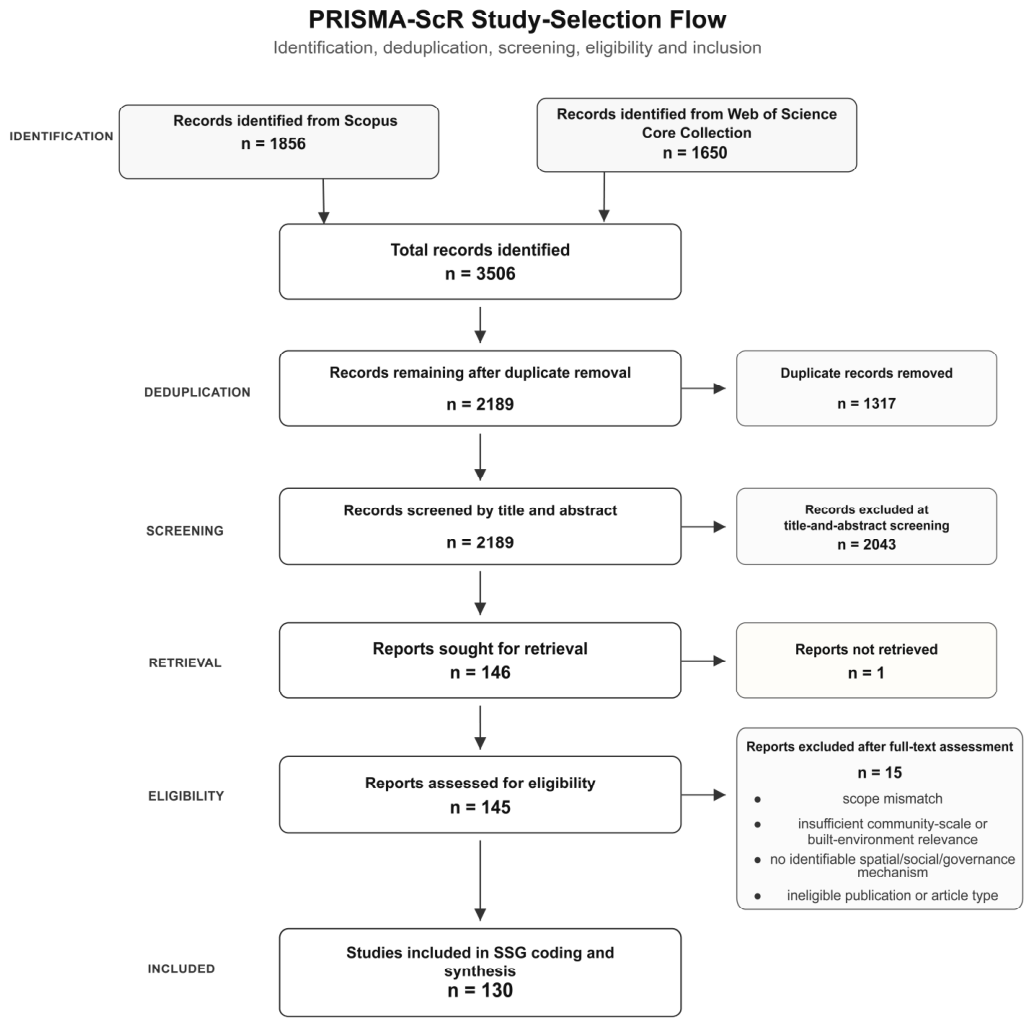
The database searches identified 3506 records in total, comprising 1856 records from Scopus and 1650 records from Web of Science. Records from both databases were consolidated in a structured screening workbook before screening. Duplicate removal was conducted before title-and-abstract screening by matching the DOI where available. For records without a DOI or with incomplete DOI information, duplicate status was checked using normalized title, author, publication year, and source-title information. When duplicate records referred to the same article, one record was retained for screening and the duplicate entry was removed. This process removed 1317 duplicate records and left 2189 unique records for title-and-abstract screening. After title-and-abstract screening, 146 reports were selected for full-text retrieval and eligibility assessment. This staged procedure ensured that the full-text corpus was derived from a transparent and reproducible screening process rather than from ad hoc selection. The 3506 records constituted the identification set rather than the analytical corpus. They included 1317 duplicate records and 2043 records that did not meet the title-and-abstract eligibility criteria; a further 15 reports were excluded after full-text assessment. Because the unit of analysis was the eligible full-text article, analyzing all identification records would combine duplicate and out-of-scope records with eligible evidence and would not permit reliable SSG coding. Accordingly, the size of the synthesis corpus was determined by the predefined eligibility process rather than by an a priori numerical target, consistent with the mapping purpose of a scoping review [
32,
34].
Screening was conducted using a structured screening workbook and the protocol-defined eligibility criteria. Initial title-and-abstract screening identified records for full-text retrieval, while full-text eligibility assessment determined final inclusion for SSG coding. Records that could not be decided confidently in the first pass were marked as uncertain and retained for conservative rechecking before final inclusion or exclusion. Full-text screening was conducted using a three-level decision structure:
Include: The article met the eligibility criteria and provided sufficient evidence for SSG coding.
Exclude: The article did not meet the scope, document type, intervention, scale, or built-environment relevance criteria.
Uncertain: The article required rechecking because the fit was borderline or the evidence did not clearly support a full include or exclude decision.
All uncertain cases were subsequently rechecked against the same eligibility criteria and resolved before synthesis. This rechecking step was used as a consistency safeguard to ensure that borderline records were not included or excluded on the basis of a single-pass judgement. Inaccessible full texts were not coded as exclusions. They were recorded separately as full-text retrieval failures. The complete PRISMA-ScR study-selection process, from database identification to final inclusion, is visualized in
Figure 1. This procedure created a traceable screening pathway from database retrieval to final inclusion. Records were not selected for narrative relevance after reading; rather, they moved through a staged eligibility process in which retrieval status, full-text decision, exclusion reason where applicable, and final inclusion status were recorded before SSG coding.
2.6. Full-Text Retrieval and Eligibility Outcome
The full-text retrieval pool consisted of 146 reports. Of these, 145 full texts were retrieved and assessed. One report could not be retrieved despite repeated access attempts and was retained as full text not retrieved. After full-text eligibility assessment and conservative rechecking of uncertain cases, 130 studies were included for SSG coding, 15 reports were excluded, and no uncertain records remained. Open-access status was recorded as a bibliographic characteristic but was not used as an inclusion or exclusion criterion. Of the 146 reports sought for retrieval, 145 (99.3%) were retrieved and assessed, while only one report (0.7%) remained unavailable after repeated access attempts. The selection process was, therefore, not restricted to open-access journals. Nevertheless, as with any database-based full-text review, residual bias associated with database coverage, language, publication type, and document accessibility cannot be completely excluded.
2.7. Data Charting
A structured data-charting form was developed to extract bibliographic, methodological, and analytical information from each included study. The charting process followed an iterative but controlled procedure. Initial fields were defined in the protocol; additional clarification fields were added only when needed to support transparent synthesis. The final charting fields covered bibliographic data, scale, evidence type, sustainability practice, intervention type, spatial mechanism, social mechanism, governance mechanism, mechanism notes, evidence confidence, and final thematic cluster. The spatial scale was coded from the principal spatial unit explicitly named and substantively analyzed in each full text. The registered protocol and data-charting form specified categorical urban-scale fields rather than the standardized physical-area or population measurements, and comparable numerical size data were not consistently available across the included studies. Accordingly, retrospective km
2, population, radius, or comparable physical-size thresholds were not imposed on the corpus. To provide a common scale ruler for cross-study synthesis, the existing spatial-scale categories were instead mapped onto a standardized ordinal measure of analytical extent: Level 1 represented a discrete site or street setting; Level 2 represented a local neighborhood or community unit; Level 3 represented a district or other multi-neighborhood sub-city unit; and Level 4 represented a citywide or multi-area urban analytical frame. Explicitly multi-scalar studies connecting a defined local intervention or evidence base with a wider urban system, strategy, or policy were designated as nested local-to-city configurations linking Level 2 (local) and Level 4 (urban/city). The ordinal ruler, therefore, standardizes relative analytical extent across heterogeneous planning systems without implying equivalent physical area or population size. For the aggregate spatial-scale reporting, the two study-level labels occupying Level 2—neighborhood and community—were combined into a single harmonized category, local neighborhood/community. This reduced the aggregate spatial-scale profile from six to five categories, while preserving the original study-level labels for auditability. Neighborhood and community, therefore, remain distinguishable in the study-level
Supplementary Data, but contribute jointly to the Level 2 local category. The remaining categories correspond to Level 1 (public space/street), Level 3 (district), Level 4 (urban/city), and the explicitly multi-scalar nested local-to-city category linking Level 2 (local) and Level 4 (urban/city). At the study level, the source-facing spatial-scale labels were operationalized using mutually exclusive decision rules based on the principal spatial unit substantively analyzed in each article. Public space/street was used for a discrete public-realm site, street segment, or corridor. Neighborhood was assigned only when the principal analytical unit was a geographically bounded, named, or functionally coherent sub-city area. Community was assigned when the principal unit was a place-linked social, user, stakeholder, or service catchment that was not delimited as a neighborhood in this study. District was reserved for a formal or functional sub-city unit comprising multiple neighborhoods or local intervention areas, whereas urban/city was reserved for citywide or multi-area analyses in which a specific community-scale intervention, process, or mechanism remained identifiable. Studies that explicitly analyzed a defined local intervention together with a wider urban system, strategy, or policy were classified as nested local-to-city rather than as an intermediate physical-size category. Where more than one scale term appeared in the full text, the assignment followed the scale at which the intervention, evidence, and analytical claims were principally developed, so that each study contributed to one spatial-scale category only. The data-charting and codebook fields are summarized in
Supplementary Table S6, and the completed study-level SSG coding matrix is provided in
Supplementary Table S7.
2.8. Spatial–Social–Governance Coding Framework
The main analytical procedure was SSG coding. For the purpose of mutually exclusive cross-study aggregation, each included article was assigned one dominant thematic cluster and one dominant code within each SSG dimension. Dominance was used as a prioritization rule rather than as a claim of mechanism exclusivity. The selected code represented the mechanism most directly supported by the article’s stated aim, intervention or object of analysis, empirical material, analytical emphasis, and reported contribution. Where more than one mechanism appeared central, the coding decision was reconsidered during the second-pass review against the same criteria and the codebook.
This single-label strategy enabled each study to contribute once to each aggregate frequency distribution and prevented the same article from being counted repeatedly within a dimension. It also introduced an intentional analytical compression. The resulting frequencies represent the primary analytical emphasis assigned to each study; they do not represent every mechanism reported in the full text or the prevalence of those mechanisms in real-world practice. Mechanisms that were substantively present but not selected as dominant may, therefore, appear less frequently in the aggregate tables. This effect is particularly relevant to cross-cutting mechanisms—such as equity, stewardship, health and wellbeing, lived-experience evidence, partnership, and monitoring—that may operate alongside a more explicit primary intervention or governance emphasis.
Secondary mechanisms were retained in the study-level narrative notes in
Supplementary Table S7 and were used to preserve contextual complexity during interpretation. They were not treated as standardized multi-label variables and were not added to the aggregate frequency tables. Consequently, low or zero values in the dominant-code tables and matrices should not be interpreted as evidence that the corresponding mechanism or relationship was absent from all underlying studies.
Table 5 provides the canonical definitions used for the three SSG dimensions throughout this manuscript.
2.9. Thematic Synthesis
The synthesis proceeded in three stages. First, included studies were grouped by dominant thematic cluster. This produced eight thematic categories: nature-based and green–blue infrastructure practices; housing, retrofit and settlement upgrading; neighborhood sustainability assessment and planning; public-space transformation and placemaking; digital tools, mapping, and monitoring; circular neighborhood infrastructures; streets, mobility, and walkability; and heritage-led regeneration.
Second, the dominant spatial, social, and governance codes were summarized descriptively. These distributions were constructed as mutually exclusive counts so that each study contributed once within each SSG dimension. They were interpreted as distributions of primary analytical emphasis rather than exhaustive mechanism-prevalence estimates. Secondary-mechanism notes informed the qualitative interpretation of clusters and representative studies but were not used to populate frequency tables or calculate co-occurrence rates. Third, a dominant spatial–social mechanism matrix was constructed to compare the primary pairings assigned to the included studies. The matrix and the governance distribution informed the development of the SSG framework by identifying recurring primary configurations. Accordingly, the framework organizes the most visible dominant-code patterns in the reviewed corpus; it does not constitute a complete network of all mechanisms reported across the 130 studies.
The synthesis was descriptive and interpretive rather than statistical. No meta-analysis was conducted because the included studies were heterogeneous in design, evidence type, intervention form, scale, and outcome reporting. This is consistent with the aim of a scoping review, which is to map the extent, range, and nature of the evidence and to clarify concepts and knowledge gaps.
2.10. Quality Appraisal and Evidence Confidence
Consistent with scoping review methodology, this study did not conduct formal risk-of-bias appraisal or intervention-effect assessment, because the review aimed to map the range, structure, and mechanisms of the evidence base rather than estimate comparative effectiveness [
32,
34]. Methodological relevance was instead addressed through evidence-type charting and an author-developed coding-confidence assessment, which indicated whether the spatial, social, and governance mechanisms were clearly identifiable from the full text.
High confidence was assigned when the article clearly described the intervention, context, community scale, and implementation mechanism. Medium confidence was assigned when the article was relevant, but one mechanism dimension was less explicit. Low confidence was reserved for borderline cases; these were rechecked before final inclusion or exclusion. No uncertain records remained in the final synthesis. The resulting confidence distribution is reported in
Supplementary Table S8. Coding confidence assessed the clarity with which mechanism evidence could be identified in the full text. It was not an inter-rater reliability statistic, a test of alternative dominant-code assignments, or a sensitivity analysis of the single-label coding strategy. A high-confidence rating, therefore, indicates clear evidence for the assigned profile, not that other plausible secondary mechanisms were absent.
2.11. Methodological Transparency and Reproducibility
All screening decisions, retrieval outcomes, exclusion reasons, SSG codes, and synthesis categories were recorded in a structured screening and coding workbook. The workbook was organized to preserve a methodological audit trail from database retrieval to final synthesis. It included separate sheets for database export, duplicate removal, title-and-abstract screening, full-text retrieval, uncertain-case resolution, full-text eligibility decisions, PRISMA summary, SSG coding, codebook, thematic synthesis, mechanism matrix, and evidence profile. This structure ensured that each included study could be traced from its bibliographic record to final inclusion, thematic cluster, SSG mechanism codes and synthesis category.
The
Supplementary Materials provide the corresponding external documentation for this process, including the search strategy and protocol-alignment note, the PRISMA-ScR checklist, the full screening and retrieval summary, the full included-studies list, the representative study-level evidence by thematic cluster, the excluded full-text reports with reasons, the SSG codebook, the study-level SSG coding matrix, the evidence-confidence summary, and the evidence-gap audit supporting RQ5. Together, the PRISMA flow diagram,
Section 2, and
Supplementary Materials document how the final corpus of 130 included studies was screened, coded, and synthesized.
3. Results
3.1. Search, Retrieval, and Full-Text Selection Outcome
The screening and eligibility process produced a final synthesis corpus of 130 included studies. These studies were not used as illustrative examples for a narrative review; each was entered into the SSG coding structure and assigned study-level values for evidence type, spatial scale, thematic cluster, spatial mechanism, social mechanism, governance mechanism, and coding confidence. The results reported below are derived from this coded evidence base. Unless otherwise stated, mechanism frequencies and cross-tabulations in the following sections refer to dominant codes. They describe the primary coded emphasis of the included studies and should not be read as counts of every mechanism mentioned or substantively present in the full texts. This section, therefore, moves from descriptive mapping to mechanism-based synthesis by reporting the evidence profile, scale distribution, thematic clusters, spatial–social mechanism matrix, and governance mechanism frequencies generated through SSG coding.
3.2. Profile of the Included Evidence Base
The included evidence base was strongly oriented towards applied, empirical, and participatory research. Empirical articles and mixed-evidence studies formed the largest group, followed by participatory case studies. Framework, toolkit, and method papers also formed a substantial part of the corpus, indicating that the field includes practice-oriented instruments, implementation methods, and decision-support approaches alongside evaluations of interventions. Survey and perception-based studies were also represented, while simulation or model-based studies were uncommon.
This distribution is important for interpreting this review. The evidence base does not represent the conventional technical intervention literature alone; it also includes studies in which participation, local perception, stakeholder negotiation, governance arrangements, and implementation tools form part of the analytical focus.
In the harmonized five-category spatial-scale profile, Level 2 local neighborhood/community studies formed the largest component of the corpus (
n = 82, 63.1%). This aggregate category combines studies originally charted as neighborhood (
n = 48) or community (
n = 34), while retaining those original study-level labels in the supplementary audit trail. Urban/city studies accounted for 26 studies (20.0%), followed by nested local-to-city studies (
n = 11, 8.5%), public-space/street studies (
n = 7, 5.4%), and district studies (
n = 4, 3.1%). The five-category harmonization was used to simplify cross-study comparison on the standardized spatial ruler and did not alter the underlying study-level eligibility or scale evidence.
Table 6 consolidates the evidence-type profile and the harmonized operational spatial-scale profile of the included studies.
Overall, the evidence profile indicates that community-scale sustainability in the built environment is not primarily represented as a single project type. Rather, it appears as a field of spatially situated practices in which technical, ecological, social, and governance dimensions are combined at different scales of urban action.
3.3. Thematic Distribution of Community-Scale Sustainable Built-Environment Practices
The thematic synthesis identified eight major clusters of community-scale sustainable built-environment practices. These clusters do not represent mutually isolated domains. Instead, they indicate the dominant entry point through which each study approached community-scale sustainability.
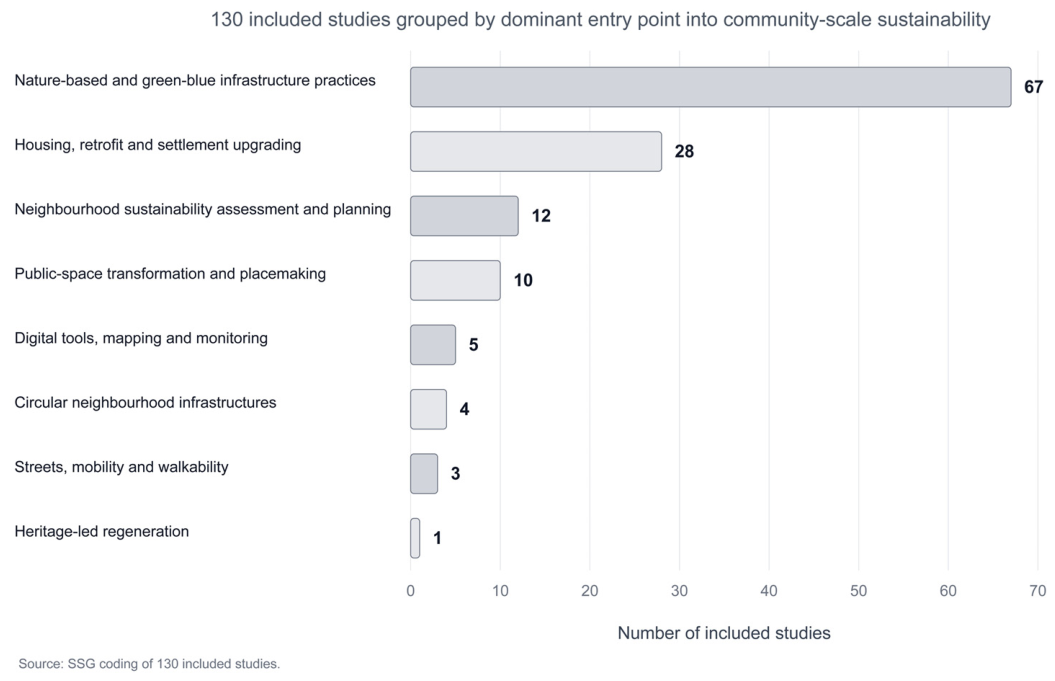
Figure 2 visualizes the thematic distribution of the 130 included studies across the eight clusters identified through SSG coding.
Figure 2 shows that the evidence base is not evenly distributed across practice families. More than half of the included studies are concentrated in nature-based and green–blue infrastructure, while housing, retrofit, and settlement upgrading form a substantial second cluster. The remaining categories are smaller but analytically important because they extend the field toward assessment tools, public-space transformation, digital evidence systems, circular neighborhood infrastructures, mobility, and heritage-led regeneration.
The largest cluster was nature-based and green–blue infrastructure practices, accounting for 67 of the 130 included studies. Within the reviewed corpus, community-scale sustainability was most frequently framed through urban greening, nature-based solutions, blue–green infrastructure, urban heat mitigation, flood adaptation, coastal resilience, stormwater management, and local environmental stewardship. These studies typically connected spatial interventions to participation, risk awareness, perception, co-design, or local stewardship, rather than treating green infrastructure as a purely ecological or engineering solution.
The second-largest cluster was housing, retrofit, and settlement upgrading, with 28 studies. This cluster included social housing renovation, neighborhood retrofit, district-scale energy renovation, informal settlement upgrading, slum settlement management, and housing-related livability interventions. These studies were especially important because they linked the built environment to vulnerability, health, access, affordability, institutional support, and everyday quality of life.
Neighborhood sustainability assessment and planning formed the third cluster, with 12 studies. These studies developed or applied assessment tools, planning indicators, suitability analyses, GIS-supported evaluation methods, or decision-support frameworks. Their contribution lies less in direct physical intervention and more in structuring how neighborhood-scale sustainability is measured, prioritized, and translated into local planning decisions.
Public-space transformation and placemaking accounted for 10 studies. These studies focused on tactical urbanism, temporary public-space transformation, placemaking, heat adaptation, participatory design, public-space safety, accessibility, and everyday social use. These studies frequently represented relatively small-scale spatial changes as relevant to how public spaces are occupied, perceived, and governed.
Digital tools, mapping, and monitoring formed a smaller but analytically important cluster of five studies. These studies used crowd mapping, participatory digital mapping, vulnerability mapping, spatial data, digital monitoring, or immersive tools to generate community-relevant evidence. Their significance lies in the way they translate lived experience and spatial perception into data that can inform governance and design.
Circular neighborhood infrastructures accounted for four studies and included local circularity, food systems, circular hubs, and neighborhood resource loops. Streets, mobility, and walkability accounted for three studies, while heritage-led regeneration appeared as one study. Although smaller in number, these clusters broaden the corpus towards mobility justice, low-traffic environments, cultural heritage, temporary reuse, and everyday public-space activation.
Table 7 summarizes the thematic synthesis of the included studies.
Article-level traceability is retained in
Supplementary Table S4a, which presents representative included studies for each thematic cluster and summarizes how they support the thematic interpretation. The complete list of all 130 included studies is provided in
Supplementary Table S4, while the full study-level SSG coding matrix is provided in
Supplementary Table S7.
3.4. Spatial Mechanisms
At the level of dominant coding, the corpus was distributed across eight primary spatial-mechanism categories. Green–blue infrastructure and nature-based spatial intervention was the most frequent dominant spatial code. This mechanism appeared across studies addressing climate adaptation, flood risk, heat mitigation, stormwater management, ecological restoration, urban greening, and community stewardship. Its prominence suggests that, in the recent literature, ecological infrastructure is increasingly treated as a socio-spatial system rather than as a purely environmental asset.
The second major spatial mechanism was housing, building, settlement upgrading, or retrofit. These studies foregrounded the material conditions of everyday living: housing quality, energy performance, accessibility, informal settlement infrastructure, social housing renewal, and district-scale renovation. The spatial mechanism here is not only technical retrofit but also the reconfiguration of housing and settlement environments in ways that affect health, vulnerability, social inclusion, and long-term livability.
Neighborhood-scale spatial planning and assessment formed a third mechanism. These studies did not always implement physical change directly, but they provided the spatial intelligence through which community-scale sustainability can be diagnosed and prioritized. They typically relied on mapping, indicators, planning criteria, or decision-support tools.
Public-space transformation and placemaking formed a fourth mechanism, involving tactical or designed changes to squares, streets, parks, open spaces, and everyday gathering places. These studies described relatively small spatial modifications in relation to broader sustainability aims, commonly alongside social embedding and institutional support.
The remaining spatial mechanisms were digital spatial assessment and monitoring, circular neighborhood infrastructure, street and walkability intervention, and heritage-led regeneration. These were smaller in frequency but important for expanding the field beyond ecological or housing-led interventions.
3.5. Social Mechanisms
Participation, co-design, and community engagement were the most frequent primary social emphases in the dominant-code distribution. This frequency does not indicate that participation was the only social mechanism in these studies or that secondary mechanisms such as equity, perception, wellbeing, or stewardship were absent. This mechanism appeared across all major spatial clusters and was particularly visible in nature-based infrastructure, housing/upgrading, and public-space transformation studies. Participation was not treated merely as consultation. In studies with more explicitly developed participatory designs, participation was described as supporting needs identification, co-production of knowledge, shared prioritization, acceptance building, capacity development, stewardship, or community ownership.
Community social sustainability and social cohesion formed a second major mechanism. These studies emphasized belonging, trust, local identity, livability, everyday interaction, and social support. This mechanism was particularly visible in neighborhood planning, housing/upgrading, circular infrastructure, and community-based initiatives.
Health, wellbeing, and age-inclusive social sustainability formed a third mechanism. Studies in this group connected spatial interventions to thermal comfort, aging, accessibility, safety, physical activity, health risk reduction, or wellbeing. This mechanism is analytically significant because the reviewed studies linked sustainability to everyday bodily and social experience.
Perception, acceptance, and lived-experience evidence formed a fourth mechanism. These studies used surveys, interviews, mapping, crowd-sourced data, or participatory evaluation to reveal how residents experience environmental risk, public-space quality, urban safety, green infrastructure, mobility or retrofit proposals. This mechanism is especially relevant to the synthesis because the reviewed studies frequently treated perceived legitimacy and local meaning as additional evaluative dimensions alongside technical performance.
Equity, inclusion, and vulnerable-group support formed a fifth mechanism. These studies addressed gender, aging, disability, low-income communities, informal settlement residents, climate-vulnerable groups, or marginalized publics. Finally, resilience, adaptation, and community preparedness appeared as a narrower but important mechanism in climate-risk and disaster-oriented studies.
Table 8 cross-tabulates the dominant spatial and dominant social codes to show the most frequent primary pairings within the coded corpus.
Within the dominant-coded corpus, the most frequent primary spatial–social pairing was green–blue infrastructure and participatory engagement (n = 41). The next most frequent pairing was housing or settlement upgrading and participation (n = 15), while public-space transformation and participation occurred as the dominant pairing in seven studies. These values identify recurring primary emphases in the included literature; they do not measure the strength, completeness, or real-world prevalence of the corresponding relationships. Because each article was placed in one matrix cell, studies containing several spatial or social mechanisms were necessarily compressed into a single pairing. Sparse cells may, therefore, reflect the coding rule, as well as the distribution of emphases in the literature. The matrix was used to support comparative interpretation and framework construction, not to infer exclusive or causal mechanism relationships.
3.6. Governance Mechanisms
Governance coding classified the primary institutional or organizational emphasis assigned to each study. Municipal planning, policy, and governance was the most frequent dominant governance code, assigned to 79 studies. This count indicates the prominence of municipal and policy framing as the primary governance emphasis; it does not imply that partnership, community stewardship, monitoring, or other governance arrangements were absent from the same studies. Within the reviewed corpus, this distribution indicates that community-scale practices were commonly framed through institutional, as well as local arrangements. Municipal planning, public policy, zoning, funding, climate-adaptation strategies, regeneration programs, and local-government coordination were frequently reported as primary or secondary governance conditions.
Local implementation and institutional support formed the second governance mechanism, appearing in 26 studies. These studies highlighted the importance of institutional capacity, implementation support, local intermediaries, municipal departments, community organizations, project teams, and technical assistance.
Data-informed decision support and monitoring appeared in 11 studies. This governance pathway linked spatial indicators, mapping, digital platforms, monitoring tools, and community-generated evidence with planning action in the reviewed studies. The pattern suggests an association between community-scale sustainability research and the production of usable evidence for decision-making; it does not establish such evidence as a necessary condition.
Stakeholder partnership and living-lab governance appeared in 10 studies. These studies typically involved universities, municipalities, local authorities, NGOs, professional actors, residents, technical experts, or project consortia working together through experimental or co-productive governance formats. Finally, community-led stewardship and ownership appeared in four studies. Although smaller as a dominant category, this mechanism is analytically relevant because it records instances in which local communities were described as moving from participation towards ownership, maintenance, monitoring, or self-organization.
Table 9 summarizes the frequency of dominant governance mechanisms across the included studies.
At the level of dominant coding, the governance profile is concentrated in municipal planning, policy, and institutional implementation categories. This indicates that the primary governance framing of the reviewed articles is predominantly institutionally anchored. It does not establish that community-led, partnership-based, or data-informed arrangements were unimportant; these arrangements may appear as secondary components in studies assigned to a different dominant governance category. The distribution should, therefore, be interpreted as a map of the literature’s principal governance emphases rather than as a complete inventory of governance relations in community-scale practice.
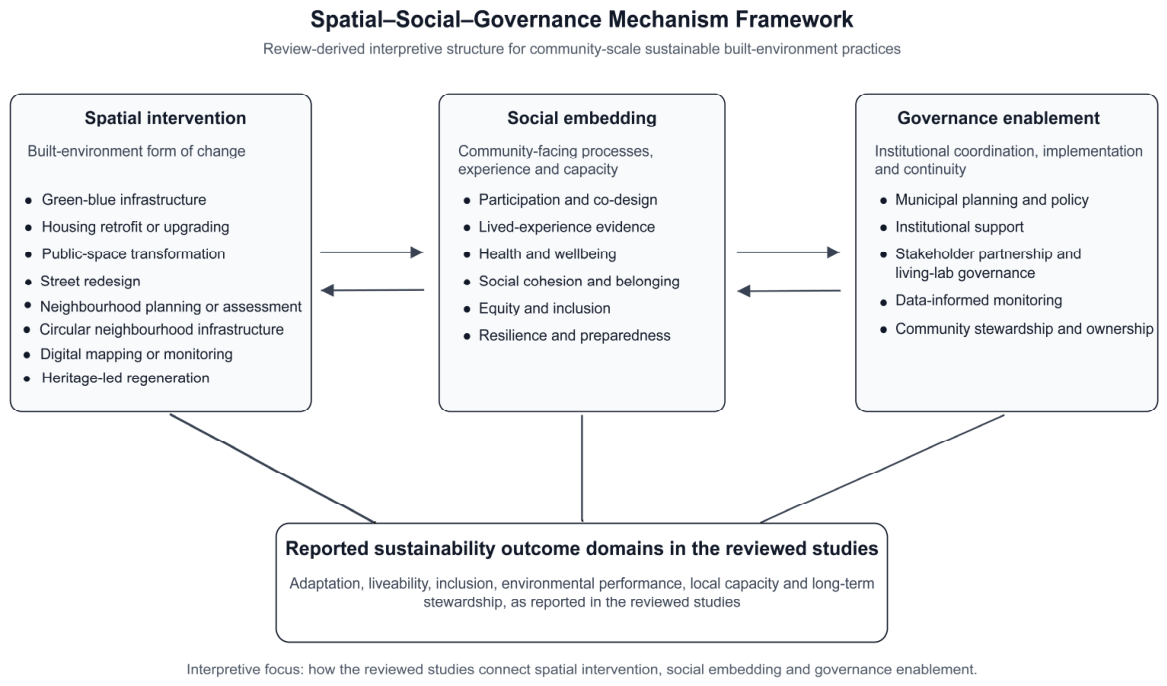
3.7. Spatial–Social–Governance Mechanism Framework
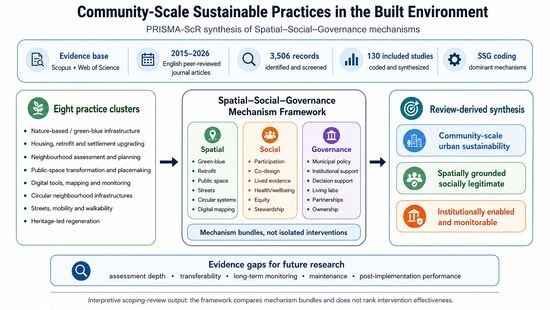
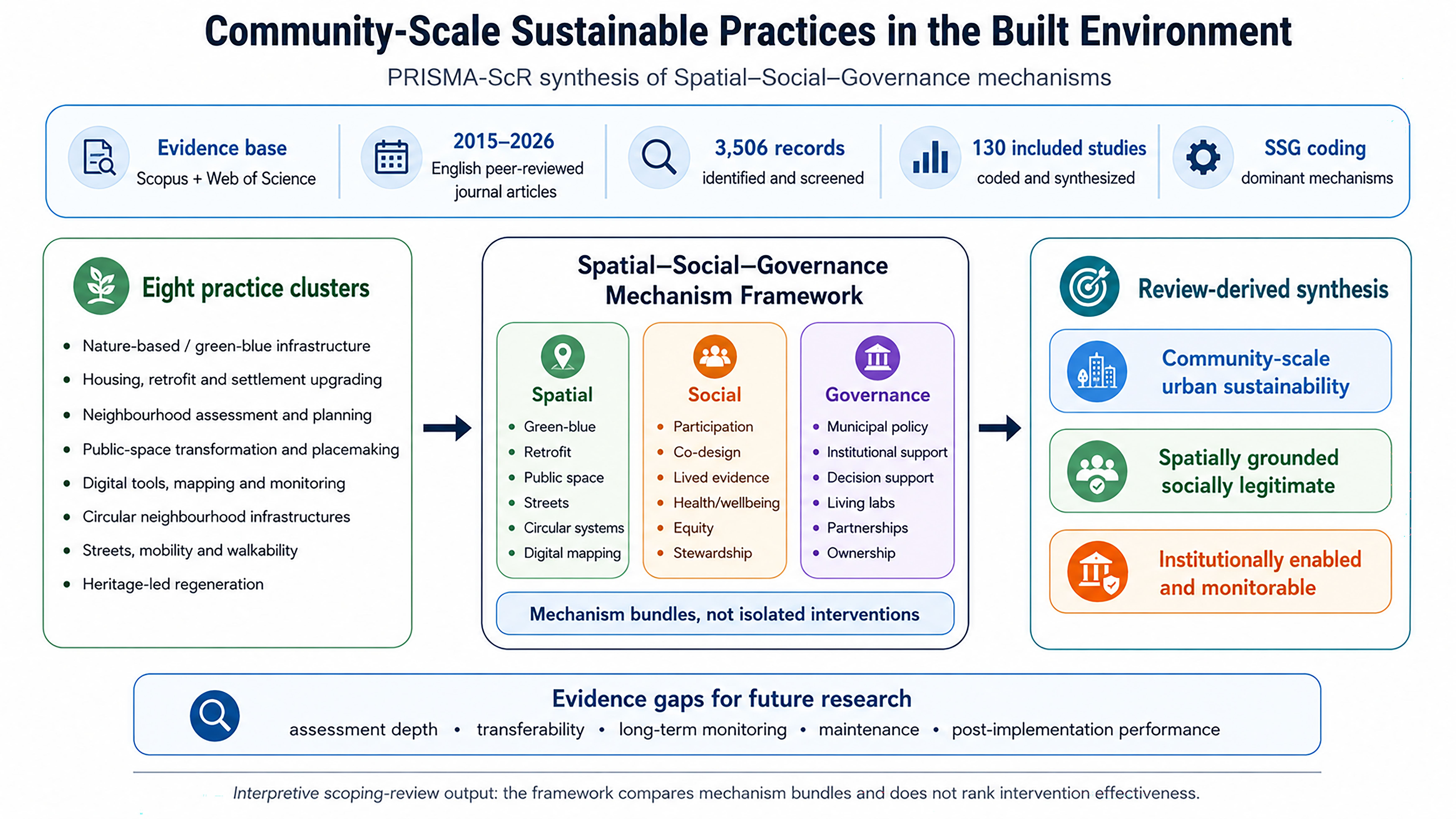
The synthesis yielded a review-specific Spatial–Social–Governance mechanism framework for organizing dominant codes and mechanism bundles across the eligible corpus. The framework does not constitute an independently validated theory and does not imply that spatial, social, and governance dimensions originated in this review. Its empirical basis is the coded distribution and combination of dominant mechanisms in the 130 included studies. The framework is organized around three analytical statements.
Because the aggregate synthesis was based on one dominant code per SSG dimension, the framework foregrounds recurring primary configurations in the corpus. It does not reproduce the complete internal complexity of each intervention or every secondary relationship documented in the study-level notes. Secondary-mechanism notes informed the interpretation and naming of the mechanism bundles, but they were not converted into a standardized multi-label matrix. The resulting framework should, therefore, be understood as a parsimonious comparative structure shaped by the dominant-code strategy, rather than as an exhaustive relational model of all mechanisms present in the reviewed studies.
Figure 3 organizes the coded evidence into three linked analytical positions already defined in
Section 2.8 and
Table 5: spatial intervention, social embedding, and governance enablement. This section, therefore, focuses on how these positions are combined within the synthesis rather than redefining the dimensions. The figure summarizes the relationships represented in the reviewed corpus and should be interpreted together with the coding definitions and decision rules reported in the
Section 2.
Figure 3 presents an interpretive synthesis of how the reviewed studies connect spatial intervention, social embedding, and governance enablement. The framework does not demonstrate that the simultaneous presence of all three dimensions produces stronger sustainability outcomes. Instead, it provides a heuristic for examining whether and how these dimensions are represented and related within a reported or proposed intervention. The potential weaknesses associated with spatial intervention without social embedding, social mobilization without material change, or governance support without local participation should, therefore, be read as analytical prompts derived from recurring concerns in the literature, not as causal effects tested by this review.
3.8. Synthesis Statement
Across the included studies, the dominant SSG codes can be organized into recurring mechanism bundles rather than treated only as isolated intervention categories. The most frequent coded configuration combined green–blue or nature-based spatial intervention, participatory engagement, and municipal or institutional governance. Other recurring configurations connected housing or settlement upgrading with resident needs and implementation support, and neighborhood assessment tools with lived-experience evidence and planning decision support. These configurations summarize primary analytical emphases within the reviewed corpus; they do not establish that the bundles are complete, superior, or causally effective.
Table 10 presents the resulting typology and the enabling conditions most commonly associated with each bundle in the included studies.
Table 10 indicates that the reviewed articles frequently described spatial change together with social and governance conditions. This pattern supports an interpretive shift from cataloguing intervention objects towards comparing how studies frame intervention, participation, and implementation. It does not demonstrate that community-scale sustainability is produced only through SSG alignment or that more closely aligned bundles are more effective. Such propositions require outcome-based comparative or longitudinal testing.
4. Discussion
4.1. From a Catalogue of Practices to a Mechanism-Based Interpretation
The Results established the distribution of practice families and dominant SSG codes; the central interpretive question is, therefore, not which category is numerically largest, but whether heterogeneous practices can be compared through a common mechanism logic. Across otherwise distinct domains, the reviewed studies frequently represented material or spatial intervention alongside community-facing processes and institutional arrangements. This pattern supports the use of mechanism bundles as a cross-domain comparison lens, while not implying causal equivalence or comparative effectiveness.
From a planning-theory perspective, participation and co-design should not be treated as self-validating indicators of social embedding. Collaborative planning foregrounds dialogue, knowledge exchange, and institutional capacity, but the just-city tradition cautions that procedurally inclusive processes may still generate or preserve unequal outcomes [
26,
28]. The frequency of participation in the reviewed corpus, therefore, raises questions about who enters the process, whose knowledge becomes authoritative, how disagreement is handled, and whether participation changes material priorities or primarily legitimizes decisions defined elsewhere.
Accordingly, SSG functions as a first-order structure for organizing evidence across intervention families. Its value lies in making comparable questions visible—what changes spatially, how communities are engaged or affected, and how implementation is enabled—while broader planning and justice theories remain necessary for assessing the quality, power relations, and consequences of those processes.
4.2. The Community Scale as an Operational Scale of Urban Sustainability
Community and neighborhood scales are analytically important because they connect everyday spatial conditions with wider planning and governance processes. Locally experienced issues, such as access, heat exposure, housing quality, public-space safety, maintenance, and stewardship, are addressed through arrangements that commonly extend beyond the immediate intervention site.
The community scale should not, however, be treated as a politically neutral or self-contained spatial container. Urban political ecology interprets environmental change as a socio-natural process shaped by power and by the politics of scale, while the spatial-justice scholarship emphasizes that injustice is produced and reproduced through spatial arrangements [
27,
30]. Relevant questions, therefore, include who gains access, who bears financial or displacement-related costs, which territories receive investment, and how local projects are connected to citywide land, infrastructure, and fiscal decisions.
Within the reviewed corpus, community scale should consequently be understood as an operational and relational level rather than as evidence that local-scale approaches are inherently more effective. Its analytical relevance lies in making visible the translation between lived experience and formal planning, while the consequences of intervention remain connected to wider institutional and territorial relations.
4.3. Nature-Based and Green–Blue Infrastructure as the Dominant Practice Family
The analytical significance of the nature-based and the green–blue infrastructure literature lies not in its numerical predominance, which is already reported in the
Section 3, but in the way it commonly brings ecological intervention, participation, stewardship, justice, and municipal implementation into the same analytical field. The dominant-code matrix suggests that participatory framing is particularly visible in this practice family, but it does not establish that participation causes effectiveness or that relevant social mechanisms are absent where they were not selected as dominant. This interpretation is consistent with work on co-creation, governance, and environmental justice in nature-based solutions [
20,
23,
36,
37,
38].
The cluster’s prominence should also be read partly as a feature of contemporary research agendas and indexing vocabularies. Practices framed through maintenance, repair, informality, circularity, cultural continuity, or heritage may be less visible because they are named and documented differently. The size of the cluster, therefore, supports analysis of how ecological interventions are represented in the indexed literature, but it does not establish their substantive priority over less consistently labelled practices.
4.4. Housing, Retrofit, and Settlement Upgrading as Socially Embedded Sustainability Practice
The housing and upgrading literature is analytically important because it locates sustainability within ordinary conditions of dwelling, affordability, energy burden, accessibility, and maintenance. The interpretive point is not the size or internal composition of the cluster, but the recurring association of technical intervention with resident vulnerability, institutional support, and local implementation capacity [
12,
39,
40,
41,
42,
43].
This pattern broadens built-environment sustainability beyond environmental performance and indicates why retrofit and upgrading cannot be assessed solely through physical outputs. At the same time, the heterogeneity of study designs and the limited availability of longitudinal outcome evidence prevent causal conclusions about which social or governance factors determine implementation quality or long-term results.
4.5. Public Space, Safety, and Lived-Experience Evidence
Public-space and digital-evidence studies are relevant less because they constitute separate practice clusters than because they expose the difference between formally designed space, and lived spatial experience. Safety, accessibility, belonging, and exclusion become analytically visible when user-generated and perception-based evidence is treated as part of spatial assessment [
14,
44,
45].
Within the SSG structure, lived-experience evidence is, therefore, both a social mechanism and an evidence source, not proof of intervention success. Its value lies in revealing evaluative dimensions that technical indicators and formal policy measures may overlook, while questions concerning representation, digital access, data bias, and institutional uptake remain unresolved.
4.6. Governance as the Enabling Condition of Community-Scale Practice
The governance distribution is interpreted here not by restating category frequencies but by examining what institutional prominence means. The visibility of municipal and institutional codes indicates that many studies framed community-scale action through formal planning, delivery, and coordination arrangements.
Urban governance theory complicates a simple interpretation of this institutional prominence. Governance concerns not only the presence of local government but the configurations through which actors, resources, interests, and policy priorities are coordinated [
29]. Municipal involvement may encompass managerial delivery, welfare-oriented provision, growth-oriented coalitions, or partnership arrangements whose democratic and distributional consequences are not equivalent. Stakeholder partnership should likewise not be equated automatically with shared authority. Critical interpretation requires attention to agenda-setting, resource control, accountability, conflict, and the capacity of community actors to influence decisions rather than merely participate in them.
The limited number of studies assigning community stewardship or ownership as the dominant governance code should, therefore, be interpreted as limited visibility as a primary analytical emphasis, not as evidence that community ownership is inherently marginal or unsustainable. The corpus identifies hybrid combinations of municipal support, institutional continuity and community agency as one recurring governance configuration rather than endorsing a universal governance model.
4.7. The Conceptual Positioning and Bounded Contribution of the SSG Framework
The SSG framework requires positioning in relation to established integrative approaches in sustainability research. Its three dimensions have clear antecedents: social–ecological systems research connects resources, users, governance arrangements, and outcomes; urban social–ecological–technological systems research examines interdependent social, ecological, and technological components; the multi-level perspective explains long-term socio-technical change through interactions among niches, regimes, and landscapes; and the Connecting Nature Framework structures the planning, delivery, and stewardship of urban nature-based solutions [
5,
20,
31,
46,
47]. The SSG framework does not replace these approaches.
Table 11 clarifies the different analytical objects, explanatory purposes, and scopes of these frameworks.
Taken together, these theoretical debates identify four limits and extensions of the SSG framework. First, planning theory distinguishes procedural inclusion from substantive planning outcomes; social embedding should, therefore, not be reduced to the presence or frequency of participation. Second, urban governance distinguishes institutional coordination from democratic control; governance enablement does not by itself indicate accountability, redistribution, or community power. Third, political ecology and spatial-justice approaches show that spatial interventions redistribute environmental goods, risks, visibility, and investment across groups and territories; the spatial dimension must, therefore, be read through power and distribution rather than material form alone. Fourth, transition theory introduces temporality, path dependence, and multi-level change; a cross-sectional SSG profile cannot establish whether a local intervention challenges, reproduces, or becomes incorporated into an existing socio-technical regime [
26,
27,
28,
29,
30,
31].
These theoretical lenses do not require expanding SSG into a comprehensive theory. Instead, they specify the second-order questions that should accompany its first-order mapping function: Who participates and with what influence? Who receives benefits and who bears costs? Which institutions control resources, implementation, and accountability? At what spatial and temporal scales does change occur? Used in this way, SSG provides a structured description of the relationships represented in the reviewed corpus, while planning, governance, political-ecology, justice, and transition theories provide explanation, critique, and normative evaluation.
The comparison indicates that the defensible contribution of SSG lies neither in the invention of three previously unrecognized dimensions nor in the replacement of established sustainability theories. Its narrower contribution consists of three elements. First, it makes the material or spatial form of built-environment intervention an explicit coding axis. Second, it applies the same comparison logic across intervention families that are normally reviewed separately. Third, it links aggregate mechanism bundles to a study-level audit trail in which dominant and secondary mechanisms remain traceable.
These advantages are accompanied by clear limits. SSG does not provide the systems depth of SETS, the institutional diagnostic granularity of the SES framework, the temporal explanation of the multi-level perspective, or the implementation specificity of the Connecting Nature Framework. It should, therefore, be treated as a review-specific heuristic and comparison instrument whose usefulness requires further testing through multi-label coding, comparative application, and empirical validation in different urban and governance contexts.
4.8. Implications for Planning, Policy, and Practice
The findings offer provisional planning and policy prompts rather than validated prescriptions. The SSG framework may be used as a heuristic for examining whether a proposed or reported intervention addresses a material or spatial component, community-facing processes, and implementation or governance arrangements. Such use should remain diagnostic because this review does not demonstrate that the presence or alignment of all three dimensions causes better outcomes.
Rather than restating each mechanism bundle, practical appraisal can be organized around four questions: What spatial or material change is proposed? Whose knowledge, needs and experience shape the intervention? Which actors control resources, decisions, delivery and monitoring? How will maintenance, adaptation, and institutional continuity be addressed? These questions translate the synthesis into an evaluative prompt without treating the reviewed associations as tested determinants of performance.
Equity should similarly not be treated merely as an additional outcome. Just-city and spatial-justice perspectives require separate consideration of who participates and exercises influence, how benefits and burdens are distributed, and whose needs and identities are recognized [
27,
28]. Urban political ecology adds questions concerning displacement, land-value change, and the rescaling of environmental benefits and risks beyond the immediate project boundary [
30]. These constitute normative and critical extensions of the SSG synthesis, not effects established by the descriptive review.
4.9. Limitations and Future Research
In relation to the fifth review question, the synthesis also identifies several evidence gaps concerning assessment depth, transferability, long-term monitoring, and post-implementation performance. These gaps were identified through a cross-study interpretive audit of evidence type, study-level mechanism notes, and coding-confidence records, rather than through standardized binary gap variables; the audit logic and representative Study IDs are reported in
Supplementary Table S9. This review has limitations that should be acknowledged. The synthesis is based on the final retrieved and assessed full-text corpus. One report could not be retrieved despite repeated access attempts and was, therefore, not assessed substantively. Under the final handling documented in Protocol Timing and Amendments Section and
Supplementary Table S1a, this record was treated as a retrieval failure rather than as a content-based exclusion. This review also focused on the English-language peer-reviewed journal literature indexed in Scopus and Web of Science. This improves transparency and reproducibility but may underrepresent local reports, municipal documents, community-produced evidence, and the grey literature, where many community-scale practices are documented.
The final set of 130 studies should, therefore, be understood as the eligible full-text synthesis corpus generated by the predefined review procedure, not as a statistical sample selected from 3506 otherwise comparable studies. The identification set contained duplicate and out-of-scope records that could not validly serve as SSG analytical units. Including these records in the mechanism analysis would have introduced non-eligible evidence and reduced methodological validity. Although the near-complete full-text retrieval rate reduces concern about access-related selection, the corpus may still underrepresent studies published outside Scopus and Web of Science, the non-English evidence, the grey literature, and practices described through alternative disciplinary vocabularies.
A second limitation concerns the use of one dominant spatial, social, and governance code for each study. This strategy established a consistent denominator, prevented repeated counting of the same article within a dimension and enabled comparison across a highly heterogeneous corpus. Its principal trade-off is analytical compression: complex interventions containing several interacting mechanisms were represented by the mechanism judged most central to the article’s aim, evidence, and contribution. The aggregate frequencies should, therefore, be interpreted as distributions of primary analytical emphasis, not as exhaustive counts of mechanism presence.
This compression may influence the synthesis in several ways. Broad or explicitly stated mechanisms may be more likely to receive dominant status, while cross-cutting mechanisms, such as equity, stewardship, health, lived experience, partnership, or monitoring, may be underrepresented when they operate as secondary components. Similarly, sparse or zero cells in the spatial–social matrix may result partly from the requirement that each study occupy only one cell. Because the SSG framework was developed from these dominant distributions, it necessarily foregrounds recurring primary configurations and simplifies the more extensive relational complexity contained within individual studies.
Secondary mechanisms were retained in the study-level narrative notes to reduce information loss and support interpretive reading. However, these notes were not coded as a standardized set of binary multi-label variables. They, therefore, cannot be converted retrospectively into valid secondary-mechanism frequencies without re-examining and recoding all 130 studies under explicit multi-label decision rules. An ad hoc keyword count of the narrative notes would produce inconsistent and non-comparable results and was not undertaken. Future extensions should conduct pre-specified multi-label or relational coding, report both dominant and secondary mechanism distributions, and compare whether the resulting network materially changes the prominence of mechanism categories or the structure of the SSG framework.
A further limitation concerns uneven thematic representation in the corpus. Circular neighborhood infrastructures, heritage-led regeneration, and informality-oriented practices were less visible than nature-based and green–blue infrastructure studies. This should not be read as evidence that these domains are marginal to community-scale sustainability. The findings should, therefore, be generalized to the wider community-scale built-environment field with caution, because the most visible patterns in the corpus partly reflect the prominence of nature-based and green–blue infrastructure within the indexed peer-reviewed urban sustainability literature. Less visible domains may be less consistently indexed through the search terms used in bibliographic databases, more frequently documented in the grey literature or municipal reports, or framed through alternative vocabularies, such as repair, reuse, upgrading, everyday infrastructure, cultural continuity, or informal governance. Future reviews could address this limitation by combining bibliographic database searches with targeted grey-literature searches, broader regional databases, and more explicit informality-related search terms.
A third limitation concerns outcome evidence. Many included studies describe participatory processes, planning frameworks, toolkits, or intervention designs, but fewer provide long-term evidence on maintenance, institutionalization, behavioral change, equity outcomes, or post-implementation performance. This is a critical gap. Future studies should move beyond short-term intervention evaluation and examine how community-scale sustainability practices evolve over time, especially after project funding, pilot phases, or research involvement ends.
This gap also points to the need for a more critical account of implementation failure. Community-scale sustainable built-environment practices may fail not because the spatial idea is weak, but because maintenance responsibilities remain unclear, municipal support declines, community participation is not sustained, monitoring systems are not institutionalized, or short-term pilot funding ends before practices become embedded in everyday governance. Future research should, therefore, examine not only successful implementation but also partial implementation, non-adoption, discontinuation, maintenance burden, and post-project decline. Such evidence is necessary for understanding which SSG mechanism bundles remain durable after the initial design, pilot, or engagement phase.
Future research should test the SSG framework across different urban contexts, income settings, governance regimes, intervention families, and degrees of community control. Comparative, longitudinal, and post-implementation designs are needed to assess whether, how, and under what conditions particular mechanism configurations are associated with implementation continuity, maintenance, equity, and other reported outcomes. Future systematic or scoping reviews could also combine the peer-reviewed literature with municipal plans, project reports, and community-generated datasets. Such work would extend the evidence base and permit effectiveness-related propositions to be evaluated rather than inferred from descriptive frequency patterns.