Article

Perceived Research Priorities in Sustainable Urban Logistics: Insights from the University Community Using a Hybrid Multi-Criteria Decision-Making Model


by
Juan Antonio Marco Montes De Oca
1,*,
Tomás García Martín
2 and
Marta Serrano Pérez
2
1
Department of Business and Logistics, Florida University, Calle Rei En Jaume I, 2, 46470 Catarroja, Valencia, Spain
2
Polytechnic School of Technology and Science, Camilo José Cela University (UCJC), Calle Castillo de Alarcón, 49, Villanueva de la Cañada, 28692 Madrid, Spain
*
Author to whom correspondence should be addressed.
Urban Sci. 2026, 10(7), 394; https://doi.org/10.3390/urbansci10070394
Submission received: 2 June 2026 / Revised: 30 June 2026 / Accepted: 7 July 2026 / Published: 9 July 2026
(This article belongs to the Section Urban Mobility and Transportation)

Abstract

Sustainability of urban logistics or last-mile logistics (LML) has been extensively studied from the perspective of experts and professionals whose objectives and interests have been closely linked to their organisations. For this reason, the conclusions drawn from these studies have had an inherent bias that is difficult to overlook. The aim of this study is to identify perceived research priorities in sustainable urban logistics through an innovative approach based on weightings established by a ‘university community’. To carry out this study, a hybrid multi-criteria model is proposed, used to weight twelve criteria employed to compare fourteen categories grouping the lines of research in LML. The main contributions of this work have therefore been: to provide an atypical perspective grounded in the ‘university community’, and to design a hybrid multi-criteria model capable of efficiently forecasting which perceived research priorities will be most relevant in the future in LML. The most significant conclusions of this study highlight the strong value that the ‘university community’ assigns to research areas in LML focused on collaborative workstreams among stakeholders. This is understood as a systemic and strategic approach grounded in the implementation of urban logistics infrastructures that enhance process efficiency through regulatory and collaborative mechanisms aimed at increasing the sustainability of LML.

1. Introduction

Urban logistics or last-mile logistics (LML) comprises the set of processes responsible for moving, storing and managing goods within the physical boundaries of a city, town or urban centre, designed to meet the needs of customers operating under different business models (primarily B2B and B2C) [1]. The volume and complexity of these processes are directly proportional to population density. Currently, urban centres occupy just 2% of the planet’s surface area, yet they are home to 55% of the world’s population, a figure forecast to reach 70% by 2050 [2]. This gradual increase in the population of urban areas and the resulting logistics activity (including, amongst other things, the E-Commerce business model) implies a scenario in which it is becoming increasingly difficult and urgent to maintain a sustainable balance across its three dimensions (social, economic and environmental, or as it is also known: people, planet, profit [3]) in line with the Triple Bottom Line (TBL) model coined by John Elkington almost thirty years ago. To understand the scale of the negative effects that various logistics activities can have on the sustainability of an urban environment, one need only examine some data relating to transport (it accounts for between 15 and 25% of the total kilometres travelled in a city, its vehicles occupy between 20 and 40% of road space, and it contributes to generating between 20 and 40% of CO2 [4]) and this is only considering the environmental dimension of TBL.
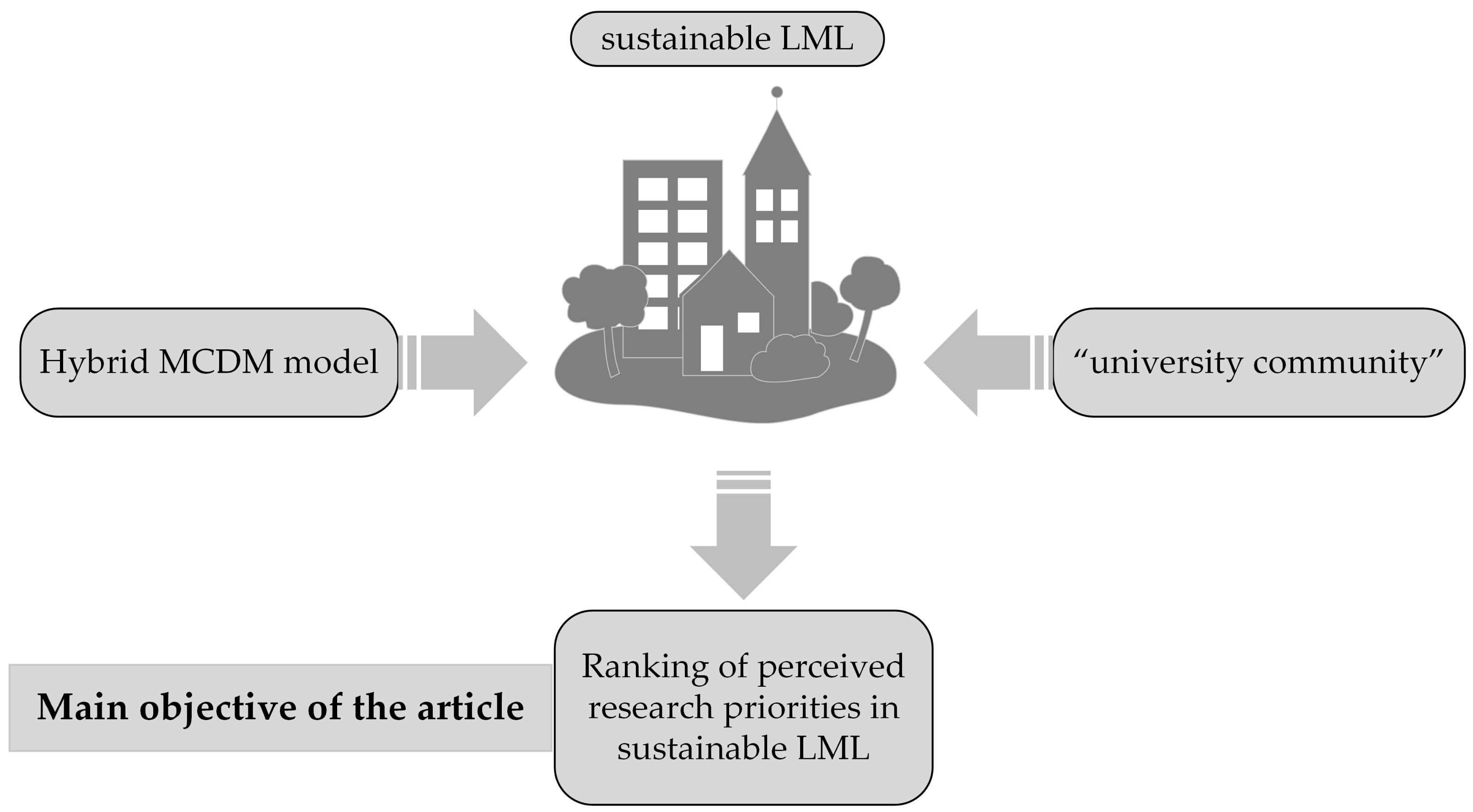
Sustainability in the urban context and its relationship with the logistical processes of goods distribution has been extensively studied in the academic literature from various perspectives. A review of the literature reveals that little attention has been paid to the study of sustainability in LML from the perspective of future professionals and researchers (referred to in this paper as the ‘university community’) who are currently studying these subjects in their respective undergraduate degree, master’s or doctoral programmes and who will soon begin to form part of some of the organisations that are currently key stakeholders in urban logistics. Studying perceived research priorities on the sustainability of LML from the perspective of these ‘university community’ members has been the original and novel starting point of this study (Figure 1).
On the other hand, designing innovative operational approaches, developing technological solutions, establishing public regulations and understanding the roles and responsibilities of the various stakeholders in LML requires taking into account the diverse and complex variables of an urban centre. All these variables must be specified and set out in a set of criteria that form the basis on which research alternatives in future LML will be compared and evaluated [5]. Obtaining conclusive results also involves posing a multi-criteria decision-making (MCDM) problem between criteria and alternatives.
This manuscript addresses the study presented with the support of two main working groups: LML experts and the ‘university community’. The combination of contributions provided by experts and the ‘university community’ is grounded in the literature that recognises the validity of integrating heterogeneous perspectives within MCDM methods. Previous studies have shown that these methods allow the integration of opinions from experts with different levels of competence or experience, provided that the aggregation procedure is robust and transparent [6]. Likewise, research focused on university evaluation has employed the ‘university community’ as a legitimate type of expert stakeholder, as their direct experience provides situated knowledge relevant to the assessment of educational and professional aspects [7]. Complementarily, the literature also shows that heterogeneity in the origin of the knowledge used does not compromise the validity of the analysis when appropriate MCDM techniques are applied [8]. In this sense, combining both groups (experts and the ‘university community’) makes it possible to capture a broader and more representative view of the future context of sustainability in LML.
To enhance the strengths of MCDM methods, this study has introduced the application of a hybrid MCDM decision model that combines the DEMATEL method and the ADAM method, thereby contributing to MCDM theory in the field of LML. The integration of both methods offers analysts a more flexible and robust framework for complex decision-making.
To better contextualise the contribution of this study within the existing body of research on sustainable urban logistics, it is important to highlight how the present work differs from and advances beyond previous studies. While earlier research has predominantly relied on expert-based evaluations and well-established MCDM methods, the current study introduces both an alternative respondent group and a hybrid methodological approach that remains scarcely explored in the field. The following table (Table 1) provides a concise comparative overview that positions this study relative to prior contributions and clarifies its distinctive value within the state of the art:
According to the description provided, the main objectives of this study are:
(1)
To forecast which perceived research priorities and work alternatives will become trends in relation to sustainability in LML, as perceived by the ‘university community’.
(2)
To do so by applying a hybrid MCDM framework based on the DEMATEL-ADAM combination, which remains scarcely explored in LML.
To this end, this paper comprises six sections. Following the introduction, Section 2 provides a review of the literature. Section 3 addresses the methodology used in this research, based on its framework. Section 4 describes the case study conducted (approach, data collection and description of alternatives and criteria), and the results obtained. Section 5 details the theoretical and managerial implications of the research, whilst Section 6 sets out the final conclusions.

2. Literature Review

LML and MCDM have been popular topics in the literature within the context of urban sustainability, and this has led to the production of a significant body of publications combining both fields. Furthermore, the sustainability of LML processes has been formulated on the basis of establishing criteria for measurement and a set of alternative lines of research to achieve such sustainability. It was therefore crucial for this research to conduct a review of the relevant literature on these topics.

2.1. Application of MCDM Methods in Sustainable LML

By creating a keyword filter using a tailored search query (‘last mile logistics’ OR ‘urban freight’ OR ‘urban logistics’ OR ‘urban delivery’ OR ‘city logistics’ AND ‘multi-criteria’) in the two main global academic reference databases (Scopus and Web of Science), a realistic snapshot can be obtained of where and how these methods have been applied to the field of LML to date (Table S1 provided as an appendix to this article; see Supplementary Materials).
In Table S1, the corpus of collected studies has been classified by approach (single/hybrid) and by the authors’ choice of uncertainty treatment (fuzzy/non-fuzzy) [9,10,11,12,13,14,15,16,17,18,19,20,21,22,23,24,25,26,27,28,29,30,31,32,33,34,35,36,37,38,39,40,41,42,43,44,45,46,47,48,49,50,51,52,53,54,55,56,57,58,59,60,61,62,63,64,65,66,67,68,69,70,71,72,73,74,75,76,77,78,79,80,81,82,83,84,85,86,87,88,89,90,91,92,93,94,95,96,97]. The result is that approximately 60% of the studies have been treated using a hybrid approach. This indicates that researchers have sought to harness the combined strengths of MCDM methods to minimise their weaknesses or inefficiencies when used in a simple and independent manner. On the other hand, almost 63% of the studies included in this collection have opted for a traditional or classical treatment of MCDM methods (i.e., non-fuzzy). Based on the data extracted, this manuscript proposes the use of a hybrid MCDM evaluation model consisting of the DEMATEL and ADAM method.
Given its characteristics, the use of MAMCA (Multi-Actor Multi-Criteria Analysis), was considered at an initial stage during the methodological design. However, this technique is specifically intended for decision problems in which the objective is to compare and contrast the preferences of different stakeholder groups, treating each group as an independent decision-making entity with its own weighting structure. In the present study, the aim is not to analyse divergences between groups, but rather to obtain a single, integrated view of research trends in LML as evaluated by one stakeholder group (‘university community’, in this case). For this purpose, the combined use of DEMATEL (for the weighting of sustainability criteria carried out by experts) and ADAM (for establishing a ranking of sustainable LML research trends based on ‘university community’ evaluations) was ultimately selected, as it adequately reflects the objective pursued in this work.
The combined use of DEMATEL and ADAM in this study is grounded in the complementary roles that each method plays within a MCDM framework. Rather than being redundant, the two methods address different levels of the decision problem: DEMATEL focuses on the structure and interrelationships of the criteria, whereas ADAM is devoted to the evaluation and ranking of the alternatives given those criteria. First, DEMATEL is particularly suitable for problems in which the criteria are not independent but exhibit complex causal relationships. By eliciting expert judgments on the influence among criteria, DEMATEL allows us to identify cause–effect chains, distinguish between driving and dependent criteria, and derive an influence-based weighting structure. This step is crucial in sustainability-related decision problems, where criteria such as environmental, social, and economic dimensions are inherently interdependent rather than additive or isolated. Second, once the criteria system has been clarified and weighted through DEMATEL, ADAM is employed to operationalize the evaluation of alternatives. The selection of the ADAM approach is justified by its suitability for evaluating research alternatives in a context characterised by multiple heterogeneous sustainability criteria in LML. ADAM relies on a geometric formulation that assesses each alternative through its aggregated distance to both the ideal and anti-ideal solutions using a unified operator, thereby avoiding the compensatory effects that may arise in classical methods such as TOPSIS, COPRAS, MARCOS or EDAS. Moreover, its normalisation scheme preserves the geometric structure of the data, which is particularly appropriate when criteria exhibit different scales and levels of dispersion, as is the case in this study. In addition, ADAM ensures a strictly monotonic and numerically stable ranking, a relevant property given that the evaluations are provided by university students specialised in LML, whose judgments may naturally present some variability. Overall, these characteristics make ADAM a more coherent, robust and consistent method for assessing the research alternatives considered. ADAM is designed to handle multi-criteria performance assessments and to produce a transparent and discriminative ranking of alternatives. In our study, ADAM uses the criteria structure and weights obtained from DEMATEL as input, and then integrates the performance evaluations (provided by ‘university community’) to generate a final prioritisation of alternatives. In this sense, DEMATEL informs how the criteria should be considered, while ADAM determines how well each alternative performs under that structured set of criteria. Third, this sequential integration enhances both the methodological rigour and the interpretability of the results. DEMATEL ensures that the decision model reflects the real interdependencies of the system, avoiding the oversimplification that would result from assuming independent criteria. ADAM, in turn, translates this refined criteria system into a practical decision output (the ranking), making the model actionable for decision-makers. The hybrid approach thus combines a structural analysis (DEMATEL) with a preferential analysis (ADAM).

2.2. Sustainability Criteria in LML

The starting point for studying sustainability in an urban context has recently been approached through the TBL model. This model offers an analysis of sustainability based on the study of three perspectives (economic, environmental and social) [98]. In the approach adopted in this study the criteria are used not as performance metrics but as strategic relevance indicators, reflecting the degree to which each research domain is positioned to address key sustainability concerns. A detailed description of each criterion classification is provided in Table S2 (provided as an appendix to this article; see Supplementary Materials), based on that presented in [1], which comprises twelve categories:
Social Perspective/Dimension:
C11: Habitability and Development. How urban spaces are conceived, used and transformed to ensure a city’s liveability, functionality and aesthetics, including environmental protection and maintaining consistency with urban planning, whilst incorporating infrastructure, technologies and services that improve the standard of living of its citizens, and recognising the dynamism of the economic development of its businesses and enterprises.
C12: Accessibility and Mobility. How urban mobility systems impact the efficiency of accessibility and the functioning of the city, taking into account the following variables: ease of reaching the destination(s), intermodality and integration of different modes of transport, and balance or coexistence with the city’s other stakeholders, ensuring that urban journeys are fluid, fast and well-connected.
C13: Safety and Protection. How the level of safety related to urban mobility and work-related activities linked to traffic is determined. Risks are identified, and road safety and the frequency, severity and consequences of accidents for people and urban infrastructure are assessed, with a key focus on minimising the conditions that contribute to accident rates.
C14: Satisfaction and Acceptance. How aspects relating to service quality (operational flexibility, reliability and coverage) and the perception of the service by the various stakeholders involved are assessed, through their degree of sustainable acceptance of the LML system.
C15: Stakeholder Participation and Interaction. The quality of relationships between the various LML stakeholders, measured by the degree of collaboration and trust between them, as well as the degree of social cohesion they reflect. Agreements, relational dynamics, the status of collaborative tools, etc., are assessed.
C16: Well-being. How an activity, service, system, framework, solution or technology within the LML sphere affects and impacts the quality of life of the city’s residents, including: risks (public health, occupational, road safety) and social benefits (environmental and spatial improvements, equal opportunities, fair working conditions, amongst others).
Economic Perspective/Dimension:
C21: Effect on Costs. How a logistics system is assessed in terms of economic and social sustainability, taking into account the economic components necessary to evaluate the real cost of a service, system, solution or technology applied in the context of LML, including direct costs, investments, asset depreciation and general management expenses.
C22: Effect on Profits. How to measure an entity’s ability to generate value (by increasing its revenue) and achieve profits through the logistics services it offers, whilst maintaining operational efficiency and minimising costs.
C23: Viability or Feasibility. How to assess whether a system, framework, solution or technology generates value, how long it would take to recoup the capital and resources invested, and how the investment made can be compared with the benefit derived from the resulting cost reduction.
Environmental Perspective/Dimension:
C31: Impacts on Human Health and the Ecosystem. How certain systems, frameworks, solutions or technologies may affect people’s health (diseases, toxicity, loss of productivity, amongst others) and how their operation degrades the urban ecosystem (including its flora and fauna, as well as landscape quality and sustainability).
C32: Environmental Impacts. How certain systems, frameworks, solutions or technologies may affect air, noise and visual pollution, as well as the effects on climate, soil and ecosystems.
C33: Energy Consumption and Mineral Depiction. How to assess energy performance and its sustainability over time and within the scope of LML through the consumption of energy or fuel required by each system, framework, solution or technology, and how this affects the depletion of non-renewable natural resources as well as their efficient use.

2.3. Research Alternatives in LML

The framework for classifying research areas proposed in this study comprises fourteen categories drawn from [1]. The aim was to group the research areas in detail into the category of alternatives best suited to their objectives and characteristics, as well as to their similarity to the other areas within the same category. This categorisation of research lines helped to simplify the process of evaluating the participants. The alternatives are not treated as operational projects but as strategic research avenues whose relevance can be inferred from the extent to which they address critical sustainability dimensions. This approach is consistent with foresight-oriented MCDM applications, where alternatives may represent policies, research themes, or strategic directions rather than concrete technologies. The categories proposed as alternative research areas used in this study were the following: crowdsourcing (A1), multi-level collaboration (A2), integrated passenger and goods transport (A3), lateral collaboration (A4), horizontal collaboration (A5), alternative delivery configurations (A6), Alternative vehicle technologies (A7), Infrastructure implementation (A8), alternative transport modes (A9), transport routing models (A10), vehicle access restrictions (A11), time windows for access (A12), off-hour deliveries (OHD)/night-time deliveries (A13), and pricing (A14). A more detailed description of each category is given in Table S3 (see Supplementary Materials).

3. Methodology

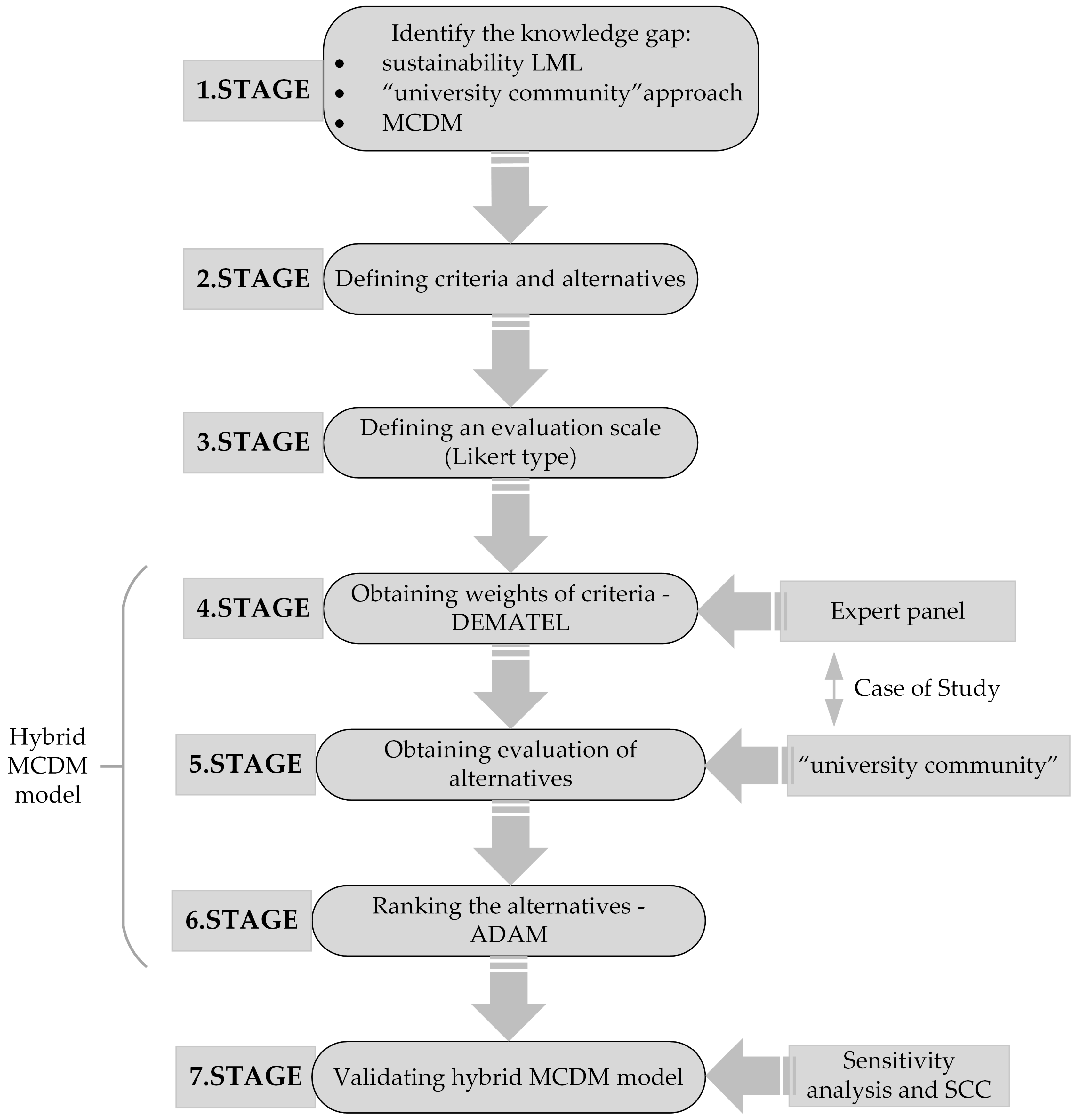
The framework of this research (Figure 2) begins, in its first stage, with the identification of a gap in academic knowledge linking the sustainability of LML with the ‘university community’ through an MCDM analysis.
In the second stage, a group of diverse experts in LML (eight experts) were invited to identify, define and classify the lines or fields of research under consideration (alternatives) and to select the sustainability criteria in LML for comparison, using the previous work carried out in [1] as a reference. The participating experts also carried out the task of weighting based on pairwise comparisons between criteria, which were then used within the DEMATEL method.
The third stage consisted of selecting and defining a verbal rating scale (Likert scale) and converting this into corresponding numerical values. Cronbach’s alpha was calculated, yielding a value of 0.923, which confirms the instrument’s reliability.
In the fourth stage, the weights of the sustainability criteria were obtained by applying the DEMATEL method in accordance with the weightings derived from the LML experts in the questionnaires conducted for the case study, thereby identifying the relationships of influence and strength between them.
The fifth stage focused on evaluating the LML research alternatives in relation to the sustainability criteria assessed by the ‘university community’ in the relevant questionnaires.
In the sixth stage, the ranking of alternatives was obtained by applying the ADAM method, thereby completing the hybrid MCDM model proposed in this study.
The seventh stage focused on validating and corroborating the stability and robustness of the results of the ranking of alternatives obtained through the hybrid MCDM model. The TOPSIS and VIKOR methods were used for this purpose. Finally, the validation of the model was completed by calculating Spearman’s correlation coefficient (SCC) and conducting a sensitivity analysis.

3.1. Identify the Knowledge Gap (1. Stage)

The study’s approach is framed around: LML sustainability, the ‘university community’ approach and MCDM methods.

3.2. Defining Criteria and Alternatives (2. Stage)

The set of criteria defining sustainability in LML and the set of alternative categories covering the lines of research to be evaluated (shown in Section 2.2 and Section 2.3) are established.

3.3. Defining an Evaluation Scale (3. Stage)

A Likert-type scale is used to weight the criteria (by the panel of experts) and to rate the alternatives (by the ‘university community’). The verbal scale selected and its numerical equivalent are shown in Table 2.

3.4. Obtaining Weights of Criteria Wj (4. Stage)

The DEMATEL (Decision-Making Trial and Evaluation Laboratory) method is used to construct the interrelationships between criteria that are not independent of one another when conducting a multi-criteria analysis for decision-making. Its main objective is to construct a vector of normalised weights W j that numerically represents the relationships of interaction and causality between criteria, which will subsequently be used in this study to compare the hybrid model alternatives.
The steps of the DEMATEL method are as follows:
  • Calculation of the initial average matrix A based on the experts’ weightings. In this first step, the panel of LML experts is asked to indicate the degree of direct influence that each criterion i exerts on each criterion j , represented as a i j in accordance with the linguistic scale. Next, each expert surveyed generates a direct matrix, and subsequently, an initial average matrix A is obtained as the geometric mean of the previous direct matrices collected from each expert. The geometric mean is used to ensure that the results are less sensitive to any extreme values obtained in the questionnaires. The initial average matrix A is represented by the following equation:
    A = a 11 a 1 j a 1 n     a i 1 a i j a i n     a n 1 a n j a n n
  • Calculation of the initial influence matrix X . The initial direct influence matrix X is obtained by normalising the initial average matrix A . To do this, the normalisation factor s is used:
    s = min 1 max i j = 1 n a i j , 1 max j i = 1 n a i j
    X = s   x   A
  • Calculation of the total relationship matrix T . This is obtained using the equation
    T = lim k X + X 2 + + X k = X ( I X ) 1
where I is the identity matrix.
4.
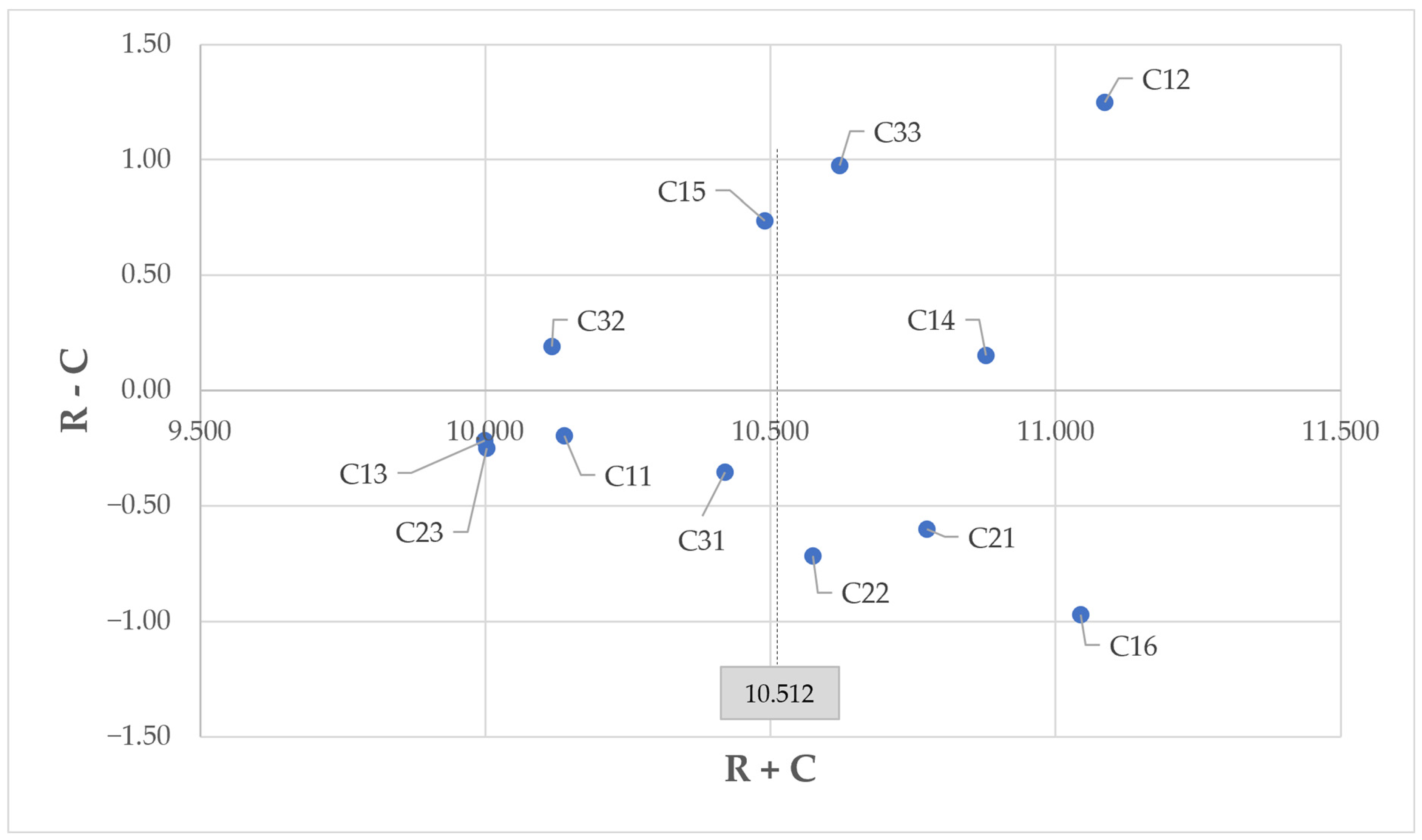
Construction of the interaction–influence map (IRM). The method is also a visual tool for representing the degree of strength or interaction between the criteria, as well as the extent to which each criterion is capable of influencing others and, in turn, being influenced by them. After calculating the matrix T , the values of each row R are summed, representing the sum of the direct and indirect effects of criterion i on the other criteria. Similarly, the sum of the values of each column C denotes the sum of the direct and indirect effects that criterion j has received from the other criteria. This is mathematically expressed in the following equations:
R = j = 1 n t i j n x 1 , i = 1 , 2 , , n
C = i = 1 n t i j n x 1 , j = 1 , 2 , , n
From here, a visual graph can be plotted by calculating R + C and R C . The values of R + C are plotted on the x-axis, showing the degree of interaction or importance of the criterion relative to the others (high, low), whilst the values of R C , plotted on the y-axis, show the degree of influence of the criterion relative to the others; this influence may be causal or influenced. If the value of R C is positive, it is classified in the group of causal criteria, whereas if it is negative, the criterion is grouped within the influenced criteria.
5.
Normalisation of the matrix T . To normalise the matrix T , each element of each column is divided by its total sum. By summing again, it can be verified that all columns must sum to 1, indicating that the normalisation process has been completed.
6.
Calculation of the normalised weight vector W j . The matrix T is considered an unweighted matrix that must be normalised. To do this, T is subjected to multiple rounds of self-multiplication until convergence [99], resulting in all values in all columns being equal to the first few decimal places. In this way, the values of any column of the resulting matrix may be chosen as components of the normalised vector W j .

3.5. Obtaining Evaluation of Alternatives (5. Stage)

The ADAM (Axial Distance-based Aggregated Measurement) method belongs to a new group of MCDM methods known as ‘geometric methods’ and is based on establishing a ranking of proposed alternatives by comparing the volumes of complex polyhedra associated with each defined alternative. The method is used to evaluate alternatives based on specific criteria.
According to [100,101], the ADAM method consists of five steps:
  • Calculation of the normalised matrix E of alternatives with respect to the criteria. To this end, the participants (in this case, the ‘university community’) evaluate the alternatives against the criteria using the verbal scale. The matrix E is constituted by the geometric mean of all the evaluations made of the alternatives in relation to the criteria. These ratings will form the elements of the matrix E described as e q j , where the alternatives are represented as q and the criteria as j follows:
    E = e q j m x n
where m is the total number of alternatives and n is the total number of criteria.
2.
Calculation of the ordered decision matrix S . The elements of the matrix S are s q j , which indicate the ordered evaluations e q j in descending order according to the importance (measured in weight) of the criterion:
S = s q j m x n
3.
Calculation of the normalised ordered matrix N . The elements of the matrix N are n q j and are obtained via
n q j = s q j max q S q j ,   f o r   j B min q S q j s q j ,   f o r   j C
where B is the set of benefits and C is the set of cost criteria.
4.
Obtaining the coordinates x , y , z of the reference points R q j and the weighted reference points P q j . These will define the complex polyhedron as follows:
X q j = n q j × sin α j , j = 1 , , n ; q = 1 , , m
Y q j = n q j × cos α j , j = 1 , , n ; q = 1 , , m
z q j = 0 ,   f o r   R q j w j ,   f o r   P q j ,   j = 1 , , n ; q = 1 , , m
where α j is the angle determining the direction of the vector defining the value of the alternative, which is obtained as follows:
α j = j 1 90 n 1 ,   j = 1 , , n
5.
Obtain the volumes of the complex polyhedra V q C . These are obtained as the sum of the volumes of the pyramids that compose them, using the following equation:
V q C = k = 1 n 1 V k ,   q = 1 , , m
where V k is the volume of the pyramid obtained by applying the following equation:
V k = 1 3 B k × h k ,   k = 1 , , n 1
where B k is the surface area of the base of the pyramid defined by the reference points and weighted reference points of two consecutive criteria, and is obtained by applying the following equation:
B k = c k × a k + a k × b k c k 2
where a k is the Euclidean distance between the reference points of two consecutive criteria, which is obtained by applying the following equation:
a k = x j + 1 x j 2 + y j + 1 y j 2
where b k and c k are the values of the vectors corresponding to the weights of two consecutive criteria, that is,
b k = z j
c k = z j + 1
where h k is the height of the pyramid from the defined base to the apex of the pyramid located at the coordinate origin 0 , 0 , 0 , obtained via the following equation:
h k = 2 s k s k a k s k d k s k e k a k
where s k is the semi-circumference of the triangle defined by the coordinates x and y of two consecutive criteria and the origin coordinate, obtained as follows:
s k = a k + d k + e k 2
where d k and e k are the Euclidean distances of the reference points of two consecutive criteria relative to the origin coordinate, obtained as follows:
d k = x j 2 + y j 2
e k = x j + 1 2 + y j + 1 2

3.6. Obtaining the Ranking of Alternatives (Stage 6)

The alternatives are ranked according to the decreasing values of the volumes of the complex polyhedral V q C q = 1 , , m . The best alternative will be the one with the highest volume value. The evaluation and ranking of the alternatives is carried out using the ADAM MCDM 1.2-beta method software http://adam-mcdm.com/ [102], (accessed on 3 March 2026).

4. Case Study and Results

This section presents the specific case study conducted for this research and the results of applying the hybrid MCDM model to it. Firstly, the case study approach will be described in general terms, including the data collection process (expert weightings for the criteria and ‘university community’ assessments for the alternatives); subsequently, the results obtained from applying each of the methods used in the hybrid MCDM model will be analysed.

4.1. Case Study Approach

The case study focuses on a higher education institution, Florida University, which offers a bachelor’s degree in Transport and Logistics Management affiliated with the Polytechnic University of Valencia (Spain). The institution has a clear strategic focus on teaching, research and the development of specialised knowledge in LML and urban mobility. This specialisation is conveyed from the teaching staff to the ‘university community’ through the proposal of specific topics and challenges within their training. Members of the ‘university community’ work on these topics from their first year until they graduate, using three basic tools: integrated research projects, participation in business events related to LML, and final-year projects. Furthermore, the centre has a research group where specialist teaching staff focus their research and teaching activities on the field of LML. Based on this approach, the authors of this study conclude that the optimal conditions exist for securing the participation and assistance of the ‘university community’.
The data for this study were collected through engagement with two large groups of participants, using information sessions and Likert-scale questionnaires. These groups consisted, on the one hand, of experts in LML and, on the other, of ‘university community’. The role of each group and the data that contributed to the final study are described below.

4.1.1. LML Experts

A panel of eight experts (academics and industry professionals) with a minimum of two years’ experience in various roles within LML were invited to participate in this study. This number of experts ensured the representativeness of nearly all stakeholders involved in LML, while also allowing the entire process of data collection and working meetings to be managed more easily and efficiently. Selection criteria were as follows: the stakeholder group to which they belong (Government Agencies (1), Shippers (2), Carriers (1), Technology Solution Providers (1), Warehouse and Facilities Owners (1), and Academics and Researchers (2)), and the functions they have performed (policy development, logistics asset planning, the design of urban logistics operations and strategies, among others) (see Table 3). The experts reviewed the alternative categories and criteria proposed in [1], proceeding with their redefinition and grouping. From this point onward, their task was threefold. Firstly, to identify, define, classify and group the lines or fields of research in sustainable LML currently being developed in both academic and business spheres. In a second stage, they were asked to analyse which sustainability criteria in LML would be most appropriate for comparing and evaluating the alternatives under study in the most objective manner. Finally, the experts also participated in the process of weighting the criteria, a mandatory step within the DEMATEL method. It is worth noting that the study previously carried out in [1] was taken as the starting point for both the process of classifying alternatives and the procedure for identifying sustainability criteria. The procedure for obtaining data from the LML experts was planned and scheduled on the basis of four meetings, each with the following objective: (1) presentation of the proposed study and its main objective, (2) identification and classification of the sustainable LML research alternatives to be studied, (3) identification and evaluation of the LML sustainability criteria for comparing alternatives, and (4) evaluation by comparing criteria in order to determine the degree of interaction and influence between them in accordance with the DEMATEL method.

4.1.2. University Community

In this section, all students from the four levels of the bachelor’s degree in Transport and Logistics Management at Florida University (90 students) were invited to participate in the study, of whom 62 ultimately took part (35 at the fourth level of the degree, 18 at the third level, and 9 at the second level). These 62 students constituted the concept of ‘university community’. The profile of the ‘university community’ was as follows: age (20.4 years on average), gender distribution (42 men; 20 women), educational level (undergraduate university students), fields of study (more than 25 specialisation courses in logistics and transportation), and geographical area of residence (towns with more than 50,000 inhabitants). The aim of their participation, which was fundamental to this study, was to use their responses to identify, from their perspective, the areas of sustainability research at LML that they considered most important to pursue or investigate (i.e., the alternatives covered by this study). The data collection procedure was carried out in a single session comprising three distinct parts: (1) explaining the context and importance of the study, (2) describing in detail the questionnaire to be completed, with its various sections (alternatives and criteria), and (3) each student’s individual completion of the questionnaire, which was prepared in a Google Forms response format.

4.2. Results

4.2.1. Results of Applying the DEMATEL Method to the Criteria

Starting from the initial average matrix of the criteria A (Table 4) obtained as a result of the expert panel’s weighting, and applying the steps outlined in Section 3.4 in accordance with the DEMATEL method, the normalised T matrix (Table 5) (obtained through successive self-multiplications) and the normalised criteria weight vector W j (Table 6) are obtained. Additionally, Table 7 presents the interactions and influences among the criteria, and Figure 3 depicts the corresponding IRM.
The normalised weight vector was obtained through a convergence procedure applied to the normalised matrix T . This procedure consists of iteratively multiplying the matrix normalised T by itself until the columns reach identical values, indicating convergence toward the dominant eigenvector. According to the Perron–Frobenius theorem, any positive and normalised matrix possesses a unique dominant eigenvector, and successive powers of the matrix converge to a rank-one matrix in which all columns are proportional to that eigenvector. This dominant eigenvector is interpreted as the vector of normalized weights of the criteria. This eigenvector-based convergence approach is commonly used in methods relying on iterative matrix stabilisation, such as Markov chain-based ranking procedures, structural analysis techniques, and eigenvector weighting schemes in the Analytic Network Process (ANP).

4.2.2. Results of Applying the ADAM Method to Rank the Alternatives

To complete the hybrid multi-criteria model proposed in this study, this recent ADAM multi-criteria method was applied to rank the alternatives proposed to the ‘university community’. The method, as described in Section 3.5 and Section 3.6, requires, on the one hand, the normalised vector of criterion weights W j (Table 6) and, on the other, the evaluation matrices of the alternatives with respect to the criteria (Table 8) and their normalisation (Table 9), obtained as a result of the assessment by the ‘university community’ group. It should be noted that this matrix represents the joint evaluation with which the respondents have rated the influence of each alternative on each of the criteria defined to measure sustainability in LML. The results were extrapolated (as with the criteria) using a geometric mean across all participants, ensuring that the model was less sensitive to any extreme values obtained in the questionnaires. From this point, and with the assistance of the ADAM MCDM method software [99], the ranking of alternatives provided by this hybrid MCDM model was obtained (Table 10). It is necessary to clarify at this point that the rankings represent the relative potential of each research domain to contribute to sustainability improvements in urban logistics, based on ‘university community’ perceptions, and do not reflect future research importance.
According to the ranking of alternatives obtained, the solution to the problem posed in the case study has concluded that the two most promising categories of research lines in sustainable LML, or those likely to generate the greatest interest for study and work, are multi-level collaboration (A2) and the implementation of infrastructure (A8) according to the ‘university community’.

4.2.3. Validation

In order to confirm the reliability of the results obtained by the proposed hybrid CDM model, these were compared with those produced by two others classical MCDM methods: TOPSIS and VIKOR. The reason for using these two methods rather than others is based on the extensive track record of applying both methods to decision-making within LML.
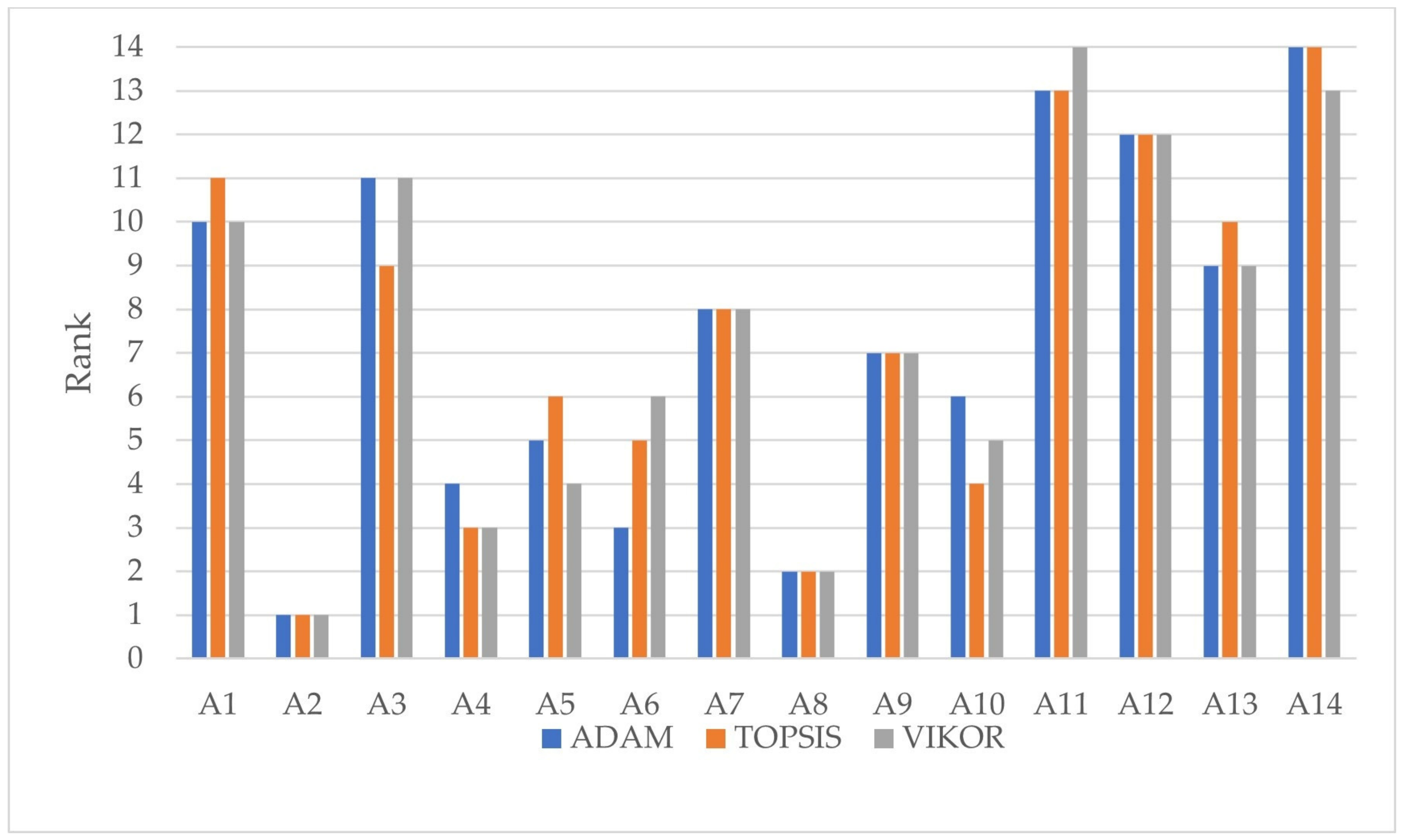
As can be seen in Table 11, the results are identical for the top two positions in the ranking. The remaining positions in the ranking vary with slight changes (a difference of one or two places within the ranking) and permutations among the results of the three methods compared (Figure 4). When analysing the positions ranging from third to sixth place across all rankings, four preferred alternatives emerge: lateral collaboration (A4), horizontal collaboration (A5), alternative delivery configurations (A6) and transport routing models (A10). This indicates a clear tendency among respondents towards alternatives involving lines of research related to collaboration between stakeholders (whether competing entities or not). From this preference, it can be inferred that the ‘university community’ understands that a sound path to achieving a sustainable LML must be based on the coordination and sharing of resources and information by all participating stakeholders. Without this collaboration, the impact of any innovation proposed to address aspects of LML may be severely compromised due to the limited effectiveness of its results, whether these are measured in terms of increased profitability for stakeholders’ businesses or in terms of meeting the requirements of customers in the final stage of the supply chain.
On the other hand, it should come as no surprise that the second category of research alternatives has been the implementation of A8 infrastructure, which is linked to the need for physical facilities and infrastructure capable of facilitating collaboration between stakeholders. Efficient development of urban logistics infrastructure (for example, UCCs) drives and facilitates greater collaboration among LML stakeholders by promoting the exchange of assets and the sharing of idle resources during periods of high demand for urban logistics services.
With regard to the proposed MCDM model, the slight discrepancies between the results obtained are explained by the different aggregation logic and interpretation of the ‘best’ compromise solution used to derive the ranking provided by each method. This implies that, even when working with the same alternative evaluation matrix, each method handles preferences differently, which naturally leads to variations in the rankings. Therefore, these slight discrepancies observed between the hybrid MCDM model proposed, TOPSIS and VIKOR are methodologically to be expected, given that each technique is based on a different aggregation logic. Within the hybrid MCDM model proposed, ADAM employs a fully compensatory additive scheme, whilst TOPSIS is based on geometric distances from the ideal and VIKOR incorporates a maximum regret minimisation approach. These structural differences in normalisation, compensation between criteria and sensitivity to data dispersion explain why the rankings are not identical, although they do converge on the most robust alternatives (in this case, A2 and A8). In short, there is agreement on the clearly dominant alternatives (first and second), with slight differences in intermediate positions (from third to sixth), and variations in alternatives that are very close to one another and to the rest.
Criteria Sensitivity Analysis
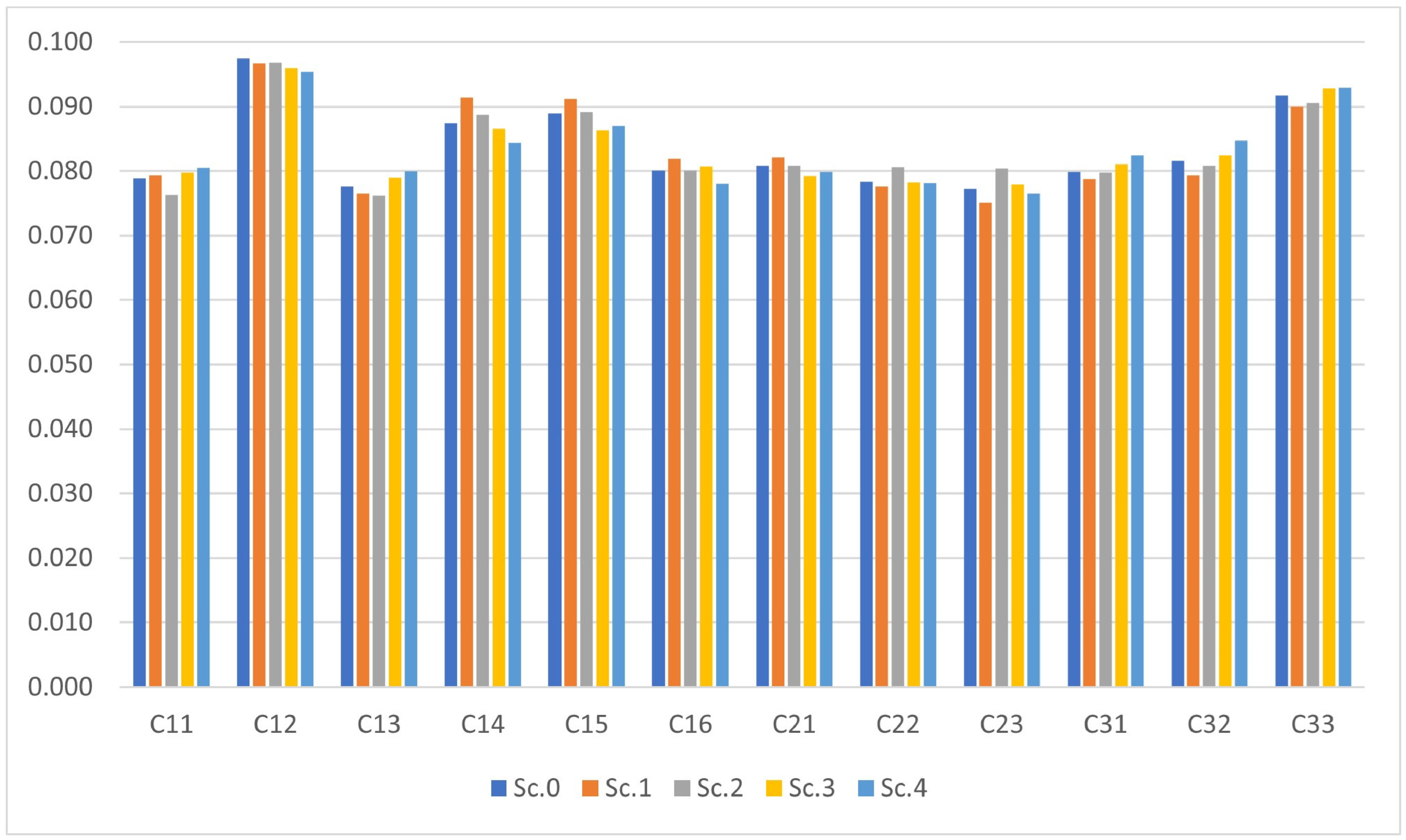
At this stage of the study, it became necessary to perform a sensitivity analysis of the normalised weight vector W j . To this end, a robustness analysis was designed based on the definition of five scenarios, taking the baseline scenario (Sc.0) presented in Table 6 as the reference. The remaining four scenarios were constructed by assigning a weight of 40% to each expert category while distributing the remaining 60% among the other categories. Accordingly, in Scenario 1 (Sc.1), a weight of 40% was assigned to the assessments provided by experts from Government Agencies, with the remaining 60% allocated to the other categories. In Scenario 2 (Sc.2), a dominant weight of 40% was assigned to the group of logistics operators (Shippers, Carriers, and Warehouse and Facilities Owners). Similarly, in Scenarios 3 (Sc.3) and 4 (Sc.4), the 40% weight was assigned to Technology Solutions Providers and to Academics and Researchers, respectively. This approach allowed us to explore potential variations in the baseline scenario as a function of changes in the weights assigned to each expert category within the LML expert panel (Table 12). A comparative graph between the proposed scenarios is also provided (Figure 5).
The results obtained for the normalised weight vectors W j across the different scenarios show a high degree of similarity, indicating that the relative importance of the criteria remains largely stable despite variations in the expert-weight configurations. This consistency demonstrates the robustness of the DEMATEL method applied in this study, as the final prioritisation of criteria is not significantly affected by reasonable changes in the underlying weighting assumptions. To support this statement, the pairwise Spearman’s rank correlation coefficient (SCC) was calculated between the baseline scenario (Sc.0) and the four alternative scenarios, yielding an average SCC of 0.899, which demonstrates a very high degree of correlation (Table 13).
Alternatives Sensitivity Analysis
In accordance with the procedure followed in [100,101], the SCC was used for each pair of methods to determine the degree of non-linear relationship between one method and another. The SCC has a range of variation [−1, 1], with coefficient values closer to 1 representing a stronger relationship between the results of the compared methods (Table 14). The results obtained from the SCC analysis indicate that the hybrid MCDM model proposed, through its ADAM alternative ranking method, shows a high degree of statistical correlation with the methods used for comparison, with almost identical results between their average SCC values (ADAM and TOPSIS at 0.978, whilst VIKOR obtains 0.979).
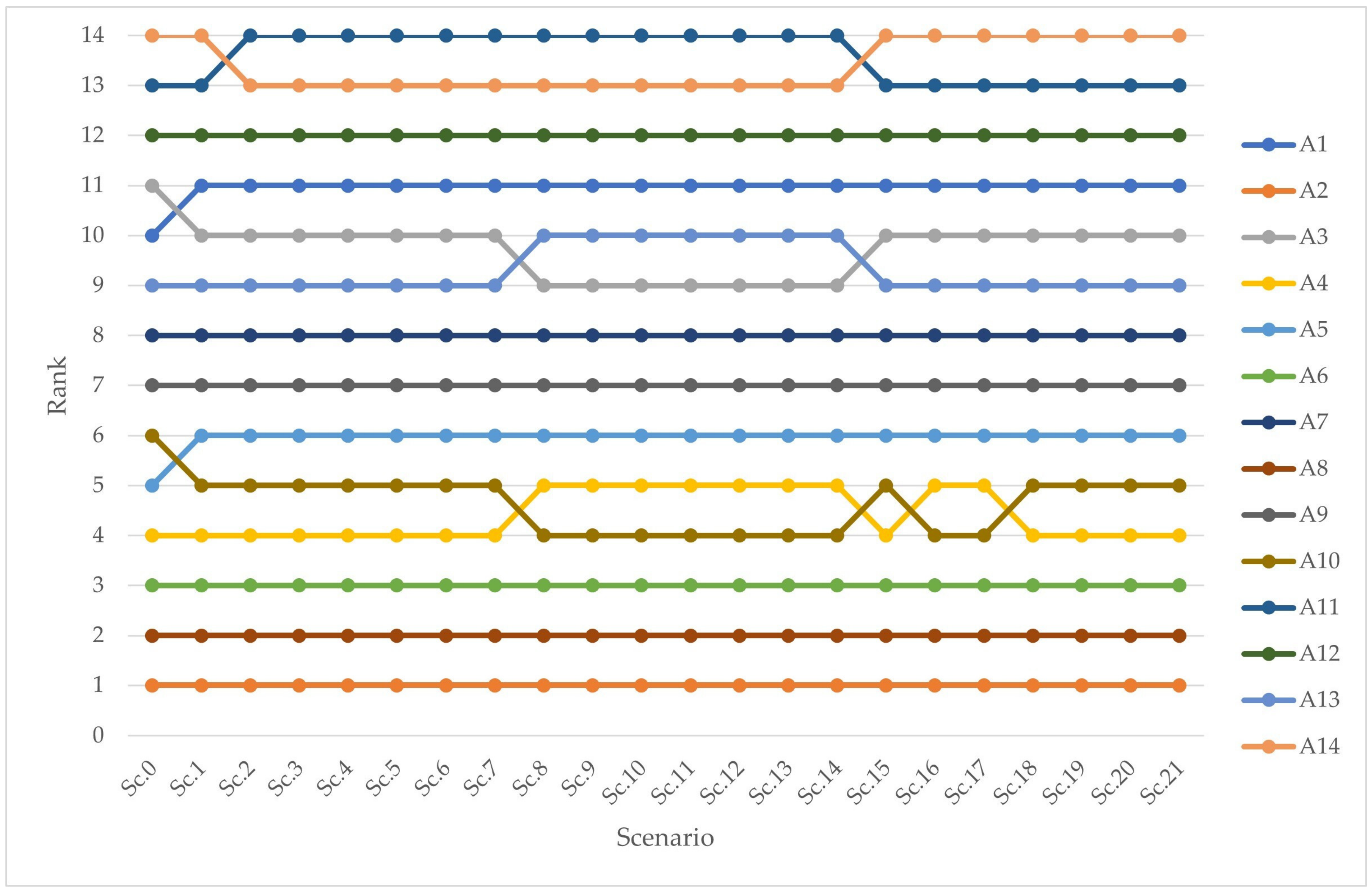
In order to assess the stability and robustness of the results produced by the ADAM method with regard to the ranking of alternatives, 21 scenarios were designed by varying the weights of the criteria, using the normalised vector of criterion weights W j as a starting point. Using the same procedure as [100,101], the most important criterion, C12, was first selected, and its value was reduced by 15%, 30%, 45%, 60%, 75%, 90% and 100%, with the remaining criteria and their normalisation scaled proportionally (all values must sum to 1). For the other fourteen scenarios, the following criteria were taken as the initial reference at importance levels C33 and C15, applying the same percentage reduction as in the case of criterion C12. Following the procedure in [101] once again, the following equation was used to scale the remaining criteria:
w j * = 1 w r * w j 1 w r ,
where
  • w j * = new scaled weight value of a criterion j (except for those criteria whose weight value has already been reduced previously).
  • w r * = new weight value of the criterion after reduction.
  • w j = weight value of a criterion j .
  • w r = weight value of the criterion before reduction.
The weights for the 21 scenarios are then obtained (Table 15). Using these new criteria weight vectors, the ADAM method is applied to obtain the new results (new alternative rankings) generated in each scenario by analysing the sensitivity of the initial solution (Sc.0) (Table 16), as well as a comparative graph between the scenarios (Figure 6).
From the table showing the rankings obtained in each scenario (Table 12), it can be seen that the first (A2), second (A8), third (A6), seventh (A9), eighth (A7) and twelfth (A12) positions remain unchanged in all scenarios. The remaining positions in the ranking are shared by two alternatives, except for the fifth, which is shared by three (A4, A5, A10). The statistical significance derived from the SCC indicates an average value of 0.9817 for all scenarios combined, with a range of 0.991 as the maximum value and 0.969 as the minimum value. From these data, it can be concluded that the ranking solution obtained using the model proposed in this study is very robust and can be considered valid.

5. Theoretical and Managerial Implications

The following section discusses the relevance or contribution of the study, its limitations, as well as the implications and future lines of research that may arise from the present work.

5.1. Contributions

This study offers a distinctive approach to analysing the research areas within sustainable LML that will be developed in the short and medium term. The main objective was to identify which perceived research priorities categories will set trends and attract the greatest resources (financial, human, time, etc.) in the LML of the future. This topic has already been addressed (more partially than comprehensively) in other works or the previous literature, but the originality of the present study lies in its focus on the population group to which all the questions raised in this work are directed. Previous studies have focused their findings on the responses of various LML stakeholders as experts familiar with the idiosyncrasies of LML. It cannot be ignored that, in almost all previous work carried out in this regard, there is an evident bias in the answers to the various questions posed, depending on the different objectives and interests that each party holds within the context of LML. It is easy to understand that, on many contentious issues, a logistics operator specialising in LML, for example, may hold an opinion contrary to that of the public authorities, who must ultimately ensure a balance between the well-being of citizens in an urban centre whilst simultaneously promoting the efficient economic development of the businesses and companies operating within that physical ecosystem. These differing interests inadvertently introduce a bias in the assessment of the influence of certain criteria when considering the various categories of alternatives proposed in the study. To avoid this bias, the authors proposed, as an important and novel distinction, taking as a starting point the ‘unbiassed’ perspective of ‘university community’ members currently studying LML from a purely academic approach to acquiring and understanding LML knowledge, thereby ensuring that respondents’ answers are not influenced (or contaminated) by business interests. Another important contribution of this approach is that it also allows us to identify the key perceived research priorities in LML in the near future among the ‘university community’ who will largely carry out their professional activities within this context. Ultimately, this can provide valuable information to both academics and the logistics sector focused on LML, enabling them to begin adapting their organisations, structures, strategies for attracting or retaining talent, and R&D departments, amongst other matters.
Furthermore, this study proposes a hybrid MCDM model as an interesting mathematical contribution to the field of MCDM methods, based on the combination of the DEMATEL and ADAM methods. The DEMATEL method was used to determine the level of interaction and causality between the criteria, which was reflected in the normalised vector of criterion weights W j . The significance of this vector lies in its ability to reflect the complex relationships between criteria that are not independent of one another in real urban contexts; consequently, it provides a greater capacity to capture complex urban contexts and ultimately enhances the reliability of the results obtained from the model.
As for the ranking of alternatives obtained using the ADAM method (and validated through the sensitivity analysis carried out), the majority of the ‘university community’ members indicate in their responses a preference for research trends focused on vertical planning models based on collaboration between all actors in the supply chain, not just in the final phase of that chain but from the first mile (with manufacturers and suppliers) right through to consumers in the final stage. This trend of prioritising research and development in the field of multi-level collaborative planning is complemented by one of the least studied aspects in the LML literature to date: the implementation of logistics infrastructure. By conducting a general analysis of the underlying trend emerging from the results of the rankings obtained, it can be predicted that the ‘university community’ expresses a clear preference for the categories grouping collaborative research lines (such as A2, A4 and A5), which occupy the top positions among all the proposed categories. A notable aspect within the collaborative categories is the low ranking of one of the most discussed and analysed topics in the literature: the crowdsourcing alternative (A1), which, according to the results, is far from being a leading research priority in the short term. The category encompassing research lines related to transport routing models also occupies a prominent position amongst the top rankings, consistent with the numerous studies conducted in this area of LML. The results suggest that future industry leaders prioritise structural and collaborative solutions over traditional restrictive measures, suggesting that companies should shift their investments from mere regulatory compliance management towards the creation of multi-level collaborative ecosystems to ensure their competitive resilience.

5.2. Limitations

The limitations of this study centre primarily on the paradoxical novelty of the approach, which includes only the ‘university community’ without incorporating the actual current stakeholders of LML into the population under investigation. It is clear that current professionals and academics working on sustainable LML have much to say and contribute based on their experience, and failing to include them in the study may detract from the credibility of the results obtained; however, despite this, the authors’ main objective was to obtain an opinion free from interests, subjectivities and biases that might distort the vision of the future of sustainable LML in the coming years. The use of ‘university community’ members as respondents is justified by their established role in both prospective research and educational evaluation, where they are frequently employed as valid informants for capturing emerging perceptions and future oriented attitudes. The prior literature shows that the ‘university community’ plays a central role in academic evaluation systems and provides relevant insights into learning processes, expectations, and attitudinal trends [103]. Recent studies further demonstrate that ‘university community’ members can meaningfully contribute to prospective and assessment-related research when engaged as respondents or even as co-researchers, offering nuanced perspectives that reflect evolving societal and educational dynamics [104,105]. However, this choice also entails clear limitations. ‘University community’ members lack direct operational experience, and their responses may be influenced by perceptual biases, limited practical knowledge, or idealised views of the phenomena under study, limitations widely documented in research on ‘university community’-based surveys [106]. Consequently, the findings should be interpreted as reflecting the perceptions of an academically trained but non-professional population, whose views complement, rather than replace, those of industry experts.
The gender distribution of the sample (42 men and 20 women) reflects a female representation of 32%. This proportion closely mirrors the percentage distribution reported in the logistics sector, which, according to various studies, ranges between 20% and 40% depending on the specificity of the subsector. In addition to this contextual alignment, several studies have shown that women tend to exhibit more favourable attitudes toward sustainability and greater sensitivity to environmental and social impacts, whereas men generally prioritise operational or efficiency-related criteria. The study acknowledges as a limitation that this asymmetry may have influenced the final weighting of the evaluated alternatives; however, it may also represent a promising avenue for future research. Such research could incorporate more gender balanced samples or apply stratified analyses to more accurately assess how gender-based perceptual differences shape the prioritisation of alternatives within LML research areas.
Due to the study using participants from a single academic institution, there is an inherent limitation regarding the extent to which its results can be extrapolated and generalised in the future. Nevertheless, the strong and specialised training in LML-related subjects received by the ‘university community’ involved in this study ensures that their assessments are sufficiently well-informed to be considered and discussed, at least in an initial phase. It should be noted that not all educational institutions in the fields of logistics and supply chain are as strongly specialised in LML. Therefore, extending this study to other educational institutions would require, as a preliminary step, the establishment of minimum specialisation criteria that participants should meet in order to ensure a credible and homogeneous basis for comparison.
Another limitation concerns the lack of criteria related to scientific novelty, research gaps, technological maturity, societal relevance, feasibility, funding potential, interdisciplinary impact, expected academic contribution, implementation barriers, and policy relevance. These are indeed highly relevant for research prioritisation measures. However, this study adopts a sustainability-driven prioritisation perspective, in which the central question is as follows: Which perceived research priorities have the greatest potential to advance sustainability in urban logistics?
Other limitation of the study lies in the inherent limitations of the mathematical methods that make up the proposed hybrid multi-criteria model. In the case of the ADAM method, its vulnerability lies in the direct input of criterion weights, and this requires the use of other methods to overcome this weakness, particularly in cases where the relationships and interdependencies between criteria are complex. In this study, this has been addressed through the application of the DEMATEL method. On the other hand, the authors are aware that some relevant criteria to be considered in the urban ecosystem of sustainable LML development may have overlapped or been omitted, just as the lines or fields of research that should be grouped into each category of alternatives and which were presented to participants in their questionnaires may not have been correctly defined and specified. The reader should understand that, for reasons of simplicity and data management for subsequent analysis of the results, some lines of research may have been included in a single alternative when they could have been integrated into several, depending on their specific characteristics. Finally, the validation performed focuses on output robustness, not on the conceptual validation of the decision framework. Conceptual validity is partially supported by the literature-based justification for combining DEMATEL (to model causal relationships among sustainability criteria) with ADAM (to prioritise alternatives under uncertainty). Nevertheless, we recognise that a more comprehensive conceptual validation (e.g., through expert elicitation, longitudinal studies, or empirical testing in real-world LML contexts) remains an important avenue for future research.

5.3. Implications

The implications of the work carried out at a theoretical level relate to the introduction of a new perspective, namely that the ‘university community’ specialised in LML. In LML, expert-centred MCDM studies tend to privilege economic, operational, and technical feasibility. In the Netherlands, economic and technical criteria were ranked above environmental and social ones, with operating cost receiving the highest priority and parcel lockers emerging as the most sustainable option [107]. Other LML evaluations likewise show that rankings shift depending on the stakeholder lens. For example, cargo bikes were preferred in stakeholder-inclusive models and clear trade-offs were observed among operational efficiency, environmental impact, social acceptance, and technological feasibility [108]. More broadly, multi-criteria sustainability research shows that respondent composition changes the weighting structure rather than eliminating consensus altogether: managers emphasise product-related and market-facing practices, while academics stress resource and waste management, yet both converge on renewable energy and greenhouse gas reduction priorities [109]. Evidence from the ‘university community’ supports the expectation that a university sample will produce a more future-oriented and sustainability-sensitive ordering: younger Japanese respondents appear more pro-SDG, Italian students reported stronger sustainable attitudes after instruction and 64% described themselves as future-oriented, and among college students biospheric and altruistic values were associated with greater engagement in sustainable behaviours, including transportation-related choices [110,111,112]. At the generational level, the evidence is not uniform across countries, which is an important caveat: post 1995, Chinese respondents showed the highest sustainable-consumption performance, whereas in Portugal Generation X displayed more sustainable habits overall and Generation Z contributed more specifically to sustainable mobility [113,114]. Taken together, these studies support presenting the ‘university community’ ranking in LML not as a substitute for professional judgement, but as a complementary lens that is especially suitable for identifying emerging research priorities within the ‘university community’ vision and for anticipating longer-term sustainability trajectories in LML and higher-education decision contexts [115,116,117]. Anticipating long-term sustainability trajectories aligns with the results obtained in this study, in which the ‘university community’ specialised in LML shows a clear tendency toward multi-level collaborative research lines that involve long-term strategic approaches among stakeholders. This approach may open up a new body of research within the LML literature that has not been addressed until now, and the study of which may yield different conclusions and interesting future forecasts.
Furthermore, the proposed hybrid MCDM model could serve as a useful decision-making tool when applied to other parts of the supply chain, provided that the relevant parameters and limits are appropriately introduced for the specific case in question. The study does not claim to predict future research trends in a deterministic or empirical manner. Instead, the results reflect the perceived potential of different research domains to contribute to sustainability improvements in LML, as evaluated by a group of emerging logistics professionals. The term ’perceived research priorities‘ has been coined to emphasise that the study identifies anticipated priorities or perceived areas of opportunity, rather than forecasting actual future developments.
With regard to the practical or business implications of the study, the clear convergence of the three methods compared (ADAM, TOPSIS and VIKOR) in identifying multi-level collaboration (A2) as the priority option, ahead of technological solutions such as alternative vehicle technologies (A7) or crowdsourcing (A1), reveals a critical insight into the profile of the ‘university community’.
The literature shows that although crowdsourcing has been identified as an innovative solution for LML, its actual adoption remains limited due to concerns regarding service reliability, traceability, legal liability, and perceived operational risk [118,119]. These factors typically lead respondents to evaluate this option more cautiously, particularly when they lack direct experience in managing logistics operations. In the case of this work, composed of ‘university community’ members specialising in LML but without real operational responsibilities, it is plausible that such perceptions contributed to placing crowdsourcing at the lower end of the ranking, as it is associated with reduced control, lower professionalisation, and less predictable service performance.
Regarding the intermediate positions (A4–A10), the literature suggests that these alternatives are often perceived as solutions with moderate impact but with a more consolidated technological and operational maturity. For instance, lateral or horizontal collaboration (A4–A5) offers recognised benefits but also faces barriers related to inter-firm coordination and the sharing of sensitive data [120]. Similarly, routing models (A10) and alternative transport modes (A9) are viewed as necessary, yet not as transformative as multi-level collaboration strategies (A2) or infrastructure investments (A8), which the literature identifies as structural levers for advancing sustainability in LML [121].
Taken together, these elements suggest that respondents’ evaluations reflect a combination of perceived risk and reliability concerns associated with emerging solutions such as crowdsourcing; a preference for alternatives with greater operational maturity; and the strategic orientation of the ‘university community’ toward collaborative and structural solutions, consistent with previous studies showing stronger sensitivity to systemic and long-term. Whilst professionals currently working in LML tend to prioritise operational solutions for immediate implementation or technological solutions to resolve limited and specific problems, the ‘university community’ demonstrates a more systemic vision. This analysis suggests that the success of sustainable LML depends not so much on a specific technical tool or technology, but on the creation of a robust governance framework and consensus among the multiple stakeholders involved, identifying collaboration as the necessary ‘enabler’ for the rest of the innovations to be scalable, viable and sustainable in the long term.
Multi-level collaboration and the implementation of urban logistics Infrastructures were the two categories most highly valued by respondents. This explicitly indicates that a more committed involvement of public authorities is required, both in investment policies for logistics-specific infrastructure (UCCs, micro-hubs, underground systems, loading/unloading zones, freight lanes, etc,) and in regulatory mechanisms that support their operation and use by all stakeholders. The latter also implies that public authorities should design multi-level or multi-tier collaboration mechanisms to enhance the efficiency of LML as a harmonised systems from the first to last mile. Some instruments have already demonstrated their usefulness, such as Living Labs, where supply chain stakeholders help co-create a collaborative and unidirectional space that benefits all participants.
The combination of the approach of conducting the research through the lens of the ‘university community’ and the application of the hybrid MCDM model proposed opens the door, based on the study carried out, to other new avenues such as:
  • Extending the sample population to a national level to enable the extraction of cross-institutional data on the ‘university community’ and to segment this data according to the curricula and specialisations studied at each educational institution. Extending this idea, it would be interesting to propose a study similar to the one conducted at an international level to observe and compare results using similar questions among the ‘university community’ from different countries and cultures.
  • Applying the proposed hybrid MCDM model to other phases of the supply chain beyond just the LML that require robust, discrete decision-making and the consideration of causal relationships and influences between criteria. Logistics fields open to this possibility include procurement, risk analysis, technology development or acquisition, and the sharing of logistics resources or assets, amongst others.
  • Proposing a study similar to the one carried out when designing the hybrid MCDM model in a fuzzy context to compare it with the approach taken in this work in order to assess the similarities or differences in the results obtained. Although the incorporation of a fuzzy approach would strengthen the hybrid model’s ability to handle the uncertainty inherent in participants’ value judgements and in the causal relationships between criteria, in this specific study, developing a fuzzy model was not considered, as the main focus of the research was to provide a practical decision-making framework that would serve as an easy-to-use tool for academics and professionals, whilst acknowledging that Likert scales can induce an inherent linguistic vagueness among participants when answering questionnaires.

6. Conclusions

This study focused on the need to fill a gap in research on sustainable LML and to identify the perceived research priorities in the coming years. The innovations of the work lie in focusing the subject under study on the responses and viewpoints of future logistics professionals, rather than on professionals currently working as stakeholders in the logistics sector. This perspective eliminated the evident bias observed in previous studies, where the surveyed participants were logistics professionals whose responses were largely influenced by the positions they held within their organisations.
Another interesting aspect of this study lies in the development of a hybrid MCDM model, combining the DEMATEL and ADAM methods to extract the study’s results. This model was adopted to overcome the individual limitations of each method, lending greater robustness, stability and realism to the results obtained. This methodological synergy is particularly valuable for discrete multivariate problems in which causal relationships and complex preference structures coexist. DEMATEL enables the identification and quantification of interdependencies between criteria, revealing the causal architecture of the system and providing a solid basis for understanding how effects propagate between factors. Building on this structure, ADAM provides a robust aggregation and prioritisation mechanism that incorporates the uncertainty inherent in expert judgements and avoids the rigidity of purely deterministic methods.
The application of the hybrid MCDM model to the case study has shown that the ‘university community’ is committed to a future LML based on research proposals centred on multi-level collaborative systems, with a view to achieving greater sustainability in the efficiency of their operations, in meeting their customers’ requirements, and in protecting the environment in urban centres. This indicates a shift in research priorities, which traditionally involved focused, limited operational and technological developments that were poorly interrelated and coordinated amongst LML stakeholders.

Supplementary Materials

The following supporting information can be downloaded at: https://www.mdpi.com/article/10.3390/urbansci10070394/s1, Tables S1–S3 [9,10,11,12,13,14,15,16,17,18,19,20,21,22,23,24,25,26,27,28,29,30,31,32,33,34,35,36,37,38,39,40,41,42,43,44,45,46,47,48,49,50,51,52,53,54,55,56,57,58,59,60,61,62,63,64,65,66,67,68,69,70,71,72,73,74,75,76,77,78,79,80,81,82,83,84,85,86,87,88,89,90,91,92,93,94,95,96,97].

Author Contributions

Conceptualization, J.A.M.M.D.O., T.G.M. and M.S.P.; methodology, J.A.M.M.D.O.; validation, T.G.M. and M.S.P.; formal analysis, J.A.M.M.D.O., T.G.M. and M.S.P.; investigation, J.A.M.M.D.O.; data curation, J.A.M.M.D.O.; writing—original draft preparation, J.A.M.M.D.O.; writing—review and editing, T.G.M. and M.S.P.; visualisation, J.A.M.M.D.O., T.G.M. and M.S.P.; supervision, T.G.M. and M.S.P. All authors have read and agreed to the published version of the manuscript.

Funding

This research received no external funding.

Institutional Review Board Statement

This study was conducted using anonymous questionnaires, without medical intervention or the collection of sensitive data. Therefore, it does not fall within the scope requiring review by a Research Ethics Committee under Spanish legislation (Law 14/2011 on Science, Technology and Innovation; Regulation (EU) 2016/679; and Organic Law 3/2018 on the Protection of Personal Data and Guarantee of Digital Rights). In accordance with this regulatory framework, ethical approval is not required for social and educational studies involving minimal risk.

Informed Consent Statement

This study was conducted using fully anonymous questionnaires, without collecting personal data that would allow the identification of participants and without involving sensitive information. In accordance with Spanish and European data protection regulations—specifically Regulation (EU) 2016/679 (General Data Protection Regulation) and Organic Law 3/2018 on the Protection of Personal Data and Guarantee of Digital Rights—data that are collected anonymously and cannot be linked to an identifiable individual do not fall under the category of personal data. Consequently, informed consent is not required in such cases.

Data Availability Statement

The original contributions presented in the study are included in the article. Further inquiries can be directed to the corresponding author.

Conflicts of Interest

The authors declare no conflicts of interest.

References

  1. Aung, T.Z.; Prapaspongsa, T.; Saraceni, A.; Cotta, D.; Surinkul, N.; Gheewala, S.H. Review of Sustainability Assessments in City Logistics from Holistic Perspective: Critical Insights, Gaps, and Future Directions. Transp. Res. Interdiscip. Perspect. 2025, 33, 101603. [Google Scholar] [CrossRef]
  2. United Nations. World Urbanization Prospects: 2018: Highlights; United Nations: New York, NY, USA, 2019. [Google Scholar]
  3. Karaoulanis, A. The Role of Micro Fulfilment Centers in Alleviating, in a Sustainable Way, the Urban Last Mile Logistics Problem: A Systematic Literature Review. Sustainability 2024, 16, 8774. [Google Scholar] [CrossRef]
  4. Blinge, M.; Cossu, P.; Logistic, F.; Sánchez, M.D.O.; Schurmans, H.; Sjouke, T.; Streng, J. Cities-Regions and Companies Working Together. Guide for Advancing Towards Zero-Emission Urban Logistics by 2030; © ALICE-ETP & POLIS: Brussels, Belgium, 2021. [Google Scholar]
  5. Tadić, S.; Zečević, S.; Krstić, M. A Novel Hybrid MCDM Model Based on Fuzzy DEMATEL, Fuzzy ANP and Fuzzy VIKOR for City Logistics Concept Selection. Expert Syst. Appl. 2014, 41, 8112–8128. [Google Scholar] [CrossRef]
  6. Tešić, D.; Pamučar, D.; Demir, G.; Puška, A.; Božanić, D. Aggregation of Expert Ranking Opinions Using Multi-Criteria Decision-Making Methods. Spectr. Oper. Res. 2026, 3, 1–14. [Google Scholar] [CrossRef]
  7. Ayyildiz, E.; Murat, M.; Imamoglu, G.; Kose, Y. A Novel Hybrid MCDM Approach to Evaluate Universities Based on Student Perspective. Scientometrics 2023, 128, 55–86. [Google Scholar] [PubMed]
  8. Kaya, R.; Salhi, S.; Spiegler, V. A Novel Integration of MCDM Methods and Bayesian Networks: The Case of Incomplete Expert Knowledge. Ann. Oper. Res. 2023, 320, 205–234. [Google Scholar] [CrossRef]
  9. Veličković, M.; Stojanović, Đ.; Ilin, V.; Mirčetić, D. A Combined Multi-Criteria Decision-Making and Social Cost–Benefit Analysis Approach for Evaluating Sustainable City Logistics Initiatives. Sustainability 2025, 17, 884. [Google Scholar] [CrossRef]
  10. Corradini, E.; Mandorlini, M.; Mariani, F.; Roselli, P.; Sacchetti, S.; Spiga, M. A Complex Network Science Perspective on Urban Parcel Locker Placement. Big Data Cogn. Comput. 2025, 9, 249. [Google Scholar] [CrossRef]
  11. Tafakkori, K.; Tavakkoli-Moghaddam, R.; Siadat, A. A Data-Driven Sustainable Scheduling Model for Dispatch-Steerable Last-Mile Delivery Systems with Negotiable Time Windows. Eng. Appl. Artif. Intell. 2025, 156, 111280. [Google Scholar] [CrossRef]
  12. Bandeira, R.A.M.; D’Agosto, M.A.; Ribeiro, S.K.; Bandeira, A.P.F.; Goes, G.V. A Fuzzy Multi-Criteria Model for Evaluating Sustainable Urban Freight Transportation Operations. J. Clean. Prod. 2018, 184, 727–739. [Google Scholar] [CrossRef]
  13. Gupta, A.; Heng, C.K.; Ong, Y.S.; Tan, P.S.; Zhang, A.N. A Generic Framework for Multi-Criteria Decision Support in Eco-Friendly Urban Logistics Systems. Expert Syst. Appl. 2017, 71, 288–300. [Google Scholar] [CrossRef]
  14. Shahparvari, S.; Nasirian, A.; Mohammadi, A.; Noori, S.; Chhetri, P. A GIS-LP Integrated Approach for the Logistics Hub Location Problem. Comput. Ind. Eng. 2020, 146, 106488. [Google Scholar] [CrossRef]
  15. Ferrer, J.M.; Ortuño, M.T.; Tirado, G. A GRASP Metaheuristic for Humanitarian Aid Distribution. J. Heuristics 2016, 22, 55–87. [Google Scholar] [CrossRef]
  16. Awasthi, A.; Chauhan, S.S. A Hybrid Approach Integrating Affinity Diagram, AHP and Fuzzy TOPSIS for Sustainable City Logistics Planning. Appl. Math. Model. 2012, 36, 573–584. [Google Scholar] [CrossRef]
  17. Yalcin Kavus, B.; Ayyildiz, E.; Gulum Tas, P.; Taskin, A. A Hybrid Bayesian BWM and Pythagorean Fuzzy WASPAS-Based Decision-Making Framework for Parcel Locker Location Selection Problem. Environ. Sci. Pollut. Res. 2023, 30, 90006–90023. [Google Scholar] [CrossRef] [PubMed]
  18. Moslem, S.; Pilla, F. A Hybrid Decision Making Support Method for Parcel Lockers Location Selection. Res. Transp. Econ. 2023, 100, 101320. [Google Scholar] [CrossRef]
  19. Moslem, S.; Gündoğdu, F.K.; Saylam, S.; Pilla, F. A Hybrid Decomposed Fuzzy Multi-Criteria Decision-Making Model for Optimizing Parcel Lockers Location in the Last-Mile Delivery Landscape. Appl. Soft Comput. 2024, 154, 111321. [Google Scholar] [CrossRef]
  20. Bennani, M.; Jawab, F.; Hani, Y.; ElMhamedi, A.; Amegouz, D. A Hybrid MCDM for the Location of Urban Distribution Centers under Uncertainty: A Case Study of Casablanca, Morocco. Sustainability 2022, 14, 9544. [Google Scholar] [CrossRef]
  21. Kovač, M.; Tadić, S.; Krstić, M.; Veljović, M. A Methodology for Planning City Logistics Concepts Based on City-Dry Port Micro-Consolidation Centres. Mathematics 2023, 11, 3347. [Google Scholar] [CrossRef]
  22. Özer, N.C.; Tuzkaya, U.R. A Methodology for the Strategic Design of City Logistics Networks and Its Application in Turkish Automotive Spare Parts Industry. J. Intell. Fuzzy Syst. 2023, 45, 2735–2752. [Google Scholar] [CrossRef]
  23. Katsela, K.; Pålsson, H. A Multi-Criteria Decision Model for Stakeholder Management in City Logistics. Res. Transp. Bus. Manag. 2019, 33, 100439. [Google Scholar] [CrossRef]
  24. Aljohani, K.; Thompson, R.G. A Multi-Criteria Spatial Evaluation Framework to Optimise the Siting of Freight Consolidation Facilities in Inner-City Areas. Transp. Res. Part A Policy Pract. 2020, 138, 51–69. [Google Scholar] [CrossRef]
  25. Bošković, S.; Švadlenka, L.; Jovčić, S.; Dobrodolac, M.; Simic, V.; Bacanin, N. A New FullEX Decision-Making Technique for Criteria Importance Assessment: An Application to the Sustainable Last-Mile Delivery Courier Selection. IEEE Access 2023, 11, 137426–137436. [Google Scholar] [CrossRef]
  26. Tadić, S.; Krstić, M.; Maravić, A.; Veljović, M. Selection of City Logistics Development Scenarios by Applying a Hybrid MCDM Model. In Proceedings of the 52nd Symposium on Operational Research (SYMOPIS 2025); University of Belgrade: Belgrade, Serbia, 2025. [Google Scholar] [CrossRef]
  27. Pourmohammadreza, N.; Jokar, M.R.A. A Novel Two-Phase Approach for Optimization of the Last-Mile Delivery Problem with Service Options. Sustainability 2023, 15, 8098. [Google Scholar] [CrossRef]
  28. Önden, İ.; Eldemir, F.; Acar, A.Z.; Çancı, M. A Spatial Multi-Criteria Decision-Making Model for Planning New Logistic Centers in Metropolitan Areas. Supply Chain Anal. 2023, 1, 100002. [Google Scholar] [CrossRef]
  29. Aljohani, K.; Thompson, R.G. A Stakeholder-Based Evaluation of the Most Suitable and Sustainable Delivery Fleet for Freight Consolidation Policies in the Inner-City Area. Sustainability 2018, 11, 124. [Google Scholar] [CrossRef]
  30. Kin, B.; Verlinde, S.; Mommens, K.; Macharis, C. A Stakeholder-Based Methodology to Enhance the Success of Urban Freight Transport Measures in a Multi-Level Governance Context. Res. Transp. Econ. 2017, 65, 10–23. [Google Scholar] [CrossRef]
  31. Macharis, C.; Milan, L.; Verlinde, S. A Stakeholder-Based Multicriteria Evaluation Framework for City Distribution. Res. Transp. Bus. Manag. 2014, 11, 75–84. [Google Scholar] [CrossRef]
  32. Chen, J.; Lee, J.; Lee, H. A Study on the Site Selection of Urban Logistics Centers Utilizing Public Infrastructure. Sustainability 2025, 17, 6846. [Google Scholar] [CrossRef]
  33. Ayyildiz, E.; Erdogan, M. Addressing the Challenges of Using Autonomous Robots for Last-Mile Delivery. Comput. Ind. Eng. 2024, 190, 110096. [Google Scholar] [CrossRef]
  34. Saxena, A.; Yadav, A.K. Adopting a Multi-Criteria Decision-Making Approach to Identify Barriers to Electrification of Urban Freight in India. Transp. Res. Rec. 2024, 2678, 816–827. [Google Scholar] [CrossRef]
  35. Bošković, S.; Švadlenka, L.; Jovčić, S.; Dobrodolac, M.; Simić, V.; Bacanin, N. An Alternative Ranking Order Method Accounting for Two-Step Normalization (AROMAN)—A Case Study of the Electric Vehicle Selection Problem. IEEE Access 2023, 11, 39496–39507. [Google Scholar] [CrossRef]
  36. Kechagias, E.P.; Gayialis, S.P.; Konstantakopoulos, G.D.; Papadopoulos, G.A. An Application of a Multi-Criteria Approach for the Development of a Process Reference Model for Supply Chain Operations. Sustainability 2020, 12, 5791. [Google Scholar] [CrossRef]
  37. Ninović, M.; Dobrodolac, M.; Bošković, S.; Dupljanin, Đ.; Lazarević, D.; Dumnić, S. An Extended FullEX Method: An Application to the Selection of Online Orders Distribution Modes Based on the Shared Economy. J. Theor. Appl. Electron. Commer. Res. 2025, 20, 207. [Google Scholar] [CrossRef]
  38. Senne, C.M.; Lima, J.P.; Favaretto, F. An Index for the Sustainability of Integrated Urban Transport and Logistics: The Case Study of São Paulo. Sustainability 2021, 13, 12116. [Google Scholar] [CrossRef]
  39. Uyanik, C.; Tuzkaya, G.; Kalender, Z.T.; Oguztimur, S. An integrated DEMATEL-IF-TOPSIS methodology for logistics centers’location selection problem: An application for Istanbul metropolitan area. Transport 2020, 35, 548–556. [Google Scholar] [CrossRef]
  40. Bouhana, A.; Zidi, A.; Fekih, A.; Chabchoub, H.; Abed, M. An Ontology-Based CBR Approach for Personalized Itinerary Search Systems for Sustainable Urban Freight Transport. Expert Syst. Appl. 2015, 42, 3724–3741. [Google Scholar] [CrossRef]
  41. Çakmak, E.; Önden, İ.; Acar, A.Z.; Eldemir, F. Analyzing the Location of City Logistics Centers in Istanbul by Integrating Geographic Information Systems with Binary Particle Swarm Optimization Algorithm. Case Stud. Transp. Policy 2021, 9, 59–67. [Google Scholar] [CrossRef]
  42. Kijewska, K.; Torbacki, W.; Iwan, S. Application of AHP and DEMATEL Methods in Choosing and Analysing the Measures for the Distribution of Goods in Szczecin Region. Sustainability 2018, 10, 2365. [Google Scholar] [CrossRef]
  43. Jardas, M.; Perić Hadžić, A.; Ogrizović, D. Application of the MAMCA Method in the Evaluation of Delivery Flows within City Centers: A Case Study of Rijeka. Urban Sci. 2024, 8, 149. [Google Scholar] [CrossRef]
  44. Tadić, S.; Krstić, M.; Radovanović, L. Assessing Strategies to Overcome Barriers for Drone Usage in Last-Mile Logistics: A Novel Hybrid Fuzzy MCDM Model. Mathematics 2024, 12, 367. [Google Scholar] [CrossRef]
  45. Nathanail, E.; Gogas, M.; Adamos, G. Assessing the Contribution of Urban Freight Terminals in Last Mile Operations. Transp. Telecommun. J. 2016, 17, 231–241. [Google Scholar] [CrossRef]
  46. Tadić, S.; Krstić, M.; Kovač, M. Assessment of City Logistics Initiative Categories Sustainability: Case of Belgrade. Env. Dev. Sustain. 2023, 25, 1383–1419. [Google Scholar] [CrossRef]
  47. Segura Viana, M.; Delgado, J.P.M. City Logistics in Historic Centers: Multi-Criteria Evaluation in GIS for City of Salvador (Bahia—Brazil). Case Stud. Transp. Policy 2019, 7, 772–780. [Google Scholar] [CrossRef]
  48. Kang, X.; Pang, H. City Selection for Fresh Produce E-Commerce’s Market Entry Strategy: Based on the Perspective of Urban Logistics Competitiveness. Transp. Res. Interdiscip. Perspect. 2022, 13, 100537. [Google Scholar] [CrossRef]
  49. Fredriksson, A.; Janné, M.; Nolz, P.; De Radiguès De Chennevière, P.; Van Lier, T.; Macharis, C. Creating Stakeholder Awareness in Construction Logistics by Means of the MAMCA. City Environ. Interact. 2021, 11, 100067. [Google Scholar] [CrossRef]
  50. Resat, H.G. Design and Analysis of Novel Hybrid Multi-Objective Optimization Approach for Data-Driven Sustainable Delivery Systems. IEEE Access 2020, 8, 90280–90293. [Google Scholar] [CrossRef]
  51. Stopka, O.; Sarkan, B.; Chovancova, M.; Kapustina, L.M. Determination of the Appropriate Vehicle Operating in Particular Urban Traffic Conditions. Komunikácie 2017, 19, 18–22. [Google Scholar] [CrossRef]
  52. Puška, A.; Dragić, R.; Prdić, N.; Ćosić, Đ.; Novaković Božić, N.; Štilić, A. Digital Technologies Selection for Sustainable Urban Logistics in Last-Mile Delivery Under Conditions of Uncertainty. Sustainability 2025, 17, 10413. [Google Scholar] [CrossRef]
  53. Pourmohammadreza, N.; Jokar, M. Efficient Last-Mile Logistics with Service Options: A Multi-Criteria Decision-Making and Optimization Methodology. Int. J. Ind. Eng. Comput. 2024, 15, 367–386. [Google Scholar] [CrossRef]
  54. Titiyal, R.; Bhattacharya, S.; Thakkar, J.J. E-Fulfillment Performance Evaluation for an e-Tailer: A DANP Approach. Int. J. Product. Perform. Manag. 2019, 69, 741–773. [Google Scholar] [CrossRef]
  55. Wang, C.-N.; Nguyen, N.-A.-T.; Dang, T.-T.; Hsu, H.-P. Evaluating Sustainable Last-Mile Delivery (LMD) in B2C E-Commerce Using Two-Stage Fuzzy MCDM Approach: A Case Study From Vietnam. IEEE Access 2021, 9, 146050–146067. [Google Scholar] [CrossRef]
  56. Zaralı, F.; Yılmaz, Ş.F.; Demirel, N.; Elomiya, A.; Jovčić, S. Evaluating Sustainable Last-Mile Delivery Modes Using IF-MAIRCA: The Perspective of Local Authorities. Socio-Econ. Plan. Sci. 2026, 104, 102393. [Google Scholar] [CrossRef]
  57. Wang, Y.; Li, Y.; Lu, C. Evaluating the Effects of Logistics Center Location: An Analytical Framework for Sustainable Urban Logistics. Sustainability 2023, 15, 3091. [Google Scholar] [CrossRef]
  58. Aksoy, B.; Gursoy, M. Evaluation of Location Selection Process of Logistics Villages Using Analytic Hierarchy Process and Electre Methods: A Case Study for Turkey. Sigma J. Eng. Nat. Sci. 2020, 38, 1897–1910. [Google Scholar]
  59. Yılmaz, Ş.F.; Demirel, N. Evaluation of out-of-Home Last Mile Delivery Methods in Terms of Sustainability. Int. J. Ind. Eng. Theory Appl. Pract. 2023, 30, 1284–1312. [Google Scholar] [CrossRef]
  60. Tadić, S.; Krstić, M.; Kovač, M.; Brnjac, N. Evaluation of Smart City Logistics Solutions. Promet-Traffic Transp. 2022, 34, 725–738. [Google Scholar] [CrossRef]
  61. Mohammed, A.; Lopes De Sousa Jabbour, A.B.; Zubairu, N.; Chiappetta Jabbour, C.J.; Al Naabi, H. Food Waste in the Era of E-Commerce: A Novel Farm-to-Fork Management Methodology. Int. J. Prod. Econ. 2025, 285, 109603. [Google Scholar] [CrossRef]
  62. Bovkir, R.; Moslem, S.; Pilla, F. GIS-Based Fuzzy Multi-Criteria Decision-Making for Selecting Optimal Parcel Lockers Location: A Case Study in Dublin, Ireland. Land Use Policy 2025, 158, 107771. [Google Scholar] [CrossRef]
  63. Kumar, A.; Goel, P.; Tiwari, S. Impediment Ranking and Solutions for Enhancing Electric Freight Vehicle Uptake in Urban Logistics. Energy Econ. 2025, 147, 108604. [Google Scholar] [CrossRef]
  64. Lebeau, P.; Macharis, C.; Van Mierlo, J.; Janjevic, M. Improving Policy Support in City Logistics: The Contributions of a Multi-Actor Multi-Criteria Analysis. Case Stud. Transp. Policy 2018, 6, 554–563. [Google Scholar] [CrossRef]
  65. Buldeo Rai, H.; Van Lier, T.; Meers, D.; Macharis, C. Improving Urban Freight Transport Sustainability: Policy Assessment Framework and Case Study. Res. Transp. Econ. 2017, 64, 26–35. [Google Scholar] [CrossRef]
  66. Bartuška, L.; Hanzl, J.; Kampf, R.; Brlek, P. Indicators as a Tool for Assessing the Level of Sustainable Urban Freight Logistics. Promet-Traffic Transp. 2023, 35, 485–499. [Google Scholar] [CrossRef]
  67. Nur, F.; Alrahahleh, A.; Burch, R.; Babski-Reeves, K.; Marufuzzaman, M. Last Mile Delivery Drone Selection and Evaluation Using the Interval-Valued Inferential Fuzzy TOPSIS. J. Comput. Des. Eng. 2020, 7, 397–411. [Google Scholar] [CrossRef]
  68. Veljović, M.; Tadić, S.; Krstić, M. Last Word in Last-Mile Logistics: A Novel Hybrid Multi-Criteria Decision-Making Model for Ranking Industry 4.0 Technologies. Mathematics 2024, 12, 2010. [Google Scholar] [CrossRef]
  69. Rudolph, C.; Nsamzinshuti, A.; Bonsu, S.; Ndiaye, A.B.; Rigo, N. Localization of Relevant Urban Micro-Consolidation Centers for Last-Mile Cargo Bike Delivery Based on Real Demand Data and City Characteristics. Transp. Res. Rec. J. Transp. Res. Board 2022, 2676, 365–375. [Google Scholar] [CrossRef]
  70. Güven Güney, B.; Yüzer, M.A. Location Criteria for E-Commerce Logistics Facilities: A Scale-Sensitive Analysis. Sustainability 2025, 17, 10115. [Google Scholar] [CrossRef]
  71. Lasota, M.; Zabielska, A.; Jacyna, M.; Gołębiowski, P.; Żochowska, R.; Wasiak, M. Method for Delivery Planning in Urban Areas with Environmental Aspects. Sustainability 2024, 16, 1571. [Google Scholar] [CrossRef]
  72. Novotná, M.; Švadlenka, L.; Jovčić, S.; Simić, V. Micro-Hub Location Selection for Sustainable Last-Mile Delivery. PLoS ONE 2022, 17, e0270926. [Google Scholar] [CrossRef] [PubMed]
  73. Milan, L.; Kin, B.; Verlinde, S.; Macharis, C. Multi-Actor Multi-Criteria Analysis for Sustainable City Distribution: A New Assessment Framework. Int. J. Multicriteria Decis. Mak. 2015, 5, 334. [Google Scholar] [CrossRef]
  74. Wątróbski, J.; Małecki, K.; Kijewska, K.; Iwan, S.; Karczmarczyk, A.; Thompson, R. Multi-Criteria Analysis of Electric Vans for City Logistics. Sustainability 2017, 9, 1453. [Google Scholar] [CrossRef]
  75. Madleňák, R.; Madleňáková, L. Multi-Criteria Evaluation of E-Shop Methods of Delivery from the Customer’s Perspective. Transp. Probl. 2020, 15, 5–14. [Google Scholar] [CrossRef]
  76. Ferrer, J.M.; Martín-Campo, F.J.; Ortuño, M.T.; Pedraza-Martínez, A.J.; Tirado, G.; Vitoriano, B. Multi-Criteria Optimization for Last Mile Distribution of Disaster Relief Aid: Test Cases and Applications. Eur. J. Oper. Res. 2018, 269, 501–515. [Google Scholar] [CrossRef]
  77. Wang, N.; Xu, Y.; Puška, A.; Stević, Ž.; Alrasheedi, A.F. Multi-Criteria Selection of Electric Delivery Vehicles Using Fuzzy–Rough Methods. Sustainability 2023, 15, 15541. [Google Scholar] [CrossRef]
  78. Sawik, B.; Serrano-Hernandez, A.; Muro, A.; Faulin, J. Multi-Criteria Simulation-Optimization Analysis of Usage of Automated Parcel Lockers: A Practical Approach. Mathematics 2022, 10, 4423. [Google Scholar] [CrossRef]
  79. Perera, L.; Thompson, R.G. Multi-Stakeholder Acceptance of Optimum Toll Schemes. Res. Transp. Bus. Manag. 2021, 41, 100654. [Google Scholar] [CrossRef]
  80. Zheng, Z.; Morimoto, T.; Murayama, Y. Optimal Location Analysis of Delivery Parcel-Pickup Points Using AHP and Network Huff Model: A Case Study of Shiweitang Sub-District in Guangzhou City, China. ISPRS Int. J. Geo-Inf. 2020, 9, 193. [Google Scholar] [CrossRef]
  81. Aiello, G.; Quaranta, S.; Certa, A.; Inguanta, R. Optimization of Urban Delivery Systems Based on Electric Assisted Cargo Bikes with Modular Battery Size, Taking into Account the Service Requirements and the Specific Operational Context. Energies 2021, 14, 4672. [Google Scholar] [CrossRef]
  82. Belil, S.; Jghamou, A.; Kouki, S. Optimizing Crowdshipping Effectiveness in B2C Deliveries: A Multi-Criteria Approach for Crowd Selection. Supply Chain Forum Int. J. 2025, 26, 379–394. [Google Scholar] [CrossRef]
  83. Wu, M.-Y.; Ke, C.-K.; Lai, S.-C. Optimizing the Routing of Urban Logistics by Context-Based Social Network and Multi-Criteria Decision Analysis. Symmetry 2022, 14, 1811. [Google Scholar] [CrossRef]
  84. Svadlenka, L.; Simic, V.; Dobrodolac, M.; Lazarevic, D.; Todorovic, G. Picture Fuzzy Decision-Making Approach for Sustainable Last-Mile Delivery. IEEE Access 2020, 8, 209393–209414. [Google Scholar] [CrossRef]
  85. Simić, V.; Lazarević, D.; Dobrodolac, M. Picture Fuzzy WASPAS Method for Selecting Last-Mile Delivery Mode: A Case Study of Belgrade. Eur. Transp. Res. Rev. 2021, 13, 43. [Google Scholar] [CrossRef] [PubMed]
  86. Gatta, V.; Marcucci, E.; Delle Site, P.; Le Pira, M.; Carrocci, C.S. Planning with Stakeholders: Analysing Alternative off-Hour Delivery Solutions via an Interactive Multi-Criteria Approach. Res. Transp. Econ. 2019, 73, 53–62. [Google Scholar] [CrossRef]
  87. Pamucar, D.; Lazarević, D.; Dobrodolac, M.; Simic, V.; Görçün, Ö.F. Prioritization of Crowdsourcing Models for Last-Mile Delivery Using Fuzzy Sugeno–Weber Framework. Eng. Appl. Artif. Intell. 2024, 128, 107414. [Google Scholar] [CrossRef]
  88. Córdova, J.; Merchán, D.; Torres, S. Redesigning a Retail Distribution Network in Restricted Urban Areas: A Case Study on Beverage Distribution in the Historic Center of Quito. J. Appl. Res. Technol. 2014, 12, 850–859. [Google Scholar] [CrossRef]
  89. Nila, B.; Pamucar, D.; Roy, J. Designing and Analyzing Drone-Based City Logistics Solutions for Kochi Using a Fuzzy Multi-Criteria Decision Making Framework. Env. Dev. Sustain. 2024. [Google Scholar] [CrossRef]
  90. Özmen, M.; Aydoğan, E.K. Robust Multi-Criteria Decision Making Methodology for Real Life Logistics Center Location Problem. Artif. Intell. Rev. 2020, 53, 725–751. [Google Scholar] [CrossRef]
  91. Vasić, N.; Kilibarda, M.; Andrejić, M. Selecting the e-Commerce Distribution Channel by Applying the Integrated FAHP and MOOSRA Methods. Int. J. Shipp. Transp. Logist. 2024, 18, 281–304. [Google Scholar] [CrossRef]
  92. Tadić, S.; Krstić, M.; Dabić-Miletić, S.; Božić, M. Smart Material Handling Solutions for City Logistics Systems. Sustainability 2023, 15, 6693. [Google Scholar] [CrossRef]
  93. Deveci, M.; Kara, K.; Cihan, G.; Önden, A.; Hasseb, M. Supplier Selection of Companies Providing Micro Mobility Service Under Type-2 Neutrosophic Number Based Decision Making Model. Expert Syst. Appl. 2024, 245, 123033. [Google Scholar] [CrossRef]
  94. Melkonyan, A.; Gruchmann, T.; Lohmar, F.; Kamath, V.; Spinler, S. Sustainability Assessment of Last-Mile Logistics and Distribution Strategies: The Case of Local Food Networks. Int. J. Prod. Econ. 2020, 228, 107746. [Google Scholar] [CrossRef]
  95. Semanjski, I.; Gautama, S. Sustainable Time-Dependent Cheapest Path Problem with Integrated Collaborative Stakeholders’ Perspectives. Sustainability 2024, 16, 3706. [Google Scholar] [CrossRef]
  96. Pamučar, D.; Gigović, L.; Ćirović, G.; Regodić, M. Transport Spatial Model for the Definition of Green Routes for City Logistics Centers. Environ. Impact Assess. Rev. 2016, 56, 72–87. [Google Scholar] [CrossRef]
  97. Muñuzuri, J.; Guadix, J.; Cortés, P.; Onieva, L. Use of Discrete Choice to Obtain Urban Freight Evaluation Data. Eur. J. Transp. Infrastruct. Res. 2016, 16, 23–37. [Google Scholar] [CrossRef]
  98. Rose, W.J.; Confente, I.; Peinkofer, S.T.; Russo, I. Activating the Consumer: Toward More Sustainable Last-Mile Delivery. J. Bus. Logist. 2025, 46, e70041. [Google Scholar] [CrossRef]
  99. Huang, J.; Li, L.; Jiang, P.; Zhang, S. DEMATEL-Based ANP Model for Identifying Critical Indicators in Sustainable Emergency Material Reserve Systems. Sustainability 2024, 16, 5263. [Google Scholar] [CrossRef]
  100. Tadić, S.; Krstić, M.; Veljović, M.; Čokorilo, O.; Milovanović, M. Risk Analysis of the Use of Drones in City Logistics. Mathematics 2024, 12, 1250. [Google Scholar] [CrossRef]
  101. Krstić, M.; Agnusdei, G.P.; Tadić, S.; Kovač, M.; Miglietta, P.P. A Novel Axial-Distance-Based Aggregated Measurement (ADAM) Method for the Evaluation of Agri-Food Circular-Economy-Based Business Models. Mathematics 2023, 11, 1334. [Google Scholar] [CrossRef]
  102. ADAM Methodology—Muli-Criteria Decision Making Methodology. Available online: https://adam-mcdm.com/ (accessed on 3 March 2026).
  103. Zhao, L.; Xu, P.; Chen, Y.; Yan, S. A Literature Review of the Research on Students’ Evaluation of Teaching in Higher Education. Front. Psychol. 2022, 13, 1004487. [Google Scholar] [CrossRef] [PubMed]
  104. Burke Reifman, J.; White, M.; Kalish, L. Students as Researchers and Participants: A Model of Iterative Member-Checking for Inclusive, Equity-Centered Assessment Research. Intersect. A J. Intersect. Assess. Learn. 2022, 3, 1–25. [Google Scholar] [CrossRef]
  105. Miró-Colmenárez, P.J.; Durán-Alonso, S.; Díaz-Cruces, E.; Zamora-Ledezma, C. Enhancing University Teaching Through Student-Led Review Articles as a Pathway to Early Research Engagement. Educ. Sci. 2025, 15, 249. [Google Scholar] [CrossRef]
  106. Ward, D. An Overview of Research on Use of Student Surveys to Evaluate Teaching; University of Kansas: Lawrence, KS, USA, 2021. [Google Scholar]
  107. Tran, T.P.A.; Gavade, S.A. Evaluating Sustainable Last Mile Delivery Solutions: A Multi-Criteria Decision Analysis. J. Supply Chain Manag. Sci. 2025, 6, 1–28. [Google Scholar] [CrossRef]
  108. Maravić, A.; Pajić, V.; Andrejić, M. A Holistic Human-Based Approach to Last-Mile Delivery: Stakeholder-Based Evaluation of Logistics Strategies. Logistics 2025, 9, 135. [Google Scholar] [CrossRef]
  109. Sağkan, F.; Uncu, A. Comparing Sustainability Priorities of Academicians and Managers: An AHP-Based SDG Analysis. Sustainability 2025, 17, 10914. [Google Scholar] [CrossRef]
  110. Yamane, T.; Kaneko, S. Is the Younger Generation a Driving Force toward Achieving the Sustainable Development Goals? Survey Experiments. J. Clean. Prod. 2021, 292, 125932. [Google Scholar] [CrossRef]
  111. Biancardi, A.; Colasante, A.; D’Adamo, I. Sustainable Education and Youth Confidence as Pillars of Future Civil Society. Sci. Rep. 2023, 13, 955. [Google Scholar] [CrossRef] [PubMed]
  112. Whitley, C.T.; Takahashi, B.; Zwickle, A.; Besley, J.C.; Lertpratchya, A.P. Sustainability Behaviors among College Students: An Application of the VBN Theory. Environ. Educ. Res. 2018, 24, 245–262. [Google Scholar] [CrossRef]
  113. Liang, J.; Li, J.; Cao, X.; Zhang, Z. Generational Differences in Sustainable Consumption Behavior among Chinese Residents: Implications Based on Perceptions of Sustainable Consumption and Lifestyle. Sustainability 2024, 16, 3976. [Google Scholar] [CrossRef]
  114. Pinho, M.; Gomes, S. Environmental Sustainability from a Generational Lens—A Study Comparing Generation X, Y, and Z Ecological Commitment. Bus. Soc. Rev. 2024, 129, 349–372. [Google Scholar] [CrossRef]
  115. Batorczak, A. Needs and Opportunities for Student Participation in Decision-Making for Sustainable Development at Universities. Eduk. Anal. Transakcyjna 2025, 14, 231–243. [Google Scholar] [CrossRef]
  116. Mutambik, I. Foresight for Sustainable Last-Mile Delivery: A Delphi-Based Scenario Study for Smart Cities in 2030. Sustainability 2025, 17, 6660. [Google Scholar] [CrossRef]
  117. Szabo, Z.K.; Szádoczki, Z.; Bozóki, S.; Stănciulescu, G.C.; Szabo, D. An Analytic Hierarchy Process Approach for Prioritisation of Strategic Objectives of Sustainable Development. Sustainability 2021, 13, 2254. [Google Scholar] [CrossRef]
  118. Mladenow, A.; Bauer, C.; Strauss, C. Crowdsourcing in Logistics: Concepts and Applications Using the Social Crowd. In Proceedings of the 17th International Conference on Information Integration and Web-Based Applications & Services; ACM: Brussels, Belgium, 2015; pp. 1–8. [Google Scholar] [CrossRef]
  119. Buldeo Rai, H.; Verlinde, S.; Merckx, J.; Macharis, C. Crowd Logistics: An Opportunity for More Sustainable Urban Freight Transport? Eur. Transp. Res. Rev. 2017, 9, 39. [Google Scholar] [CrossRef]
  120. Verdonck, L.; Caris, A.; Ramaekers, K.; Janssens, G.K. Collaborative Logistics from the Perspective of Road Transportation Companies. Transp. Rev. 2013, 33, 700–719. [Google Scholar] [CrossRef]
  121. Dablanc, L.; Morganti, E.; Arvidsson, N.; Woxenius, J.; Browne, M.; Saidi, N. The Rise of on-Demand ‘Instant Deliveries’ in European Cities. Supply Chain Forum Int. J. 2017, 18, 203–217. [Google Scholar] [CrossRef]
Figure 1. Main objective of the article.
Urbansci 10 00394 g001
Figure 2. Research framework.
Urbansci 10 00394 g002
Figure 3. Map of interactions and influences, IRM (DEMATEL method).
Urbansci 10 00394 g003
Figure 4. Comparative results: ADAM, TOPSIS and VIKOR.
Urbansci 10 00394 g004
Figure 5. Sensitivity analysis of criteria across scenarios.
Urbansci 10 00394 g005
Figure 6. Sensitivity analysis of alternatives across scenarios.
Urbansci 10 00394 g006
Table 1. Comparative table of key aspects.
AspectPrevious StudiesPresent Study
Type of participantsMainly experts, logistics professionals, or academic researchers‘University community’, providing a less sector-biassed and emerging social perspective
MCDM methods commonly usedFrequent use of hybrid approaches (e.g., AHP-TOPSIS, DEMATEL-ANP, MARCOS, EDAS)Hybrid DEMATEL-ADAM approach, still scarcely explored in urban logistics
Primary objectiveEvaluation of existing solutions, technologies or prioritisation of current strategiesIdentification of perceived future research priorities in LML
Analytical perspectiveTechnical-professional viewpoint based on accumulated experiencePerceptual assessment from future professionals with fewer pre-established biases
Contribution to the state of the artFocus on established criteria and well-known sustainability strategiesIntroduction of an alternative respondent group + incremental hybrid MCDM framework over the previous state of the art
Typical limitationsSmall expert panels; professionals with heterogeneous backgrounds; potential professional biasBroader sample of participants from the ‘university community’; reduced bias but lower technical expertise
Table 2. Evaluation scale.
Linguistic TermNumerical Value
no influence1
low influence2
moderate influence3
high influence4
very high influence5
Table 3. Description of the LML expert panel.
Expert Category (Number of Experts)Experience (Years)Area of Specialisation
Government Agency (1)7Regulatory and urban mobility policy
Shippers (2)5–7Operations and logistics planning
Carriers (1)4Transport planning
Technology Solution Providers (1)6Technological development
Warehouse and Facilities Owners (1)2Management of urban real-estate logistics facilities
Academics and Researchers (2) 5–6Research into sustainable solutions
Table 4. Initial average matrix A (DEMATEL method).
CriteriaC11C12C13C14C15C16C21C22C23C31C32C33
C110.003.133.943.002.384.233.662.711.862.913.363.13
C123.940.003.724.232.634.474.003.723.724.164.474.23
C133.463.130.002.832.713.942.632.912.713.662.832.91
C143.133.363.360.004.164.004.164.472.833.132.912.83
C153.723.943.663.940.002.833.724.163.463.462.633.46
C163.223.362.833.132.380.002.913.463.224.232.913.13
C213.463.463.663.132.632.910.003.664.162.213.002.91
C222.382.633.133.943.943.723.720.003.362.452.062.63
C232.912.062.833.463.133.463.724.230.002.912.712.38
C312.832.833.133.363.003.943.723.132.910.003.132.83
C323.132.832.633.362.714.473.223.133.224.230.002.83
C333.663.132.382.833.944.164.233.723.944.164.400.00
Table 5. Normalised matrix T (obtained through successive self-multiplications) to derive Wj.
CriteriaC11C12C13C14C15C16C21C22C23C31C32C33
C110.0790.0790.0790.0790.0790.0790.0790.0790.0790.0790.0790.079
C120.0980.0980.0980.0980.0980.0980.0980.0980.0980.0980.0980.098
C130.0780.0780.0780.0780.0780.0780.0780.0780.0780.0780.0780.078
C140.0870.0870.0870.0870.0870.0870.0870.0870.0870.0870.0870.087
C150.0890.0890.0890.0890.0890.0890.0890.0890.0890.0890.0890.089
C160.0800.0800.0800.0800.0800.0800.0800.0800.0800.0800.0800.080
C210.0810.0810.0810.0810.0810.0810.0810.0810.0810.0810.0810.081
C220.0780.0780.0780.0780.0780.0780.0780.0780.0780.0780.0780.078
C230.0770.0770.0770.0770.0770.0770.0770.0770.0770.0770.0770.077
C310.0800.0800.0800.0800.0800.0800.0800.0800.0800.0800.0800.080
C320.0820.0820.0820.0820.0820.0820.0820.0820.0820.0820.0820.082
C330.0920.0920.0920.0920.0920.0920.0920.0920.0920.0920.0920.092
Table 6. Normalised vector of weights Wj (DEMATEL method).
WjC11C12C13C14C15C16C21C22C23C31C32C33
weights0.0790.0980.0780.0870.0890.0800.0810.0780.0770.0800.0820.092
Table 7. Criteria interactions and influences (DEMATEL method).
CriteriaRCR + CR − C
C114.9725.16710.138LOW−0.19AFFECTED
C126.1684.91811.086HIGH1.25CAUSAL
C134.8915.1099.999LOW−0.22AFFECTED
C145.5155.36210.877HIGH0.15CAUSAL
C155.6144.87610.490LOW0.74CAUSAL
C165.0366.00811.044HIGH−0.97AFFECTED
C215.0875.68810.775HIGH−0.60AFFECTED
C224.9295.64610.575HIGH−0.72AFFECTED
C234.8775.12610.002LOW−0.25AFFECTED
C315.0335.38710.420LOW−0.35AFFECTED
C325.1544.96310.117LOW0.19CAUSAL
C335.7984.82410.622HIGH0.97CAUSAL
Average5.2565.25610.512 0.00
Table 8. Numerical evaluations of the alternatives with respect to the criteria (ADAM method).
C11C12C13C14C15C16C21C22C23C31C32C33
A12.9293.4482.5753.2913.4953.0032.7663.5282.6792.3812.5602.632
A23.9443.7983.0113.6643.6983.1912.7693.7063.5232.7302.8612.808
A33.5123.8163.0583.0043.5622.5842.3853.8753.3892.4372.1722.316
A43.5593.7582.9133.5153.7713.2602.5953.6153.3872.3562.7112.531
A53.5203.7243.0663.5013.7632.9672.4663.7053.6822.3612.4922.656
A63.9623.6753.4583.6233.5813.4682.4813.6203.5382.2132.4042.344
A73.8153.6832.8603.3993.3303.6653.3313.0973.2572.2512.1632.364
A83.4563.7643.2683.6663.3813.1933.2313.1953.2982.5352.7272.744
A93.6123.9232.9913.5613.4623.3932.8833.4743.3302.4312.1342.368
A103.6423.9013.3373.5853.5763.2142.7363.6513.5642.2742.2982.371
A113.3692.9023.3262.7102.5503.2632.9982.5692.8152.3572.2432.382
A123.1833.1033.1802.9002.8993.4872.6992.7252.9392.3722.3232.380
A133.0513.4123.3233.1213.2502.7852.3843.3633.2292.7092.5872.679
A143.1102.9243.0922.8442.8652.8882.9662.6963.1452.3512.3392.313
Table 9. Normalised numerical evaluations of the alternatives with respect to the criteria (ADAM method).
C11C12C13C14C15C16C21C22C23C31C32C33
A10.7390.8790.7440.8980.9270.8190.8300.9100.7280.8720.8950.937
A20.9950.9680.8710.9990.9810.8700.8310.9560.9571.0001.0001.000
A30.8860.9730.8840.8200.9450.7050.7161.0000.9200.8930.7590.825
A40.8980.9580.8420.9591.0000.8890.7790.9330.9200.8630.9480.901
A50.8880.9490.8870.9550.9980.8100.7400.9561.0000.8650.8710.946
A61.0000.9371.0000.9880.9500.9460.7450.9340.9610.8100.8400.835
A70.9630.9390.8270.9270.8831.0001.0000.7990.8850.8250.7560.842
A80.8720.9590.9451.0000.8960.8710.9700.8250.8960.9290.9530.977
A90.9121.0000.8650.9710.9180.9260.8660.8970.9040.8900.7460.843
A100.9190.9950.9650.9780.9480.8770.8210.9420.9680.8330.8030.844
A110.8500.7400.9620.7390.6760.8900.9000.6630.7640.8630.7840.848
A120.8030.7910.9190.7910.7690.9510.8100.7030.7980.8690.8120.848
A130.7700.8700.9610.8510.8620.7600.7160.8680.8770.9920.9040.954
A140.7850.7460.8940.7760.7600.7880.8900.6960.8540.8610.8180.824
Table 10. Ranking of alternatives according to criteria (ADAM method).
AlternativesVolumeRank
A10.031810
A20.03941
A30.031711
A40.03564
A50.03535
A60.03573
A70.03388
A80.03712
A90.03437
A100.03526
A110.028313
A120.029412
A130.03249
A140.028214
Table 11. Ranking of alternatives according to ADAM, TOPSIS and VIKOR methods.
AlternativesADAMTOPSISVIKOR
A1101110
A2111
A311911
A4433
A5564
A6356
A7888
A8222
A9777
A10645
A11131314
A12121212
A139109
A14141413
Table 12. Wj values in sensitivity analysis scenarios.
C11C12C13C14C15C16C21C22C23C31C32C33
Sc.00.0790.0980.0780.0870.0890.0800.0810.0780.0770.0800.0820.092
Sc.10.0790.0970.0770.0910.0910.0820.0820.0780.0750.0790.0790.090
Sc.20.0760.0970.0760.0890.0890.0800.0810.0810.0800.0800.0810.091
Sc.30.0800.0960.0790.0870.0860.0810.0790.0780.0780.0810.0820.093
Sc.40.0810.0950.0800.0840.0870.0780.0800.0780.0760.0820.0850.093
Table 13. SCC in sensitivity analysis of criteria across scenarios.
C11C12C13C14C15C16C21C22C23C31C32C33SCC
Sc.00.0790.0980.0780.0870.0890.0800.0810.0780.0770.0800.0820.092/
Sc.10.0790.0970.0770.0910.0910.0820.0820.0780.0750.0790.0790.0900.944
Sc.20.0760.0970.0760.0890.0890.0800.0810.0810.0800.0800.0810.0910.867
Sc.30.0800.0960.0790.0870.0860.0810.0790.0780.0780.0810.0820.0930.937
Sc.40.0810.0950.0800.0840.0870.0780.0800.0780.0760.0820.0850.0930.846
Table 14. SCC values of method comparisons.
ADAMTOPSISVIKOR
ADAM10.9650.969
TOPSIS0.96510.969
VIKOR0.9690.9691
Average0.9780.9780.979
Table 15. Criteria weights in sensitivity analysis scenarios.
C11C12C13C14C15C16C21C22C23C31C32C33
Sc.10.0800.0830.0790.0890.0900.0810.0820.0800.0790.0810.0830.093
Sc.20.0810.0680.0800.0900.0920.0830.0830.0810.0800.0820.0840.095
Sc.30.0830.0540.0810.0920.0930.0840.0850.0820.0810.0840.0860.096
Sc.40.0840.0390.0830.0930.0950.0850.0860.0830.0820.0850.0870.098
Sc.50.0850.0240.0840.0950.0960.0870.0870.0850.0840.0860.0880.099
Sc.60.0870.0100.0850.0960.0980.0880.0890.0860.0850.0880.0900.101
Sc.70.0870.0000.0860.0970.0990.0890.0900.0870.0860.0880.0900.102
Sc.80.0800.0990.0790.0890.0900.0810.0820.0790.0780.0810.0830.078
Sc.90.0810.1000.0800.0900.0920.0820.0830.0810.0800.0820.0840.064
Sc.100.0820.1020.0810.0910.0930.0840.0840.0820.0810.0830.0850.050
Sc.110.0840.1030.0820.0930.0940.0850.0860.0830.0820.0850.0870.037
Sc.120.0850.1050.0830.0940.0960.0860.0870.0840.0830.0860.0880.023
Sc.130.0860.1060.0850.0950.0970.0870.0880.0850.0840.0870.0890.009
Sc.140.0870.1070.0850.0960.0980.0880.0890.0860.0850.0880.0900.000
Sc.150.0800.0990.0790.0890.0760.0810.0820.0790.0780.0810.0830.093
Sc.160.0810.1000.0800.0900.0620.0820.0830.0810.0800.0820.0840.094
Sc.170.0820.1020.0810.0910.0490.0840.0840.0820.0810.0830.0850.096
Sc.180.0840.1030.0820.0930.0360.0850.0860.0830.0820.0850.0860.097
Sc.190.0850.1050.0830.0940.0220.0860.0870.0840.0830.0860.0880.098
Sc.200.0860.1060.0840.0950.0090.0870.0880.0850.0840.0870.0890.100
Sc.210.0870.1070.0850.0960.0000.0880.0890.0860.0850.0880.0900.101
Table 16. Ranking results obtained in the scenarios.
A1A2A3A4A5A6A7A8A9A10A11A12A13A14SCC
Sc.01011145382761312914/
Sc.111110463827513129140.991
Sc.211110463827514129130.987
Sc.311110463827514129130.987
Sc.411110463827514129130.987
Sc.511110463827514129130.987
Sc.611110463827514129130.987
Sc.711110463827514129130.987
Sc.811195638274141210130.969
Sc.911195638274141210130.969
Sc.1011195638274141210130.969
Sc.1111195638274141210130.969
Sc.1211195638274141210130.969
Sc.1311195638274141210130.969
Sc.1411195638274141210130.969
Sc.1511110463827513129140.991
Sc.1611110563827413129140.982
Sc.1711110563827413129140.982
Sc.1811110463827513129140.991
Sc.1911110463827513129140.991
Sc.2011110463827513129140.991
Sc.2111110463827513129140.991
Disclaimer/Publisher’s Note: The statements, opinions and data contained in all publications are solely those of the individual author(s) and contributor(s) and not of MDPI and/or the editor(s). MDPI and/or the editor(s) disclaim responsibility for any injury to people or property resulting from any ideas, methods, instructions or products referred to in the content.