Article

Modeling Driver Speed Variability and Profiles at Raised Pedestrian Crossings to Support 30 km/h Traffic Calming Zones: A Methodological Case Study

by
Giuseppe Cappelli
1,2,*,
Sofia Nardoianni
1,2,
Mauro D’Apuzzo
1,2 and
Vittorio Nicolosi
3
1
Department of Civil and Mechanical Engineering, University of Cassino and Southern Lazio, 03043 Cassino, Italy
2
European University of Technology EUt+, European Union, B-1049 Brussels, Belgium
3
Department of Enterprise Engineering “Mario Lucertini”, University of Rome Tor Vergata, Via del Politecnico 1, 00133 Rome, Italy
*
Author to whom correspondence should be addressed.
Urban Sci. 2026, 10(7), 379; https://doi.org/10.3390/urbansci10070379
Submission received: 16 March 2026 / Revised: 22 May 2026 / Accepted: 4 June 2026 / Published: 2 July 2026
(This article belongs to the Special Issue Moving Towards Sustainable Transport in Urban Environments)

Abstract

The implementation of Raised Pedestrian Crossings (RPCs) is one of the most common strategies used to reduce vehicle speeds in urban areas, thereby enhancing road safety levels. The understanding of driver speed profile variability is critical for designing effective traffic-calming policies (such as Zone 30) that account for the full range of driver responses. This study analyzed 19,840 discrete speed measurements collected from 2480 unique drivers at eight longitudinal points approaching and departing an RPC, located in the city of Cassino, Italy. The model takes into account two distinct directional approaches due to the different slopes that characterize the case study road segments that converge at the RPC. To overcome the statistical bias of simple OLS models, a Linear Mixed-Effects Model (LMEM) for each direction has been implemented. This hierarchical approach correctly models the nested data structure (measurements within drivers) and quantifies the variance related to individual driver behavior. Within this LMEM approach, the aim is to evaluate how drivers decelerate and accelerate before and after the RPC. This step is crucial because understanding vehicle and driver behavior on the RPC provides the basis for implementing effective speed reduction strategies, such as the 30 km/h Zone.

1. Introduction

The interaction between motorized vehicles and Vulnerable Road Users (VRUs), namely pedestrians, cyclists, and other micromobility users, is one of the leading causes of road deaths in urban environments worldwide [1]. The primary risk factor for crash injury severity, according to the World Health Organization (WHO), the Organisation for Economic Co-operation and Development (OECD), and the International Transport Forum (ITF), is high vehicular speeds [2,3]. Implementing strategies that incentivize the adoption of speed limits that take into account human physiological tolerance to vehicular external impact forces, promoting a paradigm shift in urban planning toward a Safe System Approach, is a key strategy towards a future with zero road fatalities [4].
In this context, the establishment of 30 km/h zones (or 20 mph zones in Anglo-Saxon contexts) has become a standard policy recommendation, as a general reduction in vehicular speeds has been shown to be a prerequisite for mitigating crash severity, particularly for VRUs who lack physical protection. According to the literature, Elvik [5] found that in Oslo, after implementing a temporary speed limit of 60 km/h (instead of 80 km/h as previously set), a 25–35% reduction in road crashes was observed. In a study conducted in London, after the establishment of a 20 mph (32 km/h) traffic speed zone, the authors found that the introduction of this Traffic Calming Measure (TCM) was associated with a 41.9% reduction in road crashes. Recent literature confirms that the adoption of 30 km/h zones can reduce road fatalities [6,7]. In the Systematic Literature Review of Yannis et al. [8], the authors found that when a 30 km/h speed limit has been introduced in urban environments, a reduction in the crash frequency rate of 40% is reported, alongside positive effects on the environment, public health, reduced fuel consumption, and an increased shift towards walking and cycling. Also, Milton et al. [9], in a study conducted in the UK, after the implementation of 20 mph speed limit interventions in Edinburgh and Belfast, found, according to previous literature, that speed reduction strategies are an effective public health intervention. Other studies, such as the work of Hu et al. [10], have shown, by analyzing trajectory data from 3.4 million trips in Milan, Italy, that where Zone 30 is implemented, an increase of 7.24% in travel times could be registered, in addition to an increase in total emissions and pollutants.
However, simply lowering vehicular speed via vertical signage may not be the optimal strategy to create an effective 30 km/h zone. In the study by Quddus et al. [11], the authors found that, with the implementation of physical measures (i.e., traffic calming), crash reduction is higher than when only traffic signage is implemented, and this could be linked to the higher effectiveness of traffic-calming measures (TCM). In line with these findings, Seya et al. [12] have shown that in Hyogo Prefecture, Japan, speed-reduction strategies lead to fewer crashes, but the effectiveness is greater when this reduction is achieved through physical TCM. Among these measures, Raised Pedestrian Crossings (RPCs) have proven to be one of the most effective strategies for lowering speeds, reducing fatalities among vulnerable users, and allowing pedestrians with disabilities to cross the road [13,14]. RPCs physically force drivers to decelerate before crossing to avoid induced discomfort or prevent vehicle damage, but also to allow VRUs to cross the road by guaranteeing visibility and accessibility to infrastructures [15,16].
While the effectiveness of RPCs is well documented in the literature, fewer studies have analyzed the vehicle speed profile of the driver in the approaching and departing phases [17,18,19,20,21]: none of these works take into account vehicle category in speed profile reconstruction, despite the well-documented differences among classes [22]. Furthermore, traditional statistical analyses often rely on aggregated data (e.g., mean speeds or v85) and simple Ordinary Least Squares (OLS) regression models [23,24]. These approaches tend to overlook the intrinsic variability of human behavior. In addition, the “nested” structure of speed data, where several speed measurements belong to the same driver, is often overlooked. Ignoring this individual variance can lead to biased estimates of speed profiles for each vehicle–road category and the effectiveness of RPCs [21,25].
To address these gaps, this study analyzes 19,840 discrete speed measurements collected from 2480 vehicles at an RPC located in Cassino, Italy. The selected site presents a complex geometric configuration characterized by different longitudinal slopes: an ‘entry’ approach (slight downhill) and an ‘exit’ departure (slight uphill). This paper proposes a Multilevel Mixed-Effects Model (MEM) to reconstruct driver speed profiles. Unlike standard regression models, the MEM accounts for the hierarchical structure of the data (measurements nested within drivers), allowing for the quantification of both the general effectiveness of the RPC and the variability attributable to individual driver behavior and different vehicle–road categories. Analyzing driver speed profiles is essential for urban planners and transportation engineers to design optimal TCMs and to ensure compliance with the 30 km/h speed limit zone in urban areas, without relying solely on enforcement. Since this research is based on a single specific site alone, without replication across multiple sites, the entire work can be configured as a methodological case study rather than a generally transferable design paper.
After this Section 1, the entire manuscript will include a section (Section 2) dedicated to the Literature Review, reporting the various works carried out not only to provide an overview but also to highlight the innovative aspects introduced in this article. Section 3 will describe the model used in these analyses. In the following Section 4, the case study will be discussed, and in Section 5, the main results obtained will be reported. Finally, in Section 6, the results will be discussed, and final considerations will be proposed.

2. Literature Review

Enhancing the safety of vulnerable users and reducing exposure to motorized flows are fundamental steps in fostering and strengthening sustainable and smart mobility. As indicated in the current literature [26], higher vehicular speeds are more likely to result in fatal crashes in vehicle–pedestrian collisions. To decrease this probability, risk mitigation strategies are required [22]. The most widely adopted interventions are known as TCMs, which aim to reduce speeds by inducing a certain psycho-physical discomfort in drivers. Generally, a traffic calming device is an intervention implemented to modify driver behavior and reduce speeds, ensuring safety for non-motorized and vulnerable users [27].
Typically, the most prevalent traffic-calming interventions are categorized as vertical and horizontal deflection [28]. The former group includes devices that induce speed reduction through a vertical displacement that causes discomfort, such as speed humps and raised platforms. Conversely, in the latter category, it is possible to find all measures that require a lateral shift in the vehicle’s trajectory, including chicanes and lane narrowings, which similarly produce a psycho-physical deterrent to speeding [15].
Within the family of vertical deflection measures, it is possible to find RPCs. RPCs are frequently used to help pedestrians cross streets safely and to alter driver behavior by reducing their travel speeds in urban areas. RPC configurations, such as height or width, and materials, are strongly linked to both the magnitude of speed reduction and their overall operational effectiveness [29]. In this context, assessing crossing speeds, speed reduction efficiency, and effectiveness is key to improving vulnerable user safety [30].
A review of the existing literature reveals that the evaluation of RPCs generally relies on three main families of methodological approaches: pure statistical analysis, speed-profile modeling, and vehicle-dynamics models. The first and most widespread family of studies relies on statistical analyses to evaluate the discrete reduction of vehicular speeds, typically focusing on mean speeds and the 85th percentile ( v 85 ). Several authors have demonstrated the effectiveness of RPCs through before-and-after observational studies or by comparing different urban areas. For instance, Gonzalo-Orden et al. [23], after analyzing the effect on speed reduction of Raised Crosswalks, Speed Warning Signs, and Lane Narrowings, found that Raised Crosswalks and Lane Narrowings provided the best improvement in speed reduction. Specifically, Raised Crosswalks lead to a decrease of 20 km/h. In another study by the same authors [31], three TCMs (RPC, lane narrowing, and radar speed camera) located in Northern Spain (Bilbao, Burgos, Leon, and Vitoria) have been analyzed. Data on 9994 vehicles have been collected and analyzed, and a before-and-after analysis, by comparing the probability distributions of ex ante and ex post scenarios, alongside statistical analyses to retrieve mean speed and 85% percentile speeds, has been conducted. The authors found that with RPCs, a speed reduction of circa 10 km/h could be obtained. They also found that additional positive effects of RPCs can be detected when they are installed at the border of urban areas because they allow drivers to change their behavior and reduce speed from the rural to the urban context. Similarly, studies in Poland [14] and Italy [32] confirmed that RPCs achieve the greatest speed reductions compared with other devices, such as refuge islands or speed tables. In the study by Pratelli et al. [32], seven analysis sites with 18 RPCs under observation were considered. The authors studied the effects of RPCs in series between the cities of Lucca and Pisa, Italy. They found that similar RPCs with a height of 15 cm have the same effect on speed reductions across different road geometries. The best RPC in terms of speed reduction detected has a height of 15 cm and a slope of 7.5%. In terms of comparisons with other TCMs, road humps are more effective than RPCs in lowering speeds. Some other observational studies have highlighted the spatial impact of TCM on driver behavior. Azmi et al. [33] in their study found a 31–48% speed reduction after installing RPCs and also identified a “zone of influence” of about 50 m before the device. However, as recently noted by Majer and Sołowczuk [34], although a consistent body of information exists on speed table design, road engineers often overlook the critical factors of siting and street landscape, which can lead to unexpected driver behaviors and suboptimal speed reductions.
The second family of models mentioned earlier aims to evaluate the vehicular speed profile when vehicles cross the RPC. For instance, Moreno and García [18] use naturalistic driving data collected via GPS trackers (actual data collected during real driving, without any experimental conditioning) to reconstruct the vehicular speed profile as a prerequisite to evaluate specific surrogate safety measures. In this work, some prediction models to forecast average operating speeds have also been proposed, suggesting that speed limit and TCMs density are the most important contributing factors. Distefano and Leonardi [19] evaluate vehicular speed profiles on a road segment with a 2% longitudinal slope in both approaching directions to account for possible asymmetry in driving behavior. In addition, a before-and-after analysis was carried out, taking into account road crashes. Where speed tables (similar to RPC) have been installed, there has been a 44% reduction in the number of fatal crashes and a 100% reduction in fatal pedestrian crashes. In a study conducted in Qazvin city, Iran, by analyzing speed profiles of 23 RPC devices, a Mixed-Effects Linear Model has been proposed [24]. The findings showed that crossing speeds are influenced by approaching speed and geometric characteristics. This method can account for unobserved heterogeneity and also evaluate percentiles of crossing speed on RPCs. The model also highlights that street width and the difference in grade between the street and the entry slope ramp on RPCs are strongly related to RPC speeds. In the work of Daniel et al. [20], speed models have been created by using simple linear regression analysis. By the analysis of 17 residential streets in Christchurch on which TCMs have been installed, the authors found that the speed table did not perform as well as the speed hump in reducing vehicular speeds (with a mean speed on the device of 24.5, higher than the 17.6 km/h of the speed hump).
In contrast to the previous category, studies in this last identified family are fewer in number. This line of research investigates the physical interactions among infrastructure, TCM, and the driver within a single model to evaluate vertical accelerations and the level of discomfort [15,16]. In these types of studies, complex numerical interaction models such as four-degree-of-freedom (4-dof, also known as “Half Car Model”) or 8 dof to represent vehicle dynamics have been implemented. These models are designed as rigid bodies and/or point masses interconnected by springs and dashpots. Within this model, the vehicle chassis is treated as a rigid body characterized by its mass and corresponding rotational inertia. The chassis is linked to both the rear and front axles through spring–damper elements representing the suspension system, while each axle (modeled as a lumped mass) is connected to the road surface by an additional spring–damper arrangement that captures the mechanical behavior of the tires. By adopting complex notation to express the displacement of each degree of freedom, the resulting system of differential equations can be converted into an algebraic system in the frequency domain. This formulation can then be solved to obtain the complex transfer functions (or frequency response functions, FRFs) between the vertical road excitation and the kinematic quantities associated with the system’s degrees of freedom (namely, translational and rotational displacements, as well as their first and second derivatives). The calibration of these models requires perfect knowledge of TCM geometry, as well as naturalistic driving data, and specifically vertical displacement on vertical TCMs.
Despite the existing body of literature, two main gaps emerge from the analysis of previous works. The first concerns the implemented model for evaluating speed profiles. In general, the vast majority of studies implement Linear Models for the estimation of speed when TCMs or RPCs are present. Only one study uses an Artificial Neural Network (ANN): Mohammadipour and Alavi [35] aim to optimize the geometric cross-section dimensions of an RPC using an ANN to predict speeds using road width, ramp length, and height as independent variables. The second main gap is that current studies do not take into account the different vehicle categories. As suggested by Mohammadipour and Alavi [35], underlying factors such as passengers’ biomechanical characteristics, vehicle type, and RPC texture should be analyzed.

3. Method

3.1. Data Collection

To model speed profiles, data speed collection is needed. As it emerges from the literature, naturalistic studies using GPS trackers [18] and external observation with speed-detection systems [19] are the two main techniques for collecting data. In this study, speed data were collected through an external observation approach using a video recording system. Unlike the other methodologies mentioned, which involved installing instrumentation on board or making it visibly identifiable at the edge of the road, the use of external video cameras allowed for the capture of users’ real behavior, without external influences. To isolate the direct impact of the RPC and driver behavior, data collection has been carefully controlled. Observations were restricted to free-flow conditions, also excluding all those observations where there were strong vehicle interactions and transient external conditions, such as roadside parked vehicles. In addition, unique vehicle trajectories have been analyzed and linked to unique drivers. Given the constrained temporal windows of data collection, the probability of capturing the identical vehicle driven by different drivers is statistically low. For this reason, behavioral variations could be attributed to inter-individual driver variability.
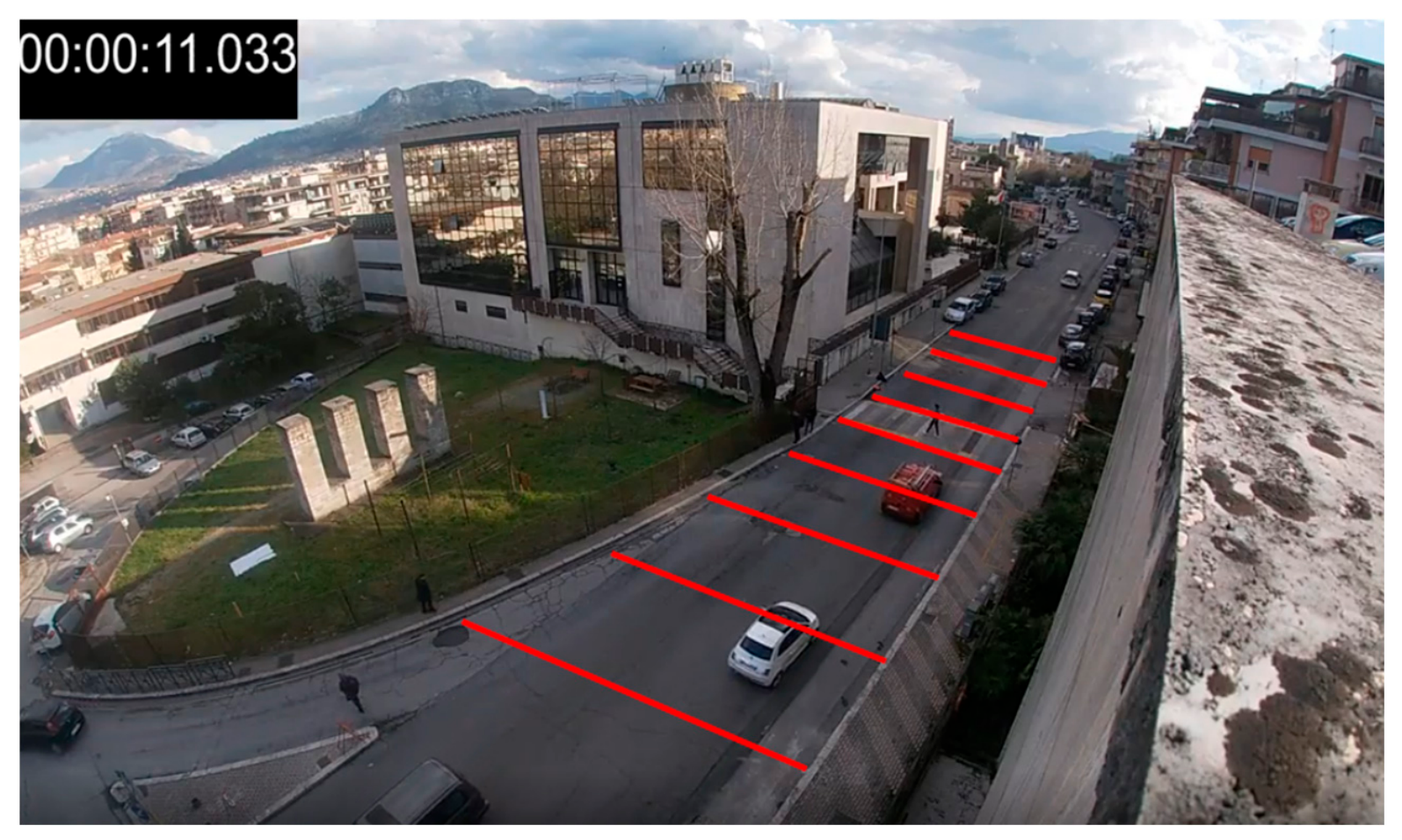
The data collection distinguishes among different vehicle categories to account for their specific dynamic responses when passing over the device. The video recording system has been strategically positioned to ensure a clear and comprehensive view of predefined physical reference points on the road surface (see Figure 1), including the beginning and the end of the RPC. Data has been analyzed using video modeling software that allows the creation of a grid with several reference points (see Figure 1) on which vehicular speeds have been evaluated. To guarantee a high level of accuracy and mitigate perspective distortions, the spatial calibration of the video modeling software has been based on these physical milestones; consequently, the distance between each virtual milestone is rigidly fixed at 5 m. Speeds have been evaluated based on the elapsed time between these milestones. With a video recording acquisition frequency of 20 frames per second (fps), the temporal resolution of the system is 0.05 s per frame, which leads to a maximum error of ± 5.5% on speed evaluation.
Surveys were conducted on multiple typical weekdays and across different time intervals to ensure that the dataset accurately reflects ordinary traffic conditions. The recorded video was subsequently examined to determine vehicle crossing speeds at selected control points along the device. These measurements have been used for further statistical analysis. During data collection, isolated vehicle conditions were met. Based on average speed, all observations involving two different vehicles crossing the same finish line within 15 s were discarded. Beyond this 15-s time gap, isolated vehicle/free-flow conditions were deemed to be met [36,37]. Furthermore, all observations involving the simultaneous passage of a pedestrian over the RPC and a vehicle, or abnormal parking conditions near the RPC, have been neglected.

3.2. Linear Mixed Effects Model

As previously mentioned in the Section 3.1, for each observation in the dataset, multiple speed measurements are recorded. To model the speed profiles from these data, standard Ordinary Least Squares (OLS) regression may be insufficient to analyze vehicle speed on RPCs. The dataset consists of repeated speed measurements (longitudinal data) from the same vehicle at different spatial milestones. In this framework of correlated speed measurements that belong to the same driver, the assumption of independent residuals with OLS is violated [38]. Applying OLS to such data can lead to underestimated standard errors and an increased risk of Type I errors (i.e., attributing significance to variables that are not significant) [39].
To overcome the OLS limitation, a Linear Mixed Effects Model (MEM) has been implemented to reconstruct speed profiles. The aforementioned model decomposes the variance (or the variability) into two main components: Fixed effects and Random effects. The fixed effect is the part of the variance explained by observed variables and describes the mean behavior across the whole population. On the contrary, the Random Effects explain the other variance component by highlighting the specific deviation from the population mean, capturing unobserved heterogeneity [38,39,40].
As specified by Laird and Ware [38], the Linear MEM is a relationship between the response or dependent variable y and the independent variables, expressed as a linear combination of fixed and random effects. By following a matrix notation, the model could be described as in Equation (1):
y = X α + Z b + ε
where:
  • y is the N × 1 vector of observed responses;
  • X is the N × p design matrix for the fixed effects;
  • α is the p × 1 vector of fixed-effect coefficients;
  • Z is the N × q design matrix for the random effect;
  • b is the q × 1 vector of random effects;
  • ε is the N × 1 vector of residual errors.
The model assumes that the random effects b and the residuals ε are independent and follow a multivariate normal distribution (Equations (2) and (3)):
b ~ N ( 0 , D )
ε ~ N ( 0 , R )
where:
  • N ( 0 , D ) is the normal distribution that characterizes b, with a mean of zero and covariance matrix D;
  • N ( 0 , R ) is the normal distribution that characterizes ε , with a mean of zero and covariance matrix R;
Some parameters to measure the goodness of fit, including metrics such as AIC (Akaike Information Criterion), BIC (Bayesian Information Criterion), Log-Likelihood (LLF), R2Marginal, R2Conditional and the, Likelihood Ratio Test (LRT) p-value, have been introduced in order to select the best model in two directions. Specifically, AIC and BIC measure the model’s goodness of fit, penalizing its complexity; in comparative terms, lower values indicate better model performance. Log-Likelihood (LLF) measures how likely the data is given the model. The higher it is, the more likely you are to predict the data (AIC in Equation (4), BIC in Equation (5), and the Log-Likelihood in Equation (6)). The predictive accuracy has been evaluated using the Mean Absolute Error (MAE) (Equation (7)) [41]:
A I C = 2 l ϑ ^ + 2 k
B I C = 2 l ϑ ^ + k l o g ( n )
l ϑ ^ = log ϑ = i = 1 n log f ( x i | ϑ )
M A E = 1 n i = 1 n y i y ^ i
where:
  • l ϑ ^ is the Log-Likelihood;
  • k is the number of parameters in the model;
  • n is the number of observations;
  • f ( x i | ϑ ) is the density probability of a sample x1 … xn;
  • y i is the actual speed value for the observation i;
  • y ^ i is the predicted speed value for the observation i.
Finally, the goodness of fit has been assessed using the coefficient of determination for mixed models proposed by Nakagawa and Schielzeth [42], by evaluating both Marginal and Conditional R2, which are defined as follows (Equations (8) and (9)). The proportion of total variance attributable to inter-individual differences has been quantified with the Intraclass Correlation Coefficient (ICC) for the random-intercept models (Equation (10)) [43]:
R M a r g i n a l 2 = σ f 2 σ f 2 + σ r 2 + σ ε 2
R C o n d i t i o n a l 2 = σ f 2 + σ r 2 σ f 2 + σ r 2 + σ ε 2
I C C = σ r 2 σ r 2 + σ ε 2
where:
  • R M A r g i n a l 2 is the Marginal R2;
  • R C o n d i t i o n a l 2 is the Conditional R2;
  • σ f 2 is the fixed effect variance or the variance explained by fixed effect predictors;
  • σ r 2 is the random effect variance or the variance explained by random effect predictors;
  • σ ε 2 is the residual or the unexplained variance.

4. Case Study

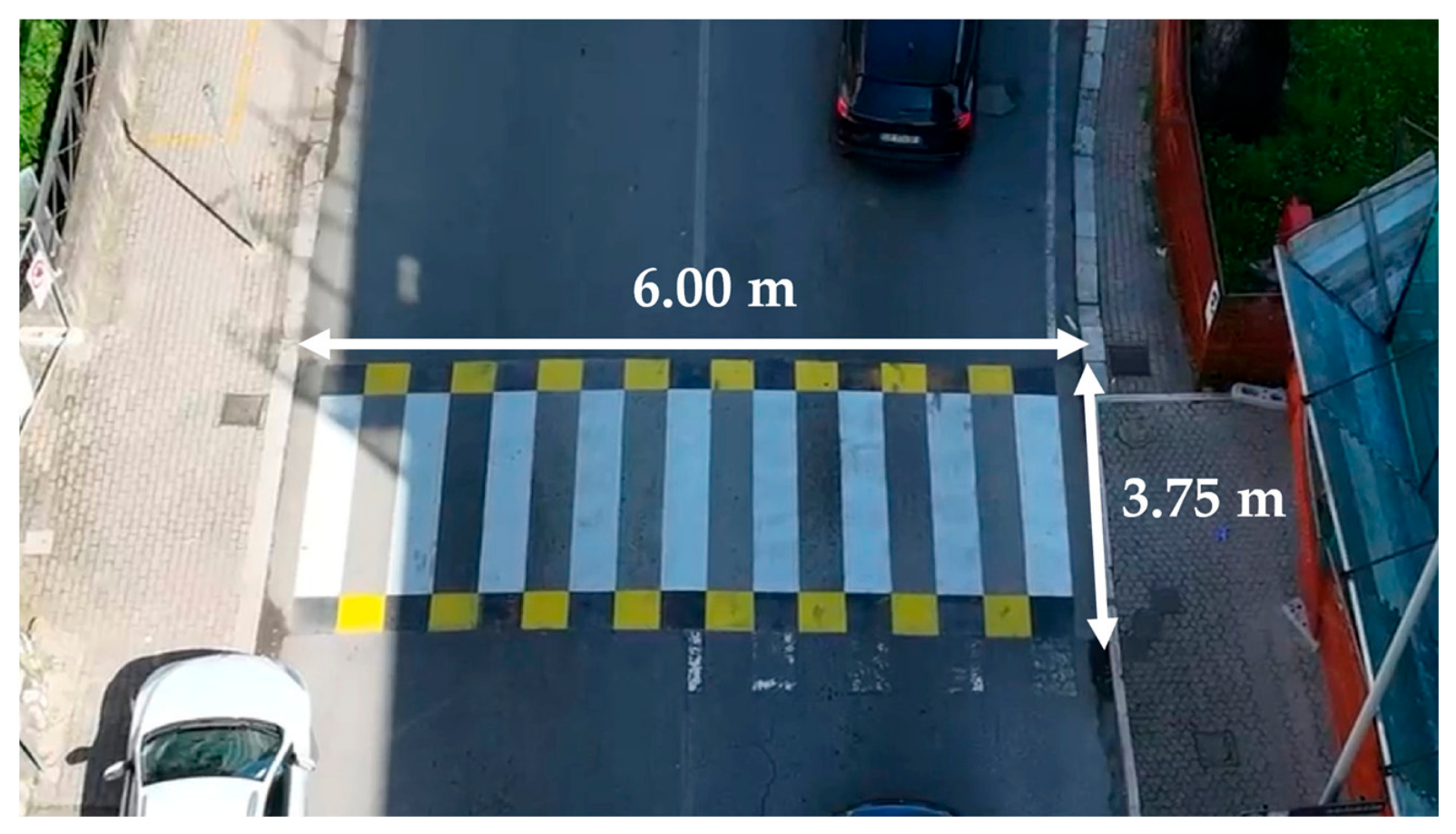
This study aims to create speed profiles within a Linear MEM approach for different vehicle typologies that cross an RPC. For these reasons, several speed data points have been collected on an RPC with video recording as described in Section 3.2. This study analyzed 19,840 discrete speed measurements collected from 2480 unique drivers (one driver per vehicle) at eight longitudinal points approaching and departing from an RPC, located in the city of Cassino, Italy (see Figure 2). The RPC is characterized by a trapezoidal shape, with a length of 3.75 m and a width of 6.00 m (equal to the road width).
The RPC is located near the University of Cassino and Southern Lazio facilities, and so it is characterized by a quite high number of students who cross the road to reach the main buildings. A video camera recording system has been placed on the roof of Building B of the Department of Civil and Mechanical Engineering, so as to have a privileged view of the road. Additionally, this positioning was strategic as it allowed drivers to behave as naturally as possible while driving their cars, without being influenced by the outside.
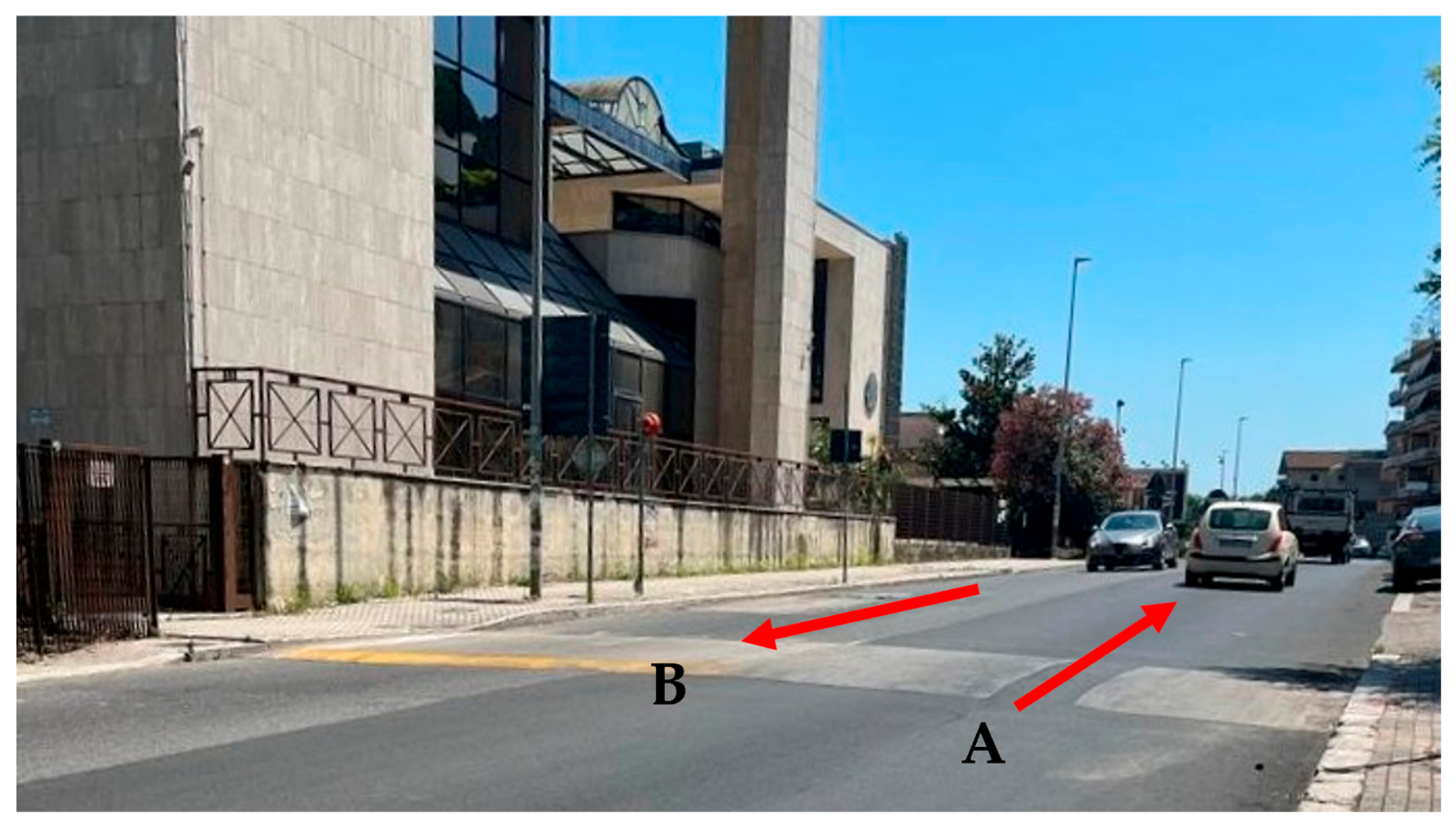
Due to different slope gradients in the outgoing and incoming directions, two directions of analysis have been considered: in particular, direction A with a slight uphill gradient (2%), and direction B with a negative slope (see Figure 3).

5. Results

5.1. Statistical Analysis

Before proceeding with the model calibration phase, an explanatory assessment of data distribution was performed. Several statistical techniques and models rely on the assumption that variables are normally distributed; neglecting this aspect may impair further analysis. For this reason, a preliminary evaluation has been carried out. Although traditional normality tests are highly sensitive to large sample sizes and often reject the null hypothesis of normality for N > 500 observations, in this work, normality has been assessed via graphical diagnostics (Q–Q plots, quantile–quantile plot) and shape statistics (such as skewness and kurtosis) [44,45]. From the results of the statistical analysis in Table 1, the most representative vehicle category is the City Car (defined according to the European A and B segments, typically characterized by an overall vehicle length under 4.0 m, and a curb weight below 1200 kg [15]), with several observations (N) exceeding 500 vehicles in both directions (A and B), followed by Sport Utility Vehicles (SUVs) and Sedans. By analyzing the skewness values for the vehicle categories reported, these values range between 0.18 and 0.76, while kurtosis values range between −0.62 and 0.73. Since both metrics fall within a widely accepted range (from −2 to +2), the vehicle speed crossing data distribution on RPC can be approximated as normally distributed, satisfying the assumption needed for further statistical analysis [44,45,46]. Although these metrics fall under a widely accepted range suggesting no extreme asymmetry, formal normality and homoscedasticity tests were executed to rigorously verify parametric assumptions. It is worth noting that these analyses have been carried out on speed values in milestone 5 for the outgoing direction A, while on milestone 4 in the incoming direction B (which represents the speed value after crossing the RPC).
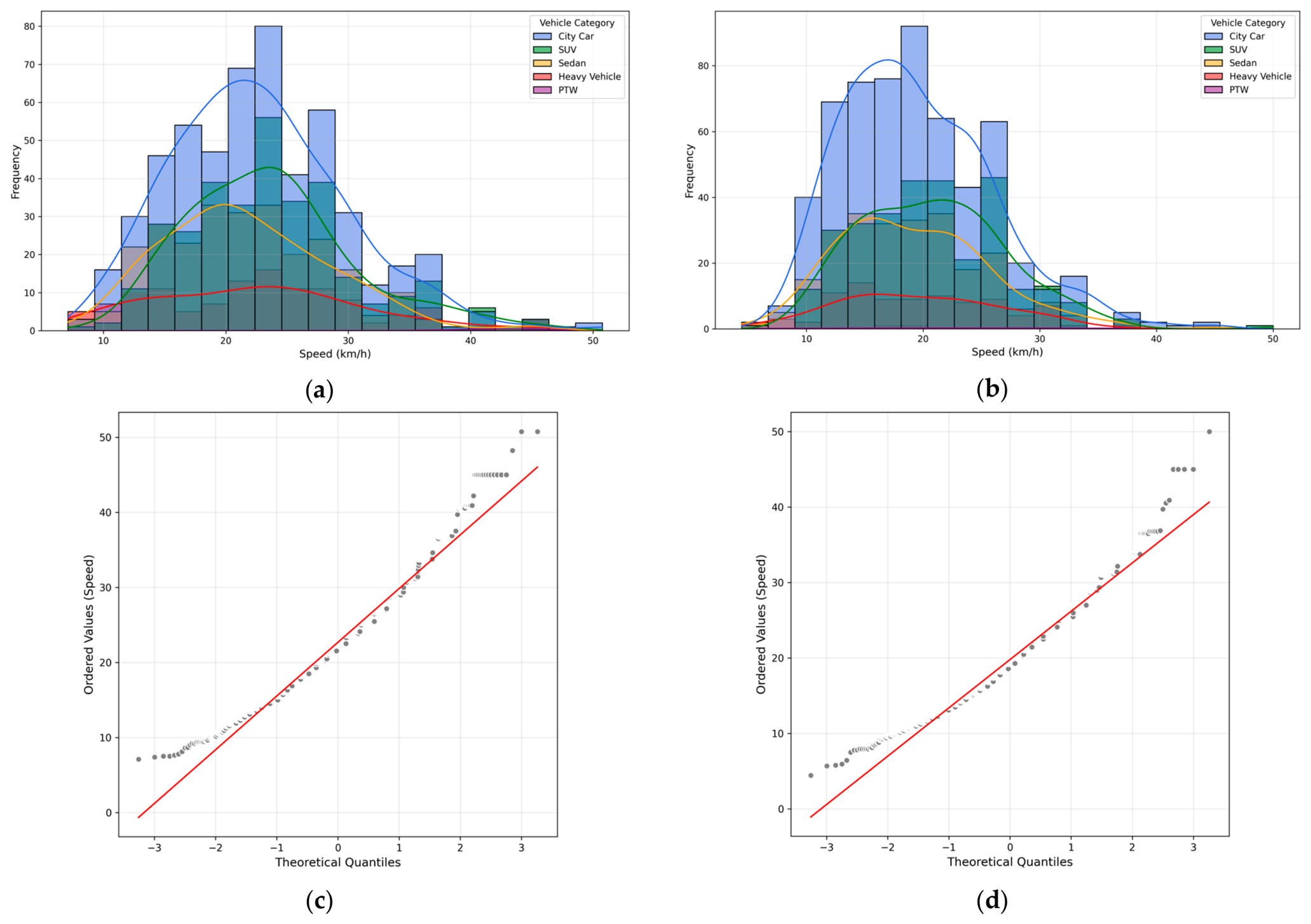
The frequency distribution of vehicle crossing speeds (see Figure 4a,b) shows a unimodal distribution across all vehicle categories and for the two directions A and B, respectively. The overall patterns do not show an abnormal trend, and the data appear normally distributed. It is worth noting that vehicle crossing speeds on RPC are higher for SUVs than for other vehicle categories in both directions.
The Q–Q plots in Figure 4c,d, for direction A and direction B, respectively, show satisfactory alignment with the theoretical normal distribution, particularly in the central quantiles: the closer the dots to the red line, the higher the level of normality in the data. In both graphs, in the right parts of the diagrams, the dots are not well aligned with the theoretical normal distribution, due to some high vehicle crossing speeds. In conclusion, Figure 4d (outgoing direction B) shows a slightly better alignment to the theoretical normal distribution compared to Figure 4c (incoming direction A).
To evaluate whether vehicle type significantly influences vehicular crossing speeds on RPC, an Analysis of Variance (ANOVA) has been performed separately for the incoming and outgoing directions. Powered Two-Wheelers (PTW) have been excluded from this specific statistical test due to an insufficient sample size (N < 5). For the outgoing direction (A), the ANOVA revealed a statistically significant difference in mean speeds across the four vehicle categories (F = 4.3477, p = 0.00468). Similarly, for the incoming direction (B), a significant main effect of vehicle category on speed was observed (F = 3.7478, p = 0.010767).
However, to validate the appropriateness of these parametric inferences and to rigorously determine the correct subsequent statistical methods, the underlying assumptions of normality and homoscedasticity were evaluated using ad hoc tests. Shapiro–Wilk (see Table 2) tests for normality indicated significant deviations from a normal distribution across almost all vehicle groups in both directions (with p < 0.05 for City Cars, SUVs, and Sedans), with the sole exception of Heavy Vehicles (p = 0.0972 in direction A, p = 0.2532 in direction B). Furthermore, Levene’s test (see Table 2) was implemented to retrieve information on the selection of the analytical framework. The test indicated a violation of homoscedasticity for the Outgoing direction A (F = 6.6543, p = 0.0002), and not for the Incoming direction B (F = 0.4629, p = 0.7083).
Given these violations of homoscedasticity and normal distribution, as emerged from Shapiro–Wilk and Levene’s tests, relying solely on standard ANOVA and parametric post hoc adjustments (such as Tukey’s Honestly Significant Difference) could introduce statistical bias and Type I errors. To overcome these limitations, the non-parametric Kruskal–Wallis H-test has been implemented. The test confirmed highly significant inter-group differences for both Direction A (H-Statistic = 14.3956, p = 0.002413) and Direction B (H-Statistic = 13.0645, p = 0.004499). Subsequently, as it is possible to observe in Table 3, Dunn’s post hoc test was executed in conjunction with the Benjamini–Hochberg False Discovery Rate (FDR) correction, with the aim of avoiding the excessive conservatism of classic Bonferroni corrections. In the Outgoing direction (A), SUVs demonstrated a distinct crossing behavior compared to all other vehicle categories, crossing the RPC significantly faster than Sedans (p = 0.002932), Heavy Vehicles (p = 0.028245), and City Cars (p = 0.035592). This behavior is also observed in the Incoming direction (B), where SUVs continued to exhibit crossing speeds that differed significantly from those of both Sedans (p = 0.004668) and City Cars (p = 0.004668).

5.2. Speed Profiles with LMEM

The application of MEM allows for the reconstruction of continuous speed profiles while accounting for driver variability and vehicle type, factors neglected in vehicle speed profile reconstruction. Based on the Linear MEM general framework described in Equation (1), the Design matrix X has been modeled to include a second-order polynomial term. The speed profile over an RPC follows a non-linear law (deceleration during the approach phase, minimum speed at the crossing, and acceleration after the crossing), represented by a quadratic function of position. The General Model (Equation (1)) has been so adapted for the specific purpose and case study, and could be expressed as follows (Equation (11)):
v i , j = β 0 + β 1 s i , j + β 2 s i , j 2 + β 3 , k T j , k + β 4 , k ( s i , j T j , k ) + β 5 , k ( s i , j 2 T j , k ) + u 0 , j + ε i , j
where:
  • v i , j is the predicted speed of vehicle j at the milestone i (km/h);
  • s is the longitudinal position (in meters);
  • β 0 ,   β 1 ,   β 2 are the fixed effect coefficients for the intercept, the linear term, and the quadratic position (s) term, respectively;
  • β 3 , k is the fixed effect coefficient for vehicle type k (categorical main effect of vehicle type);
  • β 4 , k is the fixed effect coefficient for the interaction between vehicle type k and the linear position term s;
  • β 5 , k is the fixed effect coefficient for the interaction between vehicle type k and the quadratic position term s2;
  • T j , k is the categorical fixed effect term that represents vehicle type;
  • u 0 , j is the random intercept for vehicle j, which follows a normal distribution;
  • ε i , j is the residual error term.
The model described in Equation (11) (which could be defined as M1, Intercept Only Model) has also been compared for accuracy with a more complex version of this MEM, which could be defined as a Random Intercept and Slope Model (M2). M1 is introduced to avoid non-convergence due to increased model complexity. In Equation (11), in which the term related to the random slope u 1 , j is equal to zero, in M2 it is different from zero (Equation (12)):
v i , j = β 0 + β 1 s i , j + β 2 s i , j 2 + β 3 , k T j , k + β 4 , k ( s i , j T j , k ) + β 5 , k ( s i , j 2 T j , k ) + u 0 , j + u 1 , j s i , j + ε i , j
where:
  • v i , j is the predicted speed of vehicle j at the milestone i (km/h);
  • s is the longitudinal position (in meters);
  • β 0 ,   β 1 ,   β 2 are the fixed effect coefficients for the intercept, the linear term, and the quadratic position (s) term, respectively;
  • β 3 , k is the fixed effect coefficient for vehicle type k (categorical main effect of vehicle type);
  • β 4 , k is the fixed effect coefficient for the interaction between vehicle type k and the linear position term s;
  • β 5 , k is the fixed effect coefficient for the interaction between vehicle type k and the quadratic position term s2;
  • T j , k is the categorical fixed effect term that represents vehicle type;
  • u 0 , j is the random intercept for vehicle j, which follows a normal distribution;
  • u 1 , j is the random slope for the linear position (s) term;
  • ε i , j is the residual error term.
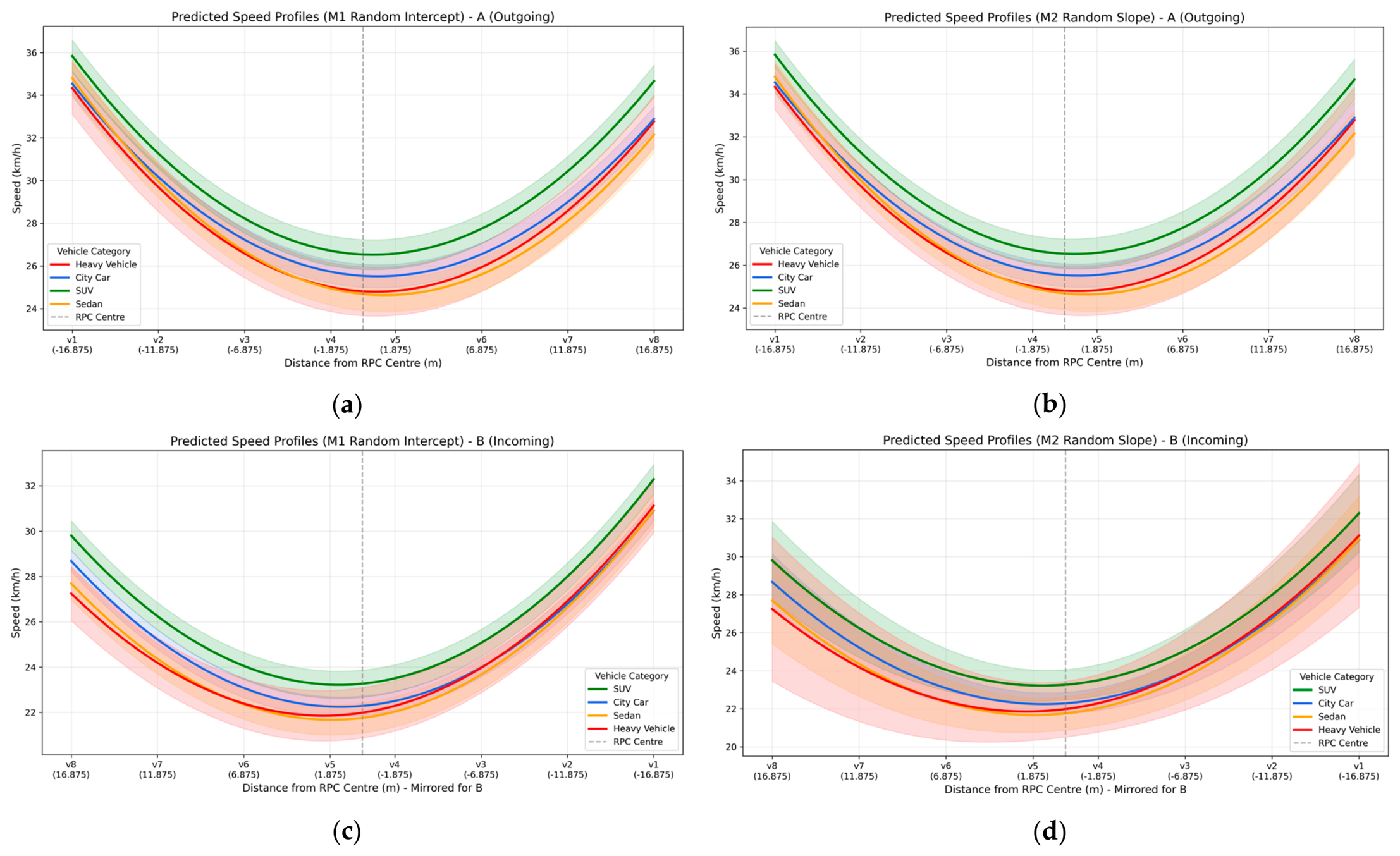
All the coefficients in Equations (11) and (12) are given in the following tables (Table 4, Table 5, Table 6 and Table 7), for the two directions of travel and for the two different calibrated models (M1 and M2). A more in-depth discussion of the coefficients will be offered in the following Section 6. Figure 5 also shows vehicle location profiles by vehicle type in both directions (A and B) and for the different types of models implemented (M1 and M2).
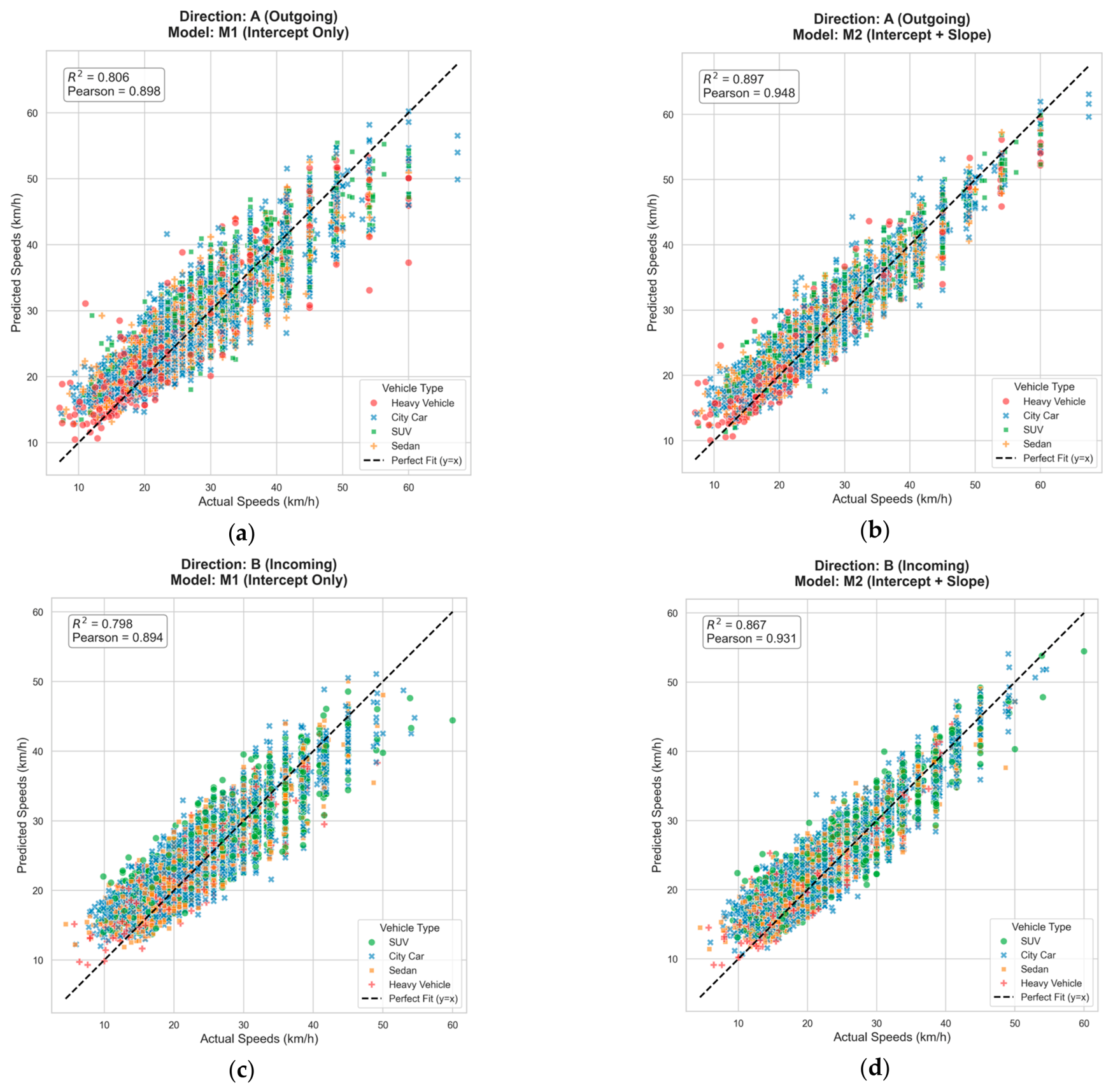
Figure 6 shows the results of model calibration in terms of R2 and Pearson correlation coefficient. Although Model M2 shows superior Pearson and R2 correlation coefficients in both directions, these indices only evaluate the goodness of fit on the sample and do not penalize the presence of a random slope in the most complex model. The selection of the final model has been based on the evaluation of the AIC, BIC, and the Log-Likelihood Function (LLF), which confirmed that for Direction B, the greater complexity of Model M2 is not justified by the simpler Model M1 (see Table 8). In addition, the M2 model in direction B resulted in a singular fit (without convergence), indicating that the variance associated with the random slope was negligible (u1,j = 0.9803). M2 in direction B has been discarded in favor of the more parsimonious and stable M1 model.
To evaluate the predictive capabilities of the models, a Hold-out validation has been conducted. The MAE has been calculated on the test set (20% of the whole dataset) to quantify the average absolute difference between the predicted and observed speeds. The MAE remains constant between M1 and M2 within each direction (5.86 km/h for Direction A, and 4.80 km/h for Direction B). An advantage of LMEM is the ability to quantify inter-individual behavioral differences through ICC. The ICC values for the M1 models are 0.731 for Direction A (outgoing) and 0.712 for Direction B (incoming). These values indicate that over 70% of the total variance in the observed speed profiles is attributable to differences between individual drivers. Model M2 in direction A shows higher performance in terms of ICC.
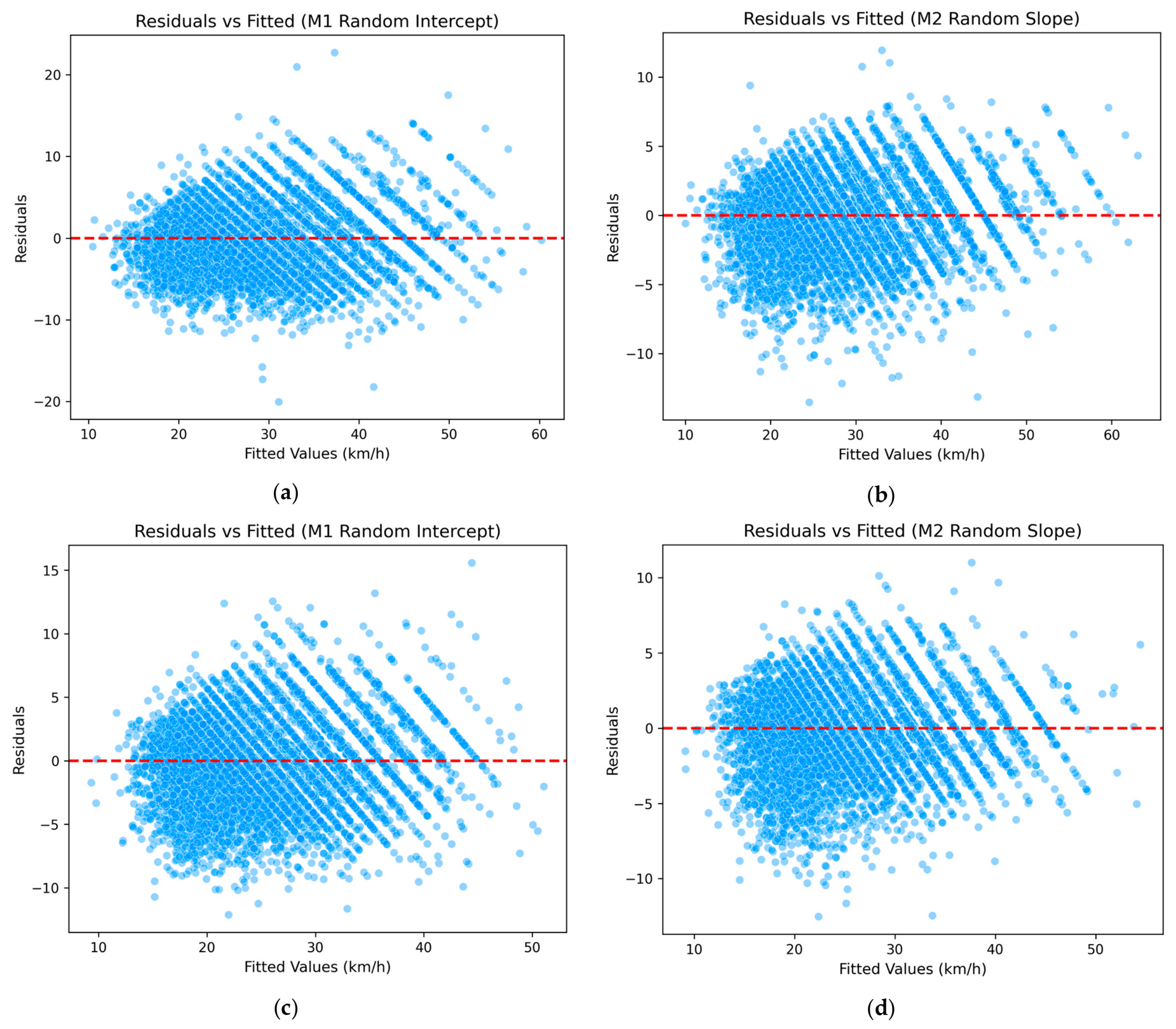
Model diagnostics showed no critical issues (see Figure 7): the scatterplot of residuals and fitted values demonstrates substantial homoscedasticity (a statistical condition in which the variance of the errors remains constant), ensuring that significance tests are valid.

6. Discussion

The descriptive statistical analysis proposed in Table 1 reveals that vehicles in the outgoing direction (A) maintain significantly higher speeds than those in the incoming direction (B). SUV speeds increase from an average of 20.8 km/h in Direction B to 23.58 km/h in Direction A. This discrepancy could mainly be due to the different widths of the roadway before and after RPC, and thus to a narrowing of the roadway due to the presence of parking spaces. Furthermore, descriptive statistical analysis shows that vehicle categories cross the RPC at different speeds, with SUVs consistently recording the highest averages (23.58 km/h in A and 20.8 km/h in B).
These preliminary findings are fully consistent with the robust non-parametric analysis. The Dunn–FDR post hoc test confirms that SUVs maintain significantly higher speeds over the RPC compared to all other vehicle categories in Direction A and against standard passenger cars (Sedans and City Cars) in Direction B, effectively bypassing the traffic-calming purpose of the infrastructure due to their specific mechanical layout (higher ground clearance and tolerant suspensions). From a physical and geometric point of view, this behavioral difference can be attributed to the characteristics of SUVs, such as greater ground clearance, larger tire diameters, and more tolerant suspension systems. These features could mitigate vertical acceleration and discomfort experienced inside the vehicle.
As shown in Table 8, metrics such as AIC (Akaike Information Criterion), BIC (Bayesian Information Criterion), Log-Likelihood (LLF), R2Marginal, R2Conditional, and Likelihood Ratio Test (LRT) p-value have been introduced. The LRT p-value suggests which model to use (whether M1 or M2). If it is <0.05, it means that adding the “Random Slope” (M2) significantly improves the model compared to the “Random Intercept” (M1) alone.
Model comparison using AIC, BIC, and Likelihood Ratio Tests (LRT) revealed an asymmetric behavioral response depending on the travel direction. For the Outgoing direction (A), Model M2 shows better prediction performance than Model M1, indicating high inter-driver variability not only in baseline speeds but also in the deceleration/acceleration rates over the RPC. Conversely, for the Incoming direction (B), Model M1 provided the best fit (lowest AIC/BIC), suggesting a constant braking profile among drivers. Furthermore, the Pseudo R2 metrics highlighted the dominance of the human factor: while fixed spatial and vehicular variables explained approximately 18–20% of the speed variance according to R2Marginal, incorporating individual driver heterogeneity (Random Effects) increased the explained variance to 77–85% (as shown in Table 8 with R2Conditional).
In the MEM framework, the City Car category has been set as the reference category. Therefore, the coefficients shown in Table 4, Table 5, Table 6 and Table 7 represent deviations from this baseline. This discussion focuses on the best-fitting models: M2 for Direction A and M1 for Direction B. Starting from the outgoing direction A, the intercept value (β0, see Table 5) is 25.53 km/h, equal to the crossing speed on RPC. The coefficient β2, which describes the shape of the curve, i.e., a convex curve, is significant, which confirms the ability of the parabolic model to predict driving dynamics. SUVs crossed the RPC approximately 1 km/h faster than City Cars (β3,SUV = 1.005). The term β5,SUV indicates that the curve tends to be narrower than the baseline curve for City Car, highlighting that SUVs tend to decelerate and accelerate more sharply than the City Car (partially explained by suspensions that allow for better absorption of the obstacle). Sedans tend to be slightly slower (−0.85 km/h, looking at the β3,Sedan coefficient) than City Cars. However, their quadratic interaction (β5,Sedan = +0.0021, p = 0.002) is significant, suggesting a more marked braking/acceleration dynamics. Going to Heavy Vehicles, no significant differences emerge, except for the quadratic term β5,HV, which is higher than for SUVs.
In the opposite direction, B, the best model found is Model M1 with Random Intercept (Table 6). In this direction, the speed at the center of RPC is 22.3 km/h (β0), 3 km/h lower than the B Outgoing direction. This could be mainly due to the road layout, i.e., a narrower road section (due to the presence of parking spaces), which therefore affects the overall driving behavior. Similar to the other direction, the strong significance of both the β1 and β2 terms confirms the validity of the parabolic profile for describing the speed profile on RPC. The linear slope (β1 = −0.065) is slightly steeper than the direction A (−0.049). SUVs’ speed in this direction is 1 km/h higher than that of City Cars. In this direction, however, the linear and quadratic interactions are not significant, indicating that the behavior assumed by the drivers and the shape of the curve are similar to those of City Cars. Although heavy-duty vehicles do not show a significant difference in minimum speed at the center of the RPC (β3,HV = −0.30, p = 0.61), the linear interaction term is strongly significant (β4,HV = −0.048, p < 0.001). This suggests a more cautious driving behavior and is constrained by the kinematics of the vehicle: the steeper slope compared to the reference category indicates that heavy vehicle drivers begin the deceleration phase earlier or with a more marked progression, probably due to the greater inertia. For sedans (Sedan), a similar phenomenon is observed: the absence of significance in the intercept (β3,Sedan = −0.53, p = 0.18) indicates that the speed on the RPC is comparable to that of City Cars. However, the significant interaction with position (β4,Sedan = −0.029, p < 0.001) reveals that these vehicles accelerate more rapidly after RPC and brake more decisively when approaching, possibly reflecting a stiffer suspension mechanical response or more responsive driving behavior than small cars.

7. Conclusions

One of the main risks associated with the severity of road crashes for all types of road users is speed. For several years now, 30 km/h Zones (or 20 mph Zones) have been introduced in various urban contexts around the world to create reduced-speed areas to mitigate the risk of road crashes. Obviously, from what emerges from the literature analysis, there is a series of devices to tangibly implement speed reduction. Among the best performing, physical traffic calming devices with an altimetric effect are the most effective. In this article, attention is paid to RPCs, which have a dual function: they not only constitute an obstacle that induces a reduction in speed due to vertical acceleration on the driver’s body, but also allow the most vulnerable road users to cross the carriageway more safely than a simple pedestrian crossing. The reason why this study is proposed was precisely to model driving and, therefore, speed behavior in relation to RPCs.
In this paper, experimental speed data collection has been conducted using external cameras positioned on buildings surrounding RPCs to not change driving behavior. The analyses were conducted by ensuring a 15-s time gap between vehicles to capture driving behavior under free-flow conditions, i.e., without the different drivers influencing each other’s behavior. Preliminary descriptive statistics were complemented by formal assumption checks (Shapiro–Wilk and Levene’s tests). Given the observed violations in data normality and homoscedasticity, a robust non-parametric framework (utilizing the Kruskal–Wallis test and Dunn’s post hoc analysis with False Discovery Rate correction) was deployed to rigorously assess whether there were significant differences in the RPC crossing speeds among vehicle categories. From a modeling perspective, this article proposes an LMEM that allows for studying and analyzing driving behavior, discriminating by vehicle type. Four models, two for each direction, have been proposed to take into account the different slopes of the road in the two directions of analysis (A and B). The two models, M1 (Random Intercept) and M2 (Random Intercept and Slope), in the calibration phase, showed very high correlation coefficients between measured and estimated speeds. Models’ comparisons have been conducted through the main statistical metrics (such as AIC and BIC). The picture that emerges is that the results of the model and statistical analyses offer a complete overview of the phenomenon. In all models, it is confirmed that the second-degree polynomial equation captures precisely the dynamics of approach, crossing and departure from the RPC. Furthermore, both the robust non-parametric tests and the LMEM confirm that, in both directions, SUVs show a higher speed (1 km/h on average) than City Cars (baselines). This could be partially explained by the SUV’s greater ground clearance and stronger suspension [15], although these parameters were not measured in this work. The estimated speed on RPC for the reference category (City Car) varies considerably according to the travel direction: 25.5 km/h for the Outgoing direction versus 22.3 km/h for the Incoming direction. This suggests that the infrastructure geometries play a crucial role in the speed of approach, imposing the need for separate directional analyses.
Obviously, the study is not free from weaknesses. The first concerns the collection of experimental data. The analysis of video footage and the subsequent processing of speeds at different milestones can be less precise than naturalistic measurements carried out on board. On the other hand, the use of cameras represents a much cheaper data-collection solution. Another aspect to take into account is the analysis of only one RPC and not a series of these, in order to highlight the geometric characteristics of the road and of the RPC itself, and its different traffic composition. It is also worth highlighting the limitations of a single case study. Because all observations occurred at the same RPC, geometric and environmental features, such as roadway width and contextual urban design, are constant for all vehicles. In this way, their specific impact on speed cannot be retrieved and isolated within the LMEM framework. The aim of this article is not to provide justifications for the implementation of 30 km/h Zones, but simply to propose a methodological approach (from data collection with an external observer to the development of speed models) that can assist in the implementation of these traffic-calming devices. Since the RPC is located in a small town in Italy, reactive analyses (based on historical crash data) are impossible to develop, as well as before-and-after analyses. Future developments for this study include increased data collection on RPCs in the same city of analysis, but also at other sites, along with improved modeling. It therefore emerges that the main contributions of this work lie in the analysis of speed profiles for different vehicles (a gap that had emerged in several works of the literature) and in providing a methodological framework that can be rigorously applied in other contexts as well. It is, after all, desirable that these results related to this specific methodological case study offer a starting point for city managers and scholars in the field of road safety in order to study traffic calming methods and techniques for the implementation of Zone 30.


Author Contributions

Conceptualization, G.C., S.N. and M.D.; methodology, G.C. and S.N.; software, G.C.; validation, G.C.; formal analysis, G.C.; investigation, G.C.; resources, G.C., S.N. and M.D.; data curation, G.C. and S.N.; writing—original draft preparation, G.C.; writing—review and editing, G.C., S.N. and M.D.; visualization, G.C.; supervision, M.D. and V.N.; project administration, M.D. and V.N.; funding acquisition, M.D. All authors have read and agreed to the published version of the manuscript.

Funding

This study was carried out within the MOST—Sustainable Mobility Center and received funding from the European Union Next-Generation EU (PIANO NAZIONALE DI RIPRESA E RESILIENZA (PNRR)—MISSIONE 4 COMPONENTE 2, INVESTIMENTO1.4—D.D.103317/06/2022, CN00000023). This manuscript reflects only the authors’ views and opinions; neither the European Union nor the European Commission can be considered responsible for them.

Institutional Review Board Statement

Not applicable.

Informed Consent Statement

Not applicable.

Data Availability Statement

The data used in this study appear in the article.

Conflicts of Interest

The authors declare no conflicts of interest. The funders had no role in the design of the study; in the collection, analyses, or interpretation of data; in the writing of the manuscript; or in the decision to publish the results.

References

  1. Road Traffic Injuries. Available online: https://www.who.int/news-room/fact-sheets/detail/road-traffic-injuries (accessed on 6 February 2026).
  2. Global Plan for the Decade of Action for Road Safety 2021–2030. Available online: https://www.who.int/publications/m/item/global-plan-for-the-decade-of-action-for-road-safety-2021-2030 (accessed on 7 July 2025).
  3. Ronan Speed and Crash Risk. Available online: https://www.itf-oecd.org/speed-crash-risk (accessed on 6 February 2026).
  4. What is a Safe System Approach?|US Department of Transportation. Available online: https://www.transportation.gov/safe-system-approach (accessed on 6 February 2026).
  5. Elvik, R. A Before–after Study of the Effects on Safety of Environmental Speed Limits in the City of Oslo, Norway. Saf. Sci. 2013, 55, 10–16. [Google Scholar] [CrossRef]
  6. Wegman, F.; Zhang, F.; Dijkstra, A. How to Make More Cycling Good for Road Safety? Accid. Anal. Prev. 2012, 44, 19–29. [Google Scholar] [CrossRef] [PubMed]
  7. Wegman, F.; Dijkstra, A.; Schermers, G.; Van Vliet, P. Sustainable Safety in the Netherlands: Evaluation of National Road Safety Program. Transp. Res. Rec. 2006, 1969, 72–78. [Google Scholar] [CrossRef]
  8. Yannis, G.; Michelaraki, E. Effectiveness of 30 Km/h Speed Limit–A Literature Review. J. Saf. Res. 2025, 92, 490–503. [Google Scholar]
  9. Milton, K.; Kelly, M.P.; Baker, G.; Cleland, C.; Cope, A.; Craig, N.; Foster, C.; Hunter, R.; Kee, F.; Kelly, P. Use of Natural Experimental Studies to Evaluate 20mph Speed Limits in Two Major UK Cities. J. Transp. Health 2021, 22, 101141. [Google Scholar] [CrossRef] [PubMed]
  10. Hu, S.; Orsi, G.; Santi, P.; Wang, A.; Fugiglando, U.; Ratti, C. Evaluating the Impact of Zone 30 Policies on Citywide Road Traffic Emissions and Efficiency: A Big Data-Driven Approach. Transp. Res. Part A Policy Pract. 2025, 202, 104705. [Google Scholar] [CrossRef]
  11. Quddus, M.; Theofilatos, A.; Feng, M.; Elvik, R. Evaluating the safety and speed impacts of the 20mph speed limit in the UK: Evidence and insights. Accid. Anal. Prev. 2025, 211, 108210. [Google Scholar] [CrossRef]
  12. Seya, H.; Yoshida, K.; Inoue, S. Verification of Zone-30-Policy Effect on Accident Reduction Using Propensity Score Matching Method for Multiple Treatments. Case Stud. Transp. Policy 2021, 9, 693–702. [Google Scholar] [CrossRef]
  13. Distefano, N.; Leonardi, S. Evaluation of the Effectiveness of Traffic Calming Measures by SPEIR Methodology: Framework and Case Studies. Sustainability 2022, 14, 7325. [Google Scholar] [CrossRef]
  14. Kruszyna, M.; Matczuk-Pisarek, M. The Effectiveness of Selected Devices to Reduce the Speed of Vehicles on Pedestrian Crossings. Sustainability 2021, 13, 9678. [Google Scholar] [CrossRef]
  15. Loprencipe, G.; Moretti, L.; Pantuso, A.; Banfi, E. Raised Pedestrian Crossings: Analysis of Their Characteristics on a Road Network and Geometric Sizing Proposal. Appl. Sci. 2019, 9, 2844. [Google Scholar] [CrossRef]
  16. D’Apuzzo, M.; Evangelisti, A.; Santilli, D.; Nardoianni, S.; Cappelli, G.; Nicolosi, V. Towards a New Design Methodology for Vertical Traffic Calming Devices. Sustainability 2023, 15, 13381. [Google Scholar] [CrossRef]
  17. Barbosa, H.M.; Tight, M.R.; May, A.D. A Model of Speed Profiles for Traffic Calmed Roads. Transp. Res. Part A Policy Pract. 2000, 34, 103–123. [Google Scholar] [CrossRef]
  18. Moreno, A.T.; García, A. Use of Speed Profile as Surrogate Measure: Effect of Traffic Calming Devices on Crosstown Road Safety Performance. Accid. Anal. Prev. 2013, 61, 23–32. [Google Scholar] [CrossRef] [PubMed]
  19. Distefano, N. Evaluation of the Benefits of Traffic Calming on Vehicle Speed Reduction. Civ. Eng. Archit. 2019, 7, 200–214. [Google Scholar] [CrossRef]
  20. Daniel, B.D.; Nicholson, A.; Koorey, G. Analysing Speed Profiles for the Estimation of Speed on Traffic-Calmed Streets. Road Transp. Res. A J. Aust. N. Z. Res. Pract. 2011, 20, 57–70. [Google Scholar]
  21. Richter, M.; Paszkowski, J. Modelling Driver Behaviour in Traffic-Calmed Areas. Tech. Trans. 2018, 11, 111–124. [Google Scholar] [CrossRef][Green Version]
  22. Nardoianni, S.; Cappelli, G.; D’Apuzzo, M.; Nicolosi, V. Statistical Analysis of Experimental Crossing Speed on Vertical Traffic Calming Devices: Influence of Vehicle Category and Road Safety Implications. In Proceedings of the International Conference on Computational Science and Its Applications; Springer: Berlin/Heidelberg, Germany, 2025; pp. 65–80. [Google Scholar]
  23. Gonzalo-Orden, H.; Rojo, M.; Pérez-Acebo, H.; Linares, A. Traffic Calming Measures and Their Effect on the Variation of Speed. Transp. Res. Procedia 2016, 18, 349–356. [Google Scholar] [CrossRef]
  24. Mohammadipour, A.; Mohammadipour, A.; Alavi, S.H. Statistical Analysis of Geometric Characteristics and Speed Reductions for Raised Pedestrian Crosswalks (RPC). J. Transp. Saf. Secur. 2020, 12, 380–399. [Google Scholar] [CrossRef]
  25. Vlassenroot, S.; Broekx, S.; Mol, J.D.; Panis, L.I.; Brijs, T.; Wets, G. Driving with Intelligent Speed Adaptation: Final Results of the Belgian ISA-Trial. Transp. Res. Part A Policy Pract. 2007, 41, 267–279. [Google Scholar] [CrossRef]
  26. Richards, D.C. Relationship Between Speed and Risk of Fatal Injury: Pedestrians and Car Occupants; Great Britain Department for Transport: London, UK, 2010.
  27. Lockwood, I.M. ITE Traffic Calming Definition. Inst. Transp. Eng. ITE J. 1997, 67, 22. [Google Scholar]
  28. Cantisani, G.; Corazza, M.V.; Di Mascio, P.; Moretti, L. Eight Traffic Calming “Easy Pieces” to Shape the Everyday Pedestrian Realm. Sustainability 2023, 15, 7880. [Google Scholar] [CrossRef]
  29. Khorshid, E.; Awada, H.; Falah, A.H.; Elkholy, A. Optimal Design of Traffic Calming Devices Using Computer Simulation. Int. J. Model. Simul. 2020, 40, 375–393. [Google Scholar] [CrossRef]
  30. Hamilton-Baillie, B.; Jones, P. Improving Traffic Behaviour and Safety through Urban Design. In Proceedings of the Institution of Civil Engineers-Civil Engineering; Thomas Telford Ltd.: London, UK, 2005; Volume 158, pp. 39–47. [Google Scholar]
  31. Gonzalo-Orden, H.; Pérez-Acebo, H.; Unamunzaga, A.L.; Arce, M.R. Effects of Traffic Calming Measures in Different Urban Areas. Transp. Res. Procedia 2018, 33, 83–90. [Google Scholar] [CrossRef]
  32. Pratelli, A.; Pratali, R.; Rossi, M. Raised Crosswalks Efficacy on the Lowering of Vehicle Speeds. WIT Trans. Built Environ. 2011, 116, 541–552. [Google Scholar] [CrossRef]
  33. Mohd Noor Azmi, A.E.; Daniel, B.D. Campus Walkability: Enhancing Pedestrian Safety through Installation of Raised Crosswalks. In Proceedings of the IOP Conference Series: Earth and Environmental Science; IOP Publishing: Bristol, UK, 2024; Volume 1347, p. 012046. [Google Scholar]
  34. Majer, S.; Sołowczuk, A. Effectiveness of Speed Tables Installed Singularly in Home Zones on 130 m–170 m Long Side Streets. Mod. Transp. 2025, 14, 13369. [Google Scholar] [CrossRef]
  35. Mohammadipour, A.H.; Alavi, S.H. The Optimization of the Geometric Cross-Section Dimensions of Raised Pedestrian Crosswalks: A Case Study in Qazvin. Accid. Anal. Prev. 2009, 41, 314–326. [Google Scholar] [CrossRef] [PubMed]
  36. Reilly, W. Highway Capacity Manual 2000. TR News 1997, 193, 22–23. [Google Scholar]
  37. Vogel, K. What Characterizes a “Free Vehicle” in an Urban Area? Transp. Res. Part F Traffic Psychol. Behav. 2002, 5, 15–29. [Google Scholar] [CrossRef]
  38. Laird, N.M.; Ware, J.H. Random-Effects Models for Longitudinal Data. Biometrics 1982, 38, 963–974. [Google Scholar] [CrossRef] [PubMed]
  39. Zuur, A.F.; Ieno, E.N.; Walker, N.J.; Saveliev, A.A.; Smith, G.M. Mixed Effects Models and Extensions in Ecology with R; Springer: Berlin/Heidelberg, Germany, 2009; Volume 574. [Google Scholar]
  40. Baayen, R.H. Mixed-Effects Models. In The Oxford Handbook of Laboratory Phonology; Oxford University Press: Oxford, UK, 2012; pp. 668–677. [Google Scholar]
  41. Willmott, C.J.; Matsuura, K. Advantages of the Mean Absolute Error (MAE) over the Root Mean Square Error (RMSE) in Assessing Average Model Performance. Clim. Res. 2005, 30, 79–82. [Google Scholar] [CrossRef]
  42. Nakagawa, S.; Schielzeth, H. A General and Simple Method for Obtaining R2 from Generalized Linear Mixed-effects Models. Methods Ecol. Evol. 2013, 4, 133–142. [Google Scholar]
  43. Nakagawa, S.; Johnson, P.C.; Schielzeth, H. The Coefficient of Determination R 2 and Intra-Class Correlation Coefficient from Generalized Linear Mixed-Effects Models Revisited and Expanded. J. R. Soc. Interface 2017, 14, 20170213. [Google Scholar] [PubMed]
  44. Field, A. Discovering Statistics Using IBM SPSS Statistics; Sage Publications Ltd.: London, UK, 2024; ISBN 1-5296-6870-0. [Google Scholar]
  45. Johnson, R.A.; Wichern, D.W. Applied Multivariate Statistical Analysis; Prentice Hall: Upper Saddle River, NJ, USA, 2002. [Google Scholar]
  46. Byrne, B.M. Structural Equation Modeling with AMOS, EQS, and LISREL: Comparative Approaches to Testing for the Factorial Validity of a Measuring Instrument. Int. J. Test. 2001, 1, 55–86. [Google Scholar] [CrossRef]
Figure 1. Predefined reference points or milestones on which vehicle speed has been evaluated. Red lines represent pre-defined milestones.
Urbansci 10 00379 g001
Figure 2. RPC shape and location in the urban context. Source: authors’ own work.
Urbansci 10 00379 g002
Figure 3. The two different directions of analysis: A is the outgoing direction, and B is the incoming direction. Source: authors’ own work.
Urbansci 10 00379 g003
Figure 4. Speed distribution for the two different directions of analysis: (a) A is the outgoing direction, and (b) B is the incoming direction. Q–Q plots for the two different directions of analysis: (c) A is the outgoing direction, and (d) B is the incoming direction.
Urbansci 10 00379 g004
Figure 5. The four developed models: (a) Random Intercept Model (M1) in direction A; (b) Random Intercept and Slope Model (M2) in direction A; (c) Random Intercept Model (M1) in direction B; (d) Random Intercept and Slope Model (M2) in direction B.
Urbansci 10 00379 g005
Figure 6. Results of model calibration in terms of Pearson correlation coefficient and R2: (a) Model M1 in direction A; (b) Model M2 in direction A; (c) Model M1 in direction B; (d) Model M2 in direction B. Source: authors’ own work.
Urbansci 10 00379 g006
Figure 7. Residual plots in the two different directions of analysis: (a) residuals plot of Model M1 in the outgoing direction A; (b) residuals plot of Model M2 in the outgoing direction A; (c) residuals plot of Model M1 in the incoming direction B; (d) residuals plot of Model M2 in the incoming direction B. Source: authors’ own work.
Urbansci 10 00379 g007
Table 1. Descriptive statistical analysis.
DirectionVehicle CategoryNMeanStd_Devv85 (km/h)SkewnessKurtosis
A (Outgoing)City Car53522.657.1229.350.620.6
A (Outgoing)Heavy Vehicle12022.288.5430.750.42−0.14
A (Outgoing)PTW242.773.1544.33N/AN/A
A (Outgoing)SUV32423.586.9629.350.760.7
A (Outgoing)Sedan25921.636.8528.910.630.51
B (Incoming)City Car58819.516.4425.470.740.6
B (Incoming)Heavy Vehicle8919.586.73270.18−0.62
B (Incoming)PTW428.113.1939.210.43−1.44
B (Incoming)SUV30320.86.27270.580.73
B (Incoming)Sedan25019.146.4325.330.620.58
Table 2. Results of Shapiro–Wilk and Levene Tests.
DirectionTestGroupStatisticp-Value
AShapiro-Wilk (Normality)City Car0.97950
AShapiro-Wilk (Normality)Heavy Vehicle0.98150.0972
AShapiro-Wilk (Normality)SUV0.97480
AShapiro-Wilk (Normality)Sedan0.96780
ALevene’s Test (Equal Variances)All Groups6.65430.0002
BShapiro-Wilk (Normality)City Car0.96430
BShapiro-Wilk (Normality)Heavy Vehicle0.9820.2532
BShapiro-Wilk (Normality)SUV0.97170
BShapiro-Wilk (Normality)Sedan0.97470.0002
BLevene’s Test (Equal Variances)All Groups0.46290.7083
Table 3. Results of Dunn’s post hoc test with the Benjamini–Hochberg False Discovery Rate (FDR) correction.
DirectionGroup 1Group 2p-Value
ACity CarHeavy Vehicle0.327948
ACity CarSUV0.035592
ACity CarSedan0.152886
AHeavy VehicleSUV0.028245
AHeavy VehicleSedan0.905169
ASUVSedan0.002932
BCity CarHeavy Vehicle0.75382
BCity CarSUV0.004668
BCity CarSedan0.622848
BHeavy VehicleSUV0.237527
BHeavy VehicleSedan0.622848
BSUVSedan0.004668
Table 4. M1 Model for Direction A (outgoing). The random intercept of the model is u0,j = 37.1646, and the residual error ε0,j = 13.6655.
DirectionModelTermEstimateStd. Errorp > |z|
AM1β025.530078740.2766994470
AM1β3,HV−0.7231876150.6464550280.263269218
AM1β3,SUV1.0048929210.4505389760.025719311
AM1β3,Sedan−0.8492892490.4844719750.079598508
AM1β1−0.0490243130.0051767862.79765 × 10−21
AM1β4,HV0.0026976980.0120945640.823496219
AM1β4,SUV0.0143128350.0084291590.089505023
AM1β4,Sedan−0.0295315310.0090640140.001121579
AM1β20.0287422810.0005243840
AM1β5,HV0.0019757240.0012251220.106815026
AM1β5,SUV0.0018801690.0008538340.027663065
AM1β5,Sedan0.0021492440.0009181410.019239155
Table 5. M2 Model for Direction A (outgoing). The random intercept of the model is u0,j = 37.8547, the random slope u1,j = 0.0406, and the residual error ε0,j = 8.1449.
DirectionModelTermEstimateStd. Errorp > |z|
AM2β025.530078740.2738353640
AM2β3,HV−0.7231876150.6397636510.258308515
AM2β3,SUV1.0048929210.4458755020.024211757
AM2β3,Sedan−0.8492892490.4794572650.076501608
AM2β1−0.0490243130.0095880853.17006 × 10−7
AM2β4,HV0.0026976980.0224007160.904143233
AM2β4,SUV0.0143128350.0156119070.359252866
AM2β4,Sedan−0.0295315310.016787740.078558332
AM2β20.0287422810.0004048380
AM2β5,HV0.0019757240.0009458270.036718014
AM2β5,SUV0.0018801690.0006591820.004340765
AM2β5,Sedan0.0021492440.000708830.002428564
Table 6. M1 Model for Direction B (incoming). The random intercept of the model is u0,j = 27.7149, and the residual error ε0,j = 10.3876.
DirectionModelTermEstimateStd. Errorp > |z|
BM1β022.286715170.2205462780
BM1β3,HV−0.3028939130.6082737350.618514641
BM1β3,SUV0.9803912840.3781962960.009534171
BM1β3,Sedan−0.5304953710.4037864470.188912903
BM1β1−0.0657998130.0043052119.81112 × 10−53
BM1β4,HV−0.0488481360.011873913.89022 × 10−5
BM1β4,SUV−0.0078811090.0073826450.285737774
BM1β4,Sedan−0.0298758760.0078821810.000150462
BM1β20.0263434320.0004360970
BM1β5,HV−0.0010696140.001202770.373846216
BM1β5,SUV0.0009796420.0007478270.190200976
BM1β5,Sedan0.0001731250.0007984270.828338905
Table 7. M2 Model for Direction B (incoming). The random intercept of the model is u0,j = 48.1391, the random slope u1,j = 0.9803, and the residual error ε0,j = 6.4835.
DirectionModelTermEstimateStd. Errorp > |z|
BM2β022.286715170.2914318360
BM2β3,HV−0.3028939130.8037783850.7062943
BM2β3,SUV0.9803912840.4997519870.04979094
BM2β3,Sedan−0.5304953710.5335670440.320104512
BM2β1−0.0657998130.0409723840.108283753
BM2β4,HV−0.0488481360.1130031540.665543498
BM2β4,SUV−0.0078811090.0702601010.910688233
BM2β4,Sedan−0.0298758760.0750141580.690431292
BM2β20.0263434320.0003445330
BM2β5,HV−0.0010696140.0009502330.260320633
BM2β5,SUV0.0009796420.0005908110.097290928
BM2β5,Sedan0.0001731250.0006307870.783732124
Table 8. Main Model Performances.
DirectionModelConvergedHold-Out MAEICCAICBICLLFR2MarginalR2ConditionalLRT p-Value
AM1True5.8630.73157,969.458,063.01−28,971.70.18040.7796-
AM2 True5.8630.82355,407.1855,515.19−27,688.590.19550.85770
BM1 True4.7980.71254,789.1454,882.66−27,381.570.20430.7711-
BM2 False4.7980.88157,569.7857,677.69−28,769.890.14290.90011
Disclaimer/Publisher’s Note: The statements, opinions and data contained in all publications are solely those of the individual author(s) and contributor(s) and not of MDPI and/or the editor(s). MDPI and/or the editor(s) disclaim responsibility for any injury to people or property resulting from any ideas, methods, instructions or products referred to in the content.