
Article

Rethinking Minor Cities with Historical Heritage Through Adaptive Reuse Strategies: Evidence from the Case of Craco (Italy)


1
Department of Civil, Environmental, Land, Building Engineering and Chemistry (DICATECh), Polytechnic University of Bari, 70126 Bari, Italy
2
Department of Architecture and Design, “Sapienza” University of Rome, 00196 Rome, Italy
*
Author to whom correspondence should be addressed.
Urban Sci. 2026, 10(7), 364; https://doi.org/10.3390/urbansci10070364
Submission received: 3 March 2026 / Revised: 15 May 2026 / Accepted: 16 May 2026 / Published: 1 July 2026
(This article belongs to the Special Issue Urban Regeneration: A Rethink)

Abstract

Regenerating fragile historical contexts requires choices of repurposing that combine heritage protection, continuity of use and managerial feasibility, in the presence of multiple objectives and stakeholders with different preferences. This study develops and tests an MCDA-based decision-support framework for the ex-ante selection of adaptive reuse scenario applied to Craco (Italy) and Palazzo Carbone-Rigirone. Craco and Palazzo Carbone-Rigirone were selected as a critical case because they combine heritage abandonment, geomorphological fragility, cultural visibility, weak local services and the need for a feasible management model. The methodology involves: (i) defining four adaptive reuse scenarios; (ii) constructing nine criteria that integrate socio-economic impacts, safety/security, cultural attractiveness, compatibility with the property and economic–financial feasibility; (iii) elicitation of weights using a hybrid approach, combining the decision-maker’s macro priorities and the social quota derived from questionnaires using normalised indicators of satisfaction/dissatisfaction and priorities for improvement; (iv) classification using the Weighted Sum Model and TOPSIS under two normalizations (distributive and ideal) and two variants (relative and absolute). The results show convergence between methods and stability of the ranking, with a preference for the multifunctional scenario oriented towards cultural services and socialising. In the case of Craco, adaptive reuse offers advantages compared with purely conservative, passive musealization or tourism-only strategies. The study concludes that MCDA is useful as a transparent pre-selection tool and supports the alignment of local needs and institutional priorities; its robustness can be strengthened with sensitivity analyses and policy scenarios.

1. Introduction

In recent years, the debate on urban regeneration has gradually shifted from a predominantly physical–spatial vision to an integrated approach, in which governance, economic and financial sustainability, the quality of the user experience and the ability to activate stable local coalitions play a decisive role. In this context, the adaptive reuse of built heritage—especially abandoned or underutilised buildings—is considered a strategic lever because it allows for the preservation of cultural and territorial capital, limits land consumption and environmental externalities linked to building replacement and generates new economies and services. However, the literature highlights how adaptive reuse is a highly complex decision-making process: technical and regulatory constraints, uncertainty of demand, trade-offs between conservation and transformation, and a plurality of actors with potentially conflicting preferences make the selection of potentially feasible scenarios non-trivial [1,2].
This complexity becomes even more critical in fragile and marginal contexts—inland areas, small towns, territories subject to physical–environmental risks or socio-economic problems—where weak administrative capacity, dependence on external resources, and the need for robust management models can transform a good project idea into an unimplementable outcome [3]. The issue of inner peripheries, i.e., territorial disconnection, the rarefaction of services and progressive marginalisation, is now recognised as a growing problem even at European level, requiring planning and assessment tools capable of integrating social and geophysical dimensions, as well as economic ones [4]. In Italy, this focus has been consolidated with the National Strategy for Inner Areas (NSIA), which represents a place-based policy laboratory aimed at combating depopulation and marginalisation. Similar European and local development programmes, such as LEADER, also show that regeneration in marginal areas depends on funding availability and on the capacity to coordinate territorial resources, local actors and implementation priorities. This reinforces the need for transparent decision-support tools capable of comparing alternative reuse strategies before implementation [5,6].
In this scenario, it becomes essential to rethink regeneration not only as physical transformation, but also as a decision-making and implementation issue: selecting functions and management models that maximise the continuous use of the asset, generate real demand and make operations sustainable over time. The issue is particularly evident in ghost towns and historic centres abandoned due to natural hazards and socio-economic fragility, where redevelopment must contend with accessibility/safety constraints and an often weak local economy. Craco was selected as a critical case because it concentrates, within a single settlement, several conditions that make adaptive reuse decisions particularly complex: historical abandonment, geomorphological instability, strong cultural and landscape visibility, weak local services, limited accessibility, and the need for a feasible long-term management model. These characteristics make the case particularly suitable for testing an MCDA-based decision-support framework, since the choice of reuse functions should be based on simultaneous consideration of protection, attractiveness, social needs, safety, compatibility and economic feasibility [7,8,9].
At the same time, in recent years, a framework of funding programmes has been strengthened that explicitly aims to support the revitalisation of villages and fragile areas. Recent Italian funding programmes, including the PNRR Investment 2.1 “Attractiveness of villages”, have further strengthened the policy relevance of transparent and replicable ex-ante protocols for selecting regeneration scenarios in fragile historical settlements.
The contribution is explicitly configured as a rethinking of urban regeneration for three reasons: (i) it shifts the focus from the “narrative” choice of function to the formalisation of a decision problem with constraints and an implementation horizon; (ii) it integrates institutional priorities with local preferences derived from surveys through a hybrid elicitation of weights, making mappings and scaling explicit; (iii) it verifies the recommendation through convergence between methods (WSM and TOPSIS) and implementation variants, strengthening the traceability of results with respect to technical choices that are often opaque in applications.
Although previous MCDA applications have contributed to structuring heritage reuse decisions, many studies remain focused either on ranking alternatives or on defining evaluation criteria, while less attention is paid to the explicit connection between territorial diagnosis, local preferences, institutional priorities and implementation feasibility. Specifically, the work: (a) defines four adaptive reuse scenarios (A1–A4); (b) adopts nine criteria (C1–C9) covering socio-economic dimensions, attractiveness, safety/security, compatibility with the asset, and economic and financial feasibility; (c) derives weights using a hybrid approach (decision-maker + survey); (d) produces rankings and indicators of distance from the ideal, discussing operational implications for governance and management. The extension with sensitivity analysis and policy scenarios is discussed as a priority development to strengthen the robustness of decisions.
The remainder of the paper is organised as follows: Section 2 reviews the relevant background on regeneration in fragile contexts, heritage-adaptive reuse trade-offs, and MCDA decision-support. Section 3 describes the case study, criteria, scoring and workflow. Section 4 presents results, while Section 5 discusses implications, limitations, and future extensions.

2. Literature Review: Adaptive Reuse Strategies for Historical Heritage and MCDA Decision Support

2.1. Adaptive Reuse of Historical Heritage

In the domain of historical heritage, adaptive reuse can be defined as a strategy that combines conservation with functionality. This approach involves the transformation of an obsolete use in a manner that extends the life cycle of a heritage asset, thereby preserving its cultural, architectural and symbolic values. From this standpoint, the practice of reuse is congruent with the principles of integrated conservation. The implementation of novel functions is permissible only when it is in accordance with the material consistency, spatial configuration, historical stratification and cultural vocation of the edifice. Adaptive reuse, therefore, necessitates a harmonious equilibrium between the processes of transformation and conservation. This is to ensure that the musealization of heritage is avoided, as well as the excessive functionalization of the asset as a mere economic resource.
The extant literature pertaining to the adaptive reuse of historic buildings identifies several recurring strategies. The initial strategy is minimal and reversible reuse, where the new function requires limited physical transformation and preserves the legibility of the historical fabric. A secondary strategy pertains to the cultural and community-oriented reuse of heritage. This is achieved through the utilisation of museums, cultural services, educational activities, creative production, events and spaces for social interaction. A third strategy is tourism-oriented reuse, which establishes a connection between the building and visitor flows and territorial attractiveness. Nevertheless, the implementation of this strategy necessitates meticulous management to circumvent the pitfalls of seasonality, over-specialisation and inadequate local integration. A fourth strategy is mixed-use adaptive reuse, in which complementary functions are combined to increase continuity of use, diversify users and improve economic and managerial sustainability.
In fragile historical contexts, the challenge lies not only in assigning a new function to a building, but also in identifying a function that can contribute to preservation, social reactivation, and long-term management. It is evident that these strategies are especially relevant in such contexts. In the context of abandoned or underused heritage sites, the adoption of compatible reuse strategies has been demonstrated to facilitate enhanced continuity of presence, facilitate maintenance, enhance surveillance, and mitigate abandonment-related risks. Nonetheless, the selection of a reuse strategy is an intricate process, given its multifaceted nature, which encompasses a series of trade-offs among various considerations. These include, but are not limited to, conservation requirements, technical compatibility, anticipated demand, economic viability, social needs, and governance capacity. It is evident that adaptive reuse decisions are becoming increasingly dependent on the utilisation of transparent decision-support tools. These tools must possess the capacity to facilitate a comparative analysis of alternative functions, encompassing a multitude of criteria.

2.2. Adaptive Reuse in Fragile, Abandoned and Minor Historical Settlements

A particularly relevant line of research for “vulnerable” cases is that which links adaptive reuse to sustainable and low-carbon urban development objectives, highlighting how social, economic, environmental and institutional dimensions must be integrated holistically to avoid partial or unworkable outcomes [10,11]. In this perspective, the focus shifts from the merits of the design solution alone to the “implementation chain”: who manages it, with what resources, with what rules, and with what local alliances [12].
Several contributions show that the implementation phase is one of the main problems: even when there are shared vision and general consensus, translating these into programmes, agreements and operational capabilities is often difficult. In the case of Salerno, for example, an analysis based on stakeholder engagement highlights a complex set of challenges and solutions, with an emphasis on data knowledge/management, participation, cooperation and enhancement tools [13]. Consistently, studies on other urban contexts indicate that the main implementation problems arise when the sustainability framework is not integrated with urban and institutional policies (and not only with design choices) [14,15,16].
This strand supports a clear methodological choice for a regeneration-oriented paper: to make explicit (a) the constraints and drivers of the context, (b) who the stakeholders are and how they fit into the decision-making model, (c) which criteria truly represent the regeneration objectives, and (d) what evidence supports the scores assigned to the alternatives. This is precisely where an MCDA approach must document decisions, assumptions, sources and traceability [17,18,19].

2.3. MCDA Decision Support for Adaptive Reuse and Heritage-Led Regeneration

MCDA is widely used in sustainability assessments and multi-objective problems because it allows for the management of heterogeneous information (quantitative and qualitative), the integration of preferences, and the production of interpretable results (rankings, distances from the ideal, comparative analyses) [20,21,22]. However, the literature highlights a frequent risk: the choice of normalisation/aggregation methods and procedures is often guided by familiarity rather than explicit reasons, resulting in a loss of transparency and replicability. For this reason, too, the combined use of simple, established methods (e.g., WSM) with methods based on distance from the ideal (TOPSIS) can be effective as a consistency check and as a communication tool for non-technical decision-makers [23,24,25,26].
In the field of cultural heritage, MCDA applications show how multi-criteria analysis can make the selection of valorisation and reuse strategies more structured, especially when the decision-making object is part of a territorial system and a network of goods/services. Examples in Italy highlight both the use of value-based approaches for the repurposing of historic buildings and the integration of multi-criteria analysis and spatial dimensions to define enhancement strategies for complex cultural heritage systems. At the same time, contributions focused on “vulnerable contexts” propose integrated protocols for classifying reuse scenarios and supporting urban development strategies, with a focus on process transparency and shared objectives [27,28,29,30]. Table 1 summarises the main contributions considered relevant to the present study. The comparison demonstrates not only the focus and methodological approach of each contribution, but also the specific type of output produced. Standardised terminology is employed in order to clarify the relationship between previous studies and the research gap addressed in this paper.

2.4. Research Gap and Contribution

The scientific value of a case study, such as Craco, lies not in the application of MCDA per se, but in the construction of a rigorous and traceable workflow that links contextual diagnosis, territorial constraints, stakeholder preferences, operational criteria, scoring assumptions and final results. Existing studies are either focused on adaptive reuse principles, stakeholder engagement processes, or MCDA-based ranking procedures. However, there is a lack of attention given to ex-ante protocols that explicitly connect local needs, institutional priorities, functional management scenarios and implementation feasibility in fragile historical settlements.
This paper tackles the issue head-on by developing an MCDA-based decision-support framework. This framework treats adaptive reuse alternatives as functional and managerial scenarios to be evaluated in relation to heritage protection, social needs, economic–financial sustainability and long-term governance. The contribution is methodological and operational. It explicitly shows the transition from territorial diagnosis and survey-derived preferences to criteria definition, weighting, scoring, ranking and interpretation of implementation implications.

3. Materials and Methods

3.1. Study Context and Decision Problem

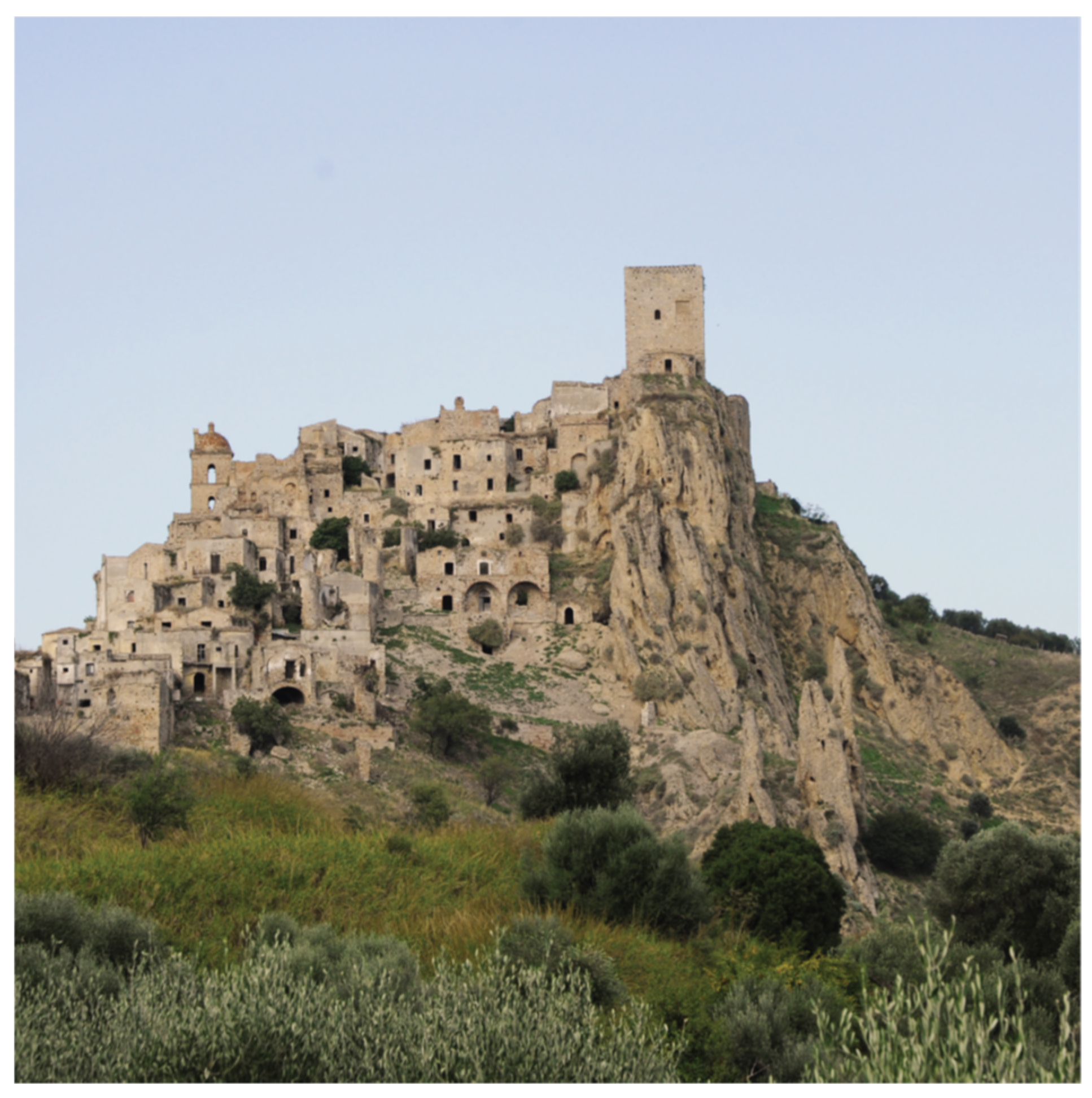
Craco serves as a quintessential case study for the regeneration of fragile historic settlements. In this context, the enhancement of built heritage is predicated on the navigation of structural constraints, including infrastructural isolation, a fragile economic fabric, and depopulation. These challenges are further compounded by significant territorial risks, such as the geomorphological instability of the site. Additionally, critical issues of management and control, including inadequate surveillance of the territory and vulnerability to vandalism, as well as the natural habitats and connection with the Calanchi territorial system (Figure 1), must be addressed. The application of MCDA to Craco is particularly pertinent due to the adaptive reuse decision involving multiple, heterogeneous and potentially conflicting dimensions that cannot be reduced to a single evaluation criterion. The following factors must be considered: heritage protection, geomorphological risk, accessibility constraints, local needs, cultural and landscape attractiveness, functional compatibility, economic and financial feasibility, and long-term management capacity. It is, therefore, evident that the case necessitates a decision-support approach that is capable of integrating quantitative and qualitative information, institutional priorities and stakeholder preferences within a transparent comparative framework.

Governance and Preservation Context

Craco is a unique case in point. It is an abandoned historic settlement that has been regenerated and preserved. The old town is not just an ordinary urban fabric; it is a controlled heritage site. Its accessibility, safety and fruition require continuous institutional coordination, maintenance and visitor management. The Municipality has taken decisive action to secure visit routes and maintain safety measures. The Parco Museale Scenografico has been meticulously organised as a controlled visitor system, ensuring regulated access and guided tours. This governance configuration clearly shows that public responsibility for heritage protection must be combined with operational actors. These actors must be capable of ensuring site management, visitor reception and cultural programming.
The state of preservation of Craco is characterised by two things. Firstly, the old town retains strong landscape, symbolic and cultural value. Secondly, its geomorphological instability, abandonment, partial ruin condition and exposure to vandalism require controlled access, constant safeguarding and compatible reuse strategies. The inclusion of the historic centre of Craco in the 2010 World Monuments Watch was a clear and decisive step in strengthening its international visibility as a heritage site at risk. It also contributed to framing its conservation as a matter of preservation, awareness-raising, advocacy and local stewardship. The adaptive reuse of Palazzo Carbone-Rigirone is not just a functional choice; it is part of a broader governance problem. The site needs uses that can increase continuity of presence, support controlled fruition, reduce abandonment-related risks and create conditions for long-term preservation.
The preliminary diagnosis adopted in the study combines two complementary components. The first was a territorial and infrastructural survey. This was to understand the study area and its wider context from a geographical, geological and infrastructural perspective. It focused on accessibility, connections between Craco Peschiera and the old town, geomorphological instability, preservation conditions, local services and landscape resources. The second survey was a socio-economic and preference survey. It was based on questionnaires and informal interviews. It identified local needs and priorities. These were related to connections, safety, job opportunities, social interaction, cultural events and the recovery/enhancement of the old town.
The SWOT analysis was then used as a synthesis tool to organise the evidence emerging from the territorial, infrastructural and socio-economic diagnosis into strengths, weaknesses, opportunities and threats. Therefore, the SWOT was not based only on questionnaire data; rather, it integrated questionnaire evidence with territorial, infrastructural, environmental and policy-related variables. On this basis, and in combination with the decision-maker’s priorities, the criteria C1–C9 were defined for the MCDA model. Details on the study population and questionnaire administration are provided in Section 3.2.
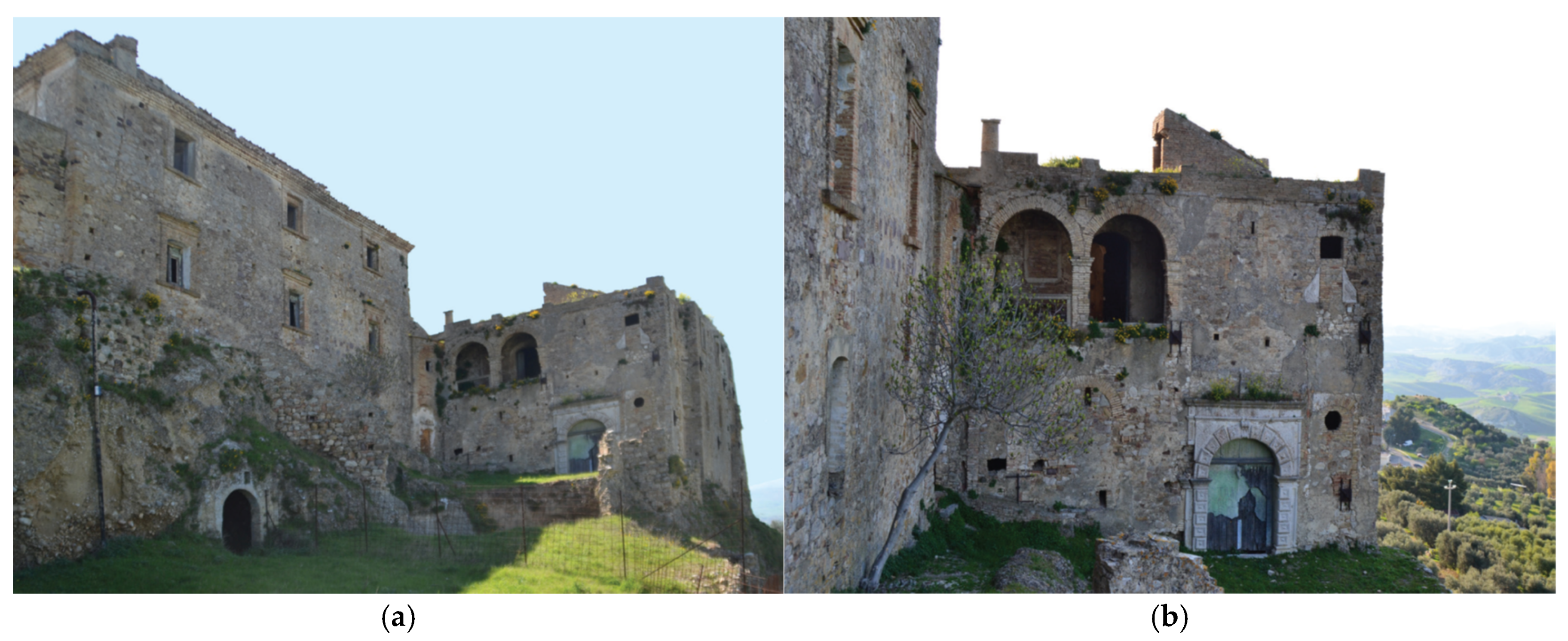
Within this context, Palazzo Carbone-Rigirone is considered a strategic asset and a “catalyst” for revitalisation (Figure 2a,b): its repurposing is conceived as a permanent facility capable of increasing presence and services on the site, while also contributing to the security and protection of the area; improve the offer and quality of the visitor experience, currently linked mainly to passing tourism attracted by the notoriety of the “ghost town”, in an area that lacks a hospitality/service system capable of functioning beyond the tourist season; and generate operational connections with local actors capable of continuously managing and promoting the functions established there.
In this logic, all the alternatives analysed include as a constant element the new headquarters of the Montedoro Ambiente e Sviluppo Sostenibile cooperative, located in a position considered strategic for facilitating tourism promotion activities and managing the refurbishment of the building and site.
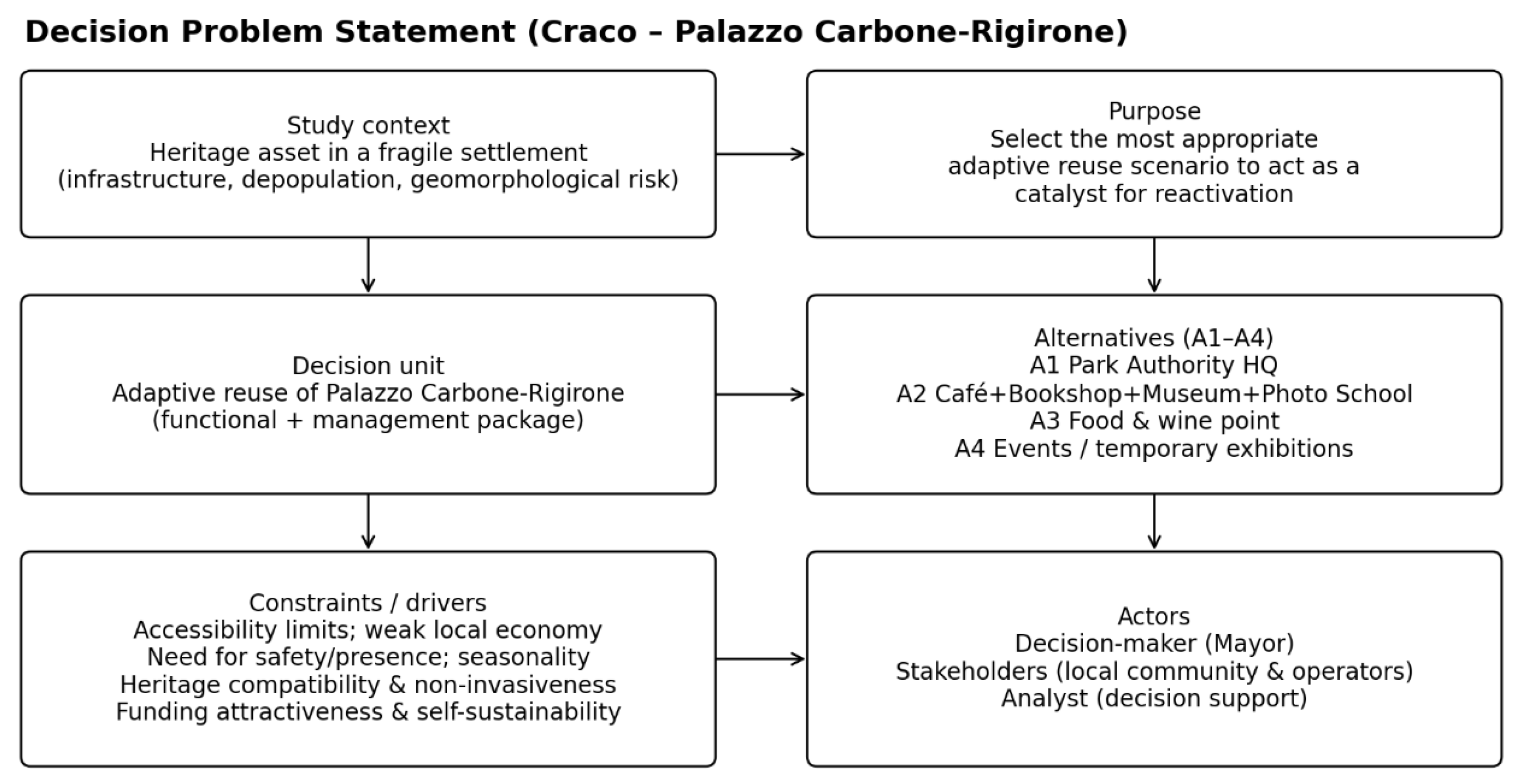
From a decision-making point of view, the process is structured as a problem of selection between alternative uses, evaluated against a set of criteria that integrates the needs of the population, the enhancement of local characteristics, and economic and financial feasibility, with attention to the protection of the historic building and the compatibility of its functions with its vocation. The governance structure provides for an institutional decision-maker, a plurality of stakeholders and an analyst to support the process (Figure 3).
Craco is not just any heritage case; it is a critical one for MCDA. The reuse decision involves multiple conflicting objectives: heritage protection, safety, accessibility, social needs, cultural attractiveness, financial sustainability and managerial feasibility. It is clear that these dimensions cannot be reduced to a single monetary or technical criterion. This makes the case particularly suitable for a multi-criteria decision-support approach.

3.2. Stakeholders and Preference Elicitation

3.2.1. Questionnaire Survey: Population, Sample and Administration

The questionnaire data used in this study were derived from a sociological survey conducted within the architectural thesis laboratory “Conservation and enhancement project of the medieval village of Craco (MT). Ancient and new in the recovery of abandoned ancient villages” at the Polytechnic University of Bari between November 2013 and February 2014. The survey involved the local population of Craco through thematic meetings organised by age groups and was aimed at identifying perceptions, needs and priorities related to the old town and its territory. Overall, the consultation process involved more than 200 people, through at least five thematic meetings, each attended by approximately 40 participants. For the purposes of the present MCDA application, only the questionnaire items referring to the local population were reprocessed, since the objective was to translate local needs and perceived criticalities into the social component of the weighting system.
The survey investigated several aspects affecting the quality of life and utilisation of the Craco area. These aspects included territorial and supra-local connections, public services, safety and public order, quality of life, job opportunities, aggregation spaces, environmental protection, cultural events promoted by the public administration, and the willingness to recover and enhance the old town. The respondents were invited to assign a score ranging from 1 to 10 to the selected aspects and to indicate which of them required improvement. The two pieces of information were subsequently reprocessed through the utilisation of normalised indicators of satisfaction/dissatisfaction and priority for improvement, and incorporated into the hybrid weighting procedure described below.

3.2.2. Elicitation of Weights

For the purposes of eliciting weights, the study adopts a “hybrid” approach (top-down + bottom-up). The decision-maker breaks down the general objective into three macro-aspects and sets a general distribution of importance: 30% to the economic–financial aspect, 10% to the enhancement of the unique characteristics of the place and 60% to the needs of the population. The latter share (60%) is then attributed to social criteria by reworking the questionnaires, combining (i) the degree of satisfaction/dissatisfaction perceived for each aspect and (ii) the urgency for improvement stated by the respondents. The questionnaires include:
  • a form in which respondents assign a score (scale 1–10) to various aspects of the city in its current state, from which a normalised indicator of (dis)satisfaction for each aspect is derived;
  • a follow-up question (“which aspect needs improvement?”) used to estimate a standardised measure of priority for action;
  • a phase combining elements of satisfaction and dissatisfaction and requests for improvement, through the product of standardised results, in order to obtain weights that simultaneously reflect “perception of criticality” and “demand for action”.
The output of this procedure is a set of percentage weights on criteria related to the needs of the population, consistent with the overall distribution established by the decision-maker (60% social area). At the same time, some criteria also incorporate indications from specific stakeholders: for example, for the safety and protection of the site, the opinions of individuals with properties in the old town and the managers of the ruins park are taken into account, with a focus on vandalism and security. Table 2 shows the stakeholder table.
The questionnaire items were transferred to the MCDA model only when they could be operationalised with respect to the alternatives for repurposing the building; for this reason, some aspects of a predominantly “systemic” nature (public services, quality of life, respect for the environment) were treated as contextual factors/constraints rather than as independent criteria. The weights derived from the mapped items were then renormalised and brought back to the social quota set by the decision-maker (60%), preserving consistency between bottom-up preferences and top-down priorities. The preference inputs derive from two normalised indices, p’s1 (satisfaction/dissatisfaction) and p’s2 (priority for improvement), calculated for each aspect of the questionnaire and subsequently transferred to the MCDA criteria using the mapping shown in Table 3.

3.3. Alternatives Adaptive Reuse Scenarios

The alternatives for repurposing Palazzo Carbone-Rigirone were developed so that each scenario combines a permanent function—the new headquarters of the Montedoro Ambiente e Sviluppo Sostenibile cooperative, intended as a management and operational centre for tourism promotion and activities related to repurposing—with a distinctive use that differentiates the scenarios. The four alternatives (A1–A4) were selected to capture different drivers of regeneration (green tourism, cultural attractiveness, experiential/food and wine tourism, event production) and to generate diverse combinations in terms of catchment area, continuity of use, management requirements and implications for the historic building (Table 4).

3.4. Evaluation Criteria and Indicators

The evaluation of alternatives was conducted using a set of nine criteria (C1–C9) designed to integrate: (i) socio-economic impact and local needs; (ii) attractiveness and capacity for cultural activation; (iii) enhancement of the specific characteristics of the location; (iv) economic and financial feasibility; and (v) compatibility of the intervention with the historical artefact.
All criteria were treated as benefit criteria: higher values indicate better performance (e.g., greater employment generated, greater financial self-sustainability or greater compatibility with the asset). Performance is measured using a combination of quantitative indicators (C1: number of contracts) and qualitative indicators on a scale of 1–5 (C2–C9), consistent with the ex ante comparative nature of the reuse scenarios. The criteria set (C1–C9) was defined by translating the SWOT findings into operational evaluation drivers, integrating decision-maker priorities; the full SWOT-to-criteria matrix is reported in Table 5.

3.5. Scoring Procedure and Data Sources

The evaluation procedure was structured in three sequential steps. First, a raw performance matrix was built by assigning a performance value to each alternative A i with respect to each criterion C j . The purpose of this matrix was to express the extent to which each adaptive reuse scenario contributes to the objective represented by each criterion. Second, the matrix was harmonised to make the criteria comparable, since C1 was measured through a quantitative indicator, whereas C2–C9 were expressed on a qualitative ordinal scale. Third, the harmonised matrix was combined with the criteria weights and processed through WSM and TOPSIS to obtain aggregate scores, closeness coefficients and final rankings.
The performance of the alternatives with respect to criteria C1–C9 was estimated ex ante using an evaluation matrix constructed by combining: (i) qualitative information emerging from the context analysis and SWOT analysis; and (ii) technical-operational proxies referring to the functional characteristics of each scenario, such as expected users, intensity and continuity of use, management requirements, additional plant interventions, revenue potential and eligibility for funding. The questionnaire results were not used to assign performance scores to the alternatives; rather, they were used in the weighting phase to inform the social-preference component of the MCDA model.
The performance scores were assigned by the decision-maker, with analytical support for the formalisation of proxy rules, internal consistency checks and traceability of assumptions. C1 was evaluated as the expected number of new job contracts generated by each scenario, consistent with the directly measurable nature of the expected employment output. Criteria C2–C9 were evaluated on a five-point qualitative performance scale, where 1 indicates a very low contribution to the criterion and 5 indicates a very high contribution. The qualitative scores were based on the functional profile of each scenario and on the technical–operational proxies described in the scoring protocol (Table 6).
Since C1 was expressed as an absolute quantitative value, while C2–C9 were scored on a 1–5 qualitative scale, C1 was harmonised through a proportional linear rescaling with respect to the maximum observed value among the alternatives. The rescaled value C 1 i for each alternative i was calculated as follows:
C 1 i = 5 C 1 i m a x ( C 1 )
where C 1 i is the expected number of new job contracts for alternative i , and m a x ( C 1 ) is the highest number of expected contracts among the alternatives. In the case study, the maximum value was 9 contracts, corresponding to A2. Therefore, the harmonised C1 values were: A1 = 1.67, A2 = 5.00, A3 = 2.78, and A4 = 3.33. This procedure preserves the proportional differences among the employment impacts of the alternatives while bringing the quantitative criterion onto the same 1–5 performance range used for the qualitative criteria. The upper bound of the scale, equal to 5, was therefore assigned to the best-performing alternative in terms of expected job creation, while the other alternatives were proportionally scaled with respect to that benchmark.
To ensure traceability and replicability, the operational definitions of the criteria (C1–C9), the metrics/evaluation scales, the direction of preference and the data source or proxy used for each criterion are reported in Supplementary Table S1. The raw and harmonised performance matrices are provided in Supplementary Tables S2 and S3. TOPSIS results are then reported under two normalisation schemes—Distributive Normalisation (DN) and Ideal Normalisation (IN)—and for two variants: Relative TOPSIS (RT), where the ideal and anti-ideal are derived from the set of alternatives, and Absolute TOPSIS (AT), where they are defined with respect to a theoretical benchmark or “ideal profile”. For transparency, all matrices and coefficients are provided as implemented in the case-study spreadsheets (Supplementary Tables S2–S6).

3.6. MCDA Workflow

The MCDA workflow combines a compensatory aggregation method (WSM) and a distance-to-ideal method (TOPSIS) to provide a transparent and internally consistent ranking of the adaptive reuse alternatives. The workflow is implemented as follows:
First, alternatives (A1–A4) and evaluation criteria (C1–C9) are defined, and a performance matrix is assembled based on decision-maker scoring supported by proxy rules described for each criterion (Section 3.5). The raw and harmonised matrices are reported in Supplementary Tables S2 and S3.
Second, criteria weights are elicited through the hybrid strategy described in Section 3.2, combining top-down macro-priorities (60% population needs, 10% place-specific enhancement, 30% economic–financial feasibility) with survey-derived allocation within the social quota.
Third, the harmonised performance matrix and the weights are processed through two complementary MCDA procedures. A Weighted Sum Model (WSM) produces an aggregate score for each alternative via weighted compensation across criteria (Supplementary Table S3). In parallel, TOPSIS is applied under two operational normalisation schemes—Distributive normalisation (DN) and Ideal normalisation (IN)—and two ideal-setting variants: Relative TOPSIS (RT), where ideal and anti-ideal are derived from the set of input alternatives, and Absolute TOPSIS (AT), where ideal and anti-ideal are defined with respect to a theoretical benchmark (“ideal profile”), consistently with the case-study implementation. The corresponding closeness coefficients are reported in Supplementary Tables S4 and S5.
Finally, rankings are compared across WSM and TOPSIS variants to assess consistency and validate the final ranking. In the case study, the ranking is stable across methods and variants (Table 7), supporting the robustness of the preferred alternative under the implemented modelling choices.
All computational outputs are reported as implemented in the case-study spreadsheets (Supplementary Tables S2–S6), while additional mathematical details are provided in Supplementary Materials.

3.7. Outputs

The MCDA application produces three classes of output that are useful both for decision support and for documenting the transparency of the model.
First, the analysis generates a ranking of refunctionalisation alternatives for each method used. The Weighted Sum Model (WSM) returns an aggregate performance score, while TOPSIS returns a proximity coefficient (CC) that can be interpreted as the proximity of the solution to the ideal. Scores and rankings are shown in Supplementary Tables S3–S6.
Secondly, TOPSIS provides distance-to-ideal information in operational form through CC values calculated under both normalisations—Distributive normalisation (DN) and Ideal normalisation (IN)—and for both variants: Relative TOPSIS (RT) (ideal/anti-ideal derived from the set of input alternatives) and Absolute TOPSIS (AT) (ideal/anti-ideal defined with respect to a theoretical benchmark/“ideal profile”). The CC values for each combination are shown in Supplementary Tables S4 and S5.
Thirdly, the study produces a cross-method comparison (WSM vs. TOPSIS) aimed at verifying the stability of the recommendation with respect to different aggregation logics (weighted sum vs. distance from the ideal) and with respect to implementation choices (DN vs. IN; RT vs. AT).
The workflow is structured to allow for an extension of the analysis through: (i) sensitivity tests on weights and performance scores; and (ii) policy scenarios with different priorities (e.g., “social-first”, “heritage-first”, “finance-first”), in order to assess the stability of the ranking under conditions of uncertainty and strengthen the robustness of the decision.

4. Empirical Results

This section presents the empirical results of the MCDA application to Palazzo Carbone-Rigirone. The purpose is to show how the four adaptive reuse alternatives perform under the adopted evaluation framework and to explain the resulting ranking before moving to the broader methodological and interpretative discussion.
Table 8 summarises the baseline results obtained with WSM and TOPSIS. For TOPSIS, the proximity coefficients (CC) calculated with the two normalisations adopted (DN and IN) in the Relative (RT) variant are reported in the main text.

4.1. Ranking of Adaptive Reuse Alternatives

The results show a stable ranking across the implemented MCDA methods. Alternative A2, corresponding to the multifunctional cultural scenario composed of a literary café, bookshop, museum and school of photography, ranks first in both WSM and TOPSIS. The overall ordering is A2 > A4 > A3 > A1. This convergence indicates that the preference for A2 does not depend on a single aggregation procedure, but is confirmed under different computational logics.
In the WSM application, A2 obtains the highest aggregate score, followed by A4, A3 and A1. The same ranking is reproduced by TOPSIS, where A2 shows the highest proximity to the ideal solution. The results therefore suggest that A2 provides the most balanced performance across the criteria considered in the model, particularly when social activation, cultural attractiveness, continuity of use and economic–financial feasibility are considered jointly.
A4, based on temporary exhibitions and cultural events, ranks second. Its performance is positively affected by its cultural coherence and limited physical impact on the building, but its use is more intermittent and dependent on the organisation of events. A3, focused on food and wine tasting, ranks third. Although it has potential in terms of tourism and local product promotion, it presents greater operational and compatibility requirements due to the need for dedicated plant systems. A1, corresponding to the headquarters of the Regional Natural Park of the Lucanian Calanchi, ranks last. Despite its institutional coherence, it shows weaker performance in terms of attractiveness, cultural activation, employment generation and financial self-sustainability.

4.2. Comparative Interpretation of Alternatives

It is imperative that the results of this study are interpreted in such a manner that they serve as an indication of the manner in which adaptive reuse can contribute to the protection of historical heritage. In this study, protection is comprehensively defined as the collective impact of functional compatibility, continuity of use, augmented presence and control on the site, and the establishment of managerial and economic conditions for maintenance over time. From this standpoint, adaptive reuse can be regarded as a means of safeguarding heritage when the designated function utilises the asset without necessitating excessive modification, thereby mitigating the risks associated with abandonment, vandalism and discontinuous management. The advantage of A2 can be explained by its capacity to combine several functions and user groups within a single adaptive reuse scenario. The literary café and bookshop can support frequent use by residents and visitors; the museum can strengthen the cultural identity and symbolic value of the site; and the school of photography can attract specialised users, workshops and periodic activities. This functional mix increases the expected continuity of presence in the building and contributes indirectly to the safeguarding of the surrounding historic settlement.
The result is mainly driven by criteria related to attractiveness, cultural event networks, financial self-sustainability and site safeguarding. A2 performs well because it does not rely exclusively on occasional tourism or on a single institutional function. Rather, it combines everyday services, cultural programming, visitor reception and potential revenue-generating activities. This makes it more capable of addressing both local needs and the requirements of long-term management. A4 is highly compatible with the cultural vocation of the building but is less continuous in terms of use. A3 is potentially attractive for tourism and local economic promotion, but it requires more complex technical adaptation. A1 is the least transformative and institutionally coherent, but its mainly administrative character limits its capacity to activate broader social, cultural and economic effects. Overall, the empirical results indicate that the most suitable scenario is not necessarily the least invasive or the most specialised one, but the one that best balances compatibility, activation capacity, management feasibility and continuity of use.
When compared with other possible strategies, adaptive reuse offers several advantages in a fragile, abandoned settlement such as Craco. A strategy that is exclusively conservative in nature, with its focus being solely on physical restoration and ensuring secure access, may result in the preservation of the material fabric. However, it does not invariably generate the social and economic conditions that are prerequisites for the establishment of long-term maintenance. Therefore, the MCDA ranking suggests that the strategy which best balances compatibility, cultural activation, continuity of use and management feasibility is not necessarily the least transformative one, but rather the most protective.

5. Discussions

5.1. Interpretation of the Empirical Results in Relation to the Study Aim

The aim of this study was to develop and test an MCDA-based decision-support framework for the ex ante selection of adaptive reuse strategies in fragile historical settlements. The empirical application to Craco was used to assess whether a structured evaluation process could support the comparison of alternative reuse scenarios by integrating heritage protection, local needs, cultural attractiveness, safety, compatibility with the building and economic–financial feasibility.
The results show that, in fragile and abandoned contexts, adaptive reuse should not be interpreted only as a design choice or as the assignment of a new function to an obsolete building. Rather, it should be understood as a strategic decision concerning the long-term capacity of a heritage asset to generate use, presence, management responsibility and socio-economic activation. From this perspective, the preferred alternative is not simply the option with the strongest cultural profile, but the one that provides the most balanced combination of continuity of use, compatibility with the asset, attractiveness for different users and potential operational sustainability.
The preference for A2 confirms this interpretation. The multifunctional cultural scenario appears to be better aligned with the complex regeneration needs of Craco because it combines daily and periodic activities, local and external users, cultural production, visitor services and possible revenue sources. This result suggests that, in fragile historical settlements, adaptive reuse strategies based on complementary functions may be more resilient than single-purpose solutions. Such strategies can reduce dependence on seasonal tourism, increase the frequency of use and create stronger conditions for maintenance, surveillance and cultural programming.

5.2. Methodological Contribution and Evaluation of the MCDA Framework

The methodological contribution of the study lies in the construction of a transparent workflow that connects territorial diagnosis, stakeholder preferences, decision-maker priorities, criteria definition, scoring assumptions and final ranking. The use of both WSM and TOPSIS allows for the recommendation to be checked through two different aggregation logics: weighted compensation and distance from the ideal solution. The convergence between the methods strengthens the internal consistency of the result and improves the communicability of the evaluation process to public decision-makers and non-technical stakeholders.
At the same time, the methodology should be interpreted as an ex ante decision-support tool, not as a definitive design prescription. Its main function is to structure the decision problem, make assumptions explicit and support comparison among alternatives before implementation. This is particularly relevant in minor historical settlements, where regeneration decisions often involve scarce resources, uncertain demand, weak management capacity and multiple forms of fragility. In these contexts, MCDA can help decision-makers avoid purely narrative or intuition-based choices by clarifying the trade-offs among social, cultural, technical and economic dimensions.

5.3. Transferability, Limitations and Future Developments

The framework is transferable to other fragile historical settlements, provided that the criteria, weights and performance scores are adapted to the specific context. The general logic of the model can be replicated, but the evaluation matrix should always be locally grounded. In another case study, for example, the relative importance of tourism, local services, environmental protection, safety or financial autonomy may differ substantially. Transferability, therefore, concerns the structure of the decision-support process rather than the specific ranking obtained for Craco.
Some limitations must also be acknowledged. The performance scores are based on ex-ante proxies and informed judgement, and therefore they should be refined when more detailed technical, economic or managerial data become available. The questionnaire data were used to support preference elicitation rather than to provide a statistically representative account of the entire population. Moreover, although the convergence between WSM and TOPSIS increases the consistency of the result, further robustness checks would be useful. Future developments should include sensitivity analyses on weights and scores, stakeholder-segmented weighting systems and policy scenarios, such as social-first, heritage-first or finance-first configurations.

6. Conclusions

This study contributes to the debate on heritage-led regeneration by proposing an MCDA-based framework for the ex ante evaluation of adaptive reuse strategies in fragile historical settlements. The main insight is that the reuse of abandoned or underused heritage assets should be treated as a multi-objective decision problem rather than as a merely architectural or functional choice. In such contexts, the selection of a new use must simultaneously consider compatibility with the building, the capacity to generate continuity of presence, social value, cultural activation, economic feasibility and long-term management conditions.
The proposed framework shows how different sources of information can be integrated into a transparent decision-support process. Contextual diagnosis, stakeholder preferences, institutional priorities, SWOT-based criteria and performance scoring can be connected within a single evaluation workflow. This structure allows decision-makers to compare alternative scenarios, understand the trade-offs among them and justify the preferred option in a more traceable way.
Beyond the specific case analysed, the study suggests that multifunctional adaptive reuse strategies may be particularly appropriate for fragile minor settlements when they are able to combine local services, visitor reception, cultural programming and operational sustainability. In these contexts, protection cannot be reduced to physical conservation alone. Heritage protection also depends on use, presence, maintenance, surveillance, social recognition and the existence of actors capable of managing the asset over time.
The framework can be applied to other historical settlements affected by abandonment, depopulation, infrastructural weakness or environmental fragility. Its transferability depends on adapting criteria, weights and scoring rules to the specific territorial and institutional context. For this reason, the framework should be understood as a replicable evaluation protocol rather than as a fixed set of indicators or preferences.
Future research should strengthen the robustness of the approach through sensitivity analysis, alternative policy scenarios and more detailed economic-management data [31,32,33]. Additional applications to different heritage contexts would also help test the capacity of the framework to support public administrations, heritage managers and local communities in selecting adaptive reuse strategies that are socially useful and operationally feasible [32,34,35,36].

Supplementary Materials

The following supporting information can be downloaded at https://www.mdpi.com/article/10.3390/urbansci10070364/s1, Table S1. Operational definitions of the criteria, the metrics/evaluation scales, the direction (benefit/cost) and the data source (survey, expert judgement, proxy); Table S2. Performance matrix (raw scores) and weights; Table S3. Harmonised performance matrix (C1 rescaled to 1–5) and WSM; Table S4. TOPSIS closeness coefficients under Distributive normalisation (DN); Table S5. TOPSIS closeness coefficients under Ideal normalisation (IN); Table S6. Weight structure and source.

Author Contributions

Conceptualization D.A.; methodology, P.M.; software, P.M.; validation, P.M. and D.A.; formal analysis, D.A.; investigation, D.A.; resources, P.M.; data curation, P.M. and D.A.; writing—original draft preparation, P.M. and D.A.; writing—review and editing, P.M. and D.A.; visualisation, D.A.; supervision, P.M.; project administration, P.M.; funding acquisition, P.M. All authors have read and agreed to the published version of the manuscript.

Funding

This research received no external funding.

Institutional Review Board Statement

Not applicable. The study involved an anonymous urban-planning consultation falling outside the clinical and biomedical mandate of Italian Ethics Committees. Furthermore, pursuant to Recital 26 of Regulation (EU) 2016/679, the data collected was entirely anonymous, exempting it from institutional ethical review and personal data processing regulations.

Informed Consent Statement

Informed consent was obtained from all subjects involved in the study.

Data Availability Statement

Data available on request.

Acknowledgments

The thesis laboratory of the Polytechnic University of Bari “Progetto di conservazione e valorizzazione del borgo medievale di Craco (MT). Antico e nuovo nel recupero dei borghi antichi abbandonati” is gratefully acknowledged by the authors for primary data.

Conflicts of Interest

The authors declare no conflicts of interest.

References

  1. Bullen, P.A.; Love, P.E.D. Factors influencing the adaptive re-use of buildings. J. Eng. Des. Technol. 2011, 9, 32–46. [Google Scholar] [CrossRef]
  2. Bullen, P.A.; Love, P.E.D. Adaptive reuse of heritage buildings. Struct. Surv. 2011, 29, 411–421. [Google Scholar] [CrossRef]
  3. Bielinskas, V.; Burinskienė, M.; Podviezko, A. Choice of abandoned territories conversion scenario according to MCDA methods. J. Civ. Eng. Manag. 2018, 24, 79–92. [Google Scholar] [CrossRef]
  4. Yung, E.H.; Chan, E.H. Implementation challenges to the adaptive reuse of heritage buildings: Towards the goals of sustainable, low carbon cities. Habitat Int. 2012, 36, 352–361. [Google Scholar] [CrossRef]
  5. Morano, P.; Tajani, F.; Anelli, D. Urban planning decisions: An evaluation support model for natural soil surface saving policies and the enhancement of properties in disuse. Prop. Manag. 2020, 38, 699–723. [Google Scholar] [CrossRef]
  6. Della Spina, L. Adaptive Sustainable Reuse for Cultural Heritage: A Multiple Criteria Decision Aiding Approach Supporting Urban Development Processes. Sustainability 2020, 12, 1363. [Google Scholar] [CrossRef]
  7. Mısırlısoy, D.; Günçe, K. Adaptive reuse strategies for heritage buildings: A holistic approach. Sustain. Cities Soc. 2016, 26, 91–98. [Google Scholar] [CrossRef]
  8. De Lotto, R. Assessment of development and regeneration urban projects: Cultural and operational implications in metropolization context. Int. J. Energy Environ. 2008, 2, 25–34. [Google Scholar]
  9. Bentivenga, M.; Pescatore, E.; Piccarreta, M.; Gizzi, F.T.; Masini, N.; Giano, S.I. Geoheritage and Geoconservation, from Theory to Practice: The Ghost Town of Craco (Matera District, Basilicata Region, Southern Italy). Sustainability 2024, 16, 2761. [Google Scholar] [CrossRef]
  10. Cucco, P.; Maselli, G.; Nesticò, A.; Ribera, F. An evaluation model for adaptive reuse of cultural heritage in accordance with 2030 SDGs and European Quality Principles. J. Cult. Herit. 2023, 59, 202–216. [Google Scholar] [CrossRef]
  11. Foster, G. Circular economy strategies for adaptive reuse of cultural heritage buildings to reduce environmental impacts. Resour. Conserv. Recycl. 2020, 152, 104507. [Google Scholar] [CrossRef]
  12. Nesticò, A.; D’Andria, E.; Fiore, P. Small towns and valorization projects. Criteria and indicators for economic evaluation. Valori Valutazioni 2020, 25, 3–10. [Google Scholar]
  13. Pintossi, N.; Ikiz Kaya, D.; Pereira Roders, A. Cultural heritage adaptive reuse in Salerno: Challenges and solutions. City Cult. Soc. 2023, 33, 100505. [Google Scholar] [CrossRef]
  14. Janssen, C.; Daamen, T.A.; Verheul, W.J. Governing capabilities, not places–how to understand social sustainability implementation in urban development. Urban Stud. 2024, 61, 331–349. [Google Scholar] [CrossRef]
  15. Medeiros, E.; van der Zwet, A. Sustainable and integrated urban planning and governance in metropolitan and medium-sized cities. Sustainability 2020, 12, 5976. [Google Scholar] [CrossRef]
  16. Cease, B.; Kim, H.; Kim, D.; Ko, Y.; Cappel, C. Barriers and incentives for sustainable urban development: An analysis of the adoption of LEED-ND projects. J. Environ. Manag. 2019, 244, 304–312. [Google Scholar] [CrossRef] [PubMed]
  17. Pazzini, M.; Corticelli, R.; Lantieri, C.; Mazzoli, C. Multi-criteria analysis and decision-making approach for the urban regeneration: The application to the Rimini canal port (Italy). Sustainability 2022, 15, 772. [Google Scholar] [CrossRef]
  18. Takva, Y.; Takva, Ç.; İlerisoy, Z. Sustainable adaptive reuse strategy evaluation for cultural heritage buildings. Int. J. Built Environ. Sustain. 2023, 10, 25–37. [Google Scholar] [CrossRef]
  19. Maktav, D.; Jürgens, C.; Siegmund, A.; Sunar, F.; Eşbah, H.; Kalkan, K.; Uysal, C.; Mercan, O.Y.; Akar, İ.; Thunig, H.; et al. Multi-criteria spatial decision support system for valuation of open spaces for urban planning. In Proceedings of 5th International Conference on Recent Advances in Space Technologies-RAST2011; IEEE: Piscataway, NY, USA, 2011; pp. 160–163. [Google Scholar]
  20. Fusco Girard, L.; De Toro, P. Integrated spatial assessment: A multicriteria approach to sustainable development of cultural and environmental heritage in San Marco dei Cavoti, Italy. Cent. Eur. J. Oper. Res. 2007, 15, 281–299. [Google Scholar] [CrossRef]
  21. Haghighi Fard, S.M.; Doratli, N. Evaluation of resilience in historic urban areas by combining multi-criteria decision-making system and GIS, with sustainability and regeneration approach: The case study of Tehran (IRAN). Sustainability 2022, 14, 2495. [Google Scholar] [CrossRef]
  22. Cinelli, M.; Coles, S.R.; Kirwan, K. Analysis of the potentials of multi criteria decision analysis methods to conduct sustainability assessment. Ecol. Indic. 2014, 46, 138–148. [Google Scholar] [CrossRef]
  23. Meng, F.; Zhi, Y.; Pang, Y. Assessment of the adaptive reuse potentiality of industrial heritage based on improved entropy TOPSIS method from the perspective of urban regeneration. Sustainability 2023, 15, 7735. [Google Scholar] [CrossRef]
  24. Gravagnuolo, A.; Angrisano, M.; Bosone, M.; Buglione, F.; De Toro, P.; Girard, L.F. Participatory evaluation of cultural heritage adaptive reuse interventions in the circular economy perspective: A case study of historic buildings in Salerno (Italy). J. Urban Manag. 2024, 13, 107–139. [Google Scholar] [CrossRef]
  25. Della Spina, L. Revitalization of inner and marginal areas: A multi-criteria decision aid approach for shared development strategies. Valori Valutazioni 2020, 25, 37–44. [Google Scholar]
  26. Ferretti, V.; Bottero, M.; Mondini, G. Decision making and cultural heritage: An application of the Multi-Attribute Value Theory for the reuse of historical buildings. J. Cult. Herit. 2014, 15, 644–655. [Google Scholar] [CrossRef]
  27. Oppio, A.; Bottero, M.; Ferretti, V.; Fratesi, U.; Ponzini, D.; Pracchi, V. Giving space to multicriteria analysis for complex cultural heritage systems: The case of the castles in Valle D’Aosta Region, Italy. J. Cult. Herit. 2015, 16, 779–789. [Google Scholar] [CrossRef]
  28. Behzadian, M.; Khanmohammadi Otaghsara, S.; Yazdani, M.; Ignatius, J. A state-of the-art survey of TOPSIS applications. Expert Syst. Appl. 2012, 39, 13051–13069. [Google Scholar] [CrossRef]
  29. Anelli, D.; Ranieri, R. Resilience of complex urban systems: A multicriteria methodology for the construction of an assessment index. In International Symposium: New Metropolitan Perspectives; Springer International Publishing: Cham, Switzerland, 2022; pp. 690–701. [Google Scholar]
  30. Ferdinando, V.; Mariarosaria, A.; Luigi, F.G. New development policies for the internal areas of Southern Italy. General principles for the valorization of rural areas in Calabria Region. Valori Valutazioni 2023, 33, 105–116. [Google Scholar]
  31. Mérai, D.; Veldpaus, L.; Pendlebury, J.; Kip, M. The governance context for adaptive heritage reuse: A review and typology of fifteen European countries. Hist. Environ. Policy Pract. 2022, 13, 526–546. [Google Scholar] [CrossRef]
  32. Malczewski, J. GIS-based multicriteria decision analysis: A survey of the literature. Int. J. Geogr. Inf. Sci. 2006, 20, 703–726. [Google Scholar] [CrossRef]
  33. Nocca, F.; Bosone, M.; Orabona, M. Multicriteria Evaluation Framework for Industrial Heritage Adaptive Reuse: The Role of the ‘Intrinsic Value’. Land 2024, 13, 1266. [Google Scholar] [CrossRef]
  34. Abastante, F.; Lami, I.M. An integrated assessment framework for the requalification of districts facing urban and social decline. In Seminar of the Italian Society of Property Evaluation and Investment Decision; Springer International Publishing: Cham, Switzerland, 2016; pp. 535–545. [Google Scholar]
  35. Anelli, D.; Tajani, F. Spatial decision support systems for effective ex-ante risk evaluation: An innovative model for improving the real estate redevelopment processes. Land Use Policy 2023, 128, 106595. [Google Scholar] [CrossRef]
  36. Morano, P.; Tajani, F. Estimative analysis of a segment of the bare ownership market of residential property. In International Conference on Computational Science and Its Applications; Springer: Berlin/Heidelberg, Germany, 2013; pp. 433–443. [Google Scholar]
Figure 1. The heritage of Craco.
Urbansci 10 00364 g001
Figure 2. (a,b) View of Palazzo Carbone-Rigirone from Via Alfieri and east elevation of Palazzo Rigirone with detail of the loggia.
Urbansci 10 00364 g002
Figure 3. Decision Problem Statement.
Urbansci 10 00364 g003
Table 1. Comparison of similar scientific literature.
Ref.FocusMethod/ApproachMain OutputStrengthsLimitations
[1]Existing buildingsEmpirical/reconnaissance analysis of factors (drivers/barriers)Factor listRobust basis for supporting “decision complexity”It does not provide a selection protocol between alternatives or traceable weights/scores
[2]Heritage buildingsReview/conceptualConservation–reuse trade-off frameworkSupports the “compatibility/constraints” partLittle oriented towards operational decision-support and multi-alternative comparison
[4]Heritage buildings and low-carbon cityCase-study/implementation analysisImplementation challenge setGreat for hinge “implementation chain”It does not formalise a ranking procedure; limited ex ante comparability
[7]Heritage buildingsFramework/holistic approachStrategy frameworkStrengthens integrated reading (social–economic–technical)Lack of reproducible weights/scoring and comparison of methods
[6]Cultural heritage in vulnerable contextsMCDA-integrated model to classify strategiesReuse strategy rankingVery close vulnerable contextsIf weight/scoring is not explicitly traceable, it can remain a “black-box”.
[26]Historic buildingsMAVT/Multi-Attribute Value TheoryValue-based rankingStrong on preference structureIt depends a lot on expert elicitation; often less oriented towards normalisation/robustness variants.
[27]Cultural heritage systemsMC-SDSS/multi-criteria + spatial decision support (GIS)Spatial strategy mapUseful for arguing transferability in systems/latticesRequires spatial data and GIS set-up; not always suitable for a single “catalyst” asset”
[13]Existing buildingsStakeholder engagement + challenge–solution mappingChallenge–solution catalogueGreat for linking governance/implementation reuseIt is not a ranking between alternatives; a comparative decision-making model is missing
Table 2. Stakeholders involved, source of preferences and aggregation rule (deliverable).
StakeholderRole in the ProcessModes of Engagement/EvidencePreference Element UsedAggregation Rule (Summary)
Decision-maker (Municipality of Craco)Final decision; defines macro prioritiesDefinition of the three macro-aspects (social; valorization; economic–financial)Macro weight breakdown: 60% social, 10% enhancement, 30% economic–financialTop-down direct allocation
Resident populationExpression of local needsQuestionnairesWeights of the “population needs” criteria derived from (un)satisfaction + urgency for improvement(1) weighted sum/indicators by aspect → (2) normalisation p’s1 → (3) normalisation p’s2 → (4) product p’s1·p’s2 → (5) Conversion to Weights
Owners in the ancient villageInterest in the protection/security of the siteQualitative evidence reported for the safety criterionPreference for increased control and reduced vandalismQualitatively integrated into the definition/interpretation of the safety criterion
Managers of the park of the ruinsOperational management and protection of the siteQualitative evidence on security issues and vandalismPreference for the protection and protection of the scenic parkQualitatively integrated into the logic of “presidium”
Analyst (decision support)Technical supportQuestionnaire data processing. Weight construction and evaluation matrixTransforming preferences into MCDA inputApply normalizations and aggregation of preferences for the considered criteria. Workflow documentation
Table 3. Survey aspects–MCDA criteria mapping.
Survey Aspect (a–i)Content
(Questionnaire)
Matching MCDAStatus in the ModelOperational Note
aConnectionsC2IncludedAspect considered relevant with respect to the usability and attractiveness of the site.
bPublic servicesExcluded as a criterionMunicipal “system” aspect, not directly influenced by the choice of use of the Palace.
cSecurity and public orderC3IncludedConsistent with the need for monitoring and reduction in vandalism on the site.
dQuality of lifeExcluded as a criterionBroad construct; not translated into proxies directly dependent on the alternatives.
eCareersC1IncludedAssociated with employment repercussions (e.g., contracts/jobs that can be activated).
fAggregation opportunitiesC4IncludedLinked to the ability of alternatives to generate sociality and protection.
gRespect for the environmentExcluded as a criterionTreated as a contextual factor; introducible as a dedicated policy in the implemented version.
hPromotion of cultural eventsC5IncludedAligned with the demand for cultural initiatives as a lever of attractiveness.
iRecovery and enhancementC8IncludedTransferred as compatibility/adaptability and non-invasiveness of the intervention on the artefact.
Note: “(a–i) identify aspects of the questionnaire: (a) links; (b) public services; (c) security and public order; (d) quality of life; (e) job opportunities; (f) opportunities for aggregation; (g) respect for the environment; (h) promotion of cultural events; (i) recovery and enhancement”.
Table 4. Alternatives’ profiles.
AlternativesMain Functions (In Addition to the Montedoro Headquarters)Target UsersExpected Intensity of UseManagement and Operational RequirementsHeritage-Compatibility Requirements
A1
Urbansci 10 00364 i001
Headquarters of the Regional Natural Park of the Lucanian CalanchiEmployees and users of the Authority’s servicesLow-medium (prevalence of office functions; limited tourist flow)Institutional management; events mainly related to green tourismNo specific additional interventions beyond basic adjustments
A2
Urbansci 10 00364 i002
Literary café + Bookshop + Museum + School of photographyResidents (meeting point), tourists (refreshments and services), enthusiasts/professionals (courses/workshops), artists and visitors (museum/exhibitions)High (daily use for café/bookshop; periodic use for courses/workshops and exhibitions/events)Integrated management (administration, sales, cultural programming, training) is necessary; network of editorial and photographic events; potential partnership (e.g., brand/equipment photos)Additional systems are planned for coffee; for bookshop/museum/school, no further specific interventions are planned beyond basic adjustments
A3
Urbansci 10 00364 i003
Cultural food and wine tasting pointTourists and visitors; local food and wine producers involved in promotion/salesMedia (flows related to tourism and seasonality; peaks at events/promotions)Commercial management and local supply chain; events for the promotion and sale of typical productsIt requires systems dedicated to the catering area (e.g., forced ventilation), with greater attention to compatibility with the asset
A4
Urbansci 10 00364 i004
Event room for temporary exhibitionsVisitors to the village; associations; public and private users interested in cultural eventsMedium (intermittent use but with peaks related to the exhibition/event calendar)Necessary cultural programming and management of spaces/events; potential rental incomeNo further specific interventions are planned beyond basic adjustments
Table 5. SWOT-to-Criteria Matrix.
CriterionOperational FocusPrimary SWOT Link(s)Derivation LogicRationale (How SWOT Is Translated into the Criterion)
C1 Creation of new jobsExpected new employment opportunities generated by the scenarioW2 (low employment offer); W3 (depopulation); W4 (lack of economic/productive activities)MitigateTargets the main socio-economic weaknesses by prioritising scenarios that can create jobs and local economic activation.
C2 Improved connectionsEnhancement of accessibility/links between valley town–old town and to surrounding areasW1 (infrastructural isolation); T1 (peripheral position vs. regional development)MitigateAddresses structural accessibility constraints that limit use continuity, tourism flows and service viability.
C3 Safety and safeguarding of the ruins parkIncreased control/presidio and protection of the siteT2 (geomorphological instability); T4 (low territorial control); T3 (absence of aggregative structures)MitigateTranslates risk/control threats into a criterion capturing how scenarios may increase supervision, safe use and safeguarding.
C4 Attractiveness for residents and non-residentsAbility to attract both local community and visitorsS5 (high cultural resonance); S2 (intact tradition/culture); S4 (proximity to cultural/landscape centres); O2 (green tourism potential)LeverageConverts strengths/opportunities related to cultural appeal and tourism into a measurable criterion of demand/appeal.
C5 Network of cultural eventsCapability to generate/host and connect to cultural event networksO5 (Lucania Film Festival); S5 (cultural resonance)LeverageUses identified cultural opportunities and visibility drivers to assess scenario ability to embed Craco into event circuits.
C6 Enhancement of panoramic viewpointsPreservation/valorisation of panoramic featuresS1 (variety of natural habitats); O2 (green tourism potential); O6 (Calanchi Regional Natural Park)LeverageTranslates landscape and nature-based strengths into a criterion reflecting place-specific value (panoramicity).
C7 Financial self-sustainabilityCapacity to generate revenues and cover operating costsW4 (lack of economic activities); W2 (low employment offer)MitigateResponds to local economic weaknesses by prioritising scenarios with plausible self-sustaining revenue mechanisms.
C8 Compatibility/adaptability with the building (non-invasiveness)Degree of functional fit and limited impact of plants/works on heritage fabricT5 (risk of interference of infrastructures with environmental preservation)MitigateConverts the “interference risk” threat into a proxy criterion capturing non-invasive adaptation and heritage/environment compatibility.
C9 Ability to attract external fundingPotential to access regional/national/EU funds aligned to scenario typeO3 (public interest declaration—MiBAC decree); O4 (Metapontino–Basso Sinni attraction pole project); O5 (Lucania Film Festival); O6 (Calanchi Park)LeverageTranslates recognised labels, programmes and cultural/environmental initiatives into a criterion capturing fundability potential.
Notes: Strengths: S1 variety of natural habitats; S2 intact tradition and culture; S4 proximity to cultural/landscape centres; S5 high cultural resonance. Weaknesses: W1 infrastructural isolation; W2 low employment offer; W3 depopulation; W4 lack of economic/productive activities. Opportunities: O2 green tourism potential; O3 public interest declaration by MiBAC; O4 “polo attrattivo Metapontino basso Sinni”; O5 Lucania Film Festival; O6 Calanchi Regional Natural Park. Threats: T1 peripheral position vs. development corridors; T2 geomorphological instability.
Table 6. Scoring protocol.
ItemSpecification
Scoring unit4 alternatives (A1–A4) × 9 criteria (C1–C9)
ResponsibilityPerformance scores are assigned by the decision-maker (Mayor), with analytical support for proxy formalisation, internal consistency and traceability.
Evidence baseScenario functional profiles + contextual evidence/proxies documented in the case study.
ScalesC1: expected number of job contracts (quantitative); C2–C9: qualitative scale 1–5.
Proxy rules (assignment)C2/C4/C5: expected user targets and usage intensity; C3: expected site safeguarding/presence; C6: expected enhancement of panoramic viewpoints and place-specific fruition enabled by the scenario; C8: level of additional plant/adaptation requirements; C7/C9: revenue potential and coherence/eligibility with the funding channels discussed in the case study.
Mixed-scale handlingC1 is proportionally rescaled to the 1–5 range using C 1 i = 5 C 1 i / max ( C 1 ) , where max ( C 1 ) = 9 contracts in the case study.
DocumentationInput matrices and outputs are reported in Supplementary Tables S2–S6.
Table 7. Ranking stability across MCDA methods and TOPSIS implementations.
MCDARanking (Best → Worst)
WSMA2 > A4 > A3 > A1
TOPSIS (DN–RT)A2 > A4 > A3 > A1
TOPSIS (IN–RT)A2 > A4 > A3 > A1
TOPSIS (DN–AT)A2 > A4 > A3 > A1
TOPSIS (IN–AT)A2 > A4 > A3 > A1
Table 8. MCDA results (WSM and TOPSIS).
AlternativesWSM ScoreWSM RankTOPSIS CC (DN–RT)TOPSIS Rank (DN–RT)TOPSIS CC (IN–RT)TOPSIS Rank (IN–RT)
A11.840.240.24
A24.710.210.91
A32.830.430.43
A43.020.520.52
Disclaimer/Publisher’s Note: The statements, opinions and data contained in all publications are solely those of the individual author(s) and contributor(s) and not of MDPI and/or the editor(s). MDPI and/or the editor(s) disclaim responsibility for any injury to people or property resulting from any ideas, methods, instructions or products referred to in the content.