1. Introduction
Prominent issues on the International Agenda such as, both, the Sustainable Development Goals (SDGs) and the Paris Agreement (PA) have regressed in their implementation due to different factors, among which the negative impacts generated by the pandemic in terms of economic development and poverty reduction stand out [
1], the costs of the energy transition [
2], and the increase in energy demand as a result of urbanization, technological development and electric mobility among many others [
3]. Precisely, the CE offers alternatives to move towards meeting these global commitments [
4], since it has great power to reduce greenhouse gas emissions due to the improvement it generates in the efficiency of resources and the reuse of materials [
5]. CE is understood as a new approach to production, distribution, and consumption that aims to replace the traditional linear model of the take-make-use-dispose model [
6,
7]. CE adopts a cradle-to-cradle approach [
8], which involves minimizing the use of materials, water, and energy while avoiding the extraction of virgin resources [
9].
The Circular Economy (CE) is also related to climate change, as the CE acts as a key driver for transforming the linear “extract-produce-dispose” model into regenerative systems that keep products and materials in use [
10,
11]. This model allows economic growth to be integrated with climate mitigation by minimizing the extraction of primary resources and reconfiguring production throughout the value chain [
12,
13]. The implementation of strategies to narrow, slow down, and close material cycles has the potential to mitigate global emissions by an average of 17% independently, a potential that rises to 50% when combined with the decarbonization of energy supply and energy efficiency measures [
14]. In this way, circularity is positioned as an indispensable tool for meeting SDGs 12 and 13, which are geared toward carbon neutrality by 2050 [
15].
In relation to the construction sector, it must be said that it is responsible for approximately 18% to 20% of global GHG emissions and 50% of material consumption. Adopting CE is vital to strengthening resilience and meeting commitments such as the PA and Nationally Determined Contributions [
16,
17]. The use of circular strategies, such as solid wood construction that acts as a carbon sink, modular prefabrication, or the design of algae-powered buildings, can reduce the sector’s cumulative emissions by up to 44% [
18]. Furthermore, beyond the environmental benefits, circularity acts as a strategic buffer against financial risks, significantly reducing the probability of corporate default by mitigating the negative impact of physical and regulatory climate shocks [
19]. Likewise, the implementation of profitable routes, such as material passports and efficient waste management, allows construction companies to transform climate pressures into competitive advantages and institutional resilience [
20].
Circular Supply Chains (CSC) are critical enablers for closing the loop for value recovery and profit maximization [
21], requiring return flows to capture additional value and involving multiple stakeholders [
22]. However, the transition to circular supply chains is complex due to multiple factors related to legislation, collection systems, technology, economics, products, and customers [
23]. Circular production and supply chains aim to eliminate waste and recover the value in their products and materials [
24]. This process requires the involvement of all stakeholders throughout the life cycle of a product or service, including manufacturers, service providers, consumers, and end users [
7]. However, the construction industry faces challenges such as structural gaps in the supply chain, coordination of diverse stakeholders, and resource management at the end of a building’s life, highlighting the need for a radical shift in current practices to achieve a CE [
25]. Many of these strategies and challenges can be addressed through circular services, which include designing out waste and pollution, keeping products and materials in use, and regenerating natural systems [
26]. These approaches contribute to economic sustainability by reusing existing materials and products, thereby creating economic value and promoting social well-being [
27,
28,
29].
Circular services in the construction sector should facilitate changes at different levels, including new design methods and the adoption of new recycled materials and building components, which can be supported through technological advances and innovative approaches [
30]. This can then be achieved by combining products and services to extend product lifetimes and improve adaptability, contributing to the principles of the CE [
31]. Among the different alternatives can be supported by product-as-a-service (PaaS) models [
23] and product-service systems that allow collaborative consumption of both products and services [
32,
33], which can lead to cost savings in the construction sector [
34]. Even circular services in the construction sector can enable industrial symbiosis to reuse secondary materials and adopt remanufacturing, contributing to the CE [
35,
36] and encouraging stakeholders to save construction materials for reuse or reject more environmentally friendly technologies [
37].
Recent research has also explored innovative approaches for assessing sustainability-related services and value creation through emerging data sources and analytical techniques, including geospatial and social-media-based methods for evaluating ecosystem services and human-environment interactions [
38]. These developments illustrate the growing interest in understanding how sustainability-oriented services generate societal and economic value across different sectors and contexts. Considering that the construction industry is still in the early stages of making strategic decisions that promote sustainable practices and ensure long-term business success [
5], and that the construction industry in emerging economies is developing rapidly, providing opportunities for the application of CE principles [
37], there is a significant research gap in assessing the CE in the construction sector of developing countries [
39]. In the specific case of the construction sector in Colombia, it must be said that this is one of the most relevant both in terms of job creation and its contribution to the Gross Domestic Product (GDP) [
40,
41]. However, this industry also represents around 60% of the resources extracted from the earth and 40% of the waste generated by the industry [
42]. The reason why the relationship between circular services and circular revenue generation deserves to be studied in this country.
Colombia represents an especially interesting case within Latin America because it was one of the first countries in the region to establish a National Circular Economy Strategy and has progressively developed regulatory frameworks promoting sustainable construction, resource efficiency, and waste management [
42,
43]. Despite these advances, empirical evidence remains limited regarding how firms operationalize circular economy principles and transform them into measurable economic outcomes. This gap is particularly relevant in the construction sector, which plays a critical role in the Colombian economy while simultaneously generating significant environmental pressures through resource consumption, waste generation, and greenhouse gas emissions. Consequently, Colombia provides a valuable context for investigating the mechanisms through which circular business model capabilities are translated into circular services and, ultimately, into economic value generation. Therefore, this study addresses the following research question: How do circular services mediate the relationship between circular business model capabilities and circular revenue generation in construction firms?
To answer this question, this article develops a theoretical model that is empirically tested using PLS-SEM, examining the relationships between circular business models, circular services, and circular revenues. The remainder of this paper is structured as follows.
Section 2 provides a review of the related literature.
Section 3 introduces the field study in the construction sector and the conceptual model linking business models, circular services, and circular revenues.
Section 4 presents the results and discussions. Finally,
Section 5 offers conclusions and suggestions for future research.
2. Framework
This framework is structured around three interrelated constructs that explain how circular economy capabilities are transformed into economic outcomes: circular business model capabilities, circular services, and circular revenues. Circular business model capabilities represent the strategic and organizational foundations that enable firms to adopt circular economy principles through expertise, strategic alignment, project development, and access to information and knowledge resources [
44,
45,
46]. However, the existence of these capabilities alone does not guarantee economic value creation. Rather, circular services constitute the operational mechanisms through which circular principles are translated into concrete market offerings [
47]. Building on Product-Service System (PSS) literature, circular services enable firms to deliver value through service-based solutions that support resource efficiency, product life extension, and circular resource flows [
48]. Moreover, circular revenues represent the economic outcomes derived from these service offerings and reflect the firm’s ability to capture value from circular economy implementation. Each of these elements will be discussed in greater detail below to provide the theoretical foundation for the proposed research model.
2.1. Circular Business Model Capabilities
Circular business models have emerged as a central mechanism for operationalizing circular economy principles within organizations [
49,
50]. Unlike conventional business models, which primarily focus on value creation through the production and sale of goods and services, circular business models seek to preserve resource value, extend product lifecycles, and reduce dependence on virgin material extraction through strategies such as reuse, repair, remanufacturing, and service-based offerings [
51,
52]. In this sense, circular business models represent not only a redesign of value propositions but also a transformation of the organizational capabilities required to create, deliver, and capture value under circular economy principles [
53,
54]. Previous studies suggest that the successful implementation of circular business models depends on the development of specific organizational capabilities. Among the most frequently identified enablers are circular economy expertise [
55], strategic alignment [
56], participation in circular projects [
57,
58], and access to information and knowledge networks.
Circular economy expertise contributes to developing awareness and understanding of circular principles in the construction industry [
59], enabling firms to identify opportunities for resource optimization and business model innovation [
60,
61,
62]. At the strategic level, the integration of circular economy objectives into corporate planning provides direction for organizational transformation and resource allocation [
63,
64,
65,
66]. Likewise, participation in circular projects allows firms to experiment with circular practices and develop implementation capabilities [
67,
68], while access to information sources facilitates learning processes and the diffusion of knowledge across organizational and interorganizational networks [
69,
70].
Although the literature widely recognizes the importance of these capabilities, empirical evidence remains limited regarding how they contribute to the generation of economic outcomes [
60,
61]. Existing studies have primarily focused on identifying barriers and drivers of circular economy adoption [
34,
39,
51,
71], while providing less insight into the mechanisms through which circular business model capabilities are translated into measurable value creation.
2.2. Circular Services as an Operational Mechanism
Circular services have gained increasing attention as a key mechanism for implementing circular economy principles in practice [
72]. While circular business models define the strategic orientation of firms toward resource efficiency and value retention, circular services represent the operational mechanisms through which these objectives are delivered to customers and other stakeholders [
73]. Such services enable organizations to shift from traditional product-centered transactions toward value propositions based on functionality, performance, lifecycle extension, resource recovery, and technology-intensive solutions [
48,
67,
74,
75].
In the construction sector, circular services encompass a wide range of activities, including product-as-a-service arrangements, leasing and outsourcing schemes, reuse and recovery services, circular construction project management, maintenance services, digital traceability solutions, and consulting services that support organizations in their transition toward circular business practices [
76]. Through these mechanisms, firms can extend product lifecycles, improve resource utilization, facilitate material recirculation, and create new opportunities for value generation beyond the sale of physical products. The theoretical foundations of circular services are closely related to the PSS literature, which argues that value creation increasingly depends on the integration of products and services into coherent solutions that satisfy customer needs while reducing environmental impacts [
48,
77,
78]. Recent studies further suggest that circular PSS configurations can support business model innovation by enabling firms to decouple revenue generation from virgin material consumption and by creating recurring revenue streams based on service provision rather than one-time product sales [
32,
79].
Despite growing interest in circular services and PSS, empirical evidence remains limited regarding their role as a mechanism linking circular organizational capabilities to economic outcomes [
80,
81]. The PSS-based business model must be circular, since it must define the logic of how an organization creates, delivers and captures value to close and stop material cycles. It must also be connected to a circular design strategy, since business models must be circular from their design [
45,
67], and this design allows the offer of a circular service portfolio [
82]. Consequently, circular services can be understood as the operational bridge through which circular business model capabilities are converted into measurable economic performance.
2.3. Circular Revenues and Value Capture
A central objective of circular business models is not only to reduce environmental impacts but also to create and capture economic value [
83,
84]. Within the circular economy literature, value capture refers to an organization’s ability to convert circular activities into tangible economic benefits, ensuring the long-term viability of circular business strategies [
85]. While considerable attention has been devoted to circular value creation and resource efficiency, less emphasis has been placed on understanding how firms effectively monetize circular initiatives and generate measurable financial returns from their circular economy activities [
86]. Circular revenues represent one of the most direct manifestations of value capture, as they reflect the proportion of organizational income derived from products, services, or business activities aligned with circular economy principles. Unlike intermediate indicators such as environmental performance, resource efficiency, or the number of circular initiatives implemented, circular revenues provide an outcome-oriented measure of the extent to which circular practices contribute to a firm’s economic performance [
48,
87]. As a result, circular revenues have increasingly been recognized as a relevant indicator for assessing the business viability and scalability of circular economy strategies.
Recent research suggests that revenue generation in circular business models is strongly influenced by the firm’s ability to develop new value propositions and revenue mechanisms capable of extending customer relationships beyond traditional product transactions [
84,
88]. Service-based offerings, in particular, have been identified as important enablers of circular value capture because they facilitate recurring income streams while supporting product life extension, resource recovery, and customer engagement [
33,
47,
78,
89]. However, empirical evidence remains limited regarding the extent to which circular services contribute to the generation of circular revenues, especially within the construction sector. Consequently, understanding how circular services contribute to value capture constitutes an important step toward explaining the economic mechanisms that support the transition from circular intentions to financially sustainable business models.
2.4. Research Gap and Theoretical Contribution
While previous studies have extensively examined circular business models, PSS, and circular economy implementation, limited empirical attention has been given to the mechanisms through which circular organizational capabilities are translated into economic outcomes. Existing frameworks generally assume a direct relationship between circular strategies and value creation, providing limited evidence regarding the operational processes that enable firms to capture economic value from circularity. This study contributes to the literature by proposing and empirically testing a capability–implementation–monetization framework, in which circular services act as the operational bridge between circular business model capabilities and circular revenue generation. By explicitly modeling circular services as a mediating mechanism, the study extends existing circular business models and PSS research and provides empirical evidence on how circular strategies are converted into measurable economic outcomes in the construction sector.
In order to address the proposed research question, the theoretical framework suggests that circular business model capabilities provide the organizational foundation for the development of circular services, while circular services constitute the mechanism through which economic value is captured. Based on this reasoning, the following hypotheses are proposed:
H1. Strengthening circular business models in the construction sector positively influences the implementation of circular services in the business portfolio.
H2. The implementation of circular services in the business portfolio of construction companies positively influences the generation of circular revenues.
It is supposed that strategic circular orientation alone is insufficient to generate economic returns. Instead, value capture emerges only when circular principles are operationalized into concrete service offerings; therefore, circular services are those that specifically generate and directly bring income and revenue for the organization.
3. Materials and Methods
3.1. Construction Sector and Circular Economy Context in Colombia
The construction sector is one of the most economically significant industries in Colombia, contributing substantially to national GDP and generating approximately 1.8 million jobs annually [
40,
41]. At the same time, it is among the sectors with the highest environmental impacts due to its intensive consumption of energy and virgin materials, as well as its contribution to waste generation and greenhouse gas emissions [
43]. It is estimated that construction activities account for approximately 60% of extracted natural resources and around 40% of industrial waste generation in the country [
42]. These challenges are particularly relevant in a national economy that has historically depended on the extraction and transformation of natural resources, including oil, coal, and raw materials used throughout construction supply chains [
90]. In response to these challenges, Colombia has progressively incorporated circular economy and sustainable construction principles into its public policy framework. The country was among the first in Latin America to launch a National Circular Economy Strategy, complemented by regulatory instruments promoting sustainable construction, efficient resource use, and waste management [
42,
43]. Examples include Resolution 0549 of 2015 on sustainable construction and broader national policies on green growth and circular economy implementation. These initiatives reflect increasing governmental and industry commitment to advancing sustainability and circularity within the built-environment sector.
The present study focuses on the Metropolitan Area of the Aburrá Valley, a political-administrative entity composed of ten municipalities, including Medellín, Bello, Envigado, Itagüí, Sabaneta, Copacabana, Girardota, Barbosa, La Estrella, and Caldas [
91]. As the second largest urban agglomeration in Colombia, the region concentrates a significant share of economic activity, infrastructure development, resource consumption, and waste generation. Consequently, the Aburrá Valley faces increasing pressures associated with material extraction, energy use, urban growth, and the management of construction and demolition waste [
92]. The region has emerged as one of Colombia’s leading ecosystems for circular economy promotion. Medellín served as the location for the launch of Colombia’s National Circular Economy Strategy in 2019 [
93], and local institutions have subsequently promoted multiple initiatives aimed at accelerating circular transitions. For example, the Circular Economy Observatory of the Medellín City Council has identified key stakeholders, projects, and programs designed to strengthen circular resource flows and support decision-making processes related to circular economy implementation in the metropolitan area [
94]. These initiatives have positioned the Aburrá Valley as a relevant living laboratory for studying how organizations translate circular economy principles into operational and economic outcomes.
Within this regional ecosystem, the Sustainable Habitat Cluster represents a particularly relevant context for examining circular economy implementation in the construction sector. Coordinated by the Medellín Chamber of Commerce for Antioquia, the cluster integrates organizations operating across multiple stages of the construction value chain, including real estate management, civil works, engineering and architectural services, building construction, materials commercialization, manufacturing activities, and specialized service providers. This diversity enables the analysis of circular services beyond individual firms and across a broader built-environment ecosystem. Previous studies assessing circular economy readiness within the Sustainable Habitat Cluster have revealed important challenges associated with circular economy adoption. Cano et al. [
54,
95] found that a substantial proportion of firms exhibited limited familiarity with circular economy concepts, low levels of strategic planning related to circularity, and restricted allocation of resources toward circular initiatives. Specifically, approximately 47% of surveyed firms reported limited knowledge of the circular economy, while nearly three-quarters had not implemented formal circular economy strategies. These findings highlight a significant gap between the institutional promotion of circular economy principles and their effective integration into organizational practices. Consequently, the cluster provides a particularly suitable setting for investigating how circular capabilities are transformed into operational initiatives and whether these initiatives contribute to the generation of measurable economic value through circular services.
3.2. Questionnaire and Sample Size
For the purpose of this study on circular services, 170 companies in the construction sector in Medellín, Colombia, were interviewed. These companies are involved in various activities that are representative of the construction supply chain, including construction activities, real estate activities, architecture and engineering activities, manufacturing and processing of construction materials, manufacturing of construction machinery, trading in construction materials, and equipment rental and leasing. The sample size was determined using simple random sampling from a population of 10,847 companies providing services to the construction sector in Medellín. This sample size balances precision and the resources available for the study, ensuring a 90% confidence level with an acceptable margin of error of 7%, which is appropriate for the objectives of the study.
The companies surveyed were given the questionnaire presented in
Table 1, which is based on topics addressed in the literature and consists of four sections: general company information, business models, circular services, and circular revenues. To ensure complete responses to the questionnaire and considering that the concept of CE is still in its infancy among Colombian companies, the questionnaire was administered through personal interviews with company executives. This involved making an appointment with each company and clarifying that the information collected would not lead to sanctions or be shared with local, regional, or national environmental control agencies. In addition, a basic definition of CE and circular services was provided during the interview, along with several examples of their application in the construction sector to facilitate the interviewees’ understanding.
The questionnaire data is processed using descriptive statistics to determine the proportion of construction sector service companies that offer circular services, as well as the proportion of their service portfolios focused on circular services, detailing their behavior according to company size and economic activity. It also describes the circular revenues of construction sector companies based on the type of circular services they offer, which can be categorized into consulting and business support services, software service sales, sales of services that utilize physical products and goods, sales of recycling services, and other circular service approaches. The analysis also identifies the percentage of the company’s total revenue that represents the sales of circular services.
Circular revenues were operationalized as the percentage of total annual revenues derived from circular services. This measure was intentionally modeled as a single-item construct because it represents an objective, directly observable organizational outcome rather than a multidimensional latent concept. The previous methodological literature has suggested that single-item measures are appropriate when the construct is concrete, unambiguous, and easily quantified through a single indicator [
96,
97]. In this study, the objective was to capture the firm’s actual level of economic value capture attributable to circular service activities rather than broader dimensions of organizational performance. Therefore, the percentage of revenue generated by circular services was considered an appropriate and parsimonious measure of circular revenue generation.
3.3. Conceptual Model
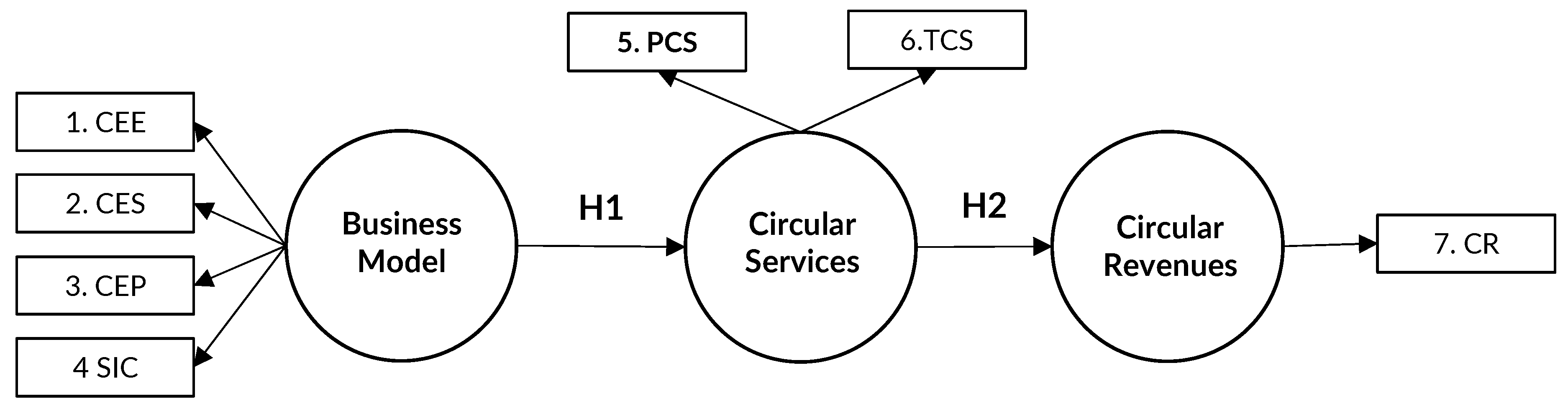
In order to validate the hypotheses proposed within the framework of this study, a theoretical model is proposed based on the latent variables and observed variables presented in
Table 2, which represent the constructs of business model, circular services and circular revenues. The proposed model, shown in
Figure 1, illustrates the hypotheses of this study and the assumption of how the latent variables are reflected by the observable variables. Using a Structural Equation Model (SEM), the study aims to validate the relationships between the variables and constructs described in the proposed model to establish significant influences between business models and circular services for generating circular revenues in the construction sector. The SEM is expected to establish the relationships between the constructs proposed in the model, as well as the covariance analysis between the proposed variables, thereby validating the established causal hypotheses and deriving logical implications from the model [
98]. The SEM analysis was performed using SmartPLS 4 software, which applies the partial least squares method, which is relevant to this study because it does not require normally distributed input data, specifies the relationships between latent variables, handles reflexive and formative constructs, and can handle first- and second-order variables together [
99].
The proposed model, shown in
Figure 1, illustrates the hypotheses of this study and the assumption of how the latent variables are reflected by the observable variables. The proposed theoretical model suggests that strategic circular orientation alone does not automatically generate economic value for organizations. Instead, economic outcomes emerge only when circular principles are operationalized through concrete service offerings. Thus, circularity must move beyond strategic intention and be materialized within the service offering of the company.
The observable variables CEE, CES, CEP, and SIC reflect the latent construct of Business Model, conceptualized here as circular organizational readiness or strategic maturity, representing organizational capabilities that enable companies to transition towards a CE. In contrast, the observable variables PCS, capturing service offering intensity, and TCS, reflecting service offering diversity, represent the latent construct of Circular Services. This construct embodies the operational materialization of circular principles within the firm’s portfolio. The observable variable CR represents the capture of economic value and reflects the financial outcome of implementing circular services. Accordingly, the proposed model represents a sequential conversion mechanism of capabilities into results, where strategic capabilities (organizational readiness) enable the operational implementation of circularity through service offerings, which subsequently generate economic value through monetization. This structure conceptualizes circular transition as a transformation process linking readiness, implementation, and value capture.
Consequently, no direct relationship is hypothesized between the Business Model construct and Circular Revenues since the generation of circular revenues is not assumed to depend solely on strategic intention or capability development, but rather on the effective implementation of CE principles in the firm’s service portfolio. Therefore, Circular Services is modeled as a mediating construct between strategic readiness and economic performance. Circular Revenues are measured as a single-item construct capturing the percentage of total annual revenue derived from circular services in the firm. This indicator represents an objective and directly observable performance measure, reflecting the degree to which circular implementation translates into tangible economic outcomes.
3.4. Data Analysis and Model Testing
Using a SEM, the study aims to validate the relationships between the variables and constructs described in the proposed model to establish significant influences between business models and circular services for generating circular revenues in the construction sector. The SEM is expected to establish the relationships between the constructs proposed in the model, as well as the covariance analysis between the proposed variables, thereby validating the established causal hypotheses and deriving logical implications from the model [
98]. The SEM analysis was performed using SmartPLS software (Version 4.1.1.4), which applies the PLS-SEM, which is relevant to this study because it does not require normally distributed input data, specifies the relationships between latent variables, handles reflexive and formative constructs, and can handle first- and second-order variables together [
99]. PLS-SEM is particularly appropriate when the primary research objective is prediction and theory development rather than theory confirmation. Given that this study seeks to examine the mechanisms linking circular business model strengthening, circular service implementation, and revenue generation in an emerging economy context, PLS-SEM provides a flexible and prediction-oriented analytical framework.
For the proposed model, three latent constructs are considered, which are Business Model (exogenous construct), Circular Services (mediating construct), and Circular Revenues (endogenous construct). The structural model hypothesizes positive relationships between the business model and circular services (H1) and between circular services and circular revenues (H2). Thus, circular services are specified as a mediating variable between business model and circular revenues. All constructs were modeled as reflective, assuming the observed indicators represent the underlying latent variables.
Following established PLS-SEM guidelines [
100], the measurement model (reflective constructs) was assessed using several criteria, such as reflective indicator loadings, internal consistency reliability, convergent validity, discriminant validity, and multicollinearity assessment. Outer loadings were assessed to determine whether each indicator sufficiently represents its latent construct, where loadings above 0.708 were considered acceptable, indicating that the construct explains more than 50% of the variance in the indicator. However, in most instances, 0.70 is considered close enough to 0.708 to be acceptable, and definitively researchers must remove the items of the construct if the items have outer loadings of less than 0.40 [
101]. Composite Reliability (ρA and ρC) was used to evaluate internal consistency, considering values between 0.708 and 0.95 satisfactory, indicating that indicators consistently measure the same construct and the factor model is correct. Convergent validity was assessed using the Average Variance Extracted (AVE), where a value above 0.50 indicates that the construct explains more than half of the variance of its indicators. Discriminant validity was evaluated using the Heterotrait–Monotrait ratio (HTMT), considering that values below 0.85 (conservative threshold) indicate adequate discriminant validity between constructs, so constructs are conceptually different. Variance Inflation Factors (VIF) were examined to detect potential multicollinearity issues, considering that VIF values below 3 are acceptable.
The structural model evaluation followed criteria such as Path Coefficients, Coefficient of Determination (R
2), Predictive Relevance (Q
2), and Effect Size (f
2). Path coefficients (β) were analyzed to assess the strength and direction of relationships between constructs. R
2 values were used to evaluate the explanatory power of the model for endogenous constructs, interpreting values of 0.25, 0.50, and 0.75 as weak, moderate, and substantial, respectively. Q
2 values greater than 0, 0.25, and 0.50 depict small, medium, and large predictive relevance for a given endogenous construct. According to Cohen’s guidelines [
102], effect size (f
2) determines the contribution of each exogenous construct to the R
2 of endogenous constructs, where values of 0.02, 0.15, and 0.35 represent small, medium, and large effects.
To test the statistical significance of the hypothesized relationships, a bootstrapping procedure with 5000 subsamples was conducted. The bootstrapping technique generates empirical sampling distributions of the estimated parameters, allowing the computation of standard errors, t-values,
p-values, and confidence intervals without assuming normal data distribution. In this test, hypotheses were considered supported when t-values exceeded 1.96 (significance level of 5%),
p-values were below 0.05, and confidence intervals did not include zero [
103].
5. Discussion
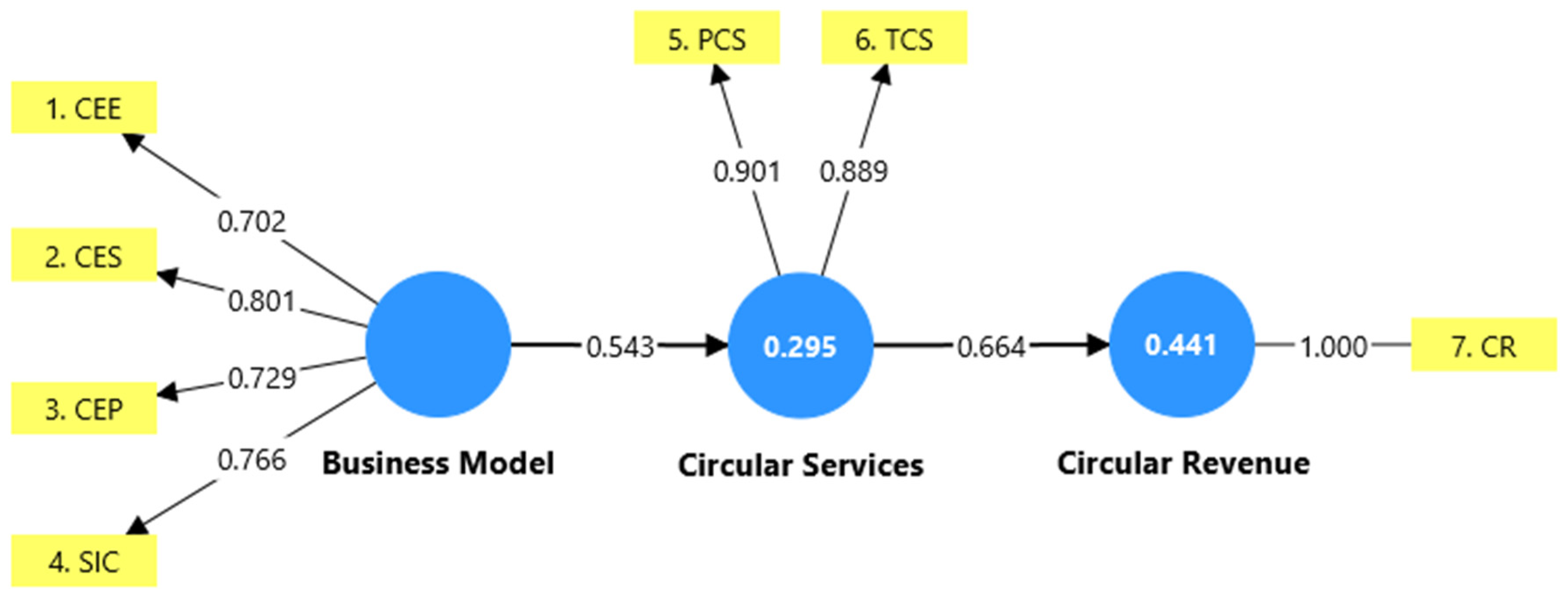
The findings of this study contribute to the growing literature on circular business models by empirically demonstrating that strategic circular orientation alone does not directly generate economic returns. Instead, circular revenues materialize only when circular principles are translated into concrete service offerings. In this sense, the structural model confirms that strengthening circular business models significantly enhances the implementation of circular services (H1) and that these services, in turn, strongly predict circular revenue generation (H2). Likewise, the mediation analysis reveals that circular services fully mediate the relationship between business model strengthening and circular revenues.
This finding supports CE theory by clarifying the mechanism through which value is captured. While previous studies emphasize the importance of circular strategies [
33,
52,
56,
104], limited empirical evidence has demonstrated how such strategies enable monetization in practice, particularly in emerging economies and service-based contexts. The present results suggest that strategic commitment, knowledge, and participation in circular projects represent organizational readiness, but readiness alone does not ensure economic performance. In this sense, value capture emerges only when readiness is operationalized into service portfolios aligned with circular principles.
The strong effect size (f
2 = 0.784) of circular services on circular revenues indicates that the configuration of service portfolios plays a central role in driving economic outcomes in the construction sector. This finding suggests that revenue generation in circular transitions depends largely on how firms translate circular principles into concrete service offerings. In this regard, the results align with [
79], who argue that circular service-based business models require firms to redefine their sustainable value propositions, collaborate to develop enabling infrastructures for circular services, and adapt their revenue models and product–service offerings accordingly.
Among firms participating in the Sustainable Habitat Cluster, these findings suggest a gradual shift from material-based value extraction toward service-based value generation. Rather than relying exclusively on the sale of physical products or construction outputs, firms increasingly capture value through service-oriented circular offerings. Among the companies analyzed, these services include product-as-a-service and outsourcing models (e.g., furniture leasing), reuse services for packaging and logistics assets such as containers, crates, pallets, and bottles, construction services designed to manage projects under circular building principles, and advisory services supporting organizations in their transition toward circular business practices. These service models are implemented across a diverse set of sectors within the construction value chain, including real estate management, civil works construction, technical consulting and engineering, building construction, finishing and installation, materials trade, and metal structure manufacturing, demonstrating that circular value creation can emerge throughout the entire built-environment ecosystem. By shifting part of the value proposition toward services, firms can increasingly decouple revenue generation from the extraction of virgin materials and instead derive value from extended product lifecycles, asset utilization, and knowledge-based services.
These findings support the argument that PSS functions as operational vehicles for circular business models [
32,
78]. By shifting part of the value proposition toward services, firms can extend product lifecycles and create value through use-oriented and service-oriented offerings rather than solely through material transactions. However, our results refine this perspective by showing that the mere adoption of a circular strategic orientation does not automatically translate into effective PSS implementation. Instead, the economic outcomes depend on the strength of the circular service portfolio, which is reflected in both the intensity and diversity of circular service offerings, determining the firm’s capacity to generate recurring and diversified revenue streams.
Consequently, this study shows from empirical evidence from Colombia, an emerging economy where CE implementation is still developing institutionally, that the transition to circularity in construction firms should not be evaluated solely by strategic declarations or project participation, but by the extent to which circularity becomes embedded in revenue-generating activities. In emerging economies, where resource constraints and financial limitations are prevalent, the ability to convert circular principles into revenue-generating services becomes critical. The moderate-to-high predictive relevance (Q
2 = 0.32 for circular revenues) indicates that circular service implementation has tangible economic potential beyond symbolic sustainability commitments. This contributes to the literature calling for more empirical research on CE implementation in developing contexts [
39,
93].
Therefore, managers should prioritize expanding the proportion of circular services within portfolios, diversifying circular service types like consulting, maintenance, reuse facilitation, digital tracking, product-as-a-service, and developing recurring service-based revenue models rather than one-time material sales. Based on the predictive relevance of the model, which indicates that firms that successfully expand circular service portfolios are likely to observe measurable improvements in circular revenue generation, firms should strengthen internal circular capabilities (training, strategy, information systems), piloting circular services in selected market segments, and gradually scaling circular services into core revenue streams.
For cluster coordinators and industry associations, the results suggest that policy interventions should go beyond awareness campaigns or strategy workshops and focus on accelerating the operationalization of circular services, particularly for SMEs with limited internal capabilities. While these initiatives strengthen business model orientation, they do not automatically translate into economic returns, so cluster-level support mechanisms should include service design laboratories focused on circular offerings, platforms to co-develop circular service solutions, and financial instruments that support service-based business models rather than asset-heavy production models.
Regarding the theoretical contributions, this study empirically validates the mediating role of circular services in the relationship between circular business models and circular revenues, shifting the focus from circular strategy formulation to circular service operationalization as the key driver of value capture. Likewise, this study extends CE research into the service dimension of the construction sector in an emerging economy context, bridging gaps between circular business model theory and the service industry.
Contextual Considerations and Transferability
While the results provide empirical support for the proposed capability–implementation–monetization framework, alternative explanations may also contribute to the observed relationships. The generation of circular revenues is likely influenced by additional organizational and market-related factors not incorporated in the present model, including firm size, market positioning, customer demand for circular solutions, access to financial resources, digital capabilities, and the maturity of inter-organizational collaboration networks. These factors may facilitate or constrain the ability of firms to transform circular capabilities into commercially viable service offerings.
Furthermore, the findings should be interpreted within the specific context of firms belonging to the Sustainable Habitat Cluster in the Aburrá Valley. This ecosystem is characterized by active institutional support, growing awareness of circular economy principles, and participation in collaborative innovation initiatives, conditions that may not be present in other regions or countries. Consequently, the observed relationships should not be interpreted as universally applicable across all construction sectors. Nevertheless, the proposed framework may offer valuable insights for other emerging economies facing similar challenges in translating circular economy strategies into measurable economic outcomes. Future studies could complement survey-based approaches with alternative data sources and analytical methods, including geospatial and digital datasets that have recently been applied to evaluate sustainability-related services and value creation in urban environments [
38].
6. Conclusions
This study examined the role of circular services in generating economic value within the construction sector, focusing on firms belonging to the Sustainable Habitat Cluster in the Aburrá Valley. By applying a PLS-SEM approach, the research analyzed the relationships between circular business model strengthening, the implementation of circular service portfolios, and the generation of circular revenues.
The results confirm the existence of a sequential mechanism linking strategic capabilities to economic outcomes, where strengthening circular business models significantly enhances the implementation of circular services within firms’ portfolios. In turn, the implementation of these services strongly predicts the generation of circular revenues. These findings demonstrate that circular strategic orientation is a necessary but insufficient condition for economic value creation, so economic monetization occurs only when circular principles are translated into concrete service offerings.
The study highlights the central role of circular services as the operational bridge between strategic readiness and economic performance. The strong effect observed between circular services and circular revenues indicates that the configuration of service portfolios plays a decisive role in enabling firms to capture economic value from CE initiatives. This finding contributes to the literature on circular business models by empirically demonstrating that value capture in circular transitions depends primarily on the operational implementation of services rather than solely on strategic commitments.
Within the construction sector, these results are particularly relevant. Firms participating in the cluster provide services that allow them to shift part of their value proposition from material-intensive activities toward knowledge- and service-based offerings, thereby enabling the decoupling of revenue generation from the extraction of virgin materials. At the same time, the findings show that the mere adoption of circular strategies does not automatically lead to effective service implementation. Rather, the strength and configuration of the circular service portfolio ultimately determine the capacity of firms to generate recurring and diversified revenue streams.
The findings suggest that, within the context of firms participating in the Sustainable Habitat Cluster, the transition toward circularity involves not only environmental and strategic changes but also transformations in how firms create and capture value. Therefore, this research provides empirical insights that can support both managerial decision-making and policy initiatives aimed at accelerating CE adoption in the built-environment sector.
Limitations and Future Research
Despite its contributions, this study presents several limitations that should be acknowledged. The study was conducted using data collected from firms belonging to the Sustainable Habitat Cluster in the Aburrá Valley, Colombia. Although this cluster provides a relevant setting for examining circular economy implementation within the construction value chain, the findings may reflect specific institutional, economic, and collaborative conditions associated with this regional ecosystem. Therefore, caution should be exercised when extrapolating the results to other regions, countries, or industrial settings with different levels of circular economy maturity. Moreover, the study relies on a cross-sectional research design, which captures organizational conditions at a single point in time. As circular economy transitions often evolve gradually, longitudinal studies would provide a more robust understanding of how circular business model capabilities, service implementation, and revenue generation co-evolve over time.
The model does not incorporate control variables such as firm size, firm age, market segment, ownership structure, or digital maturity. These characteristics may influence both the implementation of circular services and the capacity to generate circular revenues. Future research could incorporate these variables as controls or conduct multi-group analyses to explore potential heterogeneity across different organizational profiles. Furthermore, the constructs were modeled as reflective, assuming that the indicators represent manifestations of underlying latent variables. Further studies could test formative or second-order constructs for circular business models, incorporating broader dimensions such as governance structures, supply chain integration, and partnership ecosystems. Circular revenue was measured as a single-item construct representing the proportion of revenues derived from circular services. While this indicator captures a direct and objective performance metric, future studies could incorporate multi-dimensional financial indicators, including profitability margins, cost reductions, market differentiation, customer retention, or long-term contract stability.
Finally, the model does not incorporate moderation or control variables such as firm size, years of operation, market segment, or level of digital maturity. Future research should explore potential moderators that may influence the strength of the relationships identified between circular services and revenue generation and could refine the explanatory power of the framework.



 ,
,