Article

Spatiotemporal Heterogeneity of Ecosystem Service Interactions and Their Drivers: Implications for Spatial Management

College of Landscape Architecture, Henan Agricultural University, Zhengzhou 450002, China
*
Author to whom correspondence should be addressed.
Urban Sci. 2026, 10(7), 343; https://doi.org/10.3390/urbansci10070343 (registering DOI)
Submission received: 13 May 2026 / Revised: 14 June 2026 / Accepted: 21 June 2026 / Published: 23 June 2026

Abstract

Investigating the heterogeneity of ecosystem services (ESs) and their interactions plays a crucial role in refining spatial management. However, little is known about the spatiotemporal heterogeneity of ES interactions. This study quantified the spatiotemporal variations in ES interactions in Northeast China. It categorized different ES bundles through self-organizing maps and ranked the importance of drivers by SHapley Additive exPlanations (SHAP), thereby proposing targeted spatial management strategies. The results indicated that between 2000 and 2020, most ES pairs exhibited synergies, whereas a few ES pairs exhibited trade-offs. And the synergistic areas for habitat quality (HQ)–net primary productivity (NPP), HQ–soil retention (SR), and NPP-SR accounted for 67.79%, 65.29%, and 75.69% of the study region, respectively. Between 2000 and 2020, the area covered by the key synergetic bundle and habitat quality bundle first increased and then decreased. SHAP analysis indicated that NPP, SR, and water retention were most influenced by biophysical indicators, while HQ was primarily influenced by anthropogenic indicators. Based on research findings regarding ES bundles and their drivers, refined strategies for ecosystem management have been proposed. This study integrated knowledge of ES interactions into spatial management, providing a basis for maximizing ES benefits and addressing future climate change.

1. Introduction

Ecosystem services (ES) refer to the diverse benefits that humans derive from nature, which are deemed essential for human survival [1,2]. The stable and sustained provision of ESs is a prerequisite for ensuring continuous regional development [3]. However, about two-thirds of the world’s ESs are reduced owing to climate variability and irrational land use, leading to ecosystem degradation [4]. Thus, it is crucial to ensure the continued provision of ESs through effective spatial management.
Clarifying ES interactions is a prerequisite for refined spatial management [5]. ES interactions could be summarized as trade-offs, synergies, and bundles [6,7]. Trade-off is represented by one ES increasing and another decreasing, while synergy is represented by multiple ESs increasing or decreasing simultaneously [8]. ES bundles are spatially repeated collections of multiple ESs that can be used to quantitatively characterize clusters of ES spatial distribution [9]. At present, there are numerous approaches to assess the interactions among ESs [10,11]. Correlation analysis is the most commonly employed approach to quickly identify overall ES trade-offs or synergies [12]. Geographically weighted regression (GWR) is widely employed to quantify the spatial mapping of ES trade-offs or synergies [13]. Combining these two approaches facilitates a deeper comprehension of ES trade-offs or synergies at regional or larger scales [9]. K-means clustering [14], structural equation modeling [15], and self-organizing maps (SOMs) [16] are common methods for identifying ES bundles. Among them, SOMs have been gradually adopted due to their high fault tolerance and robustness [5,17].
Spatial heterogeneity is a fundamental feature of ESs, and identifying spatial heterogeneity of ES interactions facilitates the simultaneous management of multiple ESs. Existing research has mainly focused on spatially differentiated characteristics of ESs, with less attention given to the spatial heterogeneity of ES interactions [18]. Research conducted in the Qilian Mountains indicated that different ESs showed significant spatial differentiation [19]. Wang et al. explored heterogeneity in ES trade-offs and identified land use was the dominant factor affecting ES trade-offs [20]. However, current studies have concentrated on investigating the spatial heterogeneity of ES interactions in a single year, often ignoring the influence of time changes [14]. The intensity of ES interactions may vary over time and even change the direction of interactions [12]. Ignoring temporal variations in spatial heterogeneity hinders a comprehensive understanding of the long-term dynamics of ES interactions. Thus, investigating the spatiotemporal heterogeneity of ES interactions is crucial for maximizing the overall benefits of ecosystems.
Spatiotemporal heterogeneity of ESs is jointly influenced by various social and ecological factors [10]. Kang et al. employed geographically weighted regression to analyze the effects of environmental and anthropogenic factors on ESs in the two most developed regions [21]. Other research has identified the effects of land use and climate change on ESs in Kentucky, USA, by setting up different scenarios [22]. Although these studies spatially identified the main drivers of ESs, it remains difficult to clarify how the feature values of each driver influence ESs. SHapley Additive exPlanations (SHAP) is a powerful machine learning model that effectively reveals the contribution of each feature to the dependent variable and has been widely adopted [23]. Identifying the dominant drivers of spatial heterogeneity in ESs facilitates the development of spatial management strategies to achieve regional sustainable development [24]. However, current research applying knowledge of ES interactions to inform spatial management has emphasized static assessments at a single time point, failing to explore dynamic characteristics at multiple time scales [11]. Therefore, there is an urgent need to clarify the spatiotemporal heterogeneity of ES interactions to provide scientific guidance for regional spatial management.
Northeast China has a variety of landscape types and is a significant ecological barrier in Northeast Asia [25]. This region has several national ecological function zones such as the Greater Khingan Mountains, which play important roles in soil retention (SR), water retention (WR), carbon sequestration and providing good habitats [26]. However, urbanization has dramatically changed landscape patterns in recent years, resulting in reduced ES provision and ecosystem degradation [27]. The region urgently needs effective ecosystem management to ensure the continued provision of ESs, but relatively little research has been conducted to inspire spatial management based on ES knowledge. Therefore, this study took Northeast China as an example to examine the spatiotemporal heterogeneity of ES interactions and their driving factors to inform regional spatial management. The objectives of this study were (1) to clarify the spatiotemporal heterogeneity of ES interactions, (2) recognize ES bundles and analyze their dynamics, and (3) identify key drivers affecting ESs to inform regional spatial management. This study explored the spatiotemporal heterogeneity of ES interactions and contributes to a comprehensive understanding of the interrelationships among ESs and aimed to provide insights for targeted ecosystem management in Northeast China.

2. Materials and Methods

2.1. Study Area and Data Processing

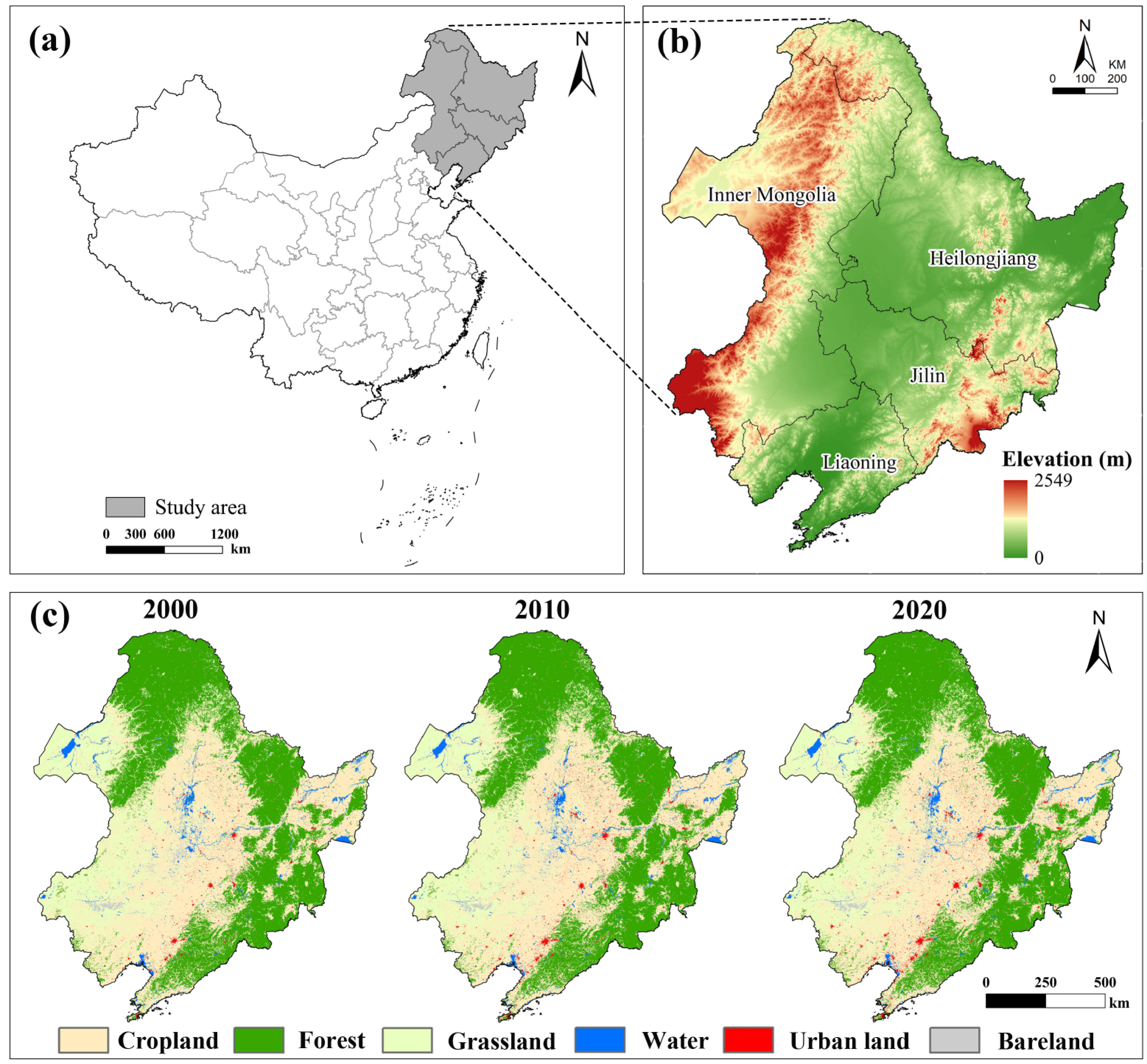
The study region is located in northeastern China (115°32′ E–135°09′ E, 38°42′ N–53°35′ N) with an area of 1.24 × 10⁶ km2 (Figure 1). The area has a continental monsoon climate, with an average annual rainfall of 300–1000 mm. Northeast China is rich in climate types, ranging from warm temperate to cold temperate zones [28,29]. For land use, Northeast China was predominantly cropland (42.3%) and forest (36.7%), followed by grassland (16.8%) in 2020.
Due to the comprehensive effects of geographic location and climate, the vegetation distribution in Northeast China exhibits significant heterogeneity. As latitude changes from south to north, the vegetation changes from deciduous broadleaved forest to coniferous forest. At the same time, the vegetation shifts from deciduous broadleaved forests at low elevations to meadows at high elevations, displaying typical vertical heterogeneity [30].
ESs and drivers were evaluated using multi-source datasets and specific data information was provided in Table 1. All data was resampled to 1000 m before being calculated. Specifically, continuous variables were resampled using the Cubic method, and categorical variables were resampled using the Nearest method.

2.2. Quantification of ESs

With the rapid expansion of cities, soil erosion, water resource reduction, and habitat degradation have occurred in Northeast China [32]. According to published research and field surveys, four key ESs were selected for this study: habitat quality (HQ), net primary productivity (NPP), SR and WR [25].
HQ is recognized as a proxy indicator of biological diversity [33], with the following equation:
Q x j = H j [ 1 ( D x y z D x y z + k z ) ]
where Qxj refers to the HQ on pixels x of land-use type j. Dxj represents the overall threat level and Hj represents the habitat adaptation. z is set to 2.5, and k refers to the half-saturation constant, given as 0.5.
The NPP was modeled on pixels using the CASA model [34], with the following equation:
N P P ( x , t ) = A P A R ( x , t ) × ε ( x , t )
where APAR(x, t) refers to the available solar radiation absorbed by vegetation on pixel x and time t (MJ·m−2) and ε(x, t) refers to the light energy use efficiency (gC·M J−1).
The RUSLE was employed to simulate SR on pixels [35], with the following equation:
S C = R × K × L S × ( 1 P × C )
where R represents the rainfall erosivity [MJ·mm/(km2·h·a)], K represents the soil erodibility [t·km2·h/(km2·MJ·mm)], LS represents the dimensionless slope length-gradient factor, C represents vegetation management factor and P represents the engineering measure factor.
The WR was modeled on pixels by the InVEST model [36]. The formula is as follows:
Y ( x ) = ( 1 A E T ( x ) P ( x ) ) × P ( x )
where Yxj refers to the annual water yield of land-use type j on pixels x (mm), AETxj refers to the actual evapotranspiration and Px refers to the annual rainfall (mm).

2.3. Evaluation of ES Trade-Offs/Synergies

Correlation methods are the most common way to measure ES trade-offs or synergies [37]. We employed the Pearson correlation method to measure trade-offs or synergies between ES pairs across years. However, this approach could only provide an overall evaluation of ES interactions and struggles to reflect their spatially differentiated characteristics [19]. This study employed GWR to measure the spatial mapping of ES interactions. Common drivers simultaneously influence ES interactions, which is consistent with the mechanisms of the GWR model [1]. Spatial differences in drivers are an important cause of heterogeneity in ES trade-offs or synergies [3]. In addition, separate ESs were employed in this study as the independent and dependent variables, thus eliminating the problem of several covariates among the independent variables. The formula is as follows:
y i = β 0 ( u i , v i ) + k = 1 m β k ( u i , v i ) x i k + ε i
where yi represents the ES on the pixel i, xik (k = 1, 2, …, m) represents the residual ESs on the pixel i, (ui, vi) represent the spatial coordinates of sample point i, β0(ui, vi) represents the intercept item, βk(ui, vi) represents regression coefficient and εi represents the error item.

2.4. Determination of ES Bundles

ES bundles were determined on pixels using the SOM method. This method is an unsupervised artificial neural network that divides pixels into different ES bundles according to the spatial recurrence of ES similarity [19]. Before calculations, the ES data needed to be normalized to remove the effect of dimension. Specific calculations were performed with “corrplot” package in the R 4.1 software [1]. The basic formula is as follows:
w i ( t + 1 ) = w i ( t ) + α ( t ) h i v ( t ) [ v ( t ) w i ( t ) ]
where wi(t) presents the weight vector i, α(t) presents the learning rate, hiv(t) presents the neighborhood kernel of the best-fitting unit, and v(t) presents the input vector selected from the input dataset.

2.5. Driver Analysis of ESs

Thirty drivers were pre-selected from published studies and categorized into four classes: landscape composition, landscape configuration, biophysical indicators, and anthropogenic indicators [8,21]. Details of the pre-selected indicators were provided in Appendix A Table A1. To reduce redundant information among indicators, some indicators with covariance or high correlation were removed. Fourteen drivers were finally selected for subsequent analyses (Table 2). All abbreviations used in this study can be found in Appendix B Table A2.
The SHAP model is a post hoc explanation method that first employed an Extreme Gradient-Boosting (XGBoost) model to evaluate relationships between the drivers and ESs and then employed this model to explain the contributions of the drivers [38]. XGBoost is a highly efficient gradient-boosting decision tree model commonly employed in data feature extraction [23,39]. SHAP analysis was applied to assess the marginal effects of the data features for each driver on ESs.
y = f 0 + i = 1 M f 1
where y, i, f0, and f1 represent the model’s output, the number of driving factors, the average of training data and the corresponding property values for each driving factor, respectively. The greater the SHAP value, the greater the contribution of the driver feature, and vice versa.

3. Results

3.1. Spatiotemporal Changes in ESs

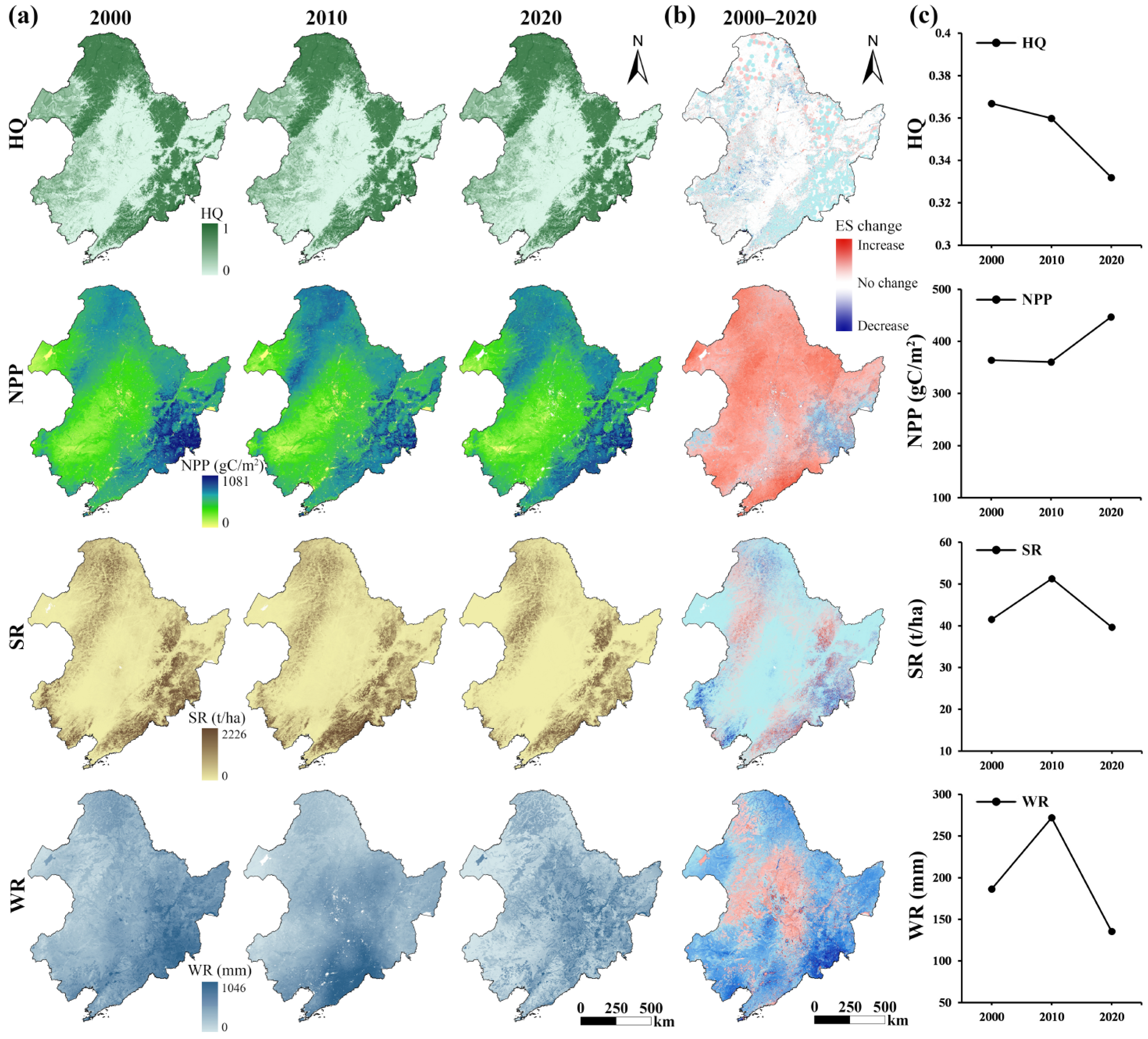
The spatial pattern of ESs showed similar distributional characteristics in different years (Figure 2a). Overall, ES exhibited a spatial distribution with a high center and a low periphery. Specifically, the high-NPP, SR, and WR regions were mainly distributed in the southeastern mountains, and the high-HQ regions were clustered in the eastern and northern mountains. The spatial variations in various ESs showed significant differences (Figure 2b). The spatial changes in HQ, SR and WR were dominated by decreases, while the spatial change in NPP was dominated by increases. The majority of the study region (87.17%) showed an upward trend in NPP, while the regions showing a decreasing trend were concentrated in the southeastern mountains.
The ESs of Northeast China have experienced varying degrees of variation in the last three decades (Figure 2c). The HQ declined and the NPP increased, with the HQ declining by 9.51% and the NPP increasing by 22.71%. SR and WR exhibited an upward and then downward trend, with overall decreases of 4.46% and 27.43%, respectively. In addition, the changes in ESs were all smaller in 2000–2010 than in 2010–2020.

3.2. Spatiotemporal Variations in ES Trade-Offs/Synergies

3.2.1. Overall Changes in ES Trade-Offs/Synergies

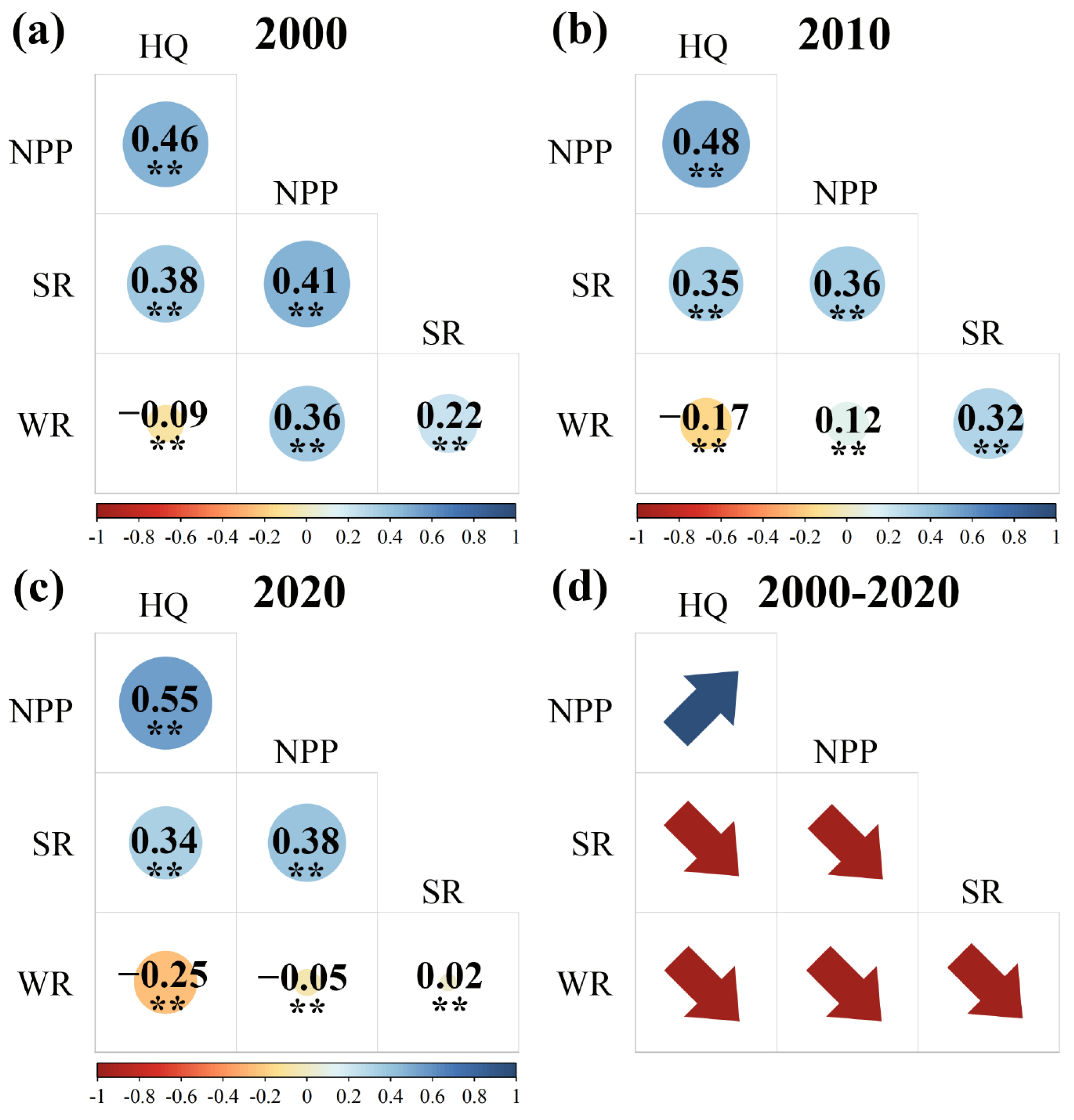
Pearson correlation was applied to determine the overall ES interactions in different years, and all correlation results met significance verification (Figure 3). Overall, the correlations were generally consistent in 2000, 2010 and 2020. The results indicated four positive correlations between ES pairs and a negative correlation between HQ and WR. The synergy between HQ and NPP was strongest in 2020, while the trade-off between HQ and WR was strongest in 2020. The correlation coefficients between most ES pairs decreased, and only the correlation between HQ and NPP was increasing from 2000 to 2020. In addition, the correlation between NPP and WR declined the most, shifting from synergy to trade-off.

3.2.2. Spatial Changes in ES Trade-Offs/Synergies

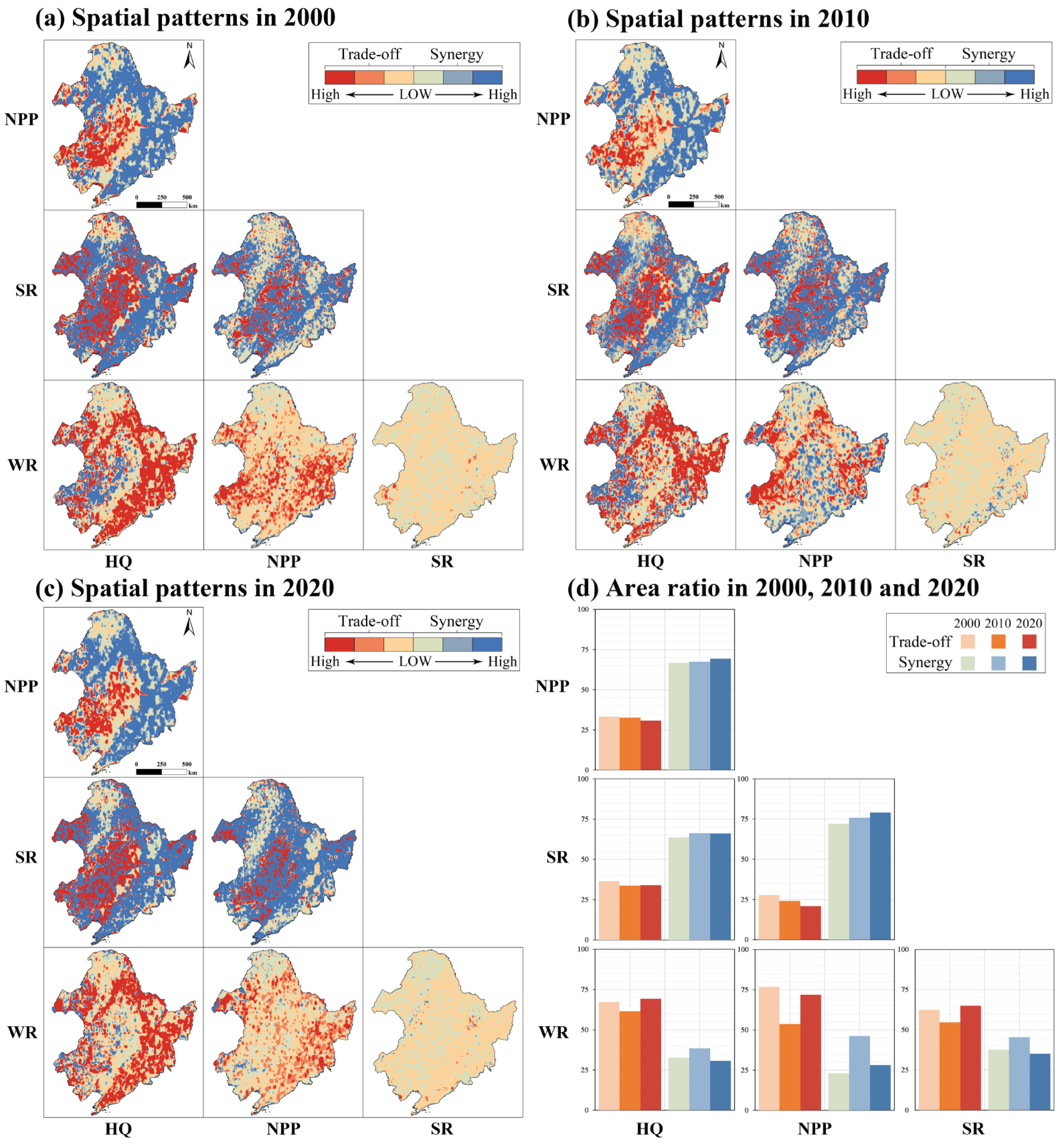
There was significant spatial heterogeneity of ES trade-offs/synergies across the years (Figure 4). Spatially, the regression results for HQ-NPP, HQ-SR, and NPP-SR were dominated by synergies, whereas the regression results for HQ-WR and NPP-WR were mainly characterized by trade-offs. ES pairs with high spatial synergies (HQ-NPP, HQ-SR, NPP-SR) were predominantly found in the eastern and northern plains. While ES pairs with high spatial trade-offs (HQ-WR, NPP-WR) were concentrated in the eastern mountains, southeastern mountains, and northwestern plains. In addition, the regression results for SR and WR exhibited low spatial trade-offs across years.
The area ratios of ES interactions were generally similar across years (Figure 4d). The synergy areas of HQ-NPP, HQ-SR, and NPP-SR accounted for 67.79%, 65.29% and 75.69% of the study region, while the trade-off areas of HQ-WR, NPP-WR, and SR-WR accounted for 66.01%, 67.48% and 60.66% of the study region. The synergy and trade-off area of most ES pairs changed little across years. Among them, the area ratio of the trade-offs between NPP and WR showed the greatest change, decreasing from 76.83% in 2000 to 53.73% in 2020. Furthermore, the trade-off areas for ES pairs associated with WR were significantly larger than the synergy areas.

3.3. Dynamic Variations in ES Bundles

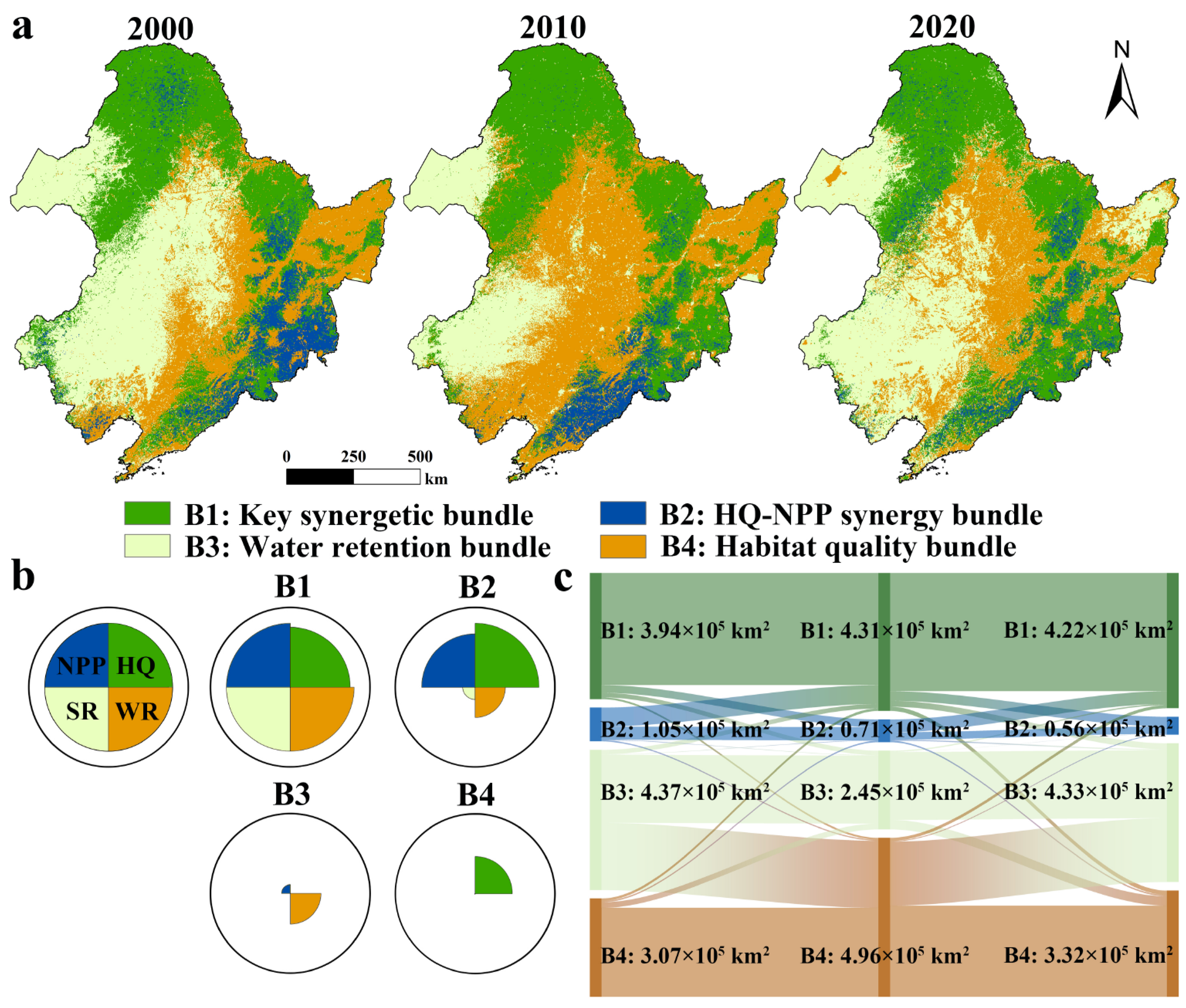
Four ES bundles were identified in this study by SOMs as the key synergetic bundle, HQ-NPP synergy bundle, water retention bundle, and habitat quality bundle, respectively (Figure 5). Overall, the different ES bundles differed significantly and they also varied somewhat in different years. Specifically, the key synergetic bundle accounted for 33.43% of the study region and was concentrated in the northern, eastern, and southeastern mountains, which largely corresponds to the spatial extent of forests. This bundle was characterized by the spatial synergy of high HQ, high NPP, high SR and high WR. The water retention bundle was primarily located in the western grasslands and south-central plains, with a high WR supply. The habitat quality bundle was predominantly distributed in the eastern wetlands and central plains., characterized by a high HQ supply. The HQ-NPP synergy bundle was distributed over a small area, sporadically in the northern and southeastern mountains. This bundle presented spatial synergistic characteristics of high HQ and high NPP.
This study assessed the area transformation of various ES bundles from 2000 to 2010 and from 2010 to 2020 (Figure 5c). The area of the key synergetic and habitat quality bundle expanded, while the area of the HQ-NPP synergy bundle and water retention bundle decreased from 2000 to 2010. The most obvious transformation in 2000–2010 was the shift from the water retention bundle to the habitat quality bundle. In addition, the area of the water retention bundle presented an increasing trend, while the area of the key synergetic bundle, HQ-NPP synergy bundle, and habitat quality bundle decreased in 2010–2020. The most obvious transformation in 2010–2020 was the shift from the habitat quality bundle to the water retention bundle.

3.4. Drivers of ESs

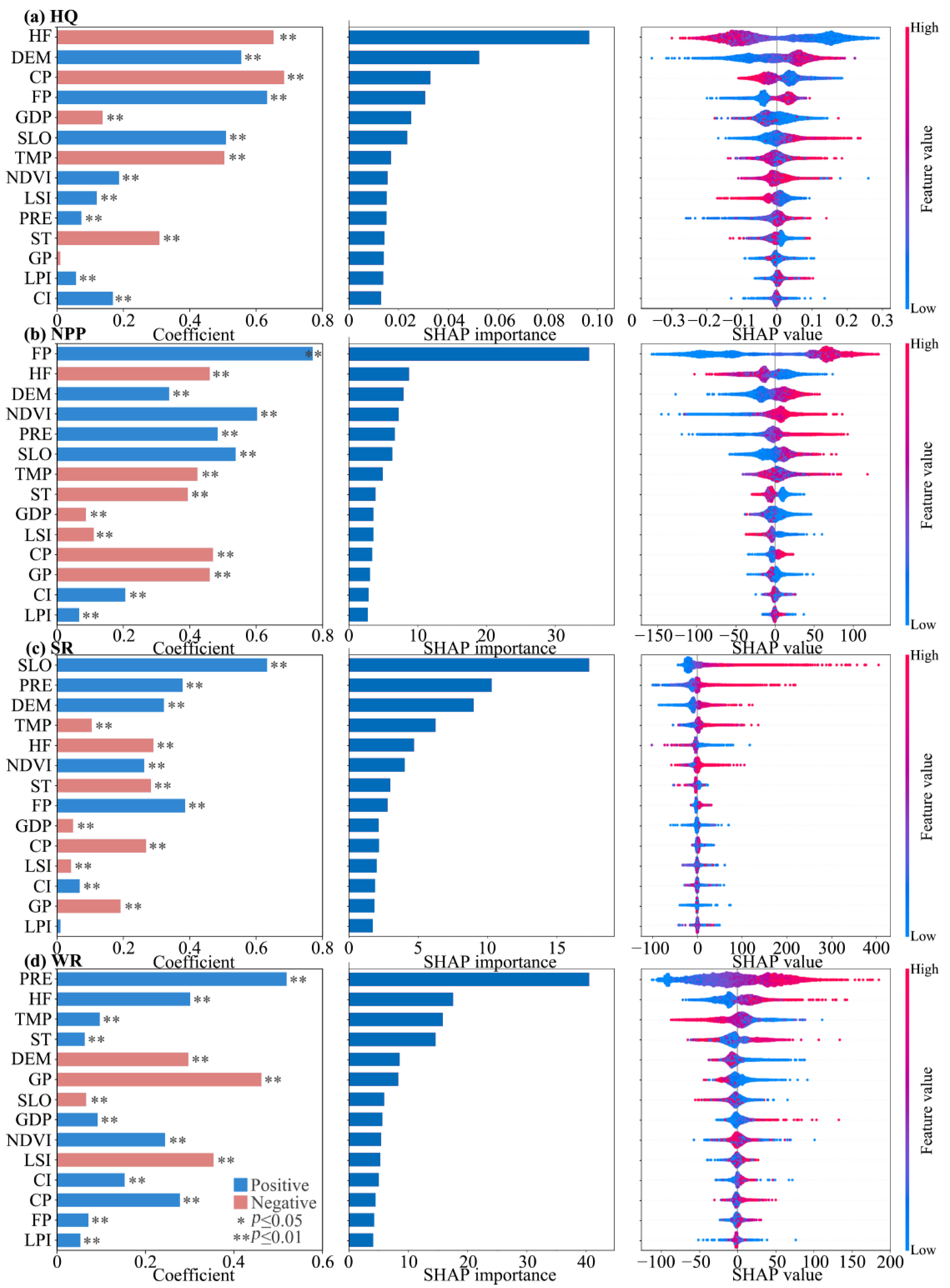
The SHAP model was combined with correlation analysis to rank the drivers of various ESs by importance (Figure 6). For the different ESs, NPP, SR and WR were most influenced by biophysical indicators, while HQ was most influenced by anthropogenic indicators. Overall, HF had the largest effect on these four ESs, seconded by DEM, TMP, PRE, and others. Specifically, HF ranked first in the importance ranking of drivers for HQ, second for NPP and WR, and fifth for SR. The importance ranking of drivers for different ESs showed significant differences. HF, DEM, and CP were key drivers of HQ and NPP, SLO, PRE, and DEM were the three most important factors influencing SR, and PRE, HF, and DEM were the three most important factors influencing WR. Besides ranking the importance of drivers, the SHAP results also revealed their positive and negative effects. The SHAP value plot revealed that the sample point features of HF had a negative impact on HQ, NPP, and SR, while having a positive impact on WR. In contrast, DEM had a positive impact on HQ, NPP, and SR, and a negative impact on WR. The correlation analysis results indicated that most drivers had a positive impact on HQ and WR, while half of the drivers had a negative impact on NPP and SR. It is worth noting that both FP and NDVI exhibited positive effects on all four ESs.

4. Discussion

4.1. Spatiotemporal Heterogeneity of ES Interactions

Understanding the ES interactions is essential for maximizing their overall benefits. We measured the spatiotemporal changes in ES interactions in 2000–2020. The results showed that the ES pairs associated with WR were dominated by trade-offs and the other ES pairs were dominated by synergies, which is consistent with existing relevant studies [40,41]. These might be related to the large interannual variability in rainfall [42]. Interannual fluctuations in rainfall directly affect the stable supply of WR, which in turn alters the interactions between ES pairs associated with WR. Climate variability and the instability of WR supply further threaten water security in Northeast China [27]. Furthermore, the correlation coefficients between ES pairs associated with WR varied rapidly across years, mainly due to the fact that WR changed faster than other ESs. This suggests that different rates of change in ESs may affect the intensity of ES interactions and even alter the direction of ES interactions [43]. Therefore, conducting long-term spatial analyses that focus on the different directions and rates of change in ESs is essential to offer valuable scientific insights for ecosystem management.
The clustering of multiple ESs in space and time forms different ES bundles. The spatial extent of the key synergistic bundle was generally the same as that of forests (Figure 1 and Figure 5). There are good synergies between the different ESs in the region and the overall benefits of ESs are high [44]. Northeast China, especially the forested areas, has implemented a number of ecological programs since 1999, such as the Grain-To-Green Project, the Natural Forest Conservation Project and so on [8]. To a certain extent, the implementation of ecological programs has become an important pathway for effectively enhancing ecosystem benefits worldwide [45]. The habitat quality bundle located in the central plains and eastern wetlands, characterized by low elevations and a high density of cities and settlements, constitutes the main habitat in Northeast China. Trade-offs between HQ and other ESs were common and closely linked to land contradictions, particularly between farmland and forests [46]. The driving results demonstrated that HF and CP were two key factors influencing HQ. Frequent human activities could degrade HQ and undermine ecosystem benefits, thereby leading to high trade-offs between HQ and others [47]. Therefore, future ecosystem management strategies need to focus on the ES interactions to guarantee a sustainable supply of ESs.

4.2. Policy Implications of Zoning Strategies

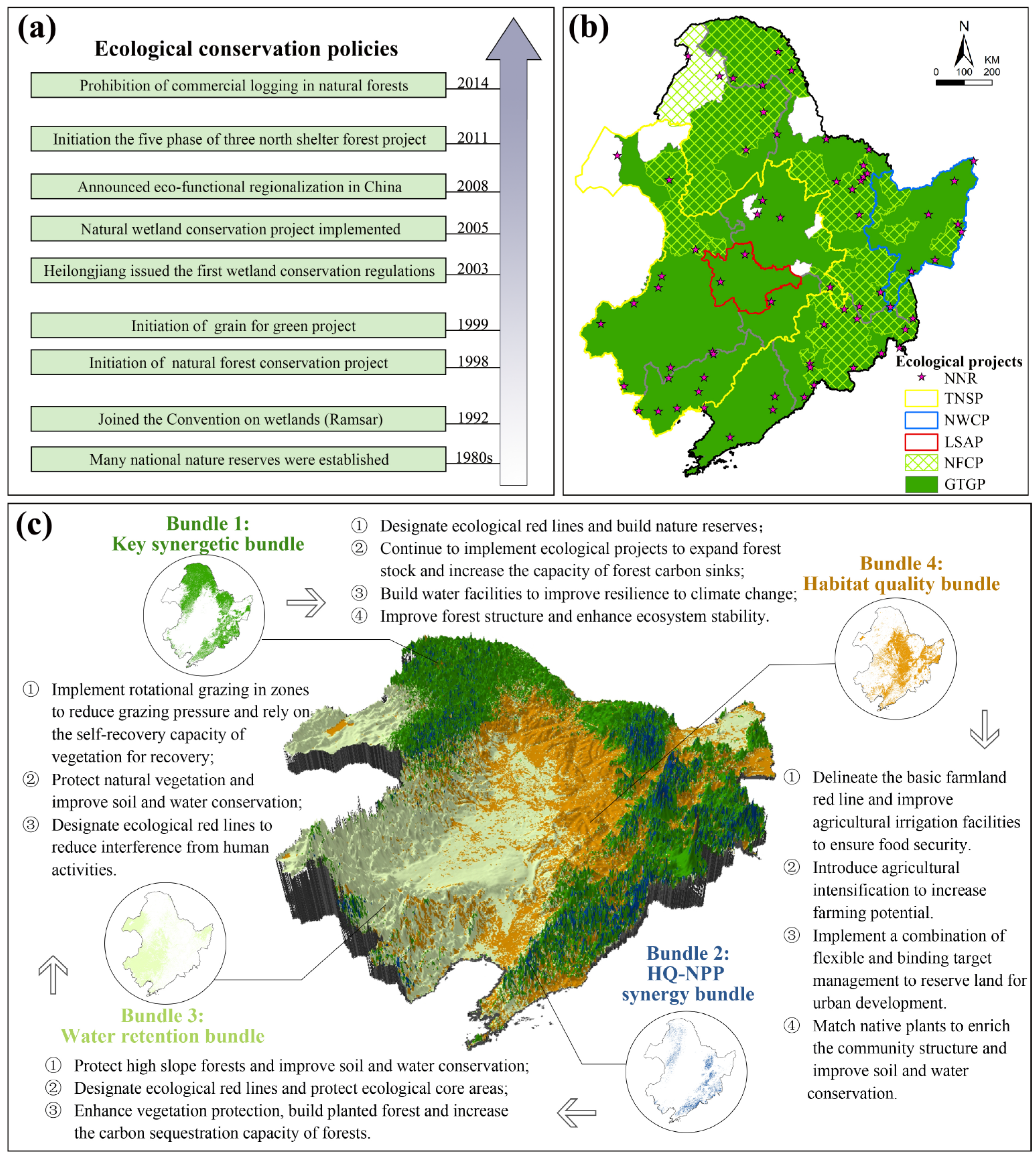
Northeast China has long played a crucial role in providing multiple ESs and maintaining intact habitat [48]. With rapid urbanization, problems such as deforestation, land sanding and water scarcity have emerged in Northeast China, exacerbating ecological degradation [49]. To address this issue, various ecological policies and projects have been implemented in the region (Figure 7a,b), including the GTGP, NFCP, and so on [25]. After years of implementation, the area of forests, grasslands and wetlands has increased significantly and the ecosystem has been effectively restored [8]. However, these ecological policies often overlooked the spatiotemporal heterogeneity of ES interactions, leading to varying ES trade-offs or synergies across regions. In particular, the increased ES trade-offs across regions were not conducive to maximizing the benefits of ESs. Clarifying the spatiotemporal heterogeneity of ES interactions is critical for ecosystem management [1]. Combined with the current socio-economic status of Northeast China, targeted spatial management strategies were provided according to the spatial patterns of ES bundles in 2020. Specific spatial management strategies are shown in Figure 7c.
The key synergetic bundle area was broadly consistent with the distribution of the natural forest conservation project, showing synergies among multiple ESs that gradually weakened over time. It is suggested that this highlights the importance of spatiotemporal heterogeneity in ES interactions and enhancing ecosystem resilience to climate fluctuations. The HQ-NPP synergy bundle area was concentrated in high-altitude mountainous areas. This region showed a synergy between HQ and NPP, which was closely related to altitude and forest distribution. It is suggested to establish ecological red lines in the area to prohibit development and destruction and to protect high-altitude core ecological areas. The water retention bundle area presented trade-offs between WR and other ESs, which were primarily driven by drivers including topography and precipitation. This area was dominated by grassland, and zoned rotational grazing should be implemented to reduce grazing pressure and rely on the self-recovery capacity of vegetation for restoration. The habitat quality bundle area was mainly affected by the human footprint and cropland proportion, suggesting strict adherence to the basic farmland red line and the improvements in agricultural irrigation facilities. In addition, the contradiction between farmland protection and urban development should be coordinated, and the level of agricultural intensification should be improved.

4.3. Advantages and Limitations

Currently, there are few studies on the spatial heterogeneity of ES interactions, especially their long-term change characteristics. Exploring long-term changes in the spatial heterogeneity of ES interactions can help improve the overall understanding of ecosystems. Furthermore, identifying various ES bundles through co-occurring features of ESs provides a realistic foundation for managing multiple ESs simultaneously. Combining the knowledge of ES interactions and drivers can help propose targeted spatial management strategies for achieving the continuous supply of ESs.
Several limitations of the current research should be acknowledged. First, although HQ, NPP, SC, and WC were considered the key ESs in Northeast China, there were still other ESs not considered, such as wood production. This was due to insufficient relevant data and different statistical standards in different regions. Additionally, the statistics were based on administrative areas, which presented some challenges in rasterization. Second, the study analyzed regulatory and supporting services, but ignored provisioning and cultural services, which may have led to the omission of some features of the ecosystem. In subsequent studies, we should quantify the four types of ESs in order to provide a comprehensive reference for ecosystem management.

5. Conclusions

This study measured the spatiotemporal heterogeneity of ES interactions in Northeast China, identified their main socio-ecological drivers, and proposed targeted spatial management strategies. In general, ESs and their interactions exhibited significant spatiotemporal heterogeneity. HQ, SR and WR showed a decreasing trend of 9.51%, 4.46% and 27.43%, respectively, while NPP increased by 22.71% in 2000–2020. The overall results for ES trade-offs and synergies indicated positive correlations between most ES pairs, with correlation coefficients decreasing over time. The synergistic areas of HQ-NPP, HQ-SR, and NPP-SR accounted for 67.79%, 65.29% and 75.69% in Northeast China, respectively. The area of the key synergetic bundle and habitat quality bundle increased and then decreased, and the area of the water retention bundle decreased first and then increased from 2000 to 2020. For the different ESs, NPP, SR and WR were most influenced by biophysical indicators, while HQ was most influenced by anthropogenic indicators. Among these, HF had the largest effect on these four ESs, seconded by DEM, TMP, PRE, and others. In addition, this study proposed specific spatial management recommendations according to ES interactions and drivers, which contribute to regional ecosystem management and the sustained provision of ESs. The study could enhance the overall understanding of ES variations and provide important references for policy-makers to regulate multiple ESs simultaneously.

Author Contributions

Conceptualization, G.J. and J.L.; methodology, G.J. and J.L.; software, G.J.; validation, G.J.; formal analysis, J.L.; investigation, J.L.; data curation, G.J.; writing—original draft preparation, G.J.; writing—review and editing, J.L.; project administration, J.L.; funding acquisition, G.J. All authors have read and agreed to the published version of the manuscript.

Funding

This research was funded by the Natural Science Foundation of Liaoning Province, grant number 2024BSBA57, the National Natural Science Foundation of China, grant number 40501141, and the Soft Science Research Program Project of Henan Province, grant number 262400410078.

Institutional Review Board Statement

Not applicable.

Informed Consent Statement

Not applicable.

Data Availability Statement

The original contributions presented in this study are included in the article.

Conflicts of Interest

The authors declare no conflicts of interest.

Appendix A

Thirty drivers were pre-selected from published studies and categorized into four categories. The specific indicators are shown in Table A1.
Table A1. Preliminary drivers and references.
CategoryIndicatorReference
Landscape compositionCropland proportion; forest proportion; grassland proportion; construction land proportion[50,51,52,53]
Landscape configurationAggregation index; cohesion index; contagion index; landscape division index; landscape shape index; effective mesh size; number of patches; patch density; percentage of like adjacencies; splitting index; area-weighted mean patch area; mean patch area; edge density; largest patch index; total edge; patch richness; Shannon diversity index; mean patch shape index[54,55,56,57,58,59]
Biophysical indicatorsElevation; slope; temperature; precipitation; NDVI; soil type[60,61,62]
Anthropogenic indicatorsPopulation density; GDP; human footprint[63,64]

Appendix B

Table A2. Abbreviations and symbols.
AbbreviationFull NameAbbreviationFull Name
ESEcosystem servicesGPGrassland percentage
HQHabitat qualityCIContagion index
NPPNet primary productivityLPILargest patch index
SRSoil retentionLSILandscape shape index
WRWater retentionDEMElevation
GWRGeographically weighted regressionSLOSlope
SOMSelf-organizing mapsPREPrecipitation
SHAPSHapley Additive exPlanationsTMPTemperature
LUCCLand-Use and Land-Cover ChangeNDVINormalized difference vegetation index
XGBoostExtreme Gradient BoostingSTSoil type
CPCropland percentageGDPGross domestic product
FPForest percentageHFHuman footprint

References

  1. Xia, H.; Yuan, S.; Prishchepov, A.V. Spatial-temporal heterogeneity of ecosystem service interactions and their social-ecological drivers: Implications for spatial planning and management. Resour. Conserv. Recycl. 2023, 189, 106767. [Google Scholar] [CrossRef]
  2. Reid, W.V.; Mooney, H.A.; Cropper, A.; Capistrano, D.; Chopra, K. Millennium Ecosystem Assessment. Ecosystems and Human Well-Being: Synthesis; Island Press: Washington, DC, USA, 2005. [Google Scholar]
  3. Liu, Q.; Qiao, J.; Li, M.; Huang, M. Spatiotemporal heterogeneity of ecosystem service interactions and their drivers at different spatial scales in the Yellow River Basin. Sci. Total Environ. 2024, 908, 168486. [Google Scholar] [CrossRef] [PubMed]
  4. Xiao, H.; McDonald-Madden, E.; Sabbadin, R.; Peyrard, N.; Dee, L.E.; Chades, I. The value of understanding feedbacks from ecosystem functions to species for managing ecosystems. Nat. Commun. 2019, 10, 3901. [Google Scholar] [CrossRef] [PubMed]
  5. Dou, H.; Li, X.; Li, S.; Dang, D.; Li, X.; Lyu, X.; Li, M.; Liu, S. Mapping ecosystem services bundles for analyzing spatial trade-offs in inner Mongolia, China. J. Clean. Prod. 2020, 256, 120444. [Google Scholar] [CrossRef]
  6. Dong, W.; Wu, X.; Zhang, J.; Zhang, Y.; Dang, H.; Lü, Y.; Wang, C.; Guo, J. Spatiotemporal heterogeneity and driving factors of ecosystem service relationships and bundles in a typical agropastoral ecotone. Ecol. Indic. 2023, 156, 111074. [Google Scholar] [CrossRef]
  7. Mouchet, M.A.; Lamarque, P.; Martín-López, B.; Crouzat, E.; Gos, P.; Byczek, C.; Lavorel, S. An interdisciplinary methodological guide for quantifying associations between ecosystem services. Glob. Environ. Change 2014, 28, 298–308. [Google Scholar] [CrossRef]
  8. Jia, G.; Dong, Y.; Zhang, S.; He, X.; Zheng, H.; Guo, Y.; Shen, G.; Chen, W. Spatiotemporal changes of ecosystem service trade-offs under the influence of forest conservation project in Northeast China. Front. Ecol. Evol. 2022, 10, 978145. [Google Scholar] [CrossRef]
  9. Xu, J.; Wang, S.; Xiao, Y.; Xie, G.; Wang, Y.; Zhang, C.; Li, P.; Lei, G. Mapping the spatiotemporal heterogeneity of ecosystem service relationships and bundles in Ningxia, China. J. Clean. Prod. 2021, 294, 126216. [Google Scholar] [CrossRef]
  10. Wang, K.; Gao, J.; Liu, C.; Zhang, Y.; Wang, C. Understanding the effects of socio-ecological factors on trade-offs and synergies among ecosystem services to support urban sustainable management: A case study of Beijing, China. Sustain. Cities Soc. 2024, 100, 105024. [Google Scholar] [CrossRef]
  11. Li, Y.; Zhang, L.; Qiu, J.; Yan, J.; Wan, L.; Wang, P.; Hu, N.; Cheng, W.; Fu, B. Spatially explicit quantification of the interactions among ecosystem services. Landsc. Ecol. 2017, 32, 1181–1199. [Google Scholar] [CrossRef]
  12. Yuan, J.; Li, R.; Huang, K. Driving factors of the variation of ecosystem service and the trade-off and synergistic relationships in typical karst basin. Ecol. Indic. 2022, 142, 109253. [Google Scholar] [CrossRef]
  13. Zuo, L.; Gao, J. Investigating the compounding effects of environmental factors on ecosystem services relationships for Ecological Conservation Red Line areas. Land Degrad. Dev. 2021, 32, 4609–4623. [Google Scholar] [CrossRef]
  14. Zhang, C.; Bai, Y.; Yang, X.; Gao, Z.; Liang, J.; Chen, Z. Scenario analysis of the relationship among ecosystem service values—A case study of Yinchuan Plain in northwestern China. Ecol. Indic. 2022, 143, 109320. [Google Scholar] [CrossRef]
  15. Qiu, J.; Yu, D.; Huang, T. Influential paths of ecosystem services on human well-being in the context of the sustainable development goals. Sci. Total Environ. 2022, 852, 158443. [Google Scholar] [CrossRef] [PubMed]
  16. Liu, Y.; Jing, Y.; Han, S. Ecological function zoning of Nansi Lake Basin in China based on ecosystem service bundles. Environ. Sci. Pollut. 2023, 30, 77343–77357. [Google Scholar] [CrossRef] [PubMed]
  17. Zhou, S.; Li, W.; Lu, Z.; Cheng, R. An ecosystem-based analysis of urban sustainability by integrating ecosystem service bundles and socio-economic-environmental conditions in China. Ecol. Indic. 2020, 117, 106691. [Google Scholar] [CrossRef]
  18. Leroux, L.; Clermont-Dauphin, C.; Ndienor, M.; Jourdan, C.; Roupsard, O.; Seghieri, J. A spatialized assessment of ecosystem service relationships in a multifunctional agroforestry landscape of Senegal. Sci. Total Environ. 2022, 853, 158707. [Google Scholar] [CrossRef] [PubMed]
  19. Teng, Y.; Zhan, J.; Liu, W.; Chu, X.; Zhang, F.; Wang, C.; Wang, L. Spatial heterogeneity of ecosystem services trade-offs among ecosystem service bundles in an alpine mountainous region: A case- study in the Qilian Mountains, Northwest China. Land Degrad. Dev. 2022, 33, 1846–1861. [Google Scholar] [CrossRef]
  20. Wang, Y.; Dai, E.; Ge, Q.; Zhang, X.; Yu, C. Spatial heterogeneity of ecosystem services and their trade-offs in the Hengduan Mountain region, Southwest China. Catena 2021, 207, 105632. [Google Scholar] [CrossRef]
  21. Kang, J.; Li, C.; Zhang, B.; Zhang, J.; Li, M.; Hu, Y. How do natural and human factors influence ecosystem services changing? A case study in two most developed regions of China. Ecol. Indic. 2023, 146, 109891. [Google Scholar] [CrossRef]
  22. Bai, Y.; Ochuodho, T.O.; Yang, J. Impact of land use and climate change on water-related ecosystem services in Kentucky, USA. Ecol. Indic. 2019, 102, 51–64. [Google Scholar] [CrossRef]
  23. Jia, G.; Li, C.; Hu, Y.; Chen, X.; Chen, W.; Zhang, Z. Urbanization significantly impacts the long-term and inner-outer changes in urban vegetation phenology. Sustain. Cities Soc. 2025, 124, 106323. [Google Scholar] [CrossRef]
  24. Longato, D.; Cortinovis, C.; Albert, C.; Geneletti, D. Practical applications of ecosystem services in spatial planning: Lessons learned from a systematic literature review. Environ. Sci. Policy 2021, 119, 72–84. [Google Scholar] [CrossRef]
  25. Mao, D.; He, X.; Wang, Z.; Tian, Y.; Xiang, H.; Yu, H.; Man, W.; Jia, M.; Ren, C.; Zheng, H. Diverse policies leading to contrasting impacts on land cover and ecosystem services in Northeast China. J. Clean. Prod. 2019, 240, 117961. [Google Scholar] [CrossRef]
  26. Xia, T.; Wu, W.; Zhou, Q.; Tan, W.; Verburg, P.H.; Yang, P.; Ye, L. Modeling the spatio-temporal changes in land uses and its impacts on ecosystem services in Northeast China over 2000–2050. J. Geogr. Sci. 2018, 28, 1611–1625. [Google Scholar] [CrossRef]
  27. Wang, H.; Wang, W.J.; Liu, Z.; Wang, L.; Zhang, W.; Zou, Y.; Jiang, M. Combined effects of multi-land use decisions and climate change on water-related ecosystem services in Northeast China. J. Environ. Manag. 2022, 315, 115131. [Google Scholar] [CrossRef]
  28. Liang, L.; Li, L.; Liu, Q. Precipitation variability in Northeast China from 1961 to 2008. J. Hydrol. 2011, 404, 67–76. [Google Scholar] [CrossRef]
  29. Ha, T.T.V.; Fan, H.; Shuang, L. Climate change impact assessment on Northeast China’s grain production. Environ. Sci. Pollut. 2021, 28, 14508–14520. [Google Scholar] [CrossRef]
  30. Yuan, W.; Wu, S.Y.; Hou, S.; Xu, Z.; Pang, H.; Lu, H. Projecting Future Vegetation Change for Northeast China Using CMIP6 Model. Remote Sens. 2021, 13, 3531. [Google Scholar] [CrossRef]
  31. Mu, H.; Li, X.; Wen, Y.; Huang, J.; Du, P.; Su, W.; Miao, S.; Geng, M. A global record of annual terrestrial Human Footprint dataset from 2000 to 2018. Sci. Data 2022, 9, 176. [Google Scholar] [CrossRef] [PubMed]
  32. Li, H.; Mao, D.; Li, X.; Wang, Z.; Jia, M.; Huang, X.; Xiao, Y.; Xiang, H. Understanding the contrasting effects of policy-driven ecosystem conservation projects in northeastern China. Ecol. Indic. 2022, 135, 108578. [Google Scholar] [CrossRef]
  33. Han, J.; Dong, Y.; Ren, Z.; Du, Y.; Wang, C.; Jia, G.; Zhang, P.; Guo, Y. Remarkable Effects of Urbanization on Forest Landscape Multifunctionality in Urban Peripheries: Evidence from Liaoyuan City in Northeast China. Forests 2021, 12, 1779. [Google Scholar] [CrossRef]
  34. Ma, F.; Jiang, Q.; Xu, L.; Lv, K.; Chang, G. Processes, potential, and duration of vegetation restoration under different modes in the eastern margin ecotone of Qinghai-Tibet Plateau. Ecol. Indic. 2021, 132, 108267. [Google Scholar] [CrossRef]
  35. Pal, S.C.; Chakrabortty, R.; Roy, P.; Chowdhuri, I.; Das, B.; Saha, A.; Shit, M. Changing climate and land use of 21st century influences soil erosion in India. Gondwana Res. 2021, 94, 164–185. [Google Scholar] [CrossRef]
  36. Donohue, R.J.; Roderick, M.L.; McVicar, T.R. Roots, storms and soil pores: Incorporating key ecohydrological processes into Budyko’s hydrological model. J. Hydrol. 2012, 436–437, 35–50. [Google Scholar] [CrossRef]
  37. Wang, S.; Hu, M.; Wang, Y.; Xia, B. Dynamics of ecosystem services in response to urbanization across temporal and spatial scales in a mega metropolitan area. Sustain. Cities Soc. 2022, 77, 103561. [Google Scholar] [CrossRef]
  38. Huan, Y.; Nijhuis, S.; Tillie, N. Optimizing urban agriculture for long-term ecosystem services: Integrating scenario-based suitability analysis and the landscape approach. J. Clean. Prod. 2025, 536, 147149. [Google Scholar] [CrossRef]
  39. Han, Y.; Yin, J.; Zhu, D.; Tan, J.; Zhao, Y.; Liu, W.; Mu, Y. Geographical-XGBoost and SHAP reveal ecosystem service supply-demand responses to landscape patterns in karst regions. J. Environ. Manag. 2026, 404, 129550. [Google Scholar] [CrossRef]
  40. Martinez-Harms, M.J.; Larraín-Barrios, B.; Arregoitia, L.D.V.; Palma-Duque, J.; Gelcich, S. Navigating ecosystem services trade-offs: A global comprehensive review. Ambio 2025, 54, 1109–1127. [Google Scholar] [CrossRef] [PubMed]
  41. Siderius, C.; Biemans, H.; Kashaigili, J.; Conway, D. Water conservation can reduce future water-energy-food-environment trade-offs in a medium-sized African river basin. Agric. Water Manag. 2022, 266, 107548. [Google Scholar] [CrossRef]
  42. Jia, G.; Li, C.; Chen, X.; Hu, Y.; Chen, W.; Kang, J. Impacts of Land Use and Climate Change on Water-Related Ecosystem Service Trade-offs in the Yangtze River Economic Belt. Ecosyst. Health Sustain. 2024, 10, 0208. [Google Scholar] [CrossRef]
  43. Luo, Y.; Guo, X.; Lü, Y.; Zhang, L.; Li, T. Combining spatiotemporal interactions of ecosystem services with land patterns and processes can benefit sensible landscape management in dryland regions. Sci. Total Environ. 2024, 909, 168485. [Google Scholar] [CrossRef] [PubMed]
  44. Huang, L.; Wang, B.; Niu, X.; Gao, P.; Song, Q. Changes in ecosystem services and an analysis of driving factors for China’s Natural Forest Conservation Program. Ecol. Evol. 2019, 9, 3700–3716. [Google Scholar] [CrossRef] [PubMed]
  45. Báliková, K.; Šálka, J. Are silvicultural subsidies an effective payment for ecosystem services in Slovakia? Land Use Policy 2022, 116, 106056. [Google Scholar] [CrossRef]
  46. Schroder, S.A.; Tóth, S.F.; Deal, R.L.; Ettl, G.J. Multi-objective optimization to evaluate tradeoffs among forest ecosystem services following fire hazard reduction in the Deschutes National Forest, USA. Ecosyst. Serv. 2016, 22, 328–347. [Google Scholar] [CrossRef]
  47. Lesmerises, F.; Dussault, C.; St-Laurent, M.H. Wolf habitat selection is shaped by human activities in a highly managed boreal forest. For. Ecol. Manag. 2012, 276, 125–131. [Google Scholar] [CrossRef]
  48. Xiang, H.; Zhang, J.; Mao, D.; Wang, Z.; Qiu, Z.; Yan, H. Identifying spatial similarities and mismatches between supply and demand of ecosystem services for sustainable Northeast China. Ecol. Indic. 2022, 134, 108501. [Google Scholar] [CrossRef]
  49. Tang, Q.; Hua, L.; Cao, Y.; Jiang, L.; Cai, C. Human activities are the key driver of water erosion changes in northeastern China. Land Degrad. Dev. 2023, 35, 62–75. [Google Scholar] [CrossRef]
  50. Feng, Q.; Zhao, W.; Hu, X.; Liu, Y.; Daryanto, S.; Cherubini, F. Trading-off ecosystem services for better ecological restoration: A case study in the Loess Plateau of China. J. Clean. Prod. 2020, 257, 120469. [Google Scholar] [CrossRef]
  51. Kong, L.; Zheng, H.; Xiao, Y.; Ouyang, Z.; Li, C.; Zhang, J.; Huang, B. Mapping Ecosystem Service Bundles to Detect Distinct Types of Multifunctionality within the Diverse Landscape of the Yangtze River Basin, China. Sustainability 2018, 10, 857. [Google Scholar] [CrossRef]
  52. Gou, M.; Li, L.; Ouyang, S.; Wang, N.; La, L.; Liu, C.; Xiao, W. Identifying and analyzing ecosystem service bundles and their socioecological drivers in the Three Gorges Reservoir Area. J. Clean. Prod. 2021, 307, 127208. [Google Scholar] [CrossRef]
  53. Zhang, Y.; Lu, X.; Liu, B.; Wu, D.; Fu, G.; Zhao, Y.; Sun, P. Spatial relationships between ecosystem services and socioecological drivers across a large-scale region: A case study in the Yellow River Basin. Sci. Total Environ. 2021, 766, 142480. [Google Scholar] [CrossRef] [PubMed]
  54. Chen, W.; Zeng, J.; Chu, Y.; Liang, J. Impacts of Landscape Patterns on Ecosystem Services Value: A Multiscale Buffer Gradient Analysis Approach. Remote Sens. 2021, 13, 2551. [Google Scholar] [CrossRef]
  55. Qiu, J.; Turner, M.G. Spatial interactions among ecosystem services in an urbanizing agricultural watershed. Proc. Natl. Acad. Sci. USA 2013, 110, 12149–12154. [Google Scholar] [CrossRef] [PubMed]
  56. Karimi, J.D.; Corstanje, R.; Harris, J.A. Understanding the importance of landscape configuration on ecosystem service bundles at a high resolution in urban landscapes in the UK. Landsc. Ecol. 2021, 36, 2007–2024. [Google Scholar] [CrossRef]
  57. Dobbs, C.; Hernández-Moreno, Á.; Reyes-Paecke, S.; Miranda, M.D. Exploring temporal dynamics of urban ecosystem services in Latin America: The case of Bogota (Colombia) and Santiago (Chile). Ecol. Indic. 2018, 85, 1068–1080. [Google Scholar] [CrossRef]
  58. Herrero-Jáuregui, C.; Arnaiz-Schmitz, C.; Herrera, L.; Smart, S.M.; Montes, C.; Pineda, F.D.; Schmitz, M.F. Aligning landscape structure with ecosystem services along an urban–rural gradient. Trade-offs and transitions towards cultural services. Landsc. Ecol. 2018, 34, 1525–1545. [Google Scholar] [CrossRef]
  59. Rodríguez-Echeverry, J.; Echeverría, C.; Oyarzún, C.; Morales, L. Impact of land-use change on biodiversity and ecosystem services in the Chilean temperate forests. Landsc. Ecol. 2018, 33, 439–453. [Google Scholar] [CrossRef]
  60. Gao, J.; Zuo, L.; Liu, W. Environmental determinants impacting the spatial heterogeneity of karst ecosystem services in Southwest China. Land Degrad. Dev. 2020, 32, 1718–1731. [Google Scholar] [CrossRef]
  61. Gao, J.; Zuo, L. Revealing ecosystem services relationships and their driving factors for five basins of Beijing. Geogr. Sci. 2021, 31, 111–129. [Google Scholar] [CrossRef]
  62. Qiu, M.; Van de Voorde, T.; Li, T.; Yuan, C.; Yin, G. Spatiotemporal variation of agroecosystem service trade-offs and its driving factors across different climate zones. Ecol. Indic. 2021, 130, 108154. [Google Scholar] [CrossRef]
  63. Liu, C.; Yang, M.; Hou, Y.; Xue, X. Ecosystem service multifunctionality assessment and coupling coordination analysis with land use and land cover change in China’s coastal zones. Sci. Total Environ. 2021, 797, 149033. [Google Scholar] [CrossRef] [PubMed]
  64. Qiu, S.; Peng, J.; Dong, J.; Wang, X.; Ding, Z.; Zhang, H.; Mao, Q.; Liu, H.; Quine, T.A.; Meersmans, J. Understanding the relationships between ecosystem services and associated social-ecological drivers in a karst region: A case study of Guizhou Province, China. Prog. Phys. Geogr. 2020, 45, 98–114. [Google Scholar] [CrossRef]
Figure 1. Study region. (a) Location, (b) elevation, and (c) land use in 2000, 2010 and 2020.
Urbansci 10 00343 g001
Figure 2. Spatiotemporal variations in ESs in 2000, 2010 and 2020. (a) Spatial pattern, (b) spatial variation, and (c) variations in annual averages.
Urbansci 10 00343 g002
Figure 3. Correlation analysis between ES pairs. (ac) Correlations in 2000, 2010 and 2020 (** p < 0.01, * p < 0.05), and (d) correlation variations (blue arrows denote correlations optimizing towards synergies, and red arrows denote correlations deteriorating towards trade-offs).
Urbansci 10 00343 g003
Figure 4. Spatial pattern and area ratios of ES trade-offs/synergies. (ac) Spatial patterns in 2000, 2010 and 2020, and (d) area ratios.
Urbansci 10 00343 g004
Figure 5. Spatiotemporal variation in ES bundles in 2000–2020. (a) Spatial distribution, (b) components and relative size of ES bundles (longer segments mean greater ES provisioning), and (c) area transformation of various ES bundles in 2000–2010 and 2010–2020.
Urbansci 10 00343 g005
Figure 6. Ranking the importance of drivers. (ad) Coefficient, SHAP importance, and SHAP values for HQ, NPP, SR, and WR, respectively.
Urbansci 10 00343 g006
Figure 7. Spatial management strategies. (a) Implementation time of ecological conservation policies, (b) spatial patterns of ecological projects, and (c) spatial management strategies for Northeast China. (NNR: national nature reserves; TNSP: three-north shelter forest program; NWCP: natural wetland conservation program; LSAP: land salinity/sodicity amelioration program; NFCP: natural forest conservation program; and GTGP: grain-to-green program).
Urbansci 10 00343 g007
Table 1. Specific information about the data.
Data SetSpecific SourcePeriodResolution
LUCCResource and Environmental Science and Data Centre (https://www.resdc.cn, accessed on 16 May 2025)2000, 2010, 20201000 m
NDVINational Earth System Science Data Centre
(http://www.geodata.cn, accessed on 16 May 2025)
2000, 2010, 20201000 m
Meteorological (including rainfall, temperature, evapotranspiration)National Earth System Science Data Centre
(http://www.geodata.cn, accessed on 16 May 2025)
2000, 2010, 20201000 m
DEMNASA/USGS published of SRTM Global DEM
(https://lpdaac.usgs.gov/, accessed on 16 May 2025)
-90 m
Root depth, soil texture, and organic carbon contentChinese soil dataset based on the Harmonized World Soil Database
(http://bdc.casnw.net/, accessed on 16 May 2025)
-1000 m
Leaf area index of vegetationNational Earth System Science Data Centre
(http://www.geodata.cn, accessed on 16 May 2025)
2000, 2010, 2020500 m
GDPResource and Environmental Science and Data Centre (https://www.resdc.cn, accessed on 16 May 2025)2000, 2010, 20201000 m
Human footprintAn index compounded by different human pressures based on Mu et al. [31]2000, 2010, 20201000 m
Table 2. Four categories of drivers.
CategoryDriversAbbreviation
Landscape compositionCropland percentageCP
Forest percentageFP
Grassland percentageGP
Landscape configurationContagion indexCI
Largest patch indexLPI
Landscape shape indexLSI
Biophysical indicatorElevationDEM
SlopeSLO
PrecipitationPRE
TemperatureTMP
Normalized difference vegetation indexNDVI
Soil typeST
Anthropogenic indicatorGross domestic productGDP
Human footprintHF
Disclaimer/Publisher’s Note: The statements, opinions and data contained in all publications are solely those of the individual author(s) and contributor(s) and not of MDPI and/or the editor(s). MDPI and/or the editor(s) disclaim responsibility for any injury to people or property resulting from any ideas, methods, instructions or products referred to in the content.