Article

Sustainable Management of Railway Infrastructure and Services in the Public Interest in a Protected Natural Area: An Electric Railway Case Study


by
Eva Nedeliaková
1 and
Kristína Ovary Bulková
2,*
1
Department of Railway Transport, Faculty of Operation and Economics of Transport and Communication, University of Žilina, 01026 Žilina, Slovakia
2
Department of Quantitative Methods and Economic Informatics, Faculty of Operation and Economics of Transport and Communication, University of Žilina, 01026 Žilina, Slovakia
*
Author to whom correspondence should be addressed.
Urban Sci. 2026, 10(5), 290; https://doi.org/10.3390/urbansci10050290
Submission received: 17 February 2026 / Revised: 2 April 2026 / Accepted: 23 April 2026 / Published: 20 May 2026

Abstract

Rail transport is the basis for the proper functioning of a transport system that is sustainable for future generations. It is safe and environmentally friendly; moreover, it is suitable for carrying a large number of passengers. Train connections should be operated following the requirements of the traveling public, as well as with the potential to reach those who have hitherto preferred individual car transport. The study aimed to identify the needs of current as well as potential rail users and to propose measures for improving service provision and supporting more sustainable transport possibilities. Given the ecological nature of rail transport and the high numbers of tourists using individual car transport in the summer and winter seasons, the study sought solutions to shift transport from road to rail infrastructure. Visitors to the area were approached directly during their visit as part of a transport–sociological survey conducted during periods of peak visitation, specifically in the summer and winter seasons. Drawing on findings from previous studies and the results of the transport–sociological survey, four universal variants were developed. The study applies to the method of practical permeability indicators. It evaluates variants of measures involving timetable adjustments, line modifications, and construction of new stations. It assesses their impact on reducing travel times and proper timetable management. The result of the study is to propose building a station on the railway infrastructure, which brings fundamental changes in increasing the practical capacity of the line and meets the goal of sustainability concerning increasing the number of connections and thus increasing the number of public service opportunities. The study addresses the growing pressure of individual car transport in a protected natural area and the need to shift demand towards more sustainable rail transport.

1. Introduction

The increasing intensity and the use of individual car transport in recent decades have a significant impact on the sustainability of the transport system from the point of view of the environment and society as a whole [1,2,3]. Sustainable mobility, appropriate infrastructure management, and transport planning are connected issues [4,5,6]. It is very important to find solutions to improve this situation, especially in protected landscape areas, where inappropriate development of road transport significantly threatens a sensitive ecosystem in terms of emissions, land use, and vibration [7,8]. Sustainable infrastructure management also applies to rail transport, which is part of the critical infrastructure sector [9,10]. Promoting and highlighting the role of rail transport is also one of the European Union’s objectives, as it is a more environmentally friendly land transport system that plays an important role in the transport market, not only nationally but also internationally [11,12]. Rail transport can accommodate larger volumes of passengers compared to individual car transport in mountain and environmentally sensitive areas and is generally considered a safer alternative [11,13].
This article is the result of a study in the protected area in Central Europe, which has been a UNESCO Biosphere Reserve (United Nations Educational, Scientific and Cultural Organization) since 1993 [14]. The area is attractive for tourism and has long struggled with congestion by individual car traffic (e.g., on a selected section of road along the railway line according to measurements since 2025; while in the winter (November–February) the observation of experts found an average of 12,506 cars per day, in summer (June–September) up to 14,600 cars per day) [15]. The congestion of the territory with greenhouse gas emissions from automobile transport is evident; the result of the comparison of unit emissions per single passenger when transported by car and by train in one return journey, 1205 gCO2e/passenger by car and 356 gCO2e/passenger by train (at 50% occupancy), can be stated, with 192 gCO2e/passenger at 100% train occupancy [15]. Individual road transport produces 1.7 tonnes of greenhouse gases in the summer and 1.8 tonnes in the winter in 12 h [16].
The study is based not only on the previous results of the authors on the intensity of traffic in the area, the ecological burden of traffic, but also the traffic–sociological survey [15,16,17]. The first traffic–sociological survey, carried out in the winter and summer seasons, was focused, among other things, on public satisfaction with traveling by electric trains and the conditions under which they would be willing to switch from cars to trains. Respondents (2680 people sample) expressed dissatisfaction with train transport in 74% due to a lack of connections and insufficient capacity when connections are not operated at appropriate intervals, and the volume of passengers is high. Assuming the addition of connections, 68% said they were willing to travel by train [15,16]. The results from the first traffic–sociological survey serve as a basis for comparison with the current survey conducted within this research.
The aim of the study was to propose a sustainable approach to railway infrastructure management. Through the assessment of alternative variants and the recommendation of a suitable solution for improving the service in the public interest. This is based on the identified needs and preferences of current as well as potential users of regional electric rail services, with attention to minimizing impacts on the protected natural environment. This even provided an opportunity to observe possible changes in comparison with the previously mentioned studies.
At the same time, at the initiative of the infrastructure manager, a solution was sought to increase the number of train paths in the public interest from an hourly interval to a new half-hourly interval. Increasing line capacity enables more frequent and regular services, which are key factors influencing the attractiveness of rail transport for users. Permissible performance was assessed, i.e., the number of trains on the infrastructure in 24 h according to the methodology of the railway infrastructure manager [18]. The current state of railway infrastructure and the operation of trains under the Contract on Transport Services in the Public Interest to Ensure the Transport Service of the Territory were analyzed [19]. Possibilities for increasing the capacity of the railway line, which is maintained by the state manager ŽSR, were proposed. The trains are operated by the national carrier Železničná spoločnosť Slovensko (ZSSK).
The study offers an evaluation of the variants that are also applicable in other mountain regions of Europe, as they show a suitable solution to increase the number of rail connections and thus the possibility of shifting transport to a more environmentally friendly and capacity-friendly mode of transport [15,16,17].

2. Background

2.1. Territory and Infrastructure of Electric Railways in the Study Region

The study region, protected under the NATURA 2000 network located in Central Europe, Slovakia, was examined as part of the evaluation of electric railway infrastructure management options and the promotion of a socially sustainable transport system. This system aims to preserve Europe’s natural resources, is the rarest and most endangered habitats and species in the EU [20]. Legal protection was granted to the area in 1948 by the declaration of the national park [21].
This case study examined the single-track line with a gauge of 1000 mm. High-altitude conditions in a global context create specific requirements for trails. The studied track is 5950 km long, electrified with a traction voltage of 1500 V, with a maximum speed of 60 km·h−1 and a braking distance of 400 m. The slopes of the tracks in mountainous conditions range from 30‰ to 60‰, which causes problems with operation and requires special solutions, which are presented further in the study.
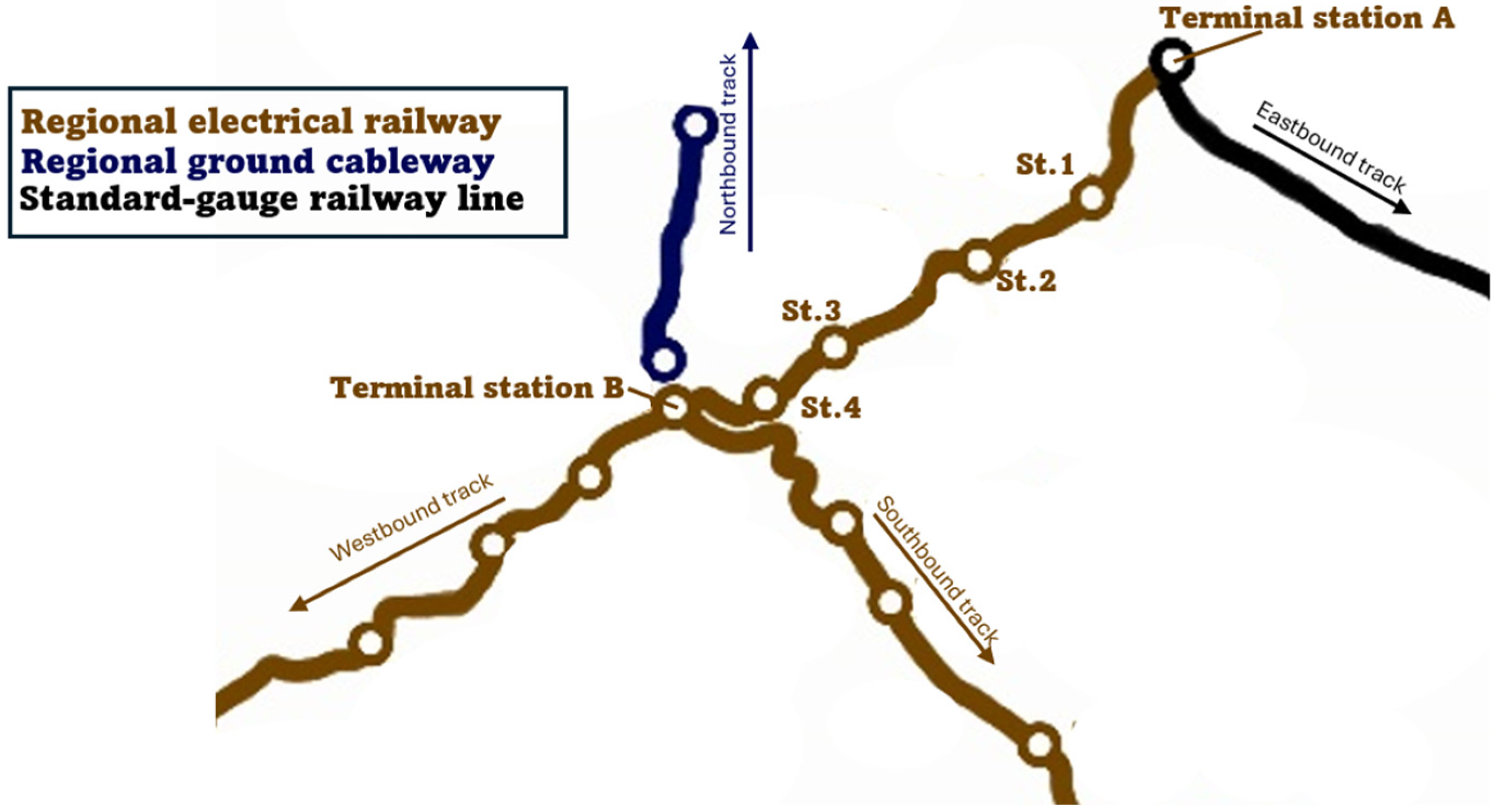
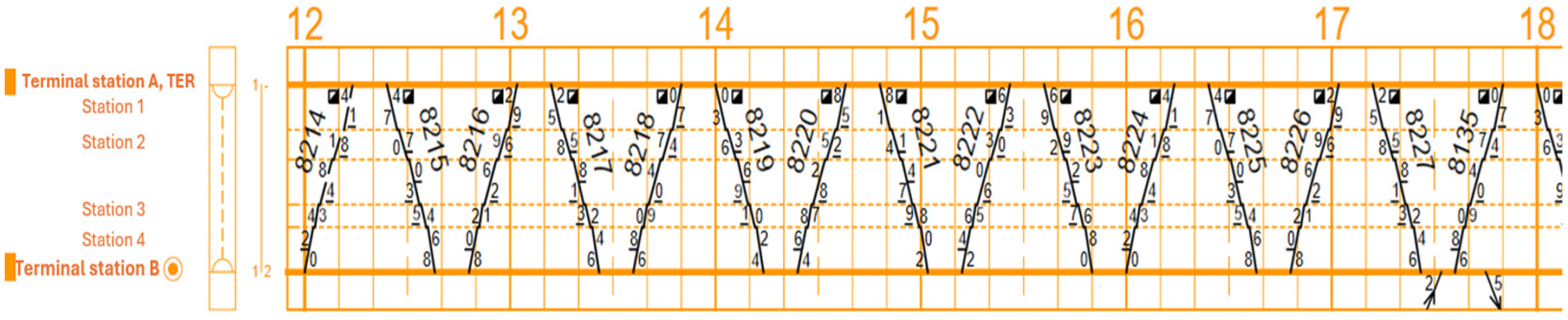
The line consists of one inter-station section with four stops (Stations 1–4, as in Figure 1). On this line, the so-called simplified traffic operation is in place. The conducting dispatcher is based at the central railway station of the study region.
The time positions of individual trains are distributed in an hourly interval, i.e., the routes of all trains are spaced apart by multiples of hours, such as the hourly chart (timetable); it then becomes easy to remember for both the passenger and the employees involved in traffic operation and management. In general, timetables distinguish between traffic peaks and off-peak periods, i.e., time intervals during which traffic significantly increases or decreases relative to the average of the reference period [22]. On the analyzed route, due to high tourist demand, peak traffic occurs throughout the day, from 8 a.m. to 8 p.m. (according to surveys [15,16,17]). A traffic saddle or train running outside the hourly clock schedule (lower number of passengers, passenger transport by morning trains to school and work, connections to the first/last trains, etc.) can be marked until 8 a.m. and after 8 p.m.
Public passenger transport is provided by modern electric units EMU200/400. These units are designed specifically for mountainous conditions; they can handle slopes of up to 50–60‰, have strong electrodynamic brakes, good adhesion, and can handle sharp curves in the mountains. Total daily capacity of transport points can be multiplied by the number of trains per day, but the focus on satisfying transport requirements is on transport requirements at peak times, i.e., in incriminated times of day, when passenger traffic is higher than in the early morning or late evening times. Due to the specifications of this location, the transport requirements are also affected by the season.

2.2. Sustainable Management of Railway Infrastructure and Services in the Public Interest in a Protected Natural Area

The basic idea of this study was supported by research by authors who confirm that a systematic approach to transport infrastructure management in protected natural areas, leading to efficient land use without the need for major interventions, to the satisfaction of the public, locals and tourists must be paramount [23,24]. The sustainability of tourism and mobility in protected alpine nature reserves is a priority issue in terms of environmental and social impact [25].
According to a study by authors from Italy, tourism-driven socioeconomic well-being is already high, there has been reinforced stakeholder participation in decision-making and raised expectations of further development [26]. Respecting the significant ideas of other authors, the need for adequate transport measures is considered essential to obtain the optimal balance of transport modes that will be required in the near future [27]. It is required to adjust sustainable mobility solutions to continuous market changes [28]. The need to address the idea of sustainable infrastructure with respect to the environment, the economy and society is also emphasized by the work of US authors [29]. Authors from China studied the development of tourism transportation systems and infrastructures [30,31]. Xiong et al. [32] took Xingwen World Geopark as their research object, the ways in which the contradiction between environment and transportation infrastructure might be coordinated in tourism development. These facts must be considered in the context of a sustainable transport system and the overall capacity of the area to accommodate the needs of residents and visitors. The transport–sociological survey conducted in this study was also informed by research by Austrian authors on health-related mobility and transport patterns of tourists [33].
The issue of critical infrastructure is not given much attention in the V4 countries [34]. A critical infrastructure program has been adopted in this area since 2018, with transport becoming one of the sectors [35]. The Act on Critical Infrastructure, in accordance with the Building Act, defines that an element of critical infrastructure is also a service of the public interest in the railway transport sector [36,37]. This study deals with the operation of trains provided by a railway company of public interest under the Rail Transport Act. This law defines the obligation to provide transport services within the scope of allocated infrastructure capacity and public service contracts efficiently [38]. The legislative support for this issue is the Regulation (EU) No 181/2011 of the European Parliament and of the Council of 16 February 2011 concerning the rights of passengers in bus and coach transport and amending Regulation (EC) No 2006/2004 [39].

3. Materials and Methods

The study consisted of the following main steps: a traffic–sociological survey, analysis of the current situation, and the design and evaluation of infrastructure variants. The research was carried out by the authors in the field, directly on the territory of the study protected nature area, in cooperation with the manager of the railway infrastructure (Bratislava, Slovakia) and the national carrier operating the railway passenger transport of the public interest (Bratislava, Slovakia).
The study included a technical assessment of infrastructure modification and also the traffic–sociological survey. The technical assessment consists of proposed construction and operational measures aimed at increasing line capacity. The traffic–sociological survey focused on proposed changes. It is very important that the transport demand corresponds to the planned infrastructure changes. Accordingly, the research followed the structure of the division of roads performed by residents and visitors of the study region, considering the purpose of the roads, the chosen means of transport and the territorial context of the roads (traffic behavior of residents and guests in the region).

3.1. Traffic–Sociological Survey Methodology

The questionnaire included demographic questions, the aim and length of respondents’ journeys, and the distribution of types of transportation used in the study area. The following questions addressed visitors’ opinions about the current situation and consisted of single-choice questions with the possibility of open-ended answers: whether they consider ecology when choosing a means of transport; whether they think limiting vehicle entry to the national park is necessary for nature conservation; how long they would be willing to wait for the local train; and whether they are satisfied with the electric train transportation in the area. The last sort of questions were only single-choice questions: whether they think increasing the number of trains or other transportation options is necessary; whether they visit the national park area regularly; and whether they visit the area seasonally.
The traffic–sociological survey was conducted in winter, as well as in the summer season, with visitors in the study area. The survey was conducted on selected dates, which were chosen to represent periods of lower and higher visitation in both seasons. One survey session took place during a weekday, considered a low-traffic period, while another was scheduled on a weekend during a peak holiday period, representing high visitation. Additionally, respondents were approached during a summer holiday week, when the region experienced high tourist traffic. The target population of the survey consisted of visitors to the study area. Interviewers approached respondents personally at five selected locations within the study area, such as urban districts, parking places, and regional train stations, as well as directly on-board electric trains during the journey, so both current and potential users of rail transport were included. The paper-form responses were processed electronically. For this reason, all responses were fully anonymized. In total, 1692 respondents were approached. The sample can be considered indicative of visitor behavior, although it does not fully ensure statistical representativeness.

3.2. Methodology of the Sustainable Railway Infrastructure Proposal

The initial analysis was used in the process of recognition and solution of various actions. The analysis of relevant domestic and international literature and scientific articles was conducted to assess the current state of the research problem.
Data analysis was used to process the identified data on the possibilities of changing traffic on the railway infrastructure. The comparison method was used to compare selected measures to increase the throughput of the line. The research compared operational and organizational measures to increase the capacity of the line, i.e., shortening station operating intervals, appropriate adjustment of the schedule, shortening the stay of trains, and accelerated transport of trains through the restricted section.
Furthermore, the research continued with the analysis of possible reconstruction measures, namely modification of stations (modification of station heads, extension of transport tracks, increase the number of transport tracks, construction of complete peronization), modification of tracks (construction of new stations, construction of double-track inserts for crossing of trains with no need to stop, construction of additional line tracks, slope) and directional adjustment of tracks.
The third category assessed the possibilities of improving the signaling system (modernization of station signaling system, improvement of track signaling system, implementation of dispatching control on the track section, use of computer and transmission technology).
The railway infrastructure cannot be separated from the introduction of more modern vehicles (locomotives, rolling stock) and mechanization equipment, but the subject of this research was to achieve resilient and sustainable infrastructure compatible with the vehicles running on it. Therefore, the solution in this research did not concern the purchase or modernization of vehicles.
The method of synthesis raised questions about the combination of individual measures. After performing a detailed analysis of the possibilities of individual measures and after collecting and evaluating data with the support of independent expert opinion using the Delphi method, only the following can be significantly applied to the electric railway:
  • Suitable change in the timetable;
  • Slope and directional adjustment of the track;
  • Construction of a new station.
The Delphi study was carried out in the form of a multi-round anonymous survey of a group of experts (from Slovakia, the Czech Republic, Italy, Spain, Scandinavian countries, the United Kingdom, and Germany) for the construction of railway infrastructure in mountainous conditions. In the first round, key factors influencing throughput and route modification design were identified, and in subsequent rounds, these factors were evaluated and refined based on aggregated feedback. The result provided an expert consensus on technical, transport, and environmental criteria and allowed for the interpretation of analysis results.
The research methodology consisted of the assessment of proposed measures to increase the capacity of the line in the train schedule (in the form of a timetable). The measures were evaluated for the feasibility (quality) of the timetable. Each proposed measure to increase the capacity of the line was applied to the timetable as a new study. The quality of this chart design is evaluated in terms of its feasibility and resilience through the method of practical permeability indicators. The actual gap time per train was calculated as t g a p r e a l :
t g a p r e a l = T T o c c T l o c k o u t N       [ m i n ]
where
T—calculation time [min];
Tocc—total occupancy time of the section [min];
Tlockout—total time in which the operating equipment is excluded from operation for the prescribed inspections, repair and maintenance during the calculated time [min];
N—the total number of trains in the calculation section.
Meanwhile,
T o c c = N · t o c c     [ m i n ]
t o c c = t o n e + τ o i     [ m i n ]
where
tocc—average time of occupying a section by one train [min];
tone—average travel time by one train [min];
τoi—operational interval [min].
The required time of gaps per train t g a p r e q was determined according to the average time of occupancy of one train and the value determined by the regulation of the railway infrastructure manager D 24. To be able to implement the schedule (i.e., running a given number of trains in a given section) and guarantee the required quality of transport, the following inequality must apply: t g a p r e q   <   t g a p r e a l .
The next step in the methodology was to calculate the practical throughput performance.
n p r a c t = T T l o c k o u t t o c c + t g a p r e q       [ t r · T 1 ]
where
T—calculation time [min];
Tlockout—total time in which the operating equipment is excluded from operation for the prescribed inspections, repair and maintenance during the calculated time [min];
tocc—average time of occupying a section by one train [min];
t g a p r e a l —the required time of gaps per train [min].
This inequality must apply to the ability to implement the schedule (i.e., the running of a given number of trains in a given section) and to guarantee the required quality of transport N n p r a c t . The feasibility condition is defined as N n p r a c t , allowing for boundary cases under practical operational conditions.
Use of practical permeability K p r a c t is determined according to relation (5).
K p r a c t = N n p r a c t · 100       [ % ]
where
N—the total number of trains in the calculation section;
npract—practical throughput in the number of trains per calculation time [tr · T−1].
Normative permeability is characterized by the use of practical permeability K p r a c t by regular transport in the range of 80–90%. The degree of occupancy was determined by relation (6).
s o = T o c c T T l o c k o u t
where
Tocc—average time of occupying a section by one train [min];
T—calculation time [min];
Tlockout—total time in which the operating equipment is excluded from operation for the prescribed inspections, repair and maintenance during the calculated time [min].
A timetable is considered sufficiently occupied if the degree of occupancy s o is within the range of 0.5 to 0.67.
The indicators of practical permeability were calculated within the research for all variants of the traffic peak schedule, which is usually calculated for at least two hours. However, on this specific line, the calculation of practical permeability indicators for a 6 h rush hour was chosen. The evaluation of variants and the calculation of practical permeability, as well as the construction of the timetable, were performed at the following technological values and conditions:
  • The travel time between the terminal railway stations (including stays at stops) is set at 14 min in both directions;
  • The train stops at all stops on the line, with a stay of 0.5 min;
  • The technological turnaround time of the set in the terminal railway stations is set at 3 min;
  • The operating interval of the train crossing at Terminal station A in the outbound direction to Terminal station B is 1.5 min, while at Terminal station B in the opposite direction, it is 4 min; any adjustment of the affected switches at both terminal stations is performed manually;
  • In the case of a shuttle, the value of the crossing operating interval is equal to the value of the technological turnaround time of the set;
  • Within the criteria for determining the time reserve, the operating conditions of this line are defined as simple, then the value of the required time of gaps per train is determined following regulation D 24 [40];
  • In the methodology, the average daily time for the inspection of the traction line (Tlockout) was considered as 20 min.
The selected parameters are based on current operational conditions, technical standards, and data provided by the railway infrastructure manager.

4. Research Results

This section presents the results of the research focusing on the second traffic–sociological survey (with 1692 respondents) and the evaluation of the railway infrastructure variants. The results reflect travel behavior, transport preferences, and respondents’ attitudes toward the existing transport system. Also, the results of the operational analysis are presented. Together, these results provide a comprehensive basis for assessing the suitability of individual variants and their potential contribution to a more sustainable transport system in the studied region.

4.1. Results of the Traffic–Sociological Survey

First, the structure of the respondents is described. Most respondents were residents from Slovakia (75%), in contrast to respondents from abroad, mostly from the Czech Republic (15.8%) and Poland (4.4%). Regarding social status, respondents were most often employed (45.4%), followed by retirees (27.7%) and students (15.9%), and the remaining respondents included self-employed persons, individuals on maternity leave or homemakers, unemployed, and others (11%).
Respondents’ travel characteristics were then analyzed in terms of purpose, duration and type of transport. The dominant purpose of visits was leisure and sports activities (72.9%), followed by local travel or travel by regional residents (11.2%), business trips (7.6%), visits to friends or family (5.9%), and other, not specified, purposes. Most respondents stayed for one day (31.5%) or for a longer trip in 5–7 days (22.3%). Shorter trips of 2–4 days outside the weekend accounted for 16%, 2–4 days during extended weekends 12.7%, and longer stays of more than seven days 9.5%. Short two-day trips during the weekend and outside the weekend represented 4.7% and 3.2% of the sample, respectively. Regarding the frequency of visits to the national park in the study area, 26.2% of respondents visited the area frequently (10 times per year or more), 6.3% visited 10 times per year, 22.2% four times per year, and 20.1% twice per year. A single visit was reported by 25.1% of respondents. With respect to seasonal visits, most respondents (63.9%) stated that they visit the area in both seasons, 33.1% visit only in the summer season, and 3% visit only in the winter season.
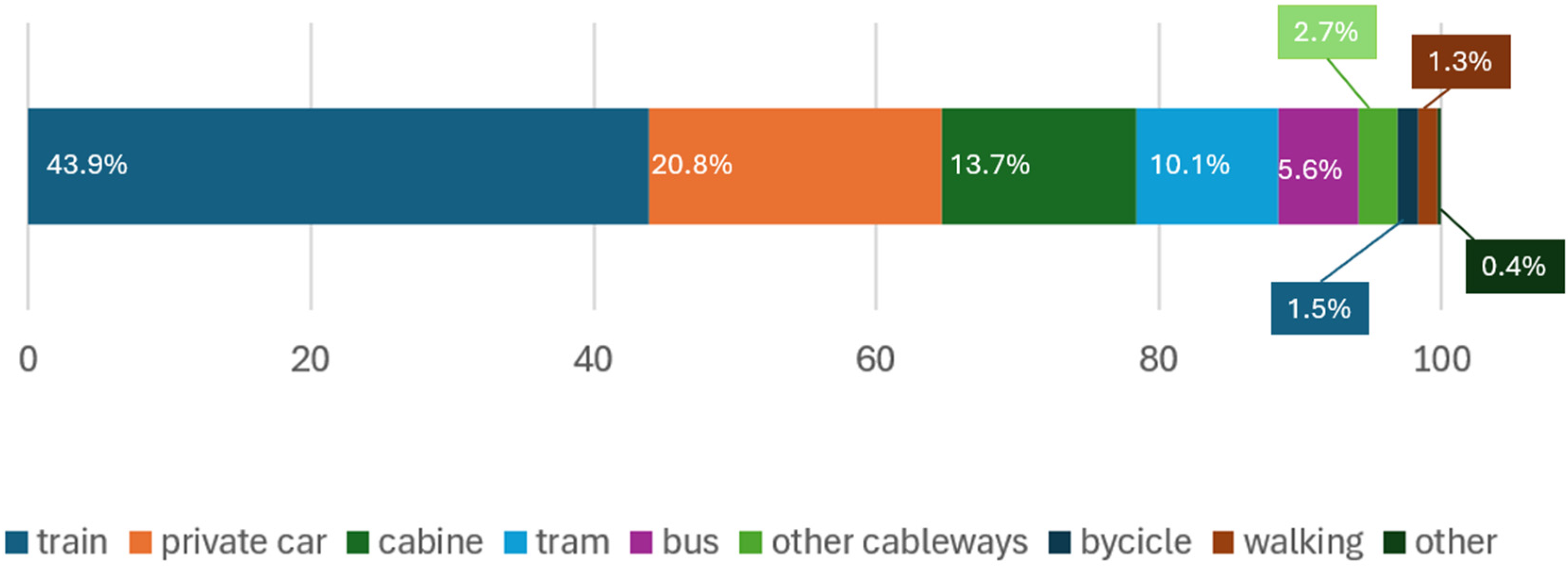
The modes of transport distribution show that the majority of respondents used trains, followed by private cars and other types of transport (Figure 2). This question did not refer only to the mode of transport used to reach the study area, but rather to the mode of transport used by respondents during their stay in the study area. The shuttle services (bus, tram, cableways) in the study region were used by 18.5% of respondents.
Respondents stated that they also consider environmental aspects when choosing a mode of transport, 62.5%, while 16.5% respondents stated that the environmental consideration depends on the specific situation. The remaining 21% respondents reported an uninterested attitude towards environmental aspects.The circumstances mentioned included the availability of bus or train, travel speed, and total journey time, whether the travel is undertaken with family, and the need to transport the luggage. Furthermore, respondents highlighted the comfort of individual car transport compared to the overcrowding of public transport, especially during peak seasons. On the other hand, 35% of respondents reported in the questionnaire that they do not use a car at all in the studied region.
Moreover, as many as 76.6% of respondents would support extending the limitation of car access for the protection of the national park in the study region. However, respondents added several conditions, including further improvements in public transport or shuttle services in the study region, as well as the expansion of the parking lots close to the stations. An important aspect was also the number of visitors in the area, with some suggestions that the limitation of car access could be applied only during the peak season.
The following part of the questionnaire concerns railway infrastructure and services for users, as it is related to the following analysis. Respondents expressed a high level of satisfaction with shuttle services in the study region: 61.8% were very satisfied, 24.4% were satisfied, while only 4.6% were rather dissatisfied and 2.8% were dissatisfied. In addition, 6.2% of respondents reported that they do not use shuttle services at all. Respondents who expressed dissatisfaction with services mainly referred to insufficient capacity and overcrowding during peak periods, as well as low service frequency. Other issues included a lack of storage space for luggage and an insufficient number of parking spaces near stations. Several respondents also pointed out the absence of convenient connections to mainline trains.
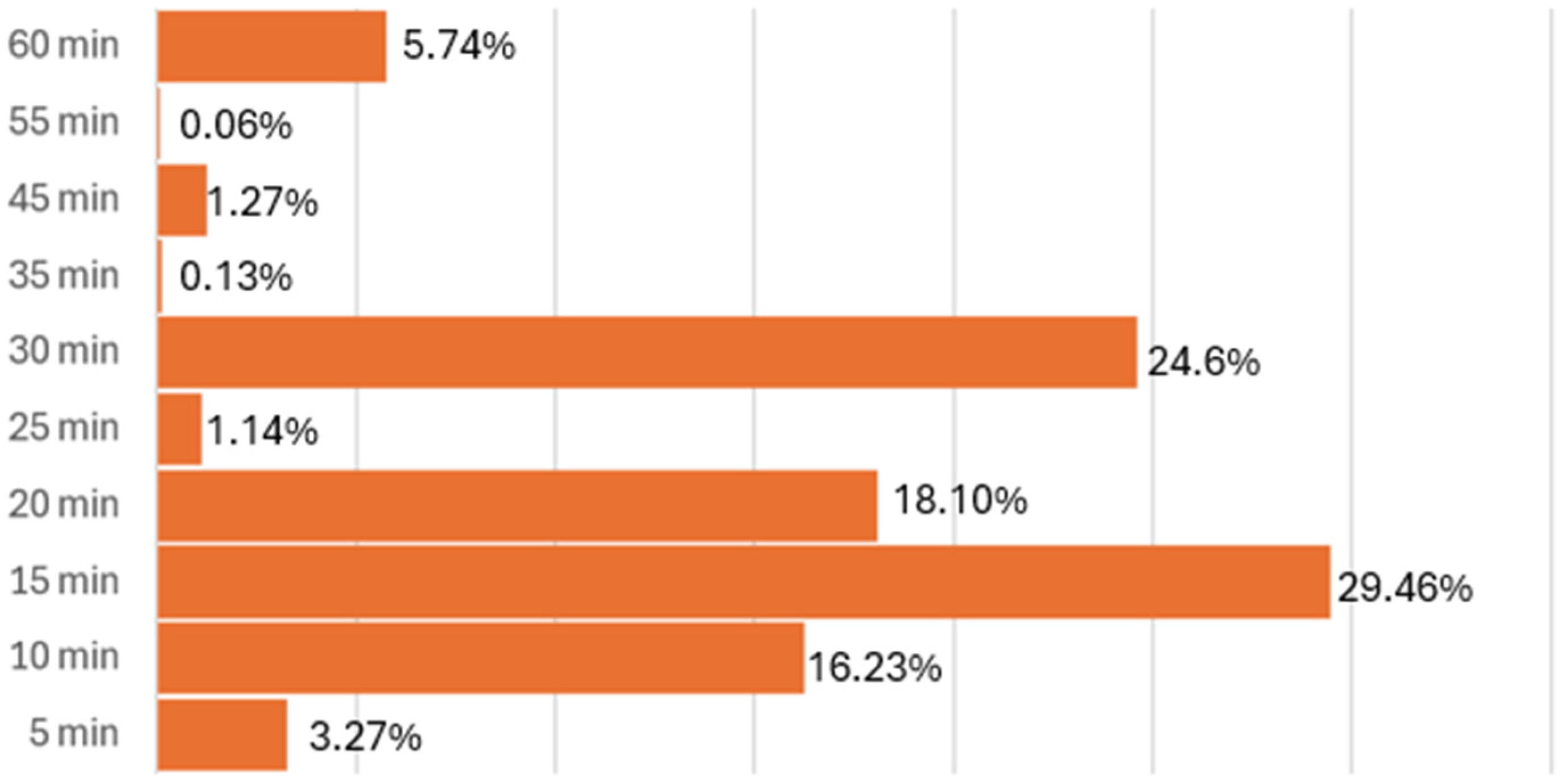
The important question concerned respondents’ willingness to wait for a transport connection or shuttle service. The results indicate that acceptable waiting times vary among users, reflecting different expectations regarding the frequency of connections. A considerable proportion of respondents were willing to wait only a short period (from 5 to 20 min); however, some respondents replied with even longer acceptable waiting intervals, like 30 min by 24.6% or 60 min by 5.74% (Figure 3). In general, tourists are more flexible in planning their journeys and may use waiting time more actively, which influences their perception of acceptable waiting times.
A dominant part of respondents (73.2%) indicated the need to increase the number of public transport connections or shuttle services, while 36.5% only during the peak season.

4.2. Analysis of Proposals Variants

In this part, the authors present an assessment of individual variants of increasing the number of trains in the public interest on the railway infrastructure. The following variants are evaluated:
  • Variant 0—Default timetable.
  • Variant 1—Adjustment of the timetable to backup times.
  • Variant 2—Directional adjustment of the track.
  • Variant 3—Construction of a new station.

4.2.1. Variant 0—Default Timetable

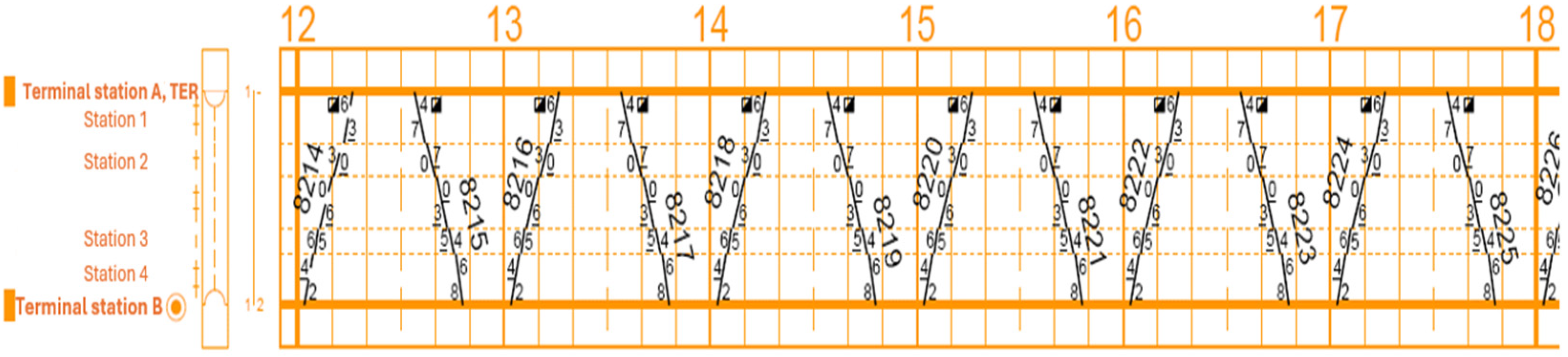
To compare the individual variants of the chart design after the implementation of measures to increase the practical throughput, the indicators of the practical throughput of the basic chart were calculated (Table 1), i.e., the current state. Figure 4 shows a fragment of the timetable sheet for variant 0.
The tocc occupancy time in this variant includes the train running time, i.e., (14 min), and the technological turnaround time of the set (3 min), as it is one set.

4.2.2. Variant 1—Adjustment of the Schedule to Backup Times

This variant uses a suitable adjustment of the timetable from the operational–organizational measures to increase the line capacity. The train paths are compressed to the level of operating intervals (technological time for the turn of the set), respecting the backup times. The reserve time is defined as the time reserve for the elimination of train delays. Figure 5 shows a section of the timetable sheet for variant 1. Table 2 shows the calculation of the practical permeability indicators for this variant.
The occupancy time of the tocc in this variant contains the running time of the train, i.e., (14 min), and the technological turning time of the set = τtt (3 min).

4.2.3. Variant 2—Directional Adjustment of the Track

The methodology for the variant design was based on a comprehensive assessment of the lines in mountainous terrain. First, sections with the potential for increasing line speed were identified based on an analysis of directional conditions, longitudinal gradient, and line routing relative to contour lines. Subsequently, the possibility of directional shifts was assessed regarding adhesion conditions, the need to route the line in curves, and spatial constraints, including existing development. The assessment also included the impact of adjustments on level crossings with roads and the need to secure them. Based on these criteria, sections suitable for directional adjustments and increasing line speed were selected.
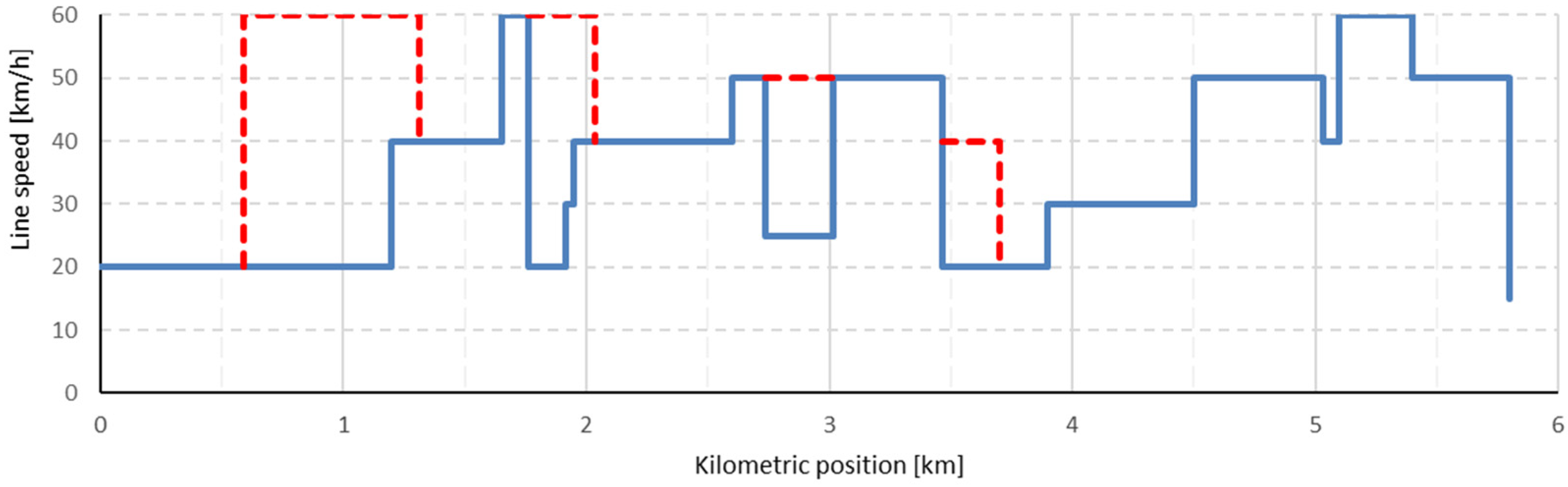
This variant uses reconstruction measures to increase the permeability of the track, its inclination and directional adjustment. The selection of individual sections of the line to increase the speed of trains with an impact on shortening travel times must be taken comprehensively. The track in question is located in mountainous terrain, with steep slopes, so the track runs along the contour of the slopes. In sections where the track with respect to the terrain planes could seemingly be replaced directly, the slope of the track must be considered, as the track is adhesive, and the sloping conditions of the straight track must be eliminated by running the track in curves. Modification of the directional guidance of the line by building new relocations of the line is also affected by constructions around the line, i.e., in addition to the construction of the railway undercarriage, also by the surrounding buildings. An increase in track speed can also affect how the railway line crosses with roads, i.e., in this case, the transition from unsecured level crossings (warning crosses) to the construction or modification of crossing safety devices with the lights linked to the movement of rolling stock. Based on the above, sections were selected in which it would be possible to make adjustments to the directional parameters of the line. The sections of possible line speed increase are given in Figure 6 (red color—new line speed and blue color—current line speed) and Table 3.
The total length of the proposed relocation of the line was 1618 m (which means about 27% of the total length of the line). All selected sections of the track are situated in cut-outs, with a maximum height of notches and embankments of up to 5 m. In selected sections, there are 10 pipe culverts and three crossings, which would need to be rebuilt or built new.
The subject measure of increasing the permeability of the track by inclination and directional adjustment of the track would have the following impact on travel times, as given in Table 4. Figure 7 shows a section of the GVD sheet for variant 2, and Table 5 calculates practical permeability indicators.
The occupancy time tocc in this variant includes the train running time, i.e., in one direction (11 min) and in the opposite direction (13 min), and a uniform technological turnaround time of the set = τtt (3 min).

4.2.4. Variant 3—New Station Construction

The selection of the most suitable location was carried out in the form of a multi-criteria evaluation, which considered the technical parameters of the line (directional ratios and longitudinal slope), transport accessibility of the area, and environmental restrictions. Various locations were compared using a scoring method, and the optimal location was determined to be the one representing the most suitable compromise between technical feasibility and serviceability of the area.
The methodology for selecting the station location consisted of designing alternative locations based on the geometry of the line, with set criteria. The criteria included technical conditions (line construction options with assessment of subsoil, slope, and directional conditions), transport conditions (accessibility, connections, and customer satisfaction), and environmental conditions (territorial impacts). The assessment mainly included the extent of impacts on protected areas, the need for felling trees and impacts on vegetation, the extent of earthworks (cuts and embankments), the impact on watercourses and runoff conditions, as well as the visual impact on the landscape. The extent of habitat fragmentation and the compatibility of the proposed solution with existing land use were also considered. This variant with minimal impacts and lower environmental burden was preferred. Evaluating the variants based on the above criteria using the Delphi method after repeated surveying of the opinions of a group of experts, selecting the variant with the highest rating while meeting the limits. As a result, this variant of increasing the permeability of the track uses the reconstruction measures from the modification of the track, namely, the construction of the new station. Considering the spatial arrangement of the railway line as well as the travel times of the connecting trains and especially the directional and inclination conditions, the study identified the most suitable location to build a new station within the section between km 3.014 and km 3.158 (i.e., before an existing Station 2 located at km 3.235–3.315). This section, with a length of 144 m, is directionally in the straight axis of the track, the slope is in the slope of 4.8‰ and 34.9‰ (in km 3.081 there is a slope break). The section is situated in a slight section, which did not require a large volume of earthworks during the expansion of the ground body of the track.
The new station has two traffic tracks with a useful length of 80 m, and there is also a new stop, Station 2, i.e., the original stop was moved 157 m towards Terminal station B. The integration of the station and the stop has a positive effect on the dynamics of the train, the operating intervals, and thus synergistically affects the resulting travel times and the throughput performance of the section (Table 6). In addition to the construction of a “second track”, the construction of a new train stop is also associated with investment costs associated with the change in security equipment, the establishment of electric heating of switches, the lighting of the stop with the modification of access roads to platforms, etc. Figure 8 shows a section of the graph for variant 3.
The time of occupancy of the tobs in this variant contains the average running time of the train, i.e., and the operating interval of crossing time τtt in the station or technological turnaround time at the target station. The calculation of practical throughput indicators was carried out for a 6 h peak because it is a representative period with the highest traffic intensity, which best describes the load on the line in conditions of a combination of regular and tourist traffic. The time interval chosen in this way allows for a sufficiently accurate capture of the dynamics of traffic and identification of limiting elements of the infrastructure without distortion by short-term fluctuations.

5. Discussion

This paper presents a comprehensive study based on a questionnaire survey and an analysis of the selected electric railway, including the evaluation of variants aimed at increasing the number of trains through infrastructure modifications and maintenance of currently operating vehicles. The study identifies a suitable alternative (variant) that provides the following conditions:
  • Relieving the burden of the area caused by individual car transport;
  • Modification of the track with minimal impact on the protected nature reserve;
  • Increasing the number of trains of public interest, thus respecting the public’s requirements for adding train connections;
  • Reduction in travel times;
  • Maintaining train running at regular intervals.
The results of the traffic–sociological survey provide important insights for the formulation and evaluation of the proposed variants, particularly regarding public preferences for transport services, environmental considerations, and acceptable waiting times for shuttle connections. The survey indicates that a majority of respondents consider environmental aspects when choosing a mode of transport, demonstrating a generally positive attitude toward sustainable mobility. However, a significant share of respondents indicated that their environmentally oriented decisions depended on situational factors, such as service availability, travel time, comfort, and luggage requirements. This may suggest that positive environmental attitudes alone may not be sufficient to shift travel behavior unless supported by convenient public transport options. The continued preference for private cars among some users, especially during peak seasons, may reflect perceived shortcomings in public transport capacity and comfort. However, it is important to note that overall satisfaction with public transport and shuttle services was relatively high compared to traffic–sociological surveys focusing on passengers’ satisfaction with train transport [15,16]. Nevertheless, concerns persisted regarding overcrowding, insufficient frequency and poor connectivity with mainline trains. The demand for increased public transport frequency, especially during peak periods, suggests that service enhancements could play an important role in supporting sustainable mobility and reducing reliance on private cars in the study region.
The theoretical contribution of the study lies in the determination of the sequence of steps within the research methodology, while the practical contribution is reflected in the application of the proposed solution in real operation. The need to shorten travel times in a given section was driven by the intention of increasing the frequency of the train connections by introducing a half-hourly interval, instead of an hourly one. From a technical perspective, the study indicates that this objective can be addressed through several alternative approaches. The evaluation of the variants included the adjustment to the timetable, modification of the track and the construction of the turnout. These variants were assessed in terms of their potential to increase line capacity. The proposed measures were subsequently applied in the form of the timetable scenarios, and their feasibility was evaluated using the practical permeability indicators.
Variant 0 of the timetables represents the baseline state and ensures operational feasibility (i.e., the carriage of a given number of trains in each section). The distribution of routes follows a regular hourly pattern, which remains a challenge in the context of shifting passengers from road to rail transport and easy memorization of the timetable. Coverage of routes is realized by one set, so-called shuttle. However, it does not meet the conditions of sufficient capacity, which remains a problem on this line in that region due to the requirement to shift passengers from road to rail infrastructure.
Achieving variant 1 of the chart does not require investment in infrastructure and is feasible within standard deadlines, intended for a regular change in the timetable. In terms of operational security, this option may result in a slight increase in costs on the part of the carrier due to payments for the use of railway infrastructure, which can be offset by higher revenues from passenger transport.
Variant 1 of the timetable still tightly guarantees the ability of its implementation (i.e., the performance of a given number of trains in a given section) and the required quality of transport. However, the distribution of routes is already unsystematic, without the logic of memorizing the timetable. Coverage of routes is realized by one set, so-called shuttle. Offset (spacing) of train paths in turning stations at the level of 10 min, which includes the operating interval of turnover of the set τoi (3 min) and the required time of gaps (reserves) per train three times (6.8 min, rounded to the nearest minute, 7 min).
Further compression of the timetable, i.e., the mutual approach of train paths, may introduce elements of operational instability, where delays could propagate across the network. The elimination of reserve times could result in cumulative delays affecting both the line and connecting services. Another fact is the untying of connecting trains and transfer options for passengers, primarily at Terminal station B, and in the direction or from the direction of westbound track, as well as secondarily in Terminal station A to trains of normal gauge in and from the direction eastbound track.
Respecting the authors’ research, achieving variant 2 of the timetable requires high investment costs in terms of infrastructure manager (EUR 1,620,000 for 1618 m) and its feasibility lasting several months, while the construction may have a considerable impact on the protected area [40]. This variant of the timetable, even with the construction modifications of the line and the investment costs caused by them, still may not lead to the fundamental changes expected in increasing the practical permeability of the line. Further directional and inclination adjustment of the line is still technically possible, but with an enormous increase in the cost of its implementation, while such an increase in throughput performance will still not bring the expected benefits.
Variant 3 was identified as the most suitable option. Although it involves investment costs amounting to 730,000 Euros, it appears to offer a balanced solution in terms of capacity increase and environmental impact. The route layout is already systematic, with an interval of every 30 min, which creates a simple logic of memorizing the itinerary. The routes are covered by two sets, which meet only in the new Station 2, and at the destination station (Terminal station A and Terminal station B), always make a turn to the next connection. For this reason, the operating crossing interval is equal to the technological turnaround time of the unit. This proposed system combines timetable adjustments with infrastructure development, enabling a transition from an hourly clock to a half-hourly clock. It also may improve coordination, thereby enhancing transfer possibilities for passengers and supporting the overall objective of this study.
Previous studies have dealt with the possibilities of double-tracking sections of railway infrastructure [16,20,21,41,42], which may have a significant environmental impact on nature due to tree felling. Given the hydrological and geological conditions of the protected area, this possibility could present considerable challenges. Similar impacts, including deforestation, floods, and their impact on the future development of the territory, have also been identified in other countries [43,44,45].
The space for further research may be found in the connection of railway infrastructure to shuttle service to places where rail transport is not available, for example, by suitable types of electric buses, which are implemented in several mountain areas, by appropriate transport planning according to the load of the area by visitors covered by previous studies [46,47].
The importance of the study is underlined by the fact that the sustainability of the transport system is not possible without stable public transport, which helps to shift users from road transport, lower land use, and protection of rare species of animals and plants in nature reserves, as reported by foreign authors [48,49,50,51].
Several limitations of the study should be acknowledged. The traffic–sociological intercept survey captures stated preferences of respondents, which do not necessarily translate into actual behavioral change. Positive environmental attitudes alone may not necessarily lead to a change in travel behavior of users without the availability of convenient and reliable public transport options. Furthermore, the technical assessment focused on selected variants and assumptions under specific operational conditions. No formal sensitivity analysis was conducted, as the study focuses on evaluating feasible variants under given operational conditions. It should also be noted that no formal statistical test of significance or sample size adequacy was carried out, as the survey was intended to provide indicative insights rather than statistically generalizable results.
The protected area of the national park with the study region exceeds the current standards for the solution of land use plans and the local impact of transport [20,21,35]. Therefore, this study may provide useful insights for assessing the possibilities and solutions for the transfer from road to rail infrastructure in other countries in mountain areas. Interventions in the protected nature reserve that secondarily place disproportionate demands on dynamic or static road transport or other undesirable interventions that place an excessive burden on the environment are inadmissible [15,52]. Based on the evaluation of variants, this study suggests that it is possible to implement an infrastructure element into the nature reserve environment that fulfills the purpose of safe and ecological transport of a large number of passengers. These findings suggest that sustainable increases in rail service capacity in protected areas can be achieved through targeted infrastructure measures combined with demand-oriented planning.

6. Conclusions

The study demonstrated that it is possible to increase the number of train connections in a protected natural area while respecting environmental constraints and public interest. By combining traffic–sociological survey results with analyses, a sustainable railway infrastructure solution was identified that improves line capacity, shortens travel times, and enhances service regularity, considering environmental considerations as well as the needs of visitors. The selected variant, based on the construction of a new station, provides a balanced approach between transport efficiency and nature conservation, while responding to users’ expectations for better public transport services.
The applied methodology and findings may serve as a reference for similar mountain regions seeking to shift transport from road to rail in an environmentally sensitive context.

Author Contributions

Conceptualization, E.N. and K.O.B.; methodology, E.N.; software, E.N.; validation, E.N. and K.O.B.; formal analysis, E.N.; investigation, E.N.; resources, E.N.; data curation, E.N.; writing—original draft preparation, E.N.; writing—review and editing, E.N. and K.O.B.; visualization, E.N. and K.O.B.; supervision, E.N.; project administration, E.N.; funding acquisition, E.N. All authors have read and agreed to the published version of the manuscript.

Funding

This research was supported by the Scientific Grant Agency, project KEGA. This paper was supported by the KEGA Agency, Grant No. 034ŽU-4/2025, “Innovative Project Management Education for Sustainable and Intelligent Transport in the EU in line with Industry 5.0” and “Assessing the ability of transport companies to effectively manage risks in the context of corporate social responsibility”—institutional research at the Faculty of Operation and Economics of Transport and Communications, University of Žilina.

Institutional Review Board Statement

Ethical approval was not required for this study in accordance with applicable legislation, as the research involved an anonymous survey conducted in a public space and did not collect any personal or identifiable data (Regulation (EU) 2016/679, GDPR). Participation was voluntary. All participants were informed about the purpose of the study and provided verbal informed consent prior to participation. No personal data, images, or other identifiable information were recorded.

Data Availability Statement

Data are contained within the article.

Conflicts of Interest

The authors declare no conflicts of interest.

References

  1. Gössling, S. Why cities need to take road space from cars—And how this could be done. J. Urban Des. 2020, 25, 443–448. [Google Scholar] [CrossRef]
  2. Geels, F.W.; Sovacool, B.K.; Schwanen, T.; Sorrell, S. Sociotechnical transitions for deep decarbonization. Science 2017, 357, 1242–1244. [Google Scholar] [CrossRef] [PubMed]
  3. Hirschhorn, F.; Paulsson, A.; Sørensen, C.; Veeneman, W. Public transport regimes and mobility as a service: Governance approaches in Amsterdam, Birmingham, and Helsinki. Transp. Res. Part A Policy Pract. 2019, 130, 178–191. [Google Scholar] [CrossRef]
  4. Hutton, B. Planning Sustainable Transport; Routledge: London, UK, 2013; p. 430. [Google Scholar] [CrossRef]
  5. Bastos, J.; Marques, P.; Batterman, S.A.; Freire, F. Environmental impacts of commuting modes in Lisbon: A life-cycle assessment addressing particulate matter impacts on health. Int. J. Sustain. Transp. 2019, 13, 652–663. [Google Scholar] [CrossRef]
  6. Baniste, D. The Sustainable Mobility Paradigm. International Seminar on Transportation Planning; Univ Amsterdam: Amsterdam, The Netherlands; Elsevier: Amsterdam, The Netherlands, 2008; Volume 15, pp. 73–80. [Google Scholar] [CrossRef]
  7. Kii, M.; Moeckel, R.; Thill, J.C. Land use, transport, and environment interactions: WCTR 2016 contributions and future research directions. Comput. Environ. Urban Syst. 2019, 77, 101335. [Google Scholar] [CrossRef]
  8. Acheampong, R.A.; Silva, E.A. Land use-transport interaction modeling: A review of the literature and future research directions. J. Transp. Land Use 2015, 8, 11–38. [Google Scholar] [CrossRef]
  9. Critical Infrastructure Act no. 45/2011. Available online: https://www.zakonypreludi.sk/zz/2011-45 (accessed on 12 February 2026).
  10. Besinovic, N. Resilience in railway transport systems: A literature review and research agenda. Transp. Rev. 2020, 40, 457–478. [Google Scholar] [CrossRef]
  11. Jacyna, M.; Wasiak, M.; Lewczuk, K.; Chamier-Gliszczynski, N.; Dabrowski, T. Decision Problems in Developing Proecological Transport System. Rocznik Ochrona Srodowiska, 2018; pp. 1007–1025. Available online: http://yadda.icm.edu.pl/baztech/element/bwmeta1.element.baztech-bbe231a7-d2f1-4036-87a9-a4406bf76957 (accessed on 1 February 2026).
  12. The European Comission. White Paper on Transport 2011: Towards a Competitive and Resource Efficient Transport System; The European Comission: Brussels, Belgium, 2011. [Google Scholar]
  13. Milinkovic, S.; Marton, P.; Mašek, J.; Nedeliakova, E.; Gasparik, J.; Kendra, M.; Camaj, J.; Izvolt, L.; Belosevic, I.; Pavlovic, N.; et al. Increasing of Effectivenes of the Railway Transport Services Using the Decision-Support Systems; APVV Project: Beograd, Serbia, 2018. [Google Scholar]
  14. United Nations Educational, Scientific and Cultural Organization Slovak Commission. 2007. Available online: https://www.mzv.sk/documents/10182/132445/Rocenka_2007.pdf/73c59834-4cec-446b-ade8-973d79f08fff (accessed on 3 February 2026).
  15. Nedeliakova, E.; Palo, J.; Skrucany, T.; Kendra, M.; Kupculjakova, J.; Vojtek, M.; Hranicky, M.P.; Stefancova, V.; Sulko, P. The Project P-101-0431, A Comprehensive Transport Solution in the High Tatras Region with an Emphasis on Ecology and Sustainable Development; University of Zilina: Žilina, Slovakia, 2025. [Google Scholar]
  16. Nedeliakova, E. The Project of the Ministry of Education, Science, Research and Sport of the Slovak Republic. KEGA No. 014ŽU-4/2020, Six Sigma and Progressive Education of the Quality Management in the Railway Transport Field of Study in Accordance with the Requirements of Railway Undertakings; University of Zilina: Žilina, Slovakia, 2020. [Google Scholar]
  17. Nedeliakova, E. KEGA Agency, Grant No. 034ŽU-4/2025 Innovative Project Management Education for Sustainable and Intelligent Transport in the EU in Line with Industry 5.0; University of Žilina: Žilina, Slovakia, 2026. [Google Scholar]
  18. Šulko, P.; Gašparík, J.; Dedík, M. Line track capacity–analysis of the implementation of the uic 406 methodology in žsr conditions. Trans Motauto World 2018, 3, 181–184. [Google Scholar]
  19. Public Service Contract Between Ministry of Transport and Construction of the Slovak Republic and National Operator Zeleznicna Spolocnost Slovensko. 2025. Available online: https://www.mindop.sk/fileadmin/documents/doprava/zeleznica/Zmluva_ZSSK_2021-2030/Ramcova_text.pdf (accessed on 15 June 2024).
  20. NATURA 2000. A Network of Protected Sites of the European Union Member States. Available online: https://gceurope.org/wp-content/uploads/2025/04/GCE-Natura-2000-factsheet.pdf (accessed on 16 February 2026).
  21. Act on the Tatra National Park TANAP no. 11/1949. 1948 with Effect from 1 January 1949. Available online: https://faolex.fao.org/docs/pdf/slo42813.pdf (accessed on 15 February 2026).
  22. MINDOP 2026. Rámcový Plán Dopravnej Obslužnosti a Štandardy Dopravnej Obsluhy, Podkladová Analýza pre Diskusiu Pracovnej Skupiny k Harmonizácii Verejnej Osobnej Dopravy. Framework Plan for Transport Services and Standards of Transport Services, Background Analysis for the Discussion of the Working Group on the Harmonization of Public Passenger Transport. Available online: https://www.mindop.sk/eurofondy/plan-obnovy/verejna-osobna-doprava/plan-dopravnej-obsluznosti-pre-zeleznicnu-osobnu-dopravu (accessed on 15 January 2026).
  23. Scuttari, A.; Della Lucia, M.; Martini, U. Integrated planning for sustainable tourism and mobility. A tourism traffic analysis in Italy’s South Tyrol region. J. Sustain. Tour. 2013, 21, 614–637. [Google Scholar] [CrossRef]
  24. Cavallaro, F.; Galati, O.I.; Nocera, S. Climate change impacts and tourism mobility: A destination-based approach for coastal areas. Int. J. Sustain. Transp. 2020, 15, 456–473. [Google Scholar] [CrossRef]
  25. Scuttari, A.; Orsi, F.; Bassani, R. Assessing the tourism-traffic paradox in mountain destinations. A stated preference survey on the Dolomites’ passes (Italy). J. Sustain. Tour. 2019, 27, 241–257. [Google Scholar] [CrossRef]
  26. Della Lucia, M.; Franch, M. The effects of local context on World Heritage Site management: The Dolomites Natural World Heritage Site, Italy. J. Sustain. Tour. 2017, 25, 1756–1775. [Google Scholar] [CrossRef]
  27. Cavallaro, F.; Ciari, F.; Nocera, S.; Prettenthaler, F.; Scuttari, A. The impacts of climate change on tourist mobility in mountain areas. J. Sustain. Tour. 2017, 25, 1063–1083. [Google Scholar] [CrossRef]
  28. Scuttari, A.; Volgger, M.; Pechlaner, H. Transition management towards sustainable mobility in Alpine destinations: Realities and realpolitik in Italy’s South Tyrol region. J. Sustain. Tour. 2016, 24, 463–483. [Google Scholar] [CrossRef]
  29. Wilck, J.; Kauffmann, P.; Lynch, P. What Level of Tourism Traffic Should be planned for in North Carolina’s Major Tourism Areas. Open Transp. J. 2019, 13, 213–226. [Google Scholar] [CrossRef]
  30. Guo, X.; Xiao, X.; Fang, L. On the impact of the new vacation policy on the space-time structure of China’s domestic tourism traffic and tourism development. Tour. Trib 2008, 23, 38–41. [Google Scholar]
  31. Mei, Z.-Y.; Qiu, H.; Feng, C.; Cheng, Y. Research on a forecasting model of tourism traffic volume in theme parks in China. Transp. Saf. Environ. 2019, 1, 135–144. [Google Scholar] [CrossRef]
  32. Xiong, X.; Liu, S.; Wei, Y. Evaluation of the tourism traffic carbon footprint in Xingwen World Geopark. Appl. Mech. Mater. 2016, 851, 697–700. [Google Scholar] [CrossRef]
  33. Schlemmer, P.; Blank, C.; Bursa, B.; Mailer, M.; Schnitzer, M. Does Health-Oriented Tourism Contribute to Sustainable Mobility? Sustainability 2019, 11, 2633. [Google Scholar] [CrossRef]
  34. Hoterová, K.; Dvořák, Z. Návrh Objektívnych Kritérií Určovania Kritických Infraštruktúrnych Prvkov v Podsektore Železničná Doprava. Svet Dopravy, Asatech, Bratislava, Slovakia, 2019. Available online: http://www.svetdopravy.sk/navrh-objektivnych-kriterii-urcovania-kritickych-infrastrukturnych-prvkov-v-podsektore-zeleznicna-doprava/ (accessed on 7 January 2026).
  35. National Infrastructure Protection Plan—NIPP. 2009. Available online: http://www.dhs.gov/xlibrary/assets/NIPP_Plan.pdf (accessed on 5 February 2026).
  36. Railways Act No. 5013/2009. Available online: https://www.zakonypreludi.sk/zz/2009-513 (accessed on 14 February 2026).
  37. Act on Spatial Planning and Building Regulations (Building Act) no. 50/1976. Available online: https://faolex.fao.org/docs/pdf/slo62007E.pdf (accessed on 12 December 2025).
  38. Act on Rail Transport No. 514/2009. Available online: https://www.slov-lex.sk/ezbierky/pravne-predpisy/SK/ZZ/2009/514/ (accessed on 20 November 2025).
  39. Regulation (EU) No. 181/2011 of the European Parliament and of the Council of 16 February 2011 Concerning the Rights of Passengers in Bus and Coach Transport and Amending Regulation (EC) No 2006/2004. Available online: https://eur-lex.europa.eu/legal-content/EN/TXT/?uri=OJ:L:2011:055:TOC (accessed on 15 January 2026).
  40. Railway Infrastructure Manager Internal Document No. SR 1025. Available online: http://fpedas.utc.sk/~gasparik/SR1025_1zmena.pdf (accessed on 10 July 2025).
  41. Railway Infrastructure Manager. Traffic Situation on the Section Starý Smokovec—Tatranská Lomnica; internal document; Railway Infrastructure Manager: Bratislava, Slovakia, 2025. [Google Scholar]
  42. Nedeliakova, E.; Paľo, J.; Slotová, J.; Kendra, M.; Skrúcaný, T. The Project no. P-101-0460/25 Analytical Study—Basis for the Elaboration of the Methodology of Processing Train Circuits; University of Zilina: Žilina, Slovakia, 2025. [Google Scholar]
  43. Rasche, D.; Reinhardt-Imjela, C.; Schulte, A.; Wenzel, R. Hydrodynamic simulation of the effects of stable in-channel large wood on the flood hydrographs of a low mountain range creek, Ore Mountains, Germany. Hydrol. Earth Syst. Sci. 2019, 23, 4349–4365. [Google Scholar] [CrossRef]
  44. Dudley, S.J.; Fischenich, J.C.; Abt, S.R. Effect of woody debris entrapment on flow resistance. J. Am. Water Resour. Assoc. 1998, 34, 1189–1197. [Google Scholar] [CrossRef]
  45. Gwinn, W.R.; Ree, W.O. Maintenance effects on the hydraulic-properties of a vegetation-lined channel. Trans. ASAE 1980, 23, 636–642. [Google Scholar] [CrossRef]
  46. Lawson, S.R.; Newman, P.; Monz, C. A systems-based approach to address unintended consequences of demand-driven transportation planning in national parks and public lands. Int. J. Sustain. Transp. 2017, 11, 98–108. [Google Scholar] [CrossRef]
  47. Lawson, S.; Newman, P.; Choi, J.; Pettebone, D.; Meldrum, B. Integrated Transportation and User Capacity Research in Yosemite National Park the Numbers Game. Transp. Res. Rec. 2009, 2119, 83–91. [Google Scholar] [CrossRef]
  48. Burson, S.L.; Belant, J.L.; Fortier, K.A.; Tomkiewicz, W.C. The effect of vehicle traffic on wildlife in Denali National Park. Arctic 1999, 53, 146–151. [Google Scholar] [CrossRef][Green Version]
  49. Lawson, S.; Chamberlin, R.; Choi, J.; Swanson, B.; Kiser, B.; Newman, P.; Monz, C.; Pettebone, D.; Gamble, L. Modeling the Effects of Shuttle Service on Transportation System Performance and Quality of Visitor Experience in Rocky Mountain National Park. Transp. Res. Rec. J. Transp. Res. Board 2011, 2244, 97–106. [Google Scholar] [CrossRef]
  50. D’Antonio, A.; Monz, C.; Newman, P.; Lawson, S.; Taff, D. Enhancing the utility of visitor impact assessment in parks and protected areas: A combined social-ecological approach. J. Environ. Manag. 2013, 124, 72–81. [Google Scholar] [CrossRef]
  51. Holly, F.M.; Hallo, J.C.; Baldwin, E.D.; Mainella, F.P. Incentives and Disincentives for Day Visitors to Park and Ride Public Transportation at Acadia National Park. J. Park Recreat. Adm. 2009, 28, 74–93. [Google Scholar]
  52. Jurdík, M. Evaluation of Physical-Geographical Research on the High Tatra Mts in the Period 1969–2008. Bachelor Thesis, Faculty of Science, Charles University, Prague, Czech Republic, 2011. Available online: https://dspace.cuni.cz/bitstream/handle/20.500.11956/38062/130032373.pdf?sequence=1 (accessed on 12 February 2026).
Figure 1. Blinded map of the selected electric railway in the study area.
Urbansci 10 00290 g001
Figure 2. The distribution of respondents’ transport modes.
Urbansci 10 00290 g002
Figure 3. Distribution of acceptable waiting times for shuttle services (train, tram, or cableway).
Urbansci 10 00290 g003
Figure 4. Timetable leaf fragment, variant 0.
Urbansci 10 00290 g004
Figure 5. Timetable leaf fragment, variant 1.
Urbansci 10 00290 g005
Figure 6. Speed profile of the track.
Urbansci 10 00290 g006
Figure 7. Timetable leaf fragment, variant 2.
Urbansci 10 00290 g007
Figure 8. Timetable leaf fragment, variant 3.
Urbansci 10 00290 g008
Table 1. Calculated practical permeability indicators of the default timetable.
IndicatorThe Whole Day
(24 h)
The Peak
(6 h)
T—Calculation time1440 min360 min
Tlockout—Total closure time20 min0 min
N—Number of the train36 trains12 trains
tocc—Average time of occupying a section by one train17 min17 min
Tocc—Total time of occupying36 × 17 min 12   · 17 min
t g a p r e q —Required time of gaps per 1 train6.8 min6.8 min
t g a p r e a l —Real time of gaps per train22.44 min13 min
npract—Practical throughput performance 59   tr · T−1 15   tr · T−1
Kpract—Use of practical throughput61.02%80.00%
so—Degree of occupancy0.430.57
N  npract—Condition of feasibility of the chart 36     59   tr · T−1 12     15   tr · T−1
t g a p r e q   <   t g a p r e a l —A condition for guaranteeing the timetable quality6.8 < 22.44 min6.8 < 13 min
Table 2. Practical permeability indicators for variant 1.
IndicatorThe Peak
(6 h)
T—Calculation time360 min
Tlockout—Total closure time0 min
N—Number of the train15 trains
tocc—Average time of occupying a section by one train17 min
Tocc—Total time of occupying 15   · 17 min
t g a p r e q —Required time of gaps per 1 train6.8 min
t g a p r e a l —Real time of gaps per train7 min
npract—Practical throughput performance 15   tr · T−1
Kpract—Use of practical throughput100.00%
so—Degree of occupancy0.71
Nnpract—Condition of feasibility of the chart 15     15   tr · T−1
t g a p r e q   < t g a p r e a l —A condition for guaranteeing the timetable quality6.8 < 7 min
Table 3. Sections of possible line speed increase.
SectionKilometric Position of the Line ModificationCurrent SpeedProposed SpeedSection LengthRemark
1.0.589–1.31340 km/h
20 km/h
60 km/h724 m4 sluices
1 crossing
2.1.654–2.03520 km/h
30 km/h
60 km/h381 m3 sluices
1 crossing
3.2.736–3.01525 km/h50 km/h279 m2 sluices
4.3.465–3.69920 km/h40 km/h234 m1 sluice
1 crossing
Table 4. Theoretical travel times (locomotive 425.95).
StationTravel Time [min]StationTravel Time [min]
CurrentNewCurrentNew
Terminal station A3.53.5Terminal station B32.5
Station 133Station 41.51
Station 23.52.5Station 342.5
Station 322Station 232.5
Station 422Station 12.52.5
Terminal station B--Terminal station A--
Total1413 1411
Difference1 3
Table 5. Practical permeability indicators for variant 2.
IndicatorThe Peak
(6 h)
T—Calculation time360 min
Tlockout—Total closure time0 min
N—Number of the train16 trains (8 + 8)
tocc—Average time of occupying a section by one train15 min
Tocc—Total time of occupying16 · 15 min
t g a p r e q —Required time of gaps per 1 train6.5 min
t g a p r e a l —Real time of gaps per train7.5 min
npract—Practical throughput performance16 tr · T−1
Kpract—Use of practical throughput100.00%
so—Degree of occupancy0.67
N   npract—Condition of feasibility of the chart15 16 tr · T−1
t g a p r e q  <  t g a p r e a l —A condition for guaranteeing the timetable quality6.5 < 7.5 min
Table 6. Practical permeability indicators.
IndicatorThe Peak (6 h)
Terminal Station B–Terminal Station ATerminal Station A–Terminal Station B
T—Calculation time360 min 360 min
Tlockout—Total closure time0 min0 min
N—Number of the train24 trains24 trains
tocc—Average time of occupying a section by one train10 min8 min
Tocc—Total time of occupying 24   · 10 min 24   · 8 min
t g a p r e q —Required time of gaps per 1 train4.6 min3.8 min
t g a p r e a l —Real time of gaps per train5 min7 min
npract—Practical throughput performance 24   tr · T−1 30   tr · T−1
Kpract—Use of practical throughput100.00%80.00%
so—Degree of occupancy0.670.53
N  npract—Condition of feasibility of the chart 24     24   tr · T−1 24     30   tr · T−1
t g a p r e q   <   t g a p r e a l —A condition for guaranteeing the timetable quality4.6 < 5 min3.8 < 7 min
Disclaimer/Publisher’s Note: The statements, opinions and data contained in all publications are solely those of the individual author(s) and contributor(s) and not of MDPI and/or the editor(s). MDPI and/or the editor(s) disclaim responsibility for any injury to people or property resulting from any ideas, methods, instructions or products referred to in the content.