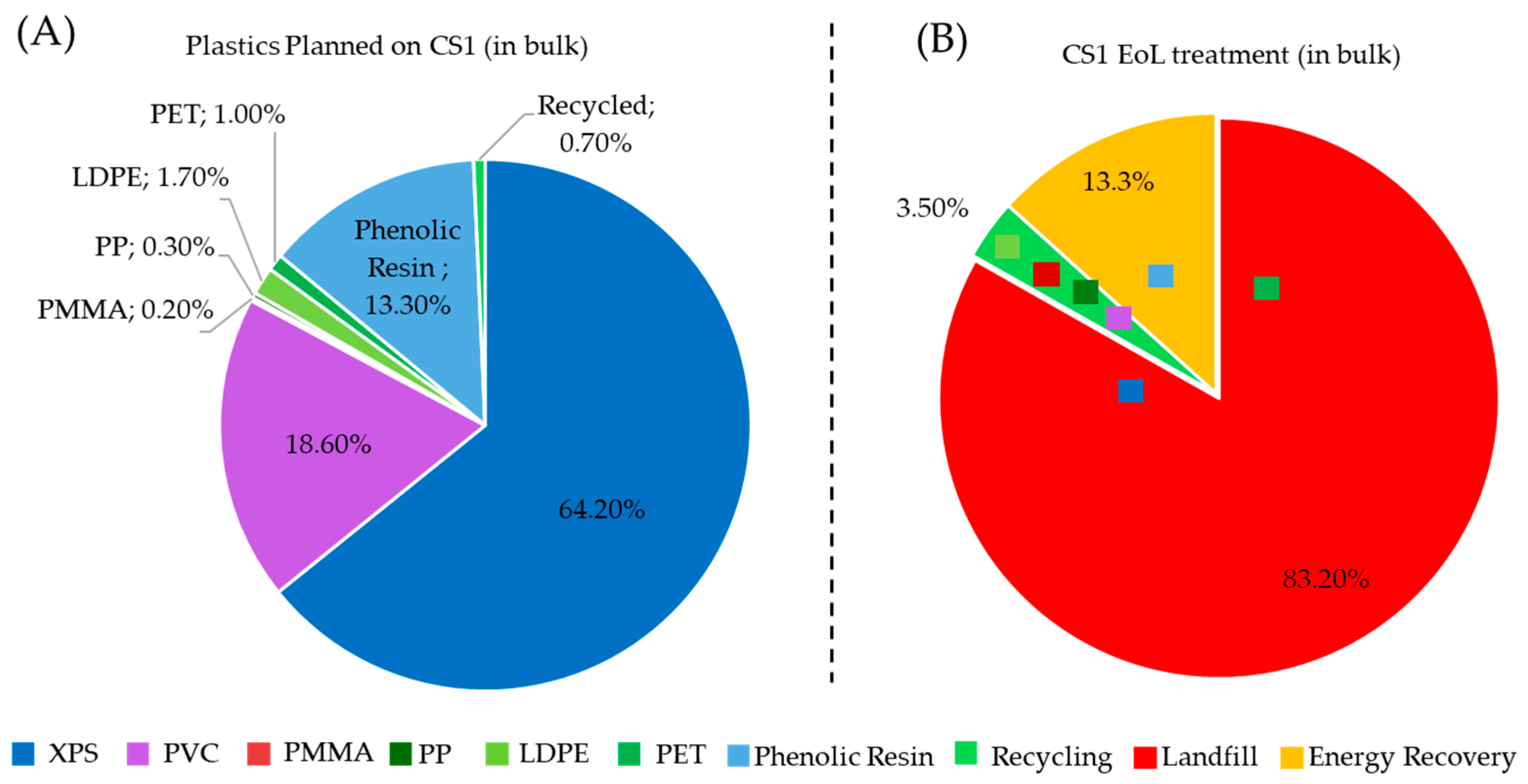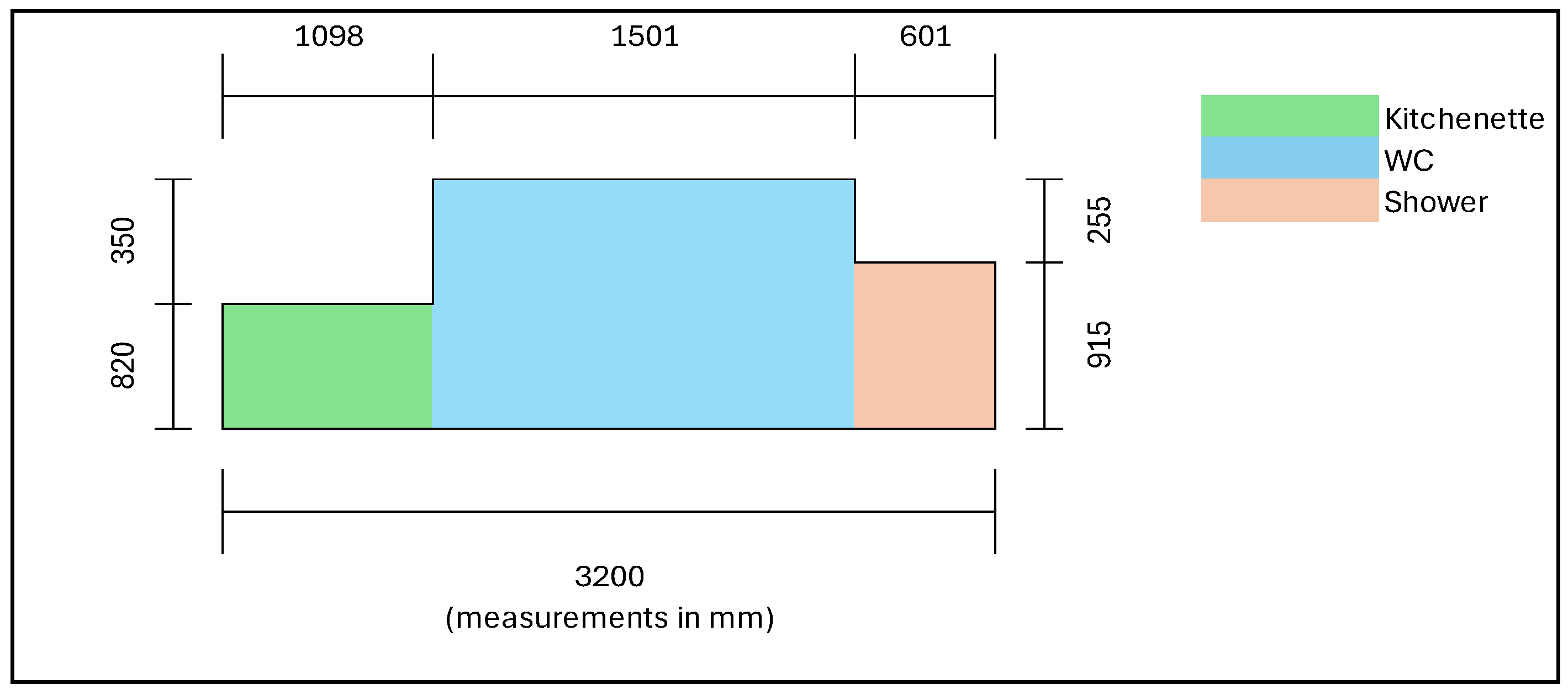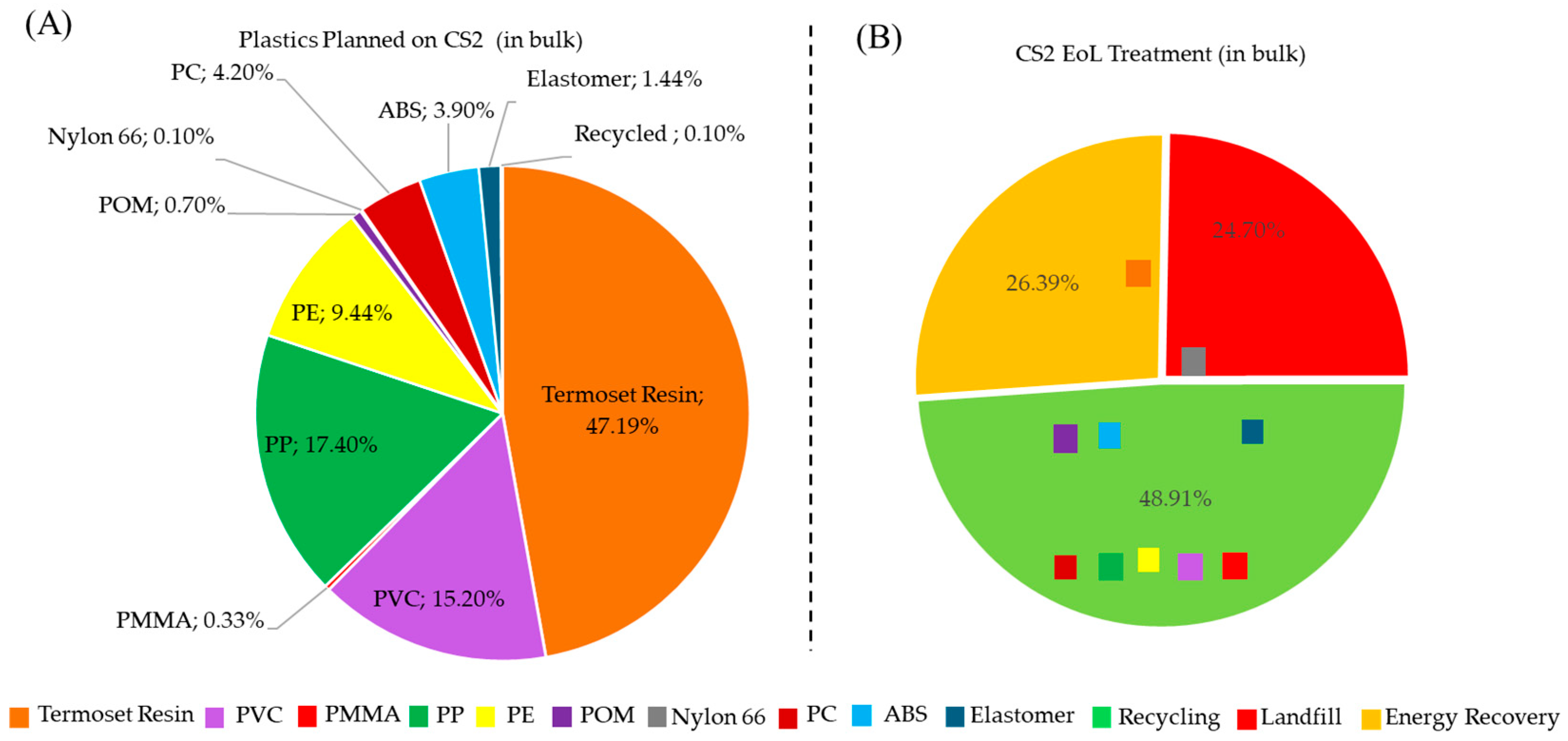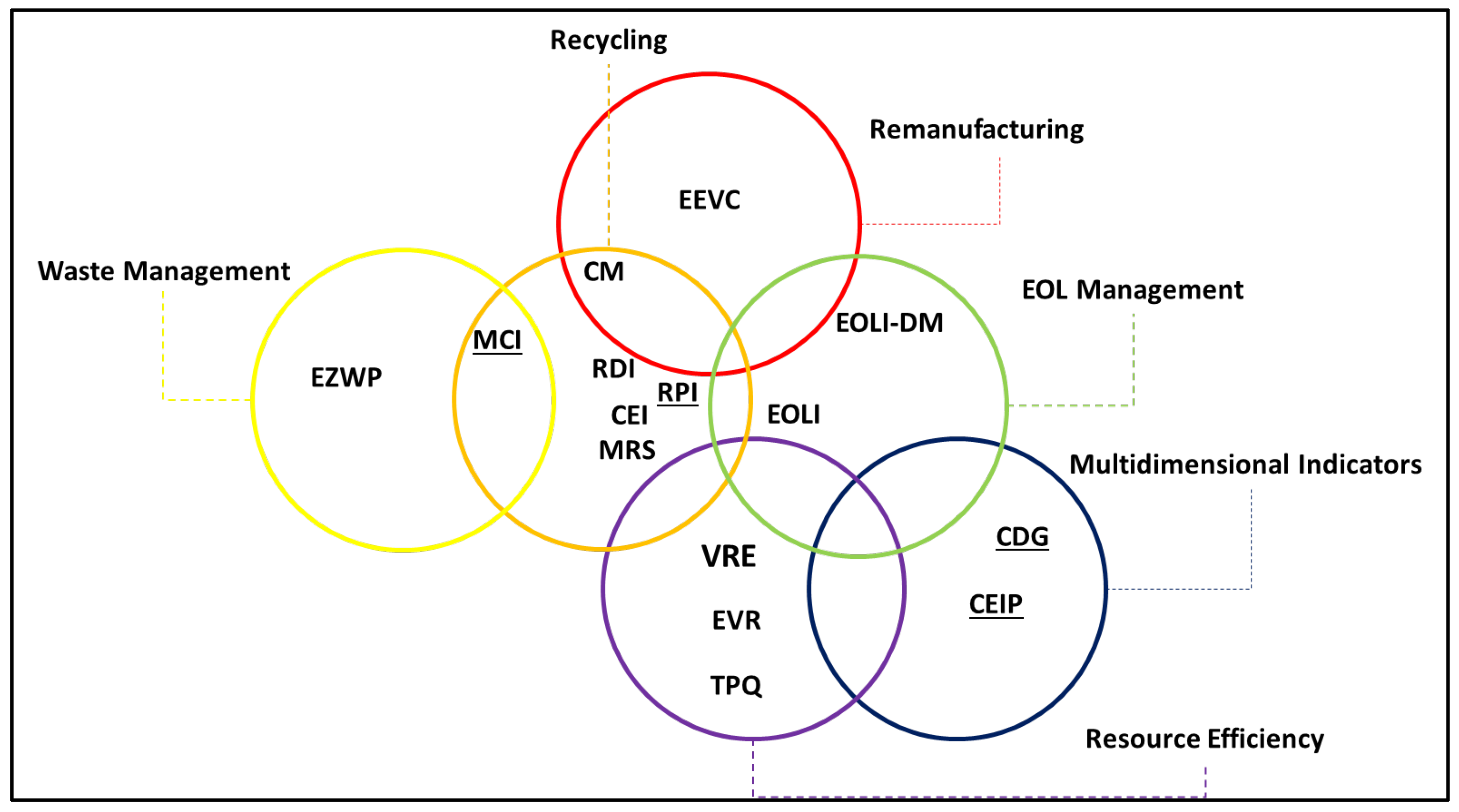



Evaluating Circularity of Plastic Use in Traditional and Modular Urban Construction Through Micro-Indicators

Abstract
1. Introduction
2. Literature Review
2.1. Legislation to CE Implementation in Building and Construction Sector
2.2. Construction and Building CE Implementation Gaps
- Challenges in coordinating multiple stakeholders in the building a value chain to ensure that all products or materials are circular.
- Insufficient information on how to aggregate products and materials for reuse at the end of the lifespan of a building.
- Difficulties in accessing and disassembling products for refurbishment without resorting to demolition.
- Lack of effective separation and sorting processes to fully recover waste when it contains diverse and incompatible materials.
- Preference for virgin materials, driven by the high costs of recycled materials compared to cheaper resource extraction and landfill disposal of CDW.
- Resistance from builders to adopt new materials and construction methods, especially those that focus on reuse or controlled deconstruction.
2.3. Plastics in the Building and Construction Sector
3. Methodology
3.1. Case Study
3.2. Selection of Circularity Micro-Indicators for Plastic Products in the Building and Construction Sector
3.3. Selection of Micro-Indicators for the Case Studies
4. Results and Discussion
4.1. Material Circularity Indicator
4.2. Reuse Potential Indicator
4.3. Circularity Design Guidelines
4.4. Summary
5. Conclusions
Author Contributions
Funding
Institutional Review Board Statement
Informed Consent Statement
Data Availability Statement
Acknowledgments
Conflicts of Interest
Abbreviations
| ABS | Acrylonitrile Butadiene Styrene |
| APA | Portuguese Environment Agency |
| CDG | Circularity Design Guidelines |
| C&D | Construction and Demolition |
| CDW | Construction and Demolition Waste |
| CE | Circular Economy |
| CEI | Circular Economy Index |
| CEIP | Circular Economy Indicator Prototype |
| CM | Combination Matrix |
| CO2 | Carbon Dioxide |
| EEVC | Eco-efficient Value Creation |
| EOLI | End-of-Life Index |
| EOLI-DM | End-of-Life Indices—Design Methodology |
| EoL | End-of-Life |
| EPDM | Ethylene Propylene Diene Monomer |
| EPVR | End-of-use Product Value Recovery |
| EPS | Expanded Polystyrene |
| EU | European Union |
| EVR | Eco-cost and Value Creation |
| EZWP | Expanded Zero Waste Practice |
| GDP | Gross Domestic Product |
| GHG | Greenhouse Gas |
| HVAC | Heating, Ventilation, and Air Conditioning |
| LCA | Life Cycle Assessment |
| LDPE | Low-Density Polyethylene |
| LFI | Linear Flow Index |
| MCI | Material Circularity Indicator |
| MDF | Medium-Density Fiberboard |
| MSW | Municipal Solid Waste |
| MRS | Material Reutilization Score |
| MUF | Melamine Urea Formaldehyde Resins |
| PA 66 | Polyamide 66 (Nylon) |
| PC | Polycarbonate |
| PE | Polyethylene |
| PE-HD | High-Density Polyethylene |
| PET | Polyethylene Terephthalate |
| PIR | Polyisocyanurate |
| PMMA | Polymethyl Methacrylate |
| POM | Polyoxymethylene |
| PP | Polypropylene |
| PU | Polyurethane |
| PUR | Rigid Polyurethane |
| PVC | Polyvinyl Chloride |
| PVC-P | Plasticized Polyvinyl Chloride |
| PVC-U | Unplasticized Polyvinyl Chloride |
| PVB | Polyvinyl Butyral |
| RDI | Recycling Desirability Index |
| RI | Recycling Indices |
| RPI | Reuse Potential Indicator |
| SDEO | Sustainable Design and End-of-life Options |
| SICE | Sustainability Indicators in Circular Economy |
| TQP | Typology for Quality Properties |
| TPE | Thermoplastic Elastomers |
| VRE | Value-based Resource Efficiency Indicator |
| XPS | Extruded Polystyrene |
| F(x) | Utility Function |
| Mass of a product | |
| Fraction of product’s feedstock from recycled sources | |
| Fraction of product’s feedstock from reused sources | |
| Fraction of product’s biological feedstock from sustained production; | |
| Fraction of a product being collected to go into a recycling process; | |
| Fraction of a product going into a component reuse; | |
| Fraction of a product being collected to go into a composting process; | |
| Fraction of a product being collected for energy recovery; | |
| Efficiency of recycling process used to produce recycled feedstock; | |
| Efficiency of recycling process for the portion of product collected for recycling; | |
| Actual average lifetime of a product; | |
| Average lifetime of an industry-average product of the same type; | |
| Actual average number of functional units achieved during the use phase. |
Appendix A
Calculation of MCI

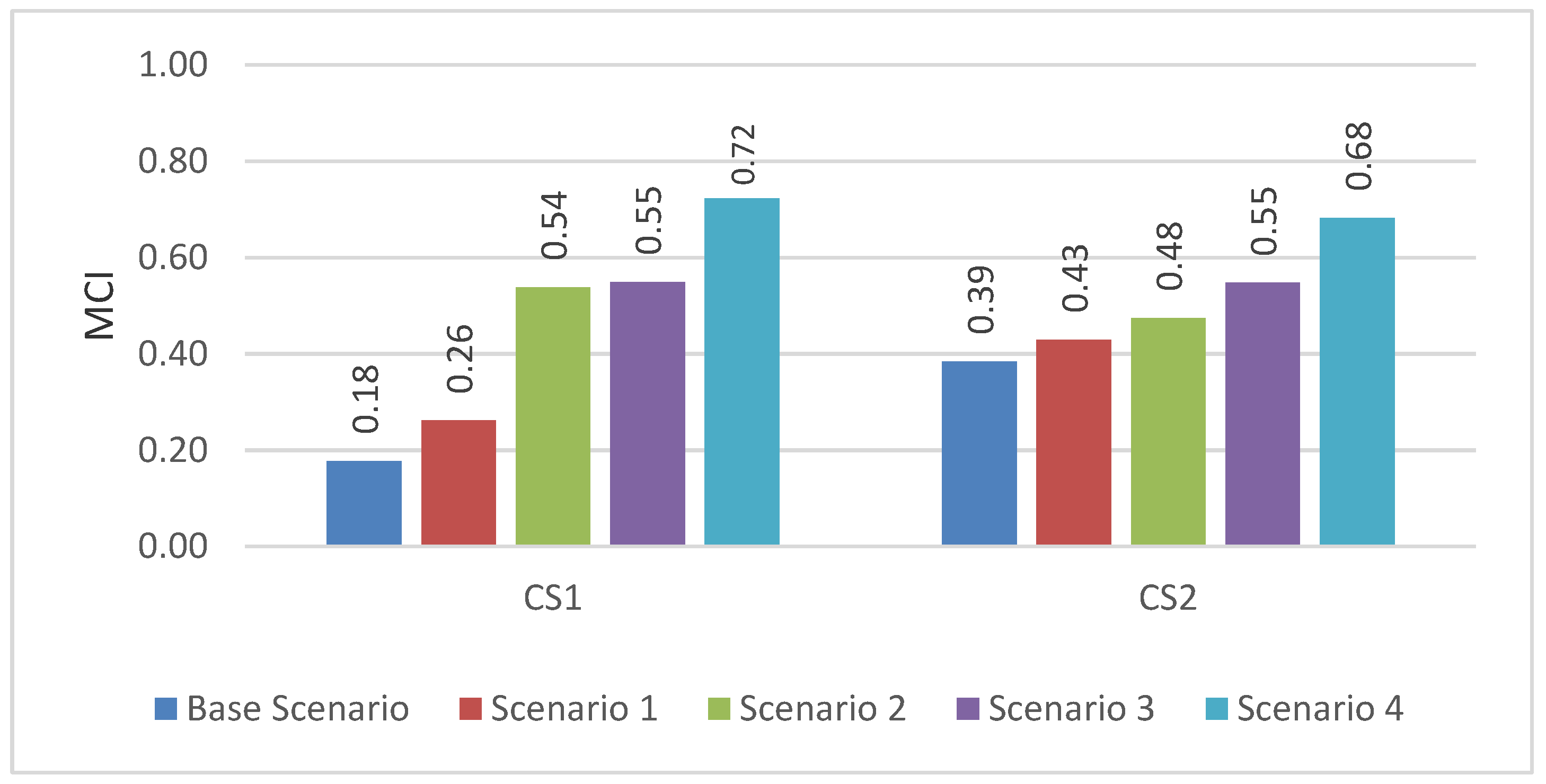
| Data | Base Scenario | Scenario 1 | Scenario 2 | Scenario 3 | Scenario 4 |
|---|---|---|---|---|---|
|
|
|
|
| |
| M | 4680.27 Kg | 4680.27 Kg | 4680.27 Kg | 4680.27 Kg | 4680.27 Kg |
| FR | 0.7% | 18.23% | 0.7% | 0.7% | 18.23% |
| FU | 0% | 0% | 20% | 0% | 20% |
| FS | 0% | 0% | 0% | 0% | 0% |
| CR | 3.5% | 3.5% | 3.5% | 55% | 53% |
| CU | 0% | 0% | 0% | 0% | 20% |
| CC | 0% | 0% | 0% | 0% | 0% |
| CE | 13.3% | 13.3% | 13.3% | 43% | 27% |
| EF | 95% | 95% | 95% | 95% | 95% |
| EC | 95% | 95% | 95% | 95% | 95% |
| L | 25 anos | 25 anos | 25 anos | 25 anos | 25 anos |
| Lav | 25 anos | 25 anos | 25 anos | 25 anos | 25 anos |
| U/Uav | 1 | 1 | 1 | 1 | 1 |
| Data | Base Scenario | Scenario 1 | Scenario 2 | Scenario 3 | Scenario 4 |
|---|---|---|---|---|---|
|
|
|
|
| |
| M | 68.98 Kg | 68.98 Kg | 68.98 Kg | 68.98 Kg | 68.98 Kg |
| FR | 0.1% | 9.9% | 0.1% | 0.1% | 9.9% |
| FU | 0% | 0% | 20% | 0% | 20% |
| FS | 0% | 0% | 0% | 0% | 0% |
| CR | 43.7% | 43.7% | 43.7% | 49.0 | 49% |
| CU | 0% | 0% | 0% | 0% | 20% |
| CC | 0% | 0% | 0% | 0% | 0% |
| CE | 20.2% | 20.2% | 20.2% | 26% | 31% |
| EF | 95% | 95% | 95% | 95% | 95% |
| EC | 95% | 95% | 95% | 95% | 95% |
| L | 25 anos | 25 anos | 25 anos | 25 anos | 25 anos |
| Lav | 25 anos | 25 anos | 25 anos | 25 anos | 25 anos |
| U/Uav | 1 | 1 | 1 | 1 | 1 |
Appendix B
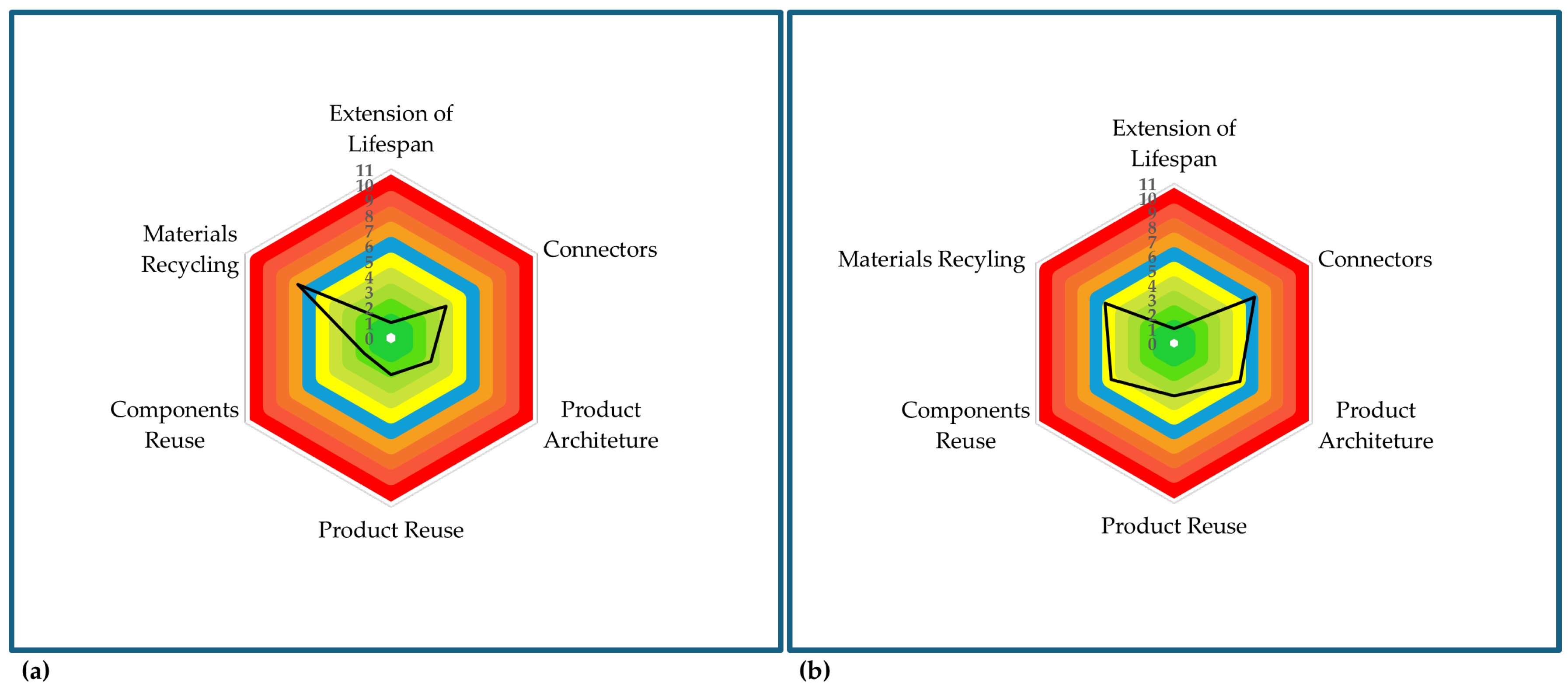
| Group | Circular Design Guidelines | CS1 | CS2 | |||||
|---|---|---|---|---|---|---|---|---|
| Margin of Improvement | Relevance | CDG Level | Margin of Improvement | Relevance | CDG Level | |||
| Life Cycle Extension | Timeless design; | 1 | 1 | 1 | 1 | 1 | 1 | |
| Adaptability; | 1 | 1 | ||||||
| Upgrading; | 1 | 1 | ||||||
| Disassembly | Connectors | Use standardized joints; | 1 | 3 | 4 | 1 | 3 | 6 |
| Use joints than can be disassembled rather than fixed joints; | 3 | 3 | ||||||
| Use screws with the same metrics; | 1 | 2 | ||||||
| Minimise type of joints; | 1 | 3 | ||||||
| Use easily accessible joints; | 2 | 3 | ||||||
| Minimize the number of joints; | 1 | 2 | ||||||
| Minimize the number of tools to be used; | 1 | 2 | ||||||
| Use standardized tools; | 1 | 1 | ||||||
| Product Architecture | Adopt modular designs; | 2 | 2 | 3 | 2 | 3 | 5 | |
| Minimize the number of components; | 2 | 1 | ||||||
| Be able to quickly identify disassembly joints; | 1 | 1 | ||||||
| Minimize length of wires and cables; | 1 | 3 | ||||||
| Size components to make their handling easier; | 2 | 3 | ||||||
| Facilitate the accessibility of essential components (for their potential reuse/recycling); | 1 | 1 | ||||||
| Avoid the disassembly of parts in opposite directions; | 1 | 2 | ||||||
| Design to make disassembly automatic; | 2 | 1 | ||||||
| Product Reuse | Design to avoid accumulation of dirt; | 1 | 2 | 2 | 2 | 2 | 4 | |
| Use materials that resist cleaning processes; | 1 | 2 | ||||||
| Minimize the use of parts that require frequent repairs/replacements; | 1 | 1 | ||||||
| Use components with a similar life span; | 2 | 1 | ||||||
| Incorporate systems to monitor failing components; | 1 | 3 | ||||||
| Components Reuse | Use standardized components; | 1 | 2 | 2 | 2 | 2 | 5 | |
| Minimize variations of tools | 1 | 3 | ||||||
| Materials Recycling | Unify materials in the components joined by fixed joints; | 3 | 3 | 7 | 2 | 3 | 6 | |
| Use materials with a low environmental impact (recyclable/low energy content/etc.); | 3 | 1 | ||||||
| Avoid using surface treatments; | 2 | 3 | ||||||
| Label materials; | 1 | 1 | ||||||
| Minimize the EU hazardous materials; | 3 | 1 | ||||||
| Promote monomaterial designs; | 2 | 3 | ||||||
References
- European Commission. Construction Sector. Available online: https://single-market-economy.ec.europa.eu/sectors/construction_en (accessed on 7 August 2024).
- González, A.; Sendra, C.; Herena, A.; Rosquillas, M.; Vaz, D. Methodology to assess the circularity in building construction and refurbishment activities. Resour. Conserv. Recycl. Adv. 2021, 12, 200051. [Google Scholar] [CrossRef]
- Agency, E.E. Greenhouse Gas Emissions from Energy Use in Buildings in Europe. Available online: https://www.eea.europa.eu/en/analysis/indicators/greenhouse-gas-emissions-from-energy (accessed on 7 August 2024).
- European Circular Economy Stakeholder Platform (ECESP). Circular Buildings and Infrastructure; State of Play Report Ecesp Leadership Group on Buildings and Infrastructure: Brussels, Belgium, 2021. [Google Scholar]
- Çimen, Ö. Construction and built environment in circular economy: A comprehensive literature review. J. Clean. Prod. 2021, 305, 127180. [Google Scholar] [CrossRef]
- Häkkinen, T.; Kuittinen, M.; Vares, S. Plastics in Buildings. 2019. Available online: https://ym.fi/documents/1410903/122689634/Plastics+in+buildings.+A+study+of+Finnish+blocks+of+flats+and+daycare+centres.pdf/9bf6e496-fd8f-1a84-f12a-b19fbcbc906e/Plastics+in+buildings.+A+study+of+Finnish+blocks+of+flats+and+daycare+centres.pdf?t=1687434923078 (accessed on 7 August 2024).
- Plastic Europe. Plastics the Fast Facts 2023: A Review on Plastic Contributions to European Economy; Plastic Europe: Brussels, Belgium, 2023; p. 2023. [Google Scholar]
- Mudgal, S.; Lyons, L.; Bain, J.; Dias, D.; Faninger, T.; Johansson, L. Plastic Waste in the Environment—Final Report; European Commission, Directorate-General for Environment: Brussels, Belgium, 2011; Available online: https://ceeii.org/environment/waste/studies/pdf/plastics.pdf (accessed on 29 November 2024).
- Sadat-Shojai, M.; Bakhshandeh, G.R. Recycling of PVC wastes. Polym. Degrad. Stab. 2011, 96, 404–415. [Google Scholar] [CrossRef]
- Santos, G.; Esmizadeh, E.; Riahinezhad, M. Recycling Construction, Renovation, and Demolition Plastic Waste: Review of the Status Quo, Challenges and Opportunities. J. Polym. Environ. 2024, 32, 479–509. [Google Scholar] [CrossRef]
- United Nations Population Fund. As the World’s Population Hits 8 Billion People, UN Calls for Solidarity in Advancing Sustainable Development for All. Available online: https://www.unfpa.org/press/worlds-population-hits-8-billion-people-un-calls-solidarity-advancing-sustainable-development (accessed on 29 November 2024).
- Ritchie, H.; Samborska, M.; Roser, V. Urbanization. Our World in Data. Available online: https://ourworldindata.org/urbanization (accessed on 29 November 2024).
- Venditti, B. This Chart Shows the Impact Rising Urbanization Will Have on the World. World Economic Forum. Available online: https://www.weforum.org/stories/2022/04/global-urbanization-material-consumption/ (accessed on 29 November 2024).
- United Nations. Sustainable Consumption and Production (Sustainable Development Goal 12). United Nations Sustainable Development. 2016. Available online: https://www.un.org/sustainabledevelopment/sustainable-consumption-production/ (accessed on 20 October 2025).
- Konstantinovas, B.; Bento, N.V.; Sanches, T. Economia Circular No Setor Da Construção Civil I-Ciclo dos Materiais; Comissão de Coordenação e Desenvolvimento Regional de Lisboa e Vale do Tejo (CCDR LVT, I.P.): Lisbon, Portugal, 2019. [Google Scholar]
- Norouzi, M.; Chàfer, M.; Cabeza, L.F.; Jiménez, L.; Boer, D. Circular Economy in the Building and Construction Sector: A Scientific Evolution Analysis. J. Build. Eng. 2021, 44, 102704. [Google Scholar] [CrossRef]
- Vasić, M.; Grubeša, I.N.; Awoyera, P.; Barišić, I. Clays in transition: Addressing resource challenges and sustainable innovations in the construction sector. Sci. Prog. 2025, 108, 368504251376483. [Google Scholar] [CrossRef] [PubMed]
- Briassoulis, D.; Hiskakis, M.; Babou, E. Technical specifications for mechanical recycling of agricultural plastic waste. Waste Manag. 2013, 33, 1516–1530. [Google Scholar] [CrossRef] [PubMed]
- Liikanen, M.; Grönman, K.; Deviatkin, I.; Havukainen, J.; Hyvärinen, M.; Kärki, T.; Varis, J.; Soukka, R.; Horttanainen, M. Construction and demolition waste as a raw material for wood polymer composites—Assessment of environmental impacts. J. Clean. Prod. 2019, 225, 716–727. [Google Scholar] [CrossRef]
- O’Grady, T.; Minunno, R.; Chong, H.Y.; Morrison, G.M. Design for disassembly, deconstruction and resilience: A circular economy index for the built environment. Resour. Conserv. Recycl. 2021, 175, 105847. [Google Scholar] [CrossRef]
- Plastics Europe. Plastics—The Facts 2020. 2020. Available online: https://plasticseurope.org/knowledge-hub/plastics-the-facts-2020/ (accessed on 7 August 2024).
- Awoyera, P.O.; Adesina, A. Plastic wastes to construction products: Status, limitations and future perspective. Case Stud. Constr. Mater. 2020, 12, e00330. [Google Scholar] [CrossRef]
- Cirino, E.; Curtis, S.; Wallis, J.; Thys, T.; Brown, J.; Rolsky, C.; Erdle, L.M. Assessing benefits and risks of incorporating plastic waste in construction materials. Front. Built Environ. 2023, 9, 1206474. [Google Scholar] [CrossRef]
- Fonseca, P.; Pedroso, M.; Tavares, V.; Costa, A.A.; Santos, L.; Laranjeira, L. Relatório do Estado Atual da Circularidade no Setor da Construção em Portugal. 2023. Available online: https://circularidade.builtcolab.pt/ (accessed on 7 August 2024).
- Gasparri, E.; Arasteh, S.; Kuru, A.; Stracchi, P.; Brambilla, A. Circular economy in construction: A systematic review of knowledge gaps towards a novel research framework. Front. Built Environ. 2023, 9, 1239757. [Google Scholar] [CrossRef]
- Lonca, G.; Lesage, P.; Majeau-Bettez, G.; Bernard, S.; Margni, M. Assessing scaling effects of circular economy strategies: A case study on plastic bottle closed-loop recycling in the USA PET market. Resour. Conserv. Recycl. 2020, 162, 105013. [Google Scholar] [CrossRef]
- Saidani, M.; Yannou, B.; Leroy, Y.; Cluzel, F.; Kendall, A. A taxonomy of circular economy indicators. J. Clean. Prod. 2019, 207, 542–559. [Google Scholar] [CrossRef]
- Matos, J.; Martins, C.; Simões, C.L.; Simoes, R. Comparative analysis of micro level indicators for evaluating the progress towards a circular economy. Sustain. Prod. Consum. 2023, 39, 521–533. [Google Scholar] [CrossRef]
- Parracho, D.F.R.; El-Din, M.N.; Esmaeili, I.; Freitas, S.S.; Rodrigues, L.; Martins, J.P.; Corvacho, H.; Delgado, J.M.P.Q.; Guimarães, A.S. Modular construction in the digital age: A systematic review on smart and sustainable innovations. Buildings 2025, 15, 765. [Google Scholar] [CrossRef]
- Commission of the European Communities. Strategy for the Sustainable Competitiveness of the Construction Sector and Its Companies; European Commission: Brussels, Belgium, 2012. [Google Scholar]
- Associação Portuguesa do Ambiente (APA). Acordo de Paris. Available online: https://apambiente.pt/clima/acordo-de-paris (accessed on 22 March 2022).
- IRENA. Global Energy Transformation: A Roadmap to 2050; International Renewable Energy Agency: Abu Dhabi, United Arab Emirates, 2019. [Google Scholar]
- United Nations Environment Programme. Towards a zero-emissions, efficient and resilient buildings and construction sector. In Global Status Report for Buildings and Construction 2020; United Nations Environment Programme: Nairobi, Kenya, 2020; pp. 9–10. Available online: https://globalabc.org/sites/default/files/inline-files/2020 Buildings GSR_FULL REPORT.pdf (accessed on 2 February 2022).
- European Commission. Protocolo de Gestão de Resíduos de Construção e Demolição da UE. 2016. Available online: https://ec.europa.eu/docsroom/documents/20509/attachments/1/translations/pt/renditions/native (accessed on 2 February 2022).
- Laboratório Nacional de Engenharia Civil (LNEC); Agência Portuguesa do Ambiente (APA); Instituto dos Mercados Públicos, do Imobiliário e da Construção (IMPIC). Legislação de RCD—O que muda? 1o Webinar Closer|Auditorias Pré-Demolição—Construir e Desconstrução. Available online: http://closer.lnec.pt/Legislacao_RCD_o_que_muda.pdf (accessed on 18 November 2021).
- Mahpour, A. Prioritizing barriers to adopt circular economy in construction and demolition waste management. Resour. Conserv. Recycl. 2018, 134, 216–227. [Google Scholar] [CrossRef]
- Cosentino, L.; Fernandes, J.; Mateus, R. A Review of Natural Bio-Based Insulation Materials. Energies 2023, 16, 4676. [Google Scholar] [CrossRef]
- Cousins, K. Polymers in Building and Construction; iSmithers Rapra: Shawbury, UK, 2022. [Google Scholar]
- Wassenaar, J. Polypropylene Materials for Sewerage & Drainage Pipes with Reduced Energy and Carbon Footprints. J. Mater. Sci. Eng. B 2016, 6, 283–290. [Google Scholar] [CrossRef]
- Matos, J.; Martins, C.I.; Simoes, R. Circularity Micro-Indicators for Plastic Packaging and Their Relation to Circular Economy Principles and Design Tools. Sustainability 2024, 16, 2182. [Google Scholar] [CrossRef]
- Matos, J.; Santos, S.; Simões, C.L.; Martins, C.I.; Simoes, R. Practical application of circularity micro-indicators to automotive plastic parts in an industrial context. Sustain. Prod. Consum. 2023, 43, 155–167. [Google Scholar] [CrossRef]
- Kristensen, H.S.; Mosgaard, M.A. A review of micro level indicators for a circular economy—Moving away from the three dimensions of sustainability? J. Clean. Prod. 2020, 243, 118531. [Google Scholar] [CrossRef]
- Mesa, J.; Esparragoza, I.; Maury, H. Developing a set of sustainability indicators for product families based on the circular economy model. J. Clean. Prod. 2018, 196, 1429–1442. [Google Scholar] [CrossRef]
- Alamerew, Y.A.; Brissaud, D. Evaluation of Remanufacturing for Product Recovery: Multi-criteria Decision Tool for End-of-Life Selection Strategy. In Proceedings of the 3rd International Conference on Remanufacturing, Linköping, Sweden, 17–19 October 2017; Available online: https://hal.univ-grenoble-alpes.fr/hal-01627790v1 (accessed on 18 November 2021).
- Cong, L.; Zhao, F.; Sutherland, J.W. Product Redesign for Improved Value Recovery via Disassembly Bottleneck Identification and Removal. Procedia CIRP 2017, 61, 81–86. [Google Scholar] [CrossRef]
- van Loon, P.; Van Wassenhove, L.N. Assessing the economic and environmental impact of remanufacturing: A decision support tool for OEM suppliers. Int. J. Prod. Res. 2018, 56, 1662–1674. [Google Scholar] [CrossRef]
- Linder, M.; Sarasini, S.; van Loon, P. A Metric for Quantifying Product-Level Circularity. J. Ind. Ecol. 2017, 21, 545–558. [Google Scholar] [CrossRef]
- Zwolinski, P.; Lopez-Ontiveros, M.A.; Brissaud, D. Integrated design of remanufacturable products based on product profiles. J. Clean. Prod. 2006, 14, 1333–1345. [Google Scholar] [CrossRef]
- IDEAL & CO Explore. Circularity Calculator. Available online: http://www.circularitycalculator.com/ (accessed on 1 February 2021).
- Van Schaik, A.; Reuter, M.A. Recycling indices visualizing the performance of the circular economy. World Metall.—Erzmetall 2016, 69, 5–20. [Google Scholar]
- Ameli, M.; Mansour, S.; Ahmadi-javid, A. A simulation-optimization model for sustainable product design and efficient end-of-life management based on individual producer responsibility. Resour. Conserv. Recycl. 2019, 140, 246–258. [Google Scholar] [CrossRef]
- Ellen MacArthur Foundation; ANSYS Granta. Circularity Indicators—An Approach to Measuring Circularity—Methodolofy; Ellen MacArthur Foundation: Cowes, UK, 2019; pp. 1–64. [Google Scholar]
- Park, J.Y.; Chertow, M.R. Establishing and testing the ‘reuse potential’ indicator for managing wastes as resources. J. Environ. Manag. 2014, 137, 45–53. [Google Scholar] [CrossRef]
- Sultan, A.A.M.; Lou, E.; Mativenga, P.T. What should be recycled: An integrated model for product recycling desirability. J. Clean. Prod. 2017, 154, 51–60. [Google Scholar] [CrossRef]
- Cradle to Cradle. Version 3.1 Cradle to Cradle Certified Product Standard; Cradle to Cradle Products Innovation Institute: Oakland, CA, USA, 2016; Available online: https://s3.amazonaws.com/c2c-website/resources/certification/standard/C2CCertified_ProductStandard_V3.1_160107_final.pdf (accessed on 13 February 2026).
- Di Maio, F.; Rem, P.C. A Robust Indicator for Promoting Circular Economy through Recycling. J. Environ. Prot. 2015, 6, 1095–1104. [Google Scholar] [CrossRef]
- Figge, F.; Thorpe, A.S.; Givry, P.; Canning, L.; Franklin-Johnson, E. Longevity and Circularity as Indicators of Eco-Efficient Resource Use in the Circular Economy. Ecol. Econ. 2018, 150, 297–306. [Google Scholar] [CrossRef]
- Veleva, V.; Bodkin, G.; Todorova, S. The need for better measurement and employee engagement to advance a circular economy: Lessons from Biogen’s ‘zero waste’ journey. J. Clean. Prod. 2017, 154, 517–529. [Google Scholar] [CrossRef]
- Lee, H.M.; Lu, W.F.; Song, B. A framework for assessing product End-Of-Life performance: Reviewing the state of the art and proposing an innovative approach using an End-of-Life Index. J. Clean. Prod. 2014, 66, 355–371. [Google Scholar] [CrossRef]
- Favi, C.; Germani, M.; Luzi, A.; Mandolini, M. A design for EoL approach and metrics to favour closed-loop scenarios for products A design for EoL approach and metrics to favour closed-loop scenarios for products. Int. J. Sustain. Eng. 2017, 10, 136–146. [Google Scholar] [CrossRef]
- Di Maio, F.; Carlo, P.; Baldé, K.; Polder, M. Measuring resource efficiency and circular economy: A market value approach. Resour. Conserv. Recycl. 2017, 122, 163–171. [Google Scholar] [CrossRef]
- Vogtlander, J.; Mestre, A.; Scheepens, A.; Wever, R. Eco-Efficient Value Creation, Sustainable Design and Business Strategies, 2nd ed.; Delft Academic Press/VSSD: Delft, The Netherlands, 2014. [Google Scholar]
- Lacovidou, E.; Velenturf, A.P.M.; Purnell, P. Science of the Total Environment Quality of resources: A typology for supporting transitions towards resource efficiency using the single-use plastic bottle as an example. Sci. Total Environ. 2019, 647, 441–4489. [Google Scholar] [CrossRef]
- Bovea, M.D.; Pérez-Belis, V. Identifying design guidelines to meet the circular economy principles: A case study on electric and electronic equipment. J. Environ. Manag. 2018, 228, 483–494. [Google Scholar] [CrossRef]
- Cayzer, S.; Griffiths, P.; Beghetto, V. Design of indicators for measuring product performance in the circular economy. Int. J. Sustain. Eng. 2017, 10, 289–298. [Google Scholar] [CrossRef]
- Vilaplana, F.; Karlsson, S. Quality Concepts for the Improved Use of Recycled Polymeric Materials: A Review. Macromol. Mater. Eng. 2008, 293, 274–297. [Google Scholar] [CrossRef]
- Silva, R.J.O.; Graf, K.; Leite Ribeiro Okimoto, M. Plastic waste recycling: An overview of the mechanical, chemical, and thermal technologies. J. Eng. Appl. Sci. 2025, 72, 251. [Google Scholar] [CrossRef]
- Agência Portuguesa do Ambiente (APA). Resíduos de Construção e Demolição—Resultados 2018 e Evolução 2016–2018; Agência Portuguesa do Ambiente: Amadora, Portugal, 2019; p. 4. [Google Scholar]


| Building & Construction Application | Plastic Type | |
|---|---|---|
| Insulation | Plastic-based Insulation Material | EPS, XPS, PU, PIR and PUR |
| Mineral-based insolation materials | Phenolic and phenol formaldehyde-urea copolymer resin | |
| Sanitation and irrigation systems | Pipes, drainpipes, surface water and storm water applications and conduits | PVC-U, PVC-P, PE, PP |
| Electric and Communication Systems | Cables coating and ducts | PVC-U, PVC-P |
| Windows | Windows profiles, window blinds and other profiles | PVC-U |
| Coverings, Flooring and Roof | Flooring sheets, Roofing sheets, sidings and gutters | PVC-U |
| Damp proofing, and coverings of floors, walls and roofs | PE, UF and MUF resins Urea-formaldehyde, | |
| MDFs, particle boards, flooring and laminates | Melamine-urea formaldehyde | |
| HVAC systems | Ventilation and AC conduits | PP |
| Lighting and households’ applications | - | ABS, PC, PET |
| Coatings | Glues, varnishes, waxes | Acrylic and Epoxy resin |
| Paints and lacquers | Acrylate copolymers, Epoxy and PU |
| Construction and Building CE Implementation Gaps | |||||||
|---|---|---|---|---|---|---|---|
| Lack of Coordination of Multiple Suppliers of a Building | Difficulty in Communication Between Stakeholders in the Building and Construction Value Chain | Lack of Available Information on How to Aggregate Products and Materials So That They Can Be Recovered | Lack of Recovery of Waste Within the Building and Construction Value Chain | Lack of Product Confidence in Implementing Recycled Raw Materials in New Products | %Gaps Addressed by Each Indicator | ||
| Micro-indicators | MCI | X | X | X | 60% | ||
| RPI | X | X | X | 60% | |||
| VRE | X | X | 40% | ||||
| CDG | X | X | X | X | X | 100% | |
| CEIP | X | X | X | X | X | 100% | |
| EZWP | X | X | 40% | ||||
| EEVC | X | X | 40% | ||||
| CM | X | 20% | |||||
| RDI | X | 20% | |||||
| CEI | X | X | 40% | ||||
| MRS | X | 20% | |||||
| EOLI | X | 20% | |||||
| EOLI-DM | X | 20% | |||||
| EVR | X | X | 40% | ||||
| TQP | X | X | 40% | ||||
| % indicators that address each gap | 27% | 27% | 40% | 67% | 60% | ||
| CDW’s Waste Typology | % Waste in CS1 | % Waste in CS2 | % Recoverable * | % Stored * | RPI | |
|---|---|---|---|---|---|---|
| CS1 | CS2 | |||||
| B (Plastic, wood and glass materials) | 1.8% | 40.2% | 79% | 20% | 64.6% | 96.1% |
| D (Metals, Cables not containing hazardous materials) | 0% | 23.0% | 78% | 22% | ||
| F (non-hazardous insulation materials) | 95.2% | 4.2% | 32% | 32% | ||
| G (Plaster) | 1.7% | 6.2% | 52% | 38% | ||
| H (CDW mix) | 1.3% | 26.4% | 76% | 19% | ||
| Guidelines for Improving the Circularity of Plastics | |
|---|---|
| CS1 | CS2 |
| Avoid contamination of plastics with materials that are incompatible with plastic recycling processes, such as plaster, concrete, glues, mortars, and cement Minimize the use of surface treatments (paints) in plastics Reduce the use of materials with a high environmental impact, such as plaster. Ensure insulation materials are properly separated from other waste, allowing recovery by recycling/incinerating; Avoid permanent fastening/anchoring of plastics to facilitate disassembly and recycling. | Ensure easy access to components that require frequent repair or replacement. Use connecting elements instead of permanent fixation. Minimize the type and number of connecting elements. Avoid disassembly in opposing directions, especially if they compromise access to products with greater wear and tear. Minimize or avoid surface treatments like painting over plastic materials. Reduce the use of high-impact materials such as plaster. Ensure insulation materials are properly separated from other waste, allowing recovery by recycling/incinerating. |
Disclaimer/Publisher’s Note: The statements, opinions and data contained in all publications are solely those of the individual author(s) and contributor(s) and not of MDPI and/or the editor(s). MDPI and/or the editor(s) disclaim responsibility for any injury to people or property resulting from any ideas, methods, instructions or products referred to in the content. |
© 2026 by the authors. Licensee MDPI, Basel, Switzerland. This article is an open access article distributed under the terms and conditions of the Creative Commons Attribution (CC BY) license.
Share and Cite
Matos, J.; Martins, C.I.; Simoes, R. Evaluating Circularity of Plastic Use in Traditional and Modular Urban Construction Through Micro-Indicators. Urban Sci. 2026, 10, 261. https://doi.org/10.3390/urbansci10050261
Matos J, Martins CI, Simoes R. Evaluating Circularity of Plastic Use in Traditional and Modular Urban Construction Through Micro-Indicators. Urban Science. 2026; 10(5):261. https://doi.org/10.3390/urbansci10050261
Chicago/Turabian StyleMatos, Joana, Carla I. Martins, and Ricardo Simoes. 2026. "Evaluating Circularity of Plastic Use in Traditional and Modular Urban Construction Through Micro-Indicators" Urban Science 10, no. 5: 261. https://doi.org/10.3390/urbansci10050261
APA StyleMatos, J., Martins, C. I., & Simoes, R. (2026). Evaluating Circularity of Plastic Use in Traditional and Modular Urban Construction Through Micro-Indicators. Urban Science, 10(5), 261. https://doi.org/10.3390/urbansci10050261