1. Introduction: Reframing Urban Heritage and Regeneration
Urban heritage and its regeneration are commonly understood as the physical legacy of earlier cultural periods, and the preservation or adaptive reuse of their relics. In planning and regeneration practice, heritage is typically framed in three principal ways: as memorial artifact to be conserved (memorializing both positive and negative aspects of their histories), as economic asset to be leveraged (particularly through tourism and place-branding), or as a regulatory constraint requiring negotiated accommodation in the face of development pressures and public preferences [
1,
2,
3].
In recent decades, adaptive reuse and heritage-led regeneration have gained prominence as strategies for revitalizing post-industrial districts and declining urban cores [
4,
5]. Yet even in these more progressive formulations, heritage is generally treated as a stock of valuable objects—structures to be protected, repurposed, or monetized. Their significance is acknowledged, but primarily as symbolic, aesthetic, or economic value.
This paper argues that such a framing is incomplete. It overlooks a deeper dimension of urban heritage: its role as embodied intelligence in the form of structured information—a phenomenon known as
stigmergy [
6]. Built environments are not merely stylistic residues of past eras; they are the cumulative outcomes of long-term processes of adaptation, experimentation, and incremental modification within complex human systems. Across generations, urban form evolves under multiple selective pressures—climatic constraints, material limits, mobility patterns, economic exchange, cognitive preferences, and social interaction. Configurations that persist are not only those that signify identity, but often those that have repeatedly resolved recurring structural problems of settlement within specific ecological and cultural contexts [
7,
8,
9]. In this sense, heritage environments encode transferable knowledge about how spatial systems function.
Recent advances in complexity science and urban systems theory reinforce this perspective. Cities are increasingly understood as complex adaptive systems rather than static artifacts [
10,
11]. From this viewpoint, enduring urban morphologies can be interpreted as stabilized relational structures within evolving networks of movement, exchange, and public space. Theories of stigmergy and distributed cognition further suggest that built environments operate as externalized memory systems, recording the traces of successful collective adaptations [
6,
12]. Urban heritage, therefore, can be understood as spatial information embedded in material form.
Reframing heritage as embodied intelligence carries significant implications for regeneration. Historic urban fabrics encode adaptive patterns—fine-grained connectivity, hierarchical scaling, climatic moderation, human-scale legibility, and structured public–private transitions—that influence resilience, well-being, and ecological performance. To overlook these properties is to risk discarding accumulated informational capital. Regeneration that instead identifies, evaluates, and translates such structural patterns may achieve more durable outcomes. The challenge is not merely to conserve or commodify heritage, but to decode and apply its embedded relational intelligence under contemporary conditions.
Decoding, in this context, means systematically identifying the structural and relational properties encoded in historic urban fabrics—their network connectivity, scaling hierarchies, threshold conditions, and geometric coherence—and distinguishing those that carry transferable adaptive value from those that reflect historically contingent circumstance. Applying means translating those identified properties into contemporary regulatory and design instruments: form-based codes, connectivity standards, performance criteria, and parcel frameworks that reproduce structural intelligence without requiring stylistic imitation. The Adaptive Patterns Model proposed in
Section 7 operationalizes this two-step process through four phases—documentation, pattern extraction, encoding, and performance correlation—providing a systematic framework for moving from heritage analysis to regeneration practice.
This argument also questions the widespread assumption that present circumstances require a fundamental rupture from inherited spatial structures. Contemporary design discourse often treats historical geometries as context-bound relics whose relevance has expired. By contrast, an evolutionary perspective situates current urban challenges within longer trajectories of human–environment co-adaptation. Within such a framework, heritage is not a nostalgic residue of the past, but a living archive of structural strategies available for reinterpretation and refinement.
The sections that follow examine the limits of prevailing heritage paradigms and outline a scientific foundation for understanding heritage as encoded adaptive knowledge. We identify recurring structural properties embedded in historic urban fabrics, review empirical evidence linking these properties to measurable human and ecological outcomes, and propose a framework—the Adaptive Patterns Model—for operationalizing heritage intelligence in contemporary regeneration practice.
2. Literature Survey: Existing Conceptions of Urban Heritage
Urban heritage occupies an ambivalent position within scholarship and practice, situated between cultural stewardship, economic development, and the pressures of growth and change. Across these domains, dominant conceptions tend to treat heritage as an object category—a set of artifacts, sites, and districts valued primarily for what they represent rather than for how they function within contemporary urban systems. As a result, the literature is rich in normative and policy argument but comparatively thin in theorizing heritage as a repository of transferable spatial intelligence.
2.1. Heritage as Monument, Memory, and Authorized Value
A foundational strand of heritage theory frames heritage as a practice of cultural memory—the selection and protection of elements of the past deemed valuable in the present [
13,
14]. Heritage, in this view, is socially constructed through institutions and political processes that determine what counts as significant and whose histories are preserved [
15,
16]. Emphasis falls on identity formation, discourse, representation, and power.
In practice, these ideas are institutionalized through designation regimes prioritizing authenticity, integrity, and material continuity [
17,
18]. While such frameworks have prevented widespread erasure, they reinforce a largely static conception of heritage, emphasizing retention over learning, translation, or generative adaptation.
2.2. Heritage as Economic Asset and Regeneration Catalyst
A second strand frames heritage as economic resource—cultural capital capable of generating tourism revenue, investment attraction, and property value uplift [
3,
14]. Heritage-led regeneration strategies extend this logic to declining districts through conservation, adaptive reuse, and public-space improvement [
19,
20]. These approaches have strengthened economic justifications for preservation and revitalization.
However, the asset framing often instrumentalizes heritage as consumable amenity, valued for “character” and market differentiation rather than as accumulated spatial knowledge. It also intersects with debates over gentrification and displacement: heritage-led upgrading can contribute to rising rents and social restructuring when protective policies are absent [
21,
22]. While outcomes vary by context, the literature consistently notes uneven value distribution under market-led regeneration.
2.3. Heritage as Environmental and Resource Strategy
A third strand emphasizes heritage as environmental opportunity, particularly through adaptive reuse and life-cycle carbon reduction [
4,
5]. Under decarbonization agendas, conservation has been repositioned as pragmatic climate strategy rather than purely cultural concern.
Yet this framing remains largely material–quantitative: buildings are valued as embodied energy and avoided waste. Although important, this perspective still treats heritage primarily as physical stock rather than as morphological and relational intelligence—information embedded in street networks, scale hierarchies, threshold conditions, and public-space systems.
2.4. Heritage as Constraint and Negotiated Exception
In rapidly changing cities, heritage is frequently framed as regulatory constraint—a brake on housing supply, infrastructure modernization, or development feasibility. Conflicts among conservation rules, market pressures, and community demands are managed through review processes, incentives, and negotiated exceptions [
23]. Such mechanisms often operate case by case, reinforcing the perception of heritage as obstacle requiring mitigation rather than as generative framework.
This governance framing can also produce a binary between preservation and progress, positioning conservation defensively against claims of urgency or innovation.
2.5. The Missing Variable
Taken together, these strands—heritage as memory, asset, environmental resource, or constraint—are necessary but incomplete. They focus on symbolic, economic, or material value while under-theorizing heritage as a systemic repository of spatial knowledge. Even when concepts such as “character” or “sense of place” are invoked, their operational content is often left implicit.
This omission becomes consequential in regeneration contexts, where decisions about demolition, densification, and restructuring are made with limited tools for understanding what is lost beyond fabric itself. The literature offers relatively little guidance on how to identify and translate structural properties embedded in historic environments—properties potentially relevant to resilience, health, ecological performance, and social trust.
Two bodies of work have begun, in different ways, to address this missing variable. The first is research on stigmergy and distributed cognition as mechanisms of collective spatial intelligence. Drawing on complexity science and studies of self-organizing systems, this tradition argues that built environments function as externalized memory—durable records of iterated problem-solving that guide subsequent action without centralized coordination [
6,
12,
24]. Within urban studies, this framework has been applied to questions of morphological persistence and emergent urban order [
11,
25], but has not been systematically extended to the evaluation and application of heritage as an active informational resource in contemporary regeneration. The present paper builds directly on this foundation.
The second relevant body of work is the New Urbanism movement and its associated scholarship. Emerging from the early 1990s, New Urbanism argued—implicitly if not always explicitly—that historic urban fabrics encode structural and geometric properties worth recovering: fine-grained street networks, mixed uses, articulated thresholds, and hierarchical scaling [
26,
27]. This position anticipates the argument developed here, though it has typically been framed in normative design terms rather than grounded in complexity science or performance evaluation. Talen’s critical assessment [
27] and subsequent empirical research on New Urbanist outcomes [
28] have begun to provide evidentiary grounding, but the theoretical basis for understanding these patterns as embodied adaptive intelligence has remained underdeveloped.
Section 8 of this paper examines New Urbanism explicitly through the lens of the Adaptive Patterns Model.
The remainder of this paper addresses this gap by reframing heritage as embodied intelligence and by outlining a performance-oriented framework for its analysis and application.
3. The Counter Thesis: Heritage as Embodied Intelligence
The prevailing literature treats urban heritage primarily as symbol, asset, resource, or constraint. This paper advances a different proposition: urban heritage constitutes embodied intelligence—a material archive of adaptive spatial solutions refined through cumulative processes of experimentation, selection, and transmission. Rather than viewing historic urban environments as static relics of prior aesthetic regimes, this perspective interprets them as persistent configurations within complex adaptive systems, stabilized because they repeatedly resolved structural problems of human settlement.
3.1. Cities as Complex Adaptive Systems
Over recent decades, urban theory has increasingly drawn upon complexity science to understand cities as dynamic, self-organizing systems characterized by nonlinear interactions, emergence, and path dependence [
9,
29,
30]. Urban form does not arise solely from centralized design but from distributed interactions among actors, infrastructures, regulations, and environmental constraints. Incremental modifications accumulate, and certain configurations persist because they exhibit robustness and adaptive fit within changing economic and ecological conditions.
Such persistence is not random. Complex systems exhibit selection dynamics: patterns that undermine viability tend to disappear, while those that facilitate coordination, exchange, and environmental compatibility endure [
31,
32]. Within this framework, persistence becomes an empirical signal. Enduring urban morphologies are candidates for adaptive intelligence rather than merely historical survival.
3.2. Stigmergy and the Externalization of Collective Intelligence
As discussed above, stigmergy—originally identified in studies of social insects and later extended to human systems—describes coordination through environmental modification [
11,
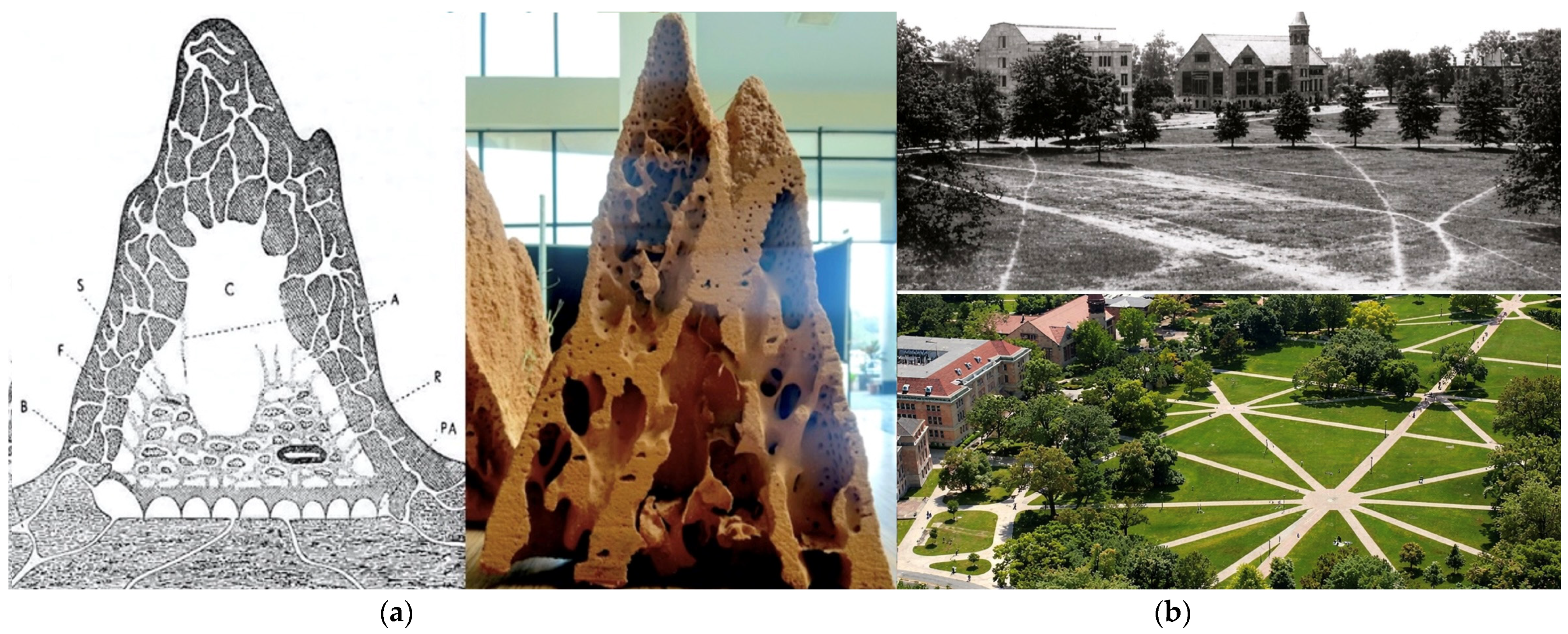
24]. Agents leave traces in shared environments; those traces guide subsequent action; and complex structures emerge without centralized control (
Figure 1). In human settlements, the built environment functions as such a medium: street alignments, parcel divisions, building typologies, and public-space hierarchies embody accumulated responses to prior decisions and constraints.
Theories of distributed and extended cognition further suggest that cognition is scaffolded by external artifacts and spatial arrangements [
12,
33]. Urban heritage can therefore be understood as collective memory encoded in durable form. This stigmergic accumulation is not incidental but constitutive: the built environment becomes the medium through which distributed intelligence is stored, transmitted, and refined across generations. It records solutions to recurring coordination challenges—organizing access, mediating microclimates, structuring public–private gradients, and supporting multi-scalar interaction. These spatial configurations persist as informational resources available for reinterpretation.
3.3. Selection, Persistence, and Morphological Intelligence
If cities evolve through incremental adaptation, then the persistence of particular morphological features—fine-grained street networks, small block structures, mixed-use frontages, arcades, courtyards, perimeter blocks—may be interpreted as evidence of functional utility under recurring conditions [
25,
34]. While no configuration is universally optimal, cross-cultural recurrence suggests convergence toward structural properties that support perception, movement, and social exchange.
This interpretation does not romanticize the past. Heritage environments embody testable hypotheses about spatial organization. Some features reflect obsolete economic systems or exclusionary social arrangements; others encode relational logics that remain robust under technological and demographic change. The task is therefore analytical: to distinguish contingent stylistic expression from enduring structural intelligence.
3.4. From Artifact to Information System
Reframing heritage as embodied intelligence shifts attention from surface aesthetics to relational structure. The central question becomes not what buildings look like, but how their configurations distribute access, regulate enclosure, structure scale hierarchies, and mediate interfaces between domains. In this light, heritage districts become information-rich environments encoding relational rules about connectivity, enclosure, proportion, and threshold articulation.
In this respect, the argument extends pattern-language and semi-lattice formulations of urban structure by situating them within contemporary complexity science and information theory. Heritage is not merely a catalog of types but a stabilized network of interdependent patterns.
This perspective clarifies why abrupt rupture—wholesale clearance, superblock restructuring, radical rescaling—can degrade systemic performance. When embedded relational structures are erased, the informational substrate guiding collective behavior is disrupted. Regeneration that neglects this dimension risks dismantling adaptive knowledge accumulated across generations.
The following sections identify specific structural properties commonly encoded in historic urban fabrics and review empirical evidence linking these properties to measurable outcomes in health, resilience, ecological performance, and social trust. By grounding embodied intelligence in identifiable morphological characteristics, the argument moves from theoretical reframing toward operational applicability.
4. Evidence from the Sciences: Complexity, Emergence, and Stigmergic Information
Reframing urban heritage as embodied intelligence requires grounding in contemporary understandings of complex systems, emergence, and distributed coordination. Across physics, biology, cognitive science, and network theory, a central insight has emerged: large-scale order can arise from decentralized interactions, and the resulting structures often exhibit adaptive properties not reducible to their individual components [
29,
32,
35]. Cities are paradigmatic examples of such systems.
4.1. Emergence and Self-Organization in Urban Systems
Urban environments display defining features of complex adaptive systems: nonlinear feedback, path dependence, multi-scalar organization, and emergent macro-patterns arising from micro-level interactions [
9,
30]. Street networks, land-use mosaics, and building typologies evolve through distributed decisions—parcel subdivision, incremental construction, regulatory adjustment, and market response—rather than singular acts of comprehensive design. Over time, these processes generate morphologies with recognizable statistical regularities, including scaling laws and hierarchical organization [
10].
Emergence theory suggests that such regularities reflect functional performance rather than accident. Configurations that persist tend to facilitate flows—movement, information, energy, and social interaction—more effectively than alternatives [
36]. Historic urban forms can therefore be interpreted as stabilized relational structures capable of mediating complex flows across scales. Whether in medieval street networks, nineteenth-century perimeter blocks, or vernacular courtyard systems, durability signals adaptive fit within specific ecological and social constraints.
4.2. Stigmergy and Environmental Memory
Stigmergy provides a mechanism linking decentralized interaction to cumulative structural intelligence [
11,
24]. Agents coordinate indirectly by modifying shared environments; those modifications guide subsequent actions. In urban contexts, the built environment serves as such a medium. Parcel lines, alignments, setbacks, and public-space hierarchies encode prior decisions and channel future behavior.
This process generates environmental memory: a durable record of iterative problem-solving embedded in spatial form. Unlike symbolic memory, environmental memory operates through affordances and constraints. As theories of embodied and extended cognition emphasize, spatial configurations shape perception and action by structuring possibilities for movement, encounter, and use [
12,
37]. Historic urban fabrics thus represent stigmergic accumulations—sedimented patterns of distributed intelligence whose structural logics may persist even as cultural meanings evolve.
4.3. Scaling, Hierarchy, and Fractal Organization
Complex systems research identifies scaling hierarchies and fractal organization as common features of robust natural and infrastructural networks [
36,
38]. Cities likewise exhibit scaling relationships in infrastructure and socioeconomic activity [
10]. Morphologically, traditional urban environments often display nested spatial hierarchies: regional connections feeding district streets, district streets feeding neighborhood lanes, lanes opening into courtyards and thresholds.
Such multi-level organization supports both global connectivity and local differentiation. Hierarchical scaling enhances redundancy, distributes flows, and stabilizes performance under stress. When similar principles appear in historic urban form—fine-grained connectivity embedded within larger frameworks—they may contribute to resilience and adaptability. By contrast, overly simplified or homogenized layouts reduce intermediate scales and can diminish systemic robustness.
4.4. Path Dependence and Information Persistence
Complex adaptive systems exhibit path dependence: early structural choices constrain and guide subsequent evolution [
39]. In cities, foundational street grids, topographic adaptations, and parcel frameworks shape long-term spatial dynamics. Heritage districts are therefore not merely remnants of prior eras but active determinants of present accessibility patterns, land-value gradients, and social interaction structures.
From an information-theoretic perspective, such persistence represents retention of high-value relational information—configurations compatible with successive technological, economic, and cultural transformations. When regeneration erases these frameworks wholesale, it risks discarding accumulated informational capital that might otherwise scaffold adaptive change.
Taken together, complexity theory, stigmergy, scaling research, and path dependence converge on a consistent proposition: enduring urban forms are stabilized informational structures within evolving systems. Recognizing heritage as embodied intelligence is therefore aligned with contemporary science rather than nostalgic preference. The next section identifies specific structural properties commonly encoded in historic urban fabrics and examines their implications for resilience, human well-being, and ecological performance.
5. Structural Properties Encoded in Historic Urban Fabrics
If urban heritage is understood as embodied intelligence, its value must be identifiable in specific structural properties rather than in generalized appeals to “character” or “sense of place.” Across cultures and climates, historic urban environments exhibit recurring morphological features that are neither arbitrary nor merely stylistic. This section identifies several such properties—network redundancy, multi-scalar hierarchy, organized symmetry, articulated thresholds, and biophilic integration—and interprets them as adaptive configurations with implications for resilience, cognition, and ecological performance. These properties are geometric and relational: they structure how environments are perceived, navigated, inhabited, and sustained.
Table 1 (below) summarizes the contrast between the conventional heritage paradigm and the approach proposed here across five analytical dimensions—value frame, unit of analysis, preservation logic, regeneration instrument, and outcome measure—providing a reference point for the structural analysis that follows.
5.1. Network Overlap, Redundancy, and Resilience
A defining feature of historic urban fabrics is fine-grained, overlapping street networks. Pre-automobile cities typically evolved with small blocks, dense intersections, and multiple route options, producing high levels of connectivity and redundancy [
30,
34]. Such networks distribute movement rather than concentrating it into limited arterial channels.
Network theory associates redundancy and distributed connectivity with robustness: when one path is disrupted, alternatives remain available [
40]. In urban settings, overlapping networks enhance pedestrian permeability, support local economic spillovers, and allow incremental adaptation of parcels and frontages. By contrast, superblock or tree-like hierarchies reduce alternative pathways and amplify vulnerability to congestion or systemic failure [
25]. The adaptive value of historic connectivity is therefore structural rather than decorative. Its intelligence resides in relational topology—how paths interconnect to sustain flows across scales.
5.2. Fractal Scaling, Hierarchy, and Legibility
Historic urban environments commonly display multi-scalar organization: lanes nested within neighborhoods, neighborhoods within districts, districts within cities. Empirical research identifies fractal characteristics in traditional street networks and building massing, reflecting self-similar scaling across levels [
41,
42].
Such hierarchical scaling aligns with cognitive research indicating that humans respond positively to environments containing structured variation across scales—neither monotonously uniform nor chaotically irregular [
43]. Multi-level differentiation supports spatial legibility and cognitive mapping by providing recognizable transitions and proportional continuity. When intermediate scales are erased—replacing fine-grained parcels with monolithic blocks—perceptual coherence diminishes.
Fractal hierarchy thus operates simultaneously as geometric order and cognitive scaffold. Its aesthetic qualities—patterned repetition with variation—are inseparable from its functional role in navigation, comfort, and resilience.
5.3. Organized Symmetry and Structured Complexity
A further recurring feature of heritage environments is organized symmetry—not rigid bilateral mirroring, but hierarchical balance across axes, rhythms, and proportional systems. Architectural and urban compositions frequently exhibit layered symmetries combined with localized differentiation [
44,
45].
Research in environmental psychology and neuroaesthetics suggests that environments exhibiting balanced complexity—coherence without monotony—support perceptual fluency, orientation, and reduced stress responses [
46,
47]. Multi-scalar symmetry enhances legibility, while rhythmic variation prevents fatigue. Street-wall definition, proportional façade articulation, and consistent enclosure ratios generate structured complexity that stabilizes perception during movement.
In this respect, organized symmetry reflects a geometric principle central to pattern-language theory: recurring relational structures that reconcile order and variation. The aesthetic experience of coherence, comfort, and even restoration emerges from this underlying geometric organization. Symmetry is therefore not ornamental embellishment but a structural regulator of human–environment interaction. In this sense, symmetry operates as a mediating principle between network structure and perceptual experience, translating relational order into cognitive legibility.
5.4. Thresholds, Gradients, and Semi-Public Interfaces
Historic environments frequently articulate graded transitions between public and private realms—stoops, arcades, balconies, courtyards, recessed shopfronts [
8,
48]. These layered thresholds create permeability without full exposure. Such gradients support informal surveillance, incidental interaction, and flexible appropriation. From a network perspective, they increase edge density between movement systems and private domains. From a perceptual perspective, they enrich spatial texture at pedestrian scale, contributing to sociability and perceived safety.
Where regeneration substitutes blank façades or internally oriented circulation for articulated thresholds, this layered relational structure is weakened. The intelligence embedded in heritage lies partly in its capacity to mediate between domains through graduated spatial transitions.
5.5. Biophilic Integration and Climatic Responsiveness
Historic settlements often integrate vegetation, shading devices, courtyards, water elements, and textured materials that moderate climate while providing sensory richness. These features align with the biophilia hypothesis, which posits an evolved human affinity for natural patterns and processes [
49,
50].
Biophilic integration operates both ecologically and perceptually. Street trees reduce heat stress; courtyards enhance ventilation; arcades provide shade; material articulation modulates thermal exchange. Such strategies shape microclimates while contributing to restorative experience and environmental comfort. Their recurrence across cultures indicates adaptive learning rather than incidental decoration.
Recognizing these elements as structural components of urban morphology reframes them as embedded environmental intelligence rather than aesthetic embellishment.
Collectively, these properties—network redundancy, hierarchical scaling, organized symmetry, articulated thresholds, and biophilic integration—form an interdependent geometric system. Their co-occurrence in enduring urban environments suggests convergence toward configurations that reconcile cognitive legibility, social interaction, and ecological adaptation. Interpreting them as embodied intelligence shifts the discourse of heritage from stylistic preservation toward relational performance, establishing the basis for empirical evaluation in the following section.
6. Empirical Evidence for Human and Ecological Value
If the structural properties identified above constitute embodied intelligence, their relevance must be demonstrable in measurable outcomes. A substantial interdisciplinary literature in public health, environmental psychology, urban morphology, transportation research, and climate science provides converging evidence that recurring features of historic urban fabrics—fine-grained connectivity, hierarchical scaling, organized symmetry, articulated thresholds, and biophilic integration—are associated with improved well-being, social cohesion, and ecological performance.
6.1. Health, Stress Reduction, and Cognitive Restoration
Environmental psychology has long documented the restorative effects of coherent, legible, and nature-integrated environments. Research grounded in attention restoration and stress recovery theory demonstrates that exposure to structured natural settings reduces physiological stress markers and improves cognitive functioning [
43,
51]. Neuroaesthetic studies further indicate that environments exhibiting balanced complexity and ordered variation activate neural pathways associated with perceptual fluency and positive affect [
47].
Urban morphology mediates these effects. Streets characterized by consistent enclosure, articulated edges, and multi-scalar order are associated with greater reported comfort and perceived safety than environments defined by blank façades, excessive scale, or spatial discontinuity [
52]. Biophilic elements—trees, courtyards, water features—are linked to reductions in heat stress and improved mental health outcomes [
53]. These findings reinforce the claim that geometric coherence and integrated natural structure contribute to cognitive restoration and environmental comfort.
6.2. Connectivity, Physical Activity, and Ecological Efficiency
Transportation and public health research consistently associates fine-grained street networks, short block lengths, and mixed uses with increased walking and reduced automobile dependence [
54,
55]. Network connectivity metrics correlate with pedestrian movement intensity and localized economic vitality [
30,
34]. Compact, permeable urban fabrics thus support both physical activity and lower transportation-related emissions.
Beyond mobility, urban form influences building energy use, infrastructure efficiency, and land consumption patterns [
56]. Dense, mixed-use environments with shared walls and proximate services generally exhibit lower per capita energy use and greenhouse gas emissions than dispersed, single-use development. The widespread presence of such configurations in pre-automobile districts suggests functional adaptation rather than stylistic coincidence.
6.3. Social Interaction, Thresholds, and Collective Efficacy
Spatial configuration also shapes patterns of interaction and informal surveillance. Research on natural surveillance and “eyes on the street” demonstrates that active frontages and visible public–private interfaces contribute to perceived and actual safety [
7,
57]. While crime dynamics are mediated by socioeconomic factors, studies link pedestrian activity and mixed-use vitality to enhanced collective efficacy in certain contexts [
58].
Historic districts commonly feature articulated thresholds—stoops, balconies, shopfront recesses—that increase semi-public interaction zones. These features support incidental encounters and weak social ties associated with social capital and mutual monitoring [
59]. Although geometry alone does not ensure inclusion or equity, such relational structures can facilitate trust-building interaction.
6.4. Climate Moderation and Microclimatic Performance
Many historic urban forms evolved under climatic constraints that demanded passive adaptation. Courtyards enhance ventilation, narrow streets provide shade, arcades buffer solar gain, and compact form reduces exposed surface area [
60]. Contemporary urban climate research confirms that enclosure ratios, vegetation cover, street orientation, and material properties significantly affect microclimatic performance and heat-island intensity [
61,
62]. Recognizing these strategies as embedded within historic fabrics reframes heritage as a repository of climate-responsive design intelligence rather than as a barrier to modernization.
Across domains—cognitive restoration, physical activity, social interaction, safety perception, and climate adaptation—the empirical literature converges on a consistent pattern: structural properties recurrent in historic urban environments correlate with measurable human and ecological benefits. While correlation alone does not establish causation, the cross-disciplinary consistency strengthens the claim that heritage encodes adaptive relational intelligence.
The following section builds on this evidence to propose a systematic framework for identifying, evaluating, and translating that intelligence into contemporary regeneration practice.
7. A Framework for Applying Heritage Intelligence in Contemporary Regeneration
If urban heritage embodies adaptive intelligence, the practical question becomes how that intelligence can be systematically identified, evaluated, encoded, and applied. The Adaptive Patterns Model proposed here operationalizes this process through four interrelated phases: documentation, pattern extraction, encoding, and performance correlation (see
Figure 2). The objective is not stylistic replication but the translation of transferable structural principles that enhance resilience, cognitive legibility, and ecological performance.
The Model was developed through a synthesis of three converging bodies of work. The first is the complexity science and stigmergy literature reviewed in
Section 3 and
Section 4 [
6,
24], which establishes the theoretical basis for treating persistent urban morphologies as repositories of adaptive information. The second is the established methodological tradition of urban morphology—including Conzenian townscape analysis [
63], space syntax [
34], fractal and network analysis [
41]—which provides the analytical vocabulary and measurement tools for the Documentation and Pattern Extraction phases. The third is the pattern-language methodology developed by Alexander and colleagues [
64], which offers a framework for abstracting transferable relational rules from observed spatial configurations. The four-phase structure of the Model follows logically from this synthesis: if heritage encodes adaptive intelligence through stigmergic accumulation (
Section 3 and
Section 4), and if that intelligence is expressed in measurable morphological properties (
Section 5 and
Section 6), then a systematic framework must move from documentation of those properties, through abstraction of their relational logic, to encoding in contemporary instruments, and finally to empirical validation through performance correlation. The Detroit case study (
Section 9) serves as an illustrative application of this sequence, demonstrating how the four phases can be operationalized in a context where encoded, disrupted, and partially restored morphological intelligence can be compared.
7.1. Documentation: Mapping Structural Configurations
The first phase involves systematic documentation of morphological and relational patterns within heritage environments. The focus is geometric and configurational rather than stylistic. Relevant variables include:
Street-network topology and connectivity indices;
Block-size distribution and parcel granularity;
Enclosure ratios and street-wall continuity;
Threshold typologies and interface density;
Scaling hierarchies and fractal characteristics;
Symmetry patterns and proportional coherence.
Typical measured values include intersection density (intersections per km
2), mean block perimeter (meters), street-wall continuity ratio (percentage of frontage with built edge), threshold count per 100 m of street frontage, fractal dimension of the street network (commonly ranging from 1.3 to 1.8 in historic fabrics [
41]), and scaling ratio between successive spatial levels.
Methods from urban morphology, space syntax, fractal analysis, and network science allow these properties to be measured rather than merely described [
34,
41,
63]. This phase shifts heritage from qualitative appreciation to quantifiable structural mapping.
For example, Hillier and colleagues’ space syntax analysis of London’s street network demonstrated that configurational properties—connectivity, integration, and choice values—measurable from the historic fabric could predict pedestrian movement patterns with considerable accuracy [
34]. Such studies establish that documentation of relational geometry yields operational data, not merely historical description.
7.2. Pattern Extraction: Distinguishing Structure from Surface
Documentation alone is insufficient. The second phase extracts recurring relational logics from surface expression. Small block size may be structurally significant; façade ornamentation may not. Organized symmetry, scaling coherence, and layered thresholds are interpreted as relational rules rather than stylistic features.
Here, the task resembles pattern-language methodology: identifying recurring spatial solutions at an appropriate level of abstraction [
25,
64]. The aim is to isolate transferable structural intelligence—connectivity redundancy, hierarchical differentiation, geometric coherence—while distinguishing it from historically contingent detail.
Conzen’s foundational study of Alnwick, Northumberland [
63], illustrates this distinction in practice: his analysis separated the durable structural logic of the town’s plot series and street-line from the stylistic variation in individual buildings, identifying transferable morphological rules that persisted across successive phases of change. The extracted pattern—fine-grained parcel structure maintaining street-wall continuity—proved robust across centuries of architectural transformation, demonstrating that relational intelligence can survive surface change.
A practical indicator of structural significance is cross-cultural or cross-temporal recurrence: a morphological property present in statistically comparable form across three or more independent historic urban contexts may be treated as a candidate adaptive pattern rather than a locally contingent feature [
25].
7.3. Encoding: Translating Structure into Contemporary Instruments
The third phase translates extracted patterns into regulatory and design instruments. Encoding may take several forms:
Connectivity and block-size standards in master plans;
Enclosure and interface metrics in form-based codes;
Performance-based climate criteria derived from courtyard or shading geometries;
Parcel subdivision frameworks that preserve fine-grained adaptability.
This stage makes geometric and relational intelligence actionable. The Brush Park Form-Based Code in Detroit—discussed in detail in
Section 9—provides a direct example: block hierarchy, a minimum street-wall continuity ratio of 70% along primary frontages, and frontage articulation standards derived from analysis of the historic nineteenth-century fabric were encoded as regulatory requirements for new development [
65]. This instrument translates documented morphological intelligence into enforceable design parameters without mandating stylistic replication. Crucially, encoding focuses on structural relationships—proportion, hierarchy, permeability, symmetry—not stylistic imitation.
Regulatory reform may be required, as zoning, parking minimums, and setback rules often preclude the reproduction of fine-grained morphologies found in heritage districts.
7.4. Performance Correlation: Testing Adaptive Value
The final phase correlates encoded patterns with measurable outcomes. Connectivity—quantified as intersection density or route-redundancy index—can be evaluated against pedestrian counts or walkability scores; enclosure ratios against mean radiant temperature or perceived thermal comfort ratings; biophilic integration against surface urban heat island differentials (°C); and scaling coherence against attentional restoration scores or self-reported stress measures [
52,
62].
Ewing and Handy’s systematic measurement of urban design qualities across walkable and non-walkable environments [
52] illustrates this phase in practice: by correlating specific configurational variables—enclosure, human scale, transparency, complexity—with observed pedestrian behavior and reported comfort, their study demonstrated that relational geometry generates measurable behavioral outcomes. Such correlational studies provide the evidential basis for treating encoded heritage patterns as testable performance hypotheses rather than normative preferences.
This step treats heritage patterns as empirical hypotheses. Some will prove robust under contemporary conditions; others may require adaptation. Multi-criteria evaluation—social, environmental, economic—ensures that structural intelligence is validated rather than assumed.
Applied in this manner, heritage shifts from defensive preservation to generative design intelligence. Regeneration becomes a process of informed continuation within an evolving system, rather than rupture or nostalgic reproduction. By decoding relational geometry and correlating it with performance, contemporary intervention participates consciously in the adaptive trajectory that produced heritage in the first place.
8. New Urbanism as Partial Recovery of Adaptive Patterns
The emergence of the Congress for the New Urbanism (CNU) in the early 1990s marked a significant shift in late twentieth-century planning discourse [
26]. Often characterized as stylistic revival, New Urbanism can more precisely be understood as an attempt—explicit or implicit—to recover structural and geometric patterns embedded in historic urban fabrics. Viewed through the Adaptive Patterns Model, the movement represents a partial rediscovery of embodied urban intelligence.
The relevant question is not whether New Urbanism replicated historic imagery, but whether it reinstated adaptive structural properties—connectivity, hierarchical scaling, threshold articulation, and organized geometric coherence—that support cognition, sociability, and ecological performance.
8.1. Network Connectivity and Perceptual Continuity
One of New Urbanism’s clearest structural interventions was the reintroduction of fine-grained street networks. Postwar planning frequently replaced interconnected grids with hierarchical tree systems and superblocks, concentrating movement in arterial corridors while eliminating local redundancy. Drawing on critiques such as Alexander’s semi-lattice argument [
8] and Jacobs’ argument for fine-grained block structures [
7], New Urbanist projects reinstated small blocks, multiple route options, and connected public streets.
Within the Adaptive Patterns Model (
Figure 1), this represents translation of a documented heritage pattern: network overlap and redundancy. Such connectivity enhances permeability and distributes movement across the urban field [
66].
Connectivity also functions perceptually. Frequent intersections, consistent block dimensions, and visually continuous street walls create rhythmic sequencing during movement. These geometric cues reduce navigational uncertainty and support embodied orientation [
67]. Walkability thus depends not only on density or distance but on structured perceptual continuity [
28]. A limitation, however, is scale isolation. Many New Urbanist projects achieved internal connectivity while remaining embedded in auto-dominated regional systems. Adaptive topology cannot function fully when disconnected from broader infrastructures.
8.2. Hierarchical Scaling and Cognitive Mapping
New Urbanism also reintroduced intermediate scales often erased by mid-century redevelopment. Instead of megastructures or repetitive slabs, projects employed perimeter blocks, varied lot widths, and coherent yet differentiated street walls.
These features correspond to recovery of hierarchical scaling—nested spatial organization across levels. Historic environments exhibit differentiation from district to neighborhood to block to threshold. Such scaling supports cognitive mapping by providing recognizable transitions and proportional continuity [
68].
When intermediate scales are removed, environments flatten perceptually. Large undifferentiated volumes reduce legibility and diminish environmental richness [
69]. New Urbanism’s reinstatement of graduated grain can therefore be interpreted as restoration of cognitive scaffolding embedded in historic morphology. Yet the movement’s reliance on single-phase master planning limited evolutionary depth. The Model emphasizes that adaptive intelligence resides not only in spatial form but in incremental process. Without distributed modification over time, hierarchical coherence may remain formally present but evolutionarily shallow.
8.3. Threshold Articulation and Edge Density
A further structural correction was the reactivation of public–private interfaces. Porches, stoops, shopfronts, and shallow setbacks reintroduced layered thresholds rather than abrupt boundaries [
70]. From the Model’s perspective, threshold articulation increases edge density—the number of interaction points between movement networks and private domains. Geometrically, it introduces micro-scale modulation within coherent street walls, producing structured complexity at pedestrian scale.
Such modulation has behavioral implications. Environments balancing order and variation support perceptual fluency and sustained engagement [
71]. Articulated thresholds encourage observation, informal surveillance, and incidental social contact [
7].
However, morphological articulation does not guarantee social vitality. Where socioeconomic homogeneity or automobile dominance persists, thresholds may function symbolically rather than performatively. The distinction underscores the Model’s emphasis on correlating geometry with measurable outcomes rather than assuming benefit.
8.4. Organized Symmetry and Structured Complexity
New Urbanist environments frequently reintroduced proportional coherence, rhythmic frontage articulation, and defined spatial enclosure. Public spaces are framed; façades exhibit ordered variation; street walls establish consistent boundaries.
These features reflect organized symmetry—not rigid bilateral repetition, but relational balance across scales. Structured complexity—coherence combined with variation—has been associated in environmental psychology with perceptual fluency, reduced stress response, and enhanced attentional restoration [
72].
Within the Adaptive Patterns Model, geometric coherence is not decorative. It stabilizes perception, supports orientation, and mediates human–environment interaction. Symmetry and proportional rhythm act as regulatory features that reduce cognitive friction during movement and habitation [
73].
The depth of such coherence varies across projects. In some cases, proportional systems operate across building, block, and district scales; in others, variation remains surface level. Where geometric integration is shallow, associated perceptual and social benefits may likewise be limited.
8.5. Limits of Recovery: Form but Not Evolution
New Urbanism’s reinstatement of adaptive structural patterns represents a significant contribution—one whose implications are still being worked out in theory and practice. Understanding its limits is therefore analytically useful rather than merely critical: it helps clarify what the Adaptive Patterns Model requires beyond formal geometry.
The principal structural limitation is that historic environments accumulate intelligence through distributed modification across generations—a stigmergic process in which each intervention responds to and modifies the traces left by prior ones [
74]. New Urbanist projects, by contrast, typically arose from single-phase, designer-led implementation, however carefully conceived. Reinstating spatial form through this process is not equivalent to regenerating the generative conditions that produced it. The result may be structurally coherent but evolutionarily shallow—correct in geometry, but without the layered adaptive depth that accrues only through distributed incremental change over time.
A related limitation concerns the systemic context in which recovered patterns operate. The Adaptive Patterns Model holds that relational geometry must be correlated with measurable performance outcomes rather than assumed to produce them. Where socioeconomic conditions—affordability constraints, automobile dependence, low pedestrian demand—undermine the activation of recovered spatial structures, geometric recovery alone will not produce the full range of systemic benefits. This is not a failure specific to New Urbanism; it applies to any morphological intervention, including those proposed by this paper’s framework. Structural patterns require supportive economic and governance conditions to achieve systemic resilience.
8.6. Transitional Rediscovery
Through the lens of the Adaptive Patterns Model, New Urbanism appears neither as nostalgic retreat nor utopian solution [
27]. It represents a transitional rediscovery: recognition that historic urban fabrics encode geometry with measurable cognitive, social, and ecological consequences.
Its most enduring contribution lies in reframing urban form as performance-oriented structure rather than aesthetic expression. Connectivity, hierarchical scaling, threshold density, and organized symmetry are adaptive configurations shaping perception and behavior. Where the movement fell short, it often reproduced form without fully restoring evolutionary process or systemic integration. The next phase of regeneration therefore requires deeper operationalization of embodied geometric intelligence—documented, encoded, and evaluated through the Adaptive Patterns Model.
9. Detroit as an Application of the Adaptive Patterns Model
Detroit, Michigan USA provides a case study of the Adaptive Patterns Model (
Figure 1) in operation. It demonstrates a compressed evolutionary case in which embodied intelligence, or its opposite, can be observed in three conditions: encoded, erased, and partially restored. Detroit’s Brush Park Historic District and the adjacent Brewster-Douglass superblocks illustrate how shifts in relational geometry affect connectivity, perceptual structure, and social performance.
9.1. Phase 1: Documentation—Encoded Structural Intelligence
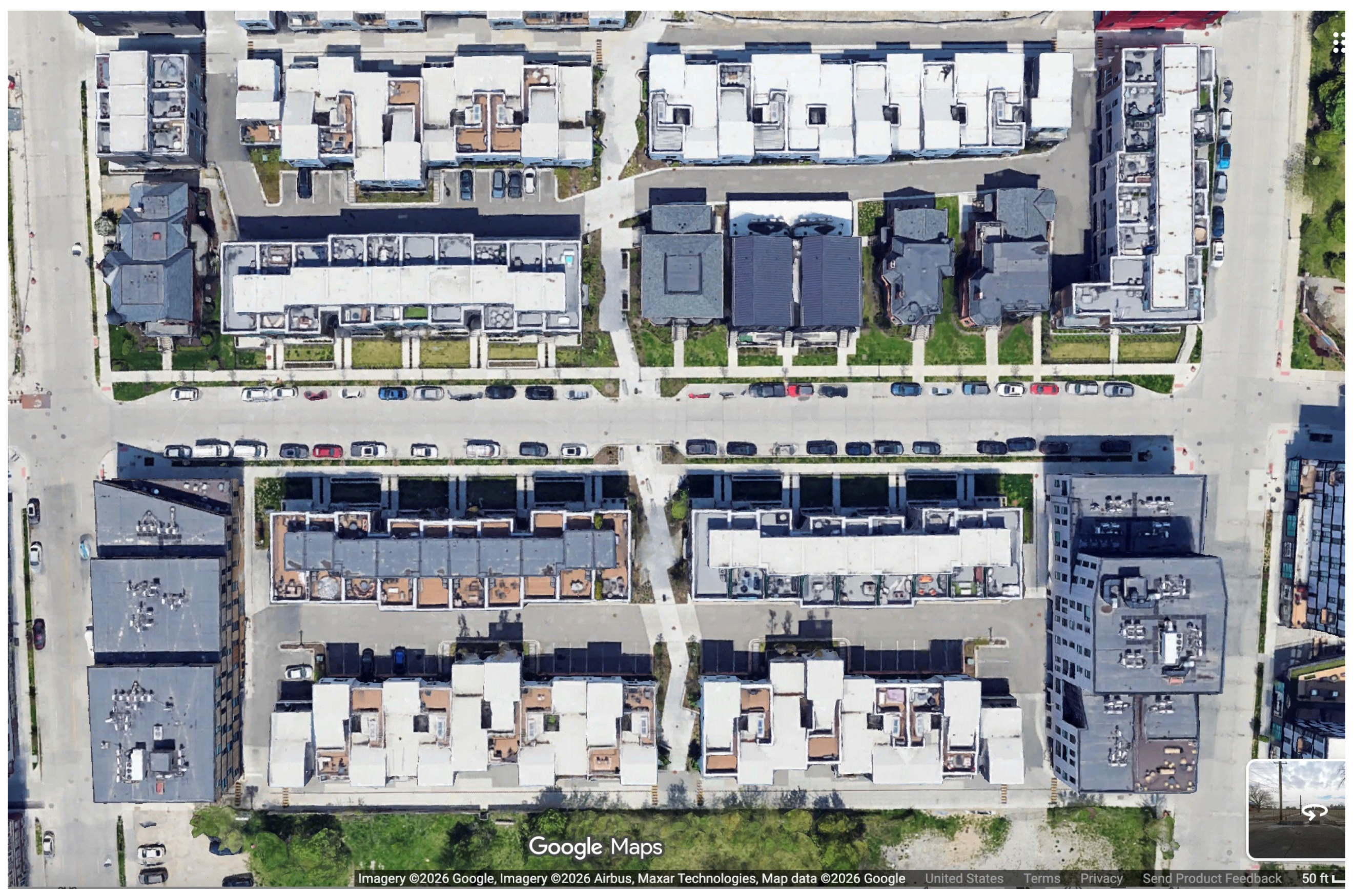
Nineteenth-century Brush Park developed within a fine-grained street grid of moderate blocks (approximately 200 m × 100 m,
Figure 3), subdivided into narrow parcels [
75,
76]. This configuration produced:
Regular intersection spacing;
Rhythmic frontage intervals;
Consistent street-wall enclosure;
Nested hierarchy from arterial to alley.
Within the Adaptive Patterns Model, several patterns are evident: network redundancy, hierarchical scaling, articulated thresholds, organized multi-scalar symmetry and proportional coherence.
These geometric properties produce perceptual consequences. Structured repetition with variation—rhythmic façades, consistent enclosure, proportional cadence—supports cognitive legibility and orientation (
Figure 3). The grid does not merely connect points; it sequences movement through coherent spatial intervals. Walkability here reflects perceptual continuity as much as metric proximity.
Figure 3.
A portion of Detroit’s Brush Park Historic District today, showing the original street pattern and some original buildings, along with newer infill buildings (photo: Google Maps).
Figure 3.
A portion of Detroit’s Brush Park Historic District today, showing the original street pattern and some original buildings, along with newer infill buildings (photo: Google Maps).
Brush Park thus encodes not only network intelligence but relational geometric order that scaffolds cognition and social interaction.
9.2. Phase 2: Disruption—Geometric Flattening
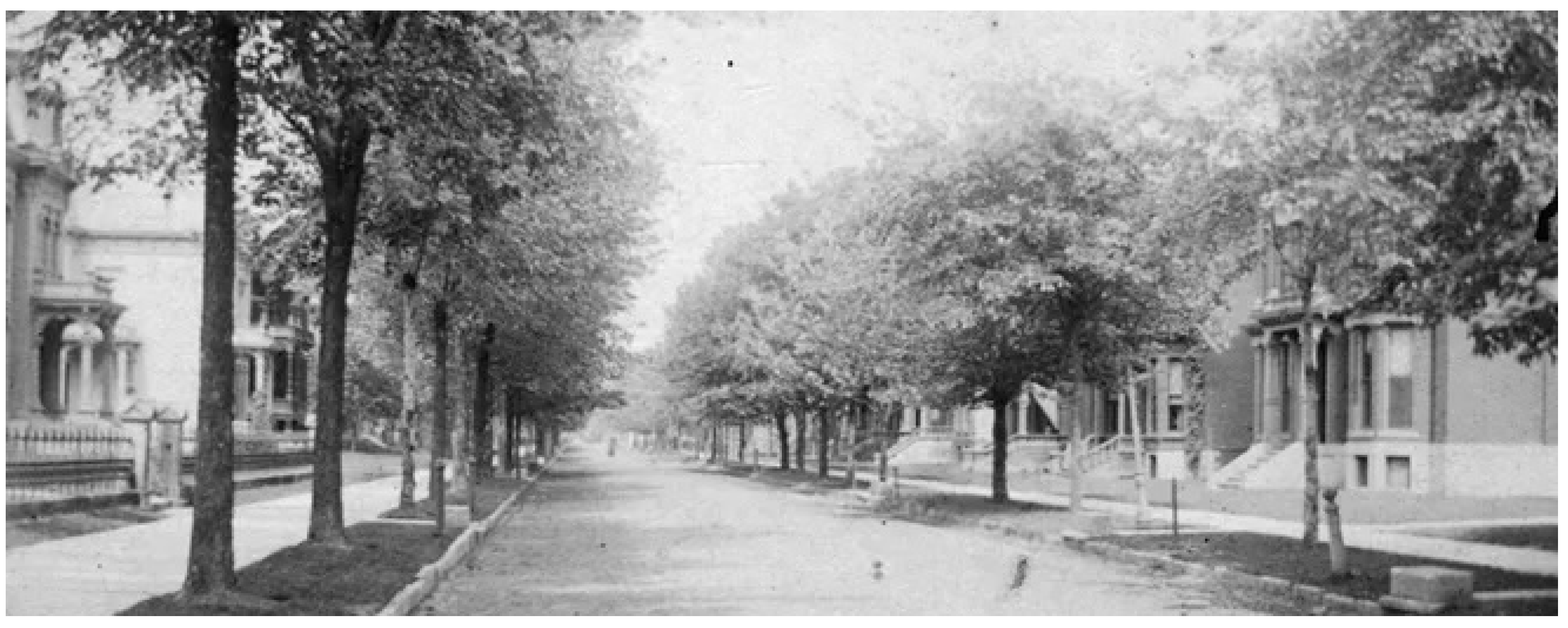
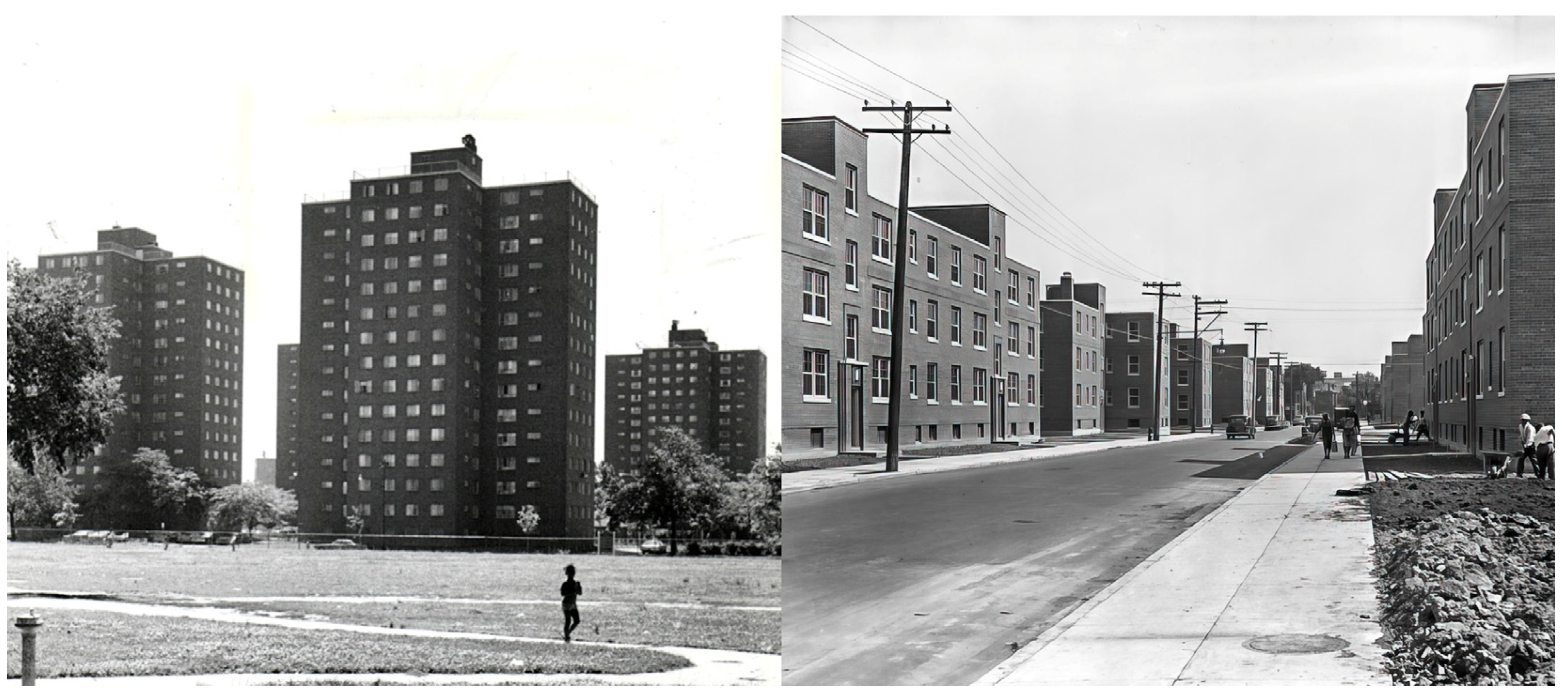
Mid-twentieth-century renewal replaced this fabric with superblocks (approximately 400 m × 350 m) and internally oriented housing, as shown in
Figure 4 [
77]. The structural effects were clear:
Loss of network redundancy;
Removal of intermediate scales;
Reduction in threshold density;
Weakening of street-wall continuity.
Figure 4.
A streetscape in Brush Park in about 1920, demonstrating its rhythmic façades, consistent enclosure, and proportional cadence, creating a highly walkable environment (photo: Detroit Public Library).
Figure 4.
A streetscape in Brush Park in about 1920, demonstrating its rhythmic façades, consistent enclosure, and proportional cadence, creating a highly walkable environment (photo: Detroit Public Library).
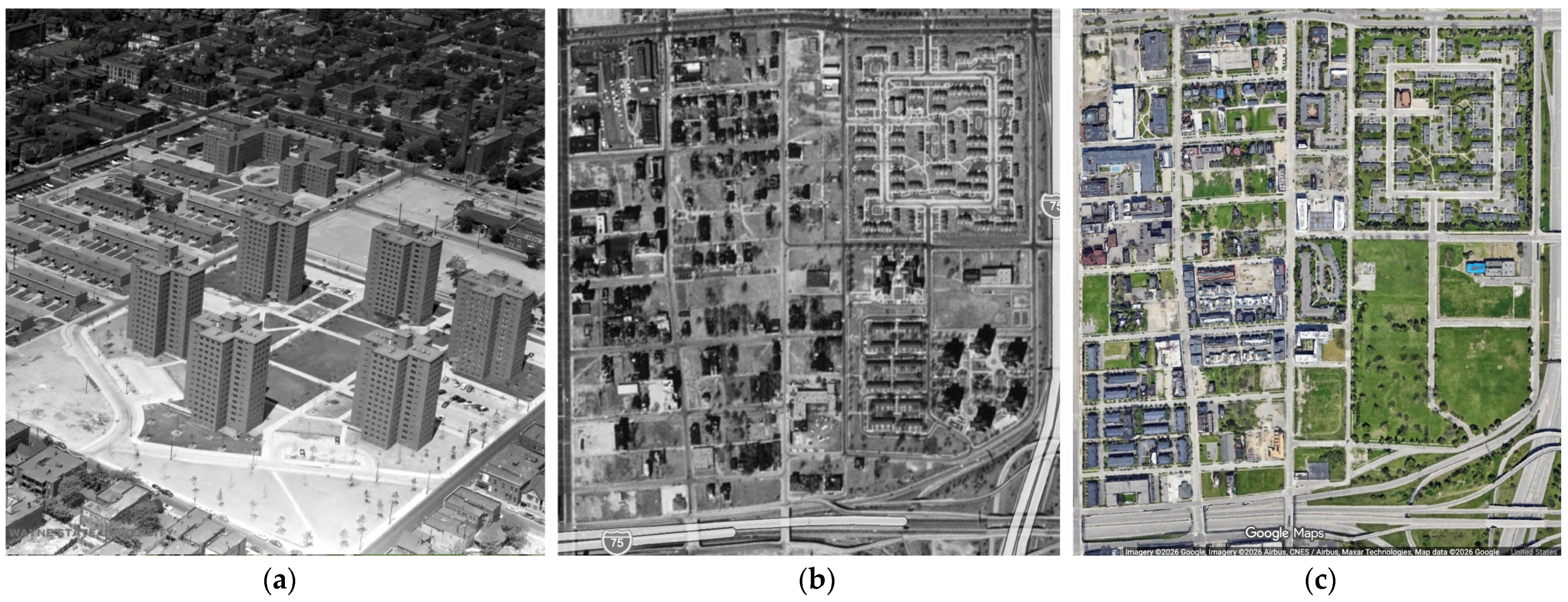
The transformation also altered geometric coherence. Large open lawns replaced articulated edges; frontage rhythm disappeared; enclosure ratios fluctuated without consistent proportional framework. The spatial field became diffuse and less legible (
Figure 5 and
Figure 6).
Research in environmental cognition indicates that weakly bounded environments increase disorientation and reduce perceived safety [
78]. When hierarchical scaling and organized symmetry are removed, perceptual anchors diminish. Renewal thus did not only eliminate streets—it simplified the essential connective geometry, with likely consequences for sociability and comfort independent of broader socioeconomic forces.
9.3. Phase 3: Re-Encoding—Partial Restoration
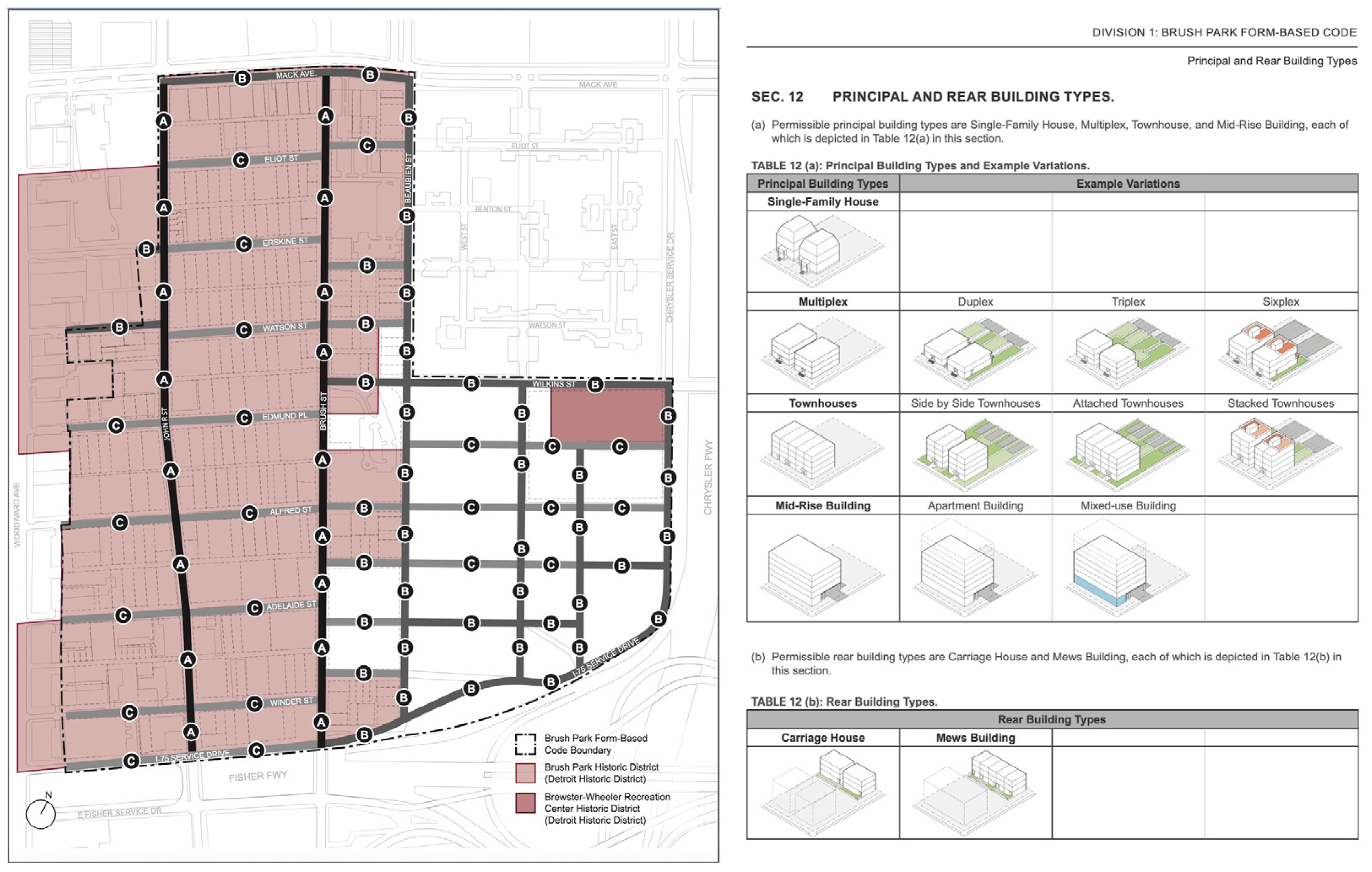
Recent redevelopment in Brush Park and the former Brewster-Douglass site has reintroduced streets, perimeter framing, and frontage articulation [
79]. The Brush Park Form-Based Code (
Figure 7) emphasizes block hierarchy and street-wall definition [
65].
Through the Model, these interventions represent partial re-encoding:
Reinstatement of fine-grained connectivity;
Reestablishment of enclosure and edge continuity;
Restoration of rhythmic frontage increments;
Reintroduction of intermediate spatial scales.
These geometric corrections improve legibility and pedestrian comfort. Defined edges support orientation; frontage rhythm modulates attention; enclosure ratios stabilize spatial perception. Aesthetic coherence functions as a perceptible expression of restored relational structure.
However, limitations remain. Parcel increments are often larger than historic precedent, potentially reducing long-term diversification. While connectivity and enclosure have improved, multi-scalar layering remains shallower than in the nineteenth-century fabric.
9.4. Phase 4: Performance Correlation—Linking Geometry to Outcomes
The Model requires correlating structural recovery with measurable or inferable outcomes:
Mobility: Fine-grained grids increase route options; coherent geometric sequencing reduces cognitive friction during walking.
Cognitive Comfort: Structured enclosure and balanced variation are associated with reduced stress and improved attentional restoration.
Social Interaction: Articulated thresholds increase edge density, supporting informal surveillance and incidental contact.
Economic Activation: Narrow frontage increments enable incremental ownership and small-scale enterprise.
Climate Moderation: Street-wall continuity and shading ratios influence microclimatic comfort.
These relationships suggest that connective or relational geometry influences behavior and perception across domains. Connectivity, scaling, and symmetry operate not as stylistic choices but as structural regulators of urban performance.
9.5. Detroit as Adaptive Laboratory
Detroit’s shrinkage provides unusual opportunity for deliberate structural reconstruction [
80]. The Brush Park case illustrates:
Historic morphology embodied relational and geometric intelligence aligned with cognitive and ecological performance.
Renewal-era superblocks erased both connectivity and multi-scale coherence.
Contemporary regeneration is restoring key adaptive patterns, though unevenly.
Long-term success will depend on the depth of geometric integration and on measurable performance across mobility, sociability, and climate resilience.
In this reading, aesthetic geometry is not an independent overlay. It is the perceptible manifestation of underlying relational order. Where geometry is coherent, network intelligence becomes legible and behaviorally supportive; where geometry is flattened, systemic performance tends to degrade.
Detroit thus demonstrates the central claim of this paper: urban heritage encodes adaptive intelligence in relational geometry [
76,
77]. Regeneration succeeds to the extent that it restores that geometry as embodied structural infrastructure rather than stylistic reference.
10. Conclusions: Heritage as Embodied Intelligence and Evolutionary Infrastructure
This paper has argued for a reframing of urban heritage: not as static artifact or symbolic residue, but as embodied intelligence—a durable archive of adaptive spatial knowledge accumulated through iterative urban evolution. Prevailing heritage paradigms emphasize conservation, tourism, or adaptive reuse. What they under-theorize is heritage as an informational system: relational geometries refined under multi-generational pressures of coordination, climate, perception, and social interaction.
Drawing on complexity science, stigmergy, scaling theory, the mathematics of symmetry, and distributed cognition, the paper has shown that enduring urban morphologies persist not only because they signify identity or power, or reflect historically contingent pathways—which they do, but only in part—but more importantly, and more commonly overlooked, because they encode structural configurations that support systemic performance. Fine-grained network connectivity, hierarchical scaling, articulated thresholds, organized symmetry, and biophilic integration operate simultaneously as spatial, perceptual, and behavioral frameworks. In this sense, aesthetic order is not superficial embellishment but the perceptible expression of relational coherence.
The Adaptive Patterns Model provides a methodological contribution by operationalizing this insight. The model operationalizes stigmergic insight by treating historic morphology as accumulated environmental memory rather than stylistic residue. Through phases of documentation, pattern extraction, encoding, and performance correlation, the model shifts heritage discourse from preservation of surface form to evaluation and translation of structural intelligence. The Detroit case demonstrates that such intelligence can be identified, disrupted through morphological rupture, and partially restored through deliberate re-encoding—with consequences extending beyond visual character to mobility, sociability, environmental comfort, and resilience.
The broader implication is that regeneration functions most effectively as evolutionary participation rather than formal rupture. Complex adaptive systems generate novelty through modification and recombination of inherited structures. When relational frameworks are discarded wholesale, accumulated informational capital may be lost. Recognizing heritage as embodied intelligence therefore reframes innovation itself: adaptive continuity becomes a condition of durable transformation.
Several limitations and research directions follow. Correlational evidence linking morphological variables to human and ecological outcomes remains uneven and requires further quantitative refinement across contexts. Advances in computational analysis offer opportunities to measure connectivity, scaling, and geometric coherence more precisely. Governance research is also needed to translate structural intelligence into regulatory instruments that enable continuity without stylistic rigidity.
This framework does not imply that all historic forms are beneficial, nor that replication ensures success. Structural patterns must be critically evaluated within contemporary social and economic conditions, and questions of equity and access remain central. The Adaptive Patterns Model is therefore analytical rather than nostalgic: a tool for decoding and testing relational intelligence.
Urban regeneration is often framed as a choice between preservation and progress. That dichotomy dissolves if heritage is understood as accumulated adaptive knowledge encoded in relational geometry. Regeneration and inheritance become interdependent processes within a continuous evolutionary trajectory. The task for contemporary cities is neither to replicate the past nor to sever it, but to extend its structural intelligence—transforming heritage from regulatory constraint into evolutionary infrastructure for future resilience.