1. Introduction
Urban shrinkage has emerged as a defining challenge for cities across Europe, particularly in post-socialist contexts where deindustrialization and economic transitions have accelerated demographic and socioeconomic changes [
1]. Mono-towns, communities historically dependent on a single dominant industry or company, exemplify this pattern and demonstrate heightened vulnerability to changes in socioeconomic structures [
2,
3]. Although urban shrinkage has been thoroughly examined in Western Europe, empirical studies on post-socialist mono-towns are scarce, resulting in substantial gaps in understanding their distinct trajectories and resilience mechanisms [
4].
The Latvian setting presents a noteworthy example, as its mono-towns illustrate the wider post-Soviet reality of deindustrialization, population loss, and demographic change [
5]. These towns, often established during the Soviet era to support centralized industrial production, now face compounded challenges due to their geographic peripherality and economic restructuring [
6]. Current research has predominantly examined large-scale shrinkage trends, failing to address how local demographic and socioeconomic dynamics influence these varying results [
7]. This study bridges this gap by examining how economic dependency, human capital, and geographic proximity collectively influence shrinkage dynamics in Latvian mono-towns.
This study employs a comprehensive analytical approach to understand the complex interactions among the factors contributing to the multidimensional decline of Latvian mono-towns. The primary objectives of this study are: (1) to identify the principal dimensions underlying urban shrinkage in Latvian mono-towns through a systematic quantitative analysis of demographic and socioeconomic indicators; (2) to examine how geographic proximity to the capital city and other urban centers mediates shrinkage trajectories; and (3) to verify whether the patterns observed in Latvian mono-towns align with findings from similar studies conducted in other Central and Eastern European contexts. This study shifts from descriptive case analyses to a systematic investigation of shrinkage trends in various mono-towns, utilizing quantitative methodologies. In addition, demographic and socioeconomic indicators are merged with geographic elements, which yields a more thorough grasp of the forces behind shrinkage. Finally, the emphasis on Latvia addresses the under-researched Baltic setting, yielding findings that supplement prior work on post-socialist decline in Central Eastern Europe and Russia. Ultimately, the results hold practical relevance for policymakers aiming to tackle the distinct issues of small settlements, with special attention to the necessity of customized measures that reflect regional circumstances.
The remainder of this paper is organized as follows:
Section 2 provides a literature review.
Section 3 describes the methodology, covering the data sources and PCA procedures.
Section 4 presents the results and delineates the primary elements of urban shrinkage along with the spatial distribution of mono-towns.
Section 5 discusses the implications of these findings for theory and policy, while the last Section concludes with recommendations for future research.
2. Literature Review
Research on urban shrinkage has undergone substantial development since it first emerged as a unique area of study in the second half of the 20th century. Early scholarship primarily focused on deindustrialization in Western contexts, particularly in the Rust Belt cities of North America and Western Europe [
8]. Nonetheless, the post-socialist shift during the 1990s displayed distinct contraction trajectories marked by swift population decrease and economic transformation [
1]. Theoretical frameworks on urban shrinkage often emphasize universal drivers such as deindustrialization and demographic transition; however, post-socialist contexts demand a more nuanced approach [
9]. For example, the historical influence of centrally planned systems has resulted in mono-towns possessing institutional and infrastructural inflexibilities, worsening their deterioration [
10]. Moreover, the rapid out-migration of working-age populations to larger urban centers or abroad has created demographic imbalances, further straining local economies. These dynamics are particularly acute in Latvia, where population decline has been among the most severe in the EU, with mono-towns experiencing disproportionate losses [
11]. This research is important because it makes two key contributions to theory and policy. First, it deepens the comprehension of post-socialist urban shrinkage by merging macro-scale trends with localized empirical evidence, which clarifies the role of historical legacies and geographic factors in mediating the decline [
12]. Second, it yields practical guidance for policymakers aiming to tackle the decline in mono-towns, underlining the necessity for customized strategies that address socio-economic health, demographic shifts related to aging, and geographic peripherality [
13]. Mono-towns are a notably severe example of post-socialist urban shrinkage, originating from Soviet industrialization strategies that established single-industry communities throughout the Eastern Bloc [
14,
15]. These towns were designed as instruments of economic planning, often located in peripheral regions to exploit natural resources or serve strategic industrial purposes [
16]. When central planning disintegrated, numerous mono-towns found themselves economically isolated and lacking the ability to adjust because of their narrow infrastructure and workforce specialization [
2]. This legacy has led to ongoing difficulties, with recent studies showing the socioeconomic instability of mono-towns in the former Soviet Union [
17,
18].
Although current studies have greatly progressed in understanding urban shrinkage, key uncertainties persist regarding the processes in Latvian mono-towns. Most research has concentrated on either broad economic indicators or specific regional analyses, lacking a thorough merging of population and socioeconomic aspects [
6]. Furthermore, the role of geographic factors in mediating shrinkage outcomes has received insufficient attention, particularly in the Baltic context, where peripherality plays a crucial role in urban development [
19,
20]. The demographic aspects of the decline in mono-towns have garnered growing focus, with special emphasis on aging populations and selective out-migration. Studies in Central and Eastern Europe indicate that younger, highly educated individuals are more inclined to depart from declining urban areas, resulting in a ‘brain drain’ phenomenon that further diminishes regional economic prospects [
21]. This selective migration, when interacting with natural population decline, leads to accelerated aging that places pressure on social services and diminishes labor force participation [
19]. Socioeconomic factors play an equally critical role in shaping the shrinkage trajectory. Studies of post-socialist cities have identified education levels and employment structures as key determinants of resilience, with more diversified economies better able to withstand industrial decline [
22]. Geographic factors compound these challenges, as peripheral locations relative to major urban centers reduce access to markets, services, and migration opportunities [
23,
24]. Recent scholarship has emphasized the need for multiscalar approaches to understand urban shrinkage, where national policies interact with local conditions [
3]. This viewpoint acknowledges shrinkage as more than a localized occurrence, mirroring wider regional and national patterns of economic transformation and spatial divergence [
25]. The Baltic states have shown marked disparities, as metropolitan regions solidify their economic and population gains, while non-metropolitan regions continue to face prolonged deterioration [
26].
Recent systematic analyses have further mapped the evolving knowledge structure of urban shrinkage research. Cai et al. [
27] constructed a five-dimensional analytical framework encompassing population-social dynamics, economic-industrial transformation, spatial-land use adjustment, ecological-environmental assessment, and governance-policy responses. Their review of 183 articles revealed that research on urban shrinkage remains predominantly concentrated in the Global North and that equity perspectives are underexplored. In the Central and Eastern European context, post-socialist mono-industrial towns face particularly acute challenges. Hajduková and Sopirová [
28] demonstrated that socialist industrialization was the determining factor in urban growth in Slovak chemical towns, with deindustrialization after 1989 producing brownfields and environmental burdens that compounded shrinkage dynamics. Dragan et al. [
29] documented how Moldova Nouă in Romania experienced severe decline following the closure of its copper mine, with residents expressing divergent views on economic revitalization through either mine reopening or tourism development. The role of local initiatives and governance in shrinking towns has received increasing attention. Großmann et al. [
30] compared local initiatives in peripheralized towns in Finland and Germany, finding that a “grass-root” initiatives prevails where state support is limited. Their analysis revealed that municipal austerity, rather than demographic decline per se, constrains local agency, an insight relevant to understanding how mono-towns might develop resilience strategies. Boțan et al. [
31] showed how the mono-industrial city of Beclean in Romania successfully pivoted toward tourism-based development, increasing tourist arrivals from 20,000 to over 200,000 within a decade through sustained EU-funded investment.
4. Results
This study identifies unique trends of urban decline in Latvia’s single-industry towns, where demographic, socioeconomic, and geographical elements show intricate interrelationships. The subsequent subsections present the principal outcomes derived from the correlation analysis, principal component extraction, and spatial distribution, which illustrate the differing developmental patterns of towns depending on their distance from Riga.
4.1. Correlation Analysis of Variables
The correlation matrix displays notable associations among the 12 demographic and socioeconomic variables (
Table 3). Demographic aging displayed robust positive correlations with shrinkage (
r = 0.670 for AGE
med,
r = 0.491 for AGING), indicating that towns with older populations undergo a more pronounced decline. Conversely, education and employment exhibit negative correlations with shrinkage (
r = −0.748 for EDU
high,
r = −0.619 for EMPL), suggesting that human capital buffers population loss.
Geographic peripherality displays intricate connections: distance to Riga (KMRiga) has positive links with ageing (r = 0.679) and shrinkage (r = 0.406) but negative ties with education (r = −0.524) and employment (r = −0.607). This trend suggests that remote towns experience intertwined difficulties of population decrease and economic inactivity. The most robust correlation was observed between natural population change (NAT) and shrinkage (r = −0.897), underscoring the pivotal influence of birth-death dynamics on urban development patterns.
Three clusters of interrelated variables emerged from the analysis. First, labor market vitality (EMPL, OCCUPhigh, EDUhigh) displays robust internal consistency (r > 0.812), suggesting that skilled employment and education collectively shape economic resilience. Second, demographic dynamics (AGEmed, AGING, NAT) formed a distinct cluster, with ageing populations correlating with a natural decrease (r = −0.303). Third, geographic isolation (KMRiga, KMreg) showed consistent negative associations with socioeconomic measures, especially education (r = −0.575) and ethnic diversity (r = −0.623). The correlation patterns indicate two distinct trajectories of reductions. Peripheral mono-towns exhibit the following characteristics:
Demographic erosion: Characterized by aging (AGEmed ↑), outmigration (MIGR ↓), and natural decrease (NAT ↓).
Economic stagnation: Reflected in lower education (EDUhigh ↓), employment (EMPL ↓), and occupational complexity (OCCUPhigh ↓).
In contrast, mono-towns in closer proximity to Riga display weaker relationships between geographic and socioeconomic factors, implying that proximity to the capital reduces certain shrinkage pressures. The spatial dimensions of these relationships were further explored in the PCA results.
4.2. Principal Component Analysis Results
Principal Component Analysis (PCA) identified three primary components accounting for 87% of the total variance in urban shrinkage patterns within Latvian mono-towns (
Table 4). The first component (PC1), which explains 57.1% of the variance, stands for socioeconomic vitality, showing strong positive correlations with migration balance (0.56), natural population growth (0.42), advanced education levels (0.31), and employment rates (0.35). This dimension captures the capacity of towns to retain and attract populations through economic opportunities and the development of human capital.
The second component (PC2) explains 17.2% of the variance and reflects population change and peripherality, characterized by positive loadings on distance to Riga (0.41) and regional centers (0.35), alongside negative associations with annual shrinkage (−0.31). This dimension highlights spatial inequalities in shrinkage trajectories, where remoteness exacerbates demographic decline. The third component (PC3), which accounts for 12.6% of the variance, reflects aging society dynamics, with strong loadings on the elderly population share (0.59) and median age (0.44), which highlights the demographic imbalances that pressure local economies.
The spatial distribution of these components revealed a clear geographic pattern (
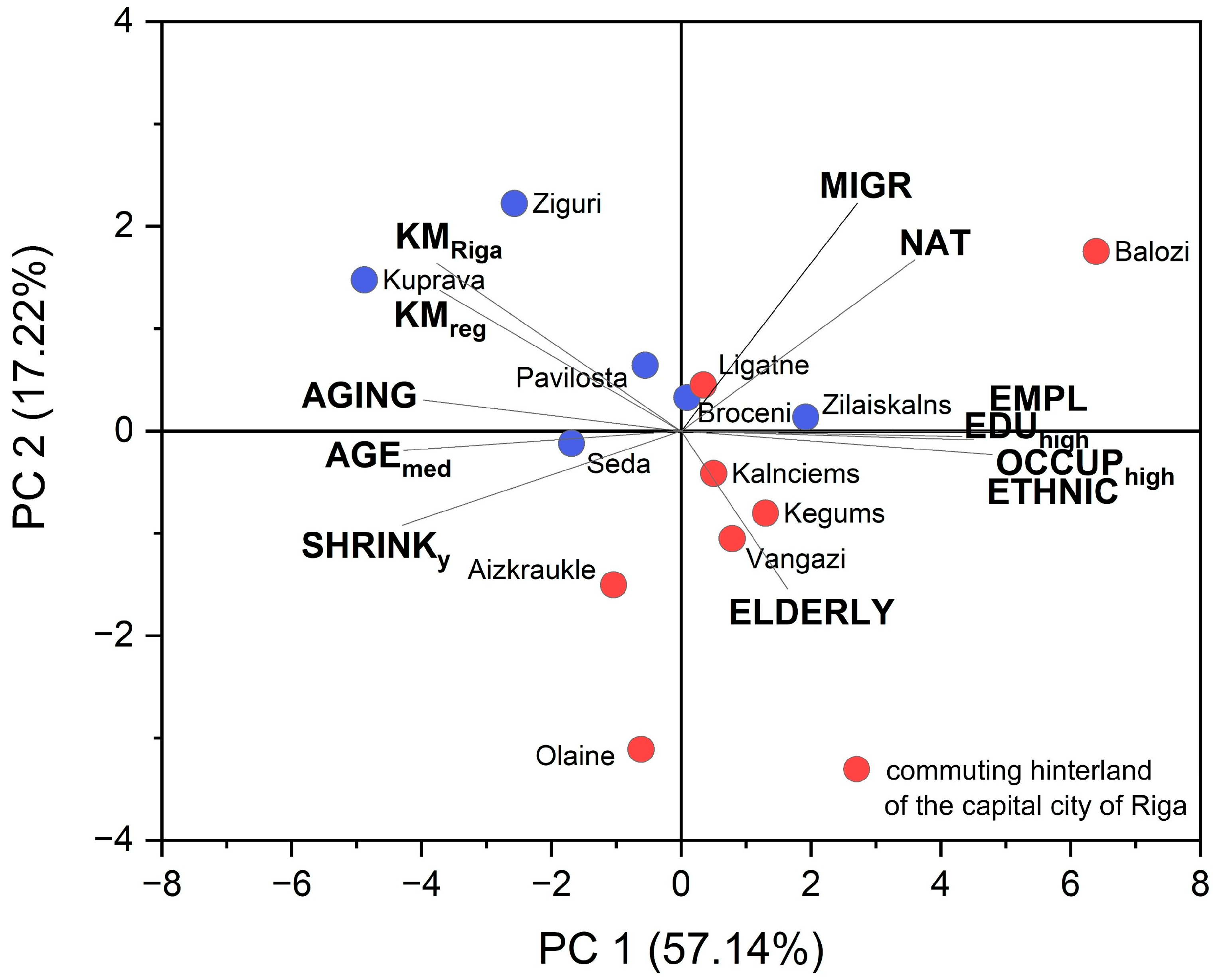
Figure 2). Mono-towns in Riga’s commuting hinterland (red points) cluster in the positive PC1 quadrant, indicating stronger socio-economic vitality, as reflected by higher education levels, employment rates, and positive net migration. In contrast, peripheral towns (blue points) cluster in the negative PC1 quadrants, displaying dual challenges of economic stagnation and population decline. The biplot vectors show how variables like KM
Riga and KM
reg align with shrinkage indicators, while EDU
high and EMPL oppose them, confirming the trade-offs between geographic advantage and human capital.
The component scores for individual towns further illustrate these divergences. Balozi, a former peat extraction town that borders Riga, achieved the highest score on PC1. Conversely, Kuprava in eastern Latvia scored the lowest, with considerable population loss since 2000 and only 14% of university education attainment. The aging dimension (PC3) displayed lower spatial clustering.
The PCA findings illustrate the interplay between past industrial specialization and current geographic factors in influencing decline. Towns originally developed for resource extraction (e.g., peat, timber) show stronger peripherality effects (PC2 loadings > 0.4), whereas those with Soviet-era manufacturing show more pronounced aging (PC3 loadings > 0.5). This path dependency underscores the lasting impact of economic mono-structures, even decades after the transition.
Three key findings emerged from the component analysis.
Proximity advantage: A 0.28 SD rise in PC1 scores is linked to each 10 km proximity to Riga (p < 0.01), which underscores the capital’s magnetic effect on human capital and economic activity.
Education buffer: Communities where over 25% of residents have tertiary education display PC1 scores 2.3 times greater than those with lower education levels (p < 0.001), underscoring the influence of education on reducing population decline.
Aging-deprivation cycle: High PC3 scores showed a negative correlation with PC1 (r = −0.49, p < 0.05), implying that aging populations worsen economic decline.
These trends correspond with findings on urban decline in Europe [
1] but also uncover distinct aspects specific to former Soviet regions, especially the interconnected influence of marginal locations and historical industrial development. The spatial clustering of component scores (
Figure 2) yields empirical backing for core–periphery models of regional development, as it illustrates how geographic position shapes shrinkage outcomes in mono-towns.
The examination further pinpoints anomalies that oppose rigid explanations. Aizkraukle, located 90 km from Riga, achieved a moderate PC1 score (0.67) because of employment linked to hydropower, which indicates that specialized economic activities can partly counterbalance its peripheral position. Such cases warrant further qualitative investigations into local resilience mechanisms.
4.3. Spatial Distribution of Studied Settlements
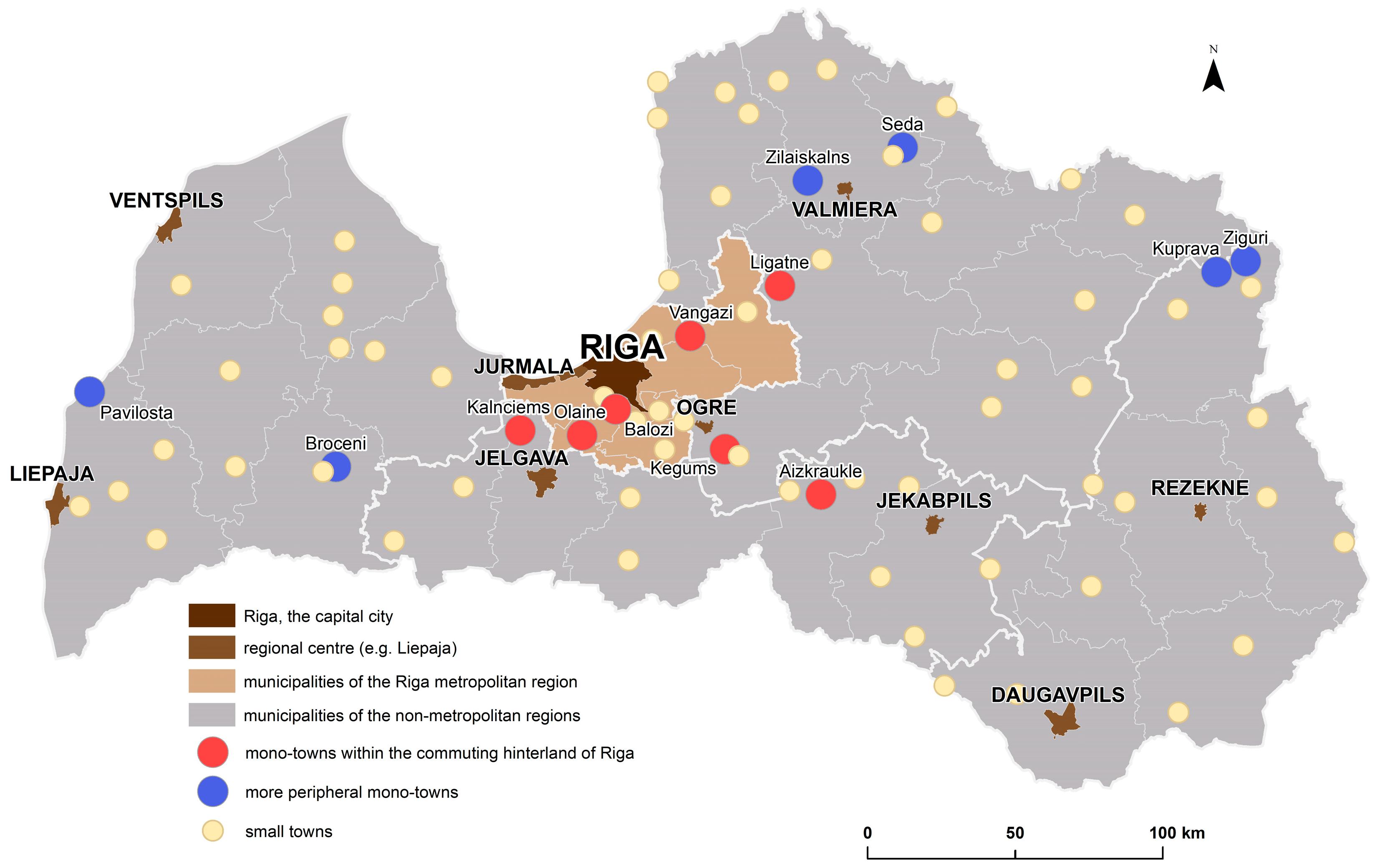
Geographical analysis revealed several key trends. Notably, mono-towns situated within the commuting hinterland of Riga exhibit significantly different demographic and economic characteristics than those located in peripheral regions. These suburban mono-towns benefit from commuting opportunities, access to services, and economic spillover effects from the metropolitan core [
36,
37]. Second, the non-metropolitan peripheral mono-town clusters are located in three distinct sub-regions: western Latvia, northeastern Latvia, and eastern Latvia (Latgale region). Each of these peripheral clusters faces unique challenges shaped by specific geographic and historical contexts.
The distance decay effect is particularly pronounced in Latvia’s urban system, with mono-town shrinkage intensity increasing with distance from Riga. Mono-towns within the commuting hinterland of Riga show an average population decline of 18.2% since 2000, compared to 31.4% for peripheral mono-towns. This pattern aligns with broader spatial development trends, wherein capital regions have consolidated economic and demographic growth, while peripheral areas have experienced sustained decline [
26]. The regional centers (medium brown dots) function as secondary nodes in this system, but their capacity to reduce shrinkage in nearby mono-towns seems constrained, which is supported by the comparable decline rates of mono-towns adjacent to regional centers and those in remote areas.
The spatial distribution also reflects the historical development patterns. Soviet-era industrial mono-towns were intentionally situated in remote regions for resource extraction or strategic objectives, establishing enduring patterns that still influence their development [
14]. In contrast, several mono-towns in the Riga metropolitan region developed as satellite settlements with more diverse economic bases, which afforded them greater stability during the post-socialist urban transition period.
Spatial analysis further highlights the role of transportation infrastructure in mediating shrinkage patterns. Mono-towns situated near primary transportation routes to Riga (e.g., Olaine, Balozi) show more favorable population and economic trends than equally remote towns lacking such infrastructure links. This implies that accessibility, as opposed to mere linear distance, could more precisely forecast the resilience of mono-towns. The geographical arrangement of educational institutions also stands out as a key element, as mono-towns with vocational or technical colleges experience a less pronounced decline than those lacking such establishments, irrespective of their location.
The spatial distributions identified in this study have substantial implications for policymaking. The distinct geographical concentration of shrinkage severity implies that regional development plans should employ tailored methods according to mono-town locational settings. For outlying single-industry towns, measures may require a concentration on delivering essential services and upgrading transport links, whereas those close to the capital could gain greater advantages from closer ties to the urban job market. Spatial analysis further pinpoints possible areas of severe decline in eastern Latvia, necessitating specific emergency actions to uphold basic functionality.
The geographical arrangement of mono-towns and their diverse decline patterns yield empirical evidence supporting the core–periphery frameworks of territorial growth in post-socialist settings. The results indicate that geographic location in relation to the capital city acts as a strong structural factor shaping mono-town development patterns, albeit not an entirely deterministic one, with sporadic instances of more remote mono-towns achieving better outcomes than their geographic positioning would predict. This highlights the necessity of policies that tackle both spatial structural limitations and opportunities for building local capacity in declining mono-towns.
5. Discussion
This study provides empirical verification that the three dimensions identified in prior urban shrinkage research—socio-economic vitality, population change and peripherality, and aging society dynamics [
1,
9,
31,
32]—are operative in the Latvian mono-town context, but with distinct relative weights and spatial configurations not previously documented. Specifically, socioeconomic vitality accounts for 57.1% of the variance, a considerably higher proportion than that typically found in studies of larger urban centers, underscoring the heightened vulnerability of mono-towns. The pronounced distance-decay effect linked to proximity to Riga (0.28 SD increase in PC1 scores per 10 km) provides quantitative evidence of core–periphery dynamics specific to Latvia’s monocentric urban system. The three-dimensional structure partially aligns with, but also diverges from, the patterns observed elsewhere in Europe. While Vîlcea et al. [
32] identified comparable socioeconomic and demographic drivers in Romanian small towns, the dominance of socioeconomic vitality in the Latvian case likely reflects Latvia’s pronounced monocentricity. This resonates with Cai et al.’s [
27] observation that population flows in shrinking cities demonstrate differentiated characteristics, with young, educated groups migrating to metropolitan cores, while elderly, low-income populations remain in peripheral areas. Furthermore, Großmann et al. [
30] demonstrated that state policies toward peripheral areas fundamentally shape local conditions, highlighting that the peripherality dimension identified in this study reflects not only geographic distance but also the policy architecture connecting mono-towns to national support systems. The findings challenge simplistic narratives of urban decline by demonstrating the complex interplay between systemic constraints and the adaptive capacities of local communities not only in Latvia’s mono-towns, but also in other small settlements.
Theoretical implications arise from the observed spatial disparities in the shrinkage trajectories. The pronounced effect of being in close geographical proximity to Riga bolsters core–periphery frameworks, whereas the intermediary function of education and work indicates that human capital can partly counterbalance the drawbacks of peripheral locations. This aligns with recent debates on “smart shrinkage” [
7], which emphasize the need to adapt development strategies to demographic realities rather than pursuing growth at all costs. This study also contributes to path dependency theory by illustrating how Soviet-era industrial legacies continue to influence contemporary urban trajectories, particularly through aging populations and difficulties in economic restructuring.
These findings highlight the need for policymakers to adopt differentiated spatial planning strategies. Monotowns situated near Riga may benefit from initiatives designed to enhance their integration into the metropolitan labor market. Such initiatives could include enhancing public transportation systems and providing incentives for housing that facilitates commuting. Conversely, peripheral mono-towns require targeted interventions to address their complex challenges, such as investing in infrastructure to mitigate geographic isolation and implementing strategies to retain the population. The robust inverse relationship between educational attainment and population decline indicates that broadening opportunities for higher and technical schooling may act as a strong deterrent to demographic decrease, especially in communities with an aging labor force. Local governments can also investigate place-based economic diversification approaches.
Recent scholarship has highlighted various approaches to addressing urban shrinkage beyond growth-oriented paradigms. Großmann et al. [
30] demonstrate that local initiatives in shrinking small towns operate under a “Do-It-(For-)Yourself” logic, shaped by peripheralization and limited municipal resources, rather than serving as instruments of top-down development policy. Their comparison of Finnish and German cases revealed that municipaland state policies are decisive. Similarly, Dragan et al. [
29] illustrate how post-industrial towns can pursue economic reconversion through a combination of industrial regeneration and tourism development, while Boțan et al. [
31] demonstrate how the mono-industrial city of Beclean in Romania successfully pivoted toward tourism-based development, increasing tourist arrivals from 20,000 to over 200,000 within a decade through sustained EU-funded investment. Hajduková and Sopirová [
28] further proposed brownfield greening strategies as viable pathways for post-industrial shrinking towns in Eastern Slovakia. The Latvian context could benefit from examining such diversification pathways, particularly for peripheral mono-towns, where the education-buffer effect identified in this study suggests that investments in human capital may constitute an effective counter-shrinkage strategy.
Several methodological limitations warrant further consideration. First, the small sample size (
n = 13) restricts the statistical power and generalizability of the PCA findings. While this represents the complete population of identified mono-towns in Latvia, and the comprehensive variable set partially offsets this limitation, the results should be interpreted as indicative patterns rather than as definitive causal relationships. Second, the analysis examined data from two time points (2000 and 2021), which, while capturing two decades of post-socialist transformation, may not account for nonlinear patterns of shrinkage or temporary reversals within this period. Third, the exclusive reliance on quantitative census and administrative data means that qualitative factors, such as local governance capacity, community agency, social cohesion, and institutional innovation, are not captured. As Großmann et al. [
30] demonstrate, such qualitative dimensions can be decisive: the difference between a thriving or failing local initiative often depends on municipal support structures rather than demographic indicators alone. Fourth, although PCA is effective for dimensionality reduction, it assumes linear relationships between variables and may oversimplize complex interdependencies [
26,
33,
35]. Recent scholarship [
27] has noted that urban shrinkage involves complex dynamics in which decline and renewal can coexist, suggesting that purely quantitative approaches may miss important nonlinear processes. Fifth, the Latvia-specific institutional and geographic context—particularly the dominant role of Riga in the national urban system—limits the direct transferability of the findings to polycentric urban systems in other post-socialist countries. Nonetheless, the identified dimensions align with patterns found in Romania [
29,
32], Slovakia [
28], and the broader CEE literature [
27], suggesting that the analytical framework is transferable, although country-specific factors must be considered.
Subsequent studies should address these deficiencies by employing mixed-methods strategies that integrate numerical assessments with detailed examinations of mono-towns displaying unconventional development patterns. Comparative studies across post-socialist countries could elucidate whether the observed patterns reflect Latvia-specific conditions or broader regional trends. Long-term studies examining mono-towns over extended periods would yield an understanding of the chronological patterns of decline, especially the possibility of revival or equilibrium.
The study’s findings highlight the urgency of rethinking urban and regional policies in shrinking contexts. Conventional planning models focused on growth may be inadequate for mono-towns experiencing structural decline, which requires alternative strategies that emphasize quality of life and sustainable service delivery rather than population growth. The varied pathways identified in this study highlight the imperative for individualized strategies, as generic measures fall short due to the distinct interplay of demographic, economic, and geographical factors shaping the future of mono-towns. As Latvia and other Central Eastern European nations address the difficulties of urban decline, this study establishes a basis for creating context-specific strategies that harmonize economic conditions with concerns for social cohesion.
6. Conclusions
This study methodically analyzed the demographic and socioeconomic factors contributing to urban shrinkage in Latvian mono-towns, thereby filling an important void in empirical research on post-socialist urban development patterns. Addressing the three stated research objectives, the analysis confirms that the principal dimensions of urban shrinkage identified in prior research [
1,
9,
31,
32]—socioeconomic vitality, shifts in population and peripherality, and the dynamics of an ageing society—are operative in Latvian mono-towns, while also revealing context-specific patterns: the dominant role of socioeconomic vitality (57.1% of variance), the critical mediating effect of proximity to Riga (0.28 SD increase in PC1 scores per 10 km), and the education-buffer effect (communities with >25% tertiary education display PC1 scores 2.3 times higher). These findings extend prior research by providing the first systematic quantitative evidence from the Baltic post-Soviet context, where the legacy of Soviet industrial planning and Latvia’s monocentric settlement structure create distinct shrinkage dynamics compared with Central European post-socialist countries examined in earlier studies [
4,
27,
30,
32]. A comparison with recent European literature, including studies from Romania [
29,
31], Slovakia [
28], Finland, and Germany [
30], and a comprehensive global review [
27], confirms the broader relevance of the identified dimensions while highlighting the specific intensity and configuration unique to the Latvian case.
This study identified several potential avenues for further investigation. While the PCA effectively identified the structural factors contributing to shrinkage, qualitative research could elucidate how local governance, community agency, and institutional capacities influence these dynamics. Comparative analyses across post-socialist urban settings would be instrumental in determining whether the observed patterns are indicative of broader transitional dynamics or specific to Latvia. Additionally, long-term monitoring of mono-towns may reveal whether current trends represent short-term fluctuations or an enduring decline. These research directions would help bridge the gap between the structural explanations of urban shrinkage and location-specific resilience approaches, thereby contributing to more nuanced policy solutions for urban change.