1. Introduction
Public transportation is closely linked to economic opportunity in urban areas. For many households, transit is the primary means of reaching employment. Access, however, is not defined only by network coverage. Service frequency and reliability also shape how usable a system is in practice. Short headways reduce waiting time and lower the generalized cost of travel.
Despite this, there is limited evidence on the labor-market effects of frequency-only service upgrades that do not involve major infrastructure investment, particularly in U.S. bus corridors. Most existing studies focus on rail expansions or capital-intensive projects. Less is known about incremental improvements in service intensity. This study examines such an upgrade. Rather than tracking individual commuting behavior or transit ridership, the analysis centers on changes in the spatial distribution of jobs. Workplace employment data are used to capture how firms and job locations respond at the neighborhood level.
Identifying the causal effect of a transit investment is challenging because service changes are not randomly assigned. Agencies typically upgrade corridors that are already important within the network. These areas may have followed different economic trajectories even in the absence of the intervention. To address this concern, the analysis uses a quasi-experimental framework. Specifically, we implement a difference-in-differences design that compares changes over time in tracts near the upgraded corridor with changes in nearby but untreated tracts. This approach removes common time effects and isolates the impact of the service improvement under a parallel-trends assumption. Although the Pulse Milwaukee Line was not randomly selected, agency documentation suggests that corridor choice was based primarily on operational considerations, including ridership patterns, network connectivity, and service feasibility. There is no indication that expectations of short-run neighborhood employment growth played a central role in the selection decision.
This study estimates the causal effect of proximity to high-frequency public transit on neighborhood labor-market outcomes. The analysis focuses on workplace job concentration, resident employment rates, and median household income. The August 2019 launch of Pace’s Pulse Milwaukee corridor provides the policy variation.
We combine publicly available GTFS stop data with American Community Survey (ACS) estimates and LEHD Workplace Area Characteristics data to construct a tract-level panel. We implement a difference-in-differences framework. We compile annual workplace employment data for 2017–2022; however, household outcomes drawn from the ACS are measured using 5-year estimates. Accordingly, our baseline difference-in-differences specification for household outcomes uses a two-period design comparing 2015–2019 (pre-treatment) to 2020–2022 (post-treatment). We use annual LODES data for event-study and robustness analyses. August 2019 marks the introduction of the Pulse Milwaukee Line. The full 2017–2022 panel is used for the event-study and robustness analyses. Outcomes from 2020 to 2022, therefore, reflect post-treatment years, while earlier years serve as the pre-treatment period. In the baseline DiD tables, ‘post’ refers to 2022, and in the event-study specification, we model post-treatment dynamics year-by-year.
A central feature of the paper is the use of a transparent difference-in-differences framework to evaluate a frequency-only bus upgrade. The analysis compares changes in workplace job concentration, resident employment, and income in tracts within walking distance of the upgraded corridor to changes in nearby but untreated tracts. All data sources are public. The approach does not rely on proprietary routing software or restricted datasets.
The launch of the Pulse Milwaukee Line offers a clearly defined policy change. Pace, the suburban bus agency serving the Chicago metropolitan area, began operating the line in August 2019 as the first phase of its Pulse Bus Rapid Transit program. The route runs along Milwaukee Avenue, linking the Jefferson Park Transit Center—a major transfer point served by CTA rail and Metra—to Golf Mill Shopping Center in Niles. The service introduced limited-stop operations, upgraded stations, real-time information, and ten-minute peak headways. Compared with the local Route 270 that it supplements, the Pulse line provides substantially higher frequency and more reliable service. Before estimating treatment effects, we examine pre-trends to verify that tracts near the corridor were not already on a different trajectory in employment or job concentration prior to 2019. The absence of differential pre-trends supports the identification strategy.
The corridor passes through residential neighborhoods, commercial strips, and established employment centers. It serves a racially and economically diverse population. Importantly, the Pulse line did not create a new transit corridor. Instead, it increased service frequency and reliability along an existing route. The treatment is therefore well defined as a change in service intensity rather than infrastructure expansion. The locations of new Pulse stops provide a clear basis for defining treated and comparison areas by spatial proximity.
For the empirical analysis, we construct a tract-level panel. Transit stop and service data come from Pace’s publicly available GTFS feeds, which allow us to identify tracts exposed to the upgraded service. Socioeconomic and labor-market measures are drawn from the American Community Survey and the LEHD Workplace Area Characteristics data. Together, these sources provide information on income, employment rates, workplace job counts, and demographic composition. Using this panel, we estimate the effect of the Pulse service on local economic outcomes while accounting for spatial and time-specific factors.
Several diagnostic checks are necessary to assess the validity of the design. We conduct placebo tests by applying the same empirical strategy to corridors that did not receive a Pulse upgrade. If the model were capturing broader regional trends rather than the service change itself, similar effects would appear in these placebo settings. We do not find such patterns, which supports the interpretation that the estimated effects are specific to the Pulse corridor.
Spatial spillovers present another concern. A high-frequency corridor may affect areas slightly beyond the immediate walkshed. If nearby tracts that benefit indirectly are included in the control group, estimated treatment effects may be attenuated. To address this issue, we implement alternative control definitions. In some specifications, we exclude tracts located between 0.5 and 1 mile from the corridor and compare treated tracts to areas located farther away. We also test sensitivity to different buffer widths. The results are broadly consistent across these definitions.
The timing of the intervention coincides with the COVID-19 pandemic. In 2020, transit agencies reduced service, and commuting patterns shifted due to remote work and sector-specific job losses. These disruptions may have dampened or delayed any short-run effects of the Pulse upgrade. For this reason, we estimate alternative specifications that compare pre-Pulse years (2018–2019) to later post-Pulse years (2021–2022), excluding the most volatile pandemic period. Short-run null results should, therefore, be interpreted cautiously.
The findings distinguish between workplace-level and household-level outcomes. We estimate a positive and economically meaningful increase in workplace job density near the corridor, though the estimate is statistically marginal. In contrast, we do not detect measurable short-run effects on resident employment rates or median household income. It is important to interpret workplace job density carefully. An increase in jobs per resident reflects a change in where employment is located. It does not imply that residents of treated tracts obtained these jobs. The effect may reflect firm relocation, sectoral adjustment, or changes in commercial activity. Firms, property owners, or commuters from outside the area may benefit even if resident labor outcomes remain unchanged.
The results point in two different directions. For household outcomes, we do not find meaningful changes in either the employment-to-population ratio or median household income between 2019 and 2022. The estimates are small and statistically indistinguishable from zero. Confidence intervals are wide; thus, moderate positive or negative effects cannot be ruled out over this short period. Within the observed horizon, however, the increase in service frequency does not appear to have translated into measurable improvements in resident labor-market outcomes.
The pattern differs for workplace employment. We estimate an increase of 0.0665 jobs per resident in treated tracts relative to controls, which corresponds to roughly a 14 percent rise compared to the treated pre-treatment mean of 0.465. Because workplace employment is measured using LODES Workplace Area Characteristics data, this estimate reflects changes in the location of jobs within tracts. It may capture firm relocation, shifts in establishment activity, or other forms of spatial reallocation. It does not, by itself, imply net job creation at the county or regional level.
The conventional tract-clustered p-value is approximately 0.07. This does not meet the five percent threshold, but the magnitude of the estimate is economically meaningful. We therefore view the result as suggestive rather than conclusive. The pattern is consistent with an increase in workplace job concentration near the corridor. At the same time, it should not be interpreted as definitive evidence of firm relocation. Nor does it imply that residents of treated tracts obtained these jobs or altered their commuting behavior in the short run. The estimate reflects a shift in where jobs are located, not necessarily who holds them.
The analysis has an important limitation. We do not observe individual transit use or origin–destination commuting flows. As a result, we cannot determine whether residents of treated neighborhoods used the Pulse service to access the additional jobs or whether commuting patterns changed after the upgrade. The findings should therefore be interpreted as evidence of changes in workplace location rather than direct evidence of changes in individual travel decisions.
Relative to prior work, this study contributes new evidence on how a high-frequency bus service upgrade—implemented without major infrastructure investment—relates to tract-level workplace and household labor-market outcomes under a parallel-trends assumption. Much of the U.S. evidence on transit and economic outcomes focuses on rail expansions or large capital projects. In contrast, we study a more incremental change: the introduction of a high-frequency, limited-stop bus service layered onto an existing route. The analysis relies entirely on publicly available data, including GTFS schedules and ACS and LODES employment records. This approach shows that careful evaluation is possible without proprietary datasets or specialized survey data.
The Pulse Milwaukee Line provides a useful setting. Pace introduced the line as the first phase of its BRT-style program. The service runs 7.6 miles along Milwaukee Avenue, from Niles to Chicago. It includes upgraded stations and vehicles but operates mostly in mixed traffic. Importantly, the project did not create a new corridor. Instead, it added frequent, limited-stop service to the existing Route 270. The corridor already had transit service; the Pulse upgrade represented a discrete increase in frequency, reliability, and service quality. This creates a clear before-and-after comparison along a fixed geography, with treatment defined by proximity to Milwaukee Avenue and a well-defined start date in August 2019. Land-uses along the corridor include both commercial strips and residential neighborhoods, and no other major transportation or development projects coincided with the launch. These features strengthen the interpretation of the results.
Taken together, the findings refine the equity discussion. The frequency increase did not produce immediate gains in household employment or income. It did, however, shift workplace job concentration toward the corridor. Over a longer horizon, or in combination with housing and workforce policies, such shifts could translate into improvements for residents. The evidence suggests a sequencing pattern: frequency upgrades may affect job location first, with household-level effects, if any, emerging later.
This study speaks to a broader question in the transit literature: whether service improvements translate into inclusive, short-run economic gains. One view is that better transit in underserved areas should quickly improve employment outcomes by expanding access to jobs. A more cautious view is that transit changes may primarily affect where jobs are located, with uncertain benefits for existing residents and possible distributional consequences.
Our findings fall between these positions. The Pulse upgrade is associated with a measurable shift in workplace job concentration toward the corridor. At the same time, we do not observe an increase in employment rates among residents over the study period. This suggests that transit improvements alone may not be sufficient to improve household labor-market outcomes in the short run. Complementary policies may be required if the goal is broad-based gains. Nonetheless, from a methodological standpoint, the study also shows that frequency upgrades—without major infrastructure expansion—can be evaluated using publicly available data and standard quasi-experimental tools. Even relatively incremental service changes can leave detectable traces in local economic data.
The remainder of the paper is organized as follows.
Section 2 reviews related literature on transit accessibility, service frequency, and neighborhood labor-market outcomes.
Section 3 presents the institutional background of the Pulse program and the corridor selection process.
Section 4 describes the public data sources and the construction of the tract-level panel.
Section 5 presents the study area, treatment and control definitions, and summary statistics.
Section 6 outlines the difference-in-differences framework and identification assumptions.
Section 7 reports robustness and validation checks, including event-study estimates and placebo tests.
Section 8 discusses the findings, and
Section 9 concludes.
2. Literature Review
This study connects to several strands of research. First, it relates to work on how public transit access influences labor-market outcomes by reducing spatial frictions. Second, it speaks to the literature emphasizing that service frequency and reliability—not only network coverage—determine how usable transit is in practice. Third, it contributes to research on the economic and development effects of bus rapid transit (BRT)-type investments. A related, more practical strand concerns measurement. Recent studies increasingly rely on publicly available GTFS data and Census employment products such as the ACS and LEHD/LODES to evaluate neighborhood-level impacts using quasi-experimental methods.
Urban labor markets frequently exhibit spatial mismatch. Lower-income and transit-dependent workers often live far from suitable job opportunities. This separation can limit employment prospects and reduce earnings. A large body of research documents that weak job accessibility is associated with higher unemployment and lower wages among low-skilled and carless workers. Improvements in transit access can expand the feasible job search area and improve labor-market outcomes [
1]. At the regional level, previous research find that greater transit provision is associated with modest but statistically significant reductions in unemployment and poverty [
2]. These findings support the view that transit can mitigate spatial frictions in urban labor markets.
Recent empirical studies provide additional evidence on the relationship between transit accessibility and labor-market outcomes. Using detailed accessibility measures in Montevideo, previous research shows that residents in areas with better public transport access to jobs face lower unemployment probabilities, even after accounting for individual characteristics [
3]. In Lima, previous research finds that the expansion of the BRT system increased job accessibility, though the benefits were uneven [
4]. Gains were smaller for low-income households located farther from trunk corridors. Together, these studies suggest that transit improvements can reduce spatial frictions, but that increases in accessibility do not automatically produce immediate or evenly distributed employment gains.
The effective cost of transit extends beyond in-vehicle travel time. It includes waiting time, transfer inconvenience, and uncertainty about arrivals. Rider surveys consistently report that frequency and reliability rank among the most important service attributes [
5,
6]. Infrequent or unreliable service increases perceived travel costs and discourages use. More consistent and frequent operations, by contrast, can improve user confidence and stabilize ridership [
7].
High-frequency bus systems and BRT investments can alter urban economic patterns by lowering generalized travel costs along specific corridors. International evidence, particularly from Latin American cities, documents substantial aggregate effects. In Bogotá, the introduction of the TransMilenio BRT system generated sizable travel-time reductions and measurable economic gains. Previous research estimates increases in citywide welfare of roughly 3.5 percent and output gains of about 2.7 percent, net of costs [
8]. These effects were not uniform across space. Peripheral neighborhoods experienced improved access to employment, while central areas gained access to a larger labor pool, altering the spatial allocation of economic activity [
9].
Large-scale BRT systems such as TransMilenio have been associated with sizable welfare and productivity gains. However, evidence from other settings indicates that labor-market responses are not uniform across space or over time. In Lima, for example, accessibility gains from BRT were concentrated near trunk corridors and did not translate into broad employment improvements for lower-income residents living farther away [
4]. These findings suggest that transit investments operate through several channels—affecting job location, worker sorting, and firm behavior—and that outcomes depend on corridor design, surrounding land-use, and the presence of complementary policies.
Evidence from the United States is more mixed, but it often points to localized development effects when BRT corridors are well integrated into their urban context. Previous research examines several U.S. BRT systems and documents clustering of economic development near stations [
10]. In their sample, areas within roughly 0.5 miles of BRT stops captured a substantially larger share of new office development than the broader region [
11]. A related example comes from Eugene, Oregon. Following the introduction of the EmX BRT line, tracts within 0.25 miles of stations experienced job growth even during a period when the metropolitan area overall was losing employment [
12]. Growth was concentrated in specific sectors, including education and health services.
These cases suggest that BRT can alter the relative attractiveness of station areas, even when broader economic conditions are weak. The distinction between nominal network coverage and effective accessibility is particularly relevant for high-frequency bus systems. Improvements in headways and reliability can change the practical reach of workers and firms without large infrastructure investments. Using confidential Census data and an instrumental-variables strategy, previous research shows that proximity to newly opened rapid transit stations in Los Angeles increased nearby employment rates and local job density [
13]. Their results indicate that transit investments can influence both resident labor outcomes and the spatial distribution of employment.
These effects are documented in large metropolitan systems with substantial complementary development and long adjustment periods. It remains unclear whether smaller-scale frequency upgrades produce comparable household-level impacts, especially in the short run. Other research highlights that BRT investments can influence local economic activity through land and location channels. Studying 11 U.S. BRT corridors, previous research finds that residential property value responses differ considerably across settings and depend on corridor design and surrounding land-uses [
14]. Their results are consistent with BRT affecting the spatial distribution of activity rather than generating uniform aggregate growth. In the short to medium run, the effects appear largely reallocative, particularly where land-use constraints limit adjustment.
Although prior work has examined the economic consequences of rail expansions and full-scale BRT systems—often involving dedicated lanes and substantial capital investment—less is known about the labor-market implications of service frequency upgrades that do not involve new infrastructure, especially in suburban U.S. bus corridors. This study addresses that gap by analyzing a frequency-only enhancement along an existing route. The focus is on tract-level workplace and household outcomes, estimated using a transparent difference-in-differences framework based entirely on public data.
3. Institutional Background: The Pulse Program and Corridor Selection
Pace introduced the Pulse program as a system-wide effort to improve bus service along major arterial corridors in the Chicago region. The program focused on operational changes rather than land-use reform or short-run economic development. Official materials describe Pulse as a way to increase frequency, improve reliability, reduce travel times, and enhance the rider experience. The strategy was to upgrade existing routes by adding branded, limited-stop service that could be implemented relatively quickly and at moderate cost [
15,
16].
The Milwaukee Avenue corridor was chosen as the first Pulse line after several years of planning. Pace documents indicate that corridor selection was based on service-related criteria, including current and projected ridership, network connectivity, operational feasibility, and local support [
16,
17]. Earlier planning studies evaluated a broad set of potential corridors. The Milwaukee Stakeholder Involvement Plan notes that twenty-four corridors were initially considered, with Milwaukee identified as the first Arterial Rapid Transit (ART) corridor within the short-term network. The selection followed a structured planning process and was not an ad hoc decision made close to the 2019 launch [
17].
Longer-term planning documents support this interpretation. The 2009 ART Feasibility Study outlined corridor selection criteria centered on existing ridership, expected demand, regional connectivity, potential travel-time savings, and institutional and community support [
18]. The Pace Board approved Milwaukee, along with a small number of other corridors, to move toward implementation more than a decade before Pulse service began. The 2009 ART Implementation Plan also emphasized that strong baseline ridership along Milwaukee Avenue reduced implementation risk, describing the corridor as a heavily used commuter route where improvements in reliability and speed were expected to produce immediate service benefits.
The planning documents do not suggest that the Milwaukee corridor was chosen because of expected short-run increases in neighborhood employment or income. Public materials often emphasize improved access to jobs and destinations, but this refers to mobility benefits for riders rather than anticipated job creation within the corridor itself. Regional planning reports also situate Pulse Milwaukee within longer-term land-use and transportation coordination efforts. However, they do not describe corridor selection as being driven by forecasts of near-term employment growth [
19,
20,
21].
Taken together, this institutional background indicates that Pulse Milwaukee was selected for operational reasons—high existing ridership, network connectivity, and strategic importance—rather than randomly assigned. The empirical strategy does not assume random placement. Instead, identification relies on a parallel-trends framework that compares tracts near the Milwaukee corridor to nearby comparison tracts. We supplement this approach with pre-treatment trend analysis and placebo tests. The resulting estimates should therefore be interpreted as evidence consistent with corridor-level employment reallocation following a major service upgrade, rather than as definitive causal effects of an exogenous policy shock.
4. Data
This study combines several publicly available datasets to examine neighborhood-level employment and income before and after a transit service upgrade. The data fall into four categories: transit service information, demographic and socioeconomic characteristics, employment records, and geographic reference files. Transit service is measured using General Transit Feed Specification (GTFS) data, which provides schedules, stop locations, and route information. These data allow precise mapping of where stops are located, how frequently buses operate, and when service changes occur. In this analysis, GTFS feeds are used to document changes in service frequency on the Pulse corridor and to define treated areas based on proximity to Pulse stops. The use of GTFS data makes it possible to implement the analysis with reproducible code and without proprietary software.
Economic outcomes are drawn from two primary public sources. The American Community Survey (ACS) provides tract-level measures of employment-to-population ratios, median household income, vehicle access, and demographic composition. These are reported as rolling five-year estimates and therefore reflect multi-year averages rather than single-year values. Employment by workplace location is measured using the Census Bureau’s Longitudinal Employer-Household Dynamics data, specifically the LODES Workplace Area Characteristics files. LODES provides annual counts of jobs at the Census Block level, which can be aggregated to tracts. Together, these datasets allow the construction of a tract-level panel that links transit service changes to local economic outcomes over time.
4.1. General Transit Feed Specification (GTFS)—Pace Bus
The first dataset used in the analysis is the General Transit Feed Specification (GTFS) published by Pace Suburban Bus. GTFS provides detailed information on transit routes, schedules, and stop locations in a standardized format used by most U.S. transit agencies [
22]. The files include geographic coordinates for each stop, route–stop relationships, and scheduled arrival times. We use these data to identify the Pulse Milwaukee Line, which began operating in August 2019, and to extract the locations of the new limited-stop, high-frequency stations along Milwaukee Avenue. Census tracts located within 0.5 miles of at least one Pulse stop are classified as treated.
4.2. American Community Survey (ACS)—5-Year Estimates
To measure neighborhood socioeconomic conditions, we use the American Community Survey (ACS) 5-year estimates from the U.S. Census Bureau [
23]. The ACS is a rolling annual survey that provides detailed tract-level information. Five-year estimates are used because they produce more stable statistics for small geographic areas. We treat the 2015–2019 ACS release as the pre-treatment period and the 2020–2022 release as the post-treatment period. From these files, we extract the employment-to-population ratio, median household income, vehicle ownership, educational attainment, and racial and ethnic composition. The employment-to-population ratio is defined for individuals aged 16 and older; thus, children are excluded by definition. Because ACS outcomes are reported as multi-year averages rather than annual observations, household employment and income are analyzed using a two-period difference-in-differences design. The estimates compare 2015–2019 to 2020–2022. These results, therefore, reflect medium-run differences between periods rather than year-by-year changes.
4.3. Longitudinal Employer-Household Dynamics (LEHD)—LODES
To supplement the ACS data with more detailed employment measures, we use the LEHD Origin-Destination Employment Statistics (LODESs) produced by the U.S. Census Bureau in collaboration with state labor agencies [
24]. LODES provides annual job counts at the census block level, reported both by workplace location and by worker residence. Two components are central to the analysis. The Workplace Area Characteristics (WACs) files report the number of jobs located in each block, while the Residence Area Characteristics (RACs) files report the number of employed residents living in each block. We aggregate these block-level data to the tract level and construct additional measures, including workplace job density and alternative employment ratios. Because LODES data are available annually, they allow for year-by-year analysis of employment changes around the timing of the Pulse intervention.
4.4. TIGER/Line Shapefiles—U.S. Census Bureau
To define geographic boundaries and link transit stops to census tracts, we use TIGER/Line shapefiles from the U.S. Census Bureau. These shapefiles provide the official geographic definitions of census tracts, block groups, and counties. We use tract-level files for the Chicago metropolitan area to map the locations of Pulse stops and determine which tracts fall within a 0.5-mile buffer (treated group) and which fall within a 0.5–2-mile ring (control group). Spatial matching is conducted using GIS software such as QGIS 3.28. This process produces the treatment indicator used in the empirical analysis.
5. Descriptive Statistics
This section describes the empirical setting and data used in the analysis. We begin by defining the treatment and comparison areas along the Pulse Milwaukee corridor. Tracts located within 0.5 miles of a Pulse stop are classified as treated, and tracts between 0.5 and 2 miles serve as the control group. We then describe how four public datasets—Pace GTFS files, TIGER/Line tract shapefiles, ACS 5-year estimates, and LEHD LODES employment data—are combined to construct a tract-level panel.
From these sources, we create the main outcome variables, including the employment-to-population ratio and median household income. We also assemble demographic controls such as vehicle ownership, educational attainment, and racial composition. A map confirms the spatial relationship between Pulse stops and census tracts. Summary statistics compare treated and control tracts in the pre-treatment period and show that baseline differences are limited. Together, the map and descriptive statistics document the geographic definition of treatment and the similarity of the two groups prior to the intervention, providing context for the difference-in-differences analysis.
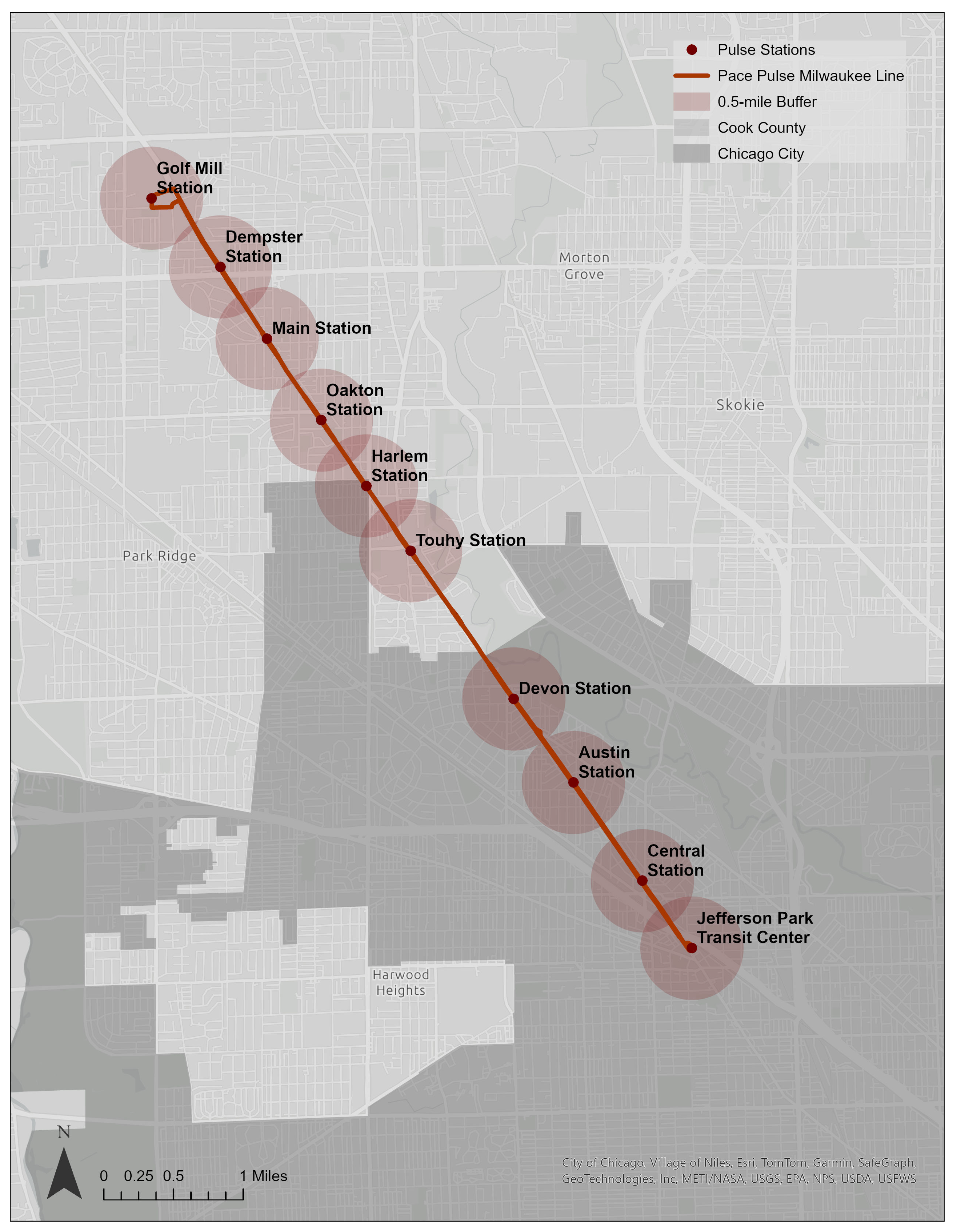
Figure 1 displays the 29 Pulse Milwaukee stops as red points over census tract boundaries in Cook County. The stops follow Milwaukee Avenue from the Jefferson Park Transit Center to Golf Mill Center in Niles, forming a linear corridor. A 0.5-mile buffer around the stops includes 26 treated tracts. The surrounding 0.5–2 mile ring contains 68 tracts that form the comparison group.
Table 1 presents descriptive statistics for the pre-treatment period. Treated and control tracts are similar across most observed characteristics. The employment-to-population ratio is 95.8 percent in treated tracts and 96.0 percent in control tracts. Median household income is USD 83.2 thousand in treated areas compared to USD 82.1 thousand in controls. The share of households without a vehicle differs by only 0.3 percentage points (9.2 percent versus 9.5 percent). Educational attainment and racial composition are also comparable: 40.9 percent versus 42.3 percent college-educated, 64.8 percent versus 59.3 percent white, and 1.8 percent versus 2.3 percent Black.
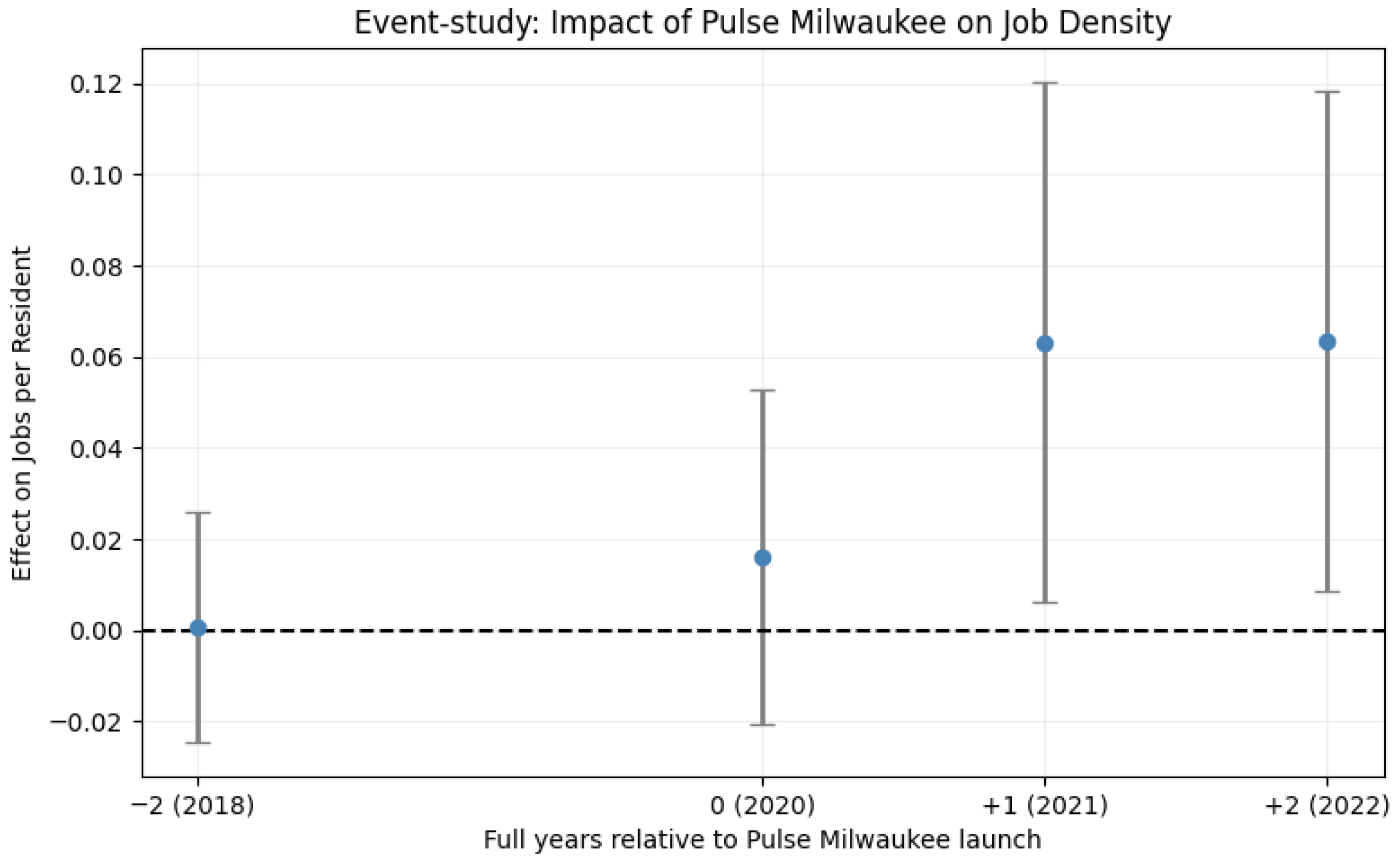
One notable difference appears in baseline workplace job density. Using LODES Workplace Area Characteristics data, jobs per resident average 0.533 in treated tracts and 0.465 in control tracts, a gap of roughly 15 percent. Difference-in-differences estimation does not require identical baseline levels, but it does require parallel trends absent treatment. We therefore examine pre-treatment event-study coefficients to assess the plausibility of this assumption (
Figure 2).
Table 2 reports Welch two-sample
t-tests comparing treated and control tracts in the pre-treatment period. Across all baseline variables shown in
Table 1, we fail to reject equality of means. Two-sided
p-values exceed 0.14 for each of the seven measures—employment-to-population ratio, median household income, zero-vehicle share, college-educated share, White population share, Black population share, and jobs per resident—and most are above 0.50.
The magnitudes of the differences are small. The employment rate differs by 0.2 percentage points, the median income by less than USD 1100, and the share of zero-vehicle households by 0.3 percentage points. The largest observed gap is a 5.5-point difference in the White population share, but even this yields a p-value of 0.14. Overall, the baseline characteristics of treated and control tracts are closely aligned. This similarity supports the credibility of the research design, as it reduces concerns that subsequent difference-in-differences estimates reflect pre-existing economic or demographic differences rather than the service upgrade.
6. The Model
We define treated units as census tracts located within 0.5 miles of a Pulse stop providing high-frequency service (less than 10 min headways during peak hours). Treatment began in August 2019, when the Pulse Milwaukee Line started operating. Control tracts are those located between 0.5 and 2 miles from any Pulse stop and are similar to treated tracts in pre-treatment characteristics.
The 0.5-mile threshold is used as a baseline definition of exposure because it is commonly adopted in U.S. transit planning as a proxy for walking access, roughly equivalent to a 10 min walk [
25,
26]. We treat this distance as a practical convention rather than a strict behavioral cutoff. In the baseline specification, the control group includes tracts between 0.5 and 2 miles from Pulse stops. In alternative specifications, we adjust the control ring to ensure that treated and control areas remain spatially distinct. We also test sensitivity to different treatment radii, including 0.25 and 0.75 miles, and report these results in the robustness section. If service improvements generate spillover effects beyond the 0.5-mile radius, some control tracts may partially benefit from the upgrade. In that case, the estimated treatment effect would be attenuated toward zero. The baseline estimates should therefore be interpreted as conservative.
Let the model components be defined as follows:
: Outcome variable, including workplace job density (jobs per resident), as well as resident outcomes such as the employment rate and median household income;
: Treatment indicator (1 if tract i is near a high-frequency stop);
: Indicator for post-treatment year(s);
: Time-varying controls (e.g., car ownership, race, education);
: Census tract fixed effects;
: Year fixed effects.
The regression equation is
The difference-in-differences design identifies the effect of the Pulse Milwaukee upgrade on
under the assumption that treated and control tracts would have followed similar trends in the absence of the intervention. The framework follows the standard potential-outcomes approach described in [
27]. For household outcomes drawn from the ACS, the estimand compares changes across two multi-year periods rather than annual movements. In these specifications, year fixed effects correspond to ACS reporting periods, not single calendar years.
The analysis compares changes in jobs per resident, employment-to-population ratios, and median household income in tracts within 0.5 miles of Pulse stops to changes in nearby tracts located 0.5 to 2 miles away. The goal is to isolate the effect of the service upgrade. Identification rests on the parallel-trends assumption: absent the Pulse intervention, outcomes in treated and control tracts would have evolved similarly. As discussed in
Section 3, corridor selection reflected operational and ridership considerations rather than expected neighborhood employment growth. The empirical strategy, therefore, relies on parallel trends rather than random assignment.
The model includes tract and year fixed effects to absorb all time-invariant neighborhood attributes and common macro shocks, and it controls for observable time-varying factors such as zero-vehicle share, college attainment, and racial composition. Race is included as a standard neighborhood-level control, reflecting persistent spatial disparities in transit access and labor-market conditions, rather than as a primary dimension of heterogeneity in this analysis. Differences in age structure across tracts are absorbed by tract fixed effects and further addressed through time-varying demographic controls; thus, the identification relies on within-tract changes over time rather than cross-sectional differences in population composition. Workplace employment outcomes from LODES are measured annually, while household outcomes from the ACS are measured as multi-year averages using 5-year estimates; therefore, the year 2020 aggregates both pre-pandemic months and the onset of COVID-19–related disruptions. As a result, coefficient estimates for 2020 should be interpreted cautiously and primarily as a transition period rather than a clean post-treatment effect. The analysis covers annual observations from 2017 through 2022, with 2019 treated as a partial exposure year and 2020–2022 classified as post-treatment. In the baseline DiD tables, ‘post’ refers to 2022; in the event-study specification, we model post-treatment dynamics year-by-year.
The coefficient on treated post in
Table 3 is
with a cluster-robust standard error of
. Because the dependent variable is jobs per resident, this estimate means that, after Pulse Milwaukee began operating, tracts within a 0.5-mile walk gained, on average, 0.066 additional jobs for every resident relative to the change in control tracts. Given a pre-treatment mean of roughly 0.46 jobs per resident, the point estimate corresponds to a 14 percent increase in local workplace density
. This estimate reflects a change in the spatial concentration of workplace employment and should not be interpreted as evidence that residents of treated tracts filled these jobs or experienced improved employment outcomes.
Statistically, the effect is marginally significant: the two-sided p-value is 0.073, so the null of no impact is rejected at the 10 percent level but not at 5 percent. The 95 percent confidence interval ranges from −0.0064 to +0.1394. This interval rules out large negative effects and places an upper bound of about +0.14 jobs per resident (≈30 percent relative to baseline), indicating that any true positive effect is likely between zero and the upper teens in percentage terms. Because our primary outcome is workplace job density (jobs per resident) constructed from LODES workplace employment counts, the estimates should be interpreted as changes in the location of workplace employment near the corridor. The analysis does not measure net job creation at the county level or whether residents of treated tracts filled the additional workplace jobs.
The two additional difference-in-differences specifications from
Table 4 confirm that the Pulse Milwaukee frequency upgrade has not yet translated into measurable gains for resident households. When median household income is the outcome, the treated-post coefficient is—USD 2540 (s.e. USD 3967), yielding a two-sided
p-value of 0.52 and a 95 percent confidence band from—USD 10,430 to +USD 5345. In practical terms, the data rule out income effects larger than about
percent of the pre-treatment mean. Likewise, the employment-to-population regression produces an estimate of −0.007 (s.e. 0.010;
p = 0.47), with the confidence interval spanning from −2.7 to +1.2 percentage points. Both point estimates are small, both standard errors are large relative to the estimated effects, and the robust F-statistics indicate that the control variables explain little additional within-tract variation. Taken together with the earlier job-density result, the evidence suggests that while the corridor has begun to attract workplaces, the shift has not yet filtered through to resident employment rates or median earnings in the three years following the service enhancement.
Because treatment is assigned at the census-tract level, all statistical inference is clustered at the tract level. The analysis includes 94 tracts in total (26 treated and 68 control). To address concerns that conventional cluster-robust inference can be sensitive in finite samples when treatment is assigned at the cluster level, and the treated group is relatively small, we complement conventional tract-clustered inference with restricted wild cluster bootstrap inference at the tract level [
28]. We report both conventional clustered
p-values and wild cluster bootstrap
p-values for transparency in
Table 5.
Restricted wild cluster bootstrap inference proceeds by imposing the null hypothesis that the “treated-post” coefficient equals zero, estimating the model under this restriction, and obtaining tract-level residuals from the restricted fit. In each bootstrap repetition, we draw a random weight for each tract (held constant within that tract), multiply the restricted residuals by these weights to generate a pseudo-outcome consistent with the null, and then re-estimate the original DiD specification on the pseudo-data. Repeating this procedure many times produces an empirical null distribution of the treated-post t-statistic, from which we compute the bootstrap p-value as the share of repetitions producing a statistic at least as extreme as the observed one.
Conventional cluster-robust inference uses an asymptotic normal (or t) approximation that becomes accurate as the number of clusters grows large. In settings like ours, where treatment is assigned at the cluster (tract) level, and the treated group is relatively small, this approximation can be conservative or imprecise in finite samples. Restricted wild cluster bootstrap inference instead constructs a reference distribution for the test statistic under the null by reweighting cluster-level residuals. This method often provides more reliable size control when cluster assignment drives dependence. In our application, both methods yield the same point estimate and t-statistic; the difference arises only from how the p-value is computed.
The point estimates are unchanged, but inference differs when comparing conventional tract-clustered p-values with restricted wild cluster bootstrap p-values. For jobs per resident, the estimated effect is , with a conventional clustered p-value of 0.073 and a wild bootstrap p-value of 0.011, while the income and employment-rate effects remain statistically indistinguishable from zero under both approaches. In this application, the bootstrap yields smaller p-values than conventional clustered inference. Because these approaches can differ in finite samples, we report both for transparency.
7. Robustness Checks
To strengthen the credibility of our empirical findings and ensure they are not driven by particular model assumptions, we conduct a series of robustness and validation checks. These checks include alternative definitions of the treatment area, placebo analyses with false treatment corridors, population-weighted regressions, and an event-study (parallel-trends) analysis. The parallel-trends test explicitly examines whether treated and control tracts were evolving similarly before the introduction of the Pulse Milwaukee service. Additionally, because our study window includes the onset of the COVID-19 pandemic, we acknowledge that this unprecedented shock may have influenced employment dynamics in 2020 and beyond, potentially interacting with or partially confounding the observed effects.
The event-study specification estimates year-specific treatment effects around the Pulse Milwaukee launch, providing a dynamic assessment of pre-trends and post-treatment timing. We estimate the model on the same tract sample used in the baseline analysis (93 tracts observed over 2018–2022; 465 tract-year observations), include tract and year fixed effects, control for time-varying tract characteristics (zero-vehicle share, college share, white share, black share), and cluster standard errors at the tract level.
Table 6 reports coefficient estimates, and
Figure 2 plots these estimates with 95% confidence intervals.
The pre-treatment coefficient for 2018 relative to the omitted baseline year (2019) is essentially zero
, providing no evidence of differential pre-trends. The contemporaneous 2020 estimate is positive but not statistically significant
, consistent with the COVID-19 transition period. In contrast, the post-treatment effects become larger and statistically significant in 2021 and 2022: the estimated increases in jobs per resident are
for 2021 and
for 2022.
Figure 2 shows the same pattern visually: a flat pre-treatment estimate, a small and imprecise 2020 coefficient, and a clear upward shift in job density in the subsequent years. Overall, the event-study results support the plausibility of parallel trends prior to treatment and suggest that the job-density effect emerges after the first pandemic year and persists into later post-treatment years.
We present the event-study results visually in
Figure 2 and report the corresponding coefficients in
Table 6, which together provide a transparent assessment of pre-trends and post-treatment dynamics. The estimates show no evidence of differential trends prior to the Pulse Milwaukee launch, as the pre-treatment lead coefficients are close to zero and statistically insignificant. Post-treatment coefficients are positive and statistically significant for 2021 and 2022, indicating an upward shift in workplace job density after the frequency upgrade. We nevertheless interpret magnitudes cautiously because 2020 is a COVID-19 transition year and because workplace job density reflects job location rather than net job creation.
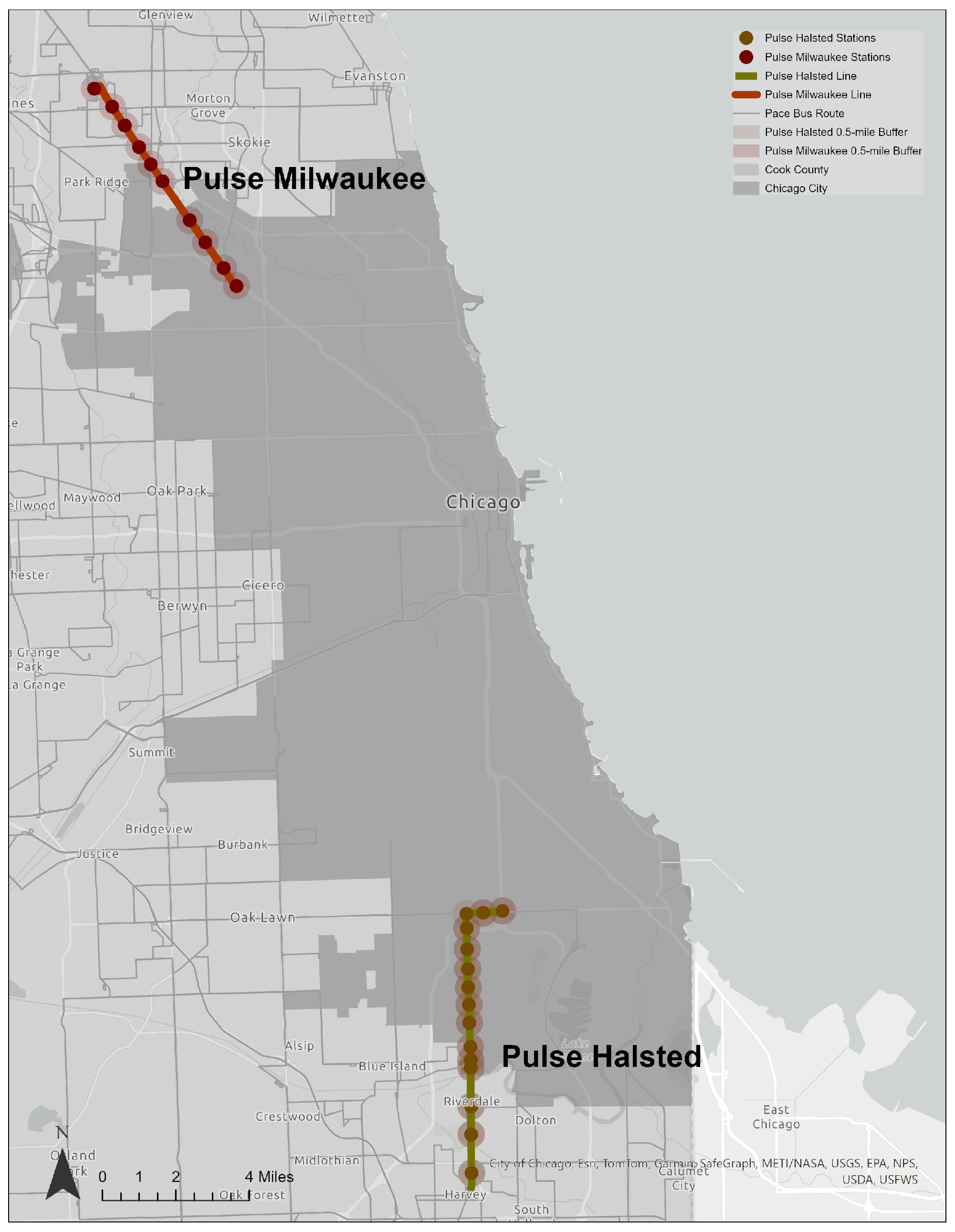
To verify that our difference-in-differences design is not simply capturing spurious spatial or temporal noise, we conduct a falsification test using a “placebo corridor” carved out along Chicago’s Halsted Street. We download the Halsted centerline from OpenStreetMap, re-project it to the Illinois State Plane, and create a 0.5-mile buffer on each side. Every Cook-County census tract whose polygon intersects this buffer is assigned the indicator “treated placebo” = 1. Because Halsted Street never received the Pulse Milwaukee BRT upgrade, any post-period divergence between these placebo tracts and the rest of the county would signal model misspecification.
Before running the regression, we confirm that no buffered tract overlaps our true treatment corridor (
Figure 3) and that the placebo flag exactly matches the tract universe used elsewhere, ensuring identical fixed-effects dimensions and clustering structure. We then re-estimate the baseline model—same controls, tract and year fixed effects, and two-way clustered standard errors—replacing the real interaction with treated placebo × post. A correctly specified model should recover a coefficient statistically indistinguishable from zero. Thus, the main results are not driven by location-specific shocks or county-wide trends unrelated to the Pulse project. Because workplace job density is constructed from LODES Workplace Area Characteristics (workplace job counts), changes in jobs per resident may reflect spatial reallocation of jobs across nearby tracts, establishment churn, or reporting/classification changes in workplace location rather than net job creation. To reduce the risk that nearby relocation contaminates the comparison group, we re-estimate the baseline DiD using a donut-style control definition that excludes tracts immediately adjacent to the treated buffer. These checks clarify interpretation: our workplace estimates are best read as corridor-level changes in workplace job concentration, and we do not claim net job creation.
Table 7 confirms that flagging a 0.5-mile buffer around Halsted Street as “treated” produces no detectable effect: the placebo interaction coefficient is −0.042 (s.e. 0.060), with a wide 95% confidence interval [−0.159, 0.075] and a
p-value of 0.48. All control variables are likewise statistically insignificant. The absence of a measurable change when treatment is fictitious reinforces the validity of our empirical design and indicates that the positive job density gains observed along the Pulse Milwaukee corridor are not driven by coincidental spatial patterns or unobserved county-wide shocks. Baseline demographic differences, including age structure, are largely time-invariant and absorbed by tract fixed effects, making it unlikely that demographic composition explains the null placebo results.
Robustness demands that our findings not depend on a single, arbitrary definition of “treated.” We therefore rebuild the treatment flag three times—using 1/4-mile, 1/2-mile (baseline), and 3/4-mile buffers around Pulse stops—and re-estimate the identical DiD specification each time. For each alternative treatment radius, we redefine the control ring to begin outside the treated radius (a donut design) so that treated and control tracts remain disjoint across specifications. If the Pulse upgrade genuinely increases ridership in nearby tracts, the point estimate should grow (or at least not collapse) as we include tracts that are still plausibly exposed. These buffer-width and donut specifications are intentionally conservative: if spillovers reach nearby tracts, excluding closer controls reduces contamination and strengthens confidence that estimated effects are not overstated.
Table 8 shows that the treatment effect is positive under every buffer choice and becomes both larger and more significant as the radius expands. The quarter-mile band yields a small, statistically indistinct effect
, which is unsurprising because it captures just the innermost walk-sheds and leaves little room for additional boarding growth. Expanding the radius to the baseline half-mile nearly doubles the estimate
and increases the significance level
. A three-quarter-mile buffer pushes the coefficient to roughly 0.08 and crosses the 5% threshold
. This monotone increase is exactly what we would expect if benefits increase with distance, consistent with observed transfer patterns and feeder-bus connections. Because the positive effect persists and even strengthens as the treated zone widens, we can be confident that our headline result is not an artifact of an overly narrow geographic definition.
To examine whether results depend on how observations are aggregated, we re-estimate the specification using population weights, which shift the estimand from an average across tracts to an average across residents. Standard errors are clustered by tract in both specifications.
Population weights are constructed from the pre-treatment tract population (ACS 5-year). For each GEOID, the ACS population is merged to the tract-year panel and broadcast to all years of that tract. Because these are representativeness weights (not inverse-variance weights), we continue to use robust/clustered standard errors rather than relying on model-based WLS variance formulas. The results are in
Table 9.
The population-weighted estimate remains positive but is smaller and less significant than the unweighted baseline ; the 95% confidence intervals overlap). This pattern is consistent with a population-averaged estimand. The sign and order of magnitude are stable across weighting schemes, indicating that the main result is not driven by an arbitrary choice of averaging across tracts; the unweighted two-way FE estimate remains our primary specification, while the weighted specification serves as a robustness check that the effect persists, although non-significant when averaging across populations.
8. Discussion
Our findings shed light on the temporal sequencing of economic impacts following a bus service upgrade. In the short run (the first 1–2 years after launch, roughly 2019–2021), we observe that the number of jobs located in the Pulse corridor tracts increased relative to comparison areas—essentially, local workplace density (jobs per resident) rose in the treated zone compared to the control. This pattern is consistent with an increase in workplace job density near the corridor after the service upgrade; however, with the available data we cannot distinguish net job creation from spatial reallocation of jobs, establishment churn, or reporting/classification changes in workplace location, consistent with the idea that better transit can attract workplaces (e.g., retail, offices, or services that benefit from worker or customer access).
Because nearby control tracts may also experience modest accessibility gains, the estimated corridor effects should be interpreted as lower bounds on the true impact of the frequency upgrade. Importantly, this response does not require an immediate increase in transit ridership by local residents; firms may adjust location or expansion decisions in response to realized improvements in service frequency, reliability, and visibility, even before household travel behavior changes. It is important to note that 2020 represents a transition year in our annual data, combining pre-pandemic months with the onset of COVID-19; consistent with this, we do not observe a statistically meaningful effect in 2020 itself, and the positive job-location effects emerge primarily in 2021–2022 as conditions stabilized.
On the other hand, household outcomes in the corridor—such as the employment rate of residents and average incomes—showed no immediate uptick relative to the controls in that same short window. In plain terms, workplace job density increased near the Pulse corridor, while resident employment rates and median household income did not change measurably over the study horizon. This kind of divergence between workplace impacts and resident impacts aligns with some prior expectations in the literature on transit accessibility and job-location responses (e.g., [
8,
10]).
One interpretation is that workplace activity responds more quickly than household outcomes to a service upgrade; alternative explanations include relocation across nearby tracts, compositional changes in establishments, or measurement/reporting changes in workplace job location data. Our design does not allow us to adjudicate among these mechanisms—for instance, by expanding operations near a transit hub to draw in more customers or employees—whereas residents’ outcomes might lag (people might not find new jobs instantly, or might need to acquire skills to access those jobs, or might even face competition if new jobs attract new immigrants). Our study’s short-run result—jobs responding first, household employment remaining flat—provides empirical nuance to debates about transit and equitable development. It suggests that frequent bus service alone, in the absence of other changes, may not immediately transform the fortunes of existing low-income residents (at least not within a year or two). In the short run, the increase in workplace job density does not appear to translate into measurable gains for incumbent residents. The available data do not allow us to identify which groups ultimately benefit from this reallocation of employment. This is in line with evidence from other contexts. For example, research on Bogotá’s BRT found that employment tended to concentrate in areas with improved transit [
8] (more jobs in accessible central locations) while population shifts (people moving to take advantage of the transit) were slower and constrained by housing supply. The authors noted that without policies to allow more housing in transit-rich areas, the initial benefits of the transit investment accrued more to firms and existing property owners. Our findings echo that pattern on a smaller scale—the Pulse corridor saw an uptick in local jobs (a benefit to the area’s economy), but translating that into improved outcomes for local residents likely requires more time or complementary policies.
It is important to stress that these are short-term impacts. It may be that as the service becomes a fixture and as more riders use it, we might later detect increases in labor force participation or incomes of corridor residents (i.e., if the transit allows previously unemployed individuals to take jobs, or encourages more people to move into the neighborhood for access). However, given the disruption caused by the COVID-19 pandemic and the use of annual outcome data, the early evidence points to a sequence suggested by our findings: first, the accessibility change influences where jobs are located, and only subsequently might it influence the socio-economic profile of the community.
9. Conclusions and Policy Implications
The results from this study carry several policy implications. These implications are offered as suggestive guidance because our data identify corridor-level workplace job density changes but do not measure net job creation, worker origins, or commuting behavior. Because our data do not allow us to distinguish between job creation and spatial reallocation, these implications should be understood as mechanisms for translating corridor-level accessibility changes into household-level gains, rather than as direct prescriptions based on observed employment growth.
First, if a frequent bus service like Pulse is associated with increased workplace job density in the short run, then simply upgrading transit is not a silver bullet for improving resident outcomes such as employment or income levels. Transit agencies and city planners interested in equitable development should consider complementary strategies to magnify the benefits of transit for local communities. For example, land-use and zoning policies could be adjusted in tandem with transit improvements, allowing higher-density or mixed-income housing and commercial development near the new bus stations to enable more people (especially transit-dependent workers) to live close to transit and take those newly attracted jobs. In Chicago’s case, the corridor municipalities could encourage infill development or adaptive reuse of properties around Pulse stops (sometimes termed “transit-supportive development”). Prior research suggests that complementary land-use policies can amplify accessibility-related welfare gains in some contexts. In the Bogotá BRT study, a simulation showed that if the city had relaxed land-use constraints to permit more housing in areas with increased accessibility, the welfare gains from the transit system would have been about 25% higher (and a portion of infrastructure costs could be recouped through land value capture). This indicates that transit + pro-housing policy can yield greater economic benefits than transit alone.
Second, to directly benefit local workers, agencies might implement or partner on workforce programs linked to transit. One idea is ensuring residents have the skills and information to compete for the jobs that arrive in their neighborhood. Another, more immediate intervention is providing transit subsidies or reduced fares for job-seekers and low-income workers so that the improved service is truly accessible to them. There is encouraging evidence on this front: a randomized pilot in Washington, D.C. gave low-income job seekers a transit subsidy of about USD 50/month during their job search, and it significantly boosted their employment prospects [
1]. Those who received the transit assistance applied to more jobs (especially in areas farther away), were nine percentage points more likely to find employment within 6 weeks, and on average had 13 fewer days of unemployment than those who did not receive a pass. External evidence suggests that transit subsidies and job-search support can improve employment outcomes for low-income job seekers; in our setting, these types of programs are plausible complements if the policy goal is to translate corridor-level accessibility changes into household-level gains. In the context of Pulse, a policy example could be a collaboration with local employers to offer discounted transit passes for employees or job-training programs along the route that include transit fare assistance for participants.
Another implication concerns transit network integration. The Pulse Milwaukee Line did interface with other transit (it serves the CTA’s Jefferson Park station at its southern end, connecting with the Blue Line ‘L’ and Metra rail, and links with various local bus routes). However, differences in fare systems or schedules can be a barrier. Policies that improve integration—such as unified fare media (so a transfer from Pace to CTA is seamless or free within a time window) or timed-transfer hubs—could increase ridership and broaden the reach of Pulse-attracted jobs to residents in other transit-dependent neighborhoods. In other words, connectivity and integration amplify the effect of any single line. Studies of large transit systems have emphasized that feeder buses and integrated services produce higher ridership and welfare gains [
8]. For Pulse, ensuring that people from adjacent neighborhoods (not directly on Milwaukee Ave) can easily connect to the service (through coordinated feeder buses or safe bike/walk paths) could help spread the benefits beyond the immediate corridor and potentially draw more employment and development to the area.
From a research perspective, this study underscores the value of open data and reproducible methods in transit evaluation. We demonstrated that by using GTFS and federal datasets like ACS and LODES, one can analyze a corridor-level intervention at a fairly granular level. Going forward, researchers can extend this work in several ways. One extension is to incorporate richer accessibility metrics—for example, calculating how many jobs the average resident of a tract can reach within 45 min by transit, before and after the Pulse service. This could be performed using GTFS-based travel time calculations for multiple origins and destinations (essentially creating a more detailed measure of connectivity than just raw job counts nearby). Another extension is to study spillover effects: did areas just outside the Pulse corridor also experience some changes (maybe a mild increase in jobs or transit usage) due to proximity? Modeling the gradation of impact with distance could inform how far the benefits of a bus improvement spread. Additionally, given the pandemic’s disruptive impact, it would be valuable to observe a longer time horizon. As we move past the acute COVID-19 period, data for 2022, 2023, and beyond might show whether the Pulse line ultimately influenced residential location choices (e.g., did population or demographic mix change near the corridor?), or whether employment gains for locals begin to materialize with a lag. It is possible that only after a few years (and a return to more normal transit ridership patterns) will changes like lower car-ownership rates or higher transit commuting rates among corridor residents become evident. Monitoring these trends over a longer panel will provide insight into the dynamic effects of transit improvements—distinguishing immediate impacts from delayed ones.
In conclusion, the literature and our findings suggest that improving transit frequency and reliability can be associated with changes in local economic geography, but to fully realize equitable outcomes, supportive policies are essential. By pairing service upgrades with proactive measures (in land-use, affordability, and workforce development), cities can help create conditions under which accessibility gains are more likely to translate into household-level improvements; in our data, however, household employment and income effects are not yet detectable over the post-treatment horizon. This holistic approach is increasingly recognized in both research and practice as crucial for making transit investments a catalyst for inclusive economic growth. The Chicago Pulse case contributes new evidence to this discussion, illustrating both the potential and the limits of a transit-first strategy—and pointing toward the integrative solutions needed to bridge the remaining gaps between transit access and employment outcomes.