Article

Spatio-Temporal Analysis of Urban Expansion and Its Impact on Agricultural Land in the Casablanca Metropolitan Periphery

1
Department of Plant Production, Protection and Biotechnology, Hassan II Institute of Agronomy and Veterinary Medicine, P.O. Box 6202, Rabat 10112, Morocco
2
Department of Natural Resources and Environment, Hassan II Institute of Agronomy and Veterinary Medicine, P.O. Box 6202, Rabat 10112, Morocco
3
TEDAEEP Research Team, Department of Life Sciences, Polydisciplinary Faculty of Larache (FPL), Abdelmalek Essaâdi University, P.O. Box 745, Larache 92000, Morocco
4
Laboratoire de Mathématiques Appliquées et d’Informatique Décisionnelle, Modeling, Materials and Computational Sciences Department, National Higher School of Mines of Rabat, P.O. Box 753, Rabat 10000, Morocco
*
Author to whom correspondence should be addressed.
Urban Sci. 2026, 10(4), 207; https://doi.org/10.3390/urbansci10040207
Submission received: 2 November 2025 / Revised: 2 January 2026 / Accepted: 6 January 2026 / Published: 13 April 2026

Abstract

Casablanca, Morocco’s most populous and economically dynamic metropolis, is undergoing rapid and unregulated expansion, leading to accelerated agricultural land artificialization, landscape fragmentation, and growing socio-environmental vulnerability in peri-urban territories. This study investigates the spatio-temporal dynamics of urban expansion within a 40 km buffer around the city, using multi-temporal Landsat imagery (2015–2025), a GIS-based framework, and supervised classification. Four land-cover classes were extracted (urban, vegetation, forest and water) enabling a diachronic comparison of land transformation processes. Two spatial indicators were mobilized to quantify urban dynamics: the Average Urban Expansion Rate (AUER) and the Urban Expansion Intensity Index (UEII). Results reveal that urban areas expanded by up to 387.9% in some communes, with 15 exceeding an AUER of 25% and 17 falling within the “very high development” category based on UEII thresholds. Land artificialization was most intense along southern and southeastern peripheries, notably Deroua, Tit Mellil, Had Soualem, and Sidi Moussa Ben Ali, resulting in severe fragmentation of agricultural land. The classification of communes into four profiles (fast, slow, consolidated, and stable) highlights varying degrees of territorial vulnerability. By integrating demographic trends (2014–2024), the study exposes mismatches between population growth and land consumption, underscoring the urgent need for integrated spatial diagnostics and governance reforms toward sustainable peri-urban land management.

1. Introduction

Urbanization is now widely recognized as one of the major markers of global change [1]. Driven by global economic growth, it has significantly accelerated in recent decades, profoundly transforming the physical configuration of territories. Rapid city development has been fueled by rising birth rates, population growth and massive migratory flows [2,3,4]. As such, urbanization has become a critical development issue across most countries worldwide [5].
In developing countries, metropolitan areas have expanded extensively under demographic pressure and industrial development [6,7]. This process of metropolization has led to major changes in land use, particularly along urban fringes, where agricultural land is increasingly fragmented, encroached upon, or converted to non-agricultural uses. This trend is especially visible in large African cities, where urban growth often occurs laterally and without consolidation of urban cores, resulting in unplanned suburban sprawl [8,9].
Known as urban sprawl, this phenomenon is associated with several negative impacts: rapid land artificialization, biodiversity loss, fragmentation of agricultural systems, increased vulnerability of peri-urban populations, and more complex urban governance challenges. Climate change, environmental degradation, and resource depletion, largely driven by decades of uncontrolled urban growth, now pose serious threats to public health, essential ecosystem services, and food security [10,11,12]. Although some recent data suggest a slowdown or even stagnation in urban growth across parts of Sub-Saharan Africa [9], there is general consensus that the cumulative impacts of past urban expansion continue to challenge sustainable development and effective urban management.
In Morocco, rapid urbanization combined with strong demographic growth poses significant challenges for urban planning and environmental management, particularly in Casablanca, the country’s economic hub and a symbol of national urbanization [13]. Urban development has profoundly reshaped the national territory, with nearly 60% of the population now living in urban areas, compared to only 35% in 1970. This trend is expected to continue, reaching approximately 75% by 2050. The Greater Casablanca region, as the economic heart of the country, concentrates a significant share of the national population, GDP, and investment. However, this accelerated urbanization has not always been accompanied by equitable development or sufficient structural transformation of the economy. Urban expansion has often occurred at the expense of agricultural land, in the absence of adequate territorial coordination, leading to fragmented, costly, and unsustainable forms of urban development. In this context, better understanding and mapping these sprawl dynamics is a crucial prerequisite for guiding public policies toward more controlled and inclusive urbanization.
The Casablanca metropolitan area exemplifies these dynamics. Since the 1990s, its outskirts have been under intense land pressure, reflected in the continuous expansion of residential buildings, industrial zones, and infrastructure at the expense of agricultural land. Several studies have shown that the Casablanca agglomeration is gradually absorbing neighboring rural communes, reshaping the spatial and functional balance of the entire region.
The use of multi-temporal satellite imagery combined with Geographic Information System (GIS) tools has become an essential approach for analyzing land use and urban expansion. Recent studies have highlighted the effectiveness of this method in detecting and quantifying land use changes over time, particularly in regions experiencing rapid urbanization [14,15]. These works emphasize the central role of satellite data, such as from Landsat sensors, in generating reliable spatial evolution maps, while facilitating diachronic analyses at various territorial scales.
The rise in remote sensing and GIS now represents a key lever for analyzing contemporary urban dynamics. The integration of multi-temporal satellite images, supervised classification techniques, spatial indices, and advanced geospatial processing enables an objective, reproducible, and detailed understanding of urban fabric evolution. Numerous studies have demonstrated the ability of these tools to characterize the intensity, direction, and forms of urban expansion, while providing strategic support for sustainable urban planning, especially in rapidly growing contexts [16,17,18,19].
To delineate peri-urban agriculture around the Casablanca metropolitan area, a 40 km radius from the city center was adopted. This choice is based on several reference studies that have defined peri-urban zones as extending between 30 and 40 km from urban centers, particularly in comparable African contexts [20,21,22]. Most agri-urban programs in Île-de-France are also located within 30 km of central Paris, further supporting the relevance of a 30 to 40 km spatial threshold for defining peri-urban areas [23]. Studies conducted in Kumasi, Bamako, and Dakar have likewise employed this threshold to analyze agricultural dynamics and irrigated land in urban [24]. Beyond this distance, agricultural characteristics tend to diverge from those typically associated with peri-urban dynamics. Moustier [25] notably emphasizes that beyond a 50 km radius, agriculture no longer exhibits the specific features of peri-urban systems, such as market proximity, land tenure conflicts, or facilitated access to agricultural inputs.
This research falls within that framework, employing remote sensing and GIS tools to analyze land-use changes within a 40 km radius around Casablanca between 2015 and 2025. The objective is to characterize the pace and patterns of urbanization in the metropolitan region and to assess the resulting pressures on peri-urban agricultural spaces.
To guide the analysis, several hypotheses were formulated. They concern both the intensity of urbanization dynamics and their impacts on local agricultural systems. It is hypothesized that the rapid expansion of urban areas leads to a significant reduction in available farmland, fragmentation of peri-urban agroecosystems, and a deterioration in their sustainability. These effects are expected to vary across municipalities, reflecting territorial inequalities in exposure to land-use pressure.
From this perspective, the present study examines the effects of rapid urbanization in the Casablanca metropolitan area on land dynamics and the viability of peripheral agricultural systems. It aims to understand the extent to which urban expansion between 2015 and 2025 alters the spatial distribution, continuity, and resilience of urban and peri-urban agricultural spaces. To address this, the research is guided by the following key questions:
  • What is the extent, form, and spatial distribution of urbanization across the extended metropolitan area of Casablanca during the study period?
  • Which municipalities experience the highest levels of land pressure on agricultural areas, and along what intensity gradients?
  • To what extent can urbanization dynamics be correlated with the levels of sustainability or vulnerability of local farming systems?
  • How can the spatial results inform planning policies and promote better integration of agriculture within sustainable territorial development?
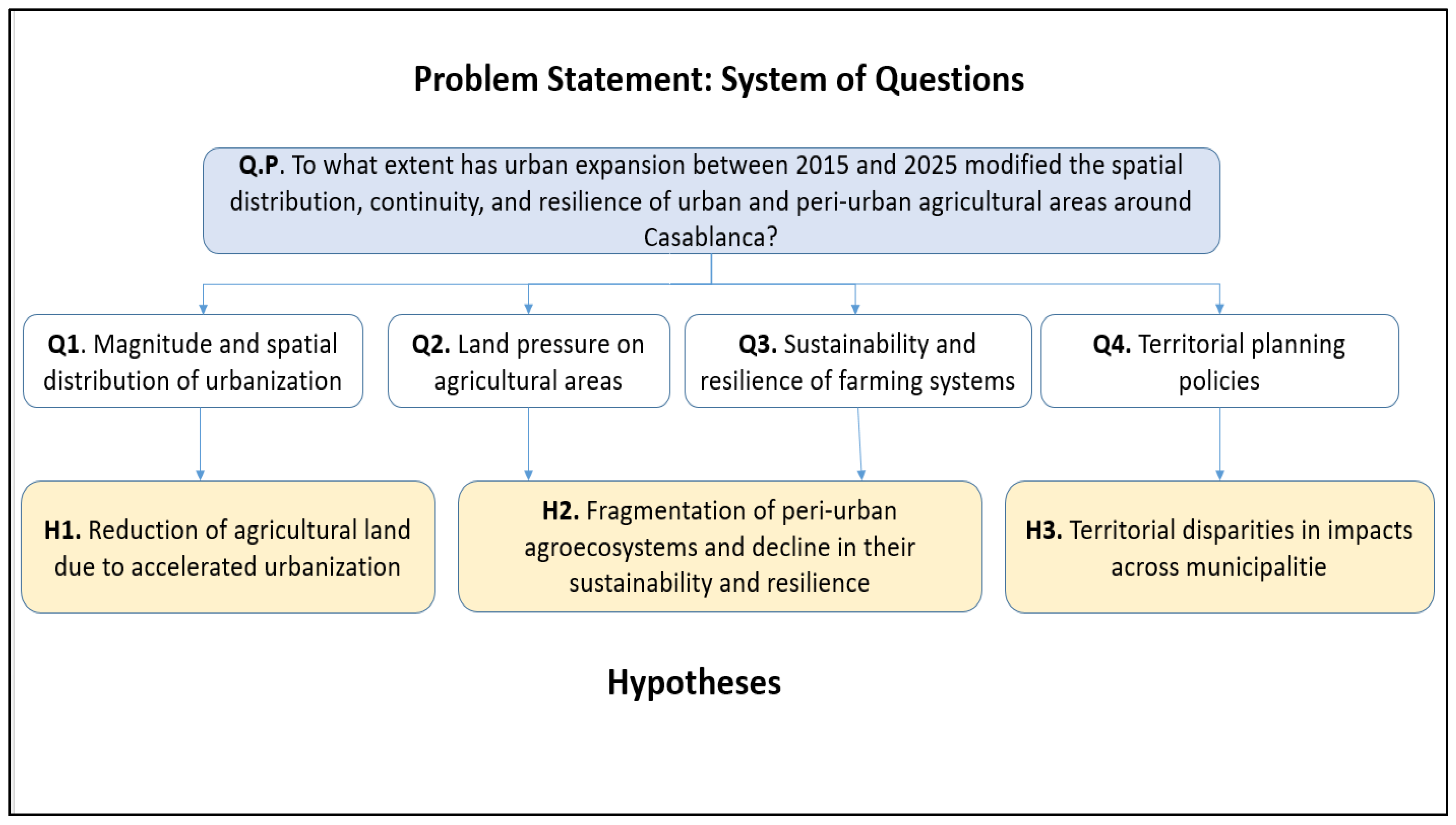
The relationship between the general research problem, the research questions, and the proposed hypotheses is summarized in Figure 1 below. The expected results of this study aim to provide a valuable scientific contribution to strategic thinking on agricultural land management, sustainable urban planning, and territorial resilience. By highlighting the often-overlooked spatial dynamics of urban peripheries, this research seeks to inform public debates on land use, spatial equity, and the preservation of agricultural resources in the face of growing urbanization.
This diagram summarizes the relationship between the central research problem, the main questions posed, and the formulated hypotheses. It highlights the guiding thread of the study, from the analysis of urbanization dynamics in the Casablanca region to the assessment of their effects on the sustainability of urban and peri-urban agricultural systems. Each research question sheds light on a specific aspect of land pressure, while the hypotheses help interpret the anticipated impacts on agricultural areas.
The primary objective of this research is to identify, characterize, and map the spatio-temporal dynamics of urbanization within municipalities located within a 40 km radius around the city center of Casablanca, over the 2015–2025 period. It focuses on analyzing major land-use transformations, with a particular emphasis on the conversion of agricultural and natural areas into built-up surfaces.
The study measures the magnitude and spatial distribution of urban expansion using multi-temporal satellite images processed through supervised classification. It also employs quantitative indicators, notably the Average Urban Expansion Rate (AUER) and the Urban Expansion Intensity Index (UEII), to, respectively, quantify the speed and intensity of territorial transformation. This enables the identification of the municipalities most exposed to urban pressure, considering both the absolute urbanized surface and the proportion of land converted relative to the total area of each municipality.
Based on this analysis, the study establishes a ranking of municipalities according to their level of exposure to urbanization and examines the impacts of this dynamic on the sustainability and resilience of urban and peri-urban farming systems. This approach provides a robust foundation for guiding field surveys and informing sustainable land-use planning policies in the Casablanca region.
The main expectations of this spatio-temporal analysis are manifold. The study has generated land-use change maps for the 2015–2025 period, allowing the visualization of major transformations within the study area. It also produced tables and graphical representations tracing changes in land cover per municipality. Additionally, the analysis enabled the systematic inventory of impacted municipalities, distinguishing between various levels of observed urban pressure.

2. Materials and Methods

2.1. Study Area Description

This study focuses on the metropolitan area of Casablanca, the economic capital of the Kingdom of Morocco, located on the Atlantic coast approximately 90 km southwest of Rabat. Casablanca is the most populous city in the country, with 3.24 million inhabitants recorded in 2024, and its greater metropolitan area exceeds 4.27 million residents. The city accounts for 46% of the urban labor force and contributes a significant share of the national GDP. Casablanca lies at the heart of the Casablanca-Settat region, the most populated region in Morocco with 7.689 million people, more than 20% of the national population, and a high urbanization rate of 73.3% [26].
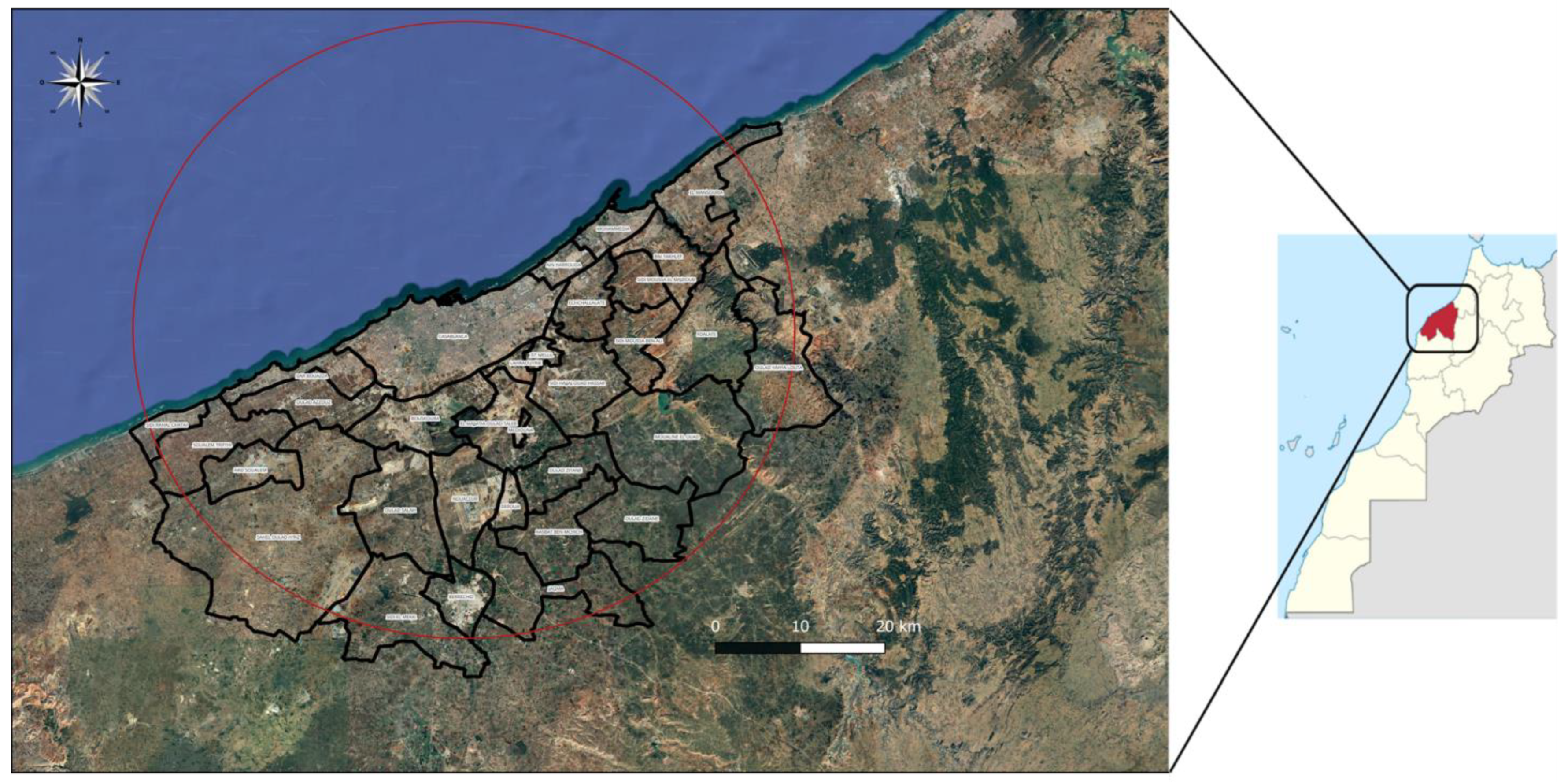
The analytical perimeter used in this study encompasses a 40 km radius around the city center of Casablanca. This spatial scope covers not only the municipality of Casablanca itself but also a set of urban, peri-urban, and rural municipalities from various provinces within the region. Such an approach allows for capturing real urbanization dynamics beyond strict administrative boundaries by integrating transitional zones where the main land pressures and land-use transformations occur. It includes municipalities with diverse socio-territorial contexts, ranging from densely urbanized areas to still-active agricultural zones, making it a particularly relevant setting for cross-analysis of urban expansion, sustainability, and agricultural resilience (Figure 2).

2.2. General Approach of the Spatio-Temporal Analysis

This study adopts an integrated geospatial approach that combines multi-temporal remote sensing, GIS-based spatial analysis, supervised classification of satellite imagery, and quantitative assessment of land-use change at the municipal scale. The study area is defined by a circular buffer with a 40 km radius around the geographic center of Casablanca, encompassing the dense urban fabric, rapidly changing peri-urban extensions, as well as surrounding agricultural and rural areas. This perimeter is overlaid with the administrative division of Moroccan municipalities provided by the Haut-Commissariat au Plan (HCP), enabling a comparative analysis of land-use dynamics by municipality over the 2015–2025 period.
Recent advances in geomatics, including improved access to high-resolution satellite imagery and the development of GIS tools, now allow for precise visualization and quantitative analysis of land-use change and urban expansion patterns. Several studies have demonstrated the effectiveness of combining multi-temporal remote sensing, supervised classification, GIS, and spatial indicators to evaluate urban form evolution in diverse contexts, particularly in Africa and the Mediterranean [16,17,27,28]. The present study follows this approach by mobilizing multi-date Landsat imagery, GIS tools, and supervised classification techniques to characterize the spatial evolution of urbanization in Casablanca and its surroundings.

2.3. Sources and Types of Data Used

The selection of data used in this study is based on its ability to reliably document recent land-use changes in the metropolitan area of Casablanca. The analysis relies on satellite images acquired at two key dates, 2015 and 2025, enabling the measurement of urban transformations over a recent decade.
Several studies adopt a time interval of approximately 10 to 15 years between images to detect significant trends in land-use change [14,16,29,30,31]. This interval is suitable for capturing marked urbanization dynamics while remaining consistent with the availability of Landsat time series. The present research uses satellite data from the Landsat program (Landsat 7 ETM+—2015, Landsat 8 OLI/TIRS—2025).
These data were downloaded from the official EarthExplorer platform of the United States Geological Survey (USGS). Image selection was based on a cloud cover threshold below 10%, to ensure optimal spectral quality, especially in peri-urban areas where land-use transitions may be subtle [16,29].
The technical specifications of the Landsat images used (Table 1), including sensors, spectral bands, path/row coordinates, acquisition dates, and intended use, ensure the temporal and spatial consistency required for a diachronic analysis of land-use change.
In addition to satellite imagery, this study uses an administrative boundary dataset of communes provided by the Haut-Commissariat au Plan (HCP), which is essential for spatializing the analysis at the communal scale and for cross-referencing results with official demographic data.
The processing of spatial data is carried out using QGIS (version 3.40.5, QGIS Development Team, Open Source Geospatial Foundation) [32], an open-source geographic information system, particularly through the Semi-Automatic Classification Plugin (SCP) (version 8.4.0, Luca Congedo, Rome, Italy) developed by Congedo [33]. This plugin is specifically designed for the import, preprocessing, classification, and export of satellite images. It enables the integration of multiple processing steps, including radiometric correction, supervised classification, and the generation of thematic maps at the communal scale.

2.4. Preprocessing Steps of Satellite Images

The preprocessing of satellite images is a crucial step to ensure temporal comparability and the reliability of classifications [34,35]. In this study, all processing was conducted using QGIS software (version 3.40.5, QGIS Development Team, Open Source Geospatial Foundation) and the specialized Semi-Automatic Classification Plugin (SCP) (version 8.4.0, Luca Congedo, Rome, Italy), known for its compatibility with Landsat images and its ability to integrate atmospheric and radiometric correction modules. The Landsat images from 2015 and 2025 underwent a series of standard procedures recommended by USGS technical guidelines and validated by numerous prior studies:
  • Radiometric correction: Digital Number (DN) values were converted to radiance and then to surface reflectance using calibration coefficients (gain and offset) extracted from Landsat metadata. This step is essential to ensure spectral consistency between the Landsat ETM+ and OLI/TIRS sensors [18].
  • Atmospheric correction: Particularly critical in diachronic studies, as differences in acquisition phases may bias change detection if atmospheric disturbances are not corrected. This correction minimizes spectral variations caused by atmospheric effects, ensuring the reliability of calculated spatio-temporal indicators. It was performed using the Dark Object Subtraction (DOS1) model integrated into the SCP [33].
  • Spectral band stacking: The spectral bands needed for classification were combined for each image. The selection focused on the visible (green, red) and near-infrared bands, which alone contain over 90% of the useful spectral information for vegetation analysis. These wavelengths are also the most relevant for detecting changes related to land artificialization and vegetation loss [36,37].
  • Spatial clipping: Finally, each image was clipped using two geographic criteria: (1) a 40 km circular buffer around Casablanca’s city center; (2) the administrative boundaries of communes (from HCP data), enabling quantitative analyses at the communal level.
Several authors emphasize the importance of these operations to ensure consistency in inter-temporal comparisons, especially when analyzing land cover changes over extended periods [17,28]. This protocol ensures inter-temporal comparability, spectral reliability of indices, and the spatial coherence required for robust detection of urbanization dynamics.

2.5. Supervised Classification Method

The land use analysis is based on a multispectral supervised classification applied separately to each image (2015 and 2025) using the SCP in QGIS. This approach enables the production of consistent and comparable land use maps over time, relying on spectral signatures learned from training data. The classification distinguishes four major land cover classes:
  • Water (blue): water bodies, lakes, reservoirs, or visible rivers
  • Built-up areas (red): dense constructions, subdivisions, industrial or urban infrastructure.
  • Vegetation (yellow): agricultural fields, green areas, bare soil (fallow), shrublands, rangelands, and non-built areas.
  • Forests (green): areas characterized by continuous tree cover with relatively high canopy density, including forest plantations, wooded patches, and mature tree stands.
Training sites were defined for each class through manual photo-interpretation (using Google Earth imagery, field knowledge, and topographic maps). These samples guide the algorithm in identifying typical spectral signatures for each category.
Several classification algorithms were tested: Random Forest, Support Vector Machine (SVM), Minimum Distance, and k-Nearest Neighbor (KNN). After visual assessment and performance testing on both dates, the KNN algorithm was selected for its robustness, ease of parameterization, and stable performance in multispectral environments, especially in areas with blurry boundaries between classes.
KNN is well known for its ability to handle datasets with low spectral complexity, such as 30 m Landsat images, particularly when classes have closely related signatures. Several studies confirm the reliability of KNN for land cover classification in similar contexts [17,18,28].
In this multi-class objective study, supervised classification using KNN effectively captured the spatial and spectral contrasts associated with urbanization, while limiting the risk of spectral confusion inherent to mixed peri-urban landscapes.

2.6. Post-Classification Analysis and Map Production

Following the classification process, the raster results are converted into vector polygons using QGIS processing tools. This conversion is essential for accurately calculating the area occupied by each land cover class, for both years of analysis (2015 and 2025), and at the scale of each municipality. Switching from raster to vector format offers several methodological advantages: it facilitates the integration of classified data with administrative boundaries (municipalities, provinces), allows for multi-level statistical aggregation (e.g., area per municipality or by regional grouping), and enhances the cartographic readability for end users [27,31].
For each classified image, the surface area of each class is calculated by intersecting with the administrative boundaries of the municipalities (HCP database), using the “intersection” function followed by “zonal statistics.” The results are exported in tabular format (CSV) and integrated into an attribute table to enable temporal analysis of changes.
In parallel, harmonized thematic maps are generated for each year (2015 and 2025). A unified legend is applied across all maps to ensure visual and comparative consistency over time. The color scheme is standardized as follows: blue for water, red for built-up areas, yellow for vegetation, and green for forests. The maps are produced in accordance with the municipal boundaries and the 40 km study perimeter, facilitating comparative and spatial interpretation of urban expansion, vegetation loss, or land artificialization.

2.7. Classification Validation

Validating classification results is a crucial step to ensure the quality and reliability of the produced maps. In this study, both quantitative and visual validation approaches are used, in accordance with standard methodologies in remote sensing [38,39].
Validation Method: For each year (2015 and 2025), a confusion matrix is generated based on an independent sample of 160 validation points randomly distributed across the different land cover classes. These points are manually extracted through photo-interpretation using high-resolution imagery (Google Earth) and field knowledge.
Performance Indicators: Based on the confusion matrix, the following indicators are calculated:
  • Overall Accuracy: The percentage of correctly classified pixels. An accuracy above 85% is generally considered acceptable in most land cover classification studies [38].
  • Kappa Index (K): Measures the agreement between the classification and ground truth, correcting for chance agreement. A Kappa value between 0.81 and 0.99 indicates very strong agreement. However, a Kappa greater than 0.99 may indicate overfitting, especially when training data are highly homogeneous or insufficiently distinct [40]. This risk is therefore considered when interpreting the results. This caution is supported by the study of Oyesiji [31], in which the authors used the same indicators to validate a classification in West Africa, achieving a Kappa index of 0.9898, demonstrating a very good match between identified classes and ground reality.
  • Class-specific Accuracy (User’s Accuracy & Producer’s Accuracy): These metrics help detect class-specific errors, distinguishing between omissions (under-classifications) and commissions (over-classifications).
These results help identify the most robust classes and highlight where classification errors persist, often due to spectral similarity in mixed peri-urban zones.

2.8. General Workflow of the Methodological Approach

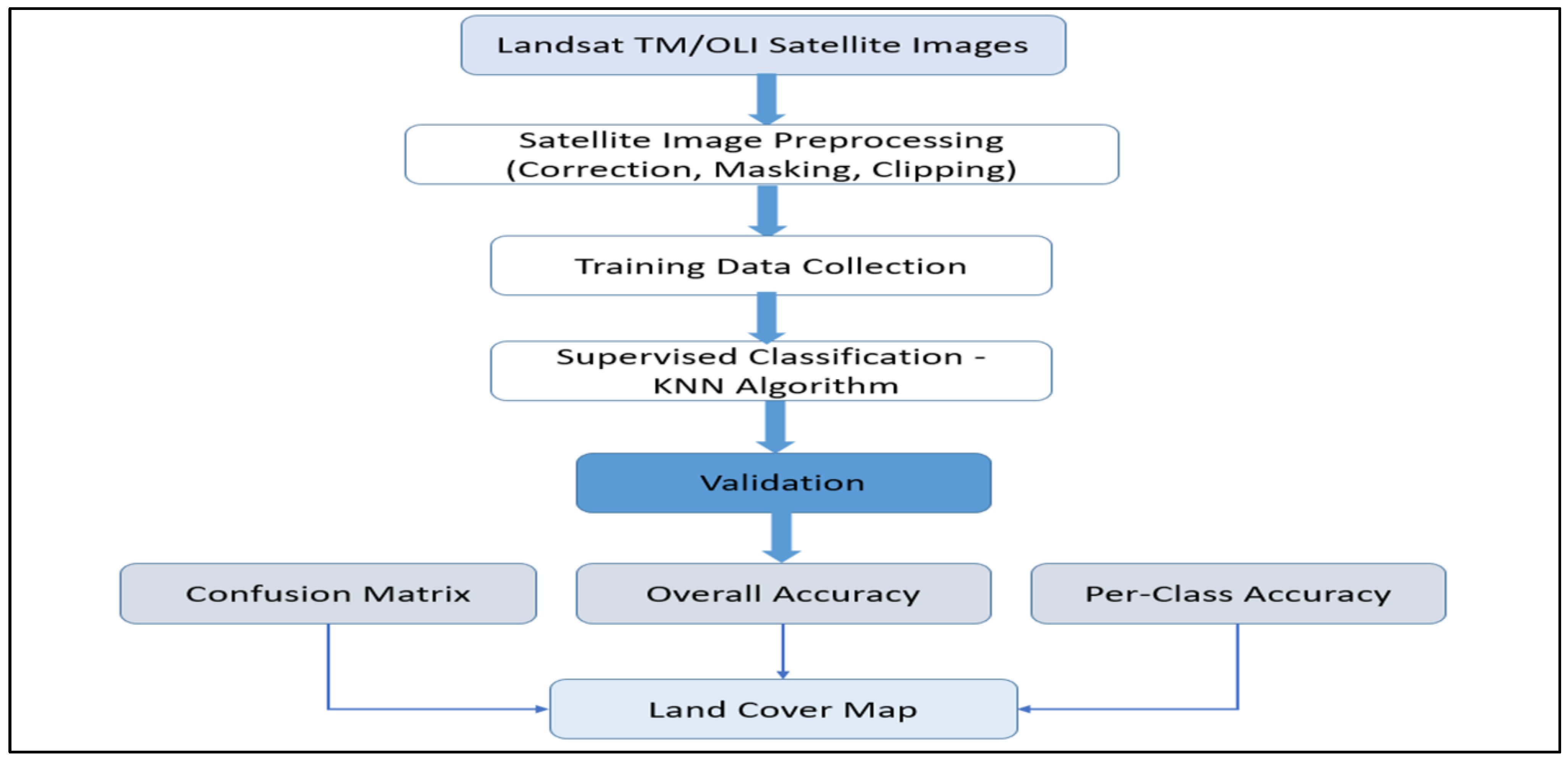
Figure 3 below provides a visual summary of the steps followed to produce the land use/land cover maps in this study. It outlines the main processing phases of satellite imagery, from acquisition to validation of results, passing through preprocessing and supervised classification. This schematic highlights the logic of the adopted approach, based on the KNN algorithm and the assessment of classification performance using accuracy metrics.
This diagram illustrates the processing sequence, including satellite image preprocessing steps such as radiometric correction, cloud masking, and spatial clipping, followed by training data collection, supervised classification using the KNN algorithm, and validation steps (confusion matrix, overall accuracy, and class-specific accuracy), leading to the generation of the final land use/land cover maps.
The implementation of this methodology led to the production of a series of cartographic outputs aimed at precisely characterizing urbanization dynamics within the study area. At the cartographic level, land use maps were generated for the two reference years, 2015 and 2025. These maps allow for the visualization of the spatial distribution of major land cover classes (water bodies, vegetation, bare land, and built-up areas) and help track their evolution over the study period.
In addition, a transition map was created to illustrate the major changes that occurred between 2015 and 2025, with a particular focus on the conversion of vegetated and agricultural areas into built-up surfaces. This map accurately pinpoints the most intense urbanization dynamics and analyzes their spatial distribution across the 40 km perimeter surrounding the center of Casablanca.
From an analytical perspective, a systematic inventory by municipality was conducted, based on the calculation of transformed areas, the conversion of agricultural land into urban areas, expressed both in hectares and as a percentage of the total municipal surface. These results are presented in Excel tables, facilitating comparative analysis across municipalities and quantitative identification of the most affected areas.
Based on these analyses, a ranking of municipalities was established according to their level of impact, by combining the absolute area of converted land and its relative proportion in relation to each municipality’s total area. This ranking clearly distinguishes the municipalities most exposed to urbanization dynamics.

2.9. Indicators of Urban Expansion: AUER and UEII

To quantify the spatio-temporal dynamics of urban expansion in the Casablanca metropolitan area, this study relies on two complementary indicators widely used in the literature: the Average Urban Expansion Rate (AUER) and the Urban Expansion Intensity Index (UEII) [16,30,31]. These two complementary metrics, respectively, characterize the speed of built-up area growth (AUER) and its relative intensity in proportion to the total area of a given territory (UEII). Together, they provide a comparative framework for analyzing heterogeneous regions across different time periods and serve as a rigorous basis for assessing land pressure driven by urbanization.
In this study, these indicators are applied to all municipalities within a 40 km radius around Casablanca, covering the period from 2015 to 2025. The objective is to quantify the pace of land artificialization and to identify the zones most impacted by urban expansion.
AUER reflects the average annual rate of increase in built-up surface area over a given time span. Expressed as a percentage, it facilitates comparisons across municipalities regardless of their initial size [16]. It is calculated using the following formula:
A U E R =   l n S 2 S 1 t 2 t 1
where
  • S1 is the urbanized surface area at the initial date,
  • S2 is the urbanized surface area at the final date,
  • t2t1 represents the number of years between the two dates,
  • ln denotes the natural logarithm.
The second indicator, UEII, measures the relative magnitude of annual urban expansion as a proportion of the total area of each municipality [41]. It thus assesses the overall land pressure exerted on the municipal territory, regardless of the initial size of the urban fabric. UEII represents the average annual proportion of newly urbanized land relative to the total area of the spatial unit under study [30].
According to Abdullahi & Pradhan [42], this indicator serves as a robust tool for anticipating the potential direction and future intensity of urban dynamics, while enabling a rigorous comparison of land-use transformation speed across different time periods. It is defined by the following formula:
U E I I = ( S 2 S 1 )   S   t o t a l   × ( t 2 t 1 )
where
  • S1 is the urbanized area at the initial date,
  • S2 is the urbanized area at the final date,
  • t2t1 is the number of years between the two dates,
  • S total is the total surface area of the municipality.

3. Results

As part of this analysis, land use maps were produced to document and visualize the spatial dynamics of urbanization in the Casablanca region. These thematic maps were generated for each reference year, namely 2015 and 2025. Each map displays the spatial distribution of the main identified land use classes: water bodies, built-up areas, agricultural zones, and forests. The maps cover all municipalities located within a 40 km radius around the center of Casablanca, thus providing a coherent overview of territorial changes over the decade.
These cartographic representations offer a direct visualization of the gradual expansion of urbanized areas and the relative decline of agricultural and natural spaces. They serve as an essential tool for understanding urbanization dynamics and guiding subsequent analyses on the impact of these transformations in peri-urban territories.
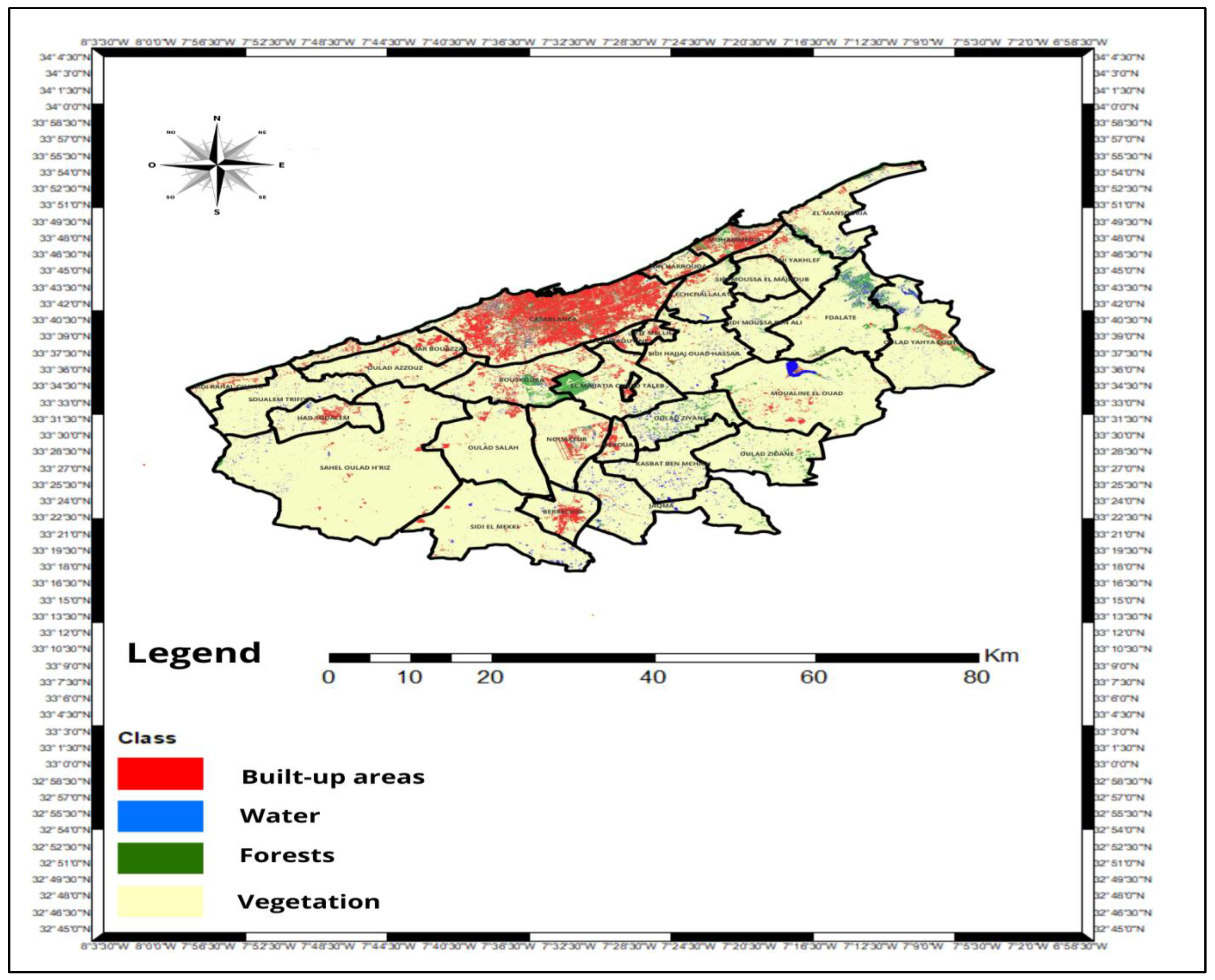
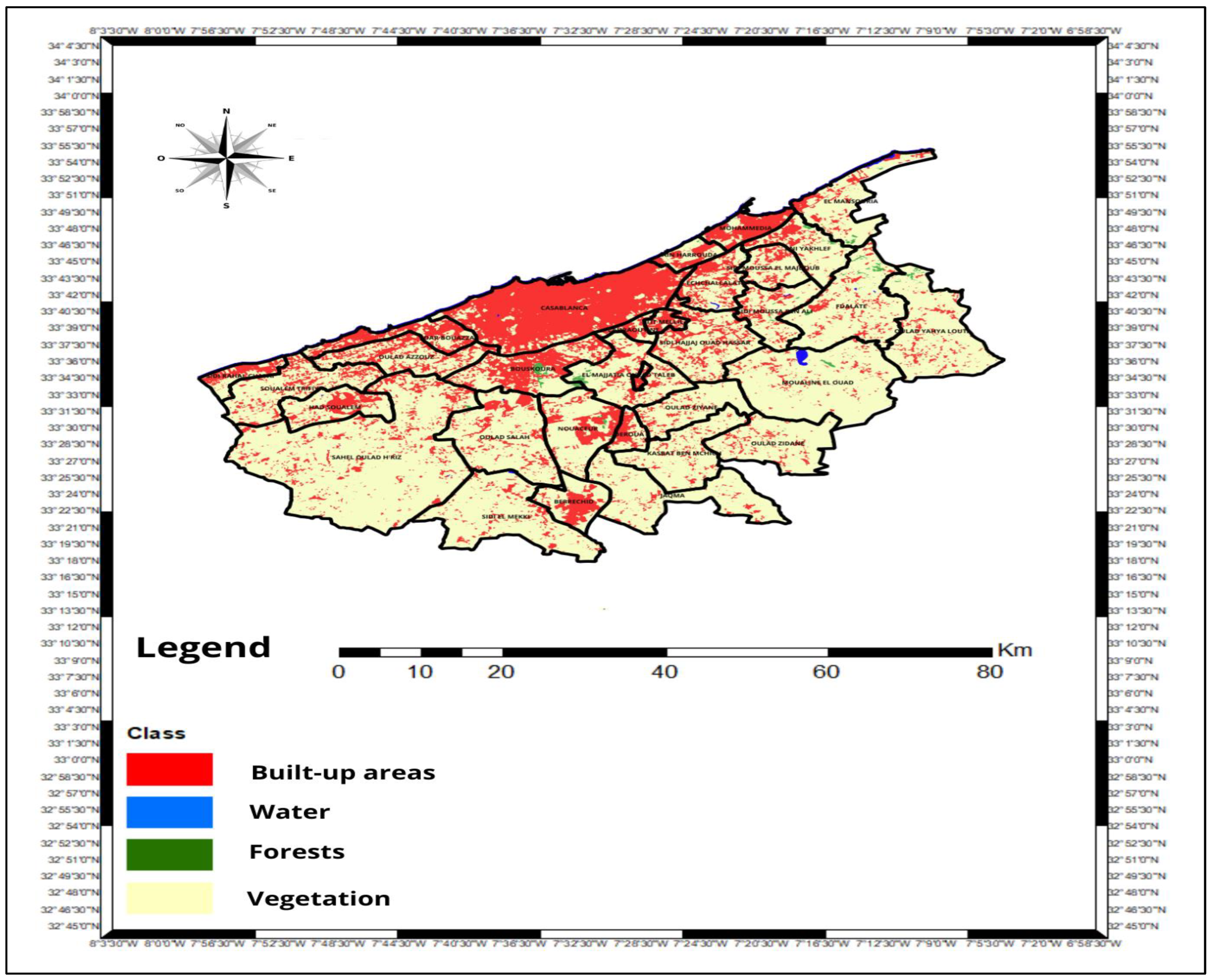
The 2015 land use map (Figure 4) highlights a significant concentration of urbanization in the northern half of the study area, particularly around the municipality of Casablanca and its neighboring municipalities such as Mohammedia, Ain Harrouda, Mediouna, Bouskoura, and Nouaceur. Built-up areas (in red) form a continuous urban front along the Atlantic coast, confirming the coastal zone’s attractiveness for infrastructure, housing, and economic activities.
Additionally, secondary urban clusters appear in some southern municipalities, notably in Berrechid, revealing a spreading dynamic of urbanization toward peri-urban areas. In contrast, agricultural areas (light yellow) still largely dominate the landscape in inland rural municipalities such as Sidi Rahal, Ouled Azzouz, and Sahel Ouled H’Riz, although increasingly fragmented by scattered urban patches.
Forested areas (in green) are scarce and limited to a few residual patches, while water zones (in blue) are highly localized (dams and small reservoirs). Overall, the map confirms strong land pressure on peri-urban agricultural areas, especially within a 20 to 30 km radius around Casablanca.
The 2025 land use map (Figure 5) reflects an intensification and generalization of urbanization dynamics across Casablanca’s peri-urban territory. Compared to earlier periods, the expansion of built-up areas (in red) now extends significantly beyond the central core, forming a continuous urban belt that includes adjacent municipalities such as Bouskoura, Tit Mellil, Médiouna, Nouaceur, and Dar Bouazza.
Urban development spreads in a diffuse and polycentric manner toward the south and east, now reaching more distant rural municipalities such as Ouled Salah, Oulad Azzouz, Berrechid, Sidi Rahal Chatai, Lahraouyine, Sahel Ouled H’Riz, and Had Soualem. This expansion is evidenced by the multiplication of scattered built-up clusters within agricultural zones, revealing increasing fragmentation of the rural fabric and continued artificialization of cultivated land. This transformation is particularly apparent along major regional roads and near newly developed industrial and logistics zones. Vegetated areas and agricultural land, which were dominant in earlier periods, have been pushed toward the margins of the study area. Forested zones remain scarce, and water bodies (in blue) remain stable, in contrast with the high pressure exerted on arable land.
Overall, these results illustrate the rapid advance of the metropolitanization process, characterized by uncontrolled horizontal expansion and accelerated consumption of agricultural and ecological land. The map highlights the diffuse nature of urbanization, the growing intensity of spatial occupation, and the gradual shift in the urban frontier toward the most peripheral municipalities of the region.
While these maps provide a visual assessment of urban expansion patterns, the magnitude of agricultural land conversion is quantitatively assessed in the following sections through surface change metrics and percentage-based indicators.
Based on the land use maps developed for the years 2015 and 2025, a quantitative extraction was carried out to calculate the surface areas occupied by each land use class. Particular attention was given to the evolution of built-up areas, as the main indicator of urban expansion. These data were subsequently used to calculate the AUER and UEII values, as defined in Section 2.9, in order to quantify the rate and intensity of urbanization at the municipal scale.
The AUER and UEII indicators were applied to all municipalities within a 40 km radius around the city center of Casablanca over the 2015–2025 period. Their use makes it possible to objectively characterize the observed spatial dynamics and to establish a differentiated ranking of municipalities based on the degree of urban pressure exerted on their territory. The following Table 2 presents the raw values calculated for AUER and UEII per municipality over the entire study period.
The analysis of AUER reveals differentiated urbanization dynamics within the municipalities of the Casablanca metropolitan area. The rates calculated over the 2015–2025 period vary considerably, reflecting both the saturation of the central urban fabric and the outward push of urban expansion into rural peripheries (Table 2).
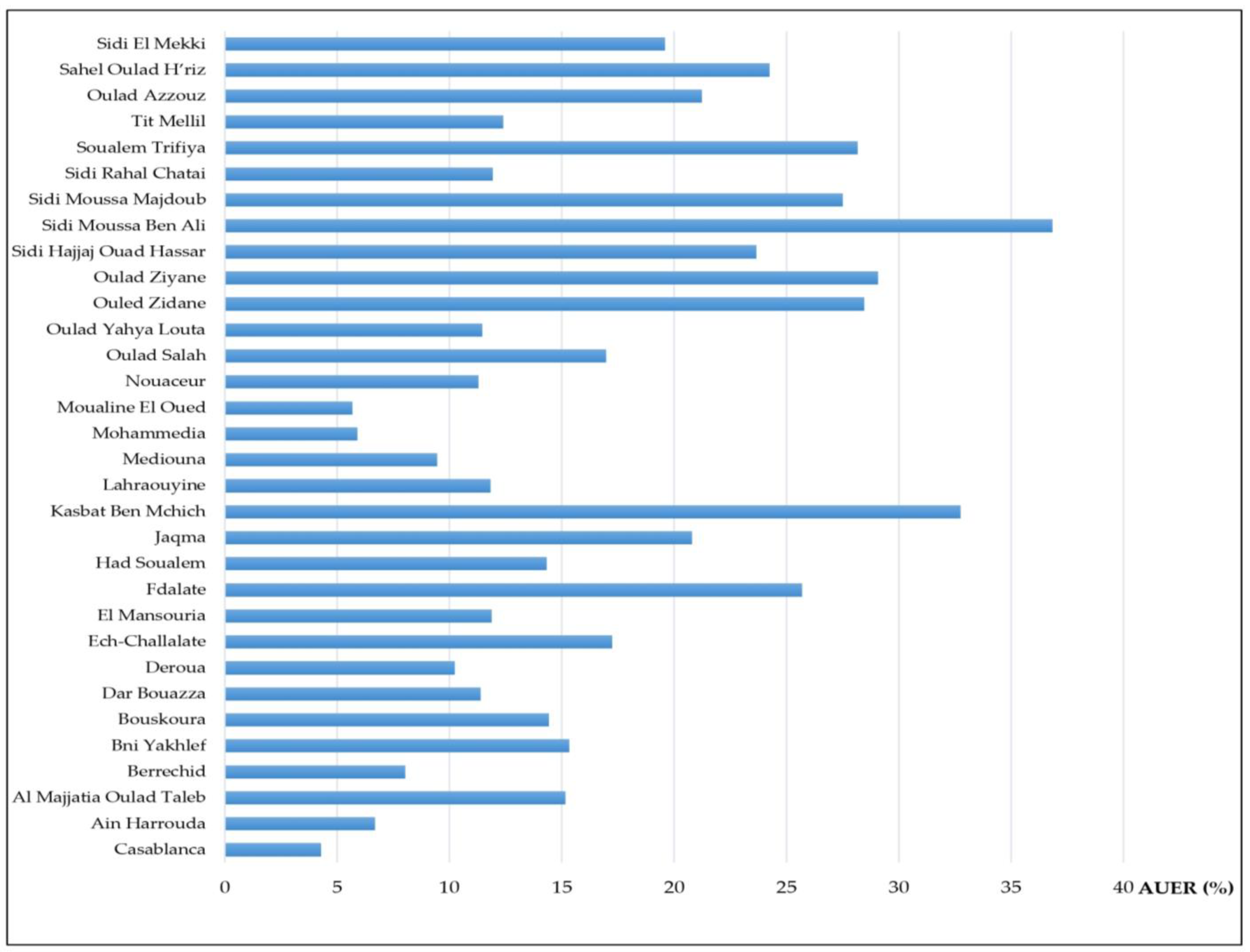
The municipalities with the highest expansion rates are primarily located on the southern and southeastern fringes of Casablanca. These include Sidi Moussa Ben Ali (36.83%), Ouled Ziyane (29.08%), Ouled Zidane (28.44%), Fdalate (25.69%), and Sahel Ouled H’Riz (24.23%). These values reflect a rapid transformation of agricultural land into built-up areas, often linked to housing developments or the establishment of economic activity zones.
Municipalities such as Dar Bouazza (11.39%), Deroua (10.23%), Tit Mellil (12.40%), and Nouaceur (11.30%) also show sustained urban growth, corresponding to a linear expansion of the urban front. These rapidly evolving areas serve as intermediaries between the city center and the periphery, accommodating new residential and logistics projects.
Conversely, municipalities such as Mohammedia (5.91%), Ain Harrouda (6.68%), Berrechid (8.03%), and Casablanca (4.30%) exhibit more moderate growth rates. This may be due to processes of densification rather than sprawl, or a reduced availability of land for development in already urbanized areas.
This transformation is further evidenced by the fact that municipalities exhibiting AUER values above 25% simultaneously experienced significant agricultural land losses, often exceeding 30% of their initial vegetated surfaces over the same period, highlighting a strong coupling between expansion speed and farmland conversion.
In parallel with rapid urban expansion, a substantial decline in vegetated and agricultural land has been observed across most municipalities between 2015 and 2025. Relative losses of vegetated (predominantly agricultural) surfaces exceeded 40% in several peri-urban municipalities, including Casablanca (69%), Dar Bouazza (54%), Bouskoura (41%), and Oulad Azzouz (36%). Other rapidly urbanizing areas such as Soualem Trifiya (23%), Sidi Hajjaj Ouad Hassar (26%), and Ech-Challalate (33%) also experienced significant agricultural land contraction.
Overall, these results illustrate a diffuse pattern of metropolitan expansion, characterized by increasing growth intensity as one moves further from the city center. This reading of urbanization rates helps identify priority zones for monitoring land conversion and provides a strategic foundation for sustainable urban planning.
The significant variations in urban expansion rates across the study area (Figure 6) clearly highlight municipalities undergoing rapid urban growth, such as Sidi Moussa Ben Ali, Jaqma, Ouled Zidane, and Fdalate, with rates exceeding 25%.
In contrast, the more modest values observed in Casablanca, Mohammedia, or Ain Harrouda reflect land saturation. This graphical representation effectively complements the tabular analysis and reinforces the notion of centrifugal urbanization, intensifying in peri-urban margins.
This average annual growth rate of urbanized surfaces, expressed by AUER, does not, however, fully capture the relative intensity of urbanization in relation to the size of each municipality. Therefore, the analysis is complemented by the calculation of the Urban Expansion Intensity Index (UEII), which offers a proportional and standardized reading of the urban pressure exerted on each territory. To interpret the values derived from the UEII calculation, several benchmark studies have proposed empirically grounded classification thresholds. A typology widely used in the literature originates from the work of Ren et al. [43] who propose a five-class division of UEII values (Table 3).
This classification has been adopted and applied in various geographical contexts. Norouzi [19] in a study on the Iranian metropolis of Qom, as well as Tao & Ye [44], in their analysis of urbanization in Nanjing, China, explicitly rely on this framework to interpret the results of their spatio-temporal analyses. The methodological convergence observed across these studies confirms the robustness and transferability of this classification system, which enables the identification of areas experiencing rapid urbanization and the quantification of its intensity on a comparable basis.
In the context of the present study, the adoption of this typology allows for a ranking of municipalities according to the intensity of urbanization and helps to highlight areas particularly exposed to land artificialization. To enhance the territorial analysis, a classification of municipalities was conducted based on UEII values calculated for the 2015–2025 period (Table 4).
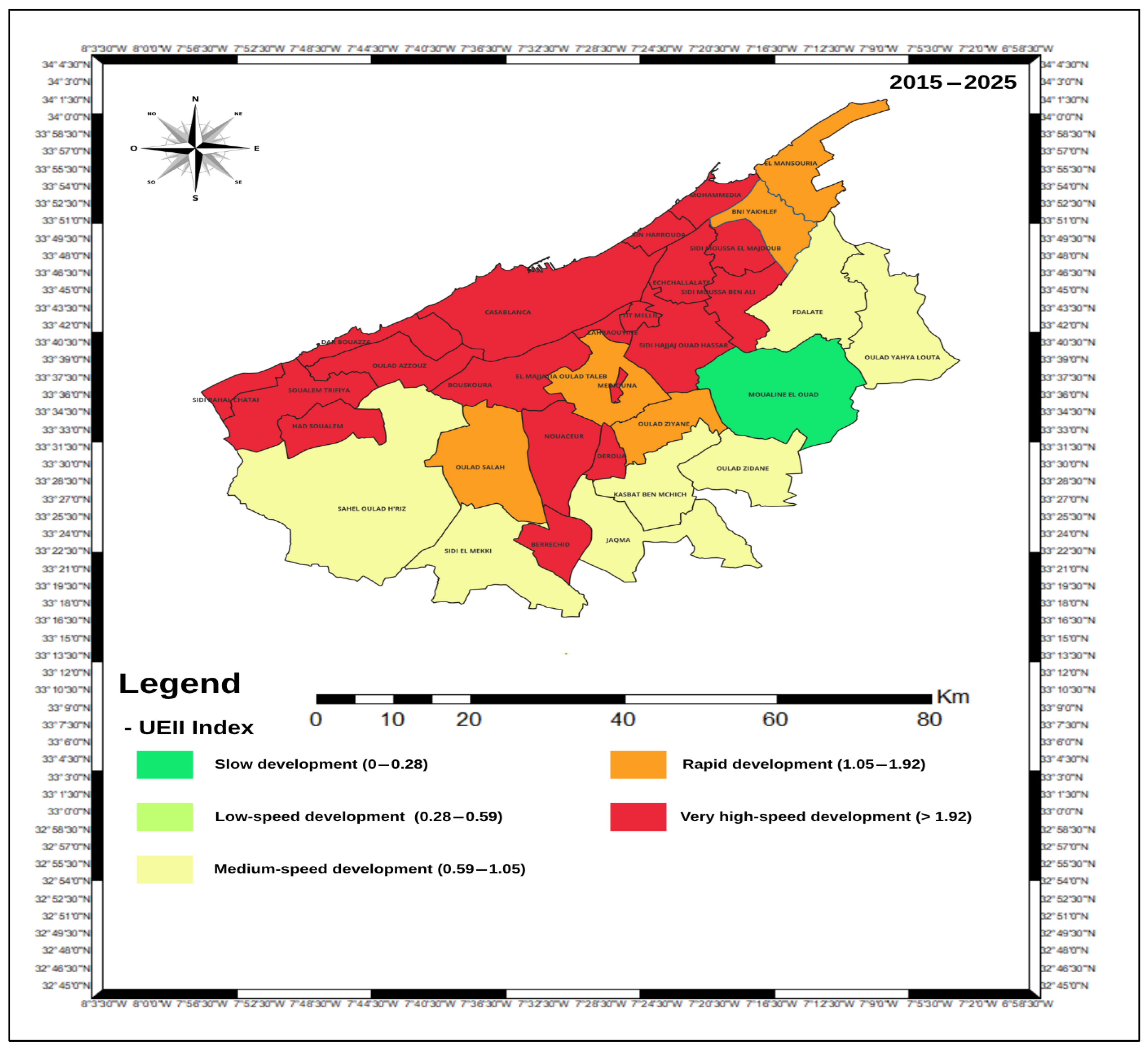
The UEII map (Figure 7) for the period 2015–2025 provides a spatially explicit and differentiated reading of urbanization dynamics across the Casablanca metropolitan area. It reveals strong heterogeneity in land artificialization rates among municipalities.
Zones classified as experiencing very high-speed development (UEII > 1.92) are concentrated around Casablanca, Ain Harrouda, Bouskoura, Dar Bouazza, Ouled Azzouz, Deroua, and Had Soualem. These municipalities, mostly located in the first and second peri-urban belts, are subject to intense land pressure due to the expansion of the built environment, industrial zones, or recent residential developments.
The rapid development class (1.05–1.92) includes peripheral territories such as Sidi Hajjaj, Tit Mellil, and Ech-Challalate, which are currently undergoing integration into the broader metropolitan dynamic. These municipalities act as interfaces for the peripheral diffusion of the Casablanca urban model.
Conversely, municipalities classified as having medium or low-speed development are generally located at the outer edge of the 40 km perimeter, where urban dynamics remain localized and partially constrained. A few rural municipalities maintain a slow development profile, indicating limited land transformation.
Overall, this mapping highlights an extensive and polycentric metropolitan expansion, with significant consequences in terms of agricultural land fragmentation, pressure on natural resources, and growing territorial imbalances.
Figure 7 provides a spatial visualization of urban expansion intensity at the municipal scale, highlighting stark contrasts between heavily urbanized areas and territories less affected by land artificialization. To complement this cartographic reading, a descriptive statistical analysis of the two main indicators (UEII and AUER) was conducted, allowing for an objective quantification of urban dynamics using representative thresholds.
The overall statistical analysis of urbanization indicators across all municipalities in the study area (Table 5) shows an average AUER of 17% and an average UEII of 2.24%. The high standard deviation of the AUER (8.58) reflects significant variability in urban growth rates between municipalities, while the UEII distribution appears more concentrated around the mean. The observed extreme values, ranging from 4.3% to 36.8% for AUER and from 0.25% to 4.61% for UEII, confirm the presence of atypical or rapidly transforming municipalities. Using the third quartile (Q3) as a critical threshold, municipalities with AUER values exceeding 23.79% and/or UEII values above 3.16% can be considered under particularly high land pressure, warranting heightened attention in urban planning efforts.
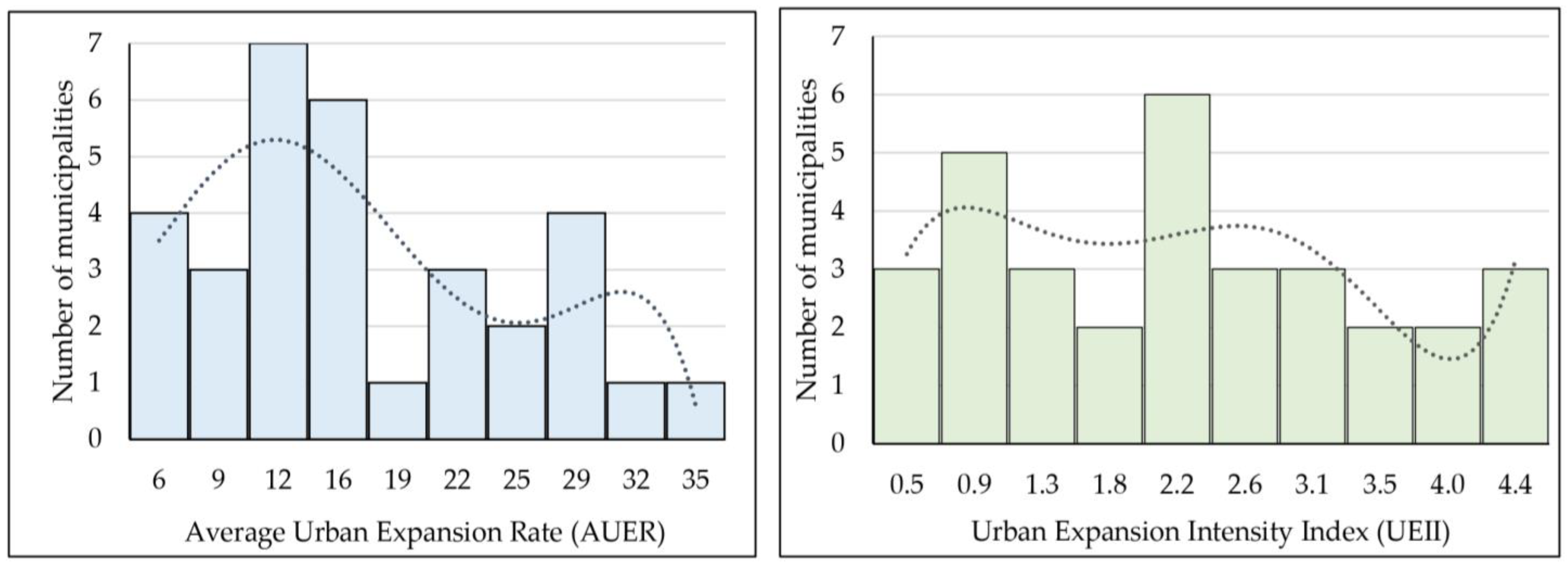
To deepen the typological analysis of urban dynamics, a cross-statistical exploration of the AUER and UEII indicators was conducted. This approach helps to understand the overall distribution of municipalities according to the speed (AUER) and intensity (UEII) of urbanization during the 2015–2025 period.
The analysis of the distribution of the Average Urban Expansion Rate (AUER) (Figure 8) reveals a concentration of municipalities around moderate values (between 11% and 16%), but with significant dispersion, as indicated by the presence of several cases exceeding 25%. This reflects highly variable rates of land artificialization between municipalities, with some territories undergoing rapid land-use transformation. In contrast, the distribution of the Urban Expansion Intensity Index (UEII) is more homogeneous, centered around 2.2%, suggesting that despite differing expansion speeds, the intensity of urbanization remains relatively stable across most municipalities. The combination of these two readings makes it possible to identify municipalities that exhibit both rapid expansion and high urban density, areas considered a priority for land management.
To provide a synthetic overview of urbanization dynamics between 2015 and 2025, a cross-typology was developed by combining two complementary indicators: UEII and AUER. This dual-axis approach distinguishes not only the municipalities experiencing the most intense land artificialization but also those undergoing the fastest expansion. The intersection of these two dimensions results in a classification of municipalities into four territorial profiles, which facilitates spatial interpretation and the identification of areas under significant land-use pressure (Table 6).
The cross-analysis of urban expansion intensity (UEII) and speed (AUER) enables the development of a spatial typology of urbanization dynamics observed between 2015 and 2025 within the Casablanca metropolitan area. This typology identifies four main profiles of municipalities based on their pace of land transformation.
Type A municipalities combine high values of both UEII and AUER (UEII ≥ 2.5% and AUER > 10%), indicating a rapid and sustained conversion of agricultural land to urban uses. This includes areas such as Bouskoura, Deroua, Soualem Trifiya, and Sidi Moussa Ben Ali, which concentrate the most intense land artificialization processes. These territories represent land-pressure hotspots, where urban expansion is likely to compromise the continuity of agricultural spaces in the short term. In these Type A municipalities, the intensity of urbanization translated into substantial agricultural land losses, with cumulative reductions ranging from 20% to more than 50% of vegetated areas between 2015 and 2025, indicating a high risk of irreversible farmland fragmentation.
Type B municipalities, on the other hand, display a high rate of land use change (AUER ≥ 15%) but lower relative intensity (UEII < 2.0%), suggesting diffuse, recent, or still emerging urbanization. This profile applies, for example, to Ouled Ziane, Sahel Ouled H’Riz, and Kasbat Ben Mchich. These areas appear as urban frontier zones, where land transformation dynamics are underway but not yet consolidated.
Type C municipalities are characterized by relatively dense urban fabric (UEII between approximately 1.5% and 3.0%) but moderate surface growth (AUER < 10%). These often correspond to already urbanized municipalities such as Casablanca or Ain Harrouda, where urban expansion is stabilizing, with little spatial extension but increased densification of built-up areas.
Type D municipalities show both low urbanization intensity (UEII < 1.0%) and low expansion speed (AUER < 15%), such as Moualine El Oued or Ouled Yahya Louta. These areas retain a rural or semi-rural profile, with limited land transformation during the study period. They constitute buffer zones that remain partially preserved yet could be exposed in the medium term if urbanization trends persist.
This typology enables a more refined targeting of planning priorities, according to the specific territorial transformation profiles. It also provides a valuable basis for aligning farmland protection policies with urban growth dynamics, and for prioritizing interventions in support of sustainable planning.
Beyond the UEII/AUER cross-typology, which offers a relative perspective on urban dynamics, it is also relevant to assess the absolute rates of land transformation. For this purpose, a complementary table presents, for each municipality, the average annual rate of urban area change, expressed both in hectares per year and as a percentage between 2015 and 2025. This analysis quantifies the actual magnitude of land artificialization on the ground and helps identify municipalities where urbanization advanced the fastest in absolute terms (Table 7).
The use of this absolute indicator allows for a direct measurement of land conversion intensity, independently of relative proportions. It usefully complements relative indices such as UEII and enhances spatial interpretation. Several studies have highlighted the relevance of such measures in evaluating urban expansion dynamics, particularly in rapidly growing contexts [18,31].
This table presents, for each municipality within the study perimeter, the average annual change in urban surface area between 2015 and 2025, expressed both in hectares per year (ha/year) and as an annual percentage relative to the urbanized area in 2015. These indicators complement the relative indices (UEII and AUER) from the previous table by assessing the absolute intensity of land-use change.
The analysis of average annual urban growth rates (Table 7) reveals a high degree of heterogeneity in the urbanization intensity across the municipalities included in the study area. Some municipalities exhibit relatively low growth rates, below 10% per year, indicating moderate and more controlled urban development. This is the case, for example, in Casablanca (681.4 ha/year; 5.4%), Mohammedia (116.6 ha/year; 8.1%), and Moualine El Oued (47.0 ha/year; 7.6%), which appear more consolidated, nearing land saturation or guided by stricter urban planning regulations.
In contrast, several municipalities report annual urban growth rates ranging from 20% to 45%, reflecting a rapid intensification of land pressure. Areas such as Oulad Salah (191.9 ha/year; 44.6%), Ech-Challalate (178.2 ha/year; 46.1%), Nouaceur (173.8 ha/year; 20.9%), and Jaqma (73.2 ha/year; 70.0%) are characterized by their role as transitional peri-urban zones. These municipalities absorb a significant share of residential or industrial demand resulting from the diffuse urban sprawl originating from the Casablanca core.
Some municipalities exhibit extremely high rates of urban expansion, exceeding 100% over the 10-year period, equating to over 10% annual growth. This includes Sidi Moussa Ben Ali (130.5 ha/year; 387.9%), Ouled Ziyane (83.4 ha/year; 173.1%), Kasbat Ben Mchich (84.5 ha/year; 254.0%), Soualem Trifiya (221.3 ha/year; 157.2%), and Fdalate (135.7 ha/year; 120.5%). These dynamics suggest an exceptionally rapid conversion of land, potentially driven by the emergence of informal urbanization hubs or weak regulations of land use. Such trends pose major challenges in terms of sustainability, service provision, and agricultural land preservation. From an agricultural perspective, municipalities displaying the highest absolute urban growth rates also correspond to those with the greatest losses of vegetated land. In areas such as Sidi Moussa Ben Ali, Soualem Trifiya, and Kasbat Ben Mchich, urban growth rates exceeding 100% over the decade coincided with agricultural land losses greater than 20%, underscoring the magnitude of land-use conflicts emerging at the urban-rural interface.
The higher the growth rate, the greater the risks of rural landscape fragmentation and spatial imbalance. Municipalities experiencing explosive urban growth are often those where expansion occurs without territorial continuity, manifesting as scattered urban pockets that frequently lie outside formal land-use planning frameworks. These trends reflect an extensive form of metropolitan expansion, where market forces tend to prevail over planning mechanisms, thereby undermining territorial coherence and compromising the resilience of local agroecosystems.
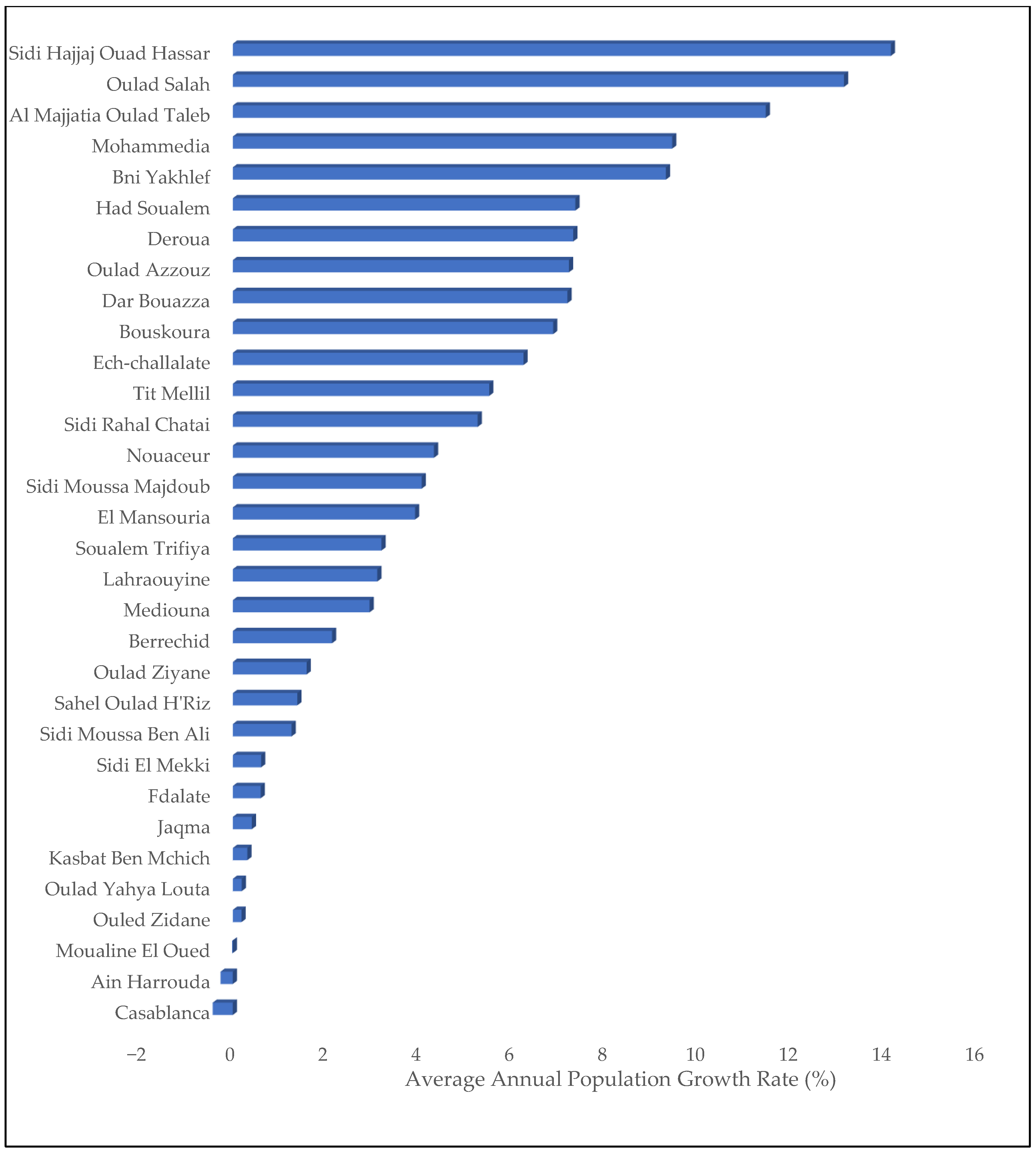
Beyond urbanization indicators (AUER, UEII) and land-use transformations, it is essential to integrate the demographic dimension to refine our understanding of territorial dynamics. Data from the 2014 and 2024 General Population and Housing Census (RGPH) were used to calculate the average annual population growth rate for each municipality over the 2014–2024 period.
By combining demographic data with land-use dynamics, this analysis enables a critical examination of the alignment, or misalignment, between population trends and urban expansion. A significant discrepancy between these two trajectories may point to uncontrolled land conversion, excessive land consumption, or the emergence of low-density urban sprawl patterns.
The results reveal a general correlation between demographic growth and urbanization, while also highlighting significant disparities (Figure 9). Several peripheral municipalities, such as Sidi Hajjaj Ouad Hassar (+14.14%), Oulad Salah (+13.13%), Al Majjatia Oulad Taleb (+11.45%), and Mohammedia (+9.44%), exhibit particularly high population growth rates. These figures align with sustained levels of land artificialization, reflecting a dual pressure on land resources, urban services, and agricultural ecosystems.
Conversely, municipalities like Moualine El Oued, Aïn Harrouda, Oulad Yahya Louta, and the prefecture of Casablanca show low or even negative growth rates. This stagnation can be attributed to land saturation in central urban areas, urbanization geared toward non-residential functions (industrial zones, infrastructure), or the displacement of populations toward more accessible peripheral areas.
This cross-analysis highlights three territorial profiles. The first corresponds to zones of active metropolization, marked by rapid urbanization accompanied by robust demographic growth, as seen in municipalities like Oulad Salah, Had Soualem, and Bouskoura. The second profile includes transition municipalities, where urban expansion outpaces population growth, such as Kasbat Ben Mchich or Ouled Ziane. Lastly, the third profile comprises relatively stable areas, low in both land and population transformation, that may serve as buffer zones or agricultural reserves, such as Moualine El Oued or Fdalate.
The joint integration of spatial and demographic dynamics offers a more nuanced understanding of territorial evolution. It allows for more targeted identification of priority areas for urban planning, land-use regulation, and farmland preservation, all in pursuit of sustainable and spatially balanced development.
Overall, the results demonstrate that urban expansion in the Casablanca metropolitan periphery is not only rapid but also highly consumptive of agricultural land. The combination of relative indicators (AUER, UEII), absolute urban growth rates, and quantified vegetation losses provides convergent evidence of increasing farmland fragmentation, particularly in the southern and southeastern peri-urban belts. These findings quantitatively substantiate the central objective of the study, namely the assessment of urban expansion impacts on agricultural land.

4. Discussion

The analysis of urbanization dynamics using the AUER and UEII indicators, combined with a typological classification, provides a comprehensive view of expansion rates, facilitates the ranking of territories based on land pressure, and objectively reveals spatial disparities within the Casablanca metropolitan area.
The results show that municipalities such as Casablanca, Ain Harrouda, Berrechid, Bouskoura, Ouled Azzouz, Had Soualem, and Dar Bouazza record high values for both AUER and UEII, indicating rapid and sustained land artificialization. Other smaller municipalities, like Al Majjatia Oulad Taleb and Bni Yakhlef, also display strong urban growth dynamics, confirming their role as peri-urban relay zones.
Beyond individual observations, the typological classification based on the intersection of AUER and UEII has allowed the identification of four territorial profiles (Types A to D). The communes classified as Type A, such as Bouskoura, Dar Bouazza, Deroua, and Had Soualem, combine both high intensity and speed of urbanization, thus concentrating the strongest land conversion pressures. These “hotspots” are not only undergoing spatial transformation but are also at heightened risk of ecological degradation and food system disruption [45]. In contrast, Type D zones like Moualine El Oued or Ouled Yahya Louta remain relatively stable, potentially acting as buffers against uncontrolled urban spread. These findings are in line with previous spatial modeling studies that have highlighted the role of peri-urban mosaics in absorbing urban growth while retaining residual agricultural functions [46,47,48].
Based on the results obtained in this study, the quantified loss of vegetated and agricultural land provides a clear measure of the pressure exerted on peri-urban farming systems. Between 2015 and 2025, several municipalities in the Casablanca metropolitan fringe experienced a reduction in agricultural surfaces ranging from one-third to more than half of their initial extent. This trend reflects a substantial contraction of the productive land base and an intensification of competition between urban and agricultural land uses.
From an agricultural perspective, this rapid land conversion results in reduced land-use efficiency, as fertile peri-urban plots are progressively replaced by low-density urban developments. Municipalities exhibiting the highest AUER and UEII values also concentrate the most significant agricultural land losses, indicating that urban expansion disproportionately affects areas with high agronomic potential. This process contributes to the fragmentation of farm structures, undermines agricultural productivity, and weakens the economic viability of peri-urban agriculture supplying the Casablanca metropolitan area.
At the national scale, these patterns mirror broader land-use dynamics observed across Morocco, where urban growth increasingly encroaches on strategic agricultural zones. In the case of Casablanca, the intensity of farmland conversion highlights a structural imbalance between urban development objectives and agricultural land preservation, raising concerns regarding long-term food security, land-use efficiency, and territorial sustainability.
The majority of municipalities within the study area fall into the categories of “rapid development” or “very high-speed development,” according to the classification by Ren et al. [43], reflecting particularly dynamic land consumption between 2015 and 2025. This finding is further supported by land-use maps that reveal advanced fragmentation of vegetated areas and a significant decline in agricultural land. Similar studies have highlighted comparable trends in fast-growing urban regions, where accelerated urban expansion leads to extensive conversion of agricultural land, landscape fragmentation, and long-term challenges for ecosystem services and food security [49,50,51].
Such urban expansion, especially in peri-urban zones, has been identified as a major driver of land degradation and agricultural vulnerability in rapidly growing cities [52,53]. In the context of Casablanca, the spatio-temporal dynamics of urban expansion exacerbate the spatial fragmentation of agroecosystems, challenging the resilience of local food systems. The artificialization processes described here echo patterns observed in other North African and Global South metropolises, where weak governance and market-driven land-use changes accelerate unsustainable urban sprawl [54].
These findings are consistent with observations reported for other Moroccan metropolitan regions, particularly the Rabat-Salé peri-urban area. Previous studies have documented how rapid urban expansion in these zones has resulted in progressive agricultural land fragmentation, changes in farming systems, and increasing sustainability challenges for peri-urban agriculture [55,56,57]. These works emphasize that urban sprawl not only reduces the availability of productive farmland but also weakens farm viability through rising land competition, water stress, and increasing exposure to land-use conflicts [57].
Compared to the Rabat metropolitan fringe, the Casablanca region exhibits a more accelerated and spatially extensive process of land artificialization, driven by its demographic weight, economic centrality, and large-scale infrastructure development. This comparison highlights that urban expansion in Casablanca represents one of the most intense forms of peri-urban land pressure at the national scale, reinforcing the need to interpret urban growth not only as a spatial process but also as a critical driver of agricultural vulnerability and territorial imbalance in Morocco [55,57].
The combination of these two indicators, the AUER and UEII, constitutes a valuable decision-making tool for guiding urban planning efforts, managing urban expansion, and preserving agricultural resources. It also opens the door to future cross-analyses with the sustainability levels of agricultural holdings located in the most exposed zones. Such integrative approaches have been increasingly emphasized in the recent literature [58,59,60], which highlight the importance of linking land-use dynamics with socio-economic and environmental indicators. By coupling spatial metrics with farm-level assessments, it becomes possible not only to monitor urban pressures but also to anticipate their implications for agricultural viability, resilience, and long-term food security.
In parallel, interpreting these dynamics in light of the region’s demographic context allows for a deeper understanding of the challenges involved. According to the 2024 General Population and Housing Census [26], the Casablanca-Settat region remains the most populated in the Kingdom, with 7.69 million inhabitants, representing 20.9% of the national population, and an urbanization rate of 73.3%, well above the national average of 62.8%.
This sustained demographic pressure, with an average annual growth rate of 1.21% between 2014 and 2024, drives strong demand for housing, infrastructure, and services, exerting substantial pressure on peri-urban lands. The high AUER values observed in several municipalities (sometimes exceeding 10% annual growth) reflect this dynamic, often at the expense of agricultural spaces. This trend occurs in a broader context of demographic transition, marked by a continuous decline in fertility (TFR = 1.90 in the region) and a gradual aging of the population (13.8% over 60 years nationally), making strategic management of territorial resources all the more crucial. Comparable dynamics have been documented in other rapidly urbanizing regions [61,62,63,64], where demographic growth combined with structural socio-economic changes reshapes settlement patterns and amplifies land-use conflicts.
As part of efforts to better structure urban growth, new towns such as Zenata and Lahraouiyine have been developed on former agricultural lands at the periphery of Casablanca, in line with a metropolitan rebalancing strategy. These projects are aligned with the objectives of the Master Plan for Urban Development (SDAU) of Greater Casablanca, revised in 2010 for a 20-year period. This strategic document, developed by the Urban Agency, aims to transform Casablanca into an open, competitive, and sustainable metropolis. The plan proposes a spatial organization based on three axes: a coastal zone dedicated to industry, a southeastern expansion focused on the tertiary sector and technopoles, and the reinforcement of peripheral poles to improve the urban-rural balance [65]. These orientations were further refined in the 2014 revision, which designated over 25,000 hectares for urban expansion, 20,000 for housing and 5000 for economic zones [66]. However, this strategy has also led to significant artificialization of peri-urban agricultural lands, raising concerns about the long-term sustainability of the metropolitan expansion model. Similar critiques have been raised in other metropolitan contexts [67,68,69], where large-scale planning strategies intended to enhance competitiveness and spatial equity often produce unintended consequences such as accelerated land consumption, loss of fertile soils, and heightened socio-spatial inequalities.
The results of this study reveal a rapid transformation of agricultural land into built-up areas in Casablanca’s peri-urban zone, particularly in the municipalities of Nouaceur, Bouskoura, Mediouna, and Had Soualem. These changes reflect the effective implementation of urban policies as envisioned in the revised SDAU [66], which aims to relieve pressure on the city center and accommodate demographic growth. Satellite data confirm this trend, with a reported 145% increase in urbanized areas between 1986 and 2018, largely at the expense of agricultural land [70].
Specific areas illustrate the deliberate reclassification of agricultural lands into urbanizable zones as part of state-led or local government projects. In Nouaceur, for example, the development of the Aéropole zone, dedicated to industrial and logistics activities around Mohammed V Airport, has resulted in the artificialization of large agricultural parcels, in accordance with the planning guidelines set by the Casablanca Urban Agency [71]. Similarly, the urban poles of Errahma and Lahraouiyine have been developed on former agricultural lands to absorb a portion of Casablanca’s population growth and promote territorial rebalancing at the metropolitan scale. These structuring projects reflect an effort to anticipate urbanization needs. However, some areas still face challenges regarding spatial coherence and infrastructure, highlighting the importance of a more localized and nuanced reading of the findings.
The National Territorial Planning Charter (CNAAT) and national strategies, such as the land tenure strategy, have played a central role in guiding these transformations. Regulated conversion of agricultural lands, social housing programs, and new governance mechanisms have all contributed to this dynamic, while underscoring the need for strengthened vigilance to maintain a sustainable balance between urbanization and agricultural functions [72].
Finally, this study aligns with broader findings in the literature on sustainable urbanization and peri-urban resilience. Urbanization processes, when unregulated, not only reduce agricultural land but also disrupt ecosystem services, increase socio-spatial inequalities, and compromise long-term food security. Several authors [73,74,75,76] have emphasized that the peri-urban interface represents both a zone of vulnerability and an opportunity for innovation in governance and land-use planning. Strengthening resilience in these territories requires integrative policies that balance urban expansion with agricultural preservation, promote multifunctional landscapes, and foster inclusive decision-making. Such approaches are essential to ensure that metropolitan growth does not undermine the ecological and social foundations upon which sustainable urban futures depend.
There is a pressing need for evidence-based urban governance that leverages remote sensing tools and geospatial analysis to anticipate risks and protect strategic farmland. In this context, the spatio-temporal dynamics of urban expansion in Casablanca, Morocco’s most populous and economically significant metropolitan area highlight the urgency of integrated and participatory land-use policies tailored to peri-urban realities. A key observation emerging from the cross-analysis of urban growth and demographic dynamics is the discrepancy between the rate of land artificialization and population growth in several communes. For instance, areas such as Kasbat Ben Mchich and Ouled Ziyane show urban growth exceeding 150% over the decade, while their demographic growth remains comparatively modest. This gap may suggest speculative urbanization, inefficient land allocation, or weak regulatory enforcement, issues also documented in other fast-growing peri-urban contexts across Africa and Asia [18,31]. Such mismatches raise concerns about urban vacancies, fragmented service delivery, and increased vulnerability to climate and economic shocks.


5. Conclusions and Recommendations

The spatio-temporal analysis conducted within the Casablanca perimeter for the 2015–2025 period reveals particularly pronounced urbanization dynamics, both in terms of speed (AUER) and intensity (UEII). The combination of these two indicators made it possible to quantify the extent of land-use transformations at the municipal scale and to develop a typology of territories based on their level of urban pressure. The results demonstrate a generalized trend of urban sprawl, with the most intense dynamics concentrated in the southern and eastern peri-urban rings of Casablanca. This urban expansion is accompanied by a significant reduction in vegetated areas, fragmentation of agricultural spaces, and increasing soil artificialization. At the same time, demographic data from the 2024 General Population and Housing Census (RGPH) confirm that the Casablanca-Settat region remains the main hub of population concentration and land pressure at the national level. The interaction between demographic growth, housing demand, and urban expansion thus raises major challenges for territorial planning, particularly concerning the preservation of agricultural land and spatial balance.
The tools mobilized in this study (indicators, maps, typologies) provide a robust analytical basis to inform spatial planning strategies. To support existing territorial planning efforts, several complementary avenues may be considered to enhance sustainability. It would be particularly relevant to strengthen the protection of agricultural zones with high productive or ecological value. The progressive integration of remote sensing and spatial analysis tools into urban planning documents could also facilitate better alignment between observed territorial dynamics and planned developments. The creation of green belts around expanding urban cores may help to preserve agroecological continuity. Furthermore, the establishment of a periodic monitoring system for land-use change based on satellite imagery would reinforce anticipatory capabilities. Lastly, enhanced coordination among municipalities, urban planning agencies, and land stakeholders would improve policy coherence and support a more inclusive and sustainable metropolitan development trajectory.
Finally, it should be emphasized that the findings of this study are based on a detailed case study of the Casablanca metropolitan periphery and should be interpreted accordingly. While the analytical framework, spatial indicators and methodological approach developed in this research are transferable and may be applied to other metropolitan contexts, the empirical results reflect local demographic dynamics, planning practices and territorial specificities. Future research extending this framework to other Moroccan or international metropolitan regions would enable comparative analyses and contribute to a broader understanding of urban expansion and its impacts on agricultural land.

Author Contributions

Conceptualization, B.N. and F.H.; methodology, B.N. and F.H.; software, B.N.; validation, F.H.; formal analysis, B.N.; investigation, B.N.; resources, F.H.; data curation, B.N.; writing—original draft preparation, B.N.; writing—review and editing, F.H.; visualization, B.N.; supervision, F.H.; project administration, F.H.; academic review and expert feedback, M.C., Y.H., M.E.J., I.E.O. and I.M. All authors have read and agreed to the published version of the manuscript.

Funding

This research was funded by the Fondation Caisse de Dépôt et de Gestion (FCDG), under Project No. 1681.

Institutional Review Board Statement

Not applicable.

Informed Consent Statement

Not applicable.

Data Availability Statement

The original contributions presented in this study are included in the article. Further inquiries can be directed to the corresponding author.

Acknowledgments

The author gratefully acknowledges the Regional Directorate of Agriculture of Casablanca–Settat (DRA Casablanca–Settat), the Provincial Directorate of Agriculture of Casablanca (DPA Casablanca), and the Urban Agency of Casablanca for their collaboration and valuable support in providing data and information essential to this study. In addition, the authors gratefully acknowledge the developers of QGIS (version 3.40.5) and the Semi-Automatic Classification Plugin (SCP) (version 8.4.0) for providing powerful open-source tools that greatly facilitated the spatial analyses conducted in this study.

Conflicts of Interest

The authors declare no conflicts of interest.

References

  1. Xu, C.; Liu, M.; An, S.; Chen, J.; Yan, P. Assessing the impact of urbanization on regional net primary productivity in Jiangyin County, China. J. Environ. Manag. 2007, 85, 597–606. [Google Scholar] [CrossRef] [PubMed]
  2. Gu, D.; Andreev, K.; Dupre, M.E. Major trends in population growth around the world. China CDC Wkly. 2021, 3, 604. [Google Scholar] [CrossRef] [PubMed]
  3. Jedwab, R.; Christiaensen, L.; Gindelsky, M. Demography, urbanization and development: Rural push, urban pull and… urban push? J. Urban Econ. 2017, 98, 6–16. [Google Scholar] [CrossRef]
  4. Buhaug, H.; Urdal, H. An urbanization bomb? Population growth and social disorder in cities. Glob. Environ. Change 2013, 23, 1–10. [Google Scholar]
  5. Zhou, C.; Wang, S.; Wang, J. Examining the influences of urbanization on carbon dioxide emissions in the Yangtze River Delta, China: Kuznets curve relationship. Sci. Total Environ. 2019, 675, 472–482. [Google Scholar] [CrossRef]
  6. Al-sharif, A.A.; Pradhan, B. Spatio-temporal prediction of urban expansion using bivariate statistical models: Assessment of the efficacy of evidential belief functions and frequency ratio models. Appl. Spat. Anal. Policy 2016, 9, 213–231. [Google Scholar]
  7. Metzger, A.E.; McHale, M.R.; Hess, G.R.; Steelman, T.A. Same time, same place: Analyzing temporal and spatial trends in urban metabolism using proximate counties in the North Carolina Triangle. Urban Ecosyst. 2016, 19, 1–18. [Google Scholar]
  8. Doan, P.; Oduro, C.Y. Patterns of population growth in peri-urban Accra, Ghana. Int. J. Urban Reg. Res. 2012, 36, 1306–1325. [Google Scholar]
  9. Potts, D. Challenging the myths of urban dynamics in sub-Saharan Africa: The evidence from Nigeria. World Dev. 2012, 40, 1382–1393. [Google Scholar] [CrossRef]
  10. Watson, V. Seeing from the South: Refocusing urban planning on the globe’s central urban issues. Urban Stud. 2009, 46, 2259–2275. [Google Scholar] [CrossRef]
  11. Eigenbrod, F.; Bell, V.; Davies, H.; Heinemeyer, A.; Armsworth, P.R.; Gaston, K.J. The impact of projected increases in urbanization on ecosystem services. Proc. R. Soc. B Biol. Sci. 2011, 278, 3201–3208. [Google Scholar]
  12. Baloye, D.O.; Palamuleni, L.G. A comparative land use-based analysis of noise pollution levels in selected urban centers of Nigeria. Int. J. Environ. Res. Public Health 2015, 12, 12225–12246. [Google Scholar] [PubMed]
  13. Lehzam, A. Le Développement Urbain au Maroc: Challenges et Perspectives; Unpublished poster presentation at: Future Challenges of the New Urban World: What Model of Development for the Moroccan City; IRES: San Francisco, CA, USA, 2012; pp. 1–2. [Google Scholar]
  14. Akubia, J.E.; Bruns, A. Unravelling the frontiers of urban growth: Spatio-temporal dynamics of land-use change and urban expansion in greater Accra metropolitan area, Ghana. Land 2019, 8, 131. [Google Scholar]
  15. Terfa, B.K.; Chen, N.; Liu, D.; Zhang, X.; Niyogi, D. Urban expansion in Ethiopia from 1987 to 2017: Characteristics, spatial patterns, and driving forces. Sustainability 2019, 11, 2973. [Google Scholar] [CrossRef]
  16. Acheampong, R.A.; Agyemang, F.S.; Abdul-Fatawu, M. Quantifying the spatio-temporal patterns of settlement growth in a metropolitan region of Ghana. GeoJournal 2017, 82, 823–840. [Google Scholar]
  17. Fenta, A.A.; Yasuda, H.; Haregeweyn, N.; Belay, A.S.; Hadush, Z.; Gebremedhin, M.A.; Mekonnen, G. The dynamics of urban expansion and land use/land cover changes using remote sensing and spatial metrics: The case of Mekelle City of northern Ethiopia. Int. J. Remote Sens. 2017, 38, 4107–4129. [Google Scholar]
  18. Indrawati, L.; Murti, B.S.H.; Rachmawati, R.; Aji, D.S. Effect of urban expansion intensity on urban ecological status utilizing remote sensing and GIS: A study of Semarang-Indonesia. In Proceedings of the IOP Conference Series: Earth and Environmental Science, Raipur, India, 6–7 March 2020; p. 012018. [Google Scholar]
  19. Norouzi, Y. Measuring Land Use Changes and Quantifying Urban Expansion Using Remote Sensing and Gis Techniques—A Case Study of Qom. ISPRS Ann. Photogramm. Remote Sens. Spat. Inf. Sci. 2023, 10, 609–615. [Google Scholar] [CrossRef]
  20. Adam, M. Definition and boundaries of the peri-urban interface: Patterns in the patchwork. In Waste Composting for Urban and Peri-Urban Agriculture: Closing the Rural-Urban Nutrient Cycle in Sub-Saharan Africa; CABI Publishing: Wallingford, UK, 2001; pp. 193–208. [Google Scholar]
  21. Drechsel, P.; Graefe, S.; Fink, M. Rural-Urban Food, Nutrient and Virtual Water Flows in Selected West African Cities; IWMI: Colombo, Sri Lanka, 2007; Volume 115. [Google Scholar]
  22. Erenstein, O.; Moussa, M.; Oswald, A.; Keijzer, P. Characterization of Peri-Urban Lowland Use Along an Ecological and Market Access Gradient in West Africa; West Africa Rice Development Association (WARDA)–The Africa Rice Center: Abidjan, Côte d’Ivoire, 2004. [Google Scholar]
  23. Poulot, M. Les programmes agri-urbains en Ile-de-France: De la «fabrique» de territoires périurbains. In Proceedings of the Communication Présentée Lors du Colloque La Dynamique des Territoires en Milieu Périurbain et le Patrimoine Naturel et Culturel, Montreal, QC, Canada, 26–28 April 2006; pp. 26–27. [Google Scholar]
  24. Drechsel, P.; Graefe, S.; Sonou, M.; Cofie, O.O. Informal Irrigation in Urban West Africa: An Overview; CGIAR: Montpellier, France, 2006. [Google Scholar]
  25. Moustier, P. Assessing the Socio-Economic Impact of Urban and Peri-Urban Agricultural Development (Trabajo de Estudio); Semantic Scholar: Online, 2001. [Google Scholar]
  26. HAUT-COMMISSARIAT AU PLAN. Recensement Général de la Population et de L’habitat de 2024. Available online: https://www.hcp.ma/Recensement-general-RGPH_r518.html (accessed on 18 September 2025).
  27. Fichera, C.R.; Modica, G.; Pollino, M. Land Cover classification and change-detection analysis using multi-temporal remote sensed imagery and landscape metrics. Eur. J. Remote Sens. 2012, 45, 1–18. [Google Scholar]
  28. Wang, W.; Li, W.; Zhang, C.; Zhang, W. Improving object-based land use/cover classification from medium resolution imagery by Markov chain geostatistical post-classification. Land 2018, 7, 31. [Google Scholar]
  29. Alam, I.; Nahar, K.; Morshed, M.M. Measuring urban expansion pattern using spatial matrices in Khulna City, Bangladesh. Heliyon 2023, 9, e13193. [Google Scholar] [CrossRef]
  30. Lu, S.; Guan, X.; He, C.; Zhang, J. Spatio-temporal patterns and policy implications of urban land expansion in metropolitan areas: A case study of Wuhan urban agglomeration, central China. Sustainability 2014, 6, 4723–4748. [Google Scholar] [CrossRef]
  31. Oyesiji, O.A. Spatio-temporal measurements of urban sprawl dynamics in Oyo Town, Nigeria. Afr. J. Land Policy Geospat. Sci. 2023, 6, 94–106. [Google Scholar]
  32. Team, Q.D. QGIS Geographic Information System. 2025. Available online: https://qgis.org (accessed on 10 September 2025).
  33. Congedo, L. Semi-Automatic Classification Plugin: A Python tool for the download and processing of remote sensing images in QGIS. J. Open Source Softw. 2021, 6, 3172. [Google Scholar] [CrossRef]
  34. Chander, G.; Markham, B.L.; Helder, D.L. Summary of current radiometric calibration coefficients for Landsat MSS, TM, ETM+, and EO-1 ALI sensors. Remote Sens. Environ. 2009, 113, 893–903. [Google Scholar]
  35. Song, C.; Woodcock, C.E.; Seto, K.C.; Lenney, M.P.; Macomber, S.A. Classification and change detection using Landsat TM data: When and how to correct atmospheric effects? Remote Sens. Environ. 2001, 75, 230–244. [Google Scholar]
  36. Lillesand, T.; Kiefer, R.W.; Chipman, J. Remote Sensing and Image Interpretation; Wiley: Hoboken, NJ, USA, 2015. [Google Scholar]
  37. Lu, D.; Weng, Q. A survey of image classification methods and techniques for improving classification performance. Int. J. Remote Sens. 2007, 28, 823–870. [Google Scholar] [CrossRef]
  38. Congalton, R.G.; Green, K. Assessing the Accuracy of Remotely Sensed Data: Principles and Practices; CRC Press: Boca Raton, FL, USA, 2019. [Google Scholar]
  39. Foody, G.M. Status of land cover classification accuracy assessment. Remote Sens. Environ. 2002, 80, 185–201. [Google Scholar] [CrossRef]
  40. Mishra, V.N.; Rai, P.K. A remote sensing aided multi-layer perceptron-Markov chain analysis for land use and land cover change prediction in Patna district (Bihar), India. Arab. J. Geosci. 2016, 9, 249. [Google Scholar]
  41. Hu, Z.-L.; Du, P.-J.; Guo, D.-Z. Analysis of urban expansion and driving forces in Xuzhou city based on remote sensing. J. China Univ. Min. Technol. 2007, 17, 267–271. [Google Scholar] [CrossRef]
  42. Abdullahi, S.; Pradhan, B. Urban expansion and change detection analysis. In Spatial Modeling and Assessment of Urban Form: Analysis of Urban Growth: From Sprawl to Compact Using Geospatial Data; Springer: Berlin/Heidelberg, Germany, 2017; pp. 155–170. [Google Scholar]
  43. Ren, P.; Gan, S.; Yuan, X.; Zong, H.; Xie, X. Spatial expansion and sprawl quantitative analysis of mountain city built-up area. In Proceedings of the Geo-Informatics in Resource Management and Sustainable Ecosystem: International Symposium, GRMSE 2013, Wuhan, China, 8–10 November 2013; pp. 166–176. [Google Scholar]
  44. Tao, Y.; Ye, R. Analysis of the spatio-temporal characteristics of Nanjing’s urban expansion and its driving mechanisms. ISPRS Int. J. Geo-Inf. 2022, 11, 406. [Google Scholar]
  45. Bren d’Amour, C.; Reitsma, F.; Baiocchi, G.; Barthel, S.; Güneralp, B.; Erb, K.-H.; Haberl, H.; Creutzig, F.; Seto, K.C. Future urban land expansion and implications for global croplands. Proc. Natl. Acad. Sci. USA 2017, 114, 8939–8944. [Google Scholar] [PubMed]
  46. Patel, S.K.; Verma, P.; Shankar Singh, G. Agricultural growth and land use land cover change in peri-urban India. Environ. Monit. Assess. 2019, 191, 600. [Google Scholar] [CrossRef]
  47. Tzortzi, J.N.; Guaita, L.; Kouzoupi, A. Sustainable strategies for urban and landscape regeneration related to Agri-cultural heritage in the urban-periphery of South Milan. Sustainability 2022, 14, 6581. [Google Scholar] [CrossRef]
  48. Gras, J.M. Conservation of the Peri-urban Landscape. In Peri-Urban Landscape; River Publishers: Gistrup, Denmark, 2024; pp. 185–216. [Google Scholar]
  49. Imbrenda, V.; Quaranta, G.; Salvia, R.; Egidi, G.; Salvati, L.; Prokopovà, M.; Coluzzi, R.; Lanfredi, M. Land degradation and metropolitan expansion in a peri-urban environment. Geomat. Nat. Hazards Risk 2021, 12, 1797–1818. [Google Scholar] [CrossRef]
  50. Tu, Y.; Chen, B.; Yu, L.; Xin, Q.; Gong, P.; Xu, B. How does urban expansion interact with cropland loss? A comparison of 14 Chinese cities from 1980 to 2015. Landsc. Ecol. 2021, 36, 243–263. [Google Scholar] [CrossRef]
  51. Yasin, K.H.; Iguala, A.D.; Gelete, T.B. Spatiotemporal analysis of urban expansion and its impact on farmlands in the central Ethiopia metropolitan area. Discov. Sustain. 2025, 6, 36. [Google Scholar] [CrossRef]
  52. Angel, S.; Sheppard, S.; Civco, D.L.; Buckley, R.; Chabaeva, A.; Gitlin, L.; Kraley, A.; Parent, J.; Perlin, M. The Dynamics of Global Urban Expansion; World Bank, Transport and Urban Development Department: Washington, DC, USA, 2005. [Google Scholar]
  53. Seto, K.C.; Fragkias, M.; Güneralp, B.; Reilly, M.K. A meta-analysis of global urban land expansion. PLoS ONE 2011, 6, e23777. [Google Scholar]
  54. Haase, D.; Haase, A.; Kabisch, N.; Kabisch, S.; Rink, D. Actors and factors in land-use simulation: The challenge of urban shrinkage. Environ. Model. Softw. 2012, 35, 92–103. [Google Scholar] [CrossRef]
  55. Hakimi, F. Development potentials and sustainability challenges of peri-urban farming in the metropolis of Rabat (Morocco). J. Anal. Sci. Appl. Biotechnol. 2021, 3, 83. [Google Scholar]
  56. Hakimi, F.; Sehli, S.; Hashem, A.; Avila-Quezada, G.D.; Abd_Allah, E.F. Comparative analysis of organic and conventional farm sustainability in peri-urban zones of Rabat, Morocco: Insights and perspectives. Cogent Food Agric. 2025, 11, 2463562. [Google Scholar] [CrossRef]
  57. Hakimi, F.; Brech, M. Opportunities and challenges of peri-urban agriculture on the fringes of the metropolis of Rabat, Morocco. Int. J. Food Sci. Agric. 2021, 5, 269–274. [Google Scholar] [CrossRef]
  58. Dang, A.N.; Kawasaki, A. Integrating biophysical and socio-economic factors for land-use and land-cover change projection in agricultural economic regions. Ecol. Model. 2017, 344, 29–37. [Google Scholar]
  59. Ziv, G.; Beckmann, M.; Bullock, J.; Cord, A.; Delzeit, R.; Domingo, C.; Dreßler, G.; Hagemann, N.; Masó, J.; Müller, B. BESTMAP: Behavioural, ecological and socio-economic tools for modelling agricultural policy. Res. Ideas Outcomes 2020, 6, e52052. [Google Scholar] [CrossRef]
  60. Nie, J.; Kiminami, A.; Yagi, H. Assessing the sustainability of urban agriculture in Shanghai’s nine agriculture districts: A decadal analysis (2010–2020). Agriculture 2024, 14, 631. [Google Scholar] [CrossRef]
  61. Salvia, R.; Halbac-Cotoara-Zamfir, R.; Cividino, S.; Salvati, L.; Quaranta, G. From Rural Spaces to Peri-Urban Districts: Metropolitan Growth, Sparse Settlements and Demographic Dynamics in a Mediterranean Region. Land 2020, 9, 200. [Google Scholar] [CrossRef]
  62. Egidi, G.; Salvati, L.; Falcone, A.; Quaranta, G.; Salvia, R.; Vcelakova, R.; Giménez-Morera, A. Re-framing the latent nexus between land-use change, urbanization and demographic transitions in advanced economies. Sustainability 2021, 13, 533. [Google Scholar]
  63. Nduwayezu, G.; Manirakiza, V.; Mugabe, L.; Malonza, J.M. Urban growth and land use/land cover changes in the post-genocide period, Kigali, Rwanda. Environ. Urban. ASIA 2021, 12, S127–S146. [Google Scholar]
  64. Wang, G.; Wang, J.; Wang, L.; Zhang, Y.; Zhang, W. Land-use conflict dynamics, patterns, and drivers under rapid urbanization. Land 2024, 13, 1317. [Google Scholar] [CrossRef]
  65. Hassani, N. La sur-urbanisation de la ville de Casablanca: Étude de l’évolution spatio-temporelle de la ville de Casablanca entre 1987 et 2017. Mém. Master 2017, 1, 339–349. [Google Scholar]
  66. Agence Urbaine de Casablanca. Schéma Directeur d’Aménagement Urbain du Grand Casablanca-Révision Partielle: Rapport Justificatif; Agence Urbaine de Casablanca: Casablanca, Morocco, 2014.
  67. Fol, S. Urban shrinkage and socio-spatial disparities: Are the remedies worse than the disease? Built Environ. 2012, 38, 259–275. [Google Scholar]
  68. Yasin, M.Y.; Yusoff, M.M.; Abdullah, J.; Noor, N.M. Is urban sprawl a threat to sustainable development? A review of characteristics and consequences. Geografia 2020, 16, 56–68. [Google Scholar]
  69. Korah, P.I.; Osborne, N.; Matthews, T. Enclave urbanism in Ghana’s Greater Accra Region: Examining the socio-spatial consequences. Land Use Policy 2021, 111, 105767. [Google Scholar] [CrossRef]
  70. Elmdari, Y.; Namir, A.; Hakdaoui, M. Analysis of Urban Growth and Sprawl and Built Up Density Using Remote Sensing Data: Case of Casablanca, Morocco. Int. J. Adv. Res 2018, 6, 1107–1116. [Google Scholar]
  71. Agence Urbaine de Casablanca. Rapport Justificatif de la Commune de Nouaceur-Projet de Zonage Urbain; Agence Urbaine de Casablanca: Casablanca, Morocco, 2018.
  72. CESE. Le Foncier au Maroc: Pour une Gouvernance Inclusive et Durable; Conseil Économique, Social et Environnemental: Paris, France, 2020. [Google Scholar]
  73. Hedblom, M.; Andersson, E.; Borgström, S. Flexible land-use and undefined governance: From threats to potentials in peri-urban landscape planning. Land Use Policy 2017, 63, 523–527. [Google Scholar] [CrossRef]
  74. Marshall, F.; Dolley, J. Transformative innovation in peri-urban Asia. Res. Policy 2019, 48, 983–992. [Google Scholar] [CrossRef]
  75. Salem, M.; Ravetz, J.; Divigalpitiya, P.; Rajan, S.C.; Sahana, M. Land-Use Management in Peri-Urban Areas; Frontiers Media SA: London, UK, 2025; p. 1586052. [Google Scholar]
  76. Simon, D. Peri-urban interfaces and peri-urbanization. In Handbook on Rural-Urban Linkages in the Global South; Edward Elgar Publishing: Cheltenham, UK, 2025; pp. 268–281. [Google Scholar]
Figure 1. Logical structure of the research problem, questions, and hypotheses.
Urbansci 10 00207 g001
Figure 2. Map delineating the study area (40 km radius around Casablanca), showing the urban, peri-urban, and rural municipalities analyzed in the spatio-temporal study (Google Earth, May 2025).
Urbansci 10 00207 g002
Figure 3. Methodological Workflow for Producing Land Use/Land Cover Maps from Landsat Imagery (2015 and 2025).
Urbansci 10 00207 g003
Figure 4. Land Use Map in 2015 within a 40 km Radius around Casablanca.
Urbansci 10 00207 g004
Figure 5. Land Use Map in 2025 within a 40 km Radius around Casablanca.
Urbansci 10 00207 g005
Figure 6. Average Urban Expansion Rate (AUER) between 2015 and 2025 in the municipalities within the Casablanca study area.
Urbansci 10 00207 g006
Figure 7. Typology of Urban Expansion Intensity (UEII) between 2015 and 2025 in the Municipalities of the Casablanca Perimeter.
Urbansci 10 00207 g007
Figure 8. Histograms of AUER and UEII distribution in the Municipalities of the Casablanca Metropolitan Area (2015–2025).
Urbansci 10 00207 g008
Figure 9. Average Annual Population Growth Rate by Municipality in the Casablanca Metropolitan Area (2014–2024).
Urbansci 10 00207 g009
Table 1. Specifications of Landsat Satellite Images Used for the Spatio-Temporal Land Use Analysis (2015–2025) in the Casablanca Region.
SatelliteSpectral BandsSensorPath/RowAcquisition DateSpatial Resolution
Landsat 78 bandesETM+203/03601/201530 m
Landsat 811 bandesOLI/TIRS203/03603/202530 m
Table 2. Results of AUER and UEII calculations by municipality (2015–2025).
Municipality and PrefectureBuilt-Up Area in 2015 (ha)Built-Up Area in 2025 (ha)UEII (%)AUER (%)
Casablanca12,688.7219,503.223.114.30
Ain Harrouda541.781056.732.186.68
Al Majjatia Oulad Taleb401.971830.551.6015.16
Berrechid817.021823.952.188.03
Bni Yakhlef283.081312.081.8015.34
Bouskoura1113.254709.213.7814.42
Dar Bouazza963.743010.564.1911.39
Deroua332.86925.942.8610.23
Ech-Challalate386.822169.153.2917.24
El Mansouria402.691322.521.2111.89
Fdalate112.571469.261.0225.69
Had Soualem426.751788.462.4614.33
Jaqma104.62836.880.6420.79
Kasbat Ben Mchich33.26878.180.9532.74
Lahraouyine231.98758.123.7411.84
Mediouna125321.894.619.46
Mohammedia1447.742613.783.465.91
Moualine El Oued615.621085.780.255.67
Nouaceur829.792567.732.0011.30
Oulad Salah430.642349.911.4616.97
Oulad Yahya Louta385.881215.860.6211.48
Ouled Zidane51.49885.060.9428.44
Oulad Ziyane42.26773.751.1429.08
Sidi Hajjaj Ouad Hassar273.062904.312.6823.64
Sidi Moussa Ben Ali33.641338.252.1936.83
Sidi Moussa Majdoub65.151019.162.4127.50
Sidi Rahal Chatai335.101103.963.0211.92
Soualem Trifiya140.782353.462.3628.16
Tit Mellil210.12726.164.3312.40
Oulad Azzouz357.142981.973.4521.22
Sahel Oulad H’riz402.644542.761.0224.23
Sidi El Mekki190.671353.140.8419.60
Table 3. UEII Classification Scheme.
UEII Value RangeIntensity Class
0–0.28Slow development
0.28–0.59Low-speed development
0.59–1.05Medium-speed development
1.05–1.92Rapid development
>1.92Very high-speed development
Table 4. Typology of Urban Expansion Intensity (UEII) between 2015 and 2025 across municipalities in the Casablanca area.
Municipality and PrefectureUEII (%)UEII Class
Casablanca3.11Very high-speed development
Ain Harrouda2.18Very high-speed development
Al Majjatia Oulad Taleb1.60Rapid development
Berrechid2.18Very high-speed development
Bni Yakhlef1.80Rapid development
Bouskoura3.78Very high-speed development
Dar bouazza4.19Very high-speed development
Deroua2.86Very high-speed development
Ech-challalate3.29Very high-speed development
El Mansouria1.21Rapid development
Fdalate1.02Medium-speed development
Had Soualem2.46Very high-speed development
Jaqma0.64Medium-speed development
Kasbat Ben Mchich0.95Medium-speed development
Lahraouyine3.74Very high-speed development
Mediouna4.61Very high-speed development
Mohammedia3.46Very high-speed development
Moualine El Oued0.25Slow development
Nouaceur2.00Very high-speed development
Oulad Salah1.46Rapid development
Oulad Yahya Louta0.62Medium-speed development
Ouled Zidane0.94Medium-speed development
Oulad Ziyane1.14Rapid development
Sidi Hajjaj Ouad Hassar2.68Very high-speed development
Sidi Moussa Ben Ali2.19Very high-speed development
Sidi Moussa Majdoub2.41Very high-speed development
Sidi Rahal Chatai3.02Very high-speed development
Soualem Trifiya2.36Very high-speed development
Tit Mellil4.33Very high-speed development
Oulad Azzouz3.45Very high-speed development
Sahel Oulad H’riz1.02Medium-speed development
Sidi El Mekki0.84Medium-speed development
Table 5. Descriptive Statistics of the Urban Expansion Intensity Index (UEII) and the Average Urban Expansion Rate (AUER) for Municipalities within the Casablanca Metropolitan Area (2015–2025).
IndicatorUEII (%)AUER (%)
Mean2.2417.00
Median2.1914.79
Std. Dev.1.218.58
1st Quartile (Q1)1.1111.37
3rd Quartile (Q3)3.1623.79
Minimum0.254.30
Maximum4.6136.83
Table 6. Cross-Typology of Municipalities According to the Intensity (UEII) and Speed (AUER) of Urban Expansion in the Casablanca Metropolitan Area (2015–2025).
TypologyUEIIAUERConcerned MunicipalitiesGeneral Interpretation
AHighHighBouskoura, Dar Bouazza, Deroua, Ech-Challalate, Had Soualem, Sidi Hajjaj Ouad Hassar, Sidi Moussa Ben Ali, Sidi Moussa Majdoub, Soualem Trifiya, Oulad Azzouz, Tit Mellil, Lahraouyine, Sidi Rahal Chatai, Mohammedia, MediounaRapid and intense conversion of agricultural land; active and high-intensity urbanization.
BLowHighAl Majjatia Oulad Taleb, Bni Yakhlef, Fdalate, Jaqma, Kasbat Ben Mchich, Ouled Zidane, Oulad Ziyane, Sahel Oulad H’Riz, Sidi El MekkiRapid surface urbanization, but recent or diffuse, with still limited spatial impact.
CHighLowCasablanca, Ain Harrouda, Berrechid, Nouaceur, El MansouriaModerate expansion rate but relatively high intensity; urbanization is dense yet more gradual.
DLowLowMoualine El Oued, Oulad Salah, Oulad Yahya LoutaStable or minimally transformed rural areas.
Table 7. Average Annual Rate of Urban Area Change by Municipality between 2015 and 2025 (in ha and in %).
Municipality/PrefectureUrban Area in 2015 (ha)Urban Area in 2025 (ha)Annual Rate (ha/year)Annual Rate (%)
Casablanca12,68919,503681.45.4
Moualine El Oued616108647.07.6
Mohammedia14482614116.68.1
Ain Harrouda542105751.59.5
Berrechid8171824100.712.3
Mediouna12532219.715.8
Deroua33392659.317.8
Nouaceur8302568173.820.9
Dar Bouazza9643011204.721.2
Oulad Yahya Louta386121683.021.5
Lahraouyine23275852.622.7
El Mansouria403132392.022.8
Sidi Rahal Chatai335110476.922.9
Tit Mellil21072651.624.6
Had Soualem4271788136.231.9
Bouskoura11134709359.632.3
Al Majjatia Oulad Taleb4021831142.935.5
Bni Yakhlef2831312102.936.3
Oulad Salah4312350191.944.6
Ech-Challalate3872169178.246.1
Sidi El Mekki1911353116.261.0
Jaqma10583773.270.0
Oulad Azzouz3572982262.573.5
Sidi Hajjaj Ouad Hassar2732904263.196.4
Sahel Oulad H’riz4034543414.0102.8
Fdalate1131469135.7120.5
Sidi Moussa Majdoub65101995.4146.4
Soualem Trifiya1412353221.3157.2
Ouled Zidane5188583.4161.9
Oulad Ziyane4277473.1173.1
Kasbat Ben Mchich3387884.5254.0
Sidi Moussa Ben Ali341338130.5387.9
Disclaimer/Publisher’s Note: The statements, opinions and data contained in all publications are solely those of the individual author(s) and contributor(s) and not of MDPI and/or the editor(s). MDPI and/or the editor(s) disclaim responsibility for any injury to people or property resulting from any ideas, methods, instructions or products referred to in the content.