Article

Over the Top or Out of Reach? Cross-Border Cooperation in the Alpine Region

1
Department of Economics, Management, and Quantitative Methods, University of Milan, 20122 Milan, Italy
2
Department of Economics and Management, University of Brescia, Via San Faustino 74/B, 25122 Brescia, Italy
*
Author to whom correspondence should be addressed.
Urban Sci. 2026, 10(4), 195; https://doi.org/10.3390/urbansci10040195
Submission received: 21 December 2025 / Revised: 4 March 2026 / Accepted: 5 March 2026 / Published: 2 April 2026
(This article belongs to the Topic Sustainable Planning in Cross-Border Cooperation)

Abstract

This article presents an analysis of cross-border cooperation over the mountains. This research stems from a European project that investigated the difficulties and opportunities to form research and innovation (R&I) partnerships in the European Alps, a geographically challenging yet highly developed region bordering seven countries at the heart of Europe. The investigation highlights the role of orchestrator platforms for coordinating and matching partners in peripheral and complex areas such as the Alps, where the characteristics of a border region combine with small and peripheral urban areas. The analysis combines second-hand studies with surveys and interviews of 114 participants in innovative partnership projects from 2019 to 2022. The evidence highlights the challenges in forming effective partnerships and presents policy proposals for managing mountain entrepreneurial ecosystems. This research contributes by providing policy prescriptions that point to digital platforms for R&I collaborations in a disadvantaged and poorly explored context, such as the smaller urban areas in the Alps.

1. Introduction

Mountain territories are supposedly unsuitable for urban agglomeration. The territory is fragmented and sparsely populated. Mountains are natural borders in terms of morphology, even when they do not administratively correspond to a political border. Different histories and traditions divide areas that are difficult to connect, often inhabited by populations of different languages and cultures, even if they are only a short distance apart. These characteristics have caused the slower economic development of the mountains. Mountain populations and economies have long been tributary and dependent on the economies of the lowlands and their larger cities. In this context, space for innovation and entrepreneurship has been limited. For these obvious reasons, entrepreneurial studies have given little consideration to the mountains. The possibility of collecting data and evidence in more advanced and rooted contexts such as metropolitan areas has dominated economic studies. However, the limited size of the urban business environment does not diminish its importance for the economic development of these regions; on the contrary, the possibility of initiating a process of entrepreneurial and innovative growth in mountain regions must push policymakers and local governments in these territories to come up with new and context-specific solutions.
With these aims, this paper proposes an exploratory analysis with a qualitative approach regarding cross-border cooperation for entrepreneurship in mountain economies; the focus of this study is on the actors that hold a central position in entrepreneurial ecosystems connecting the diverse and scattered competences of mountain areas. In the particular mountain environment, collaborations face considerable problems of cognitive distance [1,2]. Border areas located near mountain ranges separate areas of different languages, traditions, cultures, and institutional frameworks. The communication costs between these areas are considerably high, but at the same time, they offer a repertoire of different practices and experiences to solve the same problems, those typical of urban areas. Indeed, public organizations supporting research and innovation (R&I) and entrepreneurship exist in mountain territories, for example, in the European Alps.
This paper identified a digital platform for the R&I matching of small–medium enterprises (SMEs) and entrepreneurial projects across the European Alpine region. This study relies on the bulk of information retrieved from the results of the extensive analysis included in the Alpine Research and INnovation capacity Governance (A-Ring) project in the context of the EU Strategy for the Alpine region (USALPS) and extends these results to the analysis of the facilitating mechanism that sustains cross-border collaborations, i.e., digital orchestrator platforms. The evidence highlights problems typical of border areas and others specific to mountain communities. The evidence-based insights enable the production of recommendations for policymakers and provide a framework for stimulating entrepreneurship in the mountains. The research contribution leads to the conclusion that where the difficulties lie, therein lies the root of the solution, and the role of the entrepreneur is often to see an opportunity where others see only obstacles.
The remainder of this paper intertwines urban studies in bordering and mountain areas with the theories of entrepreneurial and orchestrating ecosystems to build the conceptual framework (Section 2), followed by the methodology and data collection (Section 3), the analysis of the case of the orchestrator platform in the Alps (Section 4), and the exposition of the results and the evidence-based policy recommendation (Section 5), and it concludes with the contributions and limitations of this research (Section 6).

2. Research Background

2.1. Borders and Urban Areas in the Alps

Mountain regions are typically rural, marginal, and sparsely populated areas because of their morphological configuration. The environment has constrained mountain territories to a limited form of development, largely dependent on neighbouring areas that are more suitable for economic growth and urban settlement [3,4]. As a partial exception to what often appears to be a predetermined fate for mountain regions, the European Alps escape this trajectory. Although little known to many, the Alps display a notable level of urban settlement [5,6], certainly lower than that of the plains but significant [7]. Moreover, while the Alps mark the boundary between as many as seven different countries, these countries rank among the most advanced and economically developed in Europe. Austria, Switzerland, and the German region of Bavaria, as well as Lombardy, Veneto, and Trentino in Italy and the French Rhône–Alps region, are among the most prosperous areas of the European continent, yet they encompass extensive mountainous regions.
The urban system of the Alps does not differ markedly from that of Europe as a whole and tends to favour small- and medium-sized towns [8,9]. However, while the process of urbanization is similar, economic and employment performance differ significantly [6], as does the response to climate change, which is particularly challenging for urban areas in mountain contexts [10]. Therefore, urban areas in mountain regions need comprehensive strategies to grant access to general interest services [11].
Despite their relevance and the challenges identified, the reality of urban areas in the Alps remains understudied [4,12]. One reason is the fragmentation of territories and plurality of definitions that adds complexity; for example, administrative and legislative levels and regulatory frameworks are diverse and subject to change over time [13]. Within the European Union context, the Smart Specialization Strategies (S3) targeting mountain areas have emphasized cross-border cooperation in the Alps, particularly about innovation [14]. Efforts to reconnect Alpine spaces adjacent to or across national borders have produced some examples of collaboration aimed at supporting small enterprises and entrepreneurship, facilitated by orchestrating platforms designed to promote and initiate thematic cooperation agreements and spur entrepreneurial ecosystems [15].

2.2. Entrepreneurial Ecosystems

The entrepreneurial ecosystem (EE) concept is of paramount importance to regional policies that aim to spur new ventures ([16], p. 313). The EE consists of interrelated actors and institutions that collectively support regional growth and entrepreneurship [17,18]. It is therefore not surprising that the attention of policymakers has turned to this concept for its impact on regions and local economies [19]. Actors and institutions guide the success of the EE, and their variances and differences affect a region’s entrepreneurial rate and success [20,21,22,23,24,25].
The combination of different factors is crucial for the ecosystem to thrive; however, combining different resources is equally remunerative and challenging. Resource heterogeneity is precious for the opportunity to produce new combinations and, so forth, innovation, provided that the organizations involved can understand each other. In this respect, cognitive distance and proximity are crucial [1,2]: distance may favour innovation but increases the cost of understanding; on the other hand, cognitive proximity favours the efficient absorption of knowledge but may limit innovation [26]. One can learn by either “bridging” cognitive distance through communication, as “by communication one taps into another’s absorptive capacity”, [… or] “reducing cognitive distance, through a close interaction, possibly over a long period of time: this allows aligning mental categories, improving reciprocal understanding, sharing common goals and complementary capabilities” ([2], p. 73).
Both types of learning by “bridging” and “reducing” refer to strategies that manage the uncertainties and interdependencies typically associated with “innovative organizational forms” [27]. In this respect, ecosystems guide coordination and communication among individuals.

2.3. Ecosystem Orchestrators

An ecosystem is made up of self-sufficient but interdependent entities that pool resources to create value [28,29,30]. The interdependence of roles, activities, links, flows, artefacts, and actors is central to ecosystems [31,32].
Studies on entrepreneurial ecosystems theorize on the importance of resources to actors but explain much less about how the process allocates these resources [33]. The process of resource distribution and allocation (i.e., orchestration) is crucial in marginal areas such as rural or mountain locations.
An orchestrator fosters cooperation and collaboration, leveraging the interdependences in the ecosystem [29]. The orchestrator is crucial in preventing the collapse of ecosystems that could result from dysfunctionalities, failures, ambiguities, and a lack of alignment [34]. Digital platforms involve and manage ecosystem actors, such as businesses [30], and act as ecosystem orchestrators [35].
Despite recent contributions [32,36,37] regarding orchestrators’ impact on ecosystems [29,38,39] and the complexity of orchestrating platforms in the mountains [15], this theory still needs more investigation on how orchestrators manage ecosystems, which encounter difficulties, and how the actors receive the orchestrators after fostering collaboration in the local ecosystem. While most studies have looked at the outcome of the EE, such as the number of new venture formations, these questions required a multilevel and temporal approach [40,41].

2.4. Context and Entrepreneurship

Research on entrepreneurship gives high consideration to contexts and how contexts influence entrepreneurial actions [42,43]. Contextualizing entrepreneurship provides valuable insights for understanding factors that are often tacit but influential, such as socio-economic, political, and organizational factors, as well as spatial and temporal dimensions [44,45]. Studies that contextualize entrepreneurship have investigated the effects of contexts on rural entrepreneurship [46], on family firms’ inter-generational entrepreneurship [47], on the entrepreneurial identities of ethnic and women entrepreneurs [48], and on refugees [49].
The impact between contexts and entrepreneurs is mutual. Entrepreneurship is not a reaction to localized constraints but rather is intertwined with the context. Localized factors and internal and external structures interact and co-evolve, producing the contextual meaning of entrepreneurial agency [50,51,52,53]. On the one hand, the local context of the agent is important in shaping the endeavours of entrepreneurship [54]. On the other hand, entrepreneurs equally impact contexts, either preserving or modifying external structures [55].
With regard to contexts in entrepreneurial research, challenging environments have been an under-researched area until recently, particularly with regard to norms and values [43]. More generally, all sorts of constrained places for entrepreneurship and economic growth, e.g., rural areas, have attracted little research.
Current calls for research aim at exploring how context-embedded entrepreneurs operate within local structures, with local resources, and how the intersections between entrepreneurs and contextualized structures and resources hinder or promote entrepreneurship [46,56,57,58,59].
So far, while it is well known how difficulties can be a stimulus for entrepreneurship, it is less well known and discussed in the academic debate how marginalized contexts, e.g., rural areas and mountains, can stimulate or impede entrepreneurial activity [60]. With this in mind, this research considers a particular rural context, the mountainous areas, a rural territory by definition due to their low population density, low urban agglomeration, and dispersion. Mountainous territories are also very often geographically marginal and offer a natural boundary to the territories of administrative units, first and foremost nation-states. The mountainous border area is therefore twice marginal: it is situated on the border of institutional realities that may differ in language, laws, and cultures and is geographically distant from the country’s major administrative and financial hubs.
The essence of entrepreneurship, however, is to see opportunities where others see difficulties. As mountains are rich in both, entrepreneurship is, at the same time, a much-needed and transformative solution. Ecosystem orchestrators may serve the cause of a more efficient interdependence in the mountain, and platforms are diffused. Recent evidence reports on the importance of strengthening collaboration programs like incubation support in marginal ecosystems [61], highlighting the role of supporting platforms in orchestrating resources. Therefore, the analysis of orchestrating platforms is at the core of the inquiry that concerns our research question, which asks the following: what are the actors spurring cooperation, and how do they facilitate innovation across borders in the mountains?

2.5. Conceptual Framework

Innovation relates to the generation of cutting-edge scientific knowledge; however, economic development concerns the conversion of knowledge into entrepreneurial activity and industrial dynamism that sustain local growth, in line with insights from studies on regional innovation systems [62,63,64]. Regional innovation systems (RISs) show that knowledge creation often involves different organizational capabilities and institutional supports, and entrepreneurial ecosystems consider scientific performance to not be easily translated into a commercial product [65]. Therefore, new ecosystem metrics need to integrate innovation, dynamic capabilities, and socio-economic impact [66].
This research is grounded in RISs and the premise that collaboration for innovation and entrepreneurship in regions emerges from the interaction between context, actors, and governance mechanisms. Among regions, the mountains represent a distinctive empirical setting in which structural constraints coexist with latent opportunities. The conceptual framework integrates RISs and entrepreneurial ecosystems with insights from studies on borders and mountain urban systems to systematically identify the impediments and facilitators of cross-border collaboration.
Mountain regions and borders play an ambivalent role. The heterogeneity of institutions, knowledge bases, and cultures functions simultaneously as a barrier and a potential interface for innovation. In this context, entrepreneurial ecosystems are more fragile and important. Entrepreneurial ecosystem theory provides the lens for analyzing collaboration for innovation. Ecosystem resources in mountainous areas are typically scattered, unevenly distributed, and often insufficient when considered solely within national borders. Cross-border collaboration thus becomes a functional necessity to achieve critical mass in terms of knowledge, skills, markets, and finance.
Drawing on cognitive proximity theory [67], the framework conceptualizes distance as diversity [68] in institutional frameworks, policies, and cultural norms as a driver of innovation. Cognitive distance increases the possibility of novelty and recombination, but it also increases coordination costs and reduces mutual comprehension. Therefore, mechanisms that either reduce cognitive distance through repeated interaction and shared practices or bridge it through communication and absorptive capacity are needed for effective collaboration, particularly in peripheral or small-sized urban areas [69,70].
Orchestration emerges as a critical explanatory mechanism in this complex space. Public agencies, intermediary organizations, regional development bodies, or digital platforms may serve as orchestrators, aligning other actors, coordinating resource flows, and mitigating systemic dysfunctions. In this regard, digital platforms are particularly relevant in mountainous contexts, as they help overcome physical distance and infrastructural limitations.
Digital orchestrating platforms align heterogeneous actors, manage cognitive distance, and leverage cross-border complementarities while remaining sensitive to local contexts, thereby facilitating innovation in marginal settings. This integrated framework provides a structured lens for examining how mountainous regions enable or constrain collaboration for innovation and entrepreneurship across borders and how ecosystems in such marginal yet strategic territories can activate and sustain collaboration.

3. Methods and Data

3.1. Research Strategy and Materials

This exploratory, qualitative study of the Alpine entrepreneurial ecosystem uses an inductive approach. It investigates the role of the digital orchestrator and the process of cross-border cooperation in research and innovation (R&I) and entrepreneurship. The limited existing research on this specific topic and the understudied nature of the Alpine context justify the choice of an explorative study [71].
This study explored, through desk research, the case of cross-border collaboration projects from the Alpine region and then selected the digital platforms operating in the ecosystems to sustain R&I projects. The participants in the projects were mainly SMEs located in the Alps.
This research expands on the data of a pilot study concerning European Union (EU)-sponsored projects in R&I in the Alps, the A-Ring project (https://www.alpine-space.eu/project/a-ring/ accessed on 20 February 2026). The European Regional Development Fund (ERDF) funded the project under the Interreg Alpine Space program over the period 2019–2022 (Interreg (www.interregeurope.eu/ accessed on 20 February 2026)). The A-Ring project, operating within an EU-funded interregional cooperation program, involved a partnership of 20 universities, public administrations, and business associations from the Alpine region. The A-Ring initiative specifically explored the opportunities and obstacles for cooperation in R&I within the Alpine area. With its focus on higher education institutions (HEIs), administrative units, and local governments, the project aimed to strengthen ties between actors and enhance communication and transparency among research institutions, businesses, public authorities, and civil society [14].
A survey reached 114 respondents in March 2022. The survey relied on a short questionnaire aimed at participants in cross-border projects and asked about the field of activity (e.g., digitalization, mobility, sustainability, …), the reason for accessing a digital platform (e.g., collaboration, funding, matching, …), and the idea generation process at the core of the collaboration. In the following year, a series of workshops and roundtable events engaged the participants and offered multiple occasions to collect interviews and personal experiences on the topic of this study. Informants from the Alpine regions also noted that this research needed to use different languages—French, German, Italian, Slovenian, and others—for which there was no English translation. Several researchers from HEIs in the Alps collaborated on the project and could collect interviews and experience in the mother language of the respondent and then provide an English translation to the research team.
The data collection phase ensured the anonymity of both the informants and their organizations to encourage the sincerity and openness of the informants in the interviews. This research triangulated the interviewees’ statements by cross-checking them with the collected secondary data, documents, and online sources to ensure quality assurance [72,73,74]. This research employed a combination of primary and secondary data for triangulation to enhance external validity [74,75]. The data collection process began with desk research for secondary data to provide background information on the history, context, and performance of the Alpine region.

3.2. Research Context

The Alpine region is a large territory spread across the borders of many countries with different languages and institutions (e.g., either EU or non-EU members) and includes seven countries: Austria, France, Germany, Italy, Liechtenstein, Slovenia, and Switzerland. Other countries have a small portion of land in the Alps, e.g., Monaco and Hungary, but are not part of the region in the EU framework and therefore are not part of this study.
The Alps are a challenging location because of their isolation and limited access to essential social services (e.g., healthcare and education), telecommunication, and energy infrastructure [76,77]. This results in economic inequalities and underdevelopment. Despite these issues, the Alpine region exhibits diversity across demographic, social, economic, and productive conditions [78]. Socio-demographic and infrastructural challenges hinder inter-community collaboration [79]. Furthermore, as the borderlands of seven nations, the Alps’ significant cultural and linguistic diversity and territorial shape complicate communication.
Given the proximity of borders, varying economic characteristics, attractive yet distant labour markets, differing levels of urbanization, and unique morphology, cross-border commuting is a significant factor in the Alpine region [80]. Despite acting as barriers, borders can also be viewed as “resources” [81] or “engines” of growth [82]. This perspective suggests a “promising future” for the Alps [83].

4. Analysis

The A-Ring survey concerns platform-driven collaboration in the Alps. The digital orchestrator platforms utilized an entrepreneurial discovery process (EDP) following the guidelines of the EU Smart Specialization Strategy (S3). “Smart specialisation involves an entrepreneurial discovery process that reveals what a country or region does best in terms of R&D and innovation” ([84], p. 274).
The analysis of the Alpine entrepreneurial ecosystem reveals a complex ecosystem wherein actors’ cooperation is essential to overcome the double marginality of operating at the same time over the mountains and in a border region. This study identified nine platforms based on the A-Ring survey. AI4EU is an open-source platform for the development, training, sharing, and deployment of AI models that connects research and business applications. The platform is a facilitator of knowledge transfer from research to business application (www.ai4europe.eu/ accessed on 20 February 2026).
Ardia-Net aims to develop a multilevel, multinational, and coherent Alpine RDI area for cross-regional and interdisciplinary cooperation and implement a joint funding framework and pilot projects addressing circular bio-economy and health economy megatrends (https://www.alpine-space.eu/project/ardia-net accessed on 20 February 2026).
Bridge accelerates the energy transition across Europe. The project achieves this through key areas like smart grid research, networking, energy storage, and digitalization. To facilitate knowledge sharing, the project utilizes working groups focused on specific themes: Data Management, Regulation, Customer Engagement, and Business Models.
Cicerone is an EU-funded project establishing a circular economy platform through the collaboration of program owners, research organizations, and other key stakeholders (https://www.ceps.eu/ceps-projects/cicerone-circular-economy-platform-for-european-priorities-strategic-agenda/ accessed on 20 February 2026).
Entrance is an EU- and privately funded platform matching “supply–demand–finance” for innovative transport and mobility services across seven European countries (e.g., France, Germany, Italy). Its core mission is to promote sustainable mobility and reduce CO2 emissions across all transport modes and stakeholders (www.entrance-platform.eu/ accessed on 20 February 2026).
The EU S3 Platform is a bottom-up approach used to identify a region’s strengths based on its scientific and technological endowment (https://s3platform.jrc.ec.europa.eu/ accessed on 20 February 2026).
Pantera is a research project focused on local energy systems that is being conducted by an EU-funded consortium. The consortium is led by the FOSS Research Centre for Sustainable Energy at the University of Cyprus and comprises nine partners, including institutions from Germany and Italy (https://pantera-platform.eu/ accessed on 20 February 2026).
The Policy Learning Platform is an EU-funded program that promotes a circular economy and sustainable growth, emphasizing environmental and resource efficiency and SME competitiveness. It is a continuous learning platform providing European policymakers with peer and specialist knowledge (www.interregeurope.eu/policylearning/ accessed on 20 February 2026).
Lastly, the European Cluster Collaboration Platform (ECCP) is an EU initiative focused on enhancing the competitiveness of enterprises and SMEs by utilizing technologies in AI, the circular economy, and life sciences for healthcare. Its goal is to foster a sustainable EU economy through improved resource efficiency (https://clustercollaboration.eu/ accessed on 20 February 2026).
The respondents provided information concerning whether they had ever taken part in a collaborative research and innovation (R&I) project. Among all the respondents, 59% participated in a partnership multiple times and 22% only once, and 18% never collaborated in a partnership. The organizations that took initiative and led the collaboration were the R&I platform for a quarter of the cases (25%), about the same size of the HEIs (24%), as well as SMEs (9%) and national and local authorities (4% each), while others, e.g., large firms, business organizations, agencies, and NGOs, were combined to make up a relevant share of the collaborations (29%).
Seemingly, ethnographic studies on 14 cases corroborated observations on a much larger sample (n.: 114). Prior experience with a partner heavily influences partner selection, often overriding the use of the R&I platform’s “open calls.” Respondents strongly prefer partners from past projects or those they “already know”. The participants in the collaboration did not perceive the process as “fun and nice” in the aftermath. Entrepreneurs and innovators in the Alps considered the public administration at the state level the most difficult to engage with. The “level of standardisation of processes and technical language” strongly supports this perception. The collaboration with HEIs, e.g., universities and research centres, is difficult but less complicated because of the alignment process between European HEIs (the so-called “Bologna process”), including the standardization of R&I administrative processes.
Different partner motivations, administrative languages, and bureaucracies often hinder collaboration. Effective communication, especially by ecosystem hubs and orchestrators, is crucial both before and after forming partnerships to overcome these issues. Notably, the “lack of clear-cut boundaries and shared objectives” is a key barrier to engaging SMEs.
The actors that cooperate across borders belong to different categories. Orchestrator platforms serve as the primary hub for starting and coordinating the collaboration. HEIs that provide and transfer knowledge and facilitate collaboration are perceived by the other actors in the ecosystems as more reliable and compatible and less complicated than other administrative bodies.
SMEs have the greatest interest in and are the main beneficiaries of collaborations for new markets, skills, and technologies. Administrative bodies and public authorities, either (supra)national or local, provide the regulatory framework. Lastly, other organizations, such as large firms, business associations, and non-governmental organizations (NGOs), operate in the ecosystem and complement each other (see Table 1).
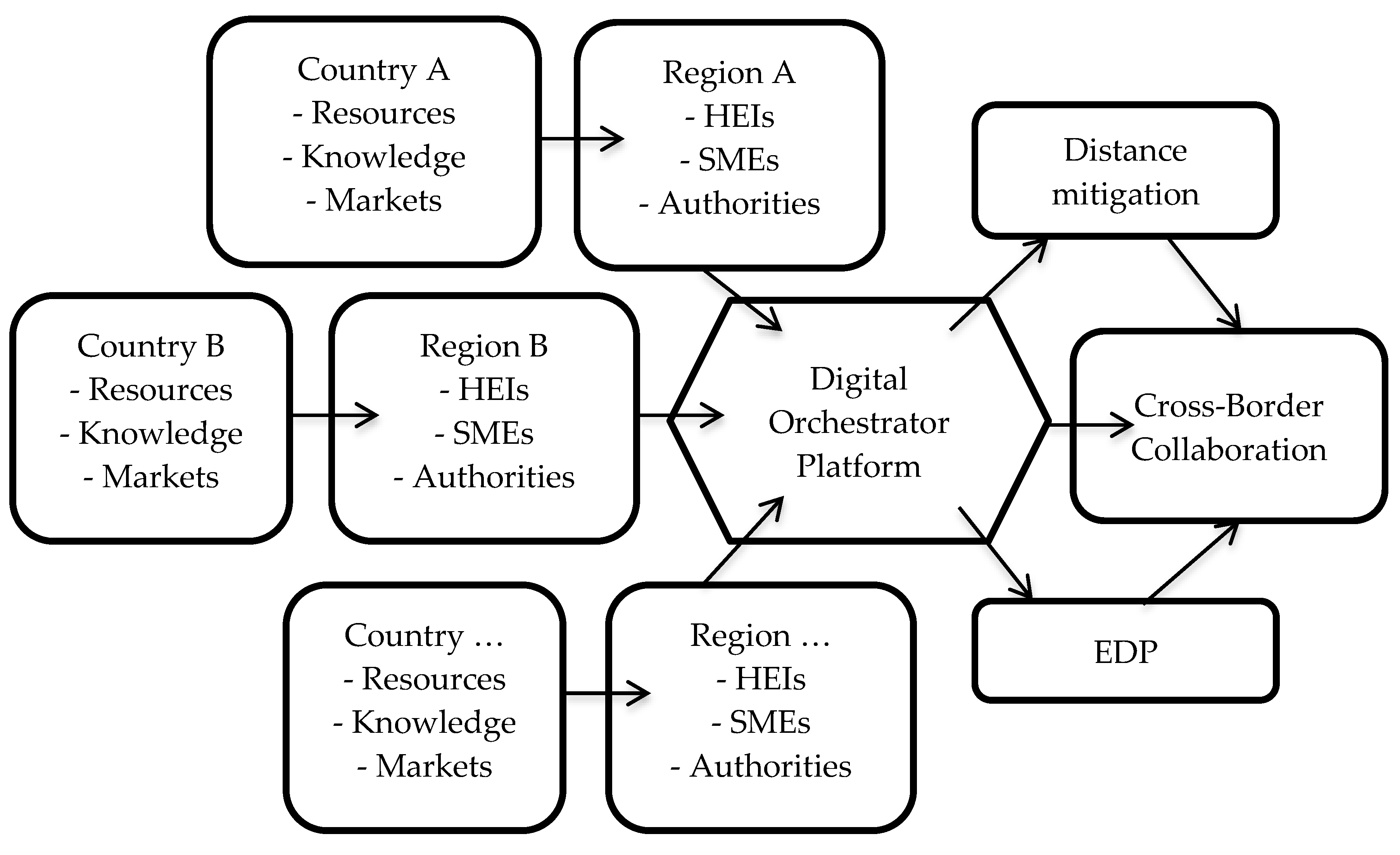
In the complex scenario of the mountains, digital orchestrating platforms like AI4EU, Ardia-Net, and Cicerone provide virtual spaces for knowledge transfer and resource allocation to mitigate geographical and institutional distance. Other orchestrators rely on the entrepreneurial discovery process (EDP), in accordance with the EU Smart Specialization Strategy (S3) guidelines, to reveal regional strengths and match partners based on resource compatibility. All of the platforms apply mechanisms to bridge and reduce cognitive distance through repeated interaction and shared practices (see Figure 1 for a visual representation of the mechanisms at play).
The analysis of digital platforms for collaborations in the Alpine region reveals that orchestrators operate in a geographically fragmented ecosystem, where institutional heterogeneity and cognitive distance hinder actors’ innovative efforts.
Theoretically, digital platforms provide ecosystem coordination and mechanisms for matching partners; however, empirical evidence shows difficulties in partner selection, trust formation, and agenda alignment because of multiple sources of differences among actors. The next section builds directly on these analytical insights to provide recommendations based on the evidence of the recurring patterns emerging from the qualitative data to explain why cross-border collaborations remain limited despite their potential for spurring innovation.

5. Results

5.1. Findings

The survey, interviews, and ethnographic studies conducted as part of the A-Ring project yielded three principal findings regarding the structural constraints on the effectiveness of cross-border collaborations in the Alpine region.
First, entrepreneurs experience difficulty identifying partners in sufficiently related domains to generate complementarities; most potential partners operate in too distant domains or sectors, thereby lacking common ground for a possible partnership or collaboration. Conversely, when potential partners operate in distant domains, cognitive distance becomes excessive and prevents the emergence of shared project foundations. Second, having only a few trustworthy partners tends to reiterate the same partnership, which, in the iterative loops of identical collaborations, results in a lack of combinatorial resources and reduces the process of innovation. The reliance on previously known and trusted partners reduces perceived uncertainty, but in this way, collaborations are path-dependent and reduce the diversity of competencies involved at the expense of novelty, limiting innovation. Third, SMEs in peripheral areas tend to rely on a smaller network of partners with respect to larger urban agglomerates because of divergencies in objectives and attitudes towards risks among the potential collaborators in the area. This behavioural pattern discourages experimentation and long-term strategic collaboration and further reduces the probability of engaging in exploratory cross-border innovation projects.
The abovementioned constraints explain why the existence of digital platforms does not automatically translate into diversified and transformative collaboration. Orchestrator platforms are therefore required not only to provide technical matching functions but also to actively manage trust formation, cognitive alignment, and agenda-setting. Orchestrators exist to bridge these three difficulties. Orchestrators promote matching events for potential partners that share needs and goals, expand the range of topics on which to centre the innovative collaboration of entrepreneurs and SMEs, and set an agenda that combines the needs of the communities living in the territory with the opportunity to develop the area.

5.2. Recommendations

Digital platforms for innovative collaboration offer opportunities to develop research projects with partners; however, the selection of partners is socially embedded and constrained by the extent of the network. In matching with partners, trust is often more important than alignment and compatibility, which, conversely, are essential to innovation. Collaborations based on trust between similar actors tend to reiterate similarities over complementary ones and create redundancies instead of innovation. At the same time, however, excessive distance, either cognitive or sectorial, prevents effective collaborations.
Trust is a relational and context-dependent process; cross-border heterogeneity (cultural, linguistic, administrative, institutional, …) increases uncertainty and reduces the perceived feasibility of collaborating with a distant partner. Because of the limited potential for combinatorial innovation in peripheral regions such as the mountains, digital platforms must intervene to reduce distance and build trust after the partner-matching stage of the collaboration. In mountain regions, a digital platform orchestrator is essential to bridge communication, particularly translating between the language of the public administration (PA) and businesses. Regional PAs should mandate the establishment of at least one such digital platform orchestrator per context.
Nevertheless, digital platforms are insufficient to drive innovative collaboration if they focus only on project compliance and administration. Digital platforms need to create support programs for Alpine business stakeholders to connect, explicitly addressing the relational and cognitive alignment of programs. These programs should help participants meet relevant contacts from different mountain areas to leverage diverse regional networks for suppliers, collaborators, and markets. Therefore, this paper recommends evaluating collaborations for their diversity rather than participation.
The interest in the platform is the highest if there is the possibility to meet new potential partners in the same field of activity, which should not be on the frontier of the innovative agenda—for example, the EU smart specialization strategy—but refers to a topic related to the local need.
Furthermore, platforms should give priority to sectoral domains that are sufficiently related to allow for complementarities, rather than sectors that are excessively frontier-oriented and disconnected from local productive structures. Aligning collaborations with local needs increases actors’ engagement and reduces cognitive distances. Finally, support mechanisms should incorporate short-term opportunities that lead actors in the mountains toward more innovative partnerships while moderating risks.

5.3. Implications

The empirical findings demonstrate that orchestration in mountain ecosystems is less about resources and more about orchestrating diversity under institutional and geographical constraints. This study advances entrepreneurial ecosystem (EE) theory by moving the focus on small and peripheral urban settings beyond metropolitan areas. It establishes the digital orchestrator platform as a critical intermediary level actor, specifically necessary for supporting R&I collaboration in geographically and institutionally constrained, peripheral contexts.
This research provides a nuanced conceptualization of distance, integrating cognitive proximity theory with border studies. It argues that the inherent institutional, cultural, and knowledge diversity of a border region is simultaneously a source of innovation (novelty and recombination) and a coordination barrier (high costs and mutual comprehension failure). The orchestrator’s core function is therefore redefined as the mechanism that actively manages this diversity by either bridging communication gaps or reducing cognitive distance through shared practices.
A digital platform’s highest value is in promoting matching events for partners in sectors that are similar enough or related to create synergy, not in fields that are too distant or where activities are merely replicated. However, since participants strongly prefer known partners over “open calls”, digital platforms should prioritize pre-collaborative support programs to build trust and dialogue among diverse cross-border actors before formal partnerships. Furthermore, orchestrators should focus on defining clear, short-term, locally relevant project agendas to mitigate the SME’s tendency to avoid risk-taking behaviour under the pressure of seasonal activities and immediate returns.
In terms of implications for policies aiming at fostering innovation and sustaining the knowledge, skills, and markets required for regional growth, policymakers should dedicate resources to support platform-led initiatives. The programs must design a mechanism to facilitate engagement and networking among business stakeholders across various mountain regions, directly addressing the current tendency toward reiterated, less diverse partnerships. Policy guidance should ensure that platforms set an agenda that combines the needs of the local communities with the opportunity for area development. The platform’s focus should be on topics related to local needs, making R&I relevant for marginal and peripheral urban areas.

6. Discussion and Conclusions

6.1. Contribution

This paper enhances the existing literature examining orchestrators’ contribution to cross-border cooperation in the Alps, a border area that allowed us to study the mechanisms combining entrepreneurial ecosystems and peripheral urban communities to foster economic development and transformation [36,37] in mountain areas.
The theoretical contribution of this study is in conceptualizing orchestrators as intermediary-level actors that support collaborations in the face of territorial constraints. This study answers the call for more research on regions facing issues across national boundaries and presents platforms that foster trust and dialogue between neighbouring countries and transform ecosystems [29,30,38], shedding light on (i) the difficulties of entrepreneurs and SMEs in making the most of partnership opportunities in a fragmented territory such as the mountains and (ii) the areas of intervention where platforms can make a significant difference in bringing together, engaging, and coordinating potential partners in forming effective collaborations for both innovative activity and territory development with respect to social, environmental, and economic sustainability, to build resilient communities along the border.
The policy implications of these findings are significant. The recognition of difficulties and opportunities for cross-border cooperation in small urban areas like the ones that can be found in the mountains is necessary for the craft of policies aimed at fostering the growth of innovative firms that could develop marginal and peripheral areas from within. Where the difficulties lie, however, the root of the solution can also be found, and the role of the innovators is often to see an opportunity where others see only obstacles. The emphasis is on understanding innovation as a local phenomenon that develops upon local resources and constraints; it can hardly be imported from outside. However, what policy can do is provide the right conditions for innovators to thrive and break down barriers to its proper deployment. Orchestrators are called to guide and coordinate the dynamics internal to the ecosystem, matching the right people and making the connections that work, bridging them with resources from outside but always looking at the internal condition of the area of origin. The results show that a considerable part of the resources that constitute a key ingredient of entrepreneurial ecosystems is deeply rooted in the context. Therefore, the study of different types of regions is of the utmost importance. Knowing that research underestimates rural areas in favour of metropolitan areas [65], it is crucial to have a clear understanding of the differences that a context can bring to an ecosystem and thus distinguish the specificities of the many rural communities and peripheral regions that are so dependent on entrepreneurship to start economic development.

6.2. Limitations and Future Research Proposal

The limitations of this study lie in its purely exploratory nature first and in the largely secondary database used for empirical evidence, which is derived from a previous study and based on the cross-referencing of qualitative and secondary data. Furthermore, this study assumed the perspective of the ecosystem and the supporting structure at its core, the orchestrator, which may underrepresent the lived experiences and strategic decision-making processes of individuals. However, this research aimed to better understand the functioning of the support for entrepreneurship and innovation in a well-defined and marginalized context.
Despite only being a marginal setting for urban studies, mountains are a fascinating area for multiple reasons, no less for entrepreneurship, given that their limits are known and that they are appreciated for their characteristics. Future research can start from these premises to develop more nuanced evidence on entrepreneurs, small businesses, and the transfer of knowledge in mountain areas, for example, on cross-border collaboration, international integration, and migration in the mountains. The insights from this study offer a valuable foundation for more in-depth evaluations and can serve as a starting point for further research. It is important to replicate this highly context-specific approach in peripheral fringe areas beyond the mountain regions to fully assess the evidence and its broader implications.

Author Contributions

Conceptualization, G.D.L. and M.L.; methodology, M.L.; formal analysis, G.D.L. and M.L.; resources, G.D.L. and M.L.; data curation, G.D.L. and M.L.; writing—original draft preparation, M.L.; writing—review and editing, G.D.L. and M.L.; visualization, M.L.; funding acquisition, G.D.L. and M.L. All authors have read and agreed to the published version of the manuscript.

Funding

This research received no external funding.

Institutional Review Board Statement

Not applicable.

Informed Consent Statement

Not applicable.

Data Availability Statement

Data obtained from the A-Ring project are available on the website https://www.alpine-space.eu/project/a-ring/ accessed on 20 February 2026.

Acknowledgments

We are grateful to Floriana Mulazzi and the A-Ring research team.

Conflicts of Interest

The authors declare no conflicts of interest.

References

  1. Nooteboom, B. Inter-Firm Collaboration, Learning and Networks: An Integrated Approach; Routledge: London, UK, 1999. [Google Scholar]
  2. Nooteboom, B. Learning and Innovation in Organizations and Economies; Oxford University Press: Oxford, UK, 2000. [Google Scholar]
  3. Dematteis, G. The Alpine metropolitan–mountain faced with global challenges: Reflections on the case of Turin. J. Alp. Res. 2018, 106. [Google Scholar] [CrossRef]
  4. Bertram, C.; Lambracht, D.; Chilla, T. Settlement systems in mountain regions: A research gap? Mt. Res. Dev. 2024, 44, A1–A9. [Google Scholar] [CrossRef]
  5. Bätzing, W.; Perlik, K.; Dekleva, M. Urbanization and depopulation in the Alps. Mt. Res. Dev. 1996, 16, 335–350. [Google Scholar] [CrossRef]
  6. Perlik, M.; Messerli, P.; Bätzing, W. Towns in the Alps: Urbanization processes, economic structure, and demarcation of European functional urban areas (EFUAs) in the Alps. Mt. Res. Dev. 2001, 21, 243–252. [Google Scholar] [CrossRef]
  7. Conedera, M.; Del Biaggio, A.; Seeland, K.; Moretti, M.; Home, R. Residents’ preferences and use of urban and peri-urban green spaces in a Swiss mountainous region of the Southern Alps. Urban For. Urban Green. 2015, 14, 139–147. [Google Scholar] [CrossRef]
  8. Bole, D.; Nared, J.; Zorn, M. Small urban centers in the Alps and their development issues. In Sustainable Development in Mountain Regions: Southeastern Europe; Springer: Cham, Switzerland, 2016; pp. 265–279. [Google Scholar]
  9. Perlik, M. Urbanisation: Changes in the built environment. In Forum Alpinum Conference Proceedings; Austrian Academy of Sciences: Vienna, Austria, 2007; pp. 27–29. [Google Scholar]
  10. Adler, C.; Wester, P.; Bhatt, I.; Huggel, C.; Insarov, G.; Morecroft, M.; Muccione, V.; Prakash, A.; Alcántara-Ayala, I.; Allen, S.K.; et al. Cross-chapter paper 5: Mountains. In Climate Change 2022: Impacts, Adaptation and Vulnerability; Cambridge University Press: Cambridge, UK, 2022; pp. 2273–2318. [Google Scholar]
  11. Bertram, C.; Chilla, T.; Hippe, S. Cross-border mobility: Rail or road? Space-timelines as an evidence base for policy debates. J. Borderl. Stud. 2023, 39, 913–930. [Google Scholar] [CrossRef]
  12. Chilla, T.; Bertram, D.; Lambracht, M. Alpine Towns—Key to Sustainable Development in the Alpine Region. Part 1: Facts, Maps and Scientific Debates; 9th Rep. State of the Alps; FAU Erlangen-Nürnberg: Erlangen, Germany, 2022. [Google Scholar]
  13. Sala, S.; Lostrangio, M.C.; Zampatti, M.; De Luca, G.; Landoni, M.; Giorgi, A. What governance for sustainable development in the mountains? Insights from the Alpine region. Mt. Res. Dev. 2024, 44, A1–A10. [Google Scholar] [CrossRef]
  14. De Luca, G.; Landoni, M. Cross-border cooperation for research and innovation in the Alpine region. An Explorative Study of the European Smart Specialization Strategy. Sci. Reg. 2026, 1, 7–31. [Google Scholar]
  15. Landoni, M. Agents in the Alps: The functions and impacts of orchestrator platforms in the mountains. Adm. Sci. 2025, 15, 441. [Google Scholar] [CrossRef]
  16. Audretsch, D.B.; Cunningham, J.A.; Kuratko, D.F.; Lehmann, E.E.; Menter, M. Entrepreneurial ecosystems: Economic, technological, and societal impacts. J. Technol. Transfer 2019, 44, 313–325. [Google Scholar] [CrossRef] [PubMed]
  17. Spigel, B. The relational organization of entrepreneurial ecosystems. Entrep. Theory Pract. 2017, 41, 49–72. [Google Scholar] [CrossRef]
  18. Stam, E.; van de Ven, A. Entrepreneurial ecosystem elements. Small Bus. Econ. 2021, 56, 809–832. [Google Scholar] [CrossRef]
  19. Feldman, M.P. The entrepreneurial event revisited: Firm formation in a regional context. Ind. Corp. Change 2001, 10, 861–891. [Google Scholar] [CrossRef]
  20. Autio, E.; Kenney, M.; Mustar, P.; Siegel, D.; Wright, M. Entrepreneurial innovation: The importance of context. Res. Policy 2014, 43, 1097–1108. [Google Scholar] [CrossRef]
  21. Feldman, M.; Siegel, D.S.; Wright, M. New developments in innovation and entrepreneurial ecosystems. Ind. Corp. Change 2019, 28, 817–826. [Google Scholar] [CrossRef]
  22. Fritsch, M.; Wyrwich, M. Regional Trajectories of Entrepreneurship, Knowledge, and Growth; Springer: Cham, Switzerland, 2018. [Google Scholar]
  23. Fritsch, M.; Wyrwich, M. Regional knowledge, entrepreneurial culture, and innovative start-ups over time and space. Small Bus. Econ. 2019, 51, 337–353. [Google Scholar] [CrossRef]
  24. Fritsch, M.; Wyrwich, M. Is innovation (increasingly) concentrated in large cities? Res. Policy 2021, 50, 104237. [Google Scholar] [CrossRef]
  25. Bosma, N.; Content, J.; Sanders, M.; Stam, E. Institutions, entrepreneurship, and economic growth in Europe. Small Bus. Econ. 2018, 51, 483–499. [Google Scholar] [CrossRef]
  26. Nooteboom, B.; Van Haverbeke, W.; Duysters, G.; Gilsing, V.; Van den Oord, A. Optimal cognitive distance and absorptive capacity. Res. Policy 2007, 36, 1016–1034. [Google Scholar] [CrossRef]
  27. Pettigrew, A.M.; Melin, L.; Whittington, R. Innovative Forms of Organizing: International Perspectives; Sage: London, UK, 2003. [Google Scholar]
  28. Adner, R. Ecosystem as structure: An actionable construct for strategy. J. Manag. 2017, 43, 39–58. [Google Scholar] [CrossRef]
  29. Schmidt, J.; Foss, N.J. Modularity, adaptation problems, and the governance and problem-solving capabilities of core firms in ecosystems. J. Manag. 2023, 51, 1484–1513. [Google Scholar] [CrossRef]
  30. Thomas, L.D.W.; Autio, E. Innovation ecosystems in management. In Oxford Research Encyclopedia of Business and Management; Oxford University Press: Oxford, UK, 2020. [Google Scholar]
  31. Ganco, M.; Kapoor, A.; Lee, G.K. From rugged landscapes to rugged ecosystems. Acad. Manag. Rev. 2020, 45, 646–674. [Google Scholar] [CrossRef]
  32. de Vasconcelos Gomes, L.A.; Flechas, X.A.; Facin, A.L.F.; Borini, F.M. Ecosystem management: Past achievements and future promises. Technol. Forecast. Soc. Change 2021, 171, 120950. [Google Scholar] [CrossRef]
  33. Shi, X.; Shi, Y. Unpacking the process of resource allocation within an entrepreneurial ecosystem. Res. Policy 2022, 51, 104378. [Google Scholar] [CrossRef]
  34. Jacobides, M.G.; Cennamo, C.; Gawer, A. Externalities and complementarities in platforms and ecosystems. Res. Policy 2024, 53, 104906. [Google Scholar] [CrossRef]
  35. Nambisan, S. Digital entrepreneurship. Entrep. Theory Pract. 2017, 41, 1029–1055. [Google Scholar] [CrossRef]
  36. Schmid, T.M.S.; Müller-Stewens, G. From product system to ecosystem: How firms adapt to provide an integrated value proposition. Strateg. Manag. J. 2022, 43, 1927–1957. [Google Scholar]
  37. Oghazi, P.; Parida, V.; Wincent, J.; Mostaghel, R. Ecosystems transformation through disruptive innovation. J. Bus. Res. 2022, 147, 16–26. [Google Scholar] [CrossRef]
  38. De Vasconcelos Gomes, L.A.; De Faria, A.M.; Braz, A.C.; de Mello, A.M.; Borini, F.M.; Ometto, A.R. Circular ecosystem management: Orchestrating ecosystem value proposition and configuration. Int. J. Prod. Econ. 2023, 256, 108725. [Google Scholar] [CrossRef]
  39. Thomas, L.D.W.; Autio, E.; Gann, D.M. Processes of ecosystem emergence. Technovation 2022, 115, 102441. [Google Scholar] [CrossRef]
  40. Gomes, L.A.D.V.; Flechas, A.; Facin, A.L.F.; Borini, F.M.; Stefani, B.; Leal, L.F. Entrepreneurial judgment governance adaptation for digital transformation in established firms. Strateg. Entrep. J. 2024, 18, 200–225. [Google Scholar] [CrossRef]
  41. Lievens, J.; Moons, I. A systemic approach of communication in multiple stakeholder settings: Challenges and future research directions from a multidisciplinary perspective. Int. J. Advert. 2022, 42, 201–226. [Google Scholar] [CrossRef]
  42. Boxer, S.; Perren, L.; Berry, A. SME managing director and non-executive director trust relations. Int. Small Bus. J. 2016, 34, 369–386. [Google Scholar] [CrossRef]
  43. Welter, F.; Smallbone, D. Institutional perspectives on entrepreneurial behavior. J. Small Bus. Manag. 2011, 49, 107–125. [Google Scholar] [CrossRef]
  44. Zahra, S.A.; Wright, M.; Abdelgawad, S.G. Contextualization and the advancement of entrepreneurship research. Int. Small Bus. J. 2014, 32, 479–500. [Google Scholar] [CrossRef]
  45. Welter, F. Contextualizing entrepreneurship—Conceptual Challenges and Ways Forward. Entrep. Theory Pract. 2011, 35, 165–184. [Google Scholar] [CrossRef]
  46. Elkafrawi, N.; Roos, A.; Refai, D. Contextualising rural entrepreneurship: A strong structuration perspective on gendered-local agency. Int. Small Bus. J. 2022, 40, 1019–1040. [Google Scholar] [CrossRef]
  47. McKeever, T.; Jack, S.; Anderson, A. Embedded entrepreneurship. J. Bus. Ventur. 2015, 30, 50–65. [Google Scholar] [CrossRef]
  48. Ozkazanc-Pan, B. Postcolonial feminist contributions to cross-cultural management. Int. J. Entrep. Behav. Res. 2014, 20, 155–172. [Google Scholar] [CrossRef]
  49. Refai, D.; McElwee, G. Refugee subentrepreneurship: The Emergence of a Liquid Cage. Work Employ. Soc. 2023, 37, 1032–1051. [Google Scholar] [CrossRef]
  50. Baker, T.; Welter, F. Contextual entrepreneurship. Found. Trends Entrep. 2018, 14, 357–426. [Google Scholar] [CrossRef]
  51. Korsgaard, S.; Ferguson, R.; Gaddefors, J. The best of both worlds: How rural entrepreneurs use placial embeddedness and strategic networks to create opportunities. Entrep. Reg. Dev. 2015, 27, 574–598. [Google Scholar] [CrossRef]
  52. Korsgaard, S.; Müller, S.; Tanvig, H.W. Rural entrepreneurship or entrepreneurship in the rural—Between place and space. Int. J. Entrep. Behav. Res. 2015, 21, 5–26. [Google Scholar] [CrossRef]
  53. Müller, S.; Korsgaard, S. Resources and bridging: The role of spatial context in rural entrepreneurship. Entrep. Reg. Dev. 2018, 30, 224–255. [Google Scholar] [CrossRef]
  54. Kalantaridis, C.; Bika, Z. In-migrant entrepreneurship in rural England: Beyond local embeddedness. Entrep. Reg. Dev. 2006, 18, 109–131. [Google Scholar] [CrossRef]
  55. Feeney, S.; Pierce, A. Strong structuration theory and accounting information: An empirical study. Account. Audit. Account. J. 2016, 29, 1152–1176. [Google Scholar] [CrossRef]
  56. Harima, A. Theorizing disembedding and re-embedding: Resource mobilization in refugee entrepreneurship. Entrep. Reg. Dev. 2022, 34, 269–293. [Google Scholar] [CrossRef]
  57. Ram, M.; Jones, T.; Villares-Varela, M. Migrant entrepreneurship: Reflections on research and practice. Int. Small Bus. J. 2017, 35, 3–18. [Google Scholar] [CrossRef]
  58. Refai, D.; Lever, J.; Haloub, R. Entrepreneurship in constrained immigration contexts—The liminal integration of Syrian refugees. Entrep. Reg. Dev. 2024, 36, 416–435. [Google Scholar] [CrossRef]
  59. Villares-Varela, M.; Ram, M.; Jones, T. Thwarted or facilitated? The entrepreneurial aspirations and capabilities of new migrants in the UK. Sociology 2022, 56, 1140–1158. [Google Scholar] [CrossRef]
  60. Korsgaard, S. Book review: Social Entrepreneurship and Innovation in Rural Europe. Int. Small Bus. J. 2020, 38, 474–475. [Google Scholar] [CrossRef]
  61. Lone, M.A.; Rashid, I.; Gulzar, F. Entrepreneurial ecosystems in fragile agrarian contexts: The role of incubation support in the intention–pre-start-up behaviour link. J. Entrep. Public Policy 2026, 1–29. [Google Scholar] [CrossRef]
  62. Cooke, P.; Uranga, M.G.; Etxebarria, G. Regional innovation systems: Institutional and organisational dimensions. Res. Policy 1997, 26, 475–491. [Google Scholar] [CrossRef]
  63. Lundvall, B.Å. National Systems of Innovation: Towards a Theory of Innovation and Interactive Learning; Pinter: London, UK, 1992. [Google Scholar]
  64. Nelson, R.R. National Innovation Systems: A Comparative Analysis; Oxford University Press: Oxford, UK, 1993. [Google Scholar]
  65. Audretsch, D.B.; Belitski, M. Towards an entrepreneurial ecosystem typology for regional economic development. Reg. Stud. 2021, 55, 735–756. [Google Scholar] [CrossRef]
  66. Guerrero, M.; Siegel, D.S. Schumpeter meets Teece: Proposed metrics for assessing entrepreneurial innovation and dynamic capabilities in entrepreneurial ecosystems. Res. Policy 2024, 53, 104984. [Google Scholar] [CrossRef]
  67. Mattes, J. Dimensions of proximity and knowledge bases. Reg. Stud. 2012, 46, 1085–1099. [Google Scholar] [CrossRef]
  68. Nooteboom, B. Cognitive distance, diversity, focus, and trust in geography. In The Oxford Handbook of Spatial Diversity and Business Economics; Andersson, M., Karlsson, C., Wixe, S., Eds.; Oxford University Press: Oxford, UK, 2025; pp. 41–58. [Google Scholar]
  69. Gros-Balthazard, C.; Talandier, M. Cooperation, proximity, and social innovation. Urban Sci. 2020, 4, 15. [Google Scholar] [CrossRef]
  70. Wagner, M.; Growe, A. Regional urbanization and knowledge-intensive business activities. Urban Sci. 2019, 4, 1. [Google Scholar] [CrossRef]
  71. Siggelkow, N. Persuasion with case studies. Acad. Manag. J. 2007, 50, 20–24. [Google Scholar] [CrossRef]
  72. Agostinho, S. Naturalistic inquiry in e-learning research. Int. J. Qual. Methods 2005, 4, 13–26. [Google Scholar] [CrossRef]
  73. Eisenhardt, K.M. Building theories from case study research. Acad. Manag. Rev. 1989, 14, 532–550. [Google Scholar] [CrossRef]
  74. Yin, R.K. Case Study Research: Design and Methods; Sage: Thousand Oaks, CA, USA, 2009. [Google Scholar]
  75. Miles, M.B.; Huberman, A.M. Qualitative Data Analysis; Sage: Thousand Oaks, CA, USA, 1994. [Google Scholar]
  76. Villeneuve, A.; Hofer, T.; McGuire, D.; Sato, M.; Mekouar, A. National policies and institutions for sustainable mountain development. In Key Issues for Mountain Areas; United Nations University: Tokyo, Japan, 2004; pp. 181–199. [Google Scholar]
  77. Kohler, T.; Hurni, H.; Wiesmann, U.; Kläy, A. Mountain infrastructure: Access, communications and energy. In Key Issues for Mountain Areas; Price, M.F., Jansky, L., Iatsenia, A.A., Eds.; United Nations University: Tokyo, Japan, 2004; pp. 38–62. [Google Scholar]
  78. Capello, R.; Cerisola, S. Development patterns and sources of competitiveness in the EUSALP macro-region. Reg. Stud. 2020, 54, 1043–1056. [Google Scholar] [CrossRef]
  79. Ferretti, V.; Zolin, M.B.; Ferraro, G. Relationships among sustainability dimensions. Land Use Policy 2020, 92, 104457. [Google Scholar] [CrossRef]
  80. Chilla, T.; Heugel, A. Cross-border Commuting Dynamics: Patterns and Driving Forces in the Alpine Macro-region. J. Borderl. Stud. 2022, 37, 17–35. [Google Scholar] [CrossRef]
  81. Sohn, C. The border as a resource in the global urban space. Int. J. Urban Reg. Res. 2014, 38, 1697–1711. [Google Scholar] [CrossRef]
  82. Möller, C.; Alfredsson-Olsson, E.; Ericsson, B.; Overvåg, K. The border as an engine for mobility and spatial integration. Nor. Geogr. Tidsskr.-Nor. J. Geogr. 2018, 72, 217–233. [Google Scholar] [CrossRef]
  83. Giorgi, A.; Scheurer, T. Alpine resources: Assets for a promising future—Conclusions from the ForumAlpinum 2014. Mt. Res. Dev. 2015, 35, 414–415. [Google Scholar] [CrossRef]
  84. Foray, D.; David, P.A.; Hall, B.H. Smart specialisation: From academic idea to political instrument. In Integration Process in the New Regional and Global Settings; University of Warsaw: Warsaw, Poland, 2012; pp. 269–284. [Google Scholar]
Figure 1. Orchestrating mechanisms.
Urbansci 10 00195 g001
Table 1. Actors and roles in the ecosystems.
ActorsRole
Orchestrator PlatformsStart and coordination
Higher Education Institutions (HEIs)Transfer of knowledge
Small and Medium Enterprises (SMEs)Access to new markets and technologies
Administrative and Public AuthoritiesRegulation
Other OrganizationsComplementarities
Source: Authors’ elaboration.
Disclaimer/Publisher’s Note: The statements, opinions and data contained in all publications are solely those of the individual author(s) and contributor(s) and not of MDPI and/or the editor(s). MDPI and/or the editor(s) disclaim responsibility for any injury to people or property resulting from any ideas, methods, instructions or products referred to in the content.