
GeoAI and Multimodal Geospatial Data Fusion for Inclusive Urban Mobility: Methods, Applications, and Future Directions




Abstract
1. Introduction
- data heterogeneity—integrating diverse modalities with mismatched resolutions and formats [17].
- algorithmic bias—detecting and correcting systematic under-representation of marginalized communities in training data [18].
- scalability—processing large-volume geospatial big data across cities and regions [19]; and
- interpretability—using explainable AI techniques to ensure that model decisions can be audited and trusted by stakeholders [20].
2. Methods: Systematic Survey
2.1. Review Design and Scope
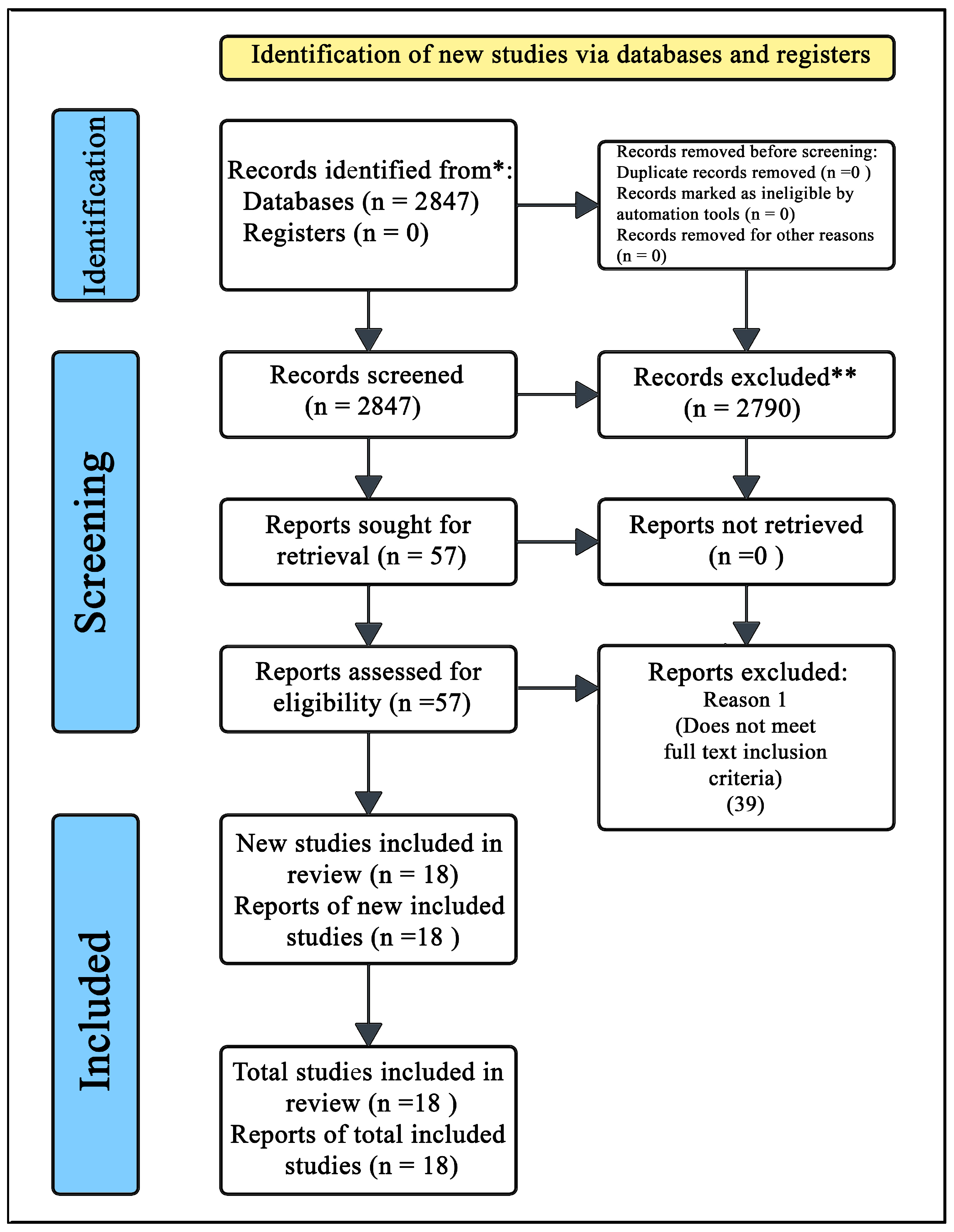
2.2. Literature Search Strategy
- (i)
- ‘“GeoAI” AND (“multimodal” OR “data fusion”) AND (“urban mobility” OR “transport equity”)’
- (ii)
- ‘“graph neural network” AND (“OD flow” OR “accessibility”) AND “multimodal”’
- (iii)
- ‘ “deep learning” AND (“transport demand” OR “walkability”) AND “geospatial fusion”’
- (iv)
- ‘“explainable AI” AND “urban mobility” AND (“equity” OR “fairness”)’
- (v)
- ‘“federated learning” AND “transport” AND “multimodal”’
2.3. Study Screening and Selection
2.3.1. Titles and Abstracts Screening
2.3.2. Full-Text Screening
- integrated two or more geospatial data modalities (e.g., GPS traces, mobile phone data, satellite imagery, transit records, crowdsourced maps) were employed;
- apply data-, feature-, or decision-level fusion techniques;
- addressed urban mobility tasks such as accessibility mapping, traffic or demand forecasting, travel behavior modeling, and OD analysis were addressed;
- reported quantitative evaluation metrics or comparative performance against the baselines.
2.4. Data Extraction and Analytical Framework
2.5. Synthesis and Evaluation Approach
3. Theoretical and Conceptual Foundations
3.1. Urban Mobility Inequities: Population, Spatial, and Social Perspectives
3.2. Accessibility and Spatial Equity Theories
- Capability Approach: Sen’s framework interprets equity as the substantive freedoms individuals require to pursue valued outcomes, shifting the focus from mere physical mobility to flexibility and opportunity to achieve life goals [30].
- Availability: Presence and diversity of mobility options;
- Accessibility: Ease of reaching desired destinations;
- Acceptability: Cultural and social appropriateness;
- Flexibility: Adaptability to various user needs
3.3. Built Environment and Inclusivity
4. GeoAI Framework for Multimodal Urban Mobility
4.1. Evolution of GIScience in the Era of GeoAI
4.2. Multimodal Geospatial Data Sources
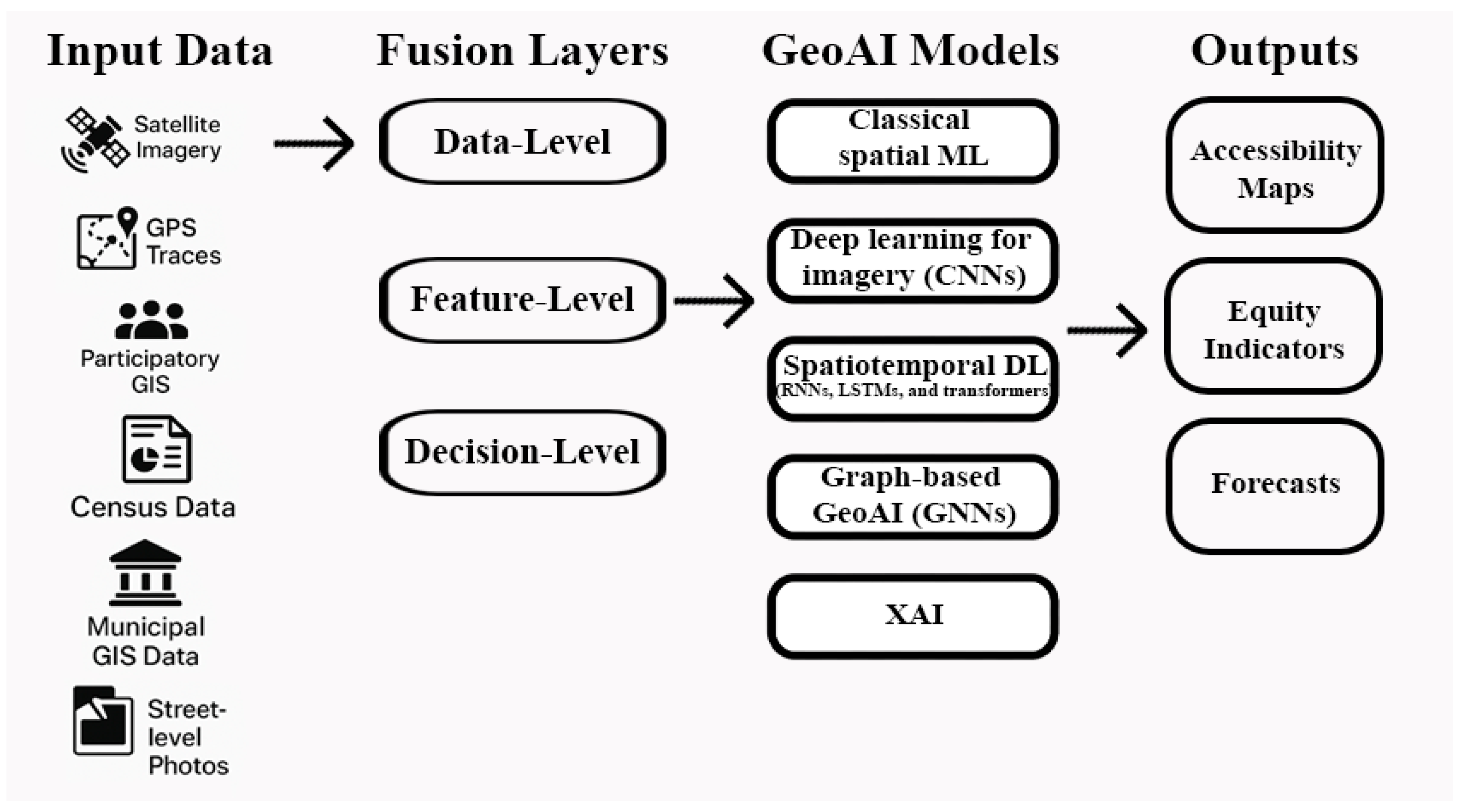
4.3. GeoAI Model Architectures
4.4. Data Fusion Techniques
4.5. Participatory Approaches and Human-in-the-Loop Design
4.6. GeoAI Data Fusion Pipeline
5. Systematic Survey Results
6. Application Domains
6.1. Walking, Micromobility, and Accessibility
- Accessibility Mapping and Equity Assessment
- b.
- Demand Forecasting and Scenario Analysis
- c.
- Infrastructure Planning and Policy Decision Support
- d.
- Specialized Domains: Maritime Mobility, Micromobility
6.2. Implications for Urban Planning and Policy
7. Technical, Ethical, and Practical Challenges
7.1. Data Heterogeneity and Resolution Mismatch
7.2. Bias, Representation, and Validation Issues
7.3. Ethical, Fairness, and Governance Principles in GeoAI
7.4. Computational Resource Constraints
8. Validation Approaches and Assessment Gaps
9. Research Gaps and Future Directions
9.1. Research Gaps
9.2. Recommendations and Roadmap for Advancing the Field
9.3. Limitations of This Survey
10. Conclusions
Funding
Institutional Review Board Statement
Informed Consent Statement
Data Availability Statement
Conflicts of Interest
References
- Sheller, M. Mobility Justice: The Politics of Movement in an Age of Extremes; Verso: London, UK, 2018. [Google Scholar]
- Turon, K. Sustainable Urban Mobility Transitions—From Policy Uncertainty to the CalmMobility Paradigm. Smart Cities 2025, 8, 164. [Google Scholar] [CrossRef]
- Lotero, L.; Cardillo, A.; Hurtado, R.G.; Gomez-Gardenes, J. Several Multiplexes in the Same City: The Role of Socioeconomic Differences in Urban Mobility. In Interconnected Networks. Understanding Complex Systems; Garas, A., Ed.; Springer: Cham, Switzerland, 2019. [Google Scholar] [CrossRef]
- Kristensen, N.G.; Lindberg, M.R.; Freudendal-Pedersen, M. Urban Mobility Injustice and Imagined Sociospatial Differences in Cities. Cities 2023, 137, 104320. [Google Scholar] [CrossRef]
- Aman, J.J.C.; Zakhem, M.; Smith-Colin, J. Towards Equity in Micromobility: Spatial Analysis of Access to Bikes and Scooters Amongst Disadvantaged Populations. Sustainability 2021, 13, 11856. [Google Scholar] [CrossRef]
- Delgado, D.; Yang, J.; Al-Ramahi, M.; Lee, Y. Routes of Inequality and Enclaves of Exclusion: Understanding Public Transit’s Role in Race and Class Segregation and Mobility Disparities in San Antonio, Texas. Crit. Sociol. 2025. [Google Scholar] [CrossRef]
- Namgung, M.; Lee, J.; Ding, F.; Chiang, Y.Y. Transit for All: Mapping Equitable Bike2Subway Connection Using Region Representation Learning. arXiv 2025, arXiv:2506.15113. [Google Scholar] [CrossRef]
- Wang, Y.; Zhang, X.; Li, J.; Liu, Q. Shared micro-mobility and transport equity: A case study of three European countries. Cities 2024, 153, 105248. [Google Scholar] [CrossRef]
- Venter, C.; Jennings, G.; Hidalgo, D.; Valderrama Pineda, A.F. The equity impacts of bus rapid transit: A review of the evidence and implications for sustainable transport. Int. J. Sustain. Transp. 2018, 12, 140–152. [Google Scholar] [CrossRef]
- Wang, X.; Yan, X.; Zhao, X.; Cao, Z. Identifying Latent Shared Mobility Preference Segments in Low-Income Communities: Ride-Hailing, Fixed-Route Bus, and Mobility-on-Demand Transit. Travel Behav. Soc. 2021, 26, 134–142. [Google Scholar] [CrossRef]
- Cai, J.; Kwan, M.P. Revealing the Complex Dynamics of Social Disparities in Personal Transit Availability Considering Human Mobility and Neighborhood Effect Averaging. Ann. Am. Assoc. Geogr. 2025, 115, 620–639. [Google Scholar] [CrossRef]
- Shaver, H.; Kim, J.; Diab, E.; Lee, J. Bridging the Gap: A Social Equity Analysis of Intra-City Transit Access to Inter-City Rail in Canada. Cities 2025, 163, 106041. [Google Scholar] [CrossRef]
- Badia, H.; Jenelius, E. Shared E-Scooter Micromobility: Review of Use Patterns, Perceptions, and Equity. Transp. Rev. 2023, 43, 811–837. [Google Scholar] [CrossRef]
- Deivanayagam, T.A.; English, S.; Hickel, J.; Bonifacio, J.; Guinto, R.R.; Hill, K.X.; Huq, M.; Issa, R.; Mulindwa, H.; Nagginda, H.P.; et al. Envisioning environmental equity: Climate change, health, and racial justice. Lancet 2023, 402, 64–78. [Google Scholar] [CrossRef]
- Janowicz, K.; Gao, S.; McKenzie, G.; Hu, Y.; Bhaduri, B. GeoAI: Spatially Explicit Artificial Intelligence Techniques for Geographic Knowledge Discovery and Beyond. Int. J. Geogr. Inf. Sci. 2020, 34, 625–636. [Google Scholar] [CrossRef]
- Mai, G.; Xie, Y.; Jia, X.; Lao, N.; Rao, J.; Zhu, Q.; Liu, Z.; Chiang, Y.Y.; Jiao, J. Towards the Next Generation of Geospatial Artificial Intelligence. Int. J. Appl. Earth Obs. Geoinf. 2025, 136, 104368. [Google Scholar] [CrossRef]
- Alastal, A.; Shaqfa, A. GeoAI Technologies and Their Application Areas in Urban Planning and Development: Concepts, Opportunities and Challenges in Smart City (Kuwait, Study Case). J. Data Anal. Inf. Process. 2022, 10, 110–126. [Google Scholar] [CrossRef]
- Liu, P.; Biljecki, F. A Review of Spatially Explicit GeoAI Applications in Urban Geography. Int. J. Appl. Earth Obs. Geoinf. 2022, 111, 102833. [Google Scholar] [CrossRef]
- Jin, C.; Park, S.; Ha, H.J.; Lee, J.; Kim, J.; Hutchenreuther, J.; Nara, A. Predicting Households’ Residential Mobility Trajectories with Geographically Localized Interpretable Model-Agnostic Explanation (GLIME). Int. J. Geogr. Inf. Sci. 2023, 37, 2597–2619. [Google Scholar] [CrossRef]
- Costa, V.; Oliveira, J.M.; Ramos, P. Deep Learning-Driven Integration of Multimodal Data for Material Property Predictions. Computation 2025, 13, 282. [Google Scholar] [CrossRef]
- Hochmair, H.H.; Juhász, L.; Li, H. Advancing AI-Driven Geospatial Analysis and Data Generation: Methods, Applications and Future Directions. ISPRS Int. J. Geo-Inf. 2025, 14, 56. [Google Scholar] [CrossRef]
- Zhang, X.; Wang, Q.; Ye, Z.; Ying, H.; Yu, D. Federated Representation Learning with Data Heterogeneity for Human Mobility Prediction. IEEE Trans. Intell. Transp. Syst. 2023, 24, 6111–6122. [Google Scholar] [CrossRef]
- Ezequiel, C.; Gjoreski, M.; Langheinrich, M. Federated Learning for Privacy-Aware Human Mobility Modeling. Front. Artif. Intell. 2022, 5, 867046. [Google Scholar] [CrossRef]
- Page, M.J.; McKenzie, J.E.; Bossuyt, P.M.; Boutron, I.; Hoffmann, T.C.; Mulrow, C.D.; Shamseer, L.; Tetzlaff, J.M.; Akl, E.A.; Brennan, S.E.; et al. The PRISMA 2020 statement: An updated guideline for reporting systematic reviews. BMJ 2021, 372, n71. [Google Scholar] [CrossRef]
- Xu, J.; Saeedi, M.; Zalzal, J.; Zhang, M.; Ganji, A.; Mallinen, K.; Wang, A.; Lloyd, M.; Venuta, A.; Simon, L.; et al. Exploring the triple burden of social disadvantage, mobility poverty, and exposure to traffic-related air pollution. Sci. Total Environ. 2024, 920, 170947. [Google Scholar] [CrossRef] [PubMed]
- United Nations. Fundamental Rights: Freedom of Movement; UN Peacemaker: New York, NY, USA, 2008; p. 1. Available online: https://peacemaker.un.org/sites/default/files/document/files/2022/07/sbfundamentalrightsfreedomofmovement2008j.pdf (accessed on 5 March 2026).
- United Nations General Assembly. Universal Declaration of Human Rights (Art. 13); UN General Assembly: Paris, France, 1948; Available online: https://www.un.org/en/about-us/universal-declaration-of-human-rights (accessed on 5 March 2026).
- Lefebvre, H. Writings on Cities; Blackwell: Oxford, UK, 1996. [Google Scholar]
- Harvey, D. The Right to the City. New Left Rev. 2008, 53, 23–40. [Google Scholar] [CrossRef]
- Sen, A. Development as Freedom; Oxford University Press: Oxford, UK, 1999. [Google Scholar]
- World Health Organization. Human Rights and Health. Available online: https://www.who.int/news-room/fact-sheets/detail/human-rights-and-health (accessed on 15 December 2025).
- Ewing, R.; Cervero, R. Travel and the Built Environment: A Meta-Analysis. J. Am. Plan. Assoc. 2010, 76, 265–294. [Google Scholar] [CrossRef]
- Handy, S. Critical Assessment of the Literature on the Relationships among Transportation, Land Use, and Physical Activity. Transp. Res. Board Spec. Rep. 2005. Available online: https://itspubs.ucdavis.edu/publication_detail.php?id=2536 (accessed on 4 February 2026).
- Lucas, K. Transport and Social Exclusion: Where Are We Now? Transp. Policy 2012, 20, 105–113. [Google Scholar] [CrossRef]
- Barrington-Leigh, C.; Millard-Ball, A. Global Trends toward Urban Street-Network Sprawl. Proc. Natl. Acad. Sci. USA 2020, 117, 1941–1950. [Google Scholar] [CrossRef]
- Mobasheri, A.; Zipf, A.; Francis, L. OpenStreetMap Data Quality Enrichment through Awareness Raising and Collective Action Tools—Experiences from a European Project. Geo-Spat. Inf. Sci. 2018, 21, 234–246. [Google Scholar] [CrossRef]
- Song, Z.; Xia, J. Spatial and Temporal Sentiment Analysis of Twitter Data. In European Handbook of Crowdsourced Geographic Information; Kettunen, J., Ostermann, F., Purves, R., Capineri, C., Antoniou, V., Haklay, M., Huang, H., Eds.; Ubiquity Press: London, UK, 2016; pp. 205–221. [Google Scholar] [CrossRef]
- Szell, M.; Sinatra, R.; Petri, G.; Thurner, S.; Latora, V. Crowdsourced Quantification and Visualization of Urban Mobility. Urban Plan. 2018, 3, 72–80. [Google Scholar] [CrossRef]
- Batty, M. Big Data, Smart Cities and City Planning. Dialogues Hum. Geogr. 2013, 3, 274–279. [Google Scholar] [CrossRef]
- Gupta, N.; Zurn, P.; Diallo, K.; Dal Poz, M.R. Uses of population census data for monitoring geographical imbalance in the health workforce: Snapshots from three developing countries. Int. J. Equity Health 2003, 2, 11. [Google Scholar] [CrossRef]
- Litman, T. Evaluating Transportation Equity: Guidance for Incorporating Distributional Impacts in Transport Planning; Victoria Transport Policy Institute: Victoria, BC, Canada, 2025; Available online: https://www.vtpi.org/equity.pdf (accessed on 11 December 2025).
- Huang, X.; Jiang, Y.; Mostafavi, A. The emergence of urban heat traps and human mobility in 20 US cities. npj Urban Sustain. 2024, 4, 6. [Google Scholar] [CrossRef]
- Aleksandrowicz, O. Shade Maps—Mapping Shade Availability for Urban Climate Resilience. 2024. Available online: https://oraleks.net.technion.ac.il/en/shade-maps/ (accessed on 11 December 2025).
- Zhou, H.; Wang, Y.; Zhang, F.; Li, X.; Liu, Y.; Zhang, J. Social inequalities in neighborhood visual walkability: Using street view imagery and deep learning in Shenzhen, China. Sustain. Cities Soc. 2019, 50, 101657. [Google Scholar] [CrossRef]
- Ki, D.; Chen, Z.; Lee, S.; Lieu, S. A novel walkability index using Google Street View and deep learning. Sustain. Cities Soc. 2023, 96, 104683. [Google Scholar] [CrossRef]
- He, Y.; Huang, P.; Hong, W.; Luo, Q.; Li, L.; Tsui, K.-L. In-Depth Insights into the Application of Recurrent Neural Networks (RNNs) in Traffic Prediction: A Comprehensive Review. Algorithms 2024, 17, 398. [Google Scholar] [CrossRef]
- Drosouli, I.; Voulodimos, A.; Mastorocostas, P.; Miaoulis, G.; Ghazanfarpour, D. A Graph Neural Network Based Learning Model for Urban Metro Flow Prediction. In Proceedings of the 2023 International Conference on Machine Learning and Applications (ICMLA), Jacksonville, FL, USA, 15–17 December 2023; pp. 1883–1888. [Google Scholar] [CrossRef]
- Rahmani, S.; Baghbani, A.; Bouguila, N.; Patterson, Z. Graph Neural Networks for Intelligent Transportation Systems: A Survey. IEEE Trans. Intell. Transp. Syst. 2023, 24, 8846–8885. [Google Scholar] [CrossRef]
- Wang, R.; Ma, L.; He, G.; Johnson, B.A.; Yan, Z.; Chang, M.; Liang, Y. Transformers for Remote Sensing: A Systematic Review and Analysis. Sensors 2024, 24, 3495. [Google Scholar] [CrossRef] [PubMed]
- Ghassemi, M.; Oakden-Rayner, L.; Beam, A.L. The False Hope of Current Approaches to Explainable AI in Health Care. Lancet Digit. Health 2021, 3, e745–e750. [Google Scholar] [CrossRef]
- Wang, S.; Huang, X.; Liu, P.; Zhang, M.; Biljecki, F.; Hu, T.; Fu, X.; Liu, L.; Liu, X.; Wang, R.; et al. Mapping the Landscape and Roadmap of Geospatial Artificial Intelligence (GeoAI) in Quantitative Human Geography: An Extensive Systematic Review. Int. J. Appl. Earth Obs. Geoinf. 2024, 128, 103734. [Google Scholar] [CrossRef]
- Yang, X.; Li, T.; Cao, Y.; Zheng, X.; Tang, L. A Novel Framework Integrating GeoAI and Human Perceptions to Estimate Walkability in Wuhan, China. Sci. Rep. 2025, 15, 25377. [Google Scholar] [CrossRef]
- Liu, P.; Zhang, Y.; Biljecki, F. Explainable Spatially Explicit Geospatial Artificial Intelligence in Urban Analytics. Environ. Plan. B Urban Anal. City Sci. 2023, 51, 1104–1123. [Google Scholar] [CrossRef]
- Sangeetha, S.K.B.; Mathivanan, S.; Rajadurai, H.; Cho, J.; Easwaramoorthy, S. A Multi-Modal Geospatial–Temporal LSTM-Based Deep Learning Framework for Predictive Modeling of Urban Mobility Patterns. Sci. Rep. 2024, 14, 31579. [Google Scholar] [CrossRef]
- Wang, B.; Leng, Y.; Wang, G.; Wang, Y. FusionTransNet for Smart Urban Mobility: Spatiotemporal Traffic Forecasting Through Multimodal Network Integration. arXiv 2024, arXiv:2405.05786. [Google Scholar]
- Graells-Garrido, E.; Opitz, D.; Rowe, F.; Arriagada, J. A data fusion approach with mobile phone data for updating travel survey-based mode split estimates. Transp. Res. Part C Emerg. Technol. 2022, 155, 104285. [Google Scholar] [CrossRef]
- Grzenda, M.; Luckner, M.; Zawieska, J.; Wrona, P. Combining Data from Multiple Sources for Urban Travel Mode Choice Modelling. arXiv 2024, arXiv:2407.12137. [Google Scholar]
- Wang, Y.; Currim, F.; Ram, S. Deep Learning of Spatiotemporal Patterns for Urban Mobility Prediction Using Big Data. Inf. Syst. Res. 2022, 33, 579–598. [Google Scholar] [CrossRef]
- Prado-Rujas, I.-I.; Serrano, E.; García Dopico, A.; Córdoba, M.L.; Pérez, M.S. Combining heterogeneous data sources for spatio-temporal mobility demand forecasting. Inf. Fusion 2022, 75, 1–13. [Google Scholar] [CrossRef]
- Wang, H.; Yu, Q.; Liu, Y.; Jin, D.; Li, Y. Spatio-Temporal Urban Knowledge Graph Enabled Mobility Prediction. Proc. ACM Interact. Mob. Wearable Ubiquitous Technol. 2021, 5, 1–26. [Google Scholar] [CrossRef]
- Fang, Z.; Pan, L.; Chen, L.; Du, Y.; Gao, Y. MDTP: A Multi-Source Deep Traffic Prediction Framework over Spatio-Temporal Trajectory Data. Proc. VLDB Endow. 2021, 14, 1289–1297. [Google Scholar] [CrossRef]
- Zhang, D.; Yan, J.; Polat, K.; Alhudhaif, A.; Li, J. Multimodal joint prediction of traffic spatial–temporal data with graph sparse attention mechanism and bidirectional temporal convolutional network. Adv. Eng. Inform. 2024, 62, 102533. [Google Scholar] [CrossRef]
- Deng, C.; Li, Y. Dynamic demand forecasting for bike-sharing e-fences using a hybrid deep learning framework with spatio-temporal attention. Sustainability 2025, 17, 7586. [Google Scholar] [CrossRef]
- Naji, H.; Xue, Q.; Zhu, H.; Li, T. Forecasting taxi demands using generative adversarial networks with multi-source data. Appl. Sci. 2021, 11, 9675. [Google Scholar] [CrossRef]
- Cantelmo, G.; Kucharski, R.; Antoniou, C. Low-dimensional model for bike-sharing demand forecasting that explicitly accounts for weather data. Transp. Res. Rec. 2020, 2674, 132–144. [Google Scholar] [CrossRef]
- Chang, X.; Wu, J.; Liu, H.; Yan, X.; Sun, H.; Qu, Y. Travel mode choice: A data fusion model using machine learning methods and evidence from travel diary survey data. Transp. A Transp. Sci. 2019, 15, 1587–1612. [Google Scholar] [CrossRef]
- Sun, Y.; Dong, Y.; Waygood, E.; Naseri, H.; Jiang, Y.; Chen, Y. Machine-learning approaches to identify travel modes using smartphone-assisted survey and map application programming interface. Transp. Res. Rec. 2022, 2677, 385–400. [Google Scholar] [CrossRef]
- Tang, L.; Lin, X.; Yu, J.; Tang, C. Integrating travel survey and Amap API data into travel mode choice analysis with interpretable machine learning models: A case study in China. IEEE Access 2025, 13, 27852–27867. [Google Scholar] [CrossRef]
- Zhang, H.; Zhang, L.; Liu, Y.; Zhang, L. Understanding travel mode choice behavior: Influencing factors analysis and prediction with machine learning method. Sustainability 2023, 15, 11414. [Google Scholar] [CrossRef]
- Ma, J.; Zhao, J.; Hou, Y. Spatial–Temporal Transformer Networks for Traffic Flow Forecasting Using a Pre-Trained Language Model. Sensors 2024, 24, 5502. [Google Scholar] [CrossRef]
- Lucas, K.; van Wee, B.; Maat, K. A Method to Evaluate Equitable Accessibility: Combining Ethical Theories and Accessibility-Based Approaches. Transportation 2016, 43, 473–490. [Google Scholar] [CrossRef]
- Iyer, H.S.; Karasaki, S.; Yi, L.; Hswen, Y.; James, P.; VoPham, T. Harnessing Geospatial Artificial Intelligence (GeoAI) for Environmental Epidemiology: A Narrative Review. Curr. Environ. Health Rep. 2025, 12, 34. [Google Scholar] [CrossRef]
- Saleh, H.J.H.; Arrang, J.; de Barros Cardoso, L.M.O. Applications of Geospatial AI in Human Geography and Spatial Networks: A Literature Review. EDRAAK 2025, 2025, 76–84. [Google Scholar] [CrossRef] [PubMed]
- Zou, L.; Song, Y.; Cervone, G. Geospatial Big Data: Theory, Methods, and Applications. Ann. GIS 2024, 30, 411–415. [Google Scholar] [CrossRef]
- Haraguchi, M.; Nishino, A.; Kodaka, A.; Allaire, M.; Lall, U.; Kuei-Hsien, L.; Onda, K.; Tsubouchi, K.; Kohtake, N. Human mobility data and analysis for urban resilience: A systematic review. Environ. Plan. B Urban Anal. City Sci. 2022, 49, 1507–1535. [Google Scholar] [CrossRef]
- Luo, P.; Chen, C.; Gao, S.; Zhang, X.; Majok Chol, D.; Yang, Z.; Meng, L. Understanding of the predictability and uncertainty in population distributions empowered by visual analytics. Int. J. Geogr. Inf. Sci. 2025, 39, 675–705. [Google Scholar] [CrossRef]
- Falahatkar, H.; Fast, V. Extending the Conversation: A Vision for Urban Accessibility for Diverse Mobilities Through GeoAI; eScholarship: Oakland, CA, USA, 2022. [Google Scholar] [CrossRef]
- Yarish, M. GeoAI and Urban Justice: An Equity-Centered Governance Model for Redeveloping the Gowanus Canal. Sci. Moralitas 2025, 10, 454–467. [Google Scholar]
- Alessandretti, L.; Natera Orozco, L.G.; Saberi, M.; Szell, M.; Battiston, F. Multimodal urban mobility and multilayer transport networks. Environ. Plan. B Urban Anal. City Sci. 2022, 50, 2038–2070. [Google Scholar] [CrossRef]



| Data Type | Source | Challenge | Equity Impacts |
|---|---|---|---|
| Satellite Imagery | NASA, Copernicus | Cloud cover, resolution | Misses informal/ground detail [17] |
| GPS Traces | Phones, Taxis | Signal gaps, user bias | Skewed to affluent travelers [12] |
| OpenStreetMap | Crowdsourcing | Under-mapping | Underrepresents poor areas [35,36] |
| Social media | Twitter, Facebook | Sentiment, sample, privacy | Reflects perceptions, not all users [37] |
| Participatory GIS | Citizen mapping | Engagement, data quality | Captures lived experience [38] |
| Census Data | National statistical offices | Coarse spatial/temporal resolution; undercounts | Masks intra-neighborhood disparities; may miss marginalized groups [39,40] |
| Municipal GIS Data | City planning/transport departments | Inconsistent coverage; update frequency | May omit informal areas; reflect institutional priorities [39,41] |
| Shade Maps | Remote sensing, urban climate models | Seasonal variability; model uncertainty | Misses micro-scale thermal stress along everyday paths: heat exposure is often highest for vulnerable groups [42,43] |
| Street-level Photos | Google Street View, Baidu, Mapillary | Coverage bias; occlusion; privacy | Overrepresents well-served areas; inequities in visual walkability and streetscape quality across neighborhoods [44,45] |
| Framework Name | Core Methodology | Prediction Target | Geographic Scope | Data Modalities Combined | Study |
|---|---|---|---|---|---|
| Hierarchical Evaluation Framework | DS-HRNet (Detail-Strengthened High-Resolution Network, deep learning) | Urban walkability | Wuhan, China | Street imagery, road network, built environment indicators | [52] |
| Spatially Explicit Explainable GeoAI | GCN (Graph Convolutional Network) + GNNExplainer (Graph Neural Network Explainer.) | Traffic volume prediction | Wuhan, China | Traffic sensor data, road network, spatial features | [53] |
| GT-LSTM (Geospatial-Temporal Long Short-Term Memory) | Attention mechanisms and Recurrent Neural Networks | Urban mobility patterns | Not reported in the original study | Multi-modal urban transportation dataset | [54] |
| FusionTransNet | Graph neural networks | Origin–destination (OD) flow prediction | Shenzhen and New York | Taxi GPS, shared bike, bus data | [55] |
| Matrix Trifactorization | Matrix factorization | Travel mode choice | Santiago, Chile | Mobile phone data, travel surveys, smart card data, OSM infrastructure | [56] |
| Software platform | Not specified | Travel mode choice | Urban areas (unspecified) | Survey data, GPS traces, weather, transport models, built environment | [57] |
| Late Fusion Network | CNNs (Convolutional Neural Network) and LSTMs (Long Short-Term Memory) with attention | Origin–destination flow prediction | Urban areas (unspecified) | Bus transit records, temporal features | [58] |
| ST-MDF | Spatio-temporal multimodal demand forecasting framework | Mobility demand forecasting | Medium to large cities | Taxi, bicycle rental, weather data | [59] |
| STKG | Knowledge graph completion | Next POI prediction | New York, Beijing, Shanghai | Foursquare check-ins, WeChat location data, POI categories | [60] |
| MDTP | Multi-source bridging using Sum and Concat | Demand forecasting | New York City, Chicago | Taxi and bike sharing data | [61] |
| GSABT | Graph Sparse Attention + Bidirectional Temporal Convolutional Network | Joint multimodal traffic prediction | Not reported in the original study (3 real datasets) | Multiple traffic modes (e.g., bus, taxi, bike) | [62] |
| STGATN | GCN + Bi-LSTM + weather attention + Transformer | Bike-sharing e-fence demand | Shenzhen, China (Nanshan District) | Bike usage, POI-based zones, weather | [63] |
| GAN-based taxi forecaster | GAN (Generative Adversarial Network) with RNN (Recurrent Neural Network) + CNN (Convolutional Neural Network) | Taxi demand | Wuhan, China | Taxi GPS, road network, weather, POIs | [64] |
| Low-dimensional bike demand model | Three-level clustering + regression | Bike-sharing demand | New York City | Bike trips, temperature, precipitation | [65] |
| Data-fusion mode choice (DAE+RF) | Stacking, denoising autoencoder + Random Forest | Individual travel mode choice | Germany & Switzerland | Travel diary surveys, socio-demographics, built environment | [66] |
| Smartphone-survey mode ID | SVM (Support Vector Machine) + GBDT (Gradient Boosted Decision Trees) | Trip mode (classification) | Hangzhou, China | Smartphone GPS, survey labels, A-Map API | [67] |
| Integrated survey + Amap API | XGBoost, Random Forest + SHAP | Travel mode choice | Chinese city (Not reported in the original study) | Revealed preference survey, Amap path/time/cost | [68] |
| Stacking Machine Learning for mode choice | Stacking ensemble | Travel mode choice | Jinan, China | Large-scale travel survey, socio-demographics | [69] |
| Gap Type | What’s Missing | Thesis Objective/Proposed Solution | Expected Contribution |
|---|---|---|---|
| Population Gap | Global city bias; lack of inclusivity | Apply to medium/marginal cities with participatory data | Demonstrated GeoAI transferability to critical contexts |
| Methodological Gap | Accuracy focus, weak fairness/XAI integration | Embed equity-aware objectives, integrate XAI | Explainable, fairness-constrained GeoAI for actionable plans |
| Multimodal Integration | Heterogeneous, misaligned data | Develop adaptive multimodal fusion pipeline | Holistic equity assessment using multimodal data |
| Equity Optimization Gap | Equity only measured post hoc | Formulate equity-aware loss functions | Moves equity from evaluation to optimization |
| Explainability/Auditability | Unstable XAI, lack of rigorous validation | Integrate policy-adaptive XAI, fairness auditing | Reliable, policy-ready equity validation |
| Reproducibility/Participation | Limited open workflows, little community voice | Open-source workflows, participatory validation | Procedural justice/transparency in GeoAI |
| Governance/Institutional | Siloed data custodianship, poor collaboration | Propose urban data trusts/multi-sector frameworks | Sustainable governance for equitable GeoAI/data use |
| Socioeconomic/Implementation | Limited real-world policy/scalability validation | Test GeoAI in diverse urban/policy contexts | Practical, scalable GeoAI impact on equity |
| Stakeholder Engagement | Weak participatory design/evaluation | Co-design and review with citizens, officials | Inclusive, socially embedded GeoAI implementations |
Disclaimer/Publisher’s Note: The statements, opinions and data contained in all publications are solely those of the individual author(s) and contributor(s) and not of MDPI and/or the editor(s). MDPI and/or the editor(s) disclaim responsibility for any injury to people or property resulting from any ideas, methods, instructions or products referred to in the content. |
© 2026 by the authors. Licensee MDPI, Basel, Switzerland. This article is an open access article distributed under the terms and conditions of the Creative Commons Attribution (CC BY) license.
Share and Cite
Kiros, A.; Ribakov, Y.; Klein, I.; Cohen, A. GeoAI and Multimodal Geospatial Data Fusion for Inclusive Urban Mobility: Methods, Applications, and Future Directions. Urban Sci. 2026, 10, 193. https://doi.org/10.3390/urbansci10040193
Kiros A, Ribakov Y, Klein I, Cohen A. GeoAI and Multimodal Geospatial Data Fusion for Inclusive Urban Mobility: Methods, Applications, and Future Directions. Urban Science. 2026; 10(4):193. https://doi.org/10.3390/urbansci10040193
Chicago/Turabian StyleKiros, Atakilti, Yuri Ribakov, Israel Klein, and Achituv Cohen. 2026. "GeoAI and Multimodal Geospatial Data Fusion for Inclusive Urban Mobility: Methods, Applications, and Future Directions" Urban Science 10, no. 4: 193. https://doi.org/10.3390/urbansci10040193
APA StyleKiros, A., Ribakov, Y., Klein, I., & Cohen, A. (2026). GeoAI and Multimodal Geospatial Data Fusion for Inclusive Urban Mobility: Methods, Applications, and Future Directions. Urban Science, 10(4), 193. https://doi.org/10.3390/urbansci10040193