
Article

Developing and Validating Heating Energy Consumption Models for Schools in Osijek-Baranja County, Croatia


Faculty of Civil Engineering and Architecture Osijek, Josip Juraj Strossmayer University of Osijek, 31000 Osijek, Croatia
*
Author to whom correspondence should be addressed.
Urban Sci. 2026, 10(4), 187; https://doi.org/10.3390/urbansci10040187
Submission received: 22 December 2025 / Revised: 18 February 2026 / Accepted: 4 March 2026 / Published: 1 April 2026

Abstract

This study develops and validates heating energy consumption models for school buildings in Osijek-Baranja County in Croatia, integrating an overview of the legal framework, a review of heating energy consumption in schools, and approaches to predicting consumption. Three models, Multiple linear regression (MLR), Artificial neural networks (ANN), and Random forest (RF), were tested using training and validation datasets. Although ANN and RF achieved higher accuracy during training, their complexity and computational demands reduce their suitability for everyday use in schools. MLR, despite slightly lower accuracy (R2 = 0.897 on validation), proved to be the most practical due to its simplicity, transparency, and minimal resource requirements. Additional testing on schools in eastern Croatia confirmed its strong performance, with high R2 and low MAPE values, reflecting the uniformity of heating systems that predominantly rely on gas or district heating. In contrast, prediction accuracy decreases in coastal regions where diverse fuels such as electricity or heating oil are used, indicating the need for region-specific models. Overall, the findings show that MLR is the most applicable model for widespread implementation, while ANN and RF offer potential for specialized cases or future enhancement.

1. Introduction

School buildings, as spaces that should provide adequate conditions for education, play a key role in the development of modern society [1]. Their primary function is not only to provide education, but also to create a safe, healthy, and stimulating environment for students and teachers [2]. However, the management of school buildings is often associated with various challenges, including outdated building elements, inadequate maintenance systems, and increasing demands for energy efficiency. Such challenges are particularly pronounced in countries and regions experiencing prolonged periods of economic stagnation, where investment in educational infrastructure has frequently been insufficient [3]. One of the key aspects related to the quality of school buildings is their physical condition. Over time, building materials degrade, which can result in cracks, damage to load-bearing elements, the loss of insulation performance, and various other problems [4].
This is especially pronounced in buildings constructed several decades ago, when construction standards did not adequately address contemporary requirements for sustainability and energy efficiency. The assessment of the condition of such buildings requires a comprehensive and systematic approach, which includes the evaluation of building components, materials and their performance over time [5].
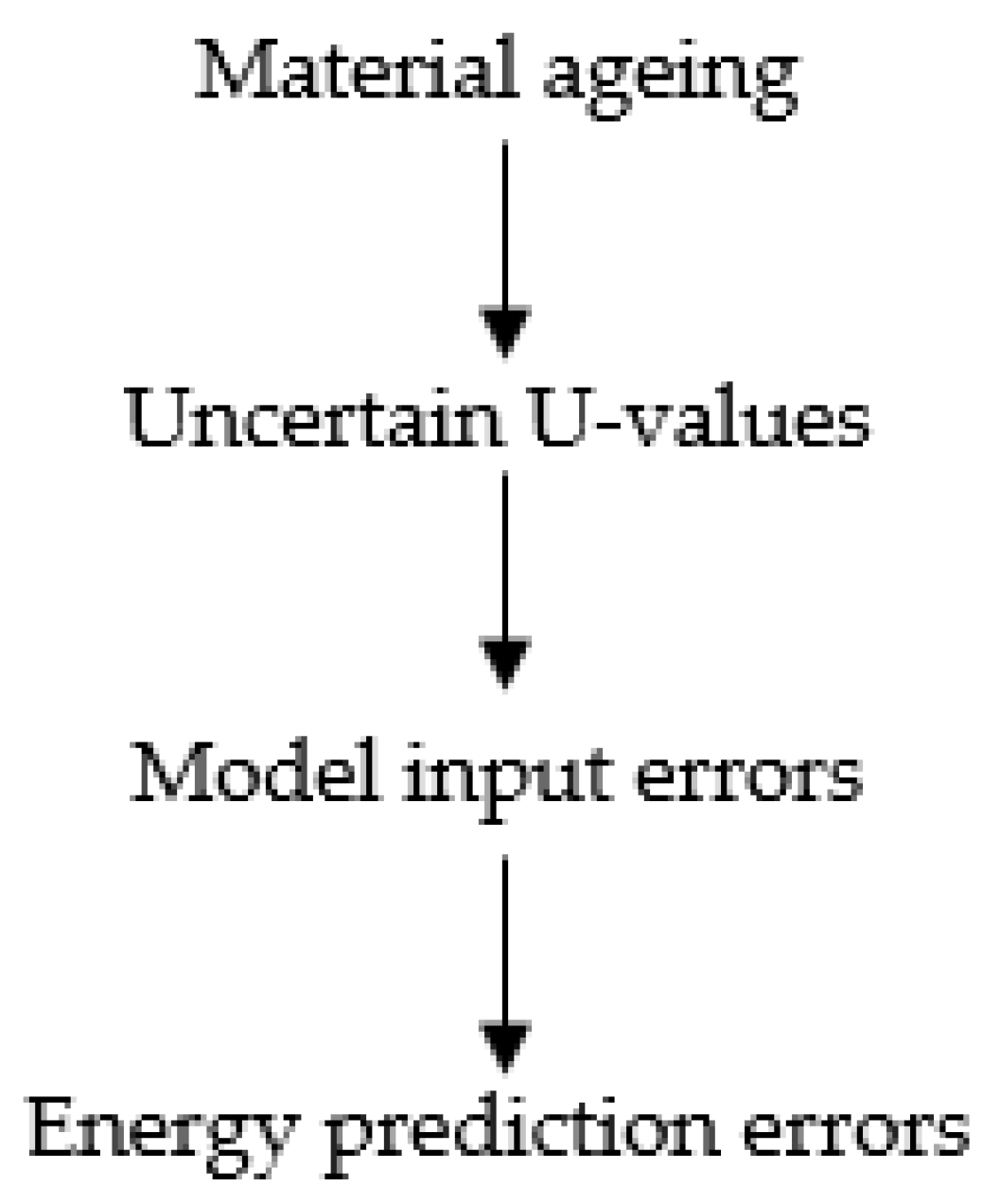
In existing school buildings, the ageing of construction materials introduces increasing uncertainty in the thermal properties of the building envelope, which subsequently propagates through energy models and affects the reliability of predicted energy performance. This chain of uncertainty is schematically illustrated in Figure 1.
In this context, accurate thermal characterization of existing building envelopes is increasingly recognized as a critical prerequisite for reliable energy performance assessment and retrofit planning. Recent studies emphasize that uncertainties in key thermal parameters, such as wall thermal transmittance, can significantly affect the reliability of energy simulations and predictive models, particularly in existing and heritage buildings where invasive measurements are not feasible [6].
In addition to assessing the physical condition, analyzing the energy performance of school buildings is equally essential. Due to their functional specificity, school buildings consume a significant amount of energy for heating and cooling and require substantial water use [7]. Many of them do not meet current energy standards, leading to increased consumption of electricity, heat, and water, and consequently to higher operating costs. At the global level, reducing energy consumption in buildings has been recognized as a key step in achieving the Sustainable Development Goals (SDG) and combating climate change [8].
Reliable assessment of energy performance strongly depends on the accurate in situ determination of thermal properties of building components, such as thermal transmittance and thermal capacity. Recent advances in compact and flexible measurement methodologies have demonstrated that improving the accuracy of these thermal diagnostics can substantially enhance the effectiveness of energy efficiency measures and retrofit strategies under diverse climatic conditions [9].
In this context, school buildings, as public buildings, represent a significant opportunity for intervention. The difference between actual and projected energy consumption in school buildings often indicates inefficient resource control and management. The issue of the sustainability of school buildings also includes a broader social context. Improving their physical condition and energy efficiency not only contributes to a safer and more comfortable environment for users but also has a broader positive impact on the local community. Reducing energy and water consumption directly impacts greenhouse gas emissions and financial savings, which can then be reinvested in the education system [10]. At the same time, renovated and functional buildings can encourage increased awareness of the importance of sustainable resource management among students and teachers [11]. School building management requires an integrated approach that encompasses multiple dimensions—ranging from technical condition assessments and energy analyses to strategic planning and decision-making [12].
Recent research on school buildings in Osijek-Baranja County has highlighted a substantial Energy Performance Gap (EPG) and Carbon Performance Gap (CPG), revealing significant discrepancies between predicted energy performance based on energy performance certificates and actual energy consumption and emissions. These findings emphasize the limitations of purely calculation-based assessments and underline the need for more reliable, data-driven and region-specific approaches to energy performance evaluation [13].
It has been found that energy consumption in buildings accounts for more than 40% of total final energy consumption in many countries [14,15,16]. Within the building sector, energy consumption in educational buildings accounts for a significant share [17]. Additionally, energy consumption in school buildings is a significant factor contributing to a school’s total operating costs. After teachers’ and other staff salaries, energy expenditure is the second largest expenditure [18]. Consequently, predicting energy consumption in a building is a primary goal of building energy management and a key concern for building managers [19].
Recent studies on educational buildings have shown that predictive energy models can be effective tools not only for forecasting energy consumption but also for identifying the most influential factors affecting heating demand. However, the selection of an appropriate modeling approach often involves a trade-off between prediction accuracy and model simplicity, depending on data availability and the technical expertise of end users [20].
Energy users in school buildings differ from those in public and residential buildings, particularly in terms of usage patterns and duration of occupancy. Despite numerous programs that raise awareness of the need for energy savings in schools, staff and students lack the motivation to save energy in school buildings as they do in their own homes because they have limited knowledge of the amount and cost of energy used, and rooms and appliances are usually used by several people [21]. Given the substantial and highly variable energy consumption in school buildings, adopting measures to reduce this consumption is becoming increasingly critical [22].
Many countries have highlighted the high energy use of non-residential buildings. In the United Kingdom, for instance, the 2 million non-residential buildings account for 19% of total CO2 emissions, representing a substantial opportunity for reducing environmental impacts [23]. School buildings in Canada account for a significant share of public-sector energy demand, consuming approximately 30% of the sector’s total energy [24]. School buildings also represent a notable share of national energy demand, comprising roughly 13% in the United States, 4% in Spain, and 10% in the United Kingdom [7,25].
Over the past few decades, numerous methods have been proposed for predicting energy consumption in buildings. Most studies rely on historical energy consumption data to develop predictive models. The methodologies developed for predicting energy consumption in buildings can be classified into two categories: statistical methods and artificial intelligence [26]. A comprehensive review of historical data-based tools for predicting energy consumption in buildings by Olu-Ajayi et al. highlights that ANNs have achieved better results in several studies than statistical tools such as MLR. However, MLR has shown optimal results in certain scenarios, such as predicting annual energy consumption [27].
Despite the growing body of research on predicting energy consumption in school buildings, most existing studies rely primarily on internal validation techniques, such as cross-validation or random train–test splits within a single dataset. While these approaches provide insight into model performance, they do not adequately assess the robustness and transferability of models when applied to buildings located in different regions with distinct climatic conditions, building typologies, and heating systems.
This study addresses this gap by evaluating multiple predictive models for heating energy consumption not only through internal validation but also through external regional validation, using independent datasets from different parts of Croatia. By explicitly testing model performance outside the region used for model development, this research provides novel insight into the regional applicability and limitations of commonly used prediction models in school buildings.
It should be emphasized that this study does not aim to perform a detailed physical heat-loss calculation for individual school buildings. Instead, the research focuses on the development and validation of data-driven predictive models based on available operational and geometric parameters. The objective is to assess the applicability and transferability of simplified predictive approaches rather than to conduct a comprehensive thermodynamic analysis of building envelope performance.

2. Legal Framework

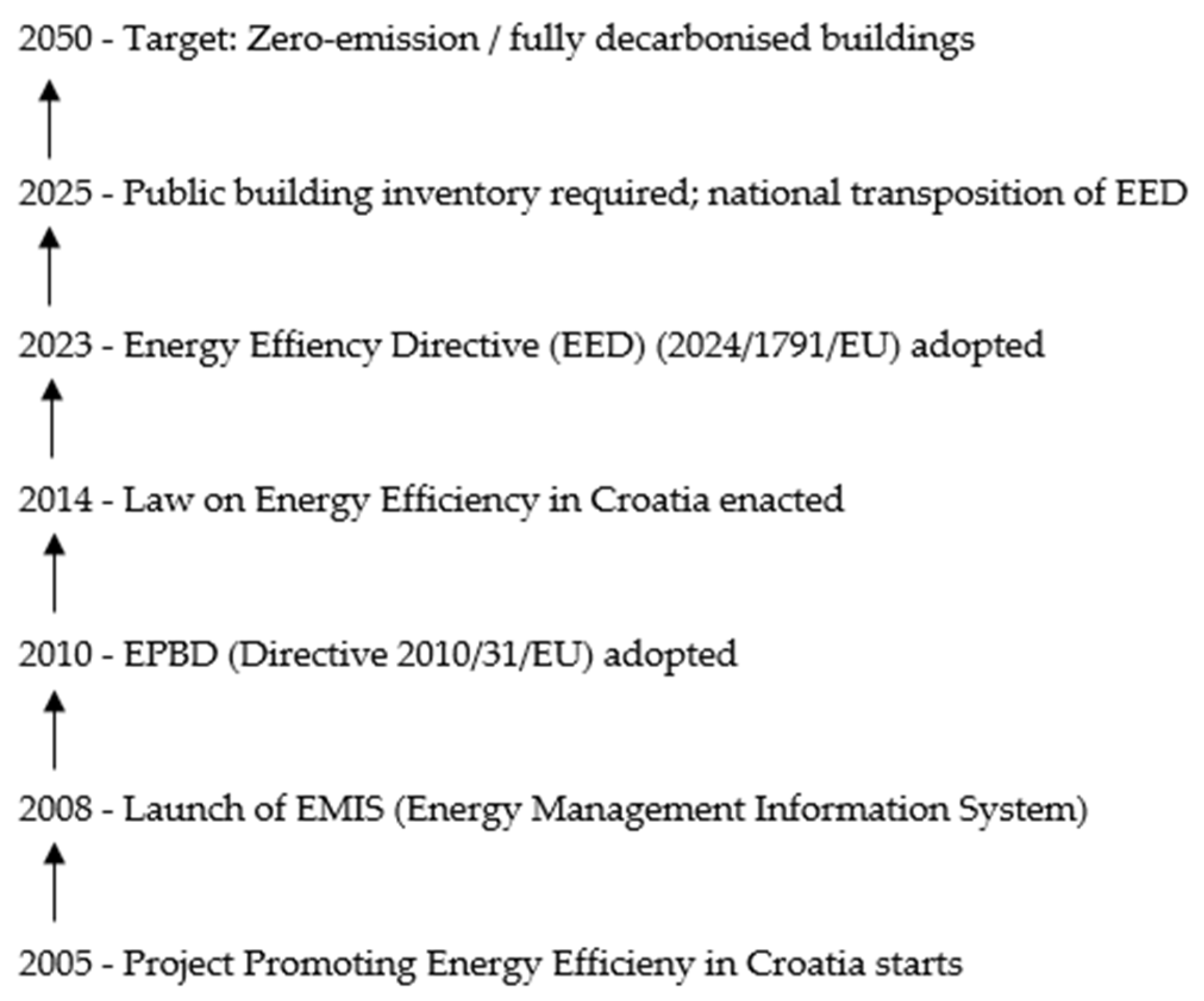
According to the European Commission, the majority of buildings in the European Union (EU), specifically 85%, were built before 2000 [28]. In addition, a significant 75% of buildings are energy inefficient. Taking measures to improve the energy efficiency of buildings is essential for conserving energy and achieving the goal of zero-emission, fully decarbonized buildings by 2050. By 11 October 2025, EU Member States will be required to draw up and publicly publish a comprehensive inventory of buildings owned or occupied by government bodies with a total useful floor area of more than 250 m2, which must be updated at least every two years [29]. Furthermore, under the Energy Performance of Buildings Directive (EPBD) (2010/31/EU) and its subsequent amendment (2018/844/EU), EU countries are required to develop national long-term renovation strategies that incorporate targeted policies and actions for the entire public building stock. In Croatia, in 2018, non-residential buildings accounted for 28% of all building area. Among the buildings in this group, educational buildings have a high percentage—10% of the total non-residential building area. Educational buildings are expected to maintain this trend, with constant predictions of a 10% share in 2030, 2040, and even 2050 [30]. Since educational buildings account for a significant share of non-residential buildings, it is important to focus energy-saving initiatives on them [31,32,33].
Along with the Croatian Ministry of Environmental Protection and Green Transition, the Ministry of Physical Planning, Construction, and State Assets plays a central role in implementing national energy and climate policies. The Ministry of Physical Planning, Construction, and State Assets is responsible for formulating policies and measures that support the attainment of energy efficiency objectives in the building sector. It develops legal frameworks, strategies, and programmes that direct the long-term, comprehensive renovation of diverse building types, including single-family homes, multi-apartment residential buildings, commercial non-residential facilities, and public-sector buildings [34].
The Croatian Agency for Legal Transactions and Real Estate Brokerage also plays a crucial role in promoting energy efficiency. It is responsible for implementing energy renovation programmes for public-sector buildings based on the energy services model, as well as for managing systematic energy performance within the public sector. All activities are carried out in accordance with the mandates established by the Energy Efficiency Act (Official Gazette 127/14, 116/18, 25/20, 32/21, 41/21) [34].
The Energy Efficiency Directive (2024/1791/EU) was adopted in October 2023 and requires Member States to transpose it into their national legislation by mid-2025. This Directive requires each Member State to ensure that at least 3% of the total floor area of heated and/or cooled buildings owned by public authorities is renovated each year into nearly zero-energy buildings (nZEB) or zero-emission buildings (ZEB) [35] while the Energy Performance of Buildings Directive (2024/1275/EU) places emphasis on the renovation and construction of new zero-emission buildings and generally on decarbonisation by 2050. It also sets minimum energy performance standards for the renovation of non-residential buildings with the worst energy performance [36].
In the Republic of Croatia, a project entitled Promoting Energy Efficiency in Croatia was implemented from 2005 to 2013, initiated in July 2005 as a joint project of the then Ministry of Economy, Labour and Entrepreneurship and the United Nations Development Programme with financial support from the Global Environment Facility and the Environmental Protection and Energy Efficiency Fund [37]. Three main components were developed within the project: the Systematic Energy Management in Cities and Counties project, the Croatian Government’s “Getting Your House in Order “Programme, and a national information and educational campaign. The objective of the project was to strengthen capacities for the systematic and continuous implementation of energy management across all public-sector buildings in Croatia. This was pursued through the development of the necessary human, organisational, and procedural resources, along with the training of relevant personnel and the provision of appropriate tools to support a structured approach to energy management [37]. The first version of the Energy Management Information System (EMIS) became available to users in 2008. The continuation of the project’s national components’ activities was undertaken by national institutions and the Environmental Protection and Energy Efficiency Fund. Following this, in 2014, the Law on Energy Efficiency was passed, implementing the Directive on the energy performance of buildings and the Directive on energy efficiency. This legislation introduced mandatory monitoring of energy and water consumption for all buildings owned or used by the public sector, encompassing both central and local authorities, with the EMIS designated as the required monitoring tool. Additionally, the law mandates institutions to appoint an energy-efficiency officer and a supporting team, and it requires energy and water suppliers to submit consumption data for public-sector buildings directly to the EMIS [38]. EMIS serves as the primary tool for the continuous collection, monitoring, and analysis of energy and water consumption in buildings. It consolidates all consumption data into a single centralized database, thereby facilitating efficient analysis from a unified platform. In this research, EMIS served as the primary data source, providing the detailed and systematic consumption records necessary for the study.
Figure 2 presents a timeline of key EU and Croatian energy efficiency policies and initiatives, highlighting major legislative acts, national projects, and milestones leading toward the 2050 zero-emission building target.

3. Literature Review

3.1. Review of Heating Energy Consumption in School Buildings

Butala and Novak conducted a comprehensive energy audit of 24 school buildings in Slovenia in 1999. The audit revealed increased energy consumption and poor indoor air quality, reported by 60% of students. The average annual energy consumption for heating, domestic hot water and lighting was found to be 192 kWh/m2/year [39]. Kim et al. investigated the optimal quantitative level of energy consumption in school buildings with the objective of maintaining a comfortable educational environment while ensuring high operational performance and efficient energy management. Their study analysed energy consumption data from ten elementary schools in Daegu, a city in southern South Korea, covering the period from January 2006 to December 2010. Energy use was assessed in terms of total annual consumption and normalised indicators based on floor area and number of occupants. The reported energy use intensities were 289 kWh/m2/year for electricity, 26 kWh/m2/year for oil, and 90 kWh/m2/year for gas [40].
Wang carried out a comprehensive analysis of energy consumption in school buildings in Taiwan, encompassing 67 senior high schools, 62 junior high schools, and 102 elementary schools. The study reported energy use intensities of 55.8, 22.5, and 20.1 kWh/m2/year for senior high, junior high, and elementary schools, respectively. In addition, energy consumption per occupant was found to be 1163 kWh/person/year for senior high schools, 469 kWh/person/year for junior high schools, and 465 kWh/person/year for elementary schools. The study found that senior high schools exhibited substantially higher energy consumption than junior high and elementary schools, a difference attributed to larger, air-conditioned classrooms and the presence of additional facilities. The analysis also revealed that private schools consumed notably more energy, which the authors associated with improved learning environments, more advanced teaching equipment, and larger class sizes. The findings were presented as a valuable reference for government agencies in formulating energy conservation policies for school buildings [41]. Antunes and Ghisi analysed resource consumption patterns in public school buildings in southern Brazil, collecting water-use data from 62 schools and energy-consumption data from 100 schools. Energy data, obtained for the period from January 2016 to May 2017, indicated average monthly consumption levels of 7.15 kWh/student in secondary schools and 5.30 kWh/student in primary schools. The authors reported substantial variability in both water use (0.81–35.43 L/student/day) and energy consumption (0.31–66.47 kWh/student/month), highlighting significant heterogeneity in resource use across the surveyed schools [22]. Hung and Yeung conducted a survey of energy consumption in 121 secondary school buildings, representing 25.6% of all secondary schools in Hong Kong. The study reported an average annual energy consumption of 529,925 kWh per building, corresponding to an intensity of 105.61 kWh/m2/year [42].
Katafygiotou and Serghides examined the average energy consumption of school buildings in Cyprus using a mixed-methods approach that included questionnaires, on-site inspections, and interviews with school principals and technical personnel. Actual energy consumption was estimated from monthly utility bills, and the findings indicated that school buildings exhibited an average annual energy consumption of 62.75 kWh/m2 [7]. Daly et al. analyzed energy usage data for 3701 public primary school buildings and found that the average energy consumption was 38.0 kWh/m2/year and 542 kWh/student/year [43]. Beusker et al. investigated the determinants of heating energy consumption in municipal school buildings and sports facilities using data from a random sample of 105 buildings in Stuttgart. Their analysis showed that final energy consumption in school buildings varied between 31 and 205 kWh/m2/year, with an average value of 93 kWh/m2/year [44]. Kim et al. examined the energy consumption of nine school buildings in Korea, reporting annual consumption levels ranging from 400 to 1750 MWh per building. Electricity accounted for approximately 82% of total energy use, followed by liquefied natural gas (14%) and kerosene (4%). The study noted that schools relying on cooling fans exhibited substantially lower energy consumption than those equipped with electric heat pumps. Annual energy-use intensities varied considerably across the sample, ranging from 67 to 240 kWh/m2/year, with an average of 133 kWh/m2/year [45].
Hernandez et al. analysed energy consumption in Irish primary schools using questionnaire data, obtaining 88 valid responses for detailed evaluation. The study reported an average annual heat energy consumption of 96 kWh/m2/year across the surveyed buildings [46]. Santamouris et al. conducted a detailed assessment of energy consumption in ten school buildings. Their findings indicated that the average annual heating energy consumption was 57 kWh/m2/year, while electricity consumption averaged 20 kWh/m2/year [47]. Hong et al. analysed energy consumption data from 7731 primary and secondary school buildings in England. Their results showed that average annual energy-use intensities were 166 kWh/m2/year for primary schools and 172 kWh/m2/year for secondary schools [24,48].
Attia et al. developed an energy-efficiency dataset and two reference building performance simulation models for high-performance school buildings in Belgium. Their findings indicated that average annual energy-use intensities were 59 kWh/m2/year for primary schools and 42 kWh/m2/year for secondary schools [49]. Katić et al. conducted a study using statistical analysis of data collected from detailed energy audit documents for 185 school buildings in the Federation of Bosnia and Herzegovina, specifically those related to the construction period. The authors evaluated several influencing parameters, including construction period, building envelope properties, climatic conditions, efficiency of the installed space heating systems, occupancy levels, and heating methods. The analysis indicated that the investigated school buildings exhibited an average heat energy consumption of 171.90 kWh/m2/year [50]. Jurišević et al. analyzed the specific heat energy consumption of educational buildings in Kragujevac, Serbia. The buildings were classified by educational level, namely: pre-school buildings, primary and secondary schools, and faculties (university buildings). Data on heat energy consumption were collected over several heating seasons to mitigate the impact of seasonal climate variations. Kindergarten and primary school buildings have been identified as priority targets for energy renovation, as they exhibit the highest average specific heat energy consumption, at 186 kWh/m2/year and 176 kWh/m2/year, respectively [51]. In his study, Obradović investigated the energy consumption of a secondary school located in Osijek-Baranja County. The analysis revealed an annual natural gas consumption of 22,088 kWh per month. The school building has a net usable floor area of approximately 4614 m2. These findings provide a valuable reference for evaluating energy efficiency and form the basis for potential energy-saving measures in similar educational facilities. The results highlight the relative contributions of electricity and natural gas to the overall energy demand of the building [52].
Table 1 provides a concise comparative overview of energy-use intensities reported in previous studies on school buildings across different countries.

3.2. Predicting Heating Energy Consumption

Various elements influence the energy consumption of a school building [7,18,53]. Therefore, it is crucial to identify these elements when developing an energy forecasting model. Forecasting energy consumption is crucial for conserving energy, ensuring optimal use, and preventing unnecessary energy waste [54]. The obstacle to this is that making accurate forecasts is often challenging due to unpredictable circumstances and data irregularities, and the techniques used often produce inaccurate forecasts [55]. Accurate prediction of energy consumption in school buildings is essential for effective resource management, cost optimisation, and the promotion of sustainability initiatives [56]. Accurate energy-use predictions allow schools to optimise energy consumption, reduce carbon emissions, and improve the efficiency of resource allocation, thereby supporting a culture of sustainability and encouraging responsible energy management within the educational community [57].
Capozzoli et al. examined heating energy consumption in 80 school buildings located in northern Italy and developed two predictive models—one based on MLR and another using a classification and regression tree (CART) approach. Both models were assessed using statistical performance indicators. The authors concluded that gross heated volume, heat-transfer surface area, boiler capacity, and window thermal conductivity were the primary determinants of heating energy consumption in the analysed school buildings [58]. Beusker et al. conducted an empirical analysis of factors influencing heating energy consumption in urban school buildings and sports facilities, using a random sample of 105 buildings in Stuttgart, Germany. The authors systematically developed and evaluated a range of linear and nonlinear regression models to predict heating energy demand. Their findings indicate that the proposed model demonstrates high predictive accuracy and satisfies the essential criteria for efficient and reliable energy-consumption prediction [44]. Mohammed et al. developed a multiple regression model to predict energy consumption in school buildings in Saudi Arabia. The authors highlight that the proposed model offers a practical and cost-effective tool for governmental institutions to support energy consumption forecasting and inform related decision-making processes [55]. Alshibani conducted a study in the Eastern Province of Saudi Arabia to identify the factors influencing energy consumption in school buildings, using 352 real energy-consumption datasets. The resulting prediction model incorporated eleven parameters found to significantly affect energy use in constructed school facilities, and these variables were employed as inputs for the model’s development. The developed model was validated using eight real-world case studies, achieving an accuracy of 87.5%. The study identified air conditioning capacity as the most influential factor, followed by the total roof area of the school building [59].
Ding et al. proposed a methodology for predicting annual energy consumption patterns at an hourly resolution. The authors highlight that the generated load profiles effectively reflect the current energy demands of Nordic school buildings and emphasize that the approach is adaptable and can be applied to other building types [57]. Faiq et al. proposed the use of a long short-term memory (LSTM) neural network to predict the energy consumption of a university building. The model was developed by analysing the relationships between energy use and meteorological variables, with the authors noting that LSTM performance improves when external factors—such as temperature and wind speed—are incorporated into the model. They also suggest that future research could enhance predictive accuracy further by integrating additional features, including data on building occupancy [60]. Cao et al. developed an energy-consumption prediction model for educational buildings that integrates geographic variables with time-series data. The model’s validity was demonstrated through its application to an educational building in Xi’an, Shaanxi Province. The results indicated that the integrated approach reduced the root mean square error (RMSE) by 13.64–34.55% relative to previous predictive models. Similarly, the mean absolute error (MAE) decreased by 10.25–30.54%, confirming a substantial improvement in forecasting accuracy [61]. Shahid et al. have developed a predictive model for forecasting electricity and heating energy consumption. They used advanced machine learning techniques such as recurrent neural network (RNN), LSTM, convolutional neural network (CNN) and autoencoders (AE). The model was trained using real consumption data from six public school buildings in a Swedish municipality. Experimental results show that the model achieved a high level of accuracy, with RMSE and nRMSE values varying from 18% to 25% for electrical energy, and from 20% to 30% RMSE and 5% nRMSE for heating energy [62]. A dataset spanning January 2020 to January 2023. The model development process included data preparation steps such as addressing missing values and assessing the significance of input variables. Three machine learning techniques—Gradient Boosting Regressor (GBR), LSTM networks, and random forest (RF)—were employed as predictive algorithms. As a recommendation for future research, the authors suggest utilising more advanced computing systems or platforms to improve the performance of the LSTM algorithm and enhance overall model accuracy [63]. Doiphode and Najafi proposed the use of a multi-layer perceptron (MLP) neural network to predict monthly energy consumption in K–12 school buildings in Brevard County, Florida, USA. The model incorporated input variables such as school population, number of operating days per month, building floor area, average monthly outdoor temperature, and relative humidity, with monthly energy consumption serving as the output variable. The selected network was effectively trained using three years of energy-consumption data from 25 middle and elementary school buildings [64].
Soares Geraldi et al. developed a predictive model using Bayesian networks to estimate energy consumption in public school buildings. Their study drew on three years of monthly utility data from 90 schools in southern Brazil, supplemented with information on building area, student population, education level, number of floors, and frequency of events. The authors suggest that future research could improve model performance by expanding the dataset to incorporate additional relevant variables [65]. Run et al. employed a multiple linear regression model to forecast hourly electricity consumption in school buildings in southern France during the winter season. Their results showed that the model achieved a coefficient of determination (R2) of 74% for the training dataset and 77% for the validation dataset, indicating relatively strong predictive performance [66]. Li et al. proposed a short-term forecasting method for cooling-related electricity consumption that specifically addresses uncertainties arising from user behaviour. Applied to an educational building, the approach employs cluster analysis to identify typical usage patterns and a weighted k-nearest neighbour technique for initial prediction. An additional RF model is developed to assess the relative importance of input variables, while a support vector machine (SVM) is incorporated to enhance accuracy under highly variable conditions. The results indicate that both modelling approaches successfully predict cooling energy consumption, with the improved hybrid model demonstrating substantially higher accuracy in the presence of uncertain usage patterns [67]. Tariq et al. examined the performance of several AI-based models, including decision trees, k-nearest neighbors, gradient boosting regressor (GBR), and LSTM networks, for predicting electricity consumption in school buildings, with particular attention to the influence of factors such as building size and air conditioning capacity on annual energy use. Their findings indicate that decision-tree models perform well during training, exhibiting low prediction errors, whereas k-nearest neighbour models tend to suffer from overfitting. In contrast, both GBR and LSTM models demonstrated robust performance across a wide range of data conditions [68].

4. Methodology and Data Analysis

The study is located in Osijek-Baranja County, Croatia, a county situated in the east of the country, characterized by fertile fields that support a rich agricultural tradition. However, like many regions with intensive agricultural activity, the area faces growing challenges related to water resource management due to increasing demand from multiple sectors, including agriculture, public utilities, and educational institutions.
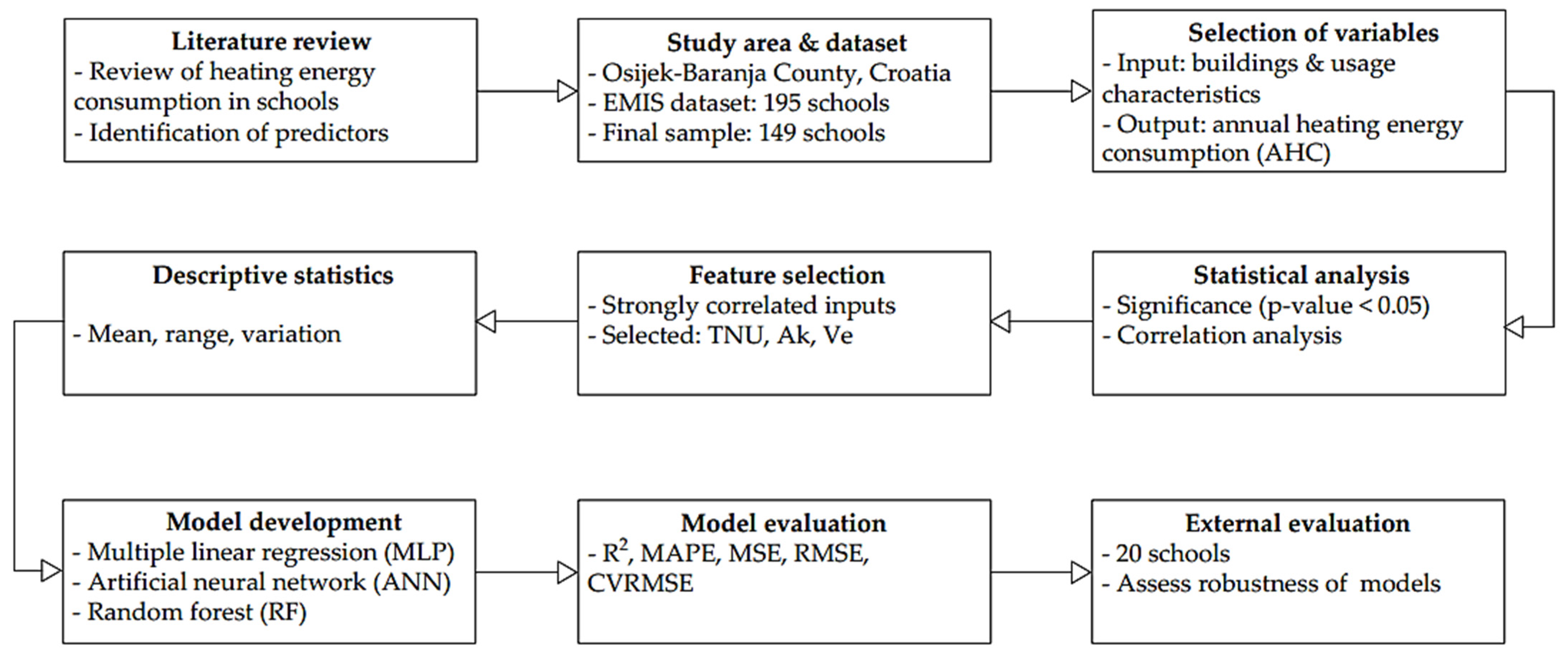
Figure 3 presents a flowchart summarizing the logical sequence of the methodological framework applied in this study.
Of the total of 195 school buildings analyzed, it was found that data on heating energy consumption from 2013 to 2023 (which was the analyzed period) were available for 149 school buildings and were therefore used to develop the heating energy consumption prediction model. At the beginning of model development, it was essential to identify the input variables that influence heating energy consumption in school buildings. The identification of the most critical input factors in the heating energy consumption analysis was conducted through an extensive review of previous research. Table 2 presents the input variables available in the EMIS dataset regarding school building characteristics, which were found to be significant in predicting heating energy consumption in school buildings. Relevant research that used these variables is also included. Table 3 shows the output/dependent variable. Besides the relevance determined by the literature review, the selection of variables was primarily limited by the availability of the data in EMIS.
To analyze the suitability of the input variables, statistical significance (p-value) analysis and correlation coefficient with the output variable were used (Table 4). As previously mentioned, statistically significant variables are those that show a p-value less than 0.05. Additionally, after conducting the statistical significance analysis, the correlation between the input variables and the output was also examined. In this context, it is essential to note the values of the correlation coefficient, which describes the relationship it represents [89].
Table 5 presents the correlations between input variables and the output variable, with variables showing a p-value less than 0.05 highlighted in red.
With regard to the values of the correlation coefficients mentioned earlier, it is evident that only three (TNU, Ak, and Ve) input variables showed a strong correlation with the output variable, and for this reason, they were further considered for the development of all three models for predicting heating energy consumption of the sample of school buildings. Table 6 shows the descriptive statistics of the analyzed sample.
Descriptive statistics analysis shows significant variations in all variables analyzed, reflecting the different types and sizes of school buildings. The average number of users is 145.3, and the range of users spans from 3 to 730, indicating that the analysis encompasses school buildings of varying sizes, from small district schools to larger school buildings with a large student population. The usable heated area of the school buildings averages 1183.6 m2, varying from 60 m2 to 6210.3 m2, indicating a wide range of sizes, from small school buildings to large ones with numerous classrooms and facilities. Similarly, the average heated building volume for the analyzed school buildings is 4703 m3, and the range of volumes is between 116 m3 and 21,185 m3, which also confirms the variations in size and space among school buildings. Annual heat energy consumption averages 121,612.82 kWh/year, but varies from 8070.21 kWh/year to 508,983.2 kWh/year, reflecting large differences in energy efficiency among school buildings.

5. Developed Models for Predicting Heating Energy Consumption

The initial data set was randomly divided into two sets: a training set, used for model development, and a validation set, used exclusively to evaluate the errors of the developed models. The training set was randomly selected to include 105 school buildings, which account for 70.5% of the total 149 school buildings. The validation set contains 44 school buildings, or 29.5% of the total. Similar ratios were used in [91,92].

5.1. MLR Model

In developing the model (training dataset) for predicting annual heat energy consumption, data on the average annual heat energy consumption for 105 school buildings were used, and it was found that the best developed multiple linear regression model for the dependent variable AHC, which represents the annual heating energy consumption of the school building, has the following form:
A H C = 6,140,533 + 146,111 T N U + 24,999 A k + 13,484 V e k W h / y e a r
where
  • TNU: Independent variable representing the total number of users, including employees and students (number);
  • Ak: Independent variable representing the area of the useful surface of the heated part of the building (m2);
  • Ve: Independent variable representing the volume of the heated part of the building (m3).
To demonstrate the practical applicability of the model, three representative examples of school buildings of different sizes (small, medium and large) were selected. Table 7 shows the actual (historical) and model-estimated annual values of heating energy consumption.
These examples show that the model provides reasonable estimates for both smaller and larger school buildings, confirming its flexibility. The relative deviations are low, and the difference between actual and predicted consumption in all three cases remains within acceptable limits.

5.2. ANN Model

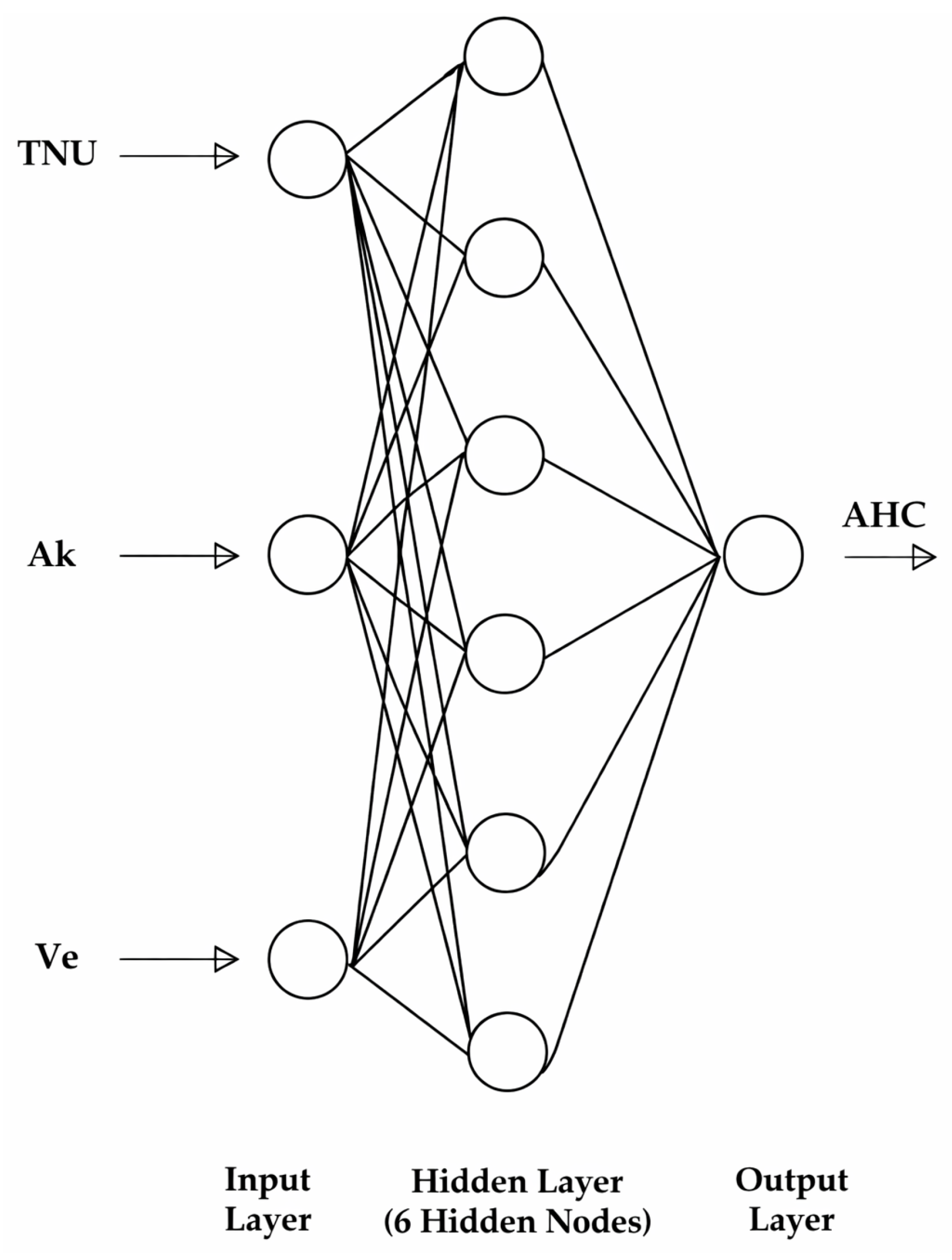
A multilayer perceptron (MLP) type of artificial neural network was used to develop the model. The MLP was developed using the Automated Network Search (ANS) procedure implemented in TIBCO Statistica 14.1.0.8 [93]. The optimal network architecture identified by ANS, illustrated in Figure 4, follows a 3–6–1 structure, consisting of three input neurons, one hidden layer with six neurons, and one output neuron for predicting annual heating energy consumption. The logistic activation function was used in the hidden layer, while the exponential activation function was applied in the output layer to ensure positive-valued predictions. The ANS procedure automatically evaluates multiple network configurations and training parameters and selects the final model based on validation performance. During training, input variables were automatically normalized by the software, and model performance was monitored on a validation subset to mitigate overfitting. Training was terminated based on convergence criteria defined within the ANS algorithm.

5.3. RF Model

Random forests are a larger set or group of decision trees [94]. The name of the algorithm derives from the machine learning technique on which it is based. Specifically, the algorithm constructs a large ensemble of decision trees—referred to as a “random forest”—using the available training data. For each tree, the algorithm randomly selects a subset of the training samples and a subset of the input variables, thereby enhancing model robustness and reducing the risk of overfitting [95,96]. Random forests (RF) offer several notable advantages, including strong predictive accuracy—often comparable to, or even exceeding, that of artificial neural networks and support vector machines—along with a low tendency to overfit. In addition, RF models typically require relatively modest computational resources and are well-suited for handling high-dimensional datasets [97]. One of the principal strengths of the algorithm is its resistance to overfitting, as the increasing number of randomly generated decision trees does not increase the risk of overfitting; each tree represents an independent random experiment. The algorithm is also robust to outliers and can automatically handle missing values, further enhancing its reliability in practical applications [98]. The literature reports that the greatest performance gain is achieved when training the first 100 trees [99]. Accordingly, in this study the random forest model was implemented using 100 decision trees, which provided a balance between predictive accuracy and computational efficiency. Each tree was trained on a bootstrap sample of the original dataset, while a randomly selected subset of input variables was considered at each split to ensure model diversity.
Table 8 illustrates the significance of the predictors for the input variables. These values are usually normalized so that the most important variable has an importance of 1.

6. Results and Discussion

6.1. Model Validation

To evaluate the accuracy of the developed prediction models and enable to comparison with other models that vary in parameters, various statistical techniques are employed to assess prediction errors. The following coefficients are used for evaluating the predictive performance of the developed models: mean absolute percentage error (MAPE), coefficient of determination (R2), mean square error (MSE), root mean square error (RMSE), and coefficient of variation of the root mean square error (CVRMSE). Unlike most error metrics, mean absolute percentage error (MAPE) doesn’t have a strict upper limit. The reason for this is that it involves taking the absolute value of the percentage error [100]. MAPE was included as a key evaluation metric because it provides an easily interpretable percentage-based measure of prediction accuracy. This makes it particularly suitable for comparing forecasting performance across school buildings with differing scales of monthly and annual water consumption. The coefficient of determination (R2) is included to evaluate the model’s capacity to explain variance in the dependent variable, thereby serving as an indicator of overall model fit. The closer the R2 value is to 1, the more accurately the model represents the observed data [101]. MSE is chosen for its ability to emphasize large errors, making it a critical metric for evaluating the precision of predictions. In general, a lower MSE is desirable because it indicates that the model’s predictions are, on average, closer to the actual observed values. Conversely, a higher MSE implies that the model’s predictions deviate more substantially from the real values, thereby signalling poorer predictive performance [102]. CVRMSE is selected to standardize RMSE relative to the mean of the observed values. Typically, an upper threshold of 30% for the CVRMSE is used to assess the representativeness of a model’s predictions [103]. The equations utilized to compute the aforementioned statistical techniques for error evaluation prediction are displayed in Table 9.
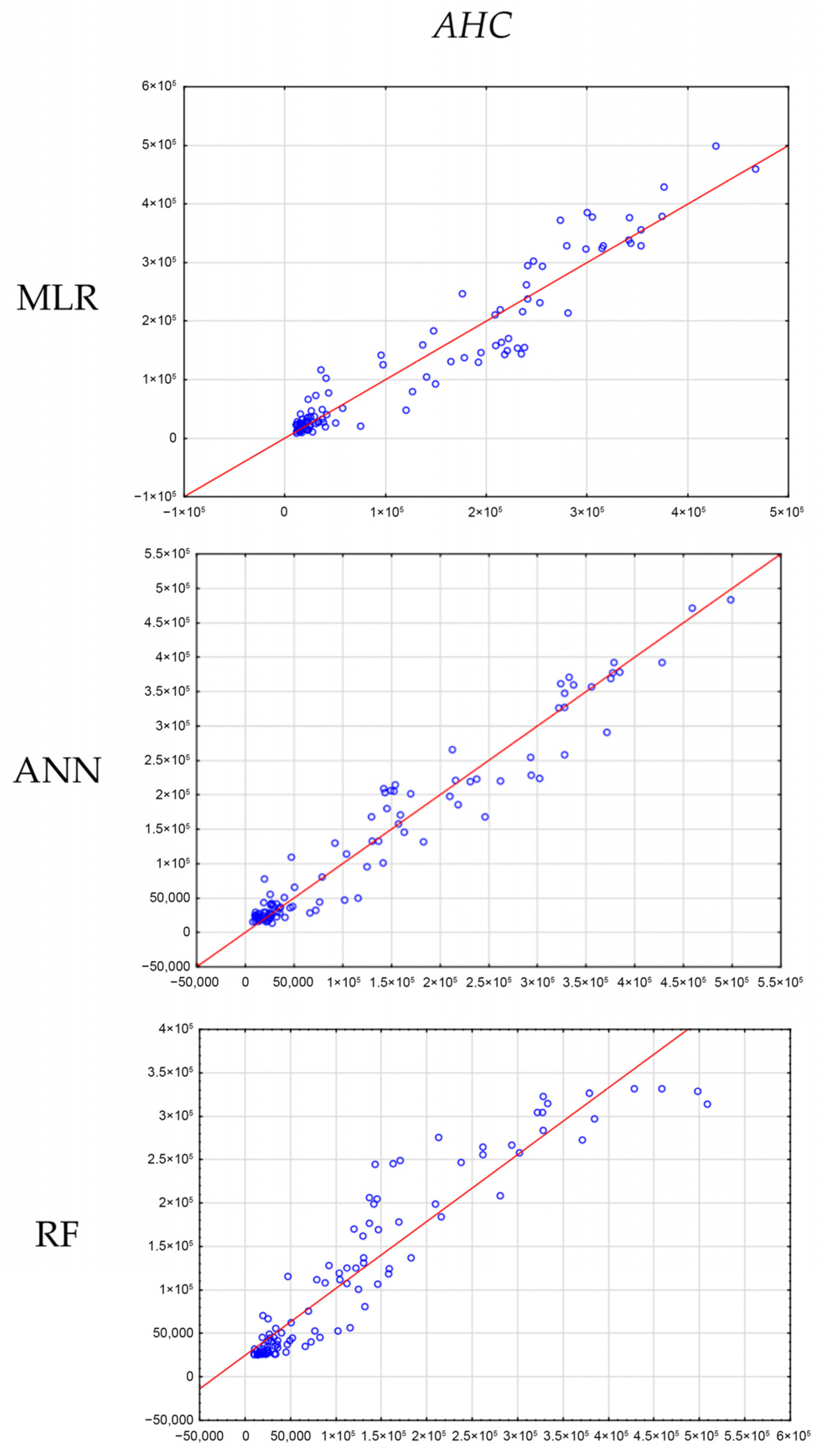
According to the analysis presented in Table 10, the artificial neural network (ANN) model proved to be the most successful, with the highest coefficient of determination (R2 = 0.943), indicating that it explains the largest portion of the variability in the dependent variable. In addition, the ANN exhibits the lowest MSE (9.07 × 10⁸) and RMSE (30,110.14), indicating the highest prediction accuracy compared to the other models. On the other hand, the MLR has a solid result with R2 = 0.913, but stands out as the model with the highest relative error MAPE (35.67%), indicating less precise predictions compared to the ANN and RF. The RF model has the lowest coefficient of determination (R2 = 0.872) and the highest absolute error (MSE = 1.64 × 10⁹, RMSE = 40,517.16), but its relative error, MAPE (28.87%), is smaller than that of the MLR model. Scatter plots of the predicted and actual values of heating energy consumption in the training data set are shown in Figure 5.
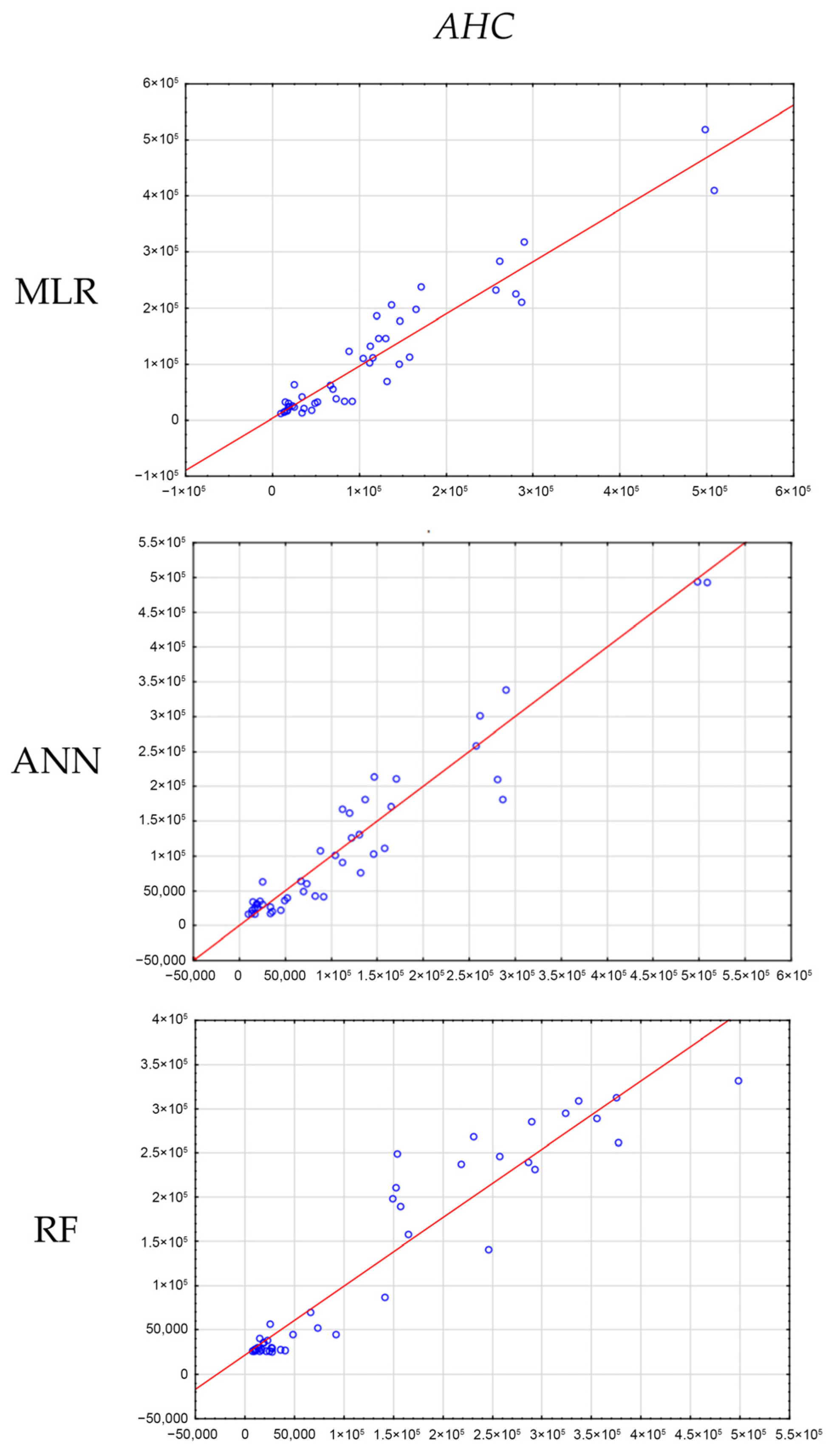
From the validation results table (Table 11), changes in the model performance compared to the training results can be observed. The MLR still exhibits relatively high performance, with an R2 value of 0.897, indicating that it explains 89.7% of the variance in the data. Also, the MSE (1.34 × 10⁹) and RMSE (36,574.16) remain similar to those of the training set, while the MAPE (39.93%) is higher than in the training set, indicating a slightly higher prediction error for the validation set. The ANN also exhibits reduced performance compared to training, with an R2 of 0.888 and an MSE of 1.39 × 10⁹, indicating a higher prediction error than during training. The RF model yields the largest drop in performance, with R2 = 0.732, indicating that the model explains only 73.2% of the variance in the validation data, which is significantly lower than the 90.2% achieved in the training phase. In addition, MSE = 2.23 × 10⁹ and RMSE = 47,207.78 indicate higher prediction errors, and MAPE = 34.65% is better than MLR and ANN. Figure 6 shows scatterplots of predicted and actual values of heating energy consumption in the validation data set.

6.2. Validation on an External Sample of School Buildings

Consistent with the development process, the external validation dataset was also retrieved from EMIS [109]. The developed models were validated using data from 20 schools, including 10 schools from inland Croatia and 10 from the coastal region. By incorporating schools from both coastal and island areas, as well as inland locations, the models were tested under diverse urban, rural, and region-specific conditions. This validation demonstrates the robustness of the models and supports their applicability in real-world settings within the Croatian educational system.
The counties of continental Croatia include the City of Zagreb, Zagreb County, Krapina-Zagorje County, Varaždin County, Koprivnica-Križevci County, Međimurje County, Bjelovar-Bilogora County, Virovitica-Podravina County, Požega-Slavonia County, Brod-Posavina County, Osijek-Baranja County, Vukovar-Srijem County, Karlovac County, and Sisak-Moslavina County. The counties along Croatia’s coast include Primorje-Gorski Kotar County, Lika-Senj County, Zadar County, Šibenik-Knin County, Split-Dalmatia County, Istria County, and Dubrovnik-Neretva County.
Osijek-Baranja County was excluded from the validation sample because all models were developed using schools from this county. Since the Republic of Croatia comprises 21 counties, excluding Osijek-Baranja leaves 20 counties available for sampling. One school was selected from each of these counties to ensure diversity in the validation dataset, resulting in a total of 20 schools. Of these, six are secondary schools, included to represent larger institutions with higher student populations. To assess the performance of the developed models on the validation sample, the aforementioned metrics were used to evaluate all models during development. The coefficient of determination R2 was primarily observed as a metric for evaluating the model. The Chaddock scale, which indicates the strength of the relationship described by the coefficient of determination (R2), is presented in Table 12.
On the previously mentioned sample of school buildings, validation of all three developed models using multiple linear regression, neural networks and the random forest algorithm for predicting heating energy consumption was carried out. Table 13 shows the accuracy of the developed models for predicting heating energy consumption in a sample of school buildings for validation.
The table shows that all three developed models for predicting heating energy consumption achieved poor results in the sample of school buildings used for validation. Specifically, the R2 values indicate a weak, almost absent relationship for all three models. Based on these results, it was concluded that models for predicting heating energy consumption of school buildings are not applicable throughout the Republic of Croatia, and it was decided to test the models on a different sample that will include only school buildings from the eastern part of Croatia, i.e., Slavonia, namely school buildings from the following counties: Brod-Posavina County, Požega-Slavonia County, Virovitica-Podravina County and Vukovar-Srijem County. As before, Osijek-Baranja County will be excluded from the sample, since all models were developed using a sample of school buildings from it. Validation of all three developed models for predicting heating energy consumption was conducted on a sample of school buildings in eastern Croatia using multiple linear regression, neural networks, and the random forest algorithm. Table 14 presents the accuracy of the developed models for predicting heating energy consumption in a sample of school buildings from eastern Croatia, used for validation purposes.
When the models were tested on a sample of school buildings from eastern Croatia, significant improvements in performance were visible. The MLR model achieved an extremely high accuracy with an R-squared value of 0.890, indicating a very strong relationship between the input variables and heating energy consumption. The MSE, RMSE, and MAPE are significantly lower than in the previous results, indicating that the MLR model now predicts heating energy consumption with greater accuracy. On the other hand, the ANN and RF models also show an improvement over the previous results, although they did not achieve as high a performance as MLR. ANN achieved R2 = 0.314 and RF R2 = 0.239. Although these models have poorer accuracy than MLR, their R2 value and error reduction indicate that they are a better fit for this specific sample.
When observing the developed models and their application on the initial validation set, given the ease of applicability among school building managers and principals, MLR is the most suitable model. Although not the most accurate, with an R2 of 0.897 on validation, MLR is simple to implement and understand, making it easier to interpret its results. This model does not require advanced computing resources and is easily applicable in everyday administration, as it provides clear insights into which factors influence heating energy consumption. On the other hand, ANN offers better accuracy in training (R2 = 0.943), but is more complex to implement and understand. For users who are not experts in data analysis, ANN can be challenging due to its “black box” nature and the need for larger computing resources. RF is also very accurate, but due to its high complexity and computing requirements, it can be challenging to apply in school buildings that lack the necessary infrastructure. Moreover, RF exhibited the largest drop in accuracy on the validation set, further highlighting its sensitivity to variations in data.
Ultimately, for most school buildings looking for practicality and simplicity, MLR is the most suitable model, while ANN and RF can be useful in specific conditions with higher resources. Testing the model on a sample of school buildings from eastern Croatia yields significantly better results, particularly for MLR, whose high R2 and low MAPE indicate its high applicability for predicting heat energy consumption in this specific geographical area. In addition, although the ANN and RF models do not achieve such high results, they also show potential for improvement and may be useful for further analyses, especially with additional optimizations and adjustments tailored to the specific conditions in the eastern part of Croatia. Ultimately, these results suggest that for a more accurate prediction of heat energy consumption, it would be useful to use models developed on data specific to certain regions, such as Slavonia, due to different factors that can affect heat energy consumption in different parts of Croatia. In coastal Croatia, due to specific climatic conditions and infrastructure, many school buildings do not use centralized gas or district heating systems. Instead, alternative energy sources such as electricity or heating oil are often used. These fuels are not as stable and economically viable as gas, and their consumption can vary depending on many factors, including the specific infrastructure of each school building, the type of heating system, and weather conditions. Additionally, electricity and heating oil have different energy characteristics compared to gas, which means that models developed to predict heat energy consumption may struggle to accurately predict consumption, as these fuels may require a different approach to modeling. On the other hand, in eastern Croatia (especially in Slavonia), most school buildings use gas or centralized heating systems (heating plants), which allows for greater uniformity in energy consumption.

7. Conclusions

In conclusion, differences in the fuels used to heat school buildings can significantly affect the accuracy of heat energy consumption prediction models. For more efficient models, it is necessary to consider the specific characteristics of each fuel and tailor the models to varying heating conditions in different parts of Croatia.
The validation results indicate that the developed models perform well only in regions with building characteristics and heating infrastructure similar to the training dataset (Osijek-Baranja County and the broader Slavonia region). When tested on schools from across the country, particularly coastal regions, model performance significantly decreased (R2 < 0.2), highlighting weak predictive ability. Several factors contribute to this:
  • Climatic differences—coastal regions experience milder winters and higher humidity, affecting heating demand;
  • Building typologies—schools in coastal areas often differ in age, insulation quality, and size compared to inland schools;
  • Heating systems—many coastal schools rely on electricity or heating oil rather than gas or centralized heating systems, leading to greater variability in energy consumption.
These regional variations explain the models’ limited applicability across all of Croatia. Consequently, our results suggest that for accurate prediction, models should be developed and calibrated using data representative of the specific region and its typical heating systems, building characteristics, and climate. This approach ensures that models capture local patterns in heating energy consumption and improves their reliability for practical use.

8. Recommendations for Future Research

As further research directions, it is proposed that the developed models be tested on various types of public buildings, including healthcare institutions, sports halls, cultural facilities (such as libraries and museums), and administrative buildings. These tests would enable the assessment of their applicability to a wider range of buildings and identify any adjustments needed for the specific requirements of each building type. Given the similar characteristics, construction standards and construction time periods in the countries of the region (e.g., Slovenia, Serbia, Bosnia and Herzegovina, Montenegro, and Hungary), it is recommended to test the model and system in these geographical areas, which would enable the comparison of results and the adaptation of the model to the specificities of individual countries. It is recommended to expand the heating energy consumption prediction model in order to improve its applicability, or, if possible, remove the spatial limitation to eastern Croatia. Based on the results of testing and applying the model, it is recommended that educational materials and guidelines be developed for school building managers and decision-makers, enabling the wider application of the model in practice and encouraging the strengthening of capacities for energy efficiency management in the public sector.

Author Contributions

Conceptualization, H.K., H.B.J. and D.O.; methodology, H.B.J. and H.K.; software, H.B.J.; validation, H.K. and H.B.J.; formal analysis, H.B.J.; writing—original draft preparation, H.B.J.; writing—review and editing, H.K. and D.O.; supervision, H.K. and D.O. All authors have read and agreed to the published version of the manuscript.

Funding

This research received no external funding.

Institutional Review Board Statement

Not applicable.

Informed Consent Statement

Not applicable.

Data Availability Statement

The data presented in this study are available on request from the corresponding author. The data are not publicly available due to privacy.

Conflicts of Interest

The authors declare no conflicts of interest.

Abbreviations

The following abbreviations are used in this manuscript:
AEAutoencoder
AkArea of the Useful Surface of the Heated Part of the Building
ANNArtificial Neural Network
ANSAutomated Network Search
CARTClassification and Regression Tree
CNNConvolutional Neural Network
CO2Carbon Dioxide
CPGCarbon Performance Gap
CVRMSECoefficient of Variation of the Root Mean Squared Error
EEDEnergy Efficiency Directive
EMISEnergy Management Information System
EPBDEnergy Performance of Buildings Directive
EPGEnergy Performance Gap
EUEuropean Union
GBRGradient Boosting Regressor
LSTMLong Short-Term Memory Network
MAPEMean Absolute Percentage Error
MLPMultilayer Perceptron
MLRMultiple Linear Regression
nZEBNearly Zero Energy Building
R2Coefficient of Determination
RFRandom Forest
RMSERoot Mean Squared Error
RNNRecurrent Neural Network
SDGSustainable Development Goals
SVMSupport Vector Machine
TNUTotal Number of Users
VeVolume of the Heated Part of the Building
ZEBZero Energy Building

References

  1. Walden, R. Schools for the Future. Design Proposals from Architectural Psychology; Hogrefe & Huber Pub.: Göttingen, Germany, 2009. [Google Scholar]
  2. Clark, H. Building Education: The Role of the Physical Environment in Enhancing Teaching and Research. Issues in Practice; ERIC: London, UK, 2002; p. 49. [Google Scholar]
  3. Baker, L.; Bernstein, H. The Impact of School Buildings on Student Health and Performance: A Call for Research; McGraw Hill: Columbus, OH, USA, 2012. [Google Scholar]
  4. Walbe Ornstein, S.; Saraiva Moreira, N.; Ono, R.; Limongi Franca, A.J.; Nogueira, R.A. Improving the quality of school facilities through building performance assessment: Educational reform and school building quality in São Paulo, Brazil. J. Educ. Adm. 2009, 47, 350–367. [Google Scholar] [CrossRef]
  5. Eweda, A.; Zayed, T.; Alkass, S. Space-based condition assessment model for buildings: Case study of educational buildings. J. Perform. Constr. Facil. 2015, 29, 04014032. [Google Scholar] [CrossRef]
  6. Evangelisti, L.; De Cristo, E.; Monteleone, S.; Guattari, C.; Gori, P.; de Rubeis, T.; Ambrosini, D. Development and validation of a non-contact method for U-value estimation in heritage and existing buildings. Results Eng. 2025, 28, 107276. [Google Scholar] [CrossRef]
  7. Katafygiotou, M.; Serghides, D.K. Analysis of structural elements and energy consumption of school building stock in Cyprus: Energy simulations and upgrade scenarios of a typical school. Energy Build. 2014, 72, 8–16. [Google Scholar] [CrossRef]
  8. Omer, A.M. Energy, environment and sustainable development. Renew. Sustain. Energy Rev. 2008, 12, 2265–2300. [Google Scholar] [CrossRef]
  9. Nicoletti, F.; Arcuri, N. A new methodology for the in-situ measurement of thermal transmittance and thermal capacity of opaque walls: Thermal Decoupling Method (TDM). Build. Environ. 2025, 276, 112881. [Google Scholar] [CrossRef]
  10. Girod, B.; van Vuuren, D.P.; Hertwich, E.G. Climate policy through changing consumption choices: Options and obstacles for reducing greenhouse gas emissions. Glob. Environ. Change 2014, 25, 5–15. [Google Scholar] [CrossRef]
  11. Cole, L.B. The Teaching Green School Building: Exploring the Contributions of School Design to Informal Environmental Education. Ph.D. Thesis, University of Michigan, Ann Arbor, MI, USA, 2013. [Google Scholar]
  12. Österreicher, D. A methodology for integrated refurbishment actions in school buildings. Buildings 2018, 8, 42. [Google Scholar] [CrossRef]
  13. Begić Juričić, H.; Krstić, H.; Domazetović, M. Analyzing the Carbon Performance Gap and Thermal Energy Performance Gap of School Buildings in Osijek-Baranja County, Croatia. Energies 2025, 18, 1818. [Google Scholar] [CrossRef]
  14. Alghoul, S.K.; Gwesha, A.O.; Naas, A.M. The effect of electricity price on saving energy transmitted from external building walls. Energy Res. J. 2016, 7, 1–9. [Google Scholar] [CrossRef]
  15. Cao, X.; Dai, X.; Liu, J. Building energy-consumption status worldwide and the state-of-the-art technologies for zero-energy buildings during the past decade. Energy Build. 2016, 128, 198–213. [Google Scholar] [CrossRef]
  16. D’Agostino, D.; Cuniberti, B.; Bertoldi, P. Energy consumption and efficiency technology measures in European non-residential buildings. Energy Build. 2017, 153, 72–86. [Google Scholar] [CrossRef]
  17. Corgnati, S.P.; Corrado, V.; Filippi, M. A method for heating consumption assessment in existing buildings: A field survey concerning 120 Italian schools. Energy Build. 2008, 40, 801–809. [Google Scholar] [CrossRef]
  18. Pereira, L.D.; Raimondo, D.; Corgnati, S.P.; Da Silva, M.G. Energy consumption in schools—A review paper. Renew. Sustain. Energy Rev. 2014, 40, 911–922. [Google Scholar] [CrossRef]
  19. Ahmad, M.W.; Mourshed, M.; Rezgui, Y. Trees vs Neurons: Comparison between random forest and ANN for high-resolution prediction of building energy consumption. Energy Build. 2017, 147, 77–89. [Google Scholar] [CrossRef]
  20. Jurišević, N.; Gordić, D.; Vukicevic, A. Assessment of predictive models for the estimation of heat consumption in kindergartens. Therm. Sci. 2022, 26, 503–516. [Google Scholar] [CrossRef]
  21. Dumciuviene, D.; Cibinskiene, A.; Melenhorst, M.; Novak, J. Determinants of sustainable energy consumption in schools. Proceedings 2018, 2, 1382. [Google Scholar] [CrossRef]
  22. Antunes, L.N.; Ghisi, E. Water and energy consumption in schools: Case studies in Brazil. Environ. Dev. Sustain. 2020, 22, 4225–4249. [Google Scholar] [CrossRef]
  23. Godoy-Shimizu, D.; Armitage, P.; Steemers, K.; Chenvidyakarn, T. Using Display Energy Certificates to quantify schools’ energy consumption. Build. Res. Inf. 2011, 39, 535–552. [Google Scholar] [CrossRef]
  24. Ouf, M.M.; Issa, M.H. Energy consumption analysis of school buildings in Manitoba, Canada. Int. J. Sustain. Built Environ. 2017, 6, 359–371. [Google Scholar] [CrossRef]
  25. Pérez-Lombard, L.; Ortiz, J.; Pout, C. A review on buildings energy consumption information. Energy Build. 2008, 40, 394–398. [Google Scholar] [CrossRef]
  26. Li, C.; Ding, Z.; Zhao, D.; Yi, J.; Zhang, G. Building energy consumption prediction: An extreme deep learning approach. Energies 2017, 10, 1525. [Google Scholar] [CrossRef]
  27. Olu-Ajayi, R.; Alaka, H.; Owolabi, H.; Akanbi, L.; Ganiyu, S. Data-driven tools for building energy consumption prediction: A review. Energies 2023, 16, 2574. [Google Scholar] [CrossRef]
  28. European Commission. Energy Performance of Buildings Directive. 2024. Available online: https://energy.ec.europa.eu/topics/energy-efficiency/energy-efficient-buildings/energy-performance-buildings-directive_en (accessed on 15 November 2025).
  29. European Commission. Public Buildings. 2024. Available online: https://energy.ec.europa.eu/topics/energy-efficiency/energy-efficiency-targets-directive-and-rules/public-buildings_en (accessed on 15 December 2024).
  30. Ministarstvo Prostornog Uređenja Graditeljstva i Državne Imovine Republike Hrvatske. Dugoročna Strategija Obnove Nacionalnog Fonda Zgrada do 2050. Godine. 2020. Available online: https://mpgi.gov.hr/UserDocsImages/9055 (accessed on 20 January 2025).
  31. Geraldi, M.S.; Ghisi, E. Building-level and stock-level in contrast: A literature review of the energy performance of buildings during the operational stage. Energy Build. 2020, 211, 109810. [Google Scholar] [CrossRef]
  32. Vassallo, P. Analysing the “Performance Gap” Between Energy Performance Certificates and Actual Energy Consumption of Non-Residential Buildings in Malta. Ph.D. Thesis, Institute for Sustainable Energy, University of Malta, Marsaxlokk, Malta, 2020. [Google Scholar]
  33. Børke, R. Energy Efficiency in Non-Residential Buildings: Motivation, Barriers and Strategies. Master’s Thesis, Norwegian University of Science and Technology, Trondheim, Norway, 2006. [Google Scholar]
  34. Ministarstvo Zaštite Okoliša i Energetike Republike Hrvatske. Integrirani Nacionalni Energetski i Klimatski Plan Republike Hrvatske za Razdoblje od 2021. do 2030. Godine. 2019. Available online: https://mingo.gov.hr/UserDocsImages/UPRAVA%20ZA%20ENERGETIKU/Strategije,%20planovi%20i%20programi/hr%20necp/Integrirani%20nacionalni%20energetski%20i%20klimatski%20plan%20Republike%20Hrvatske%20%20_final.pdf (accessed on 30 March 2025).
  35. Europski Parlament i Vijeće. Direktiva (EU) 2023/1791 Europskog Parlamenta I Vijeća. 2023. Available online: https://eur-lex.europa.eu/legal-content/HR/ALL/?uri=CELEX:32023L1791 (accessed on 15 November 2025).
  36. Europski Parlament i Vijeće. Direktiva o Energetskim Svojstvima Zgrada (2024/1275/EU). 2024. Available online: https://eur-lex.europa.eu/legal-content/HR/TXT/PDF/?uri=CELEX:02024L1275-20240508 (accessed on 20 November 2025).
  37. Fond za Zaštitu Okoliša i Energetsku Učinkovitost. Projekt Poticanje Energetske Efikasnosti u Hrvatskoj. 2024. Available online: https://www.fzoeu.hr/hr/projekt-poticanje-energetske-efikasnosti-u-hrvatskoj/7741 (accessed on 15 November 2025).
  38. APN. EMIS Energy Management Information System. 2024. Available online: https://www.interregeurope.eu/sites/default/files/2024-03/Presentation%20by%20Davor%20Pinturic%CC%81%20on%20Smart%20Energy%20Information%20System.pdf (accessed on 20 November 2025).
  39. Butala, V.; Novak, P. Energy consumption and potential energy savings in old school buildings. Energy Build. 1999, 29, 241–246. [Google Scholar] [CrossRef]
  40. Kim, T.-W.; Lee, K.-G.; Hong, W.-H. Energy consumption characteristics of the elementary schools in South Korea. Energy Build. 2012, 54, 480–489. [Google Scholar] [CrossRef]
  41. Wang, J.C. Energy consumption in elementary and high schools in Taiwan. J. Clean. Prod. 2019, 227, 1107–1116. [Google Scholar] [CrossRef]
  42. Chung, W.; Yeung, I.M. A study of energy consumption of secondary school buildings in Hong Kong. Energy Build. 2020, 226, 110388. [Google Scholar] [CrossRef]
  43. Daly, D.; Roth, J.; Kokogiannakis, G.; McDowell, C.; Tibbs, M.; Cooper, P. Energy consumption in Australian primary schools: Influences and metrics. Energy Build. 2022, 277, 112549. [Google Scholar] [CrossRef]
  44. Beusker, E.; Stoy, C.; Pollalis, S.N. Estimation model and benchmarks for heating energy consumption of schools and sport facilities in Germany. Build. Environ. 2012, 49, 324–335. [Google Scholar] [CrossRef]
  45. Kim, T.; Kang, B.; Kim, H.; Park, C.; Hong, W.-H. The study on the Energy Consumption of middle school facilities in Daegu, Korea. Energy Rep. 2019, 5, 993–1000. [Google Scholar] [CrossRef]
  46. Hernandez, P.; Burke, K.; Lewis, J.O. Development of energy performance benchmarks and building energy ratings for non-domestic buildings: An example for Irish primary schools. Energy Build. 2008, 40, 249–254. [Google Scholar] [CrossRef]
  47. Santamouris, M.; Mihalakakou, G.; Patargias, P.; Gaitani, N.; Sfakianaki, K.; Papaglastra, M.; Pavlou, C.; Doukas, P.; Primikiri, E.; Geros, V. Using intelligent clustering techniques to classify the energy performance of school buildings. Energy Build. 2007, 39, 45–51. [Google Scholar] [CrossRef]
  48. Hong, S.-M.; Paterson, G.; Mumovic, D.; Steadman, P. Improved benchmarking comparability for energy consumption in schools. Build. Res. Inf. 2014, 42, 47–61. [Google Scholar] [CrossRef]
  49. Attia, S.; Shadmanfar, N.; Ricci, F. Developing two benchmark models for nearly zero energy schools. Appl. Energy 2020, 263, 114614. [Google Scholar] [CrossRef]
  50. Katić, D.; Krstić, H.; Marenjak, S. Energy performance of school buildings by construction periods in federation of Bosnia and Herzegovina. Buildings 2021, 11, 42. [Google Scholar] [CrossRef]
  51. Jurišević, N.; Gordić, D.; Lukić, N.; Josijević, M. Benchmarking heat consumption in educational buildings in the city of Kragujevac (Serbia). Energy Effic. 2018, 11, 1023–1039. [Google Scholar] [CrossRef]
  52. Obradović, D. Predviđanje Troškova Održavanja Građevina. Faculty of Economics in Osijek. Master’s Thesis, Josip Juraj Strossmayer University of Osijek, Osijek, Croatia, 2023. [Google Scholar]
  53. Perez, Y.V.; Capeluto, I.G. Climatic considerations in school building design in the hot–humid climate for reducing energy consumption. Appl. Energy 2009, 86, 340–348. [Google Scholar] [CrossRef]
  54. Bhowmik, C.; Bhowmik, S.; Ray, A.; Pandey, K.M. Optimal green energy planning for sustainable development: A review. Renew. Sustain. Energy Rev. 2017, 71, 796–813. [Google Scholar] [CrossRef]
  55. Mohammed, A.; Alshibani, A.; Alshamrani, O.; Hassanain, M. A regression-based model for estimating the energy consumption of school facilities in Saudi Arabia. Energy Build. 2021, 237, 110809. [Google Scholar] [CrossRef]
  56. Soares, N.; Bastos, J.; Pereira, L.D.; Soares, A.; Amaral, A.; Asadi, E.; Rodrigues, E.; Lamas, F.; Monteiro, H.; Lopes, M. A review on current advances in the energy and environmental performance of buildings towards a more sustainable built environment. Renew. Sustain. Energy Rev. 2017, 77, 845–860. [Google Scholar] [CrossRef]
  57. Ding, Y.; Brattebø, H.; Nord, N. A systematic approach for data analysis and prediction methods for annual energy profiles: An example for school buildings in Norway. Energy Build. 2021, 247, 111160. [Google Scholar] [CrossRef]
  58. Capozzoli, A.; Grassi, D.; Causone, F. Estimation models of heating energy consumption in schools for local authorities planning. Energy Build. 2015, 105, 302–313. [Google Scholar] [CrossRef]
  59. Alshibani, A. Prediction of the energy consumption of school buildings. Appl. Sci. 2020, 10, 5885. [Google Scholar] [CrossRef]
  60. Faiq, M.; Tan, K.G.; Liew, C.P.; Hossain, F.; Tso, C.-P.; Lim, L.L.; Wong, A.Y.K.; Shah, Z.M. Prediction of energy consumption in campus buildings using long short-term memory. Alex. Eng. J. 2023, 67, 65–76. [Google Scholar] [CrossRef]
  61. Cao, W.; Yu, J.; Chao, M.; Wang, J.; Yang, S.; Zhou, M.; Wang, M. Short-term energy consumption prediction method for educational buildings based on model integration. Energy 2023, 283, 128580. [Google Scholar] [CrossRef]
  62. Shahid, Z.K.; Saguna, S.; Åhlund, C. Forecasting Electricity and District Heating Consumption: A Case Study in Schools in Sweden. In 2023 IEEE Green Technologies Conference (GreenTech); IEEE: Denver, CO, USA, 2023. [Google Scholar] [CrossRef]
  63. Elhabyb, K.; Baina, A.; Bellafkih, M.; Deifalla, A.F. Machine Learning Algorithms for Predicting Energy Consumption in Educational Buildings. Int. J. Energy Res. 2024, 2024, 6812425. [Google Scholar] [CrossRef]
  64. Doiphode, G.; Najafi, H. A Machine Learning Based Approach for Energy Consumption Forecasting in K-12 Schools. In ASME International Mechanical Engineering Congress and Exposition; American Society of Mechanical Engineers: New York, NY, USA, 2020. [Google Scholar]
  65. Soares Geraldi, M.; Vinicius Bavaresco, M.; Ghisi, E. Bayesian network for predicting energy consumption in schools in Florianópolis–Brazil. In Building Simulation 2019; IBPSA: Rome, Italy, 2019. [Google Scholar]
  66. Run, K.; Cévaër, F.; Dubé, J.-F. Preliminary Multiple Linear Regression Model to Predict Hourly Electricity Consumption of School Buildings. In Future Energy: Challenge, Opportunity, and, Sustainability; Doyle, A., Ed.; Springer: New York, NY, USA, 2023; pp. 119–127. [Google Scholar]
  67. Li, J.; Song, S. Urban water consumption prediction based on CPMBNIP. Water Resour. Manag. 2023, 37, 5189–5213. [Google Scholar] [CrossRef]
  68. Tariq, R.; Mohammed, A.; Alshibani, A.; Ramírez-Montoya, M.S. Complex artificial intelligence models for energy sustainability in educational buildings. Sci. Rep. 2024, 14, 15020. [Google Scholar] [CrossRef]
  69. Hens, H.; Parijs, W.; Deurinck, M. Energy consumption for heating and rebound effects. Energy Build. 2010, 42, 105–110. [Google Scholar] [CrossRef]
  70. Laskari, M.; de Masi, R.-F.; Karatasou, S.; Santamouris, M.; Assimakopoulos, M.-N. On the impact of user behaviour on heating energy consumption and indoor temperature in residential buildings. Energy Build. 2022, 255, 111657. [Google Scholar] [CrossRef]
  71. Ma, Z.; Li, H.; Sun, Q.; Wang, C.; Yan, A.; Starfelt, F. Statistical analysis of energy consumption patterns on the heat demand of buildings in district heating systems. Energy Build. 2014, 85, 464–472. [Google Scholar] [CrossRef]
  72. Filippín, C.; Ricard, F.; Larsen, S.F. Evaluation of heating energy consumption patterns in the residential building sector using stepwise selection and multivariate analysis. Energy Build. 2013, 66, 571–581. [Google Scholar] [CrossRef]
  73. Santin, O.G. Behavioural patterns and user profiles related to energy consumption for heating. Energy Build. 2011, 43, 2662–2672. [Google Scholar] [CrossRef]
  74. Gaitani, N.; Lehmann, C.; Santamouris, M.; Mihalakakou, G.; Patargias, P. Using principal component and cluster analysis in the heating evaluation of the school building sector. Appl. Energy 2010, 87, 2079–2086. [Google Scholar] [CrossRef]
  75. Catalina, T.; Virgone, J.; Iordache, V. Study on the impact of the building form on the energy consumption. In Building Simulation 2011; IBPSA: Sydney, Australia, 2011. [Google Scholar]
  76. Pino-Mejías, R.; Pérez-Fargallo, A.; Rubio-Bellido, C.; Pulido-Arcas, J.A. Comparison of linear regression and artificial neural networks models to predict heating and cooling energy demand, energy consumption and CO2 emissions. Energy 2017, 118, 24–36. [Google Scholar] [CrossRef]
  77. Aksoezen, M.; Daniel, M.; Hassler, U.; Kohler, N. Building age as an indicator for energy consumption. Energy Build. 2015, 87, 74–86. [Google Scholar] [CrossRef]
  78. Sekki, T.; Airaksinen, M.; Saari, A. Measured energy consumption of educational buildings in a Finnish city. Energy Build. 2015, 87, 105–115. [Google Scholar] [CrossRef]
  79. Tuominen, P.; Holopainen, R.; Eskola, L.; Jokisalo, J.; Airaksinen, M. Calculation method and tool for assessing energy consumption in the building stock. Build. Environ. 2014, 75, 153–160. [Google Scholar] [CrossRef]
  80. Filippidou, F.; Nieboer, N.; Visscher, H. Effectiveness of energy renovations: A reassessment based on actual consumption savings. Energy Effic. 2019, 12, 19–35. [Google Scholar] [CrossRef]
  81. La Fleur, L.; Rohdin, P.; Moshfegh, B. Energy use and perceived indoor environment in a Swedish multifamily building before and after major renovation. Sustainability 2018, 10, 766. [Google Scholar] [CrossRef]
  82. Troup, L.; Phillips, R.; Eckelman, M.J.; Fannon, D. Effect of window-to-wall ratio on measured energy consumption in US office buildings. Energy Build. 2019, 203, 109434. [Google Scholar] [CrossRef]
  83. Marino, C.; Nucara, A.; Pietrafesa, M. Does window-to-wall ratio have a significant effect on the energy consumption of buildings? A parametric analysis in Italian climate conditions. J. Build. Eng. 2017, 13, 169–183. [Google Scholar] [CrossRef]
  84. Yang, Q.; Liu, M.; Shu, C.; Mmereki, D.; Uzzal Hossain, M.; Zhan, X. Impact Analysis of Window-Wall Ratio on Heating and Cooling Energy Consumption of Residential Buildings in Hot Summer and Cold Winter Zone in China. J. Eng. 2015, 2015, 538254. [Google Scholar] [CrossRef]
  85. Lylykangas, K. Shape factor as an indicator of heating energy demand. In 15. Internationales Holzbau-Forum; Hochschule für Architektur, Bau und Holz: Garmisch-Partenkirchen, Austria, 2009. [Google Scholar]
  86. Depecker, P.; Menezo, C.; Virgone, J.; Lepers, S. Design of buildings shape and energetic consumption. Build. Environ. 2001, 36, 627–635. [Google Scholar] [CrossRef]
  87. Liu, J.; Heidarinejad, M.; Gracik, S.; Srebric, J. The impact of exterior surface convective heat transfer coefficients on the building energy consumption in urban neighborhoods with different plan area densities. Energy Build. 2014, 86, 449–463. [Google Scholar] [CrossRef]
  88. Adamczyk, J.; Dylewski, R. Changes in heat transfer coefficients in Poland and their impact on energy demand-an environmental and economic assessment. Renew. Sustain. Energy Rev. 2017, 78, 530–538. [Google Scholar] [CrossRef]
  89. Horvat, J.; Mijoč, J. Osnove Statistike; Naklada Ljevak: Zagreb, Croatia, 2012. [Google Scholar]
  90. Schober, P.; Boer, C.; Schwarte, L.A. Correlation coefficients: Appropriate use and interpretation. Anesth. Analg. 2018, 126, 1763–1768. [Google Scholar] [CrossRef]
  91. Jain, R.K.; Smith, K.M.; Culligan, P.J.; Taylor, J.E. Forecasting energy consumption of multi-family residential buildings using support vector regression: Investigating the impact of temporal and spatial monitoring granularity on performance accuracy. Appl. Energy 2014, 123, 168–178. [Google Scholar] [CrossRef]
  92. Kontokosta, C.E.; Tull, C. A data-driven predictive model of city-scale energy use in buildings. Appl. Energy 2017, 197, 303–317. [Google Scholar] [CrossRef]
  93. Cloud Software Group Inc. TIBCO Statistica® 14.1.0. 2024. Available online: https://docs.tibco.com/products/tibco-statistica-14-1-0 (accessed on 12 April 2024).
  94. Breiman, L. Random forests. Mach. Learn. 2001, 45, 5–32. [Google Scholar] [CrossRef]
  95. Lewinson, E. Python for Finance Cookbook: Over 50 Recipes for Applying Modern Python Libraries to Financial Data Analysis; Packt Publishing Ltd.: Birmingham, UK, 2020. [Google Scholar]
  96. Jokić, J.; Martinčić-Ipšić, S. Primjena šume slučajnih stabala za predviđanje ishoda šahovske partije reprezentirane kompleksnom mrežom. Zb. Veleučilišta U Rijeci 2019, 7, 31–52. [Google Scholar] [CrossRef]
  97. Caruana, R.; Niculescu-Mizil, A. An empirical comparison of supervised learning algorithms. In Proceedings of the 23rd International Conference on Machine Learning, Pittsburgh, PA, USA; Association for Computing Machinery: New York, NY, USA, 2006. [Google Scholar]
  98. Youssef, A.M.; Pourghasemi, H.R.; Pourtaghi, Z.S.; Al-Katheeri, M.M. Landslide susceptibility mapping using random forest, boosted regression tree, classification and regression tree, and general linear models and comparison of their performance at Wadi Tayyah Basin, Asir Region, Saudi Arabia. Landslides 2016, 13, 839–856. [Google Scholar] [CrossRef]
  99. Probst, P.; Boulesteix, A.-L. To tune or not to tune the number of trees in random forest. J. Mach. Learn. Res. 2018, 18, 1–18. [Google Scholar] [CrossRef]
  100. Saigal, S.; Mehrotra, D. Performance comparison of time series data using predictive data mining techniques. Adv. Inf. Min. 2012, 4, 57–66. [Google Scholar]
  101. Schneider, A.; Hommel, G.; Blettner, M. Linear regression analysis: Part 14 of a series on evaluation of scientific publications. Dtsch. Arztebl. Int. 2010, 107, 776. [Google Scholar] [CrossRef]
  102. Wang, Z.; Bovik, A.C. Mean squared error: Love it or leave it? A new look at signal fidelity measures. IEEE Signal Process. Mag. 2009, 26, 98–117. [Google Scholar] [CrossRef]
  103. Lulić, I. The Use of Regression Analysis Method in Solving Problems from Engineering Practice; Faculty of Mechanical Engineering and Naval Architecture, University of Zagreb: Zagreb, Croatia, 2014. [Google Scholar]
  104. Papić, M. Primijenjena Statistika u MS Excelu za Ekonomiste, Znanstvenike i Neznalice; Zoro d.o.o: Zagreb, Croatia, 2005. [Google Scholar]
  105. Sobol, M.G. Validation Strategies for Multiple Regression Analysis: Using the Coefficient of Determination. Interfaces 1991, 21, 106–120. [Google Scholar] [CrossRef]
  106. Rumao, S. Exploration of Variable Importance and Variable Selection Techniques in Presence of Correlated Variables. Master’s Thesis, Department of Mathematical Sciences, Rochester Institute of Technology, College of Science, Rochester, NY, USA, 2019. [Google Scholar]
  107. Cacabelos, A.; Eguía, P.; Febrero, L.; Granada, E. Development of a new multi-stage building energy model calibrationmethodology and validation in a public library. Energy Build. 2017, 146, 182–199. [Google Scholar] [CrossRef]
  108. Small, G.R.; Wong, R. The Validity of Forecasting. In The 8th Annual PRRES Conference in Christchurch, New Zealand; Parker, D., Ed.; PRRES Inc.: Christchurch, New Zealand, 2002; pp. 1–14. [Google Scholar]
  109. Agencija za Pravni Promet i Posredovanje Nekretninama. Informacijski Sustav za Gospodarenje Energijom—ISGE. 2015. Available online: https://apn.hr/isge/isge-aplikacija/ (accessed on 15 January 2024).
  110. Bebić, D.; Stazić, L.; Mišura, A.; Komar, I. EDD—Economic benefit analysis of extending dry docking interval. Trans. Marit. Sci. 2018, 7, 164–173. [Google Scholar] [CrossRef]
Figure 1. Uncertainty chain in energy performance assessment of existing school buildings (Authors’ creation).
Urbansci 10 00187 g001
Figure 2. Timeline of key EU and Croatian energy efficiency policies and initiatives (Authors’ creation).
Urbansci 10 00187 g002
Figure 3. Methodological workflow for data collection, analysis, model development, and validation (Authors’ creation).
Urbansci 10 00187 g003
Figure 4. Optimally selected model for predicting annual heating energy consumption (MLP 3–6–1) (Authors’ creation).
Urbansci 10 00187 g004
Figure 5. Scatterplots of estimated and actual values of thermal energy consumption in the training data set.
Urbansci 10 00187 g005
Figure 6. Scatterplots of estimated and actual values of heating energy consumption in the validation data set (Authors’ creation).
Urbansci 10 00187 g006
Table 1. Overview of energy consumption indicators in school buildings (Authors’ creation).
Author (Reference)CountryN (School Buildings)Energy-Use Intensity—kWh/m2/Year
(Main Values)
Butala & Novak [39]Slovenia24192
Kim et al. [40]South Korea10electricity 289; oil 26; gas 90
Wang [41]Taiwan23155.8 (senior HS); 22.5 (junior HS); 20.1 (elementary)
Antunes & Ghisi [22]Brazil1000.31–66.47 kWh/student/month
Hung & Yeung [42]Hong Kong121105.61
Katafygiotou & Serghides [7]Cyprus-62.75
Daly et al. [43]Ireland370138.0
Beusker et al. [44]Germany10531–205 (avg. 93)
Kim et al. [44]South Korea967–240 (avg. 133)
Hernandez et al. [46]Ireland8896
Santamouris et al. [47]-1057 (heating); 20 (electricity)
Hong et al. [24,48]England7731166 (primary); 172 (secondary)
Attia et al. [49] Belgium-59 (primary); 42 (secondary)
Katić et al. [50]Bosnia & Herzegovina185171.90
Jurišević et al. [51]Serbia-176 (primary); 186 (kindergartens)
Obradović [52]Croatia1natural gas consumption 57.45
Table 2. Significant input variables identified for the development of a heating energy consumption prediction model (Authors’ creation).
VariablesLabelUnitReferences
Total number of usersTNUNumber of users[58,69,70,71]
Total useful surface areaAkm2[58,72,73,74]
Volume of the buildingVem3[58,72,75]
Total number of floorsTNFNumber of floors[58,76]
Age of buildingAoBYear[74,77,78,79]
Age of renovationAoRyear[77,80,81]
Window-to-wall ratioWWR%[14,76,82,83,84]
Form factorfom−1[76,85,86]
Heat transfer coefficientHTW/m2K[58,87,88]
Table 3. Output variable for the development of a heating energy consumption prediction model (Authors’ creation).
VariableLabelUnit
Annual Heating Energy ConsumptionAHCkWh/year
Table 4. Values of the correlation coefficient [90].
rCorrelation Description
−1Completely negative correlation
−0.7 to −1Strong negative correlation
−0.3 to −0.7Moderate negative correlation
−0.3 to +0.3Weak correlation
0No correlation
+0.3 to +0.7Moderate positive correlation
+0.7 to +1Strong positive correlation
+1Completely positive correlation
Table 5. Correlation of the input variables with the output variable (Authors’ creation).
VariableCorrelation with the Output Variable AHC
TNU0.7839
Ak0.8513
Ve0.8830
TNF0.6052
AoB−0.0042
AoR−0.1245
WWR0.3214
fo−0.3256
HT0.3134
Table 6. Descriptive statistics of the input and output variables (Authors’ creation).
Type of VariableVariableUnitNMeanMin. Max. St. Dev.
InputTNUNumber of users149145.303.00730.00182.4
Akm21491183.6060.006210.31324.9
Vem31494703.00116.0021,185.15217.1
OutputAHCkWh/year149121,612.828070.21508,983.2126,492.7
Table 7. Comparison of actual and estimated annual heating energy consumption for selected school buildings of different sizes (Authors’ creation).
Target Value [kWh/Year]
(Historical Data)
Calculated Value [kWh/Year]
(MLR Model)
TNUAk [m2]Ve [m3]
290,160.50318,066.677302596.5510,408.98
22,874.6725,681.457234.6938.4
112,670.55131,584.092991820.542688
Table 8. Importance of predictors of input variables of the heating energy consumption prediction model (Authors’ creation).
VariableVariable RankImportance
Ve1001.000000
TNU980.984450
Ak890.894564
Table 9. Expressions for the calculation of statistical methods for predicting prediction error (Authors’ creation).
No.CoefficientExpressionRef.
1R2 R 2 = 1 t = 1 n ( y i y ^ i ) 2 t = 1 n ( y i Y - ) 2 [104]
2MSE MSE = 1 n t = 1 n ( y i y ^ i ) 2 [105]
3RMSE RMSE = 1 n t = 1 n ( y i y ^ ) 2 [106]
4CVRMSE CVRMSE = 1 n t = 1 n ( y i y ^ ) 2 Y - 100 ( % ) [107]
5MAPE MAPE = 1 n t = 1 n ( y i y ^ i ) y i 100 ( % ) [108]
Where it is as follows: y i real values of the dependent variable, y ^ i predicted or expected values of the dependent variable and Y - arithmetic mean of the dependent variable.
Table 10. Statistical analysis of the ANN and RF models’ prediction errors in the training data set (Authors’ creation).
No.Model TypeDependent VariableR2MSERMSECVRMSEMAPE
1MLRAHC0.9131.31 × 10936,803.4329.65%35.67%
2ANN0.9439.07 × 10830,110.1424.26%27.51%
3RF0.8721.64 × 10940,517.1632.64%28.87%
Table 11. Statistical analysis of the ANN and RF models’ prediction errors in the validation data set (Authors’ creation).
No.Model TypeDependent VariableR2MSERMSECVRMSEMAPE
1MLRAHC0.8971.34 × 10936,574.1631.63%39.93%
2ANN0.8881.39 × 10937,307.6532.27%36.54%
3RF0.7322.23 × 10947,207.7840.83%34.65%
Table 12. Chaddock scale [110].
Coefficient of Determination R2Meaning
0.00No connection
0.00–0.25Weak connection
0.25–0.64Medium connection
0.64–1.00Strong connection
1.00Full connection
Table 13. Accuracy of the developed models for predicting heating energy consumption in the external school sample (Authors’ creation).
No. Model TypeDependent VariableR2MSERMSECVRMSEMAPE
1MLRAHC0.1852.84 × 1010168,640.6564.36%39.43%
2ANN0.1192.42 × 1010155,425.8559.32%48.96%
3RF0.1742.98 × 1010172,501.6165.84%47.34%
Table 14. Accuracy of developed models for predicting heating energy consumption in a sample of school buildings from eastern Croatia (Authors’ creation).
No. Model TypeDependent VariableR2MSERMSECVRMSEMAPE
1MLRAHC0.8904.90 × 10969,992.1125.66%20.94%
2ANN0.3141.71 × 1010130,601.7547.88%34.59%
3RF0.2391.03 × 1010101,490.4737.21%27.52%
Disclaimer/Publisher’s Note: The statements, opinions and data contained in all publications are solely those of the individual author(s) and contributor(s) and not of MDPI and/or the editor(s). MDPI and/or the editor(s) disclaim responsibility for any injury to people or property resulting from any ideas, methods, instructions or products referred to in the content.