
The Dis/Continuity of the Chain: The Negative Dialectic of Tabula Rasa and Palimpsest in Urban Design



Abstract
1. Introduction
- First, it refines the vocabulary for interrogating the relationship between urban design and history, clarifying conceptual foundations through distinctions such as blank slate versus parchment metaphors, the notions of erasure and trace erasure, and the negative dialectic of tabula rasa and palimpsest.
- Second, it proposes a methodological reorientation toward the dialectics of erasure and historical dis/continuity. It assesses the compatibility of established urban design theory and highlights strategies for contexts in which historical precedents.
- Third, it articulates conceptual orientations as guidance for urban designers working, offering cognitive mapping and configurative discipline as operative tools to navigate the erasure-preservation binary and to engage with historical remnants.
2. Methodology
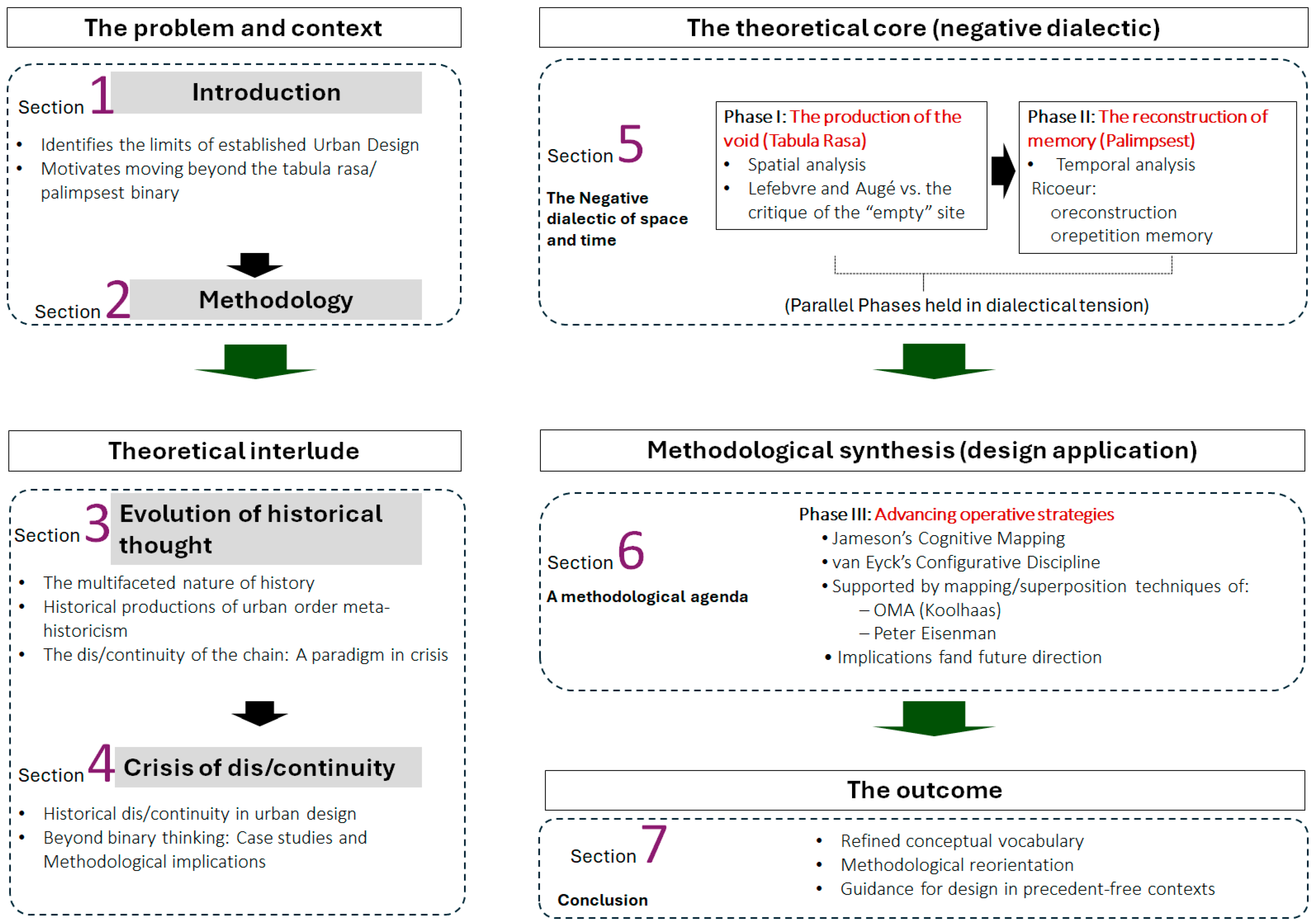
- In the first stage, conventional understandings of tabula rasa were critiqued through a synthesis of Lefebvre’s [3] theory of ‘the production of space’ and Augé’s [4] concept of non-places. The urban void is reinterpreted not as absence but as a spatial condition actively shaped by economic, political, and infrastructural processes that resist traditional placemaking.
- In the second stage, the palimpsest was examined through Ricoeur’s [5] distinction between reconstructive memory and repetitive memory. A methodological criterion was established to differentiate superficial nostalgia from critical historical engagement, providing a foundation for working with contexts in which continuity is partial, fragile, or selectively preserved.
- In the final stage, theory and practice were bridged by proposing Jameson’s [21] cognitive mapping and van Eyck’s [23] configurative discipline as operative tools. This theoretical grounding is supported by an examination of the mapping and superposition techniques employed by OMA/Koolhaas [25] and Peter Eisenman [26] in their respective Parc de La Villette competition entries, demonstrating how dialectical methods were used to generate form in contexts devoid of clear historical referents. The discussion unfolded in two steps to articulate the methodological agenda.
- Operative strategies were identified through the integration of cognitive mapping and configurative discipline, providing practical tools to navigate urban conditions marked by historical discontinuity and referential instability.
- Implications for urban design and directions for future research were articulated, highlighting how these strategies inform both theoretical understanding and practical engagement with emergent urban forms.
- Epistemological recalibration beyond analogical reasoning.
- Procedural tools for urban conditions.
- Design judgment frameworks navigating dis/continuity dialectics.
3. The Evolution of Historical Thought
3.1. The Multifaceted Nature of History
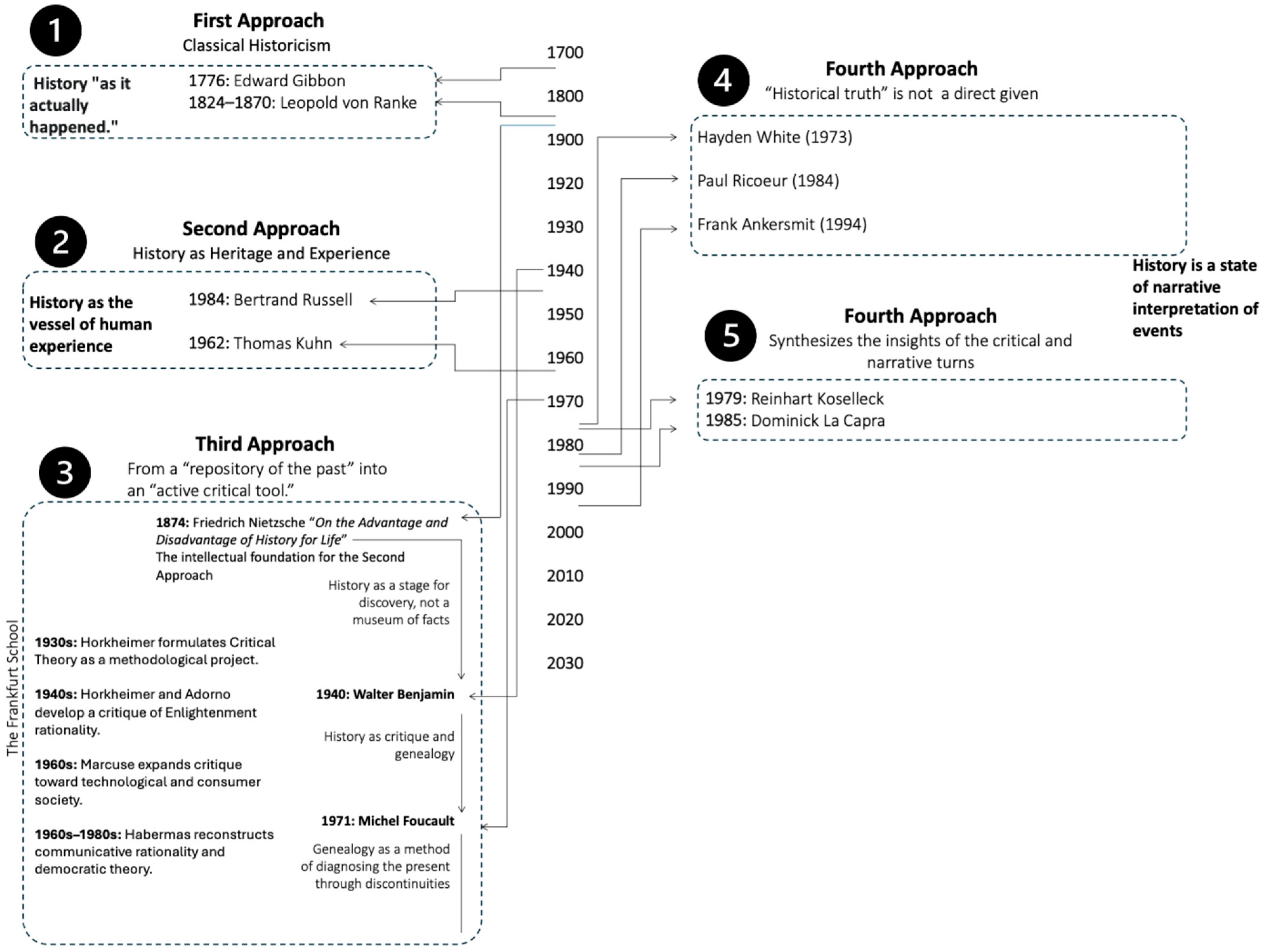
- The first stage, classical historicism, emerged from Enlightenment traditions and the institutionalization of history as a professional discipline. Edward Gibbon’s [38] monumental The History of the Decline and Fall of the Roman Empire (first released in 1776) epitomized an attempt to draw moral and political lessons from antiquity, framing the past as a continuous narrative of ascent and decay. The pursuit of historical objectivity found its methodological expression in Leopold von Ranke’s [39] dictum to describe history “as it actually happened” (in German ‘wie es eigentlich gewesen’), anchoring historical inquiry in factual reconstruction and archival evidence (pp. 57–58).
- The second stage, history as heritage and experience, marks a twentieth century turn toward recognizing history’s formative role in shaping present knowledge [49,50]. Bertrand Russell [51] observed that all human understanding, whether great or small, “is built upon the heritage of past ages” (p. 381). Such a vision was deepened by Thomas Kuhn [42], whose The Structure of Scientific Revolutions redefined history not as a linear record but as a field that exposes the urban design paradigms governing scientific practice. For Kuhn [42], history offered structural and conceptual insights into its evolution, going beyond mere chronology (pp. 1–9).
- The third stage, history as a critical tool, marks a decisive reorientation of historiography, from a passive repository of events to an active tool for critique and transformation. Friedrich Nietzsche’s [41] On the Advantage and Disadvantage of History for Life (first released 1874) framed history as a “stage for discovery, not a museum of facts” (pp. 59–13), insisting that the past ought to serve life instead of contemplation. Building on this impulse, Nietzsche [44] recasts genealogy as a method of diagnosing the present through discontinuities. Walter Benjamin [43], in his Theses on the Philosophy of History, urged historians to “brush history against the grain,” recovering the voices of the defeated (pp. 253–264). This critique was deepened by Frankfurt School theorists, who mobilized history to expose the rational pathologies and ideological entanglements of modernity [52].
- The fourth stage, history as narrative construction, shifted attention toward the representational dimensions of historical knowledge. It conceives history as interpretation, contending that “historical truth” is not objective but discursive. Hayden White [45], pp. 1–42, in Metahistory—The Historical Imagination in Nineteenth-Century Europe, demonstrated that historical writing operates through literary tropes, emplotment, and argument, revealing it to be as much a poetic as a scientific act. This insight is crucial for urban design, as Paul Ricoeur [5], pp. 52–87, further showed that narrating history inevitably merges factual reconstruction with the poetics of storytelling. Frank Ankersmit [46], in History and Tropology, pp. 7–11, advanced this insight by emphasizing that history is mediated through “representation,” meaning that the past can only be grasped through interpretive forms rather than through direct access.
- The fifth stage synthesizes the insights of the critical and narrative turns, foregrounding the historian’s own positionality as an active component in the production of historical knowledge. Reinhart Koselleck [47], in Futures Past—On the Semantics of Historical Time, p. 3–20, warned against collapsing temporal layers into simplistic analogies that project the logic of the present onto the past. Dominick La Capra [48], in History and Criticism, pp. 15–20, advocated a responsible middle path that resists both rigid objectivism, which denies interpretation, and absolute relativism, which dissolves meaning entirely.
- In ancient Egypt, the autocratic rule of the Pharaoh shaped settlement design, producing rigid orthogonal grids that materialized centralized authority and administrative control. The orthogonal layouts of Amarna and Deir El-Medina were not merely functional devices, but spatial manifestations of hierarchical power in which legibility and discipline enabled political domination and bureaucratic surveillance [53,54,55].
- In East and South Asian cities, by contrast, grid planning often emerged from religious and cosmological principles rather than bureaucratic control. Paul Wheatley [56] explains that ancient Chinese city layouts were conceived in accordance with cosmological order and ritual significance. Nancy Shatzman Steinhardt [57] shows how the Kaogong Ji and other classical imperial planning texts described capital cities structured around the cosmic axis and the emperor’s symbolic position as the “Son of Heaven”. While the Kaogong Ji frames the emperor in this role, legitimacy in Chinese political thought rests on the broader notion of All-Under-Heaven (Tian-xia), in which authority derives from the moral order rather than from personal power. As Zhao [58] explains, true authority flows from acting according to the Way (Tao) and safeguarding the people’s well-being and freedom, not ideology, inheritance, or popular preference. In India, the Vastu Shastra similarly prescribed orthogonal layouts based on cosmic geometry and cardinal orientation, aiming to harmonize human settlement with divine principles, as discussed by Klaus-Peter Gast [59].
- In Greek and Roman towns, grid planning embodied philosophical ideals of order and rationality while simultaneously advancing colonial expansion and territorial control. The grid reflected both philosophical and political dimensions. In classical Greece, Hippodamus of Miletus developed the orthogonal plan as a rational expression of civic order and democratic citizenship. In the Roman world, the centuriation system and the castrum model disseminated the grid as an instrument of colonization, governance, and military discipline, replicating Roman power across conquered territories through spatial uniformity [16,60].
- Grid planning continued as a dominant paradigm through the Renaissance and into modern European and American urbanism, reflecting ideals of order, governance, and capitalist efficiency. Renaissance theorists such as Leon Battista Alberti [61] and Filarete [62] revived the orthogonal city, drawing on classical precedents while aligning the grid with humanist and civic ideals of rational order. In the modern era, the grid evolved into an instrument for colonial expansion and capitalist development, exemplified by the rationalized layout of Barcelona’s Eixample and the Manhattan Commissioners’ Plan of 1811 [6,16,63].
- Unlike the planned grid, the organic city developed through gradual accretion and adaptation to local conditions. Its irregular form reflected social, economic, and environmental contingencies, without recourse to predetermined order. Medieval European towns, Islamic cities such as Fez and Cairo, and pre-modern Asian settlements exemplify this pattern, in which urban form emerged from communal life and negotiated spatial use, bypassing centralized imposition [16,64,65,66].
- Urban research has long wrestled with this relationship to the past—not as a chronological record but as an interpretive field that structures how the present is understood and how the future is imagined [67]. This critical perspective, which may be described as critical metahistoricism, moves beyond documenting events to examine the concepts through which history is narrated, appropriated, and mobilized in planning and design discourse [15,68].
3.2. Historical Productions of Urban Order Metahistoricism
3.3. The Dis/Continuity of the Chain: A Paradigm in Crisis
4. The Crisis of Dis/Continuity in Urban Design Theory and Practice
4.1. Historical Dis/Continuity in Urban Design
4.2. Beyond Binary Thinking: Case Studies and Methodological Implications
- What occurs when development begins anew in vast desert expansions or newly formed territories lacking urban memory?
- How should urban design respond to projects that transcend historical discontinuity?
- Can paradigms that are rooted in historical reference adequately engage such contexts, or do their conceptual and methodological assumptions need reconsideration?
5. The Negative Dialectic of Space and Time
- Phase I, the production of the void, critiques the concept of the tabula rasa. Drawing on Henri Lefebvre [3], erasure is understood not as a return to neutrality but as the active production of “abstract space”. As Marc Augé [4] notes, this production results in “non-places” that resist traditional historical grounding. For design practice, this implies that acts of demolition or clearance cannot be treated as neutral technical operations but must be understood as spatial interventions that actively reshape collective memory.
- Phase II, the reconstruction of memory, reframes the palimpsest as an active methodological problem. Drawing on Paul Ricoeur’s [5] distinction between reconstruction memory and repetition memory, we explore how history can be mobilized in design without falling into nostalgia. This distinction provides a critical lens for evaluating when historical reference operates as productive reinterpretation rather than as uncritical replication. These theoretical intersections demonstrate that urban history is not a fixed archive but a living field of production, establishing the conceptual basis for the operational strategies.
5.1. The Production of the Void (Tabula Rasa)
5.2. The Reconstruction of Memory (Palimpsest)
6. A Methodological Agenda
6.1. Urban Design Without Historical Foundations
6.2. Operative Strategies: Cognitive Mapping and Configurative Discipline
6.3. Implications and Future Directions
6.3.1. Integrated Implications
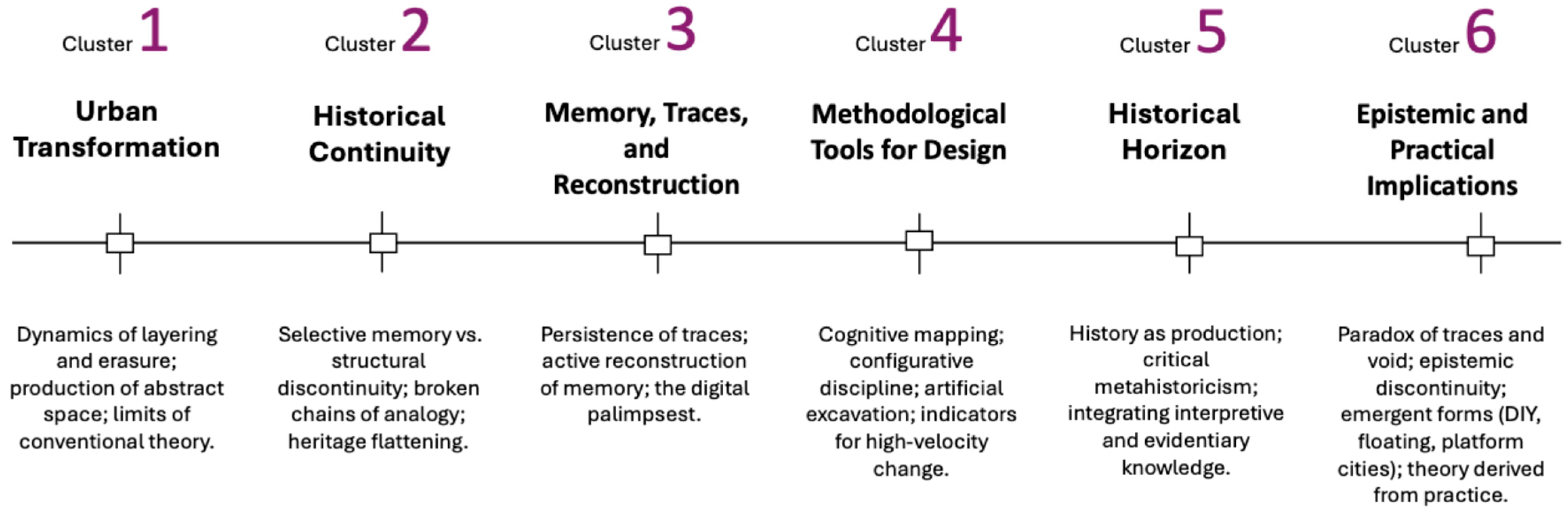
- Cluster 1 addresses urban transformation in relation to spatial production, demonstrating how processes of erasure and abstraction challenge the explanatory reach of established urban design theories.
- Following Lefebvre [3], the “void” associated with the tabula rasa is actively produced by capital, policy, and geopolitical forces.
- Accelerated development generates “non-places” [4] that overwrite and erase historical meaning, weakening the stabilizing role of collective memory.
- Psychoanalytic models of inscription, such as Freud’s “mystic writing pad” [114], show that radical actions leave traces, reframing modernist erasure as incomplete.
- Established paradigms of urban design, especially those grounded in historical precedent, struggle to explain emergent urban forms detached from traditional anchors, including rapidly built desert cities, experimental settlements, floating cities, and digital-platform neighborhoods. These conditions reveal the limits of historically derived analytical tools [71,86,126].
- Cluster 2 clarify how continuity is produced and constructed within contemporary rapid and large-scale urban transformations.
- Reintroducing historical references rarely restores continuity; as Ricoeur [5] warns, it often yields repetition (pastiche), not true reconstruction.
- Cluster 3 addresses memory, traces, and reconstruction, focusing on the persistence of urban memory and its methodological engagement with it.
- According to Ricoeur, memory functions as active reconstruction instead of passive preservation [5].
- Designers employ configurative discipline to weave fragmented traces into new spatial narratives, treating the city as a site of negotiation [23].
- Digital overlays and mediated inscription suggest new forms of “virtual palimpsest” where memory persists even when physical fabric is erased [117].
- Cluster 4 addresses future directions for design practice, outlining a methodological agenda suited to contexts marked by erasure and lack of precedent.
- Cognitive mapping develops tools to map the invisible forces, such as capital and data, to make the non-place legible [21].
- Configurative Discipline creates design methodologies that structure the void through relational grids instead of relying on historical pastiche [23].
- Artificial excavation explores methods of layering and superposition to generate complexity in tabula rasa contexts [26].
- Promote rhizomatic, network-based design logics emphasizing horizontal interconnections over vertical historical lineage [128].
- Cluster 5 addresses the historical horizon, analyzing how history informs design thinking, theory, and epistemological formation.
- Simplistic analogies between past and present [47] create methodological risks, imposing outdated logic onto unprecedented realities.
- Cluster 6 addresses its epistemic and practical implications.
6.3.2. Future Directions of the Research
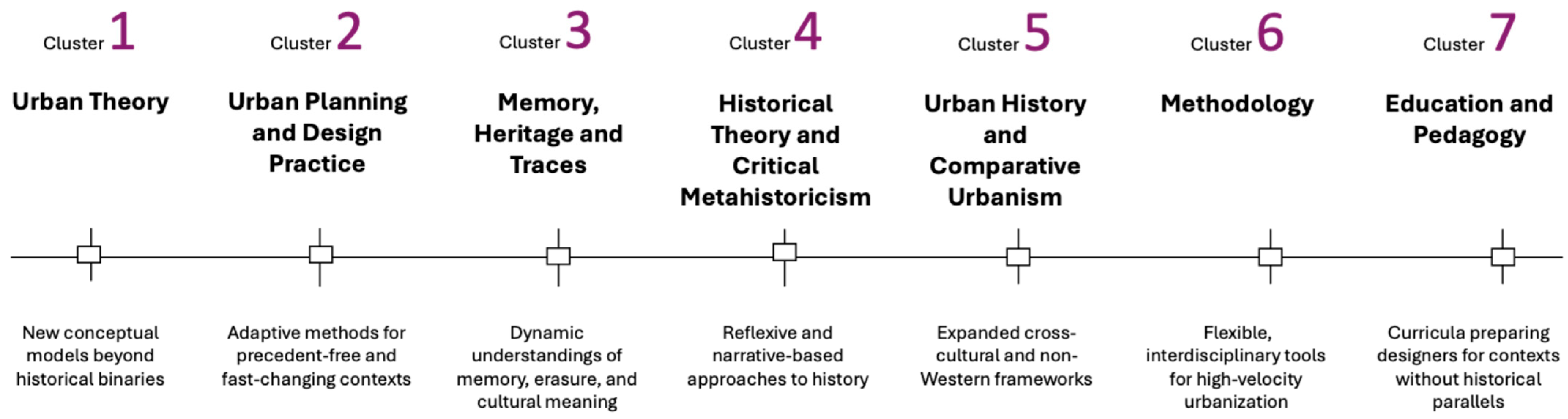
- Cluster 1 for urban theory, highlighting conceptual strategies to understand urban form under changing socio-cultural and environmental conditions.
- Cluster 2 for urban planning and design practice, highlighting applied strategies from literature in contexts of rapid change, erasure, or absence of precedent.
- Draw on Fredric Jameson’s cognitive mapping to make the invisible forces of the city (capital, data) legible in design [21].
- Adopt Aldo van Eyck’s configurative discipline to structure spatial voids through relational grids instead of relying on historical pastiche [23].
- Highlight methodological flexibility and experimental design in urban contexts [32].
- Propose rhizomatic, network-based design logics emphasizing horizontal interconnections over vertical historical lineage [128].
- Cluster 3 for memory, heritage, and urban traces, highlighting how erasure, persistence, and inscription shape evolving urban environments.
- Cluster 4 discusses historical theory and critical metahistoricism, highlighting reinterpretation of history in contemporary and future urban practice.
- Cluster 5 for urban history and comparative urbanism, highlighting historical and cross-cultural perspectives in shaping urban form.
- Cluster 6 for methodology, highlighting the development of analytical, integrative, and interdisciplinary tools.
- Create research frameworks suited to high-velocity urbanization, where traditional historical/morphological methods fail [42].
- Cluster 7 for education and pedagogy, highlighting training strategies for designers and planners in precedent-free contexts.
- Reform curricula to position history as a critical mode of inquiry [84].
- Train designers analyze context without relying on historical parallels [86].
- Foster exploration, integration, and adaptive learning capacities [85].
- Introduce predictive and scenario-based teaching [87].
- Systematically document emerging urban forms as part of education [67].
- Encourage empirical studies of how designers interpret historical analogy [73].
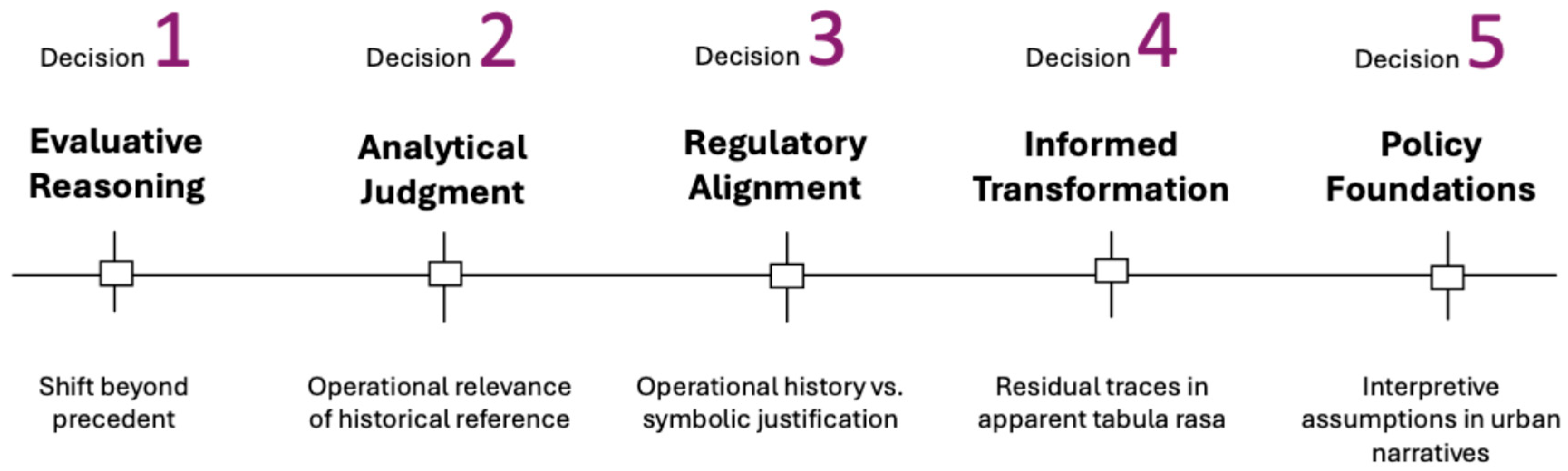
6.3.3. Support for Urban Design Decision-Making
7. Conclusions
Author Contributions
Funding
Institutional Review Board Statement
Informed Consent Statement
Data Availability Statement
Acknowledgments
Conflicts of Interest
Appendix A

| Cluster | Key Implication (Summary) | Theoretical Focus | Key References |
|---|---|---|---|
| 1. Urban transformation and the production of space | 1. Transformation is a dialectic of erasure and production. | Negative Dialectic | [3,104,114] |
| 2. Tabula rasa is a “produced” abstract space, not a void. | Production of Space | [3,4] | |
| 3. Accelerated development generates “non-places.” | Non-Place | [4] | |
| 4. Radical actions leave residual traces (inscription). | Psychoanalysis of Space | [114] | |
| 5. Adequately address forms without historical anchors. | Limits of Paradigms | [71,86,126] | |
| 2. Historical continuity and discontinuity | 1. Continuity is selectively constructed, not natural. | Social Memory | [97,98] |
| 2. Discontinuity is structural; the historical chain is broken. | Paradigm Crisis | [42,86] | |
| 3. Reintroducing references often yields pastiche (repetition). | Repetition Memory | [5] | |
| 4. Dependence on imagery leads to heritage flattening. | Commodification | [68,80] | |
| 3. Memory, traces, and reconstruction | 1. Erasure is never total; traces persist. | Persistence | [114,115] |
| 2. Memory functions as active reconstruction, not preservation. | Reconstruction Memory | [5] | |
| 3. Design is a negotiation of fragmented traces. | Configurative Discipline | [23] | |
| 4. Digital overlays create “virtual palimpsests.” | Digital Memory | [117] | |
| 4. Methodological agenda (design practice) | 1. Cognitive mapping making invisible forces legible. | Mapping the Void | [21] |
| 2. Configurative discipline structuring the void. | Relational Form | [23] | |
| 3. Artificial Excavation layering and superposition. | Superposition | [26] | |
| 4. Context-sensitive indicators for high-velocity change. | Adaptive Morphology | [119,122] | |
| 5. Rhizomatic, network-based design logics. | Horizontal Networks | [128] | |
| 5. Historical horizon of urban design theory | 1. History as a “repository” constrains innovation. | Limits of Analogy | [75,86] |
| 2. Metaphors carry ideological baggage; need dialectic. | Critical Theory | [17,20] | |
| 3. Interpretation is a “production” of political meaning. | Politics of Space | [3,16] | |
| 4. History is interpretive, not objective. | Metahistory | [15,45] | |
| 5. Simplistic analogies create methodological risks. | Temporality | [47] | |
| 6. Rapid Urban transformation | 1. It is a structural discontinuity in knowledge generation. | Epistemic Rupture | [42,77] |
| 2. Traditional succession paradigms are insufficient. | Crisis of Tradition | [15,16] | |
| 3. It creates a “referential void” demanding new tools. | Operative Strategy | [21,23] | |
| 4. Paradox generating knowledge from zero shaped by traces. | Dialectic of Origin | [3,114] | |
| 5. Emergence of forms not derivable from patterns. | Empirical Transformations | [123,124,125,126] | |
| 6. Need for methodological agility and adaptive tools. | Adaptive Methodology | [122,128] |
| Cluster | Proposed Direction | Theoretical Focus | References |
|---|---|---|---|
| 1. Urban theory | 1. Theorize continuity/discontinuity as entangled forces. | Negative Dialectic | [3,4,20] |
| 2. Reconfigure to interpret rapid growth as production. | Production of Space | [3,119] | |
| 3. Reposition history as critical insight, not template. | Critical Historiography | [15,75] | |
| 4. Formulate paradigms for referentially void forms. | The Referential Void | [4,25] | |
| 5. Establish “Future Histories” for emerging types. | Typological Emergence | [124,125] | |
| 6. Integrate psychoanalytic insights (persistence, repression). | Urban Unconscious | [114,115] | |
| 7. Advance tools for material and symbolic traces. | Material/Symbolic Trace | [5,79] | |
| 2. Design practice | 1. Methodologies for precedent-free environments. | Methodological Agility | [25,87] |
| 2. Apply Jameson’s mapping to invisible forces. | Cognitive Mapping | [21] | |
| 3. Apply van Eyck’s relational grids. | Configurative Discipline | [23] | |
| 4. Strategies of layering and scaling. | Artificial Excavation | [25,26] | |
| 5. Methodological flexibility in unprecedented contexts. | Adaptive Design | [32] | |
| 6. Paper emergent forms (floating cities, Railopolis). | Empirical Transformations | [123,124,125,126] | |
| 7. Promote network-based design logics. | Rhizomatic Planning | [128] | |
| 8. Treat urban pedagogy as integral to theory. | Praxis | [85,129] | |
| 3. Memory and heritage | 1. Move from Repetition to Reconstruction. | Reconstruction Memory | [5] |
| 2. Policies against memory commodification. | De-commodification | [68,80] | |
| 3. Frameworks for partial erasure and re-inscription. | Palimpsestic Process | [19,20] | |
| 4. Include suppressed/latent traces in heritage. | Latent Heritage | [99,115] | |
| 5. Digital overlays and AR. | Digital Palimpsest | [117] | |
| 6. Reconnecting collective memory with rapid change. | Social Memory | [83,102] | |
| 4. Historical theory | 1. Integrate narrative theory with methodology. | Narrative Theory | [45] |
| 2. Promote critical self-awareness (positionality). | Reflexivity | [23,47] | |
| 3. Strengthen genealogical tracking of concepts. | Genealogy | [44] | |
| 4. Construct multi-layered temporal dimensions. | Polychronic | [47] | |
| 5. Use critical metahistoricism to examine appropriation. | Critical Metahistoricism | [15,75] | |
| 6. Narrative-critical methods in theory. | Narrative Inquiry | [44,45] | |
| 7. Implications of exclusionary narratives. | Historiography | [10,11,48] | |
| 5. Comparative Urbanism | 1. Comparative frameworks (cosmological/political). | Cosmological Order | [56,57] |
| 2. Reassess grid/organic paradigms via culture. | Cultural Morphology | [16,53] | |
| 3. Histories of power and spatial legibility. | Spatial Legibility | [53,54] | |
| 4. Non-Western planning epistemologies. | Epistemic Pluralism | [57,58,64] | |
| 5. Critique of “heritage urbanism” discourse. | Discursive Analysis | [15,68] | |
| 6. Methodology | 1. Adaptive qualitative/quantitative methodologies. | Mixed Methods | [119,122] |
| 2. Interdisciplinary tools (psychoanalysis/morphology). | Interdisciplinary | [115,118] | |
| 3. Transfer of inscription metaphors across disciplines. | Metaphor Transfer | [17,113] | |
| 4. Research frameworks for high-velocity urbanization. | Paradigm Crisis | [42] | |
| 7. Pedagogy | 1. History as critique, not catalogue. | Critical Pedagogy | [84] |
| 2. Analyzing context without historical parallels. | Contextual Analysis | [86] | |
| 3. Exploration and adaptive learning. | Active Learning | [85] | |
| 4. Responsive predictive. | Scenario Planning | [87] | |
| 5. Documenting emergent forms in education. | Field Documentation | [67] | |
| 6. Metahistorical literacy in programs. | Metahistorical Literacy | [45,47] | |
| 7. Empirical studies of analogy interpretation. | Design Cognition | [73] |
References
- Plato. The Republic, Indianapolis/Cambridge; Hackett Publishing Company, Inc.: Indianapolis, IN, USA, 2004. [Google Scholar]
- Adorno, T.W. Negative Dialectics; Routledge: London, UK; New York, NY, USA, 1973. [Google Scholar]
- Lefebvre, H. The Production of Space; Blackwell: Malden, MA, USA, 1991. [Google Scholar]
- Augé, M. Non-Places: Introduction to an Anthropology of Supermodernity; Verso Books: London, UK; New York, NY, USA, 1995. [Google Scholar]
- Ricoeur, P. Time and Narrative, 1st ed.; The University of Chicago Press: Chicago, IL, USA; London, UK, 1984; Volume 1. [Google Scholar]
- Benevolo, L. The History of the City; MIT Press: Cambridge, MA, USA, 1982. [Google Scholar]
- Hanson, J. Order and structure in urban design: The plans for the rebuilding of London after the Great Fire of 1666. Ekistics 1989, 56, 334–335. [Google Scholar]
- Smithson, A.; Smithson, P. Urban Structuring: Studies of Alison & Peter Smithson; Studio Vista: London, UK, 1967. [Google Scholar]
- Spoormans, L.; Navas-Carrillo, D.; Zijlstra, H.; Pérez-Cano, T. Planning history of a Dutch new town: Analysing lelystad through Its residential neighbourhoods. Urban Plan. 2019, 4, 102–116. [Google Scholar] [CrossRef]
- Chatterjee, P. The inheritance and repetition of colonial practices of dispossession. Environ. Plan. D Soc. Space 2023, 41, 805–825. [Google Scholar] [CrossRef]
- Friendly, A.; Walker, A.P.P. Legacy participation and the buried history of racialised spaces: Hypermodern revitalisation in Rio de Janeiro’s port area. Urban Stud. 2022, 6, 1167–1184. [Google Scholar] [CrossRef]
- Steel, G.; van Noorloos, F.; Klaufus, C. The urban land debate in the Global South: New avenues for research. Geoforum 2017, 83, 133–141. [Google Scholar] [CrossRef]
- Antweiler, K. Why collective memory can never be pluriversal: A case for contradiction and abolitionist thinking in memory studies. Mem. Stud. 2023, 16, 1529–1545. [Google Scholar] [CrossRef]
- Clark, P. (Ed.) The Oxford Handbook of Cities in World History; University Press: Oxford, UK, 2013. [Google Scholar]
- Choay, F. The Rule and the Model: On the Theory of Architecture and Urbanism; MIT Press: Cambridge, MA, USA, 1997. [Google Scholar]
- Kostof, S. The City Shaped: Urban Patterns and Meanings Through History; Thames & Hudson: London, UK, 1991. [Google Scholar]
- Duschinsky, R. Tabula Rasa and Human Nature. Philosophy 2012, 87, 509–529. [Google Scholar] [CrossRef]
- Ianoș, I.; Craciun, C.; Jones, R.; Sorenson, A. The impact of tabula rasa actions and laissez-faire planning inaction on urban landscape dynamics: A Bucharest case study. Urban Sci. 2025, 9, 366. [Google Scholar] [CrossRef]
- Colwell, C. A palimpsest theory of objects. Curr. Anthropol. 2022, 63, 129–157. [Google Scholar] [CrossRef]
- Dillon, S. The Palimpsest: Literature, Criticism, Theory; Bloomsbury Academic: London, UK, 2007. [Google Scholar]
- Jameson, F. Cognitive Mapping. In Marxism and the Interpretation of Culture; Nelson, C., Grossberg, L., Eds.; MacMillan: London, UK; University of Illinois Press: Champaign, IL, USA, 1988; pp. 347–360. [Google Scholar]
- Roberts, A.C. Fredric Jameson; Psychology Press: London, UK; New York, NY, USA, 2000. [Google Scholar]
- van Eyck, A. Steps Toward a Configurative Discipline. In Aldo van Eyck: Collected Articles and Other Writings 1947–1998; Ligtelijn, V., Strauven, F., Eds.; Sun Publishers: Amsterdam, The Netherlands, 2008; pp. 328–341. [Google Scholar]
- Dominguez, G.M. From individual to community: Geometry as a mediating tool in Jan Verhoeven’s school architecture. Archit. Hist. 2022, 10, 1–25. [Google Scholar] [CrossRef]
- Koolhaas, R. Congestion Without Matter: Parc de la Villette. In S, M, L, XL; Koolhaas, R., Mau, B., Eds.; Monacelli: New York, NY, USA, 1995; pp. 894–935. [Google Scholar]
- Eisenman, P. Diagram Diaries; Thames & Hudson: London, UK, 1999. [Google Scholar]
- Carmona, M. The place-shaping continuum: A theory of urban design process. J. Urban Des. 2014, 19, 2–36. [Google Scholar] [CrossRef]
- Carmona, M.; Tiesdell, S. Urban Design Reader; Routledge: London, UK, 2007. [Google Scholar]
- Cuthbert, A. Eliot’s insight—The future of urban design. J. Urban Des. 2020, 25, 11–14. [Google Scholar] [CrossRef]
- Cuthbert, A.R. Urban design: Requiem for an era—Review and critique of the last 50 years. Urban Des. Int. 2007, 12, 177–223. [Google Scholar] [CrossRef]
- Madanipour, A. Urban design and dilemmas of space. Environ. Plan. D Soc. Space 1996, 14, 331–355. [Google Scholar] [CrossRef]
- Mumford, E.P. The CIAM Discourse on Urbanism, 1928–1960; MIT Press: Cambridge, MA, USA, 2002. [Google Scholar]
- Lee, S.H.; Kim, H.; Han, H. Transforming urban neighborhoods from ‘bed towns’ to eco-friendly smart cities in Korea. Cities 2025, 166, 106258. [Google Scholar] [CrossRef]
- Abusaada, H.; Elshater, A. From social sciences to urban praxis: A critical synthesis of historical–contextual inquiry and analysis in urban studies. Societies 2025, 15, 95. [Google Scholar] [CrossRef]
- Abusaada, H.; Elshater, A.; Ghalib, H. Designing a historically grounded bibliographic model to enhance reference reliability in planning research. Ain Shams Eng. J. 2026, 17, 103973. [Google Scholar] [CrossRef]
- Abusaada, H.; Elshater, A. Beyond keywords: Effective strategies for building consistent reference lists in scientific research. Publication 2024, 12, 25. [Google Scholar] [CrossRef]
- de Certeau, M. The Writing of History; Columbia University Press: New York, NY, USA, 1992. [Google Scholar]
- Gibbon, E. The History of the Decline and Fall of the Roman Empire; Bury, J.B., Ed.; Fred de Fau and Co.: New York, NY, USA, 1906. [Google Scholar]
- von Ranke, L. The Theory and Practice of History, 1st ed.; Iggers, G.G., von Moltke, K., Eds.; Routledge: New York, NY, USA, 2010. [Google Scholar]
- Nietzsche, F. On the Use and Abuse of History for Life, Meniola; Courier Dover Publications: New York, NY, USA, 2019. [Google Scholar]
- Nietzsche, F. On the Genealogy of Morality; Penguin Classics: London, UK, 2013. [Google Scholar]
- Kuhn, T.S. The Structure of Scientific Revolutions. In International Encyclopedia of Unified Science, 2nd ed.; The University of Chicago Press: Chicago, IL, USA, 1970. [Google Scholar]
- Benjamin, W. Theses on the Philosophy of History. In Critical Theory and Society; Bronner, S.E., Kellner, D.M., Eds.; Routledge: New York, NY, USA, 1990; pp. 253–264. [Google Scholar]
- Nietzsche, M.F. Genealogy, History. In The Foucault Reader; Rabinow, P., Ed.; Pantheon Books: New York, NY, USA, 1984; pp. 76–100. [Google Scholar]
- White, H. Metahistory: The Historical Imagination in Nineteenth-Century Europe; The Johns Hopkins University Press: Baltimore, MD, USA, 1973. [Google Scholar]
- Ankersmit, F. History and Tropology; University of California Press: Berkeley, CA, USA; Los Anglos, CA, USA; London, UK, 1994. [Google Scholar]
- Koselleck, R. Futures Past: On the Semantics of Historical Time; Columbia University Press: New York, NY, USA, 2004. [Google Scholar]
- LaCapra, D. History and Criticism; Cornell University Press: Ithaca, NY, USA, 1985. [Google Scholar]
- Abusaada, H.; Elshater, A. Knowledge-Based Urban Design in the Architectural Academic Field. In Knowledge-Based Urban Development in the Middle East; IGI Global: New York, NY, USA, 2018; pp. 204–227. [Google Scholar]
- Elshater, A.; Abusaada, H. From uniqueness to singularity through city prestige. Proc. Inst. Civ. Eng. Urban Des. Plan. 2022, 175, 91–97. [Google Scholar] [CrossRef]
- Russell, B. History of Western Philosophy; Routledge: London, UK, 2004. [Google Scholar]
- Ibsen, M.F. A Critical Theory of Global Justice: The Frankfurt School and World Society; Oxford University Press: Oxford, UK, 2023. [Google Scholar]
- Grant, J. The dark side of the grid: Power and urban design. Plan. Perspect. 2001, 16, 219–241. [Google Scholar] [CrossRef]
- Kemp, B.J. Ancient Egypt: Anatomy of a Civilization; Routledge: London, UK; New York, NY, USA, 2006. [Google Scholar]
- Trigger, B.G. Understanding Early Civilizations; Cambridge University Press: Cambridge, MA, USA, 2014. [Google Scholar]
- Wheatley, P. Early Urban Forms: The Pivot of the Four Quarters. In A Preliminary Enquiry into the Origins and Character of the Ancient Chinese City; Aldine: Chicago, IL, USA, 1971. [Google Scholar]
- Steinhardt, N.S. Chinese Imperial City Planning; University of Hawaii Press: Honolulu, HI, USA, 1999. [Google Scholar]
- Zhao, T. Rethinking Empire from a Chinese concept ‘all-under-heaven’ (Tian-xia 天下). Soc. Identities J. Study Race Nation Cult. 2006, 12, 29–41. [Google Scholar] [CrossRef]
- Gast, K.-P. Modern Traditions: Contemporary Architecture in India; Birkhäuser: Berlin, Germany; Boston, MA, USA, 2007. [Google Scholar]
- Owens, E.J. The City in the Greek and Roman World; Routledge: London, UK, 1991. [Google Scholar]
- Alberti, L.B. On the Art of Building in Ten Books; The MIT Press: Cambridge, MA, USA, 1991. [Google Scholar]
- di Piero Averlino, A. Filarete’s Treatise on Architecture; Yale University Press: New Haven, CT, USA, 1965. [Google Scholar]
- Reps, J.W. The Making of Urban America: A History of City Planning in the United States; Princeton University Press: Princeton, NJ, USA, 1965. [Google Scholar]
- Hakim, B.S. Arabic-Islamic Cities: Building and Planning Principles; Kegan Paul International: London, UK, 1986. [Google Scholar]
- Morris, A. History of Urban Form Before the Industrial Revolution; Routledge: London, UK, 1994. [Google Scholar]
- Abusaada, H.; Elshater, A.; Rashed, R. Exploring the singularity of smart cities in the New Administrative Capital City, Egypt. Ain Shams Eng. J. 2023, 14, 102087. [Google Scholar] [CrossRef]
- MacCallum, D.; Babb, C.; Curtis, C. Doing Research in Urban and Regional Planning: Lessons in Practical Methods; Routledge: New York, NY, USA, 2019. [Google Scholar]
- Huyssen, A. Present Pasts: Urban Palimpsests and the Politics of Memory; Stanford University Press: Redwood City, CA, USA, 2003. [Google Scholar]
- Collins, G.R.; Collins, C.C. Camillo Sitte: The Birth of Modern City Planning; Dover: New York, NY, USA, 1986. [Google Scholar]
- Le Corbusier. The City of Tomorrow; The Architecture Press Ltd.: London, UK, 1929. [Google Scholar]
- Curtis, W.J.R. Le Corbusier: Ideas and Form; Phaidon: Oxford, UK, 1986. [Google Scholar]
- Hirt, S. The compact versus the dispersed city: History of planning ideas on Sofia’s urban form. J. Plan. Hist. 2007, 6, 138–165. [Google Scholar] [CrossRef]
- Collins, P. Changing Ideals in Modern Architecture, 1750–1950; McGill University Press: Montreal, QC, Canada, 1965. [Google Scholar]
- Rossi, A. The Architecture of the City; The MIT Press: Cambridge, MA, USA; London, UK, 1982. [Google Scholar]
- Tafuri, M. Theories and History of Architecture; Granada: London, UK, 1980. [Google Scholar]
- Rowe, C.; Koetter, F. Collage City; The Mit Press: Cambridge, MA, USA, 1978. [Google Scholar]
- Koolhaas, R. Delirious New York: A Retroactive Manifesto for Manhattan; Oxford University Press: Oxford, UK, 1978. [Google Scholar]
- Krier, L. Architecture: Choice or Fate; Andreas Papadakis Pub: London, UK, 1998. [Google Scholar]
- Hayden, D. The Power of Place: Urban Landscapes as Public History; The MIT Press: Cambridge, MA, USA, 1997. [Google Scholar]
- Lowenthal, D. The Past Is a Foreign Country; Cambridge University Press: Cambridge, MA, USA, 1985. [Google Scholar]
- Mumford, L. The City in History: Its Origins, Its Transformations, and Its Prospects; Mariner Books: Boston, MA, USA, 1968. [Google Scholar]
- González-Márquez, I.; Toledo, V.M. Sustainability science: A paradigm in crisis? Sustainability 2020, 12, 2802. [Google Scholar] [CrossRef]
- Halbwachs, M. On Collective Memory; University of Chicago Press: Chicago, IL, USA, 1992. [Google Scholar]
- Hall, P. A Telegram from the Queen: The Centenary of Modern Planning. Plan. Hist. 1998, 20, 8–11. [Google Scholar]
- Prince, M. Does active learning work? A review of the research. J. Eng. Educ. 2004, 93, 223–231. [Google Scholar] [CrossRef]
- Lang, J. Programmes and paradigms in urban design. J. Urban Des. 2020, 25, 20–22. [Google Scholar] [CrossRef]
- Lang, J. The Routledge Companion to Twentieth and Early Twenty-First Century Urban Design: A History of Shifting Manifestoes, Paradigms, Generic Solutions, and Specific Designs; Routledge: New York, NY, USA; London, UK, 2021. [Google Scholar]
- Lang, J. Shifting urban design paradigms in the development of two New York projects: Battery Park City and Hudson Yards. Regul. Issue Ekistics New Habitat 2024, 84, 11–21. [Google Scholar] [CrossRef]
- Agassi, J. Continuity and discontinuity in the history of science. J. Hist. Ideas 1973, 34, 609–626. [Google Scholar] [CrossRef]
- Jones, P. Historical continuity and post-1945 urban redevelopment: The example of Lee Bank, Birmingham, UK. Plan. Perspect. 2004, 19, 365–389. [Google Scholar] [CrossRef]
- Polansky, R. Aristotle’s De Anima; Cambridge University Press: Cambridge, MA, USA, 1986. [Google Scholar]
- Locke, J. An Essay Concerning Human Understanding; Nidditch, P.H., Ed.; Clarendon Press: London, UK, 1975. [Google Scholar]
- Mehan, A. “Tabula Rasa” planning: Creative destruction and building a new urban identity in Tehran. J. Archit. Urban. 2017, 41, 210–220. [Google Scholar] [CrossRef]
- Zedong, M. Selected Works of Mao Tse-Tung; Foreign Languages Press: Beijing, China, 1977; Volume 5. [Google Scholar]
- Koo, D. A sustainable city made by resident-experts—How designerly intervention enacted rights of the public and urban infrastructure. Sci. Technol. Hum. Values 2024, 50, 1016–1045. [Google Scholar] [CrossRef]
- Fowden, E.; Çağaptay, S.; Zychowicz-Coghill, E.; Blanke, L. Cities as Palimpsests? Responses to Antiquity in Eastern Mediterranean Urbanism; Oxbow Books: Oxford, UK, 2022. [Google Scholar]
- Connerton, P. How Societies Remember; Cambridge University Press: Cambridge, MA, USA; New York, NY, USA, 1989. [Google Scholar]
- Gillis, J.R. (Ed.) Commemorations: The Politics of National Identity; Princeton University Press: New Jersey, NJ, USA, 1994. [Google Scholar]
- Thompson, Z. Erasing the Traces, Tracing Erasures: Cultural Memory and Belonging in Newcastle/Gateshead, UK. In Walter Benjamin and the Aesthetics of Change; Pusca, A.M., Ed.; Palgrave Macmillan: London, UK, 2010; pp. 55–81. [Google Scholar]
- Yanhong, H. “Les lieux de mémoire” and Pierre Nora’s writing of French national history. Chin. Stud. Hist. 2020, 53, 150–170. [Google Scholar] [CrossRef]
- Nora, P. Between memory and history: Les lieux de mémoire. Representations 1989, 26, 7–24. [Google Scholar] [CrossRef]
- Nora, P. Realms of memory: Rethinking the French past. In European Perspectives; Columbia University Press: New York, NY, USA; Chichester, UK, 1996. [Google Scholar]
- Giedion, S. CIAM 8: The Heart of the City: Towards the Humanisation of Urban Life. In The Heart of the City; Pellegrini and Cudahy Publishers: New York, NY, USA, 1952; pp. 475–477. [Google Scholar]
- Corsini, J.M.O.; Navarro, L.R.; Larrodé, E.L. Urban design paradigm shifts: The case of Barañain. Plan. Perspect. 2017, 32, 437–450. [Google Scholar] [CrossRef]
- Leibniz, G.W. New Essays on Human Understanding; Remnant, P., Bennett, J., Eds.; Cambridge University Press: Cambridge, MA, USA, 1996. [Google Scholar]
- Abusaada, H.; Elshater, A.; Ouf, A.M. Proactive urbanism—With or without an urban designer. J. Urban. 2025, 1–5, ahead of print. [Google Scholar] [CrossRef]
- Scott, J.C. Seeing Like a State: How Certain Schemes to Improve the Human Condition Have Failed; Yale University Press: New Haven, CT, USA; London, UK, 1998. [Google Scholar]
- Hall, P. Cities of Tomorrow: An Intellectual History of Urban Planning and Design Since 1880; Wiley-Blackwell: Hoboken, NJ, USA, 2014. [Google Scholar]
- Berman, M. All That Is Solid Melts into Air; Penguin Books: New York, NY, USA, 1982. [Google Scholar]
- Zukin, S. Landscapes of Power: From Detroit to Disney World; University of California Press: Berkeley, CA, USA, 1991. [Google Scholar]
- Petrucci, A. Writers and Readers in Medieval Italy: Studies in the History of Written Culture; Yale University Press: New Haven, CT, USA; London, UK, 1995. [Google Scholar]
- De Quincey, T. Confessions of an English Opium Eater and Other Writings; Lindop, G., Ed.; Oxford University Press: Oxford, UK, 1998. [Google Scholar]
- Dillon, S. Re-inscribing De Quincey’s palimpsest: The significance of the palimpsest in contemporary literary and cultural studies. Textual Pract. 2005, 19, 243–263. [Google Scholar] [CrossRef]
- Freud, S. A Note Upon the “Mystic Writing Pad”. In Deconstruction a Reader; McQuillan, M., Ed.; Routledge: London, UK, 2000; pp. 248–252. [Google Scholar]
- Gunder, M. An introduction: Psychoanalytical thought and planning theory. Plan. Theory 2011, 10, 299–300. [Google Scholar] [CrossRef]
- Marvell, A.; Simm, D. Unravelling the geographical palimpsest through fieldwork: Discovering a sense of place. Geography 2016, 101, 125–136. [Google Scholar] [CrossRef]
- Parikh, A. Urban as palimpsest: Neoliberal environments, fishing livelihoods, and toxic landscapes in Mumbai, India. GeoHumanities 2020, 6, 139–154. [Google Scholar] [CrossRef]
- Conzen, M.R.G. Thinking About Urban Form: Papers on Urban Morphology, 1932–1998; Conzen, M.P., Ed.; Peter Lang: Bern, Switzerland, 2004. [Google Scholar]
- Oliveira, V.; Porta, S. Quantitative and qualitative analysis in urban morphology: Systematic legacy and latest developments. Proc. Inst. Civ. Eng.—Urban Des. Plan. 2025, 178, 75–87. [Google Scholar] [CrossRef]
- Abusaada, H.; Elshater, A. Dragon urbanism: Virtue through destruction. J. Urban. 2026, 1–7, ahead of print. [Google Scholar] [CrossRef]
- Oliveira, V. Urban Morphology: An Introduction to the Study of the Physical Form of Cities; Springer: Cham, Switzerland, 2022. [Google Scholar]
- Kropf, K. Aspects of urban form. Urban Morphol. 2009, 13, 105–120. [Google Scholar] [CrossRef]
- Fabian, L.; Samson, K. Claiming participation—A comparative analysis of DIY urbanism in Denmark. J. Urban. Int. Res. Placemaking Urban Sustain. 2016, 9, 166–184. [Google Scholar] [CrossRef]
- Cutieru, A. UN-Habitat and Oceanix Reveal Prototype for the World’s First Sustainable Floating City. Available online: https://www.archdaily.com/980892/un-habitat-reveals-prototype-for-the-worlds-first-sustainable-floating-city (accessed on 27 April 2022).
- Banerjee, I. Railopolis: City within a city. J. Urban. Int. Res. Placemak. Urban Sustain. 2024, 17, 443–463. [Google Scholar] [CrossRef]
- Bermúdez, J.C.C.; König, R. Can digital technologies for city-making engage its users to build parklets in Vienna?—Citizen participation in the context of the platform city. J. Urban. Int. Res. Placemaking Urban Sustain. 2024, 17, 663–689. [Google Scholar] [CrossRef]
- Alioni, M. The axial city: Disjunctioning radical pluralities from an urban galaxy. J. Urban. Int. Res. Placemaking Urban Sustain. 2024, 1–22, ahead-of-print. [Google Scholar]
- Deleuze, G.; Guattari, F. A Thousand Plateaus: Capitalism and Schizophrenia; Athlone: London, UK, 1987. [Google Scholar]
- Carmona, M. To truly ‘live’, urban design needs accessible interdisciplinary research. J. Urban Des. 2020, 25, 5–9. [Google Scholar] [CrossRef]


Disclaimer/Publisher’s Note: The statements, opinions and data contained in all publications are solely those of the individual author(s) and contributor(s) and not of MDPI and/or the editor(s). MDPI and/or the editor(s) disclaim responsibility for any injury to people or property resulting from any ideas, methods, instructions or products referred to in the content. |
© 2026 by the authors. Licensee MDPI, Basel, Switzerland. This article is an open access article distributed under the terms and conditions of the Creative Commons Attribution (CC BY) license.
Share and Cite
Abusaada, H.; Elshater, A. The Dis/Continuity of the Chain: The Negative Dialectic of Tabula Rasa and Palimpsest in Urban Design. Urban Sci. 2026, 10, 151. https://doi.org/10.3390/urbansci10030151
Abusaada H, Elshater A. The Dis/Continuity of the Chain: The Negative Dialectic of Tabula Rasa and Palimpsest in Urban Design. Urban Science. 2026; 10(3):151. https://doi.org/10.3390/urbansci10030151
Chicago/Turabian StyleAbusaada, Hisham, and Abeer Elshater. 2026. "The Dis/Continuity of the Chain: The Negative Dialectic of Tabula Rasa and Palimpsest in Urban Design" Urban Science 10, no. 3: 151. https://doi.org/10.3390/urbansci10030151
APA StyleAbusaada, H., & Elshater, A. (2026). The Dis/Continuity of the Chain: The Negative Dialectic of Tabula Rasa and Palimpsest in Urban Design. Urban Science, 10(3), 151. https://doi.org/10.3390/urbansci10030151