
Measuring Retail Resilience Using a Geospatial Multi-Criteria Model: A Case Study of Saida, Lebanon



Abstract
1. Background
- Employing spatial analytical GIS methods to obtain the URRI based on a set of measurable indicators that sustain a resilient urban retail environment.
- Classifying the URRI into adaptive cycle stages of retail resilience.
- Examining spatial and statistical outcomes of the URRI, through identifying strengths and vulnerabilities (hotspot analysis) for targeted interventions.
- Employing multiple weighting scenarios for the sensitivity and robustness of the URRI.
- Aiding stakeholders to guide interventions toward more resilient urban retail environments (a diagnostic tool).
2. Methods and Materials
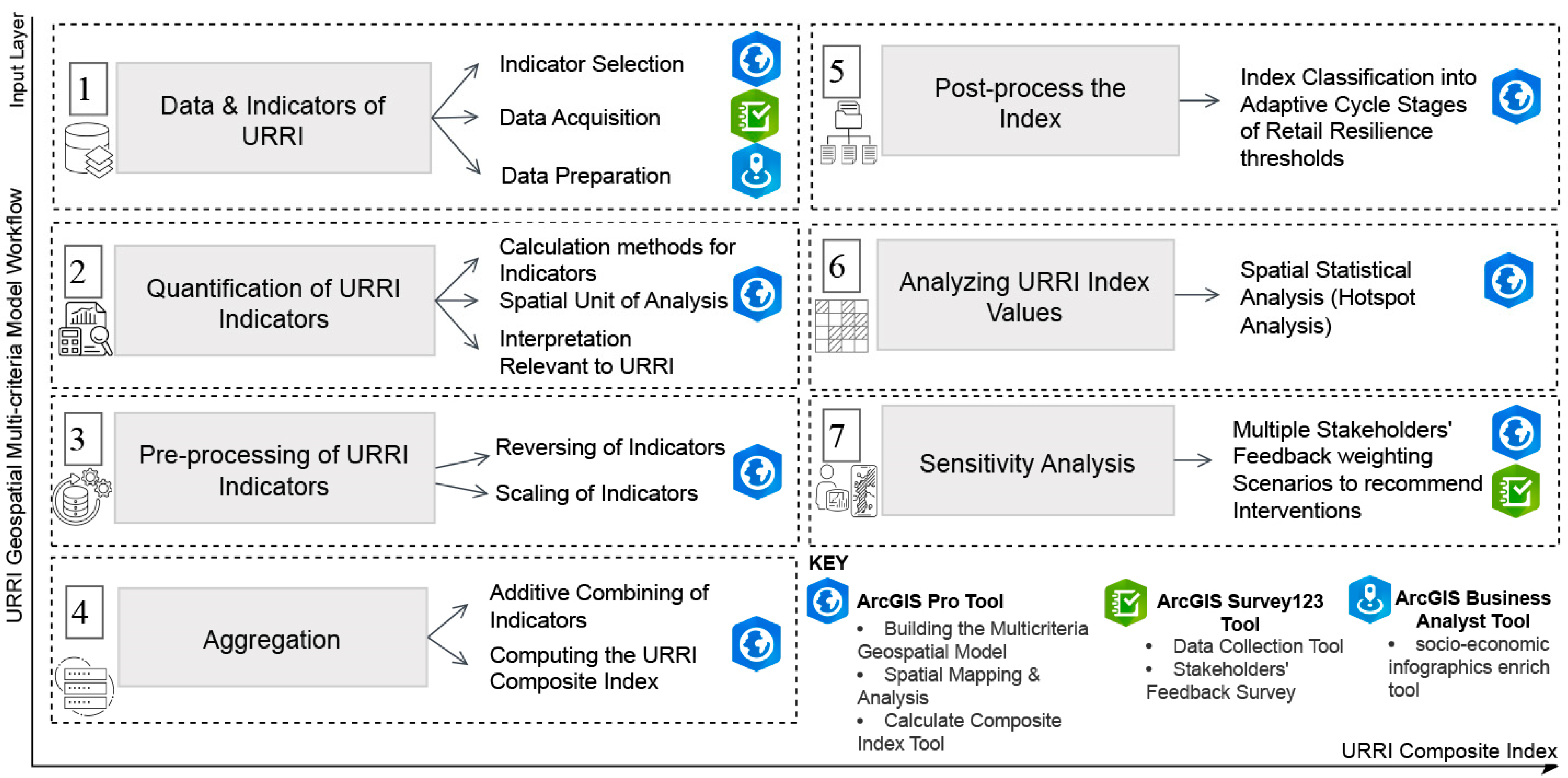
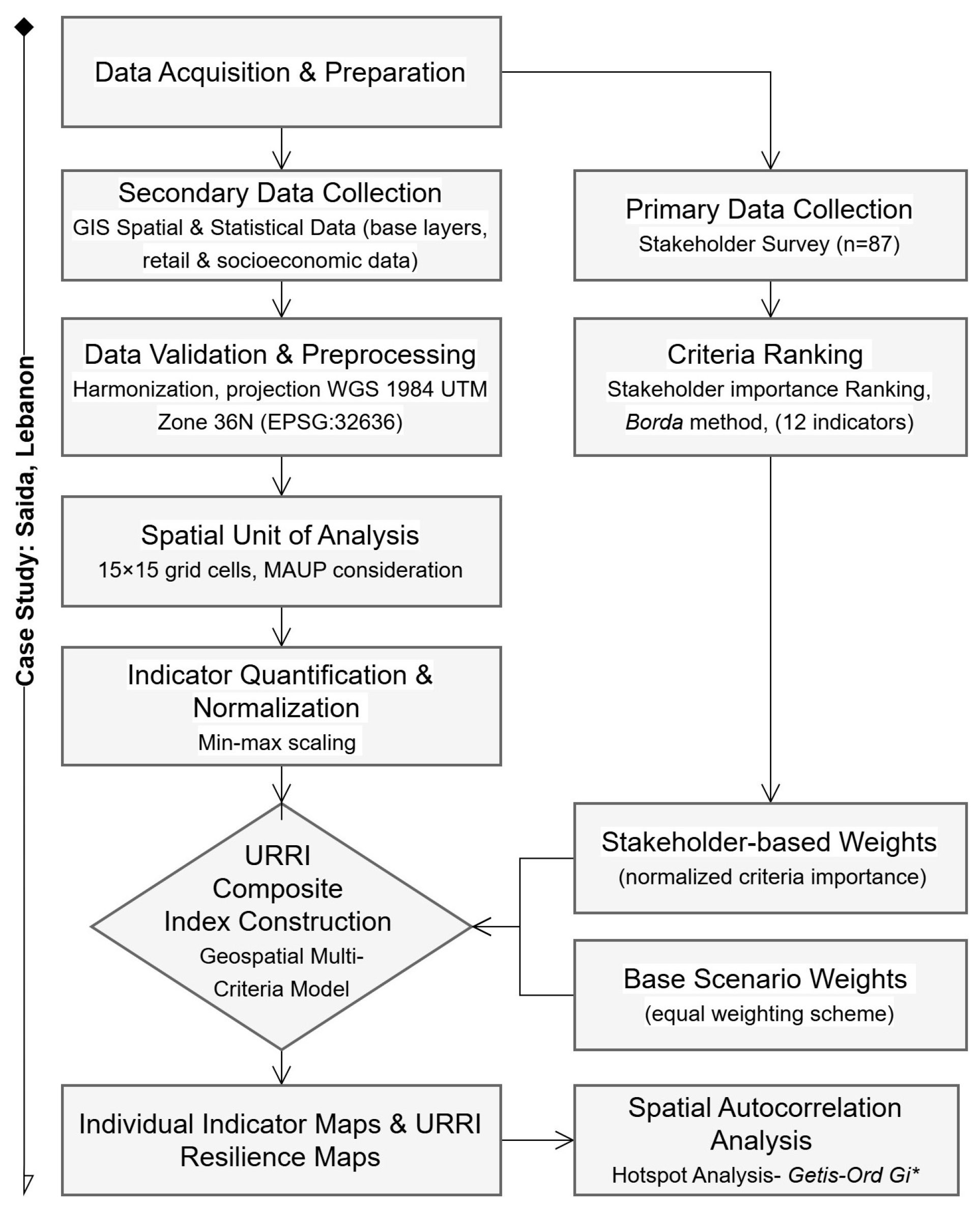
2.1. Methodology
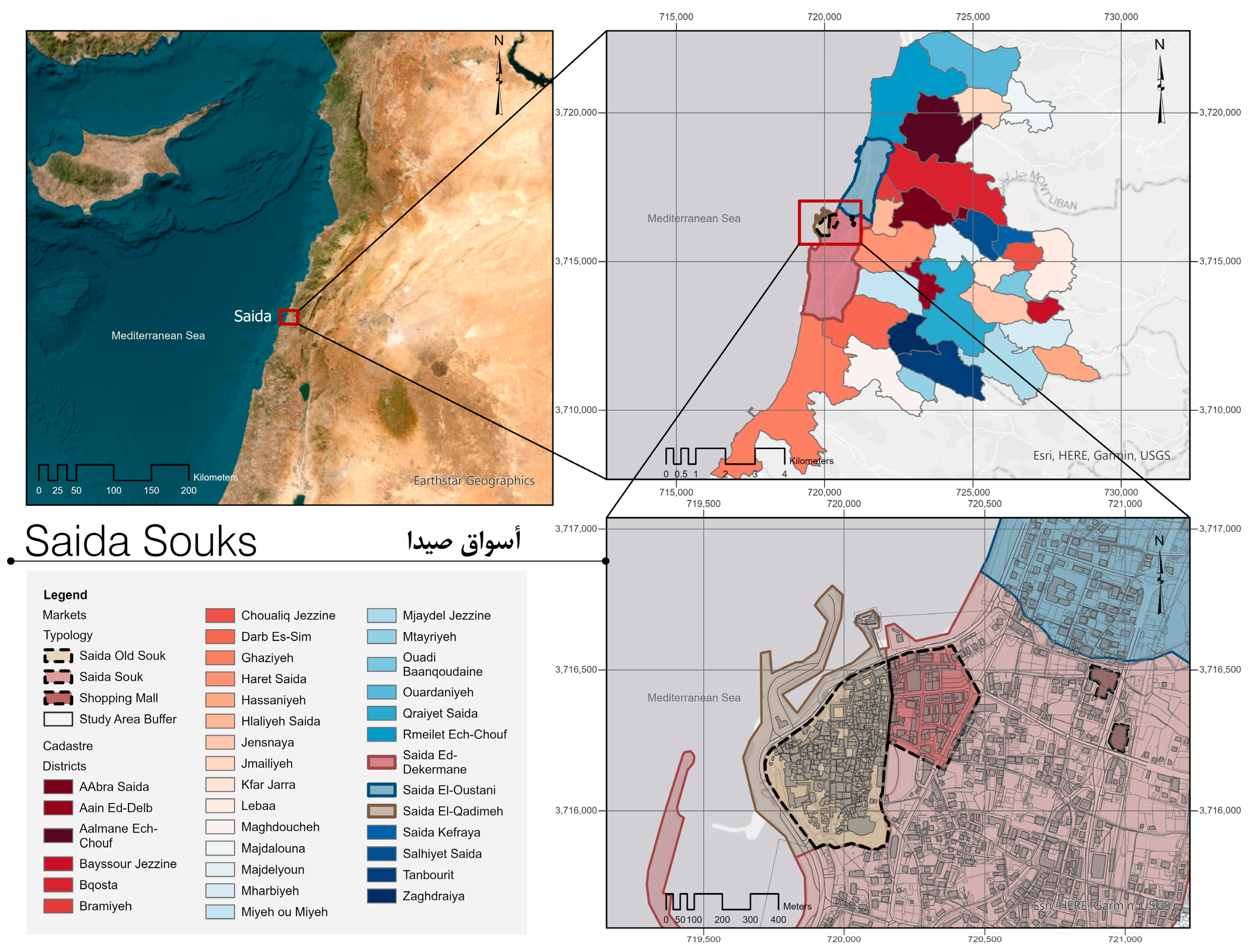
2.2. Introducing the Case Study: Saida Urban Retail Environment
2.3. Data Acquisition and Preparation
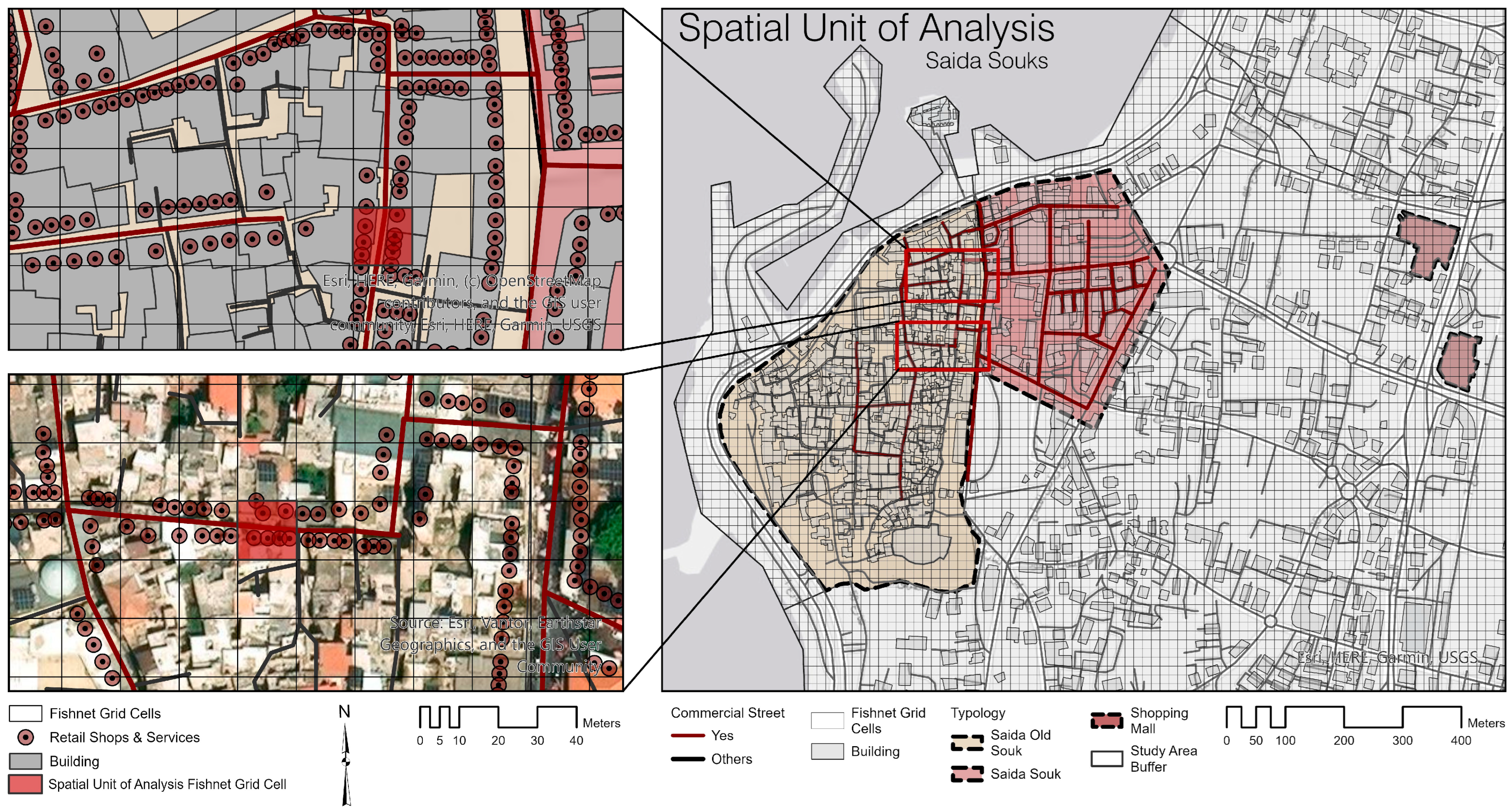
2.4. Spatial Unit of Analysis
2.5. Identification of Assessment Criteria and Selection of Indicators
3. Quantification of URRI Indicators
3.1. Diversity Indicators
3.2. Proximity Indicators
3.3. Socioeconomic Indicators
3.3.1. Dependency Ratio (DR)
3.3.2. Educational Attainment (EA)
3.3.3. Unemployment Rate (UR)
3.3.4. Retail Vacancy Rate (VR)
3.3.5. Commercial Density (CD)
4. Calculating the Composite URRI
4.1. Normalization of Indicators
4.2. Weighting of Indicators
4.3. URRI Computation
4.4. Sensitivity Analysis
- Base Scenario (equal weights): This scenario assigns equal weight to all indicators to prevent bias from influencing the URRI results. This baseline structure aligns with [41] recommendations for establishing a neutral benchmark in composite index construction.
5. Analyzing the Values of the URRI
5.1. URRI Classification into the Adaptive Cycle Stages of Retail Resilience
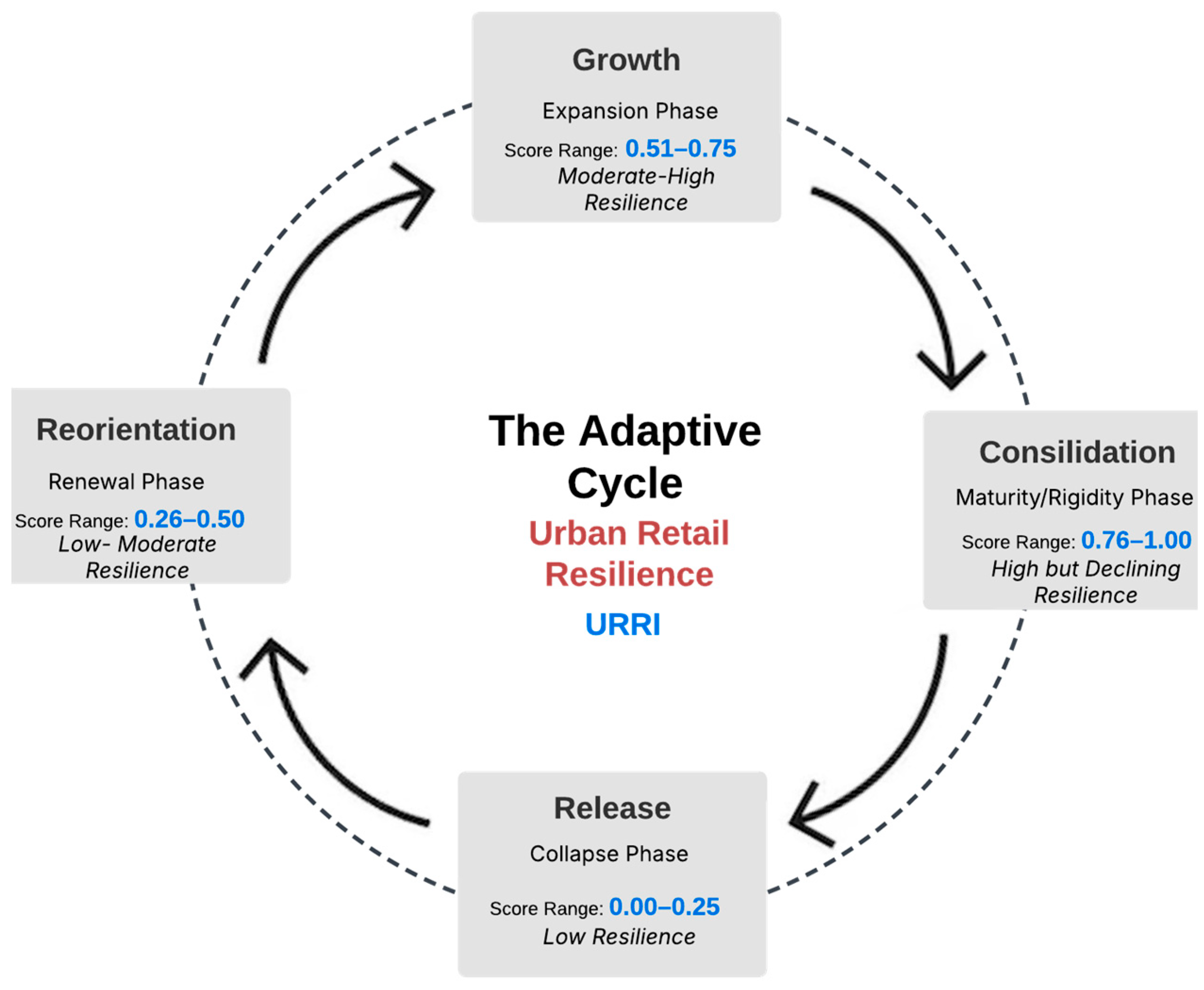
- Release Phase (Collapse): Low URRI (0.00–0.25).
- Reorientation Phase (Renewal): Low–Moderate URRI (0.26–0.50)
- Growth Phase (Expansion): Moderate–High URRI (0.51–0.75)
- Consolidation Phase (Conservation and Maturity): High but declining URRI (0.76–1.00)
5.2. Hotspot Analysis
6. Results and Discussion
6.1. Indicator Descriptive Results Statistics
6.1.1. Diversity Indicators Results
6.1.2. Proximity Indicators Results
6.1.3. Socioeconomic Indicator Results
6.2. URRI Composite Index Computation Results
6.2.1. URRI Base Scenario Results
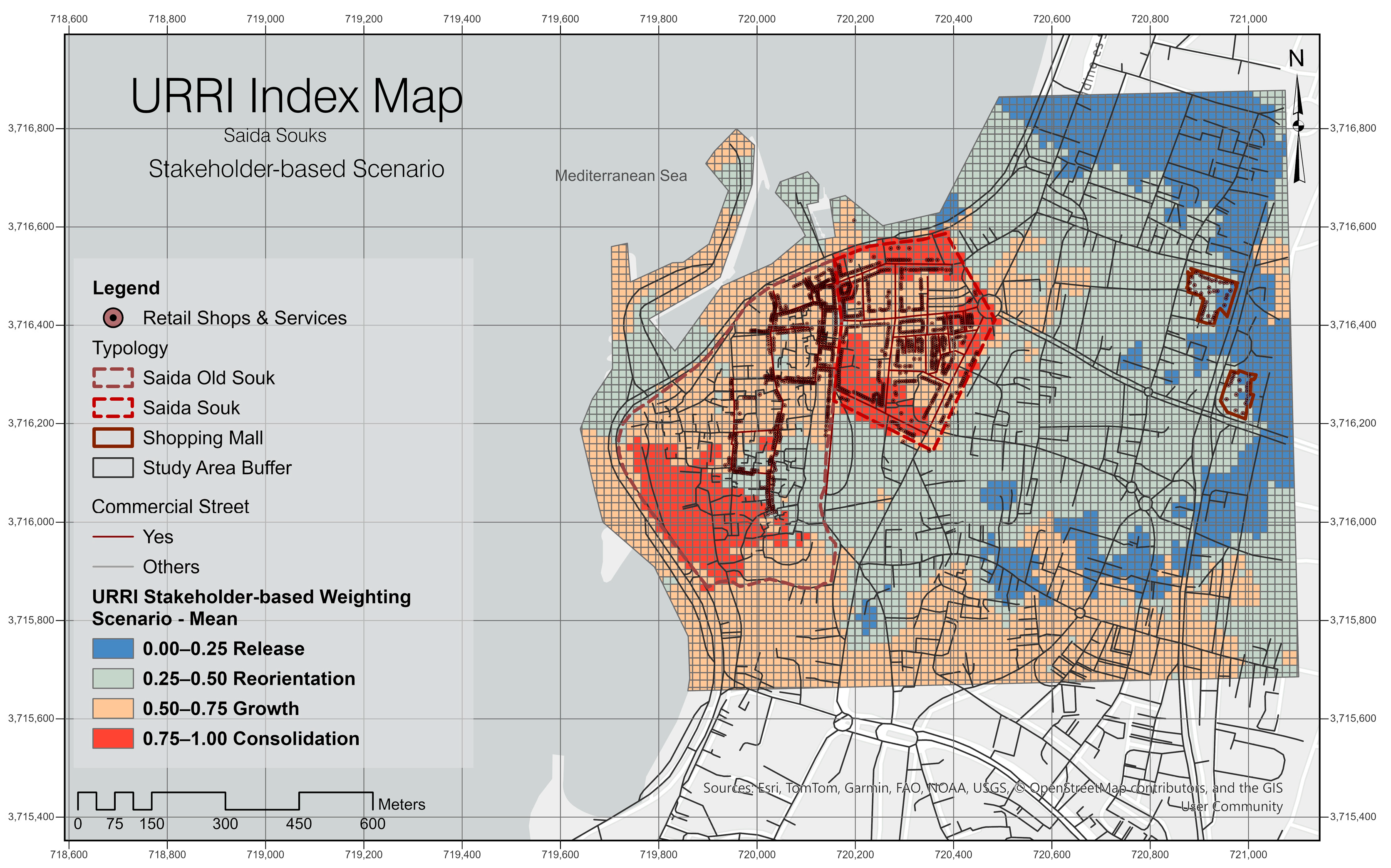
6.2.2. URRI Stakeholder-Based Scenario Results
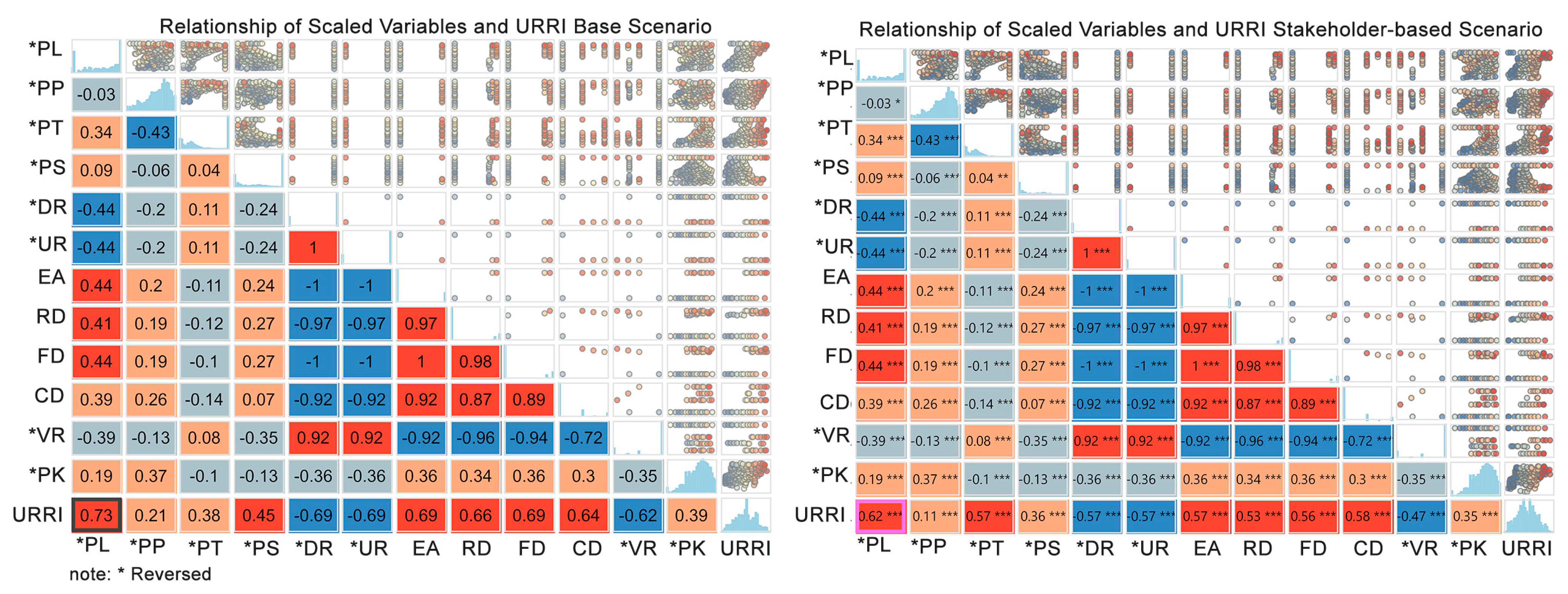
- PL: Proximity to Landmarks (r = 0.73);
- RD: Retail and Services Diversity (r = 0.66);
- FD: Functional Diversity (r = 0.66);
- CD: Commercial Density (r = 0.64);
- EA: Educational Attainment (r = 0.69);
- PS: Proximity to shopping malls (r = 0.45).
- PL: Proximity to Landmarks (r = 0.62);
- RD: Retail and Services Diversity (r = 0.53);
- FD: Functional Diversity (r = 0.56);
- CD: Commercial Density (r = 0.58);
- EA: Educational Attainment (r = 0.57);
- PT: Proximity to Public Transit (r = 0.57).
6.3. Hotspot Analysis Interpretation and Implications for Targeted Interventions
7. Conclusions
Author Contributions
Funding
Institutional Review Board Statement
Informed Consent Statement
Data Availability Statement
Acknowledgments
Conflicts of Interest
References
- Cachinho, H. Consumerscapes and the Resilience Assessment of Urban Retail Systems. Cities 2014, 36, 131–144. [Google Scholar] [CrossRef]
- Barata-Salgueiro, T. Shops with a History and Public Policy. Int. Rev. Retail Distrib. Consum. Res. 2021, 31, 393–410. [Google Scholar] [CrossRef]
- Wrigley, N.; Lambiri, D.; Astbury, G.; Dolega, L.; Hart, C.; Reeves, C.; Thurstain-Goodwin, M.; Wood, S. British High Streets: From Crisis to Recovery? A Comprehensive Review of the Evidence; University of Southampton: Southampton, UK, 2015. [Google Scholar]
- Wrigley, N.; Brookes, E. Evolving High Streets: Resilience and Reinvention—Perspectives from Social Science; Economic & Social Research Council: Wiltshire, UK, 2014. [Google Scholar]
- Barata-Salgueiro, T.; Cachinho, H. Urban Retail Systems: Vulnerability, Resilience and Sustainability. Introduction to the Special Issue. Sustainability 2021, 13, 13639. [Google Scholar] [CrossRef]
- Barata-Salgueiro, T.; Guimarães, P. Public Policy for Sustainability and Retail Resilience in Lisbon City Center. Sustainability 2020, 12, 9433. [Google Scholar] [CrossRef]
- Popławska, J.Z. The Resilience of Urban Retail System in the Face of the COVID-19 Pandemic. The Case Study of Poland. Sustainability 2021, 13, 13737. [Google Scholar] [CrossRef]
- Walker, B.; Holling, C.S.; Carpenter, S.; Kinzig, A. Resilience, Adaptability and Transformability in Social-Ecological Systems. Ecol. Soc. 2003, 9, 5. [Google Scholar] [CrossRef]
- Dolega, L.; Celińska-Janowicz, D. Retail Resilience: A Theoretical Framework for Understanding Town Centre Dynamics. Stud. Reg. Lokal. 2015, 60(2), 8–31. [Google Scholar] [CrossRef]
- Rao, F. Resilient Forms of Shopping Centers Amid the Rise of Online Retailing: Towards the Urban Experience. Sustainability 2019, 11, 3999. [Google Scholar] [CrossRef]
- Zhang, J.; Song, J.; Zeng, J. Toward Resilience: Assessing Retail Location’s Complex Impact Mechanism Using PLS-SEM Aided by Machine Learning. Sustainability 2025, 17, 7461. [Google Scholar] [CrossRef]
- Schade, K.; Hübscher, M.; Lage, F.Z.; Schulze, J.; Ringel, J. Integrating Retail into an Urban Data Platform from a Stakeholder Perspective: Network Approaches in Leipzig (Germany). Sustainability 2022, 14, 5900. [Google Scholar] [CrossRef]
- Uribe, D.; Geneletti, D.; Castillo, R.F.D.; Orsi, F. Integrating Stakeholder Preferences and GIS-Based Multicriteria Analysis to Identify Forest Landscape Restoration Priorities. Sustainability 2014, 6, 935–951. [Google Scholar] [CrossRef]
- Ozuduru, B.H.; Guldmann, J.-M. Retail Location and Urban Resilience: Towards a New Framework for Retail Policy. Surv. Perspect. Integr. Environ. Soc. 2013, 6, 2–10. [Google Scholar]
- Barata-Salgueiro, T.; Erkip, F. Retail Planning and Urban Resilience—An Introduction to the Special Issue. Cities 2014, 36, 107–111. [Google Scholar] [CrossRef]
- Erkip, F.; Kızılgün, Ö.; Akinci, G.M. Retailers’ Resilience Strategies and Their Impacts on Urban Spaces in Turkey. Cities 2014, 36, 112–120. [Google Scholar] [CrossRef]
- Appel, A.; Hardaker, S. Strategies in Times of Pandemic Crisis—Retailers and Regional Resilience in Würzburg, Germany. Sustainability 2021, 13, 2643. [Google Scholar] [CrossRef]
- Hardaker, S.; Appel, A.; Rauch, S. Reconsidering Retailers’ Resilience and the City: A Mixed Method Case Study. Cities 2022, 128, 103796. [Google Scholar] [CrossRef]
- Sommella, R.; D’Alessandro, L. Retail Policies and Urban Change in Naples City Center: Challenges to Resilience and Sustainability from a Mediterranean City. Sustainability 2021, 13, 7620. [Google Scholar] [CrossRef]
- Nanda, A.; Xu, Y.; Zhang, F. How Would the COVID-19 Pandemic Reshape Retail Real Estate and High Streets through Acceleration of E-Commerce and Digitalization? J. Urban Manag. 2021, 10, 110–124. [Google Scholar] [CrossRef]
- McEachern, M.G.; Warnaby, G.; Moraes, C. The Role of Community-Led Food Retailers in Enabling Urban Resilience. Sustainability 2021, 13, 7563. [Google Scholar] [CrossRef]
- Ribeiro, P.J.G.; Gonçalves, L.A. Urban Resilience: A Conceptual Framework. Sustain. Cities Soc. 2019, 50, 101625. [Google Scholar] [CrossRef]
- Holling, C.S. Resilience and Stability of Ecological Systems. Annu. Rev. Ecol. Evol. Syst. 1973, 4, 17–19. [Google Scholar] [CrossRef]
- Sparks, L. Towns, High Streets and Resilience in Scotland: A Question for Policy? Sustainability 2021, 13, 5631. [Google Scholar] [CrossRef]
- Jacobs, J. The Death and Life of Great American Cities; Random House, New York: New York, NY, USA, 1961; Volume V241. [Google Scholar]
- Carmona, M. The Existential Crisis of Traditional Shopping Streets: The Sun Model and the Place Attraction Paradigm. J. Urban Des. 2022, 27, 1–35. [Google Scholar] [CrossRef]
- Adebayo, A.; Greenhalgh, P.; Muldoon-Smith, K. Investigating Retail Space Performance through Spatial Configuration of Consumer Movement: A Comparison of York and Leeds. In Proceedings of the 12th Space Syntax Symposium, Beijing, China, 8–13 July 2019. [Google Scholar]
- Wrigley, N.; Dolega, L. Resilience, Fragility, and Adaptation: New Evidence on the Performance of UK High Streets during Global Economic Crisis and Its Policy Implications. Env. Plan A 2011, 43, 2337–2363. [Google Scholar] [CrossRef]
- Parizi, S.M.; Taleai, M.; Sharifi, A. A GIS-Based Multi-Criteria Analysis Framework to Evaluate Urban Physical Resilience against Earthquakes. Sustainability 2022, 14, 5034. [Google Scholar] [CrossRef]
- Pareto, A. Methods for Constructing Composite Indices: One for All or All for One? Riv. Ital. Econ. Demogr. Stat. 2013, 67, 67–80. [Google Scholar]
- Suárez, M.; Benayas, J.; Justel, A.; Sisto, R.; Montes, C.; Sanz-Casado, E. A Holistic Index-Based Framework to Assess Urban Resilience: Application to the Madrid Region, Spain. Ecol. Indic. 2024, 166, 112293. [Google Scholar] [CrossRef]
- Massarelli, C.; Binetti, M.S. Improving Urban Resilience Through a Scalable Multi-Criteria Planning Approach. Urban Sci. 2025, 9, 309. [Google Scholar] [CrossRef]
- Haghighi Fard, S.M.; Doratli, N. Evaluation of Resilience in Historic Urban Areas by Combining Multi-Criteria Decision-Making System and GIS, with Sustainability and Regeneration Approach: The Case Study of Tehran (IRAN). Sustainability 2022, 14, 2495. [Google Scholar] [CrossRef]
- Greene, R.; Devillers, R.; Luther, J.; Eddy, B. GIS-Based Multiple-Criteria Decision Analysis. Geogr. Compass 2011, 5, 412–432. [Google Scholar] [CrossRef]
- Malczewski, J.; Rinner, C. Multicriteria Decision Analysis in Geographic Information Science; Springer: New York, NY, USA, 2015. [Google Scholar]
- Tudor, C. A Geospatial Framework for Retail Suitability Modelling and Opportunity Identification in Germany. ISPRS Int. J. Geo-Inf. 2025, 14, 342. [Google Scholar] [CrossRef]
- Shi, Y.; Wang, Y.; Ren, Y.; Zhou, C.; Hu, X. Scale Distribution of Retail Formats in the Central Districts of Chinese Cities: A Study Analysis of Ten Cities. ISPRS Int. J. Geo-Inf. 2024, 13, 136. [Google Scholar] [CrossRef]
- World Bank. Lebanon Economic Monitor: Lebanon Sinking (To the Top 3). In Global Practice for Macroeconomics, Trade & Investment Middle East and North Africa Region; World Bank: Washington, DC, USA, 2021. [Google Scholar]
- UN-Habitat. Unicef Old Saida Neighborhood Profile, Saida South Lebanon; UN-Habitat: Nairobi, Kenya, 2019. [Google Scholar]
- Santos, B. The City of Saida Begins Its Resilience-Building Process with UN-Habitat, MedCities, and Barcelona City Council. Available online: https://urbanresiliencehub.org/the-city-of-saida-begins-its-resilience-building-process-with-un-habitat-medcities-and-barcelona-city-council/ (accessed on 12 October 2025).
- OECD; European Union; Joint Research Centre—European Commission. Handbook on Constructing Composite Indicators: Methodology and User Guide; OECD: Paris, France, 2008. [Google Scholar]
- ESRI. Creating Composite Indices Using ArcGIS: Best Practices; ESRI: Redlands, CA, USA, 2024. [Google Scholar]
- Ibrahim, S.M.; Ayad, H.M.; Turki, E.A.; Saadallah, D.M. Measuring Transit-Oriented Development (TOD) Levels: Prioritize Potential Areas for TOD in Alexandria, Egypt Using GIS-Spatial Multi-Criteria Based Model. Alex. Eng. J. 2023, 67, 241–255. [Google Scholar] [CrossRef]
- Greco, S.; Ishizaka, A.; Tasiou, M.; Torrisi, G. On the Methodological Framework of Composite Indices: A Review of the Issues of Weighting, Aggregation, and Robustness. Soc. Indic. Res. 2019, 141, 61–94. [Google Scholar] [CrossRef]
- Nickdoost, N.; Shooshtari, M.J.; Choi, J.; Smith, D.; AbdelRazig, Y. A Composite Index Framework for Quantitative Resilience Assessment of Road Infrastructure Systems. Transp. Res. Part D Transp. Environ. 2024, 131, 104180. [Google Scholar] [CrossRef]
- ESRI. Closest Facility Analysis Layer—ArcGIS Pro|Documentation. Available online: https://pro.arcgis.com/en/pro-app/3.4/help/analysis/networks/closest-facility-analysis-layer.htm (accessed on 24 November 2025).
- Catherine, M. Explore the New Calculate Composite Index Tool in ArcGIS Pro 3.1; ArcGIS Blog; ESRI: Redlands, CA, USA, 2025. [Google Scholar]
- Fox, N.B.; Bruyns, B. An Evaluation of Borda Count Variations Using Ranked Choice Voting Data. arXiv 2025, arXiv:2501.00618. [Google Scholar] [CrossRef]
- Sung, H.; Lee, S.; Cheon, S. Operationalizing Jane Jacobs’s Urban Design Theory: Empirical Verification from the Great City of Seoul, Korea. J. Plan. Educ. Res. 2015, 35, 117–130. [Google Scholar] [CrossRef]
- Dolega, L.; Pavlis, M.; Singleton, A. Estimating Attractiveness, Hierarchy and Catchment Area Extents for a National Set of Retail Centre Agglomerations. J. Retail. Consum. Serv. 2016, 28, 78–90. [Google Scholar] [CrossRef]
- Dolega, L.; Reynolds, J.; Singleton, A.; Pavlis, M. Beyond Retail: New Ways of Classifying UK Shopping and Consumption Spaces. Environ. Plan. B: Urban Anal. City Sci. 2021, 48, 132–150. [Google Scholar] [CrossRef]
- Bhandari, S.; Zhang, C. Urban Green Space Prioritization to Mitigate Air Pollution and the Urban Heat Island Effect in Kathmandu Metropolitan City, Nepal. Land 2022, 11, 2074. [Google Scholar] [CrossRef]
- Orr, A.M.; Stewart, J.L. Property Use Diversity and Spatial Accessibility within Urban Retailing Centers: Drivers of Retail Rents. J. Prop. Res. 2022, 39, 365–392. [Google Scholar] [CrossRef]
- Mitchell, A.; Griffin, L.S. The Esri Guide to GIS Analysis, Volume 2: Spatial Measurements and Statistics, 2nd ed.; ESRI: Redlands, CA, USA, 2021; Volume 2. [Google Scholar]
- Xu, Y.; Wang, L.; Fu, C.; Kosmyna, T. A Fishnet-Constrained Land Use Mix Index Derived from Remotely Sensed Data. Ann. GIS 2017, 23, 303–313. [Google Scholar] [CrossRef]
- Feng, X.; Xiu, C.; Bai, L.; Zhong, Y.; Wei, Y. Comprehensive Evaluation of Urban Resilience Based on the Perspective of Landscape Pattern: A Case Study of Shenyang City. Cities 2020, 104, 102722. [Google Scholar] [CrossRef]
- GIS Geography. Fishnets in GIS: An Overview; GIS Geography: 2025. Available online: https://gisgeography.com/fishnets/Proofreading-urbansci-10-00120Proofreading-urbansci-10-00120-Nour (accessed on 1 August 2025).
- Orr, A.M.; Stewart, J.L.; Jackson, C.; White, J.T. Not Quite the ‘Death of the High Street’ in UK City Centres: Rising Vacancy Rates and the Shift in Property Use Richness and Diversity. Cities 2023, 133, 104124. [Google Scholar] [CrossRef]
- Rao, F.; Dovey, K.; Pafka, E. Towards a Genealogy of Urban Shopping: Types, Adaptations and Resilience. J. Urban Des. 2018, 23, 544–557. [Google Scholar] [CrossRef]
- Rao, F.; Han, S.S.; Pan, R. Planning for Resilient Central-City Shopping Districts in the Post-Covid Era: An Explanatory Case Study of the Hoddle Grid in Melbourne. Camb. J. Reg. Econ. Soc. 2022, 15, 575–596. [Google Scholar] [CrossRef]
- Rao, F.; Summers, R.J. Planning for Retail Resilience: Comparing Edmonton and Portland. Cities 2016, 58, 97–106. [Google Scholar] [CrossRef]
- Suárez, M.; Gómez-Baggethun, E.; Benayas, J.; Tilbury, D. Towards an Urban Resilience Index: A Case Study in 50 Spanish Cities. Sustainability 2016, 8, 774. [Google Scholar] [CrossRef]
- Hangebruch, N.; Othengrafen, F. Resilient Inner Cities: Conditions and Examples for the Transformation of Former Department Stores in Germany. Sustainability 2022, 14, 8303. [Google Scholar] [CrossRef]
- Guy, C.M. Classifications of Retail Stores and Shopping Centers: Some Methodological Issues. GeoJournal 1998, 45, 255–264. [Google Scholar] [CrossRef]
- Colaço, R.; De Abreu E Silva, J. Commercial Classification and Location Modelling: Integrating Different Perspectives on Commercial Location and Structure. Land 2021, 10, 567. [Google Scholar] [CrossRef]
- Comer, D.; Greene, J.S. The Development and Application of a Land Use Diversity Index for Oklahoma City, OK. Appl. Geogr. 2015, 60, 46–57. [Google Scholar] [CrossRef]
- Alawneh, S.M.; Rashid, M. Revisiting Urban Resilience: A Review on Resilience of Spatial Structure in Urban Refugee Neighborhoods Facing Demographic Changes. Front. Sustain. Cities 2022, 4, 806531. [Google Scholar] [CrossRef]
- Barcelona Field Studies Center S.L Simpson’s Diversity Index. Available online: https://geographyfieldwork.com/Simpson’sDiversityIndex.htm (accessed on 10 July 2025).
- Araldi, A.; Fusco, G. Retail Fabric Assessment: Describing Retail Patterns within Urban Space. Cities 2019, 85, 51–62. [Google Scholar] [CrossRef]
- Lai, Y. Quantifying Place: Analyzing the Drivers of Pedestrian Activity in Dense Urban Environments. Landsc. Urban Plan. 2018, 180, 166–178. [Google Scholar] [CrossRef]
- Wu, W.; Ma, Z.; Guo, J.; Niu, X.; Zhao, K. Evaluating the Effects of Built Environment on Street Vitality at the City Level: An Empirical Research Based on Spatial Panel Durbin Model. IJERPH 2022, 19, 1664. [Google Scholar] [CrossRef]
- Du, R.; Liu, K.; Zhao, D.; Fang, Q. Urban Amenity and Urban Economic Resilience: Evidence from China. Front. Public Health 2024, 12, 1392908. [Google Scholar] [CrossRef]
- Merten, L.; Kuhnimhof, T. Impacts of Parking and Accessibility on Retail-Oriented City Centres. J. Transp. Geogr. 2023, 113, 103733. [Google Scholar] [CrossRef]
- Mingardo, G.; Wee, B.; Rye, T. Urban Parking Policy in Europe: A Conceptualization of Past and Possible Future Trends. Transp. Res. Part A Policy Pract. 2015, 74, 268–281. [Google Scholar] [CrossRef]
- Manville, M.; Shoup, D. People, Parking and Cities. J. Urban Plan. Dev. 2005, 131, 233–245. [Google Scholar] [CrossRef]
- Guzman, L.A.; Arellana, J.; Castro, W.F. Desirable Streets for Pedestrians: Using a Street-Level Index to Assess Walkability. Transp. Res. Part D Transp. Environ. 2022, 111, 103462. [Google Scholar] [CrossRef]
- Cardoso, M.; Santos, T.; Tessarolo, L.G.A.; Aprigliano, V.; Rodrigues da Silva, A.N.; da Silva, M.A.V. Exploring the Resilience of Public Transport Trips in the Face of Urban Violence from a Gender Perspective. Sustainability 2023, 15, 16960. [Google Scholar] [CrossRef]
- Arora, A.; Oakil, T.; Alhosain, N. Resilient Urban Transport Systems: The Role of Transit-Oriented Development in the GCC Cities. In Climate-Resilient Cities: Priorities for the Gulf Cooperation Council Countries; Arora, A., Belaïd, F., Lechtenberg-Kasten, S., Eds.; Springer Nature: Cham, Switzerland, 2025; pp. 63–88. [Google Scholar]
- Chen, X.; Pei, T.; Song, C.; Shu, H.; Guo, S.; Wang, X.; Liu, Y.; Chen, J.; Zhou, C. Accessing Public Transportation Service Coverage by Walking Accessibility to Public Transportation under Flow Buffering. Cities 2022, 125, 103646. [Google Scholar] [CrossRef]
- Malec, T. Can Shopping Malls Improve Resilience of City Centers? Relations Between Shopping Malls and Urban Space. In Proceedings of the UIA 2014 Congress, UIA, Durban, South Africa, 3–7 August 2014. [Google Scholar]
- Ozuduru, B.H.; Varol, C.; Ercoskun, O.Y. Do Shopping Centers Abate the Resilience of Shopping Streets? The Co-Existence of Both Shopping Venues in Ankara, Turkey. Cities 2014, 36, 145–157. [Google Scholar] [CrossRef]
- AlAwwad, R.; Mahmoud, N.; Mansour, H.; Elsamaty, H. From Heritage to Commerce: Utilizing Space Syntax to Optimize Visibility for Retail Interior Design in Al-Turaif’s Touristic Landscape. Int. J. Sci. Res. 2025, 4, 179–202. [Google Scholar] [CrossRef]
- Griñán Montealegre, M.; López Sánchez, M. Urban Commerce and Protected Cultural Landscape. Heritage 2019, 2, 72–85. [Google Scholar] [CrossRef]
- Jayantha, W.M.; Yung, E.H.K. Effect of Revitalisation of Historic Buildings on Retail Shop Values in Urban Renewal: An Empirical Analysis. Sustainability 2018, 10, 1418. [Google Scholar] [CrossRef]
- ESRI. Methodology Statement: 2024/2029 Esri Dependency Ratios; ESRI: Redlands, CA, USA, 2024. [Google Scholar]
- Si, Y.; Liang, L.; Zhou, W. An Evaluation of Urban Resilience Using Structural Equation Modeling from Practitioners’ Perspective: An Empirical Investigation in Huangshi City, China. Sustainability 2024, 16, 7031. [Google Scholar] [CrossRef]
- Hayes, A. What Is the Dependency Ratio, and How Do You Calculate It? Available online: https://www.investopedia.com/terms/d/dependencyratio.asp (accessed on 18 September 2025).
- König, L.S. Optimising Retail Environments for Older Adults: Insights into Customer Behavior and Organizational Performance. Adm. Sci. 2025, 15, 120. [Google Scholar] [CrossRef]
- Meng, Q.; Yu, W. The Impact of Population Aging on Economic Growth. Adv. Econ. Manag. Political Sci. 2024, 140, 109–116. [Google Scholar] [CrossRef]
- ISO. Sustainable Cities and Communities—Indicators for City Services and Quality of Life; ISO: Geneva, Switzerland, 2018. [Google Scholar]
- Figueiredo, L.; Honiden, T.; Schumann, A. Indicators for Resilient Cities; OECD Regional Development Working Papers; OECD: Paris, France, 2018; Volume 2018/02. [Google Scholar]
- Kim, K.; Kang, J.-Y.; Hwang, C. Identifying Indicators Contributing to the Social Vulnerability Index via a Scoping Review. Land 2025, 14, 263. [Google Scholar] [CrossRef]
- Waly, N.M.; Ayad, H.M.; Saadallah, D.M. Assessment of Spatiotemporal Patterns of Social Vulnerability: A Tool to Resilient Urban Development Alexandria, Egypt. Ain Shams Eng. J. 2021, 12, 1059–1072. [Google Scholar] [CrossRef]
- Mamatalieva, L. An Analysis of Unemployment. Available online: https://storymaps.arcgis.com/stories/37886aebd43646c6a0f9846d1ac3b096 (accessed on 18 September 2025).
- ESRI Use and Interpret Civilian Labor Force Data. Available online: https://storymaps.arcgis.com/stories/5dff1a3c52d24963889b68362e207ee2 (accessed on 18 September 2025).
- Neffke, F.; Henning, M.; Boschma, R. How Do Regions Diversify over Time? Industry Relatedness and the Development of New Growth Paths in Regions. Econ. Geogr. 2011, 87, 237–265. [Google Scholar] [CrossRef]
- New York City Department of City Planning (DCP). Assessing Storefront Vacancy in NYC, 24 Neighborhood Case Studies; DCP: New York, NY, USA, 2019.
- Dehghani, A.; Alidadi, M.; Soltani, A. Density and Urban Resilience, Cross-Section Analysis in an Iranian Metropolis Context. Urban Sci. 2023, 7, 23. [Google Scholar] [CrossRef]
- Hughes, C.; Jackson, C. Death of the High Street: Identification, Prevention, Reinvention. Reg. Stud. Reg. Sci. 2015, 2, 237–256. [Google Scholar] [CrossRef]
- Wang, F.; Niu, F. Urban Commercial Spatial Structure Optimization in the Metropolitan Area of Beijing: A Microscopic Perspective. Sustainability 2019, 11, 1103. [Google Scholar] [CrossRef]
- Buie, L.; McSorley, C.; Nieto, A. Creating Indices: Combining Variables to Make Better Decisions; ESRI: Redlands, CA, USA, 2023. [Google Scholar]
- Moreira, L.L.; De Brito, M.M.; Kobiyama, M. Effects of Different Normalization, Aggregation, and Classification Methods on the Construction of Flood Vulnerability Indexes. Water 2021, 13, 98. [Google Scholar] [CrossRef]
- Singh, D.; Singh, B. Investigating the Impact of Data Normalization on Classification Performance. Appl. Soft Comput. 2020, 97, 105524. [Google Scholar] [CrossRef]
- Gan, X.; Fernandez, I.C.; Guo, J.; Wilson, M.; Zhao, Y.; Zhou, B.; Wu, J. When to Use What: Methods for Weighting and Aggregating Sustainability Indicators. Ecol. Indic. 2017, 81, 491–502. [Google Scholar] [CrossRef]
- García-Lapresta, J.L.; Martínez-Panero, M.; Meneses, L.C. Defining the Borda Count in a Linguistic Decision-Making Context. Inf. Sci. 2009, 179, 2309–2316. [Google Scholar] [CrossRef]
- Sharifi, A.; Yamagata, Y. Urban Resilience Assessment: Multiple Dimensions, Criteria, and Indicators. In Urban Resilience: A Transformative Approach; Springer International Publishing: Cham, Switzerland, 2016; pp. 259–276. [Google Scholar]
- Bennett, L.R.; Calkins, J. The Language of Spatial Analysis; ESRI: Redlands, CA, USA, 2013. [Google Scholar]
- Teller, C.; Reutterer, T. The Evolving Concept of Retail Attractiveness: What Makes Retail Agglomerations Attractive When Customers Shop at Them? J. Retail. Consum. Serv. 2008, 15, 127–143. [Google Scholar] [CrossRef]
- Brown, S. Institutional Change in Retailing: A Geographical Interpretation. Prog. Hum. Geogr. 1987, 11, 181–206. [Google Scholar] [CrossRef]
- Zhou, J.; Dahana, W.D.; Ye, Q.; Zhang, Q.; Ye, M.; Li, X. Hedonic Service Consumption and Its Dynamic Effects on Sales in the Brick-and-Mortar Retail Context. J. Retail. Consum. Serv. 2023, 70, 103178. [Google Scholar] [CrossRef]
- Zhang, F.; Sun, X.; Liu, C.; Qiu, B. Effects of Urban Landmark Landscapes on Residents’ Place Identity: The Moderating Role of Residence Duration. Sustainability 2024, 16, 761. [Google Scholar] [CrossRef]
- Xie, Q.; Hu, L.; Wu, J.; Shan, Q.; Li, W.; Shen, K. Investigating the Influencing Factors of the Perception Experience of Historical Commercial Streets: A Case Study of Guangzhou’s Beijing Road Pedestrian Street. Buildings 2024, 14, 138. [Google Scholar] [CrossRef]
- Al-Harithy, H.; Guadagnoli, G. Saida Urban Sustainable Development Strategy; Cultural and Natural Heritage; Medcities: Saida, Lebanon, 2014. [Google Scholar]
- LCPS. Saida City Report: Lebanese Municipalities and Syrian Refugees: Building Capacity and Promoting Agency; LCPS: Beirut, Lebanon, 2023. [Google Scholar]
- Cutler, D.; Poterba, J.; Sheiner, L.; Summers, L. An Aging Society: Opportunity or Challenge? Brook. Pap. Econ. Act. 1990, 1990, 1–73. [Google Scholar] [CrossRef]
- World Population Review Age Dependency Ratio by Country 2025. Available online: https://worldpopulationreview.com/country-rankings/age-dependency-ratio-by-country (accessed on 2 December 2025).
- United Nations. World Population Prospects 2022: Summary of Results; United Nations: New York, NY, USA, 2022. [Google Scholar]
- Lebanese Republic Central Administration of Statistics. Labour Force and Household Living Conditions Survey 2018–2019 in Saida; Lebanese Republic Central Administration of Statistics: Beirut, Lebanon, 2020.
- Council for Development and Reconstruction. Final Environmental & Social Management Plan (ESMP) For Roads Routine Maintenance in Saida Caza; Consultancy Services for Roads Routine Maintenance and Rehabilitation of Remaining Roads for Lot3 (Nabatieh, Marjayoun, West Bekaa, Rachaya, Hasbaya, Jezzine & Saida Cazas); Council for Development and Reconstruction: Beirut, Lebanon, 2022.
- International Labor Organization. ILO Programme Implementation 2022–23; Programme, Financial and Administrative Section; International Labor Organization: Geneva, Switzerland, 2024. [Google Scholar]
- Accordino, J.; Johnson, G.T. Addressing the Vacant and Abandoned Property Problem. J. Urban Aff. 2000, 22, 301. [Google Scholar] [CrossRef]
- Saraiva, M.; Marques, T.S.; Pinho, P. Urban Form and Vacant Shops: Can One Explain the Other?—A Case Study in Portugal. In Proceedings of 24th ISUF 2017—City and Territory in the Globalization Age; Universitat Politècnica València: València, Spain, 2017. [Google Scholar]
- Moreira, L.L.; Vanelli, F.M.; Schwamback, D.; Kobiyama, M.; de Brito, M.M. Sensitivity Analysis of Indicator Weights for the Construction of Flood Vulnerability Indexes: A Participatory Approach. Front. Water 2023, 5, 970469. [Google Scholar] [CrossRef]
- Rossitti, M.; Oppio, A.; Torrieri, F.; Dell’Ovo, M. Tactical Urbanism Interventions for the Urban Environment: Which Economic Impacts? Land 2023, 12, 1457. [Google Scholar] [CrossRef]
- Sádaba, J.; Alonso, Y.; Latasa, I.; Luzarraga, A. Towards Resilient and Inclusive Cities: A Framework for Sustainable Street-Level Urban Design. Urban Sci. 2024, 8, 264. [Google Scholar] [CrossRef]
- Ros-McDonnell, D.; de-la-Fuente-Aragón, M.V.; Ros-McDonnell, L.; Cardós, M. Toward Resilient Urban Design: Pedestrians as an Important Element of City Design. Urban Sci. 2024, 8, 65. [Google Scholar] [CrossRef]
- Orr, A.; Stewart, J.; Jackson, C.; White, J. Ownership Diversity and Fragmentation: A Barrier to Urban Centre Resilience. Environ. Plan. B Urban Anal. City Sci. 2022, 50, 660–677. [Google Scholar] [CrossRef]
- Pratas, J.; Melo, A. Innovative Ideas for Smart City Management Using AIoTt-Driven Solutions. In Artificial Intelligence of Things (AIoT) for Retail and Services Management; IGI Global Scientific Publishing: Hershey, PA, USA, 2025; pp. 253–286. [Google Scholar]
- Pratas, J.; Gonçalves, P.; Kaswengi, J. Retail Evolution Using Artificial Intelligence of Things (AIoT): An Exploratory Analysis and Innovative Ideas Using Literature Review and Creativity Techniques. In Artificial Intelligence of Things (AIoT) for Retail and Services Management; IGI Global Scientific Publishing: Hershey, PA, USA, 2025; pp. 41–76. [Google Scholar]



| Data Features | Format | Data Source/Acquisition Tool |
|---|---|---|
| Map of Building Footprints and their attributes | GIS Spatial and Statistical Data | UN-Habitat and UNICEF Lebanon Geoportal + Municipal GIS databases |
| Map of Retail Shops and Services Data with their attributes | GIS Spatial and Statistical data | ArcGIS Survey123 Field Survey + UN-Habitat, and UNICEF Lebanon Geoportal + Municipal Data |
| Land Use Data | GIS Spatial and Statistical Data | UN-Habitat, and UNICEF Lebanon Geoportal + Reports (LCPS 3, USUDS 4) |
| Socioeconomic Data | GIS Statistical Data | ArcGIS Business Analyst, Lebanon ESRI 1 Demographic Data + CAS 2 Reports |
| Street Network Data and its attributes | GIS Spatial and Statistical Data | ESRI Lebanon GIS Data |
| Criteria | URRI Indicators | ||
|---|---|---|---|
| Measurable Indicators | Adopted | Type of Measure | |
| Diversity | Retail and Services Diversity (Simpson Diversity Index) | ✓ | Built Environment |
| Functional Diversity (Simpson Diversity Index) | ✓ | ||
| Design | Quality of Streetscape/Retail Fabric | ✗ | |
| Proximity | Proximity to Parking Spaces | ✓ | |
| Proximity to Public Transit | ✓ | ||
| Proximity to Key Amenities | ✓ | ||
| Proximity to Shopping Malls | ✓ | ||
| Proximity to Landmarks | ✓ | ||
| Socioeconomic | Dependency Ratio | ✓ | Social |
| Educational Attainment | ✓ | ||
| Unemployment Rate | ✓ | Economic | |
| Retail Vacancy Rate | ✓ | ||
| Commercial Density | ✓ | ||
| Criteria | Measurable Indicators | Rank Order | Total Points (n = 87) | Normalized Weight |
|---|---|---|---|---|
| Diversity | Retail and Services Diversity (Simpson Diversity Index) | 2 | 957 | 0.14 |
| Functional Diversity (Simpson Diversity Index) | 9 | 348 | 0.05 | |
| Proximity | Proximity to Parking Spaces | 8 | 435 | 0.06 |
| Proximity to Public Transit | 3 | 870 | 0.13 | |
| Proximity to Key Amenities | 5 | 696 | 0.10 | |
| Proximity to Shopping Malls | 7 | 522 | 0.08 | |
| Proximity to Landmarks | 10 | 261 | 0.04 | |
| Socioeconomic | Dependency Ratio | 12 | 87 | 0.01 |
| Educational Attainment | 11 | 174 | 0.03 | |
| Unemployment Rate | 6 | 609 | 0.09 | |
| Retail Vacancy Rate | 1 | 1044 | 0.15 | |
| Commercial Density | 4 | 783 | 0.12 | |
| Rank 1–12 | Total points = 6786 | Sum = 1 | ||
| Criteria | Measurable Indicators | Normalized Weight | |
|---|---|---|---|
| Stakeholder-Based Scenario | Base Scenario | ||
| Diversity | Retail and Services Diversity (Simpson Diversity Index) | 0.14 | 0.08 |
| Functional Diversity (Simpson Diversity Index) | 0.05 | 0.08 | |
| Proximity | Proximity to Parking Spaces | 0.06 | 0.08 |
| Proximity to Public Transit | 0.13 | 0.08 | |
| Proximity to Key Amenities | 0.10 | 0.08 | |
| Proximity to Shopping Malls | 0.08 | 0.08 | |
| Proximity to Landmarks | 0.04 | 0.08 | |
| Socioeconomic | Dependency Ratio | 0.01 | 0.08 |
| Educational Attainment | 0.03 | 0.08 | |
| Unemployment Rate | 0.09 | 0.08 | |
| Retail Vacancy Rate | 0.15 | 0.08 | |
| Commercial Density | 0.12 | 0.08 | |
| Criteria | Indicator | Min | Max | Mean | SD |
|---|---|---|---|---|---|
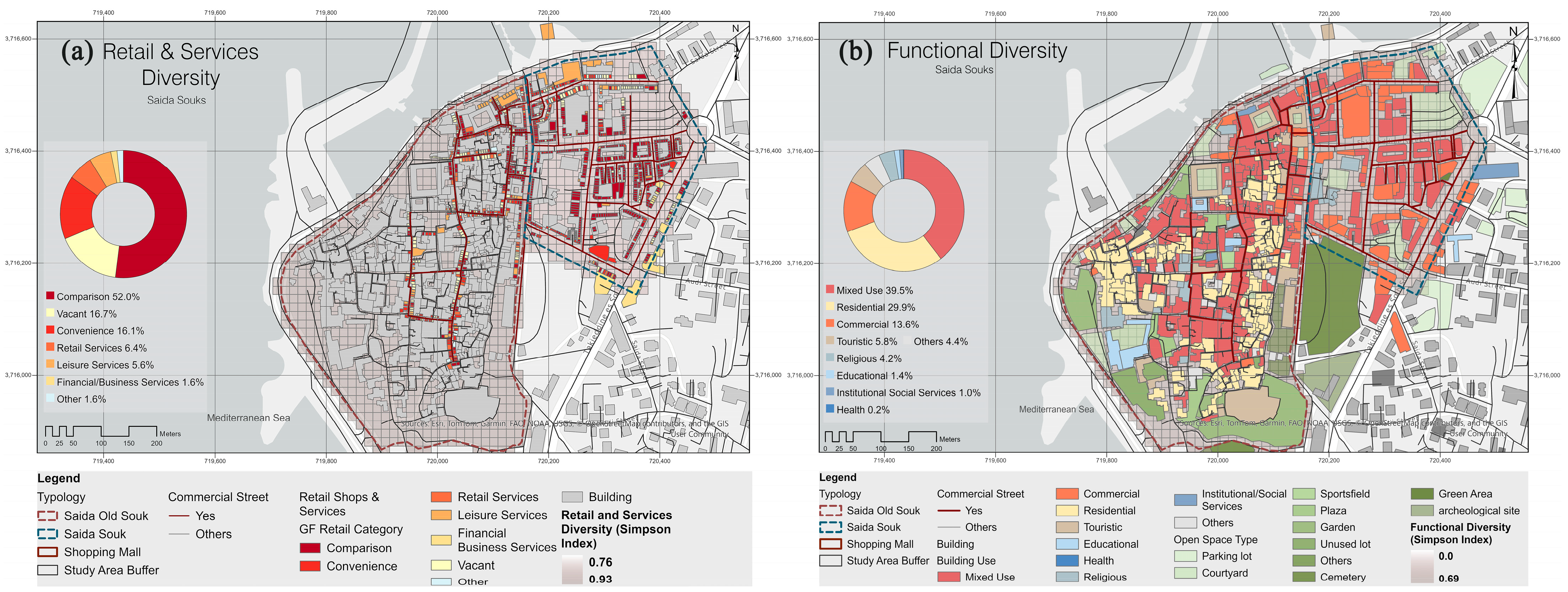
| Diversity | Retail and Services Diversity (RD) | 0 | 0.93 | 0.89 | 0.05 |
| Functional Diversity (FD) | 0 | 0.69 | 0.62 | 0.15 | |
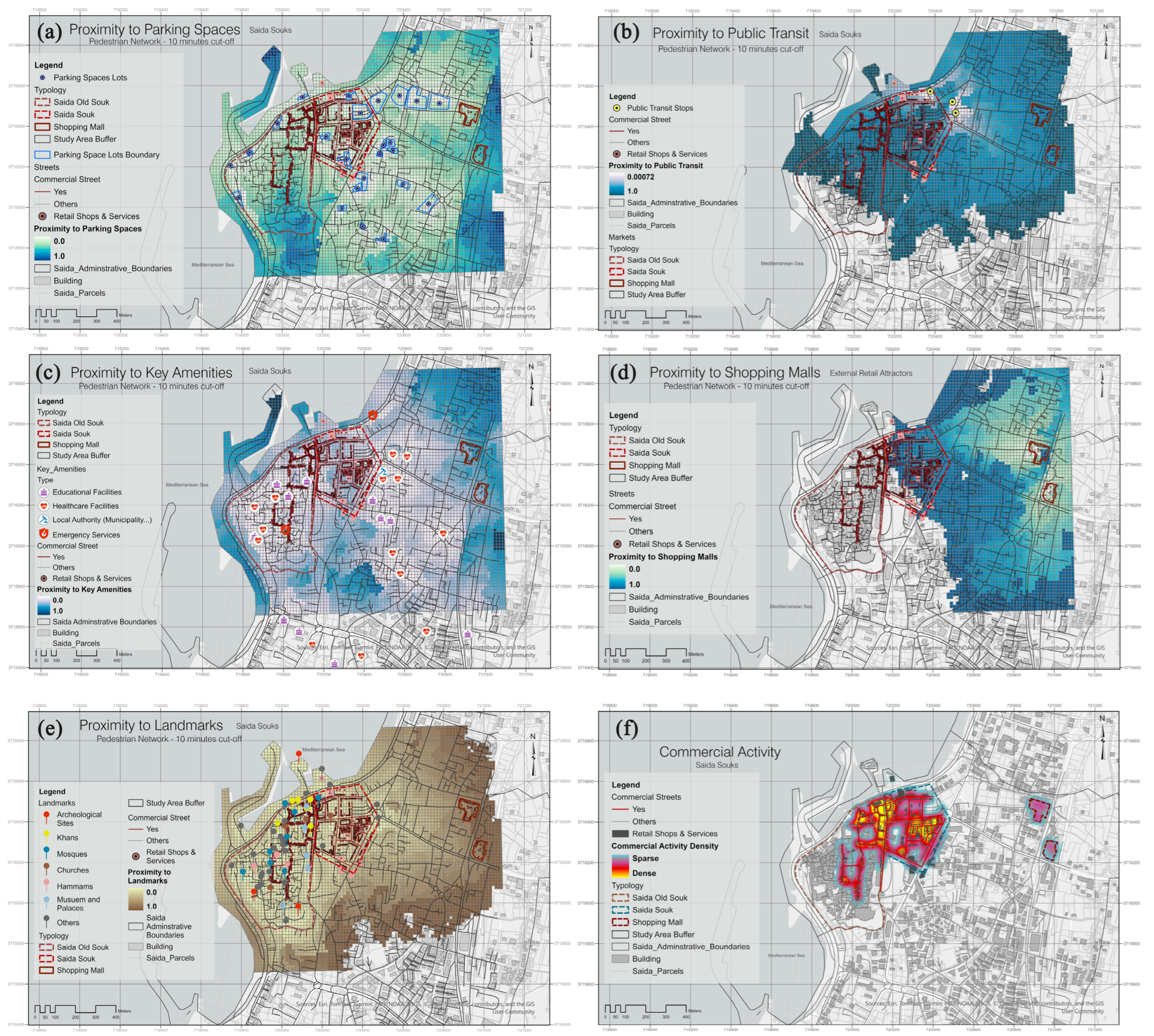
| Proximity | Proximity to Parking Spaces (PP) | 0 | 1 | 0.36 | 0.23 |
| Proximity to Public Transit (PT) | 0 | 1 | 0.79 | 0.17 | |
| Proximity to Key Amenities (PK) | 0 | 1 | 0.35 | 0.20 | |
| Proximity to shopping malls (PS) | 0 | 1 | 0.73 | 0.25 | |
| Proximity to Landmarks (PL) | 0 | 1 | 0.45 | 0.33 | |
| Socioeconomic | Dependency Ratio (DR) | 0.41 | 0.41 | 0.41 | 0 |
| Educational Attainment (EA) | 0.12 | 0.12 | 0.12 | 0 | |
| Unemployment Rate (UR) | 0.03 | 0.03 | 0.03 | 0 | |
| Retail Vacancy Rate (VR) | 0 | 0.23 | 0.19 | 0.06 | |
| Commercial Density (CD) | 0 | 0.89 | 0.55 | 0.25 |
Disclaimer/Publisher’s Note: The statements, opinions and data contained in all publications are solely those of the individual author(s) and contributor(s) and not of MDPI and/or the editor(s). MDPI and/or the editor(s) disclaim responsibility for any injury to people or property resulting from any ideas, methods, instructions or products referred to in the content. |
© 2026 by the authors. Licensee MDPI, Basel, Switzerland. This article is an open access article distributed under the terms and conditions of the Creative Commons Attribution (CC BY) license.
Share and Cite
El Baba, N.A.; Y. El Bastawissi, I.; Afify, A.; Mohsen, H. Measuring Retail Resilience Using a Geospatial Multi-Criteria Model: A Case Study of Saida, Lebanon. Urban Sci. 2026, 10, 120. https://doi.org/10.3390/urbansci10020120
El Baba NA, Y. El Bastawissi I, Afify A, Mohsen H. Measuring Retail Resilience Using a Geospatial Multi-Criteria Model: A Case Study of Saida, Lebanon. Urban Science. 2026; 10(2):120. https://doi.org/10.3390/urbansci10020120
Chicago/Turabian StyleEl Baba, Nour Ahmad, Ibtihal Y. El Bastawissi, Ayman Afify, and Hiba Mohsen. 2026. "Measuring Retail Resilience Using a Geospatial Multi-Criteria Model: A Case Study of Saida, Lebanon" Urban Science 10, no. 2: 120. https://doi.org/10.3390/urbansci10020120
APA StyleEl Baba, N. A., Y. El Bastawissi, I., Afify, A., & Mohsen, H. (2026). Measuring Retail Resilience Using a Geospatial Multi-Criteria Model: A Case Study of Saida, Lebanon. Urban Science, 10(2), 120. https://doi.org/10.3390/urbansci10020120