
Article

Assessing Transport Affordability and Spatial Inequality: Evidence from a Hierarchical Bayesian Regression Framework of South Africa’s Provinces


1
School of Commerce, University of KwaZulu-Natal, Durban 3629, South Africa
2
School of Commerce, University of KwaZulu-Natal, Pietermaritzburg 3209, South Africa
3
W.P. Carey School of Business, Arizona State University, Tempe, AZ 3506, USA
*
Author to whom correspondence should be addressed.
Urban Sci. 2026, 10(2), 117; https://doi.org/10.3390/urbansci10020117
Submission received: 21 November 2025 / Revised: 24 January 2026 / Accepted: 26 January 2026 / Published: 13 February 2026

Abstract

Transport affordability defined as the share of household income devoted to transport expenditure is a key dimension of urban equity and social inclusion, particularly in contexts characterised by spatial inequality and income disparities. This study examines provincial variation in public transport affordability across South Africa using a hierarchical Bayesian regression framework applied to province–year data from 2015 to 2022 (n = 72). Affordability is operationalised as a transport cost burden, with higher values indicating a greater proportion of household income spent on transport, and is modelled as a function of household income, trip frequency, household population, and total provincial employment, with province-level random intercepts capturing unobserved regional heterogeneity. The results indicate that household income is negatively associated with transport cost burden, suggesting that provinces with higher average income devote a smaller share of income to transport and therefore experience better affordability. In contrast, household population and aggregate provincial employment are positively associated with transport cost burden, reflecting higher overall mobility and commuting demands in larger and more economically active provinces rather than improved affordability. Trip frequency shows no statistically meaningful association with affordability once household composition and income capacity are accounted for. After accounting for observed characteristics, between-province variation is limited, indicating that affordability dynamics are broadly similar across provinces over the study period. Methodologically, the hierarchical Bayesian framework enables partial pooling across provinces and supports probabilistic inference through credible intervals, thereby improving the stability of estimates in a small-sample multilevel context. While the analysis is associational rather than causal, the findings provide policy-relevant evidence for monitoring transport affordability, including benchmarking the prevalence of affordability burdens relative to the commonly used 10% threshold.

1. Introduction

Transport affordability, defined as the share of household income devoted to transport expenditure] has become a critical dimension of social inclusion and spatial justice [1,2]. In South Africa, where historical segregation and uneven urban development continue to shape access to jobs and services, the cost of mobility determines far more than convenience: it influences employment opportunities, educational access, and overall well-being [3]. Despite the 10 per cent “ability-to-pay” benchmark introduced in the National Transport Policy White Paper (1996), recent national data indicate that households spend an average of 16 per cent of income on transport, with the highest burdens borne by low-income and peri-urban communities [4,5].
This indicates that a substantial share of households face transport cost burdens well above commonly cited policy benchmarks. Existing studies on transport affordability in South Africa have largely adopted static, cross-sectional approaches or relied on national averages that conceal sub-provincial and temporal variation [6,7,8]. Such methods cannot fully capture how affordability burdens evolve over time or differ across regions with distinct settlement patterns and labour markets.
Moreover, many studies rely on associational frameworks without clearly distinguishing descriptive relationships from causal mechanisms [9]. These limitations hinder the development of evidence-based monitoring frame-works capable of identifying persistent spatial inequities in transport affordability across the country’s nine provinces. This study addresses these limitations by applying a hierarchical Bayesian regression framework that explicitly accounts for both within- and between-province variation in transport affordability.
The Bayesian formulation provides full posterior distributions for all parameters, enabling probabilistic interpretation and credible intervals rather than binary significance testing [9]. The hierarchical (multilevel) structure allows province-level intercepts to vary, capturing unobserved contextual differences across provinces while borrowing strength from the national distribution [10]. Partial pooling improves estimate stability in a small-sample, multilevel setting by reducing overfitting while retaining meaningful regional variation [11].
Using province–year data from 2015 to 2022, the paper models transport affordability as a transport cost burden and examines its association with household income, trip frequency, household population, and total provincial employment, reflecting both economic capacity and aggregate mobility demand.
The analysis is explicitly associational rather than causal. Rather than estimating the effects of specific policy interventions, the study documents structural patterns in transport cost burdens across provinces and over time. In doing so, it provides empirical evidence relevant for monitoring affordability benchmarks, including the prevalence of transport cost burdens relative to the commonly used 10 per cent threshold.
The remainder of the paper is structured as follows. Section 2 reviews the conceptual and empirical literature on transport affordability and spatial inequality. Section 3 describes the data, variable construction, and methodological framework. Section 4 presents the results and discussion. Section 5 concludes with implications for affordability monitoring and directions for future research.

2. Literature Review

2.1. Conceptualising Transport Affordability

Transport affordability refers to the share of household income required to meet essential travel needs, commonly interpreted as a transport cost burden [12,13,14,15].
It links household economic capacity with spatial access, shaping the ability to participate in employment, education, and social life [16,17,18]. When transport costs consume a large proportion of income, households face constrained access to opportunities, reinforcing poverty and social exclusion [6,8,19,20,21,22]. Thus, affordability functions not merely as a budgetary indicator but as a proxy for mobility equity and social inclusion [23]. The conventional threshold of spending less than 10 per cent of income on transport originated as a policy guideline in South Africa’s White Paper on National Transport Policy (1996) and has been widely applied as a benchmark for “reasonable” mobility expenditure [4,24].
However, this threshold is increasingly recognised as context-sensitive rather than universal, as it does not fully account for regional variation in settlement patterns, income distribution, or modal availability [25].
For households located far from employment centres, particularly in peripheral or peri-urban areas, the fixed benchmark may understate the true burden imposed by long-distance commuting and limited transport choice [26]. Recent research emphasises the multidimensional nature of affordability, integrating financial outlays with travel time, trip frequency, and access quality [27,28,29,30,31]. From this perspective, affordability interacts closely with accessibility and network structure, requiring measures that reflect both expenditure and the spatial configuration of opportunity [32,33,34,35].

2.2. Empirical Evidence on Transport Affordability

Empirical studies in high-income countries document that high transport costs are systematically associated with social exclusion, even in contexts with extensive public transport systems [36,37,38,39]. Affordability patterns are shaped not only by household income but also by the spatial distribution of employment and services [6,8,40,41]. Policies combining fare subsidies with compact urban development are consistently associated with more equitable affordability outcomes [42,43,44,45].
In lower-income and emerging economies, affordability pressures are magnified by income inequality, spatial fragmentation, and limited public transport coverage [33,37,46]. Across African cities, research highlights strong associations between transport cost burdens, settlement patterns, and constrained modal choice [33,47,48,49,50]. Empirical studies from Kenya, Ghana, and Nigeria show that transport expenditures frequently exceed 20 per cent of household income, far above commonly cited policy benchmarks [51,52,53,54,55,56,57].
Recent work also links affordability challenges to public transport system design, network integration, and operational efficiency. Studies on transit network integration demonstrate that poorly coordinated systems are associated with higher travel costs and reduced accessibility, while integrated network design can support lower household transport burdens for example, through underground surface system integration in Greater Cairo [58]. Similarly, research on mass rapid transit systems shows that efficient, high-capacity networks are associated with lower per-trip costs and reduced emissions, reinforcing the link between affordability, sustainability, and system design [59].

2.3. Transport Affordability in the South African Context

In South Africa, the spatial legacy of apartheid continues to shape patterns of mobility, land use, and transport expenditure [7,8,60]. Public transport systems comprising minibus taxis, buses, and rail remain the dominant modes for low- and middle-income households, yet affordability challenges persist despite fare regulation and targeted subsidies [61,62,63,64]. Empirical studies show that some of the lowest-income households in metropolitan regions allocate more than 40 per cent of income to transport, far exceeding conventional affordability benchmarks [6,65,66,67].
Household and regional characteristics further shape affordability outcomes. Larger household populations are associated with higher aggregate transport expenditure due to multiple commuters, even when per capita costs are lower [68,69].
Aggregate employment levels at the provincial scale are similarly associated with higher transport cost burdens, reflecting increased commuting demand rather than improved affordability [20,32,70]. These patterns underscore the importance of distinguishing between income capacity and aggregate mobility demand when interpreting affordability metrics.

2.4. Methodological Advances in Measuring Affordability and Identified Research Gaps

Most existing affordability studies rely on static cross-sectional data or national averages. While valuable for descriptive analysis, these approaches often fail to account for the multilevel structure of transport data, where observations are nested within regions or jurisdictions [71,72]. Ignoring such hierarchy can underestimate uncertainty and overstate precision [73]. Hierarchical Bayesian approaches address these limitations by incorporating random effects and partial pooling, improving estimate stability and uncertainty quantification in small-sample, multilevel settings [74]. While these models do not resolve causal identification challenges, they have been increasingly applied in transport research on equity, safety, ridership, and travel-time reliability [10,75]. Their application to transport affordability, particularly in African contexts, remains limited.
These models do not resolve causal identification challenges but provide a flexible framework for describing structural associations across space and time. Recent applications in transport research include studies of equity, safety, ridership, and travel-time reliability [76,77], yet their use in affordability analysis particularly in African contexts remains limited. This study addresses this gap by applying a Hierarchical Bayesian regression framework to province year data, enabling systematic examination of regional variation in transport cost burdens while explicitly acknowledging aggregation constraints and the associational nature of the analysis.

3. Methodology

3.1. Study Design and Conceptual Framework

This study uses provincial-level panel data on transport affordability and socio-economic indicators compiled from Statistics South Africa and the South African Regional Explorer. The dataset comprises 72 province–year observations across nine South African provinces from 2015 to 2022.
Transport affordability is conceptualised as a transport cost burden, reflecting the share of household income devoted to transport expenditure.
The empirical framework examines how variation in transport cost burdens across provinces is associated with household income, trip frequency, household population, and total provincial employment, capturing both economic capacity and aggregate mobility demand.

3.2. Aggregation Justification

The analysis relies on aggregated provincial data rather than household-level observations due to data availability constraints and the policy relevance of provincial-scale monitoring in South Africa. Provincial governments play a central role in transport planning, subsidy allocation, and infrastructure investment, making province-level affordability indicators particularly relevant for policy analysis.
Aggregation introduces limitations, including reduced within-province heterogeneity and strong correlations among scale-related variables such as income, household population, and employment.
Accordingly, results are interpreted as describing structural associations at the provincial level rather than household-level behavioural responses.
These limitations are acknowledged throughout the analysis and revisited in the discussion of results and limitations.

3.3. Study Area and Data Sources

The analysis covers South Africa’s nine provinces Eastern Cape, Free State, Gauteng, KwaZulu-Natal, Limpopo, Mpumalanga, North West, Northern Cape, and Western Cape from 2015 to 2022. Data were obtained from Statistics South Africa and the South African Regional Explorer, which provide annual provincial indicators on household income, household population, total employment, and public transport trip frequency. Monetary variables were converted to real terms using annual provincial consumer price indices.

3.4. Variable Definition and Measurement

The dependent variable, affordability, represents the share of average household income devoted to transport expenditure and is interpreted as a transport cost burden. Higher values indicate worse affordability. Explanatory variables include household income, trip frequency, household population, and total provincial employment.
Employment is defined as the total number of employed individuals at the provincial level, not an average per household.
All variables were appropriately scaled and log-transformed to improve distributional properties and facilitate interpretation. Table 1 reports variable definitions, measurement units, and transformations.

3.5. Measuring Affordability

The primary measure is the standard share-of-income metric; an approach reflected in the equation below:
A I = T E y ×   100 %
where
TE = Transport expenditure.
y = Household income.
Alternative behaviour-sensitive formulations proposed in the literature such as trip-based indices and minimum-mobility thresholds are discussed for contextual comparison but are not directly estimated in the empirical model. These formulations are referenced to situate interpretive limits rather than to claim behavioural identification.
To situate robustness and interpretive limits, two behaviour-sensitive formulations are referenced: a Gomez-Lobo [78] type index that incorporates trip frequency and prices by mode:
A I 1 = m = 1 M x m ( p m , y ) . p m y
where
A I 1 = Affordability index for a household.
M = Total number of public transport modes (e.g., bus, train, minibus taxi).
m = Specific mode of transport within the set M .
xm = Total number of trips taken by all household members using mode m during the month.
pm = Price per trip for transport mode.
y = Total household income.
Carruthers et al. [25] introduced a minimum-mobility threshold approach (e.g., 60 trips per person per month):
A I 2 = m = 1 M x m ¯ p m y
where
A I 2 = Affordability index for a household.
x m ¯   = The number of trips made by a household member, with a fixed parameter of sixty 10-km trips per month per household member.
The standard affordability threshold is not universally applicable and may be ill-suited to South Africa’s transport context, where spatial inequality, informal services, and income disparities complicate the direct application of a fixed benchmark [25].
To accommodate spatial and temporal heterogeneity, this study adopts a panel data approach based on Gandelman et al. [26]:
A I i t = m = 1 M x m i t p m i t y i t
where
A I i t = Affordability Index for each province i at time t .
x m i t = Number of household trips for the mode m by province i at time t .
p m i t = Price per trip of the mode m by province i at time t .
y i t = Household income by province i at time t .
The affordability model developed by Gandelman et al. [26] was initially constructed using household-level data. In this study, the framework is adapted to the provincial level by converting household characteristics into provincial averages and incorporating relevant macroeconomic indicators. These adjustments aim to capture broader factors that influence affordability. Although the aggregate has limitations, the results are interpreted within these constraints. Since the original data is still household-based, the updated model provides a meaningful and robust assessment of affordability in relation to policy.

3.6. Model Specification

Transport cost burden is modelled using a dynamic hierarchical Bayesian linear regression, with province–year observations nested within provinces. Province-level random intercepts capture unobserved contextual heterogeneity across provinces.
The model is specified as:
l n ( A i t ) =   β 0   + β 1 l n ( Y i t ) +   β 2 l n ( T i t ) +   β 3 l n ( H i t ) +   β 4 l n ( E i t ) +   β 5 l n ( A i t 1 ) +   µ i   + ε i t
where
A i t is transport affordability (cost burden) in province i at time t ;
Y i t is household income;
T i t is trip frequency;
H i t is household population;
E i t is total provincial employment;
µ i is a province-specific random intercept;
ε i t is an idiosyncratic error term.
The lagged dependent variable is included to control for temporal persistence rather than to model cointegration. The model is associational and does not attempt to address endogeneity or causal identification.

3.7. Priors and Bayesian Estimation

Weakly informative priors were specified for all parameters. Regression coefficients were assigned Normal (0, 102) priors, while variance parameters were assigned half-normal priors to ensure positivity and regularisation. Posterior distributions were estimated using PROC MCMC in SAS 9.4. Convergence was assessed using trace plots and effective sample size diagnostics. Sensitivity analyses using alternative prior specifications yielded substantively similar results.

3.8. Model Diagnostics and Validation

Model performance was evaluated using posterior predictive checks, residual diagnostics, and posterior R2. The posterior R2 indicates moderate explanatory power while accounting for parameter uncertainty. Province-level variance estimates suggest modest residual heterogeneity across provinces after controlling for observed covariates and temporal persistence.

3.9. Ethical and Data Considerations

The study uses publicly available, aggregated secondary data and does not involve human subjects. Ethical approval was not required. Replication materials are available upon request.

4. Results and Discussion

4.1. Panel Stationarity

Prior to estimating the hierarchical Bayesian model, panel unit-root tests were conducted to examine the time-series properties of the variables. The results indicate that most variables become stationary after differencing.
The results yield mixed and inconclusive evidence, particularly given the short panel dimension (T = 8).
Under the Im–Pesaran–Shin (IPS) test, the null hypothesis is non-stationarity, while under the Hadri test, the null hypothesis is stationarity [79,80]:
y i t = ρ i y i t 1 + ɀ i t γ + μ i t
where i = 1 ,   2 ,   N   index provinces, t = 1 ,   2 , , T is time, ɀ i t is the deterministic component, and μ i t is a stationary process.
Table 2 reports the results of unit-root tests in levels. The IPS test fails to reject the null of non-stationarity for household income, household population, and employment, while the Hadri test strongly rejects the null of stationarity for these variables. This pattern indicates that several level series exhibit persistence. For affordability and trip frequency, the tests yield mixed results: IPS suggests marginal stationarity in some cases, while the Hadri test rejects stationarity.
Table 3 presents unit-root tests in first differences. After differencing, several variables display improved stationarity properties; however, the results remain mixed, particularly for household income and household population. Given the short panel length and the conflicting outcomes across tests, the unit-root evidence should be interpreted with caution.
Taken together, these results indicate that panel unit-root tests are inconclusive and do not provide a reliable basis for formal cointegration or error-correction modelling.
Accordingly, the lagged affordability term included in the hierarchical Bayesian model is used as pragmatic control for temporal persistence, rather than as evidence of long-run equilibrium relationships.

4.2. Posterior Summaries and Model Performance

The hierarchical Bayesian regression explains approximately 68% of the variation in transport cost burden across provinces and years. Household income is negatively associated with transport cost burden, indicating that provinces with higher average income tend to allocate a smaller share of income to transport. Household population and total provincial employment are positively associated with transport cost burden, reflecting higher aggregate commuting demand in more populous and economically active provinces rather than improved affordability.
Trip frequency exhibits a weak and statistically uncertain association once income capacity and population scale are accounted for. Residual between-province variation is modest after controlling for observed characteristics, suggesting broadly similar affordability patterns across provinces. Table 4 summarises posterior means, standard deviations, and 95% credible intervals.

4.3. Interpretation of Key Effects

The findings indicate that public transport affordability in South Africa is moderate overall but varies substantially across households due to demographic, economic, and temporal characteristics. Affordability in this study is measured as the share of household average income devoted to transport expenditure, with higher values indicating greater transport cost burden and therefore worse affordability.
Household population and employment are positively associated with transport cost burden. The relatively large positive coefficient for household population (0.05) suggests that larger households allocate a higher proportion of their income to transportation. This likely reflects greater aggregate mobility needs, including multiple commuters within the household, rather than economies of scale in transport consumption. Similarly, the positive coefficient on employment (0.50) suggests that households with more employed members experience higher transport expenditure relative to income, consistent with increased commuting intensity and work-related travel demands.
Income exhibits a transport cost burden of (−0.47), this negative association between household income and transport cost burden is consistent with affordability theory that higher income increases the capacity to absorb transport expenditure even when absolute costs are higher. In contrast, the positive associations for household population and total employment reflect increased aggregate mobility demand associated with larger populations and labour markets.
These findings indicate that employment scale is associated with higher transport cost burdens due to increased commuting intensity. Trip frequency shows limited explanatory power once scale-related variables are included, suggesting that affordability outcomes are driven more by structural eco-nomic and demographic factors than by travel intensity alone. The lagged affordability term indicates persistence in transport cost burdens over time, consistent with gradual adjustment in settlement patterns, labour markets, and transport systems. This result is consistent with standard affordability theory and prior empirical evidence, which shows that higher income improves the capacity to absorb transport costs even when absolute expenditure may be higher. Thus, higher-income households experience better affordability despite potentially using more expensive modes or travelling longer distances.
Trip frequency has no statistically significant effect on transport cost burden once household population, income, and employment are controlled for. This suggests that affordability is driven more by household structure and income capacity than by the number of trips undertaken. Lagged affordability (0.22) shows positive temporal persistence, indicating that past transport cost burdens partially predict current affordability. This highlights the dynamic nature of affordability, where patterns adjust slowly over time rather than responding immediately to short-term shocks.
Province-level random intercepts capture residual heterogeneity across provinces, with a relatively small standard deviation (σp ≈ 0.16), indicating modest regional variation once economic, demographic, and temporal differences are accounted for. Residual household-level variation (σ ≈ 0.11) reflects remaining unexplained differences in affordability between households within provinces.
Overall, the results underscore the importance of distinguishing between income capacity and aggregate transport expenditure when assessing affordability. Positive associations with household population and employment reflect increased mobility demands rather than improved affordability, the negative association with income confirms that affordability improves as households’ financial capacity increases, and the lagged effect indicates persistent patterns over time. All findings are associational and should not be interpreted causally.

4.4. Affordability Relative to the 10% Benchmark

To situate the results within a policy-relevant context, affordability outcomes are evaluated relative to the commonly cited benchmark of spending no more than 10% of household income on transport. Table 5 reports a province × year indicator identifying whether average affordability exceeds this threshold over the 2015–2022 period.
Overall, all province–year observations exceed the 10% benchmark, indicating that average transport cost burdens remain persistently above levels typically considered affordable. This pattern holds across both urbanised provinces (e.g., Gauteng, KwaZulu-Natal, and the Western Cape) and more rural provinces (e.g., Limpopo, the Northern Cape, and the Free State). While the magnitude of affordability burdens varies across provinces and over time, the absence of any province–year observations below the benchmark underscores that transport affordability pressures are structural rather than transient.

4.5. Comparison with Static Models

Results from pooled OLS and fixed-effects models are presented as robustness checks in Table 6. While the direction of associations for income and employment is broadly consistent with the hierarchical Bayesian results, coefficient magnitudes vary across specifications. Differences for household population and employment highlight the sensitivity of estimates to how between-province variation is treated. These robustness checks confirm the stability of associational patterns rather than causal effects.
Table 6 reports robustness-check results using Pooled OLS, Fixed Effects (FE), and FE models with clustered standard errors. Comparing these specifications with the Bayesian Hierarchical Model (BHM) highlights which relationships are robust and which depend on how unobserved heterogeneity is treated.
A key result that remains robust across all specifications is the negative association between household income and transport cost burden. The pooled OLS model shows a coefficient of −1.740, while the FE and FE with clustered SE models yield −1.361 (not statistically significant). The BHM estimate (β1 = −0.4654) closely matches the FE direction, suggesting that the negative association is not driven by modelling assumptions. This suggests that higher-income households may spend more on transportation in absolute terms, through longer trips, higher frequency, or more expensive modes, yet the proportion of income devoted to transportation remains lower, reflecting better affordability.
Trip frequency also exhibits a consistently weak and statistically insignificant association. In pooled OLS, the coefficient is 0.0339 and in FE and clustered FE models, it is 0.0495, while in the BHM, it is essentially zero (β2 = 0.0041). This suggests that the frequency of trips is not a primary driver of transport affordability once household population, income, and employment are accounted for.
Household population and employment show the largest discrepancies across model specifications. In pooled OLS, household population has a large positive coefficient (1.708), but in the FE models, it becomes negative (−0.645) and statistically insignificant, while employment remains small and non-significant (0.336). In contrast, the BHM estimates positive associations for both household population (β3 = 0.0505) and employment (β4 = 0.4959), reflecting structural differences across provinces rather than short-term fluctuations within provinces. This divergence highlights that the BHM leverages both within- and between-province variation, capturing long-term patterns in household and labour markets.
The lagged log-affordability term is included in the Bayesian hierarchical model to capture temporal persistence. It is not included in the static OLS or FE specifications, which focus on cross-sectional and within-province variation.
Overall, these robustness checks confirm that the negative association between income and affordability is robust, trip frequency has minimal impact, and the strong positive effects of household population and employment in the BHM reflect long-term structural differences rather than short-term temporal variation.

4.6. Transport Affordability Patterns

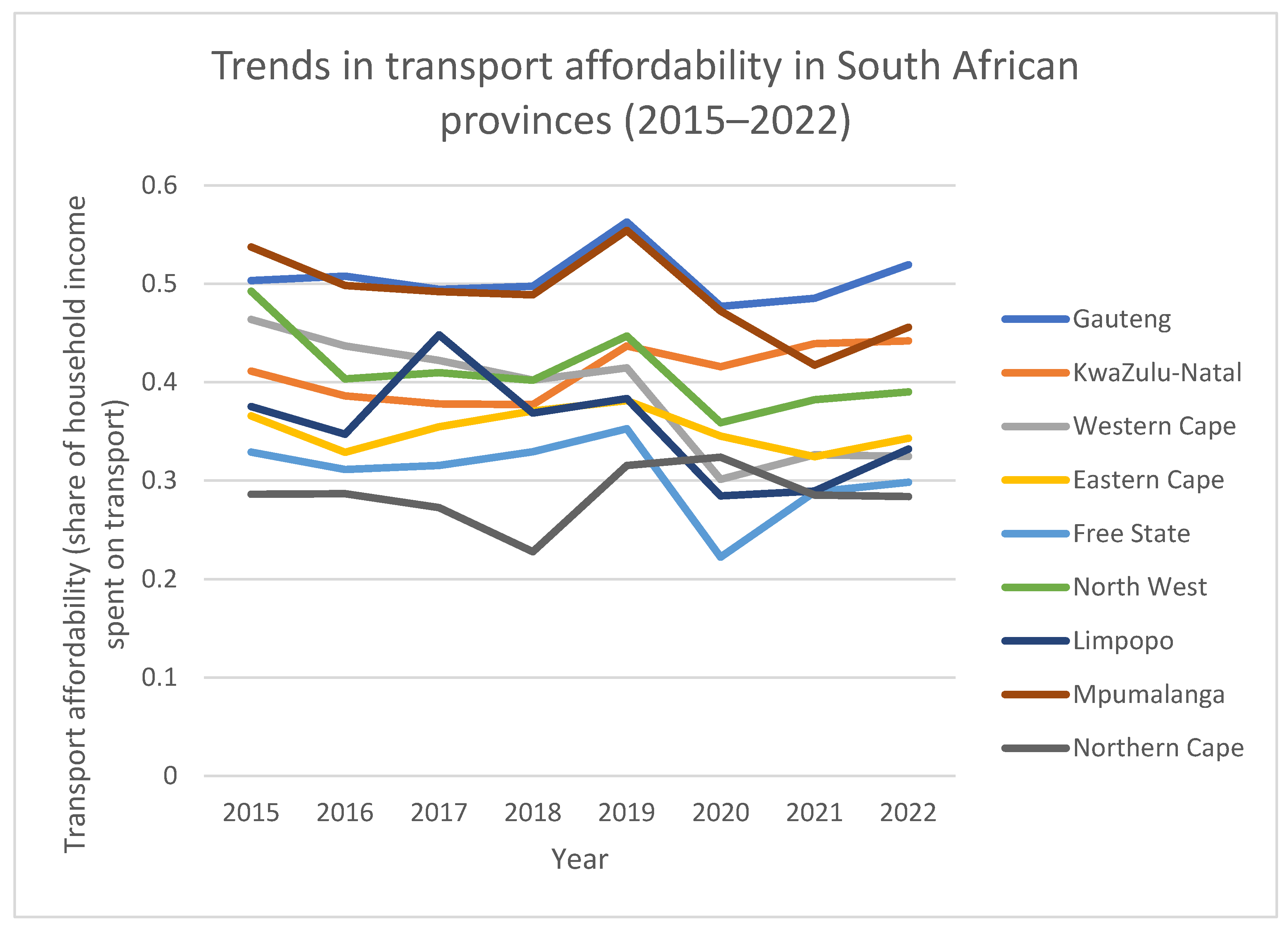
This study examines the temporal and spatial dynamics of affordability across South African provinces from 2015 to 2022. Figure 1 illustrates substantial heterogeneity in affordability ratios across provinces, shaped by differences in income, trips, household population and employment. Using the national benchmark of spending no more than 10% of household income on transportation [1,42] systematic disparities become evident. Urbanised provinces, particularly Gauteng, KwaZulu-Natal, Mpumalanga, and the West-ern Cape, consistently record the highest affordability ratios throughout the period. Despite relatively higher income levels, these provinces experience elevated transportation burdens, reflecting higher fares, longer commuting distances, dense commuting flows, and a greater reliance on formal public transportation systems.
In KwaZulu-Natal, affordability pressures are shaped by a combination of dispersed settlement patterns, long commuter corridors, and limited integration between transport modes, which sustain high household transport expenditures over time. The Western Cape similarly exhibits persistently high affordability ratios, reflecting spatial mismatch between residential areas and employment centres, alongside relatively high fare structures in metropolitan public transport systems.
In contrast, more rural provinces such as Limpopo, North West, and the Northern Cape exhibit lower average affordability ratios but greater year-to-year volatility. This pattern is consistent with weaker transport infrastructure, limited public transport availability, and fluctuating travel demand, which can amplify the cost burden when access constraints intensify.
A notable decline in affordability ratios is observed across most provinces around 2020, coinciding with the COVID-19 global pandemic, which led to lockdowns and severely limited movement. This decline reflects disruptions to mobility and household employment conditions. However, the post-2020 period shows a gradual increase in several provinces, suggesting that transport cost pressures began to reemerge as economic activity and mobility resumed.
Table 7 reports descriptive statistics for the logged variables. Affordability (lnAit) exhibits substantial variation across provinces and over time, indicating heterogeneous transport cost burdens. Household income, trip frequency, household population, and total provincial employment also show considerable dispersion, reflecting structural differences across provinces.
Table 8 presents the Pearson correlation matrix. Transport cost burden is positively correlated with household income, household population, and employment, reflecting strong scale effects inherent in aggregated provincial data.
These correlations reflect co-movement at the provincial scale and should not be interpreted causally.
The near-perfect correlations among income, household population, and employment highlight severe multicollinearity, which limits the precision of individual coefficient estimates and motivates cautious interpretation of regression results.

4.7. Discussion

This study provides empirical evidence that public transport affordability in South Africa is moderate on average but varies substantially across households due to underlying demographic and economic characteristics. Measured as the share of household income devoted to transport expenditure, affordability outcomes reflect structural and persistent conditions rather than short-term travel behaviour. These findings align with previous South African and Global South research, which emphasises the uneven and enduring nature of transport cost burdens across socio-economic groups [6,7,8].
Household population and employment emerge as the strongest positive correlates of transport cost burden. Although theories of household consumption often highlight economies of scale, where costs can be shared across members [81,82], the positive coefficients observed in this study suggest that these effects are outweighed by increased aggregate mobility demands. Larger households typically include multiple workers, students, and dependents, each generating regular travel needs. As a result, cumulative transport expenditure rises faster than household income, resulting in a higher proportion of income being allocated to transportation. Similar patterns have been observed in urban contexts where spatial separation between residential areas and employment centres amplifies commuting requirements [83,84,85,86].
The positive association between employment and transport cost burden further reinforces this interpretation. While employment enhances income stability and economic security, it also increases the intensity of work-related travel. Households with more employed members tend to incur higher commuting expenditures, particularly in spatially fragmented urban environments, such as those characteristic of South African cities. This finding is consistent with studies showing that labour-market participation, while economically beneficial, often comes with substantial mobility costs in contexts marked by long travel distances and limited affordable transportation options [8,87,88,89].
In contrast, household income exhibits a negative association with transport cost burden, indicating that higher-income households devote a smaller share of income to transport. This result aligns with standard affordability theory and prior empirical evidence, which emphasise that income growth improves households’ capacity to absorb transport costs, even when absolute expenditure increases [8,25,90,91,92]. Higher-income households may choose more comfortable or premium transport options, but these expenditures represent a smaller proportion of their income, resulting in lower measured cost burden. Consequently, affordability challenges are most severe among lower-income households, for whom even basic transport needs consume a substantial share of limited resources [6,7].
Trip frequency does not exhibit a statistically significant association with transport cost burden once household population, income, and employment are controlled for. This suggests that affordability pressures are not primarily driven by the frequency of household travel, but rather by structural factors such as household population, income, spatial form, and mode choices. This finding supports existing evidence that transport poverty is rooted in broader socio-economic and spatial inequalities rather than individual travel choices alone [8,35,93,94,95,96].
Importantly, the lagged log-affordability term (β5 = 0.2189) included in the Bayesian hierarchical model highlights temporal persistence in transport cost burdens. Households’ affordability levels in one year partially predict affordability in subsequent years, indicating that transport cost pressures adjust slowly and are shaped by enduring socio-economic and spatial conditions rather than short-term shocks. This persistence underscores that affordability is not only a cross-sectional issue but also a longitudinal concern, with past mobility and expenditure patterns influencing current household burdens.
Overall, the results highlight the importance of distinguishing between income and aggregate transport expenditure when assessing affordability. Positive associations with household population and employment reflect increased mobility demands rather than improved affordability, while the negative association with income confirms that affordability improves as households’ financial capacity increases. These findings underscore that transport affordability in South Africa is shaped by deep structural and spatial conditions, reinforcing the need for integrated policy interventions that address land-use patterns, employment accessibility, and affordable transport provision for lower- and middle-income households [6,7,25,40,97,98,99].

4.8. Policy Implications

The results suggest that transport affordability policies should account for household population and employment status, rather than relying solely on income-based targeting. Larger households and households with more employed members experience higher transport cost burdens, reflecting greater aggregate mobility demands. Policies that recognise these structural differences, such as differentiated subsidies, travel vouchers, or support mechanisms linked to household travel needs, may therefore be more effective in mitigating affordability pressures.
The relatively small residual inter-provincial variation (σp ≈ 0.1595) suggests that, after accounting for household and socio-economic characteristics, transport affordability dynamics are broadly similar across provinces. This suggests that national fare and subsidy frameworks provide a reasonably uniform baseline for affordability, while differences in affordability outcomes are primarily driven by household-level characteristics and spatial factors rather than provincial disparities.
At the same time, the remaining variation highlights the potential role of targeted local interventions, particularly those aimed at improving service reliability, network accessibility, and operational efficiency. Such measures can reduce effective transport costs and enhance affordability without requiring major adjustments to national pricing structures.
Finally, the observed temporal persistence in affordability, as captured by the positive lagged dependent variable, indicates that households’ transport cost burdens are influenced by their previous expenditure patterns. Policies designed to alleviate affordability burdens should therefore combine short-term relief mechanisms, such as temporary fare reductions, with long-term structural interventions addressing household mobility needs and spatial inequities. Overall, the findings underscore the importance of integrating nationally coordinated affordability policies with targeted local and household-level measures to effectively reduce persistent transport cost burdens in South Africa.

4.9. Limitations and Future Research

The study’s modest sample size (n = 72) limits the complexity of hierarchical structures that can be reliably estimated. Future research could incorporate a longer time horizon and finer-grained household-level data, enabling the estimation of random slopes and dynamic feedback mechanisms between transport affordability and ridership. In addition, integrating qualitative measures of perceived affordability and spatial accessibility indicators would further enhance understanding of how economic constraints and experiential factors jointly shape affordability outcomes.

5. Conclusions

This study examined public transport affordability across South Africa’s nine provinces using a hierarchical Bayesian regression framework applied to province–year data from 2015 to 2022.
The analysis documents structural associations between transport cost burdens and key economic and demographic characteristics at the provincial level.
Transport affordability was operationalised as the share of household income devoted to transport expenditure, interpreted as a transport cost burden, where higher values indicate worse affordability. The results show that household income is negatively associated with transport cost burden, suggesting that provinces with higher average income allocate a smaller share of income to transport. In contrast, household population and total provincial employment are positively associated with transport cost burden, reflecting higher aggregate mobility and commuting demand rather than improved affordability. Trip frequency exhibits a weak and statistically uncertain association once income capacity and population scale are accounted for.
These findings highlight the importance of distinguishing between income capacity and aggregate mobility demand when interpreting affordability measures.
After accounting for observed characteristics and temporal persistence, residual between-province variation is modest, suggesting broadly similar affordability patterns across provinces over time. From a methodological perspective, the hierarchical Bayesian framework provides a flexible approach for analysing transport affordability in small-sample, multi-level settings by enabling partial pooling across provinces and probabilistic inference through credible intervals. The framework improves inference and stability of estimates but does not address endogeneity or support causal interpretation. Evaluating affordability outcomes relative to the commonly cited 10% benchmark shows that average transport cost burdens exceed this threshold in all provinces throughout the study period.
This finding underscores the value of affordability benchmarking as a monitoring tool rather than as a strict policy threshold.
Several limitations warrant acknowledgement. The use of aggregated provincial data masks within-province heterogeneity and contributes to strong correlations among scale-related variables. The short time dimension limits the reliability of formal time-series testing and constrains dynamic modelling options. Accordingly, all results should be interpreted as descriptive and associational.
Future research could extend this framework using household-level panel data, longer time series, or spatially explicit measures of accessibility to better capture intra-provincial variation and evaluate the impacts of specific policy interventions. Despite these limitations, the study contributes to the literature by providing a transparent and policy-relevant assessment of transport affordability patterns across South Africa’s provinces.

Author Contributions

Conceptualisation, F.J., S.G., J.G. and J.W.; methodology, F.J. and J.W.; software, F.J. and J.W.; validation, F.J. and J.W.; formal analysis, F.J. and J.W.; investigation, F.J.; resources, F.J., S.G., J.G. and J.W.; data curation, F.J.; writing—original draft preparation, F.J.; writing—review and editing, F.J. and J.W.; visualisation, F.J.; supervision, S.G., J.G. and J.W.; project administration, F.J.; funding acquisition, S.G., J.G. and J.W. All authors have read and agreed to the published version of the manuscript.

Funding

This research received no external funding.

Institutional Review Board Statement

Not applicable.

Informed Consent Statement

Not applicable.

Data Availability Statement

Secondary data for this study were sourced from Statistics South Africa (Stats SA) and the South African Regional Explorer. Data can be made available upon reasonable request.

Acknowledgments

The authors gratefully acknowledge the guidance and constructive feedback provided by S. Gumede, J. Goebel, and J. Wilson throughout the development of this study. Further appreciation is extended to the MCom/PhD research cohort led by S. Msomi for their insightful comments during the early stages of this research, as well as to the Economic Research Southern Africa (ERSA) workshops held in Gqeberha, Pretoria, and Cape Town, which contributed to the improvement of the analysis quality.

Conflicts of Interest

The authors declare no conflicts of interest.

References

  1. Allen, J.; Farber, S. Planning Transport for Social Inclusion: An Accessibility–Activity Participation Approach. Transp. Res. Part D Transp. Environ. 2020, 78, 102212. [Google Scholar] [CrossRef]
  2. Haffner, M.E.; Hulse, K. A Fresh Look at Contemporary Perspectives on Urban Housing Affordability. Int. J. Urban Sci. 2021, 25, 59–79. [Google Scholar] [CrossRef]
  3. Todes, A.; Turok, I. Spatial Inequalities and Policies in South Africa: Place-Based or People-Centred? Prog. Plan. 2018, 123, 1–31. [Google Scholar] [CrossRef]
  4. Department of Transport (DoT). White Paper on National Transport Policy; Government of South Africa: Pretoria, South Africa, 1996. Available online: https://www.gov.za/documents/white-papers/national-transport-policy-white-paper-20-aug-1996 (accessed on 1 September 2024).
  5. Statistics South Africa. General Household Survey 2024; Statistics South Africa: Pretoria, South Africa, 2024. Available online: https://www.statssa.gov.za/publications/P0318/P03182024.pdf (accessed on 20 October 2025).
  6. Knipe, M.; Krygsman, S. The Opportunity Cost of Household Transport Expenditure in South Africa. J. Transp. Supply Chain. Manag. 2024, 18, 1–10. [Google Scholar] [CrossRef]
  7. Sutherland, A.; Kerr, A. The Evolution of Household Transport Spending in Post-Apartheid South Africa: 1995–2015. SALDRU Working Paper 2021, 287. Available online: https://www.opensaldru.uct.ac.za/bitstream/handle/11090/1023/2021_287_Saldruwp.pdf?sequence=3 (accessed on 15 April 2025).
  8. Venter, C. Transport expenditure and affordability: The cost of being mobile. Dev. South. Afr. 2011, 28, 121–140. [Google Scholar] [CrossRef]
  9. Lynch, C.; Singh, A.; Zhang, Y.F. Towards a More Nuanced Approach to Measuring Housing Affordability: Evidence from Pakistan; Policy Research Working Paper No. 10450; World Bank: Washington, DC, USA, 2023; Available online: https://documents1.worldbank.org/curated/en/099752305222329176/pdf/IDU0b84da3cc0e83b046d5097890a3a1fdba8845.pdf (accessed on 20 December 2025).
  10. Gelman, A.; Hill, J.; Vehtari, A. Regression and Other Stories; Cambridge University Press: Cambridge, UK, 2021. [Google Scholar]
  11. Sales, A.C.; Patikorn, T.; Heffernan, N.T. Bayesian partial pooling to improve inference across A/B tests in EDM. In Proceedings of the Educational Data Mining Conference, Buffalo, NY, USA, 15–18 July 2018. [Google Scholar]
  12. Mitric, S.; Carruthers, R. The Concept of Affordability of Urban Public Transport Services for Low-Income Passengers; World Bank: Washington, DC, USA, 2005; Available online: http://documents.worldbank.org/curated/en/351071468326691158/The-concept-of-affordability-of-urban-public-transport-services-for-low-income-passengers (accessed on 30 December 2025).
  13. Plyushteva, A. Affording mobility: Attending to the socio-material affordances of transport un/affordability. J. Transp. Geogr. 2023, 108, 103558. [Google Scholar] [CrossRef]
  14. Silver, K.; Lopes, A.; Vale, D. The inequality effects of public transport fare: The case of Lisbon’s fare reform. J. Transp. Geogr. 2023, 112, 103685. [Google Scholar] [CrossRef]
  15. Dewita, Y.; Burke, M.; Yen, B.T.H. The relationship between transport, housing and urban form: Affordability of transport and housing in Indonesia. Case Stud. Transp. Policy 2020, 8, 252–262. [Google Scholar] [CrossRef]
  16. Alhassan, J.A.K.; Anciaes, P. Public transport investments as generators of economic and social activity. J. Transp. Health 2025, 41, 101989. [Google Scholar] [CrossRef]
  17. Ouni, M.; Mraihi, R.; Mrad, S.; El Montasser, G. Exploring the dynamic linkages between poverty, transportation infrastructure, inclusive growth and technology: A continent-wise comparison in lower-middle-income countries. J. Knowl. Econ. 2025, 16, 16820–16869. [Google Scholar] [CrossRef]
  18. World Bank. Transport. The World Bank. Available online: https://www.worldbank.org/en/topic/transport/overview (accessed on 20 December 2025).
  19. Kgwedi, M.R. The Economic and Time Impact of Poor Access to Public Transport in South African Metropolitan Areas. PhD. Thesis, Stellenbosch University, Stellenbosch, South Africa, 2022. [Google Scholar]
  20. Bastiaanssen, J.; Johnson, D.; Lucas, K. Does transport help people to gain employment? A systematic review and meta-analysis of the empirical evidence. Transp. Rev. 2020, 40, 607–628. [Google Scholar] [CrossRef]
  21. Lucas, K. Transport and Social Exclusion: Where are We Now? In Mobilities: New Perspectives on Transport and Society; Routledge: London, UK, 2012; pp. 1–16. [Google Scholar]
  22. Mattioli, G.; Wadud, Z.; Lucas, K. Vulnerability to fuel price increases in the UK: A household-level analysis. Transp. Res. Part A Policy Pract. 2018, 113, 227–242. [Google Scholar] [CrossRef]
  23. Oviedo, D.; Meléndez Fuentes, N.; Chong, A.Z.W. Transport Affordability Across Time and Space: Considerations for Latin America and the Caribbean and Other Global South Settings. J. Transp. Land Use 2025. [Google Scholar] [CrossRef]
  24. Rodrigue, J.P. 3.3—Transport costs. In The Geography of Transport Systems, 6th ed.; Routledge: New York, NY, USA, 2024. [Google Scholar]
  25. Carruthers, R.; Dick, M.; Saurkar, A. Affordability of Public Transport in Developing Countries; Transport Papers TP-3; World Bank: Washington, DC, USA, 2005; Available online: https://thedocs.worldbank.org/en/doc/939061433866448975-0190022005/original/UrbanTransportAffordabilityOfPublicTransport2005.pdf (accessed on 20 November 2025).
  26. Gandelman, N.; Serebrisky, T.; Suárez-Alemán, A. Household spending on transport in Latin America and the Caribbean: A dimension of transport affordability in the region. J. Transp. Geogr. 2019, 79, 102482. [Google Scholar] [CrossRef]
  27. Sarath, K.T.; Mishra, T.; Banerjee, R. A multidimensional urban transport equity assessment framework: A case of Mumbai. Cities 2026, 169, 106503. [Google Scholar] [CrossRef]
  28. Mulibana, L.; du Toit, J. Transport Planning Research Toward Implementing SDG 11 in South Africa. In SDGs in Africa and the Middle East Region; Springer International Publishing: Cham, Switzerland, 2024; pp. 999–1022. [Google Scholar]
  29. Ghosh, D.; Shivani, A.P. Equity and Accessibility in Urban Transport: A Multi-Zonal Spatial and Financial Analysis. Master’s Thesis, Department of Civil Engineering—Transportation Engineering, Sat Priya Group of Institutions, Rohtak, India, 2025. [Google Scholar]
  30. Hook, H.; Durán-Rodas, D.; Jamal, S.; Schwanen, T. Evaluating initiatives to improve transport justice. Transp. Res. Part D Transp. Environ. 2025, 142, 104719. [Google Scholar] [CrossRef]
  31. Mattioli, G. Transport poverty and car dependence: A European perspective. In Advances in Transport Policy and Planning; Academic Press: London, UK, 2021; Volume 8, pp. 1–133. [Google Scholar]
  32. Van Heerden, Q.; Karsten, C.; Holloway, J.; Petzer, E.; Burger, P.; Mans, G. Accessibility, affordability, and equity in long-term spatial planning: Perspectives from a developing country. Transp. Policy 2022, 120, 104–119. [Google Scholar] [CrossRef]
  33. Aivinhenyo, I.; Zuidgeest, M. Transport equity in low-income societies: Affordability impact on destination accessibility measures. In Measuring Transport Equity; Elsevier: Amsterdam, The Netherlands, 2019; pp. 111–128. [Google Scholar]
  34. Aivinhenyo, I.; Zuidgeest, M.; van Ryneveld, M. Measuring destination accessibility by public transport incorporating user affordability: A case of Cape Town, South Africa. In Proceedings of the XIV World Conference on Transport Research, Shanghai, China, 10–15 July 2016. [Google Scholar]
  35. Litman, T. Evaluating Transportation Affordability: How Planning Can Better Respond to Demands for Lower Cost Travel; Victoria Transport Policy Institute: Victoria, BC, Canada, 2025; Available online: https://www.vtpi.org/affordability.pdf (accessed on 20 December 2025).
  36. Suel, E.; Lynch, C.; Wood, M.; Murat, T.; Casey, G.; Dennett, A. Measuring transport-associated urban inequalities: Where are we and where do we go from here? Cities 2024, 123, 1235–1257. [Google Scholar] [CrossRef]
  37. Luke, R. Transport-related social exclusion and mobility in developing countries: The South African case. Front. Sustain. Cities 2024, 6, 1199055. [Google Scholar] [CrossRef]
  38. Jahangir, S.; Bailey, A.; Hasan, M.; Hossain, S. Inequalities in accessing public transportation and social exclusion among older adults and people with disabilities in Bangladesh: A scoping review. Transp. Res. Interdiscip. Perspect. 2024, 26, 100743. Available online: https://www.sciencedirect.com/science/article/pii/S2590198224001246 (accessed on 20 October 2025). [CrossRef]
  39. MacLeod, K.E.; Kamruzzaman, L.; Musselwhite, C. Transport and health equity, social inclusion and exclusion. J. Transp. Health 2022, 27, 101543. [Google Scholar] [CrossRef]
  40. Alonso-Epelde, E.; García-Muros, X.; González-Eguino, M. Transport poverty indicators: A new framework based on the household budget survey. Energy Policy 2023, 181, 113692. [Google Scholar] [CrossRef]
  41. Duri, B. Invisible journeys: Understanding the transport mobility challenges of urban domestic workers. Soc. Sci. 2025, 14, 224. [Google Scholar] [CrossRef]
  42. Litman, T.M. Evaluating transportation equity: Guidance for incorporating distributional impacts in transport planning. ITE J. 2022, 92, 43–49. [Google Scholar]
  43. Martens, K. Transport Justice: Designing Fair Transportation Systems; Routledge: New York, NY, USA, 2016. [Google Scholar]
  44. Hernández, D. Public transport, well-being and inequality: Coverage and affordability in the city of Montevideo. Cepal Rev. 2017, 122, 151–169. [Google Scholar] [CrossRef]
  45. Guzmán, L.A.; Oviedo, D. Accessibility, affordability and equity: Assessing ‘pro-poor’ public transport subsidies in Bogotá. Transp. Policy 2018, 68, 37–51. [Google Scholar] [CrossRef]
  46. Ndebele, R.; Aigbavboa, C.; Ogra, A. Urban transport infrastructure development in African cities: Challenges and opportunities. In Proceedings of the International Conference on Industrial Engineering and Operations Management, Pretoria/Johannesburg, South Africa, 29 October–1 November 2018. [Google Scholar]
  47. Venter, C.; Jennings, G.; Hidalgo, D.; Valderrama Pineda, A.F. The equity impacts of bus rapid transit: A review of the evidence and implications for sustainable transport. Int. J. Sustain. Transp. 2018, 12, 140–152. [Google Scholar] [CrossRef]
  48. Mohammed, M.; Senadheera, S. Public transport affordability evaluation for Addis Ababa City. Sustainability 2022, 14, 6883. [Google Scholar] [CrossRef]
  49. Kerkouch, A.; Bensbahou, A.; Seyagh, I.; Agouram, J. Dynamic analysis of income disparities in Africa: Spatial Markov chains approach. Sci. Afr. 2024, 24, e02236. [Google Scholar] [CrossRef]
  50. Dossou, T.A.M. Income inequality in Africa: Exploring the interaction between urbanization and governance quality. Soc. Indic. Res. 2023, 167, 421–450. [Google Scholar] [CrossRef]
  51. Porter, G. Transport services and their impact on poverty and growth in rural Sub-Saharan Africa: A review of recent research and future research needs. Sustainability 2014, 6, 25–45. [Google Scholar] [CrossRef]
  52. Asomani-Boateng, R.; Fricano, R.J.; Adarkwa, F. Assessing the socio-economic impacts of rural road improvements in Ghana: A case study of Transport Sector Program Support (II). Case Stud. Transp. Policy 2015, 3, 355–366. [Google Scholar] [CrossRef]
  53. Okeagu, J.U. Impact of Higher Transportation Costs on Value Chains, Mobility, and Alternatives to Fuel in Nigeria: A Case Study of Abuja, Nigeria. Master’s Thesis, School of Social and Political Science, University of Edinburgh, Edinburgh, UK, August 2024. [Google Scholar]
  54. Uteng, T.P.; Turner, J. Addressing the Linkages between Gender and Transport in Low- and Middle-Income Countries. Sustainability 2019, 11, 4555. [Google Scholar] [CrossRef]
  55. Alexander, C.B.; Okpakam, I. The Role of Road Transport Infrastructure in Shaping Property Values in West African (Ghana and Nigeria): A Review of Literature. Front. Manag. Sci. 2024, 3, 52–64. [Google Scholar] [CrossRef]
  56. Diaz Olvera, L.; Plat, D.; Pochet, P. Household transport expenditure in Sub-Saharan African cities: Measurement and analysis. J. Transp. Geogr. 2008, 16, 1–13. [Google Scholar] [CrossRef]
  57. Mirza, A.M.; Jain, R.K. Review of public transportation integration and modeling strategies: Toward seamless urban mobility. Multidiscip. Rev. 2025, 8, 2025018. [Google Scholar] [CrossRef]
  58. Alaa, R.; Rana, M.; Kumar, P.; El-Gendy, A. Emissions Control Scenarios for Transport in Greater Cairo. Toxics 2021, 9, 285. [Google Scholar] [CrossRef] [PubMed]
  59. Lee, E.H.; Park, H.-C. Publicness in Highway Projects: A Multi-Criteria Decision-Making Approach to Public–Private Partnerships. Socio-Econ. Plan. Sci. 2025, 98, 102154. [Google Scholar] [CrossRef]
  60. Maharaj, B. South African Urban Planning in the Twentieth and Twenty-First Centuries—Continuities between the Apartheid and Democratic Eras? In Urban and Regional Planning and Development; Thakur, R., Dutt, A., Thakur, S., Pomeroy, G., Eds.; Springer: Cham, Switzerland, 2020; pp. 101–112. [Google Scholar] [CrossRef]
  61. Walters, J.; Pisa, N. Review of South Africa’s public transport system. Res. Transp. Econ. 2023, 100, 101322. [Google Scholar] [CrossRef]
  62. Gumbo, T.; Moyo, T. Exploring the interoperability of public transport systems for sustainable mobility in developing cities: Lessons from Johannesburg Metropolitan City, South Africa. Sustainability 2020, 12, 5875. [Google Scholar] [CrossRef]
  63. Sultana, S.; Salon, D.; Kuby, M. Transportation sustainability. in the urban context: A comprehensive review. Urban Geogr. 2019, 40, 279–308. [Google Scholar] [CrossRef]
  64. Nawaz, D.; Mustafa, F. Sustainable Transport Pathways in Developing Economies: Role of Environmental Science and Policy Integration. 2025. Research Gate. Available online: https://www.researchgate.net/publication/391625823_Sustainable_Transport_Pathways_in_Developing_Economies_Role_of_Environmental_Science_and_Policy_Integration (accessed on 20 October 2025).
  65. Litman, T. Transportation Affordability: Evaluation and Improvement Strategies; Victoria Transport Policy Institute: Victoria, BC, Canada, 2016; Available online: https://www.researchgate.net/publication/37183850_Transportation_Affordability_evaluation_and_improvement_strategies (accessed on 20 December 2025).
  66. Government Technical Advisory Centre (GTAC). Public Transport Systems in Metro Areas. GTAC Summary Report, 2021. Available online: https://www.gtac.gov.za/pepa/wp-content/uploads/2021/11/Public-Transport-in-Metros-Summary.pdf (accessed on 30 December 2025).
  67. Competition Commission. Land-Based Public Passenger Transport Sector: Main Report Non-Confidential. Competition Commission of South Africa, 2021. Available online: https://www.compcom.co.za/wp-content/uploads/2021/04/PTMI-Non-Confidential-14-April-2021-FINAL.pdf (accessed on 1 November 2024).
  68. Department of Transport (DoT). National Public Transport Subsidy Policy. Pretoria, South Africa, 2024. Available online: https://www.gov.za/sites/default/files/gcis_document/202402/50176gon4431.pdf (accessed on 1 January 2026).
  69. Mthombeni, B. South Africa’s Lack of an Integrated Transport System Hinders Freedom and Equality. Mail & Guardian. 18 July 2024. Available online: https://mg.co.za/thought-leader/2024-07-18-south-africas-lack-of-an-integrated-transport-system-hinders-freedom-and-equality/ (accessed on 20 September 2025).
  70. Everts, L. The Disproportionate Effect of Transport Availability on the Poor in South Africa: A Gender Perspective. Master’s Thesis, School of Economics and Finance, University of the Witwatersrand, Johannesburg, South Africa, 2023. [Google Scholar]
  71. Statistics South Africa. Living Conditions Survey 2014/15; Statistics South Africa: Pretoria, South Africa, 2017. Available online: https://www.statssa.gov.za/?p=9473 (accessed on 20 December 2025).
  72. Colacce, M. Three Essays on Intra-Household Distribution of Resources and Poverty. PhD. Thesis, Université de Bordeaux, Bordeaux, France, 2024. [Google Scholar]
  73. Gelman, A.; Hill, J. Data Analysis Using Regression and Multilevel/Hierarchical Models; Cambridge University Press: Cambridge, UK, 2007. [Google Scholar]
  74. McElreath, R. Statistical Rethinking: A Bayesian Course with Examples in R and Stan, 2nd ed.; CRC Press: Boca Raton, FL, USA, 2020. [Google Scholar]
  75. Hox, J.; Moerbeek, M.; van de Schoot, R. Multilevel Analysis: Techniques and Applications, 3rd ed.; Routledge: New York, NY, USA, 2017. [Google Scholar]
  76. Zhang, S.; Liu, X.; Tang, J.; Cheng, S.; Qi, Y.; Wang, Y. Spatio-temporal modeling of destination choice behavior through the Bayesian hierarchical approach. Physica A Stat. Mech. Appl. 2018, 512, 537–551. [Google Scholar] [CrossRef]
  77. Mohammadi, S.; Olivier, A.; Smyth, A. Probabilistic prediction of trip travel time and its variability using hierarchical Bayesian learning. ASCE-ASME J. Risk Uncertain. Eng. Syst. Part A Civ. Eng. 2023, 9, 04023011. [Google Scholar] [CrossRef]
  78. Gómez-Lobo, A. Affordability of public transport: A methodological clarification. J. Transp. Econ. Policy 2011, 45, 437–456. [Google Scholar]
  79. Im, K.S.; Pesaran, M.H.; Shin, Y. Testing for Unit Root in Heterogeneous Panels. J. Econom. 2003, 115, 53–74. [Google Scholar] [CrossRef]
  80. Hadri, K. Testing for stationarity in heterogeneous panel data. Econom. J. 2000, 3, 148–161. [Google Scholar] [CrossRef]
  81. Bütikofer, A.; Gerfin, M. The economies of scale of living together and how they are shared: Estimates based on a collective household model. Rev. Econ. Househ. 2017, 15, 433–453. [Google Scholar] [CrossRef][Green Version]
  82. Gordon, P.; Kumar, A.; Richardson, H.W. The influence of metropolitan spatial structure on commuting time. J. Urban. Econ. 1989, 26, 138–151. [Google Scholar] [CrossRef]
  83. Guzmán, L.A.; Cantillo-García, V.A. Exploring the effects of public transport subsidies on satisfaction and ridership. Res. Transp. Bus. Manag. 2024, 56, 101168. [Google Scholar] [CrossRef]
  84. Nelson, J.A. Household economies of scale in consumption: Theory and evidence. Econometrica 1988, 56, 1301–1314. [Google Scholar] [CrossRef]
  85. Seo, W.; Nam, H.K. Trade-off relationship between public transportation accessibility and household economy: Analysis of subway access values by housing size. Cities 2019, 87, 247–258. [Google Scholar] [CrossRef]
  86. Venter, C.J.; Mohammed, S.O. Estimating car ownership and transport energy consumption: A disaggregate study in Nelson Mandela Bay. J. South. Afr. Inst. Civ. Eng. 2013, 55, 2–10. [Google Scholar]
  87. Combrink, H.; Venter, J. The influence of employment and occupation on a household’s net equity. J. Econ. Financ. Sci. 2016, 9, 730–748. [Google Scholar] [CrossRef][Green Version]
  88. Tikoudis, I.; Carrone, A.P.; Mebiame, R.M.; Lamhauge, N.; Hassett, K.; Bystrom, O. Household transport choices. OECD Environ. Work. Pap. 2024. Available online: https://one.oecd.org/document/ENV/WKP(2024)16/en/pdf (accessed on 10 November 2025).
  89. Sanchez, T.W. Exploring the relationship between combined household housing and transportation costs and regional economic activity in Virginia. Land 2021, 10, 742. [Google Scholar] [CrossRef]
  90. Bickford, G.; Naidoo, L. The Suffocating Cost of Transport in the Gauteng City-Region; Gauteng City-Region Observatory: Johannesburg, South Africa, 2025. [Google Scholar]
  91. Hernández, C.R.; Peralta-Quiros, T. Balancing Financial Sustainability and Affordability in Public Transport: The Case of Bogotá, Colombia; Organisation for Economic Co-operation and Development (OECD), International Transport Forum: Paris, France, 2016. [Google Scholar]
  92. Ma, W.; Vatsa, P.; Owusu-Sekyere, E.; Zhou, X.; Owusu, V. Does income diversity really stimulate household consumption expenditure diversity? Evidence from mean-based and unconditional quantile regressions. Appl. Econ. 2023, 55, 6567–6581. [Google Scholar] [CrossRef]
  93. Aderibigbe, O.O.; Gumbo, T. Influence of socio-economic attributes on travel behaviour in the rural areas of Nigeria: Towards a sustainable rural planning and development. Urban Plan. Transp. Res. 2022, 10, 181–199. [Google Scholar] [CrossRef]
  94. Ahmad, M.; Anwer, I.; Yousuf, M.I.; Javid, M.A.; Ali, N.; Tesoriere, G.; Campisi, T. Investigating the Key Factors Affecting Public Transport Ridership in Developing Countries through Structural Equation Modeling. Sustainability 2024, 16, 4426. [Google Scholar] [CrossRef]
  95. Mwale, M.; Pisa, N.; Luke, R. Travel mode choices of residents in developing cities: A case study of Lusaka, Zambia. J. Transp. Supply Chain Manag. 2024, 18, 1–14. [Google Scholar] [CrossRef]
  96. Rozynek, C.; Lanzendorf, M. How does low income affect older people’s travel practices? Findings of a qualitative case study on the links between financial poverty, mobility and social participation. Travel Behav. Soc. 2023, 30, 312–324. [Google Scholar] [CrossRef]
  97. Bon, T.; Bruno, M.; van Oort, N. Three-dimensional transport poverty and its socio-demographic and urban density predictors: Spatial regression analyses of neighbourhoods in the Amsterdam metropolitan area. Transp. Res. Interdiscip. Perspect. 2025, 29, 101340. [Google Scholar] [CrossRef]
  98. Luke, R.; Pisa, N. The Spatial Trend Associations Between Socio-Economic Factors and Households’ Travel Patterns in Gauteng 2018. Available online: https://repository.up.ac.za/server/api/core/bitstreams/31047c86-5667-4b37-9abb-bd82641f6fbb/content (accessed on 20 December 2025).
  99. Pisa, N.; Ho, C.Q.; Luke, R.; Heyns, G.; Mageto, J.; Chakamera, C. Navigating the Crossroads: Addressing Transport Poverty and Social Equity in South Africa. Thredbo 18 Conference Paper 2024. Available online: https://ses.library.usyd.edu.au/bitstream/handle/2123/33396/Thredbo18_paper_66.pdf?sequence=1&isAllowed=y (accessed on 30 December 2025).
Figure 1. Trendline showing provincial transport affordability. Authors’ computation using Microsoft Excel (2025).
Urbansci 10 00117 g001
Table 1. Study Variables and Units.
VariableCodeDescriptionMeasurement (Units)Transformation Used in Analysis
Transport AffordabilityAffordabilityitShare of average household income spent on transport at the provincial level (transport cost burden)Proportion (0–1) or %Logged:
ln (Affordabilityit)
Household incomeIncomeitAnnual average household income per household, by provinceRand per household per yearLogged: ln (Incomeit + 1)
Trip frequencyTripsitAnnual average number of public transport trips per household by provinceTrips per household by yearLogged: ln (Tripsit)
Household PopulationHouseholdpopulationTotal number of individuals living in households at the provincial levelPersonsLogged: ln (Householdpopulation)
EmploymentEmploymentitTotal number of employed individuals in province i at timePersonsLogged: ln (Employmentit)
Source: Authors’ compilation (2025).
Table 2. Unit Root Summary at Levels.
IPS (p-Value)Hadri (p-Value)
lnAit−1.6312
(0.0514)
−4.0279
(0.0000)
lnYit1.9750
(0.9759)
1.5431
(0.9386)
lnTit−2.6009
(0.0046)
−9.5430
(0.0000)
lnHit3.6111
(0.9998)
2.8614
(0.9979)
lnEit0.4748
(0.6825)
−0.6629
(0.2537)
Notes: InAit log of affordability; InYit log of income; InTit log of trip frequency; InHSit log of household population; and InEit = log of employment. Source: Authors’ own estimates (2025).
Table 3. Unit Root Summary at First Differences.
IPS (p-Value)Hadri (p-Value)
ΔlnAit−0.2331
(0.4079)
−0.4877
(0.6871)
ΔlnYit5.9418
(1.0000)
−0.2534
(0.6000)
ΔlnTit−0.3370
(0.3680)
−0.9170
(0.8204)
ΔlnHit3.8182
(0.9999)
1.0347
(0.1504)
ΔlnEit−4.9109
(0.0000)
0.7041
(0.2407)
Notes: InAit log of affordability; InYit log of income; InTit log of trip frequency; InHSit log of household population; and InEit = log of employment. Source: Authors’ own estimates (2025).
Table 4. Posterior means, standard deviations, and 95% credible intervals.
ParameterPosterior MeanSD95% CrIInterpretation
Intercept (β0)−0.99030.071−1.1426, −0.8388Baseline log-affordability
log(Income) (β1)−0.46540.663−1.8643, 0.7620Weak, uncertain negative effect
log(Trips) (β2)0.00410.0107−0.0162, 0.0258Essentially no effect
log(Household Population) (β3)0.05050.4768−0.8761, 0.9880Effect is uncertain/small
log(Employment) (β4)0.49590.3106−0.0196, 1.1411Moderate positive effect
Lagged log(Afford) (β5)0.21890.1947−0.1087, 0.6340Positive temporal persistence
σp (province SD)0.15950.08150.0031, 0.3008Between-province variation
σ (residual SD)0.10790.01220.0850, 0.1309Residual household-level variation
All parameters showed well-mixed Markov chains and effective sample sizes consistent with convergence. The relatively small province-level standard deviation (σp ≈ 0.1595) suggests limited regional heterogeneity in affordability once economic and demographic differences are controlled. Source: Authors’ own estimates (2025).
Table 5. Affordability Exceedance of the 10% Transport Cost Benchmark by Province (2015–2022).
ProvinceYears ObservedYears > 10%Percentage > 10%
Gauteng88100%
KwaZulu-Natal88100%
Western Cape88100%
Eastern Cape88100%
Free State88100%
North West88100%
Limpopo88100%
Mpumalanga88100%
Northern Cape88100%
All Provinces7272100%
Notes: Affordability is defined as the share of household income spent on transport. Values above 10% indicate elevated transport cost burden. Source: Authors’ own calculations (2025).
Table 6. Pooled OLS, Fixed Effects and Fixed Effects with Clustered Standard Errors.
VariableModel 1
Pooled OLS
Model 2
Fixed Effects
Model 3
FE with Clustered SE
ln_Yit−1.740 ***
(−3.79)
−1.361
(−1.13)
−1.361
(−0.72)
ln_Tit0.0339
(1.40)
0.0495 **
(2.50)
0.0495 *
(2.30)
ln_Hit1.708 ***
(3.99)
−0.645
(−1.22)
−0.645 **
(−2.71)
ln_ Eit0.166
(1.43)
0.336
(0.50)
0.336
(0.32)
2016.yeart−0.0768
(−1.15)
−0.0252
(−0.47)
−0.0252
(−0.49)
2017.yeart−0.0320
(−0.48)
0.0219
(0.32)
0.0219
(0.28)
2018.yeart−0.113 *
(−1.69)
−0.00454
(−0.06)
−0.00454
(−0.04)
2019.yeart0.0320
(0.38)
0.237 **
(2.17)
0.237
(1.75)
2020.yeart−0.173 *
(−1.97)
0.0755
(0.67)
0.0755
(0.58)
2021.yeart−0.271 ***
(−3.55)
−0.00861
(−0.07)
−0.00861
(−0.05)
2022.yeart−0.153 *
(−1.97)
0.191
(1.19)
0.191
(1.19)
Constant−3.185 ***
(−8.13)
22.15
(1.20)
22.15
(0.74)
N727272
Standard errors in parentheses * p < 0.10, ** p < 0.05, *** p < 0.01. Source: Authors’ own estimates (2025).
Table 7. Descriptive Statistics.
VariableObservationsMeanStd. DeviationMinMax
lnAit72−0.96623210.2117374−1.503975−0.5748523
lnYit7214.208280.700592812.684515.42557
lnTit7211.798761.3756128.68744214.67341
lnHit7214.221070.713162112.6698115.53595
lnEit7214.118140.764700112.6243115.46414
Notes: InA itlog of affordability; InYit log of income; InTitlog of trip frequency; InHSit log of household population; InEit = log of employment. Source: Authors’ own estimates (2025).
Table 8. Correlation Matrix.
lnAitlnYitlnTitlnHitlnEit
1.0000
0.6311.0000
0.2610.31291.0000
0.6400.99790.30261.0000
0.6550.97940.32360.97481.0000
Notes: InAit log of affordability; InYit log of income; InTit log of trip frequency; InHit log of household population; InEit = log of employment. Source: Authors’ own estimates (2025).
Disclaimer/Publisher’s Note: The statements, opinions and data contained in all publications are solely those of the individual author(s) and contributor(s) and not of MDPI and/or the editor(s). MDPI and/or the editor(s) disclaim responsibility for any injury to people or property resulting from any ideas, methods, instructions or products referred to in the content.