1. Introduction
Recent research highlights that land use dynamics in developing economies are shaped by the interaction of global trade integration, structural transformation, and urbanization within land system frameworks. Empirical and review studies show that global agricultural trade flows influence land systems in diverse ways, affecting ecosystem services, biodiversity, and production structures across regions [
1]. In parallel, Land System Science emphasizes that human decisions and socio-economic processes operate within coupled natural–human systems, where land use is both a driver and consequence of economic and spatial transformations [
2]. Moreover, studies on land systems have identified key features such as heterogeneous responses to external drivers, scale dependencies, and complex feedbacks between socio-economic change and land dynamics [
3,
4], suggesting that aggregate measures alone may not fully capture the nuances of long-run land use change across developing economies. These perspectives provide a comprehensive backdrop for examining how trade openness, development, and urbanization interact with agricultural land use patterns.
Agricultural land constitutes one of the most fundamental components of land systems in developing economies, serving simultaneously as a productive asset, a source of livelihoods, and a key element of food security. Over recent decades, processes such as trade liberalization, economic growth, and rapid urbanization have profoundly reshaped land use patterns across developing countries. While these transformations have expanded economic opportunities, they have also intensified pressures on agricultural land, raising concerns about long-term sustainability and land allocation dynamics.
Trade openness has emerged as a central driver of structural change in developing economies. Increased integration into global markets alters production incentives, export structures, and relative returns across sectors, potentially affecting decisions related to agricultural land expansion or contraction. At the same time, economic development and urbanization reallocate labor and capital away from agriculture toward industry and services, reshaping the spatial organization of economic activity and land use. These processes suggest that agricultural land use is not a passive outcome of growth and trade but an active component of broader land system transformations.
Despite the growing body of literature examining the environmental and economic consequences of trade liberalization, empirical evidence on its long-run relationship with agricultural land use remains fragmented. Existing studies often focus on short-run effects, specific regions, or single channels such as deforestation or land degradation. Moreover, much of the empirical work relies on homogeneous panel methods that implicitly assume uniform responses across countries, overlooking the possibility that land use dynamics may differ substantially depending on country-specific characteristics, production structures, and development paths.
Another limitation in the literature concerns the direction of influence between trade, development, and land use. While trade and economic growth are frequently treated as exogenous drivers of land use change, agricultural land dynamics may also influence trade performance and development outcomes through production capacity, export competitiveness, and structural transformation. Ignoring these potential feedback mechanisms risk oversimplifying the complex interactions that characterize land systems in developing economies.
Taken together, the existing literature reveals three important gaps. First, empirical evidence on the long-run relationship between trade openness and agricultural land use remains limited, with most studies focusing on short-run effects or specific land use outcomes. Second, much of the literature relies on homogeneous panel approaches that mask cross-country heterogeneity in land use responses. Third, the potential bidirectional feedback between trade, development, urbanization, and agricultural land use has received limited empirical attention, despite its theoretical relevance within land system and structural transformation frameworks.
Against this background, this study aims to provide a comprehensive empirical assessment of the long-run relationship between trade openness, economic development, urbanization, and agricultural land use in developing economies. Using a balanced panel of twenty developing countries over the period 1990–2023, the analysis employs second-generation panel econometric techniques that explicitly account for cross-sectional dependence and slope heterogeneity. By combining cointegration analysis, heterogeneous long-run estimators, robustness checks, and panel causality tests, the study captures both equilibrium relationships and dynamic feedback effects within land use systems.
This study contributes to literature in several important ways. First, it integrates trade openness and structural transformation into a unified empirical framework for analyzing agricultural land use, moving beyond narrowly defined environmental or sector-specific perspectives. Second, by employing heterogeneous panel methods, it highlights the diversity of land use responses across countries rather than relying on average effects. Third, the analysis explicitly examines bidirectional causal relationships, offering new insights into the role of agricultural land as both a determinant and an outcome of trade and development processes. By framing agricultural land use as an active component of long-run economic and spatial transformation, the study also contributes to urban and land use research by clarifying how trade-driven structural change interacts with land allocation pressures in developing economies.
It is important to note that the empirical focus of this study is on identifying long-run structural relationships, heterogeneity, and feedback patterns at the macro level rather than isolating specific causal mechanisms or policy transmission channels. Given the use of highly aggregated macroeconomic and land use indicators, the analysis does not aim to provide precise micro-level explanations or direct policy prescriptions, but rather to document persistent interdependencies between trade openness, development, urbanization, and agricultural land use across developing economies.
The remainder of the paper is organized as follows.
Section 2 reviews the relevant theoretical and literature on trade, development, and land use dynamics.
Section 3 describes the data and methodology.
Section 4 presents empirical analysis and findings.
Section 5 discusses the results and their policy implications, and
Section 6 concludes.
2. Theoretical Framework and Literature Reviews
This study is grounded in three complementary theoretical strands—international trade theory, structural transformation theory, and land system science—which together provide an integrated framework for understanding how economic integration, development dynamics, and spatial processes interact to shape long-run agricultural land use patterns under conditions of globalization and cross-country interdependence.
From the perspective of classical and neoclassical trade theory, trade openness influences production structures through changes in relative prices and comparative advantages. According to Ricardian and Heckscher–Ohlin frameworks, countries tend to specialize in activities that intensively use their abundant factors; consequently, in land-abundant or agriculture-oriented economies, trade liberalization may increase incentives for agricultural production and contribute to the expansion or intensification of agricultural land use [
5,
6]. However, extensions of trade theory incorporating increasing returns and intra-industry trade suggest more complex outcomes. New Trade Theory emphasizes that trade openness can accelerate industrial concentration, structural diversification, and productivity gains, potentially reducing the relative importance of land-intensive activities as economies develop [
7]. As a result, the theoretical effect of trade openness on agricultural land use is inherently ambiguous and likely to vary across countries depending on development stage and structural conditions.
This ambiguity is reinforced by the broader development–land use literature, which highlights competing scale and efficiency effects. Economic growth may raise demand for food and land-based production while simultaneously enabling productivity-driven intensification and sectoral reallocation away from agriculture. Structural transformation perspectives emphasize that the net effect of development on agricultural land use depends on how income growth, technological change, trade costs, and labor-market dynamics interact across institutional contexts [
8,
9]. Empirical evidence further shows that development-induced land transitions are strongly mediated by governance and spatial constraints. In China, land conversion follows divergent and non-linear paths shaped by state-led industrialization and location-specific land scarcity [
10,
11], while in Latin America and the Caribbean, persistent rural labor on marginal lands and commodity booms may generate land expansion rather than contraction [
12]. These findings indicate that economic development does not generate a uniform land use trajectory and that cross-country heterogeneity is central to understanding land outcomes.
At the macro and spatial scale, a growing body of evidence points to significant environmental and ecological pressures associated with agricultural land expansion in developing economies. Studies on transnational large-scale land acquisitions (TALSLAs) provide robust evidence that foreign-driven agricultural investments have accelerated deforestation and biodiversity loss, particularly in the Global South. Using georeferenced data covering 178 TALSLA cases across 40 countries, recent research shows that forest loss has systematically intensified in parts of Asia and the Global South, highlighting the tension between agricultural expansion, trade integration, and ecosystem integrity [
13]. These findings underscore that trade-related land use changes cannot be evaluated solely through production or income lenses, but must also account for biodiversity and ecological constraints.
Related work further emphasizes that future agricultural land availability is shaped by environmental and policy constraints rather than purely economic incentives. Global land suitability and availability models combining climate, soil, and topographic conditions demonstrate that the potential for agricultural expansion varies substantially across scenarios and is increasingly constrained by competing objectives related to food security, climate mitigation, and biodiversity conservation [
14]. Such analyses highlight the importance of long-run and spatially explicit perspectives when assessing land use dynamics under globalization.
Urbanization constitutes one of the most direct and spatially explicit mechanisms through which structural transformation translates into land use change. Empirical research documents that urban expansion leads to the physical conversion of cropland into built-up areas while simultaneously reorganizing surrounding agricultural systems through changes in market access, land values, and production choices [
15]. Spatial analyses consistently show that fertile and well-located croplands are disproportionately affected by urban growth, particularly in developing economies [
16], with fine-scale geospatial evidence further demonstrating persistent displacement of agricultural land under ongoing urbanization trends [
17]. Importantly, recent studies highlight the productivity dimension of urban-driven conversion: cropland absorbed by cities is often more productive than newly cultivated land elsewhere [
18], implying that urbanization can exert outsized effects on agricultural output and food security even when aggregate land losses appear limited [
19,
20].
Urbanization and land use change are increasingly analyzed within a globalization and trade context. A growing literature emphasizes that agricultural globalization cannot be captured by a single trade indicator, as different measures reveal distinct spatial patterns of integration and land use responses [
21]. Land system science conceptualizes these processes through telecoupling and displacement mechanisms, whereby trade openness allows countries to externalize land demand and reallocate land use pressures across borders via imports, exports, and embodied land flows [
22]. Empirical studies show that trade in agricultural and forest-risk commodities embodies land use change and associated emissions in producer regions, effectively relocating land conversion pressures across countries [
23].
Beyond displacement, trade openness reshapes agricultural land use through intensification, spatial reorganization, and policy-mediated structural change. Evidence from export-oriented agricultural systems suggests that increased trade integration can coincide with land sparing or forest transitions when productivity gains and imports of land-intensive staples jointly release land, although such outcomes depend critically on governance and market conditions and may involve localized ecological trade-offs] [
24,
25,
26]. Recent syntheses conclude that the land use and environmental effects of agricultural trade liberalization are mixed and mediated by technology, factor reallocation, and institutional settings rather than being mechanically determined [
27].
Within a globalization context, land system science conceptualizes these processes through telecoupling and displacement mechanisms, whereby trade openness enables countries to externalize land demand and reallocate land use pressures across borders via imports, exports, and embodied land flows. Empirical studies demonstrate that international trade in agricultural and forest-risk commodities embodies land use change and associated emissions in producer regions, effectively relocating land conversion pressures across countries. At the same time, macro-econometric evidence from developing regions shows that trade openness, economic growth, and financial development often exert upward pressure on ecological footprints in the long run, while the effects of urbanization remain heterogeneous across countries [
28].
Finally, land system science emphasizes that land use is part of a coupled human–environment system characterized by feedback mechanisms and long-run interdependence [
29]. Agricultural land is not merely a passive outcome of trade, growth, or urbanization, but an active component shaping production capacity, environmental constraints, and future development trajectories. Changes in land allocation can therefore influence economic performance and subsequent land use decisions, challenging assumptions of unidirectional causality.
Taken together, this literature indicates that agricultural land use dynamics emerge from the joint evolution of trade openness, economic development, and urbanization under conditions of globalization, feedback effects, and cross-country heterogeneity. Theoretical ambiguity and displacement mechanisms imply that empirical analysis should focus on long-run equilibrium relationships and allow for heterogeneous responses across countries, providing a clear rationale for the use of panel cointegration techniques and heterogeneous long-run estimators in the empirical analysis.
3. Data Set and Methodology
3.1. Country Selection and Data Set
This study investigates the impact of trade openness on agricultural land use in developing economies using a balanced panel data set covering the period 1990–2023. The sample consists of 20 developing countries: Argentina, Bangladesh, Brazil, Chile, Colombia, Egypt, Ghana, India, Indonesia, Kenya, Mexico, Morocco, Pakistan, Peru, Senegal, South Africa, Tanzania, Tunisia, Türkiye, and Vietnam.
The selection of these countries is guided by three main considerations. First, all sample countries are classified as developing or emerging economies, where structural transformation processes, trade liberalization, and urbanization dynamics are particularly pronounced. Second, agriculture remains a key component of land use and economic activity in these economies, making them particularly suitable for examining the land use implications of trade openness. Third, and most importantly from a methodological perspective, all variables employed in the analysis are consistently available for the entire period 1990–2023, resulting in a balanced panel structure that ensures comparability across countries and over time.
The long-time dimension of the panel allows the analysis to capture long-run relationships between trade openness, land use, and economic performance, while the cross-country dimension facilitates the assessment of heterogeneous effects across economies with different development trajectories.
3.2. Variables and Definitions
This study employs agricultural land use as the dependent variable to capture land use dynamics associated with economic integration and structural transformation. Agricultural land use is measured as agricultural land expressed as a percentage of total land area. This indicator reflects changes in land allocation over time and is widely used in the literature to analyze land use dynamics while controlling cross-country differences in geographic size. By focusing on relative land shares rather than absolute land area, this measure allows for meaningful comparisons across countries with different physical and territorial characteristics.
Trade openness serves as the core explanatory variable in the analysis and is measured as total trade—defined as the sum of exports and imports—as a percentage of GDP. This variable captures the degree of a country’s integration into the global economy and reflects both scale and efficiency effects associated with trade liberalization. Economic development is proxied by GDP per capita in constant 2015 US dollars, with the natural logarithm of this variable used in the estimations to reduce skewness and facilitate elasticity-based interpretations. Urbanization is measured as the share of the urban population in total population and is included in capturing structural transformation processes that influence land use patterns. As economies urbanize, shifts in production structures and spatial development are expected to have important implications for agricultural land allocation.
All variables are sourced from the World Development Indicators (World Bank) to ensure consistency and comparability across countries.
Table 1 presents the main variables used in the empirical analysis, including their definitions, measurement approaches, and data sources. All variables are obtained from the World Development Indicators (World Bank) and are employed to examine the long-run relationship between trade openness, economic development, urbanization, and agricultural land use in developing economies.
Given the long-time dimension of the panel and the increasing degree of economic integration among the sample countries, the analysis explicitly accounts for potential cross-sectional dependence and parameter heterogeneity. As a first step, cross-sectional dependence is examined using the [
23] CD test to assess whether shocks affecting one country are transmitted to others through trade, financial, or global environmental channels. In addition, slope heterogeneity is tested to determine whether the impact of trade openness and structural factors differs across countries, reflecting heterogeneous development paths and production structures.
The presence of cross-sectional dependence and heterogeneous slope coefficients necessitates the use of second-generation panel econometric techniques. Accordingly, the stationarity properties of the variables are examined using the Cross-Sectionally Augmented IPS (CIPS) unit root test proposed by [
24], which explicitly accounts for common factors and cross-sectional dependence. The integration order of each variable is determined based on the CIPS test results, and the subsequent empirical strategy is adjusted accordingly.
To estimate long-run relationships under cross-sectional dependence and heterogeneity, the Augmented Mean Group (AMG) estimator is employed. The AMG approach allows for heterogeneous slope coefficients across countries and controls for unobserved common factors that may drive cross-sectional dependence, thereby providing consistent long-run estimates. In addition to panel-level results, country-specific long-run coefficients are reported to highlight cross-country differences in the trade–land–environment nexus.
To further explore the direction of relationships among the variables, panel causality analysis is conducted. This step provides insights into whether changes in trade openness are preceded by variations in agricultural land use and carbon intensity, or whether feedback effects are present.
Finally, potential endogeneity concerns—particularly reverse causality between trade openness, economic development, and environmental outcomes—are examined using the Durbin–Wu–Hausman (DWH) test. In addition, variance inflation factors (VIF) are employed to assess the presence of multicollinearity among the explanatory variables. The results of these diagnostic tests indicate that endogeneity and multicollinearity do not pose significant threats to the validity of the empirical estimates, thereby supporting the robustness of the findings obtained from the AMG framework.
3.3. Model Specification
In line with the theoretical framework, the baseline long-run relationship between agricultural land use and its key determinants is specified to examine how trade openness, economic development, and urbanization jointly shape agricultural land use dynamics across countries. The empirical model is formulated as follows:
where
denotes countries and
represents time periods. The term
captures country-specific fixed effects that account for unobserved, time-invariant heterogeneity across countries, such as institutional structures, geographic characteristics, and long-standing land use patterns. The error term
represents the disturbance term, which is allowed to exhibit cross-sectional dependence reflecting common shocks, global spillovers, and unobserved factors affecting countries simultaneously.
3.4. Descriptive Statistics
Table 2 reports the descriptive statistics of the main variables used in the analysis over the period 1990–2023. The summary statistics indicate substantial cross-country and time variation in agricultural land use, trade openness, income levels, urbanization, and CO
2 intensity, supporting the relevance of a heterogeneous panel framework. Agricultural land shares and trade openness display wide ranges across countries, while urbanization and income levels reflect diverse development trajectories among the selected developing economies.
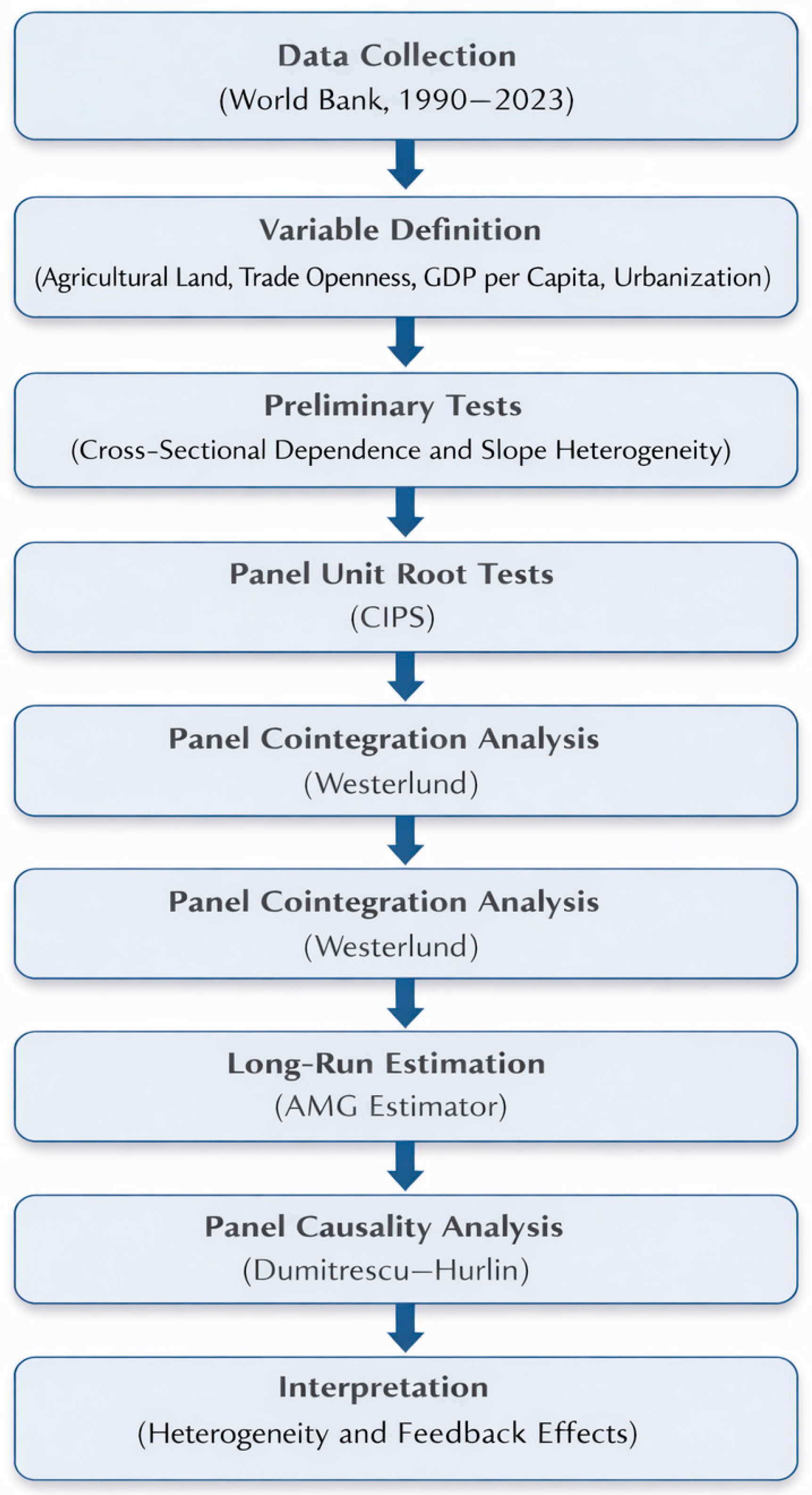
To improve transparency and clarify the empirical strategy,
Figure 1 presents a flowchart summarizing the research design and the sequence of econometric procedures employed in the analysis.
Table 2 presents descriptive statistics for the main variables used in the empirical analysis, including agricultural land use, trade openness, income level, urbanization, and CO
2 intensity. The statistics summarize the distributional properties of the variables across the sample of developing economies over the study period.
4. Analysis and Findings
This section reports the empirical findings of the study based on the methodology outlined above. The analysis examines the relationship between trade openness, agricultural land use, and economic development dynamics in the selected developing economies, with results presented in a sequential and transparent manner.
4.1. Cross-Sectional Dependence Test (CD Test)
Before proceeding with unit root testing and long-run estimations, the presence of cross-sectional dependence among the variables is examined. In panels composed of developing economies that are increasingly interconnected through trade flows, urbanization trends, and global environmental pressures, shocks are unlikely to be confined to individual countries. Ignoring such interdependence may result in biased inference. To address this issue, the [
23] cross-sectional dependence (CD) test is employed.
The null hypothesis of the CD test assumes cross-sectional independence, while the alternative hypothesis allows for cross-sectional dependence across panel units. Formally, the hypotheses are defined as follows:
The CD test statistic is constructed based on the average of pairwise correlation coefficients of the residuals across cross-sectional units and asymptotically follows a standard normal distribution under the null hypothesis.
Table 2 reports the results of the [
30] CD test for all variables included in the analysis.
The test results strongly reject the null hypothesis of cross-sectional independence for all variables at conventional significance levels. This indicates that agricultural land use, trade openness, income levels, and urbanization are subject to common shocks and unobserved factors affecting the sample countries simultaneously. The presence of cross-sectional dependence highlights the importance of accounting for global trade dynamics, shared development trajectories, and common environmental pressures. Consequently, the use of second-generation panel econometric methods is warranted in the subsequent stages of the analysis.
4.2. Slope Homogeneity (Heterogeneity) Test
Following the evidence of cross-sectional dependence, the analysis proceeds to examine whether slope coefficients are homogeneous across countries. In panels consisting of economies with different structural characteristics, development levels, and production patterns, assuming homogeneous slope coefficients may lead to misleading conclusions. To address this issue, slope heterogeneity is tested using the procedure proposed by Pesaran and Yamagata [
31].
The null hypothesis of the slope heterogeneity test assumes that slope coefficients are homogeneous across cross-sectional units, while the alternative hypothesis allows for heterogeneity. The hypotheses are formally stated as:
The test is based on standardized statistics that provide both the Delta and adjusted Delta measures, which follow standard normal distribution under the null hypothesis of slope homogeneity.
Table 3 reports the results of the slope heterogeneity test.
The test results strongly reject the null hypothesis of slope homogeneity, indicating that the impact of trade openness, economic development, and urbanization varies across countries. This finding reflects the heterogeneous nature of developing economies and underscores the importance of employing estimation techniques that allow for country-specific slope coefficients. Accordingly, the evidence of slope heterogeneity further supports the use of second-generation panel estimators in the subsequent analysis.
Table 3 reports the results of the cross-sectional dependence (CD) tests for the main variables used in the analysis. The test evaluates whether shocks affecting one country are correlated with shocks in other countries, which is a key consideration for the application of second-generation panel econometric methods.
Table 4 reports the results of the slope heterogeneity tests, which examine whether the estimated slope coefficients differ across countries. Rejecting the null hypothesis of homogeneous slopes indicates the presence of cross-country heterogeneity in the relationships among the variables.
4.3. Panel Unit Root Test (CIPS Test)
Before proceeding to long-run estimations, the stationarity properties of the variables are examined by employing the Cross-Sectionally Augmented IPS (CIPS) unit root test developed by Pesaran [
23]. Given the presence of cross-sectional dependence identified in the previous section, first-generation unit root tests may yield biased results. The CIPS test explicitly accounts for cross-sectional dependence by augmenting standard ADF regressions with cross-sectional averages, thereby providing more reliable inference in panels with common shocks.
The null hypothesis of the CIPS test assumes that all cross-sectional units are non-stationary, while the alternative hypothesis allows for stationarity in at least some units. Formally, the hypotheses are defined as:
where
denotes the autoregressive coefficient in the cross-sectionally augmented ADF regression for country
. The CIPS statistics are obtained by averaging individual CADF statistics across cross-sectional units and is compared against critical values provided by Pesaran [
32].
The CIPS unit root test results indicate that agricultural land use, trade openness, and GDP per capita are non-stationary in levels but become stationary after first differencing, implying that these variables are integrated of order one, I(1). Urban population, on the other hand, exhibits stationarity at the 10% significance level after first differencing and is therefore also treated as an I(1) process. Given that the variables share the same order of integration, the presence of a long-run equilibrium relationship among them is examined through panel cointegration analysis. In line with the evidence of cross-sectional dependence and slope heterogeneity identified earlier, the Westerlund and Edgerton [
33] panel cointegration test is employed, as it explicitly accounts for cross-sectional dependence and allows for heterogeneous adjustment dynamics across countries, making it particularly suitable for the structure of the panel used in this study.
Table 5 reports the results of the Cross-Sectionally Augmented IPS (CIPS) panel unit root tests for the main variables. The test accounts for cross-sectional dependence and is used to determine the order of integration of each variable prior to cointegration analysis.
4.4. Panel Cointegration Test
Given that all variables are integrated of order one, the existence of a long-run equilibrium relationship among trade openness, agricultural land use, economic development, and urbanization is examined using panel cointegration analysis. Panel cointegration tests allow for assessing whether non-stationary variables move together in the long run despite short-run deviations. In this study, the Westerlund and Edgerton [
33] panel cointegration test is employed, as it is based on an error-correction framework and explicitly accounts for cross-sectional dependence and heterogeneity across countries.
The Westerlund test examines whether a long-run relationship exists by testing the significance of the error-correction term in country-specific regressions. Unlike residual-based cointegration tests, this approach directly evaluates whether deviations from the long-run equilibrium are corrected over time, making it particularly suitable for panels characterized by heterogeneous adjustment dynamics.
Formally, the hypotheses of the Westerlund cointegration test can be stated as follows:
where
denotes the error-correction coefficient for country
. A statistically significant and negative
indicates the presence of a long run cointegrating relationship, as deviations from equilibrium are corrected over time.
The choice of the Westerlund (2007) [
33] test is motivated by several considerations. First, previous results reveal the presence of cross-sectional dependence, rendering first-generation cointegration tests inappropriate. Second, slope heterogeneity across countries suggests that adjustment speeds toward long-run equilibrium may differ. The Westerlund test accommodates both features by allowing for heterogeneous error-correction dynamics and providing robust inference under cross-sectional dependence.
The Westerlund cointegration test results reject the null hypothesis of no cointegration based on both the group-mean statistic (Gt) and the panel statistic (Pt) when robust
p-values are considered. This finding provides strong evidence of a long-run equilibrium relationship between agricultural land use, trade openness, economic development, and urbanization in the panel. In substantive terms, the results suggest that changes in trade integration and income levels are systematically associated with long-run adjustments in agricultural land allocation, while urbanization captures the structural transformation processes accompanying economic development. The joint significance of these variables indicates that agricultural land use does not evolve independently but is shaped by persistent interactions between openness to international markets, growth dynamics, and demographic shifts toward urban areas. The significance of the group-mean statistic further implies that, although the long-run relationship holds at the panel level, the magnitude and direction of these effects vary across countries, reflecting differences in production structures, development stages, and land use patterns. This heterogeneity is consistent with earlier evidence of slope heterogeneity and motivates the use of estimators that allow for country-specific long-run effects in the subsequent analysis.
Table 6 presents the results of the Westerlund (2007) [
33] error-correction-based panel cointegration tests examining the existence of a long-run equilibrium relationship between agricultural land use, trade openness, economic development, and urbanization.
4.5. Augmented Mean Group Estimator (AMG)
Following the evidence of cointegration among agricultural land use, trade openness, economic development, and urbanization, the analysis proceeds with the estimation of long-run coefficients using the Augmented Mean Group (AMG) estimator developed by Eberhardt and Bond [
34] and Eberhardt and Teal [
35]. Cointegration results indicate the existence of a stable long-run relationship among the variables; however, they do not provide information on the magnitude or direction of long-run effects. The AMG estimator is therefore employed to quantify these long-run relationships while explicitly accounting for cross-sectional dependence and parameter heterogeneity.
The AMG approach is particularly suitable in panels where countries are exposed to common shocks—such as global trade cycles, technological diffusion, or environmental pressures—but respond to these shocks in heterogeneous ways. By augmenting the regression with a common dynamic process, AMG captures unobserved global factors that simultaneously affect all countries, while allowing slope coefficients to vary across cross-sectional units. This feature is especially relevant for the present study, given earlier evidence of cross-sectional dependence and slope heterogeneity.
Formally, the long-run relationship can be expressed as:
where
denotes agricultural land use,
is a vector of explanatory variables including trade openness, GDP per capita, and urban population,
represents the unobserved common dynamic process, and
is the idiosyncratic error term. The coefficients
are allowed to differ across countries, reflecting heterogeneous long-run effects.
The AMG estimator first identifies the common dynamic process and then estimates country-specific long-run coefficients, which are subsequently averaged to obtain panel-level estimates. Implicitly, the AMG framework tests whether long-run relationships exist after controlling for common shocks and allows these relationships to vary across countries. This makes AMG a natural extension of the cointegration analysis and an appropriate tool for examining the long-run impact of trade openness and economic development on agricultural land use in heterogeneous panels.
Table 7 reports the long-run coefficient estimates obtained from the Augmented Mean Group (AMG) estimator, examining the long-term effects of trade openness, economic development, and urbanization on agricultural land use in developing economies.
The AMG estimation results provide insights into the long-run relationships identified by the cointegration analysis. Consistent with the Westerlund test findings, the results confirm that agricultural land use is linked to trade openness, economic development, and urbanization through a stable long-run relationship, although the average effects across countries are heterogeneous. The coefficient of trade openness is positive but statistically insignificant, suggesting that, on average, greater integration into international trade does not lead to a uniform expansion or contraction of agricultural land across the sample. This finding reflects the fact that trade openness may operate through different channels across countries, depending on sectoral specialization, export composition, and domestic land use policies.
Similarly, the estimated coefficient for GDP per capita is positive but not statistically significant at conventional levels, indicating that income growth does not exert a homogeneous long-run effect on agricultural land use across developing economies. This result is consistent with the notion that economic development may simultaneously generate forces that expand agricultural activity in some countries while promoting structural transformation and land reallocation toward non-agricultural uses in others. Urban population exhibits a positive long-run association with agricultural land use, although the effect is not statistically significant at the panel average. This outcome suggests that urbanization-related pressures on land use differ markedly across countries, reflecting variations in demographic dynamics, land management practices, and the spatial organization of economic activity.
Importantly, the statistical significance of the common dynamic process highlights the role of global shocks and unobserved common factors—such as international commodity prices, global trade cycles, and technological changes—in shaping long-run agricultural land dynamics. Taken together, these results indicate that while a long-run equilibrium relationship exists at the panel level, as evidenced by the cointegration analysis, the magnitude and direction of long-run effects vary substantially across countries. This heterogeneity underscores the importance of examining country-specific long-run coefficients and cautions against drawing uniform policy conclusions based solely on average panel estimates.
Country-Specific Long-Run Effects
Although the Westerlund cointegration test confirms the existence of a long-run equilibrium relationship between agricultural land use, trade openness, economic development, and urbanization, the earlier evidence of slope heterogeneity suggests that long-run effects are unlikely to be uniform across countries. To quantify these effects, long-run coefficients are estimated using the Augmented Mean Group (AMG) estimator. The AMG framework allows slope coefficients to vary across countries while controlling unobserved common shocks through a common dynamic process. Panel-average estimates are first reported to provide an overall picture, followed by an examination of cross-country heterogeneity.
Table 8 presents the long-run panel-average estimates obtained from the Augmented Mean Group (AMG) estimator, assessing the effects of trade openness, economic development, and urbanization on agricultural land use in developing economies.
The panel-average AMG estimates indicate that trade openness, GDP per capita, and urban population do not exert statistically significant long-run effects on agricultural land use when averaged across countries. This result does not contradict the cointegration evidence; rather, it reflects substantial heterogeneity in long-run adjustment paths across developing economies. The statistically significant common dynamic process highlights the role of global shocks—such as international commodity price movements, global trade cycles, and technological change—in shaping long-run agricultural land dynamics across countries.
To further explore the nature of this heterogeneity, country-specific AMG coefficients are summarized according to their sign and statistical significance.
The summary table reveals pronounced heterogeneity in long-run effects across countries. Trade openness is associated with agricultural land expansion in several economies, while in others it contributes to land contraction, reflecting differences in export composition, comparative advantage, and land use regulation. Economic development also displays mixed long-run effects, suggesting that income growth may either support agricultural expansion or accelerate structural transformation away from agriculture. Urban population exhibits the most heterogeneous pattern, indicating that urbanization may place pressure on agricultural land in some countries while coexisting with land expansion in others due to differences in spatial planning and demographic dynamics.
Overall, these findings demonstrate that while a stable long-run relationship exists at the panel level, the impact of trade openness, economic development, and urbanization on agricultural land use is highly country-specific. This heterogeneity underscores the importance of context-sensitive policy approaches and cautions against uniform land use or trade policy prescriptions across developing economies.
4.6. Robustness Checks: Endogeneity and Multicollinearity Diagnostics
To assess the reliability of the long-run estimates obtained from the AMG estimator, a set of robust checks is conducted. Although the AMG approach explicitly accounts for cross-sectional dependence and slope heterogeneity, additional diagnostics are required to examine potential endogeneity and multicollinearity issues among the explanatory variables. Accordingly, robustness is evaluated through formal endogeneity testing using the Durbin–Wu–Hausman (DWH) test and by examining variance inflation factors (VIF) to assess the extent of multicollinearity. Together, these tests ensure that the estimated long-run relationships are not driven by reverse causality or unstable regressor correlations.
4.6.1. Endogeneity Test: Durbin–Wu–Hausman (DWH)
Although the AMG estimator accounts for cross-sectional dependence and heterogeneous slope coefficients, the possibility of endogeneity among the explanatory variables cannot be ruled out a priori. Trade openness, economic development, and urbanization may be jointly determined with agricultural land use, giving rise to potential reverse causality or omitted variable bias. To formally assess whether endogeneity poses a concern for the estimated long-run relationships, the Durbin–Wu–Hausman (DWH) test is employed [
36,
37,
38].
The DWH test examines whether the explanatory variables are correlated with the error term by comparing estimates obtained under the assumption of exogeneity with those obtained when endogeneity is allowed. The null hypothesis states that the regressors are exogenous, while the alternative hypothesis indicates the presence of endogeneity. Formally, the hypotheses can be expressed as:
Under the null hypothesis, both estimators are consistent, whereas under the alternative hypothesis only the instrumental variable estimator remains consistent. A failure to reject the null hypothesis implies that endogeneity is not a serious concern and that the long-run estimates obtained from the AMG model can be interpreted as reliable.
In the context of this study, the DWH test provides an additional layer of validation by assessing whether the estimated effects of trade openness, GDP per capita, and urban population on agricultural land use are driven by endogenous feedback mechanisms. The test results are reported in
Table 9. This table summarizes the direction and statistical significance of country-specific long-run coefficients obtained from the Augmented Mean Group (AMG) estimator, highlighting cross-country heterogeneity in the effects of trade openness, economic development, and urbanization on agricultural land use.
Table 10 reports the results of the Durbin–Wu–Hausman endogeneity test implemented within a fixed-effects control-function framework to assess whether trade openness is endogenous in the long-run agricultural land use equation.
The coefficient of the residual term is statistically insignificant, indicating that trade openness is exogenous with respect to agricultural land use. This finding suggests that reverse causality or omitted variable bias does not materially affect the estimated relationship. Therefore, the long-run AMG estimates can be interpreted as reliable and not driven by endogeneity concerns.
4.6.2. Multicollinearity Test (Variance Inflation Factors—VIF)
In addition to endogeneity concerns, the reliability of the estimated coefficients may be affected by multicollinearity among the explanatory variables. Trade openness, economic development, and urbanization are conceptually related variables and may exhibit a high degree of correlation, potentially inflate standard errors and obscure individual effects. To assess whether multicollinearity constitutes a serious concern in the estimated models, variance inflation factors (VIF) are computed. As a commonly accepted rule of thumb, VIF values below 10 indicate that multicollinearity is unlikely to distort the estimation results [
39].
The VIF values for all explanatory variables are well below the commonly accepted threshold of 10, indicating that multicollinearity does not pose a serious problem in the estimated models. Therefore, the estimated coefficients can be interpreted without concern that collinearity among regressors inflates standard errors or distorts inference.
4.7. Panel Causality Analysis
While the cointegration and AMG results provide evidence on the existence and magnitude of long-run relationships, they do not reveal the direction of causality among the variables. To further examine the dynamic interactions between agricultural land use, trade openness, economic development, and urbanization, panel causality analysis is conducted. Identifying causal directions is particularly important for policy interpretation, as it allows distinguishing whether changes in trade and structural factors drive land use dynamics or whether land use changes influence economic and trade outcomes.
Given the presence of cross-sectional dependence and slope heterogeneity documented earlier, the Dumitrescu and Hurlin [
40] panel causality test is employed. This approach allows causal relationships to vary across countries while providing a panel-level inference based on the average causal effect. Unlike traditional homogeneous panel causality tests, the Dumitrescu–Hurlin framework is well suited for heterogeneous panels and has been widely applied in studies focusing on developing economies.
The null hypothesis of the test states that there is no Granger causality for any cross-sectional unit, while the alternative hypothesis allows causality to exist for at least a subset of countries. Formally, the hypotheses can be expressed as:
where
and
denote the variables of interest.
In this study, causality is examined between agricultural land use and each explanatory variable, including trade openness, GDP per capita, and urban population. The test results are reported in
Table 11. This table reports Variance Inflation Factor (VIF) statistics used to assess the presence of multicollinearity among the explanatory variables included in the empirical model.
Table 12 presents the results of panel Granger causality tests examining the direction of causal relationships between trade openness, economic development, urbanization, and agricultural land use across the sampled developing economies.
The panel causality results indicate strong bidirectional causal relationships between agricultural land use and trade openness, economic development, and urbanization. These findings suggest that while trade integration, income growth, and demographic changes influence agricultural land allocation, land use dynamics simultaneously feed back into trade performance and broader structural transformation processes. The presence of bidirectional causality highlights the complex and mutually reinforcing interactions between economic integration and land use outcomes in developing economies.
5. Discussion
This study examines the long-run relationship between trade openness, economic development, urbanization, and agricultural land use in developing economies using a comprehensive panel data framework. The findings provide several important insights that contribute to the existing literature on land use dynamics, trade, and structural transformation.
First, the presence of cross-sectional dependence and slope heterogeneity highlights that agricultural land use in developing economies is shaped not only by domestic factors but also by common global shocks and country-specific structural characteristics. This result is consistent with recent studies emphasizing the role of global trade integration, commodity price cycles, and synchronized economic fluctuations in shaping land use outcomes. The heterogeneity of slope coefficients further suggests that the impact of trade openness and structural change on agricultural land use cannot be captured by a single average effect, underscoring the limitations of homogeneous panel estimators in this context.
Second, the evidence of cointegration confirms the existence of a stable long-run equilibrium relationship between agricultural land use, trade openness, income levels, and urbanization. This finding supports theoretical arguments suggesting that land allocation decisions adjust gradually in response to long-term economic incentives rather than short-term fluctuations. In this sense, trade liberalization and structural transformation operate through persistent channels that reshape land use patterns over time, rather than inducing transitory adjustments.
Third, the AMG results reveal substantial cross-country variation in long-run effects. While some countries experience agricultural land expansion associated with increased trade openness, others exhibit land contraction, reflecting differences in export composition, comparative advantage, land endowments, and regulatory frameworks. Similarly, the mixed effects of economic development and urbanization indicate that rising incomes and demographic shifts may either reinforce agricultural land use or accelerate the reallocation of land toward non-agricultural purposes. These findings align with the broader literature on structural transformation, which emphasizes that development trajectories are highly context dependent.
Fourth, robustness checks confirm that the estimated relationships are not driven by endogeneity or multicollinearity. The absence of endogeneity suggests that the observed long-run associations reflect genuine economic mechanisms rather than reverse causality or omitted variable bias. This strengthens the interpretation of the AMG estimates as capturing meaningful long-run relationships between trade integration and land use dynamics.
Finally, the causality analysis uncovers strong bidirectional causal relationships between agricultural land use and trade openness, economic development, and urbanization. This result highlights the existence of feedback mechanisms whereby trade integration and structural change influence land allocation decisions, while land use dynamics simultaneously affect trade performance and broader economic outcomes. Such mutual causality suggests that agricultural land use should be viewed as an active component of the development process rather than a passive outcome of trade and growth.
Taken together, the findings emphasize that agricultural land use in developing economies is embedded in a complex and interdependent system of trade, income growth, and urbanization. Ignoring this interdependence may lead to incomplete or ineffective policy interventions, particularly in the context of trade liberalization and development strategies.
Policy Implications
The empirical findings carry several important policy implications for developing economies pursuing trade-led growth strategies. First, the presence of long-run interdependence and bidirectional causality implies that trade policies cannot be designed in isolation from land use considerations. Trade liberalization that promotes agricultural exports may generate land expansion pressures in some countries, while in others it may accelerate land reallocation away from agriculture. Policymakers should therefore account for country-specific land constraints and production structures when designing trade and export promotion policies.
Second, the heterogeneous effects of economic development and urbanization suggest that structural transformation does not follow a uniform path across developing economies. Urban expansion and income growth may coexist with agricultural land preservation in some contexts, while leading to land scarcity and degradation in others. This underscores the need for integrated land use planning frameworks that coordinate trade, urban development, and agricultural policies rather than treating them as separate domains.
Third, the feedback effects identified in the causality analysis indicate that changes in agricultural land use can influence trade performance and economic outcomes. Policies aimed at protecting or reallocating agricultural land—such as zoning regulations, land tenure reforms, or infrastructure investments—may therefore have unintended consequences for trade competitiveness and growth. A holistic policy approach that recognizes these feedback mechanisms is essential to avoid policy inconsistencies.
Overall, the results suggest that sustainable trade and development strategies in developing economies require a balanced approach that integrates trade openness with long-term land use planning and structural transformation objectives.
6. Conclusions
This study investigates the long-run relationship between trade openness, economic development, urbanization, and agricultural land use in a panel of developing economies over the period 1990–2023. By employing second-generation panel techniques that account for cross-sectional dependence and slope heterogeneity, the analysis provides robust evidence on how trade integration and structural transformation interact with land use dynamics.
The empirical findings demonstrate that agricultural land use is cointegrated with trade openness, income levels, and urbanization, indicating the presence of a stable long-run equilibrium relationship. Long-run estimates obtained from the Augmented Mean Group estimator reveal substantial cross-country heterogeneity, suggesting that the effects of trade and development on agricultural land use vary significantly depending on country-specific characteristics. Robustness checks confirm that these relationships are not driven by endogeneity or multicollinearity, while panel causality analysis uncovers strong bidirectional causal linkages among the variables.
Together, these results highlight that agricultural land use in developing economies is not a passive outcome of trade liberalization and economic growth but an active component of the development process, characterized by long-run interdependence and feedback effects. Ignoring this complexity may lead to incomplete assessments of trade and development policies and their implications for land allocation.
It should be emphasized that the results identify long-run structural interdependence and feedback patterns at the macro level rather than precise causal mechanisms or direct policy transmission channels.
This study contributes to the literature by integrating trade openness and structural transformation into a unified empirical framework for analyzing agricultural land use using heterogeneous panel methods. From a policy perspective, the findings underscore the importance of aligning trade strategies with land use planning and development objectives to achieve sustainable long-run outcomes.
7. Limitations and Future Research Directions
This study is subject to several limitations that should be considered when interpreting the results. First, the operationalization of agricultural land use as a share of total land area captures the structural extent of land allocated to agriculture but does not fully reflect qualitative or intensity-based changes in land use. This aggregate indicator does not differentiate between land use intensity (e.g., variations in yields or input use), land quality dynamics such as degradation or restoration, or shifts across agricultural land categories (cropland, pastures, and permanent crops). As a result, important transformations in land use practices may not be fully captured.
Second, the empirical analysis relies on highly aggregated macro-level indicators of trade openness and economic development. While this approach is appropriate for identifying long-run structural relationships and cross-country heterogeneity, it does not allow for the identification of specific causal mechanisms or policy transmission channels. The findings should therefore be interpreted as evidence of long-run interdependence and feedback patterns rather than precise causal effects.
Third, agricultural land availability and its evolution are also shaped by relatively time-invariant climatic and geographic constraints, such as aridity, soil characteristics, topography, and natural land cover. In countries characterized by deserts, wetlands, boreal forests, or other environmentally constrained landscapes, the share of agricultural land may be limited primarily by natural conditions rather than by urbanization or economic development processes. While the use of heterogeneous panel techniques helps account for cross-country differences, these structural geographic factors may still influence observed land use patterns and should be taken into account when interpreting the results.
Future research could extend the present analysis in several directions. Employing more disaggregated land use indicators, productivity or yield-based measures, soil quality indices, or remote-sensing-based data would allow for a more nuanced assessment of land use dynamics. In addition, incorporating sectoral trade composition, institutional variables, or spatially explicit data could help uncover the mechanisms through which trade openness and development influence land use outcomes. Finally, quasi-causal identification strategies and subnational analyses may provide further insights into the dynamic adjustment processes linking trade, development, and land systems.