Influence of Market and Non-Market Factors on the Growth of Electromobility in Metropolitan, Urban and Rural Regions in the Czech Republic

Abstract
1. Introduction
2. Literature Review
2.1. Factors Considered When Deciding to Purchase an Electric Vehicle

| Factor | Context | Authors/Citations |
|---|---|---|
| Environmental concerns | Consumers who prioritise environmental sustainability are more likely to choose an electric vehicle over a combustion engine vehicle. | [21,22] |
| Economic factors | The high initial cost of electric vehicles is a barrier, but financial incentives (e.g., from the government) can help consumers decide to buy an electric vehicle. | [19,23,24] |
| Technological attributes | Vehicle range and charging time have a significant impact on the adoption of electric vehicles. | [3] |
| Infrastructure availability | Access to charging facilities increases the willingness to purchase electric vehicles. | [22] |
| Social influences | Peer pressure and social norms can help promote electromobility. | [25] |
| Psychological factors | Attitudes and beliefs about electric vehicles significantly influence intentions to purchase an electric vehicle. | [26,27] |
| Demographic factors | Younger consumers with higher incomes are more likely to purchase electric vehicles. | [19,20] |
2.2. Regional Context of Electromobility Development in the Czech Republic
2.3. Research Objectives
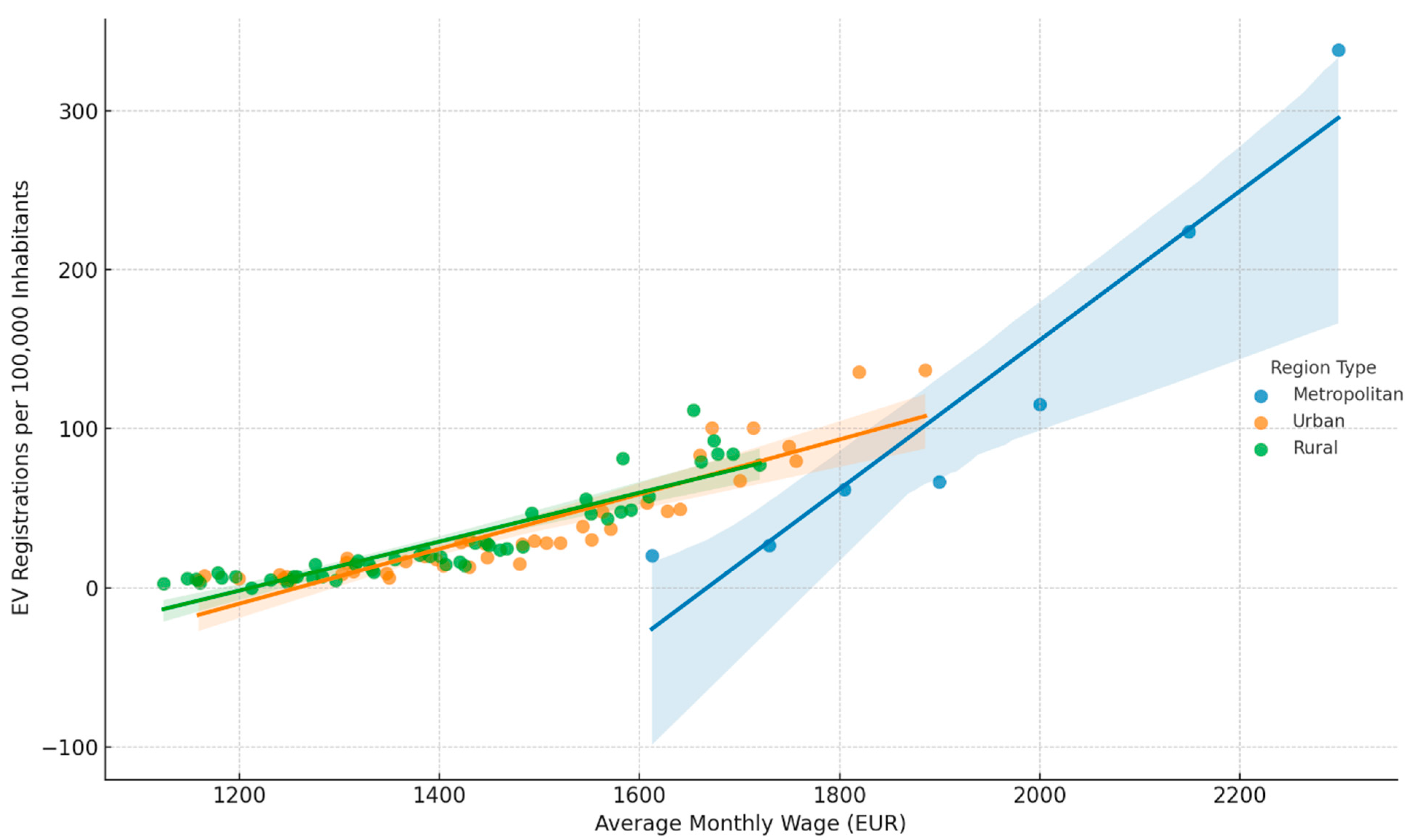
- To assess the impact of average gross wages on the rate of electric vehicle registration in individual regions.
- To assess the role of public charging infrastructure, including the time lag between its construction and its impact on the number of electric vehicle registrations.
- Compare the levels of electromobility adoption between metropolitan, urban and rural regions.
- Identify regions that deviate from expected trajectories and group them according to similarity of development through a cluster analysis.
3. Methodology
3.1. Data Set
3.2. Analytical Workflow (Flow Chart)
4. Results
4.1. Descriptive Overview of the Development of Electromobility
4.2. Research Objective 1: Impact of Wage Levels
4.3. Research Objective 2: Impact of Charging Infrastructure
4.4. Research Objective 3: The Influence of Regional Typology
4.5. Research Objective 4: Regional Deviations from Predicted Development
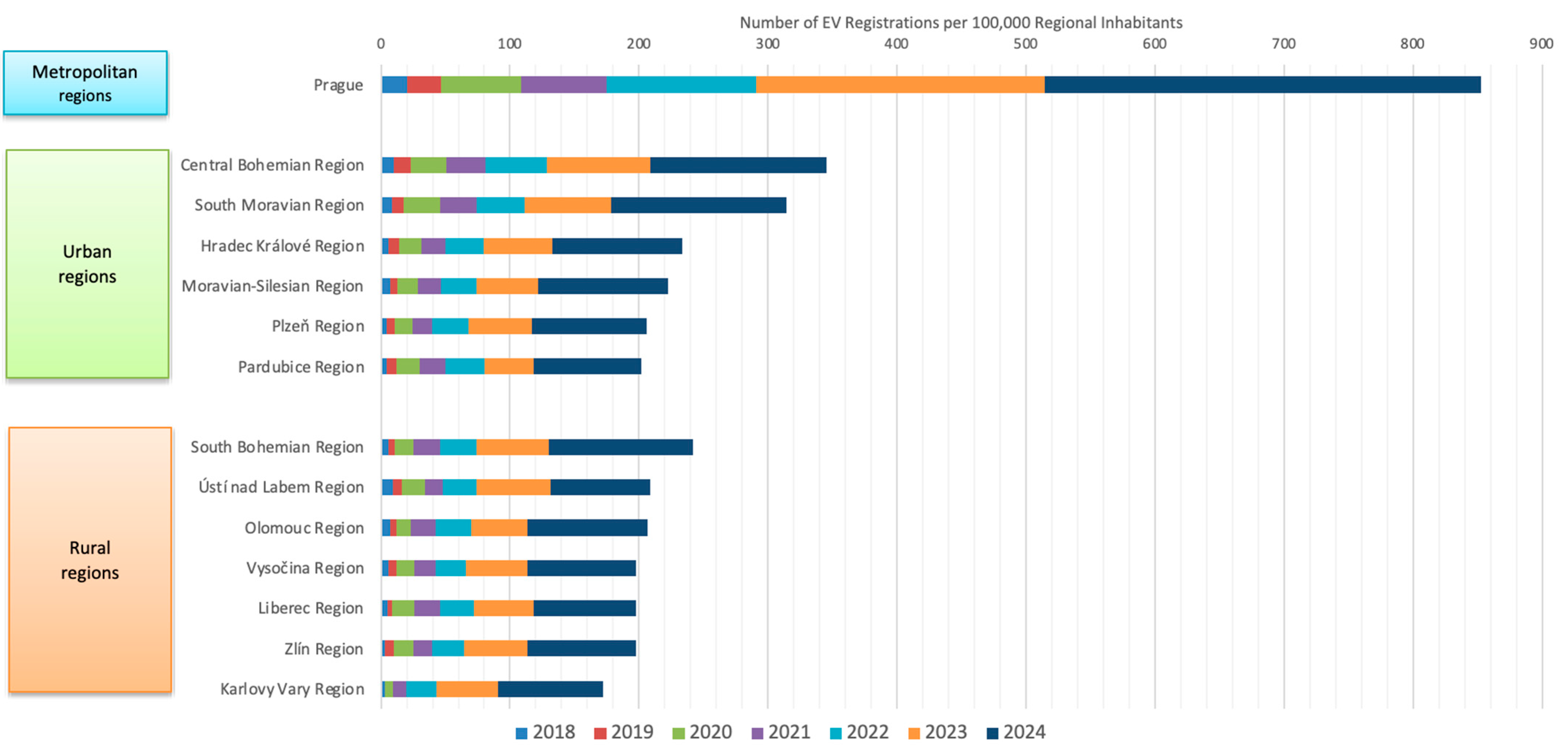
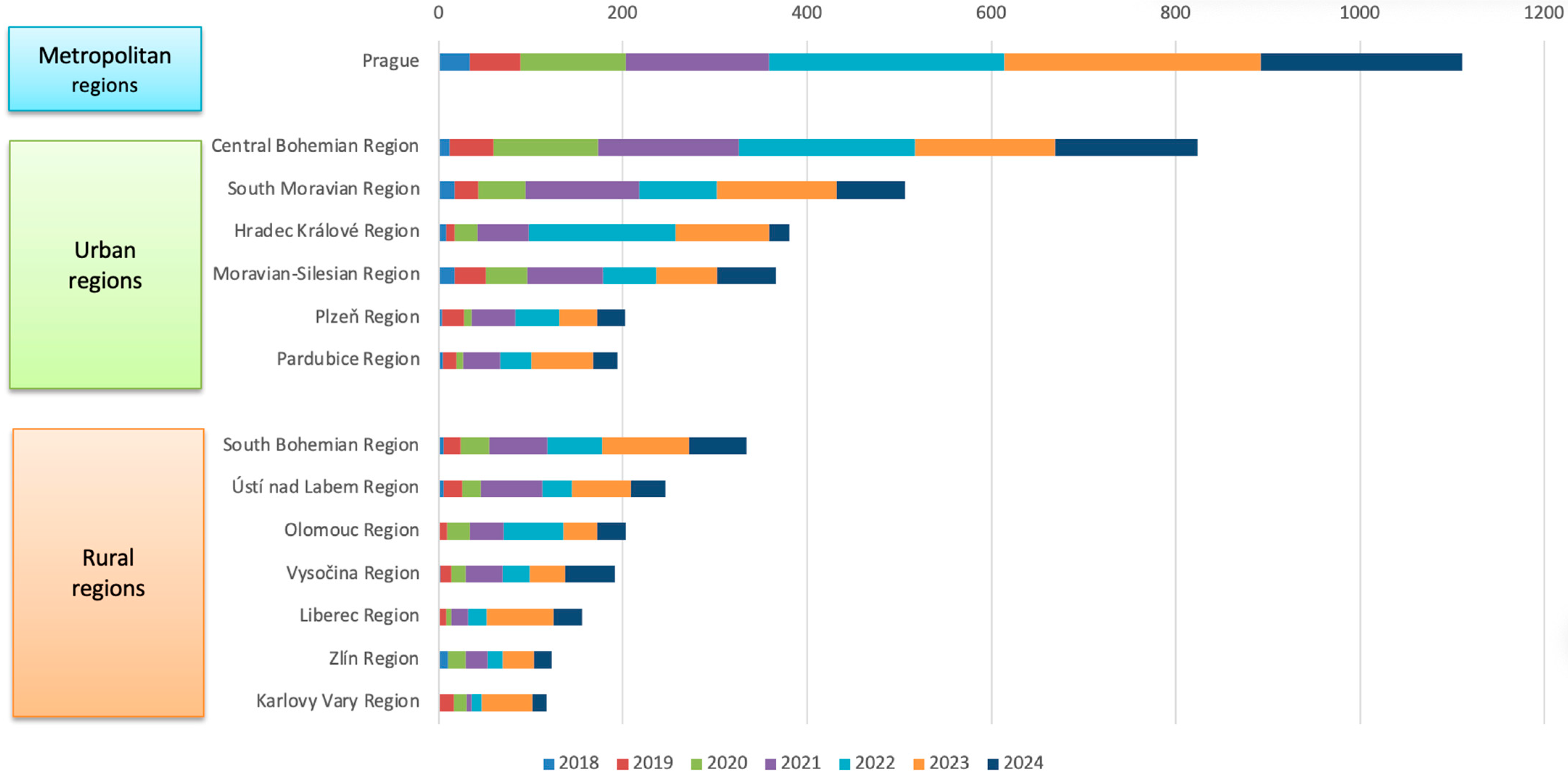
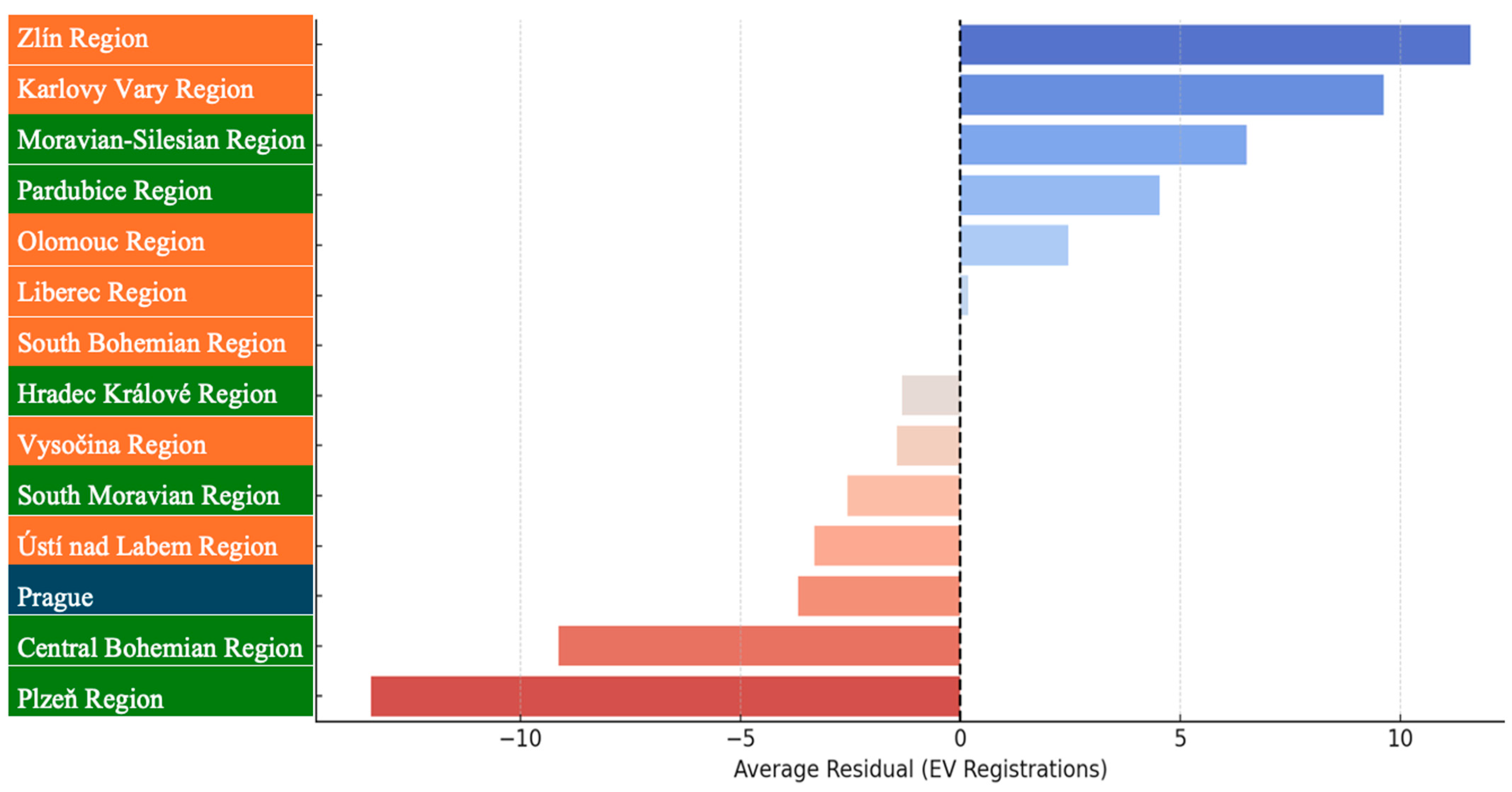
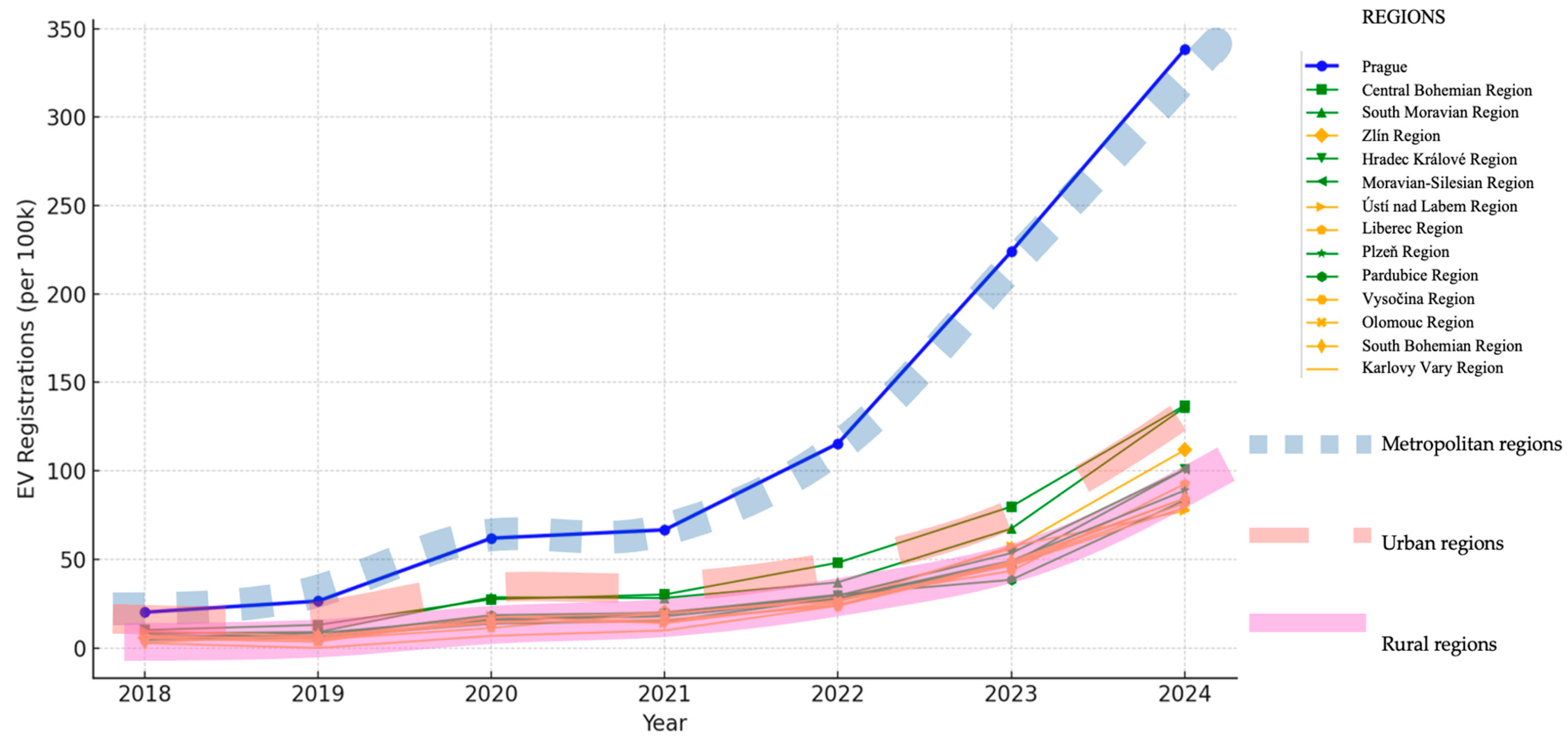
- Cluster 0 (dynamically growing) only includes the capital city of Prague, which is characterised by significantly accelerating growth in electric vehicle registrations, especially after 2021. Prague dominates both in absolute terms and in terms of development dynamics, forming a separate cluster representing the fastest phase of electromobility adoption in the Czech Republic.
- Cluster 1 (moderately growing) consists of the Central Bohemian and South Moravian regions, i.e., urban regions with a significantly above-average but less steep growth trajectory than in the case of metropolitan Prague. Both regions show continuous development of electromobility and can be described as secondary drivers of the transition to alternative fuels.
- Cluster 2 (slow growth) includes all rural regions and some urban regions (e.g., South Bohemia, Hradec Králové, Zlín, Pardubice). These regions show low absolute values and only a slight year-on-year increase in registrations. Although conditions are improving (infrastructure, awareness), the adoption of electromobility remains limited.
5. Discussion
6. Conclusions
Author Contributions
Funding
Institutional Review Board Statement
Informed Consent Statement
Data Availability Statement
Acknowledgments
Conflicts of Interest
Appendix A
Normalised Variables Used in the Empirical Analysis
- Electromobility indicators: number of newly registered electric vehicles per 100,000 inhabitants, public charging infrastructure and its lagged form
- Socio-economic indicators: average gross monthly wage (EUR).
- Regional classification variables: metropolitan, urban and rural region types.
- Derived and normalised values used in Models 1–4, including per-capita and lagged indicators.
| Year | Regions | Average Wage (EUR) | Metropolitan Region Type (DUMMY) | Rural Region Type (DUMMY) | Urban Region Type (DUMMY) | Number of EV Registrations per 100,000 Regional Inhabitants | Number of Charging Points |
|---|---|---|---|---|---|---|---|
| 2018 | Hlavní město Praha | 1612.4 | 1 | 0 | 0 | 20.2 | 34 |
| 2018 | Středočeský kraj | 1314.3 | 0 | 0 | 1 | 10.2 | 12 |
| 2018 | Jihočeský kraj | 1160.9 | 0 | 1 | 0 | 3.1 | 6 |
| 2018 | Plzeňský kraj | 1251.2 | 0 | 0 | 1 | 4.6 | 4 |
| 2018 | Karlovarský kraj | 1124.3 | 0 | 1 | 0 | 2.7 | 0 |
| 2018 | Ústecký kraj | 1178.4 | 0 | 1 | 0 | 9.4 | 6 |
| 2018 | Liberecký kraj | 1196.1 | 0 | 1 | 0 | 7.0 | 0 |
| 2018 | Královéhradecký kraj | 1199.6 | 0 | 1 | 0 | 5.8 | 8 |
| 2018 | Pardubický kraj | 1159.5 | 0 | 1 | 0 | 4.6 | 5 |
| 2018 | Kraj Vysočina | 1182.1 | 0 | 1 | 0 | 6.1 | 2 |
| 2018 | Jihomoravský kraj | 1239.9 | 0 | 0 | 1 | 8.3 | 18 |
| 2018 | Olomoucký kraj | 1156.5 | 0 | 1 | 0 | 5.4 | 0 |
| 2018 | Zlínský kraj | 1147.7 | 0 | 1 | 0 | 5.8 | 10 |
| 2018 | Moravskoslezský kraj | 1164.9 | 0 | 0 | 1 | 7.2 | 18 |
| 2019 | Hlavní město Praha | 1729.4 | 1 | 0 | 0 | 26.4 | 55 |
| 2019 | Středočeský kraj | 1430.0 | 0 | 0 | 1 | 13.0 | 48 |
| 2019 | Jihočeský kraj | 1257.4 | 0 | 1 | 0 | 7.1 | 18 |
| 2019 | Plzeňský kraj | 1350.0 | 0 | 0 | 1 | 6.1 | 24 |
| 2019 | Karlovarský kraj | 1212.0 | 0 | 1 | 0 | 0.0 | 17 |
| 2019 | Ústecký kraj | 1282.7 | 0 | 1 | 0 | 6.8 | 20 |
| 2019 | Liberecký kraj | 1295.9 | 0 | 1 | 0 | 4.7 | 8 |
| 2019 | Královéhradecký kraj | 1302.9 | 0 | 1 | 0 | 8.5 | 10 |
| 2019 | Pardubický kraj | 1247.3 | 0 | 1 | 0 | 7.1 | 14 |
| 2019 | Kraj Vysočina | 1273.0 | 0 | 1 | 0 | 5.9 | 12 |
| 2019 | Jihomoravský kraj | 1347.3 | 0 | 0 | 1 | 9.0 | 25 |
| 2019 | Olomoucký kraj | 1247.6 | 0 | 1 | 0 | 3.5 | 9 |
| 2019 | Zlínský kraj | 1231.3 | 0 | 1 | 0 | 5.0 | 0 |
| 2019 | Moravskoslezský kraj | 1243.8 | 0 | 0 | 1 | 5.7 | 33 |
| 2020 | Hlavní město Praha | 1804.8 | 1 | 0 | 0 | 61.9 | 114 |
| 2020 | Středočeský kraj | 1482.8 | 0 | 0 | 1 | 27.5 | 113 |
| 2020 | Jihočeský kraj | 1316.3 | 0 | 1 | 0 | 14.8 | 31 |
| 2020 | Plzeňský kraj | 1404.1 | 0 | 0 | 1 | 13.7 | 8 |
| 2020 | Karlovarský kraj | 1254.5 | 0 | 1 | 0 | 6.8 | 13 |
| 2020 | Ústecký kraj | 1355.1 | 0 | 1 | 0 | 17.9 | 20 |
| 2020 | Liberecký kraj | 1332.5 | 0 | 1 | 0 | 11.3 | 6 |
| 2020 | Královéhradecký kraj | 1365.9 | 0 | 1 | 0 | 16.7 | 24 |
| 2020 | Pardubický kraj | 1307.4 | 0 | 1 | 0 | 18.6 | 8 |
| 2020 | Kraj Vysočina | 1329.8 | 0 | 1 | 0 | 14.1 | 15 |
| 2020 | Jihomoravský kraj | 1421.7 | 0 | 0 | 1 | 28.6 | 51 |
| 2020 | Olomoucký kraj | 1318.3 | 0 | 1 | 0 | 17.1 | 25 |
| 2020 | Zlínský kraj | 1275.8 | 0 | 1 | 0 | 14.5 | 19 |
| 2020 | Moravskoslezský kraj | 1306.7 | 0 | 0 | 1 | 15.8 | 45 |
| 2021 | Hlavní město Praha | 1899.6 | 1 | 0 | 0 | 66.6 | 156 |
| 2021 | Středočeský kraj | 1552.3 | 0 | 0 | 1 | 30.1 | 153 |
| 2021 | Jihočeský kraj | 1406.3 | 0 | 1 | 0 | 14.6 | 63 |
| 2021 | Plzeňský kraj | 1480.1 | 0 | 0 | 1 | 15.2 | 47 |
| 2021 | Karlovarský kraj | 1334.1 | 0 | 1 | 0 | 9.9 | 6 |
| 2021 | Ústecký kraj | 1425.6 | 0 | 1 | 0 | 13.9 | 67 |
| 2021 | Liberecký kraj | 1390.3 | 0 | 1 | 0 | 19.7 | 18 |
| 2021 | Královéhradecký kraj | 1447.9 | 0 | 1 | 0 | 19.0 | 56 |
| 2021 | Pardubický kraj | 1385.5 | 0 | 1 | 0 | 19.8 | 40 |
| 2021 | Kraj Vysočina | 1420.6 | 0 | 1 | 0 | 16.1 | 41 |
| 2021 | Jihomoravský kraj | 1507.0 | 0 | 0 | 1 | 28.2 | 124 |
| 2021 | Olomoucký kraj | 1401.1 | 0 | 1 | 0 | 19.6 | 37 |
| 2021 | Zlínský kraj | 1380.5 | 0 | 1 | 0 | 20.4 | 24 |
| 2021 | Moravskoslezský kraj | 1396.9 | 0 | 0 | 1 | 17.8 | 83 |
| 2022 | Hlavní město Praha | 1999.9 | 1 | 0 | 0 | 115.4 | 255 |
| 2022 | Středočeský kraj | 1627.7 | 0 | 0 | 1 | 48.1 | 191 |
| 2022 | Jihočeský kraj | 1467.2 | 0 | 1 | 0 | 24.5 | 60 |
| 2022 | Plzeňský kraj | 1521.2 | 0 | 0 | 1 | 28.1 | 48 |
| 2022 | Karlovarský kraj | 1384.4 | 0 | 1 | 0 | 23.8 | 11 |
| 2022 | Ústecký kraj | 1483.3 | 0 | 1 | 0 | 25.9 | 32 |
| 2022 | Liberecký kraj | 1448.0 | 0 | 1 | 0 | 27.6 | 20 |
| 2022 | Královéhradecký kraj | 1494.6 | 0 | 1 | 0 | 29.5 | 159 |
| 2022 | Pardubický kraj | 1429.2 | 0 | 1 | 0 | 30.1 | 34 |
| 2022 | Kraj Vysočina | 1460.7 | 0 | 1 | 0 | 23.7 | 29 |
| 2022 | Jihomoravský kraj | 1571.4 | 0 | 0 | 1 | 37.1 | 84 |
| 2022 | Olomoucký kraj | 1449.8 | 0 | 1 | 0 | 26.4 | 65 |
| 2022 | Zlínský kraj | 1435.4 | 0 | 1 | 0 | 28.1 | 17 |
| 2022 | Moravskoslezský kraj | 1445.1 | 0 | 0 | 1 | 27.7 | 57 |
| 2023 | Hlavní město Praha | 2148.9 | 1 | 0 | 0 | 223.9 | 278 |
| 2023 | Středočeský kraj | 1756.1 | 0 | 0 | 1 | 79.7 | 152 |
| 2023 | Jihočeský kraj | 1591.5 | 0 | 1 | 0 | 49.0 | 94 |
| 2023 | Plzeňský kraj | 1640.4 | 0 | 0 | 1 | 49.2 | 41 |
| 2023 | Karlovarský kraj | 1492.4 | 0 | 1 | 0 | 47.1 | 55 |
| 2023 | Ústecký kraj | 1609.3 | 0 | 1 | 0 | 57.3 | 64 |
| 2023 | Liberecký kraj | 1567.8 | 0 | 1 | 0 | 43.5 | 73 |
| 2023 | Královéhradecký kraj | 1607.3 | 0 | 1 | 0 | 53.5 | 102 |
| 2023 | Pardubický kraj | 1543.1 | 0 | 1 | 0 | 38.4 | 67 |
| 2023 | Kraj Vysočina | 1581.1 | 0 | 1 | 0 | 47.9 | 38 |
| 2023 | Jihomoravský kraj | 1700.3 | 0 | 0 | 1 | 67.3 | 130 |
| 2023 | Olomoucký kraj | 1551.7 | 0 | 1 | 0 | 46.5 | 36 |
| 2023 | Zlínský kraj | 1546.3 | 0 | 1 | 0 | 56.0 | 34 |
| 2023 | Moravskoslezský kraj | 1562.6 | 0 | 0 | 1 | 47.8 | 66 |
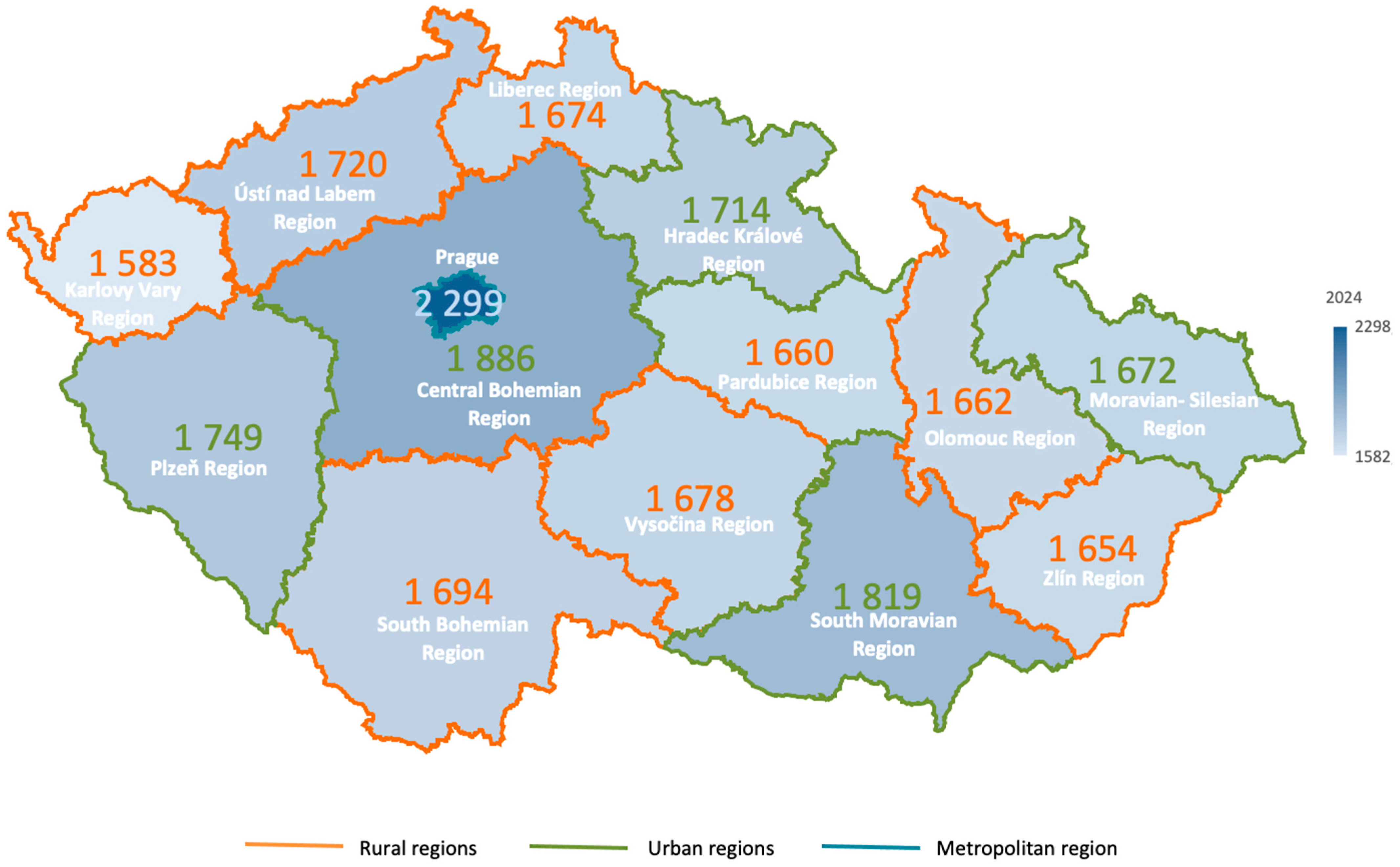
| 2024 | Hlavní město Praha | 2298.5 | 1 | 0 | 0 | 338.2 | 219 |
| 2024 | Středočeský kraj | 1885.6 | 0 | 0 | 1 | 137.0 | 155 |
| 2024 | Jihočeský kraj | 1693.6 | 0 | 1 | 0 | 84.4 | 62 |
| 2024 | Plzeňský kraj | 1749.0 | 0 | 0 | 1 | 88.8 | 30 |
| 2024 | Karlovarský kraj | 1582.9 | 0 | 1 | 0 | 81.5 | 15 |
| 2024 | Ústecký kraj | 1720.2 | 0 | 1 | 0 | 77.3 | 37 |
| 2024 | Liberecký kraj | 1674.3 | 0 | 1 | 0 | 92.5 | 31 |
| 2024 | Královéhradecký kraj | 1714.0 | 0 | 1 | 0 | 100.7 | 22 |
| 2024 | Pardubický kraj | 1660.1 | 0 | 1 | 0 | 83.3 | 26 |
| 2024 | Kraj Vysočina | 1678.2 | 0 | 1 | 0 | 84.2 | 54 |
| 2024 | Jihomoravský kraj | 1819.3 | 0 | 0 | 1 | 135.8 | 74 |
| 2024 | Olomoucký kraj | 1661.8 | 0 | 1 | 0 | 79.3 | 31 |
| 2024 | Zlínský kraj | 1654.1 | 0 | 1 | 0 | 111.7 | 19 |
| 2024 | Moravskoslezský kraj | 1672.2 | 0 | 0 | 1 | 100.6 | 64 |
References
- European Commission. A Clean Planet for All: A European Strategic Long-Term Vision for a Prosperous, Modern, Competitive and Climate Neutral Economy; European Commission: Brussels, Belgium, 2018; Available online: https://eur-lex.europa.eu/legal-content/EN/TXT/PDF/?uri=CELEX:52018DC0773 (accessed on 10 March 2025).
- Lau, Y.H. Comparative Analysis of Gasoline and Electric Vehicles: Economic, Environmental, and Consumer Perspectives. Financ. Econ. 2024, 1, 3. [Google Scholar] [CrossRef] [Scilit]
- Purwanto, E.; Irawan, A.P. The Willingness to Purchase Electric Vehicles: A Comprehensive Review. IOP Conf. Ser. Earth Environ. Sci. 2024, 1324, 012091. [Google Scholar] [CrossRef] [Scilit]
- Desreveaux, A.; Hittinger, E.; Bouscayrol, A.; Castex, E.; Sirbu, G.M. Techno-Economic Comparison of Total Cost of Ownership of Electric and Diesel Vehicles. IEEE Access 2020, 8, 195752–195762. [Google Scholar] [CrossRef] [Scilit]
- Halidah, H.; Dianti, D.V.; Priandana, E.R.; Chandrasa, G.T.; Rianjani, D.A.; Aryono, N.A. Break-Even Analysis of Battery Electric Vehicles and Internal Combustion Engine Vehicles in the Indonesian Market. Evergreen 2024, 11, 2415–2426. [Google Scholar] [CrossRef] [Scilit]
- Horvath, G.C.; Bai, A.; Szegedi, S.; Lázár, I.; Máthé, C.; Huzsvai, L.; Gabnai, Z.; Tóth, T. A comprehensive review of the distinctive tendencies of the diffusion of e-mobility in Central Europe. Energies 2023, 16, 5421. [Google Scholar] [CrossRef] [Scilit]
- Jaderná, E.; Volfová, H.; Zapletal, F.; Velinov, E. Decision Making and Consumer Behaviour Towards Electromobility in the Czech Republic. Rev. De Gestão RGSA 2025, 19, e011820. [Google Scholar] [CrossRef] [Scilit]
- Formánek, T.; Tahal, R. Socio-Demographic Aspects Affecting Individual Stances towards Electric and Hybrid Vehicles in the Czech Republic. Cent. Eur. Bus. Rev. 2020, 9, 78–93. [Google Scholar] [CrossRef] [Scilit]
- Tejedo-Romero, F.; Araujo, J.F.F.E.; Tejada, Á.; Ramírez, Y. E-government mechanisms to enhance the participation of citizens and society: Exploratory analysis through the dimension of municipalities. Technol. Soc. 2022, 70, 101978. [Google Scholar] [CrossRef] [Scilit]
- Guo, W.; Chen, W.; Mao, Y.; Atchike, D.W.; Ahmad, M. Heterogeneous factors influencing electric vehicle acceptance: Application of structural equation modelling. World Electr. Veh. J. 2023, 14, 125. [Google Scholar] [CrossRef] [Scilit]
- Hardman, S. Understanding the impact of recurring and non-financial incentives on plug-in electric vehicle adoption—A review. Transp. Res. Part A Policy Pract. 2019, 119, 1–14. [Google Scholar] [CrossRef] [Scilit]
- Czech Statistical Office. Regional Statistics—Regional Comparisons 2018–2023. 2024. Available online: https://www.czso.cz/ (accessed on 10 March 2025).
- Anthopoulos, L.G. Understanding Smart Cities: A Tool for Smart Government or an Industrial Trick? Springer International Publishing: Cham, Switzerland, 2017. [Google Scholar]
- Hlaváček, P. Small and smart municipalities: The evolving priorities and readiness for smart development. Eur. Urban Reg. Stud. 2025. [Google Scholar] [CrossRef] [Scilit]
- Chawla, U.; Mohnot, R.; Mishra, V. Factors influencing customer preference and adoption of electric vehicles in India: A journey towards more sustainable transportation. Sustainability 2023, 15, 7020. [Google Scholar] [CrossRef] [Scilit]
- Techa-Erawan, T.; Ratisukpimol, W.; Bunditsakulchai, P. The Analysis of Consumer Preference on EV Adoption Barriers and Policy Stimulations in Thailand. Int. J. Energy Econ. Policy 2024, 14, 160–168. [Google Scholar] [CrossRef] [Scilit]
- Illmann, U.; Kluge, J. Public charging infrastructure and the market diffusion of electric vehicles. Transp. Res. Part D Transp. Environ. 2020, 86, 102413. [Google Scholar] [CrossRef] [Scilit]
- Uddin, S.M.F.; Sabir, L.; Kirmani, M.D.; Kautish, P.; Roubaud, D.; Grebinevych, O. Driving change: Understanding consumers’ reasons influencing electric vehicle adoption from the lens of behavioural reasoning theory. J. Environ. Manag. 2024, 369, 122277. [Google Scholar] [CrossRef] [Scilit]
- Bozpolat, C. Estimating the Determinants of Consumers’ Electric Vehicle Purchase Intentions: Empirical Evidence from Turkey. Curr. Res. Soc. Sci. 2024, 10, 177–193. [Google Scholar] [CrossRef] [Scilit]
- Han, H.; Sun, S. Identifying Heterogeneous Willingness to Pay for New Energy Vehicles Attributes: A Discrete Choice Experiment in China. Sustainability 2024, 16, 2949. [Google Scholar] [CrossRef] [Scilit]
- Balcıoğlu, Y.S.; Sezen, B.; İşler, A.U. Evolving preferences in sustainable transportation: A comparative analysis of consumer segments for electric vehicles across Europe. Soc. Responsib. J. 2024, 20, 1664–1696. [Google Scholar] [CrossRef] [Scilit]
- Moradloo, N.; Mahdinia, I.; Khattak, A.J. Charging into the Future: Unravelling the Factors Shaping Electric Vehicle Adoption and Addressing Heterogeneity. SAE Int. J. Sustain. Transp. Energy Environ. Policy 2024, 6, 51–63. [Google Scholar] [CrossRef] [Scilit]
- Pandita, D.; Bhatt, V.; Kumar, V.V.R.; Fatma, A.; Vapiwala, F. Electrifying the future: Analysing the determinants of electric vehicle adoption. Int. J. Energy Sect. Manag. 2024, 18, 1767–1786. [Google Scholar] [CrossRef] [Scilit]
- Wongsunopparat, S. Study of factors influencing consumers to adopt EVs (Electric Vehicles). Bus. Econ. Res. 2023, 13, 155–169. [Google Scholar] [CrossRef] [Scilit]
- Kant, R.; Mehta, B.; Jaiswal, D.; Kumar, A. Adoption intention and willingness to pay for electric vehicles: Role of social-psychological attributes, fiscal incentives and socio-demographics. Manag. Environ. Qual. Int. J. 2024, 35, 945–963. [Google Scholar] [CrossRef] [Scilit]
- Zhao, H.; Furuoka, F.; Rasiah, R. The Influence of Psychological Factors on Consumer Purchase Intention for Electric Vehicles: Case Study from China: Integrating the Necessary Condition Analysis Methodology from the Perspective of Self-Determination Theory. World Electr. Veh. J. 2024, 15, 331. [Google Scholar] [CrossRef] [Scilit]
- Buhmann, K.; Rialp-Criado, J.; Rialp-Criado, A. Predicting Consumer Intention to Adopt Battery Electric Vehicles: Extending the Theory of Planned Behaviour. Sustainability 2024, 16, 1284. [Google Scholar] [CrossRef] [Scilit]
- Hafezi, S.G.; Morimoto, R. How the presence of public charging infrastructure can impact the adoption rate of electric vehicles in the UK. IOP Conf. Ser. Earth Environ. Sci. 2023, 1281, 012071. [Google Scholar] [CrossRef] [Scilit]
- Kumar, M.; Panda, K.P.; Naayagi, R.T.; Thakur, R.; Panda, G. Comprehensive Review of Electric Vehicle Technology and Its Impacts: Detailed Investigation of Charging Infrastructure, Power Management, and Control Techniques. Appl. Sci. 2023, 13, 8919. [Google Scholar] [CrossRef] [Scilit]
- Prasadh, S.H.; Gopalakrishnan, R.; Sathish, S.; Ravichandran, M. Charging Infrastructure for EVs; Informa: London, UK, 2023; pp. 196–213. [Google Scholar] [CrossRef] [Scilit]
- Etukudoh, E.A.; Hamdan, A.; Ilojianya, V.I.; Daudu, C.D.; Fabuyide, A. Electric vehicle charging infrastructure: A comparative review in Canada, the USA, and Africa. Eng. Sci. Technol. J. 2024, 5, 245–258. [Google Scholar] [CrossRef] [Scilit]
- Xu, W.; Li, J.; Harris, I.; Wells, P.; Foxall, G.R. Impacts of Consumers’ Heterogeneity in Decision-Making on Electric Vehicle Adoption: An Integrated Model. Sustainability 2025, 17, 4981. [Google Scholar] [CrossRef] [Scilit]
- Sultana, N. Interrogating Variables Affecting Consumers’ EV Purchasing Decision. Master’s Thesis, Toronto Metropolitan University, Toronto, ON, Canada, 2015. [Google Scholar] [CrossRef] [Scilit]
- Badiei, Y.; Campos do Prado, J. Advancing Rural Electrification through Community-Based EV Charging Stations: Opportunities and Challenges. In Proceedings of the 2023 IEEE Rural Electric Power Conference (REPC), Cleveland, OH, USA, 25–28 April 2023; pp. 69–73. [Google Scholar] [CrossRef] [Scilit]
- Bernard, M.J. Using Nationwide Personal Transportation Survey Data To Indicate Electric Vehicle Market Potential in Rural Areas. Transp. Res. Rec. 1996, 1537, 70–73. [Google Scholar] [CrossRef]
- Möller, C.; Faulstich, M.; Rosenberger, S. Urban-rural relations in renewable electric energy supply—The case of a German energy region. Int. J. Sustain. Energy Plan. Manag. 2019, 21, 93–110. [Google Scholar] [CrossRef]
- Sudhoff, R.; Schreck, S.; Thiem, S.; Niessen, S. Achieving grid-friendly operation of renewable energy communities through smart usage of electric vehicle charging and flexibilities. CIRED Porto Workshop 2022: E-Mobility and Power Distribution Systems. IET Conf. Proc. 2022, 2022, 103–107. [Google Scholar] [CrossRef] [Scilit]
- Fournier, G.; Baumann, M.; Gasde, J.; Kilian-Yasin, K. Innovative mobility in rural areas—The case of the Black Forest. Int. J. Automot. Technol. Manag. 2018, 18, 247–269. [Google Scholar] [CrossRef] [Scilit]
- International Energy Agency (IEA). Global EV Data Explorer; IEA: Paris, France, 2024. Available online: https://www.iea.org/data-and-statistics/data-tools/global-ev-data-explorer (accessed on 10 March 2025).
- World Bank. World Development Indicators: Population, Total; The World Bank Group: Washington, DC, USA, 2024. Available online: https://data.worldbank.org/indicator/SP.POP.TOTL (accessed on 10 March 2025).
- International Energy Agency (IEA). Global EV Outlook 2024; IEA: Paris, France, 2024. Available online: https://www.iea.org/reports/global-ev-outlook-2024 (accessed on 10 March 2025).
- Lee, J.; Hardman, S.; Tal, G. Exploring the impact of charging infrastructure on plug-in electric vehicle adoption in metropolitan areas. Energy Policy 2022, 160, 112674. [Google Scholar] [CrossRef] [Scilit]


| Country | EV Sales 2024 (Units) | Population (Million) | EV per 100,000 Inhabitants |
|---|---|---|---|
| Czech Republic | 16,500 | 10.9 | 1514 |
| Turkey | 105,000 | 86.3 | 1216 |
| United Kingdom | 540,000 | 67.6 | 7983 |
| United States | 1,700,000 | 333 | 5106 |
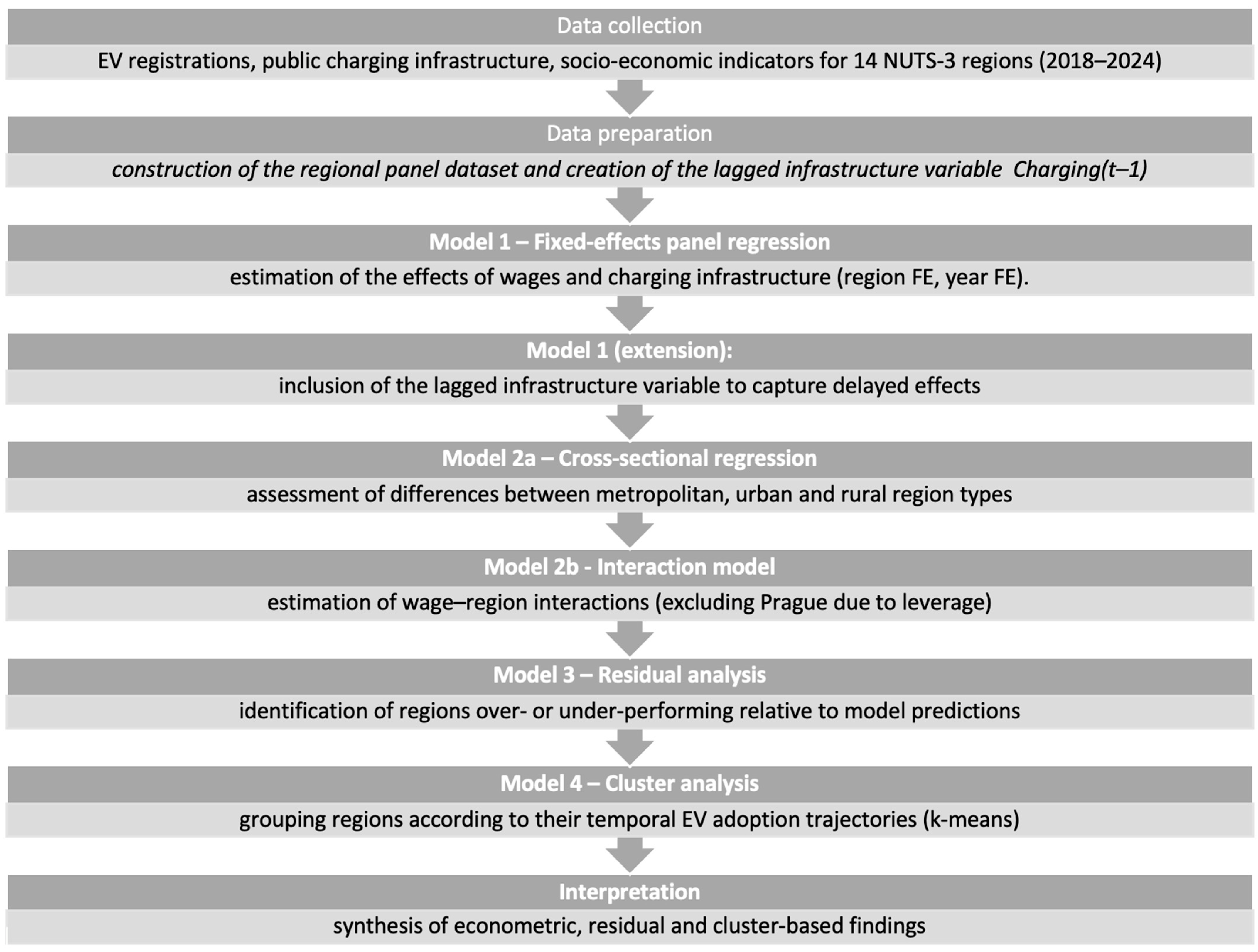
| Model | Name | Dependent Variable | Independent Variables | Method | Specificity/Purpose |
|---|---|---|---|---|---|
| Model 1 | Panel regression (FE) | EVs per 100,000 inhabitants | Wage, Charging | Fixed effects (FE + lag) | Main model—income, infrastructure incl. lag (research objectives |
| Model 2 | Regression by region type | EVs per 100,000 inhabitants | Metro, Rural (dummy) | OLS | Excluding Prague, test of the influence of region typology (research objective 3) |
| Model 3 | Residual analysis | Residuals from Model 1 | Not applicable (residual-based analysis) | Averaging | Detection of regions with positive/negative deviation from model expectations (objective 4) |
| Model 4 | K-means cluster analysis | EVs over time (panel) | EVs over time by region | K-means clustering | Group typology of regions according to registration trends (Objective 4) |
| Indicator | Designation | Unit | Period | Data Source |
|---|---|---|---|---|
| Number of new electric vehicle registrations | ev_registr | number/100,000 inhabitants | 2018–2024 | Clean Transport |
| Average gross monthly wage | wage | EUR | 2018–2024 | Czech Statistical Office |
| Number of public charging stations | charging | number | 2018–2024 | Clean Transport |
| Delayed infrastructure (t − 1) | charging_t-1 | number | 2018–2024 | Own calculation |
| Gross domestic product per capita | gdp | EUR | 2018–2024 | Czech Statistical Office |
| Dummy variable: urban region | urban_dummy | 0/1 | static | Own calculation |
| Dummy variable: rural region | rural_dummy | 0/1 | static | Own calculation |
| Interaction wage × urban | wage*urban | — | 2018–2024 | Own calculation |
| Interaction wage × rural | wage*rural | — | 2018–2024 | Own calculation |
| Region type (category: metropolitan/urban/rural) | region_type | category | static | Own calculation |
| Variable | Mean | Std. Dev. | Min | Max | Unit |
|---|---|---|---|---|---|
| Average wage | ~1470 | ~250 | 1100 | 2300 | EUR |
| EV registrations per 100,000 inhabitants | ~38 | ~45 | 0 | 338 | cars/100 k |
| Charging points | ~55 | ~65 | 0 | 278 | units |
| Charging points (t − 1) | ~45 | ~55 | 0 | 255 | units |
| Observations | 98 | – | – | – | – |
Disclaimer/Publisher’s Note: The statements, opinions and data contained in all publications are solely those of the individual author(s) and contributor(s) and not of MDPI and/or the editor(s). MDPI and/or the editor(s) disclaim responsibility for any injury to people or property resulting from any ideas, methods, instructions or products referred to in the content. |
© 2025 by the authors. Licensee MDPI, Basel, Switzerland. This article is an open access article distributed under the terms and conditions of the Creative Commons Attribution (CC BY) license.
Share and Cite
Nedvěd, J.; Hlaváček, P.; Domín, M. Influence of Market and Non-Market Factors on the Growth of Electromobility in Metropolitan, Urban and Rural Regions in the Czech Republic. Urban Sci. 2026, 10, 9. https://doi.org/10.3390/urbansci10010009
Nedvěd J, Hlaváček P, Domín M. Influence of Market and Non-Market Factors on the Growth of Electromobility in Metropolitan, Urban and Rural Regions in the Czech Republic. Urban Science. 2026; 10(1):9. https://doi.org/10.3390/urbansci10010009
Chicago/Turabian StyleNedvěd, Jiří, Petr Hlaváček, and Martin Domín. 2026. "Influence of Market and Non-Market Factors on the Growth of Electromobility in Metropolitan, Urban and Rural Regions in the Czech Republic" Urban Science 10, no. 1: 9. https://doi.org/10.3390/urbansci10010009
APA StyleNedvěd, J., Hlaváček, P., & Domín, M. (2026). Influence of Market and Non-Market Factors on the Growth of Electromobility in Metropolitan, Urban and Rural Regions in the Czech Republic. Urban Science, 10(1), 9. https://doi.org/10.3390/urbansci10010009