
Article

Heavy Metal Pollution and Health Risk Assessments of Urban Dust in Downtown Murcia, Spain

by
Ángeles Gallegos
1,
Francisco Bautista
1,*,
Pura Marín-Sanleandro
2,
Elvira Díaz-Pereira
3,
Antonio Sánchez-Navarro
2,
María José Delgado-Iniesta
2,
Miriam Romero
2,
María-Felicidad Bógalo
4 and
Avto Goguitchaichvili
5,*
1
Laboratorio Universitario de Geofísica Ambiental, Centro de Investigaciones en Geografía Ambiental, Universidad Nacional Autónoma de México, Morelia 58190, Michoacán, Mexico
2
Departamento de Química Agrícola, Geología y Edafología, Facultad de Química, Universidad de Murcia, 30100 Murcia, Spain
3
Soil and Water Conservation Group (CEBAS_CSIC), 30100 Murcia, Spain
4
Departamento de Física, Universidad de Burgos, Escuela Politécnica Superior, Avda. Cantabria s/n, 09006 Burgos, Spain
5
Laboratorio Universitario de Geofísica Ambiental, Instituto de Geofísica, Universidad Nacional Autónoma de México, Morelia 58190, Michoacán, Mexico
*
Authors to whom correspondence should be addressed.
Urban Sci. 2026, 10(1), 46; https://doi.org/10.3390/urbansci10010046

Submission received: 25 October 2025 / Revised: 5 January 2026 / Accepted: 7 January 2026 / Published: 12 January 2026

Abstract

Around eight million people—mainly in cities—die prematurely from pollution-related diseases; thus, studies of urban dust have become increasingly relevant over the last two decades. In this study, an assessment of heavy metal and metalloid contamination in urban dust was conducted in downtown Murcia, Spain. The objectives were to evaluate the level of contamination and the associated health risks, both with a spatially explicit focus. One hundred and twenty-eight urban dust samples were collected, each from a 1-square-meter area, using plastic tools to prevent contamination. The dust was dried and weighed, then acid-digested before analysis via inductively coupled plasma mass spectrometry. Corresponding maps were then generated using a geographic information system. The elements analyzed in the urban dust (with their median concentrations, given in mg/kg) were As (2.14), Bi (14.06), Cd (0.38), Co (1.88), Cr (71.17), Cu (142.60), Fe (13,752), Mn (316.64), Mo (3.90), Ni (21.94), Pb (106.27), Sb (6.54), Se (4.34), Sr (488.08), V (28.05), and Zn (357.33). The sequence of median concentrations for the analyzed elements was Fe > Sr > Zn > Mn > Cu > Pb > Cr > V > Ni > Bi > Sb > Se > Mo > As > Co > Cd. The pollution assessment reveals that the city is moderately polluted. Using local background levels, the elements with median values exceeding the threshold for considerable contamination were As, Cu, Pb, Sb, Se, and Zn. Using the global background level, the elements with median values exceeding the threshold for considerable contamination were Bi, Cu, Mo, Pb, Sb, Se, and Zn. The median value of the sum of the hazard index (1.82) indicates a risk to children’s health. The hazard index revealed that 43% of the sites pose a relative risk to children. In contrast to previous global studies, the present research provides a multi-scale assessment of urban pollution and health risks. Pollution is evaluated by metal, city, zone, and site, while health risks are assessed by metal, city, and site. We recommend a strategy for both local authorities and residents.

1. Introduction

The United Nations reports that urban land use is the preferred option for the world’s population; while 70% of the world’s population lives in cities, in some regions, this figure exceeds 90%. On the other hand, the World Health Organization has reported that around 8 million people die prematurely due to pollution-related diseases [1].
Governments most often address air and soil pollution in urban environments, but environmental regulations for urban dust have been ignored. Urban dust is a mix of natural particles (soils, rocks) and various pollutants derived from anthropogenic activities, including organic particles (microplastics), pathogenic microorganisms (bacteria, viruses, and fungi), and inorganic particles containing heavy metals [2].
As heavy metals cause many health problems, related studies have been carried out in various parts of the world over the last decade [3,4]. Urban dust can be hazardous because it can come into contact with people through their skin or via oral ingestion or inhalation [2]. Once inside the human body, heavy metals can be distributed throughout the body (brain, heart, kidneys) by the circulatory system [5,6,7]. The heavy metals contained in urban dust can disperse into other components of the urban ecosystem when their load (amount and concentration) exceeds the soil’s sorption capacity [8], at which point the soil becomes a source rather than a reservoir. Heavy metals from urban dust also damage urban plants and fauna [9,10,11,12] and may pose a risk to urban agriculture [13].
Environmental standards have been established in various countries and cities [14,15]. They include the maximum permissible concentrations of heavy metals in soil and air; however, there are no environmental regulations regarding urban dust in Europe, so the maximum allowable concentrations of pollutants in soil are often used instead.
In a study of soils in the downtown area of Murcia City, Cd, Cu, Pb, and Zn were found in higher concentrations in industrial areas than in soils of natural areas [16]. Studies carried out on urban dust in the city center found higher concentrations of Zn and Pb in areas with greater vehicular traffic [17]; furthermore, in studies carried out in schools, it was revealed that urban dust contained Zn, Cd, and Pb, but with low health risk indices [18]. However, previous studies on soil and urban dust in the area have been limited in scope, examining only a few heavy metals without a spatial approach.
On the other hand, recent studies on cancer cases in the Murcia region of Spain have highlighted the potential impact of urban pollution [19,20,21], underscoring the importance of this research for the scientific community and public health. Even though the city does not appear to have significant pollution issues, it is important to note that heavy metal pollution can lead to more than just cancer; therefore, a broader study of heavy metal pollution that includes a greater number of elements is necessary to identify possible emerging contaminants. Additionally, Murcia is a typical medium-sized European city that, like many of its size, has received little attention in research compared to larger cities, capital cities, or industrial centers. Outdoor life is a particularity of the downtown of Murcia, which makes the study of heavy metal pollution in the streets more relevant.
The majority of studies evaluating urban dust pollution in cities focus on a limited set of heavy metals and employ global assessments. While this approach facilitates intercity comparisons, it fails to identify emerging pollutants and does not provide multi-scale analyses at the city, zone, and site levels [2,7,15,17,18].
The objective of this work was to develop a comprehensive assessment of heavy metal pollution in urban dust in downtown Murcia, using a larger number of sampling sites, a broader range of analyzed elements, health risk analyses for both adults and children, and a spatially explicit approach.

2. Materials and Methods

The study area was downtown Murcia City, a typical example of an average European city with 467,501 inhabitants and an urban center covering more than 3.52 km2. Murcia has a semi-arid Mediterranean climate with an average annual temperature of 18.1 °C and average annual rainfall of 293 mm, with winds that usually blow from the east-southeast in the last months of spring and turn to the west in late autumn, winter, and early spring. Calcisols, Regosols, Fluvisol, and Luvisols predominate according to the WRB [22]. With a traffic density of 105,000 vehicles/week and no industrial zone nearby, environmental pollution is almost exclusively due to vehicular traffic [17].
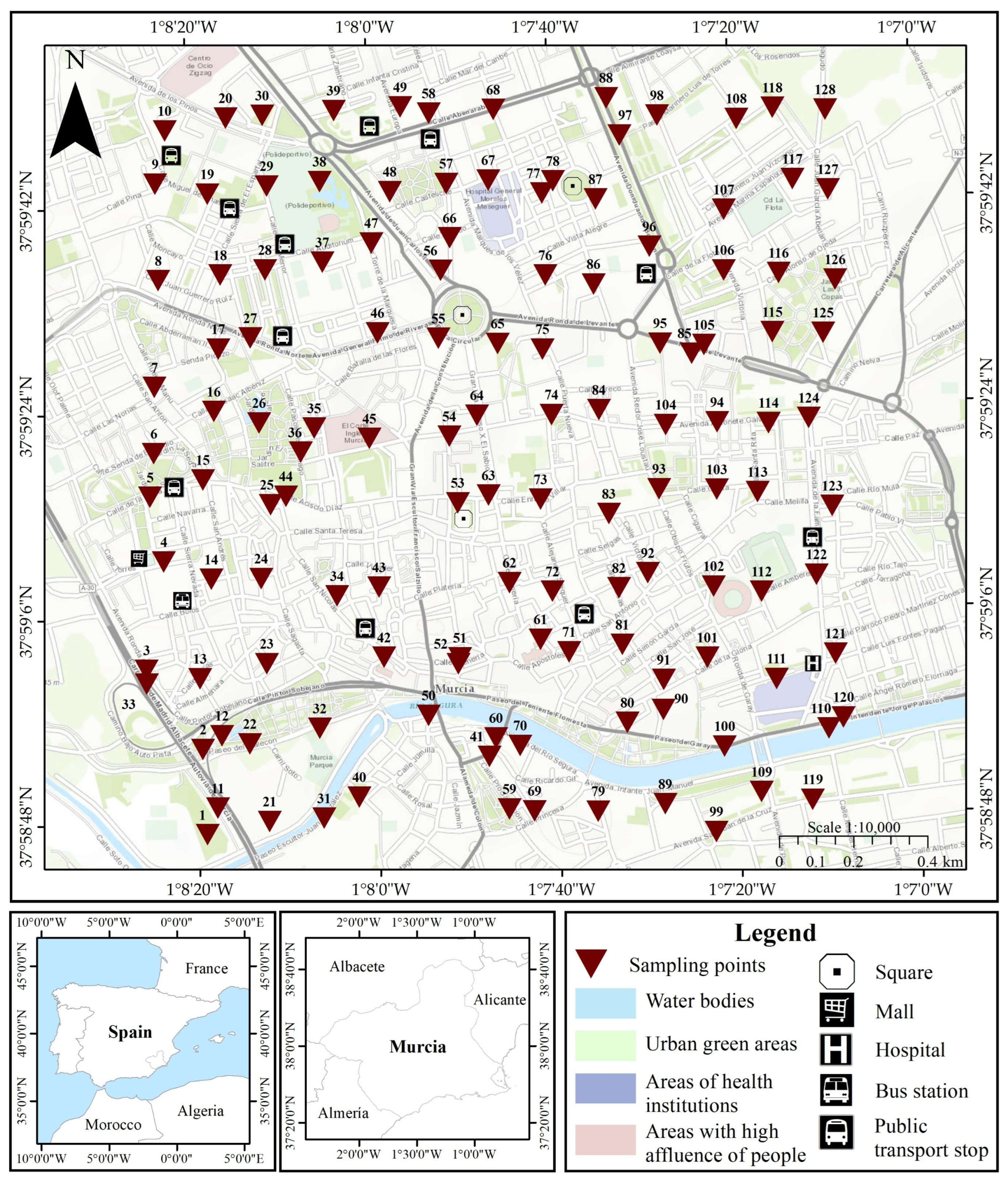
Urban dust sampling was conducted systematically, with 128 samples collected at approximately 115 ± 40 m intervals. However, access to some sites was limited, and samples were collected as close as possible to the ideal location (Figure 1). Sampling took place during the 2016 dry season. Samples were collected from roads and sidewalks in a 1 m2 area using a plastic dustpan and brushes. They dried in the shade and sieved to remove particles larger than 1 mm.

2.1. Chemical and Physical Analyses

The urban dust samples were air-dried and passed through a 50 µm sieve before acid digestion with aqua regia (HNO3/HCl, 1:3) in a microwave oven at 220 °C for 1 h. Subsequently, inductively coupled plasma mass spectrometry (ICP-MS) was used to determine the contents of the following elements: As, Bi, Cd, Co, Cr, Cu, Fe, Mn, Mo, Ni, Pb, Sb, Se, Sr, V, and Zn (total concentrations). Analyses were performed in duplicate. Blank samples and a standard reference material certified for its element content (SRM San Joaquín Soil) were used to provide the baseline metal concentrations. The standard deviation was calculated (2.5–3%) and can be considered satisfactory for environmental analysis.
Urban dust samples were prepared by consolidating 0.4–0.5 g with sodium silicate and packing it into 8 cm3 cubic plastic boxes. The saturation remanent magnetization (SIRM, Am2kg−1) was determined using ASC-Scientific IM-10 (ASC Scientific, Carlsbad, CA, USA) and the RockMagAnalyzer 1.1 software [23] (Earth Reference Data and Models, Munich, Germany). The saturation isothermal remanent magnetization (SIRM) measurements were intended to identify technogenic elements through correlation. These magnetic measurements were made at the Paleomagnetic Laboratory of Burgos University (Spain).

2.2. Data Analyses

Descriptive statistical analyses and Spearman’s correlation analyses of the elemental concentrations of the 16 examined elements were conducted in RStudio version 2024.12.1+563 [24].
The contamination factor (CF) and pollution load index (PLI) were used to assess heavy metal contamination levels. The CF was calculated with the following formula:
CF = Cn/Bn
where Cn is the concentration of an element, and Bn is the corresponding background value. In this research, two background values were used: a local one, the first decile of the frequency distribution for each metal, and a global one, the one reported for soils worldwide [25]. A CF less than 1 indicates insignificant contamination, 1–3 indicates moderate contamination, 3–6 represents considerable contamination, and more than 6 denotes high contamination.
All sites were analyzed for 16 heavy metals, and the contamination factors (CFs) for each element were calculated to indicate the degree of contamination at each site. The pollution load index (PLI) was derived from the CFs of the measured elements and was calculated as
P L I = C F 1 × C F 2 × C F 3 × C F n n
where CF represents the contamination factor, and n represents the number of metals analyzed.
The PLI is straightforward: a value of 0 indicates excellent quality; a value of 1 indicates only baseline levels of pollutants; and values above 1 indicate progressive deterioration of site quality [8].
The ArcGIS 9.0 software (ESRI, Redlands, CA, USA) was used for mapping [26]. We used the UTM projection, horizontal datum ellipsoid, and World Geodetic System 84 to study this scale level.

2.3. Human Health Risk

The methodology developed by the Environmental Protection Agency (EPA) was used to calculate the human health risk posed to the population by heavy metals in urban dust. In the first step, the estimated daily intakes for the three main exposure routes, ingestion (EDIing), inhalation (EDIinh), and dermal contact (EDIdermal), were calculated using Equations (3)–(5). The second step was to calculate the lifetime average daily dose (LADD) using Equation (6). The exposure factors used in this study were those established for reference populations, as shown in Table 1.
E D I i n g = C × I n g R × E F × E D × C F B W × A T
E D I i n h = C × I n h R × E F × E D P E F × B W × A T
E D I d e r m a l = C × S A × A F × A B S × E F × E D × C F B W × A T .
L A D D = C P E F × A T c a n × C R c h i l d × E F c h i l d × E D c h i l d B W c h i l d + C R a d u l t × E F a d u l t × E D a d u l t B W a d u l t
Here, CR is the contact rate (or adsorption rate, depending on the case), with CR = IngR for ingestion, CR = InhR for inhalation, and CR = SA × AF × ABS for dermal contact. The type of CR used for each carcinogenic metal (arsenic, nickel, cadmium, chromium, vanadium, lead, cobalt, mercury, and beryllium) depended on the exposure route.
Risk ratios for ingestion, inhalation, and dermal contact (HQing/inh/derm) were obtained by dividing the EDI by the reference dose (RfD), as shown in Equation (7).
H Q i n g / i n h / d e r m = E D I i n g / i n h / d e r m R f D
The hazard index (HI) represents the sum of the HQs for the three routes of exposure. If the HI is greater than 1, carcinogenic effects on the population’s health are expected; if the HI is less than 1, no carcinogenic effects are expected [27,31].
GHI= HI1 + HI2 + …HIn
GHI is the global hazard index for the site.
Only 11 elements were used to calculate the hazard index, as reference doses were not available for Bi, Fe, Mo, Se, and Sr.

2.4. Particle Size and Shape

Four dust samples were selected. Possible aggregates were disintegrated using an ultrasound bath. No additional chemicals (e.g., HCl and H2O2) that could alter the sample composition or dissolve any components were used during sample preparation.
For microscope analyses, a Euromex StereoBlue Ed. 1802s (Euromex, Arnhem, The Netherlands) binocular microscope equipped with a DEM200 camera (digital eyepiece for microscope, 2M pixels, CMOS chip, driverless (software: MiniSee)) was used.
The morphology and mineralogy of selected urban dust samples were also observed using a scanning electron microscope (SEM). The dust samples were analyzed using an SEM (JEOL JSM-6480LAII, JEOL Co., Tokyo, Japan) equipped with an energy-dispersive X-ray spectrometer (EDS) for chemical analysis. EDS measurements were obtained at 15 kV and 0.4 nA with a working distance of 10 mm. The spectral collection time was 100 s. Data corrections were made via the ZAF method, embedded in the software package of Analysis Station 3.91 developed by JEOL Co., with well-established natural/synthesized materials distributed by JEOL as chemical standards: jadeite (Na), periclase (Mg), corundum (Al), quartz (Si), KTiPO5 (P, K), pyrite (S), NaCl (Cl), wollastonite (Ca), rutile (Ti), eskolaite (Cr), manganosite (Mn), fayalite (Fe), and NiO (Ni). X-ray elemental maps were acquired on the SEM-EDS operated at 15 kV and 1 nA.

3. Results

The median value was used as a reference for central tendency. The sequence of elements with median concentrations, from highest to lowest, was Fe > Sr > Zn > Mn > Cu > Pb > Cr > V > Ni > Bi > Sb > Se > Mo > As > Co > Cd (Table 2). Among these, only Fe is considered a major element because it is more abundant in the Earth’s crust, while the rest are called trace elements due to their low concentrations. However, Sr, Zn, Mn, Cu, and Pb had concentrations in the range of hundreds of mg/kg.
The elements As, Cd, Co, Cr, Cu, Mo, Ni, Pb, Sb, Se, Sr, and Zn had non-Gaussian distributions, with high coefficients of variation, high values for Kurtosis (Leptokurtic) and Asymmetry (positive), and significant differences between their mean and median. A non-Gaussian distribution suggests that these elements originate from anthropogenic sources. On the other hand, elements that showed a Gaussian distribution but had higher coefficients of variation, such as Bi, Fe, Mn, and V, may originate from both natural and anthropogenic sources (Table 2). Fe, Mn, and V are found in automobile emissions, in brake linings, and from tire wear and tear, and have been reported as pollutants and toxins [34,35,36].
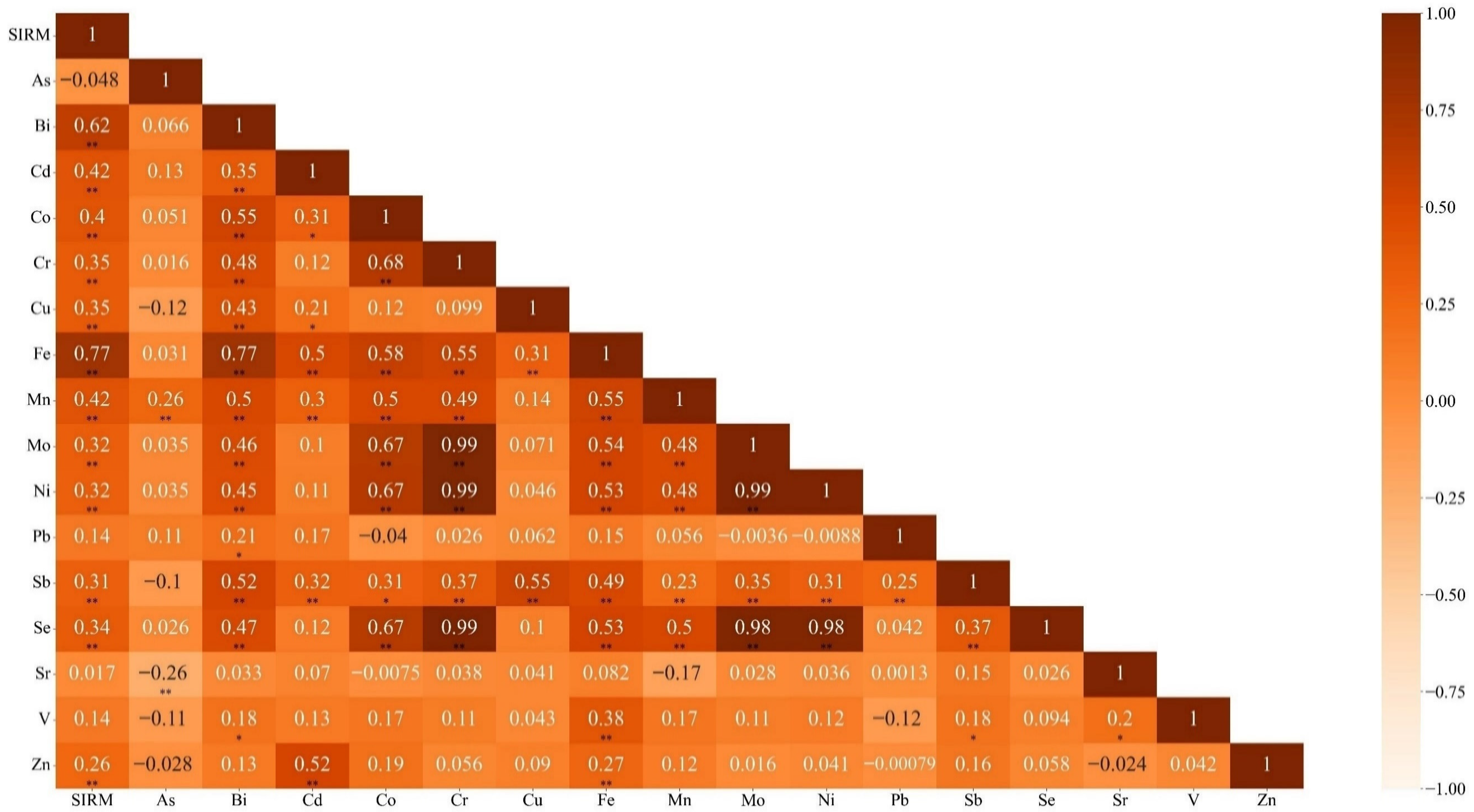
Saturation isothermal remanent magnetization (SIRM) is primarily used to characterize magnetic minerals present in rock, sediment, soil, and urban dust samples. It serves to determine the concentration of magnetic material: the SIRM magnitude is directly proportional to the total amount of magnetic minerals in a sample, allowing their abundance to be quantified. In pollution studies, SIRM serves as an effective indicator of combustion-related pollution, underscoring its importance in environmental monitoring. SIRM positively correlates with the concentrations of Fe, Bi, Cd, Cr, Cu, Mo, Ni, Pb, Sb, and Se (Figure 2); all of these are elements from technological sources, such as industrial emissions, gas and particle emissions from cars, brake pad wear, and the wear and tear of vehicles in general [37]. Other elements, such as As, Co, Mn, Sr, and V, have different origins, with As being of particular concern due to its toxicity. Arsenic is not correlated with any other element.

3.1. Heavy Metal Contamination Levels

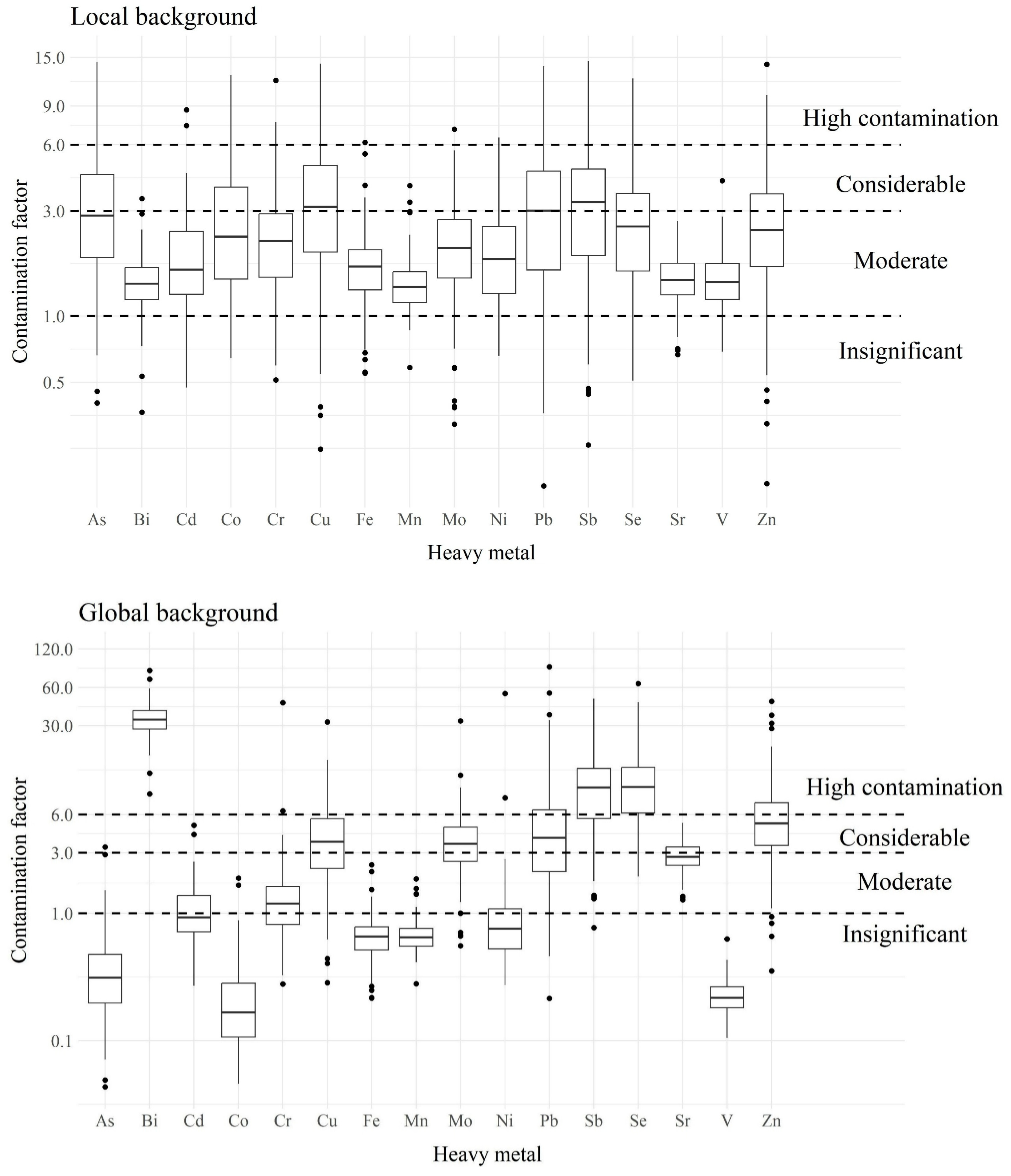
Using the first decile as the background value for urban dust in downtown Murcia City, the median values for Bi, Cd, Cr, Fe, Mn, Mo, Ni, Sr, and V were at the threshold of moderate contamination. As, Cu, Co, Pb, Sb, Se, and Zn showed moderate to considerable contamination, with extreme CF values indicating high contamination.
Cd, Cr, Fe, Mo, Ni, and V had some sites with extreme values (CF > 3; Figure 3). As, Bi, Cd, and Co were not found at 6, 4, 2, and 64 sites, respectively. Mn showed low CF values, indicating no contamination, with only a few extreme values. Co and Mn were not included in Figure 3.
When global background values for soils were considered, the sample sites were non-contaminated with As, Co, Fe, Mn, V, and Ni; moderately contaminated with Cd and Cr; considerably contaminated with Cu and Mo; and highly contaminated with Bi, Sb, and Sr. Pb and Zn were found at considerable to high levels of contamination. At 100% of the sites where Bi was found, CF > 9 indicated greater contamination.
In the case of the PLI, 6.9% and 8.4% of the sample of urban dusts had values greater than 3 for the local and global backgrounds, respectively. However, for the local and global values, only seven and six sites, respectively, showed PLI values of <1.
Using the two background values, local and global, yielded the same outcomes in terms of the median PLI value: 1.90 and 1.96, respectively. However, it is important to break down the components of the PLI to identify the elements associated with contamination issues.
On the other hand, the results of this study show that using the first decile yielded lower contamination levels than using the global background level, as it homogenized variation in contamination factors. However, in areas with cumulative contamination, as occurs in most cities, it is a practical option [15,38]. Using the global background level allowed us to identify elements, such as Bi, Sb, and Se, with naturally occurring or cumulative concentrations that would be difficult to detect using a local background level based on the same data. For this reason, it is suggested that a local background level be determined from undisturbed soil or rock samples from the downtown area of Murcia City. However, other potentially toxic elements not present in the rock’s mineral structure must also be considered.

3.2. Contamination by Site

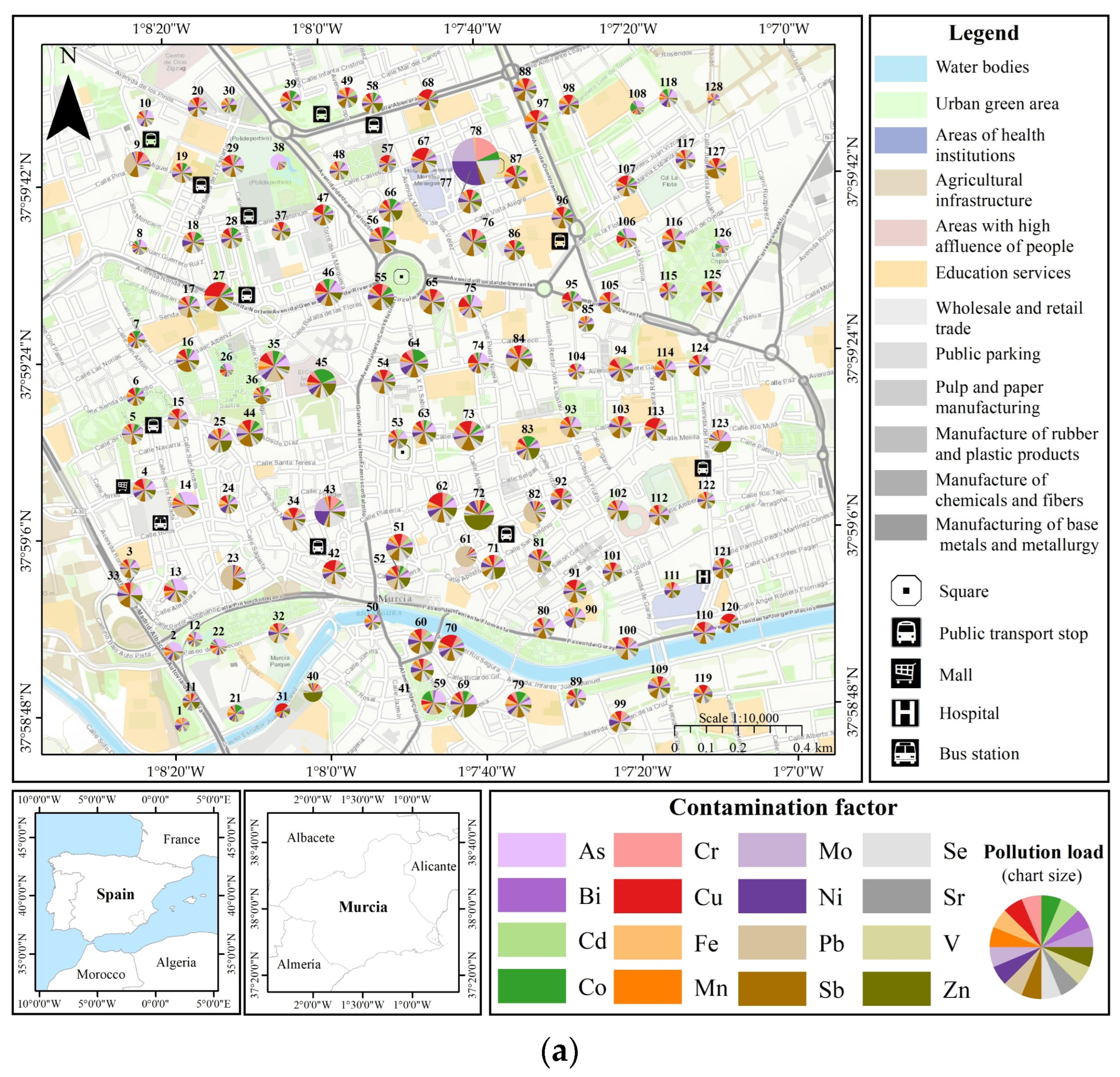
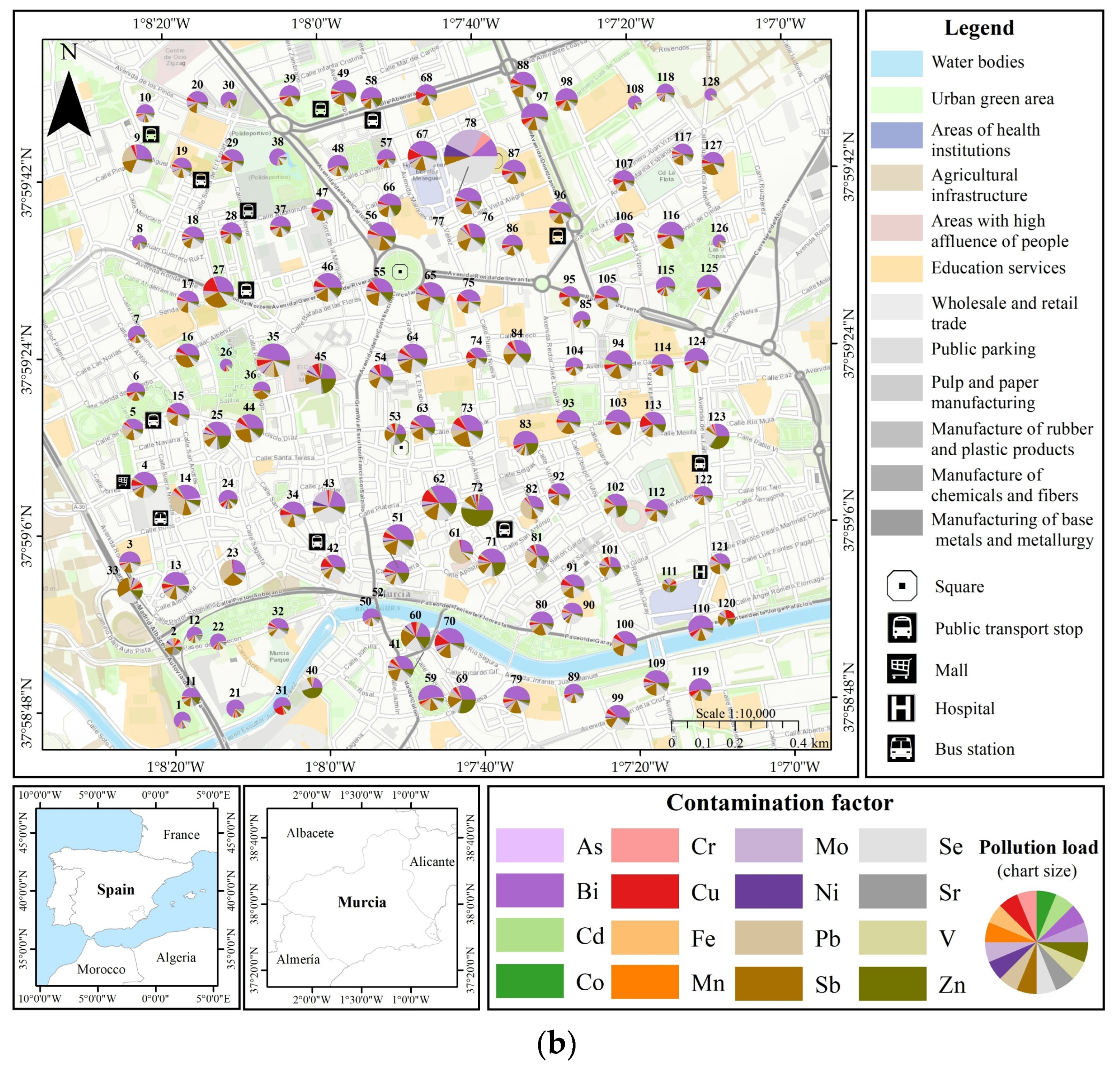
The heavy metals showed significant differences when local and global background levels were used (Figure 4). When the local background level was used, As, Cu, Pb, Sb, Se, and Zn were the most polluting elements, but when the global background level was used, the most polluting elements were Bi, Cu, Mo, Pb, Sb, Se, Sr, and Zn (Figure 4).
Using the local background level, sites with PLI > 3 were identified in the sequence 78 > 72 > 73 > 35 > 43 > 62, with the most contaminated sites being the most polluted. Sites 62 and 72 are in very close pedestrian areas, while sites 73 and 43 are located on small streets with local one-lane traffic. The most contaminated site was site 78, very close to the “Parroquia Santa María Madre de la Iglesia,” a high-traffic area in the “Plaza Pintor Inocencio Medina Vera.” Site 35 has high traffic, a high population density, and electronic equipment stores. Site 38 had low contamination but a CF of high contamination for As, despite being in a sports area near a park. To the southwest, sites 13 and 14 also had extremely high arsenic CF values, as did site 59, located south of the city center. Only sites 31, 12, 1, 108, 126, 26, and 128 had CF < 1. The following sites exhibited high contamination levels (CF > 6): antimony (Sb) sites 27, 23, 78, 73, 16, 44, 9, 127, 55, 33, 76, 36, 64, 51, and 60; lead (Pb) sites 61, 23, 82, 14, 9, 76, 56, 35, 81, 73, 54, 34, 5, 65, 84, 59, 67, 52, 17, 27, 25, and 62; copper (Cu) sites 78, 43, 72, and 64; and cobalt (Co) sites 78, 45, 64, 83, 59, 79, 56, and 35. Only 18 sites had CF > 6 for Zn, but 48 had CF > 3.
Using the global background levels for the 16 analyzed elements, only seven sites were not contaminated (sites 12, 8, 111, 108, 126, 26, and 128, with PLI < 1). On the other hand, eleven sites (78, 62, 35, 43, 72, 73, 51, 27, 45, 14, and 70) had PLI > 3. Site 78 had the highest contamination level, with PLI = 8.30.
The sites with the highest bismuth contamination were 124, with CF > 8.73. However, Bi was not detected at four sites. Thirty-five sites showed significant lead contamination, with CF values exceeding 6. Only 10 sites displayed no lead contamination: sites 50, 26, 8, 38, 1, 108, 21, 31, 126, and 128. Ninety-two percent of the sites were highly contaminated with antimony (CF > 6), while only seven sites remained unpolluted: sites 1, 8, 26, 31, 108, 126, and 128. Of the 128 sampled sites, 95 were highly contaminated with Se (CF > 6), while only 3 sites were not contaminated: sites 36, 2, and 111. Out of the 128 sites, 50 showed high contamination levels (CF > 6) of zinc, while only sites 1, 26, 128, and 126 exhibited low contamination levels (CF < 1). Only sites 78, 97, 7, 35, 14, 84, 59, 88, 90, 114, and 13 showed contamination factors between 1.00 and 1.87; this indicates that contamination with Mn was minimal and occurred at only 11 sites.
Mn has a wide range of industrial uses: it is used in brake pads, as a lead-substitute gasoline detonator, and in metal alloys, among many other uses. Its presence in high quantities in urban dust has also been reported [39,40,41,42,43]. However, Mn is a heavy metal with low concentrations and low pollution factors at most sites. Bi is used in industry for the manufacture of bullets, low-melting-point solder, electronics, and renewable energy devices, and as a substitute for lead in specific industries [44]. However, Bi also comes from non-technogenic sources; it has been found in lead-containing paints [44,45]. Mn is found in soil and rocks at high concentrations and is also emitted from cars because Mn is used as a lead substitute in gasoline [3]. These two elements could be considered emergent pollutants.

3.3. Heavy Metals and Health Risks

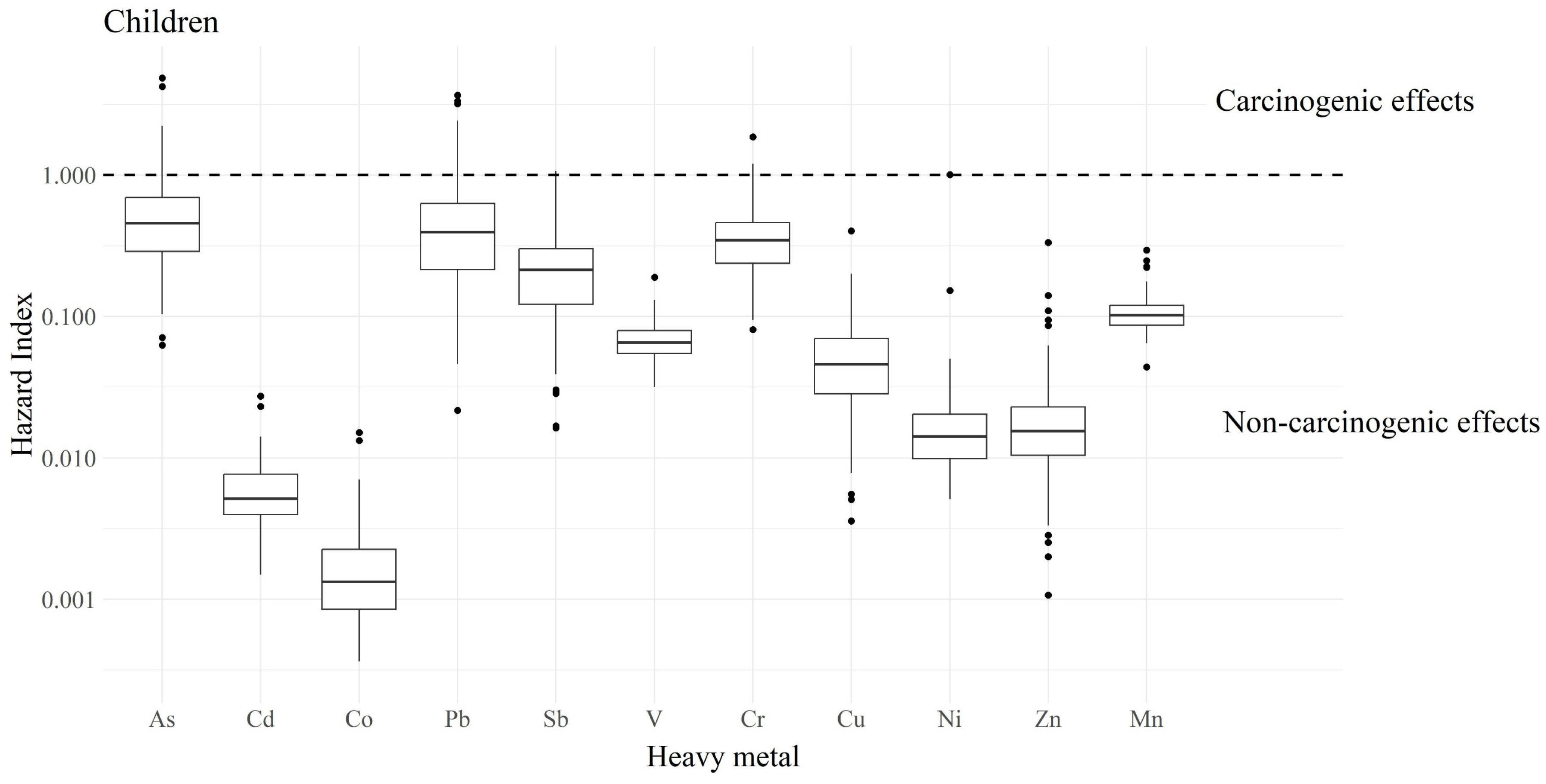
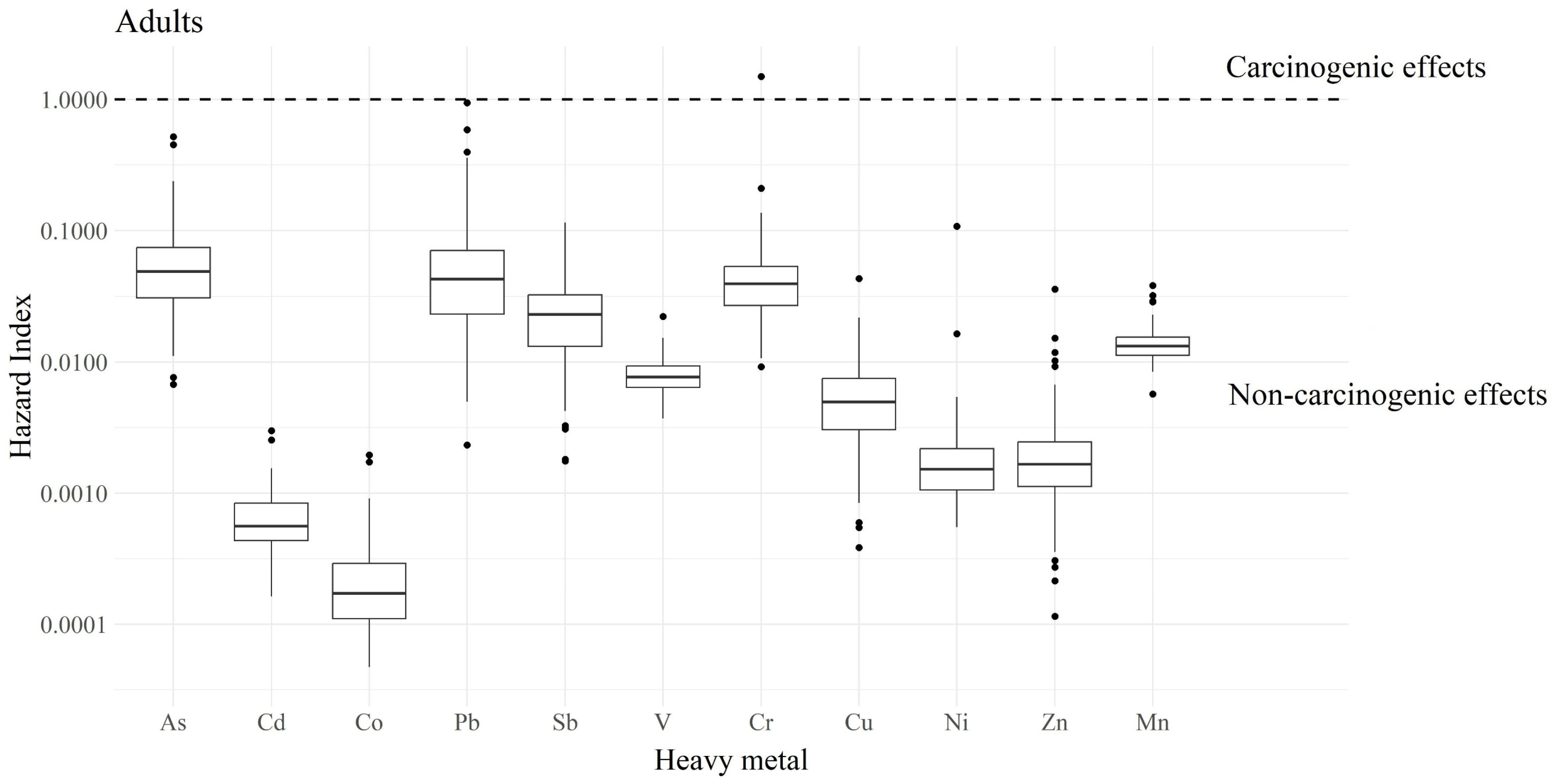
Health risk assessments using the USEPA methodology can be interpreted in three ways. The first is by describing the median value (HI < 1) for each of the measured elements, which in this case showed that the concentrations of As, Cd, Co, Cr, Cu, Mn, Ni, Pb, Sb, V, and Zn were within the levels considered safe for the health of the population (children and adults) (Figure 5).
A second aspect is to emphasize extreme values that exceed the risk threshold for children (HI > 1), as was the case for As, Pb, Sb, and Cr at 19, 15, 1, and 4 sites, respectively. In this case, various types of diseases can be triggered (Figure 5). Arsenic is a metalloid well known for its toxicity. It has several technogenic sources; however, in this study, these sources were eliminated due to their lack of correlation with SIRM, suggesting that the As likely came from pesticides.
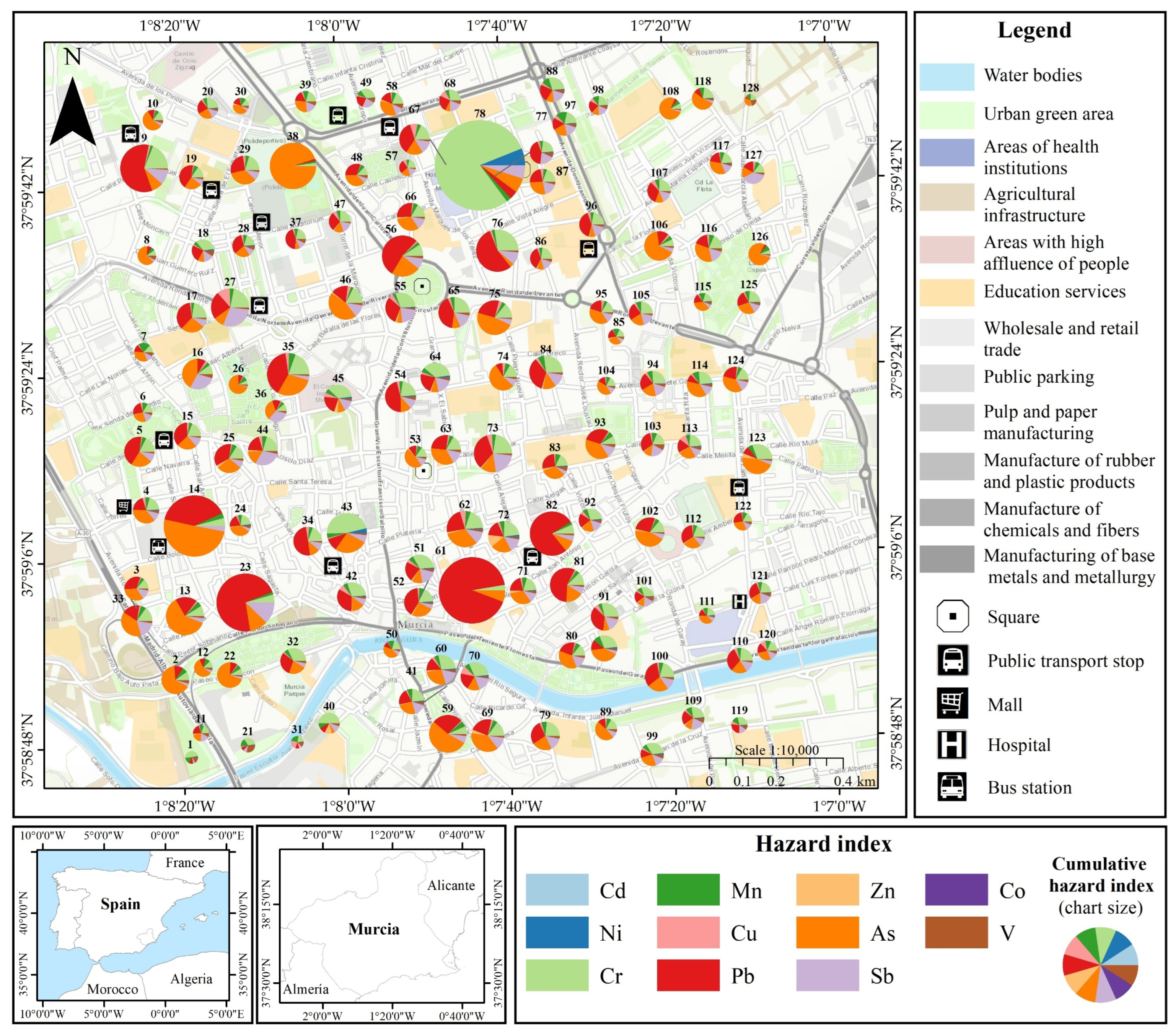
A third, rarely used way of interpreting these HI values is to sum the HI values for each element, assuming a cumulative event of the risk index; this is proposed in this work. For children, the sum of the hazard indices for heavy metals by site exceeded 1, 2, 3, and 4 at 91%, 42%, 15%, and 8% of the sites, respectively (Figure 6).
In adults, the sum of the hazard indices for detected heavy metals exceeded 1 at only two sites. This situation indicates a low risk for adults.
Furthermore, Bi, Fe, Mo, Se, and Sr were not included in this analysis because reference dose values were unavailable for calculating the hazard index.
The toxicity of certain elements, such as As, Cd, Cr, Ni, Pb, and Sb, is well established, but their toxic effects in mixtures and at low concentrations remain uncertain. There are only a few reports of magnified damage caused by mixtures of metals and heavy metalloids in animal models [46,47,48,49].
Of the three methods of data analysis, it is recommended to be clear that the first can help assess risk at the city level, the second at the point and element level, and the third at the site level, considering the measured elements. This third method of analysis is recommended for taking cleanup actions and protecting the population, particularly children, in downtown Murcia.
The sites where urgent action is needed to resolve pollution are sites 78, 61, 14, 23, 9, 38, 82, 76, 35, 56, and 43, each with different pollution problems: site 78 with Cr, Ni, and As; sites 61, 23, 82, and 56 with Pb; sites 14 and 35 with As and Pb; sites 9 and 76 with Cr and Pb; site 38 with As; and site 43 with As and Cr (Figure 6).

3.4. Morphology and Composition of Urban Dust Particles

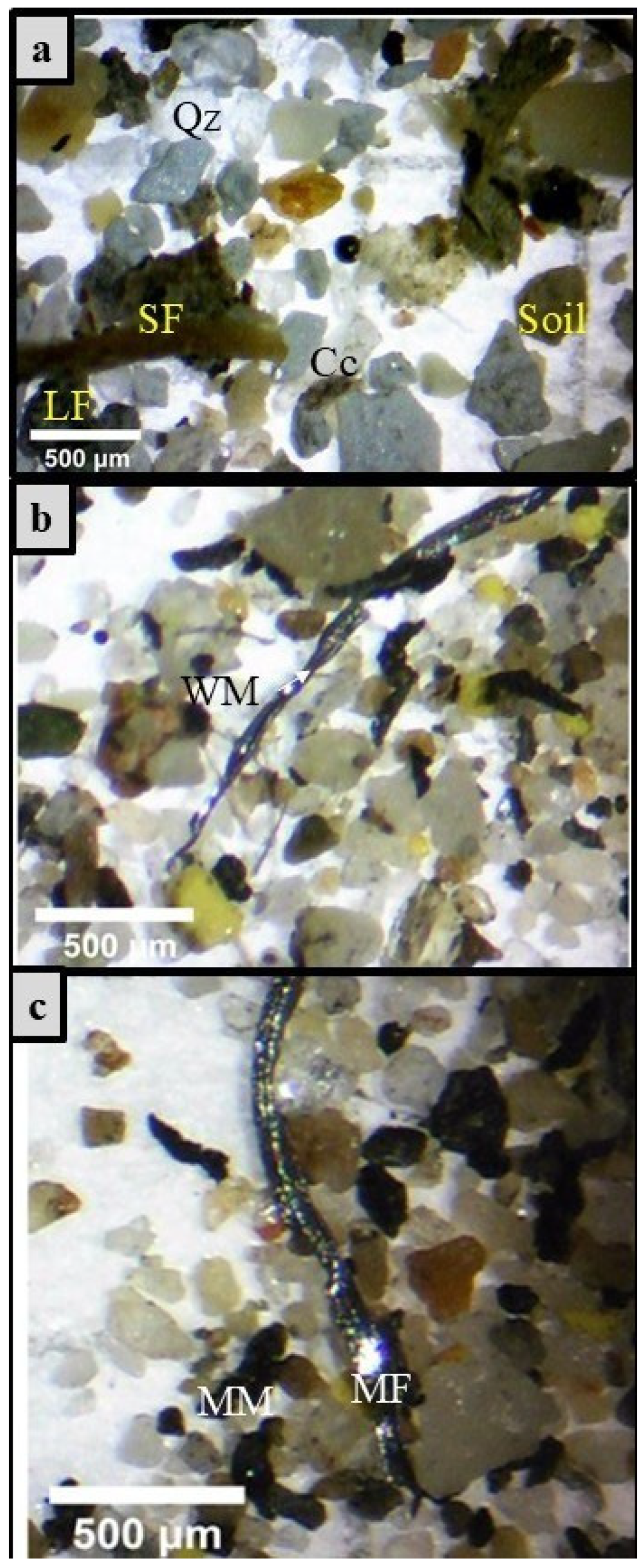
The urban dust samples from downtown Murcia are a mixture of grains of natural and anthropogenic origin (Figure 7). The grains are primarily subangular and irregularly shaped fragments, and spherules also appear. The particles of natural origin found in the binocular microscope analysis were organic remains (leaf and stem fragments; Figure 7a) and mineral and rock grains (e.g., quartz and carbonates).
Various types of artificial–anthropogenic particles also appeared in the urban dust, such as scraped-like, wire-shaped metal fragments (Figure 7a–c); very coarse metal fragments with pigment (paint); partly melted metal fragments; and one of the most distinctive features in the samples: glass and metal spherules (Figure 7a).
Based on visual observation, the characteristic grain size fell mainly within the coarse and very coarse sand categories. Still, some contributors, such as cemented (soil) aggregate-like features and spherules, appeared significantly more frequently in some samples.
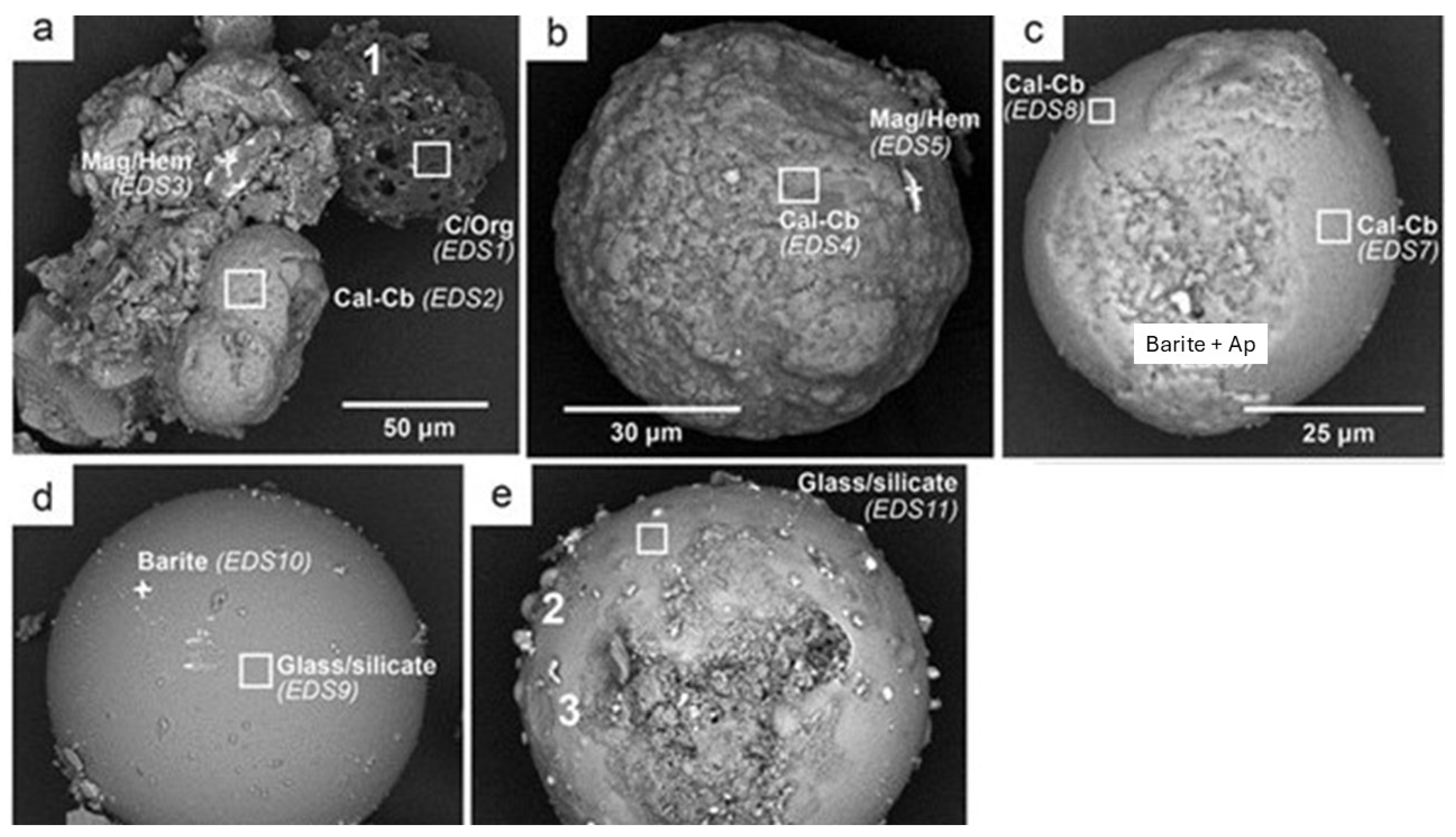
The SEM observations verified the presence of numerous irregularly shaped anthropogenic/technogenic metal and glass fragments; the spherules were evident and conspicuous. Three spherule materials were observed and identified: iron oxide (magnetite, maghemite, and hematite; Figure 8a), CaCO3 (Figure 8b,c), and glass/silicate (Figure 8d,e). SEM observations allowed us to identify respirable nanoparticles adsorbed onto the larger particles (spherules). Both were calcium carbonate, but mainly silicate and iron oxide spherules.
All the spherules (independently of their material) fell into the category of minimally coarse silt (grain diameter > ~40–50 µm). The carbonate spherules were characterized by rough or well-polished surfaces, and “exotic, strange” minerals were sometimes implanted in the spherule body (Figure 8b,c).
Glass/silicate spherules were characterized by smooth surfaces (Figure 8d,e), with possible impact marks. The sharp edge of the broken surface may indicate fresh injury. Some minor, distinctive features, including more bumps, can be seen on the surface of the silicate spherule in Figure 8e.

4. Discussion

4.1. Heavy Metals

Assessment of the concentrations of As, Bi, Cd, Co, Cr, Cu, Fe, Mn, Mo, Ni, Pb, Sb, Se, Sr, V, and Zn. in urban dust in downtown Murcia City allowed us to identify elements that had been ignored in previous analyses, such as As, Bi, Fe, Mn, Sb, Se, and V. Technogenic elements related to industrial pollution and automobile traffic are usually the most studied [17,50], such as Cd, Co, Cu, Ni, Pb, Cr, and Zn, while those that are abundant in rocks and soils, such as Fe and Mn, are usually ignored [2,36,51]. Other elements of less technological use, such as As, Bi, and Sb, are also little studied [3,52,53,54].
In cases involving a global evaluation with multiple metals, the pollution load index (PLI) has been widely used [55,56,57]. However, it cannot distinguish between metals, despite varying levels of toxicity. On the other hand, the spatial analysis in this study enables better decision-making for planning sanitation programs, as it identifies individual metals, pinpointing where thresholds are exceeded and areas where more than one metal exceeds them. In the face of budgetary constraints in city sanitation, it may be decided to address contamination hotspots with multiple metals.
The use of two background levels—local and global—tells two stories and allows for the identification of elements that could have been overlooked if only one background level had been used, as has also been reported for other cities [15,38].
The hazard index is a widely used indicator for assessing health risks from exposure to heavy metals in urban dust. The HI has limitations: there is a lack of data necessary to use the model (some elements lack a “conversion factor”); it ignores synergy and harmful pollutants; and it does not include factors such as race and gender, among others [58]. However, the HI is handy for a quick assessment of the situation at a given time, and it can be considered a first approximation in health risk assessment. The HI as currently calculated can be considered a conservative health risk assessment [59,60], whereas the sum of HI values is a more precautionary assessment. Summing the HI values across multiple elements enables identification of the highest-risk sites.
Industrial cities such as Avilés, Spain, exhibit elevated concentrations of manganese, lead, and zinc, associated with the metallurgical, chemical, and shipbuilding industries. Barcelona exhibits higher copper levels, while Madrid shows higher concentrations of lead, chromium, and zinc than Murcia and Cartagena. Toronto and Mexico City display high concentrations of chromium and vanadium, respectively (Table 3). In contrast, Chinese cities and Massachusetts report notably low levels of heavy metals in urban dust. The concentrations of carcinogenic elements in Murcia are lower than those in Madrid; however, lead concentrations in urban dust remain high [2,55]. Compared to other industrial cities, vanadium and antimony concentrations in Murcia are similar to those in Avilés, Spain, but lead concentrations are much lower [56].
In environmental toxicology, there are important challenges to investigate because new compounds are constantly appearing in the environment, many of them unexpected and enhancing environmental risk. For example, in this study, As, Sb, Se, Sr, and Bi were not expected but were found; in other studies, this happened with Y [60], Bi [3,45], and Mn [36], and recently with magnetite [6] as contaminants. All of these are emerging contaminants to be studied.

4.2. Particles in Urban Dust

Calcium carbonate is ubiquitous, found in naturally formed particles from rocks, soils [66], and sediments, and anthropogenic particles from the wear and tear of building materials [67,68]. Calcium carbonate spheres can also form naturally at room temperature [69]. Carbonaceous spherules may also be formed during low-temperature wood burning, but the microaggregates in the urban dust samples reached the size of coarse silt and fine sand “tar balls” (50–600 nm) [70].
This study observed perfectly round silicate particles, similar to the glass silicate spherules reported previously [70,71,72]. The observed glass-like silicate particles may have originated from some regional combustion and power plants [68]. We observed differences in the size and character of pollutant particles; for example, particles formed via emission from traffic mainly consisted of submicron-size grains, while fly ash from combustion plants (<100 µm) and particles from iron smelters/steel works (>100 µm, but reaching 400–800 µm in the case of agglomerated grains) were the medium- and coarse-grain-size pollutant groups.
There is extensive literature on the fine-grained, submicron-size magnetic minerals that contribute to urban pollution, observed in various forms across various carriers, including urban dust, leaves, and soils [73,74,75,76]. Iron oxide pollutants can be separated by grain size, and traffic is mainly considered the primary source of submicron-size particles [70,71]. Particles of anthropogenic origin, such as garbage, wire fragments, and paint chips containing heavy metals, were also observed.
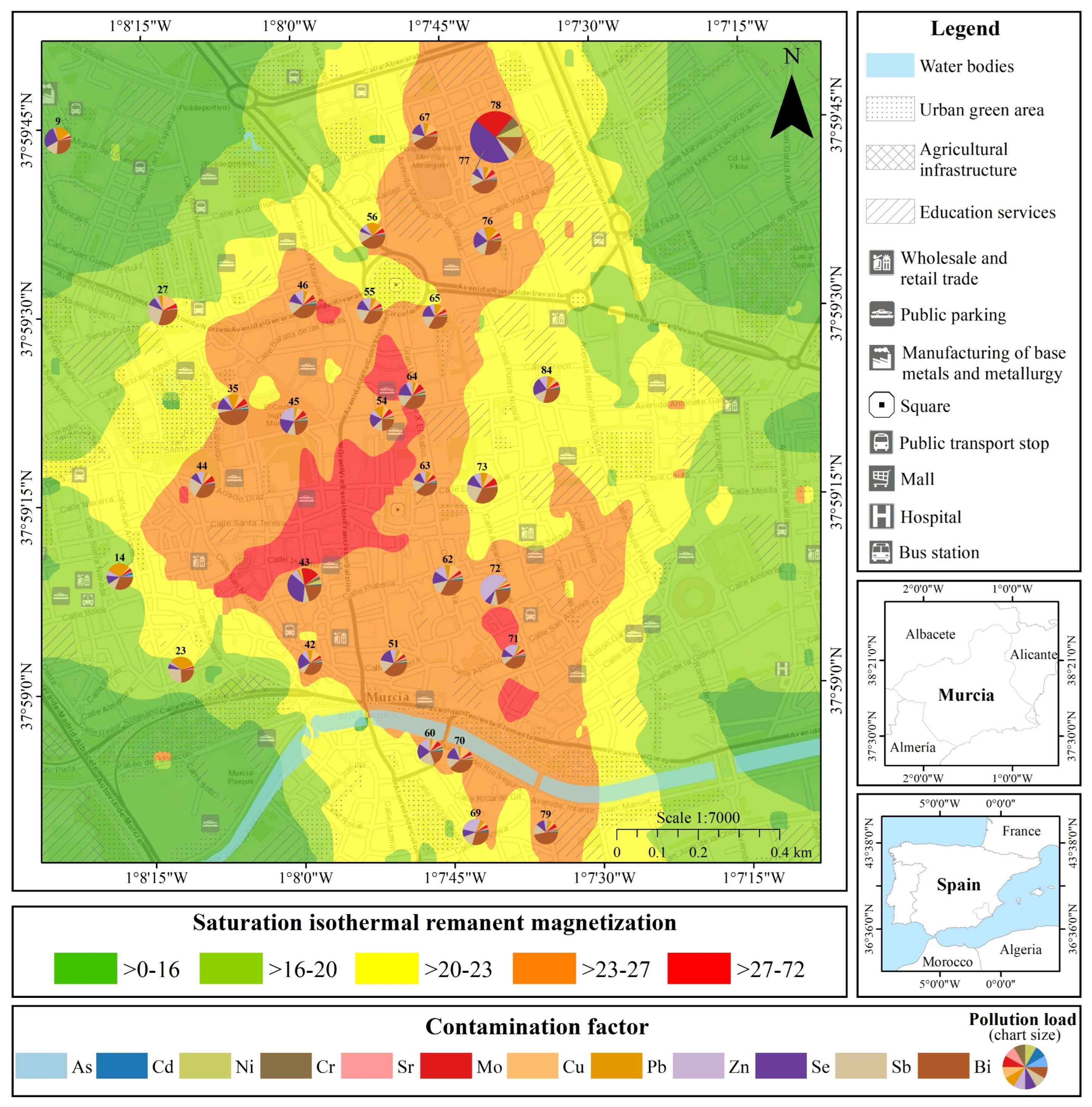
Multiple sources of nano-sized iron oxide pollutants were identified, including vehicle engines (pollutants emitted through tailpipe exhaust) and brake wear particle emissions [74], as well as car emissions [37]. The transformation of iron ores due to fuel burning is well known and causes the conversion of iron oxides such as hematite, ferrihydrite, maghemite, and magnetite. All these particles are black and magnetic spherules [75,76]. The overlay of pie charts depicting heavy metals with a pollution load index (PLI) value greater than 4 on the SIRM map (Figure 9) supports the correlation between SIRM and specific heavy metals (Figure 2). The observed spatial correlation between PLI values by site and areas with the highest SIRM levels suggests that SIRM values above 20 serve as a critical indicator of heavy metal and magnetic particle pollution. The SIRM value could provide a rapid and cost-effective way to monitor pollution. From these findings, we recommend further investigation of magnetic parameters in urban dust particles to identify minerals and their potential sources.

4.3. Actions to Monitor, Study, Control, Reduce, and Prevent Heavy Metal Pollution in the City

We provide three types of recommendations to work towards achieving a more sustainable city: to the local government, to academia (professors and researchers), and to citizens. For local government, the following recommendations are made: (a) organize and implement a heavy metal pollution monitoring plan coordinated by the environmental and health ministries; (b) create technology (apps, software) that facilitates obtaining information from collected urban dust samples, as well as analyzing the data; (c) divide the city’s surface into quadrants for spatial monitoring [77]; (d) identify the sources of heavy metals, since some metals come from industrial emissions, soil, building wear, garbage, or specific products, such as pesticides [65,78]; (e) surround industrial parks with trees to prevent pollution plumes; (f) regulate industrial emissions; (g) regulate gas and particle emissions from automobiles; (h) organize environmental contingency measures as in other countries, limiting industrial activities and automobile mobility; (i) verify that urban and peri-urban agriculture is safe and free of heavy metals [13,79]; and (j) design a social communication plan to alert the population in the event of a contingency.
The downtown area of Murcia City only has moderately acceptable vegetation cover to the north and northeast. Still, the center, west, and south have the lowest percentage of wooded areas. Because trees trap, fix, or sorb dust with heavy metals [80], a reforestation campaign with native trees is recommended to improve the urban ecosystem.
For academia, it is recommended to work on (a) helping the government identify the sources of heavy metals [67]; (b) recommending other pest control methods to the government with less toxic elements than As; (c) studying the use of less complete matrices such as soils and urban dust, perhaps some plants (sour orange, for example) [72]; (d) identifying the fate of As, a highly toxic and soluble element that can cause damage to the Segura River; (e) studying the biota of the Segura River; (f) identifying whether cancer cases have any spatial correlation with the sources of heavy metals; and (g) assisting the government in the creation of technology for monitoring, chemical analysis, results analysis, and social communication. Additionally, for future research, it is recommended that the so-called “emerging pollutants,” such as magnetite, Mn, Y, microplastic nanoparticles, and pathogenic microorganisms, be studied in the Murcian urban ecosystem [70]. We recommend investigating heavy metal concentrations in the hair of adults [81] and in the teeth of children under 10 years old [81,82]. This will help to assess and verify heavy metal exposure in the human body and explore population exposure.
The recommendations for the population are condensed into a single phrase: “extreme cleaning at home,” especially if there are children in the household. This recommendation includes changing shoes and clothes upon entering the home, cleaning terraces daily, placing plants in gardens and windows, and identifying and eliminating sources of dust inside the home. Due to its high content of heavy metals, children should not be allowed to touch, eat, or inhale urban dust. Heavy metal contamination at an early age can cause neuronal damage, Parkinson’s, cognitive impairment, cancer, and other illnesses [5,6].

5. Conclusions

According to the pollution factors calculated using local background values, urban dust in Murcia, Spain, is moderately contaminated with bismuth, cadmium, chromium, molybdenum, nickel, selenium, strontium, and zinc. At some sites in the city, contamination levels reach the “considerably contaminated” class due to the presence of arsenic, lead, and antimony. Bismuth, selenium, strontium, arsenic, and antimony are lesser-studied heavy metals and metalloids worldwide that, in this case, can be classified as emerging pollutants for this city and should also be considered in other cities.
The use of both local and global background values enabled us to identify elements that might otherwise have gone unnoticed, specifically arsenic and antimony. Spatial analysis helped to identify the most contaminated sites and the heavy metals responsible for this contamination. This case study can serve as an example for other cities around the world to use local and global background values to identify elements that could pose a danger.
Critical sites require immediate attention, as they pose significant risks to children. A multi-scale analysis enables an assessment of the city, its zones, and the most polluted sites. Children experience the highest hazard index values; however, it is important to note that these results are conservative, as it was not possible to calculate the hazard index for all the analyzed elements. However, despite this limitation, if we sum the hazard indices for all elements, we can provide a more comprehensive risk assessment, and mapping these indices facilitates better identification of site-specific contamination. Another important point is that the risk index assessment is for each metal, and this is a significant limitation because the hazard index assessment should be for the set of heavy metals—namely, the cocktail of contaminants to which the population is exposed.
Urban dust comprises naturally occurring particles, such as carbonates and silicates, as well as anthropogenic particles, including paint residues and iron oxide spheres resulting from combustion. While calcium carbonate is commonly found in nature, the spheres of this mineral in urban dust are of anthropogenic origin. This study is groundbreaking because it characterized urban dust particles by shape, size, and mineral composition, rather than relying on unverified assumptions. Heavy metal contamination in the city’s urban dust has not reached high levels; however, it is strongly recommended that the local government continue daily cleaning efforts, particularly in public areas with heavy vehicular traffic, as magnetic particles can easily break down into inhalable nanoparticles. Scientific researchers should be involved in investigating the sources and final destinations of these pollutants. Additionally, the community should be encouraged to adopt clean habits at home, especially in households with children.

Author Contributions

F.B. conceived and designed this study. F.B., A.S.-N., M.J.D.-I., P.M.-S., E.D.-P., M.R. and M.-F.B. were responsible for the data collection and processing. E.D.-P. contributed to sample analysis. Á.G. and F.B. were responsible for the data and spatial analysis. Á.G. produced maps. A.G. and E.D.-P. reviewed and edited the manuscript. F.B., Á.G. and A.G. wrote the final version. All authors have read and agreed to the published version of the manuscript.

Funding

This research was funded by Dirección General de Apoyo al Personal Académico (DGAPA), Universidad Nacional Autónoma de México (UNAM), grant number IN208621. We acknowledge the project PID2024-159094NB-I00, funded by MICIU/AEI/10.13039/501100011033/FEDER, UE.

Institutional Review Board Statement

Not Applicable.

Informed Consent Statement

Not Applicable.

Data Availability Statement

The raw data supporting the conclusions of this article will be made available by the authors upon request.

Acknowledgments

SEM images were obtained at Osaka Metropolitan University, Japan; FB thanks Yusuke Seto and Balazs Bradac for their technical support.

Conflicts of Interest

The authors declare no conflicts of interest.

References

  1. World Health Organization. WHO Global Air Quality Guidelines: Particulate Matter (PM2.5 and PM10), Ozone, Nitrogen Dioxide, Sulfur Dioxide and Carbon Monoxide; World Health Organization: Geneva, Switzerland, 2021; Available online: https://apps.who.int/iris/handle/10665/345329 (accessed on 23 November 2025).
  2. Aguilera, A.; Bautista, F.; Goguitchaichvili, A.; Garcia-Oliva, G. Health risk of heavy metals in street dust. Front. Biosci. 2022, 26, 327–345. [Google Scholar] [CrossRef]
  3. Tighe, M.; Beidinger, H.; Knaub, C.; Sisk, M.; Peaslee, G.F.; Lieberman, M. Risky bismuth: Distinguishing between lead contamination sources in soils. Chemosphere 2019, 234, 297–301. [Google Scholar] [CrossRef]
  4. López-Lanuza, A.; Mateos Nava, R.A.; Álvarez Barrera, L.; Rodríguez Mercado, J.J. Metales interesantes de la familia III A: Contaminación, toxicocinética y genotoxicidad del galio, indio y talio. Rev. Int. De Contam. Ambient. 2023, 39, 171–201. [Google Scholar] [CrossRef]
  5. Calderón-Garcidueñas, L.; Serrano-Sierra, A.; Torres-Jardón, R.; Zhu, H.; Yuan, Y.; Smith, D.; Delgado-Chávez, R.; Cross, J.V.; Medina-Cortina, H.; Kavanaugh, M.; et al. The impact of environmental metals in young urbanites’ brains. Exp. Toxicol. Pathol. 2013, 65, 503–511. [Google Scholar] [CrossRef]
  6. Calderón-Garcidueñas, L.; Ayala, A. Air pollution, ultrafine particles, and your brain: Are combustion nanoparticle emissions and engineered nanoparticles causing preventable fatal neurodegenerative diseases and common neuropsychiatric outcomes? Environ. Sci. Technol. 2022, 56, 6847–6856. [Google Scholar] [CrossRef] [PubMed]
  7. Hammond, J.; Maher, B.A.; Gonet, T.; Bautista, F.; Allsop, D. Oxidative Stress, Cytotoxic and Inflammatory Effects of Urban Ultrafine Road-Deposited Dust from the UK and Mexico in Human Epithelial Lung (Calu-3) Cells. Antioxidants 2022, 11, 1814. [Google Scholar] [CrossRef]
  8. Tomlinson, D.C.; Wilson, D.J.; Harries, C.R.; Jeffrey, D.W. Problem in assessment of heavy metals in estuaries and the formation of pollution index. Helgoländer Meeresunters. 1980, 33, 566–575. [Google Scholar] [CrossRef]
  9. Carroll, W.; Snodgrass, J.W.; Szlavecz, K.; Landa, E.R.; Casey, R.E.; Lev, S.M. The effect of earthworms on roadway-derived Zn deposited as a surface layer in storm water retention basin soils. Urban Ecosyst 2014, 17, 825–838. [Google Scholar] [CrossRef]
  10. Antisari, L.V.; Orsini, F.; Marchetti, L.; Vianello, G.; Gianquinto, G. Heavy metal accumulation in vegetables grown in urban gardens. Agron. Sustain. Dev. 2015, 35, 1139–1147. [Google Scholar] [CrossRef]
  11. Sivakoff, F.S.; Gardiner, M.M. Soil lead contamination decreases bee visit duration at sunflowers. Urban Ecosyst 2017, 20, 1221–1228. [Google Scholar] [CrossRef]
  12. Scott, S.B.; Sivakoff, F.S.; Gardiner, M.M. Exposure to urban heavy metal contamination diminishes bumble bee colony growth. Urban Ecosyst 2022, 25, 989–997. [Google Scholar] [CrossRef]
  13. Lopez, R.; Hallat, J.; Castro, A.; Miras, A.; Burgos, P. Heavy metal pollution in soils and urban-grown organic vegetables in the province of Sevilla, Spain. Biol. Agric. Hortic. 2019, 35, 219–237. [Google Scholar] [CrossRef]
  14. Boja. Decreto 18/2015, de 27 de Enero, Por El Que Se Aprueba el Reglamento Que Regula el Régimen Aplicable a Los Suelos Contaminados. Andalucía, España. Boletín Oficial de la Junta de Andalucía 2015. Available online: http://www.juntadeandalucia.es/medioambiente/site/cae/menuitem.9d35871926fad96b25f29a105510e1ca/?vgnextoid=1269f5a0f212d410VgnVCM1000001325e50aRCRD&vgnextchannel=81e8291caa6ea210VgnVCM2000000624e50aRCRD&vgnextfmt=AdmonElec&lr=lang_es (accessed on 23 November 2025).
  15. Aguilera, A.; Bautista, F.; Gutiérrez-Ruiz, M.; Ceniceros-Gómez, A.E.; Cejudo, R.; Goguitchaichvili, A. Heavy metal pollution of street dust in the largest city of Mexico, sources and health risk assessment. Environ. Monit. Assess 2021, 193, 193. [Google Scholar] [CrossRef]
  16. Acosta, J.A.; Faz, A.; Kalbitz, K.; Jansen, B.; Martínez-Martínez, S. Partitioning of heavy metals over different chemical fraction in street dust of Murcia (Spain) as a basis for risk assessment. J. Geochem. Explor. 2014, 144, 298–305. [Google Scholar] [CrossRef]
  17. Marín-Sanleandro, P.; Sánchez-Navarro, A.; Díaz-Pereira, E.; Bautista, F.; Romero, M.; Delgado-Iniesta, M.J. Asessment of Heavy Metals and Color as Indicators of Contamination in Street Dust of a City in SE Spain: Influence of Traffic Intensity and Sampling Location. Sustainability 2018, 10, 4105. [Google Scholar] [CrossRef]
  18. Marín-Sanleandro, P.; Delgado-Iniesta, M.J.; Sáenz-Segovia, A.F.; Sánchez-Navarro, A. Spatial Identification and Hotspots of Ecological Risk from Heavy Metals in Urban Dust in the City of Cartagena. SE Spain Sustain. 2024, 16, 307. [Google Scholar] [CrossRef]
  19. Chirlaque, M.D.; Salmerón, D.; Ardanaz, E.; Galceran, J.; Martínez, R.; Marcos-Gragera, R.; Navarro, C. Cancer survival in Spain: Estimate for nine major cancers. Ann. Oncol. 2010, 21, iii21–iii29. [Google Scholar] [CrossRef]
  20. Ortega-García, J.A.; López-Hernández, F.A.; Sobrino-Najul, E.; Febo, I.; Fuster-Soler, J.L. Environment and paediatric cancer in the Region of Murcia (Spain): Integrating clinical and environmental history in a geographic information system. An. De Pediatr. 2011, 74, 255–260. [Google Scholar] [CrossRef]
  21. Ortega-Garcia, J.A.; López-Hernández, F.A.; Cárceles-Álvarez, A.; Santiago-Rodríguez, E.J.; Sánchez, A.C.; Bermúdez-Cortes, M.; Fuster-Soler, J.L. Analysis of small areas of pediatric cancer in the municipality of Murcia (Spain). An. De Pediatría 2016, 84, 154–162. [Google Scholar]
  22. IUSS Working Group WRB. World Reference Base for Soil Resources. In International Soil Classification System for Naming Soils and Creating Legends for Soil Maps, 4th ed.; International Union of Soil Sciences (IUSS): Vienna, Austria, 2022. [Google Scholar]
  23. Leonhardt, R. Analyzing rock magnetic measurements: The RockMagAnalyzer 1.0 software. Comput. Geosci. 2006, 32, 1420–1431. [Google Scholar] [CrossRef]
  24. R Core Team. R. Available online: https://www.R-project.org/ (accessed on 4 September 2025).
  25. Kabata-Pendias, A. Trace Elements in Soils and Plants, 4th ed.; Taylor and Francis Group: New York, NY, USA, 2011. [Google Scholar] [CrossRef]
  26. ESRI ArcGIS Desktop and Spatial Analyst Extension, Release 10.1; Environmental Systems Research Institute: Redlands, CA, USA. Available online: https://www.esri.com/es-es/arcgis/products/arcgis-pro/overview (accessed on 4 September 2025).
  27. USEPA United States Environmental Protection Agency. Risk Assessment Guidance for Superfund (RAGS) Volume III: Part A; c2024; Environmental Protection Agency: Washington, DC, USA, 2024. Available online: https://www.epa.gov/risk/risk-assessment-guidance-superfund-rags-volume-iii-part (accessed on 4 September 2025).
  28. Li, X.; Poon, C.S.; Liu, P.S. Heavy metal contamination of urban soils and street dusts in Hong Kong. Appl. Geochem. 2001, 16, 1361–1368. [Google Scholar] [CrossRef]
  29. Ali, M.U.; Liu, G.; Yousaf, B.; Abbas, Q.; Ullah, H.; Munir, M.A.M.; Fu, B. Pollution characteristics and human health risks of potentially (Eco)toxic elements (PTEs) in road dust from metropolitan area of Hefei, China. Chemosphere 2017, 181, 111–121. [Google Scholar] [CrossRef]
  30. Zheng, N.; Liu, J.; Wang, Q.; Liang, Z. Health risk assessment of arsenic exposure to street dust in the zinc smelting district, Northeast China. Sci. Total Env. 2010, 408, 726–733. [Google Scholar] [CrossRef]
  31. USEPA United States Environmental Protection Agency EPA/540/1-89/002. RAGS Volume I. Human Health Evaluation Manual (HHEM). Part E. Supplemental Guidance for Dermal Risk Assessment; U.S. Environmental Protection Agency: Washington, DC, USA, 1989.
  32. Mohmand, J.; Eqani, S.A.M.A.S.; Fasola, M.; Alamdar, A.; Mustafa, I.; Ali, N.; Liu, L.; Peng, S.; Shen, H. Human exposure to toxic metals via contaminated dust: Bio-accumulation trends and their potential risk estimation. Chemosphere 2015, 132, 142–151. [Google Scholar] [CrossRef] [PubMed]
  33. Kurt-Karakus, P.B. Determination of heavy metals in indoor dust from Istanbul, Turkey: Estimation of the health risk. Environ. Int. 2012, 50, 47–55. [Google Scholar] [CrossRef]
  34. Wörle-Knirsch, J.M.; Kern, K.; Schleh, C.; Adelhelm, C.; Feldmann, C.; Krug, H.F. Nanoparticulate vanadium oxide potentiated vanadium toxicity in human lung cells. Environ. Sci. Technol. 2007, 41, 331–336. [Google Scholar] [CrossRef]
  35. Michalke, B.; Fernsebner, K. New insights into manganese toxicity and speciation. J. Trace Elem. Med. Biol. 2014, 28, 106–116. [Google Scholar] [CrossRef]
  36. Aguilera, A.; Bautista, F.; Gogichaichvili, A.; Gutiérrez-Ruiz, M.; Ceniceros-Gómez, A.E.; López-Santiago, N.R. Spatial distribution of manganese concentration and load in street dust in Mexico City. Salud Pública De México 2020, 62, 147–155. [Google Scholar] [CrossRef] [PubMed]
  37. Liu, H.; Yan, Y.; Chang, H.; Chen, H.; Liang, L.; Liu, X.; Sun, Y. Magnetic signatures of natural and anthropogenic sources of urban dust aerosol. Atmos. Chem. Phys. 2019, 19, 731–745. [Google Scholar] [CrossRef]
  38. Dytłow, S.; Górka-Kostrubiec, B. Concentration of heavy metals in street dust: An implication of using different geochemical background data in estimating the level of heavy metal pollution. Environ. Geochem. Health 2021, 43, 521–535. [Google Scholar] [CrossRef]
  39. Chillrud, S.N.; Epstein, D.; Ross, J.M.; Sax, S.N.; Pederson, D.; Spengler, J.D.; Kinney, P.L. Elevated airborne exposures of teenagers to manganese, chromium, and iron from steel dust and New York City’s subway system. Environ. Sci. Technol. 2004, 38, 732–737. [Google Scholar] [CrossRef]
  40. Gunier, R.B.; Jerrett, M.; Smith, D.R.; Jursa, T.; Yousefi, P.; Camacho, J.; Bradman, A. Determinants of manganese levels in house dust samples from the CHAMACOS cohort. Sci. Total Environ. 2014, 497, 360–368. [Google Scholar] [CrossRef]
  41. Gunier, R.B.; Arora, M.; Jerrett, M.; Bradman, A.; Harley, K.G.; Mora, A.M.; Eskenazi, B. Manganese in teeth and neurodevelopment in young Mexican–American children. Environ. Res. 2015, 142, 688–695. [Google Scholar] [CrossRef]
  42. Rodrigues, J.L.; Araújo, C.F.; Dos Santos, N.R.; Bandeira, M.J.; Anjos, A.L.S.; Carvalho, C.F.; Menezes-Filho, J.A. Airborne manganese exposure and neurobehavior in school-aged children living near a ferro-manganese alloy plant. Environ. Res. 2018, 167, 66–77. [Google Scholar] [CrossRef] [PubMed]
  43. Isinkaralar, O.; Isinkaralar, K.; Nguyen, T.N.T. Spatial distribution, pollution level and human health risk assessment of heavy metals in urban street dust at neighbourhood scale. Int. J. Biometeorol. 2024, 68, 2055–2067. [Google Scholar] [CrossRef] [PubMed]
  44. Amneklev, J.; Sörme, L.; Augustsson, A.; Bergbäck, B. The Increase in Bismuth Consumption as Reflected in Sewage Sludge. Water Air Soil Pollut. 2015, 226, 92. [Google Scholar] [CrossRef]
  45. Filella, M. How reliable are environmental data on ‘orphan’elements? The case of bismuth concentrations in surface waters. J. Environ. Monit. 2010, 12, 90–109. [Google Scholar] [CrossRef]
  46. Budi, H.S.; Catalan Opulencia, M.J.; Afra, A.; Abdelbasset, W.K.; Abdullaev, D.; Majdi, A.; Mohammadi, M.J. Source, toxicity and carcinogenic health risk assessment of heavy metals. Rev. Environ. Health 2024, 39, 77–90. [Google Scholar] [CrossRef]
  47. Hambach, R.; Lison, D.; D’haese, P.; Weyler, J.; De Graef, E.; De Schryver, A.; Lamberts, L.; van Sprundel, M. Co-exposure to lead increases the renal response to low levels of cadmium in metallurgy workers. Toxicol. Lett. 2013, 222, 233–238. [Google Scholar] [CrossRef]
  48. Hernández-García, A.; Romero, D.; Gómez-Ramírez, P.; María-Mojica, P.; Martínez-López, E.; García-Fernández, A. In vitro evaluation of cell death induced by cadmium, lead and their binary mixtures on erythrocytes of common buzzard (Buteo buteo). Toxicol. Vitr. 2014, 28, 300–306. [Google Scholar] [CrossRef]
  49. Wu, X.; Cobbina, S.J.; Mao, G.; Xu, H.; Zhang, Z.; Yang, L. A review of toxicity and mechanisms of individual and mixtures of heavy metals in the environment. Environ. Sci. Pollut. Res. 2016, 23, 8244–8259. [Google Scholar] [CrossRef]
  50. Trujillo-González, J.M.; Torres-Mora, M.A.; Keesstra, S.; Brevik, E.C.; Jiménez-Ballesta, R. Heavy metal accumulation related to population density in road dust samples taken from urban sites under different land uses. Sci. Total Environ. 2016, 553, 636–642. [Google Scholar] [CrossRef]
  51. Cortes, J.; Bautista, F.; Delgado, C.; Quintana, P.; Aguilar, D.; Garcia, L.; Figueroa, C.; Gogichaishvili, A. Spatial distribution of heavy metals in urban dust from Ensenada, Baja California, Mexico. Rev. Chapingo Ser. Cienc. For. Ambiente 2017, 23, 47–60. [Google Scholar]
  52. Valerio, F.; Brescianini, C.; Mazzucotelli, A.; Frache, R. Seasonal variation of thallium, lead, and chromium concentrations in airborne particulate matter collected in an urban area. Sci. Total Environ. 1988, 71, 501–509. [Google Scholar] [CrossRef]
  53. Kaonga, C.C.; Kosamu, I.B.M.; Utembe, W.R. A review of metal levels in urban dust, their methods of determination, and risk assessment. Atmosphere 2021, 12, 891. [Google Scholar] [CrossRef]
  54. Rahman, M.S.; Khan, M.D.H.; Jolly, Y.N.; Kabir, J.; Akter, S.; Salam, A. Assessing risk to human health for heavy metal contamination through street dust in the Southeast Asian Megacity: Dhaka, Bangladesh. Sci. Total Environ. 2019, 660, 1610–1622. [Google Scholar] [CrossRef] [PubMed]
  55. Delgado, M.J.; Marín, P.; Díaz-Pereira, E.; Bautista, F.; Romero, M.; Sánchez, A. Estimation of ecological and human health risks posed by heavy metals in street dust of Madrid city (Spain). Int. J. Environ. Res. Public Health 2022, 19, 5263. [Google Scholar] [CrossRef]
  56. Ordonez, A.; Loredo, J.; De Miguel, E.; Charlesworth, S. Distribution of heavy metals in the street dusts and soils of an industrial city in Northern Spain. Arch. Environ. Contam. Toxicol. 2003, 44, 0160–0170. [Google Scholar] [CrossRef]
  57. Manzhilevskaya, S. Environmental Assessment of Dust Pollution in Point-Pattern Housing Development. Buildings 2025, 15, 1466. [Google Scholar] [CrossRef]
  58. Rahmati, M.; Kazemi, A.; Esmaeilbeigi, M. Assessing Spatiotemporal Health Risks of Metal-Contaminated Urban Dust in a Highly Polluted City. Water Air Soil Pollut. 2025, 236, 631. [Google Scholar] [CrossRef]
  59. Price, P.S. The Hazard index at thirty-seven: New science new insights. Curr. Opin. Toxicol. 2023, 34, 100388. [Google Scholar] [CrossRef]
  60. Escher, B.I.; Stapleton, H.M.; Schymanski, E.L. Tracking complex mixtures of chemicals in our changing environment. Science 2020, 367, 388–392. [Google Scholar] [CrossRef]
  61. Amato, F.; Pandolfi, M.; Moreno, T.; Furger, M.; Pey, J.; Alastuey, A.; Bukowiecki, N.; Prevot, A.S.H.; Baltensperger, U.; Querol, X. Sources and variability of inhalable road dust particles in three European cities. Atmos. Environ. 2011, 45, 6777–6787. [Google Scholar] [CrossRef]
  62. Apeagyei, E.; Bank, M.S.; Spengler, J.D. Distribution of heavy metals in road dust along an urban-rural gradient in Massachusetts. Atmos. Environ. 2011, 45, 2310–2323. [Google Scholar] [CrossRef]
  63. Nazzal, Y.; Rosen, M.A.; Al-Rawabdeh, A.M. Assessment of metal pollution in urban road dusts from selected highways of the greater Toronto area in Canada. Environ. Monit. Assess. 2013, 185, 1847–1858. [Google Scholar] [CrossRef] [PubMed]
  64. Cheng, Z.; Chen, L.; Li, H.; Lin, J.; Yang, Z.; Yang, Y.; Xu, X.; Xian, J.; Shao, J.; Zhu, X. Characteristics and health risk assessment of heavy metals exposure via household dust from urban area in Chengdu, China. Sci. Total Environ. 2018, 619–620, 621–629. [Google Scholar] [CrossRef]
  65. Men, C.; Liu, R.; Xu, F.; Wang, Q.; Guo, L.; Shen, Z. Pollution characteristics, risk assessment, and source apportionment of heavy metals in road dust in Beijing, China. Sci. Total Environ. 2018, 612, 138–147. [Google Scholar] [CrossRef]
  66. Soler-Huertas, B.; Noguera Celdrán, J.M.; Arana Castilol, R.; AntolinosMarin, J.A. The red travertine of Mula (Murcia, Spain). Management and administration of quarries in the Roman Period. In Interdisciplinary Studies on Ancientstone, of the IX ASMOSIA Conference (Tarragona 2009); Institut Català d’Arqueologia Clàssica: Tarragona, Spain, 2012; pp. 744–752. [Google Scholar]
  67. Gutierrez-Carrillo, M.L.; Arizzi, A.; Bestué-Cardiel, I.; Pardo, S.E. Study of the State of Conservation and the Building Materials Used in Defensive Constructions in South-Eastern Spain: The Example of Mula Castle in Murcia. Int. J. Archit. Herit. 2021, 15, 567–579. [Google Scholar] [CrossRef]
  68. Zou, Z.; Bertinetti, L.; Politi, Y.; Jensen, A.C.; Weiner, S.; Addadi, L.; Habraken, W.J. Opposite particle size effect on amorphous calcium carbonate crystallization in water and during heating in air. Chem. Mater. 2015, 27, 4237–4246. [Google Scholar] [CrossRef]
  69. Zeb, B.; Alam, K.; Sorooshian, A.; Blaschke, T.; Ahmad, I.; Shahid, I. On the morphology and composition of particulate matter in an urban environment. Aerosol Air Qual. Res. 2018, 18, 1431–1447. [Google Scholar] [CrossRef]
  70. Jordanova, D.; Jordanova, N.; Hoffmann, V. Magnetic mineralogy and grain-size dependence of hysteresis parameters of single spherules from industrial waste products. Phys. Earth Planet. Inter. 2006, 154, 255–265. [Google Scholar] [CrossRef]
  71. Zajzon, N.; Márton, E.; Sipos, P.; Kristály, F.; Németh, T.; Kis, V.K. Integrated mineralogical and magnetic study of magnetic airborne particles from potential pollution sources in industrial-urban environment. Carpathian J. Earth Environ. Sci. 2013, 8, 179–186. [Google Scholar]
  72. Hofman, J.; Maher, B.A.; Muxworthy, A.R.; Wuyts, K.; Castanheiro, A.; Samson, R. Biomagnetic Monitoring of Atmospheric Pollution: A Review of Magnetic Signatures from Biological Sensors. Environ. Sci. Technol. 2017, 51, 6648–6664. [Google Scholar] [CrossRef]
  73. Gonet, T.; Maher, B.A.; Kukutschová, J. Source apportionment of magnetite particles in roadside airborne particulate matter. Sci. Total Environ. 2021, 752, 141828. [Google Scholar] [CrossRef]
  74. Grigoratos, T.; Martini, G. Brake wear particle emissions: A review. Environ. Sci. Pollut. Res. 2015, 22, 2491–2504. [Google Scholar] [CrossRef] [PubMed]
  75. Maher, B.A.; Alekseev, A.; Alekseeva, T. Magnetic mineralogy of soils across the Russian Steppe: Climatic dependence of pedogenic magnetite formation. Palaeogeogr. Palaeoclimatol. Palaeoecol. 2003, 201, 321–341. [Google Scholar] [CrossRef]
  76. Maher, B. Ubiquitous magnetite. Nat. Geosci. 2024, 17, 7. [Google Scholar] [CrossRef]
  77. Lu, H.; Shen, Y.; Maurya, P.; Chen, J.; Li, T.; Paz-Ferreiro, J. Spatial Heterogeneity of Heavy Metals Contamination in Urban Road Dust and Associated Human Health Risks. Land 2025, 14, 754. [Google Scholar] [CrossRef]
  78. Dyachenko, V.V.; Shemanin, V.G.; Vishnevetskaya, V.V. Influence of Technogenesis and Geochemistry of Aerosols on the Status of Environment and Public Health in the South of Russia. Geogr. Nat. Resour. 2023, 44, 333–344. [Google Scholar] [CrossRef]
  79. Chen, B.; Li, S.; Yang, X.; Lu, S.; Wang, B.; Niu, X. Characteristics of atmospheric PM2.5 in stands and non-forest cover sites across urban-rural areas in Beijing, China. Urban Ecosyst 2016, 19, 867–883. [Google Scholar] [CrossRef]
  80. Isinkaralar, K. The large-scale period of atmospheric trace metal deposition to urban landscape trees as a biomonitor. Biomass Conv. Bioref 2024, 14, 6455–6646. [Google Scholar] [CrossRef]
  81. Hernández-Bonilla, D.; Cortez-Lugo, M.; Moreno-Macias, H.; Wong, R.; Ríos-Baza, V.H.; Cathey, H.; Riojas-Rodríguez, H. Arsenic, mercury, manganese, and lead exposure in Mexican adults aged 50 and older. BioMetals 2025, 38, 1931–1947. [Google Scholar] [CrossRef] [PubMed]
  82. Zawiślak, I.; Kiryk, S.; Kiryk, J.; Kotela, A.; Kensy, J.; Michalak, M.; Matys, J.; Dobrzyński, M. Toxic Metal Content in Deciduous Teeth: A Systematic Review. Toxics 2025, 13, 556. [Google Scholar] [CrossRef] [PubMed]
Figure 1. Locations of urban dust sampling sites in downtown Murcia City.
Urbansci 10 00046 g001
Figure 2. Spearman’s correlations among elements and SIRM; * = p < 0.005, ** = p < 0.01.
Urbansci 10 00046 g002
Figure 3. Contamination factors for heavy metals using local and global background levels.
Urbansci 10 00046 g003
Figure 4. Pollution load indices and contamination factors of heavy metals by site: (a) local background; (b) global background.
Urbansci 10 00046 g004aUrbansci 10 00046 g004b
Figure 5. Hazard index (HI) values for children and adults.
Urbansci 10 00046 g005aUrbansci 10 00046 g005b
Figure 6. Hazard indices (HIs) for children at sampled sites.
Urbansci 10 00046 g006
Figure 7. Characteristics of urban dust: (a,b) an overview of the composition of samples; (c) a wire-shaped metal fragment. LF = leaf fragment; SF = stem fragment; Qz = quartz; Cc = calcium carbonate; WM = metal wire; MF = metal fragment; MM = melted metal fragment.
Urbansci 10 00046 g007
Figure 8. Scanning electron microscope micrographs of characteristic and unusual features in street dust samples. (a) a carbonate “nut,” particles of magnetite–hematite, and organic sponge-like material; (b,c) carbonate spherules; (d,e) glass/silicate spherules; Ap, apatite; C, carbon; Cal-Cb, calcite carbonate mineral, limestone (CaCO3); Hem, hematite; Mag, magnetite; Org, organic material. 1, sponge-like structure; 2, bubble/bump on the grain surface; 3, crater-like features (+conchoidal fractures).
Urbansci 10 00046 g008
Figure 9. Pie charts showing heavy metals and PLI values greater than 4 on the SIRM spatial distribution map.
Urbansci 10 00046 g009
Table 1. Exposure factors of reference to populations for human health risk assessment.
FactorDefinition and UnitsValueReference
ChildAdult
IngRIngestion rate (mg/day)200100[27]
InhRInhalation rate (m3/day)7.6312.8[28]
PEFParticle emission factor1.36 × 1091.36 × 109[27]
SASurface of exposed skin area (cm2)28005700[27]
ABSDermal absorption factor0.0010.001[27,29]
AFSkin adherence factor (mg/cm2)0.20.07[27]
EDDuration of exposure (years)624[27]
EFFrequency of exposure (days/year)350350[30]
ATAverage time for non-carcinogens (days)ED × 365ED × 365[31]
AtcanAverage time for carcinogens (days)70 × 36570 × 365[31]
BWBody weight (kg)1570[30,32,33]
CHeavy metal concentration (mg/kg)This study
CFConversion factor (kg/mg)1 × 10−6[28]
Table 2. Measured elements and parameter values of descriptive statistics.
ElementMeanMedianMinMaxSDAsymmetryKurtosis
(mg/kg)
As2.872.140.2922.792.974.2523.86
Bi14.5914.063.6634.284.301.153.59
Cd0.460.380.112.020.272.6511.36
Co2.871.880.5221.463.523.9617.66
Cr99.9471.1716.622704.70235.4710.67118.55
Cu176.45142.6011.101248.31153.443.3318.42
Fe14,52113,7524510504.1166262.268.90
Mn337.83316.64136.47914.17112.902.227.24
Mo5.913.900.61199.0317.4210.76119.68
Ni38.4821.947.931560.34136.4410.95122.67
Pb171.19106.275.822350.96274.945.2734.52
Sb7.496.540.5032.755.561.904.90
Se6.004.340.86141.9812.6210.05108.18
Sr500.27488.08223.83904.05133.150.410.11
V29.5528.0513.5681.119.251.686.89
Zn534.67357.3324.807703.09783.986.6155.55
Max = maximum value; Min = minimum value; SD = standard deviation.
Table 3. The concentrations [mg/kg] of heavy metals in urban dust from Murcia, Spain, and other cities.
CitiesCrCuMnNiPbSbVZnReference
Murcia, Spain8316734638179830433This study
Cartagena, Spain83249 48227 673[18]
Barcelona, Spain 1332 58248 1572[61]
Avilés, Spain421831661285148284892[56]
Madrid, Spain100411-42290 895[55]
Warsaw, Poland201841011717 150[38]
CDMX1269723551206 88321[22]
Massachusetts, USA95105 73 240[62]
Toronto, Canada198162140759183 233[63]
Chengdu, China83190 53123 675[64]
Beijing, China92835543361 281[65]
Disclaimer/Publisher’s Note: The statements, opinions and data contained in all publications are solely those of the individual author(s) and contributor(s) and not of MDPI and/or the editor(s). MDPI and/or the editor(s) disclaim responsibility for any injury to people or property resulting from any ideas, methods, instructions or products referred to in the content.