
Article

Spatial Correlates of Perceived Safety: Natural Surveillance and Incivilities in Bayan Baru, Malaysia

by
Aldrin Abdullah
1,
Nurfarahin Roslan
1,
Massoomeh Hedayati Marzbali
1,* and
Mohammad Javad Maghsoodi Tilaki
2,*
1
Department of Urban and Regional Planning, School of Housing, Building, and Planning, Universiti Sains Malaysia, Gelugor 11800, Penang, Malaysia
2
Department of Geography, School of Humanities, Universiti Sains Malaysia, Gelugor 11800, Penang, Malaysia
*
Authors to whom correspondence should be addressed.
Urban Sci. 2026, 10(1), 44; https://doi.org/10.3390/urbansci10010044
Submission received: 25 November 2025 / Revised: 26 December 2025 / Accepted: 8 January 2026 / Published: 12 January 2026
(This article belongs to the Special Issue Urbanization Dynamics, Urban Space, and Sustainable Governance)

Abstract

Perceived safety strongly shapes how residents use and experience their neighborhoods, yet evidence on how spatial and social factors interact in rapidly urbanizing Asian cities remains limited. This study investigates the role of natural surveillance, spatial connectivity, and perceived incivilities in shaping residents’ perceived safety in Bayan Baru, Malaysia, with fear of crime examined as a key mediating factor. A face-to-face survey of 300 adults measured five constructs: natural surveillance, spatial connectivity, perceived incivilities, fear of crime, and perceived safety. Data were analyzed using PLS-SEM in SmartPLS 4.0, supported by bootstrapping and predictive relevance tests. Results showed that natural surveillance and spatial connectivity increased perceived safety both directly and indirectly by reducing fear, while perceived incivilities undermined perceived safety through heightened fear. Additional interdependencies indicated that spatial connectivity strengthened natural surveillance, which in turn reduced perceived incivilities and reinforced perceived safety, though connectivity alone did not directly reduce incivilities. Mediation analysis confirmed fear of crime as a central psychological bridge linking environmental cues to safety evaluations. These findings highlight how the interplay of visibility, connectivity, and disorder shape perceived safety in Malaysian neighbourhood settings. Interventions should combine design improvements, maintenance of public space, and community engagement to reduce fear and strengthen everyday confidence in neighborhood safety.

1. Introduction

How safe people feel in their neighbourhood shapes everyday life: it influences whether residents walk to nearby services, allow children to play outdoors, linger in public spaces, and participate in local activities, behaviours closely linked to social cohesion and wellbeing [1,2,3,4]. Perceived safety does not simply mirror recorded crime rates; it reflects how people interpret cues embedded in streets and shared places, including the presence of others and the care and upkeep of the environment [5,6]. A growing body of research shows that these judgements are shaped by everyday experiences of place, how open or active spaces feel, how straightforward it is to move around, and whether signs of neglect are visible. People interpret the same block differently depending on small-scale qualities such as sightlines and lighting, ease of reaching daily destinations, cleanliness and maintenance, greenery and comfort, and the overall ambience of public space [7,8]. These interpretations carry emotional weight: appraisals of risk and reassurance influence how much residents use their neighbourhood and how secure they feel while doing so [9,10].
Three sets of neighbourhood cues are frequently linked to safety judgements: natural surveillance, spatial connectivity, and visible incivilities. When sightlines are clearer and legitimate activities are visible, residents may experience greater reassurance through informal “eyes on the street” and everyday guardianship (natural surveillance). Spatial connectivity, how easily residents can move through the neighbourhood and reach routine destinations, may increase street presence and casual interaction, potentially strengthening informal social control. In contrast, visible signs of neglect and disorder (perceived incivilities) can function as negative cues that heighten unease and cause residents to reassess risk. Fear of crime is often the mechanism through which cues are translated into perceived safety and behavioural responses.
Despite substantial international evidence, rapidly urbanising Asian cities remain underrepresented in this literature, even though higher densities, mixed land uses, and diverse mobility patterns may alter how environmental cues are read and acted upon [11,12,13]. Some Asian cities offer a useful context because neighbourhood life commonly involves close proximity between housing, services, and transit, alongside varied patterns of public-space use across different times of day. Under such conditions, changes in urban development trajectories and population flows can significantly reshape how public spaces are used and perceived, with direct implications for everyday safety and social order at the neighbourhood scale [11]. This gap is particularly relevant in the Malaysian context, where sustained efforts to attract foreign direct investment and promote international tourism, especially in globally connected cities such as Penang, have accelerated urban growth, economic restructuring, and both internal and global migration [14]. These transformations have increased social diversity and everyday interactions in public spaces, while simultaneously intensifying pressures on neighbourhood environments and urban management. In these settings, safety perceptions may be shaped not only by crime-related concerns but also by everyday visibility, movement patterns, and the maintenance of shared spaces especially when incivilities are present. In Malaysia, prior studies have linked environmental quality to satisfaction and perceived security but rarely test these pathways within a single integrated explanatory model [15,16].
This gap is salient in neighbourhoods like Bayan Baru, Penang, where residents encounter a concentrated mix of residential life and everyday destinations. Responding to this gap, the present study investigates how routine place experiences and local environmental signals relate to residents’ sense of safety in Bayan Baru. This study makes three contributions: (1) it integrates spatial and social cues within one model of perceived safety; (2) it extends evidence beyond Western contexts using a Malaysian neighbourhood case; and (3) it explicitly tests direct and indirect (mediated) pathways, clarifying fear of crime as a central psychological bridge linking neighbourhood conditions to safety evaluations. These findings provide practical guidance for design and management strategies aimed at strengthening everyday confidence in public space.

2. Literature Review and Theoretical Background

Perceptions of safety are widely recognized as a critical determinant of neighbourhood quality, influencing residents’ mobility choices, social interaction, and overall wellbeing [17,18,19]. Unlike recorded crime rates, which capture only reported incidents, perceptions of safety reflect how individuals interpret spatial and social cues in their everyday environments [20,21]. Research across criminology, urban design, and public health highlights that safety perceptions are not shaped solely by crime itself but also by environmental features such as visibility, accessibility, and disorder [5,6,22]. These spatial correlates interact with psychological responses, most notably fear of crime, which mediates how environmental signals are translated into feelings of safety [15,23,24].
Evidence consistently confirms that natural surveillance, the ability to see and be seen in public space, provides reassurance and reduces both crime and fear. Jacobs [25] seminal idea of “eyes on the street” remains highly influential, supported by studies showing that visible pedestrian activity, open sightlines, and active frontages are associated with higher safety perceptions [5,6,26]. Experimental research further demonstrates that environments with clear visibility reduce fear responses, while enclosed or obscured areas heighten them [27]. In Asian contexts, Guo, Liu [28] and Jing, Liu [23] found that poor visibility was one of the strongest predictors of insecurity in Chinese neighbourhoods. In Malaysia, Marzbali, Abdullah [15] reported that natural surveillance significantly improved perceptions of safety, underscoring the importance of CPTED principles in local contexts. Conversely, streets that are poorly lit, hidden, or isolated continue to produce heightened vulnerability and avoidance behaviour [29,30].
At the same time, it is important to distinguish “natural surveillance” from broader critical traditions that emphasise the downsides of surveillance (e.g., panoptic forms of monitoring and control). In this study, natural surveillance refers to informal visibility and passive guardianship that emerges from everyday activity patterns and built-form conditions, rather than formalised or coercive monitoring.
Similarly, spatial connection has emerged as a critical correlate of perceived safety. Hillier’s [31] natural movement model suggests that connectivity generates pedestrian flows, which sustain informal social control. Well-linked street networks and easy access to services increase the likelihood of activity presence, thereby reducing isolation and enhancing safety [32,33]. Empirical studies in Europe show that connectivity and access to destinations are positively associated with perceptions of neighbourhood safety [34,35,36], while Asian research emphasizes that accessibility strengthens both mobility and security in compact, high-density settings [37,38]. Kim and Mateo-Babiano [39] and Sheng, Jiao [40] demonstrate that connected street networks in Chinese districts encouraged routine pedestrian use, which indirectly enhanced perceptions of safety through increased visibility and activity flows. In Malaysia, studies of urban mobility highlight that residents in worker-based communities rely heavily on walking and public transport [41], making spatial connectivity particularly relevant to their sense of safety.
By contrast, incivilities consistently undermine safety perceptions. In the “broken windows” thesis, Wilson and Kelling [42] argues that signs of disorder such as litter, graffiti, vandalism, or loitering signal social neglect and reduced collective control, heightening fear of crime. A robust body of evidence supports this claim across diverse contexts: disorder cues are strongly linked to insecurity and avoidance behaviour [43,44]. In the UK, perceptions of vandalism and anti-social behaviour were found to reduce residents’ confidence in local safety [45,46]. In Asian neighbourhoods, Austin, Furr [47] and Lai, Zhao [48] similarly found that disorder had stronger effects on safety perceptions than recorded crime. Malaysian studies confirm this trend, with Hedayati Marzbali, Abdullah [16] identifying incivilities as one of the most significant predictors of fear and dissatisfaction in residential environments. These cues act symbolically, suggesting vulnerability and neglect even in low-crime contexts [49].
A crucial psychological mechanism linking these environmental factors to perceptions of safety is fear of crime. While often assumed to stem from direct victimization, evidence shows that fear is shaped more by environmental signals and social context [50,51]. Natural surveillance and connectivity have been shown to reduce fear by increasing reassurance and activity presence, whereas incivilities amplify it [49,52]. Fear of crime in turn strongly predicts safety judgements, discouraging outdoor activity and social engagement [53,54]. In the Malaysian context, Marzbali, Abdullah [15] demonstrated that fear mediated the link between CPTED features and perceptions of security, highlighting its role as a central explanatory factor.
Despite extensive international research, several gaps remain. Much of the existing literature on safety perceptions derives from Western contexts, particularly Europe, North America, and Australia [5,6]. Comparatively less is known about how these relationships unfold in rapidly urbanising Asian cities, where density, mixed land use, and socio-economic diversity create different dynamics [55,56]. Within Malaysia, most studies have examined general neighbourhood satisfaction or CPTED elements in isolation [15,16], with limited integration of natural surveillance, spatial connectivity, and incivilities within a single conceptual framework. Furthermore, the mediating role of fear of crime has not been systematically tested in this context, leaving a gap in understanding how environmental and psychological factors interact to shape safety perceptions. This study addresses these gaps by focusing on Bayan Baru, Penang, a mixed-density neighbourhood where issues of visibility, connectivity, and disorder intersect with diverse residential and mobility patterns. This study tests both direct and indirect pathways linking natural surveillance, spatial connectivity, incivilities, and fear of crime to perceived safety.
Accordingly, this study contributes by integrating spatial and social environmental cues within a single model and explicitly testing both direct and indirect (mediated) pathways linking natural surveillance, spatial connectivity, and perceived incivilities to perceived safety through fear of crime in a Malaysian neighbourhood setting (Bayan Baru, Penang).

3. Hypotheses Development

3.1. Direct Effects

3.1.1. Predictors of Perceived Safety (PS)

A large body of evidence shows that environments with strong natural surveillance tend to foster greater feelings of security. The ability to see and be seen reduces opportunities for deviant behaviour and reassures residents. Studies across different contexts confirm that visual openness and active frontages are positively associated with perceived safety. Accordingly:
H1a. 
Natural Surveillance positively influences Perception of Safety (NS → PS).
Neighbourhoods that are well-connected spatially are also perceived as safer, as connectivity encourages pedestrian flow and generates informal guardianship in public spaces. In compact Asian cities, access to services and transport has been shown to reduce isolation and improve safety evaluations. Therefore:
H1b. 
Spatial Connectivity positively influences Perception of Safety (SC → PS).
In contrast, perceived incivilities such as vandalism, litter, and loitering are consistently associated with lower safety ratings. The “broken windows” theory posits that such signs of disorder weaken social control and heighten fear. Empirical studies confirm that incivilities directly erode safety perceptions across both Western and Asian neighbourhoods. Thus:
H1c. 
Perceived Incivilities negatively influence Perception of Safety (PI → PS).
Fear of crime itself has been shown to directly reduce feelings of security. Individuals who feel more fearful often interpret their environment as riskier and unsafe, regardless of objective conditions. Hence:
H1d. 
Fear of Crime negatively influences Perception of Safety (FC → PS).

3.1.2. Predictors of Fear of Crime (FC)

Environmental cues not only influence safety perceptions directly but also shape the level of fear experienced by residents. Higher visibility and stronger connections typically reduce fear, whereas disorder increases it. Therefore:
H2a. 
Natural Surveillance negatively influences Fear of Crime (NS → FC).
H2b. 
Spatial Connectivity negatively influences Fear of Crime (SC → FC).
H2c. 
Perceived Incivilities positively influence Fear of Crime (PI → FC).

3.1.3. Interdependencies Among Spatial Constructs

Spatial correlates may also influence one another. Connectivity has been shown to reduce exposure to disorder by facilitating activity flows and enabling stronger social monitoring. Similarly, increased visibility can suppress incivilities by deterring opportunistic behaviours. At the same time, connected street systems may directly support greater surveillance opportunities. Accordingly:
H3a. 
Spatial Connectivity negatively influences Perceived Incivilities (SC → PI).
H3b. 
Natural Surveillance negatively influences Perceived Incivilities (NS → PI).
H3c. 
Spatial Connectivity positively influences Natural Surveillance (SC → NS).

3.2. Indirect/Mediation Effects

Beyond direct associations, spatial correlates are expected to affect perceived safety indirectly through fear of crime and disorder. Fear functions as a psychological bridge: environments with better surveillance and connectivity reduce fear, while disorder heightens it, and these emotions in turn shape safety evaluations. Therefore:
H4a. 
Fear of Crime mediates the effect of Natural Surveillance on Perception of Safety (NS → FC → PS).
H4b. 
Fear of Crime mediates the effect of Spatial Connectivity on Perception of Safety (SC → FC → PS).
H4c. 
Fear of Crime mediates the effect of Perceived Incivilities on Perception of Safety (PI → FC → PS).
In addition, disorder may itself function as a pathway. Greater surveillance can reduce incivilities, which then improve perceptions of safety. Similarly, connectivity may strengthen surveillance, which subsequently reduces fear and enhances safety. These sequential effects reflect the layered ways in which urban form shapes perceptions. Thus:
H5a. 
Perceived Incivilities mediate the effect of Natural Surveillance on Perception of Safety (NS → PI → PS).
H5b. 
Natural Surveillance mediates the effect of Spatial Connectivity on Perception of Safety (SC → NS → PS).
H5c. 
Natural Surveillance mediates the effect of Spatial Connectivity on Fear of Crime (SC → NS → FC).

3.3. Conceptual Model

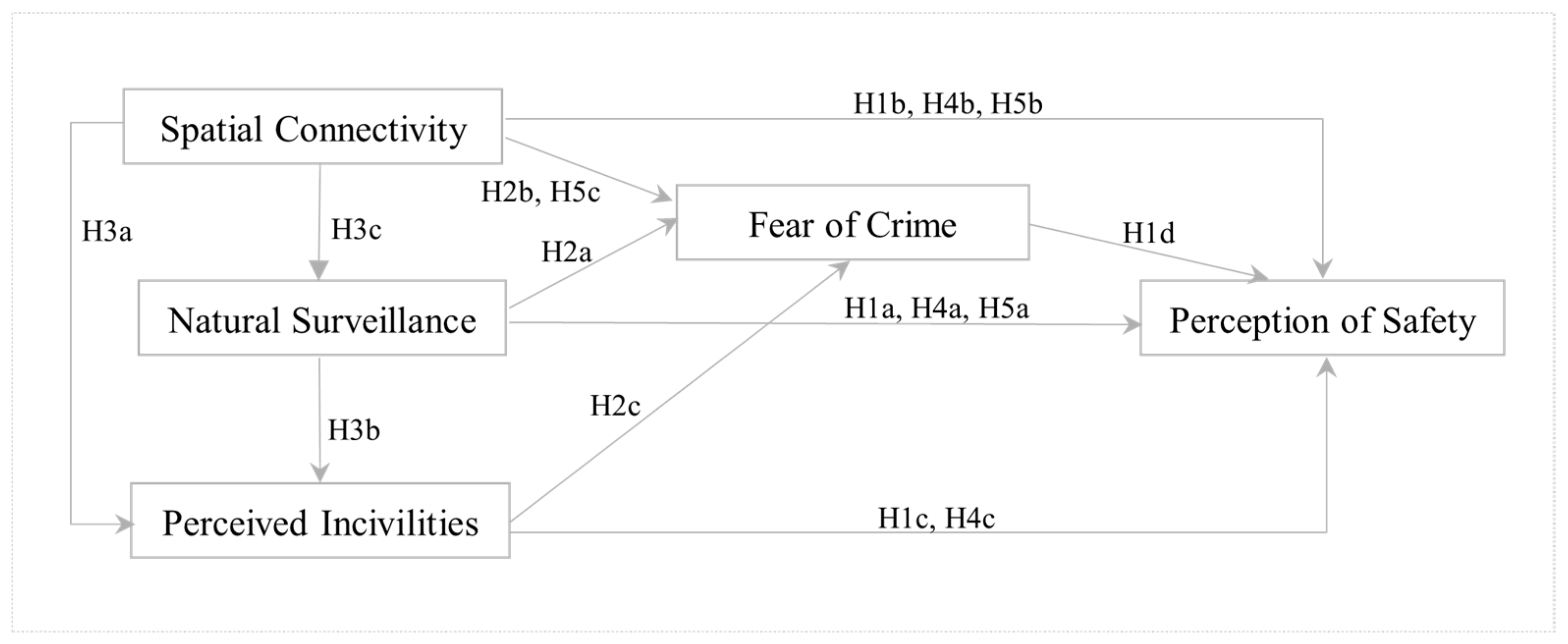
Figure 1 presents the conceptual framework developed for this study. The model positions perception of safety as the primary outcome influenced by three key spatial correlates: natural surveillance, spatial connectivity, and perceived incivilities. In line with environmental design and disorder theories, natural surveillance and spatial connectivity are expected to enhance safety, while incivilities undermine it. The framework also recognizes fear of crime as a central psychological mediator, capturing how environmental cues are internalized and translated into safety judgements. In addition, the model allows for interdependencies among the spatial constructs: connectivity is theorized to strengthen surveillance, while both surveillance and connectivity may reduce incivilities. Collectively, the framework integrates direct, indirect, and sequential pathways to explain how spatial conditions shape safety perceptions in the neighbourhood of Bayan Baru.

4. Materials and Methods

4.1. Study Area

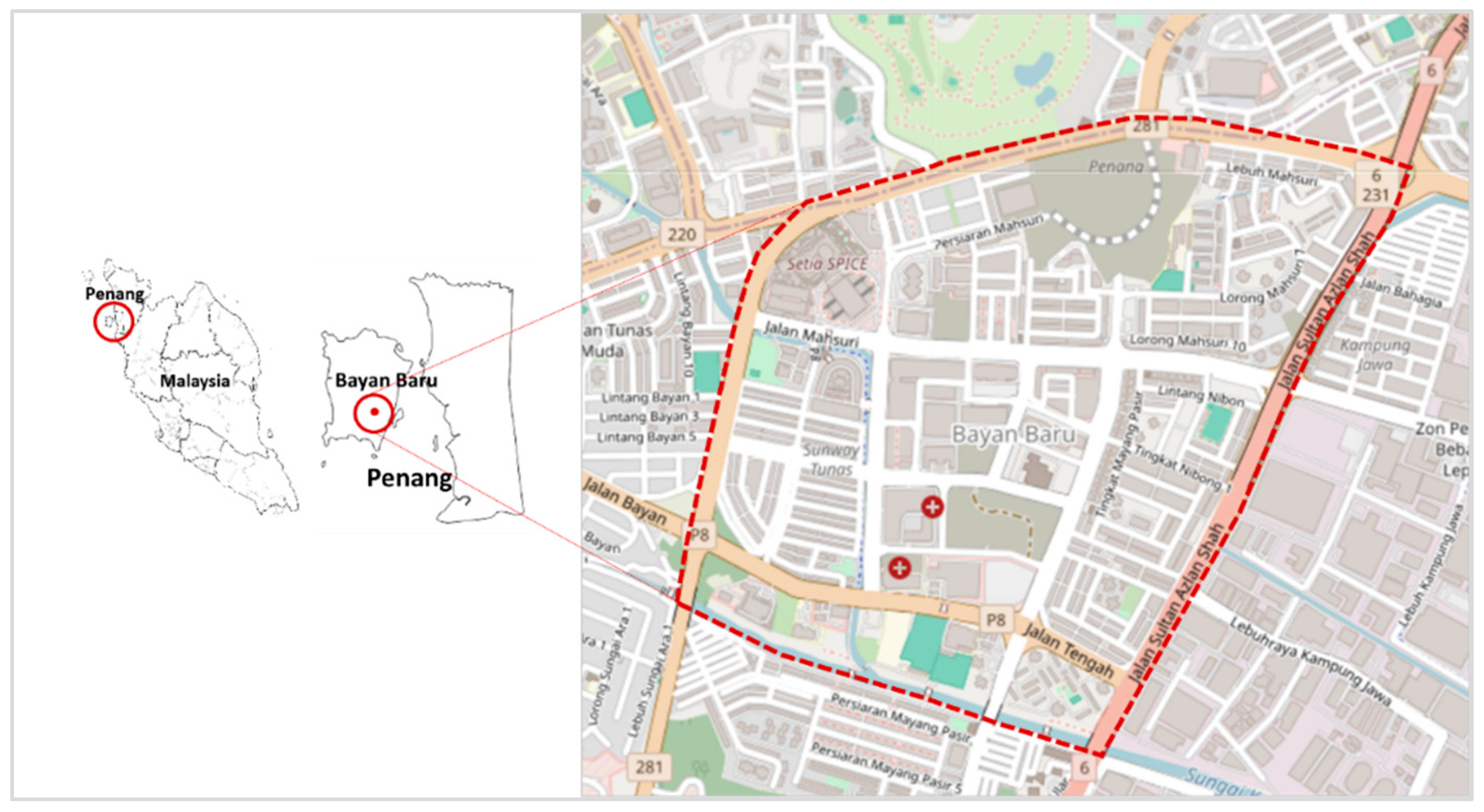
The study was conducted in Bayan Baru, a large residential neighbourhood located in the southwest district of Penang Island, Malaysia (refer Figure 2). As of 2020, the area recorded a population of 188,603. Bayan Baru is characterized by its mix of landed and high-rise housing, interconnected street networks, public transport access, and a range of amenities including shops, schools, clinics, and recreational spaces. While these features provide residents with accessibility and support daily activities, the neighbourhood also faces issues of disorder such as littering, vandalism, loitering, and poorly maintained spaces that may undermine the sense of security. This study therefore examines the spatial correlates of perceived safety in Bayan Baru, with particular attention to natural surveillance (visibility, sightlines, and eyes on the street), spatial connectivity (walkability, connectivity, and access to facilities), and incivilities (physical and social disorder). The aim is to assess how these spatial factors influence residents’ perception of safety, and whether fear of crime serves as a mediating factor in these relationships.

4.2. Study Design, Participants, and Sampling

This study applied a quantitative research design, using a structured questionnaire administered face-to-face to adult residents aged 18 years and above living in Bayan Baru, Penang. Participants were eligible if they were aged 18 years and above, currently residing in Bayan Baru, and had lived in the neighbourhood for at least one year to ensure adequate familiarity with local environmental conditions and everyday safety experiences. Only one response per household was collected to reduce clustering and to broaden coverage across the neighbourhood.
The sampling comprised occupied landed residential households within Bayan Baru study boundary. The study focused on landed housing areas because these environments provide consistent street-level exposure to visibility, connectivity, and incivility cues that are central to the conceptual framework. Data collection was conducted house-to-house through door-to-door recruitment. The sampling process began by randomly identifying the first household to establish an unbiased starting point. After selecting the initial unit, systematic sampling was implemented by approaching every 4th household along the street sequence from the starting point. This process continued across multiple streets within the landed housing area until the target sample size was achieved, supporting broad spatial coverage across Bayan Baru. This method created even spacing between sampled homes and reduced selection bias associated with convenience recruitment.
Within each selected household, the eligible respondent was the adult resident who answered the door and agreed to participate. If no eligible respondent was available at first contact, the household was revisited, when possible, to reduce exclusion of residents who were away during the initial visit. A total of 350 households/residents were approached, and 300 valid questionnaires were completed (response rate = 85.7%). Potential sources of bias include nonresponse (households that declined participation or were unavailable) and possible under-representation of residents with limited availability during door-to-door visits; these limitations are acknowledged when interpreting generalisability.

4.3. Measures and Operationalization of Constructs

The questionnaire consisted of two parts. The first section recorded demographic information (age, gender, length of stay, and household income). The second section measured the study constructs of natural surveillance, spatial connectivity, perceived incivilities, fear of crime, and perception of safety (Table 1). All items were adapted from relevant literature and were rated on a 5-point Likert scale. To ensure consistent interpretation, all variables were coded so that higher scores indicate “more” of the construct: Fear of crime (FC) 1 = Not at all worried to 5 = Extremely worried; perceived incivilities (PI) 1 = Not a problem to 5 = Very big problem; perception of safety (PS) 1 = Not safe at all to 5 = Very safe; natural surveillance (NS) 1 = Strongly disagree to 5 = Strongly agree and spatial connectivity 1 = Extremely not satisfied to 5 = Extremely satisfied.
Natural surveillance assessed perceived visibility, reduce blind spots, and opportunities for residents to observe activity in public spaces (6 items: NS1–NS6). Spatial connectivity captured satisfaction with walkability, street layout, access to daily services and facilities, and maintenance of public infrastructure (8 items: SC1–SC8). Perceived incivilities captured visible signs of physical and social disorder (9 items: PI1–PI9). Fear of crime measured concerns about common crime events such as burglary, theft, robbery, and assault (5 items: FC1–FC5). Finally, perceived safety assessed how safe respondents felt walking alone during the day and at night in their street or neighbourhood and their overall safety assessment (5 items: PS1–PS5).

4.4. Data Collection Procedure

Data collection was conducted between March and April 2025 using a structured, face-to-face questionnaire administered to residents of Bayan Baru, Penang. Participation was voluntary and respondents could skip any question or stop at any time. An a priori power analysis was conducted using G*Power 3.1 to determine the minimum required sample size. Because the primary endogenous outcome (Perceived Safety, PS) has four predictors in the structural model (NS, SC, PI, FC), we used a linear multiple regression framework (fixed model, R2 deviation from zero) with 4 predictors, α = 0.05, and power (1 − β) = 0.80. Assuming an effect size f2 = 0.30 (medium-to-large), the minimum required sample size was approximately 260. To allow for incomplete responses and to ensure adequate representation, 300 valid responses were collected for analysis. The sample had an equal gender split (50.0% female, 50.0% male), with the largest shares in the 25–34 and 35–44 age groups. Regarding residential history, about 28.0% had lived in Bayan Baru for more than 10 years. Household income was concentrated in the RM3001–RM5000 and RM5001–RM7000 categories, reflecting a diverse socioeconomic profile.

4.5. Data Screening, Missing Data Handling, and Analytical Approach (PLS-SEM)

Prior to modelling, the dataset was screened in SPSS 27 for completeness, eligibility, and data-entry accuracy. Of the 350 questionnaires collected, 50 were excluded during data cleaning due to incomplete responses and missing values on key measurement items. The final analytic dataset therefore consisted of 300 complete cases, no missing-data imputation was performed prior to importing the dataset into SmartPLS.
After data screening, the cleaned dataset was analysed using Partial Least Squares Structural Equation Modelling (PLS-SEM) in SmartPLS 4.0. This method was selected because it is suitable for complex models with multiple direct and indirect effects, and does not require strict multivariate normality. The analysis followed a two-step procedure: first, assessing the measurement model (indicator reliability, internal consistency, convergent validity, and discriminant validity), and second, evaluating the structural model to test the hypothesized relationships and indirect effects. Bootstrapping with 5000 resamples was applied to generate confidence intervals and significance levels for all path coefficients.

4.6. Ethics Approval and Informed Consent

Ethical approval was obtained from the Human Research Ethics Committee of Universiti Sains Malaysia (Approval No.: USM/JEPeM/22100676, Date: 17 November 2023). Prior to data collection, an invitation letter describing the study purpose, participation requirements, and confidentiality protections was distributed to households approximately one week before the survey commenced. During door-to-door visits, potential participants were informed that participation was voluntary and asked whether they were willing to take part before any questions were administered, and respondents could refuse to answer any item or withdraw at any time without consequences. To protect privacy, no personally identifying information was recorded in the dataset. Survey responses were anonymized and store securely, accessible only to the research team, and findings are reported only in aggregate to maintain confidentiality.

5. Results

5.1. Measurement Model

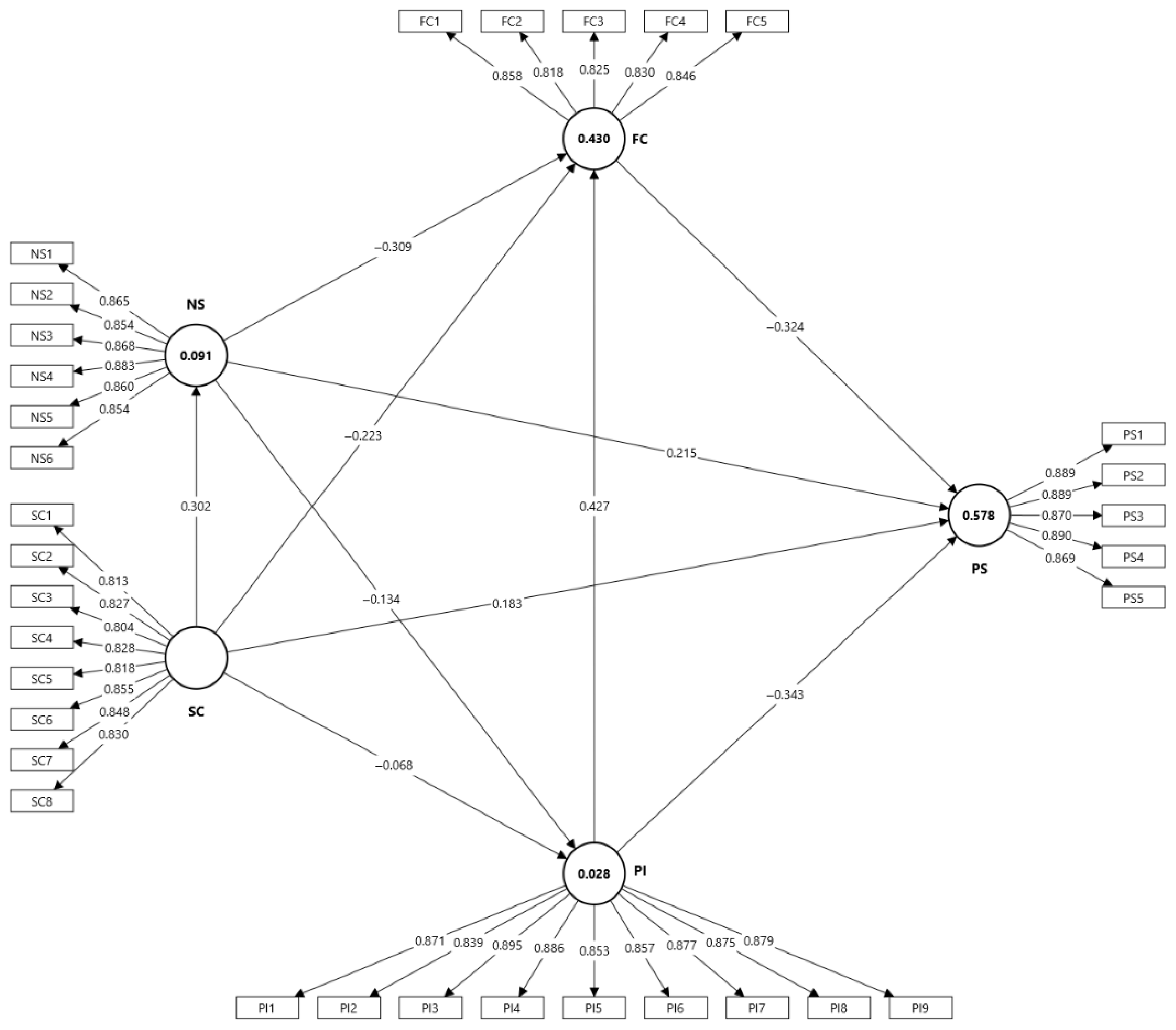
Figure 3 displays the estimated PLS-SEM model linking the study constructs, performed in SmartPLS 4.0. As summarized in Table 2, all indicators showed an outer loading of ≥0.70, indicating that the items represent their respective latent variables well. Composite reliability (CR) and Cronbach’s alpha values were all above 0.70, demonstrating adequate internal consistency. In addition, each construct’s average variance extracted (AVE) exceeded 0.50, confirming adequate convergent validity—i.e., the latent variables capture a substantial share of variance in their indicator’s [73].
Discriminant validity was assessed using the heterotrait–monotrait ratio (HTMT). As shown in Table 3, all HTMT values were below the conservative threshold of 0.85, with the highest observed value of Perceived safety and Fear of crime (0.721). This indicates that each construct is empirically distinct and satisfies the criterion for discriminant validity [74,75]. Table 4 summarises explanatory power (R2) and predictive relevance (Q2) for endogenous constructs, alongside AVE for reference. All constructs exceeded the recommended threshold for AVE (≥0.50), confirming good convergent validity [73]. The model shows moderate explanatory power for Fear of Crime (R2 = 0.430) and Perception of Safety (R2 = 0.578). Natural Surveillance (R2 = 0.091) and Perceived Incivilities (R2 = 0.028) show lower explained variance, which is consistent with their role as intermediate constructs influenced by fewer predictors in the specified model. Predictive relevance values were positive for all endogenous constructs (Q2 > 0), indicating predictive relevance of the model for the observed measures. Finally, the global Goodness-of-Fit (GoF) index, calculated as √ (average AVE × average R2), yielded a value of 0.454, which exceeds the cut-off of 0.36 for a large effect, indicating that the overall model fit is strong [15,75].

5.2. Structural Model Evaluation

Table 5 and Table 6 summarize the hypothesis tests using recommended PLS-SEM decision rules [73]. To improve transparency, each hypothesis is explicitly linked below to its path coefficient (β) and significance level, and hypotheses are marked as supported or not supported. p-values are reported as p < 0.001 where applicable (rather than p = 0.000).

5.2.1. Direct Effects (Supported vs. Not Supported)

For perceived safety (PS), Natural Surveillance and Spatial Connectivity showed positive direct effects (H1a: NS → PS, β = 0.215, p < 0.001; H1b: SC → PS, β = 0.183, p < 0.001). Perceived Incivilities and Fear of Crime showed negative direct effects (H1c: PI → PS, β = −0.343, p < 0.001; H1d: FC → PS, β = −0.324, p < 0.001). For fear of crime (FC), predictors behaved as expected: Natural Surveillance and Spatial Connectivity reduced fear (H2a: NS → FC, β = −0.309, p < 0.001; H2b: SC → FC, β = −0.223, p < 0.001), whereas Perceived Incivilities increased fear (H2c: PI → FC, β = 0.427, p < 0.001). For interdependencies among spatial constructs, Spatial Connectivity increased Natural Surveillance (H3c: SC → NS, β = 0.302, p < 0.001) and Natural Surveillance reduced Perceived Incivilities (H3b: NS → PI, β = −0.134, p = 0.024). However, Spatial Connectivity did not significantly reduce Perceived Incivilities (H3a: SC → PI, β = −0.068, p = 0.262), and this hypothesis is therefore not supported.
Table 5. Result of Hypothesis Testing (direct effects).
HsPathβt-Valuep-ValueDecision
A. Direct predictors of Perception of Safety (DV)
H1aNS → PS (+)0.2155.093p < 0.001Supported
H1bSC → PS (+)0.1834.432p < 0.001
H1cPI → PS (–)−0.3437.885p < 0.001
H1dFC → PS (–)−0.3246.243p < 0.001
B. Predictors of Fear of Crime (Mediator)
H2aNS → FC (–)−0.3096.755p < 0.001
H2bSC → FC (–)−0.2234.591p < 0.001
H2cPI → FC (+)0.42710.042p < 0.001
C. Extended IV-to-IV relationships (secondary effects)
H3aSC → PI (–)−0.0681.1210.262Not supported
H3bNS → PI (–)−0.1342.2520.024
H3cSC → NS (+)0.3025.695p < 0.001

5.2.2. Indirect and Sequential Effects (Mediation)

Mediation analysis identified several significant indirect pathways (Table 6). Fear of crime transmitted the influence of spatial factors on perceived safety: H4a (NS → FC → PS) (β = 0.100, p < 0.001), H4b (SC → FC → PS) (β = 0.072, p < 0.001), and H4c (PI → FC → PS) (β = −0.138, p < 0.001). Additional spatial chains were also supported: H5a (NS → PI → PS) (β = 0.046, p = 0.031), H5b (SC → NS → PS) (β = 0.065, p < 0.001), and H5c (SC → NS → FC) (β = −0.093, p < 0.001). Because the relevant direct effects (e.g., NS → PS, SC → PS, PI → PS; NS → FC; SC → FC) were also significant and aligned in direction with corresponding indirect effects, these results indicate complementary partial mediation. Given that R2 for perceived safety is moderate (0.578), the model explains a meaningful share of variance in perceived safety while also indicating that additional unmeasured factors (e.g., individual experiences, social ties, or other environmental attributes) likely contribute to safety perceptions. Accordingly, we interpret the effects as robust associations within the specified model rather than exhaustive prediction.
Table 6. Result of Hypothesis Testing (indirect effects) mediation.
HsPathβt-Valuep-ValueMediation Type
H4aNS → FC → PS (+)0.1004.651p < 0.001Complementary Partial Mediation
H4bSC → FC → PS (+)0.0723.500p < 0.001
H4cPI → FC → PS (−)−0.1385.377p < 0.001
H5aNS → PI → PS (+)0.0462.1520.031
H5bSC → NS → PS (+)0.0653.812p < 0.001
H5cSC → NS → FC (−)−0.0934.350p < 0.001

6. Discussion

6.1. Key Findings and Their Meaning

The results emphasize the importance of everyday spatial conditions in shaping how residents of Bayan Baru evaluate their safety. Among the strongest patterns observed is the role of natural surveillance, which emerged as a consistent protective factor. Residents who reported clearer sightlines and more visible activity in their surroundings were also more likely to perceive their neighborhood as safe (NS → PS: β = 0.215, p < 0.001). This finding echoes Jacobs [25] notion of “eyes on the street” and supports research demonstrating that visual openness and passive observation increase reassurance and reduce fear [76,77,78]. Consistent with this logic, natural surveillance was also associated with lower fear of crime (NS → FC: β = −0.309, p < 0.001), reinforcing earlier work linking visibility with reduced fear [79,80].
Spatial connectivity also plays a positive role, albeit through both direct and indirect pathways. Well-linked walkways, convenient transport access, and facilities within walking distance likely contribute to perceived safety by encouraging regular use of public space and sustaining activity presence. Empirically, spatial connectivity showed a positive direct association with perceived safety (SC → PS: β = 0.183, p < 0.001) and a negative association with fear of crime (SC → FC: β = −0.223, p < 0.001). These findings are align with Hillier [31] “natural movement” perspective, where connected networks can generate pedestrian flows that support vibrancy and informal control. Compact land use and accessible amenities strengthen both mobility and safety outcomes [81,82]. In Bayan Baru, the presence of active routes and accessible destinations may give residents greater confidence that public spaces are not abandoned or threatening.
In contrast, perceived incivilities emerged as a powerful negative influence on safety. Signs of neglect, litter, vandalism, graffiti, and loitering were associated with lower perceived safety (PI → PS: β = −0.343, p < 0.001) and higher fear of crime (PI → FC: β = 0.427, p < 0.001). This pattern supports the “broken windows” reasoning in [42], where disorder signals weakened collective control and elevates unease. Importantly, fear of crime itself showed a strong negative association with perceived safety (FC → PS: β = −0.324, p < 0.001), underscoring fear as a key psychological channel linking environmental cues to safety judgements. Numerous studies across different contexts reinforce this interpretation, showing that disorder cues elevate fear and undermine trust in community resilience [83,84]. The findings here confirm that, even when surveillance and connectivity are strong, visible disorder can overshadow these qualities and lower safety judgements.

6.2. Mediation and Interdependence Among Spatial Factors

A central contribution of the model is showing that safety is shaped not only by direct effects but also by indirect (mediated) pathways. Fear of crime transmitted the influence of natural surveillance and spatial connectivity on perceived safety (NS → FC → PS: β = 0.100, p < 0.001; SC → FC → PS: β = 0.072, p < 0.001), and also transmitted the negative effect of incivilities on safety (PI → FC → PS: β = −0.138, p < 0.001). Neighbourhoods with better surveillance and connectivity generated lower levels of fear, while those marked by incivilities produced heightened fear. These results align with psychological perspectives on risk perception, where environmental cues are internalized emotionally and guide safety appraisals [85,86,87]. The mediation findings support evidence from studies indicating that fear is not merely an outcome of urban conditions but also a mechanism that explains how design and disorder shape perceptions [88,89,90]. Importantly, the results demonstrate that design interventions can work both directly by providing reassurance through visibility and connection and indirectly by reducing the fear that undermines safety.
The study also reveals meaningful interdependence between spatial factors. Spatial connectivity strengthened natural surveillance (SC → NS: β = 0.302, p < 0.001), consistent with the idea that connected streets can increase and also produce sequential pathways to safety (SC → NS → PS: β = 0.065, p < 0.001) and to reduced fear (SC → NS → FC: β = −0.093, p < 0.001). This sequential chain underlines how design features reinforce one another. Ali Ariff, Ahmad Zawawi [91], Iqbal and Ceccato [92] and Mu, Mu [93] found that accessibility contributes to safety indirectly by sustaining visible flows of people. Natural surveillance was also associated with lower perceived incivilities (NS → PI: β = −0.134, p = 0.024; NS → PI → PS: β = 0.046, p = 0.031), suggesting that visible guardianship may deter or reduce perceived disorder in some contexts [22,94,95].
However, one hypothesized path was not supported; spatial connectivity did not directly reduce perceived incivilities (SC → PI: β = −0.068, p = 0.262). This non-significant relationship suggests that connectivity and infrastructure alone may be insufficient to suppress disorder without complementary maintenance, enforcement, and community stewardship [96,97]. This nuance is important for practice: “building connectivity” may increase movement and visibility, but it does not automatically eliminate disorder signals that residents read as threats.

6.3. Interpretation in Light of Explanatory Power (R2)

While the model explains a meaningful share of variance in perceived safety (R2 = 0.578) and fear of crime (R2 = 0.430), these values indicate moderate explanatory power rather than near-complete prediction. Accordingly, the results should be interpreted as strong evidence for the specified relationships in Bayan Baru, while recognizing that other factors not included in the model (e.g., prior victimization, social ties, or additional environmental attributes) likely also shape safety perceptions.

6.4. Practical Implications for Neighbourhood Planning and Management in Malaysia

Taken together, these findings suggest that improving perceived safety in Bayan Baru requires integrated interventions that address both built form and everyday management. Because natural surveillance showed a positive direct association with perceived safety (NS → PS: β = 0.215, p < 0.001) and a negative association with fear of crime (NS → FC: β = −0.309, p < 0.001), neighbourhood design strategies that enhance visibility are likely to yield practical safety benefits. This includes strengthening clear sightlines along walking routes, limiting blind spots around corners and public-space edges, ensuring lighting supports visibility at night, and promoting active frontages that increase passive observation and activity presence. At the same time, the results highlight that disorder cues have particularly strong implications for perceived safety, with perceived incivilities exerting the largest negative direct effect on safety and a strong positive effect on fear (PI → PS: β = −0.343, p < 0.001; PI → FC: β = 0.427, p < 0.001). This pattern indicates that routine upkeep and rapid response to visible disorder—such as littering, vandalism, graffiti, and unmanaged loitering—should be treated as a core safety strategy rather than a secondary aesthetic concern.
The model also implies that improvements to spatial connectivity can support perceived safety, but primarily when paired with conditions that enhance visibility and social presence. Spatial connectivity was positively related to perceived safety and negatively related to fear (SC → PS: β = 0.183, p < 0.001; SC → FC: β = −0.223, p < 0.001), and it also strengthened natural surveillance (SC → NS: β = 0.302, p < 0.001), producing significant sequential pathways to safety and reduced fear (SC → NS → PS: β = 0.065, p < 0.001; SC → NS → FC: β = −0.093, p < 0.001). However, connectivity did not directly reduce perceived incivilities (SC → PI: β = −0.068, p = 0.262), suggesting that better walkways and access alone may not eliminate disorder signals without complementary maintenance and community stewardship. Practically, this means Malaysian neighbourhood planning efforts should combine physical upgrades (connectivity and visibility) with ongoing management and resident–local authority coordination that reduces disorder and fear simultaneously, thereby strengthening everyday confidence in public space.

6.5. Limitations and Future Research Directions

This study draws on a cross-sectional survey within a single neighbourhood, and the findings should therefore be interpreted as evidence of robust associations within the specified model rather than causal effects. Generalization beyond Bayan Baru should be made cautiously, particularly to neighbourhoods with different housing types, street-network structures, socio-demographic profiles, or governance contexts. Future studies could replicate the model across multiple Malaysian neighbourhood types and cities and apply longitudinal or quasi-experimental designs to better assess how changes in visibility, connectivity, and disorder correspond to changes in fear and perceived safety over time. In addition, the present study treats fear of crime as a single construct. Future research could distinguish between personal fear (concerns about one’s own victimisation) and altruistic fear (concerns for family members or others), and examine whether natural surveillance and neighbourhood conditions relate differently to these dimensions of fear. Such refinements would deepen understanding of how spatial cues are interpreted emotionally and could help tailor interventions to the most influential sources of fear in specific community contexts.

7. Conclusions

This study demonstrates that residents’ perceptions of safety in Bayan Baru are closely tied to the spatial and social conditions of their neighborhoods. The results confirm that natural surveillance and spatial connectivity enhance perceived safety, while perceived incivilities undermine it, both directly and through fear of crime. Specifically, natural surveillance and spatial connectivity were positively associated with perceived safety (NS → PS; SC → PS), whereas perceived incivilities and fear of crime were negatively associated with perceived safety (PI → PS; FC → PS). By integrating design perspectives such as [25] “eyes on the street” and CPTED principles [5,6] with disorder frameworks such as broken windows [42], the study provides an integrated account of how the built-form conditions and visible cues of neglect interact to shape residents’ lived experiences of safety.
A central contribution of this study is the explicit modelling of fear of crime as a mediating mechanism that links environmental cues to safety judgements in a Malaysian neighbourhood context. Surveillance and spatial connectivity reduce fear, while incivilities amplify it, and fear in turn strongly shapes perceived safety. The mediation results indicate that environmental interventions may improve perceived safety not only through direct reassurance (visibility and access) but also indirectly by lowering fear (NS → FC → PS; SC → FC → PS) and by reducing disorder perceptions where visibility is stronger (NS → PI → PS). This finding reinforces the need for urban safety strategies that go beyond physical improvements to also consider the emotional climate of neighborhoods [79,98,99]. The findings also show that spatial factors are interdependent: spatial connectivity strengthened natural surveillance and contributed to perceived safety through sequential pathways (SC → NS → PS) and reduced fear (SC → NS → FC), while connectivity did not directly reduce perceived incivilities (SC → PI not supported). This pattern underscores that street-network improvements can support safety via increased visibility and activity presence, but may not suppress disorder without complementary management and community stewardship [100,101,102,103].
From a practical standpoint, the findings support integrated neighbourhood safety strategies in Malaysian urban settings. Because disorder showed a strong negative relationship with perceived safety and a strong positive relationship with fear, proactive management of incivilities (e.g., litter, vandalism, neglected spaces, and unmanaged loitering hotspots) should be treated as a core safety measure rather than a secondary aesthetic issue. At the same time, enhancing natural surveillance (e.g., clearer sightlines, reduced blind spots, and improved nighttime visibility) and strengthening spatial connectivity (walkable access to facilities and active routes) can reinforce everyday reassurance and reduce fear, thereby strengthening residents’ confidence in public space. Given the model’s moderate explanatory power (e.g., R2 for perceived safety and fear of crime), these conclusions are interpreted as robust associations within the specified model rather than exhaustive prediction of all determinants of safety perceptions. This research has several limitations that suggest avenues for future work. First, its cross-sectional design prevents causal inference; future research could adopt longitudinal or quasi-experimental designs to examine how safety perceptions change after environmental interventions such as CCTV installation, lighting upgrades, or street redesigns. Second, the reliance on self-reported measures means perceptions were not directly compared with objective conditions. Future studies could combine surveys with systematic social observations, GIS-based spatial analyses, or police crime data to explore the gap between perceived and recorded safety. Third, the study was limited to a single neighbourhood context; comparative multi-neighbourhood or cross-city research—including other Malaysian and Southeast Asian urban settings—would help assess whether the same spatial correlates and mediation processes operate across different urban forms, densities, and socio-economic contexts.
Future work could also expand the conceptual model by incorporating constructs such as social cohesion, collective efficacy, trust, neighbourhood vitality, and urban aesthetics, which may further explain variation in safety perceptions. Multi-group analysis in PLS-SEM could test whether relationships differ by gender, age, income, or length of residence, helping identify groups that are more sensitive to disorder or fear. In addition, future research may benefit from distinguishing between personal fear (concern for one’s own victimisation) and altruistic fear (concern for family members or others), and examining whether natural surveillance relates differently to these fear dimensions. Finally, mixed-methods approaches could provide richer insights. Qualitative interviews or participatory mapping would capture how residents interpret safety in their own words, complementing quantitative modelling. Likewise, agent-based simulations or space syntax analyses could model how changes in connectivity or visibility influence flows of people and safety perceptions. Overall, this study underscores that spatial correlates, surveillance, connection, and disorder are central to shaping how safe residents feel in their everyday environments. By addressing both physical design and social signals, planners and policymakers can strengthen safety, reduce fear, and build more resilient and inclusive neighborhoods in Malaysian cities and beyond.

Author Contributions

Conceptualization, A.A., N.R., M.H.M. and M.J.M.T.; Methodology, A.A., N.R., M.H.M. and M.J.M.T.; software, N.R. and M.H.M.; Validation, A.A. and M.J.M.T.; Formal analysis, N.R. and M.H.M.; Investigation, M.J.M.T. and A.A.; resources, N.R.; data curation, N.R.; Writing—original draft, A.A., N.R., M.H.M. and M.J.M.T.; writing—review and editing, A.A., N.R., M.H.M. and M.J.M.T.; Visualization, N.R.; Supervision, A.A. and M.H.M.; Project administration, N.R.; Funding acquisition, A.A. All authors have read and agreed to the published version of the manuscript.

Funding

This research was funded by the Universiti Sains Malaysia (USM), under I2S grant number R502-KR-ARP004-00AUPRM003-K134.

Institutional Review Board Statement

The study was conducted in accordance with the Declaration of Helsinki, and approved by the Human Research Ethics Committee of Universiti Sains Malaysia (protocol code USM/JEPeM/22100676, approval date 17 November 2023).

Informed Consent Statement

Informed consent was obtained from all subjects involved in the study.

Data Availability Statement

The data that support the findings of this study are available on request from the corresponding authors.

Acknowledgments

The authors extend their sincere appreciation to Universiti Sains Malaysia (USM) for the support and for providing the facilities required for the successful implementation of this project.

Conflicts of Interest

The authors declare no conflicts of interest to report regarding the present study.

References

  1. Machielse June, W.; Jansson, U. Perceived Safety in Public Spaces A Quantitative Investigation of the Spatial and Social Influences on Safety Perception Among Young Adults in Stockholm. Master’s Thesis, Stockholm University, Stockholm, Sweden, 2015. [Google Scholar]
  2. Sheikh Ilmi, H.; Meor Gheda, M.L.; Ahmad Yusof, N. Neighbourhood Safety and Outdoor Play Activities among Urban Children in Shah Alam, Malaysia. IOP Conf. Ser. Mater. Sci. Eng. 2018, 401, 012031. [Google Scholar] [CrossRef]
  3. Zahnow, R. Social infrastructure, social cohesion and subjective wellbeing. Wellbeing Space Soc. 2024, 7, 100210. [Google Scholar] [CrossRef]
  4. Maghsoodi Tilaki, M.J.; Farhad, S. Revitalising historic fabrics: The influence of identity and community belonging. Geogr. Res. 2025, 63, 573–593. [Google Scholar] [CrossRef]
  5. Cozens, P.; Love, T. A Review and Current Status of Crime Prevention through Environmental Design (CPTED). J. Plan. Lit. 2015, 30, 393–412. [Google Scholar] [CrossRef]
  6. Armitage, R. Burglars’ take on crime prevention through environmental design (CPTED): Reconsidering the relevance from an offender perspective. Secur. J. 2018, 31, 285–304. [Google Scholar] [CrossRef]
  7. Tian, Y.; Shuai, Y.; Ma, X.; Shao, C.; Liu, T.; Tuerhanjiang, L. Improved Landscape Expansion Index and Its Application to Urban Growth in Urumqi. Remote Sens. 2022, 14, 5255. [Google Scholar] [CrossRef]
  8. Zheng, G.; Ding, L.; Zheng, J. A Multi-Dimensional Evaluation of Street Vitality in a Historic Neighborhood Using Multi-Source Geo-Data: A Case Study of Shuitingmen, Quzhou. ISPRS Int. J. Geo-Inf. 2025, 14, 240. [Google Scholar] [CrossRef]
  9. Barron, S.; Nitoslawski, S.; Wolf, K.L.; Woo, A.; Desautels, E.; Sheppard, S.R.J. Greening blocks: A conceptual typology of practical design interventions to integrate health and climate resilience co-benefits. Int. J. Environ. Res. Public Health 2019, 16, 4241. [Google Scholar] [CrossRef]
  10. Halawani, R. The Effects of Public Spaces on People’s Experiences and Satisfaction in Taif City: A Cross-Sectional Study. Land 2024, 13, 1529. [Google Scholar] [CrossRef]
  11. Ooi, G.L. Challenges of sustainability for Asian urbanisation. Curr. Opin. Environ. Sustain. 2009, 1, 187–191. [Google Scholar] [CrossRef]
  12. Tan, Z.; Lau, K.K.L.; Roberts, A.C.; Chao, S.T.Y.; Ng, E. Designing urban green spaces for older adults in asian cities. Int. J. Environ. Res. Public Health 2019, 16, 4423. [Google Scholar] [CrossRef]
  13. Xingrui, C.; Ibrahim, F.I.B. The Impact of Green Spaces To Human Psychology and Their Mental Health. Plan. Malays. 2024, 22, 485–500. [Google Scholar] [CrossRef]
  14. Tilaki, M.J.M.; Ibrahim, W.M.M.W.; Abdullah, A. Exploring challenges of adaptive reusing of vacant shophouses in Penang’s heritage zone. Cities 2026, 170, 106663. [Google Scholar] [CrossRef]
  15. Marzbali, M.H.; Abdullah, A.; Ignatius, J.; Tilaki, M.J.M. Examining the effects of crime prevention through environmental design (CPTED) on Residential Burglary. Int. J. Law Crime Justice 2016, 46, 86–102. [Google Scholar] [CrossRef]
  16. Hedayati Marzbali, M.; Abdullah, A.; Razak, N.A.; Maghsoodi Tilaki, M.J. The influence of crime prevention through environmental design on victimisation and fear of crime. J. Environ. Psychol. 2012, 32, 79–88. [Google Scholar] [CrossRef]
  17. Al-Obeidy, M.S.; Ja‘afar, N.H.; Harun, N.Z.; Malek, M.I.A. Modeling safety as a walkability pillar: Key indicators enhancing social interaction in mixed-use streets. J. Umm Al-Qura Univ. Eng. Archit. 2025, 16, 1–26. [Google Scholar] [CrossRef]
  18. Li, X.; Zhang, C.; Li, W. Does the visibility of greenery increase perceived safety in urban areas? Evidence from the place pulse 1.0 dataset. ISPRS Int. J. Geo-Inf. 2015, 4, 1166–1183. [Google Scholar] [CrossRef]
  19. Zhang, M.; Bandara, A.K. Understanding Pedestrians’ Perception of Safety and Safe Mobility Practices. In Proceedings of the Conference on Human Factors in Computing Systems, Honolulu, HI, USA, 11–16 May 2024. [Google Scholar] [CrossRef]
  20. Ghasemi, K.; Dolatkhahi, K.; Farmahini Farahani, H.; Fallahi, M. From planning to perception: A study of urban security in new towns using machine learning, spatial clustering, and lived experiences. Environ. Sustain. Indic. 2025, 28, 101035. [Google Scholar] [CrossRef]
  21. Ogneva-Himmelberger, Y.; Ross, L.; Caywood, T.; Khananayev, M.; Starr, C. Analyzing the relationship between perception of safety and reported crime in an urban neighborhood using GIS and sketch maps. ISPRS Int. J. Geo-Inf. 2019, 8, 531. [Google Scholar] [CrossRef]
  22. Navarrete-Hernandez, P.; Afarin, K. The impact of nature-based solutions on perceptions of safety in public space. J. Environ. Psychol. 2023, 91, 102132. [Google Scholar] [CrossRef]
  23. Jing, F.; Liu, L.; Zhou, S.; Li, Z.; Song, J.; Wang, L.; Ma, R.; Li, X. Exploring large-scale spatial distribution of fear of crime by integrating small sample surveys and massive street view images. Environ. Plan. B Urban Anal. City Sci. 2023, 50, 1104–1120. [Google Scholar] [CrossRef]
  24. Park, W.; Son, D.; Im, B.; Her, J.; Kim, Y.J.; Kim, S.N. Fear of crime revisited: Analyzing the effects of urban nighttime illuminance on neural and psychological responses using recorded virtual environments and electroencephalogram data. Virtual Real. 2025, 29, 145. [Google Scholar] [CrossRef]
  25. Jacobs, J. Jane jacobs. Death Life Great Am. Cities 1961, 21, 13–25. [Google Scholar]
  26. D’Orso, G.; Migliore, M. A GIS-based method for evaluating the walkability of a pedestrian environment and prioritised investments. J. Transp. Geogr. 2020, 82, 102555. [Google Scholar] [CrossRef]
  27. Baran, P.K.; Tabrizian, P.; Zhai, Y.; Smith, J.W.; Floyd, M.F. An exploratory study of perceived safety in a neighborhood park using immersive virtual environments. Urban For. Urban Green. 2018, 35, 72–81. [Google Scholar] [CrossRef]
  28. Guo, X.; Liu, C.; Bi, S.; Tang, Y. Identification of Inequities in Green Visibility and Ways to Increase Greenery in Neighborhoods: A Case Study of Wuhan, China. Appl. Sci. 2025, 15, 742. [Google Scholar] [CrossRef]
  29. Glazener, A.; Sanchez, K.; Ramani, T.; Zietsman, J.; Nieuwenhuijsen, M.J.; Mindell, J.S.; Fox, M.; Khreis, H. Fourteen pathways between urban transportation and health: A conceptual model and literature review. J. Transp. Health 2021, 21, 101070. [Google Scholar] [CrossRef]
  30. Matthewson, G.; Kalms, N.; Berry, J.; Bawden, G. Streets after dark: The experiences of women, girls and gender-diverse people. In Everyday Streets: Inclusive Approaches to Understanding and Designing Streets; UCL Press: London, UK, 2023; pp. 89–104. [Google Scholar]
  31. Hillier, B. Can streets be made safe? Urban Des. Int. 2004, 9, 31–45. [Google Scholar] [CrossRef]
  32. Alnaim, M.M.; Mesloub, A.; Alalouch, C.; Noaime, E. Reclaiming the Urban Streets: Evaluating Accessibility and Walkability in the City of Hail’s Streetscapes. Sustainability 2025, 17, 3000. [Google Scholar] [CrossRef]
  33. Angel, A.; Cohen, A.; Nelson, T.; Plaut, P. Evaluating the relationship between walking and street characteristics based on big data and machine learning analysis. Cities 2024, 151, 105111. [Google Scholar] [CrossRef]
  34. De Jesus, M.; Puleo, E.; Shelton, R.C.; Emmons, K.M. Associations between perceived social environment and neighborhood safety: Health implications. Health Place 2010, 16, 1007–1013. [Google Scholar] [CrossRef]
  35. Petrová, E.; Štofa, T.; Šoltés, M. Exploration of the factors that influence the implementation of environmental management systems-the case of Slovakia. Economies 2021, 9, 68. [Google Scholar] [CrossRef]
  36. Sadeghi, A.R.; Ebadi, M.; Shams, F.; Jangjoo, S. Human-built environment interactions: The relationship between subjective well-being and perceived neighborhood environment characteristics. Sci. Rep. 2022, 12, 21844. [Google Scholar] [CrossRef]
  37. Negm, H.; De Vos, J.; Pot, F.; El-Geneidy, A. Perceived accessibility: A literature review. J. Transp. Geogr. 2025, 125, 104212. [Google Scholar] [CrossRef]
  38. OECD. Enhancing Compactness, Connectivity and Accessibility in Korea; Organisation for Economic Co-operation and Development: Paris, France, 2025; pp. 1–35. [Google Scholar]
  39. Kim, H.M.; Mateo-Babiano, I. Pedestrian crossing environments in an emerging Chinese city: Vehicle encountering, seamlesswalking, and sensory perception perspectives. Sustainability 2018, 10, 2200. [Google Scholar] [CrossRef]
  40. Sheng, Q.; Jiao, J.; Pang, T. Understanding the Impact of Street Patterns on Pedestrian Distribution: A Case Study in Tianjin, China. Urban Rail Transit 2021, 7, 209–225. [Google Scholar] [CrossRef]
  41. Zain, S.N.M.; Ismail, W.I.F.W.; Hamzah, A.H. Evaluating Transit-Oriented Development in Malaysia: A Comprehensive Analysis of Benefits, Drawbacks and Implementation Challenges. Int. J. Res. Innov. Appl. Sci. 2025, 10, 574–587. [Google Scholar] [CrossRef]
  42. Wilson, J.Q.; Kelling, G.L. Broken windows: The police and neighborhood safety. Atl. Mon. 1982, 249, 29–38. [Google Scholar]
  43. Chappell, A.T.; Monk-Turner, E.; Payne, B.K. Broken windows or window breakers: The influence of physical and social disorder on quality of life. Justice Q. 2011, 28, 522–540. [Google Scholar] [CrossRef]
  44. García-Tejeda, E.; Fondevila, G. Policing Social Disorder and Broken Windows Theory: Spatial Evidence from the “Franeleros” Experience. ISPRS Int. J. Geo-Inf. 2023, 12, 449. [Google Scholar] [CrossRef]
  45. Austin, D.M. Graffiti and Perceptions of Safety: A Pilot Study Using Photographs and Survey Data. J. Crim. Justice Pop. Cult. 2007, 14, 292–316. [Google Scholar]
  46. Madani, J.; Nemati, V.; Mostafazadeh, R.; Ashja, H. Factors influencing and controlling vandalism by tourists and local indigenous communities at the Fandoghlou forest natural site. J. Outdoor Recreat. Tour. 2024, 48, 100830. [Google Scholar] [CrossRef]
  47. Austin, D.M.; Furr, L.A.; Spine, M. The effects of neighborhood conditions on perceptions of safety. J. Crim. Justice 2002, 30, 417–427. [Google Scholar] [CrossRef]
  48. Lai, Y.L.; Zhao, J.S.; Longmire, D.R. Specific crime–fear linkage: The effect of actual burglary incidents reported to the police on residents’ fear of burglary. J. Crime Justice 2012, 35, 13–34. [Google Scholar] [CrossRef]
  49. Sakip, S.R.M.D.; Rahim, P.R.M.A.; Nayan, N.M. Establishing Crime Prevention Through Environmental Design Model. Int. J. Sustain. Constr. Eng. Technol. 2023, 14, 314–327. [Google Scholar] [CrossRef]
  50. Abraham, J.; Ceccato, V.; Näsman, P. From locals to outsiders: A comparative analysis of neighborhood safety perceptions. Nord. J. Criminol. 2025, 27, 1–26. [Google Scholar] [CrossRef]
  51. Burt, C.J.; Kondo, M.C.; Hohl, B.C.; Gong, C.H.; Bushman, G.; Wixom, C.; South, E.C.; Cunningham, R.M.; Carter, P.M.; Branas, C.C.; et al. Community Greening, Fear of Crime, and Mental Health Outcomes. Am. J. Community Psychol. 2022, 69, 46–58. [Google Scholar] [CrossRef] [PubMed]
  52. Lee, J.S.; Park, S.; Jung, S. Effect of crime prevention through environmental design (CPTED) measures on active living and fear of crime. Sustainability 2016, 8, 872. [Google Scholar] [CrossRef]
  53. Lorenc, T.; Clayton, S.; Neary, D.; Whitehead, M.; Petticrew, M.; Thomson, H.; Cummins, S.; Sowden, A.; Renton, A. Crime, fear of crime, environment, and mental health and wellbeing: Mapping review of theories and causal pathways. Health Place 2012, 18, 757–765. [Google Scholar] [CrossRef]
  54. Stafford, M.; Chandola, T.; Marmot, M. Association Between Fear of Crime and Mental Health and Physical Functioning. Am. J. Public Health 2007, 97, 2076–2081. [Google Scholar] [CrossRef]
  55. Murakami, A.; Medrial Zain, A.; Takeuchi, K.; Tsunekawa, A.; Yokota, S. Trends in urbanization and patterns of land use in the Asian mega cities Jakarta, Bangkok, and Metro Manila. Landsc. Urban Plan. 2005, 70, 251–259. [Google Scholar] [CrossRef]
  56. Sakketa, T.G. Understanding rapid urbanisation’s influence on social cohesion: Insights from Africa. Cities 2025, 160, 105835. [Google Scholar] [CrossRef]
  57. Aliyas, Z. Does social environment mediate the association between perceived safety and physical activity among adults living in low socioeconomic neighborhoods? J. Transp. Health 2019, 14, 100578. [Google Scholar] [CrossRef]
  58. Castillo-Paredes, A.; Iglésias, B.; Farías-Valenzuela, C.; Kovalskys, I.; Gómez, G.; Rigotti, A.; Cortés, L.Y.; García, M.C.Y.; Pareja, R.G.; Herrera-Cuenca, M.; et al. Perceived Neighborhood Safety and Active Transportation in Adults from Eight Latin American Countries. Int. J. Environ. Res. Public Health 2022, 19, 12811. [Google Scholar] [CrossRef] [PubMed]
  59. Swatt, M.L.; Varano, S.P.; Uchida, C.D.; Solomon, S.E. Fear of crime, incivilities, and collective efficacy in four Miami neighborhoods. J. Crim. Justice 2013, 41, 1–11. [Google Scholar] [CrossRef]
  60. Abdullah, A.; Hedayati Marzbali, M.; Javad Maghsoodi Tilaki, M. The Mediating Effect of Perceived Risk on the Relationship between Physical Incivilities and Health in Residential Areas. J. Humanit. Soc. Sci. Res. 2020, 2, 61–68. [Google Scholar] [CrossRef]
  61. Esteban-Cornejo, I.; Carlson, J.A.; Conway, T.L.; Cain, K.L.; Brian, E.; Frank, L.D.; Glanz, K.; Roman, C.G.; Sallis, J.F. Parental and Adolescent Perceptions of Neighborhood Safety Related to Adolescents’ Physical Activity in Their Neighborhood. Res. Q. Exerc. Sport 2016, 87, 191–199. [Google Scholar] [CrossRef] [PubMed]
  62. Cerin, E.; Saelens, B.E.; Sallis, J.F.; Frank, L.D. Neighborhood environment walkability scale: Validity and development of a short form. Med. Sci. Sports Exerc. 2006, 38, 1682–1691. [Google Scholar] [CrossRef]
  63. Wan Abdul Manan, W.M.; Lee, Y.Y. Reliability and Validity of the Neighbourhood Environment Walkability Scale (NEWS)—Malay Version. Int. J. Public Health Clin. Sci. 2018, 5, 65–82. [Google Scholar]
  64. Sallis, J.F.; Cerin, E.; Conway, T.L.; Adams, M.A.; Frank, L.D.; Pratt, M.; Salvo, D.; Schipperijn, J.; Smith, G.; Cain, K.L.; et al. Physical activity in relation to urban environments in 14 cities worldwide: A cross-sectional study. Lancet 2016, 387, 2207–2217. [Google Scholar] [CrossRef] [PubMed]
  65. Titze, S.; Giles-Corti, B.; Knuiman, M.W.; Pikora, T.J.; Timperio, A.; Bull, F.C.; Van Niel, K. Associations between intrapersonal and neighborhood environmental characteristics and cycling for transport and recreation in adults: Baseline results from the RESIDE study. J. Phys. Act. Health 2010, 7, 423–431. [Google Scholar] [CrossRef]
  66. Carmona, M. Place value: Place quality and its impact on health, social, economic and environmental outcomes. J. Urban Des. 2019, 24, 1–48. [Google Scholar] [CrossRef]
  67. Delsante, I. Metodologia e indicadores para avaliação da qualidade do ambiente urbano de bairros de média densidade: Um estudo de caso comparativo entre Lodi e Gênova. Ambiente Construído 2016, 16, 7–22. [Google Scholar] [CrossRef][Green Version]
  68. Iman, T.I.F. Mapping of Livability Assessment in Recreational Public Space: A Case Study of Titiwangsa Lake Gardens, Kuala Lumpur. IOP Conf. Ser. Earth Environ. Sci. 2021, 887, 012030. [Google Scholar] [CrossRef]
  69. Leby, J.L.; Hashim, A.H. Liveability dimensions and attributes: Their relative importance in the eyes of neighbourhood residentS. J. Constr. Dev. Ctries. 2010, 15, 67–91. [Google Scholar]
  70. Lombardi, P.; Giordano, S.; Farouh, H.; Yousef, W. Modelling the smart city performance. Innov. Eur. J. Soc. Sci. Res. 2012, 25, 137–149. [Google Scholar] [CrossRef]
  71. Neighbourhoods, M. Liveable, Healthy, Sustainable: What Are the Key Indicators for Melbourne Neighbourhoods? Research Paper 1; Place, Health and Liveability Research Program, University of Melbourne: Melbourne, Australia, 2013. [Google Scholar]
  72. Yavuz, F. An Overview of Quality of Urban Life in Konya (Turkey) from the Perspectives of Experts via Analytical Hierarchy Process (AHP). Iconarp. Int. J. Archit. Plan. 2021, 9, 611–645. [Google Scholar] [CrossRef]
  73. Hair, J.F.; Hult, G.T.M.; Ringle, C.M.; Sarstedt, M.; Danks, N.P.; Ray, S. Evaluation of the Structural Model. In Partial Least Squares Structural Equation Modeling (PLS-SEM) Using R. Classroom Companion: Business; Springer: Cham, Switzerland, 2021; Volume 30. [Google Scholar]
  74. Fornell, C.; Larcker, D.F. Structural Equation Models with Unobservable Variables and Measurement Error: Algebra and Statistics. J. Mark. Res. 1981, 18, 382. [Google Scholar] [CrossRef]
  75. Hair, J.F.; Risher, J.J.; Sarstedt, M.; Ringle, C.M. When to use and how to report the results of PLS-SEM. Eur. Bus. Rev. 2019, 31, 2–24. [Google Scholar] [CrossRef]
  76. Franco, L.S.; Shanahan, D.F.; Fuller, R.A. A review of the benefits of nature experiences: More than meets the eye. Int. J. Environ. Res. Public Health 2017, 14, 864. [Google Scholar] [CrossRef]
  77. Mason, P.; Kearns, A.; Livingston, M. “Safe Going”: The influence of crime rates and perceived crime and safety on walking in deprived neighbourhoods. Soc. Sci. Med. 2013, 91, 15–24. [Google Scholar] [CrossRef]
  78. Wang, R.; Lu, T.; Wan, C.; Sun, X.; Jiang, W. Measuring the Effects of Streetscape Characteristics on Perceived Safety and Aesthetic Appreciation of Pedestrians. J. Urban Plan. Dev. 2023, 149, 05023020. [Google Scholar] [CrossRef]
  79. Ranaweera, K.G.N.U. Urban Harmony: Balancing Fear of Crime with Sustainable and Innovative Community Development. Int. J. Soc. Sci. Technol. Econ. Manag. 2024, 1, 311–329. [Google Scholar] [CrossRef]
  80. Sýkora Horňáková, M.; Sýkora, J.; Frydrych, P. Movement matters: Uncovering life-course similarities and differences in residential environment perspectives. Mobilities 2025, 20, 464–482. [Google Scholar] [CrossRef]
  81. Popescu, I.A.; Nicolescu, L. How ’Smart’ is the 15-Minute City? Evaluating the Role of Technology in Advancing Accessibility, Mobility, and Well-being. Transp. Res. Part A Policy Pract. 2025, 196, 104481. [Google Scholar] [CrossRef]
  82. Stevenson, M.; Thompson, J.; de Sá, T.H.; Ewing, R.; Mohan, D.; McClure, R.; Roberts, I.; Tiwari, G.; Giles-Corti, B.; Sun, X.; et al. Land use, transport, and population health: Estimating the health benefits of compact cities. Lancet 2016, 388, 2925–2935. [Google Scholar] [CrossRef]
  83. Hall, C.E.; Wehling, H.; Stansfield, J.; South, J.; Brooks, S.K.; Greenberg, N.; Amlôt, R.; Weston, D. Examining the role of community resilience and social capital on mental health in public health emergency and disaster response: A scoping review. BMC Public Health 2023, 23, 2482. [Google Scholar] [CrossRef]
  84. Kleinhans, R.; Bolt, G. MORE than just fear: On the intricate interplay between perceived neighborhood disorder, collective efficacy, and action. J. Urban Aff. 2014, 36, 420–446. [Google Scholar] [CrossRef]
  85. Foster, S.; Giles-Corti, B.; Knuiman, M. Neighbourhood design and fear of crime: A social-ecological examination of the correlates of residents’ fear in new suburban housing developments. Health Place 2010, 16, 1156–1165. [Google Scholar] [CrossRef]
  86. Jing, F.; Liu, L.; Zhou, S.; Song, J.; Wang, L.; Zhou, H.; Wang, Y.; Ma, R. Assessing the impact of street-view greenery on fear of neighborhood crime in guangzhou, china. Int. J. Environ. Res. Public Health 2021, 18, 311. [Google Scholar] [CrossRef] [PubMed]
  87. Scarborough, B.K.; Like-Haislip, T.Z.; Novak, K.J.; Lucas, W.L.; Alarid, L.F. Assessing the relationship between individual characteristics, neighborhood context, and fear of crime. J. Crim. Justice 2010, 38, 819–826. [Google Scholar] [CrossRef]
  88. Glas, I. Crime Is Down and so Is Fear? Analyzing Resident Perceptions of Neighborhood Unsafety in Rotterdam, the Netherlands. Eur. J. Crim. Policy Res. 2023, 29, 27–49. [Google Scholar] [CrossRef]
  89. Mouratidis, K. Urban planning and quality of life: A review of pathways linking the built environment to subjective well-being. Cities 2021, 115, 103229. [Google Scholar] [CrossRef]
  90. Tulumello, S. Fear and Urban Planning in Ordinary Cities: From Theory to Practice. Plan. Pract. Res. 2015, 30, 477–496. [Google Scholar] [CrossRef]
  91. Ali Ariff, A.A.; Ahmad Zawawi, E.M.; Yunus, J.; Edwards, R. Application of Pathway Network Design as Natural Surveillance in Malaysian Public Green Roof. Asian J. Environ.-Behav. Stud. 2021, 6, 1–14. [Google Scholar] [CrossRef]
  92. Iqbal, A.; Ceccato, V. Is CPTED Useful to Guide the Inventory of Safety in Parks? A Study Case in Stockholm, Sweden. Int. Crim. Justice Rev. 2016, 26, 150–168. [Google Scholar] [CrossRef]
  93. Mu, X.; Mu, L.; Zhang, J. The Impact of Street Elements on Pedestrian Stopping Behavior in Commercial Pedestrian Streets from the Perspective of Commercial Vitality. Sustainability 2024, 16, 7727. [Google Scholar] [CrossRef]
  94. Foster, S.; Giles-Corti, B.; Knuiman, M. Creating safe walkable streetscapes: Does house design and upkeep discourage incivilities in suburban neighbourhoods? J. Environ. Psychol. 2011, 31, 79–88. [Google Scholar] [CrossRef]
  95. Navarrete-Hernandez, P.; Luneke, A.; Truffello, R.; Fuentes, L. Planning for fear of crime reduction: Assessing the impact of public space regeneration on safety perceptions in deprived neighborhoods. Landsc. Urban Plan. 2023, 237, 104809. [Google Scholar] [CrossRef]
  96. Campbell, L.K.; Svendsen, E.; Johnson, M.; Landau, L. Activating urban environments as social infrastructure through civic stewardship. Urban Geogr. 2022, 43, 713–734. [Google Scholar] [CrossRef]
  97. Enneking, G.; Custers, G.; Engbersen, G. The rapid rise of social infrastructure: Mapping the concept through a systematic scoping review. Cities 2025, 158, 105608. [Google Scholar] [CrossRef]
  98. González-Flores, Z.N.; Organista, M. Exploring the interactions between society, wellbeing and urban spaces: An investigation of safety and morphological attributes focusing on human experiences. Wellbeing Space Soc. 2025, 8, 100246. [Google Scholar] [CrossRef]
  99. Lauwers, L.; Leone, M.; Guyot, M.; Pelgrims, I.; Remmen, R.; Van den Broeck, K.; Keune, H.; Bastiaens, H. Exploring how the urban neighborhood environment influences mental well-being using walking interviews. Health Place 2021, 67, 102497. [Google Scholar] [CrossRef] [PubMed]
  100. Al-Ansari, H.A.; Al-Khafaji, A.S. The Role of Safety and Security in Achieving Urban Space Vitality. Int. J. Saf. Secur. Eng. 2024, 14, 613–622. [Google Scholar] [CrossRef]
  101. Kang, Y.; Abraham, J.; Ceccato, V.; Duarte, F.; Gao, S.; Ljungqvist, L.; Zhang, F.; Näsman, P.; Ratti, C. Assessing differences in safety perceptions using GeoAI and survey across neighbourhoods in Stockholm, Sweden. Landsc. Urban Plan. 2023, 236, 104768. [Google Scholar] [CrossRef]
  102. Liao, Y.; Gil, J.; Yeh, S.; Pereira, R.H.M.; Alessandretti, L. Socio-spatial segregation and human mobility: A review of empirical evidence. Comput. Environ. Urban Syst. 2025, 117, 102250. [Google Scholar] [CrossRef]
  103. Widya Putra, D.; Salim, W.A.; Indradjati, P.N.; Prilandita, N. Understanding the position of urban spatial configuration on the feeling of insecurity from crime in public spaces. Front. Built Environ. 2023, 9, 1114968. [Google Scholar] [CrossRef]
Figure 1. Conceptual framework.
Urbansci 10 00044 g001
Figure 2. The map of the study area, Bayan Baru, Penang, Malaysia. The red dashed boundary delineates the Bayan Baru neighbourhood (study area). The red target symbol (circle with a central dot) indicates the study location from national to state scale (Malaysia → Pulau Pinang → Bayan Baru).
Urbansci 10 00044 g002
Figure 3. Parameter estimates of the partial least squares analysis.
Urbansci 10 00044 g003
Table 1. Constructs and Items Used to Measure Residents’ Perception of Safety.
VariablesItem CodeItemSource
Fear of Crime: (1 = Not at all worried to 5 = Extremely worried)
Fear of CrimeFC1Someone will try to break into your home while no one is here.[57,58,59]
FC2Someone will try to steal things that you might leave outside your home overnight.
FC3Someone will try to rob you or steal something from you while you are outside in this neighbourhood.
FC4Someone will try to attack you or beat you up while you are outside in this neighbourhood.
FC5Someone might steal your car or motorcycle.
Perception of Incivilities: (1 = Not at a problem to 5 = Very big problem)
Perception of IncivilitiesPI1Houses and fences not looked after.[57,59,60]
PI2Littering and dumping of rubbish in public areas.
PI3Graffiti in public properties.
PI4Inconsiderate or disruptive neighbours.
PI5Problems regarding selling and dealing with drugs.
PI6Teenagers hanging around the street.
PI7Homeless loitering
PI8Vandalism (destroying property such as breaking windows of abandoned homes).
PI9Kids not being in school when they should be.
Perception of Safety: (1 = Not safe at all to 5 = Very safe)
Perception of SafetyPS1How safe do you feel walking alone in your street during the day?[57,61]
PS2How safe do you feel walking alone in your neighbourhood during the day?
PS3How safe do you feel walking alone in your street at night?
PS4How safe do you feel walking alone in your neighbourhood at night?
PS5Overall, how safe is your neighbourhood?
Natural Surveillance: (1 = Strongly disagree to 5 = Strongly agree)
Natural
Surveillance
NS1People walking or biking on my street are clearly visible from multiple locations (e.g., homes, shops, or public spaces).[62,63,64,65]
NS2My neighbourhood is safe enough so that I would let a 10-year-old boy walk around my block alone in the daytime.
NS3There are visible corners and open spots in my neighbourhood that create a sense of safety.
NS4The design of my neighbourhood reduces blind spots and improves visibility at intersections and open spaces.
NS5It is easy to see ahead when walking through my neighbourhood.
NS6There are no obstructions (e.g., tall walls, overgrown bushes) blocking my view in the neighbourhood.
Spatial connectivity: (1 = Extremely not satisfied to 5 = Extremely satisfied)
Spatial ConnectivitySC1The pedestrian walkways and street layout make it easy to walk between places in my neighbourhood.[66,67,68,69,70,71,72]
SC2Public transport stops (e.g., bus, taxi, e-hailing points) are located within easy walking distance.
SC3Traffic speed and road design make it safe and comfortable to cross streets.
SC4Shops and everyday services are located close enough for convenient access.
SC5Health facilities (e.g., clinics, pharmacies) are located within a reasonable distance.
SC6Schools or educational facilities are easily reachable from my neighbourhood.
SC7Shopping centres or local markets are within short travel distance.
SC8Public spaces and infrastructure (e.g., walkways, parks) are well maintained and functional.
Table 2. Reliability and convergent validity results.
ConstructsItemsConvergent ValidityInternal
Consistency Reliability
FL (≥0.708)AVE (≥0.5)α (≥0.7)CR (≥0.7)
Fear of CrimeFC10.8580.6980.8920.920
FC20.818
FC30.825
FC40.830
FC50.846
Perception of IncivilitiesPI10.8710.7580.9600.966
PI20.839
PI30.895
PI40.886
PI50.853
PI60.857
PI70.877
PI80.875
PI90.879
Perception of SafetyPS10.8890.7770.9280.946
PS20.889
PS30.870
PS40.890
PS50.869
Natural SurveillanceNS10.8650.7470.9320.946
NS20.854
NS30.868
NS40.883
NS50.860
NS60.854
Spatial ConnectivitySC10.8130.6850.9340.934
SC20.827
SC30.804
SC40.828
SC50.818
SC60.855
SC70.848
SC80.830
Table 3. Heterotrait-Monotrait Ratio (lower triangle).
FCNSPIPSSC
FC
NS0.484
PI0.5370.162
PS0.7210.5000.589
SC0.3950.3210.1130.431
Note: HTMT < 0.85 indicates adequate discriminant validity.
Table 4. Explanatory power (R2), predictive relevance (Q2), and convergent validity (AVE) of the model.
ConstructQ2R2AVE (≥0.5)GoF
Fear of Crime0.1240.4300.698 R ¯ 2   ×   A V E ¯

0.733 ¯   ×   0.282 ¯

= 0.454
Natural Surveillance0.0830.0910.747
Perceived Incivilities0.0030.0280.758
Perception of Safety0.1540.5780.777
Spatial Connectivity--0.685
-
Disclaimer/Publisher’s Note: The statements, opinions and data contained in all publications are solely those of the individual author(s) and contributor(s) and not of MDPI and/or the editor(s). MDPI and/or the editor(s) disclaim responsibility for any injury to people or property resulting from any ideas, methods, instructions or products referred to in the content.