1. Introduction
1.1. Urban Vitality as an Indicator of Vibrant Places
The success of a public place and its urban vitality are closely linked because urban vitality is a key indicator of how well a public space functions and serves its community. Essentially, a successful public place is one that sustains high urban vitality by attracting people, encouraging diverse activities, and seamlessly integrating into the cityscape. Vital urban spaces feel safe, welcoming, and enjoyable, which contributes to their overall success as public destinations.
Research on urban vitality has expanded across multiple disciplinary perspectives and carries important implications for urban policy. In particular, studies of the built environment emphasize how urban form and land-use patterns shape the spatial distribution of activities and services, thereby influencing infrastructure management and urban performance in large metropolitan areas [
1]. By studying the opinions of residents and users, municipal actors can gain a deeper understanding of their sentiments and expectations [
2]. This insight can support the development of policies and planning strategies that respond more effectively and promptly to the problems of residents. Thanks to the knowledge of positive and negative feelings among citizens, administrations can design projects aimed at addressing these issues and offering better solutions to the challenges encountered [
2,
3].
The built environment plays a central role in shaping urban infrastructure and services, influencing how cities are managed and adapted to contemporary challenges, particularly in the context of large metropolitan areas.
Since Jane Jacobs [
4], it has long been researched what the key elements are that make a successful place, from the point of view of the infrastructure [
5] or by directly asking people’s perception [
6,
7]. The domains of research involved are environmental psychology, built environment study, and big data analytics.
Environmental psychology concerns the study of satisfaction and environmental preferences, quality of life, place attachment, and perception and cognition of the environment [
6]. For instance, Lee et Jeong [
8] highlighted that environmental characteristics contribute to improving satisfaction for a neighborhood, based on an online survey. Similarly, Chen et al. [
9] demonstrated that residential satisfaction serves as a mediating factor in place attachment, with differences observed between rural and urban areas.
The study of the built environment focuses on human-made structures, encompassing all forms built by humans to shelter, define, and protect their activities [
10]. Public places that exhibit strong vitality also feature a built environment favorable to diverse uses and continuous activities [
11]. Some studies show that built forms, such as parks with their greenery, have a positive effect on the well-being of the population by promoting physical activity and human interactions [
12].
The advent of big data, and more recently the Internet of Things, has enabled the development of increasingly efficient tools and models, enhancing the accuracy, assessment, and forecasting of living conditions in urban studies [
13]. For instance, human perception of place can be precisely quantified using deep learning models at a large scale in an automatic and efficient manner [
14].
Among the generators of urban vitality identified by Jane Jacobs, mixed land use supports accommodating various needs. This paradigm is extended by concepts such as the 15-min city and walkability, which emphasize proximity and accessibility to various facilities through soft mobility modes [
15]. This urban diversity also relates to commercial diversity, which, beyond the economic benefits it generates, reflects the social and functional dynamics of a territory. Yoshimura et al. [
16] have quantified urban diversity using an index of commercial diversity and examined its association with quality of life at the neighborhood scale. Their results showed that the higher the urban diversity, the higher the quality of life, and vice versa. Commercial diversity can thus be considered a showcase of urban vitality, as it reflects the mixed use of the neighborhood and its local economic dynamism.
1.2. Urban Vitality, Polycrisis, and Resilience
The notion of urban vitality, as conceptualized by Jane Jacobs, has been significantly transformed and adapted to contemporary spatio-temporal contexts. More recently, urban vitality has been reconceptualized by drawing inspiration from the functioning of living organisms in nature. Liu et al. [
17] distinguish three dynamic and interactive elements that sustain urban vitality. First, continuous growth is a sign of biological vitality and, similarly, in cities it ensures economic, demographic, and environmental development. However, such growth must remain optimal relative to the availability of resources. Second, referring to biodiversity, which guarantees adaptability and resilience in ecosystems, the diversity of urban composition and functions is closely correlated with urban vitality. The pioneer of urban vitality had already emphasized the importance of urban diversification in its generative conditions, and this association with vitality is further amplified when spatial and temporal diversity are incorporated [
18]. Finally, mobility, understood as the flow of energy that stimulates the functioning of organisms, plays a comparable role in cities. It ensures systemic stability through the movement of people, materials, and information.
In parallel with this evolving conceptualization of vitality, the global context in which cities operate has become increasingly unstable. Polycrisis is a recent concept introduced to describe a state of major crisis. The polycrisis is closely linked to the onset of the Anthropocene period. For the first time, humans are capable of modifying their environment and living conditions on a planetary scale, to the point of being able to alter them in catastrophic ways. The complex and multifaceted activities and interactions of humankind with its environment create a new form of crisis: polycrisis. While this concept is still being developed [
19], there seems to be broad consensus on the characteristics specific to the polycrisis. A polycrisis is made up of several successive crises that interact with each other in complex ways and reinforce each other in chain reactions. They affect the equilibrium of several global systems and lead to serious upheavals such as inflation, population displacement, and economic or food insecurity. The extreme entanglement of crises forming a polycrisis makes establishing causality hightly difficult, leaving public policy makers powerless to deal with it. Finally, the consequences of a polycrisis are very serious, even catastrophic, on a global scale, and may even be irreversible. The concept of polycrisis was created because this new type of crisis requires new tools to understand and address it. The polycrisis develops suddenly and non-linearly, as a result of latent processes that weaken systems and very rapid triggering events, amplified by the latent processes. One example of a polycrisis is the COVID-19 pandemic. By creating a succession of crises, it has affected the global economy, production chains, health, and food security. According to [
20], there have been experienced several polycrises, including the 1970s oil shock and the 2008 financial crisis. The world is currently experiencing an unprecedented polycrisis, manifested in particular through climate change–induced disasters, environmental pollution, population displacements, social instability, and conflicts, affecting billions of people. Urban vitality is being impacted by this ongoing polycrisis.
Given this situation, understanding how urban vitality behaves in the face of shocks has become crucial. Facing socio-economic and environmental shocks and crises that may affect the urban system, urban vitality can also be hindered. Urban resilience refers to the capacity to recover quickly from disruptions, thereby ensuring the continuity of urban vitality and dynamics. For instance, during the Covid-19 crisis and the associated lockdown measures, Li et al. [
21] established that in June 2023 the city of Shenzhen had regained only 86% of its vitality compared to the same period in 2019. Nevertheless, certain neighborhoods demonstrated strong resilience in terms of urban vitality, and the factors influencing this resilience revealed significant spatial heterogeneity.
Taken together, these elements highlight that the urban vitality of a territory—particularly when supported by a high level of functional and commercial diversity—plays a role analogous to biodiversity in natural ecosystems: it enhances the system’s capacity to withstand, absorb, and adapt to shocks, thereby strengthening its overall resilience in the context of cascading crises.
1.3. Contribution of the Work
In this study, the research question is focused on analyzing urban vitality through the lens of commercial diversity in Paris.
First, drawing on previous work related to urban diversity, the Shannon entropy measure is applied to construct an index of business diversity using publicly available data, which allows different categories of businesses to be identified.
Second, the relationships between diversity, popularity, attendance, and tourism activity are examined through correlation analysis. Indeed, these relationships have been little explored in previous studies. The approach is distinctive in that it relies on crowdsourced data, particularly reviews published on Google Maps.
This work intent to investigate commercial diversity associated with indicators of urban vitality—such as attendance (visitation volume), tourism intensity, and establishment popularity (star ratings)—within the context of a big city. The study is guided by two primary research questions.
To what extent is commercial diversity associated with place attendance and establishments popularity, as proxied by Google Maps reviews, in an urban context like Paris, France? Answering this question will help understand how effectively can commercial diversity serve as a predictor of urban vitality compared to other spatial or socioeconomic factors using Paris as a case study.
How does the level of commercial diversity, measured through a Shannon-entropy–based index, vary across different areas of Paris, and how is it spatially distributed in relation to the city center versus the periphery? The analysis will allow to localize where in Paris is diversity significantly higher (hotspots) or lower (coldspots), and compare it to the knwoledge of the city.
The remainder of this paper is structured as follows:
Section 2 presents a literature review of the approaches used to capture urban vitality, as well as the use of commercial diversity as a relevant indicator.
Section 3 describes the methods and data used in the study.
Section 4 presents the experimental results obtained from the previous analyses.
Section 5 provides a framework for discussing the results. Finally,
Section 6 offers the conclusion and outlines directions for future research.
2. Related Works
A city that aspires to be a smart city must be safe, sustainable, vital, and focused on improving the quality of life for its citizens [
22]. Urban vitality describes a lively urban space that is welcoming to people and offers diverse functions such as growth, mobility, and diversity [
17]. This concept was introduced by Jane Jacobs in her book “The Death and Life of Great American Cities” [
23], where she recommends four conditions for urban vitality—mixed use of space, concentration, block size, and building age—as well as two additional elements: accessibility and border vacuums. Since then, there has been a surge of interest in assessing and measuring urban vitality, supported by improved access to data and shaped by different contextual approaches [
24].
Recently, with the evolution of flow data related to human behavior and the physical environment—combined with advances in computing power—new perspectives for analyzing urban vitality have emerged [
25]. Mobility data has enabled the assessment of urban vitality through mobile location information [
21,
26,
27], satellite imagery [
28], Point of Interest data [
27,
29,
30,
31], remote sensing [
29,
32], public transport card usage [
33], and bike-sharing statistics [
34].
A another framework for defining urban vitality has been proposed by Maas [
35], who conceptualizes it as a synergy of diverse and distinctive businesses that attract a dense and heterogeneous pedestrian population. The diversity and proximity of facilities play a central role in promoting urban vitality. For instance, retail diversity and access to amenities contribute to the creation of proximate urban environments that foster active mobility and even influence tourist activities [
36]. Retail diversity is positively correlated with wealth levels at both the street and city scales, and can enhance urban quality of life [
16]. According to Garau et Annunziata [
37], the availability and accessibility of facilities combined with density and environmental quality are key indicators for assessing urban vitality.
Commercial diversity remains a central component of urban vitality and continues to attract significant attention in contemporary urban studies. Several studies have examined commercial diversity in relation to economic dimensions. For instance, the work of Yoshimura et al. [
16] focused on the relationship between commercial diversity and economic performance. Their study aimed to demonstrate the economic advantages generated by a high level of business diversity within neighbourhoods. The findings indicate that greater commercial diversity is associated with higher sales volumes. This effect is more pronounced in large cities than in small and medium-sized cities. These results highlight the importance of diversity in urban functions and suggest that it can contribute to improving neighbourhood quality of life.
More broadly, Gómez-Varo et al. [
36] studied the relationships between commercial and facility diversity, social vulnerability, and tourism in the city of Barcelona. They showed that diversity in retail and facilities is negatively associated with social vulnerability and the presence of tourist accommodation. This relationship is reflected, for both social vulnerability and tourism, in a spatial specialization of business activities that cater either to residents or to tourists, depending on the neighbourhood.
Ka Shing Cheung and Chung Yim Yiu [
38] also demonstrated the negative influence of touristification on the diversity of retail businesses in Hong Kong neighbourhoods. With the intensification of tourism, local retail businesses tend to transform or relocate, giving way to tourist-oriented commercial activities. This process generates frustration among residents and leads to the loss of everyday retail services that previously supported daily life.
While the literature has highlighted the relationship between commercial diversity and urban vitality, as well as its links with tourism, social vulnerability, urban resilience, and quality of economic life at different spatial scales, relatively few studies have explicitly examined the relationship between business diversity and the dynamics of place attractiveness and visitation. Existing research has largely focused on functional or residential mix, whereas the connections between commercial diversity, place popularity, establishment attendance, and tourism intensity remain underexplored. Moreover, studies using crowdsourced data such as Google Maps reviews to analyse urban vitality at a fine-grained spatial scale are still scarce. Finally, the spatial distribution of commercial diversity within large metropolitan areas such as Paris, and in particular the contrast between central and peripheral neighbourhoods, has received limited attention in the literature. This lack of research combining quantitative measures of commercial diversity, participatory indicators of urban vitality, and spatial analysis constitutes the main gap addressed by this study.
3. Materials and Methods
3.1. Business Database and Analysis Areas
3.1.1. BDCOM Database
The BDCOM (Base de Données des Commerces) is a census of all commercial premises in Paris. It includes those opening onto public space as well as those located within commercial clusters, such as shopping centers or covered markets. Conducted by APUR (Atelier Parisien d’Urbanisme), the survey aims to improve the understanding of commercial dynamics in Paris. It is conducted every three years, and the edition used in this study was carried out in June 2023. The data were collected by approximately twenty surveyors who systematically canvassed the streets of Paris to gather essential information. The dataset, available from the website
https://opendata.apur.org/datasets/Apur::bdcom-2023/about (accessed on 25 June 2025), is licensed under the Open Database License (ODbL). A total of 60,845 business establishments were inventoried. For each premise, the dataset provides precise geolocation and activity type, classified according to a hierarchical nomenclature.
For the analysis, attributes such as longitude, latitude, and activity type grouped according to the BDCOM nomenclature with 224, 47, 18, or 2 classifications were used.
Table 1 illustrates the BDCOM nomenclature divided into six hierarchical levels, with representative examples of businesses at each level. Among all commercial premises in Paris, over 45% are comprised of restaurants, specialized food shops, personal care establishments, clothing retailers, fast food outlets, continuous catering services, or brasseries.
3.1.2. Study Area
This study assesses the urban vitality of the city of Paris through the lens of business diversity, considered a key lever of attractiveness for users. Paris, the capital of France, had an estimated population of 2,113,705 inhabitants in 2022, with a density of 20,054 inhabitants per square kilometer, making it the most densely populated department in France. This dynamism has developed over centuries, particularly due to Haussmannian and post-Haussmann urban planning, which structured the city’s neighborhoods around major public facilities and transportation arteries.
The study covers the entire city of Paris which divided into 992 analysis zones. Business diversity will be examined as the primary indicator of urban vitality in relation with attendance levels, functional mix, and the attractiveness of public spaces.
IRIS stands for “Ilots Regroupés pour l’Information Statistique”—which translates to “Aggregated Units for Statistical Information”. These zones are used by the INSEE (France’s National Institute of Statistics and Economic Studies) as geographical subdivisions of cities to collect detailed demographic, social, and economic data. IRIS zones allow for high-resolution spatial analysis of population statistics, and the mapping of urban analytics data via IRIS numbers. It enables the formation of homogeneous zones with an average population of approximately 2000 residents. There are three main types of IRIS units:
Residential IRIS: These zones are defined by the homogeneity of housing types and typically contain between 1800 and 5000 inhabitants.
Activity IRIS: These areas contain more than 1000 employees and have fewer than twice as many salaried jobs as resident population.
Miscellaneous IRIS: These correspond to particular zones with large surface areas, such as forests or amusement parks.
Paris covers an area of 10,540 hectares and is divided into 992 IRIS units, comprising 861 residential IRIS, 88 activity IRIS, and 43 miscellaneous IRIS. The IRIS base map of Paris used in this study is available for download from the official website
https://geoservices.ign.fr (accessed on 26 June 2025). The miscellaneous IRIS primarily include forested areas—namely, the Bois de Vincennes in the east and the Bois de Boulogne in the west—as well as zones along the Seine River, which flows from east to west through the city.
3.2. Touristic Sites
The city of Paris is home to numerous iconic tourist sites whose attractiveness is demonstrated by the millions of visitors they receive each year. This phenomenon is not coincidental. According to the World Tourism Organization, France was ranked in 2023 as the world’s leading international tourist destination in terms of tourist arrivals. This influx results in significant concentrations of visitors around museums, monuments, and historical landmarks, creating highly attractive and vibrant urban areas.
The analysis of tourist attendance in this study is based on data published by Visit Paris Region (
https://pro.visitparisregion.com/ (accessed on 26 June 2025)), the official organization responsible for promoting tourism in the Paris region. The dataset covers the period from January to October 2023 and includes the 20 most visited tourist sites in Paris. The geographic locations of the tourist sites were provided by the Institut Paris Region and are accessible via a web link
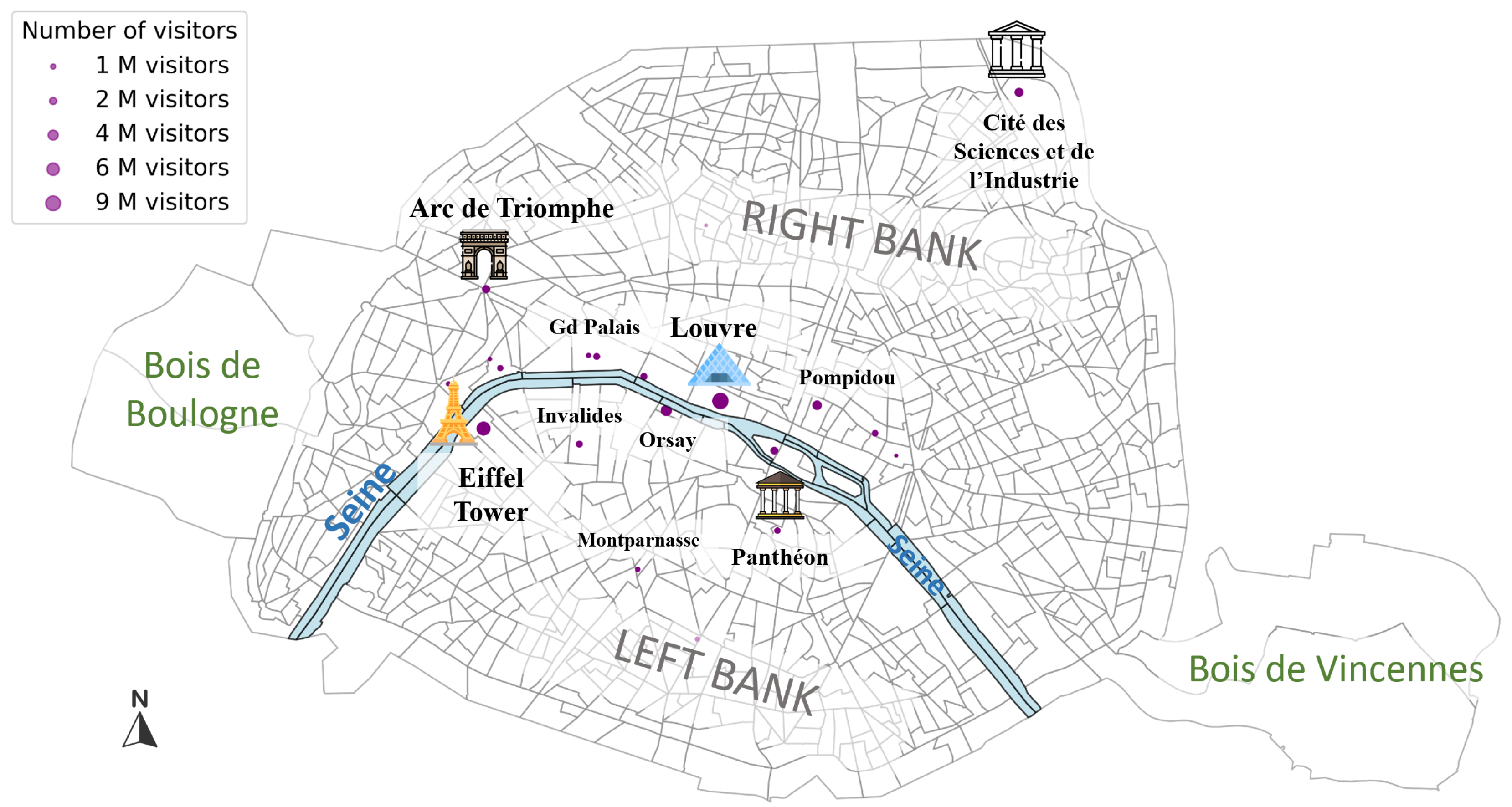
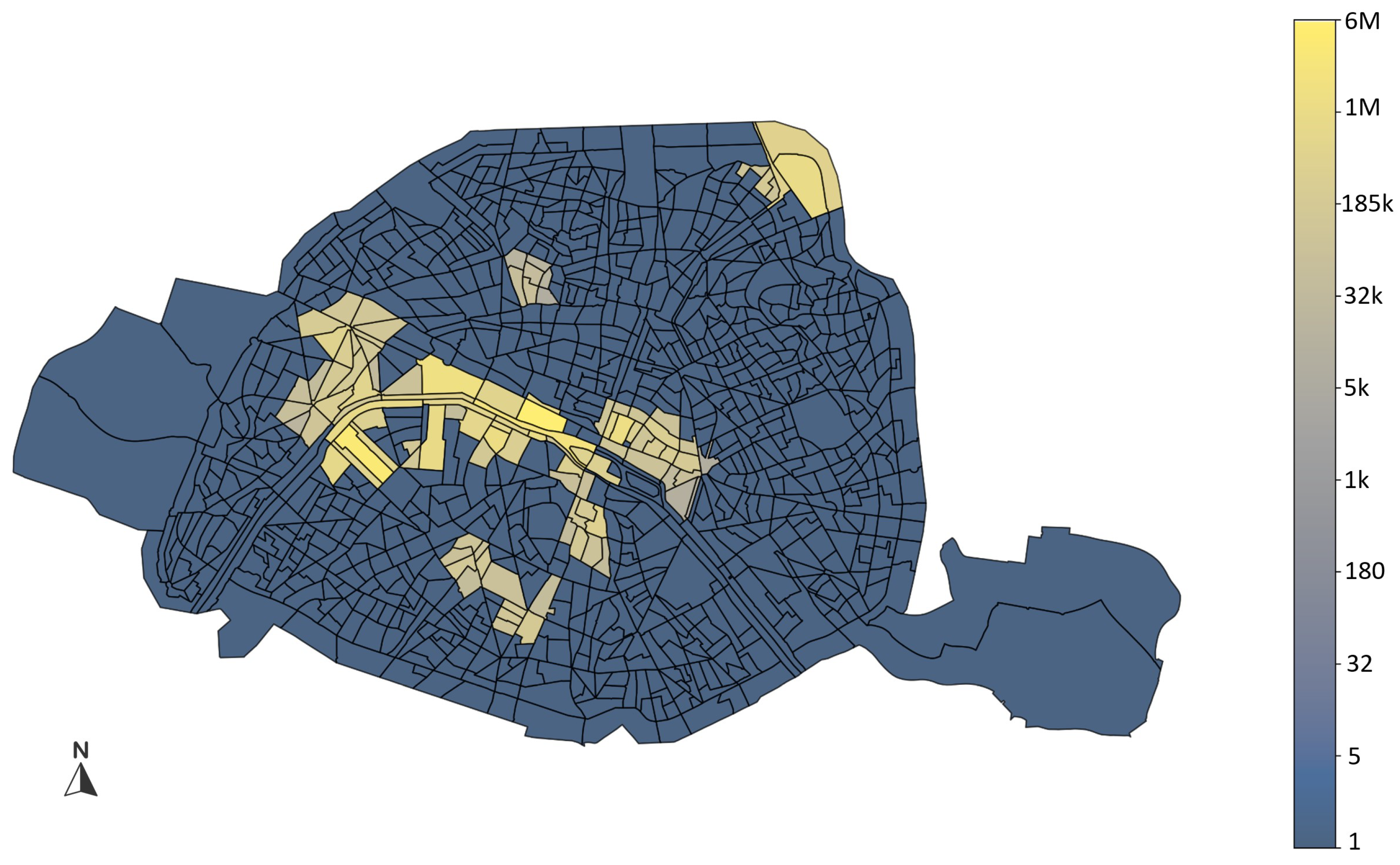
https://data-iau-idf.opendata.arcgis.com/ (accessed on 8 July 2025). Among these sites, the Louvre Museum and the Eiffel Tower recorded the highest visitor numbers as shown in
Figure 1.
To identify the IRIS zones impacted by tourist attendance, a kernel density estimation [
39] was applied at the city scale. This non-parametric method allows the construction of a continuous surface representing the spatial distribution of tourist density, without assuming any specific distribution shape. The method relies on a Gaussian kernel, which assigns higher weights to cells located closer to tourist sites, and gradually decreasing weights as the distance increases.
In line with Jane Jacobs’ principles—highlighting the importance of the street scale in analyzing urban vitality—the Paris territory was divided into a regular grid of 100 m × 100 m cells. Each cell contains the total number of visitors associated with nearby tourist sites. A Gaussian kernel with a bandwidth of 500 m was then applied to smooth the spatial distribution and reveal areas of high tourist density. The kernel used is defined by the following formula:
where
x and
y represent the spatial distances (in grid units) from the center of the kernel, and
is the smoothing parameter. In this study,
= 5, corresponding to a spatial reach of 500 m. This value was selected based on practical considerations, reflecting the typical walking distance around urban tourist sites, and offering a balance between local precision and overall readability of the density surface.
3.3. Google Maps Reviews and Ratings
Google Maps is a web-based cartographic service provided by Google. It enables users to leave reviews on points of interest (POIs), such as restaurants, museums, train stations, and parks. These reviews reflect users’ perceptions of places and contribute to local search engine optimization while also providing feedback to other users. Each review includes a star rating (from 0 to 5), a written comment, the date of publication, and, occasionally, photographs.
Google Maps reviews of Paris restaurants have been extracted from Google Map with help of Selenium library (version 4.27.1) on Python (version 3.12.2). Selenium simulates user actions on the web page. It is able to interact with the Document Object Model (DOM) for any action like opening a link, clicking a button or scrolling. It can also extract data. Extraction have been processed in two step. First, the addresses of restaurants are extracted. It was observed that the search results in Google Maps are limited to the area currently displayed on the screen, and that the level of detail depends on the zoom setting. A zoom level of 16 (on Google Maps’ scale from 0 = world view to about 21 = street level) provided the best results, as it offered both sufficient precision to capture restaurants and a wide enough area to cover the city efficiently. So Paris area has been divided in rectangles which fit the webbrowser screen, and keywords as “restaurants” have been searched. After duplicates were removed, a database of restaurant URLs was obtained. Second, for each URL, reviews were extracted with restrictions on both the number of reviews collected and their recency. This second program is embedded in a bash file which allows extractions to be automatically restarted in the event of a crash, which happens from time to time. The objective was to gather reviews related to restaurants in Paris up to February 2025. To ensure comparability between establishments, only the 200 most recent reviews per facility were retained. In total, reviews from 3,050 Parisian establishments were collected automatically.
For the subsequent analysis, only reviews published between November 2024 and February 2025 were selected, defining a consistent temporal window for assessing places visitation levels based on review frequency.
Table 2 presents the attributes associated with each collected review: the written comment, star rating, geographic coordinates of the venue, and publication date. After applying the temporal filter, the final dataset includes 117,163 reviews across 2972 establishments.
3.4. Components of Urban Vitality
To estimate the urban vitality of a neighborhood using BDCOM data, it is relevant to select categories of commercial activities that reflect the diversity of uses and the neighborhood’s ability to attract, maintain, and circulate populations. Here are five categories commonly used in the literature on urban vitality:
Leisure and culture (cinemas, bookstores, gyms, galleries, etc.): it measures access to recreational, cultural, and creative activities, encouraging non-residential traffic.
Restaurants, cafes, bars (or “Food and beverage outlets”): it is a key indicator of daytime and nighttime activity, reflecting the neighborhood’s conviviality and social appeal. Their outdoor seating, lighting, and storefront design enhance the walkability and aesthetic of urban blocks.
Essential businesses (grocery stores, bakeries, pharmacies, etc.): they reflect the neighborhood’s ability to meet the daily needs of its residents (lively residential function).
Specialized non-food businesses: this type demonstrates a broader commercial appeal beyond mere proximity, often associated with strolling or tourism. It includes businesses not related to basic needs such as clothing, home decor, electronics, etc.
Local services (hairdressers, banks, real estate agencies, administrative or medical services), contribute to place attachment and neighbourhood stability, as well as to functional diversity and density of uses.
In this study, essential and specialized businesses were grouped into a single category, referred to as “Retail stores,” resulting in four main business types considered in the analysis, as reported in
Table 3, which also includes other components of urban vitality.
This categorization enables the assignment of each business to a unique business type. As BDCOM data represent spatial entities in the form of points, and IRIS zones are defined as polygons, a spatial join was performed using the sjoin method from the GeoPandas package. This method assigns each business to the appropriate IRIS area by ensuring that the coordinate reference systems are identical (in this case, WGS84, corresponding to EPSG:4326), and by specifying the merge type with the argument predicate = “within”. Each IRIS zone thus contains the number of businesses categorized by type.
3.5. Land Use Mix: Business Diversity
To assess the distribution and diversity of business types within each IRIS zone, a business diversity index was constructed using Shannon entropy [
40], a statistical measure widely employed in urban studies literature [
16,
41]. Entropy is particularly effective for quantifying diversity, as it captures both the variety of categories and the balance among them. In the context of business diversity in Paris, entropy enables the evaluation of how evenly business activities are distributed across sectors, ownership structures, or geographic areas. It measures the degree of uncertainty or randomness within a distribution: the more evenly the categories are represented (e.g., industries, ownership demographics), the higher the entropy, and consequently, the greater the diversity. Thus, entropy reflects both richness (the number of distinct categories) and evenness (the relative distribution across those categories).
To compute the entropy value for each IRIS zone, the following steps are required. First, the values of the variable
representing the
IRIS (where
i = 1, 2, …, 992) for the
business category (Culture and Leisure, Food and Beverage, Retail Stores, and Local Services) are standardized using the Min-Max normalization method:
Second, calculate the proportion of variable
j within IRIS
i:
Third, calculate the entropy of each variable:
Fourth, compute the degree of diversity:
Fifth, determine the relative weight of each variable based on its entropy contribution.
Finally, apply the linear weighting method to calculate the composite index for each IRIS
i.
The computed indices range from 0 to 1. IRIS units exhibiting high diversity are characterized by a balanced distribution across various types of businesses. Conversely, IRIS units with low diversity tend to concentrate a limited number of categories, often dominated by a small set of business types.
4. Experimental Results
4.1. Commercial Activity
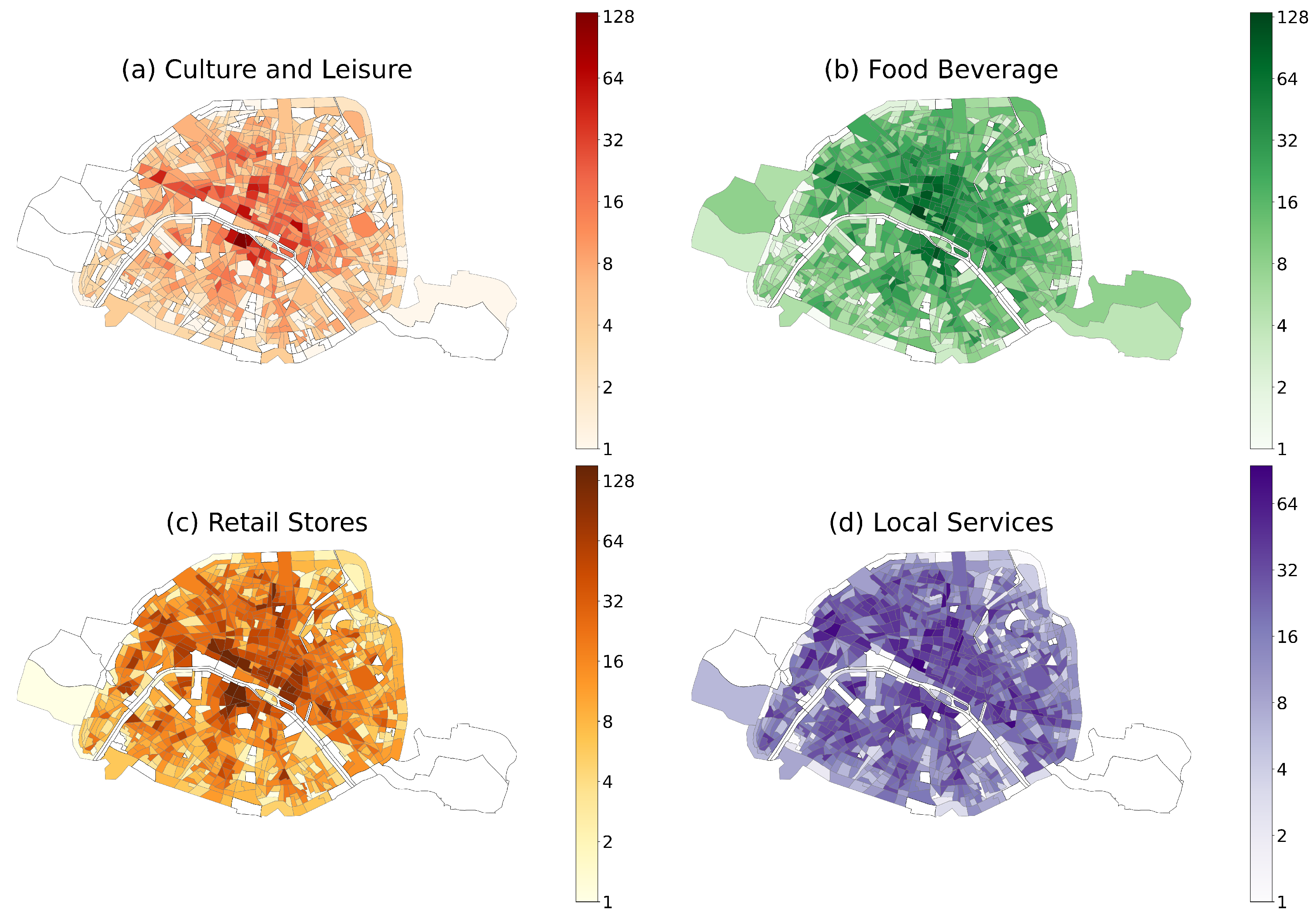
Figure 2 illustrates the spatial distribution of businesses by IRIS units in Paris, disaggregated by business type: cultural and leisure activities, food and beverage, retail stores, and local services. Each business type is represented by a distinctive color, where darker shades indicate a higher concentration (on a logarithmic scale) of that business type. The scales (1–128) and (1–64) represent the number of different types of businesses per IRIS unit. The use of a log scale smooths the visual differences and highlights relative densities more effectively. IRIS units left uncolored denote the absence of the corresponding business type.
Figure 2a displays the spatial distribution of culture and leisure businesses across Paris. These businesses are predominantly concentrated in the city center, particularly along the right bank of the Seine river (North side of the river). These IRIS units exhibit the highest density of cultural and leisure establishments. These include iconic areas such as the Quartier Latin, Le Marais, L’Orangerie, Les Halles, Centre Pompidou, Louvre/Palais Royal, and other key cultural hubs renowned for theaters, museums, concert halls, bars, and art venues. On the left bank of the Seine, the IRIS with the highest concentration of cultural and recreational venues are situated in the center of the map, near the iconic Quai Voltaire. In contrast, peripheral IRIS display the lowest densities of such businesses. They are primarily residential, and contain fewer culture and leisure establishments per unit area. Moreover, many IRIS in peripheral zones lack these venues entirely, especially in areas dominated by natural spaces like the Bois de Vincennes and Bois de Boulogne. Overall, the map reflects a centralized cultural economy, with Paris’s core neighboorhoods serving as the primary hubs for culture and leisure. These spatial patterns align closely with established socio-economic zones and tourist and nightlife hotspots, underscoring the distinct contrast between the urban core and its periphery.
Regarding the spatial distribution shown in
Figure 2b, food and beverage businesses are more evenly dispersed across Paris than cultural and leisure establishments. While their concentration remains highest in the city center, their presence extends more broadly throughout the urban fabric. IRIS units located along the right bank of the Seine exhibit high densities of food and beverage venues, comparable to those of culture and leisure businesses. Nearly all neighborhoods within central and mid-peripheral areas display moderate to high densities. The central arrondissements are marked by the darkest green tones, indicating a particularly high concentration of restaurants, cafés, and bars. Some arrondissements—well-known for nightlife and casual dining in areas such as Canal Saint-Martin and Oberkampf—are also densely saturated. In the northeast, Montmartre appears more prominently on the food and beverage map than on the culture and leisure map. On the right bank of the Seine, several IRIS units also show significant concentrations, especially along blocks facing Quai Saint-Michel. Although peripheral areas—such as southern and eastern Paris—have lower overall densities, they still host more food and beverage venues than cultural establishments. This pattern reflects the essential nature of food services, which tend to follow both residential settlement and pedestrian flows. Compared to culture and leisure businesses, food and beverage establishments are more residentially diffused, catering to both residents and visitors. The central-east area of Paris appears especially vibrant in terms of both day and night economies. The number of IRIS units without food and beverage businesses is noticeably lower than in the previous category, highlighting their wider distribution and importance across the city.
Retail store distribution across Paris is visualized in
Figure 2c, revealing key spatial trends. The map reveals a concentrated presence in central areas, with density gradually decreasing toward the periphery. Most neighborhoods in the city center exhibit a higher concentration of retail stores, particularly along the right bank of the Seine. These districts include areas offering luxury shopping experiences—such as those surrounding Place Vendôme—as well as large retail complexes like the Forum des Halles. On the left bank of the Seine, several IRIS units also show notable concentrations. In peripheral zones, retail store density is generally lower. However, IRIS located along the northern edge of the right bank demonstrate significant concentrations, reflecting the vitality of large retail outlets. Local proximity commerce appears well-distributed in peripheral areas, which may indicate better service coverage for residents in those zones. Like food and beverage establishments, retail stores are ubiquitous and are present throughout both central and peripheral districts, although with varying intensity. Several IRIS units lack retail store locations, although this absence is less significant compared to the distribution of cultural venues.
The spatial distribution of local service businesses, as represented in
Figure 2d, reveals significant concentrations in the central and northeastern sectors of Paris, along with notably strong densities in peripheral neighborhoods—especially when compared to other business types. At the IRIS scale, the distribution of local services appears heterogeneous and widespread. As observed in earlier analyses, IRIS units along the right bank of the Seine are well provisioned with essential services. In contrast, the left bank tends to exhibit lower densities, especially toward the southern outskirts of the city. The presence of other dominant business types in these same zones reflects a multifunctional urban structure and suggests high user attractiveness, driven by diverse amenities and sustained pedestrian activity. Despite their primarily residential character, peripheral areas offer comparatively high densities of local services, supporting proximity-based access to vital amenities. Disparities within peripheral zones are less pronounced than in the case of cultural and recreational venues. Nevertheless, several IRIS units still lack local service establishments entirely.
All four categories of businesses demonstrate higher densities in central and northeastern Paris. Peripheral neighborhoods, by contrast, remain predominantly residential and exhibit lower concentrations of commercial establishments. This spatial arrangement contributes to a differentiated business landscape, shaped by the varied needs of users.
4.2. Land Use Mix
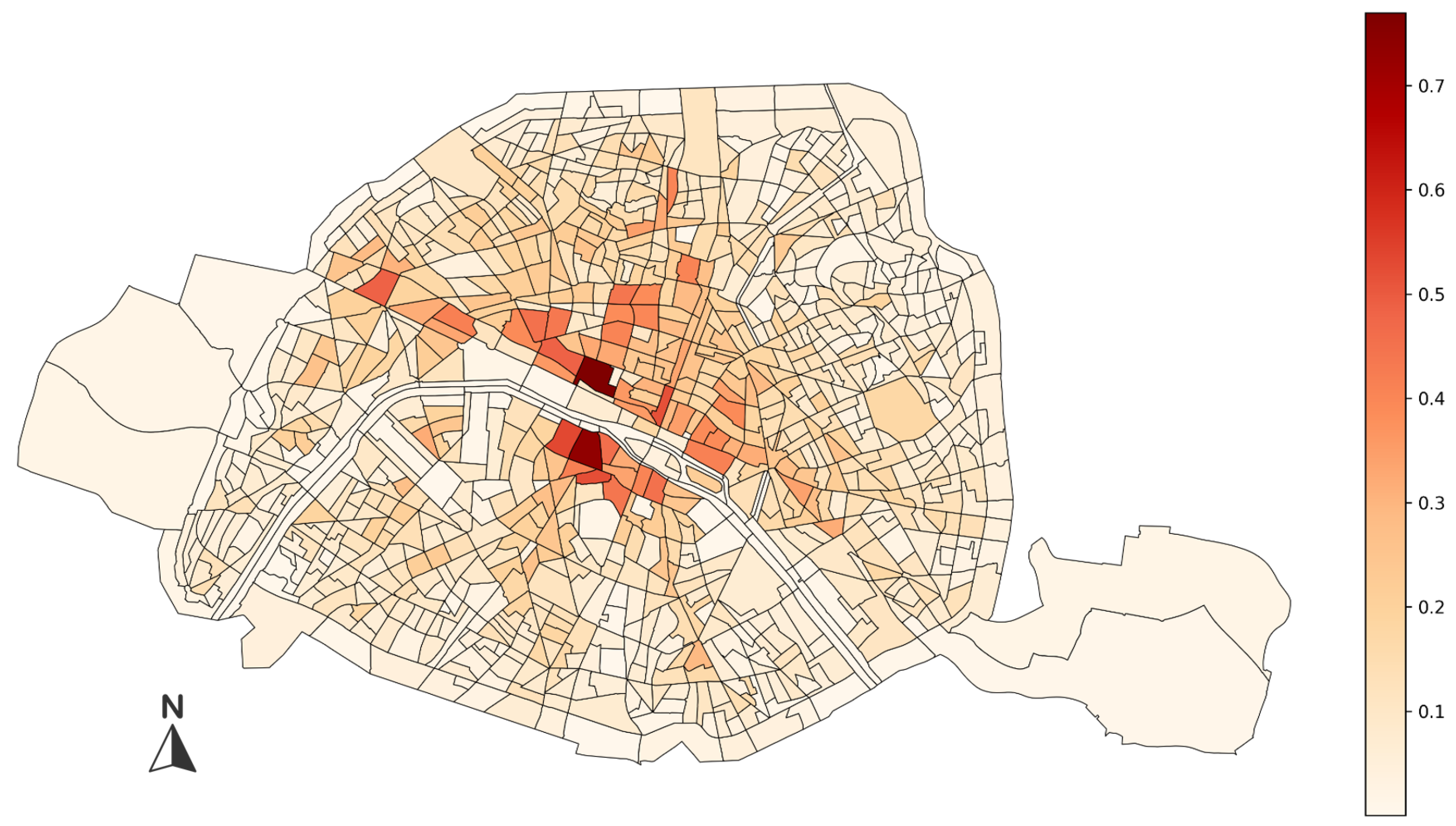
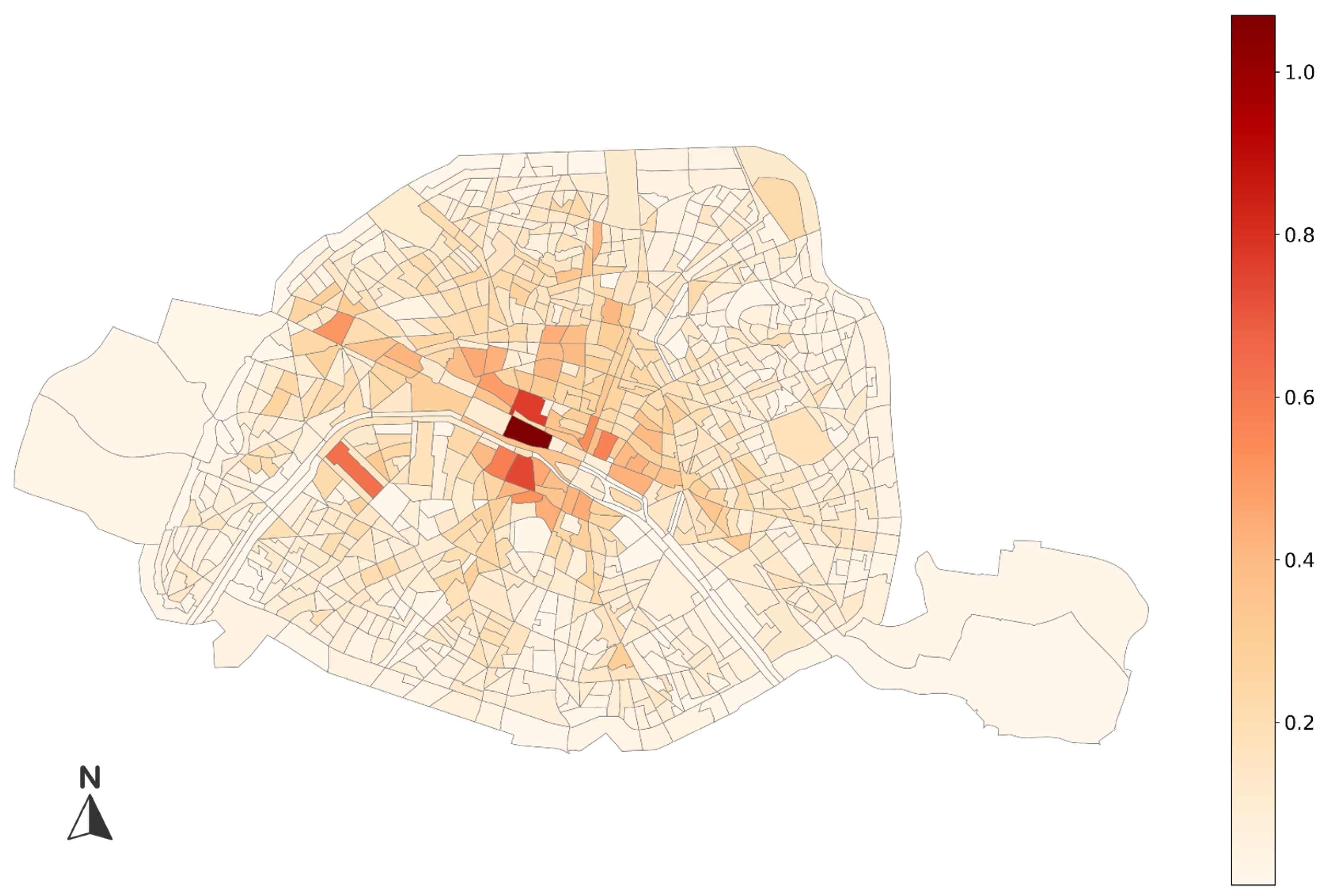
The map in
Figure 3 visualizes the business diversity in Paris at the IRIS level, computed as the entropy across the four commercial activity categories. Entropy here measures how evenly these categories are distributed—higher entropy (darker colors) means a more balanced mix of business types, while lower entropy (lighter colors) indicates dominance by one or a few types. Areas with higher entropy are often more vibrant and walkable. The map could guide economic development, urban planning, or zoning adjustments to foster more balanced commercial ecosystems.
There is a high diversity in central Paris, especially around Place Vendôme, Châtelet, and Notre Dame. These areas are known for their high pedestrian traffic, tourism, and mixed-use urban fabric—which favors a balanced mix of shops, food, leisure, and services.
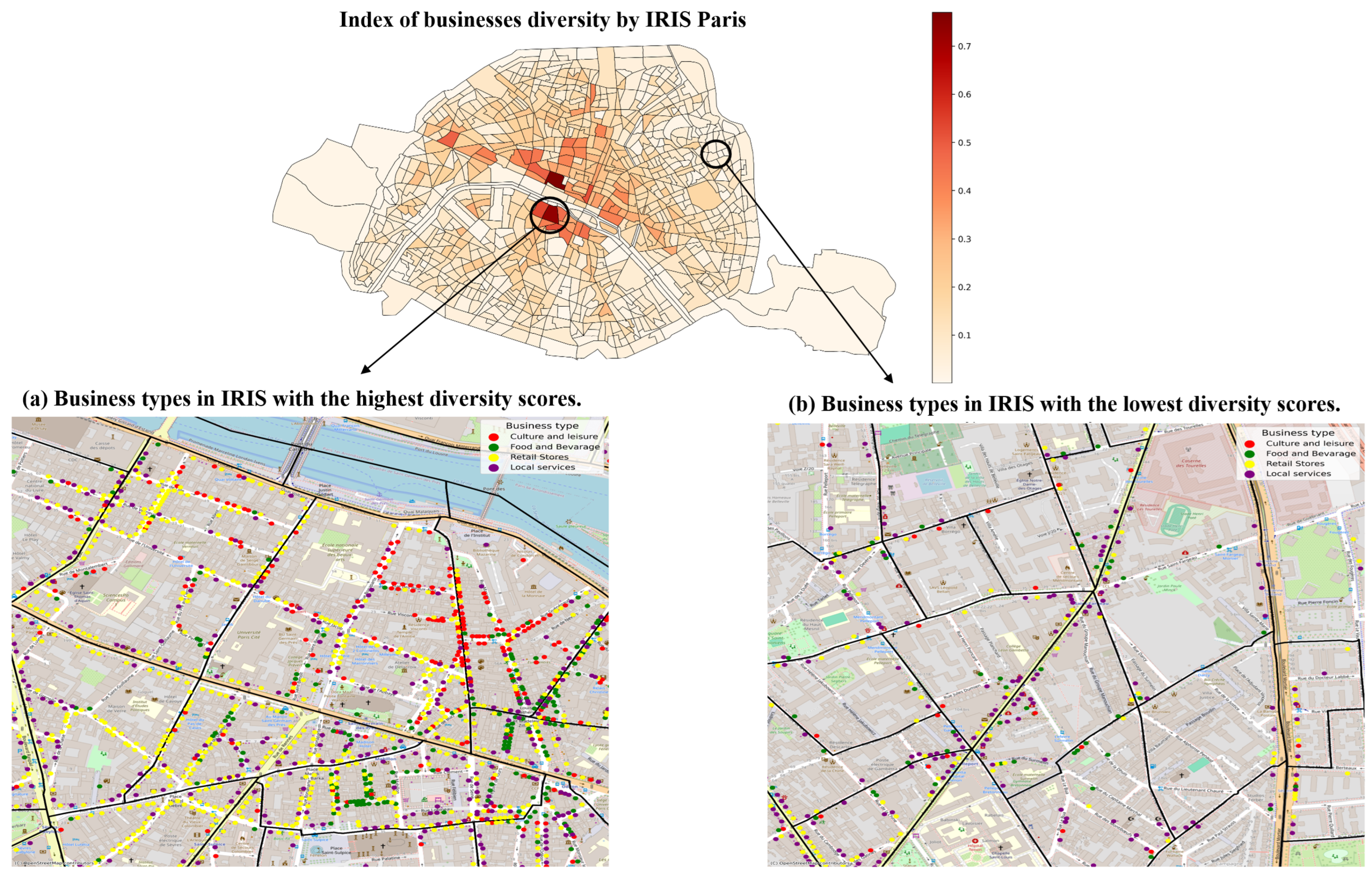
The most diverse area is the neighborhood that extent between Notre Dame and les Invalides, called Saint-Thomas-d’Aquin (see
Figure 4a). It is known for its understated elegance, embassies, art galleries, and quiet streets lined with Haussmannian buildings. This neighborhood borders iconic landmarks like the Musée d’Orsay and Les Invalides, and is often considered a natural extension of Saint-Germain-des-Prés’ chic style.
This neighbourhood borders iconic landmarks such as the Musée d’Orsay and Les Invalides and is often considered a natural extension of Saint-Germain-des-Prés’ chic style, but with a less intense commercial and tourist atmosphere, characterized by lower pedestrian flows and fewer nightlife-oriented activities.
As expected, outer districts shows lower diversity, which is particularly noticeable in peripheral zones, or forest areas like Bois de Vincennes and Bois de Boulogne. These areas might be more residential, industrial, or mono-functional.
One can observe a patchy diversity pattern: the diversity is not uniform, even within central Paris—some IRIS blocks just adjacent to highly diverse ones show relatively low entropy. This indicates a strong micro-scale heterogeneity, possibly due to zoning, land use history, or real estate dynamics.
Business diversity is highest in central Paris and gradually decreases toward the periphery.
Figure 4 highlights several IRIS units, comparing business types in centrally located areas—specifically the 6th and 7th arrondissements (shown in
Figure 4a)—with those in peripheral locations, such as the 20th arrondissement (see
Figure 4b).
The IRIS in the 6th and 7th arrondissements present a diverse mix of business types, with retail stores being the most prominent. However, cultural and leisure activities, food and beverage establishments, and local services are also well distributed among the IRIS zones. This diversity suggests high commercial attractiveness and the presence of spaces that support unique and varied businesses, fostering pedestrian activity and contributing to urban vitality.
In contrast, the peripheral IRIS show a lower density of businesses compared to the center. Local services are predominant, offering essential amenities—such as hospitals, banks, insurance agencies, and pharmacies—to residents and visitors. Food and beverage establishments and cultural and leisure venues are less visible. Retail stores become more dominant as one moves closer to the city center. The low business density and limited diversity in peripheral areas may indicate lower attractiveness to users.
4.3. Touristic Visits Indicator
The impact of tourist site attendance on surrounding IRIS zones is illustrated in
Figure 5. Many IRIS units are not affected by this phenomenon due to their distance from the tourist attractions considered in this study.
In central Paris, particularly along the Seine, the IRIS zones exhibit the highest levels of attendance. Areas surrounding the Louvre Museum, the Grand Palais, the Champ-de-Mars (including the Eiffel Tower), and the Pompidou Centre represent major tourist hubs, generating increased attendance in adjacent zones. This pattern reflects a strong concentration of tourist activity around the river Seine.
Further west, the Arc de Triomphe contributes to a moderate level of attendance in its surrounding areas. On the northeastern edge of the city, the Cité des Sciences et de l’Industrie significantly enhances the attractiveness of the 19th arrondissement.
Overall, proximity to major tourist sites is consistently associated with a notable increase in attendance across adjacent IRIS zones.
An index of tourist attendance is constructed through normalization (Equation (
2)). This index is then combined with a measure of business diversity according to Equation (
8), to capture new forms of urban vitality driven by the tourist appeal of specific areas. For a given IRIS unit
i, the total index (
) is calculated by adding the business diversity index (
) and the tourism index (
).
As illustrated in
Figure 6, the IRIS located in the city center, which includes the Louvre Museum, exhibits the highest level of urban vitality due to the large number of tourists. Similarly, the Champs-de-Mars demonstrates a significant degree of vitality, attributable to the influx of visitors to the Eiffel Tower. This tourist presence also contributes to reinforcing urban vitality in other IRIS zones, such as those encompassing the Petit and Grand Palais, as well as areas on the northeastern outskirts, including the Cité des Sciences et de l’Industrie.
4.4. Polycentric Structure of the City
In order to determine the spatial distribution of business diversity, the Moran’s I index is used [
42]. This index detects spatial autocorrelation, that is, the relationship between the values of a variable and those of its neighboring units. Its values range from −1 to +1. A positive value indicates positive spatial autocorrelation, meaning that similar values tend to cluster together. Conversely, a negative value suggests negative spatial autocorrelation, indicating that dissimilar values are located close to each other. The closer the index is to +1, the stronger the positive spatial autocorrelation; conversely, the closer it is to −1, the stronger the negative spatial autocorrelation. Moran’s I [
43] is calculated according to Equation (
9):
In Equation (
12),
n represents the number of IRIS units,
the value of business diversity for unit
i,
the average commercial diversity across all units, and
the element of the spatial weight matrix indicating the neighborhood relationship between units
i and
j.
Table 4 shows the results of Moran’s I, which is 0.513 using a rook contiguity spatial weight matrix. This indicates that IRIS units with similar levels of business diversity tend to cluster in space. In other words, spatial entities with high commercial diversity are located close to each other, while those with low values are also grouped together. This pattern suggests the existence of spatial clusters and reflects the underlying spatial organization.
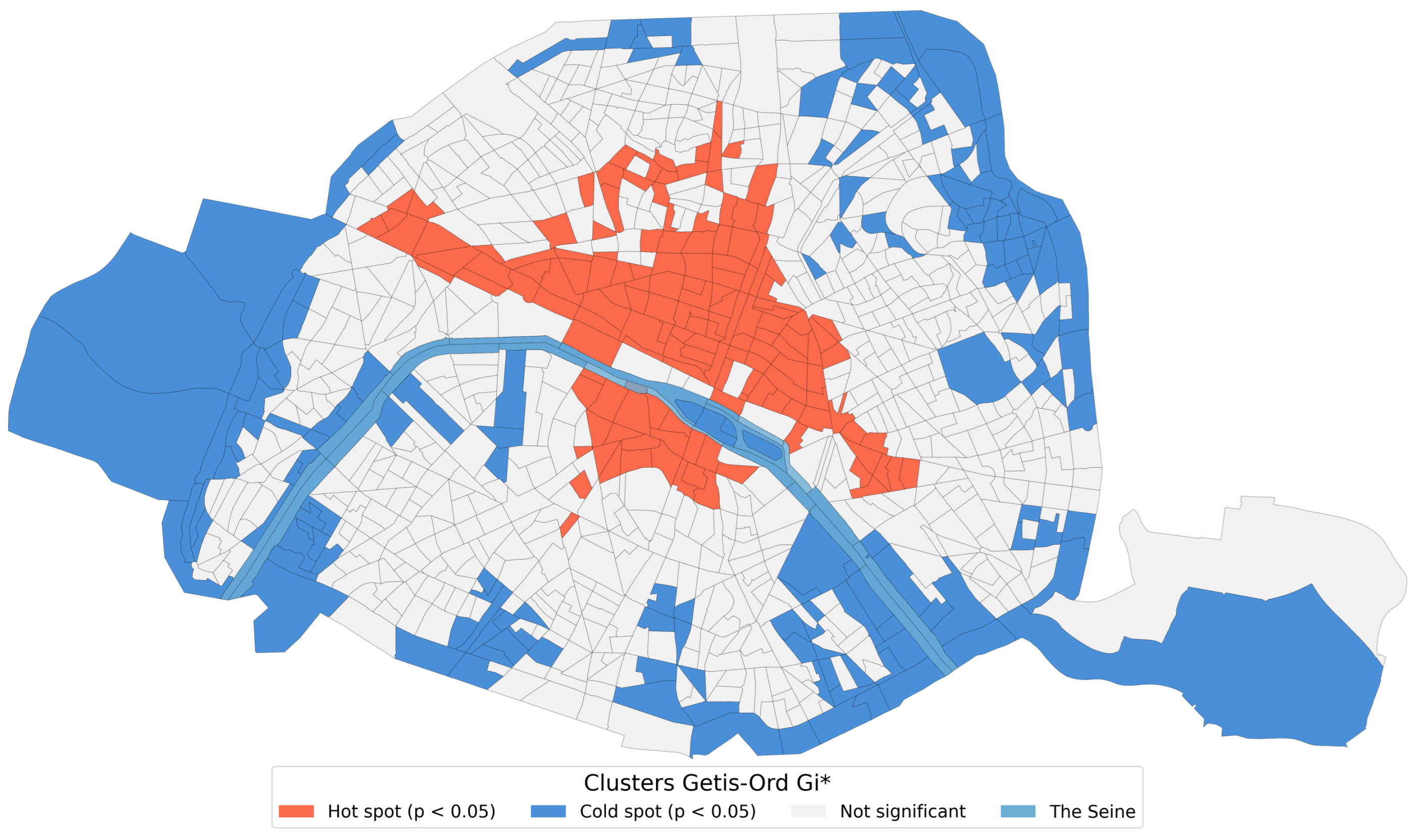
To detect these clusters, the Getis-Ord Gi* [
44] index is computed. This statistic measures the spatial concentration of commercial diversity within a given area. A high and statistically significant value greater than 0 indicates a hot spot, meaning a strong concentration of high values. Conversely, a low and statistically significant value less than 0 corresponds to a cold spot, that is, a concentration of low values relative to the average. The Gi* index is calculated according to Equation (
10):
Here,
S represents the standard deviation of business diversity, and the other elements are similar to those in Equation (
9).
Figure 7 displays the hot spots and cold spots identified according to Rook type of spatial weights. This Figure reveals several hot spots located in various central and semi-central IRIS. In contrast, the cold spots are generally distributed across the outskirts. This configuration suggests a polycentric pattern of commercial diversity, characterized by several significantly dynamic zones throughout the urban area. The central IRIS, identified as hot spots, generally present high values of commercial diversity, unlike the peripheral IRIS, where diversity values are lower.
4.5. Correlation with Attendance and Popularity
A study of parametric and non-parametric correlations is conducted to analyze the relationship between business diversity and Google reviews. The Pearson correlation coefficient is used to measure the linear relationship between two variables, assuming normality and homoscedasticity of the data. In contrast, the Spearman correlation assesses monotonic relationships based on ranked data distributions. The formulas for the Pearson and Spearman coefficients are presented in Equations (
11) and (
12), respectively:
where
and
represent the individual values of each variable,
and
denote their respective means and
n represents the total number of IRIS units.
where
and
n represents also the total number of IRIS units.
For instance, for an IRIS i, and are denoted as the respective values of diversity and attendance; and are denoted as their means across all IRIS units. rank() and rank() corresponds to their position in the ascending order of values among all IRIS.
Comparing the diversity of businesses with average reviewers ratings or attendance at the IRIS level can help uncover interesting spatial relationships (e.g., does a more diverse commercial area tend to host better-rated establishments?). A positive correlation suggests that more diverse commercial IRIS zones have better-rated places. A flat or negative correlation might indicate saturation, competition effects, or that quality is driven more by socio-demographics than commercial mix.
When analyzing popularity through the average star rating of establishments, no statistically significant relationship at the 5% threshold is observed with business diversity, even after accounting for the tourism index, as shown in
Table 5. Thus, the ratings awarded do not appear to reflect the urban vitality of IRIS zones, but are likely influenced by service quality or other socio-environmental factors.
Attendance, measured by the number of reviews, is significantly associated with the business diversity index. Considering both Pearson and Spearman correlation coefficients, a moderate positive relationship—both linear and monotonic—is observed. This suggests that the higher the business diversity index of an IRIS, the greater the number of user reviews. The number of reviews serves as a proxy for attendance, indicating that overall visitation in IRIS zones is correlated with the commercial diversity offered.
When the tourism index is integrated into the analysis, the previously observed linear relationship slightly decreases. However, the monotonic relationship strengthens, increasing from 0.48 to 0.50, thereby reinforcing the presence of a moderate and significant correlation. Tourist attendance amplifies the existing relationship between commercial diversity and the number of place reviews within IRIS zones. Tourist appeal appears to be influenced by review activity: the more comments a location receives, the higher its tourist attendance and, consequently, the greater its commercial diversity.
5. Discussion
This study demonstrates that business diversity can serve as a reliable indicator or proxy for urban vitality at the IRIS scale. In Paris, this diversity is highly concentrated in central neighborhoods, particularly around the Seine, and progressively decreases toward the periphery, following a clear spatial gradient. This pattern mirrors the findings of Zhang et al. [
45] in their analysis of Chengdu, where business diversity also peaks in the city center.
Although Paris is traditionally described as a monocentric city [
46], the presence of secondary poles suggests a trend toward a polycentric model, similar to that of Barcelona. The central area, rich in historical and cultural landmarks, reinforces both attractiveness and urban vitality. In contrast, peripheral neighborhoods—primarily residential—offer a more functional commercial landscape (focused on food and daily services), with a lower presence of businesses related to culture or leisure. This configuration limits functional mix and reduces urban vibrancy in these zones.
IRIS units located near major tourist sites exhibit higher urban vitality, largely due to increased foot traffic. These areas often overlap with those already possessing high business diversity, suggesting a synergy between tourism appeal and functional diversity. On one hand, vibrant neighborhoods attract a significant number of tourists; on the other, tourism itself fosters urban dynamism. This is supported by correlation analyses and aligns with findings from Hu et al. [
47], who identified significant fluctuations in urban vitality during tourist seasons in coastal regions—corroborating the hypothesis in the Parisian context, where cultural and heritage assets play a central role.
Conversely, Gomez-Varo et al. [
36] reported a negative impact of business diversity on tourism in cases where excessive specialization in certain types of businesses undermined overall diversity.
Venue attendance, representing places for socializing, meeting, and leisure, also serves as a useful indicator of the vibrancy of neighborhood and its welcoming nature. The user experience, as expressed in online reviews, may influence future patronage through both star ratings and the volume of comments.
The findings indicate that star ratings are not significantly associated with business diversity, likely because they reflect the perceived quality of individual services or products rather than broader environmental characteristics. However, the volume of reviews is significantly correlated with urban vitality, suggesting that areas with higher vitality experience greater patronage of venues.
The choice of the IRIS scale is appropriate for this analysis, given that these spatial units exhibit relative homogeneity in population density. The diversity of business types within an IRIS unit significantly influences urban vitality by attracting people for both everyday needs and leisure activities.
The impact of businesses on urban dynamism is most pronounced within a radius of approximately 5 km, although this distance may vary based on local context [
48]. This dynamism depends not merely on the number of businesses but more importantly, on their functional diversity, which provides users with a wider range of choices and enhances the appeal of public spaces [
49]. In this way, business diversity generates greater flows and contributes significantly to neighborhood vitality.
The analysis of business diversity in the context of Paris could be analyzed deeper by taking into account the socio-spatial specificities of the territory. The diversity considered in this study is primarily understood from an economic and functional perspective, unlike the approach proposed by Jane Jacobs, which also integrates social dimension as key levers of urban vitality. For example, The high level of diversity observed in central Paris can be related to a strong concentration of wealth, as demonstrated by long-standing work based on amenity theories [
50], as well as by recent analyses by Yoshimura et al. [
16], who show that commercial diversity is associated with better economic performance. This diversity is also embedded in a context characterized by strong tourist attractiveness and advanced gentrification processes. Conversely, the low level of business diversity observed in several peripheral neighborhoods cannot be interpreted solely as a lack of urban vitality. It may instead reflect structural factors such as housing policies, socio-economic inequalities, and local income levels that shape consumption capacity. These dynamics are particularly illustrated by the work of Pattaroni et al. [
51] on the La Réunion neighborhood (located in the eastern part of the city), which highlights a gentrification process that has transformed a historically working-class neighborhood into a more highly valued residential area.
6. Conclusions and Future Works
The aim of this study was to assess urban vitality through a commercial analysis at the IRIS level, in relation with the attendance and popularity of various establishments, as well as the tourism within the city of Paris. Firstly, businesses were classified into four categories, reflecting the capacity of each IRIS to accommodate both daily and occasional requirements. Secondly, these categories were combined using Shannon entropy, enabling a spatial measurement of commercial diversity and the identification of areas with varying levels of commercial mix, which contribute to urban vitality. Building on this, a new index was developed to combine commercial diversity with tourism activity, offering a more comprehensive measure of urban vitality. Finally, the relationships between commercial diversity, popularity, attendance, and tourism activity were explored using Pearson and Spearman correlation analyses, highlighting key dynamics that shape the vitality of urban spaces.
The results show a major concentration of businesses in the central areas of the city, in contrast to the outskirts, as reflected by both the business category distribution and the business diversity index. A polycentric model emerges, highlighting the presence of multiple diversified hubs—commercially, culturally, and historically—which contribute to urban vitality. The integration of tourism into the business diversity index further amplifies the vitality of tourist zones. On one hand, the analysis reveals a positive and significant correlation between business diversity and attendance. On the other hand, the popularity of establishments is not significantly linked to this diversity.
These results suggest that diversified areas tend to attract higher attendance, especially when they also benefit from tourism activity. This condition indicates that urban vitality can be approximated by business diversity, which, according to Jane Jacobs, is one of its key components. Even without considering other dimensions of urban vitality, business diversity demonstrates a capacity of a zone to attract people by fulfilling their varied and essential needs.
This study, which already provides a useful foundation for political decision-making, could be further enriched in the future. It would then be possible to integrate a more fine-grained typology of business categories, as well as develop an indicator of diversity based on commercial density, in order to assess more precisely the level of land-use mix. Access to broader tourism data would allow for better coverage of the study area and more accurate quantification of the relationship between tourism activity and business diversity. Finally, a semantic analysis of review texts related to different types of points of interest, using emerging natural language processing tools, would offer deeper insight into user perceptions of urban vitality and its components.
Author Contributions
Conceptualization, R.B.; methodology, R.B. and S.C.N.; software, R.B., F.D. and S.C.N.; validation, R.B. and S.C.N.; formal analysis, R.B., S.C.N., F.D. and P.-O.V.; investigation, R.B., S.C.N., F.D. and P.-O.V.; resources, F.D. and S.C.N.; data curation, S.C.N.; writing—original draft preparation, R.B., S.C.N. and P.-O.V.; writing—review and editing, R.B., S.C.N., F.D. and P.-O.V.; visualization, R.B. and S.C.N.; supervision, R.B., F.D. and P.-O.V.; project administration, R.B.; funding acquisition, R.B. All authors have read and agreed to the published version of the manuscript.
Funding
This work has received support under the program “France 2030” launched by the French Government and implemented by ANR, with the reference ANR-21-EXES-0007.
Institutional Review Board Statement
Not applicable.
Informed Consent Statement
Not applicable.
Data Availability Statement
Conflicts of Interest
The authors declare no conflicts of interest.
References
- Jerome, G.; Sinnett, D.; Burgess, S.; Calvert, T.; Mortlock, R. A framework for assessing the quality of green infrastructure in the built environment in the UK. Urban For. Urban Green. 2019, 40, 174–182. [Google Scholar] [CrossRef] [Scilit]
- Wang, J.; Chow, Y.S.; Biljecki, F. Insights in a city through the eyes of Airbnb reviews: Sensing urban characteristics from homestay guest experiences. Cities 2023, 140, 104399. [Google Scholar] [CrossRef] [Scilit]
- Duan, S.; Shen, Z.; Luo, X. Exploring the Relationship between Urban Youth Sentiment and the Built Environment Using Machine Learning and Weibo Comments. Int. J. Environ. Res. Public Health 2022, 19, 4794. [Google Scholar] [CrossRef] [Scilit] [PubMed]
- Fuller, M.; Moore, R. An Analysis of Jane Jacobs’s the Death and Life of Great American Cities; Macat Library: London, UK, 2017. [Google Scholar]
- Paköz, M.Z.; Yaratgan, D.; Şahin, A. Re-mapping urban vitality through Jane Jacobs’ criteria: The case of Kayseri, Turkey. Land Use Policy 2022, 114, 105985. [Google Scholar] [CrossRef] [Scilit]
- Erin, I.; Fusco, G.; Cubukcu, E.; Araldi, A. Quantitative methods of urban morphology in urban design and environmental psychology. In Proceedings of the 24th ISUF International Conference, Valencia, Spain, 27–29 September 2017; Book of Papers; Editorial Universitat Politècnica de València: Valencia, Spain, 2018; pp. 1391–1400. [Google Scholar]
- Belaroussi, R.; Issa, E.; Cameli, L.; Lantieri, C.; Adelé, S. Exploring Virtual Environments to Assess the Quality of Public Spaces. Algorithms 2024, 17, 124. [Google Scholar] [CrossRef] [Scilit]
- Lee, K.Y.; Jeong, M.G. Residential environmental satisfaction, social capital, and place attachment: The case of Seoul, Korea. J. Hous. Built Environ. 2021, 36, 559–575. [Google Scholar] [CrossRef] [Scilit]
- Chen, N.C.; Hall, C.M.; Yu, K.; Qian, C. Environmental Satisfaction, Residential Satisfaction, and Place Attachment: The Cases of Long-Term Residents in Rural and Urban Areas in China. Sustainability 2019, 11, 6439. [Google Scholar] [CrossRef] [Scilit]
- Lawrence, D.L.; Low, S.M. The Built Environment and Spatial Form. Annu. Rev. Anthropol. 1990, 19, 453–505. [Google Scholar] [CrossRef]
- Belaroussi, R.; Pazzini, M.; Issa, I.; Dionisio, C.; Lantieri, C.; González, E.D.; Vignali, V.; Adelé, S. Assessing the Future Streetscape of Rimini Harbor Docks with Virtual Reality. Sustainability 2023, 15, 5547. [Google Scholar] [CrossRef] [Scilit]
- Wang, M.; Qiu, M.; Chen, M.; Zhang, Y.; Zhang, S.; Wang, L. How does urban green space feature influence physical activity diversity in high-density built environment? An on-site observational study. Urban For. Urban Green. 2021, 62, 127129. [Google Scholar] [CrossRef] [Scilit]
- Li, X.; Liu, H.; Wang, W.; Zheng, Y.; Lv, H.; Lv, Z. Big data analysis of the Internet of Things in the digital twins of smart city based on deep learning. Future Gener. Comput. Syst. 2022, 128, 167–177. [Google Scholar] [CrossRef] [Scilit]
- Zhang, F.; Zhou, B.; Liu, L.; Liu, Y.; Fung, H.H.; Lin, H.; Ratti, C. Measuring human perceptions of a large-scale urban region using machine learning. Landsc. Urban Plan. 2018, 180, 148–160. [Google Scholar] [CrossRef] [Scilit]
- Murgante, B.; Valluzzi, R.; Annunziata, A. Developing a 15-minute city: Evaluating urban quality using configurational analysis. The case study of Terni and Matera, Italy. Appl. Geogr. 2024, 162, 103171. [Google Scholar] [CrossRef] [Scilit]
- Yoshimura, Y.; Kumakoshi, Y.; Milardo, S.; Santi, P.; Arias, J.M.; Koizumi, H.; Ratti, C. Revisiting Jane Jacobs: Quantifying urban diversity. Environ. Plan. B Urban Anal. City Sci. 2022, 49, 1228–1244. [Google Scholar] [CrossRef] [Scilit]
- Liu, H.; Gou, P.; Xiong, J. Vital triangle: A new concept to evaluate urban vitality. Comput. Environ. Urban Syst. 2022, 98, 101886. [Google Scholar] [CrossRef] [Scilit]
- Kang, C.; Fan, D.; Jiao, H. Validating activity, time, and space diversity as essential components of urban vitality. Environ. Plan. B Urban Anal. City Sci. 2021, 48, 1180–1197. [Google Scholar] [CrossRef] [Scilit]
- Matlovič, R.; Matlovičová, K. Polycrisis in the Anthropocene as a key research agenda for geography: Ontological delineation and the shift to a postdisciplinary approach. Folia Geogr. 2024, 66, 5. [Google Scholar]
- Lawrence, M.; Homer-Dixon, T.; Janzwood, S.; Rockström, J.; Renn, O.; Donges, J.F. Global polycrisis: The causal mechanisms of crisis entanglement. Glob. Sustain. 2024, 7, e6. [Google Scholar] [CrossRef] [Scilit]
- Li, S.; Chen, P.; Hui, F.; Gong, M. Evaluating urban vitality and resilience under the influence of the COVID-19 pandemic from a mobility perspective: A case study in Shenzhen, China. J. Transp. Geogr. 2024, 117, 103886. [Google Scholar] [CrossRef] [Scilit]
- Lim, Y.; Edelenbos, J.; Gianoli, A. Identifying the results of smart city development: Findings from systematic literature review. Cities 2019, 95, 102397. [Google Scholar] [CrossRef] [Scilit]
- Jacobs, J. Dark Age Ahead; Vintage Books: New York, NY, USA, 2005. [Google Scholar]
- Jiang, Y.; Zhang, Y.; Liu, Y.; Huang, Z. A review of urban vitality research in the Chinese world. Trans. Urban Data Sci. Technol. 2023, 2, 81–99. [Google Scholar] [CrossRef] [Scilit]
- Kong, L.; Liu, Z.; Wu, J. A systematic review of big data-based urban sustainability research: State-of-the-science and future directions. J. Clean. Prod. 2020, 273, 123142. [Google Scholar] [CrossRef] [Scilit]
- Bai, X.; Zhou, M.; Li, W. Analysis of the influencing factors of vitality and built environment of shopping centers based on mobile-phone signaling data. PLoS ONE 2024, 19, e0296261. [Google Scholar] [CrossRef] [Scilit]
- Guo, X.; Chen, H.; Yang, X. An Evaluation of Street Dynamic Vitality and Its Influential Factors Based on Multi-Source Big Data. ISPRS Int. J. Geo-Inf. 2021, 10, 143. [Google Scholar] [CrossRef] [Scilit]
- Scepanovic, S.; Joglekar, S.; Law, S.; Quercia, D. Jane Jacobs in the sky: Predicting urban vitality with open satellite data. Proc. ACM Hum.-Comput. Interact. 2021, 5, 48. [Google Scholar] [CrossRef] [Scilit]
- Huang, X.; Jiang, P.; Li, M.; Zhao, X. Applicable Framework for Evaluating Urban Vitality with Multiple-Source Data: Empirical Research of the Pearl River Delta Urban Agglomeration Using BPNN. Land 2022, 11, 1901. [Google Scholar] [CrossRef] [Scilit]
- Shi, Y.; Zheng, J.; Pei, X. Measurement Method and Influencing Mechanism of Urban Subdistrict Vitality in Shanghai Based on Multisource Data. Remote Sens. 2023, 15, 932. [Google Scholar] [CrossRef] [Scilit]
- Pan, J.; Zhu, X.; Zhang, X. Urban Vitality Measurement and Influence Mechanism Detection in China. Int. J. Environ. Res. Public Health 2023, 20, 46. [Google Scholar] [CrossRef] [Scilit]
- Wang, Z.; Xia, N.; Zhao, X.; Gao, X.; Zhuang, S.; Li, M. Evaluating Urban Vitality of Street Blocks Based on Multi-Source Geographic Big Data: A Case Study of Shenzhen. Int. J. Environ. Res. Public Health 2023, 20, 3821. [Google Scholar] [CrossRef] [Scilit] [PubMed]
- Sulis, P.; Manley, E.; Zhong, C.; Batty, M. Using mobility data as proxy for measuring urban vitality. J. Spat. Inf. Sci. 2018, 16, 137–162. [Google Scholar] [CrossRef] [Scilit]
- Zeng, P.; Wei, M.; Liu, X. Investigating the Spatiotemporal Dynamics of Urban Vitality Using Bicycle-Sharing Data. Sustainability 2020, 12, 1714. [Google Scholar] [CrossRef] [Scilit]
- Maas, P.R. Towards a Theory of Urban Vitality. Ph.D. Thesis, University of British Columbia, Vancouver, BC, Canada, 1984. [Google Scholar] [CrossRef] [Scilit]
- Gómez-Varo, I.; Delclòs-Alió, X.; Miralles-Guasch, C.; Marquet, O. Unravelling retail diversity through its spatial relationship with social vulnerability and tourism pressures in Barcelona. J. Urban Des. 2024, 29, 280–300. [Google Scholar] [CrossRef] [Scilit]
- Garau, C.; Annunziata, A. A method for assessing the vitality potential of urban areas. The case study of the Metropolitan City of Cagliari, Italy. City Territ. Archit. 2022, 9, 7. [Google Scholar] [CrossRef] [Scilit]
- Cheung, K.S.; Yiu, C.Y. Touristification and retail diversity: Theory and evidence. Humanit. Soc. Sci. Commun. 2024, 11, 1335. [Google Scholar] [CrossRef] [Scilit]
- Węglarczyk, S. Kernel density estimation and its application. ITM Web Conf. 2018, 23, 00037. [Google Scholar] [CrossRef] [Scilit]
- Shannon, C.E. A mathematical theory of communication. Bell Syst. Tech. J. 1948, 27, 379–423. [Google Scholar] [CrossRef] [Scilit]
- Dong, L.; Zhang, L. Spatial coupling coordination evaluation of mixed land use and urban vitality in major cities in China. Int. J. Environ. Res. Public Health 2022, 19, 15586. [Google Scholar] [CrossRef] [Scilit]
- Ghodousi, M.; Sadeghi-Niaraki, A.; Rabiee, F.; Choi, S.M. Spatial-Temporal Analysis of Point Distribution Pattern of Schools Using Spatial Autocorrelation Indices in Bojnourd City. Sustainability 2020, 12, 7755. [Google Scholar] [CrossRef] [Scilit]
- Moran, P.A. The interpretation of statistical maps. J. R. Stat. Soc. Ser. B (Methodol.) 1948, 10, 243–251. [Google Scholar] [CrossRef] [Scilit]
- Ord, J.K.; Getis, A. Local spatial autocorrelation statistics: Distributional issues and an application. Geogr. Anal. 1995, 27, 286–306. [Google Scholar] [CrossRef] [Scilit]
- Zhang, Z.; Liu, J.; Zhao, Y.; Zhou, Q.; Song, L.; Xu, S. Community-Level Urban Vitality Intensity and Diversity Analysis Supported by Multisource Remote Sensing Data. Remote Sens. 2025, 17, 1056. [Google Scholar] [CrossRef] [Scilit]
- Heitz, A.; Dablanc, L.; Tavasszy, L.A. Logistics sprawl in monocentric and polycentric metropolitan areas: The cases of Paris, France, and the Randstad, the Netherlands. REGION 2017, 4, 93–107. [Google Scholar] [CrossRef] [Scilit]
- Hu, C.; Xu, L.; Cai, X.; Tian, D.; Zhuang, S. Research on the Spatiotemporal Pattern and Influencing Mechanism of Coastal Urban Vitality: A Case Study of Bayuquan. Buildings 2024, 14, 2173. [Google Scholar] [CrossRef] [Scilit]
- Duan, J.; Wang, H.; Liu, L.; Zhang, J. The attraction gradient of urban functions: How does functional mix at multiple scales predict urban vitality. Cities 2025, 156, 105516. [Google Scholar] [CrossRef] [Scilit]
- Yue, Y.; Zhuang, Y.; Yeh, A.G.O.; Xie, J.Y.; Ma, C.L.; Li, Q.Q. Measurements of POI-based mixed use and their relationships with neighbourhood vibrancy. Int. J. Geogr. Inf. Sci. 2017, 31, 658–675. [Google Scholar] [CrossRef] [Scilit]
- Chabrol, M. De nouvelles formes de gentrification? Dynamiques résidentielles et commerciales à Château-Rouge (Paris). Carnets Géographes 2012, 4. [Google Scholar] [CrossRef] [Scilit]
- Pattaroni, L.; Kaufmann, V.; Thomas, M.P. The Dynamics of Multifaceted Gentrification: A Comparative Analysis of the Trajectories of Six Neighbourhoods in the Île-de-France Region. Int. J. Urban Reg. Res. 2012, 36, 1223–1241. [Google Scholar] [CrossRef] [Scilit]
| Disclaimer/Publisher’s Note: The statements, opinions and data contained in all publications are solely those of the individual author(s) and contributor(s) and not of MDPI and/or the editor(s). MDPI and/or the editor(s) disclaim responsibility for any injury to people or property resulting from any ideas, methods, instructions or products referred to in the content. |