Article

Cemeteries and Urban Planning in Vienna

Department of Landscape, Water and Infrastructure, Institute of Spatial Planning, Environmental Planning and Land Rearrangement, BOKU University, Peter Jordan-Straße 82, 1190 Vienna, Austria
*
Author to whom correspondence should be addressed.
Urban Sci. 2026, 10(1), 22; https://doi.org/10.3390/urbansci10010022 (registering DOI)

Submission received: 14 November 2025 / Revised: 8 December 2025 / Accepted: 13 December 2025 / Published: 1 January 2026
(This article belongs to the Section Urban Planning and Design)

Abstract

(1) Background: As social infrastructures, cemeteries have always played a central role in various human cultures. The changing function of cemeteries and the recognition of their potential as green spaces have resulted in the fact that cemeteries are a subject of considerable urban planning research. However, there still is a knowledge gap for the case of Vienna. In this study, from the perspective of urban planning and the city of Vienna as an operator of interdenominational cemeteries on the one hand, and of operators of denominational cemeteries on the other hand, consideration of cemeteries in strategic urban planning is discussed, and prospects for the future are outlined. (2) Methods: A qualitative content analysis of relevant strategic planning documents and a qualitative theme-centred stakeholder survey using guideline interviews were conducted. The results were put into the context of the international literature. (3) Results: Cemeteries are an integral part of urban morphology and fabric. Interdenominational cemeteries serve multiple purposes, for example, as places of remembrance, leisure and recreation. In addition, the growing importance of interdenominational cemeteries in particular as green infrastructure for the public is evident. (4) Conclusions: Despite population growth and the associated pressure on land and densification, no changes such as the decommissioning of cemeteries are to be expected in the medium term.

1. Introduction

There is a growing body of international literature on the relevance of cemeteries to urban areas, and the research on cemeteries spans multiple disciplines, each focusing on specific aspects. Cultural studies, anthropology, history and archaeology, for instance, focus, amongst other aspects, on the cultural significance of cemeteries regarding their role in the culture of death and mourning and identity [1,2,3,4,5,6,7] on the one hand, and the corresponding morphologies of cemeteries and burial artefacts reflecting religious beliefs and societal values on the other hand (e.g., [8]). The research interests in geography, urban planning and sociology are directed to whether, why and how cemeteries are or should be anchored in urban morphology [9,10,11], the factors that explain and determine whether cemeteries are ‘fixed patches’ in the urban fabric [12] (p. 4) or infrastructures that, with regard to relocation, need to be treated carefully [13]. Recent research from China reveals that geoinformation is increasingly being used to map and analyse spatial distribution of cemeteries in cities [14].
The latter aspect seems to be particularly relevant in cities with rapidly growing populations. What else could explain the fact that the multifunctionality of cemeteries [15], in the sense of cemeteries as a hybrid of social and green infrastructure, is usually analysed meticulously based on case studies? This reveals that cemeteries as social infrastructures are undergoing a change in meaning in terms of the reasons for visiting these places and the way they are used, which is not only due to socio-demographic change and ethnic-religious pluralisation, but also to emerging new funeral cultures (changing burial preferences) and a changing approach to mourning among secularised communities. For instance, it is evident that interdenominational cemeteries are visited not only by (deeply religious) mourners or grave-visitors [16]. Cemeteries attract individuals for a number of reasons, including tranquillity [17], outdoor recreation [18] and—if the cemetery itself is a cultural treasure or has unique morphological features—enjoying cultural heritage (this involves the local population as well as international tourists [19,20,21]); this can lead to user conflicts [22] and requires accurate cemetery management [23].
Against the backdrop urban densification and the loss of accessible urban green spaces, cemeteries close to where people live receive attention regarding their function as green infrastructure, contribution to the mental and physical health of visitors [21,24,25] and biodiversity protection [26,27,28,29], e.g., serving as refugia for wild animals [30,31].

1.1. Crucial Issues Regarding the Significance of Cemeteries in Urban Planning

The analysis of the international literature shows that cemeteries are recognised as a subject of and in urban planning, as the issues of land use planning and conflict-free multifunctional use of cemeteries—in relation to balancing the traditional roles of cemeteries and their increasing importance as urban infrastructure with urban development needs and densification—must be put at the centre of attention in urban planning [32,33]. This includes the following topics:
  • The positioning of cemeteries in the urban fabric, their accessibility and worthiness of conservation and their multifunctional use (including the conflict between recreational use and sacredness) [34,35].
  • Cemetery location planning and the emergence and addressing of land constraints and land use policy issues—e.g., with regard to the zoning of residential areas around cemeteries and the attractiveness or acceptance of these residential areas by (future) residents [36,37]—particularly when cemeteries that were formerly located on the urban periphery have been absorbed into urban areas and now are located in densely built-up areas.
  • The need for balanced provision of denominational and interdenominational cemeteries based on intercultural and interracial understanding and tolerance, as well as awareness of the fact that cemeteries can foster intercultural and interracial understanding by providing spaces for diverse communities (including minority faith communities) to practise their mourning and burial traditions [38,39], and dealing with resistance among the population or certain groups of people in the case of the closure or relocation of cemeteries, motivated by emotional and/or religious reasons. Evidence-informed decision-making is therefore identified as central in urban planning regarding cemetery location planning [37].
  • The importance of the legal framework in the context of conserving (historical) cemeteries, location selection and cemetery relocation [40].
  • Eco-friendly cemetery operation (including renewable energies and efficient water use) and the minimisation of environmental impacts (addressing health protection by considering, e.g., soil contamination and sanitation) [41].

1.2. More Recent Research on Vienna’s Cemeteries

To the best of the knowledge of the authors, there is a lack of international publications written in the English language about cemeteries in the context of urban planning in Vienna. Nevertheless, Vienna’s cemeteries are subject to several academic theses (primarily) written in the German language, yet likely unknown to an international readership so far. An analysis of more recently published master’s theses indicates considerable interest in this infrastructure in the fields of spatial and planning sciences (above all geography, spatial planning, landscape planning, and landscape architecture). By applying case-study approaches—here defined as the investigation of selected cemeteries, above all, the Central Cemetery—the studies primarily address the multifunctionality of cemeteries (including conflicts of use) while simultaneously recognising the increasing ecological relevance and functions of cemeteries as ‘green lungs’, recreational areas and refugia for animals and plants against the backdrop of the loss of (biodiverse) open spaces in inner-city areas and the negative impacts of climate change [42,43,44,45,46], as well as the eco-friendly and sustainable operation of cemeteries and new functions of cemeteries for (urban) society [47]; thus, they reveal the need to consider cemeteries in urban planning. Due to the high technical and environmental standards in the operation of cemeteries in Vienna, hygienic and sanitary aspects are not at the centre of attention.
While the limited availability of research on Vienna’s cemeteries published in English constitutes a research gap, Vienna is also significant from a conceptual perspective. Vienna comprises an exceptionally extensive cemetery landscape with a dense and increasingly compact urban fabric, a highly diversified population characterised by ongoing international immigration, and a municipal cemetery administration that actively promotes experimentation, from natural burials and urban gardening to cultural events. In addition, Vienna is captivating due to its historical heritage as the capital of an empire and its architectural developments, which have been preserved despite the destruction of World War II. This constellation makes Vienna a particularly interesting case study for understanding how cemeteries in contemporary European cities are developing towards multifunctional, culturally embedded and governance-intensive urban infrastructures.

1.3. Aim of the Paper and Research Questions

This article aims to provide additional content to the existing studies on Vienna by attempting to assess the persistence of and change in Vienna’s cemeteries in general, since the current urban development plan for Vienna [48] does not allow any conclusions to be drawn in this regard. This strategic spatial document is designed for a planning horizon of ten years and counts cemeteries. In the associated concept for green spaces and open spaces dated from 2015, cemeteries are categorised as ‘partially public’ green spaces [49] (p. 64), a category that also includes public parks and the Wienerwald. For cemeteries, the Vienna City Planning Department has not defined any strategic goals, even though climate change is regarded as a relevant factor for urban planning and cemeteries, which therefore take on a certain significance due to their importance as urban green infrastructure. Due to the knowledge gap on the one hand, as outlined in the previous paragraph, and the potential of cemeteries as green infrastructure, as outlined in the above-mentioned strategic planning documents in relation to climate change mitigation, on the other hand, the following questions are addressed, not only because they are relevant to land use planning in Vienna per se, but also to learn more about the relevance of the factual and value-related dimensions in urban planning:
  • Do cemeteries receive consideration in the context of urban planning in Vienna, and if so, in which respect?
  • What is the significance of cemeteries for the urban population as perceived by the Vienna urban planning authority and interdenominational as well as denominational cemetery operators?
  • What factors have an impact on the persistence of or changes in cemeteries in Vienna, and why?
An investigation of cemeteries in the context of the urban development of Vienna is particularly relevant since Austrian funeral culture was added to the UNESCO list of intangible cultural heritage in 2022 [50].

2. Materials and Methods

The research design is oriented towards Yin [51]. In this context, two core issues were formulated, which are described below together with the methodological approach.
Core objective 1 concerned the understanding of cemetery infrastructure and its relationship to urban planning/urban development through a comprehensive literature review including articles indexed in Scopus and Web of Science as well academic theses; an analysis of the legal framework for cemeteries in Austria and Vienna (including nine corpse and burial laws and five Vienna-related cemetery and burial facility regulations); the building regulations for Vienna; and strategic urban planning documents of the city of Vienna.
Core objective 2 was to include cemeteries of all denominations in this study as far as possible, to map the landscape of stakeholders (operators, administrators) of Vienna’s cemeteries and to be able to compare the various stakeholders’ perspectives.
Both core objectives refer to burial sites which are not exclusively located in buildings such as crypts, although in the case of Vienna, it must be emphasised that crypts—above all, the Capuchin Crypt, which was built in the early 17th century [52]—are of great historic and cultural value.

2.1. Data Collection

In the period running from May to June 2023, initial contact was made with relevant stakeholders in urban planning and cemetery management. To start with, the Urban Development and Urban Planning department of the city of Vienna was contacted by phone to explain the purpose of the study and to establish contact with stakeholders of denominational cemeteries. Thus, contact was established with the Protestant Cemetery.
Further contact was made with the administrator of the Protestant Cemetery. Written requests for interviews were also sent to Friedhöfe Wien GmbH (Vienna, Austria), as well as people from the administrative units of a selected Roman Catholic cemetery, the Jewish Cemetery and the Islamic Cemetery. The request addressed to the administration of the Islamic Cemetery was forwarded to a prominent member of the Islamic Religious Community in Austria who was involved in the establishment of the Islamic Cemetery in Vienna and with whom the interview was then conducted.
A literature-based and theme-centred interview guide was prepared for the face-to-face interviews. Considering the specific roles and expertise of the interviewees, and using an abductive and hermeneutic approach following Döring and Bortz [53], a total of six semi-structured interview guides were created. Each of these comprised twenty guiding questions organised into six thematic areas: (1) the cemetery’s function as a resting place, (2) the cemetery’s multifunctionality in the context of religion and societal values (piety), (3) the cemetery as green infrastructure and a recreation area, (4) the location of the cemetery, (5) the cemetery as a subject of and in urban planning, and (6) future prospects. At the end of the interviews, the interviewees were asked for further comments or insights.
A total of seven respondents agreed to be interviewed (see Table 1). Five interviews, including two group interviews, were conducted between August and October 2023 at the offices of the respective interviewees, and each lasted between 45 and 60 min. All interviews were conducted in accordance with the General Data Protection Regulation of the European Union.
The interviews were audio-recorded via cell phone and voice recorder and converted into a text file using the online platform f4xspracherkennung [54], and edited based on the original recording. Since the aim was to reproduce what was said not only in terms of meaning, but also as accurately as possible in terms of wording, without transcribing word for word, the spoken word was semantically consolidated in accordance with Dresing & Pehl [55] (p. 20ff). A qualitative content analysis of the transcripts was carried out based on Kuckartz & Rädiker [56]. For that purpose a multi-phase process was used following the seven phases proposed by Kuckartz & Rädiker [56] (p. 129ff.), namely phase 1: initial text work, memos and case summaries; phase 2: developing main categories (here, themes); phase 3: initial coding process; phase 4: formation of subcategories (here, sub-themes); phase 5: second coding process; phase 6: simple and complex analyses; and phase 7: writing up the results. The transcripts were discussed by the authors, and the first author then further processed the transcripts. In phase 1, the material was reviewed, and all relevant passages that were relevant to answering the research questions were marked. Initial comments and cross-references were written as memos on the text passages and used for later analysis. Accordingly, a deductive approach was chosen, as thematic blocks were created based on the initial reviews. However, a limited part of the topic “future prospects” has an inductive component; here, statements were included that were relevant to the research questions but could not be clearly assigned to the predefined topic block “future prospects.” This approach is in line with the recommendations of Kuckartz and Rädiker, according to which categories should not be too detailed in order to ensure that the material can be processed and connected in terms of content.
For further structured work, the marked text passages were transferred to an Excel sheet. In this phase, the focus was on quoting; summaries were not yet made. Initial analytical thoughts continued to be documented in memos. In the course of categorising the material, it was found that the original classification of the categories did not have the distinctiveness and coherence necessary to categorise the data material in a transparent and uniform manner. Accordingly, the material was reviewed again and classified according to other characteristics. Due to the complexity of the responses, “broad” thematic blocks were defined. For a more in-depth analysis, sub-categories were created to further split up the major thematic blocks, thus enabling a more differentiated presentation of the findings.
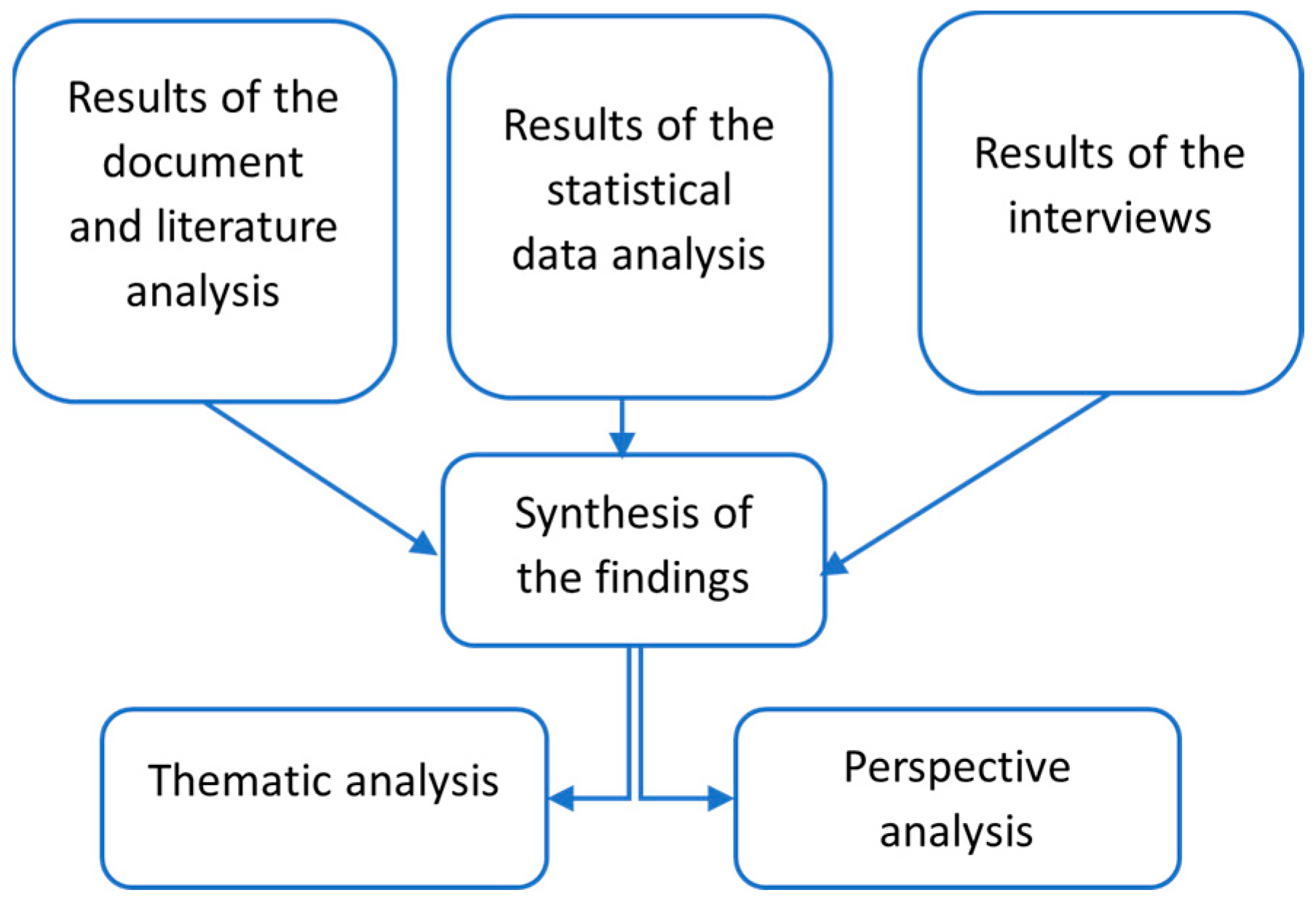
The subsequent analysis was based on these sub-categories. The analysis of the literature and documents, statistical data, and expert interviews was combined following the qualitative analysis of the interviews. Based on the previously created thematic blocks and sub-categories, it was possible to combine the results. Comparability was ensured by the application of qualitative analyses based on Kuckartz & Rädiker. The analysis was carried out using two approaches: a thematic analysis and a perspective analysis. The thematic analysis built on the thematic blocks that were created in the previous step. The thematic blocks were used for both the results of the literature and document analysis and the results of the interviews. These were compared and analysed. In the perspective analysis, the results were described from the point of view of each interviewee (see Figure 1).
Table 2 provides a breakdown of the considerations for conducting the perspective analysis.
To gain an impression of the diversity of Vienna’s cemeteries, a field study (including photo documentation) was conducted for selected cemeteries, namely the Old Jewish Cemetery Währing in the 18th district, the Protestant Cemetery Matzleinsdorf in the 10th district and the Central Cemetery in the 11th district. The latter is home to both the Old and New Jewish Cemeteries of Vienna, Muslim burial sections and graves of members of other religions and denominations, as well as people with no formal religious affiliation.

2.2. Synthesis of Findings and Presentation of Results

The results were synthesised in two respects: firstly, within the framework of thematic analysis (the literature and interviews), putting them into context with the relevant official statistical data; secondly, within the framework perspective analysis, whereby the interviewees’ statements were contextualised with reference to the international literature. The latter focused on the perspectives of the respective experts, as not all respondents had a full range of knowledge about cemeteries and urban planning.
Finally, the experts’ statements with regard to thematic aspects and their specific perspectives were verbally and argumentatively assessed using a five-point scale based on Scholles [57] to obtain an expert-related judgement of the significance of the topics and aspects surveyed. The application of this method does not allow for a direct comparison of the assessments and can only be categorised in terms of their significance from the perspective of the respective interviewee. A five-point assessment scale was created to present the results of this study. This scale reflects the interviewees’ statements on the significance of the topic. The following classes were defined: ++ highly significant regarding the strategic orientation of the cemetery; + relevant background subject; o not an issue/not relevant; - negative regarding the level of decision-making but tolerated considering the broader context; -- problematic regarding decision-making authority, strongly negative connotation.

3. Vienna’s Funeral System and Cemeteries: An Overview

3.1. Legal Framework of the Vienna Funeral System

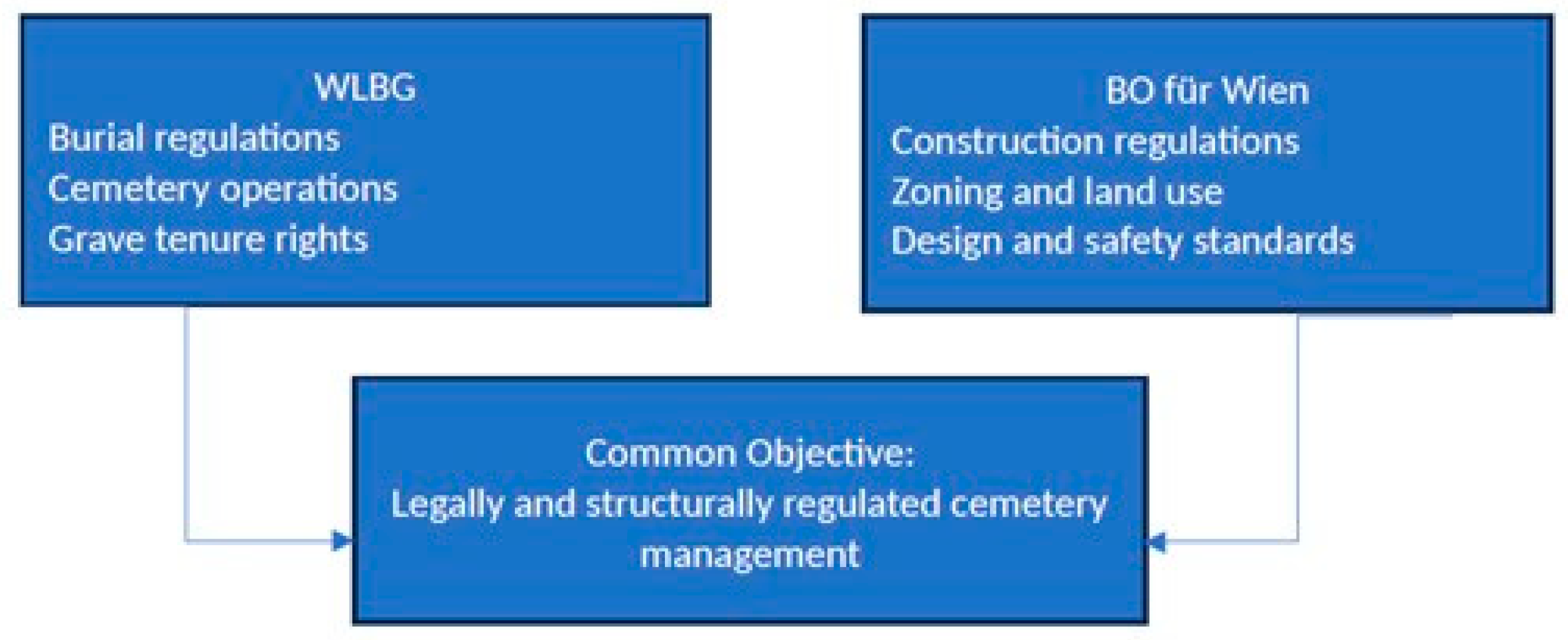
As of 1 July 2025 [58], the City of Vienna has a population of approximately two million inhabitants, making it the largest city in Austria. At the same time, Vienna also constitutes as a federal province, which represents a distinctive administrative feature. Cemeteries in Austria are regulated at the provincial level. With that, the City of Vienna has its own cemetery legislation: the Vienna’s Burial and Cemetery Act (Wiener Leichen- und Bestattungsgesetz, WLBG) [59]. This act defines both procedures to be followed after the official determination of death and the regulations governing how and where burials may take place. It also defines who is authorised to establish a cemetery. Additionally, the WLBG specifies the legally permitted forms of burial: in Vienna, both inhumation (earth burial) and cremation are allowed, with the latter including the possibility of natural burials [59]. In Vienna, it is legally mandated that cemeteries be enclosed by walls or fences. Furthermore, every cemetery operator must issue a Cemetery Regulations Ordinance (Bestattungsanlagenordnung) and display it publicly on site. This ordinance sets out the opening hours as well as the rules of conduct within the cemetery grounds [59] (see Figure 2).
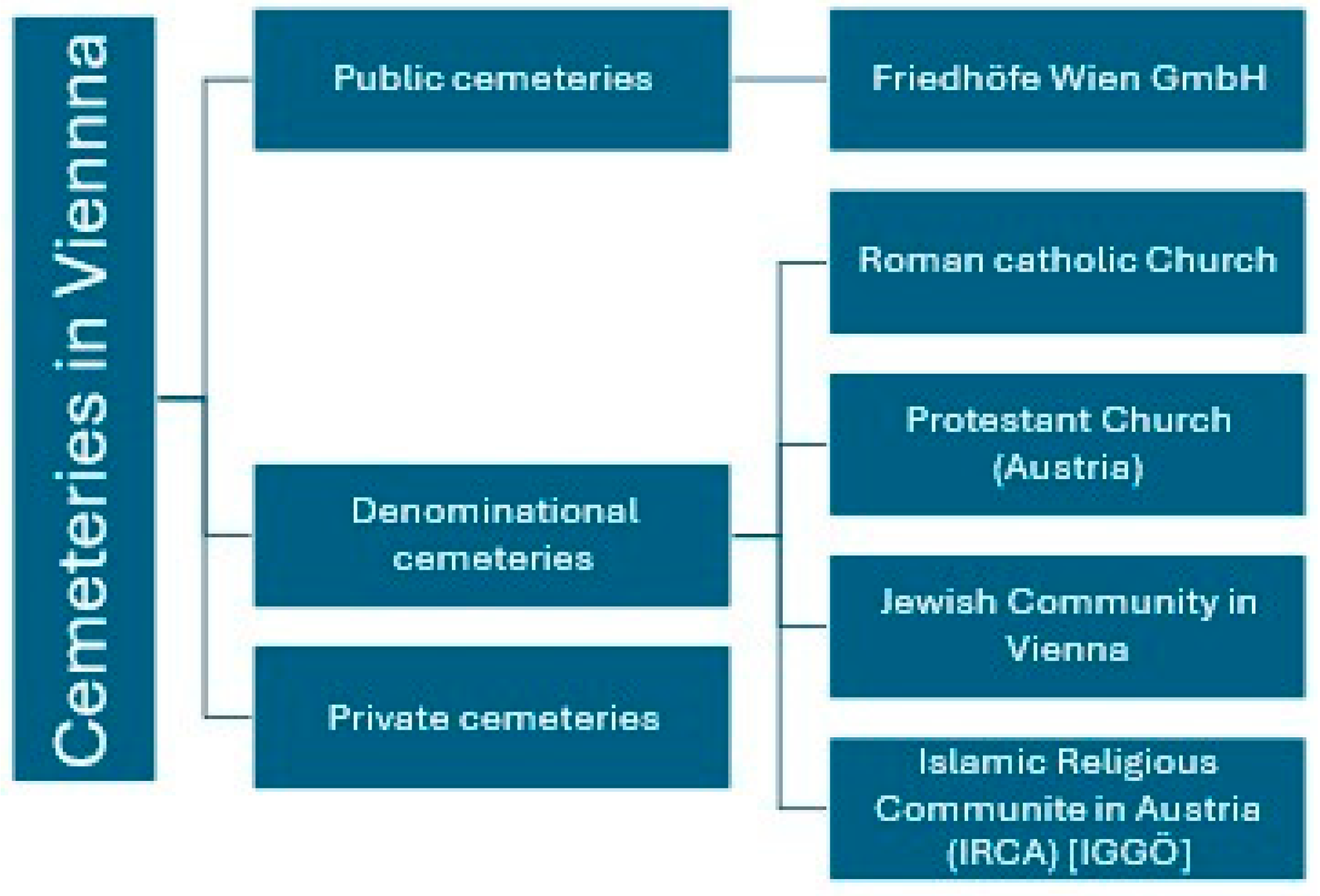
In Vienna, there are both municipal/public (which are also interdenominational) and denominational cemeteries (see Figure 3). The interdenominational cemeteries are public facilities and therefore freely accessible to all individuals during designated opening hours. Access to denominational cemeteries, however, may vary, especially during funerals or on specific religious holidays.
In this context, it is important to note that the main differences between municipal/public and denominational cemeteries primarily concern their administrative structures. For the citizens of Vienna, the religious affiliation is of no concern because municipal cemeteries are generally organised on a multireligious and multidenominational basis. However, specific sections for different religious groups have been established, especially at Vienna’s Central Cemetery, for which this has been the case since its very beginning. Denominational cemeteries are primarily intended for members of their respective faith communities, though some now also allow burials of individuals from other religions or without religious affiliation. Private cemeteries, while also located on the city outskirts, are of lesser relevance for this article.

3.2. Structural Data on Vienna’s Cemeteries

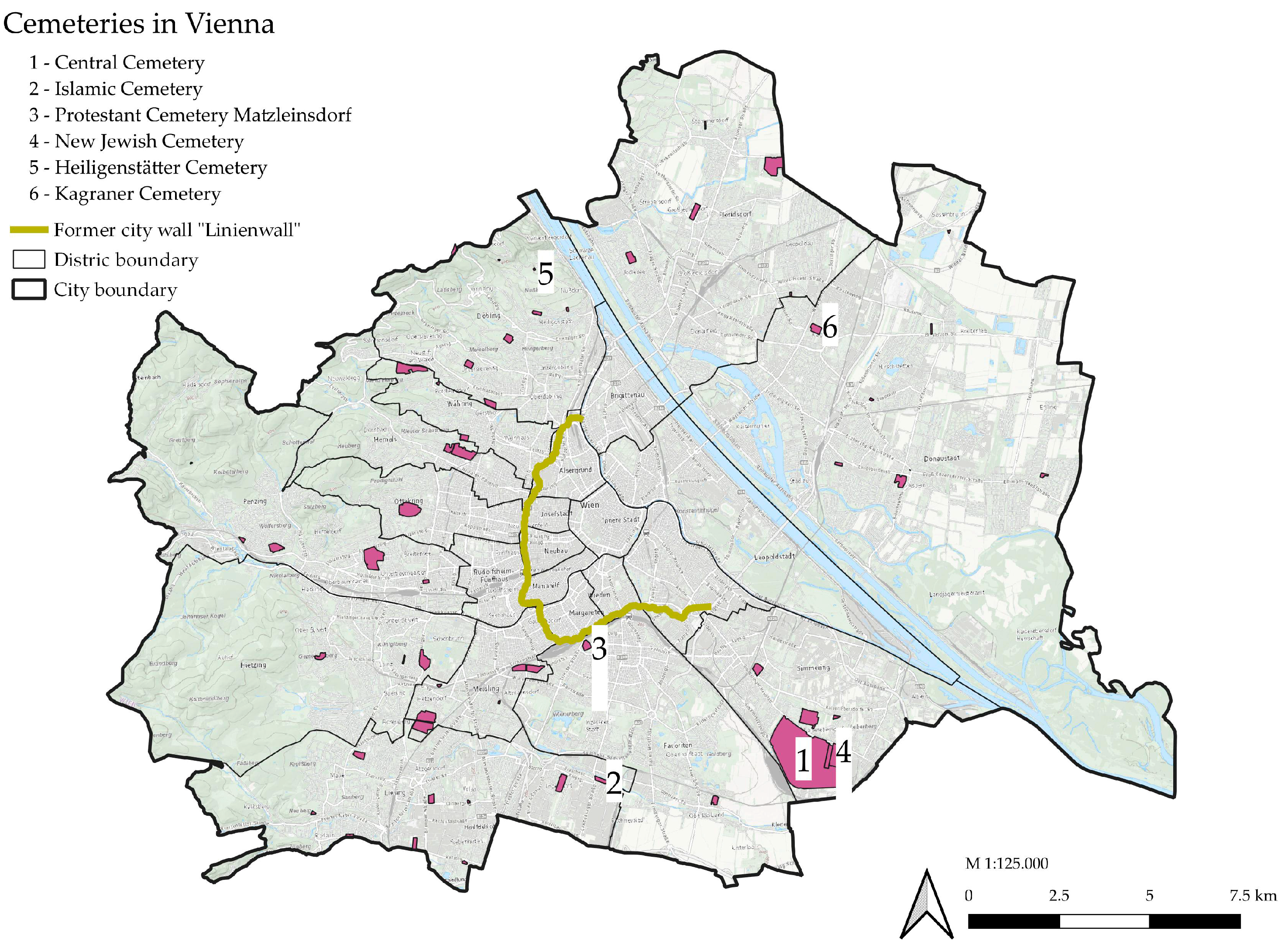
There are a total of 55 cemeteries within the city of Vienna, distributed across the entire urban area (see Figure 4). Their peripheral location outside the historical city centre has historical origins. This spatial pattern can be traced back to Emperor Joseph II, who, around 1784, ordered the closure of inner-city burial grounds as part of new hygiene regulations and epidemic prevention measures. Later, new municipal cemeteries were established along the former city wall (“Linienwall”). These municipal cemeteries, however, were only used for a short time, as the construction of the large Vienna Central Cemetery on the urban periphery was completed in 1874. Following its inauguration, the smaller municipal cemeteries were closed, and the remains of those buried there were reinterred at the Central Cemetery [11,60]. The smaller cemeteries that still exist today date back to the period before the incorporation of surrounding villages and municipalities into the city of Vienna.
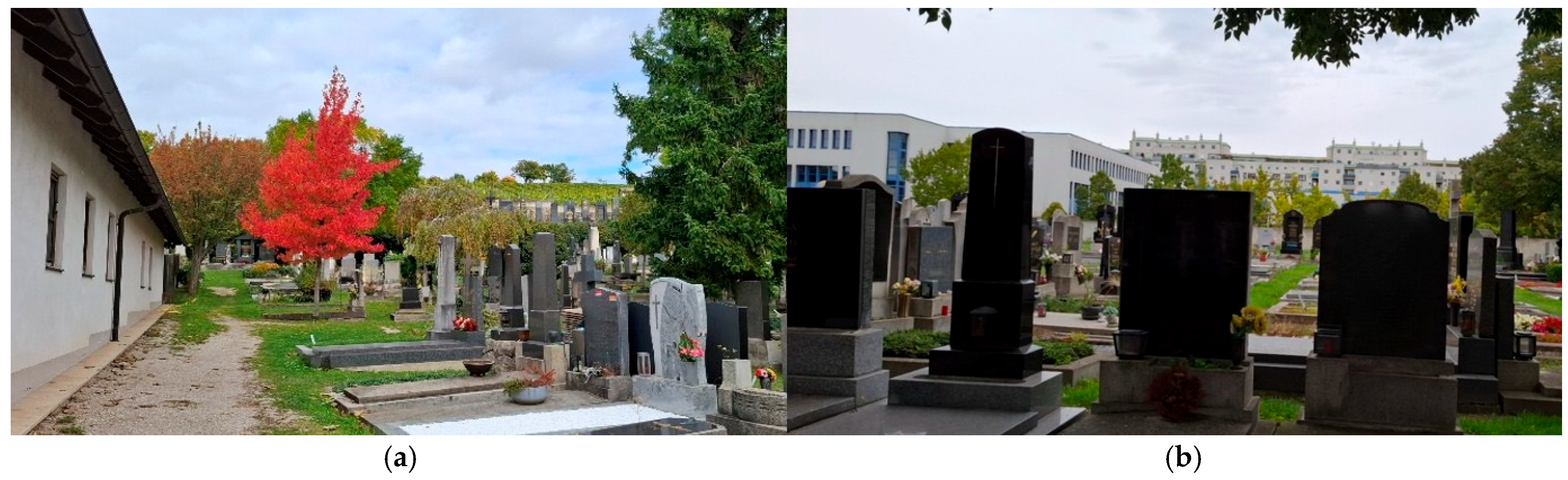
Additionally, processes of urban expansion, inner-city development and densification, with an increasing emphasis on the functional mix (particularly residential and commercial uses), have resulted in cemeteries being embedded within diverse urban environments (see Figure 5). Consequently, they vary in their accessibility by public transport as well as in their significance for the provision of local open spaces serving the surrounding residential population.
Vienna’s 55 cemeteries cover a total area of almost 539 hectares. Most of this area, around 497 hectares, is owned and managed by Friedhöfe Wien GmbH, the municipal cemetery authority. The largest cemetery is the Vienna Central Cemetery, which occupies roughly 235 hectares. The remaining 42 hectares are distributed among denominational cemeteries, with the Jewish cemeteries accounting for the largest share, approximately 25.2 hectares. In relation to the total urban area, cemeteries occupy about 1% of Vienna’s city territory [61] (p. 177).
Of the 55 cemeteries in Vienna, 46 are owned and managed by Friedhöfe Wien GmbH. In addition, there are seven denominational cemeteries: three operated by the Roman Catholic Church, two by the Protestant Church (Austria), and one each administered by the Jewish and Muslim communities. Two additional cemeteries are historic Jewish burial grounds where no interments are currently taking place [61]. At present, burials are still conducted at 53 of Vienna’s 55 cemeteries.
The cemeteries in Vienna are characterised by very similar elements. Regardless of whether they are denominational or interdenominational, they all have some kind of enclosure (walls, fences in various designs, and hedges). They also have clearly marked gates or entrances. As discussed in the text, many cemeteries were established during the 19th century. Naturally, gravestones of different shapes can be found, as can a varied stock of trees, some of which are very old. Historic graves are often old crypts or small mausoleums.
The access to the cemeteries is grid-like with a central entrance for the transport of corpses and service vehicles. Larger cemeteries may also have several central axes. These roads are paved. The paths leading away from these axes are partly unpaved and therefore unsealed. However, this is not the case for all cemeteries. All cemeteries have in common that they show certain characteristics of an urban park. Other elements found in all cemeteries are the prayer room or place of worship and the mortuary.
At first glance, the graves may look very similar. However, differences are apparent in their orientation: Muslim graves are arranged so that the faces of the buried are pointing towards Mecca. Non-Muslim graves, on the other hand, usually follow a strict grid pattern and are therefore particularly space efficient. In Islamic cemeteries, like in Jewish cemeteries, there are no urn graves. Regardless of whether it is a denominational or interdenominational cemetery, the design of the graves is very individual. It is influenced by the religious and cultural background of the dead or bereaved, as well as personal preferences.
The cemeteries administered by Friedhöfe Wien GmbH, as well as the cemetery visited in Matzleinsdorf, often have benches placed along the paths, inviting visitors to rest for a while. Except next to the entrances, benches cannot be found in Jewish and Islamic cemeteries, as this is not customary in those cultures.

3.3. Demographic Development and Change in Burial Culture

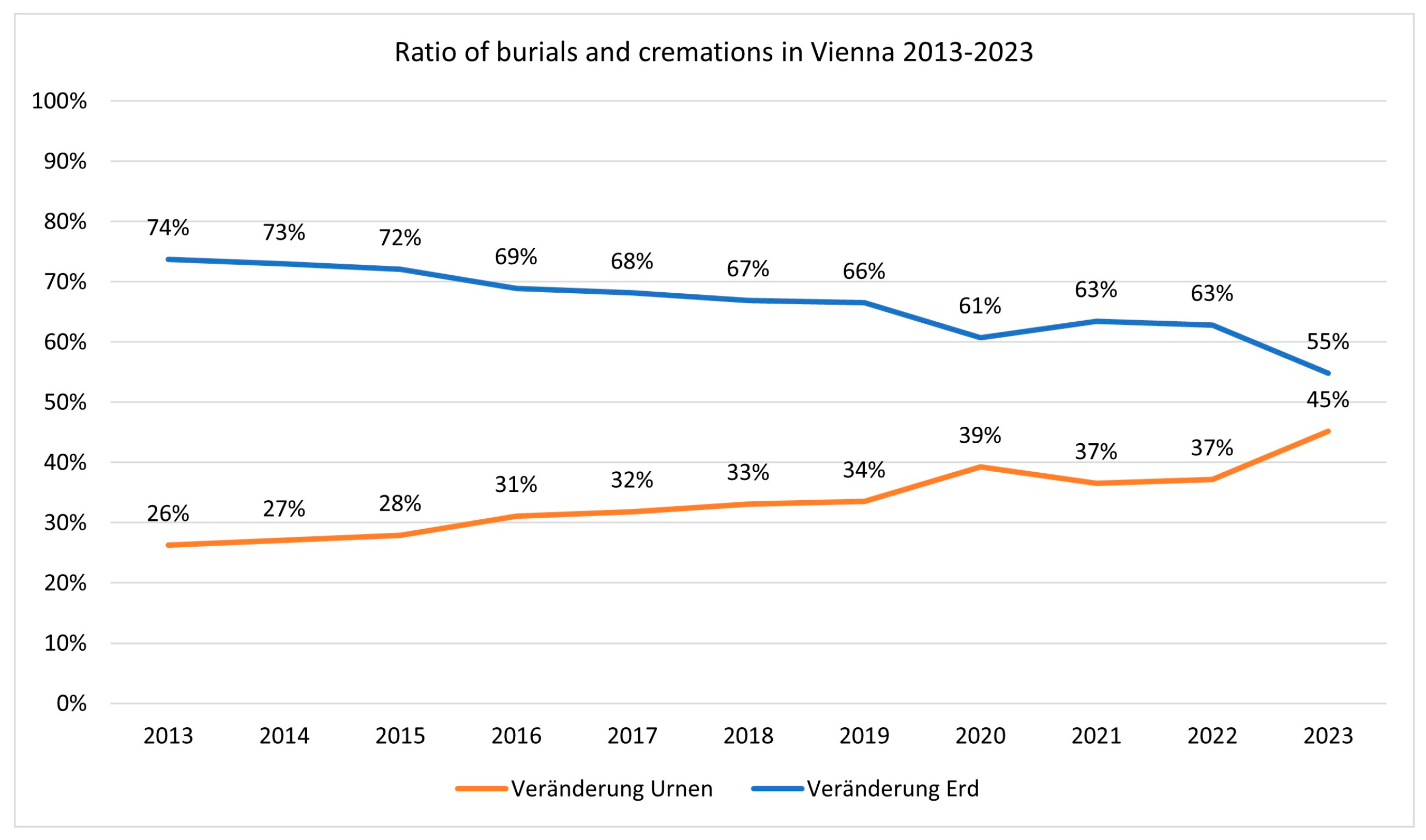
In 2024, roughly 45% of Vienna’s residents were of foreign origin [61]. Among migrants from European countries, the largest groups originated from Serbia, Romania, Poland, Germany, Turkey and Ukraine, while among those from non-European countries, Afghanistan and Syria were most strongly represented [61]. Compared to the Austrian national average age of 43.7 years [62], Vienna’s population is slightly younger, with an average age of 42 years (as of 2023) [62]. Due to Vienna’s continued attractiveness as a destination for international migrants, the city’s religious composition is also undergoing change. Since 2011, religious affiliation has been collected on a voluntary basis as part of Austria’s register-based census. Nevertheless, for religious communities that maintain membership records, such as the Roman Catholic Church, precise data remain available. For all other faith groups or religions, estimates are used to determine follower numbers. These estimates combine data from the 2001 census, demographic projections (including fertility, mortality, migration, and religious conversion), and information provided by the respective religious communities [63]. Therefore, only estimates exist for Vienna. As of 31 December 2023, around 540,000 residents were affiliated with the Roman Catholic faith, approximately 8000 with Judaism, and an estimated 200,000 with Islam, according to figures from the Islamic Religious Community in Austria (IGGÖ) [61]. These demographic characteristics also influence the city’s cemeteries and burial practices. In 2023, a total of 12,846 burials were carried out, of which 5,804 were urn burials [61]. Between 2013 and 2023, the proportion of cremations increased steadily in relation to inhumations (see Figure 6).
From these 5,804 urn burials in Vienna, 519 were classified as nature-based burials. The number of such environmentally oriented burials has been steadily increasing since their introduction in 2012. Over this period, the number of nature-based burials rose from 154 to 519 [61]. At the same time, the total number of grave sites declined from 521,082 in 2013 to 402,621 in 2023—a reduction of approximately 23%.

3.4. Multifunctionality and Experimental Practices

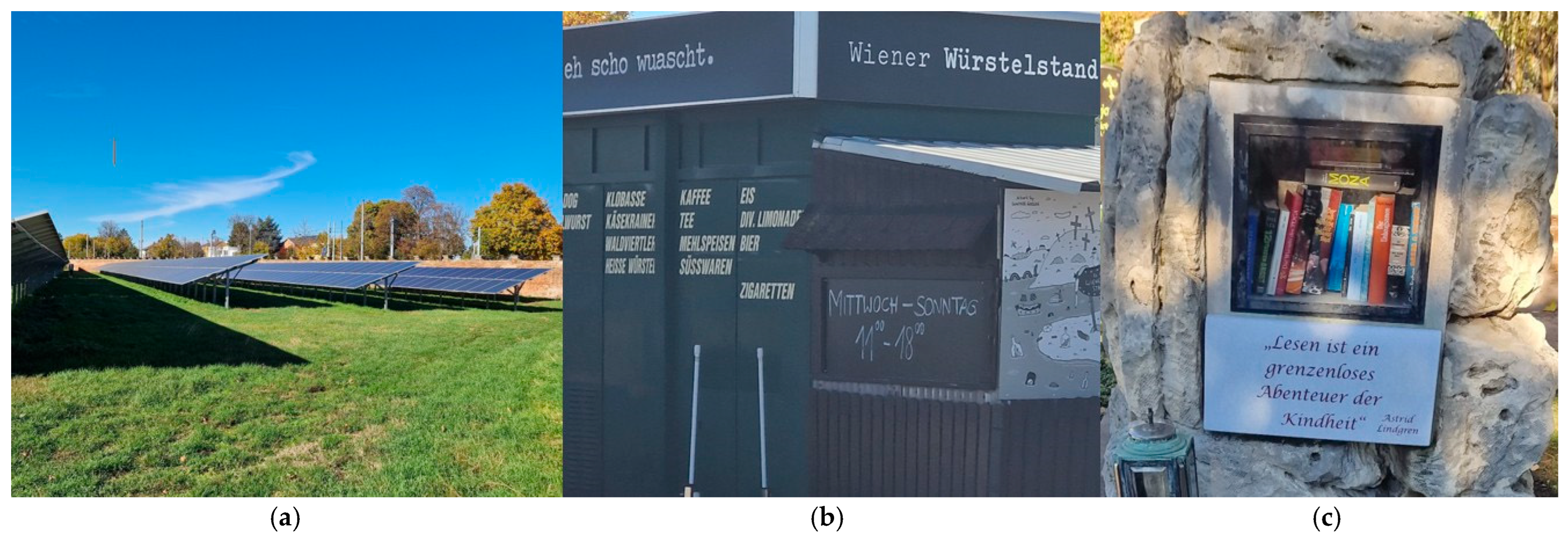
Beyond its role as a burial ground, the Vienna Central Cemetery functions as a highly frequented site for both residents of and visitors to the city. Friedhöfe Wien GmbH offers guided tours led by certified tour guides [64], including special programmes such as night tours, audio-guided visits and e-bike tours. These tours focus not only on the numerous prominent persons buried in honorary graves but also on the unique urban wildlife such as the European hamster (Cricetus cricetus), a species protected by Austrian conservation law [65]. Vienna’s citizens have developed a distinctive relationship with the themes of death, mourning and cemeteries. The Central Cemetery hosts a dedicated Funeral Museum (Bestattungsmuseum), which includes a gift shop offering themed merchandise such as T-shirts and memorabilia. The site also serves as a venue for concerts and cultural events. In 2022, Austrian funeral culture was officially added to the UNESCO-inventory of intangible cultural heritage [50]. However, this recognition does not conflict with the city’s experimental and open approach toward cemetery spaces. At the Central Cemetery, activities such as jogging and picnicking are permitted—and even encouraged. These uses became particularly visible during the COVID-19 pandemic and associated lockdown periods. Furthermore, a designated urban gardening area has been established, which can be cultivated by clients of Friedhöfe Wien GmbH [66]. The cemetery has also implemented a large-scale photovoltaic installation with a maximum output of 1.4 megawatts peak [67] (see Figure 7a).
However, multifunctional use is not limited to the Central Cemetery. The Protestant Cemetery of Matzleinsdorf also accommodates urban gardening. For this purpose, only graves are suitable that have not been used for burials for ten or more years and with least one metre of soil above the last coffin buried [68]. In addition, visitors can find publicly accessible book stands creatively integrated into gravestones (see Figure 7c).

4. Results and Discussion

4.1. Current Debate on Cemeteries in Urban Planning

The present study has shown that cemeteries have “always been there” in the context of Vienna’s urban planning. As most cemeteries within the city were established in the late nineteenth century, and, apart from the newly founded Islamic Cemetery in 2008, no new cemeteries have been created since, the question of land allocation for the dead has not been a pressing issue. Due to its considerable size, the Central Cemetery alone can accommodate Vienna’s current population. Additionally, the outsourcing of cemetery management to Friedhöfe Wien GmbH has removed the direct administrative responsibility of the cemeteries from the municipal authority.
At the same time, cremation, while increasingly common, is not acceptable for Muslims and Jews. Parallel to this, urn and natural burials have become more prevalent. The interviews revealed that believers prefer to remain “among their own,” and thus tend to avoid cemeteries that encourage leisure activities. However, declining burial numbers combined with large cemetery areas have resulted in a noticeable surplus of land. Due to their park-like design, cemetery grounds can also be regarded as recreational spaces, as noted by Długozima et al. [34].
This surplus area poses a financial challenge for cemetery administrations, since there is no public subsidy or compensation scheme provided by the City of Vienna. As a result, cemetery management depends on paying plot holders or seeks to diversify its offerings. For instance, the administration of the Protestant Cemetery in Matzleinsdorf engages in various outreach initiatives intended to attract and retain long-term visitors. Similarly, the marketing activities and event programmes of Friedhöfe Wien GmbH can be interpreted as customer-oriented strategies; in contrast, the Jewish and Islamic Cemetery administrations rely on grave fees supplemented by donations to sustain their operations.
Cemeteries are directly affected by demographical and societal change. Regardless of whether they are public or denominational, all are influenced by the growing diversity of burial preferences. For religious individuals, the “correct” choice of burial form remains of utmost importance. This is the main reason why the Muslim community established its own cemetery in Vienna, despite the possibility of burial in municipal cemeteries. For Jewish people in Vienna, cremation remains particularly unacceptable, as it evokes painful associations with the Shoah and its historical context in Europe.

4.2. On the Significance of Cemeteries for the Urban Population

The interviews showed and confirmed that the function of cemeteries as burial places is still their primary function. This essential role of burial grounds as final resting places for the deceased was therefore reaffirmed within this study. In addition, the findings of this study indicate that cemeteries form an integral part of both the social and technical infrastructure, fulfilling essential functions from public-health and religious perspectives alike.
Cemeteries enable private mourning within public space, an act which is often socially discouraged in other public spaces. These areas provide environments where religious rituals and customs can be practiced openly. Furthermore, members of minority groups have the opportunity to mourn their deceased in ways consistent with their beliefs and cultural traditions. This is particularly evident in public cemeteries, where interdenominational and interreligious burials take place, exposing visitors directly to the funerary practices and rites of different religions and cultures.
Beyond their traditional role as places of rest, cemeteries are increasingly developing into spaces for the living. This trend was particularly strengthened during the COVID-19 pandemic, when lockdown measures in Austria intensified the use of cemetery grounds. As emphasised in the interview with Friedhöfe Wien GmbH, the Vienna Central Cemetery experienced a significant increase in visitors during this period. In addition, several tourist attractions have been established at the Central Cemetery. Similarly, the Protestant Cemetery in Matzleinsdorf aims to position itself as a place for the living by implementing various initiatives designed to attract the surrounding population.
Recent developments in funerary practices may, in the long term, alter the spatial and visual character of cemeteries, particularly when alternative forms of burial no longer maintain a direct spatial relationship with cemetery grounds. This trend is evident in the statistical data provided by the City of Vienna. Nonetheless, cemeteries continue to offer an emotional anchor through the local interment of the deceased, whose absence could be perceived as a form of loss by some people. For Austria’s migrant population, the decision to bury their deceased in Austria rather than in their country of origin also represents a profound connection to their new home. These findings are consistent with the works of Maddrell et al. [69,70] and Rugg [71].
Quiet and passive recreational activities are encouraged in these cemeteries, while more active uses are viewed critically, although such restrictions depend on the spatial scale of each site. For instance, active engagement by visitors, such as jogging, is promoted at the Central Cemetery, whereas it is not permitted at the Jewish Cemetery or the Islamic Cemetery of Vienna. These findings are in line with research from Scandinavia [17,72,73,74] and North America [34], suggesting that cemeteries can be understood to be components of urban green infrastructure. The interview participants also highlighted the role of cemeteries as providers of ecosystem services. Their impact on the surrounding urban environment is evident both in the cooling effects on adjacent neighbourhoods [75] and in the aesthetic value of historic cemetery landscapes. Through targeted management strategies, cemeteries can offer residents areas of tranquillity that are otherwise scarce in densely built urban settings. As such, cemeteries may serve as valuable recreational spaces, provided that the presence of gravestones is socially and culturally accepted.

4.3. Drivers of Persistence of or Changes in the Structure of Vienna’s Cemeteries

The factors influencing burial sites and cemeteries are multifaceted. The following categorisation provides a structured overview of the main drivers identified in the Vienna case study.
  • Demographics
A central aspect in this regard is the heterogeneity of the population, reflected not only in religious and denominational diversity but also in differences in life expectancy and mortality rates. The case study of Vienna is particularly characterised by a relatively young population and a significant proportion of residents of non-Christian faiths. These demographic characteristics directly impact cemetery planning and the allocation of burial space.
  • Cultural and Religious Factors
High life expectancy, a diverse religious landscape, and varying cultural conceptions of life after death all affect cemeteries and their spatial design. The value dimension, shaped by religion, piety, personal emotions, and cultural background, exerts both direct and indirect influence on cemeteries. Direct impacts are displayed in the choice of burial form, the design of funeral rites, and the way graves are visited.
  • Social Factors
Indirectly, social and cultural factors shape the physical layout of cemeteries as well as visitor behaviour. Moreover, the very persistence of cemeteries as institutions is closely linked to societal attitudes toward death.
  • Regulatory/Planning Factors
Transforming these areas for other uses is associated with considerable challenges. In the case of Vienna, decisions regarding the closure of cemeteries must be made with a long-term perspective, as at least ten years must pass between the final burial and the formal decommissioning of the site [59] (p. 18). The municipal cemeteries, due to their large number and the broad range of burial and recreational offerings, are not directly affected by closure considerations. Furthermore, interviews revealed that no reduction in cemetery area is currently planned.
Denominational cemeteries, particularly Jewish cemeteries, are also protected due to their religious significance. In this context, Vienna’s land use zoning regulations must also be considered. The interview with the city’s planning department further revealed that there have never been any requests to rezone cemetery land.
The fact that cemeteries are accessible to the public, within designated opening hours, can have positive effects for the residents of urban neighbourhoods. Furthermore, the fenced boundaries, limited entry points, regulated opening hours and lack of crossing options mean that Vienna’s cemeteries cannot be easily interpreted or used directly as conventional public urban parks.
  • Environmental/Climate Factors
Cemetery grounds are exposed to the changing urban climate. The positive climatic effects of cemeteries on surrounding neighbourhoods have already been documented. While urban planning documents emphasise climate change adaptation, cemeteries are not addressed specifically. The City of Vienna has been engaged in this issue for more than ten years [65,76]. As such, these inner-city green spaces can serve as unique and valuable sites within an otherwise densely urbanised environment. In addition, cemeteries provide habitats for a variety of flora and fauna [29], including species listed on national red lists.
The aesthetic and spatial configuration of these sites plays a decisive role in how they are perceived and used. In addition, the strong emotional significance of these places can lead to public discomfort or resistance. Even after closure, cemeteries remain emotionally loaded and continue to be perceived as special and distinctive places [77]. Accordingly, it can be concluded that no cemetery closures are expected in Vienna.
Due to legal requirements, any change in zoning designation is a lengthy and com-plex process. Moreover, as previously discussed, the strong emotional attachment associated with cemetery grounds makes their redevelopment particularly challenging, even after rezoning, as new residents or users may raise concerns or objections [78,79]. It can therefore be concluded that the zoning category “cemetery” represents the most stable form of green land zoning in Vienna. This is of particular significance, as it also ensures the protection of the additional social, ecological and cultural functions that cemeteries provide.
The increasing tolerance of municipal cemeteries toward passive, and in some cases even active, recreational uses adds significant value. Vienna, however, is not yet prepared to promote its cemeteries as park spaces, in contrast to Copenhagen [72], where such an approach has already been implemented. In the context of increasing urban density, the trend toward expanded recreational use of cemetery grounds is nevertheless a positive development. Cemetery administrations with a surplus of land are encouraged to make such areas available for alternative uses, provided this is socially acceptable. Both the Central Cemetery and the Protestant Cemetery in Matzleinsdorf can be regarded as best-practice examples in this regard.
From the perspective of the interviewees, it is important to balance tradition and religious considerations with a more progressive approach to death. This entails a complex field of tensions, shaped by the heterogeneity of society, the already existing multifunctionality of cemeteries in the context of religion and piety, environmental and climate-related concerns, and the spatial configuration of cemeteries within the urban fabric. These aspects are further embedded within future-oriented perspectives, encompassing demographic and societal change as well as individual value systems.

4.4. Consensus and Dissent Among the Stakeholders Surveyed

Since the successful management and further development of cemeteries is also rooted in the consensus of the relevant stakeholders, the following paragraphs provide a comparison of the different perspectives of the stakeholders surveyed (see Table 3).
A broad consensus was found among the stakeholders of the City of Vienna surveyed on the relevance of the issues, with one exception: compared to the representative of Friedhöfe Wien GmbH, the respondents from the Department of Urban Planning and Urban Development rated the function of cemeteries as less relevant and ascribed comparatively little or no significance to changes in burial practices and remembrance culture, the significance of cemeteries as places of integration, and the relevancy of improving the cemeteries’ reputation and promotion of acceptance.
The comparison of the positions taken by representatives of interdenominational and denominational cemeteries reveals the following:
  • The positions are similar between the interdenominational cemetery and the Protestant Cemetery Vienna, and there is no fundamental disagreement on any of the (sub-)themes;
  • The representatives of the Jewish and Islamic Cemeteries in Vienna ascribe central importance to the stability of traditional burial practices and emphasise the great significance of the religion for the resting place function of their cemeteries, so multifunctional use—including for recreational purposes—is outside the scope of debate;
  • All respondents assume the legal framework governing cemeteries to be stable and, perhaps for this reason, do not consider the legal framework to be relevant to the further development of cemeteries.
The representative of the Islamic Cemetery stated his openness to the importance of cemeteries as green infrastructure in the context of climate change, while the representative of the Jewish Cemetery Vienna considered the discussion of location issues and questions concerning the relevance and further development of cemeteries as green infrastructure and social infrastructure to be difficult.

5. Limitations and Conclusions

Given the limited research on cemeteries and urban planning in Austria or Vienna, their investigation was highly pertinent. As the subject of cemeteries and urban planning in Vienna is still in its infancy, a qualitative research design and descriptive presentation of the results was chosen to determine the (future) relevance of this subject for Vienna.
In doing so, an attempt was made to adopt a multi-religious and multi-denominational approach, which was achieved through the selection of experts. By interviewing almost all cemetery management units, a representative overview of the discussion could be achieved at this administrative level. The primary aim of this research was to capture the current status quo of cemetery management and practices in Vienna. The interviewees are at the same time experts, stakeholders and representatives of different communities since they were actively engaged with, or had recently been involved in, cemetery management and related issues. No effort was made to identify experts who had worked on Vienna’s cemeteries in the more distant past or who had long-term experience with cemetery topics. Unfortunately, the administration of Roman Catholic cemeteries was not available for an interview or statement at any point in time. The fact that no representative of the Roman Catholic Church was interviewed leaves a slight information gap in this paper, as the Roman Catholic Church directly administers three cemeteries in Vienna. Furthermore, the Roman Catholic faith represents a cultural heritage of the city, which has a direct impact on the design of all the other cemeteries—with the exception of the Islamic Cemetery. Accordingly, the opinion of a representative would be of considerable interest. Nevertheless, this gap in information is considered minor and therefore has only a marginal effect on the present results. However, further research questions arise as to how the Roman Catholic Church is dealing with the changing conditions of cemetery culture and the diversification of cemetery land use.
Another limitation of this study is that it aimed to interview neither cemetery visitors nor residents living next to cemeteries to collect data on the motives and purposes for cemetery visits, or to find out more about the influence on cemeteries on the quality of life of the residents.
The factors influencing the persistence or transformation of cemeteries were derived from both the international literature and the insights provided by the interviewed experts. An analysis of the attitudes of the cemetery visitors towards preservation or transformation of cemeteries in particular and the sentiment of the population in general could be interesting. The assessments of the experts were crucial for this basic study and are intended to serve as a basis for further, more comprehensive research comprising representatives from other municipal departments involved in Vienna’s urban planning.
The results of this study suggest that in everyday life, cemeteries play a relatively minor role for most residents of Vienna. Until this study was conducted, it appeared that urban planners accepted cemetery areas as a fixed component of the urban fabric without paying strategic attention to them. However, based on findings from international specialist literature, this paper highlights the relevance of cemeteries as valuable components of urban space. Since interdenominational cemeteries fulfil multiple, sometimes overlapping functions, they provide substantial benefits for the environment and serve various user groups among the residents. Furthermore, cemeteries highlight the permanence and longevity of the built environment—qualities that are often lacking in the fast-paced context of modern city life and urban development against the backdrop of population growth and pluralisation of societal values. As elements that slow down the pace within the urban fabric, they represent distinctive and unique places within the city of Vienna.
Although the results of this study on Vienna’s cemeteries indicate that the urban planning authority has not yet addressed the issue of cemeteries, there is an awareness in urban planning of the ecological value of cemeteries against the background of climate change. Since Vienna’s cemeteries are experiencing developments like those documented in the international literature, their existence would seem to be protected by strict legal regulations. Due to the legal protections of cemetery grounds and the strong emotional attachments associated with them, these green spaces are not immediately threatened by closure or subsequent redevelopment. However, the form and use of interdenominational cemeteries are likely to evolve, as other user groups increasingly appropriate these areas. Within this context, the growing diversification of the religious landscape and the associated needs of different communities should be highlighted, as these will also shape the future development and use of cemeteries and therefore are worthy of further investigation. As mentioned earlier, future research should engage with the visitors of Vienna’s cemeteries following Xu et al. (2025) [81]. In this context, international urban tourists would be an interesting and important target group, as they frequently visit the Central Cemetery. Likewise, a typology of Vienna’s cemeteries with regard to the potential for functional transformation while also assessing the likelihood of persistence should be developed in order to test hypotheses relating to issues relevant to urban planning, as presented in the Results and Discussion section.
Due to the heterogeneity of European historic cities in terms of topography, demographic development and population dynamics on the one hand, and differences in cemetery management on the other, the findings for Vienna cannot be extrapolated to other historic European cities. For this reason, there is a need for further interdisciplinary comparative research on urban cemeteries.

Author Contributions

Conceptualisation, R.W. and T.F.; methodology, R.W.; investigation, R.W.; writing—original draft preparation, R.W.; writing—review and editing, T.F.; visualisation, R.W. and T.F.; supervision, T.F. All authors have read and agreed to the published version of the manuscript.

Funding

This research received no external funding.

Institutional Review Board Statement

Ethical review and approval were waived for this study by the Ethics Committee of BOKU University. At BOKU University, it is not mandatory to submit research proposals to the Ethics Committee and thus have ethics approval before data is collected.

Informed Consent Statement

Informed consent for participation was obtained from all subjects involved in the study.

Data Availability Statement

At this point, the authors would like to point out that the original data used in this article were collected by the first author for the purpose of his master’s thesis [80]. The raw data supporting the conclusions of this article will be made available by the authors on request.

Acknowledgments

During the preparation of this manuscript, the authors used Academic AI Version 1.0 for content extraction from selected papers which were searched in Scopus and the Web of Science without the use of AI. With Academic AI, ACOmarket makes ChatGPT accessible on a secure instance of Microsoft Azure. This allows ChatGPT to be used while ensuring that entered data and uploaded documents do not leave the “Azure Secure Landing Zone”. For further information please visit: https://boku.ac.at/boku-it/themen/everybodys-needs/services-fuer-spezialgruppen/academic-ai. The authors have reviewed and edited the output and take full responsibility for the content of this publication.

Conflicts of Interest

The authors declare no conflicts of interest.

References

  1. Weeber, R. Unsere Friedhöfe–kulturgeschichtliche und soziologische Aspekte zu ihrer Erhaltung und Weiterentwicklung. Forum Stadt 2025, 52, 45–63. [Google Scholar] [CrossRef]
  2. Zaremba, C. Possession, performance, and the rhetoric of belonging: Urban cemeteries as spaces of cultural citizenship. Int. J. Cult. Stud. 2025, 28, 778–796. [Google Scholar] [CrossRef]
  3. Crubézy, É. The recognition of death and grief: An evolutionary perspective. Its relations with the most ancient rituals and burials of humanity. L’Anthropologie 2024, 128, 103280. [Google Scholar] [CrossRef]
  4. García-Sánchez, R. “Incerta omnia, sola mors certa”. Muerte, sepultura y templo. Scr. Theol. 2019, 51, 573–612. [Google Scholar] [CrossRef]
  5. Kantemur, Z. Ölü Bedenin Sınırlanan Mekânı: Kayserideki Çerkes Kimlikli Mezarlar. Folklor Edebiyat 2019, 98, 339–351. [Google Scholar] [CrossRef]
  6. Muzaini, H.; Yeoh, B. Memory-Making ‘from Below’: Rescaling Remembrance at the Kranji War Memorial and Cemetery, Singapore. Environ. Plan. A 2007, 39, 1288–1305. [Google Scholar] [CrossRef]
  7. Miller, D.S.; Rivera, J.D. Hallowed Ground, Place, and Culture. Space Cult. 2006, 9, 334–350. [Google Scholar] [CrossRef]
  8. LaRoche, C.J. The African Burial Ground in the Age of Revolution: A Landscape in Transition. In Tales of Gotham, Historical Archaeology, Ethnohistory and Microhistory of New York City; Janowitz, M.F., Dallal, D., Eds.; Springer New York: New York, NY, USA, 2013; pp. 133–158. ISBN 978-1-4614-5271-3. [Google Scholar]
  9. Deng, H.; Li, M. The morphological evolution of Chinese urban cemeteries from the perspective of fringe belt: A case study of Nanjing. Front. Archit. Res. 2023, 12, 1065–1079. [Google Scholar] [CrossRef]
  10. Grabalov, P. Invisible public spaces: The role of cemeteries in urban planning and development in Moscow. J. Urban Aff. 2024, 46, 1971–1991. [Google Scholar] [CrossRef]
  11. Kolnberger, T. Cemeteries and urban form: A historico-geographical approach. Urban Morphol. 2022, 22, 119–139. [Google Scholar] [CrossRef]
  12. Wang, H.; Deng, H. An analytical study of Chinese urban cemeteries based on urban morphology and spatial vitality: Case studies in Nanjing. Front. Archit. Res. 2025; in press. [Google Scholar] [CrossRef]
  13. Davies, P.J.; Bennett, G. Planning, provision and perpetuity of deathscapes—Past and future trends and the impact for city planners. Land Use Policy 2016, 55, 98–107. [Google Scholar] [CrossRef]
  14. Wei, G.; Han, G.-S.; Lang, X. Cultural heritage site selection characteristics and the impact of the natural environment in Jinan city, China. Sci. Rep. 2024, 14, 31038. [Google Scholar] [CrossRef]
  15. McClymont, K. ‘That eccentric use of land at the top of the hill’: Cemeteries and stories of the city. Mortality 2016, 21, 378–396. [Google Scholar] [CrossRef]
  16. Evensen, K.H.; Nordh, H.; Skaar, M. Everyday use of urban cemeteries: A Norwegian case study. Landsc. Urban Plan. 2017, 159, 76–84. [Google Scholar] [CrossRef]
  17. Nordh, H.; Evensen, K.H.; Skår, M. A peaceful place in the city—A qualitative study of restorative components of the cemetery. Landsc. Urban Plan. 2017, 167, 108–117. [Google Scholar] [CrossRef]
  18. Swensen, G.; Nordh, H.; Brendalsmo, J. A green space between life and death—A case study of activities in Gamlebyen Cemetery in Oslo, Norway. Nor. Geogr. Tidsskr.—Nor. J. Geogr. 2016, 70, 41–53. [Google Scholar] [CrossRef]
  19. Santos, A.S.; Marques, T.P. Percurso pelos cemitérios do Porto. Rev. Tur. Desenvolv. 2023, 44, 365–390. [Google Scholar]
  20. Sallay, Á.; Mikházi, Z.; Gecséné Tar, I.; Takács, K. Cemeteries as a Part of Green Infrastructure and Tourism. Sustainability 2022, 14, 2918. [Google Scholar] [CrossRef]
  21. Nordh, H.; Evensen, K.H. Qualities and functions ascribed to urban cemeteries across the capital cities of Scandinavia. Urban For. Urban Green. 2018, 33, 80–91. [Google Scholar] [CrossRef]
  22. Goh, H.C.; Ching, F.E. Acceptable use of Chinese cemeteries in Kuala Lumpur as perceived by the city’s residents. Urban For. Urban Green. 2020, 55, 126837. [Google Scholar] [CrossRef]
  23. Kjøller, C.P. Managing green spaces of the deceased: Characteristics and dynamics of Danish cemetery administrations. Urban For. Urban Green. 2012, 11, 339–348. [Google Scholar] [CrossRef]
  24. Rae, R.A. Cemeteries as public urban green space: Management, funding and form. Urban For. Urban Green. 2021, 61, 127078. [Google Scholar] [CrossRef]
  25. Kowarik, I.; Buchholz, S.; von der Lippe, M.; Seitz, B. Biodiversity functions of urban cemeteries: Evidence from one of the largest Jewish cemeteries in Europe. Urban For. Urban Green. 2016, 19, 68–78. [Google Scholar] [CrossRef]
  26. McClymont, K.; Sinnett, D. Planning Cemeteries: Their Potential Contribution to Green Infrastructure and Ecosystem Services. Front. Sustain. Cities 2021, 3, 789925. [Google Scholar] [CrossRef]
  27. Säumel, I.; Butenschön, S.; Kreibig, N. Gardens of life: Multifunctional and ecosystem services of urban cemeteries in Central Europe and beyond—Historical, structural, planning, nature and heritage conservation aspects. Front. Environ. Sci. 2023, 10, 1077565. [Google Scholar] [CrossRef]
  28. Quinton, J.M.; Duinker, P.N. Beyond burial: Researching and managing cemeteries as urban green spaces, with examples from Canada. Environ. Rev. 2019, 27, 252–262. [Google Scholar] [CrossRef]
  29. Löki, V.; Deák, B.; Lukács, A.B.; Molnár, V.A. Biodiversity potential of burial places—A review on the flora and fauna of cemeteries and churchyards. Glob. Ecol. Conserv. 2019, 18, e00614. [Google Scholar] [CrossRef]
  30. Moesch, S.S.; Ladds, Z.; Francis, R.A. Life in the deadlands: Unearthing reasons for visiting and visitor perceptions of wildlife in London’s Magnificent Seven cemeteries. J. Urban Ecol. 2024, 10, juae022. [Google Scholar] [CrossRef]
  31. Sallay, Á.; Tar, I.G.; Mikházi, Z.; Takács, K.; Furlan, C.; Krippner, U. The Role of Urban Cemeteries in Ecosystem Services and Habitat Protection. Plants 2023, 12, 1269. [Google Scholar] [CrossRef]
  32. Skår, M.; Nordh, H.; Swensen, G. Green urban cemeteries: More than just parks. J. Urban. Int. Res. Placemaking Urban Sustain. 2018, 11, 362–382. [Google Scholar] [CrossRef]
  33. Długozima, A.; Kosiacka-Beck, E.; Krzykawska, K. Multiuse Cemetery Paradigm: Cemetery as a multifunctional place of social significance—Reshaping a cemetery in the urban space of Eastern Europe. Cities 2025, 156, 105556. [Google Scholar] [CrossRef]
  34. Długozima, A.; Kosiacka-Beck, E.; Krzykawska, K. Cemetery as multifaceted space with leisure uses in the urban American and Western European context. Leis. Stud. 2024, 1–18. [Google Scholar] [CrossRef]
  35. Ocón, D.; Young, W.P. Bridging the nature–cultural heritage gap: Evaluating sustainable entanglements through cemeteries in urban Asia. Sustain Sci 2024, 19, 1641–1660. [Google Scholar] [CrossRef]
  36. Tudor, C.A.; Iojǎ, I.C.; Hersperger, A.; Pǎtru-Stupariu, I. Is the residential land use incompatible with cemeteries location? Assessing the attitudes of urban residents? Carpathian J. Earth Environ. Sci. 2013, 8, 153–162. [Google Scholar]
  37. Bennett, G.; Davies, P.J. Urban cemetery planning and the conflicting role of local and regional interests. Land Use Policy 2015, 42, 450–459. [Google Scholar] [CrossRef]
  38. Westendorp, M.; Kmec, S. Cemeteries as Translocal Contact Zones: Navigating Regulations, Unwritten Rules and Divergent Expectations in Luxembourg City. In Mobilities in Life and Death; Maddrell, A., Kmec, S., Priya Uteng, T., Westendorp, M., Eds.; Springer International Publishing: Cham, Switzerland, 2023; pp. 43–64. ISBN 978-3-031-28283-6. [Google Scholar]
  39. Swensen, G.; Skår, M. Urban cemeteries’ potential as sites for cultural encounters. Mortality 2019, 24, 333–356. [Google Scholar] [CrossRef]
  40. Page, J.; Besco, L. Cemeteries as critical social infrastructure: A comparative legal geography. Cities 2025, 160, 105792. [Google Scholar] [CrossRef]
  41. Carvalho Agostini, A.L.; Manfroi, C.; Pereira, R.; Da Costa, E.M.; Dos Santos, N. Cemetery: More Human, Intelligent, and Sustainable. In Proceedings of the 2024 International Conference on Intelligent Environments (IE), Ljubljana, Slovenia, 17–20 June 2024; pp. 132–138, ISBN 979-8-3503-8679-0. [Google Scholar]
  42. Hein, V. Zukunft von Friedhöfen Heutige Multifunktionalität Innerstädtischer Friedhofsflächen am Beispiel der Evangelischen Friedhöfe Matzleinsdorf in Wien und Neuer St. Jacobi Friedhof in Berlin Neukölln. Master’s Thesis, Universität Wien, Vienna, Austria, 2023. [Google Scholar]
  43. Benatti, C. Zwei Bezirke—Zwei Friedhöfe: Ein Quantitativer Vergleich der Biodiversität urbaner Friedhöfe in Wien. Master’s Thesis, Universität Wien, Vienna, Austria, 2025. [Google Scholar]
  44. Mödritsch, K. Biodiversität am Wiener Zentralfriedhof—Ein Lehrpfad für Schüler*innen der Sekundarstufe I. Master’s Thesis, Universität Wien, Vienna, Austria, 2024. [Google Scholar]
  45. König, J.M. Der Wiener Zentralfriedhof—Als Habitat und Ort für Naturkontakt und Naturerfahrung. Master’s Thesis, Paris-Lodron-Universität Salzburg, Salzburg, Austria, 2022. [Google Scholar]
  46. Vandebosch, M. Friedhöfe als Erholungsräume am Beispiel des Wiener Zentralfriedhofs. Master’s Thesis, Universität für Bodenkultur Wien, Vienna, Austria, 2025. [Google Scholar]
  47. Ochia, R.O. Do Cemeteries Have a Future? Sustainability and Urban Socio-Technical Change at the Viennese Central Cemetery. Master’s Thesis, University of Vienna, Vienna, Austria, 2021. [Google Scholar]
  48. Magistrat der Stadt Wien, Stadtentwicklung und Stadtplanung. Der Wien-Plan—Stadtentwicklungsplan 2035; Magistrat der Stadt Wien: Vienna, Austria, 2025. [Google Scholar]
  49. Magistrat der Stadt Wien, Magistratsabteilung 18—Stadtentwicklung und Stadtplanung. Fachkonzept Grün- und Freiraum: Gemeinsam draußen. Werkstattbericht Nr. 144; Magistrat der Stadt Wien: Vienna, Austria, 2015. [Google Scholar]
  50. Österreichische UNESCO-Kommission. Wissen und Praxis der Bestatter*innen. Available online: https://www.unesco.at/kultur/immaterielles-kulturerbe/oesterreichisches-verzeichnis/detail/article/wissen-und-praxis-der-bestatterinnen (accessed on 24 October 2025).
  51. Yin, R.K. Case Study Research and Applications. Design and Methods, 6th ed.; SAGE Publications: Los Angeles, CA USA, 2017; ISBN 978-1-5063-3616-9. [Google Scholar]
  52. Bayerová, T.; Pitthard, V.; Grießer, M.; Grießer-Stermscheg, M. Metal sarcophagi of the Habsburg Imperial Crypt, Church of the Capuchin Friars, in Vienna, Austria: Analysis of surface coatings. Stud. Conserv. 2012, 57, S19–S26. [Google Scholar] [CrossRef]
  53. Döring, N.; Bortz, J. Forschungsmethoden und Evaluation in den Sozial- und Humanwissenschaften; Springer: Berlin/Heidelberg, Germany, 2016; ISBN 978-3-642-41088-8. [Google Scholar]
  54. dr. dresing & pehl GmbH. f4transkript. Available online: https://www.audiotranskription.de/f4x/ (accessed on 8 August 2023).
  55. Dresing, T.; Pehl, T. Praxisbuch Interview, Transkription & Analyse: Anleitungen und Regelsysteme für qualitativ Forschende; 8. Auflage; Eigenverlag: Marburg, Germany, 2018; ISBN 978-3-8185-0489-2. [Google Scholar]
  56. Kuckartz, U.; Rädiker, S. Qualitative Inhaltsanalyse: Methoden, Praxis, Computerunterstützung: Grundlagentexte Methoden; 5. Auflage; Beltz Juventa: Weinheim, Germany, 2022; ISBN 978-3-7799-6231-1. [Google Scholar]
  57. Scholles, F. Bewertungs- und Entscheidungsmethoden. In Handwörterbuch der Stadt-und Raumentwicklung; ARL-Akademie für Raumforschung und Landesplanung: Hannover, Germany, 2018; pp. 221–234. [Google Scholar]
  58. Statistics Austria. Table “Population at Beginning of Year/Quarter”. Available online: https://www.statistik.at/en/statistics/population-and-society/population/population-stock/population-at-beginning-of-year/quarter (accessed on 24 October 2025).
  59. WLBG—Wiener Leichen- und Bestattungsgesetz; LGBl. Nr. 38/2004 idF LGBl. Nr. 50/2018; Wiener Rathaus: Wien, Austria, 2018.
  60. Bauer, W.T. Wiener Friedhofsführer: Genaue Beschreibung Sämtlicher Begräbnisstätten nebst einer Geschichte des Wiener Bestattungswesens; Falter Verlag: Wien, Austria, 2004; ISBN 978-3-85439-335-1. [Google Scholar]
  61. Magistrat der Stadt Wien. Statistisches Jahrbuch der Stadt Wien 2024. Wien in Zahlen; Magistrat der Stadt Wien: Vienna, Austria, 2024. [Google Scholar]
  62. Magistrat Wien—Magistratsabteilung 23—Wirtschaft, Arbeit und Statistik. Durchschnittliches Alter der Bevölkerung (in Jahren) zu Jahresbeginn seit 2002—Bezirke Wien. Available online: https://www.data.gv.at/katalog/datasets/6fdea17f-9eac-4860-8b35-6108e792e6b1 (accessed on 13 November 2025).
  63. Mattes, A. Migration und Religion; Verlag der Österreichischen Akademie der Wissenschaften: Wien, Austria, 2022; ISBN 978-3-7001-8887-2. [Google Scholar]
  64. Friedhöfe Wien GmbH. Friedhofsführungen. Information on the Tours. Available online: https://www.friedhoefewien.at/friedhofsfuehrungen (accessed on 24 October 2025).
  65. Brandstätter, B.; Dopler, A.; Hofinger, D.; Hoffmann, I.; Kutzenberger, G.; Kutzenberger, H.; McInnes, M.; Meshkova, T.; Rakos, V. Vorkommen und Erhaltungszustand des Feldhamsters (Cricetus cricetus) in Wien. 2020. Available online: https://www.wien.gv.at/pdf/ma22/studien/feldhamster-wien2020.pdf (accessed on 24 October 2025).
  66. Friedhöfe Wien GmbH. Urban Gardening auf Freien Großflächen. Press Release. Available online: https://www.ots.at/presseaussendung/OTS_20230413_OTS0038/friedhoefe-wien-urban-gardening-auf-freien-grossflaechen (accessed on 24 October 2025).
  67. Friedhöfe Wien GmbH. Bürger*innen-Solarkraftwerk. Information. Available online: https://www.friedhoefewien.at/b%C3%BCrger*innen-solarkraftwerk (accessed on 24 October 2025).
  68. Evangelischer Friedhof Matzleinsdorf. Urban Gardening Friedhof Matzleinsdorf. Information. Available online: https://www.lebensraum-friedhof.at/wp-content/uploads/2022/11/FlyerUrbanGardening.pdf (accessed on 24 October 2025).
  69. Maddrell, A.; Beebeejaun, Y.; Kmec, S.; Wingren, C. Cemeteries and crematoria, forgotten public space in multicultural Europe. An agenda for inclusion and citizenship. Area 2023, 55, 125–133. [Google Scholar] [CrossRef]
  70. Maddrell, A.; McNally, D.; Beebeejaun, Y.; McClymont, K.; Mathijssen, B. Intersections of (infra)structural violence and cultural inclusion: The geopolitics of minority cemeteries and crematoria provision. Trans. Inst. Br. Geogr. 2021, 46, 675–688. [Google Scholar] [CrossRef]
  71. Rugg, J. Defining the place of burial: What makes a cemetery a cemetery? Mortality 2000, 5, 259–275. [Google Scholar] [CrossRef]
  72. Nordh, H.; Stahl Olafsson, A.; Kajosaari, A.; Præstholm, S.; Liu, Y.; Rossi, S.; Gentin, S. Similar spaces, different usage: A comparative study on how residents in the capitals of Finland and Denmark use cemeteries as recreational landscapes. Urban For. Urban Green. 2022, 73, 127598. [Google Scholar] [CrossRef]
  73. Nordh, H.; Wingren, C.; Uteng, T.P.; Knapskog, M. Disrespectful or socially acceptable?—A nordic case study of cemeteries as recreational landscapes. Landsc. Urban Plan. 2023, 231, 104645. [Google Scholar] [CrossRef]
  74. Grabalov, P.; Nordh, H. The Future of Urban Cemeteries as Public Spaces: Insights from Oslo and Copenhagen. Plan. Theory Pract. 2022, 23, 81–98. [Google Scholar] [CrossRef]
  75. Bügelmayer-Blaschek, M.; Schneider, M.; Jung, M. Analyse des Abkühlungspotentials Wiener Friedhöfe auf die Umgebung: Mikroklima-Simulationen für die Friedhöfe Wien. 2023. Available online: https://www.friedhoefewien.at/o/document/ait_endbericht_abkuhlungspotentialfriedhofe-2- (accessed on 24 October 2025).
  76. Wiener Stadtwerke Holding AG. Förderung der Biodiversität auf Friedhöfen. Sachstandsbericht November 2014; Wiener Stadtwerke Holding AG: Vienna, Austria, 2014. [Google Scholar]
  77. Woodthorpe, K. Sustaining the contemporary cemetery: Implementing policy alongside conflicting perspectives and purpose. Mortality 2011, 16, 259–276. [Google Scholar] [CrossRef]
  78. Venne, M. Nachfrageorientierte Strategien zur Nutzung Städtischer Friedhofsflächen; Kasseler Studien zur Sepulkralkultur, Band 16; Arbeitsgemeinschaft Friedhof und Denkma: Kassel, Germany, 2010; ISBN 978-3-924447-45-8. [Google Scholar]
  79. Klingemann, H. Cemeteries in transformation—A Swiss community conflict study. Urban For. Urban Green. 2022, 76, 127729. [Google Scholar] [CrossRef]
  80. Wiesinger, R. Friedhöfe und Stadtentwicklung. Raumplanerische Betrachtungen anhand der Stadt Wien. Master’s Thesis, Universität für Bodenkultur Wien, Vienna, Austria, 2024. [Google Scholar]
  81. Xu, Y.; Ma, R.; Furuya, K. Reimagining Urban Cemeteries: Behavioral Patterns, Perceptions, and Intentions in Tokyo’s Public Burial Landscapes. Land 2025, 14, 1638. [Google Scholar] [CrossRef]
Figure 1. Contextualisation and analysis of the interview transcripts.
Urbansci 10 00022 g001
Figure 2. The legal framework for cemeteries in Vienna.
Urbansci 10 00022 g002
Figure 3. Cemeteries in Vienna—cemetery administration.
Urbansci 10 00022 g003
Figure 4. The locations of Vienna’s cemeteries in purple. Source: authors’ own illustration, created using Austrian open government data (basemap.at). Note: Each cemetery addressed in Section 3 and Section 4 (either in text or illustration) is highlighted in the map.
Urbansci 10 00022 g004
Figure 5. (a) Heiligenstädter Cemetery (19th district), located at the northern edge of the Wienerwald. (b) Kagraner Cemetery (22nd district), now located in the middle of an urban expansion area in the northeast of Vienna. Photographs: Tatjana Fischer (2025).
Urbansci 10 00022 g005
Figure 6. Ratio of burials and cremations in Vienna in 2013—2023. Source: Raimund Wiesinger based on [61].
Urbansci 10 00022 g006
Figure 7. (a) Ground-mounted photovoltaic system at Central Cemetery Vienna (11th district), (b) Viennese hot dog stand “eh scho wuascht” at Central Cemetery Vienna (11th district), (c) public bookshelf inside an old gravestone at Matzleinsdorfer Cemetery (10th district). Photographs: Raimund Wiesinger (2022).
Urbansci 10 00022 g007
Table 1. Breakdown of interviewees.
InstitutionNumber of Interviewees
Department of Urban Development and
Urban Planning of the City of Vienna (MA 18) (administration)
2
Friedhöfe Wien GmbH (administration)1
Islamic Cemetery Vienna (administration)1
Jewish Cemetery Vienna (administration, clergyman)2
Protestant Cemetery Vienna (administration)1
Table 2. Detailed information on interviewees.
IntervieweeResponsibilitiesInterests
Department of Urban Development and
Urban Planning of the City of Vienna (MA 18) (administration)
Urban planningInterdenominational, green spaces, green infrastructure, open-space planning
Friedhöfe Wien GmbH (administration)Operation of 46 cemeteries spread throughout the city of ViennaInterdenominational, green spaces, preservation and maintenance of existing cemeteries, green infrastructure
Islamic Cemetery Vienna (administration)Operation of old and new Jewish cemeteries throughout Eastern AustriaFocus on the Jewish religion and on management and preservation of Jewish cemeteries
Jewish Cemetery Vienna (administration, clergyman)Operation of their own cemeteryFocus on the Muslim religion and administration of the cemetery
Protestant Cemetery Vienna (administration)Operation of their own cemeteryPreservation of the Protestant Cemetery, for use by all denominations and for leisure and recreational purposes
Table 3. Consensus and dissent of the stakeholders surveyed.
ThemeSub-ThemeFriedhöfe Wien GmbHProtestant Cemetery ViennaJewish Cemetery ViennaIslamic Cemery ViennaDepartment of Urban Development and Urban Planning of the City of Vienna (MA 18)
Cemeteries as final resting placesAlternative burial choices++++----o
Religion and pietyo+++++o
Significance of changes in the culture of remembrance and thus of the cemetery
The cemetery as a place of integration

++
+

+
+

o
o

-
++

o
o
Multifunctionality of cemeteries in the context of culture and values (piety)Religion and pietyo+++++o
Multifunctionality of the cemetery
Controversies and restrictions
++
o
++
o
--
--
--
-
+
o
Cemeteries as green infrastructure and recreation areasRecreation++++--+
Environmental and climate protection++++-++
Services and activities+++----+
Improving reputation and promoting acceptance
Accessibility and public utilisation

++
+

+
o

o
-

o
-

o
++
Cemetery location in the city area/neighbourhood/districtPark-like characteristics, local recreation area
Being a part of the local social infrastructure
Being a part of the local green infrastructure

++
++
++

+
+
+

-
-
-

o
o
+

++
++
++
Cemeteries as a subject of and in urban planningGreen infrastructure and climate change adaptation
Societal values as drivers or inhibitors of development
Legal framework

++
o
o

++
+
o

-
+
o

++
+
o

++
o
o
Future prospectsMultifunctionality of cemeteries as a key factor in preservation and further development
++

++

--

--

+
Multiconfessionality and multiethnicity as changing parameters in the Austrian cemetery culture
Changes in the legal framework for cemeteries
Changes in ways of mourning and remembrance

++
o
+

+
o
+

o
o
o

++
o
o

+
o
o
Assessment scale: ++ highly significant regarding the strategic orientation of the cemetery; + relevant background subject; o not an issue/not relevant; - negative regarding the level of decision-making but tolerated considering the broader context; -- problematic regarding decision-making authority, strongly negative connotation. Source: Raimund Wiesinger based on [80] (p. 70).
Disclaimer/Publisher’s Note: The statements, opinions and data contained in all publications are solely those of the individual author(s) and contributor(s) and not of MDPI and/or the editor(s). MDPI and/or the editor(s) disclaim responsibility for any injury to people or property resulting from any ideas, methods, instructions or products referred to in the content.