Article

Signatures of Positive Selection and Climate Associations in Human OXPHOS Genes

1
Laboratory of Functional Physiology and Valorization of Bioresources, Higher Institute of Biotechnology of Béja, University of Jendouba, Béja 9000, Tunisia
2
Research Institute of Wildlife Ecology, University of Veterinary Medicine Vienna, 1160 Vienna, Austria
3
Wildlife Research—Vienna & Bredasdorp, Bredasdorp 7280, South Africa
4
Department of Evolutionary Anthropology, Faculty of Life Sciences, University of Vienna, Djerassiplatz 1, 1030 Vienna, Austria
*
Author to whom correspondence should be addressed.
Sci 2026, 8(9), 252; https://doi.org/10.3390/sci8090252
Submission received: 12 August 2026 / Revised: 7 September 2026 / Accepted: 8 September 2026 / Published: 10 September 2026
(This article belongs to the Section Biology Research and Life Sciences)

Abstract

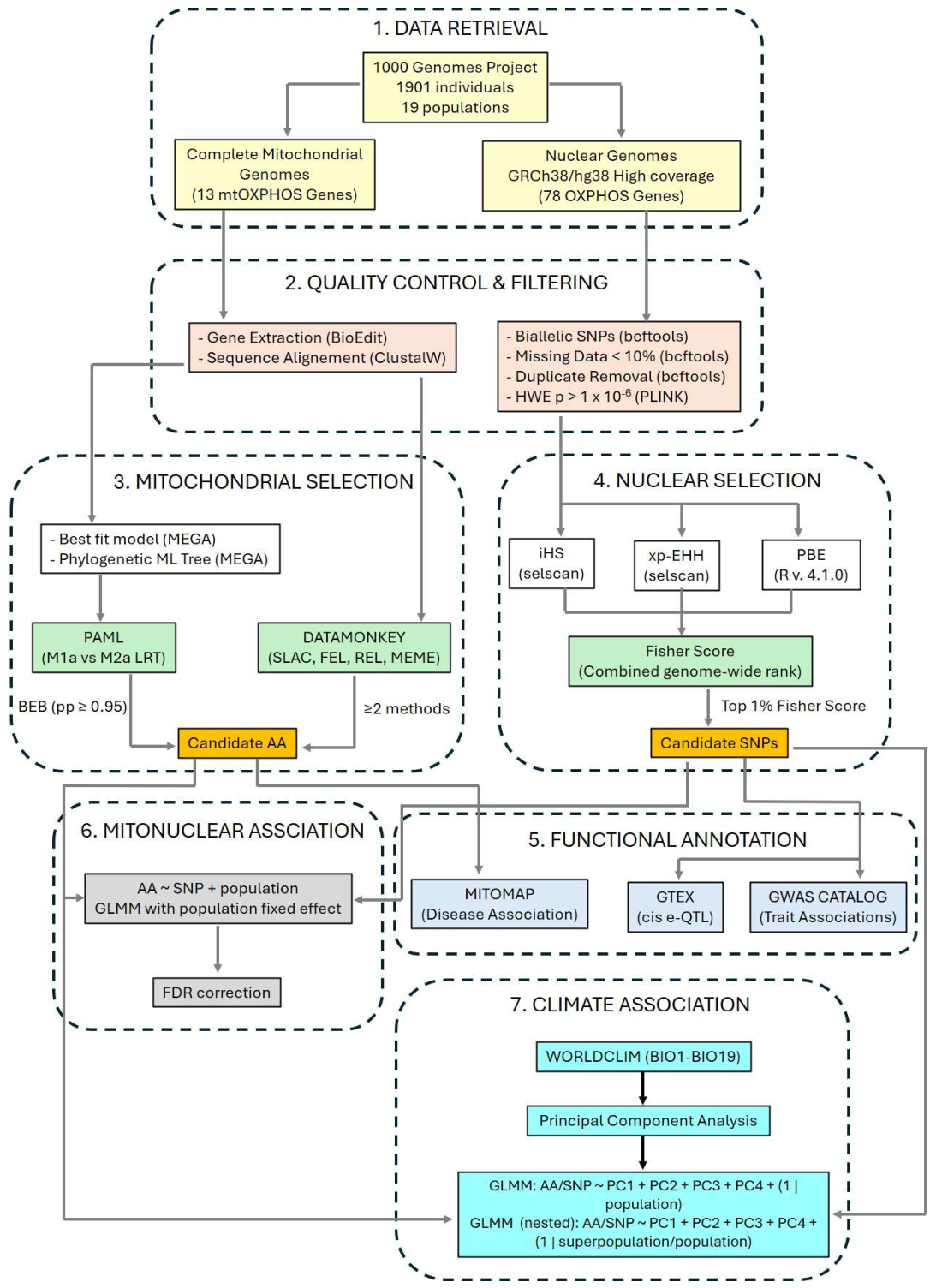
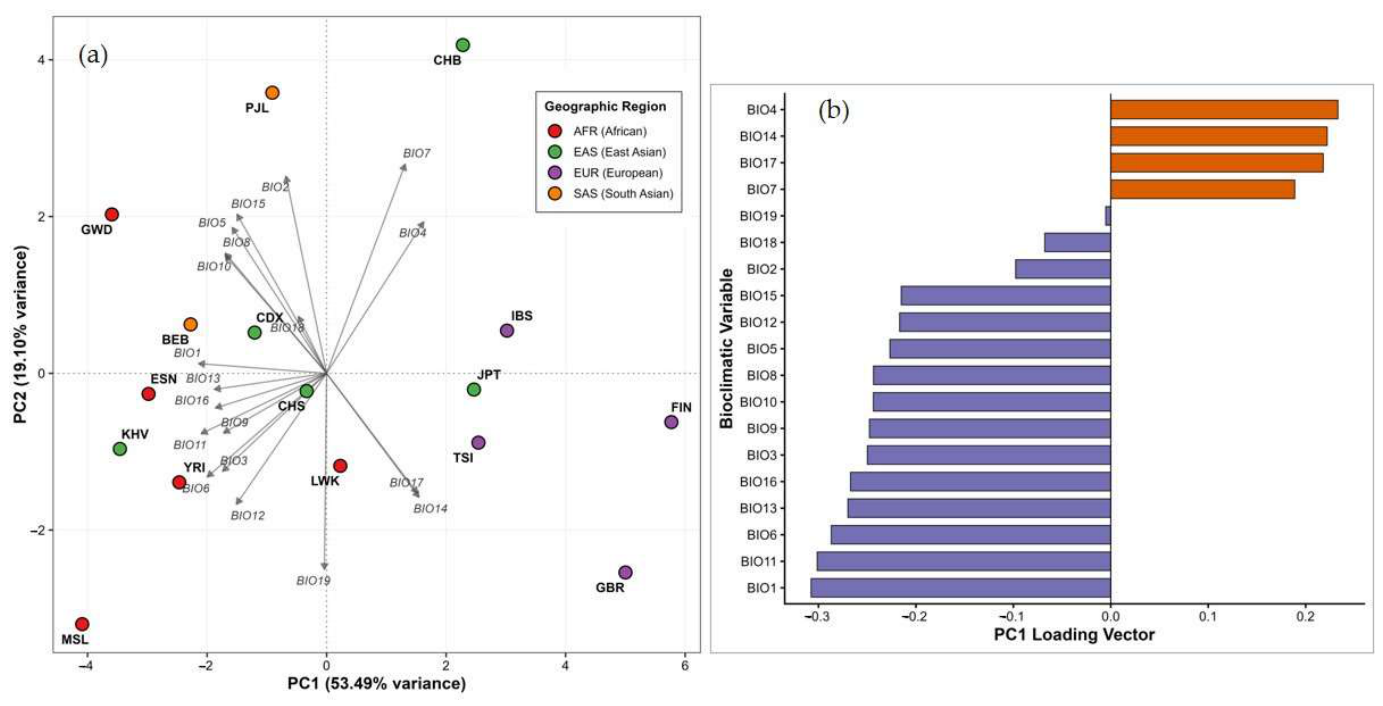
Human adaptation to diverse climates has played a major role in shaping human evolution. Mitochondrial oxidative phosphorylation (OXPHOS) is central to energy production and thermogenesis; however, the respective contributions of the mitochondrial and nuclear genomes to climate adaptation remain poorly understood. Here, we analyzed 1901 genomes from 19 global populations to investigate positive selection across 13 mitochondrial and 78 nuclear OXPHOS genes. We identified 19 candidate amino acid positions under positive selection in seven mitochondrial genes and 103 candidate SNPs under positive selection in 20 nuclear genes. Climate association analyses revealed significant associations between climatic variables and candidate mitochondrial and nuclear variants. Notably, candidate nuclear SNPs occurred almost exclusively in non-coding regions, and 96 of the 103 variants have been previously reported as cis-eQTLs, suggesting that recent adaptive variation may have involved changes in gene regulation in addition to protein sequence variation. We also tested for statistical associations between mitochondrial amino acid variants and candidate nuclear SNPs; although 78 nominal associations were observed, none remained significant after correction for multiple testing. Several mitochondrial and nuclear variants have been previously reported in association with metabolic, neurological, and cardiovascular phenotypes. Overall, our findings highlight associations between climatic variation and mitochondrial and nuclear OXPHOS variation, as well as possible genetic interactions between mitochondrial and nuclear variants, providing new insights into the evolution of the OXPHOS system during recent human evolution.
Keywords: oxidative phosphorylation; mitonuclear co-evolution; climate adaptation; positive selection; eQTL oxidative phosphorylation; mitonuclear co-evolution; climate adaptation; positive selection; eQTL