
Authenticity, Safety, and Quality Assessment of Plant-Based Dietary Supplements Marketed for Liver Support


 and
and 
Abstract
1. Introduction
Review Design and Evidence-Selection Approach
2. Plant-Derived Ingredients in Liver-Support Supplements
2.1. Terminology and Interpretation of Clinical Evidence
2.2. Milk Thistle (Silybum marianum) and Silymarin
2.2.1. Composition, Bioavailability, and Evidence Boundaries
2.2.2. Safety Considerations and Product-Related Variability
2.3. Artichoke Leaf Extracts (Cynara cardunculus L. [Syn. Cynara scolymus L.])
2.3.1. Botanical Identity, Chemical Composition, and Standardisation
2.3.2. Bioavailability, Claimed Effects, and Clinical Evidence Boundaries
2.3.3. Safety, Biliary Contraindications, and Product Variability
2.4. Turmeric (Curcuma longa)
2.4.1. Botanical Identity, Curcuminoid Composition, and Standardisation
2.4.2. Bioavailability, Claimed Effects, and Clinical Evidence Boundaries
2.4.3. Safety, Hepatotoxicity, and Product Variability
2.5. Green Tea Extract (Camellia sinensis)
2.5.1. Composition and Standardisation
2.5.2. Evidence Boundaries
2.5.3. Hepatotoxicity and Product Risk
2.6. Cross-Case Synthesis: From Ingredient-Level Evidence to Product-Level Claims
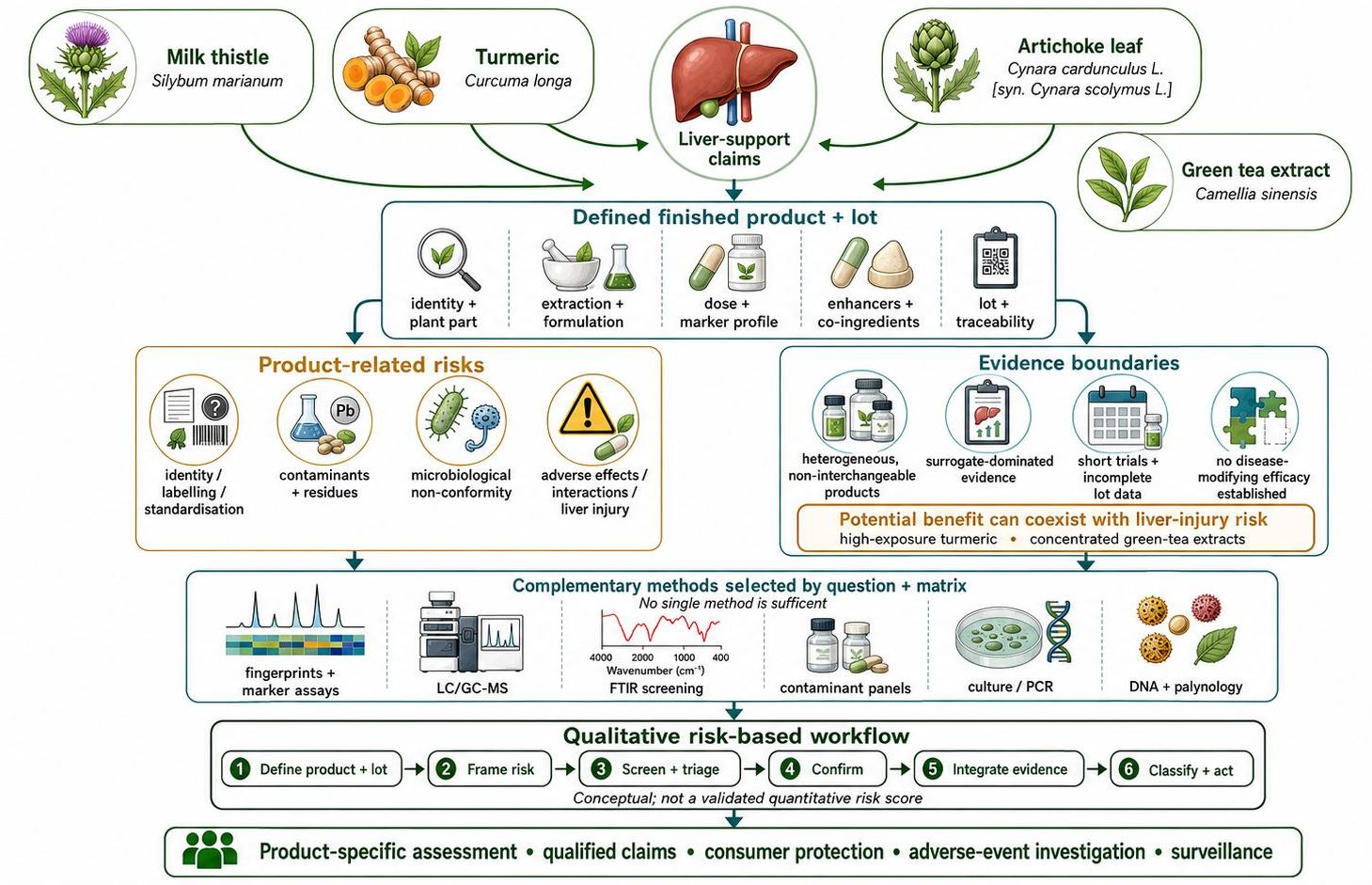
3. Product-Level Authenticity, Safety, and Analytical Assessment of Plant-Based Liver-Support Supplements
3.1. Authenticity, Safety Risks, and Regulatory Context
3.1.1. Adulteration, Mislabelling, Undeclared Pharmaceuticals, and Botanical Substitution
3.1.2. Raw-Material Variability, Supply-Chain Control, and Traceability
3.1.3. Chemical Contaminants, Residues, and Environmental Exposure
3.1.4. Microbiological Quality and Biological Contamination
3.1.5. Product-Related Adverse Effects, Herb–Drug Interactions, and Causality Assessment
3.1.6. Regulatory Frameworks, Health Claims, and Post-Market Surveillance
3.2. Complementary Analytical Approaches for Quality Assessment and Traceability
3.2.1. Chemical Profiling, Marker Quantification, and Contaminant Screening
3.2.2. Spectroscopic and Molecular Authentication
3.2.3. Microbiological and Trace-Evidence Assessment
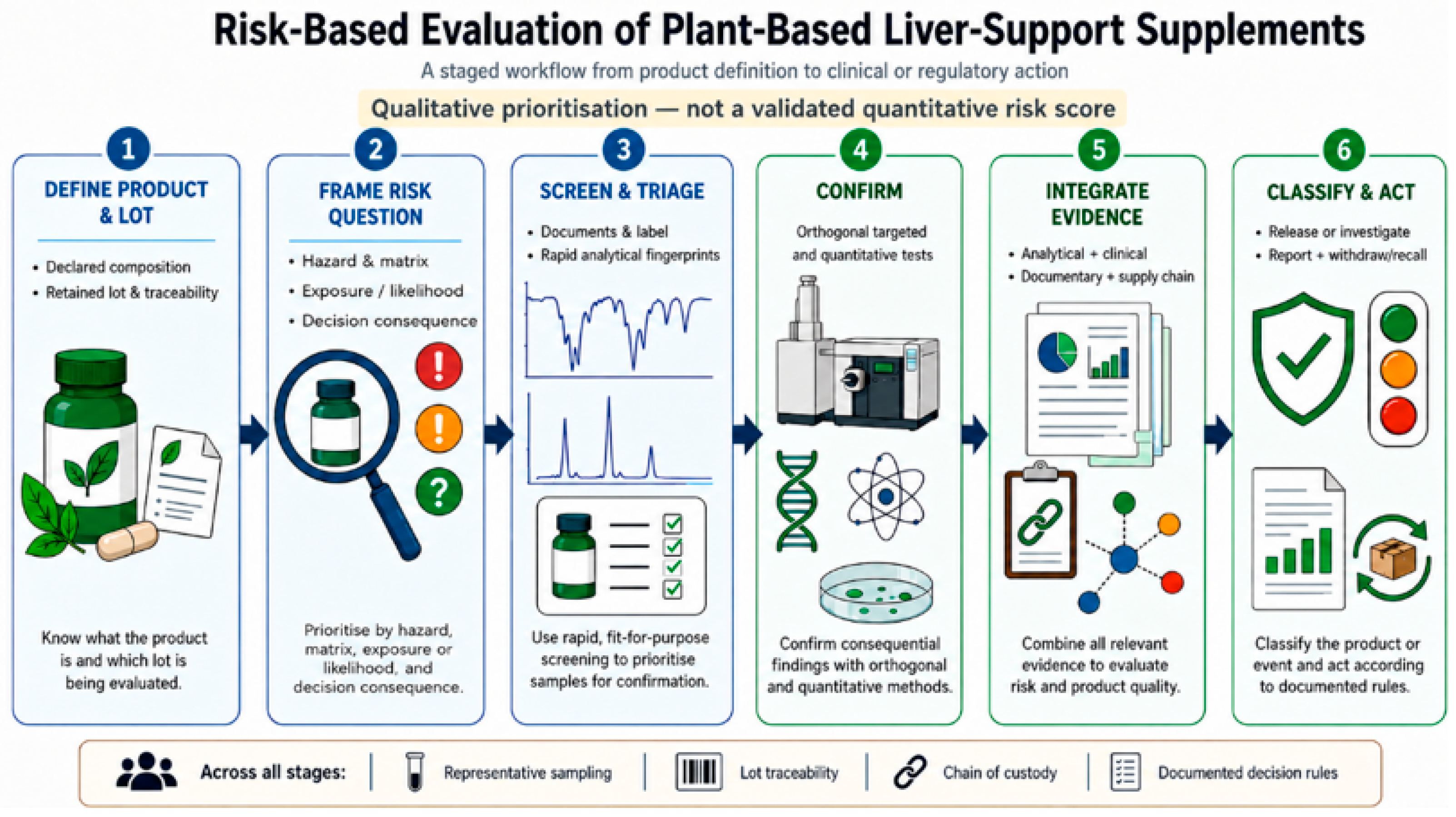
3.3. Integrated Workflow and Evidential Interpretation
3.4. Research Gaps and Reporting Standards
3.5. Limitations
4. Conclusions
Supplementary Materials
Author Contributions
Funding
Data Availability Statement
Acknowledgments
Conflicts of Interest
Abbreviations
| AI | Artificial intelligence |
| ALP | Alkaline phosphatase |
| ALT | Alanine aminotransferase |
| APRI | AST-to-platelet ratio index |
| AST | Aspartate aminotransferase |
| BMI | Body mass index |
| CAP | Controlled attenuation parameter |
| CiiEM | Egas Moniz Centre for Interdisciplinary Research |
| CONSORT | Consolidated Standards of Reporting Trials |
| CT | Computed tomography |
| DER | Drug-to-extract ratio |
| DNA | Deoxyribonucleic acid |
| DOI | Digital object identifier |
| EDQM | European Directorate for the Quality of Medicines & HealthCare |
| EFSA | European Food Safety Authority |
| EGCG | Epigallocatechin-3-gallate |
| EMA | European Medicines Agency |
| FCT | Fundação para a Ciência e a Tecnologia |
| FDA | Food and Drug Administration |
| FTIR | Fourier-transform infrared spectroscopy |
| GACP | Good agricultural and collection practice |
| GC-FID | Gas chromatography with flame ionisation detection |
| GC-MS | Gas chromatography-mass spectrometry |
| GC-MS/MS | Gas chromatography-tandem mass spectrometry |
| HbA1c | Glycated haemoglobin |
| HLA | Human leukocyte antigen |
| HPLC | High-performance liquid chromatography |
| HPLC-DAD | High-performance liquid chromatography with diode-array detection |
| HPTLC | High-performance thin-layer chromatography |
| HRAMS | High-resolution accurate-mass spectrometry |
| ICP-MS | Inductively coupled plasma mass spectrometry |
| ICP-OES | Inductively coupled plasma optical emission spectrometry |
| INR | International normalised ratio |
| LC-HRMS | Liquid chromatography-high-resolution mass spectrometry |
| LC-MS | Liquid chromatography-mass spectrometry |
| LC-MS/MS | Liquid chromatography-tandem mass spectrometry |
| MASLD | Metabolic dysfunction-associated steatotic liver disease |
| MASH | Metabolic dysfunction-associated steatohepatitis |
| NAFLD | Non-alcoholic fatty liver disease |
| NAS | NAFLD activity score |
| NASH | Non-alcoholic steatohepatitis |
| NMR | Nuclear magnetic resonance |
| PCR | Polymerase chain reaction |
| qNMR | Quantitative nuclear magnetic resonance |
| qPCR | Quantitative polymerase chain reaction |
| RASFF | Rapid Alert System for Food and Feed |
| RCT | Randomised controlled trial |
| TNF | Tumour necrosis factor |
| UPLC | Ultra-performance liquid chromatography |
| URL | Uniform resource locator |
| UV | Ultraviolet |
| WHO | World Health Organisation |
References
- Djaoudene, O.; Romano, A.; Bradai, Y.D.; Zebiri, F.; Ouchene, A.; Yousfi, Y.; Amrane-Abider, M.; Sahraoui-Remini, Y.; Madani, K. A Global Overview of Dietary Supplements: Regulation, Market Trends, Usage during the COVID-19 Pandemic, and Health Effects. Nutrients 2023, 15, 3320. [Google Scholar] [CrossRef] [Scilit] [PubMed]
- Bailey, R.L.; Gahche, J.J.; Miller, P.E.; Thomas, P.R.; Dwyer, J.T. Why US Adults Use Dietary Supplements. JAMA Intern. Med. 2013, 173, 355–361. [Google Scholar] [CrossRef] [Scilit] [PubMed]
- Ronis, M.J.J.; Pedersen, K.B.; Watt, J. Adverse Effects of Nutraceuticals and Dietary Supplements. Annu. Rev. Pharmacol. Toxicol. 2018, 58, 583–601. [Google Scholar] [CrossRef] [Scilit] [PubMed]
- U.S. Food and Drug Administration. Dietary Supplements. Available online: https://www.fda.gov/food/dietary-supplements (accessed on 28 June 2026).
- European Food Safety Authority. Food Supplements. Available online: https://www.efsa.europa.eu/en/topics/topic/food-supplements (accessed on 28 June 2026).
- Foghis, M.; Tit, D.M.; Bungau, S.G.; Ghitea, T.C.; Pallag, C.R.; Foghis, A.M.; Behl, T.; Bustea, C.; Pallag, A. Highlighting the Use of the Hepatoprotective Nutritional Supplements among Patients with Chronic Diseases. Healthcare 2023, 11, 2685. [Google Scholar] [CrossRef] [Scilit] [PubMed]
- Abenavoli, L.; Capasso, R.; Milic, N.; Capasso, F. Milk Thistle in Liver Diseases: Past, Present, Future. Phytother. Res. 2010, 24, 1423–1432. [Google Scholar] [CrossRef] [Scilit] [PubMed]
- Lattanzio, V.; Kroon, P.A.; Linsalata, V.; Cardinali, A. Globe Artichoke: A Functional Food and Source of Nutraceutical Ingredients. J. Funct. Foods 2009, 1, 131–144. [Google Scholar] [CrossRef] [Scilit]
- Hewlings, S.J.; Kalman, D.S. Curcumin: A Review of Its Effects on Human Health. Foods 2017, 6, 92. [Google Scholar] [CrossRef] [Scilit] [PubMed]
- EFSA Panel on Food Additives and Nutrient Sources added to Food (ANS). Scientific Opinion on the Safety of Green Tea Catechins. EFSA J. 2018, 16, 5239. [CrossRef] [Scilit] [PubMed]
- Likhitsup, A.; Chen, V.L.; Fontana, R.J. Estimated Exposure to 6 Potentially Hepatotoxic Botanicals in US Adults. JAMA Netw. Open 2024, 7, e2425822. [Google Scholar] [CrossRef] [Scilit] [PubMed]
- Garcia-Alvarez, A.; Egan, B.; de Klein, S.; Dima, L.; Maggi, F.M.; Isoniemi, M.; Ribas-Barba, L.; Raats, M.M.; Meissner, E.M.; Badea, M.; et al. Usage of Plant Food Supplements across Six European Countries: Findings from the PlantLIBRA Consumer Survey. PLoS ONE 2014, 9, e92265. [Google Scholar] [CrossRef] [Scilit] [PubMed]
- Hedegaard, R.V.; Rokkjær, I.; Sloth, J.J. Total and Inorganic Arsenic in Dietary Supplements Based on Herbs, Other Botanicals and Algae—A Possible Contributor to Inorganic Arsenic Exposure. Anal. Bioanal. Chem. 2013, 405, 4429–4435. [Google Scholar] [CrossRef] [Scilit] [PubMed]
- Rocha, T.; Amaral, J.S.; Oliveira, M.B.P.P. Adulteration of Dietary Supplements by the Illegal Addition of Synthetic Drugs: A Review. Compr. Rev. Food Sci. Food Saf. 2016, 15, 43–62. [Google Scholar] [CrossRef] [Scilit] [PubMed]
- European Association for the Study of the Liver; European Association for the Study of Diabetes; European Association for the Study of Obesity. EASL-EASD-EASO Clinical Practice Guidelines on the Management of Metabolic Dysfunction-Associated Steatotic Liver Disease (MASLD). J. Hepatol. 2024, 81, 492–542. [Google Scholar] [CrossRef] [Scilit] [PubMed]
- Theodosiou, E.; Purchartová, K.; Stamatis, H.; Kolisis, F.; Křen, V. Bioavailability of Silymarin Flavonolignans: Drug Formulations and Biotransformation. Phytochem. Rev. 2014, 13, 1–18. [Google Scholar] [CrossRef] [Scilit]
- European Medicines Agency. Assessment Report on Silybum marianum (L.) Gaertn., Fructus; EMA/HMPC/294188/2013; European Medicines Agency: London, UK, 2018; Available online: https://www.ema.europa.eu/en/documents/herbal-report/final-assessment-report-silybum-marianum-l-gaertn-fructus_en.pdf (accessed on 28 June 2026).
- Fenclova, M.; Novakova, A.; Viktorova, J.; Jonatova, P.; Dzuman, Z.; Ruml, T.; Kren, V.; Hajslova, J.; Vitek, L.; Stranska-Zachariasova, M. Poor Chemical and Microbiological Quality of the Commercial Milk Thistle-Based Dietary Supplements May Account for Their Reported Unsatisfactory and Non-Reproducible Clinical Outcomes. Sci. Rep. 2019, 9, 11118. [Google Scholar] [CrossRef] [Scilit] [PubMed]
- Xie, Y.; Zhang, D.; Zhang, J.; Yuan, J. Metabolism, Transport and Drug-Drug Interactions of Silymarin. Molecules 2019, 24, 3693. [Google Scholar] [CrossRef] [Scilit] [PubMed]
- Di Costanzo, A.; Angelico, R. Formulation Strategies for Enhancing the Bioavailability of Silymarin: The State of the Art. Molecules 2019, 24, 2155. [Google Scholar] [CrossRef] [Scilit] [PubMed]
- Li, S.; Duan, F.; Li, S.; Lu, B. Administration of Silymarin in NAFLD/NASH: A Systematic Review and Meta-Analysis. Ann. Hepatol. 2024, 29, 101174. [Google Scholar] [CrossRef] [Scilit] [PubMed]
- Chan, W.K.; Nik Mustapha, N.R.; Mahadeva, S. A Randomized Trial of Silymarin for the Treatment of Nonalcoholic Steatohepatitis. Clin. Gastroenterol. Hepatol. 2017, 15, 1940–1949.e8. [Google Scholar] [CrossRef] [Scilit] [PubMed]
- Navarro, V.J.; Belle, S.H.; D’Amato, M.; Afdhal, N.; Brunt, E.M.; Fried, M.W.; Reddy, K.R.; Wahed, A.S.; Harrison, S.; Silymarin in NASH and C Hepatitis (SyNCH) Study Group. Silymarin in Non-Cirrhotics with Non-Alcoholic Steatohepatitis: A Randomized, Double-Blind, Placebo Controlled Trial. PLoS ONE 2019, 14, e0221683. [Google Scholar] [CrossRef] [Scilit] [PubMed]
- Patel-Rodrigues, P.A.; Cundra, L.; Alhaqqan, D.; Gildea, D.T.; Woo, S.M.; Lewis, J.H. Herbal- and Dietary-Supplement-Induced Liver Injury: A Review of the Recent Literature. Livers 2024, 4, 94–118. [Google Scholar] [CrossRef] [Scilit]
- European Medicines Agency. European Union Herbal Monograph on Silybum marianum (L.) Gaertn., Fructus; EMA/HMPC/294187/2013; European Medicines Agency: London, UK, 2018; Available online: https://www.ema.europa.eu/en/documents/herbal-monograph/final-european-union-herbal-monograph-silybum-marianum-l-gaertn-fructus_en.pdf (accessed on 28 June 2026).
- European Medicines Agency. European Union Herbal Monograph on Cynara cardunculus L. (syn. Cynara scolymus L.), Folium; EMA/HMPC/194014/2017; European Medicines Agency: London, UK, 2018; Available online: https://www.ema.europa.eu/en/documents/herbal-monograph/final-european-union-herbal-monograph-cynara-cardunculus-l-syn-cynara-scolymus-l-folium_en.pdf (accessed on 28 June 2026).
- European Medicines Agency. Assessment Report on Cynara cardunculus L. (syn. Cynara scolymus L.), Folium; EMA/HMPC/194013/2017; European Medicines Agency: London, UK, 2018; Available online: https://www.ema.europa.eu/en/documents/herbal-report/final-assessment-report-cynara-cardunculus-l-syn-cynara-scolymus-l-folium_en.pdf (accessed on 28 June 2026).
- Wittemer, S.M.; Ploch, M.; Windeck, T.; Müller, S.C.; Drewelow, B.; Derendorf, H.; Veit, M. Bioavailability and Pharmacokinetics of Caffeoylquinic Acids and Flavonoids after Oral Administration of Artichoke Leaf Extracts in Humans. Phytomedicine 2005, 12, 28–38. [Google Scholar] [CrossRef] [Scilit] [PubMed]
- Panahi, Y.; Kianpour, P.; Mohtashami, R.; Atkin, S.L.; Butler, A.E.; Jafari, R.; Badeli, R.; Sahebkar, A. Efficacy of Artichoke Leaf Extract in Non-Alcoholic Fatty Liver Disease: A Pilot Double-Blind Randomized Controlled Trial. Phytother. Res. 2018, 32, 1382–1387. [Google Scholar] [CrossRef] [Scilit] [PubMed]
- Rangboo, V.; Noroozi, M.; Zavoshy, R.; Rezadoost, S.A.; Mohammadpoorasl, A. The Effect of Artichoke Leaf Extract on Alanine Aminotransferase and Aspartate Aminotransferase in the Patients with Nonalcoholic Steatohepatitis. Int. J. Hepatol. 2016, 2016, 4030476. [Google Scholar] [CrossRef] [Scilit] [PubMed]
- Holländer, S.; Marth, E.; Scherber, P.R.; Spiliotis, A.; Al-Ali, A.; Gäbelein, G.; Glanemann, M. Artichoke Leaf Extract Reduces Steatosis and Decreases Liver Size in Prebariatric Patients: A Randomized Placebo-Controlled Pilot Trial—The “SteatoChoke-Study”. J. Clin. Lipidol. 2026, 20, 167–178. [Google Scholar] [CrossRef] [Scilit] [PubMed]
- Amini, M.R.; Sheikhhossein, F.; Talebyan, A.; Bazshahi, E.; Djafari, F.; Hekmatdoost, A. Effects of Artichoke Supplementation on Liver Enzymes: A Systematic Review and Meta-Analysis of Randomized Controlled Trials. Clin. Nutr. Res. 2022, 11, 228–239. [Google Scholar] [CrossRef] [Scilit] [PubMed]
- European Medicines Agency. European Union Herbal Monograph on Curcuma longa L., Rhizoma; EMA/HMPC/329755/2017; European Medicines Agency: London, UK, 2019; Available online: https://www.ema.europa.eu/en/documents/herbal-monograph/final-european-union-herbal-monograph-curcuma-longa-l-rhizoma-revision-1_en.pdf (accessed on 28 June 2026).
- European Medicines Agency. Final Addendum to Assessment Report on Curcuma longa L., Rhizoma; EMA/HMPC/81467/2025; European Medicines Agency: Amsterdam, The Netherlands, 2026; Available online: https://www.ema.europa.eu/en/documents/herbal-report/final-addendum-assessment-report-curcuma-longa-l-rhizoma_en.pdf (accessed on 26 August 2026).
- Miyakoshi, M.; Yamaguchi, Y.; Takagaki, R.; Mizutani, K.; Kambara, T.; Ikeda, T.; Zaman, M.S.; Kakihara, H.; Takenaka, A.; Igarashi, K. Hepatoprotective Effect of Sesquiterpenes in Turmeric. Biofactors 2004, 21, 167–170. [Google Scholar] [CrossRef] [Scilit] [PubMed]
- Ruby, A.J.; Kuttan, G.; Babu, K.D.; Rajasekharan, K.N.; Kuttan, R. Anti-Tumour and Anti-oxidant Activity of Natural Curcuminoids. Cancer Lett. 1995, 94, 79–83. [Google Scholar] [CrossRef] [Scilit] [PubMed]
- Selvam, R.; Subramanian, L.; Gayathri, R.; Angayarkanni, N. The Anti-Oxidant Activity of Turmeric (Curcuma longa). J. Ethnopharmacol. 1995, 47, 59–67. [Google Scholar] [CrossRef] [Scilit] [PubMed]
- Bertoncini-Silva, C.; Vlad, A.; Ricciarelli, R.; Fassini, P.G.; Suen, V.M.M.; Zingg, J.-M. Enhancing the Bioavailability and Bioactivity of Curcumin for Disease Prevention and Treatment. Antioxidants 2024, 13, 331. [Google Scholar] [CrossRef] [Scilit] [PubMed]
- Gafner, S.; Orhan, N.; Kahraman, Ç.; Blumenthal, M. A Scoping Review of Turmeric Adulteration Based on Data from Six Continents. Pharm. Biol. 2026, 64, 87–107. [Google Scholar] [CrossRef] [Scilit] [PubMed]
- Rahmani, S.; Asgary, S.; Askari, G.; Keshvari, M.; Hatamipour, M.; Feizi, A.; Sahebkar, A. Treatment of Non-Alcoholic Fatty Liver Disease with Curcumin: A Randomized Placebo-Controlled Trial. Phytother. Res. 2016, 30, 1540–1548. [Google Scholar] [CrossRef] [Scilit] [PubMed]
- Yaikwawong, M.; Jansarikit, L.; Jirawatnotai, S.; Chuengsamarn, S. Curcumin for Inflammation Control in Individuals with Type 2 Diabetes Mellitus and Metabolic Dysfunction-Associated Steatotic Liver Disease: A Randomized Controlled Trial. Nutrients 2025, 17, 1972. [Google Scholar] [CrossRef] [Scilit] [PubMed]
- Ebrahimzadeh, A.; Ebrahimzadeh, A.; Fooladshekan, S.; Mohseni, S.; Mohtashamian, A.; Babajafari, S.; Sohrabi, Z. Therapeutic Effects of Curcumin Supplementation on Liver Enzymes of Nonalcoholic Fatty Liver Disease Patients: A Systematic Review and Meta-Analysis of Randomized Clinical Trials. Food Sci. Nutr. 2025, 13, e4144. [Google Scholar] [CrossRef] [Scilit] [PubMed]
- Halegoua-DeMarzio, D.; Navarro, V.; Ahmad, J.; Avula, B.; Barnhart, H.; Barritt, A.S.; Bonkovsky, H.L.; Fontana, R.J.; Ghabril, M.S.; Hoofnagle, J.H.; et al. Liver Injury Associated with Turmeric—A Growing Problem: Ten Cases from the Drug-Induced Liver Injury Network [DILIN]. Am. J. Med. 2023, 136, 200–206. [Google Scholar] [CrossRef] [Scilit] [PubMed]
- Oketch-Rabah, H.A.; Roe, A.L.; Rider, C.V.; Bonkovsky, H.L.; Giancaspro, G.I.; Navarro, V.; Paine, M.F.; Betz, J.M.; Marles, R.J.; Casper, S.; et al. United States Pharmacopeia (USP) Comprehensive Review of the Hepatotoxicity of Green Tea Extracts. Toxicol. Rep. 2020, 7, 386–402. [Google Scholar] [CrossRef] [Scilit] [PubMed]
- Sakata, R.; Nakamura, T.; Torimura, T.; Ueno, T.; Sata, M. Green Tea with High-Density Catechins Improves Liver Function and Fat Infiltration in Non-Alcoholic Fatty Liver Disease (NAFLD) Patients: A Double-Blind Placebo-Controlled Study. Int. J. Mol. Med. 2013, 32, 989–994. [Google Scholar] [CrossRef] [Scilit] [PubMed]
- Pezeshki, A.; Safi, S.; Feizi, A.; Askari, G.; Karami, F. The Effect of Green Tea Extract Supplementation on Liver Enzymes in Patients with Nonalcoholic Fatty Liver Disease. Int. J. Prev. Med. 2016, 7, 28. [Google Scholar] [CrossRef] [Scilit] [PubMed]
- Yu, Z.; Samavat, H.; Dostal, A.M.; Wang, R.; Torkelson, C.J.; Yang, C.S.; Butler, L.M.; Kensler, T.W.; Wu, A.H.; Kurzer, M.S.; et al. Effect of Green Tea Supplements on Liver Enzyme Elevation: Results from a Randomized Intervention Study in the United States. Cancer Prev. Res. 2017, 10, 571–579. [Google Scholar] [CrossRef] [Scilit] [PubMed]
- Hoofnagle, J.H.; Bonkovsky, H.L.; Phillips, E.J.; Li, Y.-J.; Ahmad, J.; Barnhart, H.; Durazo, F.; Fontana, R.J.; Gu, J.; Khan, I.; et al. HLA-B*35:01 and Green Tea-Induced Liver Injury. Hepatology 2021, 73, 2484–2493. [Google Scholar] [CrossRef] [Scilit] [PubMed]
- Misaka, S.; Ono, Y.; Taudte, R.V.; Hoier, E.; Ogata, H.; Ono, T.; König, J.; Watanabe, H.; Fromm, M.F.; Shimomura, K. Exposure of Fexofenadine, but Not Pseudoephedrine, Is Markedly Decreased by Green Tea Extract in Healthy Volunteers. Clin. Pharmacol. Ther. 2022, 112, 627–634. [Google Scholar] [CrossRef] [Scilit] [PubMed]
- Vaclavik, L.; Krynitsky, A.J.; Rader, J.I. Mass Spectrometric Analysis of Pharmaceutical Adulterants in Products Labeled as Botanical Dietary Supplements or Herbal Remedies: A Review. Anal. Bioanal. Chem. 2014, 406, 6767–6790. [Google Scholar] [CrossRef] [Scilit] [PubMed]
- U.S. Food and Drug Administration. Small Entity Compliance Guide: Current Good Manufacturing Practice in Manufacturing, Packaging, Labeling, or Holding Operations for Dietary Supplements; U.S. Food and Drug Administration: Silver Spring, MD, USA, 2018. Available online: https://www.fda.gov/regulatory-information/search-fda-guidance-documents/small-entity-compliance-guide-current-good-manufacturing-practice-manufacturing-packaging-labeling (accessed on 28 June 2026).
- Tucker, J.; Fischer, T.; Upjohn, L.; Mazzera, D.; Kumar, M. Unapproved Pharmaceutical Ingredients Included in Dietary Supplements Associated with U.S. Food and Drug Administration Warnings. JAMA Netw. Open 2018, 1, e183337. [Google Scholar] [CrossRef] [Scilit] [PubMed]
- Applequist, W.L.; Miller, J.S. Selection and Authentication of Botanical Materials for the Development of Analytical Methods. Anal. Bioanal. Chem. 2013, 405, 4419–4428. [Google Scholar] [CrossRef] [Scilit] [PubMed]
- Tziomalos, K.; Krassas, G.E.; Tzotzas, T. The Use of Sibutramine in the Management of Obesity and Related Disorders: An Update. Vasc. Health Risk Manag. 2009, 5, 441–452. [Google Scholar] [CrossRef] [Scilit] [PubMed]
- Kozhuharov, V.R.; Ivanov, K.; Karcheva-Bahchevanska, D.; Prissadova, N.; Ivanova, S. Development and Validation of Gas Chromatography-Mass Spectrometry Method for Quantification of Sibutramine in Dietary Supplements. Processes 2023, 11, 2337. [Google Scholar] [CrossRef] [Scilit]
- Hu, Z.; Zou, Y.; Ma, Z.; Liu, W.; Jin, X.; Yang, J. Rapid Screening and Identification of Targeted and Non-Targeted Illegal Added Drugs in Functional Foods by MRSIT-HRMS Based on NIST Screening Database. Food Chem. 2024, 446, 138913. [Google Scholar] [CrossRef] [Scilit] [PubMed]
- Ratajczak, M.; Kamińska, D.; Światły-Błaszkiewicz, A.; Matysiak, J. Quality of Dietary Supplements Containing Plant-Derived Ingredients Reconsidered by Microbiological Approach. Int. J. Environ. Res. Public Health 2020, 17, 6837. [Google Scholar] [CrossRef] [Scilit] [PubMed]
- European Directorate for the Quality of Medicines & HealthCare (EDQM). Chapter 5.1.8: Microbiological Quality of Herbal Medicinal Products for Oral Use and Extracts Used in Their Preparation. In European Pharmacopoeia, 12th ed.; Council of Europe: Strasbourg, France, 2025; Available online: https://pheur.edqm.eu (accessed on 28 June 2026).
- European Medicines Agency. Reflection Paper on Microbiological Aspects of Herbal Medicinal Products and Traditional Herbal Medicinal Products; EMA/HMPC/95714/2013; European Medicines Agency: London, UK, 2015; Available online: https://www.ema.europa.eu/en/microbiological-aspects-herbal-medicinal-products-traditional-herbal-medicinal-products-scientific-guideline (accessed on 28 June 2026).
- World Health Organization. Quality Control Methods for Herbal Materials; World Health Organization: Geneva, Switzerland, 2011; Available online: https://iris.who.int/handle/10665/44479 (accessed on 28 June 2026).
- European Medicines Agency; Committee on Herbal Medicinal Products. Guideline on Good Agricultural and Collection Practice (GACP) for Starting Materials of Herbal Origin—Revision 1; EMA/HMPC/246816/2005 Rev. 1; European Medicines Agency: Amsterdam, The Netherlands, 2025; Available online: https://www.ema.europa.eu/en/documents/scientific-guideline/guideline-good-agricultural-collection-practice-gacp-starting-materials-herbal-origin-revision-1_en.pdf (accessed on 26 August 2026).
- World Health Organization. WHO Guidelines for Assessing Quality of Herbal Medicines with Reference to Contaminants and Residues; World Health Organization: Geneva, Switzerland, 2007; Available online: https://www.who.int/publications/i/item/9789241594448 (accessed on 28 June 2026).
- European Commission. Commission Regulation (EU) 2023/915 of 25 April 2023 on Maximum Levels for Certain Contaminants in Food and Repealing Regulation (EC) No 1881/2006. Off. J. Eur. Union 2023, L119, 103–157. Available online: https://eur-lex.europa.eu/eli/reg/2023/915/oj/eng (accessed on 28 June 2026).
- European Parliament and Council of the European Union. Regulation (EC) No 396/2005 of 23 February 2005 on Maximum Residue Levels of Pesticides in or on Food and Feed of Plant and Animal Origin and Amending Council Directive 91/414/EEC. Off. J. Eur. Union 2005, L70, 1–16. Available online: https://eur-lex.europa.eu/eli/reg/2005/396/oj/eng (accessed on 28 June 2026).
- Berzina, Z.; Pavlenko, R.; Bartkiene, E.; Bartkevics, V. Mycotoxins and Pyrrolizidine Alkaloids in Herbal Dietary Supplements. Food Addit. Contam. Part B Surveill. 2024, 17, 180–192. [Google Scholar] [CrossRef] [Scilit] [PubMed]
- Navarro, V.J.; Lucena, M.I. Hepatotoxicity Induced by Herbal and Dietary Supplements. Semin. Liver Dis. 2014, 34, 172–193. [Google Scholar] [CrossRef] [Scilit] [PubMed]
- Fontana, R.J.; Liou, I.; Reuben, A.; Suzuki, A.; Fiel, M.I.; Lee, W.; Navarro, V. AASLD Practice Guidance on Drug, Herbal, and Dietary Supplement-Induced Liver Injury. Hepatology 2023, 77, 1036–1065. [Google Scholar] [CrossRef] [Scilit] [PubMed]
- U.S. Food and Drug Administration. Guidance for Industry: Questions and Answers Regarding Adverse Event Reporting and Recordkeeping for Dietary Supplements as Required by the Dietary Supplement and Nonprescription Drug Consumer Protection Act; U.S. Food and Drug Administration: Silver Spring, MD, USA, 2018. Available online: https://www.fda.gov/regulatory-information/search-fda-guidance-documents/guidance-industry-questions-and-answers-regarding-adverse-event-reporting-and-recordkeeping-dietary (accessed on 28 June 2026).
- Qato, D.M.; Wilder, J.; Schumm, L.P.; Gillet, V.; Alexander, G.C. Changes in Prescription and Over-the-Counter Medication and Dietary Supplement Use among Older Adults in the United States, 2005 vs. 2011. JAMA Intern. Med. 2016, 176, 473–482. [Google Scholar] [CrossRef] [Scilit] [PubMed]
- Martino, R.; Malet-Martino, M.; Gilard, V.; Balayssac, S. Counterfeit Drugs: Analytical Techniques for Their Identification. Anal. Bioanal. Chem. 2010, 398, 77–92. [Google Scholar] [CrossRef] [Scilit] [PubMed]
- European Parliament and Council of the European Union. Directive 2002/46/EC of the European Parliament and of the Council of 10 June 2002 on the Approximation of the Laws of the Member States Relating to Food Supplements. Off. J. Eur. Communities 2002, L183, 51–57. Available online: https://eur-lex.europa.eu/eli/dir/2002/46/oj (accessed on 28 June 2026).
- European Parliament and Council of the European Union. Regulation (EU) No 1169/2011 of the European Parliament and of the Council of 25 October 2011 on the Provision of Food Information to Consumers. Off. J. Eur. Union 2011, L304, 18–63. Available online: https://eur-lex.europa.eu/eli/reg/2011/1169/oj (accessed on 28 June 2026).
- Silano, V.; Coppens, P.; Larrañaga-Guetaria, A.; Minghetti, P.; Roth-Ehrang, R. Regulations Applicable to Plant Food Supplements and Related Products in the European Union. Food Funct. 2011, 2, 710–719. [Google Scholar] [CrossRef] [Scilit] [PubMed]
- European Parliament and Council of the European Union. Regulation (EC) No 1924/2006 of 20 December 2006 on Nutrition and Health Claims Made on Foods. Off. J. Eur. Union 2006, L404, 9–25. Available online: https://eur-lex.europa.eu/eli/reg/2006/1924/oj/eng (accessed on 28 June 2026).
- European Commission. Rapid Alert System for Food and Feed (RASFF). Available online: https://food.ec.europa.eu/food-safety/rasff_en (accessed on 28 June 2026).
- U.S. Food and Drug Administration. Dietary Supplements: New Dietary Ingredient Notification Procedures and Timeframes: Guidance for Industry; U.S. Food and Drug Administration: College Park, MD, USA, 2024. Available online: https://www.fda.gov/regulatory-information/search-fda-guidance-documents/guidance-industry-new-dietary-ingredient-notification-procedures-and-timeframes-dietary-supplements (accessed on 26 August 2026).
- Ivanova, N.V.; Kuzmina, M.L.; Braukmann, T.W.A.; Borisenko, A.V.; Zakharov, E.V. Authentication of Herbal Supplements Using Next-Generation Sequencing. PLoS ONE 2016, 11, e0156426. [Google Scholar] [CrossRef] [Scilit] [PubMed]
- European Medicines Agency. Guideline on Quality of Herbal Medicinal Products/Traditional Herbal Medicinal Products; EMA/HMPC/CHMP/CVMP/201116/2005 Rev. 3; European Medicines Agency: Amsterdam, The Netherlands, 2022; Available online: https://www.ema.europa.eu/en/documents/scientific-guideline/final-guideline-quality-herbal-medicinal-productstraditional-herbal-medicinal-products-revision-3_en.pdf (accessed on 28 June 2026).
- Noviana, E.; Indrayanto, G.; Rohman, A. Advances in Fingerprint Analysis for Standardization and Quality Control of Herbal Medicines. Front. Pharmacol. 2022, 13, 853023. [Google Scholar] [CrossRef] [Scilit] [PubMed]
- Ratnasekhar, C.H.; Rai, A.K.; Rakwal, P.; Khan, S.; Verma, A.K.; Mukhopadhyay, P.; Rathor, P.; Hinghrani, L.; Birse, N.; Trivedi, R.; et al. Machine Learning-Guided Orbitrap-HRAMS-Based Metabolomic Fingerprinting for Geographical Origin, Variety and Tissue Specific Authentication, and Adulteration Detection of Turmeric and Ashwagandha. Food Chem. 2025, 482, 144078. [Google Scholar] [CrossRef] [Scilit] [PubMed]
- Martinez-Farina, C.F.; Driscoll, S.; Wicks, C.; Burton, I.; Wentzell, P.D.; Berrué, F. Chemical Barcoding: A Nuclear-Magnetic-Resonance-Based Approach to Ensure the Quality and Safety of Natural Ingredients. J. Agric. Food Chem. 2019, 67, 7765–7774. [Google Scholar] [CrossRef] [Scilit] [PubMed]
- Di Mavungu, J.D.; Monbaliu, S.; Scippo, M.-L.; Maghuin-Rogister, G.; Schneider, Y.-J.; Larondelle, Y.; Callebaut, A.; Robbens, J.; Van Peteghem, C.; De Saeger, S. LC-MS/MS Multi-Analyte Method for Mycotoxin Determination in Food Supplements. Food Addit. Contam. Part A Chem. Anal. Control Expo. Risk Assess. 2009, 26, 885–895. [Google Scholar] [CrossRef] [Scilit] [PubMed]
- International Council for Harmonisation of Technical Requirements for Pharmaceuticals for Human Use. Validation of Analytical Procedures Q2(R2); ICH Harmonised Guideline; International Council for Harmonisation: Geneva, Switzerland, 2023; Available online: https://database.ich.org/sites/default/files/ICH_Q2%28R2%29_Guideline_2023_1130.pdf (accessed on 28 June 2026).
- Gad, H.A.; El-Ahmady, S.H.; Abou-Shoer, M.I.; Al-Azizi, M.M. Application of Chemometrics in Authentication of Herbal Medicines: A Review. Phytochem. Anal. 2013, 24, 1–24. [Google Scholar] [CrossRef] [Scilit] [PubMed]
- Rebiai, A.; Hemmami, H.; Zeghoud, S.; Ben Seghir, B.; Kouadri, I.; Salah Eddine, L.; Elboughdiri, N.; Ghareba, S.; Ghernaout, D.; Abbas, N. Current Application of Chemometrics Analysis in Authentication of Natural Products: A Review. Comb. Chem. High Throughput Screen. 2022, 25, 945–972. [Google Scholar] [CrossRef] [Scilit] [PubMed]
- Liu, C.; Zuo, Z.; Xu, F.; Wang, Y. Authentication of Herbal Medicines Based on Modern Analytical Technology Combined with Chemometrics Approach: A Review. Crit. Rev. Anal. Chem. 2023, 53, 1393–1418. [Google Scholar] [CrossRef] [Scilit] [PubMed]
- Ferri, G.; Alù, M.; Corradini, B.; Beduschi, G. Forensic Botany: Species Identification of Botanical Trace Evidence Using a Multigene Barcoding Approach. Int. J. Leg. Med. 2009, 123, 395–401. [Google Scholar] [CrossRef] [Scilit] [PubMed]
- Raclariu, A.C.; Heinrich, M.; Ichim, M.C.; de Boer, H. Benefits and Limitations of DNA Barcoding and Metabarcoding in Herbal Product Authentication. Phytochem. Anal. 2018, 29, 123–128. [Google Scholar] [CrossRef] [Scilit] [PubMed]
- Grazina, L.; Amaral, J.S.; Mafra, I. Botanical Origin Authentication of Dietary Supplements by DNA-Based Approaches. Compr. Rev. Food Sci. Food Saf. 2020, 19, 1080–1109. [Google Scholar] [CrossRef] [Scilit] [PubMed]
- Mildenhall, D.C.; Wiltshire, P.E.J.; Bryant, V.M. Forensic Palynology: Why Do It and How It Works. Forensic Sci. Int. 2006, 163, 163–172. [Google Scholar] [CrossRef] [Scilit] [PubMed]
- Walsh, K.A.J.; Horrocks, M. Palynology: Its Position in the Field of Forensic Science. J. Forensic Sci. 2008, 53, 1053–1060. [Google Scholar] [CrossRef] [Scilit] [PubMed]
- Coyle, H.M.; Ladd, C.; Palmbach, T.; Lee, H.C. The Green Revolution: Botanical Contributions to Forensics and Drug Enforcement. Croat. Med. J. 2001, 42, 340–345. [Google Scholar]
- Chen, Y.X.; Shi, H.F. Research Progress on Forensic Palynology and Its Application in Forensic Science. Fa Yi Xue Za Zhi 2020, 36, 354–359. [Google Scholar] [CrossRef] [Scilit] [PubMed]
- Fazal, H.; Ahmad, N.; Abbasi, B.H. Identification, Characterization, and Palynology of High-Valued Medicinal Plants. Sci. World J. 2013, 2013, 283484. [Google Scholar] [CrossRef] [Scilit] [PubMed]
- Zaman, W. Morphology, Palynology and Phytochemicals of Medicinal Plants. Horticulturae 2024, 10, 202. [Google Scholar] [CrossRef] [Scilit]
- Gagnier, J.J.; Boon, H.; Rochon, P.; Moher, D.; Barnes, J.; Bombardier, C.; CONSORT Group. Reporting Randomized, Controlled Trials of Herbal Interventions: An Elaborated CONSORT Statement. Ann. Intern. Med. 2006, 144, 364–367. [Google Scholar] [CrossRef] [Scilit] [PubMed]


| Supplement Category | Relevance to Liver-Support Assessment | Illustrative Non-Conformities and Evidence |
|---|---|---|
| Selected botanicals used in liver-support supplements | Directly relevant to the case studies | Botanical substitution [53]; variable marker content and incomplete labelling [18]; synthetic curcumin, artificial dyes, Pb-containing adulterants, and other undeclared materials in turmeric-derived products [39]; As contamination in botanical supplements [13]. |
| Weight-loss supplements | Contextual comparator | Sibutramine pharmacology [54]; undeclared sibutramine [52,55] and other appetite suppressants, stimulants, or laxatives [14,52]. |
| Sexual-performance supplements | Contextual comparator | Phosphodiesterase type 5 inhibitors and analogues [14,50,52,56]. |
| Bodybuilding supplements | Contextual comparator | Anabolic steroids, prohormones, or stimulants [14,50,52]. |
| Step | Minimum Action | Escalation or Decision |
|---|---|---|
| 1. Stabilise | Stop non-essential suspect products; assess symptoms, jaundice, encephalopathy, bleeding, and haemodynamic instability [67]. | Urgent specialist or hospital assessment for acute liver failure, rising INR, severe jaundice, or rapid deterioration [67]. |
| 2. Reconstruct exposure | Record the exact product, manufacturer, lot, formulation, daily dose, start/stop dates, prior exposure, all medicines/supplements, and alcohol [24,66,67]. | Build a dated exposure–event timeline; do not infer identity from the front label alone [24,66]. |
| 3. Characterise injury | Measure ALT, AST, ALP, bilirubin, and INR; calculate R value; exclude viral, autoimmune, ischaemic, and biliary causes as indicated [67]. | Classify pattern and severity; trend tests after withdrawal; avoid intentional rechallenge in routine care [67]. |
| 4. Retain evidence | Secure the consumed container and remaining lot; photograph the label and record storage and chain of custody [50,51,66,68]. | Compare the retained product with the declared composition, supplier records, and, where possible, an unopened comparator lot [50,51,66]. |
| 5. Test by hypothesis | Select identity, adulterant, contaminant, microbiological, or non-targeted analyses from the suspected hazard and matrix [50,57,62,70]. | Confirm consequential screening signals with orthogonal, quantitative, and validated methods [50,57,62,70]. |
| 6. Integrate and report | Combine clinical course, alternative causes, analytical findings, formulation, and supply-chain evidence [50,51,66,67]. | Report serious events; consider targeted surveillance, withdrawal, or recall; state residual uncertainty [66,67,68]. |
| Method | Primary Application | Main Strength | Principal Limitation/Evidential Boundary | Ref. |
|---|---|---|---|---|
| HPTLC/HPLC/UPLC fingerprints; marker assays | Authenticated comparison, lot consistency, and marker quantification | Links overall pattern with defined quantitative markers | A marker alone does not prove species identity or absence of substitution; fingerprints require representative references | [78,79] |
| LC-MS/MS and LC-HRMS | Predefined markers, adulterants, or contaminants; suspect/non-targeted screening | High sensitivity and selectivity; broad acquisition using high-resolution mass spectrometry | Matrix effects and tentative library matches require controls and orthogonal confirmation | [50,56,70,79,80] |
| GC-based methods | Volatiles, selected non-polar analytes, pesticides, or solvents | Strong separation and mature libraries for amenable compounds | Requires volatility or derivatisation and is unsuitable for many polar or thermolabile analytes | [50,55,70] |
| NMR and qNMR | Chemical fingerprinting, structural elucidation, and marker quantification | Reproducible, structure-rich spectra; absolute quantification in suitable protocols | Lower trace sensitivity than LC-MS, spectral overlap, and high cost; chemical evidence does not independently establish taxonomic or species identity | [70,81] |
| FTIR/chemometrics | Rapid comparative screening and lot similarity | Fast, non-destructive, and requires little preparation | Sensitive to matrix and presentation; classifiers require representative external validation | [79,83,84,85,86] |
| ICP-MS or ICP-OES | Metals and metalloids | Sensitive multi-element quantification | Destructive and element-specific; speciation may require separate methods | [13,62,63,64,83] |
| Contaminant panels | Pesticides, mycotoxins, plant alkaloids, and residual solvents | Hazard-specific quantification against specifications | Fixed panels miss unexpected hazards; matrix validation and risk-based updates are essential | [62,63,64,65,82,83] |
| Culture and PCR/qPCR | Viable counts, specified organisms, and targeted identification | Culture estimates viability; molecular assays improve identification | DNA detection does not prove viability; sampling and contamination controls are critical | [57,58,59,60] |
| DNA-based methods | Support for species identity in raw materials, powders, or mixtures | Useful when diagnostic morphology is lost | Not quantitative for chemical exposure; processing, reference gaps, and trace DNA can confound results | [53,77,87,88,89] |
| Palynology | Trace botanical or environmental context in minimally processed material | Supports defined traceability questions | Processing loss, mixed assemblages, and limited standardisation prevent stand-alone attribution | [90,91,92,93,94,95] |
| Reporting Domain | Minimum Information to Report |
|---|---|
| Botanical identity and source material | Scientific name, plant part, voucher or authentication method, geographic source, where available [78,79,96]. |
| Extraction and formulation | Extraction solvent(s), drug-to-extract ratio, extraction process, dosage form, excipients, and any bioavailability-enhancing agents [78,79,96]. |
| Manufacturing and batch traceability | Manufacturer, batch/lot number, expiry date, storage conditions, and whether the same batch was used throughout the trial [51,78,96]. |
| Chemical characterisation | Validated quantitative marker panel, chemical fingerprint, analytical method, reference standards, and batch-specific results [70,78,79,80,81,96]. |
| Product purity and safety status | Testing or certificates of analysis addressing relevant contaminants, microbial quality, and undeclared pharmacologically active substances [51,57,58,59,60,61,62,63,64,65,96]. |
| Dose and exposure | Daily dose of product and marker compound(s), schedule, administration conditions, and co-intervention restrictions [96]. |
| Comparator or placebo | Composition, matching strategy, and evidence that the placebo does not introduce botanical or analytical confounding [96]. |
| Clinical population and diagnostic framework | Eligibility criteria, MASLD/MASH or historical NAFLD/NASH definition, metabolic criteria, baseline fibrosis or imaging status [15,96]. |
| Outcomes and safety monitoring | Prespecified primary outcome; distinction between biochemical and imaging surrogate outcomes, histological endpoints, and long-term clinical outcomes; adverse-event collection and liver-safety plan where appropriate [15,24,67,96]. |
| Data availability | Batch-specific analytical documentation and key product-characterisation data are provided in the Supplementary Materials or an accessible repository [96]. |
Disclaimer/Publisher’s Note: The statements, opinions and data contained in all publications are solely those of the individual author(s) and contributor(s) and not of MDPI and/or the editor(s). MDPI and/or the editor(s) disclaim responsibility for any injury to people or property resulting from any ideas, methods, instructions or products referred to in the content. |
© 2026 by the authors. Licensee MDPI, Basel, Switzerland. This article is an open access article distributed under the terms and conditions of the Creative Commons Attribution (CC BY) license.
Share and Cite
Vaz da Silva, Z.; Varela, A.; Serra, P.A.; Neng, N.R.; Mascarenhas, P. Authenticity, Safety, and Quality Assessment of Plant-Based Dietary Supplements Marketed for Liver Support. Sci 2026, 8, 237. https://doi.org/10.3390/sci8090237
Vaz da Silva Z, Varela A, Serra PA, Neng NR, Mascarenhas P. Authenticity, Safety, and Quality Assessment of Plant-Based Dietary Supplements Marketed for Liver Support. Sci. 2026; 8(9):237. https://doi.org/10.3390/sci8090237
Chicago/Turabian StyleVaz da Silva, Zoé, Aline Varela, Patrícia A. Serra, Nuno R. Neng, and Paulo Mascarenhas. 2026. "Authenticity, Safety, and Quality Assessment of Plant-Based Dietary Supplements Marketed for Liver Support" Sci 8, no. 9: 237. https://doi.org/10.3390/sci8090237
APA StyleVaz da Silva, Z., Varela, A., Serra, P. A., Neng, N. R., & Mascarenhas, P. (2026). Authenticity, Safety, and Quality Assessment of Plant-Based Dietary Supplements Marketed for Liver Support. Sci, 8(9), 237. https://doi.org/10.3390/sci8090237