


Abstract
Smartphone colorimetry has emerged as a low-cost and accessible approach for participatory environmental monitoring. In this feasibility study, mangrove soil samples collected at two depths (approximately 0 and 30 cm) and three distances from the shoreline (−10, 0, and 10 m) were analyzed using smartphone colorimetry. The redness (a*) and yellowness (b*) tended to decrease from the seaward side toward the landward side. The lightness (L*) showed a strong agreement with measurements obtained from a standard spectrophotometer, whereas systematic deviations were observed for chromatic coordinates, with underestimation of a* and overestimation of b* by the smartphone measurements. Soil colors were further examined alongside mineral composition determined by X-ray fluorescence (XRF) and organic matter characteristics obtained from thermogravimetric analysis (TGA). No systematic relationships were identified between color parameters and mineral composition or organic matter weight loss, highlighting the complex and multi-factorial nature of mangrove soil color. Although wetting generally reduced L* and b* values, the responses to increasing water content were not monotonic. These findings indicate that smartphone colorimetry is effective for capturing relative variations in soil lightness under controlled conditions, while emphasizing the need for calibration and cautious interpretation. The accessibility of smartphone-based measurements also suggests potential in public engagement.
1. Introduction
Mangrove forests are vital coastal ecosystems that provide essential habitats for diverse biological communities while contributing significantly to climate regulation through carbon sequestration [1,2]. Beyond their ecological importance, mangrove soils represent complex geochemical systems composed of mineral phases, organic matter, and variable moisture content [3]. Owing to their unique physicochemical properties, these soils have attracted increasing attention in environmental research [4], as well as in emerging applications such as natural product utilization and sustainable material development [5]. Despite this growing interest, rapid and accessible methods for in situ characterization of mangrove soils remain limited, particularly in resource-constrained or field-based settings.
Soil color is a readily observable property that reflects underlying composition, including mineralogy (e.g., iron oxides), organic matter content, redox conditions, and hydration state [6]. As such, it provides a useful proxy for preliminary chemical and environmental assessment. Previous studies have demonstrated that soil color can be used to predict soil organic matter and, to a lesser extent, iron oxide content [7,8,9,10,11]. Conventional approaches rely on visual comparison with standardized Munsell color charts [12,13] or on benchtop spectrometers for more precise quantification [14,15]. In addition, portable colorimeters have been widely employed for quantitative field measurements [16,17].
More recently, smartphones have emerged as versatile platforms capable of capturing and processing color information for product inspection [18], biosensing [19], and chemical analysis [20]. In soil studies, digital image colorimetry has been shown to produce values comparable to those obtained using Munsell charts and spectrometers [21,22,23,24]. Han et al. utilized smartphone colorimetry to classify soil types [25], while Gómez-Robledo et al. demonstrated consistency across different smartphone devices under controlled lighting conditions [26]. In addition to the Munsell color notations [27], the Commission Internationale de l’Éclairage L*a*b* (CIELAB) color space is increasingly adopted in digital image colorimetry of soils due to its perceptual uniformity and suitability for quantitative modeling [28,29]. Notably, Naeimi et al. reported that CIELAB parameters outperform RGB values in predicting soil organic matter content [30]. When combined with appropriate calibration and data processing, smartphone-based sensing offers a low-cost, portable, and scalable alternative for environmental monitoring, enabling rapid assessment of material properties beyond traditional laboratory environments [31].
In this study, we present a smartphone-integrated analytical approach for investigating mangrove soils under varying moisture conditions through systematic colorimetric measurements. Soil samples collected at different depths and distances from the shoreline were analyzed using smartphone colorimetry. This first stage was conducted as a student-led project, highlighting its potential as an accessible platform for participatory environmental monitoring. The resulting color parameters were subsequently correlated with measurements obtained from standard analytical techniques, including spectrophotometry, thermogravimetric analysis (TGA), and X-ray fluorescence (XRF), which are widely used for soil characterization [32]. This comparative framework enables a critical evaluation of the accuracy and reliability of smartphone-based sensing for environmental analysis. The findings underscore the potential of smartphone colorimetry as a practical tool for field-based analytical chemistry, bridging conventional instrumentation with community-driven environmental monitoring.
2. Materials and Methods
2.1. Field Sampling and Sample Preparation
Mangrove soil samples were collected from the Coastal Resource Learning Center Region 2, Nakhon Si Thammarat Province, Thailand, on 6 December 2025. A transect line was established perpendicular to the shoreline, extending from the water’s edge inland. Soil samples were obtained at three distances relative to the shoreline: −10 m (seaward side), 0 m (shoreline), and 10 m (landward side). At each sampling point, soils were collected from two depths: around 0 cm (topsoil) and 30 cm (subsoil), yielding a total of six distinct samples (A–F). This sampling design enabled the investigation of spatial variations in soil color with respect to both shoreline distance and soil depth.
Collected soil samples were initially air-dried and gently ground to break down aggregates. The soils were then sieved to obtain a uniform particle size distribution. Subsequently, the samples were oven-dried at 105 °C for 24 h to remove residual moisture and achieve a constant dry weight condition (0% moisture content).
2.2. Color, Composition, and Thermal Analyses
Dry soil compositions were characterized by XRF spectroscopy (Zetium, PANalytical B.V., Almelo, The Netherlands). Variations in elemental composition were expressed as the absolute difference between the maximum and minimum oxide contents among the analyzed samples, reported in percentage points (wt.%). To investigate soil organic matter decomposition, thermal properties (up to 1025 °C) were characterized by combined thermogravimetric/differential thermal analysis (TGA/DTA; Simultaneous Thermal Analyzer STA8000, PerkinElmer, Shelton, CT, USA). Weight losses associated with thermal decomposition stages were obtained from TGA curves and reported as percentages of the initial sample mass.
In smartphone colorimetry, prepared dry soil samples were placed into plastic well trays, and the surface of each sample was carefully leveled to ensure uniformity. The samples were positioned inside a light-controlled cardboard box to minimize variations in ambient illumination. An iPhone 12 Pro Max (Apple Inc., Cupertino, CA, USA) mounted on a fixed stand was used to maintain a constant imaging distance and angle. Digital images were captured inside a light-controlled box, using the integrated LED flash of the smartphone to provide consistent illumination during image acquisition. Color values in the Munsell and CIELAB color spaces were obtained using a smartphone application named Color Meter (Contechity, available online: https://contechity.com/color-meter/, accessed on 1 March 2026). Three repeated measurements were performed on each sample, and the mean value was reported. White balance calibration was performed using a standard color reference card to ensure measurement consistency. For comparison with standard colorimetry, CIELAB values of dry soil samples were measured using a colorimetric spectrophotometer (LabScan XE, HunterLab, Reston, VA, USA) under illuminant D65 and a 10° observer angle. Correlation plots of lightness (L*), redness (a*), and yellowness (b*) values between the two methods are analyzed. The CIELAB color difference (ΔE*) is calculated using Equation (1).
where ΔL*, Δa*, and Δb* represent the differences in lightness, redness–greenness, and yellowness–blueness coordinates, respectively, between the standard spectrophotometer and smartphone measurements.
To investigate the influence of moisture on soil color, distilled water was incrementally added to oven-dried soil samples placed in a plastic well tray at predefined soil-to-water ratios of 4:1, 3:1, 2:1, and 1:1 (w/w). Each mixture was thoroughly homogenized to promote uniform moisture distribution prior to measurement. Smartphone color measurements were performed immediately after homogenization under the same controlled illumination conditions used for dry samples. For each moisture level, three replicate measurements were obtained and averaged to reduce variability associated with surface heterogeneity and image acquisition. The mean L* and b* values were then compared across the two sampling depths and three shoreline distances.
3. Results and Discussion
3.1. Munsell Color, XRF and TGA Results
As illustrated in Table 1, the dry mangrove soil samples predominantly exhibit brown to gray tonal variations that are not readily distinguishable by visual inspection alone. This limitation highlights the advantage of smartphone colorimetry, where the Color Meter application enables systematic classification into Munsell color notations. For example, sample B was identified as 10YR 6/4 (grayish-brown), whereas sample F was assigned 7.5Y 6/2 (grayish-yellow), demonstrating subtle but quantifiable differences that are otherwise difficult to discern by the naked eye. Illumination conditions can affect apparent soil color through changes in reflected intensity, spectral response, and camera-dependent image processing, including automatic exposure and white-balance correction [26,31]. Such effects may introduce variability in measured color parameters, particularly for soils exhibiting heterogeneous texture, moisture distribution, and surface morphology. These observations also emphasize the importance of standardized illumination conditions in smartphone colorimetry, particularly for soils with variable moisture and surface texture that influence optical reflectance behavior [6]. The controlled imaging setup improves reproducibility and reduces environmental variability during color acquisition.
Table 1.
Munsell color classifications obtained from smartphone Munsell color, XRF and TGA results colorimetry and elemental compositions determined by XRF for mangrove soils at varying depths and distances from the shoreline.
Although the major oxides vary across the six samples, most notably SiO2 (by ~13.5%) and Al2O3 (by ~3.5%), these components are not typically chromophoric and therefore exert limited direct influence on soil color. Instead, transition metal oxides, particularly Fe2O3 and MnO, are more relevant to color formation. However, their relationship with observed color is not strictly proportional. This is exemplified by samples A and D, which share a similar Munsell classification (2.5Y 4/4, olive brown) despite exhibiting noticeable differences in Fe2O3 and MnO contents. Only TiO2 has a small variation, ranging from 0.758% to 0.860% across samples A−E.
The TGA results for all soil samples reveal an initial mass loss associated with water removal, followed by two distinct stages attributable to soil organic matter (SOM) decomposition. As summarized in Table 2, the third stage of weight loss occurs at onset temperatures of approximately 258.2–273.6 °C. The corresponding mass losses (4.16–5.55%) are attributed to the decomposition of labile and moderately labile organic compounds, such as carbohydrates and simple organic residues. The relatively elevated onset temperatures suggest a degree of thermal stabilization of organic matter, potentially arising from interactions with clay minerals or metal oxides.
Table 2.
TGA major weight losses associated with soil organic matter and their onset temperature (TOnset) for mangrove soils at varying depths and distances from the shoreline.
The subsequent stage at higher temperatures exhibits a narrower onset range (443.1–453.8 °C) but a markedly wider variation in weight loss (4.01–8.68%), indicating the degradation of more recalcitrant organic fractions, including humic substances and organo-mineral complexes. Notably, samples D, E, and F show substantially higher mass losses in this stage, suggesting a greater abundance of stabilized or mineral-associated organic matter. In contrast, samples from the seaward side (A and B) exhibit comparatively lower weight losses. This observation may reflect a lower accumulation of organic matter in more frequently inundated or underwater soils, where hydrodynamic conditions can limit the retention of plant-derived material and enhance the redistribution of finer, organic-rich fractions.
Overall, while the TGA profiles clearly differentiate between labile and recalcitrant organic matter fractions, no systematic relationship is observed between thermal decomposition behavior and Munsell color classifications. This lack of correspondence, similar to that observed for metal oxide composition, highlights the complexity of mangrove soil systems and suggests that color alone may not fully capture variations in organic matter stability.
3.2. CIELAB Color Variations with Depth and Distance
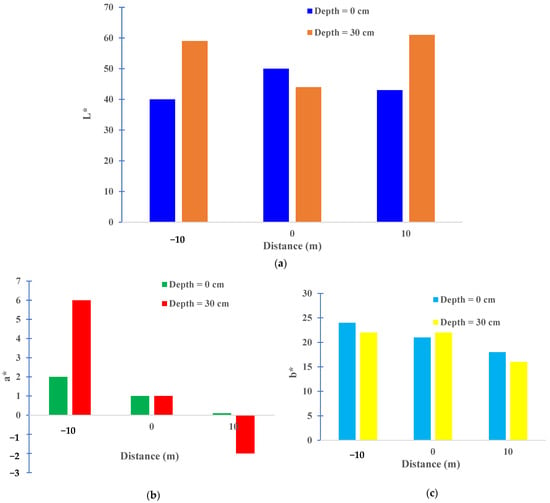
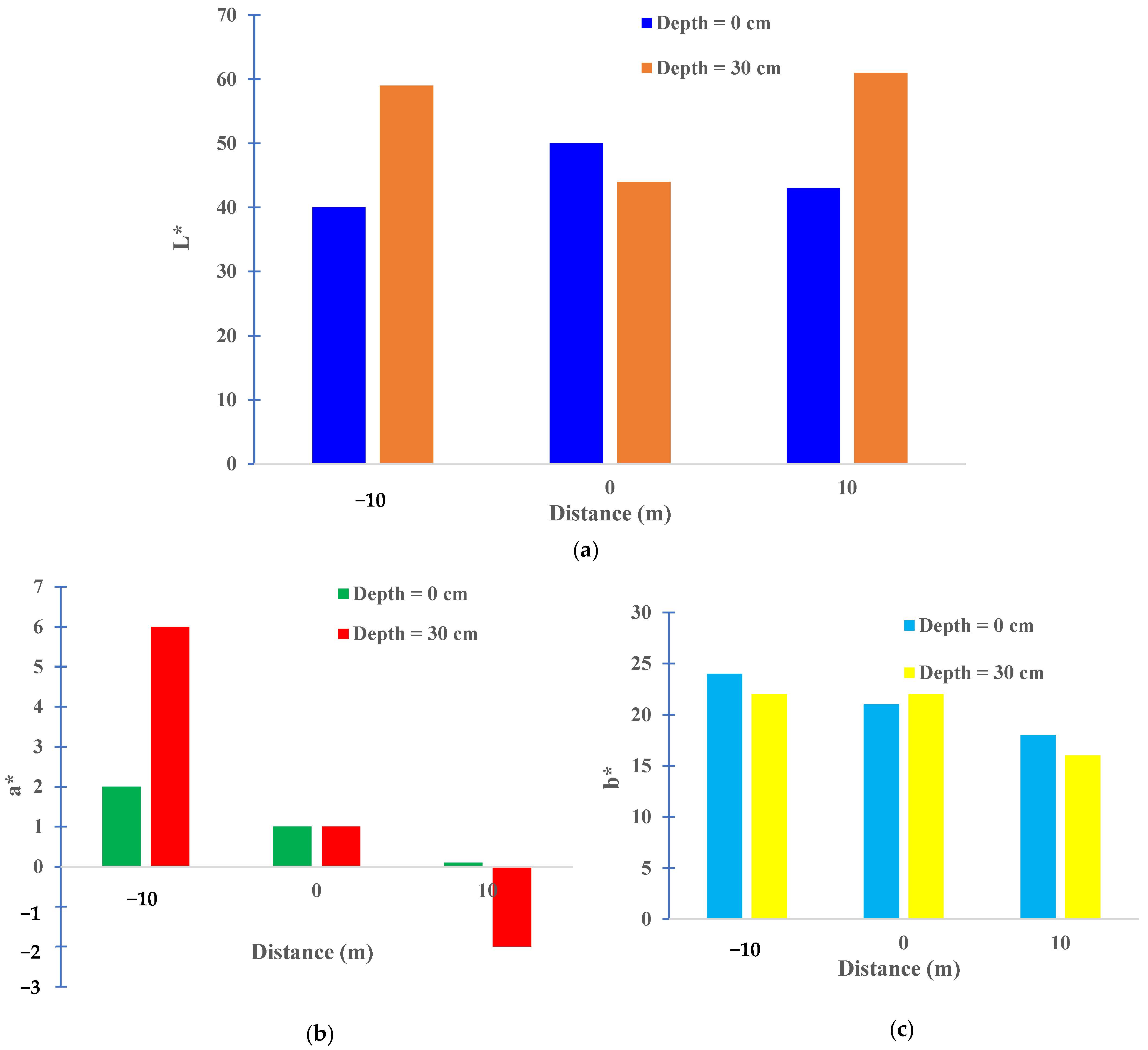
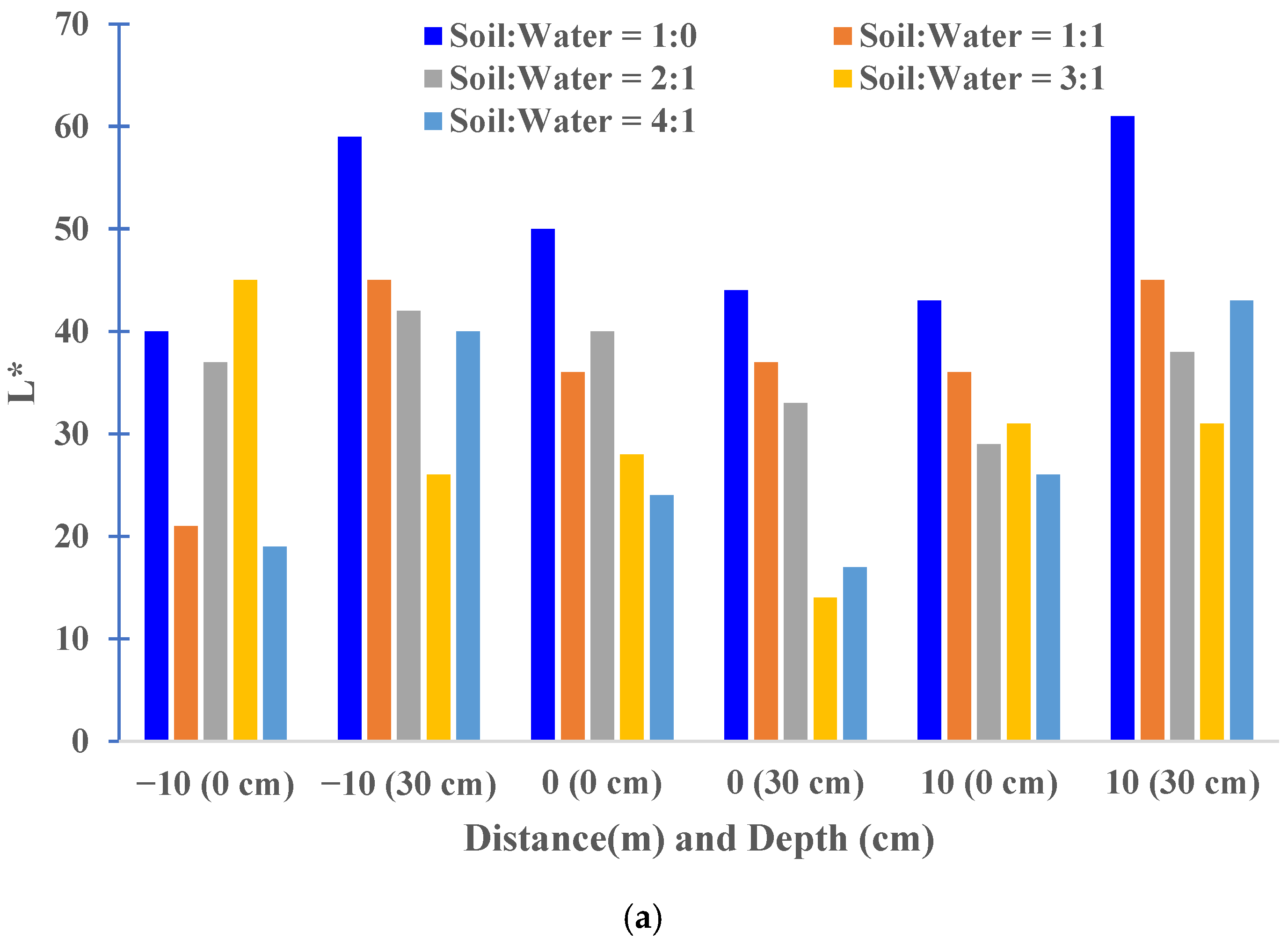
The distribution of CIELAB color parameters is consistent with the Munsell color classifications presented in Table 1. In Figure 1a, the relatively darker topsoil samples A and E exhibit lower L* values. At the same sampling distances, the corresponding subsoil samples B and F show markedly higher L* values, reflecting their comparatively lighter appearance. At the shoreline, (distance = 0 m), the topsoil sample C exhibits a higher L* value than samples A and E, whereas the corresponding subsoil sample D shows only a slight difference in lightness compared with sample C and remains darker than samples B and F.
Figure 1.
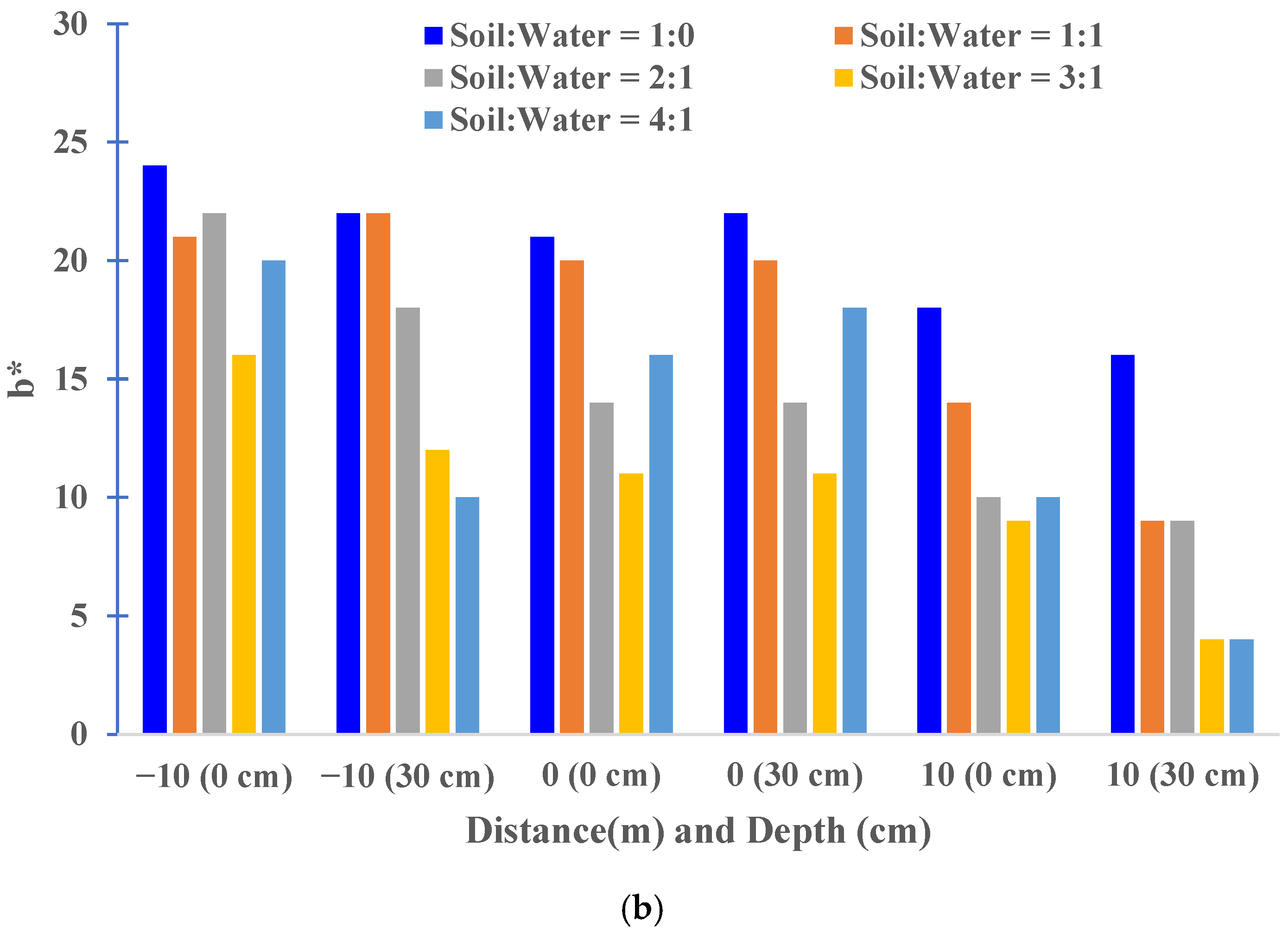
Variations in (a) L*, (b) a*, and (c) b* color values of mangrove soils as a function of depth and distance from the shoreline.
Figure 1b,c show that b* values are substantially higher than a* values for all samples, consistent with the observed brown-to-gray tonal range. Both a* and b* generally decrease from the seaward side (distance = −10 m) toward the landward side (distance = 10 m), suggesting a gradual reduction in chromatic intensity along the transect. In contrast to the clearer depth-dependent variation observed for samples collected at −10 and 10 m, the shoreline samples C and D exhibit comparable a* and b* values, indicating a less pronounced depth effect, consistent with the trend already observed for L*.
3.3. Comparison Between Smartphone Colorimetry and Standard Spectrophotometer
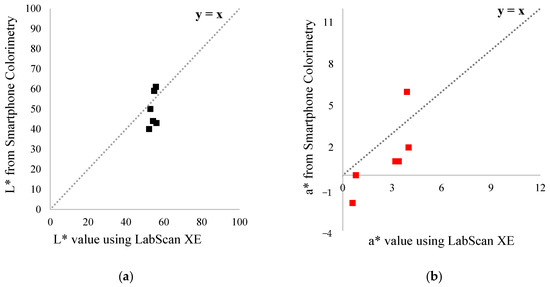
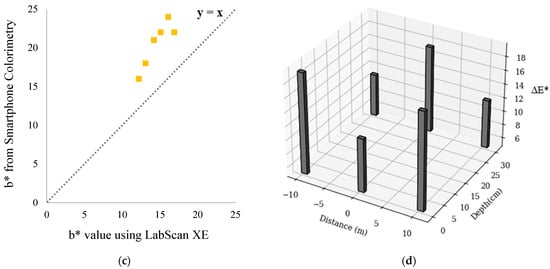
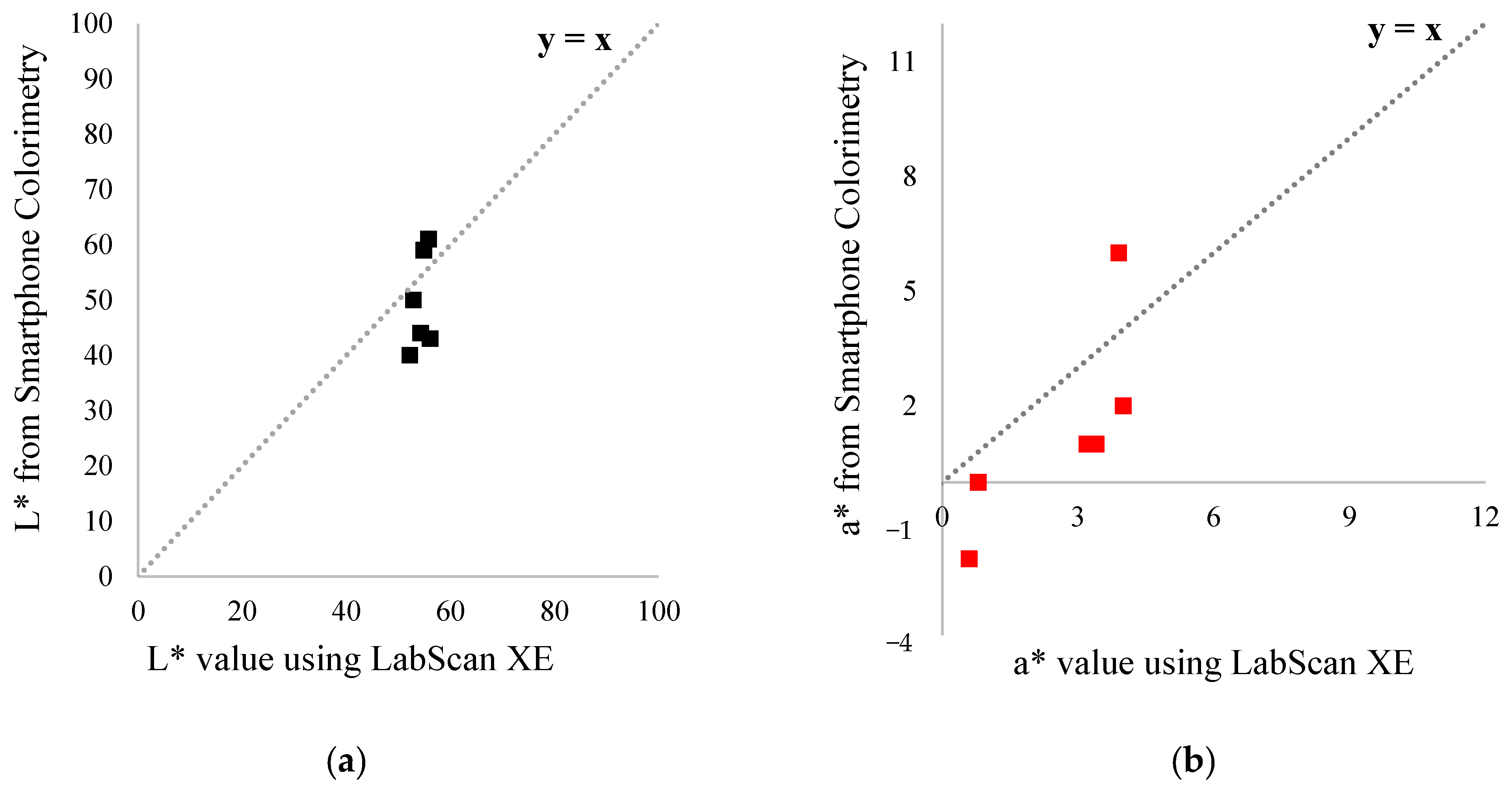
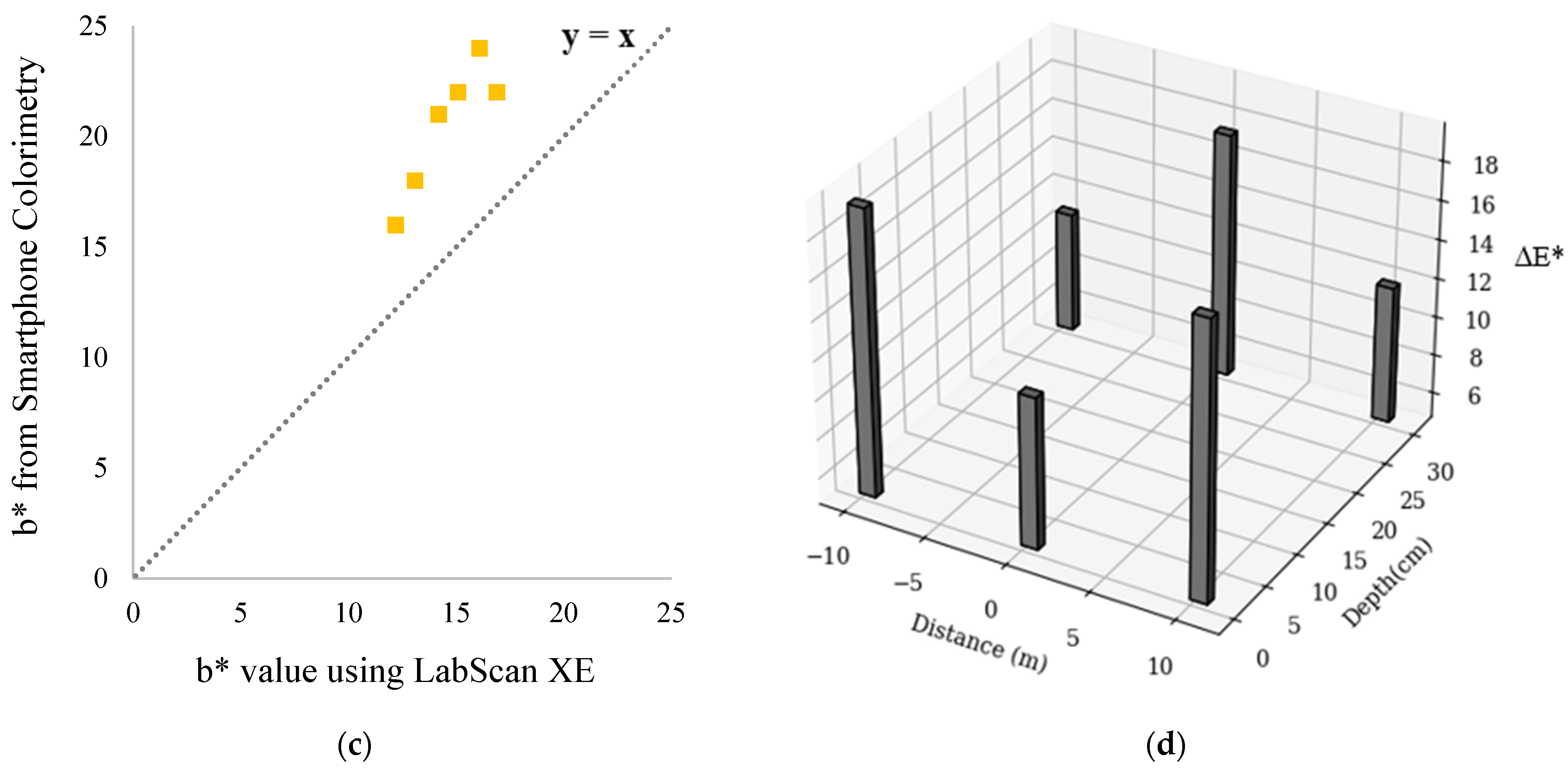
The correlation plot in Figure 2a shows that the L* values obtained from six distinct samples lie close to the y = x line, indicating strong agreement between smartphone colorimetry and the standard colorimeter in measuring soil lightness. This suggests that smartphone-based measurements can serve as a practical alternative for assessing brightness variations in mangrove soils. In contrast, the agreement is less satisfactory for chromatic coordinates. As shown in Figure 2b, most a* values measured by the smartphone fall below the y = x line, indicating a systematic underestimation of redness. Conversely, Figure 2c reveals that b* values are consistently distributed above the y = x line, suggesting an overestimation of yellowness. These deviations likely arise from differences in sensor spectral sensitivity and image processing algorithms, inherent to smartphone-based measurements [33]. Because color values are sensitive to the lighting condition, illumination has been taken into account in color calibrations [34] and colors should be measured in a light-controlled box, as demonstrated in this study.
Figure 2.
Correlation plots comparing (a) L*, (b) a*, (c) b*, and (d) CIELAB color differences (ΔE*) between smartphone colorimetry and the standard spectrophotometer (LabScan XE) in the measurement of mangrove soils.
The overall color difference (ΔE*) between the two methods, presented in Figure 2d, ranges from 10 to 18, with no clear dependence on sampling depth or distance from the shoreline. Although these values indicate noticeable discrepancies in absolute color matching, the consistency of the deviations suggests that smartphone colorimetry can still reliably capture relative trends across samples. Therefore, while not a direct replacement for laboratory-grade instruments, smartphone colorimetry provides a scalable and accessible tool for preliminary soil characterization and environmental monitoring. Importantly, the observed systematic biases in a* and b* values provide a basis for developing empirical calibration or machine learning-based correction models. Machine learning and deep learning have increasingly been demonstrated on soil color data in the past few years [35,36,37,38]. Such approaches enable improved quantitative agreement with reference instruments in analytical applications.
3.4. Moisture-Induced Color Transition
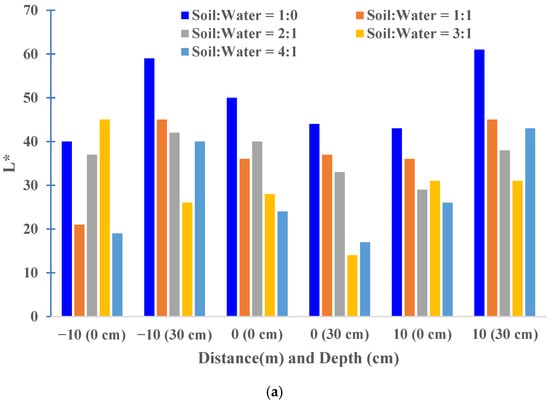
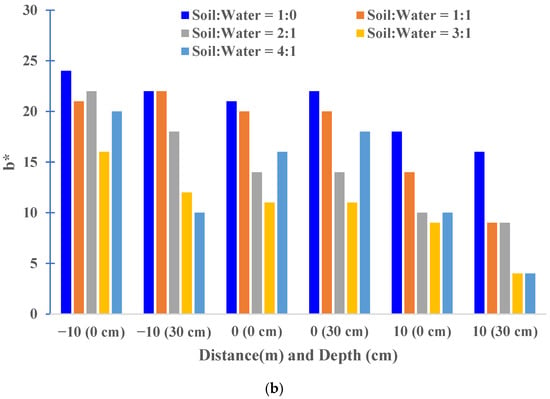
In general, increasing moisture content is associated with reductions in lightness (L*) and yellowness (b*) of soils. This behavior can be attributed to changes in light scattering and absorption. The presence of water reduces surface roughness contrast and enhances internal light absorption, typically resulting in darker and more saturated visual characteristics [39,40,41]. In the present study, hydration of oven-dried soils leads to noticeable changes in CIELAB color parameters, and corresponding decreases in L* and b* in wetted soils are evident in Figure 3. However, no monotonic relationship is observed between these parameters and the amount of added water. Such inconsistencies suggest that the color response to moisture is governed by multiple interacting factors rather than a simple linear dependence on water content.
Figure 3.
Comparison of (a) L* and (b) b* color values between oven-dried and wetted mangrove soil samples.
At higher moisture levels, deviations from the general trend become more pronounced. Beyond a certain threshold, additional water may promote optical homogenization of the soil surface, thereby reducing sensitivity to further changes in moisture. This effect can obscure incremental variations in L* and b*, leading to non-monotonic behavior. Moreover, differences in particle size distribution, organic matter content, and mineral composition, particularly the presence of clay minerals and iron oxides, can influence the formation and distribution of water films, as well as their interaction with incident light [42,43].
These findings highlight that moisture-induced color transitions in mangrove soils are complex and strongly sample-dependent. While L* and b* provide useful indicators of moisture-related color change, the absence of a consistent relationship with water content underscores the importance of considering microstructural and compositional controls when interpreting soil color under varying hydration conditions. This also emphasizes the need for moisture-aware calibration in soil color measurements. In this regard, dedicated calibration approaches for moist soils, such as that proposed by Baek et al. [44], offer a valuable reference for improving the reliability and comparability of colorimetric analyses.
3.5. Limitations and Future Implications
This study demonstrates that smartphone colorimetry can capture relative variations in mangrove soil color under controlled measurement conditions. However, several limitations should be recognized. First, the study was conducted using a limited number of samples (n = 6) and therefore does not represent the full variability of mangrove soils. Second, the interpretation of soil color was based on bulk XRF and TGA measurements, which provide only generalized compositional and thermal information. More detailed mineralogical and microstructural analyses would be required to establish mechanistic relationships between soil composition and color behavior. In addition, smartphone-derived chromatic coordinates exhibited systematic deviations from spectrophotometer measurements, indicating limitations in absolute color accuracy.
The present results also highlight the sensitivity of smartphone colorimetry to measurement conditions. Variations in illumination, camera sensor characteristics, and moisture-dependent optical effects may influence measured CIELAB parameters. Although the use of a light-controlled enclosure reduced environmental variability, differences among devices and imaging conditions remain important challenges for quantitative applications. These limitations emphasize the need for standardized imaging protocols and calibration procedures to improve reproducibility and inter-device comparability. Recent studies, such as the calibration framework proposed by Li et al. [45], demonstrate that quantitative performance can be improved through appropriate correction methods.
Future work should therefore focus on larger and more diverse soil datasets, standardized imaging protocols, and calibration frameworks capable of improving inter-device consistency and quantitative reliability under field conditions. The integration of controlled illumination systems, reference color standards, and machine-learning-based correction models may further enhance analytical performance and reduce systematic deviations in chromatic measurements. More comprehensive investigations incorporating detailed mineralogical and microstructural characterization would also help clarify the complex interactions among soil composition, moisture, and optical behavior.
Despite these limitations, smartphone colorimetry remains attractive as a low-cost and widely accessible analytical approach. Its portability and ease of use may support preliminary environmental assessment in settings where conventional instrumentation is unavailable. Furthermore, previous studies have suggested potential applications of smartphone-assisted colorimetric methods in community-based environmental monitoring and citizen science initiatives [46,47,48]. With continued methodological refinement, smartphone colorimetry may contribute to participatory environmental monitoring and environmental education related to mangroves and other ecological systems.
4. Conclusions
This study evaluated the feasibility of smartphone colorimetry for the analysis of mangrove soil color under controlled measurement conditions. Based on a limited number of samples, the work should be regarded as a pilot investigation rather than a comprehensive assessment of mangrove soil variability. Mapping across two depth levels and three distances from the shoreline revealed a gradual reduction in chromatic intensity from the seaward side toward the landward side. No consistent correspondence was observed between soil color and mineral composition determined by XRF, suggesting that mangrove soil color arises from a complex interplay of multiple environmental and physicochemical factors, rather than from bulk elemental composition alone.
TGA further indicates that soil organic matter exists in both labile and recalcitrant forms, with onset temperatures around 260 °C associated with more labile fractions and a second stage near 450 °C corresponding to more resistant organic structures. However, no systematic relationship was identified between color parameters and thermal weight loss behavior. Likewise, although moisture variations induced observable reductions in lightness (L*) and yellowness (b*), the responses to increasing water content were not monotonic. These findings highlight the heterogeneous and sample-dependent nature of mangrove soils, in which color is influenced by interacting factors including organic matter characteristics, mineral phases, particle size distribution, and surface optical effects.
Comparison with the standard LabScan XE spectrophotometer revealed systematic deviations in chromatic coordinates, with underestimation of a* (redness) and overestimation of b* (yellowness) by smartphone measurements, resulting in CIELAB color differences (ΔE*) exceeding 10. In contrast, strong agreement was observed for L* values, indicating that smartphone colorimetry can reliably capture relative variations in soil lightness. These results demonstrate the potential of smartphone colorimetry as a low-cost and accessible tool for preliminary environmental assessment. Nevertheless, several limitations remain, including limited chromatic accuracy, susceptibility to environmental lighting conditions, device-dependent variability, and the absence of unified calibration procedures.
Future work should focus on larger and more diverse soil datasets, standardized imaging protocols, and improved calibration strategies to enhance the quantitative reliability of smartphone colorimetry under field conditions. With continued methodological refinement, smartphone colorimetry may support participatory environmental monitoring and educational applications in mangrove ecosystems.
Author Contributions
Conceptualization, C.S.; methodology, P.Y., K.S., P.I. and P.S.; formal analysis, P.Y., K.S., P.I., Y.S. and C.S.; investigation, P.Y., K.S., P.I., P.S. and C.S.; resources, M.C.; data curation, P.Y., K.S., P.I. and Y.S.; writing—original draft preparation, C.S.; writing—review and editing, C.S. and Y.S.; visualization, Y.S.; supervision, C.S. and M.C. All authors have read and agreed to the published version of the manuscript.
Funding
This research received no external funding.
Institutional Review Board Statement
Not applicable.
Informed Consent Statement
Not applicable.
Data Availability Statement
The dataset used in this study is available upon request to the corresponding author.
Acknowledgments
During the preparation of this manuscript/study, the authors used ChatGPT-5 for the purposes of improving its readability. The authors have reviewed and edited the output and take full responsibility for the content of this publication.
Conflicts of Interest
The authors declare no conflicts of interest.
Abbreviations
| CIELAB | Commission Internationale de l’Éclairage L* a* b* |
| DTA | Differential thermal analysis |
| RGB | Red green blue |
| TGA | Thermogravimetric analysis |
| XRF | X-ray fluorescence |
References
- Zhang, J.; Gan, S.; Yang, P.; Zhou, J.; Huang, X.; Chen, H.; He, H.; Saintilan, N.; Sanders, C.J.; Wang, F. A global assessment of mangrove soil organic carbon sources and implications for blue carbon credit. Nat. Commun. 2024, 15, 8994. [Google Scholar] [CrossRef] [Scilit] [PubMed]
- Nyein, L.T.; Karthe, D.; Giessen, L.; Babel, M.S.; Schusser, C. Reviewing mangrove degradation, conservation, and restoration: A sustainability nexus assessment on Myanmar using the DPSIR framework. For. Soc. 2025, 9, 164–185. [Google Scholar] [CrossRef] [Scilit]
- Dewiyanti, I.; Darmawi, D.; Muchlisin, Z.A.; Helmi, T.Z.; Imelda, I.; Defira, C.N. Physical and chemical characteristics of soil in mangrove ecosystem based on differences habitat in Banda Aceh and Aceh Besar. IOP Conf. Ser. Earth Environ. Sci. 2021, 674, 01209. [Google Scholar] [CrossRef] [Scilit]
- Dharmayasa, I.G.N.P.; Sugiana, I.P.; Prapaspongsa, T. Soil organic matter in natural and rehabilitated mangroves: Implications for environmental restoration and climate resilience. J. Ecol. Eng. 2025, 26, 153–162. [Google Scholar] [CrossRef] [Scilit]
- Chacón-Calderón, A.; Zuñiga-Umaña, J.M.; Villarreal, C.; Vega-Baudrit, J.R.; Pereira-Reyes, R.; Corrales-Ureña, Y.R. Mangrove soil as a natural catalyst for green synthesis of silver nanoparticles. Front. Chem. 2025, 13, 1589836. [Google Scholar] [CrossRef] [Scilit]
- Sirisathitkul, Y.; Sirisathitkul, C. Decoding soil color: Origins, influences, and methods of analysis. AgriEngineering 2025, 7, 58. [Google Scholar] [CrossRef] [Scilit]
- Kome, G.K.; Enang, R.K.; Yerima, B.P.K.; Van Ranst, E. Quantitative relationships between Munsell colour attributes and organic carbon in highly weathered tropical soils. Geoderma Reg. 2024, 39, e00898. [Google Scholar] [CrossRef] [Scilit]
- García-Ruiz, R.; Sánchez-Hernández, R.; Bautista, F.; Goguitchaichvili, A. Colorimetric method to estimate the soil organic matter in karst areas. Ecosist. Recur. Agropec. 2022, 9, e3189. [Google Scholar] [CrossRef] [Scilit]
- Rubinić, V.; Pavlović, A.; Magdić, I. Predicting soil organic matter content using soil color at three locations with different land use in Zagreb (Croatia). J. Cent. Eur. Agric. 2021, 22, 646–656. [Google Scholar] [CrossRef] [Scilit]
- Raeesi, M.A.A.; Zolfaghari, M.R.; Gorji, Y.M.; Sabetizade, M. Prediction of soil organic matter using an inexpensive colour sensor in arid and semiarid areas of Iran. Soil Res. 2019, 57, 276–286. [Google Scholar] [CrossRef] [Scilit]
- Moritsuka, N.; Matsuoka, K.; Katsura, K.; Yanai, J. Farm-scale variations in soil color as influenced by organic matter and iron oxides in Japanese paddy fields. Soil Sci. Plant Nutr. 2019, 65, 166–175. [Google Scholar] [CrossRef] [Scilit]
- Turk, J.K.; Young, R.A. Field conditions and the accuracy of visually determined Munsell soil color. Soil Sci. Soc. Am. J. 2020, 84, 163–169. [Google Scholar] [CrossRef] [Scilit]
- Kirillova, N.P.; Grauer-Gray, J.; Hartemink, A.E.; Sileova, T.; Artemyeva, Z.S.; Burova, E. New perspectives to use Munsell color charts with electronic devices. Comput. Electron. Agric. 2018, 155, 378–385. [Google Scholar] [CrossRef] [Scilit]
- Baumann, K.; Schöning, I.; Schrumpf, M.; Ellerbrock, R.H.; Leinweber, P. Rapid assessment of soil organic matter: Soil color analysis and Fourier transform infrared spectroscopy. Geoderma 2016, 278, 49–57. [Google Scholar] [CrossRef] [Scilit]
- Fernandes, R.B.A.; Barrón, V.; Torrent, J.; Fontes, M.P.F. Quantification of iron oxides in Brazilian latosols by diffuse reflectance spectroscopy. Rev. Bras. Cienc. Solo 2004, 28, 245–257. [Google Scholar] [CrossRef] [Scilit]
- Itai, T.; Maruoka, T.; Kusakabe, M.; Uesugi, K.; Mitamura, M. Use of soil color meter for aqueous iron and ammonium measurements. Soil Sci. Plant Nutr. 2013, 59, 450–454. [Google Scholar] [CrossRef] [Scilit]
- Gunal, H.; Ersahin, S.; Yetgin, B.; Kutlu, T. Use of chromameter-measured color parameters in estimating color-related soil variables. Commun. Soil Sci. Plant Anal. 2008, 39, 726–740. [Google Scholar] [CrossRef] [Scilit]
- Sirisathitkul, Y.; Kaewareelap, S. Color analysis of batik fabric by facile smartphone colorimetry. Int. J. Adv. Sci. Eng. Inf. Technol. 2021, 11, 84–91. [Google Scholar] [CrossRef] [Scilit]
- Qain, S.; Cui, Y.; Cai, Z.; Li, L. Applications of smartphone-based colorimetric biosensors. Biosens. Bioelectron. X 2022, 11, 100173. [Google Scholar] [CrossRef] [Scilit]
- Fan, Y.; Li, J.; Guo, Y.; Xie, L.; Zhang, G. Digital image colorimetry on smartphone for chemical analysis: A review. Measurement 2021, 171, 108829. [Google Scholar] [CrossRef] [Scilit]
- Du, Y.; Kang, F.; Huang, Z.; Wang, L.; Zhang, Y.; Li, D.; Zheng, G.; Zeng, R. A comparative study of four color measurement methods for soil color identification and related properties prediction. Comput. Electr. Agric. 2025, 230, 109801. [Google Scholar] [CrossRef] [Scilit]
- da Silva, J.O.; da Silva Júnior, J.F.; da Silva Santos, L.; Pereira, G.T.; Amorim, E.C.; Sobrinho, R.J.A.; Pinheiro, D.P. Accuracy and accessibility in soil color determination: A comparative analysis of Munsell chart, colorimeter, and smartphone in Amazonian soils. Comput. Electr. Agric. 2025, 239, 111052. [Google Scholar] [CrossRef] [Scilit]
- Fan, Z.S.; Herrick, J.E.; Saltzman, R.; Matteis, C.; Yudina, A.; Nocella, N.; Crawford, E.; Parker, R.; Van Zee, J. Measurement of soil color: A comparison between smartphone camera and the Munsell color charts. Soil Sci. Soc. Am. J. 2017, 81, 1139–1146. [Google Scholar] [CrossRef] [Scilit]
- Stiglitz, R.; Mikhailova, E.; Post, C.; Schlautman, M.; Sharp, J. Evaluation of an inexpensive sensor to measure soil color. Comput. Electr. Agric. 2016, 121, 141–148. [Google Scholar] [CrossRef] [Scilit]
- Han, P.; Dong, D.; Zhao, X.; Jiao, L.; Lang, Y. A smartphone-based soil color sensor: For soil type classification. Comput. Electr. Agric. 2016, 123, 32–241. [Google Scholar] [CrossRef] [Scilit]
- Gómez-Robledo, L.; López-Ruiz, N.; Melgosa, M.; Palma, A.; Capitán-Vallvey, L.F.; Sánchez-Marañón, M. Using the mobile phone as Munsell soil-colour sensor: An experiment under controlled illumination conditions. Comput. Electr. Agric. 2013, 99, 200–208. [Google Scholar] [CrossRef] [Scilit]
- Nodi, S.S.; Paul, M.; Robinson, N.; Wang, L.; Rehman, S.U. Determination of Munsell soil colour using smartphones. Sensors 2023, 23, 3181. [Google Scholar] [CrossRef] [Scilit] [PubMed]
- Vodyanitskii, Y.N.; Kirillova, N.P. Application of the CIE-L*a*b* system to characterize soil color. Eurasian Soil Sci. 2016, 49, 1259–1268. [Google Scholar] [CrossRef] [Scilit]
- Viscarra Rossel, R.A.; Minasny, B.; Roudier, P.; McBratney, A.B. Colour space models for soil science. Geoderma 2006, 133, 320–337. [Google Scholar] [CrossRef] [Scilit]
- Naeimi, M.; Krzic, M.; Scott, S.; Daggupati, P.; Biswas, A. Optimizing image-based soil organic matter prediction: Effects of illumination type and intensity. Smart Agric. Technol. 2025, 11, 100922. [Google Scholar] [CrossRef] [Scilit]
- Naeimi, M.; Daggupati, P.; Biswas, A. Image-based soil characterization: A review on smartphone applications. Comput. Electron. Agric. 2024, 227, 109502. [Google Scholar] [CrossRef] [Scilit]
- Oyedotun, T.D.T. X-ray fluorescence (XRF) in the investigation of the composition of earth materials: A review and an overview. Geol. Ecol. Landsc. 2018, 2, 148–154. [Google Scholar] [CrossRef] [Scilit]
- Yang, J.; Shen, F.; Wang, T.; Luo, M.; Li, N.; Que, S. Effect of smart phone cameras on color-based prediction of soil organic matter content. Geoderma 2021, 402, 115365. [Google Scholar] [CrossRef] [Scilit]
- Yang, J.; Wang, T.; Que, S.; Li, Z.; Liang, Y.; Wei, Y.; Li, N.; Xu, Z. Effect of colour calibration on the prediction of soil organic matter content based on original soil images obtained from smartphones under different lighting conditions. Soil Tillage Res. 2024, 238, 106018. [Google Scholar] [CrossRef] [Scilit]
- Nodi, S.S.; Paul, M.; Robinson, N.; Wang, L.; Rehman, S.U.; Kabir, M.A. Munsell soil colour prediction from the soil and soil colour book using patching method and deep learning techniques. Sensors 2025, 25, 287. [Google Scholar] [CrossRef] [Scilit]
- Shen, F.; Yang, J.; Wang, T.; Li, N.; Que, S.; Xu, M.; Li, J.; Chen, Z. Smartphone-based soil color analysis and machine learning for free iron oxide prediction in subtropical B-horizon soils. Precision. Agric. 2025, 26, 77. [Google Scholar] [CrossRef] [Scilit]
- Kang, Y.G.; Lee, J.Y.; Kim, J.H.; Oh, T.K. Quantifying soil organic matter for sustainable agricultural land management with soil color and machine learning technique. Agron. J. 2024, 116, 982–989. [Google Scholar] [CrossRef] [Scilit]
- Pegalajar, M.C.; Ruiz, L.G.B.; Criado-Ramón, D. Munsell soil colour classification using smartphones through a neuro-based multiclass solution. AgriEngineering 2023, 5, 355–368. [Google Scholar] [CrossRef] [Scilit]
- Kirillova, N.P.; Zhang, Y.; Hartemink, A.E.; Zhulidova, D.A.; Artemyeva, Z.S.; Khomyakov, D.M. Calibration methods for measuring the color of moist soils with digital cameras. Catena 2021, 202, 105274. [Google Scholar] [CrossRef] [Scilit]
- Hill, I.; Park, D.; Bridges, W.; White, D. Soil water content and photosynthetically active radiation influences soil color assessment. Geoderma Reg. 2022, 31, e00581. [Google Scholar] [CrossRef] [Scilit]
- Fu, Y.; Taneja, P.; Lin, S.; Ji, W.; Adamchuk, V.; Daggupati, P.; Biswas, A. Predicting soil organic matter from cellular phone images under varying soil moisture. Geoderma 2020, 361, 114020. [Google Scholar] [CrossRef] [Scilit]
- Naeimi, M.; Daggupati, P.; Krzic, M.; Scott, S.; Vasava, H.; Saurette, D.; Biswas, A. Environmental factors in image-based soil analysis: Interaction effects of moisture, texture, and illumination. Geoderma 2025, 463, 117547. [Google Scholar] [CrossRef] [Scilit]
- Sánchez-Marañón, M.; Soriano, M.; Melgosa, M.; Delgado, G.; Delgado, R. Quantifying the effects of aggregation, particle size and components on the colour of Mediterranean soils. Eur. J. Soil Sci. 2004, 55, 551–565. [Google Scholar] [CrossRef] [Scilit]
- Baek, S.H.; Jeon, J.S.; Kwak, T.Y. Color calibration of moist soil images captured under irregular lighting conditions. Comput. Electr. Agric. 2023, 214, 108299. [Google Scholar] [CrossRef] [Scilit]
- Li, S.; Zheng, F.; Koiter, A.J.; Kupriyanovich, Y.; Lobb, D.A.; Goharrokhi, M. Using a reference color plate to correct smartphone-derived soil color measurements with different smartphones under different lighting conditions. Soil Syst. 2025, 9, 93. [Google Scholar] [CrossRef] [Scilit]
- Kumar Gupta, S.; Efrati, B.; Amir, O.; Francos, N.; Sternberg, M.; Ben-Dor, E. Smartphone-based spectroscopy as a tool to estimate soil attributes for the citizen science concept. Smart Agric. Technol. 2023, 5, 100327. [Google Scholar] [CrossRef] [Scilit]
- Jorge, N.F.; Clark, J.; Cárdenas, M.L.; Geoghegan, H.; Shannon, V. Measuring soil colour to estimate soil organic carbon using a large-scale citizen science-based approach. Sustainability 2021, 13, 11029. [Google Scholar] [CrossRef] [Scilit]
- Aberasturi Rodríguez, A.; Bandera, I.F.; Navarro-Pedreño, J. Can citizens do science? Science in common and social responsibility. Sci 2024, 6, 26. [Google Scholar] [CrossRef] [Scilit]

Disclaimer/Publisher’s Note: The statements, opinions and data contained in all publications are solely those of the individual author(s) and contributor(s) and not of MDPI and/or the editor(s). MDPI and/or the editor(s) disclaim responsibility for any injury to people or property resulting from any ideas, methods, instructions or products referred to in the content. |
© 2026 by the authors. Licensee MDPI, Basel, Switzerland. This article is an open access article distributed under the terms and conditions of the Creative Commons Attribution (CC BY) license.