Review

Pregnancy, Cardiovascular Risk Factors, and Mid- to Later-Life Maternal Brain Health: A Scoping Review


1
Simpson Querrey Center for Neurovascular Sciences, Division of Stroke and Vascular Neurology, Davee Department of Neurology, Feinberg School of Medicine, Northwestern University, Chicago, IL 60611, USA
2
Galter Health Sciences Library and Learning Center, Feinberg School of Medicine, Northwestern University, Chicago, IL 60611, USA
3
Division of Maternal-Fetal Medicine, Department of Obstetrics and Gynecology, Feinberg School of Medicine, Northwestern University, Chicago, IL 60611, USA
*
Authors to whom correspondence should be addressed.
Sci 2026, 8(5), 103; https://doi.org/10.3390/sci8050103
Submission received: 5 March 2026 / Revised: 18 April 2026 / Accepted: 22 April 2026 / Published: 4 May 2026

Abstract

Pregnancy involves major cardiovascular adaptations, yet its long-term impact on maternal brain health remains poorly understood. The American Heart Association’s Life’s Simple 7 (LS7) and Life’s Essential 8 (LE8) are validated tools to assess cardiovascular and brain health, but their use in obstetric populations is limited. Following PRISMA-ScR guidelines, we searched three databases (2010–2024) for studies assessing ≥ 1 LS7/LE8 component during pregnancy with mid- or later-life cognitive or dementia outcomes; narrative synthesis and meta-analyses were conducted where feasible. Of 3940 screened abstracts, 30 studies met the inclusion criteria. Most examined hypertensive disorders of pregnancy (HDP), few assessed diabetes independently, and none evaluated the full LS7/LE8 construct. Meta-analyses showed that HDP was associated with increased risk of all-cause dementia (HR 1.34; 95% CI 1.11–1.62) and vascular dementia (HR 1.76; 95% CI 1.03–3.00; n = 3 studies), but not Alzheimer’s disease (HR 1.22; 95% CI 0.96–1.56). Although LS7/LE8 are established frameworks for cardiovascular and brain health, their application during pregnancy remains limited. Integrating LE8 into obstetric care may enable earlier identification of individuals at risk for later-life cognitive decline and inform strategies to promote maternal brain health across the lifespan.

1. Introduction

Maintenance of brain health is a lifelong process that has traditionally focused on cognitive outcomes in mid- or later life [1,2]. The long-term influence of pregnancy on the maternal brain has been understudied, although mounting evidence supports the contention that those who experience an adverse pregnancy outcome (APO), such as preeclampsia or other hypertensive disorders of pregnancy, gestational diabetes, or other cardiovascular-related APOs, are at risk of subsequent cardiovascular disease (CVD) and brain injury [3,4]. Whereas cardiovascular APOs may be associated with immediate consequences to brain health, the effects of APOs may extend past the immediate perinatal period and affect the maternal brain in mid- or later life [3,4]. Several biological mechanisms may link adverse pregnancy outcomes with long-term cardiovascular and neurological risk, including endothelial dysfunction, chronic inflammation, vascular remodeling, and placental-mediated vascular injury [4]. This association has led to a call for recognizing APOs when screening for CVD risk in birthing individuals, and more timely and rigorous primary prevention of CVD risk factors in women [4].
The American Heart Association’s Life’s Essential 8 (LE8) and its forerunner, Life’s Simple 7 (LS7), are easy-to-use and well-studied tools for assessing cardiovascular health and brain health [1,5,6]. The components of LE8 include diet, physical activity, nicotine exposure, sleep health (an 8th factor added since LE7 was developed), body mass index, blood lipids, blood glucose, and blood pressure [5]. The component factors of LE8 and LS7 were chosen for use in practice as they are modifiable, monitorable, and easy to measure. Although LS7 and LE8 have been widely used to predict cardiovascular disease and cognitive decline in general populations, their application in obstetric populations remains limited. Furthermore, whether LS7/LE8-defined cardiovascular risk factors during pregnancy predict long-term cognitive outcomes in the birthing person remains largely unexplored, representing a dual gap in both pregnancy-specific application and longitudinal cognitive follow-up. Physiological changes during pregnancy—including alterations in lipid metabolism, plasma volume expansion, and hormone fluctuations—may influence measurement of several components of LS7 and LE8, and pregnancy-specific cardiovascular conditions such as hypertensive disorders of pregnancy and gestational diabetes are not explicitly included within the current LS7/LE8 framework [4].
We therefore conducted a scoping review to map the existing literature linking LS7/LE8-defined cardiovascular risk factors during pregnancy with mid- to later-life maternal cognitive outcomes, identify knowledge gaps, and inform directions for future research.

2. Materials and Methods

The scoping review protocol was developed according to the Preferred Reporting for Systematic reviews and Meta-Analyses extension for Scoping Reviews (PRISMA-ScR) guidelines [7]. PRISMA-ScR reporting guidelines were followed throughout study selection, data extraction, and synthesis. The study was registered on PRISM by author RS at the Galter Library, Northwestern University Feinberg School of Medicine [8].

2.1. Search Strategy and Selection Criteria

A comprehensive search of the literature was developed in collaboration with a research librarian (AW). The search was translated across databases and performed on 17 December 2024 in the following databases: MEDLINE (Ovid), Cochrane Library (Wiley), and Web of Science (Clarivate). The search strategy combined database-specific controlled vocabulary and title/abstract terms related to LE8 and LS7, pregnancy, and cognition. All databases were searched from 2010 to the present without the use of additional filters or limits. Records were downloaded and underwent multi-pass deduplication in a citation management software (EndNote Version 21.5), and unique records were uploaded to a screening platform, Rayyan, for blinded title/abstract screening by a team of reviewers. The final search strategy and search terms are included in the Supplementary Materials.
All search-based studies that were retrieved were imported into the Rayyan database [9]. Four review teams consisting of 2 members each were established to screen the titles and abstracts of studies garnered from the search. Each team of 2 independently screened approximately 25% of the abstracts, based on the eligibility criteria. Each abstract grader was blinded to the results of the other abstract graders. Before an abstract grader could be included on an abstract review team, they were oriented to the study aims, protocol, inclusion/exclusion criteria, Rayyan platform, and screening technique. Each potential abstract reviewer blindly evaluated 100 pre-test abstracts before the Rayyan system went live. Pre-test results for the 8 abstract reviewers were compared, and those scoring outside the anticipated 5–10% abstract selection range received additional training. This occurred in 2 cases, though the reviewers’ pre-test results were close to the expected range.
For each abstract review team of 2, each member reviewed approximately 708 identical abstracts. Upon completion of the live review, concordant abstracts selected by each of the teams of 2 members became part of the final Rayyan database. In cases where the abstract reviewers were discordant in relation to abstract selection, the corresponding abstracts were sent to a senior oversight committee (investigators PBG, DP, YC, and RS) charged with making the final selection of the publications to be included in the scoping review. Abstract reviewers had access to abstracts but not the full-length manuscripts. The oversight committee was allowed to access full-length manuscripts if necessary to adjudicate discordant results.

2.2. Eligibility Criteria

The following inclusion and exclusion criteria were applied to the study:
Inclusion criteria
  • Study population: Participants with a history of pregnancy. Studies must have at least 50 study participants.
  • Key independent variables: At least one component of LE8 (or LS7) identified during pregnancy (diet, physical activity, tobacco use, sleep health, weight, total cholesterol or non-HDL cholesterol, diabetes mellitus, hypertension).
  • Outcomes: Brain health of the birthing person during mid- or later life, measured through cognitive outcomes, cognitive impairment, or dementia.
  • Publication types: Peer-reviewed journal papers published between 2010 and 2024 (LS7 was introduced in 2010 and LE8 in 2022), in English-language journals.
  • Study designs of interest: Meta-analyses, cohort studies, systematic and narrative reviews, case–control studies, randomized controlled trials, Mendelian randomization, and population surveys.
Exclusion criteria
  • Studies that do not fit into the conceptual study framework.
  • Focus on LS7 or LE8 components outside of the pregnancy timeframe (postpartum period was excluded from the study).
  • Focus on neonatal/offspring outcomes.
  • Health outcomes measured before age 50 (applied to the mean age of the study population).
  • Non-human study participants.

2.3. Data Extraction and Synthesis

Key data elements included at least one component of LE8 (or LS7) during pregnancy (diet, physical activity, tobacco use, sleep duration, weight, total cholesterol or non-HDL cholesterol, diabetes mellitus, hypertension). Hypertensive disorders of pregnancy and gestational diabetes mellitus are pregnancy-specific manifestations of the hypertension and diabetes mellitus components of LE8/LS7, respectively. Hypertensive disorders of pregnancy (HDP) refer to de novo hypertension arising after 20 weeks of gestation, including gestational hypertension, preeclampsia, eclampsia, and HELLP syndrome. Gestational diabetes mellitus (GDM) refers to glucose intolerance first diagnosed during pregnancy, typically detected via oral glucose tolerance testing. Additionally, although LE8 uses non-HDL cholesterol (whereas LS7 used total cholesterol) as its lipid metric, lipid levels are not routinely assessed or used for cardiovascular risk scoring during pregnancy, as physiological elevations in maternal cholesterol and triglycerides occur to support fetal development and energy needs, making lipid values a less reliable indicator of maternal cardiovascular health during this period.
The primary study outcomes of interest are maternal brain health indicators in mid- or later life, including indicators of cognitive function, impairment, or dementia. Therefore, we primarily focused on types of cognitive outcomes measured (e.g., Mini-Mental State Exam, Montreal Cognitive Assessment, Trails A & B, Digit Symbol Substitution Test), effect sizes (hazard ratios, odds ratios), confidence intervals of cognitive outcomes and their subtypes (i.e., cognitive impairment, dementia, Alzheimer’s disease, vascular dementia), and predictor factors for cognitive outcomes.

2.4. Statistical Analysis

The meta-analysis was conducted using STATA 18 [10]. Subgroup analyses were performed for Alzheimer’s disease, vascular dementia, and all-cause dementia to assess the associations between APOs, components of LE8, and the outcomes of interest, where feasible. Review articles (systematic reviews, meta-analyses, and narrative reviews) contributed to the descriptive narrative synthesis only; they were not included in the meta-analysis or forest plots, which were restricted to individual primary studies.
Effect sizes and their 95% confidence intervals were log-transformed to estimate the pooled variance for weighting and forest plots, followed by back-transformation. A random-effects model was employed to estimate pooled effect sizes and confidence intervals, accounting for variations between studies. This model assumes heterogeneity across studies and incorporates the additional variation that this assumption implies.
A subgroup meta-analysis forest plot presents group-specific results, displaying effect sizes and confidence intervals for individual studies alongside the overall group-specific effect size. Additionally, the cumulative effect size from the meta-analysis is reported. Each study is represented by a square, with its size proportional to the study’s assigned weight.
Between-study heterogeneity was assessed to determine variability arising from sampling errors and methodological differences, quantified using the Q-test and I2 statistic.

3. Results

3.1. Study Selection

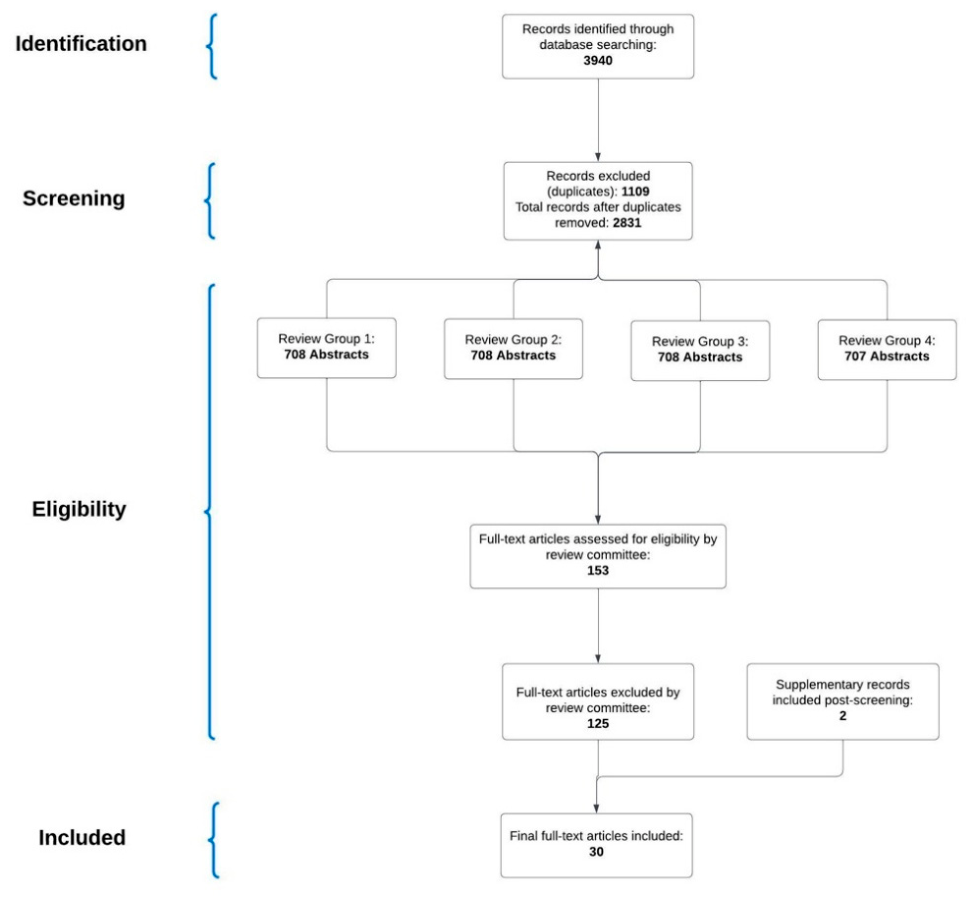
Figure 1 is a flow diagram depicting the selection process for abstracts for inclusion in the final study database. The search engine identified a total of 3940 abstracts, of which the initial screening process eliminated 1109 duplicate abstracts for a total of 2831 remaining abstracts. The four teams of abstract reviewers each reviewed 708 abstracts (one team reviewed 707 abstracts). Based on the eligibility criteria, the four teams identified 153 potentially eligible abstracts, of which 125 had discordant results. The discordant abstracts were reviewed by the oversight committee for eligibility, and based on the selection process, the total number of studies to be included in the study database was 28. An additional two abstracts were found in supplemental sources for a final study database of 30. Full-length manuscripts were obtained for abstracts selected to be in the final database, and using a pretested abstraction worksheet, investigators RS, BF, and PBG abstracted study variables of interest from the full-length manuscripts to be entered into the final study database.

3.2. Study Characteristics

Of the 30 studies selected for review, there were seven case–control studies, 13 cohort studies, one cross-sectional study, two Mendelian randomization studies, one narrative review, and six systematic reviews and meta-analyses. Most study populations were based in North America and Europe [11,12,13,14,15,16,17,18,19,20,21,22,23,24,25,26,27,28,29,30,31,32,33,34,35,36,37,38,39,40]. Table S1 (available in Supplementary Materials) is a summary narrative of key study elements from each of the 30 articles, including study design, sample size, cardiovascular exposure, cognitive outcomes assessed, and principal findings.
Of the LS7 and LE8 components, apart from two articles where the primary focus was gestational diabetes mellitus [27,39], the remainder of the articles focused on hypertension as the primary component (Table S1). Two articles focused on both diabetes mellitus and hypertension [35,37]. However, none of the studies mentioned LS7 or LE8. Components besides hypertension and diabetes mellitus, such as BMI, physical activity, and smoking, were unaddressed or limited to secondary analysis as potential covariates or confounding variables.

3.3. Cognitive and Dementia Outcomes by Study Design

3.3.1. Case–Control Studies

In case–control studies in relation to cognition as measured by various cognitive test metrics, overall, the findings in reference to hypertension during pregnancy and cognitive impairment varied (Table S1). Several studies showed a relationship between certain cognitive domains, whereas others did not or were inconsistent. In relation to dementia, one case–control study that categorized cognitive impairment and dementia [14] showed a trend toward a diagnosis of mild cognitive impairment or dementia among people with a history of preeclampsia (Table S1). The case–control studies had relatively small sample sizes (range: 64 to 1563, but generally <100 study participants) (Table S1).

3.3.2. Cohort Studies

In cohort studies, apart from one study [18], there was an association between hypertensive disorders of pregnancy and either cognitive impairment as measured by individual cognitive test metrics or dementia subtype, though the findings varied by study and neuropsychological test domain. Furthermore, the results were less consistent for a diagnosis of Alzheimer’s disease (Table S1). The overall findings were similar for gestational diabetes mellitus [27]. The cohort studies generally had large sample sizes (range: 596 to 273,375) (Table S1).

3.3.3. Systematic Reviews and Meta-Analyses

Overall, the systematic reviews and meta-analyses had the largest sample sizes (range: 290,394 to 15,973,780) (Table S1), and some but not all these studies showed a relationship between either hypertensive disorders of pregnancy and all-cause dementia, vascular dementia, or Alzheimer’s disease (Table S1).

3.3.4. Cross-Sectional Studies and Narrative Reviews

A cross-sectional study showed that hypertensive disorders of pregnancy were not associated with worse cognitive metrics, whereas gestational diabetes mellitus was [37]. One narrative review [38] showed associations between hypertensive disorders of pregnancy and impairments in cognitive metrics and aspects of psychosocial health such as anxiety and depression (Table S1).

3.3.5. Mendelian Randomization Studies

Two Mendelian randomization studies showed no association between a history of gestational diabetes mellitus or body mass index and dementia [39], and another showed no association between hypertensive disorders of pregnancy (including gestational hypertension, or preeclampsia) and cognitive performance, fluid intelligence, all-cause dementia, vascular dementia, or Alzheimer’s disease [40] (Table S1).

3.4. Associations with Cognitive Outcomes

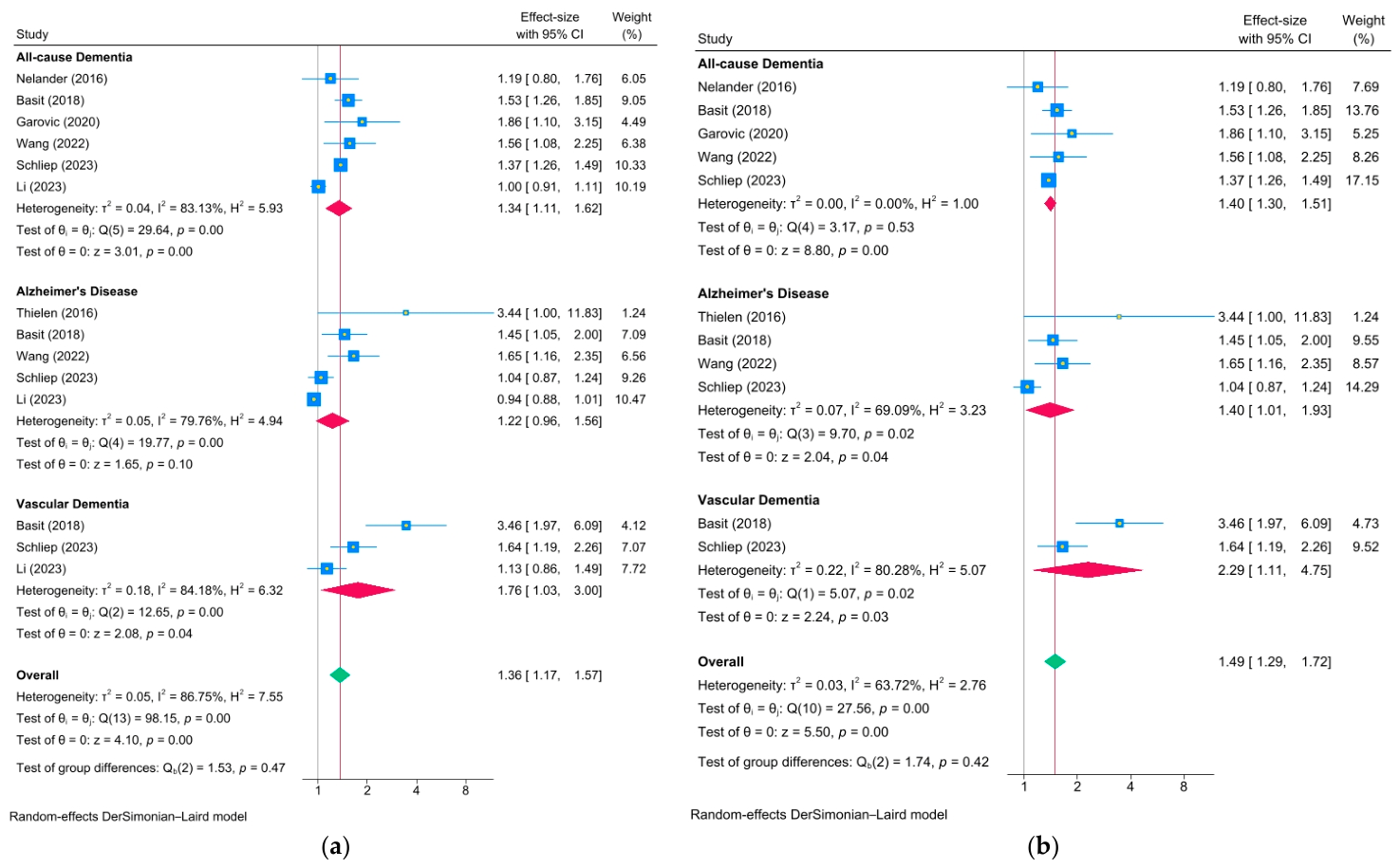
Forest plots are provided for all-cause dementia, Alzheimer’s disease, and vascular dementia to provide a more comprehensive depiction of the overall results (Figure 2). We focused on hypertensive disorders of pregnancy as there was a limited number of studies on gestational diabetes mellitus. Furthermore, we excluded studies that had limited data and prevented us from creating a forest plot entry and other meta-analyses, as well as reviews consisting of studies already included in our database. We opted not to provide forest plots for individual cognitive metrics as these metrics and study methods varied substantially by study, and the major cognitive outcomes (e.g., Alzheimer’s disease) provide more relevant and applicable information for the clinician.
All-cause dementia had an overall hazard ratio (HR) and 95% confidence interval (CI) of 1.34 (1.11, 1.62; n = 6 studies), indicating that HDP increased the risk of mid- or later-life dementia by 34% (Figure 2a). However, the I-squared value (83.13%) was high, suggesting variation across the studies due to heterogeneity (Figure 2a). One study in particular, Li et al. [40], a Mendelian randomization study, was at variance with the other studies and was heavily weighted (10.19%) in the meta-analysis based on its large sample size. For Alzheimer’s disease, the overall HR tilted in the direction of a relationship between HDP and Alzheimer’s disease (HR= 1.22); however, the 95% CI (0.96, 1.56; n = 5 studies) included the null result, and the study had high heterogeneity (I-squared= 79.76%) (Figure 2a). Again, the Mendelian randomization study contributed a heavy weighting to the forest plot (10.47%) and went in the direction of no association. Finally, there were relatively few studies contributing to the overall vascular dementia findings (n= 3), but the findings supported an association between HDP and vascular dementia with high heterogeneity (HR = 1.76 [95% CI: 1.03, 3.00; n = 3 studies; I-squared= 84.18%]) (Figure 2a). When we re-analyzed the forest plots and removed the Mendelian randomization study [40], heterogeneity was reduced for the 3 types of dementia outcomes, and all were significant for a relationship between HDP and a specific dementia subtype (Figure 2b).

4. Discussion

This scoping review synthesizes current evidence linking cardiovascular risk factors during pregnancy with mid- to later-life maternal brain health outcomes. Across the 30 included studies, hypertensive disorders of pregnancy were the most consistently examined cardiovascular exposure, while gestational diabetes mellitus was less frequently studied. In contrast, broader cardiovascular health frameworks such as LS7 and LE8 [5,6] were not evaluated as composite metrics among case–control, cohort, systematic reviews and meta-analyses, narrative reviews, Mendelian randomization, and cross-sectional study designs. This finding underscores a gap in both research design and clinical translation of these metrics during pregnancy.
Our narrative synthesis qualitatively suggests that hypertensive disorders of pregnancy, and possibly gestational diabetes mellitus, are associated with cognitive impairment, though findings vary by study design. Differences across study designs likely reflect variation in sample sizes, duration of follow-up, adjustment for confounding cardiovascular risk factors, and heterogeneity in cognitive outcome measures across studies. In relation to a diagnosis of dementia or one of its major subtypes, apart from Mendelian randomization studies, as the category of epidemiologic study design became more robust, there was evidence for an association between hypertension and dementia or vascular dementia, but less consistently so for Alzheimer’s disease. Our meta-analysis quantitatively demonstrated that hypertensive disorders of pregnancy were associated with a 34% increased risk of all-cause dementia and a 76% increased risk of vascular dementia, although no significant association was observed with Alzheimer’s disease. Recent neuroimaging data demonstrate that individuals with prior HDP show reduced regional cerebral blood flow and impaired white matter integrity as early as midlife [41]. Reduced cerebral blood flow may lead to chronic cerebral ischemia and neuronal injury, providing a plausible biological mechanism that may contribute to the elevated dementia risk observed in this population. While our results are consistent with broader literature linking midlife vascular risk factors to cognitive outcomes [33,34], one must be cautious when interpreting the data, as there was marked heterogeneity of studies and a relatively limited number of studies (especially for vascular dementia). These findings support the need to bridge this gap with additional high-quality studies of the relationship between hypertension and mid- and later-life cognitive impairment or dementia.
Physiologically, pregnancy is a period of dynamic change (e.g., increases in plasma volume, cardiac output, metabolic rate, oxygen consumption, and immune regulation), including significant surges in hormone production (e.g., estrogen and progesterone influencing vascular tone, endothelial function, and cerebral blood flow regulation), which may lead to vascular and central nervous system reorganization and altered neuroplasticity [42,43]. For example, studies show that individuals with hypertensive disorders of pregnancy exhibit persistent increases in arterial stiffness and carotid intima-media thickness as well as greater coronary calcium deposition, which may predispose them to an approximately two-fold higher long-term cardiovascular disease risk [44]. Additionally, there may be reductions in gray matter volume (GMV) that persist for decades [39,40].
Providing important insights on the remodeling process is a study of a healthy 38-year-old primiparous woman who underwent 26 brain magnetic resonance imaging (MRI) studies commencing 3 weeks preconception through 2 years postpartum [42]. As pregnancy progressed and sex hormone levels rose, the brain’s outer gray matter (GM) (cortical GM volume and thickness) decreased, and similar changes were seen in deeper GM areas like the thalamus and hippocampus. In contrast, MRI scans showed that the brain’s white matter connections strengthened over time, with non-linear increases in white matter integrity (measured by quantitative anisotropy) as pregnancy advanced [42]. These findings indicate that the physiologic and structural brain changes in pregnancy and the postpartum period may render the brain uniquely vulnerable—or resilient—to later cognitive decline depending on exposures during this critical period.
Alongside these physiological changes, pregnancy is also a time during which a person is at risk for developing added risk factors for CVD (e.g., hypertensive disorders of pregnancy and gestational diabetes mellitus) and other APOs that may adversely influence brain health later in life [3,45]. The American Heart Association’s LE8 and its precursor, LS7, were originally developed as a relatively easy-to-monitor, measure, and modify composite metric of cardiovascular risks and behaviors for defining optimal cardiovascular health in adults [5,6]. Subsequently, LS7 and LE8 were shown to be useful to measure optimal brain health [1].
With the proliferation of cardio-obstetric programs, the importance of cardiovascular risk factors during pregnancy has been gaining traction [3,4,46,47,48,49]. The focus has been largely on the prevention and management of heart disease; however, brain health is also considered [3]. Although guidance and other scientific statements generally acknowledge the importance of the component metrics of LS7 and LE8, neither LS7 nor LE8 has been constructed or used specifically for monitoring, measuring, or modifying cardiovascular risks during or following pregnancy. A modified version of LE8 for pregnancy could be developed for application in pregnancy. However, developing pregnancy-specific cardiovascular health metrics presents challenges because physiological changes during pregnancy can influence the interpretation of several standard cardiovascular risk indicators. A universal CVD risk assessment tool for pregnancy and the post-partum period has been developed [46]. The latter assessment tool is more complex than LS7 or LE8 as it incorporates far more patient information (e.g., symptoms, vital signs, physical exam findings, and cardiovascular risks) [46]. Future longitudinal cohort studies incorporating composite cardiovascular health metrics during pregnancy are needed to determine whether optimizing cardiovascular health during this period may reduce the risk of later-life cognitive decline. In the interim, timely identification and management of modifiable LE8 components—such as hypertension, blood glucose, and BMI—may represent a practical clinical strategy for reducing the risk of later-life cognitive decline in birthing individuals.

5. Limitations

Our study has several limitations. First, it included aggregate-level data and not participant-level data, which may limit our analytic approach. Second, we focused on a specific set of study questions in relation to LS7 and LE8, cardiovascular risks and behaviors during pregnancy as predictors of mid- and later-life brain health. Others, such as Miller et al., incorporated hypertensive disorders of pregnancy and gestational diabetes mellitus plus other potential predictor factors (i.e., APOs) such as stillbirth, fetal growth restriction, preterm birth, or placental abruption; some of which may share pathophysiological pathways with HDP and GDM and could similarly influence later-life cognitive outcomes [35]. Thus, our results may differ from others [35] as our exposures of interest were focused on those of LS7 and LE8 and not APOs, which would not have been assessed using these measures. Third, our overall findings were most consistent for an association between hypertension and dementia or vascular dementia. There was less consistency for the association between hypertension and Alzheimer’s disease. The lack of such an association for Alzheimer’s disease may represent a limitation in the number of available studies and follow-up periods. Additionally, the age-50 exclusion criterion was applied to mean study age; some included studies may therefore capture outcomes in individual participants below age 50, which may limit generalizability to strictly mid- or later-life outcomes. Finally, we observed differences in the results of the Mendelian randomization studies and other studies in relation to associations between risk of dementia subtypes and hypertensive disorders of pregnancy. The latter findings require further confirmation but may reflect the effect of confounding factors on the differences between observational and genetic studies. Ultimately, the complex interplay of cardiovascular, metabolic, and sociodemographic risk factors during pregnancy makes it difficult to fully disentangle causal relationships between adverse pregnancy outcomes and later-life cognitive decline within the limitations of a scoping review.

6. Conclusions

In conclusion, our findings suggest that cardiovascular health during pregnancy—particularly hypertension—may play a critical role in shaping maternal brain health. While LE8 and LS7 are promising frameworks for assessing cardiovascular risk, their application in pregnancy is virtually absent from the current literature. Future research should prioritize evaluation of these tools in obstetric populations, with the goal of modifying, measuring, and monitoring long-term brain health. As cardio-obstetric care evolves, integrating brain health into cardiovascular risk frameworks may offer a new pathway toward preserving cognitive function in birthing individuals across the lifespan.

Supplementary Materials

The following supporting information can be downloaded at: https://www.mdpi.com/article/10.3390/sci8050103/s1, 1. Search strategy, 2. PRISMA-ScR checklist, 3. Table S1: Summary of studies selected for scoping review. Supplementary Material S1: Full search strategy across three databases (Ovid MEDLINE, Cochrane Library, and Web of Science Core Collection), including all search terms, controlled vocabulary, and result counts. Supplementary Material S2: Preferred Reporting Items for Systematic Reviews and Meta-Analyses extension for Scoping Reviews (PRISMA-ScR) Checklist. Supplementary Material S3, Table S1: Summary of Studies Selected for Scoping Review, including study design, sample size, LE8/LS7 component studied, outcome, and key findings for all 30 included studies.

Author Contributions

Conceptualization, R.S.; methodology, R.S.; investigation, R.S.; data extraction, B.F., K.H., I.T.F., R.V., and Y.C.; methodological review, L.M.Y.; supervision and validation, D.K.P., P.B.G., F.A.S., and Y.C.; writing—original draft preparation, R.S.; writing—review and editing, all authors. All authors have read and agreed to the published version of the manuscript.

Funding

This research received no external funding.

Data Availability Statement

No new datasets were generated for this study. All data analyzed during this study are derived from previously published studies cited in the manuscript. Extracted study characteristics and summary tables are available in the article and Supplementary Materials.

Conflicts of Interest

The authors declare no conflicts of interest.

References

  1. Gorelick, P.B.; Furie, K.L.; Iadecola, C.; Smith, E.E.; Waddy, S.P.; Lloyd-Jones, D.M.; Bae, H.J.; Bauman, M.A.; Dichgans, M.; Duncan, P.W.; et al. Defining optimal brain health in adults: A presidential advisory from the American Heart Association/American Stroke Association. Stroke 2017, 48, e248–e303. [Google Scholar] [CrossRef]
  2. Gorelick, P.B.; Sorond, F.A. What is brain health? Cereb. Circ. Cogn. Behav. 2024, 6, 100190. [Google Scholar] [CrossRef]
  3. Bushnell, C.; Kernan, W.; Sharrief, A.Z.; Chaturvedi, S.; Cole, J.W.; Cornwell, W.K., III; Cosby-Gaither, C.; Doyle, S.; Goldstein, L.B.; Lennon, O.; et al. 2024 guideline for the primary prevention of stroke: A guideline from the American Heart Association/American Stroke Association. Stroke 2024, 55, e344–e424. [Google Scholar] [CrossRef]
  4. Parikh, N.I.; Gonzalez, J.M.; Anderson, C.A.M.; Judd, S.E.; Rexrode, K.M.; Hlatky, M.A.; Gunderson, E.P.; Stuart, J.J.; Vaidya, D. Adverse pregnancy outcomes and cardiovascular disease risk: Unique opportunities for cardiovascular disease prevention in women. A scientific statement from the American Heart Association. Circulation 2021, 143, e902–e916. [Google Scholar] [CrossRef]
  5. Lloyd-Jones, D.M.; Allen, N.B.; Anderson, C.A.M.; Black, T.; Brewer, L.C.; Foraker, R.E.; Grandner, M.A.; Lavretsky, H.; Perak, A.M.; Sharma, G.; et al. Life’s Essential 8: Updating and enhancing the American Heart Association’s construct of cardiovascular health: A presidential advisory from the American Heart Association. Circulation 2022, 146, e18–e43. [Google Scholar] [CrossRef] [PubMed]
  6. Lloyd-Jones, D.M.; Hong, Y.; Labarthe, D.; Mozaffarian, D.; Appel, L.J.; Van Horn, L.; Greenlund, K.; Daniels, S.; Nichol, G.; To-maselli, G.F.; et al. Defining and setting national goals for cardiovascular health promotion and disease reduction: The American Heart Association’s strategic Impact Goal through 2020 and beyond. Circulation 2010, 121, 586–613. [Google Scholar] [CrossRef] [PubMed]
  7. Tricco, A.C.; Lillie, E.; Zarin, W.; O’Brien, K.K.; Colquhoun, H.; Levac, D.; Moher, D.; Peters, M.D.J.; Horsley, T.; Weeks, L.; et al. PRISMA extension for scoping reviews (PRISMA-ScR): Checklist and explanation. Ann. Intern. Med. 2018, 169, 467–473. [Google Scholar] [CrossRef]
  8. Singh, R.; Gorelick, P.B.; Pandey, D.K.; Wescott, A.B. Scoping review on the impact of pregnancy on brain health: Influence of the American Heart Association’s Life’s Essential 8. Prism, Galter Health Sciences Library, Northwestern University: Chicago, IL, USA, 2024. [Google Scholar] [CrossRef]
  9. Ouzzani, M.; Hammady, H.; Fedorowicz, Z.; Elmagarmid, A. Rayyan—A web and mobile app for systematic reviews. Syst. Rev. 2016, 5, 210. [Google Scholar] [CrossRef]
  10. StataCorp. Stata 18: Statistical Software; StataCorp LLC: College Station, TX, USA, 2023. [Google Scholar]
  11. Postma, I.R.; Wessel, I.; Aarnoudse, J.G.; Zeeman, G.G. Neurocognitive functioning in women with a history of eclampsia: Executive functioning and sustained attention. Am. J. Perinatol. 2010, 27, 685–690. [Google Scholar] [CrossRef]
  12. Postma, I.R.; Bouma, A.; Ankersmit, I.F.; Zeeman, G.G. Neurocognitive functioning following preeclampsia and eclampsia: A long-term follow-up study. Am. J. Obstet. Gynecol. 2014, 211, 37.e1. [Google Scholar] [CrossRef] [PubMed]
  13. Postma, I.R.; Bouma, A.; De Groot, J.C.; Aukes, A.M.; Aarnoudse, J.G.; Zeeman, G.G. Cerebral white matter lesions, subjective cognitive failures, and objective neurocognitive functioning: A follow-up study in women after hypertensive disorders of pregnancy. J. Clin. Exp. Neuropsychol. 2016, 38, 585–598. [Google Scholar] [CrossRef]
  14. Fields, J.A.; Garovic, V.D.; Mielke, M.M.; Kantarci, K.; Jayachandran, M.; White, W.M.; Butts, A.M.; Graff-Radford, J.; Lahr, B.D.; Bailey, K.R.; et al. Preeclampsia and cognitive impairment later in life. Am. J. Obstet. Gynecol. 2017, 217, 74.e1. [Google Scholar] [CrossRef]
  15. Shaaban, C.E.; Rosano, C.; Cohen, A.D.; Huppert, T.; Butters, M.A.; Hengenius, J.; Parks, W.T.; Catov, J.M. Cognition and cerebrovascular reactivity in midlife women with history of preeclampsia and placental evidence of maternal vascular malperfusion. Front. Aging Neurosci. 2021, 13, 637574. [Google Scholar] [CrossRef]
  16. Miller, K.B.; Fields, J.A.; Harvey, R.E.; Lahr, B.D.; Bailey, K.R.; Joyner, M.J.; Miller, V.M.; Barnes, J.N. Aortic hemodynamics and cognitive performance in postmenopausal women: Impact of pregnancy history. Am. J. Hypertens. 2020, 33, 756–764. [Google Scholar] [CrossRef] [PubMed]
  17. Alers, R.J.; Ghossein-Doha, C.; Canjels, L.P.; Muijtjens, E.S.; Brandt, Y.; Kooi, M.E.; Gerretsen, S.C.; Jansen, J.F.A.; Backes, W.H.; Hurks, P.P.M.; et al. Attenuated cognitive functioning decades after preeclampsia. Am. J. Obstet. Gynecol. 2023, 229, 294.e1. [Google Scholar] [CrossRef] [PubMed]
  18. Nelander, M.; Cnattingius, S.; Åkerud, H.; Wikström, J.; Pedersen, N.L.; Wikström, A.K. Pregnancy hypertensive disease and risk of dementia and cardiovascular disease in women aged 65 years or older: A cohort study. BMJ Open. 2016, 6, e009880. [Google Scholar] [CrossRef] [PubMed]
  19. Mielke, M.M.; Milic, N.M.; Weissgerber, T.L.; White, W.M.; Kantarci, K.; Mosley, T.H.; Windham, B.G.; Simpson, B.N.; Turner, S.T.; Garovic, V.D.; et al. Impaired cognition and brain atrophy decades after hypertensive pregnancy disorders. Circ. Cardiovasc. Qual. Outcomes 2016, 9, S70–S76. [Google Scholar] [CrossRef]
  20. Theilen, L.H.; Fraser, A.; Hollingshaus, M.S.; Schliep, K.C.; Varner, M.W.; Smith, K.R.; Esplin, M.S. All-cause and cause-specific mortality after hypertensive disease of pregnancy. Obstet. Gynecol. 2016, 128, 238–244. [Google Scholar] [CrossRef]
  21. Basit, S.; Wohlfahrt, J.; Boyd, H.A. Pre-eclampsia and risk of dementia later in life: Nationwide cohort study. BMJ 2018, 363, k4109. [Google Scholar] [CrossRef]
  22. Garovic, V.D.; White, W.M.; Vaughan, L.; Saiki, M.; Parashuram, S.; Garcia-Valencia, O.; Weissgerber, T.L.; Milic, N.; Weaver, A.; Mielke, M.M.; et al. Incidence and long-term outcomes of hypertensive disorders of pregnancy. J. Am. Coll. Cardiol. 2020, 75, 2323–2334. [Google Scholar] [CrossRef]
  23. Adank, M.C.; Hussainali, R.F.; Oosterveer, L.C.; Ikram, M.A.; Steegers, E.A.; Miller, E.C.; Schalekamp-Timmermans, S. Hypertensive disorders of pregnancy and cognitive impairment: A prospective cohort study. Neurology 2021, 96, e709–e718. [Google Scholar] [CrossRef] [PubMed]
  24. Wang, K.; Guo, K.; Ji, Z.; Liu, Y.; Chen, F.; Wu, S.; Zhang, Q.; Yao, Y.; Zhou, Q. Association of preeclampsia with incident dementia and Alzheimer’s disease among women in the Framingham Offspring Study. J. Prev. Alzheimers Dis. 2022, 9, 725–730. [Google Scholar] [CrossRef] [PubMed]
  25. Mielke, M.M.; Frank, R.D.; Christenson, L.R.; Fields, J.A.; Rocca, W.A.; Garovic, V.D. Association of hypertensive disorders of pregnancy with cognition in later life. Neurology 2023, 100, e2017–e2026. [Google Scholar] [CrossRef]
  26. Schliep, K.C.; Shaaban, C.E.; Meeks, H.; Fraser, A.; Smith, K.R.; Majersik, J.J.; Foster, N.L.; Wactawski-Wende, J.; Østbye, T.; Tschanz, J.; et al. Hypertensive disorders of pregnancy and subsequent risk of Alzheimer’s disease and other dementias. Alzheimers Dement. 2023, 15, e12443. [Google Scholar] [CrossRef]
  27. Zhang, Y.; Gao, D.; Gao, Y.; Li, J.; Li, C.; Pan, Y.; Wang, Y.; Zhang, J.; Zheng, F.; Xie, W.; et al. Gestational diabetes mellitus is associated with greater incidence of dementia during long-term post-partum follow-up. J. Intern. Med. 2024, 295, 774–784. [Google Scholar] [CrossRef]
  28. Elfassy, T.; Kulandavelu, S.; Dodds, L.; Mesa, R.A.; Rundek, T.; Sharashidze, V.; Paidas, M.; Daviglus, M.L.; Kominiarek, M.A.; Stickel, A.M.; et al. Association between hypertensive disorders of pregnancy and interval neurocognitive decline: An analysis of the Hispanic Community Health Study/Study of Latinos. Obstet. Gynecol. 2024, 143, 785–793. [Google Scholar] [CrossRef]
  29. Birnie, K.; Catov, J.; Anderson, E.L.; Lapidaire, W.; Kilpi, F.; Lawlor, D.A.; Fraser, A. Hypertensive disorders of pregnancy and midlife maternal cognition in a prospective cohort study. J. Clin. Hypertens. 2024, 26, 166–176. [Google Scholar] [CrossRef] [PubMed]
  30. Jiang, X.; Schreiner, P.J.; Gunderson, E.P.; Yaffe, K. Hypertensive disorders of pregnancy and brain health in midlife: The CARDIA Study. Hypertension 2025, 82, 197–205. [Google Scholar] [CrossRef]
  31. Elharram, M.; Dayan, N.; Kaur, A.; Landry, T.; Pilote, L. Long-term cognitive impairment after preeclampsia: A systematic review and meta-analysis. Obstet. Gynecol. 2018, 132, 355–364. [Google Scholar] [CrossRef]
  32. Sukmanee, J.; Liabsuetrakul, T. Risk of future cardiovascular diseases in different years postpartum after hypertensive disorders of pregnancy: A systematic review and meta-analysis. Medicine 2022, 101, e29646. [Google Scholar] [CrossRef]
  33. Samara, A.A.; Liampas, I.; Dadouli, K.; Siokas, V.; Zintzaras, E.; Stefanidis, I.; Daponte, A.; Sotiriou, S.; Dardiotis, E. Preeclampsia, gestational hypertension and incident dementia: A systematic review and meta-analysis of published evidence. Pregnancy Hypertens. 2022, 30, 192–197. [Google Scholar] [CrossRef]
  34. Schliep, K.C.; Mclean, H.; Yan, B.; Qeadan, F.; Theilen, L.H.; De Havenon, A.; Majersik, J.J.; Østbye, T.; Sharma, S.; Varner, M.W. Association between hypertensive disorders of pregnancy and dementia: A systematic review and meta-analysis. Hypertension 2023, 80, 257–267. [Google Scholar] [CrossRef]
  35. Miller, E.C.; Conley, P.; Alirezaei, M.; Wolfova, K.; Gonzales, M.M.; Tan, Z.S.; Tom, S.E.; Yee, L.M.; Brickman, A.M.; Bello, N.A. Associations between adverse pregnancy outcomes and cognitive impairment and dementia: A systematic review and meta-analysis. Lancet Healthy Longev. 2024, 5, 100660. [Google Scholar] [CrossRef]
  36. Carey, C.; Mulcahy, E.; McCarthy, F.P.; Jennings, E.; Kublickiene, K.; Khashan, A.; Barrett, P. Hypertensive disorders of pregnancy and the risk of maternal dementia: A systematic review and meta-analysis. Am. J. Obstet. Gynecol. 2024, 231, 196–210. [Google Scholar] [CrossRef]
  37. Harville, E.W.; Guralnik, J.; Romero, M.; Bazzano, L.A. Reproductive history and cognitive aging: The Bogalusa Heart Study. Am. J. Geriatr. Psychiatry 2020, 28, 217–225. [Google Scholar] [CrossRef]
  38. Kokori, E.; Aderinto, N.; Olatunji, G.; Komolafe, R.; Abraham, I.C.; Babalola, A.E.; Aboje, J.E.; Ukoaka, B.M.; Samuel, O.; Ayodeji, A.; et al. Maternal and fetal neurocognitive outcomes in preeclampsia and eclampsia: A narrative review of current evidence. Eur. J. Med. Res. 2024, 29, 470. [Google Scholar] [CrossRef] [PubMed]
  39. Sheng, J.; Liu, J.; Chan, K.H. Evaluating the causal effects of gestational diabetes mellitus, heart disease, and high body mass index on maternal Alzheimer’s disease and dementia: Multivariable Mendelian randomization. Front. Genet. 2022, 13, 833734. [Google Scholar] [CrossRef] [PubMed]
  40. Li, M.; Qu, K.; Wang, Y.; Wang, Y.; Sun, L. Associations of hypertensive disorders of pregnancy with cognition, dementia, and brain structure: A Mendelian randomization study. J. Hypertens. 2024, 42, 399–409. [Google Scholar] [CrossRef]
  41. Alshikho, M.J.; Haghighi, N.; Ravi, R.; Solomon, V.A.; Rangel, E.; Pyne, J.D.; Bista, K.C.; Chang, J.F.; Lippert, R.V.; Cotton-Samuel, D.; et al. Hypertensive disorders of pregnancy and neuroimaging markers of dementia risk: A pilot study. Pregnancy 2025, 1, e70020. [Google Scholar] [CrossRef]
  42. Pritschet, L.; Taylor, C.M.; Cossio, D.; Faskowitz, J.; Santander, T.; Handwerker, D.A.; Grotzinger, H.; Layher, E.; Chrastil, E.R.; Jacobs, E.G. Neuroanatomical changes observed over the course of a human pregnancy. Nat. Neurosci. 2024, 27, 2253–2260. [Google Scholar] [CrossRef] [PubMed]
  43. Puri, T.A.; Richard, J.E.; Galea, L.A.M. Beyond sex differences: Short- and long-term effects of pregnancy on the brain. Trends Neurosci. 2023, 46, 459–471. [Google Scholar] [CrossRef]
  44. Kirollos, S.; Skilton, M.R.; Patel, S.; Arnott, C. A systematic review of vascular structure and function in pre-eclampsia: Non-invasive assessment and mechanistic links. Front. Cardiovasc. Med. 2019, 6, 166. [Google Scholar] [CrossRef] [PubMed]
  45. Li, S.; Tan, I.; Atkins, E.; Schutte, A.E.; Gnanenthiran, S.R. The pathophysiology, prognosis and treatment of hypertension in females from pregnancy to post-menopause: A review. Curr. Heart Fail. Rep. 2024, 21, 322–336. [Google Scholar] [CrossRef]
  46. Hameed, A.B.; Tarsa, M.; Graves, C.R.; Grodzinsky, A.; De Bocanegra, H.T.; Wolfe, D.S. Universal cardiovascular risk assessment in pregnancy: Call to action JACC: Advances Expert Panel. JACC Adv. 2024, 3, 101055. [Google Scholar] [CrossRef] [PubMed]
  47. Lindley, K.J.; Noel Bairey Merz, C.; Asgar, A.W.; Bello, N.A.; Chandra, S.; Davis, M.B.; Gomberg-Maitland, M.; Gulati, M.; Hollier, L.M.; Krieger, E.V.; et al. Management of women with congenital or inherited cardiovascular disease from pre-conception through pregnancy and postpartum. J. Am. Coll. Cardiol. 2021, 77, 1778–1798. [Google Scholar] [CrossRef]
  48. Windram, J.; Grewal, J.; Bottega, N.; Sermer, N.; Spears, D.; Swan, L.; Siu, S.C.; Silversides, C. General clinical practice update: Canadian Cardiovascular Society: Clinical practice update on cardiovascular management of the pregnant patient. Can. J. Cardiol. 2021, 37, 1886–1901. [Google Scholar] [PubMed]
  49. Mehta, L.S.; Warnes, C.A.; Bradley, E.; Burton, T.; Economy, K.; Mehran, R.; Safdar, B.; Sharma, G.; Wood, M.; Valente, A.M.; et al. Cardiovascular considerations in caring for pregnant patients: A scientific statement from the American Heart Association. Circulation 2020, 141, e884–e903. [Google Scholar] [CrossRef]
Figure 1. Abstract and full text review process: Preferred Reporting Items for Systematic reviews and Meta-Analyses extension for Scoping Reviews (PRISMA-ScR) flow diagram showing identification, screening, eligibility assessment, and inclusion of studies.
Sci 08 00103 g001
Figure 2. Meta-analysis of associations between hypertensive disorders of pregnancy and dementia outcomes by subtype. (a) Pooled hazard ratios (HRs) with 95% confidence intervals (CIs) for all-cause dementia [15,18,19,21,23,40], Alzheimer’s disease [17,18,21,23,30], and vascular dementia [18,23,40] in individuals with a history of hypertensive disorders of pregnancy compared with normotensive pregnancies. (b) Sensitivity analysis excluding the Mendelian randomization study [40]. Squares represent individual study estimates, with size proportional to study weight; diamonds represent pooled estimates.
Sci 08 00103 g002
Disclaimer/Publisher’s Note: The statements, opinions and data contained in all publications are solely those of the individual author(s) and contributor(s) and not of MDPI and/or the editor(s). MDPI and/or the editor(s) disclaim responsibility for any injury to people or property resulting from any ideas, methods, instructions or products referred to in the content.