
Co-Occurring Model of Trauma and Substance Use: An Application of a Joint Latent Profile Framework


Abstract
1. Introduction
1.1. Mixture Models
1.2. Applying Mixture Models to Co-Occurring Conditions
1.2.1. Joint Model
1.3. Current Study
2. Materials and Methods
2.1. Participants
2.2. Measures
2.2.1. Trauma
2.2.2. Substance Use
2.2.3. Graduation
2.3. Procedures
2.4. Data Analysis
2.4.1. Latent Profile Analysis
2.4.2. Co-Occurring Model
2.4.3. Column Proportions
3. Results
3.1. Trauma Latent Profile Analysis
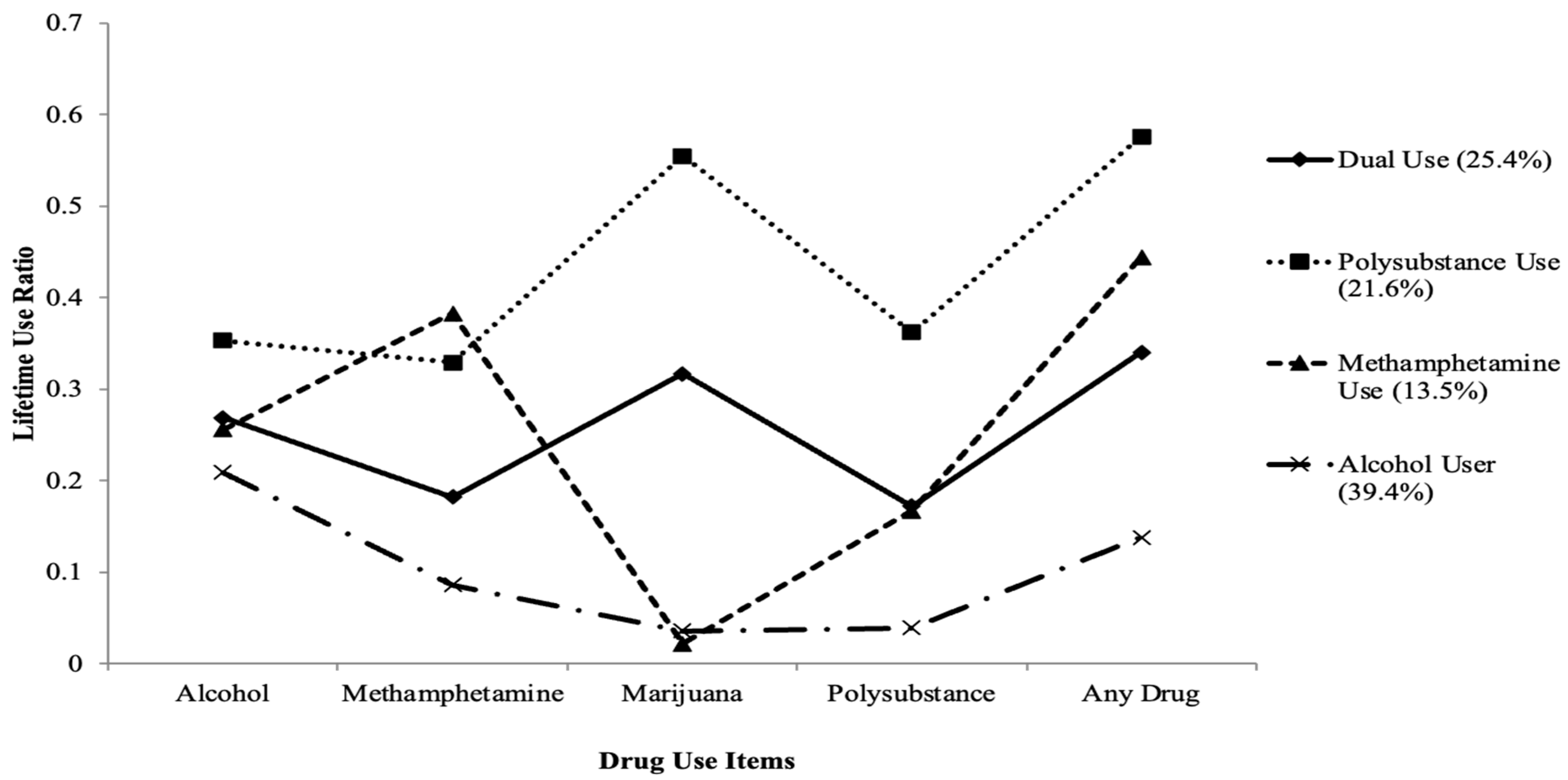
3.2. Substance Use Latent Profile Analysis
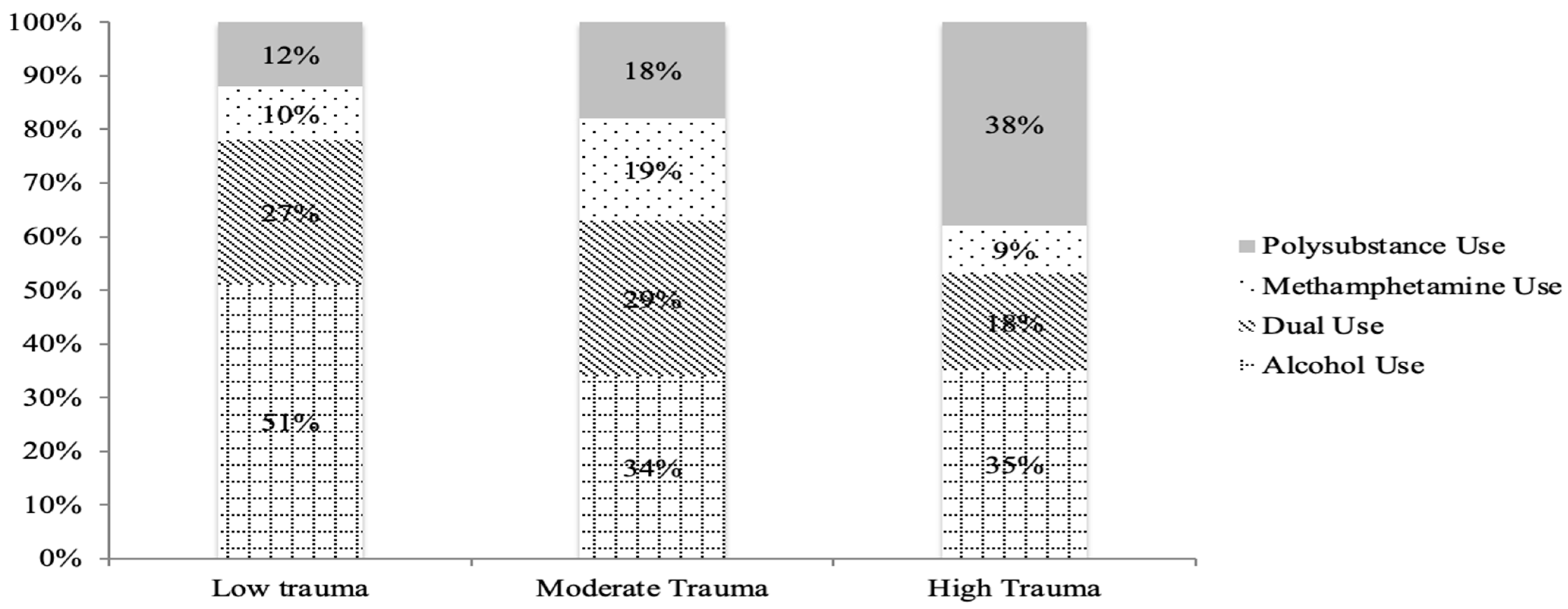
3.3. Co-Occurring Model
3.4. Column Proportions
4. Discussion
4.1. Limitations
4.2. Clinical Applications
Funding
Institutional Review Board Statement
Informed Consent Statement
Data Availability Statement
Conflicts of Interest
References
- Substance Abuse and Mental Health Services. Administration Key Substance Use and Mental Health Indicators in the United States: Results from the 2023 National Survey on Drug Use and Health; NSDUH Series H-59; Center for Behavioral Health Statistics and Quality, Substance Abuse and Mental Health Services Administration: Rockville, MD, USA, 2024.
- Flynn, P.M.; Brown, B.S. Co-Occurring Disorders in Substance Abuse Treatment: Issues and Prospects. J. Subst. Abus. Treat. 2008, 34, 36–47. [Google Scholar] [CrossRef] [Scilit]
- Hakobyan, S.; Vazirian, S.; Lee-Cheong, S.; Krausz, M.; Honer, W.G.; Schutz, C.G. Concurrent Disorder Management Guidelines. Systematic Review. J. Clin. Med. 2020, 9, 2406. [Google Scholar] [CrossRef] [Scilit]
- Choi, S.; Adams, S.M.; MacMaster, S.A.; Seiters, J. Predictors of Residential Treatment Retention among Individuals with Co-Occurring Substance Abuse and Mental Health Disorders. J. Psychoact. Drugs 2013, 45, 122–131. [Google Scholar] [CrossRef] [Scilit] [PubMed]
- Pew Charitable Trusts. More than 1 in 9 Adults with Co-Occurring Mental Illness and Substance Use Disorders Are Arrested Annually; Pew Charitable Trusts: Washington, DC, USA, 2023. [Google Scholar]
- Baranyi, G.; Fazel, S.; Langerfeldt, S.D.; Mundt, A.P. The Prevalence of Comorbid Serious Mental Illnesses and Substance Use Disorders in Prison Populations: A Systematic Review and Meta-Analysis. Lancet Public Health 2022, 7, e557–e568. [Google Scholar] [CrossRef] [Scilit] [PubMed]
- Yule, A. Integrating Treatment for Co-Occurring Mental Health Conditions. Alcohol Res. Curr. Rev. 2019, 40, 61–73. [Google Scholar] [CrossRef] [Scilit]
- Farrugia, P.L.; Mills, K.L.; Barrett, E.; Back, S.E.; Teesson, M.; Baker, A.; Sannibale, C.; Hopwood, S.; Merz, S.; Rosenfeld, J.; et al. Childhood Trauma among Individuals with Co-Morbid Substance Use and Post-Traumatic Stress Disorder. Ment. Health Subst. Use 2011, 4, 314–326. [Google Scholar] [CrossRef] [Scilit] [PubMed]
- Najavits, L.M.; Hyman, S.M.; Ruglass, L.M.; Hien, D.A.; Read, J.P. Substance Use Disorder and Trauma. In APA Handbook of Trauma Psychology: Foundations in Knowledge; American Psychological Association: Washington, DC, USA, 2017; Volume 1, pp. 195–213. [Google Scholar] [CrossRef] [Scilit]
- Pietrzak, R.H.; Goldstein, R.B.; Southwick, S.M.; Grant, B.F. Prevalence and Axis I Comorbidity of Full and Partial Posttraumatic Stress Disorder in the United States: Results from Wave 2 of the National Epidemiologic Survey on Alcohol and Related Conditions. J. Anxiety Disord. 2011, 25, 456–465. [Google Scholar] [CrossRef] [Scilit]
- Kihas, I.; Barrett, E.L.; Teesson, M.; Touyz, S.W.; Newton, N.C.; Mills, K.L. Co-Occurring Experiences of Traumatic Events and Substance Use among Young People. Child Abus. Negl. 2024, 156, 107003. [Google Scholar] [CrossRef] [Scilit]
- Najt, P.; Fusar-Poli, P.; Brambilla, P. Co-Occurring Mental and Substance Abuse Disorders: A Review on the Potential Predictors and Clinical Outcomes. Psychiatry Res. 2011, 186, 159–164. [Google Scholar] [CrossRef] [Scilit]
- Schumm, J.A.; Gore, W.L. Simultaneous Treatment of Co-Occurring Posttraumatic Stress Disorder and Substance Use Disorder. Curr. Treat. Options Psychiatry 2016, 3, 28–36. [Google Scholar] [CrossRef] [Scilit]
- Reed, P.L.; Anthony, J.C.; Breslau, N. Incidence of Drug Problems in Young Adults Exposed to Trauma and Posttraumatic Stress Disorder. Arch. Gen. Psychiatry 2007, 64, 1435. [Google Scholar] [CrossRef] [Scilit]
- Acierno, R.; Resnick, H.; Kilpatrick, D.G.; Saunders, B.; Best, C.L. Risk Factors for Rape, Physical Assault, and Posttraumatic Stress Disorder in Women. J. Anxiety Disord. 1999, 13, 541–563. [Google Scholar] [CrossRef] [Scilit]
- Jacobsen, L.K.; Southwick, S.M.; Kosten, T.R. Substance Use Disorders in Patients With Posttraumatic Stress Disorder: A Review of the Literature. Am. J. Psychiatry 2001, 158, 1184–1190. [Google Scholar] [CrossRef] [Scilit]
- Stewart, S.H.; Conrod, P.J. Psychosocial Models of Functional Associations between Posttraumatic Stress Disorder and Substance Use Disorder. In Trauma and Substance Abuse: Causes, Consequences, and Treatment of Comorbid Disorders; Ouimette, P., Brown, P.J., Eds.; American Psychological Association: Washington, DC, USA, 2003; pp. 29–55. ISBN 978-1-55798-938-3. [Google Scholar]
- Muthén, B.O. Latent Variable Hybrids: Overview of Old and New Models. In Advances in Latent Variable Mixture Models; Hancock, G.R., Samuelsen, K.M., Eds.; Information Age Publishing, Inc: Charlotte, NC, USA, 2008; pp. 1–24. [Google Scholar]
- Nylund, K.L. Latent Transition Analysis: Modeling Extensions and an Application to Peer Victimization. Ph.D. Thesis, University of California, Los Angeles, CA, USA, 2007. [Google Scholar]
- Schmiege, S.J.; Meek, P.; Bryan, A.D.; Petersen, H. Latent Variable Mixture Modeling: A Flexible Statistical Approach for Identifying and Classifying Heterogeneity. Nurs. Res. 2012, 61, 204–212. [Google Scholar] [CrossRef] [Scilit]
- Masyn, K.E. Latent Class Analysis and Finite Mixture Modeling. In The Oxford Handbook of Quantitative Methods: Statistical Analysis; Little, T.D., Ed.; Oxford University Press: Oxford, UK, 2013; pp. 551–611. [Google Scholar]
- Cleveland, M.J.; Collins, L.M.; Lanza, S.T.; Greenberg, M.T.; Feinberg, M.E. Does Individual Risk Moderate the Effect of Contextual-Level Protective Factors? A Latent Class Analysis of Substance Use. J. Prev. Interv. Community 2010, 38, 213–228. [Google Scholar] [CrossRef] [Scilit]
- Bryant Ludden, A.; Eccles, J.S. Psychosocial, Motivational, and Contextual Profiles of Youth Reporting Different Patterns of Substance Use during Adolescence. J. Res. Adolesc. 2007, 17, 51–88. [Google Scholar] [CrossRef] [Scilit]
- Breslau, N.; Reboussin, B.A.; Anthony, J.C.; Storr, C.L. The Structure of Posttraumatic Stress Disorder: Latent Class Analysis in 2 Community Samples. Arch. Gen. Psychiatry 2005, 62, 1343. [Google Scholar] [CrossRef] [Scilit]
- Vaughn, M.G.; Freedenthal, S.; Jenson, J.M.; Howard, M.O. Psychiatric Symptoms and Substance Use Among Juvenile Offenders. Crim. Justice Behav. 2007, 34, 1296–1312. [Google Scholar] [CrossRef] [Scilit]
- Lanza, S.T.; Flaherty, B.P.; Collins, L.M. Latent Class and Latent Transition Analysis. In Handbook of Psychology; John Wiley & Sons, Inc: Hoboken, NJ, USA, 2003; pp. 663–685. [Google Scholar] [CrossRef] [Scilit]
- Briere, J. Trauma Symptom Inventory. PsycTESTS Dataset 1995, 10, 387–401. [Google Scholar] [CrossRef] [Scilit]
- Briere, J. Psychometric Review of Trauma Symptom Inventory (TSI). In Measurement of Stress, Trauma, and Adaptation; Sidran Press: Lutherville, MD, USA, 1996; pp. 381–383. [Google Scholar]
- McLellan, A.T.; Kushner, H.; Metzger, D.; Peters, R.; Smith, I.; Grissom, G.; Pettinati, H.; Argeriou, M. The Fifth Edition of the Addiction Severity Index. J. Subst. Abus. Treat. 1992, 9, 199–213. [Google Scholar] [CrossRef] [Scilit] [PubMed]
- Najavits, L.M. Seeking Safety: A Treatment Manual for PTSD and Substance Abuse; The Guilford Substance Abuse Series; Guilford: New York, NY, USA, 2002; ISBN 978-1-57230-639-4. [Google Scholar]
- Desai, R.A.; Harpaz-Rotem, I.; Najavits, L.M.; Rosenheck, R.A. Impact of the Seeking Safety Program on Clinical Outcomes Among Homeless Female Veterans With Psychiatric Disorders. Psychiatr. Serv. 2008, 59, 996–1003. [Google Scholar] [CrossRef] [PubMed]
- Sherman, A.D.F.; Balthazar, M.; Zhang, W.; Febres-Cordero, S.; Clark, K.D.; Klepper, M.; Coleman, M.; Kelly, U. Seeking Safety Intervention for Comorbid Post-traumatic Stress and Substance Use Disorder: A Meta-analysis. Brain Behav. 2023, 13, e2999. [Google Scholar] [CrossRef] [Scilit]
- National Association of Drug Court Professionals; Drug Court Standards Committee, United States; Drug Courts Program Office. Defining Drug Courts: The Key Components; U.S. Dept. of Justice, Office of Justice Programs, Drug Courts Program Office: Washington, DC, USA, 1997.
- Chou, C.; Bentler, P.M. Estimates and Tests in Structural Equation Modeling. In Structural Equation Modeling: Concepts, Issues, and Applications; Hoyle, R.H., Ed.; Sage Publications, Inc: Thousand Oaks, CA, USA; pp. 37–55.
- Curran, P.J.; West, S.G.; Finch, J.F. The Robustness of Test Statistics to Nonnormality and Specification Error in Confirmatory Factor Analysis. Psychol. Methods 1996, 1, 16–29. [Google Scholar] [CrossRef]
- Muthén, L.K.; Muthén, B.O. Mplus; Muthén & Muthén: Los Angeles, CA, USA, 2013. [Google Scholar]
- Enders, C.K. Applied Missing Data Analysis, 2nd ed.; The Guilford Press: New York, NY, USA; London, UK, 2022; ISBN 978-1-4625-4986-3. [Google Scholar]
- Nylund, K.L.; Asparouhov, T.; Muthén, B.O. Deciding on the Number of Classes in Latent Class Analysis and Growth Mixture Modeling: A Monte Carlo Simulation Study. Struct. Equ. Model. A Multidiscip. J. 2007, 14, 535–569. [Google Scholar] [CrossRef] [Scilit]
- Schwarz, G. Estimating the Dimension of a Model. Ann. Stat. 1978, 6, 461–464. [Google Scholar] [CrossRef] [Scilit]
- Celeux, G.; Soromenho, G. An Entropy Criterion for Assessing the Number of Clusters in a Mixture Model. J. Classif. 1996, 13, 195–212. [Google Scholar] [CrossRef] [Scilit]
- Cantürk, M.; Faraji, H.; Tezcan, A. The Relationship between Childhood Traumas and Crime in Male Prisoners. Anatol. J. Psychiatry 2021, 22, 56–60. [Google Scholar] [CrossRef] [Scilit] [PubMed]
- Reavis, J.A.; Looman, J.; Franco, K.A.; Rojas, B. Adverse Childhood Experiences and Adult Criminality: How Long Must We Live before We Possess Our Own Lives? Perm. J. 2013, 17, 44–48. [Google Scholar] [CrossRef] [Scilit]
- Jäggi, L.J.; Mezuk, B.; Watkins, D.C.; Jackson, J.S. The Relationship between Trauma, Arrest, and Incarceration History among Black Americans. Soc. Ment. Health 2016, 6, 187–206. [Google Scholar] [CrossRef] [Scilit]
- Gillece, J.B. Understanding the Effects of Trauma on the Lives of Offenders. Correct. Today 2009, 71, 48. [Google Scholar]
- Baranyi, G.; Cassidy, M.; Fazel, S.; Priebe, S.; Mundt, A.P. Prevalence of Posttraumatic Stress Disorder in Prisoners. Epidemiol. Rev. 2018, 40, 134–145. [Google Scholar] [CrossRef] [Scilit]
- National Institute on Drug Abuse. Drug Facts: Criminal Justice; U.S. Department of Health and Human Services: Washington, DC, USA, 2020.
- Fearn, N.E.; Vaughn, M.G.; Nelson, E.J.; Salas-Wright, C.P.; DeLisi, M.; Qian, Z. Trends and Correlates of Substance Use Disorders among Probationers and Parolees in the United States 2002–2014. Drug Alcohol Depend. 2016, 167, 128–139. [Google Scholar] [CrossRef] [Scilit] [PubMed]
- Najavits, L.M.; Griffin, M.L.; Luborsky, L.; Frank, A.; Weiss, R.D.; Liese, B.S.; Thompson, H.; Nakayama, E.; Siqueland, L.; Daley, D.; et al. Therapists’ Emotional Reactions to Substance Abusers: A New Questionnaire and Initial Findings. Psychother. Theory Res. Pract. Train. 1995, 32, 669–677. [Google Scholar] [CrossRef] [Scilit]
- Flanagan, J.C.; Korte, K.J.; Killeen, T.K.; Back, S.E. Concurrent Treatment of Substance Use and PTSD. Curr. Psychiatry Rep. 2016, 18, 70. [Google Scholar] [CrossRef] [Scilit]
- Wolf, E.J.; Harrington, K.M.; Clark, S.L.; Miller, M.W. Sample Size Requirements for Structural Equation Models. Educ. Psychol. Meas. 2013, 73, 913–934. [Google Scholar] [CrossRef] [Scilit] [PubMed]
- Muthén, L.K.; Muthén, B.O. How to Use a Monte Carlo Study to Decide on Sample Size and Determine Power. Struct. Equ. Model. 2002, 9, 599–620. [Google Scholar] [CrossRef] [Scilit]
- Substance Abuse and Mental Health Services Administration. Key Substance Use and Mental Health Indicators in the United States: Results from the 2018 National Survey on Drug Use and Health; NSDUH Series H-54; Center for Behavioral Health Statistics and Quality, Substance Abuse and Mental Health Services Administration: Rockville, MD, USA, 2019.
- IEEE. CDC 2019 Welcome from the President of the IEEE Control Systems Society; IEEE: New York, NY, USA, 2019; pp. 3–6. [Google Scholar]
- Buttorff, C.; Ruder, T.; Bauman, M. Multiple Chronic Conditions in the United States; Rand: Santa Monica, CA, USA, 2017; Volume 10. [Google Scholar]
- Kessler, R. Comorbidity of Unipolar and Bipolar Depression with Other Psychiatric Disorders in a General Population Survey. In Comorbidity in Affective Disorders; Tohen, M., Ed.; Marcel Dekker Inc.: New York, NY, USA, 1999; pp. 1–25. [Google Scholar]
- Saha, S.; Lim, C.C.W.; Cannon, D.L.; Burton, L.; Bremner, M.; Cosgrove, P.; Huo, Y.; McGrath, J. Co-morbidity between Mood and Anxiety Disorders: A Systematic Review and Meta-analysis. Depress. Anxiety 2020, 38, 286–306. [Google Scholar] [CrossRef] [Scilit] [PubMed]
- Koskinen, M.; Salmi, J.K.; Loukola, A.; Mäkelä, M.J.; Sinisalo, J.; Carpén, O.; Renkonen, R. Data-Driven Comorbidity Analysis of 100 Common Disorders Reveals Patient Subgroups with Differing Mortality Risks and Laboratory Correlates. Sci. Rep. 2022, 12, 18492. [Google Scholar] [CrossRef] [Scilit]
- Unick, G.J.; Snowden, L.; Hastings, J. Heterogeneity in Comorbidity Between Major Depressive Disorder and Generalized Anxiety Disorder and Its Clinical Consequences. J. Nerv. Ment. Dis. 2009, 197, 215–224. [Google Scholar] [CrossRef] [Scilit]



| 1 | 2 | 3 | 4 | 5 | 6 | 7 | 8 | 9 | 10 | 11 | |
|---|---|---|---|---|---|---|---|---|---|---|---|
| 1. Graduation | __ | −0.21 ** | −0.20 ** | −0.24 ** | −0.17 ** | −0.17 * | −0.24 ** | −0.13 * | −0.20 | −0.19 ** | −0.26 ** |
| 2. Anxious Avoidant | __ | 0.74 ** | 0.71 ** | 0.78 ** | 0.61 ** | 0.16 * | 0.16 * | 0.04 | 0.14 * | 0.18 ** | |
| 3. Depression | __ | 0.67 ** | 0.69 ** | 0.59 ** | 0.15 ** | 0.17 ** | 0.03 | 0.12 * | 0.14 ** | ||
| 4. Intrusive Experience | __ | 0.77 ** | 0.56 ** | 0.21 ** | 0.16 ** | 0.08 | 0.22 ** | 0.21 ** | |||
| 5. Disassociation | __ | 0.62 ** | 0.17 ** | 0.16 ** | 0.06 | 0.21 ** | 0.22 ** | ||||
| 6. Tension Reduction Behaviors | __ | 0.18 ** | 0.11 | 0.04 | 0.15 ** | 0.17 ** | |||||
| 7. Year Using any Drugs | __ | 0.21 ** | 0.62 ** | 0.72 ** | 0.60 ** | ||||||
| 8. Years Using Alcohol | __ | 0.04 | 0.21 ** | 0.40 ** | |||||||
| 9. Years Using Methamphetamines | __ | 0.27 ** | 0.41 ** | ||||||||
| 10. Years Using Marijuana | __ | 0.58 ** | |||||||||
| 11. Years Using Polysubstances | __ | ||||||||||
| M | 0.56 | 55.93 | 56.33 | 58.22 | 57.14 | 58.47 | 0.34 | 0.27 | 0.20 | 0.22 | 0.16 |
| SD | 0.50 | 11.00 | 11.00 | 12.11 | 13.22 | 13.47 | 0.19 | 0.23 | 0.19 | 0.23 | 0.19 |
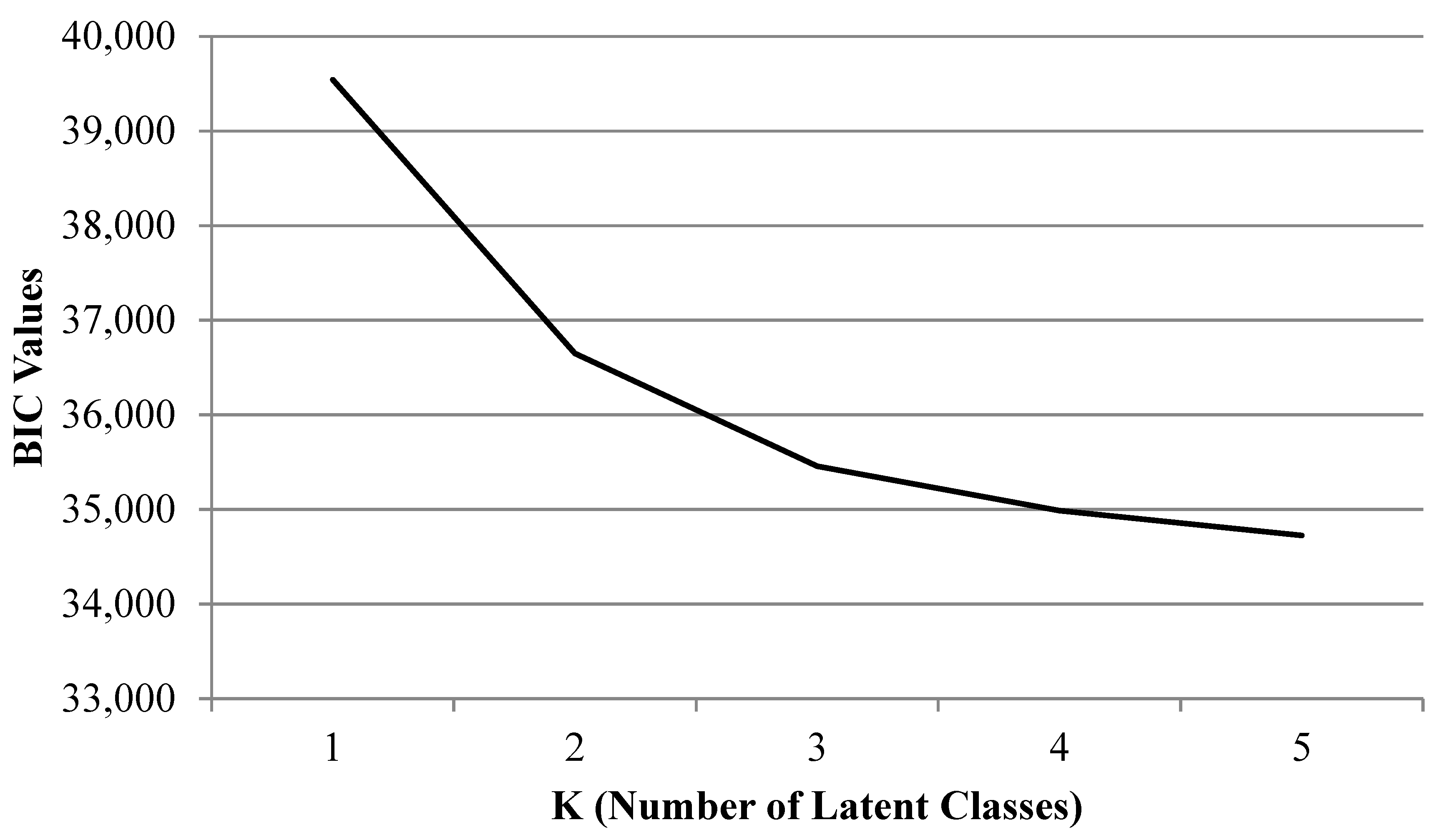
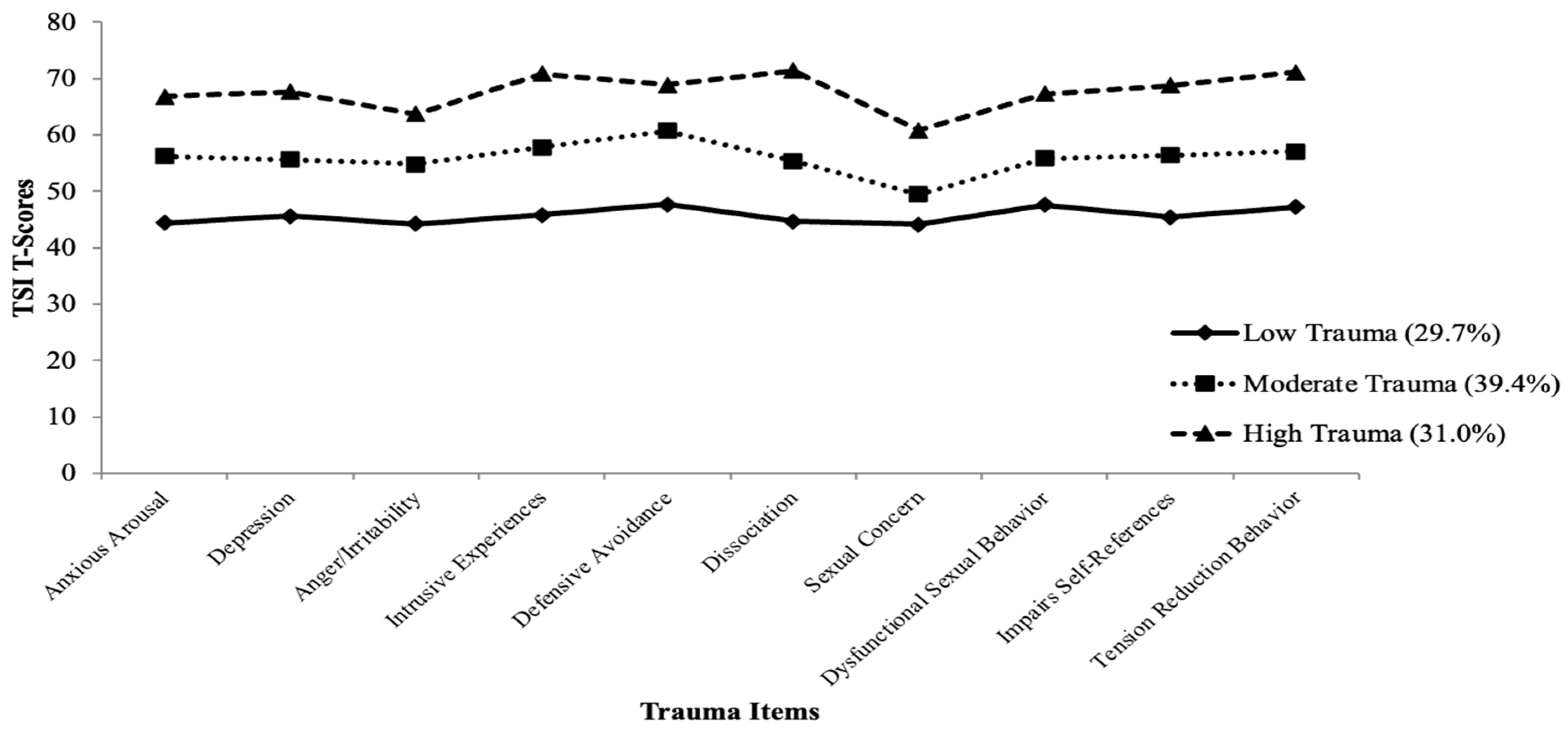
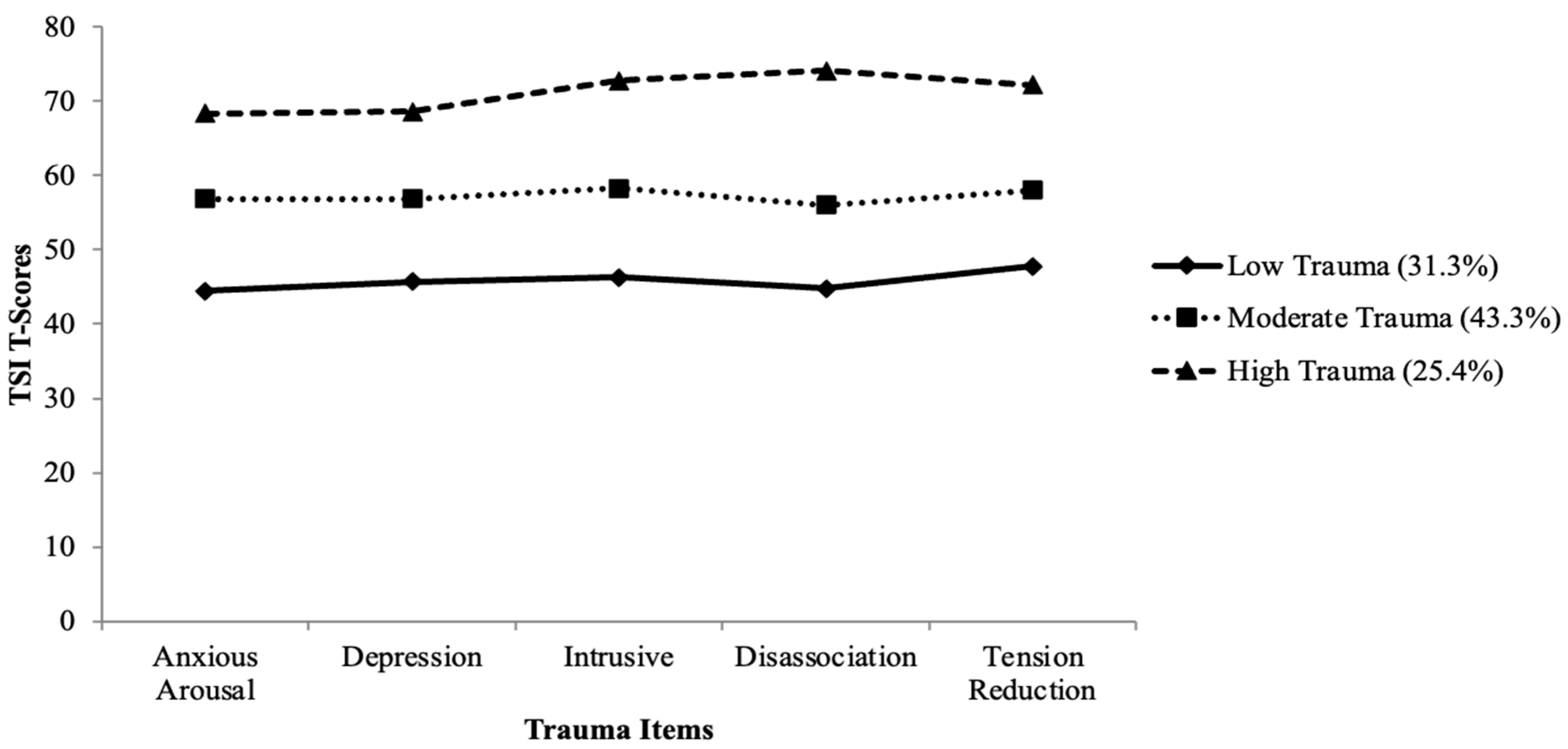
| Classes | Log Likelihood | BIC | ABIC | LMR p-Value | BLRT p-Value | Entropy |
|---|---|---|---|---|---|---|
| 1 | −19,681.69 | 39,541.67 | 39,446.48 | |||
| 2 | −18,187.89 | 36,649.16 | 36,503.21 | 0.01 | 0.01 | 0.95 |
| 3 | −17,544.27 | 35,456.99 | 35,212.53 | 0 | 0 | 0.96 |
| 4 | −17,261.74 | 34,987.01 | 34,739.53 | 0.70 | 0.70 | 0.97 |
| 5 | −17,083.70 | 34,726.03 | 34,427.78 | 0.16 | 0.16 | 0.96 |
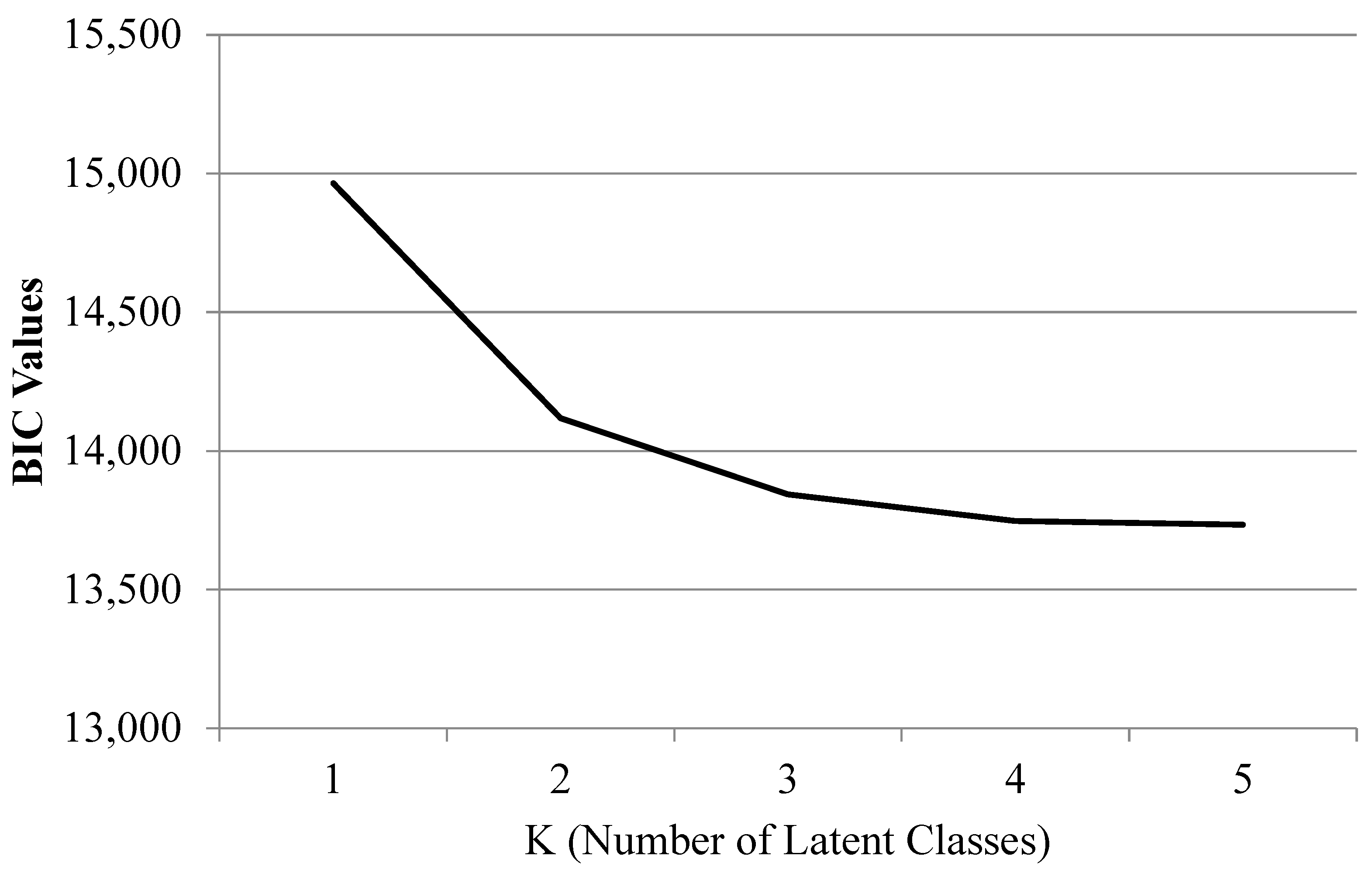
| Classes | Log Likelihood | BIC | ABIC | LMR p-Value | BLRT p-Value | Entropy |
|---|---|---|---|---|---|---|
| 1 | −7452.81 | 14,965.05 | 14,933.32 | |||
| 2 | −7011.22 | 14,117.52 | 14,066.75 | 0 | 0 | 0.88 |
| 3 | −6856.29 | 13,843.32 | 13,773.52 | <0.01 | 0 | 0.86 |
| 4 | −6790.20 | 13,746.80 | 13,657.96 | <0.01 | 0 | 0.86 |
| 5 | −6766.20 | 13,734.45 | 13,626.56 | 0.30 | 0 | 0.82 |
| Classes | Log Likelihood | BIC | ABIC | LMR p-Value | BLRT p-Value | Entropy |
|---|---|---|---|---|---|---|
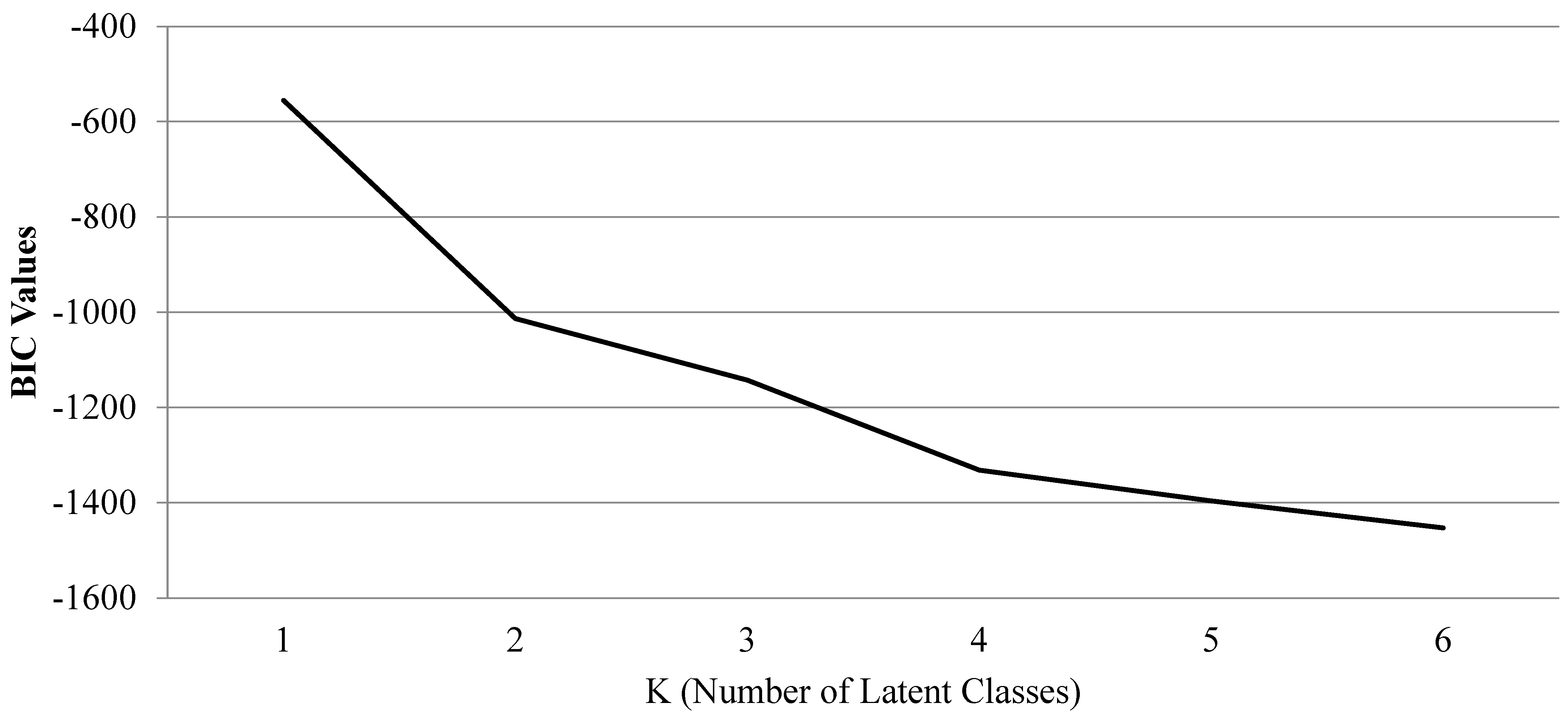
| 1 | 307.36 | −555.31 | −587.04 | |||
| 2 | 554.15 | −1013.26 | −1064.02 | 0.00 | 0 | 0.86 |
| 3 | 636.68 | −1142.67 | −1212.47 | <0.01 | 0 | 0.81 |
| 4 | 748.99 | −1331.65 | −1420.49 | 0 | 0 | 0.90 |
| 5 | 799.09 | −1396.21 | −1504.09 | 0.07 | 0 | 0.90 |
| 6 | 845.16 | −1452.71 | −1579.62 | 0.06 | 0 | 0.92 |
| Alcohol Use | Dual Use | Methamphetamine Use | Polysubstance Use | |
|---|---|---|---|---|
| Minimal Trauma | 0.51 | 0.27 | 0.10 | 0.12 |
| Moderate Trauma | 0.34 | 0.29 | 0.19 | 0.18 |
| Severe Trauma | 0.35 | 0.18 | 0.09 | 0.38 |
| N | Graduated (%) | |
|---|---|---|
| 1. Minimal Trauma/Polysubstance Use | 7 | 58% |
| 2. Minimal Trauma/Alcohol Use | 71 | 91% |
| 3. Minimal Trauma/Dual Use | 16 | 57% |
| 4. Minimal Trauma/Methamphetamine Use | 3 | 33% |
| 5. Moderate Trauma/Polysubstance Use | 14 | 50% |
| 6. Moderate Trauma/Alcohol Use | 41 | 62% |
| 7. Moderate Trauma/Dual Use | 27 | 54% |
| 8. Moderate Trauma/Methamphetamine Use | 18 | 55% |
| 9. Severe Trauma/Polysubstance Use | 22 | 50% |
| 10. Severe Trauma/Alcohol Use | 21 | 62% |
| 11. Severe Trauma/Dual Use | 11 | 61% |
| 12. Severe Trauma/Methamphetamine Use | 3 | 43% |
| Observed | Expected | |
|---|---|---|
| 1. Minimal Trauma/Polysubstance Use | 7 | 7.5 |
| 2. Minimal Trauma/Alcohol Use | 71 | 48.7 |
| 3. Minimal Trauma/Dual Use | 16 | 17.5 |
| 4. Minimal Trauma/Methamphetamine Use | 3 | 5.6 |
| 5. Moderate Trauma/Polysubstance Use | 14 | 17.5 |
| 6. Moderate Trauma/Alcohol Use | 41 | 41.2 |
| 7. Moderate Trauma/Dual Use | 27 | 31.2 |
| 8. Moderate Trauma/Methamphetamine Use | 18 | 20.6 |
| 9. Severe Trauma/Polysubstance Use | 22 | 27.5 |
| 10. Severe Trauma/Alcohol Use | 21 | 21.2 |
| 11. Severe Trauma/Dual Use | 11 | 11.2 |
| 12. Severe Trauma/Methamphetamine Use | 3 | 4.4 |
Disclaimer/Publisher’s Note: The statements, opinions and data contained in all publications are solely those of the individual author(s) and contributor(s) and not of MDPI and/or the editor(s). MDPI and/or the editor(s) disclaim responsibility for any injury to people or property resulting from any ideas, methods, instructions or products referred to in the content. |
© 2026 by the author. Licensee MDPI, Basel, Switzerland. This article is an open access article distributed under the terms and conditions of the Creative Commons Attribution (CC BY) license.
Share and Cite
Llamas, J.D. Co-Occurring Model of Trauma and Substance Use: An Application of a Joint Latent Profile Framework. Sci 2026, 8, 78. https://doi.org/10.3390/sci8040078
Llamas JD. Co-Occurring Model of Trauma and Substance Use: An Application of a Joint Latent Profile Framework. Sci. 2026; 8(4):78. https://doi.org/10.3390/sci8040078
Chicago/Turabian StyleLlamas, Jasmín D. 2026. "Co-Occurring Model of Trauma and Substance Use: An Application of a Joint Latent Profile Framework" Sci 8, no. 4: 78. https://doi.org/10.3390/sci8040078
APA StyleLlamas, J. D. (2026). Co-Occurring Model of Trauma and Substance Use: An Application of a Joint Latent Profile Framework. Sci, 8(4), 78. https://doi.org/10.3390/sci8040078