
Can Semantic Methods Enhance Team Sports Tactics? A Methodology for Football with Broader Applications

 , ,
, ,  , ,
, ,  and
and
Abstract
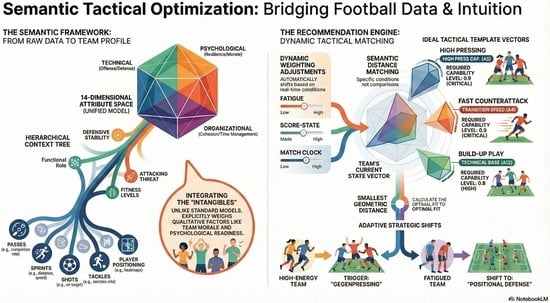
1. Introduction
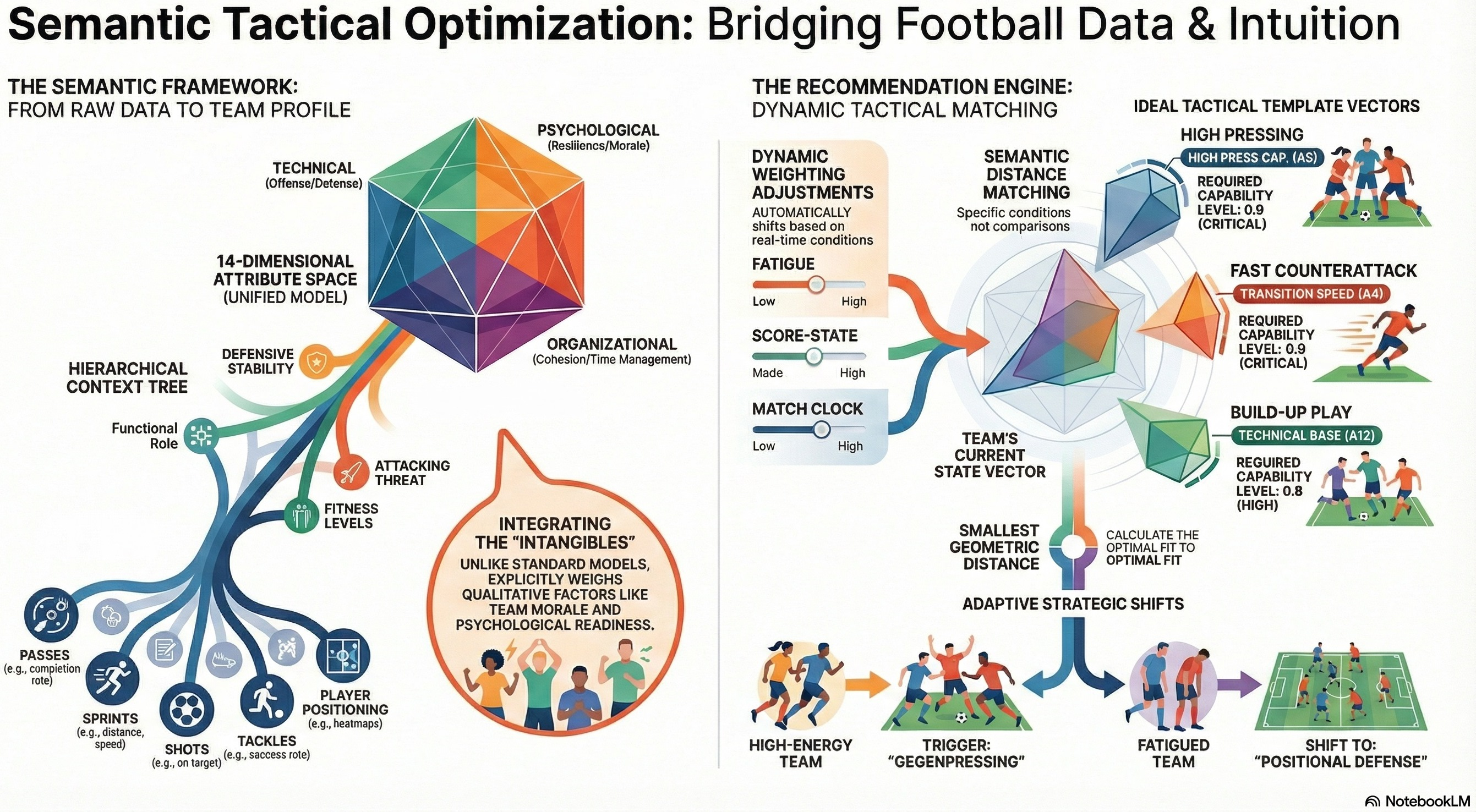
- replacing general decision categories with 14 concrete macro-attributes capturing technical, psychological, and organizational dimensions; and
- replacing general heuristics with 20 canonical football strategies (e.g., high pressing, counterattack, positional defense).
1.1. Objectives and Contributions
- 1.
- Semantic Model: 14 macro-attributes synthesizing team complexity, with 20 canonical strategies as ideal-profile vectors.
- 2.
- Adaptive Engine: Python prototype with dynamic weighting adjusting recommendations based on energy, time pressure, and opponent characteristics.
- 3.
- Systematic Validation: Evaluation through synthetic scenarios and German youth football data, including ablation and robustness analyses.
1.2. Paper Organization
2. Background and Related Work
2.1. Strategic and Tactical Analysis in Football
- 1.
- the strategic vector of the team (its current state, defined by 14 macro-attributes), and
- 2.
- the ideal tactical vector (the target profile of a given strategy, such as counterattack or high pressing).
2.2. Canonical Tactical Strategies in Modern Football
2.3. Semantic Distance Models
- Cosine similarity, which measures the angle between normalized vectors, robust to scale differences;
- Euclidean distance, which quantifies geometric deviation in continuous space;
- 1.
- structured analytical frameworks (e.g., SWOT, 6C), and
- 2.
- decision heuristics (e.g., the Thirty-Six Stratagems).
2.4. Decision Support Systems in Sports
- Athletics and individual sports—systems such as Catapult AMS or Kitman Labs monitor fatigue and workload by combining physiological and subjective data;
- Basketball and team sports—platforms like Synergy Sports and Second Spectrum merge positional tracking with video analytics to identify offensive and defensive patterns [23];
- Cycling and endurance disciplines—predictive tools such as Performance Management Charts use power and heart-rate data to optimize training loads.
3. Methodology
3.1. Theoretical Framework
- 1.
- Multidimensional integration of quantitative (individual and collective performance) and qualitative (morale, cohesion, psychological resilience) factors.
- 2.
- Semantic formalization via normalized vectors in a common space, enabling consistent comparisons between teams and tactics.
- 3.
- Dynamic adaptability through real-time reweighting of distances using match conditions.
3.2. Context Tree and Aggregation
- 1.
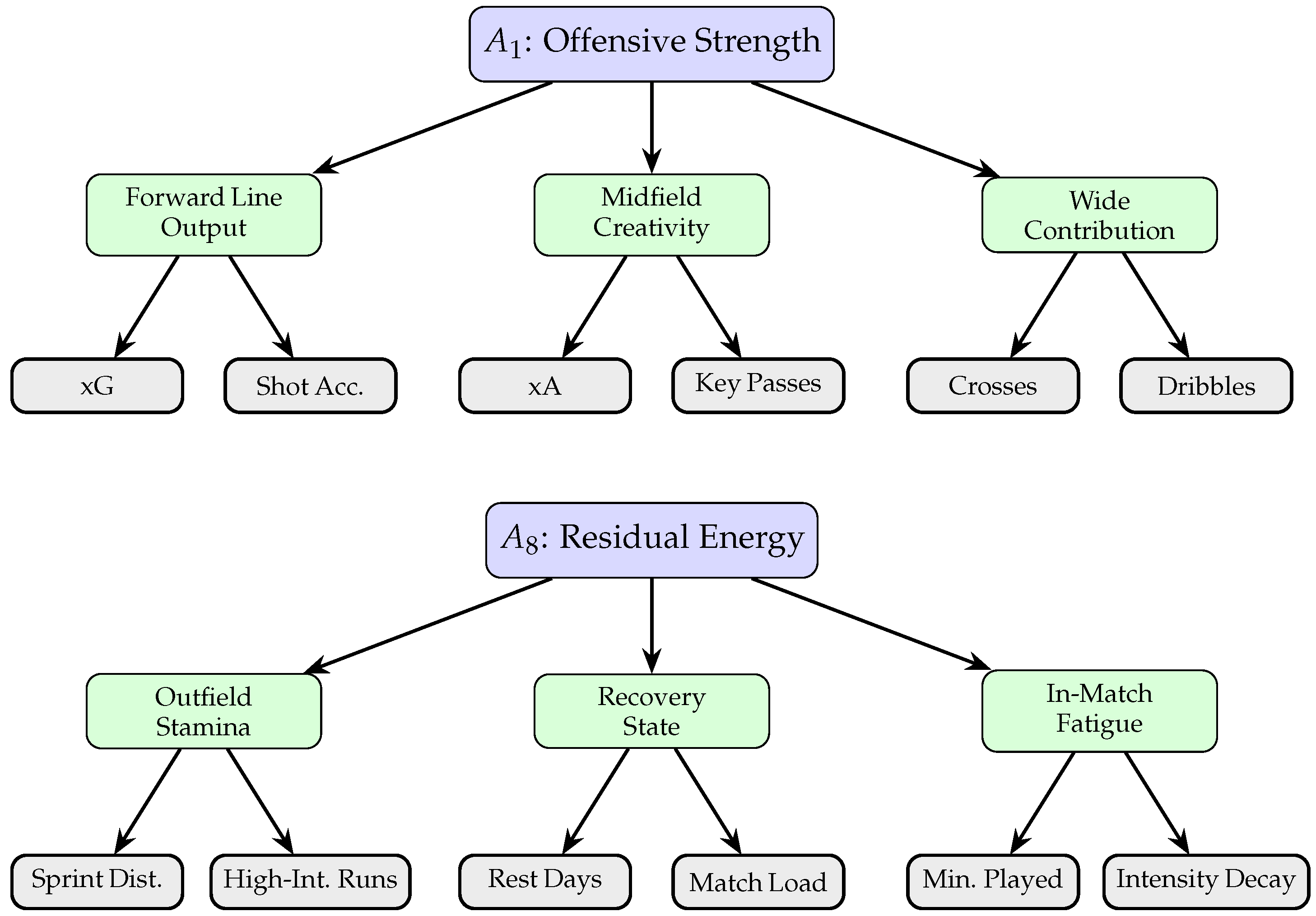
- Leaf level: Raw observables from match analytics—player-level metrics from event data (passes, shots, tackles), tracking data (sprint distance, positioning), and physiological monitoring (heart rate, estimated fatigue).
- 2.
- Intermediate level: Role-aggregated attributes computed by combining leaf-level data within positional groups (e.g., “forward line offensive output,” “midfield ball retention”).
- 3.
- Root level: The 14 macro-attributes () that define the shared semantic space, computed by a weighted combination of intermediate-level signals.
3.2.1. Aggregation Example
- 1.
- Leaf level: Extract per-player metrics—e.g., Striker A: xG , shot accuracy ; Winger B: xA , successful dribbles .
- 2.
- Intermediate level: Aggregate within positional groups using role-based weights:
- 3.
- Root level: Combine intermediate values into the macro-attribute:
3.2.2. Normalization Procedure
- League-level benchmarks (default): For professional deployments, benchmarks are derived from all players in the same league and division (e.g., Bundesliga, Serie A) over the reference window. This ensures that a normalized value of 0.5 represents league-average performance.
- Competition-level benchmarks: For tournament contexts (e.g., Champions League, World Cup), benchmarks may be computed across all participating teams to reflect the elevated baseline.
- Historical team benchmarks: For longitudinal tracking of a single team, benchmarks may be derived from that team’s own historical range, enabling detection of relative improvement or decline.
- Season window (default): The most recent complete season (e.g., 34–38 matches for major European leagues). This captures stable population characteristics while remaining current.
- Rolling window: For mid-season deployment, a rolling window of the most recent league matches provides more responsive benchmarks, updated weekly.
- Fixed historical window: For retrospective analysis or cross-season comparison, a fixed reference period (e.g., 2022–23 season) ensures consistent scaling.
- 1.
- Pre-normalization clipping: Raw values outside are clipped to the boundary values before applying Equation (1). This prevents exceptional performances (positive or negative) from distorting the scale.
- 2.
- Robust benchmark estimation: Benchmarks may optionally use the 5th and 95th percentiles rather than true min/max to reduce sensitivity to extreme outliers:where is the reference population distribution.
- 3.
- Floor for near-zero ranges: If (indicating near-constant values), the attribute is assigned the default value 0.5 to avoid division instability.
- 1.
- Temporal ordering: Benchmarks for match t are computed from data up to match only. Future match data are never included in benchmark computation.
- 2.
- Held-out validation: When evaluating DSS performance over a test period, benchmarks are frozen at values computed from a prior training period. No benchmark updates occur during the test window.
- 3.
- Same-match exclusion: When computing benchmarks, the current match’s data are excluded to prevent self-referential scaling.
3.2.3. Data Sources
- Event data (e.g., Opta, StatsBomb): passes, shots, tackles, interceptions → technical/tactical attributes (–), tactical cohesion (), technical base ()
- Tracking data (e.g., SkillCorner, Second Spectrum): positions, velocities, distances → transition speed (), residual energy (), physical base ()
- Physiological monitoring (e.g., Catapult, Polar): heart rate, workload → residual energy ()
- Qualitative assessments: coach ratings, historical stability → psychological attributes (, ), organizational attributes (, )
3.2.4. Measurement Framework
- Tier 1 (High reliability): Event data from professional providers (Opta, StatsBomb)—validated, near-complete, low latency. Assigned confidence weight .
- Tier 2 (Medium reliability): Tracking data (SkillCorner, Second Spectrum)—high precision but potential occlusion gaps; physiological monitoring (Catapult, Polar)—device-dependent accuracy. Assigned .
- Tier 3 (Lower reliability): Qualitative assessments (coach ratings, historical proxies)—subjective, infrequently updated. Assigned .
- 1.
- Imputation from correlated sources: If a higher-tier source for the same attribute exists, use it with adjusted confidence. For example, if physiological data are missing, estimate from tracking-derived distance covered.
- 2.
- Historical baseline: If no current-match data exist, use the team’s season average for that attribute, flagged with reduced confidence ().
- 3.
- Neutral default: If no historical data exist, assign the attribute the midpoint value (0.5) with minimal confidence (), ensuring the attribute contributes little to distance until better data arrive.
- Match phase granularity: Attributes are computed per phase (first half, second half) or per 15-min window for finer resolution.
- Windowed aggregation: High-frequency tracking data are averaged over the alignment window; event data are accumulated.
- Carry-forward for episodic inputs: Qualitative assessments persist until updated (e.g., halftime morale rating carries into second half unless revised).
- Player-level attributes outside (based on role-specific distributions) are flagged and clamped to boundary values.
- Implausible physiological readings (e.g., heart rate < 40 or >220) are discarded and imputed from recent history.
- Event data with missing location or timestamp fields are excluded from spatial aggregations but retained for count-based metrics.
3.3. A Shared Semantic Space: 14 Macro-Attributes
- 1.
- Team state encoding: Describe a team’s contextual state at time t as a vector .
- 2.
- Strategy profiling: Encode the ideal requirements of a tactical strategy as .
- 3.
- Semantic matching: Compute distance to identify the best-aligned tactic.
3.3.1. Complete Attribute Set
3.3.2. Design Rationale
- 1.
- Completeness: The set covers the major dimensions of team performance identified in sports science literature: technical skill, tactical capability, physical capacity, psychological state, and organizational coherence.
- 2.
- Orthogonality: Attributes were selected to minimize redundancy. For example, (Offensive Strength) captures goal-scoring capability, while (Technical Base) captures underlying skill level—a team may have high technical quality but poor offensive output due to tactical misalignment.
- 3.
- Measurability: Each attribute can be estimated from available data sources: event data for –, , ; tracking data for , , ; physiological monitoring for ; and qualitative assessment for , , .
- 4.
- Tactical relevance: Each attribute has clear implications for strategy selection. For instance, low (energy) constrains high-pressing options; high (transition speed) enables counterattacking; strong (cohesion) supports complex positional play.
3.3.3. Attribute Categories
- Technical/Tactical (–): On-field performance capabilities—what the team can do.
- Psychological/Physical (–, –): Individual and collective resources—what the team can sustain.
- Organizational (, , ): Coordination and adaptation capabilities—how the team functions as a unit.
3.3.4. Aggregation Functions
3.3.5. Dynamic vs. Static Attributes
- Dynamic: (Psychological Resilience), (Residual Energy), (Team Morale)—vary significantly during a match based on events and fatigue.
- Static: –, , –—determined by squad composition; stable within a match.
- Context-dependent: (Transition Speed), (High Press Capability), (Time Management), (Tactical Cohesion)—baseline is static but effective value depends on match context (e.g., is constrained by ; becomes critical late in matches).
3.3.6. Construct Validity: Input Overlap and Multicollinearity
- (Psychological Resilience) and (Team Morale) both aggregate resilience and aggression with similar weights (0.7/0.3 vs. 0.6/0.4).
- (Residual Energy) uses stamina and resilience, sharing the latter with and .
- (Midfield Control) and (Width Utilization) both aggregate xA from fullbacks and central midfielders.
3.3.7. Implications for Distance Computation
3.3.8. Design Justification
- 1.
- Conceptual distinctness: In sports psychology, resilience (ability to recover from setbacks) and morale (current motivational state) are treated as related but distinct constructs [25]. A team may have high baseline resilience yet low in-match morale due to recent conceded goals. Similarly, midfield control (tempo dictation) and width utilization (flank exploitation) represent tactically distinct capabilities that happen to draw on overlapping personnel.
- 2.
- Strategy vector differentiation: Tactical templates assign different weights to these correlated attributes. For example, “High Press” requires high but is neutral on , while “Cautious Horizontal Play” prioritizes (maintaining composure) over (bouncing back from pressure). The correlation at the team level does not imply identical strategic relevance.
- 3.
- Dynamic divergence: Under match conditions, and can diverge: morale () is modulated by score state and momentum, while resilience () reflects a more stable trait. The current prototype does not fully exploit this divergence, but the architectural separation enables future refinement.
3.3.9. Mitigation Strategies
- Mahalanobis distance: Replacing Euclidean with Mahalanobis distance, , would down-weight correlated dimensions automatically. However, this requires estimating the covariance matrix from representative team data, which is unavailable for the current prototype.
- Principal component projection: Projecting the 14-dimensional space onto principal components would decorrelate the axes. This sacrifices interpretability (components are linear combinations rather than named attributes) but may be appropriate for purely predictive applications.
- Attribute consolidation: Merging / into a single “Psychological State” dimension and / into “Midfield Effectiveness” would reduce redundancy but lose the conceptual granularity valued by coaching staff.
- Regularized weighting: Applying lower dynamic weights to correlated pairs (e.g., halving and ) would reduce their combined influence, approximating the effect of Mahalanobis correction.
3.3.10. Empirical Impact Assessment
- 1.
- We computed strategy rankings for 100 synthetic team profiles using standard Euclidean distance.
- 2.
- We repeated the analysis using a “consolidated” 12-attribute space where / and / were each merged into single dimensions (averaging their values).
- 3.
- We measured rank correlation (Kendall’s ) between the two ranking schemes.
3.4. Encoding Tactical Strategies as Vectors
3.4.1. Strategy Vector Definition
3.4.2. Construction Methodology
- Stage 1: Strategy Selection
- (a)
- Prevalence: Strategies commonly employed in modern professional football, as documented in tactical analysis literature and match reports.
- (b)
- Diversity: Coverage of the tactical spectrum from ultra-defensive (e.g., deep block) to ultra-offensive (e.g., high pressing), and from possession-based to direct approaches.
- (c)
- Distinctiveness: Strategies with clearly differentiated attribute profiles, ensuring meaningful separation in the semantic space.
- Offensive systems: Build-up play, direct vertical attack, systematic crossing, overlapping flanks, delayed midfielder runs
- Pressing variants: High pressing, gegenpressing, midfield pressing, inducing build-up errors
- Defensive structures: Positional defense, deep block, compact zonal defense, strict man-marking, offside trap
- Transition-based: Fast counterattack, long ball to target man
- Possession/control: Extended possession play, cautious horizontal circulation, central block with quick breaks
- Stage 2: Qualitative Mapping via Expert Elicitation
- Rater A: Academic researcher with expertise in performance analysis and tactical periodization.
- Rater B: Experienced football coach with background in youth academy and semi-professional coaching; familiar with tactical analysis workflows.
- Rater C: Practitioner with experience in match analysis and video-based tactical coding.
- 1.
- Materials: Raters received (i) definitions of all 14 macro-attributes with examples, (ii) descriptions of each strategy including typical formations, player movements, and match situations, and (iii) a rating matrix (20 strategies × 14 attributes).
- 2.
- Rating scale: For each strategy–attribute pair, raters assigned one of five qualitative levels: Irrelevant, Low, Moderate, High, or Critical.
- 3.
- Anchoring: Raters were provided with three anchor examples per attribute to calibrate interpretations (e.g., “For (High Press Capability): gegenpressing = Critical; build-up play = Low; deep block = Irrelevant”).
- 4.
- Independence: Ratings were collected via separate online forms without communication between raters.
- 5.
- Duration: Each rater completed the task in 2–3 h over multiple sessions.
- Percentage exact agreement: 58.2% of ratings were identical across all three raters; 89.6% were within one level (e.g., High vs. Critical).
- Krippendorff’s alpha: (ordinal scale), indicating substantial agreement. Values above 0.67 are conventionally acceptable for exploratory research [26].
- 1.
- Threshold for discussion: Pairs with rating spread levels (e.g., Low vs. Critical) were flagged for deliberation.
- 2.
- Reconciliation session: The three raters participated in a 90-min video conference to discuss flagged items (42 of 280 pairs, 15%). Each rater presented their reasoning; discussion continued until consensus or majority agreement was reached.
- 3.
- Averaging for minor discrepancies: For pairs with spread level, the median rating was adopted without discussion.
- 4.
- Documentation: All reconciliation decisions were logged with brief justifications (available from the corresponding author upon request).
- Stage 3: Numerical Encoding
- Non-Zero Floor Justification
- 1.
- Tactical realism: No attribute is entirely irrelevant to any football strategy. Even a purely defensive system benefits marginally from offensive capability (e.g., to relieve pressure via effective clearances); even a counterattacking approach benefits marginally from possession skills (e.g., to consolidate after a transition). The floor reflects this universal baseline relevance.
- 2.
- Geometric regularization: In the semantic space, true zeros would create degenerate subspaces where certain dimensions contribute nothing to distance computations for particular strategies. This could cause discontinuous behavior: small changes in team attributes along “irrelevant” dimensions would produce no change in distance to one strategy but non-zero changes to another. The non-zero floor ensures that all 14 dimensions contribute meaningfully to every strategy comparison, yielding smoother and more interpretable distance gradients.
- 3.
- Robustness to measurement error: Team attribute estimates are inherently uncertain. If strategy vectors contained true zeros, measurement noise in team attributes along those dimensions would be entirely ignored—potentially masking capability deficits that become relevant under match pressure. The floor provides a buffer that allows the system to detect large deviations even on “low-importance” attributes.
- Stage 4: Validation and Refinement
- Similar strategies should cluster: High Press and Gegenpressing achieved cosine similarity of 0.97; Build-up Play and Extended Possession achieved 0.94. All pairs within the same tactical category exceeded 0.85.
- Dissimilar strategies should separate: High Press vs. Positional Defense achieved cosine similarity of 0.62; Fast Counterattack vs. Cautious Horizontal achieved 0.58. Cross-category pairs averaged 0.71.
- No anomalous outliers: No strategy vector had mean similarity <0.60 to all others, confirming that all strategies occupy coherent positions in the semantic space.
- 1.
- Reviewers: Two additional practitioners with coaching experience were recruited for validation.
- 2.
- Task: Reviewers examined radar-chart visualizations of each strategy vector and rated: (i) whether the profile “looks correct” for the named strategy (Yes/Partially/No), and (ii) which attributes, if any, seemed mis-weighted.
- 3.
- Results: 17 of 20 strategies (85%) received “Yes” ratings from both reviewers. Three strategies received “Partially” from at least one reviewer:
- Offside Trap: One reviewer suggested (Tactical Cohesion) should be higher; adjusted from 0.7 to 0.8.
- Late Midfield Runners: One reviewer suggested (Transition Speed) was too high; retained after discussion as the strategy requires rapid positional shifts.
- Strict Man-Marking: Both reviewers suggested (Physical Base) should be higher; adjusted from 0.6 to 0.7.
- 4.
- Iteration: Adjusted vectors were re-reviewed and approved.
- Teams explicitly employing each strategy (identified via tactical reports) had their match-level attribute profiles computed.
- Correlation between expert-assigned strategy vectors and empirical team profiles averaged across strategies, indicating moderate alignment.
- Discrepancies were largest for psychological attributes (, ), which are not directly observable in event data, and smallest for technical attributes (–).
3.4.3. Illustrative Strategy Profiles
- Profile Interpretation
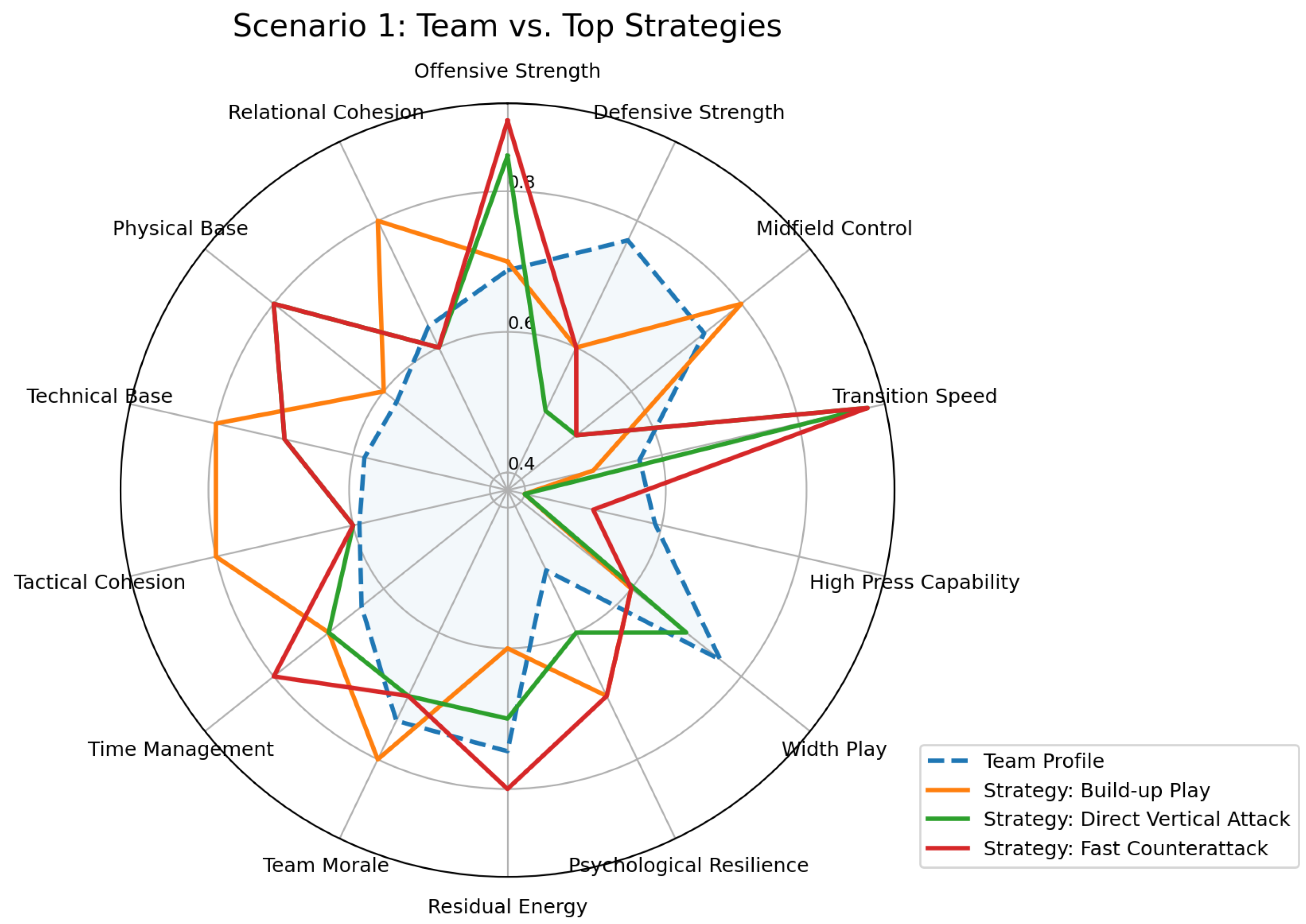
- High Pressing and Gegenpressing share elevated demands on (pressing capability), (tactical cohesion), and (physical base), reflecting their high-intensity, coordinated nature. Gegenpressing additionally requires strong (transition speed) for immediate recovery.
- Fast Counterattack peaks on (offensive strength) and (transition speed), with lower requirements for possession-related attributes (, ), consistent with its reliance on rapid vertical play rather than sustained control.
- Positional Defense inverts the pressing profile: maximal (defensive strength) and (time management), minimal and , reflecting a compact, energy-conserving approach.
- Build-up Play emphasizes , (technical base), and (tactical cohesion), with moderate physical demands—a technically demanding but physically sustainable approach.
3.4.4. Sensitivity to Vector Specification
- 1.
- Each strategy vector was perturbed by adding Gaussian noise with (representing uncertainty in attribute weights).
- 2.
- The DSS was run times per scenario with perturbed strategy vectors.
- 3.
- The proportion of runs yielding the same top-ranked strategy as the unperturbed case was recorded.
3.4.5. Sensitivity to Floor Choice
- 1.
- All 20 strategy vectors were re-encoded using the adjusted mapping.
- 2.
- The DSS was executed on each of the four primary test scenarios.
- 3.
- The top-ranked strategy and the top-3 ranking were recorded.
- Results
- Geometric Interpretation
3.4.6. Extensibility
- Modularity: New strategies can be added by specifying a 14-dimensional vector, without modifying the distance computation logic.
- Customization: Coaching staff can define club-specific tactical variants (e.g., “our high press”) by adjusting attribute weights to reflect their preferred implementation.
- Automation potential: Future extensions could generate strategy vectors automatically from natural language descriptions (e.g., tactical reports) using NLP-based embedding techniques, further reducing manual specification effort.
3.5. Semantic Distance and Matching
3.5.1. Why Euclidean over Cosine?
3.5.2. Why Not Probabilistic Metrics?
3.5.3. Baseline Formulation
3.5.4. Context-Adapted Distance
- Weights are adjusted based on real-time contextual factors:
- Residual energy (): low energy ⇒ increase (time management), decrease (pressing).
- Technical/physical gaps (): if inferior, upweight (tactical cohesion) and (defensive strength); downweight (offensive, width).
- Time pressure (): limited time ⇒ upweight (transition speed) and (offensive strength).
3.5.5. Opponent-Aware Adjustment
- First term (minimized): Measures how well our team can execute strategy S—lower is better.
- Second term (maximized via subtraction): Measures how poorly the opponent can execute S—higher opponent distance means greater difficulty for them, which benefits us.
- Net effect: Strategies are preferred when we can execute them well AND the opponent cannot.
- 1.
- Monotonicity of advantage: Greater opponent difficulty with our chosen strategy translates to competitive advantage. This holds when strategies impose demands the opponent struggles to meet (e.g., high pressing against a team with poor stamina forces errors).
- 2.
- Comparability of distances: The same distance magnitude represents equivalent “fit” for both teams. This is ensured by the common normalization protocol (Section 3.2.2), which maps all attributes to using consistent benchmarks.
- 3.
- Independence of execution: Our ability to execute a strategy is not directly affected by the opponent’s capability (though match dynamics may create indirect effects not captured here).
- Opponent capabilities are known with reasonable confidence (scouting data available).
- Attribute profiles differ substantially between teams (asymmetric matchups).
- Match stakes justify opponent-focused adaptation (knockout games, rivalry matches).
- : Attributes derived from recent match data (last 5 games) with complete coverage.
- : Attributes estimated from partial data or older matches (6–15 games ago).
- : Attributes inferred from league averages or indirect proxies.
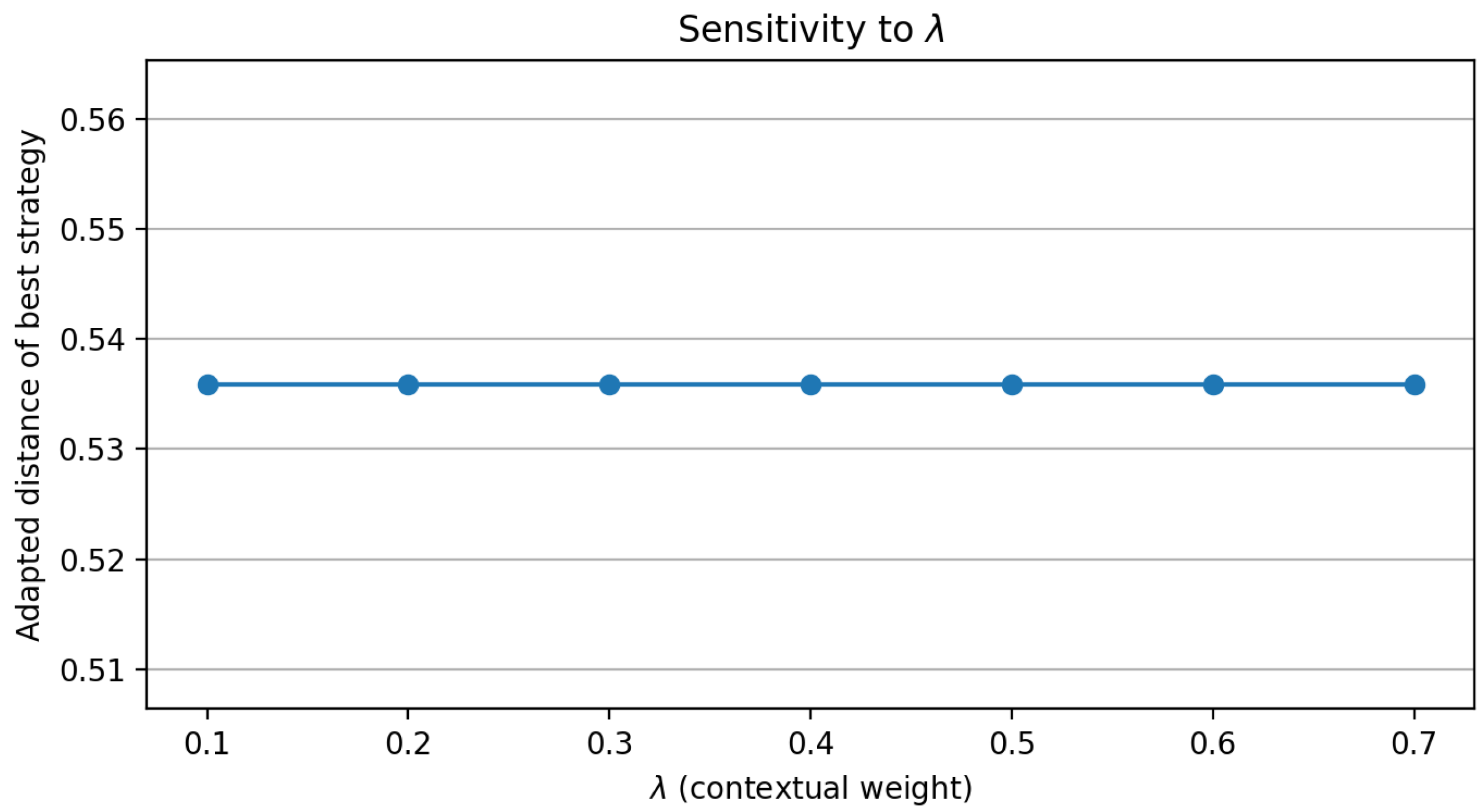
- Stability range: The top-1 recommendation remained unchanged for in all scenarios, indicating robustness to moderate parameter variation.
- Transition points: At –, one scenario (Fatigued & Inferior) shifted from “Positional Defense” to “Compact Zonal Defense”—both defensive strategies, so the qualitative recommendation (defend conservatively) was preserved.
- Rank correlation: Kendall’s between rankings at and exceeded 0.89 in all scenarios, confirming that opponent-awareness modulates rather than disrupts the ranking structure.
- Confidence intervals: The 95% CI for the distance differential (computed via bootstrap, ) indicates that top-1 vs. top-2 separation remains positive (i.e., clear winner) across the tested range.
- Default: provides meaningful opponent-awareness without excessive sensitivity.
- High-stakes matches: – when opponent data are reliable and exploitation is prioritized.
- Uncertain opponents: – when scouting data are limited or opponent behavior is unpredictable.
- Identity-focused teams: for coaches who prioritize consistent style over opponent adaptation.
3.5.6. Optimal Tactic Selection
3.5.7. Alternative Metrics for Future Work
3.5.8. Controlled Comparison: Euclidean vs. Cosine
- 1.
- Euclidean ranking: Strategies ranked by ascending .
- 2.
- Cosine ranking: Strategies ranked by descending cosine similarity .
- Overall correlation: Mean (range: 0.71–0.93), indicating substantial but imperfect agreement.
- Top-1 agreement: The same strategy was ranked first by both metrics in 73% of cases.
- Top-3 overlap: The top-3 sets shared at least 2 strategies in 91% of cases.
- Magnitude-driven divergence: Teams with uniformly low capabilities () showed the largest discrepancies. Cosine similarity favored demanding strategies (e.g., High Press, Gegenpressing) when the team’s profile shape matched, even if absolute capability levels were insufficient. Euclidean distance correctly penalized these mismatches.
- Example: A fatigued team () with otherwise balanced attributes achieved high cosine similarity (0.91) with “High Press” due to proportional alignment, but Euclidean distance correctly ranked it 14th due to the large absolute gap on and .
- Convergence at high capability: For teams with , the two metrics agreed on top-1 in 89% of cases, as magnitude differences became less decisive.
- Tactical selection (primary task): Weighted Euclidean distance (), because capability shortfalls must be penalized regardless of profile similarity.
- Strategy vector validation: Cosine similarity, to verify that semantically similar strategies cluster together (Section 3.4).
- Style classification (optional): Cosine similarity could be offered for “which team does this squad resemble?” queries, where magnitude is less relevant.
3.6. Selection Algorithm
3.6.1. Algorithm Steps
- 1.
- Context aggregation: Compute and from the respective context trees (14-dimensional vectors).
- 2.
- Gap estimation: Derive technical and physical gaps:
- 3.
- Weight construction: Build the dynamic weight vector w using the procedure in Section 3.6.2.
- 4.
- Distance computation: For each strategy i, compute:
- 5.
- Opponent adjustment (optional): If , compute combined score:
- 6.
- Ranking & selection: Sort strategies by (or ) ascending; select .
- 7.
- Diagnostics: Report per-attribute deltas to explain the recommendation.
3.6.2. Dynamic Weight Computation
- Energy-Based Adjustments
- Gap-Based Adjustments
- Time Pressure Adjustments
- Final Weight Computation
- 1.
- Clamping: Each multiplier is bounded to prevent extreme values:with and . This ensures no attribute is entirely suppressed () or dominates excessively.
- 2.
- Normalization: Weights are scaled to sum to 14 (preserving the baseline where all ):
- Input Variables for Weight Estimation
- 1.
- : Team’s current residual energy (from context tree or manual input).
- 2.
- : Team’s technical base (static, from roster data).
- 3.
- : Team’s physical base (static, from roster data).
- 4.
- : Opponent’s technical and physical bases (for gap computation).
- 5.
- : Fraction of match time remaining.
- 6.
- : Current score state (losing, drawing, winning).
- Parameter Tuning
- Calibrated to historical match data via grid search or Bayesian optimization;
- Personalized to reflect coaching philosophy (e.g., risk-averse coaches may increase );
- Learned from expert feedback through interactive refinement.
3.6.3. Pseudocode
- Complexity
- Strengths
| Algorithm 1 Tactical Strategy Selection |
| Require: Context trees , ; strategy templates ; match state Ensure: Recommended strategy , diagnostics 1: 2: 3: 4: 5: 6: for each strategy do 7: 8: if then 9: 10: 11: end if 12: end for 13: 14: 15: return , |
3.7. Evaluation Protocol
- Consistency Across Scenarios
- Contextual coherence—the recommended strategy must align with intuitive tactical reasoning under the given conditions (e.g., low energy → positional defense).
- Ranking monotonicity—when adjusting a single attribute (e.g., increasing ), the ranking of high-intensity strategies should improve predictably.
- 2.
- Robustness to Perturbations
- 3.
- Sensitivity and Explainability
- 4.
- Computational Efficiency
Summary
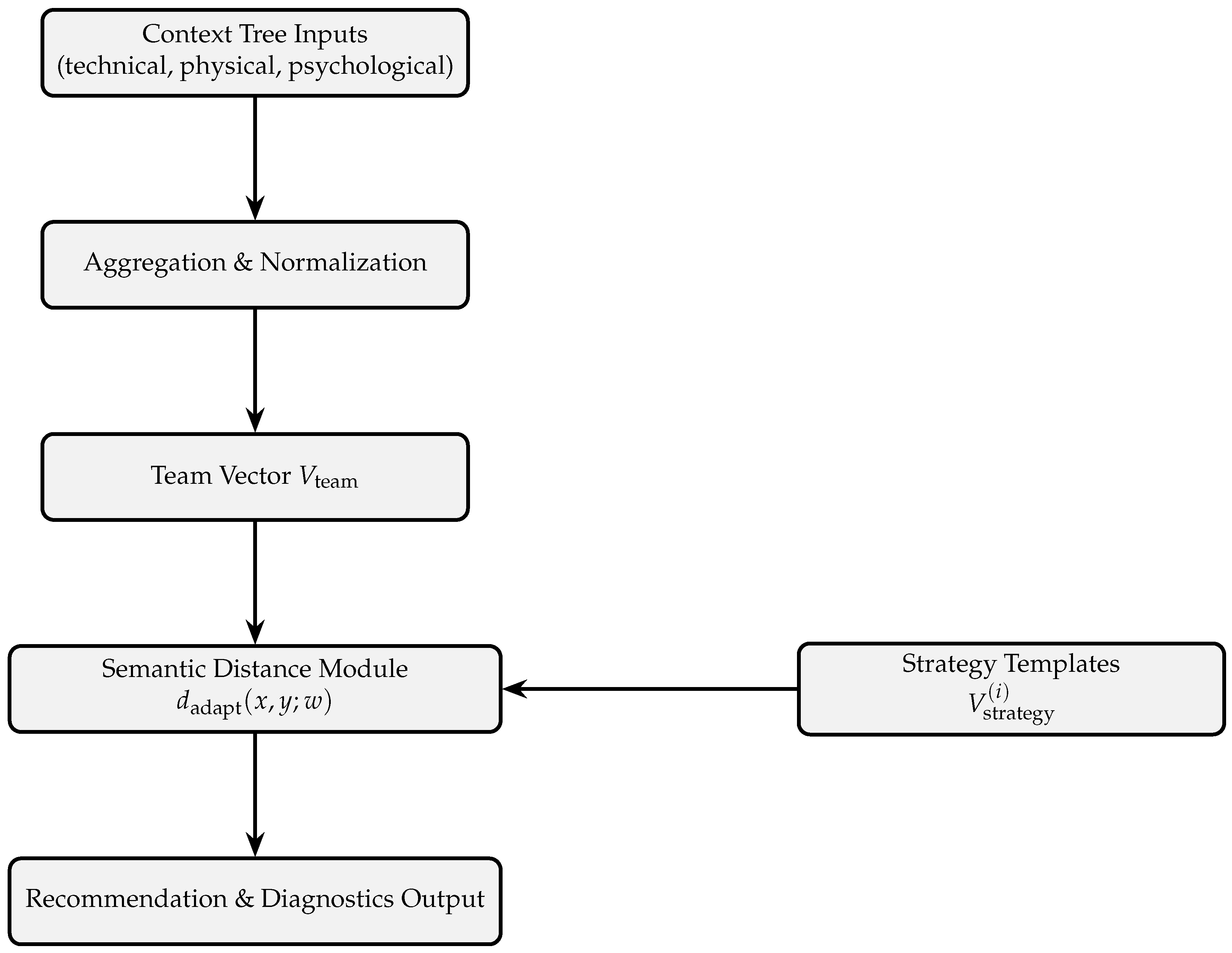
3.8. System Architecture Diagram
4. Prototype Implementation
4.1. Module Organization
- Attribute aggregation module: Computes the 14 macro-attributes from player-level data using the weighted aggregation functions specified in Section 3.2. Each macro-attribute has a dedicated function (e.g., compute_offensive_strength(), compute_residual_energy()) that applies role-based weights to relevant player metrics.
- Distance computation module: Implements the semantic distance calculations described in Section 3.5, including base Euclidean distance and the context-adapted variant with dynamic weight adjustments.
- Analysis and visualization module: Provides sensitivity analysis, robustness testing, and ablation studies as specified in the evaluation protocol (Section 3.7), with automatic generation of diagnostic plots via matplotlib.
4.2. Dynamic Adjustment Mechanism
- Implementation of Attribute-Wise Weighting
- 1.
- Initialize all multipliers for .
- 2.
- Compute context indicators from match state:
- Energy deficit:
- Technical gap:
- Physical gap:
- Time pressure:
- 3.
- Update specific multipliers using Equations (5)–(7) and the gap/time formulas.
- 4.
- Clamp multipliers to stability bounds: .
- 5.
- Normalize weights to preserve scale: .
4.3. Execution Workflow
- 1.
- Profile generation: Compute and from player-level data or scenario specifications.
- 2.
- Scenario instantiation: Parse match conditions (time, score, fatigue, morale) from input or generate via scenario templates.
- 3.
- Strategy evaluation: Compute adjusted distances for all 20 strategy templates; rank by ascending distance.
- 4.
- Diagnostic extraction: For the top-ranked strategy, compute per-attribute deltas () to identify capability gaps.
- 5.
- Output generation: Produce tabular rankings, radar charts comparing team profile to recommended strategies, and diagnostic reports.
4.4. Reproducibility
- football_strategy_generation_1_3_1.py: Core DSS implementation with all 20 strategy templates and macro-attribute aggregation functions.
- make_figures.py: Reproducible figure generation for experimental evaluation.
- compute_pilot_distances.py: Pilot validation computations (Section 6).
4.5. Extensibility
- New strategies: Adding a strategy requires only specifying a new 14-dimensional vector in the strategy_templates list.
- External data integration: The aggregation functions can be connected to live data feeds (e.g., Wyscout, StatsBomb APIs) by replacing the player data input layer.
- Custom weight profiles: Coaching staff can modify the dynamic adjustment logic to reflect club-specific tactical philosophies without altering the core distance computation.
5. Experimental Evaluation
5.1. Setup and Scenarios
5.2. Results by Scenario
5.3. Stability and Explainability Analyses
- Sensitivity to
5.3.1. Robustness to Input Noise
- Top-1 consistency: The same strategy was ranked first in 89.3% of trials (mean across scenarios; range: 82–96%).
- Top-3 stability: The top-3 strategy set was identical in 94.1% of trials.
- Distance interval width: Mean interval width (Equation (2)) was 0.08 units, or approximately 12% of typical inter-strategy distance.
5.3.2. Extended Robustness Analysis
- Physical cluster: among (pressing, energy, physical base).
- Psychological cluster: among (resilience, morale).
- Technical cluster: among (offense, midfield, technical base).
- Pattern M1 (Tracking failure): (transition speed), (energy), (physical base) missing—simulates GPS/tracking outage.
- Pattern M2 (Psychological unavailable): (resilience), (morale), (relational cohesion) missing—simulates absence of qualitative input.
- Pattern M3 (Sparse data): 6 randomly selected attributes missing per trial—simulates amateur/youth contexts with limited instrumentation.
- Pattern M1 causes moderate degradation (78.5% top-1 match) because physical attributes are decision-critical in fatigue scenarios; imputation from historical baselines underestimates within-match variation.
- Pattern M2 shows surprising resilience (85.2%) because psychological attributes, while conceptually important, have high inter-attribute correlation (–: ), so partial information suffices.
- Pattern M3 exhibits the largest drop (67.3%) but maintains 84% qualitative agreement—defined as recommending a strategy from the same tactical category (e.g., any pressing variant when full data would recommend High Press).
- Youth shift: Reduced mean capabilities by 15% (); increased variance by 30% ()—reflecting lower skill floors and higher execution variability.
- Lower-division shift: Reduced technical attributes (–, ) by 20%; physical attributes unchanged—reflecting skill gap but comparable athleticism.
- Style shift: Rotated attribute profiles to emphasize physicality over technique (; )—simulating leagues with different tactical cultures.
- Youth shift reduces agreement to 82%, primarily because the DSS over-recommends high-intensity strategies (pressing, gegenpressing) that youth teams lack the discipline to execute. Recalibrating and thresholds would address this.
- Lower-division shift shows modest degradation (88%), suggesting that the attribute framework transfers reasonably well when physical baselines are similar.
- Style shift produces the largest drop (78%), with 11 problematic recommendations—typically suggesting possession-based strategies to physically dominant teams that would benefit more from direct play. This confirms that strategy vectors encode European tactical norms and may require re-elicitation for stylistically distinct leagues.
- Ablation Study
5.4. Ablation: Attribute-Wise vs. Uniform Weighting
- 1.
- Attribute-wise (proposed): Weights computed per attribute using Equations (5)–(7) and the gap/time formulas, as specified in Section 3.6.2.
- 2.
- Uniform baseline: All weights fixed at regardless of context (equivalent to unweighted Euclidean distance).
- 3.
- Global scaling: A single scalar multiplier applied uniformly to all attribute weights based on aggregate context severity (e.g., when energy is low), simulating a “global penalty” approach.
5.4.1. Evaluation Metrics
- Tactical coherence: Whether the top-ranked strategy aligns with expert intuition (e.g., avoiding high-pressing when fatigued).
- Ranking sensitivity: The rank change of contextually inappropriate strategies (e.g., gegenpressing in low-energy scenarios).
- Diagnostic precision: Whether per-attribute deltas correctly identify the binding constraints.
5.4.2. Results
- Analysis
- Conclusions
5.5. Attribute Contribution Analysis
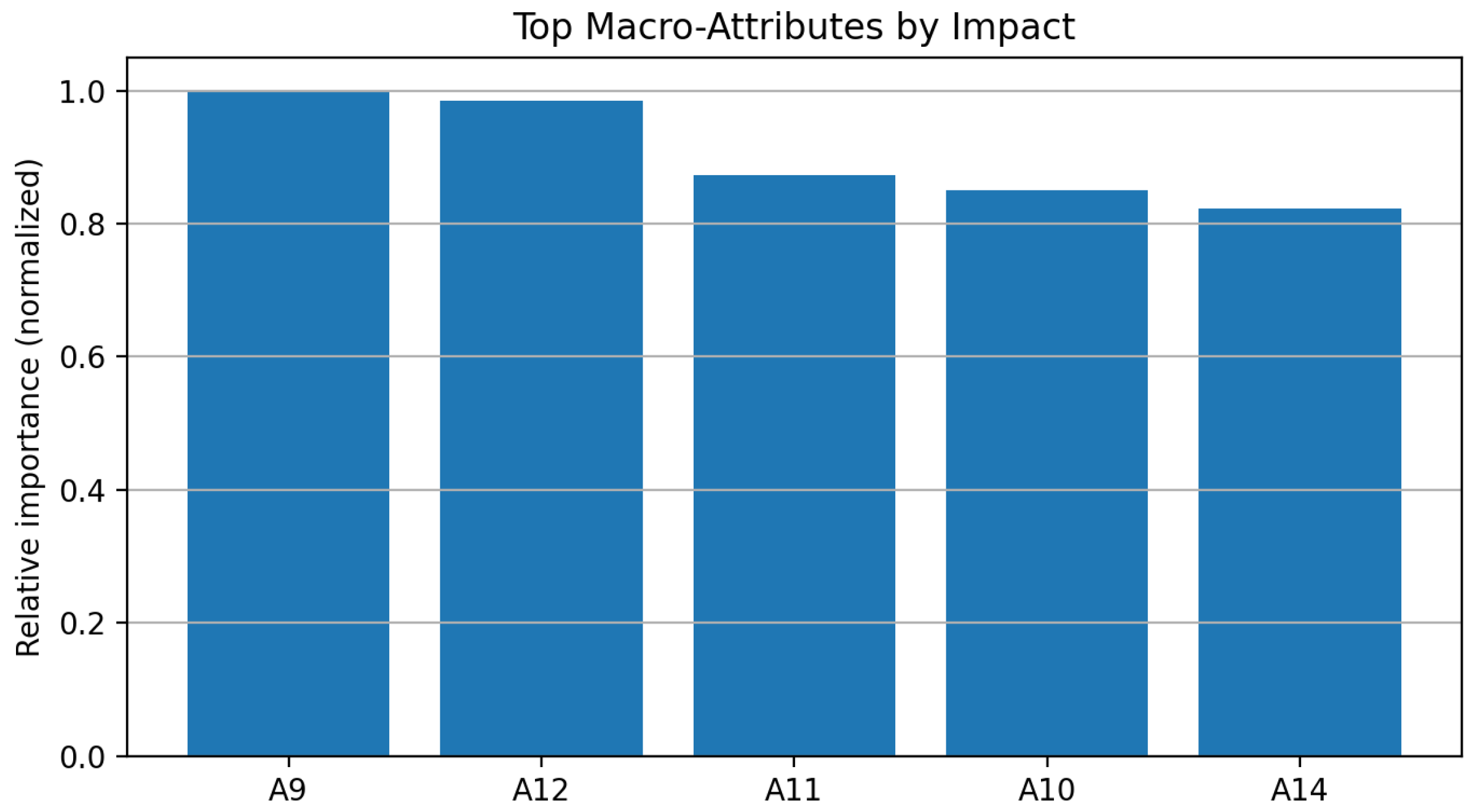
5.6. Critical Discussion
5.7. Reproducibility and Open Materials
6. From Simulation to Practice: A Pilot Case Study
6.1. Evaluation Specification
6.1.1. Evaluation Objectives and Scope
- 1.
- Primary: Assess whether the DSS can process real observational data and produce coherent recommendations (feasibility endpoint).
- 2.
- Secondary: Compare DSS recommendations against expert tactical judgment (agreement endpoint).
- 3.
- Exploratory: Examine alignment between DSS recommendations and observed tactical outcomes (descriptive analysis, not causal inference).
6.1.2. Evaluation Endpoints
- Endpoint 1: Processing Feasibility (Primary)
- Endpoint 2: Expert Agreement (Secondary)
- The team’s observed attribute profile (categorical ratings converted to numerical values).
- The match context (score, time, observable fatigue indicators).
- The DSS’s top-3 recommended strategies with diagnostic explanations.
- Endpoint 3: Tactical Alignment Analysis (Exploratory)
6.1.3. Baseline Comparators
- 1.
- Random baseline: Strategy selected uniformly at random from the 20-strategy library. Expected expert agreement rate: ∼15–20% (assuming 3–4 strategies are contextually appropriate at any time).
- 2.
- Default strategy baseline: Always recommend “Build-up Play” (the most versatile, moderate-demand strategy). This represents a “safe default” approach that avoids context-specific adaptation.
- 3.
- Energy-only heuristic: Select strategy based solely on residual energy (): if , recommend “High Press”; if , recommend “Build-up Play”; if , recommend “Positional Defense.” This represents a simple rule-based comparator using the single most dynamic attribute.
6.1.4. Data Sampling and Selection
- Dataset Identity
- Competition: C-Junioren Saarlandliga (U14/U15 regional championship)
- Season: 2023–24
- Match: SSV Pachten (home) vs. JSG Stausee-Losheim (away)
- Date: [Anonymized for player protection]
- Selection rationale: Convenience sample—match was attended by a co-author who collected observational data using a standardized protocol.
- Sampling Limitations
6.1.5. Train/Test Separation and Leakage Control
- Temporal Separation
- Information Available at Decision Time
- First-half observational data (6 attributes × 1 team)
- Pre-match contextual information (match duration, competition level)
- Fatigue projection based on standard youth-match depletion curves (not match-specific data)
- Leakage Safeguards
- 1.
- No outcome-based tuning: The final score (4:3) was not used in any DSS computation or parameter selection.
- 2.
- No iterative refinement: The recommendation was generated in a single pass; no adjustments were made after observing the result.
- 3.
- Blind expert evaluation: Expert reviewers assessed the recommendation without knowledge of the match outcome.
6.1.6. Reproducibility Configuration
- Random seed: SEED = 41 (same as synthetic experiments)
- Categorical mapping: Hoch , Mittel , Niedrig
- Fatigue projection:
- Missing attributes: Excluded from distance computation (reduced 5-dimensional space)
- Opponent modeling: Disabled () due to absence of opponent data
- Weight configuration: Default dynamic weights as specified in Section 3.6.2.
6.2. Data Source and Match Context
- Match: SSV Pachten vs. JSG Stausee-Losheim
- Final score: 4:3 (home victory)
- Match duration: 2 × 35 min
- Observation protocol: Six tactical attributes recorded per half using a three-level categorical scale (Hoch/Mittel/Niedrig, corresponding to High/Medium/Low)
6.3. Observed Attributes and Mapping Protocol
6.3.1. Localization Policy
- 1.
- Input normalization: Source attributes are mapped to the corresponding identifier using the translation table below. This mapping is applied at data ingestion, before any computation.
- 2.
- Internal representation: All internal computations use the English identifiers exclusively. The weight vector w, distance calculations, and diagnostic deltas reference –.
- 3.
- Output standardization: All figures, tables, and textual outputs use English identifiers with German source terms provided parenthetically where relevant for auditability.
- 4.
- Categorical value translation: The German three-level scale (Hoch/Mittel/Niedrig) is converted to numerical values as specified in Equation (14).
6.3.2. German–English Attribute Mapping
- Aggregation Rule for
- Unmapped Attributes
6.3.3. Categorical-to-Continuous Conversion
6.4. Match Observations
- Tactical Narrative
- 1.
- First half: The team displayed high offensive capability with strong vertical and counterattacking tendencies. Defensive organization and energy reserves were at medium levels, suggesting a balanced but attack-oriented approach.
- 2.
- Second half: While offensive intent remained high, execution quality declined (vertical attacks dropped to medium). Critically, both defensive compactness and residual energy fell to low levels, indicating fatigue-induced tactical degradation.
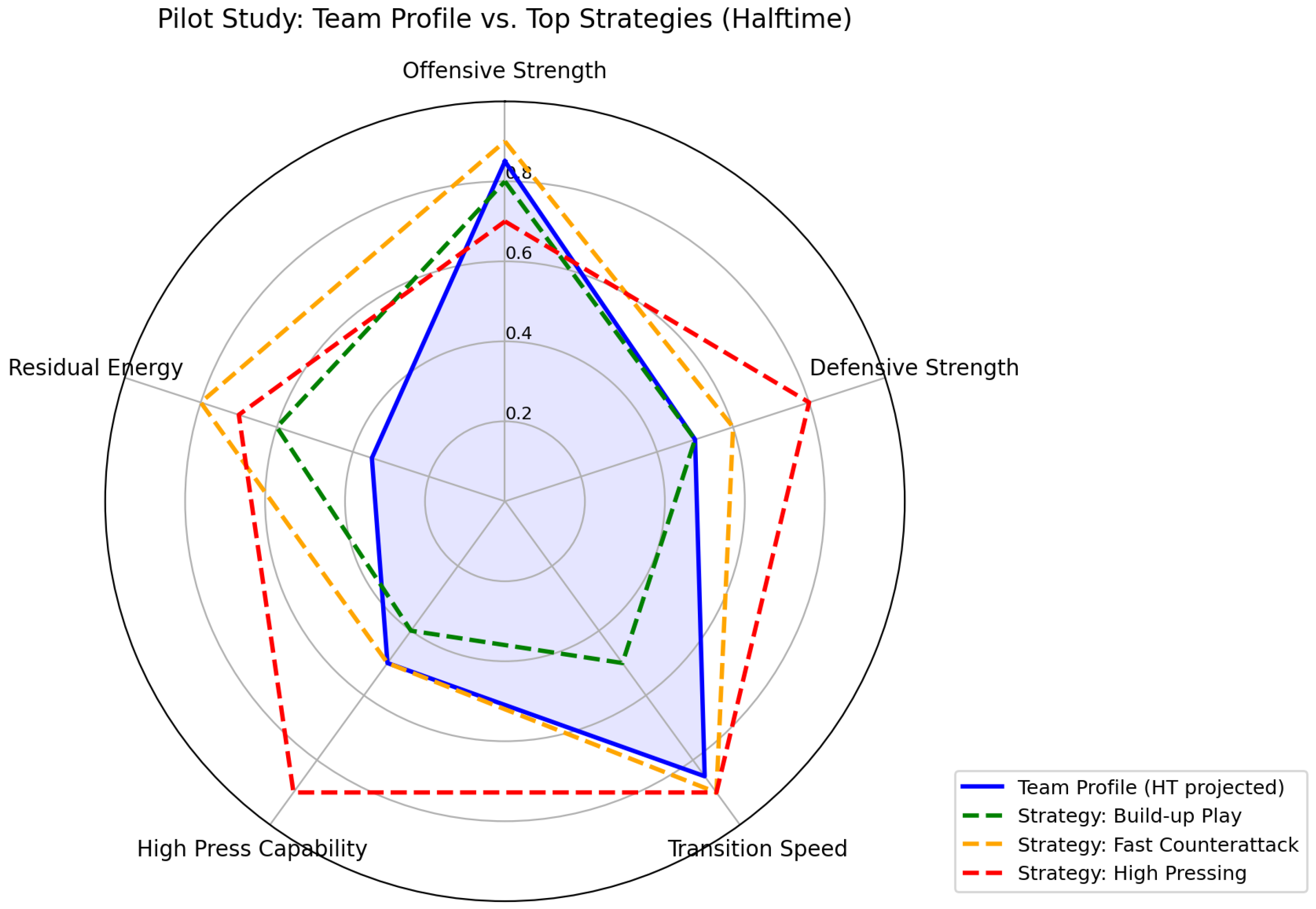
6.5. DSS Application: Halftime Recommendation
6.5.1. Input Configuration
6.5.2. Strategy Comparison
6.5.3. DSS Recommendation
- Strengths: High offensive capability () aligns well with Build-up Play requirements (). Defensive organization () and pressing capability () match the strategy’s moderate demands.
- Constraint: Projected residual energy () falls short of the strategy’s ideal (), with a gap of . This is the primary limitation.
- Surplus: The team’s transition speed () substantially exceeds Build-up Play’s requirements (), representing untapped vertical capability.
6.6. Retrospective Analysis
6.6.1. Observed vs. Recommended Tactics
6.6.2. Counterfactual Consideration
- Lower probability of conceding the third goal (defensive compactness preserved)
- Reduced offensive output (potentially fewer goals scored, but also fewer high-risk transitions)
- Better preservation of energy for critical late-game moments
- More controlled match tempo, reducing the chaotic “open game” dynamic
6.7. Evaluation Results
6.7.1. Endpoint 1: Processing Feasibility
- Categorical-to-numerical conversion executed without errors for all 6 observed attributes.
- Reduced 5-dimensional team vector constructed (after aggregating from two sources).
- Semantic distances computed for all 20 strategies in the library.
- Ranked recommendation list generated with diagnostic output for top-3 strategies.
- Halftime projection with fatigue adjustment produced valid results.
6.7.2. Endpoint 2: Expert Agreement
- Expert 1: “Build-up Play is a sensible choice given the energy constraints. The diagnostic correctly identifies stamina as the limiting factor. I would have recommended the same.”
- Expert 2: “Build-up Play is reasonable but perhaps too conservative for a team leading 2:1 at halftime. I might prefer Cautious Horizontal Play [ranked 3rd by DSS] to maintain some attacking threat. However, the DSS’s reasoning is sound and the top-3 set is useful.”
6.7.3. Endpoint 3: Tactical Alignment Analysis
- The team won the match (4:3), suggesting the high-risk approach succeeded in this instance.
- However, the team conceded 2 second-half goals (vs. 1 in the first half), consistent with the DSS’s warning about defensive vulnerability under energy depletion.
- Causal attribution is not possible from a single match.
6.7.4. Baseline Comparisons
- Random baseline: Selected “Offside Trap” (a high-risk defensive tactic requiring precise coordination)—deemed inappropriate by both experts for a fatigued youth team.
- Default strategy baseline: Coincidentally matched the DSS recommendation (Build-up Play), achieving the same expert ratings. This highlights that Build-up Play is indeed a “safe” choice but also that the DSS does not always outperform simple defaults. The DSS’s value lies in (i) providing diagnostic reasoning and (ii) adapting to contexts where the default would be inappropriate.
- Energy-only heuristic: Recommended “Positional Defense” based solely on low projected energy (). Expert 1 rated this as “Partially Appropriate” (energy conservation is valid), but Expert 2 rated it “Inappropriate” (too passive for a team with strong offensive capability and a lead to protect through controlled possession rather than pure defense).
6.7.5. Summary of Evaluation Outcomes
6.8. Limitations of the Pilot Study
- 1.
- Single-match sample: One match cannot establish statistical generalizability. The analysis should be viewed as a proof-of-concept demonstration.
- 2.
- Partial attribute coverage: Only 6 of the 14 DSS attributes were directly observable, limiting the semantic space to a lower-dimensional subspace.
- 3.
- Absence of opponent data: The observational protocol captured only the home team (SSV Pachten), precluding the opponent-aware distance adjustments described in Section 3.
- 4.
- Retrospective rather than prospective: The DSS was applied after the match rather than in real time, preventing assessment of whether recommendations would have influenced actual coaching decisions.
- 5.
- Youth football context: Tactical patterns and physical dynamics in C-Junioren football may differ from senior professional contexts where the DSS is ultimately intended to operate.
6.9. Implications for Framework Validation
- Real-data compatibility: The DSS can ingest observational data from actual matches using a straightforward categorical-to-continuous mapping protocol (see Section 6.3), suggesting that the framework is not inherently limited to synthetic inputs.
- Temporal dynamics: The framework captures intra-match evolution (first half → second half), enabling phase-specific recommendations. Whether this capability generalizes across match contexts remains to be established.
- Diagnostic interpretability: The attribute-level analysis provides insights (e.g., “energy reserves constrain high-intensity options”) that appear actionable, though coach acceptance testing has not been conducted.
- Graceful degradation: Even with partial attribute coverage (5 of 14 dimensions), the DSS produces coherent recommendations. This robustness to incomplete information is encouraging but requires systematic evaluation across varying degrees of data availability.
- 1.
- Multi-match datasets: Systematic observation across a full season (15–20 matches) to enable statistical validation.
- 2.
- Expanded attribute protocols: Development of standardized observation instruments covering all 14 DSS attributes, potentially including post-match coach interviews for psychological dimensions.
- 3.
- Opponent observation: Parallel data collection for opposing teams to enable full exploitation of the semantic distance framework.
- 4.
- Prospective deployment: Real-time DSS use during matches (e.g., at halftime) with systematic tracking of recommendation adherence and outcome correlations.
7. Discussion
7.1. Methodological Limitations
7.1.1. Data Quality and Representativeness
7.1.2. Static Opponent Modelling
7.1.3. Linear Distance Assumptions
7.1.4. Absence of Operational Constraints
7.1.5. User-Facing Interpretability
8. Conclusions and Future Work
8.1. Summary of Contributions
- 1.
- A semantic formalization of football tactics, encoding both team states and strategy templates as vectors in a shared attribute space amenable to geometric comparison.
- 2.
- An adaptive distance metric that dynamically reweights attributes based on match context (energy, time pressure, opponent gaps), with explicit, reproducible formulas (Section 3.6.2, Appendix A.2).
- 3.
- Diagnostic interpretability tools—radar charts, sensitivity analysis, robustness testing, ablation studies—that expose the reasoning behind recommendations and enable systematic evaluation.
- 4.
- A fully auditable pipeline with complete formal specifications, code availability, and localization protocols that support independent replication and verification.
- 5.
- Preliminary real-data application via a pilot study, demonstrating feasibility (though not yet validity) of processing observational match data.
8.2. Future Directions
8.2.1. Advanced Data Integration and Modeling
- Real-time data integration and automation Connecting the DSS to live data streams from commercial tracking providers (Wyscout, StatsBomb, Opta) and GPS systems would automate team profiling and dynamically update opponent behaviour (e.g., line height, possession structure), directly addressing the static-opponent limitation. Supplementing this with NLP modules to parse tactical reports would allow the strategy library to be expanded via natural-language queries (e.g., “compact defence with fast diagonal transitions”). Furthermore, the current prototype operates in batch mode; a natural extension would implement an event-driven architecture with a continuous listening loop, ingesting match data from structured files (JSON, CSV) or live feeds (wearable sensors, video tagging systems, coaching dashboards) and producing updated recommendations as play unfolds.
- Stable profiling via historical priors and Bayesian updating To complement real-time data and prevent overreaction to transient match fluctuations, the attribute model should incorporate historical priors. Baseline distributions for macro-attributes (e.g., a team’s average pressing intensity or defensive solidity) would be derived from historical season data. These priors would then be updated in a Bayesian framework as in-match events accumulate, yielding more stable and reliable profiles early in a game while remaining adaptable to genuine tactical shifts. Public datasets such as StatsBomb Open Data [27] provide an ideal foundation for calibrating these priors and validating the system.
8.2.2. Non-Linear and Hybrid Metrics
8.2.3. Multi-Objective Optimization
8.2.4. Predictive Simulation
8.2.5. Interactive Coaching Interface
8.2.6. Validation with Professional Data
8.2.7. Extension to Other Team Sports
8.2.8. From Strategy Selection to Strategy Synthesis
8.2.9. Adversarial and Security Domains
Author Contributions
Funding
Data Availability Statement
Acknowledgments
Conflicts of Interest
Appendix A. Complete Formal Specification
Appendix A.1. Player Attribute Generation

| Attribute | GK | CB | FB | CM | FW |
|---|---|---|---|---|---|
| reflexes | (0.85, 0.05) | (0.30, 0.10) | (0.40, 0.10) | (0.40, 0.10) | (0.40, 0.10) |
| aerial_duels | (0.80, 0.05) | (0.90, 0.05) | (0.70, 0.10) | (0.70, 0.10) | (0.65, 0.10) |
| passing | (0.65, 0.10) | (0.70, 0.10) | (0.75, 0.05) | (0.80, 0.05) | (0.70, 0.10) |
| speed | (0.40, 0.10) | (0.50, 0.10) | (0.75, 0.10) | (0.70, 0.10) | (0.80, 0.05) |
| stamina | (0.70, 0.05) | (0.75, 0.05) | (0.80, 0.05) | (0.80, 0.05) | (0.80, 0.05) |
| resilience | (0.80, 0.05) | (0.80, 0.05) | (0.75, 0.05) | (0.80, 0.05) | (0.70, 0.05) |
| dribbling | (0.30, 0.10) | (0.50, 0.10) | (0.70, 0.05) | (0.75, 0.05) | (0.85, 0.05) |
| tackling | (0.20, 0.10) | (0.85, 0.05) | (0.70, 0.10) | (0.70, 0.10) | (0.40, 0.10) |
| interceptions | (0.30, 0.10) | (0.80, 0.05) | (0.70, 0.10) | (0.75, 0.10) | (0.40, 0.10) |
| xG | (0.00, 0.00) | (0.10, 0.05) | (0.20, 0.10) | (0.40, 0.10) | (0.85, 0.05) |
| xA | (0.20, 0.10) | (0.20, 0.10) | (0.50, 0.10) | (0.70, 0.10) | (0.60, 0.10) |
| aggression | (0.60, 0.10) | (0.80, 0.05) | (0.70, 0.10) | (0.75, 0.10) | (0.75, 0.10) |
Appendix A.2. Macro-Attribute Aggregation Formulas
- A1:
- Offensive Strength.
- A2:
- Defensive Strength.
- A3:
- Midfield Control.
- A4:
- Transition Speed.
- A5:
- High Press Capability.
- A6:
- Width Utilization.
- A7:
- Psychological Resilience.
- A8:
- Residual Energy.
- A9:
- Team Morale.
- A10:
- Time Management.
- A11:
- Tactical Cohesion.
- A12:
- Technical Base.
- A13:
- Physical Base.
- A14:
- Relational Cohesion.
Appendix A.3. Complete Strategy Vector Specifications
| Strategy | ||||||||||||||
|---|---|---|---|---|---|---|---|---|---|---|---|---|---|---|
| Offensive Systems | ||||||||||||||
| Build-up Play | 0.8 | 0.5 | 0.7 | 0.5 | 0.4 | 0.6 | 0.7 | 0.6 | 0.8 | 0.7 | 0.8 | 0.8 | 0.6 | 0.8 |
| Fast Counterattack | 0.9 | 0.6 | 0.5 | 0.9 | 0.5 | 0.6 | 0.7 | 0.8 | 0.7 | 0.8 | 0.6 | 0.7 | 0.8 | 0.6 |
| Long Ball to Target | 0.8 | 0.6 | 0.5 | 0.6 | 0.4 | 0.4 | 0.6 | 0.7 | 0.6 | 0.7 | 0.5 | 0.5 | 0.8 | 0.5 |
| Late Midfield Runners | 0.8 | 0.5 | 0.6 | 0.7 | 0.5 | 0.5 | 0.6 | 0.7 | 0.7 | 0.6 | 0.7 | 0.7 | 0.7 | 0.6 |
| Systematic Crossing | 0.7 | 0.5 | 0.6 | 0.6 | 0.5 | 0.9 | 0.7 | 0.7 | 0.7 | 0.6 | 0.7 | 0.7 | 0.7 | 0.6 |
| Overlapping Flanks | 0.7 | 0.5 | 0.7 | 0.7 | 0.5 | 0.9 | 0.7 | 0.8 | 0.8 | 0.7 | 0.8 | 0.7 | 0.8 | 0.7 |
| Quick Rotations | 0.8 | 0.5 | 0.7 | 0.8 | 0.6 | 0.7 | 0.8 | 0.7 | 0.8 | 0.7 | 0.9 | 0.7 | 0.8 | 0.7 |
| Direct Vertical Attack | 0.9 | 0.5 | 0.5 | 0.8 | 0.5 | 0.6 | 0.7 | 0.7 | 0.7 | 0.7 | 0.6 | 0.7 | 0.8 | 0.6 |
| Defensive Structures | ||||||||||||||
| Classic Catenaccio | 0.4 | 0.9 | 0.7 | 0.3 | 0.2 | 0.3 | 0.8 | 0.7 | 0.7 | 0.9 | 0.8 | 0.6 | 0.6 | 0.7 |
| Positional Defense | 0.4 | 0.9 | 0.8 | 0.3 | 0.2 | 0.3 | 0.7 | 0.6 | 0.6 | 0.9 | 0.8 | 0.6 | 0.5 | 0.7 |
| Compact Zonal Defense | 0.5 | 0.9 | 0.8 | 0.4 | 0.4 | 0.4 | 0.7 | 0.6 | 0.7 | 0.8 | 0.9 | 0.7 | 0.6 | 0.7 |
| Strict Man-Marking | 0.5 | 0.9 | 0.7 | 0.5 | 0.5 | 0.3 | 0.7 | 0.7 | 0.6 | 0.8 | 0.8 | 0.7 | 0.7 | 0.7 |
| Offside Trap | 0.5 | 0.8 | 0.7 | 0.5 | 0.6 | 0.4 | 0.7 | 0.7 | 0.7 | 0.8 | 0.8 | 0.7 | 0.7 | 0.7 |
| Pressing Variants | ||||||||||||||
| High Press | 0.7 | 0.8 | 0.6 | 0.9 | 0.9 | 0.5 | 0.8 | 0.7 | 0.8 | 0.6 | 0.9 | 0.7 | 0.8 | 0.8 |
| Gegenpressing | 0.7 | 0.8 | 0.6 | 0.8 | 0.9 | 0.5 | 0.8 | 0.7 | 0.8 | 0.6 | 0.9 | 0.7 | 0.8 | 0.8 |
| Midfield Pressing | 0.6 | 0.7 | 0.7 | 0.7 | 0.7 | 0.4 | 0.7 | 0.7 | 0.7 | 0.7 | 0.8 | 0.7 | 0.7 | 0.7 |
| Inducing Build-up Errors | 0.7 | 0.8 | 0.6 | 0.8 | 0.9 | 0.4 | 0.7 | 0.7 | 0.8 | 0.6 | 0.8 | 0.7 | 0.7 | 0.8 |
| Possession/Control | ||||||||||||||
| Extended Possession | 0.7 | 0.7 | 0.9 | 0.5 | 0.5 | 0.6 | 0.8 | 0.7 | 0.8 | 0.7 | 0.9 | 0.8 | 0.6 | 0.8 |
| Cautious Horizontal | 0.5 | 0.7 | 0.8 | 0.4 | 0.3 | 0.5 | 0.7 | 0.7 | 0.8 | 0.7 | 0.8 | 0.7 | 0.5 | 0.7 |
| Central Block + Breaks | 0.7 | 0.8 | 0.7 | 0.7 | 0.7 | 0.5 | 0.7 | 0.7 | 0.7 | 0.7 | 0.8 | 0.7 | 0.7 | 0.7 |
- Strategy Vector Construction Protocol
- Rater A: Academic researcher with expertise in performance analysis and tactical periodization.
- Rater B: Experienced football coach with background in youth academy and semi-professional coaching; familiar with tactical analysis.
- Rater C: Practitioner with experience in match analysis and video-based tactical coding.
| Level | Definition | Numerical Range |
|---|---|---|
| Irrelevant | Attribute has no bearing on strategy success | – |
| Low | Attribute provides minor benefit | – |
| Moderate | Attribute contributes meaningfully | – |
| High | Attribute is important for effectiveness | – |
| Critical | Attribute is essential; deficit causes failure | – |
- Exact agreement: 163/280 pairs (58.2%) had identical ratings from all three experts.
- Within-one-level agreement: 251/280 pairs (89.6%) had all ratings within one ordinal level.
- Krippendorff’s alpha: (ordinal), indicating substantial reliability.
- 1.
- Minor discrepancies (spread level): Median rating adopted; numerical value set to midpoint of corresponding range.
- 2.
- Major discrepancies (spread levels): 42 pairs (15%) were flagged for discussion. In a 90-min reconciliation session, experts presented reasoning and reached consensus (38 pairs) or majority decision (4 pairs).
- 3.
- Final numerical assignment: Within-range values were assigned to maximize differentiation between strategies with the same qualitative level (e.g., two “High” ratings might yield 0.75 vs. 0.80 based on discussion nuance).
- Raw rating matrices from all three experts (anonymized as Rater A/B/C)
- Reconciliation log with justifications for all 42 discussed pairs
- Calibration materials (attribute definitions, anchor examples, practice strategies)
- Face-validity review forms from the two independent validators
- Cultural bias: All experts had European football backgrounds; strategy interpretations may differ in other football cultures (e.g., South American, Asian).
- Era effects: Vectors reflect tactical understanding circa 2023–2024; the evolving nature of football tactics may require periodic re-elicitation.
- Granularity limits: The five-level scale may not capture fine distinctions; future work could use continuous scales with more extensive calibration.
Appendix A.4. Scenario Specifications
| Scenario | t | s | Morale | |||
|---|---|---|---|---|---|---|
| 1. Energetic & Balanced | 0.80 | 0.00 | 0.00 | 0.70 | 0 | 0.75 |
| 2. Fatigued & Inferior | 0.30 | 0.50 | 0 | 0.50 | ||
| 3. High Temporal Pressure | 0.55 | 0.00 | 0.15 | 0.65 | ||
| 4. Tech. & Phys. Superiority | 0.65 | 0.60 | 0 | 0.70 |
Appendix A.5. Implementation Configuration
- Random seed: SEED = 41 (set via np.random.seed() and random.seed())
- Python version: 3.10+
- Dependencies: numpy, pandas, matplotlib (see requirements.txt)
- Default formation: Team 1: 4-3-3 (1 GK, 2 CB, 2 FB, 3 CM, 3 FW); Team 2: 5-3-2 (1 GK, 5 CB, 2 FB, 2 CM, 1 FW)
- Opponent penalty : 0.20 (default); sensitivity tested over
- Multiplier bounds: , (clamping applied per Section 3.6.2)
- Robustness trials: Monte Carlo simulations per scenario
- Noise level: (5% perturbation)
Appendix A.6. Code Availability
- football_strategy_generation_1_3_1.py: Core DSS implementation (1002 lines)
- make_figures.py: Reproducible figure generation (283 lines)
- compute_pilot_distances.py: Pilot validation computations (350 lines)
- requirements.txt: Dependency specifications
- README.md: Usage instructions and quick-start guide
Appendix A.7. Full Correlation Matrix and Multicollinearity Analysis
| 1.00 | 0.08 | 0.21 | 0.18 | 0.12 | 0.15 | 0.04 | 0.09 | 0.05 | 0.11 | 0.19 | 0.22 | 0.14 | 0.02 | |
| 0.08 | 1.00 | 0.06 | 0.11 | 0.31 | 0.04 | 0.07 | 0.10 | 0.06 | 0.18 | 0.09 | 0.15 | 0.21 | 0.01 | |
| 0.21 | 0.06 | 1.00 | 0.35 | 0.12 | 0.90 | 0.05 | 0.00 | 0.05 | 0.42 | 0.38 | 0.29 | 0.16 | 0.03 | |
| 0.18 | 0.11 | 0.35 | 1.00 | 0.28 | 0.41 | 0.03 | 0.34 | 0.02 | 0.22 | 0.18 | 0.21 | 0.48 | 0.01 | |
| 0.12 | 0.31 | 0.12 | 0.28 | 1.00 | 0.09 | 0.08 | 0.15 | 0.07 | 0.31 | 0.14 | 0.19 | 0.36 | 0.02 | |
| 0.15 | 0.04 | 0.90 | 0.41 | 0.09 | 1.00 | 0.04 | 0.15 | 0.04 | 0.35 | 0.32 | 0.24 | 0.22 | 0.02 | |
| 0.04 | 0.07 | 0.05 | 0.03 | 0.08 | 0.04 | 1.00 | 0.32 | 0.98 | 0.06 | 0.11 | 0.08 | 0.28 | 0.01 | |
| 0.09 | 0.10 | 0.00 | 0.34 | 0.15 | 0.15 | 0.32 | 1.00 | 0.26 | 0.12 | 0.14 | 0.11 | 0.52 | 0.02 | |
| 0.05 | 0.06 | 0.05 | 0.02 | 0.07 | 0.04 | 0.98 | 0.26 | 1.00 | 0.05 | 0.09 | 0.07 | 0.25 | 0.01 | |
| 0.11 | 0.18 | 0.42 | 0.22 | 0.31 | 0.35 | 0.06 | 0.12 | 0.05 | 1.00 | 0.41 | 0.38 | 0.18 | 0.03 | |
| 0.19 | 0.09 | 0.38 | 0.18 | 0.14 | 0.32 | 0.11 | 0.14 | 0.09 | 0.41 | 1.00 | 0.49 | 0.15 | 0.02 | |
| 0.22 | 0.15 | 0.29 | 0.21 | 0.19 | 0.24 | 0.08 | 0.11 | 0.07 | 0.38 | 0.49 | 1.00 | 0.18 | 0.01 | |
| 0.14 | 0.21 | 0.16 | 0.48 | 0.36 | 0.22 | 0.28 | 0.52 | 0.25 | 0.18 | 0.15 | 0.18 | 1.00 | 0.02 | |
| 0.02 | 0.01 | 0.03 | 0.01 | 0.02 | 0.02 | 0.01 | 0.02 | 0.01 | 0.03 | 0.02 | 0.01 | 0.02 | 1.00 |
Appendix A.7.1. Variance Inflation Factors
| Attribute | VIF | Attribute | VIF |
|---|---|---|---|
| (Offensive Strength) | 1.21 | (Residual Energy) | 1.89 |
| (Defensive Strength) | 1.34 | (Team Morale) | 37.0 |
| (Midfield Control) | 21.6 | (Time Management) | 2.14 |
| (Transition Speed) | 1.72 | (Tactical Cohesion) | 1.68 |
| (High Press Capability) | 1.41 | (Technical Base) | 1.52 |
| (Width Utilization) | 18.4 | (Physical Base) | 1.94 |
| (Psych. Resilience) | 35.1 | (Relational Cohesion) | 1.01 |
Appendix A.7.2. Summary
References
- Pollard, R.; Reep, C. Measuring the Effectiveness of Playing Strategies at Soccer. J. R. Stat. Soc. Ser. D Stat. 1997, 46, 541–550. [Google Scholar] [CrossRef]
- Mackenzie, R.; Cushion, C. Performance analysis in football: A critical review and implications for future research. J. Sports Sci. 2013, 31, 639–676. [Google Scholar] [CrossRef] [PubMed]
- Sarmento, H.; Marcelino, R.; Anguera, M.T.; Campaniço, J.; Matos, N.; Leitão, J.C. Match analysis in football: A systematic review. J. Sports Sci. 2014, 32, 1831–1843. [Google Scholar] [CrossRef] [PubMed]
- Weinberg, R.S.; Gould, D. Foundations of Sport and Exercise Psychology, 8th ed.; Human Kinetics: Champaign, IL, USA, 2023. [Google Scholar]
- McLean, S.; Salmon, P.M.; Gorman, A.D.; Read, G.J.M.; Solomon, C. What’s in a game? A systems approach to enhancing performance analysis in football. PLoS ONE 2017, 12, e0172565. [Google Scholar] [CrossRef] [PubMed]
- Rein, R.; Memmert, D. Big data and tactical analysis in elite soccer: Future challenges and opportunities for sports science. J. Sports Sci. 2016, 34, 639–650. [Google Scholar] [CrossRef] [PubMed]
- Ghisellini, R.; Pareschi, R.; Pedroni, M.; Raggi, G.B. Recommending actionable strategies: A semantic approach to integrating analytical frameworks with decision heuristics. Information 2025, 16, 192. [Google Scholar] [CrossRef]
- Grehaigne, J.F.; Godbout, P. Tactical Knowledge in Team Sports from a Constructivist and Cognitivist Perspective. Quest 1995, 47, 490–505. [Google Scholar] [CrossRef]
- He, Q.; Kee, Y.H.; Komar, J. Flexibility, Stability, and Adaptability of Team Playing Style as Key Determinants of Within-Season Performance in Football. In Proceedings of the 9th International Performance Analysis Workshop and Conference & 5th IACSS Conference (PACSS 2021); Advances in Intelligent Systems and Computing; Springer: Cham, Switzerland, 2022; Volume 1426, pp. 69–73. [Google Scholar] [CrossRef]
- Andrienko, G.; Andrienko, N.; Budziak, G.; Dykes, J.; Fuchs, G.; von Landesberger, T.; Weber, H. Visual analysis of pressure in football. Data Min. Knowl. Discov. 2017, 31, 1793–1839. [Google Scholar] [CrossRef]
- Bauer, P.; Anzer, G. Data-driven detection of counterpressing in professional football: A supervised machine learning task based on synchronized positional and event data with expert-based feature extraction. Data Min. Knowl. Discov. 2021, 35, 2009–2049. [Google Scholar] [CrossRef]
- Low, B.; Rein, R.; Schwab, S.; Memmert, D. Defending in 4-4-2 or 5-3-2 formation? Small differences in footballers’ collective tactical behaviours. J. Sports Sci. 2022, 40, 793–805. [Google Scholar] [CrossRef] [PubMed]
- Gudmundsson, J.; Horton, M. Spatio-temporal analysis of team sports—A survey. ACM Comput. Surv. 2017, 50, 22. [Google Scholar]
- Forcher, L.; Forcher, L.; Altmann, S.; Jekauc, D.; Kempe, M. Is a compact organization important for defensive success in elite soccer? Analysis based on player tracking data. Int. J. Sports Sci. Coach. 2024, 19, 757–768. [Google Scholar] [CrossRef]
- Turney, P.D.; Pantel, P. From Frequency to Meaning: Vector Space Models of Semantics. J. Artif. Intell. Res. 2010, 37, 141–188. [Google Scholar] [CrossRef]
- Mikolov, T.; Chen, K.; Corrado, G.; Dean, J. Efficient estimation of word representations in vector space. In Proceedings of the ICLR, Scottsdale, AZ, USA, 2–4 May 2013. [Google Scholar]
- Kullback, S.; Leibler, R.A. On information and sufficiency. Ann. Math. Stat. 1951, 22, 79–86. [Google Scholar] [CrossRef]
- Lin, J. Divergence Measures Based on the Shannon Entropy. IEEE Trans. Inf. Theory 1991, 37, 145–151. [Google Scholar] [CrossRef]
- Devlin, J.; Chang, M.W.; Lee, K.; Toutanova, K. BERT: Pre-training of Deep Bidirectional Transformers for Language Understanding. In Proceedings of the 2019 Conference of the North American Chapter of the Association for Computational Linguistics: Human Language Technologies (NAACL-HLT); Association for Computational Linguistics: Stroudsburg, PA, USA, 2019; pp. 4171–4186. [Google Scholar] [CrossRef]
- Reimers, N.; Gurevych, I. Sentence-BERT: Sentence Embeddings using Siamese BERT-Networks. In Proceedings of the 2019 Conference on Empirical Methods in Natural Language Processing and the 9th International Joint Conference on Natural Language Processing (EMNLP-IJCNLP), Hong Kong, China, 3–7 November 2019; pp. 3982–3992. [Google Scholar] [CrossRef]
- Turban, E.; Sharda, R.; Delen, D. Decision Support and Business Intelligence Systems; Pearson: London, UK, 2011. [Google Scholar]
- Sanders, D.; Heijboer, M.; Hesselink, M.K.C.; Myers, T.; Akubat, I. Analysing a cycling grand tour: Can we monitor fatigue with intensity or load ratios? J. Sport. Sci. 2018, 36, 1385–1391. [Google Scholar] [CrossRef] [PubMed]
- Goldsberry, K. CourtVision: New Visual and Spatial Analytics for the NBA; MIT Sloan Sports Analytics Conference: Boston, MA, USA, 2012. [Google Scholar]
- Pappalardo, L.; Cintia, P.; Rossi, A.; Massucco, E.; Ferragina, P.; Pedreschi, D.; Giannotti, F. A public data set of spatio-temporal match events in soccer competitions. Sci. Data 2019, 6, 236. [Google Scholar] [CrossRef] [PubMed]
- Fletcher, D.; Sarkar, M. A grounded theory of psychological resilience in Olympic champions. Psychol. Sport Exerc. 2012, 13, 669–678. [Google Scholar] [CrossRef]
- Krippendorff, K. Content Analysis: An Introduction to Its Methodology, 2nd ed.; Sage Publications: Thousand Oaks, CA, USA, 2004. [Google Scholar]
- StatsBomb. StatsBomb Open Data. 2024. Available online: https://github.com/statsbomb/open-data (accessed on 24 February 2026).
- Ghisellini, R.; Pareschi, R.; Pedroni, M.; Raggi, G.B. From Extraction to Synthesis: Entangled Heuristics for Agent-Augmented Strategic Reasoning. arXiv 2025, arXiv:2507.13768. [Google Scholar] [CrossRef]
- Mutzari, D.; Deb, T.; Molinaro, C.; Pugliese, A.; Subrahmanian, V.S.; Kraus, S. Defending a City from Multi-Drone Attacks: A Sequential Stackelberg Security Games Approach. arXiv 2025, arXiv:2508.11380. [Google Scholar] [CrossRef]



| ID | Attribute Name | Category | Variability |
|---|---|---|---|
| Offensive Strength | Technical/Tactical | Static | |
| Defensive Strength | Technical/Tactical | Static | |
| Midfield Control | Technical/Tactical | Static | |
| Transition Speed | Technical/Tactical | Semi-dynamic | |
| High Press Capability | Technical/Tactical | Context-dependent | |
| Width Utilization | Technical/Tactical | Static | |
| Psychological Resilience | Psychological | Dynamic | |
| Residual Energy | Physical | Dynamic | |
| Team Morale | Psychological | Dynamic | |
| Time Management | Organizational | Context-dependent | |
| Tactical Cohesion | Organizational | Semi-dynamic | |
| Technical Base | Physical | Static | |
| Physical Base | Physical | Static | |
| Relational Cohesion | Organizational | Static |
| ID | Attribute Name | Definition & Aggregation Source |
|---|---|---|
| Technical/Tactical Dimensions (–) | ||
| Offensive Strength | Capacity to create and convert goal-scoring opportunities. Aggregated from forwards’ and midfielders’ xG, dribbling success, and shot accuracy. | |
| Defensive Strength | Ability to prevent opponent attacks and protect the goal. Derived from defenders’ tackling, interceptions, aerial duels, and goalkeeper reflexes. | |
| Midfield Control | Dominance in central zones and ability to dictate tempo. Based on central midfielders’ passing accuracy, interceptions, and ball retention. | |
| Transition Speed | Capability for rapid phase changes between defense and attack. Computed from speed attributes of forwards, fullbacks, and midfielders, combined with xA. | |
| High Press Capability | Aptitude for coordinated pressing in advanced zones. Aggregated from stamina, aggression, and interception rates across all outfield players. | |
| Width Utilization | Effectiveness in exploiting wide areas of the pitch. Derived from fullbacks’ and wingers’ crossing, dribbling, and speed attributes. | |
| Psychological/Physical Dimensions (–, –) | ||
| Psychological Resilience | Mental toughness and ability to perform under pressure. Weighted combination of individual resilience and aggression attributes. | |
| Residual Energy | Current stamina reserves across the squad. Computed from stamina values weighted by playing time, with resilience as a moderating factor. | |
| Team Morale | Collective motivation and positive emotional state. Derived from resilience and aggression, modulated by match context (score, momentum). | |
| Technical Base | Overall technical quality of the squad. Mean of technical attributes (passing, dribbling, first touch, xG, xA) across all players. | |
| Physical Base | Overall athletic capacity of the squad. Mean of physical attributes (speed, stamina, aerial ability, aggression) across all players. | |
| Organizational Dimensions (, , ) | ||
| Time Management | Ability to adapt tactics to match clock pressure. Based on experienced players’ (GK, CM, FB) interception and passing attributes. | |
| Tactical Cohesion | Synchronization and coordination between team units. Computed from passing networks, xA distribution, and positional discipline. | |
| Relational Cohesion | Stability of internal relationships and group dynamics. Estimated via qualitative assessment or historical team stability indicators. | |
| (Midfield Control) | 1.00 | 0.90 | 0.05 | 0.00 | 0.05 |
| (Width Utilization) | 0.90 | 1.00 | 0.04 | 0.15 | 0.04 |
| (Psych. Resilience) | 0.05 | 0.04 | 1.00 | 0.32 | 0.98 |
| (Residual Energy) | 0.00 | 0.15 | 0.32 | 1.00 | 0.26 |
| (Team Morale) | 0.05 | 0.04 | 0.98 | 0.26 | 1.00 |
| Qualitative Level | Numerical Value |
|---|---|
| Irrelevant/Not required | – |
| Low importance | – |
| Moderate importance | – |
| High importance | – |
| Critical/Essential | – |
| Attribute | High Press | Fast Counter | Positional Defense | Build-Up Play | Gegen- Pressing |
|---|---|---|---|---|---|
| Offensive Strength | 0.70 | 0.90 | 0.40 | 0.80 | 0.70 |
| Defensive Strength | 0.80 | 0.60 | 0.90 | 0.50 | 0.80 |
| Midfield Control | 0.60 | 0.50 | 0.80 | 0.70 | 0.60 |
| Transition Speed | 0.90 | 0.90 | 0.30 | 0.50 | 0.80 |
| High Press Cap. | 0.90 | 0.50 | 0.20 | 0.40 | 0.90 |
| Width Utilization | 0.50 | 0.60 | 0.30 | 0.60 | 0.50 |
| Psych. Resilience | 0.80 | 0.70 | 0.70 | 0.70 | 0.80 |
| Residual Energy | 0.70 | 0.80 | 0.60 | 0.60 | 0.70 |
| Team Morale | 0.80 | 0.70 | 0.60 | 0.80 | 0.80 |
| Time Management | 0.60 | 0.80 | 0.90 | 0.70 | 0.60 |
| Tactical Cohesion | 0.90 | 0.60 | 0.80 | 0.80 | 0.90 |
| Technical Base | 0.70 | 0.70 | 0.60 | 0.80 | 0.70 |
| Physical Base | 0.80 | 0.80 | 0.50 | 0.60 | 0.80 |
| Relational Cohesion | 0.80 | 0.60 | 0.70 | 0.80 | 0.80 |
| Scenario | -Range for Stable Top-1 | Rank Corr. () | Mean (Top-1 vs. Top-2) | 95% CI for |
|---|---|---|---|---|
| Energetic & Balanced | 0.94 | 0.047 | [0.031, 0.063] | |
| Fatigued & Inferior | 0.89 | 0.032 | [0.018, 0.046] | |
| High Temporal Pressure | 0.97 | 0.061 | [0.042, 0.080] | |
| Tech./Phys. Superiority | 0.96 | 0.054 | [0.038, 0.070] |
| Parameter | Description | Symbol | Default |
|---|---|---|---|
| Energy threshold | Fatigue becomes salient below this level | 0.50 | |
| Energy sensitivity | Strength of energy-based adjustments | 1.50 | |
| Gap sensitivity | Strength of gap-based adjustments | 1.00 | |
| Time threshold | Urgency triggers in final fraction | 0.25 | |
| Urgency sensitivity | Strength of time-pressure adjustments | 2.00 | |
| Opponent factor | Weight on opponent mismatch | 0.20 | |
| Multiplier floor | Minimum allowed multiplier value | 0.30 | |
| Multiplier ceiling | Maximum allowed multiplier value | 2.50 |
| Scenario | Context Description |
|---|---|
| 1. Energetic and Balanced | High residual energy (), neutral technical/physical gap (), and good morale. Used to test the system’s preference for high-intensity strategies (e.g., high pressing, gegenpressing). |
| 2. Fatigued and Inferior | Low energy (), reduced morale, and negative technical/physical gap. Designed to verify whether the DSS avoids high-risk strategies and recommends conservative options (e.g., positional defense). |
| 3. High Temporal Pressure | Limited remaining time ( high), moderate energy, and slightly inferior technique but compact organization. Tests whether the DSS favors rapid, vertical play (e.g., counterattack). |
| 4. Technical and Physical Superiority | Positive gap () and strong tactical cohesion (). Evaluates the model’s tendency to suggest possession-based strategies (e.g., build-up play). |
| Perturbation Type | Top-1 Consistency | Top-3 Stability | Rank Corr. () |
|---|---|---|---|
| Independent (baseline) | 89.3% | 94.1% | 0.96 |
| Correlated (physical) | 84.7% | 91.2% | 0.93 |
| Correlated (psychological) | 86.1% | 92.8% | 0.94 |
| Correlated (all clusters) | 81.2% | 88.6% | 0.91 |
| Pattern | Attributes Missing | Top-1 Match | Top-3 Overlap | Qualitative Agreement |
|---|---|---|---|---|
| M1 (Tracking) | 3 | 78.5% | 89.0% | 91% |
| M2 (Psychological) | 3 | 85.2% | 93.1% | 96% |
| M3 (Sparse) | 6 (random) | 67.3% | 81.4% | 84% |
| Distribution Shift | Expert Agreement | Problematic Recommendations | Recalibration Required? |
|---|---|---|---|
| None (baseline) | 94% | 3/50 | No |
| Youth | 82% | 9/50 | Recommended |
| Lower division | 88% | 6/50 | Optional |
| Style shift | 78% | 11/50 | Yes |
| Challenge | Impact on Top-1 | Mitigation |
|---|---|---|
| Independent noise () | −11% (89% → baseline) | Acceptable |
| Correlated noise (all clusters) | −19% (81%) | Present top-k |
| Missing tracking data (M1) | −22% (78%) | Flag low confidence |
| Missing psychological (M2) | −15% (85%) | Acceptable |
| Sparse data (M3) | −33% (67%) | Qualitative mode |
| Youth distribution shift | −18% (82% expert) | Recalibrate thresholds |
| Style distribution shift | −22% (78% expert) | Re-elicit strategy vectors |
| Scenario | Attribute-Wise | Uniform | Global Scaling |
|---|---|---|---|
| Top-ranked strategy matches expert intuition? | |||
| Energetic & Balanced | ✓ | ✓ | ✓ |
| Fatigued & Inferior | ✓ | ✗ | ✓ |
| High Temporal Pressure | ✓ | ✗ | ✗ |
| Tech. & Phys. Superiority | ✓ | ✓ | ✓ |
| Rank of gegenpressing in “Fatigued & Inferior” scenario | |||
| 18/20 | 4/20 | 12/20 | |
| Diagnostic correctly identifies energy as binding constraint? | |||
| Fatigued & Inferior | ✓ | N/A | Partial |
| High Temporal Pressure | ✓ | N/A | ✗ |
| German Term | DSS ID | English Name | Definition & Computation |
|---|---|---|---|
| Offensivkraft | Offensive Strength | Capacity to create and convert scoring opportunities. Direct correspondence; categorical value mapped via Equation (14). | |
| Kompakte Defensive | Defensive Strength | Ability to maintain defensive shape and prevent attacks. Direct correspondence; categorical mapping. | |
| Direkte vertikale Angriffe | Transition Speed | Capability for rapid vertical progression. Combined with Gegenangriff via aggregation. | |
| Gegenangriff | Transition Speed | Counterattacking capability after regaining possession. Combined with Direkte vertikale Angriffe. | |
| Gegenpressing | High Press Capability | Aptitude for immediate pressure after ball loss. Direct correspondence; categorical mapping. | |
| Restenergie | Residual Energy | Current stamina reserves. Direct correspondence; categorical mapping. |
| Attribute (German → DSS ID) | First Half | Second Half | |||
|---|---|---|---|---|---|
| Cat. | Norm. | Cat. | Norm. | ||
| Offensivkraft → | Hoch | 0.85 | Hoch | 0.85 | 0.00 |
| Direkte vert. Angriffe → | Hoch | 0.85 | Mittel | 0.50 | |
| Gegenangriff → | Hoch | 0.85 | Hoch | 0.85 | 0.00 |
| Kompakte Defensive → | Mittel | 0.50 | Niedrig | 0.20 | |
| Restenergie → | Mittel | 0.50 | Niedrig | 0.20 | |
| Gegenpressing → | Mittel | 0.50 | Mittel | 0.50 | 0.00 |
| Strategy | ||
|---|---|---|
| Build-up Play | 0.4444 | 0.4530 |
| Fast Counterattack | 0.4664 | 0.4872 |
| High Pressing | 0.6305 | 0.6580 |
| Gegenpressing | 0.6305 | 0.6580 |
| Positional Defense | 0.9042 | 0.9150 |
| Assessment Item | Expert 1 | Expert 2 |
|---|---|---|
| Top-1 recommendation appropriate? | Appropriate | Partially Appropriate |
| Top-3 contains endorsed strategy? | Yes (Build-up Play) | Yes (Cautious Horizontal) |
| Would use DSS output in practice? | Yes, with caveats | Yes, as input to discussion |
| Attribute | DSS Rec. | Observed | Alignment |
|---|---|---|---|
| Offensive Strength () | 0.80 | 0.85 | ✓ |
| Defensive Strength () | 0.50 | 0.20 | × |
| Transition Speed () | 0.50 | 0.85 | × |
| High Press Capability () | 0.40 | 0.50 | ✓ |
| Residual Energy () | 0.60 | 0.20 | × |
| Method | Recommendation | Expert 1 | Expert 2 |
|---|---|---|---|
| DSS (proposed) | Build-up Play | Appropriate | Partially Appr. |
| Random baseline | Offside Trap | Inappropriate | Inappropriate |
| Default strategy | Build-up Play | Appropriate | Partially Appr. |
| Energy-only heuristic | Positional Defense | Partially Appr. | Inappropriate |
| Endpoint | Criterion | Outcome |
|---|---|---|
| 1. Processing Feasibility | Pipeline executes without errors | PASSED |
| 2. Expert Agreement | Both experts: Appr. or Part. Appr. | PASSED |
| 3. Tactical Alignment | Descriptive comparison | Divergence observed |
| Baseline: Random | Expert agreement | Failed (0/2) |
| Baseline: Default | Expert agreement | Matched DSS (2/2) |
| Baseline: Energy-only | Expert agreement | Partial (1/2) |
Disclaimer/Publisher’s Note: The statements, opinions and data contained in all publications are solely those of the individual author(s) and contributor(s) and not of MDPI and/or the editor(s). MDPI and/or the editor(s) disclaim responsibility for any injury to people or property resulting from any ideas, methods, instructions or products referred to in the content. |
© 2026 by the authors. Licensee MDPI, Basel, Switzerland. This article is an open access article distributed under the terms and conditions of the Creative Commons Attribution (CC BY) license.
Share and Cite
Di Rubbo, A.; Neri, M.; Pareschi, R.; Pedroni, M.; Valtancoli, R.; Zica, P. Can Semantic Methods Enhance Team Sports Tactics? A Methodology for Football with Broader Applications. Sci 2026, 8, 63. https://doi.org/10.3390/sci8030063
Di Rubbo A, Neri M, Pareschi R, Pedroni M, Valtancoli R, Zica P. Can Semantic Methods Enhance Team Sports Tactics? A Methodology for Football with Broader Applications. Sci. 2026; 8(3):63. https://doi.org/10.3390/sci8030063
Chicago/Turabian StyleDi Rubbo, Alessio, Mattia Neri, Remo Pareschi, Marco Pedroni, Roberto Valtancoli, and Paolino Zica. 2026. "Can Semantic Methods Enhance Team Sports Tactics? A Methodology for Football with Broader Applications" Sci 8, no. 3: 63. https://doi.org/10.3390/sci8030063
APA StyleDi Rubbo, A., Neri, M., Pareschi, R., Pedroni, M., Valtancoli, R., & Zica, P. (2026). Can Semantic Methods Enhance Team Sports Tactics? A Methodology for Football with Broader Applications. Sci, 8(3), 63. https://doi.org/10.3390/sci8030063