Article

Valuation of Green Hydrogen Production in Small Hydropower Plants Using the Real Options Approach: A Binomial Tree Methodology Perspective

1
Grupo de Investigación en Energía—GRINEN, Facultad de Ingenierías, Universidad de Medellín UdeM, Carrera 87 No 30-65, Medellín 050026, Colombia
2
World Energy Council Colombia, Calle 12 Sur # 18-168, Bloque 4, Medellín 050026, Colombia
3
Grupo de Investigación en Modelamiento y Análisis Energía-Ambiente-Economía, Facultad de Minas, Universidad Nacional de Colombia, Carrera 80 # 65-23 M8B-102, Medellín 050026, Colombia
*
Author to whom correspondence should be addressed.
Submission received: 13 September 2025 / Revised: 19 January 2026 / Accepted: 28 January 2026 / Published: 12 February 2026
(This article belongs to the Special Issue Feature Papers—Multidisciplinary Sciences 2025)

Abstract

This research evaluates the technical and financial feasibility of green hydrogen production in Colombia using Small Hydropower Plants (SHPs), positioning them as a strategic complement to intermittent sources such as solar and wind. To address an underexplored niche in the national hydrogen roadmap, the study applies a Real Options framework, specifically using a binomial tree model, and incorporates the Weibull distribution to estimate risk-adjusted discount rates. This methodological combination allows for the modeling of operational flexibility under uncertainty, particularly through the analysis of an American-style abandonment option. The results indicate that SHPs provide continuous power generation, enhance electrolyzer efficiency, lower the Levelized Cost of Hydrogen (LCOH), and improve cash flow. However, fiscal incentives and high initial capital costs remain limiting factors. The study proposes extending the evaluation horizon to 15 years and implementing mechanisms such as Capital Expenditures (CAPEX) subsidies to improve project viability. Overall, the research contributes to the diversification of Colombia’s energy matrix, encourages regional development, and supports the positioning of green hydrogen as a viable financial asset within the country’s energy transition framework.

1. Introduction

Green hydrogen has become one of the most promising energy vectors to achieve global decarbonization goals and address the challenges of climate change. Produced from renewable sources through water electrolysis, it offers a clean alternative to fossil fuels and a key solution for hard-to-electrify sectors such as heavy industry, freight transport, and fertilizer production [1,2]. Several countries have included hydrogen in their long-term energy strategies, recognizing its potential to enhance energy security, boost economic development, and reduce greenhouse gas emissions. In Latin America, countries such as Chile, Brazil, and Uruguay have led the formulation of national hydrogen roadmaps with ambitious targets for production, use, and export [3,4,5]. In Colombia, the 2021 Hydrogen Roadmap establishes objectives such as installing between 1 and 3 GW of electrolysis capacity by 2030, achieving a competitive price of around USD 1.7/kg in strategic regions such as La Guajira, deploying between 50 and 100 hydrogen refueling stations, and promoting a fleet of up to 2000 light and 1500 heavy fuel-cell vehicles [6,7]. These objectives are directly aligned with Colombia’s national carbon neutrality target for 2050, positioning green hydrogen as a key element to meet the country’s international commitments.
At the global level, proposals for green hydrogen production have been closely tied to the use of surplus renewable energy. Projects have been evaluated that take advantage of excess hydropower generation in countries with high installed capacity, as well as hybrid solar plants connected to the grid, which allow balancing electricity supply and channeling the surplus into electrolysis [8,9,10]. These schemes aim to reduce production costs and increase the competitiveness of hydrogen compared to fossil fuels. International experience demonstrates that integrating hydrogen into existing power systems, especially in contexts with high renewable penetration, is a key strategy to scale up production and mitigate the variability of intermittent sources [11,12,13].
In academic literature, different methodologies have been applied to assess the economic and financial feasibility of green hydrogen. Table 1 presents a summary of recent studies in different countries, highlighting how methodologies such as the Levelized Cost of Energy (LCOE), autoregressive distributed lag (ARDL) models [14], cost–benefit and sensitivity analyses [15], or bankability and de-risking approaches [11], capture the complexity of this emerging sector. The results show that while there is broad consensus on the technical feasibility of green hydrogen, profitability depends heavily on factors such as investment costs (CAPEX), electricity prices, and the existence of stable regulatory frameworks. In Latin America, Fontalvo & Quiroga [16] project that Colombia could produce up to nine million tons of green hydrogen annually by 2050, requiring investments of approximately USD 244 billion. Other studies in Europe and Asia confirm that success depends on integrating public policy support, reducing exposure to financial risk, and leveraging synergies with existing renewable energy sources.
In Latin America, green hydrogen is seen not only as an environmental priority but also as a strategic opportunity for industrial development. The region possesses abundant renewable resources—hydropower, solar irradiation, and wind capacity—that could position it as a competitive player in the export of hydrogen and its derivatives. However, the challenge lies in transforming this natural potential into financially viable projects capable of attracting investment and generating long-term industrial value. For countries like Colombia, advancing in this direction is critical to ensuring competitiveness in global supply chains, reducing dependence on fossil fuels, and stimulating new economic sectors such as sustainable transport, fertilizer production, and green fuels for aviation and shipping.
In Colombia, beyond these global trends, hydropower potential plays a particularly important role. The country already has extensive large-scale hydropower infrastructure and, complementarily, a largely underutilized resource: small hydropower plants (SHPs). SHPs are electricity generation facilities that harness the kinetic and potential energy of flowing water to produce renewable electricity. Within the Colombian regulatory framework, SHPs are defined as hydropower projects with an installed capacity of up to 20 MW, typically operating under run-of-river schemes and without large storage reservoirs.
These can become a strategic input for green hydrogen production, as they provide a continuous, stable, and distributed renewable energy source. Unlike solar and wind energy—prioritized in national plans for hydrogen production but limited by intermittency, which constrains electrolyzer operating hours—SHPs make it possible to optimize capacity factors, ensuring a more constant energy supply and increasing daily hydrogen production hours. Furthermore, while solar and wind projects in Latin America face delays of two to three years in securing environmental permits and licenses, SHPs represent an already installed and available capacity that can be harnessed immediately to boost this industry. Developing projects around SHPs not only represents an alternative to diversify the energy mix, but also an opportunity to promote regional development and leverage the country’s specific territorial conditions. Likewise, combining SHPs with hybrid renewable systems—such as solar or wind farms connected to the grid—could expand energy availability, reduce intermittency, and improve the competitiveness of green hydrogen.
Nevertheless, implementing a hydrogen economy in developing countries faces significant challenges, such as high technological uncertainty, substantial upfront costs, and the lack of rigorous financial feasibility studies. Although research on green hydrogen has grown in recent years, most studies focus on technical aspects or regions with consolidated regulatory frameworks. In emerging contexts such as Colombia, there remains a gap in applied research that integrates risk variables and economic flexibility into decision-making processes [17,18]. This gap has hindered the design of sustainable models adapted to local realities such as water availability, existing infrastructure, and market conditions.
This study proposes evaluating green hydrogen production from Small Hydropower Plants (SHPs) using a Real Options approach, specifically through binomial tree modeling and the application of the Weibull distribution to adjust risk-sensitive discount rates [19,20,21,22,23]. This methodological combination makes it possible to capture operational flexibility under uncertainty, including abandonment scenarios. The research not only fills a gap in the literature by analyzing a continuous and underutilized renewable energy source in the country but also offers a robust framework that can be replicated in other emerging contexts. In doing so, it identifies the conditions under which this technology can become financially viable and highlights its potential contribution to Colombia’s energy diversification, regional development, and long-term carbon neutrality commitments.
Table 1. Literature review.
AuthorCountry of StudyModel/Methodology AppliedMain Findings (Contributions)
Paolis & Bernardini [24]ItalyLevelized Cost of Energy (LCOE)Provides a static cost-based assessment focused on CAPEX and operating expenditures (OPEX) through LCOE estimation, without explicitly accounting for uncertainty, system dynamics, or managerial flexibility.
Cheilas & Daglis [14] Panel Autoregressive Distributed Lag (ARDL) ModelUses an econometric ARDL framework to capture long-run relationships in hydrogen demand, offering macro-level insights but lacking project-level techno-economic detail.
Taghizadeh & Li [25]ChinaCost–benefit and sensitivity analysisApplies cost–benefit and sensitivity analysis to evaluate financial feasibility, highlighting strong sensitivity to financing parameters under deterministic assumptions.
Hunt & Tilsted [26]SwedenBankability and de-risking analysisFocuses on bankability and risk mitigation mechanisms, emphasizing contractual and institutional factors rather than detailed operational or stochastic modeling.
Fontalvo & Quiroga [16]ColombiaEconomic and environmental scenario analysisEmploys scenario-based economic and environmental analysis to estimate large-scale hydrogen potential, providing strategic projections but limited project-level resolution.
Bozo & Guerra [13]SpainDiscounted Cash Flow ModelUses a discounted cash flow approach to assess economic feasibility, relying on fixed assumptions and excluding uncertainty or operational flexibility.
Hanxin Zhao [27]NetherlandsCost–benefit analysis and multiple linear regression modelCombines cost–benefit analysis with regression techniques to identify financial drivers of green ammonia projects, offering empirical insights but limited dynamic modeling.
Taoyuan Wei [28]NorwayComputable General Equilibrium (CGE) ModelImplements a CGE model to evaluate economy-wide impacts of hydrogen deployment, capturing systemic interactions at the expense of project-specific detail.
Bertoldi & Gable [29]South AfricaTechnological Innovation Systems (TIS) AnalysisApplies the TIS framework to assess institutional and technological maturity, highlighting systemic barriers but not providing quantitative financial valuation.
Lucey & Yahya [30]IrelandModern Portfolio Theory, CAPM, and Behavioral Finance TheoryIntegrates financial theories to compare investment risk profiles, showing that green hydrogen projects exhibit higher perceived risk than alternative green assets.
Jacob & Muller [31]GermanyNet Present Value (NPV)Uses NPV analysis to demonstrate risk reduction through operational integration, though valuation remains deterministic and scenario-dependent.
Mintz & Gillette [32]USAHydrogen Delivery Scenario Analysis Model (HDSAM)Employs HDSAM to model hydrogen delivery logistics, capturing scale effects and infrastructure dependencies without explicit financial risk modeling.
Evro et al. [33]USAHydrogen Delivery Scenario Analysis Model (HDSAM)Extends HDSAM analysis to emphasize the role of R&D investment, focusing on cost reduction pathways rather than uncertainty quantification.
El Hassani et al. [15]FranceSystem Advisor Model software version 2021.11.29 through LCOE analysisUses simulation software to assess hybrid renewable integration effects on LCOE, improving cost efficiency while assuming deterministic operating conditions.
Rong & Kuang [12]ChinaRisk Management Based on Conditional Value at Risk (CvaR), Stochastic Programming, Alternating Direction Method of MultipliersIntroduces stochastic programming and CVaR to manage risk in coupled PV–hydrogen systems, explicitly addressing uncertainty and operational variability.
Abadie & Chamorro [11]SpainStochastic model and Monte Carlo simulationsApplies stochastic modeling and Monte Carlo simulations to evaluate cost competitiveness, capturing price uncertainty but excluding managerial flexibility.
Alrobaian & Alsagri [34]Saudi ArabiaLevelized cost of hydrogen analysis combined with an optimization modelCombines LCOH estimation with optimization to assess scale effects, incorporating demand forecasting but limited dynamic decision-making.
Oesingmann & Grimme [35]GermanyComprehensive model including demand simulation for 2040, 2045, and 2050Develops long-term scenario modeling to assess aviation hydrogen viability, capturing structural uncertainty but not real-time operational decisions.
Munther & Hassan [10]PolandHOMER Pro Software (version not specified) (Levelized Cost Model)Uses HOMER Pro for techno-economic optimization, emphasizing cost minimization under predefined scenarios rather than stochastic processes.
Kigle & Achert [36]GermanyPyPSA software simulation (version not specified) (Linear Optimization, Levelized Cost Models, Scenarios and Sensitivity)Applies linear optimization and scenario analysis to reduce LCOH, capturing country risk indirectly through scenario assumptions.
Biggins & Kataria [9]UKReal OptionsDemonstrates that real options analysis captures uncertainty and strategic flexibility, overcoming the limitations of static discounted cash flow methods.
Zhao & Liu [37]ChinaReal OptionsUses real options to evaluate hydrogen refueling investments, explicitly modeling demand uncertainty and investment timing flexibility.
Park & Kang [38]KoreaMulti-objective optimization balancing levelized cost of hydrogen (LCOH) and loss of Hydrogen Probability (LOHP)Applies multi-objective optimization to balance cost and reliability, addressing technical trade-offs but assuming deterministic inputs.
Baral & Sebo [39]NepalAspen Plus and Aspen Hysys based on LCOH and Sensitivity AnalysisUses process simulation and sensitivity analysis to project long-term cost reductions, without explicit stochastic treatment.
Matute & Yusta [40]SpainEvaluation ScenariosEvaluates policy-driven scenarios to assess the impact of power purchase agreements (PPAs) and subsidies, emphasizing regulatory stability rather than market uncertainty.
Svendsmark & Straus [41]NorwayEnergyModelsX (EMX)Uses energy system modeling to assess export profitability, capturing market price thresholds but not project-level operational risk.
Webb & Longden [42]AustraliaLiterature reviewSynthesizes existing studies to highlight cost reduction trends, providing qualitative validation rather than quantitative modeling.
Nnabuife & Hamzat [43]United KingdomCost–benefit analysisApplies cost–benefit analysis to assess renewable–electrolysis integration, relying on static assumptions.
Kweinor & Graceful [44]South AfricaCost–benefit analysisEvaluates economic and environmental performance under deterministic cost assumptions, emphasizing comparative efficiency.
Nguyen & Jeanmougin [45]GermanyBilevel modelImplements a bilevel optimization framework to improve system efficiency, capturing operational coordination rather than financial uncertainty.
Arunachalam & Yoo [46]Saudi ArabiaCost–benefit analysisUses cost–benefit analysis to assess storage reduction strategies, highlighting CAPEX savings without dynamic risk modeling.

2. Materials and Methods

Before presenting the financial valuation framework, this study defines the main technical parameters of the green hydrogen production system. The project is based on a proton exchange membrane (PEM) electrolyzer H2B2 EL200N with a nominal installed capacity of 1030 kW, operating under continuous electricity supply conditions. Hydrogen production requirements are defined in terms of an average production rate expressed in kilograms per hour (kg/h), which determines both the electricity demand and the sizing of downstream components. The hydrogen produced is stored in high-pressure tanks, whose volume and operating pressure are defined according to the required storage capacity and safety standards. The electrical power required by the electrolyzer is supplied by Small Hydropower Plants (SHPs) operating under dedicated power purchase agreements, whose aggregated installed capacity is sufficient to fully cover the electrolyzer demand. Although SHPs may be geographically dispersed, their connection through existing electrical infrastructure is technically feasible and does not affect the economic valuation presented in this study.
It is important to clarify that the electricity used for hydrogen production in this study is supplied by small hydropower plants (SHPs) through long-term PPAs. Electricity prices referenced in the economic analysis correspond to market-based benchmarks used to value energy costs and assess competitiveness, rather than to electricity purchased directly from the spot market or the national grid. This distinction ensures consistency between the technical configuration of the system and the financial valuation framework.

2.1. Binomial and Salvage Tree Calculation Model

This research employs a quantitative approach based on real options theory to financially evaluate the production of green hydrogen through Small Hydropower Plants (SHPs) in Colombia. This type of analysis allows for the explicit incorporation of uncertainty and managerial flexibility into investment decision-making, which is particularly relevant in capital-intensive energy projects exposed to changing market conditions and evolving regulatory frameworks.
One of the main advantages of this approach is the inclusion of the abandonment option, which grants the investor the possibility of suspending the project early if the projected returns fall below a critical threshold [47,48,49,50]. This option is crucial in contexts where market conditions are highly volatile, as is the case in the emerging hydrogen value chain in Colombia. Ignoring this flexibility may lead to an undervaluation of the project’s true economic potential or, worse, to suboptimal investment decisions.
To capture the value of this managerial flexibility, the binomial tree methodology was used—a widely applied tool in real options analysis that allows for sequential modeling of the different paths the project’s value may follow over time. In each period of analysis, it is assumed that the project’s value may either increase or decrease depending on external conditions (hydrogen prices, technological costs, tax incentives, among others) [51,52,53].
The tree was constructed over a 10-year horizon, divided into 10 discrete steps, allowing for the evaluation of strategic decisions such as continuing or abandoning the project at various points in time.
The construction of a binomial tree begins with an initial asset or project value, denoted as S0, at time t = 0. This node represents the starting point from which multiple possible trajectories of the project’s future value are simulated, considering in each period a possible upward or downward movement based on the previously defined factors.
  • Upward factor (multiplier that reflects a percentage increase):
u = e σ T / N
  • Downward factor (multiplier that reflects a percentage decrease):
d = 1 u
  • In each period of the analysis, the tree branches into two new nodes:
    • Period 0, the only node has a value of S0.
    • Period 1, two nodes are generated:
One   upward   node = S 0 × u
O n e   d o w n w a r d   n o d e = S 0 × d
  • Period 2, the upward node from the previous period also splits into two:
U p U p = S 0 × u × u = S 0 × u 2
U p D o w n = S 0 × u × d
The same occurs with the downward node:
D o w n U p = S 0 × d × u
D o w n D o w n = S 0 × d × d = S 0 × d 2
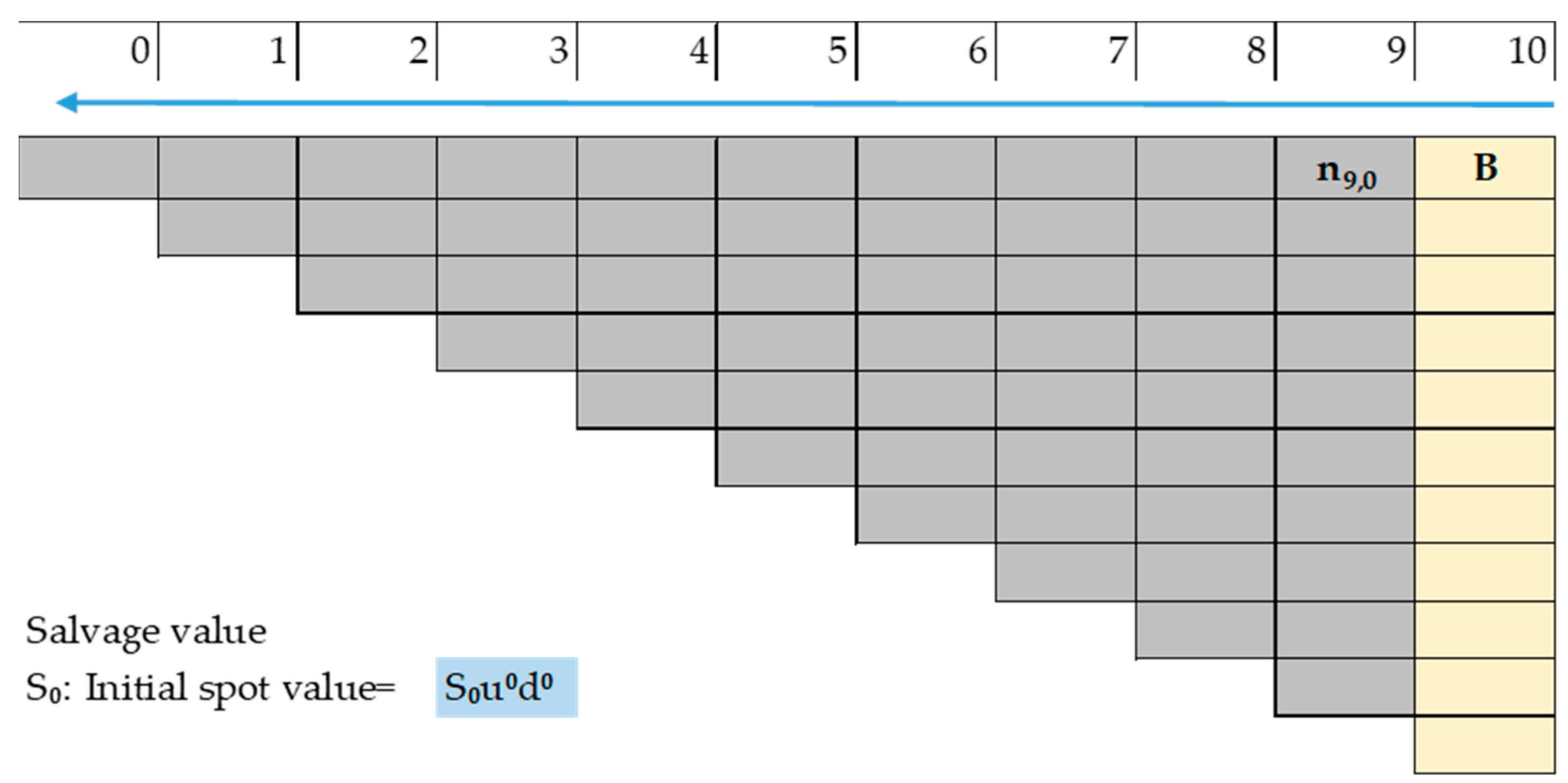
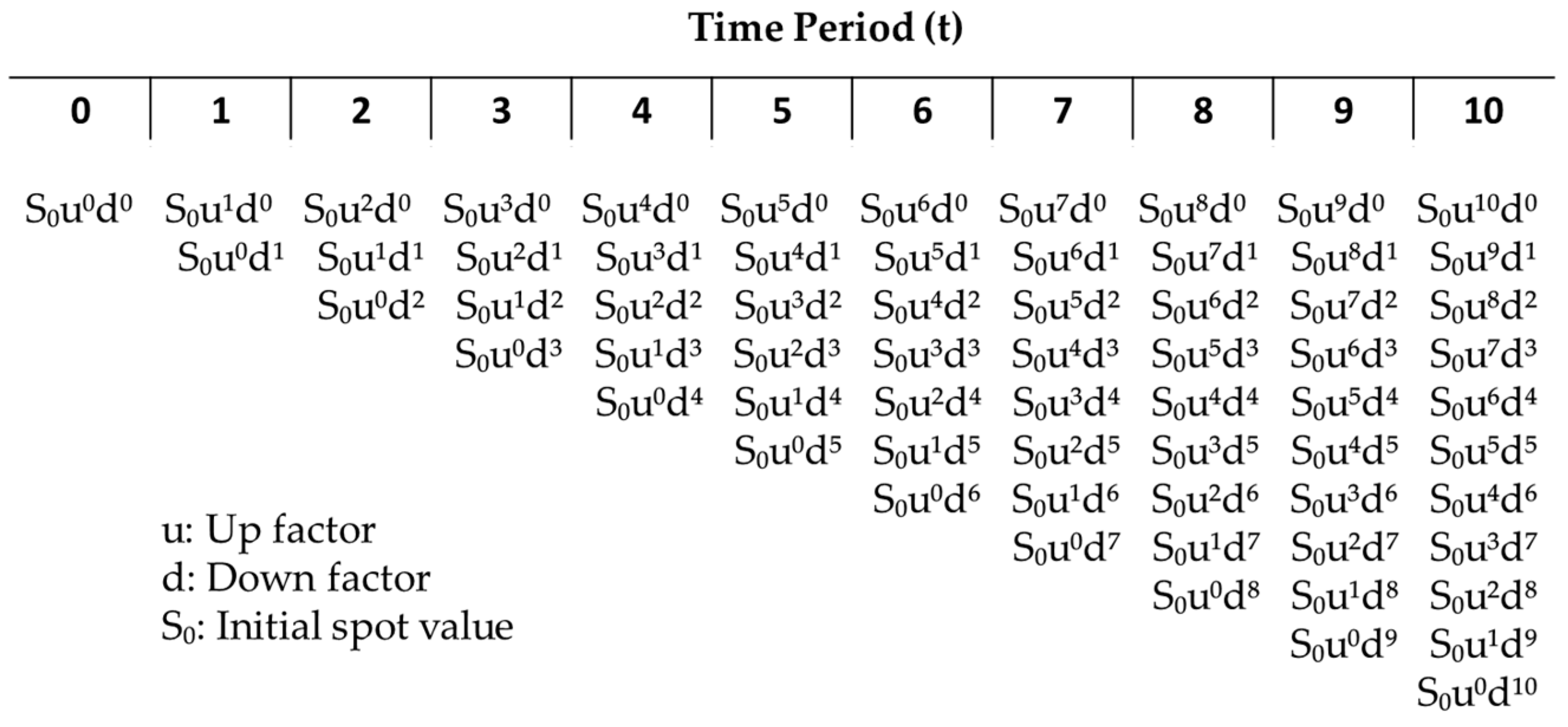
As time advances, this pattern continues. Each node gives rise to two new nodes in the following period—one applying the upward factor and the other the downward factor to the node’s current value. This sequence is repeated until all periods within the analysis horizon are completed. As shown in Figure 1, in a 10-year binomial tree, 11 levels will be constructed (from year 0 to year 10), thereby generating a complete network of possible future project values.
Once the price evolution tree is constructed, the next step is to calculate the present value of the project using the risk-neutral probability, a core concept in option theory. This probability does not reflect the real likelihood of scenarios but rather an adjusted measure that allows project valuation under the assumption that the expected return equals the risk-free rate, thereby eliminating subjective risk aversion bias
In the context of the binomial tree, this probability ensures that the expected value of future prices—once discounted—is consistent with the current value of the asset or project. Its formula is as follows:
P   =   e R f Δ t d u d
where R f denotes the continuously compounded risk-free rate, which is consistently used both in the binomial valuation framework and in the CAPM model. The parameter Δ t represents the length of each time step in the binomial tree and corresponds to the time interval between two consecutive nodes. It is defined as the ratio between the total project horizon T and the number of steps N , such that Δ t = T / N
Based on this probability, the salvage value tree is constructed from the final year of the project back to year zero—i.e., from right to left. The first step in this process is to define the salvage value, which represents the percentage of the invested capital that can be recovered in the event of early termination of the project. This value is considered constant and serves as a minimum economic recovery threshold.
In the final year of the tree (e.g., year 10), at each terminal node, the following comparison is made:
  • The current spot value, calculated as the estimated value of the project at that specific node in the binomial tree shown in Figure 1 (based on the accumulated upward and downward movements).
  • The salvage value, which represents the recoverable value of the assets.
A simple decision rule is then applied: if the current spot value is greater than the salvage value, that value is retained; otherwise, it is replaced by the salvage value. This comparison ensures that the investor’s utility is maximized in each scenario. Once the terminal nodes for year 10 have been defined, the valuation proceeds backward through the tree, from year 9 down to year 0, as shown in Figure 2. At each node, the expected value of the two subsequent nodes (upward and downward) is calculated using risk-neutral probabilities and discounted at the risk-free rate. The abandonment option is incorporated by comparing the resulting value with the salvage value.
The formula used in this stage is:
n 9 , 0   = M a x ( s p o t   p r i c e , s a l v a g e   v a l u e ) p u + 1 p B e R f Δ t
where
B: is the node in the next period (typically the downward node).
This formula is applied at each step to construct the salvage value tree, repeating the process until the initial node is reached.

2.2. Cash Flow Output Variables

The input variables of the cash flow model represent the technical, economic, and financial assumptions incorporated to project the future performance of the project. Their accurate definition and quantification are essential to obtain a realistic valuation and to assess the project’s feasibility under different environmental and market conditions [47]. These variables include investment costs, operating expenses, technological efficiency, growth rates, macroeconomic projections, market prices, tax incentives, and associated risks. A consistent and updated modeling of each of these factors improves the precision of the financial analysis and reduces uncertainty in strategic decision-making.
One of the most relevant input variables is the equipment cost and initial investment (CAPEX), which significantly impacts cash flow, particularly in the early stages. The acquisition of electrolyzers, compressors, and storage systems represents a substantial capital expenditure, with the electrolyzer being the most expensive component of the process (see Table 2). In addition, tax incentives and accelerated depreciation, as provided by Law 2099 of 2021, allow asset depreciation over three years, reducing the taxable base for income tax and improving early operating cash flow. Law 1715 complements these incentives with a 50% over-deduction on income tax, Value Added Tax (VAT) exemption, and zero import tariffs, thus reducing both CAPEX and tax obligations [17,54].
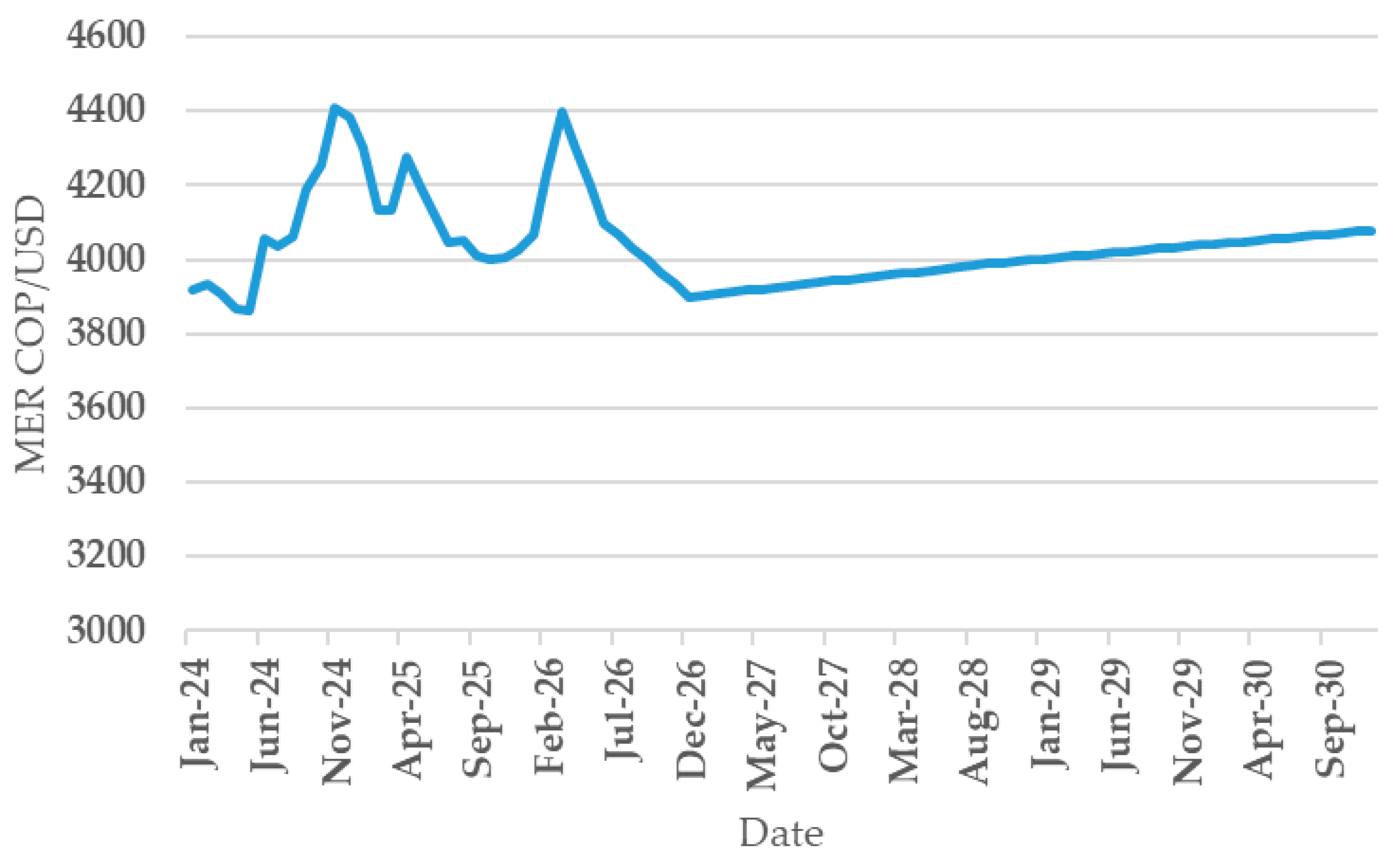
The Market Exchange Rate (MER) is another key variable, as a large portion of equipment is purchased in U.S. dollars; any appreciation of the dollar increases expenditures in local currency, reducing project liquidity. This study uses MER projections from Banco de Bogotá for the 2024–2030 period (see Figure 3 and Appendix A) [55].
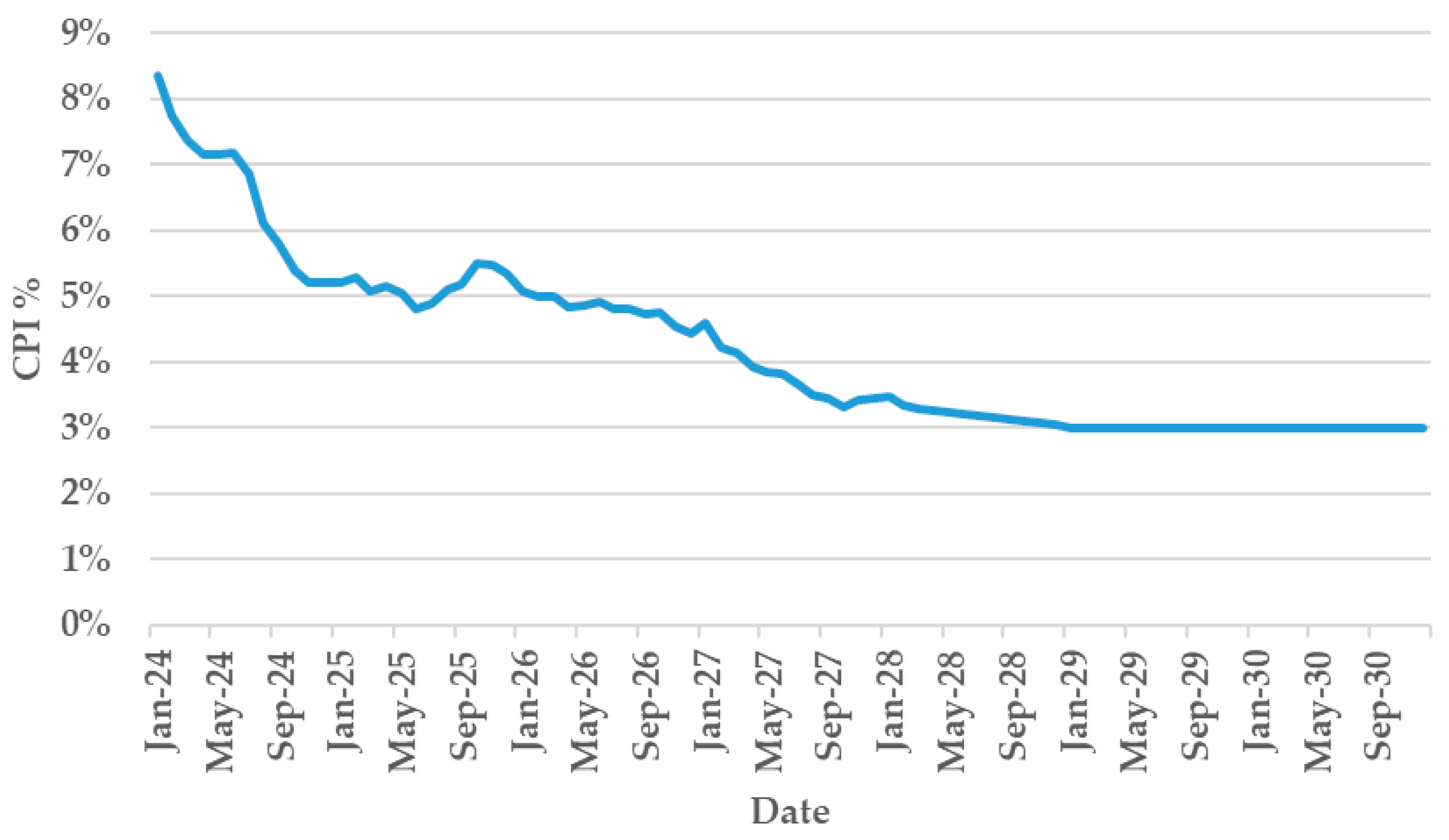
The electricity cost is considered the most critical operating variable, given that the electrolysis process consumes between 50 and 55 kWh per kilogram of hydrogen produced. A reference price of COP 350/kWh is assumed, validated by industry stakeholders. Any fluctuation in electricity prices directly affects project profitability. Consumer Price Index (CPI), estimated using data from Banco de Bogotá (see Figure 4), is used to adjust the annual growth of operating costs, including labor and utilities, maintaining coherence in long-term financial projections. The discount rate, estimated through the Weibull distribution, provides a more realistic representation of the project’s risk profile and is essential for calculating the Net Present Value (NPV). An inaccurate estimation of this rate could distort the perceived financial viability of the project. Lastly, engineering costs represent a considerable upfront investment during the design stage. Although non-recurring, these costs impact initial cash flow, and their quality has a direct effect on operational efficiency and cost optimization throughout the project’s lifecycle.

2.3. Valuation and Present Value (PV) Calculation

To determine the economic value of a project, the most commonly used method is the Discounted Cash Flow (DCF) approach, also known as Net Present Value (NPV) analysis. This method projects the future cash flows expected from the project and discounts them using a rate that reflects the associated risk, thereby obtaining their present value [56,57,58]. The basic formula is:
N P V = F C ( 1 + i ) n I 0
This technique estimates the present value of a project by considering the time value of money. It is essential to use accurate data and realistic assumptions, as a poorly estimated discount rate or unrealistic projections can significantly distort the valuation.

2.4. CAPM Model for Discount Rate Calculation

The Capital Asset Pricing Model (CAPM) is a fundamental tool used to estimate the cost of equity capital (“Ke”) for an investment project. In the case of a green hydrogen project in Colombia, the discount rate derived from the CAPM can be used to discount projected cash flows and assess the project’s financial viability [59].
  • The CAPM is expressed by the following equation:
K e = R f + β R m R f + R f
This formula incorporates market and country-specific risks to estimate a realistic cost of equity. It ensures that projected cash flows are discounted at a rate aligned with investor expectations and the project’s risk profile.

2.5. Weibull Model for Calculating Energy Price Volatility

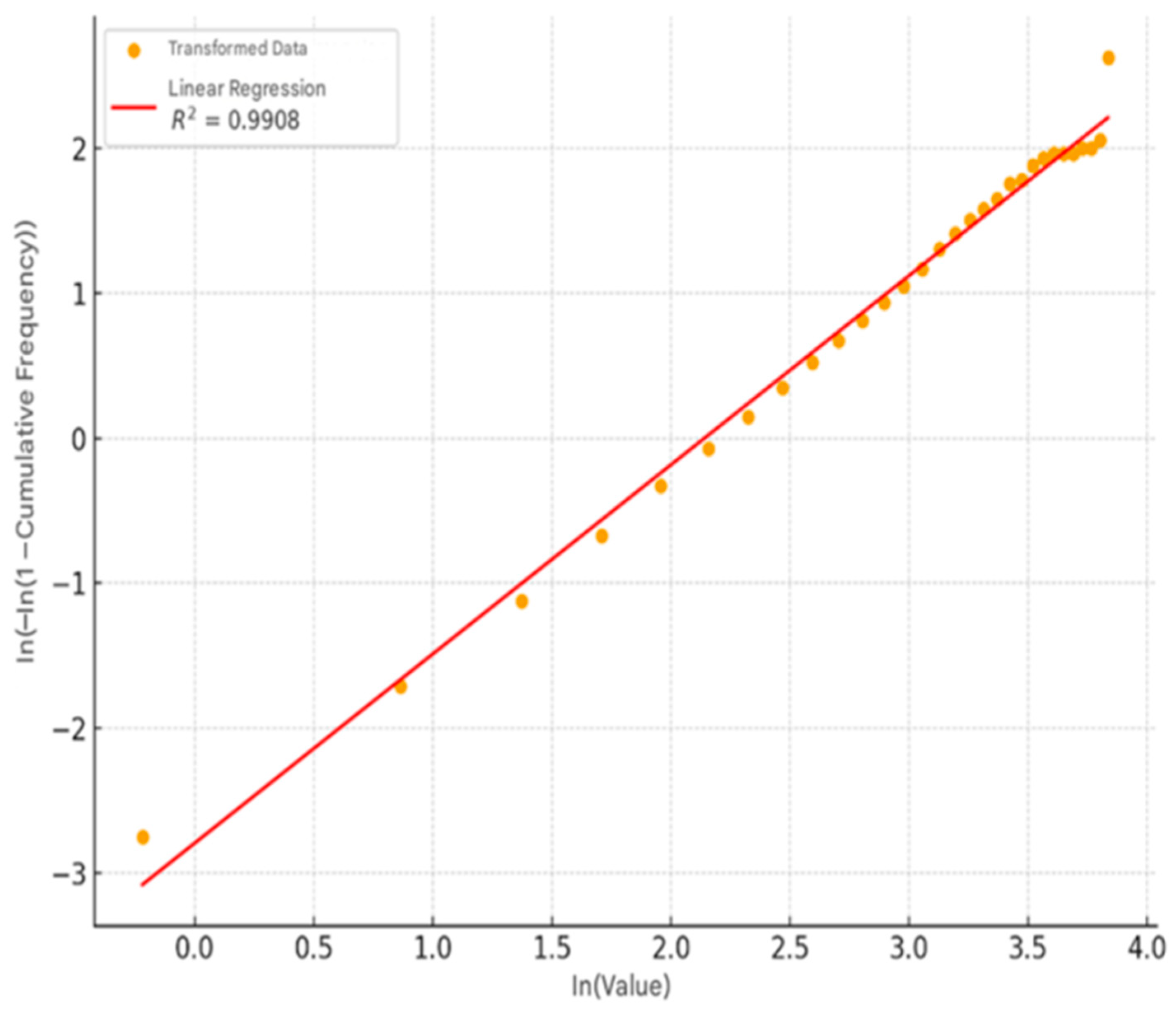
To estimate the volatility in regulated energy prices—used in the construction of the binomial tree (σ)—a statistical model based on the Weibull distribution was employed, known for its ability to model asymmetric and non-linear behaviors [19,22,23]. The analysis was conducted using daily values of the Average Price of Regulated Contracts over the past ten years, which were grouped into 30 intervals defined by upper and lower limits. For each of these intervals, the absolute frequency, relative frequency, and cumulative frequency were calculated, allowing for a clearer representation of the data distribution and laying the foundation for the subsequent adjustment of the Weibull model.
To fit the data into a Weibull distribution, a logarithmic transformation was applied in order to linearize the equation and calculate the shape (k) and scale (λ) parameters. The transformation used was:
X = L n ( V a l o r )
Y = L n ( L n ( 1 / ( 1 F   a c u m u l a d a ) )
where:
X-axis: Natural logarithm of the variable’s value.
Y-axis: Double logarithm of the cumulative frequency.
Once the transformed X and Y values were obtained, they were plotted on a Cartesian plane to perform a linear fit through regression. As shown in Figure 5, the best-fit line was obtained and its quality was evaluated using the coefficient of determination R2. The closer this value is to 1, the better the linear model explains the observed variability in the data—confirming that the Weibull distribution accurately represents the behavior of the analyzed series.
From the equation of the fitted line, the shape parameter k was identified, which corresponds to the slope of the line and describes the degree of skewness of the distribution. If the mean (μ) of the data and the shape parameter (k) are known, the scale parameter λ can be calculated with the following equation:
λ = μ Γ ( 1 + 1 / k )
where Γ represents the gamma function, calculated as:
Γ ( 1 + 1 / k ) = G A M M A 1 + 1 K
The variance of the Weibull distribution is calculated using the following formula:
V A R = ( λ 2 ) [ Γ ( 1 + 2 / k ) ( Γ 1 + k 1 ) 2 ]
The standard deviation is obtained by taking the square root of the variance:
s = V A R

Justification for the Use of the Weibull Distribution in Energy Price Volatility Modeling

Electricity prices exhibit structural characteristics that challenge the assumptions of normality commonly adopted in financial modeling. In regulated and semi-regulated electricity markets—such as the Colombian case—price dynamics are often asymmetric, bounded, and influenced by hydrological conditions, regulatory interventions, and demand shocks. These features result in distributions that are skewed and heteroskedastic, making Gaussian-based approaches inadequate for capturing the true risk profile faced by long-term energy investments.
In this study, the Weibull distribution is employed to model electricity price volatility used in the construction of the binomial tree parameter (σ). The choice of Weibull is motivated by its flexibility in representing asymmetric distributions and its proven applicability in energy economics when the underlying stochastic process deviates from normality. Unlike the normal or lognormal distributions—which impose symmetry or proportional variance growth—the Weibull distribution allows the shape parameter to adjust endogenously to the empirical behavior of the data, capturing both tail risk and non-linear responses.
This methodological choice is consistent with recent high-impact empirical studies in energy economics literature. For instance, Wilson et al. employ Weibull-based parametric survival models to analyze investment timing under energy-related uncertainty in the oil and gas sector. In their framework, Weibull is explicitly preferred because investment decisions and energy-related variables display non-normal distributions, censoring, and asymmetric hazard rates over time [60]. Importantly, the authors contrast Weibull models with alternative specifications (e.g., Cox and logit-based approaches) and demonstrate that Weibull provides a robust representation of uncertainty-driven investment behavior in energy markets.
While the present study focuses on project-level financial valuation rather than asset-level survival analysis, both contexts share a common methodological challenge: uncertainty in energy markets is inherently asymmetric and state-dependent. In line with this literature, the Weibull distribution is not used as a convenience assumption but as a risk-sensitive tool to capture the empirical distribution of electricity prices, which directly affects the volatility input of the real options framework.
To estimate the Weibull parameters, daily observations of regulated electricity contract prices over a ten-year period were grouped into frequency intervals, allowing for the construction of cumulative distributions. A logarithmic transformation was applied to linearize the Weibull function, enabling the estimation of shape and scale parameters through regression techniques. The goodness of fit was evaluated using the coefficient of determination (R2), ensuring that the fitted distribution adequately represents the observed data behavior.
It is important to note that the objective of this approach is not to forecast spot electricity prices, but to derive a statistically consistent measure of volatility that reflects downside risk and asymmetric fluctuations. This volatility measure is then integrated into the binomial tree model, influencing both upward and downward movements and, consequently, the valuation of managerial flexibility through the abandonment option.
By adopting the Weibull distribution, this study aligns with established methodological practices in energy investment analysis and provides a more realistic representation of risk than conventional normal-based assumptions. This enhances the robustness of the real options valuation, particularly in emerging economies where energy prices and regulatory conditions are subject to higher levels of structural uncertainty.

2.6. Calculations for Technical Design

To determine the electricity consumption of the process, the equipment with the highest energy demand—compressors and the electrolyzer—are identified. These components account for a significant portion of the total energy consumption in the design of the green hydrogen production system.

2.6.1. Energy Consumption of Compressors

The calculation of energy consumption for the compressors is based on the nominal power ratings of the equipment. In this case, there are two compressors (high and low pressure) [60,61]. The first step in estimating their total energy consumption is to sum the power ratings of both compressors.
P t = P 1 + P 2
With the total power value, monthly energy consumption is calculated under the assumption that the compressors operate 24 h a day, 30 days a month.
It is important to note that this calculation represents an ideal scenario of continuous operation and that, in practice, it may vary depending on the actual operational profile of the process.

2.6.2. Energy Consumption of the Electrolyzer

To estimate the electrolyzer’s energy consumption, the calculation is based on the manufacturer’s data, which indicates the amount of hydrogen produced per hour under standard conditions. Energy consumption is also calculated assuming continuous operation, 24 h a day [62]. Although oxygen is produced as a byproduct of the electrolysis process, no dedicated oxygen compressor is considered in the system configuration. Oxygen handling costs are assumed to be negligible, and oxygen is vented on-site without additional compression or storage.
The monthly hydrogen production is determined by multiplying the hourly production rate by the total number of hours in the month.
Q h = Q 24   h   30   d a y s
Based on the total amount of hydrogen produced, the monthly energy consumption of the electrolyzer is calculated using the specific energy consumption rate of the equipment.
E h = Q h P 4 Q
The total energy consumption of the process is obtained by summing the monthly energy consumption of the compressors (Ec) and the electrolyzer (Eh). This value provides an estimate of the overall energy expenditure of the system.
E = E h + E c

2.7. Calculation of the High-Pressure Hydrogen Storage Tank Volume

When hydrogen is compressed to the pressure of P in bar, it is necessary to calculate the required storage volume using the ideal gas equation. This method allows for estimating the volume based on the mass of hydrogen and the system’s pressure and temperature conditions [63].
The Ideal Gas Equation is expressed as:
P a V = n R T
The amount of substance (n) can be expressed as:
n = m / M
Substituting into the general equation, the formula to calculate the volume is:
V = ( n R T ) / ( M P a )

3. Results

The results of the financial and technical analysis show that the green hydrogen production project requires a total initial investment of COP 2,895,201,408 (see Table 3). Of this amount, the electrolyzer accounts for more than 80% of the CAPEX, confirming its strategic role as the core of the electrolysis process. However, this concentration also highlights the project’s high sensitivity to variations in the price of this equipment, its operational efficiency, and its lifespan, estimated between 10 and 15 years, with a 10-year warranty under optimal conditions.
The remaining equipment—low- and high-pressure compressors, reverse osmosis system, storage tanks, and auxiliary components—represents a smaller share of the CAPEX but is equally critical. Compressors, for instance, are essential to reach the required pressures that enable the safe storage of hydrogen, while the reverse osmosis system ensures the purity of the water used, a key condition to preserve the efficiency of the electrolyzer. In turn, the storage tanks and auxiliary components guarantee operational continuity, industrial safety, and product quality, preventing leaks or contamination that could compromise both the integrity of the system and the traceability of the green hydrogen [61,62,64,65,66,67].
The analysis of energy consumption shows that this type of project is highly electricity-intensive, which translates into an OPEX that outweighs CAPEX in relative importance. The electrolyzer, as the core equipment of the process, has an estimated monthly consumption of 742 MWh/month (see Table 4), representing the largest share of operating costs. Added to this are the compressors, required to bring hydrogen to safe storage conditions, with an additional demand of 113,760 MWh/month (see Table 5). It is important to note that, due to the high pressures required (900 bar) for storage, the compression process must be carried out in two stages: initially through a low-pressure compressor (45 kW) and subsequently with a high-pressure compressor (100 kW) (see Table 5). This staged design responds not only to an operational technical requirement but also to criteria of energy efficiency and industrial safety, as it prevents overloading a single system and reduces the risks associated with handling hydrogen under extreme conditions.
Regarding storage, the calculations show that 15 high-pressure tanks are required to reach the design capacity. These Type IV NPROXX tanks (see Table 3) are made of carbon fiber with a polyamide liner and are capable of withstanding pressures of up to 1000 bar. The choice of these materials responds to the need to guarantee the highest safety standards, given that hydrogen is a colorless, odorless, and flammable gas, whose flame is not visible to the naked eye (see Table 6). These properties increase the risks of handling and storage, making it essential to use equipment that offers maximum mechanical strength and minimal permeability. Although the cost of these tanks represents a smaller fraction of the total CAPEX, their role in mitigating operational risks makes them an unavoidable investment.
In operational terms, a monthly payroll of COP 47,879,423 is projected to cover the salaries of four specialized technicians who, in rotating shifts, ensure continuous monitoring of critical equipment around the clock, while the full labor cost structure, including additional operational and administrative staff, is detailed in Table 7.
This permanent supervision scheme is essential to preserve the lifespan of the electrolyzer, optimize its efficiency, and minimize the risks of failures or unplanned shutdowns that could compromise both process safety and the stability of financial flows.
Additionally, a contracted vehicle is included, with a monthly cost of 7,000,000 COP (see Table 7), to ensure staff mobility and timely response to logistical and operational contingencies. Table 7 presents the complete labor cost structure required for plant operation, including four technical operators as well as supporting personnel such as engineering, management, administrative, health and safety, and cleaning staff. Although these labor and transportation costs do not reach the magnitude of energy expenditures within OPEX, they constitute essential fixed costs that guarantee the continuity and stability of the project over time. From a financial management perspective, their relevance lies less in their absolute magnitude and more in their role in ensuring safe, compliant, and sustained operation.
Finally, the cash flow constructed from the technical and economic variables analyzed indicates that, under current conditions, the project exhibits a negative Net Present Value (NPV) and an Internal Rate of Return (IRR) close to 10% (see Table 8), a value below the required cost of equity (Ke) of 18.85%. This discount rate, estimated to be using the CAPM model, reflects the high technological and market risks associated with green hydrogen projects. Consequently, the project does not achieve financial viability in its current configuration and fails to meet the minimum return required to attract private investment.
Nevertheless, the integration of a stable hydroelectric power source introduces a key differentiating factor. Unlike intermittent renewable technologies, the Small Hydroelectric Plant (SHP) provides continuous 24/7 energy supply, enabling uninterrupted electrolyzer operation. This characteristic reduces revenue volatility, increases effective hydrogen output, and improves the relationship between invested CAPEX and actual production, strengthening the project’s long-term financial prospects.
The financial results summarized in Table 8 indicate that, under the baseline assumptions, the project generates an annual hydrogen production of 153,792 kg, sold at an average price of USD 7.4/kg. Despite this production scale, the financial indicators reveal a negative Net Present Value (NPV) of COP –561,119,459 and an Internal Rate of Return (IRR) of 9.7%, which remains below the required return threshold. These results confirm that, under current cost and price conditions, the project does not achieve financial viability from a purely static valuation perspective.
From a strategic perspective, this condition of energy stability represents a competitive advantage over alternative hydrogen production projects, as it improves asset utilization, enhances the bankability of the financial model, and facilitates access to international markets where renewable traceability and sustainability are indispensable requirements. All cash flow projections presented in this section are based on electricity supplied by small hydropower plants (SHPs) under long-term power purchase agreements (PPAs), with market electricity prices used exclusively as reference benchmarks for cost comparison.
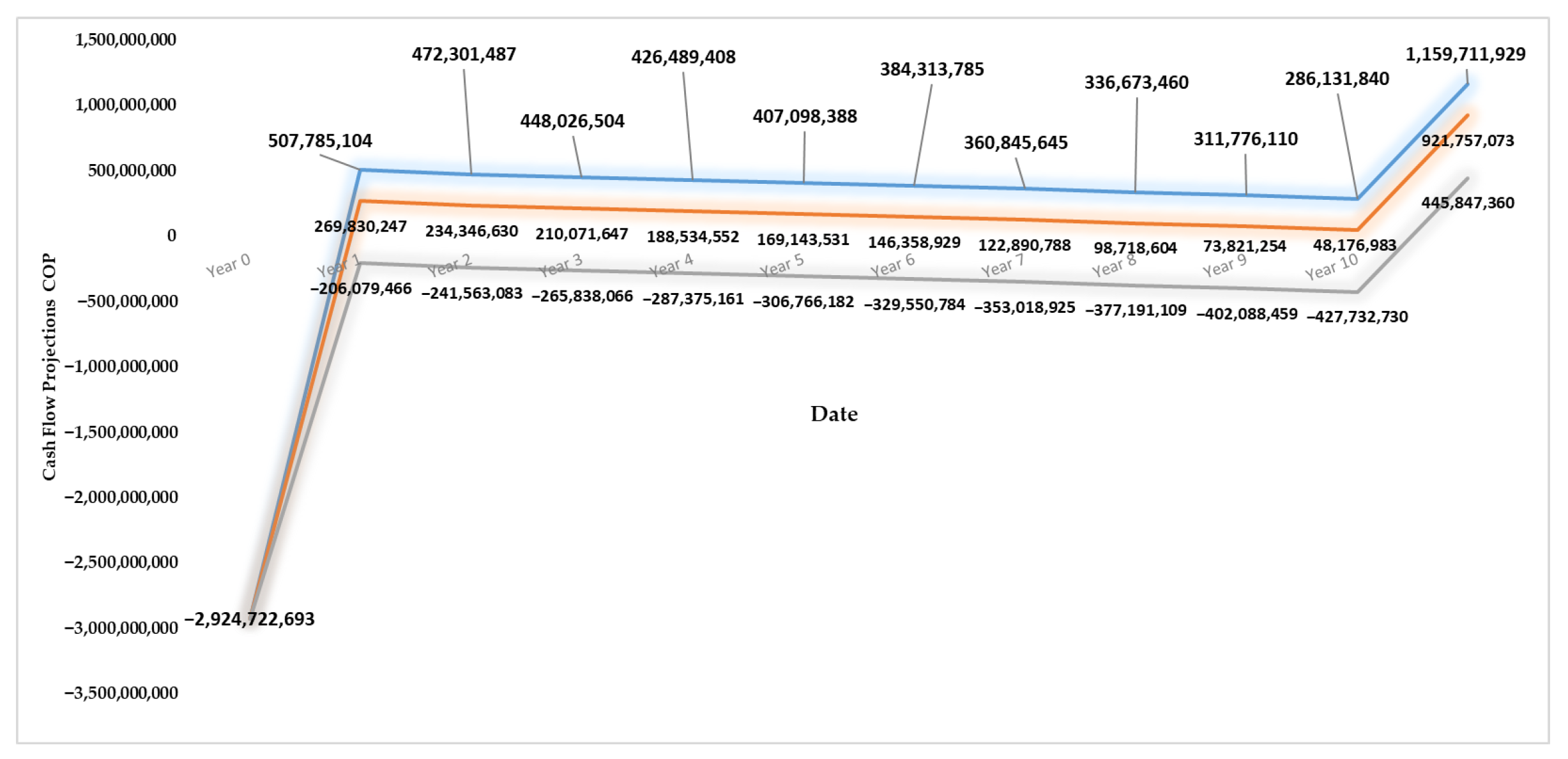
Figure 6 presents the project’s free cash flow trajectories under three operational scenarios defined by electrolyzer availability: a base case assuming continuous operation (100%), a realistic operating scenario (95%), and a highly conservative stress-test scenario (85%). The base case confirms the magnitude of the initial investment, close to COP 2924 million in year 0, which constitutes the most significant cash outflow over the project lifecycle. Under ideal operating conditions, positive cash flows are generated from the second year onwards, ranging approximately between COP 286 million and COP 507 million, reflecting continuous electrolyzer operation supported by the stable electricity supply guaranteed by the SHPs.
Under the base case scenario, a decreasing trend in free cash flows is observed from year 2 to year 10. This behavior is mainly attributable to the progressive increase in operating costs and the depreciation of key technological assets, particularly the electrolyzer, whose efficiency gradually declines over time. These dynamics highlight the project’s sensitivity to both energy-related variables and asset lifetime assumptions.
When more realistic operating conditions are considered, the sensitivity analysis shows that reduced electrolyzer availability has a significant impact on short- and medium-term financial performance. In the 95% availability scenario, free cash flows decline proportionally across all periods but remain predominantly positive, indicating that the project preserves economic viability under conservative and realistic assumptions. In contrast, the 85% availability scenario represents a stress-test case characterized by substantial operational downtime, resulting in negative cash flows during intermediate periods. Nevertheless, the project retains positive long-term value, as reflected in the terminal cash flow, underscoring the relevance of long-term operational stability and managerial flexibility.
These results indicate that, although positive operating cash flows confirm the technical feasibility of the plant, profitability margins narrow considerably under more conservative operational assumptions (see Table 9). This finding reinforces the importance of complementary strategies, such as revenue diversification (e.g., oxygen sales or downstream hydrogen derivatives), the renegotiation of electricity contracts under more competitive conditions, or extending the analysis horizon to account for reinvestments and technological upgrades that can prolong asset life and improve financial indicators.
To assess the realism and external consistency of the electricity price assumptions used in the techno-economic model, the results were contrasted with recent international benchmarks on renewable power generation costs. According to the International Renewable Energy Agency (IRENA), global weighted average levelized costs of electricity (LCOE) for new renewable projects commissioned in 2024 reached USD 0.034/kWh for onshore wind, USD 0.043/kWh for solar photovoltaic, and USD 0.057/kWh for hydropower. These values reflect mature technologies operating under competitive market conditions and provide a robust reference for long-term electricity contracting through power purchase agreements (PPAs) (See Table 10).
Although the present study does not model individual PPA contracts explicitly, the electricity prices embedded in the financial valuation fall within the cost competitiveness ranges reported by IRENA. This alignment indicates that the assumed electricity costs are neither optimistic nor detached from prevailing international market conditions. On the contrary, they are consistent with the economic fundamentals that underpin renewable PPAs globally, where contract prices tend to converge toward LCOE benchmarks adjusted for regional risk, regulatory frameworks, and contract duration.
Importantly, hydropower-based electricity exhibits a distinct advantage in the context of hydrogen production due to its dispatchability and stable generation profile. While IRENA reports comparable or lower LCOEs for solar and wind technologies, these sources are subject to intermittency and typically require complementary storage or balancing mechanisms to ensure continuous electrolyzer operation. In contrast, Small Hydropower Plants provide firm renewable supply, reducing operational risk and mitigating the volatility exposure associated with intermittent generation. This structural characteristic reinforces the suitability of SHP-based electricity for long-term hydrogen projects, beyond pure cost considerations.
Therefore, the comparison with IRENA benchmarks confirms that the electricity price assumptions adopted in this study are grounded in internationally recognized cost evidence. The robustness of the financial results is not driven by favorable price hypotheses, but by the structural stability of the energy source and its interaction with electrolyzer operation. This validation strengthens the credibility of the techno-economic analysis and supports the generalizability of the conclusions under realistic market conditions.
Finally, the binomial tree analysis (see Table 11) illustrates the potential evolution of the project’s value under different price and operational performance scenarios. A wide dispersion of trajectories toward the extremes is observed, reflecting both the inherent volatility of the hydrogen market and the model’s sensitivity to input variables. The tree construction uses as its central parameter the historical volatility of average electricity contract prices, estimated at 5.3%, which captures the intrinsic variability of the Colombian energy sector. This parameter plays a decisive role in defining the upward and downward factors of the model, ensuring that each trajectory reflects not only hydrogen market uncertainty but also the volatility of its main input: electricity. In this way, the binomial framework explicitly incorporates energy price volatility, reinforcing the robustness and internal consistency of the analysis.
Meanwhile, the tree adjusted for salvage value (see Table 11) introduces the possibility of exercising the abandonment option in those nodes where the project’s value is lower than the recovery threshold. This adjustment partially cushions the downside in the most unfavorable states by allowing a fraction of the invested capital to be recovered. However, the obtained values show that the magnitude of this recovery (COP 1.8 trillion versus an initial investment of COP 2.9 trillion) covers only 61.7% of the total investment, structurally limiting its mitigating effect. The comparative analysis between both representations leads to the conclusion that the real abandonment option, although conceptually providing managerial flexibility, remains out of the money in most nodes. In the few cases where it is exercised, the amount recovered does not succeed in reversing the deficit outcome, which explains why the Net Value of the project with real options remains negative at COP 1118 million.
From a methodological perspective, the difference between the two trees reflects the role of the abandonment option more as a containment tool than as a value-creation mechanism. Its presence partially reduces exposure to the worst-case scenario but does not alter the overall distribution of results nor transform the investment logic. In fact, scenarios with high returns are unlikely and depend on optimistic assumptions regarding prices and efficiency, while the more realistic scenarios cluster in the lower end of the tree, reinforcing the project’s asymmetric risk profile.
While the original binomial tree incorporates the abandonment option implicitly through salvage value adjustments, this study additionally reports the option value explicitly in order to enhance transparency and facilitate scenario comparison.
The financial results indicate that the project is characterized by a strongly asymmetric risk profile. While positive operating cash flows are generated under favorable conditions, the magnitude of the initial investment and the progressive deterioration of operating margins structurally limit the project’s ability to recover its capital outlay. As shown in Figure 6, reduced electrolyzer availability leads to a proportional decline in free cash flows across all periods. Under realistic operating conditions (95% availability), cash flows remain mostly positive but insufficient to offset the initial investment, whereas the conservative stress-test scenario (85%) results in negative cash flows during intermediate years, confirming the project’s sensitivity to operational performance (see Table 12).

4. Discussion of Financial Results, Real Options, and Robustness

The real options analysis further clarifies the economic implications of these dynamics. Although the abandonment option retains a positive value across all scenarios, its magnitude decreases sharply as operating conditions deteriorate. In particular, when electrolyzer availability is reduced to 85%, the expected project value without flexibility becomes negative, yet the option value remains positive due to the presence of downside protection through early termination and salvage value recovery. This behavior is fully consistent with real options theory, where the value of flexibility depends on the dispersion of future outcomes rather than on the sign of the expected net present value alone.
Nevertheless, the abandonment option does not reverse the overall economic infeasibility of the project under conservative assumptions. As indicated by the binomial tree structure (Table 10), the option remains out of the money in most nodes, and in the limited cases where it is exercised, the recovered value—approximately 61.7% of the initial investment—fails to compensate for the capital outlay. Consequently, the real option acts primarily as a loss-containment mechanism rather than as a value-creation driver. This explains why the net project value with real options remains negative even after accounting for managerial flexibility.
From a methodological standpoint, the dispersion of trajectories in the binomial tree highlights the role of electricity price volatility and operational uncertainty as the main drivers of financial outcomes. High-value trajectories are associated with optimistic assumptions regarding prices and efficiency, whereas the majority of more realistic paths cluster in the lower end of the distribution. This result reinforces the asymmetric nature of the project’s risk profile and confirms that flexibility mitigates extreme downside outcomes without fundamentally altering the investment logic.
To assess the external validity of the electricity price assumptions embedded in the cash flow and option valuation, the results were benchmarked against internationally recognized renewable cost evidence. According to the International Renewable Energy Agency (IRENA), global weighted-average levelized costs of electricity for renewable technologies commissioned in 2024 range between USD 0.034/kWh for onshore wind, USD 0.043/kWh for solar photovoltaic, and USD 0.057/kWh for hydropower. The electricity prices used in this study fall within these internationally observed cost ranges, indicating that the financial results are not driven by optimistic or unrealistic energy price assumptions.
Importantly, while some renewable technologies exhibit lower average costs, their intermittency introduces additional operational risk for continuous hydrogen production. In contrast, Small Hydropower Plants provide firm and dispatchable renewable electricity, reducing exposure to downtime and enhancing operational stability. This structural characteristic explains why, despite unfavorable economic results under conservative assumptions, the project’s performance remains relatively robust when compared to alternative renewable configurations.
Overall, the combined evidence from cash flow projections, real options valuation, and international cost benchmarking confirms that the conclusions of this study are not sensitive to overly optimistic technical or market assumptions. Instead, they reflect the intrinsic economic trade-offs of green hydrogen projects operating under realistic conditions in emerging electricity markets.
While the results provide strong evidence of the relative robustness of SHP-based green hydrogen systems, their interpretation necessarily depends on a set of modeling assumptions and boundary conditions, which are discussed below

Assumptions and Limitations

The techno-economic model developed in this study relies on a set of simplifying assumptions that are necessary to ensure tractability and transparency in long-term project evaluation. Baseline scenarios assume continuous operation of the electrolyzer system under stable technical conditions. While such assumptions are common in early-stage feasibility studies, actual project performance may be affected by operational constraints and technical degradation.
To address this limitation, a sensitivity analysis was conducted to assess the impact of more realistic operating conditions. Specifically, the analysis considers: (i) reduced electrolyzer availability to account for maintenance activities and unplanned downtime, (ii) gradual efficiency degradation over the project lifetime, and (iii) scheduled maintenance periods affecting annual operating hours. Electrolyzer availability rates of 95% and 85% were evaluated. The 95% scenario reflects conservative but realistic operating conditions consistent with industrial benchmarks, while the 85% scenario represents a highly conservative stress-test assumption incorporating significant downtime. These assumptions were applied consistently across all scenarios to ensure comparability.
The analysis assumes an electrolyzer operational lifetime of 80,000 h, which aligns with the selected project horizon of 10 years. Under this assumption, no complete electrolyzer replacement is required during the evaluation period. Although unexpected failures or accelerated degradation could affect real-world performance, routine maintenance and repair activities are incorporated into OPEX. This approach is consistent with early-stage techno-economic assessments and avoids overestimating capital requirements while maintaining conservative operational assumptions.
Recent life-cycle and techno-economic studies report electrolyzer stack lifetimes for PEM technologies in the range of 7–10 years, corresponding to approximately 60,000–80,000 operating hours under baseload conditions, with unit electricity consumption between 52 and 56 kWh/kg-H2 [68]. These findings are consistent with technical assessments indicating that stack degradation and replacement requirements represent a major source of uncertainty and may account for a substantial share of total system CAPEX [69]. While longer plant lifetimes are technically feasible through periodic stack replacement, the present study intentionally adopts a conservative 10-year project horizon in order to avoid optimistic assumptions regarding reinvestment decisions and long-term operational performance.
The sensitivity results show that reduced electrolyzer availability leads to lower annual hydrogen production and free cash flow. Under the 95% availability scenario, the project remains economically stable relative to the base case, although with reduced profitability. Under the more conservative 85% availability scenario, cash flows become negative during intermediate periods; however, residual economic value remains driven by terminal conditions and the stability of the hydropower-based electricity supply. Overall, while lower availability significantly affects short- and medium-term financial performance, the relative economic performance of green hydrogen production based on Small Hydropower Plants remains robust. This confirms that the main conclusions of the study are not driven by overly optimistic technical assumptions, but rather by the structural characteristics of SHP-based hydrogen systems.
From a financial interpretation perspective, these assumptions directly affect capital recovery dynamics and therefore warrant explicit discussion. The simple payback period exceeds the 10-year analysis horizon and is therefore not reached under the base-case scenario. However, this outcome is typical of capital-intensive green hydrogen projects and does not undermine their economic relevance. Consequently, greater emphasis is placed on discounted metrics and real-options analysis, which better reflect long-term value creation under uncertainty. Furthermore, a sensitivity-based interpretation indicates that moderate reductions in electricity costs, higher electrolyzer availability, or the inclusion of additional revenue streams (e.g., oxygen valorization) would substantially shorten the payback period, highlighting clear pathways toward economic feasibility.

5. Conclusions

It is concluded that, under the current regulatory frameworks and market conditions of the Colombian energy sector, the production of green hydrogen is not financially viable. The high investment costs (CAPEX), combined with the weight of electricity consumption within OPEX and the limited scope of existing tax incentives, prevent projects from achieving positive financial indicators in the short term.
A strategic alternative to improve profitability is to move towards the production of hydrogen derivatives such as green ammonia, methanol, and sustainable aviation fuels (SAF). These products offer greater added value, open the possibility of entering international markets, and diversify demand beyond the local oil industry.
Regarding the evaluation horizon, the 10-year timeframe used is insufficient to assess investments of this magnitude. It is recommended to extend the analysis horizon to 15 or 20 years in order to incorporate reinvestment scenarios in equipment, technological improvements, and economies of scale, which would increase the likelihood of achieving favorable financial results.
It is necessary for the Colombian State to assume a more active role in the development of this industry, not only through tax incentives but also with preferential financing mechanisms, direct subsidies to CAPEX, guaranteed purchase agreements (H2-PPAs), and explicit penalties for CO2 emissions in polluting industries. Without a more ambitious public policy, the attraction of private investment will remain limited.
Under current conditions, it is not advisable to undertake large-scale private capital investments in green hydrogen projects in Colombia. It is more prudent to wait until technological costs decrease, electrolyzer and storage system prices become more accessible, and a more solid regulatory framework is in place to reduce financial risk exposure.
Green hydrogen will only be considered competitive once its price per kilogram approaches that of gray hydrogen. As long as this gap persists, projects will lack economic attractiveness compared to fossil alternatives, except in regulated sectors or those under strong international decarbonization pressure.
Finally, it is important to invest in the development of national capabilities for the manufacturing and maintenance of technologies associated with hydrogen production, particularly electrolyzers. The emerging nature of this industry offers Colombia the opportunity to reduce its dependence on international suppliers, advance toward technological self-sufficiency, and consequently improve its competitiveness in the medium term.

Author Contributions

Conceptualization, D.V., M.A. and C.E.A.; methodology, D.V.; software, D.V.; validation, D.V., M.A. and C.E.A.; formal analysis, D.V.; investigation, D.V.; resources, C.E.A.; data curation, D.V.; writing—original draft preparation, D.V.; writing—review and editing, D.V., M.A. and C.E.A.; visualization, D.V. and M.A.; supervision, M.A. and C.E.A.; project administration, C.E.A.; funding acquisition, C.E.A. All authors have read and agreed to the published version of the manuscript.

Funding

This research was funded by Ministerio de Ciencia, Tecnología e Innovación—MINCIENCIAS grant number 2023-0680 and the APC was funded by Universidad de Medellín.

Data Availability Statement

The datasets generated and/or analyzed during the current study are not publicly available due to project restrictions but are available from the corresponding author on reasonable request.

Acknowledgments

The authors gratefully acknowledge the financial support provided by the Mi-nisterio de Ciencia, Tecnología e Innovación—MINCIENCIAS through Convocatoria 890-2020 para el Fortalecimiento de CTeI en Instituciones de Educación Superior Públicas which enabled the de-velopment and execution of the project “Hidrógeno como vector energético: evaluación teórica y experimental de la producción de hidrógeno con captura de carbono a partir del uso de biomasa residual para aplicaciones domésticas e industriales”.

Conflicts of Interest

The authors declare no conflict of interest.

Abbreviations

S0: This is the current price of the asset (NPV).
Rf: The risk-free rate of return, such as government bond yields.
σ: Volatility measures the uncertainty or risk associated with the asset’s price.
T: The total time period of the analysis, expressed in years.
N: The number of intervals into which the analysis period is divided.
ΔtCalculated by dividing the total time by the number of steps, T/N.
P: Risk-neutral probability.
u: Represents how much the asset price increases in each step
d: Represents how much the asset price decreases in each step.
FCRepresents the expected future cash flow for each period (typically annual).
IIs the discount rate.
NIs the number of periods.
I0 Is the initial investment.
Rf: Risk-Free Rate
β:Beta coefficient represents the project’s systematic risk in the CAPM framework.
Rm−Rf:Market Risk Premium
Rp:Country Risk Premium
P1: High-Pressure Compressor [kW]
P2: Low-Pressure Compressor [kW]
EcEnergy consumed by compressors
Q: Maximum Power Hydrogen Generation [kg/h]
P4: Electrolyzer [MW]
QhAmount of hydrogen produced
EhElectrolyzer power consumption
EEnergy consumption
Pa: Pressure of the hydrogen in atmospheres (atm)
V: Volume of the hydrogen in liters (L)
n: Amount of substance in moles (mol)
R: Ideal gas constant (0.082 atm·L/mol·K)
T: Absolute temperature of the hydrogen in kelvin (K)
m: Mass of hydrogen in kilograms (kg)
M: Molar mass of hydrogen (2 kg/mol)
SMMLV:Statutory Monthly Minimum Wage

Appendix A

Table A1. Variables and Sources information.
VariableSource of Information
Electrolyzers, compressors, and storage systems [69,70]“Renewables 2024 Analysis and forecast to 2030”The European IEA. International Energy Agency. Accessed: 2 September 2024. [Online] https://iea.blob.core.windows.net/assets/17033b62-07a5-4144-8dd0-651cdb6caa24/Renewables2024.pdf
“¿Cuál es el mejor compresor de aire de tornillo rotativo? -Sollant, 20 años de fábrica.” Accessed: 25 January 2025. [Online]. Available: https://es.sollant.com/product/15kw-rotary-air-compressor/
“Compresor de aire de tornillo de 100 hp: elija el fabricante de Sollant para su negocio.” Accessed: 25 January 2025. [Online]. Available: https://es.sollant.com/product/100hp-screw-air-compressor/
“Fabricantes de compresores rotativos de 45 kW: resistencia confiable.” Accessed: 25 January 2025. [Online]. Available: https://es.sollant.com/product/45kw-rotary-compressor-manufacturers/
Depreciation [71,72,73]“Ley 2099 de 2021—Gestor Normativo—Función Pública Colombia.” Accessed: 2 September 2024. [Online]. Available: https://www.funcionpublica.gov.co/eva/gestornormativo/norma.php?i=166326
Projection of the exchange rate between the Colombian peso and the US dollar [55]Proyecciones Económicas 2024–2030. Accessed: 5 May 2025. [Online] https://pbit.bancodebogota.com/Investigaciones/Proyecciones.aspx
Price of bilateral contracts
[74,75]
XM, “ Precios en contratos por tipo de mercado”. Accessed: 2 September 2024. [Online].
https://sinergox.xm.com.co/trpr/Paginas/Informes/PreciosContratosMercado.aspx
Informe de XM sobre las variables del mercado de energía|Portal XM. Accessed: 2 September 2025
https://www.xm.com.co/noticias/8584-informe-de-xm-sobre-las-variables-del-mercado-de-energia-en-noviembre-de-2025
Oxygen data
[76]
FRED, “Oxygen Price,” FRED. Accessed: 7 September 2024. [Online]. Available:
https://fred.stlouisfed.org/series/PCU325120325120A/
Levelized cost of hydrogen (LCOH)
[77,78,79]
European Hydrogen Observatory. Levelised Cost of Hydrogen (LCOH) Calculator Manual Accessed: 27 January 2026: https://observatory.clean-hydrogen.europa.eu/sites/default/files/2024-06/Manual%20-%20Levelised%20Cost%20of%20Hydrogen%20%28LCOH%29%20Calculator.pdf
“Levelised Cost of Hydrogen Maps”. https://www.iea.org/data-and-statistics/data-tools/levelised-cost-of-hydrogen-maps
https://www.eex-transparency.com/hydrogen/germany

References

  1. Adu, D.; Jianguo, D.; Asomani, S.N.; Abbey, A. Energy generation and carbon dioxide emission—The role of renewable energy for green development. Energy Rep. 2024, 12, 1420–1430. [Google Scholar] [CrossRef]
  2. Muralikrishna, I.V.; Manickam, V. Environmental Policies and Legislation. In Environmental Management: Science and Engineering for Industry; Butterworth-Heinemann: Oxford, UK, 2017; pp. 37–55. [Google Scholar] [CrossRef]
  3. Plan de Acción de Hidrógeno Verde | El Plan de Acción 2023–2030 de Hidrógeno Verde Definirá la Hoja de Ruta para el Despliegue de esta Industria, Conciliando el Desarrollo Económico con el Respeto por el Medio Ambiente, el Territorio y las Comunidades. Este Plan Tenemos que Construirlo de Manera Conjunta. Por eso, Invitamos a Todos y Todas a que Sean Parte Activa de Esta Discusión. Available online: https://www.planhidrogenoverde.cl/ (accessed on 5 September 2025).
  4. Ministerio de Minas y Energía. Hoja de Ruta para el Hidrógeno en Colombia. Available online: https://www.minenergia.gov.co/es/micrositios/enlace-ruta-hidrogeno/ (accessed on 1 September 2024).
  5. Plan Trienal Nacional 2023-2025 del Programa Nacional de Hidrógeno (PNH2) en Brasil–H2LAC. Available online: https://h2lac.org/archivos/plan-trienal-nacional-2023-2025-del-programa-nacional-de-hidrogeno-pnh2-en-brasil/ (accessed on 5 September 2025).
  6. Ministerio de Minas y Energía. Colombia lanza la Política Nacional de Hidrógeno para Impulsar la Transición Energética y Crear Nuevas Industrias Limpias. Available online: https://www.minenergia.gov.co/es/sala-de-prensa/noticias-index/colombia-lanza-la-politica-nacional-de-hidrogeno-para-impulsar-la-transicion-energetica-y-crear-nuevas-industrias-limpias/ (accessed on 9 December 2025).
  7. Plazas-Niño, F.A.; Yeganyan, R.; Cannone, C.; Howells, M.; Quirós-Tortós, J. Informing sustainable energy policy in developing countries: An assessment of decarbonization pathways in Colombia using open energy system optimization modelling. Energy Strategy Rev. 2023, 50, 101226. [Google Scholar] [CrossRef]
  8. Benalcazar, P.; Komorowska, A. Techno-economic analysis and uncertainty assessment of green hydrogen production in future exporting countries. Renew. Sustain. Energy Rev. 2024, 199, 114512. [Google Scholar] [CrossRef]
  9. Biggins, F.; Kataria, M.; Roberts, D.; Brown, D.S. Green hydrogen investments: Investigating the option to wait. Energy 2022, 241, 122842. [Google Scholar] [CrossRef]
  10. Munther, A.; Hassan, M. Techno-economic assessment of green hydrogen production systems under different scenarios. Energies 2023, 16, 2451. [Google Scholar] [CrossRef]
  11. Abadie, L.M.; Chamorro, J.M. Investment in wind-based hydrogen production under economic and physical uncertainties. Appl. Energy 2023, 337, 120881. [Google Scholar] [CrossRef]
  12. Rong, H.; Kuang, H. A cooperative model of photovoltaic and electricity-to- hydrogen including green certificate trading under the conditional value at risk. Glob. Energy Interconnect. 2023, 6, 403–417. [Google Scholar] [CrossRef]
  13. Reyes-Bozo, L.; Fúnez-Guerra, C.; Salazar, J.L.; Vyhmeister, E.; Valdés-González, H.; Caparrós, M.J. Green hydrogen integration in aluminum recycling: Techno-economic analysis towards sustainability transition in the expanding aluminum market. Energy Convers. Manag. X 2024, 22, 100548. [Google Scholar] [CrossRef]
  14. Cheilas, P.T.; Daglis, T.; Xidonas, P.; Michaelides, P.G.; Konstantakis, K.N. Financial dynamics, green transition and hydrogen economy in Europe. Int. Rev. Econ. Financ. 2024, 94, 103370. [Google Scholar] [CrossRef]
  15. El Hassani, S.; Lebrouhi, B.E.; Kousksou, T. A feasibility study of green hydrogen and E-fuels production from a renewable energy hybrid system in the city of Dakhla, Morocco. Int. J. Hydrogen Energy 2024, 73, 316–330. [Google Scholar] [CrossRef]
  16. Rodríguez-Fontalvo, D.; Quiroga, E.; Cantillo, N.M.; Sánchez, N.; Figueredo, M.; Cobo, M. Green hydrogen potential in tropical countries: The Colombian case. Int. J. Hydrogen Energy 2024, 54, 344–360. [Google Scholar] [CrossRef]
  17. Ríos, L.M.; Asesor, E.; García, L. Beneficios Financieros de la ley 1715 para la Integración de las Energías Renovables no Convencionales al Mercado Energético Colombiano. Master’s Thesis, Universidad de los Andes, Bogotá, Colombia, 2019. Available online: http://hdl.handle.net/1992/45380 (accessed on 26 January 2025).
  18. Estudio: Integración de las Energías Renovables no Convencionales en Colombia. Available online: https://www1.upme.gov.co/Paginas/Estudio-Integraci%c3%b3n-de-las-energ%c3%adas-renovables-no-convencionales-en-Colombia.aspx (accessed on 26 January 2025).
  19. Abonongo, J. Properties and applications of the Tan Weibull loss distribution. Kuwait J. Sci. 2025, 52, 100304. [Google Scholar] [CrossRef]
  20. Santos, F.S.D.; Nascimento, K.K.F.D.; da Silva Jale, J.; Xavier, S.F.A.; Ferreira, T.A.E. Brazilian wind energy generation potential using mixtures of Weibull distributions. Renew. Sustain. Energy Rev. 2024, 189, 113990. [Google Scholar] [CrossRef]
  21. Azad, A.K.; Rasul, M.G.; Islam, R.; Shishir, I.R. Analysis of Wind Energy Prospect for Power Generation by Three Weibull Distribution Methods. Energy Procedia 2015, 75, 722–727. [Google Scholar] [CrossRef]
  22. Ayua, T.J.; Emetere, M.E. Technical analysis of wind energy potentials using a modified Weibull and Raleigh distribution model parameters approach in the Gambia. Heliyon 2023, 9, e20315. [Google Scholar] [CrossRef]
  23. Danrimi, M.L.; Abubakar, H. A Bayesian Framework for Estimating Weibull Distribution Parameters: Applications in Finance, Insurance, and Natural Disaster Analysis. UMYU J. Account. Financ. Res. 2023, 5, 64–83. [Google Scholar] [CrossRef]
  24. De Paolis, R.; Bernardini, V.; Campana, L.G.; Ermini, M.V.; Verna, M.; Raimondi, G.; Spazzafumo, G. Techno-economic and climate finance assessment of a methanation plant with green hydrogen production and CO2 recycling in Italy. Int. J. Hydrogen Energy 2024, 137, 939–947. [Google Scholar] [CrossRef]
  25. Taghizadeh-Hesary, F.; Li, Y.; Rasoulinezhad, E.; Mortha, A.; Long, Y.; Lan, Y. Green finance and the economic feasibility of hydrogen projects. Int. J. Hydrogen Energy 2022, 47, 24511–24522. [Google Scholar] [CrossRef]
  26. Hunt, O.B.; Tilsted, J.P. ‘Risk on steroids’: Investing in the hydrogen economy. Environ. Plan. A 2024, 57, 1131–1150. [Google Scholar] [CrossRef]
  27. Zhao, H. Green ammonia supply chain and associated market structure. Fuel 2024, 366, 131216. [Google Scholar] [CrossRef]
  28. Wei, T. Multiplier effect on reducing carbon emissions of joint demand and supply side measures in the hydrogen market. Energy 2024, 305, 132110. [Google Scholar] [CrossRef]
  29. Walwyn, D.; Bertoldi, A.; Gable, C. Building the hydrogen economy through niche experimentation and digitalisation. J. Manuf. Technol. Manag. 2019, 30, 1179–1195. [Google Scholar] [CrossRef]
  30. Lucey, B.; Yahya, M.; Khoja, L.; Uddin, G.S.; Ahmed, A. Interconnectedness and risk profile of hydrogen against major asset classes. Renew. Sustain. Energy Rev. 2024, 192, 114223. [Google Scholar] [CrossRef]
  31. Jacob, R.; Müller, M. Reducing stranded asset risk in off-grid renewable mine sites by including hydrogen production. Int. J. Hydrogen Energy 2022, 47, 27326–27337. [Google Scholar] [CrossRef]
  32. Mintz, M.; Gillette, J.; Li, J. Hydrogen Delivery Scenario Analysis Model for Hydrogen Distribution Options. Transp. Res. Rec. J. Transp. Res. Board 2006, 1983, 114–120. [Google Scholar] [CrossRef]
  33. Evro, S.; Oni, B.A.; Tomomewo, O.S. Carbon neutrality and hydrogen energy systems. Int. J. Hydrogen Energy 2024, 78, 1449–1467. [Google Scholar] [CrossRef]
  34. Alrobaian, A.A.; Alsagri, A.S. Analysis of the effect of component size and demand pattern on the final price for a green hydrogen production system. Energy 2024, 307, 132647. [Google Scholar] [CrossRef]
  35. Oesingmann, K.; Grimme, W.; Scheelhaase, J. Hydrogen in aviation: A simulation of demand, price dynamics, and CO2 emission reduction potentials. Int. J. Hydrogen Energy 2024, 64, 633–642. [Google Scholar] [CrossRef]
  36. Kigle, S.; Schmidt-Achert, T.; Pérez, M.Á.M. The impact of country-specific investment risks on the levelized costs of green hydrogen production. Int. J. Hydrogen Energy 2024, 73, 20–31. [Google Scholar] [CrossRef]
  37. Zhao, T.; Liu, Z. Investment of hydrogen refueling station based on compound real options. Int. J. Hydrogen Energy 2024, 57, 198–209. [Google Scholar] [CrossRef]
  38. Park, J.; Kang, S.; Kim, S.; Kim, H.; Kim, S.K.; Lee, J.H. Optimizing green hydrogen systems: Balancing economic viability and reliability in the face of supply-demand volatility. Appl. Energy 2024, 368, 123492. [Google Scholar] [CrossRef]
  39. Baral, S.; Šebo, J. Techno-economic assessment of green hydrogen production integrated with hybrid and organic Rankine cycle (ORC) systems. Heliyon 2024, 10, e25742. [Google Scholar] [CrossRef]
  40. Matute, G.; Yusta, J.M.; Naval, N. Techno-economic model and feasibility assessment of green hydrogen projects based on electrolysis supplied by photovoltaic PPAs. Int. J. Hydrogen Energy 2023, 48, 5053–5068. [Google Scholar] [CrossRef]
  41. Svendsmark, E.; Straus, J.; del Granado, P.C. Developing hydrogen energy hubs: The role of H2 prices, wind power and infrastructure investments in Northern Norway. Appl. Energy 2024, 376, 124130. [Google Scholar] [CrossRef]
  42. Webb, J.; Longden, T.; Boulaire, F.; Gono, M.; Wilson, C. The application of green finance to the production of blue and green hydrogen: A comparative study. Renew. Energy 2023, 219, 119236. [Google Scholar] [CrossRef]
  43. Nnabuife, S.G.; Hamzat, A.K.; Whidborne, J.; Kuang, B.; Jenkins, K.W. Integration of renewable energy sources in tandem with electrolysis: A technology review for green hydrogen production. Int. J. Hydrogen Energy 2024, 107, 218–240. [Google Scholar] [CrossRef]
  44. Tetteh, E.K.; Sijadu, N.G.; Rathilal, S. An overview of non-carbonaceous and renewable-powered technologies for green hydrogen production in South Africa: Keywords occurrence analysis. Energy Strategy Rev. 2024, 54, 101486. [Google Scholar] [CrossRef]
  45. Nguyen, V.H.; Jeanmougin, A.; Lecointe, V.; Hammer, B. Hybrid edge–cloud energy management system for an industrial-scale green hydrogen refilling station: Lessons learned and findings. Int. J. Hydrogen Energy 2024, 85, 360–373. [Google Scholar] [CrossRef]
  46. Arunachalam, M.; Yoo, Y.; Al-Ghamdi, A.S.; Park, H.; Han, D.S. Integrating green hydrogen production with renewable energy-powered desalination: An analysis of CAPEX implications and operational strategies. Int. J. Hydrogen Energy 2024, 84, 344–355. [Google Scholar] [CrossRef]
  47. De Freitas, S. Valoración de activos intangibles basados en la metodología de opciones reales para evaluar inversiones tecnológicas. Actual. Contab. FACES 2021, 24, 36–94. [Google Scholar] [CrossRef]
  48. Davis, T.P. Information Theory and the Pricing of Contingent Claims: An Alternative Derivation of the Black–Scholes–Merton Formula. J. Risk Financ. Manag. 2023, 16, 501. [Google Scholar] [CrossRef]
  49. Ivanov, R.V. On the Stochastic Volatility in the Generalized Black-Scholes-Merton Model. Risks 2023, 11, 111. [Google Scholar] [CrossRef]
  50. Wurts, H. A Narrow 50-Year Retrospect of the Original Black-Scholes-Merton Formula Derivations. SSRN Electron. J. 2022. [Google Scholar] [CrossRef]
  51. Calvi, G. Metodologías de Valuación: Teoría y Caso (Empresa ArcelorMittal). 2022. Available online: https://riu.austral.edu.ar/handle/123456789/1849 (accessed on 22 September 2024).
  52. Sánchez Samillán, E.M.; Vidaurre Bances, Z.M. Árboles Binomiales Aplicados a la Valoración de las Opciones Financieras. 2021. Available online: http://repositorio.unprg.edu.pe/handle/20.500.12893/9933 (accessed on 22 September 2024).
  53. Ruiz Gavarron, L. Valoración de Inditex Mediante el Método de Descuento de Flujos de Fondos y Simulación Monte Carlo. 2023. Available online: https://repositorio.comillas.edu/xmlui/handle/11531/68960 (accessed on 22 September 2024).
  54. Ley 1715 de 2014-Gestor Normativo-Función Pública. Available online: https://www.funcionpublica.gov.co/eva/gestornormativo/norma.php?i=57353 (accessed on 1 August 2024).
  55. Proyecciones Economicas 2024–2030. 2025. Available online: https://pbit.bancodebogota.com/Investigaciones/Proyecciones.aspx (accessed on 5 May 2025).
  56. Panchi, D.F.M.; Panchi, P.A.M.; Rubio, D.Y.T.; Barrionuevo, F.P.P. Valoración de empresas a través del flujo de caja descontado: Caso de estudio. Bolentín Coyunt. 2024, 40, 9–17. [Google Scholar] [CrossRef]
  57. Martinez Allendes, J.; Sanchez Morales, F.E. Valoración de la Empresa Parque Arauco S.A.: Mediante Método de Flujos de Caja Descontados. 2024. Available online: https://repositorio.uchile.cl/handle/2250/199526 (accessed on 21 September 2024).
  58. Zhindon Palacios, L. Valoración Económica Financiera de la Empresa Mundo de Papel del Cantón Riobamba, Provincia de Chimborazo, a Través del Método de Flujo de Caja Descontados. 2023. Available online: http://dspace.espoch.edu.ec/handle/123456789/21795 (accessed on 21 September 2024).
  59. Useful Data Sets. Available online: https://pages.stern.nyu.edu/~adamodar/New_Home_Page/data.html (accessed on 5 September 2025).
  60. Wilson, C.; Caldecott, G.S.Y.B. Investment in new oil & gas assets: The effect of energy-related uncertainty. Energy Econ. 2025, 151, 108917. [Google Scholar] [CrossRef]
  61. Compresor de Aire de Tornillo de 100 hp: Elija el Fabricante de Sollant para su Negocio. Available online: https://es.sollant.com/product/100hp-screw-air-compressor/ (accessed on 25 January 2025).
  62. ¿Cuál es el Mejor Compresor de Aire de Tornillo Rotativo?-Sollant, 20 Años de Fábrica. Available online: https://es.sollant.com/product/15kw-rotary-air-compressor/ (accessed on 25 January 2025).
  63. H2B2. Hydrogen Electrolyser EL200N-H2B2 Electrolysis Technologies. Available online: https://www.h2b2.es/el200n/ (accessed on 25 January 2025).
  64. González, M.; Tutor, J.F.; Soucase, M.; Cotutor, B.; Pradas, G. Estudio y Diseño de una Planta de Generación de Hidrógeno Verde Alimentada por una Instalación Fotovoltaica de 1 MW. October 2022. Available online: https://riunet.upv.es/handle/10251/186882 (accessed on 25 January 2025).
  65. Aquaenergy. Osmosis Inversa Industrial 400 Litros/Hora. Available online: https://aquaenergy.es/producto/osmosis-inversa-industrial-400-litros-hora/?utm_source=chatgpt.com (accessed on 25 January 2025).
  66. Comprar Válvulas Anti-Retorno: Máxima Seguridad y Eficiencia. Available online: https://www.multidronet.com/76-valvulas-anti-retorno-alta-presion?utm_source=chatgpt.com (accessed on 25 January 2025).
  67. Interruptor de Presión de Acero NC de 10 a 70bar Conector plano G1/4’’ 42VAC | Tameson.es. Available online: https://tameson.es/products/interruptor-de-presion-de-acero-nc-de-10-a-70bar-conector-plano-g1-4-42vac-psl-e-u-10-70-c-fp (accessed on 25 January 2025).
  68. International Renewable Energy Agency (IRENA). Renewable Power Generation Costs in 2024–Summary Report; IRENA: Abu Dhabi, UAE, 2025; Available online: https://www.irena.org/-/media/Files/IRENA/Agency/Publication/2025/Jul/IRENA_TEC_RPGC_in_2024_Summary_2025.pdf (accessed on 20 December 2025).
  69. International Energy Agency (IEA). Renewables 2024: Analysis and Forecast to 2030; IEA: Paris, France, 2024; Available online: https://iea.blob.core.windows.net/assets/17033b62-07a5-4144-8dd0-651cdb6caa24/Renewables2024.pdf (accessed on 2 September 2024).
  70. Quincy Compressor. Guía completa de compresores de tornillo rotatorio. Available online: https://www.quincycompressor.com/es/blog-es/guia-completa-de-compresores-de-tornillo-rotatorio/ (accessed on 27 January 2026).
  71. Congreso de la República de Colombia. Ley 2099 de 2021: Por Medio de la Cual se Dictan Disposiciones para la Transición Energética; Congreso de la República de Colombia: Bogotá, Colombia, 2021. Available online: https://www.funcionpublica.gov.co/eva/gestornormativo/norma.php?i=166326 (accessed on 2 September 2024).
  72. Iyer, R.K.; Prosser, J.H.; Kelly, J.C.; Elgowainy, A. Life-cycle analysis of hydrogen production from water electrolyzers. Int. J. Hydrogen Energy 2024, 81, 1467–1478. [Google Scholar] [CrossRef]
  73. Electric Power Research Institute (EPRI). Water Electrolyzer Stack Degradation. Technology Brief, Low-Carbon Resources Initiative; EPRI: Palo Alto, CA, USA, 2022; Available online: https://www.epri.com (accessed on 5 June 2025).
  74. XM SA ESP Precios en Contratos por Tipo de Mercado. 2024. Available online: https://sinergox.xm.com.co/trpr/Paginas/Informes/PreciosContratosMercado.aspx (accessed on 2 September 2024).
  75. XM SA ESP. Informe de XM Sobre las Variables del Mercado de Energía. November 2025. Available online: https://www.xm.com.co/noticias/8584-informe-de-xm-sobre-las-variables-del-mercado-de-energia-en-noviembre-de-2025 (accessed on 2 December 2025).
  76. Federal Reserve Bank of St. Louis. Oxygen Price. FRED Economic Data. Available online: https://fred.stlouisfed.org/series/PCU325120325120A/ (accessed on 7 September 2024).
  77. European Hydrogen Observatory. Levelised Cost of Hydrogen (LCOH) Calculator: User Manual; European Hydrogen Observatory: Brussels, Belgium, 2024; Available online: https://observatory.clean-hydrogen.europa.eu/sites/default/files/2024-06/Manual%20-%20Levelised%20Cost%20of%20Hydrogen%20%28LCOH%29%20Calculator.pdf (accessed on 10 June 2024).
  78. International Energy Agency (IEA). Levelised Cost of Hydrogen Maps. Available online: https://www.iea.org/data-and-statistics/data-tools/levelised-cost-of-hydrogen-maps (accessed on 2 September 2024).
  79. European Energy Exchange (EEX). Hydrogen Market Transparency: Germany. Available online: https://www.eex-transparency.com/hydrogen/germany (accessed on 10 June 2024).
Figure 1. Structure of the Binomial Tree for the Real Option.
Sci 08 00044 g001
Figure 2. Backward Valuation Process in the Binomial Salvage Tree. The grey nodes represent intermediate valuation states of the binomial tree, while the yellow column (B) denotes the terminal payoff (salvage value) at maturity. The arrow indicates the backward induction procedure used to compute the project value from the terminal nodes to the initial node.
Sci 08 00044 g002
Figure 3. Projection of the Exchange Rate (2024–2030) with Data from Banco de Bogotá [55].
Sci 08 00044 g003
Figure 4. Consumer Price Index (CPI) Projection for the Period 2024–2030 Using Data from Banco de Bogotá [55].
Sci 08 00044 g004
Figure 5. Linear Fit of the Weibull Model for Transformed Data.
Sci 08 00044 g005
Figure 6. Project cash flow projection (COP, constant prices, 2024–2033). The blue line represents the base case (100% availability), the gray line corresponds to the realistic operating scenario (95% availability), and the orange line represents the conservative scenario (85% availability).
Sci 08 00044 g006
Table 2. List of Equipment and Project Components.
DescriptionQuantity
H2B2 EL200N Electrolyzer 1030 kW1
Sollant Compressor 45 kW (Low Pressure)1
Sollant Compressor 100 kW (High Pressure)1
Aquaenergy Osmosis Equipment 400 L/h 1.5 kW + VAT1
50 bar Pressure Switch1
Check Valves4
NPROXX High-Pressure Tanks (High Pressure)15
Table 3. Breakdown of the CAPEX of the Green Hydrogen Project.
Description(USD)QuantityTotal Price (USD)Total Price (COP)
H2B2 EL200N Electrolyzer 1030 kW600,000 1600,0002,534,400,000
Sollant Compressor 45 kW (Low Pressure)15,950115,95067,372,800
Sollant Compressor 100 kW (High Pressure)39,160139,160165,411,840
Aquaenergy Osmosis Equipment 400 L/h 1.5 kW + VAT85881858836,275,712
50 bar Pressure Switch25125105,600
Check Valves6142441,030,656
NPROXX High-Pressure Tanks (High Pressure)14301521,45090,604,800
Total assets723,3672,895,201,408
Table 4. Energy Consumption of the Electrolyzer.
Monthly H2 Generation 12,816 [kg]
Maximum Power H2 Generation 18 [kg/h]
P4 Electrolyzer 1 [MW]
Electrolyzer Energy Consumption 742 [MWh/month]
Process Energy Consumption 855,360 [kWh/month]
Monthly energy cost299,376,000 [COP]
Table 5. Energy Consumption of the Compressors.
P1 High-Pressure Compressor 100 [kW]
P2 Low-Pressure Compressor 45 [kW]
P3 compresor de Oxigeno 13 [kW]
Working Hours/Day24
Monthly Energy 113,760 [MWh/month]
Table 6. High-Pressure Hydrogen Tank Volume Calculation.
Hydrogen mass (m):144 kg
Ideal Gas Constant (R): 0.082 atm·L/mol·K
Hydrogen Temperature (T): 298 K
Molar Mass of Hydrogen (M): 0.002 kg/mol
Hydrogen Pressure (P): 888 bar
Volume 1.981 m3
Table 7. Labor and Transportation Costs Associated with Operation.
WorkerSalaryWageSalary + Social Benefits
4 Technicians1.5 SMMLV8,541,000 COP13,238,550 COP
Engineer5 SMMLV5,694,000 COP8,825,700 COP
Counter1 SMMLV1,423,500 COP2,206,425 COP
Manager7 SMMLV9,964,500 COP15,444,975 COP
HS2.5 SMMLV3,558,750 COP5,516,063 COP
Cleaning staff1.5 SMMLV1,708,200 COP2,647,710 COP
Contracted vehicle (transportation) 7,000,000 COP7,000,000 COP
Total54,879,423 COP
Total Year658,553,076 COP
Table 8. Financial Results.
Hydrogen Selling Price7.4 COP/kg
Hydrogen Production153,792 kg/year
Electricity Cost (Monthly)299,376,000 COP
Cost of Electrolyzers2,534,400,000 COP
Project CAPEX2,895,201,408 COP
Monthly OPEX358,261,396 COP
Net Present Value (NPV)−561,119,459 COP
Internal Rate of Return (IRR)9.70%
Table 9. Binomial Tree with Salvage Value.
012345678910
02,036,611,663 2,147,463,713 2,264,349,400 2,387,597,135 2,517,553,199 2,654,582,727 2,799,070,722 2,951,423,148 3,112,068,063 3,281,456,823 3,460,065,354
1 1,931,481,794 2,036,611,663 2,147,463,713 2,264,349,400 2,387,597,135 2,517,553,199 2,654,582,727 2,799,070,722 2,951,423,148 3,112,068,063
2 1,831,778,728 1,931,481,794 2,036,611,663 2,147,463,713 2,264,349,400 2,387,597,135 2,517,553,199 2,654,582,727 2,799,070,722
3 1,737,222,333 1,831,778,728 1,931,481,794 2,036,611,663 2,147,463,713 2,264,349,400 2,387,597,135 2,517,553,199
4 1,647,546,938 1,737,222,333 1,831,778,728 1,931,481,794 2,036,611,663 2,147,463,713 2,264,349,400
5 1,562,500,585 1,647,546,938 1,737,222,333 1,831,778,728 1,931,481,794 2,036,611,663
6 1,481,844,325 1,562,500,585 1,647,546,938 1,737,222,333 1,831,778,728
7 1,405,351,539 1,481,844,325 1,562,500,585 1,647,546,938
8 1,332,807,310 1,405,351,539 1,481,844,325
9 1,264,007,813 1,332,807,310
10 1,198,759,746
Table 10. International benchmarks for renewable electricity costs and relevance for PPA-based hydrogen projects.
TechnologyGlobal LCOE 2024 (IRENA)Relevance for PPA PricingImplications for Hydrogen Production
Solar PVUSD 0.043/kWhStrong benchmark for competitive PPAsLow cost but intermittent; requires storage or grid balancing
HydropowerUSD 0.057/kWhStable PPA pricing in regulated and semi-regulated marketsDispatchable, firm supply suitable for continuous electrolyzer operation
BioenergyUSD 0.087/kWhHigher PPA prices due to fuel costsDispatchable but less competitive
Onshore WindUSD 0.034/kWhAmong the lowest global PPA reference costsCost-efficient but subject to variability
Source: IRENA, Renewable Power Generation Costs in 2024 [68].
Table 11. Standard Binomial Tree.
012345678910
01,806,312,505 1,904,629,454 2,008,297,759 2,117,608,693 2,232,869,383 2,354,403,671 2,482,553,028 2,617,677,508 2,760,156,766 2,910,391,119 3,460,065,354
1 1,713,070,676 1,806,312,505 1,904,629,454 2,008,297,759 2,117,608,693 2,232,869,383 2,354,403,671 2,482,553,028 2,617,677,508 3,112,068,063
2 1,624,641,989 1,713,070,676 1,806,312,505 1,904,629,454 2,008,297,759 2,117,608,693 2,232,869,383 2,354,403,671 2,799,070,722
3 1,540,777,990 1,624,641,989 1,713,070,676 1,806,312,505 1,904,629,454 2,008,297,759 2,117,608,693 2,517,553,199
4 1,461,243,049 1,540,777,990 1,624,641,989 1,713,070,676 1,806,312,505 1,904,629,454 2,264,349,400
5 1,385,813,702 1,461,243,049 1,540,777,990 1,624,641,989 1,713,070,676 2,036,611,663
6 1,314,278,016 1,385,813,702 1,461,243,049 1,540,777,990 1,831,778,728
7 1,246,435,001 1,314,278,016 1,385,813,702 1,647,546,938
8 1,182,094,042 1,246,435,001 1,481,844,325
9 1,121,074,362 1,332,807,310
10 1,198,759,746
Table 12. Project valuation with abandonment real option under different electrolyzer availability scenarios of the Binomial Tree.
VariableBase Case95%85%
S02,036,611,662961,158,013−1,189,749,284
Real Option2,034,169,194960,005,315179,784,129
Initial investment−2,924,722,693−2,924,722,693−2,924,722,693
Salvage value180,000,000180,000,000180,000,000
Net project value with real options−890,553,498−1,964,717,377−2,744,938,563
Disclaimer/Publisher’s Note: The statements, opinions and data contained in all publications are solely those of the individual author(s) and contributor(s) and not of MDPI and/or the editor(s). MDPI and/or the editor(s) disclaim responsibility for any injury to people or property resulting from any ideas, methods, instructions or products referred to in the content.