
Artificial Intelligence and Orthopaedic Prosthetic Planning: A State-of-the-Art Review and Evolving Liability Perspectives

 , ,
, ,  and
and
Abstract
1. Introduction
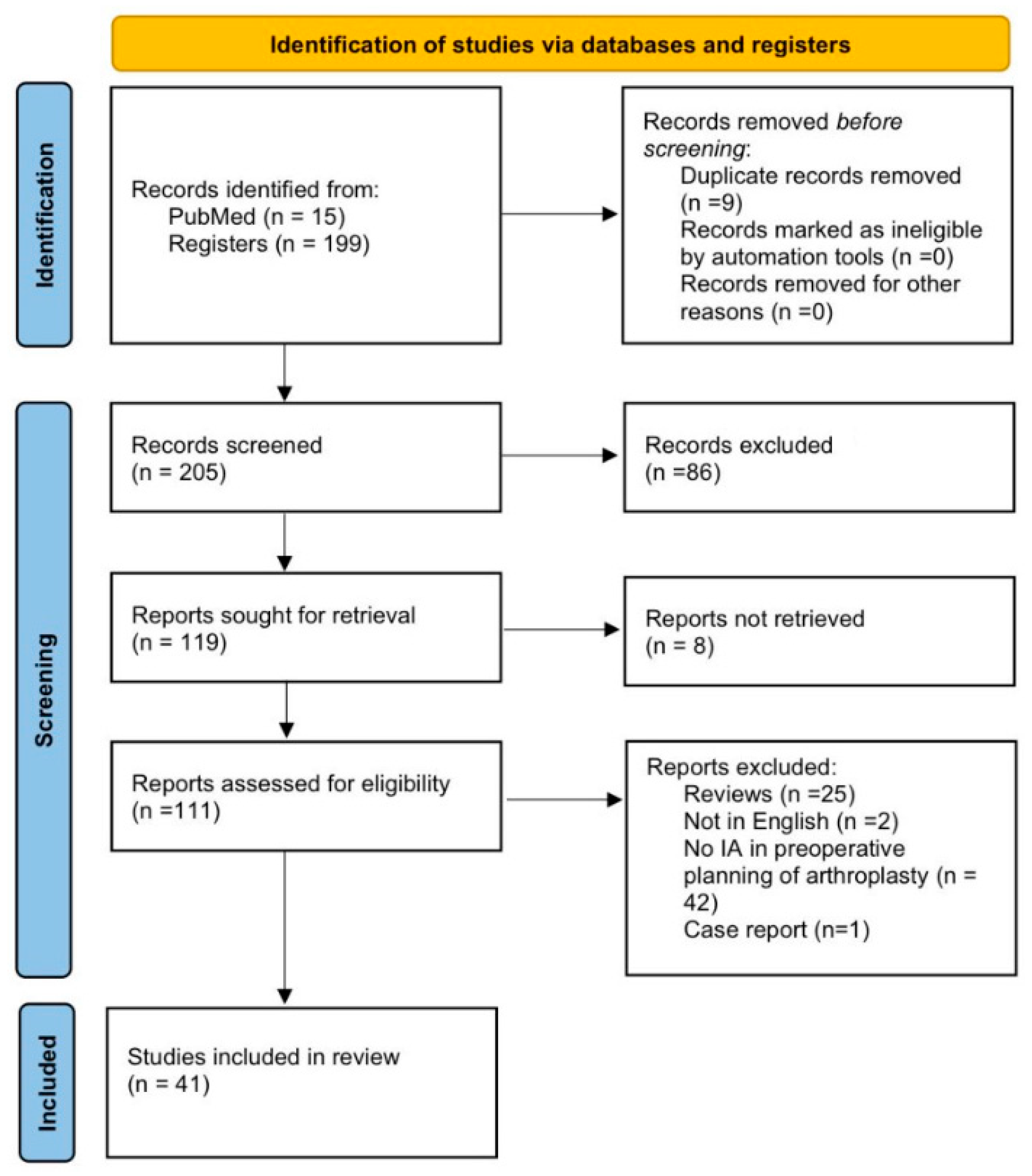
2. Materials and Methods
2.1. Search Strategy
2.2. Inclusion Criteria
2.3. Exclusion Criteria
3. Results
3.1. Hip Arthroplasty
3.2. Knee Arthroplasty
3.3. Shoulder Arthroplasty
4. Discussion
4.1. European Context
4.2. Italian Context
4.3. United States Context
- SAFE Innovation AI Framework—guidelines for developers, companies, and policymakers. While not law, it provides foundational direction for future federal AI legislation, balancing innovation and rights protection.
- REAL Political Advertisements Act—regulates generative AI use in political campaigns.
- Stop Spying Bosses Act—limits employee surveillance using ML/AI-based monitoring tools.
- NO FAKES Act—bipartisan bill that restricts the creation and use of generative AI replicas of unconsented faces, voices, and identities, targeting the widespread issue of deep-fake misuse.
- AI Research, Innovation, and Accountability Act—promotes transparency, responsibility, and safety in high-risk AI through testing requirements and mandatory corporate transparency reports.
4.4. Chinese Context
5. Conclusions
Author Contributions
Funding
Institutional Review Board Statement
Informed Consent Statement
Data Availability Statement
Conflicts of Interest
References
- Volonnino, G.; De Paola, L.; Spadazzi, F.; Ottaviani, M.; Zamponi, M.V.; Arcangeli, M.; La Russa, R. Artificial intelligence and future perspectives in Forensic Medicine: A systematic review. Clin. Ter. 2024, 175, 193–202. [Google Scholar] [PubMed]
- Patel, A.A.; Schwab, J.H.; Amanatullah, D.F.; Divi, S.N. AOA Critical Issues Symposium: Shaping the Impact of Artificial Intelligence within Orthopaedic Surgery. J. Bone Jt. Surg. Am. 2023, 105, 1475–1479. [Google Scholar] [CrossRef]
- Federer, S.J.; Jones, G.G. Artificial intelligence in orthopaedics: A scoping review. PLoS ONE 2021, 16, e0260471. [Google Scholar] [CrossRef]
- Misir, A.; Yuce, A. AI in Orthopedic Research: A Comprehensive Review. J. Orthop. Res. 2025, 43, 1508–1527. [Google Scholar] [CrossRef]
- Bozzo, A.; Tsui, J.M.G.; Bhatnagar, S.; Forsberg, J. Deep Learning and Multimodal Artificial Intelligence in Orthopaedic Surgery. J. Am. Acad. Orthop. Surg. 2024, 32, e523–e532. [Google Scholar] [CrossRef] [PubMed]
- Peng, X.; Tan, F.; Hu, Y.; Pu, H.; Zou, W.; Qu, C. Artificial intelligence in joint arthroplasty: A bibliometric analysis of global research trends (2001–2025). Medicine 2025, 104, e44136. [Google Scholar] [CrossRef]
- De Geofroy, B.; Léonard, R.; Micicoi, M.; Shin, J.; Gonzalez, J.F.; Sculco, P.K.; Micicoi, G. Artificial intelligence in hip and knee surgery: A bibliometric analysis of the 50 most cited articles. Orthop. Traumatol. Surg. Res. 2025, 104543. [Google Scholar] [CrossRef]
- Oettl, F.C.; Pruneski, J.A.; Zsidai, B.; Yu, Y.; Cong, T.; Tischer, T.; Hirschmann, M.T.; Samuelsson, K. Is orthopaedics entering the age of generative AI?-A narrative review of current applications, challenges, and future directions. Knee Surgery Sports Traumatol. Arthrosc. 2025, 34, 370–377. [Google Scholar] [CrossRef]
- Gurung, B.; Liu, P.; Harris, P.D.R.; Sagi, A.; Field, R.E.; Sochart, D.H.; Tucker, K.; Asopa, V. Artificial intelligence for image analysis in total hip and total knee arthroplasty: A scoping review. Bone Jt. J. 2022, 104, 929–937. [Google Scholar] [CrossRef]
- Oettl, F.C.; Pruneski, J.; Zsidai, B.; Yu, Y.; Cong, T.; Feldt, R.; Winkler, P.W.; Hirschmann, M.T.; Samuelsson, K.; ESSKA Artificial Intelligence Working Group. Artificial intelligence agents in orthopaedics: Concepts, capabilities and the road ahead. Knee Surgery Sports Traumatol. Arthrosc. 2025, 33, 4475–4483. [Google Scholar] [CrossRef]
- Tricco, A.C.; Lillie, E.; Zarin, W.; O’Brien, K.K.; Colquhoun, H.; Levac, D.; Moher, D.; Peters, M.D.J.; Horsley, T.; Weeks, L.; et al. PRISMA Extension for Scoping Reviews (PRISMA-ScR): Checklist and Explanation. Ann. Intern. Med. 2018, 169, 467–473. [Google Scholar] [CrossRef]
- Wu, L.; Zhao, X.; Lu, Z.D.; Yang, Y.; Ma, L.; Li, P. Accuracy analysis of artificial intelligence-assisted three-dimensional preoperative planning in total hip replacement. Jt. Dis. Relat. Surg. 2023, 34, 537–547. [Google Scholar] [CrossRef]
- Wu, L.; Yang, X.C.; Wu, J.; Zhao, X.; Lu, Z.D.; Li, P. Short-term outcome of artificial intelligence-assisted preoperative three-dimensional planning of total hip arthroplasty for developmental dysplasia of the hip compared to traditional surgery. Jt. Dis. Relat. Surg. 2023, 34, 571–582. [Google Scholar] [CrossRef]
- Zhu, J.; Zheng, S.; Sun, J.; Ma, B.; Zhang, C.; Zhang, C.; Shen, J.; Xia, T. Efficacy of an artificial intelligence preoperative planning system for assisting in revision surgery after artificial total hip arthroplasty. BMC Surg. 2025, 25, 58. [Google Scholar] [CrossRef] [PubMed]
- Li, S.; Jiang, J.; Zhang, J.; Yan, L.; Guo, H.; Tang, F. Advantages and effectiveness of AI three-dimensional reconstruction technology in the preoperative planning of total hip arthroplasty. Sci. Rep. 2025, 15, 24630. [Google Scholar] [CrossRef]
- Lu, Z.; Yuan, C.; Xu, Q.; Feng, Y.; Xia, Q.; Wang, X.; Zhu, J.; Wu, J.; Wang, T.; Chen, J.; et al. AI-assisted 3D versus conventional 2D preoperative planning in total hip arthroplasty for Crowe type II-IV high hip dislocation: A two-year retrospective study. J. Orthop. Surg. Res. 2025, 20, 777. [Google Scholar] [CrossRef]
- Zheng, Q.; She, H.; Zhang, Y.; Zhao, P.; Liu, X.; Xiang, B. Application of artificial intelligence-based three dimensional digital reconstruction technology in precision treatment of complex total hip arthroplasty. Int. Orthop. 2025, 49, 1839–1851. [Google Scholar] [CrossRef]
- Xie, H.; Yi, J.; Huang, Y.; Guo, R.; Liu, Y.; Kong, X.; Chai, W. Application and evaluation of artificial intelligence 3D preoperative planning software in developmental dysplasia of the hip. J. Orthop. Surg. Res. 2024, 19, 176. [Google Scholar] [CrossRef] [PubMed]
- Anwar, A.; Zhang, Y.; Zhang, Z.; Li, J. Artificial intelligence technology improves the accuracy of preoperative planning in primary total hip arthroplasty. Asian J. Surg. 2024, 47, 2999–3006. [Google Scholar] [CrossRef] [PubMed]
- Yang, W.; Gao, T.; Liu, X.; Shen, K.; Lin, F.; Weng, Y.; Lin, B.; Liang, D.; Feng, E.; Zhang, Y. Clinical application of artificial intelligence-assisted three-dimensional planning in direct anterior approach hip arthroplasty. Int. Orthop. 2024, 48, 773–783. [Google Scholar] [CrossRef]
- Rouzrokh, P.; Khosravi, B.; Mickley, J.P.; Erickson, B.J.; Taunton, M.J.; Wyles, C.C. THA-Net: A Deep Learning Solution for Next-Generation Templating and Patient-specific Surgical Execution. J. Arthroplast. 2024, 39, 727–733.e4. [Google Scholar] [CrossRef] [PubMed]
- Zheng, H.; Feng, E.; Xiao, Y.; Liu, X.; Lai, T.; Xu, Z.; Chen, J.; Xie, S.; Lin, F.; Zhang, Y. Is AI 3D-printed PSI an accurate option for patients with developmental dysplasia of the hip undergoing THA? BMC Musculoskelet. Disord. 2024, 25, 308. [Google Scholar] [CrossRef]
- Ding, X.; Zhang, B.; Li, W.; Huo, J.; Liu, S.; Wu, T.; Han, Y. Value of preoperative three-dimensional planning software (AI-HIP) in primary total hip arthroplasty: A retrospective study. J. Int. Med. Res. 2021, 49, 3000605211058874. [Google Scholar] [CrossRef]
- Huo, J.; Huang, G.; Han, D.; Wang, X.; Bu, Y.; Chen, Y.; Cai, D.; Zhao, C. Value of 3D preoperative planning for primary total hip arthroplasty based on artificial intelligence technology. J. Orthop. Surg. Res. 2021, 16, 156. [Google Scholar] [CrossRef]
- Chen, X.; Liu, X.; Wang, Y.; Ma, R.; Zhu, S.; Li, S.; Li, S.; Dong, X.; Li, H.; Wang, G.; et al. Development and Validation of an Artificial Intelligence Preoperative Planning System for Total Hip Arthroplasty. Front. Med. 2022, 9, 841202. [Google Scholar] [CrossRef]
- Chen, X.; Wang, Y.; Ma, R.; Peng, H.; Zhu, S.; Li, S.; Li, S.; Dong, X.; Qiu, G.; Qian, W. Validation of CT-Based Three-Dimensional Preoperative Planning in Comparison with Acetate Templating for Primary Total Hip Arthroplasty. Orthop. Surg. 2022, 14, 1152–1160. [Google Scholar] [CrossRef]
- Jang, S.J.; Kunze, K.N.; Vigdorchik, J.M.; Jerabek, S.A.; Mayman, D.J.; Sculco, P.K. John Charnley Award: Deep Learning Prediction of Hip Joint Center on Standard Pelvis Radiographs. J. Arthroplast. 2022, 37, S400–S407.e1. [Google Scholar] [CrossRef]
- Wang, Z.F.; Fang, Y.Z.; Zheng, Y.Q.; Lin, Z.X.; Lin, L.; Liu, X.F.; Zhang, C.; Zhang, J.S. Accuracy analysis of the new artificial anatomical marker positioning method (shoulder-to-shoulder) in preventing leg length discrepancy in total hip arthroplasty. Front. Surg. 2024, 11, 1487716. [Google Scholar] [CrossRef]
- Zhang, B.; Li, W.; Li, M.; Ding, X.; Huo, J.; Wu, T.; Han, Y. The role of 3-dimensional preoperative planning for primary total hip arthroplasty based on artificial intelligence technology to different surgeons: A retrospective cohort study. Medicine 2023, 102, e34113. [Google Scholar] [CrossRef]
- Karnuta, J.M.; Murphy, M.P.; Luu, B.C.; Ryan, M.J.; Haeberle, H.S.; Brown, N.M.; Iorio, R.; Chen, A.F.; Ramkumar, P.N. Artificial Intelligence for Automated Implant Identification in Total Hip Arthroplasty: A Multicenter External Validation Study Exceeding Two Million Plain Radiographs. J. Arthroplast. 2023, 38, 1998–2003.e1. [Google Scholar] [CrossRef]
- Min, M.; Wang, X.; Urba, R.; Zhang, W.; Gao, J.; Fan, L. Comparison of traditional template measurements and artificial intelligence preoperative planning in total knee arthroplasty. Front. Surg. 2025, 12, 1573148. [Google Scholar] [CrossRef]
- Pan, J.; Zhang, Q.; Kong, G.; Liu, D.; Sun, X.; Zhang, G.; Zou, Y.; Liu, K. Comparison of 3D Printing Technology and Artificial Intelligence Assisted in Total Knee Arthroplasty. Int. J. Clin. Pract. 2025, 2025, 8793065. [Google Scholar] [CrossRef]
- Lan, S.; Li, J. Assessment of preoperative planning and intraoperative accuracy of the AIKNEE system for total knee arthroplasty. BMC Musculoskelet. Disord. 2024, 25, 562. [Google Scholar] [CrossRef]
- Liao, G.; Duoji, J.; Mu, L.; Zhang, Y.; Liu, X.; Cai, D.; Zhao, C. Efficiency assessment of intelligent patient-specific instrumentation in total knee arthroplasty: A prospective randomized controlled trial. J. Orthop. Surg. Res. 2024, 19, 593. [Google Scholar] [CrossRef]
- Liu, X.; Li, S.; Zou, X.; Chen, X.; Xu, H.; Yu, Y.; Gu, Z.; Liu, D.; Li, R.; Wu, Y.; et al. Development and clinical validation of a deep learning-based knee CT image segmentation method for robotic-assisted total knee arthroplasty. Int. J. Med. Robot. 2024, 20, e2664. [Google Scholar] [CrossRef]
- Vidhani, F.R.; Woo, J.J.; Zhang, Y.B.; Olsen, R.J.; Ramkumar, P.N. Automating linear and angular measurements for the hip and knee after computed tomography: Validation of a three-stage deep learning and computer vision-based pipeline for pathoanatomic assessment. Arthroplast. Today 2024, 27, 101394. [Google Scholar] [CrossRef]
- Burge, T.A.; Jeffers, J.R.T.; Myant, C.W. Performance and Sensitivity Analysis of an Automated X-Ray Based Total Knee Replacement Mass-Customization Pipeline. J. Med. Devices 2022, 16, 041007. [Google Scholar] [CrossRef]
- Factor, S.; Gurel, R.; Dan, D.; Benkovich, G.; Sagi, A.; Abialevich, A.; Benkovich, V. Validating a Novel 2D to 3D Knee Reconstruction Method on Preoperative Total Knee Arthroplasty Patient Anatomies. J. Clin. Med. 2024, 13, 1255. [Google Scholar] [CrossRef]
- Fernandes, L.R.; Arce, C.; Martinho, G.; Campos, J.P.; Meneghini, R.M. Accuracy, reliability, and repeatability of a novel artificial intelligence algorithm converting two-dimensional radiographs to three-dimensional bone models for total knee arthroplasty. J. Arthroplast. 2023, 38, 2032–2036. [Google Scholar]
- Wang, W.; Zhou, H.; Yan, Y.; Cheng, X.; Yang, P.; Gan, L.; Kuang, S. An automatic extraction method on medical feature points based on PointNet++ for robot-assisted knee arthroplasty. Int. J. Med. Robot. Comput. Assist. Surg. 2023, 19, e2464. [Google Scholar]
- Yi, P.H.; Wei, J.; Kim, T.K.; Sair, H.I.; Hui, F.K.; Hager, G.D.; Fritz, J.; Oni, J.K. Automated detection & classification of knee arthroplasty using deep learning. Knee 2020, 27, 535–542. [Google Scholar] [CrossRef]
- Tiwari, A.; Yadav, A.K.; Bagaria, V. Application of deep learning algorithm in automated identification of knee arthroplasty implants from plain radiographs using transfer learning models: Are algorithms better than humans? J. Orthop. 2022, 32, 139–145. [Google Scholar] [CrossRef]
- Karnuta, J.M.; Luu, B.C.; Roth, A.L.; Haeberle, H.S.; Chen, A.F.; Iorio, R.; Schaffer, J.L.; Mont, M.A.; Patterson, B.M.; Krebs, V.E.; et al. Artificial Intelligence to Identify Arthroplasty Implants from Radiographs of the Knee. J. Arthroplast. 2021, 36, 935–940. [Google Scholar] [CrossRef]
- Burge, T.A.; Jones, G.G.; Jordan, C.M.; Jeffers, J.R.T.; Myant, C.W. A computational tool for automatic selection of total knee replacement implant size using X-ray images. Front. Bioeng. Biotechnol. 2022, 10, 971096. [Google Scholar] [CrossRef]
- Kunze, K.N.; Polce, E.M.; Patel, A.; Courtney, P.M.; Sporer, S.M.; Levine, B.R. Machine learning algorithms predict within one size of the final implant ultimately used in total knee arthroplasty with good-to-excellent accuracy. Knee Surg. Sports Traumatol. Arthrosc. 2022, 30, 2565–2572. [Google Scholar] [CrossRef]
- Yue, Y.; Gao, Q.; Zhao, M.; Li, D.; Tian, H. Prediction of Knee Prosthesis Using Patient Gender and BMI with Non-marked X-Ray by Deep Learning. Front. Surg. 2022, 9, 798761. [Google Scholar] [CrossRef]
- Kunze, K.N.; Polce, E.M.; Patel, A.; Courtney, P.M.; Levine, B.R. Validation and performance of a machine-learning derived prediction guide for total knee arthroplasty component sizing. Arch. Orthop. Trauma Surg. 2021, 141, 2235–2244. [Google Scholar] [CrossRef]
- Yu, Y.; Cho, Y.J.; Park, S.; Kim, Y.H.; Goh, T.S. Development of an artificial intelligence model for predicting implant size in total knee arthroplasty using simple X-ray images. J. Orthop. Surg. Res. 2024, 19, 516. [Google Scholar] [CrossRef]
- Park, K.B.; Kim, M.S.; Yoon, D.K.; Jeon, Y.D. Clinical validation of a deep learning-based approach for preoperative decision-making in implant size for total knee arthroplasty. J. Orthop. Surg. Res. 2024, 19, 637. [Google Scholar] [CrossRef]
- Rajabzadeh-Oghaz, H.; Kumar, V.; Berry, D.B.; Singh, A.; Schoch, B.S.; Aibinder, W.R.; Gobbato, B.; Polakovic, S.; Elwell, J.; Roche, C.P. Impact of Deltoid Computer Tomography Image Data on the Accuracy of Machine Learning Predictions of Clinical Outcomes after Anatomic and Reverse Total Shoulder Arthroplasty. J. Clin. Med. 2024, 13, 1273. [Google Scholar] [CrossRef]
- Caprili, G.; Calamita, A.G.; Novi, M.; Campanacci, D.A.; Nicoletti, S. Assessing the accuracy of a machine learning prediction for 2 different shoulder prostheses: An external validation study. JSES Int. 2025, 9, 1352–1356. [Google Scholar] [CrossRef]
- Crutcher, W.L.; Dane, I.; Whitson, A.J.; Matsen, F.A., III; Hsu, J.E. An accelerated deep learning model can accurately identify clinically important humeral and scapular landmarks on plain radiographs obtained before and after anatomic arthroplasty. Int. Orthop. 2025, 49, 455–460. [Google Scholar] [CrossRef] [PubMed]
- Wang, G. Making “CASES” for AI in Medicine. BME Front. 2024, 5, 0036. [Google Scholar] [CrossRef]
- Shi, M.; Gong, Z.; Zeng, P.; Xiang, D.; Cai, G.; Liu, H.; Chen, S.; Liu, R.; Chen, Z.; Zhang, X.; et al. Multi-quantifying maxillofacial traits via a demographic parity-based AI model. BME Front. 2024, 5, 0054. [Google Scholar]
- Acosta, J.N.; Falcone, G.J.; Rajpurkar, P.; Topol, E.J. Multimodal biomedical AI. Nat. Med. 2022, 28, 1773–1784. [Google Scholar] [CrossRef]
- Oettl, F.C.; Zsidai, B.; Oeding, J.F.; Hirschmann, M.T.; Feldt, R.; Tischer, T.; Samuelsson, K.; ESSKA Artificial Intelligence Working Group. Beyond traditional orthopaedic data analysis: AI, multimodal models and continuous monitoring. Knee Surg. Sports Traumatol. Arthrosc. 2025, 33, 2269–2275. [Google Scholar] [CrossRef]
- Lu, S.; Yan, M.; Li, C.; Yan, C.; Zhu, Z.; Lu, W. Machine-learning-assisted prediction of surgical outcomes in patients undergoing gastrectomy. Chin. J. Cancer Res. Oct. 2019, 31, 797–805. [Google Scholar] [CrossRef]
- Ngiam, K.Y.; Khor, I.W. Big data and machine learning algorithms for health-care delivery. Lancet Oncol. 2019, 20, e262–e273. [Google Scholar] [CrossRef]
- O’Sullivan, S.; Nevejans, N.; Allen, C.; Blyth, A.; Leonard, S.; Pagallo, U.; Holzinger, K.; Holzinger, A.; Sajid, M.I.; Ashrafian, H. Legal, regulatory, and ethical frameworks for development of standards in artificial intelligence (AI) and autonomous robotic surgery. Int. J. Med. Robot. Comput. Assist. Surg. 2019, 15, e1968. [Google Scholar] [CrossRef]
- Morris, M.X.; Song, E.Y.; Rajesh, A.; Asaad, M.; Phillips, B.T. Ethical, Legal, and Financial Considerations of Artificial Intelligence in Surgery. Am. Surg. 2023, 89, 55–60. [Google Scholar]
- Chiappini, D. Intelligenza Artificiale e responsabilità civile: Nuovi orizzonti di regolamentazione alla luce dell’Artificial Intelligence Act dell’Unione europea. Riv. Ital. Inform. Dirit. 2022, 4, 95–108. [Google Scholar]
- Sablone, S.; Bellino, M.; Cardinale, A.N.; Esposito, M.; Sessa, F.; Salerno, M. Artificial Intelligence in Healthcare: An Italian Perspective on Ethical and Medico-Legal Implications. Front. Med. 2024, 11, 1343456. [Google Scholar] [CrossRef]
- Elmi, G.T.; Marchiafava, S. Sviluppi recenti in tema di Intelligenza Artificiale e diritto: Una rassegna di legislazione, giurisprudenza e dottrina. Riv. Ital. Inform. Dirit. 2022, 4, 123–139. [Google Scholar]
- Jassar, S.; Adams, S.; Zarzeczny, A.; Burbridge, B. Il futuro dell’intelligenza artificiale in medicina: Considerazioni medico-legali per i leader sanitari. Heal. Manag. Forum 2022, 35, 185–189. [Google Scholar] [CrossRef]
- Available online: https://innovazione.gov.it/notizie/articoli/approvata-in-via-definitiva-la-legge-italiana-sull-intelligenza-artificiale/ (accessed on 17 September 2025).
- Davtyan, T. The US approach to AI regulation: Federal laws, policies, and strategies explained. J. Law Technol. Internet 2025, 16, 223. [Google Scholar]
- Biden, J.R. Executive Order on the Safe, Secure, and Trustworthy Development and Use of Artificial Intelligence. Libraries at University of Nebraska-Lincoln, Lincoln, NE, USA, 2023. [Google Scholar]
- Haque, A.; Milstein, A.; Li, F.-F. Illuminating the dark spaces of healthcare with ambient intelligence. Nature 2020, 585, 193–202. [Google Scholar] [CrossRef]
- Rodrigues, R. Legal and human rights issues of AI: Gaps, challenges and vulnerabilities. J. Responsible Technol. 2020, 4, 100005. [Google Scholar] [CrossRef]
- Hashimoto, D.A.; Ward, T.M.; Meireles, O.R. The Role of Artificial Intelligence in Surgery. Adv. Surg. 2020, 54, 89–101. [Google Scholar] [CrossRef] [PubMed]
- O’Sullivan, S.; Leonard, S.; Holzinger, A.; Allen, C.; Battaglia, F.; Nevejans, N.; van Leeuwen, F.W.B.; Sajid, M.I.; Friebe, M.; Ashrafian, H.; et al. Operational framework and training standard requirements for AI empowered robotic surgery. Int. J. Med. Robot. Comput. Assist. Surg. 2020, 16, 1–13. [Google Scholar]
- Arjomandi Rad, A.; Vardanyan, R.; Athanasiou, T.; Maessen, J.; Sardari Nia, P. The ethical considerations of integrating artificial intelligence into surgery: A review. Interdiscip. Cardiovasc. Thorac. Surg. 2025, 40, ivae192. [Google Scholar] [CrossRef]
- Ben Ali, W.; Pesaranghader, A.; Avram, R.; Overtchouk, P.; Perrin, N.; Laffite, S.; Cartier, R.; Ibrahim, R.; Modine, T.; Hussin, J.G. Implementing Machine Learning in Interventional Cardiology: The Benefits Are Worth the Trouble. Front. Cardiovasc. Med. 2021, 8, 711401. [Google Scholar] [CrossRef] [PubMed]
- Ostberg, N.P.; Zafar, M.A.; Elefteriades, J.A. Machine learning: Principles and applications for thoracic surgery. Eur. J. Cardio-Thoracic Surg. 2021, 60, 213–221. [Google Scholar] [CrossRef] [PubMed]
- Han, Y.; Ceross, A.; Ather, S.; Bergmann, J.H. Data-Driven Analysis of AI in Medical Device Software in China: Deep Learning and General AI Trends Based on Regulatory Data. arXiv 2024, arXiv:2411.07378. [Google Scholar] [CrossRef]
- Wang, Z. Artificial intelligence in Chinese healthcare: A review of applications and future prospects. Biomed. Eng. Lett. 2025, 15, 1065–1072. [Google Scholar] [CrossRef]
- Myers, T.G.; Ramkumar, P.N.; Ricciardi, B.F.; Urish, K.L.; Kipper, J.; Ketonis, C. Artificial Intelligence and Orthopaedics: An Introduction for Clinicians. J. Bone Jt. Surg. Am. 2020, 102, 830–840. [Google Scholar] [CrossRef]


| First Author/Year/Title | Study Design | AI Type | Objective | Outcomes Measured | Macro-Theme | Key Findings |
|---|---|---|---|---|---|---|
| Wu et al., 2023—Accuracy analysis of artificial intelligence-assisted three-dimensional preoperative planning in total hip replacement [12] | Retrospective single-centre cohort; AIHIP-3D planning (n = 95) vs. 2D planning (n = 66); postoperative radiographic outcomes and planning–intraoperative agreement evaluated. | AIHIP (deep learning) | Assess the accuracy of AI-assisted 3D planning in predicting implant sizing, acetabular positioning, and leg length restoration. | Acetabular/stem sizing accuracy; inclination/anteversion angles; % implants within Lewinnek/Callanan safe zones; postoperative LLD. | 3D Planning & Implant Positioning | AI significantly more accurate: cup 54% vs. 38% (p = 0.048), stem 64% vs. 44% (p = 0.011). Higher safe-zone placement (Lewinnek 86.3% vs. 72.7%). Better LLD correction (2.18 mm vs. 4.42 mm, p < 0.001). |
| Wu et al., 2023—Short-term outcome of AI-assisted preoperative three- dimensional planning of total hip arthroplasty for developmental dysplasia of the hip compared to traditional surgery [13] | Retrospective cohort; AIHIP-3D (n = 34) vs. 2D (n = 27); follow-up ≥ 1 year. | AIHIP (deep learning, 3D reconstruction + auto-segmentation) | Evaluate the accuracy of AI planning in DDH-THA. | Cup/stem sizing accuracy; inclination/anteversion; safe-zone %; LLD; HHS; complications. | 3D Planning & Positioning | AI superior: cup 56% vs. 30%, stem 68% vs. 41%. Lower LLD (1.64 mm vs. 3.53 mm). No major complications. |
| Zhu et al., 2025—Efficacy of an AI preoperative planning system for assisting in revision surgery after artificial total hip arthroplasty [14] | Retrospective cohort; revision THA (25 pts/26 hips); mean follow-up 25 months. | AIHIP (Transformer-UNet) | Evaluate AIHIP effectiveness in revision-THA planning. | Prosthesis matching accuracy; HHS; ROM; complications. | Revision THA + 3D Planning | Matching: cup 96.1%, stem 100%. Significant HHS and ROM improvement; planning time ~5 min; only 2 complications (hematoma + dislocation). |
| Li et al., 2025—Advantages and effectiveness of AI three-dimensional reconstruction technology in the preoperative planning of total hip arthroplasty [15] | Retrospective cohort; osteonecrosis; AI-3D (n = 55) vs. 2D (n = 54). | G-NET deep learning reconstruction + templating. | Compare AI-3D vs. 2D in primary THA. | Sizing accuracy; blood loss; op-time; LOS; LLD; radiographic metrics; HHS; complications | AI-3D Planning & Perioperative Outcomes | AI superior in sizing (cup 90.9% vs. 72.2%, stem 87.3% vs. 66.7%), ↓blood loss, ↓LOS, ↓LLD. Better HHS at 1–6 mo. No major complications. |
| Lu et al., 2025—AI-assisted 3D versus conventional 2D preoperative planning in total hip arthroplasty for Crowe type II–IV high hip dislocation: a two-year retrospective study [16] | Retrospective cohort; AI-3D (n = 49) vs. 2D (n = 43). | AI-3D deep-CNN segmentation. | Evaluate AI-3D in complex THA. | Sizing; safe-zone positioning; op-time; bleeding; LLD; HHS/WOMAC/VAS; complications. | AI-3D Complex THA | AI superior in sizing & positioning; ↓LLD, ↓bleeding, ↓op-time. No revision failures. |
| Zheng et al., 2025—Application of artificial intelligence-based three-dimensional digital reconstruction technology in precision treatment of complex total hip arthroplasty [17] | Prospective randomised cohort; AI (n = 29) vs. 2D (n = 27). | G-NET AI-HIP automation | Evaluate AI in complex THA planning. | Sizing; acetabular placement; LLD; offset; time; HHS; complications. | AI for Complex THA | AI superior for sizing & LLD; ↓blood loss + op-time. Better early HHS. No major complications. |
| Xie et al., 2024—Application and evaluation of artificial intelligence 3D preoperative planning software in developmental dysplasia of the hip [18] | Retrospective; 103 DDH Crowe I–IV. | AIHIP 3D automatic segmentation + simulation. | Compare AIHIP vs. 2D cup sizing. | Sizing accuracy ±0/±1; MAE; influencing factors. | AI-Planning in DDH | AIHIP ± 1 = 95.1% vs. 81.1% (p < 0.05). 2D accuracy collapses in Crowe II–III; AI remains stable. |
| Anwar et al., 2024—AI technology improves the accuracy of preoperative planning in primary total hip arthroplasty [19] | Prospective cohort 117-pt. | AIHIP deep-learning auto-segmentation. | Compare AIHIP vs. 2D. | Cup/stem accuracy; planning time; predictors of failure. | AI-Primary THA | AIHIP much more accurate; planning time halved. 2D fails in DDH & high femoral anteversion. |
| Yang et al., 2024—Clinical application of artificial intelligence-assisted three-dimensional planning in direct anterior approach hip arthroplasty [20] | Retrospective comparative 440-pt. | AIHIP CMGNet + Unet + LSTM. | Compare AI vs. 2D in DAA-THA. | Sizing; op-time; blood loss; LLD; FO; HHS; ICC. | AI for 3D-DAA Planning | AI improves sizing, op-time, fluoroscopy, blood loss, LLD. |
| Rouzrokh et al., 2024—THA-Net: A Deep Learning Solution for Next-Generation Templating and Patient-specific Surgical Execution [21] | Retrospective; 14,357 patients, 356.305 radiographs. | Diffusion-Model THA-Net. | Generate optimal post-op-like X-rays via AI. | Realism, safety-zone metrics, dislocation risk. | Generative-AI in Preoperative Simulation | 96.5% images in safe-zone; high realism; biomechanically optimised implant orientation. |
| Zheng et al., 2024—Is AI 3D-printed PSI an accurate option for patients with developmental dysplasia of the hip undergoing THA? [22] | Prospective RCT, 60 pts. | AI-PSI (3D printed patient-specific instruments) | Evaluate implant positioning with AI-PSI vs. manual. | Anteversion/abduction; FO; LLD; accuracy; bone cuts; HHS/VAS. | AI + PSI (Guided Implant Execution) | AI-PSI significantly reduces positioning error & LLD; accuracy 90–93% vs. 60–80%. |
| Ding et al., 2021—Value of preoperative three-dimensional planning software (AI-HIP) in primary total hip arthroplasty: a retrospective study [23] | Retrospective 316 pts. | G-NET segmentation. | Compare AI-HIP 3D vs. manual 2D. | Sizing, positioning, LLD, offset. | 3D-AI THA Planning | Cup 94% vs. 65%, stem 88% vs. 59%. ICC > 0.95 for stem, cup, and osteotomy level |
| Huo et al., 2021—Value of 3D preoperative planning for primary total hip arthroplasty based on artificial intelligence technology [24] | Prospective 53-pt study. | Deep-learning 3D, reinforcement-matching. | Compare AI-3D vs. 3D vs. 2D. | Sizing; planning-time. | 3D-AI Efficiency | AI accuracy similar to 3D, >2D; planning time drastically shorter. |
| Chen et al., 2022—Development and Validation of an Artificial Intelligence Preoperative Planning System for Total Hip Arthroplasty [25] | Prospective 120 pts. | Attention-UNet + PointRend. | Clinical validation of AIHIP. | Sizing; LLD; offset; blood loss; HOOS JR; EQ-5D. | AI-3D CT Planning | AIHIP ±1 sizing = 96.7% vs. 55–65%. |
| Chen et al., 2022—Validation of CT-Based Three-Dimensional Preoperative Planning in Comparison with Acetate Templating for Primary Total Hip Arthroplasty [26] | Prospective 57-pt comparison. | AI segmentation + landmark extraction. | Compare 3D-AI vs. 2D acetate templating. | Sizing; MAE; ICC. | 3D-CT AI Planning | Cup/stem accuracy 93% vs. 79–75%. High ICC reliability. |
| Jang et al., 2022—John Charnley Award: Deep Learning Prediction of Hip Joint Center on Standard Pelvis Radiographs [27] | Retrospective 3965 pts. | UNet + ResNet-34. | Predict hip centre on plain radiographs. | Mean error; % within 3–5 mm. | Landmark Automation (HJC) | 91% accuracy within 5 mm; fast (0.65 s/hip). |
| Wang et al., 2024—Accuracy analysis of the new artificial anatomical marker positioning method (shoulder-to-shoulder) in preventing leg length discrepancy in total hip arthroplasty [28] | Retrospective; 47 THA pts. | AIHIP-3D segmentation platform. | Compare manual vs. AI-LLD correction. | LLD; cut distance; prosthesis matching. | LLD Control & Femoral Positioning | No major LLD difference; AI better in cut precision; prosthesis match >91–95%. |
| Zhang et al., 2023—The role of 3-dimensional preoperative planning for primary total hip arthroplasty based on artificial intelligence technology to different surgeons A retrospective cohort study [29] | Retrospective matched cohort (n = 120): senior vs. junior ± AIHIP. | AIHIP (CT-3D + neural landmark recognition) | Compare AI usefulness between junior and senior surgeons. | LLD, NSA, offset; op-time; Hb-loss; radiation; complications; sizing accuracy. | 3D Planning & Surgical Performance | Major improvements only in junior surgeons: ↓LLD, ↓op-time, ↓Hb-loss, ↓radiation, ↓complications. Senior surgeons showed no significant benefit. |
| Karnuta et al., 2023—Artificial Intelligence for Automated Implant Identification in Total Hip Arthroplasty: A Multicenter External Validation Study Exceeding Two Million Plain Radiographs [30] | Multicentre external validation. | Inception-V3 CNN; >2 million images. | Automate femoral stem recognition. | AUC, accuracy, sensitivity/specificity; processing speed. | AI-Prosthesis Identification (Revision THA) | External accuracy 97.9%; output in 0.02 s per image. |
| Author/Year/Title | Study Design | Type of AI | Objective | Evaluated Outcomes | Macro-Theme | Key Findings |
|---|---|---|---|---|---|---|
| Min et al., 2025—Comparison of traditional template measurements and artificial intelligence preoperative planning in total knee arthroplasty [31] | Prospective randomised trial (48 patients, primary TKA) | AI-KNEE (Changmugu Medical Technology): automatic segmentation, 3D reconstruction, prosthetic planning | Assess the accuracy and clinical performance of 3D AI-assisted planning vs. traditional 2D templating | Accuracy of femoral/tibial/liner sizing; operative time; blood loss; drainage; HKA alignment; VAS (pain); AKS (function) | Planning accuracy; Alignment; Perioperative efficiency | AI significantly superior in sizing (femur 92% vs. 67%; tibia 87.5% vs. 62.5%), shorter operative time (~68 vs. 84 min), lower blood loss, improved postoperative alignment, lower VAS in first 2 weeks, higher AKS at 3 months. No postoperative complications reported. |
| Pan et al., 2025—Comparison of 3D Printing Technology and Artificial Intelligence Assisted in Total Knee Arthroplasty [32] | Single-centre double-blind RCT | AI-based 3D surgical planning (Changmugu software) | Compare patient-specific guides derived from 3D printing vs. AI-based planning in TKA | Surgical time, bleeding, drainage, length of stay, alignment accuracy (HKA, FFC, FTC), VAS, HSS | Planning accuracy; Alignment; Perioperative efficiency | AI group showed significantly reduced operative time and length of stay (p < 0.05). 3D guides yielded less pain and bleeding. Alignment accuracy similar (<3° deviation). No significant VAS/HSS differences at 3 months. |
| Lan et al., 2024—Assessment of preoperative planning and intraoperative accuracy of the AIKNEE system for total knee arthroplasty [33] | Retrospective observational cohort (64 patients) | AIKNEE—3D planning with automatic axis recognition and prosthesis simulation | Evaluate the accuracy of sizing, alignment, and correlation with postoperative outcomes | Prosthesis size prediction, deviations in mFTA/LDFA/MPTA, number of insert trials, ROM, VAS, KSS | Alignment accuracy + clinical outcomes | Sizing accuracy: 48% femur, 73% tibia. Alignment within 3° for mFTA (88%), LDFA (92%), MPTA (95%). Significant improvements in pain, ROM, and KSS (p < 0.001). Larger deviations correlated with more pain and lower KSS. |
| Liao et al., 2024—Efficiency assessment of intelligent patient-specific instrumentation in total knee arthroplasty: a prospective randomized controlled trial [34] | Prospective double-blind RCT (102 patients, 107 knees) | AI-KNEE (3D-UNet + HRNet + CNN) for CT-based planning & PSI fabrication | Evaluate resection accuracy, postop alignment, and perioperative metrics of i-PSI vs. conventional instruments | Resection accuracy (CT), HKA/FCA/JLCA/FSA alignment, surgical time, bleeding, complications | Osteotomy accuracy + alignment | i-PSI improved resection precision of the distal femur (p = 0.032–0.035), produced more neutral HKA/FCA/JLCA (p < 0.05), better FSA (p = 0.005). No bleeding/complication differences; surgical time slightly longer (p = 0.027). |
| Liu et al., 2024—Development and clinical validation of a deep learning-based knee CT image segmentation method for robotic-assisted TKA [35] | Development + clinical validation study (538 CT scans training/testing; 20 robotic-TKA patients) | DDA-Transformer (CNN + Transformer dual-path double-attention) | Develop a DL CT-segmentation model and evaluate its impact on robotic planning | Segmentation accuracy; sizing; resection precision; alignment (HKA, MPTA, PTS, FPPA) | CT segmentation + robotic planning | High segmentation accuracy; sizing and resection error < 0.5 mm and <0.7°; robotic alignment significantly more accurate vs. manual TKA (p < 0.05). |
| Vidhani et al., 2024—Automating Linear and Angular Measurements for the Hip and Knee After CT [36] | Technical development + validation on 100 CT scans | Three-stage pipeline: VGG16 + XGBoost (classification); U-Net3+/Attention U-Net/2D TransUNet (segmentation); OpenCV measurements | Automate CT-based classification, segmentation, and pre-op measurements | Classification accuracy; Dice/IoU; comparison vs. manual measurement; mean error; processing time | Automated CT-based measurement | Classification 90.8% (hip)/87.8% (knee); segmentation Dice/IoU > 0.95. Mean time 2.58 ± 1.92 min/case. No significant difference vs. manual (p > 0.05). Mean errors: FV 3.72°, sulcus 2.44°, TT–TG 2.34 mm, PCA 0.70°, AA 2.01°. |
| Burge T., 2022—Performance and Sensitivity Analysis of an Automated X-Ray Based Total Knee Replacement Mass-Customization Pipeline [37] | Computational validation on X-ray (78 pts) + DRR (147) | U-Net segmentation + PDM/SSM + CAD | Evaluate the accuracy and sensitivity of AI-based custom implant design | RMSE reconstruction; component RMSE; over/underhang (≥3 mm); sensitivity to alignment/scale | AI-based custom implant planning from X-ray | Accurate pipeline (~1 mm RMSE), OUH < 3 mm in most cases; robust across subjects but lower in under-represented ethnicities; sensitive to X-ray alignment/scale. |
| Factor et al., 2024—Validating a Novel 2D-to-3D Knee Reconstruction Method on Preoperative TKA Patient Anatomies [38] | Technical validation; 18 OA patients (CT + calibrated AP/LAT X-ray) | Neural network 2D→3D reconstruction | Validate 3D reconstruction from 2D radiographs for pre-op planning | RMSE global; landmark accuracy; osteotomy contour RMSE; axis deviation vs. human | 3D reconstruction from X-ray | Global RMSE: 0.93 ± 0.25 mm (femur), 0.88 ± 0.14 mm (tibia). Landmark RMSE ~0.5 mm. Osteotomy RMSE ~0.7 mm. Anatomical axis deviation: TEA 1.89°, PCA 1.78°, MLTA 2.82°—comparable to inter/intra-observer variability. |
| Fernandes et al., 2023—Accuracy, Reliability, and Repeatability of a Novel AI Algorithm Converting 2D Radiographs to 3D Bone Models for TKA [39] | Preclinical validation on 5 cadaveric knees (AP/LAT X-ray + CT + manual measures) | AI 2D→3D reconstruction | Assess accuracy, reliability & repeatability vs. CT/manual | MAE 2D→3D vs. CT; MAE vs. manual; ICC inter/intra-observer | 3D reconstruction for planning | Excellent accuracy: MAE < 2 mm in 9/12 anatomical parameters. All ICC > 0.90—high reliability and reproducibility. |
| Wang et al., 2023—Automatic extraction of medical feature points using PointNet++ for robot-assisted knee arthroplasty [40] | Technical development/validation; 20 CT point clouds (10 patients) | Modified PointNet++ (Point_RegNet) | Automate landmark extraction for robotic pre-op registration | Mean error of 3 feature points; processing time; comparison vs. other networks | Automatic anatomical landmark extraction | Mean error < 5 mm, 1 mm lower than manual marking; SD < 1 mm. Extraction < 3 s per point—much faster than manual. |
| Yi et al., 2020—Automated detection & classification of knee arthroplasty using deep learning [41] | Retrospective balanced sets (native vs. TKA; TKA vs. UKA; 2 TKA models) | ResNet-18/ResNet-152 transfer learning + CAM | Detect prosthesis; classify TKA vs. UKA; differentiate implant models | AUC, sensitivity, specificity, PPV, NPV, CAM maps | Automatic implant detection for revision strategies | AUC = 1 with 100% sensitivity & specificity in all tasks; CAM accurately localised prosthetic components. |
| Tiwari et al., 2022—Application of deep learning algorithm in automated identification of knee arthroplasty implants from plain radiographs using transfer learning models: Are algorithms better than humans? [42] | Retrospective 521 AP/LAT X-rays; 7 DL models compared | Transfer learning (VGG-16, MobileNet, ResNet50, etc.) | Identify TKA implant model vs. experts | Accuracy, precision, recall, loss, human comparison | Preoperative implant identification in revision | VGG-16 accuracy 95.5%, precision 98.4%; five models > 90%. Human specialists ~78%. |
| Karnuta et al., 2021—Artificial Intelligence to Identify Arthroplasty Implants From Radiographs of the Knee [43] | Multicentre retrospective (682 AP X-rays, 424 pts) | InceptionV3 CNN (1000 epochs) | Automatic manufacturer/model recognition | AUC; accuracy; sensitivity; specificity; PPV; NPV | Implant recognition for revision TKA | AUC 0.992; accuracy 98.9%; SE 94.6%; SP 99.4%. Many implant categories reached 100% accuracy. |
| Burge T., 2022—A computational tool for automatic selection of total knee replacement implant size using X-ray images [44] | Computational comparison (AP + LL X-rays, 78 pts) vs. MRI ground truth | U-Net + 2D→3D pipeline + automatic sizing | Develop an automatic predictor for femoral/tibial size | RMSE; over/underhang; correct prediction rate; ±1 size accuracy | X-ray-based pre-op sizing | Femur: 77.95% RMSE accuracy; ±1 size 99.7%. Tibia: 80.51% RMSE; ±1 size 99.7%. RMSE ~1 mm. |
| Kunze et al., 2022—Machine learning algorithms predict within one size of the final implant ultimately used in total knee arthroplasty with good-to-excellent accuracy [45] | Multicentre retrospective (11,777 TKA, 2012–2020) | ML (SVM, ENPLR, RF, XGB, SGB) | Predict final implant size using demographics only | Exact accuracy; ±1 size; MAE; RMSE | Pre-op sizing from demographic data | Best results: Femur exact 42.2%, ±1 88.3%, MAE 0.73. Tibia exact 43.8%, ±1 90.0%, MAE 0.70. Good ±1 performance using demographics alone. |
| Yue et al., 2022—Prediction of knee prosthesis using patient gender and BMI with non-marked X-ray by deep learning [46] | Retrospective 308 pts (AP/LAT X-ray + anthropometrics) | ResNet-18 + ECOC + transfer learning | Predict femoral/tibial size pre-operatively | Accuracy per component; baseline vs. optimised vs. ECOC | Preop sizing from X-ray + physical data | ECOC best: 88.23% femur, 86.27% tibia—superior to baseline/optimised, comparable or superior to surgeons. |
| Kunze et al., 2021—Validation and performance of a machine-learning derived prediction guide for total knee arthroplasty component sizing [47] | Retrospective 17,283 pts, 80/20 split, 5 model comparison | SGB, RF, SVM, XGB, Elastic-Net Logistic Regression | Predict femoral/tibial size using demographics only | Accuracy (±4 mm/exact/±1), MAE, RMSE, R2; variable importance | Demographic-based sizing | SGB best: femur ±1 95.0%, tibia ±1 97.8%; ±4 mm ≈83%. Sex strongest predictor. |
| Yu et al., 2024—Development of an artificial intelligence model for predicting implant size in total knee arthroplasty using simple X-ray images [48] | Retrospective cohort (714 patients, 1412 AP + LL X-rays) | ResNet-101 CNN | Develop AI to predict femoral/tibial implant sizing using X-rays only (no demographics) | Sizing accuracy; micro-F1 for exact size and ±1 size | Preoperative sizing | Exact-match prediction: micro-F1 = 0.91 (femur) and 0.87 (tibia). ±1 size accuracy: 0.99 (femur) and 0.98 (tibia). Outperformed traditional templating and demographic-based models. |
| Park et al., 2024—Clinical validation of a deep learning-based approach for preoperative decision-making in implant size for total knee arthroplasty [49] | Retrospective cohort (234 patients) | YOLO-v4 + CNN (detection + classification) on AP X-rays | Validate DL model for automatic femoral and tibial size prediction | Accuracy, match with implanted component, Spearman rho, ±1 accuracy | Preoperative sizing | Model significantly superior to manual templating (femur 89.32% vs. 61.54%; tibia 90.60% vs. 68.38%). ±1 accuracy ~98%. High concordance (rho femur 0.91; tibia 0.94). |
| First Author/Title | Study Type | Study Design | AI Objective | Outcomes Assessed | Main Results |
|---|---|---|---|---|---|
| Rajabzadeh-Oghaz et al., 2024— Impact of Deltoid Computer Tomography Image Data on the Accuracy of Machine Learning Predictions of Clinical Outcomes after Anatomic and Reverse Total Shoulder Arthroplasty [50] | Multicentre prospective cohort study | aTSA + rTSA; Preoperative CT image analysis of 1057 patients undergoing shoulder arthroplasty with a single-platform implant: 799 primary rTSA and 258 primary aTSA. The deltoid muscle was segmented to extract 15 three-dimensional features used in machine-learning models. | To evaluate the impact of three-dimensional deltoid characteristics on clinical outcomes after aTSA and rTSA, and to determine whether their integration improves ML postoperative outcome prediction capabilities. | Clinical outcomes (1–5 years): Active ROM: abduction, forward elevation, external rotation, internal rotation (IR score); Pain VAS; Global Shoulder Function; Constant score; ASES; SAS score. Statistical outcomes: MAE of models. | Integrating deltoid image data into ML models improved prediction accuracy compared with ML without imaging, particularly for abduction and forward elevation prediction after aTSA and rTSA. |
| Caprili et al., 2025—Assessing the accuracy of a machine learning prediction for 2 different shoulder prostheses: an external validation study [51]. | Retrospective monocentric cohort study with external validation of a machine-learning model | rTSA; 90 patients undergoing rTSA, divided into two groups based on implant type, applying a machine-learning algorithm (Predict+) to preoperative data (19 variables). | To validate a predictive platform based on machine learning (Predict+), apply it to preoperative data, and compare predicted outcomes with postoperative clinical outcomes. | Clinical outcomes (3–6 months, 1 year, 2 years): Pain VAS; active forward elevation; active abduction; active external rotation; functional internal rotation. Analytical outcomes: MCID verification (VAS, FE, AB, ER); MAE of the two groups vs. MAE internal validation. | Predict+ showed good accuracy in predicting VAS and forward elevation in both groups, with minimal differences between expected and observed values, and with valid results also for external and internal rotation (despite the absence of an MCID for the latter). In all assessed outcomes, MAE values were better or similar to internal validation, confirming predictive reliability up to 2 years, even for an implant different from the training one. |
| Crutcher et al., 2025—An accelerated deep learning model can accurately identify clinically important humeral and scapular landmarks on plain radiographs obtained before and after anatomic arthroplasty [52]. | Retrospective cohort validation study of a deep-learning model | aTSA; 120 patients undergoing anatomical shoulder hemiarthroplasty. Manual annotation of 240 AP radiographs (pre- and postoperative) with 11 bony landmarks. | To evaluate the accuracy of a deep-learning model in identifying scapular and humeral landmarks and calculating 14 anatomical measurements, comparing them with expert surgeon annotations. | Deviation between AI-identified landmarks (DLM) and surgeon-identified landmarks (SI). Accuracy in 14 scapular, humeral and gleno-humeral measurements. Analysis of differences between cortical vs. non-cortical and scapular vs. humeral points. | The model achieved a mean deviation of 1.9 ± 1.9 mm versus the surgeon. Scapular landmarks were more accurate than humeral (1.5 vs. 2.1 mm). Anatomical measurements derived from the DLM showed a mean deviation of 2.9 ± 2.7 mm. Despite a limited training dataset, the model demonstrated high efficiency, reduced observer bias, and potential for large-scale radiographic analysis. |
| Dimension | European Union | Italy | United States | China |
|---|---|---|---|---|
| Regulatory model | Centralised, rights-based, risk-based (AI Act) | National framework aligned with the EU AI Act | Decentralised, sector-based, innovation-driven | Centralised, state-centric, sector-based |
| Core legal instrument | Artificial Intelligence Act (2021 proposal; risk-based) | Law No. 132/2025 integrating the EU AI Act | Executive Orders, federal initiatives, sectoral laws | National AI plans + medical device and data laws |
| Approach to risk | Explicit classification (prohibited, high-risk, limited/minimal risk) | Mirrors the EU risk classification | No unified risk taxonomy | Risk assessed via sectoral regulation (e.g., medical devices) |
| Healthcare/surgical AI | Explicitly classified as high-risk | High-risk; strong human-oversight requirement | Regulated via FDA approval pathways | Regulated as medical devices by NMPA |
| Human oversight | Mandatory for high-risk AI | Mandatory; final decision by a human | Strongly encouraged; surgeon-in-the-loop model | Mandatory; AI as an assistive tool only |
| Civil liability regime | Operator-centred strict liability for high-risk AI | Aligned with the EU approach | Predominantly fault-based malpractice liability | Traditional tort/product liability; no AI-specific regime |
| Role of developers/manufacturers | Regulated via conformity, transparency, and documentation duties | Subject to EU-derived obligations | Limited direct liability; growing debate | Product-liability exposure under existing law |
| Data protection | GDPR-based, rights-oriented | GDPR + national safeguards | HIPAA, IRBs, fragmented data protection | Strong data localisation and state oversight |
| Regulatory philosophy | Protection of fundamental rights and legal certainty | Human-centric and innovation-supportive | Innovation-first with gradual regulation | Technological development under state control |
| Transparency & accountability | High (documentation, traceability, reporting) | High; parliamentary reporting | Variable; sector-dependent | Lower public transparency; strong administrative control |
Disclaimer/Publisher’s Note: The statements, opinions and data contained in all publications are solely those of the individual author(s) and contributor(s) and not of MDPI and/or the editor(s). MDPI and/or the editor(s) disclaim responsibility for any injury to people or property resulting from any ideas, methods, instructions or products referred to in the content. |
© 2026 by the authors. Licensee MDPI, Basel, Switzerland. This article is an open access article distributed under the terms and conditions of the Creative Commons Attribution (CC BY) license.
Share and Cite
Guarnaccia, F.R.; Spadazzi, F.; Ottaviani, M.; Di Fazio, N.; Volonnino, G.; Di Mauro, L.; Frati, P.; La Russa, R. Artificial Intelligence and Orthopaedic Prosthetic Planning: A State-of-the-Art Review and Evolving Liability Perspectives. Sci 2026, 8, 27. https://doi.org/10.3390/sci8020027
Guarnaccia FR, Spadazzi F, Ottaviani M, Di Fazio N, Volonnino G, Di Mauro L, Frati P, La Russa R. Artificial Intelligence and Orthopaedic Prosthetic Planning: A State-of-the-Art Review and Evolving Liability Perspectives. Sci. 2026; 8(2):27. https://doi.org/10.3390/sci8020027
Chicago/Turabian StyleGuarnaccia, Francesca Romana, Federica Spadazzi, Miriam Ottaviani, Nicola Di Fazio, Gianpietro Volonnino, Lucio Di Mauro, Paola Frati, and Raffaele La Russa. 2026. "Artificial Intelligence and Orthopaedic Prosthetic Planning: A State-of-the-Art Review and Evolving Liability Perspectives" Sci 8, no. 2: 27. https://doi.org/10.3390/sci8020027
APA StyleGuarnaccia, F. R., Spadazzi, F., Ottaviani, M., Di Fazio, N., Volonnino, G., Di Mauro, L., Frati, P., & La Russa, R. (2026). Artificial Intelligence and Orthopaedic Prosthetic Planning: A State-of-the-Art Review and Evolving Liability Perspectives. Sci, 8(2), 27. https://doi.org/10.3390/sci8020027