
Training Habits, Injury Prevalence, and Supplement Use in CrossFit Practitioners

 , , , and
Abstract
1. Introduction
2. Materials and Methods
2.1. Data Collection
2.2. Procedure
2.3. Statistical Analysis
3. Results
3.1. CrossFit Training and Practice Habits
3.2. CrossFit and Injuries
3.3. CrossFit and Sport Supplements
4. Discussion
4.1. Limitations and Strength
4.2. Practical Applications
5. Conclusions
Author Contributions
Funding
Institutional Review Board Statement
Informed Consent Statement
Data Availability Statement
Acknowledgments
Conflicts of Interest
Abbreviations
| HIFT | High-Intensity Functional Training |
| WOD | Workout of the day |
| CF | CrossFit® |
| RX | Training modality in which the workload is not adapted to the participant |
References
- Thompson, W.R. Worldwide Survey of Fitness Trends for 2023. ACSM’s Health Fit. J. 2023, 27, 9–18. [Google Scholar] [CrossRef]
- Veiga, O.L.; Valcarce-Torrente, M.; Romero-Caballero, A. Encuesta Nacional de Tendencias de Fitness En España Para 2023. Retos Nuevas Tend. Educ. Fís. Deporte Recreación 2024, 47, 680–690. [Google Scholar]
- A’Naja, M.N.; Reed, R.; Sansone, J.; Batrakoulis, A.; McAvoy, C.; Parrott, M.W. 2024 ACSM worldwide fitness trends: Future directions of the health and fitness industry. ACSM’s Health Fit. J. 2024, 28, 14–26. [Google Scholar]
- Wewege, M.; van den Berg, R.; Ward, R.E.; Keech, A. The Effects of High-Intensity Interval Training vs. Moderate-Intensity Continuous Training on Body Composition in Overweight and Obese Adults: A Systematic Review and Meta-Analysis. Obes. Rev. 2017, 18, 635–646. [Google Scholar] [CrossRef]
- Yin, M.; Li, H.; Bai, M.; Liu, H.; Chen, Z.; Deng, J.; Deng, S.; Meng, C.; Vollaard, N.B.J.; Little, J.P.; et al. Is Low-Volume High-Intensity Interval Training a Time-Efficient Strategy to Improve Cardiometabolic Health and Body Composition? A Meta-Analysis. Appl. Physiol. Nutr. Metab. 2024, 49, 273–292. [Google Scholar] [CrossRef]
- Claudino, J.G.; Gabbett, T.J.; Bourgeois, F.; de Souza, H.S.; Miranda, R.C.; Mezêncio, B.; Soncin, R.; Cardoso Filho, C.A.; Bottaro, M.; Hernandez, A.J.; et al. CrossFit Overview: Systematic Review and Meta-Analysis. Sports Med. Open 2018, 4, 11. [Google Scholar] [CrossRef]
- Gianzina, E.A.; Kassotaki, O.A. The Benefits and Risks of the High-Intensity CrossFit Training. Sports Sci. Health 2019, 15, 21–33. [Google Scholar] [CrossRef]
- Smith, J.S.; Bellissimo, G.F.; Amorim, F.T. The Physiological Responses to Volume-Matched High-Intensity Functional Training Protocols with Varied Time Domains. Front. Physiol. 2024, 15, 1511961. [Google Scholar] [CrossRef]
- Glassman, G. Understanding CrossFit; CrossFit: Hamilton Township, NJ, USA, 2007; Volume 56. [Google Scholar]
- Feito, Y.; Burrows, E.K.; Tabb, L.P. A 4-Year Analysis of the Incidence of Injuries Among CrossFit-Trained Participants. Orthop. J. Sports Med. 2018, 6, 2325967118803100. [Google Scholar] [CrossRef]
- De-Oliveira, L.A.; Heredia-Elvar, J.R.; Maté-Muñoz, J.L.; García-Manso, J.M.; Aragão-Santos, J.C.; Da Silva-Grigoletto, M.E. Analysis of pacing strategies in amrap, emom, and for time training models during “cross” modalities. Sports 2021, 9, 144. [Google Scholar] [CrossRef] [PubMed]
- Ferdinando, C. CrossFit®: A Multidimensional Analysis of Physiological Adaptations, Psychological Benefits, and Strategic Considerations for Optimal Training. J. Phys. Educ. Sport 2025, 25, 601–610. [Google Scholar]
- Fealy, C.E.; Nieuwoudt, S.; Foucher, J.A.; Scelsi, A.R.; Malin, S.K.; Pagadala, M.; Cruz, L.A.; Li, M.; Rocco, M.; Burguera, B.; et al. Functional High-Intensity Exercise Training Ameliorates Insulin Resistance and Cardiometabolic Risk Factors in Type 2 Diabetes. Exp. Physiol. 2018, 103, 985–994. [Google Scholar] [CrossRef] [PubMed]
- Blanco-Martínez, N.; González-Devesa, D.; Sanchez-Lastra, M.A.; Diz-Gómez, J.C.; Ayán-Pérez, C. The Effects of CrossFit® Training in Adults with Obese or Overweight: A Systematic Review of Randomized Controlled Trials. Semergen 2025, 51, 102512. [Google Scholar] [CrossRef] [PubMed]
- Kutac, P.; Kolodej, D.; Bunc, V.; Krajcigr, M. Influence of CrossFit Training on Bone Mineral Density in Athletes. J. Sports Med. Phys. Fit. 2025, 65, 1387–1394. [Google Scholar] [CrossRef]
- Petersen, M.H.; de Almeida, M.E.; Wentorf, E.K.; Jensen, K.; Ørtenblad, N.; Højlund, K. High-Intensity Interval Training Combining Rowing and Cycling Efficiently Improves Insulin Sensitivity, Body Composition and VO2max in Men with Obesity and Type 2 Diabetes. Front. Endocrinol. 2022, 13, 1032235. [Google Scholar] [CrossRef]
- Zhang, Z.; Yang, R.; Sun, G.; Wang, Y. Impact of CrossFit Training Programs on the Physical Health and Sociogenic Somatic Anxiety of Adolescents. Iran. J. Public Health 2024, 53, 1588–1597. [Google Scholar] [CrossRef]
- Dominski, F.H.; Serafim, T.T.; Siqueira, T.C.; Andrade, A. Psychological Variables of CrossFit Participants: A Systematic Review. Sport. Sci. Health 2021, 17, 21–41. [Google Scholar] [CrossRef]
- Brandsema Channah, J.; Mehrab Mirwais, M.; Nina Maria, C. Most Common Injuries in Crossfit Training: A Systematic Review. Int. J. Sports Exerc. Med. 2022, 8, 228. [Google Scholar] [CrossRef]
- Szajkowski, S.; Dwornik, M.; Pasek, J.; Cieślar, G. Risk Factors for Injury in CrossFit®—A Retrospective Analysis. Int. J. Environ. Res. Public Health 2023, 20, 2211. [Google Scholar] [CrossRef]
- Klimek, C.; Ashbeck, C.; Brook, A.J.; Durall, C. Are Injuries More Common with CrossFit Training than Other Forms of Exercise? J. Sport. Rehabil. 2018, 27, 295–299. [Google Scholar] [CrossRef]
- Ángel Rodríguez, M.; García-Calleja, P.; Terrados, N.; Crespo, I.; Del Valle, M.; Olmedillas, H. Injury in CrossFit®: A Systematic Review of Epidemiology and Risk Factors. Physician Sportsmed. 2022, 50, 3–10. [Google Scholar] [CrossRef]
- Schlegel, P.; Stuchlíková, K.; Cabrnoch, B. Epidemiology and Risk Factors of CrossFit®-Related Injuries: A Cross-Sectional Study Among Athletes in the Czech Republic. J. Sports Sci. Med. 2025, 24, 739. [Google Scholar] [CrossRef]
- Gardiner, B.; Devereux, G.; Beato, M. Injury risk and injury incidence rates in CrossFit. J. Sports Med. Phys. Fit. 2020, 60, 1005–1013. [Google Scholar] [CrossRef]
- Mehrab, M.; Wagner, R.K.; Vuurberg, G.; Gouttebarge, V.; De Vos, R.J.; Mathijssen, N.M.C. Risk Factors for Musculoskeletal Injury in CrossFit: A Systematic Review. Int. J. Sports Med. 2022, 44, 247–257. [Google Scholar] [CrossRef]
- Párraga-Montilla, J.A.; Cabrera Linares, J.C.; Jiménez Reyes, P.; Moyano López, M.; Serrano Huete, V.; Morcillo Losa, J.A.; Latorre Román, P.A. Force–Velocity Profiles in CrossFit Athletes: A Cross-Sectional Study Considering Sex, Age, and Training Frequency. Balt. J. Health Phys. Act. 2023, 15, 5. [Google Scholar] [CrossRef]
- Martinho, D.V.; Rebelo, A.; Clemente, F.M.; Costa, R.; Gouveia, É.R.; Field, A.; Casonatto, J.; van den Hoek, D.; Durkalec-Michalsk, K.; Ormsbee, M.J.; et al. Nutrition in CrossFit®—Scientific Evidence and Practical Perspectives: A Systematic Scoping Review. J. Int. Soc. Sports Nutr. 2025, 22, 2509674. [Google Scholar] [CrossRef]
- Brisebois, M.; Kramer, S.; Lindsay, K.G.; Wu, C.T.; Kamla, J. Dietary Practices and Supplement Use among CrossFit® Participants. J. Int. Soc. Sports Nutr. 2022, 19, 316–335. [Google Scholar] [CrossRef]
- dos Santos Quaresma, M.V.L.; Marques, C.G.; Magalhães, A.C.O.; Cirillo, L.; Ciudi, R.B.; Oliveira, L.S.; dos Santos, R.V.T.; Nakamoto, F.P. Prevalence of Dietary Supplement Consumption among CrossFit Practitioners. Nutrire 2023, 48, 9. [Google Scholar] [CrossRef]
- Kittilsen, H.T.; Goleva-Fjellet, S.; Freberg, B.I.; Nicolaisen, I.; Støa, E.M.; Bratland-Sanda, S.; Helgerud, J.; Wang, E.; Sæbø, M.; Støren, Ø. Responses to Maximal Strength Training in Different Age and Gender Groups. Front. Physiol. 2021, 12, 636972. [Google Scholar] [CrossRef]
- Lenz, J.E.; Szymski, D.; Krueckel, J.; Weber, J.; Krieger, F.; Karius, T.; Meffert, R.; Alt, V.; Fehske, K. From Sweat to Strain: An Epidemiological Analysis of Training-Related Injuries in CrossFit®. Open Access J. Sports Med. 2024, 15, 91–100. [Google Scholar] [CrossRef]
- Dominski, F.H.; Matias, T.S.; Serafim, T.T.; Feito, Y. Motivation to CrossFit Training: A Narrative Review. Sports Sci. Health 2020, 16, 195–206. [Google Scholar] [CrossRef]
- Eys, M.; Bruner, M.W.; Martin, L.J. The Dynamic Group Environment in Sport and Exercise. Psychol. Sport Exerc. 2019, 42, 40–47. [Google Scholar] [CrossRef]
- Ekkekakis, P.; Parfitt, G.; Petruzzello, S.J. The Pleasure and Displeasure People Feel When They Exercise at Different Intensities Decennial Update and Progress towards a Tripartite Rationale for Exercise Intensity Prescription. Sports Med. 2011, 41, 641–671. [Google Scholar] [CrossRef]
- Jacob, N.; Novaes, J.S.; Behm, D.G.; Vieira, J.G.; Dias, M.R.; Vianna, J.M. Characterization of Hormonal, Metabolic, and Inflammatory Responses in CrossFit® Training: A Systematic Review. Front. Physiol. 2020, 11, 1001. [Google Scholar] [CrossRef] [PubMed]
- Hoare, E.; Stavreski, B.; Jennings, G.L.; Kingwell, B.A. Exploring Motivation and Barriers to Physical Activity among Active and Inactive Australian Adults. Sports 2017, 5, 47. [Google Scholar] [CrossRef]
- Lastra-Rodríguez, L.; Llamas-Ramos, I.; Rodríguez-Pérez, V.; Llamas-Ramos, R.; López-Rodríguez, A.F. Musculoskeletal Injuries and Risk Factors in Spanish CrossFit® Practitioners. Healthcare 2023, 11, 1346. [Google Scholar] [CrossRef]
- Alekseyev, K.; John, A.; Malek, A.; Lakdawala, M.; Verma, N.; Southall, C.; Nikolaidis, A.; Akella, S.; Erosa, S.; Islam, R.; et al. Identifying the Most Common CrossFit Injuries in a Variety of Athletes. Rehabil. Process Outcome 2020, 9, 1179572719897069. [Google Scholar] [CrossRef]


| CrossFit | Total N = 358 (%) | Women N = 182 (%) | Men N = 176 (%) | p-Value | |
|---|---|---|---|---|---|
| Number of years practicing CF | 1 year | 76 (21.12) | 41 (22.5) | 35 (19.9) | 0.031 |
| 2 years | 76 (21.2) | 44 (24.1) | 32 (18.2) | ||
| +3 years | 206 (57.5) | 97 (48.2) | 109 (62) | ||
| Training days per week | 2 | 25 (7) | 16 (8.8) | 9 (5.1) | 0.292 |
| 3 | 98 (27.4) | 56 (30.8) | 42 (23.9) | ||
| 4 | 98 (27.4) | 47 (25.8) | 51 (29) | ||
| 5 | 80 (22.3) | 40 (22) | 40 (22.7) | ||
| 6 | 47 (13.1) | 19 (10.4) | 28 (15.9) | ||
| 7 | 10 (2.8) | 4 (2.2) | 6 (3.4) | ||
| Training hours per day | 1 | 254 (70.9) | 137 (75.3) | 117 (66.5) | 0.051 |
| 1.5 | 64 (17.9) | 32 (17.6) | 32 (18.2) | ||
| 2 | 30 (8.4) | 9 (4.9) | 21 (11.9) | ||
| 2.5 | 3 (0.8) | 0 (0.0) | 3 (1.7) | ||
| 3 | 7 (2.0) | 4 (2.2) | 3 (1.7) | ||
| Main reason for practicing CF: To connect with other people | Not important. | 15 (4.2) | 4 (2.2) | 11 (6.3) | 0.050 |
| Somewhat important | 30 (8.4) | 12 (6.6) | 18 (10.2) | ||
| Neutral | 85 (23.7) | 42 (23.1) | 43 (24.4) | ||
| Important | 117 (32.7) | 57 (31.3) | 60 (34.1) | ||
| Very Important | 111 (31) | 67 (36.8) | 44 (25) | ||
| Do you join in CF competitions? | Yes | 35 (9.8) | 9 (4.9) | 26 (14.8) | 0.002 |
| No | 323 (90.2) | 173 (95.1) | 150 (85.2) | ||
| Sport level according RX | Scaled level | 236 (65.9) | 140 (76.9) | 96 (54.5) | <0.001 |
| RX, No competition | 98 (27.4) | 37 (20.3) | 61 (34.7) | ||
| RX, Competition | 24 (6.7) | 5 (2.7) | 19 (10.8) | ||
| Exercises that you enjoy most in CF | Weightlifting | 87 (24.3) | 47 (25.8) | 40 (22.7) | 0.647 |
| Gymnastics | 41 (11.5) | 19 (46.3) | 22 (12.5) | ||
| Cardiovascular | 20 (5.6) | 8 (4.4) | 12 (6.8) | ||
| Mixed WODs | 210 (58.7) | 108 (59.3) | 102 (58.7) | ||
| Training modality | CrossFit | 182 (51.7) | 86 (48.3) | 96 (55.2) | 0.192 |
| Endurance | 56 (15.9) | 25 (14) | 31 (17.8) | ||
| Weightlifting | 62 (17.6) | 35 (19.7) | 27 (15.5) | ||
| Gymnastics | 43 (12.2) | 25 (14) | 18 (10.3) | ||
| Kettlebell | 9 (2.6) | 7 (3.9) | 2 (1.1) |
| CrossFit | Total N = 358 (%) | Young (a) 18–30 Years N = 123 (%) | Adults (b) 31–45 Years N = 178 (%) | Older (c) 45–60 Years N = 55 (%) | p-Value | Post Hoc | |
|---|---|---|---|---|---|---|---|
| Number of years practicing CF | 1 year | 76 (21.2) | 47 (37.6) | 22 (12.4) | 7 (12.8) | <0.001 | a > b; a > c ** |
| 2 years | 76 (21.2) | 28 (21.6) | 37 (21.3) | 10 (20.0) | |||
| +3 years | 206 (57.5) | 51 (40.8) | 118 (66.3) | 37 (67.2) | a < b, a < c ** | ||
| Training days per week | 2 | 25 (7.0) | 4 (3.2) | 18 (10.1) | 3 (5.5) | 0.086 | |
| 3 | 98 (27.4) | 39 (31.2) | 51 (28.7) | 8 (14.5) | |||
| 4 | 98 (27.4) | 35 (28.0) | 49 (27.5) | 14 (25.5) | |||
| 5 | 80 (22.3) | 29 (23.2) | 32 (18.0) | 19 (34.5) | |||
| 6 | 47 (13.1) | 15 (12.0) | 24 (13.5) | 8 (14.5) | |||
| 7 | 10 (2.8) | 3 (2.4) | 4 (2.2) | 3 (5.5) | |||
| Training hours per day | 1 | 254 (70.9) | 77 (61.6) | 132 (74.2) | 45 (81.8) | 0.127 | |
| 1.5 | 64 (17.9) | 28 (22.4) | 28 (15.7) | 8 (14.5) | |||
| 2 | 30 (8.4) | 16 (12.8) | 13 (7.3) | 1 (1.8) | |||
| 2.5 | 3 (0.8) | 2 (1.6) | 1 (0.6) | 0 (0.0) | |||
| 3 | 7 (2.0) | 2 (1.6) | 4 (2.2) | 1 (1.8) | |||
| Main reason for practicing CF: To connect with other people | Not important | 15 (4.2) | 4 (3.2) | 5 (2.8) | 6 (10.9) | 0.303 | c > a, c > b ** |
| Somewhat important | 30 (8.4) | 13 (10.4) | 14 (7.9) | 3 (5.5) | |||
| Neutral | 85 (23.7) | 29 (23.2) | 41 (23.0) | 15 (27.3) | |||
| Important | 117 (32.7) | 41 (32.8) | 59 (33.1) | 17 (30.9) | |||
| Very important | 111 (31.0) | 38 (30.4) | 59 (33.1) | 14 (25.5) | |||
| Do you join in CF competitions? | Yes | 35 (9.8) | 13 (10.4) | 20 (11.2) | 2 (3.6) | 0.242 | |
| No | 323 (90.2) | 112 (89.6) | 158 (88.8) | 53 (96.4) | |||
| Sport level according RX | Scaled level | 236 (65.9) | 80 (64.0) | 114 (64.0) | 42 (76.4) | 0.321 | |
| RX, No competition | 98 (27.4) | 37 (29.6) | 49 (27.5) | 12 (21.8) | |||
| RX, Competition | 24 (6.7) | 8 (6.4) | 15 (8.4) | 1 (1.8) | |||
| Exercises that you enjoy most in CF | Weightlifting | 87 (24.3) | 36 (28.8) | 44 (24.7) | 7 (12.7) | 0.133 | |
| Gymnastics | 41 (11.5) | 19 (15.2) | 17 (9.6) | 5 (9.1) | |||
| Cardiovascular | 20 (5.6) | 7 (5.6) | 9 (5.1) | 4 (7.3) | |||
| Mixed WODs | 210 (58.7) | 63 (50.4) | 108 (60.3) | 39 (70.9) | |||
| Training modality | CrossFit | 182 (51.7) | 69 (55.6) | 86 (49.4) | 27 (50.0) | 0.003 | |
| Endurance | 56 (15.9) | 11 (8.9) | 29 (16.7) | 16 (29.6) | b > a, b > c ** | ||
| Weightlifting | 62 (17.6) | 26 (21.0) | 32 (18.4) | 4 (7.4) | |||
| Gymnastics | 43 (12.2) | 16 (12.9) | 24 (13.8) | 3 (5.6) | |||
| Kettlebell | 9 (2.6) | 2 (1.6) | 3 (1.7) | 4 (7.4) | c > a, c > b ** |
| Injuries | Total N = 358 (%) | Women N = 182 (%) | Men N = 176 (%) | p-Value | |
|---|---|---|---|---|---|
| Injury resulting from CF | Si | 151 (42.2) | 59 (32.4) | 92 (52.3) | <0.001 |
| No | 207 (57.8) | 123 (67.6) | 84 (47.7) | ||
| Duration of injury (weeks) | 1 | 89 (24.8) | 35 (19.2) | 54 (30.7) | 0.025 |
| Between 1–3 | 28 (13.1) | 16 (9.1) | 12 (6.6) | ||
| >3 | 33 (9.2) | 13 (7.1) | 20 (11.4) | ||
| No injury | 208 (58.1) | 122 (67) | 86 (48.9) | ||
| How did the injury occur? | Training | 112 (31.3) | 44 (24.2) | 68 (38.6) | 0.006 |
| Competition | 10 (2.8) | 7 (4.0) | 3 (1.7) | ||
| Other | 17 (9.3) | 15 (8.5) | 32 (8.9) | ||
| No injury | 204 (57) | 85 (48.3) | 119 (65.4) | ||
| Is it a new or recurring injury? | New | 100 (28.2) | 36 (19.8) | 65 (36.9 | 0.001 |
| Previous | 50 (14.5) | 28 (15.4) | 24 (13.6) | ||
| No injury | 208 (57.3) | 118 (64.8) | 87 (49.4) | ||
| What was the cause of the injury? | Overload | 67 (18.7) | 28 (15.4) | 39 (22.2) | 0.030 |
| Bad technique | 39 (10.9) | 16 (8.8) | 23 (13.1) | ||
| Fatigue | 23 (6.4) | 9 (4.9) | 14 (8.0) | ||
| No warm-up | 4 (1.1) | 2 (1.1) | 2 (1.1) | ||
| Other | 27 (7.5) | 10 (5.5) | 17 (9.7) | ||
| No injury | 198 (55.3) | 117 (64.3) | 81 (46) | ||
| CrossFit | 70 (19.6) | 32 (17.6) | 38 (21.6) | ||
| Type of training that has suffered the most injuries | Endurance | 8 (2.2) | 2 (1.1) | 6 (3.4) | 0.260 |
| Weightlifting | 36 (10.1) | 14 (7.7) | 22 (12.5) | ||
| Gymnastics | 34 (9.5) | 12 (6.6) | 22 (12.5) | ||
| Kettlebell | 2 (0.6) | 1 (0.5) | 1 (0.6) | ||
| None | 208 (58.1) | 121 (66.5) | 87 (49.4) |
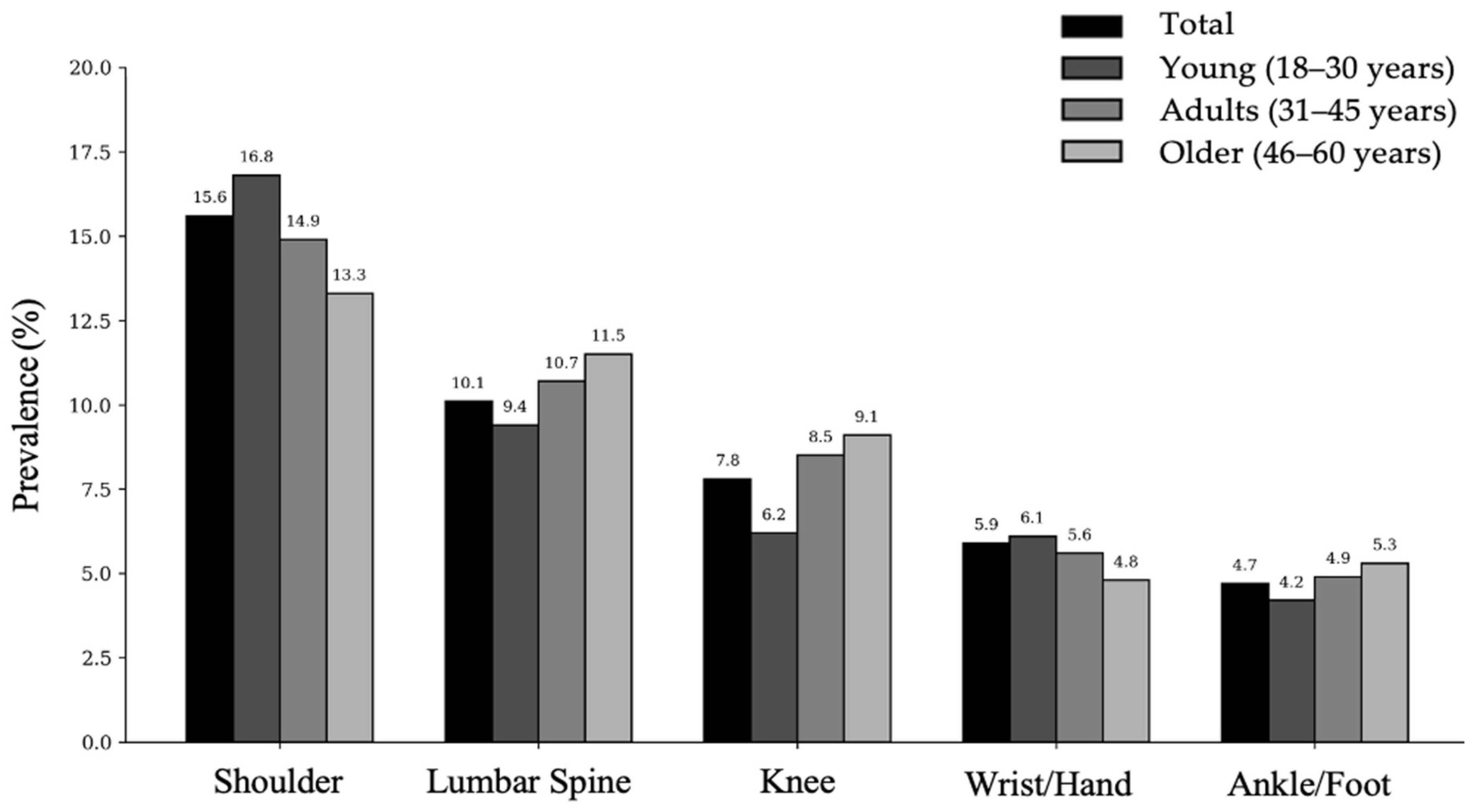
| Injuries | Total N = 358 (%) | Young (a) 18–30 Years N = 123 (%) | Adults (b) 31–45 Years N = 178 (%) | Older (c) 45–60 Years N = 55 (%) | p-Value | Post Hoc | |
|---|---|---|---|---|---|---|---|
| Injury resulting from CF | Yes | 35 (9.8) | 13 (10.4) | 20 (11.2) | 2 (3.6) | 0.242 | |
| No | 323 (90.2) | 112 (89.6) | 158 (88.8) | 53 (96.4) | |||
| Duration of injury (weeks) | 1 | 89 (24.8) | 28 (22.4) | 43 (24.2) | 18 (32.7) | 0.220 | |
| Between 1–3 | 8 (7.8) | 6 (10.1) | 18 (7.3) | 4 (7.3) | |||
| >3 | 33 (9.2) | 8 (6.4) | 17 (9.6) | 8 (14.5) | |||
| No injury | 208 (58.1) | 83 (66.4) | 100 (56.2) | 25 (45.5) | |||
| How did the injury occur? | Training | 112 (31.3) | 28 (22.4) | 59 (33.1) | 25 (45.5) | 0.135 | |
| Competition | 10 (2.8) | 4 (3.2) | 5 (2.8) | 1 (1.8) | |||
| Other | 32 (8.9) | 10 (8.0) | 18 (10.1) | 4 (7.3) | |||
| No injury | 204 (57) | 83 (66.4) | 96 (53.9) | 25 (45.5) | |||
| Is it a new or recurring injury? | New | 101 (28.2) | 28 (22.4) | 49 (27.5) | 24 (43.6) | 0.002 | c > a, c > b ** |
| Previous | 52 (14.5) | 11 (8.8) | 34 (19.1) | 7 (12.7) | |||
| No injury | 205 (57.3) | 86 (68.8) | 95 (53.4) | 24 (43.6) | |||
| What was the cause of the injury? | Overload | 67 (18.7) | 14 (11.2) | 34 (19.1) | 19 (34.5) | 0.027 | c > a; c > b * |
| Bad technique | 39 (10.9) | 11 (8.8) | 21 (11.8) | 7 (12.7) | |||
| Fatigue | 23 (6.4) | 9 (7.2) | 13 (7.3) | 1 (1.8) | |||
| No warm-up | 4 (1.1) | 1 (0.8) | 3 (1.7) | 0 | |||
| Other | 27 (7.5) | 8 (6.4) | 14 (7.9) | 5 (9.1) | |||
| No injury | 198 (55.3) | 82 (65.6) | 93 (52.2) | 23 (41.8) | |||
| Type of training that has suffered the most injuries | CrossFit | 70 (19.6) | 18 (14.4) | 39 (21.9) | 13 (23.6) | 0.060 | |
| Endurance | 8 (2.2) | 1 (0.8) | 4 (2.2) | 3 (5.5) | |||
| Weightlifting | 36 (10.1) | 17 (13.6) | 15 (8.4) | 4 (7.3) | |||
| Gymnastics | 34 (9.5) | 6 (4.8) | 22 (12.4) | 6 (10.9) | |||
| Kettlebell | 2 (0.6) | 0 | 2 (1.1) | 0 | |||
| None | 208 (58.1) | 83 (66.4) | 96 (53.9) | 29 (52.7) |
| Sport Supplements | Total N = 358 (%) | Women N = 182 (%) | Men N = 176 (%) | p-Value | |
|---|---|---|---|---|---|
| Have you considered the use of sport supplements? | Yes | 293 (81.8) | 142 (78.0) | 151 (85.8) | 0.013 |
| No | 18 (5.0) | 7 (3.8) | 11 (6.3) | ||
| NA | 47 (13.1) | 33 (18.1) | 14 (8.0) | ||
| Which days do you consider intake supplements | Training | 207 (57.8) | 106 (58.2) | 101 (57.4) | <0.001 |
| Training and competition | 53 (14.8) | 15 (8.2) | 38 (73.1) | ||
| No intake | 61 (31.3) | 37 (21.0) | 98 (26.3) | ||
| Main reason for supplement consumption | Health | 89 (24.8) | 55 (30.2) | 34 (19.4) | <0.001 |
| Recovery | 93 (26) | 32 (17.6) | 61 (34.6) | ||
| Performance | 59 (16.5) | 21 (11.5) | 38 (21.6) | ||
| Diet support | 28 (7.8) | 20 (11.0) | 8 (4.5) | ||
| No intake | 89 (24.9) | 54 (1.1) | 35 (19.9) | ||
| Have you noticed any improvement with the use of supplements? | Yes | 191 (53.4) | 82 (45.1) | 109 (61.9) | 0.016 |
| No | 10 (2.8) | 6 (3.3) | 4 (2.3) | ||
| Not sure | 69 (19.3) | 42 (23.1) | 27 (15.3) | ||
| No intake | 88 (24.6) | 52 (28.6) | 36 (20.5) | ||
| Frequency of supplement consumption (days/week) | 1–2 days | 14 (3.9) | 8 (4.4) | 6 (3.4) | 0.018 |
| 3 days | 28 (7.8) | 17 (9.3) | 11 (6.3) | ||
| 4 days | 19 (5.3) | 5 (2.7) | 14 (8.0) | ||
| 5 days | 38 (10.6) | 13 (7.1) | 25 (14.2) | ||
| Every day | 165 (46.1) | 83 (45.6) | 82 (46.6) | ||
| No intake | 94 (26.3) | 56 (30.8) | 38 (21.6) | ||
| Protein intake | Yes | 177 (49.4) | 76 (41.8) | 105 (57.4) | 0.003 |
| No | 181 (50.6) | 106 (58.2) | 75 (42.6) | ||
| Creatine intake | Yes | 216 (60.3) | 92 (50.5) | 124 (70.5) | <0.001 |
| No | 142 (39.7) | 90 (49.5) | 52 (29.5) | ||
| Caffeine intake | Si | 92 (25.7) | 40 (22.0) | 52 (29.5) | 0.101 |
| No | 266 (74.3) | 142 (78) | 124 (70.5) | ||
| Magnesium intake | Si | 136 (38) | 74 (40.7) | 62 (35.2) | 0.290 |
| No | 222 (62.0) | 108 (59.3) | 114 (64.8) | ||
| Omega 3 intake | Si | 101 (28.2) | 49 (26.9) | 52 (29.5) | 0.582 |
| No | 257 (71.8) | 133 (73.1) | 124 (70.5) |
| Supplement Consumption | Total N = 358 (%) | Young (a) 18–30 Years N = 123 (%) | Adults (b) 31–45 Years N = 178 (%) | Older (c) 46–60 Years N = 55 (%) | p-Value | Post Hoc | |
|---|---|---|---|---|---|---|---|
| Have you considered the use of sport supplements? | Yes | 293 (81.8) | 110 (88.0) | 142 (79.8) | 41 (74.5) | 0.036 | c >a *; c > b * |
| No | 18 (5.0) | 1 (5.6) | 11 (61.1) | 6 (10.9) | |||
| NA | 47 (13.1) | 14 (11.2) | 25 (14.0) | 8 (14.5) | |||
| Which days do you consider intake supplements | Training | 207 (57.8) | 68 (54.4) | 106 (59.6) | 33 (60.0) | 0.567 | |
| Training and competition | 53 (14.8) | 25 (20.0) | 22 (12.4) | 6 (10.9) | |||
| No intake | 98 (27.4) | 31 (25.6) | 50 (28.1) | 16 (29.1) | |||
| Main reason for supplement consumption | Health | 89 (24.8) | 25 (20.0) | 46 (25.8) | 18 (32.7) | 0.174 | |
| Recovery | 93 (26.0) | 30 (24.0) | 48 (26.9) | 15 (27.3) | |||
| Performance | 59 (16.5) | 27 (21.6) | 29 (16.3) | 3 (5.5) | a > c * | ||
| Diet support | 28 (7.8) | 13 (10.4) | 12 (6.7) | 5 (5.5) | |||
| No intake | 89 (24.9) | 30 (24.0) | 42 (23.6) | 15 (27.3) | |||
| Have you noticed any improvement with the use of supplements? | Yes | 191 (53.4) | 70 (56.0) | 96 (53.9) | 25 (45.5) | 0.300 | |
| No | 10 (2.8) | 2 (1.6) | 8 (4.5) | 0 | |||
| Not sure | 69 (19.3) | 22 (17.6) | 32 (18.0) | 15 (27.3) | |||
| No intake | 88 (24.6) | 31 (24.8) | 42 (23.6) | 15 (27.3) | |||
| Frequency of supplement consumption (days/week) | 1–2 days | 6 (1.7) | 1 (0.8) | 4 (2.2) | 1 (1.8) | 0.763 | |
| 3 days | 8 (2.2) | 4 (3.2) | 4 (2.2) | 0 | |||
| 4 days | 28 (7.8) | 8 (6.4) | 18 (10.1) | 2 (3.6) | |||
| 5 days | 19 (5.3) | 7 (5.6) | 8 (4.5) | 4 (7.3) | |||
| Every day | 38 (10.6) | 11 (8.8) | 22 (12.4) | 5 (9.1) | |||
| No intake | 165 (46.1) | 62 (49.6) | 77 (43.3) | 26 (47.3) | |||
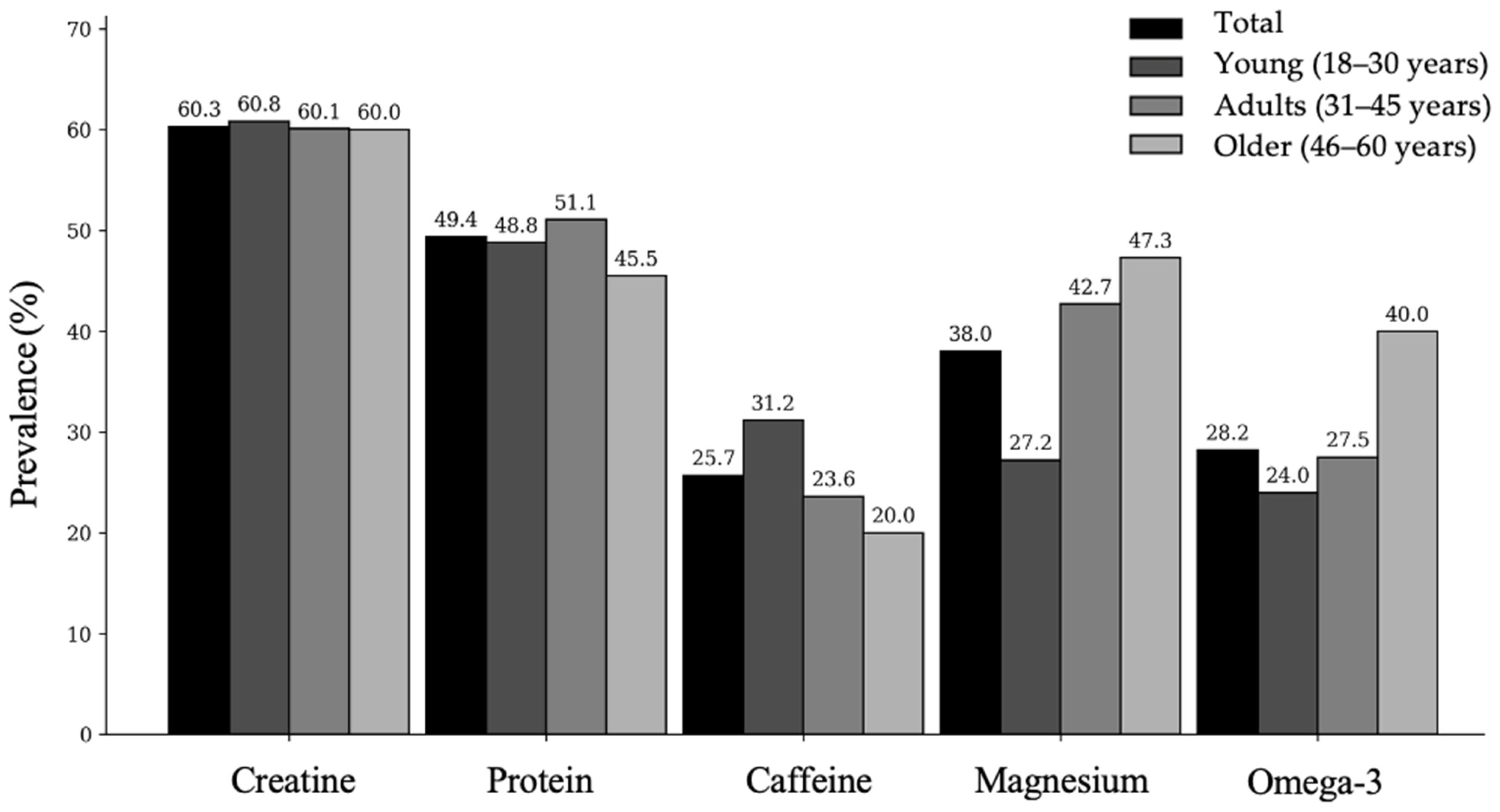
| Protein intake | Yes | 177 (49.4) | 61 (48.8) | 91 (51.1) | 25 (45.5) | 0.751 | |
| No | 181 (50.6) | 64 (51.2) | 87 (48.9) | 30 (54.5) | |||
| Creatine intake | Yes | 216 (60.3) | 76 (60.8) | 107 (60.1) | 33 (60.0) | 0.991 | |
| No | 142 (39.7) | 49 (39.2) | 71 (39.9) | 22 (40.0) | |||
| Yes | 92 (25.7) | 39 (31.2) | 42 (23.6) | 11 (20.0) | 0.189 | ||
| Caffeine intake | No | 266 (74.3) | 86 (68.8) | 136 (76.4) | 44 (80.0) | ||
| Magnesium intake | Yes | 136 (38.0) | 34 (27.2) | 76 (42.7) | 26 (47.3) | 0.007 | b > a *; c > a |
| No | 222 (62.0) | 91 (72.8) | 102 (57.3) | 29 (52.7) | |||
| Omega 3 intake | Yes | 101 (28.2) | 30 (24.0) | 49 (27.5) | 22 (40.0) | 0.086 | |
| No | 257 (71.8) | 95 (76.0) | 129 (72.5) | 33 (60.0) |
Disclaimer/Publisher’s Note: The statements, opinions and data contained in all publications are solely those of the individual author(s) and contributor(s) and not of MDPI and/or the editor(s). MDPI and/or the editor(s) disclaim responsibility for any injury to people or property resulting from any ideas, methods, instructions or products referred to in the content. |
© 2026 by the authors. Licensee MDPI, Basel, Switzerland. This article is an open access article distributed under the terms and conditions of the Creative Commons Attribution (CC BY) license.
Share and Cite
Cabrera Linares, J.C.; Párraga Montilla, J.A.; Latorre Román, P.Á.; Moreno del Castillo, R.; González, M.P. Training Habits, Injury Prevalence, and Supplement Use in CrossFit Practitioners. Sci 2026, 8, 21. https://doi.org/10.3390/sci8010021
Cabrera Linares JC, Párraga Montilla JA, Latorre Román PÁ, Moreno del Castillo R, González MP. Training Habits, Injury Prevalence, and Supplement Use in CrossFit Practitioners. Sci. 2026; 8(1):21. https://doi.org/10.3390/sci8010021
Chicago/Turabian StyleCabrera Linares, José Carlos, Juan Antonio Párraga Montilla, Pedro Ángel Latorre Román, Rafael Moreno del Castillo, and Mirella Pacheco González. 2026. "Training Habits, Injury Prevalence, and Supplement Use in CrossFit Practitioners" Sci 8, no. 1: 21. https://doi.org/10.3390/sci8010021
APA StyleCabrera Linares, J. C., Párraga Montilla, J. A., Latorre Román, P. Á., Moreno del Castillo, R., & González, M. P. (2026). Training Habits, Injury Prevalence, and Supplement Use in CrossFit Practitioners. Sci, 8(1), 21. https://doi.org/10.3390/sci8010021