
Article

Vertiport Infrastructure Location Optimization for Equitable Access to Urban Air Mobility
by
Vasileios Volakakis
and
Hani S. Mahmassani
*
Transportation Center, Northwestern University, 600 Foster Street, Evanston, IL 60208, USA
*
Author to whom correspondence should be addressed.
Infrastructures 2024, 9(12), 239; https://doi.org/10.3390/infrastructures9120239

Submission received: 14 October 2024 / Revised: 27 November 2024 / Accepted: 11 December 2024 / Published: 23 December 2024
(This article belongs to the Special Issue Recent Progress in Transportation Infrastructures)

Abstract

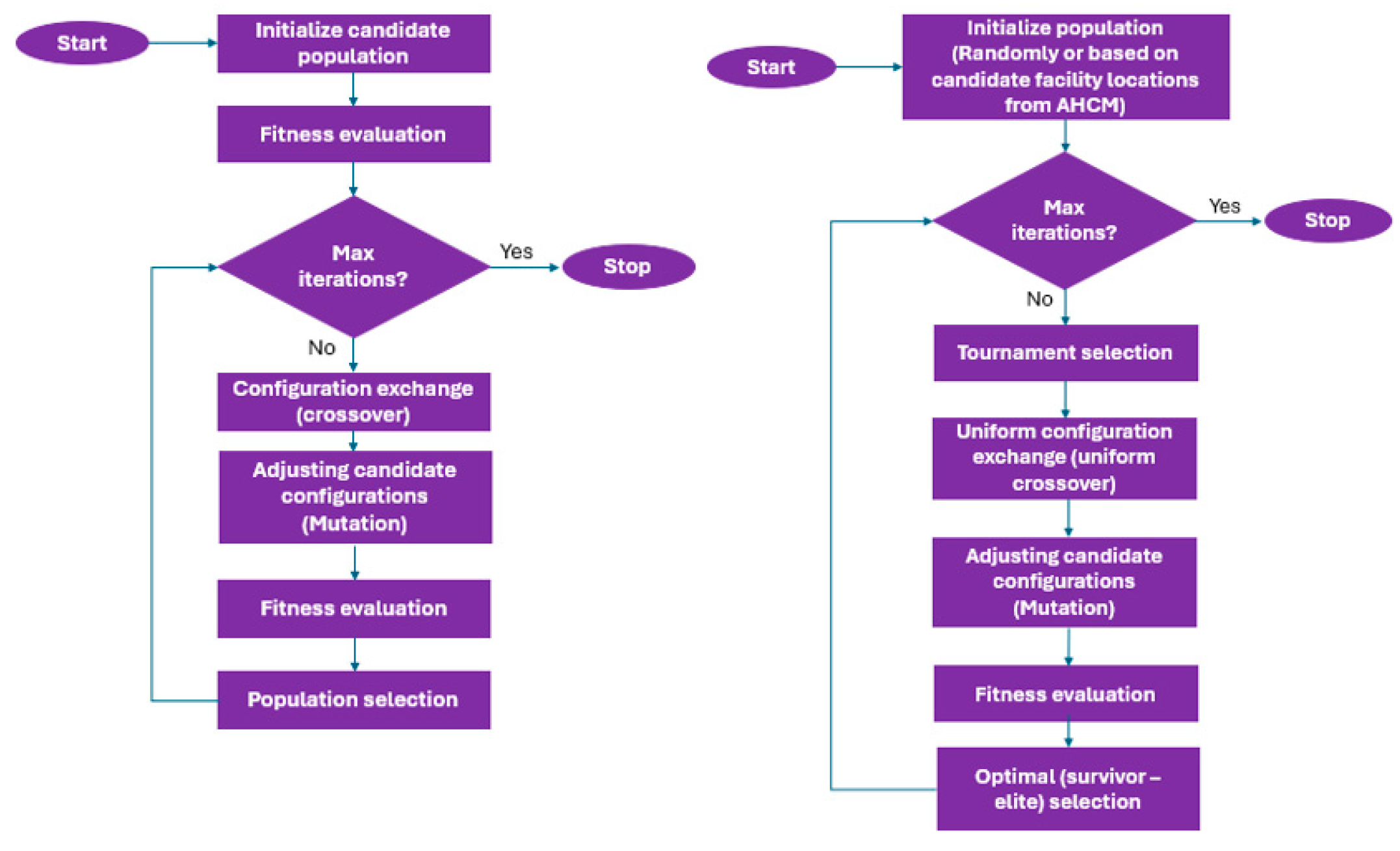
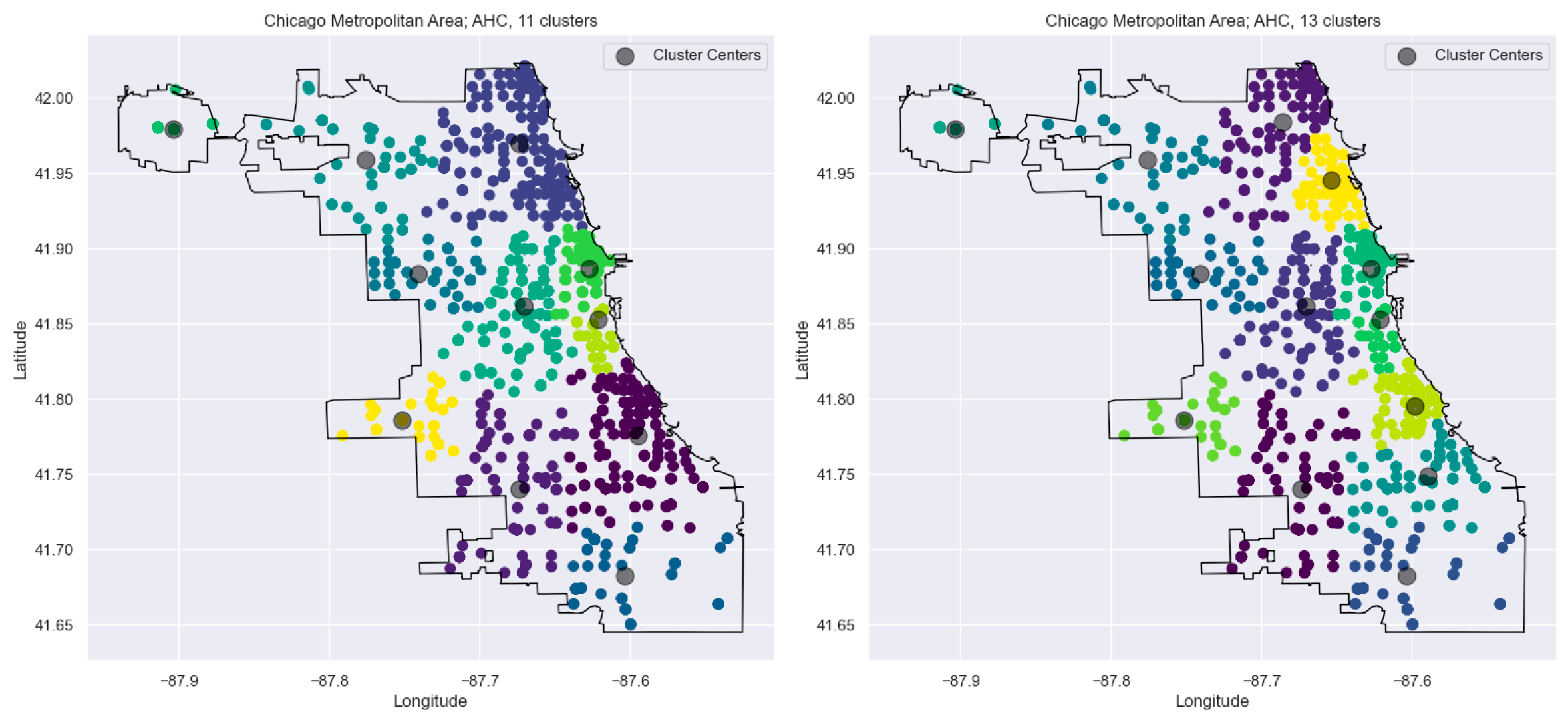
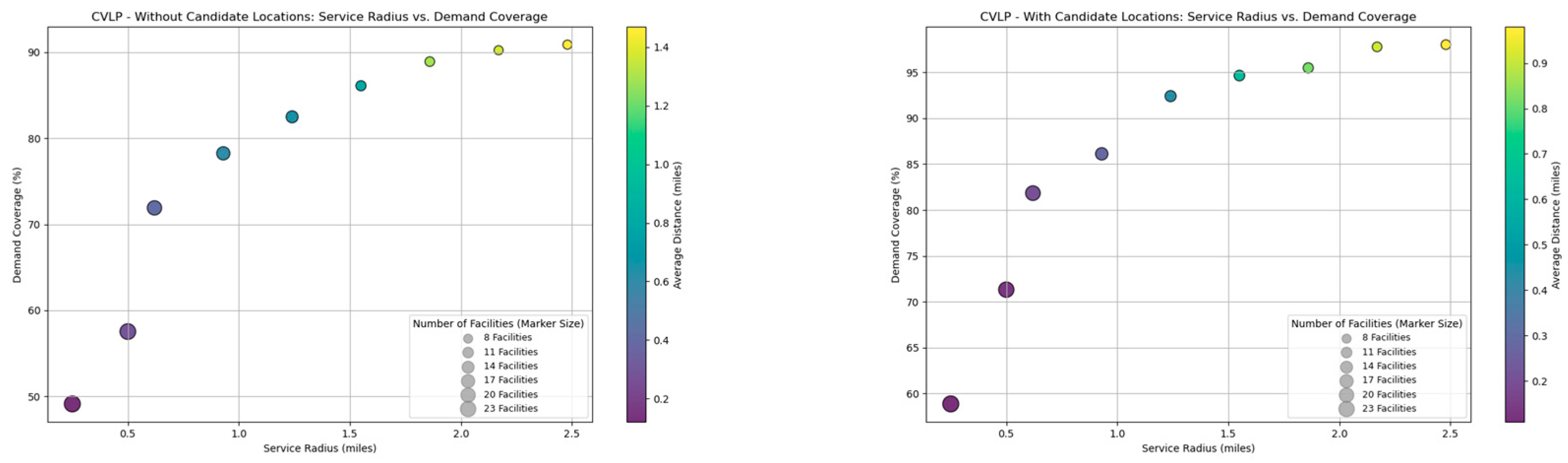
Urban air mobility (UAM) has recently emerged as a promising new transportation mode, with various potential use cases. Facility location problems are well studied and of significant importance for various transportation modes. This work introduces a vertiport location identification framework, focusing on demand coverage and infrastructure accessibility. An Agglomerative Hierarchical Clustering (AHC) model was utilized for the identification of candidate vertiport locations, along with a k-means algorithm, for comparison and validation purposes, based on an estimated UAM demand pattern. A genetic algorithm (GA) was then formulated, for the solution of the proposed Uncapacitated and Capacitated Vertiport Location Problems (UVLP and CVLP, respectively), variations of the Uncapacitated and Capacitated Facility Location Problems. To evaluate and compare the introduced methodology, different existing facility location problems (FLPs) were considered and solved exactly using integer and linear programming. These are the Location Set Covering Problem (LSCP), the Maximal Coverage Location Problem (MCLP), and the p-median problem. The p-center problem was also considered and solved via a heuristic approach. The proposed framework is illustrated through applications in the Chicago Metropolitan Area, with the demand estimated on the basis of existing taxi and Transportation Network Company (TNC) data.
Keywords: urban air mobility (UAM); facility location; vertiport location; infrastructure accessibility; demand coverage; agglomerative hierarchical clustering; genetic algorithm urban air mobility (UAM); facility location; vertiport location; infrastructure accessibility; demand coverage; agglomerative hierarchical clustering; genetic algorithm