
Distributed Fiber Optic Sensors (DFOSs) for Structural Health Monitoring (SHM) of Railway Infrastructure: A Critical Review



Abstract
1. Introduction
1.1. Railway Monitoring Challenges and Modern SHM Approaches
1.2. Fiber Optic Sensing Applications in SHM
1.3. From Conventional Sensors to Distributed Fiber Optic Sensing (DFOS)
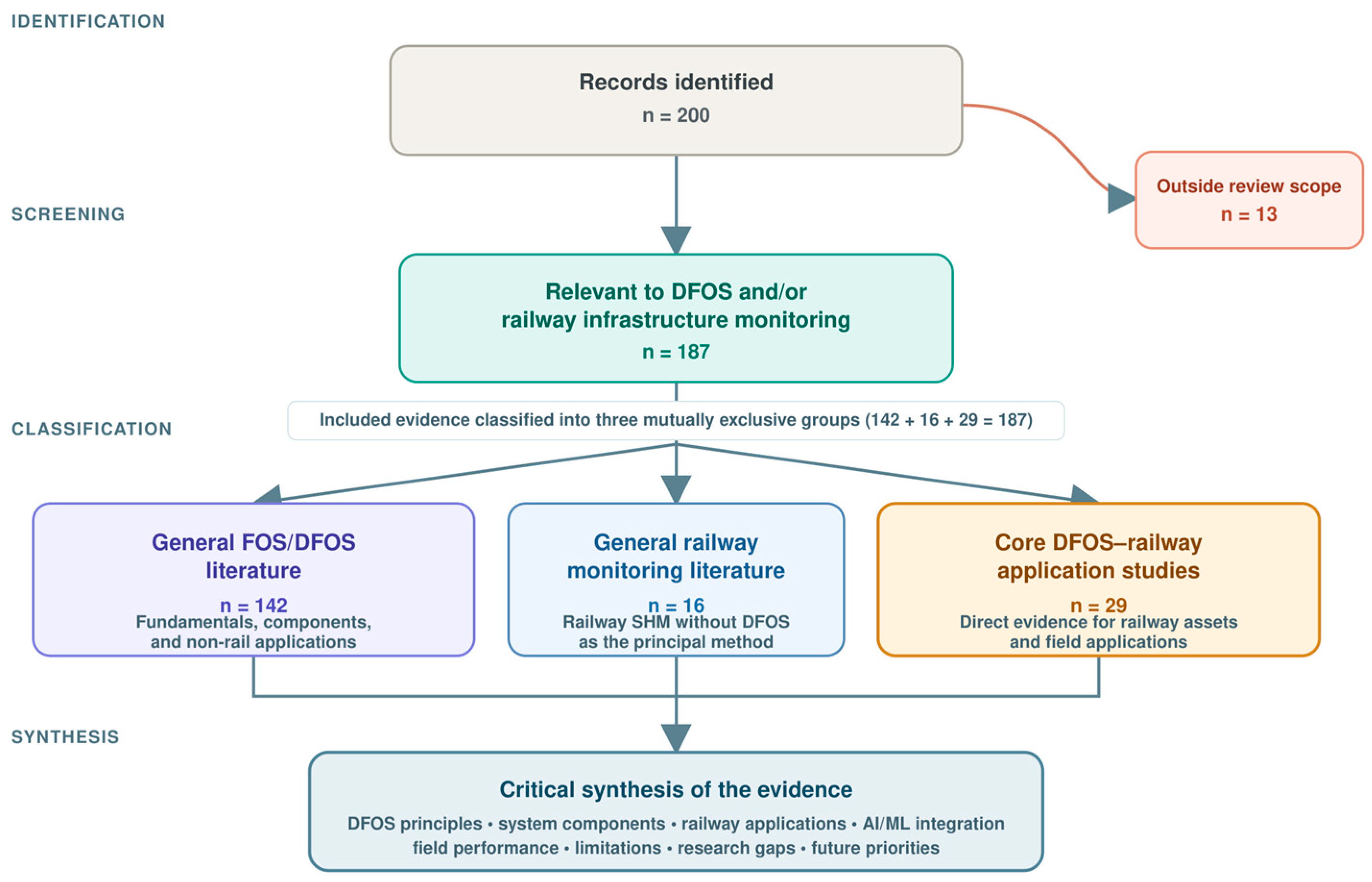
1.4. Review Methodology
2. DFOS Fundamentals
2.1. Interrogator Unit
2.2. Optical Fiber Cable

| Fiber Type | Material and Structure | Core/Clad (µm) | Attenuation | Sensing Range | Spatial Resolution | Temp. Range (°C) | Scattering Techniques | Typical DFOS Applications | Cost (USD/m) | Certification Standards |
|---|---|---|---|---|---|---|---|---|---|---|
| Single-Mode Glass | Silica core and cladding; acrylate (std) or polyimide/fluoropolymer (harsh) coatings | 8–10/125 | ~0.2 dB/km @ 1550 nm | Up to ~100 km | cm–m (BOTDA, BOTDR) | −60 to +200 °C (acrylate) −60 to +600 °C (polyimide) | Rayleigh, Brillouin, Raman | Long-haul pipeline/tunnel/bridge/rail monitoring | 0.5–2 (std) 2–5+ (specialty) | ITU-T G.652, G.657 [106,107] |
| Multi-Mode Glass | Silica core and cladding; acrylate or polyimide coatings | 50/125 (OM2) 62.5/125 (OM1) | 3–5 dB/km @ 850 nm | ~1–10 km | 1–10 m (BOTDA, Raman) | −60 to +200 °C | Brillouin, Raman, Rayleigh | Medium-range DFOS: industrial pipelines, structural segments, tunnels | 0.3–1 (std) 1–3+ (specialty) | ITU-T G.651 (MMF) [108] |
| Multi-Mode Plastic (POF) | PMMA or perfluorinated core; PE/PVC or UV-stable jacket | 980–1000/1000 | 100–200 dB/km @ 650 nm | Up to ~0.5 km | mm–cm (OFDR, OTDR) | −20 to +85 °C (PMMA) −20 to +120 °C (PF-POF) | Rayleigh (OFDR), OTDR | Short-range embedding in concrete/geotextiles, flood/slopes, wearable sensing | 0.1–0.5 | IEC 60793-1-1, IEC 60793-2-40 [109,110] |
2.3. Data Acquisition System
2.4. AI-Driven Data Interpretation and Damage Detection
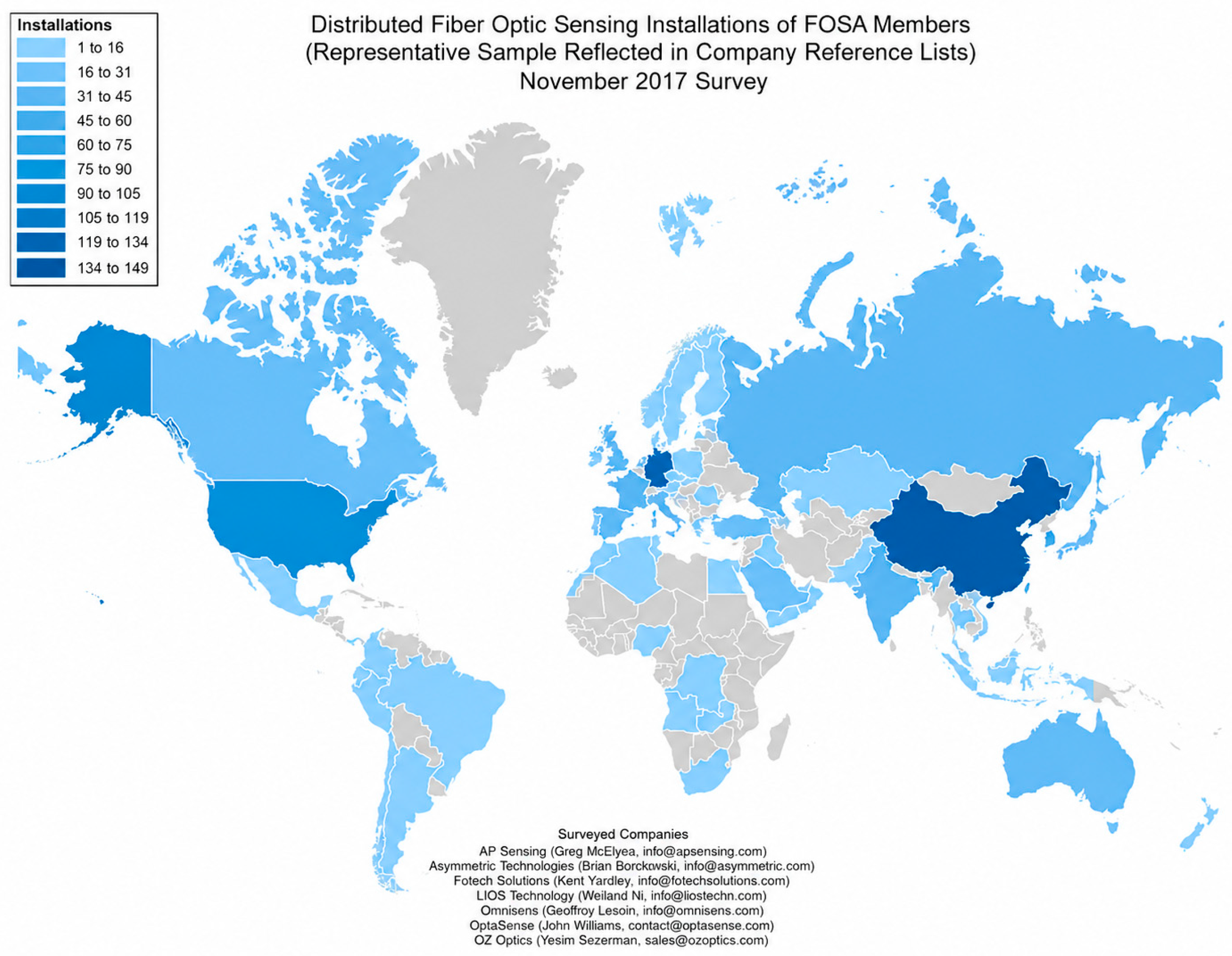
3. DFOS Market Projection and Key Players
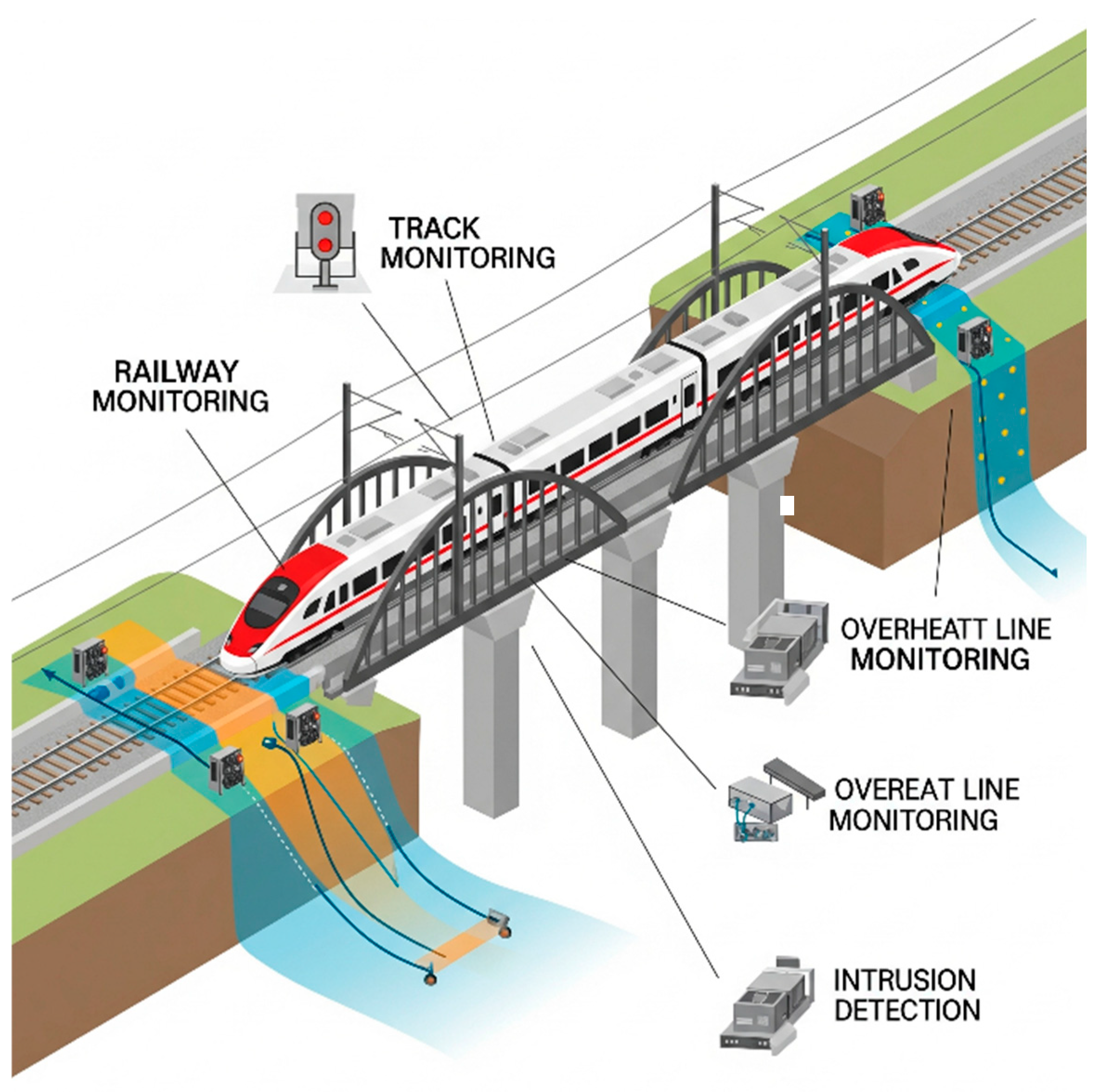
4. Implications of DFOS for Resilient Railway Infrastructure
4.1. Track and Sleeper Monitoring
4.2. Bridge Monitoring
4.3. Tunnel and Embankment Monitoring
4.4. Technology Readiness and Deployment Maturity
5. Key Constraints for Railway DFOS
5.1. Embedment and Installation Difficulties
5.2. Harsh Environmental and Mechanical Conditions
5.3. Construction and Maintenance Hazards
5.4. Data Volume, Noise and Interpretation
6. Future Directions for DFOS Research in Rail Monitoring
7. Conclusions
- DFOS converts ordinary optical fiber into a spatially continuous measurement array, delivering high-resolution profiles of strain, temperature, and vibration over kilometer-scale assets, a capability that conventional point sensors such as strain gauges, accelerometers, and track circuits fundamentally cannot replicate. Unlike discrete sensors that capture conditions only at specific locations, DFOS functions as an artificial nervous system for railway infrastructure, enabling early detection of anomalies such as rail cracks, ballast degradation, sleeper voids, and foundation settlement across entire track sections simultaneously.
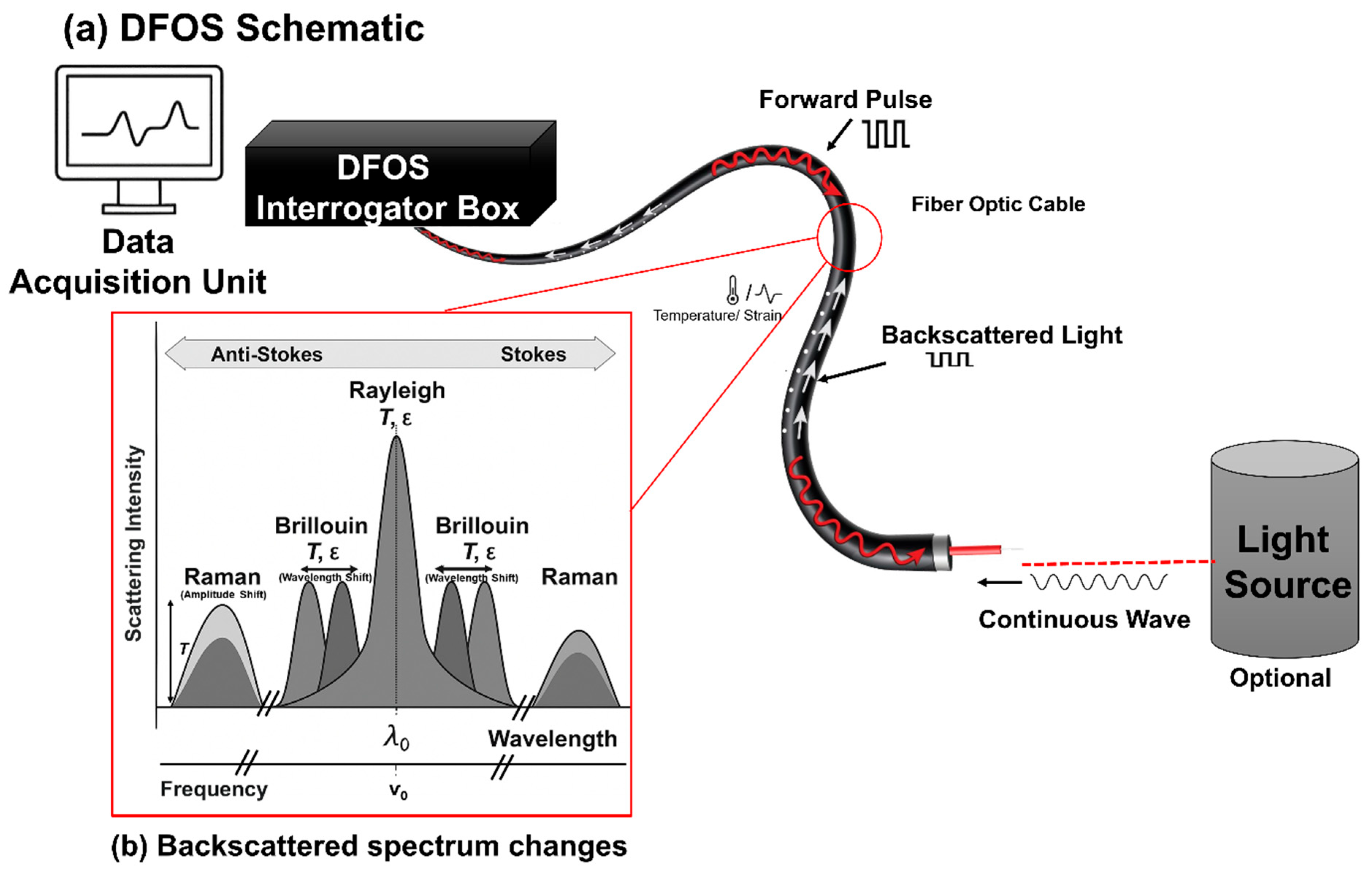
- The three principal scattering mechanisms, Rayleigh, Brillouin, and Raman, offer distinct and complementary strengths across different monitoring needs. Rayleigh-based DAS excels at centimeter-scale spatial resolution and high-frequency vibration capture for real-time train detection and intrusion monitoring; Brillouin-based systems provide long-range strain and temperature sensing with accuracies approaching ±1 µε and ±0.1 °C for embankment stability and bridge pre-stress loss assessment; and Raman-based sensing delivers subdegree temperature accuracy suited to tunnel fire detection and environmental monitoring. Field trials reviewed here confirm that these techniques have moved well beyond laboratory demonstration, with deployments validated across short instrumented rail sections, kilometer-scale elevated bridges, historic masonry arch bridges, and Victorian-era embankments.
- The integration of AI and ML with DFOS data streams has proven transformative for railway monitoring, with deep CNN, LSTM architectures, ensemble classifiers, and self-supervised anomaly detection methods all achieving detection accuracies consistently above 97% in recent field studies. FPGA-based edge inference now enables submillisecond latency classification directly within interrogator hardware, allowing DFOS to function not merely as a passive recorder but as an active, intelligent monitoring platform capable of real-time hazard alerts, predictive degradation forecasting, and automated maintenance prioritization.
- Key challenges remain that currently limit deployment to critical sections rather than full network coverage. High interrogator costs, typically six-figure capital outlays, combined with large DAS data volumes exceeding 100 MB/s on operational lines, installation complexity in retrofit scenarios, adhesive debonding under cyclic loading, temperature compensation requirements, and the absence of harmonized performance standards collectively represent significant barriers. The emerging IEC 61757 series addresses standardization only partially, and vibration-induced signal fading at operational train speeds continues to constrain the reliability of Rayleigh-based sensing under real-world conditions.
- Future research should prioritize four interconnected directions: development of lower-cost interrogation hardware and repurposing of existing telecommunications fibers to reduce capital barriers by an estimated 30–50%; construction of automated signal-processing pipelines combining adaptive noise filtering, temperature compensation, and physics-informed ML to handle terabyte-scale data at operational speeds; integration of DFOS feeds with digital twin frameworks and standardized cloud architectures for network-scale predictive maintenance; and harmonization of DFOS performance metrics with international railway engineering norms to accelerate regulatory acceptance and large-scale commercial adoption. With the global DFOS market projected to reach USD 3.12 billion by 2030, the technology is well positioned to become a foundational element of the digital railway infrastructure ecosystem, supporting safer, more resilient, and more sustainably maintained rail networks worldwide.
Author Contributions
Funding
Data Availability Statement
Acknowledgments
Conflicts of Interest
Abbreviations
| DFOS | Distributed Fiber Optic Sensing |
| DAS | Distributed Acoustic Sensing |
| DTS | Distributed Temperature Sensing |
| DSS | Distributed Strain Sensing |
| DDS | Distributed Dynamic Sensing |
| FBG | Fiber Bragg Grating |
| FPI | Fabry–Pérot Interferometer |
| POF | Plastic Optical Fiber |
| MMF | Multi-Mode Fiber |
| SMF | Single-Mode Fiber |
| MEMS | Microelectromechanical System |
| OTDR | Optical Time-Domain Reflectometry |
| OFDR | Optical Frequency-Domain Reflectometry |
| BOTDA | Brillouin Optical Time-Domain Analysis |
| BOTDR | Brillouin Optical Time-Domain Reflectometry |
| BOFDA | Brillouin Optical Frequency-Domain Analysis |
| ROTDR | Raman Optical Time-Domain Reflectometry |
| SNR | Signal-to-Noise Ratio |
| FWT | Fast Wavelet Transform |
| AI | Artificial Intelligence |
| ML | Machine Learning |
| CNN | Convolutional Neural Network |
References
- Siahkouhi, M.; Wang, J.; Han, X.; Aela, P.; Ni, Y.-Q.; Jing, G. Railway ballast track hanging sleeper defect detection using a smart CNT self-sensing concrete railway sleeper. Constr. Build. Mater. 2023, 399, 132487. [Google Scholar] [CrossRef]
- Siahkouhi, M.; Rashidi, M.; Mashiri, F.; Aslani, F.; Pazouki, G.; Ayubirad, M.S. Bridge health monitoring via self-sensing concrete sensors (SSCSs): A numerical and machine learning approach. Structures 2026, 88, 111913. [Google Scholar] [CrossRef]
- Taheri, S. A review on five key sensors for monitoring of concrete structures. Constr. Build. Mater. 2019, 204, 492–509. [Google Scholar] [CrossRef]
- Güemes, A.; Fernandez-Lopez, A.; Pozo, A.R.; Sierra-Pérez, J. Structural Health Monitoring for Advanced Composite Structures: A Review. J. Compos. Sci. 2020, 4, 13. [Google Scholar] [CrossRef]
- Wu, T.; Liu, G.; Fu, S.; Xing, F. Recent Progress of Fiber-Optic Sensors for the Structural Health Monitoring of Civil Infrastructure. Sensors 2020, 20, 4517. [Google Scholar] [CrossRef] [PubMed]
- Ansari, F. Fiber optic health monitoring of civil structures using long gage and acousticsensors. Smart Mater. Struct. 2005, 14, S1. [Google Scholar] [CrossRef]
- Lopez-Higuera, J.M.; Cobo, L.R.; Incera, A.Q.; Cobo, A. Fiber Optic Sensors in Structural Health Monitoring. J. Light. Technol. 2011, 29, 587–608. [Google Scholar] [CrossRef]
- Siahkouhi, M.; Rashidi, M.; Miri, A.; Ghiasi, A.; Paixão, A. Ballasted railway track–bridge transition zone monitoring methods: Recent developments, challenges, and prospects. J. Transp. Eng. Part B Pavements 2025, 151, 03125001. [Google Scholar] [CrossRef]
- Soga, K.; Luo, L. Distributed fiber optics sensors for civil engineering infrastructure sensing. J. Struct. Integr. Maint. 2018, 3, 1–21. [Google Scholar] [CrossRef]
- Gharehbaghi, V.R.; Noroozinejad Farsangi, E.; Noori, M.; Yang, T.; Li, S.; Nguyen, A.; Málaga-Chuquitaype, C.; Gardoni, P.; Mirjalili, S. A critical review on structural health monitoring: Definitions, methods, and perspectives. Arch. Comput. Methods Eng. 2022, 29, 2209–2235. [Google Scholar] [CrossRef]
- Rocha, H.; Semprimoschnig, C.; Nunes, J.P. Sensors for process and structural health monitoring of aerospace composites: A review. Eng. Struct. 2021, 237, 112231. [Google Scholar] [CrossRef]
- Lynch, J.P.; Loh, K.J. A summary review of wireless sensors and sensor networks for structural health monitoring. Shock Vib. Dig. 2006, 38, 91–130. [Google Scholar] [CrossRef]
- Mousavi, V.; Rashidi, M.; Shayan, G.; Samali, B. A data-driven digital twin model for bridge health monitoring using feature fusion and unsupervised deep learning. Inf. Fusion 2025, 126, 103534. [Google Scholar] [CrossRef]
- Rashidi, M.; Siahkouhi, M.; Shrestha, K.; Ayubirad, M.S.; Jafarkazemi, M. Structural Assessment and Remedial Planning for a Concrete Slab Bridge: A Case Study. Results Eng. 2025, 27, 105643. [Google Scholar] [CrossRef]
- Downer, J. Rational Accidents: Reckoning with Catastrophic Technologies; MIT Press: Cambridge, MA, USA, 2024. [Google Scholar]
- Tan, Y.; Lu, Y.; Wang, D. Catastrophic failure of Shanghai metro line 4 in July, 2003: Occurrence, emergency response, and disaster relief. J. Perform. Constr. Facil. 2021, 35, 04020125. [Google Scholar] [CrossRef]
- Sasy Chan, Y.W.; Wang, H.-P.; Xiang, P. Optical fiber sensors for monitoring railway infrastructures: A review towards smart concept. Symmetry 2021, 13, 2251. [Google Scholar] [CrossRef]
- Wang, Y.; Miao, B.; Zhang, Y.; Huang, Z.; Xu, S. Review on Rail Damage Detection Technologies for High-Speed Trains. Appl. Sci. 2025, 15, 7725. [Google Scholar] [CrossRef]
- Ren, Y.; Lu, P.; Ai, C.; Gao, L.; Qiu, S.; Tolliver, D. Review of emerging technologies and issues in rail and track inspection for local lines in the United States. J. Transp. Eng. Part A Syst. 2021, 147, 04021062. [Google Scholar] [CrossRef]
- Elsherif, M.; Salih, A.E.; Muñoz, M.G.; Alam, F.; AlQattan, B.; Antonysamy, D.S.; Zaki, M.F.; Yetisen, A.K.; Park, S.; Wilkinson, T.D.; et al. Optical Fiber Sensors: Working Principle, Applications, and Limitations. Adv. Photonics Res. 2022, 3, 2100371. [Google Scholar] [CrossRef]
- Grattan, K.T.V.; Sun, T. Fiber optic sensor technology: An overview. Sens. Actuators A Phys. 2000, 82, 40–61. [Google Scholar] [CrossRef]
- Sabri, N.; Aljunid, S.; Salim, M.; Fouad, S. Fiber optic sensors: Short review and applications. In Recent Trends in Physics of Material Science and Technology; Springer: Singapore, 2015; pp. 299–311. [Google Scholar]
- Udd, E. An overview of fiber-optic sensors. Rev. Sci. Instrum. 1995, 66, 4015–4030. [Google Scholar] [CrossRef]
- Krohn, D.A.; MacDougall, T.; Mendez, A. Fiber Optic Sensors: Fundamentals and Applications; Spie Press: Bellingham, WA, USA, 2014; Volume 4. [Google Scholar]
- Shi-Kay, Y.; Asawa, C. Fiber Optical Intensity Sensors. IEEE J. Sel. Areas Commun. 1983, 1, 562–575. [Google Scholar] [CrossRef]
- Pendão, C.; Silva, I. Optical fiber sensors and sensing networks: Overview of the main principles and applications. Sensors 2022, 22, 7554. [Google Scholar] [CrossRef] [PubMed]
- Theodosiou, A. Recent advances in fiber Bragg grating sensing. Sensors 2024, 24, 532. [Google Scholar] [CrossRef] [PubMed]
- Yassin, M.H.; Farhat, M.H.; Soleimanpour, R.; Nahas, M. Fiber Bragg grating (FBG)-based sensors: A review of technology and recent applications in structural health monitoring (SHM) of civil engineering structures. Discov. Civ. Eng. 2024, 1, 151. [Google Scholar] [CrossRef]
- Gangopadhyay, T.K. Prospects for fibre Bragg gratings and Fabry-Perot interferometers in fibre-optic vibration sensing. Sens. Actuators A Phys. 2004, 113, 20–38. [Google Scholar] [CrossRef]
- Li, Y.; Wang, Y.; Xiao, L.; Bai, Q.; Liu, X.; Gao, Y.; Zhang, H.; Jin, B. Phase Demodulation Methods for Optical Fiber Vibration Sensing System: A Review. IEEE Sens. J. 2022, 22, 1842–1866. [Google Scholar] [CrossRef]
- Ho, K.-P. Phase-Modulated Optical Communication Systems; Springer Science & Business Media: Berlin/Heidelberg, Germany, 2005. [Google Scholar]
- Zhao, Y.; Zhao, H.; Lv, R.-Q.; Zhao, J. Review of optical fiber Mach–Zehnder interferometers with micro-cavity fabricated by femtosecond laser and sensing applications. Opt. Lasers Eng. 2019, 117, 7–20. [Google Scholar] [CrossRef]
- Kong, Y.; Ding, W.; Li, Z.W.; Zhang, Y.J.; Ansari, F.; Yi, S. Double Mach–Zehnder acoustic emission interferometer for detection of damage in structures. Opt. Commun. 2020, 459, 125076. [Google Scholar] [CrossRef]
- Png, W.; Lin, H.; Pua, C.; Lim, J.; Lim, S.; Lee, Y.; Rahman, F. Feasibility use of in-line Mach–Zehnder interferometer optical fibre sensor in lightweight foamed concrete structural beam on curvature sensing and crack monitoring. Struct. Health Monit. 2018, 17, 1277–1288. [Google Scholar] [CrossRef]
- Culshaw, B. The optical fibre Sagnac interferometer: An overview of its principles and applications. Meas. Sci. Technol. 2005, 17, R1. [Google Scholar] [CrossRef]
- Arianfard, H.; Juodkazis, S.; Moss, D.J.; Wu, J. Sagnac interference in integrated photonics. Appl. Phys. Rev. 2023, 10, 011309. [Google Scholar] [CrossRef]
- Islam, M.R.; Ali, M.M.; Lai, M.-H.; Lim, K.-S.; Ahmad, H. Chronology of Fabry-Perot interferometer fiber-optic sensors and their applications: A review. Sensors 2014, 14, 7451–7488. [Google Scholar] [CrossRef] [PubMed]
- Hernández, G. Fabry-Perot Interferometers; Cambridge University Press: Cambridge, UK, 1988. [Google Scholar]
- Bado, M.F.; Casas, J.R. A review of recent distributed optical fiber sensors applications for civil engineering structural health monitoring. Sensors 2021, 21, 1818. [Google Scholar] [CrossRef] [PubMed]
- Bao, X.; Chen, L. Recent Progress in Distributed Fiber Optic Sensors. Sensors 2012, 12, 8601–8639. [Google Scholar] [CrossRef] [PubMed]
- Bednarski, Ł.; Howiacki, T.; Sieńko, R.; Zuziak, K. Distributed Fibre Optic Sensors (DFOS) in Measurements of Rail Strain and Displacements. Procedia Struct. Integr. 2024, 64, 1681–1688. [Google Scholar] [CrossRef]
- Schenato, L. A review of distributed fibre optic sensors for geo-hydrological applications. Appl. Sci. 2017, 7, 896. [Google Scholar] [CrossRef]
- Wijaya, H.; Rajeev, P.; Gad, E. Distributed optical fibre sensor for infrastructure monitoring: Field applications. Opt. Fiber Technol. 2021, 64, 102577. [Google Scholar] [CrossRef]
- Zhang, X.; Zhu, H.; Jiang, X.; Broere, W. Distributed fiber optic sensors for tunnel monitoring: A state-of-the-art review. J. Rock. Mech. Geotech. Eng. 2024, 16, 3841–3863. [Google Scholar] [CrossRef]
- Lu, X.; Chruscicki, S.; Schukar, M.; Münzenberger, S.; Krebber, K. Application of intensity-based coherent optical time domain reflectometry to bridge monitoring. Sensors 2022, 22, 3434. [Google Scholar] [CrossRef] [PubMed]
- Kouroussis, G.; Caucheteur, C.; Kinet, D.; Alexandrou, G.; Verlinden, O.; Moeyaert, V. Review of trackside monitoring solutions: From strain gages to optical fibre sensors. Sensors 2015, 15, 20115–20139. [Google Scholar] [CrossRef] [PubMed]
- Van Esbeen, B.; Finet, C.; Vandebrouck, R.; Kinet, D.; Boelen, K.; Guyot, C.; Kouroussis, G.; Caucheteur, C. Smart railway traffic monitoring using fiber Bragg grating strain gauges. Sensors 2022, 22, 3429. [Google Scholar] [CrossRef] [PubMed]
- Tam, H.Y.; Liu, S.Y.; Ho, S.L.; Ho, T.K. Fiber bragg grating sensors for railway systems. In Fiber Bragg Grating Sensors: Recent Advancements, Industrial Applications and Market Exploitation; Bentham Science Publishers: Sharjah, United Arab Emirates, 2011; Volume 11. [Google Scholar]
- Hussaini, S.K.; Indraratna, B.; Vinod, J.S. Application of optical-fiber Bragg grating sensors in monitoring the rail track deformations. Geotech. Test. J. 2015, 38, 387–396. [Google Scholar] [CrossRef]
- Naderi, H.; Mirabadi, A. Railway track condition monitoring using FBG and FPI fiber optic sensors. In Proceedings of the 2006 IET International Conference On Railway Condition Monitoring; IET: London, UK; pp. 198–203.
- Bao, X.; Wang, Y. Recent advancements in Rayleigh scattering-based distributed fiber sensors. Adv. Devices Instrum. 2021, 2021, 8696571. [Google Scholar] [CrossRef]
- Vidakovic, M. Optical Fibre Sensors Applied to Condition and Structural Monitoring for the Marine and Rail Transport Sectors. Doctoral Dissertation, Universtiy of London, London, UK, 2017. [Google Scholar]
- Howiacki, T.; Sieńko, R.; Bednarski, Ł.; Zuziak, K. Crack shape coefficient: Comparison between different DFOS tools embedded for crack monitoring in concrete. Sensors 2023, 23, 566. [Google Scholar] [CrossRef] [PubMed]
- Peng, Y.; Zhao, J.; Fan, Y.; Fan, C. Monitoring and deformation of deep excavation engineering based on DFOS technology and hybrid deep learning. Sci. Rep. 2025, 15, 16042. [Google Scholar] [CrossRef] [PubMed]
- Pellegrini, S.; Rizzelli, G.; Andrenacci, L.; Minelli, L.; Pilori, D.; Bosco, G.; Crognale, C.; Piciaccia, S.; Tanzi, A.; Gaudino, R. Polarization-based Optical Fiber Sensing: A State of the Art Review. In Proceedings of the 2024 Italian Conference on Optics and Photonics (ICOP); IEEE: New York, NY, USA, 2024; pp. 1–4. [Google Scholar]
- Guan, C.; Zeng, N.; He, H. Review of polarization-based technology for biomedical applications. J. Innov. Opt. Health Sci. 2025, 18, 2430002. [Google Scholar] [CrossRef]
- Jena, J.; Wassin, S.; Bezuidenhout, L.; Doucouré, M.; Gibbon, T. Polarization-based optical fiber acoustic sensor for geological applications. J. Opt. Soc. Am. B 2020, 37, A147–A153. [Google Scholar] [CrossRef]
- Liu, K.; Jin, X.; Jiang, J.; Xu, T.; Ding, Z.; Huang, Y.; Sun, Z.; Xue, K.; Li, S.; Liu, T. Interferometer-based distributed optical fiber sensors in long-distance vibration detection: A review. IEEE Sens. J. 2022, 22, 21428–21444. [Google Scholar] [CrossRef]
- Li, D.; Wang, M.; Li, Q.; Wang, J.; Wang, Z.; Liu, Y.; Huang, X.; Chen, D. A polarization-space Michelson interferometric fiber-optic vibration sensor. IEEE Sens. J. 2024, 24, 30046–30054. [Google Scholar] [CrossRef]
- Carver, C.J.; Zhou, X. Polarization sensing of network health and seismic activity over a live terrestrial fiber-optic cable. Commun. Eng. 2024, 3, 91. [Google Scholar] [CrossRef]
- Glisic, B.; Inaudi, D. Fibre Optic Methods for Structural Health Monitoring; John Wiley & Sons: Hoboken, NJ, USA, 2007. [Google Scholar]
- China’s Operating High-Speed Railway Hits 47,000 km. Available online: https://english.www.gov.cn/archive/statistics/202412/26/content_WS676d359cc6d0868f4e8ee49a.html#:~:text=BEIJING%2C%20Dec.%2026%20,National%20Railway%20Administration%20on%20Thursday (accessed on 15 July 2025).
- Eurostat. Characteristics of the Railway Network in Europe. Available online: https://ec.europa.eu/eurostat/statistics-explained/index.php?title=Characteristics_of_the_railway_network_in_Europe#:~:text=In%202023%2C%20there%20were%208%C2%A0556,since%202013 (accessed on 17 May 2025).
- Monsberger, C.M.; Lienhart, W. Distributed Fiber Optic Shape Sensing of Concrete Structures. Sensors 2021, 21, 6098. [Google Scholar] [CrossRef] [PubMed]
- Hartog, A.H. An Introduction to Distributed Optical Fibre Sensors; CRC Press: Boca Raton, FL, USA, 2017. [Google Scholar]
- Bai, Q.; Wang, Q.; Wang, D.; Wang, Y.; Gao, Y.; Zhang, H.; Zhang, M.; Jin, B. Recent Advances in Brillouin Optical Time Domain Reflectometry. Sensors 2019, 19, 1862. [Google Scholar] [CrossRef] [PubMed]
- Coscetta, A.; Catalano, E.; Cerri, E.; Cennamo, N.; Zeni, L.; Minardo, A. Hybrid Brillouin/Rayleigh sensor for multiparameter measurements in optical fibers. Opt. Express 2021, 29, 24025–24031. [Google Scholar] [CrossRef] [PubMed]
- Muanenda, Y.; Oton, C.J.; Di Pasquale, F. Application of Raman and Brillouin scattering phenomena in distributed optical fiber sensing. Front. Phys. 2019, 7, 155. [Google Scholar] [CrossRef]
- Li, J.; Zhang, M. Physics and applications of Raman distributed optical fiber sensing. Light Sci. Appl. 2022, 11, 128. [Google Scholar] [CrossRef] [PubMed]
- Palmieri, L.; Schenato, L.; Santagiustina, M.; Galtarossa, A. Rayleigh-Based Distributed Optical Fiber Sensing. Sensors 2022, 22, 6811. [Google Scholar] [CrossRef] [PubMed]
- Feng, C.; Kadum, J.; Schneider, T. The State-of-the-Art of Brillouin Distributed Fiber Sensing. In Fiber Optic Sensing—Principle, Measurement and Applications; Liaw, S.-K., Ed.; IntechOpen: Rijeka, Croatia, 2019. [Google Scholar]
- Song, K.Y. Optimizing multi-parameter distributed fiber sensors: A hybrid Rayleigh-Brillouin-Raman System approach. Light Sci. Appl. 2024, 13, 46. [Google Scholar] [CrossRef] [PubMed]
- Bin, L.; Yuqing, P.; Du, C.; Yuan, T.; Wu, J. Review of Brillouin Distributed Sensing for Structural Monitoring in Transportation Infrastructure. Infrastructures 2025, 10, 148. [Google Scholar] [CrossRef]
- Du, C.; Dutta, S.; Kurup, P.; Yu, T.; Wang, X. A review of railway infrastructure monitoring using fiber optic sensors. Sens. Actuators A Phys. 2020, 303, 111728. [Google Scholar] [CrossRef]
- Vidovic, I.; Marschnig, S. Optical Fibres for Condition Monitoring of Railway Infrastructure—Encouraging Data Source or Errant Effort? Appl. Sci. 2020, 10, 6016. [Google Scholar] [CrossRef]
- Alhussein, A.N.D.; Qaid, M.; Agliullin, T.; Valeev, B.; Morozov, O.; Sakhabutdinov, A. Fiber Bragg Grating Sensors: Design, Applications, and Comparison with Other Sensing Technologies. Sensors 2025, 25, 2289. [Google Scholar] [CrossRef] [PubMed]
- Barrias, A.; Casas, J.R.; Villalba, S. A Review of Distributed Optical Fiber Sensors for Civil Engineering Applications. Sensors 2016, 16, 748. [Google Scholar] [CrossRef] [PubMed]
- Gui, X.; Li, Z.; Fu, X.; Guo, H.; Wang, Y.; Wang, C.; Wang, J.; Jiang, D. Distributed Optical Fiber Sensing and Applications Based on Large-Scale Fiber Bragg Grating Array: Review. J. Light. Technol. 2023, 41, 4187–4200. [Google Scholar] [CrossRef]
- Li, C.; Tang, J.; Cheng, C.; Cai, L.; Yang, M. FBG Arrays for Quasi-Distributed Sensing: A Review. Photonic Sens. 2021, 11, 91–108. [Google Scholar] [CrossRef]
- Castillo-Mingorance, J.M.; Sol-Sánchez, M.; Moreno-Navarro, F.; Rubio-Gámez, M.C. A Critical Review of Sensors for the Continuous Monitoring of Smart and Sustainable Railway Infrastructures. Sustainability 2020, 12, 9428. [Google Scholar] [CrossRef]
- Huang, L.; Fan, X.; He, H.; Yan, L.; He, Z. Single-end hybrid Rayleigh Brillouin and Raman distributed fibre-optic sensing system. Light Adv. Manuf. 2023, 4, 171–180. [Google Scholar] [CrossRef]
- Peng, F.; Duan, N.; Rao, Y.J.; Li, J. Real-Time Position and Speed Monitoring of Trains Using Phase-Sensitive OTDR. IEEE Photonics Technol. Lett. 2014, 26, 2055–2057. [Google Scholar] [CrossRef]
- AusOptic, Luna. Luna ODiSI-B 5.0 Optical Distributed Sensor Interrogator. Available online: https://ausoptic.com.au/partners/luna/luna_odisi_optical_distributed_sensor_interrogators.html (accessed on 4 May 2025).
- Sensornet Ltd. Sentinel DTS™ Advanced Distributed Temperature Sensing System. Available online: https://www.sensornet.co.uk/sentinel-dts-sensors/ (accessed on 4 May 2025).
- Silixa Ltd. Silixa XT-DTSTM. Available online: https://silixa.com/technology/xt-dts/ (accessed on 4 May 2025).
- Corning. Corning® SMF-28® ULL Optical Fiber Portfolio. Available online: https://www.corning.com/optical-communications/worldwide/en/home/products/fiber/optical-fiber-products/smf-28-ull.html (accessed on 4 May 2025).
- Chen, W.; Yuan, L.; Zhang, B.; Yu, Q.; Lian, Z.; Pi, Y.; Shan, C.; Shum, P.P. Applications and Development of Multi-Core Optical Fibers. Photonics 2024, 11, 270. [Google Scholar] [CrossRef]
- Zhao, Z.Y.; Tang, M.; Lu, C. Distributed multicore fiber sensors. Opto-Electron. Adv. 2020, 3, 190024. [Google Scholar] [CrossRef]
- Liehr, S.; Lenke, P.; Wendt, M.; Krebber, K.; Seeger, M.; Thiele, E.; Metschies, H.; Gebreselassie, B.; Munich, J.C. Polymer Optical Fiber Sensors for Distributed Strain Measurement and Application in Structural Health Monitoring. IEEE Sens. J. 2009, 9, 1330–1338. [Google Scholar] [CrossRef]
- Peters, K. Polymer optical fiber sensors—A review. Smart Mater. Struct. 2011, 20, 013002. [Google Scholar] [CrossRef]
- Liu, Z.; Zhang, Z.F.; Tam, H.-Y.; Tao, X. Multifunctional Smart Optical Fibers: Materials, Fabrication, and Sensing Applications. Photonics 2019, 6, 48. [Google Scholar] [CrossRef]
- Neumann, E.-G. Single-Mode Fibers: Fundamentals; Springer: Berlin/Heidelberg, Germany, 2013; Volume 57. [Google Scholar]
- Bland-Hawthorn, J.; Min, S.-S.; Lindley, E.; Leon-Saval, S.; Ellis, S.; Lawrence, J.; Beyrand, N.; Roth, M.; Löhmannsröben, H.-G.; Veilleux, S. Multicore fibre technology: The road to multimode photonics. In Proceedings of the Advances in Optical and Mechanical Technologies for Telescopes and Instrumentation II; SPIE: Washington, DC, USA, 2016; pp. 576–589. [Google Scholar]
- Zhang, Y.; Qu, L.; Liu, J.; Wu, X.; Zhang, Y.; Zhang, R.; Qi, H.; Zhang, X. Synthesis and characterization of high-temperature-resistant and optically transparent polyimide coatings for potential applications in quartz optical fibers protection. J. Coat. Technol. Res. 2019, 16, 511–520. [Google Scholar] [CrossRef]
- Sapozhnikov, D.A.; Bayminov, B.A.; Zabegaeva, O.N.; Alexeeva, D.D.; Semjonov, S.L.; Kosolapov, A.F.; Plastinin, E.A.; Buzin, M.I.; Vygodskii, Y.S. The influence of organosoluble (co)polyimides side functionalization and drawing parameters on the optical fibre coatings formation and properties. High Perform. Polym. 2017, 29, 663–669. [Google Scholar] [CrossRef]
- Zeus. Solutions for Fiber Optic Applications. Available online: https://www.zeusinc.com/markets/fiber-optics/ (accessed on 4 May 2025).
- Liang, J.; Yu, Y.; Bian, Q.; Xu, W.; Wang, Z.; Zhang, S.; Weng, J.; Zhu, J.; Chen, Y.; Hu, X.; et al. Metal-coated high-temperature strain optical fiber sensor based on cascaded air-bubble FPI-FBG structure. Opt. Express 2023, 31, 16795–16811. [Google Scholar] [CrossRef] [PubMed]
- Li, J.; Sun, X.; Huang, L.; Stolov, A. Optical Fibers for Distributed Sensing in Harsh Environments; SPIE: Washington, DC, USA, 2018; Volume 10654, p. 10654. [Google Scholar]
- Chi, X.; Ke, X.; Xu, W. Manufacturing Long Optical Fiber with Specialty Coatings for Distributed Sensing. IEEE Photonics Technol. Lett. 2019, 31, 783–786. [Google Scholar] [CrossRef]
- Li, C.; Yang, W.; Wang, M.; Yu, X.; Fan, J.; Xiong, Y.; Yang, Y.; Li, L. A Review of Coating Materials Used to Improve the Performance of Optical Fiber Sensors. Sensors 2020, 20, 4215. [Google Scholar] [CrossRef] [PubMed]
- Schmid, S.R.; Toussaint, A.F.; Mendez, A.; Morse, T. Optical fiber coatings. In Specialty Optical Fibers Handbook; Elsevier: Amsterdam, The Netherlands, 2007; pp. 95–122. [Google Scholar]
- Zhou, J.; Kang, C.; Peng, M.; Stümpel, M.; Marx, S. Investigations on bond performances of GFRP/stainless steel reinforcements using distributed fiber optical sensors (DFOSs). J. Build. Eng. 2023, 75, 106881. [Google Scholar] [CrossRef]
- Weisbrich, M.; Holschemacher, K.; Bier, T. Comparison of different fiber coatings for distributed strain measurement in cementitious matrices. J. Sens. Sens. Syst. 2020, 9, 189–197. [Google Scholar] [CrossRef]
- Risch, B.; Rosko, J.; Lovie, R. Low smoke, zero halogen tight-buffer breakout cables containing radiation tolerant, full-fluorine doped, graded index multimode optical fibers. In Proceedings of the 66th International Wire and Cable Symposium (IWCS), Orlando, FL, USA, 8–11 October 2017; pp. 21–28. [Google Scholar]
- Zhang, S.; Zhang, K.; Li, Z. A review of DFOS sensors installation methods for curved. In Geotechnical Engineering Challenges to Meet Current and Emerging Needs of Society; CRC Press: London, UK, 2024. [Google Scholar]
- G.652; Characteristics of a Single-Mode Optical Fibre and Cable. ITU: Geneva, Switzerland, 2024. Available online: https://www.itu.int/rec/T-REC-G.652/en (accessed on 29 July 2026).
- G.657; Characteristics of a Bending-Loss Insensitive Single-Mode Optical Fibre and Cable. ITU: Geneva, Switzerland, 2024. Available online: https://www.itu.int/rec/T-REC-G.657-202408-I/en (accessed on 29 July 2026).
- G.651.1; Characteristics of a 50/125 µm Multimode Graded Index Optical Fibre Cable for the Optical Access Network. ITU: Geneva, Switzerland, 2018. Available online: https://www.itu.int/rec/T-REC-G.651.1-201811-I/en (accessed on 29 July 2026).
- IEC 60793-1-1; Optical Fibres—Part 1-1: Measurement Methods and Test Procedures—General and Guidance. IEC: Geneva, Switzerland, 2022. Available online: https://webstore.iec.ch/en/publication/76853 (accessed on 29 July 2026).
- IEC 60793-2-40; Optical Fibres—Part 2-40: Product Specifications—Sectional Specification for Category A4 Multimode Fibres. IEC: Geneva, Switzerland, 2021. Available online: https://webstore.iec.ch/en/publication/64304 (accessed on 29 July 2026).
- Teledyne SP Devices. Selecting a Digitizer for DFOS Applications. Available online: https://www.spdevices.com/what-we-do/applications/distributed-optical-fiber-sensing (accessed on 13 June 2025).
- Wellbrock, G.A.; Xia, T.J.; Huang, M.-F.; Han, S.; Chen, Y.; Wang, T.; Aono, Y. Explore benefits of distributed fiber optic sensing for optical network service providers. J. Light. Technol. 2023, 41, 3758–3766. [Google Scholar] [CrossRef]
- Mestayer, J.; Cox, B.; Wills, P.; Kiyashchenko, D.; Lopez, J.; Costello, M.; Bourne, S.; Ugueto, G.; Lupton, R.; Solano, G. Field trials of distributed acoustic sensing for geophysical monitoring. In Seg Technical Program Expanded Abstracts 2011; Society of Exploration Geophysicists: Houston, TX, USA, 2011; pp. 4253–4257. [Google Scholar]
- Hooper, M.; Jalilian, E.; Hull, J. Overcoming Challenges in Technology Adoption: A Case Study in Fiber Optic Sensing. In Proceedings of the SPE Canadian Energy Technology Conference, Calgary, AB, Canada, 13–14 March 2024; p. D021S017R003. [Google Scholar]
- Luo, Z.; Ge, Z.; Wu, H.; Tang, M. Real-Time FPGA Implementation of CNN-Based Distributed Fiber Optic Vibration Event Recognition Method. In Proceedings of the 2023 Asia Communications and Photonics Conference/2023 International Photonics and Optoelectronics Meetings (ACP/POEM), Wuhan, China, 4–7 November 2023; pp. 1–5. [Google Scholar]
- Urmantseva, L.; Lees, G.; Wilma, K.; Godefroy, C.; Gysen, A.; Mao, Y. Production Profiling Optimization Enabled by the Development of Distributed Acoustic Sensing Technology. In Proceedings of the Abu Dhabi International Petroleum Exhibition and Conference, Abu Dhabi, United Arab Emirates, 2–5 October 2023; p. D031S084R008. [Google Scholar]
- Zhan, Y.; Xu, L.; Han, M.; Zhang, W.; Lin, G.; Cui, X.; Li, Z.; Yang, Y. Multi-dimensional feature extraction method for distributed optical fiber sensing signals. J. Opt. 2024, 53, 662–675. [Google Scholar] [CrossRef]
- Motil, A.; Bergman, A.; Tur, M. State of the art of Brillouin fiber-optic distributed sensing. Opt. Laser Technol. 2016, 78, 81–103. [Google Scholar] [CrossRef]
- Ramsay, J.; Noble, L.; Lockyer, G.; Alyan, M.; Al Shmakhy, A. Addressing the Limitations of Oil and Gas 4.0 Surrounding Distributed Fiber Optic Data Streams. In Proceedings of the Abu Dhabi International Petroleum Exhibition and Conference, Abu Dhabi, United Arab Emirates, 15–18 November 2021; p. D011S009R004. [Google Scholar]
- Mendoza, A.; Cerrahoglu, Ç.; Delfino, A.; Sundin, M. Signal Processing and Machine Learning for Effective Integration of Distributed Fiber Optic Sensing Data in Production Petrophysics. In Proceedings of the SPWLA Annual Logging Symposium, Stavanger, Norway, 10–15 June 2022; p. D031S003R006. [Google Scholar]
- Fernández-Ruiz, M.R.; Martins, H.F.; Williams, E.F.; Becerril, C.; Magalhães, R.; Costa, L.; Martin-Lopez, S.; Jia, Z.; Zhan, Z.; González-Herráez, M. Seismic monitoring with distributed acoustic sensing from the near-surface to the deep oceans. J. Light. Technol. 2022, 40, 1453–1463. [Google Scholar] [CrossRef]
- National Instruments Corporation. PXIe-5162. Available online: https://www.ni.com/en-au/shop/model/pxie-5162.html?srsltid=AfmBOorgWrgsW35p_zf_eHCt1w0vURRqa1xt-OLChfzw43nyuWdJPYxR (accessed on 13 June 2025).
- Ma, Y.; Eaton, D.; Igonin, N.; Wang, C. Machine learning-assisted processing workflow for multi-fiber DAS microseismic data. Front. Earth Sci. 2023, 11, 1096212. [Google Scholar] [CrossRef]
- Thévenaz, L. Distributed optical fiber sensors: What is known and what is to come. Front. Sens. 2025, 6, 1546392. [Google Scholar] [CrossRef]
- Sun, Y.; Liu, J.; Xue, Z.; Li, Q.; Fan, C.; Zhang, X. A critical review of distributed fiber optic sensing for real-time monitoring geologic CO2 sequestration. J. Nat. Gas Sci. Eng. 2021, 88, 103751. [Google Scholar] [CrossRef]
- Kowarik, S.; Hussels, M.-T.; Chruscicki, S.; Münzenberger, S.; Lämmerhirt, A.; Pohl, P.; Schubert, M. Fiber Optic Train Monitoring with Distributed Acoustic Sensing: Conventional and Neural Network Data Analysis. Sensors 2020, 20, 450. [Google Scholar] [CrossRef] [PubMed]
- Yi, W.; Zhang, J.; Wang, Z.; Xiao, H.; Ai, B. Downlink Performance Analysis of Extremely Large-Scale MIMO-OFDM Systems for High-Speed Railway. IEEE Trans. Veh. Technol. 2025, 74, 11609–11614. [Google Scholar] [CrossRef]
- Karapanagiotis, C.; Hicke, K.; Krebber, K. A collection of machine learning assisted distributed fiber optic sensors for infrastructure monitoring. tm-Tech. Mess. 2023, 90, 177–195. [Google Scholar] [CrossRef]
- Qin, Z.; Chen, H.; Chang, J. Signal-to-Noise Ratio Enhancement Based on Empirical Mode Decomposition in Phase-Sensitive Optical Time Domain Reflectometry Systems. Sensors 2017, 17, 1870. [Google Scholar] [CrossRef] [PubMed]
- Markom, A.M.; Saharudin, S.; Hisham, M.H. Systematic review of fiber-optic distributed acoustic sensing: Advancements, applications, and challenges. Opt. Fiber Technol. 2025, 94, 104293. [Google Scholar] [CrossRef]
- Soroush, M.; Mohammadtabar, M.; Roostaei, M.; Hosseini, S.A.; Fattahpour, V.; Mahmoudi, M.; Keough, D.; Tywoniuk, M.; Mosavat, N.; Cheng, L. Downhole monitoring using distributed acoustic sensing: Fundamentals and two decades deployment in oil and gas industries. In Proceedings of the SPE EOR Conference at Oil and Gas West Asia, Muscat, Oman, 21–23 March 2022; p. D031S020R004. [Google Scholar]
- Li, Y.; Zhao, Z.; Tian, Y.; Wu, N. DAS weak signals recovery under condition of multiple complicated noise using CA-MSRNet. J. Appl. Geophys. 2022, 207, 104844. [Google Scholar] [CrossRef]
- Liang, Y.; Sun, J.; Zhang, J.; Wang, Y.; Wan, A.; Zhang, S.; Ye, Z.; Lin, S.; Wang, Z. Prediction of fiber Rayleigh scattering responses based on deep learning. Sci. China Inf. Sci. 2023, 66, 222301. [Google Scholar] [CrossRef]
- Rahman, M.A.; Jamal, S.; Taheri, H. Remote condition monitoring of rail tracks using distributed acoustic sensing (DAS): A deep CNN-LSTM-SW based model. Green Energy Intell. Transp. 2024, 3, 100178. [Google Scholar] [CrossRef]
- Venketeswaran, A.; Lalam, N.; Wuenschell, J.; Ohodnicki, P.R., Jr.; Badar, M.; Chen, K.P.; Lu, P.; Duan, Y.; Chorpening, B.; Buric, M. Recent Advances in Machine Learning for Fiber Optic Sensor Applications. Adv. Intell. Syst. 2022, 4, 2100067. [Google Scholar] [CrossRef]
- Stork, A.L.; Baird, A.F.; Horne, S.A.; Naldrett, G.; Lapins, S.; Kendall, J.-M.; Wookey, J.; Verdon, J.P.; Clarke, A.; Williams, A. Application of machine learning to microseismic event detection in distributed acoustic sensing data. Geophysics 2020, 85, KS149–KS160. [Google Scholar] [CrossRef]
- Huang, M.-F.; Han, S.; Narisetty, C.; Salemi, M.; Chen, Y.; Wang, T. AI-driven applications over telecom networks by distributed fiber optic sensing technologies. In Proceedings of the Next-Generation Optical Communication: Components, Sub-Systems, and Systems XI; SPIE: Washington, DC, USA, 2022; pp. 116–121. [Google Scholar]
- Shao, L.; Zhang, J.; Chen, X.; Xu, D.; Gu, H.; Mu, Q.; Yu, F.; Liu, S.; Shi, X.; Sun, J.; et al. Artificial intelligence-driven distributed acoustic sensing technology and engineering application. PhotoniX 2025, 6, 4. [Google Scholar] [CrossRef]
- Zhang, S.; He, T.; Li, H.; Fan, C.; Yan, Z.; Sun, Q. Modified data augmentation integration method for robust intrusion events recognition with fiber optic das system. J. Light. Technol. 2023, 42, 453–462. [Google Scholar] [CrossRef]
- Liu, Y.; Tan, X.; Bao, Y. Machine learning-assisted intelligent interpretation of distributed fiber optic sensor data for automated monitoring of pipeline corrosion. Measurement 2024, 226, 114190. [Google Scholar] [CrossRef]
- Liu, Y.; Bao, Y. Intelligent monitoring of spatially-distributed cracks using distributed fiber optic sensors assisted by deep learning. Measurement 2023, 220, 113418. [Google Scholar] [CrossRef]
- Liao, Y.; Han, L.; Wang, H.; Zhang, H. Prediction models for railway track geometry degradation using machine learning methods: A review. Sensors 2022, 22, 7275. [Google Scholar] [CrossRef] [PubMed]
- Hadj-Mabrouk, H. A literature review on the applications of artificial intelligence to European rail transport safety. IET Intell. Transp. Syst. 2024, 18, 2291–2324. [Google Scholar] [CrossRef]
- Phusakulkajorn, W.; Núñez, A.; Wang, H.; Jamshidi, A.; Zoeteman, A.; Ripke, B.; Dollevoet, R.; De Schutter, B.; Li, Z. Artificial intelligence in railway infrastructure: Current research, challenges, and future opportunities. Intell. Transp. Infrastruct. 2023, 2, liad016. [Google Scholar] [CrossRef]
- Tang, R.; De Donato, L.; Bešinović, N.; Flammini, F.; Goverde, R.M.P.; Lin, Z.; Liu, R.; Tang, T.; Vittorini, V.; Wang, Z. A literature review of Artificial Intelligence applications in railway systems. Transp. Res. Part C Emerg. Technol. 2022, 140, 103679. [Google Scholar] [CrossRef]
- Du, T.L.; Hartog, A.; Hilton, G.; Didelet, R. An Analysis of Railway Activity Using Distributed Optical Fiber Acoustic Sensing. Sensors 2025, 25, 4180. [Google Scholar] [CrossRef] [PubMed]
- Yürekli, Y.; Özarpa, C.; Avcı, İ. Real-Time Railway Hazard Detection Using Distributed Acoustic Sensing and Hybrid Ensemble Learning. Sensors 2025, 25, 3992. [Google Scholar] [CrossRef] [PubMed]
- Xie, Y.; Wang, M.; Zhong, Y.; Deng, L.; Zhang, J. Label-Free Anomaly Detection Using Distributed Optical Fiber Acoustic Sensing. Sensors 2023, 23, 4094. [Google Scholar] [CrossRef] [PubMed]
- Rahman, M.A.; Jamal, S.; Taheri, H. A deep LSTM-sliding window model for real-time monitoring of railroad conditions using Distributed Acoustic Sensing (DAS). In Proceedings of the ASME/IEEE Joint Rail Conference; American Society of Mechanical Engineers: New York, NY, USA, 2024; p. V001T001A005. [Google Scholar]
- Soleimani-Chamkhorami, K.; Karbalaie, A.; Kasraei, A.; Haghighi, E.; Famurewa, S.M.; Garmabaki, A.H.S. Identifying climate-related failures in railway infrastructure using machine learning. Transp. Res. Part D Transp. Environ. 2024, 135, 104371. [Google Scholar] [CrossRef]
- Zhou, Q.; Tang, H.; Hibert, C.; Chmiel, M.; Walter, F.; Dietze, M.; Turowski, J.M. Enhancing Debris Flow Warning via Machine Learning Feature Reduction and Model Selection. J. Geophys. Res. Earth Surf. 2025, 130, e2024JF008094. [Google Scholar] [CrossRef]
- Markets, R.A. Distributed Fiber Optic Sensor Market by Application, Technology, Component, End User, Fiber Type—Global Forecast to 2030; Research and Markets: Dublin, Ireland, 2025; p. 195. [Google Scholar]
- Halliburton. Real-Time Fiber Analytics. Available online: https://www.halliburton.com/en/completions/stimulation/fracture-monitoring/real-time-analytics (accessed on 14 June 2025).
- Luna. Luna Acquires Silixa. Available online: https://lunainc.com/news/luna-acquires-silixa (accessed on 14 June 2025).
- Yokogawa. DTSX200 Distributed Temperature Sensor. Available online: https://www.yokogawa.com/au/solutions/products-and-services/measurement/field-instruments-products/fiber-optic-sensor/distributed-temperature-sensing-dtsx200/ (accessed on 29 July 2026).
- APSensing. Distributed Temperature & Strain Sensing. Available online: https://www.apsensing.com/en/technology-and-products/distributed-temperature-and-strain-sensing (accessed on 13 June 2025).
- OgMentum. Fiber Optic Test & Measurement. Available online: https://www.ogmentum.com/index.php/products/fiber-optic-test-measurement (accessed on 14 June 2025).
- APSensing. FOSA Releases New Data on Global Installations. Available online: https://www.apsensing.com/en/news/fosa-releases-new-data-on-global-installations (accessed on 15 July 2025).
- Grand View Research. Distributed Fiber Optic Sensor Market Size Report 2026–2033: Size, Share & Trend Analysis Report by Function, Technology, Application, Vertical, Region, and Segment Forecasts. Available online: https://www.grandviewresearch.com/industry-analysis/distributed-fiber-optic-sensor-sensing-dfos-market (accessed on 15 July 2025).
- Wang, P.; Xie, K.; Shao, L.; Yan, L.; Xu, J.; Chen, R. Longitudinal force measurement in continuous welded rail with bi-directional FBG strain sensors. Smart Mater. Struct. 2015, 25, 015019. [Google Scholar] [CrossRef]
- Kishida, K.; Aung, T.L.; Lin, R. Monitoring a Railway Bridge with Distributed Fiber Optic Sensing Using Specially Installed Fibers. Sensors 2025, 25, 98. [Google Scholar] [CrossRef] [PubMed]
- Wheeler, L.N.; Pannese, E.; Hoult, N.A.; Take, W.A.; Le, H. Measurement of distributed dynamic rail strains using a Rayleigh backscatter based fiber optic sensor: Lab and field evaluation. Transp. Geotech. 2018, 14, 70–80. [Google Scholar] [CrossRef]
- Wu, D.; Zheng, A.; Yu, W.; Cao, H.; Ling, Q.; Liu, J.; Zhou, D. Digital Twin Technology in Transportation Infrastructure: A Comprehensive Survey of Current Applications, Challenges, and Future Directions. Appl. Sci. 2025, 15, 1911. [Google Scholar] [CrossRef]
- Klug, F.; Lackner, S.; Lienhart, W. Monitoring of railway deformations using distributed fiber optic sensors. In Proceedings of the Joint International Symposium on Deformation Monitoring (JISDM), Vienna, Austria, 30 March–1 April 2016. [Google Scholar]
- Wheeler, L.N.; Take, W.A.; Hoult, N.A.; Le, H. Use of fiber optic sensing to measure distributed rail strains and determine rail seat forces under a moving train. Can. Geotech. J. 2019, 56, 1–13. [Google Scholar] [CrossRef]
- Milne, D.; Masoudi, A.; Ferro, E.; Watson, G.; Le Pen, L. An analysis of railway track behaviour based on distributed optical fibre acoustic sensing. Mech. Syst. Signal Process. 2020, 142, 106769. [Google Scholar] [CrossRef]
- Zhang, X.; Xie, X.; Wang, L.; Luo, G.; Cui, H.; Wu, H.; Liu, X.; Yang, D.; Wang, H.; Xiang, P. Experimental study on CRTS III ballastless track based on quasi-distributed fiber Bragg grating monitoring. Iran. J. Sci. Technol. Trans. Civ. Eng. 2024, 48, 2413–2427. [Google Scholar] [CrossRef]
- Enhanced Structural Monitoring with DYWIDAG. Available online: https://assets.ctfassets.net/wz1xpzqb46pe/7H993yKUfbWdc8U55XgFcF/34d8717988ee0095b355bd180a519707/DYWIDAG_SmartTendon_Brochure_Oct24_EN-WEB.pdf (accessed on 15 July 2025).
- Ye, C.; Butler, L.J.; Elshafie, M.Z.; Middleton, C.R. Evaluating prestress losses in a prestressed concrete girder railway bridge using distributed and discrete fibre optic sensors. Constr. Build. Mater. 2020, 247, 118518. [Google Scholar] [CrossRef]
- Cocking, S.; Alexakis, H.; DeJong, M. Distributed dynamic fibre-optic strain monitoring of the behaviour of a skewed masonry arch railway bridge. J. Civ. Struct. Health Monit. 2021, 11, 989–1012. [Google Scholar] [CrossRef]
- Gómez, J.; Casas, J.R.; Villalba, S. Structural Health Monitoring with Distributed Optical Fiber Sensors of tunnel lining affected by nearby construction activity. Autom. Constr. 2020, 117, 103261. [Google Scholar] [CrossRef]
- Minardo, A.; Catalano, E.; Coscetta, A.; Zeni, G.; Di Maio, C.; Vassallo, R.; Picarelli, L.; Coviello, R.; Macchia, G.; Zeni, L. Long-term monitoring of a tunnel in a landslide prone area by Brillouin-based distributed optical fiber sensors. Sensors 2021, 21, 7032. [Google Scholar] [CrossRef] [PubMed]
- Maggio, G.; Trafford, A.; Donohue, S. Near-surface seismic characterisation of a railway embankment slope using fibre-optic distributed acoustic sensing. In Proceedings of the EGU General Assembly Conference Abstracts, Vienna, Austria, 23–28 April 2023; p. EGU-12213. [Google Scholar]
- Saqlain, M.; Trafford, A.; Khan, Q.; Maggio, G.; Harms, J.; Jessamy, G.; Crickmore, R.; Chambers, J.E.; Dashwood, B.; Donohue, S. DAS based active seismic survey to monitor railway embankment performance under seasonal variation. In Civil Engineering Research in Ireland Conference 2024 (CERI2024); Civil Engineering Research Association of Ireland: Galway, Ireland, 2023. [Google Scholar]
- Ams, M.; Dekker, P.; Anderson, L.; Giri, P.; Gorry, J.; Bustamante, H.; Kuen, T.; Gonzalez, J.; Vorreiter, L.; Taheri, S.; et al. Sustained Field Testing of Optical Fibre Temperature and Humidity Sensors in Hostile Environments Based on Laser Written FBGs. IEEE Sens. J. 2026. [Google Scholar] [CrossRef]
- Alwis, L.S.M.; Bustamante, H.; Roth, B.; Bremer, K.; Sun, T.; Grattan, K.T.V. Evaluation of the Durability and Performance of FBG-Based Sensors for Monitoring Moisture in an Aggressive Gaseous Waste Sewer Environment. J. Light. Technol. 2017, 35, 3380–3386. [Google Scholar] [CrossRef]
- Bremer, K.; Meinhardt-Wollweber, M.; Thiel, T.; Werner, G.; Sun, T.; Grattan, K.T.V.; Roth, B. Sewerage tunnel leakage detection using a fibre optic moisture-detecting sensor system. Sens. Actuators A Phys. 2014, 220, 62–68. [Google Scholar] [CrossRef]
- Rente, B.; Fabian, M.; Chen, Y.; Vorreiter, L.; Bustamante, H.; Sun, T.; Grattan, K.T. In-sewer field-evaluation of an optical fibre-based condition monitoring system. IEEE Sens. J. 2019, 20, 2976–2981. [Google Scholar] [CrossRef]
- Bocheńska, M.; Gołdyn, M.; Zdanowicz, K. Distributed Fiber Optic Sensing in Bridge Structural Health Monitoring: Insights from Real-Life Implementations in Germany. In Proceedings of the NDT-CE 2025—The International Symposium on Nondestructive Testing in Civil Engineering, Izmir, Türkiye, 24–26 September 2025. [Google Scholar]
- Lienhart, W.; Buchmayer, F.; Klug, F.; Monsberger, C.M. Distributed fibre-optic sensing applications at the Semmering Base Tunnel, Austria. Proc. Inst. Civ. Eng.-Smart Infrastruct. Constr. 2019, 172, 148–159. [Google Scholar] [CrossRef]
- Sun, F.; Hoult, N.A.; Butler, L.J.; Zhang, M. Field monitoring and prediction of the thermal response of an in-service curved continuous welded rail using distributed fiber optic strain measurements. J. Civ. Struct. Health Monit. 2024, 15, 1025–1039. [Google Scholar] [CrossRef]
- Cheng, L.; Cigada, A.; Zappa, E.; Gilbert, M.; Lang, Z.-Q. Dynamic monitoring of a masonry arch rail bridge using a distributed fiber optic sensing system. J. Civ. Struct. Health Monit. 2024, 14, 1075–1090. [Google Scholar] [CrossRef]
- Minardo, A.; Porcaro, G.; Giannetta, D.; Bernini, R.; Zeni, L. Real-time monitoring of railway traffic using slope-assisted Brillouin distributed sensors. Appl. Opt. 2013, 52, 3770–3776. [Google Scholar] [CrossRef] [PubMed]
- Mohamed, H.; Bennett, P.; Soga, K.; Mair, R.; Lim, C.; Knight-Hassell, C.; Ow, C. Monitoring tunnel deformation induced by close-proximity bored tunneling using distributed optical fiber strain measurements. In Proceedings of the 7th FMGM 2007: Field Measurements in Geomechanics, Boston, MA, USA, 24–27 September 2007; pp. 1–13. [Google Scholar]
- Hsu, W.-K.; Lee, Y.-L.; Kuan, T.-T. Brillouin Frequency Shift Sensing Technology Used in Railway Strain and Temperature Measurement. Appl. Sci. 2021, 11, 7101. [Google Scholar] [CrossRef]
- Gue, C.Y.; Wilcock, M.; Alhaddad, M.M.; Elshafie, M.Z.E.B.; Soga, K.; Mair, R.J. The monitoring of an existing cast iron tunnel with distributed fibre optic sensing (DFOS). J. Civ. Struct. Health Monit. 2015, 5, 573–586. [Google Scholar] [CrossRef]
- Zdanowicz, K.; Gebauer, D.; Koschemann, M.; Speck, K.; Steinbock, O.; Beckmann, B.; Marx, S. Distributed fiber optic sensors for measuring strains of concrete, steel, and textile reinforcement: Possible fields of application. Struct. Concr. 2022, 23, 3367–3382. [Google Scholar] [CrossRef]
- Herbers, M.; Richter, B.; Marx, S. Crack Monitoring on Concrete Structures using Robust Distributed Fiber Optic Sensors. Ce/papers 2023, 6, 644–653. [Google Scholar] [CrossRef]
- Acharya, A.; Kogure, T. Advances in fibre-optic-based slope reinforcement monitoring: A review. J. Rock. Mech. Geotech. Eng. 2025, 17, 1263–1284. [Google Scholar] [CrossRef]
- Lemcherreq, Y.; Galkovski, T.; Mata-Falcón, J.; Kaufmann, W. Application of distributed fibre optical sensing in reinforced concrete elements subjected to monotonic and cyclic loading. Sensors 2022, 22, 2023. [Google Scholar] [CrossRef] [PubMed]
- Piątek, B.; Howiacki, T.; Siwowski, T. Distributed fiber optic sensors for structural health monitoring of post-tensioned bridges. In Bridge Maintenance, Safety, Management, Digitalization and Sustainability; CRC Press: Boca Raton, FL, USA, 2024; pp. 912–920. [Google Scholar]
- Bastianini, F.; Di Sante, R.; Falcetelli, F.; Marini, D.; Bolognini, G. Optical fiber sensing cables for Brillouin-based distributed measurements. Sensors 2019, 19, 5172. [Google Scholar] [CrossRef] [PubMed]
- Her, S.-C.; Huang, C.-Y. The effects of adhesive and bonding length on the strain transfer of optical fiber sensors. Appl. Sci. 2016, 6, 13. [Google Scholar] [CrossRef]
- Alj, I.; Quiertant, M.; Khadour, A.; Grando, Q.; Terrade, B.; Renaud, J.-C.; Benzarti, K. Experimental and numerical investigation on the strain response of distributed optical fiber sensors bonded to concrete: Influence of the adhesive stiffness on crack monitoring performance. Sensors 2020, 20, 5144. [Google Scholar] [CrossRef] [PubMed]
- Romanosky, R.R. Research and development program in fiber optic sensors and distributed sensing for high temperature harsh environment energy applications (Conference Presentation). In Proceedings of the Micro-and Nanotechnology Sensors, Systems, and Applications IX; SPIE: Washington, DC, USA, 2017; p. 306. [Google Scholar]
- Bednarski, Ł.; Sieńko, R.; Grygierek, M.; Howiacki, T. New Distributed Fibre Optic 3DSensor with Thermal Self-Compensation System: Design, Research and Field Proof Application Inside Geotechnical Structure. Sensors 2021, 21, 5089. [Google Scholar] [CrossRef] [PubMed]
- Howiacki, T.; Sieńko, R.; Bednarski, Ł.; Zuziak, K. Structural monitoring of concrete, steel, and composite bridges in Poland with distributed fibre optic sensors. Struct. Infrastruct. Eng. 2024, 20, 1213–1229. [Google Scholar] [CrossRef]
- Bednarski, Ł.; Sieńko, R.; Howiacki, T.; Badura, K. Thermal compensation of monolithic distributed fibre optic sensors: From the lab to the field. Measurement 2024, 238, 115280. [Google Scholar] [CrossRef]
- TechOptics. Harsh Environment Fibre Optic Cable. Available online: https://www.techoptics.com/media/2571/2022-tech-optics-harsh-environment.pdf (accessed on 5 April 2025).
- Vlasov, A.A.; Plotnikov, M.Y.; Ashirov, A.N.; Aleynik, A.S.; Varlamov, A.V.; Stam, A.M. The method for protection of sensitive fiber optic components from environmental noise and vibration impacts. In Proceedings of the 2019 IEEE International Conference on Electrical Engineering and Photonics (EExPolytech), St. Petersburg, Russia, 17–18 October 2019; pp. 305–307. [Google Scholar]
- Keenan, P.; Kechavarzi, C.; Xu, X.; Esslemont, N. Fibre Optic Sensing Systems for Safer Real-Time Rockfall Monitoring of Rail Cuttings-Case Study; University of Cambridge: Cambridge, UK, 2019. [Google Scholar]
- Zhou, D.-P.; Peng, W.; Chen, L.; Bao, X. Computational distributed fiber-optic sensing. Opt. Express 2019, 27, 17069–17079. [Google Scholar] [CrossRef] [PubMed]
- Shu, D.; Zhou, D.-P.; Zhou, X.; Peng, W.; Chen, L.; Bao, X. Signal-to-noise ratio analysis of computational distributed fiber-optic sensing. Opt. Express 2020, 28, 9563–9571. [Google Scholar] [CrossRef] [PubMed]
- Atubga, D.; Wu, H.; Lu, L.; Sun, X. Comparative study of lossy and lossless data compression in distributed optical fiber sensing systems. Opt. Eng. 2017, 56, 024108. [Google Scholar] [CrossRef]
- Chavarria, J.A.; Bown, T.; Clarkson, P.; Watson, S.; Minto, C. Digitalization of asset surveillance through distributed fiber-optic sensing: Geophysics and engineering diagnostics and streaming. Lead. Edge 2022, 41, 636–640. [Google Scholar] [CrossRef]
- Guo, H.; Qian, L.; Zhou, C.; Zheng, Z.; Yuan, Y.; Xu, R.; Jiang, D. Crosstalk and Ghost Gratings in a Large-Scale Weak Fiber Bragg Grating Array. J. Light. Technol. 2017, 35, 2032–2036. [Google Scholar] [CrossRef]
- Yuksel, K.; Moeyaert, V.; Mégret, P.; Wuilpart, M. Complete analysis of multireflection and spectral-shadowing crosstalks in a quasi-distributed fiber sensor interrogated by OFDR. IEEE Sens. J. 2011, 12, 988–995. [Google Scholar] [CrossRef]
- Wang, G.; Song, D.; Pang, Z.; Wang, F.; Dai, H.; Li, W.; Wang, B. Laser interferometry for high-speed railway health inspection using telecom fiber along the line. Nat. Commun. 2025, 16, 4129. [Google Scholar] [CrossRef] [PubMed]
- Bado, M.F.; Tonelli, D.; Poli, F.; Zonta, D.; Casas, J.R. Digital Twin for Civil Engineering Systems: An Exploratory Review for Distributed Sensing Updating. Sensors 2022, 22, 3168. [Google Scholar] [CrossRef] [PubMed]
- Monsberger, C.M.; Lienhart, W.; Kluckner, A.; Wagner, L.; Schubert, W. Continuous strain measurements in a shotcrete tunnel lining using distributed fibre optic sensing. In Proceedings of the 9th European Workshop on Structural Health Monitoring, Manchester, UK, 10–13 July 2018; pp. 10–13. [Google Scholar]
- Wey, J.; Xia, T.; Wellbrock, G. Standardization of distributed fiber optic sensing system for terrestrial optical networks. In F5G Panel; OFC: Auckland, New Zealand, 2024. [Google Scholar]
- Wang, J.; Garg, A.; Satyam, N.; Zhussupbekov, A.; Sushkova, S. DFOS Technology in Geoengineering Monitoring in the Past 35 Years: A Bibliometric Analysis. Sensors 2024, 24, 5051. [Google Scholar] [CrossRef] [PubMed]


| Sensor Type | Measurement Principle | Example | Data Type | Spatial Coverage | Measurement Capability | Typical Applications | Key Limitation | Ref. |
|---|---|---|---|---|---|---|---|---|
| Intensity-Based | Detects changes in transmitted or reflected light intensity caused. | Microbending sensors. | Discrete or semi-continuous (often analog). | Localized (single or multiple points). | Strain, displacement, curvature, pressure, crack detection. | Bridges, concrete structures, simple strain monitoring, leak detection. | Low accuracy, susceptible to signal loss and environmental interference. | [22,25,26,45,46] |
| Wavelength-Based | Uses periodic variations in the fiber’s refractive index to reflect specific wavelengths, sensitive to external parameter changes. | Fiber Bragg grating (FBG). | Discrete (typically digital). | Localized (single or multiple points). | Strain, temperature, pressure at discrete points. | Bridges, buildings, aircraft structures (FBG widely used). | Limited to point sensing, requires multiple sensors for large areas. | [20,21,26,27,28,29,47,48,49] |
| Phase-Modulated | Detects phase differences in light split and recombined across two fiber paths. | Examples: Mach–Zehnder interferometer, Sagnac interferometer, Fabry–Pérot interferometer (FPI). | Continuous (analog or digital) for Mach–Zehnder/Sagnac; discrete (typically digital) for FPI. | Localized or short-range segments (Mach–Zehnder, Sagnac); localized (single point) for FPI. | Vibration, strain, acoustic signals (Mach–Zehnder); high-precision strain, pressure, displacement (FPI). | Pipelines, perimeter security, seismic monitoring (Mach–Zehnder); tunnels, dams, composite materials (FPI). | Sensitive to environmental noise, requires stabilization (Mach–Zehnder); complex setup, costly for large-scale monitoring (FPI). | [26,29,30,31,32,33,34,35,36,37,38,50] |
| Scattering-Based | Uses scattering effects (e.g., Rayleigh, Brillouin, Raman) to measure parameters continuously along the entire fiber length. | Distributed fiber optic sensors (DFOSs). | Continuous (typically digital). | Extensive (kilometers). | Strain, temperature, deformation over long distances. | Railways, pipelines, bridges, geotechnical structures. | Higher initial cost requires specialized analysis equipment. | [9,17,39,40,41,42,43,44,51,52,53,54] |
| Polarization-Based | Detects changes in light polarization due to stress or magnetic fields. | Polarimetric sensors. | Discrete or continuous (analog or digital). | Localized or short-range segments. | Strain, stress, magnetic field detection. | Power lines, composite materials, niche SHM. | Limited sensitivity, complex calibration. | [55,56,57,58,59,60] |
| Mechanism | Optical Measurands | Spatial Resolution | Range | Sensitivity | Physical Parameters | Main Application Area | Ref. |
|---|---|---|---|---|---|---|---|
| Rayleigh | Amplitude, phase | Centimeter–meter (OFDR) | ≲10 km | ≈±1 µε, repeatability 0.1 µε | Strain, vibration | DAS for vibration monitoring, security, seismic detection, and strain mapping | [51,70] |
| Brillouin | Frequency, amplitude | 1–10 m (standard BOTDA) | ≲100 km | ±10 µε, ±0.1 °C (BOFDA variants) | Temperature, strain | Distributed strain sensing (DSS) related to ground movements and their effect on infrastructures like pipelines, cables, dams, train tracks, bridges, tunnels, and buildings | [66,68,73] |
| Raman | Amplitude (anti-Stokes, Stokes) | ≈1 m | ≲30 km | ±0.1 °C accuracy | Temperature | Fire detection in rail and road tunnels and buildings, power cable monitoring, pipeline monitoring, oil and gas in-well monitoring, geothermal/environmental | [68,69] |
| No. | Challenges (Cons) | Description | Benefits (Pros) | Description |
|---|---|---|---|---|
| 01 | High Setup and Operational Costs | Setting up DFOS and operation can cost more than traditional systems. | Early Issue Detection | Spots rail issues early, keeping trains and passengers safe. |
| 02 | Complex Installation | Challenging retrofitting processes for existing structures which can disrupt operations. | Smarter Maintenance for Sustainability | Enables precise repairs through continuous monitoring, reducing material waste and environmental impact. |
| 03 | Complex Data Management | Requires robust systems for vast data volumes and advanced tools to process large datasets. | Low Maintenance | Tough against weather and interference, needing less upkeep. |
| 04 | Environmental and Connection Issues | Weather changes and poor site conditions can reduce data reliability. | Smart Data Precision | Uses AI and digital twins to predict track issues accurately. |
| 05 | System Reliability Issues | Fiber optic cables may break or harsh conditions, and long-term data can drift, reducing reliability. | Climate Resilience and Security | Warns of landslides and intruders for resilient railways. |
| 06 | Implementation Challenges | Evolving standards and specialized training make scaling DFOS across networks difficult. | Broad Network Coverage | Monitors entire tracks in real time, scalable across networks. |
| Study | Country | Application | Data Collected | Fiber Length | Study Duration | Major Findings | Major Limitations |
|---|---|---|---|---|---|---|---|
| Bocheńska et al. [179] | Germany | DFOS monitoring of traffic-damaged Itztal Bridge (tram + road overpass) for crack and pre-stressing wire fracture detection | Distributed strain at pier heads and superstructure soffit, monthly measurement sessions | 3 sensors, ~80 m each (~70 m active) | ~18 months (November 2023–May 2025) | Detected and localized pier-head cracking and stress concentrations; enabled year-over-year degradation tracking | Coverage limited to instrumented zones only; monthly (not continuous) sampling may miss transient events |
| Klug et al., 2016 [164] | Austria | Continuous track deformation monitoring (field experiments) | Distributed strain along rail under natural and simulated loads (thermal, lateral, vertical) | Several tens of km capability; field tests on meters | Days/weeks during tests | Detected small local deformations (millimeter-scale) due to thermal effects, landslide simulation, locomotive/wagon loads; complements point measurements | Rigid coupling (clamps/glue) required; accurate temperature compensation (parallel loose fiber); calibration effort; data interpretation complexity |
| Lienhart et al., 2019 [180] | Austria | Railway tunnel monitoring | Strain and temperature in tunnel lining | Multiple kilometers | Long-term (construction phase) | Comprehensive monitoring of tunnel linings, shafts, and structures, suitable for long-term maintenance | Installation challenges, data processing complexity |
| Sun et al., 2024 [181] | Canada | Curved track thermal buckling indicator monitoring | Axial strain, curvature, lateral deflection along curved rail | ~20 m section | ~1 month (summer peak) | DFOS captured thermal-induced axial strain and curvature; GPR models predicted buckling risk with uncertainty bounds; confirmed need for multiple temperature fibers | Single temperature fiber insufficient for full cross-section compensation; section length limited; requires integration with geotechnical/thermal models |
| Cheng et al., 2024 [182] | Italy | Masonry arch rail bridge dynamic monitoring | Distributed dynamic strain under train loads | One span (tens of meters) | Proof-of-concept sessions | Quantified full-field dynamic strain patterns of masonry arch under train loads; identified potential anomalies/crack locations; feasibility of Luna ODiSI system | Single-span proof-of-concept; short monitoring periods; environmental influences; requires careful installation on heritage structures |
| Minardo et al., 2013 [183] | Italy | Rail traffic monitoring | Strain from train passage, train identification, axle count, speed, load | 60 m | Short-term field test | Real-time monitoring with BOTDR, enabled train identification, axle counting, speed detection, load calculation | Limited to short section, potential calibration needs |
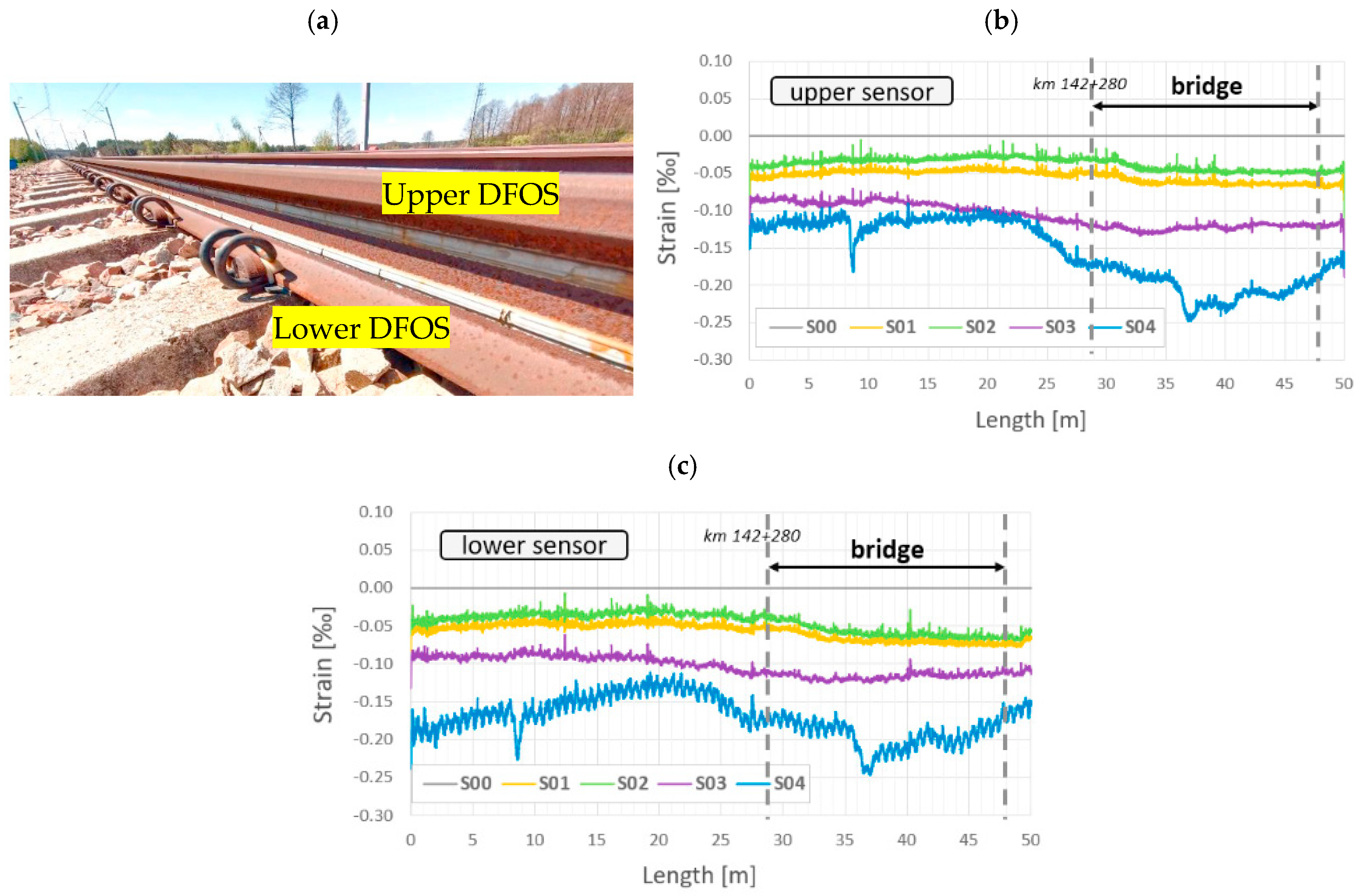
| Bednarski et al. [41] | Poland | Monitoring rail deformation on railway embankment and concrete bridge | Axial strain, temperature, curvature, vertical displacement, vibrations (via DSS, DTS, DDS, DAS) | 2200 m | One year (starting early 2023, with 12 monthly sessions) | High-resolution strain profiles detected temperature-induced compressive stresses and sleeper effects; enabled curvature and displacement calculations; largest DFOS rail system globally | Non-uniform rail restraint affected strain distribution; required complex thermal compensation for large temperature gradients (−15 °C to +45 °C); installation and data processing complexity; lack of automated measurement solutions |
| Mohamed et al., 2007 [184] | Singapore | Twin-tunnel interaction monitoring (Circle Line) | Distributed strain and temperature in shotcrete lining during adjacent tunneling | ~40 m section | During construction phases (weeks per stage) | Provided hundreds of sensing points; captured strain/temperature variations due to neighboring TBM operations; improved understanding of tunnel interaction effects | Embedding fibers in shotcrete requires timing coordination; calibration/synchronization with other sensors; data noise from construction activities |
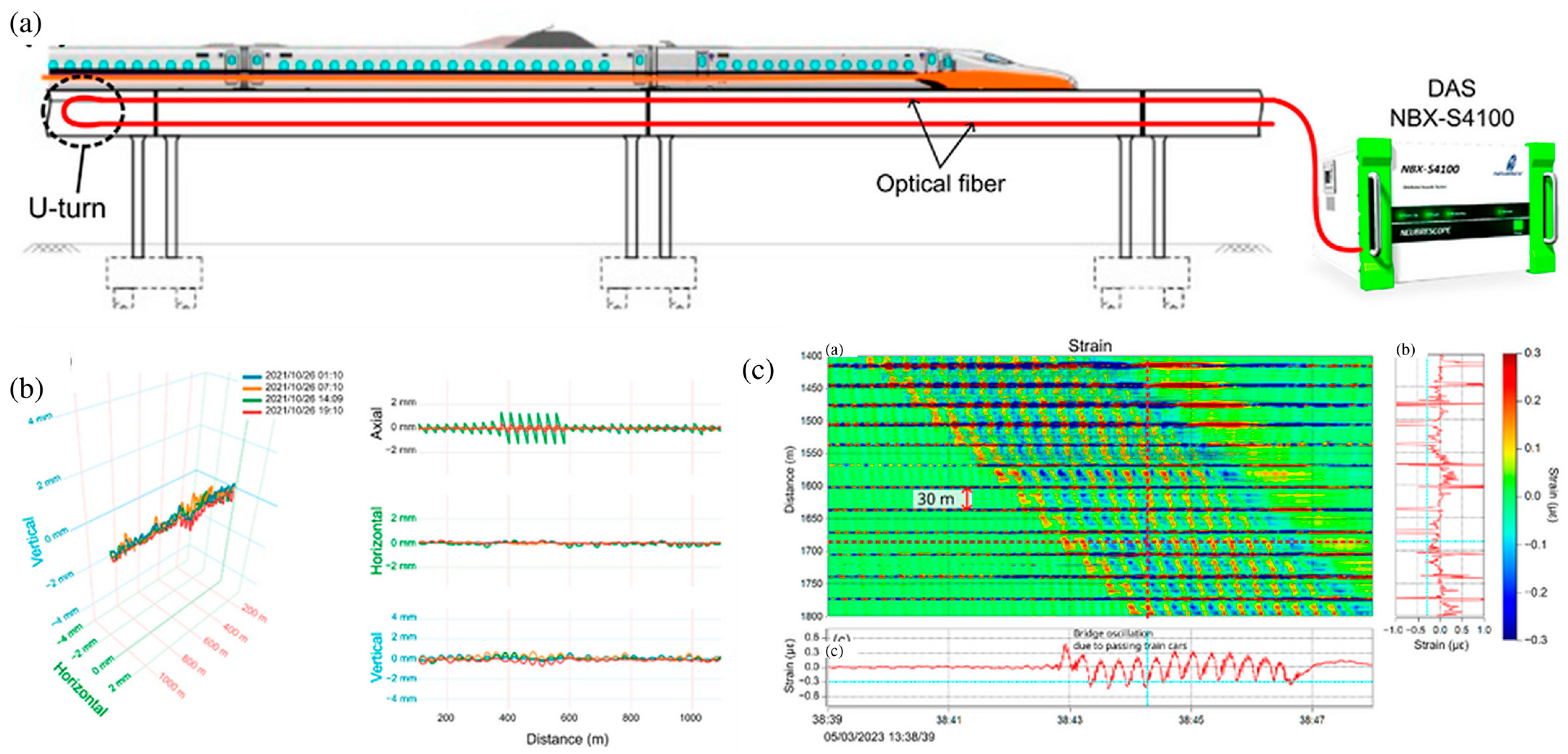
| Kishida et al., 2025 [161] | Taiwan | Elevated high-speed railway bridge monitoring | Static strains, dynamic DAS, post-earthquake profiles | ~1 km span | ~1 year | Enabled 3D deformation calculation, rapid safety confirmation after M6.4/M6.8 earthquakes, dynamic response to individual train cars | Installation complexity on live structure; cost and need for robust bonding/protection of fibers; large data volume to process |
| Hsu et al., 2021 [185] | Taiwan | In-service rail strain and temperature monitoring | Continuous Brillouin-based strain and temperature along rail; geometric irregularities detection | ~100 m test section | Days to weeks | Measured temperature differences (~12.1 °C vs. ambient with ~1.5 h delay), detected rail irregularities (−0.3 to +0.4 mm), automatic anomaly alerts possible | Single temperature fiber cannot capture cross-sectional variations; needs multiple fibers/temperature compensation; data transfer and processing infrastructure required |
| Gue et. al., 2015 [186] | UK | Cast-iron tunnel long-term strain monitoring | Continuous distributed strain along tunnel lining | Entire cast-iron tunnel length (order of 100 m) | Long-term (months to years) | Continuous and distributed strain monitoring possible without interrupting traffic; early detection of lining deformation trends; supports maintenance planning | BOTDR-based systems require calibration; potential fiber aging; data management over long durations; ensuring fiber survival in harsh tunnel environment |
| Cocking et al., 2021 [170] | UK | Skewed masonry arch railway bridge dynamic SHM | Distributed dynamic strain under live loads | One span (tens of meters) | Weeks/months | Detailed 3D strain responses, crack movement measurements, sensitivity to speed/temperature, post-repair integrity | Installation complexity on heritage structures, FBG/DFOS integration, limited coverage, environmental variability |
| Application | Representative Evidence | Maturity Assessment |
|---|---|---|
| Track/sleeper strain monitoring (Rayleigh-based) | Wheeler et al. [162,165]; short segments (7–10 m), slow/quasi-static speeds only | Early field trial (TRL 4–5), validated in controlled/slowed conditions; not yet robust at operational train speeds |
| Track monitoring, full-scale industrialized installation | Bednarski et al. [41]; 2000+ m operational deployment, mechanized/robotic bonding | Operational deployment (TRL 7–8), demonstrated at full operational scale on in-service track |
| Track deflection/support monitoring (DAS) | Milne et a. [166]; hundreds of meters, validated against strain gauges | Field-validated (TRL 5–6), good spatial coverage demonstrated, but data volume/processing remain barriers to scale-up |
| Right-of-way security/hazard detection (DAS) | Sensonic/Chicago Transit Authority pilot [163] | Pilot deployment (TRL 6–7), active transit-authority pilot, not yet widespread standard practice |
| Bridge monitoring, large-scale distributed strain | Kishida et al. [161]; 1 km high-speed rail bridge, static + dynamic | Field-validated, near-operational (TRL 6–7), large-scale deployment with demonstrated post-earthquake assessment value |
| Bridge embedded pre-stress monitoring | Ye et al. [169]; DYWIDAG Smart Tendon [168] | Commercially available (TRL 8–9) for new-build/major rehabilitation, reflects existing commercial maturity |
| Bridge dense FBG arrays | Cocking et al. [170] | Field trial (TRL 5–6), high-resolution research deployment; cost and data-handling barriers limit routine adoption |
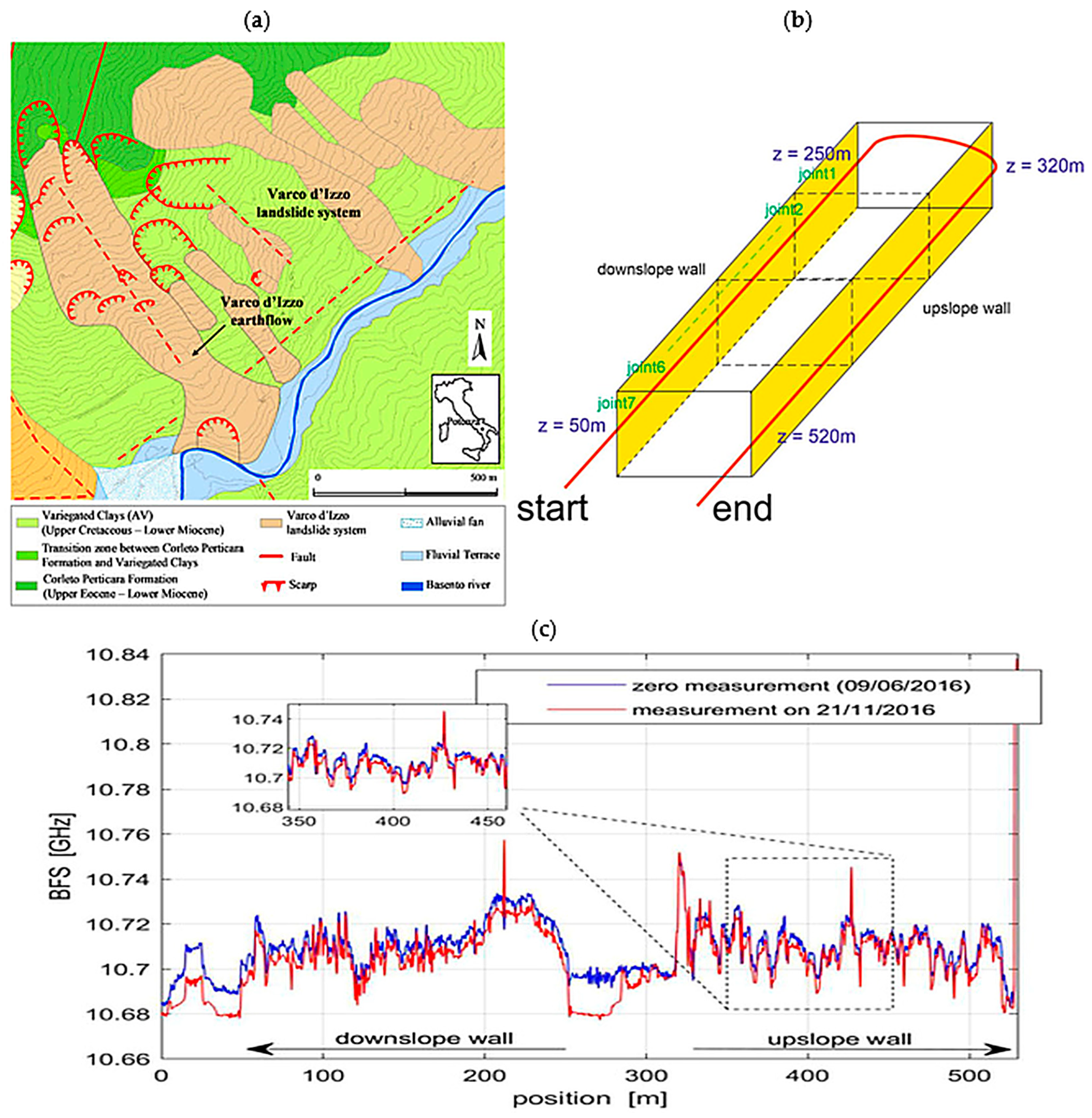
| Tunnel lining monitoring | Gómez et al. [171] (Barcelona L9); Minardo [172] (3-year landslide monitoring) | Field-validated (TRL 6), multi-month to multi-year deployments confirming viability; retrofit installation remains labor-intensive |
| Embankment seismic/geotechnical monitoring | Maggio [173] | Early field trial (TRL 4–5), proof-of-concept seasonal monitoring; interpretation complexity remains a barrier |
Disclaimer/Publisher’s Note: The statements, opinions and data contained in all publications are solely those of the individual author(s) and contributor(s) and not of MDPI and/or the editor(s). MDPI and/or the editor(s) disclaim responsibility for any injury to people or property resulting from any ideas, methods, instructions or products referred to in the content. |
© 2026 by the authors. Licensee MDPI, Basel, Switzerland. This article is an open access article distributed under the terms and conditions of the Creative Commons Attribution (CC BY) license.
Share and Cite
Taheri, S.; Siahkouhi, M.; Moghimi, A.; Rashidi, M. Distributed Fiber Optic Sensors (DFOSs) for Structural Health Monitoring (SHM) of Railway Infrastructure: A Critical Review. Infrastructures 2026, 11, 277. https://doi.org/10.3390/infrastructures11080277
Taheri S, Siahkouhi M, Moghimi A, Rashidi M. Distributed Fiber Optic Sensors (DFOSs) for Structural Health Monitoring (SHM) of Railway Infrastructure: A Critical Review. Infrastructures. 2026; 11(8):277. https://doi.org/10.3390/infrastructures11080277
Chicago/Turabian StyleTaheri, Shima, Mohammad Siahkouhi, Ali Moghimi, and Maria Rashidi. 2026. "Distributed Fiber Optic Sensors (DFOSs) for Structural Health Monitoring (SHM) of Railway Infrastructure: A Critical Review" Infrastructures 11, no. 8: 277. https://doi.org/10.3390/infrastructures11080277
APA StyleTaheri, S., Siahkouhi, M., Moghimi, A., & Rashidi, M. (2026). Distributed Fiber Optic Sensors (DFOSs) for Structural Health Monitoring (SHM) of Railway Infrastructure: A Critical Review. Infrastructures, 11(8), 277. https://doi.org/10.3390/infrastructures11080277