1. Introduction
As the most important type of infrastructure in the transport network in any country, roads play a vital role in the movement of goods and passengers. Road pavement, an essential component of this system, requires substantial national budget allocations for development, maintenance, and repair each year [
1].
Various techniques have been employed to investigate pavement performance, including the mechanistic–empirical pavement design guide (MEPDG), artificial neural networks (ANN), regression analysis, probabilistic analysis, expert systems, artificial intelligence (AI), machine learning, and pavement management systems (PMS) [
2]. However, few studies have utilized hybrid techniques and prediction models to analyze pavement problems and develop cost-effective and efficient repair plans under financial constraints [
3].
Asphalt pavement begins to deteriorate immediately after construction due to various factors, causing its serviceability to decline over time. The pavement erosion trend is highly uncertain because both traffic load and environmental conditions are influenced by unpredictable factors. The condition of the pavement network can be managed at a certain risk level and excessive costs due to unforeseen failures can be avoided by considering the effect of uncertainty on the deterioration process and on the planning of maintenance activities.
Traffic loads, the weight and frequency of vehicles, can lead to material fatigue, deformation, and even eventual failure if the pavement is not correctly designed or maintained [
2]. Weather conditions also significantly impact the effectiveness and lifecycle of pavement. Variations in temperature can cause the asphalt to expand and shrink, resulting in various types of distress such as cracks. Precipitation can infiltrate through cracks or joints, weakening the pavement structure by affecting the underlying layers [
4,
5]. To maintain the specifications a regular M&R plan for updating them is needed, decreasing repair costs and increasing road safety [
6]. The M&R plan is put into action, and strategies are executed only after the specification update is complete. These strategies include cold and warm techniques, neither of which is a new concept; however, innovations related to their application and performance have increased their use. Based on environmental and economic concerns, the reduction of the manufacturing temperature of mixtures and the use of solid waste from old roads present numerous advantages compared with traditional pavement.
Several pavement management models have been developed by providing the best M&R plan in the past two decades. Many of these models were solved by assuming specific and certain conditions. However, the conditions have fluctuated over time and cannot be stated with certainty [
7]. The authors have utilized various approaches to model the complex issue of pavement management [
8]. When the number of network sections and various criteria increases, not only does the complexity of the M&R optimization problem increase, but the problem also becomes a non-deterministic polynomial time (NP-hard) problem [
9]. The NP-hard problems are not solvable in nondeterministic polynomial time [
10]. A decision policy formulates the M&R variables, and then an appropriate optimization approach is used to solve the formulated model.
The complexity of pavement management can be significantly reduced by assigning M&R variables to clusters. These clusters consist of pavement sections with similar climatic and traffic characteristics. As a result, these sections can be used to determine the distribution functions for pavement deterioration. The microscopic approach involves identifying each pavement section, while the macroscopic approach only requires determining the pavement ratio for any given section. In the microscopic approach, M&R variables are defined as integer values representing the number of pavement sections that need reconstruction through M&R actions. Several pavement management models have utilized the microscopic concept by applying optimization approaches [
11].
The M&R program has been derived for any time period in a specified study [
12]. The proposed pavement management model is implemented by integrating a performance prediction model over a given time period. This model predicts pavement performance by determining distribution functions, which are then used to forecast future pavement conditions. If the performance model accurately predicts future pavement conditions, highway agencies can allocate the necessary budget for M&R activities appropriately. Performance models represent pavement conditions using singular or composite indices, which are selected based on data availability and the needs of highway agencies [
13].
These indices are often subjective and require conversion of pavement deterioration data into a more practical index [
14]. The Pavement Condition Index (PCI) is the most commonly used index for evaluating pavements based on observations and visual inspections [
15]. Consequently, PCI is widely used as a criterion for assessing pavement performance in this paper and is utilized for evaluating M&R plans. PCI is calculated after quantifying the distresses present in the pavement sections. The type and severity of pavement distress are assessed through visual inspection [
16]. Furthermore, PCI can evaluate material performance and pavement designs in addition to identifying maintenance needs and prioritizing pavement rehabilitation projects [
17].
Integer programming (IP) or mixed integer programming (MIP) models have been used in several studies for scheduling M&R activities. However, existing M&R planning models in the literature do not capture the multi-objective nature of the problem to address this, and many researchers have adopted multi-objective optimization approaches for M&R planning at the network level [
18,
19]. For instance, Wang et al. [
20] demonstrated a multi-objective MIP model for planning M&R activities, considering constraints such as the available annual budget and minimum acceptable pavement conditions. The results were applied to a pavement network consisting of ten sections. Additionally, Chakroborty et al. [
21] proposed a binary linear IP model to determine optimal M&R activities. Models based on deterministic assumptions can lead to inefficient maintenance plans if traffic loads and environmental conditions are inaccurately predicted for certain years in the planning period. Such suboptimal maintenance plans can result in unstable pavement conditions. Therefore, it is crucial that M&R planning models account for the randomness of conditions in addition to addressing multiple objectives.
Fani et al. [
22] proposed a multistage stochastic MIP model to identify an optimal possible plan from all scenarios under uncertainty. In the stochastic planning, the uncertain parameters of failure and budget rate are described by a set of scenarios which have a probability of occurrence. The problem leads to computational uncertainties.
Amin [
23] has used mixed-integer programming for multi-objective optimization in pavement maintenance management under budget uncertainty. The author employed the weighting method to convert the functions into a single objective for a small network. The programming assumes a deterministic budget which ignores the uncertainty of determining the weight of objectives on the Pareto frontier. In the weighting method, the optimal solution is highly dependent on the decision-maker’s choices, and determining the optimal weights in a PMS that includes a wide range of routes is a complex and time-consuming task. Furthermore, when the solution space is non-convex, it leads to dominated solutions in the weighting method [
24]. Cao and Sun [
25] applied IP to big data (BD). The authors implemented an air traffic flow optimization problem from the USA National Airspace System (NAS).
While the mentioned studies used exact mathematical algorithms to find optimal solutions for M&R scheduling, some studies employed evolutionary and metaheuristic algorithms to solve the problem [
14,
26]. For instance, Naseri et al. [
27] utilized five metaheuristic algorithms to address the M&R scheduling problem. However, evolutionary and metaheuristic algorithms may not find the global optimal solution. The results of M&R efforts from various metaheuristic algorithms significantly differed [
27] because these algorithms failed to find global solutions. In other words, the use of these algorithms may lead to suboptimal solutions [
16]. Some metaheuristic algorithms are not able to find feasible solutions for binary variable in multi-objective problems such as NSGA II [
28]. Therefore, exact mathematical algorithms leading to optimal solutions are more appropriate for solving the M&R scheduling optimization problem.
All of these predictive models used the International Roughness Index (IRI), which has not achieved high quality, so it affects the efficiency of M&R scheduling optimization significantly [
14]. Pavement management at the network level often involves in multiple objectives with uncertainty when predicting pavement condition. This study proposes an integer linear programming model with two objective functions under budget constraints. The main contribution of the proposed model is that it offers a simple optimization framework for pavement maintenance planning with multiple objectives. The proposed integer linear planning model produces an M&R plan for a route network over a planning period that satisfies the budget requirements over the planning horizon as well as the pavement condition requirements. The proposed model maximizes the pavement conditions and minimizes the cost. The overall goal of the proposed model is to manage the pavement condition over the planning period with efficient use of maintenance budget. The proposed model also captures traffic load variations and temperature fluctuations and gives flexibility to the decision-maker handling the variability in a simple way.
2. Methodology
Based on the above literature, deterioration models enabling the prediction of pavement’s condition over its service life are key components of any PMS. The environment for running such a system is characterized by the uncertainty of roads’ condition in the future and the inaccuracy of the gathered data. Although the final maintenance plan of the PMS relies heavily on the experience of decision-makers, it cannot fully utilize the power of BD. In the BD era, data-driven intelligent decision-making is an inevitable development trend across various fields of engineering optimization [
29]. Both practicalities and economics lead to significant challenges when solving complex multi-objective optimization problems and must be considered in pavement maintenance decision-making [
30]. This problem is very difficult to solve by conventional methods because there is more than one decision to be made. None of these decisions may be complex on its own, but it is not easy to consider all of them in a model simultaneously. There are various techniques for solving multi-objective problems such as goal programming, weighting methods, activity integration, and the epsilon constraint method [
31].
The proposed approach uses cluster analysis with similar traffic and climatic loading characteristics and employs IP to determine optimal maintenance schedules for the road sections requiring maintenance.
It is necessary to consider an abstract model of the real world with all existing constraints in order to plan effectively. Among the developed models for predicting pavement deterioration based on pavement condition indices, the trend curve model, which can be account for the uncertainties of the deterioration process while being simple to use, has been selected in this paper. This model is considered one of the probabilistic modeling methods for pavement deterioration. Unlike the Markov model, which considers the pavement condition in different discrete states, the trend curve model considers a continuous state and represents the pavement as a probability distribution [
32].
The pavement deterioration function (Equation (1)) defines the ratio of the pavement condition to its initial condition as exponential over time.
Here,
is the deterioration rate parameter,
is the pavement condition at the beginning of the period,
is the pavement condition at the end of the period, and
is the duration of the forecast in years. The deterioration rate parameter
is considered to be a random variable with a normal distribution in the trend curve model
. This distribution is used to model phenomena that have random characteristics and in which values are naturally concentrated around a mean. In cases in which the distribution is not normal, using BD helps to converge the distribution of a random variable summation to a normal distribution, which is called the central limit theorem. The deterioration rate parameter is used to predict pavement condition values in future years
.
In this model, the problem is considered by two objective functions, achieving an ideal default condition for the network sections at the end of the 5-year planning period: (1) minimizing M&R costs and (2) maximizing pavement conditions. The goal of the first objective function, which is formulated as Equation (2), is to minimize the budget costs for maintenance works.
Here,
is the cost of strategy
i to section
j at time
t.
is a decision that makes strategy
i reach section
j at time
t.
The main goal of cost optimization is to get approval for a budget from stakeholders in the network (government, council, etc.). However, this is not the sole objective; the additional objective of performance quality is also considered.
A pavement network is considered with a set
J = {1, 2, …,
j} representing the sections. The set of maintenance plans is defined as
I = {1, 2, …,
i}, where the
ith plan has the greatest impact and simultaneously the highest cost. The planning time frame is represented as a discrete set
T = {1, 2, …,
t}. In each interval of time, any given network section will deteriorated as a result of various factors, including traffic volume and weather conditions. A decision variable is defined as a binary variable in Equation (3):
The second objective function (Equation (4)) aims to maximize the overall condition of the road network. Maximizing quality ensures that the final output of the M&R plans meets acceptable standards.
is the value of the PCI for section
j at time
t.
represents the increase in useful road lifecycle after implementing the
ith maintenance plan. The objective function of the cost minimization model for M&R is formulated to focus on the budget constraint (Equation (5)) primarily, while its goal is to maximize system improvement.
is the considered budget for interval of time
T. Equation (6) indicates that at least one of the maintenance strategies must be selected for each network section.
SL is the level of the serviceability which agencies could present in Equation (7).
4. Case Study
In Iran, rapid road deterioration is primarily attributed to inadequate maintenance of these roads. Therefore, there is a need for systematic and continuous road maintenance management, which can be aided by the adoption of a model providing a clear perspective on the pavement behavior and the exhaustion degree. Given the existing financial constraints and the vast road network, it is essential to prioritize financial resources for the maintenance of road sections at the highest deterioration risk.
As many quantitative factors used in maintenance activities rely on the principles of statistics, i.e., probability and distribution functions, the aim of the present study is to identify the distribution functions of the deterioration rates for each cluster using statistical methods. The resulting means (M) and standard deviations (SD) are then used to predict road pavement performance. For this purpose, eight separate clusters were formed by Cartesian product rules, allowing a PCI to be predicted for each cluster.
Table 3 includes the statistics of the Anderson–Darling test and the
p-value for the heavy traffic/moderate and humid cluster. For the first-type error value (α), it is suggested to consider
p-values greater than α. The last column of
Table 3 shows the results of the likelihood ratio test comparing two-parameter distribution functions with three-parameter distribution functions. It is evident that the highest
p-value corresponds to the normal distribution with an M and SD of 0.1 and 0.064, respectively.
The results for other clusters are presented in
Table 4. In the real world, the existence of incomplete and missing data is an inevitable reality that affects the efficiency of the maintenance process in many cases. As a result, there are more fluctuations because the standard deviation is high relative to the mean. The mean of normal distribution was applied for determining the deterioration rate parameter
. A pairwise comparison of the traffic factor shows that, under identical weather conditions, roads subjected to heavy traffic have a higher deterioration rate than those under light traffic.
The service life of pavement is largely affected by its environment. For instance, the presence of salt has a negative impact on asphalt pavement in coastal areas [
37]. In the southern and northern coastal areas of Iran, the air humidity is high, and the moisture contains high levels of salt. In addition, pavement suffers from dry–wet cycles as a result of tidal patterns.
The proposed method is designed to be applied to any road type by selecting a road from each cluster in the case study. One is the Ardabil to Nir road, which has light traffic and a cold climate and connects Ardabil to Tabriz. Another is the Gorgan to Aqqala road, which also has light traffic and a moderate and humid climate, connecting Gorgan to the Incheh Borun border. Furthermore, there is the Ardestan to Isfahan road, which connects Kashan to Isfahan and has light traffic and a hot and dry climate. Beyond those, the remaining roads’ information is presented in
Table 5, which includes the maintenance costs for each.
This paper includes five classes of pavement conditions, as shown in
Table 6. This is an important step which shows maintenance plans along with conditions.
The literature describes two types of M&R activities: reactive activities, which are unscheduled and occur after emergency failures, and preventive activities, which are taken to prevent emergency failures. In this paper, all maintenance strategies are considered preventive activities, as these show that on the long term, performing preventive activities can lead to the reduction of payment by 3–5 times compared to the reactive activities practiced in the conventional method [
38]. Cold and warm techniques for pavement offer sustainable and cost-effective alternatives to traditional paving techniques, particularly in regions with fluctuating temperatures. These techniques involve producing and laying materials at lower temperatures than traditional techniques, resulting in reduced energy consumption and emissions. Pavement preservation promotes environmental sustainability by conserving energy, virgin materials, and reducing greenhouse gases by keeping good roads good [
39]. Cold and warm pavement techniques are generally cheaper than traditional pavement techniques in terms of maintenance, but a slight decrease in fatigue life in comparison with traditional techniques was noted [
40]. Five strategies of cold techniques, which can be more economical and used in a wider range of weather conditions, are utilized for pavement maintenance: partial-depth reclaimed pavement, crack repair, patching, slurry seal, and full-depth reclamation.
Partial-depth reclaimed (PDR) pavement focuses on recycling the upper portion of the pavement for rehabilitation purposes.
Crack repair involves filling in cracks with a sealant to prevent water and debris from entering the pavement.
Cold patching involves using pre-mixed cold asphalt mixtures to repair potholes and other minor damage.
Slurry seal is a cost-effective method for addressing various pavement issues, including surface distress, loss of texture, and water penetration. It extends the lifespan of pavements and enhances safety by improving skid resistance.
Full-depth reclamation (FDR) involves pulverizing the existing asphalt pavement and a portion of the underlying base, blending it with a stabilizing agent (like asphalt emulsion, cement, or lime), and then compacting it to create a new, stable base layer. This technique is particularly useful for addressing structural deficiencies like rutting, cracking, and base failures.
Additionally, the latter involves extensive repairs requiring the complete closure of the road to traffic. The first-year costs associated with each maintenance strategy are estimated at IRR 2000, 7000, 10,000, 15,000, and 20,000, respectively, and those can be understood to increase by 20 percent annually with inflation in Iran.
Table 7 lists the data input for the budgeting cost.
The paper also analyzes the impact of each maintenance strategy on the condition of a pavement section. This is achieved by assessing a strategy’s estimated improvement, which is derived from Equation (8) and is shown in the last column of
Table 6.
Here,
is the Useful Lifecycle Index
i,
is the increase of lifecycle for maintenance strategy
i in years, and
is the maximum increase of lifecycle for maintenance strategy
i in years (usually 10).
It is necessary to collect appropriate data in order to define the objective functions. The input data used for the completed work condition is listed in
Table 8. To determine the values being presented in
Table 9, it is essential to forecast the pavement condition in various years.
Two objectives are defined based on this metric. The first objective is to minimize maintenance costs, and the second is to maximize the road lifecycle.
Equation (9) is the objective function for minimizing total maintenance costs. The coefficients of the variables are extracted from
Table 5.
The objective function expressed by Equation (10) aims to maximize the useful road lifecycle. The coefficients of the variables are obtained from
Table 8.
The above objective functions are subject to the following constraints:
The total maintenance costs must not exceed the total allocated budget (Equation (11)). The coefficients of the variables are extracted from
Table 5.
The variable
must take a value of 0 or 1. If a road is chosen for maintenance, the value will be 1; otherwise, it will be 0.
4.1. Solving the Model with Merged Activity Method
To merge the objective functions, the maximum pavement condition function is placed into the fraction’s numerator, and the minimum cost function is placed into the fraction’s denominator.
Table 10 shows the values of the integrated objective functions used for the case study. Various software packages exist for solving mathematical models. MATLAB 2015b was used in this paper (see
Appendix B).
After solving the model, the value of the integrated objective function is equal to 0.0179, and the values of the cost and pavement condition objective functions are 22,400 and 54.83, respectively.
Table 11 shows the results for 100% serviceability. Variables having a value of one are the roads where the maintenance plans should be executed.
Since the PCI value in the first year is equal to 100, no M&R plan has been considered for the Hajiabad to Bandar Abbas road. Similarly, no M&R plan is needed due to the low deterioration rate for the Ardestan to Isfahan road.
Crack repair has been planned for the Sari to Qaemshahr road, and partial-depth pavement reclamation is scheduled for the Tabriz to Sofiyan road in the first year. Patching work is proposed for the Salafchagan to Qom road in the first year, and partial-depth pavement reclamation is suggested for the Bushehr to Borazjan road in the third year. In the second year, a partial-depth pavement reclamation has been encouraged for the Gorgan to Aqqala road, and crack repair has been recommended for the Ardabil to Nir road in the first year.
This M&R planning helps to extend the road lifecycle by 1.7 years. At the same time, it increases the PCI by 10 percent for the overall road rating. To validate model performance, this multi-objective integer linear programming problem was transformed into a single-objective linear programming model using the weighted sum method.
Here,
. Equation (22) shows the transformation of the multi-objective programming model into a single-objective function
.
represents the objective function described in Equation (2), and
represents the second objective as expressed by Equation (4). A negative sign is added to the second objective function to formulate it as a minimization problem.
Table 12 shows that the results are the same as those of the proposed method if the weight of the cost objective function is less than or equal to the weight of the pavement condition objective function.
4.2. Solving the Model with Epsilon Constraint Method
The epsilon constraint method, first introduced by Haims, Lasdon, and Weiss in 1971 [
41], ranks among the best-known techniques for solving multi-objective optimization problems. In the method, each objective is sequentially positioned as the objective function in multi-objective problems, while the other objectives are treated as constraints with very small values set to epsilon. The method yields one solution for the objectives in any iteration, with the number of iterations specified by the user [
42].
In the study, the dual objectives of minimizing costs and maximizing pavement condition were solved with the epsilon constraint method using GAMS 24.9.2 software on a system with a 2.16 GHz processor and 2 GB of RAM over 10 iterations. The best solution, presented in
Table 13 for 100% serviceability, was obtained using the CPLEX solver in the final iteration. The objective functions of cost and pavement condition equaled 24,000 and 62.47, respectively, which slightly differ from what integrating objective functions returned. However, the solution did not consider an M&R plan for the road from Ardabil to Nir and allocated a partial-depth pavement reclamation plan for the road from Gorgan to Aqqala in the first year instead of the second year. As a consequence, road lifecycle changed to a single year and altered the PCI to 8% for the overall road rating compared with the integration of objective functions.
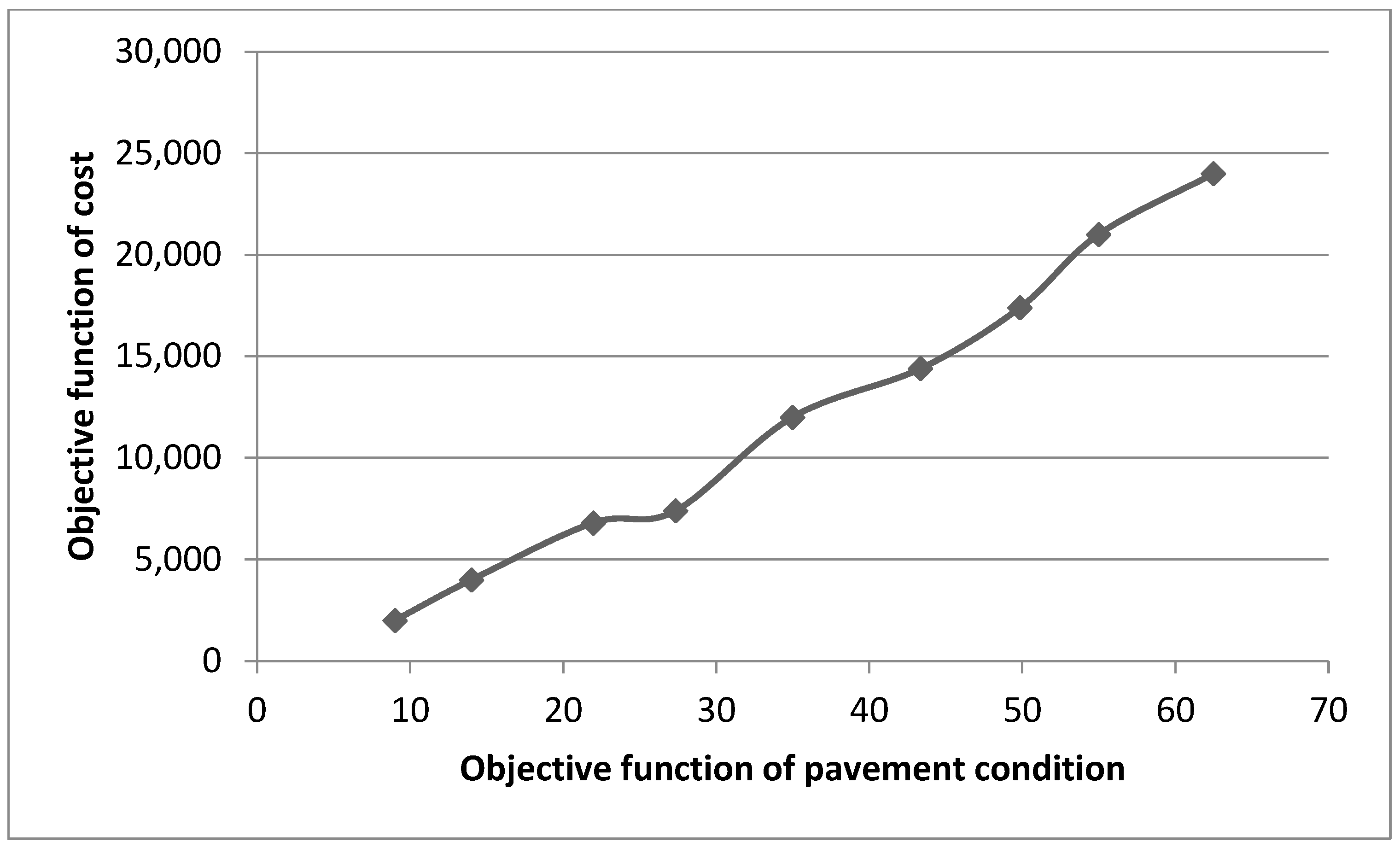
The Pareto frontier is defined as the set of all non-dominated solutions. This curve is formed by varying the value of an objective function between two extremes.
Figure 1 shows the Pareto frontier for the problem of minimizing cost and maximizing pavement condition. The points on this curve are the set of all Pareto solutions; that is, the frontier shows the tradeoff between objective 1 and objective 2. If the overall improvement of condition is 9, the cost will be IRR 2000. However, tripling the improvement of condition increases the cost 3.7 times.
Indeed,
Figure 1 shows the relationship between the objective functions, and it clearly illustrates how increasing costs leads to an increase in the road lifecycle. Ultimately, the main objective of M&R activity is to prevent pavement failure and to extend the road lifecycle.
Table 14 also shows a sensitivity analysis of variable variations to achieve the optimal solution.
4.3. Serviceability Level Changes
There are no common decision variables that produce a 25% serviceability level from both solving methods. In the merged activity method, three decision variables, [X
131, X
153, X
162], are selected by 50% serviceability, while other decision variables, [X
221, X
131, X
341], are chosen in the epsilon constraint method.
Table 15 shows that decision variables are converged to by the two methods if the serviceability level is increased by 100%.
5. Result
The decision-making process regarding road selection and prioritization at the network level differs from the selection of repair methods for individual roads and their components, which is a project-level decision. This paper presents a model that has been developed to support both project-level and network-level decisions. A key achievement of this paper is the creation of an accurate PCI prediction model that surpasses traditional empirical approaches, demonstrating the effectiveness of advanced machine learning techniques. Pavement design is crucial in creating a structure that distributes traffic loads over a larger area of the sub-grade, thereby minimizing stress and preventing deformation or failure. Traffic loads, which encompass the weight and frequency of vehicles, can lead to material fatigue, deformation, and eventual failure if the pavement is not properly designed or maintained. Additionally, weather conditions can significantly impact the effectiveness and lifecycle of pavement. Therefore, developing an efficient M&R approach is crucial in PMSs.
A key requirement in this process is the pavement performance function for modeling the M&R scheduling problem. Consequently, a pavement performance prediction model has been developed to describe the deterioration trend of the pavement throughout its service life in the first phase. Clustering techniques prove to be valuable in predicting pavement performance. This paper introduces a clustering method that groups different pavement sections with similar climatic and traffic conditions, allowing the modeling of pavement deterioration in terms of PCI within the same group of sections. Future research should also consider other pavement indices. In the case study presented, traffic data is divided into two clusters: light and heavy traffic. Future studies are expected to expand the traffic cluster range and conduct comparative analyses. Statistical models are utilized to determine the distribution functions of the pavement deterioration rate within each cluster, with parameters estimated accordingly.
This paper presents a multi-objective model for the M&R scheduling problem, with objective functions aimed at minimizing M&R costs and maximizing pavement condition within a limited planning horizon in the second phase. The proposed model also includes the feature of variable conditions. The variable conditions are formulated using the uncertainty set concept from the statistical methods. The variable conditions can capture the random characteristics of the conditions to some extent in order to generate variable condition updates. This feature provides the flexibility to examine the possible condition variations. A case study has been carried out on a small network consisting of eight pavement sections to demonstrate the applicability of the proposed model in pavement M&R planning to manage pavement condition fluctuation at the network level.
The pavement scheduling problem can be addressed using various mathematical models. This paper introduces a MIP model to identify optimal maintenance strategies. Researchers may apply different strategies to all road sections for further investigation. Although the examined objectives conflict with one another, optimizing one objective may yield unacceptable results for another. Two approaches, activity integration and epsilon constraint, were employed to compare results. Based on the findings, M&R strategies show insignificant differences between both approaches. The activity integration approach results in an increase of up to 1.25 years in the road lifecycle and a 10% improvement in PCI, while the epsilon constraint approach leads to a 1-year increase in the road lifecycle and an 8% improvement in PCI.





 ,
,