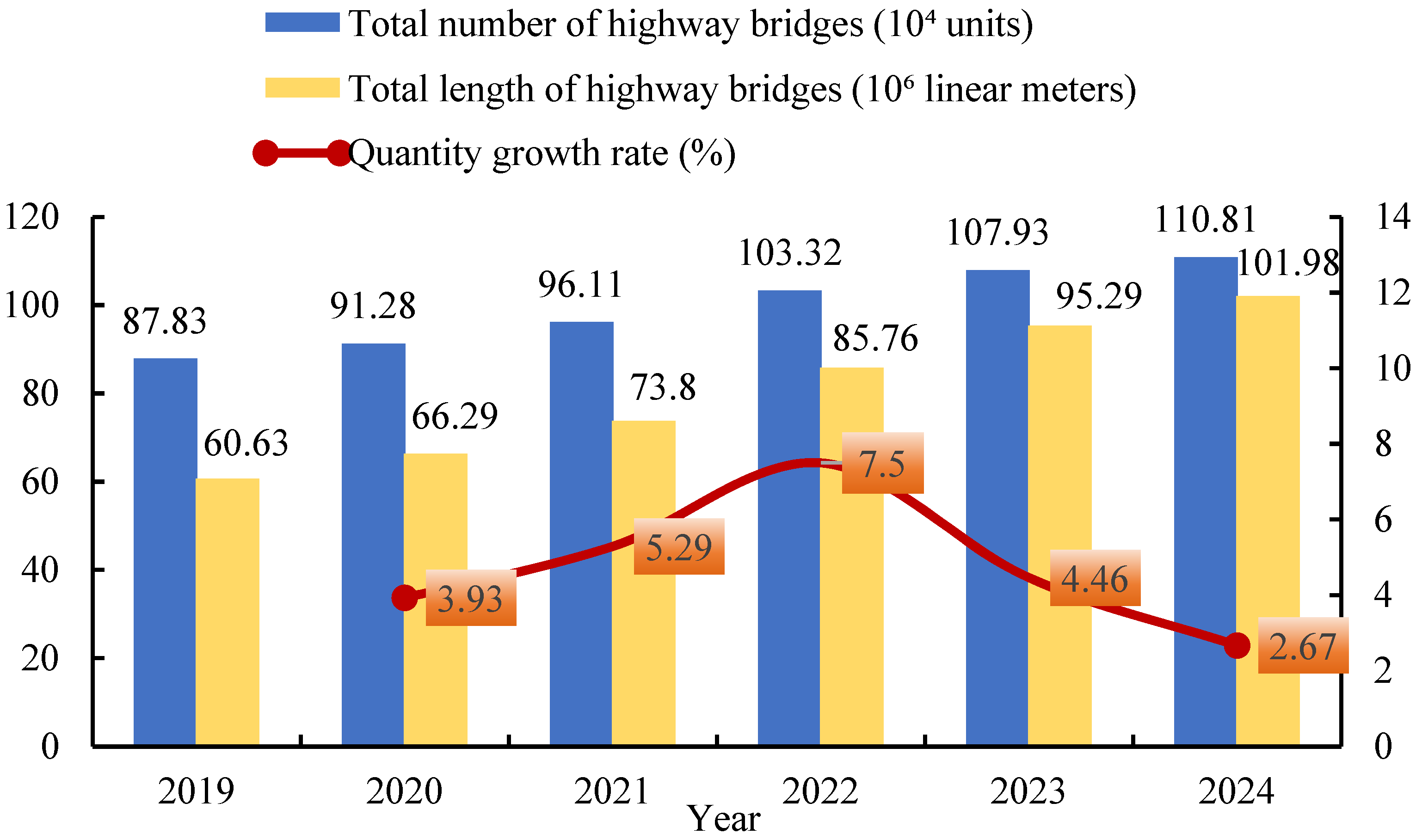

Deep Learning-Based Surface Crack Detection in Bridge Structures: A Review


Abstract
1. Introduction
2. Application of Deep Learning Method in Bridge Crack Detection
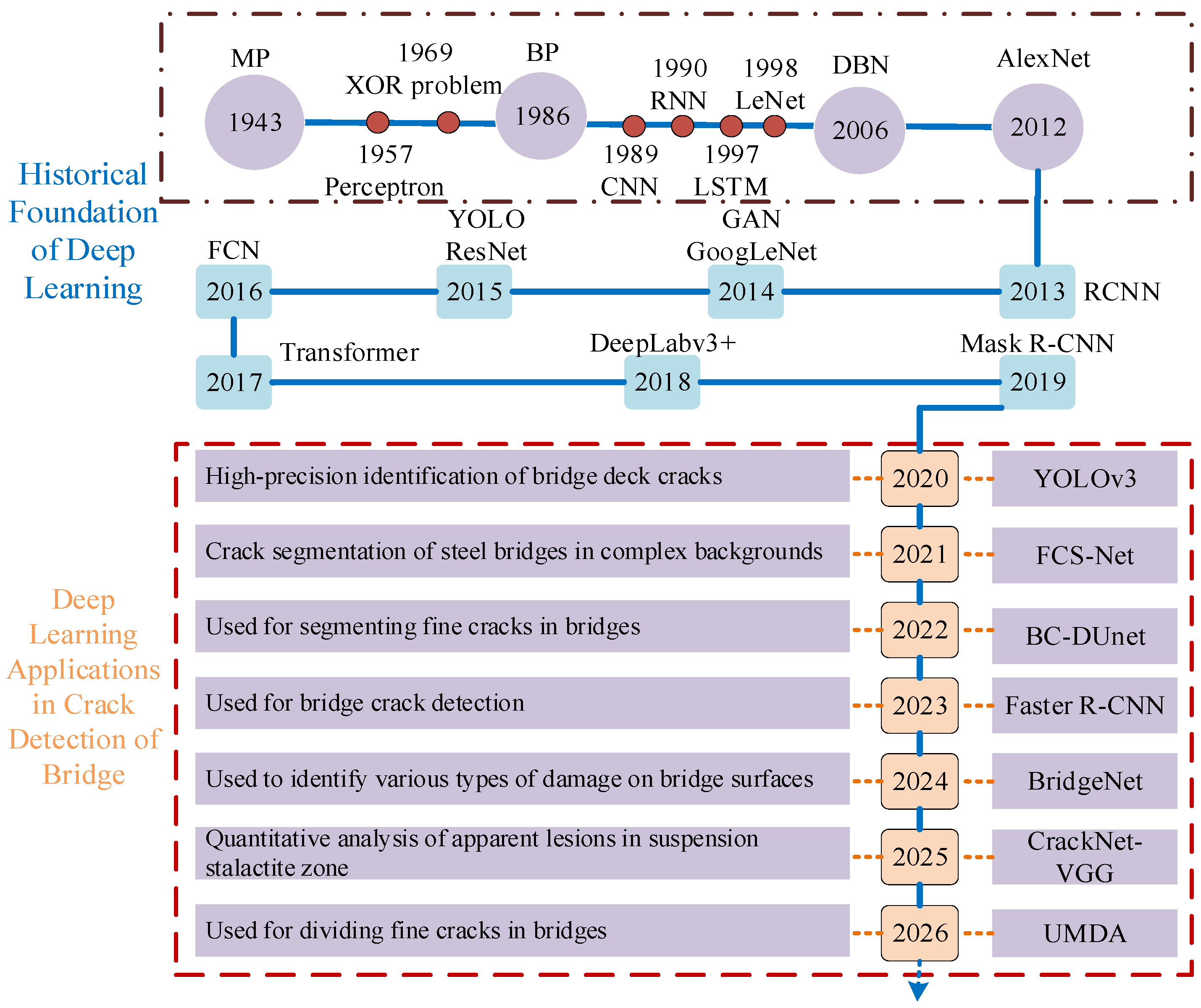
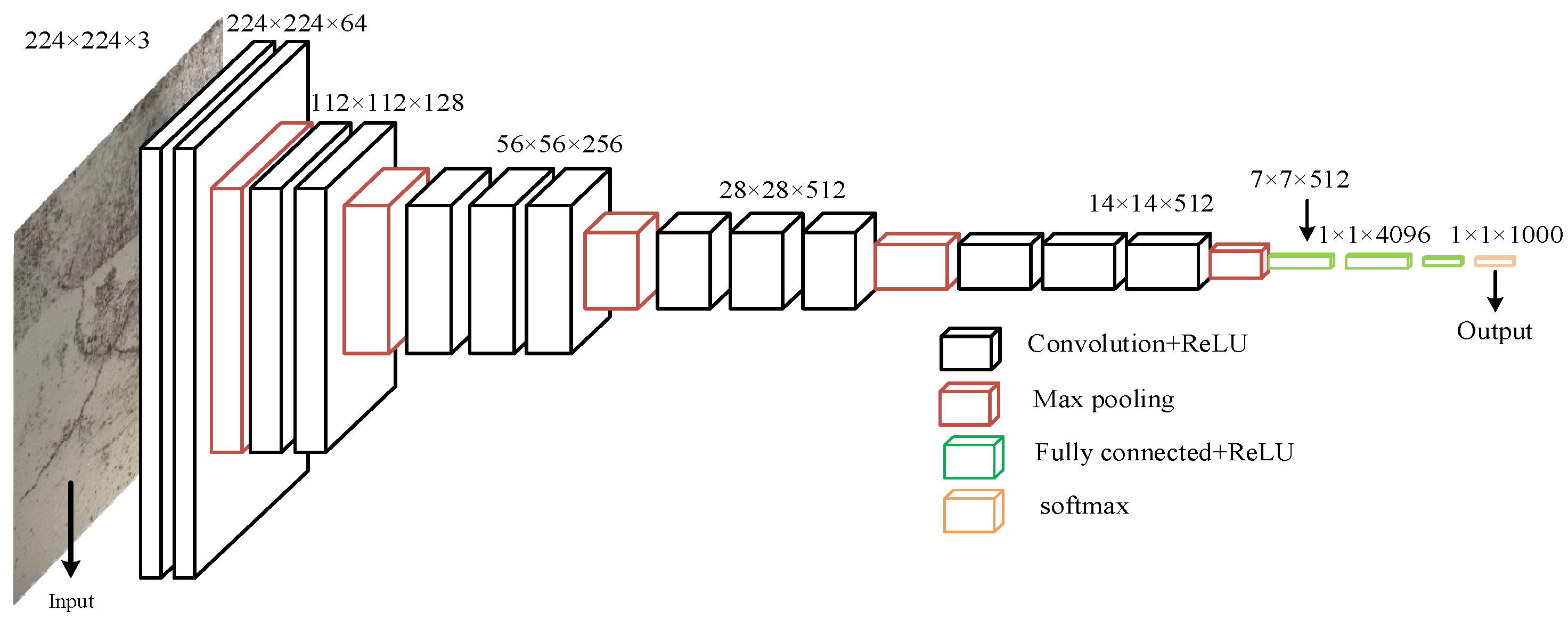
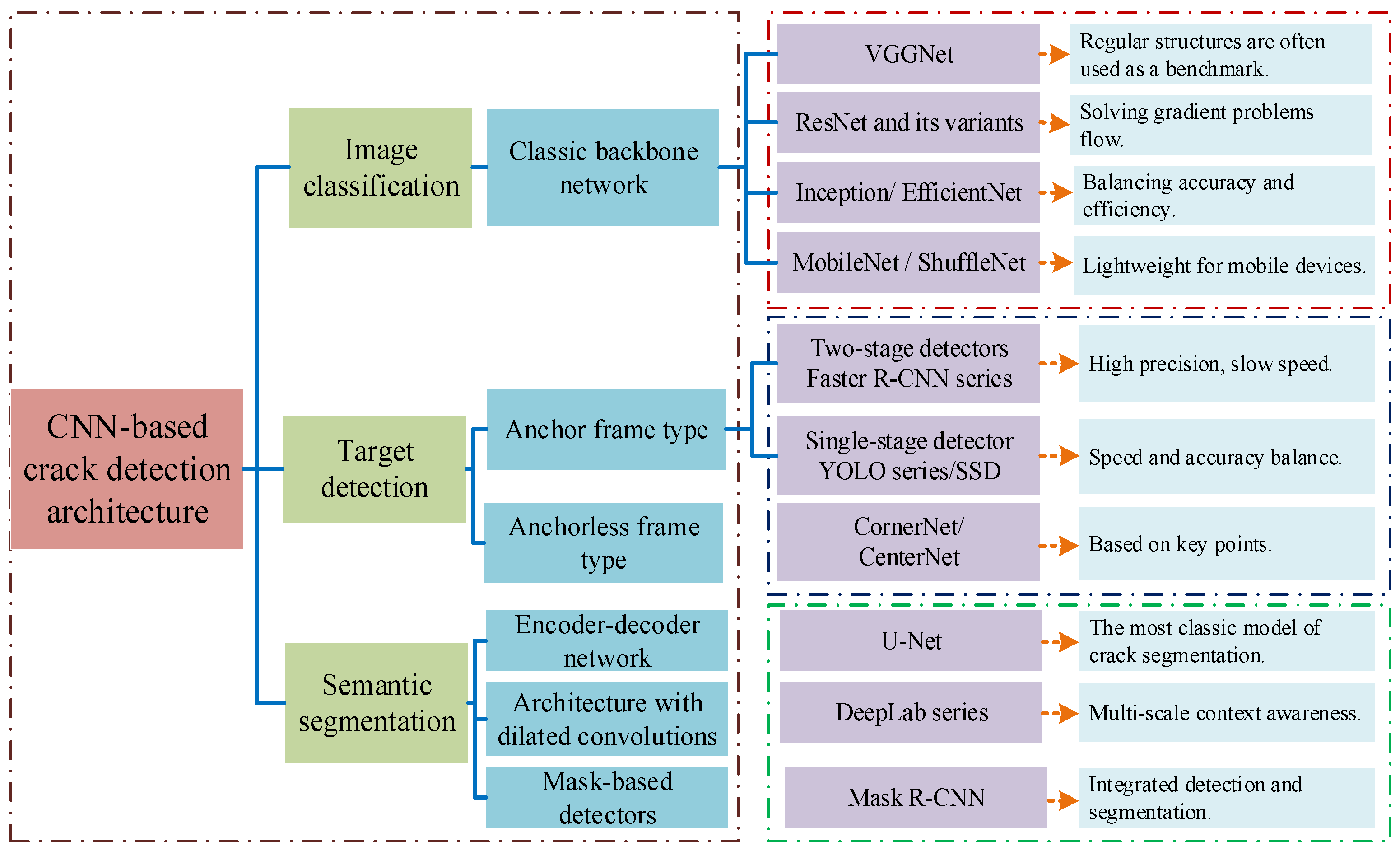
2.1. Deep Learning Methods
2.2. Crack Classification
2.3. Crack Object Detection
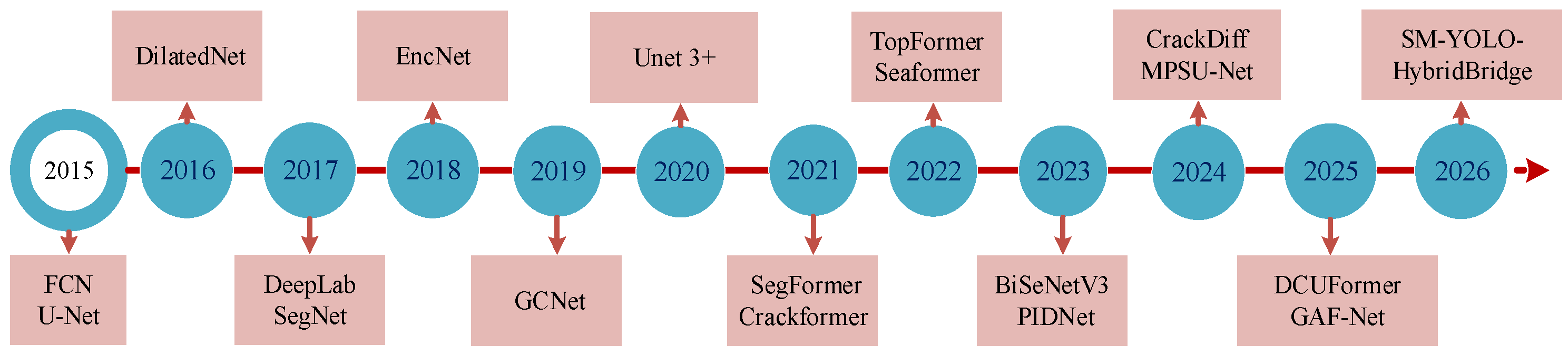
2.4. Crack Segmentation
2.5. Dataset
3. Crack Detection Technology of Different Bridge Structure Forms
3.1. Beam Bridge
3.2. Arch Bridge
3.3. Cable-Stayed Bridges and Suspension Bridges
3.4. Comparison of Typical Engineering Application Cases and Technical Solutions
4. Challenges and Future Research Directions
4.1. Structural Scarcity and Distribution Imbalance of Datasets
4.2. Challenges in Unified Modeling for Fine-Grained Detection Across Multiple Scenarios
4.3. Insufficient Scenario Adaptability for Engineering Deployment
5. Conclusions
Author Contributions
Funding
Institutional Review Board Statement
Informed Consent Statement
Data Availability Statement
Conflicts of Interest
References
- Du, H.; Wang, H.F.; Zhang, X.W.; Peng, H.A.; Gao, R.; Zheng, X.Y.; Tong, Y.X.; Shan, Y.H.; Pan, Z.F.; Huang, H.; et al. Automated intelligent measurement of cracks on bridge piers using a ring-climbing vision scanning operation robot. Measurement 2024, 237, 115197. [Google Scholar] [CrossRef] [Scilit]
- Liu, Z.L.; Zhou, A.; Ran, X.R.; Wu, Y.P.; Zhao, W.G.; Zhang, H. A crack detection and quantification method using matched filter and photograph reconstruction. Sci. Rep. 2025, 15, 25266. [Google Scholar] [CrossRef] [Scilit]
- Alawieh, A.F.; Daoud, H.; Shaffer, M.; Issa, M.A. Implementing Effective Sealing Techniques with Recommended Products to Mitigate Bridge Deck Cracking Effects. J. Bridge Eng. 2026, 31, 04026005. [Google Scholar] [CrossRef] [Scilit]
- Zhang, A.A.; Wang, D.; Peng, Y.; Cheng, H.X.; Wei, Y.F.; Zhan, Y. BSCS-Net: A Lightweight Segmentation Network for Automated Bridge Surface Crack Detection. J. Comput. Civ. Eng. 2026, 40, 04026007. [Google Scholar] [CrossRef] [Scilit]
- Xu, G.; Yue, Q.; Liu, X.; Chen, H. Investigation on the effect of data quality and quantity of concrete cracks on the performance of deep learning-based image segmentation. Expert Syst. Appl. 2024, 237, 121686. [Google Scholar] [CrossRef] [Scilit]
- Ni, Y.; Mao, J.; Fu, Y.; Wang, H.; Zong, H.; Luo, K. Damage Detection and Localization of Bridge Deck Pavement Based on Deep Learning. Sensors 2023, 23, 5138. [Google Scholar] [CrossRef] [Scilit] [PubMed]
- Xiao, J.W.; Fan, J.S.; Liu, Y.F.; Li, B.; Nie, J.G. Region of interest (ROI) extraction and crack detection for UAV-based bridge inspection using point cloud segmentation and 3D-to-2D projection. Autom. Constr. 2024, 158, 653–674. [Google Scholar] [CrossRef] [Scilit]
- Kim, B.; Yuvaraj, N.; Preethaa, K.R.S.; Pandian, R.A. Surface crack detection using deep learning with shallow CNN architecture for enhanced computation. Neural Comput. Appl. 2021, 33, 9289–9305. [Google Scholar] [CrossRef] [Scilit]
- Nguyen, S.D.; Tran, T.S.; Tran, V.P.; Lee, H.J.; Piran, M.J.; Le, V.P. Deep Learning-Based Crack Detection: A Survey. Int. J. Pavement Res. Technol. 2022, 16, 943–967. [Google Scholar] [CrossRef] [Scilit]
- Abdel-Qader, I.; Abudayyeh, O.; Kelly, M.E. Analysis of edge-detection techniques for crack identification in bridges. J. Comput. Civ. Eng. 2003, 17, 255–263. [Google Scholar] [CrossRef] [Scilit]
- Azimi, M.; Eslamlou, A.D.; Pekcan, G. Data-Driven Structural Health Monitoring and Damage Detection through Deep Learning: State-of-the-Art Review. Sensors 2020, 20, 2778. [Google Scholar] [CrossRef] [Scilit] [PubMed]
- Seo, J.; Duque, L.; Wacker, J. Drone-enabled bridge inspection methodology and application. Autom. Constr. 2018, 94, 112–126. [Google Scholar] [CrossRef] [Scilit]
- Ayele, Y.Z.; Aliyari, M.; Griffiths, D.; Droguett, E.L. Automatic Crack Segmentation for UAV-Assisted Bridge Inspection. Energies 2020, 13, 6250. [Google Scholar] [CrossRef] [Scilit]
- Gupta, P.; Dixit, M. Image-based crack detection approaches: A comprehensive survey. Multimed. Tools Appl. 2022, 81, 40181–40229. [Google Scholar] [CrossRef] [Scilit]
- Park, S.E.; Eem, S.-H.; Jeon, H. Concrete Crack Detection and Quantification Using Deep Learning and Structured Light. Constr. Build. Mater. 2020, 252, 119096. [Google Scholar] [CrossRef] [Scilit]
- Lee, J.; Kim, J.; Ahn, E.; Shin, M.; Cho, S. Learning to Detect Cracks on Damaged Concrete Surfaces Using Two-Branched Convolutional Neural Network. Sensors 2019, 19, 4796. [Google Scholar] [CrossRef] [Scilit] [PubMed]
- Roy, S.; Yogi, B.; Majumdar, R.; Ghosh, P.; Das, S.K. Deep learning-based crack detection and prediction for structural health monitoring. Discov. Appl. Sci. 2025, 7, 674. [Google Scholar] [CrossRef] [Scilit]
- Moreh, F.; Bakkali, M.E.; Laalej, H.; Bal, I.E. Deep neural networks for crack detection inside structures. Sci. Rep. 2024, 14, 4439. [Google Scholar] [CrossRef] [Scilit] [PubMed]
- Hamishebahar, Y.; Kovačević, M.; Milovanović, B.; Ghasemi, M. A Comprehensive Review of Deep Learning-Based Crack Detection Approaches. Appl. Sci. 2022, 12, 1374. [Google Scholar] [CrossRef] [Scilit]
- Alzubaidi, L.; Zhang, J.; Humaidi, A.J.; Al-Dujaili, A.; Duan, Y.; Al-Shamma, O.; Santamaría, J.; Fadhel, M.A.; Al-Amidie, M.; Farhan, L. Review of deep learning: Concepts, CNN architectures, challenges, applications, future directions. J. Big Data 2021, 8, 53. [Google Scholar] [CrossRef] [Scilit] [PubMed]
- Zhang, J.; Chen, W.; Zhang, J. UAV-based quantitative crack measurement for bridges integrating four-point laser metric calibration and mamba segmentation. Autom. Constr. 2026, 182, 106774. [Google Scholar] [CrossRef] [Scilit]
- Yiğit, A.Y.; Uysal, M. Virtual reality visualisation of automatic crack detection for bridge inspection from 3D digital twin generated by UAV photogrammetry. Measurement 2025, 242, 115931. [Google Scholar] [CrossRef] [Scilit]
- Li, S.; Zhao, X.; Zhou, G. Automatic pixel-level multiple damage detection of concrete structure using fully convolutional network. Comput.-Aided Civ. Infrastruct. Eng. 2019, 34, 616–634. [Google Scholar] [CrossRef] [Scilit]
- Kim, B.; Natarajan, Y.; Preethaa, K.S.; Song, S.; An, J.; Mohan, S. Real-time assessment of surface cracks in concrete structures using integrated deep neural networks with autonomous unmanned aerial vehicle. Eng. Appl. Artif. Intell. 2024, 129, 107537. [Google Scholar] [CrossRef] [Scilit]
- Bai, Y.; Quan, W.; Shi, X.; Yan, Z.; Yuan, G. A Review of UAV-Based Crack Detection in Civil Infrastructure: A Multi-Level Visual Analysis Framework, Scene Adaptability, and Challenges. Remote Sens. 2026, 18, 1806. [Google Scholar] [CrossRef] [Scilit]
- Prakash, V.; Debono, C.J.; Musarat, M.A.; Borg, R.P.; Seychell, D.; Ding, W.; Shu, J. Structural Health Monitoring of Concrete Bridges Through Artificial Intelligence: A Narrative Review. Appl. Sci. 2025, 15, 4855. [Google Scholar] [CrossRef] [Scilit]
- Pandey, V.; Mishra, S.S. A review of image-based deep learning methods for crack detection. Multimed. Tools Appl. 2025, 84, 35469–35511. [Google Scholar] [CrossRef] [Scilit]
- Pan, X.; Zhang, Y.; Li, J.; Wang, H.; Liu, Y. A review of recent advances in data-driven computer vision methods for structural damage evaluation: Algorithms, applications, challenges, and future opportunities. Arch. Comput. Methods Eng. 2025, 32, 4587–4619. [Google Scholar] [CrossRef] [Scilit] [PubMed]
- Yuan, Q.; Shi, Y.; Li, M. A Review of Computer Vision-Based Crack Detection Methods in Civil Infrastructure: Progress and Challenges. Remote Sens. 2024, 16, 2910. [Google Scholar] [CrossRef] [Scilit]
- Fan, C.; Ding, Y.; Liu, X.; Yang, K. A review of crack research in concrete structures based on data-driven and intelligent algorithms. Structures 2025, 75, 108800. [Google Scholar] [CrossRef] [Scilit]
- McCulloch, W.S.; Pitts, W. A logical calculus of the ideas immanent in nervous activity. Bull. Math. Biol. 1943, 5, 115–133. [Google Scholar] [CrossRef] [Scilit]
- Rumelhart, D.E.; Hinton, G.E.; Williams, R.J. Learning representations by back-propagating errors. Nature 1986, 323, 533–536. [Google Scholar] [CrossRef] [Scilit]
- Hinton, G.E.; Salakhutdinov, R.R. Reducing the dimensionality of data with neural networks. Science 2006, 313, 504–507. [Google Scholar] [CrossRef] [Scilit] [PubMed]
- Hinton, G.; Deng, L.; Yu, D.; Dahl, G.E.; Mohamed, A.-R.; Jaitly, N.; Senior, A.; Vanhoucke, V.; Nguyen, P.; Sainath, T.N.; et al. Deep neural networks for acoustic modeling in speech recognition: The shared views of four research groups. IEEE Signal Process. Mag. 2012, 29, 82–97. [Google Scholar] [CrossRef] [Scilit]
- Qiu, G.Y.; Wang, H.; Li, Z.; Zhang, Y. Low-illumination and noisy bridge crack image restoration by deep CNN denoiser and normalized flow module. Sci. Rep. 2024, 14, 18270. [Google Scholar] [CrossRef] [Scilit] [PubMed]
- Koscák, J.; Jaksa, R.; Sincák, P. Influence of Number of Neurons in Time Delay Recurrent Networks with Stochastic Weight Update on Backpropagation Through Time. In Nostradamus: Modern Methods of Prediction, Modeling and Analysis of Nonlinear Systems; Springer: Berlin/Heidelberg, Germany, 2013; pp. 133–141. [Google Scholar]
- Bareither, C.A.; Kwak, S. Assessment of municipal solid waste settlement models based on field-scale data analysis. Waste Manag. 2015, 42, 101–117. [Google Scholar] [CrossRef] [Scilit] [PubMed]
- Xu, W.Y.; Li, H.; Li, G.D.; Ji, Y.C.; Xu, J.B.; Zang, Z. Improved YOLOv8n-based bridge crack detection algorithm under complex background conditions. Sci. Rep. 2025, 15, 13074. [Google Scholar] [CrossRef] [Scilit] [PubMed]
- Kilari, S.; Wu, P. Deep residual learning for image recognition. Int. Res. J. Eng. Technol. 2022, 6, 780–783. [Google Scholar]
- Liu, H.; Zhang, Y.F. Bridge condition rating data modeling using deep learning algorithm. Struct. Infrastruct. Eng. 2020, 16, 1447–1460. [Google Scholar] [CrossRef] [Scilit]
- Zhang, Y.; Hou, S.; Shen, H.; Li, Y.; Zhao, W. Automatic Multiple Defect Detection Method for Underwater Concrete Bridge Piers based on Deep Learning. Struct. Eng. Int. 2026, 1–13. [Google Scholar] [CrossRef] [Scilit]
- Rosenblatt, F. The Perceptron, a Perceiving and Recognizing Automaton Project Para, Report: Cornell Aeronautical Laboratory; Cornell Aeronautical Laboratory: Buffalo, NY, USA, 1957. [Google Scholar]
- Elman, J.L. Finding structure in time. Cogn. Sci. 1990, 14, 179–211. [Google Scholar] [CrossRef]
- Hochreiter, S.; Schmidhuber, J. Long short-term memory. Neural Comput. 1997, 9, 1735–1780. [Google Scholar] [CrossRef] [Scilit] [PubMed]
- LeCun, Y.; Bottou, L.; Bengio, Y.; Haffner, P. Gradient-based learning applied to document recognition. Proc. IEEE 1998, 86, 2278–2324. [Google Scholar] [CrossRef] [Scilit]
- Hinton, G.E.; Osindero, S.; Teh, Y.-W. A fast learning algorithm for deep belief nets. Neural Comput. 2006, 18, 1527–1554. [Google Scholar] [CrossRef] [Scilit] [PubMed]
- 2014Creswell, A.; White, T.; Dumoulin, V.; Arulkumaran, K.; Sengupta, B.; Bharath, A.A. Generative adversarial networks: An overview. IEEE Signal Process. Mag. 2018, 35, 53–65. [Google Scholar] [CrossRef] [Scilit]
- Rhazaoui, K.; Keddam, M.; Chevalier, S.; Vivet, L. Towards the 3D Modelling of the Effective Conductivity of Solid Oxide Fuel Cell Electrodes—Validation against experimental measurements and prediction of electrochemical performance. Electrochim. Acta 2015, 168, 139–147. [Google Scholar] [CrossRef] [Scilit]
- Silver, D.; Huang, A.; Maddison, C.J.; Guez, A.; Sifre, L.; Van Den Driessche, G.; Schrittwieser, J.; Antonoglou, I.; Panneershelvam, V.; Lanctot, M.; et al. Mastering the game of Go with deep neural networks and tree search. Nature 2016, 529, 484–489. [Google Scholar] [CrossRef] [Scilit] [PubMed]
- Vaswani, A.; Shazeer, N.; Parmar, N.; Uszkoreit, J.; Jones, L.; Gomez, A.N. Attention Is All You Need. arXiv 2017, arXiv:1706.03762. [Google Scholar]
- Wang, L.; Zhang, Z. Automatic detection of wind turbine blade surface cracks based on UAV-taken images. IEEE Trans. Ind. Electron. 2018, 64, 7293–7303. [Google Scholar]
- Devlin, J.; Chang, M.-W.; Lee, K.; Toutanova, K. Bert: Pre-training of deep bidirectional transformers for language understanding. In Proceedings of the 2019 Conference of the North American Chapter of the Association for Computational Linguistics: Human Language Technologies; Association for Computational Linguistics: Stroudsburg, PA, USA, 2019; Volume 1, pp. 4171–4186. [Google Scholar]
- Gong, X.Q.; Wang, Y.; Li, S.; Zhang, H. Analysis and Test of Concrete Surface Crack of Railway Bridge Based On Deep Learning. In Proceedings of 2020 IEEE 5th Information Technology and Mechatronics Engineering Conference (ITOEC 2020); IEEE: New York, NY, USA, 2020; pp. 437–442. [Google Scholar]
- Feng, C.; Zhang, H.; Wang, H.; Wang, S.; Li, Y. Automatic pixel-level crack detection on dam surface using deep convolutional network. Sensors 2020, 20, 2069. [Google Scholar] [CrossRef] [Scilit] [PubMed]
- Liu, T.; Wang, H.; Li, Z.; Zhang, Y.; Chen, X. BC-DUnet-based segmentation of fine cracks in bridges under a complex background. PLoS ONE 2022, 17, e0265258. [Google Scholar] [CrossRef] [Scilit] [PubMed]
- Li, R.; Liu, X.; Wang, J.; Zhang, L. Automatic bridge crack detection using Unmanned aerial vehicle and Faster R-CNN. Constr. Build. Mater. 2023, 362, 129659. [Google Scholar] [CrossRef] [Scilit]
- Huang, L.J.; Zhang, Y.; Wang, L.; Chen, H. Deep learning for automated multiclass surface damage detection in bridge inspections. Autom. Constr. 2024, 166, 105601. [Google Scholar] [CrossRef] [Scilit]
- Murtaza, S.; Imran, M.; Rana, M.R.R. CrackNet-VGG: A Deep Learning Framework for Automated Detection of Surface Cracks in Concrete Structures. Appl. Comput. Syst. 2025, 30, 187–194. [Google Scholar] [CrossRef] [Scilit]
- Han, B.L.; Wang, Z.; Li, Y.; Zhao, J. UMDA: Lightweight and Efficient Crack Segmentation Model. J. Comput. Civ. Eng. 2026, 40, 04025143. [Google Scholar] [CrossRef] [Scilit]
- Zhuang, H.Y.; Li, Q.; Zhang, X.; Wang, H.; Chen, Y. Deep learning for surface crack detection in civil engineering: A comprehensive review. Measurement 2025, 248, 116908. [Google Scholar] [CrossRef] [Scilit]
- Han, X.F. A Novel Search Strategy-Based Deep Learning for City Bridge Cracks Detection in Urban Planning. Autom. Control Comput. Sci. 2022, 56, 428–437. [Google Scholar] [CrossRef] [Scilit]
- Shen, Y.G.; Yu, Z.W.; Wen, Z.L. A crack detection method based on deep transfer learning. In Bridge Maintenance, Safety, Management, Life-Cycle Sustainability and Innovations; CRC Press: Boca Raton, FL, USA, 2021; pp. 271–278. [Google Scholar]
- Afifah, V.; Erniwati, S. Yolov8 for object detection: A comprehensive review of advances, techniques, and applications. Int. J. Adv. Comput. Sci. Inf. 2026, 2, 53–61. [Google Scholar]
- Lavadiya, D.N.; Dorafshan, S. Deep learning models for analysis of non-destructive evaluation data to evaluate reinforced concrete bridge decks: A survey. Eng. Rep. 2025, 7, e12608. [Google Scholar]
- Wang, B.; Li, Y.; Zhang, X.; Liu, Z. Graph convolutional networks fusing motif-structure information. Sci. Rep. 2022, 12, 10735. [Google Scholar] [CrossRef] [Scilit] [PubMed]
- Amirkhani, D.; Allili, M.S.; Hebbache, L.; Hammouche, N.; Lapointe, J.F. Visual Concrete Bridge Defect Classification and Detection Using Deep Learning: A Systematic Review. IEEE Trans. Intell. Transp. Syst. 2024, 25, 10483–10505. [Google Scholar] [CrossRef] [Scilit]
- Schmugge, S.J.; Rice, L.; Nguyen, N.R.; Lindberg, J.; Grizzi, R.; Joffe, C. Detection of Cracks in Nuclear Power Plant using Spatial-temporal Grouping of Local Patches. In Proceedings of the 2016 IEEE Winter Conference on Applications of Computer Vision (WACV 2016), Lake Placid, New York, USA, 7–10 March 2016. [Google Scholar]
- Cha, Y.J.; Choi, W.; Büyüköztürk, O. Deep Learning-Based Crack Damage Detection Using Convolutional Neural Networks. Comput.-Aided Civ. Infrastruct. Eng. 2017, 32, 361–378. [Google Scholar] [CrossRef] [Scilit]
- Simonyan, K.; Zisserman, A. Very deep convolutional networks for large-scale image recognition. arXiv 2014, arXiv:1409.1556. [Google Scholar]
- Wang, J.F.; Zeng, W.H.; Zhong, H. A mechanism-based hybrid Transformer-GRU network for bridge pier hysteresis curves prediction: An interpretable research. Sci. Rep. 2026, 16, 4961. [Google Scholar] [CrossRef] [Scilit] [PubMed]
- Bhattacharya, G.; Mandal, B.; Puhan, N.B. Multi-Deformation Aware Attention Learning for Concrete Structural Defect Classification. IEEE Trans. Circuits Syst. Video Technol. 2021, 31, 3707–3713. [Google Scholar] [CrossRef] [Scilit]
- Yang, Q.; Shi, W.; Zhang, J.; Chen, Z. Deep convolution neural network-based transfer learning method for civil infrastructure crack detection. Autom. Constr. 2020, 116, 103199. [Google Scholar] [CrossRef] [Scilit]
- Xu, Y.; Bao, Y.; Chen, J.; Zuo, W.; Li, H. Surface fatigue crack identification in steel box girder of bridges by a deep fusion convolutional neural network based on consumer-grade camera images. Struct. Health Monit. 2019, 18, 653–674. [Google Scholar]
- Trach, R. A model classifying four classes of defects in reinforced concrete bridge elements using convolutional neural networks. Innov. Infrastruct. Solut. 2023, 8, 123. [Google Scholar] [CrossRef] [Scilit]
- Yu, Z.; Cai, R.; Cui, Y.; Liu, X.; Hu, Y.; Kot, A.C. Rethinking vision transformer and masked autoencoder in multimodal face anti-spoofing. Int. J. Comput. Vis. 2024, 132, 5217–5238. [Google Scholar] [CrossRef] [Scilit]
- Girshick, R.; Donahue, J.; Darrell, T.; Malik, J. Rich feature hierarchies for accurate object detection and semantic segmentation. In Proceedings of the IEEE Conference on Computer Vision and Pattern Recognition; IEEE: New York, NY, USA, 2014. [Google Scholar]
- Redmon, J.; Divvala, S.; Girshick, R.; Farhadi, A. You only look once: Unified, real-time object detection. In Proceedings of the IEEE Conference on Computer Vision and Pattern Recognition; IEEE: New York, NY, USA, 2016. [Google Scholar]
- Liu, W.; Anguelov, D.; Erhan, D.; Szegedy, C.; Reed, S.; Fu, C.-Y.; Berg, A.C. SSD: Single shot multibox detector. In European Conference on Computer Vision; Springer: Cham, Switzerland, 2016. [Google Scholar]
- Law, H.; Deng, J. Cornernet: Detecting objects as paired keypoints. In Proceedings of the European Conference on Computer Vision (ECCV); Springer: Cham, Switzerland, 2018. [Google Scholar]
- Shelhamer, E.; Long, J.; Darrell, T. Fully convolutional networks for semantic segmentation. IEEE Trans. Pattern Anal. Mach. Intell. 2017, 39, 640–651. [Google Scholar] [CrossRef] [Scilit] [PubMed]
- Girshick, R. Fast R-CNN. In Proceedings of the IEEE International Conference on Computer Vision; IEEE: New York, NY, USA, 2015. [Google Scholar]
- Ren, S.; He, K.; Girshick, R.; Sun, J. Faster R-CNN: Towards real-time object detection with region proposal networks. IEEE Trans. Pattern Anal. Mach. Intell. 2016, 39, 1137–1149. [Google Scholar] [PubMed]
- Wang, C.Y.; Bochkovskiy, A.; Liao, H.Y.M. YOLOv7: Trainable bag-of-freebies sets new state-of-the-art for real-time object detectors. In Proceedings of the IEEE/CVF Conference on Computer Vision and Pattern Recognition; IEEE: New York, NY, USA, 2023; pp. 7464–7475. [Google Scholar]
- Sohaib, M.; Arif, M.; Kim, J.-M. Evaluating YOLO models for efficient crack detection in concrete structures using transfer learning. Buildings 2024, 14, 3928. [Google Scholar] [CrossRef] [Scilit]
- Yang, H.; Yang, L.; Wu, T.; Meng, Z.Q.; Huang, Y.J.; Wang, P.S.P.; Li, P.; Li, X. Automatic detection of bridge surface crack using improved YOLOv5s. Math. Biosci. Eng. 2022, 36, 2250047. [Google Scholar] [CrossRef] [Scilit]
- Pandey, V.; Mishra, S.S. Lightweight frameworks for real-time crack monitoring in civil infrastructure. Ultrasonics 2026, 162, 107970. [Google Scholar] [CrossRef] [Scilit] [PubMed]
- Zhou, Q.; Dong, S.; Qin, Y.; Xia, Z.; Yang, J. Bridge apparent disease detection based on improved YOLOv3. J. Chongqing Univ. 2022, 45, 121–130. [Google Scholar]
- Yanna, L.; Liang, Y. Bridge disease detection and recognition based on improved YOLOX algorithm. J. Adv. Opt. 2023, 44, 792–800. [Google Scholar] [CrossRef] [Scilit]
- Wang, Y.; He, J. A rapid concrete crack detection method based on improved YOLOv8. IEEE Access 2025, 13, 59227–59243. [Google Scholar] [CrossRef] [Scilit]
- Inam, H.; Ali, M.; Ahmed, S.; Khan, M.A.; Ur Rehman, A. Smart and Automated Infrastructure Management: A Deep Learning Approach for Crack Detection in Bridge Images. Sustainability 2023, 15, 1866. [Google Scholar] [CrossRef] [Scilit]
- Hsieh, H.Y.; Liu, K.Y.; Kang, S.M. Development of an automated surface crack detection and BIM-integrated management system for concrete bridges. J. Civ. Eng. Manag. 2025, 31, 710–728. [Google Scholar] [CrossRef] [Scilit]
- Xia, H.; Li, Q.; Qin, X.; Zhuang, W.; Ming, H.; Yang, X. LiuBridge crack detection algorithm designed based on YOLOv8. Appl. Soft Comput. 2025, 171, 112831. [Google Scholar] [CrossRef] [Scilit]
- Hakimi, O.; Liu, H.X.; Abudayyeh, O. Deep learning-driven multi-level data fusion framework for predictive maintenance and structural health monitoring of concrete bridge decks. Autom. Constr. 2025, 175, 106180. [Google Scholar] [CrossRef] [Scilit]
- Taffese, W.Z.; Sharma, R.; Afsharmovahed, M.H.; Manogaran, G.; Chen, G. Benchmarking YOLOv8 for optimal crack detection in civil infrastructure. arXiv 2025, arXiv:2501.06922, 2025. [Google Scholar]
- Huang, J.; Wang, Y.; Li, Z.; Zhang, Q.; Zhao, M. Efficient bridge damage detection using a lightweight attention-based modeling framework. Comput.-Aided Civ. Infrastruct. Eng. 2025, 40, 4758–4773. [Google Scholar] [CrossRef] [Scilit]
- Dong, X.; Yan, S.; Duan, C. A lightweight vehicles detection network model based on YOLOv5. Eng. Appl. Artif. Intell. 2022, 113, 104914. [Google Scholar] [CrossRef] [Scilit]
- Ha, M.H.; Chen, O.T.C. Deep neural networks using capsule networks and skeleton-based attentions for action recognition. IEEE Access 2021, 9, 6164–6178. [Google Scholar] [CrossRef] [Scilit]
- Tran, T.S.; Nguyen, S.D.; Lee, H.J.; Tran, V.P. Advanced crack detection and segmentation on bridge decks using deep learning. Constr. Build. Materials 2023, 400, 132839. [Google Scholar] [CrossRef] [Scilit]
- Zhao, W.F.; Rong, S.H.; Yu, Z.; He, B. A lightweight and robust vision framework for underwater pipeline defect detection. Knowl.-Based Syst. 2026, 343, 115984. [Google Scholar] [CrossRef] [Scilit]
- Zhang, H.Y.; Tian, C.; Zhang, A.; Liu, Y.L.; Gao, G.x.; Zhuang, Z.W.; Yin, T.T.; Zhang, N. A Bridge Defect Detection Algorithm Based on UGMB Multi-Scale Feature Extraction and Fusion. Symmetry 2025, 17, 1025. [Google Scholar] [CrossRef] [Scilit]
- Long, J.; Shelhamer, E.; Darrell, T. Fully convolutional networks for semantic segmentation. In Proceedings of the IEEE Conference on Computer Vision and Pattern Recognition; IEEE: New York, NY, USA, 2015. [Google Scholar]
- Yang, X.; Li, H.; Yu, Y.; Huang, T. Automatic pixel-level crack detection and measurement using fully convolutional network. Comput.-Aided Civ. Infrastruct. Eng. 2018, 33, 1090–1109. [Google Scholar] [CrossRef] [Scilit]
- Liang, D.; Zhou, X.F.; Wang, S.; Liu, C.J. Research on concrete cracks recognition based on dual convolutional neural network. IEEE Access 2019, 23, 3066–3074. [Google Scholar] [CrossRef] [Scilit]
- Huang, H.; Lin, L.; Tong, R.; Hu, H.; Zhang, Q.; Iwamoto, Y.; Han, X.; Chen, Y.; Wu, J. Unet 3+: A full-scale connected UNet for medical image segmentation. arXiv 2020, arXiv:2004.08790. [Google Scholar]
- Tsai, T.-H.; Tseng, Y.-W. BiSeNet V3: Bilateral segmentation network with coordinate attention for real-time semantic segmentation. Neurocomputing 2023, 532, 33–42. [Google Scholar] [CrossRef] [Scilit]
- Xu, J.; Xiong, Z.; Bhattacharyya, S.P. PIDNet: A real-time semantic segmentation network inspired by PID controllers. In Proceedings of the IEEE/CVF Conference on Computer Vision and Pattern Recognition; IEEE: New York, NY, USA, 2023. [Google Scholar]
- Yu, F.; Koltun, V. Multi-scale context aggregation by dilated convolutions. arXiv 2016, arXiv:1511.07122. [Google Scholar]
- Chen, L.C.; Papandreou, G.; Kokkinos, I.; Murphy, K.; Yuille, A.L. Deeplab: Semantic image segmentation with deep convolutional nets, atrous convolution, and fully connected crfs. IEEE Trans. Pattern Anal. Mach. Intell. 2017, 40, 834–848. [Google Scholar] [CrossRef] [Scilit] [PubMed]
- Cao, Y.; Xu, J.; Lin, S.; Wei, F.; Hu, H. Gcnet: Non-local networks meet squeeze-excitation networks and beyond. In Proceedings of the IEEE/CVF International Conference on Computer Vision Workshops; IEEE: New York, NY, USA, 2019. [Google Scholar]
- Zhang, H.; Dana, K.; Shi, J.; Zhang, Z.; Wang, X.; Tyagi, A.; Agrawal, A. Context encoding for semantic segmentation. In Proceedings of the IEEE Conference on Computer Vision and Pattern Recognition; IEEE: New York, NY, USA, 2018. [Google Scholar]
- Badrinarayanan, V.; Kendall, A.; Cipolla, R. Segnet: A deep convolutional encoder-decoder architecture for image segmentation. IEEE Trans. Pattern Anal. Mach. Intell. 2017, 39, 2481–2495. [Google Scholar] [CrossRef] [Scilit] [PubMed]
- Noh, H.; Hong, S.; Han, B. Learning deconvolution network for semantic segmentation. In Proceedings of the IEEE International Conference on Computer Vision; IEEE: New York, NY, USA, 2015. [Google Scholar]
- Xie, E.; Wang, W.; Yu, Z.; Anandkumar, A.; Alvarez, J.M.; Luo, P. SegFormer: Simple and efficient design for semantic segmentation with transformers. Adv. Neural Inf. Process. Syst. 2021, 34, 12077–12090. [Google Scholar]
- Zhang, W.Q.; Huang, Z.L.; Luo, G.Z.; Chen, T.; Wang, X.G.; Liu, W.Y.; Yu, G.; Shen, C.H. Topformer: Token pyramid transformer for mobile semantic segmentation. In Proceedings of the IEEE/CVF Conference on Computer Vision and Pattern Recognition; IEEE: New York, NY, USA, 2022. [Google Scholar]
- Zhou, Q.; Ding, S.; Qing, G.; Hu, J. UAV vision detection method for crane surface cracks based on Faster R-CNN and image segmentation. J. Civ. Struct. Health Monit. 2022, 12, 845–855. [Google Scholar]
- Liu, H.J.; Miao, X.Y.; Mertz, C.; Xu, C.Z.; Kong, H. Crackformer: Transformer network for fine-grained crack detection. In Proceedings of the IEEE/CVF International Conference on Computer Vision; IEEE: New York, NY, USA, 2021. [Google Scholar]
- Zhang, H.Y.; Chen, N.; Li, M.; Mao, S.J. The crack diffusion model: An innovative diffusion-based method for pavement crack detection. Appl. Sci. 2024, 16, 986. [Google Scholar] [CrossRef] [Scilit]
- Wang, B.; Li, J.; Zhang, W.; Zhou, M. MPSU-Net: Quantitative interpretation algorithm for road cracks based on multiscale feature fusion and superimposed U-Net. Autom. Constr. 2024, 153, 104598. [Google Scholar] [CrossRef] [Scilit]
- Shan, J.; Huang, Y.; Jiang, W. DCUFormer: Enhancing pavement crack segmentation in complex environments with dual-cross/upsampling attention. Expert Syst. Appl. 2025, 264, 125891. [Google Scholar] [CrossRef] [Scilit]
- Wen, L.; Ye, Y.; Zuo, L. GAF-Net: A new automated segmentation method based on multiscale feature fusion and feedback module. Pattern Recognit. Lett. 2025, 187, 86–92. [Google Scholar] [CrossRef] [Scilit]
- Li, S.; Gou, W.; Tan, Z.; Hedayat, M.; Sun, W.; Guo, P. Ductility and cracking behavior of UHPC-RC composite beam under bending test based on acoustic emission parameters. Structures 2024, 70, 107624. [Google Scholar] [CrossRef] [Scilit]
- Li, Z.; Zhu, H.; Huang, M. A deep learning-based fine crack segmentation network on full-scale steel bridge images with complicated backgrounds. IEEE Access 2021, 9, 114989–114997. [Google Scholar] [CrossRef] [Scilit]
- Li, J.F.; Wang, B.; An, P.Y.; Zhao, J.X.; Luo, Y. Research on automatic detection and analysis of concrete cracks based on deep convolutional neural network architecture. Proc. Inst. Mech. Eng. L 2025, 29, 1188–1201. [Google Scholar] [CrossRef] [Scilit]
- Li, G.; Fang, Z.Y.; Mohammed, A.M.; Liu, T.; Deng, Z.H. Automated bridge crack detection based on improving encoder–decoder network and strip pooling. J. Struct. Eng. 2023, 29, 04023004. [Google Scholar] [CrossRef] [Scilit]
- Fan, Z.; Demirci, C.; Lin, Y.X.; Wang, H.R.; Avci, E. Automatic crack detection on road pavements using encoder-decoder architecture. Appl. Sci. 2020, 13, 2960. [Google Scholar] [CrossRef] [Scilit]
- Zhu, S.Y.; Du, J.C.; Li, Y.S. Method for bridge crack detection based on the U-Net convolutional networks. J. Bridge Eng. 2019, 46, 35–42. [Google Scholar]
- Sim, J.; Kafatos, M.; Kim, S.H.; Lee, Y.W. StyleSPADE: Realistic Image Augmentation for Robust Infrastructure Crack Segmentation via Ensemble Learning. Appl. Sci. 2026, 16, 837. [Google Scholar] [CrossRef] [Scilit]
- Li, G.; Gao, Z.Y.; Zhang, X.C.; Zhao, H.X.; Liu, Z. Improved global convolutional network for pavement crack detection. IEEE Access 2020, 57, 081011. [Google Scholar] [CrossRef] [Scilit]
- Yu, J.Y.; Li, F.; Xue, X.K.; Yin, D.; Liu, B.L. Intelligent Identification and Measurement of Bridge Cracks Based On YOLOv5 and U-Net3+. J. Hunan Univ. 2023, 50, 65–73. [Google Scholar]
- Gao, T.; Yuanzhou, Z.; Ji, B.; Xia, J. Multitask fatigue crack recognition network based on task similarity analysis. Int. J. Fatigue 2023, 176, 107864. [Google Scholar] [CrossRef] [Scilit]
- Xiong, B.; Hong, R.; Wang, J.X.; Li, W.; Zhang, J.; Ge, D.D. DefNet: A multi-scale dual-encoding fusion network aggregating Transformer and CNN for crack segmentation. Anal. Chim. Acta 2024, 448, 138206. [Google Scholar] [CrossRef] [Scilit]
- Zhang, C.; Yu, J.; Wu, G.Y. Cracks segmentation of engineering structures in complex backgrounds using a concatenation of Transformer and CNN models driven by scene understanding information. Structures 2024, 65, 106685. [Google Scholar] [CrossRef] [Scilit]
- Li, Z.W.; Yang, Y.Q.; Xie, M.Z.; Li, Y.H. Automated Concrete Crack Detection System with Superresolution Enhancement and Hybrid Measurement Techniques. J. Comput. Civ. Eng. 2026, 40, 04025159. [Google Scholar] [CrossRef] [Scilit]
- He, A.Z.; Dong, Z.S.; Zhang, H.; Zhang, A.A.; Qiu, S.; Liu, Y.; Wang, K.C.P.; Lin, Z.H. Automated Pixel-Level Detection of Expansion Joints on Asphalt Pavement Using a Deep-Learning-Based Approach. Struct. Control Health Monit. 2023, 30, 7552337. [Google Scholar]
- ang, L.; Huang, H.Y.; Kong, S.Y.; Liu, Y.H.; Yu, H.N. PAF-Net: A progressive and adaptive fusion network for pavement crack segmentation. IEEE Trans. Intell. Transp. Syst. 2023, 24, 12686–12700. [Google Scholar] [CrossRef] [Scilit]
- Zhou, Q.; Qu, Z.; Li, Y.X.; Ju, F.R. Tunnel crack detection with linear seam based on mixed attention and multiscale feature fusion. Meas. Sci. Technol. 2022, 71, 1–11. [Google Scholar] [CrossRef] [Scilit]
- Dorafshan, S.; Thomas, R.J.; Maguire, M.J. SDNET2018: An annotated image dataset for non-contact concrete crack detection using deep convolutional neural networks. Data Brief. 2018, 21, 1664–1668. [Google Scholar] [CrossRef] [Scilit] [PubMed]
- Zhang, L.; Yang, F.; Zhang, Y.D.; Zhu, Y. Road crack detection using deep convolutional neural network. In Proceedings of the 2016 IEEE International Conference on Image Processing (ICIP); IEEE: New York, NY, USA, 2016. [Google Scholar]
- Żarski, M.; Wójcik, B.; Miszczak, J.A. KrakN: Transfer learning framework and dataset for infrastructure thin crack detection. SoftwareX 2021, 16, 100893. [Google Scholar] [CrossRef] [Scilit]
- Ye, X.W.; Jin, T.; Li, Z.X. Structural Crack Detection from Benchmark Data Sets Using Pruned Fully Convolutional Networks. J. Struct. Eng. 2021, 147, 04721008. [Google Scholar] [CrossRef] [Scilit]
- Zoubir, H.; Rguig, M.; Elaroussi, M. Crack recognition automation in concrete bridges using Deep Convolutional Neural Networks. In MATEC Web of Conferences; EDP Sciences: Les Ulis, France, 2021. [Google Scholar]
- Xu, H.; Wang, Y.; Li, Z.; Zhang, Q. Autonomous bridge crack detection using deep convolutional neural networks. In Proceedings of the 3rd International Conference on Computer Engineering, Information Science & Application Technology (ICCIA 2019); Atlantis Press: Dordrecht, The Netherlands, 2019. [Google Scholar]
- Hüthwohl, P.; Lu, R.; Brilakis, I. Multi-classifier for reinforced concrete bridge defects. Autom. Constr. 2019, 105, 102824. [Google Scholar] [CrossRef] [Scilit]
- Eisenbach, M.; Stricker, R.; Seichter, D.; Amende, K.; Debes, K.; Sesselmann, M.; Ebersbach, D.; Stöckert, U.; Gross, H.M. How to get pavement distress detection ready for deep learning? A systematic approach. In Proceedings of the 2017 International Joint Conference on Neural Networks (IJCNN); IEEE: New York, NY, USA, 2017. [Google Scholar]
- Mundt, M.; Majumdar, S.; Murali, S.; Panetsos, P.; Ramesh, V. Meta-learning convolutional neural architectures for multi-target concrete defect classification with the concrete defect bridge image dataset. In Proceedings of the IEEE/CVF Conference on Computer Vision and Pattern Recognition; IEEE: New York, NY, USA, 2019. [Google Scholar]
- Xu, H.; Su, X.; Wang, Y.; Cai, H.; Cui, K.; Chen, X. Automatic bridge crack detection using a convolutional neural network. Appl. Sci. 2019, 9, 2867. [Google Scholar] [CrossRef] [Scilit]
- Zhang, C.; Chang, C.; Jamshidi, M. Concrete bridge surface damage detection using a single-stage detector. Comput.-Aided Civ. Infrastruct. Eng. 2020, 35, 389–409. [Google Scholar] [CrossRef] [Scilit]
- McEnroe, P.; Wang, S.; Liyanage, M. A survey on the convergence of edge computing and AI for UAVs: Opportunities and challenges. IEEE Internet Things J. 2022, 9, 15435–15459. [Google Scholar] [CrossRef] [Scilit]
- Shi, Y.; Cui, L.; Qi, Z.; Meng, F.; Chen, Z. Automatic road crack detection using random structured forests. IEEE Trans. Intell. Transp. Syst. 2016, 17, 3434–3445. [Google Scholar] [CrossRef] [Scilit]
- Rao, Y.; Han, X.J.; Xiao, F.; Sun, S. Multiple disease detection of concrete structures based on deep learning. J. Build. Eng. 2021, 51, 1439–1445. [Google Scholar]
- Zou, Q.; Zhang, Z.; Li, Q.Q.; Qi, X.B.; Wang, Q.; Wang, S.Y. Deepcrack: Learning hierarchical convolutional features for crack detection. IEEE Trans. Image Process. 2018, 28, 1498–1512. [Google Scholar] [CrossRef] [Scilit]
- Yang, F.; Zhang, L.; Yu, S.; Prokhorov, D.; Mei, X.; Ling, H.B. Feature pyramid and hierarchical boosting network for pavement crack detection. IEEE Trans. Intell. Transp. Syst. 2019, 21, 1525–1535. [Google Scholar] [CrossRef] [Scilit]
- Mustafa, S.; Singh, P.; Srivastava, A.K. Evaluation of flexural cracks in a concrete girder railway bridge using displacement influence lines. Structures 2025, 80, 109758. [Google Scholar] [CrossRef] [Scilit]
- Song, Y.; Li, J.; Wang, H.; Zhang, L. Advances in crack dataset development and deep learning-based detection models. J. Build. Eng. 2025, 116, 114734. [Google Scholar] [CrossRef] [Scilit]
- Yu, C.X.; Wang, Z.H.; Li, Y.D.; Chen, H.Y. An improved U-Net model for concrete crack detection. Mach. Learn. Appl. 2022, 10, 100436. [Google Scholar] [CrossRef] [Scilit]
- Yuan, J.; Liu, Y.; Zhang, Q.; Wang, H. Bridge crack segmentation method based on parallel attention mechanism and multi-scale features fusion. IEEE Access 2023, 74, 6485. [Google Scholar] [CrossRef] [Scilit]
- Maryoosh, A.A.; Pashazadeh, S.; Salehpour, P. A Hybrid Learning Framework for Enhancing Bridge Damage Prediction. Appl. Syst. Innov. 2025, 8, 61. [Google Scholar] [CrossRef] [Scilit]
- Chen, B.; Fan, M.; Li, K.; Gao, Y.S.; Wang, Y.F.; Chen, Y.Q.; Yin, S.H.; Sun, J.X. The PFILSTM model: A crack recognition method based on pyramid features and memory mechanisms. Front. Mater. 2024, 10, 1347176. [Google Scholar] [CrossRef] [Scilit]
- Yang, J.; Huang, L.; Tong, K.; Tang, Q.; Li, H.; Cai, H.; Xin, J. A review on damage monitoring and identification methods for arch bridges. Buildings 2023, 13, 1975. [Google Scholar] [CrossRef] [Scilit]
- Jin, T.; Zhang, W.; Chen, C.; Chen, B.; ZhanG, Y.; Zhang, H. Deep-learning-and unmanned aerial vehicle-based structural crack detection in concrete. Sustainability 2023, 13, 3114. [Google Scholar] [CrossRef] [Scilit]
- Zhang, L.; Gong, L.L.; Wang, L.; Wang, Z.; Yan, S. A building crack detection UAV system based on deep learning and linear active disturbance rejection control algorithm. Drones 2025, 14, 2975. [Google Scholar] [CrossRef] [Scilit]
- Xiao, Y.M.; Lu, X.L.; Zhang, H.M. Perspective Correction and Deep Learning-Based Crack Detection for Concrete Structures. Fatigue Fract. Eng. M. 2025, 34, e70029. [Google Scholar] [CrossRef] [Scilit]
- Rashid, K.I.; Hussain, A.; Yang, C.H.; Huang, C.X. Hybrid semantic segmentation with broad context and attention encoded network for urban street scenario. Eng. Appl. Artif. Intell. 2026, 165, 113528. [Google Scholar]
- Zhou, Y.C.; Li, G.J.; Wei, W.; Wang, Y.M.; Jing, Q. A Rapid Crack Detection Technique Based on Attention for Intelligent M&O of Cross-Sea Bridge. China J. Highw. Transp. 2024, 38, 866–876. [Google Scholar] [CrossRef] [Scilit]
- Yadav, D.P.; Sharma, B.; Chauhan, S.; Ben Dhaou, I. Bridging convolutional neural networks and transformers for efficient crack detection in concrete building structures. Buildings 2024, 24, 4257. [Google Scholar] [CrossRef] [Scilit]
- Feng, J.H.; Li, Y.W.; Zhang, X.Q.; Wang, Q.L. Enhanced Crack Segmentation via Dual-Branch CNN-Transformer Architecture with Linear Perception and Multi-Scale Refinement. arXiv 2025, arXiv:2501.12345. [Google Scholar]
- Wang, D.; Shi, P.; An, D.; Gou, X. Evaluating multi-defect parameters in concrete via electrical signals: A three-stage strategy of ERT imaging, image segmentation, parameter quantification. Eng. Fract. Mech. 2026, 111999. [Google Scholar] [CrossRef] [Scilit]
- Fang, Y. Pixel-level bridge crack detection and 3D localization: An improved hybrid approach combining segmentation and 3D reconstruction. Structures 2025, 82, 110611. [Google Scholar] [CrossRef] [Scilit]
- Qi, Y.L.; Wang, Z.B.; Li, J.W.; Zhang, H.T. Crack detection and 3D visualization of crack distribution for UAV-based bridge inspection using efficient approaches. Structures 2025, 78, 109075. [Google Scholar] [CrossRef] [Scilit]
- Fan, Q.; Tan, Y.H.; Liu, Y.; Zhu, S.F. Rapid construction of large-scale bridge crack dataset using residual neural network. Meas. Sci. Technol. 2025, 36, 075011. [Google Scholar] [CrossRef] [Scilit]
- Wang, Y.M.; Guo, Y.F. Different Scale Crack Contour Extraction Techniques for Bridges Incorporating Improved YOLOv5 and GCNet. IEEE Access 2025, 13, 99547–99562. [Google Scholar] [CrossRef] [Scilit]
- Deng, J.H.; Lu, Y.; Lee, V.C.S. Concrete crack detection with handwriting script interferences using faster region-based convolutional neural network. Comput.-Aided Civ. Infrastruct. Eng. 2020, 35, 373–388. [Google Scholar] [CrossRef] [Scilit]
- Fu, H.X.; Li, W.H.; Meng, D.; Wang, Y.C. Bridge Crack Semantic Segmentation Based On Improved Deeplabv3+. J. Mar. Sci. Eng. 2021, 9, 671. [Google Scholar] [CrossRef] [Scilit]
- Luo, D.M.; Han, J.; Qiao, X.D.; Niu, D.T. Research on intelligent diagnosis of freeze-thaw damage of concrete based on improved YOLO v8s-Segformer integrated model. Eng. Struct. 2025, 343, 121177. [Google Scholar] [CrossRef] [Scilit]
- Xu, Z.; Wang, Y.; Hao, X.; Fan, J. Crack detection of bridge concrete components based on large-scene images using an unmanned aerial vehicle. Sensors 2023, 23, 6271. [Google Scholar] [CrossRef] [Scilit] [PubMed]
- Hou, S.T.; Dong, B.; Wang, H.C.; Wu, G. Inspection of surface defects on stay cables using a robot and transfer learning. Autom. Constr. 2020, 119, 103382. [Google Scholar] [CrossRef] [Scilit]
- Wang, B.Q.; Feng, D.M.; Fan, Z.C.; Shi, H.Y. Automated surface defect detection of stay cables via UAV route planning and deep learning model. Autom. Constr. 2025, 180, 106579. [Google Scholar] [CrossRef] [Scilit]
- Kim, J.; Kim, J.; Kim, T. Deep learning-based framework for time-dependent reliability analysis of a cable-stayed bridge with corroded PSC box girders under gravity loads. Sci. Rep. 2025, 15, 42448. [Google Scholar] [CrossRef] [Scilit] [PubMed]
- Yue, Z.X.; Ding, Y.L.; Zhao, H.W.; Wang, Z.W. Case Study of Deep Learning Model of Temperature-Induced Deflection of a Cable-Stayed Bridge Driven by Data Knowledge. Symmetry 2021, 13, 2293. [Google Scholar] [CrossRef] [Scilit]
- Panigati, T.; Zini, M.; Striccoli, D.; Giordano, P.F.; Tonelli, D.; Limongelli, M.P.; Zonta, D. Drone-based bridge inspections: Current practices and future directions. Autom. Constr. 2025, 173, 106101. [Google Scholar] [CrossRef] [Scilit]
- Yazdanpanah, O.; Park, M.; Chang, M.; Chae, Y. Mastering seismic time series response predictions using an attention-Mamba transformer model for bridge bearings and piers across varied testing conditions. Sci. Rep. 2024, 14, 106101. [Google Scholar] [CrossRef] [Scilit]
- Xu, F.Y.; Kalantari, M.; Li, B.J.; Wang, X.S. Nondestructive Testing of Bridge Stay Cable Surface Defects Based on Computer Vision. Comput. Mater. Contin. 2023, 75, 2209–2226. [Google Scholar] [CrossRef] [Scilit]
- Wu, Y.J.; Li, S.Q.; Li, J.Q.; Yu, Y.P.; Li, J.C.; Li, Y.C. Deep Learning in Crack Detection: A Comprehensive Scientometric Review. Comput. Sci. Rev. 2025, 4, 100144. [Google Scholar] [CrossRef] [Scilit]
- Wang, L.; Tang, C. Effective small crack detection based on tunnel crack characteristics and an anchor-free convolutional neural network. Sci. Rep. 2024, 14, 10355. [Google Scholar] [CrossRef] [Scilit] [PubMed]
- Kim, B.; Devi, M.S.; Natarajan, Y.; Sri Preethaa, K.R.; Yazhini, C.S.; Park, J.Y.; Park, C.J.; Yi, C.Y. Gradient transformer Self-Attention U-Net for enhanced crack detection in concrete bridges. Sci. Rep. 2025, 15, 37087. [Google Scholar] [CrossRef] [Scilit] [PubMed]
- Zhang, T.; Qin, L.; Zou, Q.; Zhang, L.; Wang, R.; Zhang, H. Crackscopenet: A lightweight neural network for rapid crack detection on resource-constrained drone platforms. Drones 2024, 8, 417. [Google Scholar] [CrossRef] [Scilit]
- Meng, K.; Che, H.Y.; Liu, Z.Y.; Lin, H.; Yu, J.T.; Zhang, M.Y. Efficient CrackUNet: Hierarchical spatial-channel attention with multi-scale fusion for pavement and bridge crack segmentation. Phys. Scr. 2025, 100, 105011. [Google Scholar] [CrossRef] [Scilit]
- Cao, X.P.; Huang, Q.D.; Cao, L.L.; Zhang, C.; Qiu, J.F.; Niu, F.Z. Attention-enhanced automated detection system for small cracks in concrete bridges. Eng. Struct. 2026, 351, 122010. [Google Scholar] [CrossRef] [Scilit]
- Karimi, N.; Mishra, M.; Lourenço, P.B. Automated Surface Crack Detection in Historical Constructions with Various Materials Using Deep Learning-Based YOLO Network. Int. J. Archit. Herit. 2025, 19, 581–597. [Google Scholar] [CrossRef] [Scilit]
- Lin, C.; Tian, D.; Duan, X.; Zhou, J. TransCrack: Revisiting fine-grained road crack detection with a transformer design. Philos. Trans. R. Soc. A Math. Phys. Eng. Sci. 2023; 381, pp. 179–187 20220172. [Google Scholar]
- Song, F.; Sun, Y.; Yuan, G.X. Autonomous identification of bridge concrete cracks using unmanned aircraft images and improved lightweight deep convolutional networks. Math. Probl. Eng. 2024, 2024, 7857012. [Google Scholar] [CrossRef] [Scilit]
- Ni, Y.H.; Mao, J.X.; Wang, H.; Xi, Z.; Chen, Z.Y. Surface Damage Detection and Localization for Bridge Visual Inspection Based on Deep Learning and 3D Reconstruction. Math. Probl. Eng. 2024, 2024, 9988793. [Google Scholar] [CrossRef] [Scilit]
- Ozturk, H.Y.; Zappa, E. Automated Crack Width Measurement in 3D Models: A Photogrammetric Approach with Image Selection. Information 2025, 16, 448. [Google Scholar] [CrossRef] [Scilit]
- Golding, V.P.; Gharineiat, Z.; Munawar, H.S.; Ullah, F. Crack detection in concrete structures using deep learning. Sustainability 2022, 14, 8117. [Google Scholar] [CrossRef] [Scilit]
- Lu, X.C.; Li, Q.Q.; Zhang, L. Deep learning-based method for detection and feature quantification of microscopic cracks on the surface of concrete dams. Measurement 2025, 240, 115587. [Google Scholar] [CrossRef] [Scilit]
- Chen, D.H.; Cui, H.; Li, Z.; Xu, S.Z.; Zhang, Y. Indirect Identification and Analysis of Bridge Damage Using Vehicle-Bridge Coupled Vibration and Deep Learning. J. Perform. Constr. Facil. 2024, 38, 04024016. [Google Scholar] [CrossRef] [Scilit]
- Alfaro, M.C.; Vidal, R.S.; Delgadillo, R.M.; Moya, L.; Casas, J.R. Structural damage detection using an unmanned aerial vehicle-based 3D model and deep learning on a reinforced concrete arch bridge. Infrastructure 2025, 10, 33. [Google Scholar] [CrossRef] [Scilit]
- Wang, Q.P. Bridge Health Status Detection Based On Deep Learning: Integrating Attention Mechanism and Hybrid Feature Extraction Technology. J. Cases Inf. Technol. 2025, 27, 1–24. [Google Scholar] [CrossRef] [Scilit]
- Mishra, M.; Lourenço, P.B.; Ramana, G.V. Structural health monitoring of civil engineering structures by using the internet of things: A review. J. Build. Eng. 2022, 48, 103954. [Google Scholar] [CrossRef] [Scilit]



| Method | Precision | mAP@0.5 | FPS |
|---|---|---|---|
| YOLOv5n [96] | 77.0 | 74.2% | 40 |
| YOLOv6n [97] | 79.5 | 75.7% | 38 |
| YOLOv7t [98] | 78.3 | 72.4% | 35 |
| YOLOv8n [38] | 79.7 | 74.8% | 53 |
| YOLOv10n [99] | 77.4 | 74.8% | 86 |
| YOLOv11n [100] | 81.0 | 76.2% | 90 |
| Model Name | mIoU (%) | F1-Score (%) | Characteristics of Network Structure | Applicable Scene |
|---|---|---|---|---|
| FCN [80] | 72.5 | 78.3 | Replace fully connected layers with convolutional layers, achieve end-to-end pixel-level classification through upscaling, and perform feature extraction based on backbone networks such as VGG16. | The background is simple and the noise is low, such as the extraction of cracks on the bridge deck and the surface of the bridge pier. |
| UNet [137] | 63.4 | 70.6 | Based on the symmetric encoder decoder structure, multi-level features are fused via skip connections to achieve efficient segmentation. | It is suitable for single and multiple defect identification of small and medium-sized bridges, with moderate computational requirements. |
| UNet3+ [138] | 80.7 | 85.1 | The full-scale feature fusion mechanism is adopted to enhance the feature correlation and optimize the multi-scale crack capture. | It is suitable for crack detection and light multi-defect detection in complex background. |
| Segformer [137] | 70.1 | 77.8 | The lightweight architecture based on Transformer achieves a balance between speed and accuracy through hierarchical feature extraction and fusion. | It is suitable for real-time detection of unmanned aerial vehicles and other mobile platforms. |
| HRNet [139] | 54.16 | 70.51 | Maintains high-resolution features throughout the network to prevent detail loss, excelling in fine-grained component feature extraction. | It is suitable for accurate segmentation of narrow cracks with width less than 0.3 mm. |
| DeepLabv3+ [137] | 67.3 | 74.5 | The ASPP module with hollow convolution is used to expand the receptive field, process multi-scale features, and support semantic and instance segmentation. | It is suitable for the detection of complex components such as box girder and bridge pier in the strong interference environment. |
| PSPNet [137] | 65.8 | 72.9 | The pyramid pooling module is introduced to aggregate multi-scale contextual information and enhance global feature modeling. | It is suitable for the evaluation of crack distribution in large areas such as bridge deck. |
| DCUFormer [116] | 82.1 | 89.4 | By integrating CNN’s local feature extraction with Transformer’s global modeling capabilities, the dual cross-attention mechanism enhances feature representation. | It is suitable for the scene with multiple cracks and complex background texture. |
| GAF-Net [117] | 65.2 | 88.9 | Multi-scale feature fusion and dynamic feedback mechanism are adopted to improve the anti-interference capability. | It is suitable for crack detection in bad environment such as rain, snow and stain. |
| CrackDiff [114] | 84.1 | 81.8 | Powered by diffusion model, it excels at capturing fine structures and achieves high-precision segmentation. | It is suitable for accurate measurement of geometric parameters such as crack width and length. |
| PAFNet [140] | 77.0 | 72.9 | The feature transfer is optimized in layers by using the progressive adaptive fusion network to balance the efficiency and accuracy. | It is suitable for routine bridge inspection and periodic monitoring. |
| TCDNet [141] | 79.1 | 74.5 | Combined with the multi-scale feature fusion and the mixed attention, the edge feature extraction is enhanced. | It is suitable for crack detection of complex junctions such as tunnel-bridge junction. |
| Dataset | Year | Number of Images | Dimension (Pixels) | Task | Device | Description |
|---|---|---|---|---|---|---|
| SDNET2018 [142] | 2018 | 56,092 | 256 × 256 | Classification | 16 MP Nikon digital 16 MP camera | Fracture size 0.06–25 mm, with shadows, debris, etc. |
| Concrete crack images for classification [63] | 2016 | 40,000 | 227 × 227 | Classification | - | The binary classification of concrete surface cracks can partially support pixel-level segmentation tasks, making it suitable for small-sample training scenarios. |
| KrakN Dataset [143] | 2020 | 16,144 | 224 × 224 | Classification | Smartphone camera | Bivariate classification of surface fine cracks (width ≤0.2 mm) in concrete: balancing background and crack sample quantity |
| BCL [144] | 11,000 | 256 × 256 | Classification | - | ||
| CBCD [145] | 2021 | 6938 | 256 × 256 | Classification | Handheld camera | |
| BCD [146] | 2019 | 6069 | 224 × 224 | Classification | UAV | |
| CBID [147] | 2017 | 1028 | 299 × 299 | Classification | - | |
| German asphalt pavement distress (GAP) [148] | 2015 | 1969 | 1920 × 1920 | Object detection | S.T.I.E.R | Detection of pavement defects (cracks, potholes, embedded patches, etc.) for multi-defect localization tasks |
| CODEBRIM [149] | 2019 | 1590 | 6000 × 4000 | Object detection | Handheld camera + UAV | Localization and classification of multiple defects (including cracks) in bridges, covering 30 bridges of different sizes |
| Original_Crack_1024 [150] | 2019 | 2000 | 1024 × 1024 | Object detection | UAV | |
| CODEBRIM amplification [90] | 2023 | 3048 | - | Object detection | - | CODEBRIM Extended Edition enhances the generalization capability of bridge defect detection models, enabling real-time detection in complex environments. |
| BridgeDisease_2019 [151] | 2019 | 15,980 | - | Object detection | - | Localization and classification of bridge surface defects (cracks, spalling, exposed reinforcement, etc.) to support simultaneous detection of multiple defects. |
| FIND [152] | 2022 | 2500 | 256 × 256 | Segmentation | - | |
| CrackForest Dataset (CFD) [153] | 2016 | 118 | 480 × 320 | segmentation | iPhone5 | The image contains noise such as shadows, oil stains, and water stains. |
| Ref [154] | 2021 | 23,500 | 1000 × 750 | segmentation | PixelAnnotationToo | |
| CRKWH100 [155] | 2018 | 100 | 512 × 512 | Segmentation | Line-array camera | Pixel-level segmentation of bridge deck cracks under visible light irradiation, with ground sampling distance of 1 mm, suitable for fine detection. |
| CrackLS315 [155] | 2018 | 315 | 512 × 512 | Segmentation | Line-array camera | Pixel-level segmentation of bridge deck cracks under laser irradiation to improve the recognition accuracy of low-contrast cracks. |
| Crack500 [156] | 2019 | 500 | 2000 × 1500 | Segmentation | Cell phones | pixel level binary annotation. |
| BridgeDamage [50] | 2024 | 2800 | 5184 × 3888 | Segmentation | Camera | The image covers various types of damage, angles, lighting conditions, and most bridge components. |
| Evaluation Metrics | Equation | Description | Remarks |
|---|---|---|---|
| Accuracy | The proportion of correctly classified samples to the total sample size reflects the overall classification performance. | TP: Correctly identified crack pixels TN: Correctly identified normal pixels FP: Pixels falsely reported as cracks FN: Missed crack pixels | |
| Precision | The percentage of samples predicted as cracks that are actually cracks, avoiding false positives. | ||
| Recall | The correct recognition rate of samples that are actually cracks, avoiding false-negative. | ||
| F1-score | The harmonic mean of precision and recall rate to balance their contradiction | ||
| IoU | Predict the overlap ratio between the bounding box and the actual bounding box to measure the localization accuracy. | : True Positive : False Positive : False Negative : number of classes | |
| mIoU | The average IoU for all categories, providing a comprehensive evaluation of crack segmentation performance | ||
| PA | The percentage of correctly classified pixels relative to the total number of pixels, reflecting the overall pixel classification accuracy. | ||
| mPA | The average value of each PA category to avoid bias caused by category imbalance. |
| Types of Models | Representative Model | mIoU (%) | Parameter Quantity (M) | Inference Speed (FPS) | LEAKAGE Detection Rate of Fine Crack of Bridge (%) | Computing Power/Real-Time Performance of Adaptive Beam Bridge |
|---|---|---|---|---|---|---|
| Basic UNet Series | UNet [160] | 70.54 | 17.2 | 28 | 11.3 | Computing power exceeds the limit, and real-time performance is insufficient |
| Improvement of the Unet Series | UNet3+ [138] | 82.3 | 22.8 | 18 | 7.1 | Meet the performance standards, but the computing speed is a letdown |
| light weight UNet | MobileUNet [161] | 79.5 | 6.2 | 22 | 9.5 | Fully meets the three core requirements |
| Other segmentation models | Transformer [49] | 80.2 | 11.6 | 29 | 9.1 | Speed meets the standard, but the fine slot precision is insufficient |
| DeepLabv3+ [138] | 83.1 | 40.8 | 11 | 7.9 | Performance meets the standard, but computing power is severely excessive | |
| SegNet [162] | 71.25 | 29.6 | 22 | 14.7 | Speed meets the standard, but the fine slot precision is insufficient | |
| PFILSTM [162] | 74.98 | 14.8 | 31 | 8.2 | Moderate computing power requirements and excellent real-time performance |
| Types of Models | Representative Model | Adaptability of Surface and Multi-View | Space Continuity Preservation | Key Advantages | Main Limitations | Adaptability of Arch Bridge Engineering |
|---|---|---|---|---|---|---|
| Image Classification | ResNet [176] MobileNet [161] | low | not have | Simple structure with low computational cost | Crack cannot be located. Surface information is severely lost. | Not applicable to crack detection of arch bridges |
| object detection | YOLOv5 [177] Faster R-CNN [83] | centre | low | Adapt to UAV’s changing viewpoint and realize rapid area positioning | It is difficult to describe the continuous morphology of fine cracks. | Suitable for rapid inspection and preliminary screening of arch bridges |
| FCN-based segmentation | FCN [99] | centre | centre | Pixel-level output, relatively simple structure | Limited adaptability to curvature variation and scale difference | Applicable to rule arch segments or local areas |
| Encoder Decoder separation | UNet3+ [138] | Gao | Gao | Jump Connection Preserves Continuity of Fine Crack | high computing power requirements | Mainstream scheme of fine segmentation of arch bridge cracks |
| multi-scale semantic fusion | DeepLabv3+ [178] | Gao | Gao | Strong multi-scale contextual modeling capability with adaptability to complex backgrounds | high computational complexity | High Precision Detection of Large Span Arch Bridge |
| Transformer fusion model | SegFormer [179] CrackFormer [180] | Medium to high | centre | Strong global feature modeling capability with robust perspective variation resistance | Inadequate characterization of narrow crack boundaries | Macroscopic Damage Distribution Analysis of Arch Bridge |
| geometric perception method | UAV-3D + CNN [175] | very high | very high | Modeling the Spatial Geometry of Arch Bridge Explicitly to Reduce the Influence of Surface Distortion | The data acquisition and processing workflow is complex. | Optimal Fine Detection Scheme for High Value Arch Bridge |
| Types of Models | Representative Model | Perceptual Ability of Small Target | Continuity Preservation of Crack | Real-Time | Key Advantages | Main Limitations | Adaptability of the Cable-Stayed Bridge |
|---|---|---|---|---|---|---|---|
| image classification | ResNet [176] MobileNet [161] | low | not have | Gao | Simple structure with low computational cost | Defect cannot be located | For quick status assessment only |
| object detection | Faster CNN [83] Mask R-CNN [115] | centre | low | centre | High positioning accuracy | Slow reasoning speed | Not suitable for UAV real-time inspection |
| lightweight detection | YOLOv5 [177] | Medium to high | low | Gao | Real-time and suitable for drones | Fine cracks are prone to fracture | The preferred method for rapid inspection of cable-stayed bridges |
| FCN-based segmentation | FCN [99] | centre | centre | low | pixel level output | Limited background inhibition capability | Local fine detection is available |
| Encoder Decoder separation | UNet [138] | Gao | Gao | centre | good continuity of crack | High computational cost | Fine detection mainstream solutions |
| attention enhancement segmentation | Attention-UNet SegFormer [188] | Gao | Gao | centre | Background inhibition and strong continuity | complex structure | Optimal Scheme of Fine Detection for Cable-Stayed Bridge |
| collaborative framework | YOLO + Attention Segmentation [189] | very high | Gao | Medium to high | Balancing speed and precision | System complexity | The Recommended Technical Route for Cable-Stayed Bridge |
| Type of Technical Solution | Core Adaptation Scenarios | Main Advantages | Main Limitations |
|---|---|---|---|
| Mobile Device + Lightweight Detection Solution | Daily inspections of small and medium-sized beam-and slab bridges, as well as on-site verification of detailed structural components. | Low deployment cost, flexible operation, and strong real-time performance on the client side | The detection range is limited, making it difficult to cover high-altitude components. Detection accuracy is significantly affected by the shooting angle and distance. |
| Drone + Customized Model Solution | Comprehensive inspection of all types of large and medium-span bridges, including detection of structural components at elevated heights. | It offers extensive coverage and high operational efficiency, capable of reaching areas inaccessible to human personnel. | The detection accuracy of curved components is significantly affected by perspective distortion, lighting conditions, and weather, with noticeable fluctuations as viewing angles change. |
| Multi-platform integrated geometric perception solution | Precision Inspection and Long-Term Health Monitoring of High-Value Bridges | High detection accuracy enables spatial quantification of cracks and consistent mapping across multiple perspectives. | The data acquisition and processing workflow is complex and incurs high costs for equipment and computing resources, making large-scale adoption challenging. |
| Literature Reference | Bridge Type | Core Testing Component | The Deep Learning Method Employed | Data Collection Method | Core Application Performance |
|---|---|---|---|---|---|
| Yang et al. [85] | Concrete beam slab bridge | Bridge deck pavement | Improving YOLO object detection (GhostBottleneck + ECA-Net + ASFF) | Close-range photography from ground level | The crack detection accuracy of mAP reaches 98.4%, and can be implemented for real-time on-device detection using PyQt5. |
| Zhang et al. [194] | Concrete beam slab bridge | Bridge deck, piers, and abutments | BC-DUnet segmentation network (background removal + attention mechanism) | Close-range image acquisition by the camera | The segmentation accuracy for fine cracks improves significantly under complex conditions, with robustness surpassing that of the baseline U-Net model. |
| Zhou et al. [87] | Concrete beam slab bridge | Beam Body, Flange | Improving YOLOv3 Object Detection | The bridge inspection vehicle is taking photographs. | Optimized the efficiency of global and local feature fusion, enhancing the detection recall rate for side cracks in beams. |
| Liang et al. [103] | Concrete beam slab bridge | Bridge deck; inner walls of box girders | CNN + FCN Dual-Cascaded Segmentation Network | Close-range photography | First screening, followed by fine segmentation, effectively suppresses background noise, resulting in high accuracy in crack recognition in real bridge images. |
| Gao et al. [130] | Concrete arch bridge | Arched rib, arched foot | Crack Former/CATransUNet Segmented Network | Drone aerial photography from multiple angles | By leveraging self-attention to capture long-range dependencies, the integrity of segmentation for continuous cracks in curved arch ribs is significantly improved. |
| Kim et al. [178] | Concrete arch bridge | Arched ribs, piers, and abutments | GTAU-UNet Segmentation Network | Drone + Ground Shooting | By integrating preprocessing and attention mechanisms, the accuracy rate of multi-type crack detection reaches 99.42%, enabling precise measurement of crack lengths. |
| Liao et al. [88] | Concrete cable-stayed bridge | Bridge tower, main beam | Improving YOLOX Target Detection | Drone-based inspection | The system successfully detected five types of defects, including cracks, spalling, and exposed steel bars, achieving a MAP of 92.11%, significantly enhancing its capability to identify minor defects in bridge towers. |
| Wang et al. [195] | Sleeve-supported bridge | Cable Surface | YOLOv8-seg integrates 3D path planning | Drone-based inspection | The detection speed and resource utilization enable automated identification of cracks and spalling defects, demonstrating the high accuracy of the attention-enhanced segmentation model in recognizing small targets within complex backgrounds. |
| Chene et al. [196] | anchored suspension bridge | Cable PE protective sheath | One-dimensional CNN and CNN-LSTM end-to-end detection models | Drone aerial photography at close range | Taking the Zhengzhou Taohuayu Yellow River Bridge as the study subject, the system demonstrated excellent performance in both cable damage location identification and severity assessment. |
| Literature [197] | Concrete arch bridge (Vilenaario Arch Bridge in Peru) | Arched rib, arched belly | CNN Binary Segmentation Network | Drone aerial photography | The detection accuracy reaches 88.4%, effectively suppressing false positives caused by structural joints or surface contaminants. |
| Wang et al. [198] | Concrete cable-stayed bridge | Bridge tower, anchor | BridgeHealthNet Hybrid Feature Network | Fixed Points + Mobile Collection | The detection speed and resource utilization are superior to those of the baseline model, making it suitable for long-term bridge health monitoring. |
Disclaimer/Publisher’s Note: The statements, opinions and data contained in all publications are solely those of the individual author(s) and contributor(s) and not of MDPI and/or the editor(s). MDPI and/or the editor(s) disclaim responsibility for any injury to people or property resulting from any ideas, methods, instructions or products referred to in the content. |
© 2026 by the authors. Licensee MDPI, Basel, Switzerland. This article is an open access article distributed under the terms and conditions of the Creative Commons Attribution (CC BY) license.
Share and Cite
Li, J.; Yussof, M.M.; Tian, B.; Zhang, Z. Deep Learning-Based Surface Crack Detection in Bridge Structures: A Review. Infrastructures 2026, 11, 246. https://doi.org/10.3390/infrastructures11070246
Li J, Yussof MM, Tian B, Zhang Z. Deep Learning-Based Surface Crack Detection in Bridge Structures: A Review. Infrastructures. 2026; 11(7):246. https://doi.org/10.3390/infrastructures11070246
Chicago/Turabian StyleLi, Jia, Mustafasanie M. Yussof, Beiping Tian, and Zhengrui Zhang. 2026. "Deep Learning-Based Surface Crack Detection in Bridge Structures: A Review" Infrastructures 11, no. 7: 246. https://doi.org/10.3390/infrastructures11070246
APA StyleLi, J., Yussof, M. M., Tian, B., & Zhang, Z. (2026). Deep Learning-Based Surface Crack Detection in Bridge Structures: A Review. Infrastructures, 11(7), 246. https://doi.org/10.3390/infrastructures11070246