Article

Advancing Near-Field Tsunami Fragility Modeling Through Structural Simulation and Post-Event Damage Observations


by
Mojtaba Harati
1,2,* and
John W. van de Lindt
1
1
Department of Civil and Environmental Engineering, Colorado State University, Fort Collins, CO 80523, USA
2
Verisk Catastrophe and Risk Solutions, Boston, MA 02111, USA
*
Author to whom correspondence should be addressed.
Infrastructures 2026, 11(7), 221; https://doi.org/10.3390/infrastructures11070221 (registering DOI)
Submission received: 6 April 2026 / Revised: 20 June 2026 / Accepted: 24 June 2026 / Published: 26 June 2026

Abstract

Tsunami fragility modeling plays a central role in probabilistic coastal risk assessment; however, representing structural vulnerability under near-field tsunami conditions remains challenging due to complex hydrodynamic loading, strong spatial variability, and the presence of pre-existing earthquake damage. This paper advances near-field tsunami fragility modeling through three specific contributions, each bridging simulation-based methods and empirical damage survey observations. First, it demonstrates how a successive earthquake–tsunami simulation framework can generate conditional fragility surfaces that explicitly account for pre-existing seismic damage without relying on statistically intractable probabilistic decompositions. Second, it develops and validates a distance-dependent intensity-shifting approach—derived from analysis of the 2011 Great East Japan tsunami survey dataset—that adapts baseline fragility curves to near-field and near-coast conditions in a physically interpretable and practically deployable manner. Third, it establishes an explicit cross-validation pathway between simulation-derived fragility surfaces and empirical damage observations through machine-learning-assisted feature importance analysis, a connection largely absent from prior literature. Together, these contributions provide a physically consistent and data-informed foundation for near-field tsunami fragility modeling that is directly applicable—as a methodological framework—to loss and resilience estimation platforms such as IN-CORE and HAZUS and to risk-informed coastal infrastructure design in subduction-zone regions, subject to typology-specific calibration; the simulation results are demonstrated for a US Reinforced Concrete (RC) moment-frame archetype and the empirical results for Japanese wood-frame construction, so direct quantitative application to other structural typologies requires recalibration of the respective model components.

1. Introduction

Tsunamis are among the most devastating coastal hazards and have repeatedly demonstrated their impacts in causing catastrophic losses to coastal communities and infrastructure. Historical events such as the 2004 Indian Ocean tsunami and the 2011 Great East Japan tsunami revealed the enormous destructive potential of tsunami inundation and emphasized the need for systematic approaches to tsunami risk assessment and mitigation. Over the past two decades, the scientific community has made significant progress in developing quantitative frameworks for evaluating tsunami hazards and their potential impacts on the built environment [1,2,3,4]. In particular, probabilistic approaches to tsunami hazard and risk assessment have gained increasing attention as they allow for the explicit treatment of uncertainties associated with tsunami generation, propagation, and impact processes [5,6]. These developments are consistent with broader advances in probabilistic risk assessment methods that have long been applied in seismic hazard analysis and performance-based earthquake engineering [7,8,9]. More recently, probabilistic tsunami hazard and risk analysis frameworks have been widely adopted to support coastal disaster risk management and resilience planning initiatives [10,11].
Tsunami risk assessment generally involves the integration of several interrelated components, including hazard characterization, exposure modeling, and vulnerability modeling. Within probabilistic tsunami hazard and risk frameworks, tsunami hazard is commonly described using intensity measures such as flow depth, flow velocity, run-up height, and momentum flux [12,13]. These intensity measures are typically obtained through numerical simulations that model tsunami generation, propagation across ocean basins, and subsequent inundation of coastal areas [6,11]. Compared with other natural hazards such as earthquakes, tsunami hazard assessment relies heavily on numerical simulations due to the limited availability of observational data and the strong influence of coastal bathymetry and topography on wave transformation and inundation patterns [5,10]. As emphasized in recent studies, modern tsunami hazard assessment workflows often involve simulation-based probabilistic frameworks that propagate uncertainties from the initial tsunami source characterization through hydrodynamic modeling and ultimately to impact estimation [11,14,15].
A critical component of tsunami risk assessment is vulnerability modeling, which establishes the relationship between tsunami hazard intensity measures and the expected consequences for exposed assets. In probabilistic tsunami risk frameworks, vulnerability is commonly represented through fragility relationships that quantify the probability of exceeding specified structural damage states as a function of tsunami intensity measures [16,17]. Fragility functions provide an essential link between the physical characteristics of tsunami waves and the resulting damage to buildings and infrastructure, allowing hazard information to be translated into estimates of structural damage, economic loss, or casualties [6,11]. In addition, vulnerability assessment is closely connected to broader concepts of risk governance and disaster risk reduction, as fragility models are frequently used to predict potential damage and thus inform land-use planning, building code development, evacuation planning, and other risk mitigation strategies for coastal communities [18,19].
Several methodological approaches have been proposed for developing tsunami fragility relationships. Empirical approaches derive fragility functions directly from post-event damage observations collected during field surveys following major tsunami events [20,21]. Analytical approaches, in contrast, use structural analysis and hydrodynamic loading models to estimate structural response under tsunami forces [1,22]. Indicator-based approaches take a broader perspective by evaluating vulnerability through composite indicators that capture multiple dimensions of risk, including physical, economic, and social vulnerability [23]. Previous research has shown that tsunami damage is strongly influenced by hydrodynamic parameters such as flow depth, velocity, and momentum flux, highlighting the importance of accurately characterizing tsunami intensity measures when developing fragility models [6,10,24]. In practice, the choice of vulnerability modeling approach often depends on the availability of damage data, structural information, and computational resources available for the analysis [11].
Despite the considerable progress achieved in tsunami vulnerability assessment, several critical research gaps persist, particularly for near-field tsunami scenarios. First, most existing fragility relationships have been developed under the implicit assumption that earthquake and tsunami hazards act independently, yet near-field events produce rapid sequential loading in which pre-existing earthquake damage substantially reduces structural capacity before inundation begins. Conventional empirical approaches cannot isolate this coupled effect because post-event surveys inherently reflect combined damage, while simplified probabilistic formulations based on Bayes-type decompositions are not physically estimable for earthquake–tsunami sequences [25]. Second, the vast majority of fragility models treat structural vulnerability as spatially uniform, neglecting the systematic attenuation of tsunami intensity with increasing inland distance and the amplified impulsive forces experienced in the immediate coastal zone. This spatial non-stationarity has direct consequences for engineering practice: design provisions and loss estimation tools calibrated on spatially averaged fragility data may significantly misrepresent risk in near-coast zones, where hydrodynamic loading is most severe. Recent work on tsunami-induced forces on coastal structures and protection infrastructure further highlights that momentum flux, bathymetric geometry, and urban arrangement produce highly variable loading conditions that single-parameter fragility curves cannot adequately capture [26,27]. Third, the vulnerability of a wide range of coastal infrastructure types—including bridges, which are critical lifeline components—remains poorly characterized under extreme hydrodynamic and hydraulic loading; hydraulic failures of such infrastructure have been shown to account for a substantial fraction of disaster-induced losses [28,29,30]. Finally, there is no established framework for translating simulation-derived fragility surfaces into practically usable tools that can be calibrated against empirical survey data and adapted across different coastal site conditions. These gaps collectively limit the ability of engineers and planners to develop reliable, site-specific fragility models for near-field tsunami risk and resilience assessments [24,31]. Analytical fragility models, on the other hand, require detailed structural modeling and accurate representation of complex tsunami loading mechanisms, which may introduce additional uncertainties if structural properties or loading conditions are poorly constrained [32]. Furthermore, the stochastic nature of tsunami hazards and the complex interactions between tsunami waves and coastal infrastructure make it difficult to capture the full range of possible damage scenarios using a single modeling approach [5,6]. These challenges have motivated increasing interest in hybrid approaches that combine physics-based simulations with empirical damage observations in order to improve fragility model calibration and reduce epistemic uncertainty in tsunami vulnerability assessments [11,33,34,35,36,37].
Motivated by these gaps, this paper advances near-field tsunami fragility modeling through three specific contributions, structured around two complementary pillars: physics-based successive simulation and empirical post-event damage survey analysis. First, it provides a structured evaluation of how coupled earthquake–tsunami simulation frameworks can generate conditional fragility surfaces without relying on statistically intractable probabilistic decompositions, thus offering a physically consistent pathway for near-field risk assessment. Second, it demonstrates, through analysis of the 2011 Great East Japan tsunami survey dataset, that fragility behavior is inherently spatially non-stationary and proposes a distance-dependent intensity-shifting approach to adapt baseline fragility curves to near-field and near-coast conditions—a practically interpretable strategy that does not require complete model redevelopment. Third, it explicitly connects simulation-derived fragility surfaces with empirical damage observations and machine-learning-assisted feature importance analysis, providing a cross-validation pathway that has been largely absent from prior literature. From an engineering practice standpoint, the methodological insights developed here are relevant to the design of tsunami-resilient coastal infrastructure, to the calibration of loss estimation platforms such as IN-CORE and HAZUS, and to the development of risk-informed land-use planning and building code provisions in subduction-zone regions. Particular emphasis is placed on near-field tsunami environments, where waves generated by nearby seismic sources may reach coastlines within minutes, leaving no time for evacuation and creating the most severe hydrodynamic and structural demands on the built environment.

2. Near-Field and Far-Field Tsunami Characteristics

Tsunamis are commonly classified into near-field and far-field events depending on the distance between the tsunami source and the impacted coastline and the corresponding travel time of the tsunami waves [38,39]. Near-field tsunamis occur when coastal regions are located close to the source of tsunami generation, typically associated with subduction zone earthquakes or submarine mass failures occurring near the coastline. In these cases, tsunami waves may reach coastal areas within minutes to tens of minutes after the triggering event [40]. In contrast, far-field tsunamis originate from distant sources and travel across ocean basins before reaching remote coastlines, often requiring several hours to arrive [13]. This classification is important because it directly influences warning times, hazard characteristics, and the spatial variability of tsunami inundation processes [5,10]. Near-field tsunami events, such as those observed during the 2011 Great East Japan earthquake, often produce the most severe impacts due to the limited time available for evacuation and the extreme hydrodynamic conditions that can develop near the source region [6,11].
The generation mechanisms and wave propagation characteristics of near-field and far-field tsunamis differ substantially due to variations in the physical processes controlling tsunami initiation and ocean-scale propagation. Most destructive tsunamis are generated by large subduction zone earthquakes that produce vertical displacement of the seafloor, resulting in the displacement of a large volume of water and the formation of long-wavelength tsunami waves [5,41]. However, tsunamis may also be generated by other mechanisms including submarine landslides, volcanic eruptions, and atmospheric disturbances. These different sources lead to distinct wave characteristics and spatial distributions of tsunami intensity [42,43]. In near-field settings, tsunami waves often retain stronger nonlinear characteristics and may exhibit highly variable wave heights and inundation patterns due to complex coastal bathymetry and local topographic effects [44]. In contrast, far-field tsunamis propagate across ocean basins as long waves whose characteristics are strongly influenced by basin geometry and wave dispersion effects before interacting with coastal environments [45,46]. The hydrodynamic characteristics of tsunami inundation play a critical role in determining structural damage and therefore must be carefully considered in fragility modeling. Key tsunami intensity measures commonly used in hazard and vulnerability analyses include flow depth, flow velocity, run-up height, and momentum flux, all of which influence the hydrodynamic forces acting on coastal structures [47]. High flow depths can generate large hydrostatic forces on building components, while high flow velocities contribute to significant hydrodynamic forces that may lead to structural failure or scour [48]. In addition, tsunami flows frequently transport debris such as vehicles, building fragments, and vegetation, which can generate impact forces that significantly amplify structural damage. Observations from major tsunami events have demonstrated that debris impact and debris accumulation can play a major role in building damage and infrastructure failure during tsunami inundation [49,50]. As a result, accurate representation of these hydrodynamic parameters is essential for developing realistic fragility relationships for tsunami-induced structural damage.
Fragility relationships aim to quantify the probability that a structure will reach or exceed a specified damage state given a particular hazard intensity measure [51]. However, the variability of tsunami loading conditions can introduce significant uncertainty in fragility estimation. Near-field tsunamis often involve complex hydrodynamic conditions with rapid changes in flow depth and velocity, leading to highly variable damage patterns even within relatively small geographic areas [42,52]. Such variability complicates the development of consistent empirical fragility relationships derived from post-event damage surveys. Consequently, simulation-based approaches that combine hydrodynamic modeling with structural analysis have become increasingly important tools for improving fragility estimation in tsunami risk assessments [53,54].

3. Simulation-Based Tsunami Fragility Modeling for Near-Field Tsunamis

Simulation-based fragility modeling provides a systematic framework for evaluating the probability of structural damage under coupled earthquake–tsunami hazard scenarios [1,55,56,57,58]. In the context of near-field tsunami events, this approach becomes particularly important because structures may already experience significant damage from the preceding earthquake before the arrival of the tsunami wave [22,59]. Consequently, the fragility of structures exposed to tsunami loads cannot be assumed to be independent of the earthquake damage state. Traditional approaches may appear, at first glance, to allow estimation of conditional failure probabilities through Bayes-type formulations—P(TS∣EQ) = [P(EQ∣TS) P(TS)]/P(EQ)—that combine earthquake and tsunami fragility curves. However, terms such as P ( E Q T S ) are not practically estimable, as they imply a conditional dependence that is not physically or statistically observable in realistic earthquake–tsunami sequences. Consequently, rather than pursuing such formulations, conventional methodologies rely on simplified statistical relationships—often linear or empirically calibrated mappings—such as those adopted in FEMA (2019) [60], to approximate multi-hazard interactions in a tractable manner.
To address this difficulty, recent efforts have increasingly turned to direct numerical simulation frameworks in which conditional probabilities P ( T S | E Q ) are obtained explicitly from large-scale successive vulnerability simulations, rather than through indirect probabilistic inference [1,22,55,59]. Among the most notable advances in this line of research are studies that derive fragility relationships directly from simulated structural responses under combined hazard loading scenarios—an approach that has gained particular traction in near-field tsunami modeling, where the coupling between ground shaking and inundation demands cannot be decoupled without significant loss of accuracy. While the broader literature on this topic is extensive, the discussion that follows focuses on the most recent and methodologically consequential contributions that have shaped how near-field tsunami structural response is currently understood and simulated.

3.1. Near-Field Tsunami Fragility Simulation

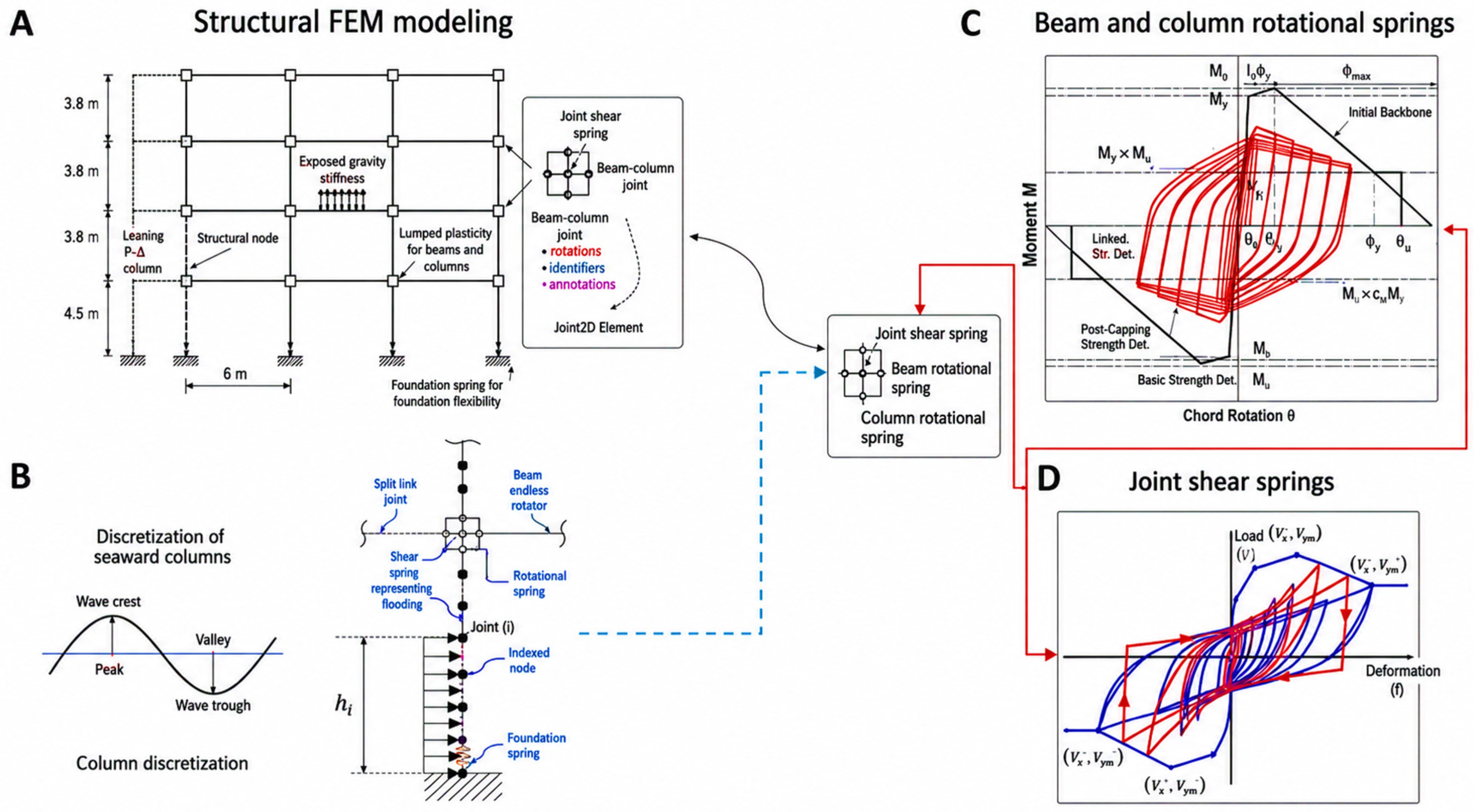
The simulation framework begins with the development of nonlinear structural models capable of representing the response of coastal buildings subjected to both seismic and hydrodynamic loading. It is important to note that the illustrative simulations presented in this section are based on a reinforced concrete (RC) special moment-resisting frame archetype (Figure 1, T1 = 0.94 s), which is representative of modern US code-conforming construction and is used here to demonstrate the successive simulation methodology (the empirical component in Section 4 uses Japanese wood-frame buildings as noted in the abstract; the two components are complementary methodological demonstrations). As can be seen from Figure 1, structural systems are typically modeled using finite-element formulations that capture the nonlinear behavior of beams, columns, and joints. Rotational spring models are commonly used to represent nonlinear plastic hinge behavior at beam-column connections, while additional springs can capture joint shear failure mechanisms [25,61]. These modeling approaches allow the simulation to represent key damage mechanisms that occur during earthquake excitation, including stiffness degradation, strength deterioration, and plastic rotation accumulation [62]. The structural discretization also enables the representation of hydrodynamic loads acting on seaward columns and structural frames when tsunami waves inundate the building. Such modeling strategies allow the structural model to capture the progressive transition from earthquake-induced damage to tsunami-induced structural failure [25].
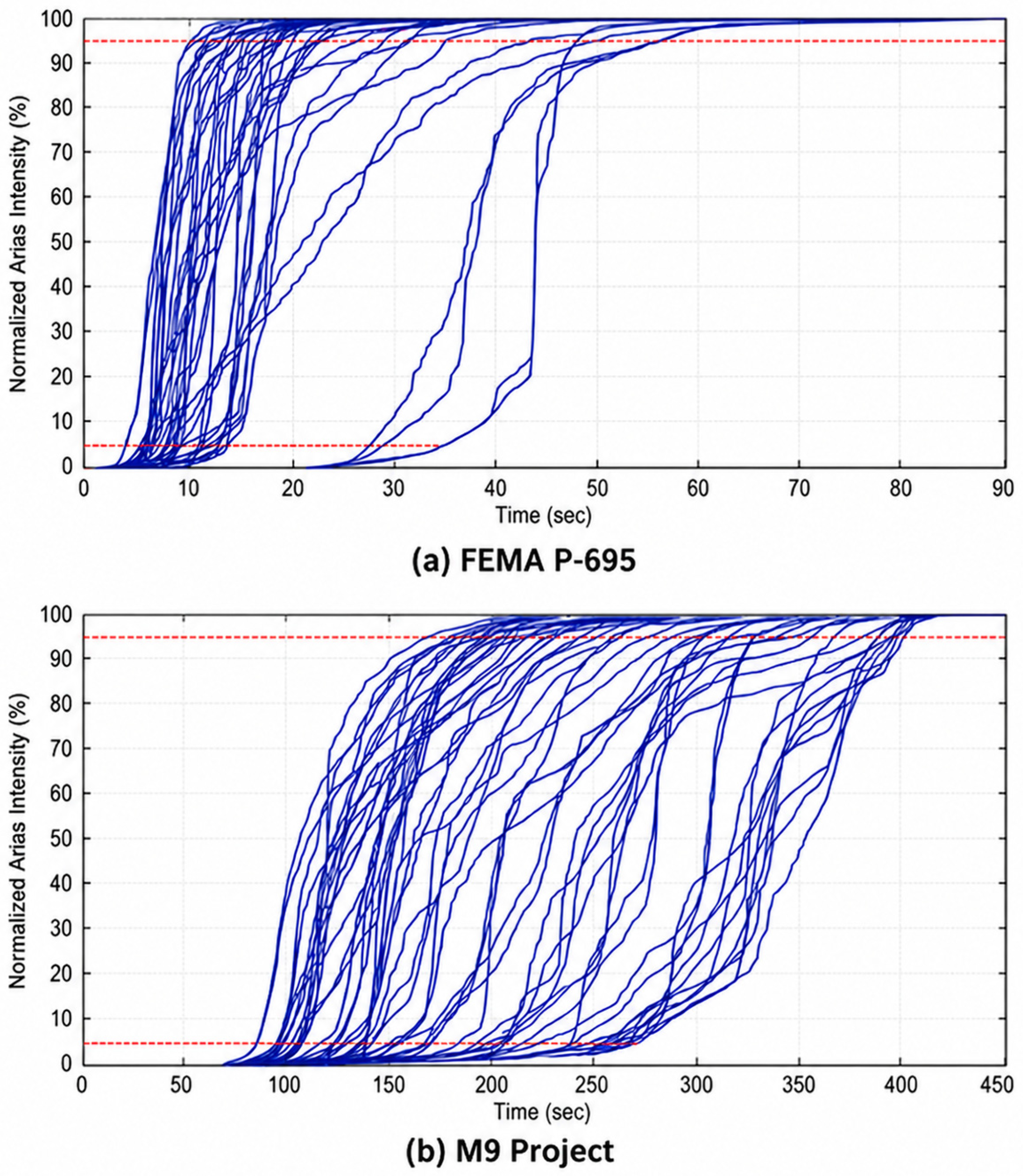
Once the structural model is established, the simulation procedure incorporates uncertainties associated with both hazard and structural parameters. As shown in Figure 2, ground motion records representing earthquake excitation are selected from standardized datasets such as the FEMA P-695 (regular-duration earthquakes) and M9 Project (long-duration earthquakes) record sets, which provide a suite of ground motions designed for collapse assessment studies of structural systems (see more details in [61]). The two sets differ substantially in their duration characteristics: FEMA P-695 records have a median significant duration (D5–95, defined as the interval over which 5% to 95% of the total Arias intensity is accumulated) of approximately 15–25 s, while M9 Project records—representing Cascadia Subduction Zone scenarios—exhibit D5–95 values exceeding 60 s, as illustrated in Figure 2. These records are scaled to represent a range of seismic intensity levels and applied to the structural model through nonlinear time-history analysis.
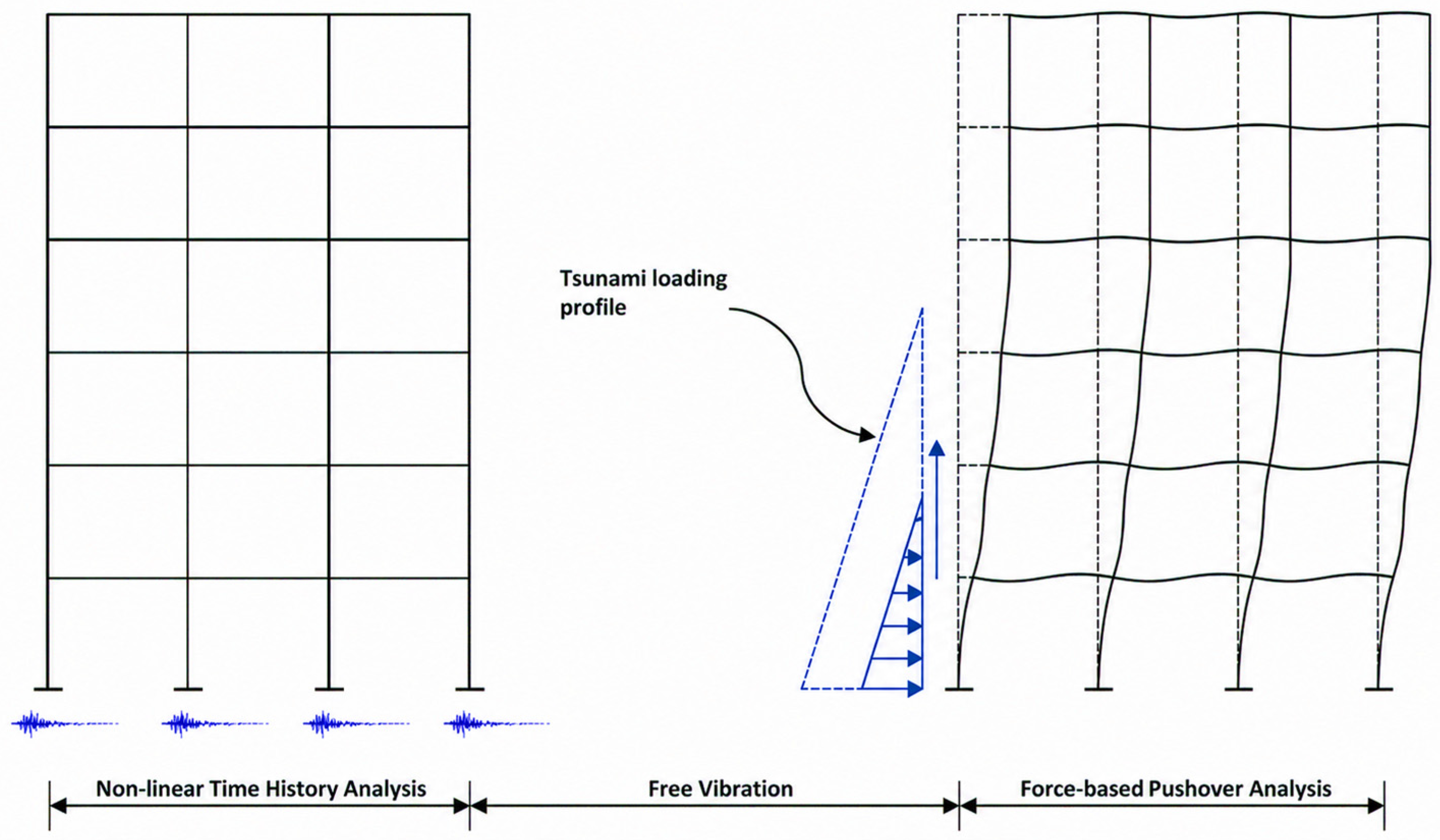
The resulting structural response captures the earthquake-induced damage state that forms the initial condition for the subsequent tsunami loading phase. For near-field tsunami scenarios as shown in Figure 3, the structural system may enter the tsunami loading phase with varying levels of residual damage, which significantly influences the structural capacity against hydrodynamic forces [22].
The transfer of structural state from the earthquake phase to the tsunami loading phase follows explicit parameter-passing rules that govern the initial conditions of the second analysis stage. Specifically, at the conclusion of each nonlinear time-history analysis under earthquake excitation, three categories of state variables are extracted and carried forward: (i) residual nodal displacements and rotations, which define the deformed geometric configuration of the structure at the onset of tsunami loading; (ii) plastic hinge rotation demands accumulated at beam–column connections, which determine the remaining rotational capacity at each joint and therefore the effective lateral resistance of the degraded frame; and (iii) component-level stiffness and strength degradation parameters, updated through the hysteretic model during earthquake shaking, which reduce the backbone force–deformation relationship used in the subsequent pushover analysis. These extracted state variables collectively define the “damaged structural configuration” that serves as the starting point for the force-based pushover analysis conducted in the tsunami phase. Between the earthquake and tsunami phases, a free vibration step is introduced in which all external forcing is removed, and the structure is allowed to vibrate freely under its own inertia and restoring forces until kinetic energy dissipates and a stable static equilibrium is reached. This step serves two purposes: first, it eliminates transient velocity and inertia contributions that are present during shaking but physically absent at the onset of tsunami inundation—which arrives as a quasi-static rising flow rather than a dynamic impulse—ensuring that the extracted state variables reflect the true residual static condition of the damaged structure; second, it allows any remaining dynamic amplification in nodal displacements and plastic hinge rotations to settle, so that the three categories of state variables extracted for the pushover phase represent a physically consistent and statically admissible initial condition. No reinitialization of plastic hinge states or stiffness matrices is performed between the two main phases; the post-earthquake structural model is used directly, ensuring that the capacity reduction due to seismic damage is fully reflected in the tsunami demand-to-capacity comparisons. This one-way coupling approach—where earthquake damage governs the initial state of the tsunami analysis but tsunami loading does not retroactively influence the earthquake response—is physically appropriate given the rapid sequential nature of near-field events and is consistent with the successive analysis strategy described in detail in [25,63].
The tsunami loading, in the third phase of the simulation in Figure 3, is represented through hydrodynamic force components acting on the structural frame, typically including drag forces, hydrostatic pressures, and impulsive loads associated with bore impact or velocity contribution of tsunami waves. In the simulation framework, these loads are often represented using simplified hydrodynamic formulations in which the total lateral tsunami force depends on flow depth, flow velocity, and structural geometry. Because tsunami parameters exhibit significant variability, the simulation framework introduces these loads as random variables within a probabilistic modeling framework [25]. Multiple tsunami loading profiles with varying water depths and flow velocities are generated to represent different inundation scenarios (see [25] for more details). This probabilistic treatment allows the simulation to capture the wide range of tsunami forces that may occur during real coastal inundation events.
To evaluate structural performance under combined hazards, the structural demand is compared with the structural capacity for each pair of earthquake and tsunami intensity parameters to determine whether a specified damage state or collapse condition is reached [63]. Repeating this process across a large set of earthquake–tsunami intensity combinations produces a dataset of failure outcomes associated with different hazard intensities. This process produces a set of failure-probability points that describe the relationship between earthquake intensity measures and tsunami intensity measures for different structural damage states.

3.2. Near-Field Tsunami Fragility Response

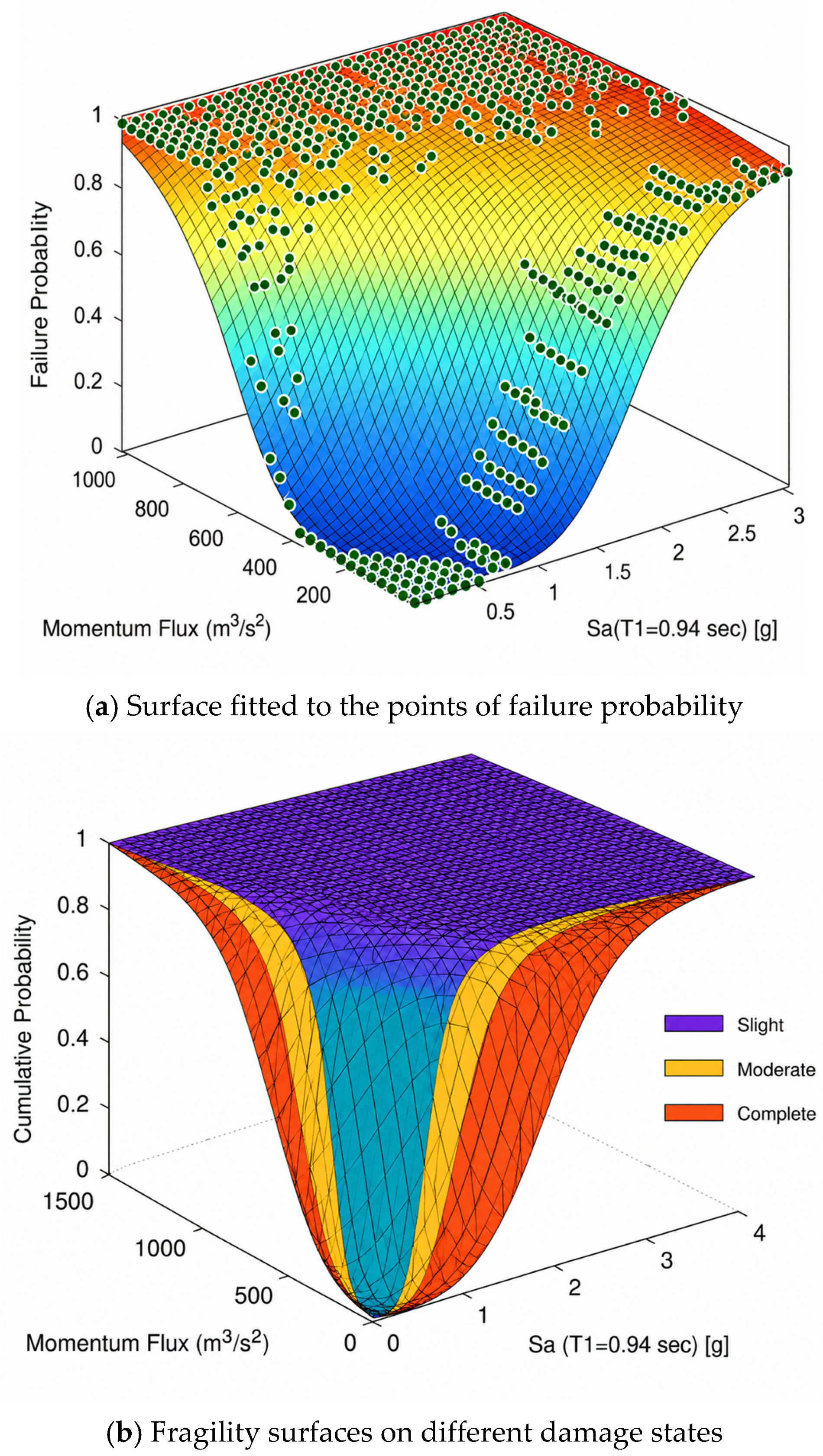
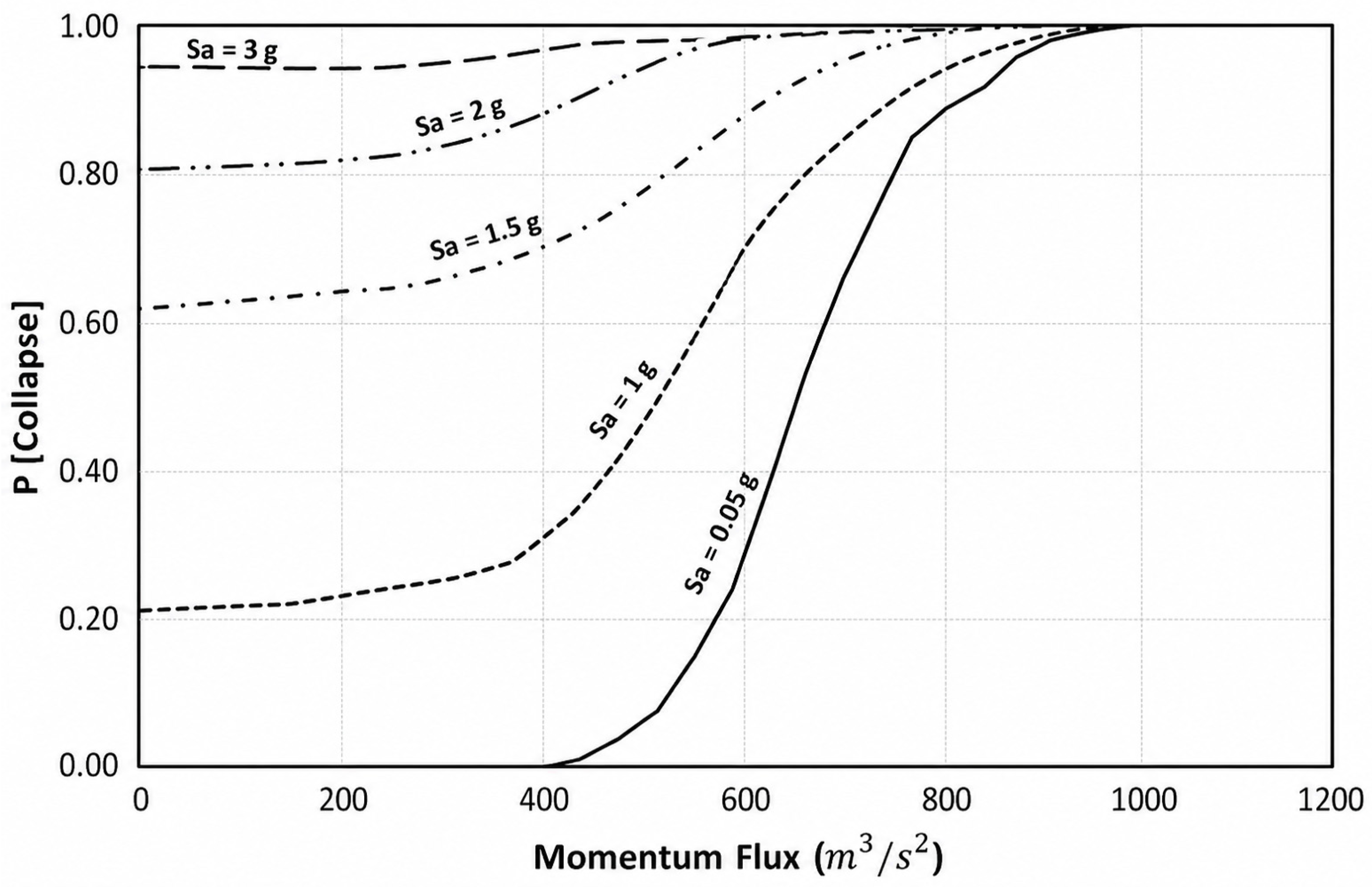
The results of the successive simulations using regular-duration earthquakes (FEMA P-695) can be visualized as a set of points representing the conditional failure probability P ( T S E Q ) across a two-dimensional hazard space. As shown in Figure 4, these points form the basis for constructing fragility surfaces that describe structural vulnerability of the RC frame archetype under combined earthquake–tsunami loading. Surface-fitting techniques can then be applied to the simulated failure probability points in order to obtain continuous fragility surfaces for different damage states [63]. These fragility surfaces provide a generalized representation of structural vulnerability across a wide range of earthquake and tsunami intensities, enabling probabilistic risk assessments that account for interacting hazards [64].
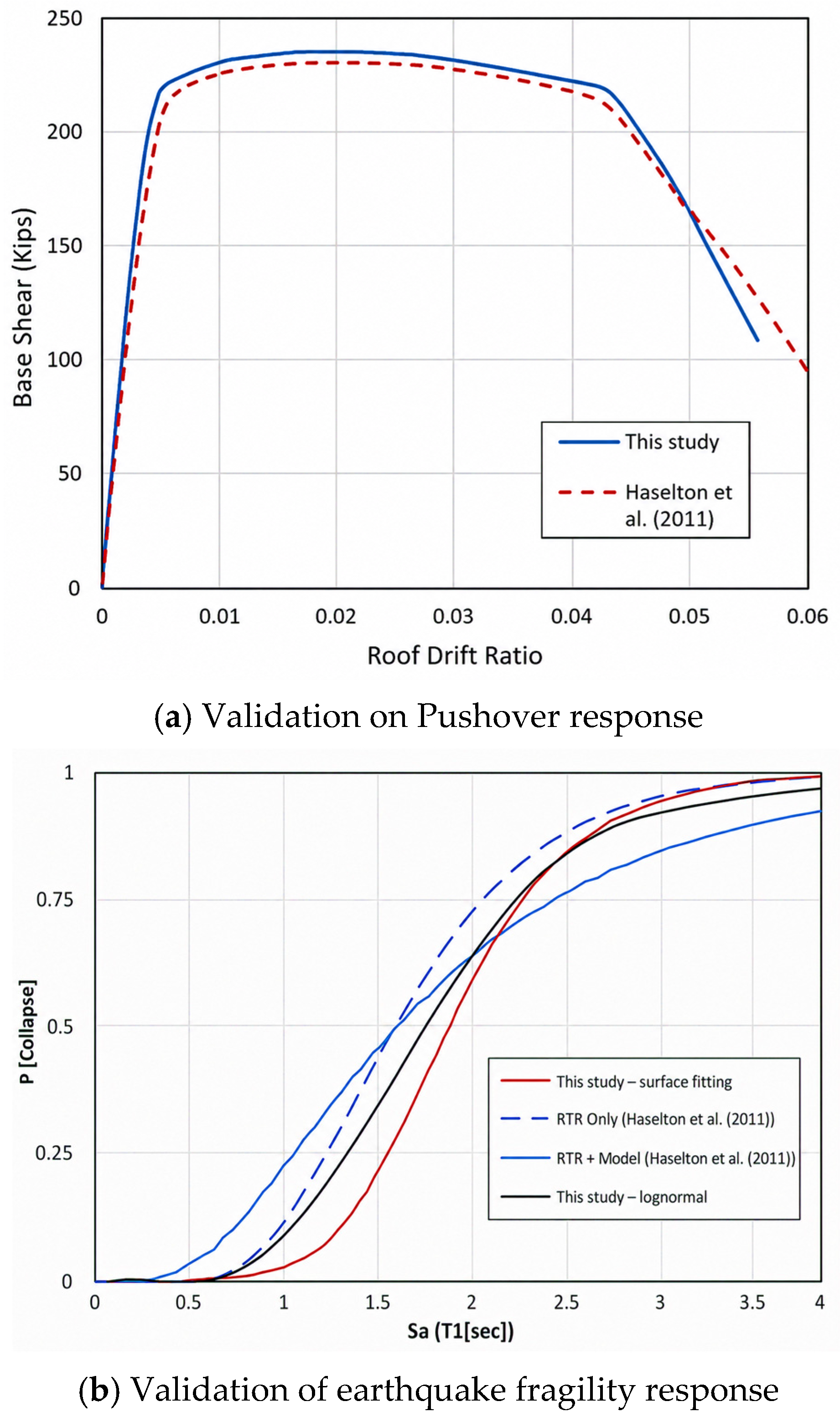
Validation of the simulation framework is an essential component of the modeling process. For the earthquake component, the nonlinear structural model can be validated by comparing simulated structural responses—such as pushover curves and dynamic fragility curves (Figure 5)—with benchmark results reported in previous studies (e.g., [62]). For example, comparisons with established structural models can verify that the simulated building exhibits realistic stiffness, strength, and collapse behavior under seismic loading. Figure 5b presents the earthquake fragility curves for the RC frame archetype, showing the probability of exceeding on DS3/collapse damage state (as defined in Table 1) as a function of spectral acceleration at the fundamental period Sa(T1 = 0.94 s). Each curve in the figure corresponds to the same structural limit state. Solid lines represent fragility curves derived from the present simulations; dashed lines represent benchmark fragility curves from [62] for the same archetype. The close agreement between these fragilities confirms that the simulated structural model reproduces the expected seismic fragility behavior of the archetype, providing confidence that the earthquake-induced damage states generated in the successive simulation (presented in Section 3.1) are physically consistent and suitable as initial conditions for the subsequent tsunami loading phase. The period of vibration and mode shapes have also been examined and found consistent with the benchmark values reported in [62].
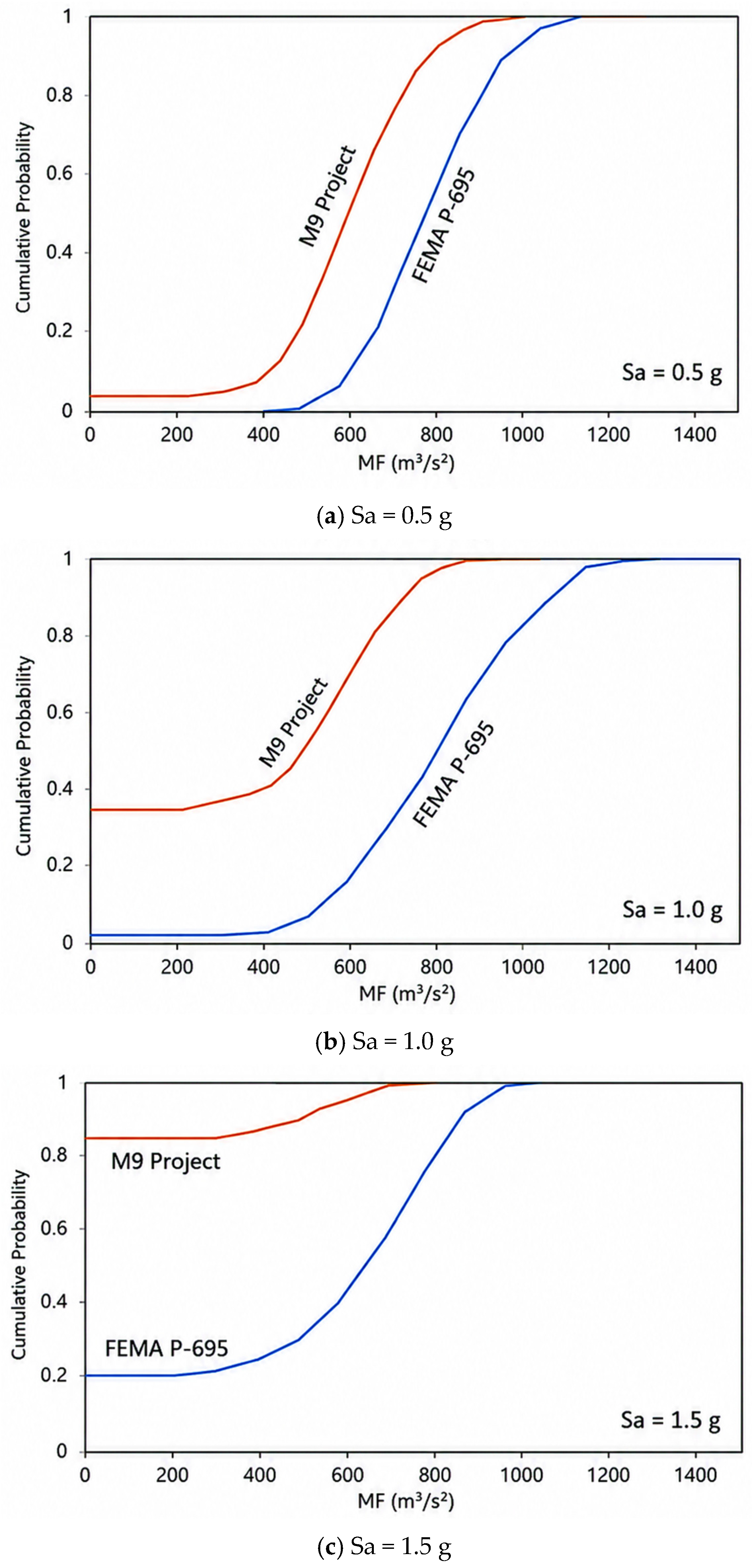
The close agreement between the simulated pushover response and the benchmark curve reported by Haselton et al. (2011) [62] provides confidence in the structural model and validates its suitability for the force-based pushover procedure used in the tsunami loading phase. The resulting fragility curves in Figure 6 can then be compared across earthquake intensity levels to examine how pre-existing seismic damage influences tsunami vulnerability. In near-field tsunami scenarios, structures subjected to strong ground shaking exhibit an increased baseline probability of failure before any tsunami loading is applied. Consequently, the tsunami fragility curves conditioned on earthquake intensity show a vertical shift relative to those derived for undamaged structures—manifesting as a non-zero failure probability at zero tsunami force, referred to here as the jump at the origin. This jump reflects the compounded damage state in which tsunami forces act on a structure whose capacity has already been reduced by seismic loading. As shown in Figure 7, this effect is further amplified when long-duration ground motion records (M9 Project) are used: the jump at the origin becomes more pronounced relative to results obtained with regular-duration records (FEMA P-695), consistent with the greater cumulative damage imposed by extended shaking—a pattern evident across all three intensity levels: higher Sa values (1.0 g and 1.5 g) produce both a larger jump at the origin and a leftward shift in the entire curve relative to the Sa  =  0.5 g case, reflecting the greater reduction in structural capacity with increasing seismic demand (see [61] for details).

4. Post-Tsunami Damage Survey

Post-tsunami damage survey datasets provide an essential empirical foundation for understanding how coastal buildings respond to tsunami inundation; in this study the empirical analysis is based on wood-frame building records from the 2011 Great East Japan survey, and the observations should be interpreted as typology-specific unless otherwise noted. While simulation-based fragility modeling enables controlled exploration of structural behavior under coupled earthquake–tsunami hazards, field observations provide direct evidence of real damage mechanisms and allow validation of the simulated fragility relationships [32,65,66]. In this study, post-tsunami survey data are analyzed to examine the relationship between structural damage, hydrodynamic intensity measures, and spatial characteristics such as distance from the coastline. These empirical observations allow the fragility models derived from numerical simulations to be interpreted within the context of actual tsunami damage patterns.

4.1. Damage Survey Data and Information

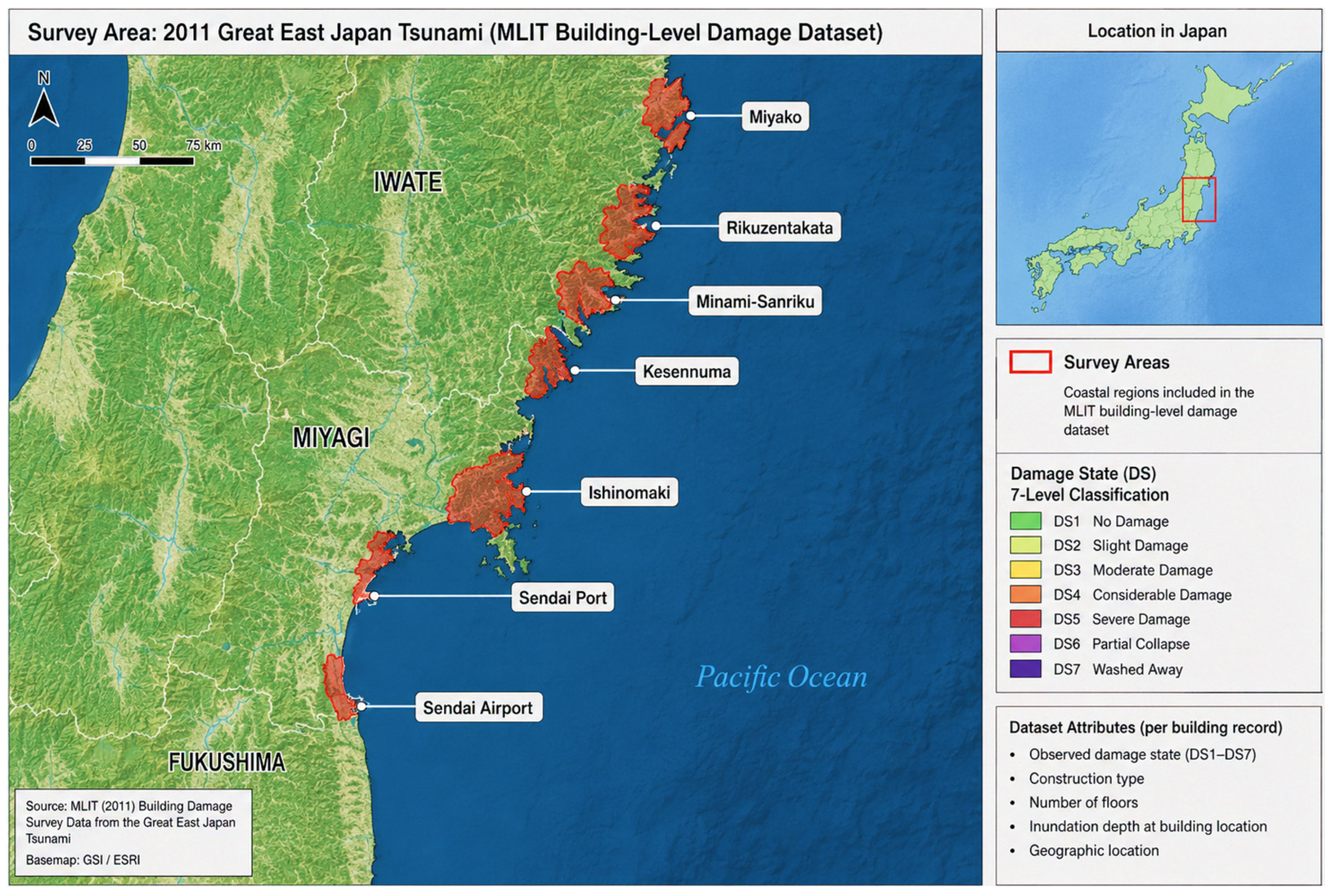
The damage data utilized in this study are based on the building-level survey dataset compiled by the Japanese Ministry of Land, Infrastructure, Transport and Tourism (MLIT) following the 2011 Great East Japan tsunami—a near-field event in which all surveyed structures were subjected to sequential earthquake and tsunami loading. The recorded damage states in the dataset therefore represent the outcome of coupled hazard exposure, not isolated tsunami response [67]. This dataset consists of detailed ex-post damage observations for a large number of structures across multiple affected coastal regions (Figure 8), including Miyako, Rikuzentakata, Minami-Sanriku, Kesennuma, Ishinomaki, Sendai Port, and Sendai Airport [68]. Each record in the dataset includes the observed damage state of individual buildings, categorized into seven discrete levels ranging from no damage (DS1) to washed away (DS7), along with key structural and site-related attributes such as construction type, number of floors, and inundation depth at the building location. The dataset therefore provides a comprehensive empirical basis for linking tsunami intensity measures to structural damage.
In addition to the original survey information, the dataset has been extended in previous studies to incorporate additional geospatial and proxy variables representing hydrodynamic effects, including shielding and debris interaction mechanisms [68]. These extensions introduce several hydraulic variables whose provenance and derivation differ importantly and are clarified here for transparency. The inundation depth h_MLIT is measured directly from post-event field survey records and represents the primary observed intensity measure. Flow velocity, however, was not directly recorded during the 2011 event owing to insufficient video documentation of the inundation; two distinct velocity estimates are therefore used in this study. The first, v_c, is an approximation derived from the survey data itself using a simplified analytical method (a depth-velocity proxy formula applied to the observed inundation depths); it is not a direct field measurement and carries the uncertainty inherent in any surrogate-based velocity estimate. The second pair of variables, h_sim and v_sim, are both outputs of a hydrodynamic simulation of the 2011 event calibrated against the field-observed inundation depths and spatial damage patterns; these variables provide physically consistent estimates of depth and velocity across the inundation zone but are model-derived rather than directly observed. The observed momentum flux m_MLIT is computed as M = h_MLIT·v_c2 (m3/s2) and therefore inherits the approximation uncertainty in v_c, while the simulated momentum flux m_sim is computed from h_sim and v_sim. Consequently, h_MLIT is the only hydraulic quantity with direct observational grounding; all velocity-dependent variables involve either approximation or simulation-based inference.
For the machine-learning classification analysis presented in the next section, the original seven-level MLIT damage scale (DS1–DS7) is aggregated into three ordered classes to align with the damage-state taxonomy used in the IN-CORE community resilience platform [69]. Class 1 (Minor/Slight Damage) includes DS1 (no damage), DS2 (minor damage), and DS3 (moderate damage); Class 2 (Moderate/Severe Damage) includes DS4 (major damage) and DS5 (complete damage); and Class 3 (Collapse/Complete Loss) includes DS6 (collapsed) and DS7 (washed away). This aggregation preserves the key engineering distinction between repairable damage, irreparable damage, and total loss while providing sufficient samples in each class for robust classifier training. The corresponding crosswalk is summarized in Table 1. Because both the original MLIT damage states and the aggregated IN-CORE classes are used throughout this section, their relationship is explicitly identified in the figures and discussion.

4.2. Observations on Near-Field Tsunamis from Damage Survey

A key insight obtained from the damage survey data is that structural damage exhibits a strong correlation with hydrodynamic intensity measures characterizing tsunami loading. Among these, momentum flux—defined in this study as M = h·v2 (m3/s2), where h is flow depth (m) and v is flow velocity (m/s), without inclusion of the fluid density ρ —emerges as one of the most informative parameters, as it captures the combined effect of hydrostatic and hydrodynamic forces acting on structures. Note that while ρ is excluded from the intensity measure definition (consistent with common practice in empirical fragility studies), it is retained when computing the hydrodynamic force component of the tsunami force for structural load calculations. The empirical results presented in this section and in Figure 9, Figure 10, Figure 11, Figure 12 and Figure 13 are derived exclusively from wood-frame building records in the 2011 Great East Japan survey dataset. This typology is the most prevalent in the MLIT dataset and thus provides the largest sample for robust statistical analysis.
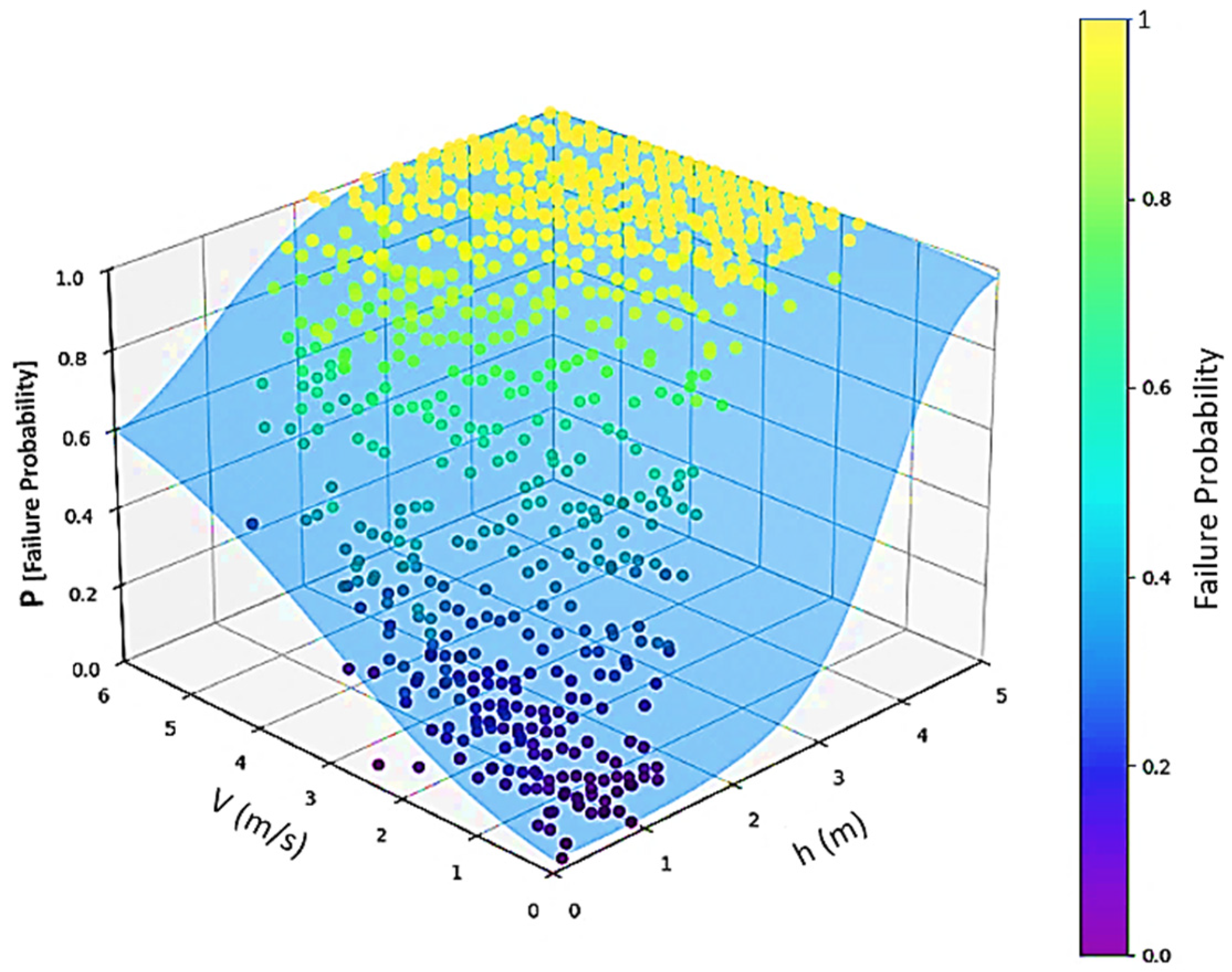
Before presenting Figure 9, it is important to clarify how numerical failure probability values are generated from survey-based damage assessment. Each building record in the MLIT dataset carries an observed damage state (DS1–DS7) and associated hydraulic intensity values (inundation depth h and estimated flow velocity v). The binary failure criterion (DS ≥ DS4 = failure; DS < DS4 = non-failure) converts each record into a Bernoulli outcome [21]. To construct the 3D failure probability surface, the (h, v) domain is partitioned into a regular grid of bins; within each bin, the empirical failure probability is computed as the ratio of failed buildings to total buildings in that bin. These bin-level failure fractions constitute the data points visible in Figure 9. A smooth probabilistic surface is then fitted to these empirical data points using a parametric regression model, yielding a continuous failure probability function of h and v. This procedure is entirely empirical—no structural simulation is involved—and the resulting surface represents the observed conditional failure probability directly from the survey data. As illustrated in Figure 9, the probability of failure (DS ≥ DS4 of MLIT) for wood-frame buildings increases nonlinearly with both inundation depth (h) and flow velocity (v), highlighting their combined influence on structural damage. The resulting failure surface indicates that neither variable alone adequately characterizes structural response; rather, their interaction governs the transition to severe damage and collapse, supporting the use of composite intensity measures such as momentum flux in tsunami fragility modeling.
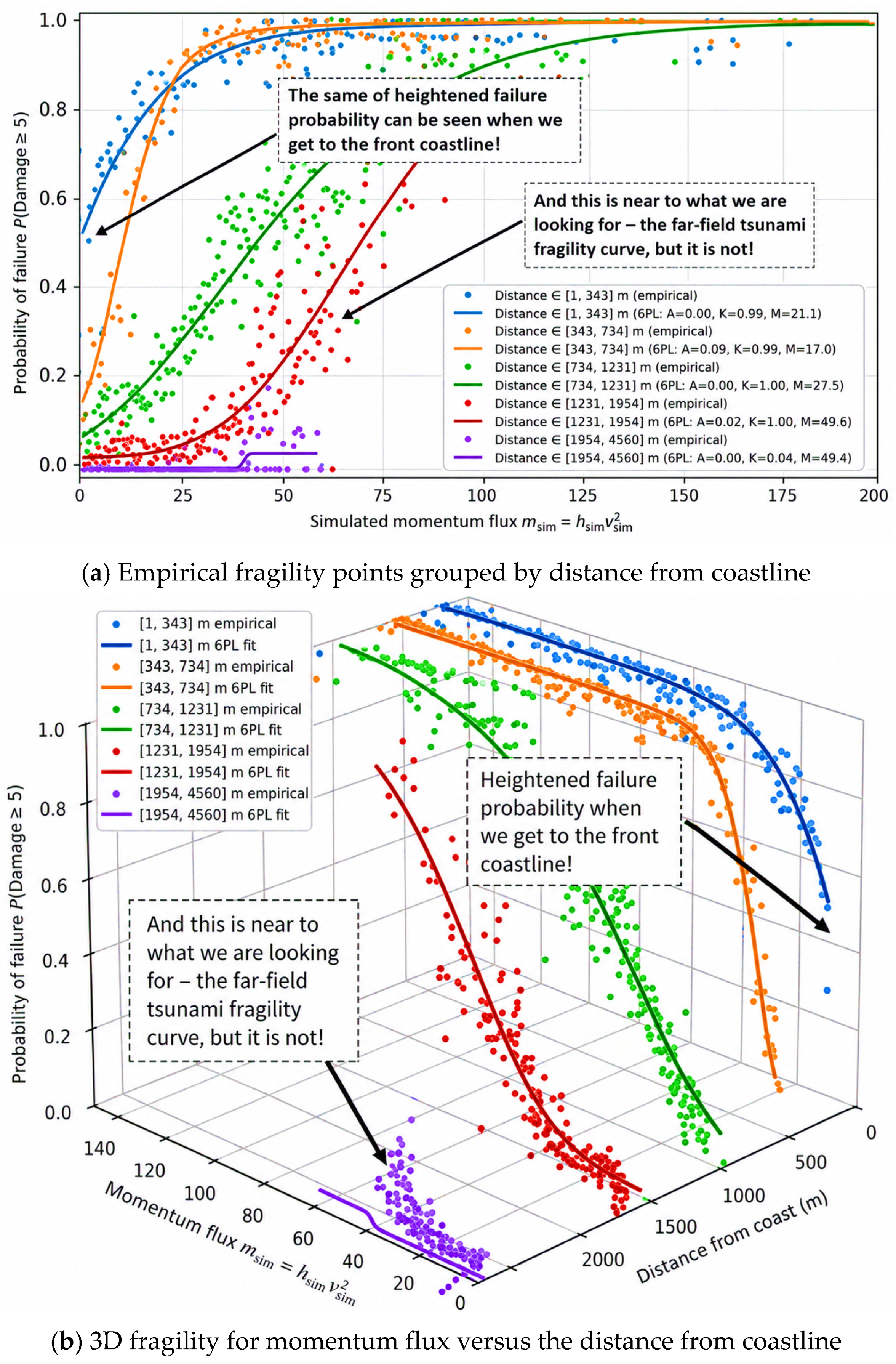
Figure 10 uses the simulated momentum flux m_sim as the intensity measure on the horizontal axis. As described in Section 4.1, both depth and velocity fields are simulation-derived (calibrated against field observations), ensuring physically consistent hydrodynamic inputs for the distance-dependent fragility analysis.
This cross-validation between simulation-derived and empirical fragility behavior supports the physical realism of the successive earthquake–tsunami analysis framework. The results further indicate that hydrodynamic parameters, including inundation depth, flow velocity, and their combined momentum flux, are physically meaningful predictors of tsunami-induced structural damage, whereas the baseline failure probability at low tsunami intensities is influenced by pre-existing seismic damage. In Figure 9 and Figure 10, structural failure is defined as the exceedance of DS4 (major damage), i.e., P(Damage ≥ DS4). This threshold was selected because DS4 marks the onset of irreparable structural damage and represents the engineering boundary beyond which a building is typically considered a total loss for recovery purposes. It also corresponds to the transition between IN-CORE Classes 1 and 2 in the adopted three-class damage taxonomy.
Another important observation emerging from the damage survey data is the significant influence of distance from the coastline on observed damage levels. Buildings located closer to the shoreline generally experience higher damage probabilities compared with buildings located further inland. When the dataset is stratified into distance bins measured from the coastline, the resulting fragility curves reveal systematic variations in failure probability with distance. Structures located in the near-coast region tend to exhibit a higher baseline probability of severe damage even at relatively moderate hydrodynamic intensities. In contrast, buildings located farther inland show a lower probability of failure for the same intensity levels. This trend suggests that coastal proximity plays a critical role in tsunami damage processes and should be considered explicitly in fragility modeling frameworks.
The influence of coastal distance on damage patterns also reveals important differences between near-coast, mid-coast, and far-coast tsunami effects. In the immediate coastal zone, buildings are exposed to highly energetic tsunami flows characterized by strong impulsive forces, debris impact, and rapid hydrodynamic loading. These mechanisms contribute to elevated damage probabilities in the near-coast region and can produce structural failures even when hydrodynamic intensity measures appear moderate. In addition, structures in this zone may experience stronger earthquake shaking prior to tsunami arrival, particularly in near-field tsunami events where the earthquake source is located close to the affected coastline. The combined effects of intense tsunami forces and potential earthquake damage lead to elevated fragility levels for buildings located near the shoreline.
At intermediate distances from the coastline, the tsunami flow tends to transition from highly impulsive conditions toward more stable hydrodynamic inundation behavior. In this region, damage patterns are influenced by both the residual energy of the incoming tsunami flow and the attenuation of impulsive forces with distance. As a result, fragility curves derived from damage observations in this region often exhibit intermediate characteristics between near-coast and far-coast behaviors. This transition zone is particularly important for fragility modeling because it captures the gradual attenuation of tsunami forces as the wave propagates inland.
For buildings located further inland, tsunami damage appears to be dominated primarily by hydrodynamic inundation rather than impulsive coastal forces. In these far-coast locations, debris impacts and bore-like forces become less dominant, and the structural response tends to be controlled primarily by sustained hydrodynamic loads. Consequently, the observed damage patterns in this region resemble what is typically described as far-field tsunami fragility behavior, in which structural vulnerability depends mainly on hydrodynamic flow parameters such as water depth and velocity. These conditions align closely with simplified engineering design approaches in which tsunami loads are represented through hydrodynamic pressure formulations, such as those incorporated into design guidance documents and coastal hazard engineering methodologies.
The inherently coupled nature of the 2011 dataset—in which earthquake and tsunami effects cannot be separated—deserves to be understood not only as a limitation for validation purposes but also as a feature that connects the empirical analysis directly to the near-field scenario motivating Section 3. The survey data capture exactly the conditions the successive simulation framework is designed to represent: structures whose seismic capacity had been partially consumed before tsunami loading commenced. In this sense, the empirical fragility curves in Figure 9, Figure 10, Figure 12 and Figure 13 are the real-world analog of the simulation-derived conditional fragility surfaces in Figure 4, Figure 5, Figure 6 and Figure 7, both reflecting the compounded vulnerability of structures under coupled earthquake–tsunami loading. It should nevertheless be noted that, for validation of the pure tsunami edge of the fragility surfaces, far-field tsunami fragility data would ideally be required, since none of the empirical curves represent pure far-field tsunami response—even for structures located relatively far from the coastline, the prior seismic event means that some degree of earthquake conditioning is present in all survey records.
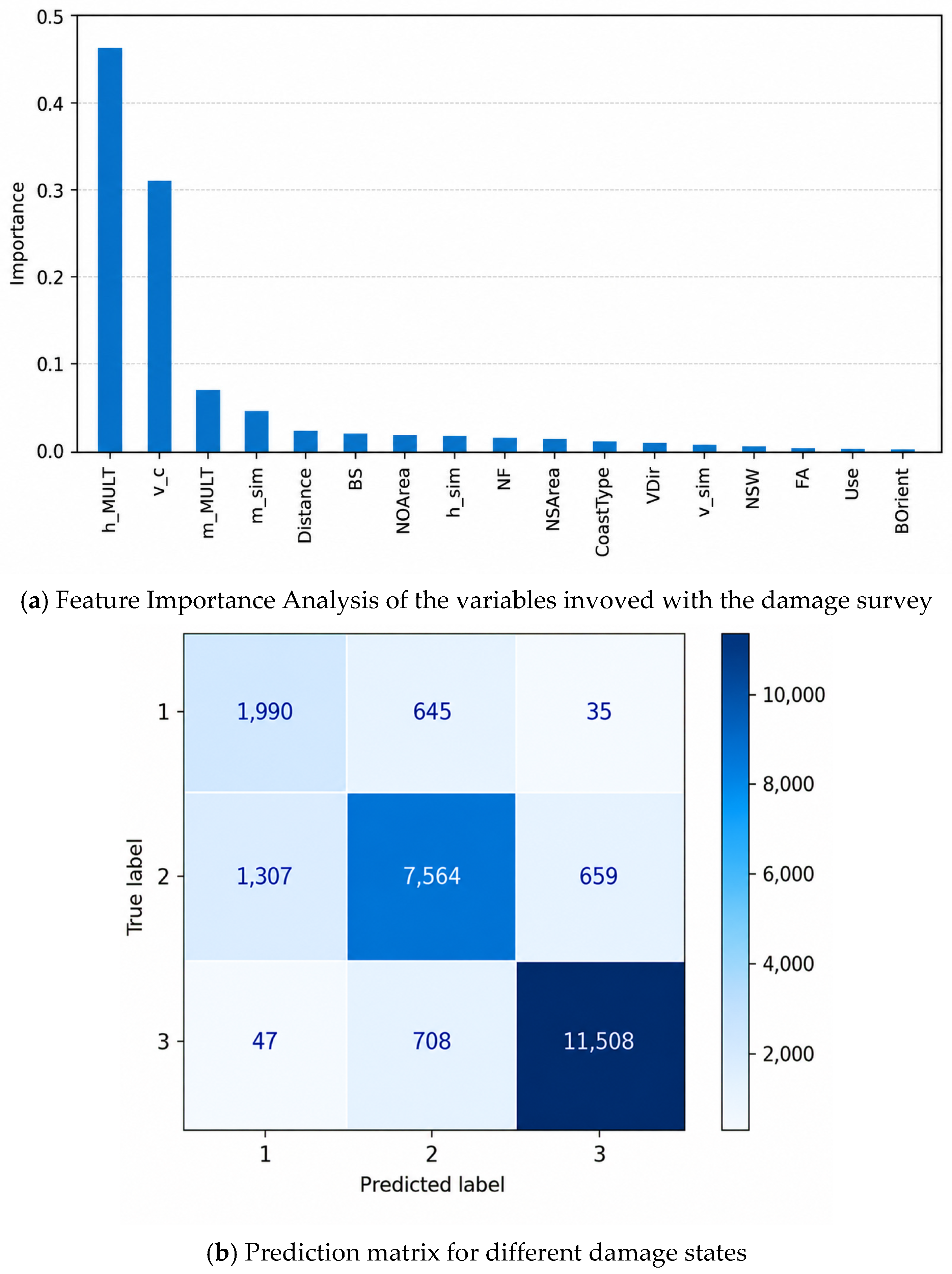
Machine-learning-based (ML) analysis—using an XGBoost classifier—of the survey dataset further confirms the relative importance of key variables influencing tsunami damage. The wood-frame subset of the MLIT dataset used in the classification analysis comprises 97,852 records after cleaning (held-out test set: 24,463; training set: 73,389). The dataset was divided into a stratified 75/25 training/test split (random state = 42), preserving the IN-CORE class distribution in both partitions. Class imbalance was not explicitly corrected (no oversampling or class weighting was applied); the class distribution across the three IN-CORE classes is: Class 1 (minor/slight) 10.9% (n = 10,680), Class 2 (major/moderate) 39.0% (n = 38,120), and Class 3 (collapse/complete) 50.1% (n = 49,052). The classifier is an XGBoost multi-class model (objective: multi:softprob, eval_metric: mlogloss) with the following hyperparameters: n_estimators = 600, max_depth = 4, learning_rate = 0.05, subsample = 0.8, colsample_bytree = 0.8. The input feature set comprises seven core MLIT variables: building structure type (BS), number of floors (NF), coast type (CoastType), floor area (FA), distance from coastline (Distance), building use (Use), and observed momentum flux (m_MLIT).
The confusion matrix in Figure 11b and all performance metrics reported below reflect predictions on the held-out test set only. Note that Figure 11a (feature importance) is derived from a separate XGBoost regressor trained on the continuous seven-level damage scale using an extended 17-variable feature set including simulated hydraulic variables (h_sim, v_sim, m_sim) and additional site attributes; this distinction is important because the feature ranking reflects the regressor’s response surface rather than the classifier’s decision boundaries.
Feature-importance evaluations presented in Figure 11a show that flow depth and flow velocity are the two dominant predictors of structural damage states, with momentum flux ranking as a more distant third predictor—nearly an order of magnitude lower in importance than depth—followed by distance from the coastline and other environmental variables. Notably, since momentum flux is itself a function of both flow depth and velocity, the strong individual importance of these two components is consistent with momentum flux acting as the underlying controlling parameter; the XGBoost model effectively decomposes its influence into its constituent variables, which together account for the combined hydrodynamic loading captured by momentum flux. This result supports the physical interpretation that tsunami forces are primarily governed by hydrodynamic loading mechanisms, while spatial characteristics influence how those forces are transmitted to the built environment.
The classification analysis presented in Figure 11b, based on the three-class IN-CORE damage taxonomy described in Table 1 (Class 1: minor/slight; Class 2: major/moderate; Class 3: collapse/complete) [69], demonstrates the following out-of-sample classification performance on the held-out test set. Overall weighted accuracy is 87%. Per-class metrics are as follows: Class 1 (minor/slight)—precision 78%, recall 49%, F1 = 0.60; Class 2 (major/moderate)—precision 81%, recall 88%, F1 = 0.84; Class 3 (collapse/complete)—precision 93%, recall 95%, F1 = 0.94; weighted macro-F1 = 0.86. The comparatively low recall for Class 1 (49%) is consistent with both the class imbalance (∼11% of records) and the physical difficulty of distinguishing minor from moderate damage at low hydrodynamic intensities; because no class weighting or oversampling was applied, the model optimizes toward the majority classes. Despite this, the classifier achieves high performance on the two most consequential damage states—Classes 2 and 3 account for 89% of records and are identified with F1 scores of 0.84 and 0.94, respectively—confirming strong statistical relationships between damage patterns and hazard intensity measures.
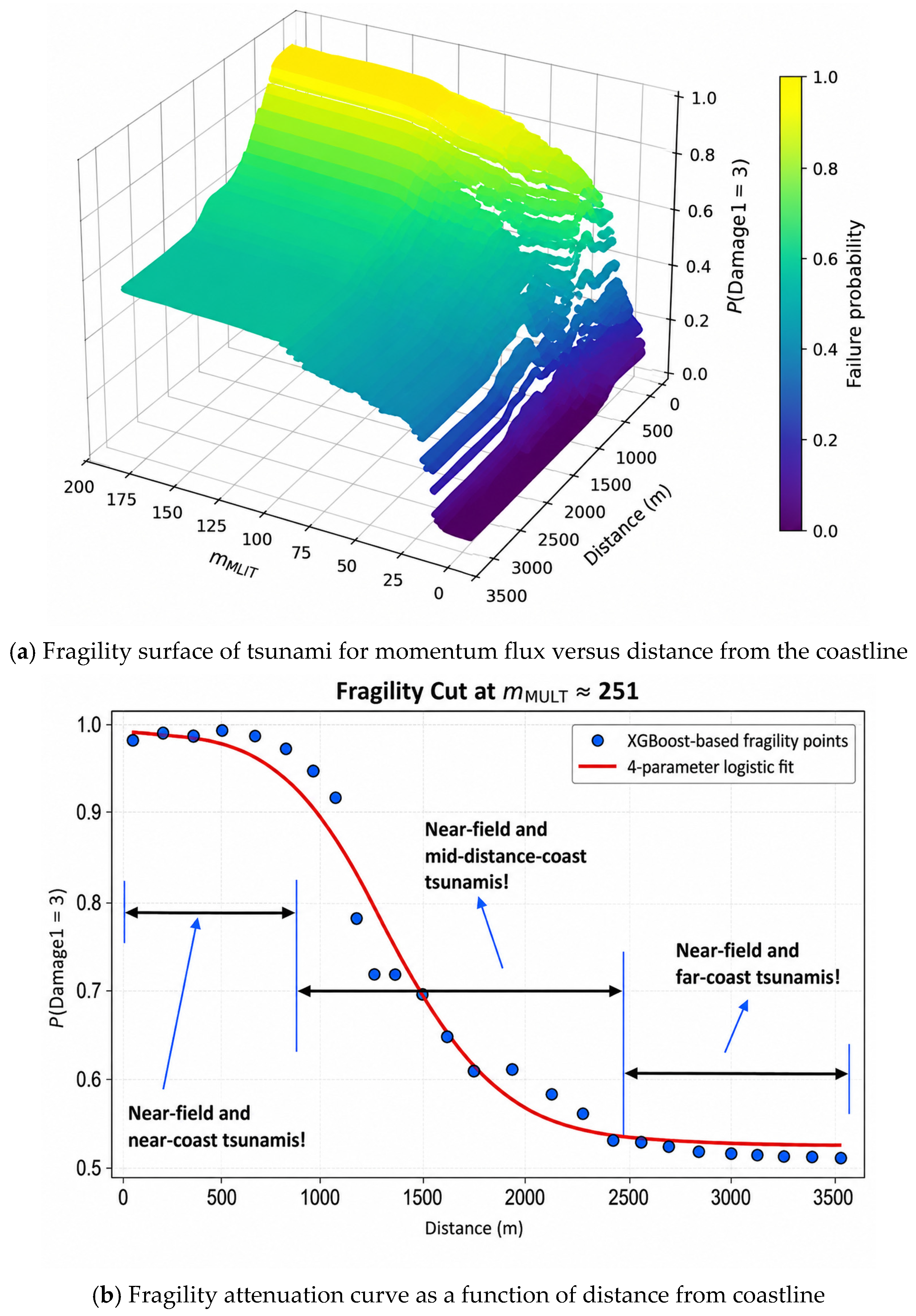
An additional insight from the ML analysis over damage survey data is the identification of coastal attenuation effects in tsunami fragility behavior. As tsunami waves propagate inland, the energy of the flow gradually dissipates due to surface friction, topographic effects, and flow spreading. This attenuation process leads to systematic reductions in tsunami dominant forces with increasing distance from the coastline. When ML-assisted fragility curves derived for different coastal distance ranges are compared, as shown in Figure 12a, they exhibit systematic shifts toward lower failure probabilities with increasing distance from the coastline. This trend highlights that tsunami fragility relationships are not spatially uniform and must account for the attenuation of hazard intensity across the inundation zone, as illustrated in Figure 12b. The subscript notation used in Figure 12 (e.g., Damage1 = 3) follows the same convention: the subscript identifies the distance bin index and the integer value indicates the predicted IN-CORE damage class (1, 2, or 3) for that bin.
The observed spatial variation in fragility behavior seen from Figure 12b also suggests that fragility curves derived from damage survey data may represent different effective hazard regimes depending on the coastal distance of the surveyed structures. In particular, fragility relationships derived from buildings located far from the shoreline may resemble traditional far-field tsunami fragility curves, while buildings located near the coast may exhibit fragility characteristics influenced by both earthquake damage and intense impulsive tsunami forces. Understanding this distinction is critical when interpreting empirical fragility datasets because the observed damage patterns may reflect a mixture of near-field and far-field tsunami processes.
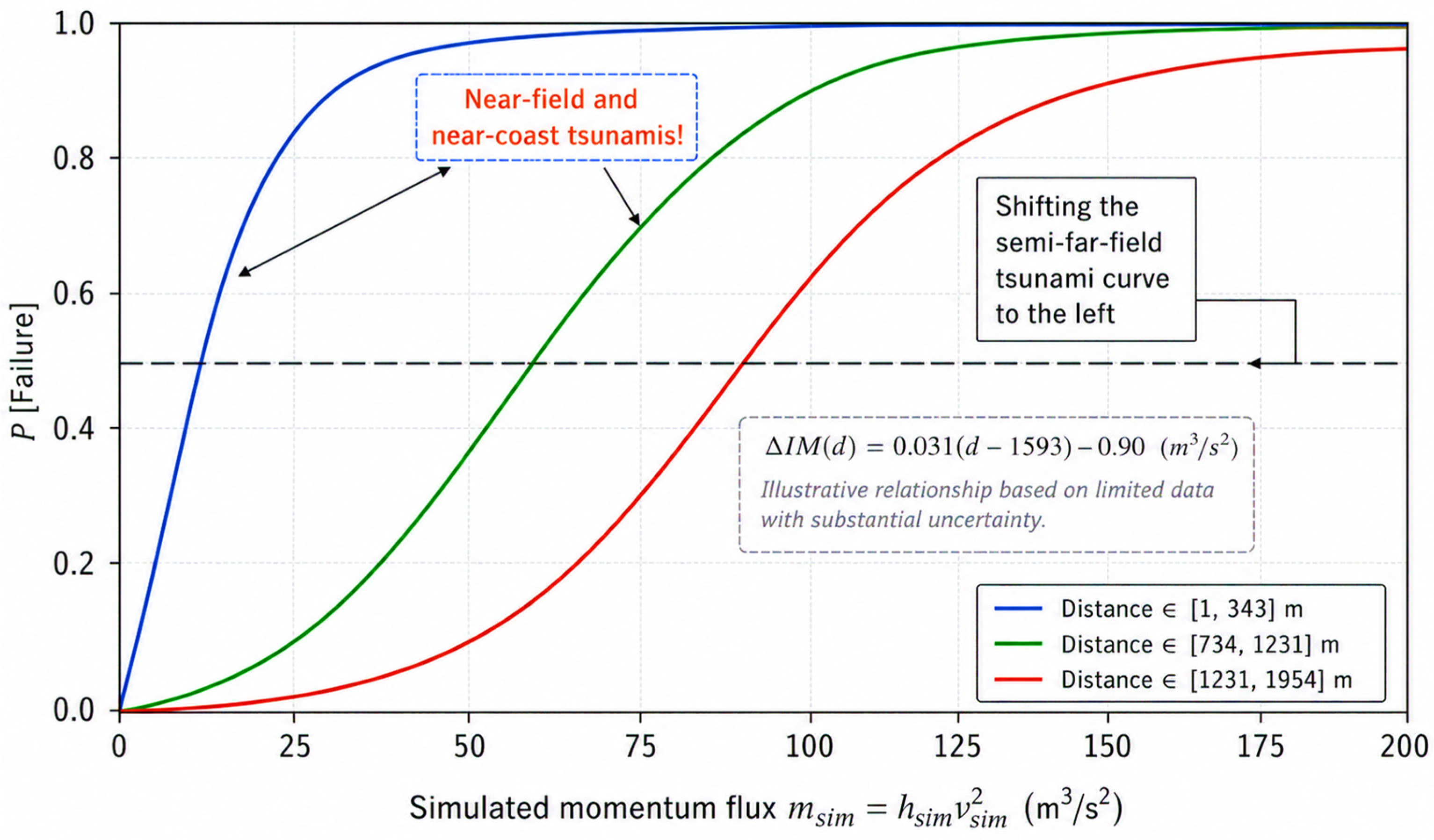
Figure 13 illustrates the systematic variation in tsunami fragility curves with coastal distance, highlighting the pronounced influence of near-field and near-coast effects on structural vulnerability. It is important to understand Figure 13 as the engineering operationalization of Figure 10a: the two figures represent the same underlying phenomenon at two levels of abstraction. Figure 10a presents the raw empirical observation—a three-dimensional failure probability surface in which damage probability varies jointly with momentum flux and coastal distance, with the surface shifting upward (higher failure probability at the same intensity) as distance from the coast decreases. Figure 13 then decomposes this 3D surface into a tractable engineering tool by expressing the distance-dependent behavior as a horizontal shift in a single reference fragility curve: instead of requiring a new fragility curve for every distance, the 3D variation in Figure 10a is captured by a single baseline curve plus the scalar function ΔIM(d), which quantifies how far the fragility curve must be shifted leftward (toward lower intensity) to represent conditions at distance d from the coast. In other words, Figure 10a establishes that coastal distance is a significant determinant of tsunami vulnerability, and Figure 13 translates that observation into a practical parameterization: each fragility curve in Figure 13 corresponds to a horizontal cross-section of the 3D surface in Figure 10a at a fixed distance bin, and the horizontal separation between those curves is precisely what ΔIM(d) quantifies.
As observed in this paper, structures located closer to the coastline exhibit significantly higher failure probabilities at lower intensity levels, effectively resulting in a leftward shift in the fragility curve relative to those representing semi–far-field conditions. It should be noted that the fragility curve for the far-distance bin [1954, 4560] m in Figure 13 is truncated at approximately msim ≈ 100 m3/s2. This truncation is entirely data-driven: the MLIT survey contains no records from this distance range with simulated momentum flux values exceeding this threshold, which is physically consistent with the strong attenuation of tsunami hydrodynamic intensity at large distances from the coastline. The fitted 6PL curve is therefore shown only over the range of observed data, and extrapolation beyond msim ≈ 100 m3/s2 for this distance bin is not supported. This constraint does not affect the derivation of ΔIM(d), which depends only on the fitted median IM parameter MF= 49.4 m3/s2 for this bin—a value that falls well within the observed data range and is therefore reliably estimated. The proposed shift, expressed as a function of distance, provides a practical mechanism to incorporate near-coast effects without redefining the entire fragility model, offering both computational efficiency and physical interpretability in multi-scale tsunami vulnerability assessments.
The distance-dependent intensity shift ΔIM(d) shown in Figure 13 is a contribution of this work, derived as follows. For each coastal distance bin, the 6-parameter logistic (6PL) fragility curve was fitted to the empirical damage survey data, yielding a median intensity measure MF (the momentum flux value at which failure probability equals 0.5) for each bin. The shift for bin i is then defined as ΔIM(dᵢ) = M(dᵢ) − Mᵣᵉᶠ, where Mᵣᵉᶠ = 49.6 m3/s2 is the median IM of the reference (semi-far-field) bin [1231, 1954] m, whose midpoint dᵣᵉᶠ = 1592.5 m serves as the baseline. A negative ΔIM indicates a leftward shift in the fragility curve relative to the baseline, corresponding to higher vulnerability at the same hazard intensity. Three of the five distance bins were used for regression: [343, 734] m (midpoint 538.5 m, MF = 17.0, ΔIM = −32.6), [734, 1231] m (midpoint 982.5 m, MF = 27.5, ΔIM = −22.1), and [1231, 1954] m (midpoint 1592.5 m, MF = 49.6, ΔIM = 0.0). The nearest-coast bin [1, 343] m (midpoint 172 m, MF = 21.1) was deliberately excluded from the regression because its fitted median MF = 21.1 m3/s2 is higher than that of the adjacent [343, 734] m bin (MF = 17.0 m3/s2), producing a non-monotonic pattern inconsistent with the expected inland attenuation trend. This non-monotonicity in the immediate coastal zone is physically attributable to the dominance of impulsive bore forces, debris impact, and wave breaking in the first 343 m from the shoreline—loading mechanisms that are not adequately captured by the simulated momentum flux msim alone and that can produce severe damage even at moderate depth-velocity combinations. As a result, the median IM derived from 6PL fitting in this zone reflects a mixture of hydrodynamic and impulsive damage mechanisms, rather than the quasi-steady inundation loading that the momentum flux intensity measure is designed to represent. Forcing this bin into a monotonic linear model would therefore introduce a physically unjustified constraint. The far-field bin [1954, 4560] m (MF = 49.4, ΔIM ≈ 0.2) was also excluded because its ΔIM is negligibly different from zero and would add no meaningful information to the regression slope.
Ordinary least-squares regression of ΔIM on (ddᵣᵉᶠ) across the three selected bins, with a free intercept, yields: ΔIM(d) = 0.031(d − 1593) − 0.90 (m3/s2), where d is the coastal distance in meters. The regression statistics are: slope a = 0.031 m3s−2/m (SE = 0.004, 95% CI [−0.013, 0.076]), intercept b = −0.90 m3/s2, R2 = 98.75%, p = 0.071, and RMSE = 1.52 m3/s2. The near-zero intercept (b = −0.90) confirms that the fitted line passes close to the origin of the (ddᵣᵉᶠ, ΔIM) space, consistent with the definition that ΔIM = 0 at the reference distance. The p-value of 0.071 reflects the small sample size (n = 3 bins) rather than a weak physical relationship; the high R2 and low RMSE confirm that a linear model captures the trend well within the available data. Leave-one-out (LOO) cross-validation across the three bins yields a LOO-RMSE of 5.79 m3/s2, which represents the expected prediction error when the equation is applied to a bin not used in fitting; this provides an honest estimate of out-of-sample uncertainty given the limited number of calibration points.
The domain of applicability of this equation is d ∈ [343, 1593] m from the coastline, corresponding to the range spanned by the three regression bins. Within this range the equation predicts ΔIM values between −39.95 m3/s2 (at d = 343 m) and 0 m3/s2 (at d = dᵣᵉᶠ). Extrapolation below 343 m is not supported by the regression, and the non-monotonic behavior of the nearest-coast bin suggests that a different physical model may be needed in that zone. Extrapolation beyond 1593 m is similarly unsupported, as the far-field bin indicates ΔIM ≈ 0 for all distances greater than the reference. This equation should be understood as an illustration of the methodological concept calibrated to the 2011 Great East Japan dataset for wood-frame buildings; practitioners are encouraged to apply the same regression procedure to their own site-specific survey data to derive locally calibrated shift functions. Finally, it should be noted that the reference baseline corresponds to the semi-far-field bin of this dataset, not a pure far-field fragility curve, since all surveyed structures experienced coupled earthquake–tsunami loading to some degree. The shift coefficients are therefore calibrated against this semi-far-field reference, and their applicability to a genuine far-field baseline remains subject to further validation.

5. Calibration Challenges for Near-Field Tsunami Fragility

This section identifies the specific limitations and calibration uncertainties arising from the two study components presented in Section 3 and Section 4. The successive simulation framework is demonstrated for a single US RC special moment-resisting frame archetype (T1 = 0.94 s). While this archetype is well-characterized and consistent with prior work, the resulting fragility surfaces (Figure 4, Figure 5, Figure 6 and Figure 7) cannot be generalized to other structural typologies without recalibration. The tsunami loading phase uses a quasi-static force-based pushover rather than a fully dynamic representation; this one-way coupling approach is physically appropriate for the rapid sequential loading of near-field events but does not capture potential dynamic amplification from the tsunami itself. Sensitivity to earthquake record characteristics is also a recognized limitation: as shown in Figure 7, long-duration ground motions (M9 Project records) produce more pronounced jumps at the fragility curve origin than regular-duration records (FEMA P-695), indicating that the choice of ground motion set affects the magnitude of pre-existing damage and therefore the conditional tsunami fragility surface. Expanding the framework to multiple archetypes and earthquake record sets remains a priority for future work. Empirical intensity measure uncertainty (Section 4) arises from a physically based output of a calibrated hydrodynamic simulation. As detailed in Section 4.1, the 2011 event lacked direct velocity measurements; the two velocity estimates used (v_c, a depth-velocity proxy, and v_sim, a hydrodynamic simulation output) each carry uncertainty as described therein. The simulated momentum flux m_sim used in Figure 10, Figure 11, Figure 12 and Figure 13 is therefore model-derived rather than directly observed, and its accuracy is bounded by the fidelity of the hydrodynamic simulation and the quality of the bathymetric and topographic inputs used in calibration. Users of m_sim-based fragility relationships should be aware that the intensity measure inherits epistemic uncertainty from the simulation chain, not only from the survey data itself.
The distance-dependent intensity shift ΔIM(d) is derived from only three distance bins with sufficient data coverage for reliable 6PL fitting. The leave-one-out cross-validation yields a LOO-RMSE of 5.79 m3/s2, reflecting the limited number of calibration points. The regression p-value of 0.071 is attributable to this small sample size rather than a weak physical relationship, but users should treat the specific coefficient (a = 0.031 m3s−2/m) as an illustrative estimate rather than a precisely determined universal constant. The nearest-coast bin, [1, 343] m, was excluded from the regression due to a non-monotonic pattern driven by impulsive bore and debris loading mechanisms not captured by m_sim; a separate model may be required for this zone. The far-distance fragility curve is truncated at m_sim ≈ 100 m3/s2 due to data sparsity at high intensities for that distance bin, reflecting real attenuation of tsunami forcing at large inland distances but also limiting the curve’s upper range.
The ΔIM(d) framework and the ML feature importance analysis are specific to this typology and this event; direct application to RC frames, masonry, or steel buildings, or to different tsunami events and coastal geographies, requires recalibration. The survey data reflect coupled earthquake–tsunami loading for all records—the M3 9.0 Tōhoku earthquake preceded inundation for every surveyed structure—meaning that the empirical fragility curves are conditioned on the prior seismic event and do not represent pure tsunami vulnerability. Validation against a true far-field baseline (distant-source event, no earthquake pre-conditioning) has not been performed and remains a key gap. The XGBoost classifier achieves a recall of only 49% for Class 1 (minor/slight damage, ~11% of records) because no class weighting or oversampling was applied; practitioners using the classifier for operational damage prediction should be aware that minor damage is systematically under-predicted relative to the majority classes, and should consider applying class-balancing strategies for applications where minor damage identification is critical.

6. Summary and Conclusions

This paper advanced near-field tsunami fragility modeling through three specific contributions that bridge physics-based simulation and empirical damage survey analysis. First, a successive earthquake–tsunami simulation framework was applied to a US RC special moment-resisting frame archetype to generate conditional fragility surfaces that explicitly account for pre-existing seismic damage without relying on Bayes-type probabilistic decompositions that are not practically estimable for near-field sequences. The resulting surfaces reveal a characteristic jump at the origin—a non-zero baseline failure probability at zero tsunami force—that grows with increasing earthquake intensity and is further amplified by long-duration ground motions, confirming that pre-existing seismic damage is a physically meaningful and non-negligible determinant of tsunami vulnerability under near-field conditions. Second, analysis of the 2011 Great East Japan MLIT damage survey dataset demonstrated that tsunami fragility behavior is inherently spatially non-stationary: failure probabilities for wood-frame buildings increase systematically as coastal distance decreases, consistent with the amplified impulsive and hydrodynamic forces experienced in the immediate coastal zone. A distance-dependent intensity-shift function was derived through regression across three distance bins, providing a practical mechanism to adapt a single reference fragility curve to site-specific coastal locations without redefining the entire model. Third, machine-learning-assisted feature importance analysis using an XGBoost classifier confirmed that flow depth and velocity are the dominant predictors of structural damage, with momentum flux acting as the controlling composite parameter, and that distance from the coastline constitutes a significant secondary determinant—a finding that aligns with both the simulation results and the physical attenuation behavior observed in the survey data.
Several important calibration uncertainties and scope limitations should be recognized when interpreting these results. The simulation component is demonstrated for a single archetype and cannot be generalized to other structural typologies without recalibration; the one-way coupling approach, while physically appropriate for the rapid sequential loading of near-field events, does not capture potential dynamic amplification from tsunami inundation itself. The empirical component relies on velocity estimates that carry inherent uncertainty (as detailed in Section 4.1 and Section 5), meaning that momentum-flux-dependent fragility relationships inherit epistemic uncertainty from the estimation chain. The distance-dependent shift function is calibrated from only three distance bins, and the resulting leave-one-out cross-validation error should be treated as an illustrative estimate rather than a precisely determined universal constant; the nearest-coast zone was excluded due to non-monotonic behavior driven by impulsive bore and debris loading mechanisms not captured by the simulated momentum flux. Furthermore, all empirical fragility relationships are specific to wood-frame construction in the 2011 Tōhoku event, conditioned on the prior magnitude 9.0 earthquake, and have not been validated against a pure far-field tsunami baseline.
Despite these limitations, the methodological framework developed in this study offers a physically consistent and data-informed foundation for near-field tsunami fragility modeling that is directly applicable—subject to typology-specific recalibration—to loss and resilience estimation platforms such as IN-CORE and HAZUS, and to risk-informed coastal infrastructure design in subduction-zone regions. The convergence of three independent lines of evidence—simulation-derived fragility surfaces, empirical survey-based damage patterns, and machine-learning feature rankings—around the same governing physical mechanisms provides confidence in the robustness of the core findings. Future work should prioritize extending the successive simulation framework to additional structural typologies including wood-frame and masonry archetypes, incorporating dynamic tsunami loading representations, obtaining direct velocity measurements through instrumented field campaigns or high-resolution video analysis, and validating the distance-dependent shift framework against far-field tsunami datasets and different coastal geographies to establish the boundary conditions of its applicability.

Author Contributions

Conceptualization, M.H. and J.W.v.d.L.; methodology, M.H. and J.W.v.d.L.; formal analysis, M.H.; investigation, M.H.; writing—original draft preparation, M.H.; writing—review and editing, J.W.v.d.L.; visualization, M.H.; supervision, J.W.v.d.L.; project administration, J.W.v.d.L.; funding acquisition, J.W.v.d.L. All authors have read and agreed to the published version of the manuscript.

Funding

This research was funded by the U.S. National Institute of Standards and Technology (NIST) through the Center for Risk-Based Community Resilience Planning, a NIST-funded Center of Excellence, under Cooperative Agreements with Colorado State University (Financial Assistance Award Nos. 70NANB15H044 and 70NANB20H008).

Data Availability Statement

The data, models, and code that support the findings of this study are available from the corresponding author upon reasonable request.

Acknowledgments

The Center for Risk-Based Community Resilience Planning is an NIST-funded Center of Excellence; the Center is funded through a cooperative agreement between the U.S. National Institute of Standards and Technology and Colorado State University.. The views expressed are those of the authors and may not represent the official position of the National Institute of Standards and Technology or the U.S. Department of Commerce.

Conflicts of Interest

Author Mojtaba Harati was employed by Verisk Catastrophe and Risk Solutions. The research presented in this study did not use any proprietary data, models, or knowledge from Verisk. The remaining authors declare that the research was conducted in the absence of any commercial or financial relationships that could be construed as a potential conflict of interest.

References

  1. Alam, M.S.; Barbosa, A.R.; Scott, M.H.; Cox, D.T.; van de Lindt, J.W. Multi-hazard Earthquake-Tsunami Structural Fragility Assessment Framework. In Proceedings of the 13th International Conference on Applications of Statistics and Probability in Civil Engineering (ICASP13); Korean Institute of Bridge and Structural Engineers: Seoul, Republic of Korea, 2019; Volume 1, pp. 1318–1325. [Google Scholar] [CrossRef]
  2. Amini, M.; Sanderson, D.R.; Cox, D.T.; Barbosa, A.R.; Rosenheim, N. Methodology to incorporate seismic damage and debris to evaluate strategies to reduce life safety risk for multi-hazard earthquake and tsunami. Nat. Hazards 2023, 120, 9187–9222. [Google Scholar] [CrossRef]
  3. Charvet, I.; Suppasri, A.; Kimura, H.; Sugawara, D.; Imamura, F. A multivariate generalized linear tsunami fragility model for Kesennuma City based on maximum flow depths, velocities and debris impact, with evaluation of predictive accuracy. Nat. Hazards 2015, 79, 2073–2099. [Google Scholar] [CrossRef]
  4. Foytong, P.; Ruangrassamee, A.; Lukkunaprasit, P.; Thanasisathit, N. Behaviours of reinforced-concrete building under tsunami loading. IES J. Part Civ. Struct. Eng. 2015, 8, 101–110. [Google Scholar] [CrossRef]
  5. Geist, E.L.; Parsons, T. Probabilistic Analysis of Tsunami Hazards*. Nat. Hazards 2006, 37, 277–314. [Google Scholar] [CrossRef]
  6. Grezio, A.; Babeyko, A.; Baptista, M.A.; Behrens, J.; Costa, A.; Davies, G.; Geist, E.L.; Glimsdal, S.; González, F.I.; Griffin, J.; et al. Probabilistic Tsunami Hazard Analysis: Multiple Sources and Global Applications. Rev. Geophys. 2017, 55, 1158–1198. [Google Scholar] [CrossRef]
  7. Cornell, C.A. Engineering seismic risk analysis. Bull. Seismol. Soc. Am. 1968, 58, 1583–1606. [Google Scholar] [CrossRef]
  8. Vamvatsikos, D.; Cornell, C.A. Incremental dynamic analysis. Earthq. Eng. Struct. Dyn. 2002, 31, 491–514. [Google Scholar] [CrossRef]
  9. Ibarra, L.F.; Krawinkler, H. Global Collapse of Frame Structures Under Seismic Excitations; University of California: Berkeley, CA, USA, 2005. [Google Scholar]
  10. Mori, N.; Goda, K.; Cox, D. Recent Process in Probabilistic Tsunami Hazard Analysis (PTHA) for Mega Thrust Subduction Earthquakes. In The 2011 Japan Earthquake and Tsunami: Reconstruction and Restoration: Insights and Assessment After 5 Years; Santiago-Fandiño, V., Sato, S., Maki, N., Iuchi, K., Eds.; Springer International Publishing: Cham, Switzerland, 2018; pp. 469–485. [Google Scholar] [CrossRef]
  11. Behrens, J.; Løvholt, F.; Jalayer, F.; Lorito, S.; Salgado-Gálvez, M.A.; Sørensen, M.; Abadie, S.; Aguirre-Ayerbe, I.; Aniel-Quiroga, I.; Babeyko, A.; et al. Probabilistic Tsunami Hazard and Risk Analysis: A Review of Research Gaps. Front. Earth Sci. 2021, 9, 628772. [Google Scholar] [CrossRef]
  12. Reis, C.; Baptista, M.A.; Lopes, M.; Oliveira, C.S.; Clain, S. Cascade earthquake and tsunami hazard assessment: A deterministic perspective for engineering purposes. Int. J. Disaster Risk Reduct. 2022, 75, 102952. [Google Scholar] [CrossRef]
  13. Ma, T.; Shen, L.; Chen, Z.; Liang, D. Review on tsunami research and risk mitigation: From prediction models to resilient coastal communities. npj Nat. Hazards 2026, 3, 34. [Google Scholar] [CrossRef]
  14. Zamora, N.; Grezio, A.; Papathoma-Köhle, M.; Jalayer, F.; Salmanidou, D.; Parsons, T.; Geist, E.L.; Selva, J.; Sørensen, M.B.; Rafliana, I. Frameworks for Assessing Tsunami Hazard and Risk. In Probabilistic Tsunami Hazard and Risk Analysis: A Cookbook; Sørensen, M.B., Behrens, J., Jalayer, F., Løvholt, F., Lorito, S., Rafliana, I., Salgado-Gálvez, M.A., Selva, J., Eds.; Springer Nature: Cham, Switzerland, 2026; pp. 13–86. [Google Scholar] [CrossRef]
  15. Gibbons, S.J.; Lorito, S.; Macías, J.; Løvholt, F.; Selva, J.; Volpe, M.; Sánchez-Linares, C.; Babeyko, A.; Brizuela, B.; Cirella, A.; et al. Probabilistic Tsunami Hazard Analysis: High Performance Computing for Massive Scale Inundation Simulations. Front. Earth Sci. 2020, 8, 591549. [Google Scholar] [CrossRef]
  16. Gunawan, W.C.; Alhamid, A.K.; Akiyama, M.; Permana, M.F.; Farid, M.; Kurniawan, A.; Adityawan, M.B. Probabilistic tsunami risk assessment based on supervised learning considering nonstationary sea-level rise and multiple source rupture: Application to Denpasar City of Bali. Prog. Disaster Sci. 2026, 29, 100505. [Google Scholar] [CrossRef]
  17. De Risi, R.; Goda, K. Probabilistic Earthquake-tsunami Hazard Assessment: The First Step Towards Resilient Coastal Communities. Procedia Eng. 2017, 198, 1058–1069. [Google Scholar] [CrossRef]
  18. Renn, O. New challenges for risk analysis: Systemic risks. J. Risk Res. 2021, 24, 127–133. [Google Scholar]
  19. Rafliana, I.; Jalayer, F.; Cerase, A.; Cugliari, L.; Baiguera, M.; Salmanidou, D.; Necmioğlu, Ö.; Ayerbe, I.A.; Lorito, S.; Fraser, S.; et al. Tsunami risk communication and management: Contemporary gaps and challenges. Int. J. Disaster Risk Reduct. 2022, 70, 102771. [Google Scholar] [CrossRef]
  20. Jalayer, F.; Ebrahimian, H.; Trevlopoulos, K.; Bradley, B. Empirical tsunami fragility modelling for hierarchical damage levels. Nat. Hazards Earth Syst. Sci. 2023, 23, 909–931. [Google Scholar] [CrossRef]
  21. Charvet, I.; Macabuag, J.; Rossetto, T. Estimating Tsunami-Induced Building Damage through Fragility Functions: Critical Review and Research Needs. Front. Built Environ. 2017, 3, 36. [Google Scholar] [CrossRef]
  22. Attary, N.; Van De Lindt, J.W.; Barbosa, A.R.; Cox, D.T.; Unnikrishnan, V.U. Performance-Based Tsunami Engineering for Risk Assessment of Structures Subjected to Multi-Hazards: Tsunami following Earthquake. J. Earthq. Eng. 2021, 25, 2065–2084. [Google Scholar] [CrossRef]
  23. O’Brien, K.; Eriksen, S.; Nygaard, L.P.; Schjolden, A. Why different interpretations of vulnerability matter in climate change discourses. Clim. Policy 2007, 7, 73–88. [Google Scholar] [CrossRef]
  24. Xiong, Y.; Liang, Q.; Park, H.; Cox, D.; Wang, G. A deterministic approach for assessing tsunami-induced building damage through quantification of hydrodynamic forces. Coast. Eng. 2019, 144, 1–14. [Google Scholar] [CrossRef]
  25. Harati, M.; van de Lindt, J.W. Methodology to generate earthquake-tsunami fragility surfaces for community resilience modeling. Eng. Struct. 2024, 305, 117700. [Google Scholar] [CrossRef]
  26. Millar, O.; Ma, L.; Karmpadakis, I. Tsunami-induced loads on coastal structures: Experimental investigation and prediction. Ocean Eng. 2025, 336, 121762. [Google Scholar] [CrossRef]
  27. Torabbeigi, M.; Amir Hosseini, M.; Abolfathi, S. Modelling Tsunami wave impacts on the resilience of critical coastal protection infrastructure. Ocean Eng. 2026, 343, 123140. [Google Scholar] [CrossRef]
  28. Tang, C.; Jia, Y.; Fei, L.; Liu, P.; Zhang, C.; Fang, Q.; Guo, A. Numerical investigation of breaking wave impact on coastal bridge superstructures with box girder. Ocean Eng. 2026, 344, 123740. [Google Scholar] [CrossRef]
  29. Xiong, W.; Cai, C.S.; Zhang, R.; Shi, H.; Xu, C. Review of Hydraulic Bridge Failures: Historical Statistic Analysis, Failure Modes, and Prediction Methods. J. Bridge Eng. 2023, 28, 03123001. [Google Scholar] [CrossRef]
  30. Jia, Y.; Ruan, H.; Fei, L.; Li, J.; Liu, P.; Fang, Q.; Guo, A. Experimental investigation of wave forces on superstructures of coastal bridges with curved box–girders. Ocean Eng. 2026, 357, 125618. [Google Scholar] [CrossRef]
  31. Rodwell, J.; Williams, J.H.; Paulik, R. Empirical Fragility Assessment of Three-Waters and Railway Infrastructure Damaged by the 2015 Illapel Tsunami, Chile. J. Mar. Sci. Eng. 2023, 11, 1991. [Google Scholar] [CrossRef]
  32. Oddo, M.C.; Cavaleri, L. Earthquake-tsunami combined fragility curves for coastal masonry buildings: A numerical-analytical approach. Bull. Earthq. Eng. 2025, 24, 2709–2734. [Google Scholar] [CrossRef]
  33. Habibnia, M.; van de Lindt, J.W. Enhanced risk mapping for hurricane surge losses using synthesized probabilistic and machine learning models. Int. J. Disaster Risk Reduct. 2025, 123, 105523. [Google Scholar] [CrossRef]
  34. Habibnia, M.; van de Lindt, J.W. Physics-Informed Stochastic Modeling of Tornado-Induced Building Losses. J. Struct. Eng. 2026, 152, 04026096. [Google Scholar] [CrossRef]
  35. Habibnia, M.; van de Lindt, J.W. An interpretable framework for tornado loss estimation using parametric surrogate models and dual-objective adaptive smart sampling. Comput.-Aided Civ. Infrastruct. Eng. 2026, 45, 100047. [Google Scholar] [CrossRef]
  36. Habibnia, M. Generalized Probabilistic Loss Modeling and Adaptive Resilience Strategies for the Built Environment. Ph.D. Thesis, Colorado State University, Fort Collins, CO, USA, 2026. [Google Scholar]
  37. Habibnia, M.; van de Lindt, J.W. Innovative risk assessment approach for storm surge losses using adaptive models and machine learning algorithms. In Proceedings of the 14th International Conference on Structural Safety and Reliability—ICOSSAR’25, Los Angeles, CA, USA, 1–6 June 2025. [Google Scholar]
  38. Sannikova, N.K.; Segur, H.; Arcas, D. Influence of Tsunami Aspect Ratio on Near and Far-Field Tsunami Amplitude. Geosciences 2021, 11, 178. [Google Scholar] [CrossRef]
  39. Sharrocks, P.D.; Peakall, J.; Hodgson, D.M.; Barlow, N.L.M. Tsunami versus storms: Diagnostic sedimentary criteria in coastal lakes, lagoons and sinkhole deposits. Earth-Sci. Rev. 2025, 271, 105277. [Google Scholar] [CrossRef]
  40. Laksono, F.A.T.; Mishra, M.; Fadlin; Kovács, J. Exploring the tsunami generation potential of major faults in the sicilian channel using 3D numerical modeling. Ocean Model. 2026, 199, 102625. [Google Scholar] [CrossRef]
  41. Tappin, D.R. The Generation of Tsunamis. In Encyclopedia of Maritime and Offshore Engineering; John Wiley & Sons, Ltd.: Hoboken, NJ, USA, 2017; pp. 1–10. [Google Scholar] [CrossRef]
  42. Vilibić, I.; Zemunik Selak, P.; Šepić, J. Meteorological Tsunamis: From Local Hazard to Global Relevance. Rev. Geophys. 2025, 63, e2024RG000867. [Google Scholar] [CrossRef]
  43. Schindelé, F.; Kong, L.; Lane, E.M.; Paris, R.; Ripepe, M.; Titov, V.; Bailey, R. A Review of Tsunamis Generated by Volcanoes (TGV) Source Mechanism, Modelling, Monitoring and Warning Systems. Pure Appl. Geophys. 2024, 181, 1745–1792. [Google Scholar] [CrossRef]
  44. Abdelhafeez, M.; Park, H.; Sherif, M.; Ghanem, A.; Moon, D.-S. Effects of tsunami wave and bathymetric parameters on hydrodynamic forces and structural fragility. J. Build. Eng. 2026, 118, 115077. [Google Scholar] [CrossRef]
  45. Kolukula, S.S.; Murty, P.L.N.; Kumar, T.S.; Ramarao, E.P.; M. V, R.M. Tsunami modelling over global oceans. R. Soc. Open Sci. 2025, 12, 241128. [Google Scholar] [CrossRef] [PubMed]
  46. Tsunami Hazard Assessment Based on Wave Generation, Propagation, and Inundation Modeling for the U.S. East Coast (NUREG/CR-7222)|Nuclear Regulatory Commission. Available online: https://www.nrc.gov/reading-rm/doc-collections/nuregs/contract/cr7222/index (accessed on 22 March 2026).
  47. Koshimura, S.; Oie, T.; Yanagisawa, H.; Imamura, F. Developing Fragility Functions for Tsunami Damage Estimation Using Numerical Model and Post-Tsunami Data from Banda Aceh, Indonesia. Coast. Eng. J. 2009, 51, 243–273. [Google Scholar] [CrossRef]
  48. Sturm, M.; Gems, B.; Keller, F.; Mazzorana, B.; Fuchs, S.; Papathoma-Köhle, M.; Aufleger, M. Experimental analyses of impact forces on buildings exposed to fluvial hazards. J. Hydrol. 2018, 565, 1–13. [Google Scholar] [CrossRef]
  49. Koh, M.J.; Park, H.; Kim, A.S. Tsunami-driven debris hazard assessment at a coastal community: Focusing on shipping container debris hazards at Honolulu Harbor, Hawaii. Coast. Eng. 2024, 187, 104408. [Google Scholar] [CrossRef]
  50. Nistor, I.; Goseberg, N.; Stolle, J. Tsunami-Driven Debris Motion and Loads: A Critical Review. Front. Built Environ. 2017, 3, 2. [Google Scholar] [CrossRef]
  51. De Risi, R.; Goda, K.; Yasuda, T.; Mori, N. Is flow velocity important in tsunami empirical fragility modeling? Earth-Sci. Rev. 2017, 166, 64–82. [Google Scholar] [CrossRef]
  52. Park, H.; Cox, D.T. Probabilistic assessment of near-field tsunami hazards: Inundation depth, velocity, momentum flux, arrival time, and duration applied to Seaside, Oregon. Coast. Eng. 2016, 117, 79–96. [Google Scholar] [CrossRef]
  53. Del Zoppo, M.; Di Ludovico, M.; Lignola, G.P.; Prota, A. Time-dependent tsunami fragility analysis for reinforced concrete building stock. Eng. Struct. 2025, 330, 119931. [Google Scholar] [CrossRef]
  54. Harati, M.; van de Lindt, J.W. Data-driven machine learning for multi-hazard fragility surfaces in seismic resilience analysis. Comput.-Aided Civ. Infrastruct. Eng. 2024, 40, 698–720. [Google Scholar] [CrossRef]
  55. Alam, M.S.; Barbosa, A.R.; Scott, M.H.; Cox, D.T.; van de Lindt, J.W. Development of Physics-Based Tsunami Fragility Functions Considering Structural Member Failures. J. Struct. Eng. 2018, 144, 04017221. [Google Scholar] [CrossRef]
  56. Alam, M.S.; Winter, A.O.; Galant, G.; Shekhar, K.; Barbosa, A.R.; Motley, M.R.; Eberhard, M.O.; Cox, D.T.; Arduino, P.; Lomonaco, P. Tsunami-Like Wave-Induced Lateral and Uplift Pressures and Forces on an Elevated Coastal Structure. J. Waterw. Port Coast. Ocean Eng. 2020, 146, 04020008. [Google Scholar] [CrossRef]
  57. Park, S.; van de Lindt, J.W.; Cox, D.; Gupta, R.; Aguiniga, F. Successive Earthquake-Tsunami Analysis to Develop Collapse Fragilities. J. Earthq. Eng. 2012, 16, 851–863. [Google Scholar] [CrossRef]
  58. Belliazzi, S.; Lignola, G.P.; Palermo, D. Simplified structural analysis framework for buildings under combined earthquake and tsunami loads. Structures 2025, 77, 109206. [Google Scholar] [CrossRef]
  59. Attary, N.; Unnikrishnan, V.U.; van de Lindt, J.W.; Cox, D.T.; Barbosa, A.R. Performance-Based Tsunami Engineering methodology for risk assessment of structures. Eng. Struct. 2017, 141, 676–686. [Google Scholar] [CrossRef]
  60. FEMA P-646 Guidelines for Design of Structures for Vertical Evacuation from Tsunamis, 3rd Edition|WBDG—Whole Building Design Guide. 2019. Available online: https://www.wbdg.org/ffc/dhs/criteria/femap646 (accessed on 30 November 2022).
  61. Harati, M.; van de Lindt, J.W. Impact of Long-duration Earthquakes on Successive Earthquake-tsunami Fragilities for Reinforced Concrete Frame Archetypes. J. Struct. Eng. 2024, 150, 04024126. [Google Scholar]
  62. Haselton, C.B.; Liel, A.B.; Deierlein, G.G.; Dean, B.S.; Chou, J.H. Seismic Collapse Safety of Reinforced Concrete Buildings. I: Assessment of Ductile Moment Frames. J. Struct. Eng. 2011, 137, 481–491. [Google Scholar] [CrossRef]
  63. Harati, M.; van de Lindt, J.W. Fragility Function Development of RC Building Portfolio for Use in Earthquake-Tsunami Community Resilience Studies. J. Perform. Constr. Facil. 2024, 39, 04025019. [Google Scholar]
  64. Harati, M.; van de Lindt, J.W. Community-Level Resilience Analysis using Earthquake-Tsunami Fragility Surfaces. Resilient Cities Struct. 2024, 3, 101–115. [Google Scholar]
  65. Dias, W.P.S.; Yapa, H.D.; Peiris, L.M.N. Tsunami vulnerability functions from field surveys and Monte Carlo simulation. Civ. Eng. Environ. Syst. 2009, 26, 181–194. [Google Scholar] [CrossRef]
  66. Suppasri, A.; Mas, E.; Charvet, I.; Gunasekera, R.; Imai, K.; Fukutani, Y.; Abe, Y.; Imamura, F. Building damage characteristics based on surveyed data and fragility curves of the 2011 Great East Japan tsunami. Nat. Hazards 2013, 66, 319–341. [Google Scholar] [CrossRef]
  67. Scorzini, A.R.; Di Bacco, M.; Sugawara, D.; Suppasri, A. Extended MLIT dataset for the 2011 Great East Japan tsunami with inclusion of velocity information. Mendeley Data 2024, 1. [Google Scholar] [CrossRef]
  68. Scorzini, A.R.; Di Bacco, M.; Sugawara, D.; Suppasri, A. Machine learning and hydrodynamic proxies for enhanced rapid tsunami vulnerability assessment. Commun. Earth Environ. 2024, 5, 301. [Google Scholar] [CrossRef]
  69. van de Lindt, J.W.; Kruse, J.; Cox, D.T.; Gardoni, P.; Lee, J.S.; Padgett, J.; McAllister, T.P.; Barbosa, A.; Cutler, H.; Van Zandt, S.; et al. The interdependent networked community resilience modeling environment (IN-CORE). Resilient Cities Struct. 2023, 2, 57–66. [Google Scholar] [CrossRef]
Figure 1. Schematic of nonlinear FEM model for typical RC frame in US with beam–column rotational springs and joint shear springs used to capture member and joint nonlinear behavior.
Infrastructures 11 00221 g001
Figure 2. Comparison of regular- and long-duration earthquake records using cumulative energy distribution and motion duration (D5–95) for the earthquake phase of the successive simulation.
Infrastructures 11 00221 g002
Figure 3. Analysis procedure: (1) nonlinear time-history analysis under earthquake loading; (2) post-earthquake free vibration to obtain residual deformation and damage states; and (3) pushover analysis of the damaged structure to assess residual lateral capacity under subsequent tsunami loading.
Infrastructures 11 00221 g003
Figure 4. Multi-hazard fragility surfaces relating spectral acceleration and tsunami momentum flux (MF) to structural damage probability for collapse and multiple damage states.
Infrastructures 11 00221 g004
Figure 5. Validation of the RC special moment-resisting frame archetype: (a) simulated pushover response compared with benchmark results from [62]; (b) simulated earthquake fragility curves (on DS3/collapse) compared with benchmark models from [62].
Infrastructures 11 00221 g005
Figure 6. Tsunami fragility curves conditioned on prior earthquake intensity levels, illustrating increased initial failure probability for near-field tsunami scenarios compared to far-field conditions.
Infrastructures 11 00221 g006
Figure 7. Comparison of tsunami fragility curves for different earthquake intensity levels (Sa = 0.5 g, 1.0 g, and 1.5 g) showing the vertical shift caused by pre-existing earthquake damage prior to tsunami loading.
Infrastructures 11 00221 g007
Figure 8. Survey areas covered by the MLIT building-level damage dataset following the 2011 Great East Japan tsunami, including seven coastal regions in Iwate and Miyagi Prefectures. Building damage was classified into seven states (DS1–DS7), with associated structural characteristics and inundation depths recorded for each surveyed structure.
Infrastructures 11 00221 g008
Figure 9. Failure probability surface as a function of inundation depth (h) and flow velocity (v), based on 2011 Great East Japan MLIT survey data. Points denote observed building outcomes, and the fitted surface represents the estimated probability of failure from binned empirical failure rates.
Infrastructures 11 00221 g009
Figure 10. (a) Empirical fragility data points for wood-frame buildings grouped by distance from coastline; (b) failure probability surface as a function of simulated momentum flux (msim) and distance from the coastline, illustrating the effects of tsunami intensity and coastal proximity on wood-frame building failure probability.
Infrastructures 11 00221 g010
Figure 11. Machine-learning model evaluation for wood-frame buildings in the 2011 Great East Japan survey dataset: (a) XGBoost feature importance rankings for damage prediction; (b) confusion matrix for three-class damage classification on the test dataset, showing an overall accuracy of 87%.
Infrastructures 11 00221 g011
Figure 12. Failure probability as a function of tsunami intensity and coastal distance, illustrating coastal attenuation effects on wood-frame building vulnerability. Damageᵢ = k denotes the predicted IN-CORE damage class for distance bin i.
Infrastructures 11 00221 g012
Figure 13. Influence of coastal distance on tsunami fragility curves for wood-frame buildings in the 2011 Great East Japan survey dataset, showing higher vulnerability under near-field, near-coast conditions. A distance-dependent intensity shift adapts a reference semi–far-field fragility curve to site-specific coastal locations.
Infrastructures 11 00221 g013
Table 1. Crosswalk between the seven-level MLIT damage scale (DS1–DS7) and the three-class IN-CORE damage taxonomy used in the machine-learning classification analysis (presented later in this paper).
IN-CORE ClassMLIT DS Levels IncludedMLIT Damage Descriptions
Class 1DS1, DS2, DS3No damage; minor; slight
Class 2DS4, DS5Major; moderate
Class 3DS6, DS7Collapsed; washed away; complete
Disclaimer/Publisher’s Note: The statements, opinions and data contained in all publications are solely those of the individual author(s) and contributor(s) and not of MDPI and/or the editor(s). MDPI and/or the editor(s) disclaim responsibility for any injury to people or property resulting from any ideas, methods, instructions or products referred to in the content.