

Performance Evaluation of High-RAP Asphalt Mixtures Incorporating Rejuvenators, Regenerators, and Softer Binders



Abstract
1. Introduction
2. Materials and Methods
2.1. Materials
2.2. Mix Design
2.3. Specimen Preparation
3. Results
3.1. Air Void Content
3.2. Water Sensitivity
3.3. Resistance to Permanent Deformation
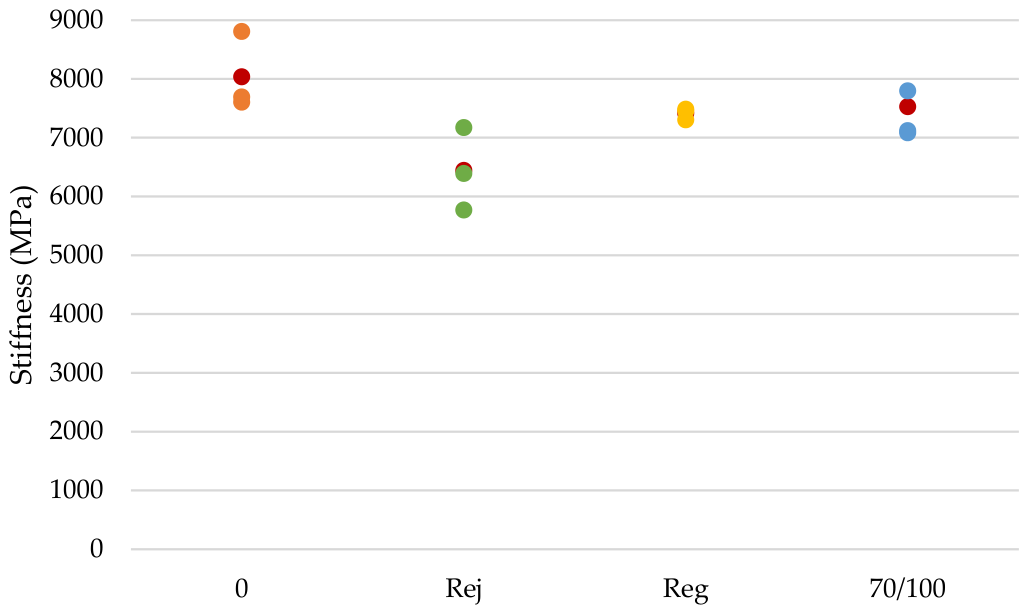
3.4. Stiffness
4. Discussion
5. Conclusions
- The reference mixture, produced with 50% RAP and without binder correction, exhibited the highest stiffness modulus and the best resistance to permanent deformation. However, this increased stiffness may also be associated with a more brittle mechanical response and a greater susceptibility to cracking.
- Among the strategies evaluated, the rejuvenator provided the most balanced overall performance in terms of the mechanical properties assessed at mixture level. It achieved the lowest stiffness modulus while maintaining high water resistance, satisfactory rutting resistance, and adequate air void content, demonstrating its effectiveness in reducing excessive mixture stiffness without compromising structural performance.
- The regenerator also showed satisfactory performance, particularly in terms of water resistance and rutting behavior. However, its stiffness remained higher than that of the rejuvenated mixture, resulting in a less favorable balance among the evaluated mechanical indicators.
- The mixture produced with 70/100 bitumen showed the least favorable overall response. Although its stiffness was lower than that of the reference mixture, it exhibited the highest air void content and the lowest resistance to permanent deformation. These results indicate that the use of a softer virgin binder alone does not necessarily provide the same mixture-level response as additives specifically designed for high-RAP applications.
- From a scientific perspective, the results demonstrate that reducing the stiffness of high-RAP mixtures is not sufficient by itself to ensure improved mechanical performance. The behavior of these mixtures must be interpreted through the combined balance between compactability, stiffness, moisture resistance, and resistance to permanent deformation, among other mechanical characteristics.
- The direct comparison of three binder correction strategies under equivalent design and manufacturing conditions provides new mixture-level evidence regarding the influence of different approaches to RAP binder correction, contributing to a better understanding of the factors governing the mechanical response of high-RAP asphalt mixtures.
- From a practical perspective, the results support the use of asphalt mixtures containing 50% RAP as a technically feasible and potentially more sustainable solution for pavement rehabilitation, provided that an appropriate binder correction strategy is adopted. Under the dosage and experimental conditions evaluated, the rejuvenator was the most effective strategy among the solutions studied.
Author Contributions
Funding
Data Availability Statement
Conflicts of Interest
References
- Asociación Española de la Carretera. Audit of the Condition of Spanish Roads 2025; Asociación Española de la Carretera: Madrid, Spain, 2025. [Google Scholar]
- Noland, R.B.; Hanson, C.S. Life-cycle greenhouse gas emissions associated with a highway reconstruction: A New Jersey case study. J. Clean. Prod. 2015, 107, 731–740. [Google Scholar] [CrossRef]
- Chester, M.V.; Horvath, A. Environmental assessment of passenger transportation should include infrastructure and supply chains. Environ. Res. Lett. 2009, 4, 24008. [Google Scholar] [CrossRef]
- Hajj, E.; Sebaaly, P.; Kandiah, P. Use of Reclaimed Asphalt Pavements (RAP) in Airfields HMA Pavements; University of Nevada Reno, Department of Civil and Environmental Engineering College of Engineering: Reno, NV, USA, 2008. [Google Scholar]
- Alonso-Troyano, C.; Llopis-Castelló, D.; García, A. Towards highly sustainable asphalt mixtures using RAP and ceramic waste. Constr. Build. Mater. 2026, 506, 145039. [Google Scholar] [CrossRef]
- Zaumanis, M.; Mallick, R.B.; Frank, R. 100% recycled hot mix asphalt: A review and analysis. Resour. Conserv. Recycl. 2014, 92, 230–245. [Google Scholar] [CrossRef]
- Bilema, M.; Yuen, C.W.; Memon, Z.A. A systematic review on rejuvenators in flexible asphalt pavement: Types, content, methods, performance, and applications. Open Eng. 2026, 16, 20250151. [Google Scholar] [CrossRef]
- Meng, Y.; Ouyang, J.; Ong, G.P.; Ou, J. Fracture Behavior of Asphalt Emulsion Warm-Mix Recycled Asphalt Mixtures Incorporating High RAP Contents and Rejuvenator. J. Mater. Civ. Eng. 2026, 38, 4026055. [Google Scholar] [CrossRef]
- Al-Saffar, Z.H.; Yaacob, H.; Katman, H.Y.; Mohd Satar, M.K.I.; Bilema, M.; Putra Jaya, R.; Radeef, H.R. A review on the durability of recycled asphalt mixtures embraced with rejuvenators. Sustainability 2021, 13, 8970. [Google Scholar] [CrossRef]
- Mirhosseini, A.F.; Tahami, S.A.; Hoff, I.; Dessouky, S.; Ho, C.H. Performance evaluation of asphalt mixtures containing high-RAP binder content and bio-oil rejuvenator. Constr. Build. Mater. 2019, 227, 116465. [Google Scholar] [CrossRef]
- Samad, A.; Luo, X.; Wang, J.; Abid, M.W. Optimization of recycled asphalt binder with eco-friendly additives: Activation energy and bonding properties. Constr. Build. Mater. 2025, 497, 143795. [Google Scholar] [CrossRef]
- Verma, M.; Saboo, N. Effect of rejuvenator characteristics on the performance attributes of recycled asphalt binder and mixture. Mech. Time-Depend. Mater. 2026, 30, 18. [Google Scholar] [CrossRef]
- Ziari, H.; Moniri, A.; Bahri, P.; Saghafi, Y. Evaluation of performance properties of 50% recycled asphalt mixtures using three types of rejuvenators. Pet. Sci. Technol. 2019, 37, 2355–2361. [Google Scholar] [CrossRef]
- Zhang, Y.; Bahia, H.U. Effects of recycling agents (RAs) on rutting resistance and moisture susceptibility of mixtures with high RAP/RAS content. Constr. Build. Mater. 2021, 270, 121369. [Google Scholar] [CrossRef]
- Altarawneh, O.; Masad, E.; Epps Martin, A.; Arámbula-Mercado, E.; Leavitt, A. Performance and Aging Characteristics of Asphalt Binders and Asphalt Mixtures Incorporating High Recycled Asphalt Pavement and a Recycling Agent. Transp. Res. Rec. 2025, 2679, 576–589. [Google Scholar] [CrossRef]
- Xia, H.; Zhang, X.; Zhao, Y.; Liu, L.; Cao, J. Performance Evaluation of High-RAP Asphalt Mixtures with Compound Bio-Based Rejuvenators. J. Mater. Civ. Eng. 2026, 38, 4026164. [Google Scholar] [CrossRef]
- Sun, Y.; Zhang, F.; Wang, D.; Lin, W.; Wu, H.; Song, W.; Cannone Falchetto, A. Mechanistic insights into the circular aging-recycling evolution of bio-oil rejuvenated asphalt binders with high RAP content. Constr. Build. Mater. 2026, 523, 146311. [Google Scholar] [CrossRef]
- Ding, H.; Zhang, K.; Li, S.; Wang, D.; Huang, W.; Cao, M.; Qiu, Y.; Yuan, H. Evaluation of rejuvenation efficiency and compatibility of rejuvenated asphalts: A framework based on rheology, FTIR and Hansen Solubility. Constr. Build. Mater. 2026, 520, 145927. [Google Scholar] [CrossRef]
- UNE-EN 12697-8; Bituminous Mixtures-Test Methods-Part 8: Determination of Void Characteristics of Bituminous Specimens. Spanish Association for Standardization and Certification (AENOR): Madrid, Spain, 2020.
- UNE-EN 12697-12; Bituminous Mixtures-Test Methods-Part 12: Determination of the Water Sensitivity of Bituminous Specimens. Spanish Association for Standardization and Certification (AENOR): Madrid, Spain, 2019.
- UNE-EN 12697-22; Bituminous Mixtures-Test Methods-Part 22: Wheel Tracking. Spanish Association for Standardization and Certification (AENOR): Madrid, Spain, 2022.
- UNE-EN 12697-26; Bituminous Mixtures-Test Methods-Part 26: Stiffness. Spanish Association for Standardization and Certification (AENOR): Madrid, Spain, 2019.
- Ministerio de Fomento. Pliego de Prescripciones Técnicas Generales para obras de Carreteras y Puentes de la Dirección General de Carreteras (PG-3); Ministerio de Fomento: Madrid, Spain, 2008. [Google Scholar]
- Ministerio de Fomento. Orden FOM 3460. Norma 6.1-IC Secciones de Firme, de la Instrucción de Carreteras; Ministerio de Fomento: Madrid, Spain, 2003. [Google Scholar]
- UNE-EN 933-1; Tests for Geometrical Properties of Aggregates—Part 1: Determination of Particle Size Distribution—Sieving Method. Spanish Association for Standardization and Certification (AENOR): Madrid, Spain, 2012.
- UNE-EN 933-2; Tests for Geometrical Properties of Aggregates—Part 1: Determination of Particle Size Distribution—Test Sieves, Nominal Size of Openings. Spanish Association for Standardization and Certification (AENOR): Madrid, Spain, 2022.
- UNE-EN 12697-39; Bituminous Mixtures-Test Methods-Part 39: Binder Content by Ignition. Spanish Association for Standardization and Certification (AENOR): Madrid, Spain, 2022.
- UNE-EN 12697-6; Bituminous Mixtures-Test Methods for Hot Mix Asphalt-Part 6: Determination of Bulk Density of Bituminous Specimens. Spanish Association for Standardization and Certification (AENOR): Madrid, Spain, 2012.
- UNE-EN 12697-33; Bituminous Mixtures-Test Method-Part 33: Specimen Prepared by Roller Compactor. Spanish Association for Standardization and Certification (AENOR): Madrid, Spain.
- UNE-EN 12697-30; Bituminous Mixtures-Test Methods-Part 30: Specimen Preparation by Impact Compactor. Spanish Association for Standardization and Certification (AENOR): Madrid, Spain, 2019.



| Fraction | Test Sieves for Aggregates (mm) | |||||||
|---|---|---|---|---|---|---|---|---|
| 16.0 | 11.2 | 8.0 | 5.6 | 4.0 | 2.0 | 0.5 | 0.063 | |
| RAP 0/8 | 100.0 | 100.0 | 99.7 | 87.4 | 73.5 | 48.7 | 25.0 | 11.4 |
| RAP 8/20 | 88.8 | 68.2 | 40.3 | 28.5 | 24.7 | 19.0 | 12.3 | 5.7 |
| Limestone 0/4 | 100.0 | 100.0 | 100.0 | 99.3 | 90.8 | 65.0 | 27.9 | 15.4 |
| Limestone 4/11 | 100.0 | 97.1 | 76.6 | 44.1 | 18.6 | 8.5 | 5.2 | 3.6 |
| Type of Asphalt Mixture | Aggregates | Binder | Additive | ||
|---|---|---|---|---|---|
| RAP 8/20 | Limestone 0/4 | Limestone 4/10 | |||
| 0 | 50% | 18% | 32% | 4.5% 50/70 | - |
| REJ | 50% | 18% | 32% | 4.5% 50/70 | Rejuvenator |
| REG | 50% | 18% | 32% | 4.5% 50/70 | Regenerator |
| 70/100 | 50% | 18% | 32% | 4.5% 70/100 | - |
| Type of Asphalt Mixture | Maximum Density (g/cm3) | Bulk Density (g/cm3) | Air Void Content (%) |
|---|---|---|---|
| 0 | 2.567 | 2.415 | 5.90 |
| Rej | 2.543 | 2.408 | 5.31 |
| Reg | 2.550 | 2.413 | 5.36 |
| 70/100 | 2.551 | 2.395 | 6.13 |
| Type of Asphalt Mixture | WTSAIR | PRD (%) | RD (mm) |
|---|---|---|---|
| 0 | 0.060 | 3.06 | 1.796 |
| Rej | 0.059 | 3.18 | 1.755 |
| Reg | 0.076 | 3.67 | 1.836 |
| 70/100 | 0.138 | 6.31 | 3.153 |
| Test | Standards [18] | Type of Asphalt Mixture | |||
|---|---|---|---|---|---|
| 0 | Rej | Reg | 70/100 | ||
| Air voids (%) | High-Moderate traffic category: (4–6) | 5.90 | 5.31 | 5.36 | 6.13 |
| Low traffic category: (3–6) | 5.90 | 5.31 | 5.36 | 6.13 | |
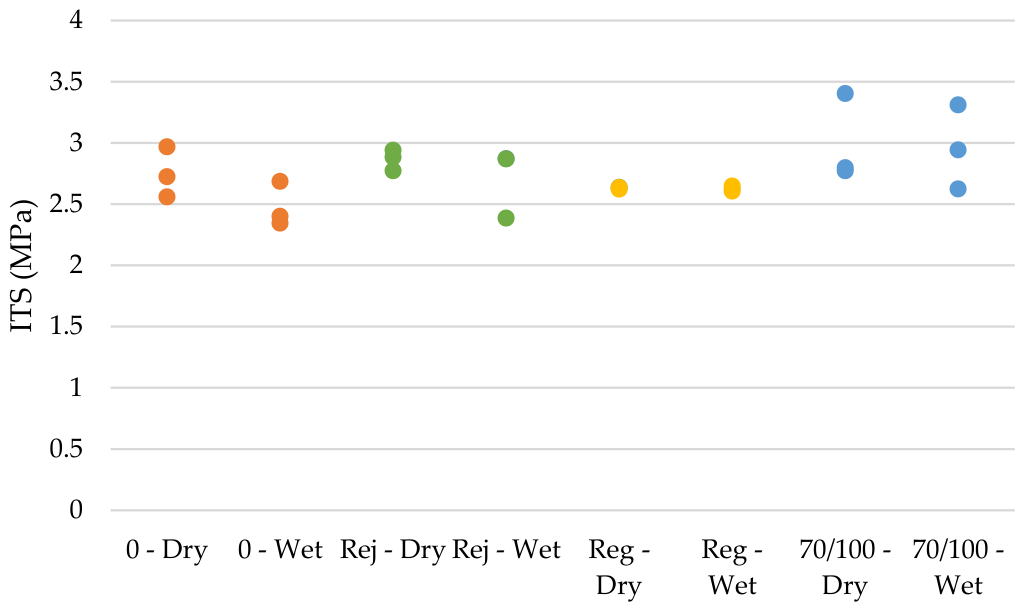
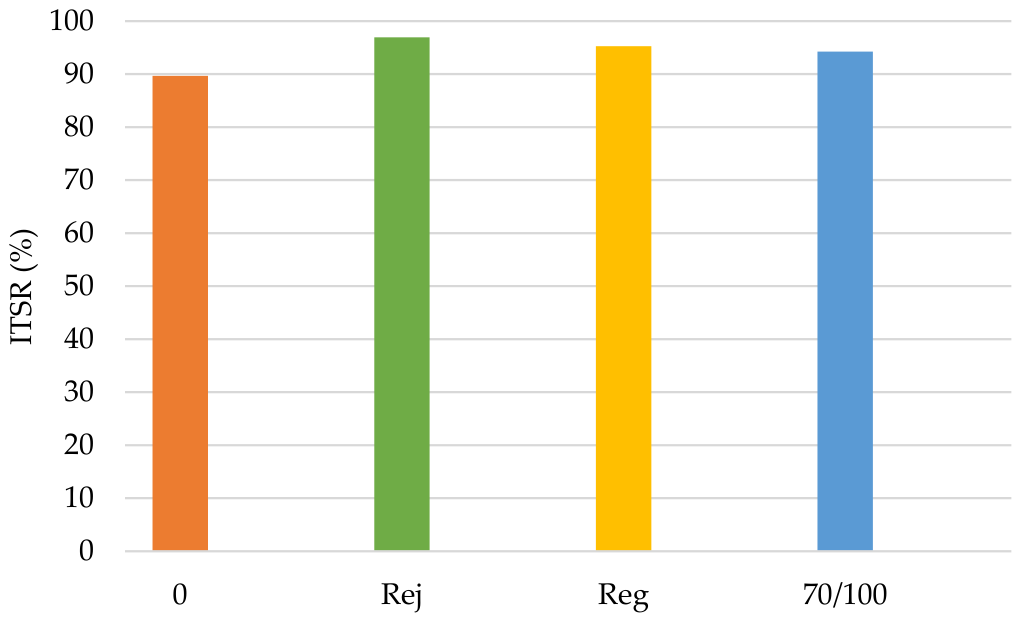
| ITSR (%) | >85 | 89.69 | 96.96 | 95.27 | 94.25 |
| WTSAIR (mm/103 cycles) | High-Moderate traffic category: <0.07 | 0.060 | 0.059 | 0.076 | 0.138 |
| Low traffic category: <0.10 | 0.060 | 0.059 | 0.076 | 0.138 | |
| Stiffness (MPa) | 6000–7000 | 8034 | 6443 | 7413 | 7526 |
Disclaimer/Publisher’s Note: The statements, opinions and data contained in all publications are solely those of the individual author(s) and contributor(s) and not of MDPI and/or the editor(s). MDPI and/or the editor(s) disclaim responsibility for any injury to people or property resulting from any ideas, methods, instructions or products referred to in the content. |
© 2026 by the authors. Licensee MDPI, Basel, Switzerland. This article is an open access article distributed under the terms and conditions of the Creative Commons Attribution (CC BY) license.
Share and Cite
López-García, D.; Alonso-Troyano, C.; Llopis-Castelló, D. Performance Evaluation of High-RAP Asphalt Mixtures Incorporating Rejuvenators, Regenerators, and Softer Binders. Infrastructures 2026, 11, 198. https://doi.org/10.3390/infrastructures11060198
López-García D, Alonso-Troyano C, Llopis-Castelló D. Performance Evaluation of High-RAP Asphalt Mixtures Incorporating Rejuvenators, Regenerators, and Softer Binders. Infrastructures. 2026; 11(6):198. https://doi.org/10.3390/infrastructures11060198
Chicago/Turabian StyleLópez-García, David, Carlos Alonso-Troyano, and David Llopis-Castelló. 2026. "Performance Evaluation of High-RAP Asphalt Mixtures Incorporating Rejuvenators, Regenerators, and Softer Binders" Infrastructures 11, no. 6: 198. https://doi.org/10.3390/infrastructures11060198
APA StyleLópez-García, D., Alonso-Troyano, C., & Llopis-Castelló, D. (2026). Performance Evaluation of High-RAP Asphalt Mixtures Incorporating Rejuvenators, Regenerators, and Softer Binders. Infrastructures, 11(6), 198. https://doi.org/10.3390/infrastructures11060198