Article

Performance Evaluation of High-RAP Asphalt Mixtures Incorporating Rejuvenators, Regenerators, and Softer Binders


by
David López-García
,
Carlos Alonso-Troyano
and
David Llopis-Castelló
*
Highway Engineering Research Group, Universitat Politècnica de València, Camino de Vera s/n, 46022 Valencia, Spain
*
Author to whom correspondence should be addressed.
Infrastructures 2026, 11(6), 198; https://doi.org/10.3390/infrastructures11060198
Submission received: 8 May 2026 / Revised: 6 June 2026 / Accepted: 9 June 2026 / Published: 10 June 2026

Abstract

The need for potentially more sustainable road rehabilitation solutions has driven the use of reclaimed asphalt pavement (RAP) in bituminous mixtures. However, high-RAP content remains a technical challenge due to binder ageing, which increases mixture stiffness and adversely affects its mechanical performance. The aim of this research is to evaluate three strategies for correcting aged binder in asphalt concrete (AC) 16 surf S mixtures containing 50% RAP: rejuvenator, regenerator, and softer virgin bitumen. To this end, four asphalt mixtures were evaluated through tests on air void content, water sensitivity, resistance to permanent deformation, and stiffness modulus, in accordance with European standards. The results show that the reference mixture without binder correction exhibits excessive stiffness, whereas the mixture incorporating a rejuvenator showed the most favorable combination of the mechanical indicators evaluated, combining a significant reduction in stiffness modulus with high water resistance and adequate rutting resistance. The mixture with regenerator showed an intermediate response, while the exclusive use of a softer bitumen did not achieve satisfactory overall performance. The results confirm that the use of high-RAP contents in AC 16 surf S mixtures can be feasible, provided that an appropriate strategy for rheological correction of the aged binder is applied.

1. Introduction

The progressive deterioration of road pavements has become a critical concern for transport infrastructure management. According to the Asociación Española de la Carretera (AEC), more than half of the national road network, approximately 54,000 km, is currently classified as being in poor or very poor condition, with 34,000 km showing severe or very severe structural degradation in 2025 [1]. The lack of sustained investment in conservation and preventive maintenance has led to an estimated deficit exceeding €13.4 billion, further aggravated by rising costs of raw materials, energy, and labor. The implications extend beyond infrastructure functionality: deteriorated pavements contribute to a 10–12% increase in fuel consumption, accelerated vehicle wear, higher crash rates, and delays in the transition toward safer, more energy-efficient, and environmentally sustainable mobility systems.
Conventional methods for repairing and rehabilitating flexible pavements involve high consumption of virgin aggregates and bitumen, both non-renewable resources. In addition, these techniques generate large volumes of construction waste and significant greenhouse gas emissions. The construction and maintenance phases of road infrastructure can account for between 10% and 20% of total life-cycle emissions, with bituminous mixtures being the main contributors [2,3]. Consequently, there is an urgent need to redefine pavement engineering practices to align them with the principles of the circular economy and sustainable development, reducing environmental impacts without compromising, and even improving, technical performance.
In this context, the use of recycled materials in asphalt mixtures as substitutes for aggregates has emerged as one of the most promising strategies for sustainable pavement construction, particularly reclaimed asphalt pavement (RAP). This material is obtained from milling existing asphalt layers during maintenance and rehabilitation operations and consists of mineral aggregates coated with aged bituminous binder. The reuse of RAP reduces the consumption of virgin bitumen and aggregates, minimizes waste generation, and potentially lowers production costs compared to conventional mixtures [4]. In this regard, Alonso-Troyano et al. [5] demonstrated that the combined incorporation of RAP and ceramic waste can produce mixtures that meet the mechanical requirements for low- and medium-traffic roads, confirming their viability as a sustainable solution.
However, the use of RAP, especially at high contents, introduces significant challenges related to the mechanical behavior of the asphalt mixtures. Binder ageing, caused by oxidation processes and the loss of volatile compounds, increases viscosity and stiffness, reducing ductility and increasing susceptibility to cracking, particularly at low temperatures and under fatigue loading [6]. Furthermore, this ageing may lead to durability issues, such as increased moisture damage sensitivity and reduced deformation capacity. Recent reviews have highlighted that these limitations are among the main factors restricting the use of high-RAP contents in asphalt mixtures [7].
These effects have been experimentally observed in recent studies. Meng et al. [8] analyzed recycled asphalt mixtures with RAP contents of up to 100%, finding that although these mixtures exhibit high stiffness, their low-temperature cracking performance is clearly unfavorable. However, the same study demonstrated that the incorporation of rejuvenators significantly improves fracture energy and cracking resistance, highlighting that modification of the aged binder is key to ensuring adequate performance in high-RAP asphalt mixtures.
To mitigate these drawbacks, numerous studies have explored the incorporation of rejuvenating and regenerating agents to restore the viscoelastic balance of aged binders. These additives act by reducing bitumen viscosity, rebalancing the asphaltene/maltene ratio, and improving properties such as ductility, fatigue resistance, and low-temperature performance [9]. Regenerating agents, in addition, may induce chemical changes that partially reverse the effects of oxidation, contributing to the recovery of the binder’s colloidal structure [10]. In this line, the use of alternative eco-efficient additives, such as waste engine oil (WEO), crumb rubber (CR), and styrene-butadiene-styrene (SBS) copolymer, has also been proposed as a way to improve the workability, fatigue resistance, adhesion, and high-temperature performance of recycled binders, reinforcing the potential of sustainable additive-based strategies for RAP valorization [11].
Nevertheless, the effectiveness of these additives largely depends on their physicochemical characteristics. Verma and Saboo [12] concluded that properties such as viscosity, diffusion capacity, and ageing resistance of the rejuvenator play a decisive role in the final mixture performance, influencing the balance between cracking and rutting resistance. In particular, higher diffusion capacity promotes homogenization of the aged binder and improves fatigue response, whereas less diffusive products tend to maintain higher structural stiffness.
Experimental evidence supports the effectiveness of these additives: asphalt mixtures with high-RAP contents treated with rejuvenators can show significant improvements in fatigue resistance and moisture durability [13], while maintaining deformation resistance close to that of virgin mixtures, although potential reductions in rutting resistance may occur if dosage is not properly optimized [14]. For instance, mixtures containing 40% RAP and a bio-based recycling agent have been reported to achieve intermediate- and high-temperature performance comparable to, or even better than, mixtures with lower RAP contents, although the same results also warn that recycling agents may increase ageing susceptibility and therefore require careful performance-based validation [15]. This need for optimization is also supported by studies on compound bio-based rejuvenators, which show that excessive rejuvenator contents may improve flexibility but reduce rutting resistance or low-temperature fracture toughness [16].
Despite these advances, most existing studies analyze the effect of additives in isolation or focus on a single binder modification strategy. This limits a comprehensive understanding of their relative effectiveness and complicates the selection of the most appropriate solution under real design conditions. Moreover, recent research indicates that the apparent efficiency of a rejuvenator should not be assessed only through short-term binder softening, but also through its ageing evolution, compatibility with the aged binder, and ability to maintain a balanced mechanical response after recycling [17,18].
In this context, the present study focuses on the comparative evaluation of the mechanical performance of asphalt concrete (AC) 16 surf S asphalt mixtures with a 50% RAP content, incorporating different strategies for modifying aged binder, including the use of a rejuvenator, a regenerator, and a softer bitumen under equivalent design conditions. Unlike previous studies, this research systematically addresses the direct comparison between different solutions, assessing their influence on key properties such as stiffness, resistance to permanent deformation, water sensitivity, and air void content.
The main contribution of this work lies in demonstrating that the incorporation of high-RAP contents is not only technically feasible but also requires appropriate rheological correction of the binder to achieve a suitable balance between stiffness, moisture resistance, compactability, and resistance to permanent deformation. In this regard, the results allow the identification of significant differences in the performance of the various strategies, highlighting that not all solutions are equivalent and that their selection decisively affects the mechanical properties of the mixture.
Thus, this study provides experimental evidence on the relative effectiveness of different types of additives in high-RAP mixtures, offering technical criteria for their selection and contributing to the development of high-performance recycled mixtures capable of maximizing the use of recycled materials without compromising structural behavior.

2. Materials and Methods

This research focuses on evaluating the technical feasibility of using rejuvenating and regenerating additives, as well as softer bitumen, in AC16 surf S asphalt mixtures containing a high content of RAP. The adopted methodology (Figure 1) includes the characterization of constituent materials, mixture design, and performance evaluation through the following standardized tests: (i) air void content [19], (ii) water sensitivity [20], (iii) wheel tracking test [21], and (iv) stiffness modulus [22]. The test results were compared with the specifications established in Spanish road standards [23,24].

2.1. Materials

For this study, a semi-dense asphalt concrete mixture AC16 surf S was selected. The following natural and recycled aggregates were used for mixture production: limestone aggregates were employed as the fine fraction, with a maximum size of 4 mm, and coarse fraction ranged from 4 to 10 mm. RAP was incorporated in two fractions: 0/8 mm and 8/22 mm. Aggregate characterization was carried out through particle size distribution analysis in accordance with UNE-EN 933-1 [25] and UNE-EN 933-2 [26], after washing and drying the samples to remove fines. Table 1 presents the gradation distribution.
To ensure an accurate mixture design, the residual binder content in the RAP fractions was determined using the ignition method [27]. The results indicated an average binder content of 5.03% for the fine fraction (0/8) and 3.37% for the coarse fraction (8/22).
A 50/70 penetration grade bitumen was selected for the reference mixture and for the mixtures modified with rejuvenating and regenerating additives. The rejuvenating additive used was Ravasol RAP-4F, added at 0.15% by weight of RAP in the mixture, as recommended by the manufacturer in the product technical datasheet. A regenerating additive, Ravasol RAP-8V, was also used at 0.15% by weight of RAP in the mixture, this dosage being within the range recommended by the manufacturer. This dosage was selected to compare both additives under practical application conditions and equivalent mixture design criteria, rather than to optimize the dosage of each product.
Although both additives are intended to improve the behavior of aged binders in RAP mixtures, their expected mechanisms of action differ. The rejuvenating additive is mainly intended to reduce the stiffness associated with binder ageing, thereby improving the flexibility and workability of the mixture. In contrast, the regenerating additive is designed not only to soften the aged binder but also to promote a broader recovery of the aged binder response, according to its intended function. Therefore, while the rejuvenator mainly provides a softening effect, the regenerator aims to achieve a broader improvement in the response of the aged binder. In the present study, this distinction is considered from the perspective of mixture-level mechanical performance, rather than through direct chemical or rheological binder characterization.
In contrast, a 70/100 penetration grade bitumen was used to evaluate the effect of a softer binder on mixture performance.

2.2. Mix Design

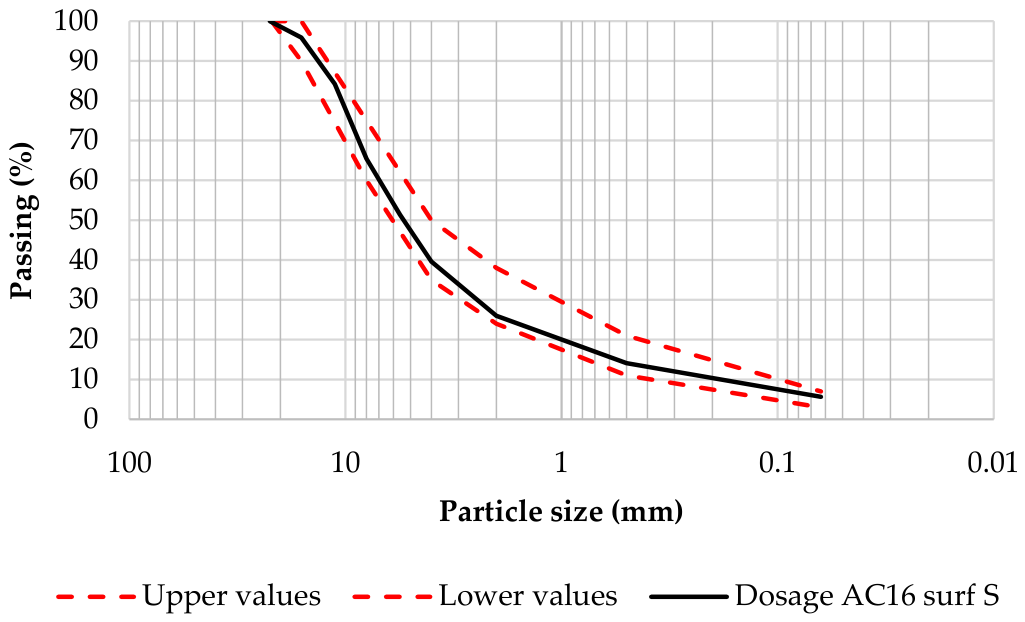
Four AC16 surf S asphalt mixtures were designed, all composed of 50% natural limestone aggregates and 50% RAP. Figure 2 shows the adjusted gradation curve designed to comply with the grading envelope specified in the Spanish standards (PG-3) for surface courses [23].
Due to the high fines content in the RAP, the mixture was designed with a filler-to-binder ratio of 1.44, which was considered the optimal proportion to avoid excessive stiffness of the mastic. The final composition of the four mixtures studied is detailed in Table 2.

2.3. Specimen Preparation

The manufacturing process was carried out under strict control of temperature and mixing times. The aggregates, including the RAP, were preheated to 85 °C to remove moisture without causing additional aging of the RAP binder and to facilitate mixing. Subsequently, the aggregates and binder were heated to the mixing temperature: 155 °C for the 50/70 bitumen and 150 °C for the 70/100 bitumen.
In the mixtures containing additives, these were incorporated into the binder before its addition to the mixer. The laboratory manufacturing procedure was selected to reproduce, as closely as possible, the main stages occurring during plant production of high-RAP asphalt mixtures, including RAP preheating, contact between the aged RAP binder and the virgin binder during mixing, and incorporation of the additives into the virgin binder before mixing. Although this procedure is expected to promote partial interaction between the aged RAP binder, the virgin binder, and the additives, no complete binder homogenization is assumed, as occurs in plant manufacturing processes of asphalt mixtures. After mixing, the mixture was compacted according to the specific requirements of each test.
After mixing, the mixture was compacted according to the specific requirements of each test. A total of 48 cylindrical specimens and 8 prismatic specimens were manufactured so as to develop the following tests.
The air void content, determined according to UNE-EN 12697-8 [19], was calculated from the relationship between the theoretical maximum density and the bulk density of the mixture. The bulk density, according to UNE-EN 12697-6 [28], was measured on four cylindrical specimens with a minimum thickness of 20 mm or twice the nominal maximum aggregate size, compacted with 75 blows per face.
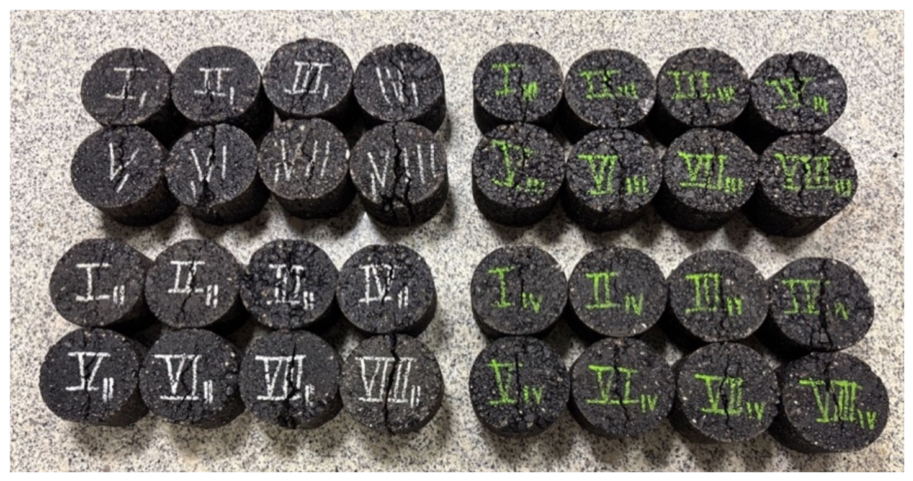
For the water sensitivity test, according to UNE-EN 12697-12 [20], eight cylindrical specimens were prepared for each mixture, with a diameter of 100 ± 3 mm and a height of 63.5 ± 2.5 mm, by impact compaction with 50 blows per face. The dry subset was stored on a flat surface at laboratory room temperature (~20 °C). The wet subset was subjected to vacuum saturation, ensuring that the volume increase did not exceed 2%, and was subsequently immersed in a water bath at 40 ± 2 °C for 72 ± 2 h to simulate the effects of moisture. The final appearance of the specimens after testing is shown in Figure 3.
For the wheel tracking test, according to UNE-EN 12697-22 [21], two prismatic specimens were prepared for each mixture, with dimensions of 260 × 410 mm and a thickness between 40 and 60 mm, in accordance with UNE-EN 12697-33 [29] using a plate compactor. After fabrication, the specimens were conditioned at laboratory room temperature (~20 °C) prior to testing.
For the stiffness modulus test, according to UNE-EN 12697-26 [22], four cylindrical specimens per mixture were manufactured by impact compaction in accordance with UNE-EN 12697-30 [30]. The specimens had a diameter of 100 ± 3 mm and a height of 60 ± 2 mm and were compacted with 75 blows per face. Once manufactured, the specimens were stored on a flat surface at a temperature not exceeding 20 °C for a period between 14 and 42 days before testing.

3. Results

This section presents the results obtained from the tests carried out on the four asphalt mixtures studied: the reference asphalt mixture without additives (0), the asphalt mixture with rejuvenator (Rej), the asphalt mixture with regenerator (Reg), and the asphalt mixture with softer bitumen (70/100). The tests include: (i) air void content, (ii) water sensitivity, (iii) resistance to permanent deformation, and (iv) stiffness.

3.1. Air Void Content

Table 3 includes the maximum density, the bulk density, and the resulting air void content of each type of asphalt mixture. It can be observed that the incorporation of additives facilitated compaction, leading to a reduction in air void content compared with the reference mixture. However, the use of a softer binder did not result in adequate densification, which led to a higher air void content.

3.2. Water Sensitivity

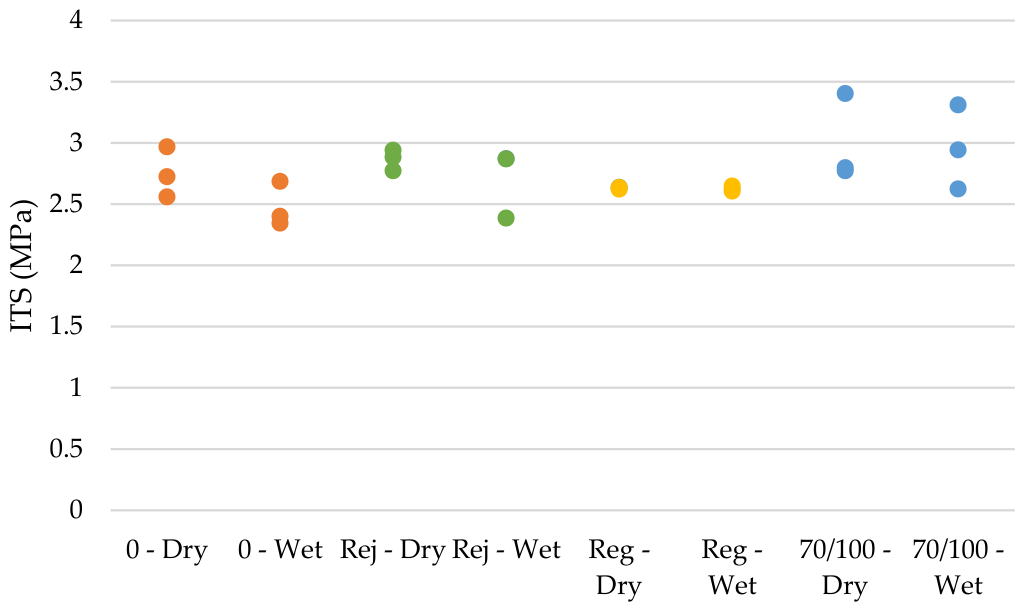
Figure 4 shows that the Indirect Tensile Strength (ITS) values obtained under wet conditions were slightly lower than those measured under dry conditions for all mixtures, which is consistent with the expected effect of moisture on asphalt mixture cohesion and adhesion. However, the differences between dry and wet conditions were generally limited, indicating an adequate resistance to moisture damage in all cases. Furthermore, no significant differences in tensile strength were observed among the different binder correction strategies. Nevertheless, the mixtures manufactured with softer virgin bitumen exhibited slightly higher ITS values compared with the other alternatives, both under dry and wet conditions.
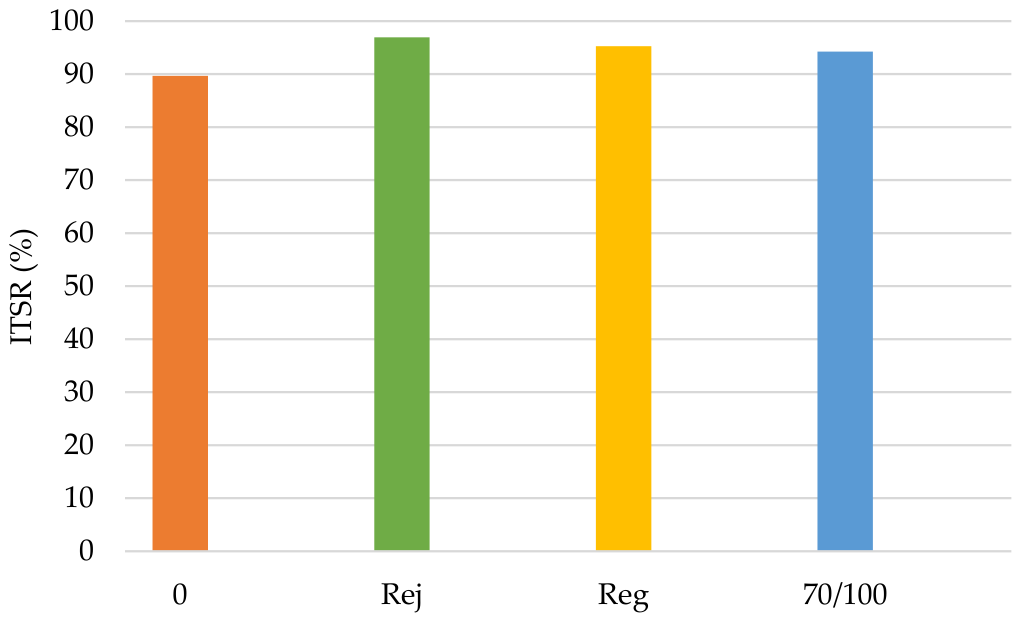
Concerning the Indirect Tensile Strength Ratio (ITSR), shown in Figure 5, a general improvement in water sensitivity can be observed when additives are incorporated or when a softer binder is employed. The reference mixture (0) showed the lowest ITSR value, at 89.69%, whereas the modified mixtures achieved higher values. In particular, the rejuvenated mixture (Rej) exhibited the best performance, with an ITSR of 96.96%, followed by the regenerated mixture (Reg), with 95.27%, and the mixture produced with 70/100 soft bitumen, with 94.25%.
These results indicate that all mixtures clearly exceeded the minimum required threshold (85%), confirming adequate resistance to water action. Furthermore, the increase in ITSR observed in the mixtures containing additives suggests that these additives not only contribute to recovering or improving the properties of the aged binder but also enhance the aggregate–binder adhesion.

3.3. Resistance to Permanent Deformation

The test consists of the repeated passage of a loaded wheel over an asphalt specimen. It was carried out according to Procedure B in air at 60 °C for 10,000 cycles, using the Wheel Tracking Slope in air (WTSAIR), the Proportional Rut Depth (PRD), and the Rut Depth (RD) as characterization parameters to assess resistance to permanent deformation. The results obtained for these parameters are summarized in Table 4.
The asphalt mixture with softer bitumen showed the poorest performance, with higher deformation values for each parameter compared with the other asphalt mixtures. In contrast, the reference mixture (0) and the rejuvenated mixture (Rej) exhibited excellent resistance to deformation, with WTSAIR values of around 0.060 mm/103 cycles. The regenerated mixture (Reg) showed intermediate performance, although within acceptable ranges of structural stability.

3.4. Stiffness

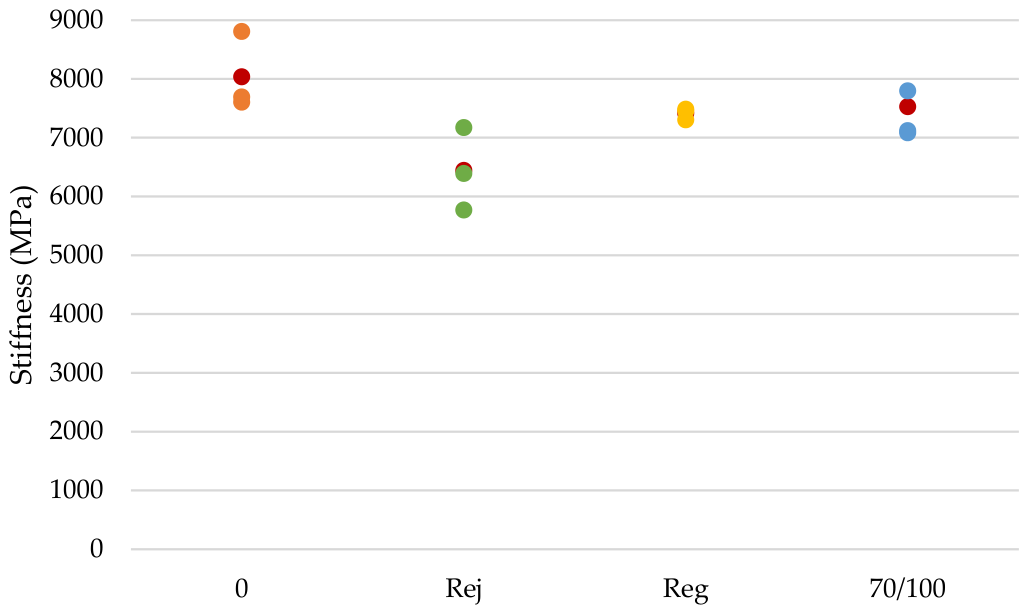
Figure 6 illustrates the stiffness modulus obtained at 20 °C for each specimen and the average value for each asphalt mixture (red circles). The effect of binder ageing is clearly evidenced in the reference mixture (0), which reached a very high stiffness for this type of mixture, with a value of 8034 MPa.
The incorporation of additives successfully reduced the stiffness of the mixtures. The rejuvenated mixture (Rej) showed the lowest stiffness modulus, falling within a range closer to the typical behavior of a conventional mixture (6000–7000 MPa). The asphalt mixture with softer bitumen and the regenerated mixture showed intermediate values. This reduction in modulus in the rejuvenated mixture suggests an effective reduction in the stiffness of the high-RAP mixture under the adopted manufacturing conditions, resulting in a mechanical response closer to that expected for a conventional mixture.

4. Discussion

The results obtained confirm that the incorporation of 50% RAP in AC16 surf S mixtures can be technically feasible, although their performance depends decisively on the strategy used to counteract the effect of the aged binder. Beyond simple compliance with specifications, the tests carried out show that each binder modification approach produces a different mechanical balance between compactability, water durability, stiffness, and resistance to permanent deformation.
The lower air void content of the mixtures with additives suggests improved compactability under the same compaction energy, whereas the higher air void content of the 70/100 mixture indicates that the use of a softer virgin binder alone did not provide the same densification response. The analysis of the air void content shows that most of the mixtures fall within the limits required by the Spanish specifications for AC16 surf S mixtures [23]. Spanish standards (PG-3) established values between 4% and 6% for high and moderate traffic categories and between 3% and 6% for low categories. In this context, the reference mixture presented a value of 5.9%, while the mixtures with rejuvenator and regenerator reached 5.31% and 5.36%, respectively. By contrast, the mixture produced with the softer binder, 70/100, reached a value of 6.13%, slightly above the maximum admissible limit. This result indicates that the mere use of a softer binder does not guarantee adequate compaction when working with high-RAP contents. On the contrary, the specific additives appear to promote better workability and a denser internal structure, which is particularly important from the point of view of durability.
The higher ITSR values of the modified mixtures suggest a more favorable mixture-level response after moisture conditioning, probably associated with improved cohesion and aggregate–binder adhesion. Spanish specifications require an ITSR value above 85% for this type of mixture. All the formulations analyzed clearly met this requirement, with the reference mixture reaching 89.69%, the rejuvenated mixture 96.96%, the regenerated mixture 95.27%, and the mixture with 70/100 bitumen 94.25%. Although all mixtures widely exceeded the specification threshold, the improved performance of the mixtures with additives is particularly significant. This increase suggests that the action of the rejuvenator and the regenerator is not limited solely to softening the aged binder, but also improves the interaction between binder and aggregates, increasing the cohesion of the system and reducing its susceptibility to moisture damage. Therefore, from the point of view of durability, the use of specific additives represents a clear advantage over the unmodified mixture.
The comparison of resistance to permanent deformation, evaluated through the WTSAIR parameter, allows the effect of each binder modification strategy to be more clearly differentiated. According to PG-3 [23], the admissible limits depend on the traffic category: <0.07–0.10 mm/103 cycles for high and moderate traffic categories, and <0.10–0.15 for low traffic categories. The reference mixture presented a value of 0.060 mm/103 cycles, and the rejuvenated mixture showed a practically identical value of 0.059 mm/103 cycles, with both mixtures satisfying even the most demanding traffic categories. The regenerated mixture reached 0.076 mm/103 cycles, a value that would no longer comply with the requirements for high and moderate traffic categories but would remain within the limits for low traffic categories. In contrast, the mixture with 70/100 bitumen obtained 0.138 mm/103 cycles, meaning that it would only be admissible for low traffic categories, being clearly penalized compared with the other mixtures. The rutting response cannot be attributed solely to the penetration grade of the binder, but should also be interpreted in relation to the compactability achieved by each mixture. In the case of the mixture produced with 70/100 bitumen, the higher air void content reflects a less dense compacted structure, which probably contributed to its greater susceptibility to permanent deformation. Therefore, the results show that not all strategies aimed at reducing stiffness led to equivalent mechanical behavior. While the rejuvenator allowed the stiffness of the mixture to be reduced while maintaining high rutting resistance, the exclusive use of a softer binder was associated with lower compactability and a more pronounced loss of structural stability.
The analysis of the stiffness modulus reinforces this interpretation. Although the value of 6000–7000 MPa should not be interpreted as a strict specification limit, it does constitute a representative reference for the typical behavior of a conventional AC16 surf S asphalt mixture. In this study, the reference mixture reached a stiffness of 8034 MPa, evidencing the effect of ageing of the RAP binder and confirming a potentially more brittle behavior against thermal or fatigue cracking. The high stiffness of the reference mixture is consistent with the presence of aged RAP binder. The rejuvenated mixture reduced this value to 6443 MPa, placing it in a range closer to that expected for a conventional mixture and therefore showing a reduction in mixture stiffness under the adopted manufacturing conditions. The regenerated mixture presented an intermediate stiffness of 7413 MPa, while the mixture with 70/100 bitumen reached 7526 MPa, both values being lower than that of the reference mixture, although still higher than that of the rejuvenated mixture. This confirms that, under the dosage and experimental conditions evaluated, the most effective strategy to reduce the stiffness associated with RAP was not the use of a softer bitumen, but rather the use of a rejuvenator specifically designed for high-RAP mixtures.
The performance obtained for the rejuvenated mixture is consistent with previous research on asphalt mixtures incorporating high amounts of RAP. Alonso-Troyano et al. [5] studied AC16 S asphalt mixtures containing 50% RAP combined with ceramic waste and reported that the C50R50 mixture achieved a stiffness modulus of approximately 6678 MPa, close to the reference value of conventional AC16 S mixtures, together with acceptable rutting indicators, with WTSAIR = 0.094 mm/103 cycles, PRD = 4.38%, and RD = 2.192 mm. In the present study, the rejuvenated mixture reached a similar stiffness level, 6443 MPa, but showed a lower WTSAIR value, 0.059 mm/103 cycles, and a lower rut depth, 1.755 mm. This suggests that the use of a specific rejuvenator can provide a stiffness level comparable to that of sustainable AC16 S mixtures with 50% RAP, while maintaining even higher resistance to permanent deformation.
Similar trends regarding the stiffness–rutting balance were reported by Mirhosseini et al. [10] in RAP asphalt mixtures incorporating date seed oil as a bio-rejuvenator. Their results showed that increasing RAP content led to stiffer mixtures, while the addition of the bio-rejuvenator reduced stiffness but could also increase susceptibility to rutting. This highlights the need for performance-based studies when high-RAP contents and rejuvenating agents are used, since the effectiveness of these additives cannot be assessed only in terms of binder softening. Instead, their impact must be evaluated through the combined analysis of stiffness, moisture resistance, and permanent deformation. In this context, the present study shows that the rejuvenator used provided a balanced response withing these evaluated indicators, reducing the stiffness of the 50% RAP mixture while maintaining rutting resistance at a level comparable to that of the reference mixture.
Overall, the results show that the feasibility of using 50% RAP does not depend solely on the isolated compliance with certain specification parameters, but rather on the overall balance between properties. This overall comparison, including the specification limits considered and the values obtained for each mixture, is summarized in Table 5. The reference mixture presents excellent resistance to permanent deformation and acceptable water sensitivity performance, but its high stiffness limits its suitability from the point of view of cracking. The mixture with the softer binder, by contrast, partially reduces this problem, but worsens compactability and clearly penalizes rutting resistance. The mixture with the regenerator additive offers a reasonably effective intermediate solution, whereas the mixture with the rejuvenator additive shows the most balanced performance across all the parameters analyzed: air void content within specification, an ITSR of 96.96%, a WTSAIR of 0.059 mm/103 cycles, and a stiffness of 6443 MPa, clearly closer to that of a conventional mixture.

5. Conclusions

This study analyzed the mechanical behavior of AC16 surf S asphalt mixtures containing 50% RAP by comparatively evaluating three binder correction strategies under equivalent design and manufacturing conditions: a rejuvenator, a regenerator, and a softer virgin binder (70/100). The results confirm that the performance of high-RAP mixtures depends not only on the amount of recycled material incorporated but also on the effectiveness of the selected strategy in mitigating the stiffening effect associated with the aged RAP binder.
The main conclusions of this study are as follows:
  • The reference mixture, produced with 50% RAP and without binder correction, exhibited the highest stiffness modulus and the best resistance to permanent deformation. However, this increased stiffness may also be associated with a more brittle mechanical response and a greater susceptibility to cracking.
  • Among the strategies evaluated, the rejuvenator provided the most balanced overall performance in terms of the mechanical properties assessed at mixture level. It achieved the lowest stiffness modulus while maintaining high water resistance, satisfactory rutting resistance, and adequate air void content, demonstrating its effectiveness in reducing excessive mixture stiffness without compromising structural performance.
  • The regenerator also showed satisfactory performance, particularly in terms of water resistance and rutting behavior. However, its stiffness remained higher than that of the rejuvenated mixture, resulting in a less favorable balance among the evaluated mechanical indicators.
  • The mixture produced with 70/100 bitumen showed the least favorable overall response. Although its stiffness was lower than that of the reference mixture, it exhibited the highest air void content and the lowest resistance to permanent deformation. These results indicate that the use of a softer virgin binder alone does not necessarily provide the same mixture-level response as additives specifically designed for high-RAP applications.
  • From a scientific perspective, the results demonstrate that reducing the stiffness of high-RAP mixtures is not sufficient by itself to ensure improved mechanical performance. The behavior of these mixtures must be interpreted through the combined balance between compactability, stiffness, moisture resistance, and resistance to permanent deformation, among other mechanical characteristics.
  • The direct comparison of three binder correction strategies under equivalent design and manufacturing conditions provides new mixture-level evidence regarding the influence of different approaches to RAP binder correction, contributing to a better understanding of the factors governing the mechanical response of high-RAP asphalt mixtures.
  • From a practical perspective, the results support the use of asphalt mixtures containing 50% RAP as a technically feasible and potentially more sustainable solution for pavement rehabilitation, provided that an appropriate binder correction strategy is adopted. Under the dosage and experimental conditions evaluated, the rejuvenator was the most effective strategy among the solutions studied.
Future research should extend the analysis through fatigue, cracking, durability, and long-term field performance studies. Additional work should also address additive dosage optimization, life-cycle assessment, and economic analysis to quantify the environmental and economic benefits of these solutions. Furthermore, chemical and rheological characterization of the binder blends obtained by combining aged binder with the different additives should be carried out to better understand the mechanisms underlying the mixture-level performance observed in this study.

Author Contributions

Conceptualization, C.A.-T. and D.L.-C.; methodology, C.A.-T. and D.L.-C.; validation, C.A.-T. and D.L.-C.; formal analysis, D.L.-G.; investigation, D.L.-G.; resources, D.L.-C.; data curation, D.L.-G.; writing—original draft preparation, D.L.-G.; writing—review and editing, C.A.-T. and D.L.-C.; visualization, D.L.-C.; supervision, D.L.-C.; project administration, D.L.-C.; funding acquisition, D.L.-C. All authors have read and agreed to the published version of the manuscript.

Funding

This research was funded by Centre for Technological Development and Innovation (CDTI) and BECSA, S.A.U., through the BECSA Business Chair at the Universitat Politècnica de València.

Data Availability Statement

The raw data supporting the conclusions of this article will be made available by the authors on request.

Conflicts of Interest

The authors declare no conflicts of interest.

References

  1. Asociación Española de la Carretera. Audit of the Condition of Spanish Roads 2025; Asociación Española de la Carretera: Madrid, Spain, 2025. [Google Scholar]
  2. Noland, R.B.; Hanson, C.S. Life-cycle greenhouse gas emissions associated with a highway reconstruction: A New Jersey case study. J. Clean. Prod. 2015, 107, 731–740. [Google Scholar] [CrossRef]
  3. Chester, M.V.; Horvath, A. Environmental assessment of passenger transportation should include infrastructure and supply chains. Environ. Res. Lett. 2009, 4, 24008. [Google Scholar] [CrossRef]
  4. Hajj, E.; Sebaaly, P.; Kandiah, P. Use of Reclaimed Asphalt Pavements (RAP) in Airfields HMA Pavements; University of Nevada Reno, Department of Civil and Environmental Engineering College of Engineering: Reno, NV, USA, 2008. [Google Scholar]
  5. Alonso-Troyano, C.; Llopis-Castelló, D.; García, A. Towards highly sustainable asphalt mixtures using RAP and ceramic waste. Constr. Build. Mater. 2026, 506, 145039. [Google Scholar] [CrossRef]
  6. Zaumanis, M.; Mallick, R.B.; Frank, R. 100% recycled hot mix asphalt: A review and analysis. Resour. Conserv. Recycl. 2014, 92, 230–245. [Google Scholar] [CrossRef]
  7. Bilema, M.; Yuen, C.W.; Memon, Z.A. A systematic review on rejuvenators in flexible asphalt pavement: Types, content, methods, performance, and applications. Open Eng. 2026, 16, 20250151. [Google Scholar] [CrossRef]
  8. Meng, Y.; Ouyang, J.; Ong, G.P.; Ou, J. Fracture Behavior of Asphalt Emulsion Warm-Mix Recycled Asphalt Mixtures Incorporating High RAP Contents and Rejuvenator. J. Mater. Civ. Eng. 2026, 38, 4026055. [Google Scholar] [CrossRef]
  9. Al-Saffar, Z.H.; Yaacob, H.; Katman, H.Y.; Mohd Satar, M.K.I.; Bilema, M.; Putra Jaya, R.; Radeef, H.R. A review on the durability of recycled asphalt mixtures embraced with rejuvenators. Sustainability 2021, 13, 8970. [Google Scholar] [CrossRef]
  10. Mirhosseini, A.F.; Tahami, S.A.; Hoff, I.; Dessouky, S.; Ho, C.H. Performance evaluation of asphalt mixtures containing high-RAP binder content and bio-oil rejuvenator. Constr. Build. Mater. 2019, 227, 116465. [Google Scholar] [CrossRef]
  11. Samad, A.; Luo, X.; Wang, J.; Abid, M.W. Optimization of recycled asphalt binder with eco-friendly additives: Activation energy and bonding properties. Constr. Build. Mater. 2025, 497, 143795. [Google Scholar] [CrossRef]
  12. Verma, M.; Saboo, N. Effect of rejuvenator characteristics on the performance attributes of recycled asphalt binder and mixture. Mech. Time-Depend. Mater. 2026, 30, 18. [Google Scholar] [CrossRef]
  13. Ziari, H.; Moniri, A.; Bahri, P.; Saghafi, Y. Evaluation of performance properties of 50% recycled asphalt mixtures using three types of rejuvenators. Pet. Sci. Technol. 2019, 37, 2355–2361. [Google Scholar] [CrossRef]
  14. Zhang, Y.; Bahia, H.U. Effects of recycling agents (RAs) on rutting resistance and moisture susceptibility of mixtures with high RAP/RAS content. Constr. Build. Mater. 2021, 270, 121369. [Google Scholar] [CrossRef]
  15. Altarawneh, O.; Masad, E.; Epps Martin, A.; Arámbula-Mercado, E.; Leavitt, A. Performance and Aging Characteristics of Asphalt Binders and Asphalt Mixtures Incorporating High Recycled Asphalt Pavement and a Recycling Agent. Transp. Res. Rec. 2025, 2679, 576–589. [Google Scholar] [CrossRef]
  16. Xia, H.; Zhang, X.; Zhao, Y.; Liu, L.; Cao, J. Performance Evaluation of High-RAP Asphalt Mixtures with Compound Bio-Based Rejuvenators. J. Mater. Civ. Eng. 2026, 38, 4026164. [Google Scholar] [CrossRef]
  17. Sun, Y.; Zhang, F.; Wang, D.; Lin, W.; Wu, H.; Song, W.; Cannone Falchetto, A. Mechanistic insights into the circular aging-recycling evolution of bio-oil rejuvenated asphalt binders with high RAP content. Constr. Build. Mater. 2026, 523, 146311. [Google Scholar] [CrossRef]
  18. Ding, H.; Zhang, K.; Li, S.; Wang, D.; Huang, W.; Cao, M.; Qiu, Y.; Yuan, H. Evaluation of rejuvenation efficiency and compatibility of rejuvenated asphalts: A framework based on rheology, FTIR and Hansen Solubility. Constr. Build. Mater. 2026, 520, 145927. [Google Scholar] [CrossRef]
  19. UNE-EN 12697-8; Bituminous Mixtures-Test Methods-Part 8: Determination of Void Characteristics of Bituminous Specimens. Spanish Association for Standardization and Certification (AENOR): Madrid, Spain, 2020.
  20. UNE-EN 12697-12; Bituminous Mixtures-Test Methods-Part 12: Determination of the Water Sensitivity of Bituminous Specimens. Spanish Association for Standardization and Certification (AENOR): Madrid, Spain, 2019.
  21. UNE-EN 12697-22; Bituminous Mixtures-Test Methods-Part 22: Wheel Tracking. Spanish Association for Standardization and Certification (AENOR): Madrid, Spain, 2022.
  22. UNE-EN 12697-26; Bituminous Mixtures-Test Methods-Part 26: Stiffness. Spanish Association for Standardization and Certification (AENOR): Madrid, Spain, 2019.
  23. Ministerio de Fomento. Pliego de Prescripciones Técnicas Generales para obras de Carreteras y Puentes de la Dirección General de Carreteras (PG-3); Ministerio de Fomento: Madrid, Spain, 2008. [Google Scholar]
  24. Ministerio de Fomento. Orden FOM 3460. Norma 6.1-IC Secciones de Firme, de la Instrucción de Carreteras; Ministerio de Fomento: Madrid, Spain, 2003. [Google Scholar]
  25. UNE-EN 933-1; Tests for Geometrical Properties of Aggregates—Part 1: Determination of Particle Size Distribution—Sieving Method. Spanish Association for Standardization and Certification (AENOR): Madrid, Spain, 2012.
  26. UNE-EN 933-2; Tests for Geometrical Properties of Aggregates—Part 1: Determination of Particle Size Distribution—Test Sieves, Nominal Size of Openings. Spanish Association for Standardization and Certification (AENOR): Madrid, Spain, 2022.
  27. UNE-EN 12697-39; Bituminous Mixtures-Test Methods-Part 39: Binder Content by Ignition. Spanish Association for Standardization and Certification (AENOR): Madrid, Spain, 2022.
  28. UNE-EN 12697-6; Bituminous Mixtures-Test Methods for Hot Mix Asphalt-Part 6: Determination of Bulk Density of Bituminous Specimens. Spanish Association for Standardization and Certification (AENOR): Madrid, Spain, 2012.
  29. UNE-EN 12697-33; Bituminous Mixtures-Test Method-Part 33: Specimen Prepared by Roller Compactor. Spanish Association for Standardization and Certification (AENOR): Madrid, Spain.
  30. UNE-EN 12697-30; Bituminous Mixtures-Test Methods-Part 30: Specimen Preparation by Impact Compactor. Spanish Association for Standardization and Certification (AENOR): Madrid, Spain, 2019.
Figure 1. Experimental methodology for the design and evaluation of the asphalt mixtures.
Infrastructures 11 00198 g001
Figure 2. Particle size distribution of the AC16 surf S mixture, including upper and lower limits.
Infrastructures 11 00198 g002
Figure 3. Tested specimens after the water sensitivity test.
Infrastructures 11 00198 g003
Figure 4. Indirect Tensile Strength (ITS) values of dry and wet specimens.
Infrastructures 11 00198 g004
Figure 5. Indirect Tensile Strength Ratio (ITSR) of each tested mixture.
Infrastructures 11 00198 g005
Figure 6. Stiffness modulus at 20 °C of each tested mixture. Red circles represent the average value of each mixture.
Infrastructures 11 00198 g006
Table 1. Aggregate gradation distribution for the RAP and virgin limestone fractions.
FractionTest Sieves for Aggregates (mm)
16.011.28.05.64.02.00.50.063
RAP 0/8100.0100.099.787.473.548.725.011.4
RAP 8/2088.868.240.328.524.719.012.35.7
Limestone 0/4100.0100.0100.099.390.865.027.915.4
Limestone 4/11100.097.176.644.118.68.55.23.6
Table 2. Final composition of the AC 16 surf S mixtures studied.
Type of Asphalt MixtureAggregatesBinderAdditive
RAP 8/20Limestone 0/4Limestone 4/10
050%18%32%4.5% 50/70-
REJ50%18%32%4.5% 50/70Rejuvenator
REG50%18%32%4.5% 50/70Regenerator
70/10050%18%32%4.5% 70/100-
Table 3. Maximum density, bulk density, and air void content of each tested mixture.
Type of Asphalt MixtureMaximum Density (g/cm3)Bulk Density (g/cm3)Air Void Content (%)
02.5672.4155.90
Rej2.5432.4085.31
Reg2.5502.4135.36
70/1002.5512.3956.13
Table 4. Results of the wheel tracking test of each tested mixture.
Type of Asphalt MixtureWTSAIRPRD (%)RD (mm)
00.0603.061.796
Rej0.0593.181.755
Reg0.0763.671.836
70/1000.1386.313.153
Table 5. Summary of specification compliance and mechanical performance of the studied mixtures. Green indicates compliance with the specification limits; yellow indicates values close to the specification limits; orange indicates non-compliance.
TestStandards [18]Type of Asphalt Mixture
0RejReg70/100
Air voids (%)High-Moderate traffic category: (4–6)5.905.315.366.13
Low traffic category: (3–6)5.905.315.366.13
ITSR (%)>8589.6996.9695.2794.25
WTSAIR (mm/103 cycles)High-Moderate traffic category: <0.070.0600.0590.0760.138
Low traffic category: <0.100.0600.0590.0760.138
Stiffness (MPa)6000–70008034644374137526
Disclaimer/Publisher’s Note: The statements, opinions and data contained in all publications are solely those of the individual author(s) and contributor(s) and not of MDPI and/or the editor(s). MDPI and/or the editor(s) disclaim responsibility for any injury to people or property resulting from any ideas, methods, instructions or products referred to in the content.