1. Introduction
Ground-penetrating radar (GPR) has become an established non-destructive tool for pavement assessment, supporting the evaluation of layer thickness, material condition, moisture-related anomalies, and structural defects. In pavement engineering, one of its main advantages is the rapid acquisition of subsurface information without interrupting traffic or damaging the structure. Over the last decades, its application has expanded from thickness estimation to broader structural and condition assessment of road pavements and related transport infrastructure systems [
1,
2,
3].
Among the different types of pavement distress, cracking is one of the most relevant because it reflects the structural and functional condition of the asphalt layer and often precedes further deterioration. Cracks facilitate water ingress, accelerate damage progression, and may lead to other subsurface problems that affect pavement performance and service life [
4,
5,
6]. In GPR radargrams, cracks and other localized discontinuities may generate hyperbolic signatures. However, the number of visible hyperbolas is not always straightforward, particularly when crack geometry and pavement-layer configuration vary.
Previous GPR studies on pavements have mainly focused on thickness estimation, defect detection, and interpretation of anomalous responses at the level of individual events. Experimental and numerical studies have shown that crack-related responses depend on crack width, dielectric contrast, surrounding layers, and acquisition conditions [
4,
5,
7]. Other works have shown that small subsurface discontinuities such as air voids may also generate hyperbolic responses whose appearance changes with geometry and wavelength-scale effects [
8]. More recent studies have examined amplitude variation and signal attributes for different crack types, including fatigue and reflective cracking, and have shown that top-down and bottom-up cracks may produce globally similar hyperbolic geometries while differing in amplitude distribution and interface response [
6,
7]. In addition, ref. [
9] investigated internal cracks in asphalt pavements using GPR, numerical simulation, and coring verification; ref. [
10] extended forward modeling to irregular concealed pavement distresses; refs. [
11,
12] advanced automated interpretation of pavement GPR images through deep learning and multi-perspective semantic segmentation; and ref. [
13] proposed a dedicated method for automatic hyperbola detection in GPR B-scans.
This state of the art leaves an open question regarding hyperbola occurrence itself. Existing studies have shown that crack responses are influenced by diffraction, dielectric contrast, interface interaction, and temporal separation between arrivals, but less attention has been given to systematically examining how many detectable hyperbolas may arise from a single crack under controlled geometric conditions. This issue becomes more relevant in layered pavements, where multilayer propagation may produce overlapping or additional detectable events. Although previous studies have discussed crack-related hyperbolic responses in top-down and bottom-up scenarios, a systematic comparison of the occurrence of one, two, or three detectable hyperbolas in these two crack configurations under a common numerical design is still limited [
6,
7,
14].
To address this gap, the present study performs a controlled numerical investigation of hyperbola occurrence in radargrams of cracked pavements. Two crack models are considered. Model A represents top-down cracking, and Model B represents bottom-up cracking. For each model, four parametric studies are conducted by varying crack width, crack depth, asphalt-layer thickness, and granular-layer thickness within the same acquisition and processing framework.
Within this context, this paper examines how many detectable hyperbolas appear in numerical GPR radargrams of cracked pavements and under which geometric configurations one-, two-, or three-hyperbola responses occur. The objective is to determine the occurrence of hyperbolic signatures in top-down and bottom-up cracked pavements and to identify the geometric trends associated with the appearance of 1H (1 Hyperbola), 2H (2 Hyperbolas), and 3H (3 Hyperbolas) responses.
2. Materials and Methods
2.1. Theoretical Background
GPR interpretation in pavements is based on the propagation of electromagnetic waves in layered, generally non-magnetic media. Under this approximation, wave velocity
is related to the relative dielectric permittivity
by:
where
is the speed of light in free space. Accordingly, the two-way travel time (TWT) associated with a reflector or diffractor at depth
can be written as:
These expressions provide the basic link between dielectric properties, propagation velocity, and radargram timing. In pavement materials, however,
should generally be interpreted as an effective or bulk property influenced by the composition of the medium, including aggregate, binder, air voids, and moisture content, so that both velocity and TWT may vary with pavement structure and condition [
15,
16,
17].
For a localized scatterer, such as a crack tip or another small subsurface discontinuity, the reflected/diffracted response in a GPR B-scan is commonly approximated by a hyperbolic travel-time curve. In its idealized form, this response may be expressed as:
where
is the apex TWT and
is the lateral offset with respect to the apex position.
This hyperbolic geometry constitutes the classical basis for interpreting diffraction responses in radargrams and for relating apex time and curvature to propagation velocity and target depth. In pavement applications, similar formulations have been used to describe crack-related hyperbolic echoes and to estimate the position of internal distress features from GPR longitudinal images [
7,
11].
In layered pavements, the observed GPR response may deviate from the ideal single-hyperbola case. Crack-related signatures depend not only on the crack itself but also on dielectric contrast, crack geometry, wavelength-scale effects, interface interaction, and temporal separation between arrivals. As a result, a single crack may produce a dominant diffraction event together with additional detectable contributions from the crack extremities, nearby interfaces, or secondary propagation paths in the multilayer system [
3,
7,
8]. Therefore, although the hyperbolic response remains a useful theoretical reference, the multiplicity and separability of detectable events must be interpreted in the context of multilayer wave propagation and crack–interface interaction [
1,
18,
19].
2.2. Numerical Pavement Models
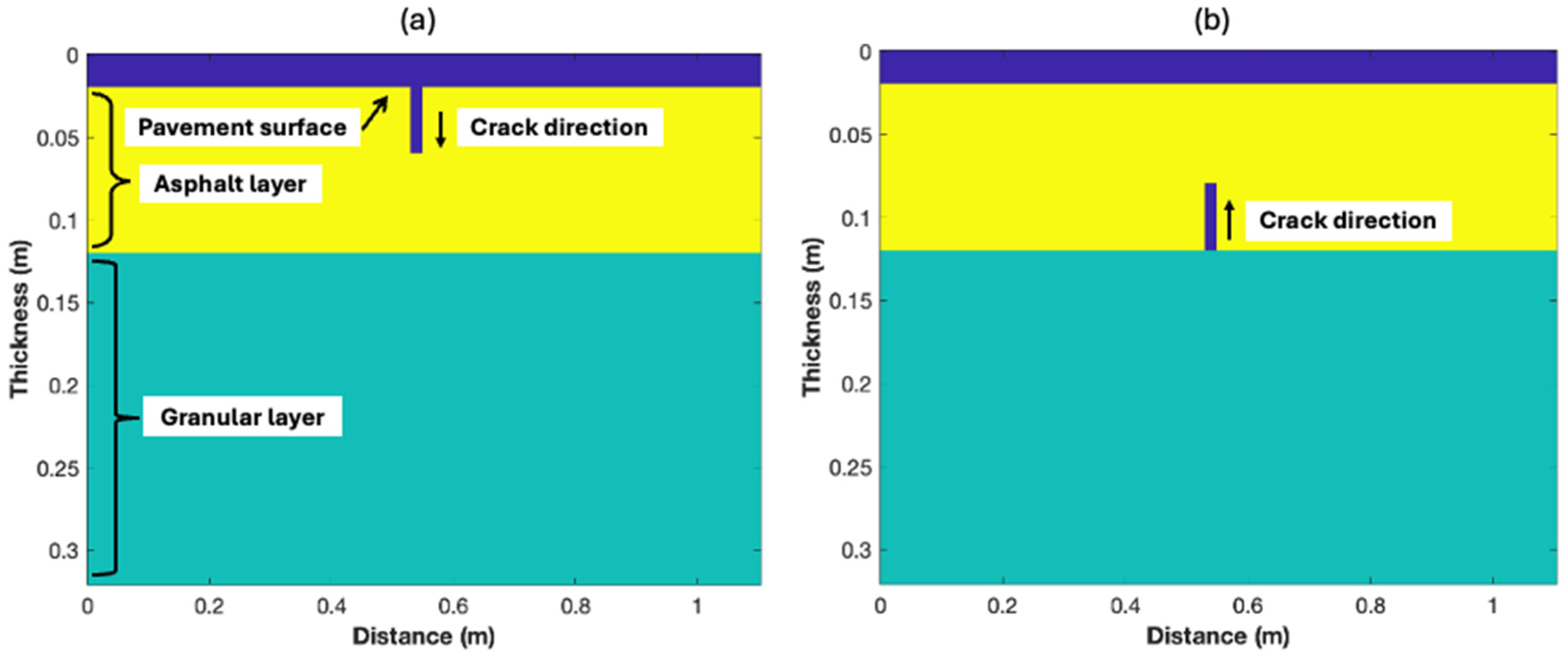
Two numerical pavement models were investigated, as shown in
Figure 1. Model A represents top-down cracking, in which the crack starts at the pavement surface and propagates downward within the asphalt layer. Model B represents bottom-up cracking, in which the crack starts at the bottom of the asphalt layer and propagates upward. In both models, the pavement structure consists of an asphalt layer (yellow) over a granular base (green), and the crack is represented geometrically within the asphalt layer.
The asphalt layer was assigned a relative permittivity of 5.5 and an electrical conductivity of 0.0001 S/m. The granular layer was assigned a relative permittivity of 6.0 and an electrical conductivity of 0.0001 S/m. In all cases, the crack was modeled as an air-filled discontinuity. The two models therefore differ in crack position and propagation direction, while preserving the same layer structure and acquisition logic.
2.3. Parametric Design
For each crack model, four parametric studies were performed, each containing four cases. Therefore, 16 cases were analyzed for Model A and 16 for Model B, for a total of 32 numerical simulations. The parametric design adopted for the four studies is summarized in
Table 1.
In Study 1, crack width was varied while crack depth , asphalt-layer thickness , and granular-layer thickness were kept fixed. The fixed values were cm, cm, and cm. The crack width values were 2, 6, 10, and 20 mm.
In Study 2, crack depth was varied while crack width , asphalt-layer thickness , and granular-layer thickness were kept fixed. The fixed values were mm, cm, and cm. The crack depth values were 2, 4, 6, and 10 cm.
In Study 3, asphalt-layer thickness was varied while crack width and granular-layer thickness were kept fixed. The fixed values were mm and cm. The asphalt thickness values were 5, 10, 15, and 20 cm. In this study, crack depth was defined as .
In Study 4, granular-layer thickness was varied while crack width , crack depth , and asphalt-layer thickness were kept fixed. The fixed values were mm, cm, and cm. The granular thickness values were 20, 30, 40, and 50 cm. All simulations were performed with a central frequency of 2300 MHz.
The numerical design adopted in this study is intentionally idealized and sensitivity-oriented. Its purpose is not to reproduce the full complexity of field pavement conditions but to isolate, under controlled conditions, the effects of crack position, crack geometry, and layer thickness on hyperbola occurrence. Accordingly, the models do not include material heterogeneity, irregular crack morphology, moisture variation, mixed distress conditions, or three-dimensional acquisition effects. This simplification is important because recent studies closer to engineering practice have shown that pavement GPR responses may become more complex and sometimes ambiguous when different hidden distresses coexist, when irregular distress geometries are present, or when heterogeneous pavement structures and multi-view acquisition conditions are considered [
9,
10,
11]. Within this framework, the present parametric studies should be interpreted as a comparative, controlled numerical design aimed at identifying occurrence regimes, rather than as a complete representation of all real engineering scenarios. The adopted design is, therefore, not intended as a full-factorial or exhaustive sensitivity analysis but as a controlled one-factor-at-a-time numerical comparison within a limited parameter space.
The selected parameter values were chosen to define a controlled and progressive numerical comparison of crack geometry and pavement stratigraphy under fixed acquisition conditions. Specifically, crack width was varied from 2 to 20 mm, crack depth from 2 to 10 cm, asphalt-layer thickness from 5 to 20 cm, and granular-layer thickness from 20 to 50 cm. These ranges were adopted to cover systematic geometric and stratigraphic variations within the simplified framework of the study, rather than to reproduce the full variability of field pavements.
2.4. GPR Simulation Setup
All simulations were performed in gprMax2D (version 2, 64-bit Windows build) at 2300 MHz. The spatial discretization was set to 0.002 m in both horizontal and vertical directions, and the time window was fixed at 8 ns in all cases. The acquisition geometry consisted of 480 traces with a trace spacing of 0.002 m and a fixed transmitter-receiver offset of 0.048 m. This configuration was kept unchanged throughout the study to isolate the effects of crack geometry and layer thickness on hyperbola occurrence.
The source was modeled as a line source with a Ricker wavelet at 2300 MHz. The transmitter and receiver advanced with the same horizontal step along the survey line. The starting positions, trace spacing, and offset were preserved in all simulations. As a result, differences in the radargrams can be attributed to the modeled pavement configuration rather than to changes in acquisition settings.
The simulations were performed under the stability constraints of the two-dimensional FDTD formulation. With a fixed spatial discretization of m, the corresponding Courant-type stability limit is on the order of s. Considering the adopted time window of 8 ns and the temporal sampling used in the output radargrams, the implied time step was also approximately s, indicating consistency between the temporal discretization and the spatial grid. Thus, the numerical setup satisfied the Courant-type stability requirement associated with the fixed discretization used in the study.
At the adopted central frequency of 2300 MHz, the free-space wavelength is approximately 0.13 m. Considering the relative permittivities assigned to the pavement layers, the corresponding effective wavelength is approximately 0.056 m in the asphalt layer and 0.053 m in the granular layer . Therefore, the crack widths analyzed in this study (2–20 mm) represent sub-wavelength features, whereas the crack depths (2–10 cm) range from values below the effective wavelength to values of the same order or larger. Within this framework, the detectability of crack-related events depends on the relative scale between wavelength and crack dimensions, together with dielectric contrast, interface interaction, and temporal separation between arrivals. In particular, when crack dimensions are small relative to the effective wavelength, the resulting reflected or diffracted contributions may become weaker or less separable in the processed radargram.
2.5. Radargram Processing and Candidate Hyperbola Detection
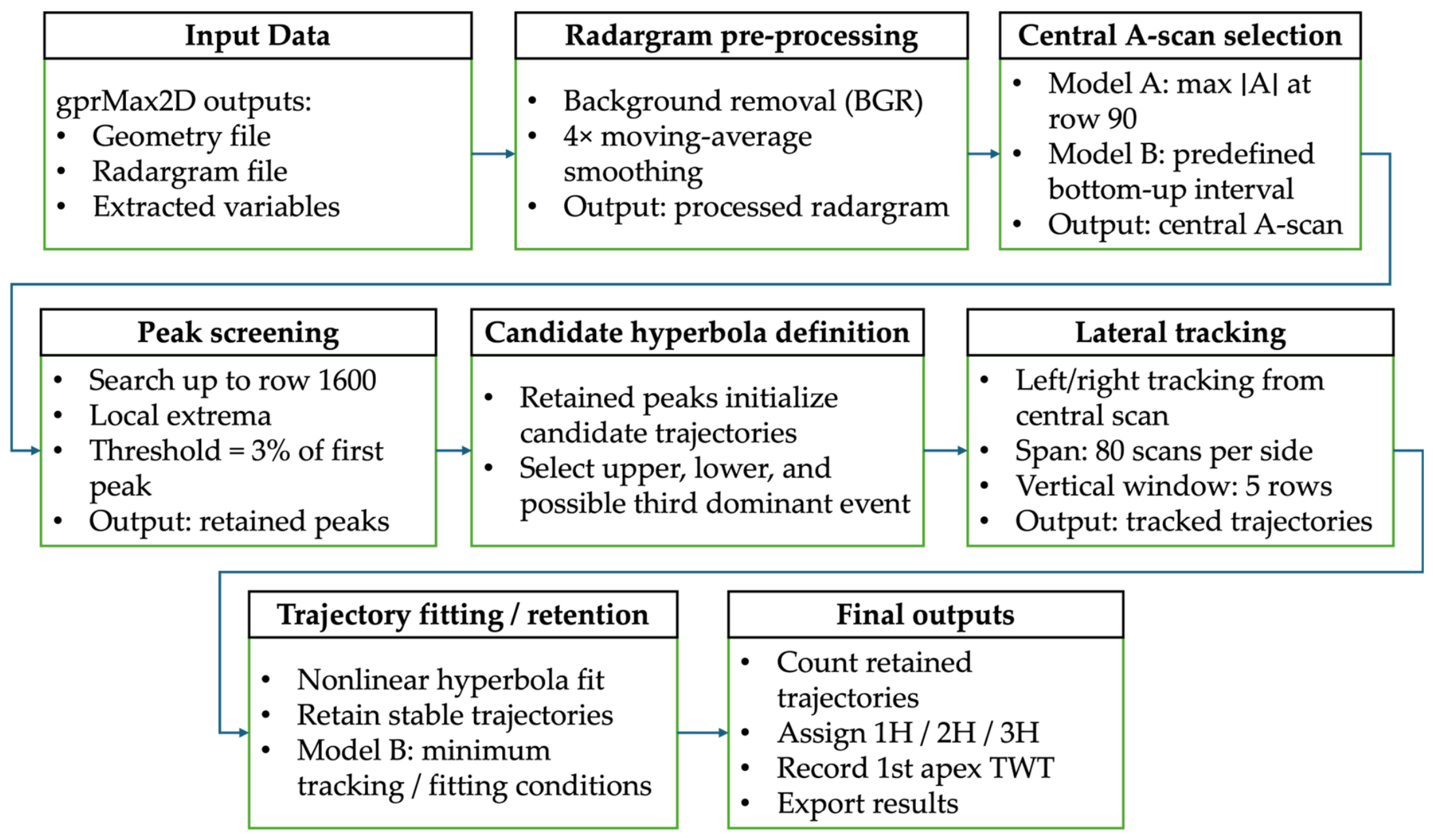
Radargrams generated by the numerical simulations were post-processed in MATLAB R2024b (MathWorks, Natick, MA, USA). The full algorithmic workflow adopted for radargram processing, candidate-event detection, trajectory tracking, and final classification is summarized in
Figure 2. The procedure was applied separately to the two crack models through two closely related routines.
For Model A, the same processing sequence was applied to all cases. First, the geometry and radargram data were read from the gprMax2D outputs. Background removal was then applied by subtracting, for each time sample, the mean amplitude across all scans. The resulting radargrams were smoothed by repeated moving-average filtering along the time axis, using four successive smoothing passes. The central A-scan was then selected as the scan with maximum absolute amplitude at a fixed early-time reference row, corresponding to row 90. Peak candidates were searched on the selected central A-scan up to row 1600 using a local-extremum criterion. The first detected peak was used to define a dynamic amplitude threshold equal to 3% of its amplitude, and only subsequent peaks satisfying this threshold were retained as candidate events.
For Model B, the same main workflow was preserved, namely reading the simulation outputs, background removal, repeated smoothing, central A-scan selection, and candidate peak detection. However, the search settings were adapted to the expected bottom-up response pattern. After pre-processing, the central A-scan was selected within a predefined time interval by searching for the strongest response away from the scan edges. Peak candidates were then searched only within a prescribed time window of the selected central A-scan, and the retained peaks were restricted to the strongest early events relevant to the bottom-up configuration.
The retained peaks in the central A-scan were used to initialize candidate hyperbolic events for subsequent lateral tracking. In this sense, the candidate-detection stage was semi-automatic: the same processing logic was applied to all cases, whereas the retained peaks depended on the temporal and amplitude response of each processed radargram. The final class was not assigned from the raw number of detected peaks alone but from the number of laterally coherent and stable trajectories retained after tracking and validation, as summarized in
Figure 2.
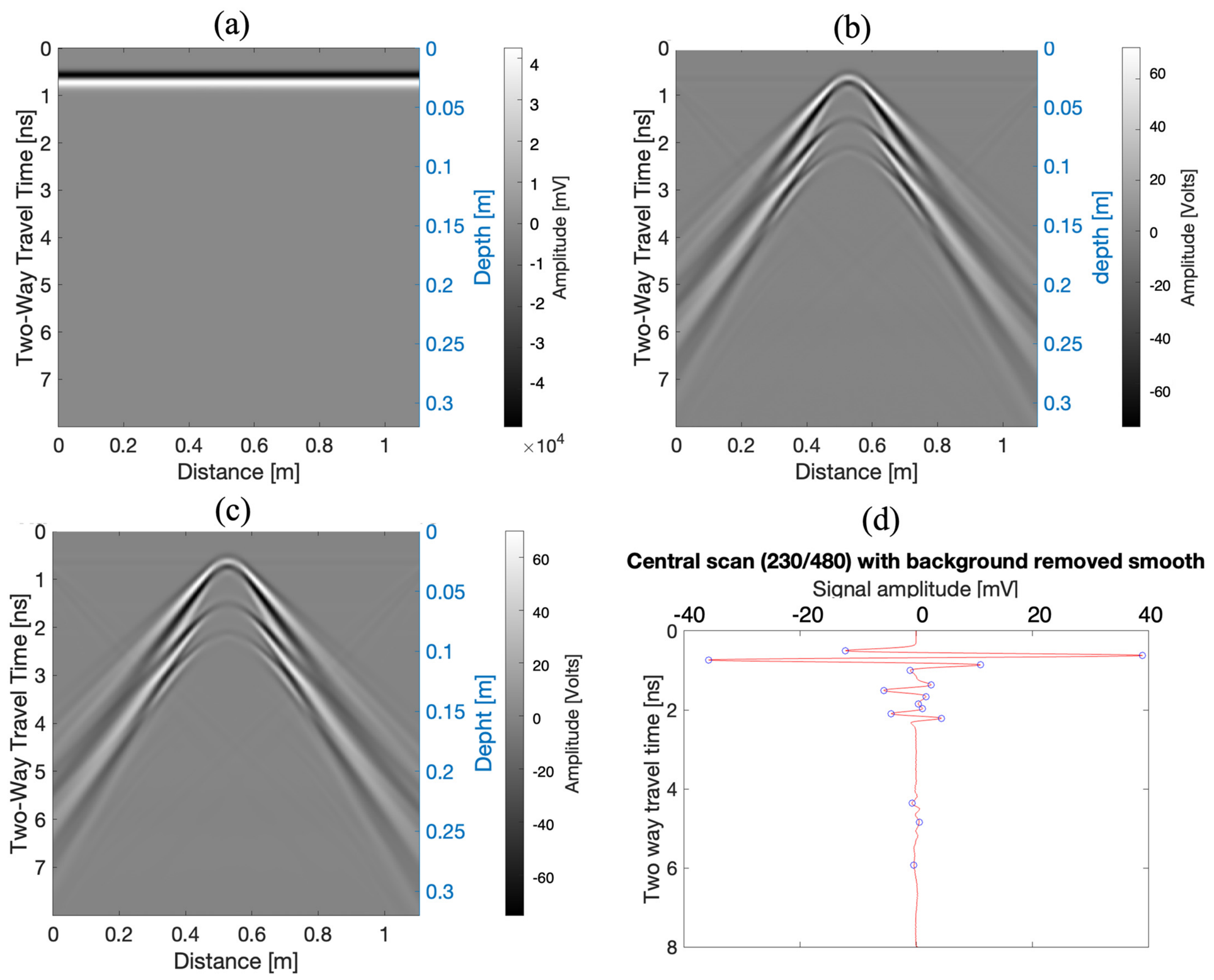
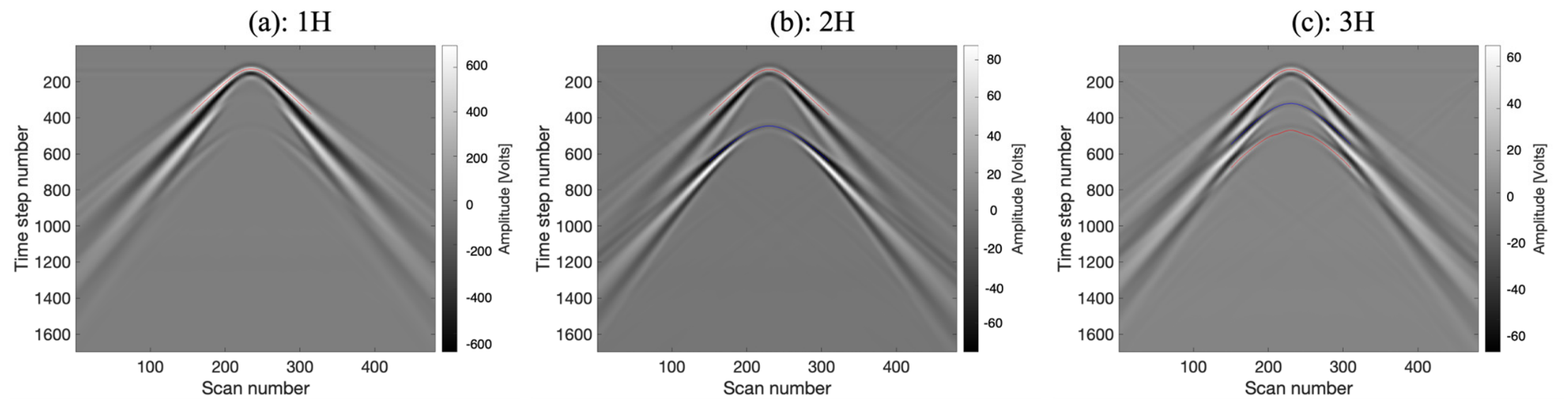
A representative example of the radargram-processing stages for Model A, Study 2, Case 3
is shown in
Figure 3. The figure illustrates the raw radargram, the radargram after background removal, the smoothed radargram used for subsequent analysis, and the central A-scan selected for candidate detection. For the case shown, the selected scan was 230 of 480, and the final classification was 3H.
2.6. Hyperbola Tracking
For each peak detected in the central A-scan, a candidate hyperbola was tracked laterally to the left and to the right of the central scan. At each adjacent scan, the local maximum within a predefined vertical search window was identified and stored, producing a set of points associated with that event.
In Model A, the tracking was performed over 80 scans to each side of the central scan, and the search window was defined relative to the previous peak position and extended downward by a fixed number of samples. In Model B, the search window was defined symmetrically around the previous peak position, and additional constraints were imposed on the minimum number of tracked points and on the horizontal and temporal span required for fitting. These adjustments were introduced to accommodate the deeper and later-time response pattern of the bottom-up cases.
For each tracked event, the stored quantities were scan position, horizontal distance, time-sample index, two-way travel time, and signal amplitude. This procedure allowed the identification of laterally coherent hyperbolic trajectories in the processed radargrams and provided the intermediate validation step between candidate peak detection and final classification. Only trajectories retained after tracking and the corresponding model-specific conditions were passed to the final hyperbola-count classification, as summarized in
Figure 2.
2.7. Hyperbola-Count Classification
Each case was classified according to the number of detectable hyperbolas retained after signal processing, candidate-event detection, and lateral tracking. A case was considered to contain one, two, or three hyperbolas, depending on the number of laterally coherent tracked trajectories that remained after the retention stage described in
Section 2.6.
The classification was based on observable and stable hyperbolic trajectories in the processed radargrams rather than on a full physical attribution of each event. In Model A, the retained events corresponded to the dominant hyperbola families identified after peak detection and tracking. In Model B, the same logic was applied, but candidate trajectories that did not satisfy the minimum tracking and fitting conditions were excluded from the final count. The resulting occurrence classes were therefore defined as 1H, 2H, or 3H according to the number of detectable hyperbolic trajectories preserved by the adopted workflow. In addition, the 1st apex TWT was recorded as the earliest apex time among the stable hyperbolic trajectories retained in the final classification of each case.
This classification scheme was adopted because the aim of the present paper is to establish the occurrence of detectable hyperbola families in top-down and bottom-up cracked pavements under controlled numerical conditions. A detailed physical attribution of each individual hyperbola is outside the scope of this study.
As summarized in
Figure 2, the final classification was based not on the raw number of detected central-scan peaks, but on the number of stable tracked trajectories retained after screening, tracking, and model-specific retention conditions. Although the candidate-detection stage used model-specific predefined search windows, the final classification criterion was identical for both models: each case was assigned to class 1H, 2H, or 3H according to the number of detectable and stable hyperbolic trajectories retained after processing and lateral tracking. Thus, the workflow was not fully identical in all low-level search settings, but it remained unified in terms of the final classification criterion.
2.8. Targeted Robustness Check of the Classification Workflow
In addition to the baseline detection and classification workflow, a targeted robustness check was performed to evaluate the sensitivity of the final 1H/2H/3H classification to model-specific search-window and retention parameters. This additional procedure was applied only to representative borderline or transition-relevant cases selected from Models A and B, rather than to the full set of 32 simulations.
For each selected case, the original parameter set of the corresponding model was taken as the baseline configuration. The robustness assessment was then carried out using two complementary perturbation strategies: (i) one-parameter-at-a-time perturbations, in which a single model-specific parameter was modified while all others were kept at baseline values, and (ii) a combined restrictive parameter set, in which multiple search-window and retention parameters were simultaneously modified toward a more restrictive configuration.
For Model A, the tested perturbations involved the central A-scan reference row, peak-retention threshold, peak-search limit, lateral tracking window, and tracking extent. For Model B, the tested perturbations involved the edge margin used for central-scan selection, the temporal bounds of the central-scan and peak-search windows, the peak-retention threshold, the lateral tracking window, the tracking extent, and the maximum number of retained hyperbola candidates.
In the robustness-check implementation, the final class was assigned from the number of valid tracked trajectories retained after tracking, rather than from central-scan candidate peaks alone, so that the sensitivity of the post-tracking classification stage could also be evaluated under parameter perturbations. This additional validity check was introduced only for the robustness analysis and did not replace the main classification workflow adopted in the baseline study.
The purpose of this complementary analysis was not to redefine the original workflow but to verify whether the principal occurrence trends were preserved under moderate parameter variations and whether any classification sensitivity was concentrated in representative transition cases. The results of this targeted robustness check are presented in
Section 3.6.
2.9. Analytical Travel-Time Consistency Check
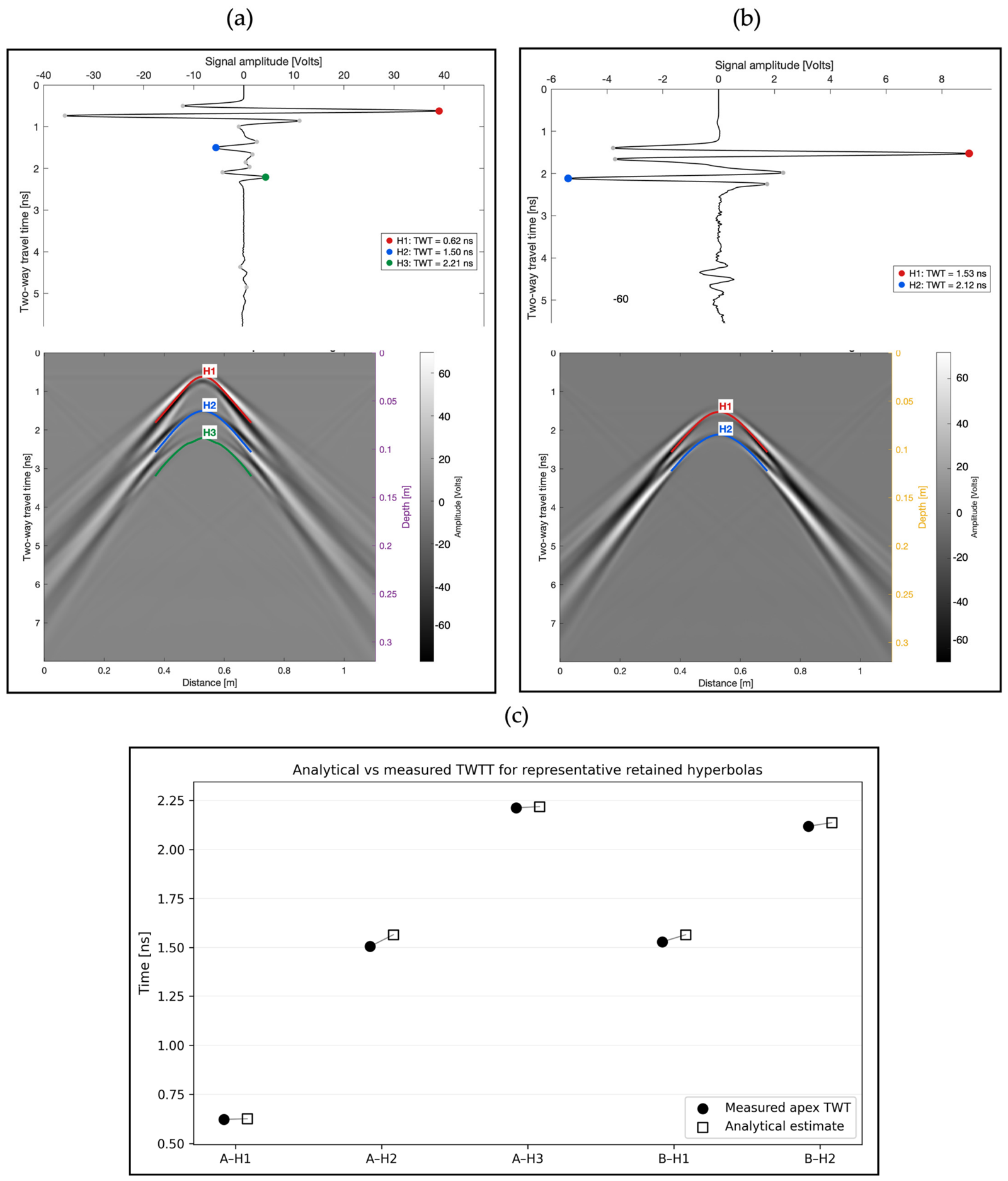
To support the physical interpretation of the retained detectable hyperbolas, an additional analytical travel-time consistency check was performed for the representative cases selected for the interpretative analysis. This complementary analysis was limited to the retained representative peaks identified in the central A-scans, namely H1, H2, and H3 for Model A (case 7) and H1 and H2 for Model B (case 10).
The measured values were taken as the two-way travel times (TWTs) of the retained representative peaks annotated in the corresponding representative central A-scans. For the representative Model A case, these measured TWTs were 0.6227 ns, 1.5048 ns, and 2.2124 ns for H1, H2, and H3, respectively. For the representative Model B case, the measured TWTs were 1.5284 ns and 2.1181 ns for H1 and H2, respectively. These representative event times are distinct from the 1st apex TWT metric adopted for the final case classification, which records the earliest apex among the stable hyperbolic trajectories retained in the final classification of each case.
Analytical estimates were then calculated from plausible effective geometric reference paths using the dielectric properties adopted in the numerical models, namely relative dielectric permittivity 5.5 for the asphalt layer and 6.0 for the granular layer. For effective paths restricted to a single layer, the analytical TWT was estimated using the standard expression , where is the effective reference depth, is the relative dielectric permittivity of the layer, and is the speed of light in free space. For deeper effective paths involving more than one layer, the analytical TWT was estimated as the sum of the corresponding layer contributions.
For Model A (case 7), the analytical references were defined as follows: H1 was associated with a shallow effective crack-related contribution represented by 0.04 m in the asphalt layer; H2 was associated with an asphalt-bottom/interface reference represented by 0.10 m in the asphalt layer; and H3 was associated with a deeper effective contribution represented by 0.10 m in the asphalt layer plus 0.04 m in the granular layer. For Model B (case 10), H1 was associated with an asphalt–granular interface reference represented by 0.10 m in the asphalt layer, whereas H2 was associated with a deeper effective contribution represented by 0.10 m in the asphalt layer plus 0.035 m in the granular layer.
The purpose of this analytical check was not to provide a definitive path-by-path attribution of each retained hyperbola, but rather to verify whether the measured TWTs of the retained representative peaks were temporally consistent with physically plausible geometric and dielectric references derived from the adopted numerical models. In this way, this comparison was used as supporting evidence for the interpretative framework proposed in
Section 4.1.
3. Results
3.1. Overview of Hyperbola Occurrence in the Two Crack Models
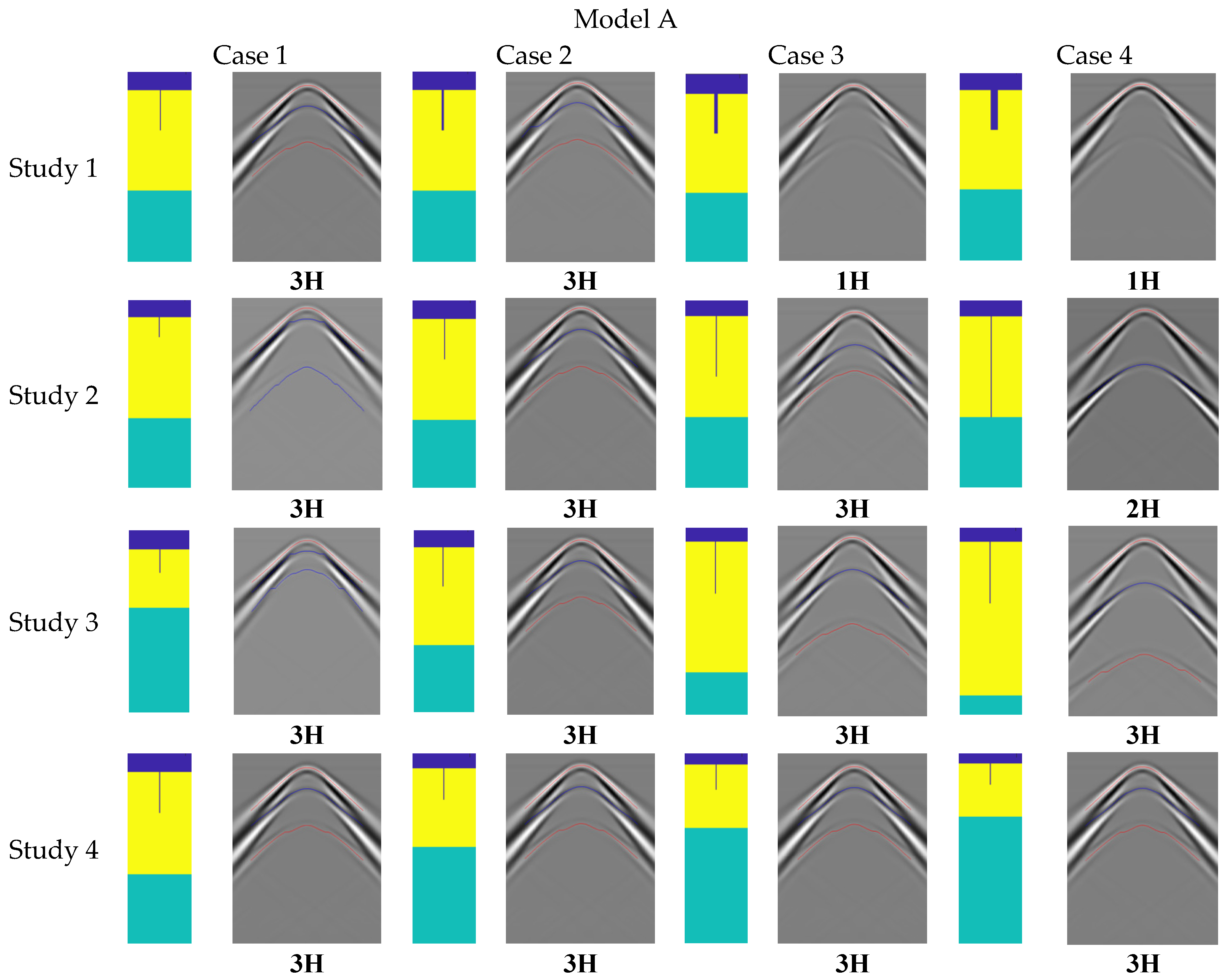
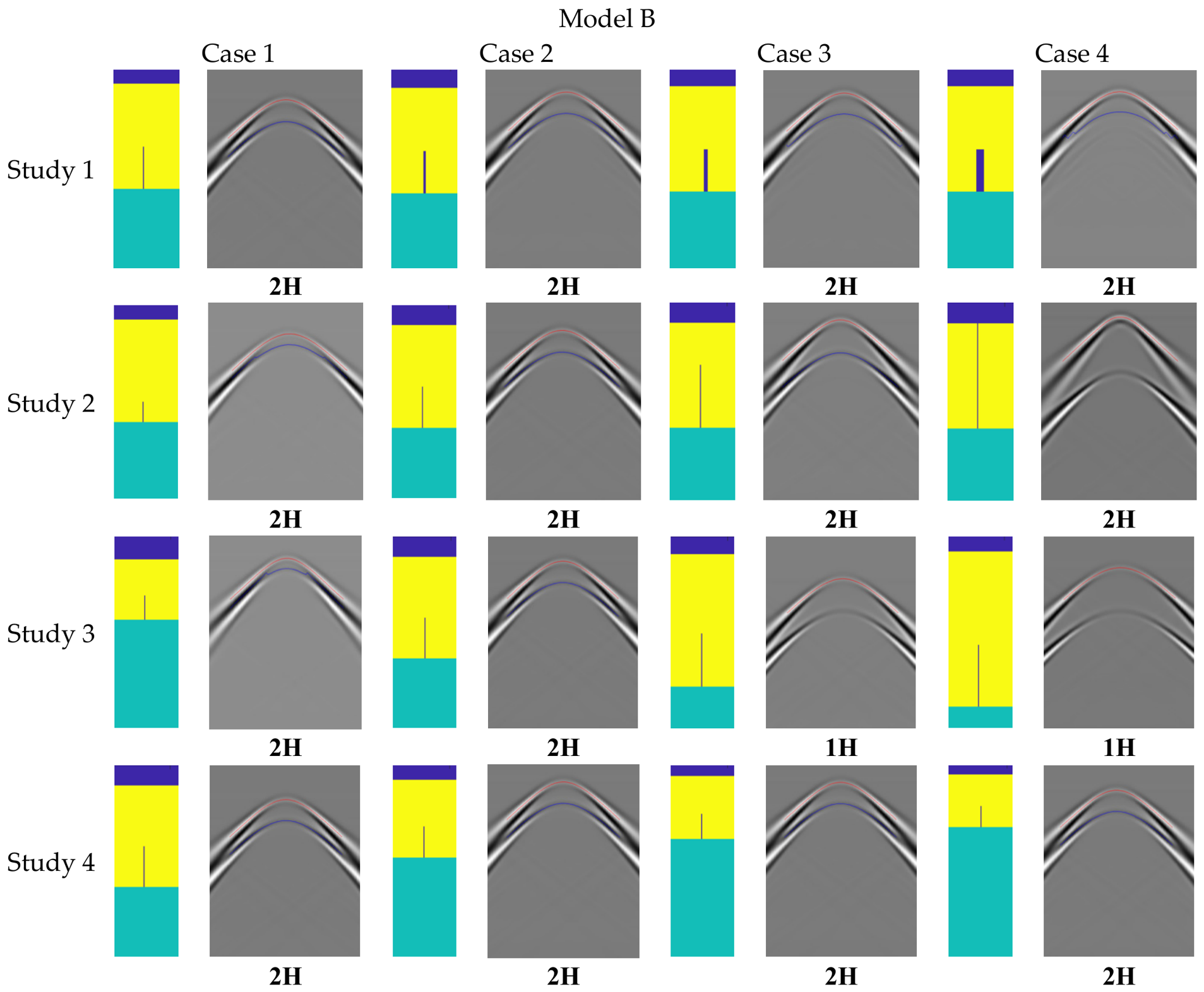
The 32 numerical cases showed distinct patterns of hyperbola occurrence for the two crack models.
Table 2 summarizes the geometric parameters for each case, together with the final classification of the processed radargrams and the 1st apex TWT of the dominant detectable event.
Figure 4 and
Figure 5 summarize these results for Models A and B, respectively, and show that the number of detectable hyperbolas was associated with both the crack model and geometric configuration of the pavement system.
Model A, which represents top-down cracking, was dominated by cases with three detectable hyperbolas. Among the 16 analyzed cases, 13 were classified as 3H, one as 2H, and two as 1H. The cases with only one hyperbola were restricted to Study 1, in which crack width was varied. The only case with two hyperbolas occurred in Study 2, in which crack depth was varied. In contrast, Studies 3 and 4, which investigated asphalt-layer thickness and granular-layer thickness, showed three hyperbolas in all cases of Model A.
Model B, which represents bottom-up cracking, showed a simpler occurrence pattern. None of the 16 cases exhibited three detectable hyperbolas. Instead, 14 cases were classified as 2H and two as 1H. The one-hyperbola cases were restricted to Study 3, whereas Studies 1, 2, and 4 showed two hyperbolas in all cases. This contrast between the two models indicates that crack position within the layered pavement system affected the number of hyperbolic events that could be separated and identified in the radargrams under the adopted simulation conditions.
Taken together, these results show that Model A and Model B differed not only in the presence of hyperbolic responses but also in the multiplicity of detectable events. Within the analyzed parameter space, top-down cracking was associated mainly with three-hyperbola patterns, whereas bottom-up cracking was limited to one- and two-hyperbola patterns. This difference forms the basis for the more detailed case-by-case analysis presented in the following subsections.
3.2. Representative Radargram Signatures in Model A and Model B
The classification summarized in
Table 2 and
Figure 4 and
Figure 5 was established from the processed radargrams after detection and tracking of stable hyperbolic trajectories.
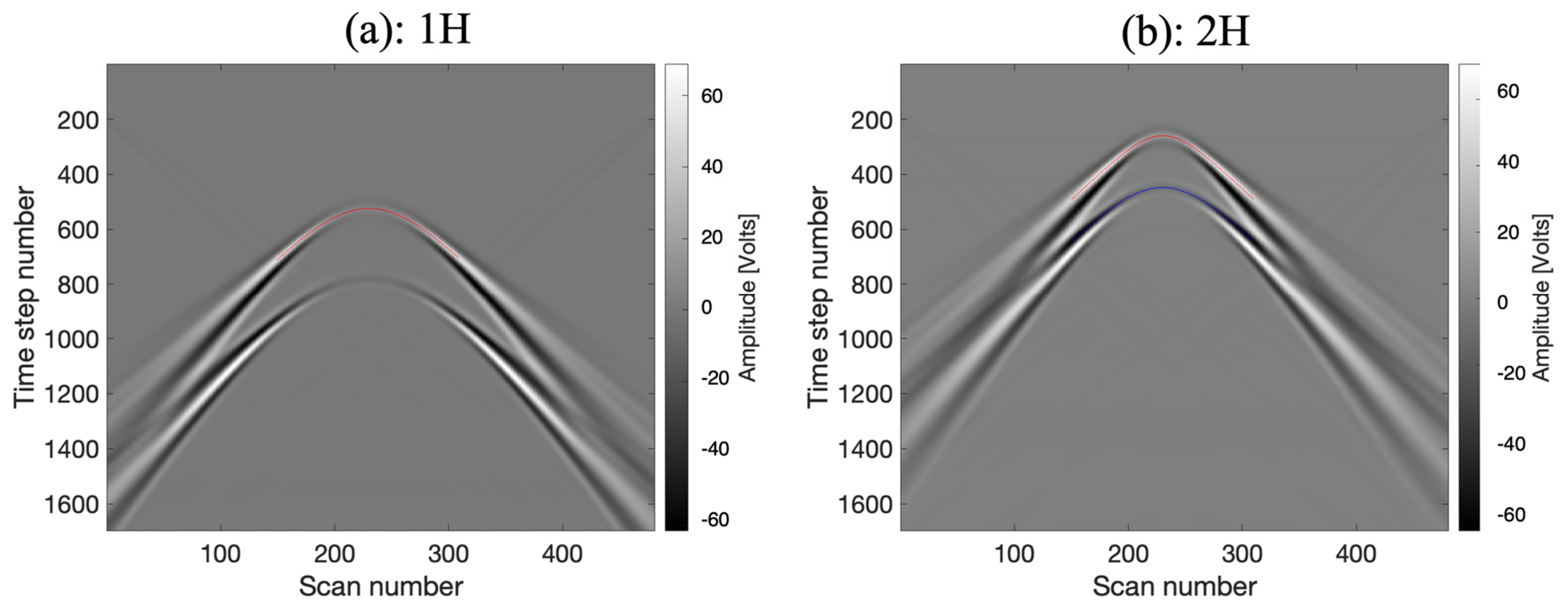
Figure 6 and
Figure 7 present representative cases for Models A and B, respectively.
In Model A, representative cases were selected to illustrate the three classes observed in the numerical study, namely 1H, 2H, and 3H. The selected radargrams show that the top-down crack model produced a wide range of signal patterns, from cases with a single detectable hyperbola to cases with three distinct hyperbolic events. The one-hyperbola examples were limited to a small subset of cases, whereas the three-hyperbola pattern was the dominant response in this model. This visual pattern is consistent with the overall classification presented in
Table 2 and
Figure 4 and confirms that Model A was characterized mainly by a higher multiplicity of detectable hyperbolic events.
In Model B, representative cases were selected to illustrate the two classes in the dataset: one-hyperbola and two-hyperbola responses. No case with three detectable hyperbolas was identified in this model. The bottom-up configuration, therefore, yielded a more restricted visual response pattern than Model A. In most cases, the radargrams showed two detectable hyperbolas, whereas in a smaller number of cases, only one was observed. This result is consistent with the classification summarized in
Table 2 and
Figure 5, and it reinforces the contrast between the two crack models in terms of observable event multiplicity.
Taken together, the representative radargrams provide direct visual support for the occurrence patterns identified in the full set of numerical cases. Model A showed a wider range of hyperbola multiplicity and was characterized mainly by three-hyperbola responses, whereas Model B was limited to one-hyperbola and two-hyperbola patterns under the present simulation conditions.
3.3. Trends Associated with Crack Width and Crack Depth in Hyperbola Occurrence
Within the adopted one-factor-at-a-time numerical design, the trends associated with crack width and crack depth in hyperbola occurrence were model-dependent. As summarized in
Figure 4 and
Figure 5 and detailed in
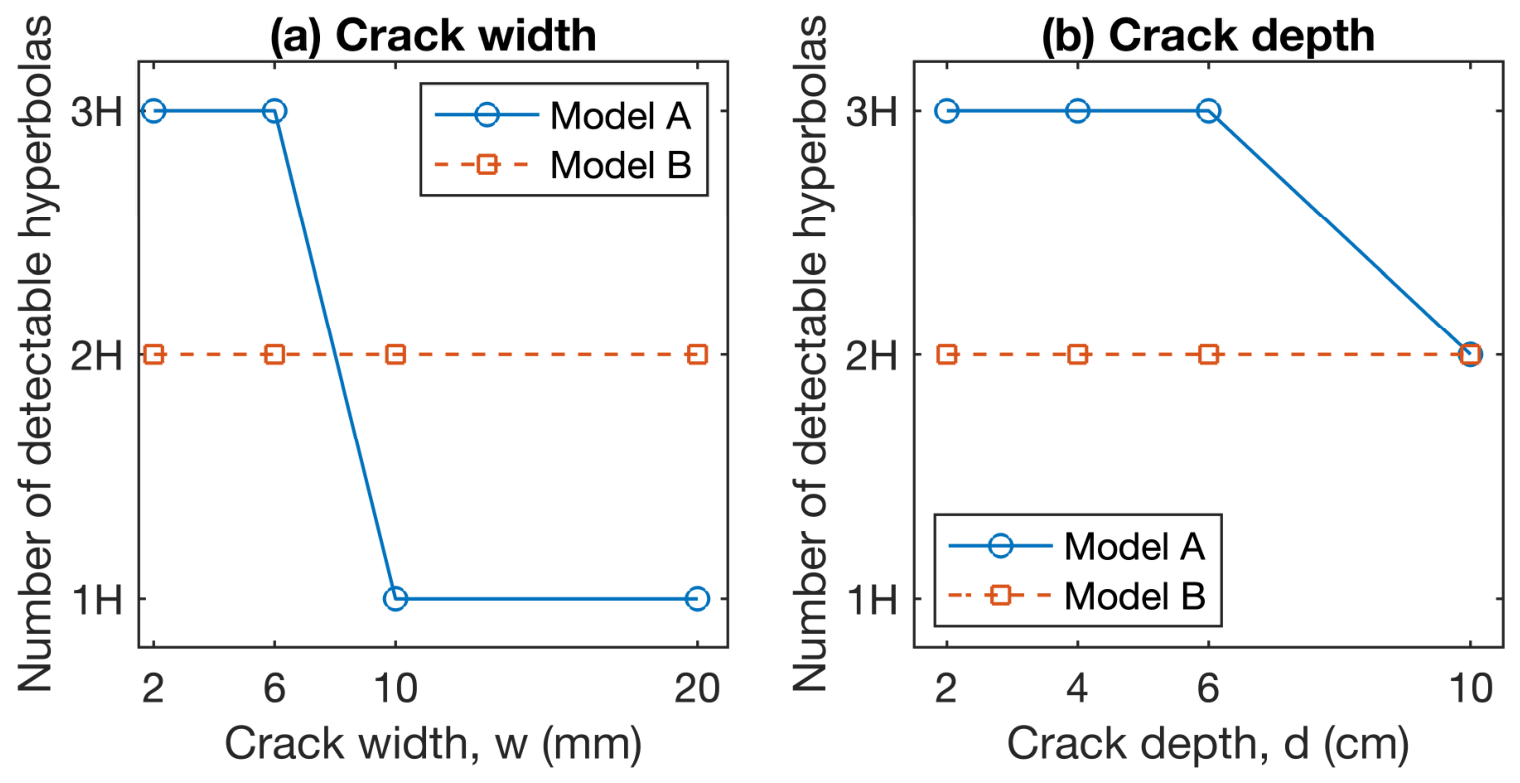
Figure 8, Studies 1 and 2 showed that the number of detectable hyperbolas did not vary in the same way for Models A and B.
In Study 1, crack width was associated with different occurrence trends in the two models. In Model A, the response remained at 3H for w = 2 and 6 mm but changed to 1H for w = 10 and 20 mm. Thus, within the analyzed width range, increasing crack width in the top-down configuration was associated with an abrupt reduction in hyperbola count, with a transition from 3H to 1H between 6 and 10 mm. In Model B, all four cases remained at 2H over the full width range from 2 to 20 mm. Therefore, within the analyzed interval, crack width was not associated with a change in occurrence class in the bottom-up configuration. This contrast is shown in
Figure 8a.
In Study 2, crack depth was also associated with different occurrence trends in the two models. In Model A, the response remained at 3H for d = 2, 4, and 6 cm and decreased to 2H only at d = 10 cm. Thus, within the analyzed depth range, increasing crack depth preserved the three-hyperbola regime in most top-down cases and reduced the response only in the full-depth configuration. In Model B, the response remained at 2H for all four depth cases, from d = 2 to 10 cm. Therefore, within the analyzed range, crack-depth variation was not associated with a change in the dominant two-hyperbola regime in the bottom-up configuration. This trend is shown in
Figure 8b.
Taken together, these results indicate that, within the analyzed parameter space, crack width and crack depth were associated with different hyperbola-occurrence trends in the two models. In Model A, width increase was associated with the strongest change, with a direct transition from 3H to 1H, whereas depth increase reduced the response from 3H to 2H only at the largest depth. In Model B, both width and depth preserved the dominant 2H regime throughout the analyzed ranges. These patterns suggest that the relationship between crack geometry and hyperbola count depended on crack position within the layered pavement system as well as on the magnitude of the geometric variation.
3.4. Trends Associated with Asphalt-Layer Thickness and Granular-Layer Thickness in Hyperbola Occurrence
Within the adopted one-factor-at-a-time numerical design, the trends associated with asphalt-layer thickness and granular-layer thickness in hyperbola occurrence were also model-dependent. As summarized in
Figure 4 and
Figure 5 and detailed in
Figure 9, Studies 3 and 4 showed that asphalt-layer and granular-layer thicknesses were not associated with the same occurrence patterns in Models A and B.
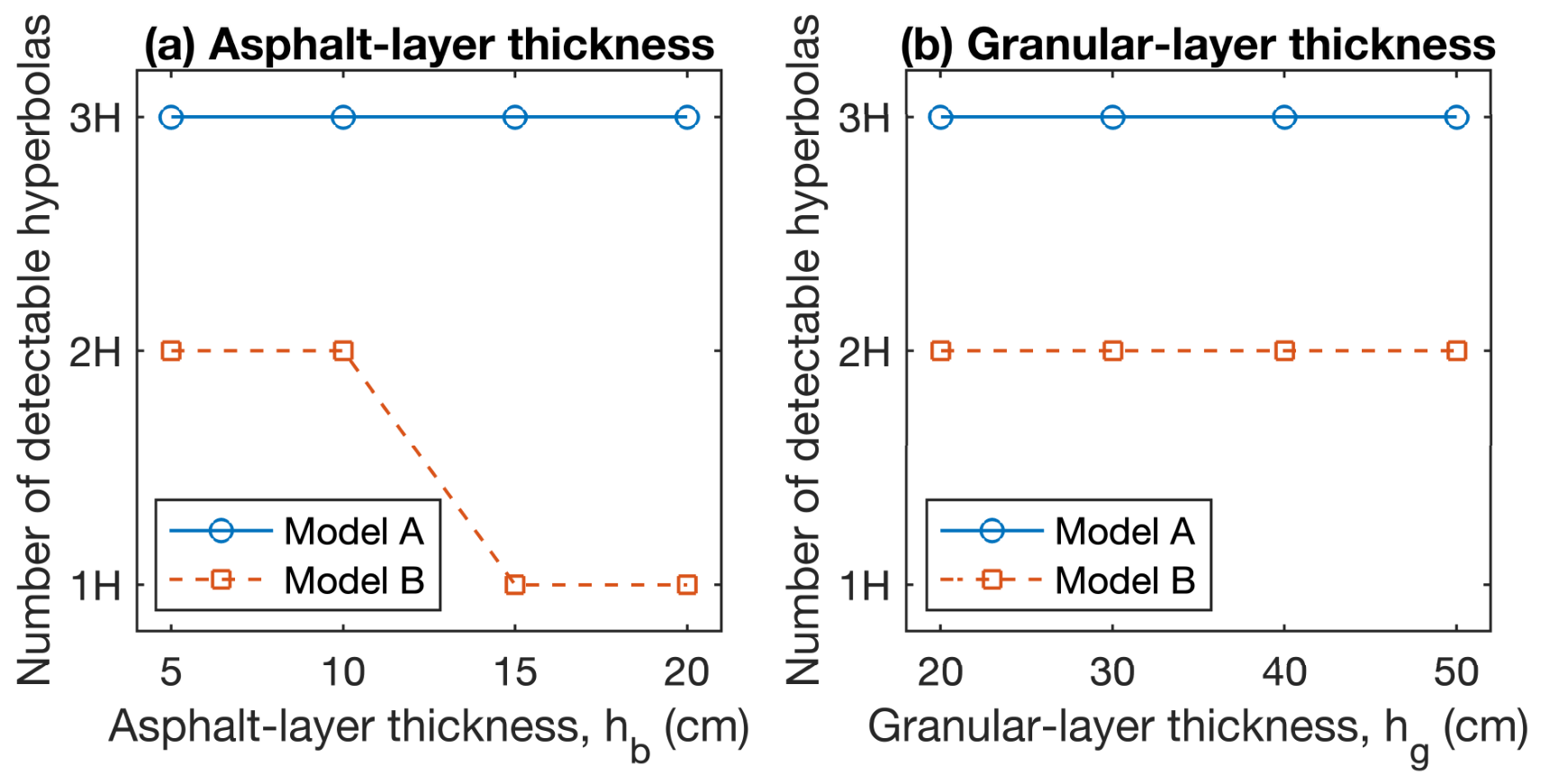
In Study 3, asphalt-layer thickness was associated with different occurrence trends in the two models. In Model A, the response remained at 3H for
= 5, 10, 15, and 20 cm. Thus, within the analyzed thickness range, increasing asphalt-layer thickness was not associated with a change in the dominant three-hyperbola regime in the top-down configuration. In Model B, the response remained at 2H for
= 5 and 10 cm but decreased to 1H for
= 15 and 20 cm. Therefore, within the analyzed interval, increasing asphalt-layer thickness in the bottom-up configuration was associated with a reduction in hyperbola count, with a transition from 2H to 1H between 10 and 15 cm. This contrast is shown in
Figure 9a.
In Study 4, granular-layer thickness was not associated with class transitions in either model. In Model A, the response remained at 3H for
= 20, 30, 40, and 50 cm. In Model B, the response remained at 2H over the same range. Therefore, within the analyzed thickness range, increasing granular-layer thickness preserved the dominant occurrence class in both crack models. In this study, the role of
was expressed as a stable difference between models rather than as an internal transition within each model. This trend is shown in
Figure 9b.
Taken together, these results indicate that, within the analyzed parameter space, asphalt-layer thickness and granular-layer thickness were associated with different hyperbola-occurrence trends in the two models. In Model A, neither asphalt-layer thickness nor granular-layer thickness altered the dominant 3H regime. In Model B, asphalt-layer thickness was associated with a reduction from 2H to 1H, whereas granular-layer thickness preserved the dominant 2H regime throughout the analyzed interval. These patterns suggest that the relationship between pavement stratigraphy and hyperbola count depended on both layer thickness and crack position within the multilayer system.
3.5. Comparative Synthesis of Occurrence Regimes
Figure 4 and
Figure 5 summarize the occurrence classes identified in the two numerical crack models across the 32 simulated cases. When read together with
Table 2, which also includes the 1st apex TWT of the dominant detectable event, and with the trend-based results shown in
Figure 8 and
Figure 9, they provide a global synthesis of the occurrence regimes identified in the study.
Model A was dominated by three-hyperbola responses. Among the 16 cases, 13 were classified as 3H, one as 2H, and two as 1H. The 3H class was maintained in all cases of Studies 3 and 4 and in most cases of Study 2.
Model B showed a different distribution. Among the 16 cases, 14 were classified as 2H and two as 1H. No case was classified as 3H. The 2H class was maintained in all cases of Studies 1 and 4, in all cases of Study 2, and in two of the four cases of Study 3.
The additional comparison based on the 1st apex TWT values reported in
Table 2 provides a complementary distinction between the two models, particularly for the 2H cases. In Model A, the single 2H case occurred at an early TWT of 0.500035 ns. In Model B, the 2H responses occurred, in most cases, at later TWTs, generally above 1.0 ns and commonly around 1.39 ns. The main exception was Study 2, Case 4, which also showed an early 1st apex TWT of 0.500035 ns. This case corresponds to the full-depth crack configuration, in which the crack spans the full asphalt-layer thickness in both models, providing a plausible explanation for the similar early-time dominant response.
Taken together, these results show that the occurrence of detectable hyperbolas varied according to crack model, crack geometry, and layer thickness. Within the analyzed set, Model A was associated mainly with 3H responses, whereas Model B was associated mainly with 2H responses, with a smaller number of 1H cases. The 1st apex TWT reported in
Table 2 added a temporal discriminator that further differentiated most 2H cases of Model B from the 2H response observed in Model A.
3.6. Robustness Check of the Classification Workflow
The results of the targeted robustness check described in
Section 2.8 are summarized in
Table 3. This additional analysis was performed on representative borderline or transition-relevant cases to evaluate whether the final 1H/2H/3H classification remained stable under moderate perturbations of model-specific search window and retention parameters.
For Model A, three representative cases were selected from the top-down dataset. In the baseline runs, the robustness-check workflow reproduced the original final classes reported in the manuscript, namely 3H, 1H, and 2H for the three analyzed cases. As shown in
Table 3, the final class remained unchanged in 27 of the 30 one-parameter perturbation runs. The only one-parameter sensitivity was associated with the peak-retention threshold (perc_first_peak). Specifically, the baseline 3H case changed to 2H for perc_first_peak = 4%, whereas the baseline 1H and 2H cases changed to 3H for perc_first_peak = 2%. By contrast, perturbations of row_center_search, limit_search_peaks, delta, and hyp_length did not change the final class in the tested Model A cases. The combined restrictive parameter set changed the class in one of the three cases.
For Model B, three representative cases were selected from the bottom-up dataset. In the baseline runs, the robustness-check workflow reproduced the original manuscript classification for the selected cases, namely 2H, 2H, and 1H. As summarized in
Table 3, the final class remained unchanged in 51 of the 54 one-parameter perturbation runs. In this model, the only one-parameter sensitivity was associated with max_hyperbolas_to_fit. The two baseline 2H cases changed to 1H for max_hyperbolas_to_fit = 4, whereas the baseline 1H case changed to 2H for max_hyperbolas_to_fit = 8. In contrast, perturbations of scan_edge_margin, center_search_start_ns, center_search_end_ns, peak_search_start_ns, peak_search_end_ns, perc_first_peak, delta, and hyp_length did not change the final class in the tested Model B cases. The combined restrictive parameter set changed the class in two of the three cases.
Taken together, the results summarized in
Table 3 indicate that the main occurrence trends identified in the study are not solely an artifact of a single parameter choice. In both models, most moderate perturbations preserved the final class, whereas classification changes were concentrated in parameters directly affecting candidate-event retention. In Model A, this sensitivity was associated mainly with the peak-retention threshold on the central A-scan, whereas in Model B it was associated mainly with the maximum number of retained candidate hyperbolas. These results support the interpretation that the reported occurrence regimes are generally stable, although selected transition cases remain sensitive to stricter or more permissive retention settings.
4. Discussion
4.1. Physical Meaning of One, Two, and Three Detectable Hyperbolas
The literature indicates that the number of detectable hyperbolas in cracked pavements is controlled by wave propagation in a layered medium rather than by crack presence alone. Crack geometry, dielectric contrast, interface interaction, and temporal separation between arrivals affect whether one, two, or more events remain observable in the processed radargram [
7,
14,
20].
Within this framework, 1H may be interpreted as a regime in which only the dominant event remains detectable after overlap, attenuation, and processing. A 2H response indicates that a second event also remains temporally separable. A 3H response indicates preservation of an additional detectable contribution, consistent with a more complex propagation pattern in the multilayer system, possibly involving crack–interface interaction or additional reflected or diffracted paths [
6,
7].
Within the interpretative framework adopted in this study, the first detectable hyperbola may be associated with the dominant crack-related reflected/diffracted response preserved after propagation and processing. Previous numerical and experimental studies on layered pavements have shown that crack responses may include diffraction contributions from the crack top and crack bottom, as well as additional events associated with internal interfaces and secondary propagation paths in the layered system [
6,
7,
15]. In this sense, the second detectable hyperbola may be interpreted as an additional separable contribution plausibly related to crack–interface interaction or to a secondary reflected/diffracted path, whereas the third detectable hyperbola may indicate the preservation of a further separable contribution under geometric conditions that maintain event distinctness. This interpretation is also consistent with previous laboratory and numerical studies showing that crack width, dielectric contrast, and surrounding layer configuration affect amplitude, detectability, and separability of crack-related GPR responses [
4,
5]. These interpretations are proposed as physically plausible reflection/diffraction-path hypotheses rather than as definitive path-by-path identifications.
To strengthen this interpretation,
Figure 10 combines representative retained-event annotation in the signal and radargram domains with an analytical travel-time consistency check.
Figure 10a shows the representative Model A case, in which the central A-scan and the processed radargram preserve three retained and temporally separable events, H1, H2, and H3.
Figure 10b shows the representative Model B case, in which only two retained events, H1 and H2, remain separable. These panels provide a direct link between the retained representative peaks identified in the central A-scans and the tracked hyperbolic trajectories preserved in the processed radargrams.
Figure 10c further compares the measured TWTs of these retained representative peaks with analytical TWT estimates derived from plausible effective geometric reference paths and the dielectric properties adopted in the numerical models. These measured event times are distinct from the 1st apex TWT metric reported in
Table 2, which records the earliest apex among the stable hyperbolic trajectories retained in the final classification of each case. The consistent temporal ordering and the small differences between measured and analytical values support the interpretation that the retained first, second, and third hyperbolas correspond to physically plausible and temporally separable contributions controlled by crack position, crack extent, and multilayer propagation. This comparison is intended as interpretative support rather than as a definitive path-by-path attribution of each event.
The present results support this interpretation in terms of detectability regimes. In Model A, the 3H regime was preserved for narrow cracks and throughout the analyzed layer-thickness variations, whereas wider cracks reduced the response to 1H and the full-depth crack reduced the response to 2H. In Model B, the dominant regime was 2H, and reductions to 1H occurred only under the thickest asphalt-layer conditions. These patterns suggest that the top-down configuration more often preserved a third detectable event, whereas the bottom-up configuration more often preserved only one or two.
These interpretations remain hypotheses rather than definitive physical assignments. In the present paper, 1H, 2H, and 3H are treated as observable response regimes governed by crack position, crack geometry, layer interfaces, and temporal separability.
4.2. Why Model A and Model B Showed Different Occurrence Regimes
The contrast between Models A and B indicates that crack position within the layered pavement system controlled the detectability regime of the hyperbolic responses. Model A was dominated by 3H, with 13 of the 16 cases classified as three-hyperbola responses, whereas Model B was dominated by 2H, with 14 of the 16 cases classified as two-hyperbola responses and no 3H case. This difference suggests that the top-down configuration preserved a larger number of temporally separable events than the bottom-up configuration under the same acquisition and processing framework.
The observed trends support this interpretation. In Model A, the 3H regime was preserved in all cases of Studies 3 and 4 and in most cases of Study 2. The only 2H case in this model occurred in the full-depth crack configuration of Study 2, Case 4. The reduction to 1H occurred only in Study 1, Cases 3 and 4, indicating that crack-width increase produced the strongest suppression of event multiplicity in the top-down configuration. In Model B, the dominant regime was 2H. This class was preserved in all cases of Studies 1 and 4, in all cases of Study 2, and in the first two cases of Study 3. The reduction to 1H occurred only in Study 3, Cases 3 and 4, indicating that increased asphalt-layer thickness was the main condition associated with loss of one detectable event in the bottom-up configuration. Thus, the top-down model was characterized by preservation of a third detectable event in most configurations, whereas the bottom-up model was characterized by preservation of two detectable events and transition to 1H only under specific stratigraphic conditions.
An additional distinction between the two models is provided by the 1st apex TWT values listed in
Table 2. The single 2H case identified in Model A occurred at an early TWT of 0.500035 ns. In Model B, the 2H responses occurred, in most cases, at later TWTs, generally above 1.0 ns. This pattern suggests that the apex time of the dominant detectable event may serve as a complementary indicator for distinguishing top-down and bottom-up 2H responses.
An additional point concerns the full-depth crack configuration in Study 2, Case 4, in which crack depth reached the full asphalt-layer thickness in both models. Under this condition, both Model A and Model B were classified as 2H, and both showed the same early 1st apex TWT of 0.500035 ns. This convergence suggests that, when the crack spans the full asphalt layer, the final vertical extent of the discontinuity becomes sufficiently similar in the two models to produce a comparable dominant detectable response, despite the opposite crack propagation directions. Therefore, the full-depth crack case represents a limiting configuration in which the occurrence regimes of the two models become less distinct than in the remaining cases.
This behavior is consistent with previous studies showing that top-down and bottom-up cracks may produce similar hyperbolic geometries but different amplitude distributions, interface responses, and detectability conditions [
4,
6,
7,
20]. In the present results, these differences were expressed not only at the level of hyperbola count but also in the time position of the first detectable event. The top-down configuration favored a broader detectability regime, whereas the bottom-up configuration favored a narrower regime dominated by two detectable events, usually associated with later first-apex responses. Within the present numerical design, this occurrence-based and time-based distinction is the main comparative result between the two crack models.
4.3. Role of Geometric Parameters in Hyperbola Detectability
The results indicate that, within the analyzed parameter space and under the adopted one-factor-at-a-time numerical design, hyperbola occurrence was associated with the geometric configuration of the pavement-crack system rather than with crack type alone. Across the four studies, crack width, crack depth, asphalt-layer thickness, and granular-layer thickness were associated with different patterns of preservation or loss of detectable events in Models A and B.
Crack width was associated with the clearest occurrence change in Model A. The response remained at 3H for
and 6 mm but changed to 1H for
and 20 mm. In Model B, all width cases remained at 2H. This result suggests that, within the analyzed width range, width increase was associated with a change in the detectability regime only in the top-down configuration. This interpretation is consistent with [
4,
5,
7], who showed that crack width affects the strength and detectability of crack-related responses through geometry and dielectric contrast.
Crack depth was associated with a different pattern in the two models. In Model A, the response remained at 3H up to
cm and decreased to 2H only at
cm, which corresponds to the full-depth crack case for
cm. In Model B, all depth cases remained at 2H, including the full-depth configuration. This result indicates that the preservation of 3H in Model A was not linked to a single specific
ratio, since 3H was maintained for
, 0.4, and 0.6, whereas the full-depth condition
was associated with a reduction to 2H. In this sense, the available evidence suggests that, in Model A, the third detectable hyperbola was associated with sub-full-depth crack configurations rather than with a unique depth fraction of the asphalt layer. This trend agrees with [
15], who related event detectability to temporal separation between arrivals, and with [
6,
7], who showed that crack depth and bottom position affect the observable GPR response.
Asphalt-layer thickness was the parameter most clearly associated with a difference between the two models. In Model A, all Study 3 cases remained at 3H. Since Study 3 was defined with , this result further supports the interpretation that the 3H regime in Model A can be preserved across different asphalt thicknesses when the crack does not extend through the full depth of the asphalt layer. In Model B, the response changed from 2H at and 10 cm to 1H at and 20 cm. By contrast, granular-layer thickness was not associated with a change in the dominant class within either model. Model A remained at 3H and Model B remained at 2H throughout Study 4. These results suggest that, within the analyzed ranges, asphalt-layer thickness was more strongly associated than granular-layer thickness with event preservation in the bottom-up configuration.
Taken together, these patterns indicate that hyperbola detectability was associated with the combined action of crack geometry and pavement stratigraphy within the adopted numerical framework. The same parameter did not produce the same response in the two crack models. In particular, the preservation of 3H in Model A was associated with narrow cracks and sub-full-depth crack configurations, whereas the dominant 2H regime in Model B was preserved over wider ranges of crack width, crack depth, and granular-layer thickness and changed to 1H only with increased asphalt-layer thickness. This model-dependent behavior is consistent with previous studies showing that pavement-layer configuration, crack geometry, and temporal separability jointly influence the observable radargram response [
4,
6,
7,
15].
4.4. Implications for Numerical GPR Interpretation in Cracked Pavements
The present results show that the interpretation of cracked-pavement radargrams should not assume a one-to-one correspondence between one crack and one hyperbolic event. As discussed by [
6,
7,
14,
15], the recorded response in layered pavements depends on the combined action of crack geometry, dielectric contrast, interface interaction, and temporal separability. Under such conditions, a cracked zone may generate one, two, or three detectable hyperbolas, depending on how these factors act together in the wavefield.
This point has direct implications for numerical GPR interpretation. First, the number of observable hyperbolas should be treated as an informative feature of the pavement-crack system rather than as a secondary by-product of the signal. Second, differences in hyperbola multiplicity may reflect changes in crack position, crack dimensions, and layer thickness, even when the general hyperbolic geometry remains visually similar. In this sense, the present results extend earlier studies that focused mainly on amplitude variation, crack detectability, or isolated crack configurations [
4,
5,
7].
Within this framework, the main contribution of the present study is to map occurrence regimes of 1H, 2H, and 3H responses as a function of crack width, crack depth, asphalt-layer thickness, and granular-layer thickness for two crack mechanisms under a common numerical design. This occurrence-based perspective provides a structured basis for interpreting cracked-pavement radargrams in multilayer systems and for distinguishing between top-down and bottom-up configurations at the level of observable response pattern.
4.5. Limitations and Scope of the Present Paper
The present study has a defined scope. First, it is based on two-dimensional numerical simulations, which do not represent the full complexity of three-dimensional pavement responses. Second, each pavement layer was modeled as homogeneous, so local material variability, aggregate-scale heterogeneity, moisture variation, and construction-related irregularities were not included. Third, all cases were analyzed at a single antenna frequency of 2300 MHz, which means that the results do not address frequency-dependent changes in event resolution and detectability. A single spatial discretization of 0.002 m in both directions was adopted for all simulations to maintain numerical consistency across the full set of cases. This choice supports the internal comparability of the simulated responses, but it was not accompanied by a formal mesh-convergence study. Under the adopted grid spacing of 0.002 m, the analyzed crack widths from 0.002 to 0.020 m were represented by approximately 1 to 10 cells, while the crack depths from 0.02 to 0.10 m were represented by approximately 10 to 50 cells. Therefore, the present results should be interpreted as trend-based comparisons obtained under a fixed discretization scheme. A further limitation is that the adopted numerical design is based on a restricted set of 32 cases and one-factor-at-a-time parametric variations, which allows controlled comparison of trends but does not constitute a full-factorial or global sensitivity analysis.
A further limitation is that the classification adopted here is based on detectable hyperbolic events in processed radargrams. The occurrence classes 1H, 2H, and 3H therefore describe observable response patterns under the present processing and detection workflow, not an exhaustive inventory of all wavefield contributions generated in the model. In the same sense, this paper does not attempt a definitive physical attribution of each hyperbola family. Its focus is limited to the occurrence and detectability of one, two, and three hyperbolic events across the analyzed numerical configurations.
An additional limitation concerns the uncertainty associated with hyperbola identification and classification. Since the adopted workflow is based on processed radargrams and on the retention of detectable and stable hyperbolic trajectories, borderline cases may be sensitive to signal-processing choices, including smoothing, thresholding, and the model-adapted temporal search windows used during the candidate-detection stage, as well as to event separability. Therefore, the occurrence classes reported here should be interpreted as observable response regimes under the adopted numerical and processing framework, rather than as an error-free inventory of all wavefield contributions. A formal evaluation of classification robustness with respect to alternative search-window choices remains a relevant topic for future work.
A further point concerns the applicability of the present results to real engineering pavements. The occurrence regimes reported here were obtained from idealized two-dimensional numerical models with homogeneous layers, regular air-filled crack geometries, fixed acquisition settings, and a single antenna frequency. In field conditions, however, pavement responses may become more complex due not only to material heterogeneity, irregular concealed distress geometries, moisture variation, and coexistence of different distress types, but also to three-dimensional wave propagation and multi-view acquisition effects, which can produce more variable and sometimes partially ambiguous GPR signatures [
9,
10,
11]. Therefore, the present findings should be interpreted as controlled reference trends for understanding how crack position, crack geometry, and pavement stratigraphy affect hyperbola occurrence, rather than as a complete or directly transferable representation of all field scenarios.
Within these limits, the study provides a comparative framework for evaluating hyperbola occurrence in top-down and bottom-up cracked pavements and establishes the response regimes that emerge from the adopted geometric and stratigraphic variations.
5. Conclusions
Within the adopted two-dimensional numerical design and analyzed parameter space, the results showed that hyperbola occurrence in numerical GPR radargrams of cracked pavements was associated with both the crack model and geometric configuration. Model A (top-down cracking) was predominantly characterized by 3H responses, whereas Model B (bottom-up cracking) was predominantly characterized by 2H responses, with no 3H case observed in the analyzed bottom-up configurations. These occurrence patterns therefore differed systematically between the two crack models under the adopted numerical framework.
The 1st apex TWT provided a complementary discriminator between the models. In general, the dominant detectable event in Model A occurred at earlier times, whereas the dominant 2H responses in Model B were typically associated with later TWT values. The main exception was the full-depth crack configuration, for which both models exhibited the same early 1st apex TWT, indicating that this specific geometry reduced the distinction between the two crack configurations. In this context, the 1st apex TWT reported in
Table 2 should be understood as the earliest apex among the stable hyperbolic trajectories retained in the final classification of each case.
From an interpretative perspective, the first detectable hyperbola was associated with the dominant observable response of the crack-layer system and was present in all cases. The second detectable hyperbola was associated with cases in which an additional contribution remained separable after processing and tracking. The third detectable hyperbola was observed only in Model A and may be interpreted as an indicator of a more complex response regime in the top-down configuration. However, a definitive physical attribution of the first, second, and third hyperbolas cannot be established from the present results alone. In addition, the proposed interpretation of the retained H1, H2, and H3 responses was supported by representative A-scan and radargram annotation together with analytical travel-time consistency in the selected cases. The measured event times used in this complementary interpretation correspond to the retained representative peaks shown in
Figure 10 and are therefore distinct from the 1st apex TWT metric reported in
Table 2.
Overall, the study shows that hyperbola count, together with the 1st apex TWT, can provide a structured basis for comparing top-down and bottom-up cracked pavements under controlled numerical conditions. These findings should be interpreted as controlled numerical reference trends, rather than as directly generalizable predictions for all real pavement conditions or as the outcome of an exhaustive sensitivity analysis.