1. Introduction
Kazakhstan is located in a sharply continental climatic zone, with long, severe winters and short, hot summers. In central and northern regions, ground temperatures frequently fall below −20 °C for extended periods, and freezing penetrates 2.2–2.5 m into the soil profile. These conditions make frost heave one of the most critical geotechnical challenges for transport infrastructure. Ice lens formation within the subgrade often results in differential heave, transverse cracking, and rutting of pavements, significantly shortening service life and increasing maintenance costs [
1,
2,
3,
4]. Such problems have been reported widely along highways in the steppe and permafrost-affected regions of Kazakhstan, where moisture accumulation under freezing fronts is common [
5,
6].
Systematic observations of temperature and moisture regimes in pavements and subgrades have highlighted the strong coupling between freezing depth, moisture migration, and frost damage. Recent monitoring studies in Kazakhstan confirm that seasonal frost penetration and thawing cycles are tightly linked to moisture content in the upper soils and that the accumulation of unfrozen water during winter months can accelerate frost heave processes [
6,
7,
8]. Other field and laboratory investigations have demonstrated that even small variations in soil moisture and thermal boundary conditions can trigger significant heat and mass transfer under freezing [
9,
10,
11]. These works underscore the importance of measuring and modelling both temperature and moisture regimes when assessing road stability in cold regions.
A central parameter for such assessments is the thermal conductivity (
k) of pavement and subgrade layers, which governs the magnitude of conductive heat flux. Classical soil thermal conductivity models, such as those by Côté and Konrad [
4], predict
k as a function of porosity, mineralogy, and degree of saturation and have been validated for a wide range of frozen and unfrozen soils. Laboratory studies of base materials further show that dense, moist granular layers can reach conductivities of 1–2 W·m
−1·K
−1, while more porous asphalt mixtures display much lower values [
10,
12]. However, recent work in Kazakhstan indicates that generalized models may not always capture the actual behaviour of layered pavement systems, where heterogeneity in air voids and non-ideal contacts between layers lead to effective conductivities that deviate from model predictions [
7,
8]. This issue is further explored in the Discussion Section of this paper, where back-calculated values are compared with model expectations.
Beyond conduction, moisture transfer in freezing soils plays a critical role in frost heave and long-term durability. When liquid water mobility is restricted by ice, water can still migrate in the vapour phase through air-filled pores. This process, driven by thermal gradients and controlled by effective vapour diffusivity, is commonly described using Fick’s law with corrections for soil tortuosity and porosity [
13,
14]. Several studies have emphasized that vapour transport may contribute substantially to the supply of water to freezing fronts in unsaturated soils [
11,
15,
16]. Analytical and numerical methods have been developed to link measured temperature and RH profiles with vapour flux estimates, providing a way to quantify moisture redistribution where direct liquid water flow is absent [
7,
17].
A large body of work has analyzed coupled heat and mass transfer in freezing soils using fully transient numerical models that simultaneously resolve thermal conduction, phase change and liquid–vapour migration. Classical formulations by Harlan, Jame and Norum, Hansson et al., and Dall’Amico et al. explicitly include latent heat terms associated with freezing and thawing in the energy balance, together with sensible heat storage in the soil matrix and pore air [
18,
19,
20,
21]. In these models, the latent contribution emerges as one part of the total energy budget and varies in time and space depending on temperature, water content and freezing rate; it is not prescribed as a fixed, universal fraction of the conductive heat flux. Similar conclusions follow from snowpack energy-balance studies by Sturm and co-authors [
3], which show that sublimation, condensation and internal phase transitions account for only part of the available energy, with the remainder stored or released as sensible heat. These works provide the physical foundation for the present study: they demonstrate that vapour-related latent heat must be considered in freezing soils and snow, but they do not supply a single, site-independent “latent fraction” that could be directly adopted for pavement design.
In the context of cold-region pavements, however, fully coupled numerical schemes require numerous poorly constrained parameters and are not easily linked to routine field monitoring. The present work adopts a complementary, analytically transparent framework that uses directly measured temperature and relative humidity profiles to (i) back-calculate effective thermal conductivities of multilayer pavement and subgrade and (ii) bracket vapour-driven moisture fluxes between a diffusion-based lower bound and an energy-balance upper bound. This lower–upper bounding strategy does not compete with detailed numerical models but rather provides a field-calibrated envelope within which more complex simulations should fall and offers a practical tool for interpreting monitoring data in engineering applications.
In this study, field-measured temperature and moisture data obtained from a highway site in Kazakhstan were combined with back-calculated thermal conductivities and a diffusion-based vapour transport model. The objective was to quantify the volume of ice formed from vapour-phase water due to cryosuction forces and to compare the magnitude of heat and mass transfer processes beneath the pavement and in an adjacent snow-covered profile under natural topographic and climatic conditions during a 126-day freezing period.
2. Materials and Methods
2.1. Study Site and Field Monitoring
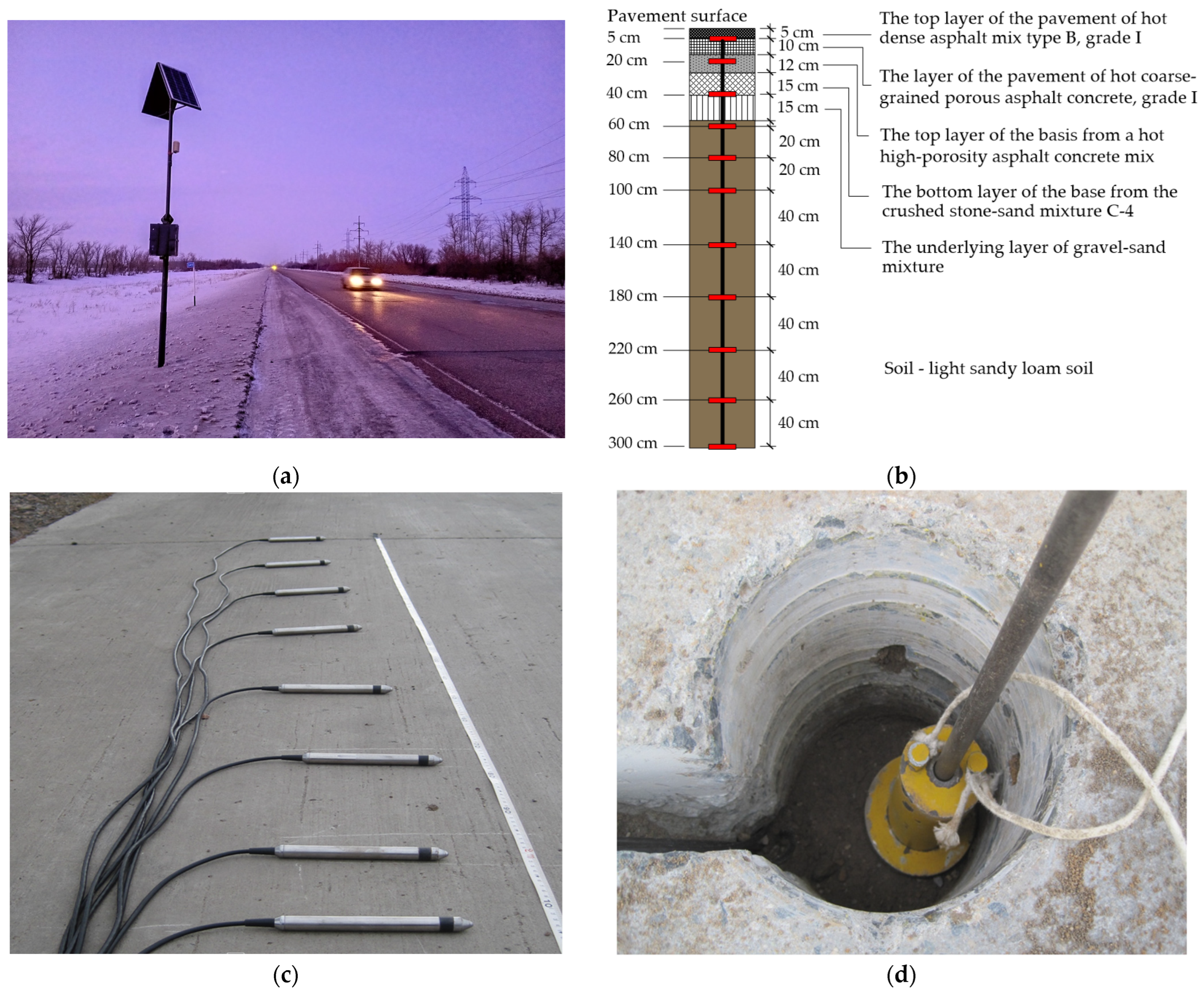
Field observations were conducted at the Kosshy highway (
Figure 1a), located near Astana, Kazakhstan, in a region characterized by a cold continental climate with prolonged freezing seasons (120–150 days of sub-freezing temperatures). The road embankment consists of a multilayer pavement structure, comprising a dense asphalt surface course (5 cm), a porous asphalt layer (10 cm), a highly porous asphalt base (12 cm), a crushed-stone–sand mixture (C-4, 15 cm), a gravel-sand bedding layer (15 cm), and an underlying sandy clay (light sandy loam) foundation soil. A roadside ditch (~0.7 m below the pavement surface) retained approximately 0.5 m of snow throughout winter. A series of temperature and relative humidity sensors were installed within the pavement layers at fixed depths (0, −5, −20, and −40 cm) and in the loam subgrade at 0.4 m intervals (
Figure 1b). Sensor arrays embedded beneath the traffic lanes were designed to monitor the coupled hydrothermal regime of flexible and rigid pavement structures under combined traffic and climatic effects, whereas arrays along the shoulder of a cement-concrete section captured cross-sectional variations near the embankment slopes and shoulders. Each measurement point employed a co-located temperature–humidity probe manufactured by NPP
Interpribor (Chelyabinsk, RF): a resistance-type thermistor paired with a dielectric moisture sensor (VIMS-2.2) certified in the State Register of Measuring Instruments of the Republic of Kazakhstan. Temperature and relative humidity were recorded continuously throughout the year with a sampling frequency of one measurement per hour.
Sensors were placed in narrow-diameter boreholes and backfilled with the excavated material, compacted to near-original density, thereby minimizing disturbance and ensuring thermal and hydraulic continuity with the surrounding layers (
Figure 1c,d). This procedure follows standard road-monitoring practice and allows the captured data to reflect in situ thermal gradients and pore-air water vapour conditions with acceptable accuracy. The sensors continuously recorded temperature (T, °C) and pore-air water vapour state, reported as relative humidity with respect to ice (RH, %), throughout the winter season, providing a continuous dataset for reconstructing freezing-front dynamics, vertical thermal gradients, and vapour-driven moisture migration patterns.
Soil physical properties were obtained from laboratory tests performed on samples collected during geotechnical investigations along the Kosshy road alignment. In total, 17 laboratory samples from six boreholes were available for analysis. The samples were grouped by sampling depth (1.0, 2.0, 2.5, 3.0 and 4.0 m). For each depth interval,
Table 1 reports the representative values used in the calculations together with the observed range of laboratory measurements and the corresponding number of samples (n).
According to the geotechnical investigation reports, the soil profile in the study area is relatively uniform in the upper part of the section. The pavement subgrade is formed by loam (EGE-2, aQII–Iv) extending to a depth of approximately 6 m. Below this layer, medium sand (EGE-3, aQII–Iv) occurs to about 11 m depth, followed by gravelly sand (EGE-4, aQII–Iv) to approximately 12 m. The deeper part of the section is composed of a coarse debris–gravel soil (EGE-5, e(CI)).
Since seasonal freezing and frost heave processes affect mainly the upper part of the soil profile, the laboratory analysis and modelling in this study focus on the loam layer within the upper 3–4 m. For the depths of 1.0 m and 4.0 m, the representative values correspond to samples taken from boreholes located closest to the temperature monitoring section. These values were therefore used as the most representative parameters for the analytical calculations, while the observed ranges of laboratory measurements are also reported in
Table 1.
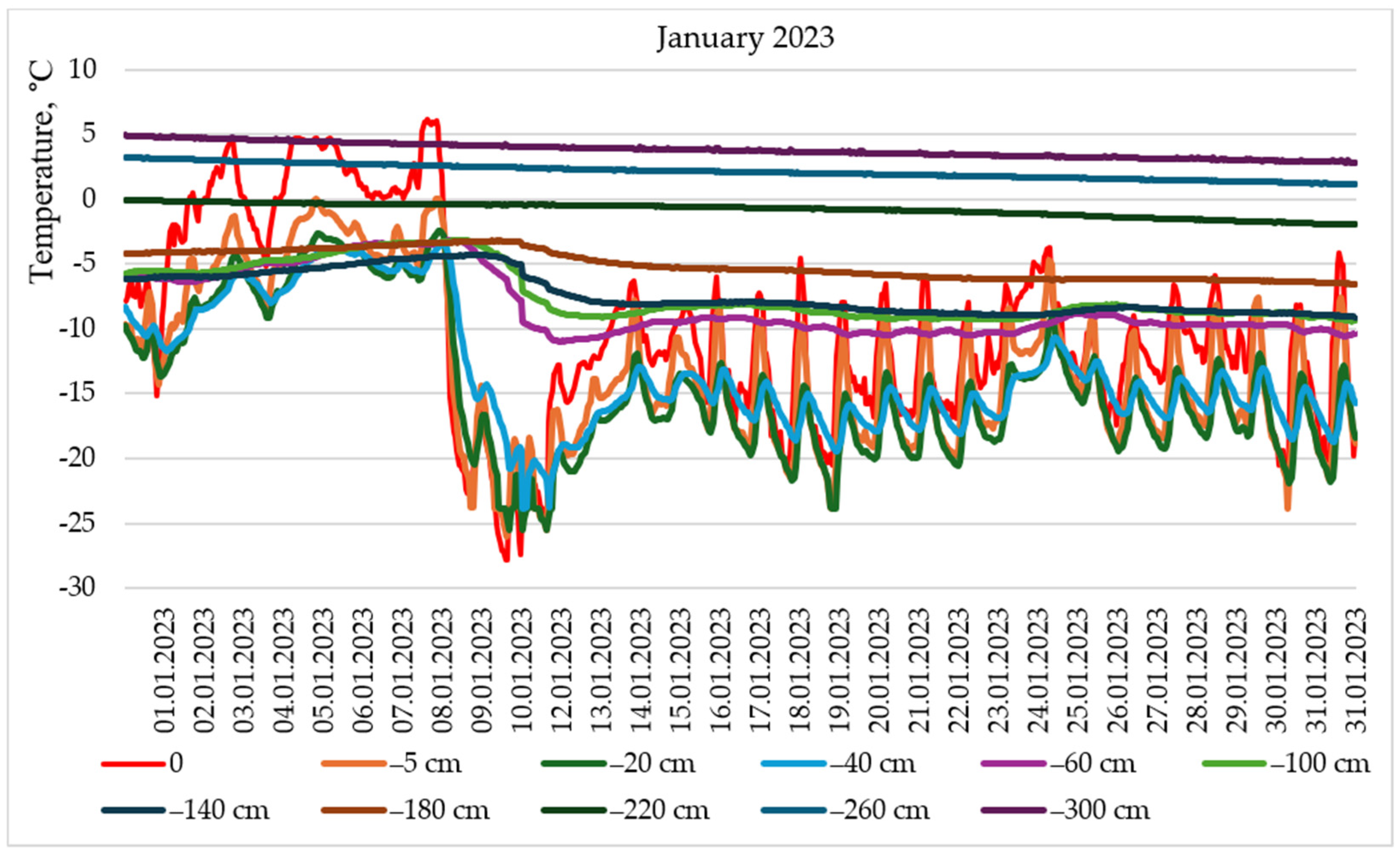
The temperature profile for January 2023 (
Figure 2) shows sharp fluctuations near the road surface that quickly damp out at depths below 0.6 m. The pronounced difference between the −0.40 m temperature curve and the deeper curves arises because the −0.40 m sensor lies within the pavement/base system, where temperatures are strongly affected by short-term atmospheric forcing and variations in snow and ice cover. In contrast, the −0.60 m and −1.00 m sensors are located within the relatively homogeneous silty-clay subgrade, where surface fluctuations are already strongly attenuated and heat transfer is dominated by one-dimensional conduction.
Below this depth, the profile becomes smoother and gradually increases toward the unfrozen base layer, with the crossing of the 0 °C isotherm marking the seasonal frost penetration depth. During midwinter the temperature profile in this deeper zone varies only slowly with time and becomes approximately linear with depth. These measured profiles were therefore used to back-calculate the thermal conductivity of individual layers under quasi-steady midwinter conditions and to estimate vapour transport and ice formation rates in the freezing subgrade.
2.2. Laboratory Characterization of Foundation Soil
Undisturbed samples were taken from boreholes at depths of 1.0, 2.0, 2.5, 3.0, and 4.0 m. Laboratory tests included Atterberg limits, natural water content, bulk density (ρ), dry density (ρd), particle density (ρs), and phase composition by oven-drying. From these results, porosity (n) and air-filled porosity (θa) were computed, providing essential parameters for the calculation of vapour transport capacity. On average, the air-filled porosity of the foundation soil was θa ≈ 0.09, confirming a limited but significant capacity for gas-phase moisture transfer under a freezing gradient.
The thermal conductivity (k) of frozen and unfrozen silty clay was determined using a transient heat needle probe method. The measured values were consistent with the literature, yielding k ≈ 1.6–2.0 W·m−1·K−1 for frozen conditions and k ≈ 1.2–1.4 W·m−1·K−1 for unfrozen soil. These results were applied directly in the energy-balance calculations described below.
2.3. Analytical Method for Thermal Conductivity and Vapour Transport
2.3.1. Thermal Conductivity Back-Calculation
The thermal conductivity of each pavement layer was first back-calculated from the measured midwinter temperature profile by applying Fourier’s law for one-dimensional heat conduction under quasi-steady conditions:
where
q is the vertical heat flux per unit area (W·m
−2), calculated from the observed temperature differences
and layer thicknesses
;
k is the thermal conductivity of the layer. This inversion approach allowed us to determine the actual heat flux through the pavement structure and upper subgrade during periods of quasi-steady freezing.
For energy-balance calculations, the total heat energy passing through a layer during a time interval
t was as follows:
where
Q is expressed in J per m
2,
t—time interval in s.
2.3.2. Diffusion-Based Vapour Transport
Moisture transport in the gaseous state was evaluated using Fick’s first law of diffusion, but with explicit mass–volume relations to connect measured RH, air volume fraction, and vapour mass flux.
1. The volume of air in a 10 cm mould section was computed from air-filled porosity:
where
is the total section volume and
its length (0.10 m);
is the cumulative cross-sectional area of air voids per unit soil section length
:
The parameter
represents the total effective area through which vapour migrates in the gaseous phase. Derived from the air-filled porosity (
) and the section volume (
), it reflects the cumulative cross-section of all air pores—effectively equivalent to the diameter of an “average” air channel available for vapour flow through the soil [
6].
2. The instantaneous density of water vapour in pores is as follows:
where
is the water vapour density calculated from the measured temperature
T and relative humidity RH;
μ—molar mass of water vapour;
Ps(
T)—saturated vapour pressure over ice (
T ≤ 0 °C) or water (
T > 0 °C);
R—universal gas constant.
3. The volume of vapour passing through the air-channel cross-section during time
t is:
where
is the mean advective–diffusive velocity in air voids. Combining with mass relation
the velocity is equal to the following:
4. Using Fick’s first law, the diffusive mass flux per unit surface area is as follows:
where
is the mass flux of vapour (kg·m
−2·s
−1).
is the effective vapour diffusivity corrected for soil tortuosity:
The total vapour flux:
where
accounts for advective transport due to gas pressure gradients,
is the Darcy gas velocity. In the present study
assumed to be negligible.
5. The mass of ice deposited at the colder end of each segment during
is as follows:
2.3.3. Energy-Balance Vapour Transport
The second approach provides an upper-bound estimate of moisture flux by equating the available conductive heat flux to the latent heat associated with vapour–ice phase change, effectively assuming that the accessible heat is fully consumed by vapour cooling and freezing:
where C is the specific heat capacity of vapour (J·kg
−1·K
−1), ΔT is the temperature change in the vapour,
accounts for latent heat (condensation/sublimation) if deposition occurs, and α ∈ [0, 1] is the fraction of heat flux converted into phase change energy.
In the energy-balance formulation, the parameter α specifies the fraction of the conductive heat flux that is effectively converted into latent heat associated with the vapour–ice phase change. By definition, 0 < α < 1: part of the available energy is always consumed as sensible heating or cooling of soil particles and pore air, stored within the soil matrix, or dissipated by lateral heat flow and cannot be used to drive phase change. Fully coupled numerical studies of freezing soils (e.g., Harlan, 1973; Jame and Norum, 1980; Hansson et al., 2004; Dall’Amico et al., 2010 [
18,
19,
20,
21]) and snowpacks (Sturm et al., 1997 [
3]) consistently show that latent heat consumption is only one component of the total energy budget and never exhausts the conductive heat flux. However, these studies do not provide a universal, site-independent “latent fraction” that could be prescribed a priori. In this paper α is therefore treated as a phenomenological efficiency parameter rather than a calibrated constant. A central scenario with α = 0.6 is adopted to represent physically realistic conditions in which latent processes account for a substantial but not dominant share of the energy flux. Sensitivity tests indicate that the predicted vapour flux scales linearly with α in the present formulation, so that varying α within a plausible range (e.g., 0.3–0.8) proportionally shifts the magnitude of the fluxes but leaves the contrast between pavement and snow-covered ground essentially unchanged.
The parameter α is not intended to represent a universal physical constant but rather a phenomenological efficiency factor that bounds the fraction of conductive heat potentially available for phase change. Its purpose is to provide an upper-envelope estimate of vapour-driven moisture flux consistent with the total energy budget.
The vapour velocity was then calculated using Equation (7). The method inherently assumes one-dimensional heat flow, negligible convection, and quasi-steady conditions—limitations acknowledged explicitly and considered acceptable for establishing upper-bound flux estimates.
Both methods were integrated over a representative freezing season of 126 days (23 November 2022–28 March 2023) to compute the total mass of ice formed in each soil layer and to evaluate its contribution to frost heave. The results were tabulated as daily rates and seasonal totals (kg·m−2 and mm-equivalent of ice).
2.3.4. Integration, Validation, and Model Limitations
Both vapour-transport methods were applied to the same measured temperature and RH profiles, enabling cross-validation. Diffusion-based results were compared with published laboratory-derived lower bounds (e.g., Batterman), while the magnitude of energy-balance fluxes was checked against rapid-freezing flux ranges reported by Yu et al. and heat-driven sublimation rates documented in snowpack studies. Thermal conductivities derived from inversion were validated against independent laboratory needle-probe measurements.
The modelling framework operates under explicit limitations:
- (i)
One-dimensional vertical transport;
- (ii)
Quasi-steady heat conduction in midwinter;
- (iii)
Negligible gas convection;
- (iv)
Homogeneous conditions within each layer;
- (v)
No explicit coupling with unfrozen water flow.
These constraints define the lower- and upper-bound nature of the results and are further discussed in
Section 4.
3. Results
The temperature measurements under the road surface and in the adjacent natural soil covered by 0.5 m of snow are summarized in
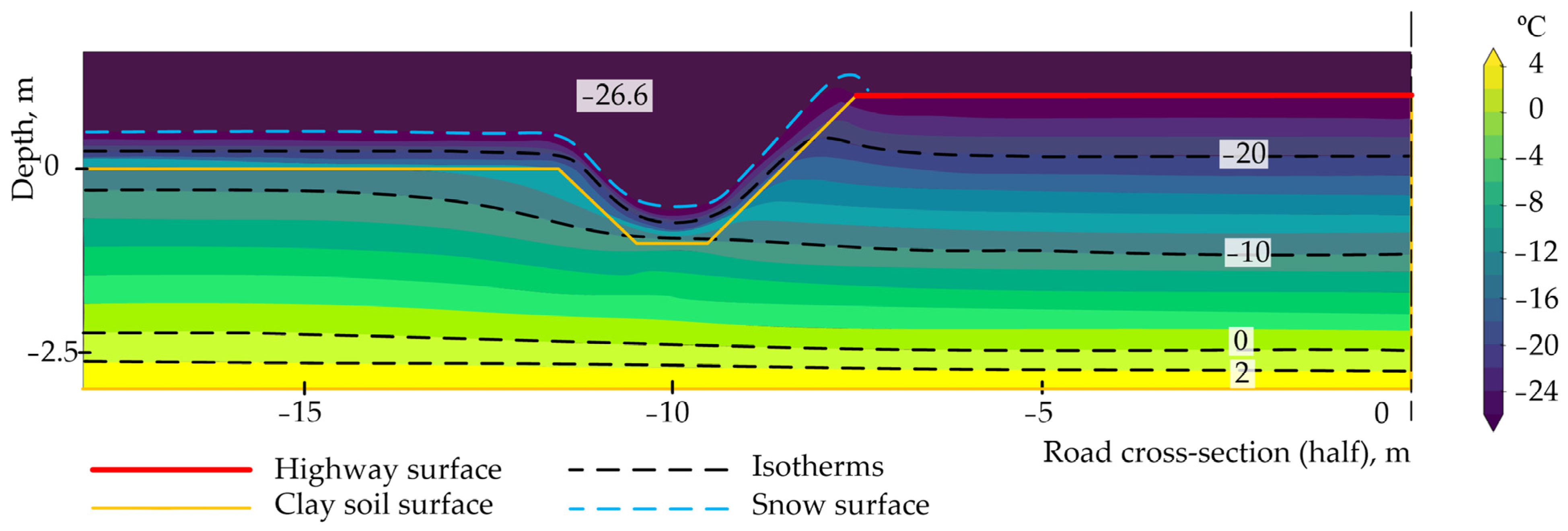
Table 2. The data clearly demonstrate the strong cooling effect of the road structure in midwinter: the road surface temperature reached −26.6 °C, which is almost 17 °C lower than under the adjacent snow cover (−9.9 °C). This difference persists to a depth of approximately 0.4 m, after which the profiles converge.
At a depth of 0.6–1.0 m, the soil under the road is slightly warmer (by 0.1–0.7 °C) than under the snow, indicating that the road surface and subgrade moderate the conductive heat flux magnitude at these depths. Below a depth of 1.4 m, the soil under the snow again consistently warms by 2–3 °C, confirming the superior thermal insulation capacity of the snow layer compared to the road structure. At a depth of 3 m, the difference becomes insignificant (≈0.2 °C). These observations confirm that the road surface not only enhances surface cooling but also alters the distribution of heat flow within the subgrade. Thus, the upper frozen layer beneath the road is deeper and colder than the adjacent snow-covered zone, which is a significant factor for modelling soil heaving and validating the numerical calculations presented later in this study (
Figure 3).
The winter temperature profile obtained in January 2023 demonstrates a clear vertical structure of the seasonal freezing process. In the upper 0.4 m, temperature fluctuations closely follow atmospheric variations, producing high-amplitude oscillations that are gradually damped with depth. The presence of a 0.5 m snow layer in the ditch acts as a thermal insulator, which results in a steep temperature gradient in the upper 0.6 m and limits the penetration of extreme cold into the soil.
Below 0.6 m, the profile transitions into a quasi-linear segment that represents the frozen active layer. Here, the temperature gradient remains nearly constant at approximately 3 °C per meter, which confirms a quasi-steady state of heat transfer. This section of the profile is especially valuable for quantitative analysis because it enables reliable back-calculation of vertical heat flux and thermal conductivity using Fourier’s law under steady-state assumptions.
At depths near 2.3–2.5 m, the temperature profile crosses the 0 °C isotherm, marking the position of the freezing front. Beneath 2.6 m, temperatures remain slightly positive, typically between +1 and +3 °C, which indicates continuous upward heat flow from the unfrozen layers. Within the silty-clay subgrade, where density and material properties are relatively uniform with depth, the midwinter temperature profile varies approximately linearly so that the vertical gradient can be treated as nearly constant over each layer. This quasi-linear behaviour is consistent with one-dimensional conductive heat transfer in a homogeneous medium and underpins the use of a constant gradient in Fourier’s law for back-calculating effective thermal conductivity. The resulting thermal regime creates a persistent gradient of vapour pressure that drives moisture migration from deeper, warmer zones toward the freezing front, where vapour condenses and deposits as ice lenses, contributing to seasonal frost heave. The combination of field temperature measurements with laboratory-determined porosity and moisture content therefore provides a robust basis for modelling both diffusion-driven vapour transport and energy-limited moisture flux throughout the winter season.
3.1. Thermal Conductivity of Pavement Layers
The effective thermal conductivity
k of each pavement and subgrade layer was back-calculated from the measured January 2023 temperature profile using Fourier’s law under quasi-steady conditions.
Table 3 summarizes the thicknesses, measured temperature drops, and derived
k-values.
The highest conductivity is observed in the frozen silty clay, consistent with partial ice saturation (
k ≈ 1.8 W·m
−1·K
−1). The porous asphalt layer exhibits a much lower
k-value (≈0.17 W·m
−1·K
−1), reflecting its insulating behaviour. Within the frozen silty-clay subgrade, the mid-winter temperature profile varies approximately linearly with depth so that the vertical temperature gradient can be treated as nearly constant over each layer (
Figure 2), consistent with one-dimensional steady conductive heat flow in a relatively homogeneous material. The calculated total heat flux through the pavement was approximately 10.7 W·m
−2, which was then used in the calculation of the vapour-transport energy balance.
3.2. Diffusion-Based Vapour Flux
The results of the diffusion-based vapour transport calculations are summarized in
Table 4, showing the main parameters of vapour density gradients and the resulting diffusive fluxes obtained from field-measured temperature and humidity profiles.
The computed gradients are positive (vapour density increases with depth), giving negative diffusive fluxes, i.e., upward vapour migration toward the colder surface. The largest magnitude of occurs in the 0.60–1.00 m and 1.80–2.20 m segments, where both the RH contrast and air-filled porosity are relatively high, resulting in enhanced effective diffusivity. The maximum daily ice deposition predicted by diffusion alone was approximately 2.6 × 10⁻⁴ kg·m−2·day−1 (equivalent to 0.0003 mm·day−1 water equivalent) beneath the pavement. These extremely low rates confirm that diffusion alone cannot account for observable frost heave or ice lens growth.
For comparison, an identical table is provided for the adjacent ground with a 0.5 m snow cover (
Table 5). In general, vapour density gradients there are smaller due to the warmer and smoother temperature profile, leading to weaker fluxes in the upper frozen zone (
Table 6). This indicates that the pavement intensifies the upward vapour transport and potential ice lens growth compared with the snow-covered ground, which is consistent with field observations of stronger frost heave beneath the road.
The results show that the largest daily ice accumulation is predicted in the 0.60–1.00 m layer directly beneath the pavement, where it reaches about 8.2 × 10⁻⁵ kg·m−2·day−1. This value is roughly twenty times higher than in the adjacent snow-covered ground. Elevated deposition in this upper frozen zone reflects the combination of higher air-filled porosity and a pronounced vapour-density gradient, which together enhance the effective diffusivity.
A second noticeable peak appears in the 1.80–2.20 m segment, near the depth where soil temperatures approach the freezing point. At this level, vapour is almost saturated, so even a small temperature difference is enough to drive an appreciable upward flux. In contrast, the snow-covered profile shows much weaker gradients and correspondingly lower mass fluxes throughout, confirming that the pavement column provides stronger conditions for vapour migration and ice lens growth. This behaviour agrees with field evidence where frost heave and moisture accumulation are more pronounced under the roadway.
3.3. Energy-Balance Moisture Flux
An energy-based calculation was performed by equating the available conductive heat flux to the latent heat associated with the vapour–ice phase change, while recognizing that only a fraction of the conductive energy can realistically be used to drive phase transitions. This fraction is represented by an efficiency parameter α, with 0 < α < 1. In the present analysis we focus on a central efficiency scenario with α = 0.6. Within the adopted formulation the predicted flux scales linearly with α, so that results for other plausible efficiencies can be obtained by simple rescaling without changing the relative contrast between pavement and snow-covered ground (
Table 7).
Daily results (
Table 7) show a clear depth dependence. In the upper 0.60–1.00 m layer, beneath the pavement, the potential ice deposition reaches 0.0961 kg·m
−2·day
−1 for α = 0.6. Under the snow cover, the corresponding value is lower, 0.0330 kg·m
−2·day
−1. With increasing depth, deposition rates systematically decline. At 1.00–1.40 m they decrease to 0.0812 kg·m
−2·day
−1 beneath the road and 0.0283 kg·m
−2·day
−1 under snow, while at 2.20–2.60 m they reach only 0.0413 and 0.0133 kg·m
−2·day
−1, respectively. This vertical attenuation reflects the weakening of temperature gradients and the diminishing conductive energy available for vapour-phase transitions with depth.
For the 126-day freezing period (23 November 2022–28 March 2023), cumulative potentials in the 0.60–1.00 m layer amount to 12.1 kg·m−2 beneath the pavement and about 4.2 kg·m−2 under snow. With depth, seasonal totals decrease monotonically, mirroring the attenuation of conductive heat flux. At 2.20–2.60 m, accumulation amounts to 5.2 kg·m−2 beneath the pavement and 1.7 kg·m−2 under snow. Thus, in all layers the pavement consistently supports roughly two- to threefold higher vapour-driven ice deposition than the adjacent snow-covered profile.
Compared with the diffusion-based calculations, the energy-balance estimates yield substantially larger masses, as expected for an upper-bound framework in which a finite share of the conductive heat flux is allowed to feed phase change. At the same time, both approaches are consistent in showing that the multilayer pavement structure, with its steeper winter temperature gradients, systematically enhances vapour migration toward the freezing front beneath the road relative to the insulating snowpack.
4. Discussion
The analytical method applied in this study differs from most conventional approaches in two main respects. First, the thermal conductivity of each pavement and subgrade layer was back-calculated directly from field-measured temperature gradients using Fourier’s law under quasi-steady winter conditions. This inversion approach provides effective conductivity values that reflect the heterogeneity of multilayer pavements and imperfect thermal contact at layer boundaries. By contrast, classical models such as those by Côté and Konrad [
4] or Farouki [
12] predict soil thermal conductivity as a function of porosity, saturation, and mineral composition. While such models provide useful generalizations, they may over- or underestimate actual fluxes in layered pavement systems, particularly where asphalt mixes with different air-void ratios are involved. Recent laboratory studies on granular bases [
9] also confirm that measured conductivities can diverge from generalized predictions, supporting the need for back-calculation methods.
Second, the vapour transport analysis combined two complementary perspectives: (i) diffusion-based mass flux, calculated from measured relative humidity and air-filled porosity profiles, and (ii) an energy-balance approach that equates available heat flux with the latent heat of vapour–ice phase change through an efficiency factor α. The diffusion-based approach yielded small but steady fluxes, with maximum daily ice deposition of 8.17 × 10⁻⁵ kg·m−2 under the road and 3.60 × 10⁻⁶ kg·m−2 under snow, while deeper layers showed values an order of magnitude lower. These values illustrate the large difference between diffusion-limited and energy-limited estimates of vapour-driven moisture transport. Integrated over the 126-day freezing season and the 0.60–2.60 m frozen zone, these fluxes correspond to cumulative masses on the order of 10−2 kg·m−2 beneath the pavement and 10−3 kg·m−2 under snow, i.e., more than a twenty-fold enhancement of vapour-driven ice deposition below the road even in a purely diffusive scenario.
In contrast, the energy-balance method produced substantially higher estimates in absolute terms. For the central efficiency scenario with α = 0.6, daily deposition in the 0.60–1.00 m layer reached 0.0961 kg·m−2·day−1 beneath the pavement and 0.0330 kg·m−2·day−1 under snow, yielding seasonal totals of 12.1 and 4.2 kg·m−2, respectively. With increasing depth, the fluxes attenuated systematically, reaching 0.0413 kg·m−2·day−1 beneath the pavement and 0.0133 kg·m−2·day−1 under snow at 2.20–2.60 m, with corresponding seasonal totals of 5.2 and 1.7 kg·m−2.
In this framework, the efficiency factor α represents the fraction of conductive heat flux converted into latent heat of vapour–ice phase change. Because the predicted flux scales linearly with α, these values represent a central scenario within a broader envelope of plausible vapour fluxes.
In all layers, the pavement consistently supported roughly two- to threefold higher vapour-driven ice accumulation than the adjacent snow-covered profile. This systematic enhancement is controlled by the steeper vertical temperature gradients and higher effective thermal conductivities in the multilayer pavement system compared with the insulating snowpack.
These magnitudes are broadly consistent with earlier findings. Yu et al. [
14] reported daily vapour fluxes of 0.04–0.14 kg·m
−2·day
−1 during a rapid freezing phase, contributing 6–13% of the total water migration. Our energy-balance results for the central efficiency scenario (α = 0.6) fall within the same order of magnitude, whereas the diffusion-based estimates are closer to laboratory-derived lower bounds: Batterman [
16], for example, inferred effective gas diffusion coefficients in moist soils corresponding to fluxes on the order of 10
−6–10
−5 kg·m
−2·day
−1. Other studies (e.g., Zhang et al. [
22]; Huang et al. [
23]; He et al. [
24]) emphasized the importance of vapour transport in frozen soils and snowpacks but did not report daily fluxes that can be directly compared with our field-based calculations. At the other end of the spectrum, Murphy and Koop [
15] demonstrated that different formulations for vapour pressure can amplify sublimation fluxes by about an order of magnitude, and Sturm et al. [
3] linked snow thermal conductivity to enhanced heat-driven vapour transport. Taken together, these works reinforce the qualitative conclusion that vapour migration can be a non-negligible contributor to ice lens growth under cold, unsaturated or snow-covered conditions, while also highlighting the strong sensitivity of flux estimates to both energy partitioning and constitutive assumptions.
To place these results in context,
Table 8 compares the daily vapour fluxes estimated in this study with those reported in the literature. The table shows that the diffusion-based fluxes from this study are close to laboratory-derived lower bounds (e.g., Batterman [
16]), whereas the energy-balance approach with α = 0.6 yields fluxes of the same order as those inferred from cryospheric and snowpack studies (e.g., Yu et al. [
14]). The true contribution of vapour-driven moisture transport in frozen subgrades is therefore likely to lie between these extremes, depending on thermal gradients, soil porosity and the efficiency of heat conversion into phase change. This interpretation follows from the physical constraints of the two approaches: the diffusion formulation is limited by vapour transport capacity in the pore system, whereas the energy-balance formulation is limited by the available conductive heat flux.
Field measurements of surface snowpack sublimation derived from eddy-covariance and mass-balance methods provide an additional upper-range benchmark for vapour fluxes. Reba et al. (2012, [
25]) report mean daily sublimation rates typically on the order of 0.15–0.40 mm·day
−1 (≈0.15–0.40 kg·m
−2·day
−1) at forested or sheltered sites, with episodic values up to about 1–2 mm·day
−1 (≈1–2 kg·m
−2·day
−1) in exposed, blowing-snow conditions. In comparison, the upper-bound energy-balance flux obtained in this study for α = 0.6 (≈0.10 kg·m
−2·day
−1 in the 0.60–1.00 m layer) lies below the typical exposed-snow rates but within the lower envelope of snowpack sublimation values. This is consistent with the different roles of snow and frozen soil: the snowpack is a highly porous medium in which ice crystals form an open skeletal structure that not only resembles a granular soil matrix but also provides a substantial reservoir and buffer for phase change, whereas the underlying frozen subgrade is more strongly constrained by limited pore connectivity and the available conductive energy.
Taken together, these findings illustrate that diffusion-based calculations provide a conservative lower limit, while the energy-balance method with a physically motivated efficiency factor defines an upper envelope of plausible vapour fluxes. The inversion-based thermal conductivity estimation and dual-method vapour transport analysis provide a more realistic picture of heat and mass transfer in multilayer highway subgrades than approaches relying solely on generalized thermal properties. Unlike purely laboratory-derived models, the present framework captures site-specific conditions, layer thicknesses, snow cover, compaction and porosity distribution—that strongly influence freezing behaviour. At the same time, the consistent enhancement of vapour-driven ice accumulation beneath the pavement relative to the snow-covered ground highlights that gaseous migration, although unlikely to be the sole or dominant driver of frost heave, should be considered alongside liquid water migration and mechanical processes in future models of cold-region pavements.




 ,
,