Article

Prediction Model for the Local Bearing Capacity of Stirrup-Confined Concrete Based on the PSO-BP Neural Network

1
Key Laboratory of Earthquake Engineering and Engineering Vibration, Institute of Engineering Mechanics, China Earthquake Administration, Harbin 150000, China
2
Key Laboratory of Earthquake Disaster Mitigation, Ministry of Emergency Management, Harbin 150000, China
3
School of Civil Engineering, Jilin Jianzhu University, Changchun 130000, China
4
Key Laboratory of Architectural Cold Climate Energy Management, Ministry of Education, Jilin Jianzhu University, Changchun 130000, China
*
Authors to whom correspondence should be addressed.
Infrastructures 2026, 11(4), 143; https://doi.org/10.3390/infrastructures11040143
Submission received: 9 March 2026 / Revised: 12 April 2026 / Accepted: 17 April 2026 / Published: 20 April 2026
(This article belongs to the Section Infrastructures and Structural Engineering)

Abstract

The calculation for the local bearing capacity of stirrup-confined concrete is an important issue in structural design. Due to the coupling effects of multiple factors, there is no unified calculation method recognized by scholars. The improved backpropagation neural network model based on the particle swarm optimization algorithm (PSO-BPNN) is used in this research to conduct a systematic analysis. The results of 40 stirrup-confined concrete specimens from the tests conducted by ourselves and an additional 92 similar test data points from references were combined; the calculation efficiency and accuracy of the PSO-BPNN model were verified. Compared with the BPNN model, the training iterations of the PSO-BPNN model were reduced by 74.23% with the condition of same training effect. The mean squared error (MSE) is reduced by 33.9%, and the coefficient of determination (R2) is increased by 5.5% with the condition of the same number training iterations. In addition, compared with the calculation stability and accuracy of Random Forest Regression (RFR), Support Vector Regression (SVR), and Extreme Gradient Boosting (XGBoost) models, the PSO-BPNN model also shows better results. Within the applicable range of the codes, the average ratio of the predicted values to the calculated values for GB50010-2010, MC2020 and ACI318-25 are 1.988, 1.719, and 5.387, respectively. A higher evaluation for the contribution of stirrup is considered in the MC2020 code; the predicted values of some specimens are lower than the calculated values when Acor/Al is less than 1.35. The brittleness effect is not adequately considered: the predicted values of some specimens are also lower than the calculated values with the active powder concrete (RPC) is used. The sensitivity ranking of the model with coupling effect for parameters is Al, Ab, fc,k, s, d, dcor, and fy,k. It is slightly different from the sensitivity ranking obtained by analyzing individual parameters, but the calculation logic is consistent. The research results can provide a theoretical basis for practical engineering.

1. Introduction

Local bearing is a common phenomenon in civil engineering structures. Excessive local loads can cause damage to components, thereby affecting the safety and stability of the entire structure. Therefore, research on local bearing capacity is of vital importance for structural safety.

1.1. Stirrup-Confined Concrete

German scholar Bauschiger [1] conducted the local bearing tests on natural cubic stone and derived the calculation formula for the increased coefficient of the local bearing capacity. Australian scholar Hawkins [2] studied the properties of concrete materials via axial and eccentric local bearing tests, with variables including local bearing area ratio, specimen size, concrete strength, local bearing plate shape/size and loading position. The results revealed the failure modes and derived a formula for calculating the local bearing strength of concrete.
To reduce the risk of local bearing failure for concrete components in structures, it has often been adopted in engineering to add spiral stirrups or grid stirrups. Cai [3] proposed the “Hoop Reinforcement Theory” regarding the constraining effect of stirrups, revealing the constraining mechanism of stirrups on core concrete. The improvement of local bearing capacity by the stirrup constraining effect is limited. Niyogi et al. [4] clearly revealed the rule through the local bearing test of reinforced concrete. When the reinforcement ratio of the stirrups ρv is within the range of 1.0% to 2.0%, an increase of 0.5% in the reinforcement ratio can stably enhance the local bearing capacity by 10% to 15%. When ρv exceeds 2.0%, for every 0.5% increase in the reinforcement ratio, the increase in local bearing capacity drops to less than 5%. Marchao et al. [5] conducted tests on the local bearing capacity of concrete columns with ordinary reinforced concrete (ORC) and high-performance fiber-reinforced concrete (HPFRC). The results show that, when there are two layers of constraint reinforcement in the component, the constraint efficiency of the outer layer reinforcement is lower than that of the inner layer reinforcement.
Zheng et al. [6] conducted concrete local bearing tests under the condition that the core concrete area to loading area ratio is less than 1.35, focusing on the influence of core area variation. They revealed the local bearing stress characteristics of concrete under this scenario, providing an experimental basis for the local bearing design and local bearing capacity calculation of relevant structures. Miao et al. [7,8,9] conducted research on the precise calculation model for the local bearing capacity of concrete. In response to complex conditions such as the constraint of spiral stirrups, the combined effect of pressure and bond stress, and the bond stress of straight anchor sections, the corresponding calculation models and methods for local bearing capacity were established.
Although some scholars have conducted experimental studies on parameters such as the area ratio of local bearing and stirrup constraint, and developed corresponding calculation models, the traditional local bearing capacity in models still exhibits significant limitations in applicability and accuracy under complex conditions. Most existing models are derived from single-variable experiments, and their treatment of coupled influences is often oversimplified.

1.2. Neural Networks in Engineering

To address the limitations of traditional experimental and empirical fitting methods, the integration of civil engineering with artificial intelligence (AI) provides a novel approach for studying concrete local bearing behavior. Among AI techniques, backpropagation (BP) neural networks are capable of autonomously learning nonlinear relationships from labeled data without predefined models [10,11]. Zhao et al. [12] adopted artificial neural networks to predict the local bearing capacity and confining pressure of rectangular concrete-filled steel tube members. Deng et al. [13] utilized an optimized BP-ANN model to forecast the abrasion resistance of sintered aggregates prepared from coal gangue and feldspar powder. Alshihri et al. [14] employed neural networks to estimate the compressive strength of structural lightweight concrete.
However, their practical application is hindered by local optima convergence, slow training, and overfitting, which can be mitigated by optimization algorithms like genetic algorithm (GA) and particle swarm optimization (PSO) [15,16]. Notably, optimized neural networks have achieved promising results in civil engineering: Xiao et al. [17] improved asphalt pavement performance prediction accuracy via a PSO-BP model; Cheng et al. [18] proposed a RGPSO-ANN model to optimize surface quality and process parameters for WAAM-fabricated steel components; Liu et al. [19] developed a PSO-RBF model to predict material properties and optimize grouting mixture ratios.
Despite these advances in engineering, optimized neural networks have not been systematically applied to predict the local bearing capacity of stirrup-confined concrete. It is reasonable to believe that neural networks can reveal the inherent logic underlying this problem. Meanwhile, the logic of the existing calculation formulas for this issue is also highly crucial, which is mainly reflected in the mainstream structural design codes.

1.3. Calculation Formulas in Codes

The calculation formulas of codes are all established based on the Strut-and-Tie Model (STM). STM serves as an effective and rigorous theoretical approach for analyzing the concrete bearing behavior under local compression. As a classical analytical method for interpreting structural failure mechanisms, STM can excellently reveal the force transfer mechanism, quantify the tensile forces induced by cracking, and accurately predict the local bearing capacity, which significantly deepens the understanding of the mechanical behavior of locally compressed concrete members. It should be clarified that the core perspective of this study focuses on the design methodologies specified in current mainstream design codes, which are the most widely adopted practical criteria in engineering practice. Although these code formulations are derived from the basic mechanical theories (including the theoretical foundation of Strut-and-Tie Models), they are simplified and formulated to be more conservative for safe engineering design, rather than adopting the detailed theoretical analysis of STM directly. Therefore, the analysis of the calculation formulas in the codes essentially involves a thorough examination of the different values adopted by various codes regarding the local bearing capacity of stirrup-confined concrete.
The formula for local bearing capacity in the Chinese code GB50010-2010 is given as [20]
F l 0.9 ( β c β l f cd + 2 α ρ v β cor f yd ) A l n   ( β l = A b A l , β c o r = A cor A l )
The value of βc shall be taken as 1.0 when the fcg is no higher than C50 and 0.8 when the fcg is equal to C80, and linear interpolation shall be applied for fcg between C50 and C80. The value of α shall be taken as 1.0 when the fcg is no higher than C50 and 0.85 when the fcg is equal to C80, and linear interpolation shall be applied for fcg between C50 and C80. The formula is derived based on the mechanical behavior of concrete under local bearing, the constraining effect of indirect reinforcement, and reliability-based safety margins. From a computational perspective, although the expression appears to superimpose the intrinsic local bearing capacity of concrete and the contribution of stirrups, the two values were not in fact computed independently. Instead, it ingeniously integrates the constraining effect of stirrups on concrete. Stirrups effectively restrict the lateral deformation of concrete, thereby enhancing its compressive strength. The code quantifies the constraining effect through specific coefficients, effectively incorporating the contribution of stirrup-confined concrete into the local bearing capacity.
The formula for the local bearing capacity of concrete confined by stirrups in the American code ACI318-25 is given as [21]
F l 0.65 × 0.85 × f c A l × min ( 2 , A e A l )
In ACI318-25, the local bearing capacity is determined as the smaller value obtained from Equation (2). The ratio Ae/Al quantifies the constraining effect provided by a wider supporting surface: a higher ratio indicates greater lateral constraint and improved local bearing capacity. To prevent the overestimation of the constraining effect, an upper limit of 2 is imposed on the A e A l . When fc’ is greater than 10,000 psi (approximately 69 MPa), the upper limit of A e A l is adjusted to 1.8. The factor 0.85 adjusts the cylinder compressive strength fc’ to account for the difference between non-uniform stress distribution under local bearing and uniform axial compression. Additionally, the omission of explicit stirrup variables in the code formula is intended to reserve the favorable effect of stirrups as an additional safety reserve. A strength reduction factor of 0.65 is adopted to ensure structural safety, which takes into account the concrete local bearing behavior under local bearing, the constraining effect of stirrups, as well as inherent uncertainties such as load variability, material property deviations, and construction tolerances. This approach simplifies the complex mechanical response by consolidating multiple influencing factors into a single unified coefficient, thereby guaranteeing overall structural safety through this calibrated reduction factor. This formula is applicable for fcg not exceeding C70.
The formula for the local bearing capacity of stirrup-confined concrete in the European code MC2020 is given as [22]
F l = k c k Φ f c d A l A c 1 A l 3.0 k Φ f c d A l
where kc is typically taken as 1.0; kФ defined as
k Φ = 1.0 + 5.0 σ 2 f c d 3.0
For concrete with fc,k > 50 MPa, this becomes
k Φ = 1.0 + 3.0 σ 2 f c d
σ 2 = ρ v f y d ( 1 s 2 d cor )
The MC2020 formulation explicitly incorporates the lateral constraint provided by stirrups into the local bearing capacity calculation. The edge effect coefficient kc accounts for stress distribution in the edge region. The core parameter kФ quantifies the degree of stirrup-induced confinement, which is directly linked to σ2 (Equation (6)). This σ2 depends on the volumetric reinforcement ratio ρv (related to stirrup diameter and spacing), stirrup yield strength fyd, stirrup spacing s, and diameter of core concrete dcor. For high-strength concrete (fc,k > 50 MPa), kФ is adjusted to reflect its reduced ductility and altered constraint-strengthening behavior. By combining kc and kФ, the model integrates the intrinsic compressive strength of concrete with the reinforcing effect of stirrups. This formula is applicable for fcg not exceeding C90.
This study focuses on the interdisciplinary integration of artificial intelligence and civil engineering, aiming to investigate the local bearing capacity of stirrup-confined concrete. A comprehensive database was established by synthesizing experimental data from independent studies and the public literature, with seven key parameters as inputs and the local bearing capacity as the output. To capture complex nonlinear parameter relationships, a backpropagation neural network (BPNN) model was developed, whose weights and thresholds were optimized via the PSO algorithm to form a PSO-BPNN prediction model. The accuracy and performance of the model were systematically evaluated against the traditional BPNN and classical machine learning methods. Additional comparative analyses were performed against major international code provisions. A sensitivity analysis was additionally performed to clarify the underlying mechanical mechanisms.

2. Experimental Program

2.1. Specimen Design

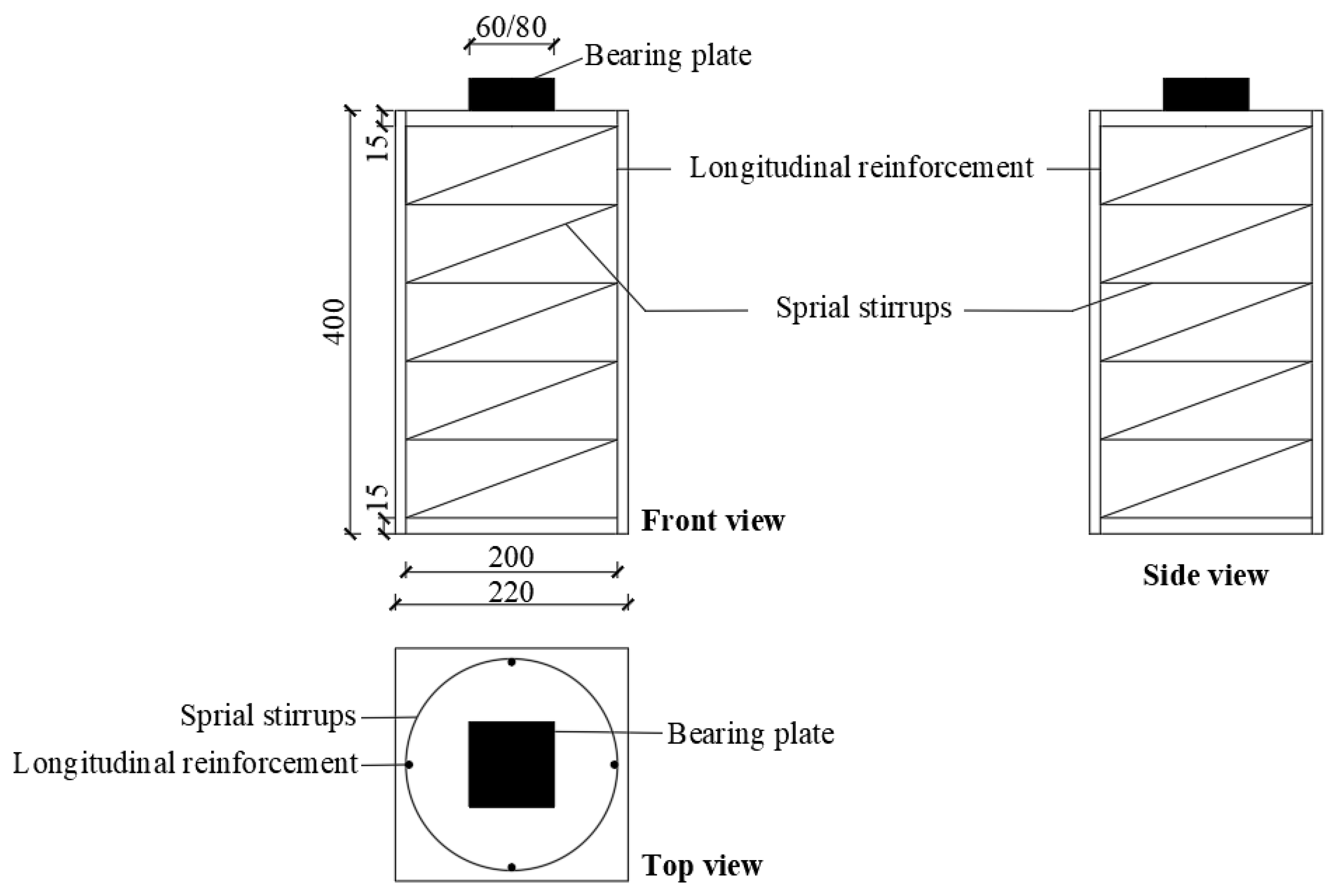
A total of 40 stirrup-confined concrete short column specimens were designed. All specimens had a cross-section of 220 mm × 220 mm and height of 400 mm. Stirrups were HRB400 deformed bars with diameters of 6 mm and 8 mm. Four 8 mm diameter HRB400 longitudinal bars were used as the main reinforcement, tied with stirrups to form a reinforcement cage. The three-view diagram of the specimen is shown in Figure 1 with two local bearing plates (80 mm × 80 mm × 30 mm, 60 mm × 60 mm × 30 mm). The main specimen parameters are listed in Table 1.

2.2. Experimental Process

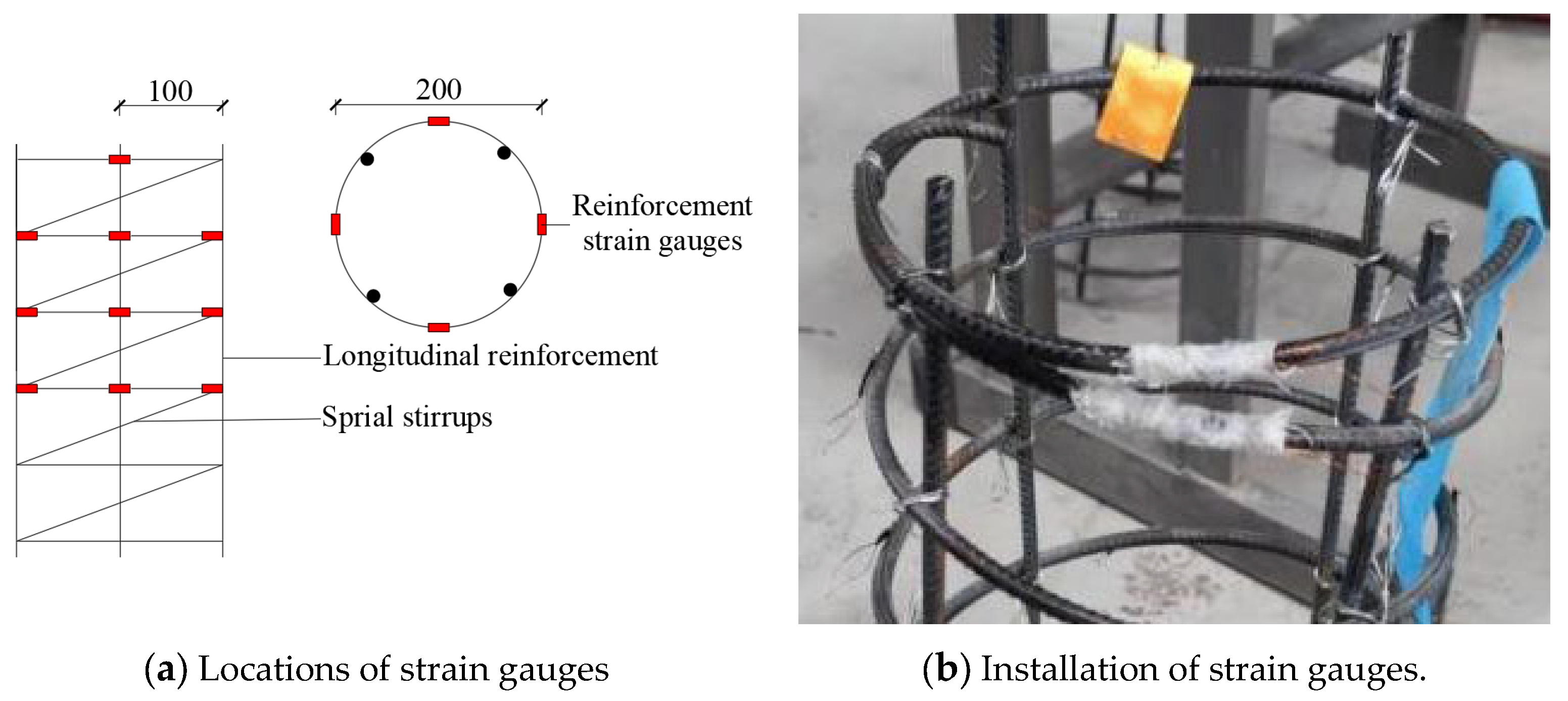
To investigate the stress–strain characteristics of the spiral stirrups in the test specimens, 3 mm × 5 mm strain gauges were attached to the stirrup surfaces, with their measurement zones covering the local bearing affected regions of the specimens. The layout of strain gauges is shown in Figure 2. The mechanical properties of concrete are presented in Table 2. The spiral hoop reinforcement used in this test comprises HRB400-grade hot-rolled ribbed steel bars.
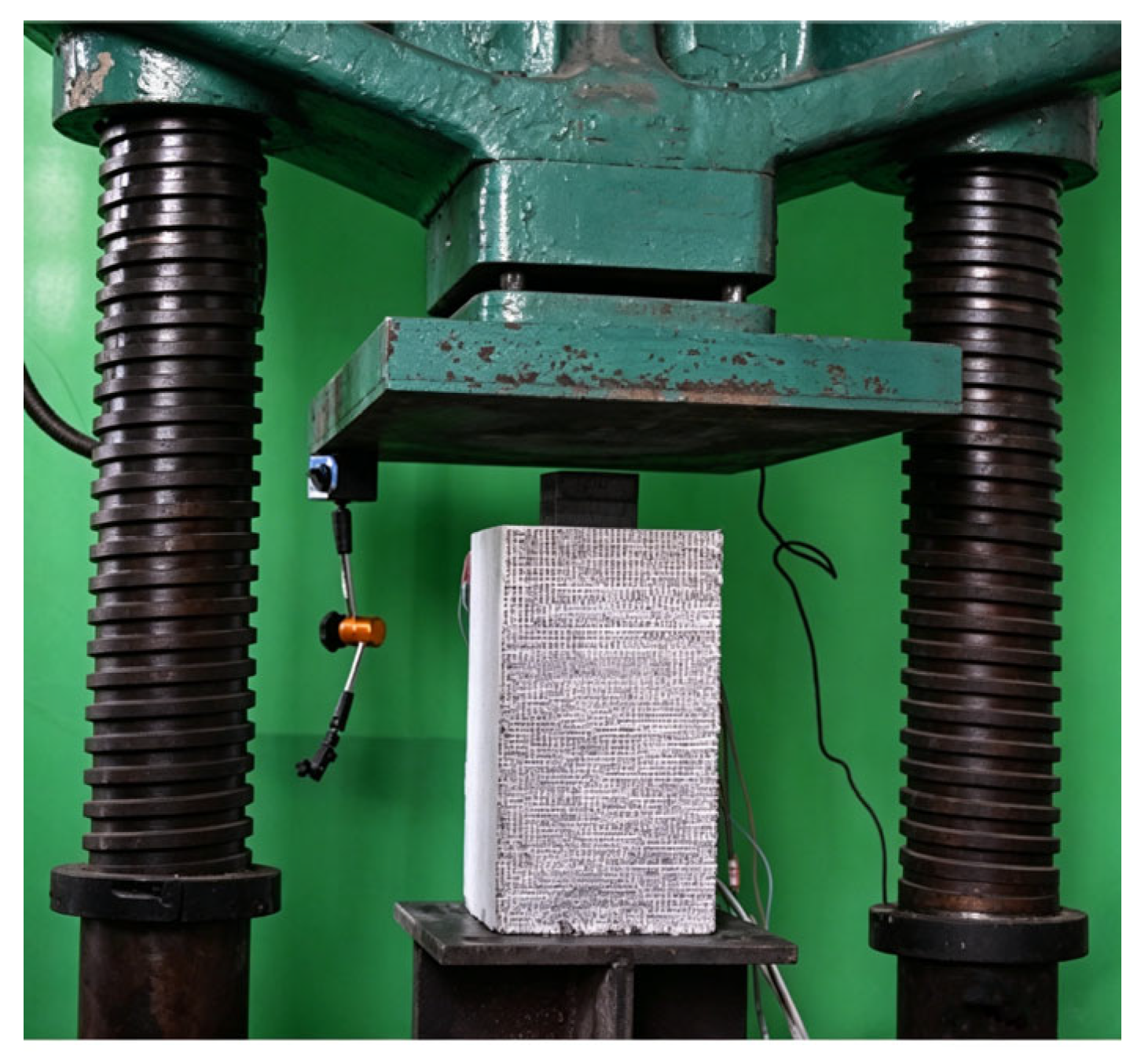
The formal loading process is divided into two stages. In the first stage, loading was force-controlled at a rate of 3 kN/s, with each load increment accounting for 10% of the estimated load. In the second stage, the loading shifted to displacement control at a rate of 0.003 mm/s, continuing until the load decreases to 85% of the peak value. The specimen was defined to have failed when this criterion was met, concluding the test. The actual loading situation is illustrated in Figure 3.

2.3. Experimental Phenomena

Vertical cracks were observed in the mid-upper region of all specimens, which conforms to the typical characteristics of concrete local bearing failure. As the applied load increased, these cracks further propagated and formed vertical through-cracks, as illustrated in Figure 4. In some specimens, the cracks developed diagonally and eventually formed transverse through-cracks, as depicted in Figure 5. The local bearing plates underwent substantial displacement and exhibited an obvious trend of local crushing and indentation. The local bearing capacity Fl of each specimen is summarized in Table 1. To ensure the accuracy of model, an additional 92 sets of specimen data points were collected from references [6,23,24,25,26,27].

3. Neural Network Prediction Model

3.1. BP Neural Network

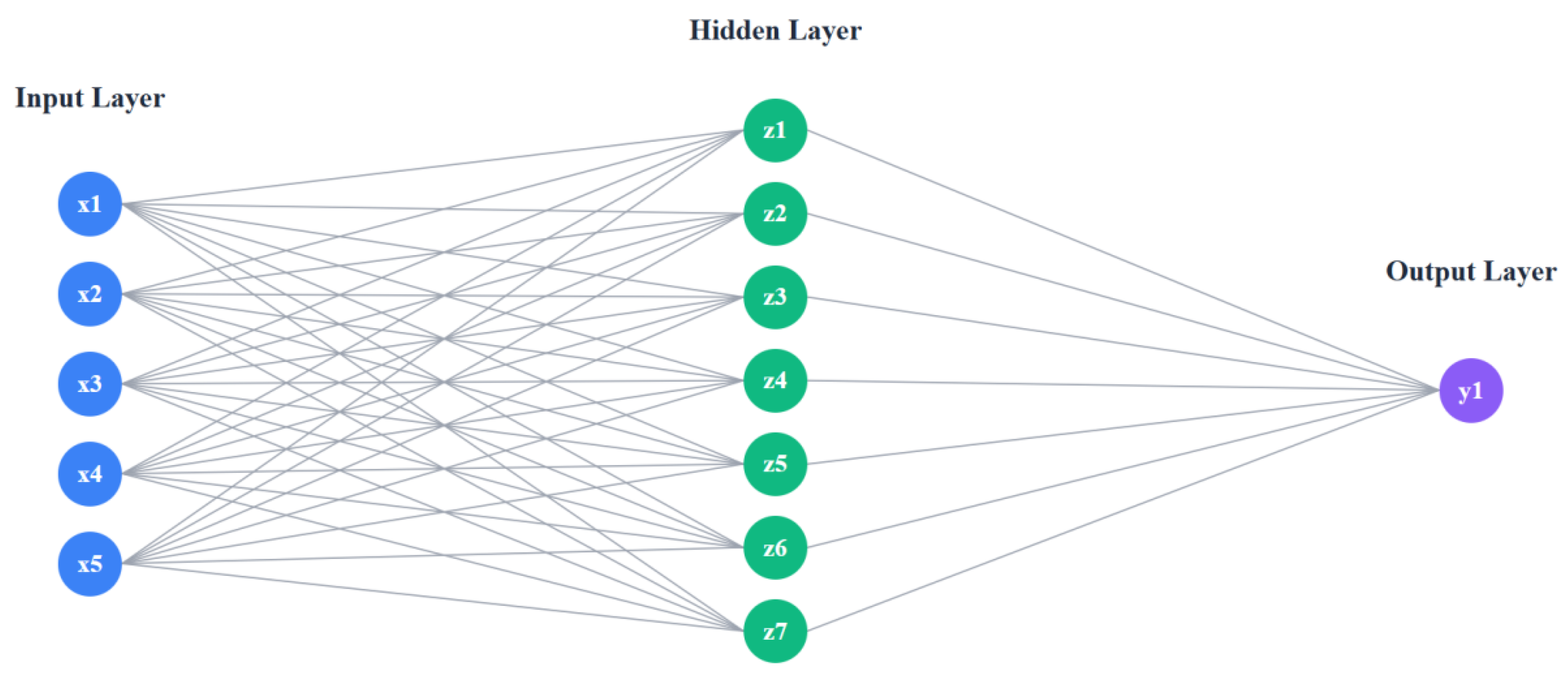
The backpropagation (BP) is a multi-layer feedforward neural network that operates under supervised learning and is based on the error backpropagation algorithm [28]. Its fundamental mechanism involves iteratively adjusting the weight and threshold parameters of the network to minimize the discrepancy between the actual and desired outputs, thereby progressively converging toward the target values. The architecture typically consists of three layers: an input layer, one or more hidden layers, and an output layer [29,30].
The input layer receives external data, with the number of neurons corresponding to the dimensionality of the input features. The hidden layers comprise nonlinear activation units responsible for feature extraction and transformation. The output layer produces the final predicted values, with the number of neurons aligned to the dimensionality of the target output. A simplified schematic of this structure is illustrated in Figure 6.

3.2. PSO Algorithm

PSO is a population-based metaheuristic optimization algorithm inspired by the collective behavior of social organisms, such as bird flocks or fish schools [31]. The algorithm models the social dynamics of a swarm of “particles”, where each particle represents a potential solution. By iteratively updating their positions and velocities based on individual experience and shared group knowledge, particles navigate the search space to converge toward optimal solutions [32,33].
The PSO algorithm first randomly initializes a set of particles in the preset search space. Each particle contains two core state parameters: the position xit and velocity vit at the t-th iteration, where i denotes the particle index. The fitness value of each particle is calculated and evaluated through the preset objective function to quantitatively measure the advantages and disadvantages of the current position of the particle. Subsequently, the velocity and position of each particle are updated according to the predefined update rules, with the velocity update governed by Equation (7):
v i t + 1 = ω v i t + c 1 r 1 ( p best , i x i t ) + c 2 r 2 ( g best x i t )
where pbest,ixit represents the direction and magnitude of movement toward its personal historical best and gbestxit indicates the direction and magnitude of movement toward the swarm’s global optimum. The inertia weight ω [34] controls the extent to which the particle retains its previous velocity, thereby balancing the global exploration (searching unexplored areas) and local exploitation (refining solutions near known optima) of algorithm. The variables c1 and c2 regulate the influence of the particle’s experience and group’s shared knowledge, respectively. The terms r1 and r2 are random numbers uniformly distributed in [0, 1], introducing stochastic diversity into the search process. The position is then updated using the formula:
x i t + 1 = x i t + v i t + 1
where vit+1 determines the direction and magnitude of the position update. The iterative cycle system, from fitness assessment to speed and position update, stops when the requirements are met.

3.3. Model Performance Evaluation

The performance of the model was evaluated with multiple statistical indicators, including mean squared error (MSE), root mean squared error (RMSE), mean absolute error (MAE), and the coefficient of determination (R2). The corresponding formulas are presented as follows:
MSE = 1 n i = 1 n ( y i y ^ i ) 2
R M S E = 1 n i = 1 n ( y i y ^ i ) 2
M A E = 1 n i = 1 n y i y ^ i
R 2 = 1 i = 1 n ( y i y ^ i ) 2 i = 1 n ( y i y ^ ) 2
In the above formulas, y i represents the actual measured value of the i-th sample, y ^ i represents the model predicted value of the i-th sample, and y ¯ represents the mean value of all actual measured values.

3.4. Machine Learning

Random Forest Regression (RFR) is an ensemble learning method that builds multiple decision trees and merges their predictions, featuring strong anti-overfitting ability and high interpretability [35]. Support Vector Regression (SVR) is a nonlinear regression method based on statistical learning theory, which maps data into a high-dimensional space through kernel functions for linear separability [36]; it performs well with small datasets but requires careful tuning of kernel and regularization parameters. Extreme Gradient Boosting (XGBoost) is an efficient gradient boosting algorithm based on decision trees, which optimizes the loss function via second-order Taylor expansion and adds regularization to control model complexity [37]; it is widely used as a benchmark for regression tasks owing to its high accuracy and efficiency in processing structured data.

3.5. Model Development

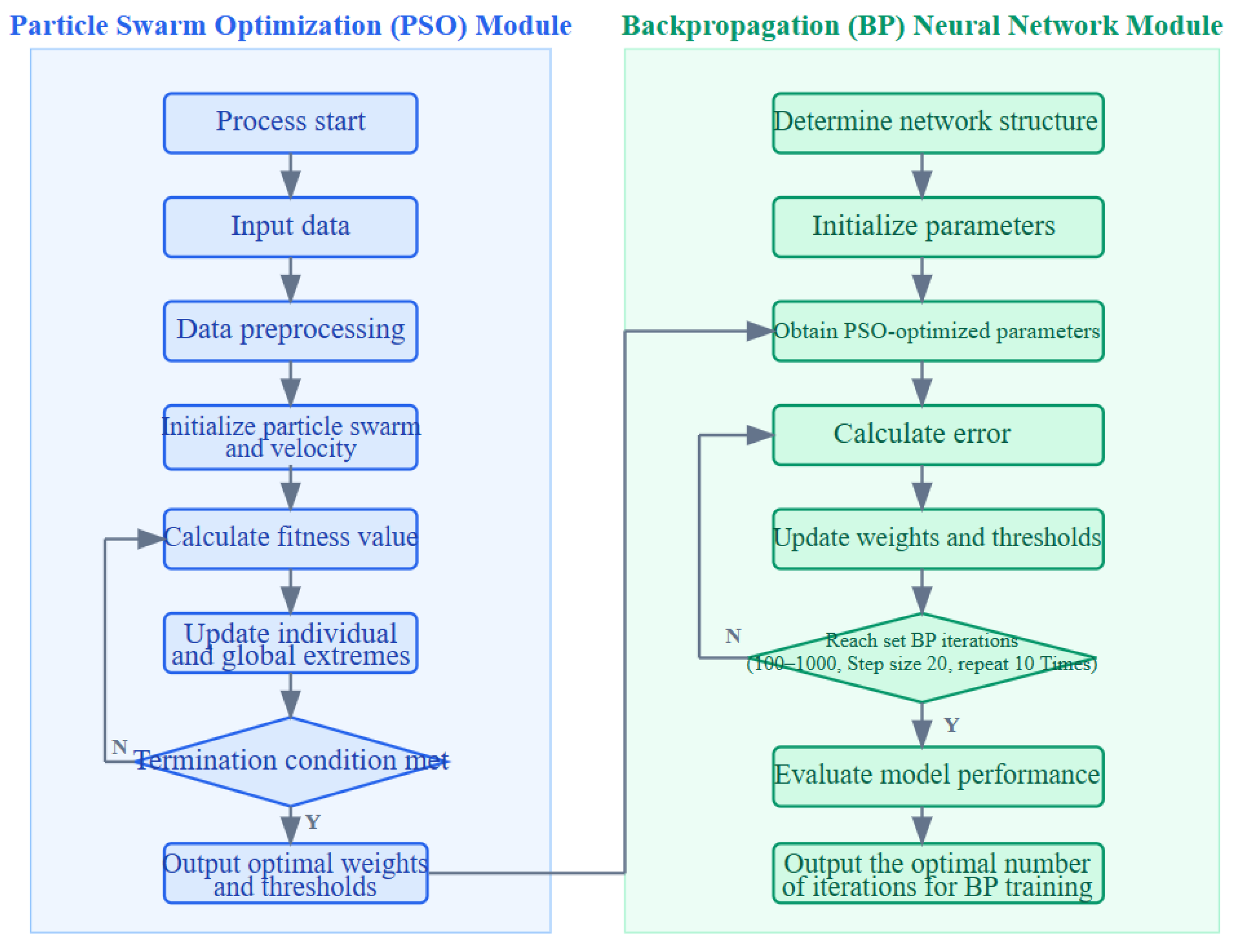
By optimizing the weights and thresholds through PSO and subsequently embedding these optimal parameters into the BP neural network (BPNN), the efficiency of the BP algorithm can be effectively enhanced. The study proposes an integrated PSO-BPNN model, and the corresponding algorithmic flow chart is illustrated in Figure 7.
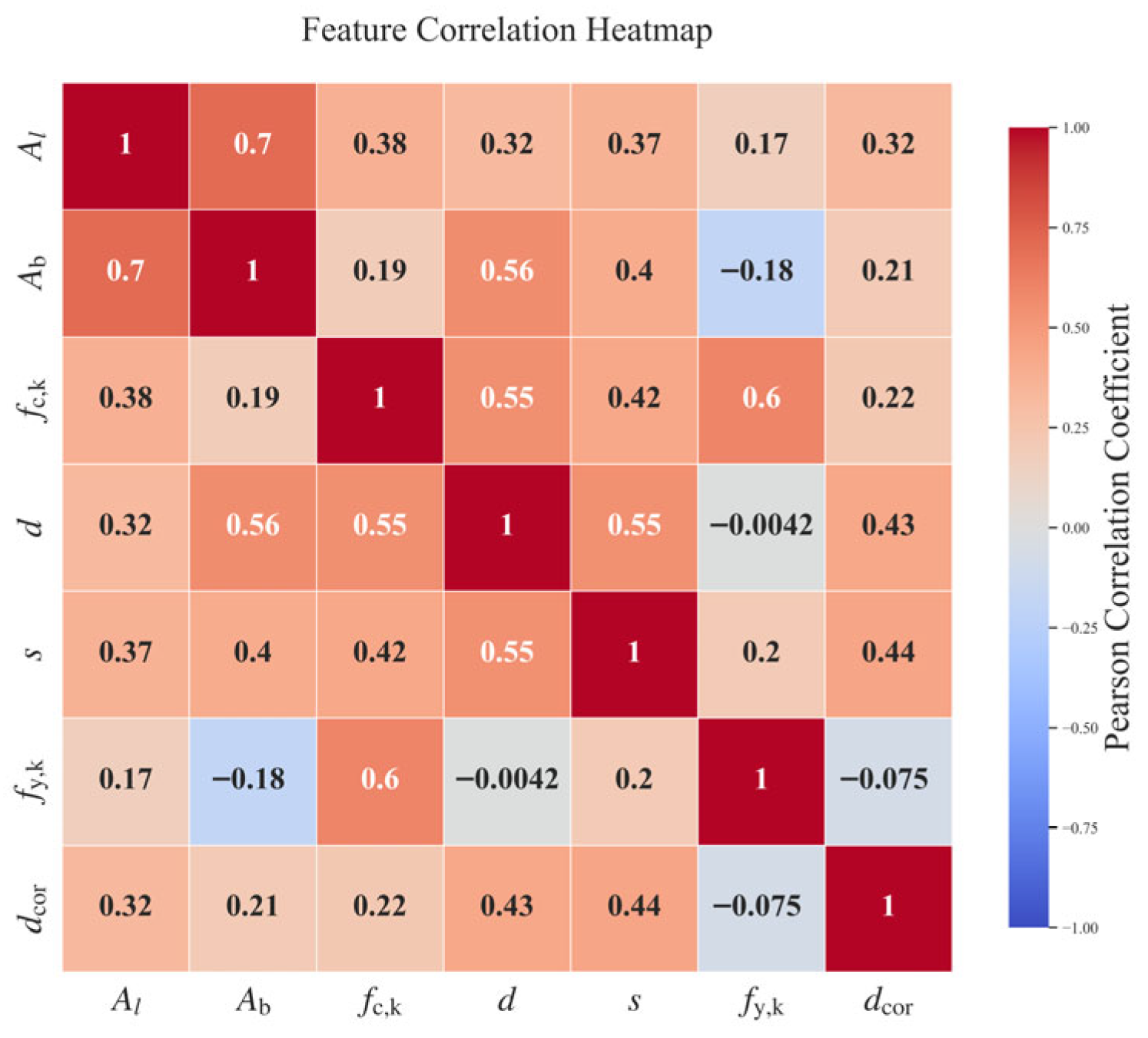
The initial dataset included seven input features (Ab, Al, fc,k, d, s, fy,k, dcor), with Fl as the output. Raw data were loaded from a CSV file, with Fl set as the target variable and the rest as input features. To eliminate ordering bias, the dataset was randomly shuffled with a fixed seed, then split into an 80% training set and 20% validation set. Min–Max scaling was applied to both features and targets, with normalization parameters derived only from the training set to avoid data leakage. A correlation coefficient heat map (Figure 8) was used to check multicollinearity. All pairwise correlation coefficients were below 0.8 (the highest was 0.7 between Al and Ab), indicating multicollinearity was not severe enough to affect model validity [38].

3.5.1. PSO for BPNN Optimization

In this study, the PSO algorithm was initialized with 50 particles, where each particle encodes the weights and thresholds of the neural network in the form of an N-dimensional vector. The positional vectors of particles were uniformly initialized within an N-dimensional hypercube defined by the range [−1, 1], and the initial velocity vectors were set to zero to avoid disordered particle updates in the early stage of iterations. A fitness evaluation was first performed at the initial particle positions to establish a baseline for the subsequent iterative optimization. During the iteration process, the flight of each particle was guided by its personal-best position and the global-best position of the swarm, which facilitated an efficient and orderly search in the solution space.
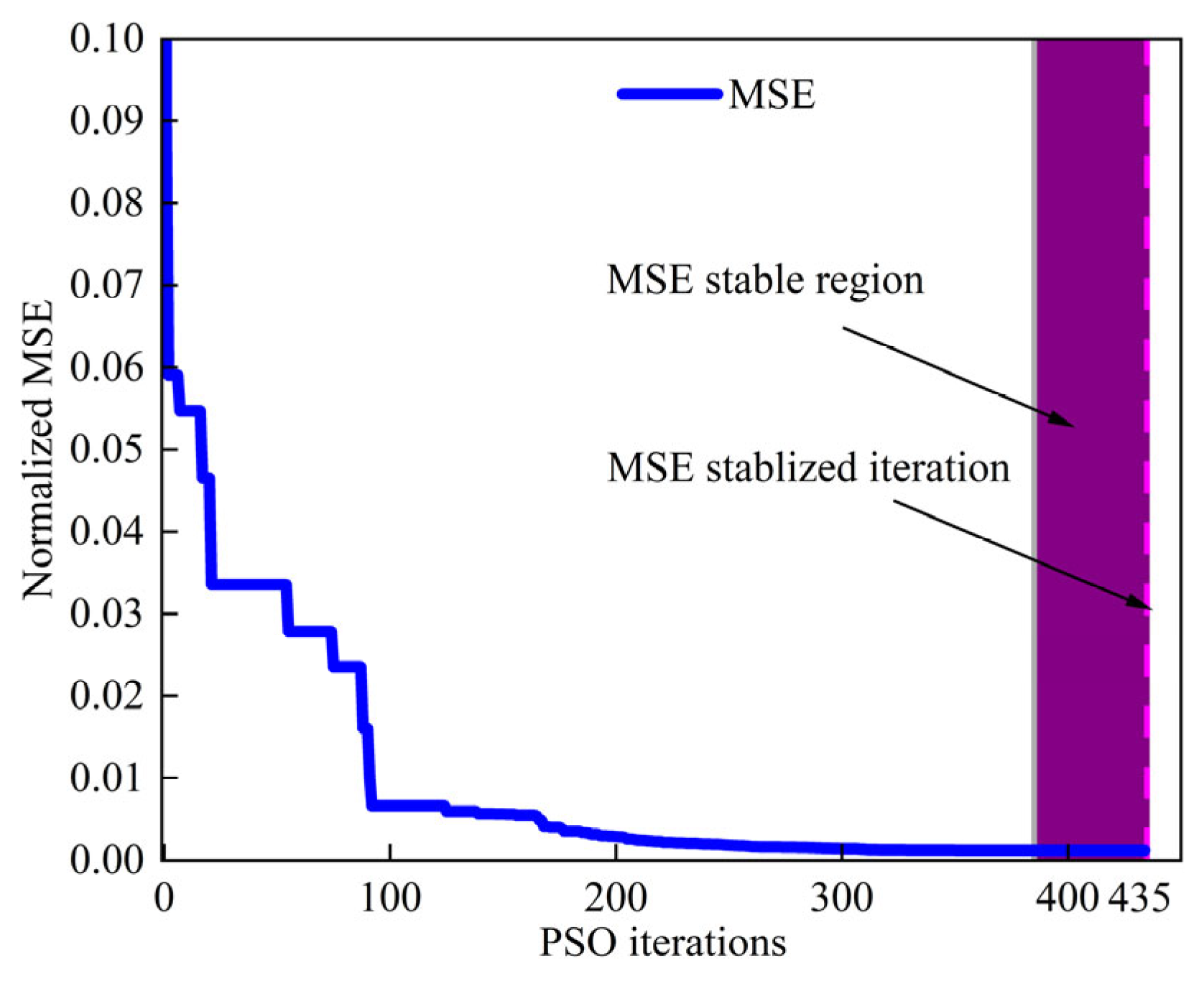
To avoid the dilemma of local optima caused by insufficient iterations and unnecessary computational waste caused by excessive iterations, the optimal iteration number of PSO was determined by a normalized mean squared error (MSE) stability detection mechanism to balance optimization performance and computational efficiency. As illustrated in Figure 9, the blue curve characterized the dynamic variation of the normalized MSE during the PSO optimization process, which exhibited two typical stages: rapid descent and steady convergence. Specifically, the normalized MSE decreased drastically within the first 200 iterations, demonstrating that the PSO algorithm efficiently optimizes the network weights and rapidly diminishes the initial high prediction loss.
To quantitatively identify the convergence point, a sliding window with a window size of 50 was adopted to track the relative change rate of the normalized MSE in real time. The convergence condition was defined as the relative change rate between all consecutive iterations within the sliding window being less than 10−3, and the first iteration satisfying this criterion was determined as the optimal stopping iteration. The purple shaded region in Figure 9 represents the convergence stabilization zone, where the normalized MSE first stabilized at 0.002320 at the 435th iteration. Only marginal performance improvements could be observed in the subsequent iterations, which verified that the 435th iteration was the optimal termination point that struck a favorable balance between model prediction accuracy and computational efficiency.
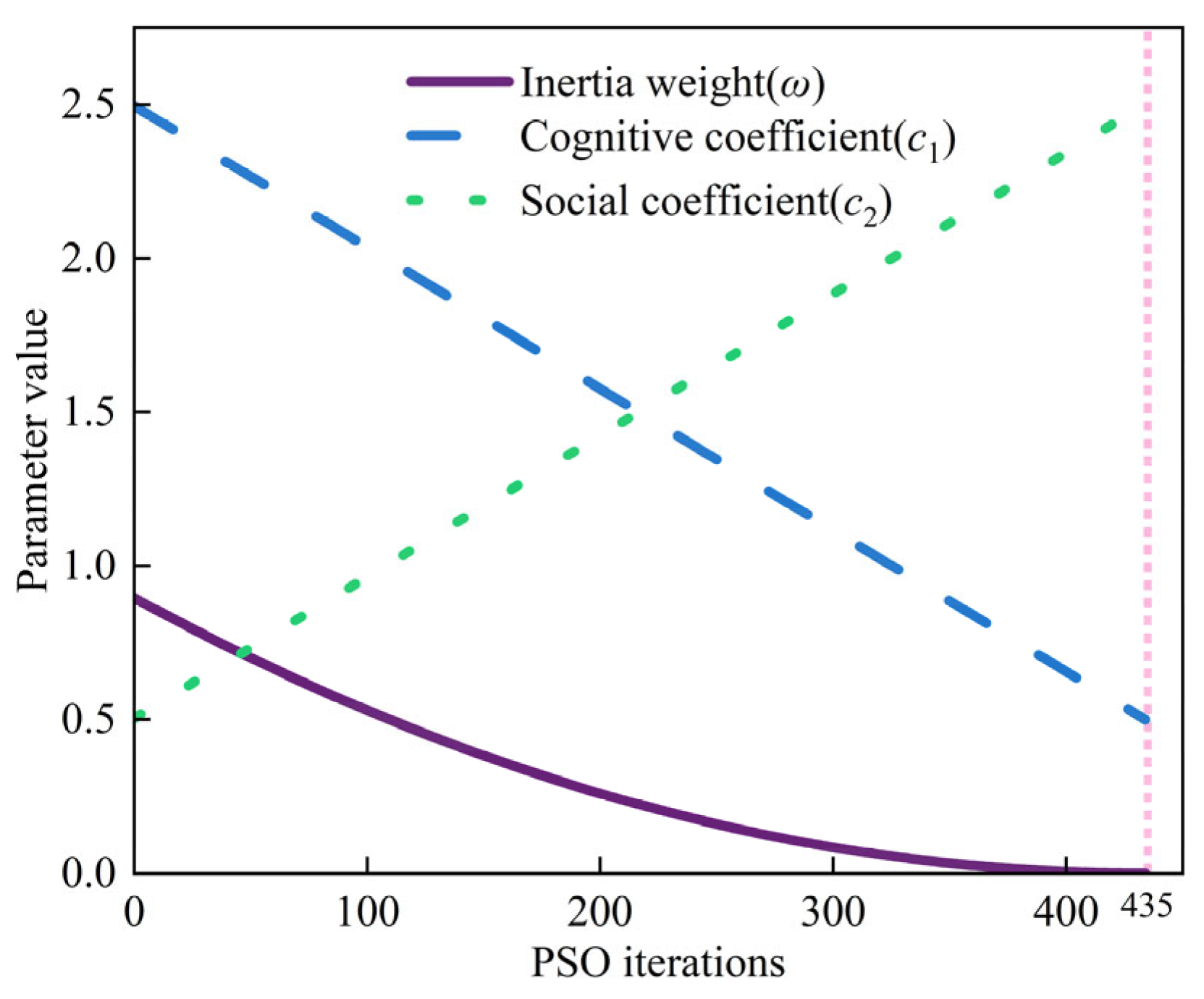
Figure 10 visualizes the dynamic evolution of key PSO parameters during training, with iterations on the horizontal axis and parameter values on the vertical axis. The purple curve (inertia weight ω) decreases gradually, reflecting the shift from global exploration to local exploitation. The blue dashed line (cognitive coefficient c1) remains high initially to promote individual learning from personal best positions and decreases later. The green dotted line (social coefficient c2) increases progressively, encouraging particles to rely more on collective swarm experience as optimization proceeds.

3.5.2. PSO-BPNN Model

In the BP phase, the optimal parameters (optimal weights and thresholds) searched by PSO were used as the initialization points for gradient based training.
This study adopted a BPNN with two hidden layers, which can approximate any decision boundary to arbitrary precision with an appropriate activation function [39]. The number of hidden layer neurons significantly affects the model prediction accuracy. Insufficient neurons may cause convergence failure, while excessive neurons increase the overfitting risk. At present, there is no universal method to determine the optimal neuron number, which is usually determined by empirical judgment and repeated tests, and verified by final model performance.
This study designed a regression task with seven-dimensional input features (Ab, Al, fc,k, d, s, fy,k, dcor) and a one-dimensional output (Fl). The input layer contained seven neurons. The first hidden layer has 20 neurons with the ReLU activation function to capture nonlinear feature interactions. The second hidden layer has 15 neurons for dimensionality reduction. The output layer has one neuron to predict Fl. Network parameters were initialized by the He initialization strategy [40]. The Adam optimizer was used with an adaptive learning rate η = 0.001 [41]. After training, model performance was evaluated by MSE and R2.
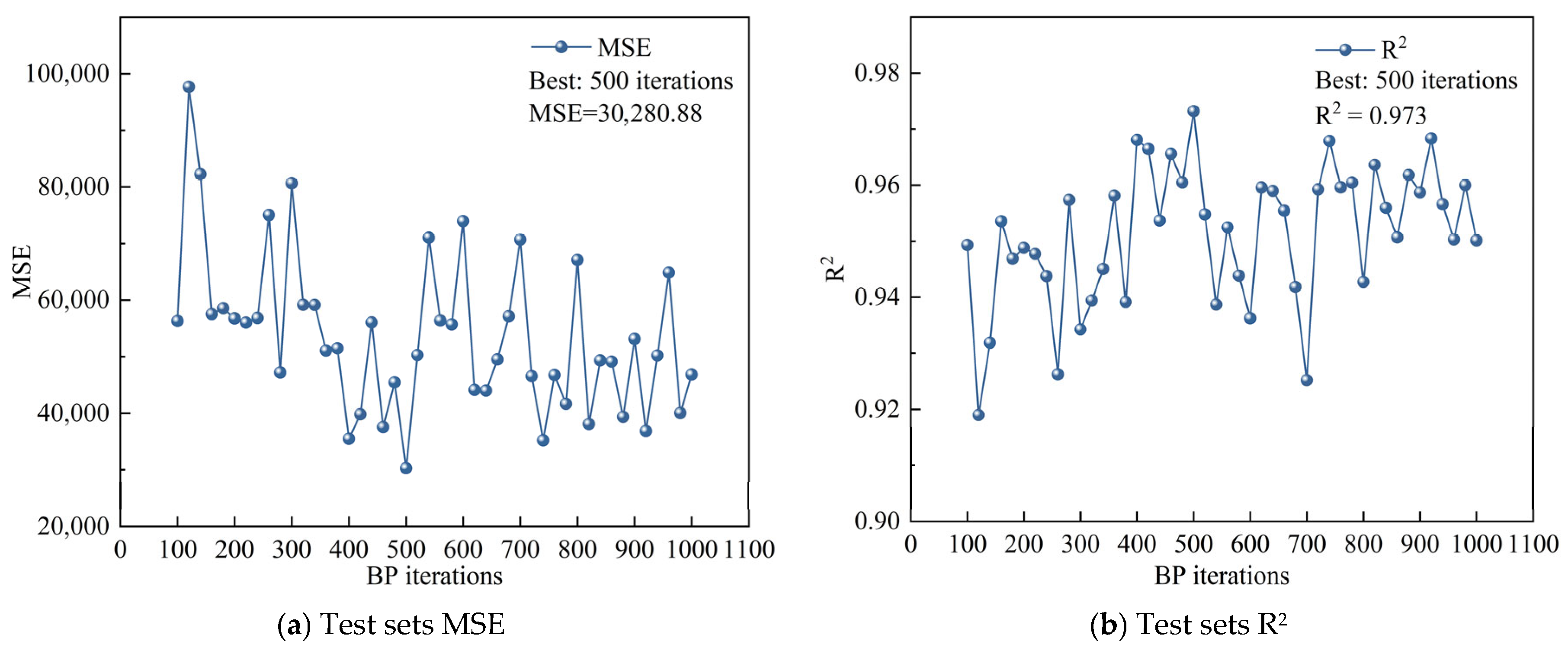
To determine the optimal number of BP training iterations, the PSO optimization phase was fixed at 435 iterations. The BP iteration number was adjusted from 100 to 1000 with a step of 20. Ten independent experiments were carried out for each configuration, and the performance was evaluated by the average MSE and R2 on the test set.
In Figure 11a, the blue line illustrated the average MSE across 10 trials under varying numbers of BP iterations. Although fluctuations in MSE were observed, the value reaches its minimum at 500 iterations. This is an optimal balance between training convergence and generalization performance. Notably, the model exhibited stability without significant overfitting around this point. The blue line in Figure 11b represented the average R2 value. The trends in R2 and MSE were complementary, reaching a peak of 0.973 at 500 iterations. Consistent with the optimal MSE round, the robustness of the results was verified. Therefore, the optimal number of iterations for BP training was set to 500.
The proposed PSO-BPNN model was independently implemented using the Python 3.10 programming language. The neural network structure was built on the PyTorch 2.5.1 deep learning library, and the entire code development, debugging, and experimental execution were conducted in the PyCharm integrated development environment.

4. Evaluation

4.1. Comparison of Iterations and Convergence Efficiency

A comparative analysis was conducted to evaluate the influence of training iterations on MSE and R2 under two approaches: one approach involved conducting BP training after the PSO algorithm had completed 435 iterations, while the other approach entailed training only with the BPNN model.
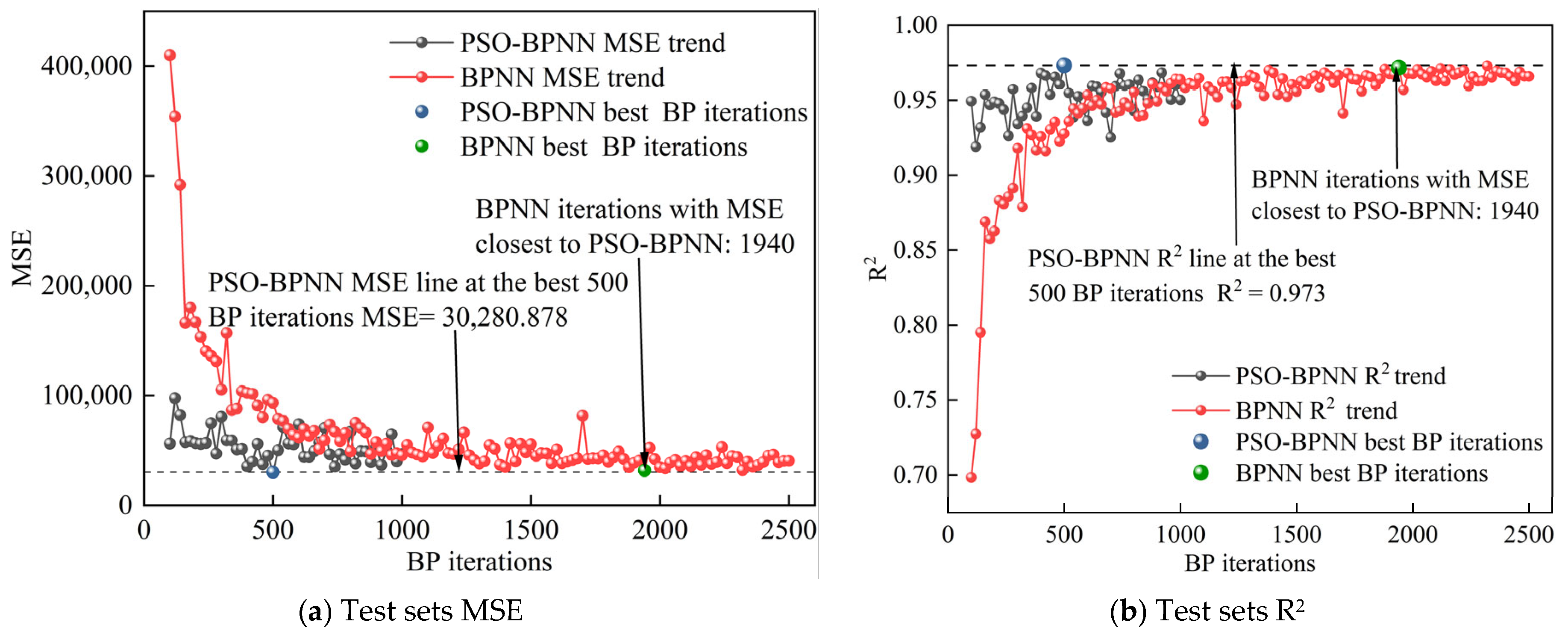
As depicted in Figure 12a,b, the black curve (PSO-BPNN) exhibits a lower initial MSE, faster convergence rate, and higher initial R2 compared with the red curve (conventional BPNN). The PSO-BPNN achieves a test MSE of approximately 30,280.878 and R2 of 0.973 with only 500 BP iterations, whereas the traditional BPNN requires 1940 iterations to attain comparable performance, corresponding to a 74.23% reduction in the number of training iterations. This confirms the PSO-BPNN’s superior convergence efficiency, as PSO provides optimal initial weights and thresholds through global parameter space search, preventing premature convergence to local optima. For practical engineering applications, the PSO-BPNN delivers stable, high-precision predictions with fewer iterations, significantly reducing computing time and hardware resource consumption—critical advantages under the constraints of training latency and computational cost.

4.2. Stability Analysis of PSO-BPNN Model

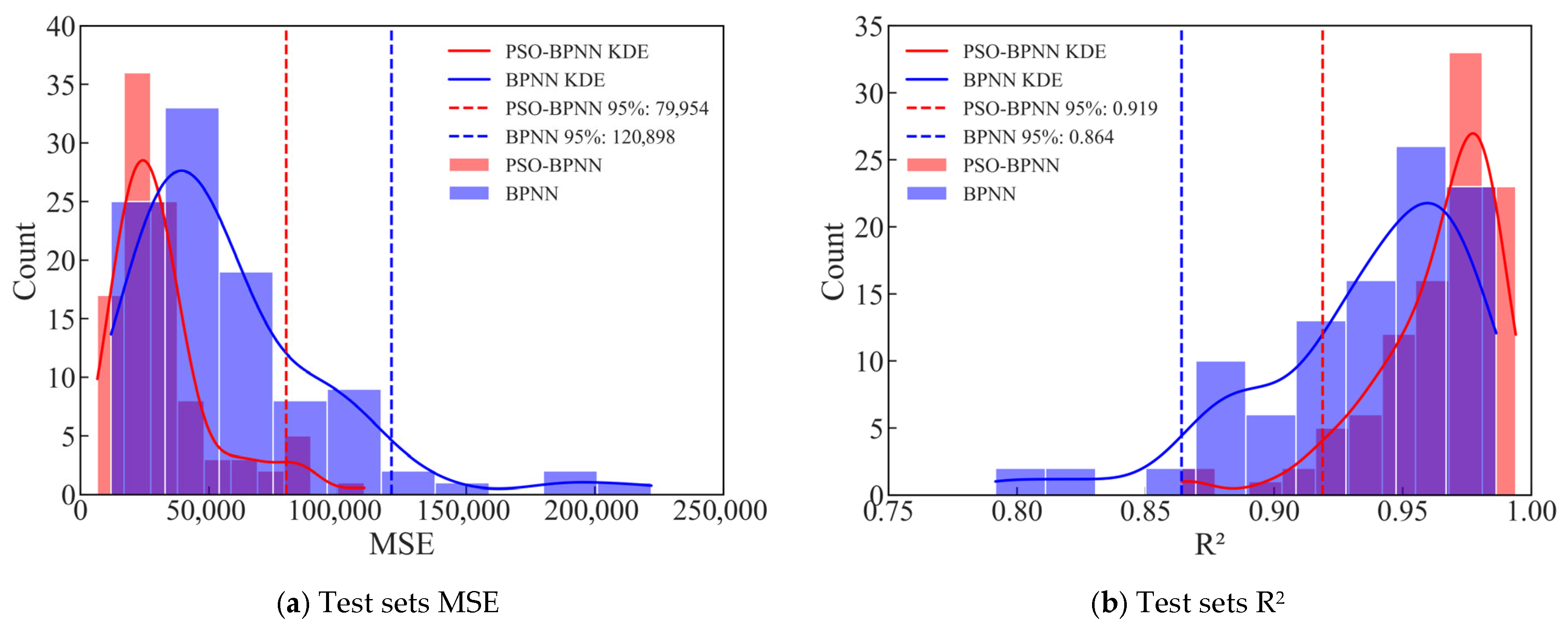
The PSO-BPNN and BPNN models were trained independently for 100 runs with 500 fixed iterations and different random seeds. The test set MSE and R2 of the 200 models were statistically analyzed to assess the stability and generalization ability of the two methods.
f ^ h ( x ) = 1 n h i = 1 n K ( x x i h )
K ( u ) = 1 2 π e u 2 2
The kernel density estimation (KDE) curve is calculated by Equations (13) and (14) with a Gaussian kernel [42]. The bandwidth parameter h is determined by Silverman’s rule [43]. As a non-parametric method, KDE is adopted to characterize the probability distribution of model performance indicators without preset distribution assumptions.
Figure 13 shows double histograms superimposed with KDE curves, plotting the test set MSE and R2 distributions of the PSO-BPNN and BPNN models (horizontal axis: distribution characteristics; vertical axis: frequency). The 95th percentile of PSO-BPNN test set MSE is 79,954, approximately 33.9% lower than BPNN 120,898, confirming the low error rates of model. Meanwhile, the 5th percentile of the PSO-BPNN test set R2 is 0.919, a 5.5% improvement over BPNN 0.864, indicating higher fitting accuracy across most samples. Kernel density analysis reveals that the PSO-BPNN test set MSE and R2 feature sharp peaks and narrow intervals: MSE clusters tightly in the low-error range, and R2 concentrates near 1.0, reflecting narrow performance fluctuations and superior stability. In contrast, the BPNN exhibits insufficient stability.
The results indicate that the PSO-BPNN model achieves both higher prediction accuracy and greater stability, verifying the effectiveness of PSO in enhancing BP neural network performance.

4.3. Evaluation of the Performance of the PSO-BPNN Model

To enable a more systematic approach to subsequent research and analysis, a PSO-BPNN model is selected as the primary focus of investigation. The performance of the model is quantitatively evaluated using four core evaluation metrics, which collectively capture its overall effectiveness across key dimensions, including prediction accuracy, convergence speed, and generalization capability. The corresponding indicator values are summarized in Table 3.
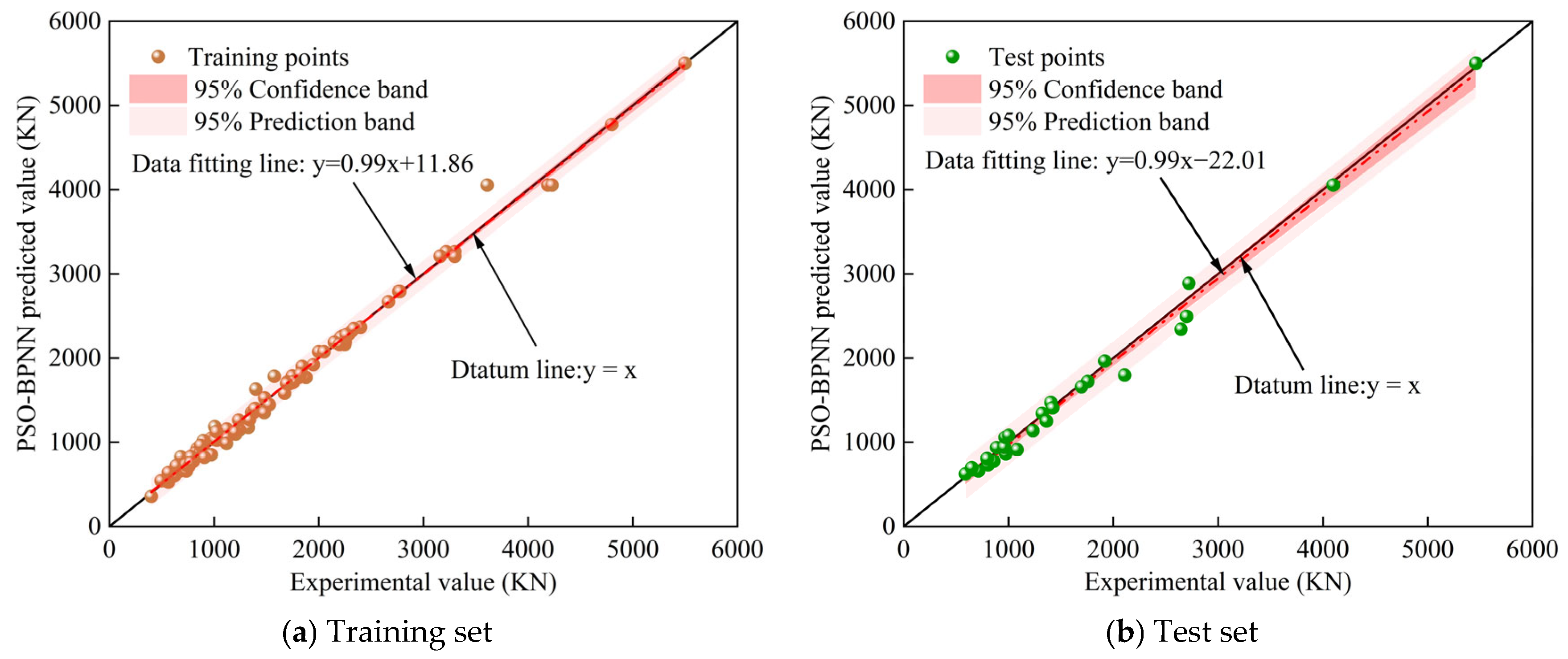
Figure 14 compares the predicted values of the PSO-BPNN model with experimental results. For the training set (Figure 14a), the model achieves R2 = 0.993 and MSE = 6672.734, with all data points closely distributed around the regression line (slope = 0.99), demonstrating superior fitting accuracy. For the test set (Figure 14b), the model yields R2 = 0.989 and MSE = 13,950.174, and the predicted values also agree well with the experimental values (slope = 0.99). The high fitting consistency verifies the reliable performance of the proposed model. Accordingly, the predicted values are adopted in the following analysis.

4.4. Comparative Analysis of PSO-BPNN and Machine Learning Algorithms

To comprehensively evaluate the performance of the proposed PSO-BPNN model, a systematic comparison is conducted with three classical machine learning algorithms. A grid search method is adopted to optimize the hyperparameters of each comparative model, and the optimal parameter configurations are listed in Table 4.
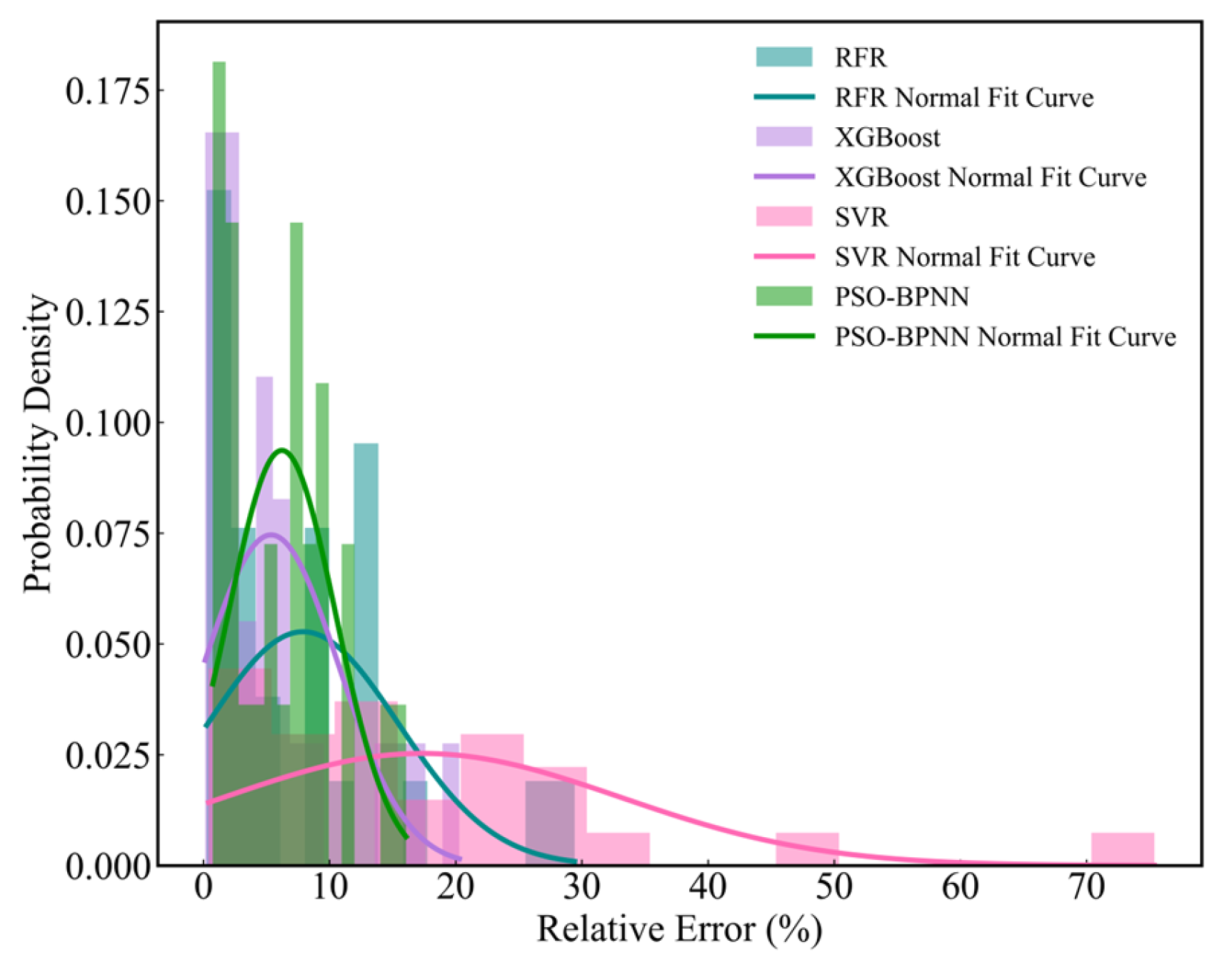
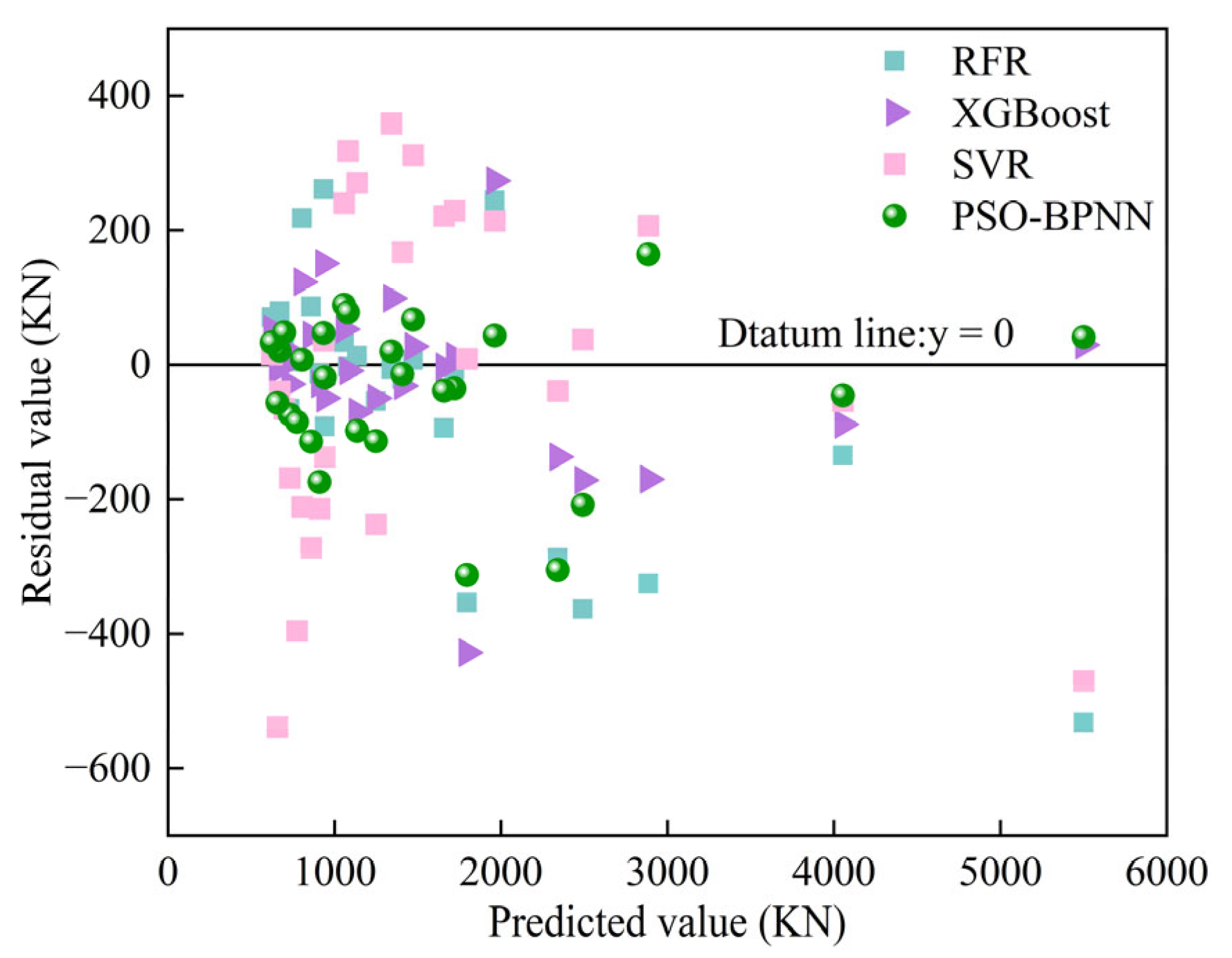
Figure 15 shows the relative error distribution histogram (colored by model), with relative error (%) on the horizontal axis and probability density on the vertical axis. The PSO-BPNN model displays a more concentrated, higher-peaked distribution, indicating smaller overall relative errors and greater predictive stability, with superior error control performance. Figure 16 presents the residual analysis plot (predicted values vs. residuals, with the black solid line representing the ideal zero residual). The PSO-BPNN model’s residual points cluster closely around the ideal line without evident systematic deviation, confirming that its prediction errors are random and minor, with no systematic fitting errors.
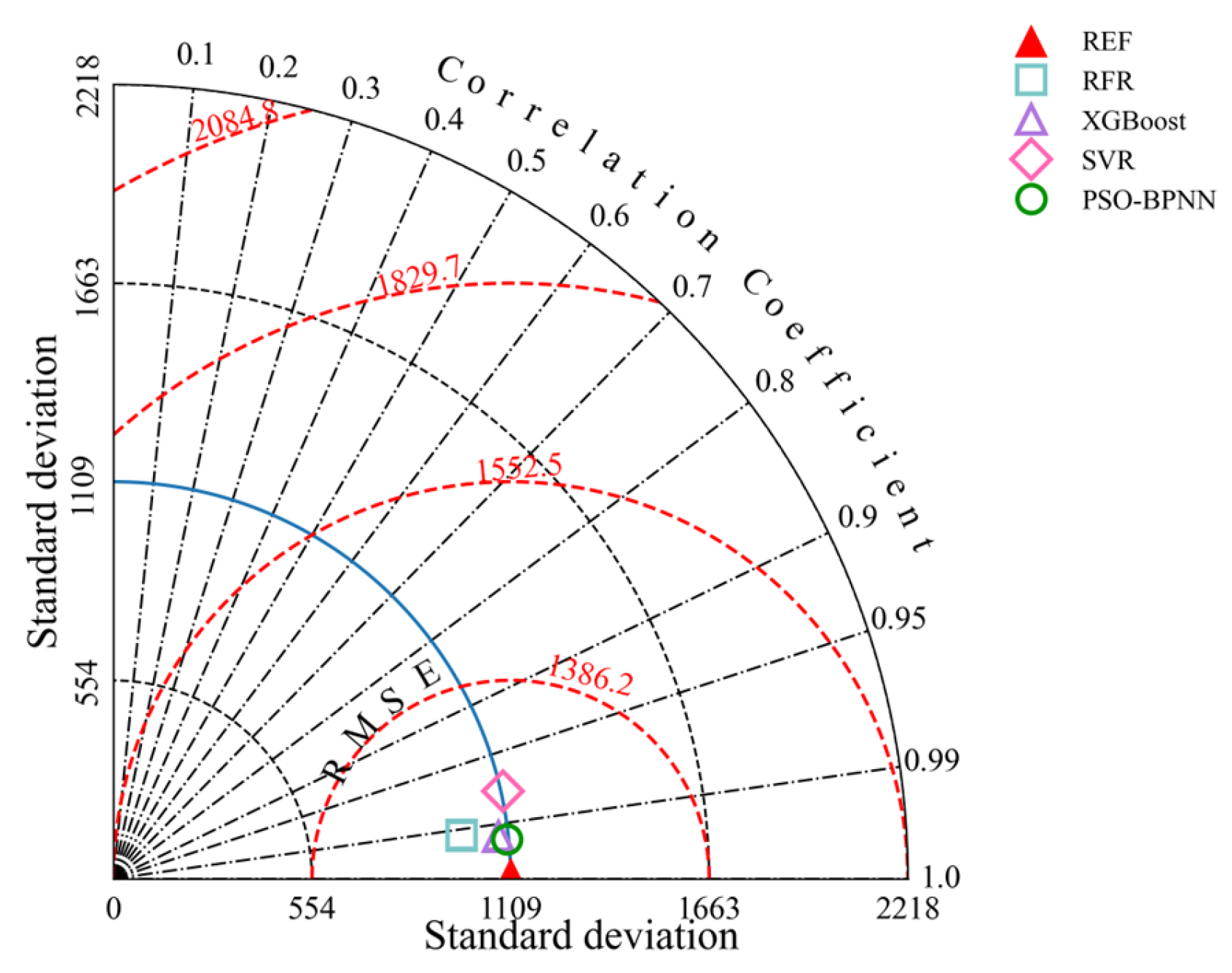
Figure 17 shows the Taylor diagram that comprehensively evaluates correlation coefficient, standard deviation, and RMSE (red dotted contours). The PSO-BPNN model achieves the correlation coefficient closest to 1, a standard deviation highly consistent with REF values, and the lowest RMSE, demonstrating the best performance in linear correlation, dispersion matching, and error level.
The quantitative performance metrics are presented in Table 5. Among the four models, PSO-BPNN exhibits the lowest values for MSE and RMSE, along with the highest R2 score. Although its MAE is slightly higher than that of XGBoost, PSO-BPNN demonstrates superior overall performance in terms of error levels and goodness of fit. In contrast, SVR performs the worst across all error metrics and yields the lowest R2 value.

4.5. SHAP Analysis

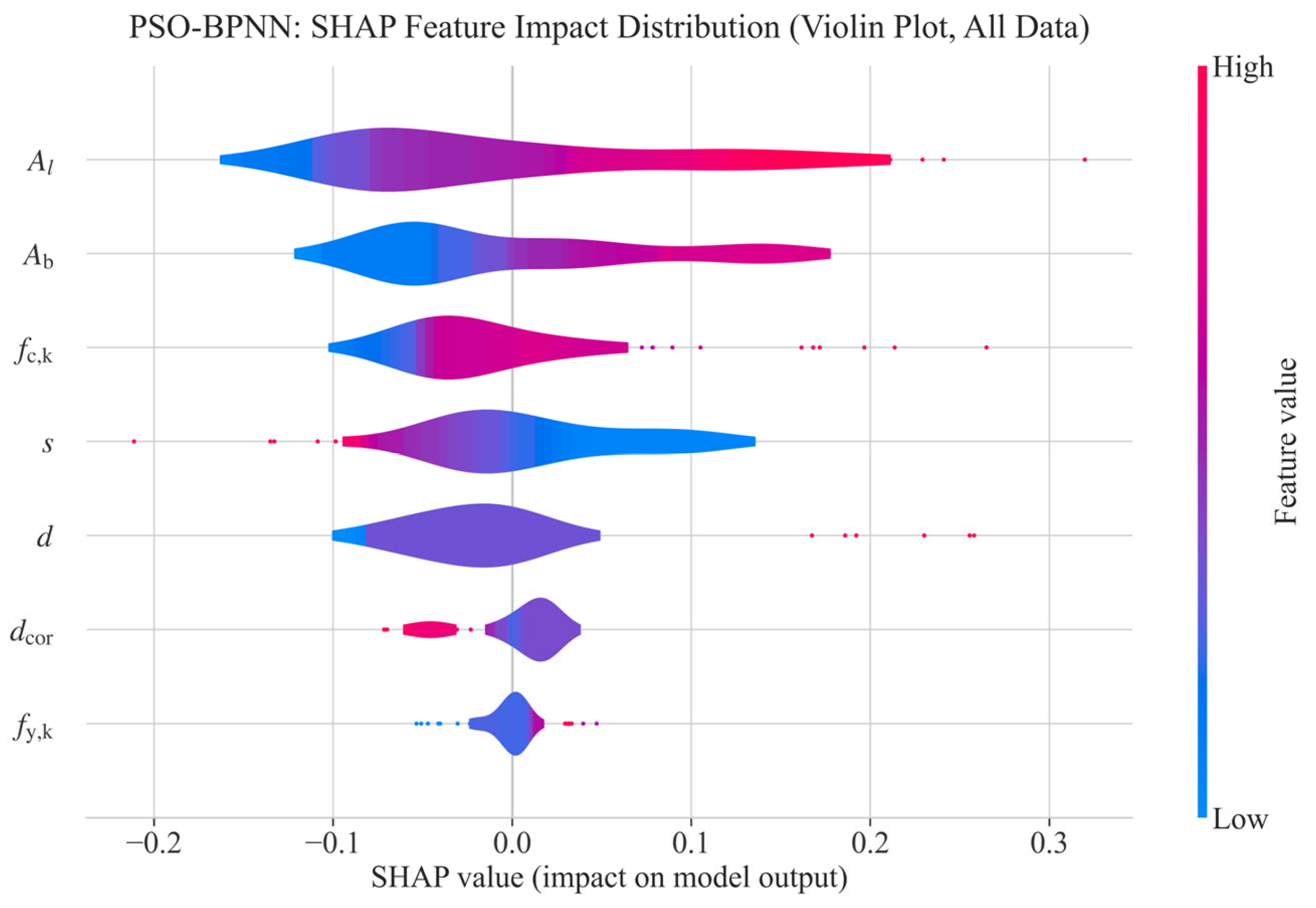
SHAP is a game-theoretic interpretation method based on Shapley values, which quantifies the marginal contribution of each feature to model predictions and reveals the decision logic of machine learning models [44]. With a rigorous theoretical foundation and strong adaptability, SHAP can explain the local feature effects on single samples and identify global feature importance and interactions through aggregation analysis. Figure 18 presents the SHAP violin plot of the PSO-BPNN model, showing the distribution of each feature’s influence on the local bearing capacity Fl. The horizontal SHAP value indicates the direction and magnitude of the feature effect (positive for improvement, negative for reduction), and the vertical axis lists the input features. The color bar represents the relative value of each feature. Al has a wide SHAP value distribution concentrated in the high-value region, verifying its core role as a highly sensitive variable. Ab exerts a positive effect at high values, but its overall impact is weaker than Al and further weakened by feature interactions. fc,k, s, d, and dcor show limited influence on the local bearing capacity in most cases. The SHAP values of fy,k are mainly distributed near zero, indicating its weak contribution or neutralization by multivariable interactions.

5. Comparison Verification with Traditional Models

5.1. Comparison Between the PSO-BPNN Model and Codes

The PSO-BPNN model was validated against experimental measurement data, achieving a high R2 of 0.989, a low MSE of 13,950.174, and a regression slope of 0.99 in the test set (as detailed in Section 4.3), which confirmed excellent consistency between the model predicted values and actual experimental results. Owing to this verified high predictive accuracy, the PSO-BPNN model’s predicted values were designated as the ground truth for subsequent analyses, replacing the original experimental measurement data. This designation was justified by the ability of the model to reliably capture the true local bearing capacity, as validated by the aforementioned accuracy indices. A quantitative comparative evaluation was conducted to assess the predictive performance of three traditional codes approaches with formulas from the GB50010-2010, MC2020, and ACI318-25 against this ground truth (PSO-BPNN predicted values) to estimate the local bearing capacity of stirrup-confined concrete.
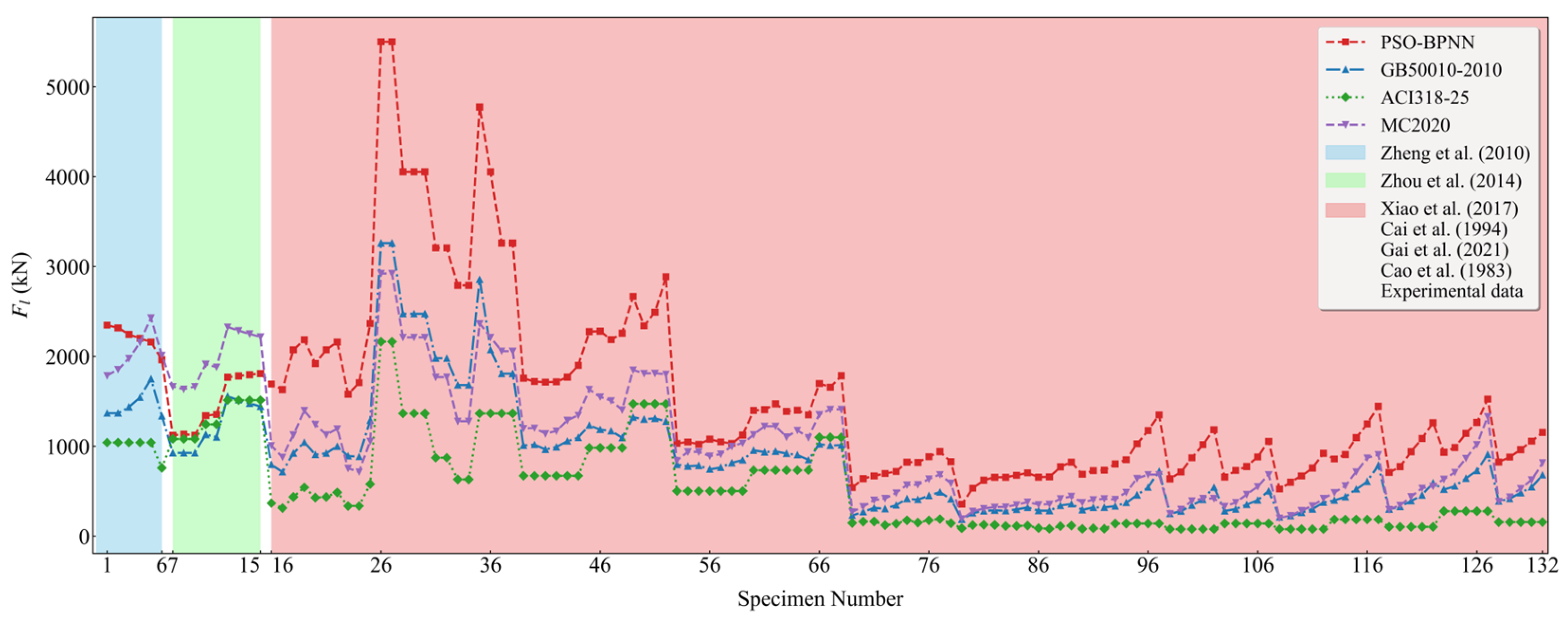
The learning data were derived from multiple independent experimental datasets with significant variations in test conditions and parameter settings, resulting in distinct and heterogeneous characteristics across the dataset. To facilitate a systematic analysis, a comprehensive overview comparison is presented in Figure 19 to visually illustrate the overall distribution pattern of the data. Based on the observed distribution trends, the data are subsequently partitioned into three regions exhibiting relatively distinct feature clusters. Detailed quantitative discussions and analyses of the influencing factors are carried out for each region separately, with all comparisons anchored to the PSO-BPNN.
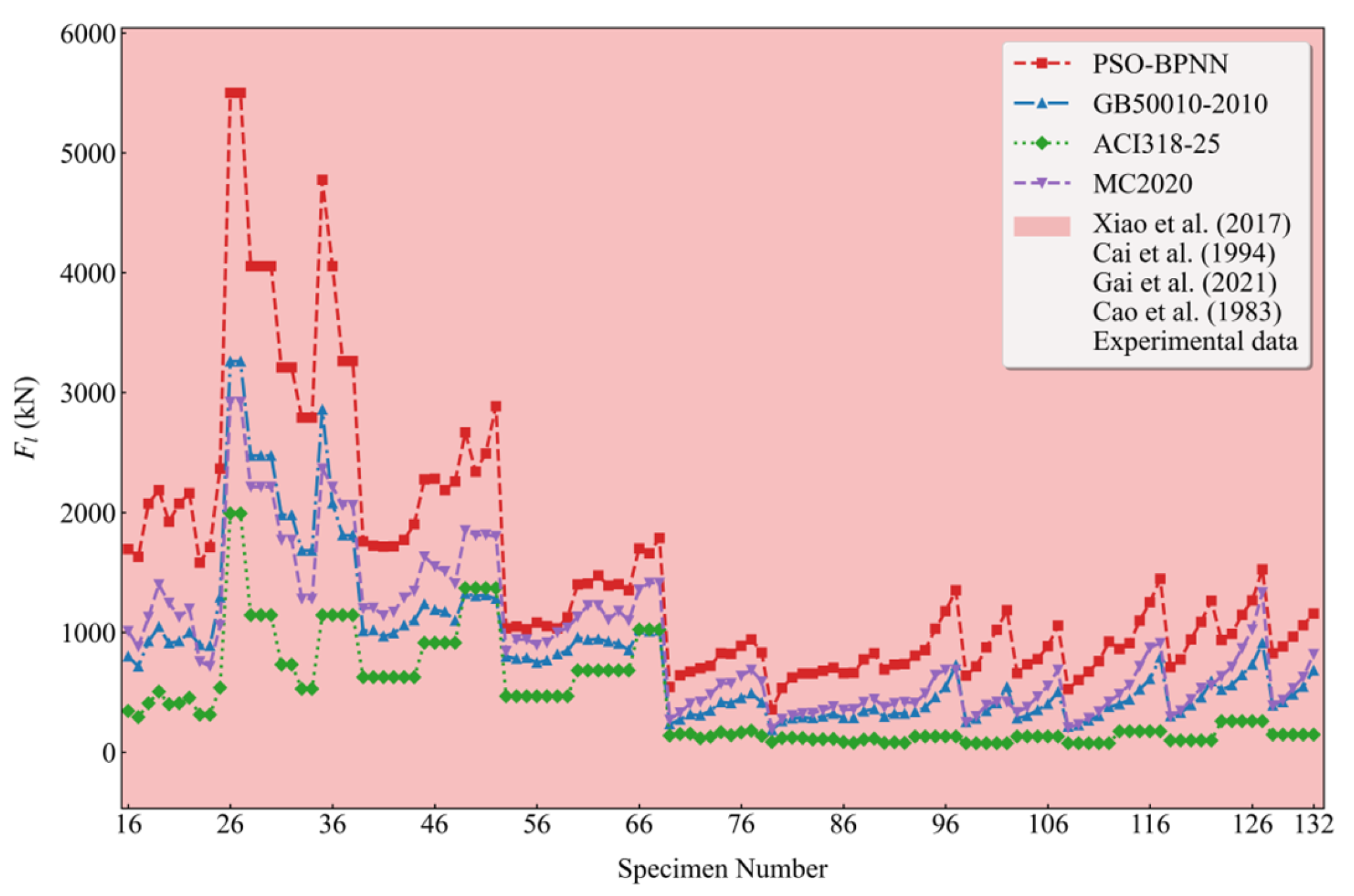
The first two regions fall outside the applicable scope of the codes, leading to overestimated local bearing capacity values for some specimens. Attention is now turned to the third region shown in Figure 20, with data sourced from Xiao et al. (2017) [24], Cai et al. (1994) [25], Gai et al. (2021) [26], Cao et al. (1983) [27]. and our own experimental data. Within the applicable range of code applicability, the curve illustrates the quantitative differences between the local bearing capacity values calculated by the three codes (ACI318-25, GB50010-2010, and MC2020) and the predicted values of the PSO-BPNN model.
There is a relatively high dispersion for ACI318-25, but the most conservative local bearing capacity is estimated as shown in Table 6. This is because the code adopts the method of overall reduction. The calculated values in GB50010-2010 are slightly higher than those in ACI318-25, but slightly lower than those in MC2020. The calculation logic of the GB50010-2010 and MC2020 is consistent, with only slight differences in parameter selection when calculating the strength of stirrup-confined concrete, which results in this discrepancy.
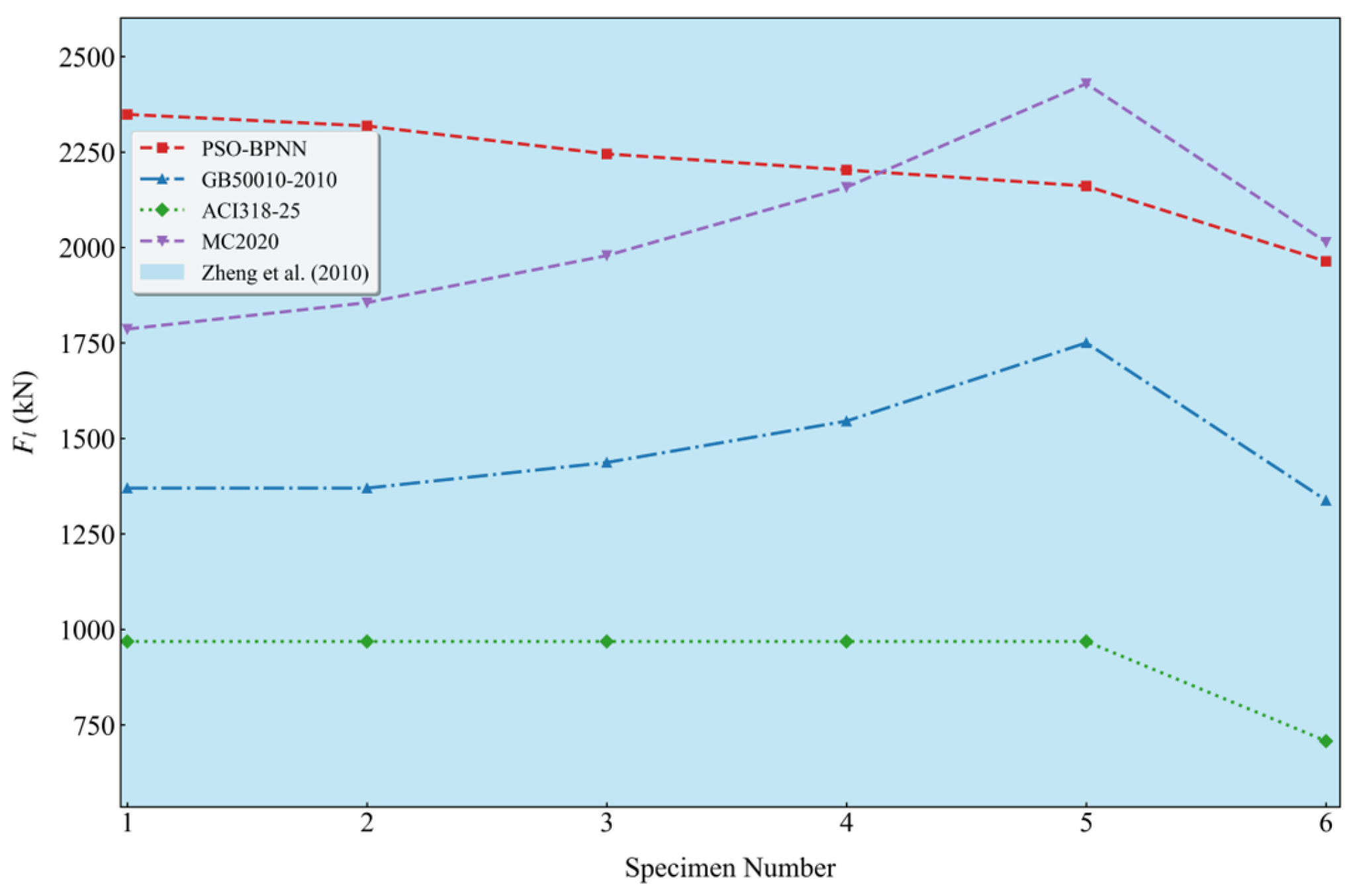
The comparison results for the first region are presented in Figure 21, with test data derived from Zheng et al. (2010) [6]. The corresponding performance indicators of different calculation methods in this region are summarized in Table 7. In this group, the Acor/Al is less than 1.35, and in some cases even below 1.0. This atypical geometric configuration induces a fundamental shift in the load-transfer mechanism, transitioning the stress state from local bearing to nearly full-section compression. From a constraint perspective, the extremely limited core area is unable to effectively confine the local bearing area, thereby substantially reducing the lateral constraint provided by the stirrups. Under these working conditions, the MC2020 overestimated the constraining effect of stirrups on concrete strength, resulting in a calculated local bearing capacity (purple curve) that exceeds the actual local bearing capacity of the specimen under real loading conditions. Consequently, the formula in MC2020 is no longer applicable in such scenarios. According to GB50010-2010, when Acor is not greater than 1.25 times Al, the indirect reinforcement constraint coefficient is taken as 1.0, indicating that no additional constraint enhancement is considered. When formulas of codes are employed for calculations, the results obtained from GB50010-2010 and ACI318-19 are relatively conservative and thus provide a higher degree of safety.
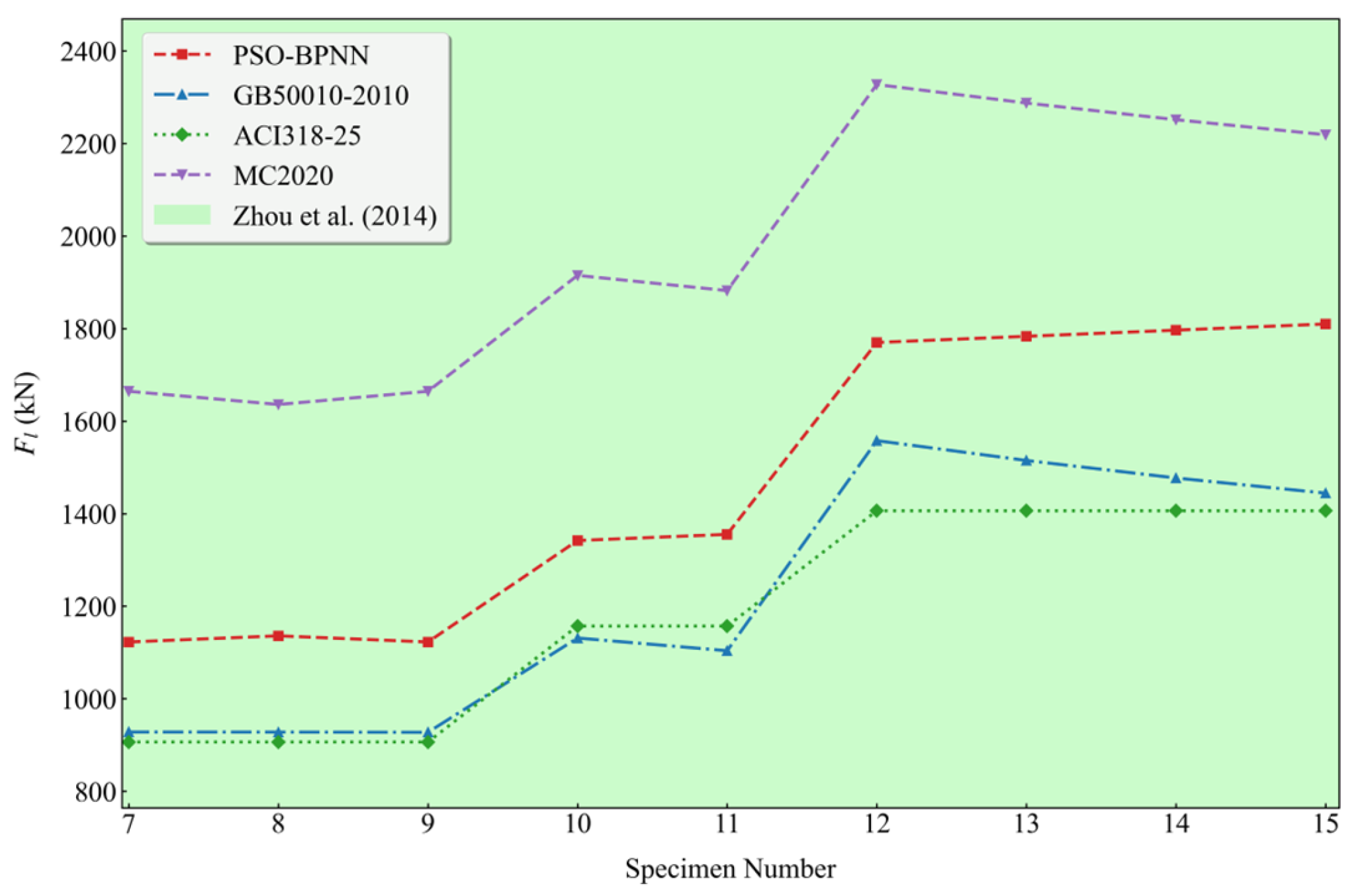
The comparison of local bearing capacity for the second region is presented in Figure 22, with data sourced from Zhou et al. (2014) [23]. The corresponding performance indicators for this region are systematically listed in Table 8. According to the MC2020 code, to prevent the overestimation of local bearing capacity, the coefficient kФ in the calculation formula is reduced from 5.0 to 3.0 for high-strength concrete with compressive strength fc,k > 50 MPa. However, the comparison results for this group of specimens show that the MC2020 calculated values (purple curve) exceed the PSO-BPNN predicted values (red curve), indicating insufficient adaptability of the code to reactive powder concrete (RPC). If kФ is further reduced to 1, this indicates that the constraining effect provided by the stirrups becomes entirely ineffective. Under this condition, the local bearing capacity calculated according to the MC2020 closely approximates the actual local bearing capacity. This phenomenon indicates that the concrete strength used in the code exceeds the effective strength actually provided by the RPC component. This discrepancy arises because the concrete strength values specified in the code are primarily derived from test data on ordinary concrete, which is assumed to possess certain plastic deformation capacity under loading. In contrast, RPC typically exhibits a compressive strength exceeding 100 MPa and demonstrates significantly higher brittleness compared to ordinary concrete. There is minimal plastic deformation during the later stages of stress application. Once cracks initiate, they propagate rapidly, leading to the premature exhaustion of the actual local bearing capacity and resulting in a higher calculated strength value. If MC2020 continues to be adopted for local bearing capacity calculations, it is recommended that the coefficient kФ should not be regarded as a constant. A comprehensive consideration of factors such as concrete strength, safety reserve, and failure probability suggests that a functional approach for determining the value of kФ should be developed to enhance calculation accuracy.
To avoid overestimating the constraining effect, when the specified compressive strength fc’ of concrete in ACI 318-25 exceeds 10,000 psi (approximately 69 MPa), the upper limit of A e A l is set to 1.8. It should be noted that code-based local bearing capacity values are typically based on design values. However, if standard values are used instead, the calculated values are more likely to exceed the PSO-BPNN predicted values (red line), significantly reducing the safety margin. Although RPC is a highly dense and ultra-high-strength material, its coefficient of variation in compressive strength typically ranges between 1% and 3%. As a brittle material, however, its structural performance is highly sensitive to strength variability. Even minor fluctuations can cause significant deviations in actual component capacity. This variability may result in some RPC members exhibiting low strength in practice. Design based solely on the code calculated values may lead to potential safety hazards, as the safety reserve might not fully account for strength fluctuations caused by material discreteness. This approach also struggles to meet the actual reliability requirements of ultra-high-strength concrete structures in engineering practice.

5.2. Sensitivity Analysis

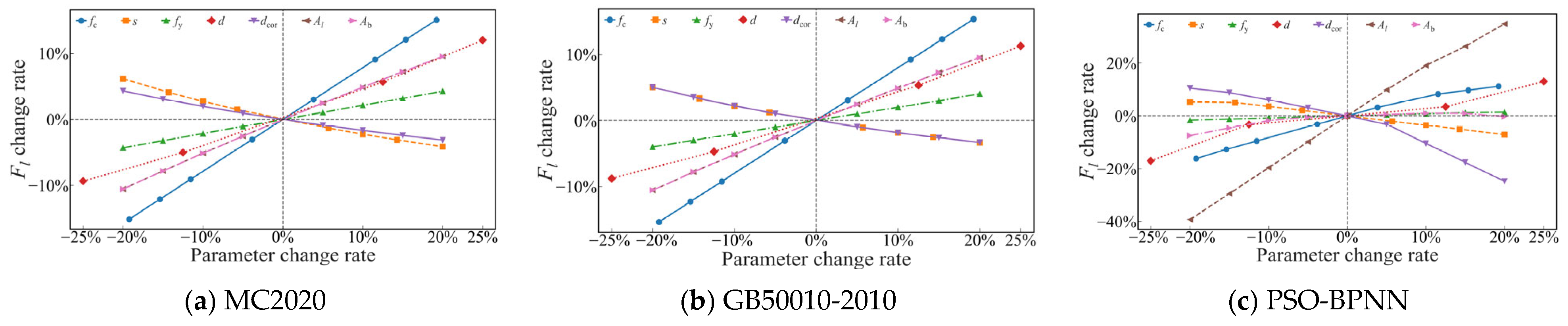
The theoretical foundations of various normative local bearing capacity calculation models differ significantly, and the relative importance of each parameter within these models varies accordingly. To investigate the sensitivity of input parameters to the local bearing capacity Fl, a controlled approach is adopted whereby all other parameters are held constant while individual parameters are varied incrementally. The resulting changes in Fl are then analyzed with respect to the predicted values from the three codes and the PSO-BPNN model. A parametric sensitivity analysis is conducted by varying one input parameter at a time while keeping others fixed at the following benchmark values: ‘Al’: 20,025 mm2, ‘Ab’: 45,000 mm2, ‘fc,k’: 26 MPa, ‘d’: 8 mm, ‘s’: 70 mm, ‘fy,k’: 300 MPa, ‘dcor’: 264 mm. This approach enables a systematic assessment of the influence of each individual variable on the predicted Fl.
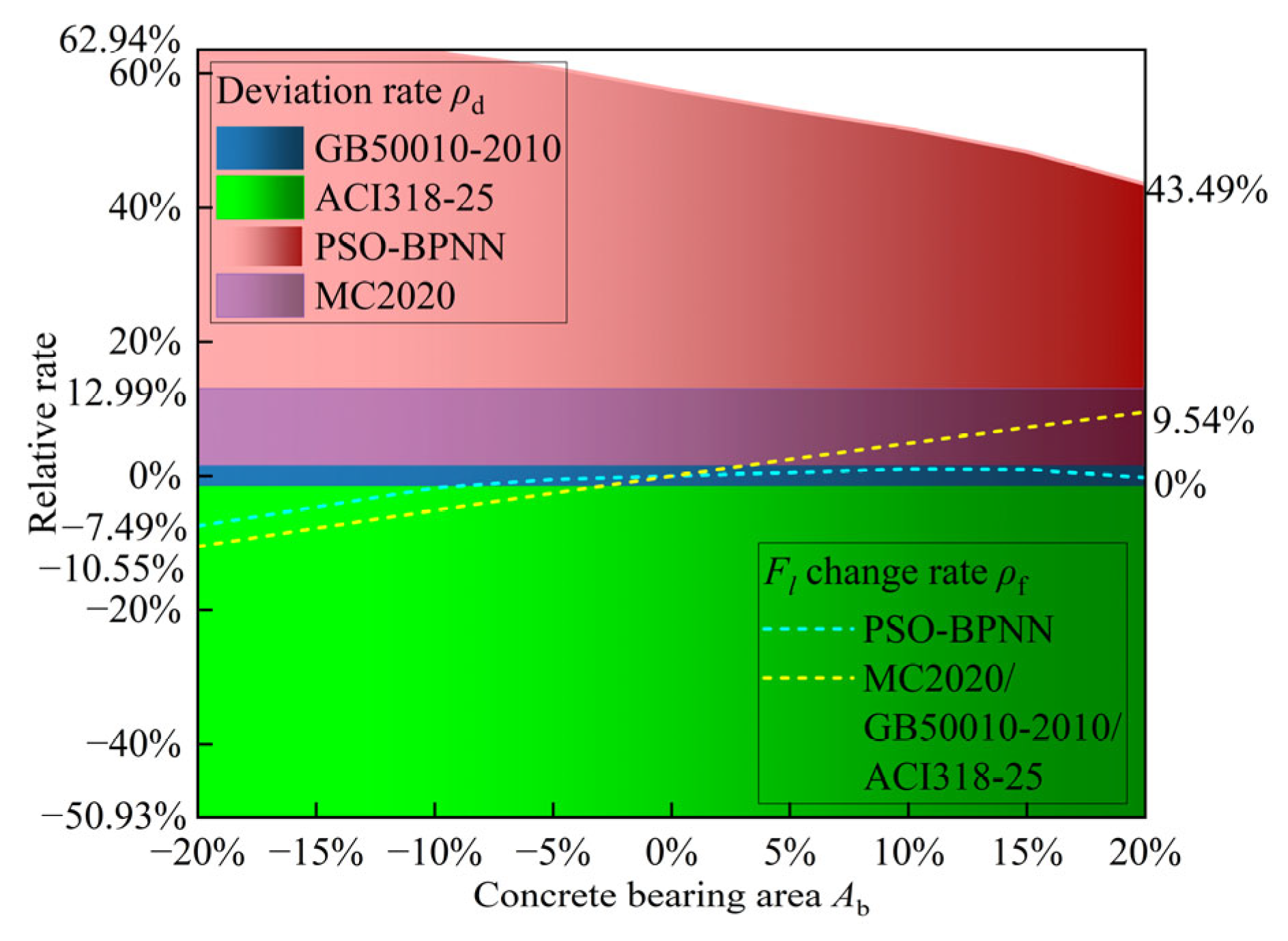
The sensitivity analysis of the Ab is presented in Figure 23. All other parameters were held constant, while Ab was varied by ±20% from its reference value of 45,000 mm2 to systematically evaluate its influence on the local bearing capacity Fl. The blue reference line in Figure 23 indicates the local bearing capacity calculated in accordance with GB50010-2010 for the given Ab, and the vertical axis represents the relative rate of the local bearing capacity Fl. Each shaded region corresponds to the deviation rate ρd of the local bearing capacity predicted by alternative models compared to the GB50010-2010, computed using Equation (15).
ρ d = F l , m o d e l F l , GB 50010 - 2010 F l , GB 50010 - 2010 × 100 %
The Fl change rate ρf is calculated using Equation (16).
ρ f = F l c u r r e n t F l r e f e r e n c e F l r e f e r e n c e × 100 %
From the perspective of regional color variation trends, the progressive darkening of the color signifies a gradual enhancement in local bearing capacity as Ab increases. In the PSO-BPNN model, the red area diminishes with increasing Ab, indicating that the influence of Ab on Fl is not continuously linear. In the initial stage, an increase in Ab can expand the constraint range of concrete on the local bearing area, thereby enhancing the lateral constraining effect and leading to an increase in Fl. However, the rate of Fl improvement slows down or even plateaus once Ab exceeds a critical threshold. In contrast, the calculated values according to the GB50010-2010 exhibit a linear increase with Ab, resulting in a progressively shrinking red area. The purple and green areas associated with MC2020 and ACI318-19 remain largely unchanged, as their theoretical formulations assume a linear relationship between local bearing capacity and Ab. The rate of change for Fl (Fl change rate) along the cyan dashed curve in the PSO-BPNN model gradually decreases and approaches zero, further confirming the saturation effect of Ab on Fl. This implies that, once the concrete constraining effect reaches its upper limit, a further expansion of Ab cannot enhance the core zone constraint. Moreover, an excessively large Ab may lead to uneven stress distribution and disrupted transmission pathways, resulting in a gradual reduction in its contribution to Fl as its size increases. This observation aligns with the mechanical principle governing local bearing concrete, where the constraining effect initially intensifies before reaching saturation. It also reflects the sensitivity of Fl to Ab within the PSO-BPNN model, which decreases as Ab increases. In contrast, GB50010-2010, MC2020, and ACI318-19 (indicated by yellow dots) all demonstrate a continuous rise in Fl with increasing Ab. This behavior arises because the codes employ simplified formulas derived from empirical and theoretical considerations, assuming a linearized constraining effect. These models presuppose that a larger Ab leads to stronger participation of concrete in constraint, without accounting for the practical saturation of the constraint mechanism.
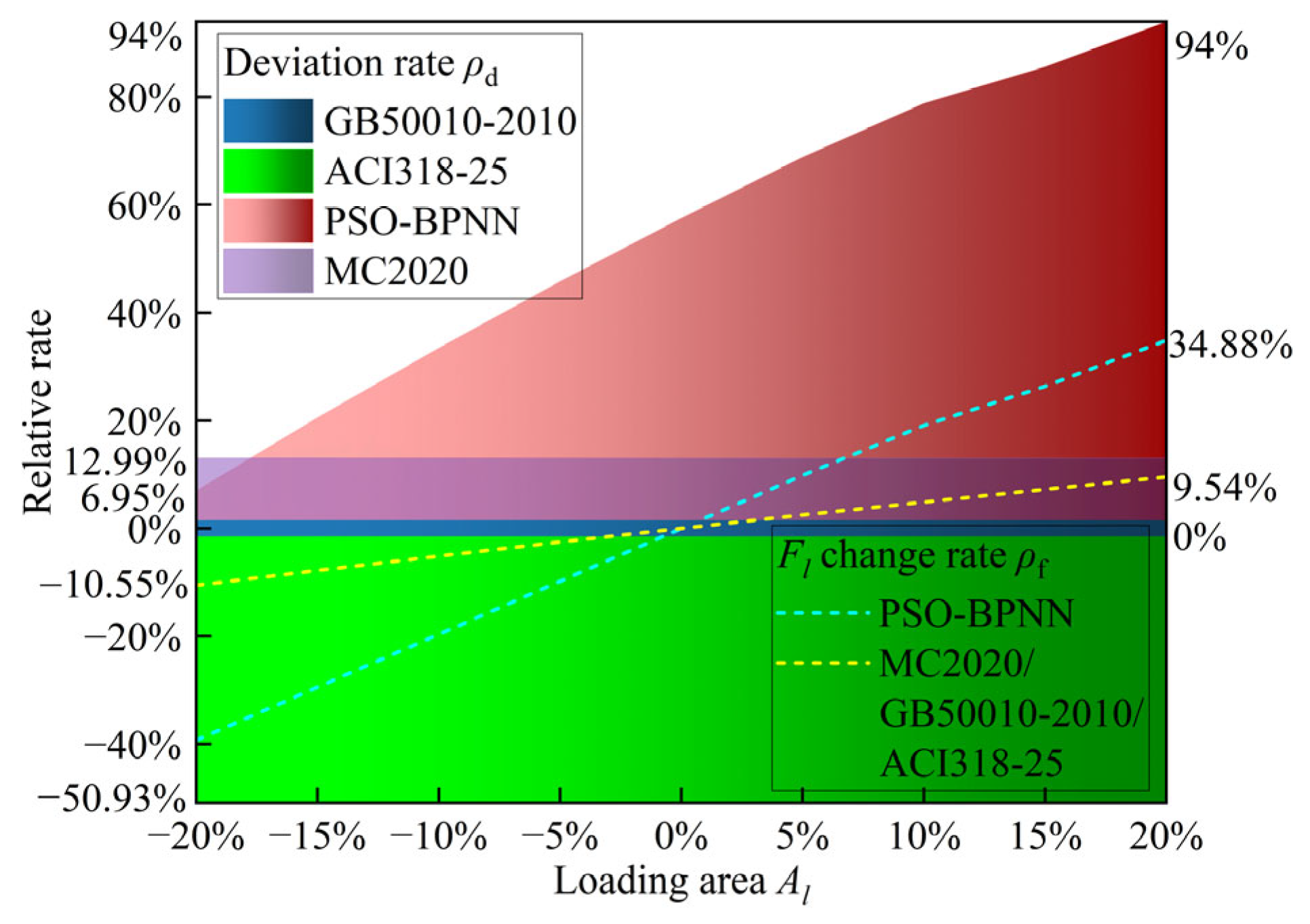
The sensitivity analysis of Al is presented in Figure 24. All other parameters were held constant, while Al was varied by ±20% from its reference value of 20,025 mm2 to systematically evaluate its influence on the local bearing capacity Fl. From the perspective of regional color variation trends, the progressive darkening of the color signifies a gradual enhancement in local bearing capacity as Al increases. The red area in the PSO-BPNN model expands as Al increases, and the rate of change for Fl along the cyan dashed curve of PSO-BPNN is significantly higher than that predicted by the three codes. This suggests that Fl exhibits high sensitivity to variations in Al under this model, implying that changes in Al substantially affect Fl. As Al increases, the contribution of the surrounding confined concrete to the local bearing capacity decreases. However, the lateral expansion of concrete in the local bearing area becomes more pronounced, resulting in increased circumferential tensile stress on the stirrups. In response, the constraining effect exerted by the stirrups on the concrete through reaction forces is considerably enhanced. Importantly, the increase in stirrup constraint outweighs the reduction in constraint provided by the surrounding concrete, leading to an overall continuous improvement in structural local bearing capacity. The three codes are derived from engineering experience and theoretical simplifications. To balance safety and computational simplicity, the favorable constraining effect of the stirrups has been simplified. Therefore, the trend of local bearing capacity increasing is relatively gentle. It should be emphasized that this analysis is valid only under the condition Al < Ab, i.e., the loading area must remain within the concrete local bearing area. Additionally, the local bearing capacity may fall below the calculated value of MC2020 if Al is too small. Therefore, an appropriate Al should be selected during design to ensure both safety and performance.
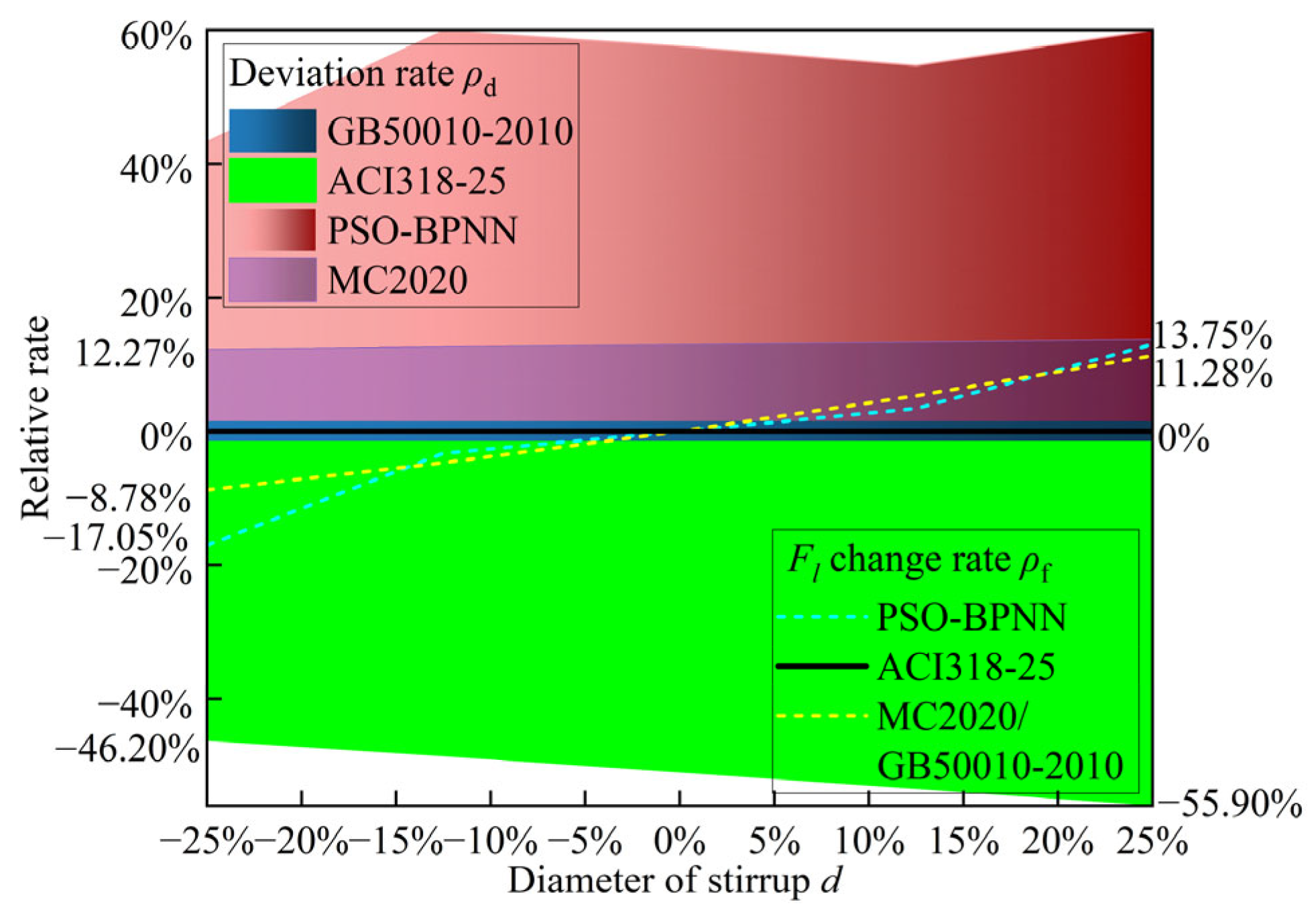
The sensitivity analysis for d is presented in Figure 25. All other parameters were held constant, while d was varied within ±25% from its reference value of 8 mm. The ±25% range was selected because a ±20% variation around 8 mm does not encompass commonly used stirrup diameter increments in practical engineering applications. In contrast, the ±25% range covers typical diameters from 6 mm to 10 mm. To better align with actual engineering scenarios, this study systematically investigates the influence of stirrup variations on the local bearing capacity Fl. From the perspective of regional color variation trends, the progressive darkening of the color signifies a gradual enhancement in local bearing capacity with d increases. From the perspective of the constraint mechanism, the larger the diameter d of the stirrup, the stronger the constraining effect on the concrete. Additionally, the surface configuration of the reinforcement can influence the constraining effect. Although different types may introduce minor variations in constraining effect, the overall trend remains consistent: increasing d enhances constraint and improves Fl. For the PSO-BPNN model, when the diameter d is too small, the constraining effect provided by the stirrups is weak and it is difficult to effectively restrain the concrete. This substantially diminishes the local bearing capacity of the structural components. Therefore, the model is highly sensitive to d. With the increase in d, the contribution of d to the local bearing capacity gradually transitions to a synergistic effect with concrete. The sensitivity of the model to d shows a gradually decreasing trend, and eventually its sensitivity change rate approaches that of GB50010-2010 and MC2020. The relatively flat curve for the rate of change for Fl of ACI318-25 (black curve) indicates a very low sensitivity of Fl to d under this code, reflecting a theoretical framework that assigns limited importance to the role of the diameter of stirrup in constraint and overall structural performance. Consequently, changes in d do not significantly affect Fl, leading to a gradually expanding green area.
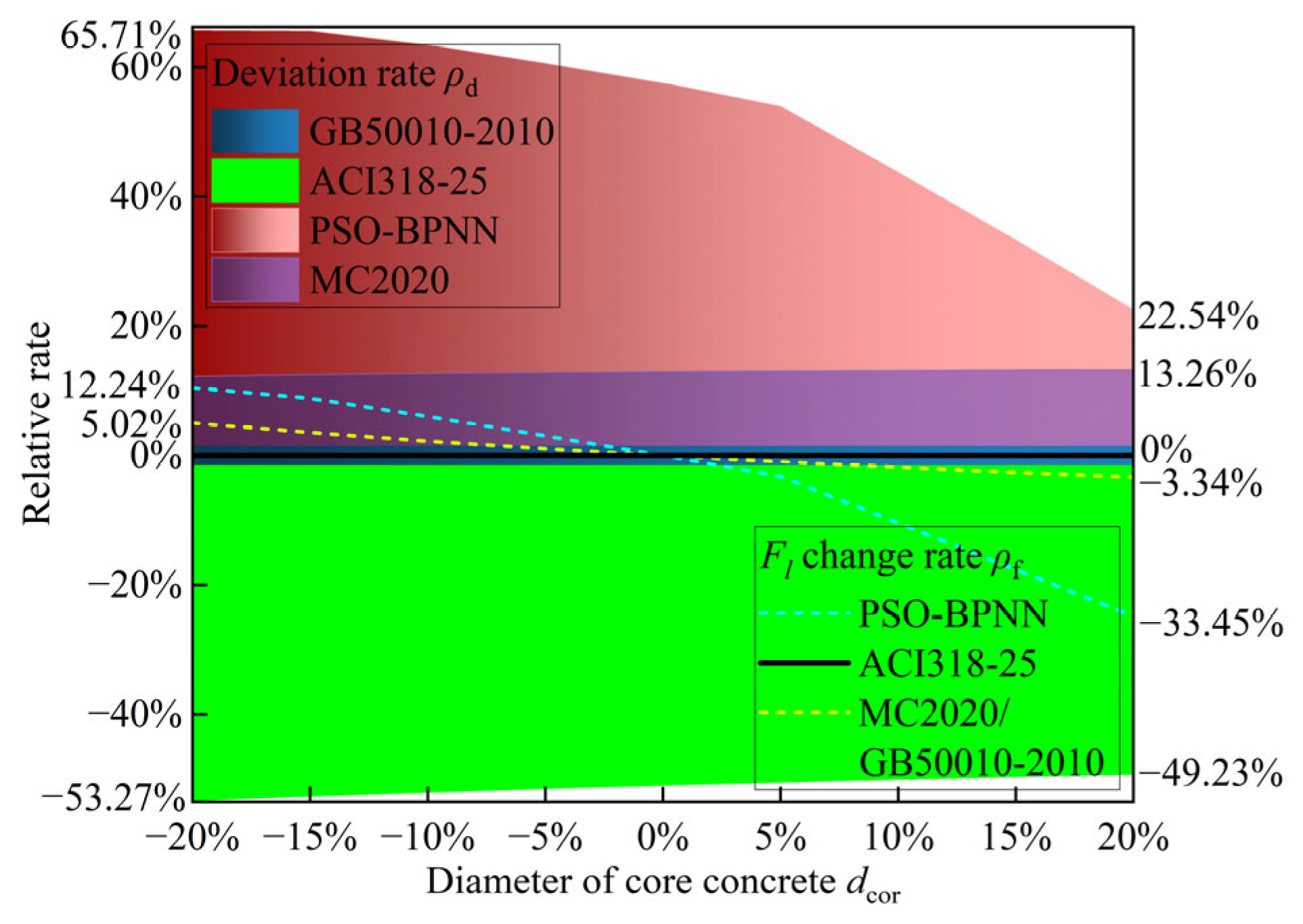
The sensitivity analysis for dcor is presented in Figure 26. All other parameters were held constant, while dcor was varied within ±20% from its reference value of 264 mm to systematically evaluate its influence on the local bearing capacity Fl. From the perspective of regional color variation trends, an increase in dcor leads to lighter colors, indicating a progressive reduction in local bearing capacity. As dcor increases, the red area associated with PSO-BPNN is markedly reduced, indicating that the rate of decline in local bearing capacity predicted by PSO-BPNN is significantly higher than that stipulated in the GB50010-2010. The primary reason for this discrepancy lies in the relative dilution of the effective constraining effect within the core area as dcor increases. On the one hand, the increase in dcor directly alters the stress concentration distribution in the core area, resulting in a more dispersed stress transmission path. On the other hand, this geometric change reduces the volume proportion of effectively confined concrete, thereby substantially diminishing the constraint efficiency of the stirrups on the core concrete. These factors act cumulatively and amplify the weakening of constraint, which is reflected in Figure 26 as a sharp decrease in the rate of change for Fl along the cyan dashed curve. This demonstrates the high sensitivity of the PSO-BPNN model to changes in dcor, ultimately leading to a significant downward trend in the carrying capacity Fl. GB 50010-2010 and MC 2020, grounded in engineering practice and theoretical simplification principles, typically assume a concurrent variation between the effective constraint diameter dcor of the core area and Al. As a result, the sensitivity to changes in dcor is relatively reduced. The nearly horizontal curve of the rate of change for Fl of ACI318-25 (black curve) indicates that this code places greater emphasis on factors like concrete strength and local bearing area, exhibiting extremely low sensitivity to dcor changes. This is manifested as a near-zero change rate in Fl, implying that variations in dcor within a certain range have negligible influence on Fl.
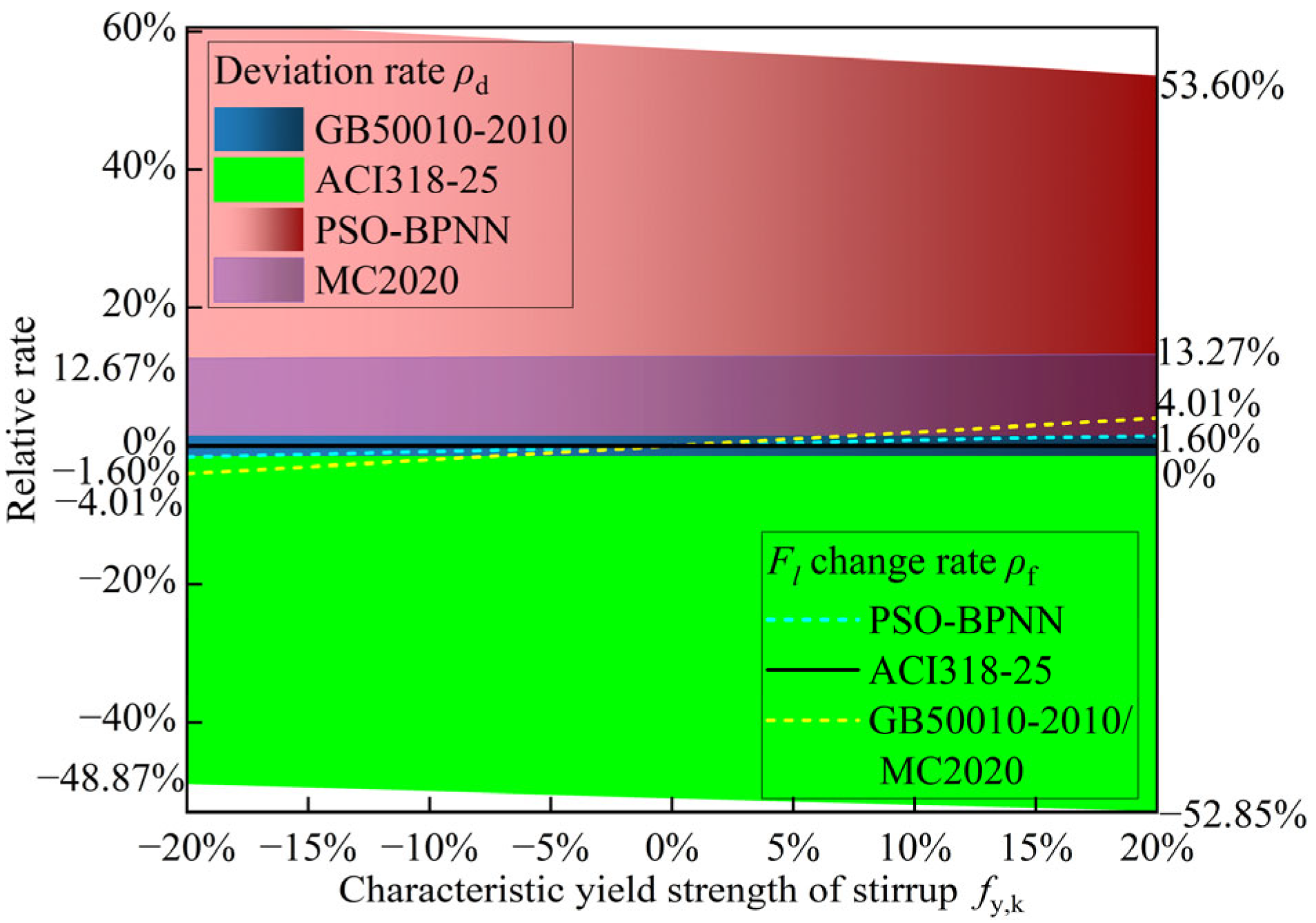
The sensitivity analysis for the fy,k is presented in Figure 27. All other parameters were held constant, while fy,k was varied within ±20% from its reference value of 300 MPa to systematically evaluate its influence on Fl. From the perspective of regional color variation trends, the progressive darkening of the color signifies a gradual enhancement in local bearing capacity as fy,k increases. The PSO-BPNN model demonstrates a consistent sensitivity trend with respect to both GB50010-2010 and MC2020 as fy increases, wherein the Fl increases steadily with comparable magnitude. From the perspective of the mechanical mechanism, an increase in fy,k directly enhances the tensile local bearing capacity and slip resistance of the reinforcement. However, in practical engineering, this improvement is constrained by multiple factors to limit the full effectiveness of increased fy,k, such as the bond performance at the concrete–reinforcement interface, stress distribution across the section, and the constraining effect of stirrups. Ultimately, this resulted in a stabilization of the rate of change for Fl and an overall low level of sensitivity. In contrast, due to differing design philosophies or considerations regarding local bearing behavior, fy,k variations within this range are deemed to have negligible impact on predicted local bearing capacity within ACI318-25.
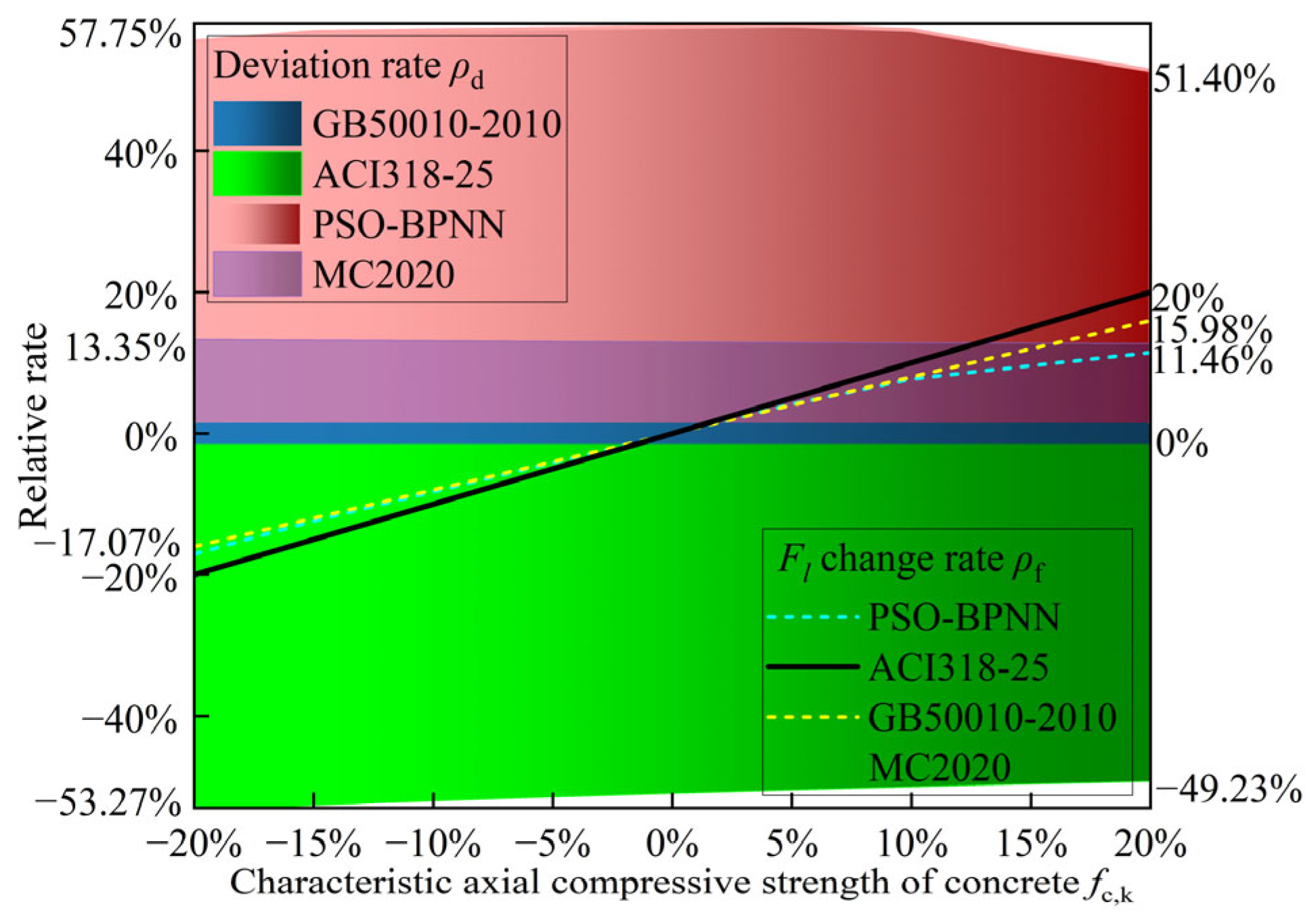
The sensitivity analysis of fc,k is presented in Figure 28. All other parameters were held constant, while fc,k was varied within ±20% from its reference value of 26 MPa to systematically evaluate its influence on Fl. From the perspective of regional color variation trends, the progressive darkening of the color signifies an enhancement in local bearing capacity as fc,k increases. The three models (PSO-BPNN, GB50010-2010, and MC2020) exhibited comparable sensitivity. As fc,k increases, the enhanced compressive strength of concrete directly contributes to an increase in Fl, indicating a significant positive influence of fc,k on Fl. ACI 318-25 places greater emphasis on fc,k as a dominant factor influencing Fl. The model demonstrates high sensitivity to fc,k, wherein an increase in fc,k results in an approximately proportional increase in carrying capacity. The contribution of fc,k is thus most prominently reflected in this code.
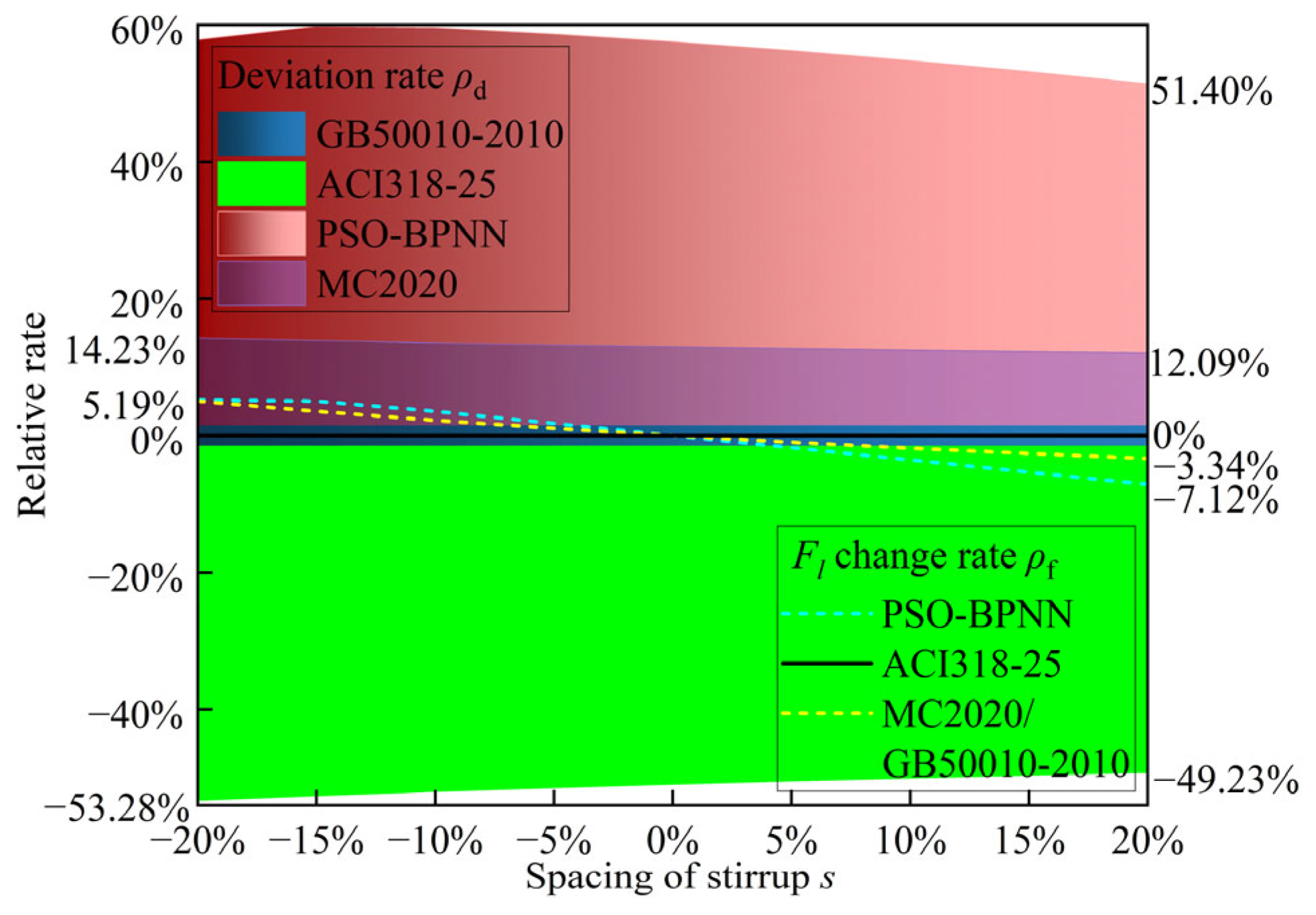
The sensitivity analysis for s is presented in Figure 29. All other parameters were held constant, while s was varied within ±20% from its reference value of 70 mm to systematically evaluate its influence on Fl. From the perspective of regional color variation trends, an increase in s leads to lighter colors, indicating a progressive reduction in local bearing capacity. The three models (PSO-BPNN, GB50010-2010, MC2020) display similar sensitivity trends. An increase in s reduces the constraining effect due to an expanded constraint interval, leaving the concrete between stirrups inadequately restrained. This leads to a marked decline in the ability to resist lateral deformation. As a result, the compressive performance of the core concrete deteriorates, causing Fl to decrease progressively with increasing s. Despite differences in theoretical assumptions and computational approaches, all three models consistently capture the mechanism. In contrast, variations in s within this range have minimal direct impact on local bearing capacity Fl according to ACI318-25, as evidenced by the nearly flat response curve.
Figure 30 presents a comparative analysis of parameter sensitivity between each code and the PSO-BPNN model. ACI 318-25 conducts overall regulation based on local bearing capacity to meet design requirements, so no parameter sensitivity comparison diagram has been drawn for it. The sensitivity ranking for MC2020 is consistent with that of GB50010-2010: fc,k >Ab > Al > d > s > fy,k >dcor. In contrast, the PSO-BPNN model exhibits a different ranking: Al > dcor > fc,k > d > s > Ab> fy,k.

5.3. Discussion

Based on Section 5.2 and SHAP results (Al > Ab > fc,k > s > d > dcor > fy,k), the following insights can be drawn.
The calculations for codes primarily rely on the local bearing capacity of concrete, the product of axial compressive strength of concrete fc,k, and loading area Al. The constraining effect provided by stirrups is indirectly modeled through the enhancement of the core concrete, reflecting the influence of parameters d, s, and fy,k. In contrast, a sensitivity analysis of the PSO-BPNN model identifies the loading area Al as the most influential parameter, thereby reversing its priority relative to fc,k when compared to codes. Formally, Al and fc,k have swapped positions, but the principle that the local bearing capacity of concrete plays a major role remains consistent.
A significant correlation exists between Ab and dcor. In codes, Ab is directly derived from dcor, implying a fixed geometric relationship. However, when the PSO-BPNN model treats dcor as an independent input and applies a ±20% variation, the resulting change in Ab exceeds 20%. This amplified area variation is directly propagated into the prediction output, making dcor appear more influential than Ab. The differing rankings of dcor and Ab across models and codes reflect differences in how core geometry is parameterized rather than fundamental logical conflicts. Nevertheless, all approaches confirm the critical role of core area in determining local bearing capacity.
d, fy,k, and s collectively govern the effectiveness of lateral constraint. Both code provisions and the PSO-BPNN model indicate the relatively limited influence on overall capacity with fy,k. Under sensitivity analysis with s held constant, both frameworks assign higher sensitivity to d than to s, consistent with code limits on the spacing of stirrups, which reduce variability in s. However, in global feature importance analysis, where s is allowed to vary freely, its influence surpasses that of d.
In summary, for the local bearing capacity of concrete, the material itself provides the primary resistance, while stirrup constraint serves as auxiliary reinforcement. This hierarchical logic is clearly reflected in the sensitivity ranking: parameters related to concrete (fc,k, Al, dcor) generally rank higher than those associated with stirrup constraint (d, s, fy,k).
Based on the above analysis, the following design recommendations are proposed: core optimization should focus on enhancing mechanical properties of concrete and rationally designing key geometric parameters to fully leverage intrinsic load local bearing role of concrete; additionally, the design of stirrup constraint should be harmonized with concrete performance to ensure the efficient activation and compatibility of the constraining effect.

6. Conclusions

A database was established based on 40 stirrup-confined concrete specimens from the tests conducted by ourselves and an additional 92 similar test data points from references. The range of Ab/Al is 0.19–7.89, the range of fc,k is 15.60–74.10 MPa, and the fy,k is 233–1027 MPa. A PSO-BPNN prediction model is established by optimizing the weights and thresholds of the BPNN via the PSO algorithm, which mitigates the local optimum issue of conventional BPNN. Although the proposed model has broader applicability than existing codes, its performance essentially depends on the diversity and coverage of the data set. The following conclusions are drawn:
  • The training iterations and calculation accuracy of the PSO-BPNN model are superior to the BPNN model, while the predicted values are consistent with experimental values. Moreover, enhanced applicability, attributable to the diversity and broad domain coverage of training dataset, is exhibited. There is great potential for practical engineering applications, based on the advantages of the PSO-BPNN model.
  • Within the applicable range of codes, the average ratios of the predicted values to the calculated values for GB50010-2010, MC2020, and ACI318-25 are 1.988 (CV = 0.167), 1.719 (CV = 0.223), and 5.387 (CV = 0.539), respectively, reflecting the inherent safety margins and conservative design principles of these codes. A higher evaluation for the contribution of the stirrup is considered in the MC2020 code: the predicted values of some specimens are lower than the calculated values when Acor/Al is less than 1.35. The brittleness effect is not adequately considered: the predicted values of some specimens are also lower than the calculated values when the active powder concrete (RPC) is used. Rapid crack propagation would lead to premature brittle failure, resulting in overestimated design values. Therefore, targeted rechecking and verification should be performed for these special conditions in practical engineering to ensure the safety and reliability of structural designs.
  • The analysis results indicate that the parameter sensitivity trend in the PSO-BPNN model is generally consistent with the design code. Both indicate that concrete plays the main load–local bearing role, while the reinforcement bars provide auxiliary reinforcement. The slight differences do not imply a fundamental logical conflict, but rather reflect differences in modeling assumptions, calculation rules, or expected application scopes.
  • The feasibility and effectiveness of the PSO-BPNN model for predicting the local bearing capacity of concrete was confirmed in this study. Consequently, predicting other key mechanical performance indicators within structures via the PSO-BPNN model presents strong feasibility. This can provide ideas for analysis and research in other structural fields.

Author Contributions

T.M.: Conceptualization, Data curation, Formal analysis, Funding acquisition, Investigation, Methodology, Project administration, Supervision, Writing—original draft, Writing—review and editing. J.D.: Conceptualization, Data curation, Formal analysis, Funding acquisition, Investigation, Methodology, Writing—original draft, Writing—review and editing. T.J.: Conceptualization, Data curation, Formal analysis, Investigation, Methodology, Supervision, Validation, Visualization, Writing—original draft, Writing—review and editing, Resources. Y.D.: Conceptualization, Data curation, Formal analysis, Investigation, Methodology, Project administration, Writing—original draft, Writing—review and editing. R.Q.: Investigation, Supervision. Y.L.: Investigation, Supervision. Y.Z.: Investigation, Supervision. All authors have read and agreed to the published version of the manuscript.

Funding

This research was funded by the National Natural Science Foundation of China (52078471), the Natural Science Foundation of Jilin Province (YDZJ202401575ZYTS), and the Basic Research Foundation of Institute of Engineering Mechanics, China Earthquake Administration (2019A03).

Data Availability Statement

Data will be made available on request.

Acknowledgments

Thank you very much for the encouragement and support of the teachers and students in the research group. Thanks to your help, the writing of this paper was successfully completed.

Conflicts of Interest

The authors declare that they have no conflicts of interest related to this work. We declare that we do not have any commercial or associative interests that represent a conflict of interest in connection with the work submitted.

Nomenclature

AcorCore concrete areakcEdge effect coefficient
AlLoading areakФConstraining effect enhancement factor
Acor/AlRatio of core concrete area to loading areaAc1Effective local bearing area
FlLocal bearing capacity of stirrup-confined concretefcgConcrete strength grade
AbConcrete local bearing areafcu,mMean cube compressive strength of concrete
fc,kCharacteristic axial compressive strength of concretefc,mMean axial compressive strength of concrete
sSpacing of stirrupftCharacteristic axial tensile strength of concrete
dDiameter of stirruptIndex of iteration
dcorDiameter of core concreteiIndex of particle
fy,kCharacteristic yield strength of stirrupxitPosition of particle i at the t-th iteration
ρvReinforcement ratiovitVelocity of particle i at the t-th iteration
βcInfluence factor of concrete brittlenesspbest,iPersonal best position of particle i (individual optimum)
βlInfluence factor of loading areagbestGlobal best position of the whole swarm
fcdDesign axial compressive strength of concreteωInertia weight
αReduction coefficient of reinforcement for concrete constraintc1Cognitive coefficient
βcorInfluence factor of reinforcementc2Social coefficient
fydDesign yield strength of stirrupr1, r2Random numbers uniformly distributed in [0, 1]
AlnNet area under local bearingρdDeviation rate of predicted local bearing capacity compared with the calculation result of GB50010-2010
fcCompressive strength of cylindersρfChange rate of the local bearing capacity Fl
AeEffective confining area of concrete

References

  1. Bauschinger, J. Tests with Blocks of Natural Stone; Technical Report; Mechanical and Technical Laboratory of the Royal Technical University: Stockholm, Sweden, 1876. [Google Scholar]
  2. Hawkins, N.M. The bearing strength of concrete loaded through rigid plates. Mag. Concr. Res. 1968, 20, 31–40. [Google Scholar] [CrossRef]
  3. Cai, S.H. Local compressive strength of concrete and reinforced concrete. Chin. Civil Eng. J. 1963, 9, 1–27. [Google Scholar]
  4. Niyogi, S.K. Bearing strength of reinforced concrete blocks. Struct. Div. ASCE 1975, 101, 1125–1137. [Google Scholar] [CrossRef]
  5. Marchão, C.; Lúcio, V.; Ganz, H.R. Efficiency of the confinement reinforcement in anchorage zones of posttensioning tendons. Struct. Concr. 2019, 20, 1182–1198. [Google Scholar] [CrossRef]
  6. Zheng, W.Z.; Zhao, J.W.; Wang, Y.; Zhou, W. Local pressure test of concrete with Acor/Al < 1.35 and Ab extended to side beam. J. Harbin Inst. Technol. 2010, 42, 1536–1542. [Google Scholar]
  7. Miao, T.M.; Yang, J.; Zhou, Y.; Zhan, M.Q.; Wang, B.; Zheng, W.Z. Model for calculating local bearing capacity of concrete with spiral stirrups. Constr. Build. Mater. 2023, 389, 131762. [Google Scholar] [CrossRef]
  8. Miao, T.M.; Zheng, W.Z. Local bearing capacity of concrete under the combined action of pressure force and bond stress. Constr. Build. Mater. 2019, 226, 152–161. [Google Scholar] [CrossRef]
  9. Miao, T.M.; Yang, J.; Zhou, Y.; Sha, L.R.; Zheng, W.Z. Method for calculating local bearing capacity of concrete under bond stress from reinforcement in straight anchor section. Structures 2022, 46, 1796–1807. [Google Scholar] [CrossRef]
  10. Feng, Q.; Xie, X.Y.; Wang, P.H.; Qiao, H.X. Prediction of durability of reinforced concrete based on hybrid-Bp neural network. Constr. Build. Mater. 2024, 425, 136091. [Google Scholar] [CrossRef]
  11. Li, S.; Zheng, W.Z.; Xu, T.; Wang, Y. Artificial neural network model for predicting the local compression capacity of stirrups-confined concrete. Structures 2022, 41, 943–956. [Google Scholar] [CrossRef]
  12. Zhao, B.Z.; Li, P.F.; Du, Y.S.; Li, Y.; Rong, X.W.; Zhang, X.M.; Xin, H.H. Artificial neural network assisted bearing capacity and confining pressure prediction for rectangular concrete-filled steel tube (CFT). Alex. Eng. J. 2023, 74, 517–533. [Google Scholar] [CrossRef]
  13. Deng, W.; Xiong, R.; Wang, H.Y.; Zong, Y.J.; Sheng, Y.P.; Guan, B.W.; Chang, M.F. Prediction of abrasion resistance characteristics of sintered aggregates from coal gangue and feldspar powder based on optimized BP-ANN neural network. Constr. Build. Mater. 2025, 487, 142069. [Google Scholar] [CrossRef]
  14. Alshihri, M.M.; Azmy, A.M.; El-Bisy, M.S. Neural networks for predicting compressive strength of structural light weight concrete. Constr. Build. Mater. 2009, 23, 2214–2219. [Google Scholar] [CrossRef]
  15. Fan, G.; Fu, W.; Sha, F.; Li, Y.; Zhao, Z.; Sun, S. Construction and optimization of spatial network structure of waterborne polyurethane modified concrete. Constr. Build. Mater. 2025, 458, 139611. [Google Scholar] [CrossRef]
  16. Wang, Z.Q.; Yi, Q.H.; Zhao, Y.B.; Zhang, K.; Xia, X.X.; Xiao, Z.; Huang, J.Q.; Gong, T. Parameter analysis and multi-objective optimization of organic Rankine cycle coupled vapor compression cycle using PSO-BPNN model. Appl. Therm. Eng. 2025, 273, 126583. [Google Scholar] [CrossRef]
  17. Xiao, M.Z.; Luo, R.; Chen, Y.; Ge, X.M. Prediction model of asphalt pavement functional and structural performance using PSO-BPNN algorithm. Constr. Build. Mater. 2023, 407, 133534. [Google Scholar] [CrossRef]
  18. Cheng, J.; Waele, W.D. Prediction and optimization of surface waviness of WAAM components using a hybrid Rank-Gaussian PSO algorithm and ANN. Structures 2024, 69, 107247. [Google Scholar] [CrossRef]
  19. Liu, X.; Wang, S.; Liu, B.; Liu, Q.; Zhou, Y.; Chen, J.; Luo, J. Cement-based grouting material development and prediction of material properties using PSO-RBF machine learning. Constr. Build. Mater. 2024, 417, 135328. [Google Scholar] [CrossRef]
  20. GB50010-2010; Code for Design of Concrete Structures. China Architecture & Building Press: Beijing, China, 2015.
  21. American Concrete Institute. ACI Committee 318 Building Code Requirements for Structural Concrete (ACI 318M-25) and Commentary; American Concrete Institute: Farmington Hills, MI, USA, 2025. [Google Scholar]
  22. The International Federation for Structural Concrete. Fib Model Code for Concrete Structures (2020), Version 1; International Federation of Structural Concrete: Lausanne, Switzerland, 2023. [Google Scholar]
  23. Zhou, W.; Hu, H.B.; Zheng, W.Z. Test on partial compressive bearing capacity of active Powder Concrete constrained by high-strength helical bars. Chin. J. Civ. Eng. 2014, 47, 63–72. [Google Scholar]
  24. Xiao, Z.M. Study on Local Compression Performance of HRB500 Reinforced Lightweight Aggregate Concrete Members. Master’s Thesis, Suzhou University of Science and Technology, Suzhou, China, 2017. [Google Scholar]
  25. Cai, S.H.; Xue, L.H. Local bearing strength of high-strength concrete. J. China Civ. Eng. 1994, 27, 52–61. [Google Scholar]
  26. Gai, L.Q.; Zheng, W.Z.; Li, S. Indepth study on calculation method of local compression bearing capacity of concrete. J. Harbin Inst. Technol. 2021, 53, 1–11. [Google Scholar]
  27. Cao, S.Y.; Yang, X.K.; Xu, K.Y. Experimental study on local bearing capacity of reinforced concrete. J. Harbin Univ. Civ. Eng. Archit. 1983, 2, 1–22. [Google Scholar]
  28. Rumelhart, D.E.; Hinton, G.E.; Williams, R.J. Learning Representations by Back Propagating Errors. Nature 1986, 323, 533–536. [Google Scholar] [CrossRef]
  29. Zheng, N.H.; Zhang, W.P.; Zhou, Y.; Liu, Y. Confinement strength prediction of corroded rectangular concrete columns using BP neural networks and support vector regression. Structures 2024, 67, 107021. [Google Scholar] [CrossRef]
  30. Krishnaveni, S.; Rajendran, S. A state of the art on characterization and application of artificial neural networks on bond strength between steel rebar and concrete. Constr. Build. Mater. 2022, 354, 129124. [Google Scholar] [CrossRef]
  31. Kennedy, J.; Eberhart, R. Particle swarm optimization. In Proceedings of the IEEE International Conference on Neural Networks; IEEE: Piscataway, NJ, USA, 1995; Volume 4, pp. 1942–1948. [Google Scholar]
  32. Cai, B.; Lin, X.; Fu, F.; Wang, L. Postfire residual capacity of steel fiber reinforced volcanic scoria concrete using PSO-BPNN machine learning. Structures 2022, 44, 236–247. [Google Scholar] [CrossRef]
  33. Wang, P.H.; Dong, B.Q.; Zhang, Y.Y. Evaluation and characteristic analysis of compressive strength and resistivity of EG cement conductive mortar based upon hybrid-BP neural network. Constr. Build. Mater. 2023, 394, 132203. [Google Scholar] [CrossRef]
  34. Shi, Y.; Eberhart, R. A modified particle swarm optimizer. In IEEE International Conference on Evolutionary Computation Proceedings; IEEE World Congress on Computational Intelligence; IEEE: Piscataway, NJ, USA, 1998; pp. 69–73. [Google Scholar]
  35. Breiman, L. Random forests. Mach. Learn. 2001, 45, 5–32. [Google Scholar] [CrossRef]
  36. Vapnik, V.N.; Cortes, C. Support-vector networks. Mach. Learn. 1995, 20, 273–297. [Google Scholar]
  37. Chen, T.; Guestrin, C. XGboost: A scalable tree boosting system. In Proceedings of the 22nd ACM SIGKDD International Conference on Knowledge Discovery and Data Mining, San Francisco, CA, USA, 13–17 August 2016; pp. 785–794. [Google Scholar]
  38. Gujarati, D.N. Basic Econometrics, 5th ed.; McGraw-Hill: Columbus, OH, USA, 2009. [Google Scholar]
  39. Wang, Y.J.; Zhao, Y.Q. Predicting bedrock depth under asphalt pavement through a data-driven method based on particle swarm optimization-back propagation neural network. Constr. Build. Mater. 2022, 354, 129165. [Google Scholar] [CrossRef]
  40. He, K.; Zhang, X.; Ren, S.; Sun, J. Delving deep into rectifiers: Surpassing human-level performance on ImageNet classification. In Proceedings of the IEEE International Conference on Computer Vision; IEEE: Piscataway, NJ, USA, 2015; pp. 1026–1034. [Google Scholar]
  41. Kingma, D.P.; Ba, J. Adam: A method for stochastic optimization. In Proceedings of the International Conference on Learning Representations (ICLR), San Diego, CA, USA, 7–9 May 2015. [Google Scholar]
  42. Jones, M.C. Kernel Smoothing; Chapman & Hall: Boca Raton, FL, USA, 1995. [Google Scholar]
  43. Silverman, B.W. Density Estimation for Statistics and Data Analysis; Chapman and Hall: Boca Raton, FL, USA, 1986. [Google Scholar]
  44. Lundberg, S.M.; Lee, S.I. A unified approach to interpreting model predictions. Adv. Neural Inf. Process. Syst. 2017, 30, 4765–4774. [Google Scholar]
Figure 1. Three-view diagram of the specimen.
Infrastructures 11 00143 g001
Figure 2. Layout of strain gauges.
Infrastructures 11 00143 g002
Figure 3. Loading situation.
Infrastructures 11 00143 g003
Figure 4. Vertical through-cracks.
Infrastructures 11 00143 g004
Figure 5. Transverse through-cracks.
Infrastructures 11 00143 g005
Figure 6. Simplified structure of BPNN.
Infrastructures 11 00143 g006
Figure 7. Flow chart of PSO-BPNN.
Infrastructures 11 00143 g007
Figure 8. Feature correlation heatmap.
Infrastructures 11 00143 g008
Figure 9. Normalized MSE analysis for PSO.
Infrastructures 11 00143 g009
Figure 10. PSO parameter evolution.
Infrastructures 11 00143 g010
Figure 11. Influence of BP training iterations.
Infrastructures 11 00143 g011
Figure 12. Comparison for MSE and R2.
Infrastructures 11 00143 g012
Figure 13. The histogram of kernel density estimation (KDE) curve.
Infrastructures 11 00143 g013
Figure 14. Comparison between PSO-BPNN predicted values and experimental values.
Infrastructures 11 00143 g014
Figure 15. Relative error distribution.
Infrastructures 11 00143 g015
Figure 16. Residual analysis diagram.
Infrastructures 11 00143 g016
Figure 17. Taylor diagram.
Infrastructures 11 00143 g017
Figure 18. SHAP violin plot.
Infrastructures 11 00143 g018
Figure 19. Comparison of local bearing capacity.
Infrastructures 11 00143 g019
Figure 20. Comparison in the third region.
Infrastructures 11 00143 g020
Figure 21. Comparison in the first region.
Infrastructures 11 00143 g021
Figure 22. Comparison in the second region.
Infrastructures 11 00143 g022
Figure 23. Ab sensitivity analysis.
Infrastructures 11 00143 g023
Figure 24. Al sensitivity analysis.
Infrastructures 11 00143 g024
Figure 25. d sensitivity analysis.
Infrastructures 11 00143 g025
Figure 26. dcor sensitivity analysis.
Infrastructures 11 00143 g026
Figure 27. fy,k sensitivity analysis.
Infrastructures 11 00143 g027
Figure 28. fc,k sensitivity analysis.
Infrastructures 11 00143 g028
Figure 29. s sensitivity analysis.
Infrastructures 11 00143 g029
Figure 30. Codes and model sensitivity.
Infrastructures 11 00143 g030
Table 1. Specimen parameters.
IndexfcgSpecimen Width
/mm
Plate Width
/mm
StirrupsFl
/kN
IndexfcgSpecimen Width
/mm
Plate Width
/mm
StirrupsFl
/kN
d @ s
/mm
d @ s
/mm
1C30220808 @ 80797.021C40220808 @ 80974.3
2220808 @ 60974.822220808 @ 601084.0
3220808 @ 401063.023220808 @ 401207.0
4220808 @ 301327.024220808 @ 301363.0
5220808 @ 201481.025220808 @ 201528.5
6220608 @ 80604.026220608 @ 80743.9
7220608 @ 60760.027220608 @ 60776.5
8220608 @ 40822.028220608 @ 40897.2
9220608 @ 30898.029220608 @ 301012.0
10220608 @ 201007.030220608 @ 201236.0
11220806 @ 80714.331C50220808 @ 80888.0
12220806 @ 60730.032220808 @ 601120.0
13220806 @ 40860.033220808 @ 401244.0
14220806 @ 30898.034220808 @ 301338.0
15220806 @ 201124.035220808 @ 201485.0
16220606 @ 80565.036220608 @ 80684.0
17220606 @ 60623.037220608 @ 60871.0
18220606 @ 40685.038220608 @ 40872.0
19220606 @ 30779.039220608 @ 30969.5
20220606 @ 20840.040220608 @ 201123.0
Note: Symbol @ is standard engineering notation for spacing. 8 @ 80 means stirrups with diameter 8 mm at a spacing of 80 mm.
Table 2. Mechanical properties of concrete.
fcgfcu,m/MPafc,m/MPafc,k/MPaft,k/MPa
C3039.9430.3517.841.93
C4048.5436.8923.632.25
C5059.0844.9034.222.76
Note: The fc,k and the ft,k were calculated according to Code for Design of Concrete Structures, GB 50010-2010.
Table 3. Evaluation indicators.
SetMSERMSEMAER2
Training6672.73481.68755.1590.993
Test13,950.174118.11187.1020.989
Table 4. Optimized hyperparameters for machine learning architectures.
ModelHyperparameterOptimal ValueModelHyperparameterOptimal Value
RFRMin_samples_split2SVRKernelRBF
RFRN_estimators50XGBoostLearning_rate0.3
SVRC100XGBoostMax_depth5
SVRGamma0.1XGBoostN_estimators50
Note: Hyperparameter denotes the parameter for each corresponding machine learning algorithm.
Table 5. Evaluation of models.
ModelPSO-BPNNRFRSVRXGBoost
MSE13,950.17535,881.00760,163.06115,299.127
RMSE118.110189.423245.282123.689
MAE87.1023126.928202.87680.121
R20.9890.9710.9510.988
Table 6. Performance in the third region.
CodeMRE (%)Average RatioCV
GB50010-201048.161.9880.167
ACI318-2575.095.3870.539
MC202038.871.7190.223
Note: Average ratio represents the mean value of the ratio of PSO-BPNN predicted values to code calculated values; MRE denotes mean relative error, defined as the average percentage relative error between code calculated values and PSO-BPNN predicted values; CV denotes coefficient of variation, calculated as the sample standard deviation of the ratio of PSO-BPNN predicted values to code-calculated values divided by the mean value of this ratio.
Table 7. Performance in the first region.
CodeMRE (%)Average Ratio CV
GB50010-201033.221.5160.119
ACI318-2558.182.4040.082
MC202012.131.0970.150
Table 8. Performance in the second region.
CodeMRE (%)Average RatioCV
GB50010-201016.921.2050.028
ACI318-2519.21.2390.036
MC202036.640.7350.074
Disclaimer/Publisher’s Note: The statements, opinions and data contained in all publications are solely those of the individual author(s) and contributor(s) and not of MDPI and/or the editor(s). MDPI and/or the editor(s) disclaim responsibility for any injury to people or property resulting from any ideas, methods, instructions or products referred to in the content.