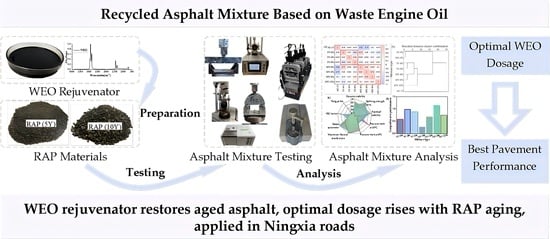
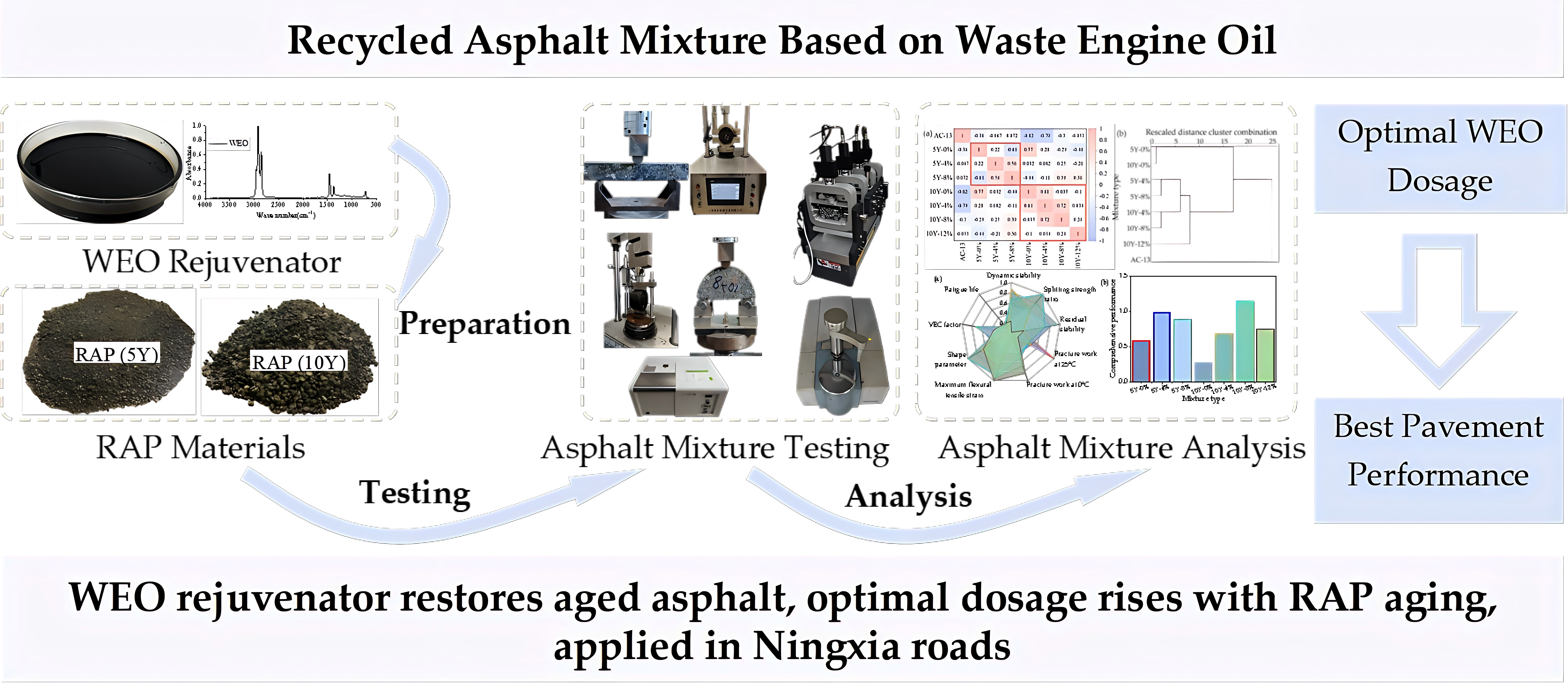
1. Introduction
Complex climatic conditions and frequent traffic loads easily cause aging and cracking diseases in asphalt pavements. The massive generation of reclaimed asphalt pavement (RAP) materials has resulted in waste of non-renewable asphalt resources and brought environmental pressure, which contradicts the concept of green and sustainable development in infrastructure engineering. Against the backdrop of rapid development in highway construction and maintenance, the recycling and utilization of waste asphalt pavement materials has become an indispensable approach to achieving sustainable development in the transportation infrastructure industry. This method can reduce the consumption of scarce mineral resources, alleviate the environmental impact caused by RAP stockpiling, save land resources occupied by waste disposal, and align with the requirements of eco-friendly and low-carbon development in infrastructure construction [
1,
2,
3].
Currently, research on recycled asphalt mixtures mainly focuses on RAP content, regenerant selection, mix design, and evaluation of basic pavement performance. In terms of regenerant selection, scholars have conducted in-depth performance comparisons on different types of materials such as petroleum-based regenerants, bio-based regenerants, and composite regenerants, analyzing their compatibility with aged asphalt, performance recovery effects, and economic and environmental benefits. Petroleum-based regenerants exhibit good compatibility and lower costs, but have poor environmental friendliness; bio-based regenerants have wide sources and are environmentally friendly, but their performance stability needs improvement; composite regenerants can integrate multiple advantages, but their formula design is complex [
4,
5,
6,
7]. In parallel, dosage design has usually been established through laboratory-based performance recovery tests, and the commonly recommended rejuvenator dosage is approximately 2–8% by mass of aged binder [
8]. Several studies have also proposed relationships between rejuvenator dosage and performance restoration, providing useful references for engineering practice [
9,
10].
Despite these advances, the current understanding of rejuvenator dosage design remains insufficient for practical regional application. In many studies, the optimum dosage is still determined mainly from empirical experience or a limited number of indicators, without adequately considering the combined effects of climatic conditions, RAP aging severity, and rejuvenator–binder interaction [
11,
12,
13,
14]. This limitation becomes more pronounced for RAP materials with different field service lives, because the rejuvenation demand depends not only on stiffness recovery but also on the oxidation state of the aged binder and the compatibility between rejuvenator fractions and oxidized asphalt components. Recent studies have further shown that, especially under high-RAP conditions and repeated recycling scenarios, dosage applicability should be evaluated from a broader perspective that includes diffusion efficiency, compositional stability, and durability-related uncertainty, rather than relying on a single performance index [
8,
15].
Waste engine oil (WEO) has attracted increasing attention as a low-cost and recyclable rejuvenator. Previous studies have examined the optimization of rejuvenator dosage from rheological and chemical viewpoints [
9] and clarified the behavior of diffusion and regeneration of WEO in aged binders at the molecular scale [
16]. However, these studies have mostly focused on binder-scale evaluation or a single aging condition, while the combined effects of regional climate, field service age of RAP, and mixture-scale engineering performance remain insufficiently clarified. Therefore, the novelty of this study does not simply lie in applying WEO as a rejuvenator, but in proposing a region-oriented evaluation method for determining the appropriate rejuvenator dosage for RAP materials with different field service ages.
Thus, two representative RAP sources from the Ningxia region were selected in this study. Ningxia is characterized by an arid to semi-arid climate, large temperature fluctuations, and limited rainfall, making it a representative region for examining the interaction between environmental exposure and RAP aging. Based on local climatic conditions and laboratory performance evaluation, recycled asphalt mixtures with different WEO dosages were designed and tested. Through the analysis of pavement performance and dosage sensitivity, this study aims to identify dosage recommendations suitable for different RAP aging levels under Ningxia’s climatic and engineering conditions. In this way, the work extends existing research from binder-scale or single-aging-level evaluation toward a more application-oriented method that explicitly considers RAP aging severity, regional environment, and rejuvenator dosage, thereby providing technical support for the efficient and sustainable utilization of RAP in local highway engineering.
2. Materials and Methods
2.1. Raw Material
2.1.1. Laboratory Reagent and Base Asphalt
In this study, all chemicals were used as received without further purification. Toluene (analytical grade, AR, 99.5%) was purchased from Sinopharm Chemical Reagent Co., Ltd. (Shanghai, China). Dichloromethane (analytical grade, AR, 99.5%) was obtained from Aladdin Reagent (Shanghai) Co., Ltd. (Shanghai, China). Methanol, meeting the Reag. Ph Eur standard and designated as gradient grade for liquid chromatography, was acquired from Merck KGaA (Darmstadt, Germany) under the LiChrosolv® brand. n-Heptane (analytical grade, AR, 98%) was supplied by ACMEC Reagent Co., Ltd. (Shanghai, China).
#90 base asphalt was used as the new asphalt for the asphalt mixture, and its material performance parameters are shown in
Table 1.
2.1.2. Aggregates
Diabase was selected as the coarse aggregate, manufactured sand as the source of fine aggregate, and limestone powder as the filler.
2.1.3. Reclaimed Asphalt Pavement (RAP)
Two asphalt pavements that had been in service for approximately 5 years and 10 years were selected for this study. The obtained mixtures were named RAP (5Y) and RAP (10Y), respectively. After crushing and sieving, both materials were processed into the following two size fractions: 0–3 mm and 3–5 mm. The service periods of 5 years and 10 years can represent typical moderate and severe asphalt aging conditions in Ningxia, respectively, considering the local climatic characteristics and actual pavement performance degradation law.
The asphalt content of the four RAP materials was determined, the relevant technical indicators are presented in
Table 2.
The rheological properties of the aged asphalt extracted from RAP were evaluated using MSCR and DSR tests, as shown in
Table 3.
Due to long-term environmental exposure, the asphalt in RAP undergoes aging and hardening, resulting in deteriorated rheological properties, reduced low-temperature performance, and decreased moisture stability. Therefore, the RAP content in recycled mixtures should not be excessively high. Additionally, aggregates in RAP may develop micro-cracks or fracture under repeated traffic loading, compromising their structural mechanical properties and ability to meet skeleton interlock requirements. Consequently, the maximum particle size of RAP should be limited.
2.1.4. WEO Rejuvenator
The WEO rejuvenator used in this study was sourced from typical automotive repair enterprises in Yinchuan, Ningxia. Although WEO was a blended oil product that might exhibit compositional variations due to differences in vehicle sources and service periods, its widespread availability, low cost, and reusability attributes conferred significant potential for large-scale application. To ensure experimental representativeness and comparability, a single batch of WEO was used in this study.
The WEO appeared dark brown in color, with a density of 0.894 g/cm
3 and a viscosity of 31 mPa·s at room temperature. Prior to use, WEO was filtered to remove solid impurities to ensure the rejuvenation effectiveness. The main chemical components of the WEO rejuvenator were characterized using FTIR.
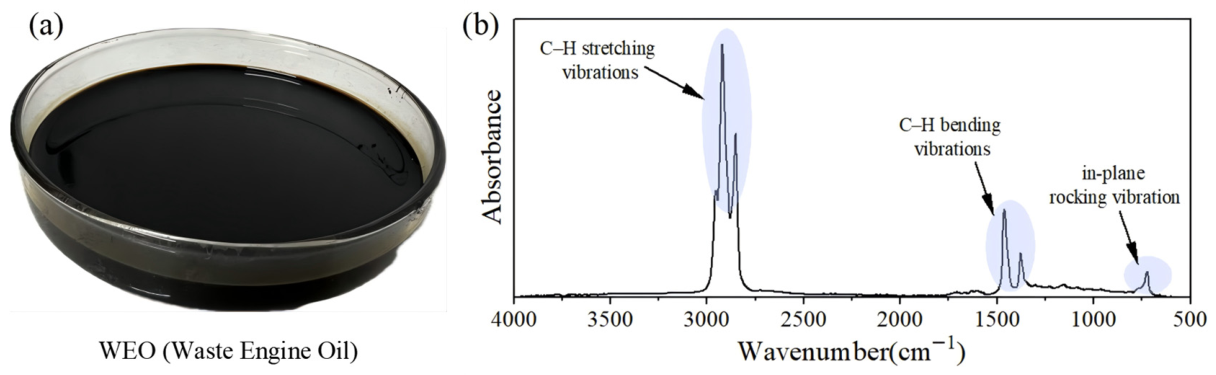
Figure 1 showed the appearance and FTIR spectrum of the WEO. The characteristic absorption peaks were mainly distributed in the vibration region of saturated aliphatic hydrocarbons. The absorption peaks at 2957 cm
−1, 2920 cm
−1, and 2858 cm
−1 corresponded to the C-H stretching vibrations of methyl and methylene groups, respectively. The peaks at 1462 cm
−1 and 1374 cm
−1 were attributed to the C-H bending vibrations of methylene and methyl groups, respectively. The absorption peak at 719 cm
−1 represented the in-plane rocking vibration of long-chain alkanes. These features indicated that the WEO contained abundant long-chain aliphatic hydrocarbon components, which might contribute to replenishing the light fractions of aged asphalt.
However, the potential aging-related risks of WEO should also have been considered when interpreting its rejuvenation effectiveness. Previous molecular-scale studies had shown that WEO improved aged asphalt mainly through the migration of light components and the rebalancing of the colloidal structure, but this mechanism also implied possible sensitivity to volatilization and oxidation during long-term service [
16]. In addition, rheological studies had suggested that the durability benefit of rejuvenation depended on whether the recovered viscous response could be maintained after subsequent oxidative exposure, and that the softening effect of rejuvenators lacking sufficient anti-aging resistance might gradually diminish with further aging [
17,
18,
19]. Such secondary aging might lead to partial stiffness rebound, reduced viscous relaxation capacity, and the deterioration of cracking-related performance. Therefore, since no dedicated PAV-based aging evaluation was conducted in this study, the effectiveness of WEO should be interpreted primarily in terms of short- to medium-term rejuvenation at the mixture scale, while its potential long-term influence on asphalt mastic aging still required further investigation.
2.1.5. Recycled Asphalt Mixture Design
Based on preliminary investigations and the requirements of the Ningxia region, #90 base asphalt was selected as the virgin asphalt. Referring to previous studies on recycled asphalt mixtures [
20,
21], a 30% RAP content (by internal mixing method) was chosen, as this proportion provides balanced performance suitable for large-scale construction. The RAP fractions of 0–3 mm and 3–5 mm were adopted as the recycled materials, and dense-graded asphalt mixture AC-13 was selected as the design mixture type.
The optimal asphalt-aggregate ratios for RAP (5Y) and RAP (10Y) were determined to be 5.1% and 5.3%, respectively.
To analyze the rejuvenation mechanism of aged asphalt and evaluate the performance of recycled mixtures with varying rejuvenator dosages, WEO was incorporated at different mass ratios using the external mixing method. Specifically, the study prepared recycled asphalt mixtures by blending RAP (5Y) with WEO at dosages of 0%, 4%, and 8%, as well as RAP (10Y) with WEO at dosages of 0%, 4%, 8%, and 12%. These mixtures are hereinafter referred to as 5Y-0%, 5Y-4%, 5Y-8%, 10Y-0%, 10Y-4%, 10Y-8%, and 10Y-12%, respectively.
These recycled asphalt mixtures are hereinafter referred to as: 5Y-0%, 5Y-4%, 5Y-8%, 10Y-0%, 10Y-4%, 10Y-8%, and 10Y-12%, respectively.
2.2. Test Methods
This study refers to the Test Procedures for Asphalt and Asphalt Mixtures in Highway Engineering and conducts the rutting test, immersion Marshall stability test, freeze–thaw splitting test, low-temperature beam bending test, and uniaxial compression dynamic modulus test, with three parallel specimens prepared for each test.
The semi-circular bending (SCB) test was used to evaluate the crack resistance of asphalt mixtures. No unified standard exists for SCB test operation. Specimens were semi-cylindrical, with a diameter of 150 mm and thickness of 50 mm. A pre-cut notch (3 mm wide, 15 mm deep) was made at the bottom as the crack propagation starting point to guide fracture along the preset path. The SCB test loading span was 120 mm to assess specimen fracture performance, with three parallel specimens prepared.
A universal testing machine executed the four-point bending fatigue test under strain-controlled loading. This mode was selected because repeated flexural tensile strain primarily governs the bottom-up fatigue cracking of asphalt layers, and a framework of constant strain enables the comparison of mixtures under an equivalent demand of deformation. A haversine waveform was applied at a strain level of 800 με, a loading frequency of 10 Hz, and a test temperature of 15 °C. Three parallel beam specimens were tested for each condition, and fatigue failure was defined as a 50% reduction in the initial stiffness modulus (E/E0 = 50%), which is a widely accepted phenomenological criterion for fatigue evaluation in bending tests [
22,
23]. The selected test parameters were intended to balance mechanistic relevance and discriminatory capability. Specifically, 10 Hz is consistent with the loading frequency commonly adopted in four-point bending fatigue testing and reasonably represents medium-speed traffic loading [
22]. The temperature of 15 °C falls within the intermediate-temperature range typically used to characterize asphalt-mixture fatigue, where fatigue cracking is sufficiently sensitive to binder aging while the results are less affected by low-temperature brittleness or high-temperature flow deformation [
23]. In addition, 800 με provides a moderate-to-high strain level that accelerates damage accumulation while still preserving clear differences in fatigue life among mixtures with different RAP aging states and WEO dosages. Therefore, this test configuration is suitable for evaluating and comparing the relative fatigue resistance of recycled asphalt mixtures within a unified strain-controlled framework.
An IATROSCAN rod thin-layer chromatography analyzer was used. Toluene was the solvent; n-heptane was used for primary development, toluene for secondary development, and dichloromethane and methanol for tertiary development. The hydrogen flame rod thin-layer chromatography used a special quartz thin-layer rod. Samples were spotted on the rod and separated by developers. After development, the rod was sequentially placed in a flame ionization detector, burned at a constant speed, and the ion current signal was collected and processed by a computer to obtain chromatographic results, with three parallel specimens prepared [
24].
A Bruker Tensor 27 attenuated total reflection Fourier transform infrared spectrometer (ATR-FTIR) was used to analyze the chemical structure changes of aged and recycled asphalt. The wave number range was 600–4000 cm
−1, with 32 spectral scans and a resolution of 4 cm
−1 to ensure data accuracy. The sample to be tested was placed on the ATR crystal surface and uniformly thinned and fixed by the device’s pressure mechanism. OPUS 8.5 software (developed by Bruker Optik GmbH, Ettlingen, Germany) was used for necessary preprocessing of infrared spectral data, including baseline correction and noise filtering, with three parallel specimens prepared [
25].
2.3. Anylise Methods
2.3.1. Pearson Correlation Analysis
This study adopted the Pearson correlation analysis method to analyze the performance indicators of asphalt mixture. The test statistic of the Pearson correlation coefficient was the T-statistic, which followed a T-distribution with corresponding degrees of freedom; the Pearson correlation coefficient ranged between −1 and 1. A result close to 1 indicated a strong positive correlation, a result close to −1 indicated a strong negative correlation, and a result close to 0 indicated a weak or no linear correlation between the two sets of data. It should be noted that correlation did not imply causation; a high correlation coefficient only indicated that there was a certain relationship between variables but could not indicate that one variable caused changes in another variable.
2.3.2. Principal Component Analysis
Principal component analysis (PCA) was used to process the multi-index evaluation data of asphalt aging and regeneration. In the preprocessing stage, the original data were standardized to unify dimensions, and correlation and multicollinearity tests were carried out to ensure the applicability of indicators. This method transformed multiple correlated original indicators into a few independent principal components through linear transformation, retained core information and achieved dimensionality reduction, thereby efficiently analyzing the evolution law of asphalt aging and regeneration and providing reliable support for subsequent performance evaluation.
2.3.3. Hierarchical Cluster Analysis
The dendrogram of cluster analysis using average linkage (between groups) was a commonly used multivariate statistical classification method. It measured similarity by calculating the Euclidean distance between samples and performed hierarchical clustering using the average distance between groups, finally presenting the classification relationship intuitively in a tree diagram. In this study, this clustering method was adopted with a threshold Euclidean distance of 5 to divide eight types of asphalt mixtures into five main clusters. It distinguished the performance differences in recycled mixtures with different service lives and waste edible oil (WEO) dosages, and reflected the significant effects of raw material sources, aging degree and regenerant dosage on clustering results, providing an intuitive statistical basis for controlling regenerant dosage and coordinating road performance.
3. Results and Discussion
3.1. Road Performance of Recycled Asphalt Mixtures
3.1.1. High-Temperature Performance and Water Damage Resistance
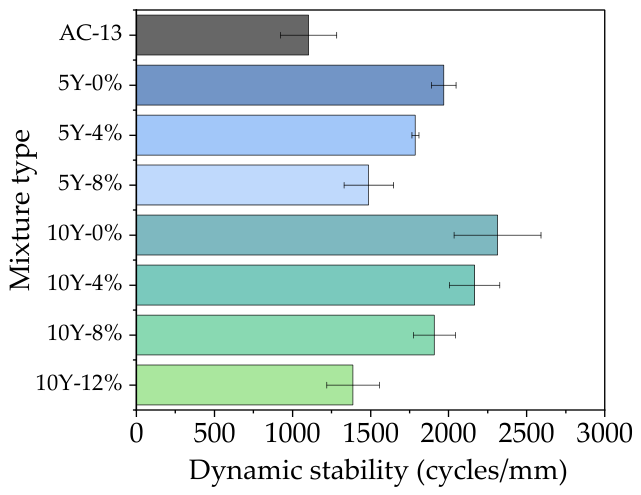
The dynamic stability results of the mixtures were presented in
Figure 2. The dynamic stability values of the various recycled asphalt mixtures all fell within the range of 1500–2500 times/mm; by fitting the variation trend of the dynamic stability of asphalt mixtures, it could be observed that with the increase in WEO content, the dynamic stability of RAP (5Y) and RAP (10Y) decreased continuously, gradually approaching and then falling below the level of AC-13, respectively.
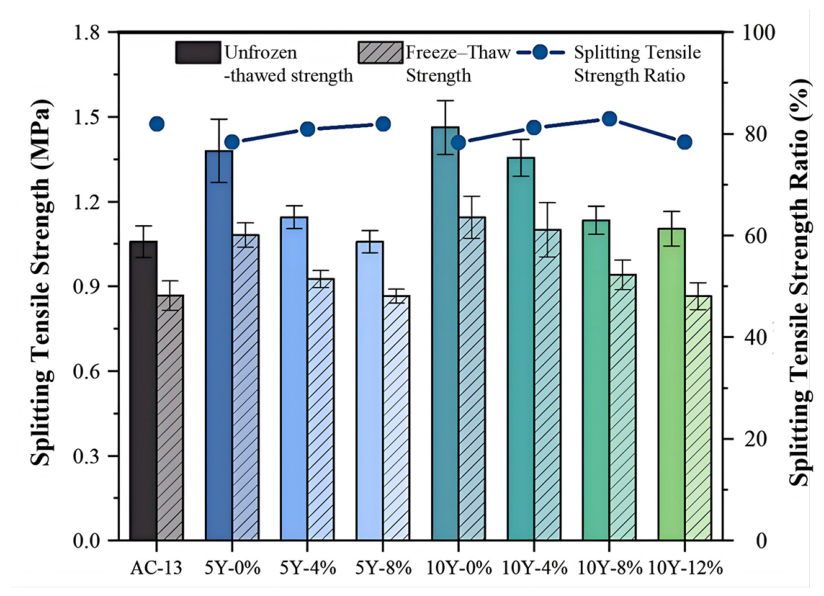
Figure 3 presented the tensile strength test results of the recycled asphalt mixtures. For the RAP (5Y) recycled mixtures, the residual stability exhibited a gradual upward trend with the increase in WEO content, and the residual stability value at a WEO content of 8% was basically equivalent to that of the AC-13 reference mixture. For the RAP (10Y) recycled mixtures, the effect of WEO content on residual stability followed a variation pattern of first increasing and then decreasing.
Based on the strength data before and after freeze–thaw cycles, the overall mechanical properties of the RAP (10Y) recycled mixtures were superior to those of the RAP (5Y) recycled mixtures, and this advantage was more significant especially under the conditions of 0% WEO content and 4% WEO content. The RAP (5Y)-recycled mixtures also demonstrated good performance at WEO contents of 4% and 8%, among which the splitting strength ratio of the 5Y-8% group was close to that of the AC-13 reference mixture.
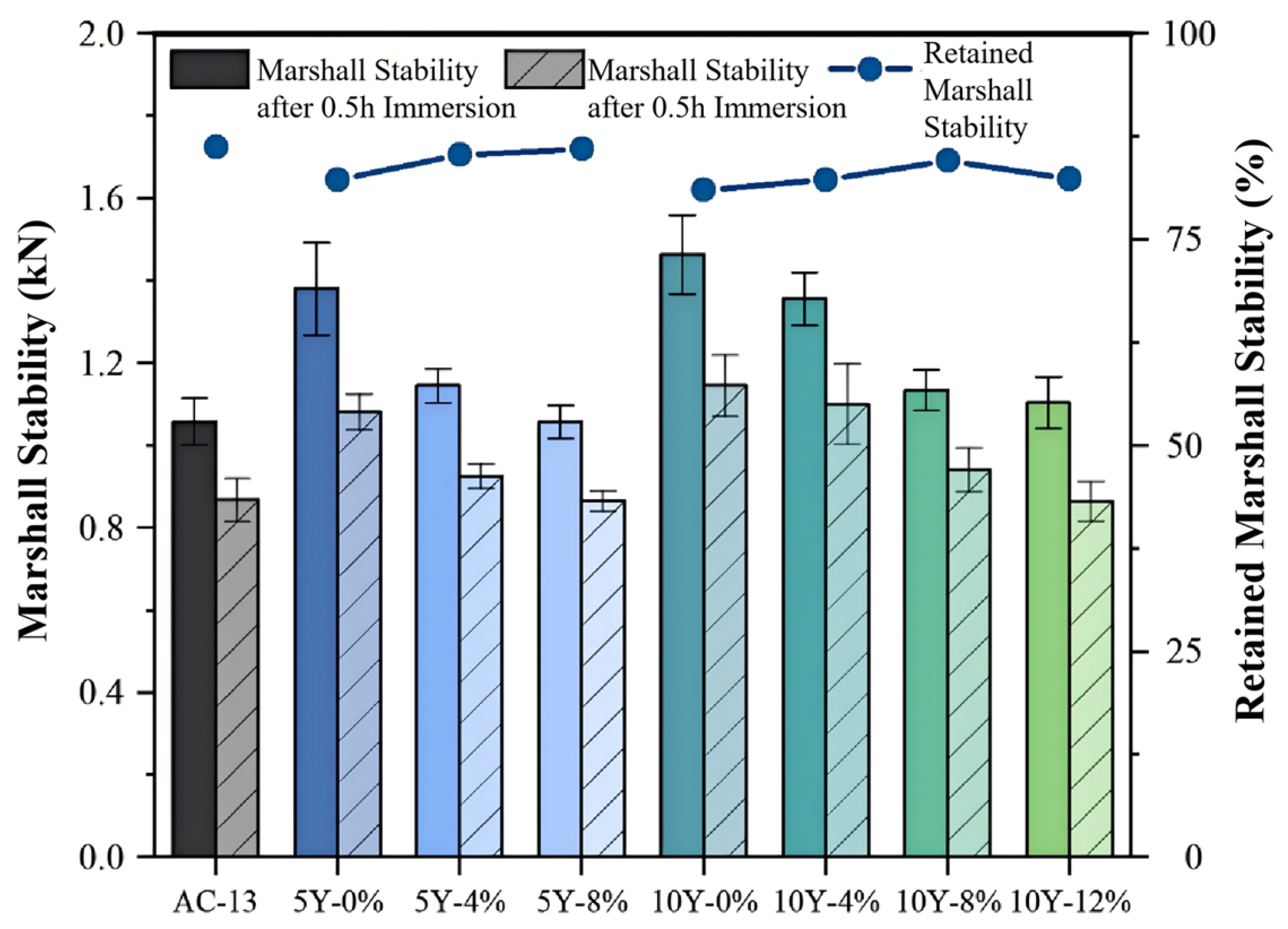
The content of the regenerant WEO had a significant impact on immersion Marshall stability and residual stability of recycled asphalt mixtures. As shown in
Figure 4, for RAP (5Y), the residual stability increased gradually with the incorporation of WEO, and the value at a WEO content of 8% was almost the same as the reference value. For RAP (10Y), the residual stability first increased and then decreased with the incorporation of WEO, indicating that excessive incorporation may reduce its performance. This trend was consistent with that observed in the freeze–thaw splitting test results.
3.1.2. Analysis of Crack Resistance
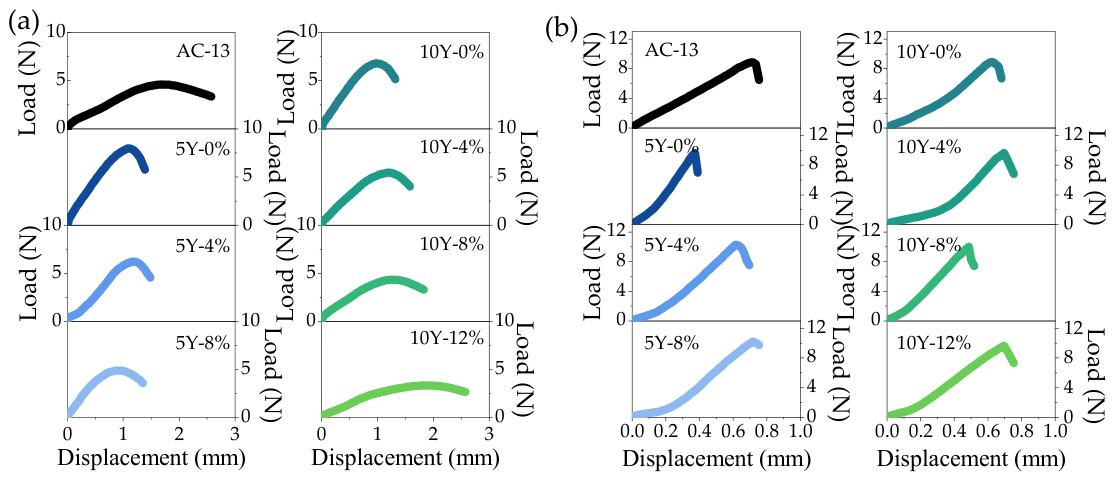
To evaluate the low-temperature crack resistance of different types of asphalt mixtures, semi-circular bending (SCB) tests and beam bending tests were conducted on the eight selected groups of specimens, respectively. For the SCB tests, two temperature conditions (25 °C and 0 °C, representing normal and low temperatures) were adopted. Four parallel samples were tested for each group, and a set of representative data was selected at each temperature to plot the load–displacement curves. The specific results were shown in
Figure 5.
The SCB test results indicated that the effect of the regenerant on crack resistance varied under different temperature conditions. At a test temperature of 25 °C, the addition of the regenerant led to a decrease in the peak load and maximum displacement, whereas the load–displacement curves measured at 0 °C showed the opposite trend. Under the low-temperature condition of 0 °C, the fracture mode of the hot-recycled asphalt mixtures clearly transitioned from ductile fracture to brittle fracture, yet the critical displacement and final displacement at specimen failure exhibited a distinct decreasing trend. To quantitatively analyze the changes in the crack resistance of the recycled asphalt mixtures, the fracture work was further adopted in this study, and the fracture work and coefficient of variation in all specimens were summarized in
Table 4.
The content of the WEO and the test temperature had a significant impact on the crack resistance of the recycled asphalt mixtures. According to the data in
Table 5, at 25 °C, the 5Y-0% group exhibited the highest fracture work, while the fracture work decreased gradually with the increase in WEO content. A similar trend was observed for the 10Y group. Meanwhile, although the 10Y mixtures had a higher degree of aging, excessive WEO content still led to a decline in their crack resistance.
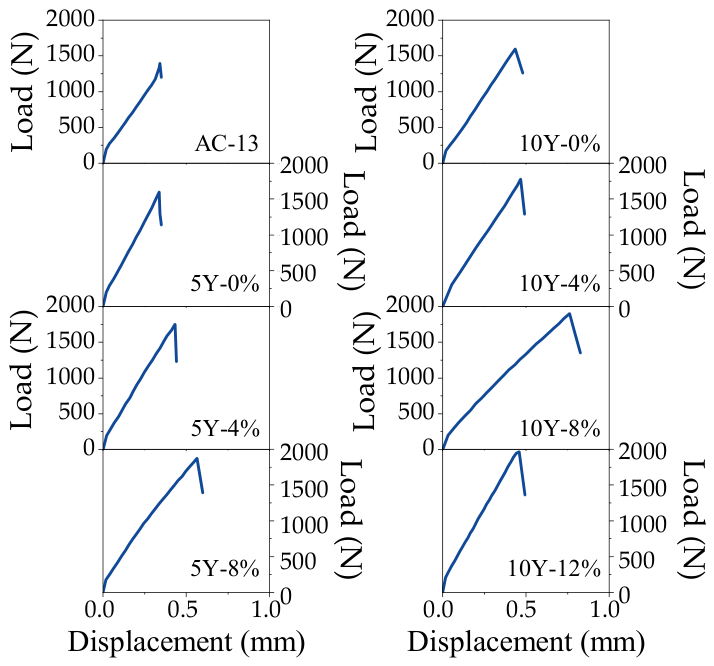
To further compare and analyze the crack resistance of the recycled asphalt mixtures, the study compiled the data of the beam bending tests. As shown in
Figure 6, for each type of mixture, a representative load–displacement response curve was selected to compare and analyze its fracture process and strength performance.
At 0 °C, the fracture work of 5Y-0% was the lowest, but it increased significantly with the increase in WEO content. The 10Y mixtures exhibited a more pronounced improvement at 0 °C, and meanwhile, the 10Y mixtures responded more obviously to WEO content at low temperatures. In particular, the dosages of 8% and 12% significantly enhanced the crack resistance, indicating that the regenerant effectively improved the brittleness of aged asphalt and enhanced its crack resistance under low-temperature conditions. Temperature and WEO content had significant effects on the crack resistance of recycled asphalt mixtures. To optimize the crack resistance of recycled asphalt mixtures, the WEO content should be appropriately reduced under normal temperature conditions and appropriately increased under low-temperature conditions.
Analysis of the test results showed that the content of the regenerant WEO had a significant impact on the low-temperature crack resistance of recycled asphalt mixtures. The 5Y-0% mixture had a relatively high fracture load and good crack resistance, but its ductility was inferior to that of AC-13. With the increase in WEO content, the ductility increased significantly, while the crack resistance decreased to some extent. The 10Y-0% mixture had good crack resistance but poor ductility, and its crack resistance decreased with the increase in WEO content. The 10Y-12% mixture achieved the optimal balance between fracture load and ductility.
To further quantitatively analyze the crack resistance, the flexural tensile strength, flexural stiffness modulus, and maximum flexural tensile strain of all specimens were summarized in
Table 5.
According to the data in
Table 5, with the increase in WEO content, the flexural tensile strength and maximum flexural tensile strain of both 5Y and 10Y mixtures increased significantly, indicating that the regenerant WEO improved the cohesiveness and ductility of the material, thereby enhancing the crack resistance. However, the flexural stiffness modulus decreased at high WEO contents.
In conclusion, temperature and WEO content had significant effects on the performance of recycled asphalt mixtures. An appropriate WEO content (5Y-4% and 10Y-8%) could improve the mixture performance, while excessively high content might lead to a decrease in crack resistance.
3.1.3. Analysis of Viscoelastic Properties
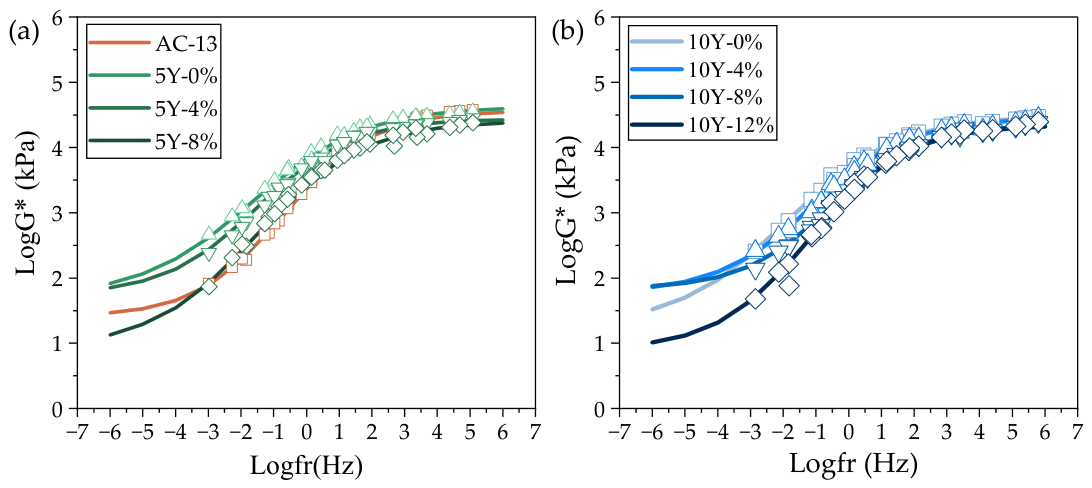
This study adopted the unconfined compressive dynamic modulus test method to evaluate the viscoelastic properties of the eight types of recycled asphalt mixtures, respectively. The tests were conducted at temperatures of −10 °C, 5 °C, 20 °C, 35 °C, and 50 °C. Dynamic loads were applied to the specimens under six test frequencies (0.1 Hz, 0.5 Hz, 1 Hz, 5 Hz, 10 Hz, and 25 Hz). The axial stress on and axial strain of the specimens during each loading cycle were measured and recorded. Ultimately, the dynamic modulus and phase angle under each condition were documented. Based on the time-temperature superposition principle, the dynamic modulus data measured at different temperatures and frequencies were shifted into a unified reduced-frequency domain and fitted using a modified sigmoidal master-curve model, as shown in
Figure 7.
The dynamic modulus master curve had clear engineering significance because it characterized the mechanical response of asphalt mixtures over a broad range of loading times and temperatures within a single framework. In particular, the high reduced-frequency region reflected the load-bearing and deformation-resistance capacity of the mixture under rapid loading, whereas the low reduced-frequency region was more closely related to its stress-relaxation capability under prolonged loading [
26,
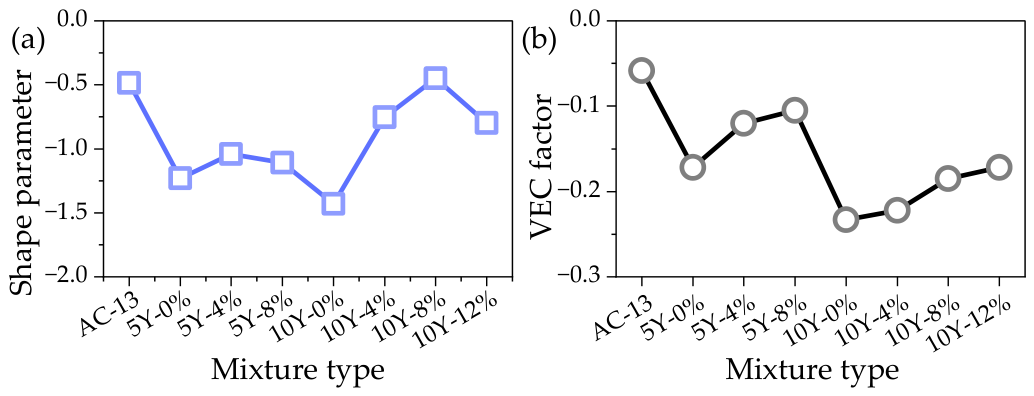
27]. In addition to the modulus level, two master-curve-derived indicators were used in this study for further interpretation. The shape parameter -β/γ, corresponding to the reduced-frequency location of the inflection region of the sigmoidal curve, was used to describe the transition characteristics between elastic-dominant and viscous-dominant response. A lower -β/γ indicated a more elastic and relaxation-deficient state, whereas a higher -β/γ suggested improved viscous contribution and stress-dissipation capability. Meanwhile, the viscoelastic cracking index (VEC Index) was adopted as a fatigue-related indicator derived from the master-curve characteristics. A higher VEC Index indicated that the mixture could better maintain structural integrity while dissipating cyclic loading through viscoelastic deformation, and therefore reflected lower cracking susceptibility and better fatigue resistance [
27,
28]. In this study, both -β/γ and VEC Index were interpreted as comparative indicators among mixtures tested under the same gradation, RAP source, binder system, and loading conditions.
The moduli of 5Y-0% and 10Y-0% decreased significantly in the low-frequency region (<10−2 Hz), indicating that aging led to a substantial decline in viscoelastic properties, with the performance degradation of 10Y being more pronounced. After the addition of 4% of regenerant, the modulus of 5Y-4% increased significantly across all frequencies, with a particularly obvious improvement observed in the low-frequency region. When the regenerant content was increased to 8%, the moduli of both 5Y-8% and 10Y-8% further increased. However, when the regenerant content was further increased to 12%, although the modulus still increased, the magnitude of the increase was limited, indicating that the effect of the regenerant tended to saturate and an optimal dosage existed.
The WEO rejuvenator improved the viscoelastic properties of the recycled asphalt mixtures, especially in the low-frequency region, indicating enhanced stress-relaxation ability under longer loading times. To further quantify the master-curve evolution, the shape parameter -β/γ and the VEC Index were used to interpret the viscoelastic transition characteristics and fatigue resistance of the mixtures. As shown in
Figure 8, compared with AC-13, 5Y-0% and 10Y-0% mixtures exhibited lower -β/γ values, indicating that aging shifted the mixtures toward a more elastic-dominant state, weakened their viscous relaxation capacity, and increased cracking susceptibility. This tendency was more pronounced for the 10Y mixture, which is consistent with its more severe field-aging condition. After WEO addition, the -β/γ values of both 5Y and 10Y mixtures increased, especially for the 10Y mixtures at an 8% dosage, indicating that the rejuvenator partially restored the viscous response and moved the viscoelastic transition toward a more balanced state. However, when the dosage was further increased to 12%, the increase in -β/γ became limited, suggesting that the beneficial effect of rejuvenation tended to saturate. A similar trend was observed for the VEC Index. The aged mixtures showed lower VEC Index values than AC-13, indicating that aging significantly reduced fatigue resistance. With appropriate WEO addition, the VEC Index increased progressively, demonstrating that the rejuvenator improved not only modulus recovery but also the capacity of the mixtures to dissipate cyclic loading through viscoelastic deformation. Nevertheless, the increase became marginal at the highest dosage, indicating that excessive rejuvenator addition did not produce proportional gains in cracking resistance. Therefore, the combined interpretation of the dynamic modulus master curve, the shape parameter, and the VEC Index supported the conclusion that 5Y-4% and 10Y-8% provided a more appropriate balance between viscoelastic recovery and engineering performance.
In conclusion, the WEO regenerant significantly improved the elasticity and fatigue resistance of the recycled asphalt mixtures, with the optimal effect observed at a regenerant content of 8%. The rational selection of regenerant content was of great significance for enhancing the performance of recycled asphalt mixtures.
3.1.4. Analysis of Fatigue Performance
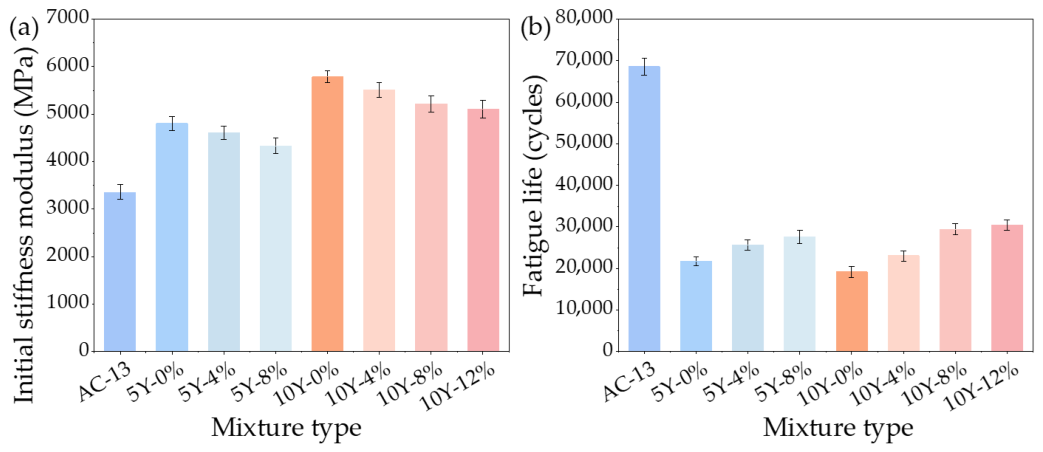
As can be seen from
Figure 7a, the incorporation of the regenerant significantly reduced the initial stiffness modulus of the recycled asphalt mixtures. In particular, for the 10-year RAP material with a higher degree of aging, a higher dosage of the regenerant was required to restore part of its elastic properties. After the incorporation of RAP, the initial stiffness moduli of the two recycled mixture groups (5Y-4% and 10Y-8%) were both higher than that of the AC-13 virgin mixture control group. The main reasons for this might be that the aged asphalt in RAP had undergone severe aging, which significantly reduced its fluidity and impaired the overall deformation capacity. Meanwhile, the aged asphalt and virgin asphalt only had surface physical contact, lacking sufficient fusion, and failed to fully form a synergistic cementitious network. This interface separation state was prone to causing local stress concentration, thus exhibiting a higher initial stiffness modulus under the fixed strain loading condition.
The fatigue life of asphalt mixtures defined in this study referred to the number of loading cycles when the stiffness modulus decayed to 50% of the initial stiffness modulus. As shown in
Figure 9b, under the same strain level, the ranking of the fatigue life of different asphalt mixtures was AC-13 > 10Y-8% > 5Y-4%. Under the control condition of 800 με, the virgin asphalt mixture without RAP (0% RAP) exhibited significantly superior fatigue crack resistance, with a fatigue life exceeding 68,000 cycles, which was obviously better than that of the recycled mixtures containing RAP. The reason was that the incorporation of RAP weakened the bonding system, failing to form a continuous and effective cementitious network structure.
By comparing the fatigue life of the two recycled asphalt mixture groups (5Y-4% and 10Y-8%), it could be seen that the 10Y-8% group exhibited a significantly longer fatigue life. This difference was mainly attributed to the fact that the dosage of WEO in the 10Y-8% group was 8%, much higher than 4% in the 5Y-4% group, which gave full play to its lubricating and blending effect. The relatively high dosage of WEO effectively improved the performance matching between the aged asphalt and virgin asphalt in RAP, reduced the performance difference between them, and promoted the optimization of interface bonding and the improvement of fusion degree.
3.2. Comprehensive Performance Analysis and Comparison of Recycled Asphalt Mixtures
To comprehensively evaluate the influence mechanism of different dosages of the WEO modifier on the performance of asphalt mixtures, this study took the influence law of different WEO regenerant dosages on mixture performance as the main research line, and adopted a variety of statistical and visualization methods such as Pearson correlation analysis, cluster analysis, principal component analysis (PCA), and radar chart analysis to analyze the key performance indicators of modified asphalt mixtures. First, correlation analysis of mixture types was carried out through Pearson correlation analysis and cluster analysis. Then, PCA was used for data dimensionality reduction, which realized the quantitative characterization and multi-dimensional evaluation of the influence of regenerant dosage. Finally, radar chart analysis was adopted to cross-validate the results of PCA. The above analysis provided a theoretical basis and data support for the optimal selection of regenerant dosage.
3.2.1. Pearson Correlation Analysis
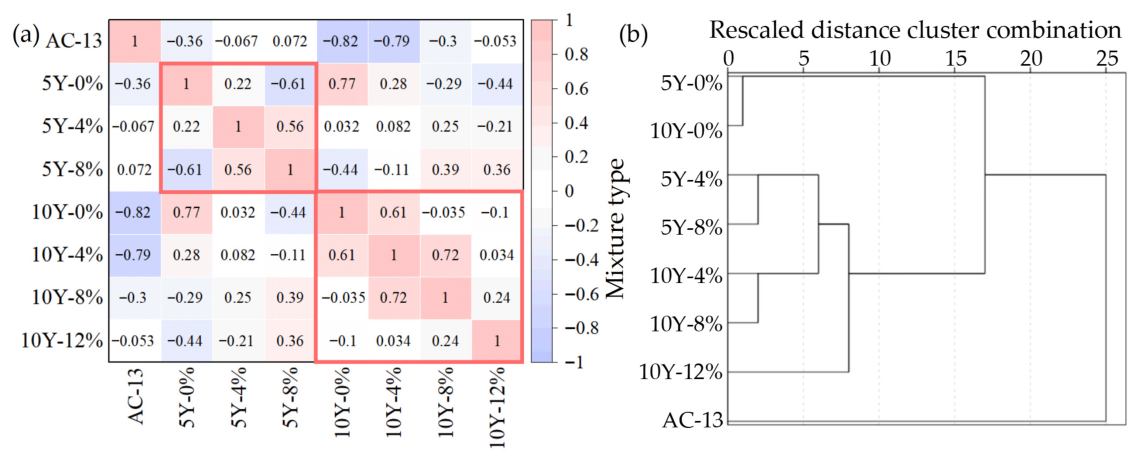
The performance of the AC-13 reference material was correlated with that of most recycled asphalt mixtures, indicating a performance difference between RAP materials and virgin asphalt mixtures. As shown in
Figure 8a, with the increase in WEO regenerant content, the correlation between the performance of different RAP materials changed significantly. The correlations for RAP (5Y) and RAP (10Y) were highlighted in red squared part, respectively.
In the 5Y series, the correlation between 5Y and 0% and 5Y-4% was 0.22, while the correlation between 5Y and 4% and 5Y-8% increased to 0.56, indicating that an increase in regenerant content helped to homogenize the performance. In the 10Y series, the correlation between 10Y and 0% and 10Y-4% was 0.61, and the correlation between 10Y and 4% and 10Y-8% further increased to 0.72, suggesting that a moderate regenerant content could enhance the correlation and stability of performance. However, when the content was further increased to 12%, the correlation between 10Y and 8% and 10Y-12% decreased to 0.24, indicating that excessive regenerant might cause the performance response to deviate from a consistent trend, and even lead to the degradation of some indicators. In addition, the correlation between RAP materials with different service years was low under the same regenerant content. For example, the correlation coefficient between 5Y and 4% and 10Y-4% was 0.28, reflecting that the regeneration effect was affected by the service life of RAP. Overall, the addition of regenerant generally promoted changes in RAP performance, but attention should be paid to the rational selection of content. At high contents, the regeneration efficiency and performance coordination of the mixture should be balanced.
As shown in
Figure 10b, based on the cluster analysis results at a Euclidean distance of five, the eight types of asphalt mixtures could be clearly divided into five main clusters.
Cluster I included “5Y-0%” and “10Y-0%”, corresponding to the asphalt mixtures with 5 and 10 years of service life that had not been modified with WEO. Their performance characteristics were relatively similar, indicating that the difference in aging time did not cause a significant distinction in performance under unmodified conditions. Cluster II was composed of “5Y-4%” and “5Y-8%”, representing the mixtures prepared from RAP with 5 years of service life and modified with 4% and 8% WEO. Their performance tended to be consistent, which indicated that the modification effect was relatively continuous within this dosage range. Cluster III included “10Y-4%” and “10Y-8%”, which were the mixtures modified with the same type of treatment based on RAP with 10 years of service life. They also exhibited the characteristic of being grouped together due to the similar raw material sources and modification conditions. Cluster IV only contained “10Y-12%”, and Cluster V was the reference group “AC-13”.
The results indicated that the mixtures with closer raw material sources and service life were more likely to be classified into the same cluster in the clustering analysis due to their similar performance characteristics. Especially for the RAP material with 10 years of service life, when the WEO content was increased to 12%, its performance deviated from that of other modified groups and formed a separate cluster. This indicated that the incorporation of excessive WEO might lead to a significant variation in the performance structure, deviating from the conventional modification behavior. Therefore, in practical recycling applications, it was necessary to strictly control the WEO content and balance regeneration efficiency with the coordination of the final road performance to avoid the adverse effects caused by high content.
3.2.2. Principal Component Analysis
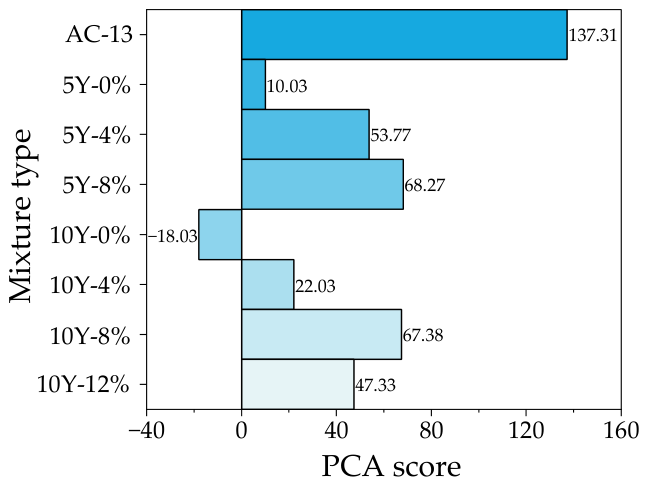
To evaluate the comprehensive impact of different WEO contents on the performance of recycled asphalt mixtures, this study conducted PCA using Origin 2024 software based on the performance test data. The principal component eigenvalues and variance contribution rates were shown in
Table 6, the variation trend of eigenvalues was presented in the figure, and the PCA score results were displayed in
Figure 11.
As could be seen from
Table 6, the variance contribution rates of Principal Component 1, Principal Component 2, and Principal Component 3 were 56.5%, 22.1%, and 11.3% respectively, with the cumulative contribution rate reaching 89.9%. This exceeded the commonly used discrimination threshold of 85%, indicating that the first three principal components could fully represent most of the variation information in the original data. Therefore, the data could be reduced to these three principal components for subsequent analysis. On this basis, the comprehensive PCA scores were calculated to evaluate the impact of WEO content on the performance of the mixtures.
The results showed that AC-13 achieved the highest comprehensive score, representing its optimal overall performance. In contrast, the unmodified RAP (5Y) mixture obtained a significantly lower score, indicating that long-term service had led to performance degradation. With the addition of WEO, the comprehensive PCA scores of both types of RAP mixtures showed an upward trend, indicating that the incorporation of WEO helped to improve the comprehensive performance of the mixtures. Specifically, for the RAP (5Y) group, the comprehensive score reached 53.77 after the incorporation of 4% WEO and increased slightly to 68.27 when the content was further increased to 8%, but the magnitude of the increase was limited. This indicated that the modification effect of WEO in RAP (5Y) tended to stabilize within the range of 4% to 8%. For the RAP (10Y) group, the comprehensive score reached the highest at a WEO content of 8%, while a further increase to 12% led to a decrease in the score. This reflected that excessive incorporation had an adverse effect on the performance of the mixtures.
In conclusion, the incorporation of WEO could effectively enhance the comprehensive performance of aged asphalt mixtures, but there was an optimal range of content for its improvement effect. Excessive use could not only fail to further improve performance but also cause performance attenuation. In practical recycling engineering, optimization should be carried out by combining the service life of raw materials and the mixing ratio.
3.2.3. Radar Chart Analysis
Furthermore, the study used the area of the radar chart to reflect the comprehensive performance of the recycled asphalt mixtures. Generally, a larger radar chart area indicates better comprehensive performance of the material across various indicators.
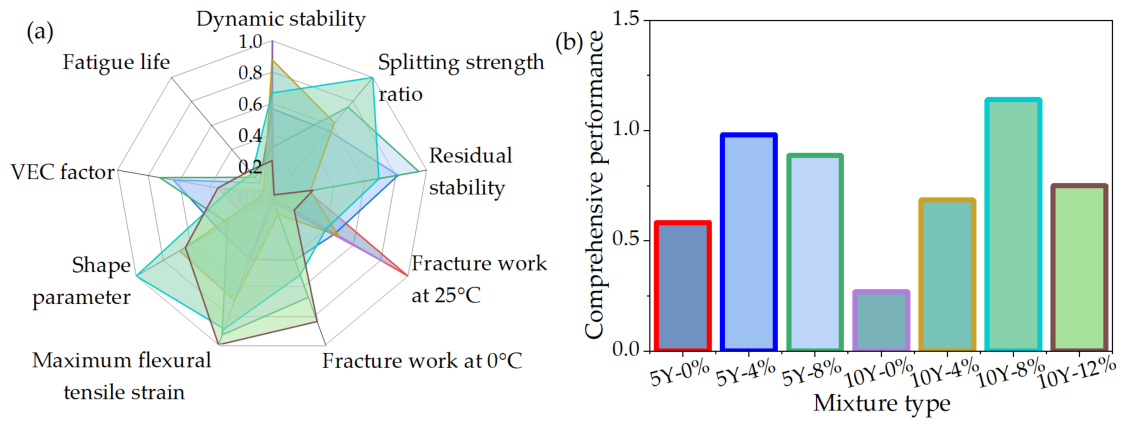
Through the analysis of various performance indicators in the radar chart, the study clarified the significant impact of the WEO regenerant on the comprehensive performance of recycled asphalt mixtures, as illustrated in
Figure 12a. When no regenerant was added, the asphalt performance was relatively low. After the incorporation of 4% regenerant, the performance of both 5Y and 10Y recycled mixtures improved significantly, particularly in terms of initial stiffness modulus and fatigue life. With the further incorporation of regenerant up to 8%, the performance of the 10Y recycled mixture increased remarkably, with outstanding performance especially in fatigue life, shape parameter, and VEC Index, which demonstrated the significant effect of the regenerant in improving the performance of aged asphalt. When the regenerant content was increased to 12%, although the performance improved, the magnitude of the increase was limited compared with that at 8%. In addition, the high-temperature dynamic stability of 5Y-8% and 10Y-12% decreased significantly compared with that of 5Y-4% and 10Y-8%, indicating that excessive regenerant was detrimental to the high-temperature stability of the mixtures.
The area of the radar chart represented the comprehensive performance, as shown in
Figure 12b. Among the mixtures, 5Y-4% and 10Y-8% exhibited the best comprehensive performance in the 5Y and 10Y recycled asphalt mixture series, respectively. Considering both comprehensive performance and cost, the optimal WEO content was 4% for 5Y recycled asphalt mixtures and 8% for 10Y recycled asphalt mixtures. This regenerant content was basically consistent with the results of previous studies [
9]. The contents predicted by the recycled asphalt performance prediction model (3.94% and 7.72%) verified the feasibility of predicting regenerant content based on key control indicators and prediction models of recycled asphalt from the perspective of mixtures. Higher contents of rejuvenator were required for the 10-year-aged asphalt materials. More severe aging was undergone by their internal asphalt components, with considerable loss of light fractions (saturates and aromatics) and excessive accumulation of heavy fractions (asphaltenes and resins). Serious deterioration of viscoelastic properties was induced, and greater difficulty in performance recovery was encountered. More rejuvenator was therefore needed to compensate for component loss and restore the balanced state of the asphalt colloid structure.
Therefore, controlling the WEO content at approximately 4% for 5Y recycled asphalt mixtures and 8% for 10Y recycled asphalt mixtures could not only effectively enhance the overall performance of the recycled mixtures but also adapt to the service environments under different climatic zones, ensuring the long-term stable operation of road engineering projects.
3.3. Mechanistic Analysis
In our previous work, we performed partial mechanistic analysis and optimized the evaluation indices and models [
9]. Furthermore, in this section, we extracted the asphalt from RAP mixtures by trichloroethylene extraction, followed by filtration, centrifugation, rotary evaporation and vacuum evaporation, to obtain recovered asphalt from RAP materials. We conducted thin-layer chromatography with TLC-FID and FTIR on RAP (5Y) and RAP (10Y) to investigate the physicochemical properties of rejuvenated asphalt, evaluate the differences in physicochemical performance between rejuvenated asphalt and virgin asphalt, and thereby reveal the regeneration mechanism of aged asphalt.
3.3.1. FTIR Analysis
Chemical changes in aged and rejuvenated asphalt were further explored via analysis of the well-recognized characteristic absorption peaks of asphalt. To quantitatively assess the influence of multi-field coupled aging on the chemical structure of the specimens, C-H stretching vibration peaks within the ranges of 1325–1480 cm
−1 and 2740–3000 cm
−1 were selected as references [
9,
24]. Variations in functional groups during the aging process were then evaluated by calculating the relative peak areas of the characteristic functional groups presented in
Table 7.
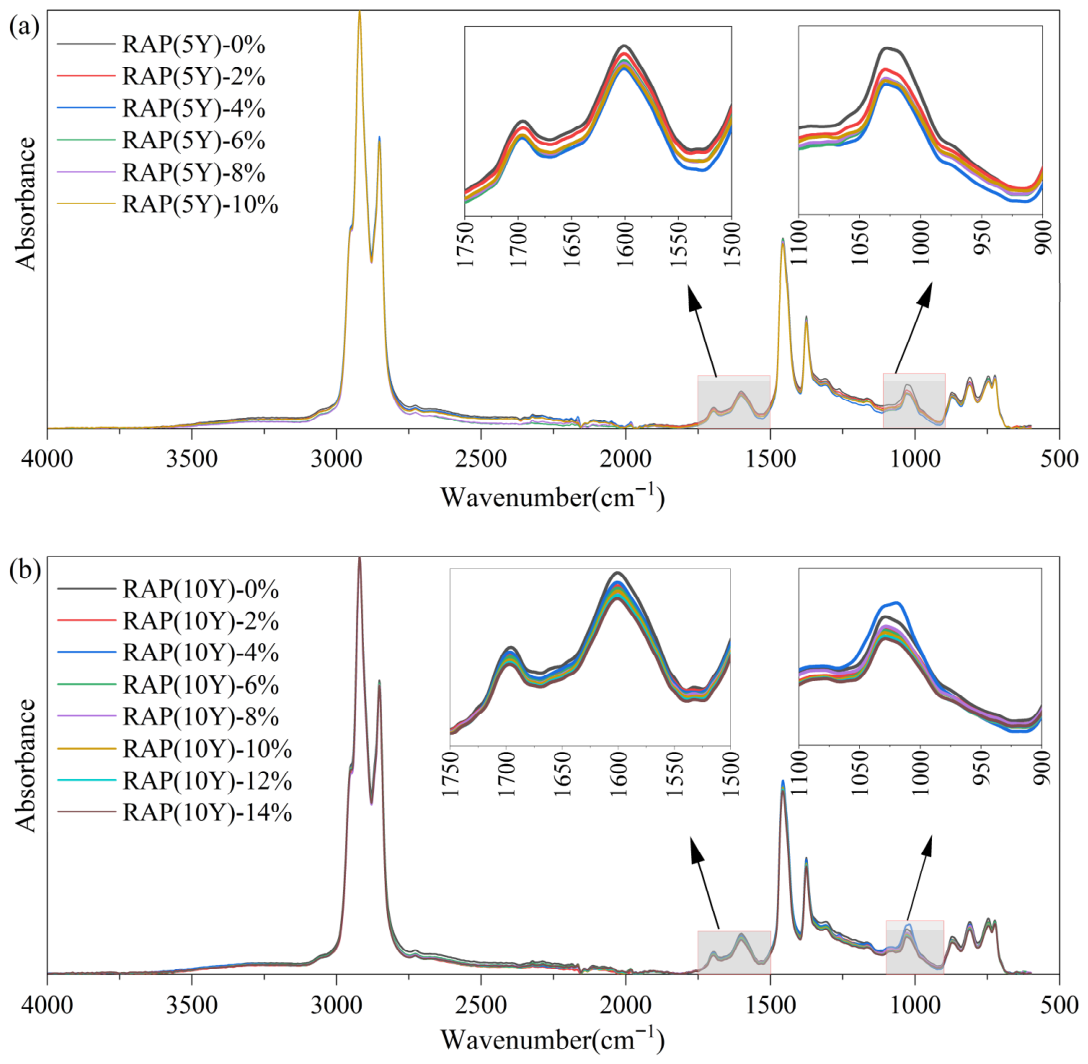
The functional group composition of rejuvenated asphalt was analyzed by FTIR, as shown in
Figure 13. The results revealed that the absorption peaks of rejuvenated asphalt in the range of 1750–1500 cm
−1 gradually decreased with increasing WEO content, indicating changes in the intensities of characteristic absorption peaks corresponding to carbonyl (C=O), sulfoxide (S=O), and aromatic groups. To further elucidate the specific effects of WEO on different functional groups in rejuvenated asphalt, quantitative analysis was performed on variations in carbonyl (C=O) and sulfoxide (S=O) functional groups, as well as the aromatic factor (-C=C-) and aliphatic factor (-CH
2-).
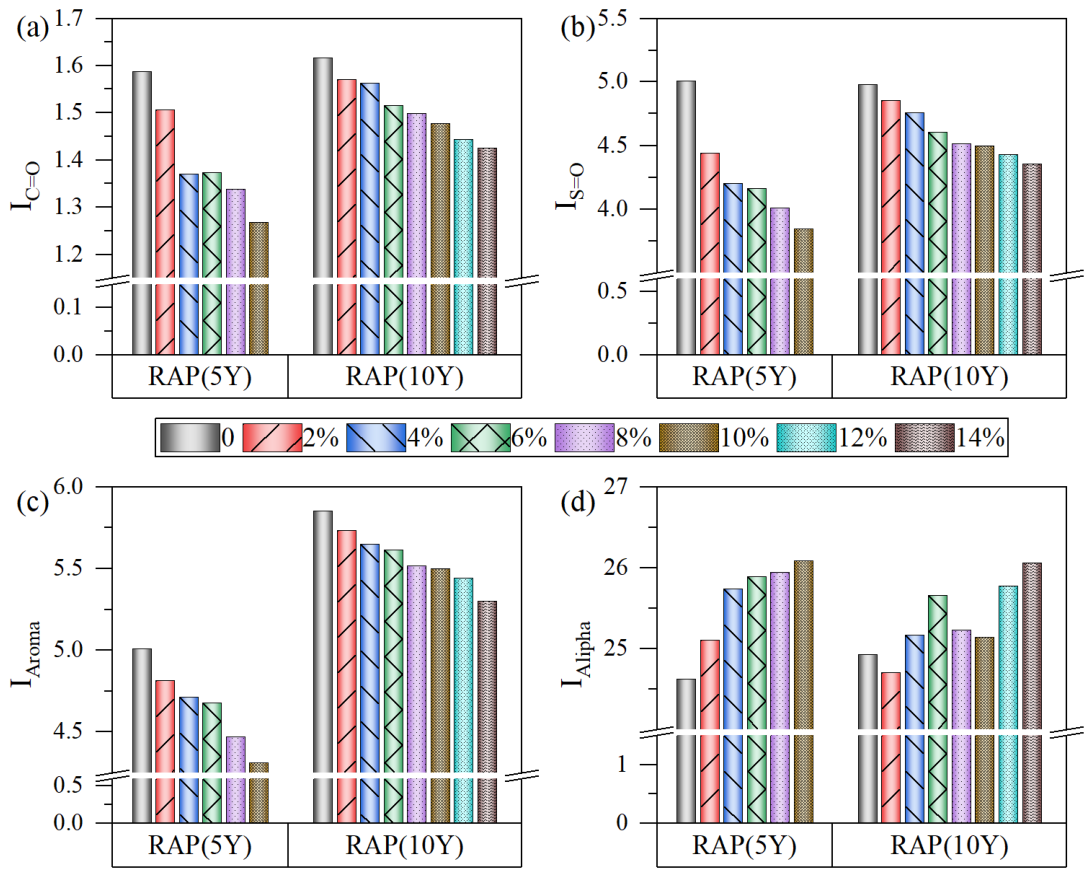
The relationships between the carbonyl index, sulfoxide index of rejuvenated asphalt and WEO content are presented in
Figure 14. A general downward trend in the carbonyl index of different rejuvenated asphalts was observed with increasing WEO dosage, with a particularly pronounced reduction at WEO contents of 10% and above. Meanwhile, the sulfoxide index also exhibited a clear decreasing trend as WEO content increased. This behavior was attributed to the physical dilution effect of the rejuvenator WEO. Upon WEO addition, carbonyl and sulfoxide-containing compounds in the asphalt were diluted into a larger volume, reducing their relative concentrations and resulting in decreased absorption peak intensities in the FTIR spectra. According to the experimental results, the restorative effect of WEO gradually weakened when the reduction in
IC=O of rejuvenated asphalt reached 10–12% at WEO dosages above 3–4%. Similarly, the restorative effect of WEO diminished when the reduction in
IS=O reached 9–11%.
The relationships between
IAroma,
IAlipha of rejuvenated asphalt and WEO content are shown in
Figure 14.
IAroma displayed a distinct decreasing trend with increasing WEO dosage, which was ascribed to the effective dissolution and dilution of aromatic compounds by the solvent components in WEO, leading to reduced relative concentrations of these species. In contrast, the variation in the aliphatic content index
IAlipha with WEO content was more complex and unstable. Further analysis of
IAroma revealed that the restorative effect of WEO gradually weakened when the reduction in
IAroma of rejuvenated asphalt reached 20–25% at WEO dosages above 5–6%. This lack of a clear trend in aliphatic compounds was likely due to the complex composition of WEO, as well as the combined effects of physical dilution and chemical component supplementation by the rejuvenator.
3.3.2. TLC-FID Analysis
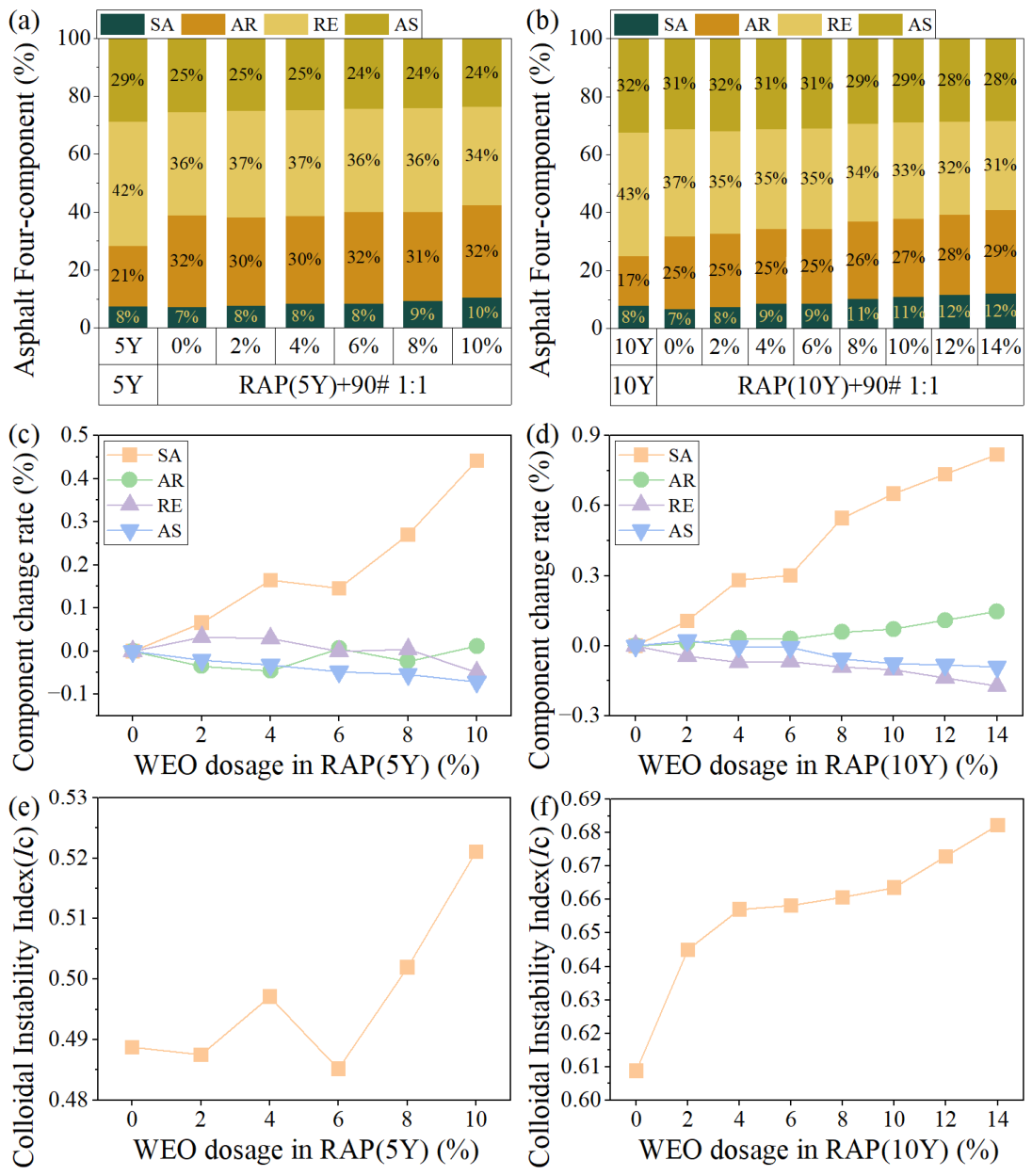
TLC-FID was employed to separate and quantify the four fractions (saturates, aromatics, resins, and asphaltenes) of rejuvenated asphalt derived from RAP (5Y) and RAP (10Y), and the evolution characteristics of asphalt fractions during rejuvenation were determined.
During asphalt aging, light fractions (saturates and aromatics) were volatilized significantly under thermo-oxidative conditions. Meanwhile, aromatics were aromatized and condensed into heavy fractions (resins and asphaltenes), resulting in continuous decreases in saturate and aromatic contents and gradual increases in resin and asphaltene contents. This process was attributed to the disrupted equilibrium between the dispersed phase (asphaltenes) and the dispersion medium (light fractions) in the asphalt colloidal system, which gradually transformed into an unstable gel structure.
The variation rules of each fraction with WEO dosage were further analyzed, as presented in
Figure 15. As a rejuvenator, WEO supplemented light oil components into aged asphalt and dissolved part of the heavy components formed during aging. Thus, the contents of saturates and aromatics in rejuvenated asphalt both increased with rising WEO dosage, showing similar trends. Aromatics exhibited a more pronounced change due to their higher solubility and supplementability by WEO. Concurrently, the aggregation of asphaltenes and the condensation of resins were inhibited by WEO addition, leading to decreased asphaltene and resin contents. The reduction rate gradually slowed with increasing WEO dosage, as the dissolution of heavy components in aged asphalt reached saturation and the fraction conversion rate stabilized when WEO dosage exceeded a certain level.
In addition to the evolution of the four fractions in rejuvenated asphalt, the intrinsic correlation between the gel index
Ic of rejuvenated asphalt and WEO dosage was investigated, as shown in
Figure 15. The gel index
Ic was adopted as a key indicator for characterizing the stability of asphalt colloidal structure. It was defined as the ratio of unstable components (saturates + asphaltenes) to stable components (aromatics + resins) in asphalt, which directly reflected the dispersion state of the asphalt colloidal system. In this study,
Ic was used to evaluate the colloidal structural stability of aged and rejuvenated asphalts, and its calculation formula is expressed as Equation (5).
where AR, RE, SA, and AS represent the mass fractions of aromatics, resins, saturates, and asphaltenes in asphalt four fractions, respectively (%).
The gel index Ic of rejuvenated asphalt was effectively regulated by the addition of WEO rejuvenator. The Ic values of all rejuvenated asphalts were elevated with increasing WEO dosage, because the light oil components (saturates and aromatics) supplemented by WEO optimized the asphalt colloidal system, promoted uniform dispersion of asphaltene micelles, and enhanced the stability of the colloidal structure, thereby improving the aging resistance of asphalt. However, the variation amplitude of Ic values for both rejuvenated asphalts tended to plateau when WEO dosage was further increased to a certain range. Taking RAP (10Y) asphalt as an example, the increment of its Ic value was maintained within 5–10%. Excessive WEO resulted in an overabundance of light components in the asphalt system, which potentially destroyed the colloidal equilibrium and reduced the high-temperature stability of asphalt. Therefore, excessive WEO rejuvenator was not recommended for the rejuvenation of aged asphalt from the perspective of gel index regulation and optimization of colloidal stability in rejuvenated asphalt.
4. Conclusions
For the arid and hot climate in Ningxia, the optimal mix ratio of recycled asphalt mixtures suitable for this region was designed and verified in this study. Using two types of reclaimed asphalt pavement (RAP) materials with different aging periods from Ningxia as raw materials, the RAP content was fixed at 30%, and recycled asphalt mixtures with different regenerant contents and RAP types were prepared, whose main road performance was analyzed. Based on the balance of comprehensive road performance, climate adaptability and cost, the optimal design scheme of recycled asphalt mixtures suitable for Ningxia’s climate was determined; FTIR and TLC-FID were used for analysis. The main conclusions are as follows:
(1) Raw materials and properties of recycled asphalt mixtures were analyzed. The optimal mix ratio of recycled asphalt was determined through tests, and its high-temperature rutting resistance and water damage resistance were verified. Tests showed the designed mixtures had excellent high-temperature stability and water damage resistance, and appropriate WEO content could improve their water damage resistance.
(2) The influence of regenerant on crack resistance and viscoelastic properties of recycled asphalt mixtures was analyzed. At 25 °C, fracture work of 5Y and 10Y mixtures decreased with increasing regenerant, while significantly increased at 0 °C; adhesion and ductility were improved at −10 °C to enhance crack resistance. Performances were optimal at 4% and 8% regenerant, limited at 12%, and 8% content improved elasticity and fatigue resistance of aged asphalt.
(3) The addition of RAP reduced the deformation capacity of recycled asphalt mixtures. Incomplete fusion between aged and virgin asphalt caused stress concentration and rapid decrease in stiffness modulus. Also, 10Y-8% mixtures had longer fatigue life than 5Y-4% due to higher WEO content; environmental aging shortened fatigue life and accelerated stiffness attenuation and damage development.
(4) Multiple performances of several recycled asphalt mixtures were compared based on normalization and radar charts. Considering comprehensive performance, climate adaptability in Ningxia and cost, regenerant contents of 5Y and 10Y mixtures were suggested to be controlled at approximately 4% and 8%, respectively, to improve overall performance and adapt to Ningxia’s service environment.
(5) TLC-FID and FTIR analyses were conducted to explore the physicochemical properties and regeneration mechanism of rejuvenated asphalt extracted from RAP (5Y) and RAP (10Y). The results showed that WEO effectively regulated the contents of functional groups (C=O, S=O, aromatic and aliphatic groups) and four fractions (saturates, aromatics, resins, and asphaltenes), optimized the asphalt colloidal structure, while excess WEO caused excessive light components, destroying colloidal equilibrium and impairing high-temperature stability.
However, this paper still had several limitations, with its conclusions mainly oriented to the Ningxia region. In addition, the composition of waste engine oil (WEO) varied significantly with oil sources and service histories, and only basic filtration and FTIR characterization were performed in this study, which introduced certain uncertainty into the universality of the experimental regeneration mechanism. This study determined that the optimal waste engine oil content was 4% for 5-year aged RAP and 8% for 10-year aged RAP, which had practical engineering reference value. Due to differences in the variation law of rejuvenator dosage across regions, regional differences should be comprehensively considered when applying this dosage scheme to other areas.
Author Contributions
Conceptualization, G.M. and Z.W.; methodology, F.H. and Z.W.; validation, Y.C. (Yu Cui) and J.Y.; formal analysis, Y.C. (Yanlin Chen) and J.L.; investigation, G.M. and Z.W.; data curation, G.M. and Z.W.; writing—original draft preparation, G.M. and Z.W.; writing—review and editing, F.H. and Z.W.; supervision, G.M. and F.H.; project administration, F.H.; funding acquisition, F.H. All authors have read and agreed to the published version of the manuscript.
Funding
This research was funded by the Key Research and Development Program of Ningxia Hui Autonomous Region of China, grant number 2024BEG02041. Named Key Technologies for Improving the Durability of Asphalt Pavements Under Complex Environments in Ningxia, China.
Data Availability Statement
The authors confirm that the data supporting the findings of this study are available within the article. Additionally, the raw data that support the findings are available from the corresponding author, Zichao Wu, upon reasonable request.
Acknowledgments
The authors sincerely acknowledge the financial support from Project No. 2024BEG02041.
Conflicts of Interest
The authors declare no conflicts of interest. The authors Guangyu Men, Fangyuan Han and Yu Cui were employed by the company Ningxia Communications Construction Co., Ltd. There is no conflict of interest between any of the authors and the company.
Abbreviations
The following abbreviations are used in this manuscript:
| RAP | Reclaimed Asphalt Pavement |
| WEO | Waste Engine Oil |
| SCB | Semicircular bending |
| TSR | Tensile Strength Ratio |
| PCA | Principal Component Analysis |
| VEC Index | Viscoelastic Cracking Index |
| AC-13 | Asphalt Concrete-13 (dense-graded asphalt mixture with nominal maximum aggregate size of 13 mm) |
| JTG | Industry Standards of the People’s Republic of China (Highway Engineering, JTG) |
| RAP(5Y) | 5-year aged Reclaimed Asphalt Pavement |
| RAP(10Y) | 10-year aged Reclaimed Asphalt Pavement |
| 5Y-0% | 5-year aged RAP mixture with 0% WEO regenerant |
| 5Y-4% | 5-year aged RAP mixture with 4% WEO regenerant |
| 5Y-8% | 5-year aged RAP mixture with 8% WEO regenerant |
| 10Y-0% | 10-year aged RAP mixture with 0% WEO regenerant |
| 10Y-4% | 10-year aged RAP mixture with 4% WEO regenerant |
| 10Y-8% | 10-year aged RAP mixture with 8% WEO regenerant |
| 10Y-12% | 10-year aged RAP mixture with 12% WEO regenerant |
| TLC-FID | Thin-Layer Chromatography with Flame Ionization Detector |
| FTIR | Fourier Transform Infrared Spectroscopy |
| IC=O | Carbonyl group formed by carbon oxidation on side-chain benzene rings adjacent to aromatic rings |
| IS=O | Sulfoxide group generated by sulfur oxidation in asphalt |
| IAroma | Aromatic ring C=C stretching vibration (conjugated C-C bond stretching of the aromatic skeleton), representing aromatic content |
| IAlipha | Symmetric and asymmetric bending vibrations of −CH3, representing aliphatic content |
| Ic | Gel Index/Colloidal Instability Index |
References
- Zhao, W.; Yang, Q. Life-Cycle Assessment of Sustainable Pavement Based on the Coordinated Application of Recycled Asphalt Pavement and Solid Waste: Environment and Economy. J. Clean. Prod. 2024, 434, 140203. [Google Scholar] [CrossRef]
- Zhao, Y.; Goulias, D.; Peterson, D. Recycled Asphalt Pavement Materials in Transport Pavement Infrastructure: Sustainability Analysis & Metrics. Sustainability 2021, 13, 8071. [Google Scholar] [CrossRef]
- Hasheminezhad, A.; Ceylan, H.; Kim, S. Sustainability Promotion through Asphalt Pavements: A Review of Existing Tools and Innovations. Sustain. Mater. Technol. 2024, 42, e01162. [Google Scholar] [CrossRef]
- Zaumanis, M.; Mallick, R.B.; Frank, R. Evaluation of Different Recycling Agents for Restoring Aged Asphalt Binder and Performance of 100% Recycled Asphalt. Mater. Struct. 2015, 48, 2475–2488. [Google Scholar] [CrossRef]
- Costa, D.B.; De Medeiros Melo Neto, O.; Luz, P.M.S.G.; De Figueiredo Lopes Lucena, L.C.; De Figueiredo Lopes Lucena, A.E. Influence of Aging, RAP Content, and Recycling Agent on the Performance of Asphalt Mixtures. Environ. Sci. Pollut. Res. 2023, 31, 1419–1441. [Google Scholar] [CrossRef]
- Sabaei, M.; Hosseini, S.A.; Salami, B.; Shirinabadi, R. Performance Evaluation of Rejuvenators in Recycled Asphalt Mixtures Based on Mechanical and Rheological Properties. Sci. Rep. 2025, 15, 39223. [Google Scholar] [CrossRef]
- Tan, Y.; Xie, J.; Xu, J.; Li, K.; Wei, D. Rheological Properties and Regeneration Mechanisms of Recycled Asphalt: A Comparative Study of Mineral Rejuvenators and Biomass Rejuvenators. Constr. Build. Mater. 2025, 491, 142665. [Google Scholar] [CrossRef]
- Sun, Y.; Wijepala, U.; Wang, D.; Zhang, F.; Cannone Falchetto, A. Optimizing Rejuvenator Dosage for High RAP Content Asphalt Binders under Multiple Recycling Cycles: A Study Based on an Alternative Rheological Approach. Case Stud. Constr. Mater. 2025, 22, e04690. [Google Scholar] [CrossRef]
- Chen, Y.; Wu, Z.; Liang, J.; He, W.; Xiao, F. Method for Optimizing Key Evaluation Parameters of Recycled Asphalt: Based on Rheology and Chemistry. J. Clean. Prod. 2025, 516, 145844. [Google Scholar] [CrossRef]
- Huo, J.; Zhang, X.; Liu, F.; Liu, Y.; Niu, Y.; Zhang, H.; Liu, P. Rejuvenation Performance and Mechanism of Aged SBS Modified Asphalt Rejuvenated by Bio-Oil Based Rejuvenators. Constr. Build. Mater. 2024, 457, 139366. [Google Scholar] [CrossRef]
- Santana, P.R.L.D.; Santos, E.D.; Amor Divino, F.S.D.; Jesus, L.P.D.; Costa, W.G.S.; Achy, A.R.A.; Almeida, M.S.D.S. Mechanistic–Empirical Performance Evaluation of Cold Asphalt Mixtures Produced with Different RAP Contents. Infrastructures 2026, 11, 81. [Google Scholar] [CrossRef]
- Wang, L.; Yang, X. Analysis of Optimal RAP Content Based on Discrete Element Method. Adv. Mater. Sci. Eng. 2022, 2022, 2878848. [Google Scholar] [CrossRef]
- Katla, B.; Raju, S.; Waim, A.R.; Danam, V.A. Utilization of Higher Percentages of RAP for Improved Mixture Performance by Adopting the Process of Fractionation. Int. J. Pavement Res. Technol. 2022, 15, 349–366. [Google Scholar] [CrossRef]
- Guduru, G.; Kuna, K.K. Allowable Limits for Reclaimed Asphalt Pavement (RAP) Content in Hot Mix Asphalt Using Simple Indicative Tests. Mater. Struct. 2023, 56, 27. [Google Scholar] [CrossRef]
- Mehmood, R.; Jakarni, F.M.; Muniandy, R.; Hassim, S.; Nik Daud, N.N.; Ansari, A.H. Waste Engine Oil as a Sustainable Approach for Asphalt Rejuvenation and Modification: A Review. Heliyon 2024, 10, e40737. [Google Scholar] [CrossRef]
- Sun, Y.; Falchetto, A.C.; Zhang, F.; Wang, D.; Chen, W. Molecular Dynamics Simulation and the Regeneration and Diffusion Effects of Waste Engine Oil in Aged Asphalt Binder. Materials 2024, 17, 2212. [Google Scholar] [CrossRef]
- Guo, S.; Xiu, H.; Guo, M.; Guo, Y.; Zhang, S.; Chang, L. Using Rheology to Study the Synergistic Effect of Anti-Aging Modifier and Rejuvenator on Aged Asphalt Binder. Constr. Build. Mater. 2024, 447, 138067. [Google Scholar] [CrossRef]
- Liu, F.; Liu, P.; Zhang, X.; Zhou, Z.; Peng, Y. Effect of Re-Aging on Chemical and Rheological Properties of Waste Engine Oil Rejuvenated Asphalt Binder. Constr. Build. Mater. 2023, 408, 133798. [Google Scholar] [CrossRef]
- Liu, S.; Peng, A.; Zhou, S.; Wu, J.; Xuan, W.; Liu, W. Evaluation of the Ageing Behaviour of Waste Engine Oil-Modified Asphalt Binders. Constr. Build. Mater. 2019, 223, 394–408. [Google Scholar] [CrossRef]
- Saltan, M.; Khaliqi, M.H. Effects of Utilization of Rejuvenator in Asphalt Mixtures Containing Recycled Asphalt Pavement at High Ratios. Case Stud. Constr. Mater. 2024, 20, e03095. [Google Scholar] [CrossRef]
- Li, Z.; Guo, T.; Chen, Y.; Bian, X.; Jiang, X.; Hao, M.; Zhao, X.; Liu, J. Study on Rheological Properties of Warm Mix Large Proportion Recycled Asphalt. Mater. Res. Express 2022, 9, 105101. [Google Scholar] [CrossRef]
- Ghanizadeh, A.R.; Fakhri, M.; Amlashi, A.T.; Dessouky, S. Effect of Strain Waveform Modeling and Loading Frequency on the Fatigue Life of Asphalt Concrete. Constr. Build. Mater. 2025, 462, 139906. [Google Scholar] [CrossRef]
- Cheng, H.; Liu, J.; Sun, L.; Liu, L.; Zhang, Y. Fatigue Behaviours of Asphalt Mixture at Different Temperatures in Four-Point Bending and Indirect Tensile Fatigue Tests. Constr. Build. Mater. 2021, 273, 121675. [Google Scholar] [CrossRef]
- Zhang, Z.; Xiao, F.; Han, F.; Yan, J.; Chen, W.; Wu, Z. Performance of Asphalt Anti-Aging Agents under Coupled Temperature-Humidity-Irradiance Conditions—A Case Study in Ningxia, China. Case Stud. Constr. Mater. 2026, 24, e05937. [Google Scholar] [CrossRef]
- Wu, Z.; Yan, J.; Wang, J.; Amirkhanian, S.; Xiao, F. Interface Investigation of High Asphalt Content Emulsified Asphalt under the Action of Inorganic Micro-Gels. Fuel 2026, 409, 137805. [Google Scholar] [CrossRef]
- Su, N.; Xiao, F.; Wang, J.; Amirkhanian, S. Precision Analysis of Sigmoidal Master Curve Model for Dynamic Modulus of Asphalt Mixtures. J. Mater. Civ. Eng. 2018, 30, 04018290. [Google Scholar] [CrossRef]
- Zhang, R.; Sias, J.E.; Dave, E.V. Evaluation of the Cracking and Aging Susceptibility of Asphalt Mixtures Using Viscoelastic Properties and Master Curve Parameters. J. Traffic Transp. Eng. (Engl. Ed.) 2022, 9, 106–119. [Google Scholar] [CrossRef]
- Ling, M.; Cui, Y.; Chen, H.; Yang, M.; Walubita, L.F.; Komba, J.J.; Fuentes, L.; Xu, S. Establishing Asphalt Layer Rutting–Fatigue Cracking Performance Thresholds for Balanced Mix Design Based on Viscoelastic Properties. Int. J. Pavement Eng. 2025, 26, 2555993. [Google Scholar] [CrossRef]
Figure 1.
Characterization of WEO: (a) appearance photograph of WEO; (b) spectrum diagram of WEO.
Figure 1.
Characterization of WEO: (a) appearance photograph of WEO; (b) spectrum diagram of WEO.
Figure 2.
Dynamic stability of different asphalt mixtures.
Figure 2.
Dynamic stability of different asphalt mixtures.
Figure 3.
Splitting tensile strength of recycled asphalt mixture.
Figure 3.
Splitting tensile strength of recycled asphalt mixture.
Figure 4.
Marshall stability of recycled asphalt mixture after immersion.
Figure 4.
Marshall stability of recycled asphalt mixture after immersion.
Figure 5.
Load–displacement curve: (a) 0 °C; (b) 25 °C.
Figure 5.
Load–displacement curve: (a) 0 °C; (b) 25 °C.
Figure 6.
Load–displacement curve at −10 °C.
Figure 6.
Load–displacement curve at −10 °C.
Figure 7.
Dynamic modulus and its master curve: (a) recycled asphalt mixture with RAP (5Y); (b) recycled asphalt mixture with RAP (10Y).
Figure 7.
Dynamic modulus and its master curve: (a) recycled asphalt mixture with RAP (5Y); (b) recycled asphalt mixture with RAP (10Y).
Figure 8.
Characterization of recycled asphalt mixtures by master curve analysis: (a) Shape parameters of master curve of recycled asphalt mixtures; (b) VEC factor of master curve of recycled asphalt mixtures.
Figure 8.
Characterization of recycled asphalt mixtures by master curve analysis: (a) Shape parameters of master curve of recycled asphalt mixtures; (b) VEC factor of master curve of recycled asphalt mixtures.
Figure 9.
Mechanical performance of different asphalt mixtures: (a) Initial stiffness modulus; (b) Fatigue life.
Figure 9.
Mechanical performance of different asphalt mixtures: (a) Initial stiffness modulus; (b) Fatigue life.
Figure 10.
Correlation analysis: (a) Pearson correlation analysis diagram; (b) dendrogram of cluster analysis using average linkage (between groups).
Figure 10.
Correlation analysis: (a) Pearson correlation analysis diagram; (b) dendrogram of cluster analysis using average linkage (between groups).
Figure 11.
PCA score plot of principal component analysis.
Figure 11.
PCA score plot of principal component analysis.
Figure 12.
Radar chart of comprehensive performance of recycled asphalt: (a) radar chart analysis; (b) radar chart area analysis.
Figure 12.
Radar chart of comprehensive performance of recycled asphalt: (a) radar chart analysis; (b) radar chart area analysis.
Figure 13.
FTIR spectra: (a) extracted asphalt from RAP (5Y) with various WEO contents; (b) extracted asphalt from RAP (10Y) with various WEO contents.
Figure 13.
FTIR spectra: (a) extracted asphalt from RAP (5Y) with various WEO contents; (b) extracted asphalt from RAP (10Y) with various WEO contents.
Figure 14.
FTIR tests result of recycled asphalt: (
a)
IC=O, (
b)
IS=O, (
c)
IAroma, (
d)
IAlipha [
9].
Figure 14.
FTIR tests result of recycled asphalt: (
a)
IC=O, (
b)
IS=O, (
c)
IAroma, (
d)
IAlipha [
9].
Figure 15.
Four-component analysis of asphalt based on TLC-FID: (
a) four-component proportions of recycled asphalt from RAP (5Y) [
9]; (
b) four-component proportions of recycled asphalt from RAP (10Y) [
9]; (
c) component change rates of RAP (5Y); (
d) component change rates of RAP (10Y); (
e) colloidal instability index of RAP (5Y); (
f) colloidal instability index of RAP (10Y).
Figure 15.
Four-component analysis of asphalt based on TLC-FID: (
a) four-component proportions of recycled asphalt from RAP (5Y) [
9]; (
b) four-component proportions of recycled asphalt from RAP (10Y) [
9]; (
c) component change rates of RAP (5Y); (
d) component change rates of RAP (10Y); (
e) colloidal instability index of RAP (5Y); (
f) colloidal instability index of RAP (10Y).
Table 1.
Performance parameters of 90# base asphalt.
Table 1.
Performance parameters of 90# base asphalt.
| Parameter | #90 Asphalt | Specification Requirement |
|---|
| Penetration (25 °C, 100 g, 5 s)/(0.1 mm) | 91.5 | 80~100 |
| Ductility (10 °C)/(cm) | 49 | ≥20 |
| Softening Point (Ring-and-Ball Method)/(°C) | 47.5 | ≥45 |
| Dynamic Viscosity (60 °C)/(Pa·s) | 184 | ≥160 |
| Solubility (Trichloroethylene)/(%) | 99.9 | ≥99.5 |
| Density (15 °C)/(g/cm3) | 1.029 | — |
| Wax Content/(%) | 0.9 | ≤2.2 |
Table 2.
Technical indicators of RAP material.
Table 2.
Technical indicators of RAP material.
| Index Parameter | Test Result | Specification Requirement | Asphalt Content |
|---|
| RAP (5Y): 0–3 mm |
| Moisture content (%) | 1.95 | ≤3 | 6.46% |
| Sand equivalent (%) | 73 | ≥60 |
| Maximum particle size (mm) | 2.36 | ≤26.5 |
| RAP (5Y): 3–5 mm |
| Moisture content (%) | 0.84 | ≤3 | 8.15% |
| Sand equivalent (%) | 70 | ≥60 |
| Maximum particle size (mm) | 4.75 | ≤26.5 |
| RAP (10Y): 0–3 mm |
| Moisture content (%) | 1.54 | ≤3 | 5.06% |
| Sand equivalent (%) | 68 | ≥60 |
| Maximum particle size (mm) | 2.36 | ≤26.5 |
| RAP (10Y): 3–5 mm |
| Moisture content (%) | 0.68 | ≤3 | 7.78% |
| Sand equivalent (%) | 71 | ≥60 |
| Maximum particle size (mm) | 4.75 | ≤26.5 |
Table 3.
Rheological parameters of extracted asphalt from RAP materials.
Table 3.
Rheological parameters of extracted asphalt from RAP materials.
| Materials | RAP (5Y) | RAP (10Y) |
|---|
| MSCR (64 °C) | Jnr0.1 (kPa−1) | 0.343 | 0.049 |
| Jnr3.2 (kPa−1) | 0.401 | 0.054 |
| Jnrdiffer (%) | 16.8 | 10 |
| R0.1 (%) | 25.1 | 54.4 |
| R3.2 (%) | 17.9 | 51.5 |
| Temperature Sweep Test (58 °C) | G* | 34.536 | 105.890 |
| δ | 69.87 | 58 |
| G*/sinδ | 36.783 | 124.866 |
Table 4.
Fracture work and coefficient of variation in different types of recycled asphalt mixtures.
Table 4.
Fracture work and coefficient of variation in different types of recycled asphalt mixtures.
| Mixture Type | Test Temperature 25 °C | Test Temperature 0 °C |
|---|
| Fracture Work (J) | Coefficient of Variation (%) | Fracture Work (J) | Coefficient of Variation (%) |
|---|
| AC-13 | 1418.96 | 4.72 | 1000.59 | 9.38 |
| 5Y-0% | 1583.19 | 6.00 | 704.02 | 2.80 |
| 5Y-4% | 1200.59 | 5.85 | 830.34 | 5.40 |
| 5Y-8% | 872.92 | 6.71 | 904.91 | 7.91 |
| 10Y-0% | 1457.46 | 4.72 | 713.70 | 7.16 |
| 10Y-4% | 1218.72 | 1.18 | 737.54 | 5.26 |
| 10Y-8% | 1156.12 | 5.20 | 859.95 | 8.26 |
| 10Y-12% | 988.36 | 4.42 | 953.41 | 2.80 |
Table 5.
Crack resistance parameters of different specimens under low-temperature bending failure.
Table 5.
Crack resistance parameters of different specimens under low-temperature bending failure.
| Mixture Type | Average Flexural Tensile Strength (MPa) | Average Flexural Stiffness Modulus (MPa) | Average Maximum Flexural Tensile Strain (με) |
|---|
| AC-13 | 11.48 | 0.0051 | 2254.30 |
| 5Y-0% | 13.08 | 0.0070 | 1883.40 |
| 5Y-4% | 13.90 | 0.0061 | 2289.51 |
| 5Y-8% | 14.66 | 0.0053 | 2784.32 |
| 10Y-0% | 13.24 | 0.0058 | 2319.21 |
| 10Y-4% | 13.57 | 0.0053 | 2559.23 |
| 10Y-8% | 14.91 | 0.0048 | 2744.38 |
| 10Y-12% | 16.05 | 0.0057 | 2848.86 |
Table 6.
Results of principal component analysis (PCA).
Table 6.
Results of principal component analysis (PCA).
| Number of Principal Components | Eigenvalue | Variance Percentage (%) | Cumulative Percentage (%) |
|---|
| 1 | 5.08204 | 56.46713 | 56.46713 |
| 2 | 1.98631 | 22.07016 | 78.53729 |
| 3 | 1.01657 | 11.29522 | 89.83251 |
| 4 | 0.76318 | 8.4798 | 98.31231 |
| 5 | 0.11647 | 1.2941 | 99.6064 |
| 6 | 0.02812 | 0.31249 | 99.9189 |
| 7 | 0.0073 | 0.0811 | 100 |
| 8 | 1.02172 × 10⁻³² | 1.13525 × 10⁻³¹ | 100 |
Table 7.
Relative peak areas of characteristic functional groups.
Table 7.
Relative peak areas of characteristic functional groups.
| Index | Description | Wavenumber Range (cm−1) | Calculation Formula |
|---|
| IC=O | Carbonyl group formed by carbon oxidation on side-chain benzene rings adjacent to aromatic rings | 1673.0–1718.5 | Equation (1) |
| IS=O | Sulfoxide group generated by sulfur oxidation in asphalt | 981.7–1057.0 | Equation (2) |
| IAroma | Aromatic ring C=C stretching vibration (conjugated C-C bond stretching of the aromatic skeleton), representing aromatic content | 1517.9–1637.5 | Equation (3) |
| IAlipha | Symmetric and asymmetric bending vibrations of −CH3, representing aliphatic content | 1325.1–1479.4 | Equation (4) |
| Disclaimer/Publisher’s Note: The statements, opinions and data contained in all publications are solely those of the individual author(s) and contributor(s) and not of MDPI and/or the editor(s). MDPI and/or the editor(s) disclaim responsibility for any injury to people or property resulting from any ideas, methods, instructions or products referred to in the content. |