


Dynamic Response-Based Bridge Monitoring and Structural Assessment: A Structured Scoping Review and Evidence Inventory



Abstract
1. Introduction
- Provide a bridge-focused synthesis of dynamic-response indicators and their interpretation under environmental and operational variability.
- Summarize how dynamic responses are used in stiffness and capacity-related assessment, including calibrated dynamic–static conversion and data-driven surrogate approaches.
- Organize sensing and acquisition technologies for dynamic response (contact, non-contact, and indirect/drive-by) together with practical deployment constraints.
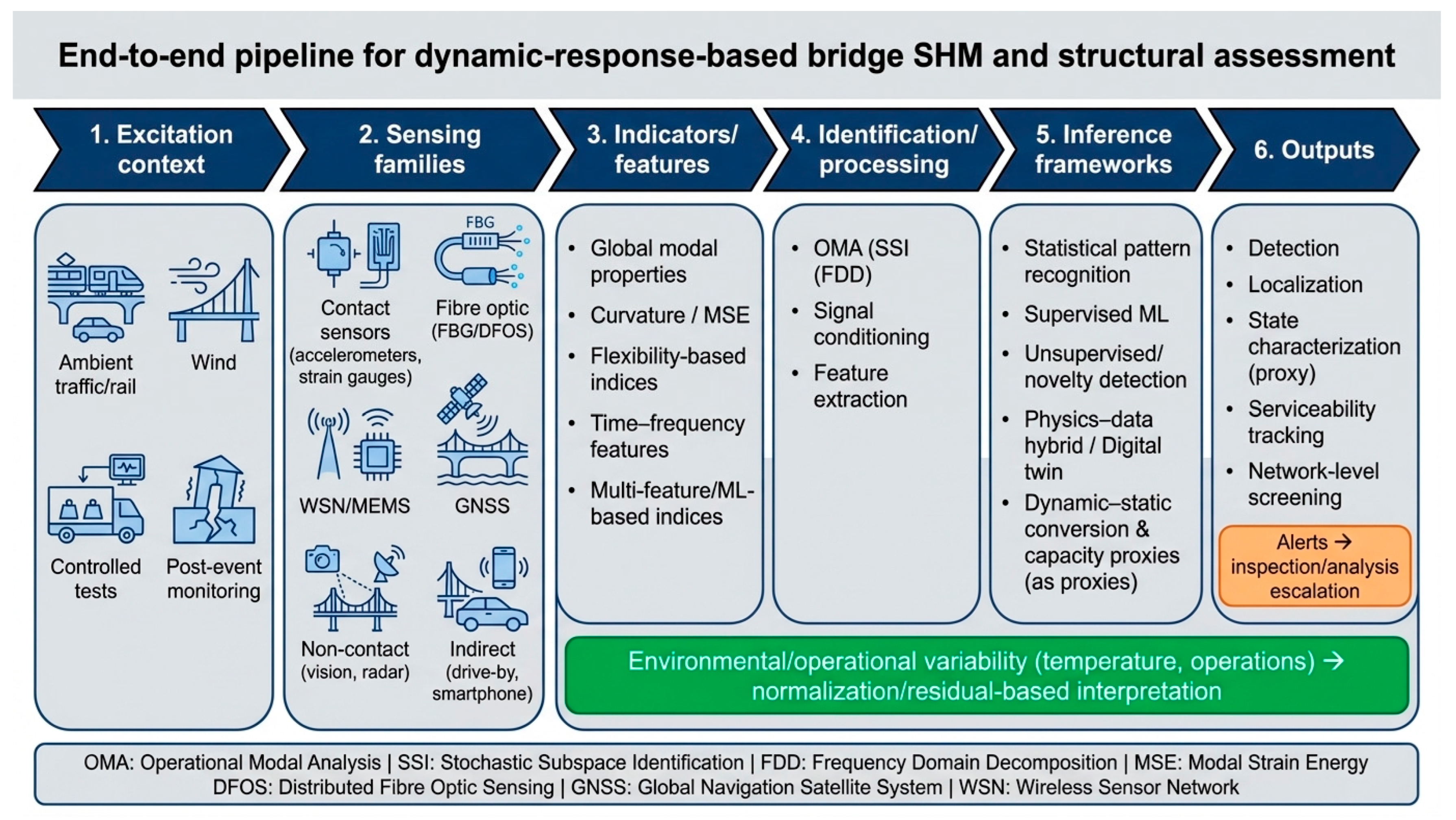
- Integrate data-processing, ML, and digital-twin concepts into a common pipeline view to support interpretation and decision support.
- Identify recurring evidence and deployment gaps and articulate a structured agenda for future work grounded in the reviewed literature.
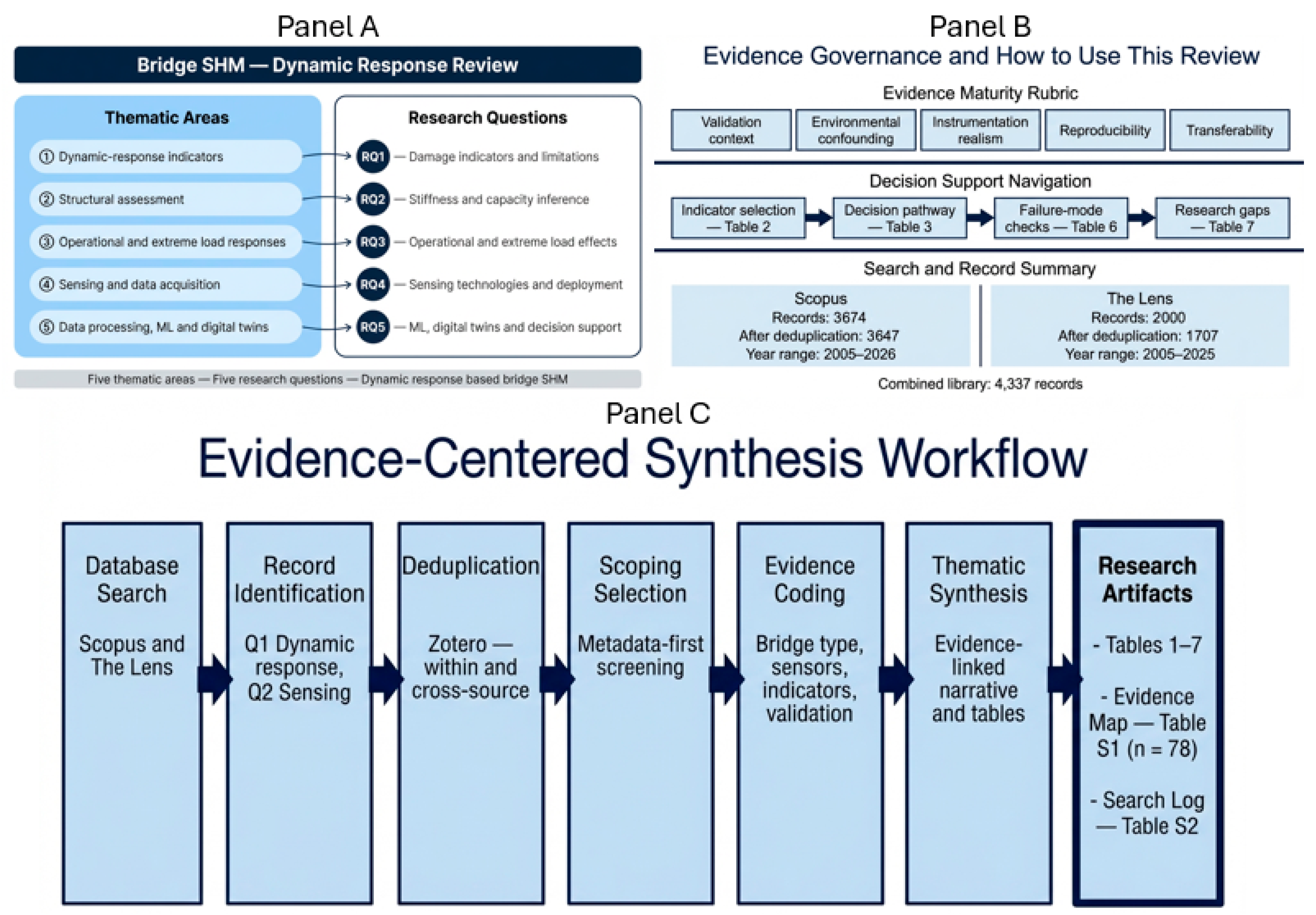
- (A)
- Scope definition and thematic areas with five research questions (RQ1–RQ5);
- (B)
- Evidence-centered synthesis workflow from database search and record handling through screening, evidence coding, and thematic synthesis;
- (C)
- Evidence governance for bridge management, including evidence-maturity rubric, decision-support navigation aids, and associated research tool artifacts (tables, Supplementary Materials, and search log).
2. Review Methodology
2.1. Scope and Research Questions
2.2. Search Strategy and Record Identification
2.3. Scoping Selection Criteria
2.4. Data Extraction and Coding
- Bridge or system type (laboratory specimen, numerical benchmark, full-scale bridge);
- Structural configuration (e.g., simply supported, or continuous beam, arch, cable-stayed, suspension, box girder, slab);
- Loading or excitation (e.g., ambient traffic, high-speed rail, wind, seismic, impact, controlled excitation);
- Sensing configuration (sensor types, locations, sampling rates, short-term tests, or long-term monitoring);
- Dynamic-response features (e.g., natural frequencies, mode shapes, damping ratios, curvature/MSE, flexibility indices, time–frequency features, displacements, strains, ML-based feature vectors);
- Data-processing and identification methods (e.g., operational modal analysis, statistical pattern recognition, supervised and unsupervised ML, deep learning, model updating, digital-twin schemes);
- Validation approach (numerical, laboratory, full-scale field testing, long-term monitoring);
- Reported main findings and limitations related to dynamic-response-based SHM.
2.5. Thematic Synthesis
- reported sensitivity to damage, stiffness change, or other state variables.
- reported influence of environmental and operational variability.
- data and instrumentation requirements.
- reported advantages, limitations, and open issues.
3. Dynamic Response in Bridge SHM: Concepts and Indicators
3.1. Global Modal Properties
3.2. Mode-Shape Curvature and Modal Strain Energy
3.3. Flexibility-Based Indicators
3.4. Time–Frequency and Statistical Features
3.5. Multi-Feature and ML-Based Indicators
4. Dynamic-Response-Based Structural Assessment
4.1. Stiffness Change and Modal Parameters
4.2. Flexibility and Damage Localization
4.3. Dynamic–Static Stiffness Conversion and Capacity Proxies
4.4. Correlation-Based Damage Indicators
4.5. Data-Driven Capacity-Related Assessment
5. Dynamic Responses Under Operational and Extreme Loads
5.1. Traffic-Induced Vibrations
5.2. High-Speed Rail
5.3. Seismic Loading
5.4. Wind-Induced Vibrations and Pedestrian Loads
5.5. Vehicle Impacts and Extreme Transients
6. Sensing and Data Acquisition for Dynamic Response
6.1. Conventional Sensors
6.2. Fiber Optic and Distributed Sensing
6.3. GNSS for Dynamic Displacement
6.4. Wireless Sensor Networks and MEMS
6.5. Vision-Based and Radar Techniques
6.6. Drive-By Monitoring and Smartphones
7. Data Processing, Modeling and Control
7.1. Modal and System Identification
7.2. Machine Learning (ML)-Based Pattern Recognition
7.3. Unsupervised and Reference-Free Approaches
7.4. Deep Learning and End-to-End Models
7.5. Digital Twins and Control-Oriented Modeling
8. Integration, Trends and Research Gaps
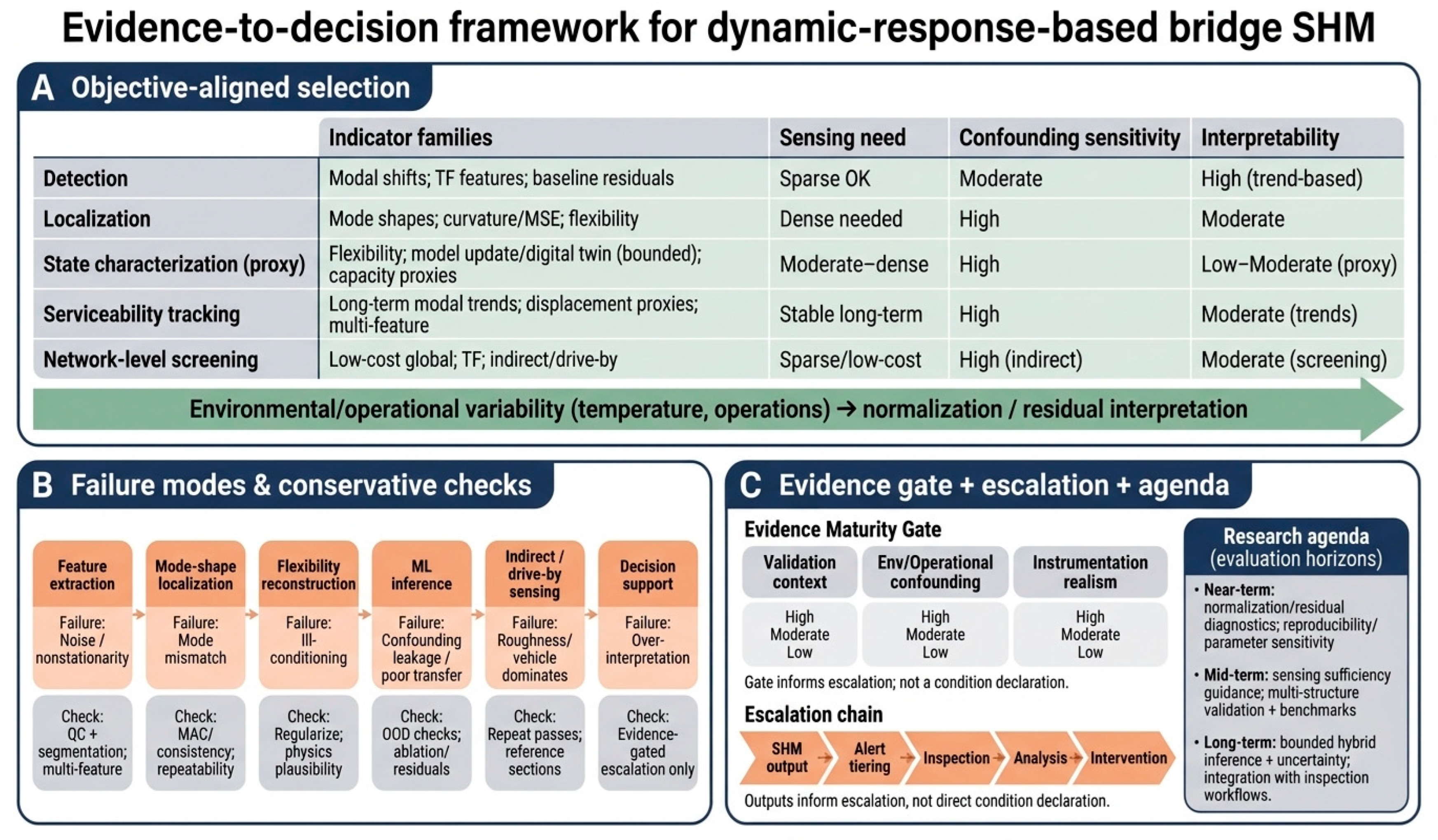
- (A)
- Objective-aligned selection linking decision objectives to indicator families, sensing density, confounding sensitivity and interpretability, with environmental/operational variability addressed via normalization or residual-based interpretation;
- (B)
- Key failure modes and conservative quality-control checks across feature extraction, localization, flexibility inference, ML inference, indirect/drive-by sensing, and decision support;
- (C)
- Evidence-maturity gating and escalation pathway connecting SHM outputs to alert tiering, inspection, analysis, and intervention, alongside a near-/mid-/long-term research agenda for validation.
8.1. Integration of Sensing, Modeling and Analytics
8.2. Field Validation and Benchmarking
8.3. Environmental and Operational Variability
8.4. Sparse Instrumentation and Indirect Sensing
8.5. Data, Labels, and Interpretability
8.6. Outlook
8.7. Structured Research Agenda
8.7.1. Near-Term Priorities (Deployment Discipline)
- Define and report normalization variables and residual diagnostics used to interpret dynamic-response changes;
- Report processing pipelines and parameter sensitivities sufficient for replication and comparison;
- Quantify sensor-density requirements and robustness limits for localization-oriented indicators.
8.7.2. Mid-Term Priorities (Validation and Bounded Inference)
- Validate methods across more than one structure or across repeated campaigns using consistent protocols.
- State applicability bounds for calibrated conversion models and ML surrogates and report drift monitoring when used in long-term settings.
- Use evaluation designs that separate training, tuning, and testing periods to reduce optimistic bias.
8.7.3. Long-Term Priorities (Benchmarks and Decision Support)
- Develop benchmark datasets and protocol standards with documented confounding and metadata to support transparent comparison.
- Establish evaluation metrics that reflect detection/localization performance and operational credibility (false-alarm control and robustness).
- Integrate SHM outputs into decision frameworks that link alerts to inspection and analysis escalation rather than direct condition declarations.
Supplementary Materials
Author Contributions
Funding
Data Availability Statement
Conflicts of Interest
Appendix A. Acronyms and Terminology
| Term | Definition (as Used in This Review) |
| SHM | Structural health monitoring. |
| OMA | Operational modal analysis. |
| SSI | Stochastic subspace identification. |
| FDD | Frequency-domain decomposition. |
| MSE | Modal strain energy. |
| FBG | Fiber Bragg grating sensor. |
| DFOS | Distributed fiber optic sensing. |
| BOFDA | Brillouin optical frequency domain analysis. |
| GNSS | Global Navigation Satellite System. |
| WSN | Wireless sensor network. |
| MEMS | Micro-electro-mechanical systems. |
| CNN | Convolutional neural network. |
| Autoencoder | Neural networks are trained to reconstruct inputs; used for representation learning and anomaly detection. |
| Digital twin | Virtual representation of a physical asset updated with monitoring data to reflect current state and support analysis. |
Appendix B. Data-Extraction Template (Reporting Scheme)
| Study ID | Asset/Bridge Type | Span/System Description | Monitoring Duration | Excitation Context | Sensors & Layout | Sampling/DAQ | Indicators/Features | Inference/Algorithm Class | Validation Evidence & Stated Limits |
References
- Carden, E.P.; Fanning, P. Vibration Based Condition Monitoring: A Review. Struct. Health Monit. 2004, 3, 355–377. [Google Scholar] [CrossRef] [Scilit]
- Ko, J.M.; Ni, Y.Q. Technology developments in structural health monitoring of large-scale bridges. Eng. Struct. 2005, 27, 1715–1725. [Google Scholar] [CrossRef] [Scilit]
- Farrar, C.R.; Worden, K. Structural Health Monitoring: A Machine Learning Perspective, 1st ed.; John Wiley & Sons: Hoboken, NJ, USA, 2012. [Google Scholar] [CrossRef] [Scilit]
- Doebling, S.W.; Farrar, C.R.; Prime, M.B. A Summary Review of Vibration-Based Damage Identification Methods. Shock Vib. Dig. 1998, 30, 91–105. [Google Scholar] [CrossRef] [Scilit]
- He, Z.; Li, W.; Salehi, H.; Zhang, H.; Zhou, H.; Jiao, P. Integrated structural health monitoring in bridge engineering. Autom. Constr. 2022, 136, 104168. [Google Scholar] [CrossRef] [Scilit]
- Deng, Z.; Huang, M.; Wan, N.; Zhang, J. The Current Development of Structural Health Monitoring for Bridges: A Review. Buildings 2023, 13, 1360. [Google Scholar] [CrossRef] [Scilit]
- Zhang, B.; Ren, Y.; He, S.; Gao, Z.; Li, B.; Song, J. A review of methods and applications in structural health monitoring (SHM) for bridges. Measurement 2025, 245, 116575. [Google Scholar] [CrossRef] [Scilit]
- Elsisi, A.; Zamrawi, A.; Emad, S. A Comprehensive Review of Structural Health Monitoring for Steel Bridges: Technologies, Data Analytics, and Future Directions. Appl. Sci. 2025, 15, 12090. [Google Scholar] [CrossRef] [Scilit]
- Bao, Y.; Li, H. Machine learning paradigm for structural health monitoring. Struct. Health Monit. 2021, 20, 1353–1372. [Google Scholar] [CrossRef]
- Avci, O.; Abdeljaber, O.; Kiranyaz, S.; Hussein, M.; Gabbouj, M.; Inman, D.J. A review of vibration-based damage detection in civil structures: From traditional methods to Machine Learning and Deep Learning applications. Mech. Syst. Signal Process. 2021, 147, 107077. [Google Scholar] [CrossRef] [Scilit]
- Malekloo, A.; Ozer, E.; AlHamaydeh, M.; Girolami, M. Machine learning and structural health monitoring overview with emerging technology and high-dimensional data source highlights. Struct. Health Monit. 2022, 21, 1906–1955. [Google Scholar] [CrossRef] [Scilit]
- Gomez-Cabrera, A.; Escamilla-Ambrosio, P.J. Review of Machine-Learning Techniques Applied to Structural Health Monitoring Systems for Building and Bridge Structures. Appl. Sci. 2022, 12, 10754. [Google Scholar] [CrossRef] [Scilit]
- Figueiredo, E.; Brownjohn, J. Three decades of statistical pattern recognition paradigm for SHM of bridges. Struct. Health Monit. 2022, 21, 3018–3054. [Google Scholar] [CrossRef] [Scilit]
- Fan, W.; Qiao, P. Vibration-based Damage Identification Methods: A Review and Comparative Study. Struct. Health Monit. 2011, 10, 83–111. [Google Scholar] [CrossRef] [Scilit]
- Casas, J.R.; Moughty, J.J. Bridge Damage Detection Based on Vibration Data: Past and New Developments. Front. Built Environ. 2017, 3, 4. [Google Scholar] [CrossRef] [Scilit]
- Peeters, B.; De Roeck, G. One-year monitoring of the Z24-Bridge: Environmental effects versus damage events. Earthq. Eng. Struct. Dyn. 2001, 30, 149–171. [Google Scholar] [CrossRef] [Scilit]
- Xia, Y.; Chen, B.; Weng, S.; Ni, Y.-Q.; Xu, Y.-L. Temperature effect on vibration properties of civil structures: A literature review and case studies. J. Civ. Struct. Health Monit. 2012, 2, 29–46. [Google Scholar] [CrossRef] [Scilit]
- Luo, J.; Huang, M.; Lei, Y. Temperature Effect on Vibration Properties and Vibration-Based Damage Identification of Bridge Structures: A Literature Review. Buildings 2022, 12, 1209. [Google Scholar] [CrossRef] [Scilit]
- Moravvej, M.; El-Badry, M. Reference-Free Vibration-Based Damage Identification Techniques for Bridge Structural Health Monitoring—A Critical Review and Perspective. Sensors 2024, 24, 876. [Google Scholar] [CrossRef] [Scilit]
- Levac, D.; Colquhoun, H.; O’Brien, K.K. Scoping studies: Advancing the methodology. Implement. Sci. 2010, 5, 69. [Google Scholar] [CrossRef] [Scilit] [PubMed]
- Arksey, H.; O’Malley, L. Scoping studies: Towards a methodological framework. Int. J. Soc. Res. Methodol. 2005, 8, 19–32. [Google Scholar] [CrossRef] [Scilit]
- Tricco, A.C.; Lillie, E.; Zarin, W.; O’Brien, K.K.; Colquhoun, H.; Levac, D.; Moher, D.; Peters, M.D.J.; Horsley, T.; Weeks, L.; et al. PRISMA Extension for Scoping Reviews (PRISMA-ScR): Checklist and Explanation. Ann. Intern. Med. 2018, 169, 467–473. [Google Scholar] [CrossRef] [Scilit]
- Teughels, A.; de Roeck, G. Damage detection and parameter identification by finite element model updating. Arch. Comput. Methods Eng. 2005, 12, 123–164. [Google Scholar] [CrossRef] [Scilit]
- Yu, J.; Meng, X.; Yan, B.; Xu, B.; Fan, Q.; Xie, Y. Global Navigation Satellite System-based positioning technology for structural health monitoring: A review. Struct. Control Health Monit. 2020, 27, e2467. [Google Scholar] [CrossRef] [Scilit]
- Noel, A.B.; Abdaoui, A.; Elfouly, T.; Ahmed, M.H.; Badawy, A.; Shehata, M.S. Structural Health Monitoring Using Wireless Sensor Networks: A Comprehensive Survey. IEEE Commun. Surv. Tutor. 2017, 19, 1403–1423. [Google Scholar] [CrossRef] [Scilit]
- Dallard, P.; Fitzpatrick, T.; Flint, A.; Low, A.; Smith, R.R.; Willford, M.; Roche, M. London Millennium Bridge: Pedestrian-Induced Lateral Vibration. J. Bridge Eng. 2001, 6, 412–417. [Google Scholar] [CrossRef] [Scilit]
- Salawu, O.S. Detection of structural damage through changes in frequency: A review. Eng. Struct. 1997, 19, 718–723. [Google Scholar] [CrossRef] [Scilit]
- Munn, Z.; Peters, M.D.J.; Stern, C.; Tufanaru, C.; McArthur, A.; Aromataris, E. Systematic review or scoping review? Guidance for authors when choosing between a systematic or scoping review approach. BMC Med. Res. Methodol. 2018, 18, 143. [Google Scholar] [CrossRef]
- Peters, M.D.J.; Marnie, C.; Tricco, A.C.; Pollock, D.; Munn, Z.; Alexander, L.; McInerney, P.; Godfrey, C.M.; Khalil, H. Updated methodological guidance for the conduct of scoping reviews. JBI Evid. Synth. 2020, 18, 2119–2126. [Google Scholar] [CrossRef] [Scilit] [PubMed]
- Fujino, Y.; Pacheco, B.M.; Nakamura, S.; Warnitchai, P. Synchronization of human walking observed during lateral vibration of a congested pedestrian bridge. Earthq. Eng. Struct. Dyn. 1993, 22, 741–758. [Google Scholar] [CrossRef] [Scilit]
- Sonbul, O.S.; Rashid, M. Towards the Structural Health Monitoring of Bridges Using Wireless Sensor Networks: A Systematic Study. Sensors 2023, 23, 8468. [Google Scholar] [CrossRef] [Scilit]
- Qu, X.; Shu, B.; Ding, X.; Lu, Y.; Li, G.; Wang, L. Experimental Study of Accuracy of High-Rate GNSS in Context of Structural Health Monitoring. Remote Sens. 2022, 14, 4989. [Google Scholar] [CrossRef] [Scilit]
- Gentile, C.; Bernardini, G. Output-only modal identification of a reinforced concrete bridge from radar-based measurements. NDT & E Int. 2008, 41, 544–553. [Google Scholar] [CrossRef] [Scilit]
- Peng, Z.; Li, J.; Hao, H. Development and experimental verification of an IoT sensing system for drive-by bridge health monitoring. Eng. Struct. 2023, 293, 116705. [Google Scholar] [CrossRef] [Scilit]
- Malekjafarian, A.; McGetrick, P.J.; O Brien, E.J. A Review of Indirect Bridge Monitoring Using Passing Vehicles. Shock Vib. 2015, 2015, 286139. [Google Scholar] [CrossRef] [Scilit]
- Carnevale, M.; Collina, A.; Peirlinck, T. A Feasibility Study of the Drive-By Method for Damage Detection in Railway Bridges. Appl. Sci. 2019, 9, 160. [Google Scholar] [CrossRef] [Scilit]
- Matarazzo, T.J.; Kondor, D.; Milardo, S.; Eshkevari, S.S.; Santi, P.; Pakzad, S.N.; Buehler, M.J.; Ratti, C. Crowdsourcing bridge dynamic monitoring with smartphone vehicle trips. Commun. Eng. 2022, 1, 29. [Google Scholar] [CrossRef] [Scilit]
- Dong, C.-Z.; Catbas, F.N. A review of computer vision–based structural health monitoring at local and global levels. Struct. Health Monit. 2021, 20, 692–743. [Google Scholar] [CrossRef] [Scilit]
- Sun, X.; Ilanko, S.; Mochida, Y.; Tighe, R.C. A Review on Vibration-Based Damage Detection Methods for Civil Structures. Vibration 2023, 6, 843–875. [Google Scholar] [CrossRef] [Scilit]
- Scozzese, F.; Leoni, G.; Dall’Asta, A. HHT-Based Probabilistic Model of Prestressed Bridges Inferred From Traffic Loads. Struct. Control Health Monit. 2025, 2025, 585257. [Google Scholar] [CrossRef] [Scilit]
- Scozzese, F.; Dall’Asta, A. HHT-based methodology for bridge’s nonlinear response identification. Procedia Struct. Integr. 2024, 62, 911–915. [Google Scholar] [CrossRef] [Scilit]
- Tan, G.; Lin, S.; Wang, W.; Yang, W. A rapid evaluation method for the bearing capacity of reinforced concrete bridges under crack damage based on dynamic-static stiffness conversion model. Eng. Struct. 2025, 343, 121207. [Google Scholar] [CrossRef] [Scilit]
- Calò, M.; Ruggieri, S.; Buitrago, M.; Nettis, A.; Adam, J.M.; Uva, G. An ML-based framework for predicting prestressing force reduction in reinforced concrete box-girder bridges with unbonded tendons. Eng. Struct. 2025, 325, 119400. [Google Scholar] [CrossRef] [Scilit]
- Whelan, M.J.; Gangone, M.V.; Janoyan, K.D.; Jha, R. Real-time wireless vibration monitoring for operational modal analysis of an integral abutment highway bridge. Eng. Struct. 2009, 31, 2224–2235. [Google Scholar] [CrossRef] [Scilit]
- Hester, D.; González, A. A discussion on the merits and limitations of using drive-by monitoring to detect localised damage in a bridge. Mech. Syst. Signal Process. 2017, 90, 234–253. [Google Scholar] [CrossRef] [Scilit]
- Shokravi, H.; Shokravi, H.; Bakhary, N.; Heidarrezaei, M.; Koloor, S.S.R.; Petrů, M. Vehicle-Assisted Techniques for Health Monitoring of Bridges. Sensors 2020, 20, 3460. [Google Scholar] [CrossRef] [Scilit] [PubMed]
- Yang, X.-M.; Qu, C.-X.; Yi, T.-H.; Li, H.-N.; Liu, H. Modal Analysis of a Bridge During High-Speed Train Passages by Enhanced Variational Mode Decomposition. Int. J. Struct. Stab. Dyn. 2020, 20, 2041002. [Google Scholar] [CrossRef] [Scilit]
- Xi, R.; Jiang, W.; Xuan, W.; Xu, D.; Yang, J.; He, L.; Ma, J. Performance Assessment of Structural Monitoring of a Dedicated High-Speed Railway Bridge Using a Moving-Base RTK-GNSS Method. Remote Sens. 2023, 15, 3132. [Google Scholar] [CrossRef] [Scilit]
- Vagnoli, M.; Remenyte-Prescott, R.; Andrews, J. Railway bridge structural health monitoring and fault detection: State-of-the-art methods and future challenges. Struct. Health Monit. 2018, 17, 971–1007. [Google Scholar] [CrossRef] [Scilit]
- Jia, Z.; Wen, J.; Hu, M.; Han, Q.; Bi, K. Seismic response of rocking bridge systems under three-dimensional ground motions. Eng. Struct. 2025, 322, 119162. [Google Scholar] [CrossRef] [Scilit]
- Yang, D.; Liu, J.; Yu, R.; Chen, G. Unified framework for stochastic dynamic responses and system reliability analysis of long-span cable-stayed bridges under near-fault ground motions. Eng. Struct. 2025, 322, 119061. [Google Scholar] [CrossRef] [Scilit]
- Zhang, J.; Chen, K.-J.; Zeng, Y.-P.; Yang, Z.-Y.; Zheng, S.-X.; Jia, H.-Y. Seismic Reliability Analysis of Cable-Stayed Bridges Subjected to Spatially Varying Ground Motions. Int. J. Struct. Stab. Dyn. 2021, 21, 2150094. [Google Scholar] [CrossRef] [Scilit]
- Piras, S.; Palermo, A.; Saiid Saiidi, M. State-of-the-Art of Posttensioned Rocking Bridge Substructure Systems. J. Bridge Eng. 2022, 27, 03122001. [Google Scholar] [CrossRef] [Scilit]
- Heng, K.; Li, R.; Li, Z.; Wu, H. Dynamic responses of highway bridge subjected to heavy truck impact. Eng. Struct. 2021, 232, 111828. [Google Scholar] [CrossRef] [Scilit]
- Wang, P.; Zhao, M.; Du, X.; Liu, J. Dynamic Response of Bridge Pier under Combined Earthquake and Wave–Current Action. J. Bridge Eng. 2019, 24, 04019095. [Google Scholar] [CrossRef] [Scilit]
- Sofi, A.; Regita, J.J.; Rane, B.; Lau, H.H. Structural health monitoring using wireless smart sensor network—An overview. Mech. Syst. Signal Process. 2022, 163, 108113. [Google Scholar] [CrossRef] [Scilit]
- Xu, L.; Shi, S.; Huang, Y.; Yan, F.; Yang, X.; Bao, Y. Corrosion monitoring and assessment of steel under impact loads using discrete and distributed fiber optic sensors. Opt. Laser Technol. 2024, 174, 110553. [Google Scholar] [CrossRef] [Scilit]
- Wang, S.; Yang, Z.; Mohanty, L.; Zhao, C.; Han, C.; Li, B.; Yang, Y. Distributed fiber optic sensing for internal strain monitoring in full life cycle of concrete slabs with BOFDA technology. Eng. Struct. 2024, 305, 117798. [Google Scholar] [CrossRef] [Scilit]
- Barrias, A.; Casas, J.; Villalba, S. A Review of Distributed Optical Fiber Sensors for Civil Engineering Applications. Sensors 2016, 16, 748. [Google Scholar] [CrossRef] [Scilit] [PubMed]
- Siwowski, T.; Rajchel, M.; Howiacki, T.; Sieńko, R.; Bednarski, Ł. Distributed fibre optic sensors in FRP composite bridge monitoring: Validation through proof load tests. Eng. Struct. 2021, 246, 113057. [Google Scholar] [CrossRef] [Scilit]
- Shen, N.; Chen, L.; Liu, J.; Wang, L.; Tao, T.; Wu, D.; Chen, R. A Review of Global Navigation Satellite System (GNSS)-Based Dynamic Monitoring Technologies for Structural Health Monitoring. Remote Sens. 2019, 11, 1001. [Google Scholar] [CrossRef] [Scilit]
- Yu, J.; Meng, X.; Shao, X.; Yan, B.; Yang, L. Identification of dynamic displacements and modal frequencies of a medium-span suspension bridge using multimode GNSS processing. Eng. Struct. 2014, 81, 432–443. [Google Scholar] [CrossRef] [Scilit]
- Yigit, C.O.; Gurlek, E. Experimental testing of high-rate GNSS precise point positioning (PPP) method for detecting dynamic vertical displacement response of engineering structures. Geomat. Nat. Hazards Risk 2017, 8, 893–904. [Google Scholar] [CrossRef] [Scilit]
- Xue, C.; Psimoulis, P.A. Monitoring the dynamic response of a pedestrian bridge by using low-cost GNSS receivers. Eng. Struct. 2023, 284, 115993. [Google Scholar] [CrossRef] [Scilit]
- Abdulkarem, M.; Samsudin, K.; Rokhani, F.Z.; Rasid, M.F.A. Wireless sensor network for structural health monitoring: A contemporary review of technologies, challenges, and future direction. Struct. Health Monit. 2020, 19, 693–735. [Google Scholar] [CrossRef] [Scilit]
- Feng, D.; Feng, M.; Ozer, E.; Fukuda, Y. A Vision-Based Sensor for Noncontact Structural Displacement Measurement. Sensors 2015, 15, 16557–16575. [Google Scholar] [CrossRef] [Scilit]
- Aliansyah, Z.; Shimasaki, K.; Senoo, T.; Ishii, I.; Umemoto, S. Single-Camera-Based Bridge Structural Displacement Measurement with Traffic Counting. Sensors 2021, 21, 4517. [Google Scholar] [CrossRef] [Scilit] [PubMed]
- Pieraccini, M. Monitoring of Civil Infrastructures by Interferometric Radar: A Review. Sci. World J. 2013, 2013, 786961. [Google Scholar] [CrossRef] [Scilit] [PubMed]
- Chen, Y.; Huang, Q.; Zhang, T.; Zhou, M.; Jiang, L. Measurement Refinements of Ground-Based Radar Interferometry in Bridge Load Test Monitoring: Comprehensive Analysis on a Multi-Span Cable-Stayed Bridge. Remote Sens. 2024, 16, 1882. [Google Scholar] [CrossRef] [Scilit]
- Elhattab, A. Drive-by Bridge Damage Monitoring: Concise Review. Civ. Eng. Res. J. 2017, 1, 555555. [Google Scholar] [CrossRef] [Scilit]
- Zhu, X.; Cao, M.; Ostachowicz, W.; Xu, W. Damage Identification in Bridges by Processing Dynamic Responses to Moving Loads: Features and Evaluation. Sensors 2019, 19, 463. [Google Scholar] [CrossRef] [Scilit]
- Ozer, E.; Kromanis, R. Smartphone Prospects in Bridge Structural Health Monitoring, a Literature Review. Sensors 2024, 24, 3287. [Google Scholar] [CrossRef] [Scilit]
- Brincker, R.; Ventura, C.E. Introduction to Operational Modal Analysis, 1st ed.; John Wiley & Sons: Hoboken, NJ, USA, 2015. [Google Scholar] [CrossRef] [Scilit]
- Flah, M.; Nunez, I.; Ben Chaabene, W.; Nehdi, M.L. Machine Learning Algorithms in Civil Structural Health Monitoring: A Systematic Review. Arch. Comput. Methods Eng. 2021, 28, 2621–2643. [Google Scholar] [CrossRef] [Scilit]
- Ye, X.W.; Jin, T.; Yun, C.B. A review on deep learning-based structural health monitoring of civil infrastructures. Smart Struct. Syst. 2019, 24, 567–585. [Google Scholar] [CrossRef]
- Cha, Y.-J.; Ali, R.; Lewis, J.; Büyükӧztürk, O. Deep learning-based structural health monitoring. Autom. Constr. 2024, 161, 105328. [Google Scholar] [CrossRef] [Scilit]
- Gao, Y.; Xiong, G.; Hu, Z.; Chai, C.; Li, H. Bridge Digital Twin for Practical Bridge Operation and Maintenance by Integrating GIS and BIM. Buildings 2024, 14, 3731. [Google Scholar] [CrossRef] [Scilit]
- Qin, L.-F.; Ren, W.-X.; Guo, C.-R. A Physics-Data Hybrid Framework to Develop Bridge Digital Twin Model in Structural Health Monitoring. Int. J. Struct. Stab. Dyn. 2023, 23, 2340037. [Google Scholar] [CrossRef] [Scilit]
- Costin, A.; Adibfar, A.; Bridge, J. Digital Twin Framework for Bridge Structural Health Monitoring Utilizing Existing Technologies: New Paradigm for Enhanced Management, Operation, and Maintenance. Transp. Res. Rec. J. Transp. Res. Board 2024, 2678, 1095–1106. [Google Scholar] [CrossRef] [Scilit]
- Mazzeo, M.; Santoro, R.; Sciutteri, S.; Ricciardi, G. Inerter-based dissipation for vibration control of a cable-stayed bridge subjected to transverse seismic excitation. Eng. Struct. 2025, 336, 120297. [Google Scholar] [CrossRef] [Scilit]
- Gonzalez, A.; Aied, H. Application of the Hilbert-Huang Transform for Identification of Changes in Boundary Conditions of a Bridge Using Vibration Data due to Traffic. Key Eng. Mater. 2013, 569–570, 892–899. [Google Scholar] [CrossRef] [Scilit]
- Scozzese, F.; Dall’Asta, A. Nonlinear Response Characterization of Post-Tensioned R.C. Bridges through Hilbert–Huang Transform Analysis. Struct. Control. Health Monit. 2024, 2024, 5960162. [Google Scholar] [CrossRef] [Scilit]



| Dimension | Maturity Signals (High, Moderate, Low) | Interpretation Notes | Representative Sources (Ref.) | Evidence Map ID (Table S1) |
|---|---|---|---|---|
| Validation context | High: Full-scale bridge monitoring and/or full-scale testing with operational variability represented Moderate: Laboratory validation and/or validated numerical studies linked to repres. bridge conditions Low: Numerical demonstration without validation or without bridge-relevant conditions | Higher-maturity evidence supports stronger external validity. | [2,23] | S1-02, S1-30 |
| Environmental/operational confounding | High: Explicit modeling normalization and residual assessment Moderate: Confounding acknowledged and partially addressed Low: Confounding not addressed | Modal features can be influenced by temperature and operations. | [13,17,18] | S1-17, S1-18, S1-13 |
| Instrumentation realism | High: Feasible sensor types/locations and limitations reported Moderate: Feasible sensing assumed but not fully justified Low: Idealized dense sensing without feasibility discussion | Spatial resolution is central for curvature/MSE indicators. | [21,24,25,26] | S1-52, S1-46, S1-44, S1-21 |
| Reproducibility of analysis | High: Processing steps and key parameter choices reported Moderate: Partial reporting of processing steps Low: Limited reporting of analysis choices | Reporting enables meaningful comparison across studies. | [3,13] | S1-03, S1-13 |
| Transferability framing | High: Applicability bounds stated, no extrapolation beyond evidence Moderate: Transferability discussed qualitatively Low: General claims without stated limits | Transferability is typically context dependent. | [1,4] | S1-01, S1-04 |
| Objective | Recommended Indicators (Families) | Deployment Notes (Sensing, Confounding, Interpretability) | Representative Sources (Ref.) | Evidence Map ID (Table S1) |
|---|---|---|---|---|
| Detection (change screening) | Global modal properties Multivariate statistical indices | Sensing: sparse acceleration/displacement can be sufficient Confounding: high sensitivity to temperature and operational variability Interpretability: high to moderate | [1,4] | S1-01, S1-04 |
| Localization (where is the change?) | Mode-shape curvature Modal strain energy (MSE) Flexibility-based indices Correlation-pattern methods | Sensing: denser spatial sensing to recover reliable mode shapes Confounding: moderate to high sensitivity to noise and identification accuracy Interpretability: moderate; report sensitivity to sensor density and mode truncation | [3,4] | S1-03, S1-04 |
| State characterization (severity/proxy) | Multi-feature indicators Calibrated conversion models ML surrogates (when bounds are stated) | Sensing: stable feature extraction and consistent measurement conditions Confounding: high sensitivity to domain shift and calibration drift Interpretability: moderate; treat outputs as proxies within stated applicability | [27,28,29] | S1-23, S1-24, S1-25 |
| Serviceability performance tracking | Displacements and accelerations Modal trends under operational loads | Sensing: placement aligned with response peaks and dominant modes Confounding: moderate sensitivity to load variability and operational changes Interpretability: high when linked to monitored response quantities | [25,30,31,32] | S1-46, S1-21, S1-58, S1-55 |
| Network-level screening | Drive-by/vehicle response features Smartphone-derived features Coarse modal signatures | Sensing: minimal bridge-mounted sensors; relies on passing vehicles/devices Confounding: high sensitivity to road roughness and vehicle/device variability Interpretability: moderate; use primarily to prioritize detailed assessment | [33,34,35] | S1-61, S1-65, S1-64 |
| Decision Step | Key Considerations (Evidence-Aligned Checks) | Representative Sources (Ref.) | Evidence Map ID (Table S1) |
|---|---|---|---|
| 1. Define monitoring question | Detection, localization, state characterization, serviceability tracking, or network-level screening. | [1,2] | S1-01, S1-02 |
| 2. Define excitation context | Ambient traffic/rail, wind, controlled tests, or post-event monitoring; match analysis choices to non-stationary conditions when relevant. | [1,2] | S1-01, S1-02 |
| 3. Select indicators aligned with objective | Align indicator family with required spatial resolution, confounding sensitivity, and interpretability needs. | [1,4] | S1-01, S1-04 |
| 4. Design sensing configuration | Sensor type and placement consistent with required features; document limitations explicitly. | [21,24,25,26] | S1-52, S1-46, S1-44, S1-21 |
| 5. Specify baseline and normalization approach | Define how environmental/operational variability is measured and treated; define residual-based decision rules. | [17,18] | S1-17, S1-18 |
| 6. Choose inference model and validation plan | Classical, statistical, ML, or hybrid; define validation evidence and applicability bounds. | [12,36,37] | S1-12, S1-68, S1-69 |
| 7. Define decision thresholds and reporting | Specify thresholds and uncertainty reporting; link alerts to inspection/analysis escalation rather than direct condition statements. | [3,23] | S1-03, S1-30 |
| Indicator Type | Typical Features | Main Advantages | Main Limitations/Considerations | Representative Sources (Ref.) | Evidence Map ID (Table S1) |
|---|---|---|---|---|---|
| Global modal properties | Natural frequencies, global mode shapes, damping ratios | Sensitive to global stiffness changes | Low spatial resolution; strongly affected by environmental and operational variability | [1,2,4] | S1-01, S1-02, S1-04 |
| Mode-shape curvature/MSE | Curvature profiles, modal strain energy distribution | Enhanced localization of local damage | Require dense and accurate mode-shape information; sensitive to noise | [4] | S1-04 |
| Flexibility-based indicators | Flexibility matrix entries, deflection patterns | Direct link to stiffness and deflection behavior | Need several well-identified modes; affected by mode truncation and ID errors | [4] | S1-04 |
| Time–frequency features | Wavelet spectra, Hilbert–Huang components, RMS measures | Capture non-stationary events | Interpretation depends on loading scenarios and chosen to transform | [1,40,41] | S1-01 |
| Multi-feature/ML-based indices | Feature vectors combining multiple indicators | Can exploit high-dimensional data and complex patterns | Require representative data, calibration, and careful validation; may be sensitive to domain shift | [12,36,37] | S1-12, S1-68, S1-69 |
| Strategy | Main Idea | Evidence Map ID (Table S1) |
|---|---|---|
| Frequency-/stiffness-based trends | Use changes in natural frequencies and modal stiffness as indicators of global stiffness loss [4,5,6,14,27]. | S1-04, S1-05, S1-06, S1-014, S1-23 |
| Flexibility-based detection | Use changes in flexibility matrices to localize stiffness reductions [14,15]. | S1-14, S1-15 |
| Dynamic–static conversion | Map dynamic stiffness measures static stiffness or bearing-capacity proxies within a calibrated model [42]. | S1-28 |
| ML-based internal state/capacity | Learning mappings from response features to damage indices, stiffness, or prestress-related quantities [9,28,43]. | S1-09, S1-28, S1-29 |
| Correlation-based indicators | Use deviations in multi-sensor correlation patterns of dynamic responses to flag possible damage [6]. | S1-06 |
| Pipeline Stage | Failure Mode/Misinterpretation Risk | Conservative Check | Representative Sources (Ref.) | Evidence Map ID (Table S1) |
|---|---|---|---|---|
| Feature extraction | Modal feature changes reflect temperature or boundary-condition changes rather than damage | Use environmental variables and residual analysis; avoid interpreting raw frequency drift as damage evidence. | [1,4] | S1-01, S1-04 |
| Mode-shape-based localization | Curvature/MSE indicators amplify noise and degrade under sparse sensing | Verify spatial resolution and noise levels; report sensitivity to sensor density. | [4] | S1-04 |
| Flexibility reconstruction | Mode truncation and identification errors bias flexibility-change indicators | Document number of modes; assess robustness to truncation and identification uncertainty. | [4] | S1-04 |
| ML inference | Overfitting and domain shift from simulated/lab data to field conditions | Use strict train/validation/test separation; report applicability bounds; use conservative decision rules. | [12,36,37] | S1-12, S1-68, S1-69 |
| Indirect/drive-by sensing | Road roughness and vehicle variability dominate vehicle response features | Use repeated passes and statistical baselines; interpret primarily as screening. | [33,66,69] | S1-61, S1-59, S1-63 |
| Decision support | Thresholds chosen without uncertainty or operational context | Define thresholds with uncertainty; link alerts to inspection/analysis escalation rather than direct condition statements. | [3,23] | S1-03, S1-30 |
| Horizon | Research Priority (Problem Statement) | Minimum Evaluation/Reporting Target | Decision Support Linkage | Representative Sources (Ref.) | Evidence Map ID (Table S1) |
|---|---|---|---|---|---|
| Near-term | Define and report normalization variables and residual diagnostics used to interpret dynamic-response changes. | Report the item explicitly and in a form that supports reproducibility (definitions, parameter settings, and diagnostics as applicable). | Supports traceable interpretation and comparison across deployments and studies. | [17,18] | S1-17, S1-18 |
| Near-term | Report processing pipelines and parameter sensitivities sufficient for replication and comparison. | Report the item explicitly and in a form that supports reproducibility (definitions, parameter settings, and diagnostics as applicable). | Supports traceable interpretation and comparison across deployments and studies. | [3,13] | S1-13, S1-03 |
| Near-term | Quantify sensor-density requirements and robustness limits for localization-oriented indicators. | Report the item explicitly and in a form that supports reproducibility (definitions, parameter settings, and diagnostics as applicable). | Supports traceable interpretation and comparison across deployments and studies. | [4] | S1-04 |
| Mid-term | Validate methods across more than one structure or across repeated campaigns using consistent protocols. | Report the item explicitly and in a form that supports reproducibility (definitions, parameter settings, and diagnostics as applicable). | Supports traceable interpretation and comparison across deployments and studies. | [23] | S1-30 |
| Mid-term | State applicability bounds for calibrated conversion models and ML surrogates and report drift monitoring when used in long-term settings. | Report the item explicitly and in a form that supports reproducibility (definitions, parameter settings, and diagnostics as applicable). | Supports traceable interpretation and comparison across deployments and studies. | [28,29] | S1-24, S1-25 |
| Mid-term | Use evaluation designs that separate training, tuning, and testing periods to reduce optimistic bias. | Report the item explicitly and in a form that supports reproducibility (definitions, parameter settings, and diagnostics as applicable). | Supports traceable interpretation and comparison across deployments and studies. | [37,72] | S1-69, S1-68 |
| Long-term | Develop benchmark datasets and protocol standards with documented confounding and metadata to support transparent comparison. | Report the item explicitly and in a form that supports reproducibility (definitions, parameter settings, and diagnostics as applicable). | Supports traceable interpretation and comparison across deployments and studies. | [76,77] | S1-74, S1-75 |
| Long-term | Establish evaluation metrics that reflect detection/localization performance and operational credibility (false-alarm control and robustness). | Report the item explicitly and in a form that supports reproducibility (definitions, parameter settings, and diagnostics as applicable). | Supports traceable interpretation and comparison across deployments and studies. | [23] | S1-30 |
| Long-term | Integrate SHM outputs into decision frameworks that link alerts to inspection and analysis escalation rather than direct condition declarations. | Report the item explicitly and in a form that supports reproducibility (definitions, parameter settings, and diagnostics as applicable). | Supports traceable interpretation and comparison across deployments and studies. | [3,23] | S1-03, S1-30 |
Disclaimer/Publisher’s Note: The statements, opinions and data contained in all publications are solely those of the individual author(s) and contributor(s) and not of MDPI and/or the editor(s). MDPI and/or the editor(s) disclaim responsibility for any injury to people or property resulting from any ideas, methods, instructions or products referred to in the content. |
© 2026 by the authors. Licensee MDPI, Basel, Switzerland. This article is an open access article distributed under the terms and conditions of the Creative Commons Attribution (CC BY) license.
Share and Cite
Bacha, M.Z.; Puppio, M.L.; Zucca, M.; Sassu, M. Dynamic Response-Based Bridge Monitoring and Structural Assessment: A Structured Scoping Review and Evidence Inventory. Infrastructures 2026, 11, 134. https://doi.org/10.3390/infrastructures11040134
Bacha MZ, Puppio ML, Zucca M, Sassu M. Dynamic Response-Based Bridge Monitoring and Structural Assessment: A Structured Scoping Review and Evidence Inventory. Infrastructures. 2026; 11(4):134. https://doi.org/10.3390/infrastructures11040134
Chicago/Turabian StyleBacha, Muhammad Ziad, Mario Lucio Puppio, Marco Zucca, and Mauro Sassu. 2026. "Dynamic Response-Based Bridge Monitoring and Structural Assessment: A Structured Scoping Review and Evidence Inventory" Infrastructures 11, no. 4: 134. https://doi.org/10.3390/infrastructures11040134
APA StyleBacha, M. Z., Puppio, M. L., Zucca, M., & Sassu, M. (2026). Dynamic Response-Based Bridge Monitoring and Structural Assessment: A Structured Scoping Review and Evidence Inventory. Infrastructures, 11(4), 134. https://doi.org/10.3390/infrastructures11040134