Systematic Review

Modeling the Resilience of Multimodal Freight Networks Under Disruptions: A Systematic Review

Department of Civil and Environmental Engineering, College of Engineering, University of Idaho, Moscow, ID 83844, USA
*
Author to whom correspondence should be addressed.
Current address: T.Y. Lin International, Olympia, WA 98502, USA.
Infrastructures 2026, 11(4), 130; https://doi.org/10.3390/infrastructures11040130
Submission received: 1 March 2026 / Revised: 30 March 2026 / Accepted: 3 April 2026 / Published: 6 April 2026

Abstract

Multimodal freight transportation networks are increasingly exposed to natural and human-made disruptions, yet prior research remains fragmented in how disruptions are represented, which modeling techniques are applied, and how results are validated, limiting comparability and actionable guidance for resilient planning. This study presents a PRISMA-guided systematic review of disruption modeling in multimodal freight networks. A total of 21 studies were identified and coded to address three research questions concerning (RQ1) which analytical and computational modeling techniques are applied; (RQ2) to what extent models represent cross-modal interdependencies, cascading failures, and recovery processes; and (RQ3) what validation, calibration, and empirical testing strategies are employed. The review shows that optimization-based approaches and hybrid frameworks dominate the literature, complemented by fewer network science and data-driven methods. Most studies model disruptions as node/link failures and/or capacity degradation using static single-event scenarios, and explicit representations of cascading effects, operational delay propagation, and time-evolving recovery trajectories remain relatively rare. While many studies rely on real network data, formal calibration and historical backtesting against observed disruption events are uncommon, and validation is primarily case study-based. These findings highlight the need for more dynamic resilience modeling, stronger uncertainty quantification, standardized reporting of performance and resilience metrics, and greater use of empirically grounded validation to improve the generalizability and decision relevance of multimodal freight resilience models.

1. Introduction

Multimodal freight transportation networks are the critical backbone of modern economies, enabling the efficient movement of goods across local, national, and international supply chains. These networks support industrial production, trade, and consumption by integrating multiple transportation modes, such as roadways, railways, waterways, and airways, into interconnected freight corridors. A multimodal freight transportation network involves the coordinated use of two or more transportation modes to move goods from origin to destination, emphasizing efficient modal transitions, standardized containers, and transfer facilities [1]. In freight transportation research, the terms “multimodal” and “intermodal transport” describe related but distinct concepts. Multimodal freight transport refers to the movement of goods using two or more transportation modes within an integrated transport chain, whereas intermodal transport represents a specific operational form in which each leg of the journey is managed by different carriers under separate contracts, while the freight unit remains unchanged [2]. Although intermodal systems are widely applied in practice, particularly in rail–truck corridors, this study adopts the broader term multimodal freight transportation to encompass interactions across all connected modes and enable a comprehensive assessment of network resilience at the corridor level.
The United States hosts the world’s largest freight transportation system in terms of traffic volume, transporting goods valued at over $14 billion annually [3]. Highways, railways, ports, and airports form the core infrastructure supporting multimodal freight movement, with rail–truck multimodal transport accounting for approximately 75% of the total multimodal freight ton-miles [3]. Multimodal freight transport offers significant advantages over single-mode transport, including reduced costs, improved logistics efficiency, lower congestion, and decreased environmental impact [4]. Consequently, freight shippers have increasingly adopted multimodal solutions to enhance system flexibility and performance.
Beyond economic efficiency, the integration of multiple transportation modes is crucial for enhancing the resilience of freight networks. By enabling alternative routing and modal substitution, multimodal freight corridors can adapt better to changing operational conditions and disruptive events. However, this interdependence among modes also introduces complexity, as disruptions affecting one mode can propagate across the entire network. The infrastructure supporting multimodal freight corridors, including highways, railways, waterways, ports, airports, and intermodal terminals, forms a tightly coupled system in which the functionality of individual components is mutually dependent [5].
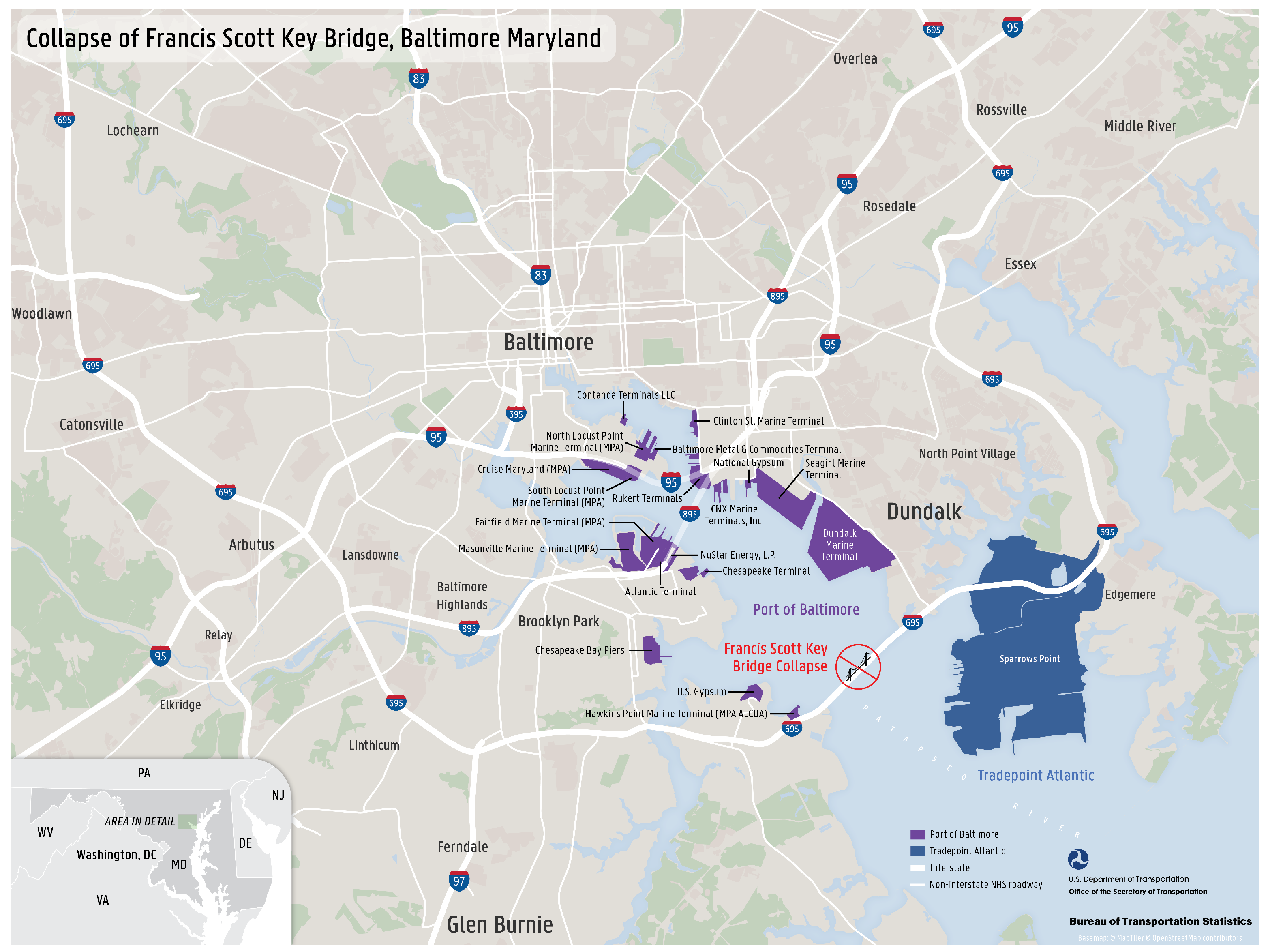
Freight transportation networks are increasingly exposed to a wide range of disruptions, including natural hazards (e.g., earthquakes, floods, and hurricanes), operational failures, congestion, infrastructure deterioration, and human-induced events [6,7]. Recent large-scale disruptions, such as the COVID-19 pandemic, have demonstrated the vulnerability of freight systems, with passenger traffic declining and freight demand increasing owing to the rapid expansion of e-commerce. Infrastructure failure further illustrates this vulnerability. For example, the collapse of the Francis Scott Key Bridge in Baltimore, Maryland (see Figure 1), resulted in substantial traffic redistribution across the regional network, increased truck volumes on alternative corridors, longer diversion routes, particularly for hazardous materials, and heightened congestion and safety risks [8,9]. These events underscore the need for freight networks that can withstand disruptions, maintain acceptable service levels, and recover efficiently. Given the critical role of freight transportation in economic stability and supply chain continuity, resilience has emerged as a key performance attribute of multimodal freight network.
Although a growing body of literature has examined transportation network resilience, research specifically addressing disruptions in multimodal freight transportation networks remains fragmented and inconsistent. Existing studies employ diverse analytical and computational techniques, represent disruptions using heterogeneous assumptions (e.g., node/link failures, capacity degradation, and demand shocks), and vary considerably in their capture of intermodal interdependencies, cascading effects, and recovery dynamics. In addition, validation and empirical testing practices differ widely across studies, which limits the comparability and transferability of findings across multimodal freight corridors. Accordingly, this systematic review seeks to answer the following research questions:
  • RQ1: What analytical and computational modeling techniques have been applied to study disruptions in multimodal freight networks?
  • RQ2: To what extent do existing models dynamically represent cross-modal interdependencies, cascading failures, and recovery processes?
  • RQ3: What validation, calibration, and empirical testing strategies are employed, and how robust are these approaches?
To address these questions, this study presents a systematic review of resilience modeling in multimodal freight transportation networks. Before reviewing the modeling approaches and resilience assessment methods, it is essential to establish how resilience is defined in the context of freight transportation networks. Existing studies adopt a wide range of definitions, reflecting different system boundaries, analytical objectives and disruption contexts. Therefore, the following subsection reviews the definitions of resilience used in the literature to provide a common conceptual foundation for subsequent analysis.

Definitions of Resilience in Transportation Systems

The term resilience originates from the Latin word resiliere, which means to rebound or spring back. Following the influential work of Holling [10], who introduced resilience in the context of ecological systems and distinguished it from system stability, the concept has been widely adopted across multiple disciplines, including organizational systems [11], economics [12], social sciences [13], supply chains [14,15,16,17] and engineering. Within the engineering domain, particularly in transportation systems, resilience has received increasing attention in response to the growing frequency, scale, and complexity of disruptive events.
In transportation research, resilience has been examined across multiple modes, including aviation [18], roadway networks [19,20,21], waterborne transport systems [22,23], and railway networks [24,25]. Despite this growing body of literature, no single, universally accepted definition of transportation resilience has been established. The definitions vary depending on the transportation mode, system scale, disruption type, and performance objectives. Nevertheless, a widely accepted and overarching definition is provided by the United Nations Office for Disaster Risk Reduction (UNDRR) [26], which defines resilience as the ability of a system, community, or society exposed to hazards to resist, absorb, accommodate, adapt to, and recover from the effects of a hazard in a timely and efficient manner while preserving and restoring essential structures and functions. This definition emphasizes resilience as a dynamic process rather than as a static system property. Building on this general understanding of resilience, Table 1 synthesizes the definitions of resilience that have been specifically developed for multimodal freight transportation networks.
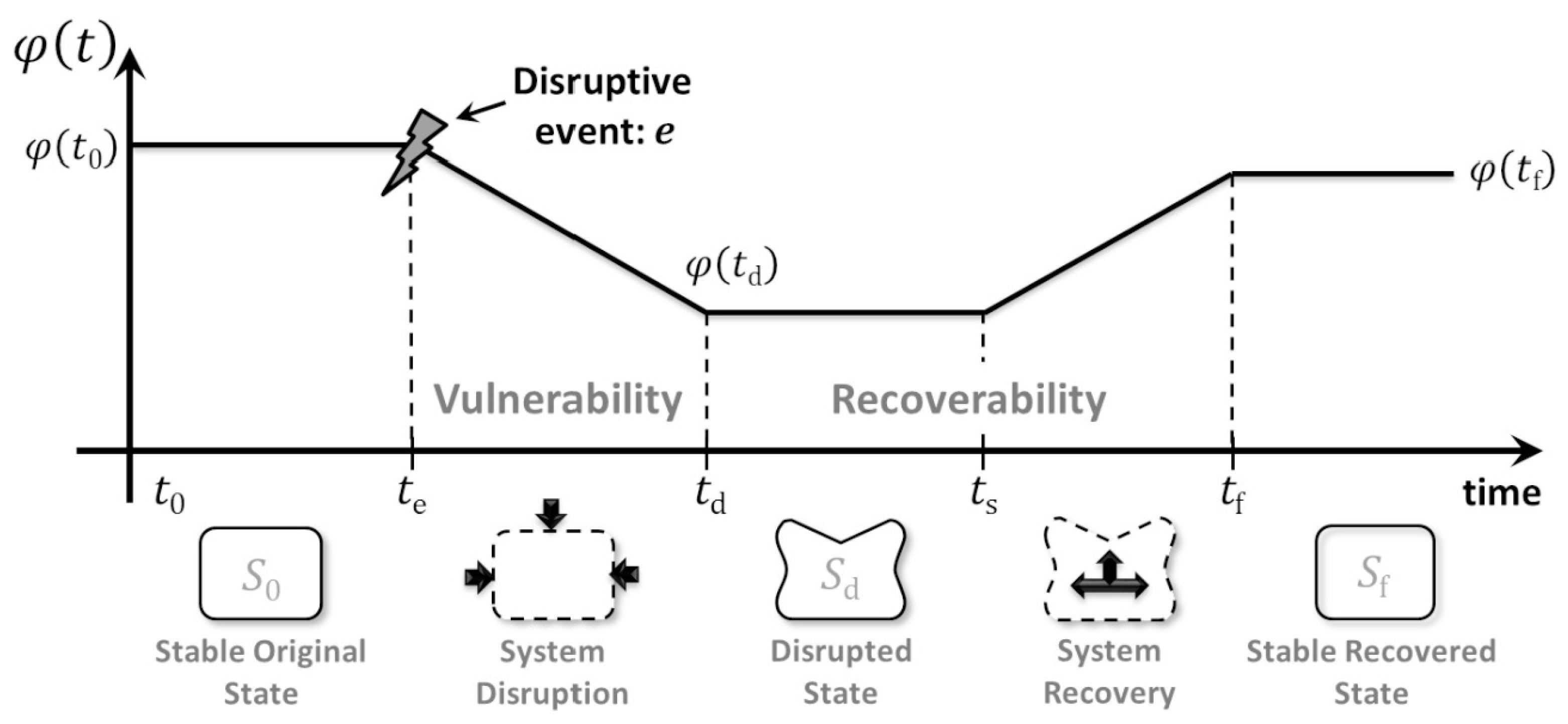
Resilience in transportation networks is inherently time-dependent because disruption impacts and recovery processes evolve over time rather than occurring instantaneously. A widely adopted way to conceptualize this behavior is a performance–time representation, where system functionality is tracked before, during, and after a disruptive event. Figure 2 illustrates this relationship for freight transportation systems.
In Figure 2, φ ( t ) denotes system performance (functionality) at time t and φ ( t 0 ) is the baseline performance level at the reference time t 0 (stable original state, S 0 ). A disruptive event, denoted by e, occurs at time t e and triggers a decline in performance governed by system vulnerability, until the disrupted state is reached at time t d with performance level φ ( t d ) (disrupted state, S d ). The lowest portion of the curve represents the disrupted steady state, where network performance and serviceability are most constrained. Recovery is then reflected by the increasing segment of φ ( t ) after t d , with the system entering the recovery phase around t s and reaching the recovered state at time t f with performance level φ ( t f ) (stable recovered state, S f ). In this framework, vulnerability is captured by the magnitude of performance loss following e (from φ ( t 0 ) toward φ ( t d ) ), whereas recoverability is reflected by the rate of performance restoration during the recovery interval (from t d to t f ).
Within this performance–time framework, vulnerability describes the susceptibility of a freight transportation network to disruptions that result in significant performance loss, capturing both the magnitude of degradation immediately following the event and the system’s exposure to disturbance impacts [36,37]. In multimodal freight networks, vulnerability is often driven by failures of critical components (e.g., terminals, hubs, intermodal transfer facilities, or high-betweenness links), where the loss of capacity or connectivity can propagate through tightly coupled mode-transfer operations and reduce system-wide serviceability. Vulnerability can be amplified when redundancy is limited (i.e., few alternative routes or terminals are available), when capacity is highly concentrated at specific nodes, or when modal substitution is operationally constrained by schedule coordination, transfer times, or terminal handling limits. From a planning perspective, vulnerability therefore reflects not only the immediate performance drop but also the extent to which disruptions trigger broader bottlenecks and operational spillovers across modes.
Recoverability represents the ability of a freight transportation network to restore performance after reaching the disrupted steady state; as illustrated in Figure 2, higher recoverability corresponds to a steeper recovery slope and faster restoration of freight movement and service levels, thereby reducing the duration and severity of disruption impacts [38]. In practice, recoverability depends on the availability and effectiveness of response actions such as rerouting, mode switching, temporary capacity expansion, resource reallocation, and repair/restoration scheduling. It is also influenced by organizational readiness and coordination among stakeholders (e.g., carriers, terminal operators, and public agencies), which affects how quickly recovery actions can be implemented. Consequently, the same initial disruption may yield markedly different recovery trajectories depending on operational flexibility, resource constraints, and the degree of intermodal coordination, highlighting the importance of modeling both vulnerability and recoverability when assessing resilience in multimodal freight systems.
Figure 2. System performance related to disruptive event [35,39].
Infrastructures 11 00130 g002

2. Methods

The methodology employed in this systematic review followed the PRISMA guidelines [40] to ensure transparency, reproducibility and consistency throughout the review process. A systematic review approach was adopted to synthesize peer-reviewed evidence on disruption modeling in multimodal freight transportation networks, motivated by the increasing frequency of disruptive events and rapid growth of methodological contributions in this area. In line with the study objectives and research questions, the review focused on three elements extracted from each included record: (i) the analytical and computational techniques used to model disruptions (e.g., optimization, simulation, network science, machine learning, and hybrid frameworks), (ii) the extent to which models represent cross-modal interdependencies, cascading effects, and recovery dynamics, and (iii) the empirical testing practices used to support model robustness (e.g., uncertainty representation, calibration, validation type, and use of observed disruption events).

2.1. Search Strategy

To ensure comprehensive and diverse literature coverage, four major academic databases were systematically searched: Web of Science, Scopus, ScienceDirect, and TRID (Transportation Research International Documentation). Web of Science and Scopus were selected as the primary multidisciplinary indexing databases because of their extensive coverage of peer-reviewed journal articles and citation records across engineering, transportation, and infrastructure research. Scopus, in particular, provides broad international coverage and advanced indexing of technical and applied research, enabling comprehensive retrieval of studies related to multimodal freight transportation and disruption modeling.
ScienceDirect was included as a complementary full-text platform to reduce the likelihood of missing relevant Elsevier-hosted studies in transportation, civil engineering, and infrastructure systems that may be inconsistently indexed across databases. TRID was incorporated as a transportation-specific database because it indexes a wide range of transportation research outputs, including Transportation Research Record and related transportation publications. Overlap across sources was expected, and duplicate records were removed during the screening process. The combined use of these databases ensured broad disciplinary coverage while maintaining a transparent and reproducible search process. Other databases were not searched as standalone databases because most transportation journals relevant to multimodal freight disruption modeling are indexed in Web of Science and Scopus, and preliminary scoping indicated limited incremental yield relative to added duplication. Google Scholar was not used due to limited reproducibility of searches and a high proportion of duplicate and non-peer-reviewed records.
Specific keywords were selected to target studies that are highly relevant to multimodal freight transportation network resilience. The search strategy was structured around four main categories of terms: (1) transportation modes, (2) disruptive events, (3) network and system characteristics, and (4) resilience-related concepts. Transportation mode keywords included roadway, railway, waterway, airway, multimodal, intermodal, trucks, and freight transportation to capture the diverse modes and operational contexts of freight systems. Disruption-related terms, such as disruption, delay, natural disasters, hurricanes, earthquakes, landslides, and manmade disasters, were incorporated to reflect a broad spectrum of hazard scenarios affecting multimodal freight networks. To represent network characteristics and system performance dimensions, terms such as recovery, mobility, survivability, sustainability, vulnerability, resourcefulness, connectivity, and supply chain were used. Additional contextual terms such as economy, rural, agriculture, manufacturing, industry, stakeholders, and freight networks were included to ensure coverage of studies addressing infrastructure impacts and broader freight system interactions.
To further enhance relevance, resilience-focused terms including resilience, resiliency, resilient, redundancy, robustness, and rapidity were required to appear in the title or abstract in combination with freight- and multimodality-related terms. Freight-related terms included freight, cargo, goods movement, logistics, and supply chain, while multimodality terms included multimodal, intermodal, multi-modal, multi-mode, and mode shift. The Boolean structure followed the form (resilience terms) AND (freight terms) AND (multimodal terms), with database-specific syntax applied as needed. The resulting database-specific query strings are summarized in Table 2. The search was limited to English-language publications published between January 2015 and December 2025 to ensure contemporary relevance and methodological consistency of the included evidence. The start year (2015) was selected to capture recent methodological developments and contemporary data environments in multimodal freight resilience research, including broader adoption of large-scale network datasets, increased computational capability for robust/stochastic optimization and simulation, and the emergence of data-driven and hybrid modeling approaches. This time window also improves comparability across studies by focusing on more consistent reporting practices and disruption contexts in the post-2015 literature.

2.2. Screening Strategy

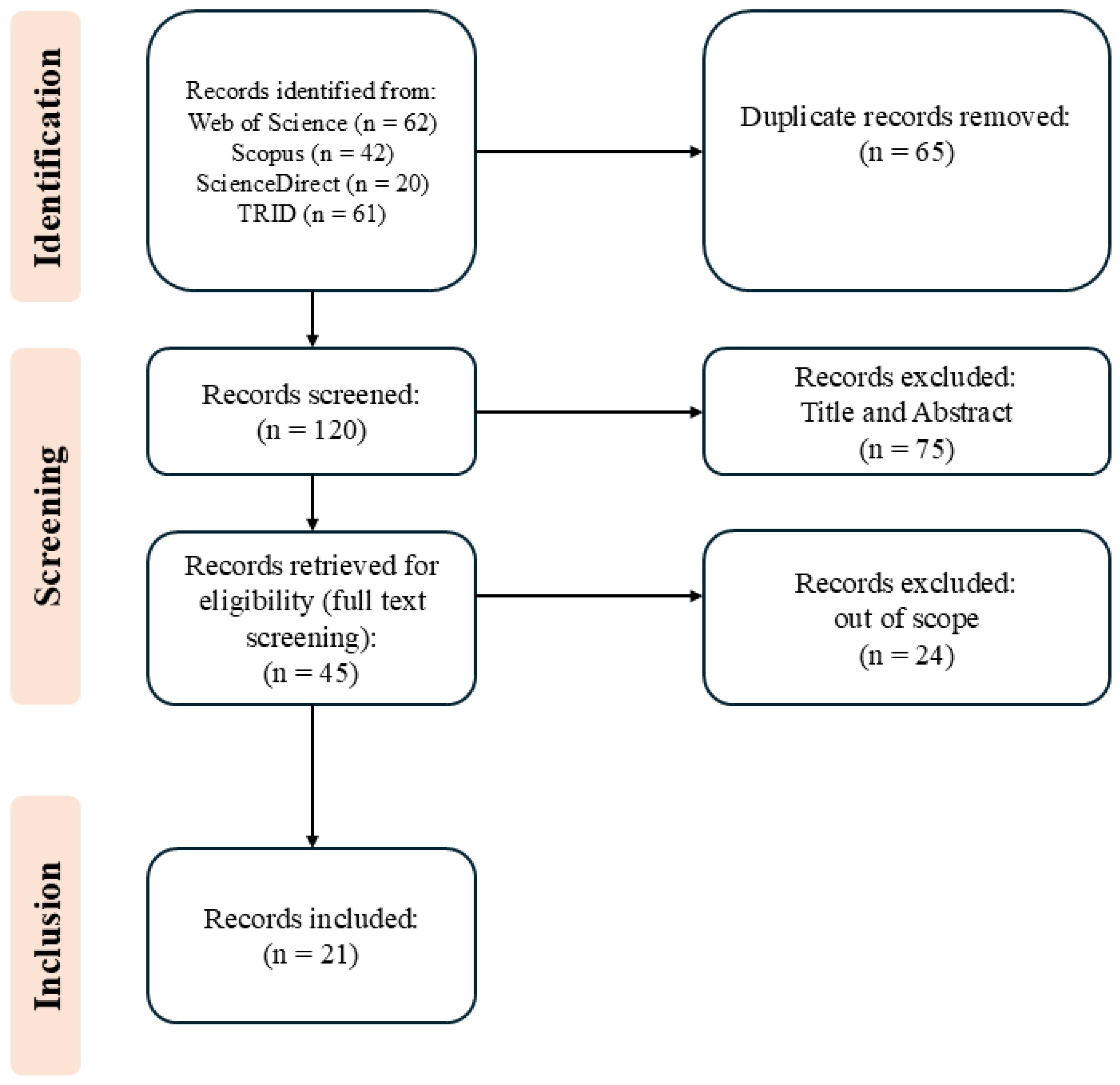
The database search yielded 185 records across four major databases: 62 from the Web of Science, 42 from Scopus, 20 from ScienceDirect, and 61 from the Transportation Research Information Database (TRID). Following the initial retrieval, 65 duplicate records were identified and removed from the study. This resulted in 120 unique records remaining for screening. A two-stage screening process was used. In the first stage, titles and abstracts were reviewed to assess their relevance to the research objectives and predefined inclusion criteria. A total of 75 records were excluded during this stage because of a lack of relevance to multimodal freight transportation network resilience or the absence of modeling and disruption-related analysis. Consequently, 45 studies were included in the full-text assessment.
In the second stage, the full texts of the 45 potentially eligible studies were examined in detail. Studies were included if they: (1) investigated disruptions and resilience-related outcomes in the context of multimodal (intermodal) freight transportation networks; (2) explicitly modeled at least two freight transportation modes and their interaction through terminals, transfers, or shared infrastructure; (3) defined a quantitative evaluation basis, such as resilience indices/proxies (e.g., robustness, service level, time-to-recovery, vulnerability), and/or model performance metrics (e.g., cost, delay, throughput, unmet demand, reliability); and (4) applied the approach to a freight network representation using either empirical data (e.g., public or proprietary datasets) or a clearly specified simulated/synthetic network instance. Editorials, commentaries, news reports, opinion pieces, and non-peer-reviewed preprints were excluded to ensure methodological rigor and reliability of the results. Following full-text screening, 24 studies were excluded for being out of scope, primarily due to single-mode focus, absence of resilience modeling, or lack of network-level analysis. Ultimately, 21 studies met the inclusion criteria and were included in the final review. Although the final synthesis includes 21 studies, this number reflects the specificity of the review scope and inclusion criteria rather than a lack of research activity. We intentionally focused on studies that (i) model disruptions in multimodal/intermodal freight transportation networks and (ii) provide sufficient quantitative detail to be systematically coded (e.g., explicit disruption representation, performance/resilience metrics, and evaluation/validation strategy).
A substantial portion of the broader resilience literature was excluded because it is single-mode, conceptual, supply-chain oriented without an explicit network model or does not report the methodological elements required for consistent cross-study comparison. In particular, many borderline records discussed multimodal or intermodal freight at a conceptual level but did not explicitly model cross-modal transfers (e.g., terminal/transfer representation) or quantify disruption impacts using network-based performance or resilience measures. Other borderline studies modeled disruptions quantitatively but were limited to a single mode (e.g., road-only or rail-only), which prevents consistent assessment of cross-modal interdependencies and mode-switching mechanisms central to RQ2. While relaxing the multimodality requirement would increase the number of included studies, it would reduce methodological comparability and dilute the ability to synthesize cross-modal interaction and recovery mechanisms; therefore, we retained a strict multimodal/intermodal criterion and note this scope decision as a trade-off.
Importantly, the included studies span multiple regions and modeling paradigms (optimization, simulation, network science, machine learning, and hybrid frameworks) and cover diverse disruption types, providing adequate breadth to identify dominant practices and recurring methodological gaps. Nevertheless, we acknowledge the sample size as a limitation and expect that periodic updates will be beneficial as the multimodal freight resilience literature continues to expand. The full-text studies that met the inclusion criteria were subsequently coded using a standardized data extraction protocol described in the following subsection. Figure 3 presents the PRISMA flow diagram summarizing the identification, screening, eligibility, and inclusion processes adopted in this study.

2.3. Data Extraction and Coding Protocol

After final inclusion, all 21 full-text studies were systematically coded using a standardized data extraction matrix aligned with the research questions (RQ1–RQ3). For each study, the extracted fields included: (i) bibliographic information (publication year and study region), (ii) network and modal scope (modes included and multimodal context), (iii) disruption representation (disruption type and how disruptions were modeled, such as node failure, link failure, capacity reduction, and demand shock), and (iv) modeling approach characteristics (primary modeling paradigm and, where applicable, optimization and simulation types).
To address RQ2, studies were additionally coded for the presence of cascading or interdependent failure representations, temporal representation (static, multi-period, or operational/continuous-time), and whether recovery actions were explicitly modeled. To address RQ3, we extracted evaluation and robustness information, including uncertainty representation, empirical data usage and data sources, calibration and validation type, whether a real disruption event was modeled, and the performance and resilience metrics reported. The coding matrix was used to generate the synthesis tables presented in the Results and Discussions section.

3. Results and Discussion

3.1. Overview of Included Studies

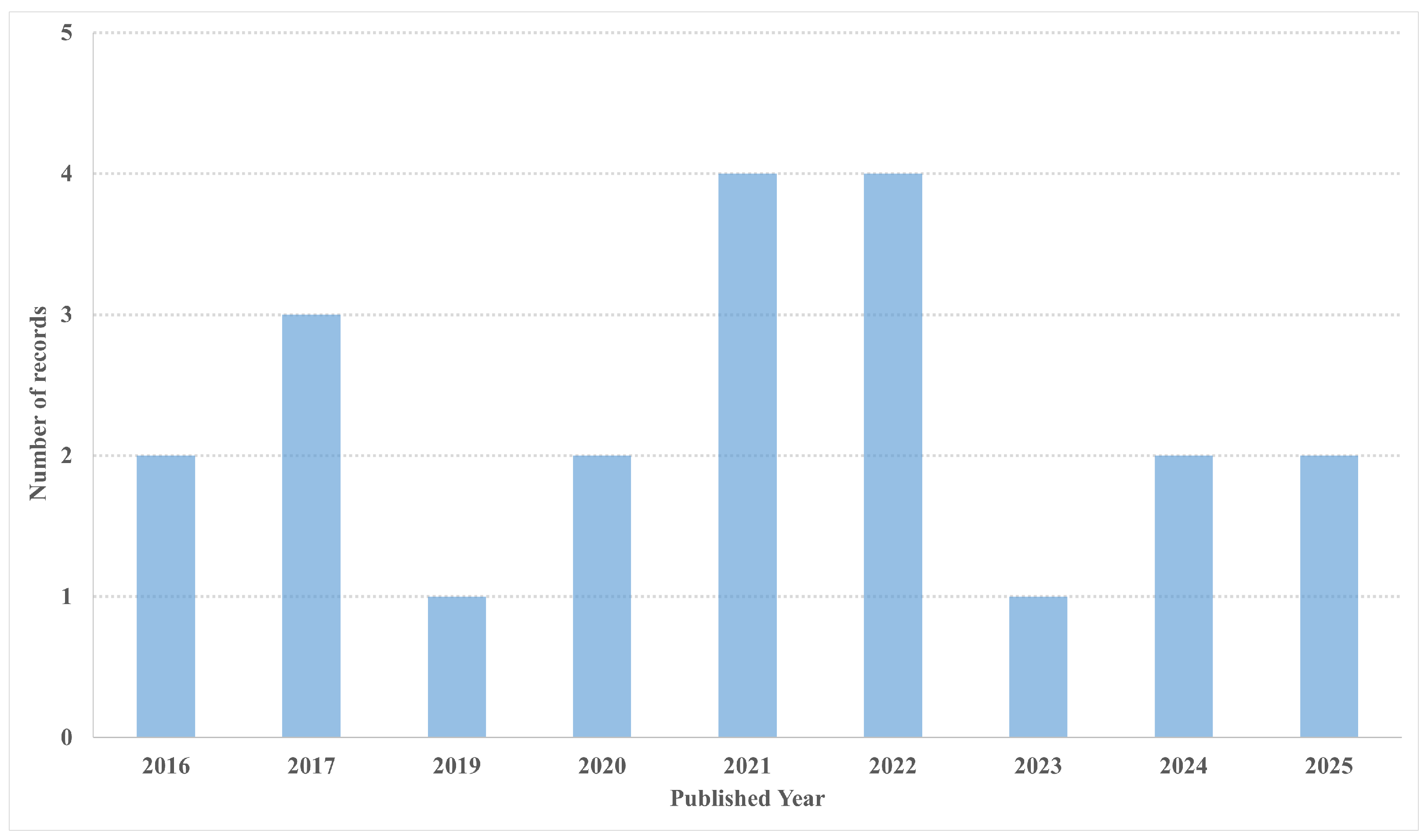
The final synthesis included 21 studies published between 2015 and 2025. As shown in Figure 4 and Table 3, the publication trend indicates increasing research activity after 2020. Specifically, six studies were published during 2016–2017 (two in 2016 and three in 2017), followed by one study in 2019 and two studies in 2020. The largest concentration occurred in 2021–2022 (eight studies), with continued contributions in 2023 (one study), 2024 (two studies), and 2025 (two studies). Geographically, the included studies were heavily concentrated in the United States, which accounted for 11 of the 21 studies (approximately 52%). These U.S.-based studies span corridor-level and state/regional case studies (e.g., Gulf Coast/Southeast, Oklahoma, Tennessee, multi-state surface networks, and Houston). Outside the United States, the evidence base includes applications in Europe (Germany, the Netherlands, and a multi-country Central European context) and national case studies in Japan, Iran, China, and the United Kingdom. One study adopted an international corridor perspective (China–Middle East–Europe) and one study did not report a specific study region.
Across the included studies, the most frequently examined multimodal configuration was the road–rail intermodal network, reflecting the prevalence of rail–truck terminals and the availability of corresponding network and OD data in multiple regions. The second most common configuration expands to road–rail–inland waterway systems, typically motivated by corridor-level freight flows and port/inland port connectivity, where waterways provide an alternative capacity layer during disruptions. Maritime components appear less frequently and are primarily studied in port-centric contexts or international corridor settings that combine sea transport with inland modes. Air freight is rarely represented and appears only in an airport-centered disruption case study. Overall, the literature emphasizes land-based intermodal systems (road–rail, with or without inland waterways), with fewer studies modeling full multimodal integration across maritime, inland waterways, and air transport within a single disruption framework, as summarized in Table 3. This concentration of U.S.-based and road–rail-focused studies has implications for generalizability, as modeling assumptions, disruption representations, and recovery mechanisms may not directly transfer to regions with different modal shares, port/inland-waterway integration, and regulatory or cross-border operating contexts. We return to these implications and associated research needs in the Discussion section.

3.2. Disruption Modeling: Types, Representation, and Methods

This subsection addresses RQ1 by synthesizing (i) the types of disruptions considered in the reviewed studies and (ii) how these disruptions are analytically represented within multimodal freight network models. Understanding the type of disruption is essential for evaluating freight transportation resilience because disruption characteristics (e.g., severity, duration, predictability, and spatial extent) shape both the magnitude of performance loss and the feasible set of response actions [58,59,60]. The disruption type also influences the selection of resilience indicators; sudden, high-impact hazards often motivate robustness and recovery-oriented measures, whereas recurring operational disturbances emphasize service continuity and reliability metrics [61].

3.2.1. Disruption Event Types

Across the included studies, disruptions were most commonly framed as natural hazards, operational and infrastructure disturbances, and human-induced events. Natural hazards appear in diverse forms, including airport closures and large-scale disasters [41], flooding and storm-surge impacts [52,54,57] and earthquake scenarios [1]. Operational and infrastructure disturbances are frequently described through accidents, maintenance, and unexpected events that degrade serviceability or increase travel times [51], as well as more generic disruption settings that capture variable levels of disturbance without tying the analysis to a single hazard mechanism [42,46,53,55,56]. Human-induced disruptions are typically reflected in strike-related and terrorism/conflict framings [33,43,44,45,57]. Pandemic-related disruption is less common in the reviewed set but is explicitly examined through epidemic/COVID-19 scenarios that alter facility operations and congestion [29]. Finally, some studies emphasize disruption propagation mechanisms (e.g., knock-on delay effects and missed connections) rather than focusing only on the initiating cause [48,51].

3.2.2. Disruption Representation in Models

In the reviewed literature, disruption representation is most often implemented through changes in the network connectivity and capacity. Connectivity disruptions are modeled as node and link failures, either individually or in combination. Examples include node failure due to hub or terminal outages [44], specific one-at-a-time component removals [45], and mixed node/link failure settings within broader disruption scenarios [42,43,49,55]. Link failures are also modeled through interrupted arcs [37] and hazard-based link removals [54], whereas some studies incorporate link failures alongside capacity degradation and time inflation [57]. Capacity-related disruption is the most prevalent representation across the set, typically implemented via reduced capacity at links, nodes, and/or intermodal terminals [33,41,42,43,46,49,50,53,55,56,57]. Capacity loss may be expressed directly as reduced terminal handling capability [50,56], speed reductions, or travel-time inflation on affected links [47,51,52,57], or as combined capacity and functionality loss under earthquakes, where closures are mapped onto network impedances [1]. Demand-side disruption is less frequently represented, but one study explicitly couples capacity reductions with demand shocks, such as customer demand/time/location changes [47]. Overall, these representations provide a consistent modeling vocabulary—node/link failures, capacity degradation, and (less often) demand shocks—that underpins the subsequent choice of solution approach (optimization, simulation, network science, machine learning, or hybrid frameworks) discussed in the remainder of this subsection.

3.2.3. Primary Modeling Methods to Represent Disruption

Across the included studies, optimization was the most prevalent paradigm, reflecting its suitability for prescriptive decision-making under disrupted capacities (e.g., rerouting, recovery action selection, and resilient planning). The second major cluster consists of hybrid approaches that combine optimization with complementary components such as economic interdependency modeling, regression analytics, simulation, or probabilistic hazard–fragility–restoration modeling [1,45,50,51,52,56]. Network science methods are used to evaluate robustness and vulnerability through performance degradation and cascading processes in multilayer networks [33,54]. Machine learning appears primarily as a predictive tool to model delay propagation across intermodal legs [48], and it is also used as a surrogate modeling layer when trained on outputs from disruption simulations [52]. Several recurring formulation families have been observed in the optimization-based literature. Mixed-integer linear programming (MILP) and mixed-integer nonlinear programming (MINLP) are used for recovery-oriented and disruption-response problems, including multi-objective MINLP for post-disruption recovery actions [41] and flow-routing formulations with congestion or disrupted capacities [37,49]. Stochastic programming is used to minimize expected costs under disruption uncertainty, for example, via a stochastic mixed-integer program solved using sample average approximation [42]. Robust and reliability-oriented formulations are also prominent, including min–max regret planning [43], distribution-free chance-constrained routing with user-specified reliability levels [46], scenario-based robust optimization with risk and variability objectives [53], and two-stage robust optimization for vulnerability assessment and reduction using column-and-constraint generation [55]. Several studies have adopted explicit multi-objective formulations (e.g., cost–throughput or cost–emissions trade-offs) and solved them using augmented ϵ -constraint procedures [37,57]. In addition, nonstandard optimization structures are observed in specific contexts, such as spatial partitioning models discretized into large 0–1 programs for epidemic-driven consolidation decisions [29] and metaheuristic solution schemes (GA/SA) for disruption-aware intermodal routing with time windows and booking decisions [47].
Simulations appear primarily in studies that require operational realism and time-dependent execution dynamics. A real-time disruption management decision support system combines discrete-event/agent-based simulation with optimization-based replanning [51]. Large ensembles of area-spanning disruption scenarios with congestion spillovers are generated using routing simulations with incremental assignments and penalty functions and are subsequently analyzed using surrogate modeling [52]. Cascading failure processes are represented through iterative simulations on networks, including topology-based cascading models, where overload propagation is simulated until equilibrium [54]. Finally, probabilistic simulation is used to propagate hazard, fragility, and restoration uncertainty through time-evolving functionality trajectories, enabling an explicit recovery-curve-based resilience assessment [1]. Overall, the reviewed evidence indicates that optimization is the dominant paradigm for disruption response and planning problems, whereas simulation-based components are used selectively to capture operational dynamics, cascading processes, and time-evolving recovery phenomena that are difficult to represent within static formulations. Table 4 shows a summary of the disruption types and their representations and the modeling techniques used in the studied records.

3.3. Interdependencies, Cascading Effects, and Recovery Modeling

This subsection addresses RQ2 by assessing the extent to which existing studies represent (i) cross-modal interdependencies, (ii) cascading or interdependent failure mechanisms, and (iii) recovery processes. All the included studies explicitly model interdependencies across modes, most commonly through intermodal terminals that couple routing and capacity constraints across layers. Examples include capacity sharing and mode/route substitution within intermodal networks [41,42,46], multi-level hub dependencies in port–hinterland systems [44], and explicit terminal-based transfer and shared-capacity interactions in large integrated surface networks [49]. Several studies have extended interdependency beyond physical transfer nodes. For example, economic interdependency and cross-sector propagation are integrated through an inoperability input–output framework [45]. Other studies capture operational interdependency through schedule-based interactions and shared links among services [51] or through explicit segmentation of intermodal legs, where the outcome of one leg determines the feasible connection in subsequent legs [48]. In network science frameworks, interdependency is represented through multilayer crossings and paired-node failures (e.g., bridges/tunnels that affect multiple modes) [33], as well as integrated multilayer graphs connected through ports and intermodal terminals [54]. Collectively, these approaches indicate that interdependency is most often operationalized via transfer constraints and shared capacities, with fewer studies incorporating broader economic or schedule-based couplings in their analyses.
Despite the widespread recognition that disruptions can propagate through intermodal systems, explicit cascading failure modeling remains limited. Most studies evaluate disruptions as single-event scenarios (e.g., disruption of one terminal, one component, or a small set of links) without modeling secondary failures. A smaller subset explicitly considers the propagation mechanisms. Operational cascading through delay propagation and missed connections was modeled in [48]. Spatially correlated multi-component disruption with indirect congestion spillovers is represented via area-spanning hazards in [52]. A true cascading failure process, implemented as an iterative overload cascade on an integrated multimodal graph, was modeled in [54]. In addition, worst-case disruption selection in a robust framework is used to represent interdependent network failures with influence spreading [55]. Overall, these findings suggest that most models treat disruptions as exogenous shocks to a residual network, whereas only a few explicitly simulate cascading mechanisms or interdependent failure propagation.
Temporal representation is predominantly static: many studies evaluate pre–post disruption performance or solve a post-disruption snapshot without tracking the recovery trajectory. Multi-period formulations are adopted when the problem includes scheduling, time windows, inventory dynamics, or staged decisions [37,47,56], and operational continuous-time dynamics appear mainly in real-time or schedule-driven settings [48,51]. Recovery actions are common but are usually modeled as decision-based recovery (e.g., rerouting, repair, transshipment, and capacity rental) rather than as a time-evolving restoration process. Examples include post-disruption rerouting and recovery action selection [37,41,49], explicit recovery strategies such as rerouting/repair/third-party fulfillment [50,53], and online replanning policies (wait, detour, transship) in real-time disruption management [51]. A dedicated recovery model that re-identifies routes and schedules after disruption realization was developed in [47], and epidemic-driven consolidation reallocation was treated as a recovery strategy in [29]. The most explicit time-dependent recovery representation in the reviewed set is provided in [1], which simulates a recovery timeline and tracks the functionality trajectory over time ( Q ( t ) ) using fragility and restoration models. Overall, the reviewed literature shows strong coverage of intermodal coupling through terminals and shared constraints but limited adoption of explicit cascading failure simulations and relatively few models that quantify resilience through time-evolving recovery trajectories. As summarized in Table 5, the reviewed studies predominantly model disruptions as single-event shocks and evaluate their impacts using static representations. Only a limited subset explicitly captures cascading or interdependent disruption processes (e.g., delay propagation, area-spanning multi-component disruptions, or overload cascades), and comparatively few studies adopt multi-period or operational (continuous-time) formulations to represent the time-dependent system behavior.

3.4. Evidence Base: Uncertainty, Data, and Validation

This subsection addresses RQ3 by synthesizing how the reviewed studies handle (i) uncertainty, (ii) empirical data and data sources, and (iii) calibration and validation strategies, with an emphasis on the robustness of the reported evidence. Across the included studies, uncertainty was most commonly handled through scenario-based representations, where disruption realizations (e.g., component outages, capacity degradations, or hazard footprints) were evaluated under multiple what-if cases. A smaller set explicitly adopts probabilistic formulations, including scenario probabilities and capacity distributions in stochastic programming [42], distribution-free chance constraints for reliability-based routing [46], probabilistic scenario sets with assumed disruption frequencies [53], and probabilistic hazard–fragility–restoration modeling with Monte Carlo simulation [1]. Deterministic settings also appear, typically through fixed capacity reduction factors or specified disabled components [41,44,45]. Finally, a limited number of studies employ robust or mixed-uncertainty frameworks, including budgeted uncertainty sets for worst-case vulnerability assessments [55] and mixed scenario-based plus possibilistic (epistemic) uncertainty for supply/demand [56]. Overall, the evidence suggests that while scenario analysis is widespread, fewer studies adopt probabilistic or robust uncertainty sets that provide stronger guarantees under incomplete knowledge.
Most studies report using empirical inputs (e.g., real networks, origin–destination (OD) flows, schedules, or public infrastructure data) rather than purely synthetic testbeds. Government datasets are a dominant source of network and demand information, particularly in the U.S. settings [1,42,43,46,49,52] and European national datasets [33]. Exclusive or industry data are used less frequently but provide higher operational fidelity when available, such as rail/terminal operational datasets and weather services in the Estimated Travel Time (ETA) prediction study [48] and operator schedules and cost/emission parameter sources in real-time disruption management [51]. Mixed or semi-synthetic datasets have appeared in several studies, where public infrastructure is combined with assumed parameters or literature-derived costs [29,53,54,56]. In contrast, at least one study relies primarily on literature-based instances and synthetic inputs for evaluation [47]. Collectively, this indicates that empirical grounding is common, but the depth of empirical realism varies substantially across the papers. Explicit calibration has been inconsistently reported in the reviewed literature. Many studies either do not report calibration procedures or rely on assumed parameters and literature values. When calibration is present, it is most clearly documented in data-driven machine learning settings via model training and tuning (e.g., cross-validation) [48] and in some epidemic/consolidation modeling where the paper notes parameter-setting rather than formal calibration [29]. In terms of validation, case study evaluations dominate, often supplemented by sensitivity analyses, computational experiments, or comparisons across scenarios. Out-of-sample validation is comparatively rare and appears most strongly in machine learning and surrogate modeling studies [48,52]. Historical event simulation is also rare; among the included studies, direct modeling of a specific real disruption event is explicitly reported in the airport-closure case study [41], whereas most other studies evaluate synthetic or stylized disruption scenarios on real networks.
The overall robustness of empirical claims is therefore shaped by three recurring patterns: (i) heavy reliance on scenario-based case studies without testing them against observed disruptions [42,49,55,57]; (ii) limited reporting of calibration procedures outside ML contexts [33,54,56]; and (iii) heterogeneous performance and resilience metrics (cost-, time-, flow-, reliability-, and recovery-oriented) that hinder direct comparability across methods [1,46,49,55]. Nevertheless, several studies have strengthened robustness through systematic sensitivity analysis (e.g., disruption extent, uncertainty level, or model parameters) [46,53,54,55] and explicit uncertainty propagation (e.g., Monte Carlo recovery trajectories) [1]. Overall, the evidence base is rich in methodological diversity but would benefit from more consistent calibration reporting and greater use of historical back-testing to support generalizable resilience conclusions.
Across the reviewed studies, model performance is most commonly reported using cost-based measures (e.g., total cost, expected cost, regret, penalty for unmet demand) [37,42,43,49,55,57], often complemented by service or flow-based measures such as satisfied demand, throughput, or unmet demand volumes [37,41,42,46]. A smaller set emphasizes time-based indicators, including delay, travel time, and processing/congestion time [29,33,51], whereas machine-learning studies report predictive accuracy metrics such as RMSE and classification accuracy [48,52]. The reported resilience metrics are heterogeneous. Many studies use robustness-style proxies based on performance degradation (e.g., cost or travel time increase) [33,49,55], reliability/service-level proxies (e.g., chance-constraint reliability or percentage satisfied demand) [46,57], and custom indices tailored to the modeling context [29,41,50]. Only a limited subset explicitly quantifies resilience through time-evolving recovery trajectories (e.g., functionality Q ( t ) and integrated resilience) [1]. Overall, the diversity of performance and resilience metrics limits the direct comparability across studies and reinforces the need for clearer reporting standards and harmonized resilience indicators in future research. Table 6 shows performance metrics and resilience metrics used in the reviewed studies.

4. Conclusions

This systematic review examined disruption modeling in multimodal freight transportation networks through three questions: (RQ1) analytical and computational techniques; (RQ2) the representation of interdependencies, cascading processes, and recovery dynamics; and (RQ3) validation, calibration, and empirical testing practices. Although the reviewed studies demonstrate substantial methodological innovation, the evidence base remains fragmented, and several recurring gaps limit generalizability, comparability, and operational transferability. The discussion below synthesizes the key gaps and outlines a sequenced research agenda that moves from near-term improvements that are straightforward to implement to longer-term developments requiring richer data and more complex modeling.
A first and foundational gap is the lack of standardization in how disruptions, performance, and resilience are specified and reported, including how conceptual definitions are translated into operational measures. While Table 1 synthesizes resilience definitions spanning infrastructure, user, and organizational perspectives, the reviewed studies often operationalize resilience using a narrower set of quantitative proxies (e.g., cost/time increases, throughput loss, unmet demand, or service-level constraints), with limited consistency in linking these measures back to an explicit definition. Many studies represent disruptions as exogenous shocks via node/link removals or capacity reductions, but disruption severity, spatial footprint, and duration are rarely documented in a consistent way, making cross-study comparisons difficult. In addition, demand shocks are underrepresented relative to capacity and connectivity degradation, despite their practical importance during major disruptions. Future studies would benefit from reporting a minimum disruption specification (hazard/trigger type, affected assets, spatial extent, duration, and severity) and from explicitly distinguishing baseline performance, disruption impact, and recovery outcomes. Clearer reporting standards that state the adopted resilience definition and justify the selected operational metric(s)—together with transparent parameter sources, even when literature-based—would strengthen comparability, transparency, and replication.
A second gap concerns evidence strength and validation practice. While most studies rely on real network data or realistic network structures, formal calibration procedures are often not reported outside machine learning contexts, and validation is dominated by case study demonstrations and sensitivity tests. Historical testing against observed disruption events remains uncommon, which limits confidence in external validity and complicates technology transfer. Addressing this gap requires more systematic evaluation designs, including explicit calibration documentation, held-out testing where feasible, consistent sensitivity analysis protocols, and benchmarking against observed disruptions when data are available. Community benchmark datasets for intermodal disruptions (with documented assumptions and standardized outputs) would substantially improve reproducibility and allow fair method-to-method comparisons.
A third gap is the limited modeling of propagation mechanisms and cascading effects. Despite frequent acknowledgement that disruptions propagate through intermodal systems, explicit representations of operational delay propagation (e.g., missed connections), spatially correlated multi-component hazards, and overload cascades remain relatively rare. The dominant single-event framing can underestimate systemic risk in tightly coupled intermodal networks where congestion spillovers, terminal queues, and service cancellations amplify initial shocks. Future work should advance models that represent propagation more explicitly, including congestion-mediated cascades (assignment under degraded capacity), schedule-based cascades (connection feasibility and dwell-time dynamics), and multi-layer dependency cascades driven by shared infrastructure and terminal coupling.
A fourth gap relates to recovery modeling. Many studies include recovery actions in a decision-based sense (rerouting, transshipment, mode switching, capacity rental, or repair choices), but comparatively few represent recovery as a time-evolving restoration process under realistic constraints. As a result, resilience is often measured using robustness-style performance degradation rather than recovery trajectories and time-to-recovery behavior. Future research should incorporate restoration dynamics, resource constraints (crews, budgets, access), and restoration sequencing to enable recovery-curve assessment and to support more actionable restoration planning. Broader adoption of recovery-trajectory metrics would also improve alignment between conceptual resilience definitions and how resilience is quantified in practice.
A fifth gap involves uncertainty quantification. Scenario-based analysis is prevalent, but probabilistic grounding and systematic uncertainty propagation are less common, and robust formulations with decision guarantees are still limited. This matters because disruption likelihood and impact are often uncertain, especially for low-frequency/high-consequence hazards and compounding events. Future work should calibrate scenario probabilities when data permit, propagate uncertainty through performance measures (including terminal throughput and queueing), and benchmark scenario-based solutions against probabilistic and robust counterparts to quantify the trade-offs between expected performance and worst-case protection.
Finally, the evidence base is skewed toward U.S. case studies and road–rail intermodal systems, with fewer studies incorporating inland waterways, maritime layers, or air freight. This concentration likely reflects data availability and the operational prominence of rail–truck terminals, but it constrains transferability to regions with different modal shares, port and inland-waterway integration, and regulatory or cross-border operating contexts. Future work should broaden modal coverage—particularly maritime and inland waterways—and test transferability by replicating methods across regions using standardized benchmark scenarios and comparable reporting frameworks.
Despite these limitations, the reviewed studies provide actionable insights for research and practice. Optimization-based models support prescriptive disruption response and recovery decisions, network-science approaches enable rapid criticality screening when detailed flow data are limited, and simulation and data-driven models improve operational realism for real-time management and early warning. Strengthening disruption specification, empirical evaluation, propagation modeling, recovery dynamics, uncertainty treatment, and transferability testing will bridge the gap between academic prototypes and decision-relevant tools for agencies and freight operators.
In summary, the literature provides a strong methodological foundation for analyzing disruptions in multimodal freight networks. However, advancing the field will require more consistent reporting standards, stronger empirical validation and benchmarking, broader adoption of dynamic propagation and recovery trajectory modeling, improved uncertainty quantification, and systematic transferability testing across modal compositions and governance contexts.


Author Contributions

Conceptualization, A.I. and A.A.-R.; methodology, T.L., A.I. and A.A.-R.; resources, T.L. and A.E.; data curation, T.L. and A.E.; writing—original draft preparation, T.L. and A.E.; writing—review and editing, A.I. and A.A.-R.; visualization, T.L. and A.E.; supervision, A.I. and A.A.-R.; project administration, A.I. and A.A.-R.; funding acquisition, A.I. and A.A.-R. All authors have read and agreed to the published version of the manuscript.

Funding

This work has been funded by the US Department of Transportation’s University Transportation Center program, (Grant 69A3552348310) through the Pacific Northwest Regional University Transportation Center (PacTrans). The authors would like to thank PacTrans for their support.

Institutional Review Board Statement

Not applicable.

Informed Consent Statement

Not applicable.

Data Availability Statement

All data used in this systematic review are derived from the published literature and the database search results described in Section 2. The coded study-level extraction matrix is summarized in the Results; additional details are available from the corresponding author upon reasonable request.

Acknowledgments

Generative artificial intelligence tools were used to assist with language editing and structural refinement of the manuscript. All methodological descriptions, analyses, results, and conclusions were conceived, implemented and verified by the authors. No data, figures, numerical results, or scientific content were generated or modified using generative AI.

Conflicts of Interest

Author Tariq Lamei was employed by the company T.Y. Lin International. The remaining authors declare that the research was conducted in the absence of any commercial or financial relationships that could be construed as a potential conflict of interest.

Abbreviations

The following abbreviations are used in this manuscript:
ABMAgent-Based Model
AIArtificial Intelligence
ASCEAmerican Society of Civil Engineers
CIRCost Improvement Rate
CPUCentral Processing Unit
DESDiscrete-Event Simulation
DOTsDepartments of Transportation
ETAEstimated Time of Arrival
FTSFreight Transportation System
GAGenetic Algorithm
GBMGradient-Boosting Machine
HLPHub Location Problem
LPLinear Programming
MILPMixed-Integer Linear Programming
MINLPMixed-Integer Nonlinear Programming
MIPMixed-Integer Programming
MLMachine Learning
ODOrigin–Destination
PCCPPossibilistic Chance-Constrained Programming
PDPPartial Dependence Plot
PRISMAPreferred Reporting Items for Systematic Reviews and Meta-Analyses
RESPResilience of a Single Port (throughput ratio)
RESSResilience of a Port System (throughput ratio)
RMSERoot Mean Square Error
SASimulated Annealing
SAASample Average Approximation
SMIPStochastic Mixed-Integer Programming
SOSystem Optimum
SQPSequential Quadratic Programming
STDStandard Deviation
TIRTime Improvement Rate
TRBTransportation Research Board
TRIDTransportation Research International Documentation
UEUser Equilibrium
UNDRRUnited Nations Office for Disaster Risk Reduction
VRPVehicle Routing Problem
VSSValue of the Stochastic Solution
WBCWeighted Betweenness Centrality

References

  1. Misra, S.; Padgett, J.E. Estimating Extreme Event Resilience of Rail–Truck Intermodal Freight Networks: Methods, Models, and Case Study Application. J. Infrastruct. Syst. 2022, 28, 04022013. [Google Scholar] [CrossRef]
  2. Ertem, M.A.; İşbilir, M.; Şahin Arslan, A. Review of intermodal freight transportation in humanitarian logistics. Eur. Transp. Res. Rev. 2017, 9, 10. [Google Scholar] [CrossRef]
  3. Sprung, M.J. Freight Facts and Figures 2017; Technical Report; U.S. Department of Transportation: Washington, DC, USA, 2018. [CrossRef]
  4. Reis, V.; Macário, R. Intermodal Freight Transportation; Elsevier: Amsterdam, The Netherlands, 2019. [Google Scholar]
  5. De Domenico, M.; Solé-Ribalta, A.; Gómez, S.; Arenas, A. Navigability of interconnected networks under random failures. Proc. Natl. Acad. Sci. USA 2014, 111, 8351–8356. [Google Scholar] [CrossRef] [PubMed]
  6. Lorenc, A.; Kuźnar, M. The most common type of disruption in the supply chain—Evaluation based on the method using artificial neural networks. Int. J. Shipp. Transp. Logist. 2021, 13, 1–24. [Google Scholar] [CrossRef]
  7. Lamei, T.; Abdel-Rahim, A.; Ibrahim, A. Development of performance-based deterioration models for bridge components. Innov. Infrastruct. Solut. 2025, 10, 230. [Google Scholar] [CrossRef]
  8. Pack, M. Data prepared: Insights and impacts from the Francis Scott key bridge collapse. Inst. Transp. Eng. Ite. J. 2024, 94, 24–36. [Google Scholar]
  9. Zahedian, S.; Franz, M.L.; Parekh, D.; Sekula, P.; Pack, M.; Lattimer, C. Assessment of the Impact of the Francis Scott Key Bridge Collapse on Regional Traffic. Transp. Res. Rec. J. Transp. Res. Board 2025, 2679, 03611981251378137. [Google Scholar] [CrossRef]
  10. Holling, C.S. Resilience and stability of ecological systems. Annu. Rev. Ecol. Syst. 1973, 4, 1–23. [Google Scholar] [CrossRef]
  11. Sheffi, Y. The Resilient Enterprise: Overcoming Vulnerability for Competitive Advantage; MIT Press: Cambridge, MA, USA, 2007. [Google Scholar]
  12. Rose, A.; Liao, S.Y. Modeling regional economic resilience to disasters: A computable general equilibrium analysis of water service disruptions. J. Reg. Sci. 2005, 45, 75–112. [Google Scholar] [CrossRef]
  13. Adger, W.N. Social and ecological resilience: Are they related? Prog. Hum. Geogr. 2000, 24, 347–364. [Google Scholar] [CrossRef]
  14. Wang, J.; Dou, R.; Muddada, R.R.; Zhang, W. Management of a holistic supply chain network for proactive resilience: Theory and case study. Comput. Ind. Eng. 2018, 125, 668–677. [Google Scholar] [CrossRef]
  15. Bier, T.; Lange, A.; Glock, C.H. Methods for mitigating disruptions in complex supply chain structures: A systematic literature review. Int. J. Prod. Res. 2020, 58, 1835–1856. [Google Scholar] [CrossRef]
  16. Kochan, C.G.; Nowicki, D.R. Supply chain resilience: A systematic literature review and typological framework. Int. J. Phys. Distrib. Logist. Manag. 2018, 48, 842–865. [Google Scholar] [CrossRef]
  17. Tukamuhabwa, B.R.; Stevenson, M.; Busby, J.; Zorzini, M. Supply chain resilience: Definition, review and theoretical foundations for further study. Int. J. Prod. Res. 2015, 53, 5592–5623. [Google Scholar] [CrossRef]
  18. Janić, M. Reprint of “Modelling the resilience, friability and costs of an air transport network affected by a large-scale disruptive event”. Transp. Res. Part Policy Pract. 2015, 81, 77–92. [Google Scholar] [CrossRef]
  19. Wang, D.Z.W.; Liu, H.; Szeto, W.Y.; Chow, A.H.F. Identification of critical combination of vulnerable links in transportation networks—A global optimisation approach. Transp. A Transp. Sci. 2016, 12, 346–365. [Google Scholar] [CrossRef]
  20. Bashir, T.; Bergantino, A.S.; Troiani, G.; Henke, I.; Pagliara, F. Vulnerability and resilience analysis of road network: A systematic literature review using Bibliometrix. Sustain. Futur. 2025, 10, 101142. [Google Scholar] [CrossRef]
  21. Gu, Y.; Fu, X.; Liu, Z.; Xu, X.; Chen, A. Performance of transportation network under perturbations: Reliability, vulnerability, and resilience. Transp. Res. Part Logist. Transp. Rev. 2020, 133, 101809. [Google Scholar] [CrossRef]
  22. Wendler-Bosco, V.; Nicholson, C. Port disruption impact on the maritime supply chain: A literature review. Sustain. Resilient Infrastruct. 2020, 5, 378–394. [Google Scholar] [CrossRef]
  23. Mansouri, M.; Sauser, B.; Boardman, J. Applications of systems thinking for resilience study in maritime transportation system of systems. In Proceedings of the 2009 3rd Annual IEEE Systems Conference; IEEE: Piscataway, NJ, USA, 2009; pp. 211–217. [Google Scholar]
  24. Bešinović, N. Resilience in railway transport systems: A literature review and research agenda. Transp. Rev. 2020, 40, 457–478. [Google Scholar] [CrossRef]
  25. Khaled, A.A.; Jin, M.; Clarke, D.B.; Hoque, M.A. Train design and routing optimization for evaluating criticality of freight railroad infrastructures. Transp. Res. Part Methodol. 2015, 71, 71–84. [Google Scholar] [CrossRef]
  26. United Nations. UNISDR Terminology on Disaster Risk Reduction; United Nations Office for Disaster Risk Reduction: Geneva, Switzerland, 2009; pp. 1–13. [Google Scholar]
  27. Patnala, P.K.; Regehr, J.D.; Mehran, B.; Regoui, C. Resilience for freight transportation systems to disruptive events: A review of concepts and metrics. Can. J. Civ. Eng. 2023, 51, 237–263. [Google Scholar] [CrossRef]
  28. Li, W.; Asadabadi, A.; Miller-Hooks, E. Enhancing resilience through port coalitions in maritime freight networks. Transp. Res. Part Policy Pract. 2022, 157, 1–23. [Google Scholar] [CrossRef]
  29. Wang, M.; Tan, Z.; Chen, J. Improving the resilience of the inland river transportation chain with flexible freight consolidation strategy under epidemic. Ocean Coast. Manag. 2023, 243, 106757. [Google Scholar] [CrossRef]
  30. Woodburn, A. Rail network resilience and operational responsiveness during unplanned disruption: A rail freight case study. J. Transp. Geogr. 2019, 77, 59–69. [Google Scholar] [CrossRef]
  31. Kharrat, N.; Benaissa, M.; Hamani, N.; Kermad, L. A proposal of indicators assessing freight transport sustainability and resilience. Euro-Mediterr. Environ. Integr. 2023, 8, 1035–1056. [Google Scholar] [CrossRef]
  32. Piña-Barcenas, J.; Cedillo-Campos, M.G.; Moreno-Quintero, E.; Covarrubias, D. Graph Theory to Achieve the Digital Transformation in Managing Freight Transportation Corridors. Mobile Netw. Appl. 2024, 29, 201–210. [Google Scholar] [CrossRef]
  33. He, Z.; Navneet, K.; Van Dam, W.; Van Mieghem, P. Robustness assessment of multimodal freight transport networks. Reliab. Eng. Syst. Saf. 2021, 207, 107315. [Google Scholar] [CrossRef]
  34. Sullivan, J.L.; Novak, D.C.; Aultman-Hall, L.; Scott, D.M. Identifying critical road segments and measuring system-wide robustness in transportation networks with isolating links: A link-based capacity-reduction approach. Transp. Res. Part Policy Pract. 2010, 44, 323–336. [Google Scholar] [CrossRef]
  35. Darayi, M.; Barker, K.; Nicholson, C.D. A multi-industry economic impact perspective on adaptive capacity planning in a freight transportation network. Int. J. Prod. Econ. 2019, 208, 356–368. [Google Scholar] [CrossRef]
  36. Bababeik, M.; Nasiri, M.M.; Khademi, N.; Chen, A. Vulnerability evaluation of freight railway networks using a heuristic routing and scheduling optimization model. Transportation 2019, 46, 1143–1170. [Google Scholar] [CrossRef]
  37. Ahmady, M.; Eftekhari Yeghaneh, Y. Optimizing the Cargo Flows in Multi-modal Freight Transportation Network Under Disruptions. Iran J. Sci. Technol. Trans. Civ. Eng. 2022, 46, 453–472. [Google Scholar] [CrossRef]
  38. Wu, F.; Schonfeld, P.M.; Ayyub, B.; Kim, M. Topological Approach for Optimizing Railroad Freight Network Restoration after Disruptions. Transp. Res. Rec. J. Transp. Res. Board 2022, 2676, 750–759. [Google Scholar] [CrossRef]
  39. Henry, D.; Emmanuel Ramirez-Marquez, J. Generic metrics and quantitative approaches for system resilience as a function of time. Reliab. Eng. Syst. Saf. 2012, 99, 114–122. [Google Scholar] [CrossRef]
  40. PRISMA-P Group; Moher, D.; Shamseer, L.; Clarke, M.; Ghersi, D.; Liberati, A.; Petticrew, M.; Shekelle, P.; Stewart, L.A. Preferred reporting items for systematic review and meta-analysis protocols (PRISMA-P) 2015 statement. Syst. Rev. 2015, 4, 1. [Google Scholar] [CrossRef]
  41. Chen, C.C.F.; Tsai, Y.H.N.; Schonfeld, P. Schedule Coordination, Delay Propagation, and Disruption Resilience in Intermodal Logistics Networks. Transp. Res. Rec. J. Transp. Res. Board 2016, 2548, 16–23. [Google Scholar] [CrossRef]
  42. Uddin, M.M.; Huynh, N. Routing Model for Multicommodity Freight in an Intermodal Network Under Disruptions. Transp. Res. Rec. J. Transp. Res. Board 2016, 2548, 71–80. [Google Scholar] [CrossRef]
  43. Fotuhi, F.; Huynh, N. Reliable Intermodal Freight Network Expansion with Demand Uncertainties and Network Disruptions. Netw. Spat. Econ. 2017, 17, 405–433. [Google Scholar] [CrossRef]
  44. Kim, H.; Ryerson, M.S. The q-Ad Hoc Hub Location Problem for Multi-modal Networks. Netw. Spat. Econ. 2017, 17, 1015–1041. [Google Scholar] [CrossRef]
  45. Darayi, M.; Barker, K.; Santos, J.R. Component Importance Measures for Multi-Industry Vulnerability of a Freight Transportation Network. Netw. Spat. Econ. 2017, 17, 1111–1136. [Google Scholar] [CrossRef]
  46. Uddin, M.; Huynh, N. Reliable Routing of Road-Rail Intermodal Freight under Uncertainty. Netw. Spat. Econ. 2019, 19, 929–952. [Google Scholar] [CrossRef]
  47. Rosyida, E.E.; Santosa, B.; Pujawan, I.N. Freight route planning in intermodal transportation network to deal with combinational disruptions. Cogent Eng. 2020, 7, 1805156. [Google Scholar] [CrossRef]
  48. Balster, A.; Hansen, O.; Friedrich, H.; Ludwig, A. An ETA Prediction Model for Intermodal Transport Networks Based on Machine Learning. Bus. Inf. Syst. Eng. 2020, 62, 403–416. [Google Scholar] [CrossRef]
  49. Hosseini, S.; Al Khaled, A. Freight flow optimization to evaluate the criticality of intermodal surface transportation system infrastructures. Comput. Ind. Eng. 2021, 159, 107522. [Google Scholar] [CrossRef]
  50. Ke, G.Y.; Verma, M. A framework to managing disruption risk in rail-truck intermodal transportation networks. Transp. Res. Part Logist. Transp. Rev. 2021, 153, 102340. [Google Scholar] [CrossRef]
  51. Hrušovský, M.; Demir, E.; Jammernegg, W.; Van Woensel, T. Real-time disruption management approach for intermodal freight transportation. J. Clean. Prod. 2021, 280, 124826. [Google Scholar] [CrossRef]
  52. Johnson, P.M.; Barbour, W.; Camp, J.V.; Baroud, H. Using machine learning to examine freight network spatial vulnerabilities to disasters: A new take on partial dependence plots. Transp. Res. Interdiscip. Perspect. 2022, 14, 100617. [Google Scholar] [CrossRef]
  53. Ke, G.Y. Managing rail-truck intermodal transportation for hazardous materials with random yard disruptions. Ann. Oper. Res. 2022, 309, 457–483. [Google Scholar] [CrossRef]
  54. Sun, J.; Bathgate, K.; Pan, S.; Zhang, Z. Network-based method for assessing multi-modal transportation network vulnerability to cascading failures. Sustain. Anal. Model. 2024, 4, 100034. [Google Scholar] [CrossRef]
  55. Wei, X.; Wang, M.; Meng, Q. Vulnerability assessment and reduction for intermodal freight transportation networks. Reliab. Eng. Syst. Saf. 2024, 245, 109969. [Google Scholar] [CrossRef]
  56. Rahiminia, S.; Mehrabi, A.; Jabbarzadeh, A.; Aghaee, M.P. A hybrid optimization approach for designing sustainable intermodal freight transport under mixed uncertainty. Socio-Econ. Plan. Sci. 2025, 98, 102146. [Google Scholar] [CrossRef]
  57. Hasani Goodarzi, A.; Jabbarzadeh, A.; Paquet, M.; Haughton, M. An optimization approach for resilient and sustainable planning of intermodal transport. Environ. Dev. Sustain. 2025. [Google Scholar] [CrossRef]
  58. Ganin, A.A.; Kitsak, M.; Marchese, D.; Keisler, J.M.; Seager, T.; Linkov, I. Resilience and efficiency in transportation networks. Sci. Adv. 2017, 3, e1701079. [Google Scholar] [CrossRef]
  59. Shang, W.L.; Gao, Z.; Daina, N.; Zhang, H.; Long, Y.; Guo, Z.; Ochieng, W.Y. Benchmark analysis for robustness of multi-scale urban road networks under global disruptions. IEEE Trans. Intell. Transp. Syst. 2022, 24, 15344–15354. [Google Scholar] [CrossRef]
  60. Hassan, S.A.; Amlan, H.A.; Alias, N.E.; Ab-Kadir, M.A.; Sukor, N.S.A. Vulnerability of road transportation networks under natural hazards: A bibliometric analysis and review. Int. J. Disaster Risk Reduct. 2022, 83, 103393. [Google Scholar] [CrossRef]
  61. Almaleh, A. Measuring resilience in smart infrastructures: A comprehensive review of metrics and methods. Appl. Sci. 2023, 13, 6452. [Google Scholar] [CrossRef]
Figure 1. Location of the collapsed Francis Scott Key Bridge and nearby transportation infrastructure. Source: U.S. Department of Transportation, Bureau of Transportation Statistics.
Infrastructures 11 00130 g001
Figure 3. The PRISMA diagram adopted for this review.
Infrastructures 11 00130 g003
Figure 4. Distribution of included studies by publication year (2015–2025).
Infrastructures 11 00130 g004
Table 1. Resilience definitions and commonly used indicators in freight transportation networks.
CategoryStatementSource
Panel A. Resilience definitions proposed by Patnala et al. [27] (collective and dimension-specific perspectives)
Definition 1 (collective)A resilient freight transportation system can coordinate the physical infrastructure, users, and organizational dimensions of freight movements such that the effective interactions between them can withstand the negative externalities of disruptive events, maintain an acceptable level of service, and reconfigure to normal operations at minimum cost and time.Patnala et al. [27]
Definition 2 (infrastructure)The ability of infrastructure to be less degradable to disruptive events through available routes for moving goods, quickly adapt to the situation, and return to normal operations in less time. This can be improved by increasing the robustness, redundancy, and flexibility of transportation networks.Patnala et al. [27]
Definition 3 (users)The ability of users to prepare for unforeseen network disruptions in such a way that they continue moving goods through alternative routes or modes, maintain profitability by adapting variations in supply, and bounce back quickly from operational losses. It can be improved through increased efficiency, accessibility, interdependency, and redundancy of users in the event of disruptive events.Patnala et al. [27]
Definition 4 (organizational)The ability to anticipate internal or external threats, disseminate information to users, prepare in advance for adverse situations, identify suitable recovery strategies, respond quickly with adequate resources, and adapt to operational changes in time to strive for continuing freight movements under the effect of network disruptions. It can be improved through dedication to continuous improvement, reluctance to simplify the interpretations, diligent commitment, and effective communication with users and infrastructure.Patnala et al. [27]
Panel B. Resilience indicators used in the literature (operational measures)
Throughput ratioPost-disruption throughput over pre-event throughput for both a single port (RESP) and the port system (RESS).Li et al. [28]
Recovery capability (generic)The ability of a system to return to its normal state after a change in its state occurs.Wang et al. [29]
Extreme-weather resilienceThe ability of the transport network to withstand the impacts of extreme weather, operate in the face of such weather, and recover promptly from its effects.Woodburn [30]
Mobility maintenanceThe ability of a given system to reduce the consequences of disruptions and maintain the mobility of goods.Kharrat et al. [31]
AdaptabilityAn object’s ability to adapt to unfavorable situations.Piña-Barcenas et al. [32]
Economic loss avoidanceThe avoidance of direct and indirect economic losses of a transport network is defined as the degree to which the transportation network can function in the presence of various capacity disruptions on transport elements.He et al. [33], Sullivan et al. [34]
Performance-drop metricThe maximum potential drop in the system performance and the estimated performance drop.Darayi et al. [35]
Table 2. Database-specific query strings used in the literature search.
DatabaseSearch string
Web of ScienceTS = ((resilience OR resiliency OR resilient OR redundancy OR robustness OR rapidity) AND (freight OR cargo OR “goods movement” OR logistics OR “supply chain”) AND (multimodal OR intermodal OR “multi-modal” OR “multi-mode” OR “mode shift”)) AND PY = (2015–2025) AND LA = (English)
ScopusTITLE-ABS-KEY((resilience OR resiliency OR resilient OR redundancy OR robustness OR rapidity) AND (freight OR cargo OR “goods movement” OR logistics OR “supply chain”) AND (multimodal OR intermodal OR “multi-modal” OR “multi-mode” OR “mode shift”)) AND PUBYEAR > 2014 AND PUBYEAR < 2026 AND (LIMIT-TO(LANGUAGE,“English”))
ScienceDirect(resilience OR resiliency OR resilient OR redundancy OR robustness OR rapidity) AND (freight OR cargo OR “goods movement” OR logistics OR “supply chain”) AND (multimodal OR intermodal OR “multi-modal” OR “multi-mode” OR “mode shift”) AND (year:2015–2025) AND (language:English)
TRID(resilience OR resiliency OR resilient OR redundancy OR robustness OR rapidity) AND (freight OR cargo OR “goods movement” OR logistics OR “supply chain”) AND (multimodal OR intermodal OR “multi-modal” OR “multi-mode” OR “mode shift”) AND (year: [2015 TO 2025]) AND (language: English)
Table 3. Bibliographic overview of included studies (country-level) and modal scope.
RecordYearCountryModes
Chen et al. [41]2016JapanRoad–Air
Uddin and Huynh [42]2016USARoad–Rail
Fotuhi and Huynh [43]2017USARoad–Rail
Kim and Ryerson [44]2017USAMaritime–Inland
Darayi et al. [45]2017USARoad–Rail–Inland Waterway
Uddin and Huynh [46]2019USARoad–Rail
Rosyida et al. [47]2020Not reportedRoad–Maritime
Balster et al. [48]2020GermanyRoad–Rail
Hosseini and Al Khaled [49]2021USARoad–Rail–Inland Waterway
Ke and Verma [50]2021USARoad–Rail
Hrušovský et al. [51]2021Europe (multi-country)Road–Rail–Inland Waterway
He et al. [33]2021The NetherlandsRoad–Rail–Inland Waterway
Johnson et al. [52]2022USARoad–Rail
Ahmady and Eftekhari Yeghaneh [37]2022IranRoad–Rail
Ke [53]2022USARoad–Rail
Misra and Padgett [1]2022USARoad–Rail
Wang et al. [29]2023ChinaRoad–Inland Waterway
Sun et al. [54]2024USARoad–Rail–Inland Waterway
Wei et al. [55]2024International (multi-region)Road–Rail–River–Sea
Rahiminia et al. [56]2025Middle East (multi-country)Road–Rail
Hasani Goodarzi et al. [57]2025UKRoad–Rail–Maritime
Table 4. Disruption types/representations and modeling techniques used in the included studies (RQ1).
StudyDisruption TypeHow ModeledModel TypeModel Formulation/Simulation
Chen et al. [41]Natural hazardNode failure + capacity reductionOptimizationMulti-objective MINLP (Hybrid GA–SQP)
Uddin and Huynh [42]Natural hazard/GenericLink & node failures + capacity reductionOptimizationStochastic MIP (SMIP) solved via SAA
Fotuhi and Huynh [43]Natural hazard/Strike/Infrastructure failureLink & node failures + capacity reductionOptimizationRobust MILP (Min–Max Regret)
Kim and Ryerson [44]Natural hazard/ConflictNode failure (hub outage)OptimizationHub location (HLP) extension; MIP
Darayi et al. [45]Natural hazard/ConflictNode/link removal (component failure)HybridMulti-commodity network flow (min-cost + max-flow with slack)
Uddin and Huynh [46]Natural hazard/Strike/GenericCapacity reduction (links/nodes/terminals)OptimizationMIP with distribution-free chance constraints
Rosyida et al. [47]Natural hazard/GenericCapacity reduction + demand shockOptimizationVRP extension + recovery model; GA/SA
Balster et al. [48]Generic (operational delays)Capacity reduction/missed connectionsMachine learningETA prediction and delay propagation modeling
Hosseini and Al Khaled [49]Natural hazard/Human-made disasterLink/node failures + capacity reductionOptimizationFreight-flow MIP with congestion; LP relaxation
Ke and Verma [50]Natural hazard/Conflict/GenericTerminal capacity loss (partial/complete)HybridTwo MIPs (baseline + post-disruption with repair/reroute/3rd-party)
Hrušovský et al. [51]Infrastructure failure/Natural hazard/GenericLink disruption (time increase/blockage)HybridOffline MILP + online replanning; DES/ABM (AnyLogic)
He et al. [33]Strike/Natural hazard/Infrastructure failureNode failures + modal capacity degradationNetwork scienceTraffic-based robustness (UE/SO assignment via Frank–Wolfe)
Johnson et al. [52]Natural hazard (area-spanning)Travel-time inflation + congestion spilloversHybridRouting simulation + GBM surrogate (PDP analysis)
Ahmady and Eftekhari Yeghaneh [37]Natural hazard/GenericLink interdiction (single/multiple)OptimizationMulti-objective MILP; AUGMECON2 + heuristic routing
Ke [53]Generic (yard disruptions)Yard capacity loss (node disruption)OptimizationScenario-based robust optimization (mean + STD risk; cost reliability)
Misra and Padgett [1]Natural hazard (earthquake)Capacity/functionality loss mapped to linksHybridMonte Carlo hazard–fragility–restoration simulation; network performance
Wang et al. [29]Pandemic (COVID-19)Port capacity loss + time/cost increaseOptimizationSpatial partitioning → 0–1 program; branch-and-bound
Sun et al. [54]Natural hazard (storm surge)Link removals + overload cascadesNetwork scienceCascading failure simulation (WBC load; iterative removals)
Wei et al. [55]Generic (uncertain disruptions)Node/link failures + capacity reductionOptimizationTwo-stage robust optimization; C&CG
Rahiminia et al. [56]Generic (random disruptions)Terminal disruption (node/capacity loss)HybridMulti-period bi-objective MIP + P-robust + PCCP (TH method)
Hasani Goodarzi et al. [57]Natural hazard/ConflictRail link failure + road capacity loss + time increaseOptimizationTwo-stage stochastic bi-objective SMIP; AUGCON
Table 5. Dynamic modeling features across studies (RQ2): cascading class and temporal representation.
StudyCascading ClassTemporal Class
Chen et al. [41]SingleStatic
Uddin and Huynh [42]SingleStatic
Fotuhi and Huynh [43]SingleStatic
Kim and Ryerson [44]SingleStatic
Darayi et al. [45]SingleStatic
Uddin and Huynh [46]SingleStatic
Rosyida et al. [47]Single/CombinedMulti-period
Balster et al. [48]Cascading (delay propagation)Continuous-time/operational
Hosseini and Al Khaled [49]SingleStatic
Ke and Verma [50]SingleStatic
Hrušovský et al. [51]Single (event-by-event)Continuous-time/operational
He et al. [33]Single + random failuresStatic
Johnson et al. [52]Cascading/interdependent multi-componentMulti-period
Ahmady and Eftekhari Yeghaneh [37]Single (multi-link)Multi-period
Ke [53]SingleStatic
Misra and Padgett [1]Single regional eventMulti-period (recovery curve)
Wang et al. [29]SingleStatic
Sun et al. [54]Cascading (overload cascade)Multi-step cascade
Wei et al. [55]Interdependent (influence spreading)Static
Rahiminia et al. [56]SingleMulti-period
Hasani Goodarzi et al. [57]SingleStatic
Table 6. Summary of performance metrics and resilience metrics used in the reviewed studies.
StudyPerformance Metrics (Reported)Resilience Metric/Index (Used)
Chen et al. [41]Cost, time, throughputCustom cargo-value/throughput index (cost-adjusted)
Uddin and Huynh [42]Expected cost, unsatisfied demandRobustness proxy: minimize expected cost + unmet demand
Fotuhi and Huynh [43]Cost, regret, capacity, demand satisfactionRobustness proxy: min–max regret
Kim and Ryerson [44]Transport cost increase (vs. baseline)Cost-based recovery efficiency
Darayi et al. [45]Delivered/unmet flow, slack, economic loss/inoperabilityEconomic vulnerability/importance index ( η )
Uddin and Huynh [46]Total cost, unmet-demand penalty; sensitivity trendsService level/reliability (chance-constraint based)
Rosyida et al. [47]Total cost, waiting/penalties, routing changesCustom cost-based recovery performance
Balster et al. [48]RMSE (time prediction), connection classification accuracyPredictive service-level support (no formal index)
Hosseini and Al Khaled [49] Δ cost/ Δ delay; criticality rankingRobustness/criticality proxy ( Δ cost/delay)
Ke and Verma [50]Cost, repair time/cost, third-party volume; criticality residualsCustom criticality (residual-based) and mitigation benefit
Hrušovský et al. [51]Replanning time, delays, cost changes; policy sharesService level/time-to-mitigation proxy
He et al. [33]Total travel time (tons·hours), node criticalityRobustness: normalized travel-time increase ( η , ω )
Johnson et al. [52]Added travel time/distance; surrogate RMSESpatial vulnerability/robustness proxy (PDP heat-maps)
Ahmady and Eftekhari Yeghaneh [37]Cost, throughput, delay penalty; CPU/optimality gapService level proxy: throughput + cost under disruption
Ke [53]Cost, risk, risk variability (STD), delays; trains/capacityCustom robust risk (mean+STD) + cost reliability
Misra and Padgett [1]Functionality Q ( t ) , resilience R, closures; value ratiosTime-integrated resilience index ( Q ( t ) d t )
Wang et al. [29]Cost, port congestion timeCustom: CIR (cost improvement) + TIR (time improvement)
Sun et al. [54]Failed edges (direct+cascade), load/capacity ratioRobustness/vulnerability proxy: cumulative failures
Wei et al. [55]Cost (transit+penalty), vulnerability rate; algorithm metricsVulnerability rate (cost increase vs baseline)
Rahiminia et al. [56]Cost, emissions, lost demand, inventory, mode-switchingService level/robustness: lost-demand ratios; regret (P-robust)
Hasani Goodarzi et al. [57]Cost, emissions, % satisfied demand/lost sales; VSSService level proxy + VSS-based benefit under uncertainty
Disclaimer/Publisher’s Note: The statements, opinions and data contained in all publications are solely those of the individual author(s) and contributor(s) and not of MDPI and/or the editor(s). MDPI and/or the editor(s) disclaim responsibility for any injury to people or property resulting from any ideas, methods, instructions or products referred to in the content.