
Article

Structural Evaluation Procedure for Heavy Haul Railway Tracks Using Field Instrumentation and Numerical Back-Analysis

by
Antônio Carlos Rodrigues Guimarães
1,
William Wilson dos Santos
1,*,
Lucas Marinho Buzatto
1,
Caio Vinícius Schlogel
2,
Gabriel de Carvalho Nascimento
3,
Sergio Neves Monteiro
4 and
Lisley Madeira Coelho
1
1
Department of Fortification and Construction, Military Institute of Engineering-IME, Praça General Tibúrcio, 80, Urca, Rio de Janeiro 22290-270, Brazil
2
Rumo S.A., Infrastructure and Special Structures (OAE), Curitiba 82920-030, Brazil
3
Department of Agricultural Engineering and Environment, Fluminense Federal University, Rio de Janeiro 24210-240, Brazil
4
Department of Materials Science, Military Institute of Engineering-IME, Praça General Tibúrcio, 80, Urca, Rio de Janeiro 22290-270, Brazil
*
Author to whom correspondence should be addressed.
Infrastructures 2026, 11(4), 125; https://doi.org/10.3390/infrastructures11040125
Submission received: 15 January 2026 / Revised: 24 February 2026 / Accepted: 4 March 2026 / Published: 2 April 2026
(This article belongs to the Special Issue Computational Methods in Engineering)

Abstract

Structural evaluation of railway tracks in operation requires the integration of field measurements and numerical models capable of adequately representing the mechanical behavior of permanent railway pavement components. In this context, this study presents the structural analysis of a railway segment based on the combination of field instrumentation, laboratory testing, and numerical simulations grounded in the Finite Element Method, adopting linear elastic and resilient material behavior for all track components, using SysTrain software (v.1.88).The objective of this work is to assess the application of a back-analysis methodology based on field instrumentation and numerical modeling, as well as to verify the structural conditions of an in-service railway pavement. The back-analysis was conducted using the SysTrain software, with a focus on calibrating the ballast resilient modulus (RM) and analyzing its effects on the propagation of stresses, internal forces, and displacements throughout the track structure. To this end, field-measured deflections obtained from LVDT sensors installed at the sleeper ends were used, together with the geotechnical, resilient, and permanent deformation (PD) characterization of the underlying soil layers obtained in the laboratory. The results indicated that the calibration of the numerical model requires a ballast resilient modulus in the order of 1500 MPa, suggesting a condition of high layer stiffness. The simulations showed vertical stress levels below 100 kPa in the lower layers, while laboratory tests revealed the high susceptibility of the soils to PD, particularly under moisture variations. It is concluded that the applied methodology enables a consistent assessment of the structural conditions of the track and contributes to a more robust understanding of the ballast response under repeated loading, providing support for railway design, maintenance, and management criteria.

1. Introduction

Heavy-haul freight railways play a central role in economic development due to their high transport capacity and comparatively low operating costs. In this global context, emerging trends in rail freight transportation point toward technological innovation, improved logistics performance, and sustainability [1,2]. Nevertheless, reliable structural information on trackbed materials is frequently limited in practice, particularly in older or degraded sections where construction records are incomplete, hindering distress diagnosis and the definition of adequate maintenance or rehabilitation strategies. In Brazil, where heavy-haul operations are increasingly relevant, this limitation is especially critical [3].
Railway trackbeds are layered systems whose performance depends on the mechanical response of each component. In many tropical-climate countries, including Brazil, this assessment is further challenged by the presence of tropical soils, whose behavior is not always well represented by traditional classification systems (e.g., USCS and TRB) [4,5,6,7]. Guimarães [8] and Carvalho et al. [9] emphasize the distinctive response of tropical soils and the need for specific engineering approaches, while other studies have shown that tropical fine soils may be suitable for railway subballast applications due to low plastic deformation and high resilient modulus [10,11].
From a structural standpoint, rails and sleepers transfer vertical loads to ballast, subballast, and subgrade, and mechanistic modeling is commonly employed to interpret stresses, internal forces, and displacements within these layers [12,13]. Recent research in tropical environments has advanced the understanding of heavy-haul track performance through field monitoring and laboratory testing, including investigations on the influence of seasonal moisture/suction variations on support stiffness and permanent deformation (PD) accumulation [14,15,16,17,18]. In parallel, numerical tools and mechanistic approaches have been applied to simulate track behavior and support structural evaluation using finite element platforms (e.g., SysTrain, ABAQUS, Ferrovia, ANSYS, and Kentrack) [19,20,21,22,23,24]. Instrumented sections and in situ measurements have also been employed to capture track response under train loading [25,26,27,28,29,30,31,32,33,34].
Despite these advances, integrated procedures applicable to heavy-haul railways under tropical climate conditions remain limited, particularly those that consistently combine (i) field instrumentation data, (ii) mechanistic modeling, and (iii) systematic back-analysis for parameter calibration. In many studies, these components are treated in isolation, which reduces applicability for maintenance planning and intervention decision-making in segments without reliable structural records, a condition frequently observed in tropical heavy-haul networks. To address this gap, this study proposes and demonstrates an integrated evaluation framework that combines full-scale field instrumentation with three-dimensional numerical modeling in SysTrain, supported by a systematic back-analysis. The framework is applied to an in-service heavy-haul track section to (i) calibrate the effective resilient modulus of the ballast under in situ conditions and (ii) quantify how this parameter affects the propagation of stresses, internal forces, and displacements throughout the track structure. By linking measured responses to calibrated layer properties, the proposed approach provides a practical basis for structural diagnosis, damage monitoring, and maintenance-oriented decision-making.

2. Literature Review

2.1. Numerical Modeling

SysTrain, previously known as VALEtrack, was developed in 2016 through a partnership between VALE, Elgayer, and the Military Institute of Engineering (IME) [20]. The software employs the Finite Element Method (FEM) to simulate the mechanical response of the railway superstructure, including rails, sleepers, and fastening systems, as well as the substructure layers, namely ballast, subballast, and subgrade. Its main features include three-dimensional parametric modeling of the track, the implementation of nonlinear elastic constitutive models, stress–strain analysis under static loading conditions, and the use of predefined railway load models.
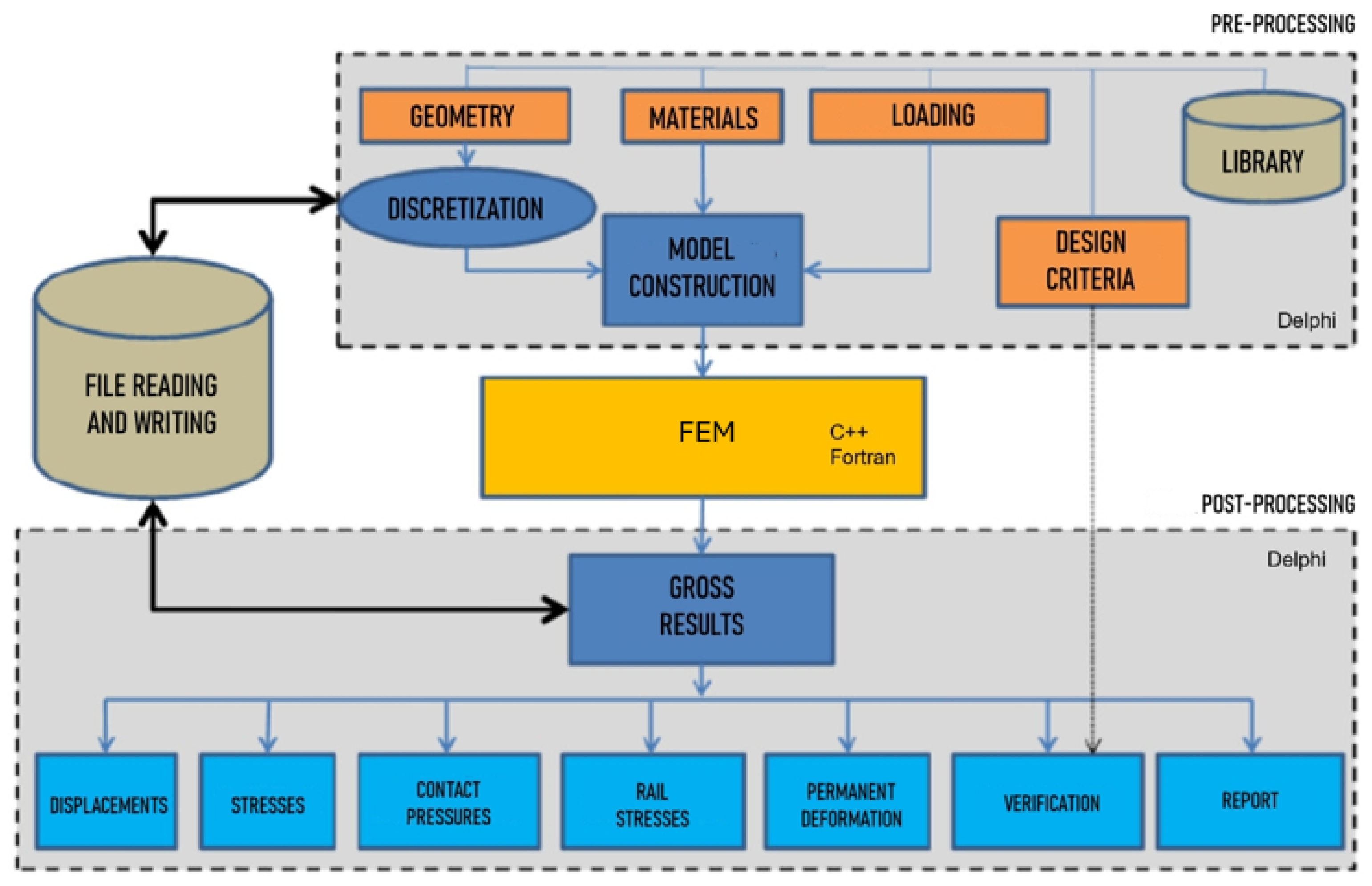
SysTrain was calibrated using monitoring data from a Brazilian railway, specifically an experimental section located in Açailândia, Maranhão, demonstrating good representativeness of the structural behavior of the permanent way [35]. The software also stands out for generating clear graphical outputs, which facilitate the interpretation of stress and displacement distributions along the vertical, longitudinal, and transverse axes (Figure 1).
Several studies have employed SysTrain for structural analyses of railway tracks. Silva Filho [36] used the software to evaluate stresses and displacements in an experimental section in Açailândia, Maranhão, considering fine lateritic sandy soil as the subballast material. The results showed good agreement when compared with simulations performed using Ferrovia 3.0 and ANSYS, as well as with field instrumentation data [23,37]. In a subsequent study, Silva Filho [38] investigated different structural track arrangements, assessing the influence of material properties and layer geometry on track modulus, rail stresses, and subgrade stresses. Ribeiro et al. [39] also employed SysTrain to perform iterative stress–strain analyses, enabling the determination of effective stresses acting within the railway structure.
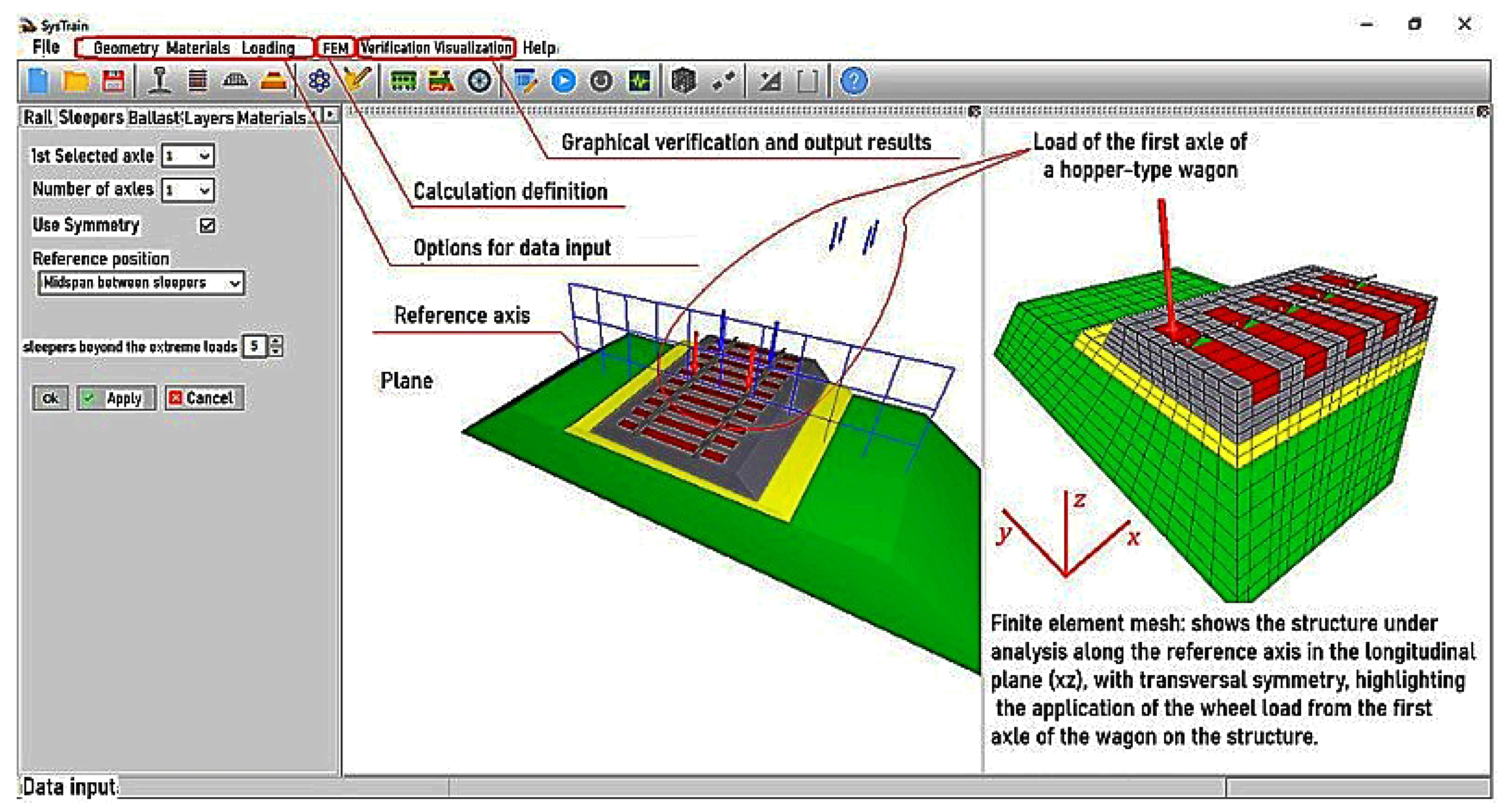
Overall, the FEM implemented in SysTrain enables the integrated consideration of the different components of the permanent way, providing a robust tool for the assessment of railway pavement structural performance. The software also allows the definition of calculation parameters, convergence criteria, and parallel processing, delivering results in the form of graphical outputs and detailed technical reports [40]. Figure 2 illustrates a typical SysTrain input environment, including track geometry definition, finite element mesh generation, and the assignment of load cases used in the structural analysis.
To ensure an adequate balance between numerical accuracy and computational efficiency, a mesh sensitivity analysis was performed. The finite element discretization was defined based on specific parameters, including the longitudinal divisions of the rail and track layers, as well as the transverse and vertical divisions of the sleepers, ballast, and underlying layers. The element size was progressively refined, and the resulting responses were monitored until variations in key output parameters, such as vertical displacements and stress distribution, became negligible. This procedure allowed the adoption of a mesh configuration that ensured stable numerical results without excessive refinement and unnecessary computational cost. In addition, transverse and longitudinal symmetry planes were applied, reducing the modeled domain while preserving the representative structural behavior of the railway track.

2.2. Field Monitoring and Non-Destructive Testing for Track Assessment

In the context of in situ monitoring and condition assessment, non-destructive testing (NDT) and continuous instrumentation systems have become increasingly relevant for supporting railway maintenance decisions. Approaches include the measurement of vertical track stiffness (e.g., Rolling Stiffness Measurement Vehicle (RSMV)) to identify deficient support conditions, the application of Ground Penetrating Radar (GPR) for ballast condition assessment, and correlations between dynamic laboratory tests and rapid field tests such as the Light Weight Deflectometer (LWD) and the Dynamic Cone Penetrometer (DCP). In addition, fiber optic sensors and onboard instrumentation have been used to evaluate, in real time, track response and wheel loads [31,32,33,34].
In Brazil, structural evaluation practices have combined in situ measurements, local instrumentation, and mechanistic modeling. The Displacement Measuring Device (DMD) has been employed to record rail deflections under train passages and to estimate track modulus [25,26]. Instrumented experimental sections commonly incorporate pressure cells at the sleeper–ballast and subballast-subgrade interfaces, thermocouples, and suction sensors, complemented by field tests such as LWD, DCP, sand cone, and Speedy tests for compaction and moisture control [27,28]. The DCP has also been investigated for railway subgrade evaluation [29], and GPR has been calibrated for national ballast conditions [30]. When combined with mechanistic tools, these measurements provide an objective basis for diagnosis, maintenance prioritization, and assessment of track solutions [20,24].

2.3. Resilient Modulus (RM) and Permanent Deformation (PD) in the Structural Evaluation

The structural evaluation of railway pavements depends on the characterization of the mechanical behavior of the ballast, subballast, and subgrade layers under cyclic loading conditions. In this context, the RM and PD are fundamental parameters, representing, respectively, the recoverable elastic stiffness and the accumulation of plastic strains over time [41,42,43]. The RM is widely used in numerical modeling to describe the elastic response of materials, whereas PD is directly associated with track durability and the potential for structural degradation [44,45,46].
The resilient response and the evolution of PD are strongly influenced by the stress state, material characteristics, and moisture conditions, resulting in nonlinear mechanical behavior [4,17,47]. Repeated load triaxial tests are widely employed to determine RM and PD, providing reliable parameters for constitutive model calibration and for structural analyses that more accurately represent field conditions [12,48].
The application of computational tools based on the FEM, such as the SysTrain software, enables three-dimensional analysis of stress, strain, and displacement distributions within the railway structure [24,36,49]. The incorporation of laboratory-derived RM values contributes to the calibration of the numerical model, while the assessment of PD assists in identifying zones susceptible to the accumulation of plastic deformations. However, the representativeness of these simulations requires verification of their consistency with actual operating conditions, which motivates the use of experimental field data for the validation of computational models.

2.4. Field Instrumentation for Validation of Computational Models

Building on these monitoring approaches, field instrumentation is also essential for validating and calibrating numerical models applied to railway track structural analysis. In this study, the experimental validation of the computational model developed using the SysTrain software is performed based on field-measured deflection data obtained from LVDT devices installed at the sleeper ends. This approach allows the comparison of measured displacements with those computed by the finite element model, enabling the adjustment of input parameters, particularly the resilient modulus values of the track layers [24,36]. The correlation between experimental and numerical responses ensures that the model adequately represents the actual loading conditions and the interaction among the components of the permanent railway pavement.
Previous studies reinforce the importance of field instrumentation as a crucial tool for the calibration of railway structural models. Rosa et al. [24] used field measurements to compare experimental deflections with those simulated using SysTrain, validating the method for assessing the stress–strain behavior of the railway trackbed. Similarly, Silva Filho [36] applied a model calibrated with experimental data to a section in Açailândia, Maranhão, validating the simulations by comparing them with in situ measurements. This integration of numerical modeling and field instrumentation enables the development of more robust structural evaluation procedures, particularly in tropical environments, where soil variability and loading conditions are high.
In addition to enabling direct model calibration, field instrumentation also allows the application of back-analysis techniques, in which mechanical parameters of the track layers, such as RM and PD, are iteratively adjusted until the numerical responses converge toward the experimental measurements [14]. This inverse procedure is crucial for reducing uncertainties related to boundary conditions, moisture variations, and material heterogeneity, which are commonly observed in railway platforms under tropical conditions. The integration of real measurements and numerical simulations thus enables a more realistic representation of pavement structural behavior, contributing to the improvement of evaluation methodologies and to the development of more accurate predictive models, particularly applicable to complex geotechnical conditions such as those associated with tropical soils.

3. Materials and Methods

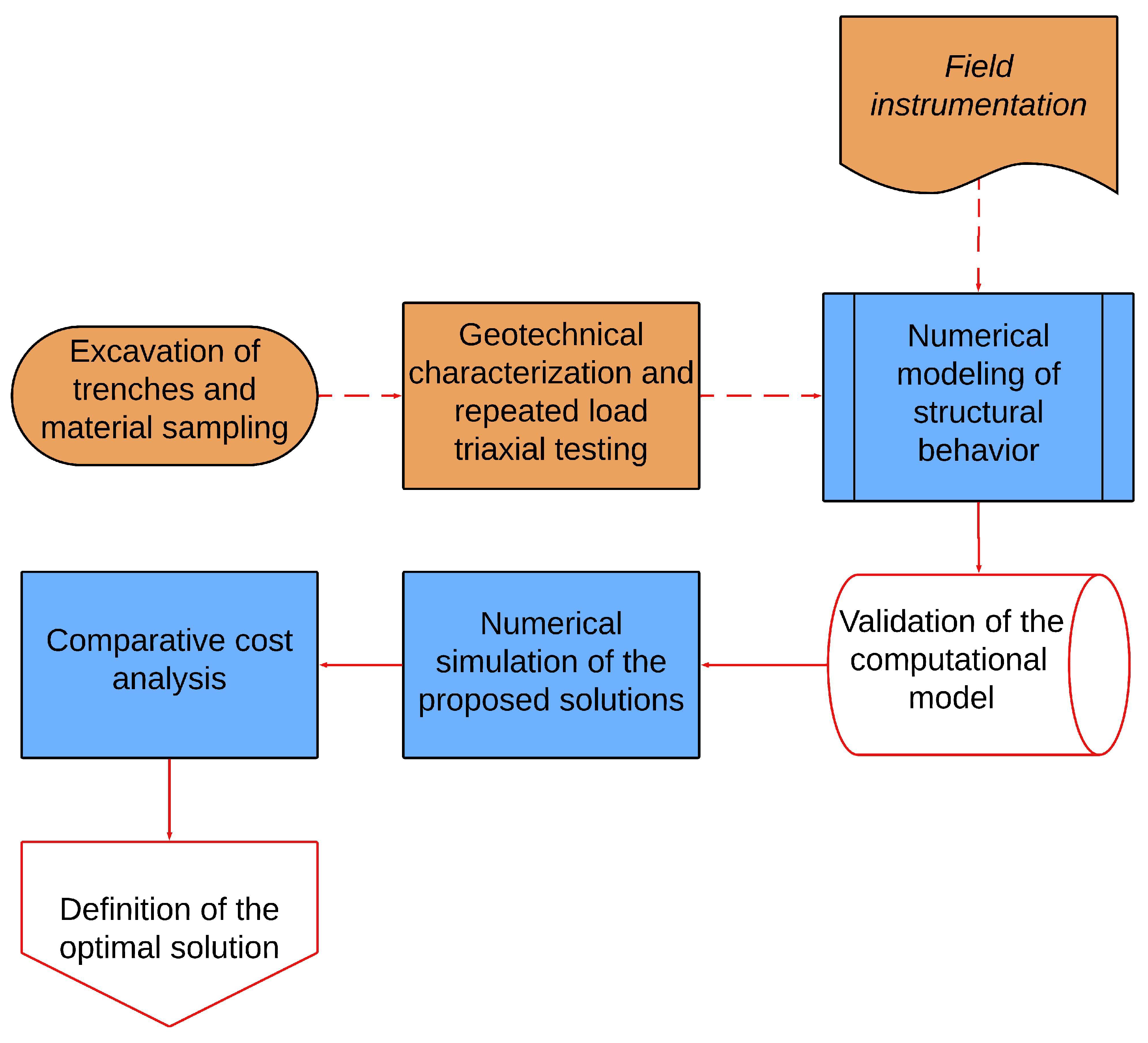
As illustrated in Figure 3, the methodological procedure adopted in this study followed an integrated and sequential approach, beginning with the excavation of trenches for the identification of the layers composing the railway platform, material sampling, and the execution of in situ tests. The collected samples were subjected to geotechnical characterization and repeated load triaxial tests, providing the mechanical parameters including the RM, Poisson’s ratio, and material density required for the numerical modeling of the structural behavior of the track.
In parallel, field instrumentation based on LVDT sensors installed at the sleeper ends was employed to obtain real structural response data under traffic loading, which were used for the calibration and validation of the computational model. Once validated, the numerical model was applied to simulate alternative design and maintenance solutions, the results of which supported comparative performance and cost analyses.
The procedure developed in this study resulted from the consolidation of experience gained through the structural evaluation of railway platforms and was applied, in the present work, to a representative experimental section of the FCA railway platform, located within the São Paulo network, in the interior of the state of São Paulo, Southeastern Brazil. The proposed methodology is summarized in Figure 3 and comprises several complementary stages.

3.1. Study Area and Sampling

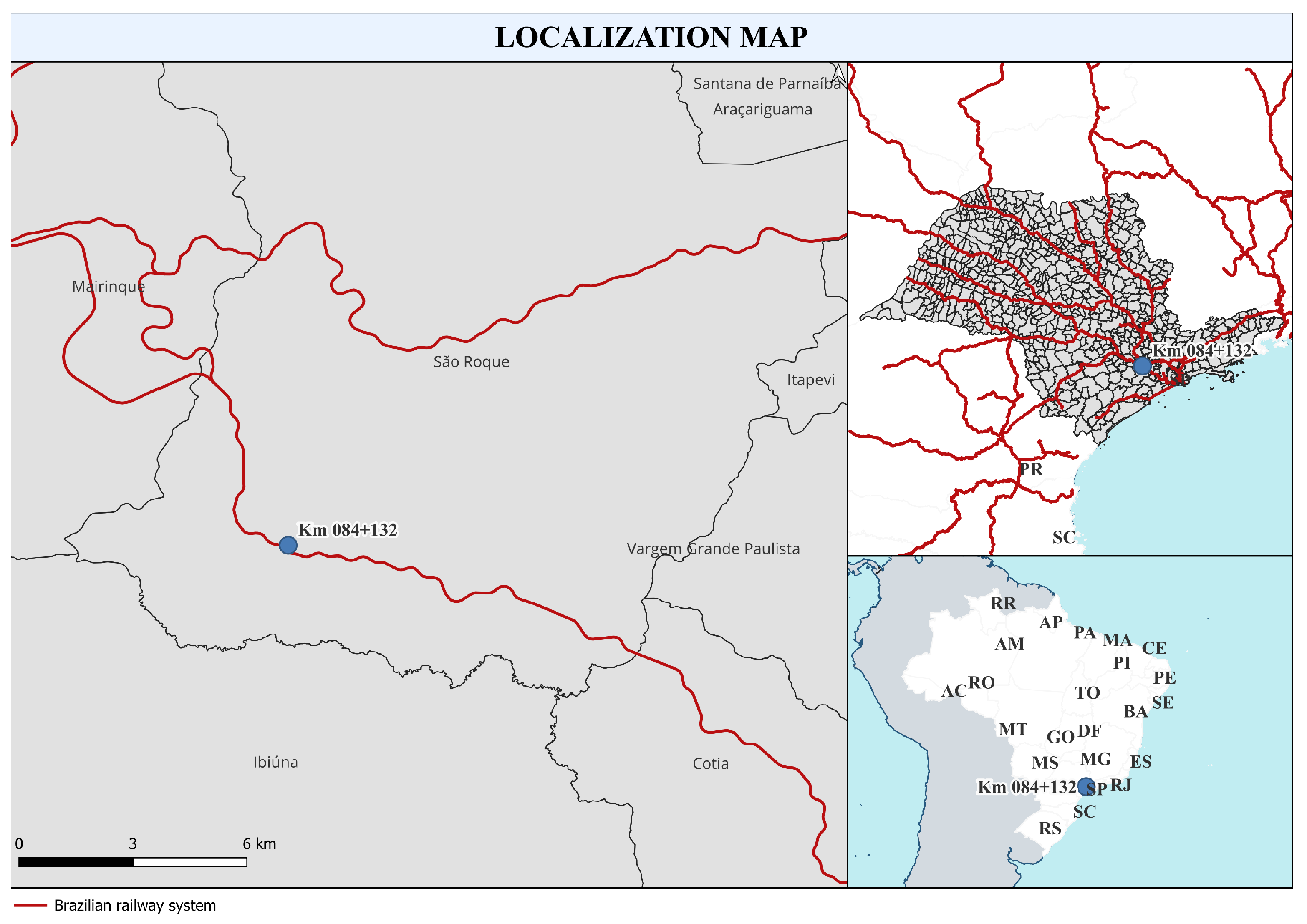
At the selected study site located near the city of São Roque, in the state of São Paulo, Brazil, within the São Paulo railway network (Figure 4), a trench was excavated for material sampling and the execution of in situ tests, including density determination using the sand cone methodin accordance with NBR 7185 [50] and the measurement of natural moisture content. Within this trench, the thicknesses of the different layers of the railway pavement were also assessed.
The collection of materials was carried out in a stratified manner along the depth of the trench, aiming to represent the different layers of the railway structure below the ballast. The depth ranges adopted (e.g., 0.50–0.80 m; 0.80–1.20 m; 1.10–1.72 m) correspond to vertical intervals measured from the platform surface (reference level) in a downward direction. These intervals delimit soil materials associated with the subballast, the subgrade reinforcement layer, and the subgrade.
It is also worth noting that the subgrade corresponds to the foundation soil (natural ground) and/or compacted fill soil that forms the support base of the railway platform. The subgrade reinforcement layer is an additional layer of selected and compacted (possibly stabilized using chemical binders) soil, laid immediately above the subgrade to improve its bearing capacity. The subballast is the transition layer in soil (or stabilized soil) located above the subgrade/reinforcement and immediately below the base (upper granular layer). Thus, the samples directly represent the subballast, subgrade reinforcement, and subgrade oils.
The collected samples were properly identified according to their depth intervals and sent to the laboratory for geotechnical characterization.

3.2. Physical and Geotechnical Characterization of the Materials

Laboratory characterization tests were carried out according to the standards summarized in Table 1. Based on these tests, basic physical properties, particle size distribution, Atterberg limits, and compaction characteristics, were determined to support material classification and to provide input parameters for the subsequent analyses.

3.2.1. Particle Size Distribution

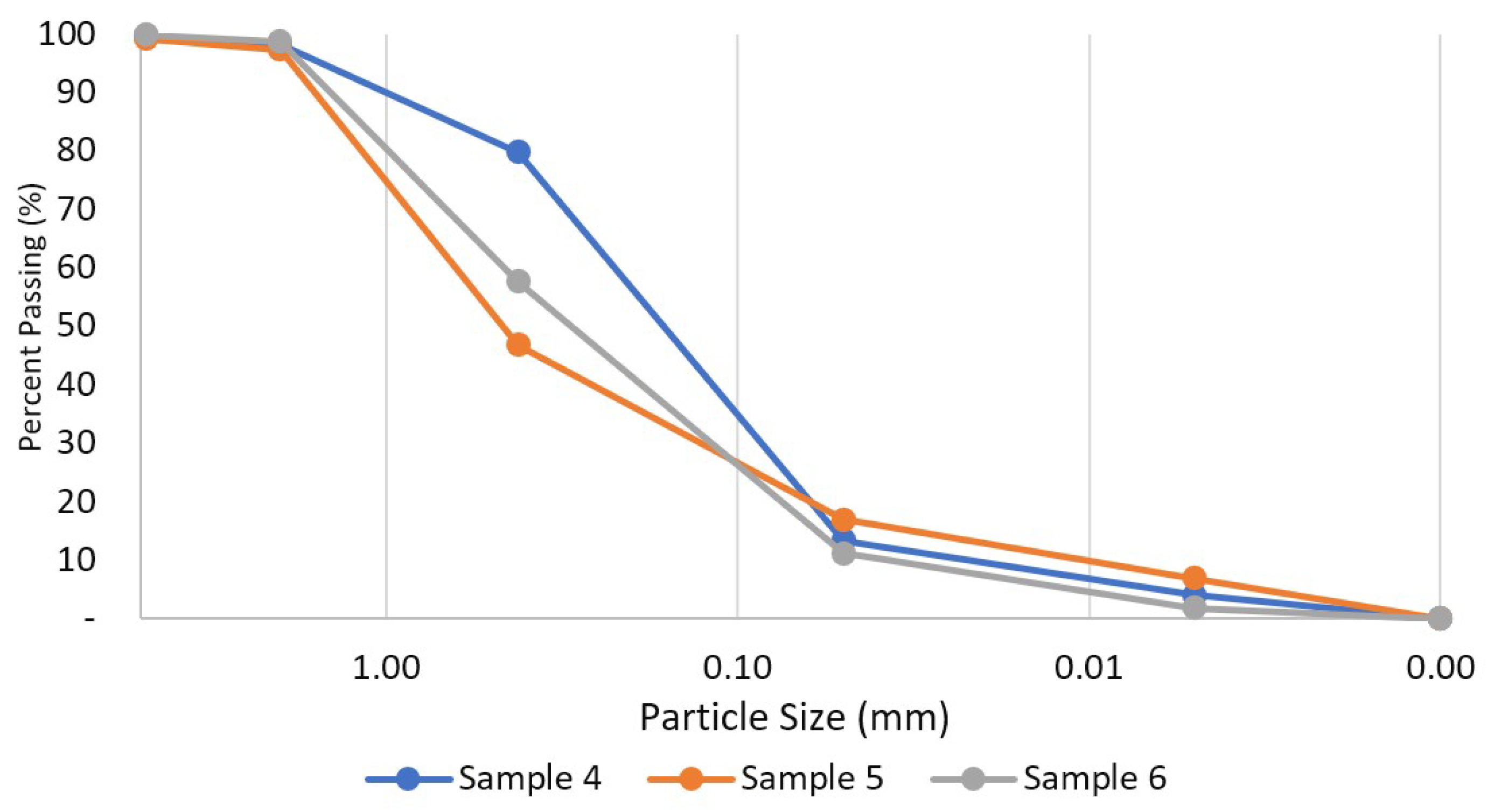
Particle size distribution tests were performed for all collected materials to characterize their granulometric composition. The results, expressed as percentage by mass of each particle-size fraction, are summarized in Table 2. Sample 5 presents a comparatively coarser gradation, whereas the remaining samples are predominantly sand with fines.
Figure 5 presents the grain-size distribution curves corresponding to the materials summarized in Table 2, providing a graphical representation of the gradation characteristics of the studied soils.

3.2.2. Consistency Limits

Atterberg limits were determined to support material classification. The liquid limit (LL) and plastic limit (PL) were determined in accordance with [52,53]. The liquid limit corresponds to the water content at the transition between the plastic and liquid states, while the plastic limit represents the transition between the semi-solid and plastic states. The plasticity index (PI) was calculated as PI = LL − PL. The results are presented in Table 3, showing low to moderate plasticity indices for the analyzed materials.

3.2.3. Compaction Characteristics

Compaction tests were performed using the Intermediate Proctor energy. The optimum moisture content (OMC) and maximum dry unit weight (MDD) obtained for the sampled layers are summarized in Table 4. These parameters are reported for material characterization and as input information for subsequent analyses.

3.3. Laboratory Tests

The mechanical behavior was evaluated using repeated load triaxial (RLT) tests to determine the resilient modulus (RM) and permanent deformation (PD), according to DNIT 134 [42] and DNIT 179 [41]. Specimens were prepared from soil samples collected at different depth intervals in the investigated trench (PI-02) along the railway platform. For each depth interval, three replicate specimens were tested. The replicate results were used to compute a representative RM response (reported in the Section 4)and to fit the composite model parameters (K1–K3) adopted as input to the numerical simulations. In this study, RM was represented by:
R M = K 1 σ 3 K 2 σ d K 3
where R M is the resilient modulus, σ 3 is the confining stress, σ d is the deviator stress, and K 1 K 3 are fitted material constants. The calibrated parameters for each substructure layer are presented in Section 3.4 and were used as input to the numerical simulations.
The materials and testing program adopted for the PD stage are summarized in Table 5. In this table, Sample corresponds to the identification number associated with each depth interval, while Trench indicates the sampling location (PI-02). The resulting average RM values are reported separately in Table 5. The stress states applied in the permanent deformation tests were defined according to the layer represented by each sample and are summarized in the same table. The confining stress ( σ 3 ) represents the radial stress applied uniformly to the specimen during the cyclic triaxial test [56]. The deviator stress ( σ d ) corresponds to the cyclic axial stress increment superimposed on σ 3 , so that the major principal stress ( σ 1 ) is given by σ 1 = σ 3 + σ d [57]. The deviator stress is a key parameter governing shear deformation and permanent strain accumulation under cyclic loading in subgrade and granular materials [58]. To characterize the severity of the applied stress state, the stress ratio σ 1 / σ 3 was adopted, since this ratio (or closely related cyclic stress ratios) is widely used to interpret cyclic triaxial results and to compare with permanent deformation reference databases and shakedown-based criteria in railway geotechnical studies [56].
The evaluation of PD was performed based on the interpretation of experimental results obtained from RLT tests, in accordance with DNIT 179 [41]. The analysis focused on the relationship between the number of loading cycles and the accumulated specific permanent deformation, expressed as a percentage, allowing the assessment of the materials’ susceptibility to plastic deformation accumulation under cyclic loading, considering different stress states applied during the tests. This graphical approach enabled direct comparison of the behavior of the samples throughout repeated loading, as well as the identification of trends toward stabilization or continuous growth of accumulated deformation.
Although mechanistic–empirical models, such as the one proposed by Guimarães [8], are widely employed in the literature for the analytical description of PD behavior in soils, such models were not used as input data in the numerical model in the present study. Instead, PD analysis was conducted exclusively as a complementary tool for evaluating the mechanical behavior of the materials, with the purpose of supporting the interpretation of the experimental results and the structural responses obtained from the numerical simulations.

3.4. Numerical Model and Simulations

Numerical simulations were performed using the FEM with SysTrain 1.88 software [40]. The input data adopted in the model were obtained from laboratory tests and field surveys, complemented by information provided by the railway operator. These data include the actual track geometry, the characteristics of the train loading conditions (wagon types, axle loads, and sleeper spacing), as well as the material properties of the rails, fastening systems, sleepers, and granular layers of the pavement structure, as summarized in Table 6, where the substructure parameters come from laboratory RLT testing and the ballast modulus is defined by back-analysis using LVDT deflections (Section 3.6).
The three-dimensional model explicitly considered the geometry of the permanent railway pavement, comprising rails, fastening systems, sleepers, and the ballast, subballast, and subgrade layers, according to data obtained from field investigations and laboratory testing. In the numerical simulations, all materials were modeled assuming linear elastic and resilient behavior. The elastic and resilient properties of the materials were defined based on the results of RM and PD tests, and were supplemented, when necessary, by values recommended in technical standards and previous studies [36,41,42,59,60].
Boundary conditions were explicitly defined in the three-dimensional finite element model to ensure numerical stability and to represent the physical support of the railway track. The bottom boundary was restrained in the vertical direction ( U z = 0 ), preventing rigid-body motion while allowing the track response to develop within the modeled depth. Lateral boundaries were constrained in the horizontal direction normal to each face ( U x = 0 or U y = 0 , depending on the boundary orientation), while vertical displacements were allowed. A longitudinal symmetry plane along the track axis was adopted (symmetry option enabled in SysTrain), reducing the computational domain without altering the structural response. Loading was applied directly to the rails as equivalent wheel–rail contact stresses, using the axle loads and sleeper spacing provided by the railway operator. This configuration enables the evaluation of stresses, strains, and displacements transmitted to the underlying layers under representative traffic conditions (Figure 2; Table 6).

3.5. Field Instrumentation

Field instrumentation was carried out with the objective of obtaining in situ data for the validation of the computational model developed using SysTrain software, allowing direct comparison between vertical displacements measured in the field and those obtained from numerical simulations. The monitoring area corresponds to a representative section of the FCA railway platform within the São Paulo network, located in the interior of the state of São Paulo. This section is characterized by standard track geometry and straight alignment, ensuring homogeneous loading conditions and structural response along the instrumented segment.
The instrumentation system was designed to capture the structural response of the permanent railway pavement under the passage of real freight trains, with emphasis on measuring vertical displacements at the sleeper ends. This location was selected because it concentrates high contact stresses and is particularly sensitive to variations in the mechanical properties of the ballast, subballast, and subgrade layers, allowing an indirect assessment of stress and strain distribution within the railway structure [24,36].
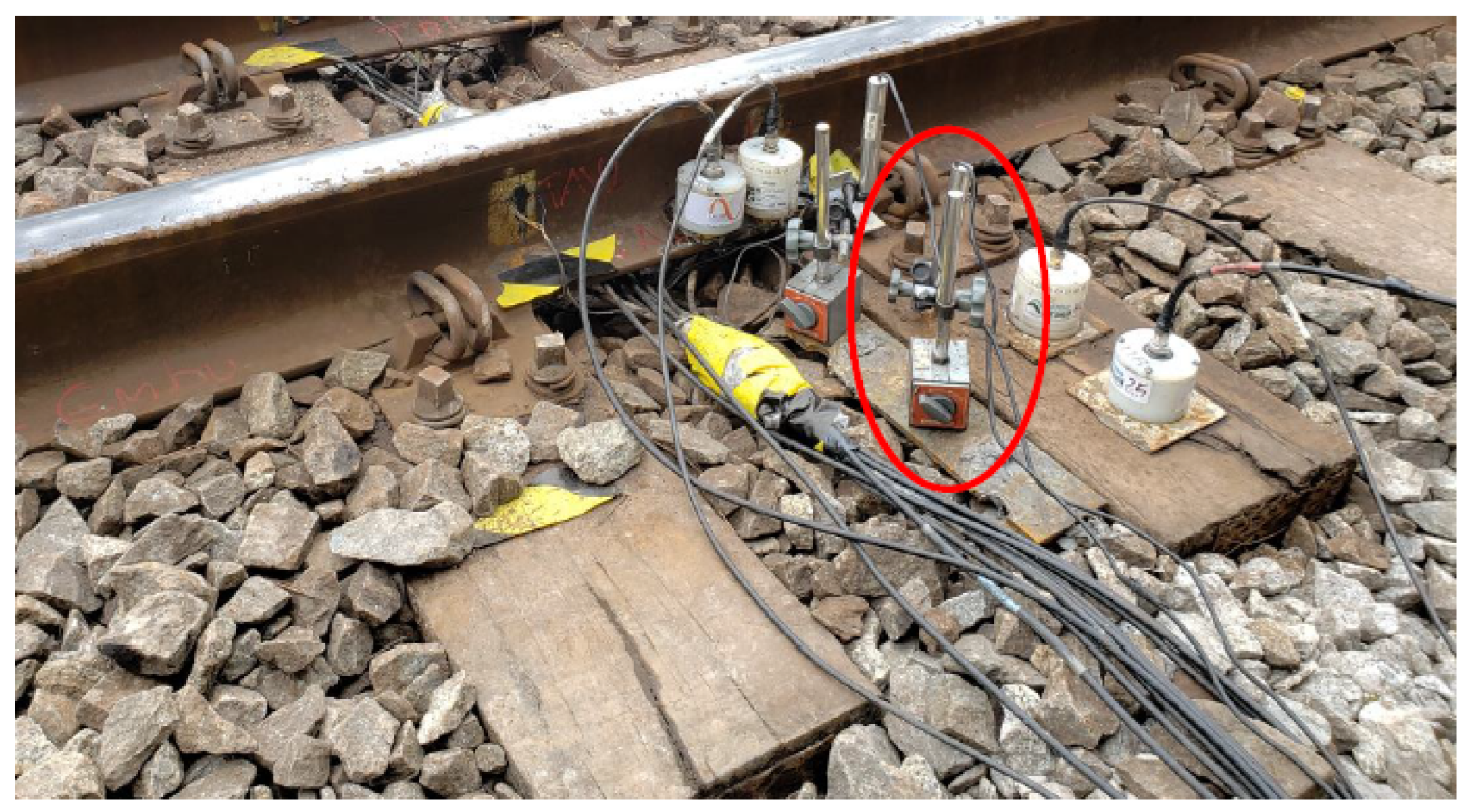
LVDT sensors were installed at the sleeper ends, close to the rail support points, as illustrated in Figure 6. Each sensor was fixed to a rigid reference frame positioned outside the ballast influence zone in order to avoid interference caused by local settlements or relative movements of the granular material. This configuration ensures that the recorded displacements are predominantly attributed to the global structural response of the track.
Measurements were performed during the passage of real freight train consists under different operating conditions, with continuous time series of displacements recorded over multiple loading cycles. Information regarding axle loads, wagon types, and average train speeds was provided by the railway operator, ensuring consistency between the field measurements and the loading and boundary conditions adopted in the numerical simulations.

3.6. ModelCalibration (Back-Analysis Using LVDT Deflections)

The calibration of the numerical model was carried out based on field instrumentation data obtained from LVDT sensors installed at the sleeper ends (Figure 6). SysTrain does not provide deflection outputs directly at the sleeper-end LVDT locations (maximum/minimum values) as it does for the rails; however, the FEM computes displacements at all mesh nodes. Therefore, the numerical counterpart for the instrumented point was defined as the vertical displacement of the sleeper mesh node closest to the LVDT position, after filtering model outputs to include only sleeper nodes.
The substructure parameters obtained from laboratory RLT testing (composite RM model constants K 1 K 3 ; Table 6) were kept fixed, and the ballast layer was represented by a linear resilient elastic model. The ballast resilient modulus was iteratively adjusted until the simulated peak sleeper-end displacement at the selected node matched the measured peak displacement amplitude for the baseline loading case [24,36]. The final calibrated value adopted in the simulations was R M ballast = 1500 MPa (Table 6).
After calibration, the calibrated model was employed to perform complementary simulations in which alternative structural performance scenarios were evaluated, including variations in the ballast RM and the stiffening of the subgrade through lime or cement stabilization. This approach was adopted to analyze the influence of layer mechanical properties on the distribution of stresses, strains, and displacements under representative heavy-haul traffic conditions.

4. Results and Discussions

4.1. Resilient Modulus (RM)

RM results obtained from repeated load triaxial tests are presented in this section as the primary indicator of the cyclic stiffness of the trackbed materials. Basic physical properties (particle size distribution, Atterberg limits, and compaction characteristics) are reported in Section 3 (Materials and Methods) and are used here only to contextualize the mechanical response.
Table 7 summarizes the average RM values obtained from the RLT tests for the analyzed samples. The average RM values for the sampled layers ranged from 47 to 114 MPa, indicating relatively low stiffness under cyclic loading, which is consistent with the typical mechanical behavior of fine-grained soils of tropical origin [4,5,61]. The variability observed among layers suggests heterogeneity along the investigated depth, which may be associated with differences in moisture condition and compaction state at the time of sampling, as well as intrinsic material variability.
From a structural perspective, lower RM values tend to increase vertical strains and reduce the support stiffness of the trackbed, which may contribute to higher susceptibility to deformation accumulation under repeated loading. Therefore, the assessment of PD is presented next to complement the RM interpretation and to support the subsequent numerical analyses and back-analysis procedure.

4.2. Permanent Deformation (PD) Behavior

The results of the PD tests are presented in Table 8. All PD tests were conducted considering a total of 500,000 loading cycles. Considering the specimen geometry (10 cm diameter and 20 cm height), the measured total deformations exceeded 2.0 mm under the applied stress conditions, indicating a pronounced plastic response under repeated loading. These results are relevant for track structural assessment, as higher PD levels are typically associated with increased settlement potential and reduced long-term stability under heavy-haul traffic. This behavior reinforces the need to account for both cyclic stiffness RM and PD when interpreting field response and calibrating the numerical model.
For comparative purposes, the PD test results of the trench samples were analyzed under stress states equivalent to those used in the reference database presented by Guimarães [62]. Representative stress levels classified as low, intermediate, and high were considered, allowing a direct comparison between the PD curves obtained in this study and those available in the literature.
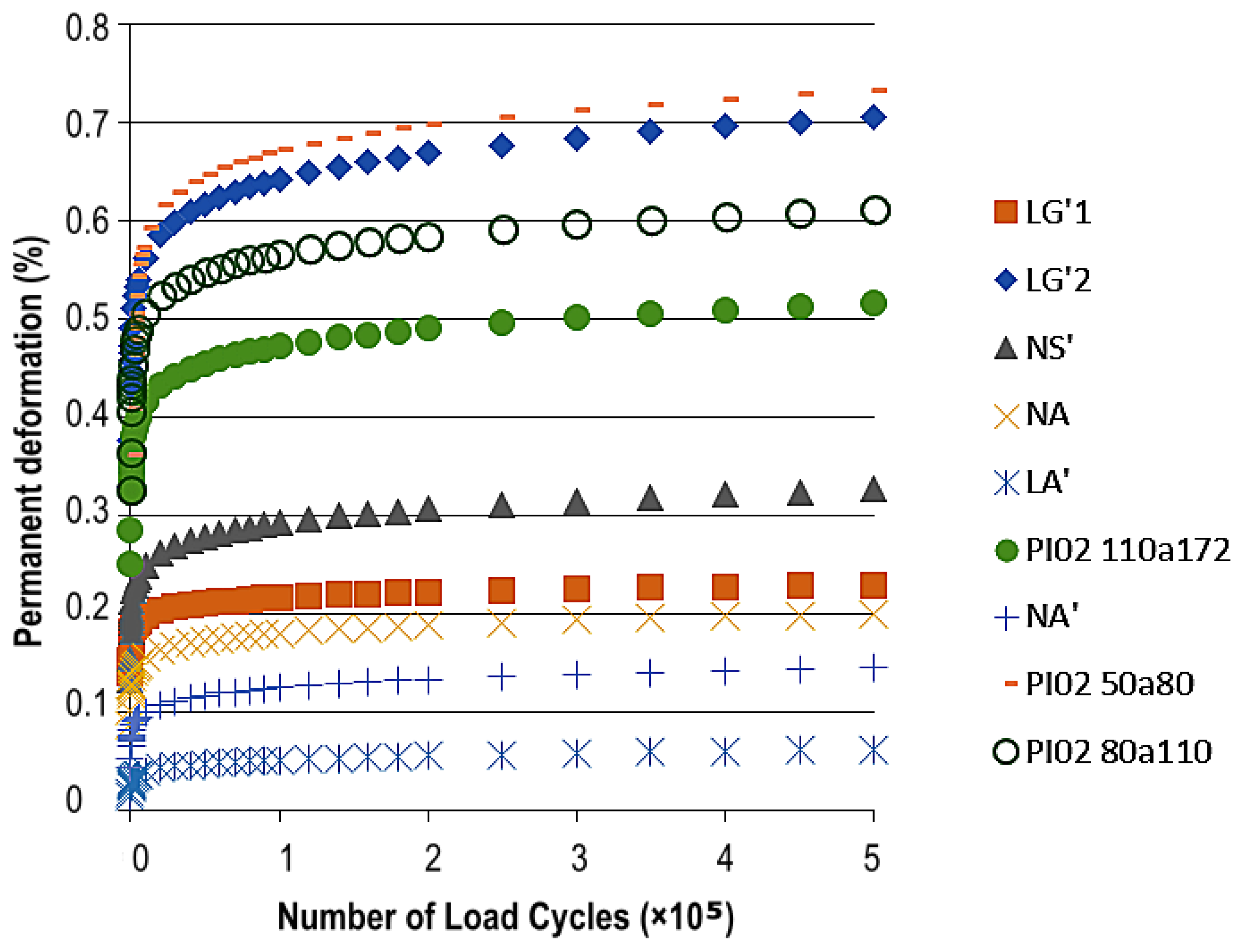
Figure 7, Figure 8 and Figure 9 present the comparative PD results for the different trench layers and for the soils analyzed by Guimarães [62], corresponding to low, intermediate, and high stress states. These analyses enable the evaluation of material behavior under different levels of confining and deviator stresses, providing support for the interpretation of the potential for plastic deformation accumulation.
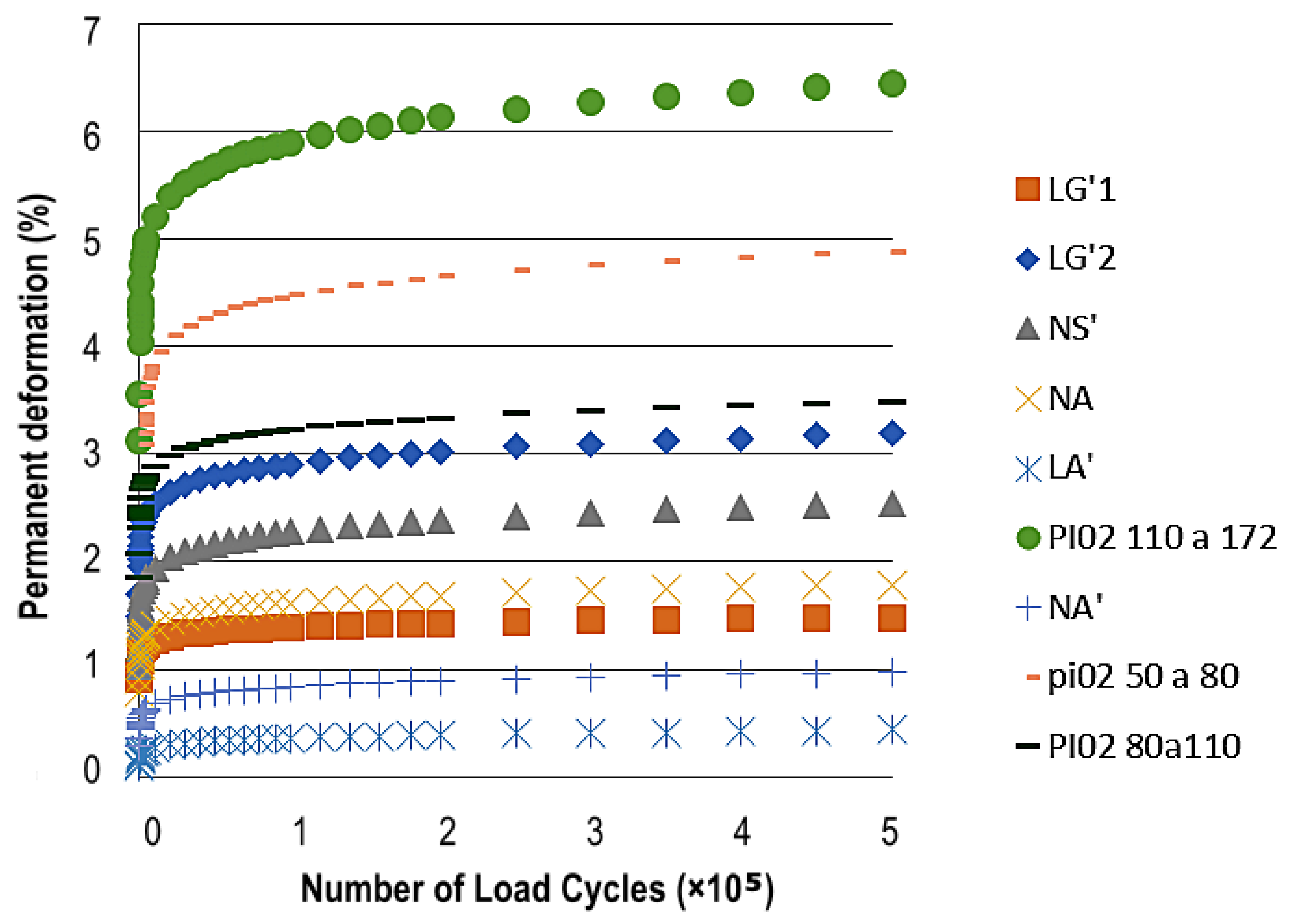
Under the lowest stress state (Figure 7), the samples PI02 50–80 cm, PI02 80–110 cm, and PI02 110–172 cm exhibited the highest PD values. Among the materials included in the reference database used for comparison, only sample LG’2 showed deformations of a similar order of magnitude, highlighting the greater susceptibility to deformation of the layers investigated in this study.
The soils presented in the figures were classified according to the MCT (Miniature, Compacted, Tropical) methodology proposed by Nogami and Villibor [5], which is widely used in Brazil for the characterization of tropical soils. In this classification system, materials are grouped according to their lateritic or non-lateritic nature and the predominant particle size fraction, allowing for a more consistent interpretation of their mechanical behavior.
The designations LG’ and LA’ correspond to lateritic clayey and sandy soils, respectively, characterized by an aggregated structure and greater volumetric stability. The designations NA’, NS’, and NA refer to non-lateritic soils, predominantly sandy or silty, which are generally more sensitive to moisture variations and, consequently, more susceptible to PD. The samples identified as PI02 correspond to layers collected at different depths of the trench investigated in this study, whose behaviors were compared with those of the reference materials.
The low permanent deformation levels observed for some materials, particularly under low stress states, are associated with structured tropical soils that exhibit rapid shakedown behavior, with most plastic deformation occurring during the initial loading cycles [63].
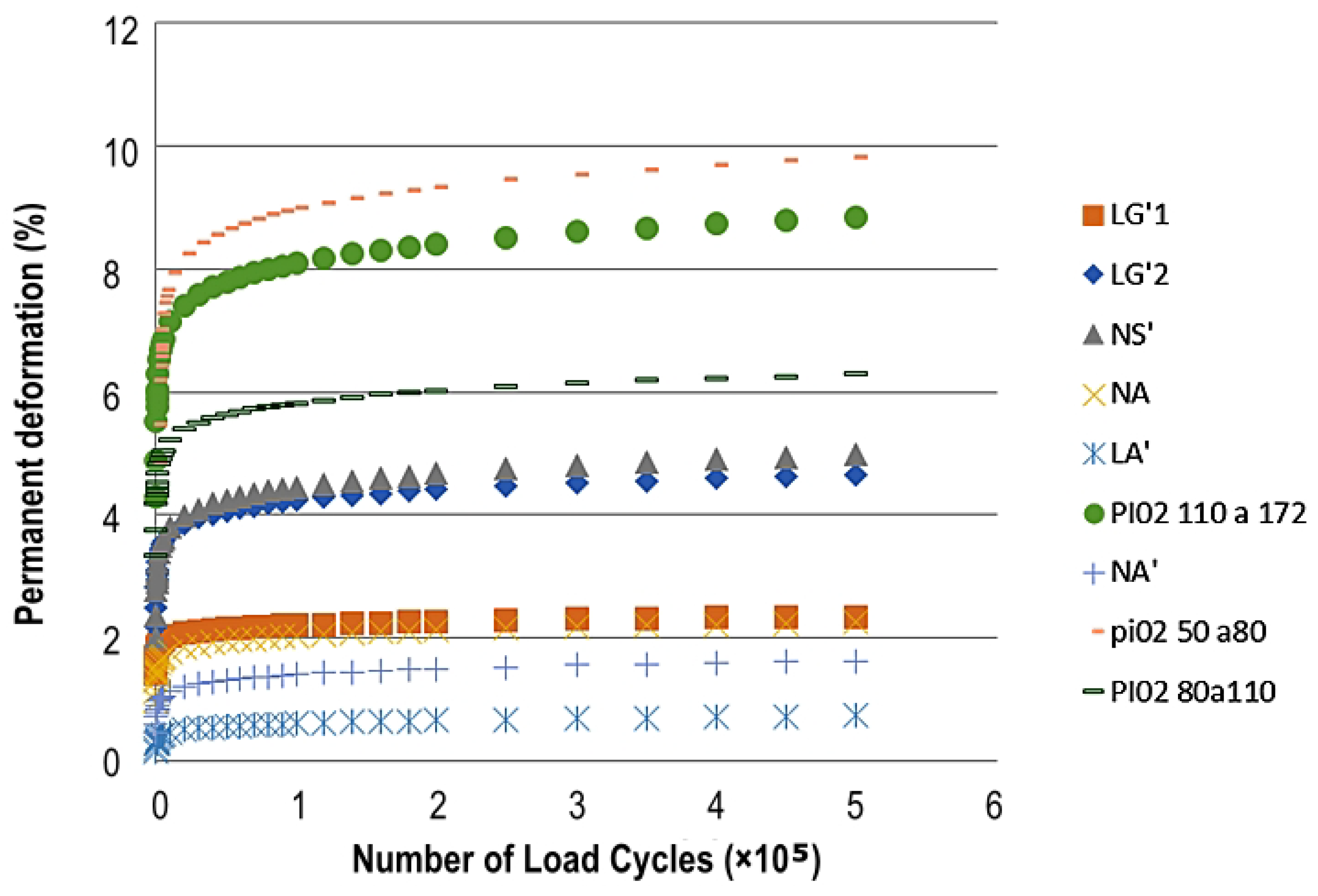
Under the intermediate (or medium) stress state (Figure 8), the trench samples continued to exhibit the highest accumulated PD values. In particular, sample PI02 110–172 cm showed an accumulated deformation of approximately 6.5%, a value considered high and indicative of significant plastic behavior under more severe loading conditions.
Under the highest stress state (Figure 9), the tested samples again exhibited the largest PD values. Sample PI02 50–80 cm showed the highest total value, approximately 10%. From a practical standpoint, this level of deformation represents significant plastic settlement: in a layer with a thickness of 200 mm, it would correspond to about 20 mm of accumulated deformation.

4.3. Numerical Simulation Results

4.3.1. Model Calibration and Validation Using LVDT Deflections

The deflections obtained from field instrumentation were compared with the displacements calculated by the numerical model developed using SysTrain software. The field deflection measurement points (Figure 6) are located on the timber sleeper, a few centimeters from its edge. While SysTrain provides deflection outputs for the rails, sleeper-end deflections must be obtained from the FEM nodal displacements.
To establish a numerical counterpart for the instrumented points, model outputs were filtered to include only the nodes associated with the sleeper. The node closest to the LVDT installation position was identified in the sleeper-end region and its vertical displacement was adopted for comparison. All other layer parameters were kept fixed using the laboratory-fitted composite RM model constants ( K 1 K 3 ; Table 6).
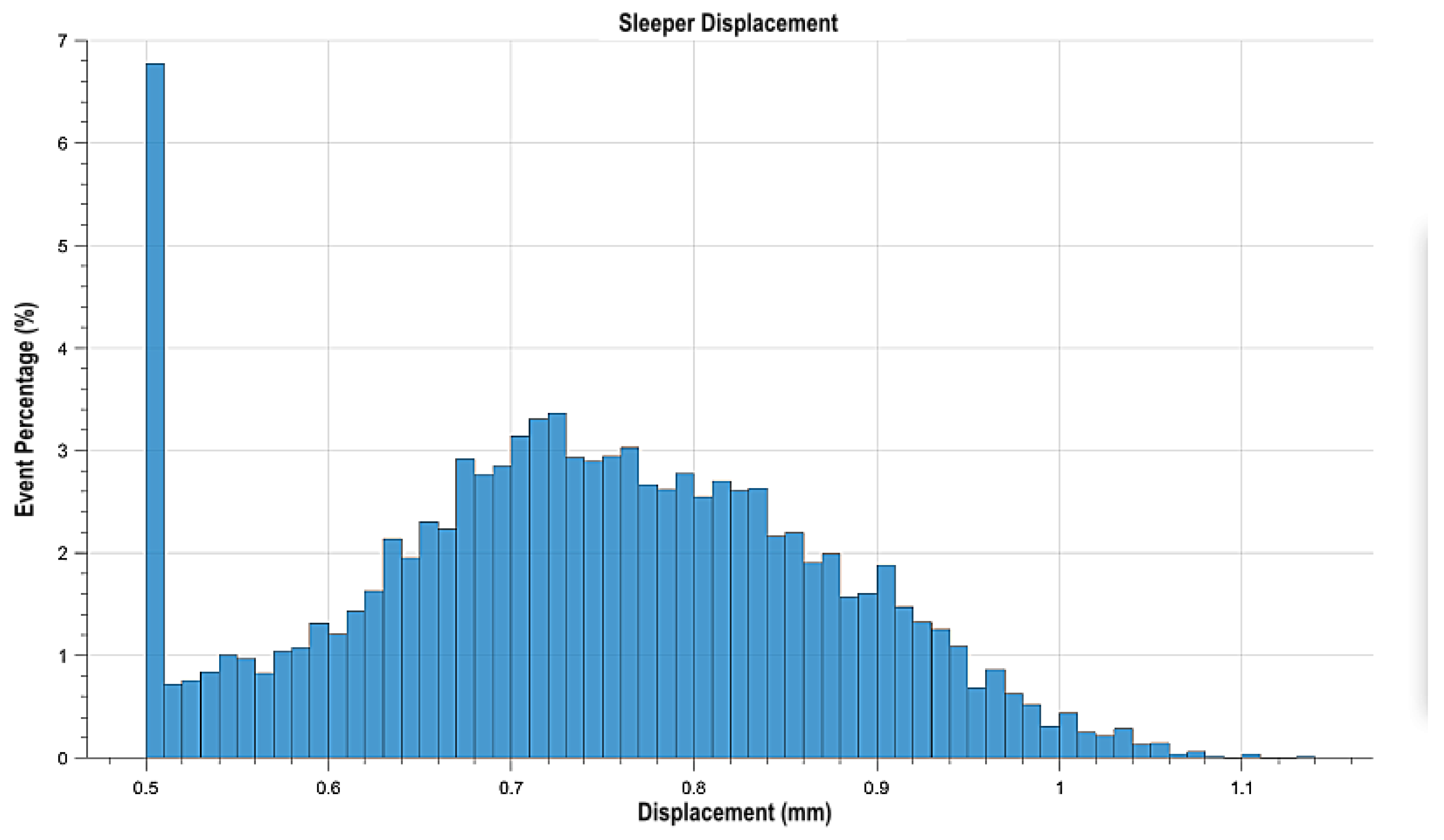
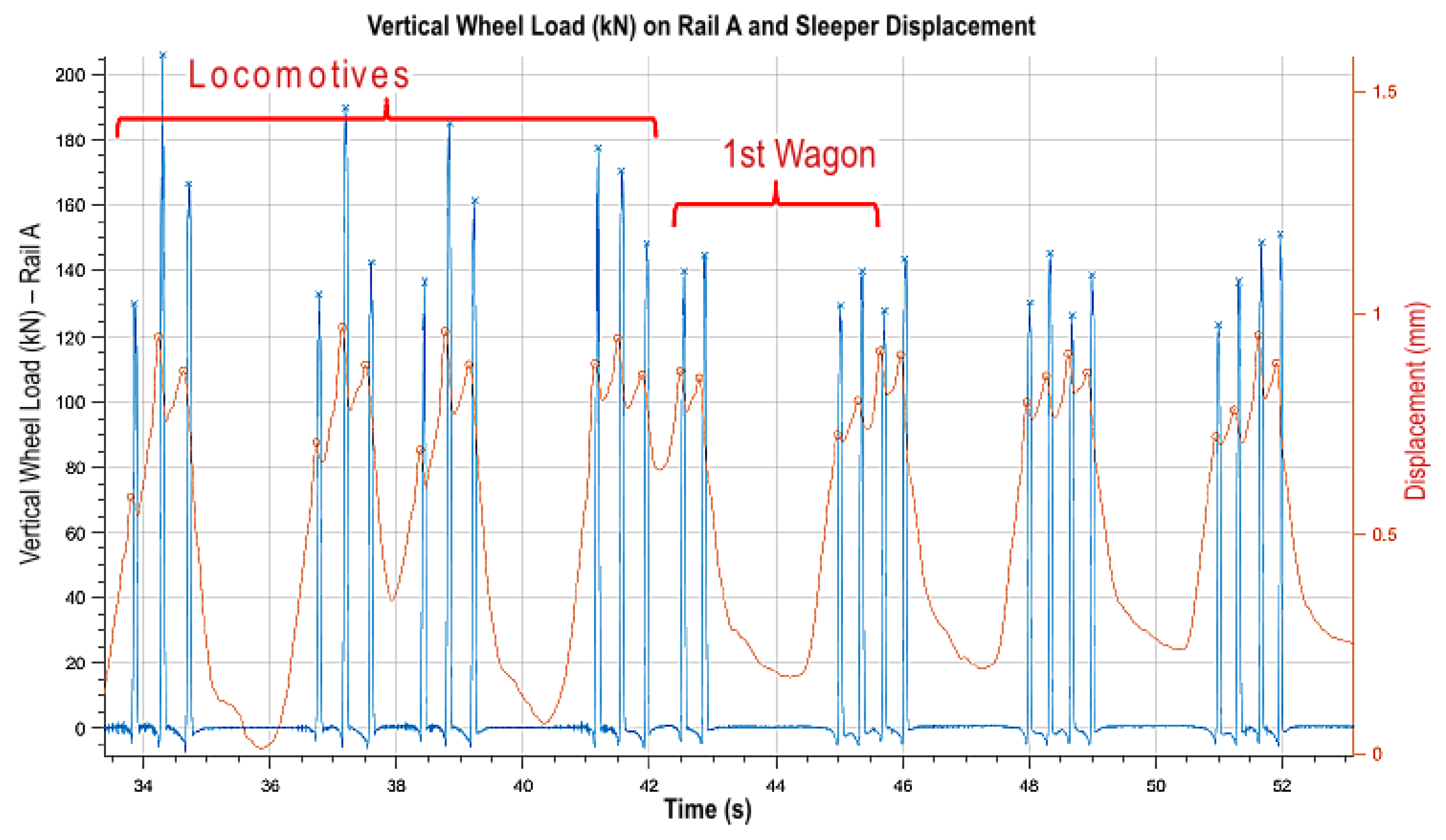
Figure 10 compares the field-measured wheel load on Rail A with the corresponding sleeper-end vertical displacement during a train passage. These measurements provided the target response for back-analysis calibration of the numerical model. Model calibration was performed by iteratively adjusting the ballast resilient modulus in the linear elastic representation until the simulated peak sleeper-end displacement at the sleeper node closest to the LVDT location matched the measured peak displacement amplitude (Figure 6 and Figure 10). The measured displacements exhibited a predominantly unimodal distribution, as shown in Figure 11. The observed values were relatively low, indicating a high global structural stiffness under the analyzed condition.
As a result of the back-analysis calibration, an equivalent ballast resilient modulus in the order of 1500 MPa was obtained for the investigated track section under the baseline loading case (Table 6). This value is higher than those typically reported for fresh ballast, which generally remain below 700 MPa [12,48]. However, this calibrated value should not be interpreted as an intrinsic laboratory material property, but rather as an equivalent in situ stiffness parameter representing the effective ballast response under the local confinement and service conditions of the investigated track section. The back-analysis therefore indicates that ballast stiffness is a key factor governing the global track response under the analyzed condition.
The remaining layers (subballast, reinforcement layer, and subgrade) were represented based on laboratory RM and PD test results (composite model parameters reported in Table 6). The numerical stress and displacement results for the different structural components (Table 9, Table 10, Table 11, Table 12, Table 13 and Table 14).

4.3.2. Stress and Displacement Results for Structural Components

From Table 9, it can be observed that the maximum vertical rail displacement is low and of the same order of magnitude as the displacements measured in the field at the sleeper level, which is consistent with the high global stiffness indicated by the calibration process. The stress results in the sleeper (Table 10) provide the level of demand associated with the applied loading and serve as a basis for interpreting the stresses transmitted to the underlying layers.
In the next tables (Table 11, Table 12, Table 13 and Table 14), stress components are presented according to the Cartesian coordinate system adopted in the numerical model, where S x x and S y y represent horizontal normal stresses, S z z corresponds to vertical normal stress, and S x y , S x z and S y z denote shear stress components.
In the ballast layer (Table 11), the vertical stresses S z z exhibit low-magnitude values when compared with other components, indicating that a significant portion of the structural response is associated with the stiff behavior calibrated for this layer. For interpretation purposes, it is noted that the largest magnitude of S z z occurs at the minimum (compressive) value, with | S z z | in the order of 185.7 kPa. Although this stress level is not extreme, it may contribute to processes such as particle rearrangement and gradual aggregate degradation under traffic loading.
The maximum compressive vertical stresses S z z in the lower layers ranged between 81 and 92 kPa. Although these magnitudes are moderate, their structural relevance must be interpreted in light of the laboratory PD results presented in Section 4.2. Under comparable stress ratios ( σ 1 / σ 3 4 ), the tested soils exhibited significant permanent deformation accumulation, indicating that even stress levels below 100 kPa may contribute to progressive settlement under repeated heavy-haul loading. Therefore, the apparently low stress regime obtained in the numerical simulations does not necessarily imply negligible long-term deformation risk, particularly in moisture-sensitive tropical soils.
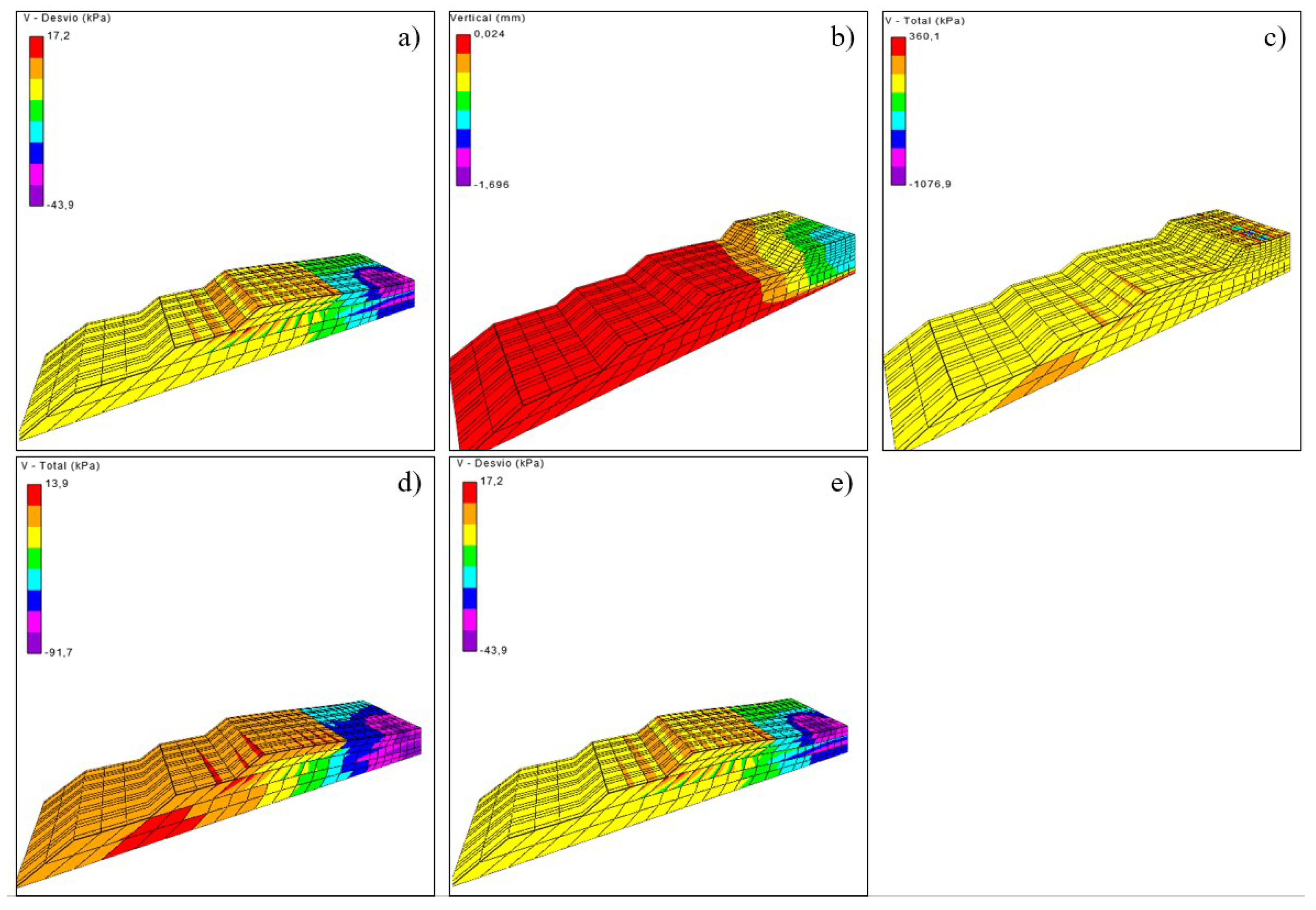
This stress distribution is consistent with the result maps obtained from SysTrain, presented in Figure 12, which allow visualization of stress and displacement propagation throughout the track structure. The graphical outputs indicate that, for the applied loading condition, the stresses transmitted to the lower layers remain at moderate levels, while also highlighting the sensitivity of the structural response to the adopted mechanical properties, particularly the calibrated stiffness of the ballast layer.
It is also important to emphasize that the calibrated ballast modulus (RM = 1500 MPa) plays a dominant role in controlling stress transmission to the lower layers. Table 12, Table 13 and Table 14 allow a direct comparison of stress magnitudes across the substructure layers and clearly highlight the progressive reduction in vertical stress amplitude with depth, which is consistent with layered elastic behavior. The high equivalent in situ stiffness of the ballast reduces vertical strain propagation, concentrating a significant portion of the structural demand within the ballast–sleeper interface and attenuating stress levels in the underlying layers. However, this calibrated modulus should be interpreted as a global structural parameter rather than an intrinsic laboratory material property, since the model assumes linear resilient behavior and does not account for ballast degradation, particle breakage, or cyclic stiffness reduction. Consequently, the stress attenuation observed in the substructure layers reflects the calibrated global stiffness of the track system under the analyzed loading condition rather than a purely material-based stiffness response. This interpretation is consistent with the proposed procedure (Figure 3), which incorporates RLT testing of the subballast to provide an independent material-level characterization for the numerical analyses, rather than relying solely on the back-calibrated global response of the track system.
In the subballast layer (Table 12), the stress state reflects its role as a transitional medium between the granular ballast and the reinforced foundation. The maximum compressive vertical stress ( S z z = −84.5 kPa) remains moderate when compared with the ballast layer, indicating effective stress spreading across the ballast–subballast interface. The presence of shear components ( S x z and S y z ) of comparable order to the normal stresses suggests that this layer actively participates in load redistribution rather than acting as a purely compressive support. Considering its laboratory RM (Table 7), this behavior is consistent with an intermediate stiffness response, contributing to progressive stress attenuation with depth.
For the reinforcement layer (Table 13), the slightly higher compressive vertical stresses ( S z z = −91.7 kPa) indicate that this layer acts as an active structural buffer between the subballast and the natural subgrade. Despite being located at greater depth, the stress magnitude does not decrease significantly compared with the subballast, which reflects the redistribution effect induced by the calibrated ballast stiffness. The relatively high equivalent stress ( S e q ) values further suggest that multiaxial stress interaction remains relevant at this level. When interpreted together with its laboratory RM (Table 7), the reinforcement layer demonstrates structural participation in stiffness continuity along the vertical profile.
It should be noted that the slightly higher compressive Szz observed in the reinforcement layer compared with the subballast does not contradict the expected stress attenuation trend, since the reported values correspond to local peak stresses occurring at different nodal positions within a three-dimensional layered system. Minor variations in peak magnitude are consistent with stiffness contrasts and stress redistribution effects between adjacent layers.
In the subgrade (Table 14), the vertical stresses reach similar magnitudes but exhibit a slightly more attenuated distribution, consistent with the layered elastic response of the system. Although the stress levels remain below 100 kPa, the relatively low laboratory RM obtained for this material (Table 7) suggests increased susceptibility to strain accumulation under repeated loading. Therefore, even under a globally stiff structural configuration, the subgrade may represent a critical layer for long-term performance, particularly under heavy-haul traffic and moisture-sensitive tropical conditions.
A layer-by-layer examination of the stress state further clarifies the structural behavior of the track system. In the subballast layer, stress components remain moderate, indicating effective load distribution immediately below the ballast and a transition zone where shear components still play a relevant role. In the reinforcement layer, the slightly higher compressive vertical stresses ( S z z ) suggest that this layer participates actively in stress redistribution, functioning as an intermediate stiffness buffer between the granular base and the natural subgrade. In contrast, the subgrade exhibits comparatively lower overall stress magnitudes, reflecting the attenuation effect provided by the overlying layers; however, when interpreted together with the laboratory PD results, these stress levels may still be sufficient to promote gradual permanent strain accumulation under repeated heavy-haul loading.
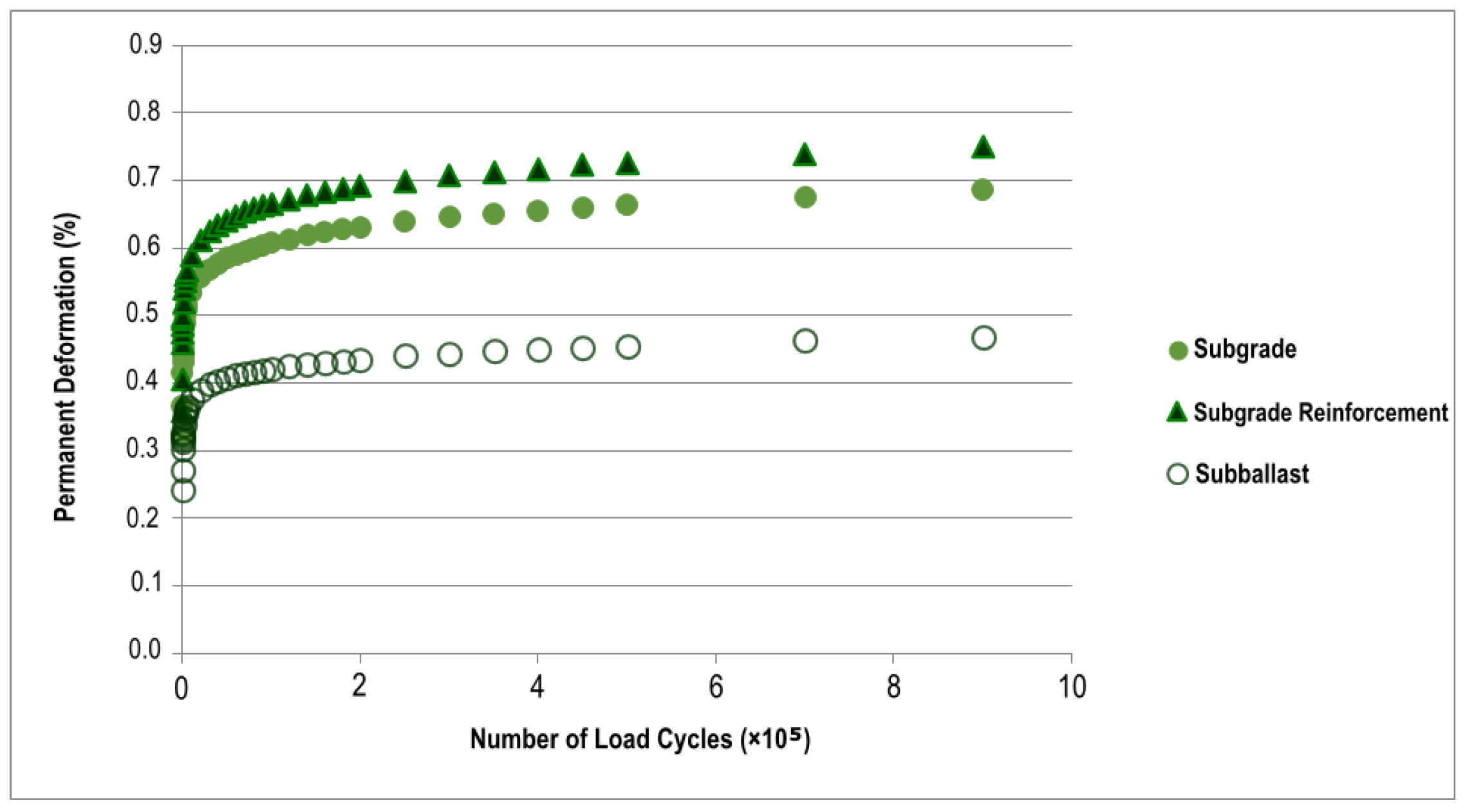
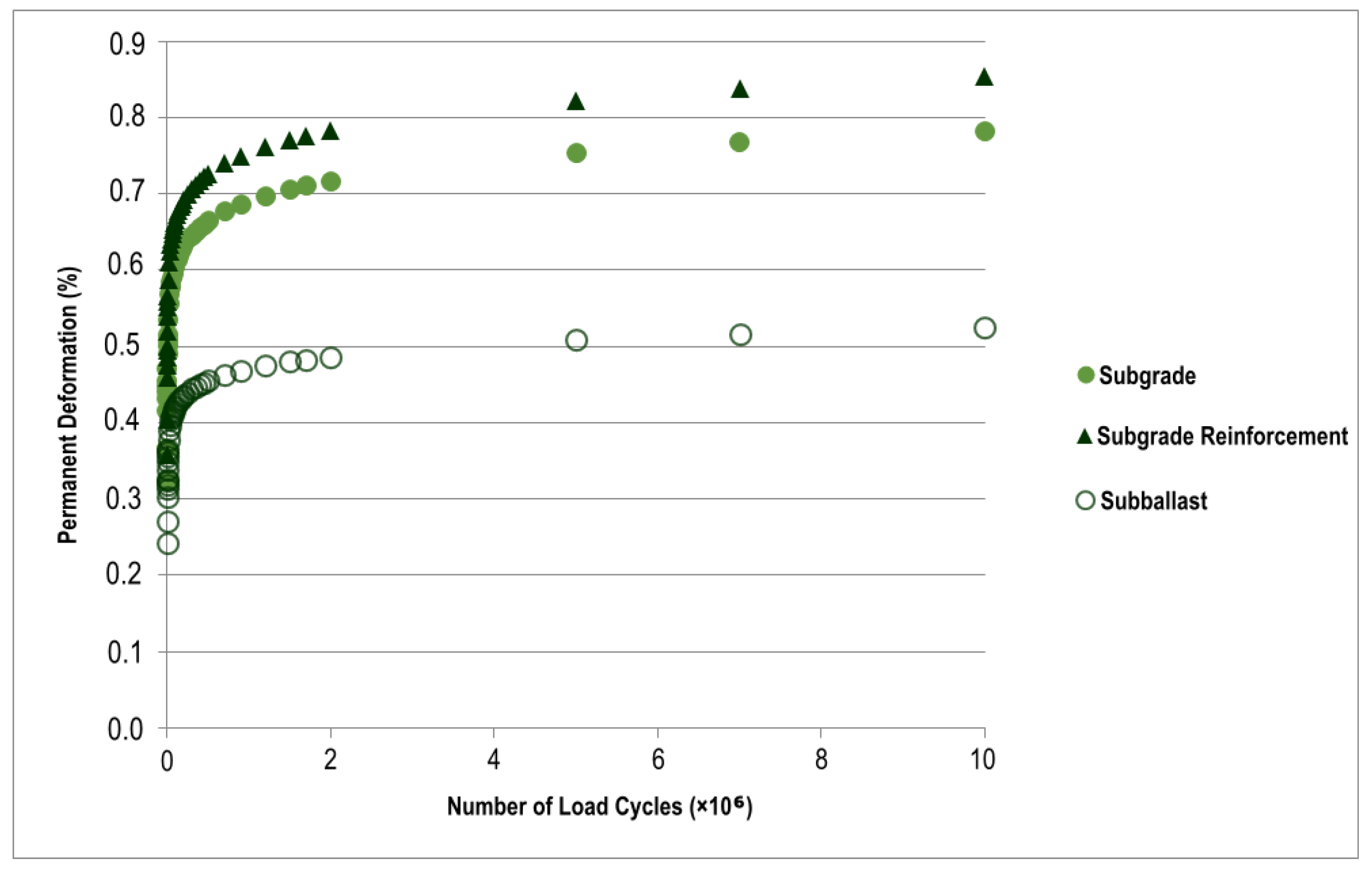
In line with the methodological procedure adopted in this study, in which mechanical parameters are initially obtained from laboratory testing and subsequently adjusted through back-analysis based on field-measured responses, a complementary analysis of the accumulated PD potential of the soil layers was performed. This assessment was based on the PD parameters determined in the laboratory, considering loading cycles of 10 6 and 10 7 (Figure 13 and Figure 14), in order to verify the consistency between the demands calculated in the numerical model and the susceptibility of the materials to plastic deformation.
For the scenario of 10 7 loading cycles, the estimated total PD was 4.32 mm, which is below the limit of 6.35 mm recommended by AREMA [64]. This result indicates a moderate level of accumulated deformation, consistent with the low vertical stress levels calculated in the lower layers, below 100 kPa, and with the global stiffness of the structure calibrated through back-analysis.
However, it is important to note that the PD parameters used in this estimation were obtained in the laboratory under optimum moisture content conditions. In the field, moisture content may vary significantly over time and may exceed the optimum condition [17]. Under such circumstances, particularly during rainy periods, reductions in material stiffness and increases in deformability may lead to PD accumulation greater than that estimated herein, reinforcing the importance of drainage control and operational monitoring of the track, as envisaged in the proposed methodological flowchart (Figure 3).
Overall, the main numerical results obtained in this study can be summarized as follows: the calibrated ballast resilient modulus reached values in the order of 1500 MPa; maximum sleeper vertical displacements under the reference loading condition remained in the order of 1 mm; and vertical stresses transmitted to the subballast, reinforcement layer, and subgrade remained below approximately 100 kPa. These quantitative results support a consistent interpretation of the structural response and load transfer mechanisms within the track system.

5. Conclusions

This study evaluated the structural behavior of a railway track section through the integration of field instrumentation, laboratory testing, and numerical simulations based on the Finite Element Method, using SysTrain software. By calibrating the numerical model with field-measured deflection data, it was possible to analyze the mechanical response of the track structure and to identify critical aspects of its performance.
The back-analysis of field-measured deflections indicated that the ballast resilient 510 modulus is in the order of 1500 MPa. Although this value is high when compared with typical values reported for granular ballast, it is consistent with the stiffened in-service condition of the layer, possibly associated with progressive compaction and aggregate rearrangement during railway operation. This high stiffness contributes to low deflection levels but may promote stress concentration in superstructure components.
Numerical simulations showed that the vertical stresses transmitted to the lower layers remain below 100 kPa, resulting in moderate levels of accumulated permanent deformation (PD) under the analyzed loading condition. However, laboratory tests revealed a high susceptibility to PD in the subballast, subgrade reinforcement layer, and subgrade soils, particularly when potential variations in field moisture conditions are considered.
In summary, the structural diagnosis of the analyzed railway pavement indicates the following:
  • High stiffness of the ballast layer, as evidenced by the back-analysis of field-measured deflections;
  • High susceptibility to PD of the underlying soil layers.
The results confirm that the combined use of field instrumentation and numerical modeling is an effective tool for the structural assessment of in-service railway tracks, providing relevant support for performance diagnosis and maintenance planning. In this context, laboratory tests contributed key information on the resilient behavior and permanent deformation susceptibility of the track materials, while FEM simulations calibrated through field measurements enabled the evaluation of stress distribution and displacement levels within the track structure. This integrated interpretation strengthens the reliability of the structural diagnosis and supports more informed maintenance-related decision-making.
The expansion of the database and the application of the proposed procedure to other track sections may contribute to the consolidation of the method for predictive analyses and for railway infrastructure design.

Author Contributions

Conceptualization, A.C.R.G., C.V.S. and L.M.C.; Methodology, A.C.R.G., C.V.S. and L.M.C.; Software, W.W.d.S., C.V.S. and G.d.C.N.; Validation, A.C.R.G., W.W.d.S., C.V.S. and G.d.C.N.; Formal analysis, L.M.C.; Investigation, W.W.d.S., L.M.B., C.V.S. and L.M.C.; Resources, C.V.S.; Data curation, W.W.d.S., C.V.S. and G.d.C.N.; Writing—original draft, W.W.d.S., L.M.B., C.V.S. and L.M.C.; Writing—review & editing, W.W.d.S., L.M.B. and L.M.C.; Visualization, W.W.d.S., L.M.B. and L.M.C.; Supervision, A.C.R.G., S.N.M. and L.M.C.; Project administration, A.C.R.G. and S.N.M.; Funding acquisition, S.N.M. All authors have read and agreed to the published version of the manuscript.

Funding

This study was financed in part by the Coordenação de Aperfeiçoamento de Pessoal de Nível Superior-Brasil (CAPES)—Finance Code 001.

Data Availability Statement

The data presented in this study are available on request from the corresponding author.

Conflicts of Interest

Author Caio Vinícius Schlogel was employed by the company Rumo S.A. The remaining authors declare that the research was conducted in the absence of any commercial or financial relationships that could be construed as a potential conflict of interest.

References

  1. Santos, A.A., Jr.; Fraga Guimarães, L.; Santos, J.; Mandelli, A.; Fernandes Nunes, L. Challenges for Heavy Haul Rail Transportation in Brazil: A Safety and Environmental Perspective. In Proceedings of the Sixth International Conference on Railway Technology: Research, Development and Maintenance; Pombo, J., Ed.; Civil-Comp Conferences; Civil-Comp Press: Edinburgh, UK, 2024; Volume 7. [Google Scholar] [CrossRef]
  2. Machado, M.F. Importância do Sistema Ferroviário Para o Desenvolvimento do Brasil. Rev. Científica Sem. Acadêmica 2023, 11, 1–16. [Google Scholar] [CrossRef]
  3. Fortunato, E.; Pinelo, A.; Fernandes, M.M. In situ characterization of an old railway platform with DCP. In Proceedings of the 17th International Conference on Soil Mechanics and Geotechnical Engineering; IOS Press: Amsterdam, The Netherlands, 2009. [Google Scholar]
  4. Nogami, J.S.; Villibor, D.F. Use of lateritic fine-grained soils in road pavement base courses. Geotech. Geol. Eng. 1991, 9, 167–182. [Google Scholar] [CrossRef]
  5. Nogami, J.S.; Villibor, D.F. Low-Cost Paving with Lateritic Soils; Editora Villibor: São Paulo, Brazil, 1995. [Google Scholar]
  6. Prass, A.S.; Roza, A.E.D.; dos Santos, W.M.; dos Santos, B.G.S.; Crispim, F.A. Estudo comparativo de diferentes sistemas de classificações geotécnicas aplicadas a solos do município de Alta Floresta–MT. In Proceedings of the 33º Congresso de Pesquisa e Ensino em Transporte da ANPET, Balneário Camboriú, SC, Brazil, 10–14 November 2019; ANPET: Santa Catarina, Brazil, 2019. [Google Scholar]
  7. Costa, R.; Motta, R.; Bernucci, L.; Moura, E.; Pires, J.; Oliveira, L. Bearing capacity evaluation of a subgrade in a heavy haul railway in Brazil. In Proceedings of the Bearing Capacity of Roads, Railways and Airfields–BCRRA 2017; Loizos, A., Al-Qadi, I., Scarpas, A., Eds.; CRC Press: Boca Raton, FL, USA, 2017; pp. 1977–1983. [Google Scholar] [CrossRef]
  8. Guimarães, A.; Motta, L.d. A Study on Permanent Deformation of Lateritic Soils Including the Shakedown Concept, 1st ed.; CRC Press: Boca Raton, FL, USA, 2008; p. 8. [Google Scholar]
  9. de Carvalho, J.C.; Gitirana, G.d.F.N., Jr. Unsaturated soils in the context of tropical soils. Soils Rocks 2021, 44, e2021068121. [Google Scholar] [CrossRef]
  10. dos Santos, J.T.A.; Gomes, M.B.B.; Guimarães, A.C.R.; do Nascimento, F.A.C.; Serra, G.A. Considerações Sobre a Caracterização de Solos Tropicais para Emprego em Sublastro. In Anais do Xxi Congresso Brasileiro de Mecânica dos Solos e Engenharia Geotécnica; Editora Omnis Scientia: Recife, Brazil, 2024. [Google Scholar] [CrossRef]
  11. Hilário, R.Q.; Fernandes, G.; Alves, H.d.C. Study of soils used as subgrade and subballast in Brazilian railways. REM-Int. Eng. J. 2022, 75, 197–204. [Google Scholar] [CrossRef]
  12. Indraratna, B.; Salim, W.; Rujikiatkamjorn, C. Advanced Rail Geotechnology–Ballasted Track; CRC Press: Boca Raton, FL, USA, 2011. [Google Scholar]
  13. Spada, J.L.G. A Pavement Mechanics Approach Applied to the Understanding of the Stress-Strain Behavior Mechanism of Railway Tracks. Ph.D. Thesis, Federal University of Rio de Janeiro, Rio de Janeiro, Brazil, 2003. [Google Scholar]
  14. Castro, G.; Pires, J.; Motta, R.; Bernucci, L.; Fortunato, E.; Futai, M. Evaluating environmental effects on the structural behavior of the railroad track subgrade considering different sub-ballast design solutions. Transp. Geotech. 2022, 34, 100761. [Google Scholar] [CrossRef]
  15. Castro, G.; Pires, J.; Motta, R.; Bernucci, L.; Marinho, F.; Merheb, A. Unsaturated numerical analysis of a railroad track substructure considering climate data. Transp. Geotech. 2021, 31, 100662. [Google Scholar] [CrossRef]
  16. Menezes, L.C.d.A.; Guimarães, A.C.R.; Marques, M.E.S.; Ribeiro, T.S.; do Nascimento, F.A.C. Analysis of the Influence of Moisture Variation on the Behavior of Tropical Soils of Carajás Railway. Appl. Sci. 2023, 13, 7909. [Google Scholar] [CrossRef]
  17. Santos, W.W.d.; Serra, G.A.; Coelho, L.M.; Monteiro, S.N.; Nascimento, G.d.C.; Guimarães, A.C.R. Influence of Moisture on the Shakedown Behavior of Fine Soils for Sustainable Railway Subballast Layers. Infrastructures 2025, 10, 149. [Google Scholar] [CrossRef]
  18. Gomes, B.B.; Guimarães, A.C.R.; Nascimento, F.A.C.d.; Tanabe, J. Ballast with siderurgic aggregates: Variation analysis of the shape parameters of particles submitted to triaxial tests through 3D scanner. Soils Rocks 2023, 46, e2023006122. [Google Scholar] [CrossRef]
  19. Prakoso, P.B. The basic concepts of modelling railway track systems using conventional and finite element methods. Info-Teknik 2012, 13, 57–65. [Google Scholar]
  20. Rangel, G.W.A. A Method for Estimating Railway Pavement Deflection: Based on Numerical Simulations Using the Finite Element Method (FEM); New Academic Issues: Rio de Janeiro, Brazil, 2018. [Google Scholar]
  21. Filho, J.C.S. Numerical Analysis of the Mechanical Behavior of a Railway Track for Different Types of Rail Vehicles. Master’s Thesis, NUGEO/UFOP, Ouro Preto, Brazil, 2013. [Google Scholar]
  22. Silva, R.F.; Guimarães, A.C.R. Analysis of Stresses and Strains in Railway Pavement Subjected to Static Loading. In Proceedings of the 44th Annual Meeting of Pavement by ABPv, Foz do Iguaçu, PR, Brazil, 18–21 August 2015; ABPv: Rio de Janeiro, Brazil, 2015. [Google Scholar]
  23. Silva Filho, J.C.; Guimarães, A.C.; Nascimento, G.D.C. Um Estudo Comparativo Utilizando Método Tradicional E Plataforma Computacional para Análise da Propagação de Tensões em um Pavimento Ferroviário. In Proceedings of the Reunião Anual de Pavimentação–RAPv, Brasília, DF, Brazil, 20–23 September 2016; ABPv: Rio de Janeiro, Brazil, 2016; Volume 45. [Google Scholar]
  24. Rosa, A.C.; Teixeira, M.; Guimarães, A.C.R.; Cruz, L.O.; Pires, D.; Freitas, R. Avaliação estrutural de pavimentos ferroviários do corredor centro sudeste paulista utilizando o software SysTrain. In Proceedings of the Congresso de Pesquisa e Ensino em Transportes da ANPET; ANPET: Balneário Camboriú, SC, 2019; Volume 33. [Google Scholar]
  25. Costa, R.C.; Moura, E.; Bernucci, L.; Motta, R.; Teixeira, A.; de Oliveira, L. Dispositivo de medição de deslocamentos em via permanente para determinação do módulo de via. Transportes 2016, 24, 32–38. [Google Scholar] [CrossRef]
  26. Costa, R.C. Proposição de Dispositivo de Medidas in situ para Avaliação do Comportamento Mecânico de Lastro Ferroviário: Estudo de caso na Estrada de Ferro Carajás. Master’s Thesis, Escola Politécnica, Universidade de São Paulo (USP), São Paulo, Brazil, 2016. [Google Scholar]
  27. de Freitas Alves, T. Análise do Comportamento de via Permanente Lastrada com Emprego de Sublastro Betuminoso. Master’s Thesis, Escola Politécnica, Universidade de São Paulo (USP), São Paulo, Brazil, 2018. [Google Scholar]
  28. de Almeida Filippetto Pires, D.C. Avaliação das Consequências da Manutenção Inadequada da Infraestrutura de um Pavimento Ferroviário. Master’s Thesis, Escola Politécnica, Universidade de São Paulo (USP), São Paulo, Brazil, 2024. [Google Scholar]
  29. Schlögel, C.V. Ensaio de Cone de Penetração Dinâmica para Avaliação do Subleito de via Férrea. Master’s Thesis, Universidade Tecnológica Federal do Paraná (UTFPR), Curitiba, Brazil, 2020. [Google Scholar]
  30. de Oliveira Stenico, N. Estudo Laboratorial Sobre a Aplicação do Método GPR na Avaliação do Lastro Ferroviário. Master’s Thesis, Universidade Estadual de Campinas (UNICAMP), Campinas, Brazil, 2023. [Google Scholar]
  31. Fonte, M.S.; Donato, M.; Gouveia, B.G.; Santana, C.S.A.; Silva, M.A.V.d. Analysis of the influence of tropical soil classification methods on railway subgrades according to repeated load triaxial (RLT) and light weight deflectometer (LWD) tests. Case Stud. Constr. Mater. 2022, 17, e01301. [Google Scholar] [CrossRef]
  32. Wang, P.; Wang, L.; Chen, R.; Xu, J.; Xu, J.; Gao, M. Overview and outlook on railway track stiffness measurement. J. Mod. Transp. 2016, 24, 89–102. [Google Scholar] [CrossRef]
  33. Wang, S.; Liu, G.; Jing, G.; Feng, Q.; Liu, H.; Guo, Y. State-of-the-Art Review of Ground Penetrating Radar (GPR) Applications for Railway Ballast Inspection. Sensors 2022, 22, 2450. [Google Scholar] [CrossRef]
  34. Van Esbeen, B.; Finet, C.; Vandebrouck, R.; Kinet, D.; Boelen, K.; Guyot, C.; Kouroussis, G.; Caucheteur, C. Smart Railway Traffic Monitoring Using Fiber Bragg Grating Strain Gauges. Sensors 2022, 22, 3429. [Google Scholar] [CrossRef]
  35. Delgado, B.; Fonseca, A.; Fortunato, E.; Paixão, A.; Alves, R. Geomechanical assessment of an inert steel slag aggregate as an alternative ballast material for heavy haul rail tracks. Constr. Build. Mater. 2021, 279, 122438. [Google Scholar] [CrossRef]
  36. Silva Filho, J.C. Contribution to the Development of a Mechanistic–Empirical Design Method for Railway Pavements with Focus on Tropical Soils. Ph.D. Thesis, Military Institute of Engineering (IME), Rio de Janeiro, Brazil, 2018. [Google Scholar]
  37. Merheb, A.; Valente, L.; Marotta, R.; Moreira, F.; Montoya, R. Dynamic loads evaluation in existing railroad infrastructure under increasing axle loads and speed. In Proceedings of the International Heavy Haul Association (IHHA), International Heavy Haul Association, Cape Town, South Africa, 2–6 September 2017; International Heavy Haul Association (IHHA): Virginia Beach, VA, USA, 2017. [Google Scholar]
  38. Silva Filho, J.; Skwarok, A.; Witiuk, R. Study of the track dynamics for optimizing the railway superstructure. In Advances in Transportation Geotechnics IV; Tutumluer, E., Nazarian, S., Al-Qadi, I., Qamhia, I., Eds.; Lecture Notes in Civil Engineering; Springer: Cham, Switzerland, 2022; Volume 165. [Google Scholar] [CrossRef]
  39. Ribeiro, F.; Nascimento, F.; Silva, M. Environmental performance analysis of railway infrastructure using life cycle assessment: Selecting pavement projects based on global warming potential impacts. J. Clean. Prod. 2022, 365, 132558. [Google Scholar] [CrossRef]
  40. Systrain. Software for Railway Simulation and Analysis. 2024. Available online: https://systrain.com.br/ (accessed on 1 December 2025).
  41. Departamento Nacional de Infraestrutura de Transportes (DNIT). DNIT179/2018-IE: Pavement Soils: Determination of Permanent Deformation; Testing Instruction DNIT 179/2018-IE; DNIT: Brasília, Brazil, 2018.
  42. Departamento Nacional de Infraestrutura de Transportes (DNIT). DNIT 134/2018-ME: Pavement Soils—Determination of the Resilient Modulus—Test Method; DNIT: Brasília, Brazil, 2018.
  43. dos Santos, W.W.; Coelho, L.M.; Monteiro, S.N.; Marques, M.E.S.; Guimarães, A.C.R. Evaluation of Steel Slag as a Sustainable Alternative Aggregate for Railway Ballast: A Shakedown Theory-Based Approach. Buildings 2024, 14, 3546. [Google Scholar] [CrossRef]
  44. Rahman, M.S.; Erlingsson, S. A Model for Predicting Permanent Deformation of Unbound Granular Materials. Road Mater. Pavement Des. 2015, 16, 653–673. [Google Scholar] [CrossRef]
  45. Mohammadinia, A.; Naeini, M.; Arulrajah, A.; Horpibulsuk, S.; Leong, M. Shakedown Analysis of Recycled Materials as Railway Capping Layer under Cyclic Loading. Soil Dyn. Earthq. Eng. 2020, 139, 106423. [Google Scholar] [CrossRef]
  46. dos Santos, W.W.; Guimarães, A.C.R.; Marques, M.E.S. Comprehensive Analysis of Railway Pavement with Box Test: Characterization and Evaluation of Resilient Modulus of Steel Slag Ballast for Sustainable Railway Pavement Viability. In Proceedings of the 5th International Conference on Transportation Geotechnics (ICTG) 2024; Rujikiatkamjorn, C., Xue, J., Indraratna, B., Eds.; Springer: Singapore, 2025; Volume 5, pp. 171–181. [Google Scholar]
  47. Guimarães, A.C.R.; Silva Filho, J.C.; Castro, C.D. Contribution to the use of alternative material in heavy haul railway sub-ballast layer. Transp. Geotech. 2021, 30, 100524. [Google Scholar] [CrossRef]
  48. Selig, E.T.; Waters, J.M. Track Geotechnology and Substructure Management, 14th ed.; Thomas Telford: London, UK, 1994. [Google Scholar]
  49. Teixeira, M.A.d.O.; Santos, W.W.d.; Coelho, L.M.; Santana, L.H.d.S.; Ávila, F.G.d.; Monteiro, S.N.; Guimarães, A.C.R. Influence of Ballast and Sub-Ballast Thickness on Structural Behavior of Heavy-Haul Railway Platform Determined by Using Finite Element Modeling. Constr. Mater. 2025, 5, 13. [Google Scholar] [CrossRef]
  50. Associação Brasileira de Normas Técnicas (ABNT). NBR 7185: Soils—Determination of In Situ Bulk Density Using the Sand Cone Method; ABNT: Rio de Janeiro, Brazil, 2016. [Google Scholar]
  51. NBR 7181; Soil–Granulometric Analysis. ABNT–Brazilian Association of Technical Standards: Rio de Janeiro, Brazil, 1984.
  52. NBR 6459; Solo–Determinação do Limite de Liquidez. ABNT–Brazilian Association of Technical Standards: Rio de Janeiro, Brazil, 2016.
  53. NBR 7180; Soil–Determination of Plasticity Limit. ABNT–Brazilian Association of Technical Standards: Rio de Janeiro, Brazil, 1984.
  54. NBR 7182; Solo–Ensaio de Compactação. ABNT–Brazilian Association of Technical Standards: Rio de Janeiro, Brazil, 2016.
  55. NBR 6558; Grãos de Solos que Passam na Peneira de 4,8 mm–Determinação da Massa Específica. ABNT–Brazilian Association of Technical Standards: Rio de Janeiro, Brazil, 2016.
  56. Ramos, A.; Correia, A.; Indraratna, B.; Ngo, T.; Calçada, R.; Costa, P. Mechanistic-empirical permanent deformation models: Laboratory testing, modelling and ranking. Transp. Geotech. 2020, 23, 100326. [Google Scholar] [CrossRef]
  57. Wang, K.; Zhuang, Y. Characterizing the permanent deformation Response-Behavior of subgrade material under cyclic loading based on the shakedown theory. Constr. Build. Mater. 2021, 311, 125325. [Google Scholar] [CrossRef]
  58. Liu, G.; Zhao, M.; Luo, Q.; Lu, R. Characterization of permanent deformation properties of densely-compacted unbound granular materials subjected to cyclic loading. Sci. Rep. 2023, 13, 3731. [Google Scholar] [CrossRef] [PubMed]
  59. T 307-99; Standard Method of Test for Determining the Resilient Modulus of Soil and Aggregate Materials. American Association of State Highway and Transportation Officials (AASHTO): Washington, DC, USA, 1999.
  60. Transportation Research Board of the National Academies. Laboratory Determination of Resilient Modulus for Flexible Pavement Design; Technical Report Project 1-28A; National Cooperative Highway Research Program (NCHRP): Washington, DC, USA, 2004. [Google Scholar]
  61. Medina, J.; Motta, L.G. Pavement Mechanics, 3rd ed.; Interciência Ltda: Rio de Janeiro, Brazil, 2015. [Google Scholar]
  62. Guimarães, A.C.R. A Mechanistic–Empirical Method for Predicting Permanent Deformation in Tropical Soils Used in Pavements. Ph.D. Thesis, Federal University of Rio de Janeiro (COPPE/UFRJ), Rio de Janeiro, Brazil, 2009. [Google Scholar]
  63. Guimarães, A.; da Motta, L.M.G.; Castro, C.D. Permanent deformation parameters of fine–grained tropical soils. Road Mater. Pavement Des. 2019, 20, 1664–1681. [Google Scholar] [CrossRef]
  64. American Railway Engineering and Maintenance-of-Way Association (AREMA). Manual for Railway Engineering; AREMA: Lanham, MD, USA, 2013. [Google Scholar]
Figure 1. Systrain structure (adapted from Silva Filho [36]).
Infrastructures 11 00125 g001
Figure 2. Example of data input in SysTrain, illustrating the customized structure of the track, the finite element mesh, and the specified loads for the analysis.
Infrastructures 11 00125 g002
Figure 3. Flowchart of the proposed procedure for the structural evaluation of the railway platform.
Infrastructures 11 00125 g003
Figure 4. Location of the study area and the instrumented point.
Infrastructures 11 00125 g004
Figure 5. Grain-size distribution curve.
Infrastructures 11 00125 g005
Figure 6. Location of LVDT (Linear Variable Differential Transformer) sensors at the sleeper end in the field. The red circle indicates the LVDT sensor assembly. Source: The author.
Infrastructures 11 00125 g006
Figure 7. Comparative evaluation of PD. Low stress state ( σ 3 = 70 kPa, σ d = 70 kPa). PI02 sample, 80–110 cm depth.
Infrastructures 11 00125 g007
Figure 8. Comparative evaluation of PD. Intermediate stress state ( σ 3 = 100 kPa, σ d = 300 kPa). PI02 sample, 80–110 cm depth.
Infrastructures 11 00125 g008
Figure 9. Comparative evaluation of PD. High stress state ( σ 3 = 140 kPa, σ d = 450 kPa). PI02 sample, 80–110 cm depth.
Infrastructures 11 00125 g009
Figure 10. Field measurements during a train passage under the reference condition: measured wheel load on Rail A (kN, left axis; blue curve) and measured sleeper-end vertical displacement (mm, right axis; orange curve).
Infrastructures 11 00125 g010
Figure 11. Histogram of measured sleeper-end vertical displacements under the reference loading condition.
Infrastructures 11 00125 g011
Figure 12. SysTrain numerical results under the reference loading condition: (a) deviatoric stress distribution in the soil layers; (b) vertical displacement field of the track structure; (c) vertical stress distribution; (d) total stress distribution in the soil layers; (e) deviatoric stress distribution highlighting critical zones within the substructure.
Infrastructures 11 00125 g012
Figure 13. PD of soil layers considering 10 6 load applications.
Infrastructures 11 00125 g013
Figure 14. PD of soil layers considering 10 7 load applications.
Infrastructures 11 00125 g014
Table 1. Laboratory tests performed and corresponding standards.
TestStandard
Particle size distributionNBR 7181 [51]
Liquid limitNBR 6459 [52]
Plastic limitNBR 7180 [53]
Compaction test (Proctor)NBR 7182 [54]
Specific gravity of soil particlesNBR 6558 [55]
Table 2. Summary of particle size distribution of the tested materials.
SampleGravel (%)Sand (%)Silt (%)Clay (%)
Above Coarse Medium Fine 0.05–0.002 Below
4.8 mm 4.8–2.0 mm 2.0–0.42 mm 0.42–0.05 mm mm 0.002 mm
40.361.4618.3766.449.294.08
50.881.7750.5429.9410.026.84
60.111.2441.0246.469.341.82
Table 3. Consistency limits of the studied materials.
SampleTrenchDepth RangeConsistency Limits (%)
LL PL PI
4PI-020.50–0.80 m30.326.53.8
50.80–1.10 m33.721.712.0
61.10–1.72 m34.329.05.3
Table 4. Compaction characteristics of the studied materials (Intermediate Proctor energy).
SampleTrenchDepth Range (m)OMC (%)MDD (g/cm3)
4PI-020.50–0.8021.071.62
50.80–1.1023.471.65
61.10–1.7220.731.63
Table 5. Stress conditions for PD triaxial tests.
SampleTrenchDepth Range (m)Confining Stress
σ 3 (kPa)
Deviator Stress
σ d (kPa)
Principal Stress
σ 1 (kPa)
Stress Ratio
σ 1 / σ 3
4PI-020.50–0.80702102804
4PI-020.80–1.104040802
5PI-020.80–1.10802403204
5PI-020.80–1.1080801602
5PI-020.80–1.10401201604
5PI-020.80–1.101203604804
6PI-021.10–1.72802403204
6PI-021.10–1.7280801602
6PI-021.10–1.721201202402
6PI-021.10–1.721203604804
6PI-021.10–1.724040802
6PI-021.10–1.72401201604
Table 6. Input parameters for the railway infrastructure simulation.
ElementDescription
Rails• Gauge: 1600 mm• Elastic modulus: 210 GPa
• Section: TR-68• Poisson’s ratio: 0.30
• Steel density: 7850 kg/m3
Sleepers• Wooden sleepers• Length: 2.80 m
• Height: 54 cm• Width: 54 cm
• Spacing: 0.54 m• Elastic modulus: 13 GPa
• Poisson’s ratio: 0.40• Density: 1400 kg/m3
Ballast• Crushed stone• Thickness: 40 cm
• Shoulder width: 40 cm• Slope (H:V): 1:1
• Cross slope: 3%• Density: 1900 kg/m3
• Linear elastic model (equivalent in situ stiffness) R M ballast = 1500 MPa
(back-analysis; see Section 3.6)• Poisson’s ratio: 0.10
Subballast• Thickness: 30 cm• Shoulder width: 2.00 m
• Slope (H:V): 1.5:1• Cross slope: 1%
• Composite RM model: R M = K 1 σ 3 K 2 σ d K 3 K 1 = 1.108 × 10 8 ; K 2 = 0.28 ; K 3 = 0.20
• Density: 1400 kg/m3• Poisson’s ratio: 0.20
Reinforcement layer• Soil reinforcement layer• Thickness: 30 cm
• Shoulder width: 1.00 m• Slope (H:V): 1.5:1
• Composite RM model: R M = K 1 σ 3 K 2 σ d K 3 K 1 = 1.920 × 10 8 ; K 2 = 0.28 ; K 3 = 0.12
• Poisson’s ratio: 0.20
Subgrade• Thickness: 62 cm• Shoulder width: 1.00 m
• Slope (H:V): 1.5:1• Cross slope: 1%
• Composite RM model: R M = K 1 σ 3 K 2 σ d K 3 K 1 = 8.0699 × 10 3 ; K 2 = 0.40 ; K 3 = 0.36
• Poisson’s ratio: 0.20
Loading• Hopper wagons• Total wagon load: 120 t
• 2 bogies• Axle load: 30.0 t/axle
• Axle spacing: 1.70 m• Bogie spacing: 13.945 m
• Applied axles: 2• Load per wheel: 15.0 t
• Reference position: midpoint between sleepers• Transverse symmetry: yes
Table 7. Average RM values of the studied soils (MPa).
SampleTrenchDepth RangeAverage RM (MPa)
4PI-020.50–0.80 m79
50.80–1.10 m114
61.10–1.72 m47
Table 8. Summary results of PD tests.
SampleTrenchDepth Range σ 3 (kPa) σ d (kPa)Final PD (mm)
4PI-020.50–0.80 m702109.933
50.80–1.10 m40401.367
50.80–1.10 m802404.661
50.80–1.10 m80801.128
50.80–1.10 m401201.280
50.80–1.10 m1203608.150
61.10–1.72 m80800.496
61.10–1.72 m802401.825
61.10–1.72 m1201202.061
61.10–1.72 m12036015.268
61.10–1.72 m40400.496
61.10–1.72 m401201.280
Table 9. Results for rails.
RAILS
Axial Force
( N x )
Horizontal Load
( F y )
Vertical Load
( F z )
Horizontal Moment
( M y )
Vertical Moment
( M z )
Vertical Displacement
( u z )
Maximum value0.88 kN0.01 kN101.32 kN0.01 kN·m22.10 kN·m−0.40 mm
Longitudinal position5.300 m3.770 m2.870 m5.030 m2.910 m5.300 m
Table 10. Results for sleepers.
SLEEPERS
Axial Normal Stress ( σ xx ) Vertical Normal Stress ( σ zz ) Shear Stress ( τ xz ) von Mises Stress ( σ eq )
Maximum value111.32 kPa360.07 kPa833.45 kPa1800.56 kPa
Transverse position0.800 m1.000 m0.800 m0.800 m
Element686696685685
Node1026842829829
Minimum value−1779.43 kPa−1076.95 kPa−802.24 kPa64.31 kPa
Transverse position0.600 m0.800 m0.800 m1.000 m
Table 11. Results for ballast layer.
BALLAST
S xx S yy S zz S xy S xz S yz S eq
Maximum value151.2 kPa178.7 kPa69.0 kPa82.8 kPa136.6 kPa132.6 kPa332.4 kPa
Longitudinal position5.300 m2.480 m3.020 m3.260 m3.020 m2.720 m3.020 m
Transverse position1.200 m0.800 m0.600 m1.400 m0.800 m1.000 m0.800 m
Vertical position0.000 m−0.576 m0.000 m0.000 m0.000 m−0.200 m0.000 m
Element27871998231038845698845
Node35834451012145010248431024
Minimum value−249.8 kPa−233.1 kPa−185.7 kPa−65.5 kPa−117.0 kPa−114.5 kPa13.8 kPa
Longitudinal position2.720 m2.180 m3.020 m2.480 m2.720 m3.020 m2.600 m
Transverse position0.600 m1.400 m0.800 m1.400 m0.800 m0.800 m0.000 m
Vertical position0.000 m0.000 m−0.294 m0.000 m0.000 m0.000 m−0.300 m
Table 12. Results for the subballast layer (50–80 cm).
SUBBALLAST 50–80 cm
S xx S yy S zz S xy S xz S yz S eq
Maximum value6.6 kPa20.6 kPa5.7 kPa2.6 kPa23.7 kPa40.7 kPa92.4 kPa
Longitudinal position2.180 m2.180 m2.060 m3.680 m3.800 m2.180 m2.720 m
Transverse position3.456 m3.456 m2.616 m3.187 m0.600 m2.242 m0.888 m
Vertical position−0.684 m−0.684 m−0.522 m−0.504 m−0.582 m−0.707 m−0.733 m
Minimum value−19.7 kPa−51.3 kPa−84.5 kPa−4.7 kPa−3.1 kPa−8.6 kPa6.7 kPa
Longitudinal position5.180 m2.060 m2.480 m3.680 m3.260 m2.060 m5.300 m
Transverse position0.000 m2.616 m0.666 m2.330 m2.616 m4.607 m4.330 m
Vertical position−0.900 m−0.522 m−0.737 m−0.530 m−0.522 m−0.854 m−0.470 m
Table 13. Results for the reinforcement layer (80–110 cm).
REINFORCEMENT LAYER 80–110 cm
S xx S yy S zz S xy S xz S yz S eq
Maximum value76.7 kPa171.3 kPa13.9 kPa0.7 kPa14.1 kPa24.7 kPa229.0 kPa
Longitudinal position2.180 m2.180 m2.060 m3.800 m3.260 m2.060 m2.060 m
Transverse position0.000 m0.494 m4.901 m4.607 m0.488 m2.842 m0.494 m
Vertical position−1.200 m−1.195 m−0.851 m−0.854 m−0.895 m−0.872 m−1.195 m
Minimum value−61.3 kPa−18.3 kPa−91.7 kPa−18.5 kPa−4.7 kPa−20.1 kPa5.1 kPa
Longitudinal position5.300 m2.060 m2.060 m3.680 m4.880 m2.060 m5.300 m
Transverse position0.000 m3.581 m0.494 m2.111 m0.000 m3.581 m5.345 m
Vertical position−1.200 m−1.164 m−1.195 m−1.179 m−1.200 m−1.164 m−1.147 m
Table 14. Results for the subgrade layer (110–172 cm).
SUBGRADE 110–172 cm
S xx S yy S zz S xy S xz S yz S eq
Maximum value1.0 kPa0.8 kPa4.7 kPa0.0 kPa0.6 kPa0.3 kPa65.6 kPa
Longitudinal position2.180 m2.060 m2.060 m2.180 m4.100 m2.060 m2.060 m
Transverse position6.308 m6.678 m6.345 m0.252 m0.000 m2.550 m0.000 m
Vertical position−1.397 m−1.133 m−1.137 m−1.457 m−1.200 m−1.434 m−1.720 m
Minimum value−17.9 kPa−15.4 kPa−81.1 kPa−0.4 kPa−0.2 kPa−1.9 kPa0.1 kPa
Longitudinal position4.640 m2.180 m2.060 m3.680 m3.020 m2.060 m5.300 m
Transverse position0.252 m0.247 m0.000 m2.282 m0.000 m3.663 m7.447 m
Vertical position−1.457 m−1.198 m−1.460 m−1.697 m−1.460 m−1.423 m−1.646 m
Disclaimer/Publisher’s Note: The statements, opinions and data contained in all publications are solely those of the individual author(s) and contributor(s) and not of MDPI and/or the editor(s). MDPI and/or the editor(s) disclaim responsibility for any injury to people or property resulting from any ideas, methods, instructions or products referred to in the content.