
Infrastructure Transitions Through Nature-Based Solutions: Aligning Perceptions


Abstract
1. Introduction
- How is the concept of NbS understood; ‘what’ do NbS represent in the infrastructure domain?
- Who are the main stakeholders operating in the infrastructure domain, and how do they currently understand and engage with NbS?
- Why are stakeholders motivated to adopt NbS—or not?
- Which institutional conditions promote more systemic, integrated adoption of NbS?
2. Socio-Technical Infrastructure Regimes
NbS as Regime Disruptors
3. Research Design and Methodology
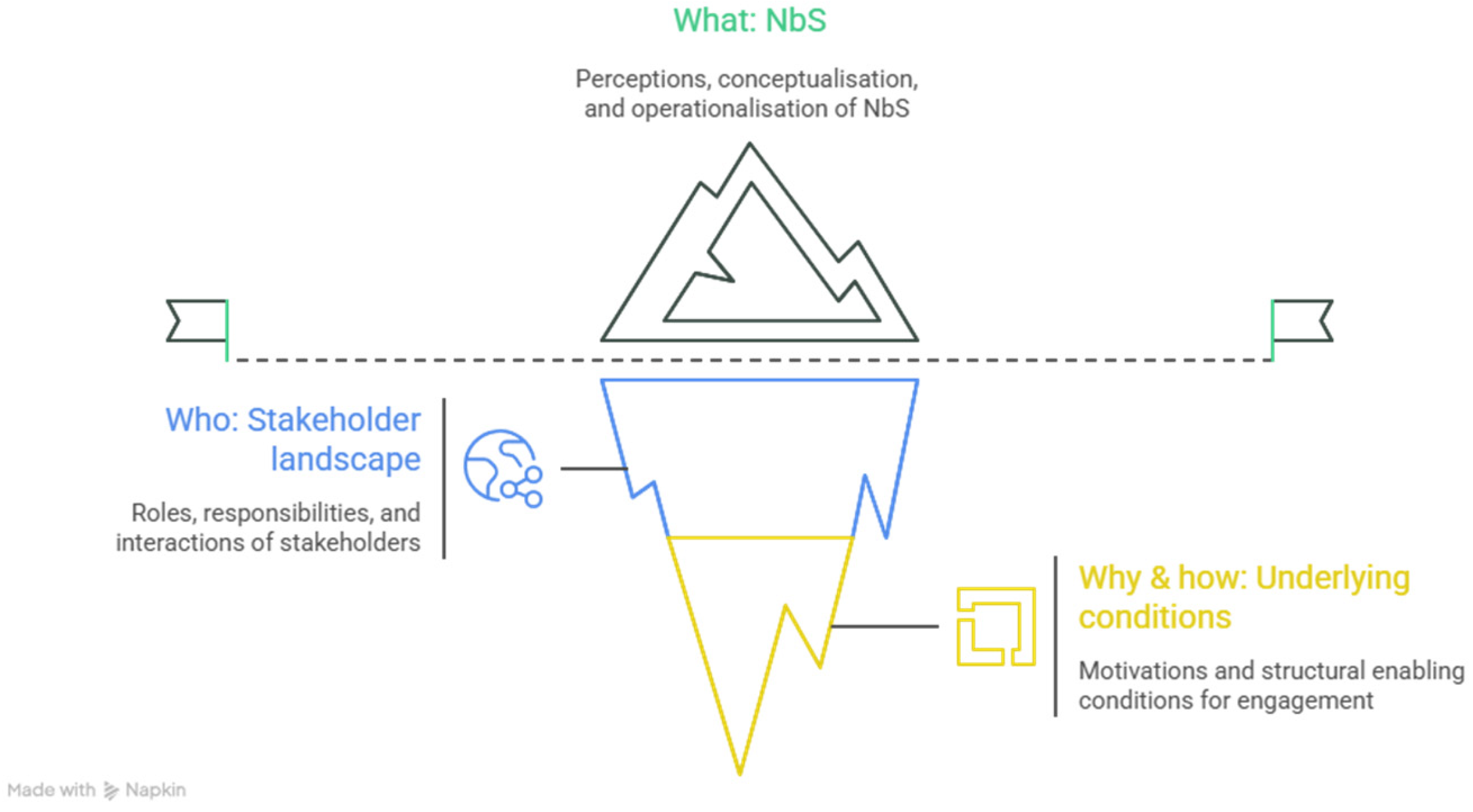
3.1. Analytical Framework
- Level 1—The NbS concept (what): Perceptions, conceptualisation, and operationalisation of NbS
- Our analysis starts by uncovering how NbS are understood, conceptualised, and subsequently operationalised in the infrastructure domain.
- Level 2—The stakeholder landscape (who): Roles, responsibilities, and interactions
- Level 3—Underlying conditions for engagement (why and how): Motivations and structural enabling conditions

3.2. Step 2: Interview Design
Data Analysis
3.3. The Dutch Infrastructure Ecosystem
4. Results
4.1. NBS in the Built Environment: Beyond Singular Solutions
‘[When it comes to] nature-based solutions, it’s actually very quickly all about measures, wanting to move to implementation [of concrete projects]. And nature-inclusive is a more overarching concept, that can also be about natural capital. And about arranging funding in a different way, and behaviour, and education.’(Interview #3, National government)
‘Not the green roofs, but the large areas of the Netherlands [are needed for impactful greening]. Look, when we are implementing green roofs, but everyone keeps popping these logistical blocks into the landscape like that—what are we talking about? Or if we keep lowering the groundwater level but keep CO2 levels rising. And that’s really where the big hitters are. Housing construction should certainly not be neglected. […] A lot of people have eyes on that housing development. So if something happens there, it does a lot for perception. It might prompt people to do something. But the real impact lies elsewhere.’(Interview #6, Engineering consultancy and design)
4.2. Stakeholder Roles, Responsibilities, and Strategies: Reorienting Asset Management
‘If everyone very much cherishes the areas and has embraced the NbS… then it does become more difficult to do crazy things with it. I believe this is actually the best way. That there is so much more backlash socially if you put the flail mower over it […] then no one gets it in their head… Or that the municipal council gets reprimanded right away. That really happens.’(Interview #5, NGO)
‘You would actually like to make agreements with several parties at the same time [about sharing both in the contributions to and benefits of NbS in the public domain], which just apply to everyone. But to do that, you actually have to start on a small scale [to show the business case], and people don’t think that distributes the risks fairly.’(Interview #3, National government)
‘In the end, there is no one who has some kind of integral responsibility and can also make decisions at this level. Everything is cut up. Everyone is concerned with a small piece with a different horizon. And other goals. […] I think with a lot of nature-based solutions, I think this is really the big bottleneck.’(Interview #5, NGO)
‘What we are up against now is that [when] it goes from the project organisation to the management organization, [they] say, well, the project was executed, but now I just have a management task with a budget and certain goals. […]. So you actually see those NbS just being killed within a year. Because the manager only looks at: what is my budget and my task this year or in the coming years. They don’t look at the long term at all. We are dealing with […] the management department, which says, well, this is a situation we can’t control. Because we can’t predict NbS in our models.’(Interview #5 (NGO))
‘In infrastructure it is definitely asset managers [who can accelerate the implementation of alternative (i.e., nature-based) solutions. They are] more conservative, they know what works, and they have the best insights into the risks. Once you know the actual risks, you can try to find fitting alternatives. With climate adaptation, it is about potential future impacts. But it is so far ahead, and we work with scenarios, we cannot specifically identify risks into models.’(Interview #7, Engineering consultancy and design)
4.3. Sector Preferences and Enabling Conditions: Standardisation, Concretisation, and a Business Case
‘[The insights we need are] very practical; […] What parameters [do you use] to say: this is nature-based design?’(Interview #6, Engineering consultancy and design)
‘Start designing with a different focus, to help people get out of normal ways of thinking. Organise design sessions with all stakeholders, focusing on sustainability, and ask them: which alternatives are there, and which is the most sustainable. Broaden the problem scope. […] We get the question: we have no capacity for traffic in [the city of] Eindhoven so we want to go underground. But if you rephrase it to: we want a better living environment—that is a very different assignment.’(Interview #7, Engineering consultancy and design)
‘Benefits are difficult to measure and monetize, such as a decrease of biodiversity. Monetization, quantification is important for decision-makers. […] Using measurement and performance tools is not business as usual yet; often they also only cover one share of benefits, but do not give a comprehensive picture.’(Interview #2, Engineering consultancy and design)
‘I think, above all, there is a great need for practical examples. Where was an idea conceived? Where was the idea tested? And did it lead to positive results? If you can demonstrate that in quick wins, you have the first key to the solution.’(Interview #6, Engineering consultancy and design)
‘Some people live on arguments, some work on intrinsic feeling. It already helps to show pictures. But for asset managers, it needs to be tested, tested, tested.’(Interview #7, Engineering consultancy and design)
‘We are competing with [energy transition] and they are winning because they have clear numbers. They have clear benefits for individuals. They are getting like energy discounts or things like that, [such as] mortgage discounts.’(Interview #1, Academia)
‘We experienced that a municipality wanted to intensify livestock farming, while there was no space. We really tried to get that changed, but it didn’t work. Then we used a forum that includes, for example, ASML and Philips, the hi-tech campus. You only have to tell them once: listen, we all made this vision of how we can increase a business climate. And those high potentials that we very much need, that we are going to look for all over the world, they really won’t come and live here if they have to sit in a pigsty. Well, then it was done. It was just off the table. But then, that is quite a heavy economic argument.’(Interview #5, NGO)
‘Many people follow the path of least resistance. This can be a clue. You never pay for extra [environmental] costs of a [technical] solution. If those costs are also included, choices may be different. If you pay the actual costs, you choose differently.’(Interview #7, Engineering consultancy and design)
5. Discussion and Conclusions: An Action Perspective for the Infrastructure Domain
- There is a lack of insight into co-benefits and trade-offs and especially how these play out along the value chain of infrastructure development.
- This undercuts the effective division of roles and responsibilities and diminishes impactful collaborative decision making in and beyond the sector.
Author Contributions
Funding
Data Availability Statement
Acknowledgments
Conflicts of Interest
Appendix A. Interview Protocol and Coding Scheme

| Category | Code (Long) | Explanation |
|---|---|---|
| NBS | NBS types, examples | Examples given, types interviewee is mostly involved in |
| Definitions | How the interviewee defines NBS or nature-inclusive practices | |
| NBS status | Current state of NBS/nature-inclusive practices (in NL) | |
| Stakeholder landscape | Actor types and roles | Who is involved, who is not, who should be Which role does interviewee play, which roles do they see in the landscape, which roles are missing/not taken |
| Collaboration | Collaboration (or lack thereof), dependencies, relations of influence +Barriers or opportunities related to this theme +Reasons to collaborate (or not) +Strategies for collaboration, partnerships | |
| Stakeholder motivations | Motivations | Which personal or professional motivations does the interviewee have to be involved in NBS? Which advantages do they see? |
| Resistance | Which motivations are there to not be involved? Drawbacks, hesitations, challenges | |
| Conditions for getting involved | What would it take (institutionally, infrastructural, knowledge, …?) for actors to get more involved? | |
| Future | Trends | Visions for the future, which trend will be influential +Sources of potential disruption in the field |
| Mainstreaming | Opportunities, strategies, examples of NBS mainstreaming into built environment planning and practice +Changes needed to achieve mainstreaming/scaling |
Appendix B. Stakeholder Mapping—Dutch NbS Implementation Landscape
- Numerous national and international programmes, research collaborations, pilot projects, and urban/regional experiments focusing on climate adaptation, coastal resilience, river system restoration, and nature-inclusive spatial development.
- Activities span coastal zones, rivers, urban contexts, and infrastructure environments, illustrating a diversified landscape of NbS experimentation and implementation.
- Overall, these initiatives show a maturing ecosystem of actors, from research consortia and public authorities to engineering firms and community-oriented pilots.
Appendix B.1. Public Sector
- Encompasses national ministries, regional authorities, municipalities, public agencies, regulators, and water-related authorities involved in spatial planning, infrastructure, nature, and environmental management.
- Hold high influence, though their level of interest varies depending on mandate.
- Aligning NbS strategies with overarching policy frameworks.
- Conducting robust environmental and social impact assessments.
- Efficiently allocating public resources while maintaining transparency.
- Managing complex spatial trade-offs across sectors.
- Engaging communities effectively in planning and decision making.
Appendix B.2. Private Sector
- Includes advisory firms, engineering and design consultancies, construction companies, and financial institutions operating at national and international levels.
- Generally high interest in NbS due to emerging markets, professional positioning, and sustainability ambitions but limited direct influence on public policy.
- Advisors: effectiveness, demonstrability, scalability, monitoring, and alignment with best practices.
- Implementers: cost efficiency, timelines, safety regulations, environmental standards, community impacts.
- Financial actors: investment certainty, long-term value creation, risk management, alignment with sustainability criteria.
Appendix B.3. Private and Public Landowners
- Includes both public landowners (government and semi-government) and individual or collective private owners of land impacted by NbS interventions.
- Hold high interest and high influence, as NbS directly affects their land management activities and long-term stewardship strategies.
- Property value impacts—whether NbS enhances or threatens long-term land value.
- Land use implications—access, landscape change, operational constraints.
- Environmental trade-offs—short-term disturbance vs. long-term benefits.
- Compensation mechanisms for restrictions or functional changes.
Appendix B.4. Non-Governmental Organisations (NGOs)
- Typically operate as advocacy, monitoring, and advisory entities, providing recommendations on environmental and community interests.
- Low direct influence on project-specific decisions but high societal relevance.
- Monitoring NbS outcomes and pushing for accountability and transparency.
- Mobilising societal engagement and strengthening public awareness.
Appendix B.5. Academia and Research Institutes
- Includes universities, applied research institutes, and specialised knowledge centres engaged in NbS knowledge creation, experimentation, and long-term environmental monitoring.
- Generally high interest and low formal influence, though strong agenda-setting power is achieved through evidence, models, and analytical frameworks.
- Improving mechanisms for knowledge transfer and practical application.
- Strengthening long-term monitoring and data collection.
- Building interdisciplinary collaborations for holistic NbS design and evaluation.
- Securing long-term funding for research and experimentation.
- Supporting practitioner capacity and community understanding.
References
- Silva Zuniga, M.C.; Watson, G.; Watkins, G.G.; Rycerz, A.; Firth, J. Increasing Infrastructure Resilience with Nature-Based Solutions (NbS); Inter-American Development Bank: Washington, DC, USA, 2020. [Google Scholar]
- UNEP. Nature-Based Infrastructure: How Natural Infrastructure Solutions Can Address Sustainable Development Challenges and the Triple Planetary Crisis; United Nations Environment Programme: Nairobi, Kenya, 2023; ISBN 978-92-807-4099-8. [Google Scholar]
- Moser, J. Here’s Why Infrastructure Will Make or Break Our Response to Climate Change. Available online: https://www.weforum.org/stories/2019/09/here-s-why-infrastructure-will-make-or-break-our-response-to-climate-change/ (accessed on 18 April 2025).
- IUCN. IUCN Issues Brief: Ensuring Effective Nature-Based Solutions; International Union for the Conservation of Nature: Gland, Switzerland, 2020. [Google Scholar]
- Urban Nature Atlas. Available online: https://una.city/ (accessed on 17 February 2026).
- Dorst, H.; van der Jagt, A.; Raven, R.; Runhaar, H. Urban Greening through Nature-Based Solutions–Key Characteristics of an Emerging Concept. Sustain. Cities Soc. 2019, 49, 101620. [Google Scholar] [CrossRef]
- Wirth, M.; Canga, E.; Machi Castañer, C.; Findlay, S.; Slade, R.; Seifert, L.F.; Heffer Flaata, E.; Conevski, S.; Obriejetan, M.; Kuschel, E.; et al. Nature-Based Solutions for Demonstrating Climate-Resilient Critical Infrastructure. Deliverable 1.1: Catalogue of Suitable NbS for Climate-Resilient Infrastructure. [Project Deliverable] Nature-DEMO, 2025. Available online: https://zenodo.org/records/18812283 (accessed on 28 January 2026).
- European Commission. Towards an EU Research and Innovation Policy Agenda for Nature-Based Solutions & Re-Naturing Cities: Final Report of the Horizon 2020 Expert Group on “Nature-Based Solutions and Re-Naturing Cities”; European Commission: Bruxelles/Brussel, Belgium, 2015; ISBN 978-92-79-46051-7. [Google Scholar]
- Seddon, N.; Chausson, A.; Berry, P.; Girardin, C.A.J.; Smith, A.; Turner, B. Understanding the Value and Limits of Nature-Based Solutions to Climate Change and Other Global Challenges. Philos. Trans. R. Soc. B Biol. Sci. 2020, 375, 20190120. [Google Scholar] [CrossRef]
- Dorst, H.; van der Jagt, A.; Runhaar, H.; Raven, R. Structural Conditions for the Wider Uptake of Urban Nature-Based Solutions–A Conceptual Framework. Cities 2021, 116, 103283. [Google Scholar] [CrossRef]
- Monstadt, J. Conceptualizing the Political Ecology of Urban Infrastructures: Insights from Technology and Urban Studies. Environ. Plan. A 2009, 41, 1924–1942. [Google Scholar] [CrossRef]
- Martin, J.G.C.; Scolobig, A.; Linnerooth-Bayer, J.A.; Irshaid, J.; Aguilera Rodriguez, J.J.; Fresolone-Caparrós, A.; Oen, A. The Nature-Based Solution Implementation Gap: A Review of Nature-Based Solution Governance Barriers and Enablers. J. Environ. Manag. 2025, 388, 126007. [Google Scholar] [CrossRef]
- Frantzeskaki, N.; Vandergert, P.; Connop, S.; Schipper, K.; Zwierzchowska, I.; Collier, M.; Lodder, M. Examining the Policy Needs for Implementing Nature-Based Solutions in Cities: Findings from City-Wide Transdisciplinary Experiences in Glasgow (UK), Genk (Belgium) and Poznań (Poland). Land Use Policy 2020, 96, 104688. [Google Scholar] [CrossRef]
- Viljanen, A.; Harju, C.; Harmanen, J.; Lähtinen, K.; Toppinen, A. Toward Resilient Urban Environments: Transition Pathways in Nature-Based Solutions. Futures 2025, 169, 103595. [Google Scholar] [CrossRef]
- Dorst, H.; van der Jagt, A.; Toxopeus, H.; Tozer, L.; Raven, R.; Runhaar, H. What’s behind the Barriers? Uncovering Structural Conditions Working against Urban Nature-Based Solutions. Landsc. Urban Plan. 2022, 220, 104335. [Google Scholar] [CrossRef]
- Sarabi, S.E.; Han, Q.; Romme, A.G.L.; de Vries, B.; Wendling, L. Key Enablers of and Barriers to the Uptake and Implementation of Nature-Based Solutions in Urban Settings: A Review. Resources 2019, 8, 121. [Google Scholar] [CrossRef]
- Sarabi, S.E.; Han, Q.; Romme, A.G.L.; de Vries, B.; Valkenburg, R.; den Ouden, E. Uptake and Implementation of Nature-Based Solutions: An Analysis of Barriers Using Interpretive Structural Modeling. J. Environ. Manag. 2020, 270, 110749. [Google Scholar] [CrossRef]
- Fuenfschilling, L.; Truffer, B. The Structuration of Socio-Technical Regimes-Conceptual Foundations from Institutional Theory. Res. Policy 2014, 43, 772–791. [Google Scholar] [CrossRef]
- Loorbach, D.; Frantzeskaki, N.; Avelino, F. Sustainability Transitions Research: Transforming Science and Practice for Societal Change. Annu. Rev. Environ. Resour. 2017, 42, 599–626. [Google Scholar] [CrossRef]
- Geels, F.W. The Multi-Level Perspective on Sustainability Transitions: Responses to Seven Criticisms. Environ. Innov. Soc. Transit. 2011, 1, 24–40. [Google Scholar] [CrossRef]
- Geels, F.W. Technological Transitions as Evolutionary Reconfiguration Processes: A Multi-Level Perspective and a Case-Study. Res. Policy 2002, 31, 1257–1274. [Google Scholar] [CrossRef]
- Smith, A.; Raven, R. What is Protective Space? Reconsidering Niches in Transitions to Sustainability. Res. Policy 2012, 41, 1025–1036. [Google Scholar] [CrossRef]
- Broto, V.C.; Bulkeley, H. Maintaining Climate Change Experiments: Urban Political Ecology and the Everyday Reconfiguration of Urban Infrastructure. Int. J. Urban Reg. Res. 2013, 37, 1934–1948. [Google Scholar] [CrossRef]
- Whyte, J.; Mijic, A.; Myers, R.J.; Angeloudis, P.; Cardin, M.A.; Stettler, M.E.J.; Ochieng, W. A Research Agenda on Systems Approaches to Infrastructure. Civ. Eng. Environ. Syst. 2020, 37, 214–233. [Google Scholar] [CrossRef]
- Hommels, A. Unbuilding Cities: Obduracy in Urban Sociotechnical Change; Mit Press: Cambridge, MA, USA, 2008. [Google Scholar]
- Zuniga-Teran, A.A.; Staddon, C.; de Vito, L.; Gerlak, A.K.; Ward, S.; Schoeman, Y.; Hart, A.; Booth, G. Challenges of Mainstreaming Green Infrastructure in Built Environment Professions. J. Environ. Plan. Manag. 2020, 63, 710–732. [Google Scholar] [CrossRef]
- Biasin, A.; Toxopeus, H.; Pettenella, D.; Polzin, F.; Masiero, M. Financing Urban Nature-Based Solutions (NBS): A Literature Review from the Perspective of Funders. Nat. Based Solut. 2024, 6, 100195. [Google Scholar] [CrossRef]
- Rijkswaterstaat. Meerjarenoverzicht Vernieuwingsopgave Bruggen, Tunnels en Sluizen 2026–2030; Rijkswaterstaat: Utrecht, The Netherlands, 2025. [Google Scholar]
- Rijkswaterstaat. De Staat van de Infrastructuur; Rijkswaterstaat: Utrecht, The Netherlands, 2025. [Google Scholar]
- Rasker, P.C. Vernieuwingsopgave Infrastructuur; TNO: Den Haag, The Netherlands, 2023. [Google Scholar]
- Konijnendijk, C.C. Evidence-Based Guidelines for Greener, Healthier, More Resilient Neighbourhoods: Introducing the 3–30–300 Rule. J. For. Res. 2023, 34, 821–830. [Google Scholar] [CrossRef]
- McPhearson, T.; Frantzeskaki, N.; Ossola, A.; Diep, L.; Anderson, P.M.L.; Blatch, T.; Collier, M.J.; Cook, E.M.; Culwick Fatti, C.; Grabowski, Z.J.; et al. Global Synthesis and Regional Insights for Mainstreaming Urban Nature-Based Solutions. Proc. Natl. Acad. Sci. USA 2025, 122, 2315910121. [Google Scholar] [CrossRef]
- McPhearson, T.; Cook, E.M.; Berbés-Blázquez, M.; Cheng, C.; Grimm, N.B.; Andersson, E.; Barbosa, O.; Chandler, D.G.; Chang, H.; Chester, M.V.; et al. A Social-Ecological-Technological Systems Framework for Urban Ecosystem Services. One Earth 2022, 5, 505–518. [Google Scholar] [CrossRef]
- Egusquiza, A.; Cortese, M.; Perfido, D. Mapping of Innovative Governance Models to Overcome Barriers for Nature Based Urban Regeneration. In Proceedings of the IOP Conference Series: Earth and Environmental Science, Shanghai, China, 16–18 August 2009; IOP: London, UK, 2009; Volume 323. [Google Scholar]
- Frantzeskaki, N.; Wijsman, K.; Adams, C.; Kabisch, N.; Malekpour, S.; Pinto, M.P.; Vandergert, P. Governance of and with Nature-Based Solutions in Cities. In Nature-Based Solutions for Cities; McPhearson, T., Kabisch, N., Frantzeskaki, N., Eds.; Edward Elgar Publishing: Cheltenham, UK, 2023. [Google Scholar]
- Fakirova, E.; van Lierop, M.; Dorst, H.; Pauleit, S. City-Civil Society Dynamics in Urban Green Infrastructure Development in Munich: Governance Features and Their Impacts. Nat. Based Solut. 2025, 8, 100272. [Google Scholar] [CrossRef]
- Besters, M.; Chereji, M.; Griffin, H.; Sluimer, N.; Beunderman, J. Financiering van Integratie; City Deal Openbare Ruimte: Amsterdam, The Netherlands, 2022. [Google Scholar]
| NbS Category | Expected Ecosystem Services |
|---|---|
| Open green spaces/urban forests | Cooling and microclimate regulation; stormwater infiltration; carbon sequestration; habitat provision; air quality improvement; recreation and wellbeing. |
| Green roofs | Stormwater retention; insulation and energy savings; biodiversity habitat; evapotranspirative cooling; improved air quality. |
| Bioswales and infiltration trenches | Stormwater slowdown; infiltration; sediment capture; pollutant removal; groundwater recharge; dispersed cooling effects. |
| Riparian buffer zones | Bank stabilisation; nutrient and sediment capture; flood peak dampening; shading and cooling of waterways; habitat connectivity; groundwater recharge; pollination benefits. |
| Floodplain restoration | Flood storage; peak flow reduction; sediment retention; biodiversity enhancement; carbon storage in wet soils; recreation; groundwater recharge; microclimate regulation. |
| Rain gardens/bioretention | Pollution filtration (nutrients, metals); peak flow attenuation; increased infiltration; urban cooling; local biodiversity habitat. |
| Constructed wetlands | Wastewater purification; nutrient removal; flood buffering; carbon sequestration in soils; biodiversity; recreational/nature value; cooling via evapotranspiration. |
| Soil and water bioengineering (e.g., riverbank stabilisation) | Bank stabilisation; erosion control; slope reinforcement via roots; habitat for amphibians/invertebrates; sediment moderation; landscape integration. |
| Urban green corridors and street trees | Shading and heat island mitigation; particulate deposition; carbon sequestration; stormwater interception; habitat; psychological wellbeing. |
| Vertical greening | Thermal insulation; building energy reduction; noise buffering; habitat for insects; air pollutant capture; microclimate regulation. |
| Blue–green hybrid systems (e.g., water squares) | Pluvial flood retention; cooling; recreation; social cohesion through multifunctional space; biodiversity niches; air quality benefits. |
| Permeable pavements | Runoff reduction; improved infiltration; groundwater recharge; reduced sewer load; reduction of local flood peaks; pollutant filtration through sub-soil. |
| Analytical Framework Elements | Key Results |
|---|---|
| Level 1—‘What’: NbS as tangible systemic interventions (part of broader socio-ecological–technical systems) |
|
| Level 2—‘Who’: Stakeholder landscape (multi-actor involvement across government, markets, civil society, knowledge institutions; differing mandates, incentives, time horizons; roles/responsibilities and collaboration patterns) |
|
| Level 3a—‘Why’: Actor motivations (e.g., intrinsic sustainability commitments, societal pressure, compliance; perceived risks/values; willingness to engage and invest) |
|
| Level 3b—‘How’: Structural conditions for engagement (policy/finance frameworks, market logics, knowledge and data; governance arrangements enabling collaboration and uptake) |
|
Disclaimer/Publisher’s Note: The statements, opinions and data contained in all publications are solely those of the individual author(s) and contributor(s) and not of MDPI and/or the editor(s). MDPI and/or the editor(s) disclaim responsibility for any injury to people or property resulting from any ideas, methods, instructions or products referred to in the content. |
© 2026 by the authors. Licensee MDPI, Basel, Switzerland. This article is an open access article distributed under the terms and conditions of the Creative Commons Attribution (CC BY) license.
Share and Cite
Dorst, H.; van Kempen, S.; Bigaj-van Vliet, A. Infrastructure Transitions Through Nature-Based Solutions: Aligning Perceptions. Infrastructures 2026, 11, 102. https://doi.org/10.3390/infrastructures11030102
Dorst H, van Kempen S, Bigaj-van Vliet A. Infrastructure Transitions Through Nature-Based Solutions: Aligning Perceptions. Infrastructures. 2026; 11(3):102. https://doi.org/10.3390/infrastructures11030102
Chicago/Turabian StyleDorst, Hade, Suzan van Kempen, and Agnieszka Bigaj-van Vliet. 2026. "Infrastructure Transitions Through Nature-Based Solutions: Aligning Perceptions" Infrastructures 11, no. 3: 102. https://doi.org/10.3390/infrastructures11030102
APA StyleDorst, H., van Kempen, S., & Bigaj-van Vliet, A. (2026). Infrastructure Transitions Through Nature-Based Solutions: Aligning Perceptions. Infrastructures, 11(3), 102. https://doi.org/10.3390/infrastructures11030102