
Sustainable Concrete for Rigid Pavements Using Alkali-Activated Recycled Pumice: Strength and Carbonation Assessment

 , ,
, ,  , , ,
, , ,  and
and
Abstract
1. Introduction
2. Materials and Methods
2.1. Materials
2.1.1. Aggregates
2.1.2. Cement
2.1.3. Pumice
2.1.4. Alkaline Activator
2.2. Experimental Methods
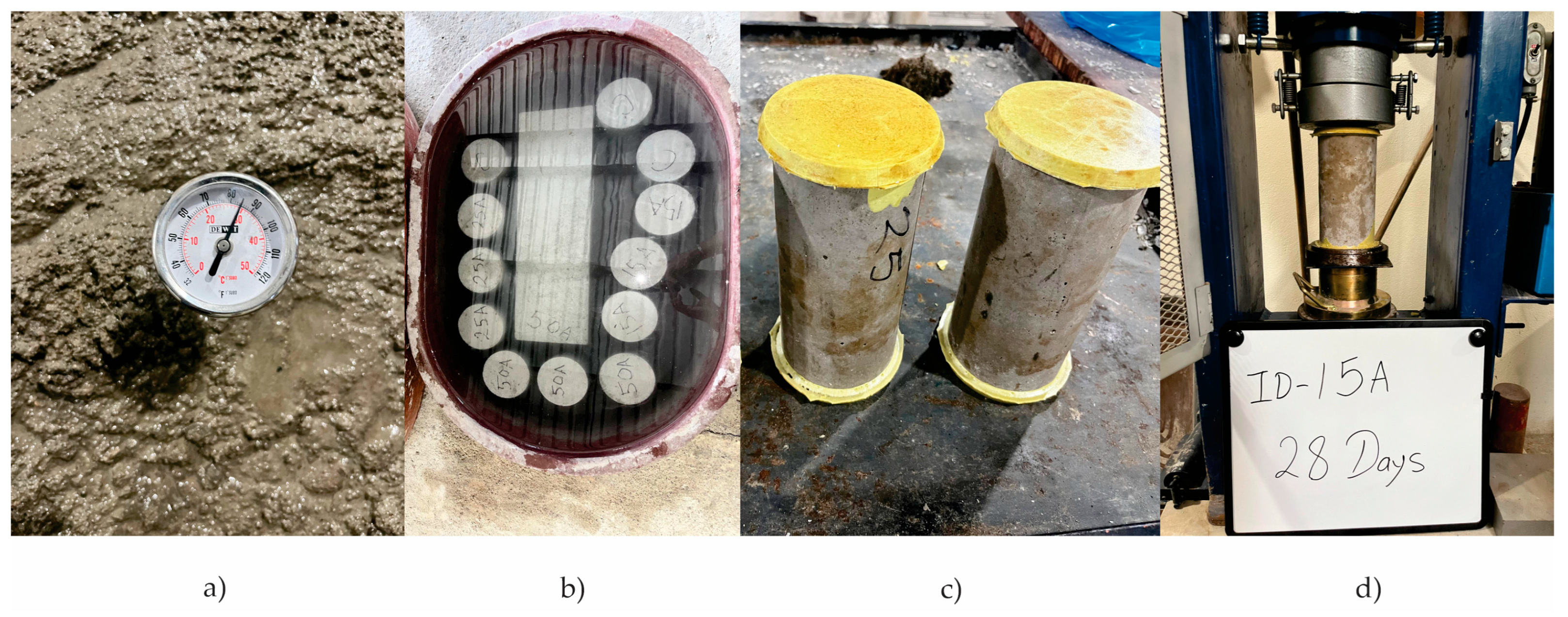
2.3. Sample Preparation
2.3.1. Preparation of Mixtures
2.3.2. Compressive Strength Test Method
2.3.3. Flexural Strength Test Method
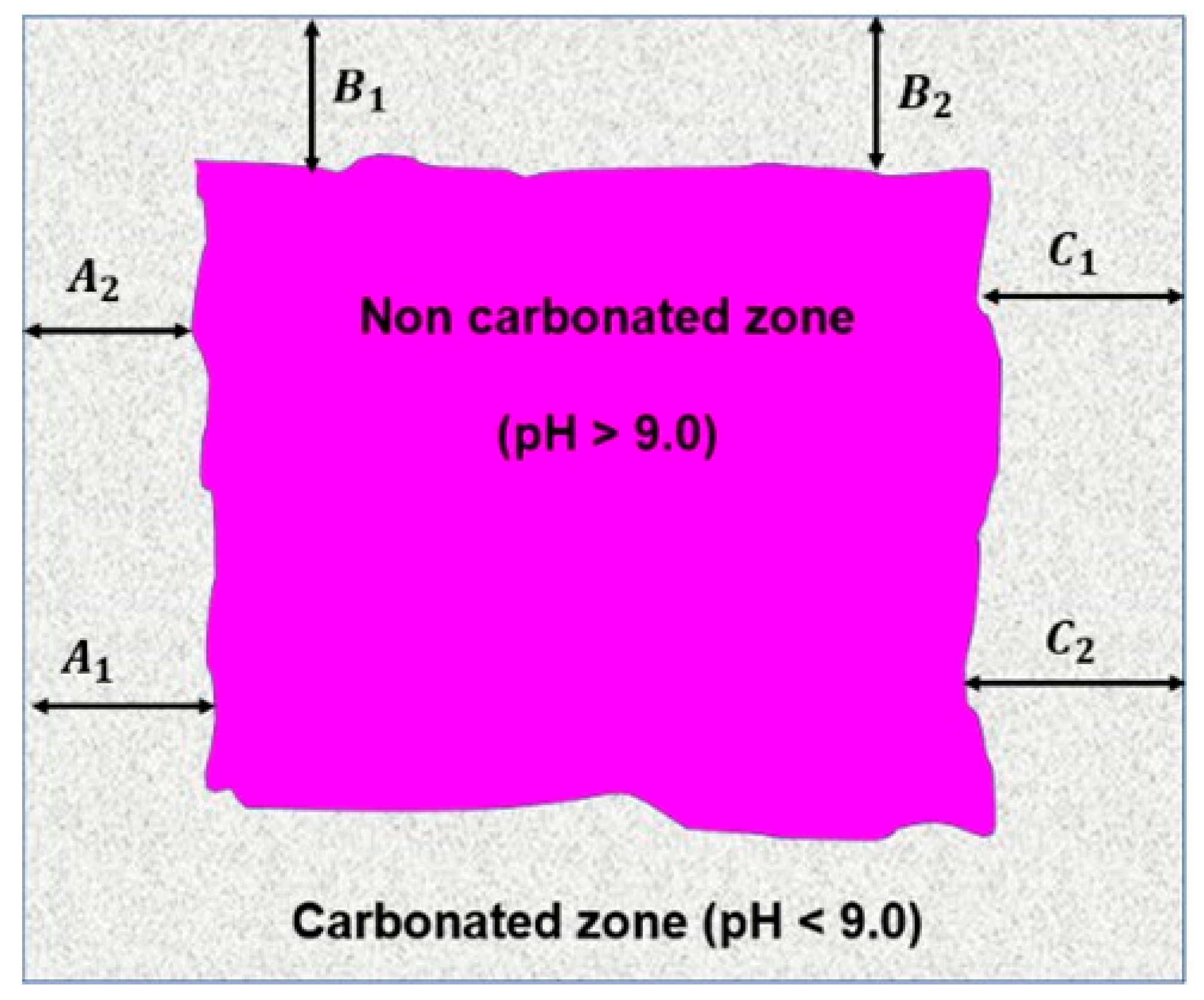
2.3.4. Carbonation Depth
2.4. Statistical Analysis
3. Results and Discussion
3.1. X-Ray Diffraction (XRD)
3.2. Fresh-State Properties of Concrete Mixtures
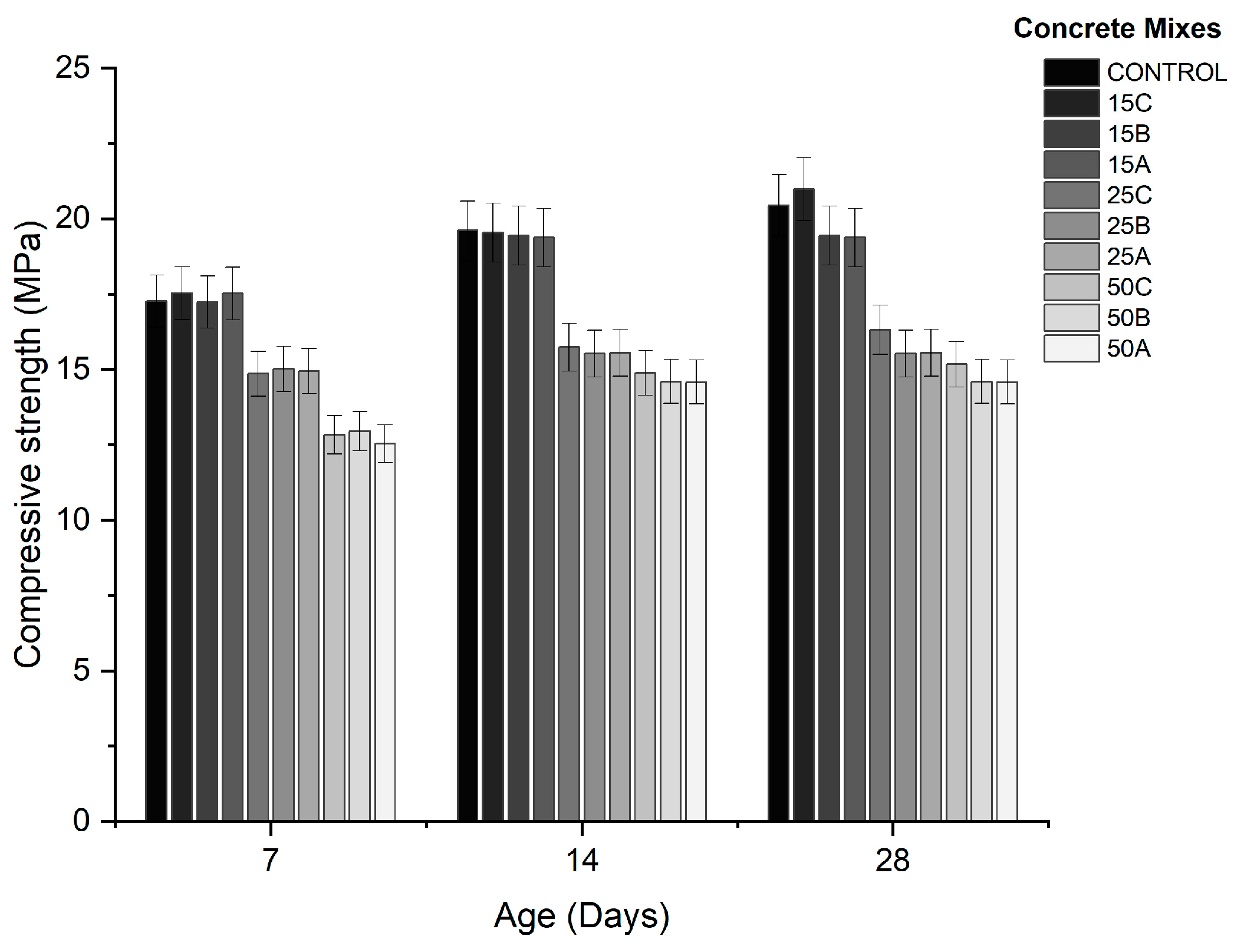
3.3. Compressive Strength
3.4. Flexural Strength
3.5. Analysis of Variance
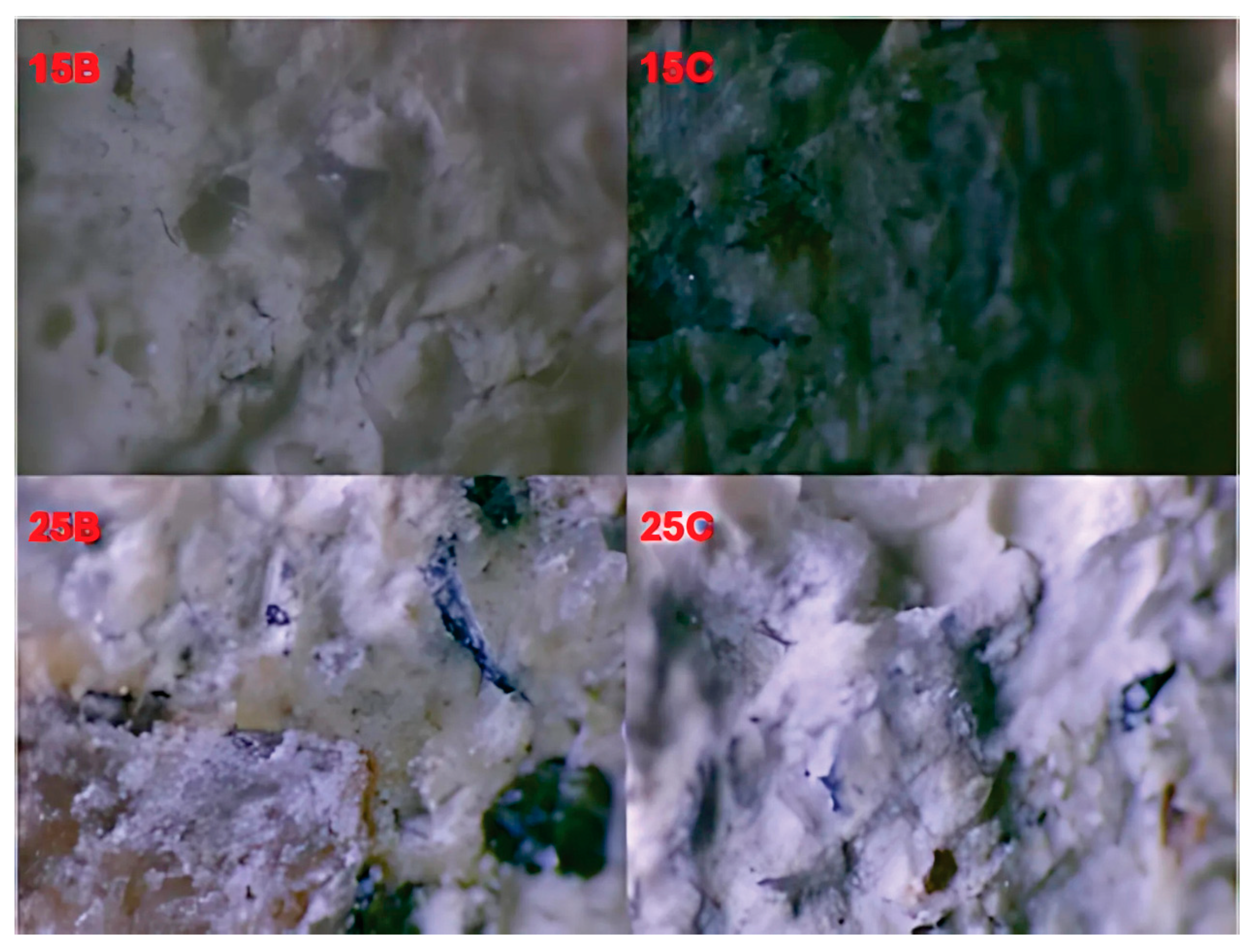
3.6. Microstructure of PM-Based Modified Hydraulic Concrete Specimens
3.7. Carbonation
4. Conclusions
Author Contributions
Funding
Data Availability Statement
Acknowledgments
Conflicts of Interest
References
- Suryani, F.M.; Rizal, S.; Abdullah, A.; Isya, M. Fly Ash Substitution in Lightweight Concrete for Rigid Pavement Construction on Low-Bearing-Capacity Soil. Sustainability 2023, 15, 15239. [Google Scholar] [CrossRef] [Scilit]
- Shao, R.; Wu, C.; Li, J. A comprehensive review on dry concrete: Application, raw material, preparation, mechanical, smart and durability performance. J. Build. Eng. 2022, 55, 104676. [Google Scholar] [CrossRef] [Scilit]
- Dehghan, A.M.M.N.M.; Maher, M.L.J.; Navarra, M. The Effects of Aggregate Properties on Concrete Mix Design and Behaviour. In Canadian Society of Civil Engineering Annual Conference; Springer Nature: Singapore, 2021; pp. 457–468. [Google Scholar]
- Villagrán-Zaccardi, Y.; Pareja, R.; Rojas, L.; Irassar, E.F.; Torres-Acosta, A.; Tobón, J.; John, V.M. Overview of cement and concrete production in Latin America and the Caribbean with a focus on the goals of reaching carbon neutrality. RILEM Tech. Lett. 2022, 7, 30–46. [Google Scholar] [CrossRef] [Scilit]
- Vásques, B.; Corrales, S. La industria del cemento en México. Análisis de sus determinantes. Problemas Del Desarrollo. Rev. Latinoam. Econ. 2017, 48, 113–138. [Google Scholar] [CrossRef] [Scilit]
- Fry, M. Cement, carbon dioxide, and the ‘necessity’narrative: A case study of Mexico. Geoforum 2013, 49, 127–138. [Google Scholar] [CrossRef] [Scilit]
- Achaw, O.W.; Danso-Boateng, E. Cement and Clay Products Technology. In Chemical and Process Industries: With Examples of Industries in Ghana; Springer International Publishing: Cham, Switzerland, 2021; pp. 135–170. [Google Scholar]
- León-Velez, A.; Guillén-Mena, V. Energía contenida y emisiones de CO2 en el proceso de fabricación de cemento en Ecuador. Ambiente Construido 2020, 20, 611–625. [Google Scholar] [CrossRef] [Scilit]
- Rosewitz, J.A.; Wang, S.; Scarlata, S.F.; Rahbar, N. An enzymatic self-healing cementitious material. Appl. Mater. Today 2021, 23, 101035. [Google Scholar] [CrossRef] [Scilit]
- Okashah, A.M.; Zainal, F.F.; Hayazi, N.F.; Nordin, M.N.; Abdullah, A. Pozzolanic properties of calcined clay in geopolymer concrete: A review. In AIP Conference Proceedings; AIP Publishing: Melville, NY, USA, 2021; Volume 2339. [Google Scholar] [CrossRef] [Scilit]
- Alrefaei, Y.; Wang, Y.S.; Dai, J.G.; Xu, Q.F. Effect of superplasticizers on properties of one-part Ca (OH) 2/Na2SO4 activated geopolymer pastes. Constr. Build. Mater. 2020, 241, 117990. [Google Scholar] [CrossRef] [Scilit]
- Zhao, W.; Chen, Y.; Liu, Z.; Wang, L.; Li, X. Effects of surface-modified coal-bearing metakaolin and graphene oxide on the properties of cement mortar. Constr. Build. Mater. 2023, 372, 130796. [Google Scholar] [CrossRef] [Scilit]
- Varshney, H.; Khan, R.A. Assessing the performance of metakaolin-enriched bio-mineralized concrete. Structures 2024, 60, 105793. [Google Scholar] [CrossRef] [Scilit]
- Zhang, H.Y.; Qiu, G.H.; Kodur, V.; Yuan, Z.S. Spalling behavior of metakaolin-fly ash based geopolymer concrete under elevated temperature exposure. Cem. Concr. Compos. 2020, 106, 103483. [Google Scholar] [CrossRef] [Scilit]
- Sharbatdar, M.K.; Abbasi, M.; Fakharian, P. Improving the properties of self-compacted concrete with using combined silica fume and metakaolin. Period. Polytech. Civ. Eng. 2020, 64, 535–544. [Google Scholar] [CrossRef] [Scilit]
- Swaminathen, A.N.; Kumar, C.V.; Ravi, S.R.; Debnath, S. Evaluation of strength and durability assessment for the impact of Rice Husk ash and Metakaolin at High Performance Concrete mixes. Mater. Today Proc. 2021, 47, 4584–4591. [Google Scholar] [CrossRef] [Scilit]
- Kolawole, J.T.; Babafemi, A.J.; Fanijo, E.; Paul, S.C.; Combrinck, R. State-of-the-art review on the use of sugarcane bagasse ash in cementitious materials. Cem. Concr. Compos. 2021, 118, 103975. [Google Scholar] [CrossRef] [Scilit]
- Prabhath, N.; Kumara, B.S.; Vithanage, V.; Samarathunga, A.I.; Sewwandi, N.; Maduwantha, K.; Madusanka, M.; Koswattage, K. A Review on the Optimization of the Mechanical Properties of Sugarcane-Bagasse-Ash-Integrated Concretes. J. Compos. Sci. 2022, 6, 283. [Google Scholar] [CrossRef] [Scilit]
- De Sande, V.T.; Sadique, M.; Pineda, P.; Bras, A.; Atherton, W.; Riley, M. Potential use of sugar cane bagasse ash as sand replacement for durable concrete. J. Build. Eng. 2021, 39, 102277. [Google Scholar] [CrossRef] [Scilit]
- Siline, M.; Mehsas, B. Effect of increasing the Blaine fineness of Metakaolin on its chemical reactivity. J. Build. Eng. 2022, 56, 104778. [Google Scholar] [CrossRef] [Scilit]
- Abdelmelek, N.; Alimrani, N.S.; Krelias, N.; Lubloy, E. Effect of elevated temperatures on microstructure of high strength concrete based-metakaolin. J. King Saud Univ.-Eng. Sci. 2021; in press. [CrossRef] [Scilit]
- Karthika, R.B.; Vidyapriya, V.; Sri, K.N.; Beaula, K.M.G.; Harini, R.; Sriram, M. Experimental study on lightweight concrete using pumice aggregate. Mater. Today Proc. 2021, 43, 1606–1613. [Google Scholar] [CrossRef] [Scilit]
- Alqarni, A.S. A comprehensive review on properties of sustainable concrete using volcanic pumice powder ash as a supplementary cementitious material. Constr. Build. Mater. 2022, 323, 126533. [Google Scholar] [CrossRef] [Scilit]
- Lehner, P.; Konečný, P.; Ghosh, P. Variation of Durability and Strength Parameters of Pumice Based Mixtures. Materials 2021, 14, 3674. [Google Scholar] [CrossRef] [Scilit]
- Hrabová, K.; Lehner, P.; Ghosh, P.; Konečný, P.; Teplý, B. Sustainability Levels in Comparison with Mechanical Properties and Durability of Pumice High-Performance Concrete. Appl. Sci. 2021, 11, 4964. [Google Scholar] [CrossRef] [Scilit]
- Zeyad, A.M.; Shubaili, M.; Abutaleb, A. Using volcanic pumice dust to produce high-strength self-curing concrete in hot weather regions. Case Stud. Constr. Mater. 2023, 18, e01927. [Google Scholar] [CrossRef] [Scilit]
- Hamada, H.M.; Abed, F.; Beddu, S.; Humada, A.M.; Majdi, A. Effect of Volcanic Ash and Natural Pozzolana on mechanical properties of sustainable cement concrete: A comprehensive review. Case Stud. Constr. Mater. 2023, 19, e02425. [Google Scholar] [CrossRef] [Scilit]
- Tran, Q.; Ghosh, P. Influence of pumice on mechanical properties and durability of high performance concrete. Constr. Build. Mater. 2020, 249, 118741. [Google Scholar] [CrossRef] [Scilit]
- Ab Latif, A.; Putrajaya, R.; Ing, D.S. A review of porous concrete pavement: Compressive strength and clogging investigation. J. Adv. Res. Appl. Sci. Eng. Technol. 2023, 29, 128–138. [Google Scholar] [CrossRef] [Scilit]
- Ferić, K.; Sathish Kumar, V.; Romić, A.; Gotovac, H. Effect of aggregate size and compaction on the strength and hydraulic properties of pervious concrete. Sustainability 2023, 15, 1146. [Google Scholar] [CrossRef] [Scilit]
- Yue, Z.; Al-odaini, A. An Investigation of the Application of New Concrete Materials in the Field of Civil Engineering. Int. J. New Dev. Eng. Soc. 2023, 7, 60–65. [Google Scholar] [CrossRef] [Scilit]
- Nilimaa, J. Smart materials and technologies for sustainable concrete construction. Dev. Built Environ. 2023, 15, 100177. [Google Scholar] [CrossRef] [Scilit]
- Santana, J.J.; Rodríguez-Brito, N.; Blanco-Peñalver, C.; Mena, V.F.; Souto, R.M. Durability of Reinforced Concrete with Additions of Natural Pozzolans of Volcanic Origin. Materials 2022, 15, 8352. [Google Scholar] [CrossRef] [Scilit]
- Ibrahim, W.M.W.; Abdullah, M.M.A.B.; Ahmad, R.; Sandu, A.V.; Vizureanu, P.; Benjeddou, O.; Sauffi, A.S. Chemical distributions of different sodium hydroxide molarities on fly ash/dolomite-based geopolymer. Materials 2022, 15, 6163. [Google Scholar] [CrossRef] [Scilit]
- López-Gonzalez, P.J.; Vivar-Ocampo, R.; González-Moreno, H.R.; Moreno-Vazquez, O.; Meza-Ruíz, E.; Zamora-Castro, S.A.; Reyes-González, D.; Sangabriel-Lomeli, J. Impact of Pumice Substitution on Mortar Properties: A Case Study on Mechanical Performance and XRD Analysis. Infrastructures 2025, 10, 95. [Google Scholar] [CrossRef] [Scilit]
- Moreno-Vázquez, O.; López-González, P.J.; Zamora-Castro, S.A.; Trujillo-García, B.S.; Sangabriel-Lomelí, J. Mechanical Behavior of Sustainable Concrete with Alkali-Activated Pumice as Cement Replacement for Walkway Slabs in Humid Tropical Climates. Eng 2025, 6, 191. [Google Scholar] [CrossRef] [Scilit]
- Noel, K.; Reyes-González, D.; Vivar-Ocampo, R.; López-González, P.J.; Martínez Castellanos, G. Effect of the Sea Breeze on the Durability of Pumice-Based Supersulfated Pastes under Accelerated Conditions. AIMS Mater. Sci. 2026, 13, 1–29. [Google Scholar] [CrossRef] [Scilit]
- NMX-C-111-ONNCCE-2014; Construction Industry—Aggregates for Hydraulic Concrete—Specifications and Testing Methods. ONNCCE: Mexico City, Mexico, 2014.
- NMX-C-414-ONNCCE-2017; Construction Industry—Hydraulic Cements—Specifications and Testing Methods. ONNCCE: Mexico City, Mexico, 2017.
- Cabrera Luna, K.; Escalante García, J.I.; Nieves Mendoza, D.; Maldonado Bandala, E.E. Compressive strength and microstructure of concretes manufactured with supersulfated cement based on materials of volcanic origin exposed to a sulfate environment. Rev. ALCONPAT 2019, 9, 106–116. [Google Scholar]
- Ghazy, M.F.; Abd Elaty, M.A.; Mostafa, S.M. Properties of one-part versus two-part geopolymers composites-a review. Am. J. Eng. Res. 2022, 11, 1–14. [Google Scholar]
- NMX-C-159-ONNCCE-2016; Construction Industry—Concrete—Preparation and Curing of Test Specimens. ONNCCE: Mexico City, Mexico, 2016.
- NMX-C-083-ONNCCE-2013; Construction Industry—Concrete—Determination of Compressive Strength—Test Method. ONNCCE: Mexico City, Mexico, 2013.
- NMX-C-191-ONNCCE-2015; Construction Industry—Concrete—Determination of Flexural Strength—Test Method. ONNCCE: Mexico City, Mexico, 2015.
- Ribeiro, A.B.; Santos, T.; Gonçalves, A. Performance of concrete exposed to natural carbonation: Use of the k-value concept. Constr. Build. Mater. 2018, 175, 360–370. [Google Scholar] [CrossRef] [Scilit]
- Medvedev, V.; Pustovgar, A. A Review of Concrete Carbonation and Approaches to Its Research under Irradiation. Buildings 2023, 13, 1998. [Google Scholar] [CrossRef] [Scilit]
- Al-Ameeri, A.S.; Rafiq, M.I.; Tsioulou, O.; Rybdylova, O. Impact of climate change on the carbonation in concrete due to carbon dioxide ingress: Experimental investigation and modelling. J. Build. Eng. 2021, 44, 102594. [Google Scholar] [CrossRef] [Scilit]
- Robayo-Salazar, R.A.; Aguirre-Guerrero, A.N.; Mejía de Gutiérrez, R. Carbonation-induced corrosion of alkali-activated binary concrete based on natural volcanic pozzolan. Constr. Build. Mater. 2020, 232, 117–189. [Google Scholar] [CrossRef] [Scilit]







| Run | Nomenclature | % of PM | % of Alkaline Solution Concentration |
|---|---|---|---|
| 1 | 15A | 15 | 1.00 N |
| 2 | 15B | 15 | 0.50 N |
| 3 | 15C | 15 | 0.25 N |
| 4 | 25A | 25 | 1.00 N |
| 5 | 25B | 25 | 0.50 N |
| 6 | 25C | 25 | 0.25 N |
| 7 | 50A | 50 | 1.00 N |
| 8 | 50B | 50 | 0.50 N |
| 9 | 50C | 50 | 0.25 N |
| Shape of Specimen | Tests | Age of Test |
|---|---|---|
| Cylinders (100 mm × 200 mm) | Compression strength | 7, 14 and 28 days |
| Beams (500 mm × 150 mm × 150 mm) | Flexural strength | 28 days |
| Cubes (100 mm × 100 mm × 100 mm) | Carbonation | 210 and 1090 days |
| Mix ID | Temperature (°C) | Slump (mm) | Unit Weight (kg/m3) |
|---|---|---|---|
| CONTROL | 28.0 | 105 | 2165 |
| 15A | 29.5 | 100 | 2120 |
| 15B | 29.0 | 105 | 2098 |
| 15C | 28.0 | 100 | 2104 |
| 25A | 29.0 | 95 | 2079 |
| 25B | 28.5 | 90 | 2047 |
| 25C | 28.0 | 100 | 2072 |
| 50A | 29.0 | 90 | 2028 |
| 50B | 28.5 | 90 | 2044 |
| 50C | 29.0 | 85 | 2032 |
| Effects | Sum of Squares | DF | Mean Squares | F Value | Critical F Value | p Value |
|---|---|---|---|---|---|---|
| Effect A | 50.653 | 2 | 25.326 | 137.467 | 3.168 | 6.52 × 10⁻²² |
| Effect B | 3.027 | 2 | 1.514 | 8.215 | 3.168 | 7.68 × 10⁻⁴ |
| Effect C | 338.390 | 2 | 169.195 | 918.362 | 3.168 | 2.02 × 10−42 |
| Effect AB | 3.051 | 4 | 0.763 | 4.139 | 2.543 | 0.005 |
| Effect AC | 7.853 | 4 | 1.963 | 10.657 | 2.543 | 1.94 × 10⁻⁶ |
| Effect BC | 0.528 | 4 | 0.132 | 0.716 | 2.543 | 0.585 |
| Effect ABC | 1.143 | 8 | 0.143 | 0.775 | 2.115 | 0.626 |
| Error | 9.949 | 54 | 0.184 | |||
| Total | 414.593 | 80 |
| Effects | Sum of Squares | DF | Mean Squares | F Value | Critical F Value | p Value |
|---|---|---|---|---|---|---|
| Effect A | 43.4115 | 2 | 21.7057 | 574.3830 | 3.5546 | 4.95 × 10⁻²² |
| Effect B | 0.1315 | 2 | 0.0658 | 1.7405 | 3.5546 | 0.2037 |
| Effect AB | 0.0875 | 4 | 0.0219 | 0.5792 | 2.9277 | 0.6815 |
| Error | 0.6802 | 18 | 0.0378 | |||
| Total | 44.3108 | 26 |
| PM-Based Modified Hydraulic Concrete | Age (Days) | Points in a Sample of Carbonated Concrete (mm) | Mean Carbonation Depth [mm] | APR = Alkaline Solution Concentration/%wt PM Substitution | |||||
|---|---|---|---|---|---|---|---|---|---|
| A1 | A2 | B1 | B2 | C1 | C2 | ||||
| 15C | 210 | 1.9 | 2.0 | 2.3 | 2.2 | 2.2 | 2.4 | 2.2 | 0.0167 |
| 25C | 10.1 | 10.3 | 9.7 | 9.8 | 10.1 | 10.0 | 10.0 | 0.01 | |
| 15B | 9.9 | 9.8 | 9.8 | 10.1 | 9.9 | 10.0 | 9.9 | 0.033 | |
| 25B | 4.8 | 4.9 | 4.9 | 5.1 | 4.9 | 5.0 | 4.9 | 0.02 | |
| 15C | 1090 | 16.0 | 15.0 | 15.0 | 16.0 | 15.0 | 13.0 | 15.0 | 0.0167 |
| 25C | 19.0 | 19.0 | 19.0 | 19.0 | 20.0 | 20.0 | 19.3 | 0.01 | |
| 15B | 18.0 | 19.0 | 21.0 | 20.0 | 21.0 | 21.0 | 20.0 | 0.033 | |
| 25B | 14.0 | 15.0 | 16.0 | 15.0 | 15.0 | 15.0 | 15.0 | 0.02 | |
Disclaimer/Publisher’s Note: The statements, opinions and data contained in all publications are solely those of the individual author(s) and contributor(s) and not of MDPI and/or the editor(s). MDPI and/or the editor(s) disclaim responsibility for any injury to people or property resulting from any ideas, methods, instructions or products referred to in the content. |
© 2026 by the authors. Licensee MDPI, Basel, Switzerland. This article is an open access article distributed under the terms and conditions of the Creative Commons Attribution (CC BY) license.
Share and Cite
López-González, P.J.; Moreno-Vázquez, O.; Zamora-Castro, S.A.; Lagunes-Vega, T.I.; Meza-Ruíz, E.; Trujillo-García, B.S.; Vivar-Ocampo, R.; Reyes-González, D.; Sangabriel-Lomelí, J. Sustainable Concrete for Rigid Pavements Using Alkali-Activated Recycled Pumice: Strength and Carbonation Assessment. Infrastructures 2026, 11, 70. https://doi.org/10.3390/infrastructures11020070
López-González PJ, Moreno-Vázquez O, Zamora-Castro SA, Lagunes-Vega TI, Meza-Ruíz E, Trujillo-García BS, Vivar-Ocampo R, Reyes-González D, Sangabriel-Lomelí J. Sustainable Concrete for Rigid Pavements Using Alkali-Activated Recycled Pumice: Strength and Carbonation Assessment. Infrastructures. 2026; 11(2):70. https://doi.org/10.3390/infrastructures11020070
Chicago/Turabian StyleLópez-González, Pablo Julián, Oscar Moreno-Vázquez, Sergio Aurelio Zamora-Castro, Tania Irene Lagunes-Vega, Efrén Meza-Ruíz, Brenda Suemy Trujillo-García, Rodrigo Vivar-Ocampo, David Reyes-González, and Joaquín Sangabriel-Lomelí. 2026. "Sustainable Concrete for Rigid Pavements Using Alkali-Activated Recycled Pumice: Strength and Carbonation Assessment" Infrastructures 11, no. 2: 70. https://doi.org/10.3390/infrastructures11020070
APA StyleLópez-González, P. J., Moreno-Vázquez, O., Zamora-Castro, S. A., Lagunes-Vega, T. I., Meza-Ruíz, E., Trujillo-García, B. S., Vivar-Ocampo, R., Reyes-González, D., & Sangabriel-Lomelí, J. (2026). Sustainable Concrete for Rigid Pavements Using Alkali-Activated Recycled Pumice: Strength and Carbonation Assessment. Infrastructures, 11(2), 70. https://doi.org/10.3390/infrastructures11020070