
Assessing the Perceived Interrelationships Among Barriers to Digital Twin Implementation in Construction: An Exploratory System Dynamics Modeling Approach
Abstract
1. Introduction
2. Literature Review
2.1. Definition of Digital Twins
2.2. Building Digital Twin
2.3. Applications in Construction
2.4. Theoretical Framework
3. Acquisition and Processing of Bdt Implementation Barrier Data
3.1. Bdt Implementation Barrier Identification
3.2. Data Processing and Analysis
3.3. Analysis of Hypothesized Interrelationships Among Variables
3.4. System Dynamics Equations
3.5. Parameter Assignment for Equations
4. Simulation Analysis and Discussion
4.1. Sensitivity Analysis of Digital Twin Implementation Barriers
4.2. Sensitivity Analysis of Risk Factors in Subsystems
4.3. Model Validation
4.4. Discussion
5. Conclusions
Supplementary Materials
Author Contributions
Funding
Institutional Review Board Statement
Informed Consent Statement
Data Availability Statement
Acknowledgments
Conflicts of Interest
References
- Dixit, S.; Mandal, S.N.; Sawhney, A.; Singh, S. Relationship between skill development and productivity in construction sector: A literature review. Int. J. Civ. Eng. Technol. 2017, 8, 649–665. [Google Scholar]
- Tezel, A.; Aziz, Z. Visual management in highways construction and maintenance in England. Eng. Constr. Archit. Manag. 2017, 24, 486–513. [Google Scholar] [CrossRef] [Scilit]
- Ministry of Housing and Urban-Rural Development, National Development and Reform Commission, Ministry of Science and Technology, Ministry of Industry and Information Technology, Ministry of Human Resources and Social Security, Ministry of Ecology and Environment, Ministry of Transport, Ministry of Water Resources, State Taxation Administration, State Administration for Market Regulation, China Banking and Insurance Regulatory Commission, National Railway Administration, and Civil Aviation Administration of China. Guidance on Promoting the Collaborative Development of Intelligent Construction and Building Industrialization. 28 July 2020. Available online: https://www.gov.cn/zhengce/zhengceku/2020-07/28/content_5530762.htm (accessed on 13 October 2026). (In Chinese)
- Opoku, D.-G.J.; Perera, S.; Osei-Kyei, R.; Rashidi, M.; Famakinwa, T.; Bamdad, K. Drivers for digital twin adoption in the construction industry: A systematic literature review. Buildings 2022, 12, 113. [Google Scholar] [CrossRef] [Scilit]
- Allen, B.D. Digital twins and living models at NASA. In Proceedings of the Digital Twin Summit, Virtual, 3–4 November 2021. [Google Scholar]
- Grieves, W.M. Product lifecycle management: The new paradigm for enterprises. Int. J. Prod. Dev. 2005, 2, 71–84. [Google Scholar] [CrossRef] [Scilit]
- Borth, M.; Verriet, J.; Muller, G. Digital twin strategies for SoS 4 challenges and 4 architecture setups for digital twins of SoS. In Proceedings of the 14th Annual Conference System of Systems Engineering (SoSE); IEEE: Piscataway, NJ, USA, 2019; pp. 164–169. [Google Scholar]
- Canedo, A. Industrial IoT lifecycle via digital twins. In Proceedings of the 11th IEEE/ACM/IFIP International Conference on Hardware/Software Codesign and System Synthesis; Association for Computing Machinery: New York, NY, USA, 2016; p. 1. [Google Scholar]
- Tao, F.; Sui, F.; Liu, A.; Qi, Q.; Zhang, M.; Song, B.; Guo, Z.; Lu, S.C.-Y.; Nee, A.Y.C. Digital twin-driven product design framework. Int. J. Prod. Res. 2019, 57, 3935–3953. [Google Scholar] [CrossRef] [Scilit]
- Han, D.C.; Zhang, H.; Liu, Y.; Cui, W. From BIM to BDT: A conceptual study on building digital twin (BDT). Archit. J. 2020, 10, 95–101. (In Chinese) [Google Scholar]
- Corrado, C.R.; DeLong, S.M.; Holt, E.G.; Hua, E.Y.; Tolk, A. Combining green metrics and digital twins for sustainability planning and governance of smart buildings and cities. Sustainability 2022, 14, 12988. [Google Scholar] [CrossRef] [Scilit]
- Martinelli, I.; Campi, F.; Checcacci, E.; Presti, G.M.L.; Pescatori, F.; Pumo, A.; Germani, M. Cost estimation method for gas turbine in conceptual design phase. Procedia Cirp 2019, 84, 650–655. [Google Scholar] [CrossRef] [Scilit]
- Liu, Z.S.; Shi, G.L.; Sun, J.J. Digital twin technology and its application in intelligent construction. Ind. Constr. 2021, 51, 184–192. (In Chinese) [Google Scholar]
- Sacks, R.; Brilakis, I.; Pikas, E.; Xie, H.S.; Girolami, M. Construction with digital twin information systems. Data-Centric Eng. 2020, 1, e14. [Google Scholar] [CrossRef] [Scilit]
- Khajavi, S.H.; Motlagh, N.H.; Jaribion, A.; Werner, L.C.; Holmstrom, J. Digital twin: Vision, benefits, boundaries, and creation for buildings. IEEE Access 2019, 7, 147406–147419. [Google Scholar] [CrossRef] [Scilit]
- Zhang, Y.F. A review of digital twin applications across the whole lifecycle of the construction industry. Constr. Econ. 2023, 44, 479–483. (In Chinese) [Google Scholar]
- Adeniyi, O.; Rathnasiri, P.; Ojo, L.D.; Akindehinde, A.; Thurairajah, N. The evolution of digital twin applications in construction and the built environment: Analysis of trends, research clusters and future directions. Intell. Build. Int. 2025, 1–29. [Google Scholar] [CrossRef] [Scilit]
- Tornatzky, L.G.; Fleischer, M. The Processes of Technological Innovation; Lexington Books: Lexington, MA, USA, 1990. [Google Scholar]
- Trist, E.L.; Bamforth, K.W. Some social and psychological consequences of the longwall method of coal-getting. Hum. Relat. 1951, 4, 3–38. [Google Scholar] [CrossRef] [Scilit]
- Tuhaise, V.V.; Tah, J.H.M.; Abanda, F.H. Technologies for digital twin applications in construction. Autom. Constr. 2023, 152, 104931. [Google Scholar] [CrossRef] [Scilit]
- Omrany, H.; Al-Obaidi, K.M.; Husain, A.; Ghaffarianhoseini, A. Digital twins in the construction industry: A comprehensive review of current implementations, enabling technologies, and future directions. Sustainability 2023, 15, 10908. [Google Scholar] [CrossRef] [Scilit]
- Opoku, D.-G.J.; Perera, S.; Osei-Kyei, R.; Rashidi, M.; Bamdad, K.; Famakinwa, T. Barriers to the adoption of digital twin in the construction industry: A literature review. Informatics 2023, 10, 14. [Google Scholar] [CrossRef] [Scilit]
- Marocco, M.; Garofolo, I. Integrating disruptive technologies with facilities management: A literature review and future research directions. Autom. Constr. 2021, 131, 103917. [Google Scholar] [CrossRef] [Scilit]
- Shahzad, M.; Shafiq, M.T.; Douglas, D.; Kassem, M. Digital twins in built environments: An investigation of the characteristics, applications, and challenges. Buildings 2022, 12, 120. [Google Scholar] [CrossRef] [Scilit]
- Boje, C.; Guerriero, A.; Kubicki, S.; Rezgui, Y. Towards a semantic construction digital twin: Directions for future research. Autom. Constr. 2020, 114, 103179. [Google Scholar] [CrossRef] [Scilit]
- Sacks, R.; Girolami, M.; Brilakis, I. Building information modelling, artificial intelligence and construction tech. Dev. Built Environ. 2020, 4, 100011. [Google Scholar] [CrossRef] [Scilit]
- Opoku, D.-G.J.; Perera, S.; Osei-Kyei, R.; Rashidi, M. Digital twin application in the construction industry: A literature review. J. Build. Eng. 2021, 40, 102726. [Google Scholar] [CrossRef] [Scilit]
- Greif, T.; Stein, N.; Flath, C.M. Peeking into the void: Digital twins for construction site logistics. Comput. Ind. 2020, 121, 103264. [Google Scholar] [CrossRef] [Scilit]
- Rafsanjani, H.N.; Nabizadeh, A.H. Towards digital architecture, engineering, and construction (AEC) industry through virtual design and construction (VDC) and digital twin. Energy Built Environ. 2023, 4, 169–178. [Google Scholar] [CrossRef] [Scilit]
- Wu, Y.; Shang, J.; Xue, F. Regard: Symmetry-based coarse registration of smartphone’s colorful point clouds with cad drawings for low-cost digital twin buildings. Remote Sens. 2021, 13, 1882. [Google Scholar] [CrossRef] [Scilit]
- Jiang, Y.; Liu, X.; Kang, K.; Wang, Z.; Zhong, R.Y.; Huang, G.Q. Blockchain-enabled cyber-physical smart modular integrated construction. Comput. Ind. 2021, 133, 103553. [Google Scholar] [CrossRef] [Scilit]
- Li, M.; Lu, Q.; Bai, S.; Zhang, M.; Tian, H.; Qin, L. Digital twin-driven virtual sensor approach for safe construction operations of trailing suction hopper dredger. Autom. Constr. 2021, 132, 103961. [Google Scholar] [CrossRef] [Scilit]
- Meža, S.; Mauko Pranjić, A.; Vezočnik, R.; Osmokrović, I.; Lenart, S. Digital twins and road construction using secondary raw materials. J. Adv. Transp. 2021, 2021, 8833058. [Google Scholar] [CrossRef] [Scilit]
- Tao, F.; Zhang, C.; Qi, Q.; Zhang, H. Digital twin maturity model. Comput. Integr. Manuf. Syst. 2022, 28, 1267. [Google Scholar]
- Tao, F. Digital twin standard system. Comput. Integr. Manuf. Syst. 2019, 25, 2405. [Google Scholar]
- Jiang, Y.; Li, M.; Guo, D.; Wu, W.; Zhong, R.Y.; Huang, G.Q. Digital twin-enabled smart modular integrated construction system for on-site assembly. Comput. Ind. 2022, 136, 103594. [Google Scholar] [CrossRef] [Scilit]
- Teisserenc, B.; Sepasgozar, S. Adoption of blockchain technology through digital twins in the construction industry 4.0: A PESTELS approach. Buildings 2021, 11, 670. [Google Scholar] [CrossRef] [Scilit]
- Xia, H.; Liu, Z.; Maria, E.; Liu, X.; Lin, C. Study on city digital twin technologies for sustainable smart city design: A review and bibliometric analysis of geographic information system and building information modeling integration. Sustain. Cities Soc. 2022, 84, 104009. [Google Scholar] [CrossRef] [Scilit]
- Hoeft, M.; Trask, C. Safety built right in: Exploring the occupational health and safety potential of BIM-based platforms throughout the building lifecycle. Sustainability 2022, 14, 6104. [Google Scholar] [CrossRef] [Scilit]
- Cruz, H.; Raheem, A.A.; Nazarian, S. Digital twin technology applications for transportation infrastructure—A survey-based study. In Computing in Civil Engineering 2021; ASCE Library: Reston, VA, USA, 2021; pp. 350–357. [Google Scholar]
- Nguyen, H.X.; Trestian, R.; To, D.; Tatipamula, M. Digital twin for 5G and beyond. IEEE Commun. Mag. 2021, 59, 10–15. [Google Scholar] [CrossRef] [Scilit]
- Turner, C.J.; Oyekan, J.; Stergioulas, L.; Griffin, D. Utilizing industry 4.0 on the construction site: Challenges and opportunities. IEEE Trans. Ind. Inf. 2020, 17, 746–756. [Google Scholar] [CrossRef] [Scilit]
- Zhao, J.; Feng, H.; Chen, Q.; de Soto, B.G. Developing a conceptual framework for the application of digital twin technologies to revamp building operation and maintenance processes. J. Build. Eng. 2022, 49, 104028. [Google Scholar] [CrossRef] [Scilit]
- Deng, M.; Menassa, C.C.; Kamat, V.R. From BIM to digital twins: A systematic review of the evolution of intelligent building representations in the AEC-FM industry. J. Inf. Technol. Constr. 2021, 26, 58–83. [Google Scholar] [CrossRef] [Scilit]
- Xie, M.; Qiu, Y.; Liang, Y.; Zhou, Y.; Liu, Z.; Zhang, G. Policies, applications, barriers and future trends of building information modeling technology for building sustainability and informatization in China. Energy Rep. 2022, 8, 7107–7126. [Google Scholar] [CrossRef] [Scilit]
- Kang, K.; Besklubova, S.; Dai, Y.; Zhong, R.Y. Building demolition waste management through smart BIM: A case study in Hong Kong. Waste Manag. 2022, 143, 69–83. [Google Scholar] [CrossRef] [Scilit] [PubMed]
- He, R.; Li, M.; Gan, V.J.L.; Ma, J. BIM-enabled computerized design and digital fabrication of industrialized buildings: A case study. J. Clean. Prod. 2021, 278, 123505. [Google Scholar] [CrossRef] [Scilit]
- Lu, Q.; Chen, L.; Li, S.; Pitt, M. Semi-automatic geometric digital twinning for existing buildings based on images and CAD drawings. Autom. Constr. 2020, 115, 103183. [Google Scholar] [CrossRef] [Scilit]
- Hunhevicz, J.J.; Motie, M.; Hall, D.M. Digital building twins and blockchain for performance-based (smart) contracts. Autom. Constr. 2022, 133, 103981. [Google Scholar] [CrossRef] [Scilit]
- Al-Geddawy, T. A digital twin creation method for an opensource low-cost changeable learning factory. Procedia Manuf. 2020, 51, 1799–1805. [Google Scholar] [CrossRef] [Scilit]



| Barrier Subsystem | ID | Barrier Description | Source |
|---|---|---|---|
| Technical Barriers | B1 | Lack of trust in data security | [21,23] |
| B2 | Heterogeneity of data from multiple sources | [24,25] | |
| B3 | Reliance on uninterrupted Internet connectivity | [26,27] | |
| B4 | Limitations in scalability and difficulties in data processing | [28,29] | |
| B5 | Uncertainty regarding data quality and dependability | [30,31] | |
| B6 | Insufficient availability of supporting technologies | [27,31] | |
| B7 | Challenges in setting realistic expectations | [28] | |
| B8 | System instability and unexpected breakdowns | [32] | |
| B9 | Difficulties associated with system maintenance | [33] | |
| B10 | Inaccuracies in performance simulation and prediction | [34,35] | |
| B11 | Obstacles in data acquisition and transmission | [29,36] | |
| B12 | Challenges related to data modeling | [28,29] | |
| Policy and Regulatory Barriers | B13 | Insufficient governmental incentive mechanisms | [37,38] |
| B14 | Legal and ethical issues | [39] | |
| B15 | Challenges in data governance and privacy protection | [40] | |
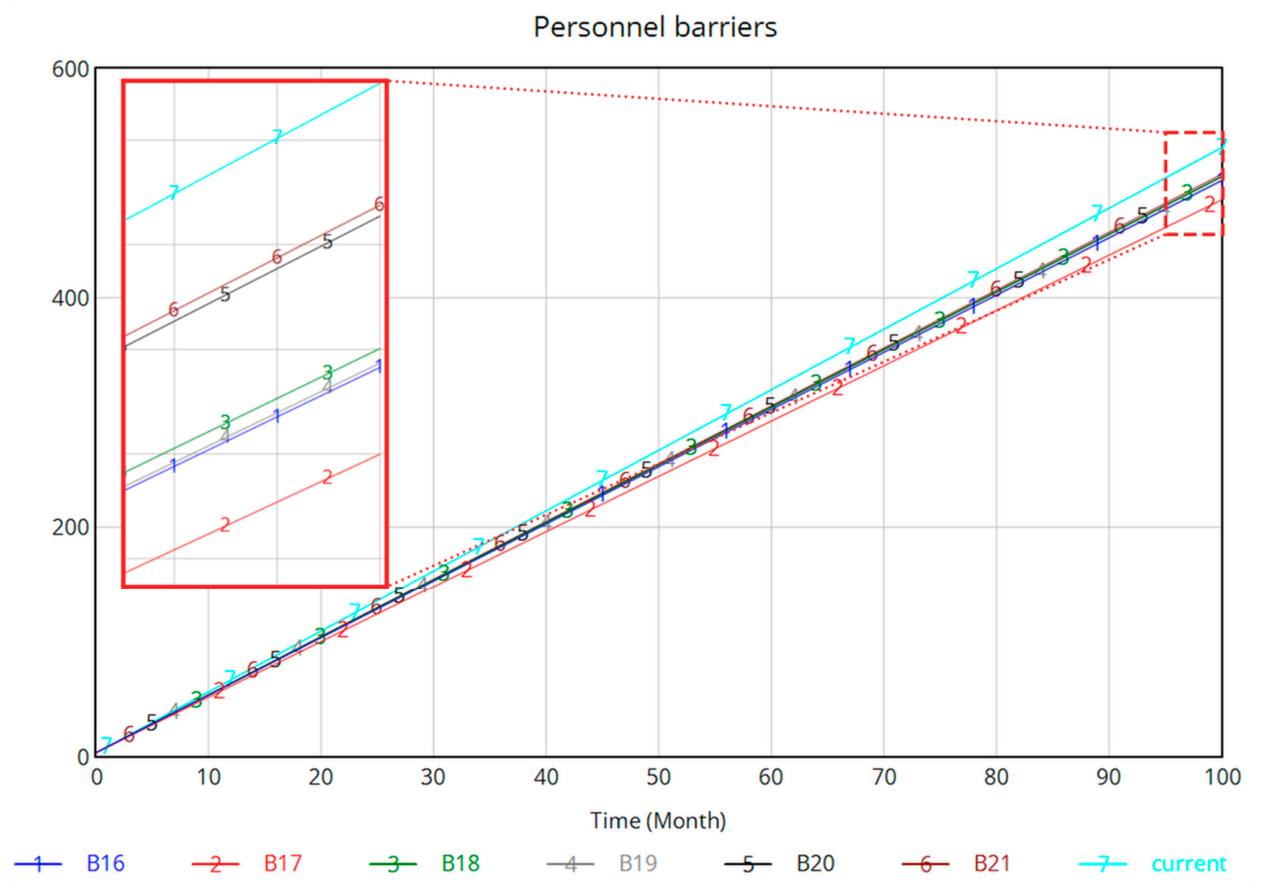
| Personnel Barriers | B16 | Inadequate levels of knowledge | [41,42] |
| B17 | Low acceptance of new technologies | [4,22] | |
| B18 | Fragmented empirical evidence related to DTs | [36,43] | |
| B19 | Gaps in interdisciplinary collaboration | [29,38] | |
| B20 | Difficulties in optimizing control strategies | [44] | |
| B21 | Challenges arising from multicultural collaboration | [29] | |
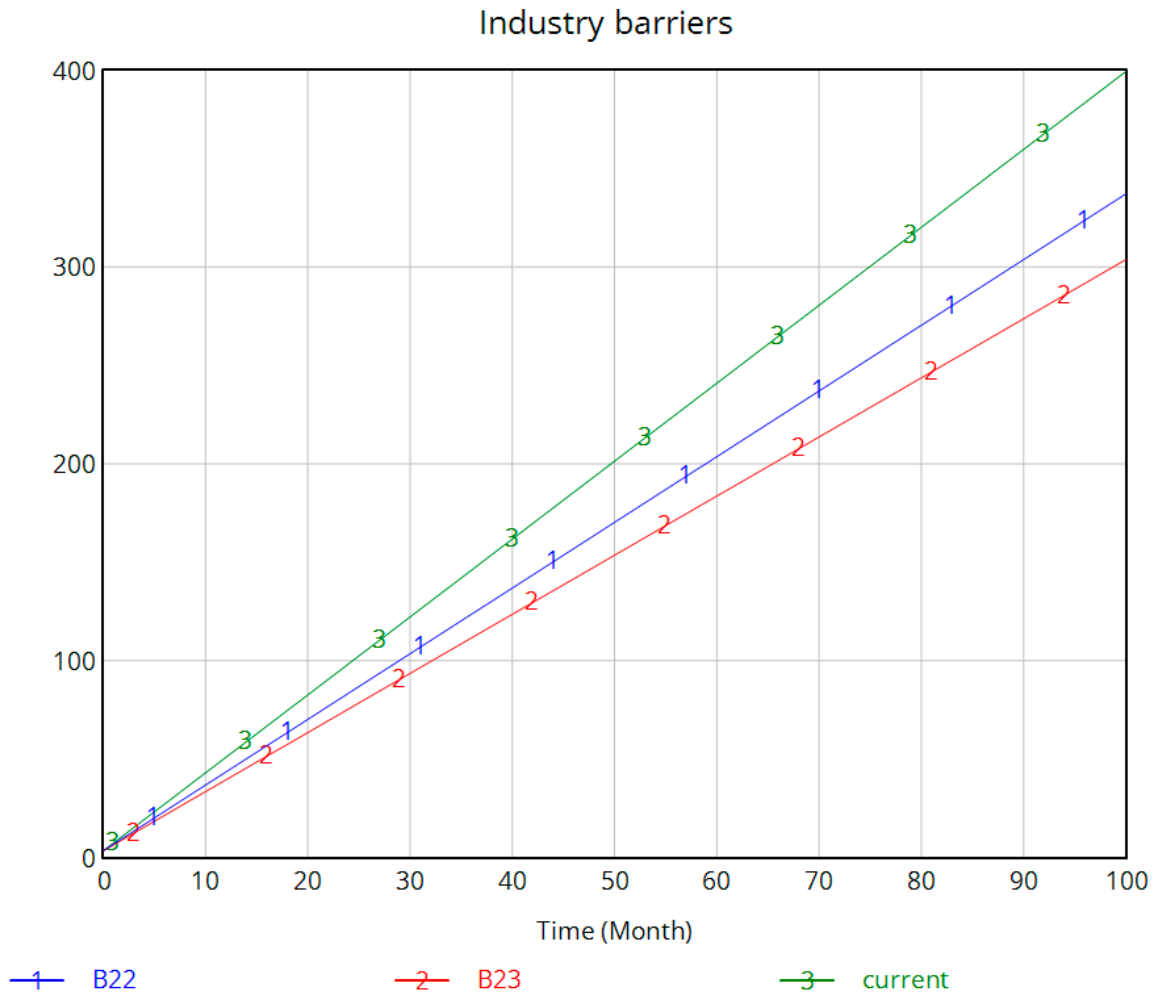
| Industry Barriers | B22 | Absence of standardized tools and methodologies | [23,45] |
| B23 | Ambiguity in the value proposition of DTs | [29,46] | |
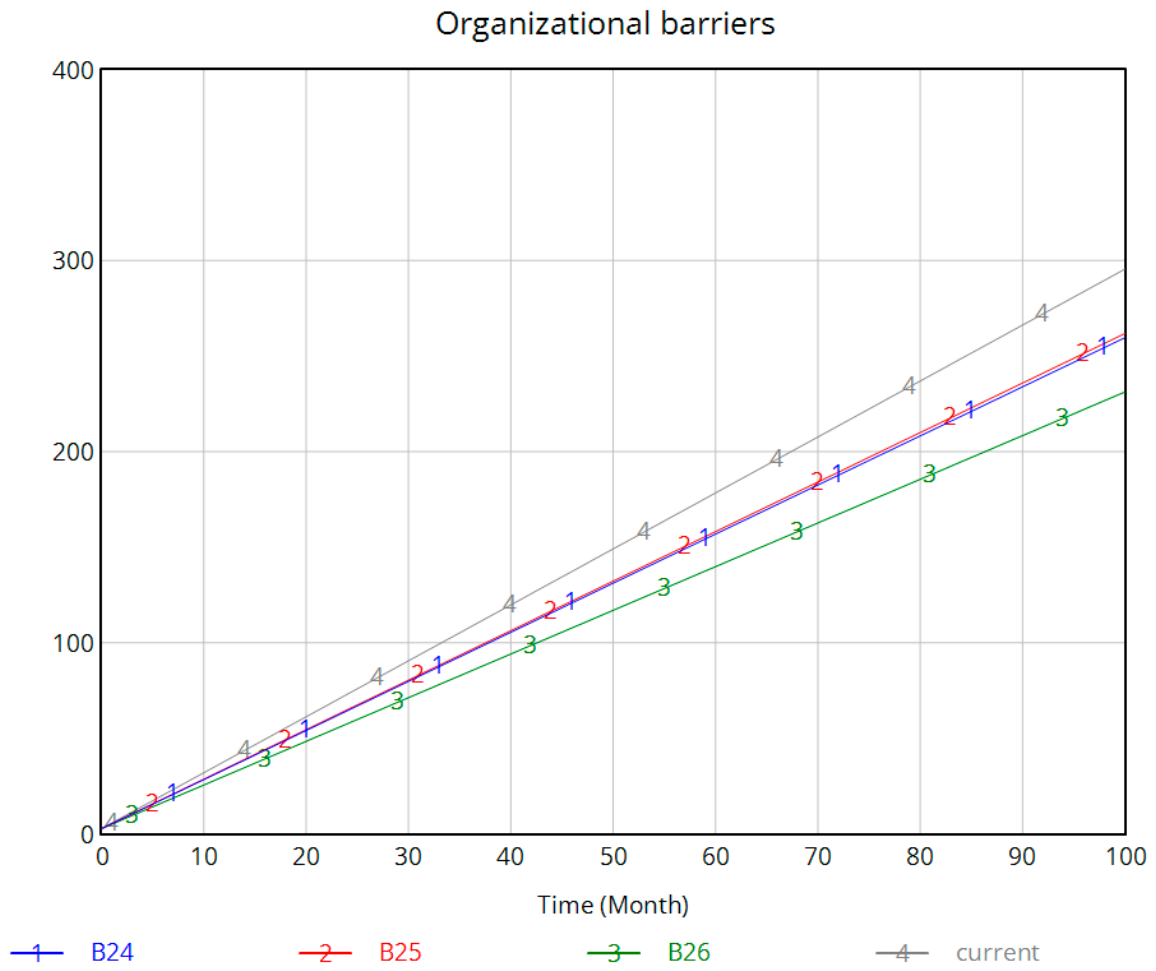
| Organizational Barriers | B24 | High project complexity | [47,48] |
| B25 | Overly stringent building codes and regulations | [26,44] | |
| B26 | Inconsistencies in project-related data | [26,29] | |
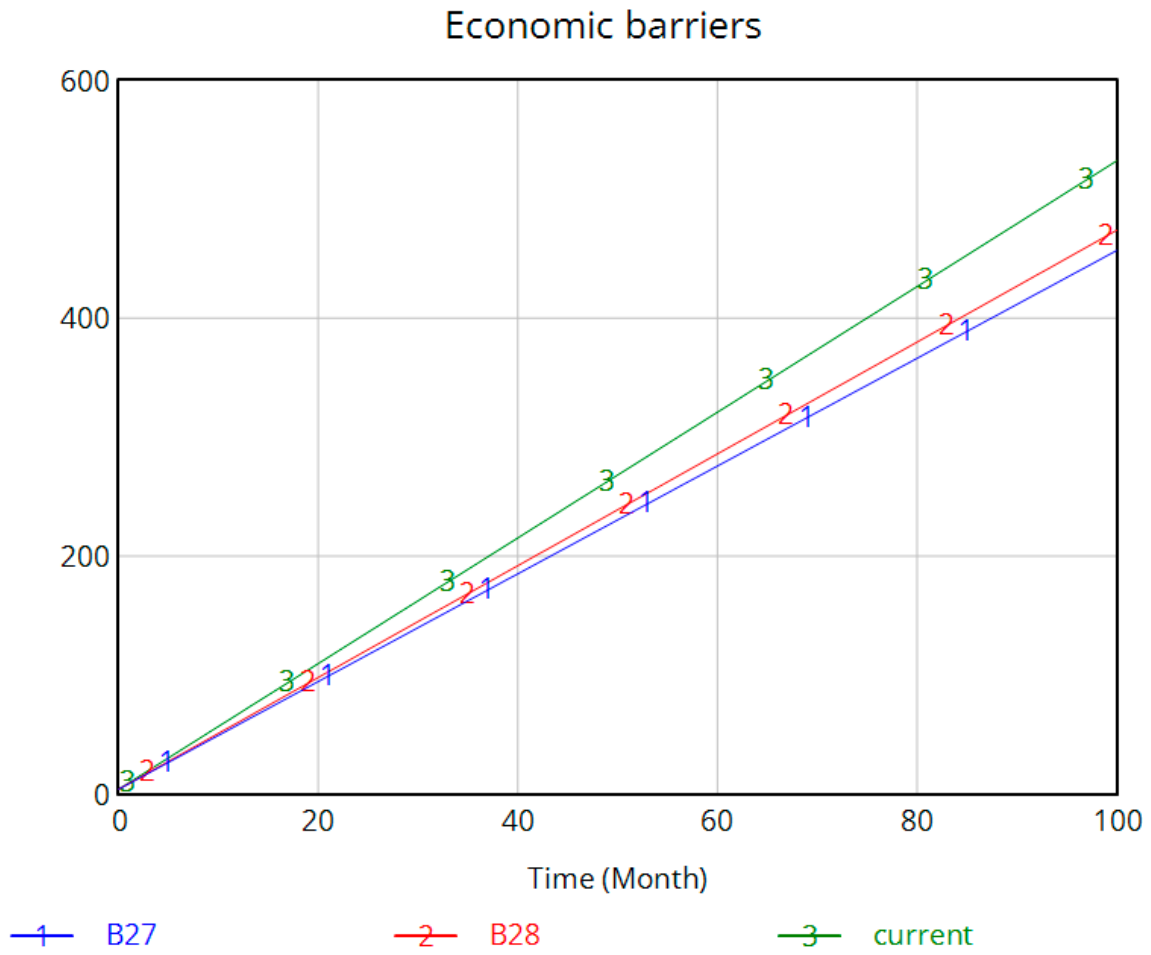
| Economic Barriers | B27 | Difficulties in obtaining financial investment | [25,49] |
| B28 | Elevated costs associated with implementation | [4,50] |
| Likelihood Level | Score | Impact Level | Score |
|---|---|---|---|
| Very high likelihood | 5 | Severe | 5 |
| High likelihood | 4 | Major | 4 |
| Moderate likelihood | 3 | Moderate | 3 |
| Low likelihood | 2 | Minor | 2 |
| Very low likelihood | 1 | Negligible | 1 |
Disclaimer/Publisher’s Note: The statements, opinions and data contained in all publications are solely those of the individual author(s) and contributor(s) and not of MDPI and/or the editor(s). MDPI and/or the editor(s) disclaim responsibility for any injury to people or property resulting from any ideas, methods, instructions or products referred to in the content. |
© 2026 by the authors. Licensee MDPI, Basel, Switzerland. This article is an open access article distributed under the terms and conditions of the Creative Commons Attribution (CC BY) license.
Share and Cite
Zhang, C.; Li, J.; Yang, L.; Fu, H.; Tang, Y.; Ao, Y. Assessing the Perceived Interrelationships Among Barriers to Digital Twin Implementation in Construction: An Exploratory System Dynamics Modeling Approach. Infrastructures 2026, 11, 374. https://doi.org/10.3390/infrastructures11100374
Zhang C, Li J, Yang L, Fu H, Tang Y, Ao Y. Assessing the Perceived Interrelationships Among Barriers to Digital Twin Implementation in Construction: An Exploratory System Dynamics Modeling Approach. Infrastructures. 2026; 11(10):374. https://doi.org/10.3390/infrastructures11100374
Chicago/Turabian StyleZhang, Chi, Jingjin Li, Lan Yang, Hanrui Fu, Yinyin Tang, and Yibin Ao. 2026. "Assessing the Perceived Interrelationships Among Barriers to Digital Twin Implementation in Construction: An Exploratory System Dynamics Modeling Approach" Infrastructures 11, no. 10: 374. https://doi.org/10.3390/infrastructures11100374
APA StyleZhang, C., Li, J., Yang, L., Fu, H., Tang, Y., & Ao, Y. (2026). Assessing the Perceived Interrelationships Among Barriers to Digital Twin Implementation in Construction: An Exploratory System Dynamics Modeling Approach. Infrastructures, 11(10), 374. https://doi.org/10.3390/infrastructures11100374